
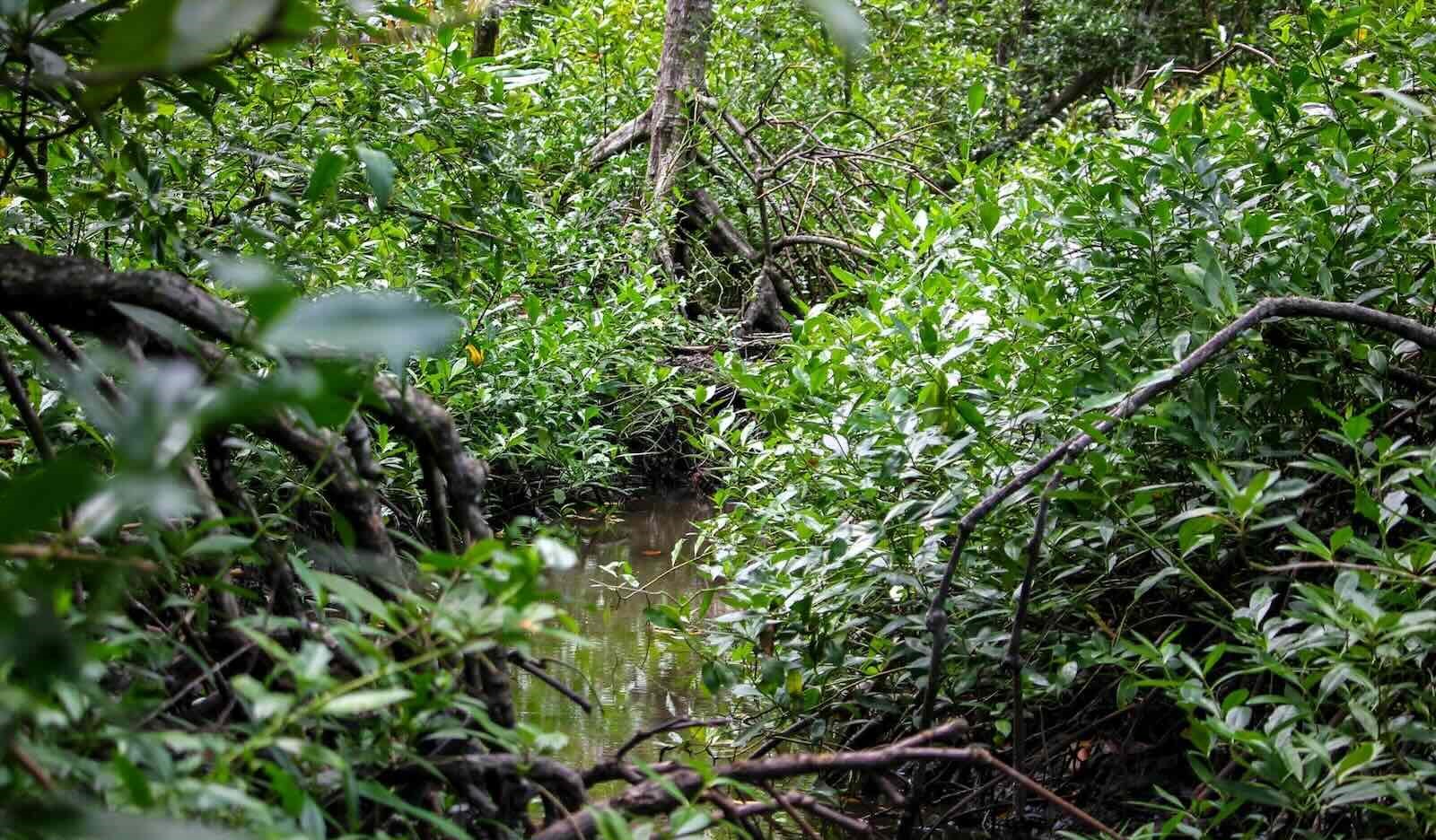
It looks like a mess but the dense, interlaced roots and branches of mangroves are what make them so mighty: a shield against the tides that would otherwise inundate the lands and drag shores back to the wider ocean. Living between sea and land, mangroves are called coastal forests. But in reality, they link and transition all the way inland to dryland forests. Or they did.
In many parts of Malaysia, they no longer do. This makes coastal communities more vulnerable. And it is the birds that are signaling the loss of mangroves – with their absence.
No More Nuthatches
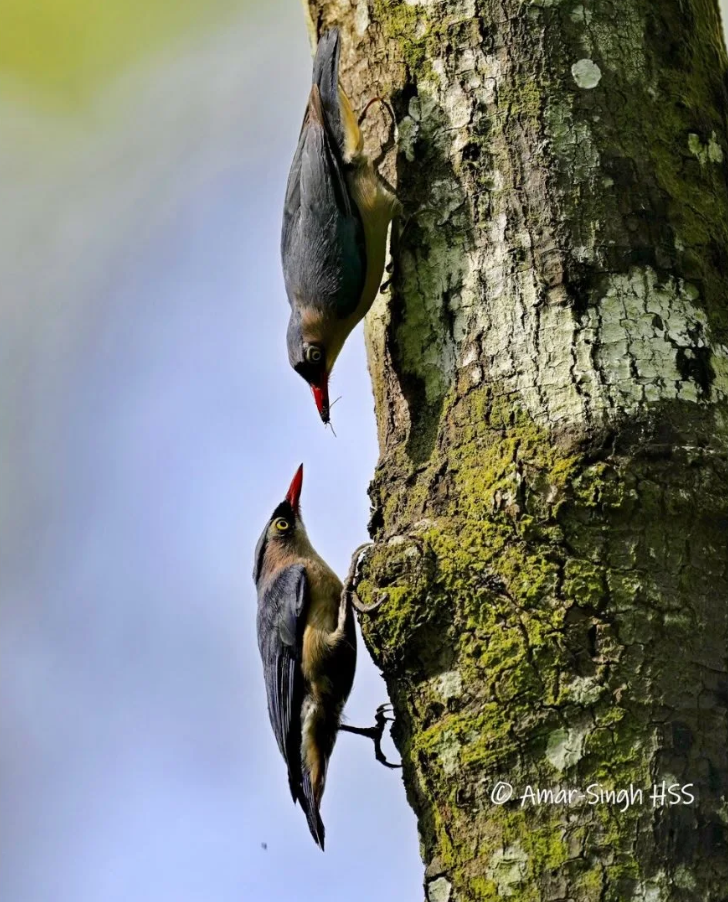
Take the Velvet-fronted Nuthatch (Sitta frontalis). This blue beauty looks like it can defy gravity by walking down vertical tree trunks thanks to powerful curved claws. But this mangrove resident “has been pushed out from, for example, nearly all of the Selangor coast, by bunding and clearance of that vegetation zone,” says eminent ornithologist Dr David Wells.
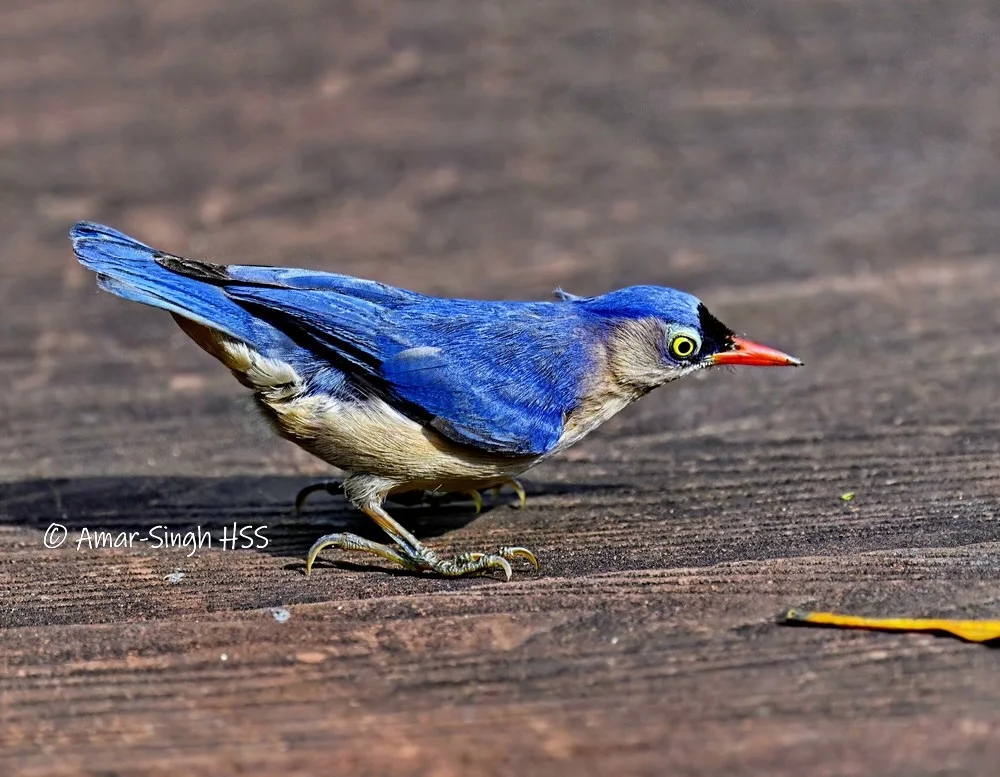
Of note is that the bird relies on what are called back mangroves. This is the landward section of the mangrove ecosystem where it transitions to non-mangrove forests. “In my estimation, back mangroves are critical to at least half of all mangrove-recorded birds. Their loss is out of all proportion to their relative area,” says Wells, who has an encyclopedic knowledge of birdlife in the region.
Generally, mangroves are not immediately associated with birds. But mangroves in Malaysia support at least 144 species of birds, both resident and migratory. In turn, birds help sustain the ecosystem.
These birds depend on mangroves as a habitat, a rich food source and a breeding ground, says the Malaysian Nature Society (MNS) in its publication ‘Birds of rehabilitated mangrove sites in Selangor’. The dense branches and tangled roots of mangroves provide nesting sites, shelter from predators, and roosting areas for both resident and migratory birds. Mangroves teem with life. Fish, crabs, and insects thrive in the shallow waters and amongst tree roots, providing a plentiful food source for wading birds, herons, and fish eagles.
Additionally, mangrove trees themselves produce fruit and nectar that some bird species consume. The richer and more diverse a mangrove habitat, the richer and more diverse the birdlife. In turn, birds contribute to mangroves in a number of ways. This includes pollination, seed dispersal, pest control and providing nutrients via bird droppings. In Peninsular Malaysia, sunbirds are a major pollinator of the Bruguiera mangrove species, says avian ecologist Richard Noske.
Famously, coastal mangrove regions are “important staging and wintering sites for waterbirds,” says MNS. The north-central Selangor coast is recognised as an Important Bird and Biodiversity Area and is located along the East-Asian-Australasian Flyway. This bird migratory route stretches from Russia all the way down to New Zealand. Specifically, mangroves are “much preferred by wintering shorebirds, herons, egrets and storks because of the strategic location that allows easy access to adjacent tidal mudflats as their foraging sites during low tide”.
But unlike mudflats and the seaward fringes of mangroves, the interiors of a mangrove ecosystem are shrouded in obscurity.
From the air, the extensive mangroves of Matang Mangroves are breathtaking (Video: Ahmad Aldrie Amir)
How Mangrove Zones Work
In Peninsular Malaysia’s largest mangrove forest, when one moves from land to water, “you can see the terrain is starting to change,” says mangrove ecologist Dr Ahmad Aldrie Amir. These are the Matang Mangroves in Perak. Stretching in a crescent, their almost 41,000 hectares of area have been protected and managed for 122 years.
The ecosystem is complex, but as the scientist points out, it is possible to roughly make out the succession of zones from the ‘true’ mangrove species seawards to the mixed dryland forest inland dominated by ‘associate’ mangrove species. The key is how much seawater reaches the various zones.
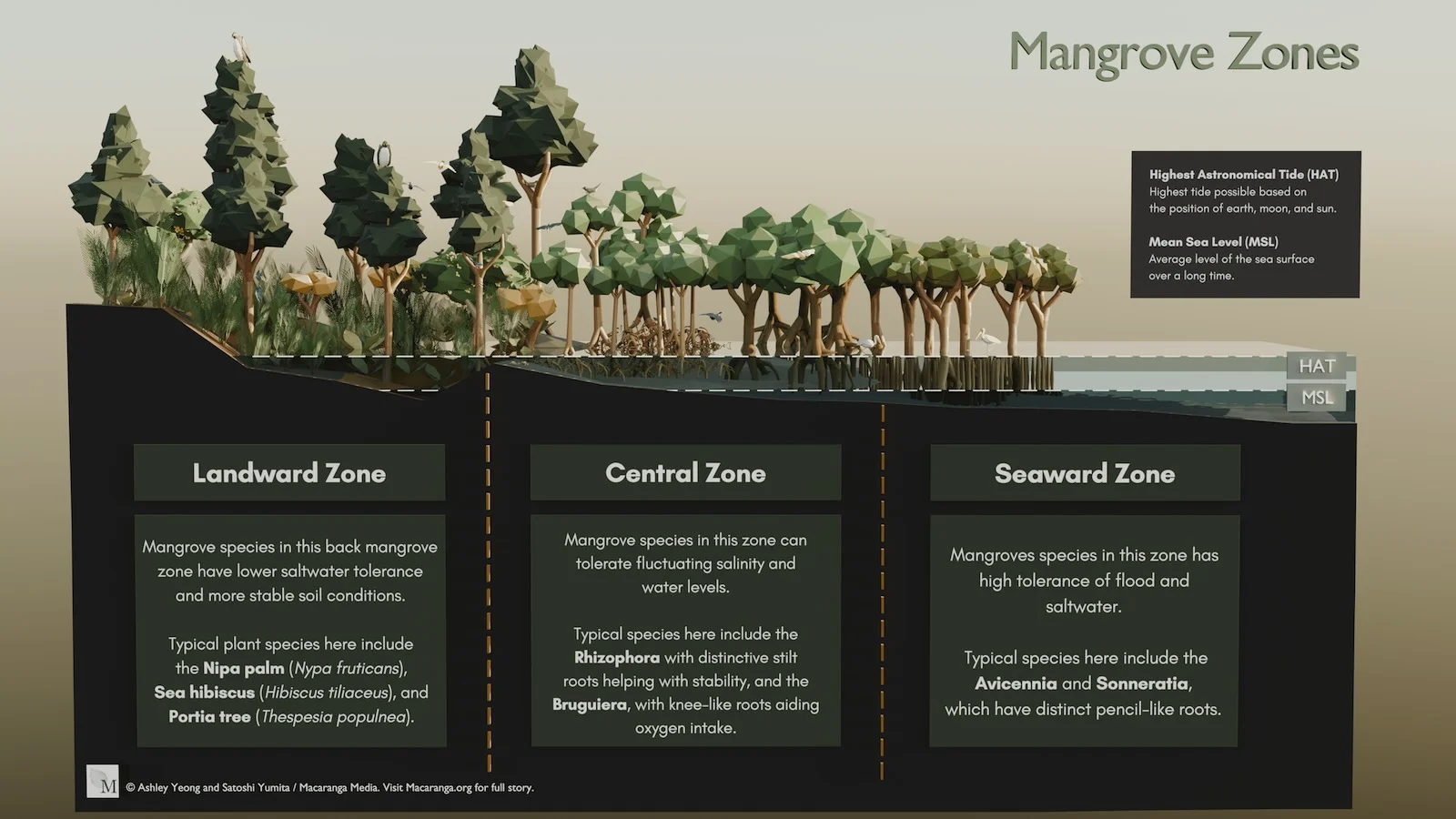
Facing the ocean and awash in 100% salty seawater are hardy species like Avicennia and Sonneratia. These trees are distinguished by their ‘pencil roots’, sticking vertically out of the sand and mud to breathe oxygen. They are called pioneer species because they ‘grow’ land by colonising new deposits of sediment.
Behind the seaward zone is the central zone, dominated by Rhizophora species. Inundated daily by seawater, their tangled web of aerial roots elevate the plants above the saltwater and allow them to ‘breathe’ even while their lower roots are submerged. Moving landward, Brugueira species with their buttresses and knee-shaped roots tend to dominate.
This zone melds into the back mangroves or landward zone, which is influenced by freshwater and is inundated only by the highest tides.
This is where the most diverse communities live, comprising mangrove and mangrove-associates plants. Among them are the Acrostichum, Acanthus, Excoecaria, and river-fringing Nypa fruticans. This zone is also richest in bird numbers and diversity, says ornithologist Wells.
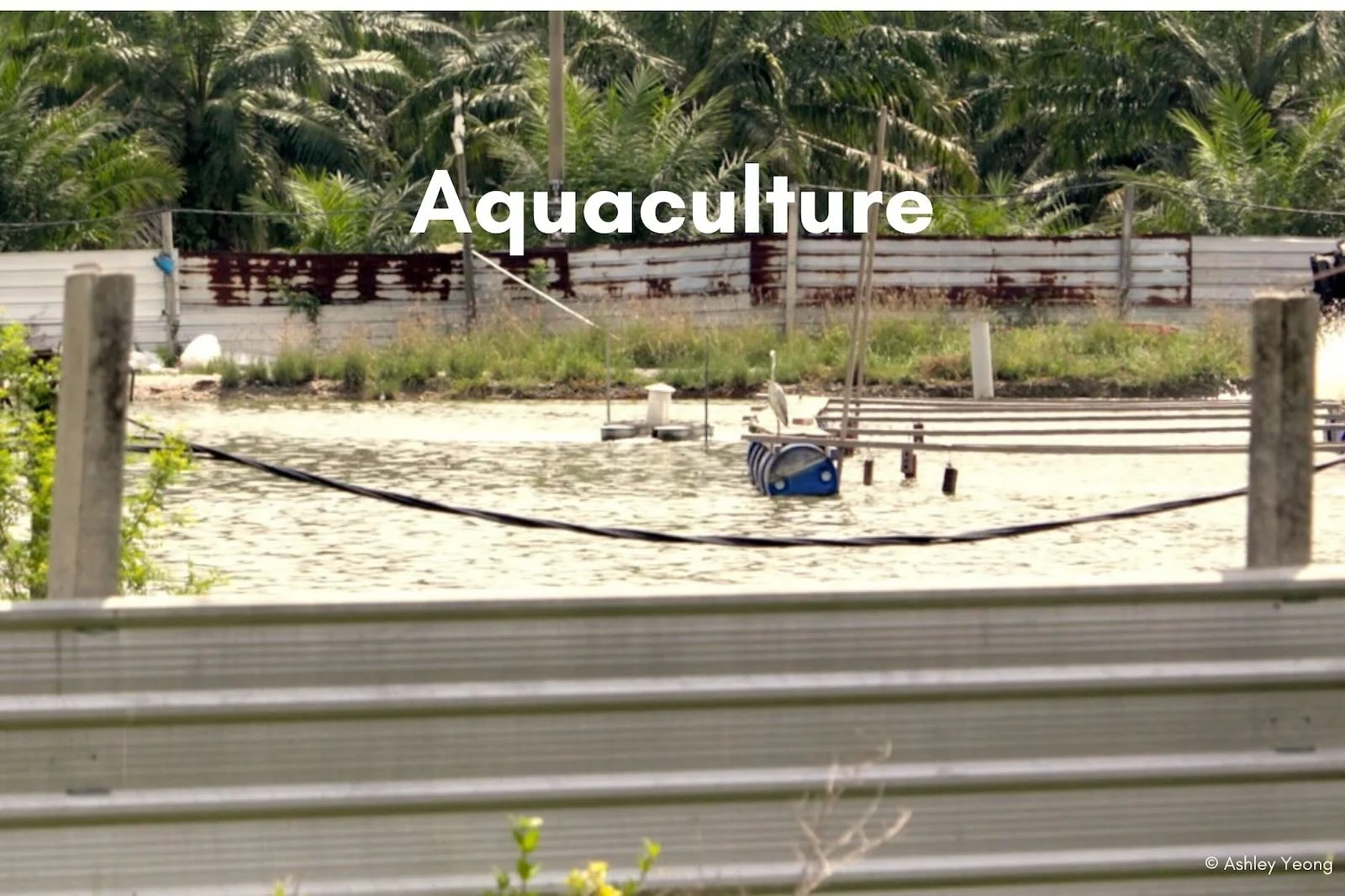
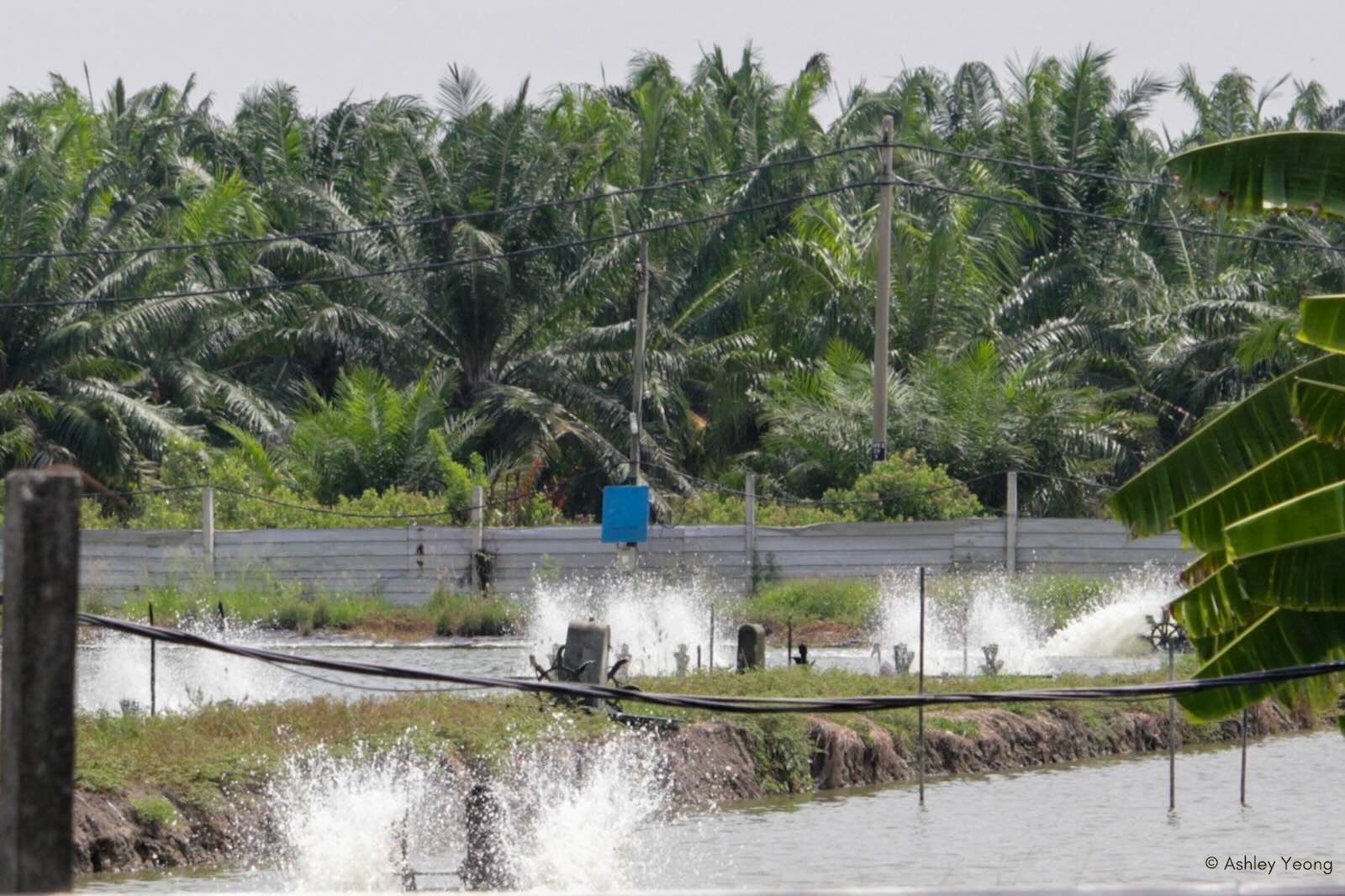
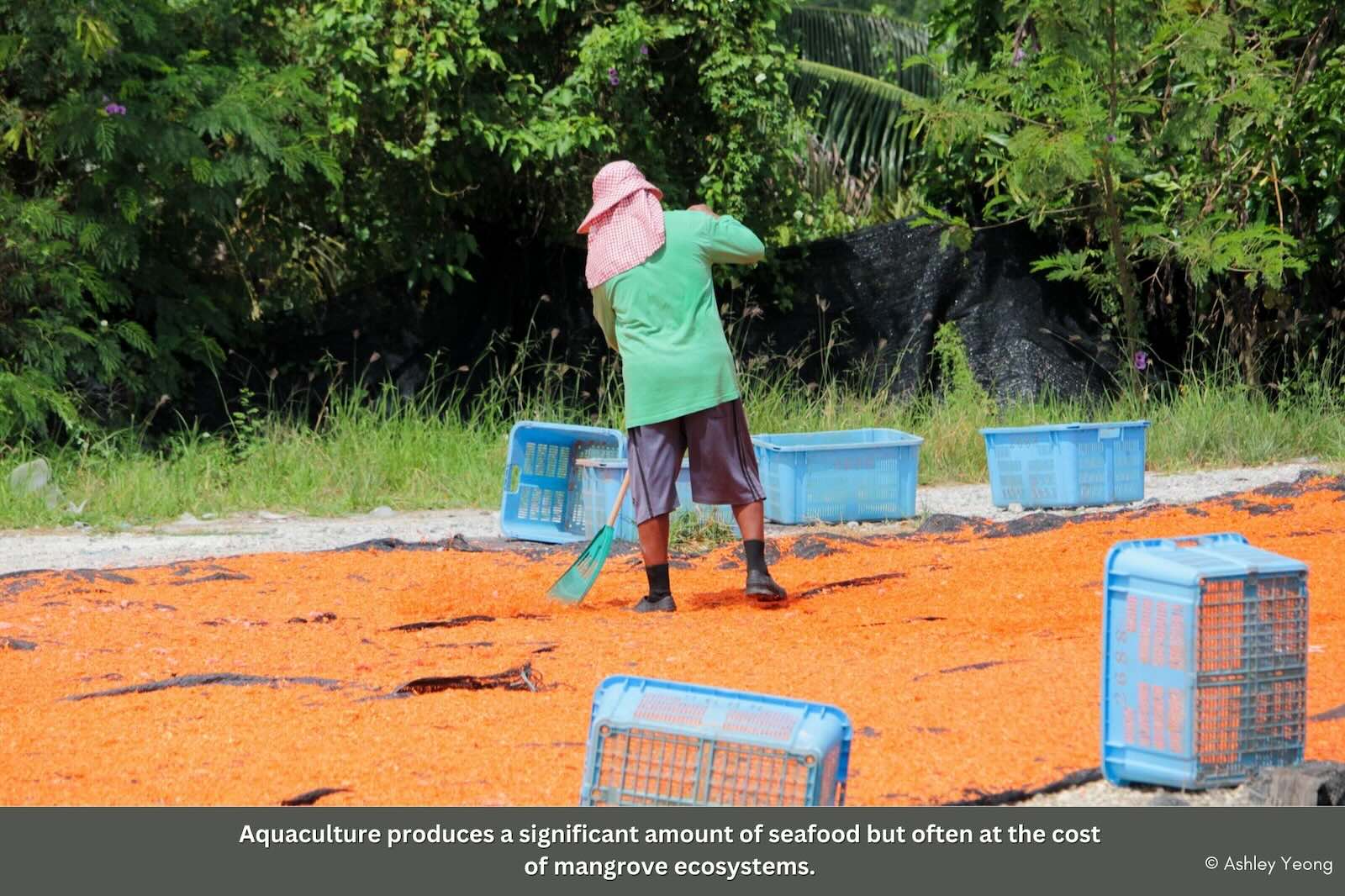
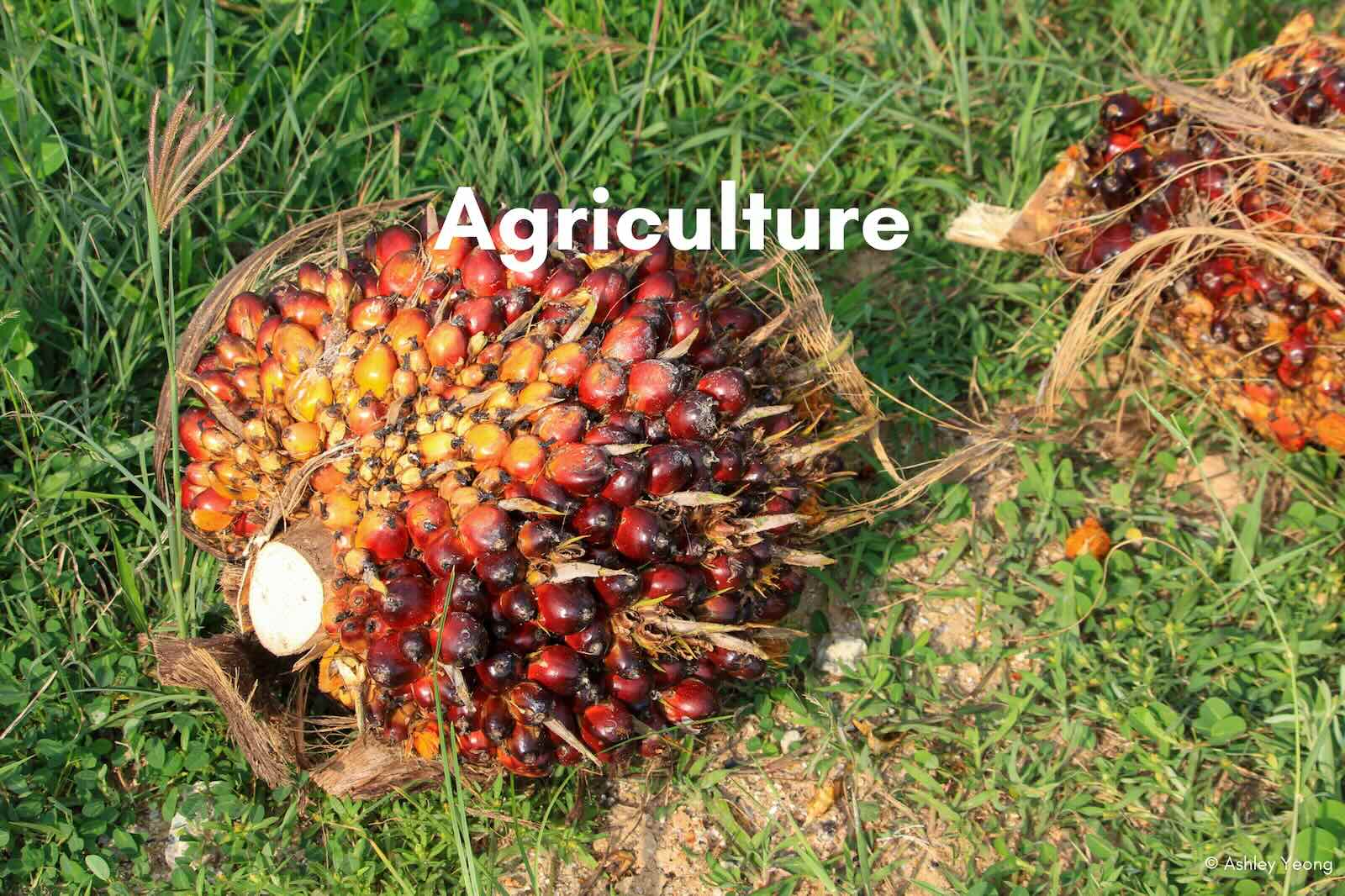
Ideally, back mangroves would merge into dryland forest. However, in reality, their ecological succession is blocked by a slew of man-made impediments. These include roads and plantations, aquaculture farms and landfills, and factories and ports. Often, these fragment the very mangroves themselves.
And when mangroves are degraded or lost, society and the environment suffer. The consequences grow ever more severe as Malaysia’s sea levels are set to rise with climate change. Already, Malaysia has lost plenty of mangroves.
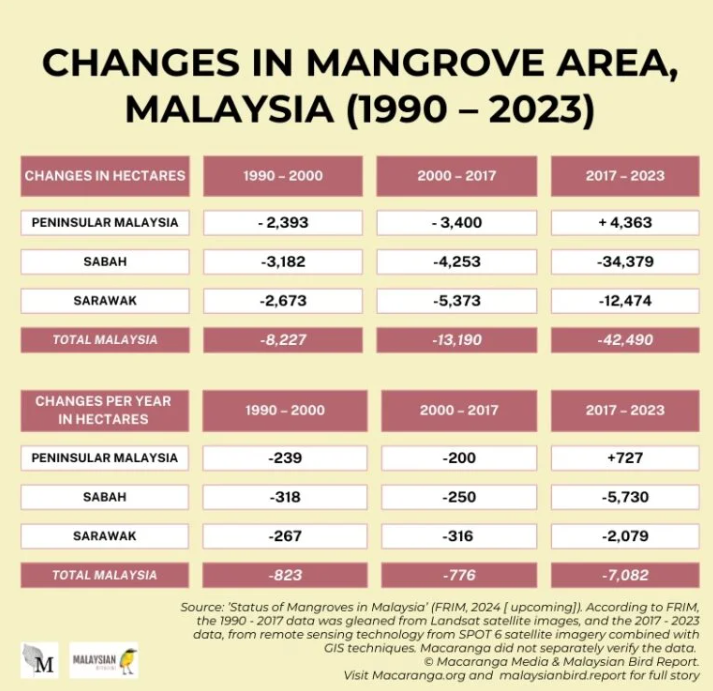
Many of Malaysia’s mangroves are actually legally protected: of its 586,548 ha, 93.74% are inside permanent reserved forests, and state and national parks. But Malaysia has been losing its mangroves steadily since 1990, according to the Forest Research Institute of Malaysia (FRIM) in its upcoming 2024 report on the status of mangroves shared with Macaranga.
While loss can also result naturally, FRIM states that the most loss is caused by development outside protected areas, on state lands. The biggest loss of mangroves took place in the last 6 years, since 2017.
Mangrove areas decreased by 46,853 ha, almost twice the size of Kuala Lumpur. Of this, a massive 73% (34,379 ha) happened in Sabah, and the rest in Sarawak (12,474 ha).
Measured in terms of loss per year, Sabah lost about 19 times more mangroves than in the previous 27 years, and Sarawak, at least 8 times more. Both these regions are home to the most mangroves in the country – Sabah around 22% and Sarawak 59%.
Interestingly, Peninsular Malaysia actually gained 4,364 ha of mangroves, more than making up for the mangroves it lost between 2000 – 2017. The losses and gains differed across states, but most states saw mangrove areas grow. Still, the earlier mangrove loss is evident. Driving from Penang to Selangor, outside of the protected areas, Macaranga found most mangrove forests little more than strips fenced by infrastructure and agriculture.
When agriculture is developed behind mangroves, bunds are typically built to shield plots from tidal flooding. To protect the bunds from eroding, the Department of Irrigation and Drainage has a policy to maintain a strip of mangroves between the bunds and the sea. But the bunds cause the mangroves themselves to erode.
Still, even in these mangrove strips, there is enough avifauna to draw bird-watchers and photographers.
South of Matang in Bagan Datuk are the popular Beting Beras Basah jetty and Kampung Sungai Tiang. To get there, bird-watchers must drive through long stretches of oil palm plantations.
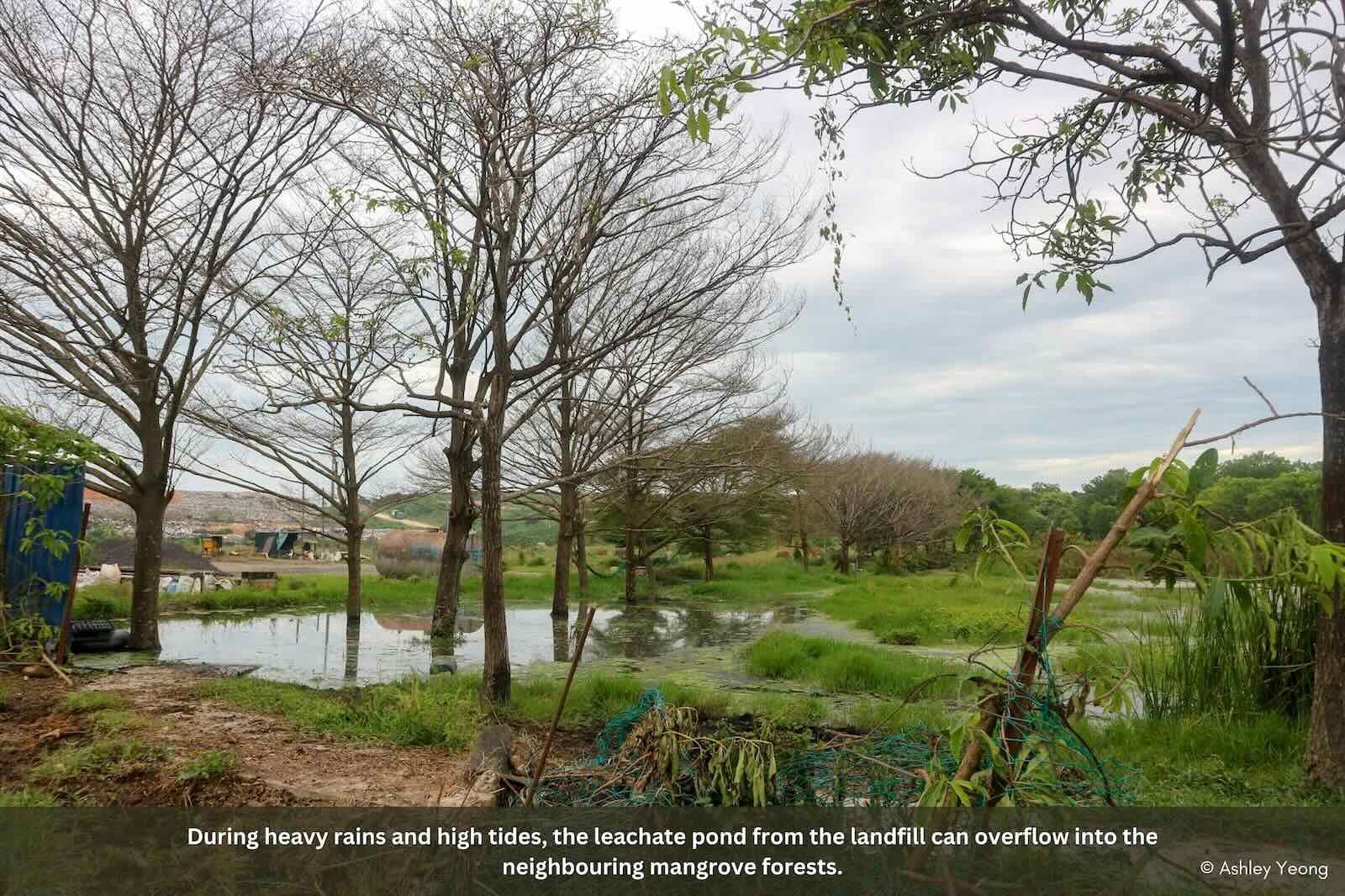
North at the bird sanctuary of Kuala Gula, they must pass aquaculture ponds that ring the mangroves. Here, the forest fringes the coastline, but only roughly 50m wide. A road around the ponds cuts through the back mangroves, fragmenting the habitat. Even further north in Penang, the mangroves of the once-aptly named Pulau Burung draws bird-watchers. This is despite its back mangroves having been replaced by a mountainous 16 ha landfill. Flood researcher Edlic Sathiamurthy says “during heavy rain, the leachate pond can overflow,” bringing toxic leachate into the mangroves and ocean. He personally observed this in 2017.
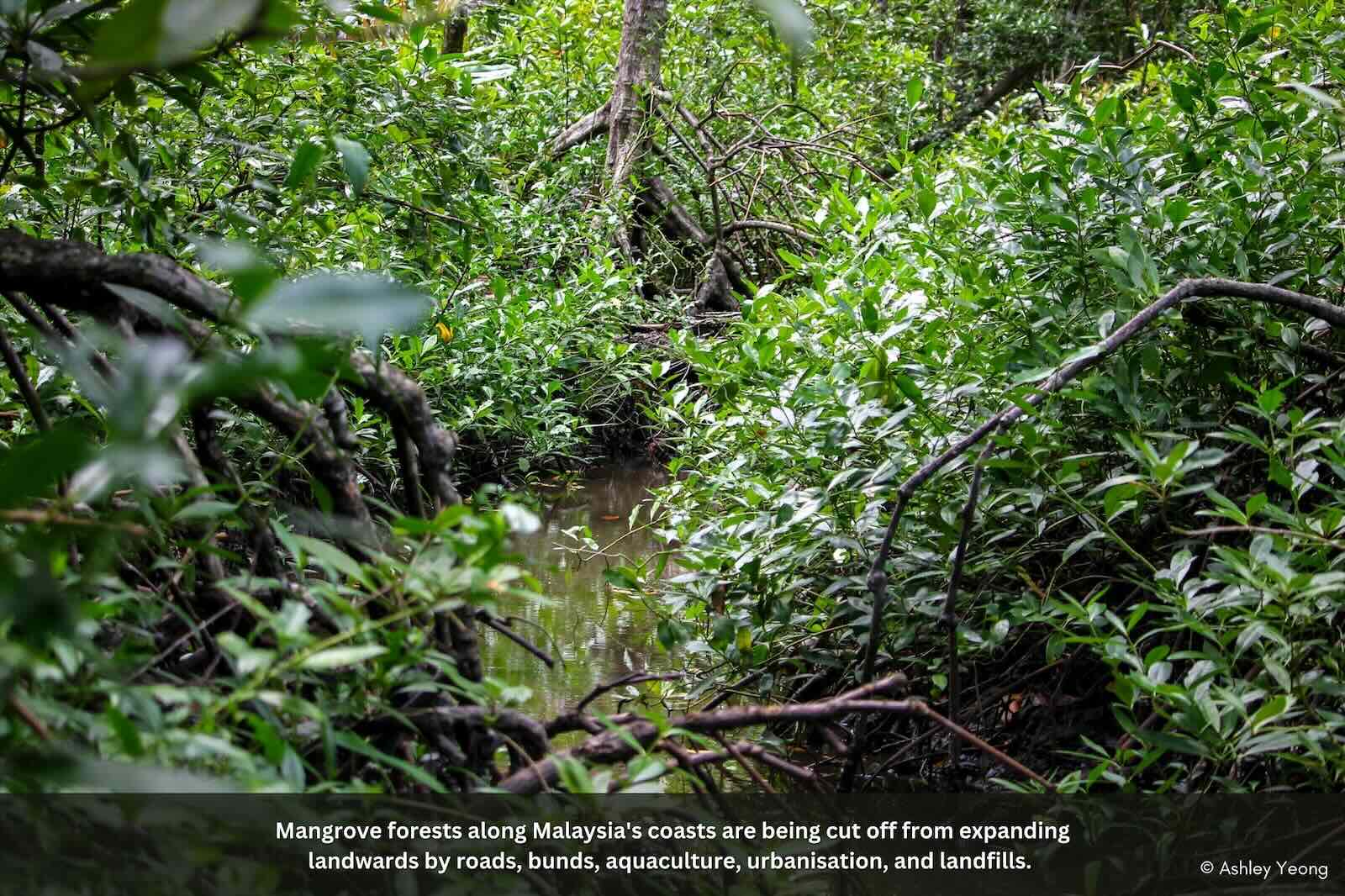
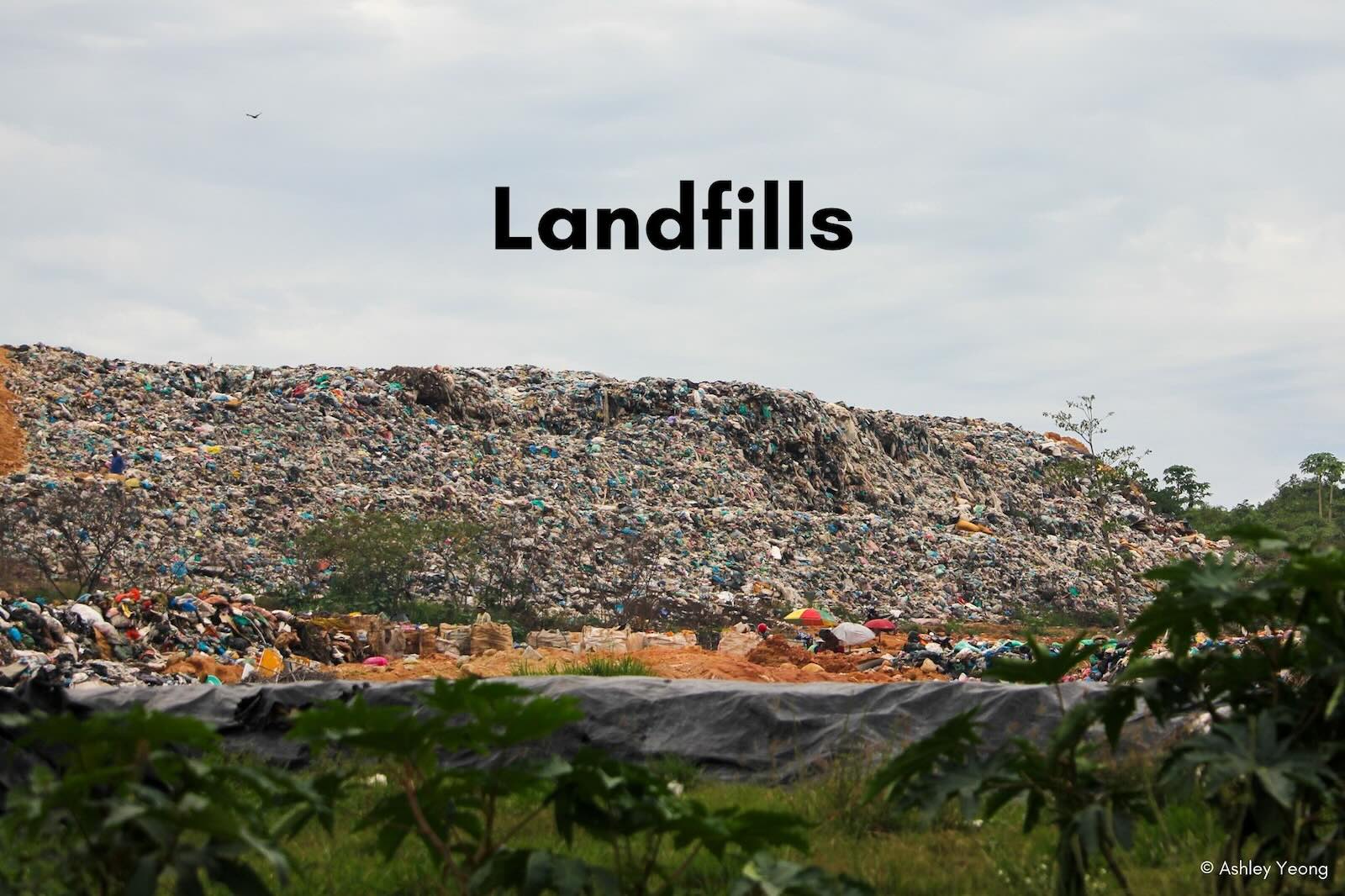
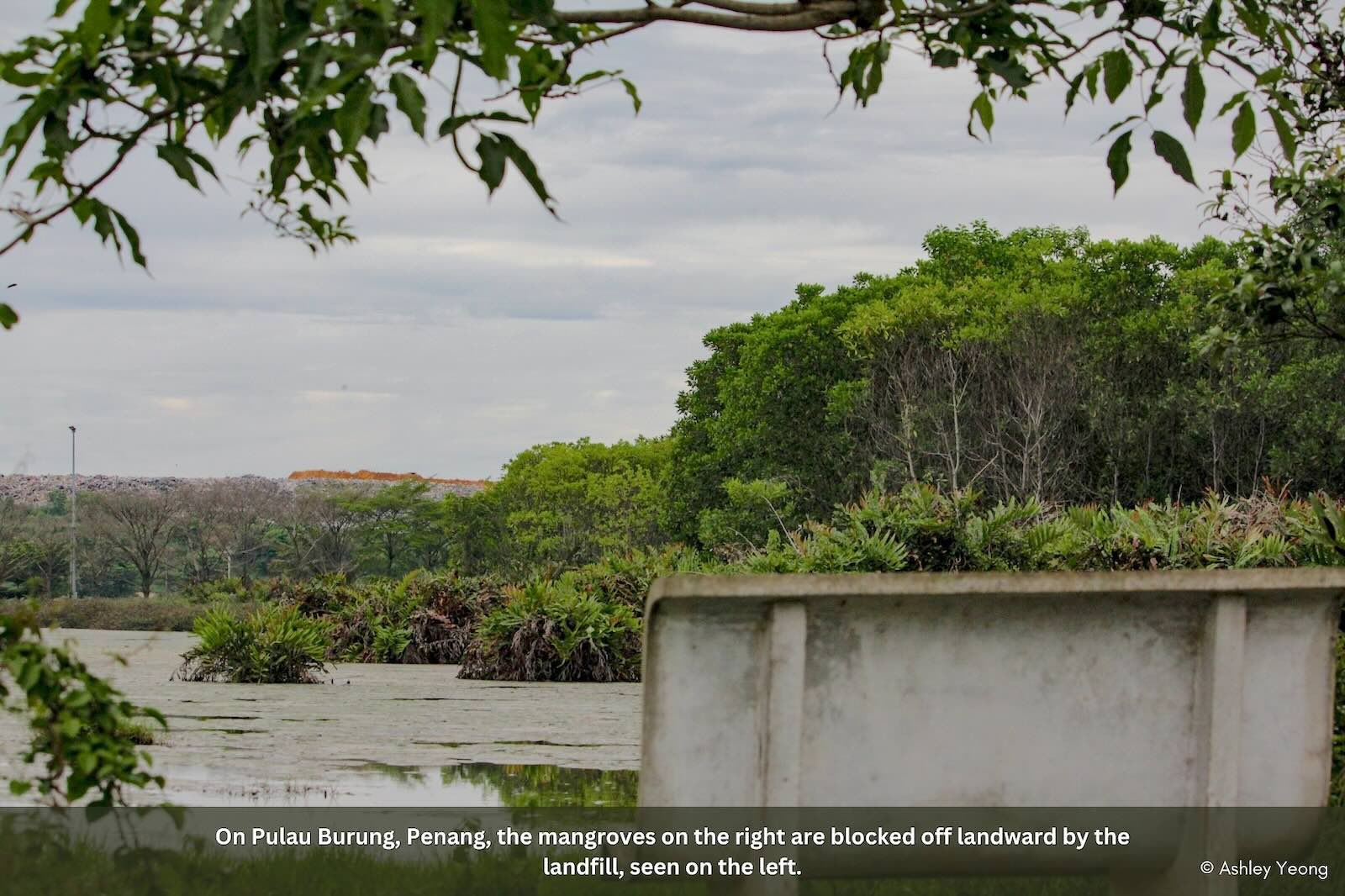
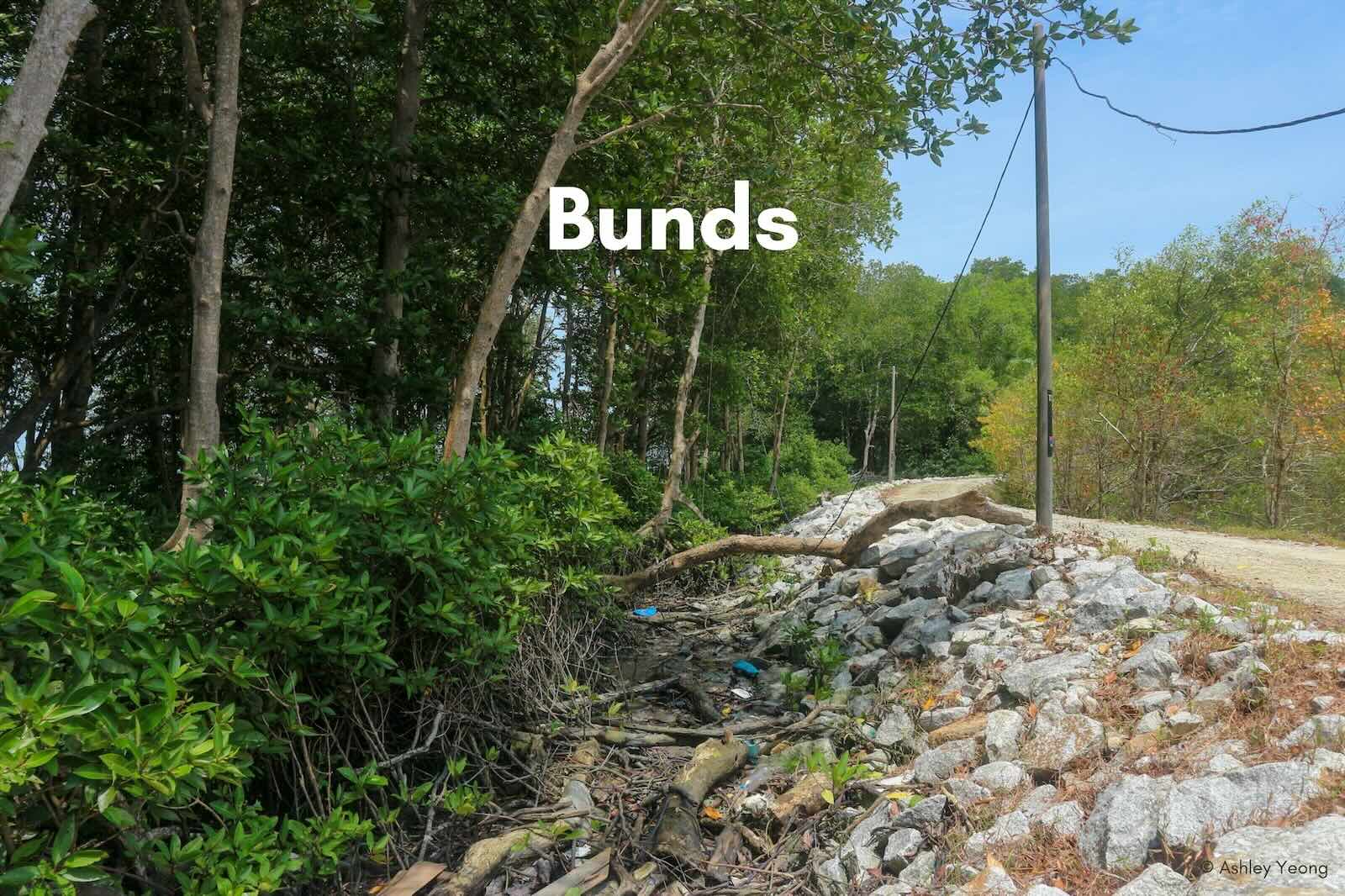
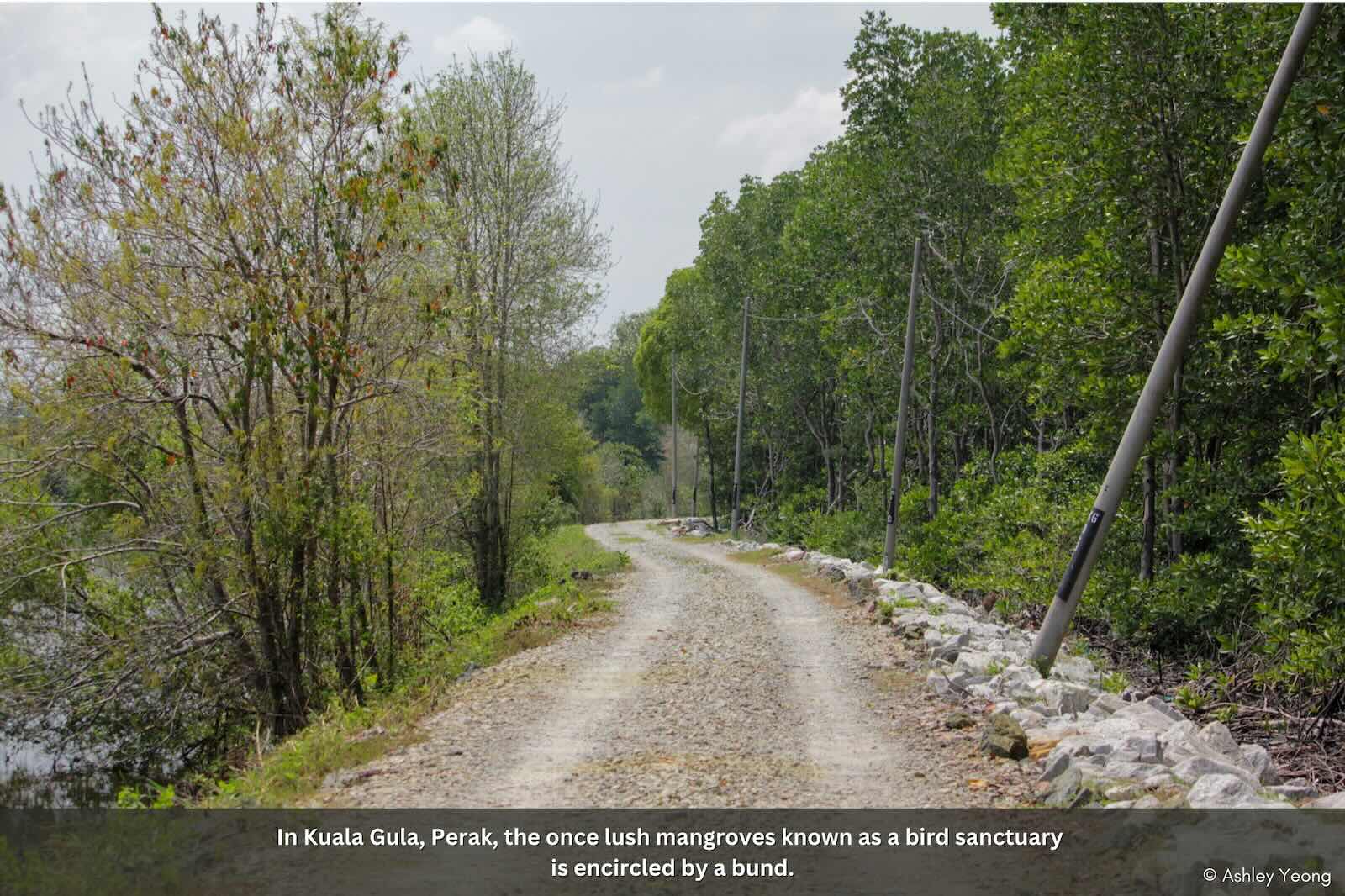
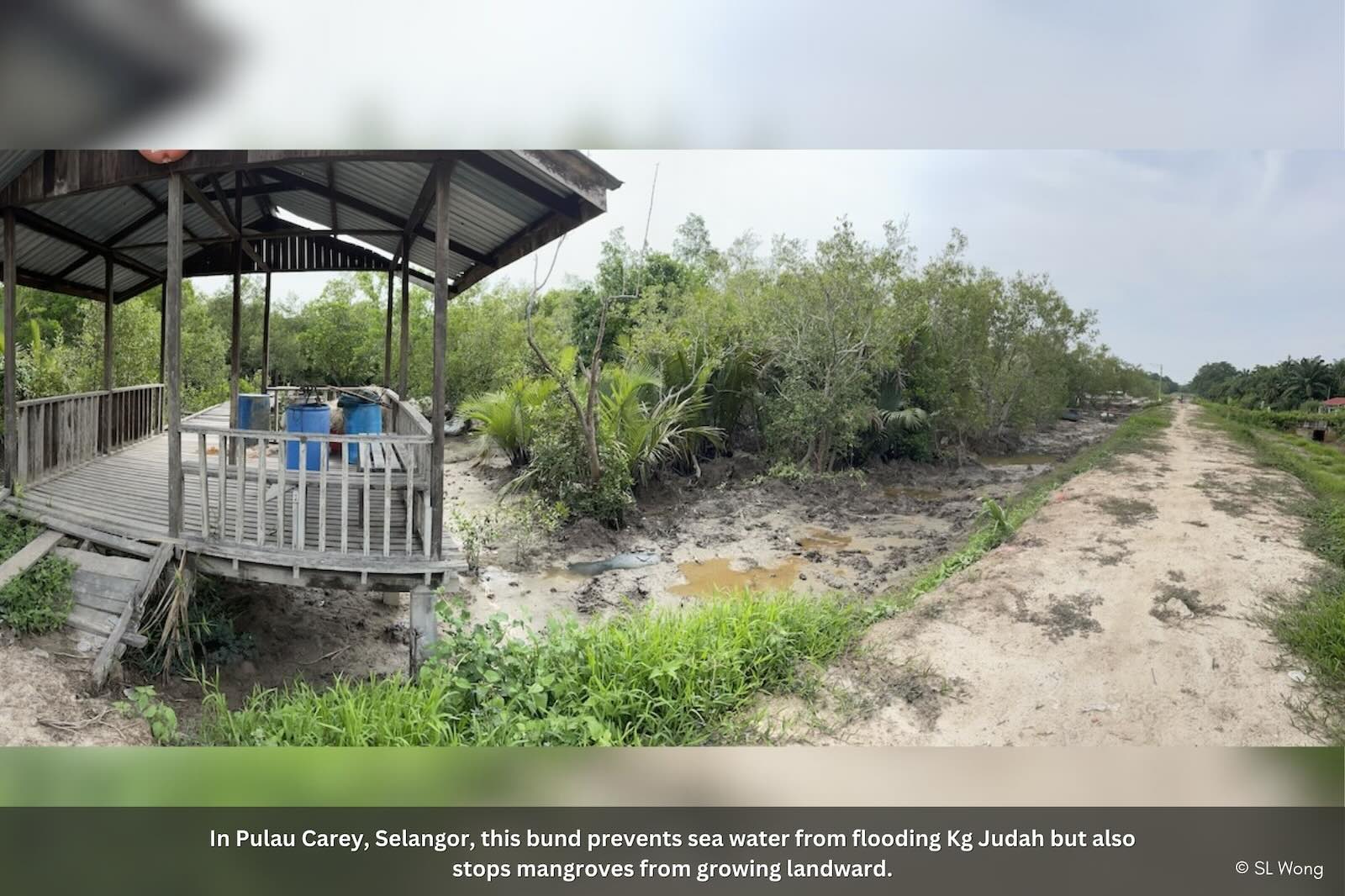
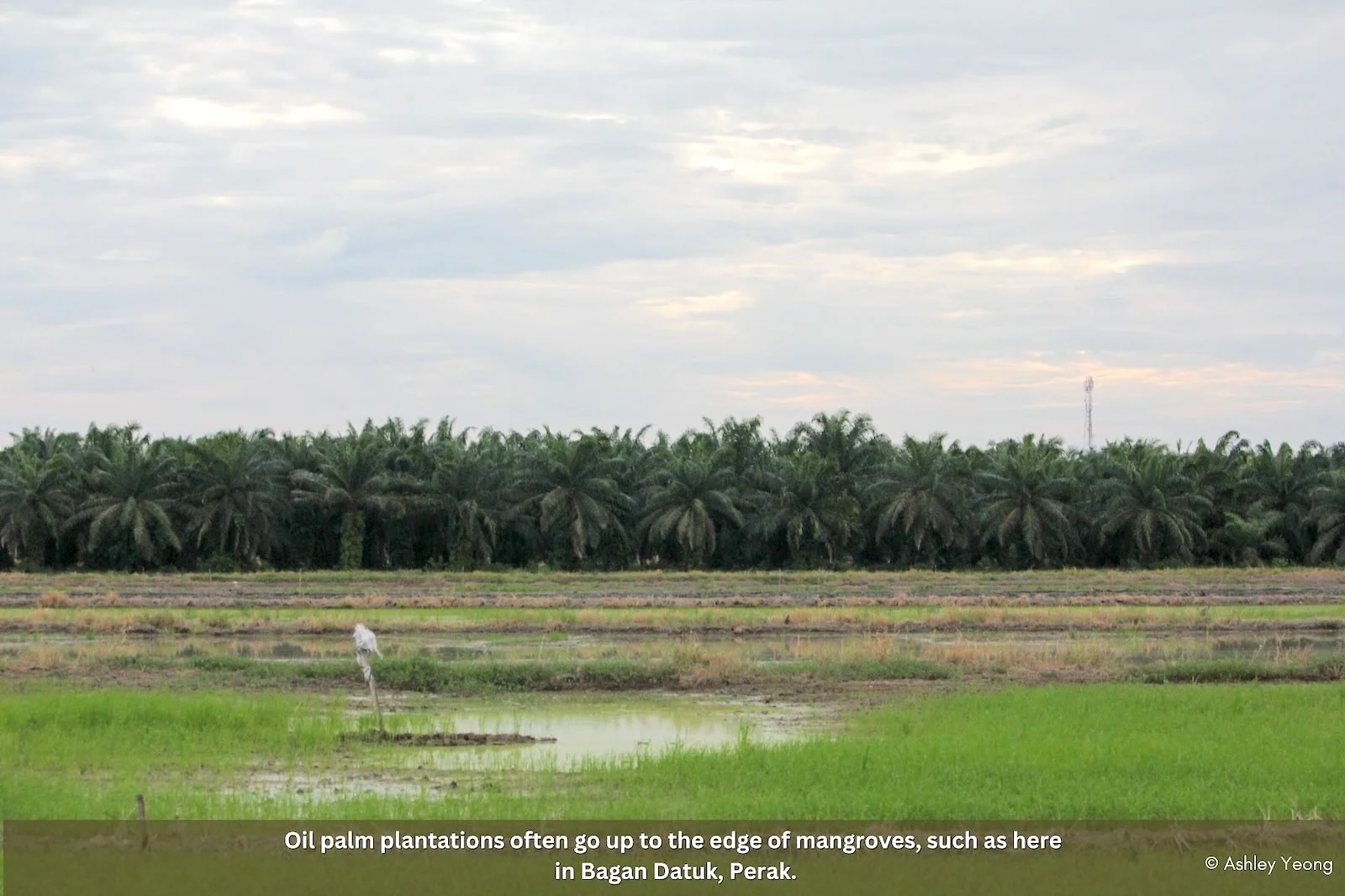
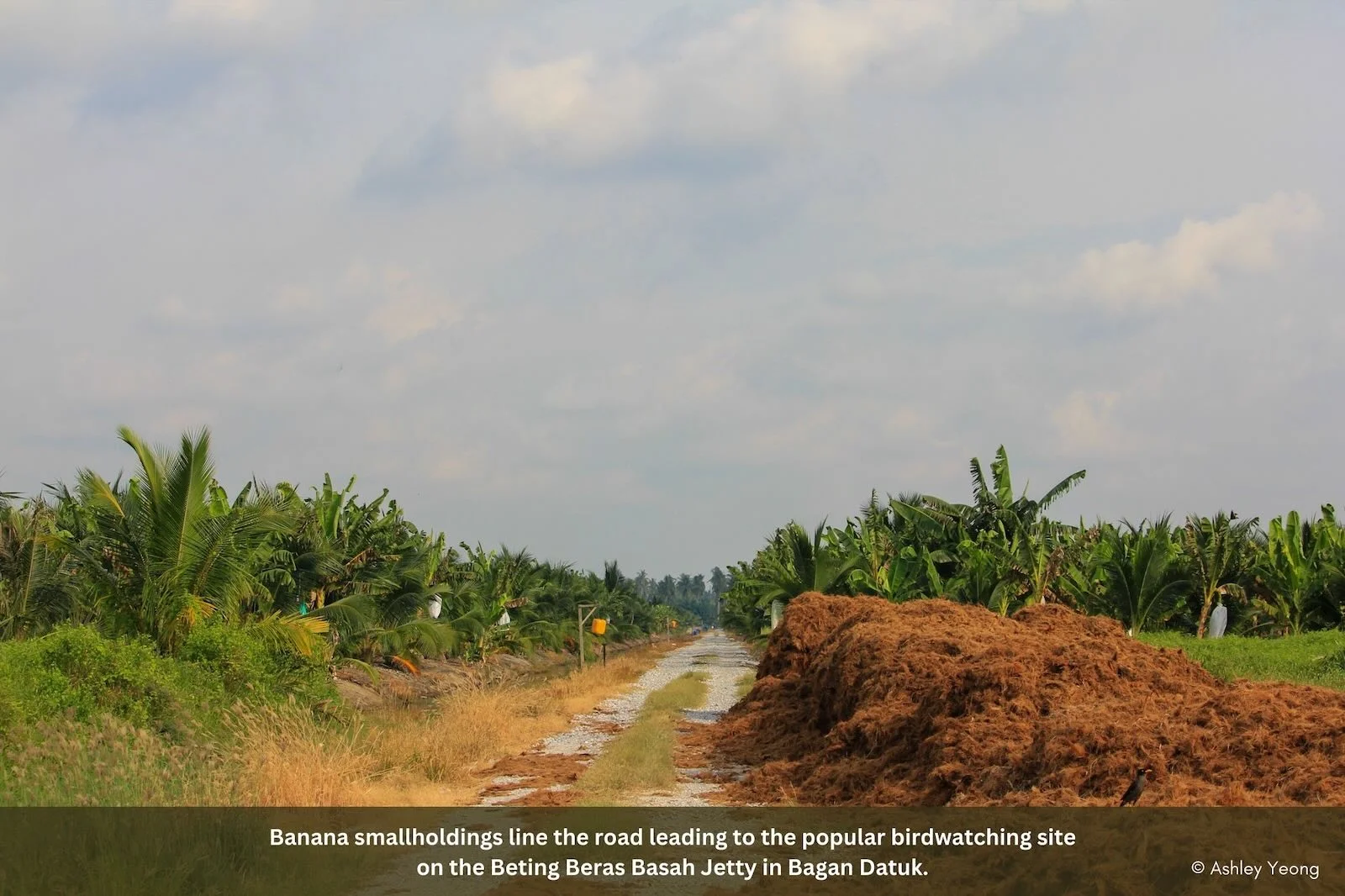
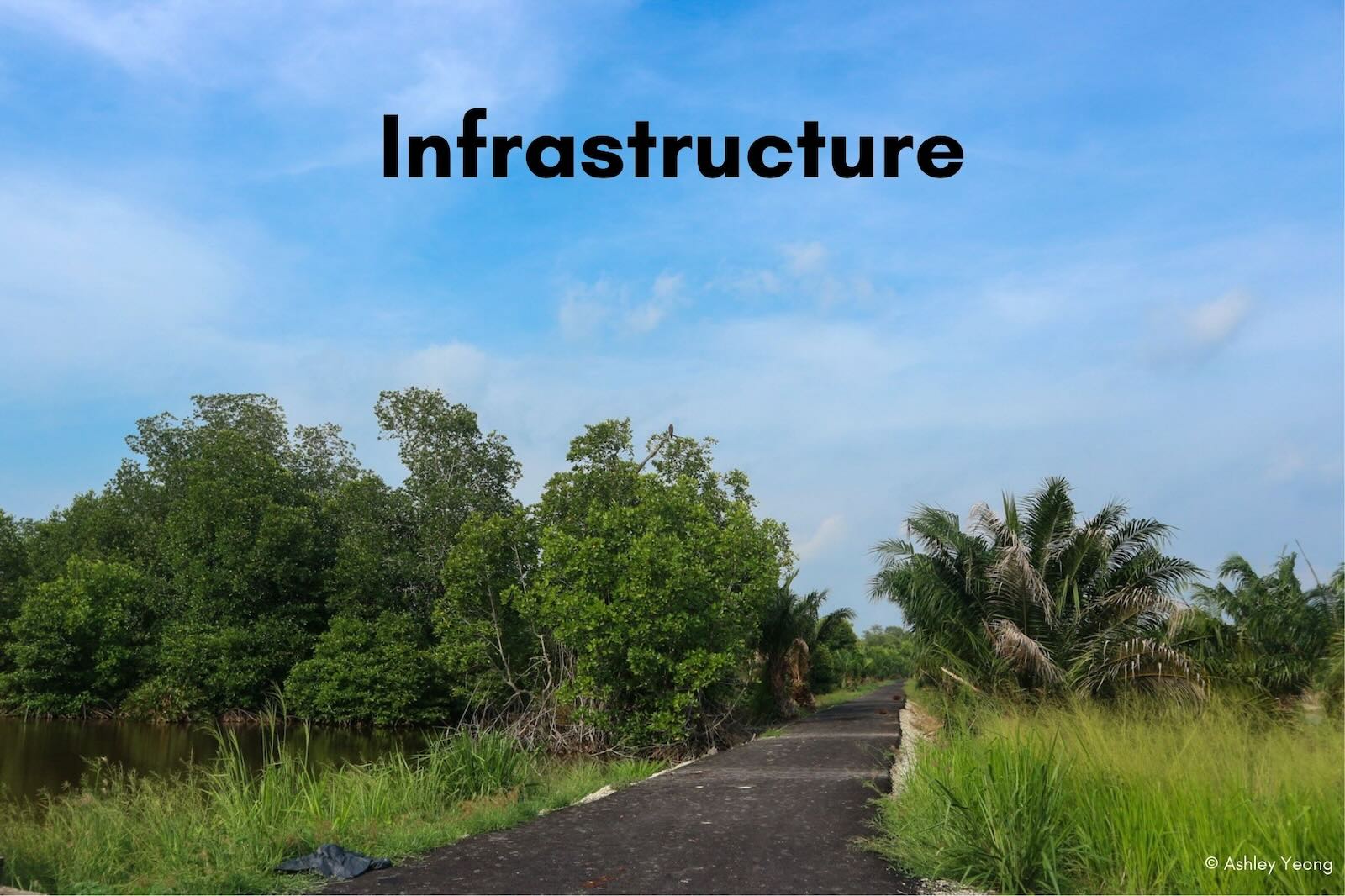
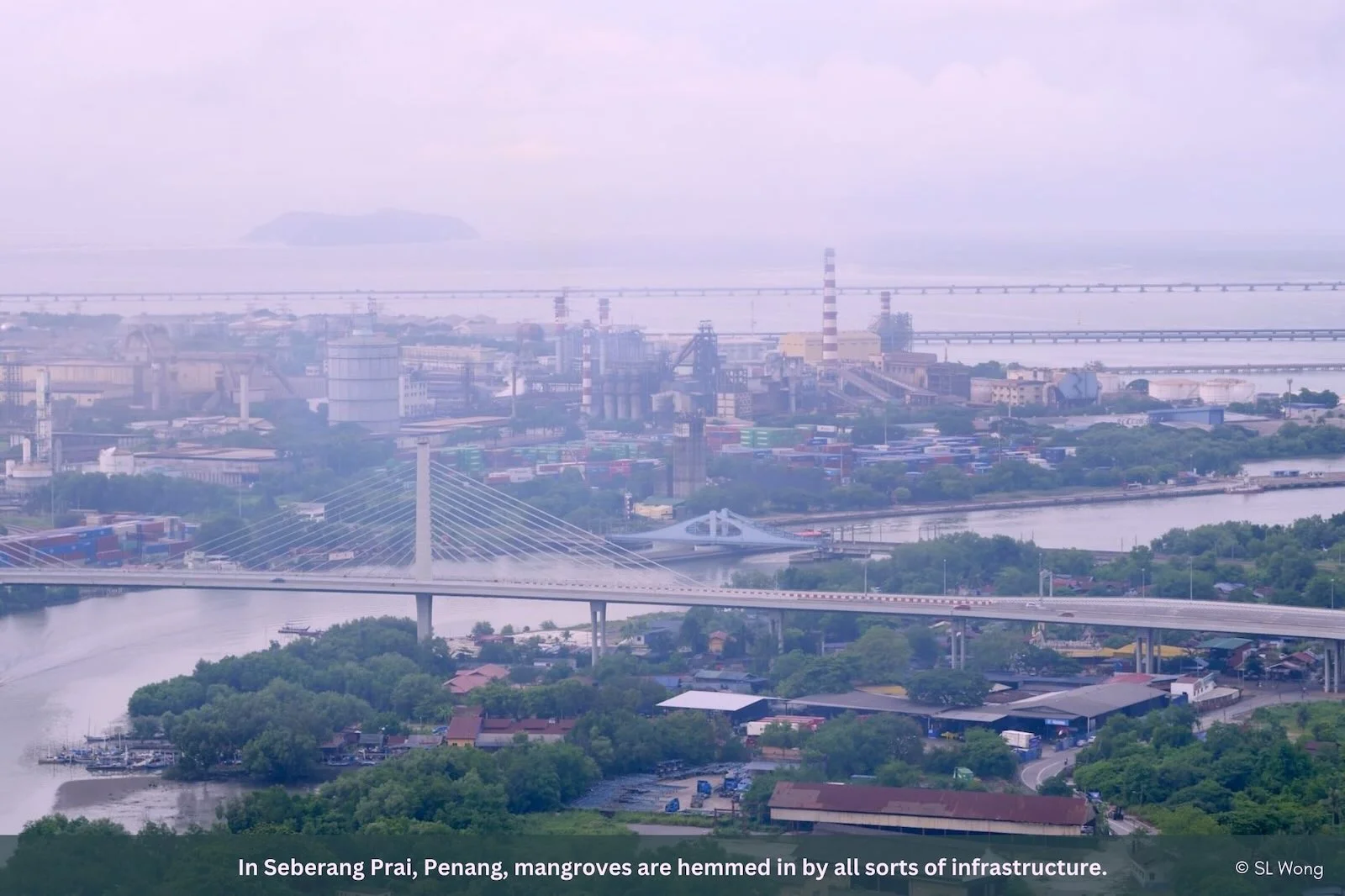
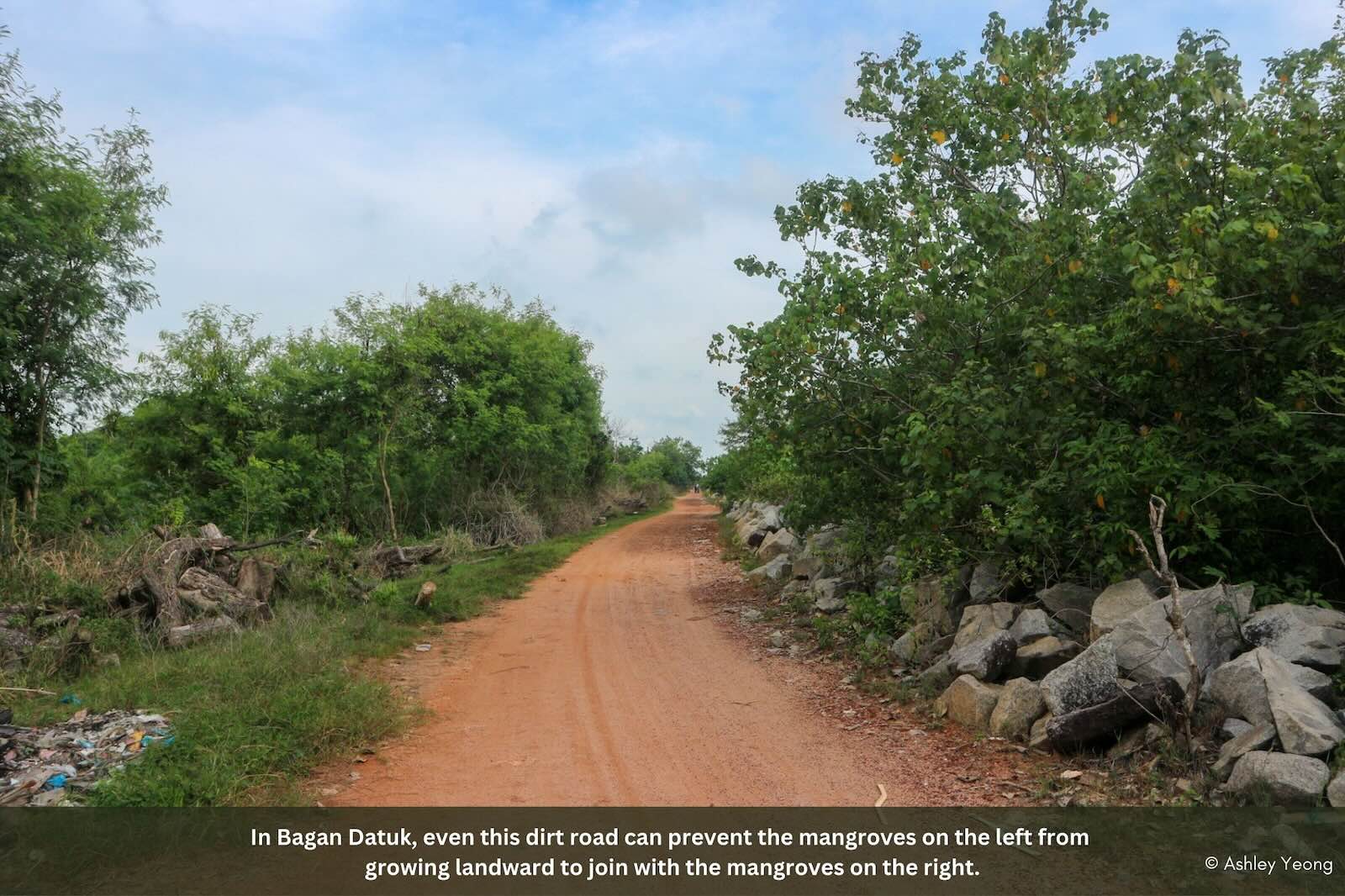
The critical point about cutting off mangroves from expanding landwards is that it throttles the health of mangroves, and their superpower to protect coasts and inland areas. Mangroves can gradually expand landmass from soil or sand deposits caused by the movement of water. Their dense root systems trap sediments carried by tides and rivers, gradually building soil. But mangroves need room to perform their ecological functions effectively, says Dr Chee Su Yin who researches coastal ecosystem conservation.
“If the sea level rises, they can move backwards. And if they have enough soil they can also move (forwards) towards the sea.” By this logic, mangrove areas should be protected to allow them to grow both seaward and landward. This has big implications as Malaysia’s sea levels are set to rise with climate change.
“But mangroves can only grow backwards if there is space,” points out Chee. How much space exactly? Ideally, as much space as possible. In reality though, she notes that the buffer zone is usually a mere 100 m. “This area (back mangroves) is always a tussle between developers and profit-makers and conservationists. One hundred meters is actually not enough. For me, I would advocate for at least 200 m to half a kilometer.”
But she concedes that “space is very precious. If you’re in the developers’ camp, then you want to use this space to develop. There’s a lot of money involved.
That’s where the difficulty of conserving mangroves is. It’s always been the developers and conservationists. Whether it’s mangroves or coral reefs, this is always the issue. –Dr Chee Su Yin
Birds as Red Flags
Without space for back mangrove expansion and the forest’s ability to host all its various zones, birds are at risk. Macaranga compared bird diversity and numbers at 2 sites in Perak 100 km apart, using the citizen birdwatching global database, eBird at Cornell University.
The Matang Mangrove Forest with its healthy forest complete with back mangroves has considerably more different bird species than Bagan Datuk, which only has a sea-front mangrove fringe (see table). In terms of resident bird species spotted, Matang has 96, more than double the 45 species in Bagan Datuk.
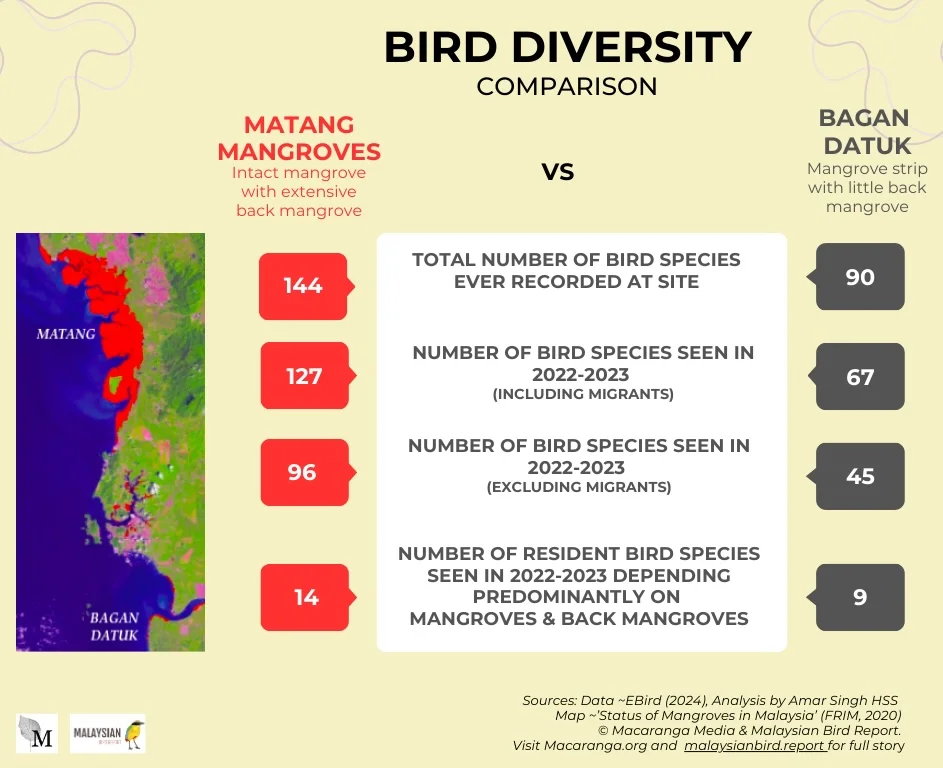
Narrowing it down to birds that live predominantly in mangrove habitats, Matang still has one-and-a-half times more different bird species than Bagan Datuk (mouse over the photos in the gallery below; tap on mobile). In 2022—2023, the majority of resident birds are more commonly seen and in larger numbers at Matang with its extensive back mangroves.
Unfortunately, in the thinner mangroves of Bagan Datuk, species such as the Mangrove Pitta Pitta megarhyncha, Mangrove Whistler Pachycephala cinerea have not been recorded in recent years; the birds were absent in both the 2024 eBird database and the 2018 MNS surveys.
Avian ecologist Noske, in his study of mangrove forest birds in Peninsular Malaysia, noted that birds like the Mangrove Blue Flycatcher have a “preference for dense forests with low light levels”. Hence its absence where the forest has ‘gaps’ or is sparse.
Ensuring the existence of birds in mangroves can actually help mangrove conservation – through ecotourism. Mangrove forests are under-appreciated as ecotourism sites. In recent decades firefly watching, for one, has grown. The top firefly-watching site in Malaysia, Sungai Klias in Sabah, draws 100,400 tourists annually. MNS in 2018 estimated that the economic value of the Teluk Air Tawar-Kula Muda coastal mangrove region at USD6 million per annum (RM28 million); USD760,000 (RM3.5 million) from nature-based tourism.
Drawing bird-waters and photographers can further boost the case for mangrove conservation. In Sabah, which saw the biggest mangrove loss in the last 6 years, 35% of tourists visited for ecotourism, including bird-watching in pre-pandemic 2019. The year before that, the state earned RM8.3 billion from 3.9 million tourists in tourism revenue. The Sabah Tourism Board also recognises bird watching as a niche market in tourism.
For ecotourism to thrive in mangrove forests, so must birdlife. And birds need healthy multi-zone mangroves.
Symbiotic Conservation
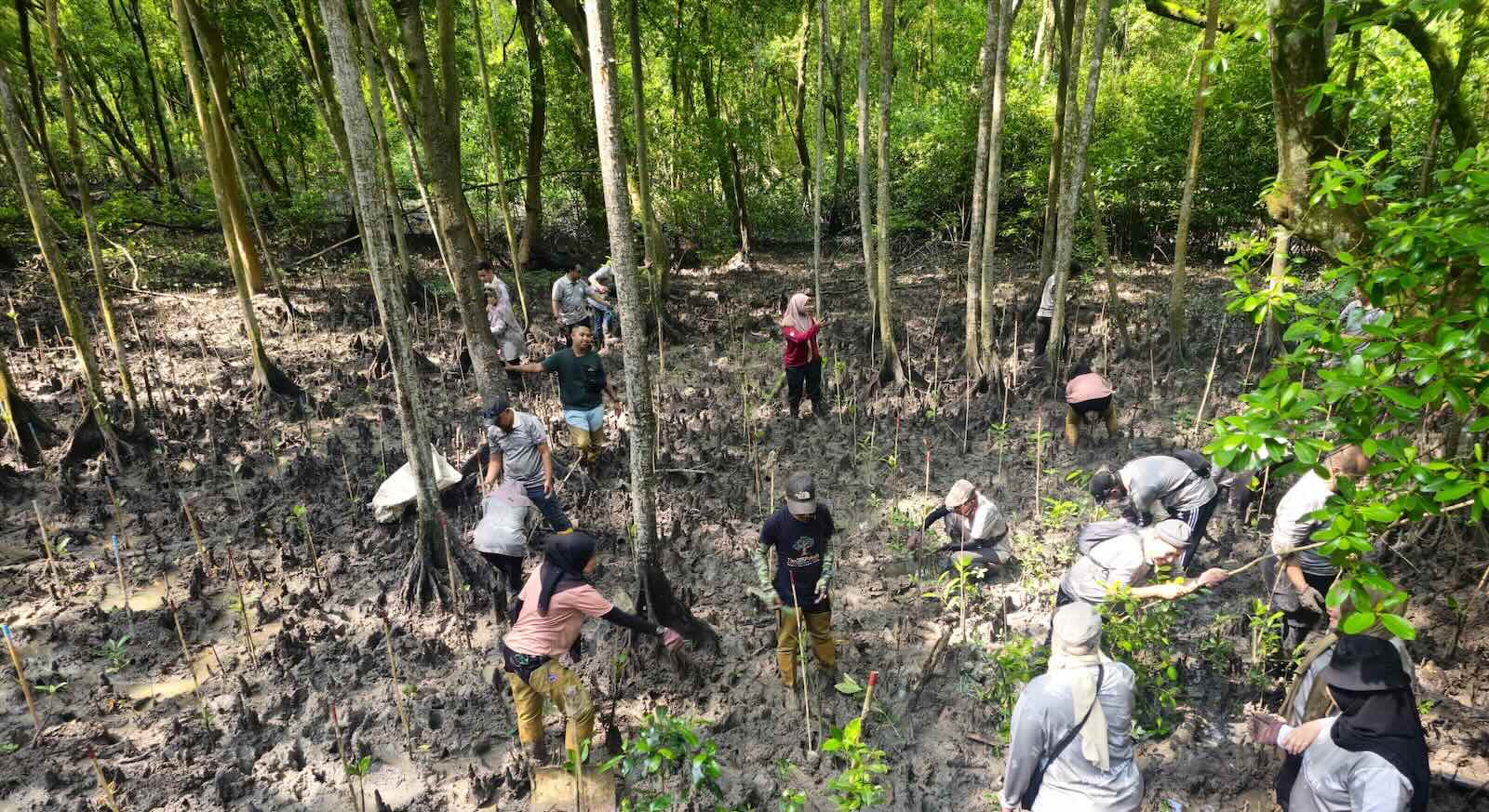
To boost mangrove’s land building capacity, restoring is a key activity in Malaysia. “Replanting really started after the tsunami in 2004,” says mangrove researcher Aldrie. The Indian Ocean tsunami of 2004 struck the coasts of several South and Southeast Asian countries, including Malaysia. The disaster killed at least 225,000, of whom at least 68 were in Malaysia.
Recognising the role mangroves played in mitigating the tsunami, Malaysia started the Programme for the Planting of Mangrove and Other Suitable Tree Species Along the National Coastline. From 2005 to 2022, 7.2 million seedlings were planted along coastlines, covering 3,278 hectares.
“The government and companies have a lot of money and they want to do replanting,” says Aldrie. But oftentimes, they do not engage with the scientific community and local communities. The result is ineffective or failed replantings. “They plant the wrong species and [on] the wrong site,” says the scientist. “You plant thousands of seedlings, and it’s washed away the next day.”
The idea is to establish an ecosystem. “We want to reforest, not just replant. Actually, if you let mangroves thrive naturally, they can regrow by themselves.”
Chee, the coastal conservationist, shares the same sentiment. She shares a powerful example of how Penang’s Gurney Drive reclamation had a “happy side effect”. While the developers were piling on sand to reclaim land, it created the perfect environment for mangroves to regenerate.
“It was muddy, sheltered,” she says. “The waves couldn’t get in but the seawater could. So because there was this really ideal situation in where the salinity was right, and there were these bunds stopping the waves from coming in. “And [in the] little space that the mangroves used to be, the propagules started to migrate. In 6 months, you can see that mangroves from a small area [spread] about 200 m down the Gurney Drive coastline. I thought this was really fast. Based on this observation, as long as the conditions are correct, then they can grow at a very fast pace.”
MNS also says that mangrove birds return to well-rehabilitated mangroves, calling their presence “an important indicator”. As elsewhere in the world, Malaysia’s mangroves are under tremendous pressure from competing uses, from agriculture to infrastructure. But what it takes for mangroves to support birdlife is what it takes to ensure they are healthy.
This means having a mix of zones and enough space inland to undergo ecological succession to dryland forest, especially for the forest to survive as climate change raises sea levels. Chee says the discussion between scientists and policymakers is to allow these coastal forests room to migrate landwards; this means ensuring infrastructure like highways are not built too closely.
Ornithologist Wells was particularly worried about how the loss of back mangroves in Selangor had already led to a drop in bird diversity. The good news is that mangrove area has seen a net increase in the states featured in this article: Selangor (21 ha), as well as in Perak (58 ha) and Penang (124 ha) (see graph above).
At Bagan Datoh, Perak, both MNS and FRIM are working to conserve and enrich the remaining mangroves, working with local communities and developing ecotourism, including establishing an on-site mangrove germplasm facility.
All these would certainly augur well for the Velvet Fronted Nuthatch. This blue tree hopper has not actually disappeared from Selangor, as it has been spotted in other forest types. But perhaps one day, if Selangor’s mangroves – and especially its back mangroves – revive, the bird could actually return to its favourite habitat.