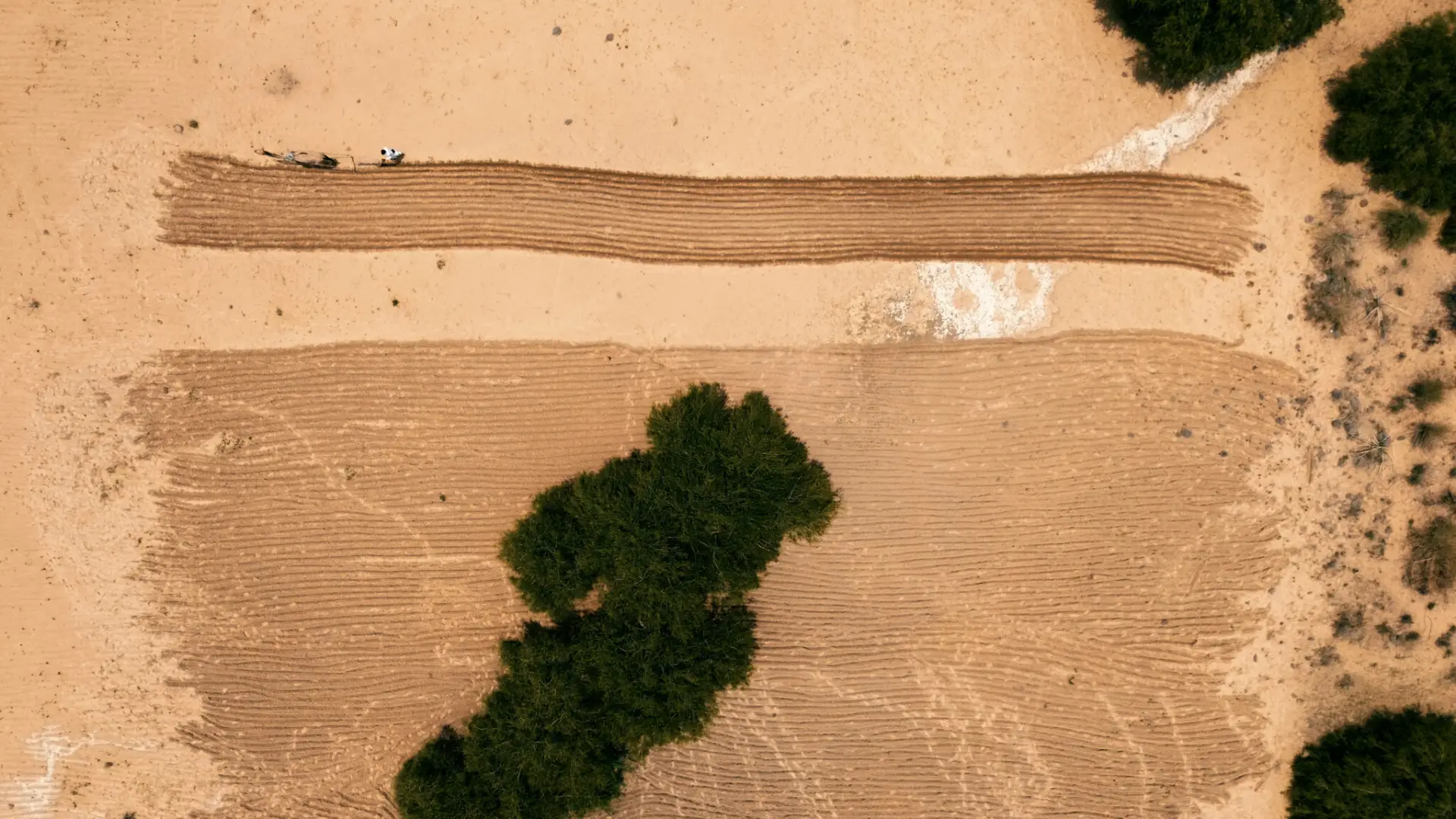
The aeral view of a man plouging the fields in the arid region of Tharparkar district of Pakistan’s Sindh. Photo: Jaldeep Sarkar/Earthwise
The night is dark, silent and dusty in Khario Ghulam Shah village that lies about 70 kilometres to the east of Mithi, the headquarters of Sindh’s Tharparkar district. An open pit coal mine and a power plant loom nearby and the roar of dumper trucks carrying coal echoes through the toxic air, making peacocks cry and shattering the village’s tranquility.
Millions of years ago, Tharparkar was lush with forests and vegetation. Over eons, dense vegetation accumulated in its swampy environments, transforming into peat. As sediments buried the peat, heat and pressure eventually turned it into lignite coal. Today, Tharparkar’s 175 billion tons of coal reserves are spread over 9,000 square kilometres.
In Khario Ghulam Shah, the digging and utilisation of this vast natural resource forewarns of a future when all of these reserves are dug up and utilised.
Early one morning in the summer of 2024, a picture hanging on the wall of a local autak (guestroom) starts emerging feebly through the coal-induced haze. It carries the image of Rasool Bux Palijo, the founder of Awami Tehreek, a Sindh-based movement for the rights of the province’s marginalized inhabitants. He famously led a 32-day long march in 2017 against coal mining and coal-based power generation in Tharparkar – at the age of 88 and only a year before his death.
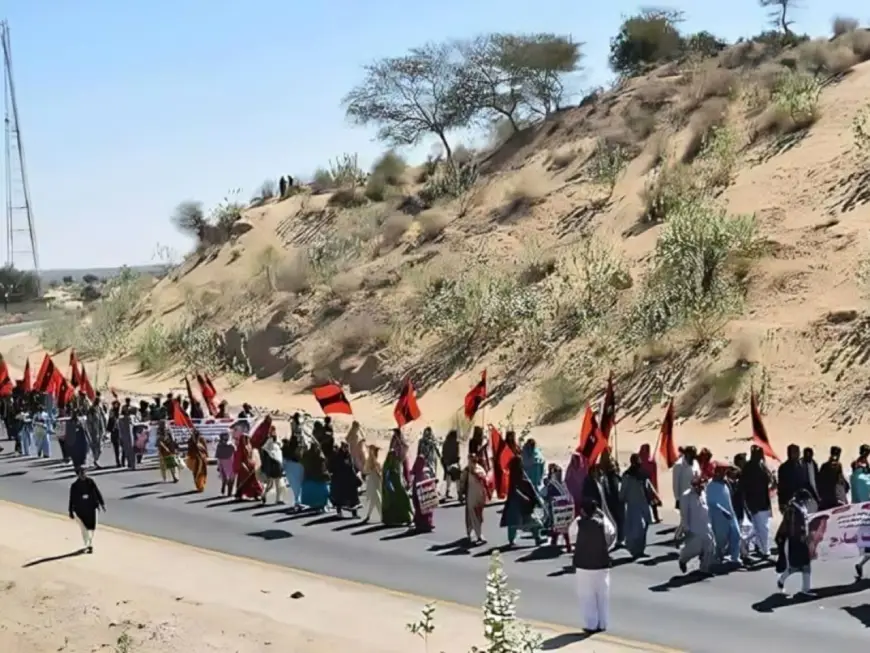
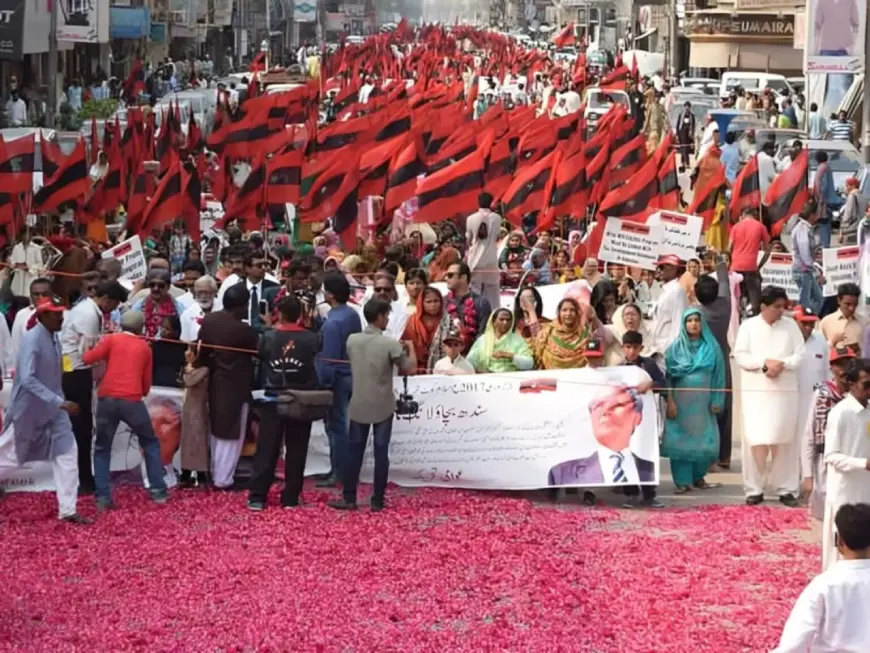
Photos from Awami Tehreek’s 2017 march in Tharparkar, Pakistan. Photo: Awami Tehreek/Earthwise
The march was carried out against the controversial selection of a natural reservoir for dumping coal mine’s wastewater near the village of Gorano – lying 47 kilometres to the south of Tharparkar’s first coal mine in what is officially known as Thar Coalfield Block-II. The work on the reservoir – sprawling across 1,500 acres – commenced as soon as coal mining began in Block-II in early 2016.
Palijo and his fellow marchers wanted the government to realise that the reservoir would soon wreak havoc upon all the manifestations of life in and around Gorano. Their protestations, however, were ignored.
Now, their worst prognosis has come true. Underground water in Gorano is both rising and turning toxic and its people, animals, plants and wildlife are suffering seriously. A 2023 essay written by a leading American environmental lawyer, Dr Mark Chernaik, for Earthwise reported high levels of selenium, arsenic, mercury, chromium, and lead in the reservoir’s water. Local people also report that crops and trees cannot take root in the land around the reservoir because of the unusually high underground water table. They also allege that incidence of diseases, livestock deaths, and deteriorating agricultural output are increasing in their village, signalling a gathering environmental catastrophe that could soon force them to leave their homes.
The villagers, therefore, demand a change in the reservoir’s location. They have continued their protests after the march, gathering for 636 consecutive days at Islamkot Press Club in 2017-18. On 9th March 2024, too, local men, women and children formed a human chain around the reservoir in an attempt to highlight its toxic effects on their lives.
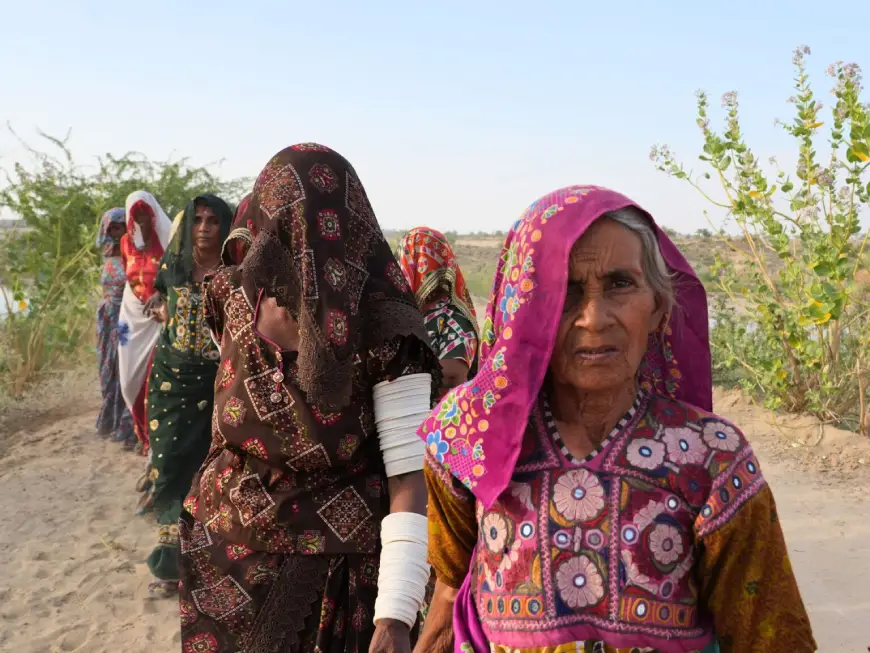

A human chain formed by the residents of Gorano, a village in Tharparkar, Pakistan where water being extracted from coal mines is being dumped. Photo:Usama Irfan/Earthwise
Back in the autak at Khario Ghulam Shah, as the first light of dawn filters through cracks in the room’s brick walls, Kamlesh, a ninth-grade student, enters with a tray of tea. After a few moments of shared silence, sips of tea and a formal introduction, I pose a question to the boy. “Kamlesh, after you finish your studies and become an engineer, if the coal company offers you a high-paying job with many perks and privileges, would you accept it?”
Kamlesh’s deep eyes cloud for a moment. Silence wraps around us like a shroud. My question seems to hang in the autak’s still air like a quivering shadow before he utters a firm yet melancholic “no”. Intrigued, I press further. “Why not, Kamlesh? Such an opportunity is rare in these parts.”
“What will I do with the job when I won’t have my land and will die of a lung disease while working in the coal mine ?” he responds.
His words, simple yet profound, strike at the heart of the problem confronting the residents of Khario Ghulam Shah and several other villages situated in the proximity of coal mines and coal-based power plants. His village’s air, once clean and pure, has become acrid and carries the burden of dust and disease. Its water, the lifeblood of local existence, is tainted by monsoon runoffs from the coal mine. The promises of jobs and prosperity, routinely made by the government and coal development companies, ring hollow in the face of the environmental and economic devastation being faced by the villagers.
Read: In Punjab: A Tale of Two Immigrants
Black and lifeless, coal seems to have drained colour from the lives of local people, leaving only shades of grey in its wake. The dark grey of coal ash, the light grey of smoke emitting from the chimneys of the power plant and the pale grey pall of gloom and despair hanging above their heads all the time. As the sun rises over Khario Ghulam Shah’s desolate landscape, dumper trucks carrying grey coal continue their relentless journey, carrying with them the weight of a thousand broken dreams.
All local residents, like Kamlesh, know that the true cost of coal should not just be measured in economic terms but also in terms of a lost way of life, a severed connection with land and, most worryingly, a rapidly disappearing sense of being.
But the story of Tharparkar’s land is not one of loss alone. As Palijo’s march and the protests at Islamkot press club show, it is also a story of resistance.
The heart of darkness
Tharparkar stretches over 20,000 square kilometres , with coal reserves found in 45 per cent of its area. The coal reserves are divided by the government into 13 blocks, five of them having been allocated to different entities for coal mining and power generation. Block-I has been given to the Sino Sindh Resources Limited (SSRL), Block-II to the Sindh Engro Coal Mining Company (SECMC), Block-III to the Asia Power Group Limited, Block-V to a government-run coal gasification pilot project and Block-VI to to a British company, the Oracle Power. Out of these five blocks, only two – Block-I and Block-II – are functional. The coal gasification project, initiated under the supervision of nuclear scientist Dr Samar Mubarkmand, has been abandoned after the expenditure of several billion rupees while the entities interested in working in Block-III and Block-VI have not succeeded in attracting finances required to start their mining operations and power production.
Though coal was discovered in Thar in the 1990s, commercial interest in it began only a decade or so ago, at a time many developed economies were already moving away from it. In 2012-13, SECMC, a partnership between a Karachi-based private company and the Sindh government, started acquiring land for coal mining in Block II – not far from Tharparkar ’s taluka town of Islamkot.
In 2019, power generation also began in the same block – accompanied by a country-wide celebration that it will herald an era of energy security for Pakistan. This coal-driven development narrative, however, has failed to lure a large number of Tharparker’s residents. They see Pakistan’s energy security coming at the cost of their land, history, culture and environment.

Shanghai Electric coal power plant in Tharparkar, Pakistan. Photo: Usama Irfan/Earthwise
Coal development has particularly led to displacement and environmental degradation, imposing serious socio-economic costs on the communities living in the vicinity of coal mines and coal-based power plants. They have lost their livelihood, they are facing health hazards like never before, their forests have been razed to make way for mines, biodiversity around them has fallen victim to development schemes and both their air and water qualities have degenerated drastically. When they look at the dark black abyss of coal mines, they do not see glittering lights. Instead, they see a darkening spectre spread around all aspects of their lives.
Take land, for instance.
Most of the people in Tharparkar rely on cattle and rain-fed agriculture for their living. A large part of the land in the district, however, is not owned by individuals but is utilised communally and collectively as gauchers, or collective grazing land. In Tharparkar’s traditional way of living, gauchers weave human beings, animals and nature into a seamless tapestry.
Coal development projects, propelled by the outdated Land Acquisition Act of 1894, have shattered this pristine image. This archaic law empowers the government to acquire land for any agricultural, industrial, commercial or security-related project as long as it serves a public purpose. The critics of the law have argued since its inception that the definition of public purpose in it has been kept deliberately vague so that it can allow land acquisition in all types of circumstances for all types of purposes. In Tharparkar’s case, the public purpose for which local land has been acquired is the generation of electricity for the whole of Pakistan.
This is how the government puts it.
Dr Hassan Abbas, a Rawalpindi-based water expert, has a different interpretation at least with reference to Gorano reservoir. In an interview with Dawn newspaper, he said: “The reservoir for dumping poisonous water is built on common grazing lands [acquired] for investors and not for the public”. The public, anywhere in Pakistan, is gaining nothing from the reservoir but the coal development company has been certainly facilitated to save money it should have spent on devising other means to dispose of wastewater being extracted from its mine.
The land acquisition law also draws lines on Tharparkar’s indivisible landscape to parcel it into various fragments: qabuli (private), yaksala (leasehold) and gauchar (communal pasture) etc. Though the law provides that the owners of the land to be acquired will be given reasonable compensation, it fails to acknowledge, let alone protect, the rights of those who cultivate state-owned land on yaksala lease or depend on communal pastures to earn their livelihood.
A farmer sows a crop in Tharparkar. Video: Jaldeep Sarkar/Earthwise
And that is not the only problem with land acquisition in Tharparkar.
It has also led to disputes over qabuli land, resulting from conflicting claims over who should receive the compensation. In a region where once land and people were parts of an ancient whole, there is division and discord now. Similarly, yaksala leases could provide the peasants a path to land ownership – as it did for so many of them in the past – but those who have lost their leases permanently to coal development have been deprived of this possibility as well as the right to get compensated. Gauchers, too, have been appropriated without compensating their beneficiaries.
In Tharparkar, thus, the story of land acquisition is not just of loss but also of erasure of tradition, culture and history. It is the tale of a landscape being torn apart by the very resources that it owns.
Under one attack after another
Muhammad Ramzan Halepoto sports a black beard. A colourful Sindhi cap covers his head. When he smiles, his white teeth shine brightly. He lives in the village of Thario Halepoto, in Islamkot taluka of Tharparkar district, just outside the boundary of a coal mine.
On the night of 10th August 2021, Halepoto was sleeping under the vast Tharparkar sky when his sleep was disrupted violently. Dozens of policemen riding mobile vans were charging upon him and other male members of his family – a swarm of authority and intimidation coming down upon unarmed, sleepy villagers.
Halepoto says the police forcibly took them to the Islamkot Police Station. The policemen also bulldozed their crops standing on 100 acres of land, he adds.
Within 15 minutes of their arrival at the police station, he alleges, they were blindfolded and their hands were tied behind their backs. “We were driven to an unknown location where we were thrown into a room devoid of water,” he says. “It was like we were slaves and they were treating us as they wanted,” he adds. “Nearly 12 hours later, the head of the police station called us into his office and told us that we could face death if we did not stop cultivating our ancestral land.” Undeterred, Halepoto declared to the police officer: “Land and wives are not for sale.”
The land in question has been declared by the government as the gaucher of New Senhri Dars, a village where the residents of another village have been resettled after their displacement by coal development. Halepoto and his family claim it was always theirs. The police, he says, were unwilling to treat them lawfully, let alone accept their claim.
Several hours after being detained without any food and water, Halepoto says, he and his companions became desperate. He remembers asking the policeman: “You didn’t provide us food but at least give us water to drink”.
The policemen still took their time. Water came at 10 pm and a set of watery tea followed the next morning.
For four days, says Halepoto, they endured illegal detention. “The police neither produced us in front of a magistrate [as was mandatory under the law[ nor did it inform our family about our whereabouts.” Each day, he alleges, the policemen echoed the same threat: surrender your land or vanish without a trace.
Read: Motherland | دھرتی ماں
Freedom finally came – eight days after their detention began – in the form of a bail granted by a court. Three months later, a court decreed that Haleopto and his family rightfully own the land where their crops were bulldozed. The shadow of uncertainty still lingers because the claim by the other party – the residents of New Senhri Dars – is backed by both the coal development company and Sindh’s provincial government. So, even though four years have passed since that fateful night, the Halepotos are still hounded by the fear of police returning to whisk them away and destroy their crops.
That night, says Halepoto, still replays in his mind like a recurring nightmare. The sheer audacity of the police’s action, the heart-wrenching sight of destroyed crops, the suffocating darkness of the room where they were detained — all of it, he says, is imprinted on his soul.
The root cause of his anguish, as alluded earlier, is a piece of land contentious between his village and the village of Senhri Dars. Since time immemorial, the two villages existed less than five kilometres apart from each other but then SECMC came in between them and their relationship soured like never before.
All this began when SECMC wanted to acquire the land of Senhri Dars village to expand its coal mine back in 2019. The company promised the residents of the village that they will be settled in a new, ‘model’, village – named New Senhri Dars – which will have a gaucher just like the one their old village had. The company, however, did not specify where the land required for the gaucher will come from. Like all outsider administrators, it drew lines on a paper and declared a part of Halepoto-owned land as the gaucher of New Senhri Dars. The residents of the two villages have been at daggers drawn ever since .
This isn’t merely a land dispute.
SECMC, say local residents, has deliberately divided the two communities to avert the possibility of their collective resistance against its actions. And, even though Halepotos have a court decree in their favour, the dispute remains unresolved because the company, and the Sindh’s provincial government, continue to designate the disputed land as the gaucher of New Senhri Dars.
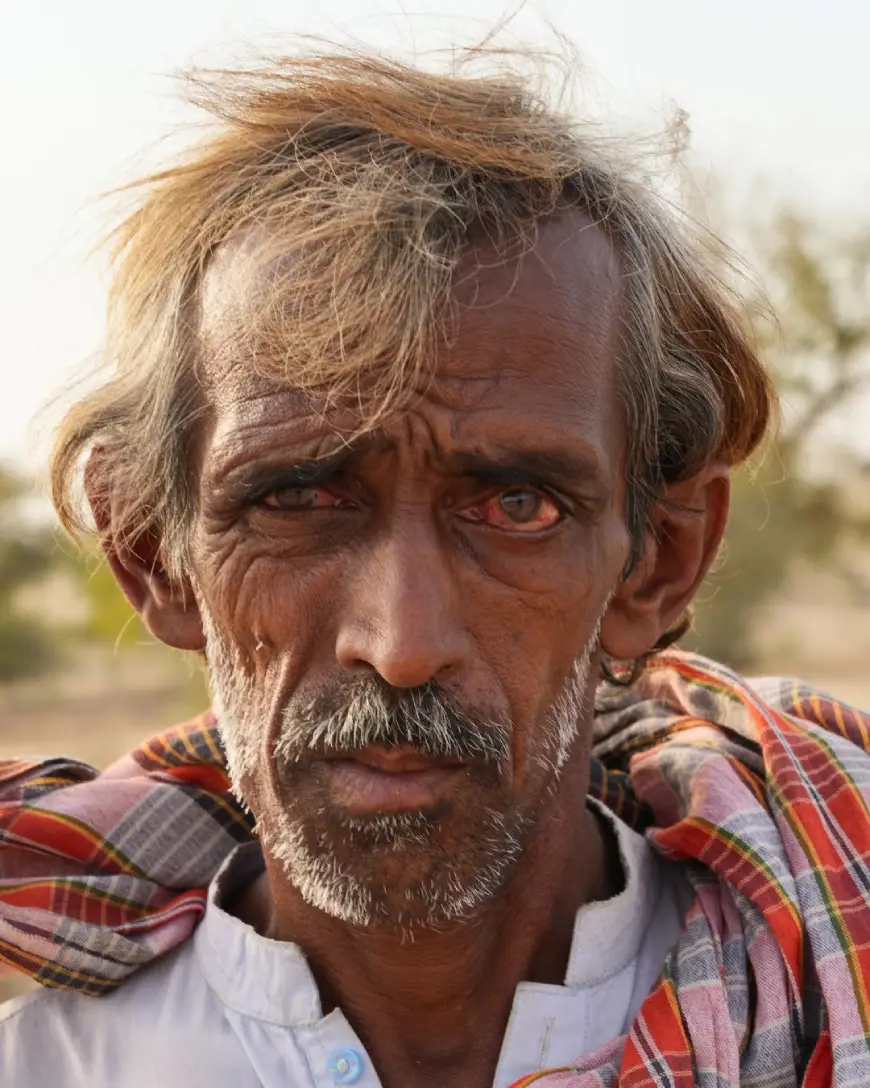
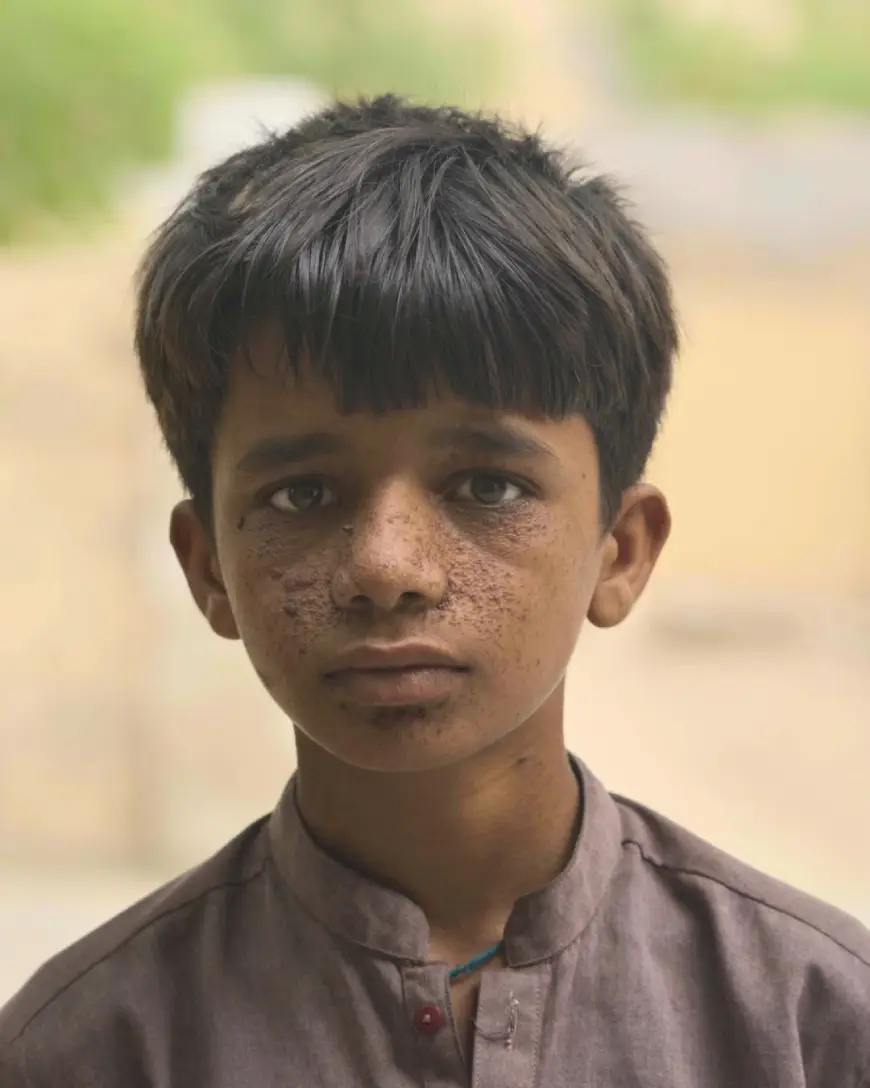
Portraits of Tharparkar residents fallen ill due to the impacts of coal development. Photo: Usama Irfan.Earthwise
Not just that, complain the residents of Thario Halepoto.
The company has acquired 2,500 acres of land from them for coal mining. It claims that it has compensated the owners of the land as per the laws of the land. The villagers, however, say they received only one-time compensation for land that gave them food and income every year. They say they received 180,000 rupees per acre of privately owned land which, as Halepoto puts it, was neither fair nor sufficient. “This paltry amount cannot compensate for what we have lost forever,” he says.
There were hundreds of kandi trees on the acquired land and the annual produce of even a single kandi tree was worth 40-50 thousand rupees, he says. That land, according to him, also had many other trees besides being the source of several food and cash crops. “The money given to us is nothing compared to what our land gave us each year.”
And then some more.
Over the last couple of years, SECMC has been warning the residents of Thario Halepoto that they would have to leave their remaining lands and their homes so that the mine could be expanded further. Halepoto’s voice shakes as he speaks of this impending development. “How can we leave our ancestral lands and homes where our forefathers, fathers and we have lived for centuries?” he says as his eyes well with tears. “Did Omer not give every luxury to Marvi and she still grieved for her homeland? So do we,” he says, referring to the love legend of Omer-Marvi in which the latter refuses to stay in the former’s palace, preferring instead to be returned to her family’s hutment in Tharparkar.
This love for the land, however deep and irrevocable it may appear, does not offer any protection against another problem: increasing incidence of health hazards. Halepoto, who never had any lung problems in the first 32 years of his life, has been experiencing asthma attacks for the last two years. Initially, these attacks occurred every 30 days but then they started happening every 15 days. Now they happen on a daily basis. “If I have an attack in the morning, I pray that all the mines and power plants vanish by the evening,” he says. “But that doesn’t happen, and I brace myself for another attack.”
He is not alone.
A survey carried out by the Policy Research Institute for Equitable Development (PRIED), an Islamabad-based think tank focused on energy transition and climate justice, in 2023 found that as many as 137 residents of New Senhri Dars suffered from respiratory diseases.
Ghosts of the present
Abbas Dars, now in his late sixties, did not want to leave his ancestral village of Senhri Dars when SECMC wanted to acquire its land. He also did not want to sell his land at 180,000 rupees per acre to the mining company. “We were earning 20-25 thousand rupees yearly from a single acre of land,” he echoes Halepoto, “and the trees on our land also provided enough food for us and our animals.”
In the end, his refusal to leave came to nothing. The police and the mining company employees came with a bulldozer to demolish his home on a day when he was not there, he says. He feared that they might try to invade the privacy and self-respect of his family in his absence. He, therefore, decided to move to the new village as soon as he came back home.
An open pit mine towers over where Senhri Dars once stood. Its 2,000 or so residents were displaced and resettled in New Senhri Dars in 2018. The construction of the new village was financed and overseen by Thar Foundation – a philanthropic organisation funded by SECMC.
After six years of living in the new village, Dars is thinking of moving again. The problem is that he has nothing left to finance his migration. “We can’t even sell these houses because we don’t have their ownership documents,” he says.
New Senhri Dars, meanwhile, remains eerily silent. Its residents – once deeply connected to their land and a communitarian way of living – now find themselves in a place that feels more like a cage than a home. Their model village, meant to be a manifestation of modernity, stands as a ghostly reminder of broken promises and shattered lives.
Unlike older villages in Thar, its residents don’t congregate in the streets or sit together under the trees to have small talk. “Soon after we moved to this model village, elderly people, particularly women, started dying,” says Abbas. The trauma of displacement was too much for them to bear, he adds.
“It was a day of mourning when we migrated to this village,” says Taj Muhammad Dars, another resident of New Senhri Dars. In our old village, he says, people had two main sources of income: agriculture and animal husbandry. With their village having been lost, both those sources have gone away. While their farmlands have been acquired for mining, they have lost their livestock considerably because their designated gaucher remains disputed with the residents of Thario Halepoto.
He also says that he and his fellow villagers have already spent the money they got for their land and can’t survive only on the 8,000 rupees monthly allowance that SECMC provides to each household. “Under the current inflation, how will we survive? Will we eat these concrete walls of our houses?” he says, alluding to the modern architecture of New Senhri Dars.
Another problem has cropped up recently: a new power plant owned and run by SSRL, a Chinese company, has been built right next to the village over the last four years. “When we were shifted here, no power plant was planned near us but now we have been forced to live under the shadow of this plant,” says Taj Muhammad Dars. “Its toxic smoke falls on our homes on a daily basis,” he says. “How can we remain happy in this environment?”
Aerial shot of New Senhri Dars model village in Tharpakar, Pakistan Video: Jaldeep Sarkar/Earthwise
Chandro Bheel, a 37-year old labourer from the local Bheel community – a marginalised part of Tharparkar’s large Hindu community – has a different complaint: SECMC has not given him land or a home in New Senhri Dars. The reason: he did not have a home of his own in his ancestral village because he spent a lot of time every year working elsewhere. When his family moved to the new village, his brother got new homes but he did not. “In our old village, it would have been easy for me to build a house whenever I liked [on the residential land collectively owned by my family]. Here, in this village, I can’t do that because I have no land to build a house on.”
His story and those of other residents of New Senhri Dars are echoes of a larger tragedy in which progress tramples upon culture, traditions and dreams. New Senhri Dars stands as a stark reminder of the social costs of coal development.
No entry
In Tharparkar’s landscape, horizons stretch endlessly. The sky kisses the earth in a gentle embrace in all four directions. In recent years, an obstructive feature has been added to this boundless serenity: fences. Made of barbed wire and concrete pillars, these fences can be seen everywhere, including along the road that connects Mithi with Islamakot.
Tall and imposing, most of the fences have been constructed around coal power plants and coal mines. They encircle vast spaces that were once fields and grazing lands. They simultaneously symbolise the promise of development and the reality of exclusion. For the people of Thar, they are not mere physical barriers. They are a metaphor for their lost freedom, dignity and way of life.
The fences demarcate not just who owns the land inside them, they also delineate the boundary between hope and despair. Inside them, the hum of machinery and extraction of coal signify progress and power. Outside, the people of Thar watch helplessly as their world shrinks around them and their land is swallowed by an insatiable hunger for electricity. They show how Tharparkar’s land has changed from a shared resource – to be nurtured and utilised collectively – to a commodity to be fenced off, controlled and exploited.
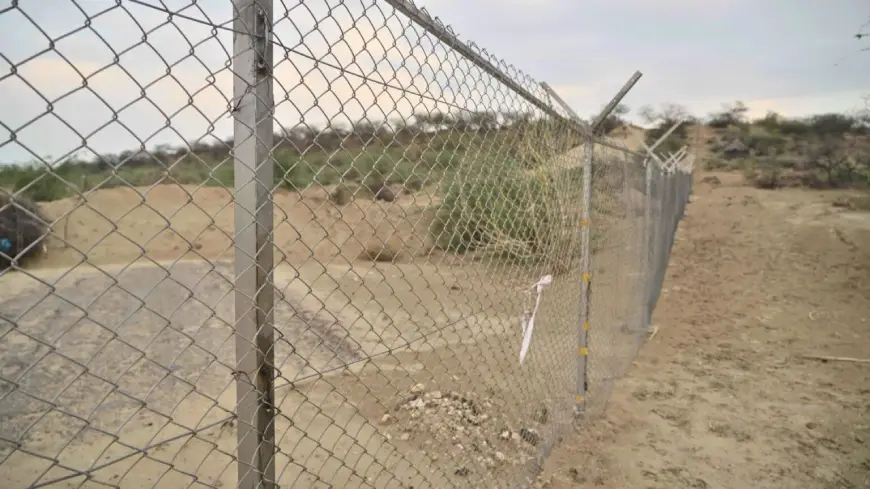
Fence installed by a power plant around Old Senhri Dars village in Tharparkar, Pakistan Photo: Usama Irfan/Earthwise
With a mixture of sorrow and defiance, Halepoto gazes at the fence that separates his village from the coal mine in Block II. “These fences are prisons without walls,” he murmurs. “They keep us out of the land that once nourished us, out of the spaces where our children played, where our animals grazed.”
The nearby village of New Senhri Dars is hemmed in by more than one fence – with a coal mine on its one side and a power plant on its other side. “Our lands were more than just soil and crops, they were our identity, our heritage. These fences have severed us from our roots,” says Abbas Dars, one of the village’s oldest residents – his words carrying the weight of his unresolved grief. “Every time I see a fence, a part of me withers away.”
The fences also create the fear of the unknown, the anxiety of being cut off from the familiar. These feelings have, indeed, seeped into the daily lives of the villagers. They speak of how the presence of fences has changed the way they perceive their surroundings: The once open and inviting landscape now feels hostile and suffocating. “The fences not just surround our land, they are also drawn inside our hearts,” says Bheel.
The fences are not creating merely psychological problems. In many places, they have blocked traditional paths, hampering access to gauchers and graveyards. The distances that once people covered in five minutes are now taking an hour or so to traverse. People in New Senhri Dars have dozens of stories to tell how they have to travel several kilometres skirting around the fences to take their dead relatives to their graveyard.
In the good old days, no fences divided the living from the dead.
Motherland, the second documentary about Tharparkar from Islamabad-based magazine Earthwise, explores how the advent of coal mining has deprived the people of Tharparkar of their land rights. Often coerced into relinquishing their homes and hearths for coal mines, they have lost access to their pastures and farmlands that once guaranteed a self-sufficient way of life.
Many of them have also received little or no compensation even after waging a decade-long legal struggle. This documentary records changes brought about in their lives by coal-related developments. It tells the story of a once prosperous people reduced to pecuniary, feeling imprisoned by their changed circumstances and forced to take up menial jobs.
As coal mining operations began, the underground wells, once a lifeline for communities in Thar, Pakistan, turned toxic. Locals allege that water from the mines is being dumped into reservoirs near their villages, polluting their only source of sustenance.
Despite their pleas, the government has turned a blind eye, leaving these communities to fend for themselves in a desert where water is already a scarce commodity.