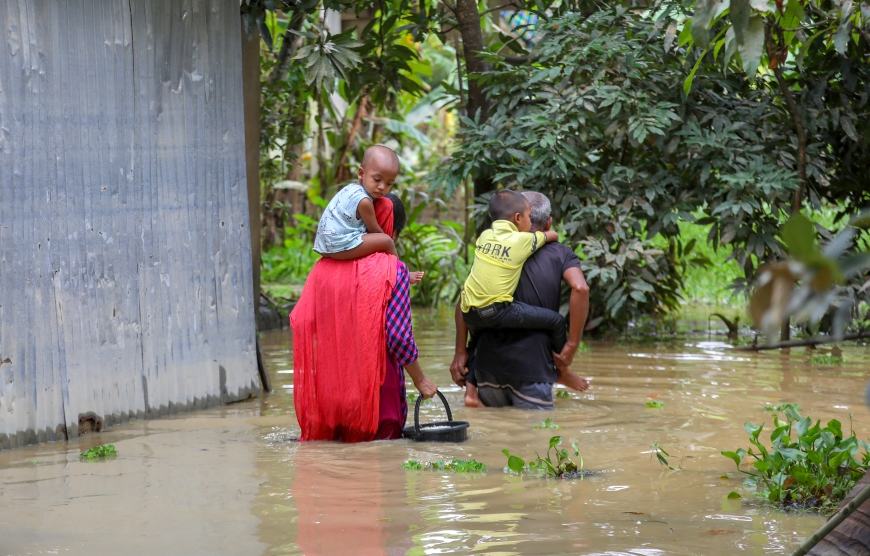
Shimul Chandra Paul, a resident of Parshuram in Feni, woke up to incessant rain for the third consecutive day. The looming risk of flooding, which had seemed unlikely just a day before, had suddenly become a reality. By noon, water had reached his village, rising rapidly with each passing minute. Before he could figure out how to save his belongings, the water level rose too high. Shimul barely managed to save himself, first taking refuge on a tin-shed rooftop before moving to a building in nearby bazaar as the surging waters continued to rise.
“We have never seen such massive rain in our lives. Even our fathers hadn’t,” said Shimul. Although the water rose rapidly, it didn’t recede as quickly. It took over a week for the discharge to begin. By then, Shyamal’s house was in ruins, and his properties were irreversibly damaged.
Shimul, his brothers, extended family, and millions of others in southeastern Bangladesh – along with the people in the Indian state of Tripura – were stranded in the prolonged flood in August 2024. Thousands lost their houses and belongings to the flash floods. But, except for inundating national sympathy and private help in the immediate aftermath of the disaster, many victims found no help as the government came up with little hope for them.
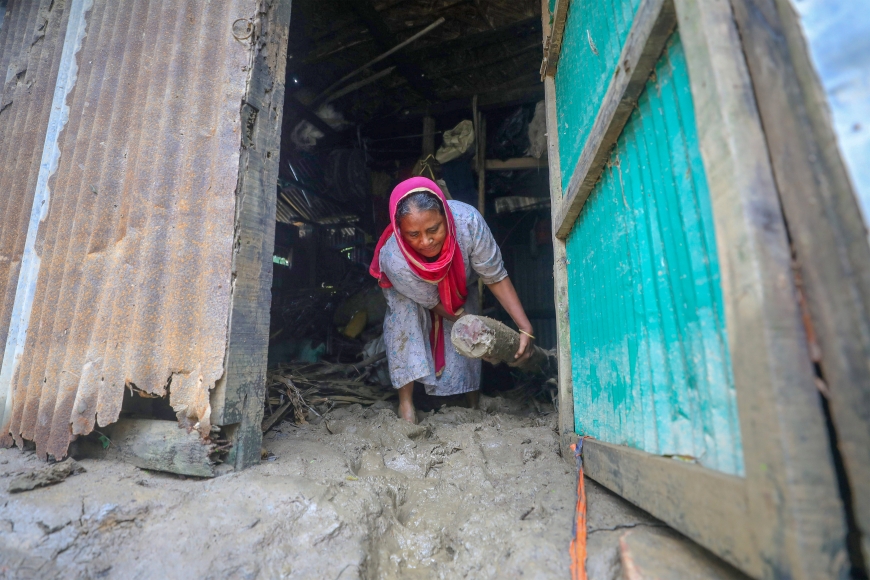
Thousands lost their houses and belongings to the flash floods. Photo: Mohammad Minhaj Uddin
District officials in Cumilla and Feni reported shortages in relief supplies, immediately receiving only 400 metal sheet bundles and Tk12 lakh each, despite much higher demands as thousands of houses were damaged. However, around 300 houses were handed over to the victims by the government this April, while many needs relied on private aid or were simply left unmet as over 8,000 houses were fully or partially damaged in Feni alone.
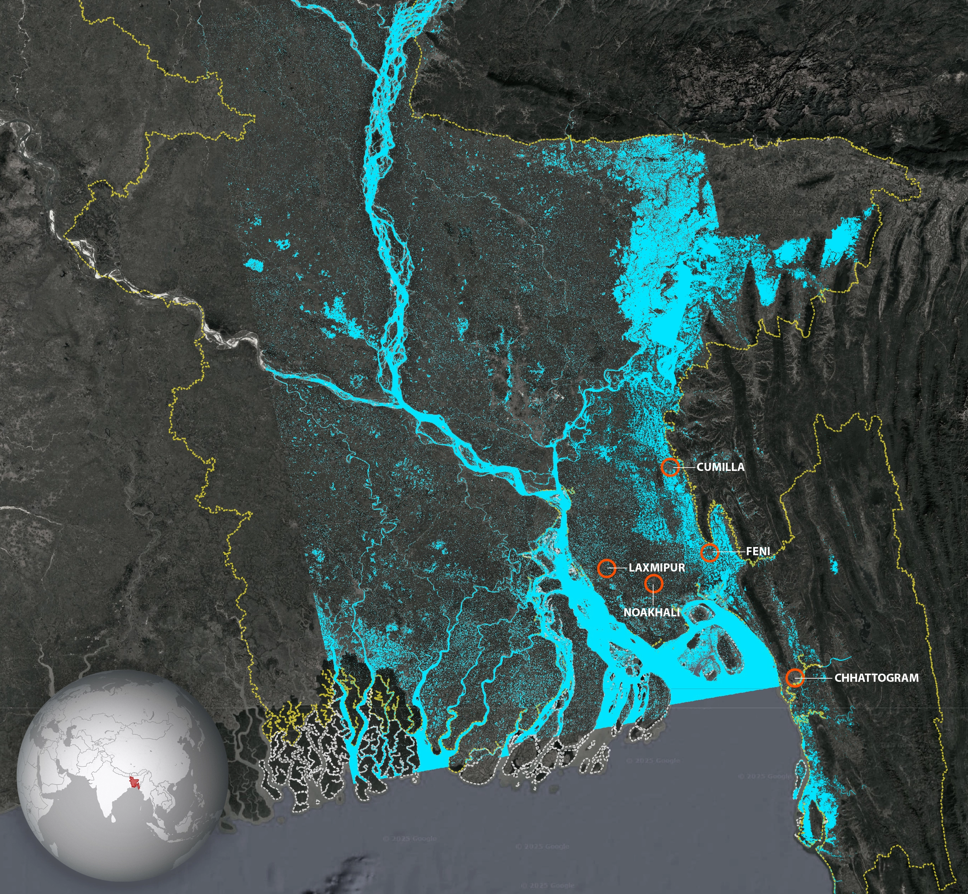
Bangladesh’s Feni has been the most affected besides Cumilla, Noakhali, Chattogram, and Laxmipur, as it rarely experiences floods. So, when consecutive days of heavy rainfall, amounting to hundreds of millimetres, poured down along with a cloudburst, people were caught off guard, lacking prior experience in dealing with floods of this scale.
About 71 people died in southeastern Bangladesh, including 28 in Feni, while 31 lost their lives in the Indian state of Tripura. The floodwater remained for over a week as drainage channels were blocked, and swamps and canals had been lost to encroachment.
As a result, people’s suffering worsened. Although private aid poured into flood-affected areas, many struggled without food and water for days, as relief workers faced difficulties reaching remote areas. Even after the water finally receded, the devastation left behind was staggering. Waves of diseases spread, and many victims received little to no assistance for rehabilitation.
Erratic rainfall – the force behind August disaster
From August 19-23, 2024, Bangladesh’s Feni recorded 832 mm of rain in just five days, while Comilla received 513 mm and Noakhali 605 mm. This erratic downpour, combined with water cascading from the hilly regions across the Indian border in Tripura, triggered the unprecedented flood in southeastern Bangladesh.
Tripura also recorded one of its highest 24-hour rainfall totals on August 22, 2024. For example, South Tripura District (Bokafa) received 493.6 mm, Sepahijala District (Sonamura) 293.4 mm, West Tripura District (Agartala) 233 mm, and Gomati District (Udaipur) 155 mm in 24 hours, exacerbating the flood situation in the Indian state.
K M Abdul Wadud, Additional Secretary at the Ministry of Disaster Management and Relief, said both Feni and Tripura receiving a gigantic amount of rain simultaneously overstrained the discharge channels, which were already encroached.
“Water from both sides was released into the same area. The Gomti, Mohuri, Kohua, and Feni rivers are hilly and shallow, with limited capacity. If it had been only upstream water, we would have had some lead time and an opportunity to issue early warnings.”
On a monthly estimate, in August 2024, Feni recorded a total of 1,787 mm of rainfall.
According to our analysis of 30 years of daily and monthly data, the previous highest recorded rainfall in August for Feni was 858 mm in 1998. Similarly, Noakhali received 1,646 mm of rain in August 2024, whereas its highest in the past 30 years was 897 mm in 1998. Comilla recorded 880 mm, significantly surpassing its previous near-highest record of 523 mm from the previous year.
For instance, in Sylhet, the highest recorded monthly rainfall in June was 1,288 mm in 2006, based on our 30-year data analysis. The average is far below. However, in the past three years, rainfall levels have consecutively far exceeded or come close to this record – reaching 2,124 mm in 2024, 1,485 mm in 2022, and 1,267 mm in 2023.
“The August rainfall in Feni was about three times higher than the 30-year average. Since this massive rainfall occurred in a clustered manner, it became a major trigger for flooding, highlighting the abrupt shift in rainfall patterns due to climate change,” said Dr. Md Sarwar Hossain, Associate Professor at the University of Glasgow’s School of Social and Environmental Sustainability.
A similar erratic rainfall pattern was also observed on the Indian side in Tripura. But questions remain about whether information was exchanged regarding the opening of the Dumbur Dam gates. If it wasn’t shared, we need to determine who is responsible,” he said.
When asked if India notified Bangladesh before releasing water from the Dumbur Dam and whether an agreement mandates such notification, Wadud said, “Yes, regional data is shared”, and emphasized that they “do not rely solely on Indian data. We use our own assumption models.”
What was unusual in the Feni flood was the local rainfall, Wadud said. There was a cloudburst, which added to the regular monsoon rains.
“The Feni event was highly unusual – so many things don’t usually happen all at once,” he added.
Sarwar Hossain said erratic rainfall is likely to increase in the future, but with canals disappearing and rivers narrowing, flash floods will only heighten the risks further. He also emphasised the need for an early warning system and a robust disaster management mechanism to minimise damage from flash floods.
Vanishing waterways and encroachment
Erratic rainfall triggered the initial flooding, but the decay of rivers and the encroachment on waterways, such as canals, worsened the situation in Bangladesh – prolonging the suffering as floodwaters had nowhere to drain. We investigated satellite images and conducted field visits to see first-hand the ruined canals and encroached waterways.
The Pagli Chhara canal in Feni’s Daudpur, for example, illustrates the impact of encroachment and pollution. Once over 30 feet wide, it was navigated by boats and even served as a docking point for cargo ships coming from Noakhali. Now, in some areas, it is less than three feet wide and largely filled in.
“This canal had good water flow even a few years ago, but encroachment has nearly destroyed it,” said Nurul Islam, a local resident.
Other canals, such as the Damdama Canal, have become drains. Locals say that dozens of such water bodies have disappeared from Feni city in the last two decades, with canals and water flow filled in or destroyed. Experts warn that the reduction of water bodies in a city significantly increases flood risks.
“Mohuri, Kohua, and Silonia rivers have been encroached on both sides, narrowing the rivers. Houses have been built in riverbeds, and tree plantations along the riverbed have obstructed water flow,” said M A Hasan, a journalist based in Feni.
When asked what made the Feni flood worse and why no significant river restoration projects had succeeded, Wadud pointed out the negligence in water management systems.
“Our water flows from north to south, yet we keep building roads that cross from east to west, which creates obstacles. But riverbanks aren’t dredged properly – there’s no integrated coordination. We face water shortages during the dry season, yet have overflowing rivers during the monsoon. These are also forms of disaster,” he added.
Nayma Baten, a meteorologist at the Climate Division of the Bangladesh Meteorological Department, said that while erratic rainfall has contributed to flooding, the narrowing of rivers and the disappearance of other water bodies have worsened the flash flood situation.
“Water can no longer flow effectively through the rivers or be released through running water bodies. This was evident when we received heavy rainfall several decades ago – the floods were not as severe because the rivers were free-flowing,” she said.
The Feni River, a vital drainage route for Feni, Khagrachari, and Chittagong, flows approximately 153 km into the Bay of Bengal. Nearby, the 50-km Muhuri Project dam, built in 1984 to protect Mirsarai and Sonagazi from floods, has contributed to the formation of chars. Over time, fish enclosures and ponds, established through occupation or leasing, have further obstructed water flow.
Meanwhile, the Gomti River, which flows through Cumilla, has also dried up and narrowed down in places, obstructing its capacity to carry enough water.
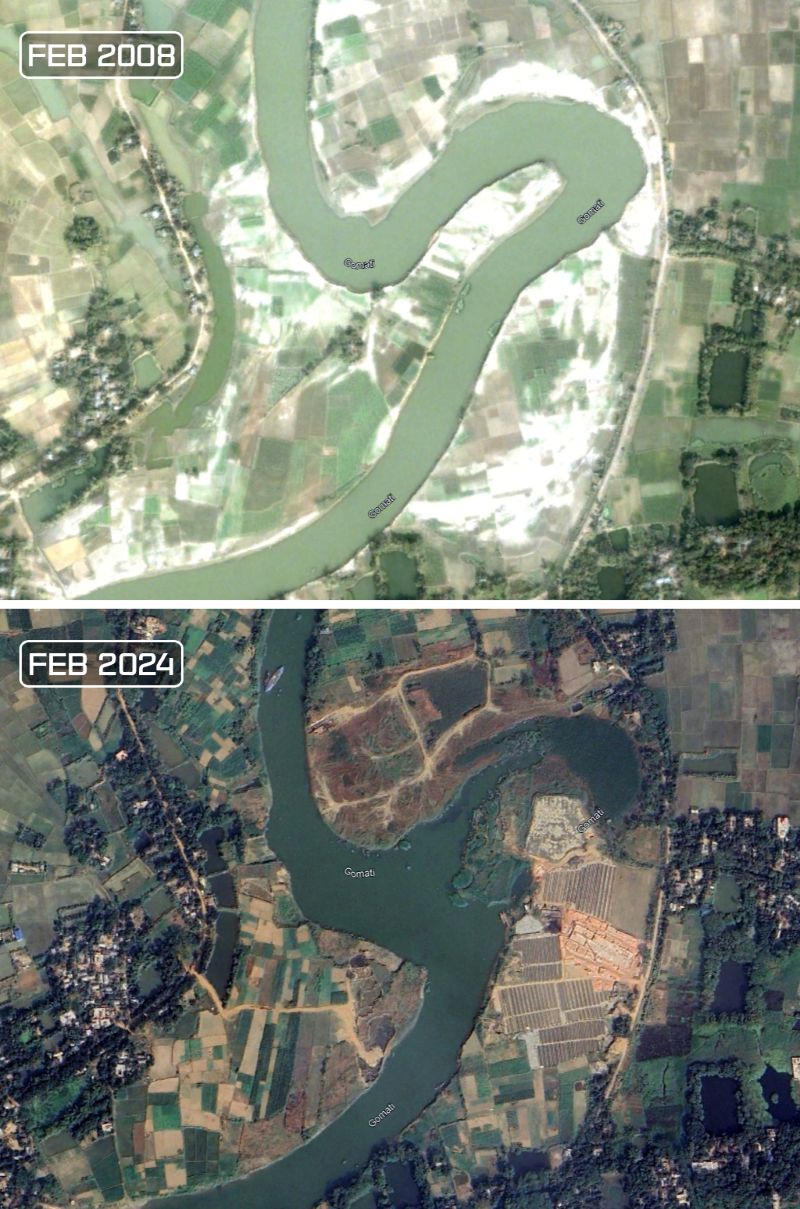
“Gomti didn’t dry out on its own,” said Mohammad Azaz, Chairman of the River & Delta Research Centre (RDRC), referring to the dam in the Indian side of Tripura, which reduced the regular water flow in the river.
“Besides, the swamps and water bodies have also disappeared. The damage done to rivers and water bodies in Bangladesh causes flooding not only in Feni, but also in Sylhet and other areas,” he said.
“All the canals and water bodies in Noakhali, Feni, and Laxmipur have been filled. Re-excavation projects for canals must be launched urgently to ensure water discharge. Without this, it will take a long time for water to flow properly,” he added.
Negligence in post-flood rehabilitation
The August 2024 flood caused massive damage to lives and livelihoods. Flood victims in these districts, having essentially lost everything, needed assistance from the authorities to rebuild and restart.
However, despite private efforts during the flood to save lives, the people in these areas didn’t get adequate support for rehabilitation.
“I got Tk50,000 for rebuilding my house, which was destroyed, but this fund is not enough, so I still couldn’t start the rebuilding of my house,” Shaymol Chandra said. “But my brothers didn’t get a penny from anyone, the flood had damaged their houses too.”
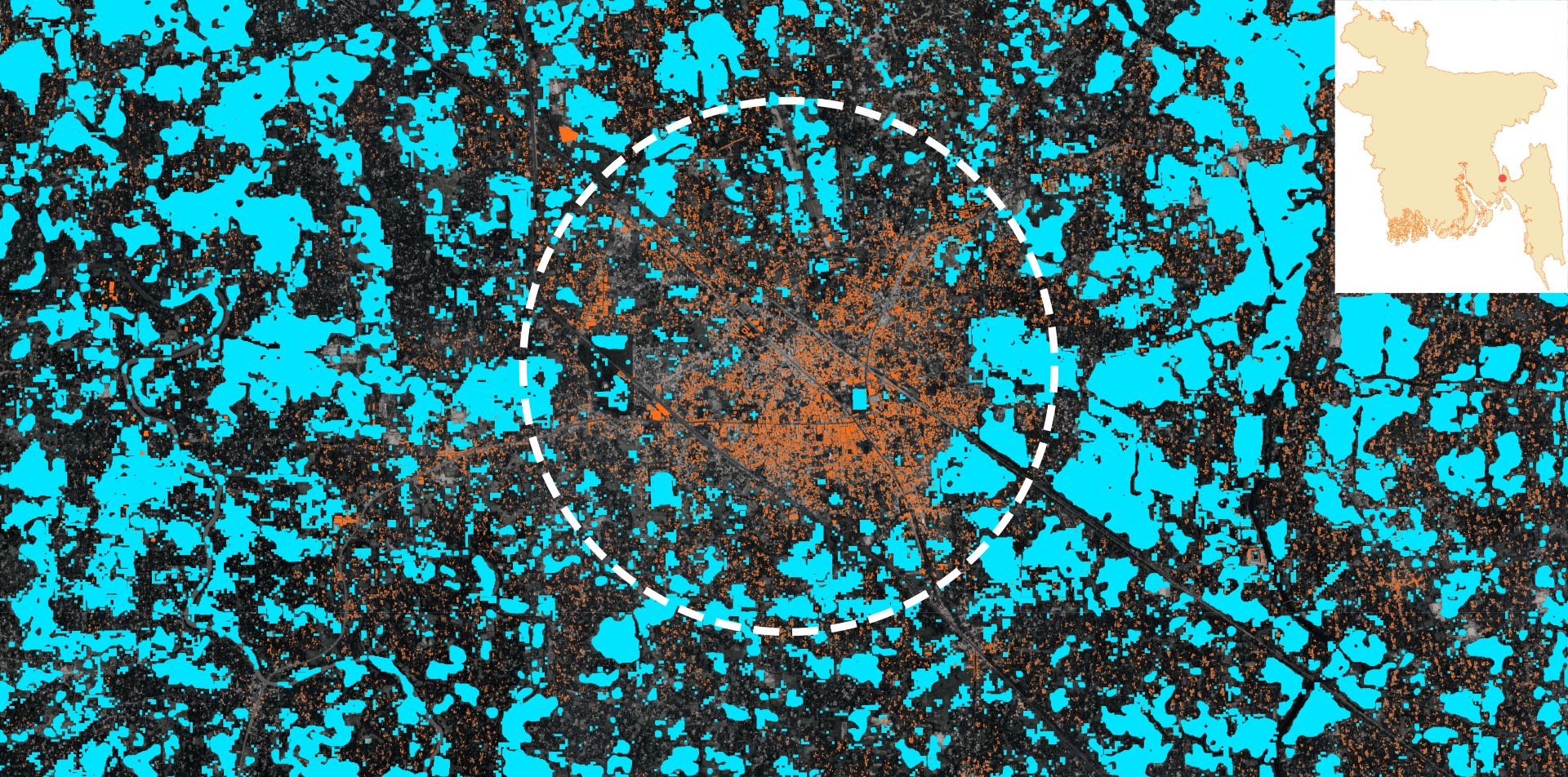
By combining flood extent data from ARIA Water Maps (OPERA Dynamic Surface Water Extent) and the UNOSAT SAR AI model, our analysis shows that at least 8,000 structures in Feni and surrounding areas (orange) with flooded areas (light blue), highlighting the scale of inundation. Credit: Arun Karki
When asked about the gaps in relief distribution and funding for flood rehabilitation, Wadud, addressing the lack of funds, said the budgetary timeframe had something to do with poor government response.
“Our disaster management fund is governed by specific rules – there is a Disaster Management Act that allows local collection of funds, but Deputy Commissioners (DCs) often don’t collect them. Even when funds are available locally, they must be returned to the government by June [budget year end]. But floods usually begin in July. This becomes a major barrier.”
Juel Mahmud, former Programme Coordinator at the International Centre for Climate Change and Development (ICCCAD), said that erratic precipitation patterns themselves hinder resilience capacity.
“We have mechanisms in place to deal with such flood situations. But the erratic nature of it, coupled with the failure of local officials, exacerbated the suffering of the people,” he said.
Md Sirajul Islam, a local social worker, said that flood survivors in remote areas hadn’t received help.
“Our agriculture had been severely damaged. While there has been some effort to support farmers with rice seedlings from the northern area, it has been minimal compared to the actual need. If the government could provide enough seeds, fertilisers, or at least subsidised fertilisers, our farmers could have overcome this crisis.”
“Our land is fertile. Our watermelons meet the demand of several districts. If our farmers are properly supported, they will stand on their own feet again,” Sirajul Islam said.
Mohammad Abed Ali District Relief & Rehabilitation Officer in Cumilla, said that against a demand for one lakh bundles of corrugated metal sheets, they received only 400 bundles and Tk12 lakh. “We submitted our requisition, but the department couldn’t provide us with more,” he said.
In Feni, on the other hand, about 8659 houses were destroyed in full or partially. District Relief and Rehabilitation Officer Mahbub Alam said they also received 400 bundles of corrugated metal sheets and Tk12 lakh besides private help, which was inadequate to the demand.
However, according to a document shared by Mahbub, some other government wings, including the military, have built around 300 houses, which was delivered to the victims this April. The document also lists donations from NGOs and non-profits such as UNDP, WFP, and others.
While most donations ranged between Tk 6,000 and Tk 30,000 – providing a little relief in the rebuilding process – As Sunnah Foundation offered Tk 300,000 per damaged family. However, they were able to assist only 287 families, whereas over 1,700 houses were completely destroyed.
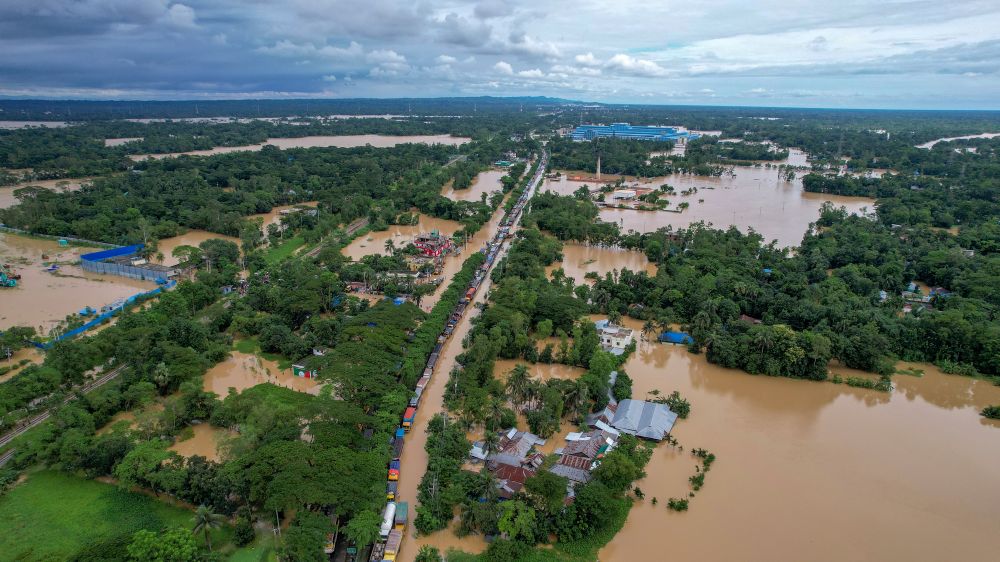
The erratic nature of rainfall and accompanying flash flood exacerbated the suffering of the people. Photo: Mohammad Minhaj Uddin
“The flood claimed everything we had, and most of us are now left alone in the fight to rebuild our lives,” Shimul said. “Only God knows how we will survive if such a disaster strikes us again.”
After last year’s flood, Syeda Rizwana Hasan, adviser to the Ministry of Water Resources, promised embankments in strategic locations, modern surveys, cancellation of illegal sand leases, and eviction of river encroachers to prevent future disasters.
Around a year later, at a recent advisory council meeting, the officials discussed finalising designs for the Musapur Regulator and Bamni Closure, permanent embankments in Feni, and freeing drainage canals in Noakhali.
Pointing out that a year has passed and these project discussions remain “finalising” or “ongoing,” river researcher Sheikh Rokon wrote in a recent column: “It is inevitable to question: what has the government actually done in the past year to tackle flooding in Feni?
Across the beds of Feni’s rivers, there is now cultivation and fish farming. Why couldn’t the government remove these encroachments over the past year? No matter how many embankments or structures are built or repaired, they will not be sustainable without clearing these flow paths,” he added.
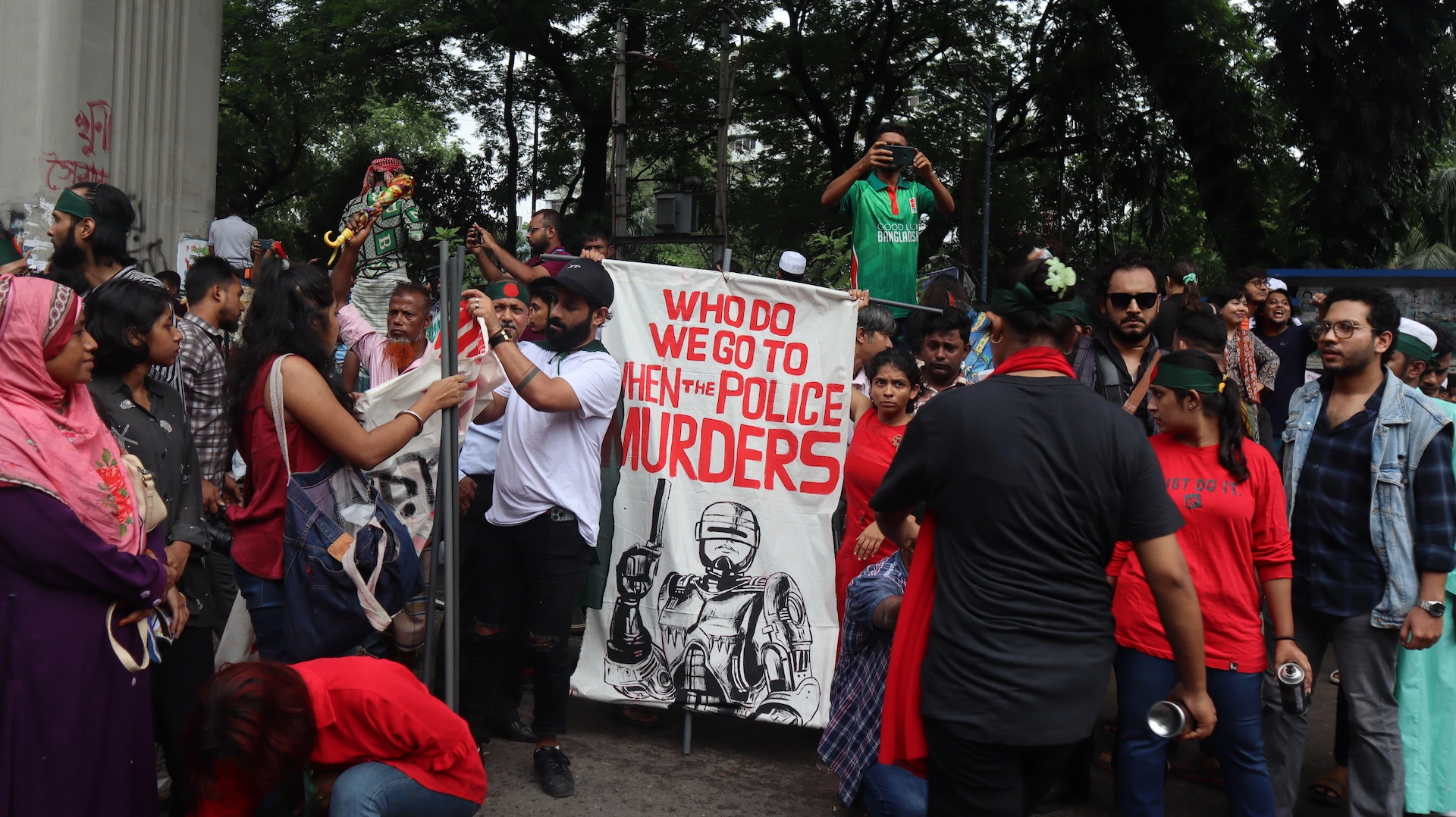
On August 2, 2024, protesters in Dhaka brought a large procession for Hasina’s resignation. Photo: Masum Billah
Imam Hasan Taim had already been shot twice before the camera started recording.
On July 20, 2024, Taim was in Jatrabari, a neighbourhood in Bangladesh’s capital city Dhaka, when the police started firing. He was one of the student protesters in a crowd that had gathered to demand resignation of the now ousted prime minister Sheikh Hasina.
In the now-viral footage, taken by a journalist called Arefin Mahmud Shakil, Taim is seen being dragged by his friend Rahat Hossain to safety. A few seconds in, a police officer is seen shooting Imam at close range. The officer’s name was later identified as Jakir Hossain. Rahat was also injured but he continued to drag Imam. In the next few seconds, Jakir Hossain was seen shooting Imam again — then again. Unable to go on any further, Rahat fled to save his own life.
Ironically the son of a police officer himself, Taim was left at the scene for half an hour before officers carried his body to Jatrabari police station. There, his family claims that the officers trampled their son – who was alive until then – to death.
“My brother would have survived had he been taken to the hospital,” Rabiul Awal, Imam Hasan’s older brother, told Asian Dispatch. “But after they took him to Jatrabari thana, a group of officers led by an officer called Assistant Commissioner (AC) Nahid Ferdous trampled him to death.”
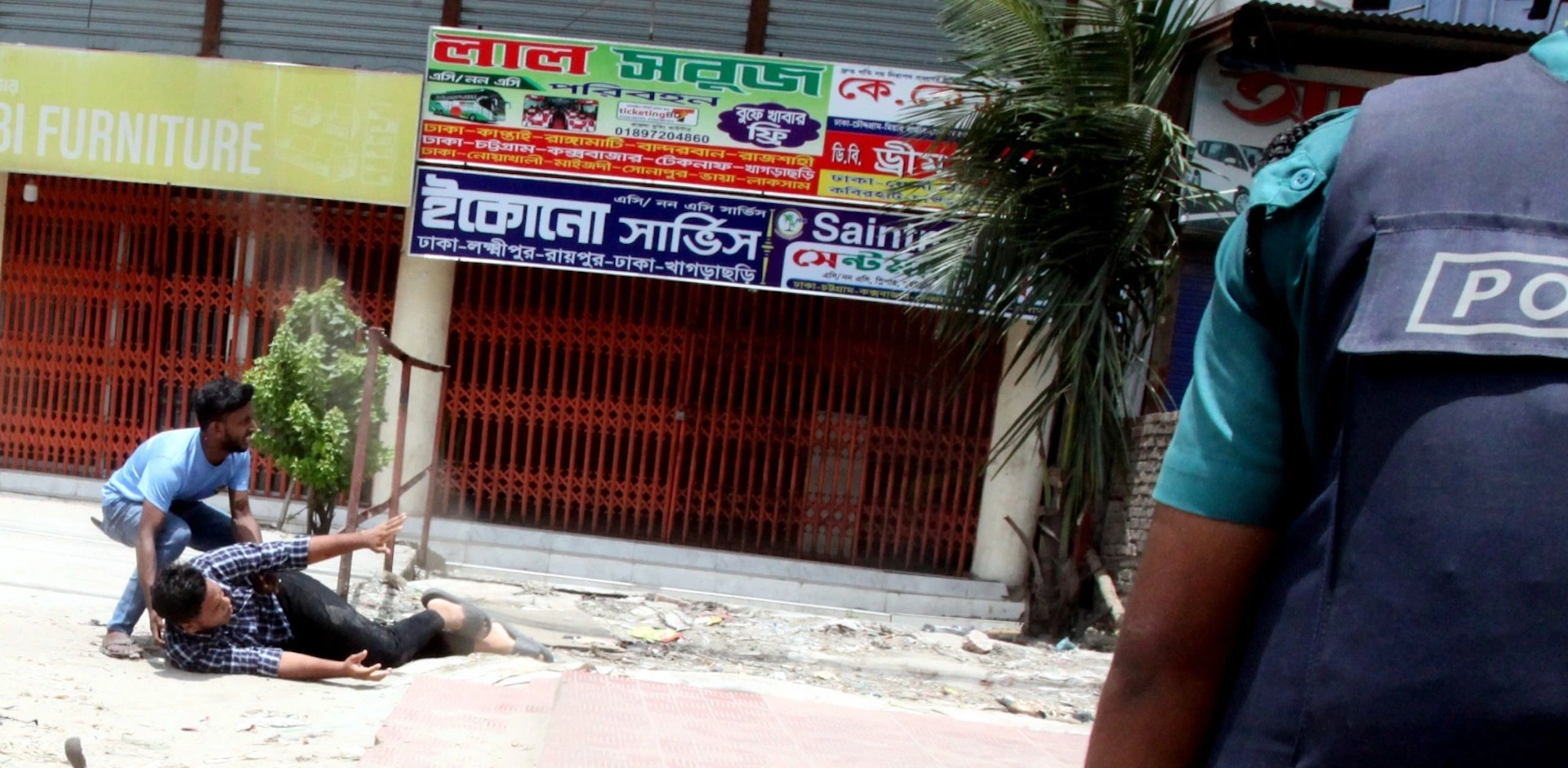
Taim (right) and his friend Rahat being attacked during protests on July 20, 2024. Photo via screengrab.
Taim’s family identified at least eight more police officers from the Dhaka Metropolitan Police alongside Jakir Hossain, including Additional Deputy Commissioners Shakil Mohammad Shamim and Shahadat Ali, and Additional Deputy Commissioner Masudur Rahman.
My brother would have survived had he been taken to the hospital. But after they took him to Jatrabari thana, a group of officers led by an officer called Assistant Commissioner Nahid Ferdous trampled him to death. — Rabiul Awal, Taim’s older brother.
Taim’s brother Awal told this reporter – based on his review of government documents – that out of this group of cops, Nahid Ferdous was later transferred and stationed at a Rapid Action Battalion (RAB) camp in Jhinaidaha district, which is nearly 200 kms from Dhaka. RAB is a paramilitary force in Bangladesh sanctioned by the US for human rights abuses under Hasina’s rule.
Imam’s family filed a case against 10 police officers, including Jakir Hossain, Iqbal Hossain, Shakil Mohammad Shamim, Tanjil Ahmed, Shahadat Ali, Masudur Rahman, Nahid Ferdous, Shudipta Kumar and Wahidul Haque, in a Dhaka court. Among them, only Abul Hasan, Tanjil Ahmed, and Shahadat Ali have been arrested.
The family also filed a case against the accused at the country’s International Crimes Tribunal (ICT), where warrants were issued for several officers, including Nahid.
“The ICT issued warrants for them on November 12. But AC Nahid was on duty until November 20. How is that possible?” Tuhin asked, implying Nahid’s connection with an influential Dhaka Metropolitan Police official. He suspects forces within the police are sheltering the accused officers.
A Tale of Disproportionate Police Violence
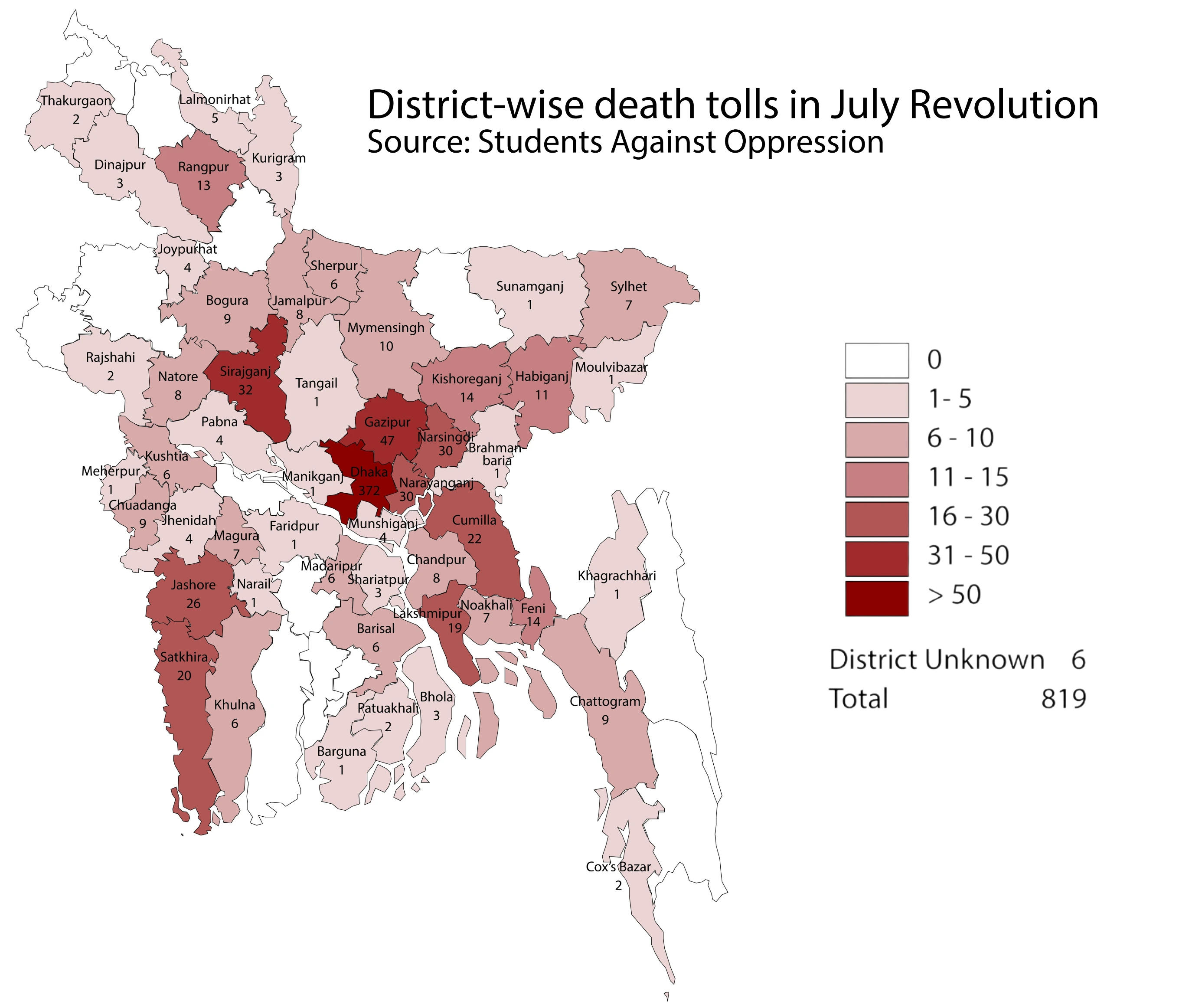
The mass uprising in Bangladesh – South Asia’s youngest country formed in 1971 – was a pivotal moment in the world that saw thousands of people, mostly students, not only shake Hasina’s 16 years of autocratic rule, but dismantle it entirely. Hasina fled the country – she’s currently in hiding in India – but left, in the wake of her ouster, a lasting legacy of police brutality. From July 16 to August 5, 2024, more than 800 people, including at least 89 children, were killed by the police, other security forces and men associated with Hasina’s party.
On July 19 alone – the day the fallen regime enforced an internet blackout – at least 148 people were killed by law enforcement agencies, according to a report by the International Truth and Justice Project (ITJP) and Tech Global Institute.
“Shockingly, 54 of the dead were shot in the head or throat. Many of those killed were not even part of the protests, but bystanders and people who happened to live or work close to the shooting that was completely indiscriminate,” the ITJP report found.
Among them were children as young as four-year-old Abdul Ahad and six-year-old Riya Gope, each shot in the head in front of their parents at home during an attack on protesters in their neighborhood.
In a report by Human Rights Watch (HRW), released on January 27, 2025, a police officer is quoted as saying, “I witnessed officers firing at vital organs…. In many cases, I witnessed live ammunition being fired even when officers’ lives were not in danger.” Another police official described, to HRW, how senior officers in the Dhaka Metropolitan Police headquarters watched live CCTV footage and directed officers on the ground to shoot protesters as if “they were ordering someone to shoot in a video game.”
Many of the July-August killings were captured on video by witnesses, bystanders and journalists. Law enforcement agencies shot citizens from helicopters, killed children in their homes through windows, targeted long-range shooting aimed at protesters, denied treatment and burned bodies after killing people.
I witnessed officers firing at vital organs…. In many cases, I witnessed live ammunition being fired even when officers’ lives were not in danger. — A police officer quoted in Human Rights Watch’s report on 2024 police brutality.
After Hasina fled the country, legal cases against cops poured in by families of the deceased. Top officers, including the then Inspector General of Police Chowdhury Abdullah Al-Mamun, Harun Or Rashid, Monirul Islam and Biplob Kumar Sarker, face dozens of murder charges each. According to a list of cases against police officials obtained by Asian Dispatch, at least 94 officers face charges of murder or torture. Different reports published in local dailies such as Prothom Alo also suggest nearly a hundred police officers being charged.
These statistics are now several months old. Asian Dispatch reached out to various authorities – including Bangladesh’s police headquarters, CID and International Crimes Tribunals – to confirm the estimated number of police officers facing murder charges. None of them provided answers. “We don’t have information about this,” Assistant Inspector General Enamul Haque Sagar, the spokesperson of Police Headquarters, told Asian Dispatch. However, he did confirm that only 34 officers – as of Feb. 5 – have been arrested so far in connection to the July uprising.
READ: As a ‘Gen Z’ Journalist, This is How I Felt Witnessing Young Bangladeshis Overthrow Sheikh Hasina
The Center for Information Resilience (CIR), an international agency that uses open source and digital investigations to expose human rights violations, verified 83 pieces of footage showcasing 52 separate incidents of police brutality in July-August. Of these, 24 showed verified casualties.
The CIR findings also identified “two peaks” in violence. The first was on July 18, where killings amounted to a massacre. It all started with the killing of a protester called Abu Sayeed, in Rangpur district, on July 16, which was captured in a now iconic image of him spreading his hands in front of the police force. The second “peak” in violence was on August 5, the day Hasina resigned and fled to India.
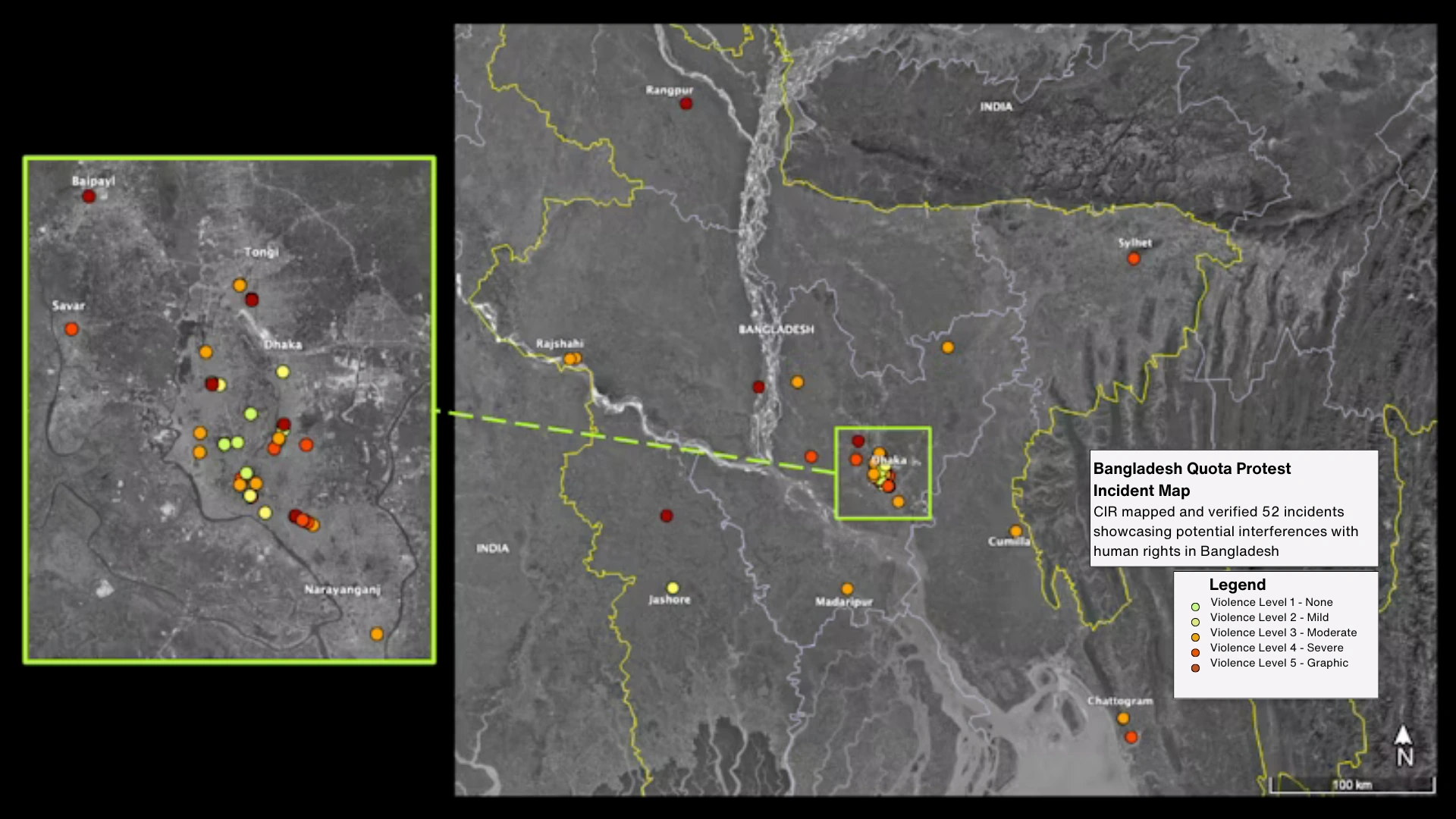
Centre for Information Resilience mapped and verified 52 incidents showcasing potential interferences with human rights in Bangladesh. The key on the right-hand side indicates the graphic level of footage and images collected. Graphics courtesy: CIR
“Within these verified incidents, CIR identified a concerning trend of disproportionate violence by police officers and military personnel, which potentially breaches human rights, including the use of live ammunition against protesters, the desecration of bodies, and the beating of unarmed civilians,” the report states.
Cold-blooded Targeted Killing
On August 5, Mohammed Sujon Hossain, a police officer from the Armed Police Battalion (APBn), a specialised combat unit of Bangladesh Police, was seen shooting a protester. On duty in Dhaka’s Changkharpur area, the official is seen firing a Type 56 semi-automatic carbine – an assault rifle often used by military personnel or armed groups – at protesters located less than 100 meters to the east. In a video that was later aired on Jamuna TV, the official is seen shooting one protester, after which other officers join in. Sujon Hossain is seen leaning on his knee to shoot again and saying, “Someone is dead,” as other officers start shooting at unarmed civilians.
Sujon was arrested on September 12, 2024.
Asian Dispatch got the said footage verified by CIR. The video was shot from Zahir Raihan Road near the Sheikh Hasina National Institute of Burn & Plastic Surgery and Chankharpul General Hospital in the Chankharpul area of Dhaka, geolocated at 23.7238, 90.4010.

Officers fired multiple weapons, including Type 56 semi-automatic carbines (left) and a Type 56 assault rifle (right). Graphics Courtesy: CIR
On this day, more than 10 dead bodies were reportedly brought to Dhaka Medical College Hospital from Chankharpul soon after the shootouts.
One of those shot dead was Shahriar Khan Anas, a 16-year-old student at Gandaria Ideal High School in Dhaka. Before joining the march to Hasina’s residence, Anas had written a letter to his mother saying, “Rather than staying at home like a coward, it is much better to join the struggle and be shot dead like a hero.”
His father, Shahria Khan Palash, filed a case at the ICT, naming Hasina as the prime accused, along with several police officers. He told Asian Dispatch that he asked the ICT to include the then Additional Deputy Police Commissioner (ADPC) Akhtarul Islam in his case. “Whenever I call, they [ICT] say my case is still being processed. But arrest is far away,” Palash said.
When contacted, ICT investigating officer Munirul Islam told Asian Dispatch that they were still investigating the allegations and refused to share any details about charges, including the allegations against Akhtarul Islam.
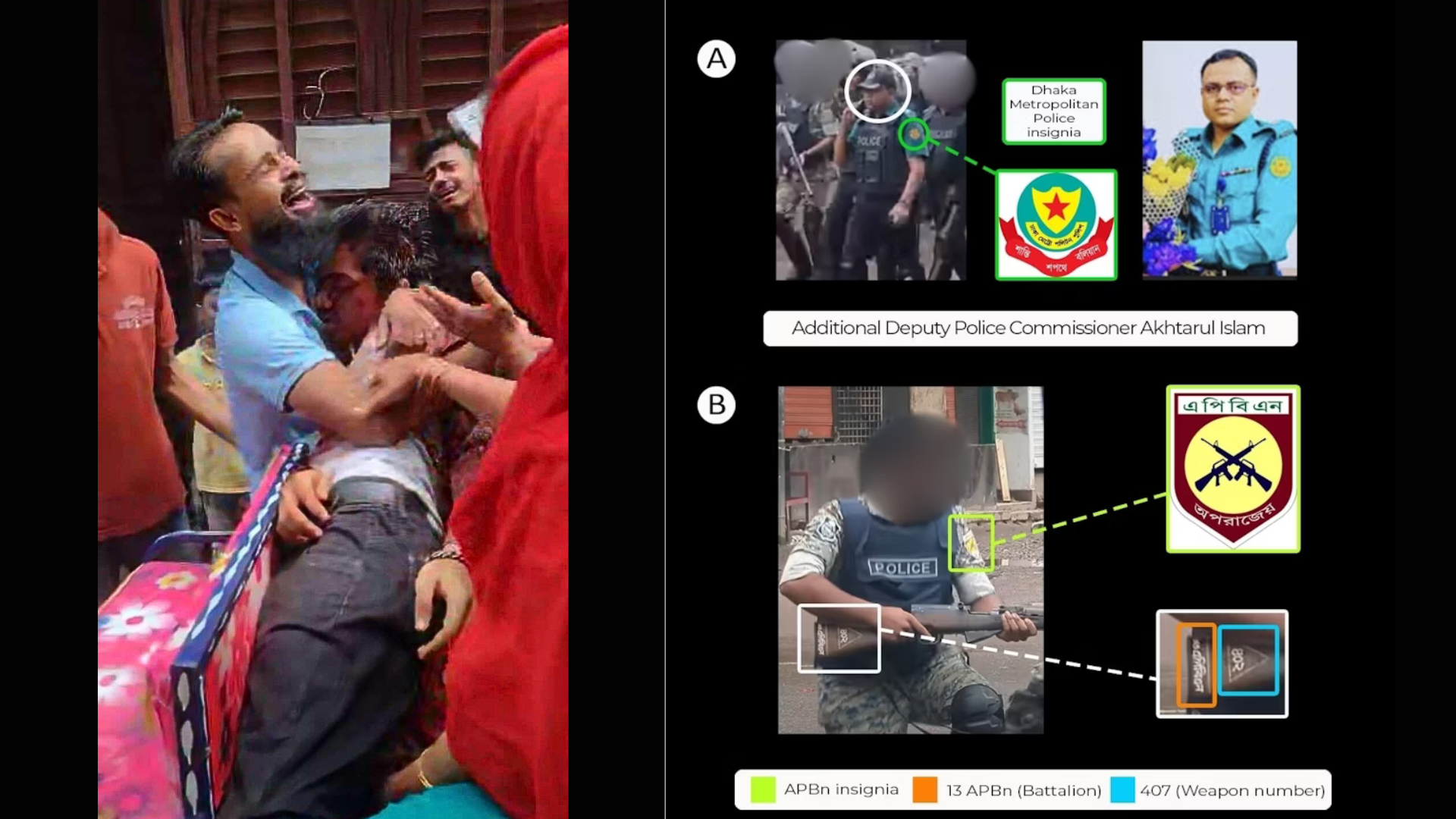
(Left) Shahria Khan Palash holds the body of his son Shahrirar Khan Anas. Photo courtesy: Shahria Khan Palash; (Right) CIR confirmed that Additional Deputy Police Commissioner Akhtarul Islam was present during the incident. Sources: upper left (A): Samakal News, bottom left (B): X. Graphics courtesy: CIR
According to Bangladeshi daily, The Business Standard, ADPC Akhtarul Islam was seen in command in Chankharpul that day. Another police officer present there told The Business Standard that, “Sir Akhtarul himself also fired that day.” When Asian Dispatch asked ICT about Akhtarul Islam’s whereabouts on the aforementioned day, spokesperson Enamul Haque Sagar responded: “We don’t have that information.”
In another part of Dhaka, another police officer called Arafatul Islam was seen in a video near a van where police officers were loading several dead bodies, with at least six other officers in the background. The bodies were later burned on a truck. Arafatul was subsequently arrested for concealing evidence of police brutality. Md Abdullahil Kafi, the additional superintendent of police (crime and operations) in Dhaka, was also arrested in connection to this case.
Escaping Justice
Asian Dispatch reviewed around 100 videos from this time, and corroborated those of over a dozen police officers in connection to the July-August violence. The interim government of Nobel Laureate Muhammad Yunus has, so far, set up a foundation to support the families of wounded and killed, with a funding of TK100 crore ($8.1 million). In January 2025, the Police Reform Commission submitted recommendations to curb abuse of power and excessive force by the police. But mounting evidence shows little to no attempts to bring the accused to justice.
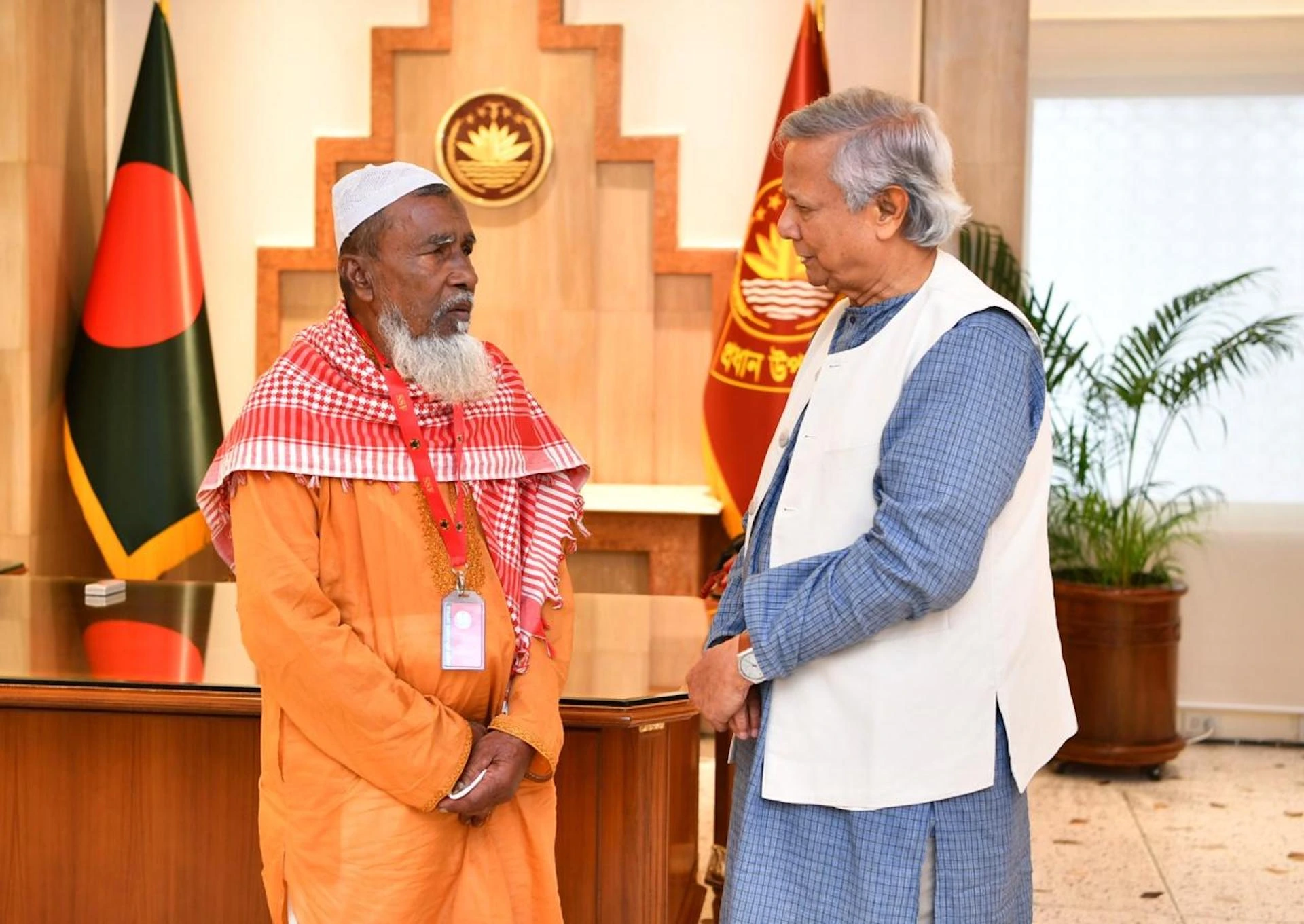
Chief Adviser Professor Yunus meets the father of a student called Abu Syed, a student activist from Rangpur who was shot dead by the Bangladesh police last July. Photo: ChiefAdviserGoB/X
Another accused official, Harun Or Rashid, the then Additional Commissioner (Crime and Operations) of the Dhaka Metropolitan Police and former chief of the Detective Branch, was rumoured to have been detained after Hasina fled. Rashid dismissed those claims in a text message to the Daily Star on August 6. However, despite a travel ban on him by a Dhaka court on August 27, Rashid appeared in an interview with a US-based Bangladeshi journalist in October, where he denied all charges. He continues to be at large. Asian Dispatch couldn’t confirm his whereabouts to secure an interview.
Former head of the Police’s Special Branch (SB), Monirul Islam, who faces several cases too, also remains free. Asian Dispatch found him active on Facebook – his last post on his Facebook account was January 21. Asian Dispatch contacted him via WhatsApp but did not receive a response at the time of publishing this story.
Many other top police officers are believed to have fled Bangladesh after August 5.
Salahuddin Miah, the former officer in-charge of Khilgaon police station in Dhaka during the protests, faces charges but is currently stationed in Rangamati with the Armed Police Battalion.
“The cases against me are related to BNP programs from [2023], not the July uprising,” Salahuddin Miah told Asian Dispatch, referring to police violence against a Bangladesh Nationalist Party (BNP) rally in 2023.
Attempts to reach out to up to 15 police officers facing charges of murder and torture went in vain. Their whereabouts remain unknown and did not respond to text and calls.
The Government’s Efforts and Limitations
On July 20, when Moynal Hossain discovered the lifeless body of his son, Taim – the young protester mentioned at the beginning of this report – riddled with bullets, he called his superior in despair, crying, “How many bullets are necessary to kill a person?”
Moynal Hossain is a senior sub-inspector from the Bangladesh Police. Despite his rank and evidence, the grieving family claims they were denied the right to file a case.
Ramizul Huq, the investigating officer from the Police Bureau of Investigation assigned to Taim’s case, told Asian Dispatch that arresting government officers requires authorisation from the relevant authorities. For instance, arresting an Assistant Superintendent of Police or higher ranks requires permission from the Home Ministry, while constables to inspectors need approval from the Inspector General of Police.
“At the same time, multiple investigating officers were being changed, which caused further delays. Sometimes, following these procedures takes considerable time,” said Huq.
Taim’s family is among many waiting in darkness for justice. Many live in fear of consequences from the charges they’ve pressed against police officers since the accused remain free.
We are scared to talk to the press. If they find out I am speaking against them, I fear we may not be able to sleep peacefully in our own homes. —Kamal Hawlader, whose son was killed in July, told Asian Dispatch.
Enamul Haque Sagar, the Police Headquarters spokesperson, says that the charges are being investigated with “great seriousness.” “The investigations are ongoing, and the process of bringing those found involved to justice is in progress,” he added.
But these words of reassurance aren’t enough.
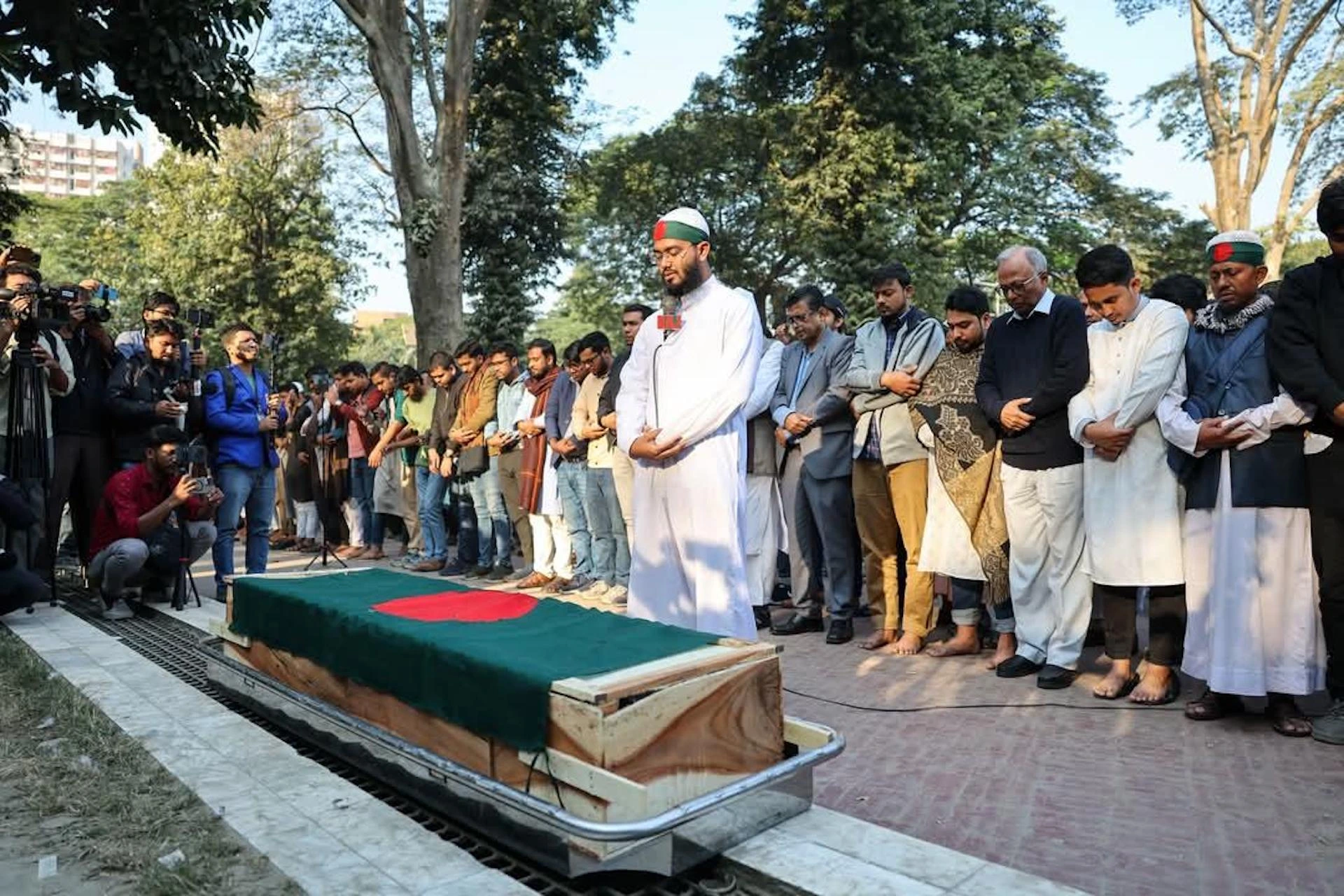
Members of Yunus’s interim government attend the final rites of a 12-year-old boy called Arafat, who was shot during the anti-government protests last year. Photo: Photo: ChiefAdviserGoB/X
Human rights activist Rezaur Rahman Lenin told Asian Dispatch that internal processes and weak systems set by the government allow police officials to evade accountability. “The government faces multiple challenges on various fronts, which they are unable to address due to a lack of commitment, prudence, and bureaucratic transformation,” he said.
Institutional fragmentations among different commissions and the International Crimes Tribunal are both visible and vibrant, he says. “Harmonising legal approaches transparently and effectively is essential to ensure justice,” said Lenin, noting the paradox of relying on the same force accused of killing protesters in order to maintain law and order.
Professor CR Abrar, the president of human rights organisation Odhikar, shared similar concerns.
“It is deeply disconcerting that after such heinous crimes, only 34 are apprehended,” he said. “The evil force protecting the accused officials remains dominant and continues to call the shots.”