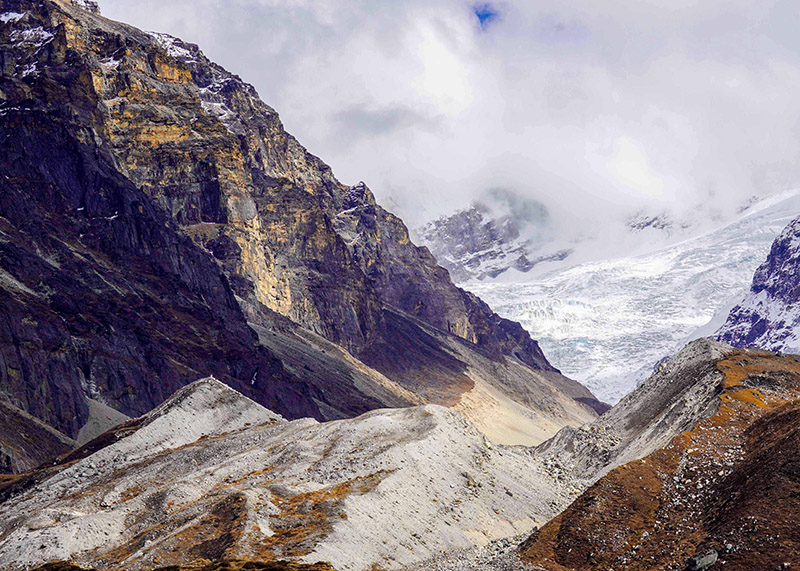
Landslides in the mountains. Photo: Giriraj Banskota/NIMJN
Lonak, the final village before the Kanchenjunga base camp, serves as the ultimate refuge for trekkers embarking on the Kanchenjunga expedition. Given that the base camp, situated at an elevation of 4,790 meters, is a day’s trek from Lonak, allowing for a same-day return, the village hosts hotels catering to tourists. However, a pervasive sense of uncertainty and impending crisis hangs over the local hoteliers. They face the grim reality that they cannot predict how long this scenic village will endure or how much longer they will be able to sustain their businesses there.
Tenjing Sherap Sherpa, a hotelier, has personally witnessed the dramatic shifts in the village’s landscape and harbors deep concerns that Lonak’s very existence may one day be jeopardized.
The United Nations Intergovernmental Panel on Climate Change in its 2023 Synthesis Report has said that human activities, principally through emissions of greenhouse gases, have caused global warming, with global surface temperature rising. Rising temperature of earth has caused topographical changes in the Himalayan region and Kanchenjunga, which spreads across 2,035 square kilometers, is no exception.
The trekking route to the base camp is frequently impacted by landslides and the emergence of new glacial lakes.
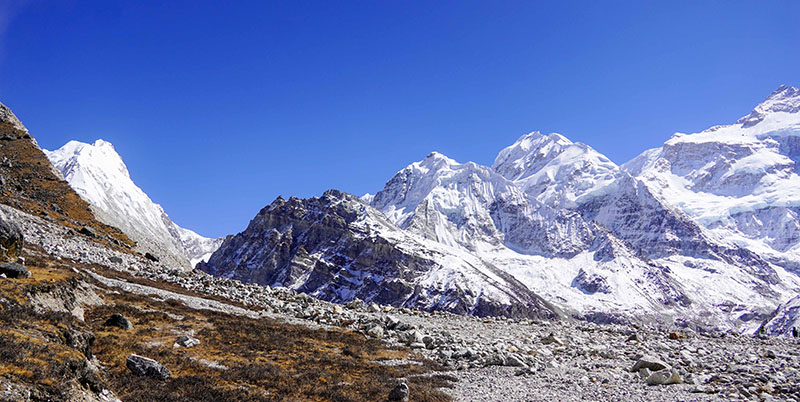
Aggregates and mud swept to the Kanchenjunga Base Camp. Photo: Giriraj Banskota/NIMJN
Kanchenjunga is an example of change. The glacial lake at Lonak appears to expand annually. Locals report that the lake now occupies a site where cowsheds once stood. “We haven’t named this lake, but it’s getting bigger every year,” Tenjing explained. “About 10 to 15 years ago, there were cowsheds here. The grazing land has become a glacier, and where the cattle used to roam, there’s now a lake.”
Tenjing Nupu, another local, has observed a similar phenomenon. Two years ago, when he trekked the Anidesh summit, there was no lake along the route; now, there is one. The water from this lake flows down to Ghunsa and Handrung before reaching the Tamor River. Locals fear that if the lake bursts, it would cause significant loss and damage to downstream settlements, including Khabachen, Ghunsa, and Handrung.
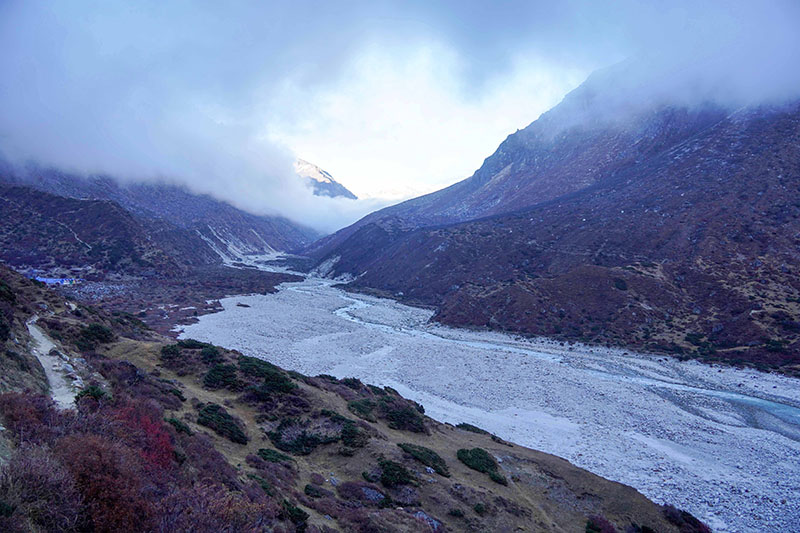
Ghunsa river, which falls along the trekking route, has been widened by floods. Photo: Giriraj Banskota/NIMJN
The widespread landslides serve as another indicator of the environmental shifts occurring in the Kanchenjunga region.
Bibek Basnet, information officer at the District Police Office in Taplejung district, reported that Tika Bahadur Rai of Yabu, Sankhuwasabha, a tourist guide, died in a landslide in Itahari on October 5, 2024.
The Kanchenjunga trekking route begins in Japantar and passes through Itahari. Landslide risks are present not only in Itahari but also along the entire four-day trek to the base camp. A report by the Kanchenjunga Conservation Area states, “The topographical structure of this area is too steep. So the landslide risks become too acute during monsoon.”
The area bordering northeast India and China from Taplejung district was designated a conservation area in 1997. This region encompasses mountain peaks, including the world’s third-highest peak, Kanchenjunga, four peaks over 8,000 meters, and 17 peaks between 7,000 and 8,000 meters.
Due to the risk of landslides, Dikki Sherpa’s “teashop” at Zorque, an hour’s walk from the base camp, has been replaced by a tent. She explained, “Landslides keep occurring, later the walking trail might be damaged. It is expensive to build a house here. Which is why we have put up a tent here.”
Trekkers heading to Kanchenjunga often stop at Zorque for tea, hot water, and soup before continuing their ascent, which sustains local businesses. According to the Kanchenjunga Conservation Area Management Council, 1,085 foreign tourists visited this area in the fiscal year 2023/24. Despite the business potential and her desire to manage her eatery more effectively, Dikki states that she has been unable to invest further due to the persistent risk of landslides.
The trail from Zorque to the base camp has also suffered landslide damage. Debris and piles of earth scattered along the path serve as stark evidence of the ongoing topographical changes in the Kanchenjunga region.
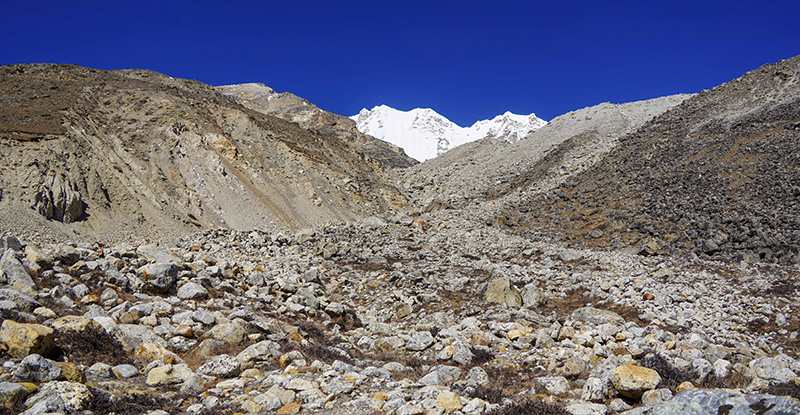
Debris of aggregates brought by landslides. Photo: Giriraj Banskota/NIMJN
Upon reaching the Panpe basecamp, located at an elevation of 5,142 meters, one is greeted by a direct view of the Himalayas. This base camp, offering views of the pristine white mountains against a blue sky, is also threatened by landslides. While one edge of the base camp is eroding, the other side faces active landslides. The glacier in this area is visibly expanding. Tenjing Nurbu, who operates a ‘tea house’ at the base camp, is concerned about the future of the magnificent Kanchenjunga mountain.
“There’s significantly less snowfall. Melting glaciers may have caused the landslides,” Nupu stated. “We’ve witnessed considerable change in the Himalayan region over the past few years.” Like Dikki, Nupu is hesitant to invest further in additional infrastructure for his ‘tea house’ due to these safety risks.
The changes observed in Kanchenjunga are not isolated to this area. According to Sudip Thakuri, Dean of the Faculty of Science and Technology at Mid-western University, who conducts research and studies in the Himalayan region, numerous changes have been occurring across the Hindu-Kush Himalayan region in recent years. This vast region spans 3,500 km across Afghanistan, Bangladesh, Bhutan, China, India, Myanmar, Nepal, and Pakistan, with Nepal’s Himalayas, including Kanchenjunga, falling within it.
According to Sudip Thakuri, the Kanchenjunga region is particularly susceptible to landslides. He attributes this to the area’s proximity to the Tarai, which results in a more compacted landmass, thereby increasing the risks of both floods and landslides.
The rising temperatures and significant decrease in the volume and frequency of snowfall are profoundly impacting the Himalayan region. Sudip Thakuri explains that while land above 5,000 meters typically remains frozen, an increase in temperature weakens the surface, elevating the risks of falling rocks and ice, as well as avalanches.
He stated, “In recent times, incidents such as landslides, avalanches, glacial lake outbursts, melting of glaciers, formation of new glacial lakes, and the expansion of existing glacial lakes have all been observed.”
Floods of June and October
The floods and landslides that occurred from June to October 2024 further exacerbated the fragility of Kanchenjunga’s topography. During this season, tourists found it challenging to navigate the trails due to the widespread flooding and landslides, which extensively damaged the paths in numerous locations.
Some areas have become exceptionally risky and hazardous. “There were dangers in many places. Some sections have become difficult to reach due to the landslides,” said Srithulung Rai, who had returned home from Australia and was trekking in the region. “I felt really bad to see floods and landslides making lives difficult in this beautiful place.”
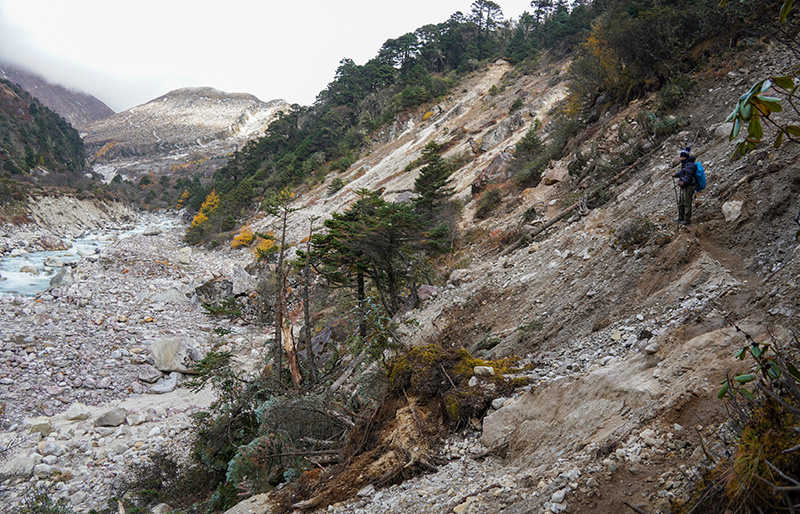
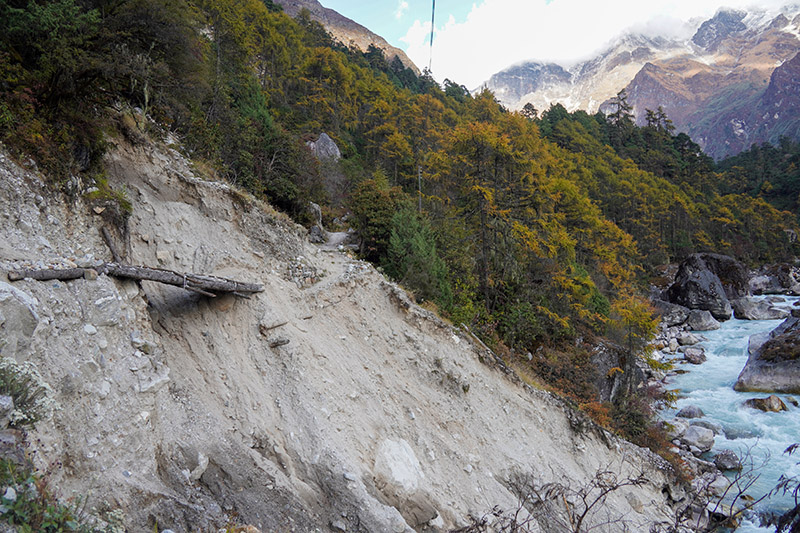
(Left) The Kanchenjunga trail was enveloped by landslides in September. (Right) A makeshift wooden crossing built after the path was broken by a landslide. Photos: Giriraj Banskota/NIMJN
Since the shorter trail from Japantar to Itahari was obstructed by landslides, he had to take a longer, more circuitous route. In certain spots, ladders have been installed, and stools placed on narrow sections of the trail to aid passage.
The old route to Lamatar was swept away by the Ghunsa River floods, forcing travelers to take a longer and more arduous path.
Numerous landslides above Ghunsa have rendered the Himalayan region increasingly fragile. The floodwaters have significantly widened the Ghunsa River. Reaching base camp now requires traversing three camps from Ghunsa, a journey that involves navigating through multiple landslide-affected areas—a situation unlike in the past. Paths are obstructed in many places, preventing mules from traveling to Japantar this year.
These changes in Kanchenjunga, Nepal’s second and the world’s third tallest peak, are attributed to the impacts of climate change. However, there are no authoritative or reliable studies and research specifically addressing the floods and landslides and their precise impacts. Given the recurring and damaging nature of landslides and floods in the area, the Kanchenjunga Conservation Area Management Council has formally requested the International Center for Integrated Mountain Development (ICIMOD) to conduct such studies.
It is worth noting that this conservation area operates on a community-based model. Local tourism entrepreneurs and yak herders are responsible for repairing damaged trails. While the Council also undertakes annual path repairs in many areas, these efforts are often hampered by insufficient budget, according to Council officials. Chhawang Sherpa, the Council’s treasurer and a business owner in Gyabla along the trail, reports that floods and landslides in Kanchenjunga have occurred with unusual intensity.
According to data from the Department of Meteorology and Hydrology’s Lungthung Center, 375.7 mm of rain fell in September/October 2024, and 631 mm in July of the same year. Locals describe significant floods in even smaller rivulets during these rains, which carried substantial debris into the rivers.
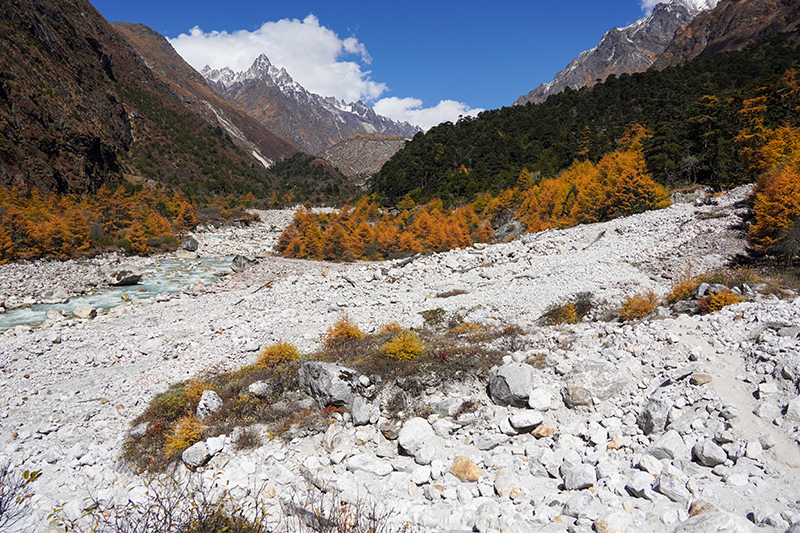
Aggregates brought by landslides near Ghunsa. Photo: Giriraj Banskota/NIMJN
Chhawang reports that landslides have rendered the terrain fragile. He observed, “We’ve experienced rising temperatures, and significantly less snowfall during the winter season. The paths damaged by floods and landslides in October are still awaiting repair.” He added, “I’ve witnessed numerous changes in my lifetime over the last decade.”
Unusual Weather Patterns
Himalayan cow herders, tourism entrepreneurs, and locals in the Kanchenjunga area are observing unusual weather patterns, including unseasonal snowfall, rising temperatures, and scorching daytime heat. These shifts have, in turn, triggered other environmental changes. “We’ve lived in this place since childhood and have experienced several changes,” remarked Chhawang.
He noted that alder trees, once found only above the Thangyam area, now grow at the lower elevation of the Phale riverbed. Similarly, poisonous snakes, previously absent above Thangyam, are now encountered further up in Gyabla. Sherap, also a ward member of Phatanglung Rural Municipality-6, highlighted the significant losses caused by September snowfall and rain in the lower regions. “It snows when it’s not the snowfall season. This year it snowed in September, which caused immense loss and damage,” Sherap stated. He added that in Lonak, at 4,780 meters, mornings and evenings are extremely cold, while the days are very hot.
Tenjing Sherpa, another businessperson from Lonak, recounted instances of underground snowmelt triggering landslides in previously unaffected areas. “The ice underground melts and it triggers landslides,” he explained. According to Tenjing, glaciers they once crossed on foot have now transformed into lakes. Earlier, they could walk directly to the basecamp, but now landslides force them to take a long, winding path. “There used to be small landslides before. Last year there was a big one,” he observed.
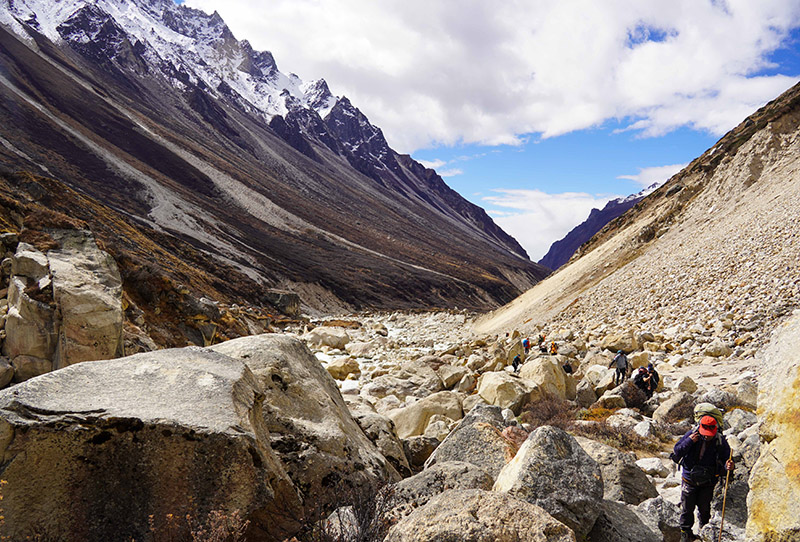
Landslide on the way from Khabachen to Lonak. Since the path has been covered by debris, people have to walk upon the rocks. Photo: Giriraj Banskota/NIMJN
Pema Chhiring Sherpa of Khambachen, who observed dry landslides during the daytime in late September, expressed concern about the region’s future. He remarked, “Unusual things are happening here. Things that existed are becoming extinct.”
Not only locals, but also those engaged in Himalayan research and studies, agree that the changes witnessed in the region are alarming.
Sudip Thakuri, Dean of the Faculty of Science and Technology at Mid-western University, attributes these regional changes to temperature increases induced by climate change. He stated, “Kanchenjunga region is extremely sensitive in the context of climate change. That is the region where rain starts in the monsoon in Nepal. It is very dry in April and May. Once the monsoon starts, the landslides follow.”
The past 30 to 40 years show a clear trend of rising temperatures, he noted. Studies indicate that ice in the Kanchenjunga region is melting at a rate of 15%, and landslides occur when rain falls instead of snow.
A study by the International Centre for Integrated Mountain Development (ICIMOD) reveals that rapidly diminishing snow and ice have negatively impacted both nature and human populations. ICIMOD’s report states that the disappearance of snow and ice in the Hindu Kush Himalaya threatens two billion people and is accelerating species extinction. It further highlights that the effects of the changing cryosphere on fragile mountain habitats are acute, leading to cascading impacts on ecosystems and affecting most inhabitant species. The cryosphere encompasses frozen components of the Earth System, including snow cover, glaciers, ice sheets, ice shelves, icebergs, sea ice, lake ice, river ice, permafrost, seasonally frozen ground, and solid precipitation.
According to ICIMOD, Hindu Kush Himalayan glaciers melted 65% faster between 2011 and 2020 compared to the preceding decade. ICIMOD’s study forecasts that water availability in the Hindu Kush Himalaya will peak in mid-century due to accelerated glacial melt, after which it is projected to decline. The variability in meltwater from glaciers and snow creates significant uncertainty for mountain communities and large lowland populations. Floods and landslides are expected to increase. Exposure to these hazards poses a risk of heightened damage to properties, heritage, and infrastructure, impacting communities already facing adverse conditions.
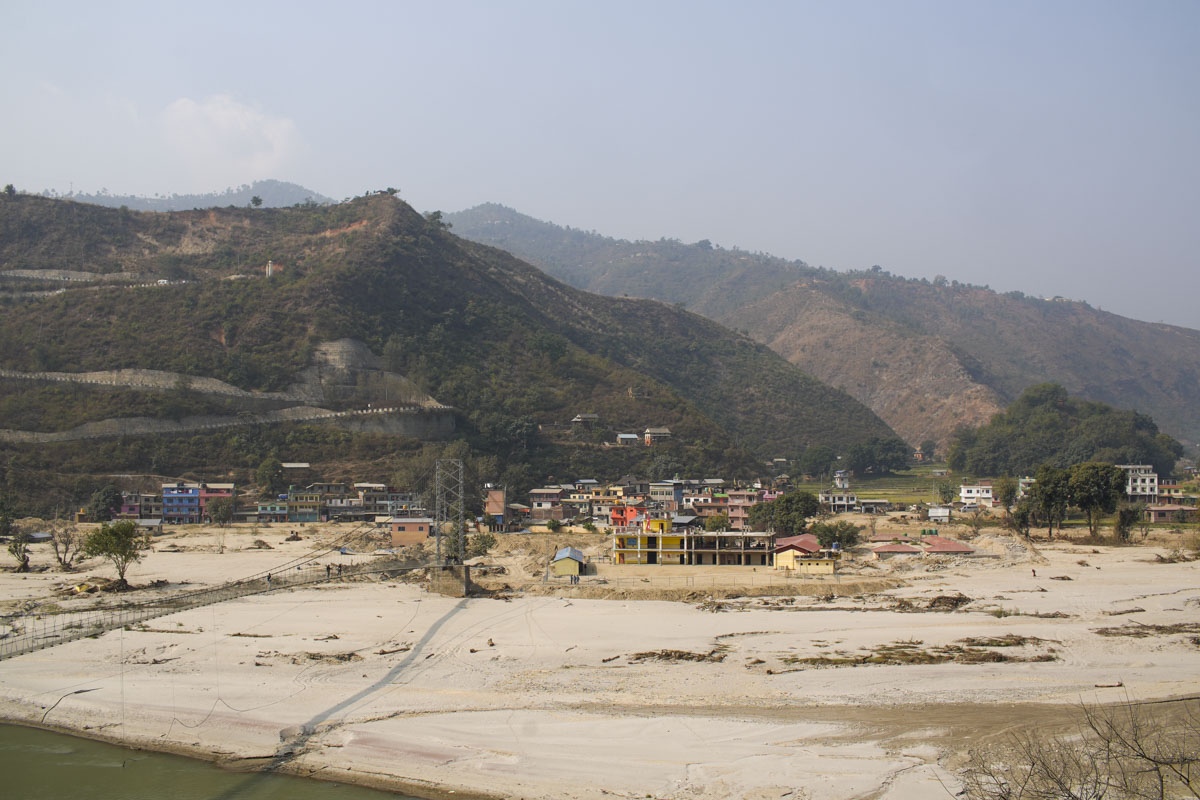
Tanka Prasad Dahal is 18 years old and lives very close to his school, Pashupati Basic School in Mulkot, Sindhuli. Even though he is older than most students, he lives at the school because he has an intellectual disability. But everything changed on September 26, 2024. After two days of heavy rain, the Sunkoshi River flooded and went over his school. When the water went down, the school was full of sand and broken pieces. The two-story building now looked like it only had one story.
A total of 117 students went to Pashupati Basic School, including 95 regular students and 22 students with disabilities. The 95 regular students were able to start classes again, even if they had to use one classroom for two different classes. But students like Tanka have not been able to return. This makes it hard for students with disabilities to get back to school after the disaster.
Nirmala Kumari Shrestha, the school principal, said that they haven’t been able to bring the students with disabilities back because the flood destroyed the entire first floor. All the supplies and materials that were stored there were also ruined. On February 12, 2025, she came with us (the NMJN team) to check on Tanka’s situation.
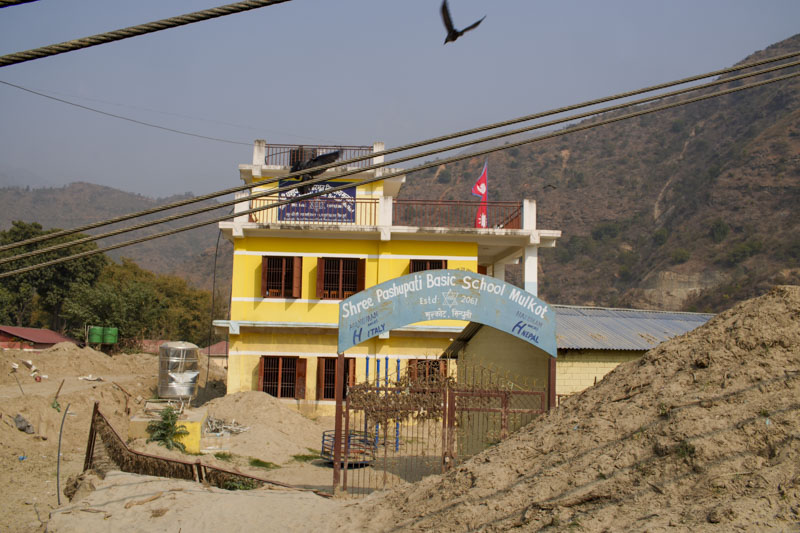
Pashupati Basic School. Photo: NIMJN
Tanka has a problem with his leg. Last year, he went to Kathmandu for an operation on his leg but it didn’t get much better because he didn’t get enough exercises to help it heal, his mother Sharada said. The principal said that Tanka has trouble walking because there is no one at home who can help him do these exercises regularly, probably because both of his parents have health issues.
Tanka’s mother, Sharada, says that he is trying to walk on his own. For his part, Tanka cannot speak confidently and clearly. He shows his feelings through babbling and humming when he hears his favorite song on the radio. Tanka is also trying to write his name clearly. He told us, while his mother was there, that he really wants to go to school and that he misses his friends from school. It’s clear that his parents also want him to be able to go to school.
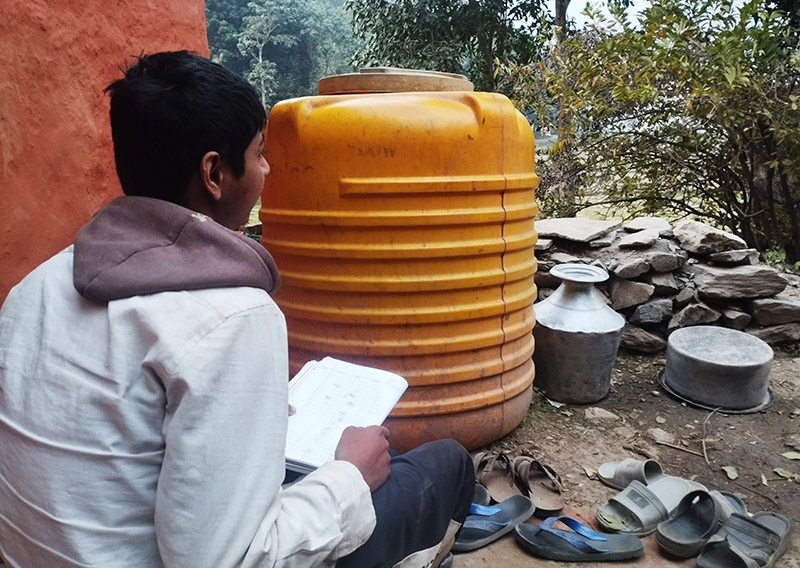
Tanka Prasad Dahal at his home. Photo: NIMJN
Hira Devi Shankar is another child with a disability from Sindhuli Nanglebhare. Her parents send her to a school nearby but she doesn’t want to go because that school doesn’t have things that make it easy and comfortable for children with disabilities. Hira, who is 10, learned a lot at Pashupati School. Before she came to that school, she didn’t even know how to hold a pencil. Before the flood damaged the school, including the classrooms, she could write and read a little. The school hasn’t asked her to come back because there is no fence around the school for safety.
Now, Hira’s parents have started sending her to a school close to their home, but she doesn’t want to go there. Her mother, Kalpana, said, “The school is only about 15 minutes from our house. We started sending her there so she wouldn’t forget what she learned, but she doesn’t want to go because it’s not a good place for her.” Kalpana also said, “Even when she goes, she doesn’t learn anything new.” According to Kalpana, Hira forgets things easily. She doesn’t speak clearly and takes a long time to understand what other people are saying to her. Kalpana said, “She has missed school because of the flood. The school said they will call us after they build a fence. I really hope they do.”
The school principal, Nirmala Kumari, said that the children with disabilities used to learn practical skills and knowledge instead of just theory. But the school hasn’t been able to start classes for them again because it’s not easy for them to get around after the floods. A wire fence has been put up at the edge of the school grounds. She says that once they build a proper wall around the school and get the money to fix the damage, it won’t take long to make the school like it was before. She also mentioned that a new building with three rooms is being built with help from the local government so that the children with disabilities can continue their learning. The principal said that once the wall is built, they will be able to bring the children with disabilities back to school.
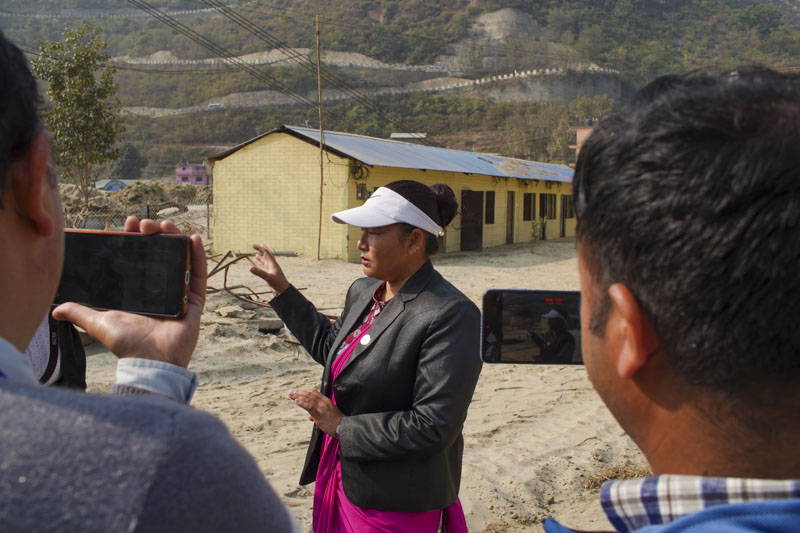
School principal Nirmala Kumari Shrestha briefing about loss and damage caused by floods. Photo: NIMJN
Surath Kumar Basyal, spokesperson for the Sunkoshi Rural Municipality, said that there used to be a special learning center just for children with intellectual disabilities. Two teachers and two helpers worked there for these children. They had two rooms to live in and one classroom, and the Rural Municipality took care of it all. The floods ruined everything except the building itself.
Because they don’t have enough desks and benches, some students have to sit on the floor during classes.
There are no good restrooms or clean drinking water. The flood filled up their well, so now they get dirty water from it. They also have to walk a long way to get water to drink. Nirmala Kumari said that the mud from the flood has dried up and is now causing a lot of pollution, which is making the children sick.
677 schools in suffering
According to the National Disaster Risk Reduction and Management Authority (NDRRMA), a total of 677 schools in 41 different districts of the country were damaged or destroyed by the floods in 2024. Forty-five of these schools were in Sindhuli. Sadly, 13 students died because of the monsoon disaster, and 50 affected students were rescued alive. However, the NDRRMA doesn’t have information on how many children with disabilities were affected. The NDRRMA says that Bagmati province was the most affected by floods and landslides, with Kavrepalanchok district reporting damage to as many as 182 schools. The Authority estimates that it will cost over 1.78 billion rupees to rebuild the school buildings that were destroyed by the monsoon disaster.
The Ministry of Education has slightly different numbers. They say that floods and landslides damaged 163 schools – 110 in Bagmati and 53 in Koshi provinces. The difference is because the NDRRMA counted all schools that had any damage, while the Ministry of Education only counted the schools that had serious damage. Debaka Dhakal, the head of the Education Development and Coordination Unit (EDCU), said that the monsoon floods and landslides have made some schools unsafe for children to attend. Other schools have reopened after some small repairs. She said that the local government, through the EDCU, gathered information about the losses and damage to help with aid and rebuilding in the education area. According to her, they are currently talking about how to manage money for school cleaning, repairs, rebuilding and preparing for future disasters.
The floods have badly damaged the places where schools get drinking water and the toilets. It’s very important to make sure the schools have clean drinking water right away, and the paths to the school and the playground need to be fixed. A first report about getting ready for the monsoon and helping after emergencies, made by the Makawanpur district, showed that they need to rebuild the damaged schools more quickly. The report says that 29 schools in that district were damaged.
Surath Kumar Basyal, Spokesperson for the Sunkoshi Rural Municipality, said that even though the local government is trying to fix the problems caused by the disaster, they don’t have enough money to do it. At the same time, Dr. Dijan Bhattarai, who is an Undersecretary and was the spokesperson for NDRRMA, said that they have created a joint plan to help the schools that were damaged by the monsoon floods and the earthquakes in Jajarkot.
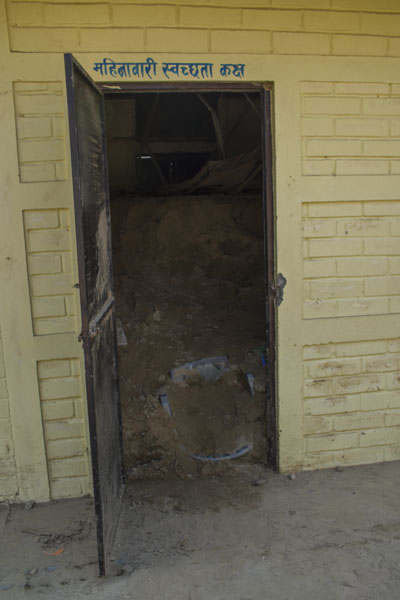
(Left) The menstrual hygiene room covered by flood. Photo: NIMJN
Education for children with disability
There are rules in Nepal’s constitution, laws, and government plans to make sure children with disabilities get the education they need. Devidutta Acharya, who leads the National Disability Federation Nepal, said that in recent years, some regular schools have become inclusive, and more children with disabilities are getting access to education. According to a guidebook from 2018 about including people with disabilities in education, there were 33 special schools, 23 schools that combined special and regular education, and 316 resource classes for children with disabilities.
However, the schools that are open still have problems. Janaki Thapa, who is an interpreter, said that the school for the deaf in Birgunj, Parsa, doesn’t have enough classrooms. This school goes up to grade five and has 53 students, 38 of whom live there, and four teachers. The school needs a building and more classrooms.
The situation is much worse at Ramjanaki Sustamanasthiti School in Dhanusha – it is not even open anymore. Baliram Jha, who used to be the principal, retired two years ago. Now, only one staff member looks after the school. According to Baliram, this person just signs the attendance book whenever they want and still gets paid. Baliram said, “Nobody cares about it. Students come to the school and find the gate locked, so they go back home. Parents call me to complain. When I go to check myself, I find the school closed.”
When Baliram retired two years ago, there were 14 students at the school. Now, all of them have lost their chance to learn.
The situation of these two schools from Dhanusha and Birgunj is symbolic of the various problems faced by schools for children with disability.
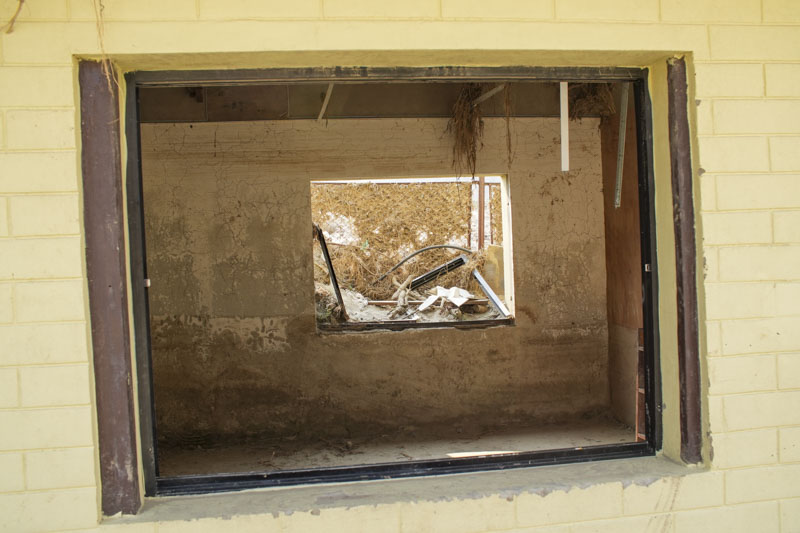
Classroom of Pashupati Basic School. Photo: NIMJN
The government gives four kinds of money help to children with disabilities. There is a “Motivation” scholarship of 1000 rupees each month for ten months. There is also a monthly transportation scholarship of 3000 rupees or 5000 rupees for each child who needs help to go to school regularly. Children who live in hostels, away from their homes, get 50,000 rupees each year. The schools get this money from their local government.
Devidutta Acharya said that they are trying to build schools in safer places. However, the government hasn’t yet made it possible to build school buildings that are completely safe for children. Because of this, when disasters happen, the schools that teach children with disabilities become risky for these children, especially because there aren’t good ways to rescue them that consider their needs.
The number of disasters happening in schools and the education area is increasing every day, making both the schools and the children there unsafe.
Around the world and in Nepal, steps are being taken to make schools and the education area less risky. There are laws and government plans in place, both internationally and in Nepal, to reduce disaster risks in schools and to encourage a culture of school safety. These efforts will help get everyone involved to work together to make sure schools are safe in the future.
Even though children with physical disabilities, vision problems, and hearing problems are currently going to school, those with more severe disabilities are still not in school, which means they are missing out on education. The Ministry of Education has a program to teach children at home. They are talking about finding these children and creating a way to have volunteer teachers educate them in their homes. The government has been making plans to make sure these children can go to school. However, when you look at how well these plans are being put into action, you don’t see much real progress.
Disability and social inclusion
The government has created a plan called the Strategic Action Plan for Gender Equality, Disability and Social Inclusion (GEDSI) in Disaster Risk Reduction and Management (2024). Dr. Dijan Bhattarai, who was the spokesperson for NDRRMA at the time, said that this plan gives clear instructions on how to include everyone equally, including people with disabilities, when preparing for and dealing with disasters.
Devidutta Acharya said that even though the 2015 earthquakes showed that children with disabilities are very likely to be in danger during disasters, there still isn’t enough specific preparation that includes them.
Pashupati Basic School doesn’t have enough classrooms, so students are being taught in an open area on the second floor of a building that is still being built.
According to him, he has asked the NDRRMA to make children with disabilities a priority in schools and hospitals when they are doing rescue and recovery work. He believes that early warnings about disasters should also be easy for everyone to understand and access. He also said that not having access to information makes these children even more at risk during disasters. When making plans for how to respond to disasters, they should think about how to provide services for people who can’t hear or speak, people who use wheelchairs, and children who can’t see.
Also, the people who help during disasters should be trained on how to assist these individuals. The Strategic Action Plan (2024) says that the government should give out kits with tools that people with disabilities will need in emergency situations. Devidutta Acharya says that his organization has been working on this issue constantly.
Making schools safe
According to a report from 2017/18, there are 35,601 schools in Nepal, with 29,005 being public and 6,566 private. A study called ‘School Safety and Existing Legal Provision Directive’ by Krishna Prasad Bhattarai found that two-thirds of these schools are in danger of disasters. The Ministry of Education has started a big plan called the Comprehensive School Safety Masterplan (2017) and created a guide called the Comprehensive School Safety Minimum Package (2018). The National Policy for Disaster Risk Reduction (2018) aims to help Nepal grow in a way that is safer, can adapt to climate change, and can recover from disasters. These rules give schools at all levels advice on having good education and being ready for disasters. Chandra Kanta Bushal, Spokesperson for the Center for Education and Human Resource Development (CEHRD), said that CEHRD is working with aid groups and other organizations to promote the comprehensive school safety masterplan. They also provide training and do practice drills.
The School Safety campaign includes programs that protect students, teachers, and staff from dangerous weather, fires, diseases, and natural disasters, including ways to prevent them. According to Chandra Kanta Bushal, they are teaching people and sharing information as part of this campaign. He also said that they are working to make schools safe by creating education groups and working with the national, regional, and local governments. They are also providing training to the School Management Committee and parents.
However, education expert Professor Dr. Bidhyanath Koirala says that this campaign hasn’t been very effective because it doesn’t consider the specific needs of local areas. He believes that if the training included local knowledge and skills, it would work better.
The study by Krishna Prasad Bhattarai also showed that putting school safety programs into action in schools is still weak. The study found that people involved in education don’t know much about school safety, and they also don’t know much about the existing laws and school safety rules. The study showed that most students are at risk of disasters because they don’t have a safe place to learn. The study lists the problems caused by disasters, such as damage to school buildings, disruption of teaching and learning, students being forced to leave school, and the need for recovery in the local community.
Leaving no child behind
Article 24 of the Convention on the Rights of Persons with Disabilities (2006) says that people with disabilities have the right to education. It states that countries that have signed this agreement must make sure that everyone, including those with disabilities, has the same chance to get an education at all levels and throughout their lives. The Convention also says that these countries should provide the specific support that each person needs to achieve this.
The Rules Regarding Rights of Persons with Disabilities (2020) in Nepal say that the government must arrange accessible education with places to live for children who cannot travel to and from school on their own because of a severe disability or because they are very poor and have no one to help them.
The constitution of Nepal has given the responsibility for education up to the secondary level to the local governments. Because of this, Devidutta Acharya argues that it is the job of the local authorities to know how many children with disabilities there are, to understand what each of them needs, and to make sure they can go to school.
What kind of tools would help children like Tanka to learn easily or to walk? Devidutta says that the local authorities should create a helpful environment for Tanka to get to school. And once he is there, the school should make it easy for him to interact with teachers and other students. Children with disabilities can get the regular money help that the government provides for free education if their schools write to the local authorities, and then the local authorities recommend it to the Department of Education.
Education expert Dr. Bidyanath Koirala argues that local authorities need to take the lead in providing desks, benches, and trained teachers for children with disabilities and in making sure they can go to school. He says that the regional and national governments should help the local authorities with this. According to him, each school should provide what a child with a disability needs based on their individual situation, and the local government should make sure this happens. He says that schools, local authorities, parents, and organizations that work with people with disabilities all need to support this cause.
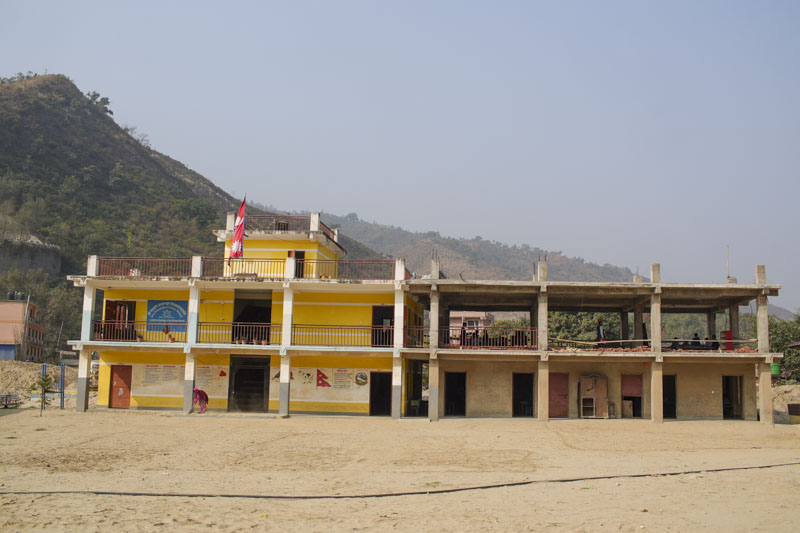
The schoolyard of Pashupati Basic School ravaged by floods. Photo: NIMJN
There is a special learning plan made just for children with intellectual disabilities. But they need teachers and helpers who are trained, and they need different kinds of technical help based on what they need. For example, children with physical disabilities need help from a physiotherapist. Those with speech problems need a speech therapist. And they need occupational therapy to learn practical knowledge and skills.
Dr. Bidhyanath Koirala says that because schools, local authorities, and the community don’t know enough about these needed services, children with disabilities have been missing out on school education. He says that there are now good technologies and training available for learning. The government has also made a plan to use resources, and there are different organizations working in this area.
Devidutta Acharya, the president of the National Disability Federation Nepal, says that if all these things are well organized and if schools can create the right way to teach, then no children will be left behind.
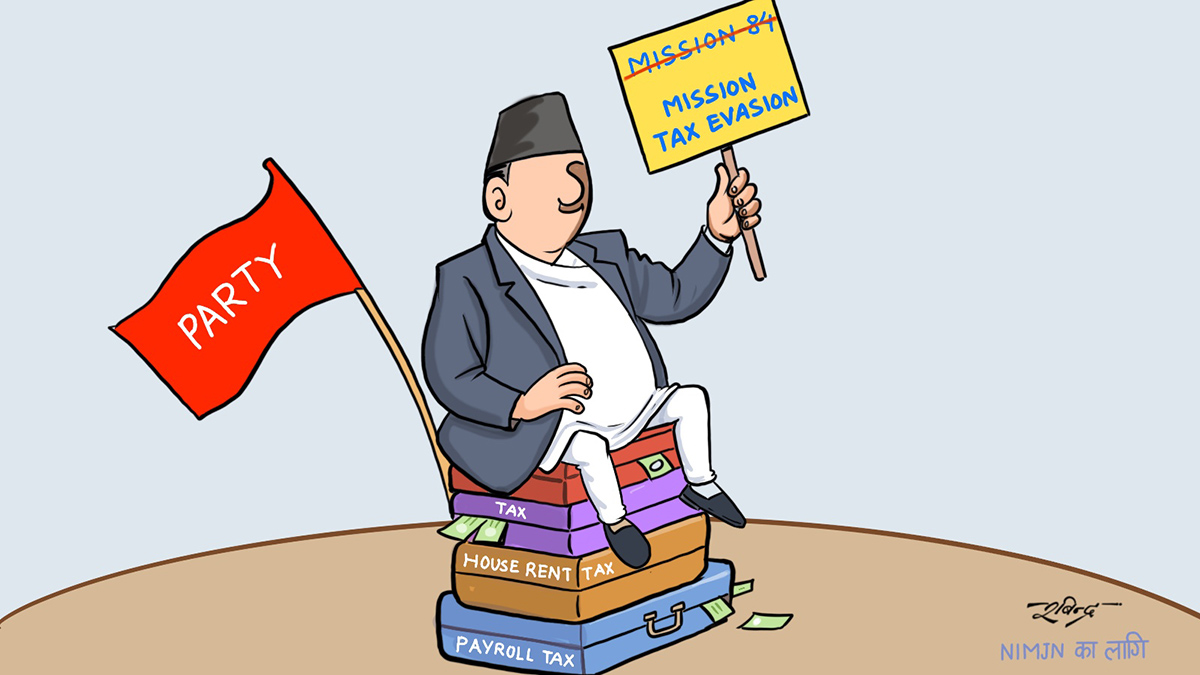
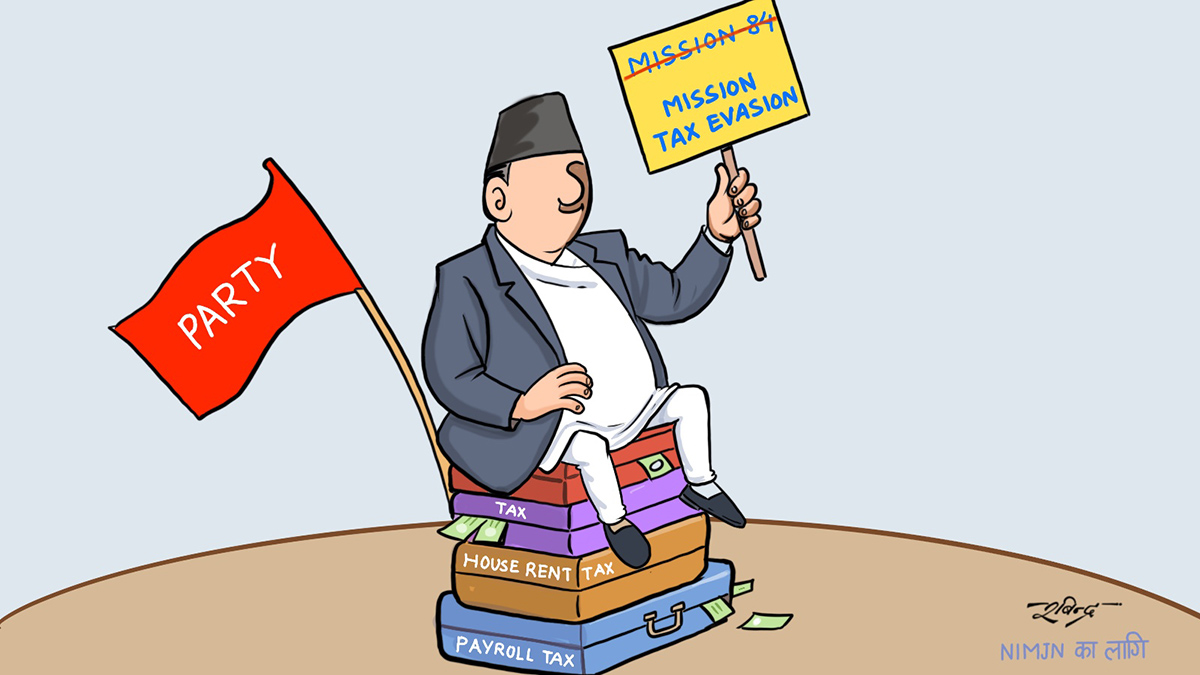
62 political parties in Nepal failed to pay a combined Rs 3.4 million in taxes. An expert audit — with a director from the Auditor General’s Office — found they skipped paying house rent tax, failed to deposit the 1% social security tax deducted from staff salaries, and dodged other advance taxes.
The quotes below are a collection of commitments from the election manifestos of major political parties in Nepal, which were made public in 2079 BS (2022 AD) before they went to voters’ doorsteps to ask for votes for the House of Representatives and Provincial Assembly elections:
“Good governance is our highest priority. The misuse of authority, the exploitation of national and government resources, and corruption will be met with a merciless, strict and zero-tolerance approach. Similarly, monitoring, investigation and scrutiny will be made more effective and any individual who engages in corruption, irregularities, misuse or misappropriation of government property will be brought to justice.”
— CPN (UML) Election Manifesto, 2079
“… Establishing economic good governance is our priority.”
— Nepali Congress Election Manifesto, 2079
“We will not engage in corruption and will not spare those who do.” “… Good governance is for the people.”
— Rastriya Swatantra Party Election Manifesto, 2079
“It is our firm commitment to develop a system of good governance with zero tolerance for corruption, complete transparency and effective service delivery at the doorsteps of the people in line with the principle of separation of powers and the spirit of federalism. This system will also ensure that all tasks, including development work, are completed quickly, efficiently and within a set timeframe. We will always remain steadfast in these commitments.”
— CPN (Unified Socialist) Election Manifesto, 2079
“A system of administration will be adopted that follows all principles of good governance, transparency, accountability and financial discipline, and provides services in a corruption-free and economical manner through digitized government offices.”
— CPN (Maoist Centre) Election Manifesto, 2079
Despite emphasizing good governance and transparency before seeking votes, the parties themselves have made a mockery of these principles. The very year they issued election manifestos promising to uphold good governance, transparency, accountability and financial discipline, that is, in the Fiscal Year 2079/080 (mid-July 2022 to mid-July 2023), they evaded taxes owed to the state.
An audit conducted by the Election Commission, with the help of an expert team including a director from the Auditor General’s office, on the parties’ audit reports revealed that the parties had evaded taxes and that their accounting systems were found to be opaque. This raises questions about the parties’ commitment to transparency.
While the audit reports submitted by the parties to the Commission have been made public, the expert team’s audit report from the Auditor General’s office has not been. However, acting Chief Election Commissioner Ram Prasad Bhandari stated that the Commission has informed the concerned parties about the weaknesses pointed out by the expert team in that report.
The confidential report, which was not made public by the Commission, was analyzed by the Nepal Investigative Multimedia Journalism Network (NIMJN). The analysis found that in the fiscal year 2079/2080 (mid-July 2022 to mid-July 2023), 62 political parties failed to pay a total of 3,409,866 rupees in house rent tax, social security tax and other advance taxes. This total includes 3,066,704 rupees in house rent tax, 309,094 rupees in social security tax, and 34,068 rupees in advance tax and audit fees.
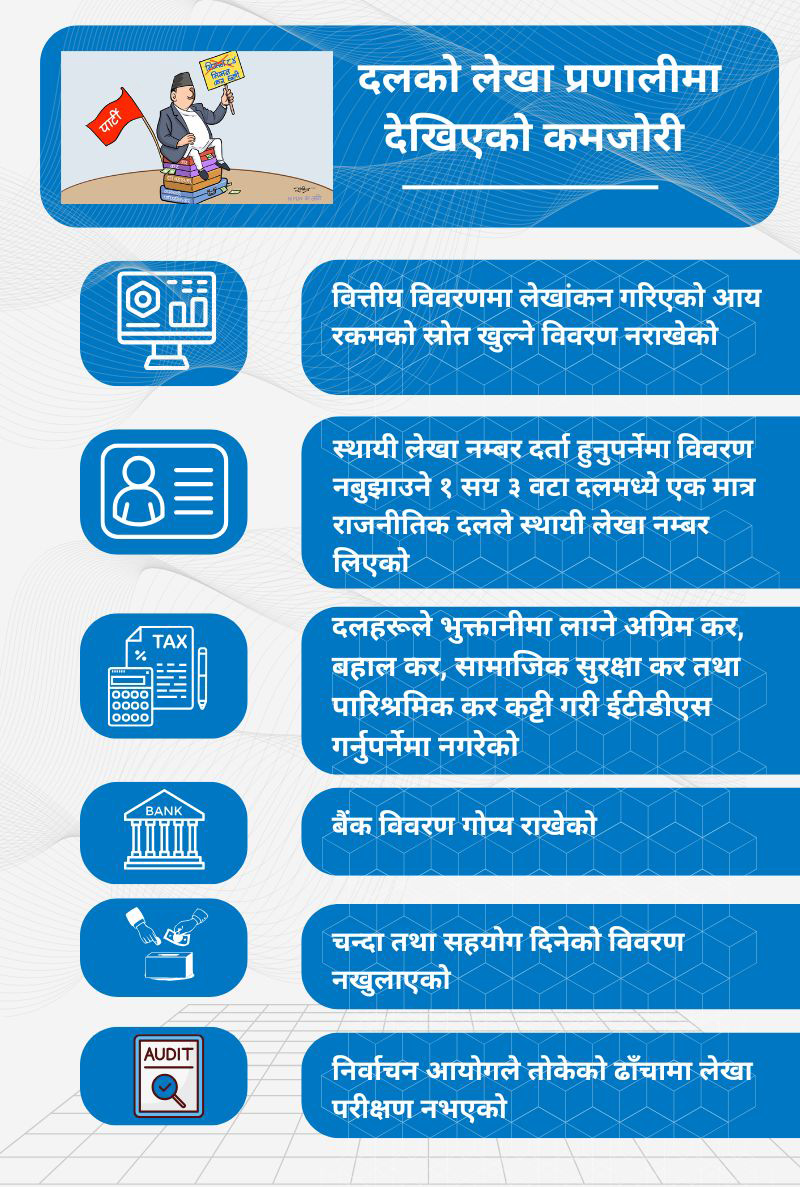
According to that report, political parties have committed irregularities, including maintaining disorganized and non-transparent accounting systems, failing to deposit taxes deducted from the salaries of their office staff to the tax office, and not paying house rent tax.
Major parties also among those not paying taxes
Of the 103 political parties that submitted financial reports to the Election Commission in the Fiscal Year 2079/080 (mid-July 2022 to mid-July 2023), 62 have not paid taxes. These include major parties that have received national party status, such as the Nepali Congress, CPN (UML), CPN (Maoist Centre), Rastriya Swatantra Party, Rastriya Prajatantra Party, Janata Samajwadi Party, and Janamat Party, all of whom were in government at the time. It was in this same year that the House of Representatives and Provincial Assembly elections took place and these parties were granted national party status.
When the audit reports submitted by the parties for the Fiscal Year 2079/080 (mid-July 2022 to mid-July 2023) were reviewed by the expert team from the Auditor General’s office, the CPN (UML), which currently leads the government, was found to have evaded the most taxes. According to the report, the UML has not paid 1.83 million rupees in house rent tax and 47,842 rupees in payroll tax, for a total of 1,877,872 rupees in unpaid taxes.
Schedule 13 of the UML’s 2079/080 (mid-July 2022 to mid-July 2023) audit report shows an expenditure of 18,383,520 rupees for building leasehold expenses.
After the 2072 (2015) earthquake, the CPN (UML) moved its office to the Pasang Lhamu Foundation building in Dhumbarahi. On April 14, 2021, it relocated to a private rented house in Thapathali. However, citing that building as too small, the UML office moved again on April 22, 2022, to the Tulsilal Memorial Foundation in Chyasal, Lalitpur, where it has remained since.
UML office secretary Bhishma Adhikari stated that the party does not have to pay rent, saying, “We don’t pay house rent, so how can we pay house rent tax?”
However, according to Baburam Thapa, the foundation’s treasurer, the UML gives the foundation a monthly ‘donation’ for using the building. “It is not given as rent, but as a donation of 400,000 rupees,” he said.
Bishnu Pokhrel, the office secretary of the foundation, also stated that the UML provides the agreed-upon amount to the foundation to cover expenses for building maintenance, research and other projects. The memorandum of understanding regarding the UML’s use of the foundation’s building for office purposes was signed on October 24, 2021, by then-UML General Secretary Ishwor Pokhrel and the foundation’s chairman, Gopal Shakya.
In that year, 2079/080 BS (mid-July 2022 to mid-July 2023), the UML spent 4.584 million rupees on employee salaries. Based on this expenditure, the expert team’s report noted that the party had not paid the required taxes and a clarification was written stating that the taxes should be recovered.
Bhishma Adhikari, the UML’s office secretary, claimed that the party has no outstanding tax liabilities. We had informed him that the Election Commission, using experts from the Auditor General’s office, had prepared a report that indicated there were outstanding taxes.
The next day, he contacted us and said, “The Auditor General’s office and the Election Commission should have asked us once before preparing the report. After you informed us, we made inquiries, and only then did we learn about the report with the details of the taxes we were supposed to pay.”
He claimed that the one percent tax deducted from employee salaries is submitted monthly.
The expert team also pointed out that the Rastriya Swatantra Party (RASWAPA), which has consistently advocated for good governance in the streets and parliament, has not paid 324,496 rupees in house rent tax and 75,519 rupees in payroll/social security tax, totaling 400,015 rupees.
RASWAPA, which was announced on June 21, 2022, moved its central office from Basundhara to Banasthali on June 22, 2023.
RASWAPA’s treasurer, Lima Adhikari, said that the outstanding house rent tax from 2079/080 (mid-July 2022 to mid-July 2023) was paid in the following year. “We have already paid the outstanding tax from the previous year at the ward office,” she said. “I cannot show you the exact amount we paid, however.”
According to sources from Kathmandu Metropolitan City Ward 16, RASWAPA has been paying 10% of its monthly rent, or 300,000 rupees, as house rent tax since last year (2080/81 BS) {mid-July 2023 to mid-July 2024}.
Clause 6 of Schedule 6 of the Kathmandu Metropolitan City Financial Act of 2078 states that a house rent tax of 10% of the annual rent amount is applicable.
Also, on the list of tax defaulters is the CPN (Unified Socialist), a party led by former Prime Minister Madhav Kumar Nepal and with another former Prime Minister, Jhalanath Khanal, as its esteemed leader. The report notes that it still owes 426,000 rupees in house rent tax and 20,635 rupees in payroll tax. Khem Paudel, a staff member of the party’s accounting department, said that the party had paid the outstanding house rent tax for 2079/80 BS (mid-July 2022 to mid-July 2023) on January 14, 2024.
“Whatever tax we owed, we have already paid it,” he said.
The audit report for the CPN (Unified Socialist) shows an expenditure of 4.26 million rupees for house rent in 2079/80 BS (mid-July 2022 to mid-July 2023). According to the city’s laws, the party should have paid 426,000 rupees in tax. However, according to the tax receipt obtained by NIMJN, the party only paid 360,000 rupees. Its central office is located in Ward 31 of Kathmandu Metropolitan City.
Nepali Congress failed to pay tax deducted from employee salaries for seven years
According to the report prepared by the expert team from the Auditor General’s office, the Nepali Congress did not pay 101,145 rupees in payroll/social security tax for the Fiscal Year 2079/080 BS (mid-July 2022 to mid-July 2023).
However, during our investigation, we found that the Nepali Congress had not paid the tax deducted from its office employees’ salaries for seven years. Robin Bajracharya, the accountant at the Nepali Congress party office, acknowledged this, stating, “There is a plan to pay the one percent tax from employees’ salaries for the last seven years within this year.”
The party’s audit report shows that the Nepali Congress spent 12,004,500 rupees on employee salaries, wages, and gratuities in the Fiscal Year 2079/080 BS (mid-July 2022 to mid-July 2023). Bajracharya said that even though they were ready to pay the tax last year, they were delayed because a system issue made it unclear how much tax each person owed.
He also mentioned that the Congress party had obtained a PAN from the tax office on June 7, 2023. Bajracharya stated that the party office is aware of the tax issue raised by the Auditor General’s office and has kept the amount it is supposed to pay as a liability.
Krishna Prasad Paudel, the chief secretary of the Nepali Congress central office, said that it is possible some taxes the party was supposed to pay were missed. “We haven’t received any such information from the Election Commission and it’s not like the party would skip paying taxes it owes,” he said. “We are ready to pay the outstanding taxes; the party has no intention of evading taxes.”
The report also mentions that the Janamat Party, which participated in the 2079 BS (2022 AD) elections for the first time and became a national party, has not paid 78,000 rupees in house rent tax. Janamat Party chairman C.K. Raut said that while the party was aware of the tax it owed, it was delayed due to technical reasons. “We had planned to pay it last year but there were some issues, which caused the delay,” he said.
The report also mentions that the Janata Samajwadi Party has not paid 1,275 rupees, while the Nagarik Unmukti Party has not paid 8,750 rupees in taxes, which includes 8,000 rupees in payroll tax and 750 rupees in TDS.
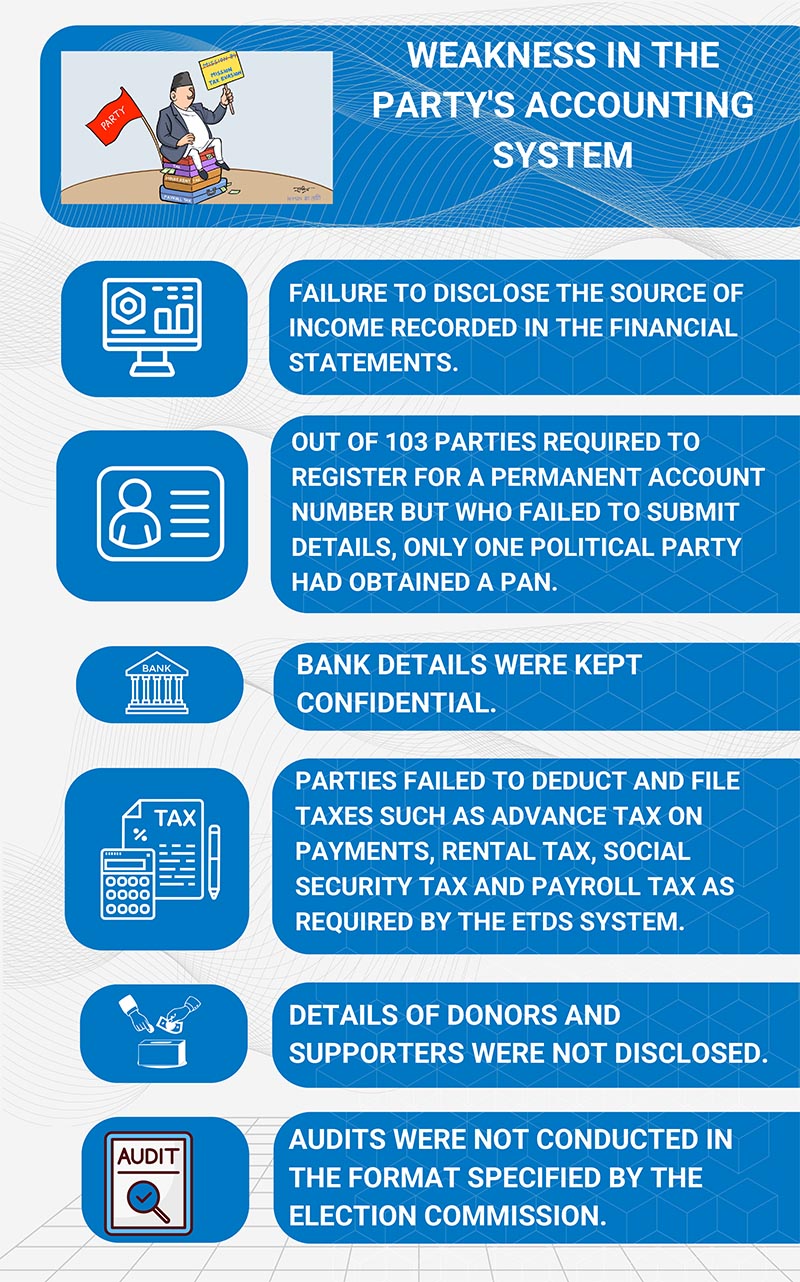
Newly appointed Chairman of the Nagarik Unmukti Party, Lalbir Chaudhary, said he was not aware of the taxes the party owed. “I’ve just taken on the responsibility, I’ll figure out where and how much we need to pay and then we will pay it,” he said. Chaudhary was made chairman of the Nagarik Unmukti Party on July 31, 2025, replacing Ranjita Shrestha.
The Rastriya Prajatantra Party (RPP) has not submitted 17,000 rupees in taxes, which is 1% of its employees’ salaries. RPP Senior Vice Chairman Dhurva Bahadur Pradhan claimed that no one receives a salary that requires paying payroll tax, so no tax was deducted. “People work as volunteers and only get pocket money,” he said. “Except for the security guards, no one receives a salary that requires them to pay taxes, which is why we have not paid them.”
The audit report for the fiscal year 2078/79 (mid-July 2021 to mid-July 2022), which the RPP submitted to the Election Commission, shows that the party spent 2.626 million rupees on employee salaries.
What does the law say?
Section 2 (d) (2) of the Income Tax Act, 2058 (2002), mentions that political parties registered with the Election Commission are considered tax-exempt organizations. This same section clarifies that such organizations will not be tax-exempt if they benefit any individual from their property or income, except when making payments for work done according to the organization’s goals or for assets or services provided to the organization by an individual.
Rule 23 of the Income Tax Regulations states that any individual required to deduct tax under Chapter 17 of the Act must apply for a Permanent Account Number (PAN) from the Inland Revenue Department before earning income or deducting tax. The expert team’s report points out that the parties did not comply with the Act and Regulations by failing to obtain a PAN and neglecting to use the eTDS system to deduct advance tax on payments, social security tax and payroll tax.
The secret report prepared by the expert team from the Auditor General’s office states, “Evidence of tax deduction on payments was not presented and in the financial statements of some parties, the amount of advance tax deduction was shown under outstanding liabilities but no evidence of its submission was provided.”
Why different laws for political parties and citizens?
Former Acting Auditor General, Sukdev Bhattarai Khatry, said that there should not be a system where ordinary citizens pay taxes while political parties are exempt.
“The same rules that apply to the people should also apply to the parties that lead the country,” he said. “Except for exemptions specified in the Financial Act and the Income Tax Act, taxes must be paid. Just because you make the laws in parliament doesn’t mean anything goes.”
Acting Chief Election Commissioner Ram Prasad Bhandari stated that the audit reports submitted by the parties were not in the format prescribed by the commission. “The parties have submitted their audit reports, but they were not found to be in the format we had specified,” he said. “We have already instructed them to make the necessary improvements and it is the parties’ responsibility to comply with those instructions.” He added that whether the parties have complied with the instructions will only be known from the audit reports they submit the following year.
Bhandari also said that, similar to previous years, they are preparing to have the audit reports submitted by the parties this year re-audited through the Auditor General’s office.
Section 40, Subsection 1 of the Political Parties Act, 2073 (2017), stipulates that parties must maintain accounts that accurately show their income and expenses. The Act also states that such accounts can be kept in electronic records. The law mandates that the accounts must be in the format specified by the Election Commission, and the commission must be informed about the officials responsible for the party’s accounts.
Similarly, there is a legal provision that allows the commission to demand or inspect the accounts maintained by a party through an officer or expert it designates. Based on the provision in Section 42 of the Act, which allows the commission to verify if a party’s submitted report is in the legally prescribed format, the commission has been conducting re-audits through the Auditor General’s office for the past two years. “The work the commission is doing to make party accounting systems transparent shows that improvements are being made,” said former Acting Auditor General Sukdev.
Eager to impose fines but weak on ensuring transparency
The Election Commission has a history of fining candidates from political parties who fail to submit their election expense reports on time. For instance, the commission published a list of candidates from local level elections who hadn’t submitted their expense reports and fined them. According to the list, the total fines amounted to more than 24 billion rupees.
The commission had issued a notice on September 22, 2022, to collect 24.638 billion rupees from 123,650 candidates for failing to submit their expense reports within 30 days of the election results being made public.
After the commission announced that candidates who didn’t pay the fine would be barred from participating in elections for six years, many paid up. However, following a writ petition filed by Kathmandu Metropolitan City Mayor Balen Shah, the Supreme Court issued an interim order to the commission on February 16, 2023, to not implement the decision to impose the fines.
On the same day, February 16, 2023, a cabinet meeting recommended to then-President Bidya Devi Bhandari to waive the fines imposed by the commission. Following that recommendation, the President waived the fines on February 17, 2023, under Article 276 of the Constitution.
On March 6, 2024, the Supreme Court also dismissed the writ petition filed by Balen Shah.
The commission has also fined candidates for the House of Representatives and Provincial Assembly elections 15,000 rupees each for not submitting their election expense reports, similar to the candidates in the local elections. The commission levied a total fine of 36,525,000 rupees on 2,435 candidates – 1,037 from the House of Representatives and 1,398 from the Provincial Assembly – at a rate of 15,000 rupees per person. The 61st annual report of the Auditor General has recommended that this outstanding amount be collected.
The confidential report notes that the commission has not been as proactive in getting the political parties to pay their taxes as it was in getting the candidates to pay their fines.
Although the Auditor General’s office provided a list of parties that had not paid taxes and the amounts owed, the commission has only informed the parties about the matter.
According to the acting Chief Election Commissioner, the commission has not yet pressured the parties to pay their taxes.
राष्ट्रिय दलको मान्यता प्राप्तसहित ६२ वटा राजनीतिक दलले राज्यलाई बुझाउनु पर्ने कर छली गरेको पाइएको छ । उनीहरूले घर बहाल कर, कर्मचारीको पारिश्रमिकबाट कट्टा गरिएको १ प्रतिशत सामाजिक सुरक्षा कर र अन्य अग्रिम कर छलेको भेटिएको छ ।
“सुशासन हाम्रो उच्च प्राथमिकता । अख्तियारको दुरुपयोग, राष्ट्रिय तथा सरकारी स्रोतको दोहन र भ्रष्टाचारप्रति निर्मम, कठोर र शून्य सहनशीलता अपनाइनेछ । यस्तै अनुगमन, अनुसन्धान र छानबिन कार्यलाई सशक्त बनाइने, भ्रष्टाचार, अनियमितता, सरकारी सम्पत्तिको दुरुपयोग र अपचलन गर्ने जुनसुकै व्यक्तिलाई कानुनी कारबाहीको दायरामा ल्याइनेछ ।”
– नेकपा एमालेको घोषणा पत्र, २०७९
“… आर्थिक सुशासन कायम गर्नु हाम्रो प्राथमिकता हुन् ।”
– नेपाली कांग्रेसको घोषणापत्र, २०७९
“भ्रष्टाचार गरिन्न र गर्नेलाई छाडिन्न ।” “ …सुशासन जनताको लागि ।”
– राष्ट्रिय स्वतन्त्र पार्टीको घोषणापत्र, २०७९
“भ्रष्टाचारमा शून्य सहनशीलतासहितको सुशासन, पूर्ण पारदर्शिता, शक्ति पृथकीकरणको सिद्धान्तअनुरूप राज्यका सबै अंगहरूको कार्य सम्पादन र संघीयताको मर्मअनुरूप जनताको घरदैलोमै प्रभावकारी सेवा प्रदान गर्ने तथा छिटो, छरितो र समय सीमाभित्र विकास निर्माणलगायत सबै काम सम्पन्न गर्ने प्रणालीको विकास गर्ने हाम्रो दृढ प्रतिज्ञा छ । हामी यी प्रतिज्ञामा सधैँ अडिग रहनेछौँ ।”
– नेकपा एकीकृत समाजवादीको घोषणापत्र, २०७९
“सुशासन, पारदर्शिता, जवाफदेहिता र वित्तीय अनुशासनका सम्पूर्ण सिद्धान्त अनुसरण गरी डिजिटाइज्ड सरकारी कार्यालयमार्फत भ्रष्टाचारमुक्त र मितव्ययी रूपमा सेवा प्रवाह हुने प्रशासन प्रणाली अवलम्बन गरिनेछ ।”
– माओवादी केन्द्रको घोषणपत्र, २०७९
प्रमुख राजनीतिक दलहरूले प्रतिनिधिसभा र प्रदेशसभाको निर्वाचनको बेला भोट माग्न मतदाताको घरदैलोमा जानुअघि २०७९ सालमा सार्वजनिक गरेका चुनावी घोषणापत्रका प्रतिबद्धताहरू हुन् यी ।
भोट माग्न जानुअघि सुशासन र पारदर्शितामा जोड दिने दलहरू आफैंले भने त्यसको धज्जी उडाएका छन् । दलहरूले सुशासन, पारदर्शिता, जवाफदेहिता र वित्तीय अनुशासन पालना गर्ने आश्वासनसहित चुनावी घोषणा पत्र जारी गरेकै वर्ष अर्थात् आर्थिक वर्ष २०७९/०८० मा राज्यलाई तिर्नुपर्ने कर छली गरेका छन् ।
दलहरूको लेखा परीक्षण प्रतिवेदनलाई निर्वाचन आयोगले महालेखा परीक्षकको कार्यालयका निर्देशकसहित अरू लेखा परीक्षकबाट परीक्षण गराउँदा दलहरूले कर छली गरेको र दलका लेखा प्रणाली अपारदर्शी पाइएको छ । यसले दलहरुको पारदर्शिताप्रतिको प्रतिबद्धतामाथि नै प्रश्न उठेको छ ।
दलहरूले आयोगमा बुझाएका लेखा परीक्षण प्रतिवेदन सार्वजनिक भए पनि त्यसकै आधारमा महालेखाको विज्ञ टिमबाट गराएको लेखा परीक्षण प्रतिवेदन भने आयोगले सार्वजनिक गरेको छैन ।
तर, प्रतिवेदनमाथि महालेखाको विज्ञ टिमले औंल्याएका कमजोरीका बारेमा सम्बन्धित दलहरूलाई जानकारी गराएको आयोगका कार्यवाहक प्रमुख निर्वाचन आयुक्त रामप्रसाद भण्डारीले जानकारी दिए ।
आयोगले सार्वजनिक नगरेको त्यो गोप्य प्रतिवेदन नेपाल इन्भिेस्टिगेटिभ मल्टिमिडिया जर्नालिज्म नेटवर्क (निमजिन) ले फेला पारेर विश्लेषण गर्दा आर्थिक वर्ष २०७९/२०८० मा ६२ राजनीतिक दलले घर बहाल कर, सामाजिक सुरक्षा कर र अन्य अग्रिम कर गरी ३४ लाख ९ हजार ८ सय ६६ रुपैयाँ नतिरेको पाइएको छ । जसमा घर बहाल करबापत ३० लाख ६६ हजार ७ सय ४ रुपैयाँ, सामाजिक सुरक्षा करबापत् ३ लाख ९ हजार ९४ रुपैयाँ, अग्रिम कर र अडिट शुल्क ३४ हजार ६८ रुपैयाँ छ ।
त्यो प्रतिवेदनअनुसार दलहरूको लेखा प्रणाली अव्यवस्थित र अपादर्शी रहेको, दलका कार्यालयमा कार्यरत कर्मचारीको पारिश्रमिकबाट कर कट्टा गरेको तर त्यो रकम कर कार्यालयमा जम्मा नगरेको, घरबहाल कर नतिरेकोसहितका अनियमितता राजनीतिक दलबाट भएका छन् ।
कर नतिर्नेमा ठूला दल पनि
निर्वाचन आयोगमा आर्थिक वर्ष २०७९/०८० मा १ सय ३ वटा रजानीतिक दलले वित्तीय विवरण बुझाएका थिए । तीमध्ये कर नतिर्ने ६२ दल छन् । जसमा सरकारमा रहेको नेपाली कांग्रेस, नेकपा एमालेसहित राष्ट्रिय दलको मान्यता पाएका राष्ट्रिय स्वतन्त्र पार्टी, राष्ट्रिय प्रजातन्त्र पार्टी, जनता समाजवादी पार्टी र जनमत पार्टी पनि छन् । त्यही वर्ष प्रतिनिधिसभा र प्रदेशसभा चुनाव भएको थियो र यी दललले राष्ट्रिय दलको मान्यता पाएका थिए ।
आर्थिक वर्ष २०७९/०८० मा दलहरूले आयोगमा बुझाएको लेखा परीक्षण प्रतिवेदनलाई महालेखाको विज्ञ टोलीले परीक्षण गर्दा सबैभन्दा बढी कर छली गर्नेमा अहिले सरकारको नेतृत्व गर्ने नेकपा एमालेलाई देखाइएको छ । प्रतिवेदनले औंल्याएअनुसार एमालेले घर बाहल कर मात्रै १८ लाख ३० हजार, पारिश्रमिक कर ४७ हजार ८ सय ४२ गरी १८ लाख ७७ हजार ८ सय ४२ रुपैयाँ कर बुझाएको छैन ।
एमालेको २०७९/०८० को लेखा परीक्षण प्रतिवेदनको अनुसूची १३ मा भवन लिजहोल्ड खर्चबापत १ करोड ८३ लाख ८३ हजार ५ सय २० रुपैयाँ खर्च लेखेको छ ।
२०७२ सालको भूकम्पपछि धुम्बाराहीस्थित पासाङ ल्हामु प्रतिष्ठानको भवनमा सरेको नेकपा एमाले वैशाख १, २०७८ मा थापाथलीमा रहेको एउटा निजी घरमा भाडामा सरेको थियो । तर त्यो घर साँघुरो भएको भन्दै एक वर्षपछि वैशाख ९, २०७९ मा एमालेको कार्यालय ललितपुरको च्याँसलस्थित तुल्सीलाल स्मृति प्रतिष्ठानमा सरेको छ । त्यसयता एमालेको कार्यालय प्रतिष्ठानमै छ ।
एमालेका कार्यालय सचिव भीष्म अधिकारीले भने पार्टीले घरभाडा नै तिर्न नपरेको बताए । उनले भने, “हामीले घरभाडा नै तिरेको छैन, बहाल कर कसरी तिर्नु ?” उनले भने ।
तर, प्रतिष्ठानका कोषाध्यक्ष बाबुराम थापाका अनुसार भवन प्रयोग गर्न दिएबापत् एमालेले प्रतिष्ठानलाई मासिक ‘सहयोग’ दिने गरेको छ । “भाडा भनेर दिएको छैन, सहयोगस्वरूप भनेर ४ लाख तिर्छ,” उनले भने ।
प्रतिष्ठानको भवन मर्मतसम्भार, अध्ययन अनुसन्धानलगायतका शीर्षकमा खर्च गर्ने गरी एमालेले सम्झौताअनुसारको रकम दिने गरेको प्रतिष्ठानका कार्यालय सचिव विष्णु पोखरेलले पनि बताए । प्रतिष्ठानको भवन एमालेले कार्यालय प्रयोजनका लागि प्रयोग गर्नेबारेको समझदारी पत्रमा एमालेका तत्कालीन महासचिव ईश्वर पोखरेल र प्रतिष्ठानका अध्यक्ष गोपाल शाक्यले कात्तिक ७, २०७८ मा हस्ताक्षर गरेका थिए ।
त्यो वर्ष अर्थात् २०७९/०८० कर्मचारीको पारिश्रमिकमा ४५ लाख ८४ हजार रुपैयाँ खर्च गरेको छ । यही खर्चका आधारमा सरकारलाई तिर्नुपर्ने कर नतिरेको भन्दै विज्ञ टोलीको प्रतिवेदनमा कर असुल गर्नुपर्ने कैफियत लेखेको हो ।
एमालेका कार्यालय सचिव भीष्म अधिकारीले पार्टीले तिर्नुपर्ने कुनै कर बाँकी नरहेको दाबी गरे । हामीले उनलाई निर्वाचन आयोगले महालेखाका विज्ञ प्रयोग गरेर प्रतिवेदन तयार गरेको र त्यसमा कर तिर्न बाँकी रहेको रहेछ नि भनेर जानकारी गराएका थियौँ ।
त्यसको भोलिल्ट उनले नै सम्पर्क गरेर हामीलाई भने, “महालेखा र निर्वाचन आयोगले रिपोर्ट तयार गर्नुअघि एक पटक सोधेको भए हुन्थ्यो, तपाईंहरूले जानकारी गराएपछि हामीले सोधखोज गर्यौं, त्यसपछि मात्रै हामीले कर तिर्नुपर्ने विवरणसहितको प्रतिवेदनको बारेमा बल्ल थाहा पायौं ।”
कर्मचारीको पारिश्रमिकमा कट्टा गरिएको एक प्रतिशत कर मासिक बुझाउने गरेको उनले दाबी गरे ।
सुशासनको पक्षमा सडक र सदनमा आवाज उठाउँदै आएको रास्वपाले पनि बहाल करबापत् ३ लाख २४ हजार ४ सय ९६ रुपैयाँ, पारिश्रमिक/सामाजिक सुरक्षा करबापत् ७५ हजार ५ सय १९ रुपैयाँ गरी ४ लाख १५ रुपैयाँ कर नबुझाएको विज्ञ टोलीले औंल्याएको छ ।
७ असार, २०७९ मा घोषणा भएको रास्वपाको केन्द्रीय कार्यालय वसुन्धराबाट ७ असार, २०८० मा वनस्थलीमा सरेको थियो ।
रास्वपाकी कोषाध्यक्ष लिमा अधिकारीले भने २०७९/०८० मा तिर्न बाँकी घरबहाल कर पछिल्लो वर्षमा तिरेको बताइन् । “अघिल्लो वर्ष तिर्न बाँकी कर हामीले वडा कार्यालयमा तिरिसक्यौं,” उनले भनिन, “कति तिर्यौं भन्नेचाहिँ तपाईंलाई देखाउन मिल्दैन ।”
काठमाडौं महानगरपालिका १६ नम्बर वडा कार्यालय स्रोतका अनुसार रास्वपाले गतवर्ष (२०८०/०८१) देखि मासिक ३ लाख रुपैयाँको १० प्रतिशत घरबहाल कर तिर्ने गरेको छ ।
काठमाडौं महानगरपालिकाको आर्थिक ऐन २०७८ को अनुसूची ६ को बुँदा नम्बर ६ मा बहाल रकमको वार्षिक १० प्रतिशतका दरले बहाल कर लाग्ने उल्लेख छ ।
कर नतिर्नेमा पूर्वप्रधानमन्त्री माधवकुमार नेपाल र अर्का पूर्वप्रधानमन्त्री झलनाथ खनालको दल नेकपा एकीकृत समाजवादी पनि छ । उसले घरबाहल कर मात्रै ४ लाख २६ हजार र पारिश्रमिक कर २० हजार ६ सय ३५ रुपैयाँ तिर्न बाँकी रहेको प्रतिवेदनमा उल्लेख छ । पार्टीका लेखा शाखाका कर्मचारी खेम पौडेलले २०७९/०८० मा पार्टीले तिर्नुपर्ने घरबाहल कर पुस २९, २०८० मा तिरिसकेको बताए । “हामीले जेजति तिर्नुपर्ने कर हो, त्यो तिरिसकेका छौं,” उनले भने ।
एकीकृत समाजवादीले २०७९/०८० मा ४२ लाख ६० हजार रुपैयाँ घरभाडाबापत् तिरेको लेखा परीक्षण प्रतिवेदनमा खर्च लेखेको छ ।
महानगरको कानुनअनुसार समाजवादीले ४ लाख २६ हजार कर तिर्नुपर्ने हो । तर, निमजिनले प्राप्त गरेको कर तिरेको रसिदअनुसार उसले ३ लाख ६० हजार मात्रै कर तिरेको छ । काठमाडौं महानगरको ३१ नम्बर वडामा उसको केन्द्रीय कार्यालय छ ।
कांग्रेसले कर्मचारीको तलबमा कट्टा गरेको कर ७ वर्षसम्म तिरेन
महालेखाका विज्ञ टोलीले तयार पारेको प्रतिवेदनअनुसार नेपाली कांग्रेसले आर्थिक वर्ष २०७९/०८० मा कर्मचारीको पारिश्रमिक/सामाजिक सुरक्षा करबापत्को १ लाख १ हजार १ सय ४५ रुपैयाँ बुझाएको छैन ।
तर हामीले खोजी गर्ने क्रममा कांग्रेसले कार्यालयका कर्मचारीको तलबबाट कट्टा गरेको कर ७ वर्षदेखि नतिरेको पायौं । कांग्रेस पार्टी कार्यालयका लेखापाल रविन बज्राचार्यले यसलाई स्वीकार गर्दै भने, “पछिल्लो सात वर्षदेखिका कर्मचारीको पारिश्रमिकको एक प्रतिशत कर यो वर्षभित्र तिर्ने योजना रहेको छ ।”
नेपाली कांग्रेसले आर्थिक वर्ष २०७९/०८० मा कर्मचारीको तलब, ज्याला र उपदानमा १ करोड २० लाख ४ हजार ५ सय रुपैयाँ खर्च गरेको उसको लेखा परीक्षण प्रतिवेदनमा उल्लेख छ ।
गतवर्ष नै तिर्ने तयारी गरेको भए पनि सिस्टममा समस्या भएपछि कसको कति कर तिर्ने भन्ने यकिन नभएकाले ढिला भएको उनले बताए ।
कांग्रेसले जेठ २४, २०८० मा कर कार्यालयबाट प्यान नम्बरसमेत लिइसकेको उनले बताए । लेखापाल रविनले महालेखाले करका बारेमा औंल्याएको विषयमा पार्टी कार्यालय जानकार रहेको र उसले तिर्नुपर्ने भनेको रकम दायित्वमा नै राखेको बताए ।
कांग्रेस केन्द्रीय कार्यालयका मुख्य सचिव कृष्णप्रसाद पौडेलले पार्टीले तिर्नुपर्ने कुनै कर छुट भएको हुन सक्ने बताए । “निर्वाचन आयोगबाट कुनै त्यस्तो जानकारी त आएको छैन, पार्टीले तिर्नुपर्ने कर छुट लिने भन्ने पनि हुँदैन,” उनले भने, “तिर्न बाँकी देखाएको कर तिर्न तयार छौं, कर छली गर्ने पार्टीको नियत छैन ।”
२०७९ सालको चुनावमा पहिलोपल्ट भाग लिएर राष्ट्रिय पार्टी बनेको जनमत पार्टीले पनि बहाल करबापत्को ७८ हजार नतिरेको प्रतिवेदनमा उल्लेख छ । जनमत पार्टीका अध्यक्ष सीके राउतले पार्टीले तिर्नुपर्ने करको बारेमा जानकारी भए पनि प्राविधिक कारणले ढिलाइ भएको बताए । “पोहोर नै तिर्ने भनेका थियौं, केही समस्या भएकाले ढिलाइ भएको हो,” उनले भने ।
यस्तै, जनता समाजवादी पार्टीले १ हजार २ सय ७५ तिरेको छैन भने नागरिक उन्मुक्ति पार्टीले पारिश्रमिक कर ८ हजार र टीडीएसबापत्को ७ सय ५० समेत गरी ८ हजार ७ सय ५० रुपैयाँ कर नतिरेको प्रतिवेदनमा उल्लेख छ ।
नागरिक उन्मुक्ति पार्टीका नवनियुक्त अध्यक्ष लालवीर चौधरीले पार्टीले तिर्नुपर्ने करका बारेमा जानकारी नभएको बताए । उनले भने, “भर्खर जिम्मेवारी सम्हालेको छु, कहाँ कति तिर्नुपर्नेछ, बुझेर तिर्छौं ।”
रञ्जिता श्रेष्ठलाई हटाएर नागरिक उन्मुक्तिले साउन १५, २०८२ मा लालवीरलाई अध्यक्ष बनाएको थियो ।
राष्ट्रिय प्रजातन्त्र पार्टीले कर्मचारीको पारिश्रमिकको १ प्रतिशतले हुन आउने १७ हजार रुपैयाँ कर बुझाएको छैन । राष्ट्रिय प्रजातन्त्र पार्टीका वरिष्ठ नेता उपाध्यक्ष धुव्रबहादुर प्रधानले पारिश्रमिक कर तिर्ने गरी कसैले पनि तलब नखाने भएकाले कट्टा नगरेको दाबी गरे । “स्वयंसेवकको रूपमा काम गरिरहेका हुन्छन्, पकेटमनी मात्रै पाउँछन्,” उनले भने, “सुरक्षागार्डले बाहेक कर तिर्ने गरी कसैले पनि तलब पाउँदैनन्, त्यसैले कर नबुझाएका हौं ।”
निर्वाचन आयोगमा राप्रपाले बुझाएको २०७८/०७९ को लेखा परीक्षण प्रतिवेदनमा कर्मचारीको तलबमा २६ लाख २६ हजार खर्च लेखेको छ ।
कानुनमा के छ ?
आयकर ऐन २०५८ को दफा २ को (ध) (२) मा निर्वाचन आयोगमा दर्ता भएका राजनीतिक दललाई कर छुट पाउने संस्थाको रूपमा उल्लेख गरिएको छ । यही दफामा छुट पाउने संस्थाको उद्देश्यअनुसार कार्य सम्पन्न हुँदा वा कुनै व्यक्तिद्वारा त्यस्तो संस्थालाई प्रदान गरिएका सम्पत्ति वा सेवाबापत्को कुनै भुक्तानी गर्दाबाहेक त्यस्तो संस्थाको सम्पत्ति र त्यस्तो संस्थाले प्राप्त गरेको रकमबाट कुनै व्यक्तिलाई फाइदा पुर्याएको भए त्यस्तो संस्थालाई कर छुट नहुने स्पष्ट छ ।
आयकर नियमावलीको नियम २३ मा ऐनको परिच्छेद १७ अन्तर्गत करकट्टी गर्नुपर्ने जुनसुकै व्यक्तिले त्यस्तो आय आर्जन वा करकट्टीअगावै स्थायी लेखा नम्बरका लागि आन्तरिक राजस्व विभागमा आवेदन दिनुपर्ने उल्लेख छ । दलहरूले ऐन र नियमावलीअनुसार स्थायी लेखा नम्बर लिई भुक्तानीमा लाग्ने अग्रिम कर, सामाजिक सुरक्षा कर तथा पारिश्रमिक करकट्टी गरी ईटीडीएस नगरेको विज्ञ टोलीको प्रतिवेदनले औंल्याएको छ ।
“भुक्तानी लाग्ने करकट्टी गरेको प्रमाण पेस नगरेको र कतिपय दलको वित्तीय विवरणमा अग्रिम करकट्टीको रकम भुक्तानी गर्न बाँकी दायित्वअन्तर्गत देखाइएकोमा सो दाखिला गरेको प्रमाण पेस गरेको देखिएन,” महालेखाको विज्ञ टोलीले तयार पारेको गोप्य प्रतिवेदनमा भनिएको छ ।
दल र नागरिकलाई फरक कानुन किन ?
महालेखा परीक्षकको कार्यालयका पूर्वकार्यवाहक महालेखा परीक्षक सुकदेव भट्टराई खत्रीले सर्वसाधारणले कर तिर्ने र दललाई छुट दिने व्यवस्था गर्न नहुने बताए ।
“जनतालाई जे व्यवस्था हुन्छ, देशको नेतृत्व गर्ने दलहरूलाई पनि त्यही लागू हुनुपर्छ,” उनी भन्छन्, “आर्थिक ऐन र आयकर ऐनले नै छुट दिने भनेको बाहेकमा कर तिर्नैै पर्नेहुन्छ, संसद्मा कानुन बनाउने भएपछि जे पनि हुन्छ भन्ने हुँदैन ।”
कार्यवाहक प्रमुख निर्वाचन आयुक्त रामप्रसाद भण्डारीले दलहरूले बुझाएको लेखा परीक्षण प्रतिवेदन आयोगले तोकेको ढाँचामा नपाइएको बताए । “दलहरूले लेखा परीक्षण प्रतिवेदन त बुझाएका छन्, तर हामीले जुन ढाँचामा हुनुपर्छ भनेका छौं, त्यसअनुसार पाइएन,” उनले भने, “कमजोरी देखिए जतिको सुधार गर्न निर्देशन दिइसकेका छौं, निर्देशनको पालना गर्नु दलको दायित्व हुन्छ ।”
दललाई दिएको निर्देशन पालना भए/नभएको पछिल्लो वर्ष बुझाएको लेखा परीक्षण प्रतिवेदनबाट मात्रै थाहा हुने उनले बताए ।
विगतको जस्तै यस वर्ष पनि दलहरूले बुझाएको लेखा परीक्षण प्रतिवेदनलाई महालेखामार्फत पुनःपरीक्षण गराउने तयारी रहेको उनले बताए ।
राजनीतिक दलसम्बन्धी ऐन २०७३ को दफा ४० को उपदफा १ मा दलले आफ्नो आय र व्ययको वास्तविक हिसाब देखिने गरी लेखा राख्नुपर्ने व्यवस्था छ । त्यस्तो लेखा विद्युतीय अभिलेखमा पनि राख्न सकिने ऐनमा उल्लेख छ । लेखाको अभिलेख निर्वाचन आयोगले तोकेको ढाँचामा हुनुपर्ने, दलको हिसाब हेर्ने पदाधिकारीका बारेमा आयोगलाई जानकारी दिनुपर्ने ऐनमै उल्लेख छ ।
यसैगरी, दलले राखेको हिसाब आयोगले तोकेको अधिकृत वा विशेषज्ञमार्फत माग गर्न वा निरीक्षण गराउन सक्ने कानुनी प्रावधान छ । ऐनअनुसार दलहरूले आर्थिक वर्ष सकिएको ६ महिनाभित्र आफ्नो आय र व्ययको लेखा परीक्षण गराई एक महिनाभित्र आयोगमा पेस गर्नुपर्ने हुन्छ ।
ऐनको दफा ४२ मा दलले बुझाएको प्रतिवेदन कानुनले तोकेको ढाँचामा भए/नभएको जाँच गराउन सकिने व्यवस्थालाई टेकेर आयोगले महालेखामार्फत पछिल्लो दुई वर्षयता परीक्षण गराउँदै आएको हो । “दलको लेखा प्रणाली पारदर्शी बनाउन आयोगले जुन काम गरिरहेको छ, यसले सुधार हुँदै गएको पनि देखिन्छ,” पूर्वकार्यवाहक महालेखा परीक्षक सुकदेवले भने ।
जरिवाना तोक्न आतुर, पारदर्शिता कायम गराउन फितलो
निर्वाचन आयोगले तोकेको समयमा निर्वाचन खर्च विवरण नबुझाउने दलका उम्मेदवारलाई जरिवाना गर्दै आएको छ । स्थानीय तह निर्वाचनको खर्च विवरण नबुझाउने उम्मेदवारहरूलाई जरिवाना तोक्दै आयोगले सूची नै सार्वजनिक गरेको थियो । आयोगले सार्वजनिक गरेको सूचीअनुसार २४ अर्ब रुपैयाँभन्दा धेरै जरिवाना तोकिएको थियो ।
निर्वाचन परिणाम सार्वजनिक भएको मितिले ३० दिनभित्र खर्च विवरण नबुझाएको भन्दै १ लाख २३ हजार ६ सय ५० जना उम्मेदवारबाट आयोगले २४ अर्ब ६३ करोड ८८ लाख रुपैयाँ असुल्न असोज ६, २०७९ मा सूचना निकालेको थियो ।
जरिवाना नतिर्ने उम्मेदवारले ६ वर्षसम्म निर्वाचनमा भाग लिन नपाउने भनेपछि धेरैले जरिवाना बुझाएका पनि थए । तर काठमाडौं महानगरपालिकाका मेयर बालेन्द्र शाहले दायर गरेको रिटमा सुनुवाइ गर्दै ४ फागुन, २०७९ मा सर्वोच्च अदालतले जरिवाना तिराउने निर्णय कार्यान्वयन नगर्न आयोगलाई अन्तरिम आदेश दिएको थियो ।
४ फागुन, २०७९ मै बसेको मन्त्रिपरिषद् बैठकले आयोगले तोकेको जरिवाना रकम मिनाहा गर्न तत्कालीन राष्ट्रपति विद्यादेवी भण्डारीसमक्ष सिफारिस गरेको थियो । त्यो सिफारिसअनुसार राष्ट्रपतिले ५ फागुन, २०७९ मा संविधानको धारा २७६ अनुसार जरिवाना मिनाहा गरेकी थिइन् ।
सर्वोच्च अदालतले फागुन २३, २०८० मा बालेन्द्र शाहले दायर गरेको रिट पनि खारेज गरिदिएको छ ।
आयोगले स्थानीय तहका उम्मेदवारलाई जस्तै निर्वाचन खर्च विवरण पेस नगरेको भन्दै प्रतिनिधिसभा र प्रदेशसभाका उम्मेदवारलाई पनि १५ हजार रुपैयाँ जरिवाना तोकेको छ । आयोगले प्रतिनिधिसभातर्फ १ हजार ३७ र प्रदेशसभातर्फ १ हजार ३ सय ९८ समेत गरी २ हजार ४ सय ३५ उम्मेदवारलाई जनही १५ हजारका दरले कुल ३ करोड ६५ लाख २५ हजार जरिवाना तोकेकोमा त्यो रकम उठ्न बाँकी रहेकाले उठाउन महालेखा परीक्षकको ६१ औं वार्षिक प्रतिवेदनमा सुझाव दिइएको छ ।
आयोगले उम्मेदवारलाई जरिवाना तिराउन जसरी ताकेता गरेको थियो, त्यसैगरी दलहरूबाट कर तिराउन भने ताकेता नगरेको गोप्य प्रतिवेदनमा उल्लेख छ ।
विज्ञ टोलीले कर नतिर्ने दलबाट असुल गर्नुपर्ने कर रकमसहितको सूची उपलब्ध गराए पनि आयोगले यसबारे दललाई जानकारी मात्रै गराएको छ । आयोगका कार्यवहाक प्रमुख निर्वाचन आयुक्तको भनाइअनुसार कर तिराउन आयोगले ताकेता भने गरेको छैन ।
While visiting Gaighat Bazaar in Udayapur district of eastern Nepal, Elisa (name changed) went to a restaurant for a snack. The restaurant owner, whom she knew from her village, greeted her warmly. Anil Sewa, the owner of Brothers Restaurant, asked for her mobile number and Facebook ID.
“I gave him my number and Facebook ID and went home,” says Elisa. “A few days later, he messaged me and said, ‘When you come to the market, come to my restaurant for a snack. I have a secret to tell you’.”
Elisa cannot remember the exact date but recalls it was around June/July when she visited Brothers Restaurant for work. She says, “When I met him and asked, ‘What’s the secret, Dada (elder brother)?’ he replied, ‘Sometimes interesting customers come to my restaurant. If you have fun with them, you can enjoy good food and earn money too’.”
She also asked the hotel owner what kind of work it was. The owner said it wasn’t difficult work. It was about ‘eating, drinking, and having fun. “It sounded easy, and I needed money. So, I was tempted and agreed to it.”
The next day around 11 am, Sewa called Elisa and asked her to come. “When I went there, he made me sit in a room with an unknown man, probably around 50 years old,” Elisa says. “The man ordered beer, cigarettes and snacks, and offered me some too.”
Having seen her parents fight daily due to alcoholism, Elisa had become addicted to drugs at the age of eight due to peer pressure. Therefore, she didn’t refuse the beer and cigarettes. She says that while they were eating, the man made a sexual advance, which she rejected. But the man didn’t stop. “I told him I had never done such a thing before, but he didn’t listen and started forcing himself on me, saying that he had paid the hotel owner for this,” she said tearfully. “I was scared. The man was much older than me and I resisted but in vain.”
Elisa fainted. She says that when she regained consciousness, she was naked, and the man was sleeping naked on the bed. She got dressed and went downstairs to meet the hotel owner and told him about the abuse. But the hotel owner gave her 1,000 rupees, saying it was her ‘earning’ for the day.
Elisa was furious. “I was so angry. How could someone I knew do this to me?” she says. “I was also scared that someone else might find out what happened with me.”
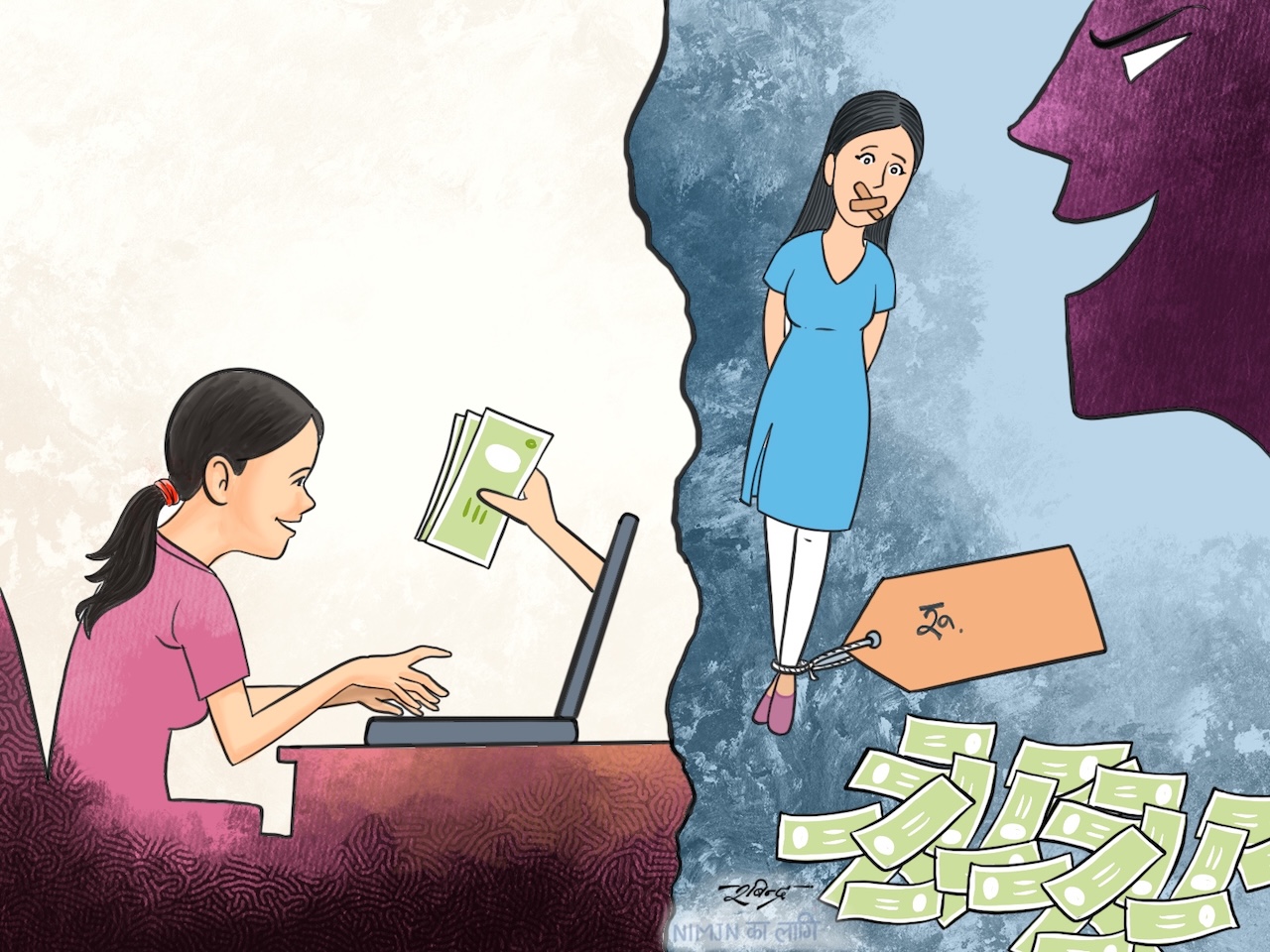
Hotel owner Sewa had used Facebook Messenger to lure Elisa, trafficked her, forced her into prostitution, and she had been raped. But out of fear, she did not report the crime.
The hotel owner had lured Elisa with promises, knowing full well about her weak family and financial situation. “He told me, ‘You won’t find such work anywhere else. Look, you earned a thousand rupees in less than two hours. If a better customer comes, you’ll earn even more. Then, you can buy whatever you want with that money’, he tempted me,” she recalls. “I didn’t say anything. He said, ‘I’ll call you when a good customer comes’, and I went home without saying anything.”
Some hotels and restaurants in urban areas are found to have forced minors like Elisa into sex work under the guise of entertaining customers. According to the police, most of these girls are between ages 13-19. In her statement to the police, Elisa revealed that the hotel owner, Sewa, had also made other women engage with customers. However, in the court statement, Sewa said that he had never had any physical relationship with her and had never made such a proposal.
Elisa was told by the hotel owner in Gaighat that the more people she had physical relations with, the more money she would get. She was paid accordingly. “I used to get 1,000 rupees for having physical relations with one person and 3,000 rupees if I had such relations with two persons,” says Elisa. “Since I could earn more by doing it with more people, I would sleep with two or three people a day.”
She admits that due to her financial need, she was willing to have physical relations with anyone. She says that she would get extra money if she could make the customer happy.
In his statement to the police, restaurant owner Sewa admitted that he would call Elisa when customers wanted to have fun and engage in physical contact. He said that he would take 2,000 rupees from the customer and keep half of it for himself, giving the other half to Elisa.
Cases like Elisa’s have been increasing. Maiti Nepal, an organization working against human trafficking, has rescued 6,434 girls and women in the last 10 years alone. According to Maiti Nepal’s statistics, the number of rescues of those trafficked has been increasing every year.
Last year alone, 101 people were rescued from abroad and 2,287 from within the country, totaling 2,388. Similarly, in 2022, 117 people were rescued from abroad and 2,180 from within the country, totaling 2,297.
| Year | Number of people rescued |
| 2023 | 2388 |
| 2022 | 2297 |
| 2021 | 142 |
| 2020 | 94 |
| 2019 | 322 |
| 2018 | 250 |
| 2017 | 273 |
| 2016 | 239 |
| 2015 | 144 |
| 2014 | 183 |
| 2013 | 142 |
SP Gautam Mishra, the then Information Officer of Nepal Police’s Human Trafficking Investigation Bureau, says that girls from poor families and broken homes are often lured into prostitution with promises of work. Mishra said that the operators themselves trap these girls in massage centers, spas, parlors and restaurants, promising them good jobs.
He said that social media has made it easier for girls to be trafficked. Mishra says that girls are lured and sexually exploited through TikTok, Facebook and Viber, and through online advertisements promising employment.
According to him, children and adolescents are forced into the sex trade through fear and intimidation, and are used to perform obscene acts on video for customers through various apps like strip chat, free live sex cam, and adult chat.
Mishra said that groups are created on Facebook, WhatsApp, and other platforms, and girls are sent to the places specified by the customers who pay.
Lured with the promise of work and raped
Apsara (name changed), a 17-year-old girl from near Butwal, received a mobile number from an unknown person on TikTok. The person who sent the number from a TikTok account named Kelvin James was Resham Gurung from Gorkha, who lived in Tokha, Kathmandu.
After asking why he sent the number, Resham replied, “If you need a job, contact me.” Apsara still remembers saying, “I will not work right now.” Resham assured her that the massage parlor job paid 10,000 rupees per month with a promise of a future raise.
Resham also asked for Apsara’s Facebook ID, and they started chatting daily. One day, Resham said, “If you don’t want a parlor job, it’s okay. I need someone to work at my house. You’re like my sister, and I’ll take good care of you. Don’t be afraid to come to Kathmandu.”
When she said she didn’t have the money to come to Kathmandu, Resham sent her 8,000 rupees as travel expenses. On her first day in Kathmandu, she was raped.
“On the very day I got off the bus, he took me home. While changing my clothes after eating, he knocked on the door,” she says. “When I opened the door, he forced himself on me, saying he would sleep with me. When I resisted, he made a video and threatened to post it online.”
Frightened by threat, Apsara was forced to comply with Resham. In her statement to the police, she said that after the rape, Resham brought a contraceptive from a nearby medical store and forced her to take it, scolding her when she refused.
Resham’s flat was home to his paralyzed mother and postpartum wife. Apsara stayed there for a month, taking care of them, and during this time, she was raped three times, as she revealed in her police statement.
After a month, Resham put her to work at his own Sunflower Wellness Spa in Gongabu. “Although it was called a massage parlor, I had to have sexual relations with the customers and engage in sexual activities to please them,” she says. She faced harassment and abuse at the spa.
According to the police, Resham initially confessed to the charges after his arrest. However, the charge sheet states that he later retracted his statement. Quoting him, the charge sheet states, “When the police interrogated me for the first time after my arrest, I said those things. I don’t remember now.”
Using the victim to find other girls
Resham used Apsara to bring other girls to Kathmandu. After working for a few months, Resham threatened her, saying, “Call another friend from your village, or I’ll make your video go viral.” Out of fear, she called her friend Ayusha (name changed) to Kathmandu.
“Out of fear, I called my 17-year-old classmate Ayusha, telling her there was a good job in Kathmandu,” said Apsara. Ayusha, who didn’t receive much love and affection from her father after her mother left and her father remarried, came to Kathmandu and faced the same fate as Apsara.
Resham knew Makhmali Maya Syangtan, the owner of A-One Spa in Thamel. While visiting Resham’s spa, she met Apsara and Ayusha. Afterward, they left Resham’s spa and started working at A-One.
Apsara said that Makhmali, like Resham, would take 1,000 rupees for each sexual encounter with a customer, keeping 500 for herself and giving 500 to them.
Both Apsara and Ayusha, while working at A-One, were rescued by a team deployed by the Human Trafficking Investigation Bureau on the evening of May 19, 2024. The police filed a case against Resham in the Kathmandu District Court for human trafficking and rape. Both Apsara and Ayusha are currently in a safe house. According to Mishra, the bureau’s information officer, although both girls’ families have been informed, they have not come to take them back, and the girls have also refused to go home.
Just as Resham had used Apsara to bring Ayusha, Sewa and Satish Kumar Yadav had used Elisa to bring another girl from Gaighat. On September 8, 2023, Yadav, who had been staying with Elisa at Sewa’s hotel, took her to Lahan, Siraha, the next day. When Elisa said she would only go to Lahan if Sewa went, Yadav gave her money for the bus fare and they went to Lahan on a scooter.
Sewa told the police in his statement that Yadav had agreed to pay for the hotel expenses in Lahan and had said he would arrange for a fee of 5,000 rupees for one night.
On the night of September 9, 2023, Yadav and Elisa were in one room and Sewa in another room at a hotel in Lahan. On the afternoon of September 10, 2023, when Yadav saw Elisa chatting with a friend on Facebook Messenger, he pressured her to call her friend. According to Sewa’s statement to the police, Yadav had told Elisa’s friend, “Come to Lahan, I’ll give you as much money as you want.”
However, when she said she didn’t have the bus fare, Yadav went to Gaighat on a motorcycle. While returning to Lahan with her, the police at the Jaljale checkpoint stopped their motorcycle and questioned them. When the girl said that she did not know Yadav and that her friend had told her she could earn some money by staying at a hotel for a while, Yadav was arrested. After Yadav’s arrest, the police arrested Sewa on September 13, 2023, and filed a human trafficking case against him in the Udayapur District Court.
Elisa’s friend’s father has filed another human trafficking case against Elisa, Yadav and Sewa. These cases are pending in court.
Trafficking to India
Girls are also being trafficked to India through online contacts. There has been an increase in gangs luring girls with promises of employment on social media and then trafficking them. Binod Pokharel, the program coordinator of Maiti Nepal, Biratnagar, said that rural girls are particularly vulnerable to such traps.
“They lure simple village girls with promises of attractive salaries and take them away. It has been found that they are forced into prostitution in India,” said Pokharel. “These trafficking gangs have been found to use social media, Viber and WhatsApp the most.”
Gitanjali Sharma of Maiti Nepal shared that in July/August alone, they rescued and brought back a 13-year-old girl who had been trafficked to India after getting acquainted with a person through Facebook.
Human trafficking and smuggling is a global and multifaceted problem. Like the illegal trade in weapons and drugs, human trafficking and smuggling has become a thriving business operated by international criminal organizations worldwide. Social analyst Bigyan Luintel states that this crime has become widespread because it is less risky and more profitable compared to other crimes.
Social media has further facilitated this. “The pursuit of urban lifestyles, including commercial sex work, cheap labor, and easy living, has become a pull factor for trafficking,” says Luintel. “Children in local environments are influenced by poverty, illiteracy, unemployment, lack of income-generating opportunities, and social insecurity.”
Mishra said that in the fiscal year 2022/23, the bureau raided hotels, restaurants, and massage parlors 18 times and rescued 61 girls who were forced into risky work. Of these, only 14 were taken by their families, and the rest are still in safe houses.
Mishra said that the bureau has been posting various messages on social media about how to protect oneself from human trafficking through social media. He suggests not chatting with strangers on social media, not being lured by anyone’s promises, not sharing personal information on social media, not trusting anyone easily, and consulting with family members if someone makes any proposal.
उदयपुरको गाईघाट बजार घुम्न गएको बेला खाजा खान छिरेकी एलिसा (परिवर्तित नाम) लाई होटलका सञ्चालकले पहिला नै चिनजान रहेको भन्दै सन्चोबिसन्चो सोध्छन् ।
गाउँकै सामान्य चिनजान रहेका ब्रोदर्स रेस्टुरेन्टका मालिक अनिल सेवाले उनीसँग मोबाइल नम्बर र फेसबुक आईडी माग्छन् । “उहाँलाई मेरो नम्बर र फेसबुक आईडी दिएर घर फर्किएँ,” एलिसा भन्छिन्, “केही दिनपछि उहाँले मलाई मेसेन्जरमा फोन गर्नुभयो र ‘बजार आएको बेला मेरो रेस्टुरेन्टतिर खाजा खान आउनु तिमीसँग एउटा गोप्य कुरा गर्नुछ’ भन्नुभयो ।”
एलिसाका अनुसार उनले मिति त सम्झिएकी छैनन् । तर असारतिर हुनुपर्छ उनी कामविशेषले गाईघाट गएको बेलामा ब्रदर्स रेस्टुरेन्टमा छिरिन् । उनी भन्छिन्, “उहाँलाई भेटेर ‘के गोप्य कुरा छ दादा ?’ भनेर सोध्दा उहाँले ‘मेरो रेस्टुरेन्टतिर कहिलेकाहीँ रमाइलो गर्ने ग्राहक आउँछन्, तिनीहरूसँग रमाइलो गरी बस्यौ भने मिठोमिठो खान पाउनुको साथै पैसा नि कमाइ हुन्छ’ भन्नुभयो ।”
उनले होटल सञ्चालकलाई कामचाहिँ के गुर्नपर्छ नि भनेर पनि सोधेकी थिइन् । सञ्चालकले गाह्रो काम होइन ‘खाने, पिउने रमाइलो गर्ने’ भने । “सुन्दा काम सजिलै लाग्यो, मलाई पैसाको नि जरुरत थियो र खान नि पाइन्छ भनेपछि म प्रलोभनमा परेँ र हुन्छ भनी सहमति जनाएर घर फर्केँ ।”
त्यसको भोलिपल्ट ११ बजेतिर होटल सञ्चालक सेवाले फोन गरेर बोलाएपछि एलिसा गइन् । “त्यहाँ जाँदा मैले नचिनेका अन्दाजी ५० वर्षका मानिससँग कोठामा बस्न लगाउनुभयो,” एलिसा भन्छिन्, “त्यस व्यक्तिले बियर, चुरोट र नास्ता मगाएर मलाई नि खान दिए र आफूले पनि खाए ।”
आमाबुबाले दैनिक रक्सी खाएर झगडा गर्ने गरेको देखेकी उनी ८ कक्षा पढ्दा नै साथीको संगतमा लागूऔषधको दुर्व्यसनमा फसेकी थिइन् । त्यसैले वियर र चुरोटमा नाइँनास्ती नगरेको बताउने उनका अनुसार खानपिन चलिरहेकै बेला तीे व्यक्तिले शारीरिक सम्पर्क गर्ने प्रस्ताव राखे, उनले अस्वीकार गरिन् । तर ती मान्छे रोकिएनन् ।
“मैले अहिलेसम्म यस्तो कार्य गरेको छैन भन्दाभन्दै नमान्दा पनि त्यस व्यक्तिले ‘मैले यसको लागि होटल मालिकलाई पैसा दिएको छु’ भन्दै जबरजस्ती गर्न थाल्यो,” उनले सुस्केरा हाल्दै भनिन्, “मलाई डर लागिरहेको थियो, त्यो मान्छे मभन्दा उमेरमा धेरै ठूलो थियो, मैले प्रतिकार गरिहेको थिएँ, तर मेरो प्रतिकार व्यर्थ रह्यो ।”
एलिसा बेहोस भएकी थिइन् । उनका अनुसार होसमा आउँदा उनको शरीरमा कुनै लुगा थिएन, ती व्यक्ति नग्न अवस्थामै बेडमा सुतिरहेका थिए । उनी लुगा लगाएर होटल मालिकलाई भेट्न तल झरिन् र आफूमाथि भएको अत्याचारको बारेमा बताइन् । तर होटल मालिकले ‘तिम्रो आजको कमाइ’ भनेर हातमा १ हजार रुपैयाँ थमाए ।
एलिसा रिसाइन् । “मलाई रिस उठिरहेको थियो, चिनेजानेको मानिसले मलाई यस्तो काम गर्न कसरी लगाउन सक्छ भनेर,” उनी भन्छिन्, “डर पनि लागेको थियो, कतै अरुले थाहा पाउछ कि भनेर ।”
होटल मालिक सेवाले फेसबुक म्यासेन्जरबाट बोलाएर एलिसाको बेचबिखन गरेका थिए, वेश्यावृत्ति गराएका थिए, त्यहाँ एलिसामाथि बलात्कार भएको थियो । तर डरले उनले आफूमाथि भएको अपराधका बारेमा कतै उजुरी गरिनन् ।
एलिसाको पारिवारिक अवस्था र आर्थिक अवस्था कमजोर रहेको बुझेरै होटल मालिकले लोभलालच देखाएका थिए । “उहाँले मलाई ‘तिमीले यस्तो काम अरु कहीँ पाउँदिनौ, हेर दुई घण्टा नबित्दै एक हजार कमायौ, अझै राम्रो ग्राहक आयो भने योभन्दा धेरै कमाउँछौ, त्यसछि त्यो पैसाले तिमीले मन लागेको कुरा लाउन खान खान पाउँछौ’ भन्दै मलाई प्रलोभन देखाउनुभयो,” उनी सम्झन्छिन्, “म केही नबोली बसेँ, उहाँले ‘म राम्रो ग्राहक आयो भने फोन गर्छु आउनू’ भनेपछि म केही नबोली घर फर्किएको थिएँ ।”
सहर बजारका केही होटल रेस्टुरेन्टमा ग्राहकलाई मनोरञ्जन दिने भन्दै एलिसाजस्ता नाबालिकाहरूलाई यौनकार्यमा लगाउने गरेको पाइन्छ । जसमा १३ वर्षदेखि १९ वर्षसम्मका किशोरी धेरै हुने गरेका प्रहरीको भनाइ छ । एलिसाले प्रहरीमा दिएको बयानअनुसार होटल सञ्चालक सेवाले अरु महिलालाई समेत ग्राहकसँग बस्न लगाउने गरेका थिए । सेवा स्वयंले भने आफूसँग कहिल्यै शारीरिक सम्बन्ध नराखेको र राख्ने प्रस्ताव पनि नगरेको उनले अदालतमा दिएको बयानमा स्पष्ट पारेकी छन् ।
एलिसालाई गाईघाटका होटल सञ्चालकले जति धेरै जनासँग शारीरिक सम्बन्ध बनायो धेरै त्यति पैसा हुन्छ भनेका थिए, त्यसअनुसार उनलाई पैसा पनि दिएका थिए । “एक जनासँग शारीरिक सम्बन्ध बनाउँदा १ हजार र दुई जनासँग बनाउँदा ३ हजार दिनुहुन्थ्यो,” एलिसा भन्छिन्, “धेरै जनासँग गर्दा धेरै पैसा हुने भएकोले म दिनमा दुई–तीन जनासँग नि सुत्थेँ ।”
पैसाको आवश्यकता भएकाले जति जनासँग पनि शारीरिक सम्बन्ध राख्न आफू तयार भएको उनी बताउँछिन् । ग्राहकलाई खुसी बनाएमा अझै अतिरिक्त पैसा आउने गरेको उनी बताउँछिन् ।
| वर्ष | उद्धार गरिएकाको सङ्ख्या |
| 2023 | 2388 |
| 2022 | 2297 |
| 2021 | 142 |
| 2020 | 94 |
| 2019 | 322 |
| 2018 | 250 |
| 2017 | 273 |
| 2016 | 239 |
| 2015 | 144 |
| 2014 | 183 |
| 2013 | 142 |
रेस्टुरेन्ट सञ्चालक सेवाले प्रहरीसँगको बयानमा ग्राहकले रमाइलो गर्न तथा शारीरिक सम्पर्क राख्न केटी खोजीमा एलिसालाई बोलाउने गरेको स्विकारेका छन् । उनले ग्राहसँगबाट २ हजार रुपैयाँ लिने गरेको त्यो पैसा आधा आफूले राखेर १ हजार रुपैयाँ उनलाई दिने गरेको बताए ।
गाउँघरका आर्थिक अवस्था कमजोर भएका, पारिवारिक विखण्डन भएका किशोरीलाई काम लगाइदिन्छु भनेर प्रलोभन देखाई वेश्यावृत्तिमा लगाउने गरेको नेपाल प्रहरीको मानव बेचबिखन अनुसन्धान ब्युरोको सूचना अधिकारी एसपी गौतम मिश्र बताउँछन् । मसाज सेन्टर, स्पा, पार्लर, रेस्टुरेन्टमा काम लगाइदिने भनेर सञ्चालकहरूले नै उनीहरूलाई फसाउने गरेका पाइएको मिश्रले बताए ।
उनका अनुसार सामाजिक सञ्जालको कारणले किशोरीहरू बेचबिखनमा सजिलैसँग फस्ने गरेका छन् । टिकटक, फेसबुक, भाइबरका माध्यमबाट सम्पर्क गरेर तथा अनलाइन माध्यममा विज्ञापन दिएर रोजगारीको प्रलोभन देखाएर किशोरीहरूलाई बोलाउने र यौनशोषण गर्ने गरेको मिश्र बताउँछन् ।
उनका अनुसार बालबालिका तथा किशोरीहरूलाई डर, धाकधम्की दिई जबरजस्ती यौनधन्दामा लाउने, इन्टरनेटको माध्यमबाट विभिन्न एपहरूजस्तै बाट स्ट्रिप च्याट, फ्री लाइभ सेक्स क्याम, एडल्ट च्याटलगायतमा बसाएर ग्राहकले भनेअनुसार भिडियोमा अश्लील हर्कत गर्न लाउने काममा प्रयोग गरिएको पाइन्छ ।
फेसबुक, ह्वाट्सएपलगायतमा ग्रुप बनाई सम्पर्कमा आएका ग्राहकहरूले पेमेन्ट गरेपछि उनीहरूले भनेको स्थानमा किशोरीहरू पठाउनेसमेत पाइएको मिश्र बताउँछन् ।
काम लगाइदिन्छु भन्दै बोलाएर बलात्कार
बुटवल नजिकैकी १७ वर्षीया अप्सरा (परिवर्तित नाम) को टिकटकमा अपरिचित व्यक्तिले मोबाइल नम्बर पठाउँछन् । केल्भिन जेम्स नाम गरेको टिकटकबाट नम्बर पठाउने गोरखा घर भई काठमाडौंको टोखा बस्ने रेशम गुरुङ हुन्छन् ।
किन नम्बर पठाएको भनेर सोधेपछि रेशमले ‘तपाईंलाई काम चाहिएको छ भने सम्पर्क गर्नु’ भनेको र आफूले ‘अहिले म काम गर्दिनँ’ भनेको अप्सारलाई अहिले पनि सम्झना छ । रेशमले मसाज पार्लरको काम मासिक १० हजार रुपैयाँ तलब हुने र पछि तलब बढाइदिने आश्वासन पनि दिन्छन् ।
रेशमले अप्सराको फेसबुक आईडी पनि माग्छन् र उनीहरूबीच दैनिकजसो च्याट हुन्छ । यसै क्रममा एक दिन रेशमले ‘तिमीलाई पार्लरको काम आउँदैन भने केही छैन, मेरो घरमा काम गर्ने मान्छे चाहिएको छ, तिमी मेरो बहिनीजस्तै मान्छे हो, राम्रोसँग काममा राख्ने छु डराउनु पर्दैन काठमाडौं आऊ’ भन्छन् ।
उनले काठमाडौं आउने पैसा छैन भन्दा रेशमले बाटोखर्च भन्दै मनी ट्रान्सफरबाट ८ हजार रुपैयाँ पठाइदिएका थिए । त्यही खर्चले काठमाडौं पुगेको पहिलो दिन नै उनी बलात्कारमा परिन् ।
“बसबाट ओर्लिएकै दिन उहाँले घर लैजानुभयो, खाना खाएर कोठामा लुगा चेन्ज गर्दैगर्दा उहाँले ढोका ढकढक्याउनुभयो,” उनी भन्छिन्, “मैले ढोका खोलेपछि ‘म नि यही सुत्छु भन्दै जबरजस्ती गर्नुभयो, मैले प्रतिकार गर्दा भिडियो बनाउनुभयो, यो कुरा कोही कसैलाई भनेमा नेटमा हाल्दिन्छु भनी डर देखाउनुभयो ।”
अप्सरा त्यही डरले कतै उजुरी नगरी रेशमले भनेको मान्न बाध्य हुन्छिन् । बलात्कारपछि रेशमले नजिकैको मेडिकलबाट गर्भ रोक्ने औषधि ल्याएर खान दिएको र आफूले इन्कार गर्दा गाली गरेको उनले प्रहरीसँगको बयानमा बताएकी छन् ।
रेशमको फ्ल्याटमा प्यारालाइसिस भएकी आमा, सुत्केरी श्रीमती पनि हुन्छन् । उनीहरूकै स्याहार गरेर एक महिना बसेकी अप्सारले त्यसबीचमा ३ पटक करणी गरेको प्रहरीसँगको बयानमा बताएकी छन् ।
एक महिनापछि रेशमले गोंगबुमा रहेको आफ्नै सनफ्लावर वेलनेस स्पामा उनलाई काम लगाउँछन् । “मसाज पार्लर भने पनि त्यहाँ आउने ग्राहकसँग शारीरिक सम्बन्ध राख्नुपर्ने, उनीहरूलाई खुसी बनाउन यौनजन्य गतिविधि गर्नुपर्थ्यो ,” उनी भन्छिन् । मसाज पार्लरमा धेरै नै दुर्व्यवहारको सामना गरेको उनी सुनाउँछिन् ।
प्रहरीका अनुसार रेशमले पक्राउ परेलगत्तै आरोप स्वीकार गरेका थिए । तर पछि उनले आफ्नो बयान फेरेको अभियोगपत्रमा उल्लेख छ । उनलाई उद्धृत गर्दै अभियोग पत्रमा लेखिएको छ, “म पक्राउ परी आएपश्चात् पहिलो पटक मलाई प्रहरीले सोधपुछ गर्ने क्रममा मैले उल्लेखित कुराहरू बोल्न पुगेछु, हाल मलाई याद छैन ।”
पीडितलाई नै प्रयोग गरिन्छ किशोरी खोज्न
अप्सरालाई प्रयोग गरेर रेशमले अरु किशोरीलाई समेत काठमाडौं बोलाएका थिए । केही महिना काम गरेपछि रेशमले ‘गाउँबाट अर्को साथीलाई बोला, नत्र तेरो भिडियो भाइरल गराइदिन्छु’ भनेर डर देखाएपछि गाउँकै साथी आयुशा (परिवर्तिन नाम) लाई काठमाडौं बोलाएको उनी बताउँछिन् ।
“डरका कारण सँगै पढेकी १७ वर्षकी आयुशालाई राम्रो काम छ भन्दै काठमाडौं बोलाएँ,” अप्सराले भनिन् । आमा अर्केसँग हिँडेपछि बुबाले पनि अर्की आमा ल्याएका कारण राम्रो मायाममता पाउन नसकेकी आयुशाले काठमाडौं आएर अप्सराकै नियति भोग्छिन् ।
ठमेलको ए वान स्पाकी सञ्चालिका मखमली माया स्याङ्तानसँग रेशमको चिनजान हुन्छ । उनी रेशमको पार्लरमा आउजाउ गर्ने क्रममा अप्सरा र आयुशाको चिनजान हुन्छ । त्यसपछि उनीहरू रेशमको स्पा छाडेर ए वानमा काम गर्न पुग्छन् ।
मखमलीले पनि रेशमको जस्तै ग्राहकसँग यौनसम्बन्ध बनाएबापत् १ हजार लिने र ५ सय आफूले राखेर ५ सय आफूहरूलाई दिने गरेको अप्सराले बताएकी छन् ।
ए वानमै कार्यरत रहेको बेला अप्सरा र आयुशा दुवै जनालाई जेठ ६, २०८१ को साँझ मानब बेचबिखन अनुसन्धान ब्युरोबाट खटिएको टोलीले उद्धार गरेको थियो । प्रहरीले रेशमविरुद्ध मानव बेचबिखन र जबरजस्ती करणीको कसुरमा काठमाडौं जिल्ला अदालतमा मुद्दा दर्ता गरेको छ । अप्सरा र आयुशा दुवै सेफ हाउसमा छन् ।
ब्युरोका सूचना अधिकारी मिश्रका अनुसार दुवै किशोरीका परिवारलाई खबर गरे पनि हालसम्म लिन नआएको र उनीहरूले पनि घर जान मानेका छैनन् ।
जसरी अप्सरालाई प्रयोग गरेर रेशमले आयुशालाई बोलाएका थिए, त्यस्तै गरेर गाईघाटकी एलिसाकै माध्यमबाट सेवा र सतीशकुमार यादवले अर्की किशोरीलाई समेत बोलाएका थिए । भदौ २२, २०८० मा एलिसासँग सेवाको होटलमा बसेका यादवले भोलिपल्ट उनलाई सिरहाको लहान लगेका थिए । एलिसाले सेवा गए मात्रै लहान जाने भनेपछि एलिसालाई गाडीबाट आऊ भन्दै भाडा दिएर उनीहरू स्कुटरमा लहान पुगेका थिए ।
लहान गएको होटल खर्चबाहेक एक रातको ५ हजार रुपैयाँ लाग्छ भन्दा यादवले मिलाएर दिन्छु भनेको सेवाले प्रहरीसँगको बयानमा बताएका छन् ।
भदौ २३ गते राति लहानको एक होटलमा यादव र एलिसा एउटा कोठामा र सेवा अलग्गै कोठामा सुतेका थिए । भदौ २४ गते दिउँसो लहानको होटलमा बसिरहेको बेला एलिसाले साथीसँग फेसबुक म्यासेन्जरमा कुराकानी गरेको देखेपछि यादवले ती साथीलाई पनि बोलाउन दबाब दिए । सेवाले प्रहरीमा दिएको बयानअनुसार यादवले एलिसाका साथीलाई ‘लहान आऊ मागेजति पैसा दिन्छु’ भनेका थिए ।
तर उनले गाडीभाडा छैन भनेपछि यादव मोटरसाइकल लिएर गाईघाटसम्म गएका थिए । उनलाई लिएर लहान फर्कंदै गर्दा जलजलेको चेकप्वाइन्टमा प्रहरीले मोटरसाइकल रोकेर सोधपुछ गर्दा ती किशोरीले ‘हामीबीच चिनजान नभएको, साथीले होटलमा केही समय बसेपछि पैसा कमाइ हुन्छ भनेकाले लहानतिर जान लागेको’ भनेपछि आफू पक्राउ परेको यादवले बताएका छन् । यादव पक्राउ परेपछि प्रहरीले सेवालाई भदौ २७, २०८० मा पक्राउ गरेर जिल्ला अदालत उदयपुरमा मानव बेचबिखनको मुद्दा दर्ता गरेको छ ।
एलिसाकी साथीका बुबाले एलिसासहित, यादव र सेवालाई आरोपी बनाएर मानव बेचबिखनको अर्को मुद्दा दर्ता गरेका छन् । यी मुद्दा अदातलमा विचाराधीन छन् ।
भारतमा समेत बेचिन्छन्
अनलाइनमार्फत सम्पर्क गरेर किशोरीहरूलाई भारतमा समेत लैजान गरिएको छ । रोजगारी लगाइदिने भनेर सामाजिक सञ्जालमा पोस्ट गर्ने र झुक्याई उनीहरूलाई बेचबिखन गर्ने गिरोह बढ्दै गएको पाइन्छ । यसमा विशेषतः ग्रामीण क्षेत्रका बालबालिकाहरू त्यसको जालमा पर्ने गरेको पाइएको माइती नेपाल विराटनगरका कार्यक्रम संयोजक विनोद पोखरेलले जानकारी दिए ।
“गाउँका सिधासाधा किशोरीहरूलाई आकर्षक तलब हुने भनेर यहाँबाट फकाएर लैजान्छन् । भारततिर पुर्याएपछि वेश्यावृत्तिमा लगाउने गरेको पाइएको छ,” पोखरेलले भने, “बेचबिखन गर्न लैजाने गिरोहले सबैभन्दा बढी सामाजिक सञ्जाल, भाइबर र वाट्स एप प्रयोग गरेको पाइएको छ ।”
माइती नेपालकै गिताञ्जली शर्माले गत साउनमा मात्र फेसबुकको माध्यमबाट चिनजान भएर भारत पुगेकी १३ वर्षकी बालिकालाई उद्धार गरेर फिर्ता ल्याएको जानकारी दिइन् ।
मानव बेचबिखन तथा ओसारपसार एक विश्वव्यापी र बहुआयामिक समस्या हो । हातहतियार र लागूऔषधको अवैध कारोबारजस्तै मानव बेचबिखन तथा ओसारपसार अन्तर्राष्ट्रिय आपराधिक संगठित गिरोहद्वारा सञ्चालित धन्दाका रूपमा विश्वमा फस्टाउँदै गएको छ । अन्यको तुलनामा बेचबिखन र ओसारपसारमा कम जोखिम तर धेरै नाफा आर्जन हुने हुँदा यो अपराधले व्यापकता पाउँदै गएको सामाजिक विश्लेषक विज्ञान लुइँटेल बताउँछन् ।
अहिले सामाजिक सञ्जालले यसलाई थप सहजता दिएको पाइन्छ । “सहर बजारमा व्यावसायिक यौनधन्दा, सस्तो श्रम, सहरी मस्ती, आरामको जीवनशैली नक्कल गर्ने प्रवृत्ति बेचबिखनका लागि तान्ने शक्ति बनेका छन्,” लुइँटेल भन्छन्, “स्थानीय परिवेशमा गरिबी, अशिक्षा, बेरोजगारी, आयआर्जनको अवसरमा कमी, सामाजिक असुरक्षाको प्रभावमा बालबालिका परिरहेका छन् ।”
मिश्रका अनुसार गत आर्थिक वर्ष २०८०/८१ मा ब्युरोले १८ पटक होटल, खाजाघर, मसाज पार्लरलगायतमा छापा मारेर जोखिमपूर्ण काम गर्न बाध्य ६१ जना किशोरीलाई उद्धार गरेको छ । जसमध्येका १४ जनालाई मात्रै परिवारले बुझेर लगेका छन् । अरु सबै सेफ हाउसमै छन् ।
सामाजिक सञ्जालको माध्यमबाट हुने मानव बेचबिखन पर्नबाट जोगिन के गर्ने भन्ने बारेमा ब्युरोले सामाजिक सञ्जालमै विभिन्न पोस्टसमेत गर्ने गरेको मिश्र बताउँछन् । नचिनेका व्यक्तिहरूसँग सामाजिक सञ्जालमा कुराकानी नगर्ने, कसैले कुनै लोभलालच देखाउँदैमा नलोभिने, आफ्नो व्यक्तिगत तथा निजी कुराहरू सामाजिक सञ्जालमा नराख्ने, कसैलाई पनि हत्तपत्त विश्वास नगर्ने र कसैले कुनै प्रस्ताव गरेको छ भने घरपरिवारमा सरसल्लाह गर्नुपर्ने उनको सुझाव छ ।
(यो खोज समाचार निमजिनको फेलोसिप कार्यक्रम अन्तर्गत अस्ट्रेलियन एडको सहयोगमा उत्पादन गरिएको हो । यो सामग्रीको पूर्ण जिम्मेवारी प्रकाशक र लेखकसँग मात्र रहने छ ।)
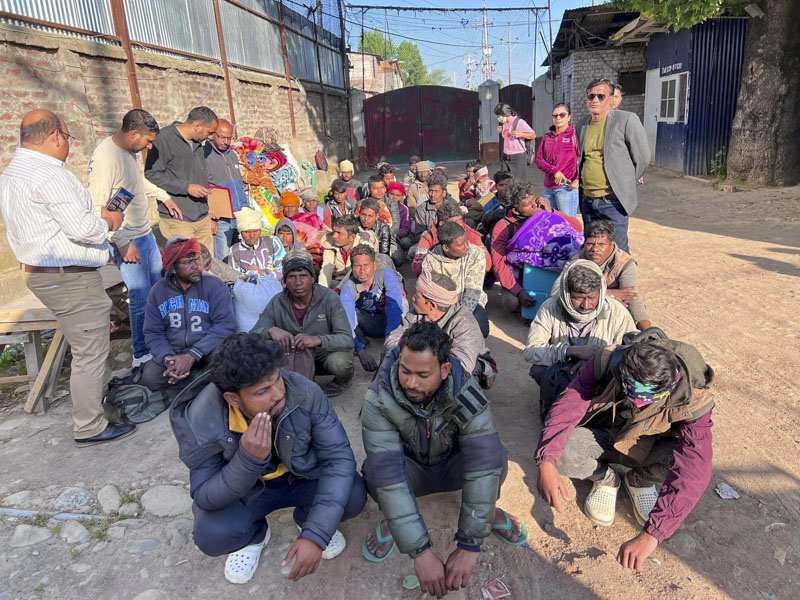
Rescued Nepali workers. Photo: Saroj Ray via NIMJN
Chandan Mandal, a 20-year-old from Mithila Municipality-9 Bengadabar in Dhanusha district, had traveled to Srinagar, India, hoping to improve his family’s financial situation. He envisioned better earnings, stable employment, and the opportunity to explore Kashmir.
However, his aspirations were quickly dashed.
Forty-two Nepali workers, including Mandal, crossed the Sonbarsha border point between Nepal and India, embarking on a journey fraught with unforeseen challenges and hardships. They were deprived of basic humanitarian aid and had their money, jewelry, and other valuables confiscated by the procurer, who had promised decent work.
Nepali workers are often lured to India with false promises of easy work, food, accommodation, and higher wages. Indian procurers visit Nepali villages, exploiting unemployed locals to entice other young people with the allure of better job opportunities and income.
Once in India, these workers face immense difficulties finding employment. Even if they manage to secure a job, they struggle to afford basic necessities like food. Many days are spent idle, without work.
Mandal fell victim to this deceitful scheme, lured to India by unscrupulous procurers. He and the other 41 workers were initially paid a small sum of Rs 5,000 to Rs 7,000. However, upon reaching Srinagar, they were held captive and forced to work without additional compensation. The procurer claimed to have purchased Mandal for Rs 7,000.
Mandal managed to escape this ordeal and returned home with Saroj Sada from Sarlahi. Based on the information provided by Mandal, 36 other workers were rescued on May 16, 2024. Twenty-three of the rescued were from Mahottari, 11 from Sarlahi, and two from Dhanusha. They were all between the ages of 15 and 44. Some others had fallen ill and returned to Nepal.
Rescued Nepali workers. Photo: Saroj Ray via NIMJN
Rina Jha, the coordinator of Peace Rehabilitation Center, Dhanusha, explained that most procurers lure Nepali workers to India with promises of better income and job opportunities. In some cases, even children are taken to India for work. The procurers receive commissions from both employers and workers, creating a system that exploits Nepali workers. These workers are often denied promised jobs, food, and accommodation, and are forced to work excessive hours.
Ram Ekbal Sada from Mahottari was one of the 42 workers who faced this situation. Indian procurers met him in Bardibas and asked him to recruit other young people. With the promise of advance payment of Rs 5,000 to Rs 7,000, Sada convinced unemployed youths to accompany him to India.
Last year, in July or August, Lallan Yadav, an Indian procurer from Madhawapur, visited the Mushahar settlement in Janakpurdham Sub-Metropolis-7 and took 12 workers, including Jhapsa Sada, to Gujarat, India. Jhapsa was initially told that he would be lifting 10-12 kg cotton bags, but once in Gujarat, he was forced to lift 100 kg sacks and carry them to the fourth floor. He was required to work from 8 in the morning till 10 in the night for a meager monthly wage of 10,000 Indian Rupees. Feeling deceived and exploited, Jhapsa wanted to return home.
However, Lallan insisted that he had invested a significant amount of money in bringing them to India and that they would have to complete the work before returning. These 12 Nepali men were subjected to forced labor. Jhapsa stated, “We refused to work and expressed our desire to return home, but he forced us to work late hours every day. All the payment meant for us was taken by Lallan.”
According to Jhapsa, young boys who were unable to lift 100 kg were physically abused and forced to complete the task. As they were not provided with adequate food, they seized an opportunity to escape the workplace one night and reached Ahmedabad. There, they worked for a few days in eateries, earned enough money for their travel expenses, and returned home. A few others chose to remain in Ahmedabad. Jhapsa is currently engaged in menial labor in Nepal. He expressed frustration, stating, “If we could find work here in Nepal, why would we go there? Only those with influence and connections secure jobs here.”
Exploitation and Torture
Forty-two men, including Chandan Mandal, were taken to Badgam, a town near Srinagar, by Indian procurers. They were transported by bus from Sonbarsha, an Indian town bordering Sarlahi. Upon arrival, they were confined to a warehouse-like room and subjected to severe exploitation, according to Chandan.
They endured physical abuse, including beatings with belts and canes, forced humiliation, and threats of violence. The workers were forced to perform degrading acts and were constantly intimidated. Chandan recalled the contractor’s threats, “If you speak up, we will kill you and throw you away.”
Chandan and his fellow workers were promised employment in drainage ditch construction, but were instead forced to work on building construction sites, erecting concrete slabs. For a month and a half, they endured extreme torture and exploitation and they decided to flee one day. “We faced extreme torture and exploitation, hence Saroj and I took a risk one day and escaped,” Chandan said. They ran away while slab work was going on by jumping off the compound wall and reached a military camp in about 10 minutes. On reaching the military camp they narrated their story to the guard there but the soldier suspected them of being terrorists. “We thought, as Gorkhas and Nepalis, we would be believed. Instead, we were mistaken for terrorists,” said Chandan. “We told him the entire story, and he advised us to go to the police.”
While on their way, they met a traffic policeman and told him about their plight. On hearing their story, the traffic police helped them hitch a ride on a truck to Jammu. They were tired and hungry. “The truck driver gave us two biscuits each. We ate the biscuits and continued the journey.” “I don’t remember the names of the places but the truck driver took us to another traffic police at around nine in the evening and dropped us there,” said Chandan. When Chandan narrated his story to the new traffic police, the police was kind enough to give him 550 Indian Rupees and 250 Indian Rupees to Saroj. The police also helped them to get on to a pick-up truck which took them to the railway station in Udhampur and left them there. They purchased two train tickets for Rs 70 each and left for Jammu.
From Jammu, they took a train to New Delhi by which time they had used up all the money they had. “Though we did not have any money, we boarded a train in Delhi but in Sonpur the train authorities asked us for tickets. Since we did not have any tickets we decided to get off from that train and boarded another train to Jayanagar,” Chandan said. After reaching Jayanagar, they walked all the way to Janakpur. According to Chandan, they heaved a huge sigh of relief when they crossed over the border to Nepal. They had felt like they had just won a huge battle.
Back home, Chandan now works as a truck driver and is preparing to go abroad for employment. “If we were able to find decent jobs in Nepal, nobody would want to leave their homes. Here in Nepal, we get work for one day and have to manage our basic needs for another 10 days with what we earn on that day. How is that possible? This is the main reason why unemployed Nepali men fall into the job trap set by unscrupulous strangers and reach India,” he said.
Rescue Efforts from India
Saroj Ray was instrumental in rescuing the stranded Nepali workers in Srinagar. After Chandan returned home and informed the families of the workers about their captivity and forced labor, the families sought help from various authorities, organizations, and individuals. Chandan recounted, “After returning, I approached Raghubir Mahaseth (the MP) and the CDO office, but they didn’t offer any assistance. Then, I contacted Saroj Sir, who was the one who helped us.”
Rajib, brother of Ranjit Chaudhary, who at that time was living in Saudi Arabia, had already contacted Saroj and informed him about the plight of his brother, and requested him for help. While Saroj didn’t have specific details at the time, the meeting with Chandan shed light on the severity of the situation.
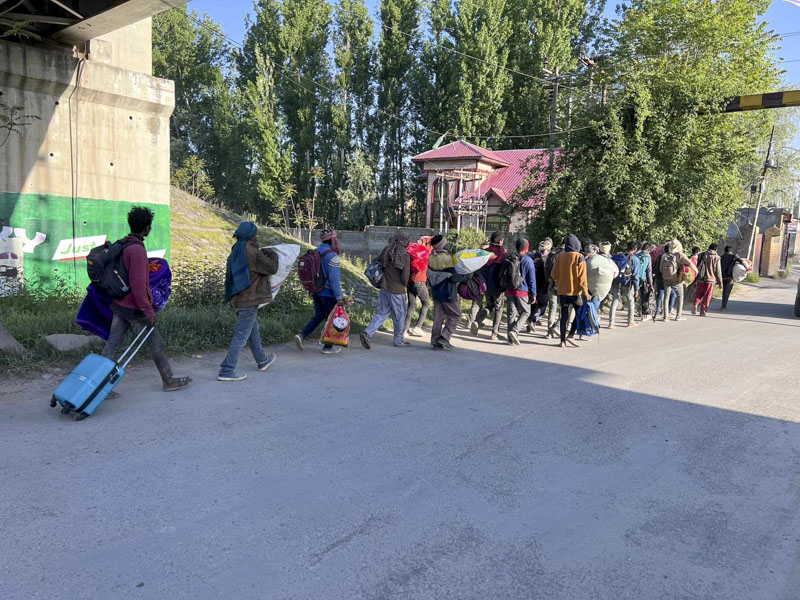
Nepali workers returning home after being rescued. Photo: Saroj Ray via NIMJN
Saroj promptly took action. First, he compiled a list of the Nepalis stranded in Srinagar. Then, on April 29, 2024, he brought the issue to the attention of the Ministry of Foreign Affairs, highlighting the plight of the Nepali workers trapped in Kashmir. The Ministry subsequently communicated the matter to the Embassy of Nepal in New Delhi.
Saroj, Chandan, and other relatives of the workers traveled to India and, with the assistance of Keen India, an Indian NGO, and the Indian Police, successfully rescued the workers. Chandan, in disguise, led the activists to the location in Srinagar where the workers were held captive. On May 10, 2024, Chandan and the undercover Indian police identified the house where the Nepali workers were confined. The police then raided the premises and rescued them. According to Saroj, the workers were crammed into two basement rooms, locked from both the inside and outside.
Initially, the workers did not believe when the Nepali team said they were there to rescue the workers. Only when they saw their relatives did the workers believe that the team had come to rescue them. “The working and living condition of the workers there was pathetic,” Saroj recalled. “Everyone was crying and complaining. They were locked inside, severely beaten, and not even allowed to go outside to relieve themselves,” Saroj recounted. “To prevent the workers from escaping, the contractor would lock the door from outside and sleep in the same room,” he added.
These Nepali workers had toiled for 85 days without receiving a single penny, except for an advance payment of Rs 5,000 to Rs 7,000 each before leaving their homes. They finally returned home on May 16, 2024.
During the raid, six Indians involved in the forced labor of the Nepali workers were present. Four managed to escape, while two were arrested by the Indian police. Saroj explained, “As we couldn’t identify all the contractors, four of them escaped, but two, Muktakim Alam and Sajad, who were the main culprits, were arrested.”
The Indian police have initiated legal proceedings against the arrested individuals based on the complaints filed by the Nepali workers. Nabin Joshi, the president of Keen India, an Indian NGO that coordinated the rescue efforts, revealed that they have successfully rescued over 700 Nepali workers. He highlighted the tactics employed by agents (procurers) from Bihar, who lure Nepali individuals from the Tarai Madhesh region to India.
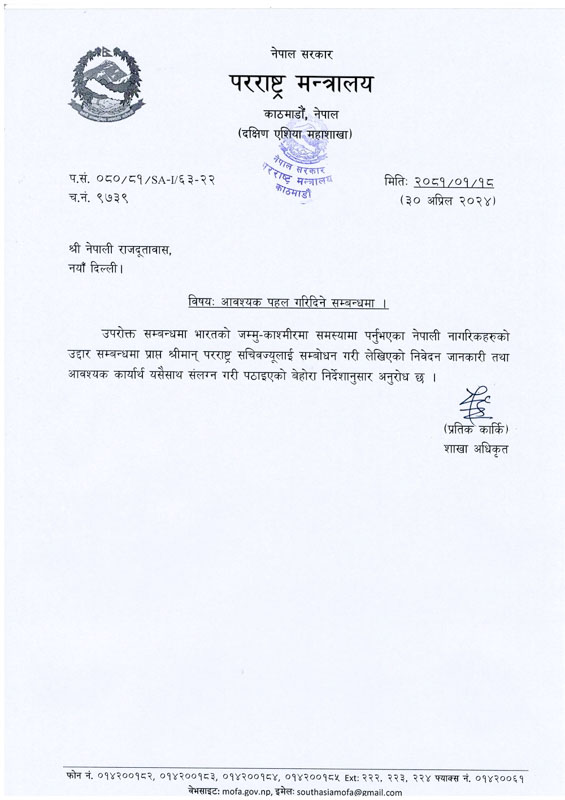
According to Saroj, the procurers had taken stock of the ground reality of Nepal prior to taking 42 workers to India five months before. “Most of the times they target people from poor and deprived families, especially those who belong to the Mushahar community. This is their modus operandi, however we do not have any documents or any kind of proof against them,” said Saroj.
According to him, the contractors who come to Saptari to lure Nepalis are from Araria, a town across the border.
The government maintains records of individuals leaving the country using passports but lacks data on the number of Nepalis who migrate to India for work. These workers often lack job security and healthcare benefits.
(Left) Letter from the Ministry of Foreign Affairs
Saroj questioned, “All Nepalis, regardless of whether they hold passports or not, are citizens. Why is there such discrimination?” To prevent Nepali workers from enduring the torture and hardships experienced in Kashmir, Saroj suggests implementing a policy that mandates obtaining a labor permit from the Nepali government before migrating to India for work.
Local administrations often lack awareness about workers who migrate to India. Despite the rescue and return of the Nepali workers from Srinagar, the local administration in Mahottari, for example, remains uninformed. Shivaram Gelal, the Chief District Officer (CDO) of Mahottari, admitted to being unaware of the situation. When asked if the families of the victims had sought assistance from the local administration, he replied, “The office is obligated to help those who approach us with complaints. We are unaware of any such interactions.”
False Business Promise
Nepalis are often lured to India with promises of business opportunities. Lilaram Chapagain, a 47-year-old from Kawasoti Municipality-2, Nawalparasi district, is one such example. A returning migrant, he was struggling to make a living from his grocery shop. A friend convinced him that he could earn substantial sums of money in India. On May 22, 2024, Chapagain was taken to the Modern Fashion Networking Company in Muzaffarpur, India. Initially, he was promised a job in clothing packaging followed by business training. He was required to pay a training fee of Rs 10,000. During his stay in the company’s hostel, he realized he had been deceived into a multi-level marketing scheme.
He was then informed that after completing the training, he would need to pay a membership fee of Rs 150,000 to earn a commission of Rs 120,000 by recruiting three more members. The more members he recruited, the higher his commission would be.
Recognizing the illegal nature of multi-level marketing in Nepal, Lilaram decided to cut his losses and return home. “I was losing Rs 10,000, but staying would have risked losing up to Rs 200,000. When the seven-day training ended, I told them I would bring the money from home and escaped,” he recalled.
(Right) Leelaram Chapagain’s house. Photo: Leelaram Chapagain via NIMJN
Lilaram mentioned that several other Nepali youths were undergoing training alongside him in India. “In one seminar, there were around 600 Nepalis,” he stated, highlighting the significant number of Nepalis who fall victim to false promises and deception in India. Lilaram revealed that some of these deceived Nepalis, after returning from their training, turn into recruiters, luring their relatives and acquaintances into the same trap. He cautioned, “No one should fall for such schemes. They are mere traps designed to deceive innocent people.”
Nepal-India border. Photo: Laxmi Chaudhary/NIMJN
- Lilaram explained that the training sessions were held in a company hall near the Khabada Mankamana Baba temple in Muzaffarpur. The trainees were accommodated in a nearby hostel. Company personnel provided transportation to and from the training center. The trainees were strictly prohibited from interacting with outsiders, retaining training materials, or using mobile phones within the training halls. This restriction prevented Lilaram from capturing any evidence of the activities inside the hall.
Rajkumar Thing, a six-year-old boy from Phulbari in Marin Rural Municipality, Ward no. 4, Sindhuli, Nepal, is playing near his house. As soon as Kana Thing from Deurali, a neighboring village, meets him, he proposes to take Rajkumar to study at a monastery in India. Luring the innocent child, he promises, “If you go to study at a monastery in India, you will become a great Lama, earn a lot of money, and get free food, accommodation, and education.”
Rajkumar, at a playful age, is thrilled by the proposal to go far away from home.
Kana, a 28-year-old man, had arrived in Phulbari on the first week of Jestha, 2076 (May, 2019) searching for boys of Rajkumar’s age to take them to a monastery to become monks. He followed Rajkumar, whom he had met on the street, all the way to his house.
Kana proposed to Rajkumar’s mother, Sunimaya, to take him to India for education. Sunimaya agreed to send her son as Rajkumar also expressed a desire to go to the monastery and Kana’s offer seemed reasonable. Kana had already proposed the offer to Rajkumar’s friends, Mingmar Moktan(8) and Man Bahadur Yonjan(12). Mingmar’s mother, Anita, and Man Bahadur’s mother, Kanchhimaya, also agreed to send their sons. Sunimaya feels comfortable sending her son because he will be going with his friends from the village who play and study together.
Home of Somraj Thing. Photo: Kalpana Bhattarai/NIMJN
The parents send their sons to India based solely on the promise of being taken to a monastery in India, without any knowledge of the location, purpose, method or duration of their stay. In total, 18 boys from Marin, including Rajkumar, Mingmar, and Man Bahadur, were taken to India through the Malangwa border checkpoint in Sarlahi in Jestha, 2076 (June, 2019). Their own parents helped them cross the border. They left their children in the care of Lal Singh Bal, Kalsang Lama and Kana before returning home.
Rajkumar, who went to the Drepung Gomang Monastery in Karnataka, South India, with the dream of studying and becoming a great monk, initially enjoyed himself there. However, as days passed, he wanted to return home. When he spoke to his mother through someone from the monastery, he expressed his strong desire to come home permanently and asked her to come get him soon.
His parents, who had no idea where to go or how to get him when they sent him to study, were now in a dilemma. Their son, who they had expected would return only after completing his education, was now insisting on coming back midway. So, they asked the people at the monastery to bring Rajkumar home.
Since Rajkumar refused to stay and was adamant about returning, the people from Drepung Gomang Monastery brought him to a monastery in Kathmandu in the first week of Asar, 2080 (June, 2023). Sunimaya, who had accompanied her son to the border in Sarlahi in 2019, went to Kathmandu herself to bring him back four years later, in 2023. When she had left him earlier, she had cried for a month. It was the same this time around too. The only difference was that the tears she shed earlier were of separation, while now these were tears of reunion.
After learning about Rajkumar’s return, we visited his home in Chyane, Marin, Rural Municipality-4, Sindhuli for the second time on Shrawan 27, 2080 (August 12, 2023). Six months prior to this, on Magh 28, 2079 (February 11, 2023), we visited Chyane and Deurali in Kapilakot Rural Municipality, Ward no. 6, for the first time. Back then, we had met some children who had returned from monasteries in India. Our purpose for visiting again was to understand why Rajkumar agreed to go to the monastery, how he was taken to India, what happened there, and why and how he returned.
Braving the monsoon rain and flooded local rivers, we reached there to find Rajkumar playing with his friends, just like he was when Kana met him in 2076 (2019). “We couldn’t play like this there,” he said, stopping his game to talk to us. “We had to follow strict discipline and rules.” When asked about his experiences at the monastery in India, he replied, looking scared. Considering his state, we talked to him in the presence of his parents. Even then, he answered with a downcast gaze and kept fidgeting with his fingers.
Somraj Thing (Rajkumar’s father). Photo: Kalpana Bhattarai/NIMJN
Rajkumar, who is now enrolled in grade 4 at Khayarsaal Madhyamik Vidyalaya in the village after returning home, finds a vast difference in teaching methods between here and the monastery. In the monastery, he had to study from 5:30 am till 12:00 midnight. He was required to understand and recite the day’s lessons at night. By the time he could go to bed, it would be 1:00 am. If he couldn’t complete his classwork properly or made mistakes, he would be beaten.
“The teacher would hit me wherever he could reach,” Rajkumar narrated his ordeal. “I have been beaten with sticks and even phone charger cables. Whenever I was beaten, I would cry, thinking about home and my village.” He feels that the fear of being beaten always loomed over him whenever he had to present his classwork.
Rajkumar vividly remembers a time when he was severely beaten for accidentally dropping and breaking a cup during a prayer ceremony in the monastery. “My whole body was bruised, it is healing only now,” he says.
According to him, the monastery provided food, accommodation, and education. However, any mistake resulted in harsh beatings, which is why many of his friends there also wanted to return home. “I would be exhausted after studying all day, and if I could not complete the classwork at night, I would not be allowed to sleep,” says Rajkumar. “I could not take it anymore, so I came home. I have no desire to go back there ever again.” When he went to India, he was six years old. Now, he is 10.
Sunimaya, his mother, was initially unaware of the problems her son faced at the monastery. She says that initially, their phone conversations with Rajkumar were limited to answering their questions, and he would not share anything else. The first time they spoke to him after he was sent to the monastery in 2076 (2019) was two months later.
His father, Somraj, says it took time for Rajkumar to adjust to being back with the family and talk openly. “Things are slowly getting better,” he says.
We reached out to the Drepung Gomang Monastery and the Delhi Police to ask about the minors, including Rajkumar Thing, being taken to India to study. We have not received any response from them as of June 24, 2024.
Screenshot of email sent to Drepung Gomang Monastery. Image: NIMJN
According to Sub-section 2 of Section 15 of the Act Relating to Children (2018), every child has the right to free and compulsory basic education and free secondary education in a child-friendly environment, as per the prevailing laws. Similarly, Sub-section 3 states that every child has the right to education through appropriate learning materials and teaching methods according to their specific physical and mental conditions, as per the prevailing laws. Taking Rajkumar to India to make him a monk and the hardships he endured at the monastery clearly demonstrate a violation of these rights and an injustice done to him, according to child rights activist Milan Dharel.
Neglect of the authorities
During the scorching heat of Jestha (May), Rajkumar said goodbye to his mother. He along with 18 other boys crossed into India with Lal Singh Bal, Kalsang Lama and Kana. After spending three days in Delhi, they boarded a train to Karnataka. At the Nizamuddin Railway Station in Delhi, the sight of 18 children without guardians on their way to Karnataka alarmed the Delhi Police, who took them into custody. Upon learning that the children were Nepali, the police suspected smuglling and immediately informed the Nepali Embassy in Delhi. Coincidentally, the then Prime Minister Pushpa Kamal Dahal ‘Prachanda’ was on a visit to India at that time. Busy with welcoming the prime minister, the embassy officials sent a Nepali organization called ‘Afanta Nepal’ (KIN) to check on the condition of the children apprehended at the railway station.
According to Navin Joshi, the then rescue officer at Afant Nepal who reached the police station, it was confirmed that the children were brought through illegal means. However, instead of sending them home, they were allowed to proceed to their destination. Documents were requested from the Karnataka monastery to release the children from police custody. These documents mentioned that the children were being taken to become novice monks. Joshi further states that the people accompanying the children had nothing but birth certificates.
(Left) Letter sent from the Karnataka’s Gumba to the Indian Police. (Right) Letter sent by the Human Rights Commission to the police. Images: NIMJN
Even though the children were allowed to go to the monastery, Joshi wrote letters to the Human Trafficking Investigation Bureau, the Child Rights Council, and the Human Rights Commission, urging them to take immediate action to rescue the children and return them to Nepal due to the risk of trafficking.
Based on this, the Human Rights Commission also wrote a letter on Asar 9, 2076 (June 24, 2019), requesting the Human Trafficking Investigation Bureau to rescue the children, return them to Nepal, and provide information on the matter. In response, the Human Trafficking Investigation Bureau’s letter stated, “Sent with parental consent and in touch with family.”
The letter mentioned that contact could not be established with the parents of three of the 18 children: Chhenmong Dorje Tamang, Raju Bholan and Sang Bahadur Waiba. There were meetings, discussions and debates between government and non-government agencies regarding whether or not to repatriate the children who were taken to the monastery illegally without completing the process.
Letter sent by the Human Trafficking Investigations Bureau to the Human Rights Commission. Image: NIMJN
The discussions also raised concerns about the children’s rights, well-being and protection. However, investigating the situation of the children sent there did not fall under anyone’s responsibility. Anupam Rana, the then Superintendent of Police at the Human Trafficking Investigation Bureau, states, “In the end, the case was closed with a light comment saying they were sent to study.”
Somraj Thing, Rajkumar’s father, says he only found out about the illegal method used to take his son after the police stopped him in Delhi. According to him, the Kapilakot Area Police Office in Marin called them and asked them to sign documents stating they could contact their son by phone and that he was safe.
The documents we found at the Kapilakot Area Police Office on Asar 27, 2080 (July 12, 2023) confirm this. Records show that the Human Trafficking Investigation Bureau wrote to the Sindhuli District Police Office In Bhadra of 2076 (mid-August to mid-September, 2019), who then forwarded it to the Kapilakot Area Police Office.
Response made by the police
Report prepared in Kapilakot
(Left) Response by the police. (Right) Report prepared in Kapilakot. Images: NIMJN
According to records from the then Kapilakot Police Office, a local investigation report was created in the presence of the then Ward Chairmen, Kursang Lama (Ward 6) and Dhan Bahadur Syangtan (Ward 4) of Marin Rural Municipality. This report stated that the children were ‘safe and studying’, and the parents were made to sign and stamp it. However, Kursang Lama, the then Ward Chairman of Ward 6, was himself involved in collecting children from the village and sending them to the monastery in India. It appears the police created this report solely based on what the parents were told, without contacting the monastery or verifying the children’s well-being.
Article 3 of the Palermo Protocol defines such movement as falling within the definition of trafficking. The article defines trafficking as the recruitment, transportation, transfer, harboring or receipt of persons, by means of threat or use of force or other forms of coercion, of abduction, of fraud, of deception, of the abuse of power or of a position of vulnerability, or of the giving or receiving of payments or benefits in exchange for a person’s consent to having control exercised over that person. Based on this definition, it can be argued that these 18 children were victims of trafficking and smuggling. However, the authorities, including the Human Trafficking Investigation Bureau, normalized the movement of these children.
Binod Sharma, Superintendent of Police at the Sindhuli District Police Office, acknowledges the mistake. “The police should not have done that,” he says. “How did such a mistake happen back then?” However, he claims he does not have any information about the incident as he recently joined the office.
Who benefits from smuggling children?
There is no exact data on the number of children from Marin who have been sent to monasteries in India. Kajiman Thing, coordinator of the Tamang Ghilin organization in Marin-4, estimates that the number could be between 50 and 60. He says that poor parents send their children hoping for a better life, but emphasizes that separating young children from their families in the name of religion and cultural preservation is worriying. Thing fears that being raised far from family and their country could lead to a loss of language, culture and identity.
“Parents assume their children are well cared for but they lack information about the environment, treatment or educational quality at the monasteries,” Thing says.
There have not been any studies on the conditions within these monasteries. Neither the parents nor the people taking the children seem to consider the children’s interests or psychology, often using the guise of traditional religious and cultural preservation. This has a negative impact on the children’s mental, social and emotional development. Thupten Tamang, a Buddhist philosophy scholar, observes that children brought to monasteries at a young age tend to develop problems like being socially distant, aggressive, and withdrawn.
Thupten has witnessed similar issues in children of his relatives who were sent to study at a young age and other children who studied in monasteries.
Even non-Buddhist children are in monasteries
There are cases where children from non-Buddhist communities are also lured to monasteries in India under the pretense of being educated in Buddhism and preserving the culture.
For example, in Bhadra of 2078 (August 2021), 14 Dalit children from Kunji and nearby areas in Ward 5 of Mustang’s Thasang Rural Municipality were rescued from being taken to India on the pretext of becoming Lamas (Buddhist monks). Sunil Dahal, the then Deputy Superintendent of Police at the Kakarvitta Area Police Office, explains that the children were dressed in Lama clothing and were being taken across the border illegally when they were rescued. Police records indicate that smugglers often take children from the East through western borders and vice versa.
Basanta Maharjan, a Buddhist writer and scholar, states that the practice of collecting children from villages and taking them to Indian monasteries is old. According to him, neither the ward offices nor the municipalities have any information about the children taken in this way. “To which monasteries are they being taken? From where are they all being collected? What happens to them after they are taken to the monasteries?” He questions. He further says, “We have no data on how many children are studying in monasteries in India.”
Sexual abuse of children in monasteries
There have been cases of violence and sexual abuse against children kept in monasteries and religious institutions in India. According to an online article published in the Daily Tribune in 2018, 15 boys were subjected to beatings and sexual abuse. The police arrested Bhante Shanghpriya Sujoy, a Bangladeshi citizen who headed the ‘Prasanna Jyoti Buddhist School and Meditation Center in Bodh Gaya, Bihar, India. He was accused of beating, sexually abusing and forcing the boys in the monastery to dance naked.
Following his arrest, the International Buddhist Council (IBC) held an emergency meeting and passed a resolution condemning the heinous crime against children in the name of religious education. The resolution also proposed expelling any institution involved in such acts from the Council’s membership. It is important to note that many monasteries in India operate without registering with the IBC.
In 2020, Rinpoche Gyana Vajra, President and Head Lama of Shakya Academy in Dehradun, India, was accused of beating 51 Nepali students aged 6 to 17 who requested permission to return home for the Dashain-Tihar holidays. He allegedly beat and confined the students who submitted the request. The incident became public after the victims themselves spoke up. The Nepali Embassy in India and an organization called Help Cross rescued the students and brought them back to Nepal.
Section 64 (1) of the Act Relating to Children (2018) allows the children themselves or concerned individuals to file a complaint with the local government or the local government’s judicial committee if a child’s rights are violated or if the responsibilities towards the child as outlined in Section 3 are not fulfilled. However, no complaints have been registered regarding these issues.
Why Nepali children?
According to Buddhist writer and scholar Basanta Maharjan, monasteries prefer young children because of the belief that their strong memory allows them to memorize religious texts (sutras) more easily. Memorizing becomes more difficult after a certain age. He explains, “Younger children can grasp things better than older ones. They focus on memorizing until a certain age, after which it becomes harder.”
Monasteries with a larger number of students can also use them to impress donors and gain financial or other advantages. Therefore, they strive to have a high number of students. Since there are fewer children studying in monasteries in India, they specifically target Nepali children.
Lal Singh Bal, who takes children to monasteries, claims that the education and facilities are better in Indian monasteries compared to Nepal. He argues that Nepali children are the preferred choice for Indian monasteries because they (especially those from poor and disadvantaged communities) are easier to convince and can be offered fewer amenities.
The plight of returnees
Based on information provided by relatives in Nepal after finding 18 children, including Rajkumar, at the Nizamuddin Railway Station in Delhi, the Human Rights Commission urged the Human Trafficking Investigation Bureau to rescue the children.
The commission’s letter provided us with the names and addresses of the children. Following these addresses, on Magh 28, 2079 (February 11, 2023), we first reached Chyane in Ward 4 and Kapilakot Deurali in Ward 6 of Marin Rural Municipality, Sindhuli.
At that time, we learned that Kulsaang Thing (13) and Dhudraj (14) from Kapilakot had returned home after three-and-a-half years. Buddhabahadur Bal, also from Kapilakot, had been back for eight months. They were convinced to leave by their neighbor Lalbahadur Bal, who promised they could earn a lot of money after becoming Lamas (Buddhist monks), while they were still in grade 6 in the village school.
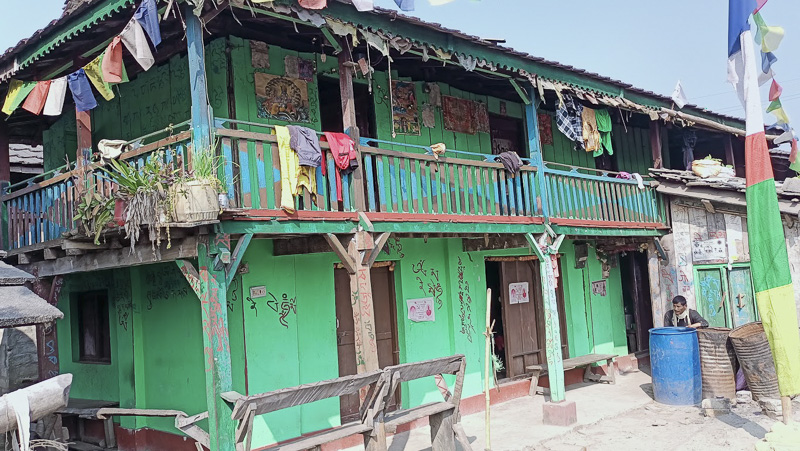
Man Bahadur Yonjan’s house. Photo: Kalpana Bhattarai/NIMJN
Sushil, Man Bahadur’s elder brother, also went to study at the same monastery in Karnataka. Their mother, Kanchhi Maya, says she sent them due to their insistence on studying. According to her memory, she only made phone contact with her older son, Sushil, after a year of him being gone.
For a long time, Kanchhi Maya has been tormented by the memory of her younger son, Man Bahadur, who is seven hundred kilometers away from home. While Sushil has returned, Man Bahadur remains there. She says, “If my son returns, I do not plan to send him back.”
Kulsang, who returned home after three-and-a-half years, says he did not know what studying to be a Lama entailed, how the studies would be conducted, or what his future would hold. He came back because the environment and the style of teaching did not suit him. Now 16 years old, Kulsang says, “Going there made me miss my studies here. Now I plan to learn about Lama teachings in the village itself.”
He does not know if this knowledge will help him earn a living, but currently, he does not have any other option. Dudhraj, who returned home with him, has started working at a hotel in Kathmandu because he could not find any other choice. He has the responsibility of supporting his family.
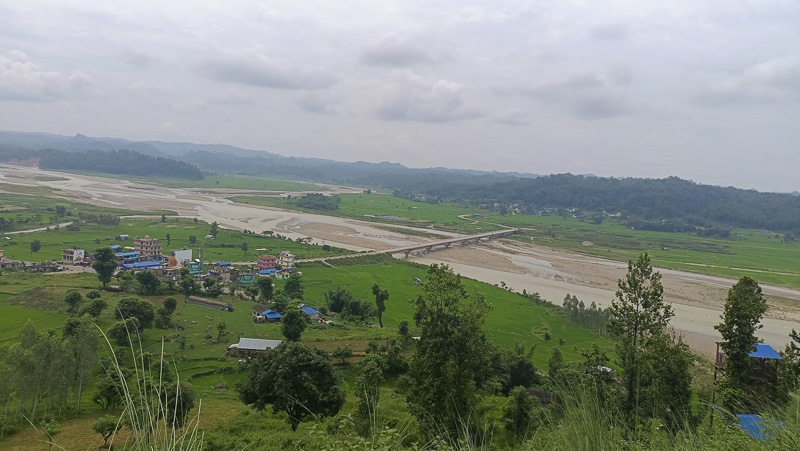
Marin Village. Photo: Kalpana Bhattarai/NIMJN
Sushil Tamang from Marin Fulbari is preparing to go to Malaysia for foreign employment. He returned because he thought studying to be a Lama in the monastery would take too long. The monastery taught Tibetan, Russian and Nepali students together. However, Nepali students were excluded when it came to making Aadhaar cards.
The person who had taken him, Kana had also taken the 18 boys. Even Kana had been sold to a hotel by a person in the village, according to Lalsingh Bal. While working at the hotel, he met people from the monastery and was then taken there. Since the time he was studying, Kana had been working for the monastery itself. Kanchhi Maya says that Kana not only took her two sons but also used to take other children and teenagers from the village. Kana passed away two years ago.
Starting school again
Supuwang Lama from Kapilakot returned home after studying for five years at a monastery in India. At the age of 13, he and 12 others from the village left to study at a monastery in Siliguri, India. They lacked clear information about the environment and subjects before going. A relative from the same village who was already studying at that monastery took them there.
Supuwang spent five years at the monastery before returning at the age of 18. He had completed grade 5 before leaving for the monastery, but upon returning, he enrolled in grade 8. However, while at the monastery, he forgot his own language. He could not read or write Nepali well enough to take exams.
Most of the 10 who returned with him are now working abroad. Now that educational certificates are required almost everywhere, Supuwang has resumed his studies in the village. At the age of 23, he is taking the SEE (Secondary Education Examination) exams. He says, “I am learning Lama knowledge and skills here in the village, but I regret not being able to complete both paths of education.”
In his view, many leave Lama studies incomplete because it is difficult. His younger brother Wangsen, who had been studying at the same monastery for six years, refused to return home.
Supuwang’s experience suggests that those who drop out of their studies lack sufficient knowledge. Additionally, the teachings in some Indian monasteries may not align with Nepali religion and culture and may not be practical. The knowledge he received at the monastery itself did not fit well with the village culture either. According to Supuwang, some monasteries do not provide proper education and skills, resulting in monks who have not learned much even after 10 years of study. He advises that before going, one should thoroughly understand the teaching style, culture, and environment of the monastery.
Quoting his fellow monks whom he met at an event for Buddhist monks and Lamas in Bodh Gaya, India, he says, “Some monasteries in Sikkim make students studying to be monks cut grass, milk cows and do cleaning chores.”
The Act Relating to Children (2018) guarantees several rights for children, including protection from economic exploitation (Section 7 (6) (a)) and from any act that could cause harm, hinder their education or impede their physical, mental, moral or social development (Section 7 (6) (b)). However, children sent to monasteries seem to be deprived of these rights.
Mental health problems of children separated from families
According to a 2010 article titled ‘Families Not Orphanages’ published in the Better Care Network Working Journal, residential institutions with strict rules limit interaction with family and society. This makes it difficult for children to establish and maintain healthy relationships from childhood to adolescence. The study also found that the mental development of children in residential institutions was 33% lower than that of children who are integrated with their families and communities.
Hasina Shrestha, a clinical child psychologist at the Kanti Children’s Hospital, emphasizes the need for a safe and secure environment in residential schools and institutions where children are placed for education. “A bad environment can lead to lifelong psychological problems,” she says. According to Shrestha, children in such situations may exhibit symptoms of depression, anxiety, withdrawal, irritability, isolation, fear and even suicidal thoughts. When children are unable to contact their families for extended periods, they may try to run away or self-harm.
There are monasteries for higher education in Nepal
Nepal already has well-equipped monasteries in places like Swayambhu, Chobar, Boudha and Pharping. However, there is a trend of sending underprivileged children aged 6-17 from villages to monasteries in India.
Buddhist writer and scholar Basanta Maharjan argues that there is no need to send children abroad since Nepal already has well-equipped monasteries that offer higher education. “There are language barriers when studying in another country,” he says. “They teach in Tibetan, Hindi and the local language. By the time they return to Nepal, they may have forgotten Nepali.”
Maharjan adds that even if English is taught, these children might only be able to go to Europe or America. Otherwise, they would be limited to staying within the monastery. He believes it is better to keep children in the country and teach them their own courses. “If we can teach our children our own courses,” Maharjan says, “even if they go abroad, they will have knowledge of Nepali religion and culture. They will be able to speak confidently about their own religion and culture.”
He argues that by properly raising and educating Lamas, they can then educate followers abroad and promote Nepali religion and culture. Maharjan mentions how foreigners come to Nepal to see and understand Nepali Buddhism and culture. He says, “This can contribute to the promotion of Nepal’s historical, religious and cultural tourism.”
Maharjan clarifies that he is not against sending children abroad for studies altogether, but that priority should be given to monasteries and schools within Nepal. There is still demand for children in monasteries – Lal Singh Bal, the person responsible for taking children to monasteries.
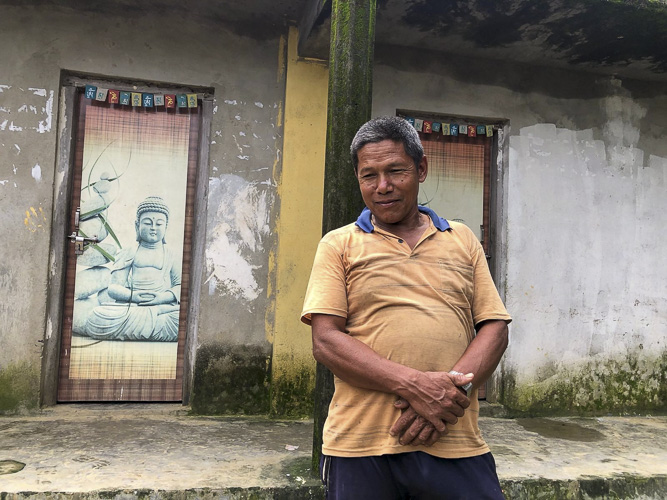
Lal Singh Bal. Photo: Kalpana Bhattarai/NIMJN
No one knows exactly when the practice of taking children from Nepal to monasteries in India began. However, I know that children have been taken from places like Marin in Sindhuli since around 1998.
There are currently 60 children studying at the Drepung Gomang Monastery in Karnataka, India. When the monastery needs more students, they collect children from villages.
Once they cross the border, people associated with the monastery come to pick them up. These monasteries sometimes operate restaurants in various locations in India, and people from those restaurants may also come to collect the children.
In Jestha, 2076 (June 2019), we were caught by the police in Malangwa, Sarlahi, while trying to put 18 children on a train to Delhi. The police released them only after the monastery provided documents. There were no documents or recommendations made when taking them from Nepal. We went without them because the ward office would not provide a recommendation, and the monastery was pressuring us to bring the children. They do not provide anything except food, snacks and travel expenses when taking them from here. They do not provide any documents except a pamphlet with the monastery’s contact number.
Previously, when we prepared to send 8 or 9 children, they were caught by the police at the border in Sunauli. After the police released the children who were accompanied by their parents, they were sent again through the Malangwa checkpoint.
The monastery is still asking for children but the ward has not provided a recommendation this time. It is difficult to cross the border without documents, so I have not been able to take them.
Since the ward would not give a recommendation and it became difficult to cross the border, I have not been sending children anymore. They were sent to study Buddhist philosophy, religion and culture. But I do not know much about what happens over there or what kind of education they receive.