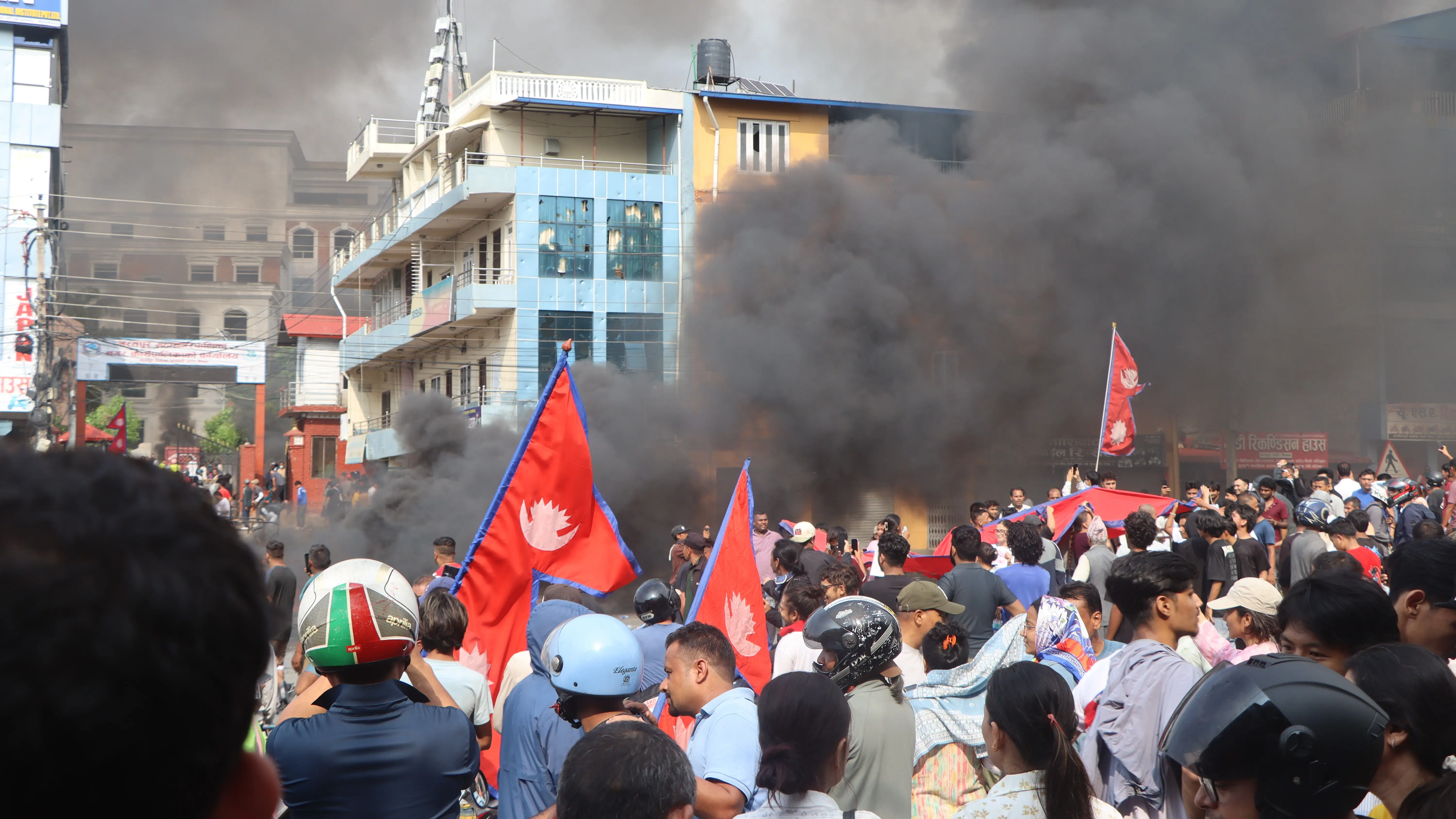
Anti-corruption protests in Nepal. Photo: Wikimedia Commons
In early September, as a peaceful protest swiftly turned violent in Nepal’s capital city Kathmandu, Koan* knew things were getting out of hand. On September 4, Nepal’s government had put a ban on 26 social media platforms, prompting students to fight back peacefully on the streets.
Last week, when security forces opened fire – killing at least 72 protesters, mostly students – protests turned ugly. Unknown actors burnt down key buildings including the Parliament and the Supreme Court. Student protesters distanced themselves from the violence but within 10 hours, Prime Minister KP Sharma Oli and his cabinet resigned, effectively setting in motion what can be categorised as one of the world’s fastest regime falls.
But this was just the beginning.
25-year-old Koan, who was a part of the protests and requested anonymity to protect his privacy, says that there was a lot of chaos during the protests.
“[When the shooting of students happened] everyone was confused: why did it happen? Who ordered the shooting? Moreover, we didn’t have a fixed plan for the protest. We just knew things had to change [in the country] and it needed to be done fast,” he tells Asian Dispatch. Following the police action and announcement of resignations, Koan says the focus shifted to filling the power vacuum in the country.
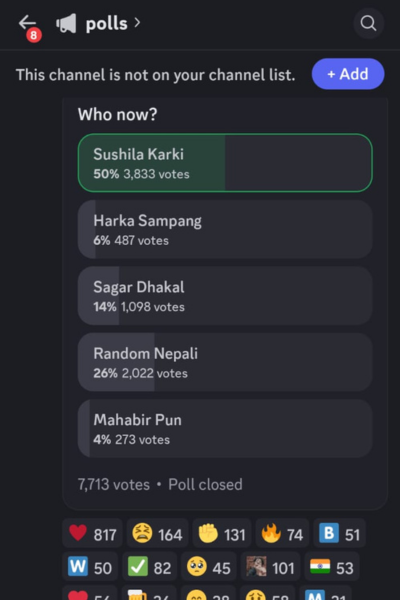
In the thick of this confusion, Gen Z protesters created a server on the social networking and gaming app Discord. Started with nearly 12,000 members, by the weekend, it had over 160,000 people. The group held a vote and negotiated to form an interim government with Nepal’s Army in a Discord livestream.
By Saturday, President Ramchandra Paudel dissolved the parliament and announced Sushila Karki as the interim prime minister until the elections on March 5, 2026. Karki was Nepal’s first woman Chief Justice and faced an impeachment motion in 2017 after she overruled a police appointment.
Initially, the Discord channel, Koan says, arose because of chaos but it helped them organise themselves. “People were scattered on every social media platform, and on the ground,” he says.
(Left) Screenshot of a poll on Discord to decide on the interim prime minister. Source: Aradhana Gurung
“The Discord server streamlined discussions so that people on the ground can get announcements based on their location.”
This group has since published a public manifesto called ‘Nepal Reforms’, which is now open for public consultation and is undergoing legal and constitutional review. This proposal focuses on decentralisation of power, wealth disclosures by all politicians, transformation in education, and banning political affiliations in student politics, among others.
Nepal’s ruling class once comprised a monarchy that lasted roughly 240 years. This was followed by shaky, successive governments that did little to reform the country. Citizens paid the price of political instability and weak governance for years as corruption scandals exacerbated the wealth gap.
The Himalayan nation is one of the poorer nations in South Asia with a GDP of $42.91 billion (as of 2024) and the country ranks 107 out of 180 in Transparency International’s Corruption Perceptions Index. The hashtag #nepokids during the ongoing protests highlighted the vast disconnect the young generations feel with the political elites and their children. The average monthly income in Nepal is $123 per capita. The richest 10 percent of Nepalis have more than 26 times the wealth of the poorest 40 percent, according to the non-partisan think tank Nepal Economic Forum.
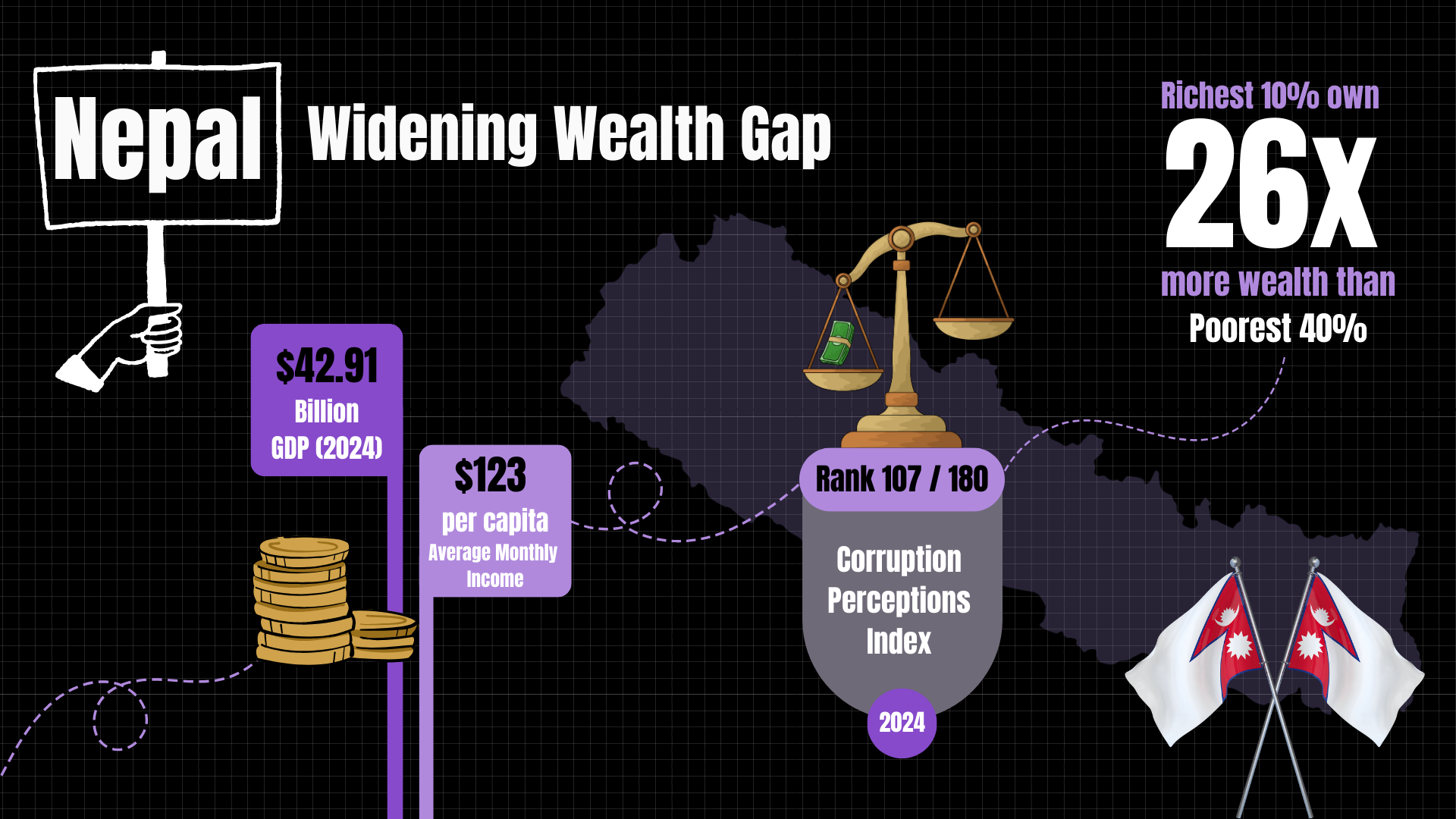
The widening income gap in Nepal. Graphic: Shivansh Srivastava
Nepal’s current political crisis, says Narayan Adhikari, the co-founder and South Asia director of Accountability Lab, isn’t an overnight outburst of anger. Young people have long been left out of political decisions, processes, and outcomes. In Nepal, people in the age group of 16-40 constitute 40 percent of the population, but make up only 11.6 percent of the country’s parliament.
“We’ve been ruled by kleptocrats who captured politics and state machinery, and siphoned off resources especially in the last 15 years,” Adhikari says. “Young people understand why they’re left out, why they’re poor, why they’re uneducated. They see the lives of their peers who come from wealthy families – the nepo babies – on social media. They channeled their anger into this new way of thinking that they can fight for what they deserve.”
However, Nepal’s youth are not alone in thinking this way, says Adhikari, adding, “Young people are leading the change across the world. Nepali youth see it on social media. It’s inspiring them.”
Koan reaffirms this.
“I speak for the majority of us when I say that our movement is technically inspired by movements in South and Southeast Asia,” he says. “A lot of countries have seen a lot of turmoil. Nepal started on a similar level. We knew the government was corrupt and that things weren’t going well for the last 20 years. We needed to stand up.”
A Deepening Divide
The Asia-Pacific region is home to 60 percent of the world’s adolescent and youth population but they’re increasingly getting left out of jobs, education, and seemingly optimistic economic growth in their own countries.
This region holds 35.9 percent of the global wealth, according to the Global Wealth Report 2025. However, the distribution is disproportionate due to inherent and a colonial legacy of corruption, nepotism and cronyism, thereby giving rise to a class of billionaires who “took” – not earned – wealth through these measures, according to a January 2025 report by Oxfam International titled ‘Takers, Not Makers’.
The world’s billionaire wealth has risen three times faster in 2024 than 2023, the report adds, but the number of people living in poverty – an estimated 3.6 billion people – hasn’t changed since 1990.

Graphic: World Inequality Database
At this juncture, young people are finding ways to break out of the rigged system.
“The young people [in Asia] are unhappy with what the future looks like. There is deep insecurity,” Meenakshi Ganguly, the deputy director of Asia Division, Human Rights Watch, says. “In almost all these cases [of protests across Asia], the trigger was different but the underlying concerns are very similar. And in almost all these cases, it was also because of authoritarian actions by the state.”
As young people in Nepal, Bangladesh, and Sri Lanka occupied the streets, their voices were uniformly met with violent repressive tactics by the state machinery. “Protests can be peaceful,” continues Ganguly. “But it translates into anger because of security forces abuses, which happens when the forces believe they have the protection of the state.”
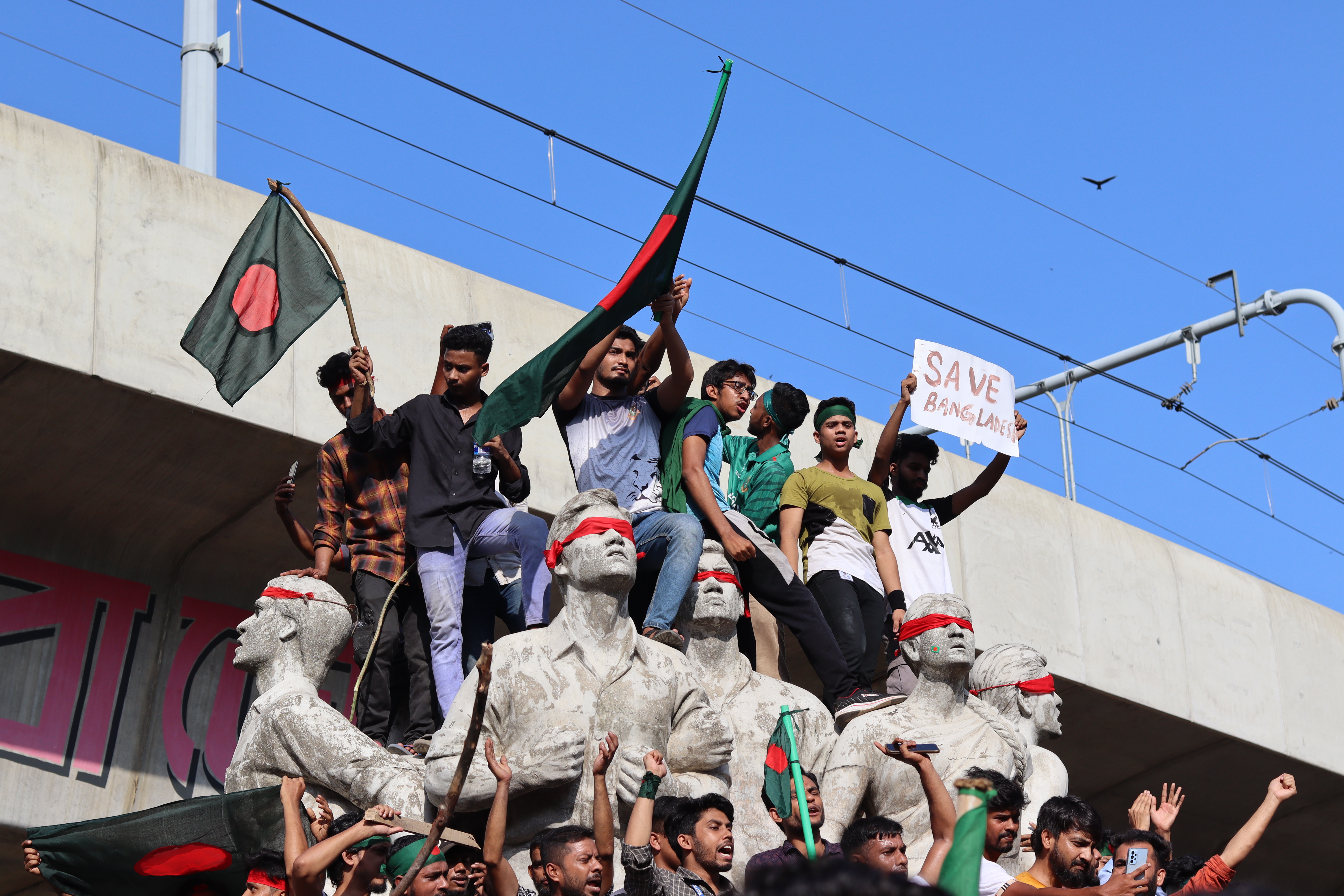
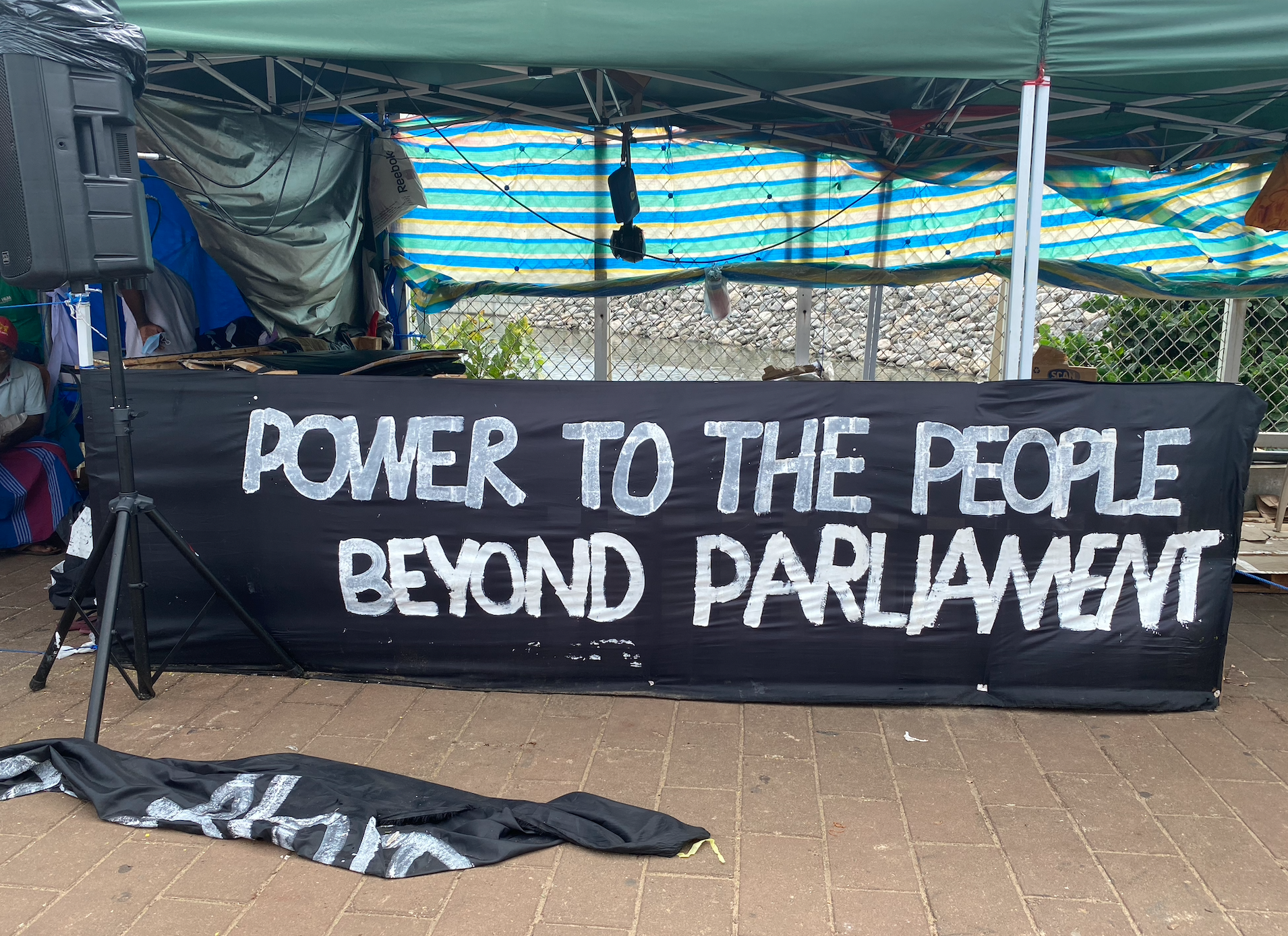
(Left) An image of protests against Sheikh Hasina’s government in Bangladesh. Photo: Wasiul Bahar/Wikimedia Commons
(Right) An image from the economic crisis protests against the government in Sri Lanka. Photo: Pallavi Pundir

Indonesia, Thailand, and the Arab Spring protests are other such examples. The Arab Spring protests that spread across the Arab world in the 2010s were in response to growing corruption and economic stagnation.
The protests that began in Indonesia on August 25 were a part of one of the 14 mass demonstrations that happened between October 2024 and September 2025. A 2025 Indonesia Inequality Report by Center of Economic and Law Studies states that the wealth of 50 richest Indonesians is equal to the total wealth of 50 million Indonesians.
The outrage over parliamentarians’ perks – which was nearly 10 times the minimum wage in Jakarta – snowballed after a police car killed a 21-year-old motorcycle taxi driver, Affan Kurniawan. Many protesters torched and looted politicians’ homes, revealing tangible evidence of disproportionate wealth.
Rebecca (uses only her first name), who works with a youth-focused non-profit called Pamflet Generasi (or “Pamphlet Generation”) in Jakarta, says she experienced wealth gap first-hand while growing up in north Jakarta, which is economically poorer than the south, and is also at the forefront of submergence due to a combination of climate change and groundwater extraction.
READ: Behind the Protests in Indonesia—A Long History of Corruption and Resentment
Indonesia is the world’s third-largest democracy, where political dynasties have held key political positions since independence in 1948. President Probowo Subianto, who was elected last year, himself has personal links to former President and dictator Suharto. Last year, he called the process of democracy “really very, very tiring…[and] very, very messy and costly.”
Disquiet in the Neighbourhood
Thousands of miles away in Bangladesh, the 2024 student uprising ousted Prime Minister Sheikh Hasina accusing her of nepotism, corruption, and crushing dissent and opposition. During the protests, an estimated 1,400 people died — vast majority reportedly shot by security forces — in a span of 46 days. Now on a run for over a year, Hasina faces several charges, including by her country’s International Crimes Tribunal, which she established in 2010.

Students atop former prime minister Sheikh Hasina’s official residence. Photo: Sajib Hasan
Interestingly, global consulting firms and economic surveys consistently hailed the nation of 170 million people as one of the fastest-growing consumer markets in Asia. But a recent white paper published by the interim government revealed it might all just be falsehoods.
Last year, the governor of Bangladesh’s central bank claimed that $17 billion was siphoned off in 15 years under Hasina. A 2023 government data shows that the wealthy 10 percent controlled 40 percent of the nation’s income in 2022, while the bottom 5 percent received only 0.37 percent.
“In Asian countries, whatever progress has been made, the benefits have not been shared equally because of the political and state capture of institutions,” Fahmida Khatun, the executive director of Centre for Policy Dialogue, a think tank in Bangladesh, tells Asian Dispatch.
She says that while there was economic stability, low inflation, export income and remittances helped with forex reserves, this didn’t meet the basic requirements of the citizens such as employment. “In fact, towards the end of the previous regime, the economy had essentially crumbled.”
Ganguly adds that social media, in this scenario, prised open the facade of development across these countries. “In a generation where a lot of people live their lives on social media, that disparity becomes even more glaring. Politicians cannot point to stock markets or some growth rate because that doesn’t translate to lived experiences of the people,” she adds.
READ: In Bangladesh, Cops Accused of Killing Protesters During 2024 Uprising Roam Free
While Bangladesh is still negotiating changes within an interim government, Sri Lanka provides lessons in rebuilding the country after kicking out its populist President Gotabaya Rajapaksa during the 2022 “Aragalaya” – Sinhalese for “The Struggle” – movement.

Protests in Sri Lanka in 2022 against the government. Photo: AntanO/Wikimedia Commons

Mostly led by young people, the movement blamed the Rajapaksa family, who have been entrenched in the political class for decades, for the economic crisis, and accused them of siphoning off $18 billion from the country.
Amid food, fuel, and medicine shortages, citizens braved violent repression by security forces and forced Rajapaksa to resign and flee the country overnight. A 2024 polling by the Institute for Health Policy shows that 92 percent of Sri Lankans believe the income gap in the country has widened in the last decade.
Since the uprising, though the Rajapaksas are back, the country voted for left-leaning Anura Kumara Dissanayake as its new president last year. Many see it as a refreshing outcome of the 2022 movement.
Thisara Anuruddha Bandara, who ran a Facebook group called “GoHomeGota2022” during the movement and also faced arrests in 2022 for his activism, says that the Aragalaya movement succeeded in having its popular demands met to a large extent.
“In a country where historically peoples’ uprisings have been suppressed, we could end with a victorious outcome.” However, he adds, the movement couldn’t completely overhaul the political system. “We think that within the limitations of a public force and a movement, we accomplished the maximum possible tasks. However, many tasks still remain to be accomplished in the future.”
The Hashtag Generation
If #NepoBabies were at the heart of Nepal’s recent protests, in Sri Lanka, it was #GoHomeGota. In Indonesia, it was #PolisiPembunuhRakyat, which translates to #PoliceThePeopleKiller alongside a parallel social media movement that spread across Southeast Asian countries calling for “SEAblings” – or SEA siblings i.e. Southeast Asian brotherhood.
In Bangladesh, the digital mobilisation stood against 22 days of internet blackouts, curfews, and military crackdowns, during which VPN usage shot by by 5,016 percent and young Bangladeshis increasingly released rap and memes to express their discontent against authoritarianism. Digital rights platform AccessNow called 2024 the “worst year” for internet shutdowns.
READ: 404 Not Found: How Internet Shutdowns Impact South Asians
In Nepal, Koan says that while social media helped unify everyone, it also opened them up to pro-government trolls. Last week, when Koan and Sah started a Google Doc to start putting together a list of proposed reforms, “malicious actors” infiltrated the document. “There was a lot of vandalism on the document itself,” he says.
Human Rights Watch calls digital repression and violence a violation of fundamental rights, which disproportionately hurt vulnerable communities.
“We’ve been concerned about instigation of violence and targeting of minorities that happens on social media, especially in mob violence like we saw in Myanmar and Sri Lanka,” Ganguly says. “At the same time, social media is the driver to create collective moves in situations where protests build up, as it’s happened in Nepal, Sri Lanka, and Indonesia. Information is also more transparent here.”
Rebecca of Pamflet Generasi says that the internet is instrumental in the political awakening of the younger generation, where they express both rage as well as empathy and solidarity.
However, she points out that social media doesn’t represent communities from all socio-economic and cultural backgrounds. This, according to her, resulted in Indonesia not seeing any reformative changes.
We are stuck in a cycle of collective rage and frustration. The middle class and the privileged people feel good enough that they have acted upon the inequalities [online] while the vulnerable and marginalised keep living with injustice everyday. – Rebecca, Pamflet Generasi
Back in Nepal, Usha Mahato, a 28-year-old nurse, adds that for many Nepalis, especially those in the remote corners, the internet is a lifeline. She works in a government hospital in the agrarian province of Gandaki, located in central-western Nepal, and says that eight years ago when she was deployed in a remote location, she relied on the internet for upskilling, seeking information about scholarships, and connecting with medical professionals.
“It [The internet] provides young people with a platform to connect, learn, grow, and be seen. It’s a bridge to a brighter future,” she adds. Lack of domestic opportunities forced over 227,000 unskilled Nepali workers to leave the country last year for jobs, Nepal’s official estimates say.
“For over three decades, we’ve faced political instability, often led by a small group of ageing politicians, many of whom are not highly educated or capable,” adds Mahato. “The long-term development of our country depends on the active participation of its younger generation.”
Building the Future, Collectively
Koan and Sah, the two members of Nepal’s Discord group, say that the protests were just the tip of the iceberg. There, now, lies the formidable task of rebuilding a country.
While these protests were largely dubbed as ‘Gen Z’ protests, people like Aradhana Gurung, a 45-year-old development professional in Nepal, supported the negotiations as a governance expert.
“I’m 45. My mother is 78. I have a 13-year-old child. When [the Gen Z protesters] reached out to me last week, I saw the need to focus on the future for all of us,” she says.
Gurung says she was a part of student protests during the decade-long armed conflict between the monarchy and Communist Party of Nepal (Maoist), but in those days they didn’t have the tools like the ones that this generation has and even the support from their older generations was missing.
The 45-year-old says that now the group will work towards making their reform manifesto inclusive and accessible to everyone. “We’re making an effort to get these conversations to the communities at the local level and collect feedback,” she says. “This manifesto is not perfect but it’s a start, and we want people to critique and challenge it. This is big and we want to think of a big and bold future.”
Down south in Sri Lanka, Bandara says that the support of civil society organisations, intellectuals, trade unions, and farmers’ organisations, among others, was critical in making the Aragalaya movement a success. “While we can expect some short-term results – such as replacing individuals, appointing more responsible individuals who can perform their duties better, and initiating a new process – we can only achieve a long-term solution with a sustained commitment,” says Bandara.
Bandara says his political arrest in 2022 – which he labels as an abduction since the police didn’t inform his family of his whereabouts – resulted in him pursuing law and becoming an election observer in his country along with other Asian countries including Indonesia and Nepal. “This exposure has allowed me to create regional and global networks,” he adds. “Based on these experiences, we continue to strive to advance social pressure groups, organise them, and provide the necessary pressure and intervention to keep up the civic activism.”
Across Asia, student protests have been a foundational basis of the region’s politics. “In Bangladesh, it was so in the 1960s, for our language movement, or 1970s for independence, or even in the 1990s, in the context of removing the army general in power,” says Khatun, the economist. “[Young people] facilitated the fall of regimes and brought in new chapters in our history. But this time was different. While in the past, students went back to their educational institutions after the movement was complete, this is the first time when students wanted their share in power.”

Victory march by protesters in Bangladesh after Sheikh Hasina’s resignation. Photo: Wikimedia Commons

After taking positions in the interim government, young Bangladeshis have now launched a new political party. As Bangladesh hurtles towards the first general elections since the uprising, in February 2026, Khatun says that young revolutionaries should remember that interim government is just that – temporary.
“Interim arrangement should focus on institutional strengthening through reforms, which in itself is a continuous process,” she says. “Rather than opening it up on every front, just focus on crucial agendas. That is easier to follow through and implement and then quickly follow up with elections.”
Bangladesh’s fragile economy, which was once a $416-billion one, is slowly picking up as it receives millions in bailouts. The interim government is particularly focusing on reforms, particularly in banking, governance, and electoral sectors.
In Bangladesh, economic decisions have been intervened and influenced heavily by political parties. In the immediate past regime, we saw a nexus of politicians, bureaucrats, and businesses that created oligarchs who then controlled decisions in every sector. The biggest issue [right now in Bangladesh] is to separate these groups and strengthen our institutions. – Fahmida Khatun, Executive Director, Centre for Policy Dialogue
Rebecca from Indonesia says that the recent youth movements have ushered many young people into politics. Calling this a significant step, she says that the education system needs to go beyond assessing the political participation of the younger generation by the number of the voters and voter turnout. She suggests defining it through voicing of political opinions, volunteering with civic and political authorities, solidarity with all classes and so on.
“However, we have to critically ask if the participation is meaningful and inclusive (or at least, representing the diversity of youth’s identity),” she says. “The [prevalent political] system has made only certain groups of young people in the formal political arena: Those with higher degree, with connections, or with social power (i.e. influencer/celebrity). Most of the young people we met through our work in Pamflet Generasi are already fed up with formal politics, which is influenced by a feudal culture.”
At the moment, Nepal is struggling with economic blows particularly from the tourism sector, which contributes eight percent to the country’s GDP. Adhikari says that maintaining law and order is also critical to the safety of citizens right now. “The priority,” he says, “is to have a strong interim government that maintains law and order, and builds trust as the country plans its new elections, while also maintaining international relations and geopolitical order.”
Khatun adds that reforms are a continuous process. “One or two elections wouldn’t change this culture. It’s an iterative process,” she says. “If we can install a cycle of good elections, that would be our checks and balances and it would facilitate the delivery of the government’s commitments to their people.”
Asian Dispatch didn’t come at the right time.
For one, a lot was going on. 2024 has been a year of pivotal moments: of landmark elections and intensifying conflicts, to triumph of people’s movements over authoritarian regimes and escalating crackdown on pro-democracy activists and journalists. Domestically across Asian countries, local events of crime, nepotism and corruption of national proportions captured the mood and social media platforms.
At a time when independent news outlets are shutting down across the world and mainstream media channels are tightly bound by the State narrative, what radical acts can one conceive of a tiny new media entity like Asian Dispatch in the thick of it all? Turns out, a lot.
The media landscape today is in crisis. An army of influencers dominates news and storytelling platforms, blurring the lines between credible journalism and disinformation. Audiences are increasingly unequipped to navigate this noisy, chaotic environment. Global news platforms often treat Asia as an afterthought, parachuting in only for sensational headlines, neglecting the region’s depth and complexity. The 13th Digital News Report by the Reuters Institute highlights this grim reality: Trust in news is at an all-time low, selective news avoidance is on the rise, and most publishers prioritise breaking news over offering thoughtful, nuanced analysis. It might seem bleak. But there’s always space for reinvention.
This is where Asian Dispatch steps in — with a bold vision to redefine how news platforms connect with their audiences. This year, we laid the groundwork for a transformative ecosystem that addresses the urgent challenges faced by Asian media. At its heart is a growing network of 18 Asian newsrooms, united in their mission to tell authentic stories. These newsrooms contribute to the Asian Dispatch platform while collaborating on groundbreaking reporting and capacity-building initiatives. Together, we’re creating a model that empowers journalism to rise above the noise.
We started the year with winning a grant by Earth Journalism Network, alongside our member newsroom Macaranga! This is the first funding we’ve received to do some independent reporting while building a global curriculum on biodiversity reporting with the help of some of the best experts in Asia. As part of this project, our cross-border reporting on the illicit trade of the wool of Tibetan Antelope is still in the works (to be published in 2025), so keep your eyes peeled for that!
Our team also mediated a collaboration between our member newsrooms Malaysiakini and Prothom Alo to publish a two-part investigation (Part 1 here and Part 2 here) into a Bangladesh-origin businessman whose controversial migrant worker business fell into troubles in Malaysia. This investigation brought to life data — offered as a tip by OCCRP —into a groundbreaking investigation digging into the wealth and past of an influential businessman, and connected dots from Malaysia to Bangladesh.
In a bid to bring together the best of Asian journalism, we started the ‘Members’ Dispatch’ tab on our website, which is a repository of the best stories and investigations published by Asian Dispatch members. From Tribal News Network’s piece on the smog crisis in Pakistan and Philstar’s investigation into the alleged trafficking of Filipino women in a surrogacy and baby trafficking ring, to looking into medical care for queer disabled folx by queerbeat and the empty promises behind the making of Indonesia’s new capital by Project Multatuli – Asian Dispatch became a space where different voices and editorial styles comes together to make sense of local events across Asia.
Much of behind-the-scenes are managed by Preeksha Malhotra and Kritika Kamthan, who are the byline-less superstars of everything partnerships. Their efforts, among others, led to two webinars. The first, what Sri Lanka’s unpredictable elections mean for the world, which came at the cusp of the country’s first elections since the anti-government protests of 2022 that unseated the unpopular Rajapaksa government. It was moderated by Dilrukshi Handunnetti, the founder of Centre for Investigative Reporting, Sri Lanka, an Asian Dispatch member. The second unpacked dynastic politics in Indonesia, with Project Multatuli’s Evi Mariani as the moderator.
We also organised workshops, including one on digital safety in collaboration with India-based Software Freedom Law Center, and another on digital transformation in collaboration with The Hindu Group’s Pradeep Gairola, Vice President and Business head-Digital. Both were made possible through the support of the Asia Media Program by Konrad Adenauer Stiftung.
Internally, we’re a small but power-packed (and mostly women-led) team based in New Delhi, Surat, Dehradun, Colombo, Dhaka and Chiang Mai. Unlike a regular newsroom that kicks off their day with “What are your story ideas for the day?” we ask: How can we tell this story differently? We don’t chase news cycles. Instead, we encourage our reporters to report on news stories that matter to Asia.
One of our first reports was by our Colombo-based correspondent Rukshana Rizwie, who wanted to revisit the story of pig-butchering crimes in Southeast Asia to ask why so many of those trafficked into these scams are South Asians. Her approach was innovative: In between interviews, she built a visual novel that brought to life every lived experience of her interviewees. This tech-driven approach to journalism was brought to life by a collaboration with Sharanya Eshwar, our gifted in-house illustrator, and Anoushka Dalmia, our South Asia correspondent and editorial strategist. This effort took months – and it was eventually rewarding. In November, Rukshana was invited by the DW Akademie for their ‘Beyond Borders’ conference in Chiang Mai to talk about how innovation can lead to empathetic storytelling. The piece is also a finalist for the 2024 Global Media Competition on Labour Migration, awarded by the International Labour Organization. It was amazing to see a story by a brand new news platform in the company of legacy newsrooms such as The Guardian and Al Jazeera.
This was also the year of the people’s movement in Bangladesh and, in the thick of police brutality and violence, our colleague Abdullah Al Soad penned a thoughtful first-person account of what it means for a Gen-Z to witness and why – despite stereotypes of Gen-Z not being politically inclined – young people took matters into their own hands and reshaped the narratives of governance after decades of authoritarianism.
In India, Anoushka Dalmia reported on Kashmir’s first election in a decade, and found what the locals truly think of the polling process in the state in the wake of the abrogation of its semi-autonomous rights in 2019.
Asian Dispatch’s desire to focus on new and innovative forms of storytelling led to us starting a bimonthly illustration and social commentary space featuring Sharanya Eshwar. Her scribbles resonate very well with our readers, and are a testament to the growing need of visual storytelling on structural issues. Her pieces have explored issues from across the region such as the lack of intersectional feminism across the world, why we glorify toxic workplaces despite mental health awareness and the inequalities fuelled by air pollution.
Bringing all these stories and our projects together is our social media team. Maitri Modi in Surat and May Sabel Phoo in Chiang Mai have been experimenting with a lot of formats. Their aim is to diversify our storytelling through multimedia formats, including this video on ‘Why Men Harm’, an explainer about gender-based violence that flips the question of why women aren’t safe. Our host, Aliya Zainab, went outdoors in Delhi at night to shoot some segments and did a remarkable job in articulating some of the most shocking facts of femicide. Catch Maitri and May’s occasional explainers on our channels!
READ: The Year That Was: Best of Asian Dispatch in 2024
For our lean and mighty team, achieving all this in less than a year is no small feat. We’ve made the deliberate choice to keep all our stories free for now, while actively seeking support from external partners and media accelerators to sustain our work. In 2025, we’re setting our sights higher by commissioning and publishing powerful stories by independent journalists, researchers, and advocates, and expanding our editorial horizons. Their work will not only elevate our storytelling but also solidify Asian Dispatch as a trusted voice. After all, a news platform is only as strong as the storytellers who bring it to life.
You will see a lot more of us in 2025 to reiterate our motto: Let’s unveil Asia one story at a time.
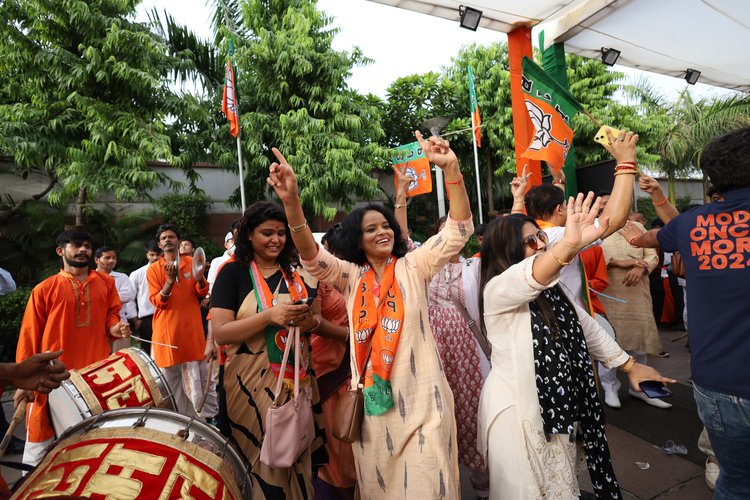
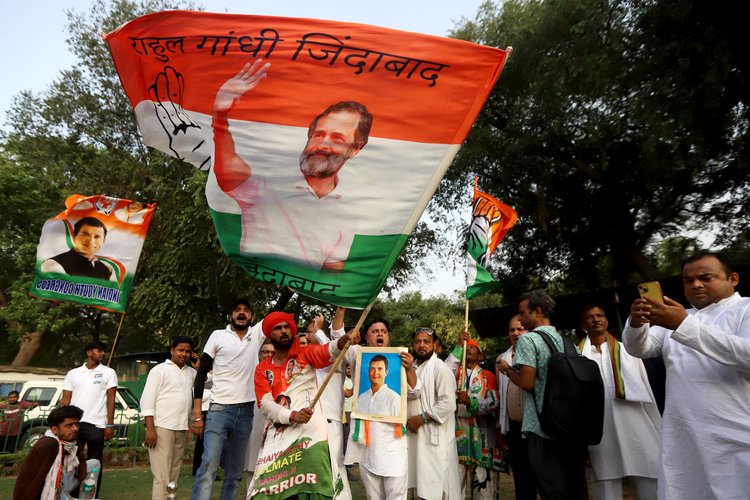
Supporters of both Bharatiya Janata Party (left) and INDIA (right) celebrate the election outcome on June 4, at their respective New Delhi headquarters. Photos: Vijay Pandey
On Tuesday morning, just as vote counting for India’s General Elections began, a video of a man crying on a prime-time news show in India went viral.
This man was Pradeep Gupta, the chairman and managing director of a poll survey company called Axis My India, had predicted a landslide victory for Prime Minister Narendra Modi’s Bharatiya Janata Party (BJP), with a vote share of almost 400 seats out of total 543 in the Parliament. The result, however, was wildly different.
Although BJP has been declared victorious for a rare third consecutive time, it fell short of the 272 seats that are needed to form the government, thereby relying on allied parties to constitute the majority.
Poll predictions aren’t a definitive indicator of election outcomes. Nevertheless, Axis My India’s survey had been splashed all over mainstream media channels and social media before and during elections, which took over a month.
Modi’s comeback, according to Gupta, was not just imminent but also signalled his strongman persona and the enduring cult of the BJP. Coinciding with the exit polls arrived Modi’s own post on X, formerly known as Twitter: “I can say with confidence that the people of India have voted in record numbers to re-elect the [BJP alliance] NDA government.”
But the results on Tuesday were a far cry from the dominant stronghold that BJP had established in the last two elections. This stumble also constituted a symbolic victory for INDIA (Indian National Developmental Inclusive Alliance), a multi-party alliance formed in 2023 led by India’s largest opposition party, the Indian National Congress.
INDIA was formed directly in opposition to NDA, but was predicted to lose by a huge margin. However, they won 234 seats, putting up a legitimate fight against NDA’s 272. For comparison, in the last general elections in 2019, NDA won 353 seats while the Congress-led alliance won only 91. This rearrangement marks a monumental shift for the political sentiments in India, which had been overwhelmingly supportive of BJP, at least in vote shares.
On June 4, as vote numbers started to form a clear picture, Gupta was grilled by news anchors on how predictions went so wrong. He started weeping, prompting journalist-anchor Rajdeep Sardesai to comment, “All pollsters need to introspect…that [poll predictions are] terrible.”
In the theatre of the world’s largest electoral process this year, Axis My India was among a flurry of opinion polls that predicted Modi’s landslide victory. But in the world’s most populated country – with over 640 million voters this year – exit polls are tricky, and their purpose can lean toward self-fulfilment.
“Some goals of [exit polls] may be flattery, but there can also be attempts to create or strengthen a narrative,” said Joyojeet Pal, a professor at the School of Information at the University of Michigan. “For instance, by repeatedly stressing that one party is likely to win in a big way, the coalition partners of the likely winner may be moved to be more acquiescent to the wishes of the broader coalition.”
Indian journalist and researcher Pamela Philipose called it a money-making system: “Pollsters are often supported by political parties, especially the ruling party, who stand to benefit from their projections even if it is only for a short time. It creates a narrative which helps in government formation.”
“Media channels mint money through advertising for such programmes,” she added, referring to how exit polls have historically boosted Television Rating Point (TRP) of English and Hindi news channels. “And then there’s the stock market.”
This week saw India’s stock market’s worst tumble in four years after BJP lost its parliamentary majority. India’s stocks recorded losses on both June 4 and June 5, driving investors to react negatively to the election results. On June 6, opposition leader Rahul Gandhi accused the BJP’s top leaders, including Modi, of misleading people into buying stocks before elections, which led to the market crash.
Before the results, another opposition leader Sitaram Yechury had told Indian news channel NDTV that exit polls were done to influence share markets.
“The way the stock markets behaved,” Philipose added, “shows how this system fuels financial speculation.”
In the lead up to the 2024 elections, the BJP had the ambitious slogan, “Ab ki baar, 400 paar”, or “This time, we’ll cross 400 (seats).” As per the final count, BJP won 240 seats, down from 303 seats it won in 2019. This discrepancy left most of the country shocked with the results.
All the biggest private survey agencies such as Today’s Chanakya, Matrize and C-Voter, got it wrong. An aggregate of 14 such exit polls predicted that the NDA would win 365 Lok Sabha seats, an increase from the 352 seats it secured in 2019. INDIA was predicted to receive just 146 seats. This, when there was no visible wave in favour of any party or politician, including Modi.
The most astonishing were the results in Uttar Pradesh, India’s most populous state which sends 80 members to the Parliament, and had been BJP’s flagship supporter in the last two elections. This is where Modi’s Ram Mandir project, which was built in Ayodhya city on a site contested by the Muslim minority, galvanised millions of Hindu supporters worldwide.
Exit polls had predicted that the BJP would secure between 64-68 seats in the state on the back of, among other aspects, the Ram Temple popularity. Instead, it secured only 36. INDIA, on the other hand, secured 43. The BJP, ironically, also lost in the Faizabad constituency, which includes Ayodhya city, to INDIA.
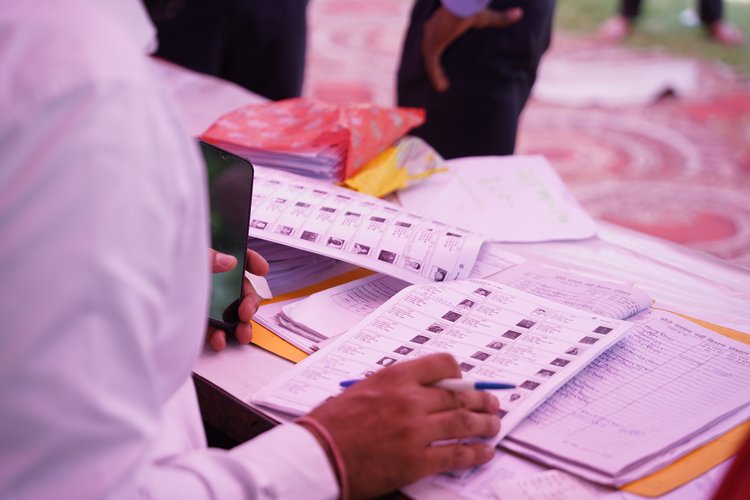
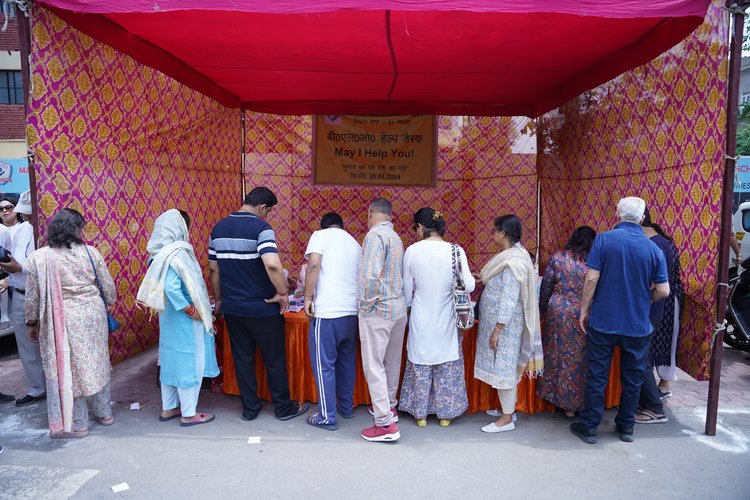
Voting takes place at poll stations in Noida, Uttar Pradesh, on April 26, 2024. Photos: Vijay Sadasivuni
The pattern continued in West Bengal, where the BJP was predicted to win between 20-30 seats, but ended up with just 12, and Maharashtra, where the NDA secured 17 seats out of 48. Praveen Dhonti, an analyst at International Crisis Group, says one of the biggest reasons why the exit polls missed the clear shift of voting preferences away from the BJP was fear.
There is a fear [among the people] towards the Modi government, the BJP and its supporters. The masses kept the cards close to their chest. They didn’t open up to most of the media or the agencies conducting these exit poll surveys. —Praveen Dhonti
Pal, the professor, echoed this sentiment, calling it a “spiral of silence”, in which “people may be slightly afraid to admit to not voting for the BJP since it is very well organised on the ground.”
Polling agencies have confirmation bias too, Dhonti added. “They didn’t see or explore beyond what they thought would be a sure win for Modi,” he said.
This isn’t the first time exit polls failed their own predictions. In 2004, the favourably placed Atal Bihari Vajpayee-led NDA government failed to secure a second term despite running a high-decibel campaign. Experts are now questioning whether the tradition of exit polls should continue after all.
For one, exit polls operate opaquely, says Pal. “[They] are not clear about their sampling, enumeration process, and framing of questions – all of which may have biassing impacts,” he said. “It has been suggested that over-sampling of urban, middle class populations may have caused systematic failure in accurately capturing the mood.”
“The opacity is likely intentional in part because a lot of the agencies which run these are not empirically trained to do these,” Pal added.
The polls may have exaggerated but Modi will be sworn in as Prime Minister for his third consecutive term on Sunday, June 9, at 6 pm IST. BJP’s alliance parties are expected to demand key positions in return for their support.
The political impact of this week’s turn of events are yet to be seen, but the failure of exit polls in predicting national sentiment will not be forgotten anytime soon.
“Exit polls are a bit of a mystery to me,” said Michael Kugelman, the director of South Asia Institute at The Wilson Center. “If they’re meant to bolster the ruling party, then why would they put themselves out there and risk looking silly later on, as was the case with just about every exit pollster this time?”