“As I saw the barbed wire, it seemed to be the end of everything… I thought I’d never be able to return to my homeland. My dado’s dado [great grandfather] used to live right here in Murshidabad. My nani [maternal grandmother] lived in this village in Bhagawangola [block] where we have our home now.”
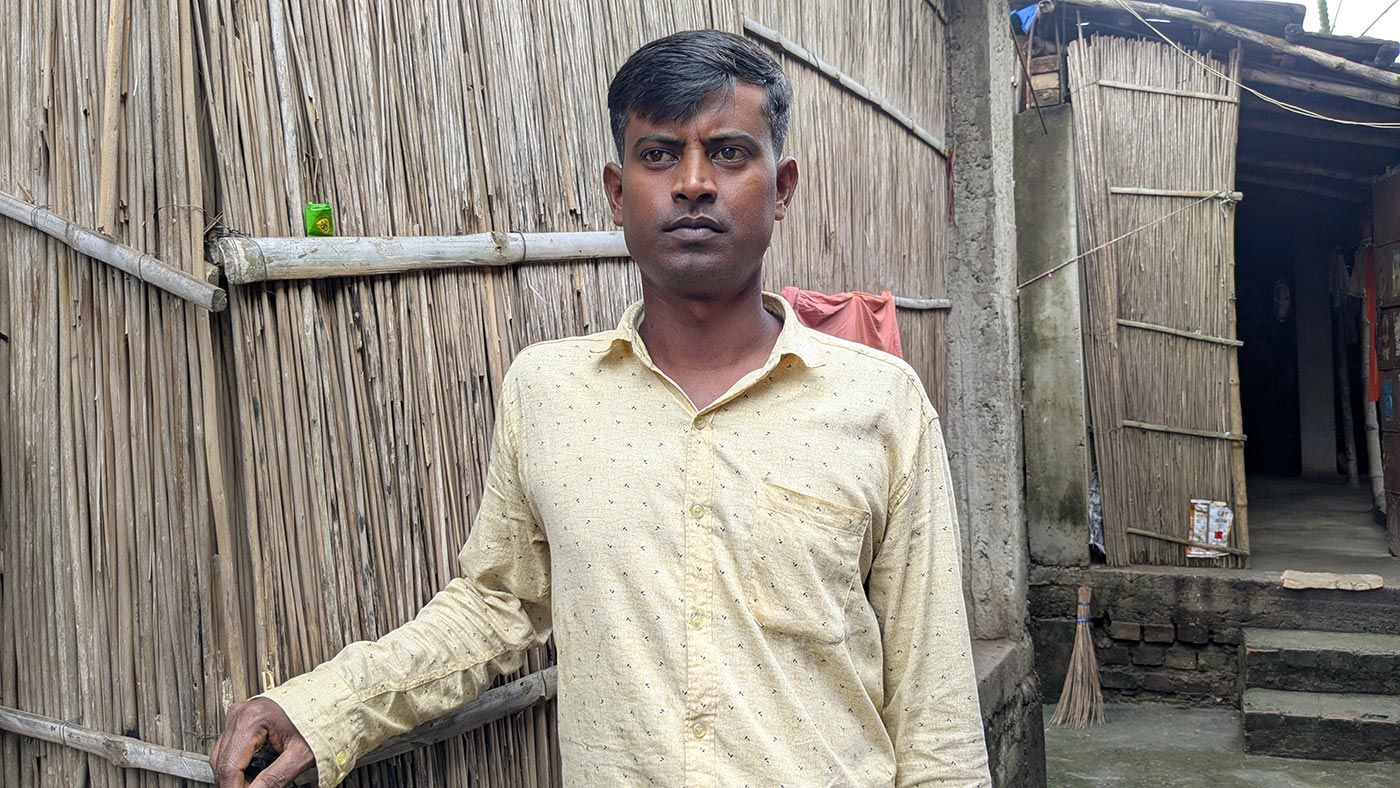
A visibly upset Mehbub Sheikh, 36, explains his family’s historic roots in Murshidabad district to us at his home in Balia Hasennagar. It’s barely a month since he was labelled a ‘Bangladeshi infiltrator’ and shoved across the border.
“Voter card, ration card, Aadhaar card – I have every single one. I have toiled hard and bought some land as well. How come they call me a Bangladeshi now?” asks the migrant labourer.
Mehbub is not alone. Migrants from Murshidabad across the country – construction labourers, domestic workers, street vendors and hawkers – ask the same question: why are Bengali-speaking Muslim migrant labourers of our district being targeted in various states?
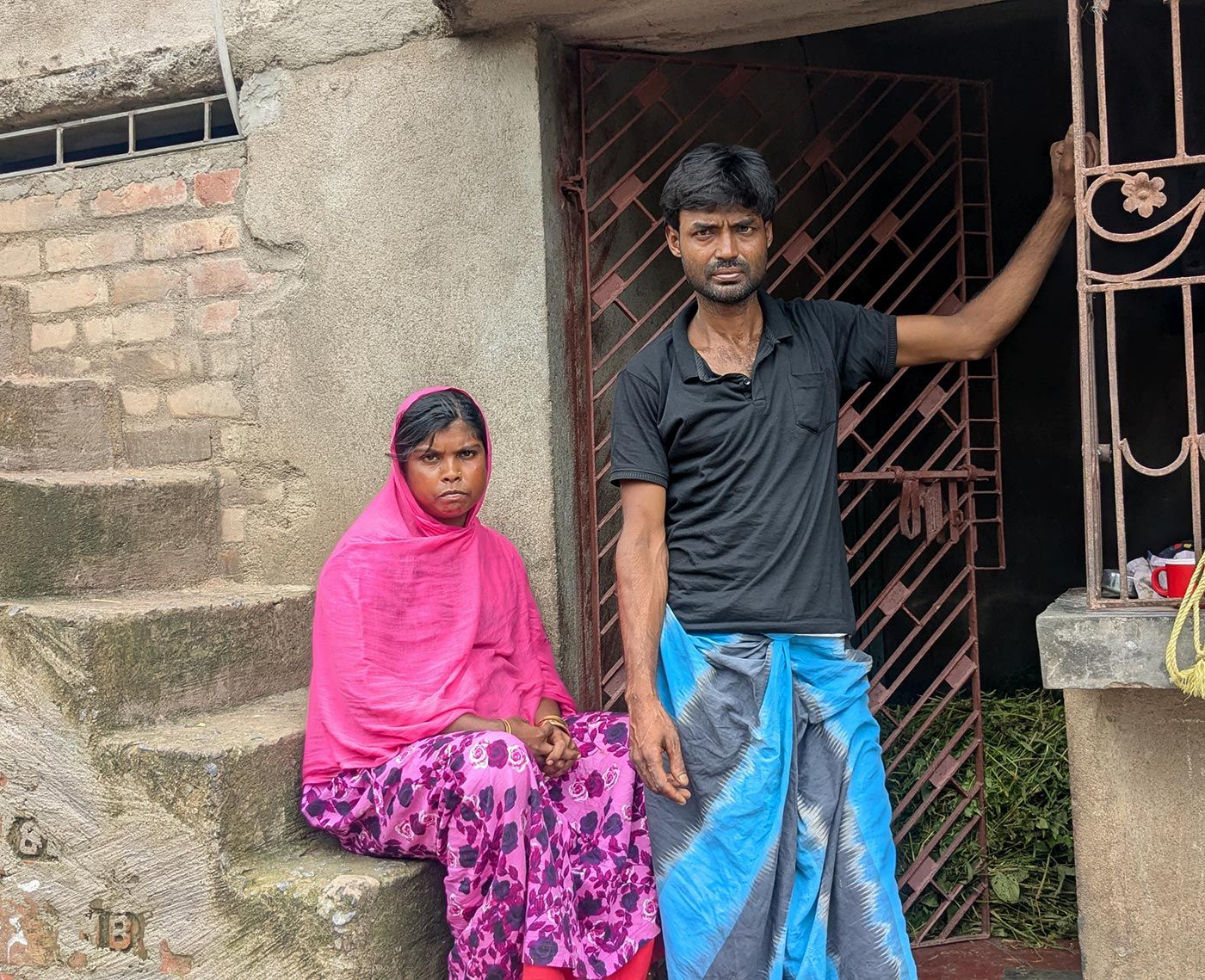
![‘No one raised a question [about our being Indians] until now. But with all these troubles [us] Bangali Musalman workers everywhere, we can’t help getting worried,’ says Bishakha Mondal (name changed), a domestic worker in Delhi. Photo: Anirban Dey/PARI](https://admin.asiandispatch.net/uploads/editor-image-new/image_20250917175810580868ca90d0f2dc0.jpg)
(Left) Mehbub Sheikh with his wife Surna Bibi at their home in Murshidabad’s Balia Hasennagar. On June 9, 2025, he was picked up by Maharashtra police and asked for documents to prove his citizenship. He was eventually pushed back and abandoned in Bangladesh.
(Right) ‘No one raised a question [about our being Indians] until now. But with all these troubles [us] Bangali Musalman workers everywhere, we can’t help getting worried,’ says Bishakha Mondal (name changed), a domestic worker in Delhi. Photos: Anirban Dey/PARI
“No one raised a question [about our being Indians] until now,” says Bishakha Mondal, 52 (name changed) from Gokarna village in Kandi. “But with all these troubles [us] Bangali Musalman workers everywhere, we can’t help getting worried.” She has been a domestic worker in Delhi for three decades. Her labour in five households there brings in Rs. 25,000 a month. She has an authentic voter card and ration card. Also an Aadhaar card and bank account linked to her Delhi address.
Murshidabad, administrative centre of undivided Bengal till the British shifted the capital to Kolkata, was once famed for its prosperity. Today, it supplies the biggest out-migrant workforce from West Bengal. Till May 2025, close to 4 lakh workers from here had registered for the Migrant Workers Welfare Scheme of West Bengal. (Curiously, the document citing these numbers has vanished from the government site). Independent estimates by different migrant organisations suggest there are more than a million such workers in Murshidabad. A state education ministry official says on condition of anonymity, “no government data would ever mention it… but the reality is, countless child labourers are [also] moving out for work every day.”
Both Mehbub’s younger brother Mujibar Sheikh,33, and their father Hossein Sheikh in his early sixties, worked as migrant labourers. Hossein still works in Kolkata as a mason. Mujibar, now a driver, had been to Delhi and Mumbai with Mehbub, for masonry work. Both brothers remember childhood as an incessant battle with poverty. Mehbub remembers: “There was a time when I used to graze the goats of others. I have not studied much. Ours was a very needy family. The burden of poverty had me working from an early age.”
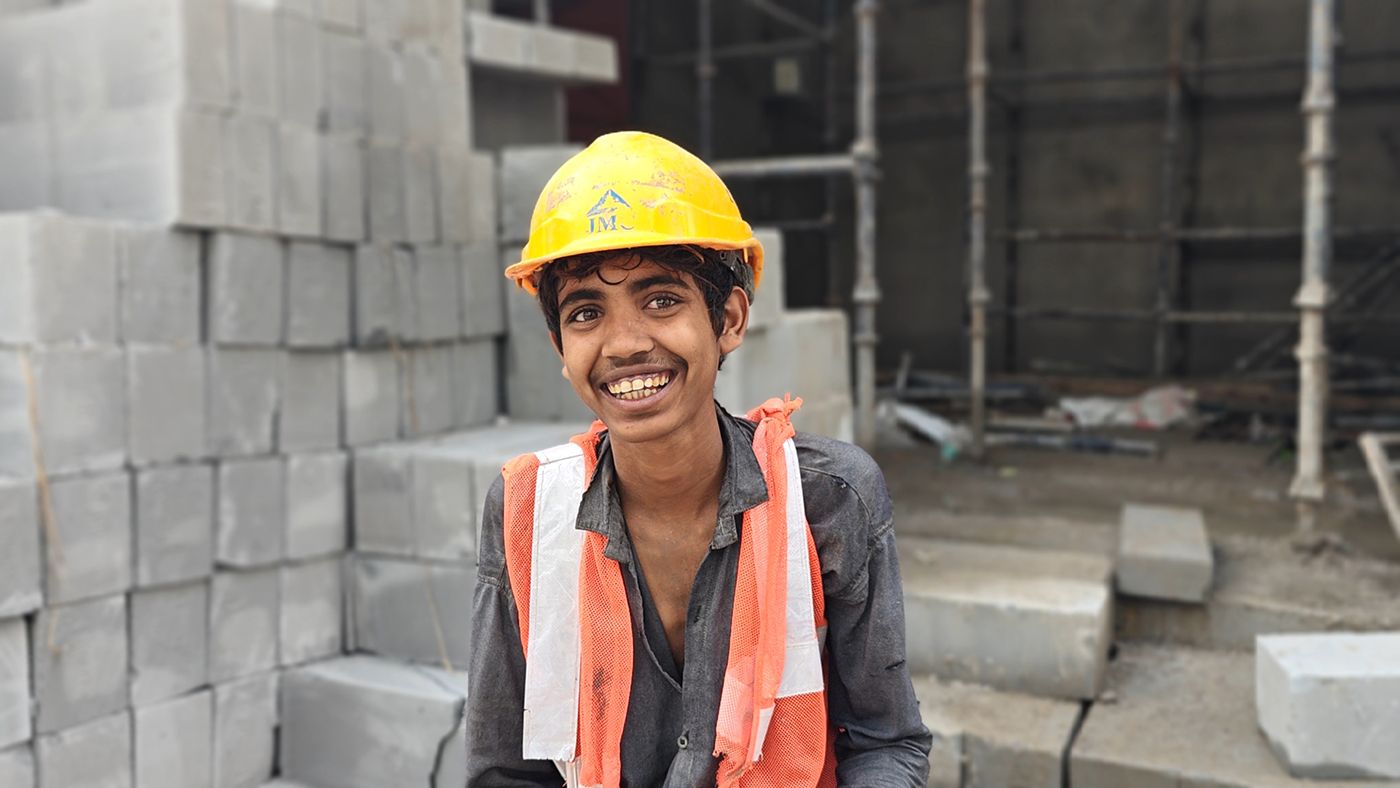
Babu Islam (doesn’t wish to reveal his real name) from Dhuliyan in Murshidabad fled Odisha when the attacks on Bengali Muslim migrant workers began around September, 2024. He says: ‘I am better now. I came back and took this work in Kolkata. I miss my home’. Photo: Smota Khator/PARI
At 17, Mehbub migrated out in search of a livelihood with his inheritance of masonry skills. As someone who has worked in states like Delhi, Punjab, Tamil Nadu, Rajasthan and elsewhere, he finds the awful changes in his migrant workplaces baffling. Media reports and personal accounts record several instances of migrant labourers like him being pushed out on flimsy grounds to Bangladesh.
There is a palpable atmosphere of suspicion and distrust. That’s unsurprising: For more than a year, they have been targeted by law enforcement agencies of both central and state governments. “Our names don’t sound like yours. That’s why we are humiliated,” Mujibar tells us. Over the last one year, Muslim migrant labourers from West Bengal have been picked up, branded as ‘Bangladeshi’, ‘Rohingya’, ‘Ghuspethia’ (infiltrator) or ‘illegal’.
All of them recognise and speak of hatred based on language, religion, caste, or regional identity having intensified in the last decade, leading to the current escalation. The Muslim migrant workforce is the most vulnerable segment, bearing the brunt of hate speech propagated by the fundamentalist outfits and political leaders.
“We are having to choose between life and work,” people in Diarjali Bagicha complained to this reporter. Nejema Bibi, 32, who lives here in a two-room brick house with unplastered walls, fears for her husband Rafiqul Islam working in Kanpur, Uttar Pradesh. “My heart sinks if he doesn’t pick up my calls for even just a few hours,” she says.
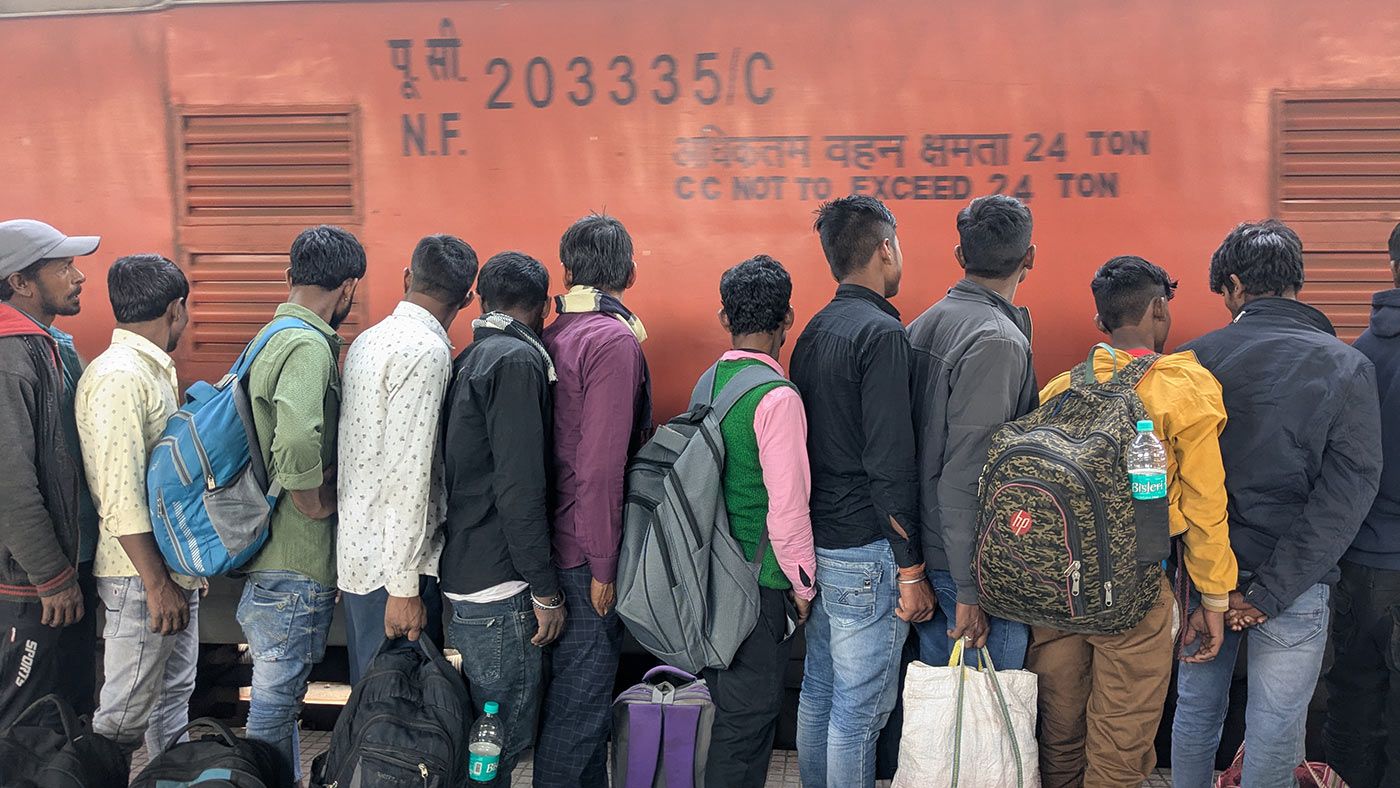
Young migrants in search of work wait to board a train to Andhra Pradesh at the Howrah rail terminus. Photo: Anirban Dey/PARI
Mehbub returned to Balia Hasennagar this May to celebrate Eid al-Adha (in early June, 2025) with his family. Their two-and-a-half storey house was built brick by brick over years by this family of masons. It has five rooms and some space on the ground floor to set up a shop in future. The part where Mehbub lives with his wife and homemaker Surna Bibi, 30, and their three children, is as yet unplastered on either side. Their eldest son Bakul Sheikh,16, having dropped out of school, is working in a nearby shop. The younger sons – Sagar Sheikh,12, and Rehan Sheikh,7 – are studying in a local school. On the occasion of holy qurbani and Mehbub’s homecoming, his family even made arrangements for the ritual sacrifice.
It didn’t happen. “Repeated calls from the construction site at Thane,” summoned him back.” Mehbub flew back to Maharashtra and resumed his work – leaving family and celebrations behind.
On June 9, while having tea at a local stall, he was picked up by police without explanation and taken to an outpost of theirs near the Shree L R Tiwari College of Engineering in Mira Road, Thane. At night, he was transferred to the Mira Road Police Station where he was asked for documents to prove his citizenship.
“‘You are a Bangladeshi, right?’ The officers asked me in Hindi. I said, ‘I am from West Bengal’ and showed them my Aadhaar and PAN card. They said, ‘these can be bought for five rupees nowadays’,” Mehbub told this reporter.
Somehow, he stealthily phoned his family in Balia Hasennagar who immediately contacted the local gram panchayat at Mahishasthali and sent all the necessary documents to the Mira Road Police Station. “For four long days,” says Mehbub, “I endured immense mental torture. Through daytime I was made to sit outside the station and was put in a police camp during nights.”
The Mira Road police contest Mehbub’s account of wrongdoing on their part. Senior Inspector Meghna Burade stated that they were “not at fault.” And that the detention of Mehbub Sheikh and others was carried out on a police commissioner’s order.
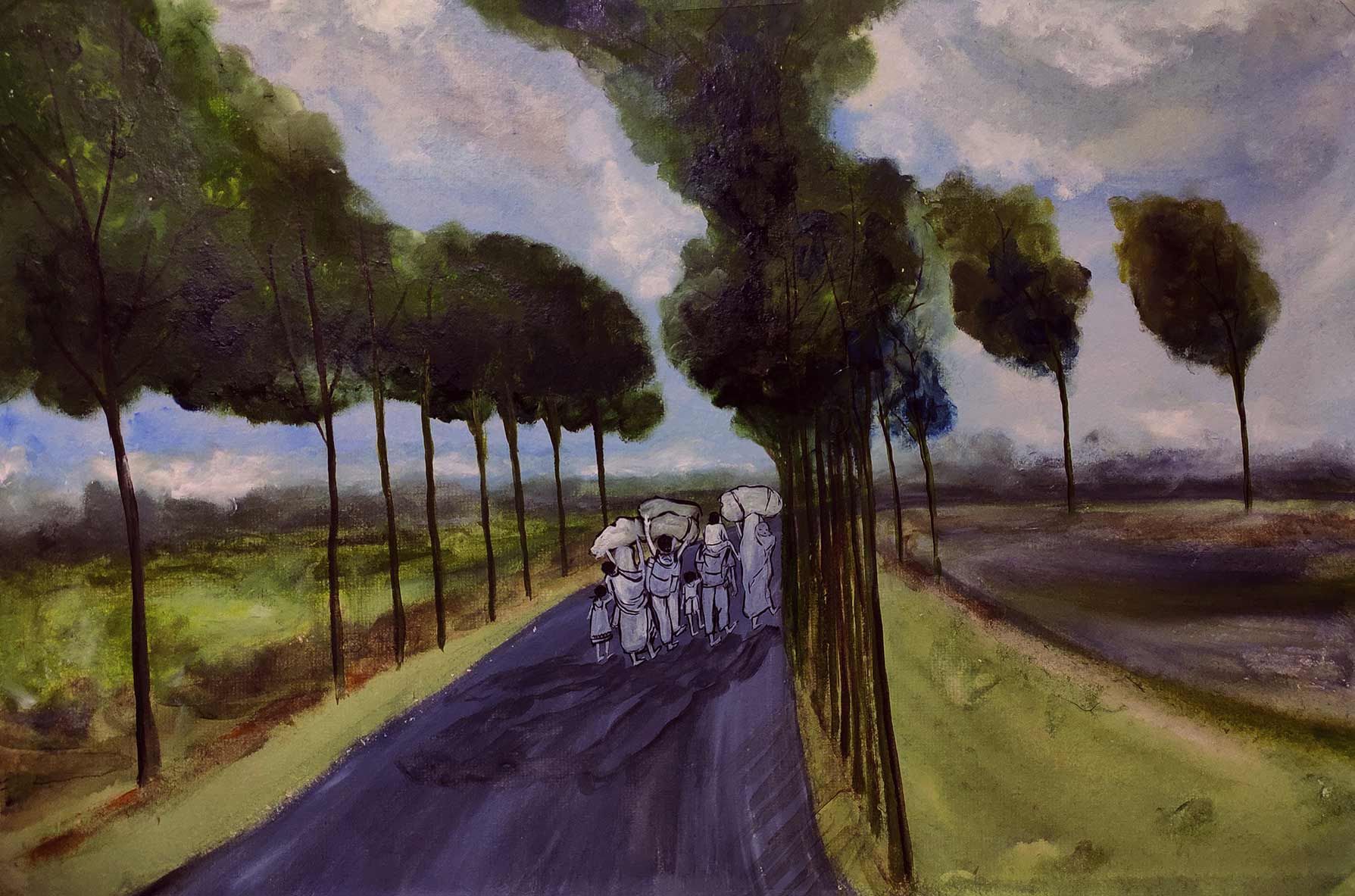
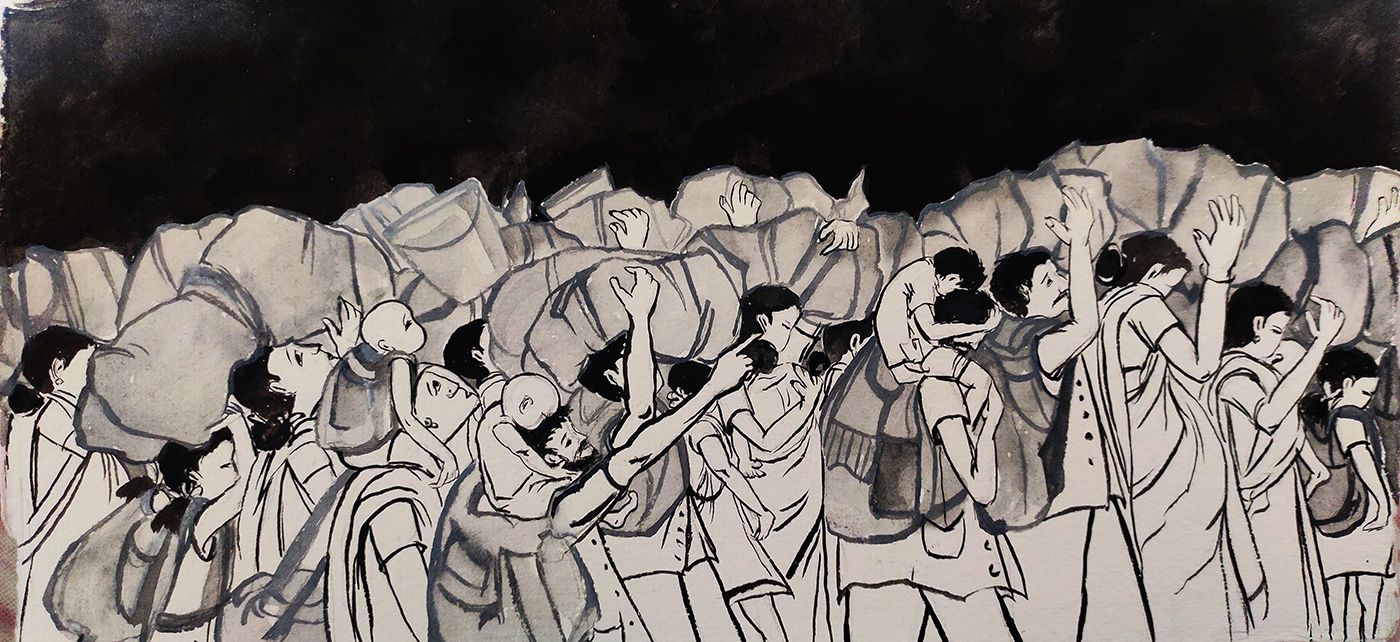
‘We are having to choose between life and work,’ say Muslim labourers from West Bengal who have been branded as illegal immigrants increasingly over the last year. Illustration: Labani Jangi/PARI
For Mehbub, though, June 13 was to prove dreadful.
“That day we were picked up in a large police van covered with wire-mesh. Many more cars piloted us, like we were some important leaders or ministers,” says Mehbub. “The car finally stopped at some security camp near Panvel.”
On June 14, the same vehicle ferried almost 30 people including Mehbub to the Pune airport. At 2 p.m. they were swiftly put onto a flight. On getting off the plane Mehbub realised it was the Bagdogra airport in West Bengal. “They made a head count and divided us into small groups,” he says. “I had heard criminals face head count. But why count us the same way? Suspicion crept in…” From the airport they were taken to the Siliguri Border Security Force (BSF) camp and from there a new journey began towards an unknown destination.
“The vehicle ran some five-six hours at a stretch. Then they dropped us in the middle of a jungle at a small BSF camp. The handful of officers there got us down and asked, ‘Where are you from?’ I told my address. Immediately, a brutal beating ensued. They even held loaded guns at our throat. Then the BSF officers clicked our photos and asked us to walk off through the forest.
“Where to go? And how? We didn’t have the least idea. We worried that if we got spotted, BSF or Border Guard Bangladesh (BGB) would straightaway shoot us. Fear gripped our hearts. The forest became our hideout for the night,” a traumatised Mehbub recalls.
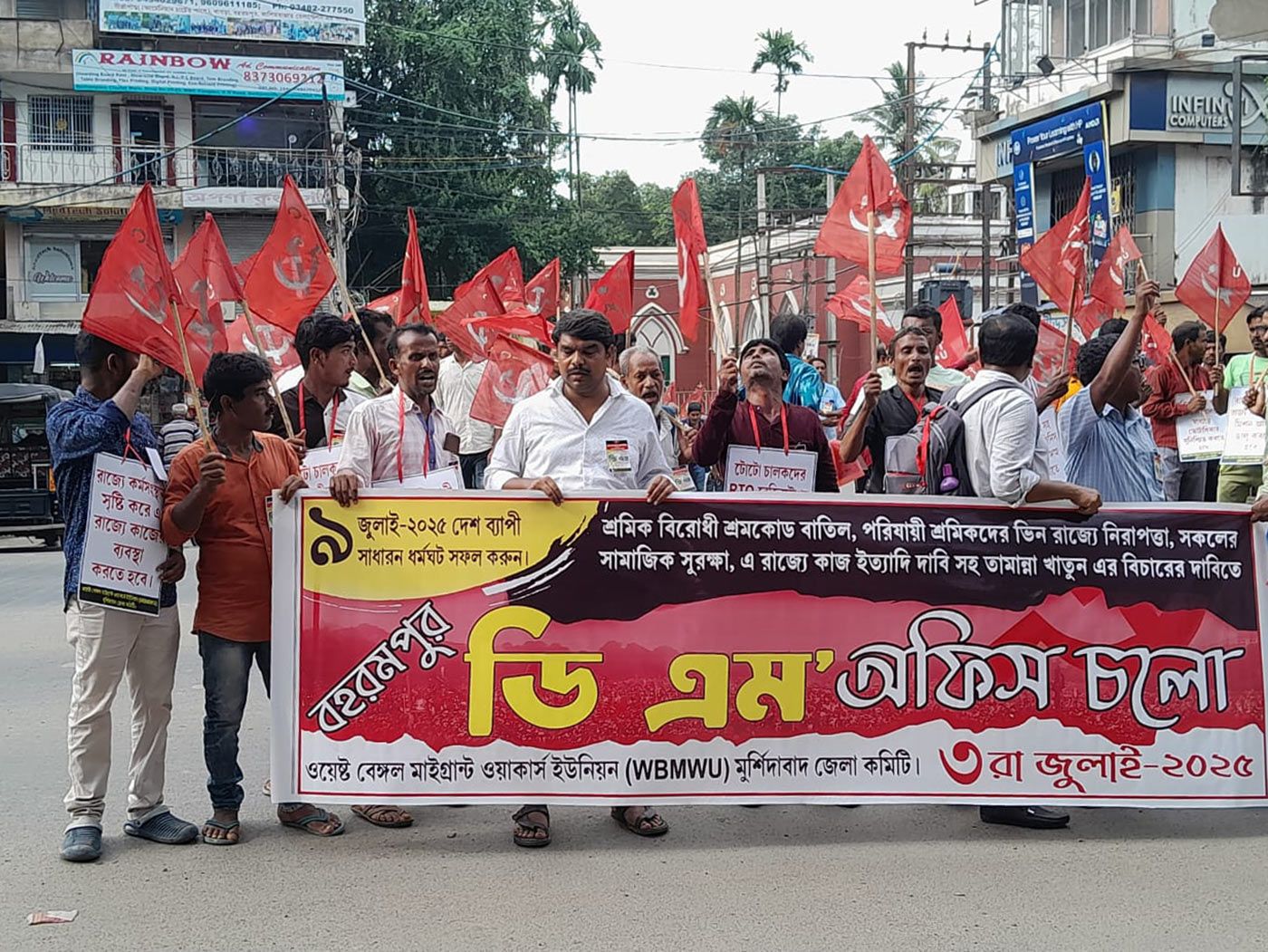
(Left) In light of workers being harassed, a rally was organised by the West Bengal Migrant Workers’ Union in Baharampur demanding the right to secure and dignified work. Photo: Anirban Dey/PARI
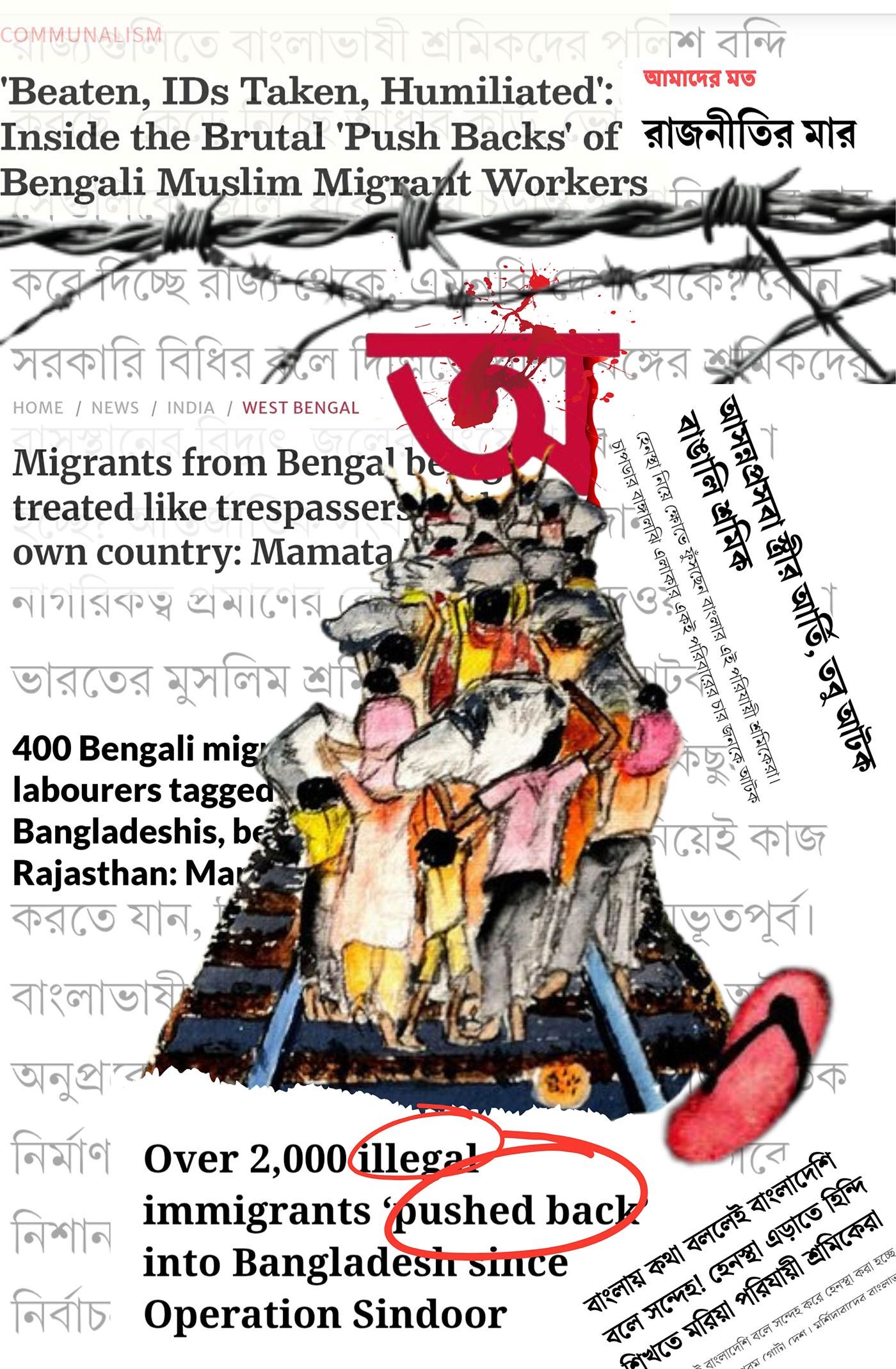
(Right) A collage of recent news headlines on atrocities against Bengali-speaking migrant workers across different states. Photo: Aunshuparna Mustafi/PARI
Daybreak brought more stress. The last they’d eaten something was at the Pune airport. And 24 hours had passed since, without a single morsel of food. “It felt like we would collapse and die right there,” says Mehbub. “There were only trees all around us. We were walking in a group.” He pauses some moments, then continues, “It was around 2 p.m. when we walked up to a small settlement in Bangladesh. We told the people that we were Indians. They suggested we take a bath, and gave us rice to eat. [With their help] I contacted my family through Imo app [a mobile app that enables chats and international calls]. I was crying. My voice choked. I could barely speak …”
Mehbub lost all hope of ever returning. Meanwhile, his brother Mujibar ran around many places including Siliguri and Raiganj, going door to door seeking help and support. From the panchayat office to district administration, even to state-level sarkari officials. Finally, Mehbub could make his way back home. “Even after bringing him back, sarkari people [departmental affiliations unknown] visited our house wanting to verify the land deeds.”
The relief was short lived and did not end their anxieties. From Mehbub, we learn the compulsions of migration. “Sitting idle at home means zero income. I can earn 800-1,200 rupees a day there [other states]. I can even work double shifts for additional income…” But fear has shattered his confidence. “I have been working as a mason in cities like Pune, Mumbai and Thane for years. Never thought I would witness such a time.”
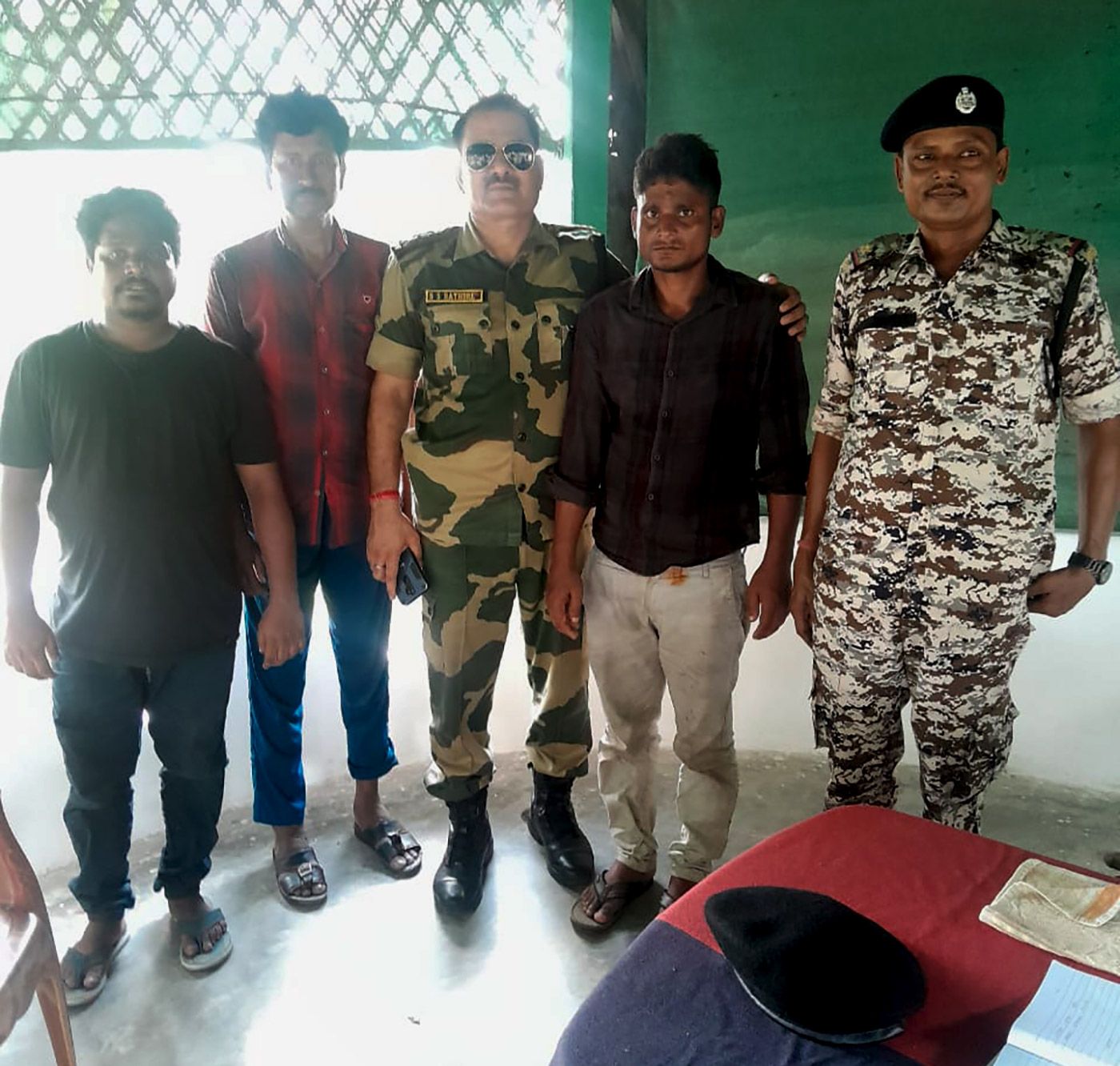
(Left) Nazimuddin Mondal (in black shirt), Mostafa Kamal Sheikh (in red shirt) and Minarul Sheikh (left) seen here with security officials. They were pushed out to Bangladesh on June 13 and rescued back on June 15.
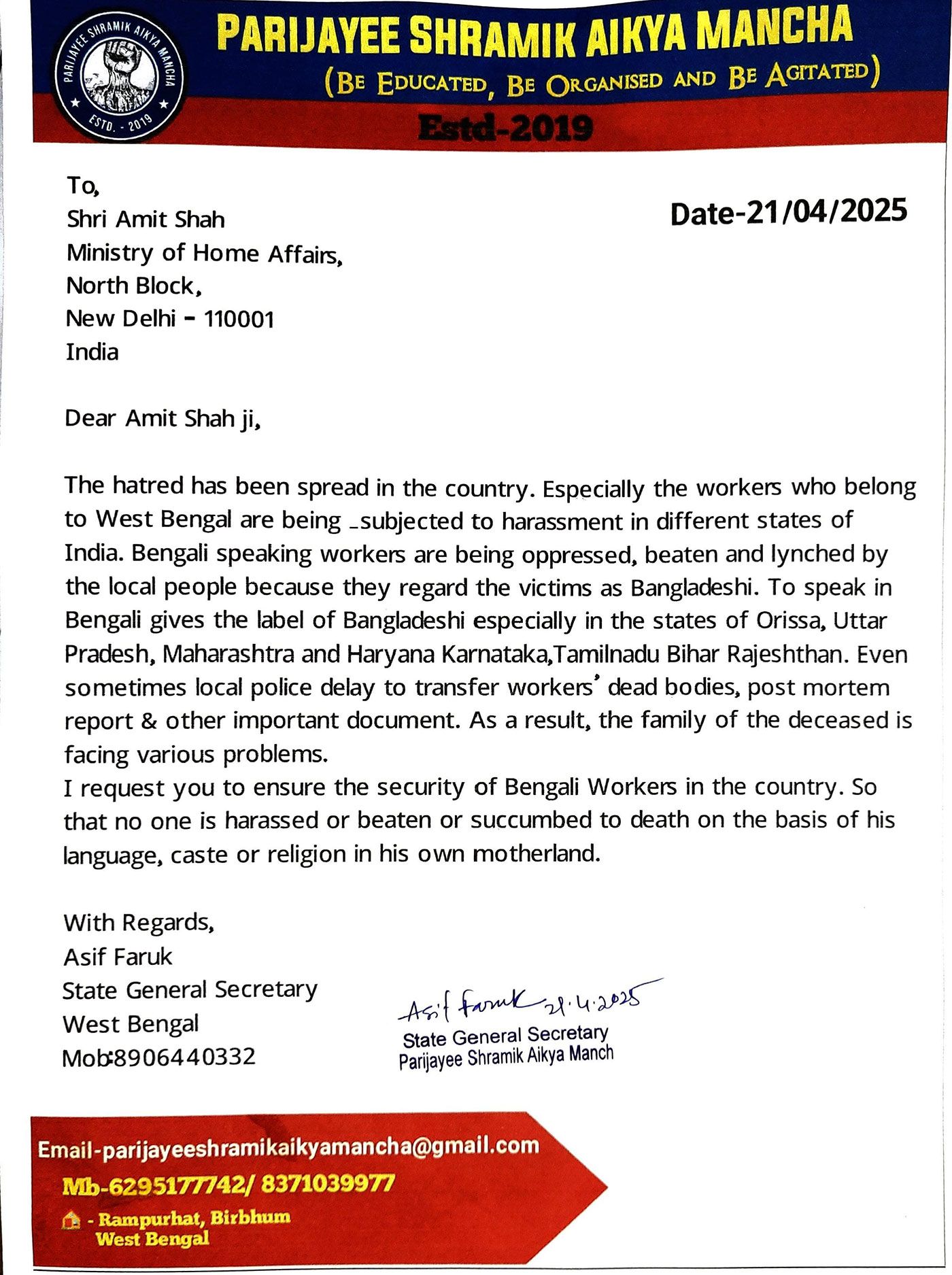
(Right) Parijayee Shramik Aikya Mancha – an organization fighting for the rights of migrant workers from West Bengal – sent out a letter to the Union Home Minister seeking immediate action against harassment of Bengali migrant workers. Photos: Courtesy of Parijayee Shramik Aikya Mancha via PARI
On seeing this reporter, Nazimuddin Mondal could barely control his anger. This resident of Murshidabad’s Hariharpara Block is as resentful of the media as he is of government and administration. Ever since a video of Nazimuddin abandoned by Indian state authorities in Bangladesh went viral, journalists have frequently quizzed this 35-year-old mason from Tartipur village about being pushed across the border. “What have you got to do with that?” he bursts out. “Why can’t you write about the torture [inflicted on us]? Why on earth are we being tagged as Bangladeshis? It’s high time the media speak out.”
The silence of most media on the current situation worries Nazimuddin even more. He sees clearly that in the name of news, some media houses actually promote suspicion about Bangla-speaking Muslim labourers.
The “push-back” experience traumatised Nazimuddin. The thought of leaving his wife and a teen daughter – in Class 10 – at home for work in a distant state now terrifies him. “[I have] worked in the Mira Road Police Station earlier,” he says. There, he did masonry and repair work. “Now police from the same station picked me up from my rented room at the dead of night and called me ‘Bangladeshi’. What kind of system is this?” The Maharashtra police had raised questions regarding his birth certificate. “I was born in Hariharpara 35 years ago. That’s where my baap-dada [father and grandfather] was born. None of my parents got formal education. They didn’t obtain my birth certificate either. Poverty made things difficult. I couldn’t even finish primary schooling,” clarifies Nazimuddin.
His belongings remain in the room at Mira Road, Maharashtra. No one knows how he can collect the wages the contractor still owes him. His mobile phone, confiscated by the police, is yet to be returned. “It’s really hard to get work in a new place. Working somewhere for five long years results in having some contacts and ease. How can that be taken away like this?” he asks angrily.
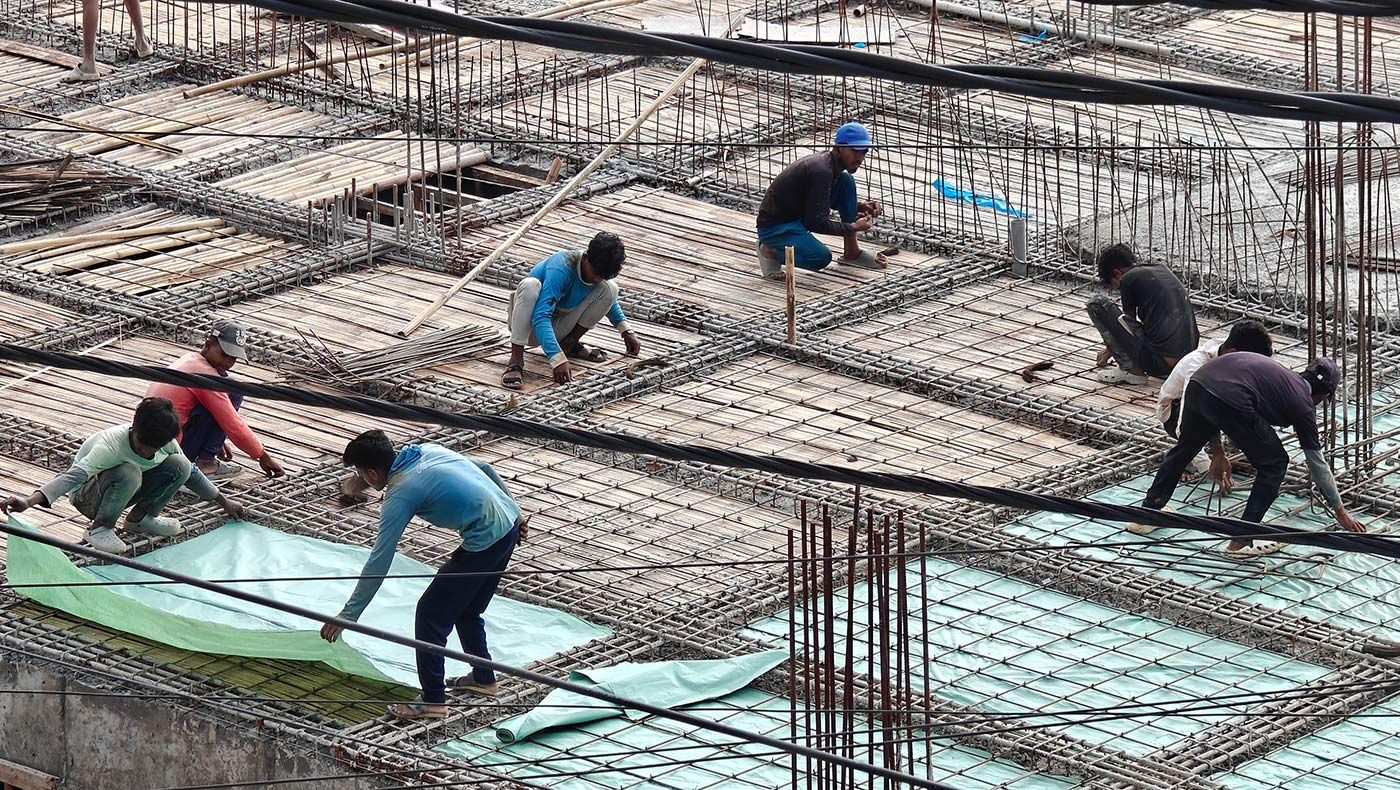
Lack of decent employment opportunities and an increasingly fruitless agriculture sector forces young people from Murshidabad to migrate to distant states from Mizoram (seen in the photo) to Maharashtra. Photo: Smita Khator/PARI
Two brothers of Nazimuddin work as labourers in Kerala and Tamil Nadu. Workers here generally say the southern-Indian states are a lot safer for Bengali migrant workers. Many labourers, forced to return from Maharashtra, Gujarat or Delhi, are now trying to find wage work in the south.
Nazimuddin says that Minarul Sheikh from Kazisaha, Beldanga I, Murshidabad, and Mostafa Kamal Sheikh from Monteshwar in Barddhaman district shared his ordeal. “On June 13 [2025] we were deported to Bangladesh via Siliguri and got rescued on the 15th.”
“After this…it won’t be easy to move out again. But remaining in our village means a meagre 500 rupees per day [on days that work is available] and expenditure of 250. [In the other states], the daily expense might be 300 rupees, but the wage is 800 a day. We can send 500 rupees to the family. So, leaving [migration] is the only way out,” explains Nazimuddin. “We must return to work [outside] at our own risk.”
There is a dearth of steady work, even that at just survival wage level, across Murshidabad district. The 100 days of employment guaranteed under MGNREGA is still stuck in limbo. Migration seems the only option for working-class people. Murshidabad, one of India’s most underdeveloped districts, is mostly rural. Roughly 80 per cent of its people live in 2,166 villages. At 66 per cent, its literacy rate is way below the state average of 76 per cent (Census 2011). Two-thirds of the population are Muslims. It is obviously they – marginalised in class, region, and religious terms – who account for most of the forced labour migration.
The situation in in Diarjali Bagicha, a hamlet under Habaspur panchayat, captures that reality. In over 60 per cent of households, at least one member is a migrant worker. Residents Latibul Haque, Ainal Haque and Rajjak Hossein Sheikh, who once worked as porters, left their jobs and went to Odisha to earn a better wage as street vendors. They explained to us on phone that the mahajans (moneylenders) lend them various household and stationery items. They load these items on their cycles or motorbikes and sell them across the villages. On average, it earns them Rs. 700-800 a day after deducting the contractor’s share. They live together in groups in small, rented rooms.
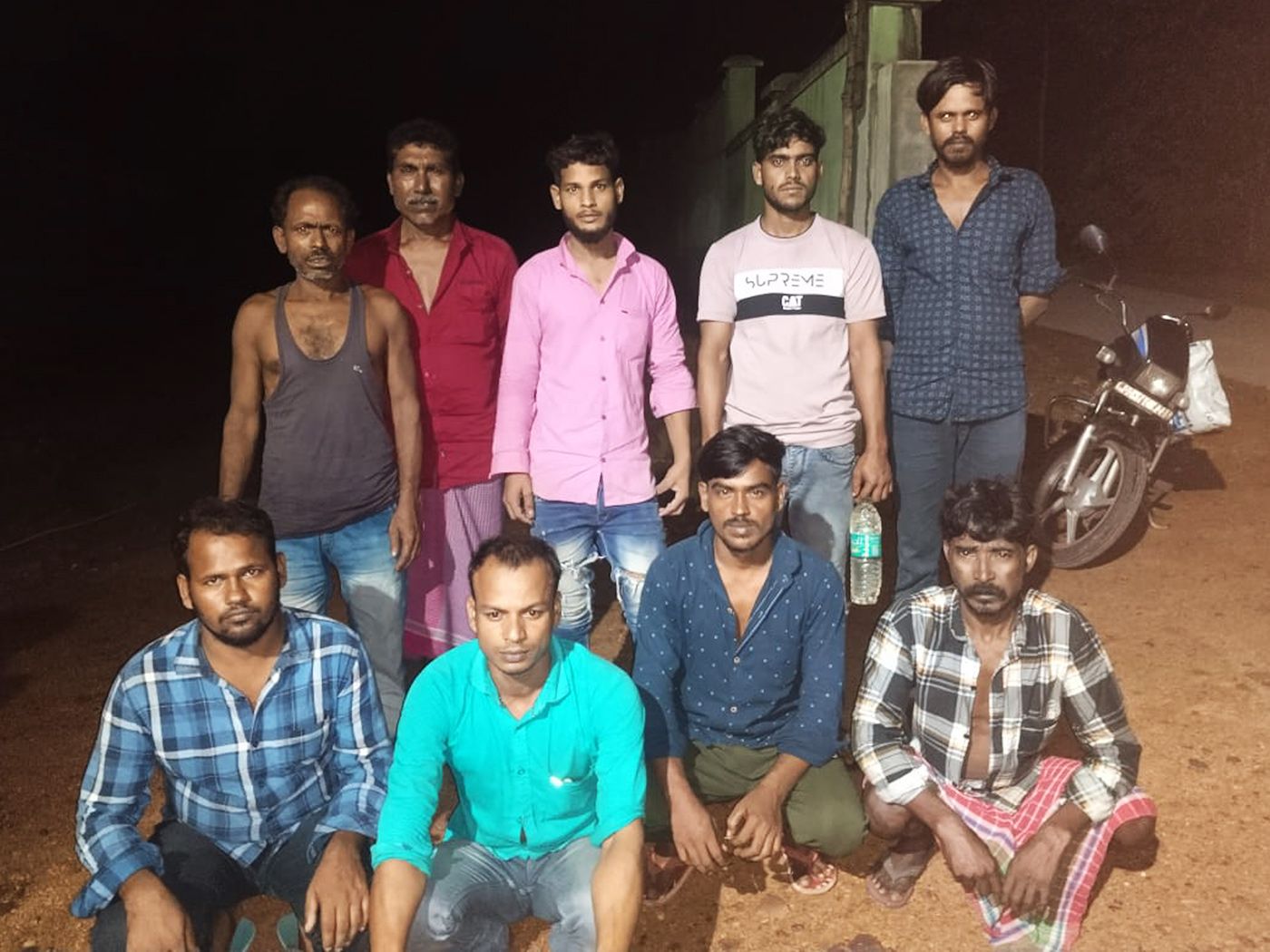
(Left) Migrant workers from Murshidabad were detained for four days at Lakhanpur Police Station in Jharsuguda, Odisha. They were eventually released after the intervention of their native gram panchayat back in Dakshin Hanumanta Nagar. Photo: Courtesy of WB Migrant Workers’ Union via PARI
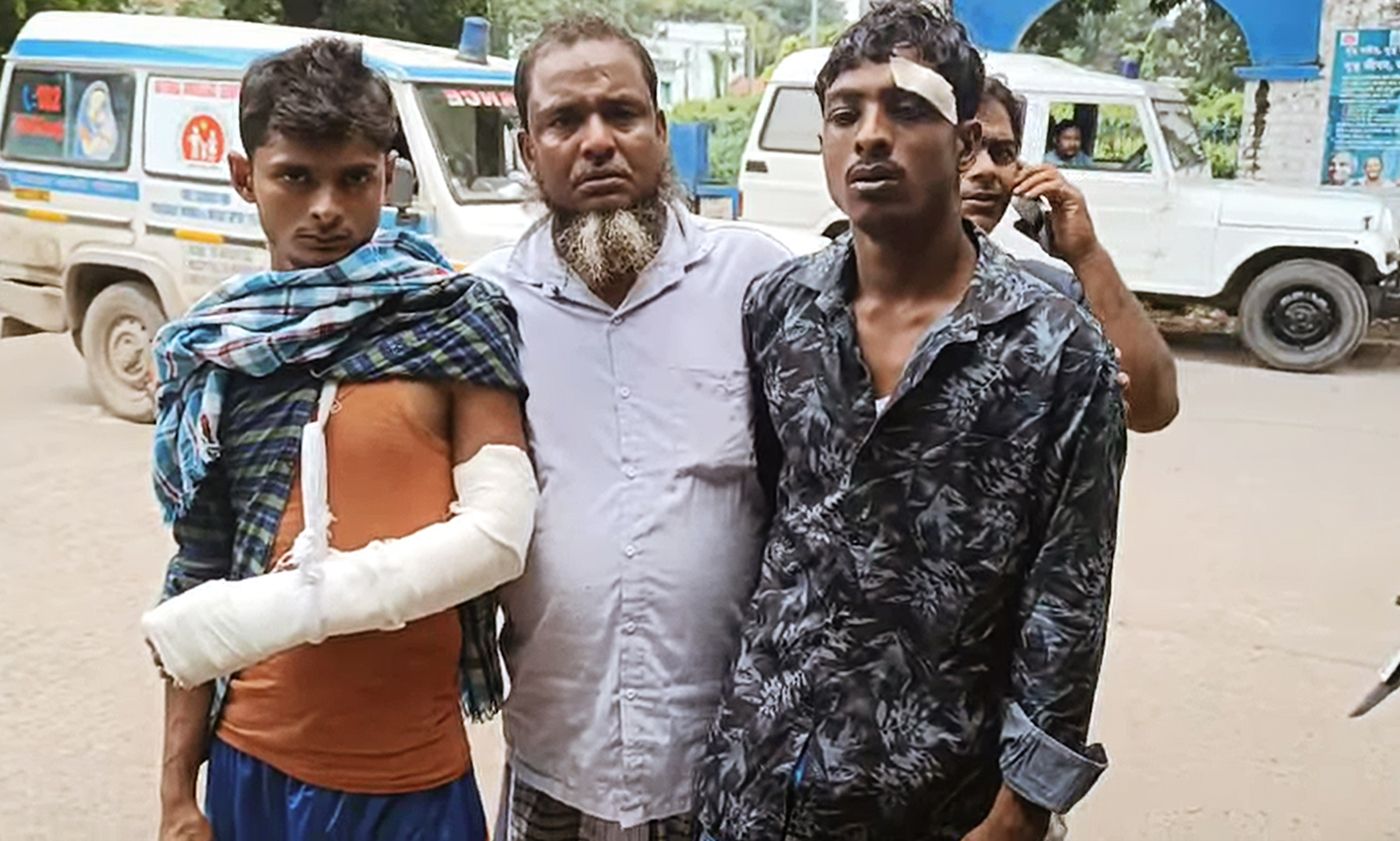
(Right) Three migrant labourers from Lalbagh Police Station in Murshidabad working at a construction site – Milan Sheikh, Ismail Sheikh and Babu Sheikh – were attacked in Chennai, Tamil Nadu, on July 15, 2025, as they were speaking in Bengali among themselves. Photo: Courtesy of Parijayee Shramik Aikya Mancha via PARI
Family members of these migrants told us in Diarjali Bagicha that since September 2024 many travelling Bengali Muslim salesmen from Murshidabad have been attacked and detained in Odisha. That, on the pretext of the violence against Hindus in Bangladesh and in Murshidabad’s Samserganj. But what is panicking the migrants is the increasing involvement of Odisha police in such incidents.
When the police there questioned the validity of Latibul Haque’s documents, his family members in Diarjali Bagicha sought help from the Bhagwangola Police Station. Latibul and others were set free only after the documents were exchanged between the police stations, but are still stuck in Odisha. Latibul who was confined in one of the camps in Jharsuguda for four days tells us on phone: “The police said they are still verifying our documents related to Indian citizenship and instructed us not to return to our home state for a month.”
The families of labourers toiling in distant states like Maharashtra, Odisha, Uttar Pradesh and Delhi are now rattled. In Diarjali Bagicha, we met Ainal Haque’s mother Madina Bibi, 60, frail, but with keen eyesight. Her deft fingers fly while weaving kanthas (hand-embroidered quilts) of intricate design as she speaks to us. People get her to weave and stitch kanthas, paying her just 20 to 30 rupees a piece. However meagre, that amount helps in sustaining the family. With her son and grandsons all toiling in Odisha, Madina can’t hold back her tears as she talks about the ordeal and harassment they’ve been through.
“When they said my son and pota [grandson] are all Bangladeshis, how could I keep calm?” Madina asks. “My second son Ainal Haque and two grandsons from my eldest son – Amir and Rajjak Hossein – live in Odisha. The police detained them for four days. I didn’t get any sleep those days.”
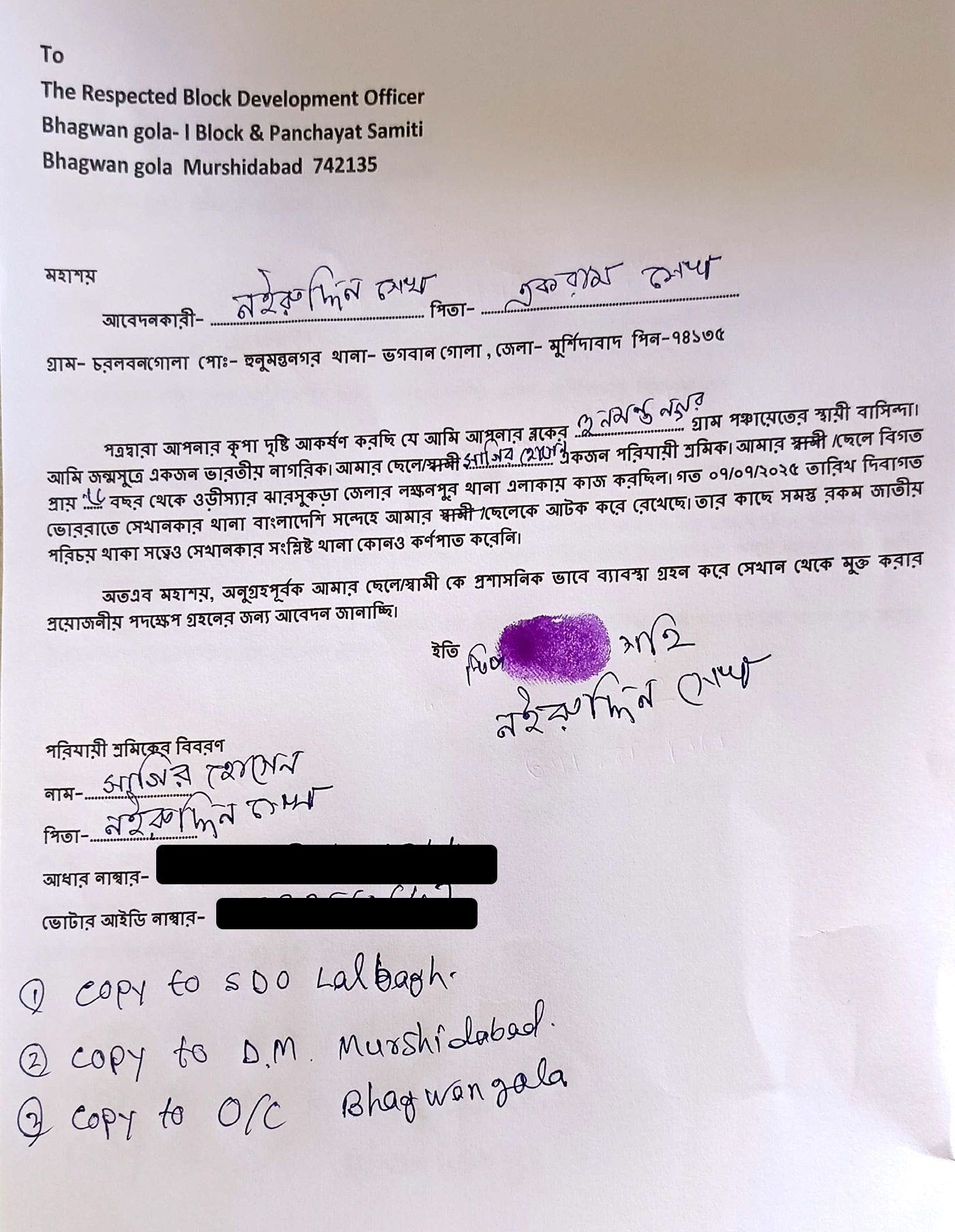
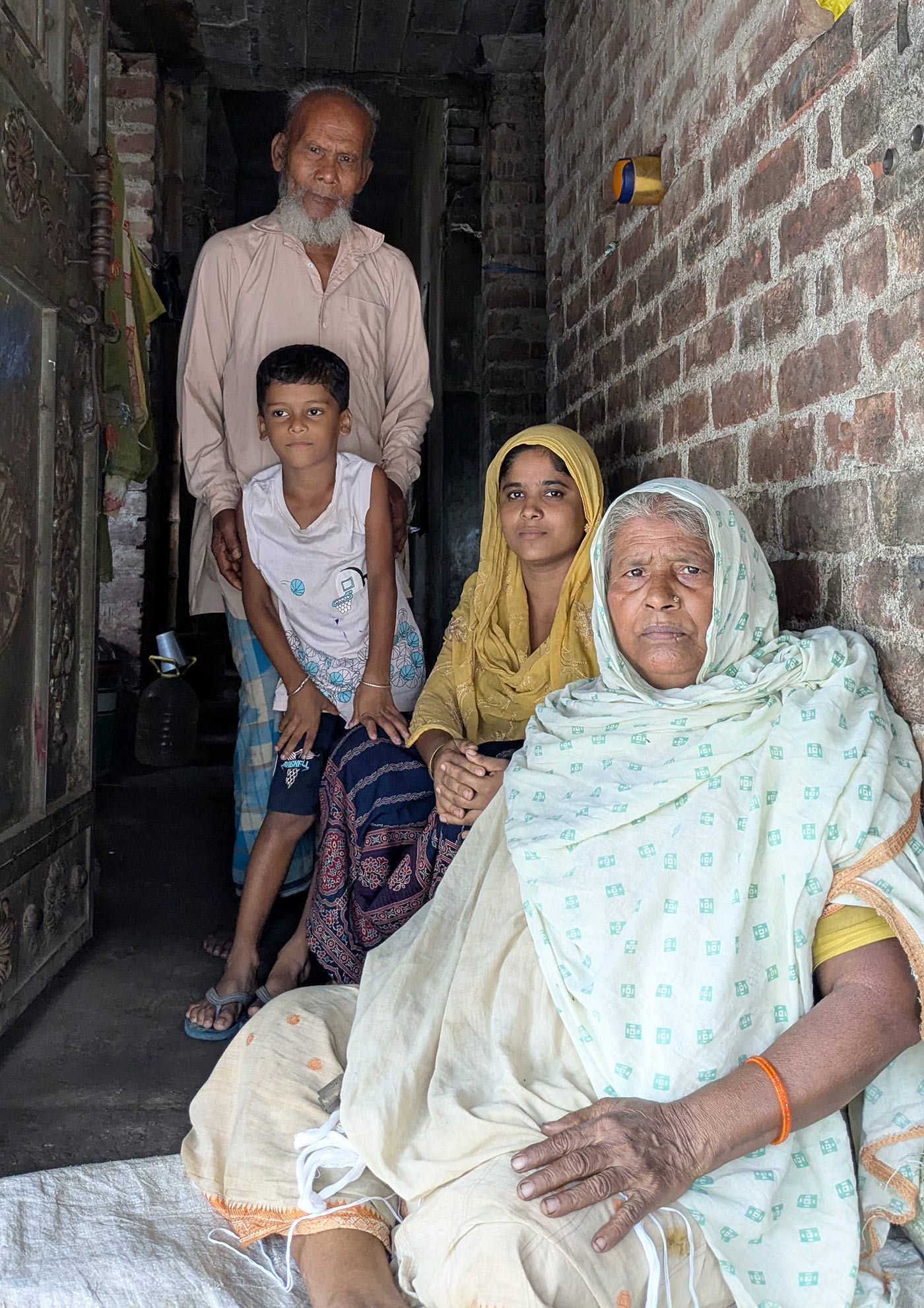
(Left) Father of detained migrant worker Sagir Hossein has sent an application to various government officials detailing his son’s proof of Indian citizenship. He appeals for the immediate release of Sagir, a resident of Dakshin Hanumanta Nagar, Murshidabad. Photo: Courtesy of WB Migrant Workers’ Union via PARI
(Right) Detained migrant worker Ainal Haque’s wife, Shiuli Bibi with his mother Madina Bibi, father Moinul Sheikh and their son at the family home. Photo: Anirban Dey/PARI
The phone call Shiuli Bibi – Ainal Haque’s wife – received, terrified the whole family. Documents such as Aadhaar and ‘admit card’ of the secondary board examination [class-10] had to be found and submitted. Ainal Haque’s father Moinul Sheikh, in his late 60s, had to take all these papers to the police station. “There, they even snapped at me for being late. But what could I do? I was totally numb and dumbfounded, thinking of my son’s situation…” recalls the old gentleman.
A distraught Madina Bibi tells us: “After his secondary exam, my son [Ainal] said, ‘I must work to fill our bellies.’ He ran chores for the malik at a brick kiln and would get 800 rupees a month. Later, he carried loads in a godown. Even that would only get him 10,000 rupees a month at best. We were crushed by debt. That’s the reason he went outside…It’s been two years now. We are merely trying to survive,” she says. “[My] father-in-law, even his father, are all from India… Yet, the fear refuses to leave me.”
On July 7, 2015, Amirul Sheikh, in his mid-30s, from Charlabangola village in Bhagawangola I, were also detained in Lakhanpur Police Station of Jharsuguda in Odisha with 30 other migrant workers from West Bengal. On getting the news, family members ran frantically from Bhagawangola Police Station to the local Dakshin Hanumanta Nagar gram panchayat office. Finally, the detained workers were released four days later from Lakhanpur Police Station, Odisha. “I have worked 10 years in Odisha as a hawker. But everything has changed. People have been beaten up before, but this time we are straightway being labelled as Bangladeshis,” says a shaken Amirul on phone. Still, he has no choice but to remain in Odisha to support his family in Charlabangola.
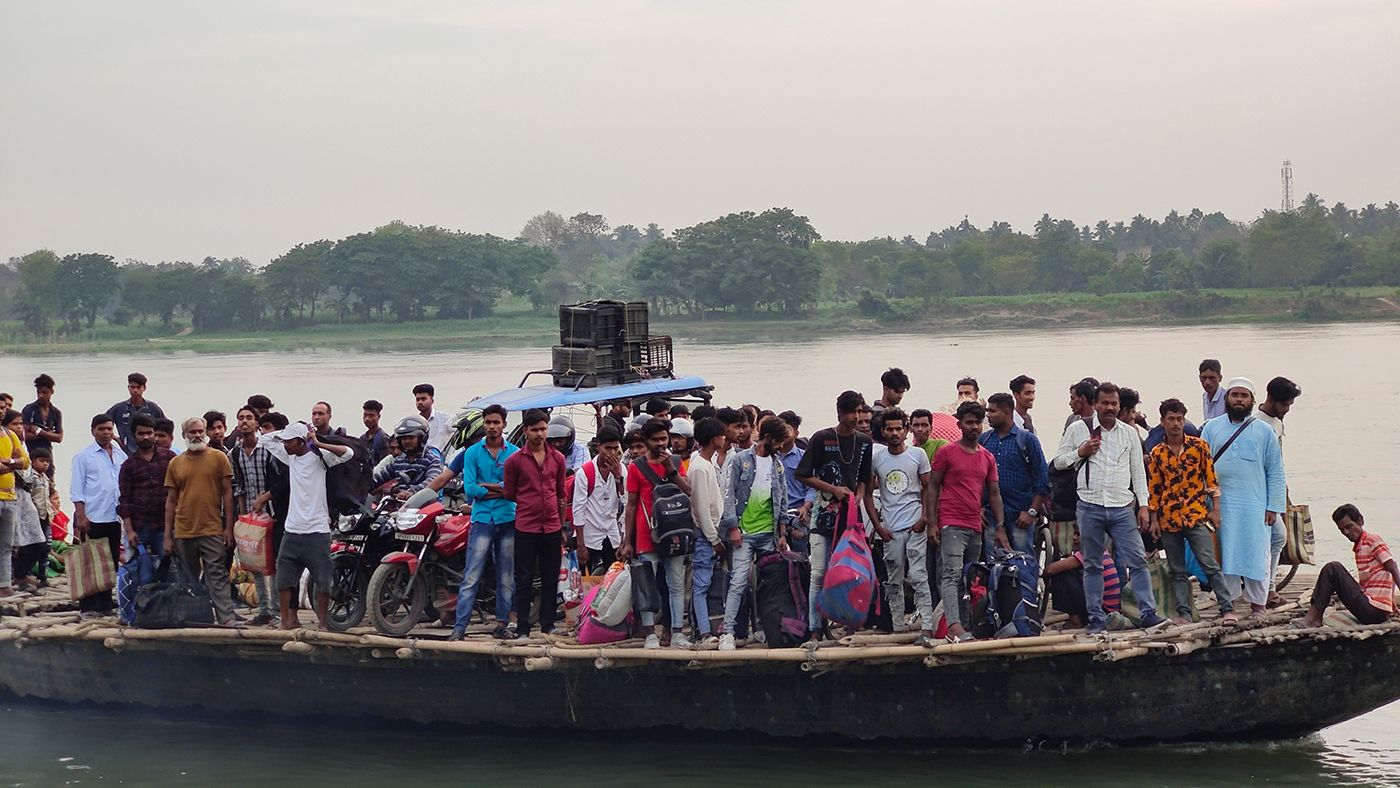
Migrant workers returning from Bihar report growing intolerance against Muslim workers. Photo: Smita Khator/PARI
“In this year alone, more than 5,000 migrant labourers from Murshidabad have been harassed by police in Odisha,” says Asif Faruk. He is secretary of Parijayee Shramik Aikya Mancha (PSAM) – an organisation fighting for the rights of migrant workers from West Bengal. “In different regions of Odisha including Jharsuguda and Paradip, many Murshidabad labourers have been detained in police camps for four to five days and are being interrogated to prove their citizenship status.”
The political storm between Centre and State governments, highlighted by the speeches of leaders of both, isn’t helping. A press release by the Central Government’s Ministry of Labour months ago lauded the projects and schemes undertaken by them for the welfare of the migrant labourers in India. But there have been no official statements, no condemnation of the violence against them.
The Border Security Force has not issued any official statement on the charges of unlawful conduct during the ongoing crackdown on people alleged to be unauthorised Bangladeshi infiltrators in several Indian states. Villagers in Bhagawangola say: “The lower rank [BSF] jawans tell us ‘we are merely doing as instructed by the oporwalas [higher authority]’.”
The state government has promised to defend the rights of citizens and deal with the issue of people being pushed across the border. Asif Faruk of the PSAM believes the “West Bengal government is trying to rescue and bring the victims back.” And “from April, we started a helpline for the workers.”
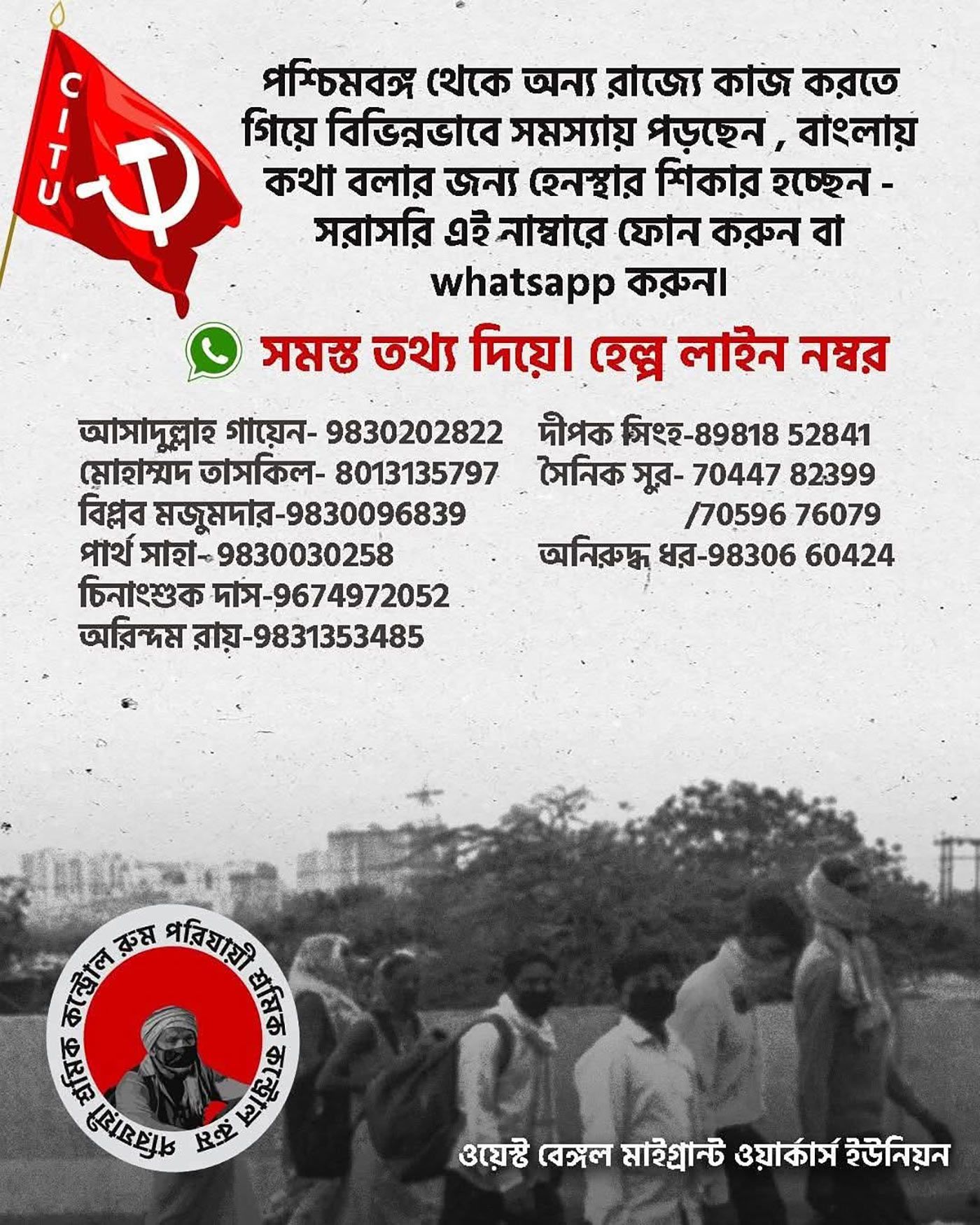
(Left) West Bengal Migrant Workers’ Union has started a helpline for workers facing atrocities in other states and their concerned families back home. Photo: Courtesy of WB Migrant Workers’ Union via PARI
(Right) Safiqul Islam from Diarjali Bagicha fears the safety of his brother Rafiqul Islam, a mason working in Kanpur, Uttar Pradesh. He has noticed a sharp surge in reports of harassment of Bengali-speaking Muslim migrants circulated in social media platforms. Photo: Anirban Dey/PARI
The organisation has also filed a Public Interest Litigation in the Calcutta High Court seeking immediate action against harassment of Bengali migrant workers. And the West Bengal Migrant Workers’ Union organised a procession in Murshidabad district headquarters, Baharampur, demanding security for the labourers in other states. “MPs [Members of Parliament] from the concerned districts,” says Kamal Hossein, WBMWU district secretary, “must visit and intervene in the states where the migrant labourers are under attack.”
Meanwhile, the Centre-State squabble sidelines the question: had there been decent employment in Murshidabad, and serious intervention in the agriculture sector – would people have had to migrate in the first place?
Back in Balia Hasennagar, a panic-stricken Mehbub Sheikh, wonders how he will sustain his family now. “The [construction] company is calling me [from Mumbai] to resume work, but they are not willing to take any responsibility…”
Disappointment grips the master mason: “Where shall I find work now? I don’t have any answer to this…”
“যখন কাঁটাতার দেখলাম, মনে হল সব শেষ… মনে হল, এই জীবনে আর দেশে ফিরতে পারব না। আমার দাদোর দাদো (ঠাকুরদার ঠাকুরদা) এই মুর্শিদাবাদেই থাকতেন। আমরা এখন ভগবানগোলা [ব্লকের] যে গ্রামে থাকি সেটাও আমার নানির গ্রাম।“
বালিয়া হোসেন নগর গ্রামে নিজের বাড়িতে বসে মুর্শিদাবাদ জেলার সঙ্গে তাঁর পরিবারের আজন্মকালের সম্পর্কের খতিয়ান দিচ্ছিলেন বছর ৩৬-এর মেহেবুব শেখ। চোখেমুখে আতঙ্কের ছাপ। মাসখানেক আগেই ভয়ঙ্কর এক অভিজ্ঞতার মধ্যে দিয়ে গিয়েছেন। দেশের প্রশাসন তাঁকে ‘বাংলাদেশি অনুপ্রবেশকারী’ হিসেবে দাগিয়ে ঘাড়ধাক্কা দিয়ে সীমার ওপারে চালান করেছিল।
“আমার ভোটার কার্ড, আধার কার্ড, রেশন কার্ড সবই আছে। গায়ে গতরে খেটে জমিও কিনেছি। তারপরেও আমি বাংলাদেশি হই কেমন করে?” জানতে চান মেহেবুব, পেশাগত পরিচয়ে তিনি পরিযায়ী শ্রমিক।
মেহেবুবের মতোই এই প্রশ্নের উত্তর খোঁজার চেষ্টা করছেন তাঁর জেলাতুতো আরও হাজার হাজার দেশান্তরি শ্রমিকেরা। তাঁদের কেউ নির্মাণশ্রমিক, কেউ গৃহশ্রমিক, কেউ ফেরিওয়ালা, কেউ বা হকার। হঠাৎ নেমে আসা অস্তিত্বের সংকটে জেরবার দিন আনি দিন খাই এই মজুরদের ঠিক ঠাহর হচ্ছে না কেন মুর্শিদাবাদের বাংলাভাষী মুসলমান পরিযায়ী শ্রমিকেরা ভিনরাজ্যে কাজে গিয়ে আক্রান্ত হচ্ছেন।
(Left) স্ত্রী সুরনা বিবির সঙ্গে মুর্শিদাবাদের বালিয়া হোসেন নগরে নিজেদের বাড়িতে মেহেবুব শেখ। ২০২৫-এর ৯ জুন এই পরিযায়ী রাজমিস্ত্রিকে তুলে নিয়ে যায় মহারাষ্ট্র পুলিশ, তাঁর নাগরিকত্বের প্রমাণ হিসেবে কাগজপত্র চায়। শেষপর্যন্ত তাঁকে জোর করে বাংলাদেশে রেখে আসা হয়।
(Right) মুর্শিদাবাদের কান্দি ব্লকের গোকর্ণ গ্রামের বিশাখা মণ্ডল (নাম পরিবর্তিত) দিল্লিতে গৃহশ্রমিক হিসেবে কাজ করছেন তিন দশক হল। তিনি বলছেন: ‘আমাকে এখনও কেউ [আমরা ভারতীয় কিনা] কিছু বলেনি। কিন্তু চারদিকে এত ঝামেলা হচ্ছে [আমাদের মতো বাঙালি মুসলমানদের নিয়ে], আমরাও চিন্তিত’। Photos: Anirban Dey/PARI
“আমাকে এখনও কেউ [আমরা ভারতীয় কিনা] কিছু বলেনি,” বলেন বছর বাহান্নর বিশাখা মণ্ডল (নাম পরিবর্তিত)। কান্দি ব্লকের গোকর্ণ গাঁয়ে তাঁর ঘর। “কিন্তু চারদিকে এত ঝামেলা হচ্ছে [আমাদের মতো] বাঙালি মুসলমানদের নিয়ে, আমরাও চিন্তিত।” দিল্লিতে তিন দশক ধরে গৃহশ্রমিক হিসেবে কাজ করছেন তিনি। পাঁচ বাড়ি খেটে মাসে ২৫০০০ টাকা আয় করেন। ভোটার কার্ড, রেশন কার্ড সবই যথাযথ আছে তাঁর। রয়েছে আধার কার্ড, মায় দিল্লির ঠিকানার সঙ্গে লিংক করা ব্যাঙ্ক অ্যাকাউন্টও।
ইংরেজরা কলকাতায় রাজধানী স্থানান্তরের আগে পর্যন্ত অবিভক্ত বাংলার প্রশাসনিক কেন্দ্র মুর্শিদাবাদ পরিচিত ছিল তার সম্পদ আর প্রাচুর্যের জন্য। বর্তমানে অবশ্য তার পরিচয় রাজ্যের সর্বাধিক পরিযায়ী শ্রমিক সরবরাহকারী জেলা হিসেবে। ২০২৫ সালের মে মাস পর্যন্ত পাওয়া হিসেব অনুযায়ী মুর্শিদাবাদ জেলার মোটামুটি ৪ লক্ষ শ্রমিক পশ্চিমবঙ্গ রাজ্য সরকারের মাইগ্র্যান্ট ওয়ার্কার্স ওয়েলফেয়ার স্কিমে নাম নথিভুক্ত করেছেন।[আশ্চর্যের বিষয়, উক্ত নথি অধুনা অপ্রকাশিত হয়েছে সরকারি সাইট থেকে]। বিভিন্ন পরিযায়ী সংগঠনের বেসরকারি হিসেব বলছে মুর্শিদাবাদ জেলায় পরিযায়ী শ্রমিকের সংখ্যা ১০ লক্ষেরও বেশি। নাম প্রকাশে অনিচ্ছুক শিক্ষা দপ্তরের জনৈক সরকারি আধিকারিক এও জানান, “সরকারি কোনও পরিসংখ্যানেই নাবালক শ্রমিকদের উল্লেখ থাকবে না। কিন্তু বাস্তব এটাই যে জেলার অসংখ্য নাবালক শ্রমিক বাইরে কাজে যাচ্ছে প্রতিদিন।“
মেহেবুব শেখের দাদা ৩৩ বছরের মুজিবর শেখ আর বাবা হোসেন শেখও ছিলেন পরিযায়ী শ্রমিক। ষাটের কোঠার গোড়ায় পৌঁছে হোসেন আজও কলকাতা শহরে রাজমিস্ত্রির কাজ করেন। ভাইয়ের সঙ্গে মুজিবরও দিল্লি, মুম্বইয়ে রাজমিস্ত্রির কাজে গিয়েছেন। এখন গাড়ি চালান তিনি। দুই ভাই-ই চরম দারিদ্র্যের সঙ্গে লড়াই করে বড়ো হয়েছেন। মেহেবুব বলছেন, “এক সময় গ্রামে অন্যদের বাড়িতে ছাগলও চরিয়েছি। স্কুলে বেশিদিন যাইনি। অভাবের সংসার। ছোটো থেকেই খাটছি।”
‘এখন বরং ভালো আছি। ফিরে এসে কলকাতায় এই কাজ নিয়েছি। বাড়ির কথা মনে পড়ে,’ বলেন মুর্শিদাবাদের ধুলিয়ানের বাবু ইসলাম (আসল নাম জানাতে চাননি)। ২০২৪ সালের সেপ্টেম্বর মাস নাগাদ ওড়িশায় বাঙালি মুসলিম পরিযায়ী শ্রমিকদের ওপর অত্যাচার শুরু হলে সেখান থেকে পালিয়ে আসেন তিনি। Photo: Smota Khator/PARI
সতেরোয় পা দিয়েই, বংশ পরম্পরায় শেখা রাজমিস্ত্রির বিদ্যেটুকু সম্বল করে কাজের তাগিদে ভিনরাজ্যে পাড়ি জমান মেহেবুব। সেই থেকে দিল্লি, পঞ্জাব, তামিলনাডু, রাজস্থান-সহ বিভিন্ন রাজ্যে কাজ করে আসা এই ওস্তাদ রাজমিস্ত্রি বিশ্বাসই করতে পারছেন না যে চারপাশ এতটা বদলে যাবে। মেহেবুবের মতো বহু পরিযায়ী শ্রমিককে সন্দেহের বশে গ্রেফতার করে বাংলাদেশের ভূখণ্ডে পাঠিয়ে দেওয়ার মতো ঘটনাও সামনে এসেছে সংবাদমাধ্যমের রিপোর্ট আর প্রকাশিত নানান প্রত্যক্ষ বয়ান এবং অভিজ্ঞতার মারফত।
বাতাসে ভাসছে সন্দেহ আর অবিশ্বাসের বিষ। তাতে অবশ্য অবাক হওয়ার কিছু নেই: এক বছরেরও বেশি সময় ধরে রাজ্য ও কেন্দ্রীয় সরকারের আইন প্রয়োগকারী সংস্থাগুলো আক্রমণ শানিয়েছে তাঁদের বিরুদ্ধে। “আমাদের নামগুলো শুনতে আপনাদের মতো না। সেজন্যই আমাদের এই অবস্থা,” ক্ষুব্ধ স্বরে বলেন মুজিবর। গত একবছর যাবত পশ্চিমবঙ্গ থেকে বাইরে যাওয়া পরিযায়ী শ্রমিকরা নিশানা হচ্ছেন বারবার। ‘বাংলাদেশি’, ‘রোহিঙ্গা’, ‘ঘুসপেটিয়া,’ ‘অনুপ্রবেশকারী’, ‘ইল্লিগাল’ ইত্যাদি তকমা জুটছে তাঁদের।
বিগত এক দশকে ধর্ম, ভাষা, জাতি তথা স্থানিক পরিচিতির ভিত্তিতে যে বিদ্বেষমূলক আচরণ নিয়ম করে বেড়েছে, প্রত্যেকেই খেয়াল করেছেন সেটা। বর্তমান বাড়বাড়ন্ত সেসবেরই এক চরম পর্যায়। মৌলবাদী সংগঠন ও রাজনৈতিক দলের নেতানেত্রীদের ঘৃণাপ্রসূত বয়ান তথা ভাষণের জেরে সর্বাধিক আক্রান্ত হয়েছেন মুসলমান পরিযায়ী শ্রমিকেরা।
“হয় জান, নয় কাম, একটা বেছে নিতে বাধ্য হচ্ছি আমরা,” এই প্রতিবেদকের কাছে ক্ষোভ উগরে দেন ডিয়ার জালি বাগিচার বাসিন্দারা। এখানেই ইটের গাঁথনি দেওয়া প্লাস্টার বিহীন দুই কামরার ঘরে থাকেন ৩২ বছরের নাজেমা বিবি, উত্তরপ্রদেশের কানপুরে কর্মরত স্বামীর জন্য ভয়ে-ভাবনায় দিন কাটছে তাঁর। “এখন কয়েক ঘণ্টা ফোন না ধরলেই বুক কাঁপে,” জানান তিনি।
মুর্শিদাবাদ জেলা জুড়ে স্থিতিশীল কাজের আকাল ও দিন গুজরানের জন্য যথেষ্ট মজুরির অভাবে শ্রমজীবী মানুষদের কাছে দেশান্তরি হওয়া ছাড়া উপায় থাকে না। ছবিতে দেখা যাচ্ছে, হাওড়া স্টেশন থেকে অন্ধ্রপ্রদেশগামী ট্রেনে ওঠার অপেক্ষায় আছেন তরুণ পরিযায়ী শ্রমিকেরা । Photo: Anirban Dey/PARI
চলতি বছরের জুন মাসের প্রথম দিকে ঈদ উল আজহা সপরিবারে পালন করবেন বলে মে মাসেই বালিয়া হোসেন নগর ফিরেছিলেন মেহেবুব। বহুকষ্টে তিল তিল করে দাদা, ভাই, বাবা – তিন রাজমিস্ত্রি মিলে আড়াই তলা পাকা বাড়িটা বানিয়েছেন। ৫টা ঘর। নিচে দোকান করার মতো কিছুটা জায়গা রাখা। গৃহিণী স্ত্রী সুরনা বিবি (৩০) আর তিন সন্তানকে নিয়ে মেহেবুব যে দিকটায় থাকেন সেদিকে এখনও ভিতর বা বাইরে কোথাও-ই প্লাস্টার হয়নি। বড়ো ছেলে বকুল শেখ (১৬) পড়াশোনা ছেড়ে এখন কাছেই একটা দোকানে কাজ করে। বাকি দুই ছেলে সাগর শেখ (১২), রেহান শেখ (৭) স্কুলে পড়ছে। মেহেবুব ঈদে ফিরেছেন দেখে বাড়ির সব আত্মীয় পরিজনেরা মিলে পবিত্র কুরবানির জন্য পশুর ব্যবস্থাও করেছিলেন।
কিন্তু বাধ সাধল কাজের চাপ। থানে শহরে যে ইমারতি সাইটে কাজ করতেন তিনি, “সেখান থেকে বারবার ফোন আসতে থাকে।” অগত্যা পরিবারের সঙ্গে পরব না কাটিয়েই প্লেনে চেপে মহারাষ্ট্র ফিরে রাজমিস্ত্রির কাজে যোগ দেন মেহেবুব।
জুন মাসের ৯ তারিখ কাজের ফাঁকে খানিক বিরতি নিয়ে কাছেই একটা দোকানে চা খেতে বেরিয়েছিলেন তিনি। হঠাৎ সেখান থেকেই তাঁকে তুলে নিয়ে যাওয়া হয় থানের মীরা রোডে শ্রী এল আর তিওয়ারি ইঞ্জিনিয়ারিং কলেজের পাশে পুলিশ চৌকিতে। রাতেই সেখান থেকে নিয়ে যাওয়া হয় মীরা রোড পুলিশ স্টেশনে। দেখতে চাওয়া হয় কাগজ।
“’তুই বাংলাদেশি?’ হিন্দিতে এই প্রশ্নই করছিল পুলিশ অফিসাররা। আমি বলি, ‘আমার বাড়ি পশ্চিমবঙ্গে’। আধার কার্ড, প্যান কার্ড দেখাই। পুলিশ বলে, ‘এসব পাঁচ টাকায় পাওয়া যায়’,“ প্রতিবেদককে জানালেন মেহেবুব।
কোনও মতে থানা থেকেই লুকিয়ে বাড়িতে ফোন করে সব কথা জানান তিনি। বালিয়া হোসেন নগরে তাঁর পরিবারের সদস্যরা তক্ষুনি যোগাযোগ করেন তাঁদের স্থানীয় মহিষাস্থলী গ্রাম পঞ্চায়েতের সঙ্গে। সেখান থেকেও যাবতীয় নথিপত্র পাঠানো হয় মহারাষ্ট্রের মীরা রোড থানায়। “চারদিন ধরে চলে অসহ্য মানসিক নির্যাতন। সারাদিন থানার বাইরে বসিয়ে রাখত। রাতে পাঠিয়ে দেওয়া হত একটা পুলিশ ক্যাম্পে।“
যদিও মেহেবুবের বয়ানে উঠে আসা নিজেদের যাবতীয় অপরাধ সটান খারিজ করে মীরা রোডের পুলিশ। সিনিয়র ইন্সপেক্টর মেঘনা বুরাডে জানান, তাঁদের কোনও “দোষ ছিল না” এবং এক পুলিশ কমিশনারের আদেশমাফিকই মেহেবুব শেখ সহ বাকিদের আটক করা হয়।
‘হয় জান, নয় কাম, একটা বেছে নিতে বাধ্য হচ্ছি আমরা,’ বলছেন লাগাতার ধরপাকড় ও ‘বাংলাদেশি ঘুসপেটিয়া’ তকমায় দিশেহারা পশ্চিমবঙ্গের পরিযায়ী শ্রমিকরা । Illustration: Labani Jangi/PARI
মেহেবুবর জন্য, অবশ্য ১৩ জুন দিনটা ছিল ভয়াবহ।
“সেদিন থানা থেকে আমাদের বড়ো একটা জাল দেওয়া গাড়িতে তোলা হয়। সামনে পিছনে আরও অনেক গাড়ি। মনে হচ্ছিল, নেতা মন্ত্রী যাচ্ছে,” বলছেন মেহবুব। “গাড়ি পানভেলের সিকিউরিটি ফোর্সের ক্যাম্পে এসে থামে।“
১৪ তারিখ সেই একই গাড়ি করে মেহেবুব-সহ প্রায় তিরিশ জনকে নিয়ে যাওয়া হয় পুণে বিমান বন্দরে। দুপুর ২টোয় বিমানে তোলা হয়। নামার পর মেহেবুব বুঝতে পারেন, পশ্চিমবঙ্গের বাগডোগরা বিমান বন্দরে এসে পড়েছেন। তাঁর কথায়, “এয়ারপোর্টে গুণতি করা হয়। আমাদের ছোটো ছোটো গ্রুপে ভাগ করে দেয়। আসামীদের গুণতির কথা শুনেছি। আমাদেরও এই রকম গুণতি কেন হচ্ছে? সন্দেহ হয়…” এয়ারপোর্ট থেকে তাঁদের আনা হয় শিলিগুড়ির বিএসএফ এর ছাউনিতে। সেখান থেকে অজানা গন্তব্যের পথে যাত্রা শুরু হয়।
“প্রায় পাঁচ, ছয় ঘণ্টা গাড়িতে গিয়েছি। যেখানে নামাল সেখানে জঙ্গল। একটা ছোটো বিএসএফ’এর ক্যাম্প। অল্প কয়েকজন অফিসার। নামিয়ে প্রশ্ন করল, ‘বাড়ি কোথায়?’ ঠিকানা বললাম। বেধড়ক মার শুরু হল। গলায় বন্দুক অবধি ঠেকানো হল। এরপর বিএসএফ অফিসাররা আমাদের ছবি তুলল। বলল, হেঁটে চলে যেতে জঙ্গল দিয়ে।”
“কোথায় যাব? কীভাবে যাব কিছুই জানি না। অনেকে বলছে, বিএসএফ বা বিজিবি (বর্ডার গার্ড বাংলাদেশ) দেখলে গুলি করে দেবে। ভয় হচ্ছিল। জঙ্গলে লুকিয়ে থাকলাম সারারাত,” আতঙ্কের সেই রাতের কথা জানাচ্ছেন বিধ্বস্ত সন্ত্রস্ত মেহেবুব।
(Left) ভিনরাজ্যে পরিযায়ী শ্রমিকদের নিরাপত্তার দাবি জানিয়ে মুর্শিদাবাদের সদর শহর বহরমপুরে একটি মিছিলের ডাক দেয় ওয়েস্ট বেঙ্গল মাইগ্রান্ট ওয়ার্কাস ইউনিয়ন। Photo: Anirban Dey/PARI
(Right) ভারতের বিভিন্ন রাজ্যে বাংলাভাষী পরিযায়ী শ্রমিকদের ওপর নেমে আসা অত্যাচার নিয়ে সাম্প্রতিক কিছু সংবাদ-শিরোনামের কোলাজ। Photo: Aunshuparna Mustafi/PARI
সকাল হতেই কষ্ট বেড়েছে। পুণে বিমান বন্দরে তাঁদের খেতে দিয়েছিল বিএসএফ। তারপর আর ২৪ ঘণ্টা পেটে কিচ্ছুটি পড়েনি। বলছেন, “মনে হচ্ছিল এখানেই মরে যাব। চারদিকে শুধুই গাছ। আমরা কয়েকজন একসঙ্গে থাকছিলাম।” খানিক থেমে আবারও বলেন মেহেবুব, “দুপুর ২টো নাগাদ হাঁটতে হাঁটতে যেখানে গেলাম সেখানে বাংলাদেশের ছোটো একটা বসতি ছিল। ওদের গিয়ে বললাম যে আমরা ভারতীয়। ওরা আমাদের স্নান করতে বলল, ভাত খেতে দিল। [ওদের সাহায্যে] ইমো অ্যাপ [আন্তর্জাতিক কল এবং চ্যাট করার মোবাইল অ্যাপ] থেকে বাড়িতে ফোন করলাম। কাঁদছিলাম। কথা বলতে পারছিলাম না…”
সেই অবস্থা থেকে যে কোনওদিন ফিরে আসবেন, ভাবতে পারেননি। মেহেবুব শেখকে উদ্ধারের জন্য তাঁর দাদা মুজিবর শিলিগুড়ি, রায়গঞ্জ কত না জায়গায় ছোটাছুটি করেছেন। স্থানীয় পঞ্চায়েত অফিস থেকে শুরু করে জেলা আর রাজ্য প্রশাসনের নানান সরকারি কর্তাব্যক্তির দ্বারস্থ হয়েছেন। অবশেষে মেহেবুব ফিরতে পেরেছেন ঘরে। “মেহেবুবকে উদ্ধার করে নিয়ে আসার পরেও বাড়িতে সরকারি লোকজন এসেছে। জমির কাগজও দেখতে চেয়েছে।“ তবে তাঁরা কোন দপ্তর থেকে এসেছিলেন সেটা পরিবারের কাছে স্পষ্ট নয়।
ফিরে এসেও চিন্তা আর শেষ হচ্ছে কোথায়? তাঁদের জন্য বাইরে যাওয়া যে আর ছাড়া গতি নেই, সেকথাই বুঝিয়ে বলেন মেহেবুব। “ভিনরাজ্যে দিনে যে ৮০০ থেকে ১২০০ টাকা আয় হয়, ঘরে বসে তো সেসব বন্ধ। অনেকসময় ওখানে আবার ডবল শিফটেও কাজ করি আমরা।“ অথচ মনে গেড়ে বসেছে চরম ভয়। বলছেন, “বছরের পর বছর পুণে, মুম্বই, থানে শহরে রাজমিস্ত্রির কাজ করেছি। এইরকম দিন দেখব কখনও ভাবিনি।”
(Left) ১৫ জুন উদ্ধার পাওয়ার পর নিরাপত্তা আধিকারিকদের সঙ্গে নাজিমুদ্দিন মণ্ডল (কালো শার্ট গায়ে), মোস্তফা কামাল শেখ (লাল শার্ট গায়ে) ও মিনারুল শেখ (বাঁদিকে)। ১৩ জুন জবরদস্তি বাংলাদেশ পাঠিয়ে দেওয়া হয় এই তিন পরিযায়ী শ্রমিককে ।
(Right) পশ্চিমবঙ্গ থেকে বহির্গামী শ্রমজীবীদের অধিকার নিয়ে কর্মরত সংগঠন পরিযায়ী শ্রমিক ঐক্য মঞ্চের তরফ থেকে পরিযায়ী শ্রমিকদের ওপর হামলার বিরুদ্ধে অবিলম্বে ব্যবস্থাগ্রহণের দাবি জানিয়ে কেন্দ্রীয় স্বরাষ্ট্রমন্ত্রীকে চিঠি দেওয়া হয়েছে। Photos: Courtesy of Parijayee Shramik Aikya Mancha via PARI
সাংবাদিক দেখেই মুর্শিদাবাদেরই হরিহরপাড়া ব্লকের নাজিমুদ্দিন মণ্ডল নিজের রাগ বিরক্তি উগরে দেন। সরকার, প্রশাসনের পাশাপাশি তাঁর সমান ক্ষোভ সংবাদমাধ্যমকে ঘিরেও। যবে থেকে রাষ্ট্রের হাতে ঘাড়ধাক্কা খেয়ে বাংলাদেশ পৌঁছনো নাজিমুদ্দিনের একটি ভিডিও সমাজমাধ্যমে ছড়িয়ে পড়েছে, সাংবাদিকরা প্রশ্নে প্রশ্নে জেরবার করে তুলেছেন তাঁকে। পেশায় রাজমিস্ত্রি, তরতিপুর গ্রামের ৩৫ বছর বয়সি নাজিমুদ্দিনকে হঠাৎ বাংলাদেশি তকমা দিয়ে ওদেশে ঠেলে দেওয়া প্রসঙ্গে জানতে চাওয়া হচ্ছে বারবার। ক্ষোভে ফেটে পড়েন তিনি, “কি করবেন জেনে? আপনারা লিখতে পারেন না কেন [আমাদের উপর] অত্যাচার করা হচ্ছে? কেন আমাদের বাংলাদেশি বলা হচ্ছে? মিডিয়াকেও তো বলতে হবে।”
সাম্প্রতিক পরিস্থিতি বিষয়ে মিডিয়ার বড়ো অংশের নীরবতা বিচলিত করে নাজিমুদ্দিনকে। অনেকেই যে আবার খবরের নামে বাংলাভাষী শ্রমিকদের ঘিরে সন্দেহের বাতাবরণ তৈরি করতে তৎপর, সেটাও নজর করেছেন তিনি।
বাংলাদেশে ঠেলে দেওয়ার অভিজ্ঞতায় এখনও আতঙ্কিত নাজিমুদ্দিন। বাড়িতে ক্লাস টেনের পড়ুয়া মেয়ে আর স্ত্রীকে রেখে ভিনরাজ্যে পাড়ি দিতে এখন রীতিমতো ভয় হচ্ছে তাঁর। “মীরা রোড [আমি] থানাতেও কাজ করেছি,” বলেন তিনি। রাজমিস্ত্রির কাজ, মেরামতি সবই করেছেন সেখানে। “সেই থানার লোকে এসেই মাঝরাতে ভাড়ার ঘর থেকে তুলে নিয়ে গেল। বলল, ‘বাংলাদেশি’। এ কেমন নিয়ম?” প্রশ্ন করছেন নাজিমুদ্দিন। মহারাষ্ট্র পুলিশ প্রশ্ন তুলেছিল জন্ম সার্টিফিকেট নিয়ে। নাজিমুদ্দিন বলছেন, “৩৫ বছর আগে জন্ম হরিহরপাড়ায়। এখানেই বাপ, দাদাদের জন্ম। বাবা, মা কেউই পড়াশোনা জানেন না। জন্মসার্টিফিকেটও তোলেননি। আমার বাড়ির অবস্থা খুব খারাপ ছিল। আমি প্রাইমারি স্কুলটাও পাশ করিনি।”
মহারাষ্ট্রের মীরা রোডে সেই ঘরে এখনও জিনিসপত্র পড়ে আছে। ঠিকাদারের কাছে মজুরির টাকাও বকেয়া আছে। সেসবের কী হবে তারও কোনও ঠিক নেই। পুলিশ মোবাইল ফোন কেড়ে নিয়েছে। সেই ফোনও ফেরত পাননি। “নতুন জায়গায় কাজ খোঁজা মুশকিল। পাঁচ বছর ধরে যে জায়গাটা তৈরি হয়েছে। সেটা এইভাবে কেড়ে নেওয়া যায়?” প্রশ্ন তাঁর।
অবৈধ বাংলাদেশি অনুপ্রবেশকারী সন্দেহে মানুষজনকে লাগাতার হেনস্থা নিয়ে কেন্দ্র-রাজ্য তরজার মাঝে চাপা পড়ে যাচ্ছে গোড়ার প্রশ্নটাই: মুর্শিদাবাদে যদি ঠিকঠাক কাজের সুযোগ থাকত, কৃষিক্ষেত্রে যদি একটুও সুযোগ-সুবিধে মিলত – বাসিন্দাদের কি আদৌ মিজোরাম (ছবিতে) কি মহারাষ্ট্রের মতো নানান রাজ্যে পাড়ি দিতে হত? Photo: Smita Khator/PARI
নাজিমুদ্দিনের অন্য দুই ভাইও পরিযায়ী শ্রমিক। একজন কেরালায়, অন্যজন তামিলনাড়ুতে কাজ করেন। এলাকার শ্রমিকরা প্রতিবেদককে জানাচ্ছেন, দক্ষিণের রাজ্যগুলিতে বাঙালি শ্রমিকদের উপর তেমন অত্যাচার হচ্ছে না। তাই মহারাষ্ট্র, গুজরাট, দিল্লি থেকে ফিরে আসা শ্রমিকরা এখন মরিয়া হয়ে দক্ষিণের রাজ্যে কাজ খুঁজছেন।
মুর্শিদাবাদের বেলডাঙা ১ ব্লকের কাজিসাহা গ্রামের বাসিন্দা মিনারুল শেখ এবং বর্ধমান জেলার মন্তেশ্বর থানা এলাকার বাসিন্দা মোস্তফা কামাল শেখকেও তাঁর সঙ্গে একই দুর্ভোগের শিকার হতে হয়েছিল বলে জানান নাজিমুদ্দিন। “১৩ জুন আমাদের শিলিগুড়ি দিয়ে বাংলাদেশে পাঠিয়ে দেওয়া হয়। উদ্ধার পাই ১৫ জুন।
“যা হয়ে গেল… এরপর বাইরে যাওয়াই এখন মুশকিল। দেশে দিনে [যে-কদিন কাজ জোটে] ৫০০ টাকা রোজগার। ২৫০ টাকা খরচ। বাইরে [ভিনরাজ্যে] ৩০০ টাকা খরচ হলেও [আয়] ৮০০ টাকা রোজ। ৫০০ টাকা হাতে থাকে। বাড়িতে পাঠাতে পারি। তাই বাইরে যাওয়া ছাড়া উপায় নেই,” সহজ হিসেবটা বুঝিয়ে বলছেন নাজিমুদ্দিন। “ঝুঁকি নিয়েই [বাইরে] কাজে ফিরে যেতে হবে।“
জেলা জুড়ে মজুরি নির্ভর নিয়মিত কাজ অমিল। যা মজুরি মেলে তাতে দিন গুজরান অসম্ভব। বন্ধ মনরেগার ১০০ দিনের কাজও। অগত্যা দেশান্তরি হওয়া ছাড়া আয়ের আর পথ নেই শ্রমজীবী মানুষের মধ্যে। দেশের অনগ্রসরতম জেলাগুলির মধ্যে অন্যতম মুর্শিদাবাদ পরিসংখ্যানের নিরিখে আদতে গ্রামীণ – জেলার শতকরা ৮০ শতাংশ মানুষ ২,১৬৬টি গ্রামে বাস করেন। শতকরা ৬৬ শতাংশ সাক্ষরতার হার নিয়ে মুর্শিদাবাদ রাজ্যের গড় ৭৬ শতাংশের চেয়ে অনেকখানি নিচে অবস্থান করছে (তথ্যসূত্র: জনগণনা ২০১১)। মুর্শিদাবাদের মোট জনসংখ্যার দুই তৃতীয়াংশই মুসলমান সম্প্রদায়ভুক্ত। ফলে এই অবশ্যম্ভাবী অভিবাসন এবং সে সংক্রান্ত যাবতীয় সমস্যার সর্বাধিক ভুক্তভোগী শ্রেণি, ধর্ম, আঞ্চলিক পরিচিতির নিরিখে জেলার প্রান্তিকতম মুসলিম জনগোষ্ঠী।
ভগবানগোলার হাবাসপুর গ্রাম পঞ্চায়েতের ডিয়ার জালি বাগিচা গ্রামের দিকে তাকালেই ছবিটা স্পষ্ট হয়ে যায়। এই গ্রামে ষাট শতাংশেরও বেশি বাড়ির অন্তত একজন ভিনরাজ্যে আছেন। এখানকার বাসিন্দা লতিবুল হক, আইনাল হক, আমির হোসেন, রাজ্জাক হোসেন শেখ মুটে শ্রমিকের কাজ ছেড়ে ফেরিওয়ালা হিসেবে কাজ শুরু করেছিলেন ওড়িশার ঝাড়সুগুডায়, খানিক ভদ্রস্থ রোজগারের আশায়। ফোনে জানান, তাঁরা মহাজনের কাছ থেকে হরেক মনিহারি মালপত্র বাকিতে নিয়ে সেসব সাইকেল, বাইকে করে গ্রামে গ্রামে ঘুরে বিক্রি করেন। ঠিকাদারের ভাগটুকু বাদ দিলে গড়পড়তা দৈনিক ৭০০-৮০০ টাকা আয় থাকে। দলবেঁধে ঘর ভাড়া নিয়ে একসঙ্গে থাকেন তাঁরা।
(Left) ওড়িশার ঝাড়সুগুডার লাখনপুর থানায় চারদিন আটক রাখা হয়েছিল মুর্শিদাবাদের ভগবানগোলা ১ ব্লকের এই পরিযায়ী শ্রমিকদের দলটিকে। পশ্চিমবঙ্গে তাঁদের দেশ-গাঁ দক্ষিণ হনুমন্ত নগর গ্রাম পঞ্চায়েত থেকে হস্তক্ষেপ করার পর ১১ জুলাই ছাড়া পান তাঁরা। Photo: Courtesy of WB Migrant Workers’ Union via PARI
(Right) মুর্শিদাবাদের লালবাগ থানা এলাকার এই তিন পরিযায়ী শ্রমিক – মিলন শেখ, ইসমাইল শেখ ও বাবু শেখ – তামিলনাড়ুর চেন্নাইয়ের একটি নির্মাণক্ষেত্রে কাজ করেন। ২০২৫ সালের ১৫ জুলাই নিজেদের মধ্যে বাংলায় কথা বলায় আক্রান্ত হতে হয় তাঁদের । Photo: Courtesy of Parijayee Shramik Aikya Mancha via PARI
ডিয়ার জালি বাগিচা গ্রামে তাঁদের পরিবারের লোকেরা জানালেন, গত সেপ্টেম্বর (২০২৪) মাস থেকেই মুর্শিদাবাদের অনেক বাঙালি মুসলিম ফেরিওয়ালাকে ওড়িশায় কাজ করতে গিয়ে আক্রান্ত হতে হচ্ছিল, চলছিল ধরপাকড়। কখনও বাংলাদেশের সাম্প্রদায়িক সমস্যার অজুহাত দেখিয়ে, কখনও মুর্শিদাবাদ জেলার সামশেরগঞ্জে ধর্মীয় উত্তেজনার দায়ে তাঁরা হয়রানির শিকার হচ্ছিলেন। তবে ক্রমশ ওড়িশা পুলিশও আরও বেশি করে এই কাজে মদত দেওয়ায় প্রমাদ গুনছেন শ্রমিকরা।
লতিবুল হকের কাগজপত্রের সত্যতা নিয়ে সেখানকার পুলিশের তরফ থেকে প্রশ্ন তোলা হলে, ডিয়ার জালি বাগিচায় তাঁর পরিবারের সদস্যরা ভগবানগোলা থানার দ্বারস্থ হন। থানা থেকে নথি পাঠানোর পরে ছাড়া হয় লতিবুল সহ বাকি শ্রমিকদের। তবে এখনও তাঁরা ওড়িশাতেই আটকে আছেন। ঝাড়সুগুডার একটি ক্যাম্পে প্রায় চারদিন বন্দি থাকা লতিবুল হক ফোনে জানালেন, “পুলিশ বলল আমরা ভারতীয় কিনা সেই কাগজ যাচাই হচ্ছে। একমাস রাজ্যে যাওয়া যাবে না।“
মহারাষ্ট্র, ওড়িশা, উত্তরপ্রদেশ, দিল্লির মতো বিদেশবিভুঁইয়ে থাকা শ্রমিকদের কথা ভেবে দেশগাঁয়ে চরম ত্রাসে দিন কাটাচ্ছে পেছনে ফেলে আসা তাঁদের পরিবারগুলিও। ডিয়ার জালি বাগিচা গ্রামের এমন কয়েকটি বাড়ির মেয়েদের সঙ্গে কথা বলতে গিয়ে আইনাল হকের মা, বছর ষাটের মদিনা বিবির সঙ্গে সাক্ষাৎ হল। উৎকণ্ঠায় জর্জরিত প্রৌঢ়ার শরীর অশক্ত হলে কি হবে, চোখের দৃষ্টি প্রখর। নিবিড় হাতে কাঁথা বোনেন। কাঁথা বুনিয়ে, সেলাই করিয়ে নিয়ে কেউ কুড়ি টাকা, কেউবা তিরিশ টাকা দেন। তাতে সংসারের কিছুটা সাহায্য হয়। ভিনরাজ্যে আছে তাঁর ছেলে আর নাতিরা। তাঁদের উপর অত্যাচার, হেনস্থার প্রসঙ্গে চোখ ভিজে ওঠে তাঁর।
“যখন বলল, ছেলে, পোতা [নাতি] সবাই বাংলাদেশি তখন কি আর মন মানে?” আর্তি ছাপিয়ে ওঠে মদিনা বিবির গলায়। তাঁর মেজ ছেলে আইনাল হক আর বড়ো ছেলের দুই সন্তান আমির হোসেন, রাজ্জাক হোসেন চারদিন কাটিয়েছেন ওড়িশা পুলিশের হেফাজতে। “ছেলে আর দুই পোতাকে ওড়িশায় পুলিশ চারদিন ধরে আটকে রেখেছিল। ছাড়া পেয়েছে। কিন্তু ওই চারদিন আমিও ঘুমাতে পারিনি।”
(Left) নিজের ছেলের নাগরিকত্বের প্রমাণ হিসেবে খুঁটিনাটি তথ্য জানিয়ে নানান সরকারি আধিকারিকদের কাছে এই আবেদনপত্রই দাখিল করেন আটক হওয়া পরিযায়ী শ্রমিক সাগির হোসেনের বাবা। মুর্শিদাবাদের দক্ষিণ হনুমন্ত নগরের বাসিন্দা সাগিরের অবিলম্বে মুক্তির আবেদন জানান তিনি।Photo: Courtesy of WB Migrant Workers’ Union via PARI
(Right) আটক পরিযায়ী শ্রমিক আইনাল হকের স্ত্রী শিউলি বিবি, তাঁদের ছেলে, মা মদিনা বিবি আর বাবা মইনুল শেখ, ভগবানগোলার ১ ব্লকের ডিয়ার জালি বাগিচা গ্রামে নিজেদের বাড়িতে।Photo: Anirban Dey/PARI
আইনাল হকের স্ত্রী শিউলি বিবির কাছে ফোন এসেছিল। সেই ফোনেই ঘুম উড়েছিল সারা পরিবারের। আধার কার্ড, মাধ্যমিকের অ্যাডমিট কার্ড সব জোগাড় করে পাঠাতে হয়েছে থানায়। এই সব কাগজপত্তর নিয়ে থানায় গিয়েছিলেন আইনাল হকের বাবা শেষ ষাটের মইনুল শেখ। বলছেন, “দেরি করে যাওয়ার জন্য থানাতে ধমকও খেয়েছি। কিন্তু কী করব? ছেলের কথা ভেবে বাকহারা হয়ে গিয়েছিলাম…”
সন্তানসন্ততির চিন্তায় মনের কোণে গভীর আতঙ্ক জেগে আছে মদিনা বিবির। “মাধ্যমিক দেওয়ার পর ছেলে (আইনাল) বলল পেটে খেতে হবে তো, কাজ করতে হবে। শুরুতে একটা ইটভাটায় মালিকের কাজকাম করে দিয়ে মাসে আটশো টাকা মজুরি পেত।“ তারপর টানা বহুদিন প্রতি বস্তার হিসেবে, “গোডাউনে কাজ করেছে বস্তা তোলার। সেখানেও মাসে দশ হাজারের বেশি আসত না। দেনা হচ্ছিল। তাই দুই বছর ধরে ছেলে বাইরে। পেট চালাতে গিয়ে এই রকম অবস্থায় পড়তে হবে কেন?” সওয়াল তাঁর। জানান, “[আমার] দাদাশ্বশুর, শ্বশুর, সবাই তো ইন্ডিয়ার। এখনও আতঙ্ক লেগে থাকে।”
ভগবানগোলা ১ ব্লকের চরলবণগোলা গ্রামের মধ্য তিরিশের আমিরুল শেখকে, ৭ জুলাই ওড়িশার ঝাড়সুগুডার লখনপুর থানায় আটক করা হয়। সেখানেই ছিলেন পশ্চিমবঙ্গের আরও প্রায় তিরিশ জন শ্রমিক। খবর পেয়ে পরিবারের সদস্যরা কখনও ভগবানগোলা থানায় কখনও স্থানীয় দক্ষিণ হনুমন্তনগর গ্রাম পঞ্চায়েতে ছোটাছুটি করেছেন। থানায় জমা করেছেন দরখাস্ত। চারদিন পর আটক শ্রমিকেরা ছাড়া পান ওড়িশার লখনপুর থানা থেকে। স্পষ্টতই বিপর্যস্ত আমিরুল শেখ ফোনে জানালেন, “১০ বছর ধরে ওড়িশায় ফেরিওয়ালার কাজ করি। কিন্তু গত কয়েক বছরে সব যেন পালটে গেছে। আগেও অনেককে মারধোর করা হয়েছে। কিন্তু এবার তো সরাসরি বাংলাদেশিই বলে দেওয়া হচ্ছে।“ কাজ না করলে সংসার চলবে না, কাজেই এখনও ওড়িশাতেই থাকছেন আমিরুল।
বেলডাঙা ১ ব্লকের কুমারপুর ফেরিঘাটে এই বিহারফেরত তরুণ পরিযায়ী শ্রমিকেরাও জানান মুসলিম শ্রমিকদের বিরুদ্ধে ক্রমবর্ধমান অসহিষ্ণুতার কথা। Photo: Smita Khator/PARI
“এই বছরই মুর্শিদাবাদ জেলার ৫ হাজারেরও বেশি পরিযায়ী শ্রমিককে ওড়িশায় পুলিশি হেনস্থার শিকার হতে হয়েছে,” জানাচ্ছেন আসিফ ফারুক। পরিযায়ী শ্রমিক ঐক্য মঞ্চ (পিএসএএম) নামে পশ্চিমবঙ্গ থেকে বহির্গামী শ্রমজীবীদের অধিকার নিয়ে কর্মরত একটি সংগঠনের সম্পাদক তিনি। “ওড়িশার ঝারসুগুডা, পারাদ্বীপ সহ বিভিন্ন এলাকায় চার থেকে পাঁচদিন করে মুর্শিদাবাদের বহু শ্রমিককে পুলিশ ক্যাম্পে আটকে রেখে দেশের নাগরিকত্বের প্রমাণ চাওয়া হচ্ছে।“
ওদিকে কেন্দ্র আর রাজ্য সরকারের মধ্যে রাজনৈতিক তরজা অব্যাহত, দুদিকের নেতানেত্রীদের ভাষণে সেটাই স্পষ্ট হচ্ছে বারবার। তবে, কাজের কাজ কিছুই হচ্ছে না তাতে। কয়েক মাস আগে কেন্দ্রীয় শ্রম মন্ত্রকের একটি প্রেস বিজ্ঞপ্তিতে পরিযায়ী শ্রমিকদের কল্যাণার্থে কেন্দ্র সরকারের গৃহীত নানান যোজনা আর প্রকল্পের কথা ফলাও করে বলা হয়েছে। অথচ তাঁদের উপর এহেন অত্যাচারের নিরিখে কোনওরকম সরকারি বিবৃতি তো আসেইনি, নিন্দাটুকুও জানানো হয়নি কেন্দ্রের তরফে।
ভারতের বিভিন্ন রাজ্যে অবৈধ বাংলাদেশি অনুপ্রবেশকারী সন্দেহে লাগাতার হেনস্থার মতো যেসব অনৈতিক কাজকর্মের অভিযোগ আনা হয়েছে, তার ভিত্তিতেও কোনও সরকারি বিবৃতি জারি করেনি সীমান্তরক্ষী বাহিনী বা বিএসএফ। ভগবানগোলার গ্রামবাসীদের কথায়: “নিচুপদের সেনা [অধস্তন বিএসএফ জওয়ানরা] বলছে, ‘আমরা তো ওপরওয়ালাদের হুকুমে কাজ করছি’।”
যদিও, নাগরিকদের অধিকার রক্ষা ও জবরদস্তি সীমান্ত-পার করানোর বিষয়টি খতিয়ে দেখা হবে বলে প্রতিশ্রুতি দেওয়া হয়েছে রাজ্য সরকারের তরফে। পরিযায়ী শ্রমিক ঐক্য মঞ্চের সম্পাদক আসিফ ফারুকের বয়ান, ইতিমধ্যেই “পশ্চিমবঙ্গ সরকার আক্রান্ত শ্রমিকদের উদ্ধারের চেষ্টা করছে।“ তিনি আরও জানাচ্ছেন, “এপ্রিল মাস থেকেই পরিযায়ী শ্রমিকদের জন্য হেল্পলাইন চালু করেছি আমরা।”
(Left) ভিনরাজ্যে আক্রান্ত শ্রমিক আর গ্রামে তাঁদের নিজের নিজের পরিবারের জন্য একটি হেল্পলাইন চালু করেছে ওয়েস্ট বেঙ্গল মাইগ্রান্ট ওয়ার্কাস ইউনিয়ন। Photo: Courtesy of WB Migrant Workers’ Union via PARI
(Right) উত্তরপ্রদেশের কানপুরে কর্মরত, পেশায় রাজমিস্ত্রি, ভাই রফিকুল ইসলামের জন্য চিন্তায় থাকেন ডিয়ার জালি বাগিচা গ্রামের সফিকুল ইসলাম। বাংলাভাষী মুসলিমদের ওপর হামলা, ধরপাকড় ও জবরদস্তি সীমান্ত পার করানোর মতো ঘটনা যে উত্তরোত্তর বাড়ছে ফেসবুক-সহ নানান সমাজমাধ্যমের কল্যাণে তা বেশ খেয়াল করেন বলে জানান সফিকুল। Photo: Anirban Dey/PARI
দেশজুড়ে বাঙালি পরিযায়ী শ্রমিকদের হেনস্থা অবিলম্বে বন্ধ করার দাবিতে কলকাতা হাইকোর্টে একটি জনস্বার্থ মামলাও দায়ের করেছে পরিযায়ী শ্রমিক ঐক্য মঞ্চ। অন্য একটি সংগঠন – ওয়েস্ট বেঙ্গল মাইগ্রান্ট ওয়ার্কাস ইউনিয়নও ভিনরাজ্যে পরিযায়ী শ্রমিকদের নিরাপত্তার দাবি নিয়ে ৩ জুলাই মুর্শিদাবাদের সদর শহর বহরমপুরে একটি মিছিল করে। ইউনিয়নের জেলা সম্পাদক কামাল হোসেন স্পষ্ট ভাষায় নিজেদের দাবি তুলে ধরেন, “যে যে রাজ্যে শ্রমিকরা আক্রান্ত হচ্ছেন, [নির্দিষ্ট] জেলার সাংসদদের সেই সব রাজ্যে গিয়ে হস্তক্ষেপ করতে হবে।“
এদিকে, কেন্দ্র-রাজ্যের দায় ঠেলাঠেলির মাঝে চাপা পড়ে যাচ্ছে গোড়ার প্রশ্নটাই: মুর্শিদাবাদে যদি ঠিকঠাক কাজের সুযোগ থাকত, কৃষিক্ষেত্রে যদি একটুও সুযোগ-সুবিধে মিলত – বাসিন্দাদের কি ভিনরাজ্যে পাড়ি দিতে হত আদৌ?
ওদিকে, বালিয়া হোসেননগর গ্রামে সংসারের অন্নসংস্থানের কি উপায় হবে ভেবে কূলকিনারা পাচ্ছেন না তাড়া খাওয়া শ্রমিক মেহেবুব শেখ। “[নির্মাণ] কোম্পানির লোকজন কাজের জন্য ফোন করছে [মুম্বই থেকে]। কিন্তু জিম্মা (দায়িত্ব) নিতে চাচ্ছে না…”
জমাট হতাশা তাঁর গলায়: “এবার কোথায় কাজে যাব? সে প্রশ্নের উত্তর জানি না…”

Randeep Singh was not fortunate enough to get arrested, shackled, and strapped into a seat on the Amritsar-bound C-17 flight from the United States. After struggling in alien lands for 264 days, he finally died in Cambodia on his way to the US, while taking a dunki route (donkey flight) on February 21 this year.
You might say Pargat Singh was luckier. Another Punjabi lured by foreign dreams, his journey to the US began with selling half of his family’s 3-acre landholding, and most of his mother’s jewellery – and ended with his deportation to India. He returned home in handcuffs, but at least lived to tell the tale.
At Randeep’s house in village Sheikhpura Kalan of Punjab’s Mohali district now, only sathar — a funeral ritual of sitting on the floor after a death in the family — brings grim testimony to his heart-rending story. The tiny two-room house falls short on space in accommodating the mourners, who are waiting for his remains to arrive. But that doesn’t seem about to happen anytime soon. The Indian Embassy in Cambodia has asked for an advance of USD 7,100 (roughly Rs. 6,21,000) to cover all expenses in dispatching the body back home.
That six-digit figure is incomprehensible to Randeep’s father, 55-year-old Balwinder Singh, who is a daily wage labourer and earns Rs. 500 on those lucky days he finds work at all. Regardless of whether he knows them or not, Balwinder gazes at each visitor with a fragile hope and whispers just one sentence. “Body lai ke aaun da dekho [Please do something to bring the body back].”
With joblessness and agrarian crisis stalking the countryside, Randeep, 24, was not the only one yearning to escape Punjab. Born in a landless Dalit family, he was raised amid sheer hopelessness when successive crop failures, unavailability of work, and a wave of suicides had engulfed rural Punjab.

Intense grief marks every corner of Randeep Singh’s house in Sheikhpura Kalan village, Mohali district. His mother Gian Kaur (centre, in printed brown shawl) is inconsolable. Photo: Vishav Bharti/PARI
A study by Punjab Agricultural University, Ludhiana, found that the state had seen 16,606 farm suicides from 2000 to 2015. Half of these were landless Dalit agricultural labourers. Following that period too, the claims of successive governments about ‘turning Punjab into California,’ or creating an abundance of employment that would entice even job-seeking foreigners to come here, seem to have left youth unimpressed.
The return in chains from the USA of many from this generation confirms that. Why would they otherwise have gone there in search of a better life? On March 13 this year, the Union Government stated in Parliament that among the 388 people deported to India by the US, 39.43 per cent were from Punjab and 34.02 per cent from Haryana. That is, close to three-fourths of the total. The boom of the immigration business, of centres running the International English Language Testing System (IELTS) and Test of English as a Foreign Language (TOEFL) even in small towns, confirms this sad truth. Escaping Punjab had become the only dream of large numbers of youngsters.
Earlier, the government of India had stated in Parliament that around half a million people had migrated abroad from Punjab for employment between 2016 and 2021. During the same period, 2.62 lakh students had opted to study abroad; for most of them, education was just a way to exit Punjab. The wave of suicides had been followed by another wave: a mass exodus.
Randeep’s dream was to get his elder sister married and to free his father and mother from hard labour. So, after taking high-interest loans and selling off two buffaloes, he struck a deal for Rs. 42 lakhs with a travel agent. That agent ‘guaranteed’ he would take him to the US through Canada. Randeep left home on June 1, 2024, on that assurance. The family says they paid the travel agent Rs. 25 lakhs.
The agent took him to Cambodia instead, where he died mysteriously in a hospital on February 21. “The agent has duped us. Kids are just sacrificial goats for them. Now we have to get his body back,” says Randeep’s paternal uncle Dharampal, who is a taxi driver. This is a common tale across most youngsters here who have taken the immigration plunge. After spending anywhere between Rs. 30 to 50 lakhs, the journey of many of them ends in interception, even drowning, in the Mediterranean Sea, or in the jungles of Panama, or jails in the USA.
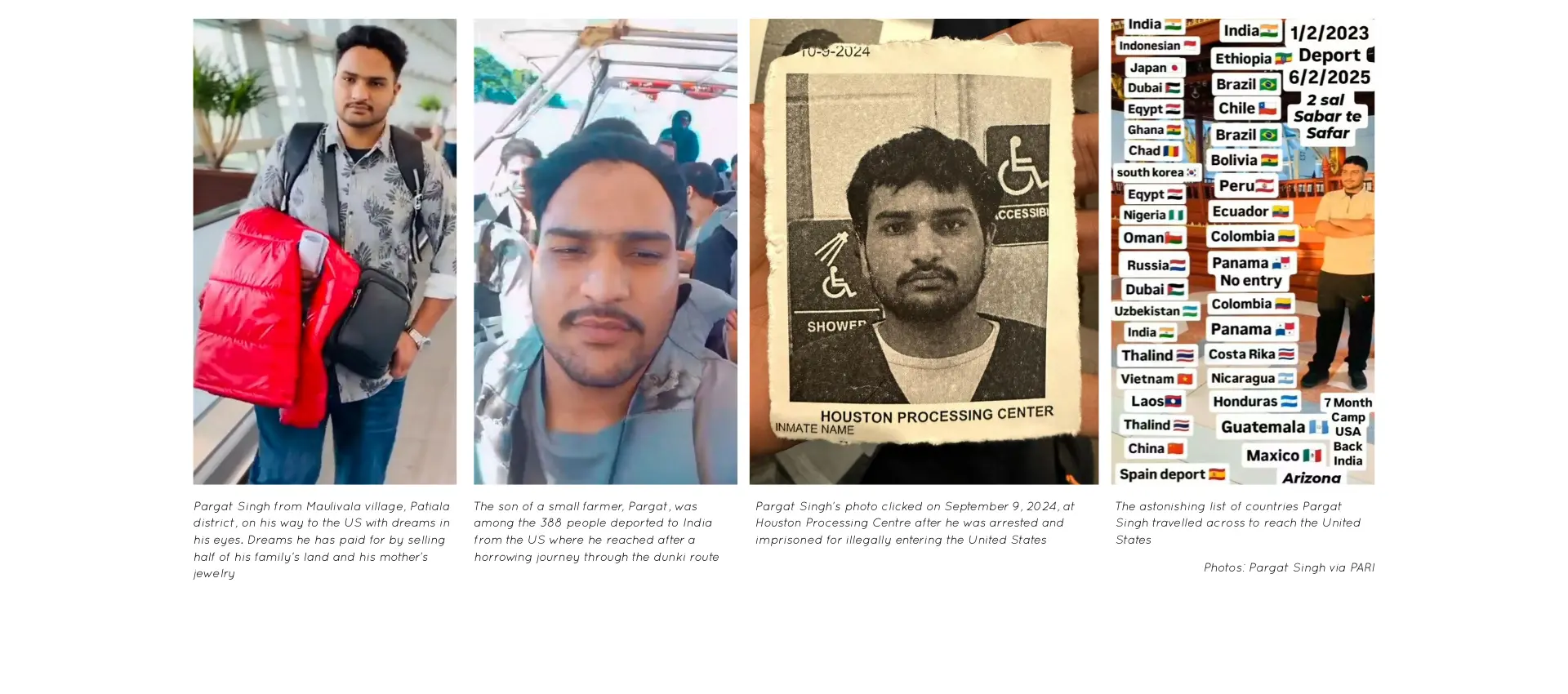
Like Randeep, Pargat Singh, a Jat Sikh and only child of a small farmer from Maulivala village in Patiala district, also wanted to reach the US. Seeing his father, 45-year-old Major Singh, unable to come out of the debt cycle, and noticing him being humiliated in the mandis when trying to get their paddy lifted at the minimum support price (MSP), he decided to move away from agriculture.
After doing a course at an Industrial Training Institute (ITI) in Patran in Patiala district, Pargat started a modern dairy farm. But all his four cows died following the outbreak of Lumpy Skin Disease (a highly contagious viral disease afflicting cattle) in 2022. “The state government promised compensation, but didn’t give us a single paisa,” he says. From that time, he started searching for ways of escaping to Europe or the US. Finally, in June 2024, he left on a long journey — called the dunki route in Punjab — for the US.
“I landed in Brazil,” says Pargat, recounting his epic journey to PARI. “There, donkers [local guides of travel agents who enable people to enter the US illegally] formed an 80-strong group from amongst us. First, we crossed countries like Bolivia, Ecuador, Colombia and Peru on a bus. Then we were pushed to the jungles of Costa Rica, Nicaragua, Honduras and Guatemala. Finally, we entered Mexico. We had trekked five days through the jungle – with just two days rations in hand.
“For the last three days, we survived only on water. Along the way, we were kidnapped by a mafia for 15 days, who demanded money to set us free. They kept on beating us until we paid them their ransom.” Pargat recalls the journey as if it were yesterday.
The moment he entered the US, he was arrested along with the others and confined to a 10×3 feet cell in a Houston jail in Texas. And remained lodged there for six months. On February 10, he was shackled and put on a Delhi-bound flight from New York. But that was not the end of his ordeal, says Pargat ruefully.
“When I landed in Delhi, the immigration officials threatened to send me to Tihar Jail. I broke down and told them: ‘Why don’t you shoot me? I already have had enough.’” The entire trip cost him Rs. 50 lakhs. It was to pay for that trip that Pargat had sold 1.5 acres of his family’s land, the gold ornaments of his 43-year-old mother Simarjit Kaur, and borrowed money from his relatives.
Randeep’s uncle Dharampal says, “It is our poverty that forces us to travel like animals.” Most of those travelling illegally or returning from the US, are marginal farmers. Lakhwinder Singh, 24, an unemployed cousin of Randeep, says “an educated person earns Rs. 10–12,000 here in Punjab. A postgraduate earns Rs. 15,000. What can you do with that? The government has given income tax exemption up to Rs. 12 lakhs. Have you heard of anybody earning one lakh a month? People often blame youngsters for going abroad, but what has the government here offered them?”
It has been eight days since Randeep’s death, but mourners continue to pour into his home. The moment anybody walks in, Balwinder Singh’s eyes look at them with a quiet hope, as if clinging to a fading dream.
The wails get louder. “Oh putt, ikk baari aaja. Ikk baari keh de, ‘Mummy main theek haan. Mera raula jhootha.’ [Son, come back just once. Just once, tell me, ‘Mom, I’m okay. News of my death is untrue’].” Randeep’s 52-year-old mother Gian Kaur wails, unable to talk further – a sound that echoes endlessly. The other women try to console her, but her wails rise with her distress.
As we prepare to leave, Balwinder slowly rises from the sathar. He quietly follows us to the door. With the words dying in his throat, he says, for the last time: “Body lai ke aaun da dekho.” His words seem to have been already lost in the cacophony over ‘illegal immigrants.’


(1) Randeep Singh’s father, daily wage labourer, Balwinder Singh, was devastated by the news of his son’s death. He also found incomprehensible the amount demanded by the Indian Embassy in Cambodia for dispatching the body of his son back home.
(2) Lakhwinder Singh, Randeep Singh’s cousin, says that a government which does little to offer job opportunities to youngsters must not blame youth for risking their lives chasing other options in foreign lands.
(3) Dharampal, Randeep Singh’s paternal uncle, is distraught at his loss and disillusioned by the way agents dupe aspirational young people.
Photos: Vishav Bharti/PARI
Postscript:
Around a month after Randeep’s death, Balwinder Singh’s son came home. Randeep’s body arrived in India and his last rites could finally be conducted at his village on March 19. But it came at a heavy cost — the family paid over Rs. 6 lakhs towards transportation expenses, while being sucked deeper into debt. They have no idea at all of how they will repay that debt.
Pargat, meanwhile, shared videos and photographs with PARI that he had shot during his journey across nine nations shepherded by illegal traffickers. These include a clip of a boat ride during his group’s journey from Colombia to Panama and another of their travel through the jungle in Panama just as they were about to enter Mexico. Also, a few frames of an awful accident they met with in Mexico while being recklessly driven at high-speed to a ‘safe location.’ Many of the group were injured. An earlier deadly accident in Colombia saw the death of two of Pargat’s fellow travellers – but that footage is not included in this video.
It’s a tale of two immigrants – but also of the torment of thousands of others.
रणदीप सिंह इतने भाग्यशाली नहीं थे कि वे अमेरिका से अमृतसर जाने वाली उड़ान संख्या सी-17 में गिरफ़्तार कर लिए जाते और उन्हें हठकड़ी पहनाकर उनकी सीट से बांध दिया जाता. अनजान जगहों पर अनेक मुश्किलों से लगातार 264 दिनों तक लड़ते रहने के बाद आख़िरकार इस साल 21 फरवरी को अमेरिका जाने के कोशिश में कंबोडिया में उनकी मौत हो गई. वे अवैध तरीक़े (डंकी फ्लाईट) से अमेरिका में दाख़िल होने की कोशिश कर रहे थे.
उनकी तुलना में परगट सिंह अधिक ख़ुशक़िस्मत रहे, जिन्होंने विदेश में जीवन के सुखद सपनों के प्रभाव में आकर अपने परिवार की 3 एकड़ ज़मीन में से आधी ज़मीन बेच दी और अपनी मां के ज़्यादातर गहने भी बेच डाले, लेकिन शुक्र था कि उनका यह सपना भारत में उनके निर्वासन के साथ ख़त्म हुआ. वह हथकड़ियों में बंधे घर लौट आए, लेकिन कम से कम अपनी कहानी बताने को जीवित रह गए.
पंजाब के मोहाली ज़िले के शेख़पुरा कलां में रणदीप के घर पर उनके मरने की ख़बर सुनकर सथर (मातमपुर्सी) में आए लोगों की भीड़ उनकी इस दर्द भरी कहानी को मार्मिक ढंग से बयान करती है. दो कमरे के उनके इस छोटे से घर में शव की प्रतीक्षा में बैठे लोगों के लिए पर्याप्त जगह भी नहीं है. बल्कि, उन सबको तो ठीक से यह भी नहीं पता है कि रणदीप का पार्थिव शरीर यहां कब तक पहुंच पाएगा. कम्बोडिया स्थित भारतीय दूतावास ने उनके परिवार से 7,100 अमेरिकी डॉलर का अग्रिम भुगतान करने को कहा है, ताकि पार्थिव शरीर को वापस भेजने का ख़र्च उठाया जा सके.
छह अंकों की यह भारी-भरकम रक़म रणदीप के 55 वर्षीय पिता बलविंदर सिंह की औक़ात से बाहर की बात है. वे एक दिहाड़ी मज़दूर हैं, और जिस दिन उन्हें काम मिल जाता है उस दिन भी वे अधिक से अधिक 500 रुपए ही कमा पाते हैं. उन आगंतुकों को देखकर जिन्हें वे ख़ुद भी नहीं जानते, वे मामूली सी उम्मीद के साथ बस इतना ही कह पाते हैं, “बॉडी लैके औन दा देखो [बॉडी को वापस लाने का कोई उपाय कीजिए].”
गांवों में बढ़ती बेरोज़गारी और अभावों के कारण रणदीप (24) अकेले नहीं थे, जो पंजाब से बाहर जाने के लिए उतावले थे. एक भूमिहीन दलित परिवार में पैदा हुए रणदीप पंजाब के ग्रामीण इलाक़ों में फ़सलों की तबाहियों से जन्मी हताशा, रोज़गार की तंगी, और किसानों की आत्महत्याओं जैसी समस्याओं के बीच पले-बढ़े.
मोहाली ज़िले के शेख़पुरा कलां गांव में रणदीप सिंह के घर का हर कोना गहरे दुख में डूबा है. उनकी मां गियान कौर (बीच में, भूरी प्रिंटेड शॉल में) शोकाकुल हैं. Photo: Vishav Bharti/PARI
लुधियाना स्थित पंजाब कृषि विश्वविद्यालय के एक शोध में यह पाया गया कि वर्ष 2000 से 2015 के बीच राज्य में खेती से जुड़े कुल 16,606 लोगों ने आत्महत्या की, जिनमें क़रीब आधे भूमिहीन दलित खेतिहर मज़दूर थे. इस अवधि के बाद भी सत्ता में आई अलग-अलग सरकारों का ‘पंजाब को कैलीफोर्निया बना देने,’ और ‘राज्य में रोज़गार की बरसात कर देने’ का वायदा भी युवाओं को लुभा नहीं पाया.
इस पीढ़ी के कई लोग जो बेड़ियों में बांधकर अमेरिका द्वारा वापस भेज दिए गए, वे इस कहानी की काली सच्चाई पर मुहर लगाने के लिए काफ़ी हैं. वर्ना वे एक बेहतर ज़िंदगी की तलाश में वहां जाते ही क्यों? इसी साल 13 मार्च को केंद्र सरकार ने संसद में यह कहा कि अमेरिका ने अवैध रूप से रह रहे जिन 388 भारतीयों को वापस भेजा है उनमें से 39.43 फ़ीसदी पंजाब के थे, और 34.02 फ़ीसदी लोग हरियाणा के थे. यह संख्या वापस भेजे गए सभी लोगों का लगभग तीन चौथाई थी. छोटे शहरों में भी विदेश भेजने के धंधे, और इन्टरनेशनल इंग्लिश लैंग्वेज टेस्टिंग सिस्टम (आईईएलटीएस) और टेस्ट ऑफ़ इंग्लिश एज ए फॉरेन लैंग्वेज (टॉफेल) को संचालित करने वाले केंद्रों में आई जबर्दस्त उछाल ने इस मायूस करने वाले सच की तस्दीक़ की है. पंजाब से बाहर निकलना वहां के अधिकतर युवाओं का सबसे बड़ा सपना बन चुका था.
पहले, भारत सरकार ने संसद में यह बात कही थी कि साल 2016 और 2021 के बीच रोज़गार की तलाश में पंजाब से तक़रीबन 5 लाख लोग विदेशों में पलायन कर चुके थे. इसी अवधि में 2.62 लाख छात्रों ने विदेशों में पढ़ने का विकल्प चुना था. इनमें से अधिकतर लोगों के लिए शिक्षा पंजाब से बाहर निकलने का एक बहाना था. पंजाब में आत्महत्याओं के दौर के साथ-साथ एक और दौर शुरू हुआ. यह बड़े पैमाने पर पलायन का दौर था.
रणदीप का सपना था कि वे अपनी बड़ी बहन की शादी कर दें और अपने मां-बाप से कड़ी मेहनत का काम छुड़वाकर उन्हें आराम दे सकें. इसलिए उन्होंने ऊंची ब्याज दर पर न केवल क़र्ज़ लिया, बल्कि अपनी दो भैंसे भी बेच दीं. उन्होंने एक ट्रेवल एजेंट के साथ 42 लाख में बात तय की. एजेंट ने उन्हें ‘भरोसा’ दिलाया कि वे उन्हें कनाडा के रास्ते से अमेरिका ले जाएगा. इस आश्वासन के बाद रणदीप 1 जून, 2024 को घर से निकल पड़े. परिवार वाले बताते हैं कि उन्होंने ट्रेवल एजेंट को 25 लाख रुपए का भुगतान कर दिया था.
लेकिन एजेंट उन्हें कनाडा की जगह कंबोडिया ले गया, जहां 21 फरवरी को एक अस्पताल में संदिग्ध अवस्था में उनकी मौत हो गई. “एजेंट ने हमें धोखा दिया था. उनके लिए बच्चे तो बलि के बकरे होते हैं,” रिश्ते में रणदीप के चाचा लगने वाले धरमपाल कहते हैं. वे एक टैक्सी ड्राईवर हैं. यहां पलायन की दौड़ में शामिल युवाओं के लिए यह एक सामान्य बात है. तीस से लेकर 50 लाख रुपए तक ख़र्च करने के बाद उनमें से कईयों का यह सफ़र किसी न किसी बाधा के कारण ख़त्म हो जाता है. ऐसे युवाओं की कमी नहीं है जिनकी यात्रा भूमध्य सागर में ड़ूबने, या पनामा के जंगलों में भटकने, या अमेरिका की जेलों में समाप्त होती है.
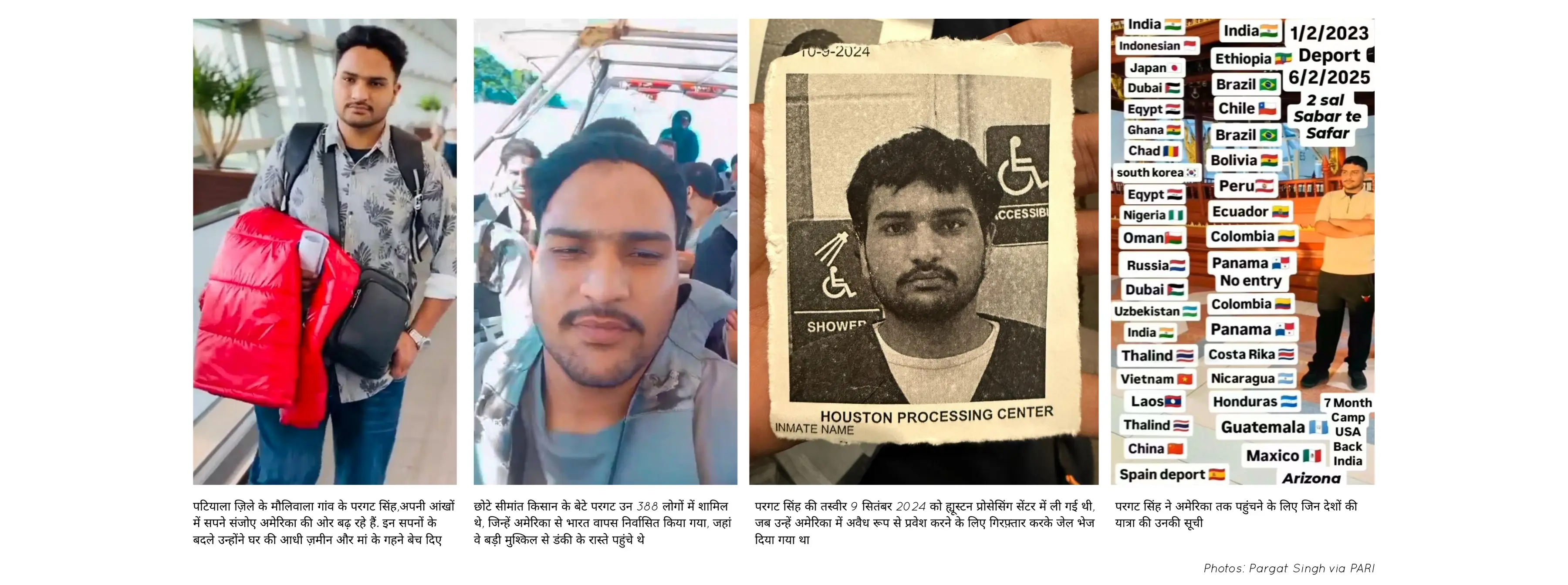
रणदीप की तरह परगट सिंह – जो एक जाट सिख हैं और पटियाला ज़िले में मौलिवाला गांव के एक छोटे से किसान के इकलौते पुत्र – भी अमेरिका जाना चाहते थे. अपने 45 वर्षीय पिता मेजर सिंह को क़र्ज़ के घेरे से बाहर निकलने में नाकाम होता देखकर, और मंडियों में अपने धान की फ़सल को न्यूनतम समर्थन मूल्य (एमएसपी) पर बेचने की कोशिश में अपमानित होता देखकर उन्होंने खेती के कामों से दूर रहने का फ़ैसला लिया.
पटियाला ज़िला में पटरान के इंडस्ट्रियल ट्रेनिंग इंस्टीट्यूट (आईटीआई) में एक कोर्स करने के बाद परगट ने एक आधुनिक डेरी फार्म का काम शुरू किया. लेकिन वर्ष 2022 में लंपी स्किन डिजीज (मवेशियों को होने वाली एक भयानक संक्रामक वायरल बीमारी) से संक्रमित होकर उनकी चारों गाएं मर गईं. “राज्य सरकार ने मुआवज़ा देने का वायदा किया था, लेकिन हमें एक पाई भी नहीं दी गई,” वे कहते हैं. उसी समय से वे यूरोप या अमेरिका पलायन करने की बात सोचने लगे. आख़िरकार जून 2024 में वे अमेरिका के लिए अपने सफ़र पर निकल पड़े, जिसे पंजाब में डंकी रूट कहा जाता है.
“मैं ब्राज़ील पहुंचा,” अपनी उस यात्रा को याद करते हुए परगट पारी को बताते हैं. “वहां डंकरों [ट्रेवल एजेंट के स्थानीय गाइड जो लोगों को ग़ैरक़ानूनी तरीक़े से अमेरिका में दाख़िल होने में मदद करते हैं] ने हममें से 80 लोगों का एक ग्रुप बनाया. सबसे पहले हमने बस पर सवार होकर बोलिविया, इक्वाडोर, कोलंबिया और पेरू जैसे देशों को पार किया. उसके बाद हमें कोस्टारीका, निकारागुआ, हौंडूरस और ग्वाटेमाला के जंगलों में छोड़ दिया गया. आख़िरकर हम मैक्सिको पहुंच गए. हम पांच दिनों तक जंगल में सफ़र करते रहे, लेकिन हमारे साथ सिर्फ़ दो दिनों की रसद थी.
“आख़िर के तीन दिन हम सिर्फ़ पानी पीकर ज़िंदा रहे. रास्ते में एक माफ़िया गिरोह ने हमें अगवा कर लिया और 15 दिनों तक बंधक बनाए रखा. उन्होंने हमें आज़ाद छोड़ने के लिए पैसों की मांग की. वे तब तक हमारी पिटाई करते रहे, जब तक हमने उनको फिरौती नहीं चुका दी.” यादों में डूबे परगट ने हमें इस तरह से यह वाक़या सुनाया जैसे यह कल की ही बात रही हो.
जैसे ही उन्होंने अमेरिका में पांव रखा, अन्य लोगों के साथ गिरफ़्तार कर लिया गया और टेक्सस के ह्यूस्टन जेल की एक 10X3 फीट की सेल में डाल दिया गया. जेल में उन्हें छह महीने बंद रहना पड़ा. बीते 10 फ़रवरी को उनके हाथ और पैरों को ज़ंजीर से बांधकर न्यूयॉर्क से दिल्ली जाने वाले एक जहाज़ में डाल दिया गया. लेकिन उनकी अग्नि परीक्षा अभी पूरी नहीं हुई थी, परगट उदास लहज़े में बताते हैं.
“जब मैं दिल्ली उतरा, तो इमीग्रेशन अधिकारियों ने मुझे तिहाड़ जेल भेज देने की धमकी दी. मैंने उन्हें रोते हुए कहा, ‘आप मुझे गोली क्यों नहीं मार देते? मैं पहले से आधा मरा हुआ हूं’.” इस पूरी ट्रिप में उनके 50 लाख रुपए ख़र्च हो चुके थे. अमेरिका जाने के लिए परगट ने अपने परिवार की 1.5 एकड़ ज़मीन और अपनी मां सिमरजीत कौर (43) के सोने के गहने बेच डाले थे, और बाक़ी पैसे अपने रिश्तेदारों से उधार लिए थे.
रणदीप के चाचा धरमपाल कहते हैं, “अपनी ग़रीबी के हाथों मजबूर होकर ही हमें जानवरों की तरह सफ़र करना पड़ता है.” ग़ैरक़ानूनी तौर पर यात्रा करने या अमेरिका से लौटने वाले अधिकतर लोग छोटे किसान होते हैं. रणदीप के बेरोज़गार चचेरे भाई 24 वर्षीय लखविंदर सिंह कहते हैं, “पंजाब में एक पढ़ा-लिखा आदमी 10 से 12 हज़ार रुपए कमाता है. एक एमए पास आदमी 15,000 रुपए कमाता है. इतने कम पैसों में आप कैसे गुज़ारा कर सकते हैं? सरकार ने आयकर की सीमा बढ़ाकर 12 लाख कर दी है. आपको कोई ऐसा आदमी मिला जो हर महीने एक लाख रुपए कमाता है? लोग युवाओं को दोष देते हैं कि वे देश छोड़कर बाहर जा रहे हैं, लेकिन सवाल यह उठता है कि सरकार के पास उनको देने के लिए क्या है?”
रणदीप की मौत के आठ दिन गुज़र चुके हैं, लेकिन उनके घर शोक प्रकट करने वाले लोग अब भी लगातार आ रहे हैं. जैसे ही कोई आदमी भीतर प्रवेश करता हैं, बलविंदर बुझती उम्मीद के साथ उसकी ओर देखने लगते हैं. उनकी आंखों का सपना अब मुरझाने लगा है.
भीतर से रोने की आवाज़ तेज़ हो जाती है, “ओह पुत्त, इक्क बारी आजा. इक्क बारी कह दे, ‘मम्मी मैं ठीक हां. मेरा रौला झूठा.’ [बेटा, एक बार आ जाओ. एक बार बस ये कह दो, ‘मम्मी, मैं ठीक हूं. मेरे मरने की ख़बर झूठी है].” यह रुलाई रणदीप की 52 वर्षीय मां गियान कौर की है. वे आगे कुछ बोलने की हालत में नहीं हैं. लेकिन चुप हो जाने के बाद भी उनकी रुलाई की आवाज़ सन्नाटे में गूंजती हुई महसूस होती है. दूसरी महिलाएं उन्हें सांत्वना देने की कोशिश कर रही है, लेकिन उनकी रुलाई दोबारा फूट पड़ती है.
जब हम निकलने को होते हैं, बलविंदर धीरे से सथर से उठते हैं. वे हमारे पीछे-पीछे दरवाज़े तक आते है. रुंधे हुए गले से वे अंतिम बार कहते हैं, “बॉडी लैके औण दा देखो.” उनकी आवाज़ पहले ही ‘अवैध घुसपैठिए’ के कोलाहल में डूब गई महसूस होती है.
(1) रणदीप सिंह के पिता और दिहाड़ी मज़दूर बलविंदर सिंह, अपने बेटे की मृत्यु की ख़बर से पूरी तरह टूट गए थे. उन्हें नहीं समझ आया कि कंबोडिया में भारतीय दूतावास ने उनके बेटे का शव वापस भेजने के लिए इतने ज़्यादा पैसे क्यों मांगे.
(2) रणदीप सिंह के चचेरे भाई लखविंदर सिंह कहते हैं कि लोग युवाओं को दोष देते हैं कि वे जान जोखिम में डाल देश छोड़कर बाहर जा रहे हैं, लेकिन सवाल यह उठता है कि सरकार के पास उनको देने के लिए क्या है.
(3) रणदीप सिंह के चाचा धरमपाल मौत की ख़बर से व्यथित नज़र आते हैं और इस बात से निराश हैं कि एजेंट कैसे महत्वाकांक्षी युवाओं को ठगते हैं.
Photos: Vishav Bharti via PARI
पुनश्च:
रणदीप की मौत के लगभग महीने भर बाद बलविंदर सिंह का बेटा घर लौटा. रणदीप का पार्थिव शरीर भारत आया और आख़िरकर 19 मार्च को उनकी अंत्येष्टि उनके गांव में कर दी गई. लेकिन इसके लिए घरवालों को बड़ी क़ीमत चुकानी पड़ी. परिवहन ख़र्च के रूप में उनके परिवार को 6 लाख रुपए चुकाने पड़े, जबकि वे पहले से ही भारी क़र्ज़ के बोझ में थे. उन्हें नहीं पता है कि यह क़र्ज़ वे किस तरह चुकाएंगे.
इस बीच परगट ने पारी के साथ उन वीडियो और तस्वीरों को साझा किया, जिन्हें उन्होंने अपने सफ़र के दौरान उन नौ देशों में शूट किया था जहां-जहां उन्हें लेकर मानव तस्कर गए थे. इनमें वह क्लिप भी शामिल है जिसे एक नाव से कोलंबिया से पनामा जाने के क्रम में बनाया गया था. दूसरी क्लिप पनामा के जंगलों को पार कर मैक्सिको पहुंचने के ठीक पहले की है. इनमें एक क्लिप उस ख़तरनाक दुर्घटना की भी है जो मैक्सिको में ‘सुरक्षित जगह’ तक पहुंचने के लिए तेज़ रफ्तार से ड्राइविंग करने के कारण घटी थी. इसमें बहुत से लोग ज़ख़्मी हो गए थे. इससे पहले कोलंबिया में हुई एक दुर्घटना में परगट के दो सहयात्रियों की मृत्यु हो गई थी – लेकिन उस फुटेज को इस वीडियो में शामिल नहीं किया गया है.
यह दो अप्रवासियों की कहानी है, लेकिन हज़ारों लोगों की मुश्किलों को भी बयान करती है.
ਰਣਦੀਪ ਸਿੰਘ ਇੰਨਾ ਵੀ ਖੁਸ਼ਕਿਸਮਤ ਨਹੀਂ ਸੀ ਕਿ ਉਸ ਨੂੰ ਗ੍ਰਿਫ਼ਤਾਰ ਕਰਕੇ, ਹਥਕੜੀਆਂ ਲਾ ਕੇ ਅਮਰੀਕਾ ਤੋਂ ਅੰਮ੍ਰਿਤਸਰ ਆਉਣ ਵਾਲ਼ੀ ਸੀ-17 ਉਡਾਨ ਰਾਹੀਂ ਲਿਆਂਦਾ ਜਾਂਦਾ। ਬਿਗਾਨੀ ਧਰਤੀ ’ਤੇ 264 ਦਿਨ ਜ਼ਿੰਦਗੀ ਲਈ ਲੜਦੇ ਹੋਏ ਇਸ ਸਾਲ 21 ਫਰਵਰੀ ਨੂੰ ਡੌਂਕੀ ਰਸਤੇ ਅਮਰੀਕਾ ਜਾਂਦੇ ਹੋਏ ਕੰਬੋਡੀਆਂ ਵਿੱਚ ਉਸ ਨੇ ਆਪਣੇ ਸਾਹਾਂ ਦਾ ਸਫ਼ਰ ਮੁਕਾ ਲਿਆ।
ਤੁਸੀਂ ਕਹਿ ਸਕਦੇ ਹੋ ਕਿ ਪਰਗਟ ਸਿੰਘ ਖੁਸ਼ਕਿਸਮਤ ਸੀ। ਵਿਦੇਸ਼ੀ ਸੁਪਨਿਆਂ ਦਾ ਠੱਗਿਆ ਹੋਇਆ ਇੱਕ ਹੋਰ ਪੰਜਾਬੀ ਜਿਸਦਾ ਅਮਰੀਕਾ ਜਾਣ ਦਾ ਸਫ਼ਰ ਆਪਣੇ ਪਰਿਵਾਰ ਦੀ ਤਿੰਨ ਏਕੜ ਜ਼ਮੀਨ ਦਾ ਅੱਧਾ ਹਿੱਸਾ ਅਤੇ ਆਪਣੀ ਮਾਂ ਦੇ ਲਗਭਗ ਸਾਰੇ ਗਹਿਣੇ ਵੇਚਣ ਨਾਲ਼ ਸ਼ੁਰੂ ਹੋਇਆ- ਅਤੇ ਭਾਰਤ ਡਿਪੋਰਟ ਹੋਣ ਨਾਲ਼ ਹੀ ਖ਼ਤਮ ਵੀ ਹੋ ਗਿਆ। ਬਹੁਤ ਦੁਖਦ ਹੈ ਇਹ ਕਹਿਣਾ ਕਿ ਹਥਕੜੀਆਂ ਵਿੱਚ ਜਕੜਿਆ ਪਰਗਟ ਸਿੰਘ ਘਰ ਪਹੁੰਚਿਆ; ਪਰ ਘੱਟੋ-ਘੱਟ ਆਪਣੀ ਕਹਾਣੀ ਸੁਣਾਉਣ ਲਈ ਜਿਉਂਦਾ ਤਾਂ ਰਿਹਾ।
ਪੰਜਾਬ ਦੇ ਮੁਹਾਲੀ ਜ਼ਿਲ੍ਹੇ ਵਿੱਚ ਪੈਂਦੇ ਸ਼ੇਖਪੁਰਾ ਕਲਾਂ ਵਿੱਚ ਰਣਦੀਪ ਦੇ ਘਰ ਵਿਛਿਆ ਸੱਥਰ (ਪਰਿਵਾਰ ਵਿੱਚ ਮੌਤ ਤੋਂ ਬਾਅਦ ਹੇਠਾਂ ਬੈਠਣ ਵਾਲ਼ੀ ਰਸਮ) ਉਸਦੀ ਵਲੂੰਧ ਕੇ ਰੱਖ ਵਾਲ਼ੀ ਕਹਾਣੀ ਦੀ ਗਵਾਹੀ ਭਰਦਾ ਹੈ। ਦੋ ਕਮਰਿਆਂ ਦੇ ਘਰ ਵਿੱਚ ਇੰਨੀ ਵੀ ਥਾਂ ਨਹੀਂ ਕਿ ਅਫ਼ਸੋਸ ਕਰਨ ਵਾਲ਼ੇ ਲੋਕਾਂ ਨੂੰ ਆਪਣੇ ਅੰਦਰ ਸਮਾ ਸਕੇ। ਪਰ ਇਹ ਕੰਮ ਛੇਤੀ ਹੋਣ ਵਾਲ਼ਾ ਨਹੀਂ ਜਾਪਦਾ। ਮ੍ਰਿਤ ਸਰੀਰ ਨੂੰ ਘਰ ਵਾਪਸ ਪਹੁੰਚਾਉਣ ਲਈ ਹੋਣ ਵਾਲ਼ੇ ਖਰਚੇ ਦੀ ਪੂਰਤੀ ਲਈ ਕੰਬੋਡੀਆ ਸਥਿਤ ਭਾਰਤੀ ਦੂਤਾਵਾਸ ਨੇ 7,100 ਅਮਰੀਕੀ ਡਾਲਰਾਂ (ਲਗਭਗ 6,21,000 ਰੁਪਏ) ਦੀ ਪੇਸ਼ਗੀ ਮੰਗ ਕੀਤੀ ਹੈ।
ਛੇ ਅੰਕਾਂ ਦੀ ਇਹ ਰਕਮ ਰਣਦੀਪ ਦੇ ਪਿਤਾ, ਬਲਵਿੰਦਰ ਸਿੰਘ (55) ਦੀ ਸਮਰੱਥਾ ਤੇ ਸਮਝ ਦੋਵਾਂ ਤੋਂ ਹੀ ਬਾਹਰ ਹੈ ਜੋ ਕਿ ਇੱਕ ਦਿਹਾੜੀਦਾਰ ਮਜ਼ਦੂਰ ਹਨ ਅਤੇ 500 ਰੁਪਏ ਦਿਹਾੜੀ ਕਮਾਉਂਦੇਂ ਹਨ, ਉਹ ਵੀ ਉਦੋਂ ਜਦੋਂ ਉਹਨਾਂ ਨੂੰ ਕੋਈ ਕੰਮ ਮਿਲ਼ ਜਾਵੇ। ਸੋਗ ਮਨਾਉਣ ਆਉਣ ਵਾਲ਼ੇ ਨੂੰ ਉਹ ਜਾਣਦੇ ਹੋਣ ਭਾਵੇਂ ਨਾ, ਬਲਵਿੰਦਰ ਸਿੰਘ ਹਰ ਵਿਅਕਤੀ ਵੱਲ ਇਸੇ ਉਮੀਦ ਨਾਲ਼ ਦੇਖਦੇ ਹਨ ਅਤੇ ਮਸਾਂ ਸੁਣੀਂਦੀ ਅਵਾਜ਼ ਵਿੱਚ ਕਹਿੰਦੇ ਹਨ,“ਬੋਡੀ ਲੈ ਕੇ ਆਉਣ ਦਾ ਦੇਖੋ।”
ਪੇਂਡੂ ਇਲਾਕਿਆਂ ਵਿੱਚ ਬੇਰੁਜ਼ਗਾਰੀ ਅਤੇ ਖੇਤੀਬਾੜੀ ਸੰਕਟ ਨੂੰ ਦੇਖਦੇ ਹੋਏ ਸਿਰਫ਼ ਰਣਦੀਪ ਹੀ ਇਕੱਲਾ ਨਹੀਂ ਸੀ ਜੋ ਪੰਜਾਬ ਨੂੰ ਛੱਡ ਜਾਣ ਬਾਰੇ ਸੋਚ ਰਿਹਾ ਸੀ। ਇੱਕ ਬੇਜ਼ਮੀਨੇ ਦਲਿਤ ਪਰਿਵਾਰ ਵਿੱਚ ਪੈਦਾ ਹੋਏ ਰਣਦੀਪ ਦਾ ਬਚਪਨ ਨਿਰਾਸ਼ਾ ਵਿਚਾਲ਼ੇ ਬੀਤਿਆ, ਇਹ ਉਹ ਸਮਾਂ ਸੀ ਜਦੋਂ ਪੰਜਾਬ ਫ਼ਸਲ ਦੀ ਤਬਾਹੀ-ਬਰਬਾਦੀ, ਬੇਰੁਜ਼ਗਾਰੀ ਅਤੇ ਖ਼ੁਦਕੁਸ਼ੀਆਂ ਦੀਆਂ ਸਮੱਸਿਆਵਾਂ ਨਾਲ਼ ਘਿਰਿਆ ਹੋਇਆ ਸੀ।
Iਮੁਹਾਲੀ ਜ਼ਿਲ੍ਹੇ ਦੇ ਸ਼ੇਖਪੁਰਾ ਕਲਾਂ ਪਿੰਡ ਵਿਚਲੇ ਰਣਦੀਪ ਸਿੰਘ ਦੇ ਘਰ ਦਾ ਹਰ ਕੋਨਾ ਦੁੱਖ ਨਾਲ਼ ਭਰਿਆ ਪਿਆ ਹੈ। ਉਸਦੀ ਮਾਤਾ ਗਿਆਨ ਕੌਰ (ਵਿਚਕਾਰ, ਪਰਿੰਟਡ ਸ਼ਾਲ ਲਏ ਹੋਏ) ਪੂਰੀ ਤਰ੍ਹਾਂ ਟੁੱਟ ਗਏ ਜਾਪਦੇ ਹਨ । Photo: Vishav Bharti/PARI
ਪੰਜਾਬ ਖੇਤੀਬਾੜੀ ਯੂਨੀਵਰਸਿਟੀ, ਲੁਧਿਆਣਾ ਦੇ ਇੱਕ ਅਧਿਐਨ ਅਨੁਸਾਰ ਰਾਜ ਵਿੱਚ 2000 ਤੋਂ 2015 ਤੱਕ 16,606 ਕਿਸਾਨ ਖ਼ੁਦਕੁਸ਼ੀਆਂ ਦਰਜ ਕੀਤੀਆਂ ਗਈਆਂ ਹਨ।ਇਹਨਾਂ ਵਿੱਚੋਂ ਅੱਧੀਆਂ ਬੇਜ਼ਮੀਨੇ ਦਲਿਤ ਖੇਤ ਮਜ਼ਦੂਰਾਂ ਵੱਲੋਂ ਕੀਤੀਆ ਗਈਆਂ ਇਸ ਤੋਂ ਬਾਅਦ ਵੀ ਆਉਣ ਵਾਲ਼ੀਆਂ ਸਰਕਾਰਾਂ ਦੇ ਦਾਅਵੇ ਕਿ ‘ਪੰਜਾਬ ਨੂੰ ਕੈਲੀਫੋਰਨੀਆਂ
ਬਣਾ ਦਿਆਂਗੇ’ ਜਾਂ ਰੁਜ਼ਗਾਰ ਦੀ ਇੰਨੀ ਭਰਮਾਰ ਕਰ ਦਿਆਂਗੇ ਕਿ ਵਿਦੇਸ਼ੀ ਵੀ ਇੱਥੇ ਨੌਕਰੀ ਕਰਨ ਆਇਆ ਕਰਨਗੇ, ਨੌਜਵਾਨਾਂ ਨੂੰ ਪ੍ਰਭਾਵਤ ਨਾ ਕਰ ਸਕੇ।
ਧਿਆਨ ਰਹੇ ਅਮਰੀਕਾ ਤੋਂ ਜ਼ੰਜੀਰਾਂ ਵਿੱਚ ਜਕੜੇ ਇਨ੍ਹਾਂ ਨੌਜਵਾਨਾਂ ਦਾ ਵਾਪਸ ਆਉਣਾ ਇਸੇ ਗੱਲ ‘ਤੇ ਮੋਹਰ ਲਾਉਂਦਾ ਹੈ ਨਹੀਂ ਤਾਂ ਉਹ ਇੱਕ ਬਿਹਤਰ ਜ਼ਿੰਦਗੀ ਦੀ ਭਾਲ਼ ਵਿੱਚ ਉੱਥੇ ਕਿਉਂ ਜਾਂਦੇ? ਇਸ ਸਾਲ ਮਾਰਚ 13 ਨੂੰ ਕੇਂਦਰ ਸਰਕਾਰ ਨੇ ਸੰਸਦ ਵਿੱਚ ਦੱਸਿਆ ਕਿ ਅਮਰੀਕਾ ਤੋਂ ਭਾਰਤ ਭੇਜੇ ਗਏ 388 ਲੋਕਾਂ ਵਿੱਚੋਂ 39.43 ਪ੍ਰਤੀਸ਼ਤ ਪੰਜਾਬ ਤੋਂ ਅਤੇ 34.02 ਪ੍ਰਤੀਸ਼ਤ ਹਰਿਆਣੇ ਤੋਂ ਸਨ। ਜੋ ਕੁੱਲ ਗਿਣਤੀ ਦਾ ਲਗਭਗ ਤਿੰਨ-ਚੋਥਾਈ ਹਿੱਸਾ ਬਣਦਾ ਹੈ। ਛੋਟੇ ਕਸਬਿਆਂ ਵਿੱਚ ਵੀ International English Language Testing System (IELTS) ਅਤੇ Test of English as Foreign Language (TOEFL) ਚਲਾ ਰਹੇ ਕੇਂਦਰਾਂ ਦੇ ਇਮੀਗ੍ਰੇਸ਼ਨ ਕਾਰੋਬਾਰ ਦਾ ਉਛਾਲ਼ ਇਸੇ ਦੁਖਦਾਈ ਸੱਚਾਈ ਨੂੰ ਹੀ ਬਿਆਨ ਕਰਦਾ ਹੈ।
ਇਸ ਤੋਂ ਪਹਿਲਾਂ ਭਾਰਤ ਸਰਕਾਰ ਨੇ ਸੰਸਦ ਵਿੱਚ ਕਿਹਾ ਸੀ ਕਿ 2016 ਤੋਂ 2021 ਵਿਚਕਾਰ ਲਗਭਗ ਪੰਜ ਲੱਖ ਲੋਕ ਰੁਜ਼ਗਾਰ ਲਈ ਪੰਜਾਬ ਤੋਂ ਵਿਦੇਸ਼ ਚਲੇ ਗਏ ਸਨ। ਇਸ ਸਮੇਂ ਦੌਰਾਨ 2.62 ਫੀਸਦੀ ਵਿਦਿਆਰਥੀਆਂ ਨੇ ਵਿਦੇਸ਼ ਵਿੱਚ ਪੜ੍ਹਾਈ ਕਰਨ ਦੀ ਚੋਣ ਕੀਤੀ ਸੀ, ਜਿਨ੍ਹਾਂ ਵਿੱਚੋਂ ਜ਼ਿਆਦਾਤਰ ਲਈ ਪੜ੍ਹਾਈ ਸਿਰਫ਼ ਪੰਜਾਬ ਤੋਂ ਨਿਕਲ਼ਣ ਦਾ ਇੱਕ ਰਸਤਾ ਮਾਤਰ ਸੀ। ਖ਼ੁਦਕੁਸ਼ੀਆਂ ਦੇ ਹੜ੍ਹ ਤੋਂ ਬਾਅਦ ਇੱਕ ਹੋਰ ਲਹਿਰ ਉੱਠੀ: ਇੱਕ ਸਮੂਹਿਕ ਪਰਵਾਸ ਦੀ ਲਹਿਰ।
ਰਣਦੀਪ ਦਾ ਸੁਪਨਾ ਸੀ ਕਿ ਉਹ ਆਪਣੀ ਵੱਡੀ ਭੈਣ ਦਾ ਵਿਆਹ ਕਰੇ ਅਤੇ ਆਪਣੇ ਮਾਤਾ-ਪਿਤਾ ਨੂੰ ਮਜ਼ਦੂਰੀ ਤੋਂ ਮੁਕਤ ਕਰੇ। ਸੋ ਉਹਨੇ ਉੱਚ ਵਿਆਜ ’ਤੇ ਕਰਜਾ ਚੁੱਕਣ ਅਤੇ ਦੋ ਮੱਝਾਂ ਵੇਚਣ ਦਾ ਫ਼ੈਸਲਾ ਕੀਤਾ ਤੇ ਟ੍ਰੈਵਲ ਏਜੰਟ ਨਾਲ਼ 42 ਲੱਖ ਰੁਪਏ ਵਿੱਚ ਸੌਦਾ ਮਾਰ ਲਿਆ। ਉਸ ਏਜੰਟ ਨੇ ‘ਗਰੰਟੀ’ ਦਿੱਤੀ ਕਿ ਉਹ ਉਸਨੂੰ ਕੈਨੇਡਾ ਦੇ ਰਸਤੇ ਅਮਰੀਕਾ ਲੈ ਜਾਵੇਗਾ। ਇਸੇ ਭਰੋਸੇ ਆਸਰੇ ਰਣਦੀਪ 1 ਜੂਨ, 2024 ਨੂੰ ਘਰੋਂ ਚੱਲ ਪਿਆ। ਪਰਿਵਾਰ ਦਾ ਕਹਿਣਾ ਹੈ ਕਿ ਉਹਨਾਂ ਨੇ ਏਜੰਟ ਨੂੰ 25 ਲੱਖ ਰੁਪਏ ਦਿੱਤੇ ਸਨ।
ਪਰ ਉਹ ਏਜੰਟ ਉਸਨੂੰ ਕੰਬੋਡੀਆ ਲੈ ਗਿਆ, ਜਿੱਥੇ 21 ਫਰਵਰੀ ਨੂੰ ਇੱਕ ਹਸਪਤਾਲ ਵਿੱਚ ਭੇਤਭਰੀ ਹਾਲਤ ਵਿੱਚ ਉਸਦੀ ਮੌਤ ਹੋ ਗਈ। “ਏਜੰਟ ਨੇ ਸਾਡੇ ਨਾਲ਼ ਧੋਖਾ ਕੀਤਾ। ਬੱਚੇ ਉਹਨਾਂ ਲਈ ਸਿਰਫ਼ ਬਲ਼ੀ ਦਾ ਬੱਕਰਾ ਹੀ ਨੇ। ਹੁਣ ਸਾਨੂੰ ਉਸਦੀ ਮ੍ਰਿਤਕ ਦੇਹ ਹੀ ਵਾਪਸ ਮਿਲ਼ੇਗੀ ਉਹ ਨਹੀਂ,” ਰਣਦੀਪ ਦੇ ਚਾਚਾ ਧਰਮਪਾਲ ਕਹਿੰਦੇ ਹਨ ਜੋ ਇੱਕ ਟੈਕਸੀ ਡਰਾਇਵਰ ਹਨ। ਇੱਥੇ ਜ਼ਿਆਦਾਤਰ ਨੌਜਵਾਨਾਂ ਦੀ ਇਹੋ ਕਹਾਣੀ ਹੈ ਜਿਹੜੇ ਇਮੀਗ੍ਰੇਸ਼ਨ ਦੇ ਜਾਲ਼ ਵਿੱਚ ਜਾ ਫਸਦੇ ਹਨ। 30 ਤੋਂ 40 ਲੱਖ ਰੁਪਏ ਲਾ ਕੇ ਵੀ ਉਹਨਾਂ ਵਿੱਚੋਂ ਬਹੁਤਿਆਂ ਦਾ ਸਫ਼ਰ ਅੱਧ ਵਿਚਾਲ਼ੇ ਦਮ ਤੋੜ ਦਿੰਦਾ ਹੈ, ਕਈ ਵਾਰੀਂ ਭੂਮੱਧ ਸਾਗਰ ਵਿੱਚ ਡੁੱਬਣ ਨਾਲ਼ ਜਾਂ ਪਨਾਮਾ ਦੇ ਜੰਗਲਾਂ ਵਿੱਚ ਮਾਰੇ-ਮਾਰੇ ਫਿਰਨ ਨਾਲ਼ ਵੀ ਮੁੱਕ ਜਾਂਦਾ ਹੈ ਤੇ ਕਈ ਵਾਰੀਂ ਇਹੀ ਸਫ਼ਰ ਉਨ੍ਹਾਂ ਨੂੰ ਅਮਰੀਕਾ ਦੀਆਂ ਜੇਲ੍ਹਾਂ ਤੱਕ ਲੈ ਜਾਂਦਾ ਹੈ।
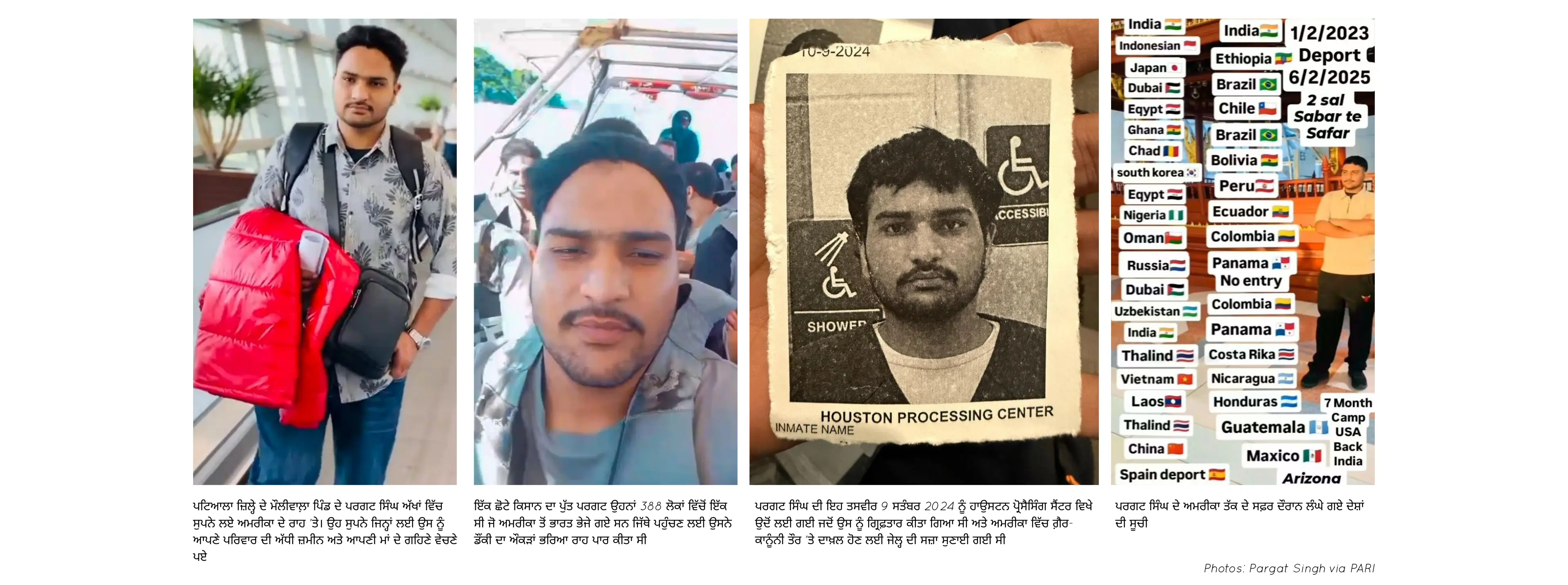
ਰਣਦੀਪ ਵਾਂਗ, ਪਰਗਟ ਸਿੰਘ ਜੋ ਪਟਿਆਲਾ ਜ਼ਿਲ੍ਹੇ ਦੇ ਮੌਲੀਵਾਲ਼ਾ ਪਿੰਡ ਦੇ ਇੱਕ ਜੱਟ ਸਿੱਖ ਪਰਿਵਾਰ ਨਾਲ਼ ਸਬੰਧਤ ਇੱਕ ਛੋਟੇ ਕਿਸਾਨ ਦਾ ਇਕਲੌਤਾ ਪੁੱਤ ਹੈ, ਹਰ ਹੀਲੇ ਅਮਰੀਕਾ ਪਹੁੰਚਣਾ ਚਾਹੁੰਦਾ ਸੀ। ਉਹਨੇ ਬਚਪਨ ਤੋਂ ਹੀ ਪਿਤਾ, 45 ਸਾਲਾ ਮੇਜਰ ਸਿੰਘ ਨੂੰ ਕਰਜੇ ਹੇਠ ਪਿਸਦੇ ਦੇਖਿਆ, ਘੱਟੋ-ਘੱਟ ਸਮਰਥਨ ਮੁੱਲ (MSP) ’ਤੇ ਆਪਣਾ ਝੋਨਾ ਚੁਕਾਉਣ ਲਈ ਮੰਡੀਆਂ ਵਿੱਚ ਅਪਮਾਨਤ ਹੁੰਦੇ ਦੇਖਿਆ, ਇਹ ਸਭ ਦੇਖ ਕੇ ਉਸਦਾ ਮਨ ਖੱਟਾ ਹੋ ਗਿਆ ਤੇ ਉਹਨੇ ਖੇਤੀਬਾੜੀ ਤੋਂ ਦੂਰ ਜਾਣ ਦਾ ਫ਼ੈਸਲਾ ਕੀਤਾ।
ਪਟਿਆਲਾ ਜ਼ਿਲ੍ਹੇ ਦੇ ਪਾਤੜਾਂ ਵਿੱਚ ਇੱਕ ਉਦਯੋਗਿਕ ਸਿਖਲਾਈ ਸੰਸਥਾ (ITI) ਵਿੱਚ ਕੋਰਸ ਕਰਨ ਤੋਂ ਬਾਅਦ ਪਰਗਟ ਨੇ ਇੱਕ ਆਧੁਨਿਕ ਡੇਅਰੀ ਫਾਰਮ ਸ਼ੁਰੂ ਕੀਤਾ। ਪਰ 2022 ਵਿੱਚ ਲੰਪੀ ਸਕਿਨ ਡਿਸੀਜ਼ (ਪਸ਼ੂਆਂ ਨੂੰ ਪ੍ਰਭਾਵਿਤ ਕਰਨ ਵਾਲ਼ੀ ਭਿਆਨਕ ਛੂਤ ਦੀ (ਵਾਇਰਲ) ਬਿਮਾਰੀ, ਫੈਲਣ ਤੋਂ ਬਾਅਦ ਉਸਦੀਆਂ ਚਾਰ ਗਾਵਾਂ ਦੀ ਮੌਤ ਹੋ ਗਈ। “ਰਾਜ ਸਰਕਾਰ ਨੇ ਮੁਆਵਜ਼ਾ ਦੇਣ ਦਾ ਵਾਅਦਾ ਕੀਤਾ ਸੀ, ਪਰ ਸਾਨੂੰ ਇੱਕ ਵੀ ਪੈਸਾ ਨਹੀਂ ਮਿਲ਼ਿਆ,” ਉਸ ਨੇ ਦੱਸਿਆ। ਉਸ ਸਮੇਂ ਤੋਂ ਬਾਅਦ ਉਸ ਨੇ ਯੂਰੋਪ ਜਾਂ ਅਮਰੀਕਾ ਨਿਕਲ਼ਣ ਦੇ ਤਰੀਕੇ ਲੱਭਣੇ ਸ਼ੁਰੂ ਕਰ ਦਿੱਤੇ। ਅਖੀਰ ਜੂਨ 2024 ਵਿੱਚ ਉਹ ਅਮਰੀਕਾ ਦੇ ਲੰਮੇ ਸਫ਼ਰ ’ਤੇ ਨਿਕਲ਼ ਗਿਆ ਜਿਸਨੂੰ ਪੰਜਾਬ ਵਿੱਚ ਡੌਂਕੀ ਲਾਉਣਾ ਕਹਿੰਦੇ ਹਨ।
“ਮੈਂ ਬ੍ਰਾਜ਼ੀਲ ਉਤਰਿਆ,” PARI ਨਾਲ਼ ਆਪਣੇ ਲੰਮੇ ਸਫ਼ਰ ਦੀਆਂ ਯਾਦਾਂ ਸਾਂਝੀਆਂ ਕਰਦੇ ਹੋਏ ਪਰਗਟ ਦੱਸਦਾ ਹੈ। “ਡੌਂਕਰਜ਼ [ਟ੍ਰੈਵਲ ਏਜੰਟਾਂ ਦੇ ਸਥਾਨਕ ਗਾਈਡ ਜੋ ਲੋਕਾਂ ਨੂੰ ਗੈਰ-ਕਾਨੂੰਨੀ ਤੌਰ ’ਤੇ ਅਮਰੀਕਾ ਵਿੱਚ ਦਾਖ਼ਲ ਕਰਵਾਉਂਦੇ ਹਨ] ਨੇ ਸਾਡੇ ਵਿੱਚੋਂ 80 ਜਾਣਿਆਂ ਦਾ ਇੱਕ ਸਮੂਹ ਬਣਾਇਆ। ਅਸੀਂ ਪਹਿਲਾਂ ਬੱਸ ਰਾਹੀਂ ਬੋਲੀਵੀਆ, ਏਕੁਆਡੋਰ, ਕੋਲੰਬੀਆਂ ਅਤੇ ਪੇਰੂ ਵਰਗੇ ਦੇਸ਼ ਪਾਰ ਕੀਤੇ। ਫਿਰ ਸਾਨੂੰ ਕੋਸਟਾ ਰਿਕਾ, ਨਿਕਾਰਾਗੂਆ, ਹੋਂਡੂਰਸ ਅਤੇ ਗੁਆਟੇਮਾਲਾ ਦੇ ਜੰਗਲਾਂ ਵਿੱਚ ਸੁੱਟ ਦਿੱਤਾ ਗਿਆ। ਅਖ਼ੀਰ ਅਸੀਂ ਮੈਕਸੀਕੋ ਜਾ ਪਹੁੰਚੇ। ਅਸੀਂ ਜੰਗਲ ਵਿੱਚ ਸਿਰਫ਼ ਦੋ ਦਿਨ ਦੇ ਰਾਸ਼ਨ ਨਾਲ਼ ਪੰਜ ਦਿਨ ਦਾ ਸਫ਼ਰ ਤੈਅ ਕੀਤਾ।”
“ਮਗਰਲੇ ਤਿੰਨ ਦਿਨ ਅਸੀਂ ਸਿਰਫ਼ ਪਾਣੀ ਪੀ-ਪੀ ਕੱਟੇ। ਰਾਸਤੇ ਵਿੱਚ ਇੱਕ ਮਾਫੀਆ ਨੇ ਸਾਨੂੰ 15 ਦਿਨ ਲਈ ਅਗਵਾ ਕਰ ਲਿਆ ਸੀ ਜੋ ਸਾਨੂੰ ਛੱਡਣ ਦੇ ਪੈਸੇ ਮੰਗ ਰਹੇ ਸੀ। ਉਹ ਸਾਨੂੰ ਉਦੋਂ ਤੱਕ ਕੁੱਟਦੇ ਰਹੇ ਜਦੋਂ ਤੱਕ ਕਿ ਅਸੀਂ ਉਹਨਾਂ ਨੂੰ ਫਿਰੌਤੀ ਦੇ ਪੈਸੇ ਨਹੀਂ ਦੇ ਦਿੱਤੇ।” ਪਰਗਟ ਨੂੰ ਇਹ ਸਫ਼ਰ ਹਾਲੇ ਕੱਲ੍ਹ ਦੀ ਹੀ ਗੱਲ ਜਾਪਦਾ ਹੈ।
ਅਜੇ ਉਹਨੇ ਅਮਰੀਕਾ ਵਿੱਚ ਪੈਰ ਰੱਖਿਆ ਹੀ ਸੀ ਕਿ ਦੂਜਿਆਂ ਨਾਲ਼ ਉਹਨੂੰ ਵੀ ਗ੍ਰਿਫ਼ਤਾਰ ਕਰ ਲਿਆ ਗਿਆ ਅਤੇ ਟੈਕਸਸ ਦੀ ਹਾਉਸਟਨ ਜੇਲ੍ਹ ਵਿੱਚ 10×3′ ਦੀ ਕੋਠੜੀ ਵਿੱਚ ਸੁੱਟ ਦਿੱਤਾ ਗਿਆ। ਉਹ ਛੇ ਮਹੀਨੇ ਉੱਥੇ ਰਹੇ। 10 ਫ਼ਰਵਰੀ ਨੂੰ ਉਹਨਾਂ ਨੂੰ ਬੇੜੀਆਂ ਲਾ ਕੇ ਨਿਊਯਾਰਕ ਤੋਂ ਦਿੱਲੀ ਜਾਣ ਵਾਲ਼ੀ ਉਡਾਨ ਵਿੱਚ ਬਿਠਾ ਦਿੱਤਾ ਗਿਆ। ਪਰ ਬਿਪਤਾਵਾਂ ਦਾ ਅੰਤ ਇੱਥੇ ਹੀ ਨਹੀਂ ਹੋਇਆ, ਪਰਗਟ ਦੁਖੀ ਹੋ ਕੇ ਕਹਿੰਦਾ ਹੈ।
“ਜਦੋਂ ਮੈਂ ਦਿੱਲੀ ਉਤਰਿਆ, ਇਮੀਗ੍ਰੇਸ਼ਨ ਅਫ਼ਸਰ ਮੈਨੂੰ ਤਿਹਾੜ ਜੇਲ਼੍ਹ ਭੇਜਣ ਦੀਆਂ ਧਮਕੀਆਂ ਦੇਣ ਲੱਗੇ। ਮੈਂ ਬਿਲਕੁਲ ਟੁੱਟ ਗਿਆ ਅਤੇ ਉਹਨਾਂ ਨੂੰ ਕਿਹਾ:‘ਤੁਸੀਂ ਮੈਨੂੰ ਗੋਲ਼ੀ ਕਿਉਂ ਨੀ ਮਾਰ ਦਿੰਦੇ? ਮੈਂ ਬਹੁਤ ਕੁਝ ਝੱਲ ਚੁੱਕਿਆਂ’।” ਸਾਰੇ ਸਫ਼ਰ ’ਤੇ ਮੇਰਾ 50 ਲੱਖ ਖ਼ਰਚ ਹੋਇਆ। ਇਸ ਖਰਚੇ ਲਈ ਪਰਗਟ ਨੇ ਆਪਣੀ 1.5 ਏਕੜ ਜ਼ਮੀਨ ਵੇਚੀ ਸੀ, ਆਪਣੀ 43 ਸਾਲਾ ਮਾਤਾ, ਸਿਮਰਨਜੀਤ ਕੌਰ ਦੇ ਗਹਿਣੇ ਤੱਕ ਵੇਚੇ ਸਨ ਅਤੇ ਬਾਕੀ ਆਪਣੇ ਰਿਸ਼ਤੇਦਾਰਾਂ ਤੋਂ ਵੀ ਉਧਾਰ ਲੈਣੇ ਪਏ ਸਨ।
ਰਣਦੀਪ ਦੇ ਚਾਚਾ ਧਰਮਪਾਲ ਦਾ ਕਹਿਣਾ ਹੈ,“ਸਾਡੀ ਗ਼ਰੀਬੀ ਈ ਆ ਜੋ ਸਾਨੂੰ ਜਾਨਵਰਾਂ ਵਾਂਗ ਸਫ਼ਰਾਂ ’ਤੇ ਜਾਣ ਲਈ ਮਜ਼ਬੂਰ ਕਰਦੀ ਆ।” ਗ਼ੈਰ-ਕਾਨੂੰਨੀ ਤਰੀਕੇ ਜਾਣ ਵਾਲ਼ੇ ਜਾਂ ਅਮਰੀਕਾ ਤੋਂ ਵਾਪਸ ਆਉਣ ਵਾਲ਼ੇ ਜ਼ਿਆਦਾਤਰ ਲੋਕ ਛੋਟੇ (ਸੀਮਾਂਤ) ਕਿਸਾਨ ਪਰਿਵਾਰਾਂ ਤੋਂ ਹਨ। ਲਖਵਿੰਦਰ ਸਿੰਘ, 24, ਰਣਦੀਪ ਦੇ ਬੇਰੁਜ਼ਗਾਰ ਚਚੇਰੇ ਭਰਾ ਦਾ ਕਹਿਣਾ ਹੈ, “ਇੱਥੇ ਪੰਜਾਬ ਵਿੱਚ ਪੜ੍ਹਿਆ-ਲਿਖਿਆ ਆਦਮੀ 10-12,000 ਰੁਪਏ ਕਮਾਉਂਦੈ। ਇੱਕ ਪੋਸਟ-ਗ੍ਰੈਜੂਏਟ 15,000 ਰੁਪਏ ਕਮਾਉਂਦੈ। ਇੰਨੇ ਕੁ ਨਾਲ਼ ਤੁਹਾਡਾ ਗੁਜ਼ਾਰਾ ਕਿਵੇਂ ਹੋਊਗਾ ਭਲ਼ਾ? ਸਰਕਾਰ ਨੇ 12 ਲੱਖ ਰੁਪਏ ਤੱਕ ਟੈਕਸ ਤੋਂ ਛੋਟ ਦਿੱਤੀ ਆ। ਕੀ ਤੁਸੀਂ ਕਿਸੇ ਨੂੰ ਮਹੀਨੇ ਦਾ ਇੱਕ ਲੱਖ ਰੁਪਿਆ ਕਮਾਉਂਦੇ ਸੁਣਿਐ? ਲੋਕ ਅਕਸਰ ਨੌਜਵਾਨਾਂ ਨੂੰ ਵਿਦੇਸ਼ ਭੱਜਣ ਲਈ ਦੋਸ਼ੀ ਕਰਾਰ ਦਿੰਦੇ ਨੇ ਪਰ ਇੱਥੇ ਸਰਕਾਰਾਂ ਉਹਨਾਂ ਨੂੰ ਰੋਕਣ ਲਈ ਕਰ ਕੀ ਰਹੀਆਂ ਨੇ?”
ਰਣਦੀਪ ਦੀ ਮੌਤ ਨੂੰ ਅੱਠ ਦਿਨ ਹੋ ਚੁੱਕੇ ਹਨ, ਪਰ ਸੋਗ ਮਨਾਉਣ ਵਾਲ਼ਿਆਂ ਦਾ ਆਉਣਾ-ਜਾਣਾ ਜਾਰੀ ਹੈ। ਜਿਓਂ ਹੀ ਕੋਈ ਅੰਦਰ ਵੜ੍ਹਦਾ ਹੈ, ਬਲਵਿੰਦਰ ਸਿੰਘ ਦੀਆਂ ਅੱਖਾਂ ਲੁਕਵੀਂ ਉਮੀਦ ਨਾਲ਼ ਉਸ ਵੱਲ ਵੇਖਣ ਲੱਗਦੀਆਂ ਹਨ, ਜਿਵੇਂ ਕੋਈ ਧੁੰਦਲੇ ਜਿਹੇ ਸੁਪਨੇ ਨੂੰ ਫੜ੍ਹਦਾ ਹੋਵੇ।
ਵੈਣ ਉੱਚੇ ਹੋਰ ਉੱਚੇ ਹੋ ਜਾਂਦੇ ਹਨ। “ਓ ਪੁੱਤ, ਇੱਕ ਵਾਰੀ ਆਜਾ, ਇੱਕ ਵਾਰੀ ਕਹਿ ਦੇ, ‘ਮੰਮੀ ਮੈਂ ਠੀਕ ਹਾਂ। ਮੇਰਾ ਰੌਲ਼ਾ ਝੂਠਾ।” ਰਣਦੀਪ ਦੇ ਮਾਤਾ ਗਿਆਨ ਕੌਰ ਦੇ ਮੂੰਹੋਂ ਬੱਸ ਇੰਨੇ ਕੁ ਬੋਲ਼ ਹੀ ਨਿਕਲ਼ਦੇ ਹਨ, ਜਿਨ੍ਹਾਂ ਦੀ ਅਵਾਜ਼ ਅਸਮਾਨ ਤੱਕ ਗੂੰਜਦੀ ਜਾਪਦੀ ਹੈ। ਦੂਜੀਆਂ ਔਰਤਾਂ ਉਹਨਾਂ ਨੂੰ ਧਰਵਾਸ ਦੇਣ ਦੀ ਕੌਸ਼ਿਸ਼ ਕਰਦੀਆਂ ਹਨ ਪਰ ਉਹਨਾਂ ਦਾ ਦਿਲ ਜਿਓਂ ਫਟ-ਫਟ ਜਾਂਦਾ ਹੈ।
ਜਦੋਂ ਅਸੀਂ ਉੱਥੋਂ ਨਿਕਲ਼ਣ ਲੱਗੇ, ਬਲਵਿੰਦਰ ਸਿੰਘ ਹੌਲ਼ੀ ਜਿਹੇ ਸੱਥਰ ਤੋਂ ਉੱਠੇ, ਸਾਨੂੰ ਬੂਹੇ ਤੱਕ ਛੱਡਣ ਆਏ, ਗੱਚ ਭਰੀ ਅਵਾਜ਼ ਵਿੱਚ ਇੱਕ ਆਖ਼ਰੀ ਵਾਰ ਸਾਨੂੰ ਕਿਹਾ,“ਬੋਡੀ ਲੈ ਕੇ ਆਉਣ ਦਾ ਦੇਖੋ।” ਉਹਨਾਂ ਦੇ ਇਹ ਬੋਲ ਚੁਫ਼ੇਰੇ ਮੱਚੇ ‘ਗ਼ੈਰ-ਕਾਨੂੰਨੀ ਪ੍ਰਵਾਸੀਆਂ’ ਦੇ ਰੌਲ਼ੇ-ਰੱਪੇ ਹੇਠ ਜਿਓਂ ਕਿਤੇ ਦੱਬ ਕੇ ਰਹਿ ਗਏ ਹੋਣ।
(1) ਰਣਦੀਪ ਦੇ ਪਿਤਾ, ਬਲਵਿੰਦਰ ਸਿੰਘ ਜੋ ਕਿ ਇੱਕ ਦਿਹਾੜੀਦਾਰ ਹਨ, ਆਪਣੇ ਪੁੱਤ ਦੀ ਮੌਤ ਦੀ ਖ਼ਬਰ ਸੁਣ ਕੇ ਪੂਰੀ ਤਰ੍ਹਾਂ ਟੁੱਟ ਗਏ। ਕੰਬੋਡੀਆ ਸਥਿਤ ਭਾਰਤੀ ਦੂਤਾਵਾਸ ਵੱਲੋਂ ਪੁੱਤ ਦੀ ਮ੍ਰਿਤਕ ਦੇਹ ਘਰ ਭੇਜਣ ਲਈ ਮੰਗੀ ਗਈ ਰਕਮ ਉਨ੍ਹਾਂ ਦੀ ਸਮਰੱਥਾ ਤੇ ਸਮਝ ਦੋਵਾਂ ਤੋਂ ਬਾਹਰ ਹੈ
(2) ਰਣਦੀਪ ਸਿੰਘ ਦੇ ਚਚੇਰੇ ਭਰਾ ਲਖਵਿੰਦਰ ਸਿੰਘ ਦਾ ਕਹਿਣਾ ਹੈ ਕਿ ਜਿਹੜੀ ਸਰਕਾਰ ਆਪਣੇ ਨੌਜਵਾਨਾਂ ਨੂੰ ਨੌਕਰੀ ਦੇ ਮੌਕੇ ਤੱਕ ਨਹੀਂ ਦਿੰਦੀ, ਨੌਜਵਾਨਾਂ ਦੇ ਵਿਦੇਸ਼ੀਂ ਪ੍ਰਵਾਸ ਕਰਨ ਤੇ ਆਪਣੀ ਜਾਨ ਜੋਖਮ ਵਿੱਚ ਪਾਉਣ ਲਈ ਵੀ ਇਸੇ ਨੂੰ ਹੀ ਦੋਸ਼ੀ ਨਹੀਂ ਠਹਿਰਾਉਣਾ ਚਾਹੀਦਾ ਹੈ
(3) ਰਣਦੀਪ ਸਿੰਘ ਦੇ ਚਾਚਾ, ਧਰਮਪਾਲ ਉਸਦੀ ਮੌਤ ਦੇ ਬਹੁਤ ਦੁਖੀ ਹਨ ਅਤੇ ਏਜੰਟਾਂ ਦੁਆਰਾ ਨੌਜਵਾਨਾਂ ਨੂੰ ਧੋਖੇ ਦੇਣ ਦੇ ਤਰੀਕੇ ਤੋਂ ਨਿਰਾਸ਼ ਹਨ
Photos: Vishav Bharti/PARI
ਪੋਸਟਸਕ੍ਰਿਪਟ:
ਰਣਦੀਪ ਦੀ ਮੌਤ ਦੇ ਲਗਭਗ ਇੱਕ ਮਹੀਨਾ ਬਾਅਦ ਬਲਵਿੰਦਰ ਸਿੰਘ ਦਾ ਪੁੱਤ ਘਰ ਆ ਗਿਆ। ਰਣਦੀਪ ਦਾ ਸਰੀਰ ਭਾਰਤ ਪਹੁੰਚਿਆ ਅਤੇ 19 ਮਾਰਚ ਨੂੰ ਉਸਦੇ ਪਿੰਡ ਵਿੱਚ ਉਸਦਾ ਅੰਤਿਮ ਸੰਸਕਾਰ ਕੀਤਾ ਗਿਆ। ਪਰ ਇਸ ਸਭ ਦੀ ਇੱਕ ਵੱਡੀ ਕੀਮਤ ਅਦਾ ਕਰਨੀ ਪਈ- ਪਰਿਵਾਰ ਨੇ ਕਰਜ਼ੇ ਦੀ ਦਾਬ ਹੇਠਾਂ ਆਉਣ ਦੇ ਬਾਵਜੂਦ ਆਵਾਜਾਈ ਦੇ ਖਰਚਿਆਂ ਲਈ 6 ਲੱਖ ਦਾ ਭੁਗਤਾਨ ਕੀਤਾ। ਉਹਨਾਂ ਨੂੰ ਬਿਲਕੁਲ ਵੀ ਅੰਦਾਜ਼ਾ ਨਹੀਂ ਹੈ ਕਿ ਸਾਰਾ ਕਰਜ਼ ਕਿਵੇਂ ਚੁਕਾਇਆ ਜਾਵੇਗਾ।
ਇਸ ਦੌਰਾਨ ਪਰਗਟ ਨੇ PARI ਨੂੰ ਤਸਵੀਰਾਂ ਅਤੇ ਚਲਚਿੱਤਰ ਦਿਖਾਏ ਜਿਹੜੇ ਉਸਨੇ ਗ਼ੈਰ-ਕਾਨੂੰਨੀ ਤਸਕਰਾਂ ਦੁਆਰਾ ਚਲਾਏ ਗਏ ਨੌ ਦੇਸ਼ਾਂ ਦੇ ਸਫ਼ਰ ਦੌਰਾਨ ਖਿੱਚੇ ਸਨ। ਇਹਨਾਂ ਵਿੱਚ ਇੱਕ ਕਲਿੱਪ ਵਿੱਚ ਉਹਨਾਂ ਦਾ ਕੰਬੋਡੀਆ ਤੋਂ ਪਨਾਮਾ ਤੱਕ ਦਾ ਕਿਸ਼ਤੀ ਸਫ਼ਰ, ਅਤੇ ਦੂਜੀ ਵਿੱਚ ਮੈਕਸੀਕੋ ਦਾਖ਼ਲ ਹੋਣ ਤੋਂ ਪਹਿਲਾਂ ਪਨਾਮਾ ਜੰਗਲਾਂ ਦਾ ਸਫ਼ਰ ਸ਼ਾਮਲ ਹੈ। ਨਾਲ਼ ਹੀ, ਮੈਕਸੀਕੋ ਵਿੱਚ ਵਾਪਰੇ ਇੱਕ ਭਿਆਨਕ ਹਾਦਸੇ ਦੀਆਂ ਕੁਝ ਝਲਕੀਆਂ ਵੀ ਮਿਲ਼ਦੀਆਂ ਜਦੋਂ ਉਹਨਾਂ ਨੂੰ ਇੱਕ ‘ਸੁਰੱਖਿਅਤ ਜਗ੍ਹਾ’ ਤੱਕ ਲਿਜਾਣ ਲਈ ਬੜੀ ਲਾਪਰਵਾਹੀ ਨਾਲ਼ ਕਾਰ ਚਲਾਈ ਜਾ ਰਹੀ ਸੀ। ਸਮੂਹ ਦੇ ਬਹੁਤੇ ਮੈਂਬਰ ਜ਼ਖ਼ਮੀ ਹੋ ਗਏ ਸੀ। ਇਸ ਤੋਂ ਪਹਿਲਾਂ ਕੋਲੰਬੀਆ ਵਿੱਚ ਹੋਏ ਇੱਕ ਘਾਤਕ ਹਾਦਸੇ ਵਿੱਚ ਪਰਗਟ ਦੇ ਦੋ ਸਾਥੀਆਂ ਦੀ ਮੌਤ ਹੋ ਗਈ ਸੀ- ਪਰ ਉਹ ਫੂਟੇਜ ਇਸ ਵੀਡੀਓ ਵਿੱਚ ਸ਼ਾਮਿਲ਼ ਨਹੀਂ ਹੈ।
ਭਾਵੇਂ ਕਿ ਇਹ ਕਹਾਣੀ ਸਿਰਫ਼ ਦੋ ਪ੍ਰਵਾਸੀਆਂ ਦੀ ਹੈ ਪਰ ਹਜ਼ਾਰਾਂ ਹੋਰ ਲੋਕਾਂ ਦੀਆਂ ਦੁੱਖ-ਤਕਲੀਫਾਂ ਨੂੰ ਵੀ ਬਿਆਨ ਕਰਦੀ ਹੈ।
It was the third Friday in June this year when the labour helpline rang.
“Can you help us? We have not been paid.”
It was a group of 80 labourers from Kushalgarh, a town in the Indian state of Rajasthan, who had gone to work on sites in neighbouring tehsils within the state. For two months they dug trenches two feet wide and six feet deep to lay telecom fibre cables. Wages are paid per metre of trench that has been dug.
After two months when they asked for their full dues, the contractor cited poor work, played with the numbers and then tried to fob them off saying, “deta hoon, deta hoon [I’ll pay up, I’ll pay up].” But he didn’t, and after another week of waiting for their dues of Rs. 7-8 lakhs, they went to the police who told them to call the labour helpline.
When the workers called, “we asked them if they had any proof. If they could give us names and phone numbers of the contractor, and any photos of an attendance register,” said Kamlesh Sharma, a social worker in Banswara, district headquarters.
Luckily some of the younger mobile-savvy labourers were able to furnish all this as well as send photos of their workplace sites by phone to build their case.
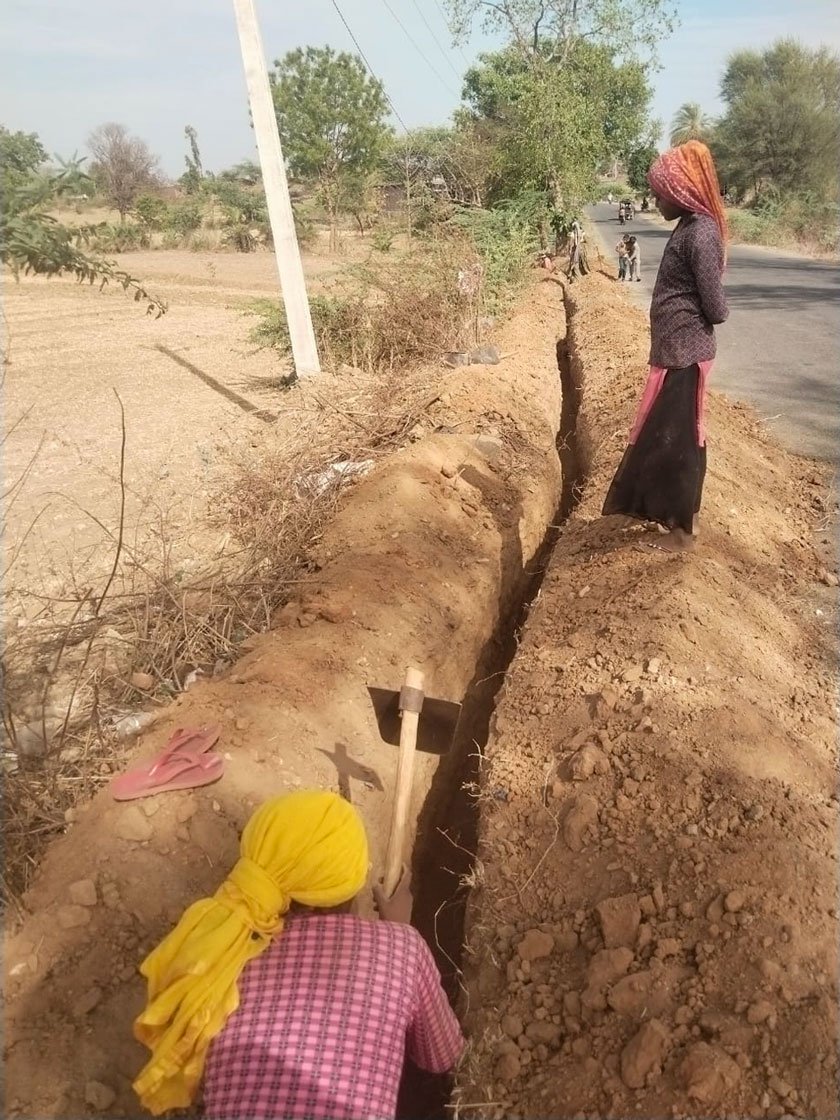
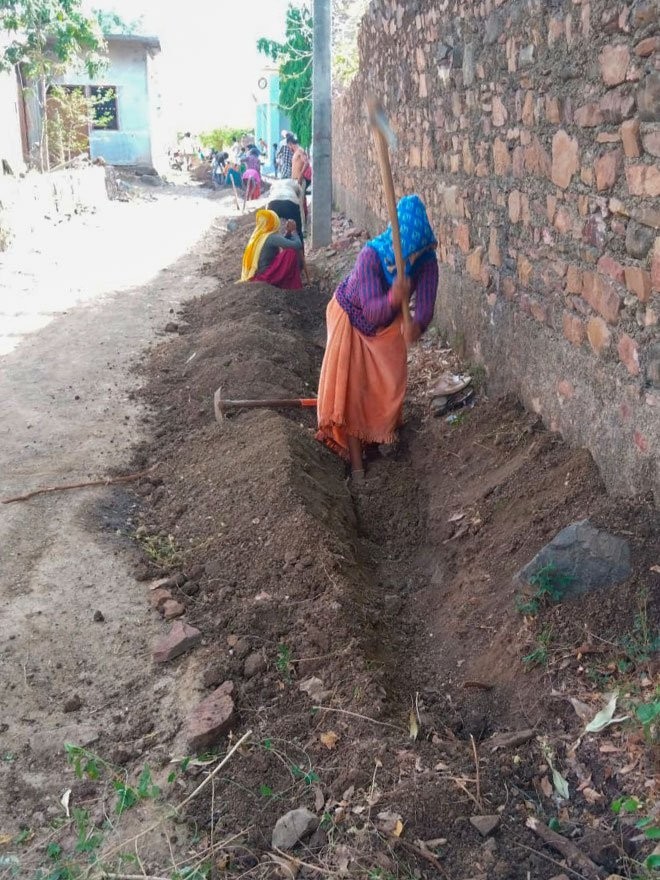
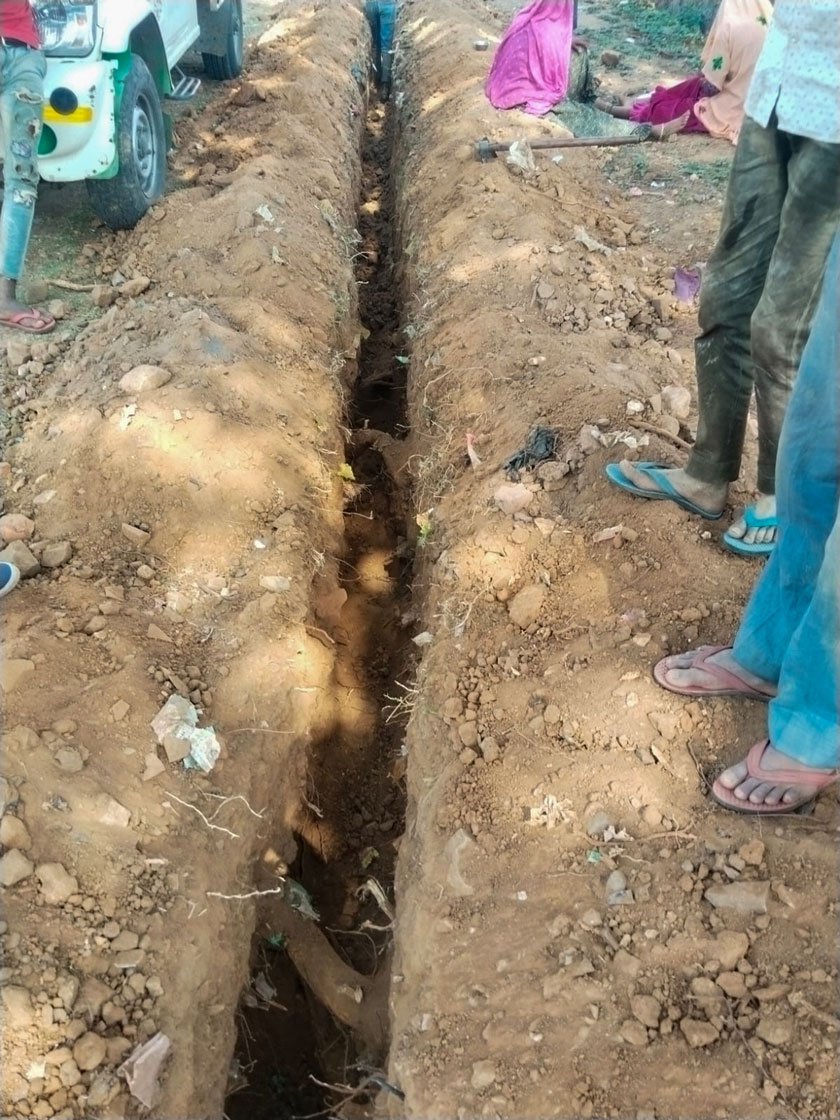
Migrants workers were able to show these screen shots taken on their mobiles as proof that they had worked laying telecom fibre cables in Banswara, Rajasthan. The images helped the 80 odd labourers to push for their Rs. 7-8 lakh worth of dues. Photos: Aajeevika Bureau via PARI
The irony is not lost on them – the trenches they had dug were for one of the country’s biggest telecom providers who wants to ‘connect people’.
Kamlesh – a project manager with Aajeevika Bureau a non-profit working on labour issues – and others, helped build their case. All their outreach material carries both the Aajeevika helpline – 1800 1800 999, and the phone numbers of officials at the bureau.
The workers from Banswara are among the lakhs migrating in search of work. “Kushalgarh has many pravasi [migrants],” says Joga Pitta, sarpanch of Churada village in the district. “We are not able to sustain ourselves with farming.”
Small landholdings, lack of irrigation, absence of jobs and overall poverty have made this district a hub for distress migration among Bhil tribals, who make up 90 per cent of the population here. An International Institute for Environment and Development Working Paper observes that migration rises sharply after climate extreme events like drought, flood and heatwaves.
At the busy Kushalgarh bus stands, around 40 state buses leave every day through the year carrying 50-100 people in one journey. Then there are the private buses of roughly the same number. A ticket to Surat costs 500 rupees and the conductor says they don’t charge for children.
Suresh Maida arrives early to find space, and settle his wife and three small children into the bus to Surat. He gets off to put their luggage – a big sack with five kilos of flour, some utensils and clothes into the storage area behind the bus, and clambers back in.
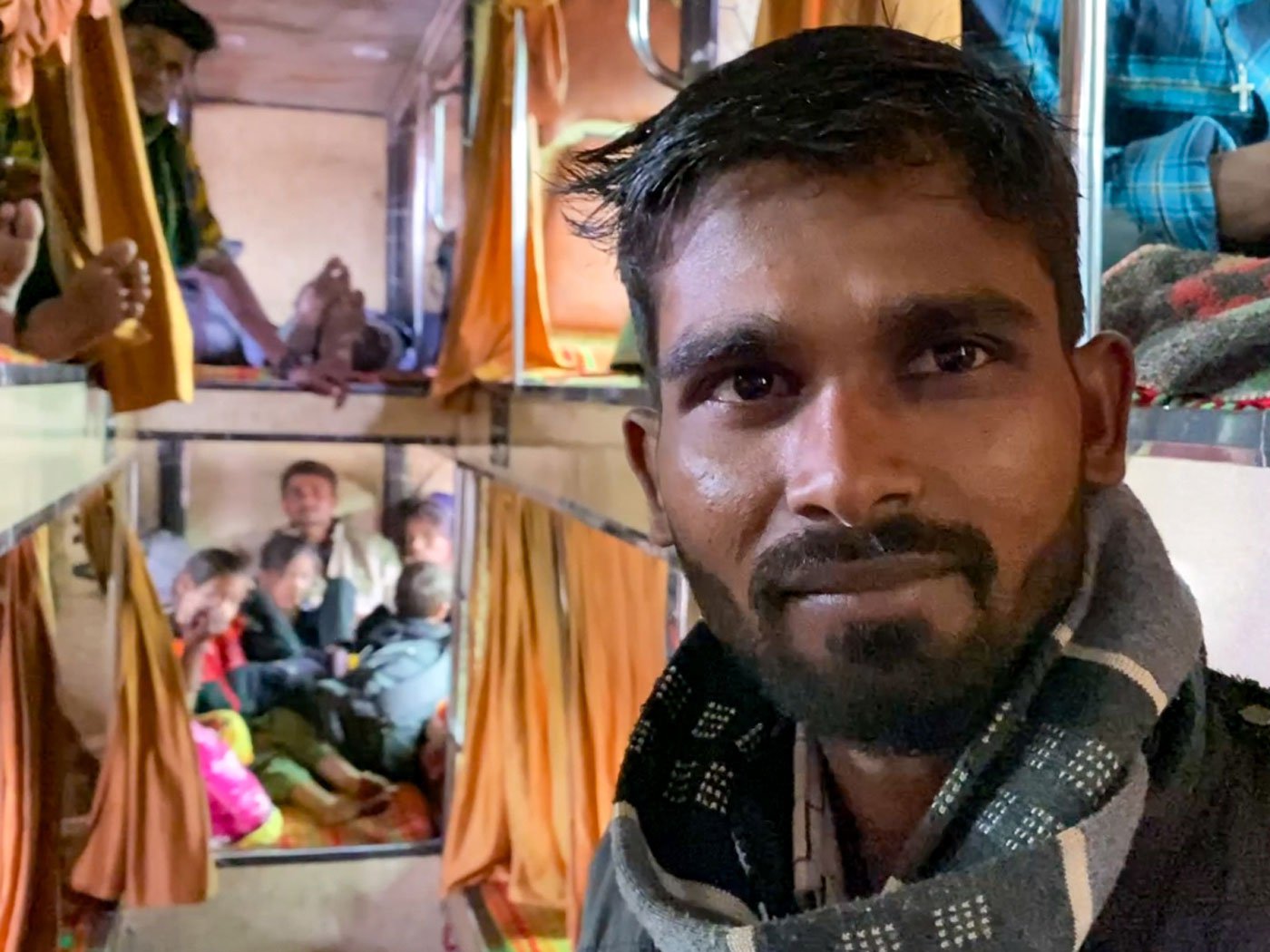
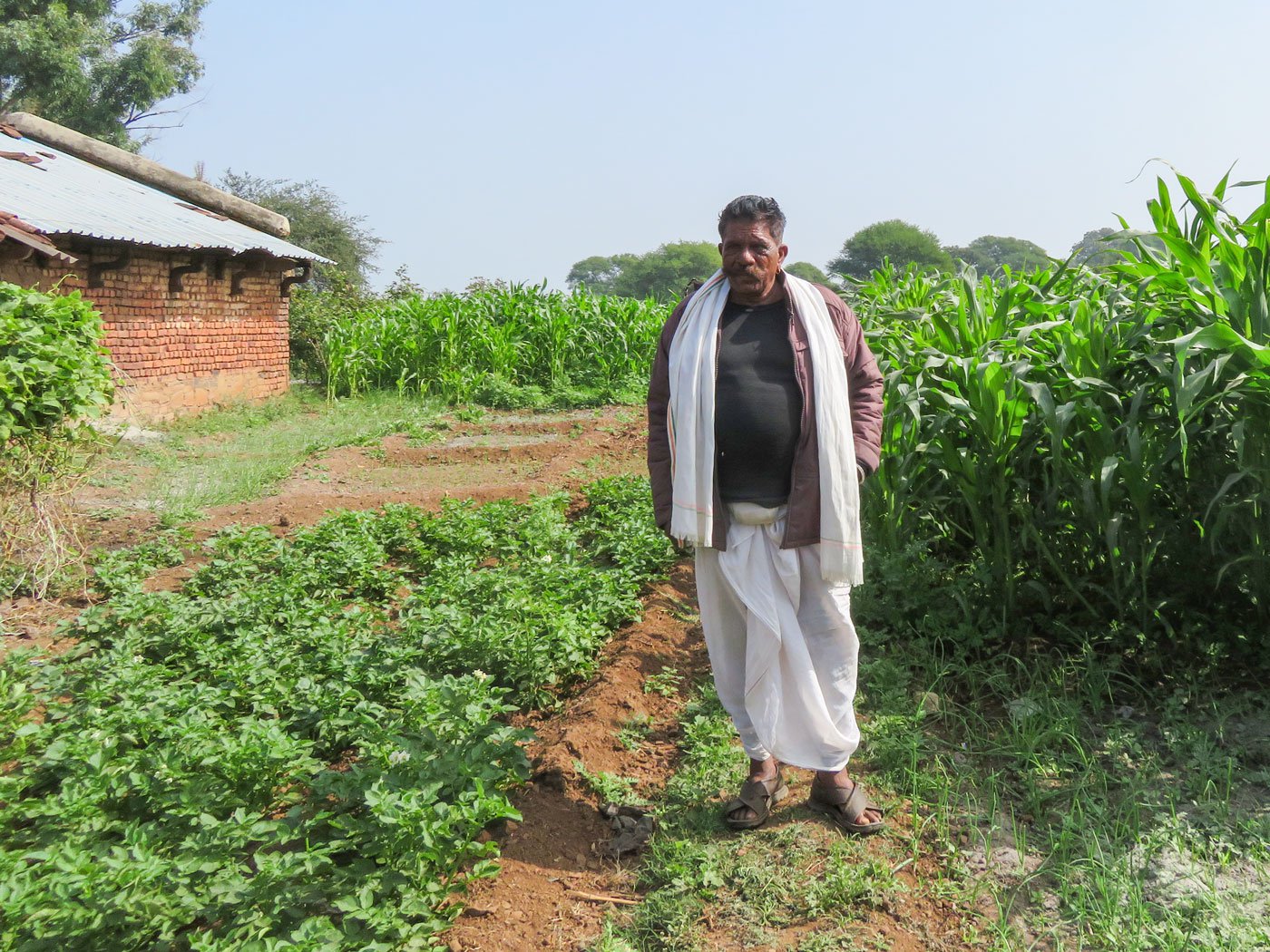
Left: Suresh Maida is from Kherda village and migrates multiple times a year, taking a bus from the Kushalgarh bus stand to cities in Gujarat. Right: Joga Pitta is the sarpanch of Churada village in the same district and says even educated youth cannot find jobs here. Photos: Priti David/PARI
“I will earn around 350 [rupees] a day,” the Bhil Adivasi daily wage worker tells PARI; his wife will earn 250-300 rupees. Suresh expects they will stay a month or two before returning, spend roughly 10 days at home and set off again. “I’ve been doing this for more than 10 years,” adds the 28-year-old. Migrants like Suresh usually come home for big festivals like Holi, Diwali and Raksha Bandhan.
Rajasthan is a net out-migration state – more people leave than enter as migrants; only Uttar Pradesh and Bihar see greater numbers leaving for wage work. “Not only is agriculture the only option, but it also only one-time – after the rains,” points out V.S. Rathod, an official in the Kushalgarh tehsil office.
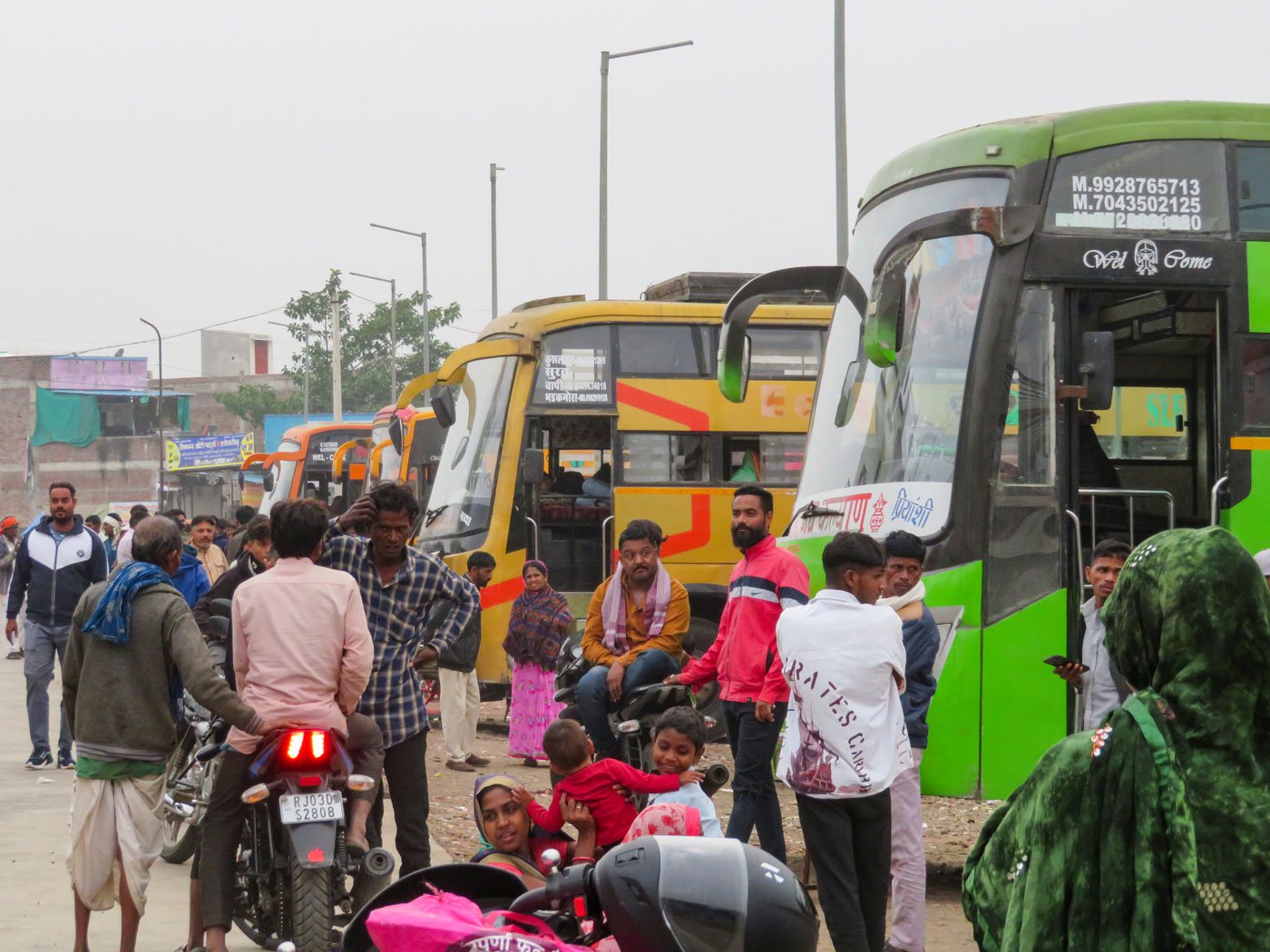
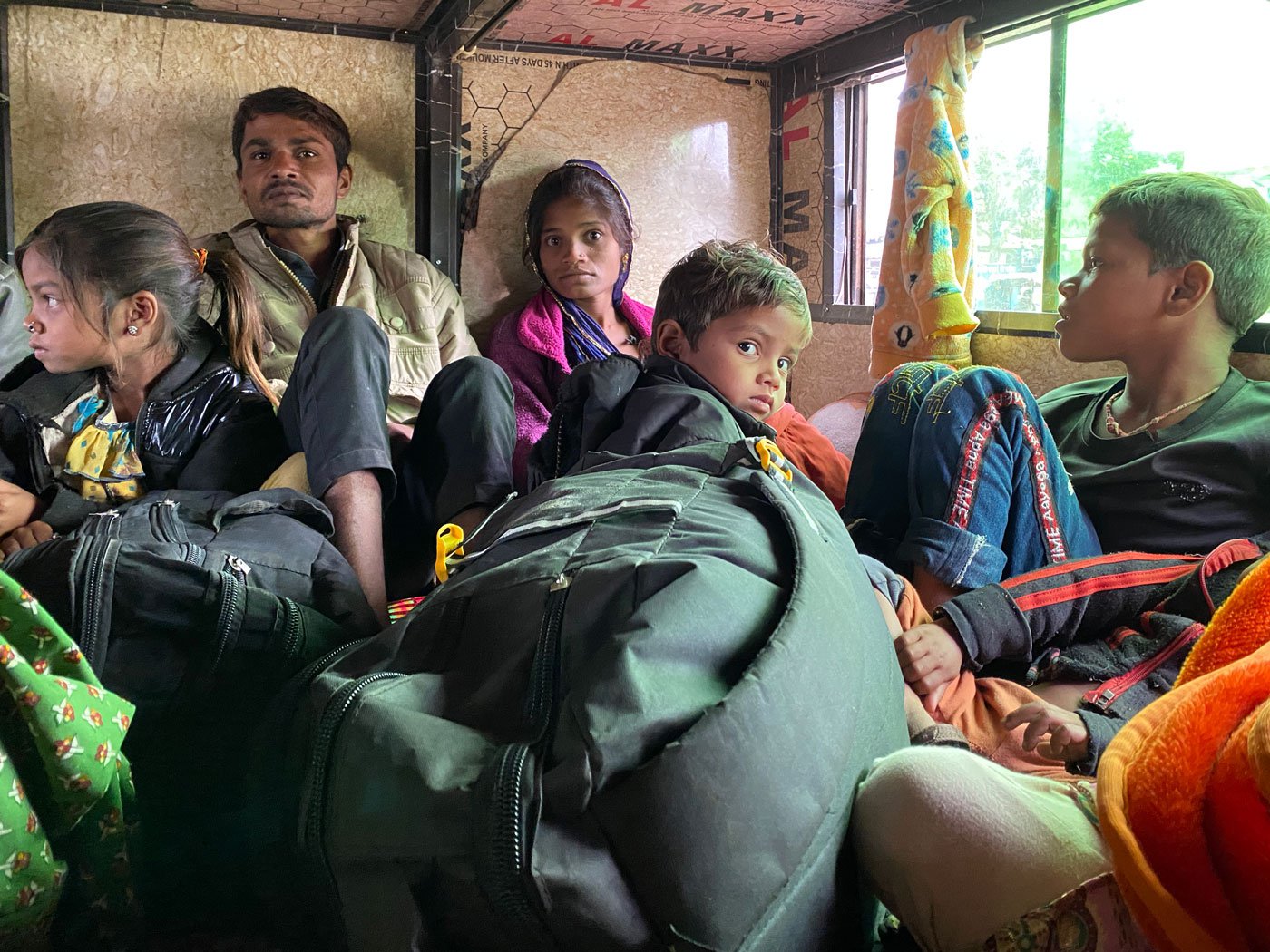
At the Timeda bus stand (left) in Kushalgarh, roughly 10-12 busses leave every day for Surat and big cities in Gujarat carrying labourers – either alone or with their families – looking for wage work. Photos: Priti David/PARI
All workers are hoping for kayam work where they are attached to one contractor for the entire period. It offers more stability as against rokdi or dehadi – standing at the mazdoor mandi (labour market) every morning.
Joga ji has educated all his children but even so “yahan berojgaari zyaada hain. Padhe likhe logon ke liye bhi naukri nahin [There is a lot of unemployment here, even those who are educated have no jobs].”
Migration is the only foreseeable option.
When Maria Paaru leaves home, she takes a mitti ka tawa (clay pan) with her. It’s a critical part of her packing. Corn rotis are best made on the clay pans which can handle the heat of wood fires without burning the roti she says, while showing me how it’s done.
Maria and her husband Paaru Damor are among the lakhs of Bhil Adivasis who move out of their homes in Banswara district of Rajasthan in search of daily wage work in Surat, Ahmedabad, Vapi and cities in Gujarat, as well as other neighbouring states. “MNREGA takes too long and is not enough,” says Paaru, speaking of the Mahatma Gandhi National Rural Employment Guarantee scheme that gives 100 days of work.
The 30-year-old Maria also carries 10-15 kilograms of makai (corn) flour. “We prefer to eat these,” she says, sharing the food habits of her family who are away for up to nine months in a year. Familiar food is a comfort when away from home in Dungra Chhota.
The couple have six children whose ages range from 3-12 years, and they own two acres of land on which they grow wheat, channa and corn for their own consumption. “We can’t manage [finances] without migrating for work. I have to send money home to my parents, pay for irrigation water, buy fodder for cattle, food for the family…,” Paaru reels off his expenses. “So, we have to migrate.”
He first migrated when he was eight years old, travelling with his older brother and sister after the family incurred a debt of 80,000 rupees on medical expenses. “It was winter,” he recalls, “I went to Ahmedabad and would earn 60 rupees a day.” The siblings stayed for four months and managed to pay off the debt. “I enjoyed the fact that I had helped out,” he adds. Two months later he went again. It’s been 25 years of a migrant’s life for Paaru, now in his early thirties.
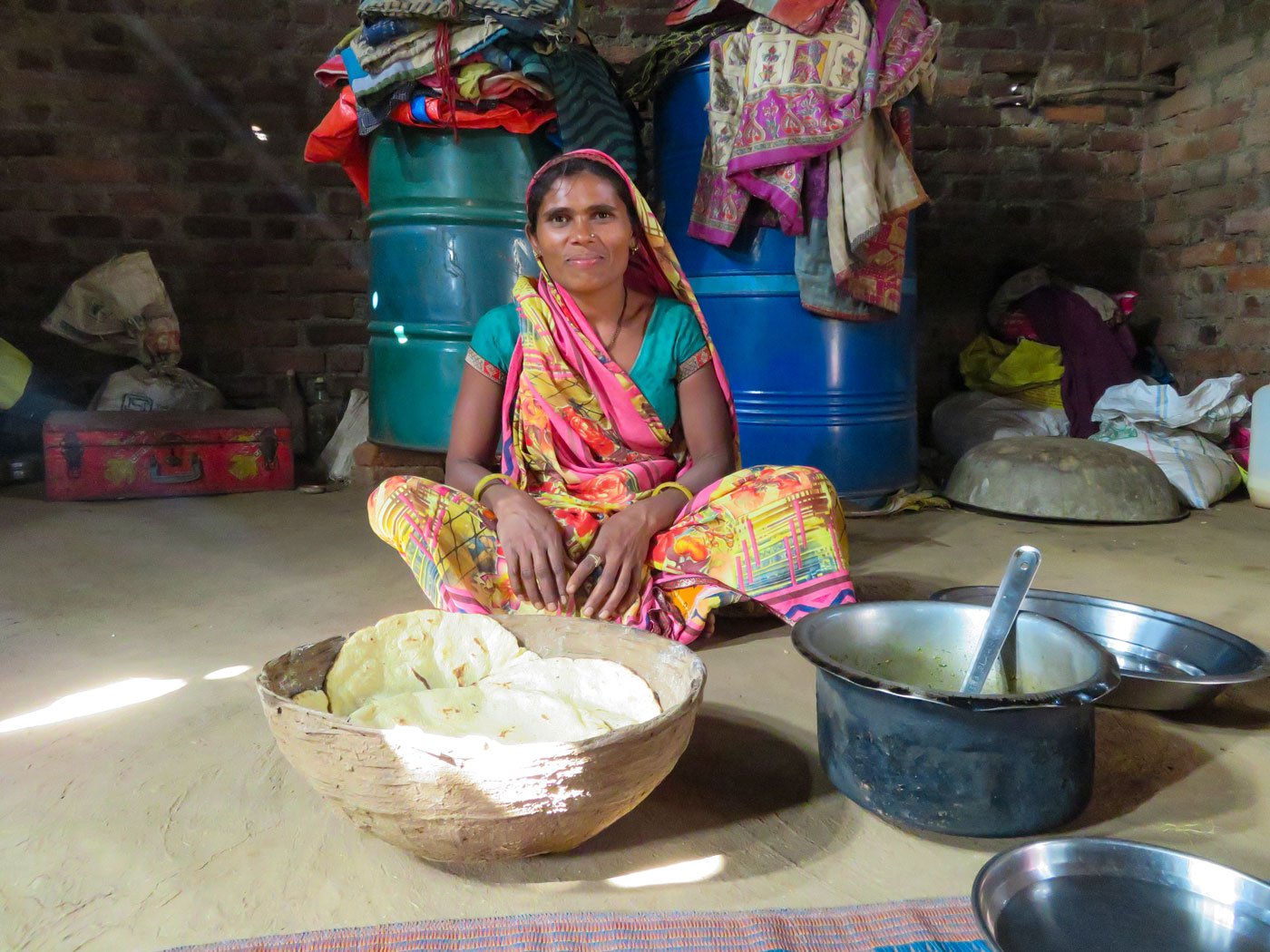
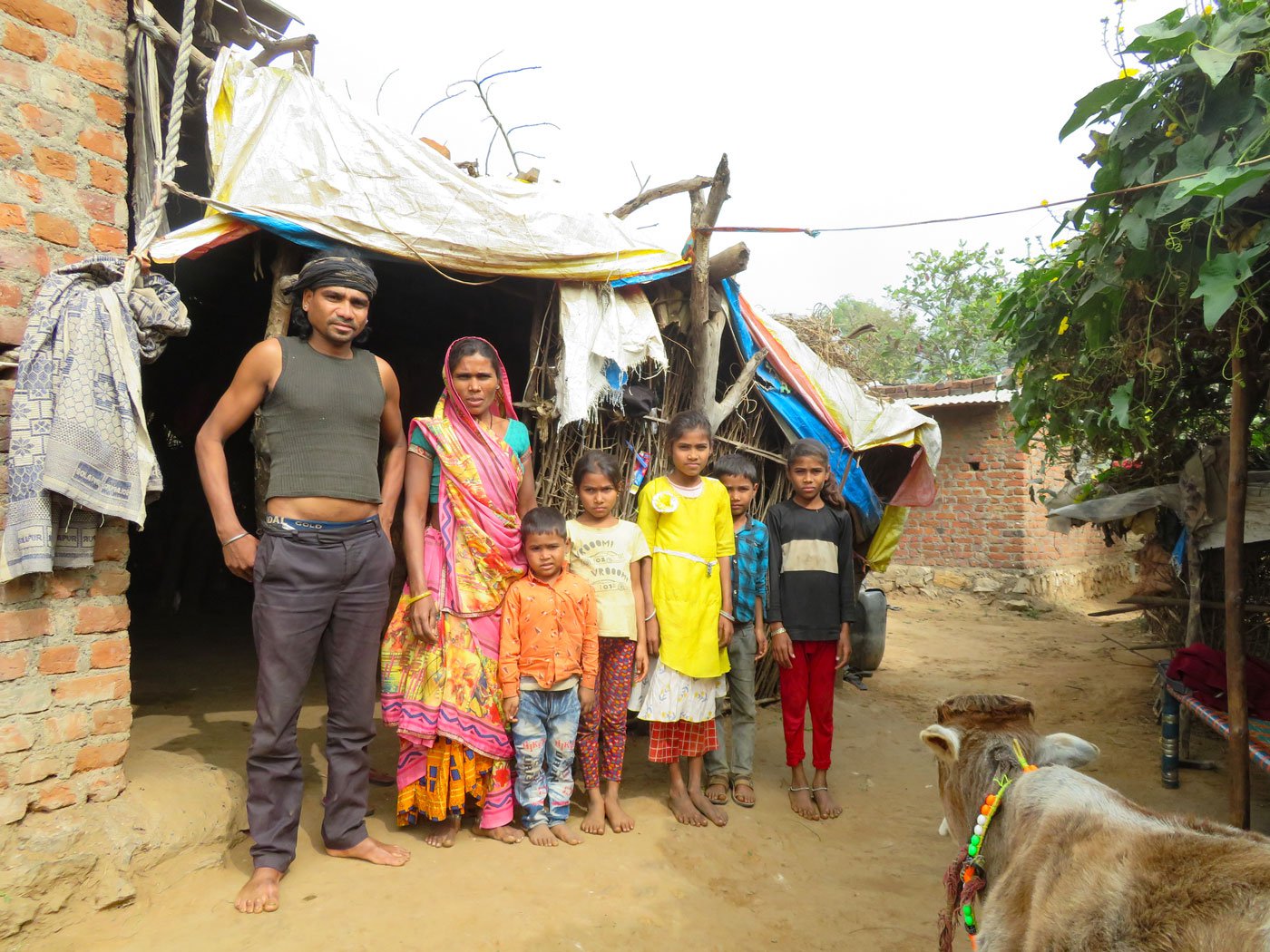
Left: Maria Paaru has been migrating annually with her husband Paaru Damor since they married 15 years ago. Maria and Paaru with their family at home (right) in Dungra Chhota, Banswara district. Photos: Priti David/PARI
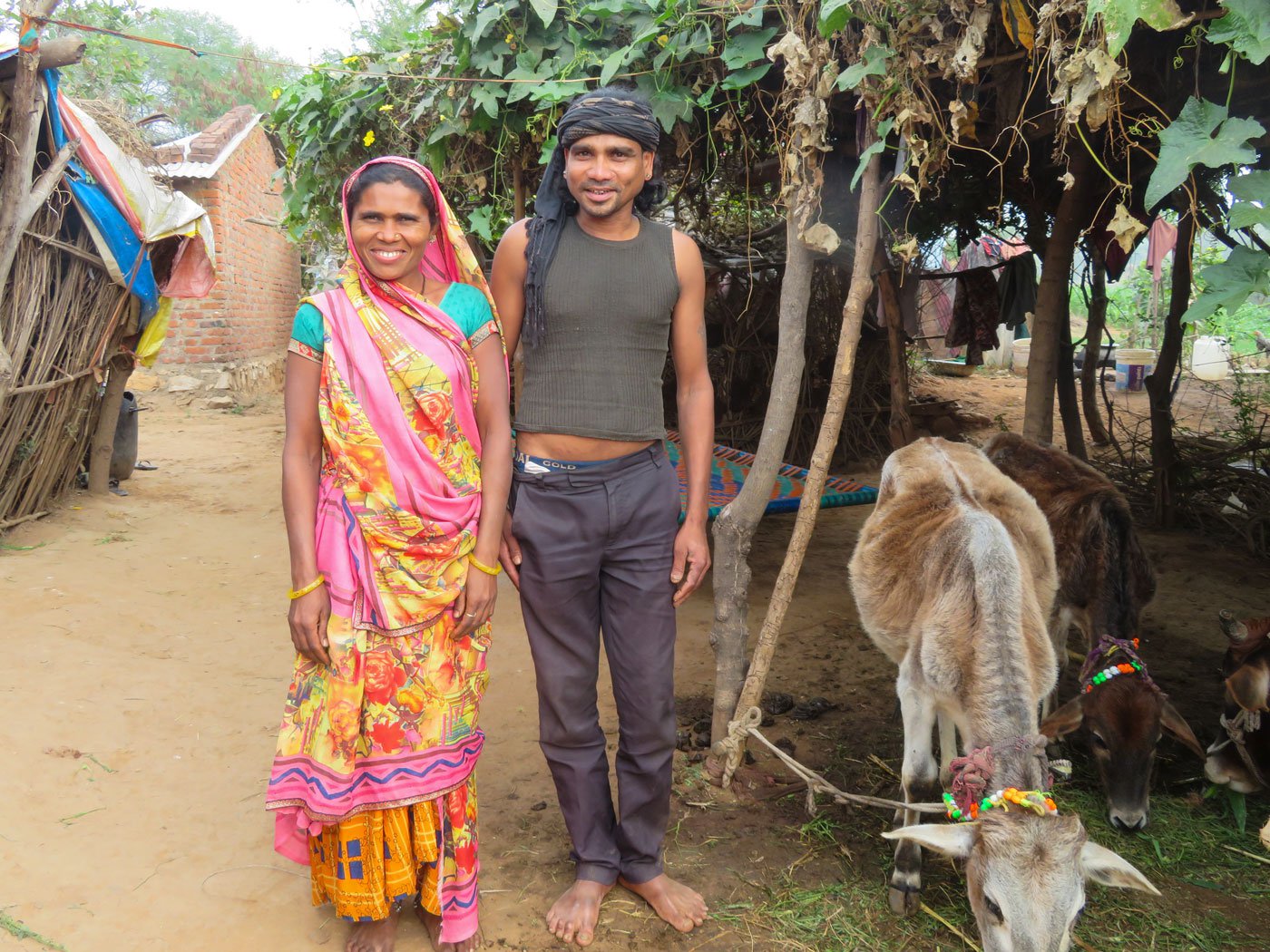
“We can’t manage [finances] without migrating for work. I have to send money home to my parents, pay for irrigation water, buy fodder for cattle, food for the family…,” Paaru reels off his expenses. “So, we have to migrate.” Photos: Priti David/PARI
Migrants dream of a pot of ‘gold’ at the end that will pay off debts, keep children in school and hunger at bay. But things often go wrong. The state labour helpline run by Aajeevika receives up to 5,000 calls a month from migrant workers seeking legal redress for non-payment of dues.
“For wage labour, agreements are never formal, they are verbal. Labourers are passed from one contractor to another,” says Kamlesh who estimates that the denial of wages for just the migrants out of Banswara district adds up to crores of rupees.
“They never get to know who their principal contractor is, who they are working for, so redressal of dues is a frustrating and longwinded process,” he adds. His job gives him a ringside view of how migrants are exploited.
On June 20, 2024, Rajesh Damor, a 45-year-old Bhil Adivasi and two other workers walked into his office in Banswara seeking help. Temperatures in the state were at an all-time high, but that was not the reason why the beleaguered workers were hot and bothered. Collectively due Rs. 226,000 from the labour contractor who had hired them, they had approached the Patan Police Station in Kushalgarh tehsil to lodge a complaint. The cops redirected them to Aajeevika’s Shramik Sahayata Evam Sandarb Kendra, a resource centre for migrant labour in the area.
In April, Rajesh and 55 workers from Sukhwara panchayat had left for Morbi in Gujarat, 600 kilometres away. They had been hired to do labour and masonry work at a construction site in a tile factory there. A daily wage of Rs. 700 was promised to the 10 skilled workers and the rest would get Rs. 400.
After a month of working, “we asked the thekedar [contractor] to pay us all our dues and he kept pushing the dates,” says Rajesh speaking on the phone to PARI. It helped that Rajesh, who was at the forefront of negotiations, speaks five languages – Bhili, Wagdi, Mewari, Hindi and Gujarati. The contractor dealing with their dues was from Jhabua in Madhya Pradesh and spoke Hindi. Often labour is unable to communicate with the final contractor sometimes because of a language barrier, but often because it means wading through a hierarchy of sub-contractors below him. Sometimes contractors get physically violent when the labourers demand their dues.
The 56 workers waited weeks to be paid their hefty dues. They were running out of food from home and purchases in the open market were eating away at their earnings.
“He kept pushing the date – 20, then 24 May, 4 June…” recalls a distressed Rajesh. “We asked him ‘what will we eat? We are so far from home.’ Finally, we stopped working the last 10 days, hoping that would force him to pay up.” They were promised June 20 as the final date.
Unsure but unable to stay, on June 9, the party of 56 took the bus home to Kushalgarh. On June 20 when Rajesh called him, “he was rude and started haggling and cursing us.” That’s when Rajesh and the others walked into a police station near their home.
Rajesh Damor (seated on the right) with his neighbours in Sukhwara panchayat. He speaks Bhili, Wagdi, Mewari, Gujarati and Hindi, the last helped him negotiate with the contractor when their dues of over Rs. two lakh were held back in Morbi in Gujarat. Photo: PARI
Rajesh has 10 bighas of land on which his family grow soybean, cotton and wheat, the latter for their own consumption. His four children have all received an education, and are enrolled in schools and colleges. Yet, this summer they joined their parents in wage work. “It was the holidays, so I said they can come along and earn some money,” says Rajesh. He is hopeful his family will see the earnings now that the contractor has been threatened with a case in the labour court.
The mention of labour court does force erring contractors to make good their promises. But to get there, labourers need help with filing the case. A group of 12 wage workers who had gone from this district to work on roads in Alirajpur, in neighbouring Madhya Pradesh were denied full payment after three months of working. The contractor cited poor work and refused to pay the Rs. 4-5 lakh due to them.
“We got a call saying we are stuck in Madhya Pradesh, and we have not been paid,” recalls Teena Garasia who often gets such calls on her personal phone. “Our numbers get circulated among workers,” explains the head of Aajeevika’s Livelihood Bureau in Banswara district.
This time the workers were able to give details of the work site, photos of the attendance register, and the name and mobile number of the contractor for the case to be filed.
Six months later the contractor paid up in two instalments. “He came here [Kushalgarh] to give the money,” say the relieved workers who received the wages, but not the interest due on late payment.
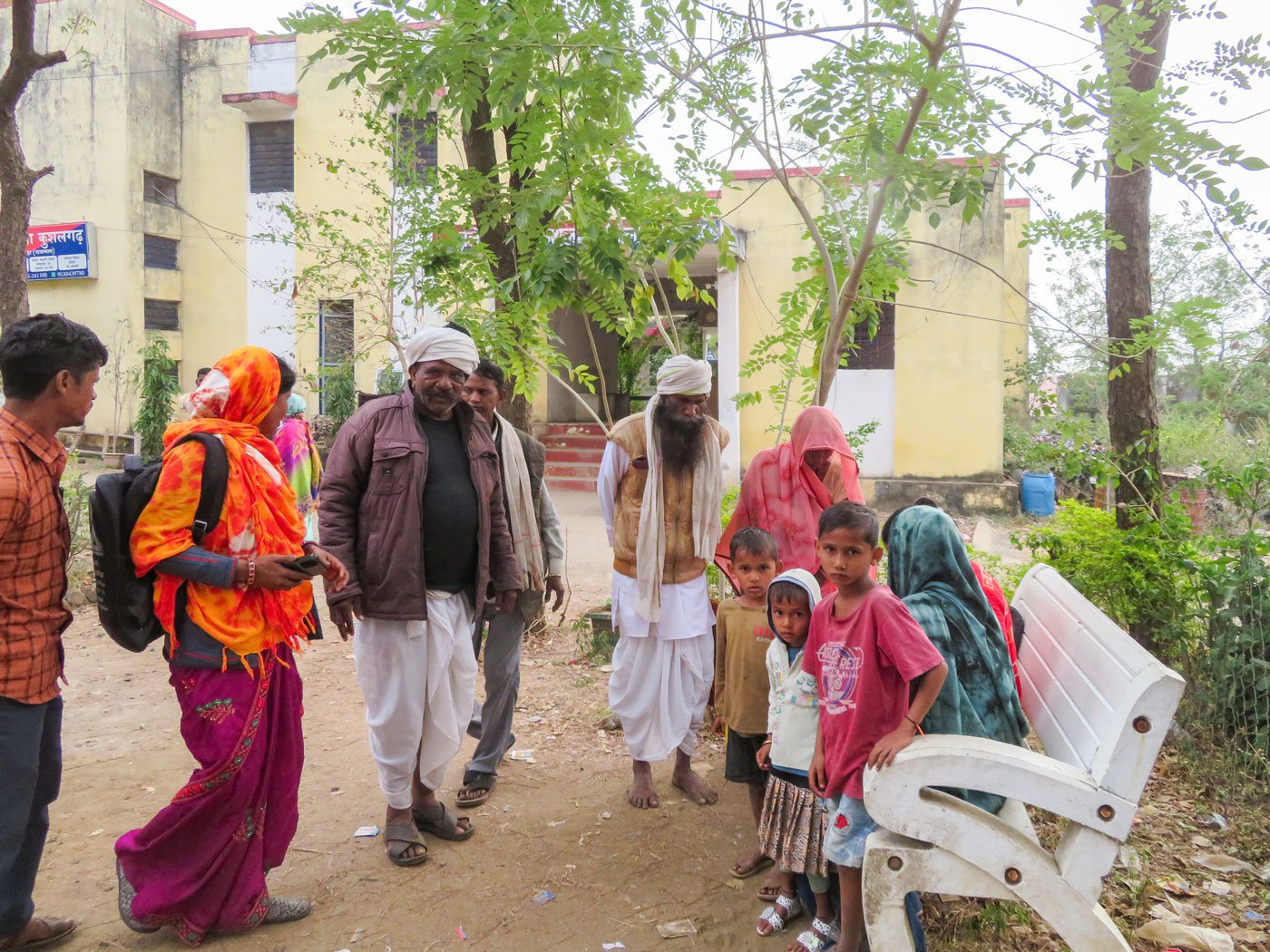
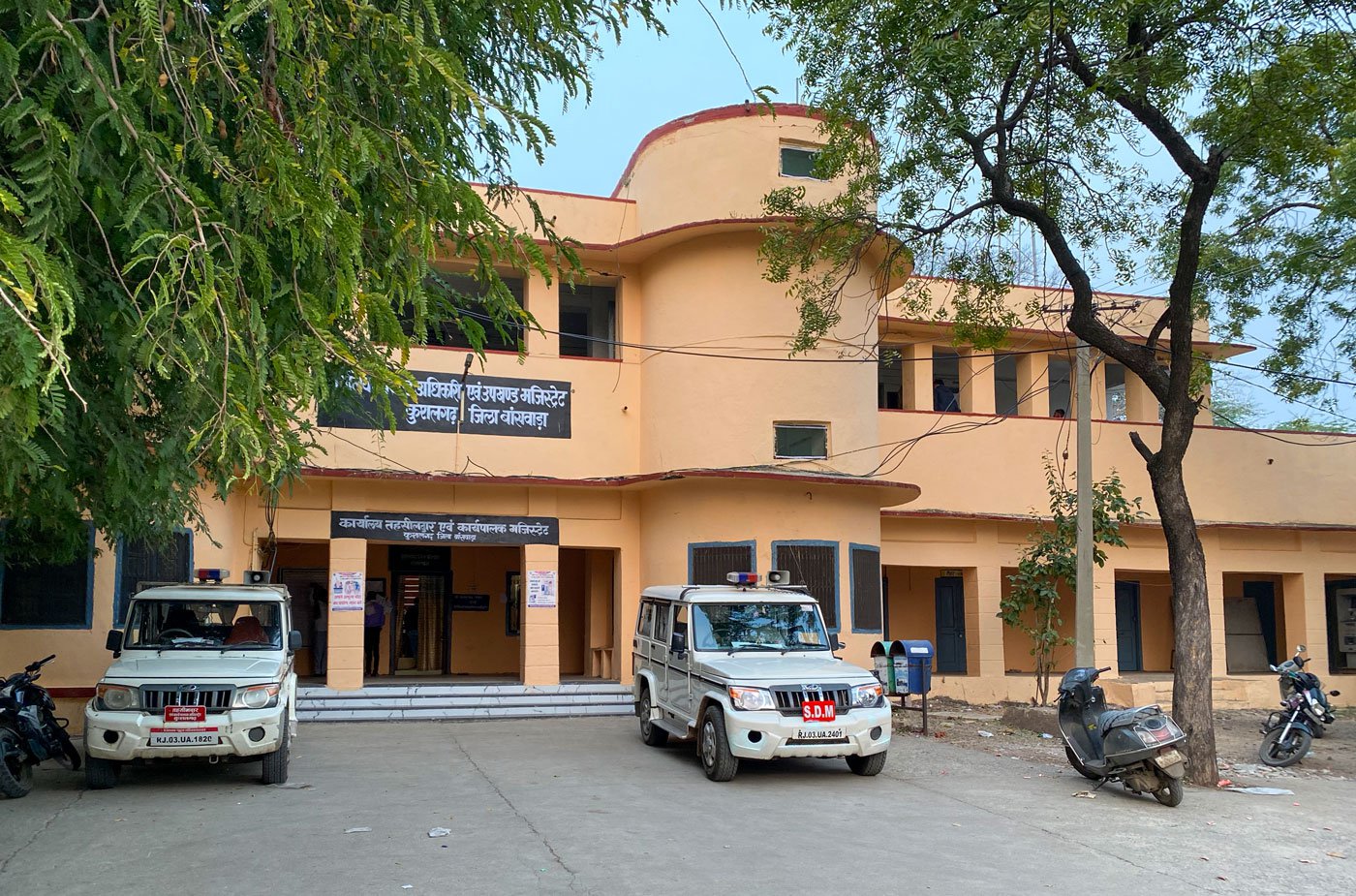
For unpaid workers, accessing legal channels such as the police (left) and the law (right) in Kushalgarh is not always easy as photographic proof, attendance register copies, and details of the employers are not always available. Photos: Priti David/PARI
“We try negotiation first,” says Kamlesh Sharma. “But that is only possible if the details of the contractor are there.
The 25 labourers who migrated for Surat to work in a textile factory had no proof. “They were passed on from one contractor to another and have no phone number or name to pin the person down,” says Teena. “They couldn’t identity the factory in the sea of similar looking ones.”
Harassed and denied their full wages of Rs. 6 lakhs, they returned home to their villages in Banswara’s Kushalgarh and Sajjangarh.
It’s for such cases that social worker Kamlesh places a lot of faith in kanoon shiksha (legal literacy). Banswara district lies on the state border and is the scene of maximum migration. Eighty per cent of families in Kushalgarh, Sajjangarh, Ambapara, Ghatol and Gangar Talai have at least one migrant, if not more, says Aajeevika’s survey data.
Kamlesh is hopeful that since “the younger generation have phones, can store numbers, take photos and therefore nailing defaulting contractors will become easier in the future.”
The union government’s Samadhan Portal was launched pan-India on September 17, 2020 for filing industrial disputes, and in 2022 it was rejigged to allow workers to file claims. But there is no office in Banswara despite it being an obvious choice.
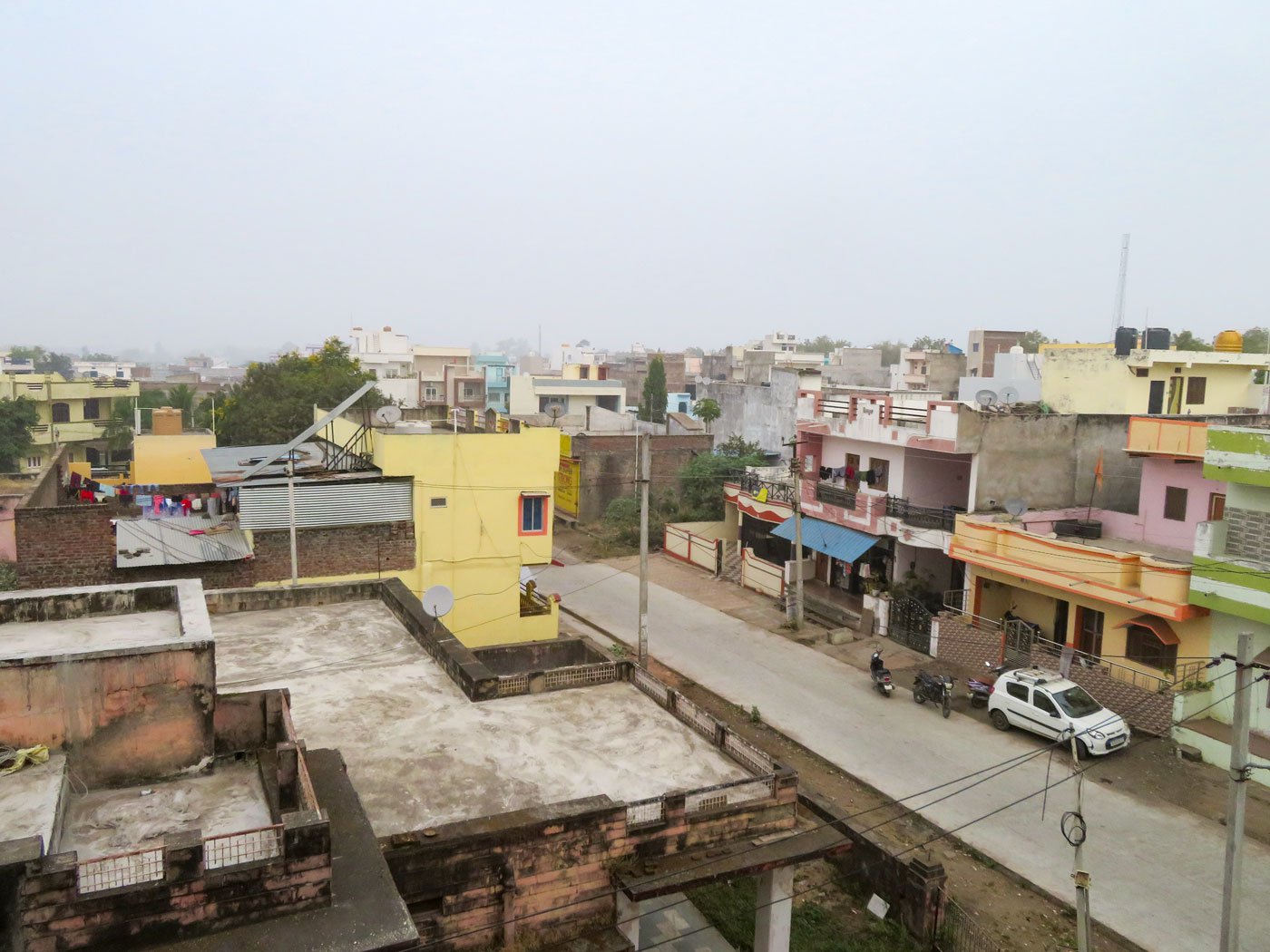
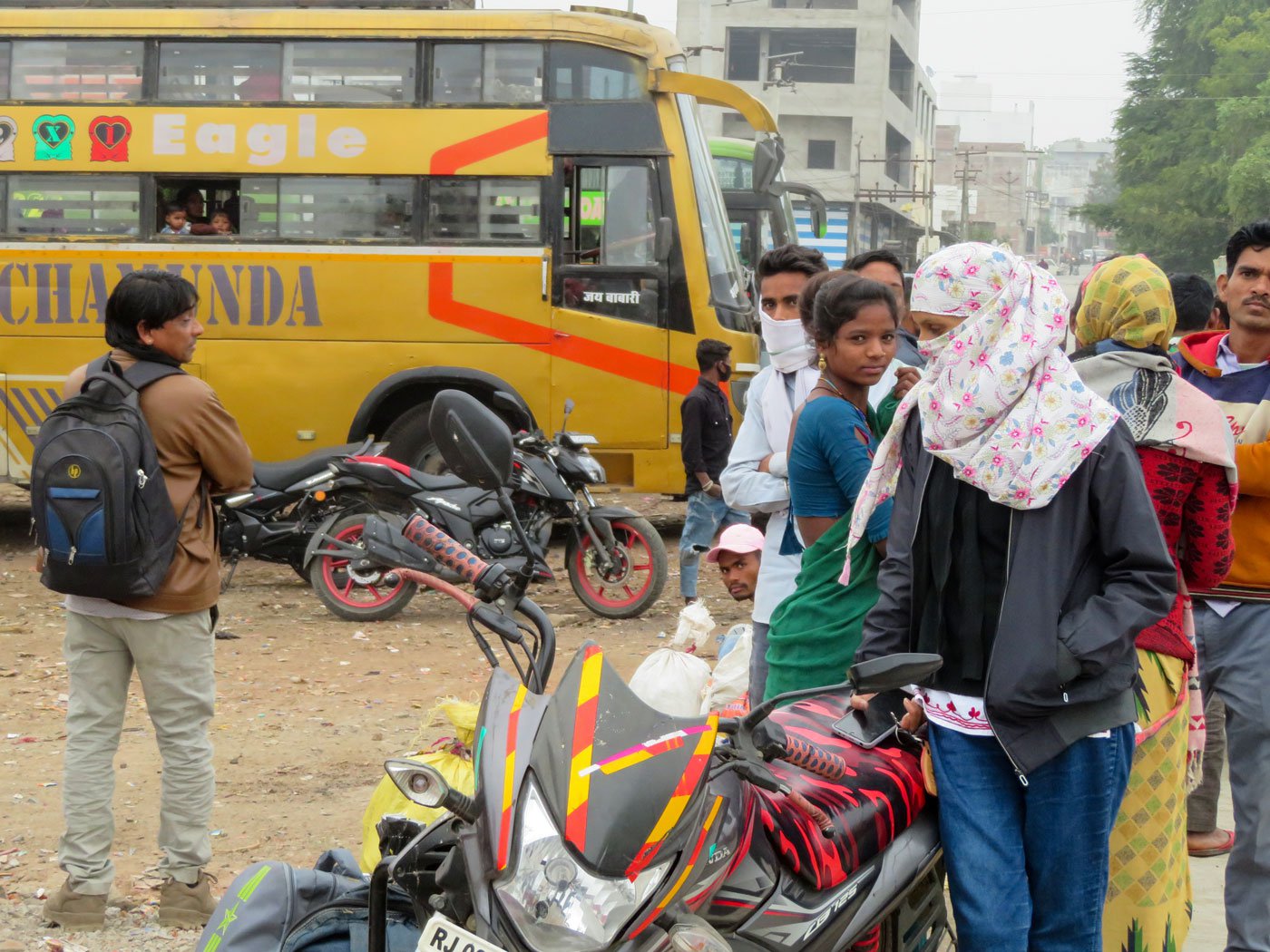
Kushalgarh town in Banswara district lies on the state border and is the scene of maximum migration. Eighty per cent of families in Kushalgarh, Sajjangarh, Ambapara, Ghatol and Gangar Talai have at least one migrant, if not more, says Aajeevika’s survey data. Photos: Priti David/PARI
Women migrants don’t find a voice in wage conversations. They rarely have their own phone and both work and wages are directed through the men around them. There has been serious resistance to women getting their own phones. The last government of the state, led by Ashok Gehlot of the Congress, launched a programme for distribution of over 13 crore free phones to women in the state. Close to 25 lakh phones were distributed to poor women till the Gehlot government lost power. In the first phase, the phones were given to widows and girls in Class 12 who were from migrant families.
The incoming government of Bhajan Lal Sharma of the Bhartiya Janata Party has put the programme on hold “till the scheme’s benefits are examined.” It was among the first decisions he made barely a month after being sworn in. Locals says the scheme is unlikely to be revived.
For most women the lack of agency over their earnings contributes to the routine gender, sexual abuse and abandonment they face.
“I cleaned the wheat and he took it along with some corn flour, 5-6 kilos. He took it and left,” recalls Sangeeta, a Bhil Adivasi now living with her parents in their home in Churada, Kushalgarh block. She had migrated with her husband when he went to Surat after they were married.
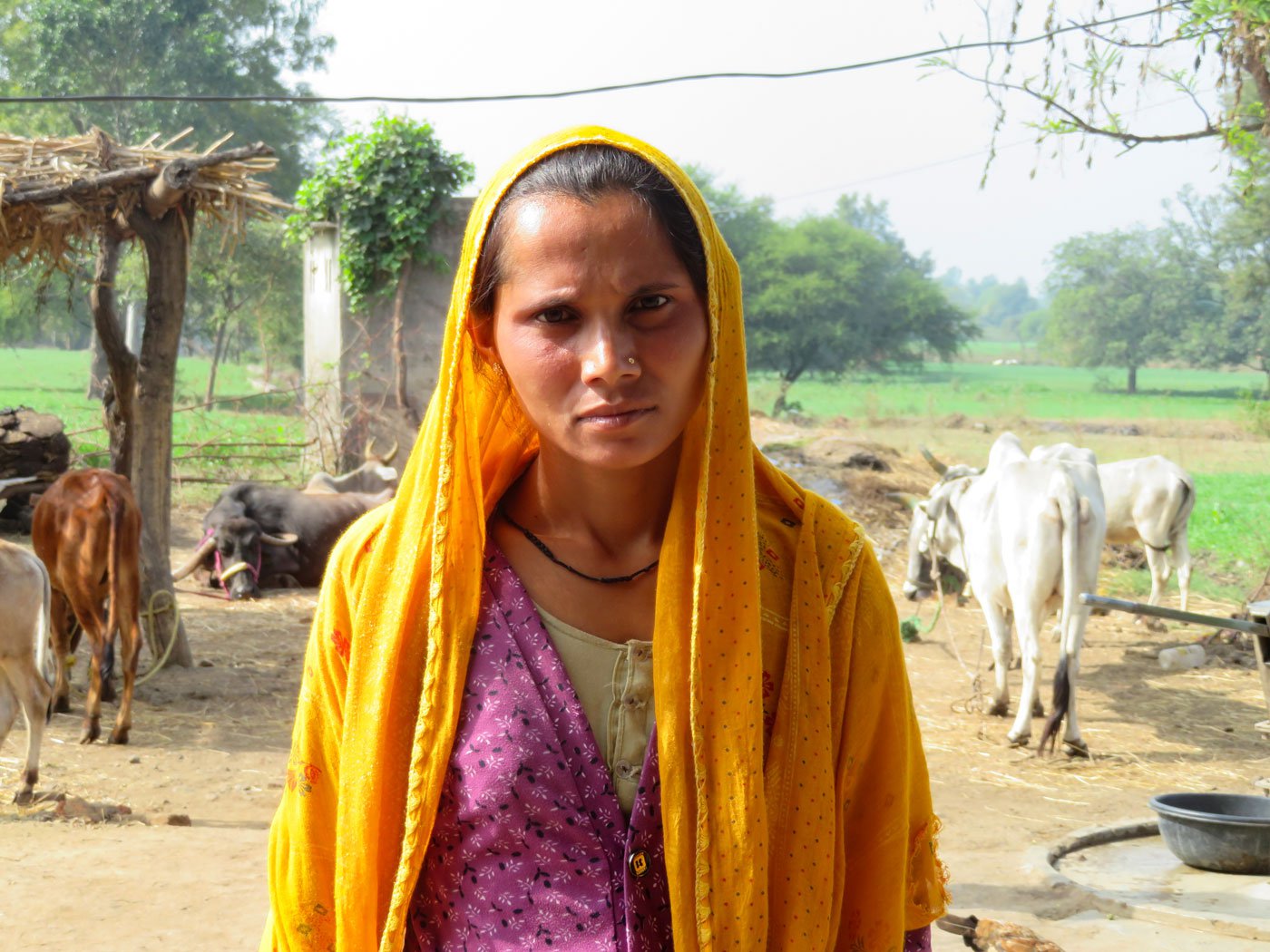
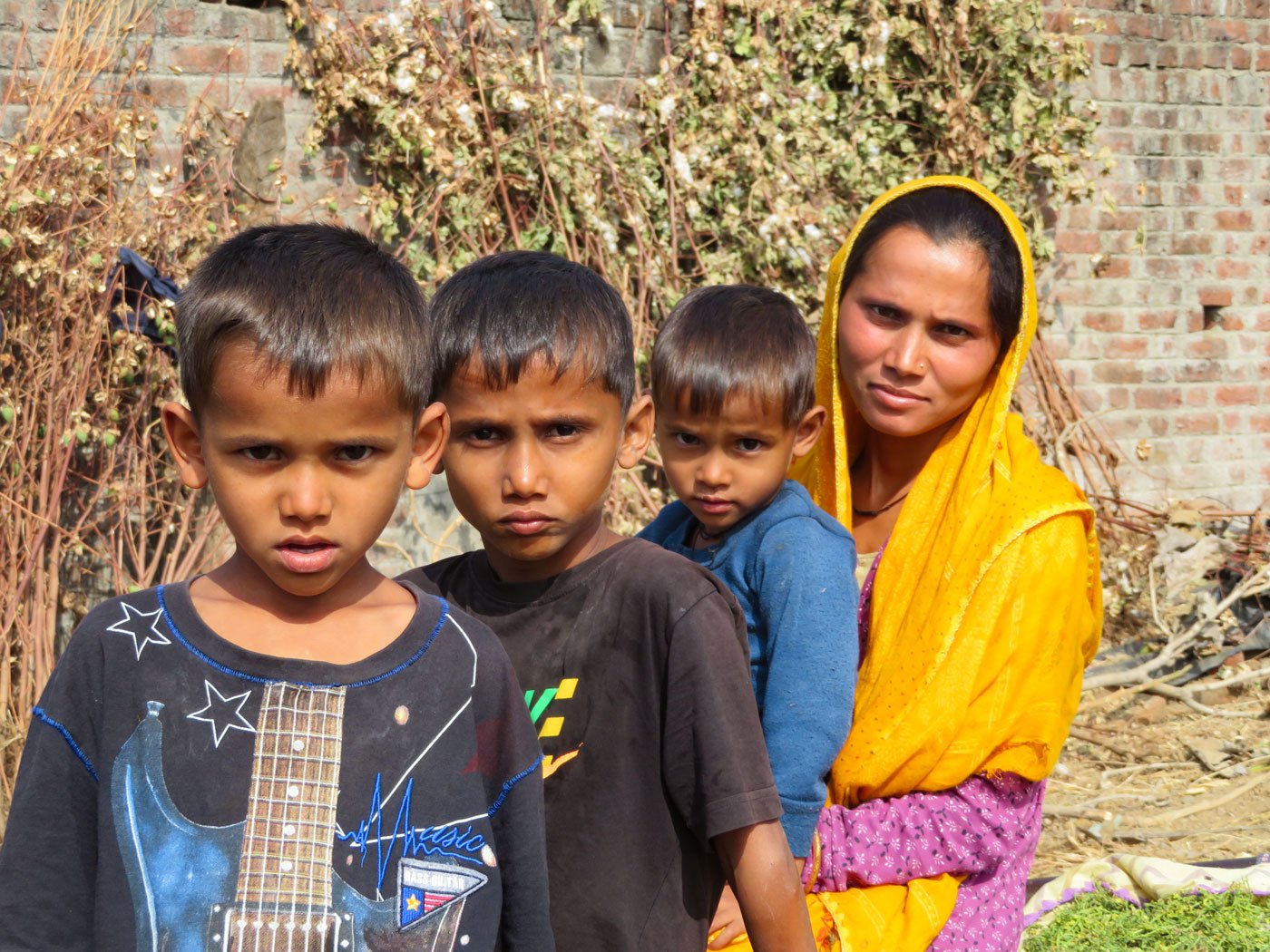
Sangeeta in Churada village of Kushalgarh block with her three children. She arrived at her parent’s home after her husband abandoned her and she could not feed her children. Photos: Priti David/PARI
“I helped in construction work,” she recalls, and her earnings were handed to her husband. “I didn’t like it there.” Once the couple’s children were born – they have three boys ages aged seven, five and four – she stopped going. “I was taking care of the children and the house.”
For more than a year now, she has not seen her husband, or received any money from him. “I have come to my parent’s house as there is nothing to feed my children there [at her married home].”
In January this year (2024), she went to the police station in Kushalgarh to file a case. Rajasthan accounts for almost 10 per cent of India’s abandoned women, says the National Crimes Records Bureau (NCRB) 2020 report . But real data is hard to find as figures for abandoned women are clubbed with miscarriage, infanticide, foeticide.
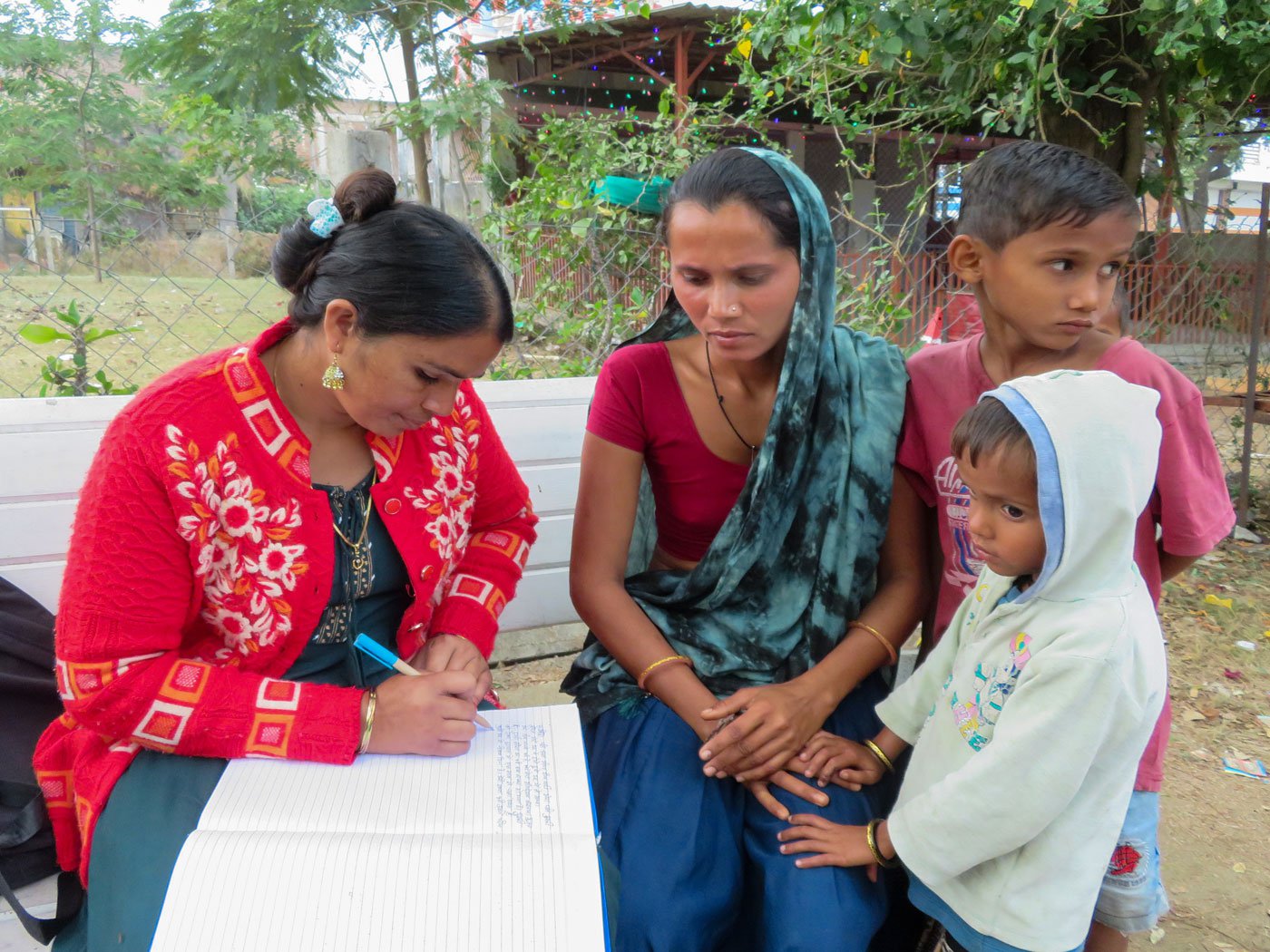
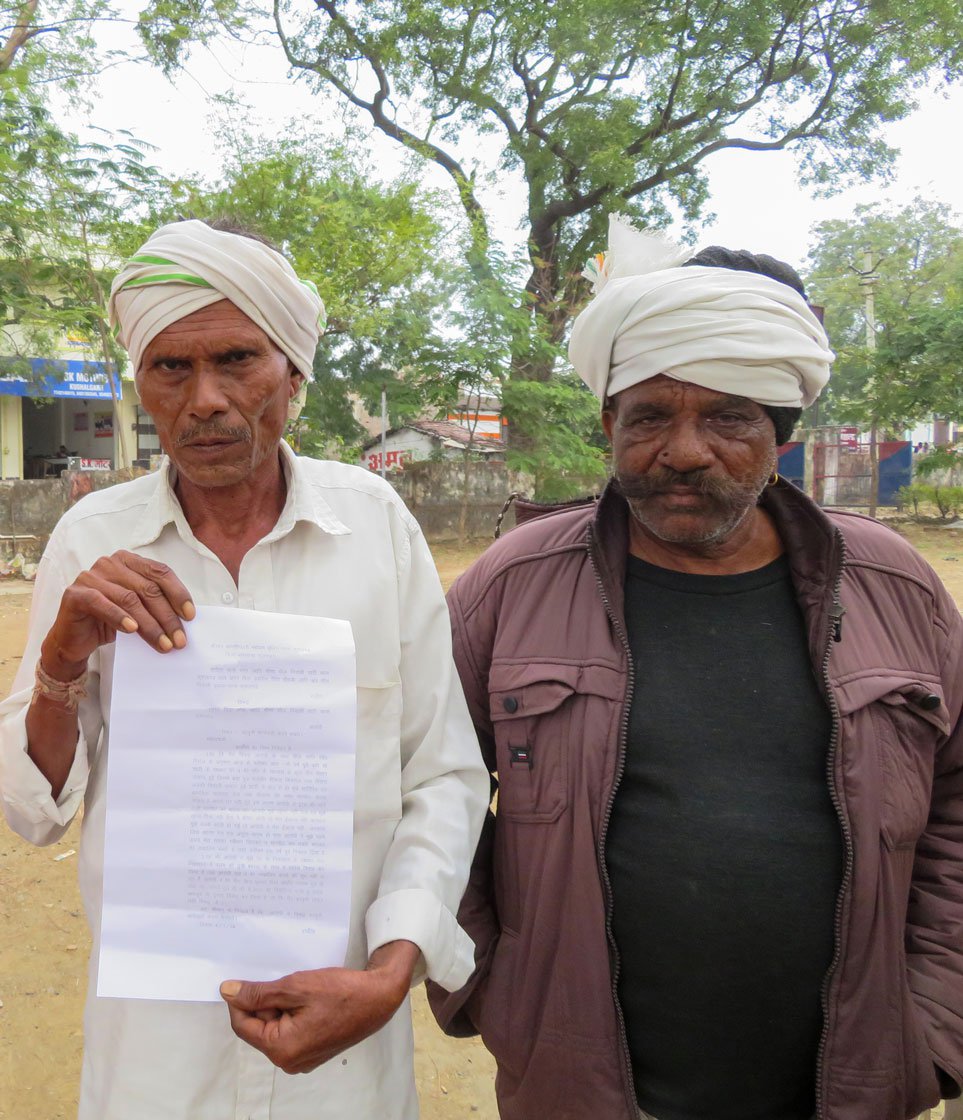
Sangeeta is helped by Jyotsna Damor to file her case at the police station. Sangeeta’s father holding up the complaint of abandonment that his daughter filed. Sarpanch Joga (in brown) has come along for support. Photos: Priti David/PARI
At the Kushalgarh Police Station, officers admit that the number of women seeking redressal is only rising. But they also admit that most cases don’t reach them as the banjadia – an all-men group in the village who take decisions – prefer to settle without the cops. “The banjadia take money from both sides,” says a resident. “Justice is an eye wash, and women never get their due.”
Sangeeta’s distress is worsening as relatives are telling her that her husband is with another woman who he wants to marry. “I feel bad that the man has hurt my children, not come to see them for over a year. They ask me ‘is he dead?’ My eldest one abuses him and tells me, ‘Mummy when the police catch him you also beat him up!’” she says, a small smile on her face.
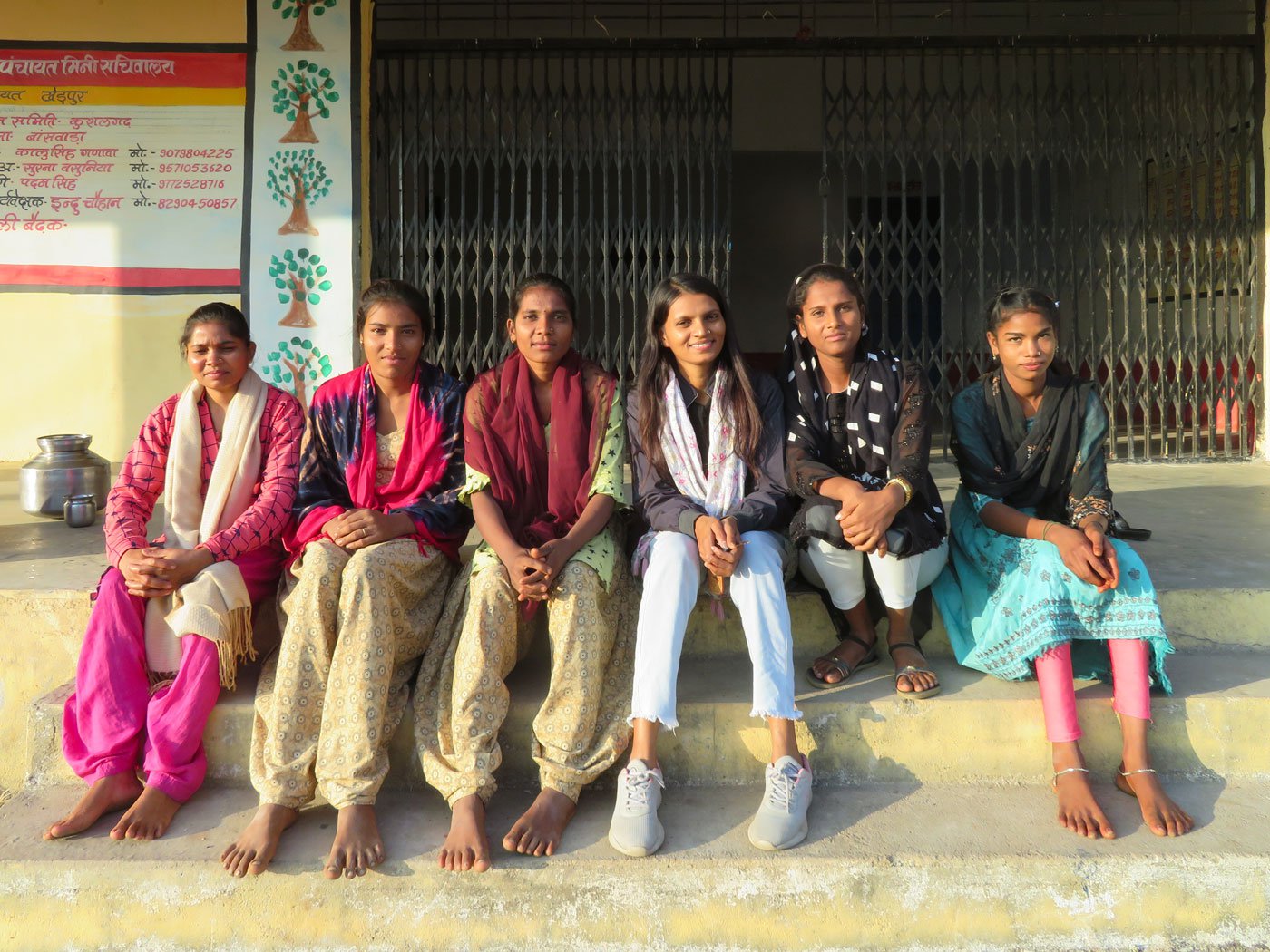
Menka (wearing blue jeans) with girls from surrounding villages who come for the counselling every Saturday afternoon. Photo: Priti David/PARI
On a Saturday afternoon in the deserted panchayat office in Kherpur, 27-year-old social worker Menka Damor is speaking to young girls of five panchayats here in Kushalgarh block.
“What is your sapna [dream]?” she asks the 20 odd girls sitting in a circle around her. All of them are daughters of migrants, all have travelled with their parents and are likely to again. “They tell me even if we get to school, we will only have the migration at the end,” says Menka who manages the Kishori Shramik Programme for young girls.
She wants them to see a future beyond migration. Switching between Wagdi and Hindi, she flashes cards showing people from different professions – cameraperson, weightlifter, dress designer, skateboarder, teacher and engineer. “You can be anything you want, and you have to work towards it,” she tells the bright faces.
“Migration is not the only option.”
जून महीने का तीसरा शुक्रवार था, जब मज़दूर हेल्पलाइन नंबर की घंटी बजी.
“क्या आप हमारी मदद कर सकते हैं? हमें हमारी मजूरी नहीं दी रही है.”
कुशलगढ़ में रहने वाले 80 मज़दूरों की टोली राजस्थान में ही आसपास की तहसीलों में काम करने गई हुई थी. दो माह से वे टेलीकॉम फाइबर केबल बिछाने के लिए दो फीट चौड़ा और छः फीट गहरा गड्ढा खोद रहे थे. मजूरी खोदे जा रहे गड्ढे की प्रति मीटर गहराई के हिसाब से मिलनी तय हुई थी.
दो माह बाद जब काम पूरा हुआ, तो उन्होंने अपनी मजूरी मांगी. ठेकेदार ख़राब काम करने का बहाना देने लगा, और हिसाब-किताब में फंसाने लगा. इसके बाद वह उन्हें यह कहकर टालने लगा कि “देता हूं, देता हूं.” लेकिन उसने पैसे नहीं दिए. एक हफ़्ते तक अपने बकाया 7-8 लाख रुपए का इंतज़ार करने के बाद मज़दूर पुलिस के पास गए, जहां उन्हें मज़दूर हेल्पलाइन में फोन करने को कहा गया.
जब मज़दूरों ने हेल्पलाइन में फ़ोन किया, तो “हमने पूछा कि उनके पास कोई सबूत है कि नहीं. हमने उनसे ठेकेदार का नाम और फ़ोन नंबर, और हाज़िरी रजिस्टर की तस्वीरें मांगी,” बांसवाड़ा ज़िला मुख्यालय में सामाजिक कार्यकर्ता कमलेश शर्मा बताते हैं.
क़िस्मत से नई उम्र के कुछ मज़दूर – जो मोबाइल चलाने में माहिर थे – ये सब इकट्ठा करने में कामयाब रहे. अपना पक्ष मज़बूत करने के लिए उन्होंने काम के जगह की कुछ तस्वीरें भी भेजीं.
प्रवासी मज़दूर मोबाइल में लिए इन स्क्रीनशॉट को सबूत के रूप में पेश करने में कामयाब रहे, जिससे यह साबित होता था कि वे राजस्थान के बांसवाड़ा में दूरसंचार फाइबर केबल बिछाने का काम कर रहे थे. इन तस्वीरों से 80 मज़दूरों को 7-8 लाख रुपए की बकाया मजूरी के लिए दबाव बनाने में मदद मिली | Photos: Aajeevika Bureau via PARI
विडंबना है कि जो गड्ढे उन्होंने खोदे थे वो देश की सबसे बड़ी दूरसंचार कंपनियों में से एक की ख़ातिर खोदे गए थे. उस कंपनी के लिए को ‘लोगों को जोड़ने’ का दावा करती है.
श्रमिकों से जुड़े मुद्दों पर काम करने वाली एक ग़ैर-लाभकारी संस्था ‘आजीविका ब्यूरो’ के प्रोजेक्ट मैनेजर कमलेश और अन्य लोगों ने मिलकर उनके मामले को आगे बढ़ाया. इस संस्था तक पहुंचने के लिए आजीविका हेल्पलाइन नंबर- 1800 1800 999 के साथ ब्यूरो के अधिकारियों के फ़ोन नंबर उपलब्ध कराए जाते हैं.
बांसवाड़ा के ये मज़दूर हर साल काम की तलाश में पलायन करने वाले लाखों मज़दूरों में शामिल हैं. ज़िले के चुड़ादा गांव के सरपंच जोगा पित्ता कहते हैं, “कुशलगढ़ में बहुत से प्रवासी हैं. सिर्फ़ खेती करके हमारा गुज़ारा नहीं चल पाता.”
खेत के छोटे-छोटे जोत, सिंचाई की कमी, रोज़गार के अभाव और इन सब के ऊपर ग़रीबी ने इलाक़े को भील आदिवासियों के पलायन का गढ़ बना दिया है. यहां की 90 प्रतिशत आबादी भील आदिवासियों की है. इंटरनेशनल इंस्टिटयूट फ़ॉर एनवायरनमेंट एंड डेवलपमेंट विश्लेषण के मुताबिक़ सूखे, बाढ़ और गर्मी की लहर (हीट वेव) जैसे चरम मौसमी बदलावों ने पलायन में तेज़ी ला दी है.
कुशलगढ़ के व्यस्त बस स्टैंड से हर दिन क़रीब 40 सरकारी बसें एक बार में 50-100 लोगों को लेकर जाती हैं. इसके अलावा लगभग इतनी ही निजी बसें भी चलती हैं. सूरत की टिकट 500 रुपए में आती है और कंडक्टर बताते हैं कि वे बच्चों के टिकट के पैसे नहीं लेते.
सुरेश मेडा बस में जगह पाने के लिए जल्दी पहुंच जाते हैं और सूरत जाने वाली बस में अपनी पत्नी व तीन छोटे बच्चों को बिठाते हैं. सामान चढ़ाने के लिए वह उतरते हैं और पांच किलो आटा, थोड़े बर्तन और कपड़ों से भरी बोरी बस के पीछे की तरफ़ सामान रखने वाली जगह पर रखते हैं और फिर से बस में चढ़ जाते हैं.
बाएं: सुरेश मेडा खेरदा गांव से हैं और साल में एक से ज़्यादा बार पलायन करते हैं. कुशलगढ़ बस स्टैंड से वह गुजरात के अलग-अलग शहरों के लिए बस पकड़ते हैं. दाएं: जोगा पित्ता चुड़ादा गांव के सरपंच हैं और बताते हैं कि यहां पढ़े-लिखे युवाओं के लिए भी नौकरी नहीं है | Photos: Priti David/PARI
“मैं हर रोज़ 350 रुपए के आसपास कमाऊंगा,” भील आदिवासी मज़दूर सुरेश पारी को बताते हैं; उनकी पत्नी को रोज़ के 250-300 रुपए मिलेंगे. सुरेश को उम्मीद है कि वे लौटने से पहले एक या दो महीने तक काम करेंगे. फिर घर पर 10 दिन रहने के बाद, दोबारा काम पर निकल जाएंगे. सुरेश (28) कहते हैं, “दस साल ज़्यादा समय से जीवन इसी तरह चल रहा है.” सुरेश जैसे प्रवासी मज़दूर आम तौर पर होली, दिवाली और रक्षाबंधन जैसे बड़े त्योहारों में घर आते हैं.
राजस्थान से बड़ी मात्रा में बाहर के राज्यों में पलायन होता है. यहां काम के लिए आने वाले लोगों के बनिस्पत काम के लिए बाहर जाने वाले लोग ज़्यादा हैं. मज़दूरी के लिए पलायन के मामले में राजस्थान सिर्फ़ उत्तर प्रदेश और बिहार से पीछे है. कुशलगढ़ तहसील कार्यालय के अधिकारी वी. एस राठौड़ कहते हैं, “यहां खेती ही कमाई का एकमात्र साधन है. और यह भी साल में बस एक बार, बारिश के बाद की जा सकती है.”
कुशलगढ़ के टिमेड़ा बस स्टैंड (बाएं) से रोज़ क़रीब 10 से 12 बसें गुजरात के सूरत और अन्य बड़े शहरों के लिए रवाना होती हैं. इनमें ज़्यादातर मज़दूर चलते हैं, जो काम की तलाश में अकेले या अपने परिवार के साथ यात्रा करते हैं | Photos: Priti David/PARI
सभी मज़दूर कायम वाले काम की आस में रहते हैं, जिसमें पूरे अंतराल के लिए वे एक ठेकेदार के साथ काम करते हैं. इसमें रोकड़ी या दिहाड़ी – जिसके लिए हर सुबह मज़दूर मंडी में खड़ा होना पड़ता है – के बनिस्पत ज़्यादा स्थिरता होती है.
जोगाजी ने सभी बच्चों को पढ़ाया-लिखाया है, लेकिन “यहां बेरोज़गारी ज़्यादा है. पढ़े-लिखे लोगों के लिए भी नौकरी नहीं है.”
ऐसे में पलायन ही आख़िरी सहारा बचता है.
मरिया पारू जब घर से निकलती हैं, तो साथ में मिट्टी का तवा साथ ले जाती हैं. इसके बिना वह नहीं चलती हैं. वह बताती हैं कि मिट्टी के तवे पर मकई की रोटी बढ़िया बनती है. उनके मुताबिक़, लकड़ी के चूल्हे पर जब रोटी पकती है, तो मिट्टी का तवा उसे जलने नहीं देता. यह बताते हुए वह मुझे रोटी पकाकर दिखाती भी हैं.
मरिया और उनके पति पारू दामोर जैसे लाखों भील आदिवासी राजस्थान के बांसवाड़ा ज़िले से दिहाड़ी के काम की तलाश में गुजरात के सूरत, अहमदाबाद, वापी जैसे शहरों में तथा अन्य पड़ोसी राज्यों में पलायन करते हैं. साल में 100 दिन काम देने का वादा करने वाली महात्मा गांधी राष्ट्रीय ग्रामीण रोज़गार गारंटी योजना के बारे में बताते हुए पारू कहती हैं, “मनरेगा में जल्दी काम नहीं मिलता और पूरा भी नहीं पड़ता.”
तीस साल की मरिया अपना साथ मकई का 10-15 किलो आटा भी ले जाती हैं. वह कहती हैं, “हम लोग इसे खाना पसंद करते हैं.” उनका परिवार साल में नौ महीने घर से दूर रहता है. डुंगरा छोटा में स्थित अपने घर से दूर रहते हुए ‘घर’ का भोजन सुकून देता है.
इस दंपति के तीन से 12 बरस के छः बच्चे हैं और गांव में उनके पास दो एकड़ ज़मीन है. इस पर वे अपने खाने के लिए गेहूं, चना और मक्का उगाते हैं. “काम की तलाश में घर छोड़े बिना हमारा गुज़ारा नहीं चलता. घर पर मां-बाप को पैसा भेजना पड़ता है, सिंचाई का ख़र्च उठाना होता है, मवेशियों के लिए चारा ख़रीदना होता, घरवालों का पेट पालना पड़ता है…,” पारू पूरा हिसाब गिनाते हैं. “इसलिए हमें पलायन करना पड़ता है.”
पहली बार उन्होंने आठ साल की उम्र में बड़े भाई और बहन के साथ पलायन किया था, जब परिवार के ऊपर अस्पताल के ख़र्चों के चलते 80,000 रुपए का क़र्ज़ चढ़ गया था. उन्हें याद है, “सर्दियों के दिन थे. मैं अहमदाबाद गया था और रोज़ के 60 रुपए कमाता था.” सभी भाई-बहन वहां चार महीना रहे थे और क़र्ज़ चुकाने में कामयाब हुए थे. वह कहते हैं, “मुझे इस बात के लिए अच्छा लगा था कि मैं भी कुछ मदद कर पाया था.” दो महीने बाद वह फिर से काम पर चले गए थे. तीस की उम्र पार कर चुके पारू लगभग 25 साल से पलायन कर रहे हैं.
बाएं: मरिया पारू की 15 साल पहले शादी हुई थी, जिसके बाद से वह अपने पति पारू दामोर के साथ हर साल काम की तलाश में पलायन करती रही हैं. मरिया और पारू, बांसवाड़ा के डुंगरा छोटा गांव में अपने परिवार के साथ घर (दहिना) पर | Photos: Priti David/PARI
‘काम की तलाश में घर छोड़े बिना हमारा गुज़ारा नहीं चलता. घर पर मां-बाप को पैसा भेजना पड़ता है, सिंचाई का ख़र्च उठाना होता है, मवेशियों के लिए चारा ख़रीदना होता, घरवालों का पेट पालना पड़ता है…,’ पारू पूरा हिसाब गिनाते हैं. ‘इसलिए हमें पलायन करना पड़ता है’ | Photos: Priti David/PARI
मज़दूरों को उम्मीद रहती है कि काम की अवधि ख़त्म होने पर उन्हें इतने पैसे मिल जाएंगे कि क़र्ज़ चुका पाएंगे, उनके बच्चों के स्कूल की फ़ीस भरी जा सकेगी, और सबका पेट भरा जा सकेगा. आजीविका द्वारा संचालित राज्य के मज़दूर हेल्पलाइन नंबर पर हर महीने तक़रीबन 5,000 कॉल आती है, जिसमें बकाया मजूरी न मिलने की समस्या से निपटने के लिए क़ानूनी मदद की गुहार लगायी गई होती है.
“दिहाड़ी मज़दूरी के काम में लिखा-पढ़ी नहीं होती, सबकुछ मुंह-ज़बानी तय होता है. मज़दूरों को एक ठेकेदार से दूसरे ठेकेदार के पास भेज दिया जाता है.” कमलेश कहते हैं. उनका अनुमान है कि सिर्फ़ बांसवाड़ा ज़िले के मज़दूरों का करोड़ों रुपया बकाया होगा.
वह आगे कहते हैं, “उन्हें लोगों को सही-सही पता ही नहीं चलता कि असली ठेकेदार कौन है, वे किसके लिए काम कर रहे हैं. इसलिए बकाया रक़म को हासिल करने की प्रक्रिया लंबी और हताश कर देने वाली होती है.” कमलेश का काम ऐसा है कि उन्हें इसका अंदाज़ा मिल जाता है कि प्रवासियों का किस तरह शोषण किया जा रहा है.
बीते 20 जून, 2024 को 45 वर्षीय भील आदिवासी राजेश दामोर और दो अन्य मज़दूर बांसवाड़ा में स्थित उनके कार्यालय में मदद मांगने आए. गर्मी अपना चरम पर थी, लेकिन मज़दूरों के ग़ुस्से और परेशानी का कारण कुछ और था. जिस ठेकेदार ने उन्हें काम पर रखा था उसके पास उनके सामूहिक रूप से 226,000 रुपए बकाया थे. इसकी शिकायत के लिए जब वे कुशलगढ़ तहसील के पाटन पुलिस स्टेशन गए, तो पुलिस ने उन्हें आजीविका के श्रमिक सहायता एवं संदर्भ केंद्र भेज दिया.
अप्रैल में राजेश और 55 अन्य मज़दूर सुखवाड़ा पंचायत से 600 किमी दूर स्थित गुजरात के मोरबी के लिए रवाना हुए. उन्हें वहां की एक टाइल फैक्ट्री में निर्माण स्थल पर मज़दूरी और राजगीरी के काम के लिए बुलाया गया था. दस कुशल मज़दूर को दिहाड़ी के 700 रुपए मिलने थे, और बाक़ियों को हर रोज़ 400 रुपए दिए जाने थे.
एक महीने काम करने के बाद, “हमने ठेकेदार से बकाया पैसे देने को कहा, लेकिन वो टालता रहा,” राजेश पारी को फ़ोन पर बताते हैं. राजेश को भीली, वागड़ी, मेवाड़ी, हिंदी और गुजराती बोलनी आती है, इसलिए उन्हें बातचीत में सबसे आगे रखा जाता है. जिस ठेकेदार के पास उनका पैसा बकाया था वह मध्य प्रदेश के झाबुआ का था और हिंदी बोलता था. अक्सर मज़दूर भाषा की समस्या के चलते मुख्य ठेकेदार से सीधे बात नहीं कर पाते हैं, और उन्हें उसके चेलों व छुटभैयों से बात करनी पड़ती है. कई बार जब मज़दूर अपना बकाया मांगते हैं, तो ठेकेदार उनके साथ मारपीट करते हैं.
सभी 56 मज़दूर हफ़्तों तक बकाये के पैसों का इंतज़ार करते रहे. घर में खाने के लाले पड़ने लगे थे, और बचा-खुचा पैसा हाट से सामान ख़रीदने में उड़ रहा था.
“ठेकेदार भुगतान को बार-बार टालता रहा- पहले बोला 20 मई को दूंगा, फिर कहा 24 मई, 4 जून…” राजेश याद करते हैं. “हमने उससे पूछा कि ‘हम पेट कैसे भरेंगे? हम अपने घरों से इतने दूर हैं.’ हारकर, हमने आख़िर के 10 दिनों का काम बंद कर दिया. हमें लगा कि शायद इससे ठेकेदार पर दबाव पड़ेगा.” उन्हें भुगतान के लिए 20 जून की आख़िरी तारीख़ दी गई.
मज़दूर अनिश्चितताओं से घिरे हुए थे, लेकिन अब वहां रुक पाने में असमर्थ थे, इसलिए सभी 56 मज़दूरों ने 9 जून को कुशलगढ़ की बस पकड़ी और घर लौट गए. राजेश ने जब 20 जून को ठेकेदार को फ़ोन किया, तो “वह बदतमीज़ी से बात की, मोल-भाव करने लगा और गाली बकने लगा.” इसके बाद, राजेश और अन्य मज़दूरों को मजबूरन पास के पुलिस थाने जाना पड़ा.
राजेश दामोर (दाईं तरफ़ बैठे) सुखवाड़ा पंचायत में अपने पड़ोसियों के साथ. वह भीली, वागड़ी, मेवाड़ी, गुजराती और हिंदी बोलना जानते हैं. गुजरात के मोरबी में दो लाख से ज़्यादा रुपए की बकाया मज़दूरी के लिए ठेकेदार से बातचीत करने में हिन्दी जानना उनके काम आया | Photo: PARI
राजेश के पास 10 बीघा ज़मीन है, जिस पर उनका परिवार सोयाबीन, कपास और अपने खाने के लिए गेहूं उगाता है. उनके चारों बच्चे पढ़ाई करते हैं और स्कूल व कॉलेज में हैं. फिर भी इस बार गर्मी के सीज़न में उन्होंने मां-बाप के साथ मज़दूरी की. “छुट्टी के दिन थे, इसलिए मैंने उन्हें साथ आने को कहा, ताकि कुछ पैसे कमा सकें.” उनको उम्मीद है कि अब परिवार को पैसे मिल जाएंगे, क्योंकि ठेकेदार के ख़िलाफ़ लेबर कोर्ट में केस होने की चेतावनी दे दी गई है.
लेबर कोर्ट में मामला जाने की बात से ठेकेदारों पर अपना वादा पूरा करने का दबाव पड़ता है. लेकिन इसके लिए मज़दूरों को मामला दर्ज कराने में मदद की ज़रूरत पड़ती है. पड़ोसी राज्य मध्य प्रदेश के अलीराजपुर में सड़क का काम करने के लिए इस ज़िले से गए 12 मज़दूरों के समूह को तीन महीने काम करने के बाद पूरे पैसे नहीं मिले. ठेकेदार ने ख़राब काम का हवाला देकर मज़दूरी के 4-5 लाख रुपए देने से मना कर दिया.
“हमारे पास फ़ोन आया कि वे मध्य प्रदेश में फंसे हुए हैं और उन्हें मज़दूरी नहीं मिली है,” टीना गरासिया बताती हैं, जिन्हें फ़ोन पर अक्सर इस तरह के कॉल आते रहते हैं. वह बांसवाड़ा ज़िले में स्थित आजीविका ब्यूरो की प्रमुख हैं, और आगे बताती हैं, “हमारे नंबर मज़दूरों के पास होते हैं.”
इस बार मज़दूर कार्यस्थल से जुड़ी जानकारी, हाज़िरी रजिस्टर की तस्वीरें, ठेकेदार के नाम और मोबाइल नंबर वगैरह के साथ तैयार थे, ताकि मामला दर्ज किया जा सके.
छः महीने बाद ठेकेदार ने दो क़िस्तों में पैसा चुकाया. “वह हमारी मज़दूरी देने यहां [कुशलगढ़] आया,” मज़दूरों ने बताया, जिन्हें उनके पैसे मिल गए थे. हालांकि, मज़दूरी मिलने में हुई देरी के लिए उन्हें कोई हर्जाना नहीं मिला.
जिन मज़दूरों को उनकी मजूरी नहीं मिली उनके लिए कुशलगढ़ में पुलिस (बाएं) और क़ानूनी (दाएं) सहायता पाना आसान नहीं होता, क्योंकि उनके पास सबूत के तौर पर तस्वीर, हाज़िरी रजिस्टर की प्रतियां, और ठेकेदार से जुड़ी जानकारी कई बार नहीं होती | Photos: Priti David/PARI
कमलेश शर्मा कहते हैं, “पहले हम बातचीत से मसला सुलझाने की कोशिश करते हैं. लेकिन ये तभी संभव हो पाता है, जब ठेकेदार के बारे में सभी जानकारी उपलब्ध हो.”
कपड़ा कारखाना में काम करने के लिए सूरत गए 25 मज़दूरों के पास कोई सबूत नहीं था. टीना कहती हैं, “उन्हें एक ठेकेदार से दूसरे ठेकेदारों के पास भेजा गया था, और उनके पास कोई फ़ोन नंबर या ठेकेदार की पहचान के लिए कोई नाम नहीं था. एक जैसे दिखाई देने वाले तमाम कारखानों के बीच वे अपनी फैक्ट्री की पहचान नहीं कर पाए.”
उत्पीड़न का शिकार होने और 6 लाख रुपए का भुगतान न मिलने के बाद, वंचित मज़दूर बांसवाड़ा के कुशलगढ़ और सज्जनगढ़ लौट आए.
सामाजिक कार्यकर्ता कमलेश इस तरह के मामलों में क़ानूनी तौर पर शिक्षित होने पर बहुत ज़ोर देते हैं. बांसवाड़ा ज़िला राज्य की सीमा पर स्थित है और यहां से सबसे ज़्यादा पलायन होता है. कुशलगढ़, सज्जनगढ़, अंबापाड़ा, घाटोल और गंगर तलाई के अस्सी प्रतिशत परिवारों में कम से कम एक सदस्य ज़रूर पलायन करता है.
कमलेश को उम्मीद करते हैं कि “नई पीढ़ी के पास फ़ोन हैं, वे नंबर सेव कर सकते हैं, तस्वीरें ले सकते हैं, और इसलिए भविष्य में दोषी ठेकेदारों को आसानी से पकड़ा जा सकेगा.”
उद्योग-धंधों से जुड़े विवादों के निपटारे के लिए केंद्र सरकार ने 17 सितंबर, 2020 को देशव्यापी समाधान पोर्टल लॉन्च किया था. साल 2022 में श्रमिकों को अपने दावे दाख़िल करने की अनुमति देने के लिए इसमें बदलाव किए गए. लेकिन विकल्प के तौर पर मौजूद होने के बावजूद इसका बांसवाड़ा में कोई कार्यालय नहीं है.
बांसवाड़ा का कुशलगढ़ राज्य की सीमा पर पड़ता है, और यहां सबसे ज़्यादा पलायन देखने को मिलता है. कुशलगढ़, सज्जनगढ़, अंबापाड़ा, घाटोल और गंगर तलाई के अस्सी फ़ीसदी परिवारों में कम से कम एक सदस्य पलायन ज़रूर करता है | Photos: Priti David/PARI
मज़दूरी तय करने से जुड़े फ़ैसलों में महिला मज़दूरों का कोई दख़ल नहीं होता. उनके पास अपना फ़ोन नहीं होता, और काम व मज़दूरी परिवार के मर्दों के ज़रिए उन तक पहुंचती है. कांग्रेस नेता अशोक गहलोत के नेतृत्व वाली राज्य की पिछली सरकार ने औरतों के बीच 13 करोड़ से ज़्यादा फ़ोन मुफ़्त में बांटने का कार्यक्रम शुरू किया था. गहलोत सरकार जब तक सत्ता में थी, तब तक 25 लाख फ़ोन ग़रीब औरतों के बीच बांटे गए थे. पहले चरण में, प्रवासी परिवारों की विधवा औरतों और 12वीं में पढ़ने वाली लड़कियों के बीच फ़ोन बांटे गए थे.
भारतीय जनता पार्टी के भजन लाल शर्मा की वर्तमान सरकार ने “योजना के लाभ की जांच होने तक” इस कार्यक्रम पर रोक लगा दी है. पद की शपथ लेने के मुश्किल से एक महीने बाद लिए गए शुरुआती फ़ैसलों में से एक यह भी था. स्थानीय लोगों को इस योजना के फिर से चालू होने की उम्मीद कम है.
ख़ुद की कमाई पर अपना हक़ न रहने के चलते ज़्यादातर महिलाओं के साथ होने वाले लैंगिक भेदभाव व यौन शोषण, और पति द्वारा छोड़ दिए जाने जैसी मुश्किलों में बढ़ोतरी देखने को मिलती है. पढ़ें: बांसवाड़ा: शादी की आड़ में लड़कियों की तस्करी
“मैंने गेहूं साफ़ किया और वह 5-6 किलो मक्के के आटे के साथ उसे भी ले गया. उसने ये सब लिया और चला गया,” संगीता बताती हैं. वह भील आदिवासी हैं और अब अपने मां-बाप के साथ कुशलगढ़ ब्लॉक के चुड़ादा गांव में रह रही हैं. शादी के बाद जब पति कमाने के लिए सूरत गया, तो वह भी उसके साथ गई थीं.
कुशलगढ़ ब्लॉक के चुड़ादा गांव में अपने तीन बच्चों के साथ संगीता. जब पति ने उन्हें छोड़ दिया और वह अपने बच्चों का पेट भरने में असमर्थ हो गईं, तो अपने मां-बाप के घर आ गईं | Photos: Priti David/PARI
वह बताती हैं, “मैं निर्माण के काम में मदद करती थी.” उनकी कमाई उनके पति को थमा दी जाती थी. “मुझे ये अच्छा नहीं लगता था.” जब उनके बच्चे पैदा हुए – उनके सात साल, पांच साल और चार साल के तीन बेटे हैं – उन्होंने साथ जाना बंद कर दिया. “हम घर और बच्चों को संभालती थी.”
एक साल से ज़्यादा समय हो चुका था, और उन्होंने अपने पति को नहीं देखा था, न ही उनके पति ने पैसे ही भेजे. “मैं मां-बाप के घर आ गई, क्योंकि बच्चों का पेट भरने के लिए कुछ था ही नहीं…”
आख़िर में, वह इस साल जनवरी में कुशलगढ़ के पुलिस थाने में शिकायत लेकर गईं. नेशनल क्राइम रिकॉर्ड ब्यूरो (एनसीआरबी) की साल 2020 की रिपोर्ट के अनुसार, देश में महिलाओं के ख़िलाफ़ (पति या रिश्तेदारों द्वारा की गई) क्रूरता के मामलों में राजस्थान तीसरे नंबर पर आता है.
थाना में मामला दर्ज कराने में ज्योत्सना दामोर ने संगीता की मदद की है. संगीता को पति द्वारा छोड़ दिए जाने की शिकायत के काग़ज़ात के साथ उनके पिता. सरपंच जोगा (भूरे कपड़ों में) समर्थन में आए हैं | Photos: Priti David/PARI
कुशलगढ़ थाने के अधिकारी स्वीकार करते हैं कि औरतों के साथ ज़्यादती के मामले बढ़ रहे हैं. लेकिन, वे बताते हैं कि ज़्यादातर मामले उन तक नहीं पहुंचते, क्योंकि गांव के मर्दों का समूह – बांजड़िया – इस तरह के मामलों में फ़ैसले लेता है, और पुलिस के बगैर ही मामलों को रफ़ा-दफ़ा कर दिया जाता है. एक स्थानीय निवासी के मुताबिक़, “बांजड़िया दोनों पक्षों से पैसे खाता है. इंसाफ़ का बस दिखावा किया जाता है, और औरतों को कभी न्याय नहीं मिलता.”
संगीता की परेशानी बढ़ती जा रही है. उनके रिश्तेदार बताते हैं कि उनका पति किसी दूसरी महिला के साथ है और उससे शादी करना चाहता है. संगीता कहती हैं, “मुझे ख़राब लगता है कि उस आदमी ने मेरे बच्चों को दुख दिया है, एक साल से उन्हें देखने भी नहीं आया. बच्चे पूछते हैं, ‘क्या वो मर गए?’ मेरा बड़ा बेटा अपने पिता को गालियां देता है और मुझसे कहता है, ‘मम्मी, जब पुलिस उन्हें पकड़ेगी, तो आप भी पीटना!’” संगीता के होंठों पर फीकी सी मुस्कान आ जाती है.
मेनका (नीली जींस में) के साथ आसपास के गांवों की लड़कियां हैं, जो हर शनिवार की दोपहर काउंसलिंग के लिए आती हैं | Photo: Priti David/PARI
शनिवार की एक दोपहर खेरपुर के उजाड़ से पंचायत कार्यालय में 27 वर्षीय सामाजिक कार्यकर्ता मेनका दामोर युवा लड़कियों से बात कर रही हैं, जो कुशलगढ़ ब्लॉक के पांच पंचायतों से आई हैं.
“तुम्हारा सपना क्या है?” वह अपने इर्द-गिर्द गोल घेरा बनाकर बैठीं 20 लड़कियों से सवाल करती हैं. ये लड़कियां प्रवासी कामगारों की बेटियां हैं और अपने मां-बाप के साथ पलायन कर चुकी हैं; शायद फिर से करेंगी. युवा लड़कियों के लिए संचालित किशोरी श्रमिक कार्यक्रम का प्रबंधन संभालने वाली मेनका बताती हैं, “ये लड़कियां कहती हैं कि अगर हम स्कूल पहुंच भी जाते हैं, तो आख़िर में पलायन ही करना पड़ता है.”
वह चाहती हैं कि ये लड़कियां पलायन से परे अपने भविष्य के बारे में सोच पाएं. वागड़ी और हिन्दी में बोलते हुए वह अलग-अलग काम और पेशों से जुड़े लोगों के कार्ड दिखाती हैं, जिसमें कैमरामैन, वेटलिफ्टर, ड्रेस डिज़ाइनर, स्केटबोर्डर, मास्टर, इंजीनियर आदि शामिल हैं. वह उनसे कहती हैं, “तुम लोग जो चाहो वह बन सकती हो, और इसके लिए मेहनत कर सकती हो.”
“पलायन आख़िरी विकल्प नहीं है.”
Precisely 4,45,256 cases were registered in the year 2022 as ‘crime against women’ in India. This amounts to nearly 1,220 cases everyday – those reported officially and gathered by the National Crime Records Bureau, that is. The actual incidence of such gendered violence is bound to be greater than the official numbers.
Violence against women has insidiously permeated into every aspect of daily living. Workplace harassment, trafficking of women, sexual abuse, domestic violence, sexism in art and language – all hinder the safety and security of women.
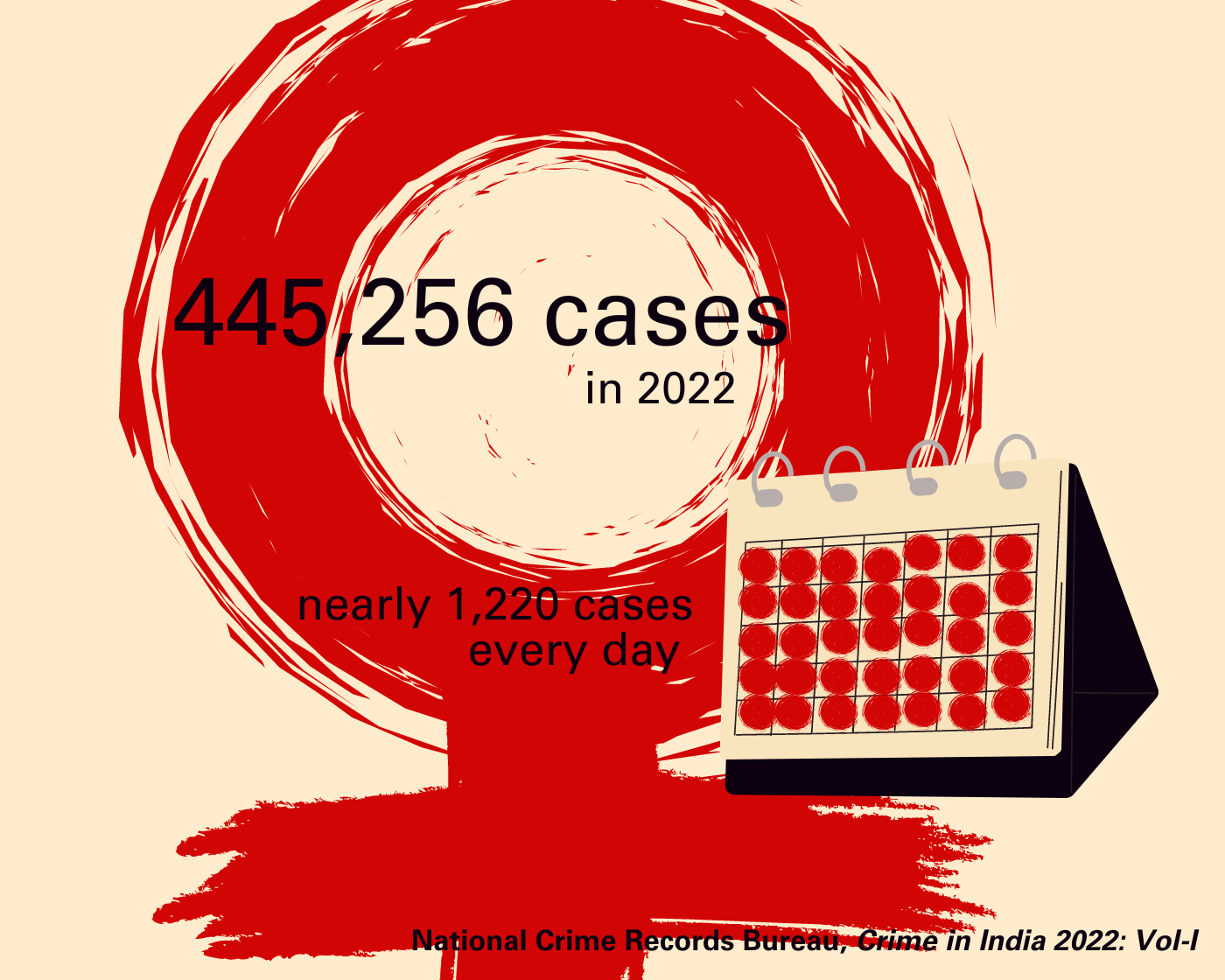
Violence against women has insidiously permeated into every aspect of daily living. Workplace harassment, trafficking of women, sexual abuse, domestic violence, sexism in art and language – all hinder the safety and security of women.
It’s a well-documented fact that women hesitate to report cases of crimes committed against them, further marginalising their voices. Take for instance the case of Barkha, a 22-year-old Dalit woman from Uttar Pradesh. Barkha states that the police refused to lodge an FIR for her complaint of rape and kidnapping when she first approached them because the main accused was a local political leader. Another rape survivor, Malini, who is a resident of Haryana, says, “the police asked me to take some money from the accused and to just let it [the crime] go. When I refused to compromise, they scolded me and said, “We will put you in lock-up if you don’t compromise.“
Police negligence, informal khap panchayats and lack of access to medical and legal resources work in tandem, discouraging women from seeking reparations for violence against them. A 2020 report, Barriers in Accessing Justice: The experiences of 14 rape survivors in Uttar Pradesh, India shows that in six of the reviewed cases, police registered an FIR (first information report) only after complaints were escalated to senior police officers. In the remaining five cases where an FIR was filed, it was done only after a court order. Markers like caste, class, disability and age augment one’s exclusion from state mechanisms which are in place to redress gender-based violence.
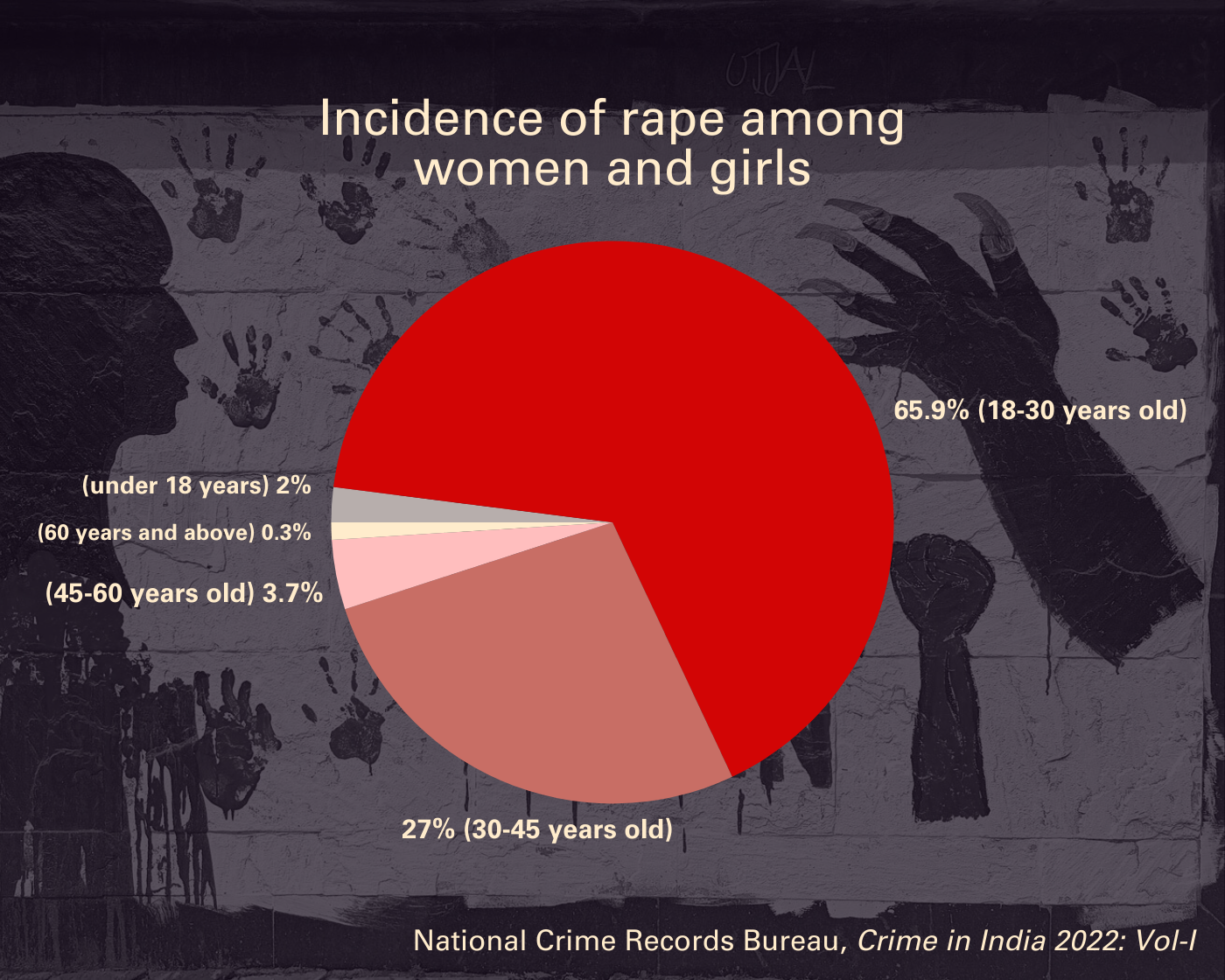
As per a report by Dalit Human Rights Defenders Network, perpetrators targeted girls younger than 18 years of age in 62 per cent of the 50 case studies of sexual violence against Dalit women. The Crime in India 2022 report also notes that the the incidence of rape cases in highest among women aged between 18 to 30 years.
Girls and women with psychological or physical disabilities are more prone to sexual violence in India, this report notes, due to the barriers in communication as well as their dependency on caretakers. Even when complaints are registered, like in the case of 21-year-old Kajri who is living with psychiatric disability, the legal process itself becomes the punishment. Kajri was kidnapped in 2010 and spent 10 years as a victim of trafficking, sexual assault, and child labour. Her father says, “it’s been difficult to continue my job in one place because I need days off to take Kajri to give police statements, tests etc. I get fired when I ask for frequent leave.”
In the essay Conceptualising Brahmanical Patriarchy in Early India , Prof. Uma Chakravarty writes of the enduring “obsession with creating an effective system of control and the need to guard them [women] constantly.” This control, as the essay notes, is often undertaken by rewarding women who subscribe to patriarchal norms and shaming those who do not. Regulatory norms which violently limit women’s mobility are often rooted in the fear of women’s sexuality and financial independence. “Earlier they [her in-laws] would say that I was going to meet with other men whenever I would go to see any pregnant woman in the village or take them to the hospital. Being an ASHA, this is my duty,” says 30-year-old Girija. A resident of Uttar Pradesh’s Mahoba district, Girija faces pressure from her in-laws to quit her job as an Accredited Social Health Activist (ASHA). “Yesterday my husband’s grandfather hit me with a lathi [stick] and even tried to throttle me,” she adds.
When women do manage to work and get paid for it, workplace harassment is the next gendered hurdle. As per a survey of garment sector workers in National Capital Region and Bengaluru, 17 per cent of women workers reported instances of sexual harassment at the workplace. “Male managers, supervisors and mechanics – they would try to touch us and we had no one to complain to,” notes Latha, a factory worker in the garment industry. Aiming to strengthen the collective bargaining power of female workers, the Vishaka Guidelines (1997) recommends organisations to form a Complaints Committee which should be headed by a woman and have as women not less than half of its members. Despite the existence of such directives on paper, their implementation continues to be feeble. Violence against women pervades at work and home.
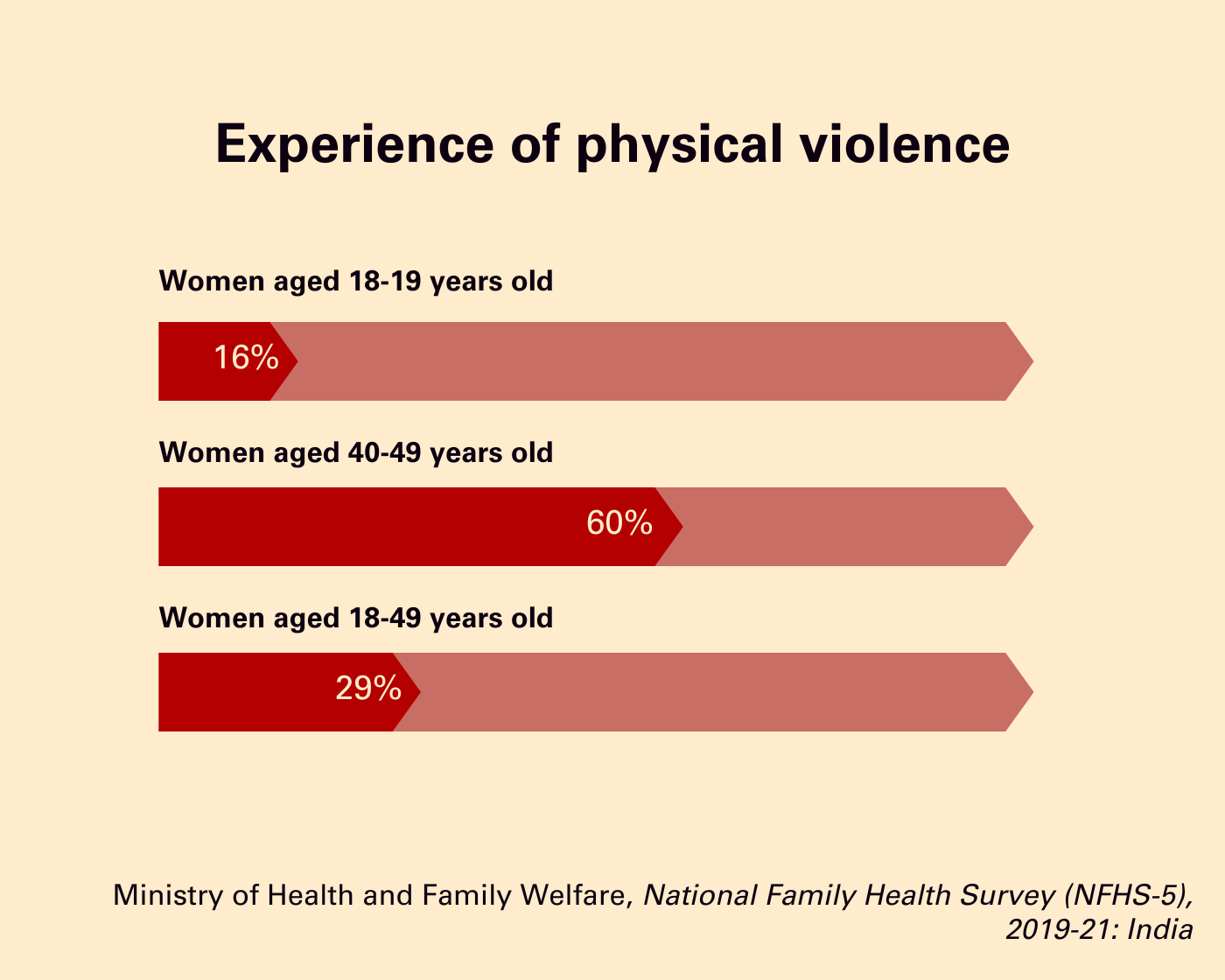
In the 2019-21 National Family Health Survey (NFHS), 29 per cent of women aged 18-49 years reported having experienced physical violence at home since the age of 15. Six per cent reported experiencing sexual violence. However, only 14 per cent of the women who had ever experienced sexual or physical violence sought help to stop it – from family, friends, or government institutions. There is a growing number of cases of violence women suffer from partners. “Meri gharwali hai, tum kyon beech mein aa rahe ho [She is my wife. Why are you interfering]?” Ravi would say when someone objected to his beating his wife. In just the year 2021, about 45,000 girls were killed by their partners or other family members around the world.
Without doubt, the endorsement of violence in romantic relationships portrayed in popular culture is a factor. In Impact of Indian Cinema on Young Viewers , depictions of “ chedh khaani ” or eve teasing (better termed as street sexual harassment) is seen as harmless banter by 60 per cent of the youth. The sinister normalisation of gendered violence is noted in another recent publication, Analysis of sitting MPs/MLAs with Declared Cases Related to Crimes against Women 2024, which states that as high as 151 sitting MPs/MLAs have cases of crimes against women declared in their candidature affidavits.
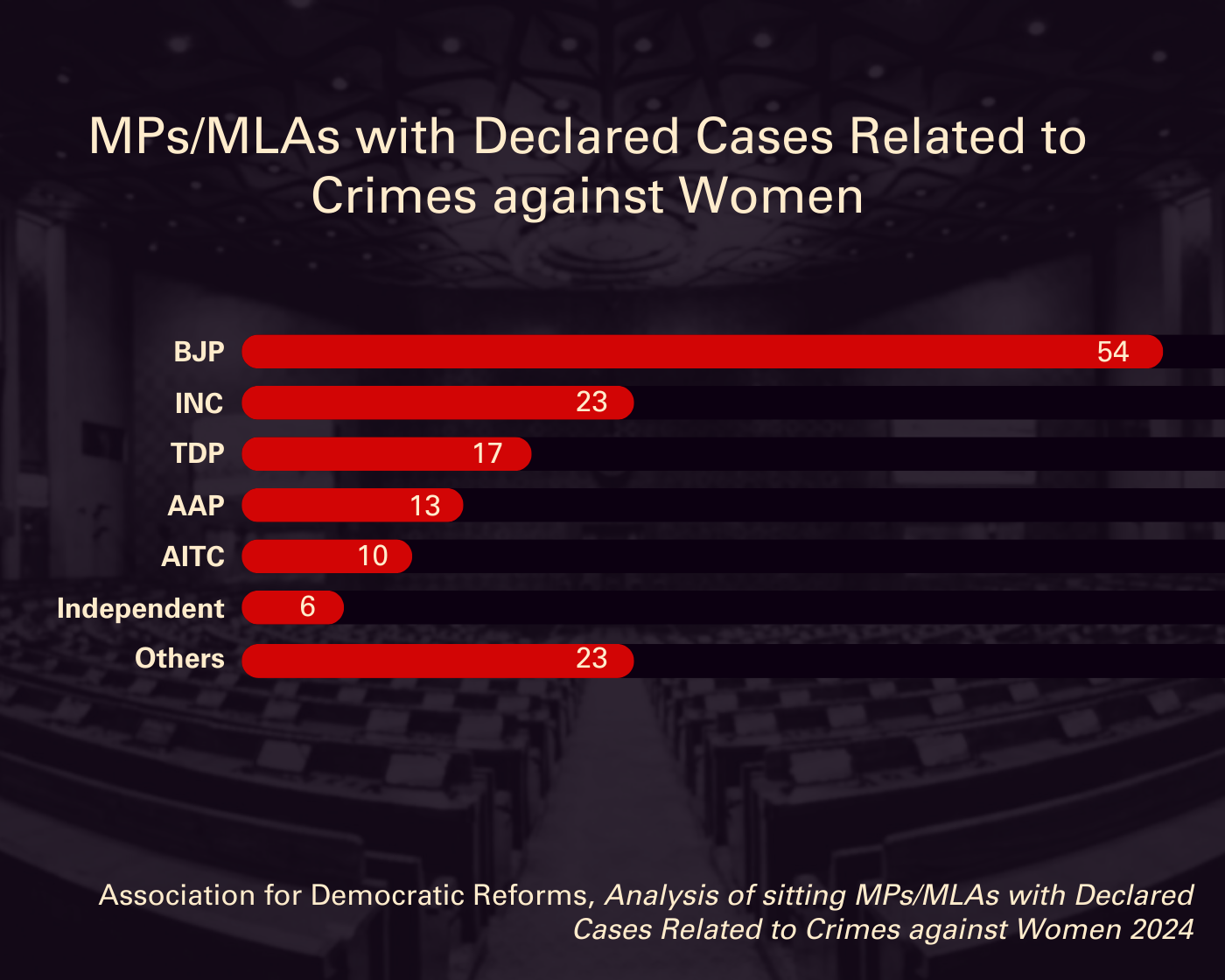
Add to this alarming mix the culture of victim-shaming, especially towards those who have experienced sexual violence: Radha, who was raped by four men from her village in Beed district, was then accused of being “characterless” and defaming her village when she spoke out against them.
The list of such crimes is long, and their patriarchal roots are deeply enmeshed in our society.
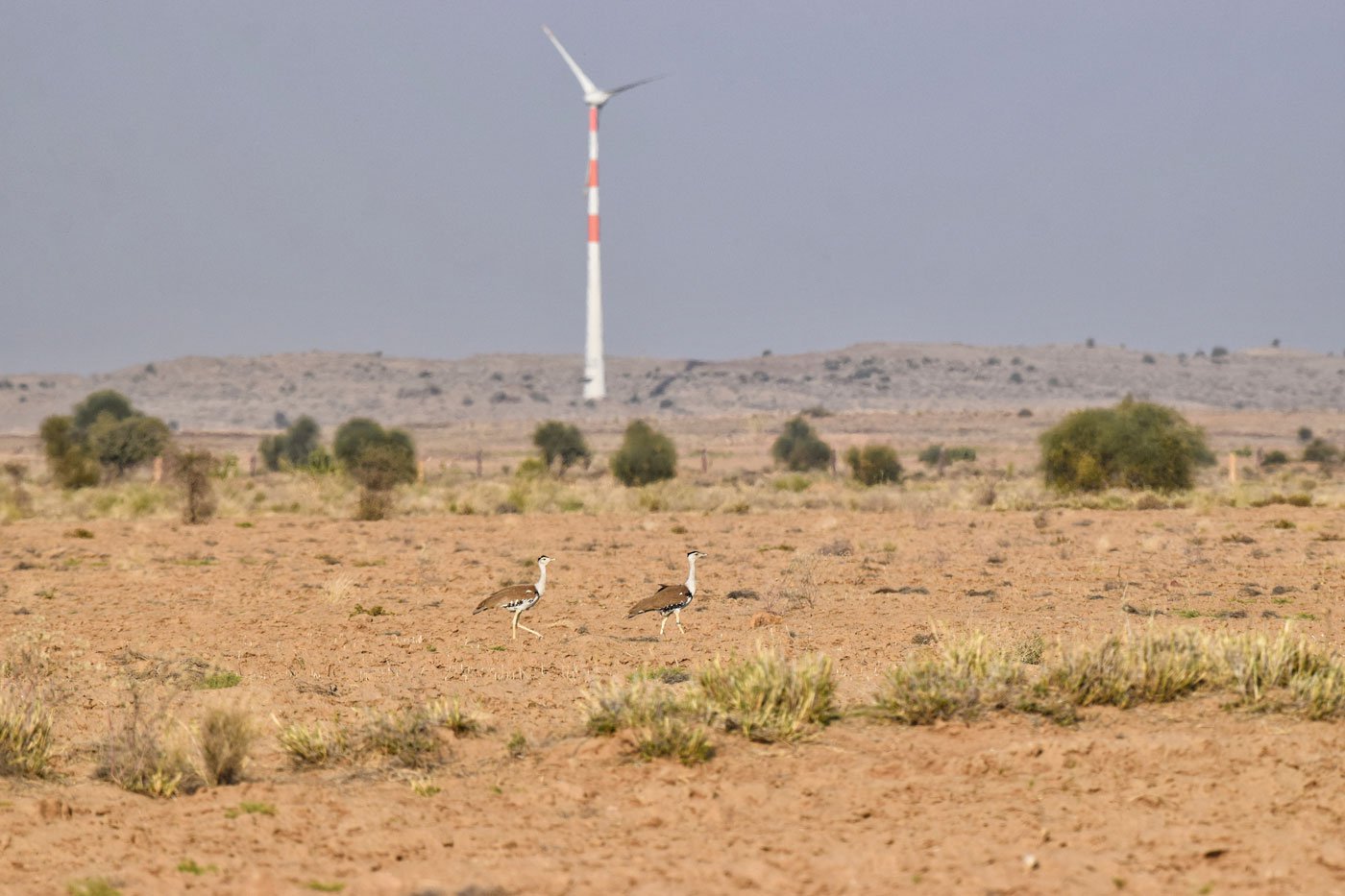
Brown feathers speckled with white are scattered in the short grasses.
Searching keenly, Radheshyam Bishnoi circles the area in the fading light. He is hoping he is wrong. “These feathers don’t look plucked,” he says aloud. Then he makes a call, “Are you coming? I think I’m quite sure…,” he tells the person on the line.
Above us, like an omen in the sky, the 220-kilovolt high tension (HT) cables hum and crackle – now black lines silhouetted against the darkening evening sky.
Remembering his duty as a collector of data, the 27-year-old pulls out his camera and takes a series of close-up and mid-shots of the scene of the crime.
The next day, early in morning we are back on site – a kilometre from hamlet Ganga Ram ki Dhani, near Khetolai in Jaisalmer district.
This time there is no doubt. The feathers belong to the Great Indian Bustard (GIB), known locally as the godawan.
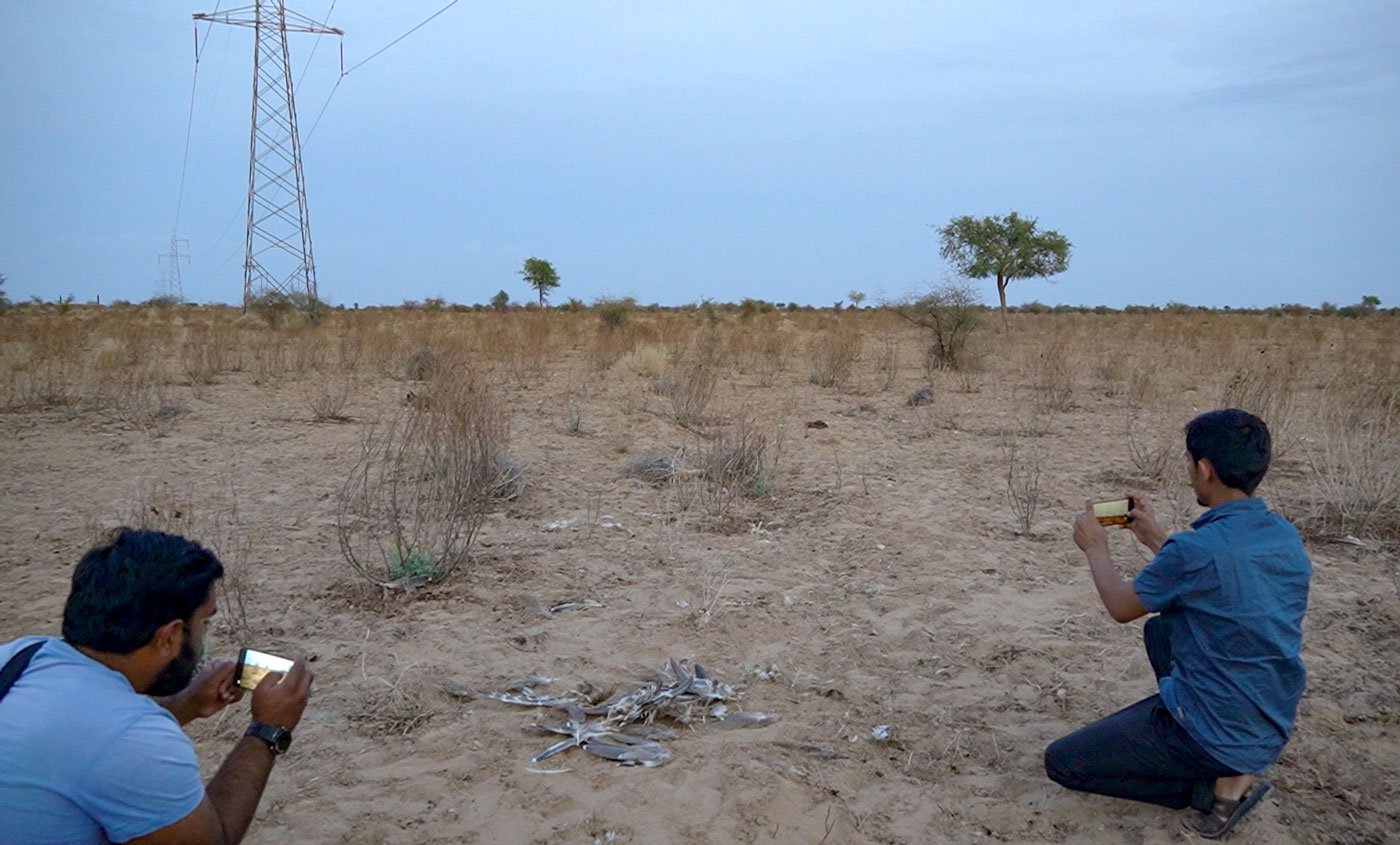
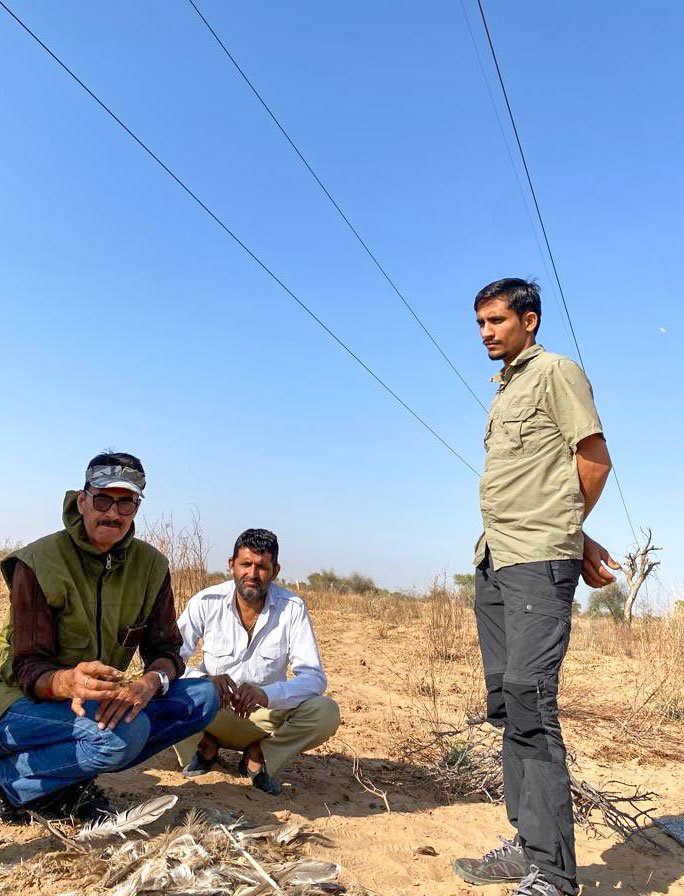
(Left) WII researcher, M.U. Mohibuddin and local naturalist, Radheshyam Bishnoi, at the site on March 23, 2023 documenting the death of a Great Indian Bustard (GIB) after it collided with high tension power lines. (Right) Radheshyam (standing) and local Mangilal watch Dr. S. S. Rathode, WII veterinarian (wearing a cap) examine the feathers. Photos: Urja/PARI
Dr. Shravan Singh Rathore, a wildlife veterinarian is at the site on the morning of March 23, 2023. He says, on examining the evidence: “The death is due to collision with the HT wires, there is no doubt. It appears to have taken place three days prior to today, so on March 20 [2023].”
This is the fourth body of a GIB that Dr. Rathore, who works with Wildlife Institute of India (WII), has examined since 2020. The WII is the technical arm of the Ministry of Environment, Forests and Climate Change (MoEFCC) and state wildlife departments. “All the carcasses were found under HT wires. The direct link between the wires and these unfortunate deaths is clear,” he adds.
The dead bird is the critically endangered Great Indian Bustard (Ardeotis nigriceps). And it’s the second one in just five months to crash and fall to its death after colliding with high tension wires. “This is the ninth death since 2017 [the year he began tracking],” says Radheshyam, a farmer from nearby village Dholiya in Sankra block of Jaisalmer district. An ardent naturalist, he keeps an eye out for the big bird. “Most of the godawan deaths have been right under HT wires,” he too adds.
The GIB is listed under Schedule I of India’s Wildlife (Protection) Act 1972 . Once seen in the grasslands of Pakistan and India, today there are totally only around 120-150 birds in the wild in the world, and their population is fragmented across five states. Around 8-10 birds have been sighted at the intersection of Karnataka, Maharashtra and Telangana, and four females in Gujarat.
The maximum number are right here in Jaisalmer district. “There are two populations – one near Pokaran and one in the Desert National Park – roughly 100 kilometres apart,” says Dr. Sumit Dookia, wildlife biologist who has been tracking these birds in their habitat – the grasslands of western Rajasthan.
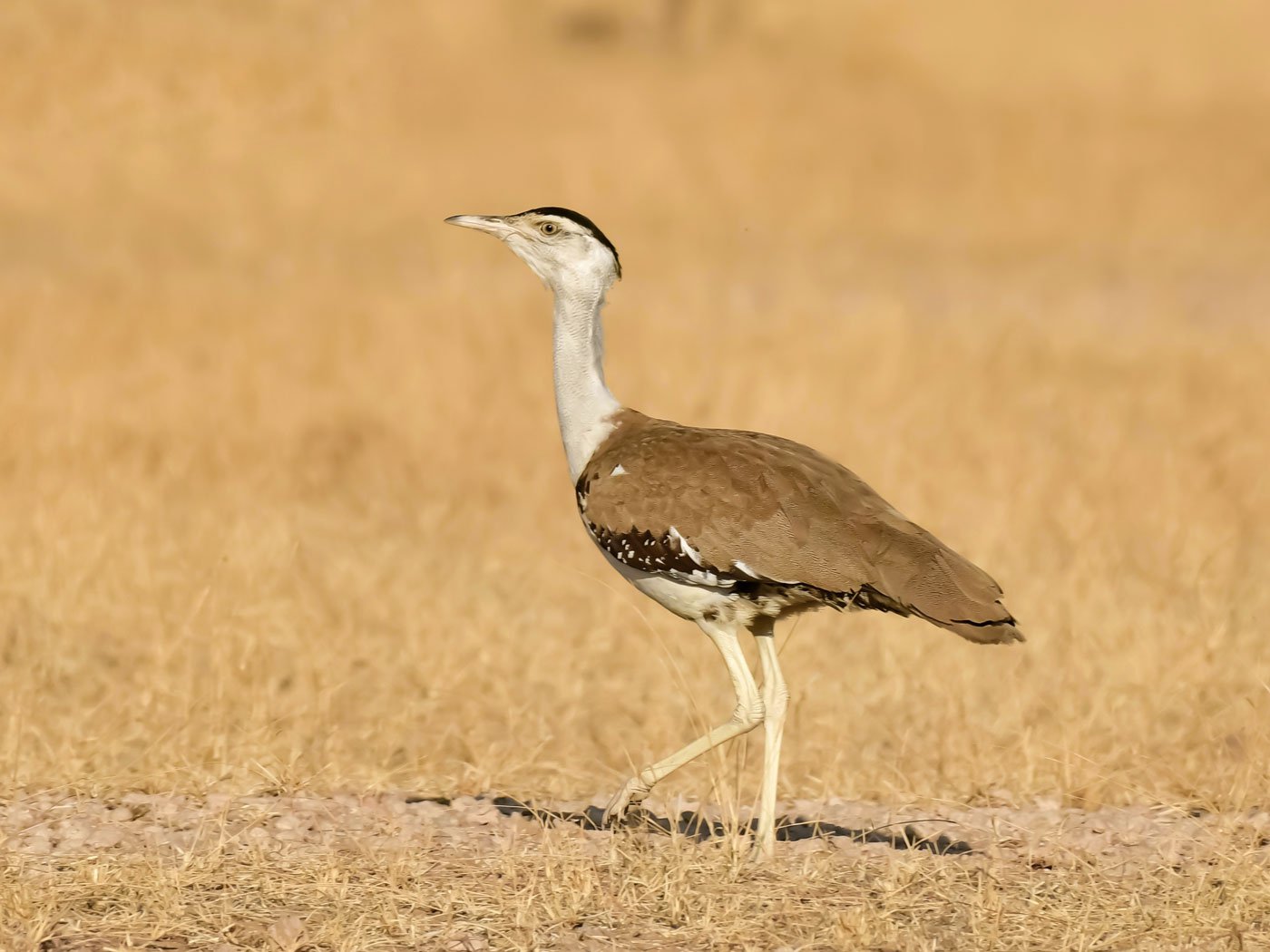
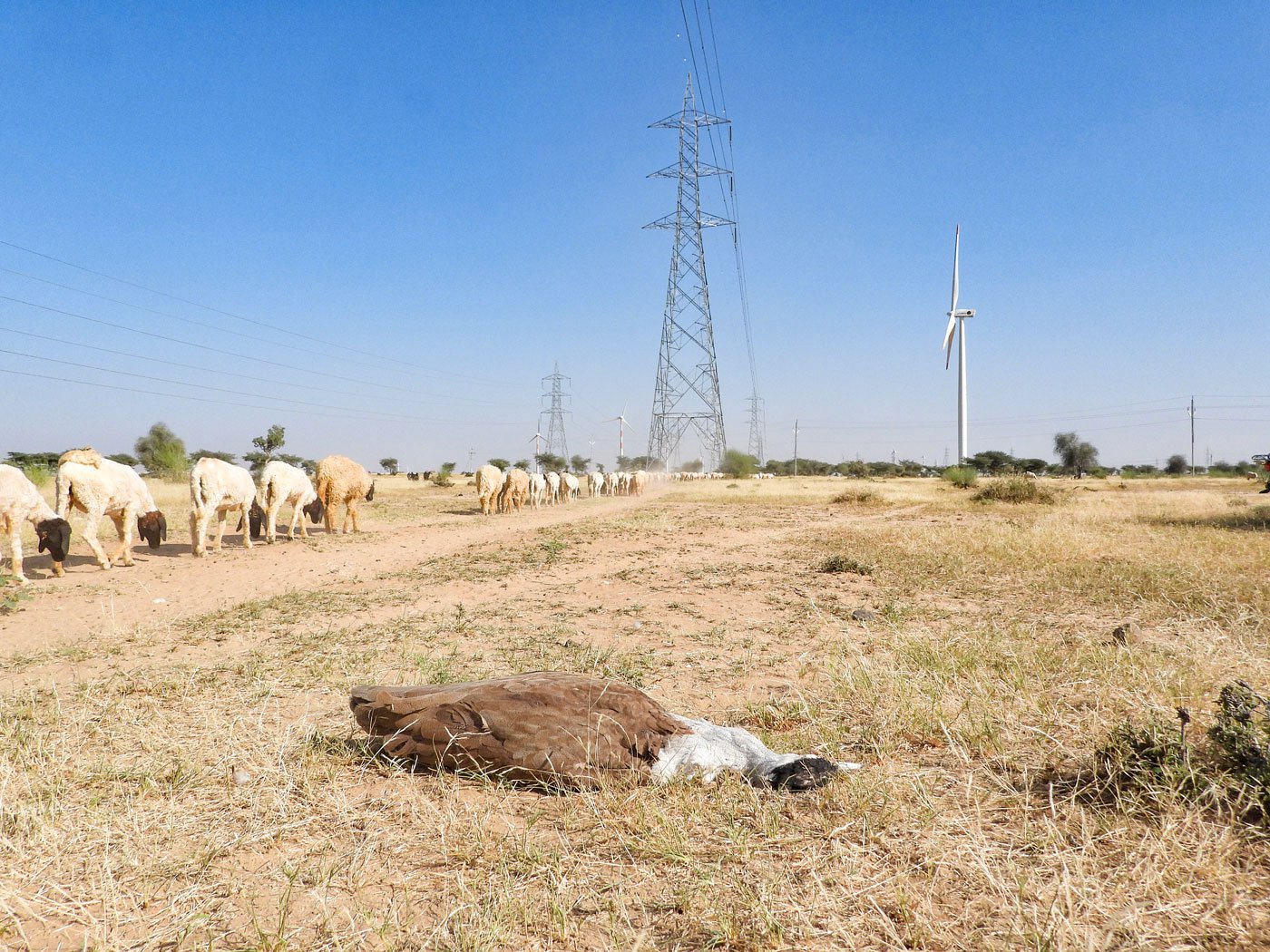
(Left) Today there are totally only around 120-150 Great Indian Bustards in the world and most live in Jaisalmer district. (Right) ‘We have lost GIB in almost all areas. There has not been any significant habitat restoration and conservation initiative by the government,’ says Dr. Sumit Dookia. Photos: Radheshyam Bishnoi/PARI
Mincing no words he says, “We have lost GIB in almost all areas. There has not been any major significant habitat restoration and conservation initiative from the government.” Dookia is honorary scientific advisor at Ecology, Rural Development & Sustainability (ERDS) Foundation – an organisation that has been working in the area since 2015 to build community participation for saving the GIB.
“In my own lifetime I have seen these birds in flocks in the sky. Now I see the single bird, occasionally and rarely in flight,” points out Sumer Singh Bhati. In his forties, Sumer Singh is a local environmentalist and actively working to save the bustard and its habitat in the sacred groves of Jaisalmer district.
He lives in Sanwata village in Sam block, an hour away, but the death of the godawan has brought him and other concerned locals and scientists rushing to the site.
About a 100 metres from the Degray Mata Mandir near Rasla village sits a life-size godawan made of plaster-of-paris. It can be seen from the highway – alone atop a platform inside a roped enclosure.
Locals have installed it as a mark of protest. “It was on the first death anniversary of the GIB that died here,” they tell us. The plaque written in Hindi translates to: ‘Near Degray Mata mandir on 16 September 2020, a female godawan collided with high tension lines. In its memory this monument has been built.’
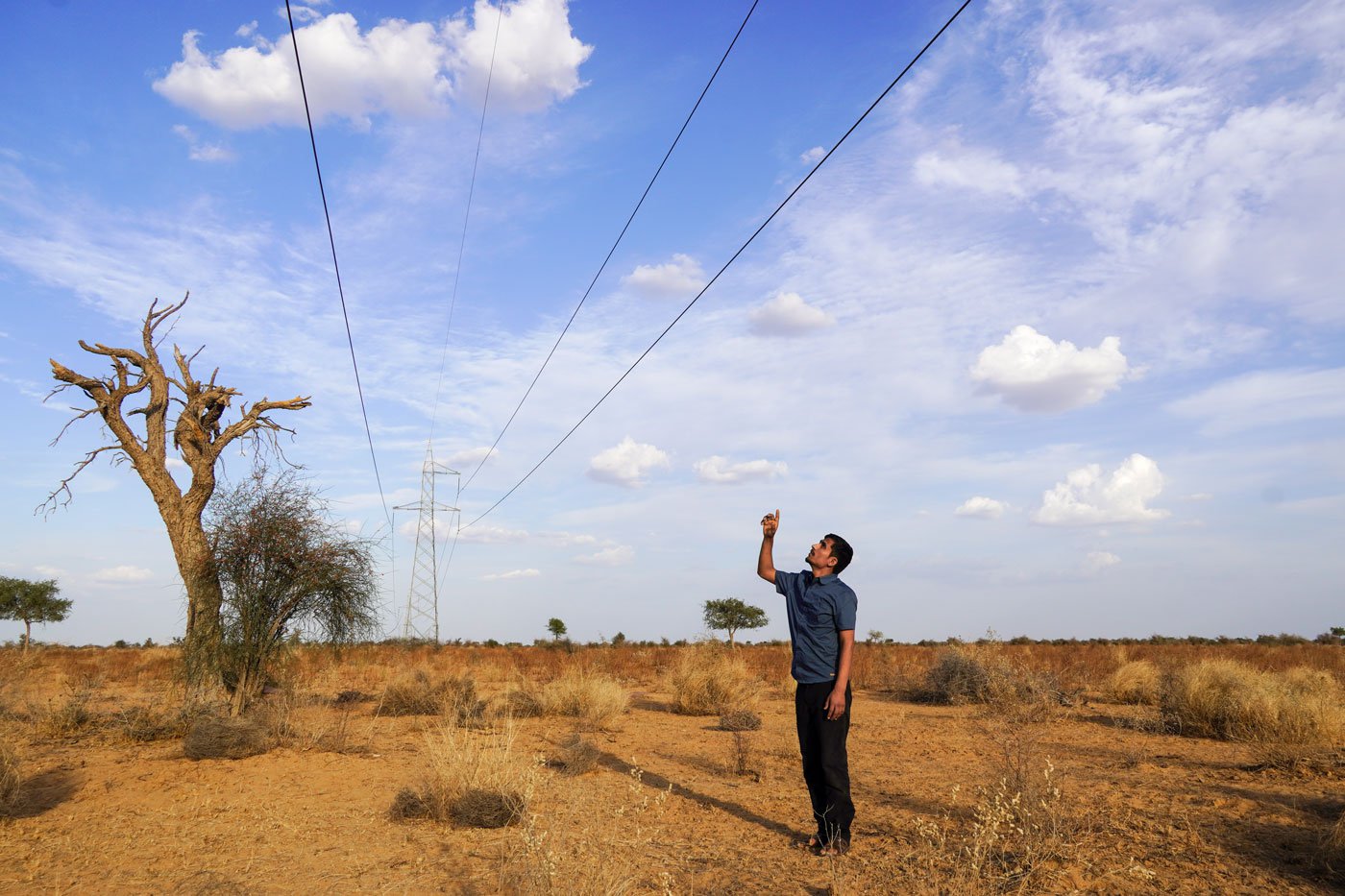
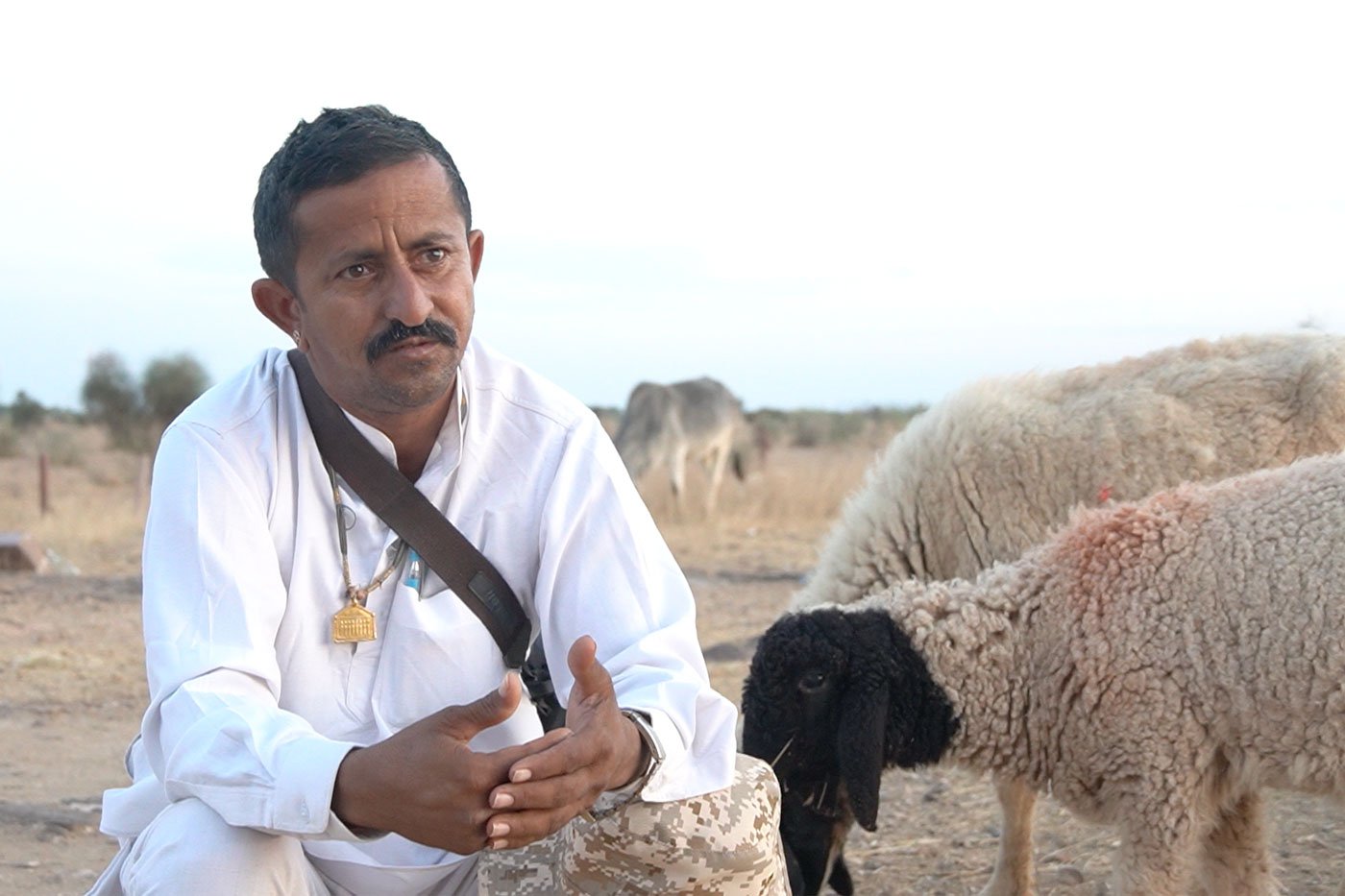
(Left) Radheshyam pointing at the high tension wires near Dholiya that caused the death of a GIB in 2019. (Right) Sumer Singh Bhati in his village Sanwata in Jaisalmer district. Photos: Urja/PARI
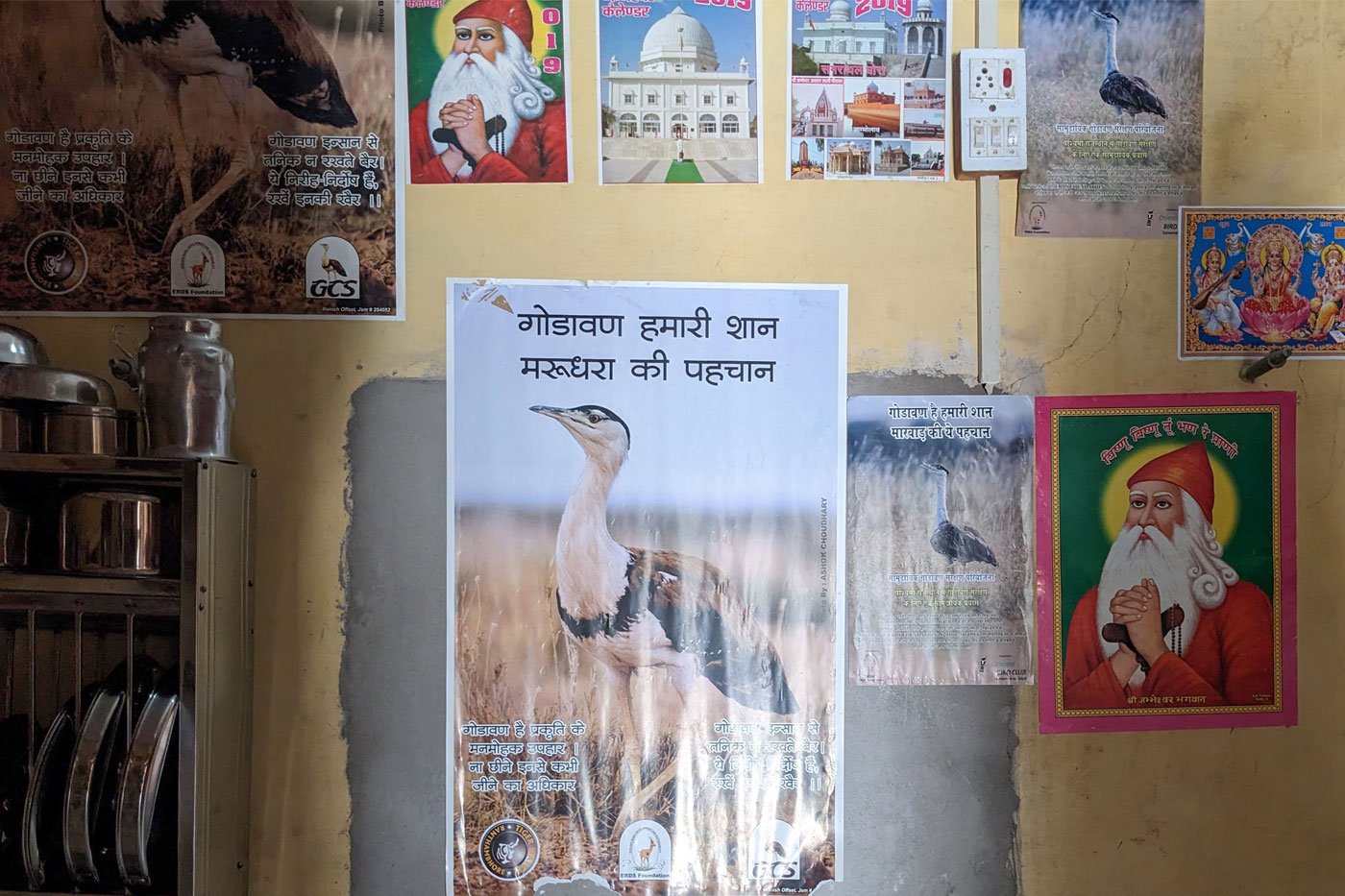
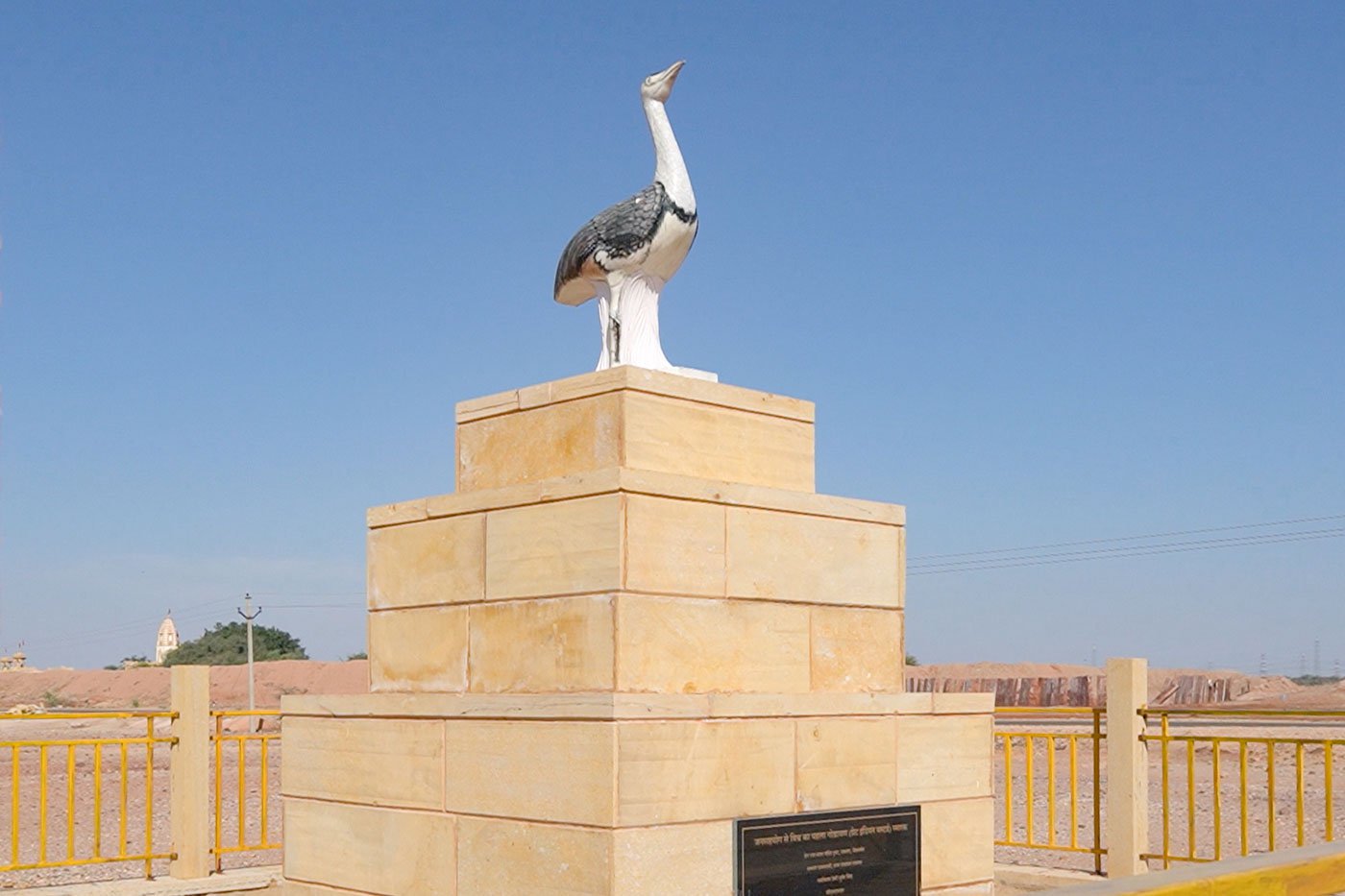
(Left) Posters of the godawan (bustard) are pasted along with those of gods in a Bishnoi home. (Right) The statue of a godawan installed by people of Degray. Photos: Urja/PARI
For Sumer Singh, Radheshyam and other locals of Jaisalmer, the dying godawans and their loss of habitat is grimly symbolic of the lack of agency that their pastoral communities have over their surroundings, and the subsequent loss of pastoral lives and livelihoods.
“We are losing so much in the name of ‘development’,” says Sumer Singh. “And who is this development for?” He has a point – there is a solar farm 100 metres away, power lines run overhead, but electricity supply in his village is fitful, inconstant, and unreliable.
India’s RE capacity jumped 286 per cent in the last 7.5 years, proclaims the central Ministry of New and Renewable Energy. And in the last decade but more so in the last 3-4 years, thousands of renewable energy plants – both solar and wind – have been commissioned in this state. Among others, Adani Renewable Energy Park Rajasthan Ltd (AREPRL) is developing a 500 MW capacity solar park in Bhadla, Jodhpur and 1,500 MW capacity solar park in Fatehgarh, Jaisalmer. An inquiry via the website sent to the company asking if they are moving any lines underground, has not been answered at the time of this story being published.
The energy produced by solar and wind farms in the state is sent on to the national grid with the help of a huge network of power lines that act as a barrier in the flight path of bustards, eagles, vultures and other avian species. The RE projects will lead to a green corridor that passes through the GIB habitats of Pokhran and Ramgarh-Jaisalmer.
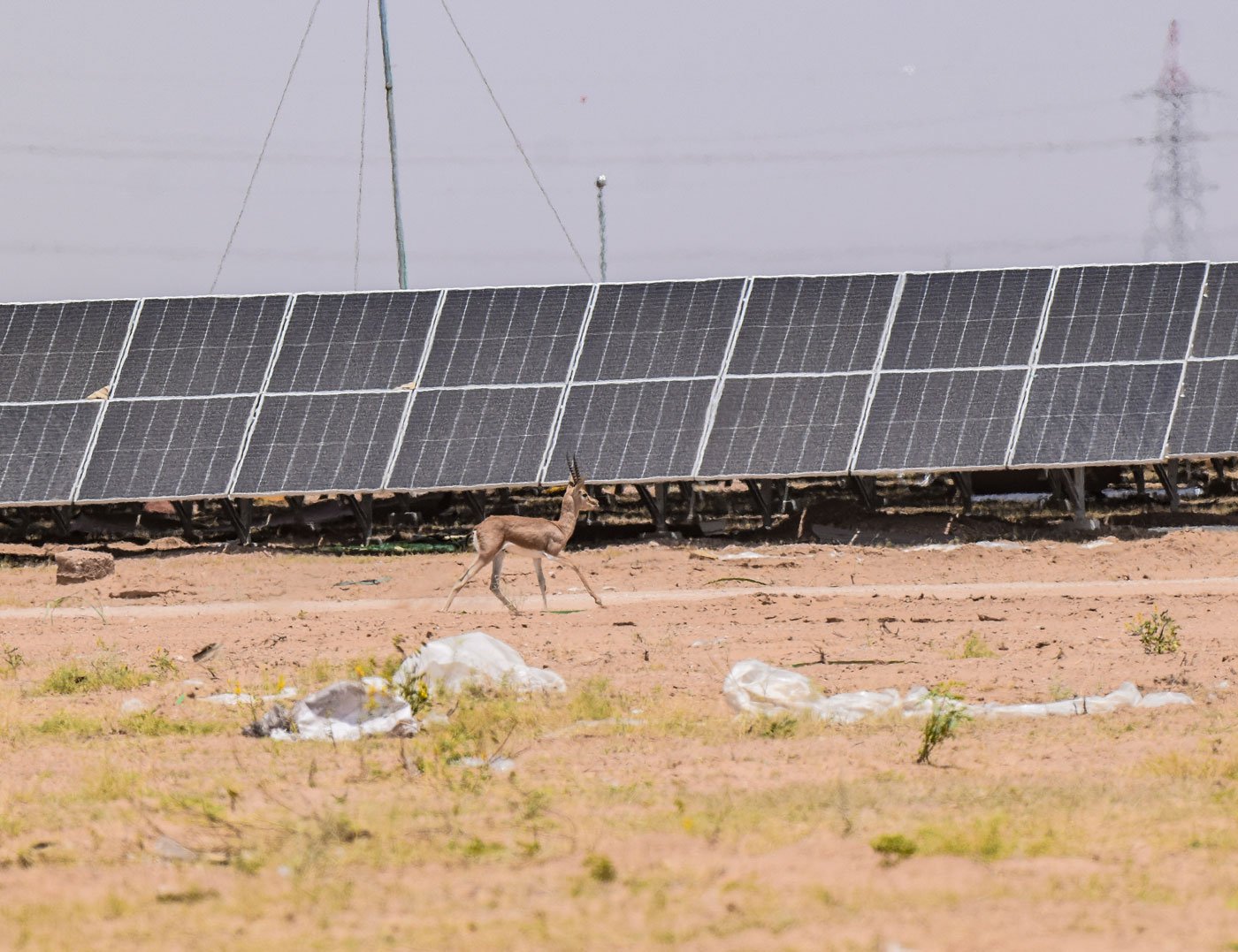
Solar and wind energy projects are taking up grasslands and commons here in Jaisalmer district of Rajasthan. For the local people, there is anger and despair at the lack of agency over their surroundings and the subsequent loss of pastoral lives and livelihoods. Photo: Radheshyam Bishnoi/PARI
Jaisalmer lies in the critical Central Asian Flyway (CAF) – the annual route taken by birds migrating from the Arctic to Indian Ocean, via central Europe and Asia. An estimated 279 populations of 182 migratory waterbird species come through this route, says the Convention on the Conservation of Migratory Species of Wild Animals. Some of the other birds are the endangered Oriental White-backed vulture (Gyps bengalensis), Long-billed (Gyps indicus) , Stoliczka’s Bushchat (Saxicola macrorhyncha) , Green Munia (Amandava formosa) and MacQueen’s or Houbara Bustard (Chlamydotis maqueeni) .
Radheshyam is also an avid photographer and his long focus tele lens has thrown up disturbing images. “I have seen pelicans landing on a field of solar panels at night because they think it’s a lake. The hapless bird then slips on the glass and its delicate legs are irreversibly injured.”
Powerlines are killing not just bustards, but a staggering estimated 84,000 birds a year within a 4,200 square kilometre area in and around the Desert National Park in Jaisalmer, says a 2018 study by the Wildlife Institute of India. “Such high mortality rate [of the bustard] is unsustainable for the species and a sure cause of extinction.”
The danger is not just in the sky but on the ground – large areas of grassland commons, sacred groves or orans as they are referred to here, are now dotted with whirling 200-metre-tall windmills placed at 500 metre intervals, and hectare upon hectares of walled enclosures for solar farms. The intrusion of renewable energy into sacred groves where all communities insist even a branch cannot be cut, has turned grazing into a game of snakes and ladders – pastoralists can no longer tread a direct path, but instead must go round fences and dodge windmills and their attendant microgrids.
(Left) The remains of a dead griffon vulture in Bhadariya near a microgrid and windmill. (Right) Radheshyam tracks godawans to help keep them safe. Photos: Vikram Darji/PARI
“If I leave in the morning, I get home only by evening,” says Dhanee (she uses only this name). The 25-year-old must go into the forest to bring grass for her four cows and five goats. “I get a shock from the wires sometimes when I take my animals into the forest.” Dhanee’s husband is studying in Barmer town, and she manages their six bigha (roughly 1 acre) of land and their three boys aged 8, 5 and 4 years.
“We have tried to raise questions with our MLA and the District Commissioner (DC), but nothing has happened,” says Murid Khan, Gram Pradhan of Degray in Rasla village of Sam block in Jaisalmer.
“Six to seven lines of high-tension cables have been installed in our panchayat,” he points out. “It is in our orans [sacred groves]. When we ask them, ‘bhai who has given you permission’, they say ‘we don’t need your permission’.”
On March 27, 2023, days after the incident, in a question asked in the Lok Sabha, the Minister of State for Environment, Forest and Climate Change, Shri Ashwini Kumar Choubey said that important GIB habitats would be designated into national parks (NPs).
Of the two habitats, one is already designated a NP and the other is defence land, but bustards are not safe.
On April 19, 2021, in response to a writ petition, the Supreme Court ruled that, “in the priority and potential bustard area, where it is found feasible to convert the overhead cables into underground powerlines the same shall be undertaken and completed within a period of one year, and till such time diverters [plastic discs that reflect light and warn off birds] shall be hung from the existing powerlines.”
The SC judgement lists 104 km of lines to go underground, and 1,238 km of lines to have diverters in Rajasthan.
“Why is the government allowing such big-sized renewable energy parks in GIB habitat when transmission lines are killing birds,” asks wildlife biologist, Sumit Dookia. Photos: Urja/PARI
Two years later – April 2023 – the SC’s ruling to send lines underground has been completely ignored and plastic diverters affixed on only a few kms – in areas where it gets public and media attention near major roads. “As per available research, bird diverters reduce collision to a great extent. So theoretically, this death could have been averted,” says wildlife biologist, Dookia.
The native bustard is at risk in what is their only home on this planet. Meanwhile we have rushed to make a home for a foreign species – a majestic five-year plan to spend Rs. 224 crore on bringing African cheetahs to India. The outlay covers flying them in special aircrafts, building secure enclosures, hi-quality cameras, and observation watchtowers. Then there is the tiger whose population is increasing and its budgetary allocation stands at a generous Rs.300 cr in 2022.
An imposing member of the avian species, the Great Indian Bustard stands a metre tall and weighs around 5-10 kilograms. It lays only one egg a year, and in the open. The increasing population of feral dogs in the area has put bustard eggs at risk. “The situation is grim. We need to find ways to sustain this population and leave some [inviolate] area for this species,” says Neelkanth Bodha, Programme Officer with the Bombay Natural History Society (BNHS) that runs a project in the area.
A terrestrial species, it prefers to walk. When it does fly, it’s a majestic sight – its wingspan of around 4.5 feet holding up the heavy body as it glides through the desert skies.
(Left) ‘The godawan doesn’t harm anyone. In fact, it eats small snakes, scorpions, small lizards and is beneficial for farmers,” says Radheshyam (Right) Not only is the Great Indian Bustard at risk, but so are the scores of other birds that come through Jaisalmer which lies on the critical Central Asian Flyway (CAF) – the annual route taken by birds migrating from the Arctic to Indian Ocean. Photos: Radheshyam Bishnoi/PARI
The mighty bustard has eyes on the side of its head, and it cannot see dead ahead. So, it either hits the high-tension wire in a head-on collision or tries to swerve at the last minute. But like a trailer truck that can’t take sharp turns, the GIB’s sudden change of direction is often too late, and some part of its wing or head slams into the wires situated at heights of 30 metres and above. “If the electric shock on encountering the wires don’t kill it, the fall usually does,” says Radheshayam.
In 2022, when locusts entered India through Rajasthan, “it was the presence of the godawan that saved some fields as they ate up locusts in thousands,” recalls Radheshyam. “Godawan doesn’t harm anyone. In fact, it eats small snakes, scorpions, small lizards and is beneficial for farmers,” he adds.
He and his family own 80 bighas (roughly 8 acres) of land on which they grow guar and bajra, and sometimes a third crop if there is winter rain. “Imagine if there were not 150 GIB, but in thousands, such a serious calamity like locusts’ invasion would be reduced,” he adds.
To save the GIB and ensure its habitat is undisturbed requires attention to a relatively small area. “We can make that effort. It’s not such a big deal to do. And there is a court order to send lines underground and not give permission for any more lines,” says Rathore. “Now the government should really stop and think before it’s all over.”
छोटे घासों के बीच सफ़ेद धब्बों वाले भूरे पंख यहां-वहां बिखरे पड़े हैं.
गौर से देखते हुए राधेश्याम बिश्नोई ढलती हुई रौशनी में उस क्षेत्र का चक्कर लगाते हैं. वह उम्मीद करते हैं कि वह ग़लत साबित होंगे. वह अपेक्षाकृत ऊंची आवाज़ में कहते हैं, “ये पंख तोड़े हुए नहीं लगते हैं.” फिर वह किसी को फ़ोन लगाते हैं, “आप आ रहे है? देखकर तो मुझे ऐसा ही लगता है…,” वह लाइन पर जुड़े दूसरे आदमी से कहते हैं.
हमारे माथे के ऊपर आसमान में एक अपशकुन की तरह 220-किलोवाट हाईटेंशन (एचटी) तारों से चटखने और गूंजने की लगातार आवाज़ें आ रही हैं. शाम के गहराते अंधेरे में ये तार काली लकीरों की तरह दिखते हैं.
डेटा-संग्राहक के रूप में अपनी ज़िम्मेदारियों को याद रखते हुए 27 साल के बिश्नोई अपना कैमरा बाहर निकालते हैं और क़रीब से व मध्यम दूरी से ‘अपराध-स्थल’ की बहुत सी तस्वीरें लेते हैं.
अगली सुबह हम पौ फटते ही दोबारा घटना-स्थल पर पहुंचते हैं, जो जैसलमेर ज़िले में खेतोलाई के नज़दीक की छोटी सी बस्ती, गंगाराम की ढाणी से बस एक किलोमीटर की दूरी पर है.
इस बार हमें इस निष्कर्ष पर पहुंचने में कोई दुविधा नहीं होती है कि ये पंख ग्रेट इंडियन बस्टर्ड (जीआइबी) के ही हैं, जिसे स्थानीय लोग गोडावण कहते हैं.
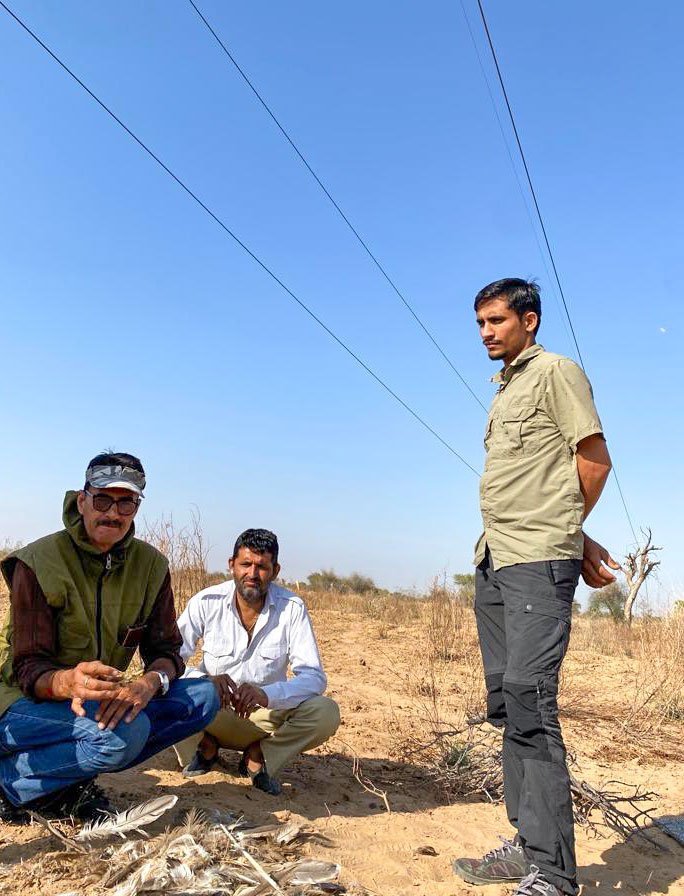
(1) डब्लूआईआई शोधकर्ता एम. यू. मोहिबुद्दीन और स्थानीय प्रकृतिविद राधेश्याम बिश्नोई 23 मार्च को घटना स्थल पर ग्रेट इंडियन बस्टर्ड की हाई टेंशन बिजली के तारों से टकराने के बाद हुई मौत से संबंधित जानकारी इकट्ठा कर रहे हैं. तस्वीर: ऊर्जा/PARI
(2) राधेश्याम (खड़े हैं) और स्थानीय निवासी मांगीलाल, वन्यपशु पशु चिकित्सक डॉ. एस.एस. राठोड़ (टोपी लगाए हुए) को पंखों की जांच करते देख रहे हैं. तस्वीर: प्रीती डेविड/PARI
वन्यपशु चिकित्सक डॉ. श्रवण सिंह राठोड़ भी 23 मार्च, 2023 की सुबह घटना स्थल पर मौजूद हैं. साक्ष्यों पर नज़र दौड़ाते हुए वह कहते हैं: “कोई शक नहीं है कि मौत हाई टेंशन तार से टकराने की वजह से हुई है. ऐसा लगता है कि यह आज से तीन दिन पहले की घटना है, यानी 20 मार्च [2023] को घटी घटना लगती है.”
साल 2020 से लेकर अब तक यह चौथा मृत पंछी है जिसकी जांच भारतीय वन्यजीव संस्थान (डब्लूआईआई) में कार्यरत डॉ. राठोड़ कर रहे हैं. डब्लूआईआई पर्यावरण, वन और जलवायु परिवर्तन मंत्रालय (एमओईएफ़सीसी) और राज्य वन्यजीवन विभाग की एक तकनीकी शाखा है. डॉ. राठोड़ आगे कहते हैं, “सभी मृत गोडावण हाईटेंशन तारों के नीचे पड़े मिले हैं. इन तारों और इन दुर्भाग्यशाली मौतों के बीच सीधा संबंध एकदम साफ़ है.”
यह मृत पक्षी विलुप्ति के गंभीर संकट को झेलता ग्रेट इंडियन बस्टर्ड (आर्डीयोटिस नाइग्रिसेप्स) है. पांच महीने के अन्तराल में यह दूसरी बार हुआ है कि हाई टेंशन तारों से टकराने से इनकी मौत हुई है. राधेश्याम बताते हैं, “साल 2017 [इन पक्षियों पर जब से वह नज़र रखे हैं] से मौत की यह नौवीं घटना है.” वह पड़ोस के ढोलिया में रहते हैं, जो जैसलमेर ज़िले के सांकड़ा ब्लॉक का एक छोटा सा गांव है. एक सच्चे प्रकृतिप्रेमी होने के कारण वह इन विलुप्त होते पक्षियों पर कड़ी नज़र रखते हैं. उनका भी यही कहना है, “अधिकतर गोडावणों की मौत हाई टेंशन के तारों के नीचे हुई है.“
गोडावण को वन्यजीव (संरक्षण) अधिनियम 1972 की अनुसूची-1 में शामिल किया गया है. कभी भारत और पाकिस्तान के मैदानी इलाक़ों में पाए जाने वाले ये दुर्लभ पक्षी आज पूरी दुनिया में केवल 120-150 की तादाद में जीवित हैं और भारत के केवल पांच राज्यों में ही देखे जा सकते हैं. लगभग 8 से 10 पक्षी कर्नाटक, महाराष्ट्र और तेलंगाना के परस्पर सीमावर्ती क्षेत्रों में और चार मादाएं गुजरात में देखी गई हैं.
इनकी सबसे अधिक संख्या जैसलमेर ज़िले में है. पश्चिम राजस्थान के घास वाले मैदानों में इनके प्राकृतिक आवासों में पक्षियों पर निगरानी रखने वाले वन्यजीव जैव वैज्ञानिक डॉ. सुमित डूकिया कहते हैं, “इनकी दो आबादियां हैं – एक पोकरण के निकट, और एक लगभग 100 किलोमीटर की दूरी पर डेजर्ट [मरुस्थल] नेशनल पार्क में.”
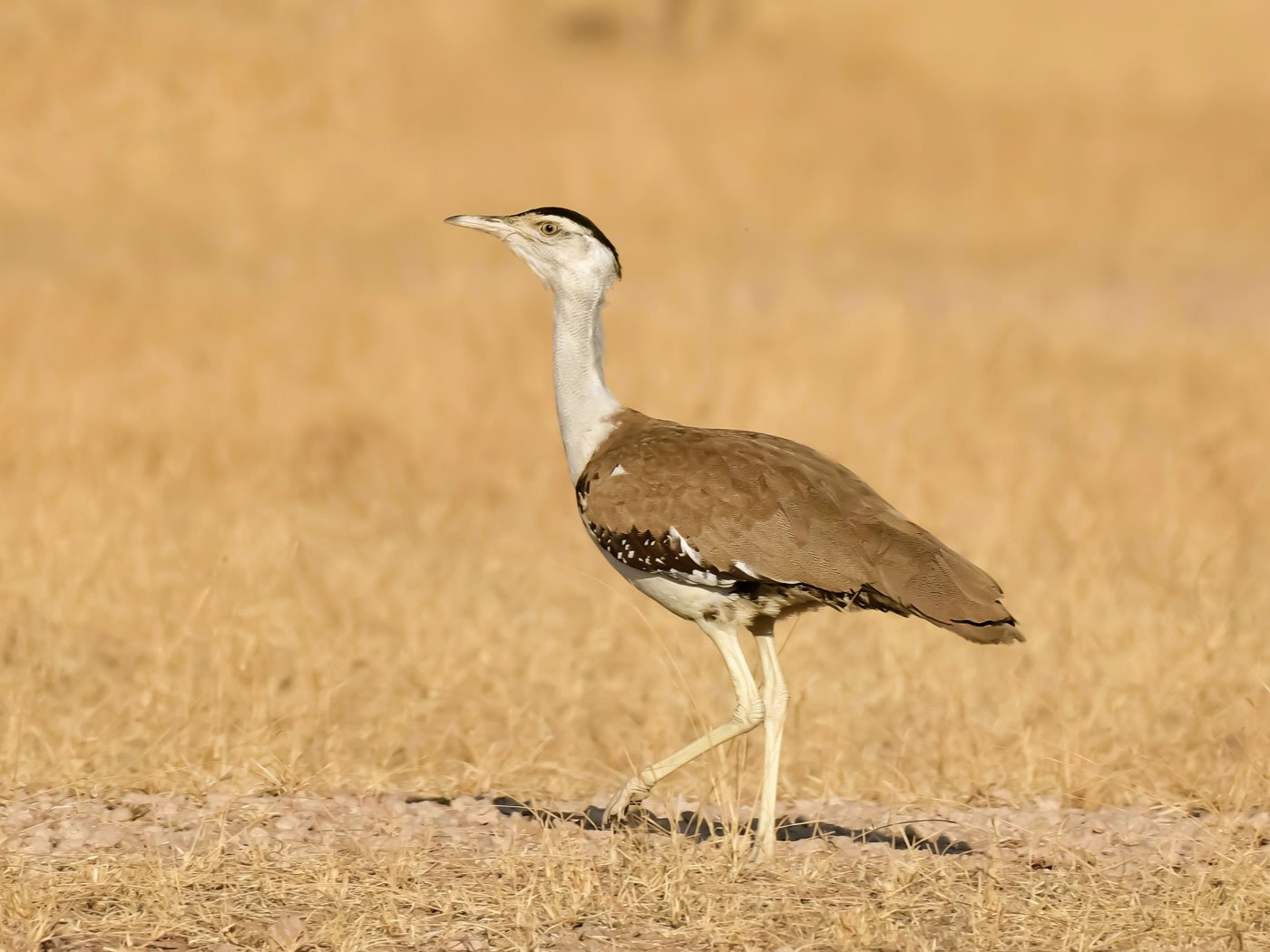
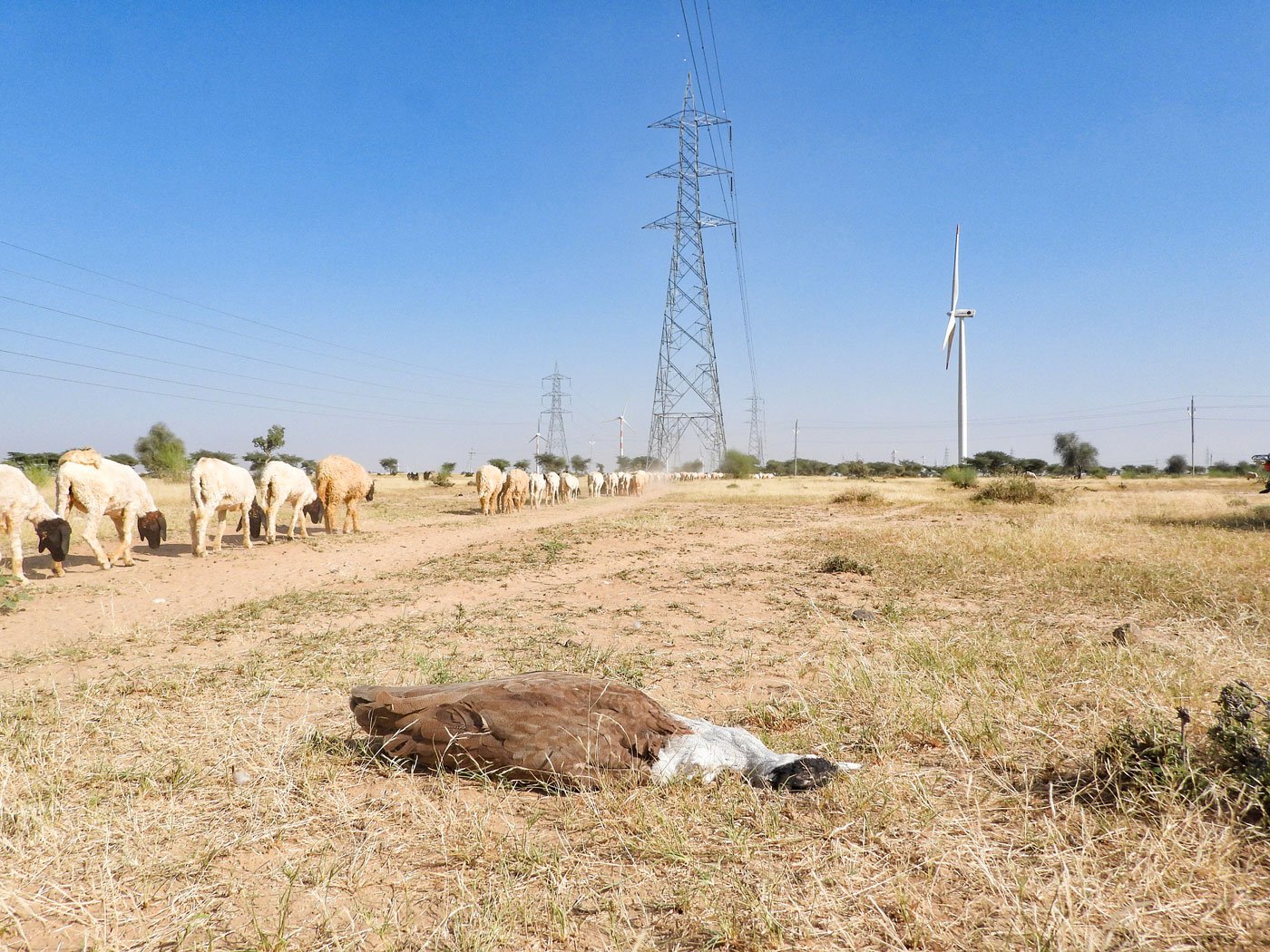
(1) आज दुनिया में कुल मिलाकर लगभग 120-150 गोडावण बचे हैं और उनमें से ज़्यादातर जैसलमेर ज़िले में हैं. तस्वीर: राधेश्याम बिश्नोई/PARI
(2) डॉ. सुमित डूकिया बताते हैं, ‘हमने लगभग सभी इलाक़ों में ग्रेट इंडियन बस्टर्ड को खोया है. उनके प्राकृतिक आवासों को दोबारा उनके अनुकूल बनाने और उनके संरक्षण के लिए सरकार की तरफ़ से अभी तक कोई ठोस पहल नहीं की गई है’. तस्वीर: राधेश्याम बिश्नोई/PARI
बिना किसी लाग-लपेट के वह कहते हैं, “हमने लगभग सभी इलाक़ों में ग्रेट इंडियन बस्टर्ड को खोया है. उनके प्राकृतिक आवासों को दोबारा उनके अनुकूल बनाने और उनके संरक्षण के लिए सरकार की तरफ़ से अभी तक कोई ठोस पहल नहीं की गई है.” डूकिया इकोलॉजी, रूरल डेवलपमेंट एंड सस्टेनिबिलिटी (ईआरडीएस) फाउंडेशन के अवैतनिक वैज्ञानिक सलाहकार हैं. यह संगठन गोडावणों के संरक्षण में सामुदायिक भागीदारी के निर्माण की दिशा में 2015 से सक्रिय है.
सुमेर सिंह भाटी बताते हैं, “अपने इसी जीवन में मैंने इन पक्षियों को झुंडों में आकाश में उड़ते हुए देखा है. अब मुझे कभी-कभार आसमान में कोई अकेला गोडावण उड़ता हुआ दिखाई देता है.” चालीस के आसपास की उम्र के सुमेर सिंह स्थानीय पर्यावरणविद हैं और जैसलमेर ज़िले की घनी झुरमुटों में बस्टर्ड और उसके प्राकृतिक आवास को बचाने में काम में पूरी तरह से समर्पित हैं.
हालाँकि सम ब्लॉक के संवत गांव में रहते हैं जहां जाने में एक घंटे का समय लगता है लेकिन गोडावण की मौत की ख़बर ने उन्हें और उनकी तरह इस पक्षी के भविष्य को लेकर चिंतित दूसरे स्थानीय लोगों और वैज्ञानिकों को घटना स्थल पर पहुंचने के लिए विवश कर दिया है.
रासला गांव के क़रीब देगराय माता मंदिर से लगभग 100 मीटर की दूरी पर प्लास्टर ऑफ़ पेरिस की बनी गोडावण की एक आदमकद मूर्ति है, जो हाईवे से ही नज़र आती है – एक चबूतरे पर रस्सी के घेरे के बीच एक अकेली मूर्ति.
स्थानीय लोगों ने इस मूर्ति को अपना विरोध प्रकट करने के उद्देश्य से स्थापित किया है. गांव के लोग बताते हैं, “इस मूर्ति को इसी स्थान पर मरे एक गोडावण की मृत्यु के एक साल पूरे होने के दिन स्थापित किया गया था.” स्मृति-पट्टिका पर लिखा है: “16 सितंबर 2020 को यहां देगराय माता मंदिर के पास हाईटेंशन तारों से टकरा कर एक मादा गोडावण की मौत हुई. यह स्मारक उसी पक्षी की स्मृति में बनाया गया है.”
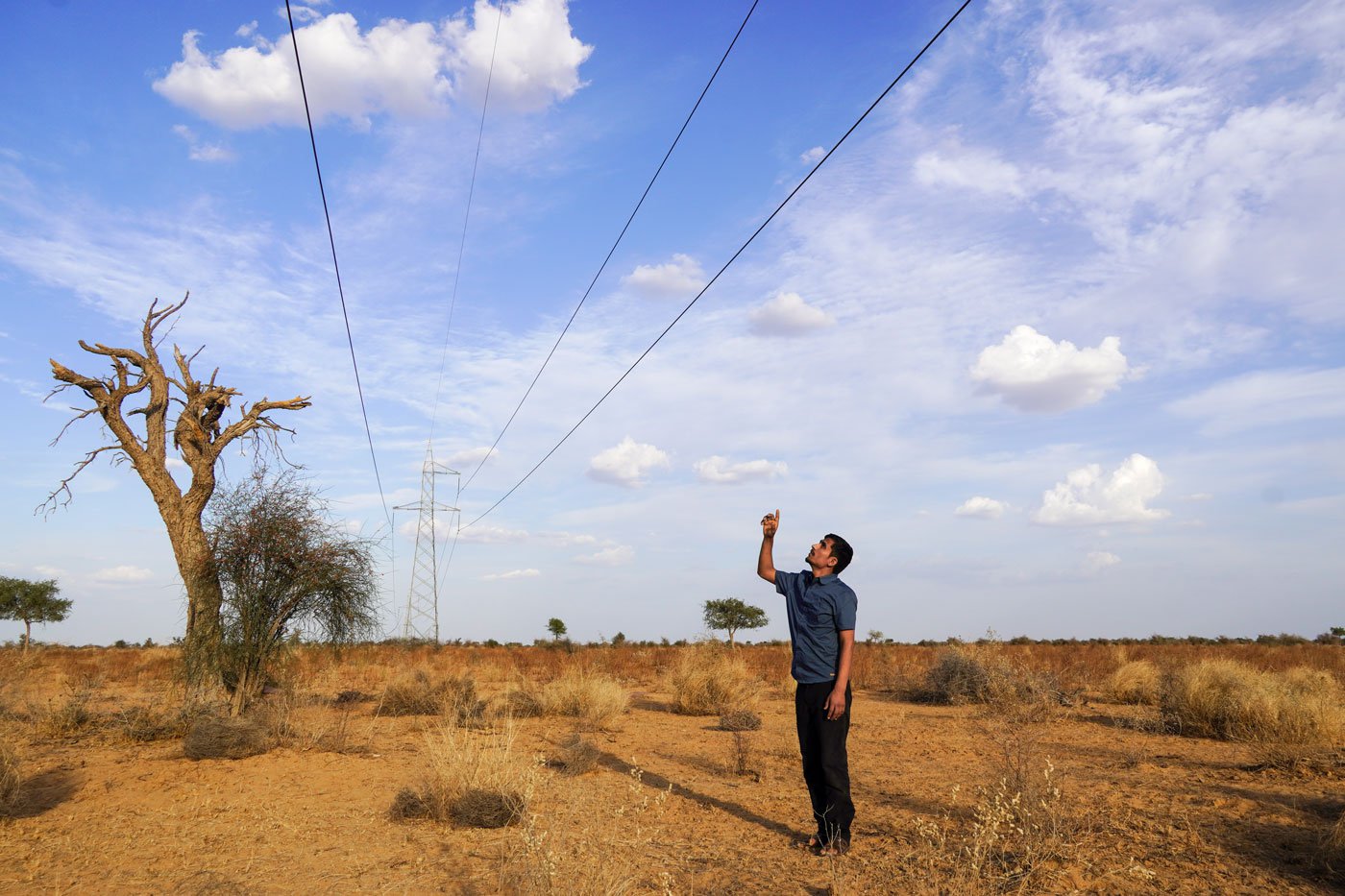
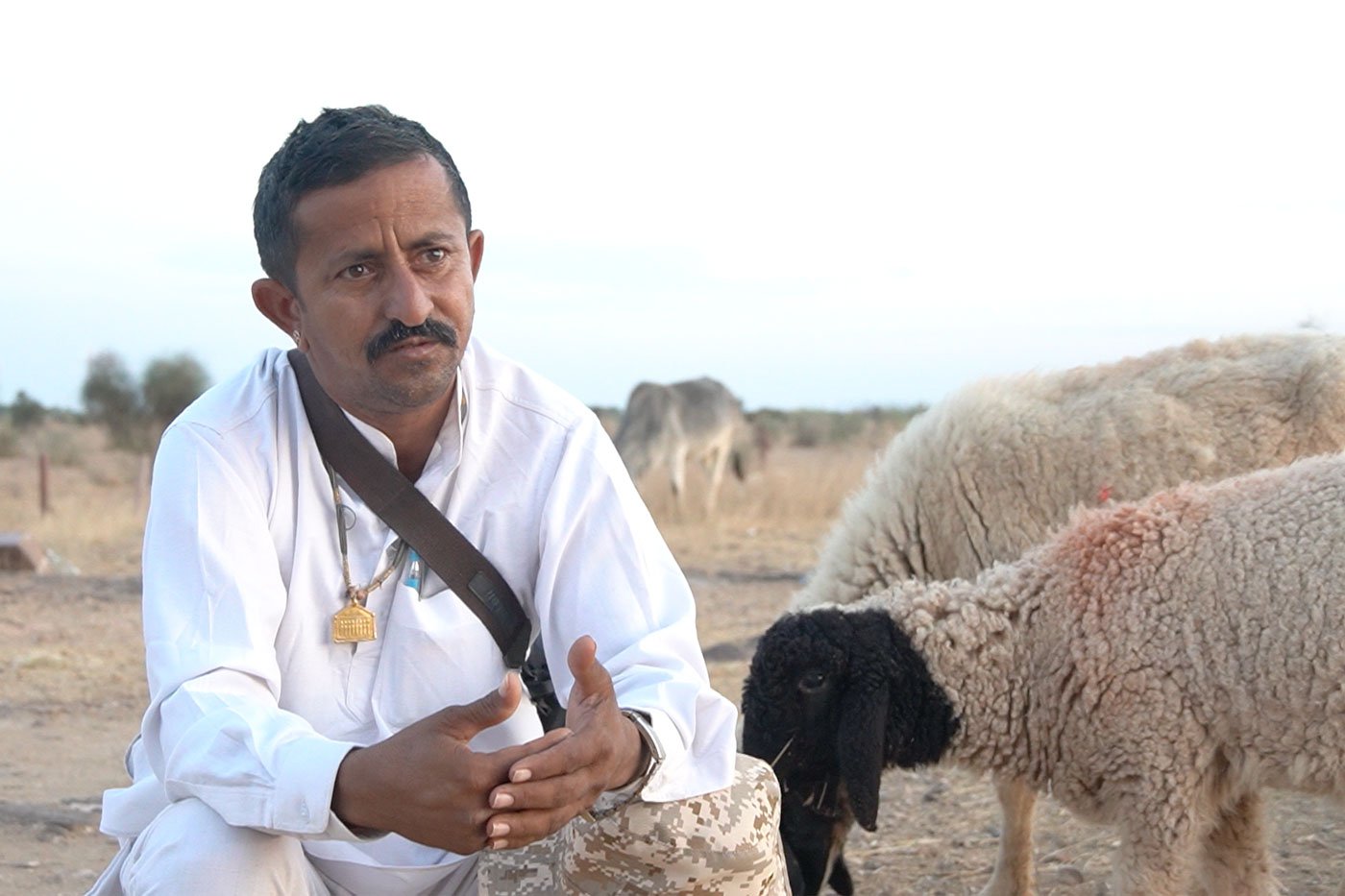
(1) राधेश्याम हाईटेंशन तारों को दिखाते हुए, जिसके कारण 2019 में एक बस्टर्ड की मौत हो गई. तस्वीर: ऊर्जा/PARI
(2) जैसलमेर ज़िले में अपने गांव सांवता में सुमेर सिंह भाटी. तस्वीर: ऊर्जा/PARI
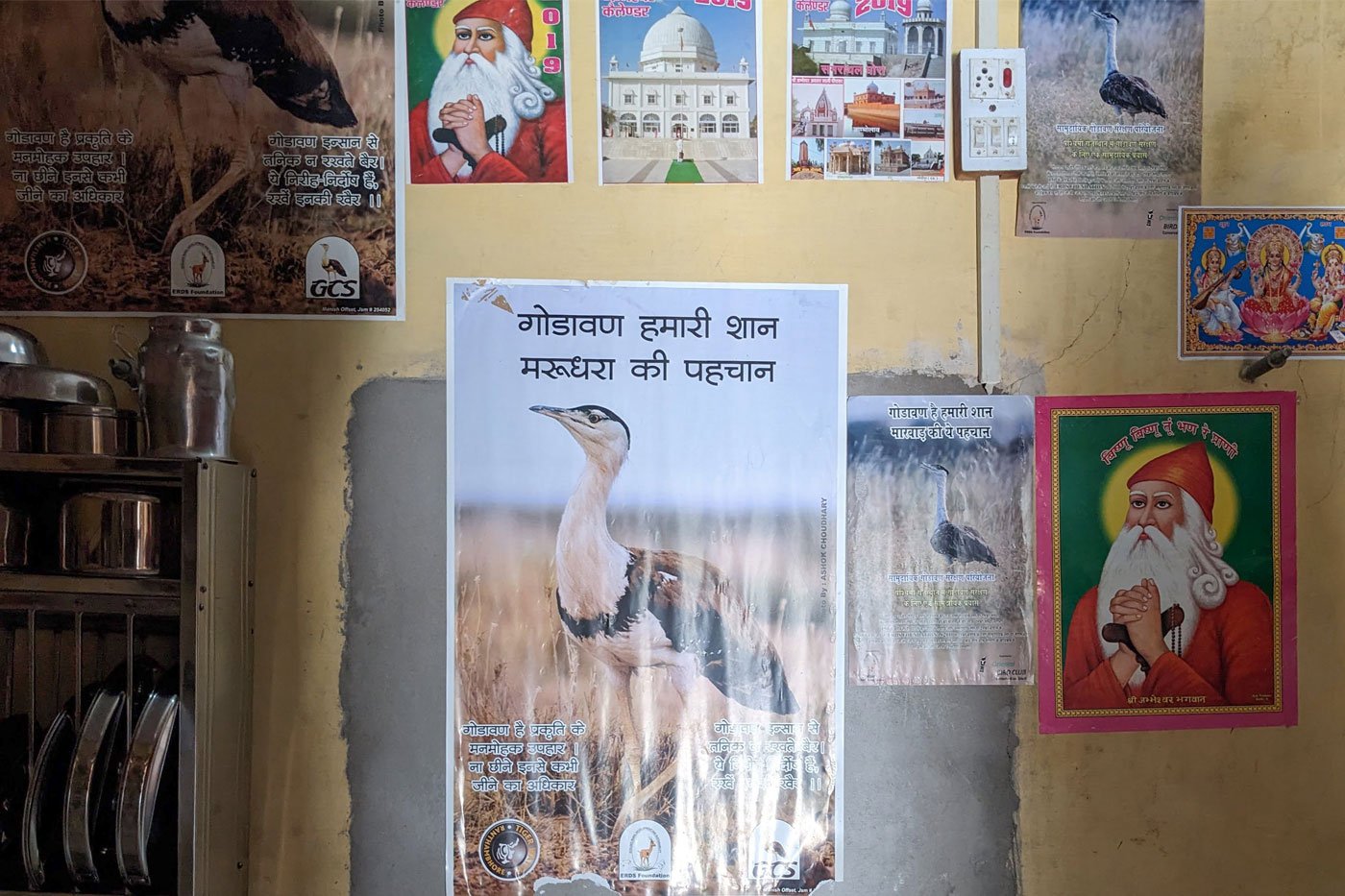
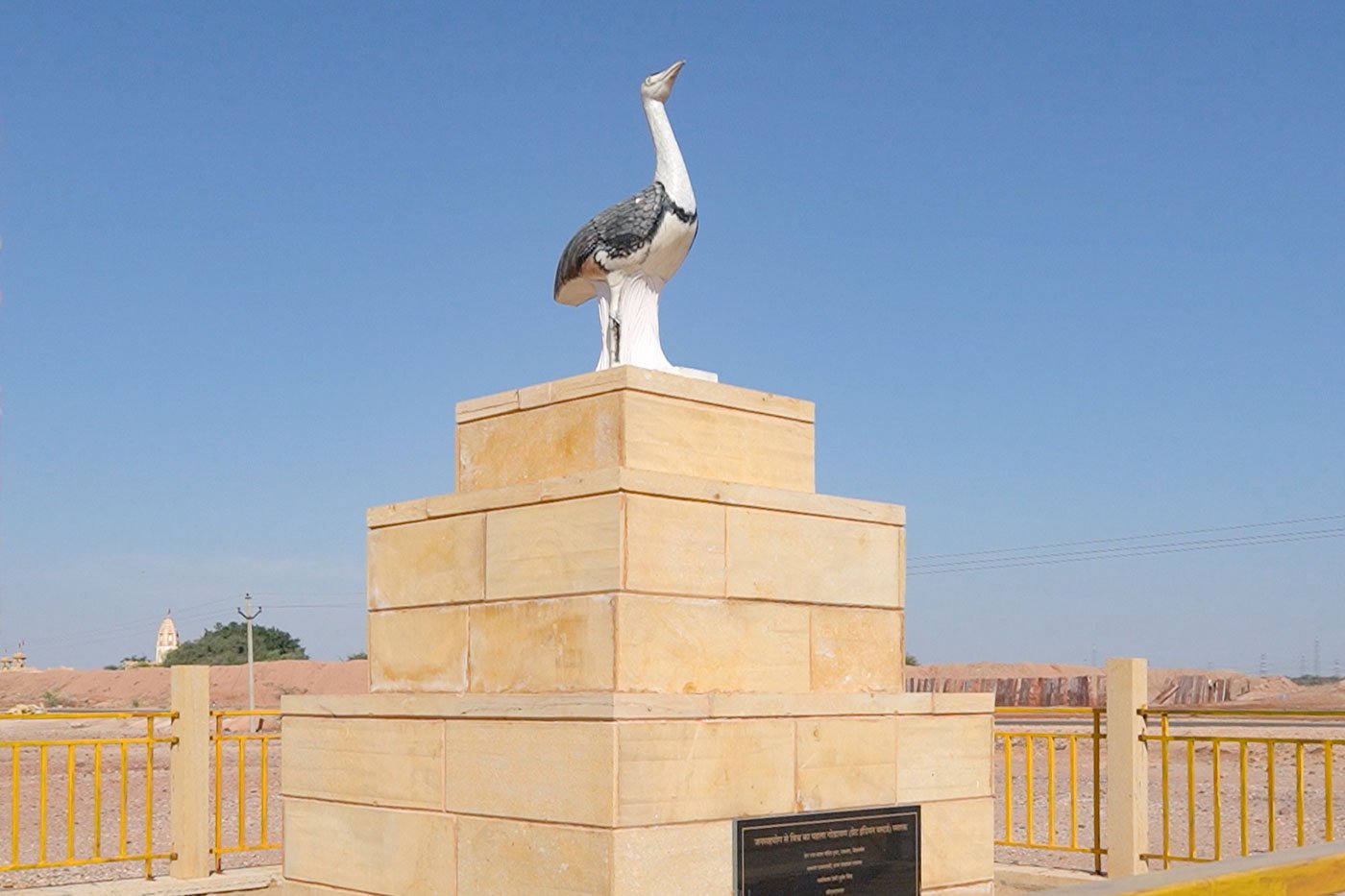
(1) बिश्नोई समुदाय के एक घर में देवताओं के चित्रों के बगल में चिपकाए गए गोडावण के पोस्टर. तस्वीर: ऊर्जा/PARI
(2) देगराय के स्थानीय ग्रामीणों द्वारा स्थापित गोडावण की मूर्ति. तस्वीर: ऊर्जा/PARI
सुमेर सिंह, राधेश्याम और जैसलमेर के अन्य स्थानीय लोगों के लिए गोडावणों की मौतें और उनके प्राकृतिक आवास के प्रति संवेदनहीनता, आसपास के ग्राम्य समुदायों और उनकी आजीविका के प्रति एक तरह की प्रतीकात्मक उपेक्षा है.
सुमेर सिंह कहते हैं, “विकास के नाम पर हम न जाने कितनी चीज़ें खोते जा रहे हैं. और यह विकास आख़िर किसके लिए है?” उनकी बात में दम है. यहां से क़रीब 100 मीटर की दूरी पर ही एक सौर ऊर्जा संयंत्र है, और लोगों के माथे के ऊपर से बिजली के तार गुज़रते हैं. लेकिन इस गांव में बिजली की आपूर्ति बहुत कम, अनियमित और भरोसेमंद नहीं है.
पिछले 7.5 सालों में भारत की अक्षय ऊर्जा की क्षमता में 286 प्रतिशत की बढ़ोतरी हुई है. यह दावा केंद्रीय नवीन और अक्षय उर्जा मंत्रालय का है. विगत दशक में, ख़ासकर पिछले 3-4 सालों में, राज्य में सौर और पवन उर्जा के हज़ारों प्लांट शुरू किए गए हैं. इसके अतिरिक्त, अडानी रिन्यूएबल एनर्जी पार्क राजस्थान लिमिटेड (एआरईपीआरएल) भी जोधपुर के भादला में एक 500 मेगावाट और जेसलमेर के फतेहगढ़ में 1,500 मेगावाट की क्षमता वाले सौर पार्क विकसित कर रहा है. कंपनी की वेबसाइट के माध्यम से उनसे यह पूछा गया कि क्या वे भूमिगत तारों के माध्यम से अपने ऊर्जा-उत्पादन को वितरित करेंगे, लेकिन इस रपट के प्रकाशित होने की तिथि तक उनकी ओर से कोई उत्तर प्राप्त नहीं हुआ है.
राज्य में सौर और पवन संयंत्रों से जो ऊर्जा पैदा होती है उसे विद्युतीय तारों के विशाल संजालों के ज़रिए नेशनल ग्रिड को भेज दिया जाता है. बिजली की उच्च तरंगों वाले ये तार गोडावण, गरुड़, गिद्ध और दूसरे वायवीय जीवों के लिए बड़ी बाधाएं हैं. अक्षय ऊर्जा से संबंधित परियोजनाएं पोखरण और रामगढ़-जैसलमेर के गोडावणों के हरित क्षेत्र की बाधाएं बन सकती हैं.
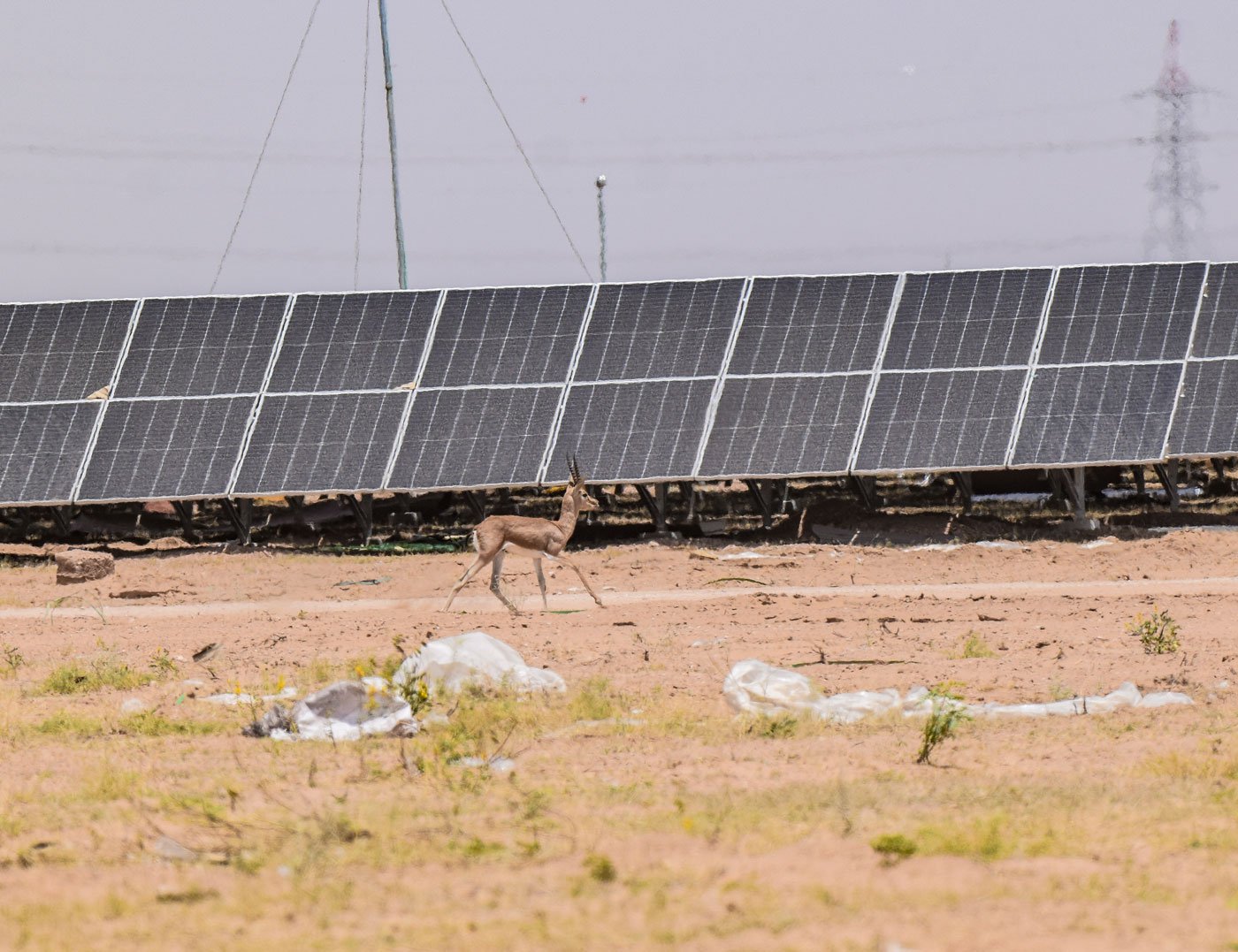
राजस्थान के जैसलमेर ज़िले में सौर और पवन ऊर्जा परियोजनाएं हरे-भरे मैदानी इलाक़ों और स्थानीय निवासियों, दोनों को अपना निवाला बना रही हैं. स्थानीय लोगों में आक्रोश और हताशा की एक बड़ी वजह आसपास के ग्राम्यजीवन और उनके आजीविका के लिए आसन्न संकट की स्थिति है. तस्वीर: राधेश्याम बिश्नोई/PARI
जैसलमेर, मध्य एशियाई वायुमार्ग (सीएएफ़) में पड़ने के कारण बहुत महत्वपूर्ण है – आर्कटिक से मध्य यूरोप और एशिया होते हुए हिन्द महासागर तक पहुंचने के लिए अप्रवासी पक्षी इसी मार्ग को चुनते हैं. एक अनुमान के मुताबिक़, 182 अप्रवासी जलीय पक्षियों की प्रजातियों की 279 की आबादी इसी रास्ते से होकर गुज़रती है. ‘यह कन्वेंशन ऑन दी कन्जर्वेशन ऑफ़ माइग्रेटरी स्पीशीज़ ऑफ वाइल्ड एनिमल्स’ का निष्कर्ष है. कुछ अन्य विलुप्तप्राय पक्षियों में बंगाल का गिद्ध या ओरियंटल वाइट-बैक्ड वल्चर (जिप्स बेंगालेन्सिस), लॉन्ग-बिल्ड या भारतीय गिद्ध (जिप्स इंडिकस), पिद्दो या स्टोलिज्का बुशचैट (सैक्सिकोला मेक्रोरिंचा), हरी मुनिया और हौबरा गोडावण या मैकक्वीन बस्टर्ड (क्लेमिडोटिस मैक्वीनी) प्रमुख हैं.
राधेश्याम एक बेहतरीन फ़ोटोग्राफ़र भी हैं और उनके लंबे फोकस वाले लेंसों से कई बार बेचैन कर देने वाले चित्र भी निकलते रहते हैं. “मैंने हवासीलों (पेलिकन) को रात के समय सोलर पैनलों वाले खेतों में उतरते हुए देखा है, क्योंकि उनको यह गलतफ़हमी हो जाती है कि वे एक झील में उतर रहे हैं. नतीजा यह होता है कि ये असहाय पक्षी शीशे पर फिसल जाते हैं और उनके कोमल पैरों में बहुत गहरी चोटें लग जाती हैं.”
भारतीय वन्यजीवन संस्थान के 2018 के एक अध्ययन के अनुसार, हाईटेंशन तारों से केवल गोडावण ही नहीं मारे जा रहे हैं, बल्कि बल्कि डेजर्ट नेशनल पार्क के भीतर और आसपास के 4,200 वर्ग किलोमीटर के इलाक़े में इनके विस्तृत संजालों के कारण प्रत्येक वर्ष अनुमानतः 84,000 अन्य पक्षी भी मारे जाते हैं. “इतनी ऊंची मृत्यु-दर [गोडावणों की] इस प्रजाति के लिए बेहद ख़तरनाक है और ऐसी स्थिति में इन्हें विलुप्त होने से नहीं बचाया जा सकता है.”
ख़तरा सिर्फ़ आसमान में नहीं, बल्कि ज़मीन पर भी है. मैदानी क्षेत्रों का बड़ा भाग, पवित्र उपवनों या ओरण, जैसा कि उन्हें यहां कहा जाता है, अब निरंतर घूमते रहने वाली 200 मीटर ऊंची पवन चक्कियों से बेतरह भर चुके हैं. दो पवन चक्कियों के बीच बमुश्किल 500 मीटर का अन्तराल रह गया है, और साथ में हज़ारों हेक्टेयर ज़मीन पर ऊंची दीवारों से घिरे सौर संयंत्र अलग बने हुए हैं. पवित्र उपवनों की परिधि में अक्षय ऊर्जा की घुसपैठ, जहां स्थानीय समुदायों के लोग पेड़ की एक टहनी काटने तक को धर्म-विरुद्ध काम मानते हैं, वहां मवेशियों की चराई कराना सांप-सीढ़ी के खेल में तब्दील हो गया लगता है. चरवाहे अब सीधे रास्ते नहीं जा सकते हैं, बल्कि उनको पवन चक्कियों और उनकी सहायक माइक्रोग्रिड को पार करने के लिए पूरी घेरेबंदी को घूम कर पार करना पड़ता है.
(1) भादरिया में एक पवन चक्की और माइक्रोग्रिड के पास मरे पड़े ग्रिफिन गिद्ध के अवशेष. तस्वीर: ऊर्जा/PARI
(2) राधेश्याम, गोडावण की सुरक्षा के लिए उनपर नज़र रखते हैं. तस्वीर: विक्रम दर्जी/PARI
धानी (वह अपना यही नाम इस्तेमाल करती हैं) कहती हैं, “मैं सुबह-सुबह घर से निकलती हूं और शाम को वापस लौटती हूं.” क़रीब 25 वर्षीया धानी को अपनी चार गायों और पांच बकरियों के चारे के लिए घास लाने जंगल जाना होता है. “कई बार अपने जानवरों को जंगल ले जाते हुए मुझे इन तारों से बिजली के झटके भी लगते हैं.” धानी के पति बाड़मेर शहर में पढ़ाई करते हैं, और वह परिवार की छह बीघा (लगभग 1 एकड़) ज़मीन और अपने 8, 5 और 4 साल के तीन लड़कों की देखभाल करती हैं.
जैसलमेर के सम ब्लॉक के रासला में देगराय के ग्राम-प्रधान मुरीद ख़ान कहते हैं, “हम इस मामले को लेकर अपने विधायक और उपायुक्त [डीसी] से भी मिले, लेकिन कोई कार्रवाई नहीं हुई.”
वह बताते हैं, “हमारे पंचायत से होकर हाईटेंशन तारों की छह से सात लाइनें गुज़रती हैं. ये हमारे ओरण [पवित्र उपवनों] में आती हैं. जब हम उनसे पूछते हैं, ‘भाई तुम्हें किसने इजाज़त दी है’, तो वे कहते हैं, ‘हमें आपकी इजाज़त लेने की ज़रूरत नहीं है’.”
घटना के कुछ ही दिन बाद 27 मार्च 2023 को जब लोकसभा में यह प्रश्न उठाया गया, तब पर्यावरण, वन और जलवायु परिवर्तन राज्य मंत्री श्री अश्विनी चौबे ने कहा कि गोडावण के महत्वपूर्ण प्राकृतिक आवासों को राष्ट्रीय उद्यान (एनपी) घोषित किया जाएगा.
उनके दोनों प्राकृतिक आवासों में एक को पहले से ही नेशनल उद्यान घोषित किया जा चुका है, और दूसरा भारतीय सेना की ज़मीन है, लेकिन बस्टर्ड कहीं भी सुरक्षित नहीं हैं.
एक याचिका पर 19 अप्रैल, 2021 को सुनवाई करते हुए सर्वोच्च न्यायालय ने आदेश दिया था, “प्राथमिकता के हिसाब से और गोडावणों के संभावित इलाक़ों में, यथासंभव ऊपर से गुज़रने वाले हाईटेंशन तारों को भूमिगत पॉवरलाइनों में बदल दिया जाए, और यह कार्य तत्काल आरंभ कर एक साल की अवधि में संपन्न कर दिया जाए. और, तबतक मौजूदा पॉवरलाइनों में डाईवर्टर [पक्षियों को चेतावनी देने के लिए बने प्लास्टिक डिस्क जिनसे प्रकाश प्रतिबिंबित होता है] लगाए जाएं.”
सर्वोच्च न्यायालय के फ़ैसले में 104 किलोमीटर लंबे पॉवरलाइन को चिन्हित किया गया है, जहां उन्हें भूमिगत किया जाना है. साथ ही, 1,238 किलोमीटर लंबे लाइनों की भी पहचान की गई है, जिनमें डाईवर्टर लगाए जाने हैं.
वन्यजीव जैव वैज्ञानिक सुमित डूकिया कहते हैं, ‘गोडावणों के प्राकृतिक आवासों में सरकार इतने बड़े आकार के अक्षय ऊर्जा पार्क बनाने की अनुमति क्यों दे रही है, जबकि यहां से गुज़रने वाले तारों से टकरा कर पक्षियों की मौतें हो रही हैं’. तस्वीर: ऊर्जा
दो साल बाद, अप्रैल 2023 तक भी सर्वोच्च न्यायालय के पॉवरलाइनों को भूमिगत करने के आदेश की पूरी तरह से उपेक्षा की गई है, और प्लास्टिक के डाईवर्टर भी सिर्फ़ कुछेक किलोमीटर ही लगाए गए हैं. ये अधिकतर मुख्य सड़कों से लगे हुए वे इलाक़े हैं जहां आमतौर पर मीडिया और जनता की नज़र जाती है. वन्यजीव जैव वैज्ञानिक डूकिया कहते हैं, “उपलब्ध शोधों के अनुसार, डाईवर्टर पक्षियों के तार से टकराने की संभावना को कम करने में बहुत हद तक कारगर हैं. इसलिए, सैंद्धांतिक रूप में इन मौतों को टाला जा सकता था.”
आज ये भोलेभाले परिंदे इस पूरी धरती पर अपने इकलौते घर में ख़तरों से घिरे हैं. दूसरी तरफ़, हम अपने देश में एक विदेशी पशु के लिए घर बनाने की हड़बड़ी में हैं. विदित है कि सरकार भारत में अफ़्रीकी चीतों को लाने की 224 करोड़ रुपए की एक पांच वर्षीय वृहद योजना पर काम कर रही है. उन्हें विशेष विमानों से भारत लाने की योजना है, उनके लिए सुरक्षित वनक्षेत्र निर्धारित और विकसित किए गए हैं, उनपर नज़र रखने के लिए उच्च-गुणवत्ता के कैमरे लगाए जा रहे हैं, और निगरानी के लिए वाचटावर बनाए जा रहे हैं. उसके अलावा, बाघ के उदाहरण भी लिए जा सकते हैं, जिनकी तादाद में अब बढ़ोतरी दर्ज की जा रही है और उनके संरक्षण से जुड़ी परियोजना पर वर्ष 2022 में 300 करोड़ रुपए ख़र्च किए गए.
भारतीय पक्षियों में अपनी क़दकाठी से ख़ासा रोबीला दिखने वाला पंछी गोडावण या ग्रेट इंडियन बस्टर्ड लगभग एक मीटर ऊंची होता है और इसका वज़न 5 से 10 किलो के बीच होता है. यह साल में केवल एक अंडे देता है और वह भी खुले में. जंगली कुत्तों की तेज़ी से बढ़ती हुई तादाद के कारण गोडावण के अंडे हमेशा असुरक्षित रहते हैं. बॉम्बे नेचुरल हिस्ट्री सोसाइटी (बीएनएचएस) के कार्यक्रम पदाधिकारी नीलकंठ बोधा कहते हैं, “स्थिति बहुत गंभीर है. हमें इनकी संख्या को बनाए रखने और बढ़ाने के उपाय ढूंढने के लिए, इन प्रजातियों की ख़ातिर एक अलग क्षेत्र छोड़ देने की ज़रूरत है. और, इनके निषेध के उल्लंघन का अधिकार किसी को नहीं हो.” बीएनएचएस, इस इलाक़े में एक परियोजना पर काम कर रहा है.
उड़ने की क्षमता रखने के बावजूद इस प्रजाति को ज़मीन पर चलना अधिक पसंद है. लेकिन जब यह पक्षी उड़ान भरता है, तो एक अद्भुत दृश्य का निर्माण करता है. इसके दोनों डैने 4.5 फीट तक फैल सकते हैं और अपनी भारी-भरकम काया के साथ यह रेगिस्तान के आकाश में किसी वायुपोत की तरह उड़ता हुआ दिखता है.
संकट केवल गोडावणों पर ही नहीं है, बल्कि जैसलमेर आने वाले बहुत से अन्य पक्षी भी ख़तरे के दायरे से बाहर नहीं हैं. यह ज़िला मध्य एशियाई वायुमार्ग में पड़ता है. आर्कटिक से हिन्द महासागर जाने वाले प्रवासी पक्षियों का यही सालाना मार्ग है. तस्वीर: राधेश्याम बिश्नोई
विशालका्य गोडावण की आंखें उनके माथे के दोनों तरफ़ होती हैं, और इसीलिए वे सामने के ख़तरों को ठीक से नहीं देख पाते हैं. इसलिए, या तो वे सीधे-सीधे हाई टेंशन तारों से टकरा जाते है या फिर एकदम अंतिम क्षणों में इधर-उधर मुड़ने की कोशिश करते है. एक दिक्कत यह भी है कि ट्रक की तरह बस्टर्ड भी तेज़ी से मुड़ नहीं सकते हैं. उड़ान के क्रम में मुड़ने में अक्सर देरी होने के कारण उनके माथे या डैनों के तारों में उलझने का ख़तरा रहता है, जो ज़मीन से लगभग 30 मीटर की उंचाई पर होते हैं. राधेश्याम कहते हैं, “अगर बस्टर्ड इन तारों से टकराने के बाद बिजली के झटके से जीवित बच भी जाते हैं, तो इतनी अधिक ऊंचाई से गिरकर उनका मरना तय है.”
राधेश्याम याद करते हैं कि साल 2022 में जब राजस्थान के रास्ते टिड्डियों ने भारत में प्रवेश किया था, तब “गोडावणों ने खेतों को बचाने में महत्वपूर्ण भूमिका निभाई थी. उन्होंने हज़ारों की तादाद में उन टिड्डियों को अपना आहार बनाया था. गोडावण किसी को नुक़सान नहीं पहुंचाते हैं. इनके भोजन में छोटे सांप, बिच्छू, छोटी छिपकलियां आदि शामिल हैं. इस लिहाज़ से वे किसानों के लिए मददगार हैं.”
उनके और उनके परिवार के पास 80 बीघा (लगभग 8 एकड़) खेत हैं, जिनपर वे ग्वार और बाजरा उपजाते हैं, और अगर सर्दियों में मानसून अनुकूल रहा, तो वे कोई तीसरी फ़सल भी उपजा लेते हैं. वह कहते हैं, “फ़र्ज़ कीजिए, अगर 150 की जगह हज़ारों गोडावण होते, तो टिड्डियों के हमलों से निबटना कितना आसान होता.”
गोडावण को बचाने और उनके प्राकृतिक आवास को सुरक्षित व ग़ैर-बाधित बनाए रखने के लिए बहुत छोटे इलाक़े पर ध्यान देने की आवश्यकता है. राठोड कहते हैं, “हम यह प्रयास कर सकते हैं. यह बहुत कठिन काम नहीं है. और, अदालत का यह निर्देश भी है कि पॉवरलाइनों को भूमिगत कर दिया जाए और हाईटेंशन तारों को बिछाने की कोई अनुमति आगे से नहीं दी जाए. सबकुछ नष्ट हो जाए, उससे पहले अब सरकार को भी अपनी ज़िम्मेदारी गंभीरता के साथ निभानी चाहिए.