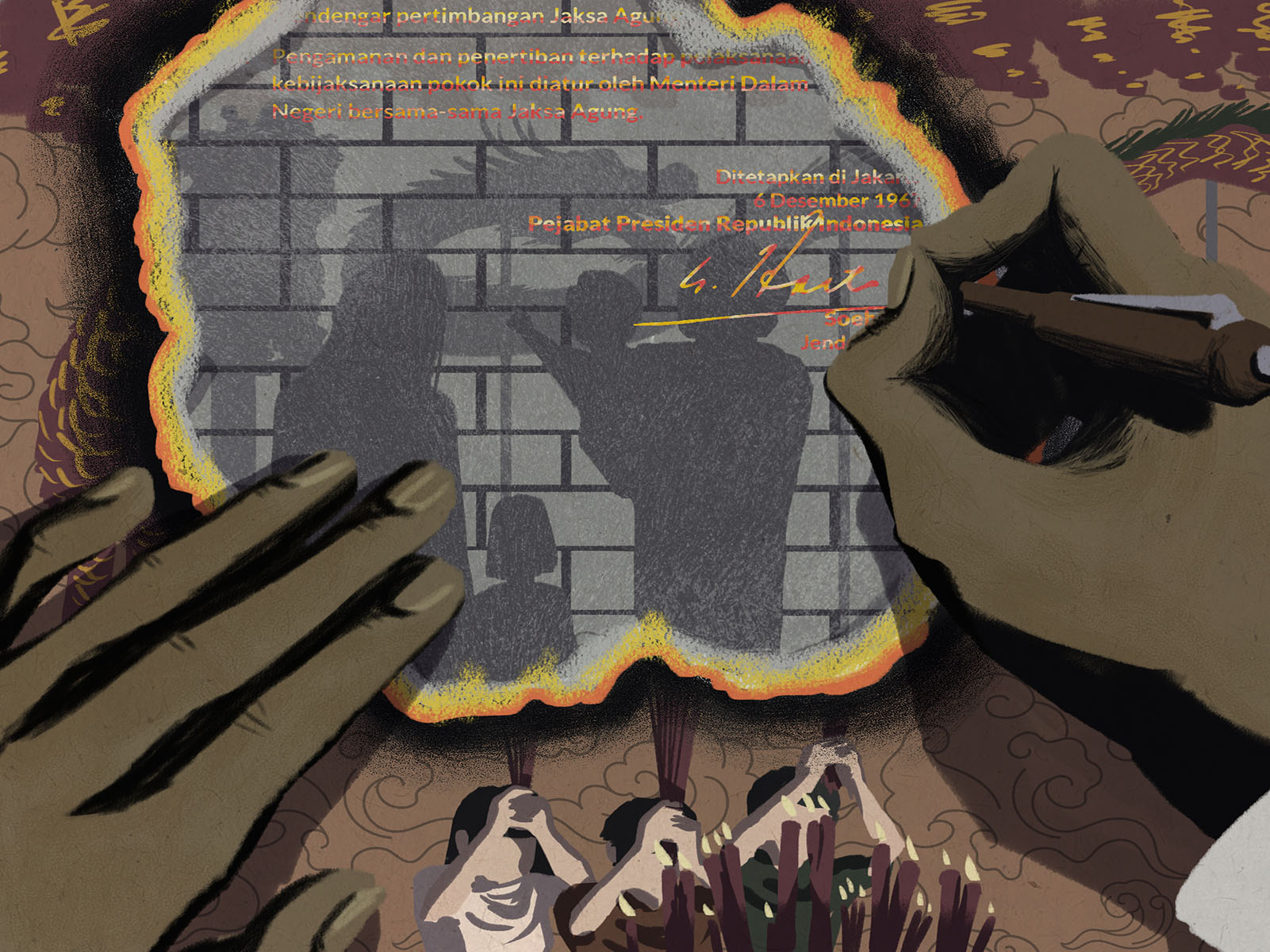
The epistemicide of Chinese-Indonesians. Illustration: Abdul Malik Amirullah/Project Multatuli
(Trigger Warning: This article may be distressing or triggering for some readers.)
May 1998 was the moment when I began to associate the word “Chinese-Indonesian” with “violence” and “rape”.
At the end of elementary school, it was the first time I was forced to be afraid of my identity both as a woman and as a Chinese-Indonesian, and I was frustrated because I did not understand how I ended up feeling that way. I knew almost nothing about the history of Chinese-Indonesians that led to the May 1998 riots. That ignorance made it even harder for me to understand my own emotions.
My parents also didn’t explain much. “The most important thing is, as a Chinese-Indonesian, you always have to be cautious. You can’t just say whatever you want, especially when it comes to politics,” they said.
For years I carried a pile of unanswered questions in my head. Who am I? Who is my family? What is Chinese-Indonesian? How is it that other holidays are marked with red-letter dates and celebrated festively, except for Chinese New Year? Why must we learn Mandarin in secrecy, while other regional languages can be studied freely? What really happened? Why did being Chinese start to feel wrong?
The turning point came in 2009. After graduating from university, I worked as a journalist for Suara Baru, an internal media of the Chinese-Indonesian Association (INTI) that was formed in 1999.
Even though I only worked there briefly, my time opened many doors for me to learn more deeply about Chinese-Indonesian issues and meet several Chinese-Indonesians who were directly involved in social and political work. Slowly, I began to find answers to the many questions that had haunted me for so long. Those answers were often shocking and heartbreaking.
I began to understand that the history of Chinese-Indonesians in this country is almost inseparable from the history of violence, which has often been systematically orchestrated by those in power since the VOC era. This systematic violence has spanned hundreds of years and is not only physical but also epistemic, taking the forms of neglect, concealment, and even denial of many historical facts, especially the darker parts of history.
I came to realize that the New Order regime carried out a systematic epistemicide against the Chinese-Indonesian community. The state deliberately stripped away knowledge about the history of my own ethnicity, uprooting me and other Chinese-Indonesians from our cultural roots, leaving me confused and struggling to process my own position and feelings.
As a result, I began to understand that the New Order never really died. More than 27 years after Soeharto’s downfall, the state has become increasingly blatant in its efforts to whitewash the past by erasing the violent and painful chapters of history involving the Chinese-Indonesian community.
This became very clear with a statement made by Culture Minister Fadli Zon on June 10, 2025. In an interview with IDN Times about the project to rewrite national history, Fadli referred to the mass rape of May 1998 as a “rumor” that had no proof.
His statement made my stomach turn. My chest tightened. Tears streamed down uncontrollably.
The History of Violence and ‘Disciplining’
“This is insane! How could the riots get out of control?”
My mother said that with panic etched across her face, appalled as scene after scene of apocalyptic brutality flashed endlessly across the television screen in front of us.
Fires raged and smoke filled the air. Physical clashes led to gunfire that killed without hesitation. Clenched fists went up and down as people screamed and scattered in all directions. Buildings and vehicles were covered in ash. Smooth highways turned into battlegrounds clouded with dust.
Unfortunately, we were not watching an action movie. It was real life that pierced straight into the Chinese-Indonesian community in the blink of an eye, leaving behind open wounds that have never fully healed.
Even more unfortunate, this was not the first time that a tragedy like this had happened to Chinese-Indonesians.
A number of historical milestones demonstrate how racism and discrimination against the Chinese-Indonesian community have manifested in their most extreme forms, including acts that amount to literal genocide. These include brutal massacres, rape, mutilations, and live immolations of Chinese-Indonesians.
These events include the 1740 Batavia Massacre; anti-Chinese massacres during the Indonesian National Revolution from 1946 to 1949; violence following the issuance of Presidential Regulation No. 10/1959 prohibiting Chinese-Indonesians from rural trade; the 1965 tragedy; and of course the May 1998 riots that included looting, burglary, and the mass rape of Chinese-Indonesian women.
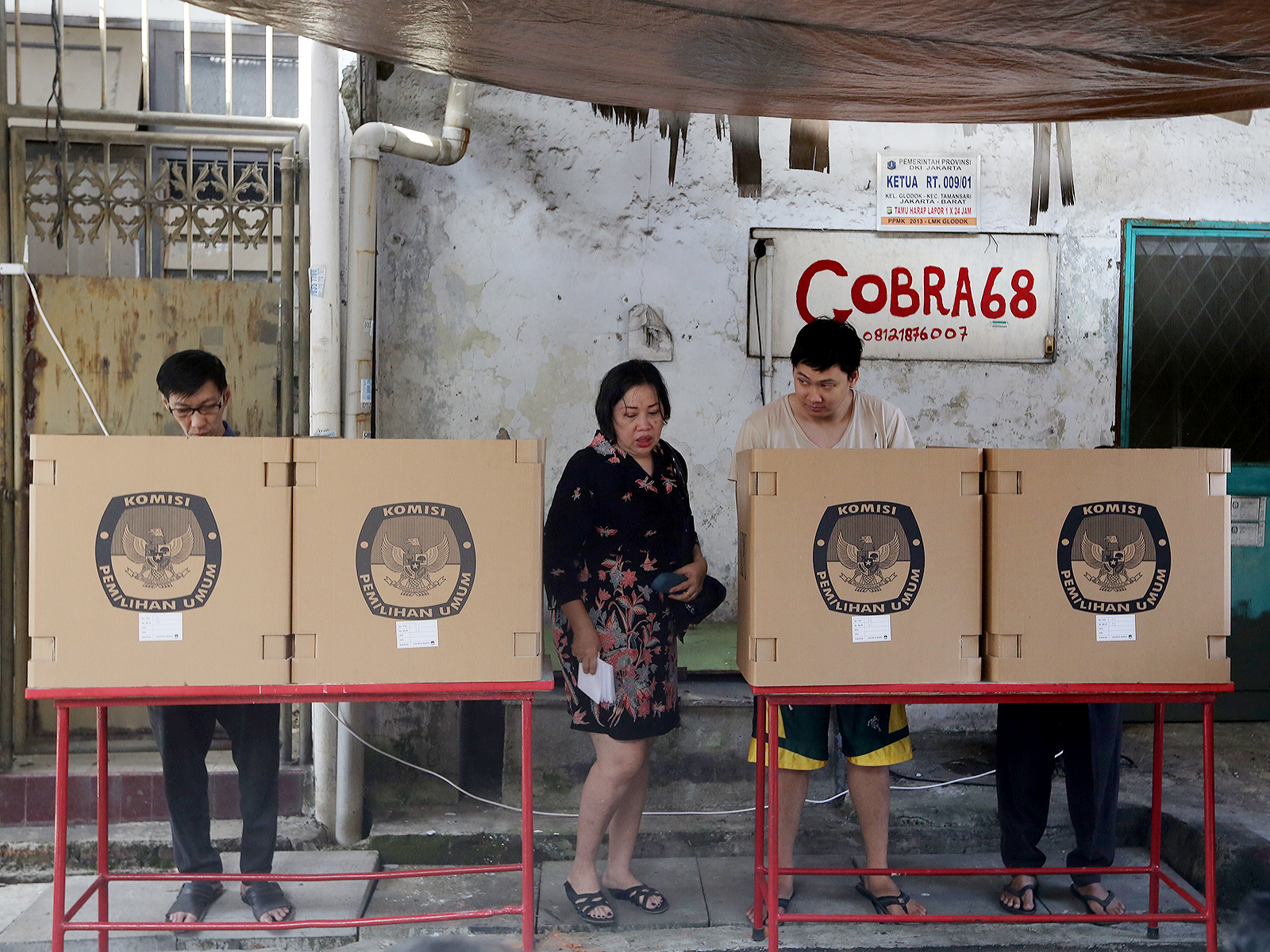
Chinese-Indonesian citizens participate in the 2014 General Elections in Glodok, Jakarta’s Chinatown and one of the tensest areas during the May 1998 riots. The high fences and iron security bars commonly installed on the windows of Chinese-Indonesian homes and shops since the riots remain a visible manifestation of the community’s lingering trauma. Photo: Ricky Yudhistira/Project Multatuli
These incidents occurred at the national level, but we have yet to fully address the widespread anti-Chinese violence at regional and sub-regional levels, where scale of brutality was no less appalling. For instance, the mass slaughter and rape of members of the Benteng Chinese community in Tangerang in June 1946, and the Mergosono tragedy in Malang in July 1947, which claimed the lives of at least 30 Chinese-Indonesians. In my own hometown, Bandung, several anti-Chinese riots have also occurred, including those on May 10, 1963 and August 5, 1973.
The repeated episodes of violence were made possible by the persistence of stereotypes that can be tracked back centuries like “Chinese-Indonesians are nothing but economic animals who only care about their own interest and benefits” and “Chinese-Indonesians are exclusive”.
During the Dutch colonial rule, Chinese-Indonesians were classified as Eastern Foreigners within the colonial demographic hierarchy. They were assigned the role of distribution intermediaries for daily necessities, serving both the colonial administration and the Malay-descended locals, whom the Dutch labeled as pribumi (a pejorative term that means “native”). This was a dilemmatic position that the Chinese-Indonesian community was compelled to occupy, whether they liked it or not.
Slowly but surely, a majority of Chinese-Indonesians (forcibly) ended up working in commerce and trade, a situation that bred resentment among the so-called pribumi, who came to see them as selfish profiteers.
After Indonesia declared independence, successive regimes carefully preserved these negative sentiments. Leaders appeared to understand how useful it was to deflect attention from their own failures by scapegoating the Chinese-Indonesians, portraying them as the root of the nation’s economic problem. The narrative was simple: “Chinese-Indonesians are greedy, so everything is their fault.”
During Sukarno’s era, the government enacted many discriminatory policies against Chinese-Indonesians that continued colonial legacies. A particularly controversial policy was the Presidential Regulation No. 10/1959, which banned Chinese-Indonesians from running retail businesses in rural areas. The military involvement in the implementation of the regulation led to major unrest that claimed the lives of many Chinese-Indonesians and massive exodus.
The 1965 tragedy, which paved the way for the rise of the New Order regime, also disproportionately targeted Chinese-Indonesians. As a communist state, China was accused of supporting the uprising and, thus, Chinese-Indonesians were automatically suspected of complicity. This logical fallacy led to the arrest and imprisonment of many Chinese-Indonesian figures who had actively contributed to Indonesia’s independence struggle. Ordinary Chinese-Indonesians suffered the most, especially with the closure of schools and constant fear of persecution.
During the New Order regime, the authoritarian president Soeharto reproduced colonial-era discriminatory tactics. He stripped Chinese-Indonesians of their access to and rights within practical politics, while granting privileges to a select few tycoons whom he considered loyal allies. This strategy ensured that all economic resources remained concentrated within the New Order’s circle of power, while Chinese-Indonesians continued to play essential roles in the economy even though they were never fully trusted. Therefore, writer Pramoedya Ananta Toer described the Chinese-Indonesian community as a “minority without political muscle”.
The New Order regime obliterated the history of the Chinese-Indonesian community’s roles and contributions to the nation-building process from various official references, before introducing new narratives that portrayed them as mere “foreign guests”—temporary residents whose rights could be easily revoked. Chinese-Indonesians were consistently constructed as “a problem” that needed to be surveilled and “solved” to avoid being seen as a threat to the country.
From there emerged a number of assimilationist policies that prohibited the use of Chinese names, as well as the Mandarin language and script. Chinese-Indonesians were banned from publicly displaying their religious, spiritual and cultural practices. At the same time, all Chinese-Indonesian media, political and social organizations, as well as Chinese-language schools were disbanded.
These discriminatory policies effectively laid the foundation for long-term racism, uprooting the Chinese-Indonesian identity to its very core and depriving the future generation of knowledge of the ethnic group’s history. The regime deliberately created distance between younger Indonesians and the collective memory of Chinese-Indonesians’ valuable contributions to the nation-building process. Even when some members of the new generations chose to become critical of the regime’s narratives and attempted to uncover the true history of Chinese-Indonesians, trauma and lack of reliable sources caused members of the ethnic group to remain silent.
This fear-based culture and knowledge, instilled by the regime, ended up being affirmed and embraced by generations of Indonesians, even by the Chinese-Indonesians.
In his Master’s thesis for Lund University in 2017, Roy Thaniago explicitly described how the Chinese-Indonesian community was being “disciplined” during the New Order regime through manipulation of media narratives. These narratives were crafted to ensure the community’s total obedience to the authorities to the point where the Chinese-Indonesians willingly disciplined and monitored their own behavior into submission.
In the end, the knowledge and culture that belong to Chinese-Indonesians today are nothing more than a product of state government violence. Centuries of systematic oppression have instilled fear so deeply that it can no longer be seen as just an individual issue. It has turned into a collective problem which has triggered intergenerational trauma.
This explains why my parents repeatedly reminded me that, as someone of Chinese-descent living in Indonesia, I always have to be extra careful. Careful with what I say, careful with how I act—because anything we say or do could backfire and put us in danger, no matter how good our intentions were. Whenever I find myself in a potential conflict with a non-Chinese, my parents always ask me to back down because even if I’m right, Chinese-Indonesians will always be seen as wrong, and will always lose in the end.
My parents also reminded me to study diligently, work hard, and focus on achieving academic and professional achievements—especially because in this country, Chinese-Indonesians are often valued only for their wealth.
Chinese-Indonesians are pressured to be financially generous, even though only a small number of us are truly wealthy. We are also expected to constantly prove our contributions just to be recognized as legitimate members of this country, even though it often feels like running a race with no finish line.
Epistemicide
I grew up in a Chinese-Indonesian family that is still deeply rooted in Chinese culture, yet I never truly experienced what it is like to see Chinese-Indonesian traditions publicly celebrated, let alone embraced in a deep and meaningful way.
Throughout the New Order period, the only major Chinese tradition my family celebrated that left a lasting impression on me was Chinese New Year. Even then, we could only celebrate it in the evening after my father came home from working long hours at a factory, physically exhausted, because Chinese New Year had not yet been recognized as a national holiday.
During that period, my parents also continued to observe several other Chinese-Indonesian traditions in private, but they never made any effort to pass them down to their children.
When I was in elementary school, my parents made an effort to teach me Mandarin themselves. At one point, they even asked me to join a Mandarin “course” held at a Christian church whose congregation was mostly Chinese-Indonesians. Of course, at that time, I didn’t understand why learning Mandarin had to be done discreetly in a church. Unfortunately, since I never use the language in daily interactions, I ended up forgetting much of the Mandarin vocabulary as I grew older.
At first, I didn’t care. But later, I realized that it was all the result of Soeharto’s discriminatory policies, which had a profound impact on me and many other Chinese-Indonesians.
For instance, I haven’t been able to trace my own family’s history because I struggled to understand my parents’ archived documents and letters, most of which were written in traditional Mandarin script. Yet the documents are the closest sources for me to understand my family history as well as the broader context of Chinese-Indonesian history as a whole.
Because my younger siblings and I did not understand Chinese customs, my father made a major decision. In 2007, he and his younger sister (my aunt) decided to exhume their parents’ graves. The bongpai, or gravestone, was destroyed, and the remaining bones were collected and cremated on the spot. They then scattered the ashes into the open sea. In their eyes, this was the best course of action, so that their children and grandchildren would not be burdened with maintaining traditions or tending graves, which can be costly.
For most Chinese families, graves carry far more cultural significance than simply being a final resting place. They are considered sacred, a symbolic tribute of respect for ancestors, a marker of identity, and a site of pilgrimage for future generations. To dismantle a grave is to erase a symbol of identity and lose the opportunity to honor and remember ancestral stories.
The dismantling of the grave is the perfect metaphor for the erasure of Chinese-Indonesian historical footprints, which was part of the epistemicide systematically carried out by the New Order regime.
As explained by Beth Patin, a professor of library and information science, epistemicide is “the killing, silencing, annihilation, or devaluing of a knowledge system”. According to her, epistemicide occurs when epistemic injustices take place persistently and systematically, collectively working as a structured and systemic oppression of particular ways of knowing.
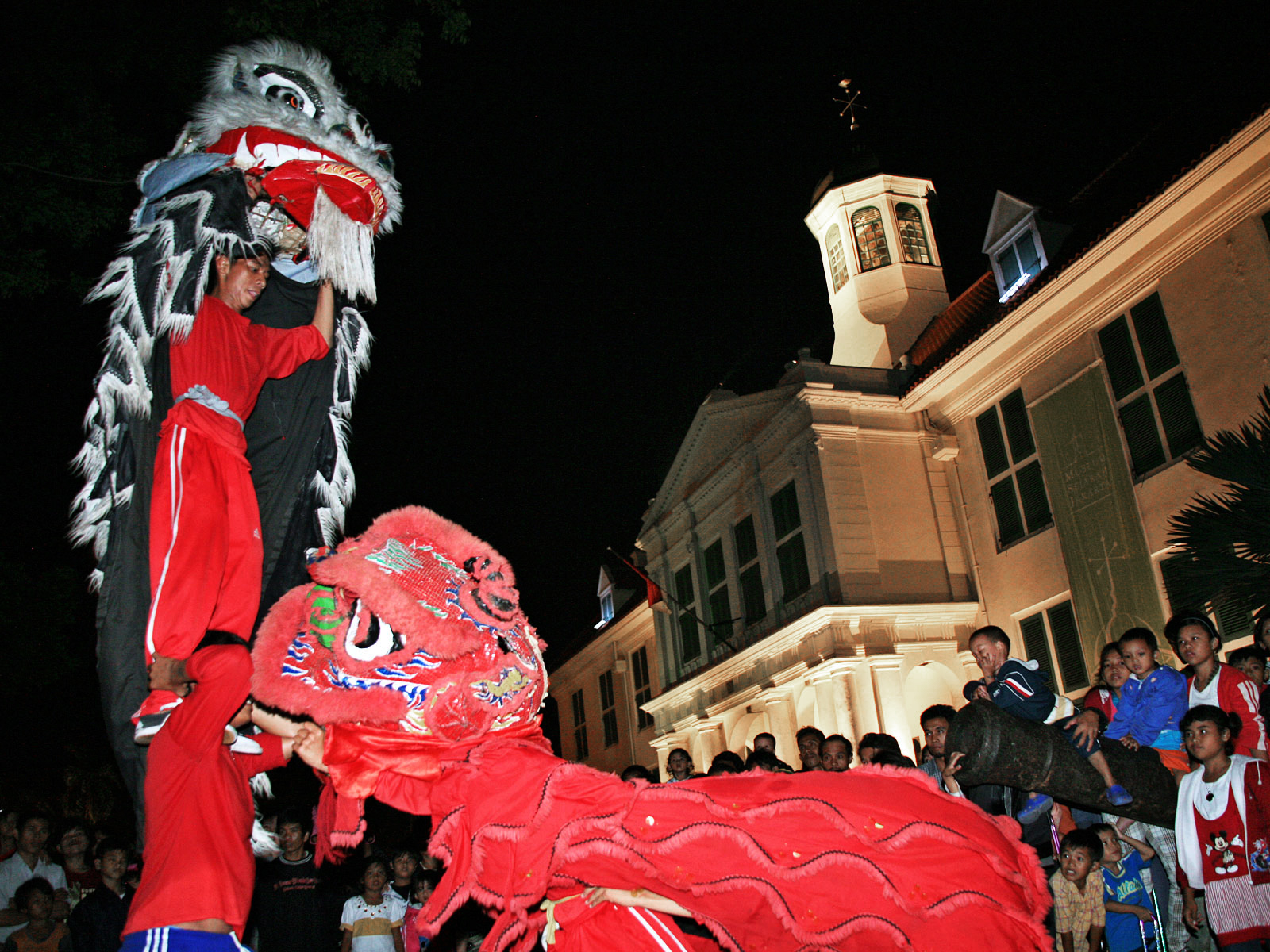
A group of barongsai (lion dance) performers play in front of the Fatahillah Park in Jakarta. Presidential Instruction No. 14/1967 on Chinese Religions, Beliefs, and Traditions once prohibited Chinese-Indonesians from practicing religious and cultural traditions rooted in their ancestral heritage, including barongsai. Even after the instruction was officially revoked by Presidential Decree No. 6/2000, the discriminatory policy has left many young Chinese-Indonesians disconnected from their cultural identity. Photo: Ricky Yudhistira/Project Multatuli
It’s disheartening to see how many Chinese-Indonesians today know next to nothing about the important roles their ancestors once played in politics, society, media, arts, or culture. Even in the sports sector, few are aware that Chinese-Indonesians have contributed not only to badminton but also to soccer.
In August 2024, I had the privilege of discussing this topic with Astrid Reza, a researcher from the Women’s Archive and History Center (RUAS). She said that historical writing about the Chinese-Indonesian community remains rare. As a result, it will take a much longer process for anyone to uncover, layer by layer, the knowledge that was subjected long ago to a form of epistemicide by those in power.
Not to mention those who attempt to uncover the truth about their own history must contend with deeply rooted New Order narratives about Chinese-Indonesians, along with waves of paid social media operatives working to preserve the narratives.
And, just as importantly, some Chinese-Indonesians remain hesitant to learn their own history.
“The New Order not only effectively obliterated the collective memory and knowledge related to Chinese-Indonesians, but also succeeded in killing the awareness of how important that knowledge is,” Astrid said.
“The greatest success [of epistemicide] is when even Chinese-Indonesians themselves become reluctant to learn about their own history. All it takes is silencing two or three generations, and entire bodies of knowledge, even the awareness of the importance of having that knowledge, will disappear.”
Understanding the Trauma of Chinese-Indonesians
Before Culture Minister Fadli Zon dismissed the mass rapes of May 1998 as a “rumor”, several political statements and events had already signaled the continued vulnerability of Chinese-Indonesians.
In 2016, Basuki Tjahaja Purnama, also known as Ahok, who was then serving as the governor of Jakarta, was accused of blasphemy after someone edited his speech quoting a verse from the Quran, uploaded the doctored clip to social media, and spread it with a misleading narrative. Large-scale anti-Chinese protests soon followed. Although the blasphemy charges were never truly proven, Ahok who is both Chinese and Christian, was sentenced to nearly two years.
For many of my Chinese-Indonesian friends, the massive protests instantly triggered bitter memories related to the May 1998 riots. One of them who felt this was Anastasia Satriyo, a Chinese-Indonesian who works as a child and adolescent psychologist.
“It’s as if my body is having a panic attack. I can’t watch the news about [anti-Chinese] issues for too long, just getting the gist of it is enough for me. I’ve realized that watching news related to these issues could cause me to stop functioning. On top of that, I always feel some tightening sensation in my chest every time I hear people shouting anti-Chinese sentiments,” Anastasia said.
“I always wonder, why is there always prejudice against Chinese-Indonesians?”
Anies Baswedan, who succeeded Ahok as governor of Jakarta, seemed to further inflame the situation. In his inauguration speech, he explicitly used the term “pribumi” (a pejorative term meaning “native”) and contrasted it with “non-pribumi“. Historically, these terms were used by the Dutch colonial government to divide the society along ethnic lines.
Anies earned his master’s degree at the University of Maryland and his PhD at Northern Illinois University. Therefore, many people believed he knew exactly the history behind those politicized terms, and it was no coincidence that he chose to use them. It is important to note that the use of “pribumi” and “non-pribumi” had officially been abolished by B.J.Habibie’s administration in 1998.
Eight years after the Ahok incident, Prabowo Subianto came to power. Prabowo, a former son-in-law of Soeharto, is widely believed to be involved in the forced disappearance of several activists in 1998.
It didn’t take long for his regime to reveal its true colors. On October 21, 2024, after being sworn in as Coordinating Minister of Law, Human Rights, Immigration and Correctional Services, Yusril Ihza Mahendra said what happened in May 1998 “was not a gross human rights violation”.
This came despite former President Joko Widodo’s acknowledgment in 2023 of 12 past gross human rights violations, including the 1965 tragedy and the May 1998 riots.
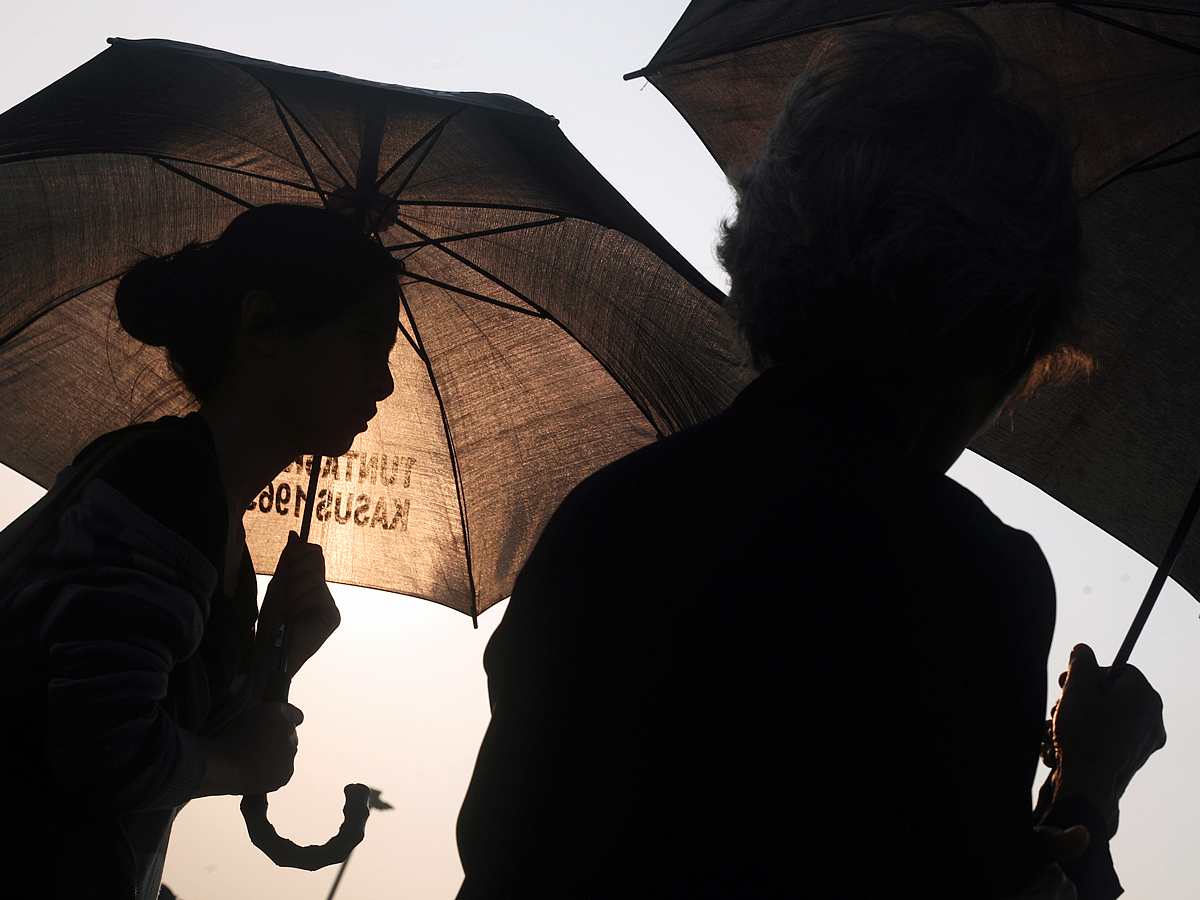
The Kamisan (Thursday) silent protests have persisted for two decades, as victims and families of gross human rights violations—including the 1965 and 1998 tragedies—continue to demand state accountability and justice. And yet, despite multiple regime changes, no legal resolution has been delivered. Instead, the state has opted for non-judicial measures that disregard the victim’s rights and dignity. Photo: Ricky Yudhistira/Project Multatuli
But it didn’t end there. My frustration and that of many other Chinese-Indonesians reached a boiling point when Fadli questioned the truth of the May 1998 mass rapes.
The first thing that came to my mind at that time was Ita Martadinata Haryono, a victim and young activist brutally murdered by those who couldn’t bear the thought of having their vile crimes exposed on the international stage. Ita was killed just before she was scheduled to testify about the mass rape in the United Nations forum.
Fadli’s words were incredibly cruel. He truly spat on the victims, witnesses and volunteers of the May 1998 tragedy, especially the women and Chinese-Indonesian community who, to this day, continue to carry the trauma, both directly and indirectly.
How can the findings of the Joint Fact-finding Team (TGPF), which clearly confirmed that a series of brutal gang rape took place in public spaces during May 1998, be denied simply because of “lack of evidence”?
Why insist on a legalistic argument which lacks empathy to defend himself? How is it possible to obtain evidence that requires victim testimony when the state offers no assurance of protection for the witnesses and survivors courageous enough to speak out?
That’s why, even though I wasn’t a direct victim, Fadli’s words threw me into emotional turmoil. My stomach turned. My chest tightened. Tears streamed down uncontrollably.
According to psychologist Anastasia, intergenerational trauma often manifests physically. When someone experiences trauma, their body’s DNA responds by activating certain genes and hormones to help the individual cope whether by confronting the threat (fight), escaping it (flight), appeasing it (fawn), or turning stiff, not taking any actions while trying to figure out the safest response (freeze).
It explains why Anastasia felt as if she was having a panic attack during the mass protest against Ahok’s so-called “blasphemy”, and why my chest suddenly tightened when I heard Fadli’s words.
In her practice as a psychologist, Anastasia often encounters subtle cases of intergenerational trauma among young Chinese-Indonesians, which usually manifest in relationship issues with their partners or parents.
“I once worked with a teenager who was confused about why her parents wouldn’t allow her to come home after 9 p.m., even though they lived in Jakarta. When she asked them about it, they simply said, ‘Remember your ethnicity,’” Anastasia said.
“This teenager became angry with her parents, especially since she had been exposed to concepts of human rights, democracy, and more. Her relationship with them turned sour.”
Other subtle forms of intergenerational trauma are also common among Chinese-Indonesians who live in a bubble, preoccupied with money, wealth, power, and lifestyle. Their focus tends to be solely on personal interests. According to Anastasia, this behavior may be an unconscious trauma response shaped by decades of systemic oppression in which Chinese-Indonesians were only allowed to engage in business and economic sectors to survive.
Therefore, Anastasia added, the issue of intergenerational trauma among Chinese-Indonesians cannot be separated from the broader power structures that have always targeted them. It is also deeply influenced by political, social, and cultural factors. This is why understanding their historical roots is crucial for Chinese-Indonesians.
“Awareness of one’s identity has a significant impact on a person’s psychological well-being. This awareness is shaped, among other things, by knowledge about one’s past, be it through family history or national history,” Anastasia said.
“The government’s attempt to uproot knowledge from Chinese-Indonesians is not just an act of epistemicide, but also of mental genocide.”
This means that efforts to heal from intergenerational trauma cannot be done by Chinese-Indonesians alone. They require strong support from the broader society—including fellow Indonesians—and the government.
But how realistic is it to expect support from the government?
After his controversial statement sparked public outrage, Culture Minister Fadli didn’t bother to apologize. On June 16, 2025, he even posted a thread on X, defending his stance, which only made people angrier.
Without acknowledging the TGPF’s findings, Fadli said the people “need to be careful and meticulous” before concluding that mass rape occurred in May 1998 because “it concerns the truth and the nation’s good name”.
This argument once again reminds us of the normalization of impunity toward perpetrators of sexual violence by institutions that prioritize protecting their reputation over delivering justice to victims.
What’s even more horrifying is the state’s blatant effort to whitewash past crimes by continuously manipulating history, while all protests are dismissed as meaningless noise.
Presenting Alternate Narratives
At a time when expecting support from the government is difficult, the rise of alternative sources about Chinese-Indonesians on social media offers a glimpse of hope.
One platform that has consistently promoted understanding of Chinese-Indonesians is Suara Peranakan. Founded in 2020, Suara Peranakan uses Instagram and X to spark discussions about Chinese-Indonesian identity and history, aiming to rebuild awareness within the community. The content it shares includes personal reflections with local perspectives that are rarely heard or represented.
Suara Peranakan covers a wide range of topics, including the hidden histories of Chinese-Indonesians, food and culinary traditions, intercultural communication, traditions and celebrations, the climate crisis, and calls for solidarity with other minority and marginalized groups sidelined by those in power. These topics are compelling because Chinese-Indonesians are no longer viewed as a single entity as they are always connected to the broader picture of global humanity.
“We must always uphold the values of solidarity and humanity because, in the end, you can’t stand alone. During the New Order era, Chinese-Indonesians were consistently labeled as money-oriented. We can break this stereotype by standing in solidarity with economically disadvantaged communities and other oppressed minority groups,” said Randy Mulyanto, a member of Suara Peranakan, in September 2024.
“Still, understanding our own history is essential as a starting point. It’s hard for us to be aware of broader issues if we don’t even know our own identity.”
Astrid Reza, the RUAS researcher, said Chinese-Indonesians could also resist epistemicide by stepping into social spaces that have long been considered difficult or even impossible for them to enter, although this is certainly no easy task.
Astrid cited her own experience of spending several days participating in the 2024 protests against the revision of the Regional Elections Law, which was allegedly aimed at allowing Kaesang Pangarep—former president Joko Widodo’s youngest son—to compete in the gubernatorial election. Astrid wanted to show that Chinese-Indonesians could voice their concerns through a demonstration, an avenue long avoided by the community due to past trauma.
Astrid’s words reminded me of a personal experience from years ago in East Aceh, during a visit for a literacy program.
One day, I ran into a group of elementary school students who were giggling, then yelled at me: “Kafir!”
“Kafir”, often translated as “infidel”, is frequently used in a derogatory way in Indonesia to refer to non-Muslims.
For a moment, I froze. I then decided to approach them and strike up a casual conversation. We talked about light topics, mostly about their daily lives.
These children admitted that they had never seen a single Chinese-Indonesian in their lives. As children of farm laborers, they rarely traveled outside their region due to financial constraints. They only knew that I looked different and assumed I might be a foreigner from Japan, Korea, or China.
After a while, as we grew closer, they started to get curious about Chinese-Indonesians.
“Tell us more about Chinese in Indonesia, please!”
I was immediately moved.
To me, their initial remark stemmed purely from ignorance. And when the official government narratives can’t be relied on, I believe there is nothing wrong with taking the initiative to reach out and share the alternative narratives myself.
Peringatan: Artikel ini bisa memicu trauma.
Epistemisida Tionghoa-Indonesia. Ilustrasi: Abdul Malik Amirullah/Project Multatuli
Mei 1998 adalah momen perdana saya mengasosiasikan “Tionghoa” dengan “kekerasan”, juga “pemerkosaan”.
Saat itu, di akhir jenjang SD, untuk pertama kalinya saya dipaksa merasa takut dengan identitas saya sebagai seorang perempuan sekaligus Tionghoa, dan saya kesal karena tak tahu mengapa bisa demikian. Selain nyaris tidak tahu apa-apa mengenai sejarah Tionghoa yang berujung kerusuhan Mei 1998, saya kesal karena ketidaktahuan tersebut membuat saya kesulitan memproses perasaan saya sendiri.
Orang tua pun tidak banyak menjelaskan. “Pokoknya, sebagai Tionghoa itu kamu mesti selalu waspada. Enggak bisa sembarang omong, apalagi omong politik,” ucap mereka.
Selama bertahun-tahun, setumpuk pertanyaan memenuhi kepala. Siapa saya? Siapa keluarga saya? Tionghoa itu apa? Mengapa hari besar lain bertanggal merah dan dirayakan semarak berhari-hari sementara Imlek tidak? Mengapa belajar Mandarin saja harus sembunyi-sembunyi seolah itu perbuatan ilegal sementara bahasa daerah lainnya tidak? Apa yang sebenarnya terjadi? Mengapa lama-lama muncul perasaan bahwa menjadi Tionghoa itu salah?
Titik baliknya ada di 2009. Setelah lulus kuliah, saya bekerja sebagai jurnalis Suara Baru. Ini adalah media internal Perhimpunan Indonesia Tionghoa (INTI), salah satu asosiasi Tionghoa terbesar di Indonesia yang berdiri pasca-1998.
Meski usia kerja di sana sangat singkat, terbuka pintu bagi saya untuk berkenalan dengan isu-isu Tionghoa secara lebih mendalam sekaligus berjumpa orang-orang Tionghoa yang terjun langsung dalam bidang sosial-politik. Perlahan, saya mulai memperoleh jawaban-jawaban atas segala pertanyaan yang begitu lama menghantui; jawaban-jawaban yang justru mengejutkan dan mencabik hati.
Saya jadi paham bahwa sejarah terkait Tionghoa di negeri ini nyaris tak pernah lepas dari sejarah kekerasan yang biasanya dirancang sistematis oleh para pemegang kekuasaan sejak era VOC. Membentang ratusan tahun, kekerasan sistemik ini bukan cuma perkara fisik tapi juga epistemik dalam bentuk pengabaian, penyembunyian, bahkan penyangkalan rupa-rupa realitas sejarah—terutama sejarah kelam.
Saya jadi paham bahwa rezim Orde Baru sungguh-sungguh menjalankan genosida pengetahuan terkait Tionghoa atau epistemisida secara sistematis. Negara sengaja merenggut pengetahuan mengenai sejarah etnis saya sendiri, mencerabut saya dan teman-teman Tionghoa lainnya dari akar kultural, juga membuat saya gamang memproses posisi dan perasaan saya sendiri.
Dan, saya jadi paham bahwa Orde Baru tak pernah benar-benar mati. Selewat 27 tahun setelah Soeharto turun takhta, negara justru kian gamblang berusaha mencuci dosa dengan menyetip babak-babak sejarah kelam yang sarat kekerasan terhadap komunitas Tionghoa.
Ini tampak jelas dalam pernyataan Menteri Kebudayaan Fadli Zon pada 10 Juni 2025. Dalam sesi wawancara dengan IDN Times terkait proyek penulisan ulang sejarah nasional, Fadli menyebut pemerkosaan massal pada Mei 1998 sebagai “rumor” yang tidak pernah ada buktinya.
Mendengar hal ini, asam lambung saya mendadak naik. Dada sesak seketika. Air mata pun mengalir tak terbendung.
Sejarah Kekerasan dan ‘Pendisiplinan’
“Ini betul-betul gila! Kok bisa rusuh sampai segitunya?”
Mama berujar dengan raut panik, tercekat menyaksikan adegan demi adegan brutal nan apokaliptik yang tak henti hilir-mudik melintasi layar televisi di hadapan kami.
Kobar api dan asap di mana-mana. Bentrok fisik berujung letup peluru tak ragu meminta nyawa. Tangan-tangan terkepal naik-turun silih berganti seiring jerit manusia yang lari berhamburan tak tentu arah. Bangunan dan kendaraan sekejap diselimuti abu. Jalan raya yang mulus jadi medan tempur berlumur debu.
Sayangnya, yang sedang kami tonton bukanlah film laga. Ia adalah realitas yang seketika menghunjam komunitas Tionghoa hingga meninggalkan luka menganga yang sulit kering.
Sayangnya lagi, ini bukan kali pertama tragedi semacam ini menimpa orang Tionghoa di Indonesia.
Ada sejumlah titik sejarah penting yang menunjukkan bagaimana rasisme dan diskriminasi terhadap Tionghoa muncul dalam wujudnya yang paling ekstrem, termasuk genosida dalam pengertian harfiah. Ini termasuk pembantaian keji, pemerkosaan, mutilasi, dan pembakaran Tionghoa hidup-hidup.
Sebut saja genosida Tionghoa di Batavia pada 1740 oleh kolonial Belanda, rangkaian pembantaian sepanjang periode revolusi kemerdekaan 1946-1949, pembantaian Tionghoa menyusul terbitnya Peraturan Pemerintah (PP) No. 10/1959, tragedi 1965, dan—tentunya—kerusuhan Mei 1998 yang diwarnai penjarahan, perampokan, serta pemerkosaan massal terhadap perempuan Tionghoa.
Warga Tionghoa mengikuti pemilihan umum 2014 di Glodok, kawasan Pecinan paling mencekam saat peristiwa kerusuhan Mei 1998 di Jakarta. Pagar tinggi dan teralis besi di setiap jendela rumah dan toko yang ramai dipasang untuk perlindungan diri sejak kerusuhan rasial itu menjadi manifestasi trauma warga Tionghoa yang tidak pernah sembuh. Foto: Ricky Yudhistira/Project Multatuli
Itu baru contoh di tingkat nasional. Belum lagi di tingkat regional dan sub-regional yang skala kekejamannya tak kalah mencengangkan, misalnya tragedi Cina Benteng di Tangerang pada Juni 1946 yang juga diwarnai pembunuhan dan pemerkosaan massal dan tragedi Mergosono di Malang pada Juli 1947 yang mengorbankan setidaknya 30 Tionghoa. Di kota kelahiran saya, Bandung, beragam huru-hara anti-Tionghoa pun pernah terjadi seperti kerusuhan 10 Mei 1963 dan 5 Agustus 1973.
Kekerasan berulang kali terjadi seiring langgengnya stigma-stigma seperti “Tionghoa adalah binatang ekonomi yang hanya memikirkan kepentingan dan keuntungannya sendiri” dan “Tionghoa itu selalu eksklusif”, yang bisa ditelusuri jejaknya hingga ratusan tahun silam.
Di masa kolonial Belanda, Tionghoa diposisikan sebagai Timur Asing dalam strata kependudukan, yang berfungsi sebagai perantara distribusi barang kebutuhan sehari-hari bagi kolonial sekaligus bumiputra. Ini peran dilematis yang mau tak mau mesti dilakoni komunitas Tionghoa saat itu.
Perlahan tapi pasti, sebagian besar Tionghoa (terpaksa) menjalankan hidup dalam bidang ekonomi dan perdagangan, situasi yang lantas melahirkan sentimen negatif di kalangan bumiputra bahwa kelompok ini hanya fokus mengejar keuntungan pribadi dengan menghalalkan segala cara.
Setelah Indonesia merdeka, setiap rezim yang berkuasa dengan telaten memelihara sentimen negatif ini. Para penguasa tampaknya tahu persis bahwa cara paling ampuh untuk mengalihkan perhatian rakyat dari ketidakbecusan mereka mengelola negara adalah mengambinghitamkan komunitas Tionghoa, menunjuk kelompok ini sebagai penyebab utama krisis atau ketimpangan ekonomi. Mudahnya, narasinya seperti ini: “Tionghoa rakus, jadi semuanya salah Tionghoa.”
Sepanjang era Sukarno, aneka kebijakan diskriminatif yang menargetkan Tionghoa hadir melanjutkan warisan kolonial Belanda. Salah satu yang memicu konflik adalah PP No. 10/1959 yang melarang orang Tionghoa berdagang eceran di perdesaan. Pelibatan militer dalam implementasi kebijakan ini berujung rusuh hebat yang memakan banyak korban orang Tionghoa dan memicu gelombang pengungsian besar-besaran.
Tragedi 1965 yang membuka jalan lahirnya Orde Baru pun menumbalkan banyak orang Tionghoa. Tiongkok yang komunis dituding terlibat mendukung pemberontakan sehingga Tionghoa di Indonesia diasumsikan pasti ikut terlibat. Sesat logika ini bahkan membuat banyak tokoh Tionghoa yang berjasa besar memerdekakan Indonesia tetap diciduk dan dibui. Dampak 1965 paling nyata dirasakan para Tionghoa jelata, termasuk karena penutupan sekolah-sekolah dan rasa takut yang senantiasa mengintai.
Selama rezim Orde Baru, presiden otoriter Soeharto mereproduksi taktik kolonial. Ia mengebiri seluruh akses dan hak Tionghoa terhadap politik praktis, tapi melimpahkan hak istimewa pada segelintir cukong yang dianggap sekutu loyal. Strategi ini memastikan ekonomi tetap terkonsentrasi pada lingkaran kekuasaan Orde Baru, sementara masyarakat Tionghoa tetap dalam posisi diperlukan tetapi tidak pernah dipercaya. Karena itu, penulis Pramoedya Ananta Toer menyebut komunitas Tionghoa “minoritas tanpa otot politik”.
Orde Baru melenyapkan sejarah peran dan kontribusi Tionghoa dalam pembangunan bangsa dari berbagai rujukan resmi, lalu menyusun ulang narasi-narasi baru yang membingkai Tionghoa sebagai “tamu asing” yang menumpang hidup di Indonesia dan pantas dikebiri. Tionghoa dikonstruksikan sebagai “masalah”, sehingga perlu diawasi dan dicari jalan keluarnya supaya tidak merugikan Indonesia.
Dari sana, lahirlah serangkaian kebijakan asimilasi yang melarang penggunaan nama Tionghoa serta bahasa dan aksara Mandarin. Kegiatan keagamaan, kepercayaan, dan adat istiadat orang Tionghoa tak bisa ditampilkan di depan umum. Media, organisasi politik dan sosial, serta sekolah Tionghoa pun dibubarkan.
Ini semua terbukti berhasil meletakkan fondasi rasialisme jangka panjang, mencerabut identitas Tionghoa hingga ke akar-akarnya, sekaligus membuat generasi berikutnya buta sejarah. Generasi penerus sengaja dibuat berjarak dengan memori kolektif terkait kontribusi Tionghoa. Kalaupun ada yang memilih kritis dan mencoba membongkar sejarahnya, minimnya referensi yang bisa dipercaya dan trauma membuat orang Tionghoa enggan bersuara.
Budaya dan pengetahuan berbasis rasa takut yang dialami selama bergenerasi-generasi akhirnya diamini dan dirangkul, bahkan oleh orang Tionghoa sendiri.
Dalam tesis masternya untuk Lund University pada 2017, Roy Thaniago gamblang memperlihatkan bagaimana Tionghoa “didisiplinkan” melalui permainan wacana di media massa supaya mereka selalu patuh terhadap kehendak penguasa, sampai-sampai pendisiplinan ini menjadi hal yang diinginkan oleh orang Tionghoa sendiri.
Akhirnya, segenap pengetahuan serta kebudayaan yang dimiliki Tionghoa-Indonesia saat ini tak lain merupakan produk kekerasan dari pemerintah. Penindasan terstruktur yang membuahkan ketakutan selama ratusan tahun bukan lagi masalah individu semata. Ia telah menjelma permasalahan kolektif yang memicu trauma lintas generasi.
Ini cukup menjelaskan mengapa orang tua berkali-kali menasihati saya bahwa hidup sebagai Tionghoa yang tinggal di Indonesia itu mesti selalu ekstra hati-hati. Hati-hati dalam berucap, hati-hati dalam bertindak, karena apa pun yang kami katakan dan lakukan bisa berbalik menjadi bumerang yang membahayakan sekalipun itikadnya baik. Jika berpotensi adu konflik dengan non-Tionghoa, saya selalu diminta mengalah karena sekalipun saya benar, Tionghoa pasti dianggap salah dan akan kalah.
Orang tua juga mengingatkan saya untuk belajar dengan tekun, bekerja keras, dan mencapai prestasi setinggi-tingginya—apalagi nilai Tionghoa di mata banyak orang biasanya terletak pada hartanya.
Tionghoa dituntut rajin memberi, sekalipun faktanya hanya segelintir saja Tionghoa yang super kaya. Tionghoa pun diminta selalu pro-aktif menunjukkan kontribusi mereka agar bisa diakui sebagai bagian dari Indonesia, meski ini bagai lomba lari tanpa garis finis.
Genosida Pengetahuan
Saya tumbuh besar di lingkungan keluarga Tionghoa yang masih sangat totok, tapi tak pernah benar-benar merasakan bagaimana kultur Tionghoa dirayakan, apalagi dimaknai secara mendalam.
Di era Orde Baru, tradisi akbar Tionghoa yang dirayakan keluarga dan membekas dalam benak saya hanyalah Imlek. Itu pun baru bisa kami rayakan jelang petang selepas papa yang buruh pabrik pulang bekerja dalam kondisi lelah karena Imlek belum diakui sebagai hari libur nasional.
Ada beberapa tradisi Tionghoa lain yang masih dijalankan orang tua, tapi mereka tak pernah berusaha menjelaskan kepada anak-anaknya.
Saat saya SD, orang tua memang sempat mengajarkan bahasa Mandarin secara autodidak. Saya pun pernah diminta orang tua mengikuti “kursus” Mandarin di sebuah gereja Kristen yang jemaatnya didominasi Tionghoa. Tentu, saat itu saya belum paham mengapa belajar Mandarin saja harus sembunyi-sembunyi di gereja. Masalahnya, karena tidak pernah digunakan dalam pergaulan, banyak kosakata Mandarin yang akhirnya terlupa begitu saja saat saya beranjak dewasa.
Awalnya, saya tidak ambil pusing. Di kemudian hari, barulah saya sadar bahwa ini semua adalah hasil kebijakan diskriminatif Soeharto yang berdampak begitu dalam bagi saya dan banyak Tionghoa lainnya.
Saya, misalnya, jadi tak mampu menelusuri akar sejarah keluarga sendiri karena kesulitan memahami arsip dokumen dan surat-menyurat orang tua yang kebanyakan ditulis dalam aksara Mandarin tradisional. Padahal, itulah sumber paling dekat untuk memahami sejarah keluarga sekaligus konteks sejarah Tionghoa-Indonesia secara keseluruhan.
Karena saya dan adik-adik tidak mengerti adat istiadat Tionghoa, papa pun mengambil keputusan besar. Pada 2007, papa dan adik perempuannya (tante saya) menggali kembali makam orang tua mereka. Bongpai atau batu nisan dihancurkan, sementara tulang-belulang yang tersisa diangkat dan kemudian dikremasi di tempat. Abunya lantas dilarung ke laut lepas. Di mata mereka, inilah langkah terbaik supaya anak-cucu tak perlu repot di kemudian hari menghidupi tradisi sekaligus mengurus makam yang biayanya tak murah.
Bagi kebanyakan Tionghoa, makam bukan sekadar situs peristirahatan terakhir. Ia bermakna sakral sebagai wujud penghormatan terhadap leluhur, penanda identitas, juga tujuan ziarah bagi generasi penerus. Pembongkaran makam berarti lenyapnya penanda identitas sekaligus buyarnya kesempatan merayakan kisah-kisah leluhur.
Pembongkaran makam itu adalah metafora paling sempurna dari pembumihangusan jejak sejarah Tionghoa, yang merupakan bagian dari genosida pengetahuan atau epistemisida yang begitu gencar dijalankan rezim Orde Baru.
Seperti yang dijelaskan Beth Patin, profesor ilmu perpustakaan dan informasi, “epistemisida” adalah “pembunuhan, pembungkaman, pemusnahan, atau devaluasi sebuah sistem pengetahuan”. Menurutnya, epistemisida terjadi ketika ketidakadilan epistemik terjadi secara terus-menerus dan sistematis, dan secara kolektif menghasilkan penindasan terstruktur dan sistemik terhadap cara-cara kita untuk mengetahui suatu hal.
Kelompok barongsai tampil di hadapan pengunjung Taman Fatahillah di Jakarta. Instruksi Presiden No 14 tahun 1967 tentang Agama, Kepercayaan, dan Adat Istiadat Cina, melarang warga Tionghoa menyelenggarakan kegiatan agama dan tradisi yang berpusat pada budaya negeri leluhur mereka, termasuk barongsai. Setelah Inpres itu dicabut Keputusan Presiden No. 6 tahun 2000, yang tertinggal adalah banyak generasi muda Tionghoa tercerabut dari identitasnya. Foto: Ricky Yudhistira/Project Multatuli
Sungguh sedih rasanya ketika saya mendapati orang-orang Tionghoa sendiri kini sudah tidak tahu apa-apa mengenai peran penting nenek moyangnya dalam bidang politik, sosial, media, seni, ataupun budaya. Bahkan dalam bidang olahraga yang lebih familier pun tak banyak yang tahu bahwa kontribusi Tionghoa bukan sekadar di bidang badminton, tapi juga sepak bola.
Pada Agustus 2024, saya sempat berbincang soal ini dengan Astrid Reza, peneliti dari Ruang Arsip dan Sejarah Perempuan (RUAS). Ia bilang penulisan sejarah mengenai Tionghoa masih langka. Karena itu, perlu waktu relatif lebih panjang bagi seseorang untuk membuka kembali lapis demi lapis pengetahuan-pengetahuan yang sudah lama digenosida oleh penguasa.
Belum lagi, mereka yang berusaha menggali sejarah mesti bergelut dengan narasi Orde Baru yang telah begitu mendarah daging dan serbuan buzzer di media sosial yang aktif dikerahkan untuk melestarikan narasi tersebut.
Dan, yang tak kalah pentingnya, ada keengganan dari kelompok Tionghoa untuk mempelajari sejarahnya sendiri.
“Orde Baru bukan hanya efektif membunuh memori kolektif dan pengetahuan-pengetahuan tentang Tionghoa, tapi juga membunuh kesadaran tentang pentingnya memiliki pengetahuan itu sendiri,” kata Astrid.
“Keberhasilan paling gemilang [dari epistemisida] adalah ketika justru orang-orang Tionghoa menjadi enggan mencari tahu sejarah mereka sendiri. Hanya perlu membungkam dua hingga tiga generasi, berbagai pengetahuan dan bahkan kesadaran untuk memiliki pengetahuan pun lenyap.”
Memahami Trauma Tionghoa-Indonesia
Sebelum Menteri Kebudayaan Fadli Zon menyatakan pemerkosaan massal Mei 1998 adalah “rumor”, sebenarnya telah muncul sejumlah pernyataan dan peristiwa politik yang menunjukkan posisi Tionghoa-Indonesia masih sangat rentan.
Pada 2016, Basuki Tjahaja Purnama alias Ahok yang saat itu menjabat gubernur Jakarta dituduh menista Islam setelah ada oknum yang memenggal pidatonya yang mengutip ayat Al-Qur’an, mengunggahnya di media sosial, dan menyebarluaskannya dengan narasi menyesatkan. Demonstrasi besar-besaran bernuansa anti-Tionghoa digelar tak lama kemudian. Meski tuduhan menista tak pernah benar-benar terbukti, Ahok yang Tionghoa dan Kristen lantas dipenjara hampir dua tahun.
Bagi banyak teman Tionghoa, demonstrasi besar yang terjadi saat itu sontak memantik memori pahit terkait kerusuhan Mei 1998. Salah satu yang merasakan hal ini adalah Anastasia Satriyo, seorang Tionghoa yang berprofesi sebagai psikolog anak dan remaja.
“Tubuhku seperti mengalami serangan panik. Aku enggak bisa lihat berita kayak gitu terlalu lama, cukup tahu saja. Aku sadar kalau lama-lama menonton berita seperti itu, aku bisa enggak berfungsi. Selain itu, ada sensasi sesak di dada tiap kali mendengar sentimen-sentimen anti-Tionghoa diteriakkan,” ujar Anastasia.
“Saya bertanya-tanya kenapa sih harus selalu ada prasangka terhadap kelompok Tionghoa?”
Anies Baswedan, yang menggantikan Ahok sebagai gubernur Jakarta, lalu seakan memperkeruh suasana. Dalam pidato pelantikannya, Anies terang-terangan menyebut istilah “pribumi” versus “non-pribumi” yang dahulu digunakan Belanda untuk memecah belah masyarakat.
Anies menamatkan pendidikan S2 di University of Maryland dan S3 di Northern Illinois University. Karena itu, banyak orang percaya Anies tahu persis sejarah di balik kata-kata tersebut, dan bukan kebetulan ia memilih menggunakannya. Sebagai catatan, penggunaan istilah “pribumi” dan “non-pribumi” di lingkungan pemerintahan telah resmi dicabut pemerintahan B.J. Habibie pada 1998.
Selang delapan tahun setelah peristiwa Ahok, terbitlah rezim Prabowo Subianto, mantan menantu Soeharto yang diduga ada di belakang penghilangan paksa sejumlah aktivis 1998.
Tak butuh waktu lama bagi rezim ini untuk menampilkan watak aslinya. Pada 21 Oktober 2024, usai dilantik sebagai Menteri Koordinator Bidang Hukum, HAM, Imigrasi, dan Pemasyarakatan, Yusril Ihza Mahendra menyebut apa yang terjadi pada Mei 1998 “bukan merupakan bentuk pelanggaran HAM berat”.
Padahal, pada awal 2023, Presiden Joko Widodo telah mengakui ada 12 pelanggaran HAM berat di masa lalu, termasuk tragedi 1965 dan kerusuhan Mei 1998.
Selama hampir dua dekade aksi Kamisan, korban dan keluarga pelanggaran HAM berat -di antaranya tragedi 1965 dan 1998- terus menuntut keadilan dan pertanggungjawaban negara. Namun, pergantian rezim tak membawa penyelesaian hukum, dan negara justru memilih jalur non-yudisial yang mengabaikan hak serta martabat korban. Foto: Ricky Yudhistira/Project Multatuli
Tak berhenti di situ, frustrasi saya dan banyak Tionghoa lainnya memuncak setelah Fadli mempertanyakan kebenaran pemerkosaan massal pada Mei 1998.
Hal pertama yang tebersit dalam benak saya tentu saja Ita Martadinata Haryono, korban sekaligus aktivis perempuan muda yang dibunuh secara keji oleh mereka yang tak terima laku bejatnya bakal diumbar di altar internasional. Ucapan Fadli luar biasa jahat. Ia benar-benar meludahi para korban, saksi, dan relawan Mei 1998, khususnya perempuan dan komunitas Tionghoa yang secara langsung maupun tak langsung masih terdampak peristiwa tersebut hingga detik ini.
Bagaimana mungkin temuan Tim Gabungan Pencari Fakta (TGPF) yang sudah sedemikian gamblang mengonfirmasi terjadinya gang rape alias pemerkosaan massal di ruang publik secara brutal selama peristiwa Mei 1998 malah disangkal begitu saja dengan alasan minim pembuktian?
Mengapa ngotot menggunakan alasan legal yang nir-empati untuk membela diri? Mana bisa pembuktian yang mensyaratkan pengakuan korban diharapkan terjadi di tengah ketiadaan jaminan perlindungan negara terhadap para saksi dan korban yang berani buka suara?
Karena itu, meski bukan korban langsung, emosi saya bergolak hebat mendengar kata-kata Fadli. Asam lambung saya naik. Dada sesak seketika. Air mata pun mengalir tak terbendung.
Menurut psikolog Anastasia, jejak trauma lintas generasi biasanya memang termanifestasi di tubuh. Ketika seseorang mengalami trauma, DNA tubuh akan merespons dengan mengaktifkan gen dan hormon tertentu untuk membantu individu melewati masa-masa traumatis entah dengan melawan ancaman (fight), menghindari ancaman (flight), meredakan sumber ancaman (fawn), atau malah kaku dan menunggu untuk menentukan respons terbaik (freeze).
Makanya, Anastasia bagai kena serangan panik saat terjadi demonstrasi menentang “penistaan agama” oleh Ahok, dan dada saya sesak mendengar kata-kata Fadli.
Selama berpraktik sebagai psikolog, Anastasia pun kerap menemui kasus-kasus trauma lintas generasi pada level yang lebih subtil di kalangan anak muda Tionghoa, yang umumnya termanifestasi dalam isu hubungan dengan pasangan atau orang tua.
“Pernah ada remaja yang bingung kenapa orang tuanya melarang dia pulang di atas jam sembilan malam, padahal mereka tinggal di Jakarta. Ketika dia bertanya, orang tuanya hanya menjawab singkat, ‘Ingat kamu tuh etnis apa,’” kata Anastasia.
“Remaja ini jadi marah dengan orang tuanya, apalagi ia sudah banyak terpapar dengan konsep-konsep hak asasi manusia, demokrasi, dan lainnya. Relasi dengan orang tuanya jadi buruk.”
Trauma lintas generasi subtil lainnya pun jamak ditemui pada kelompok Tionghoa yang hidup di dalam bubble dan hanya sibuk membahas uang, kekayaan, kekuasaan, dan gaya hidup. Fokusnya hanyalah diri sendiri. Anastasia bilang hal-hal macam ini bisa jadi merupakan bentuk respons trauma yang tak disadari akibat penindasan bertahun-tahun terhadap Tionghoa yang dulunya hanya diizinkan menggeluti bidang bisnis dan ekonomi untuk bertahan hidup.
Karena itu, menurut Anastasia, problem trauma lintas generasi Tionghoa tak bisa dilepaskan begitu saja dari keterkaitannya dengan struktur kekuasaan yang selalu menargetkan Tionghoa. Ini sangat dipengaruhi faktor-faktor politik, sosial, dan budaya. Itu sebabnya amat penting bagi Tionghoa untuk memahami akar sejarahnya sendiri.
“Kesadaran akan identitas sangat memengaruhi kondisi psikologis seseorang. Salah satu sumber untuk membangun kesadaran tersebut berasal dari pengetahuan-pengetahuan akan sejarah masa lalunya, baik sejarah keluarga maupun sejarah nasional,” kata Anastasia.
“Upaya pemerintah mencerabut pengetahuan dari diri Tionghoa bukan saja genosida pengetahuan tetapi juga genosida mental.”
Artinya, upaya pemulihan trauma lintas generasi tidak bisa diselesaikan sendiri oleh Tionghoa. Ia sangat membutuhkan dukungan dari lingkungan, dalam hal ini masyarakat dan pemerintah.
Masalahnya, realistiskah berharap ada dukungan dari pemerintah?
Setelah pernyataannya membuat gaduh, Menteri Kebudayaan Fadli toh tidak meminta maaf. Pada 16 Juni 2025, ia malah membuat utas penyangkalan di media sosial X yang isinya semakin bikin jengkel.
Tanpa menyinggung temuan TGPF, Fadli mengatakan “perlu kehati-hatian dan ketelitian” sebelum menyimpulkan ada pemerkosaan massal pada Mei 1998, karena ini “menyangkut kebenaran dan nama baik bangsa”.
Argumen ini sekali lagi mengingatkan kita pada normalisasi praktik impunitas terhadap para pelaku kekerasan seksual oleh institusi yang lebih memilih nama baiknya ketimbang keadilan pada korban.
Yang lebih mengerikan, upaya negara mencuci dosa dengan memanipulasi sejarah itu terus berjalan dengan begitu gamblang, dan segala protes yang muncul hanya dianggap angin lalu.
Menghadirkan Narasi Alternatif
Di saat sulit berharap pada pemerintah, munculnya sumber-sumber pengetahuan alternatif mengenai Tionghoa di media sosial seakan memberi sepercik harapan.
Salah satu yang konsisten menyebarluaskan pemahaman mengenai Tionghoa adalah Suara Peranakan. Digagas pada 2020, Suara Peranakan memanfaatkan Instagram dan X untuk memantik diskusi mengenai Tionghoa sekaligus membangun kembali kesadaran Tionghoa akan sejarah dan identitasnya. Pengetahuan yang disebarluaskan menyertakan refleksi pribadi, juga perspektif lokal yang selama ini jarang disuarakan.
Suara Peranakan mengusung topik beragam, termasuk sejarah-sejarah Tionghoa yang disembunyikan, pangan dan kuliner, komunikasi antarbudaya, tradisi dan perayaan Tionghoa, ragam Tionghoa non-Jawa, krisis iklim, hingga seruan solidaritas terhadap sesama minoritas dan kelompok marginal yang tersisihkan oleh kekuasaan. Topik-topik ini jadi sangat menarik karena Tionghoa tak lagi disorot sebagai entitas tunggal melainkan selalu terkait dengan gambar besar kemanusiaan global.
“Nilai solidaritas dan kemanusiaan memang harus selalu dibawa karena pada akhirnya lo enggak bisa berdiri sendiri. Di zaman Orde Baru, Tionghoa selalu dicap berorientasi pada uang. Tionghoa bisa mendobrak stereotip tersebut dengan menggalang solidaritas bersama masyarakat yang ekonominya lebih terbatas, juga bersama kelompok minoritas tertindas lainnya,” kata Randy Mulyanto, anggota Suara Peranakan, pada September 2024.
“Tapi, mengenali sejarah sendiri tetap penting sebagai pintu masuk. Sulit bagi kita untuk sadar dengan isu-isu yang lebih luas kalau identitas sendiri saja tidak tahu.”
Astrid Reza, peneliti RUAS, mengatakan Tionghoa juga dapat berupaya melawan genosida pengetahuan dengan menempatkan diri di ruang-ruang yang selama ini jarang atau bahkan dianggap mustahil dimasuki—walau ini tentu tak mudah.
Astrid mencontohkan bagaimana ia terjun berhari-hari dalam demonstrasi menentang revisi Undang-Undang Pilkada yang menjadi kedok untuk menempatkan putra bungsu presiden dalam tampuk kekuasaan di level provinsi—sebuah ancaman serius bagi demokrasi Indonesia. Selain menyuarakan aspirasinya, Astrid ingin memperlihatkan bahwa Tionghoa juga dapat menyampaikan pendapat melalui demonstrasi, ruang yang selama ini banyak dihindari Tionghoa akibat trauma masa lalu.
Pernyataan Astrid melayangkan ingatan saya pada sebuah pengalaman pribadi yang terjadi bertahun-tahun silam di Aceh Timur, ketika saya berkunjung ke sana dalam rangka aktivitas literasi.
Satu hari, saya berpapasan dengan sekelompok anak SD, yang sembari cekikikan kemudian meneriaki saya: “Kafir!”
Sejenak, saya terpaku, sebelum memutuskan menghampiri dan mengajak mereka berbincang santai. Kami mengobrol soal topik-topik ringan saja, utamanya terkait keseharian mereka.
Anak-anak ini mengaku tidak pernah melihat seorang Tionghoa pun sejak mereka lahir. Sebagai anak-anak buruh tani, mereka jarang bepergian ke luar daerah karena keterbatasan biaya. Mereka hanya tahu bahwa saya berbeda tampilan, mengira saya warga negara asing entah dari Jepang, Korea, atau Tiongkok.
Selang beberapa waktu, ketika kedekatan perlahan terjalin, mereka mulai tertarik mengetahui lebih banyak tentang Tionghoa.
“Kak, ceritakan lebih banyak tentang Cina yang tinggal di Indonesia dong!”
Saya sontak terharu.
Bagi saya, celetukan anak-anak itu murni datang dari ketidaktahuan. Dan, saat narasi resmi pemerintah tak bisa diandalkan, saya kira tidak ada salahnya menjemput bola dan menyerukan narasi alternatif.
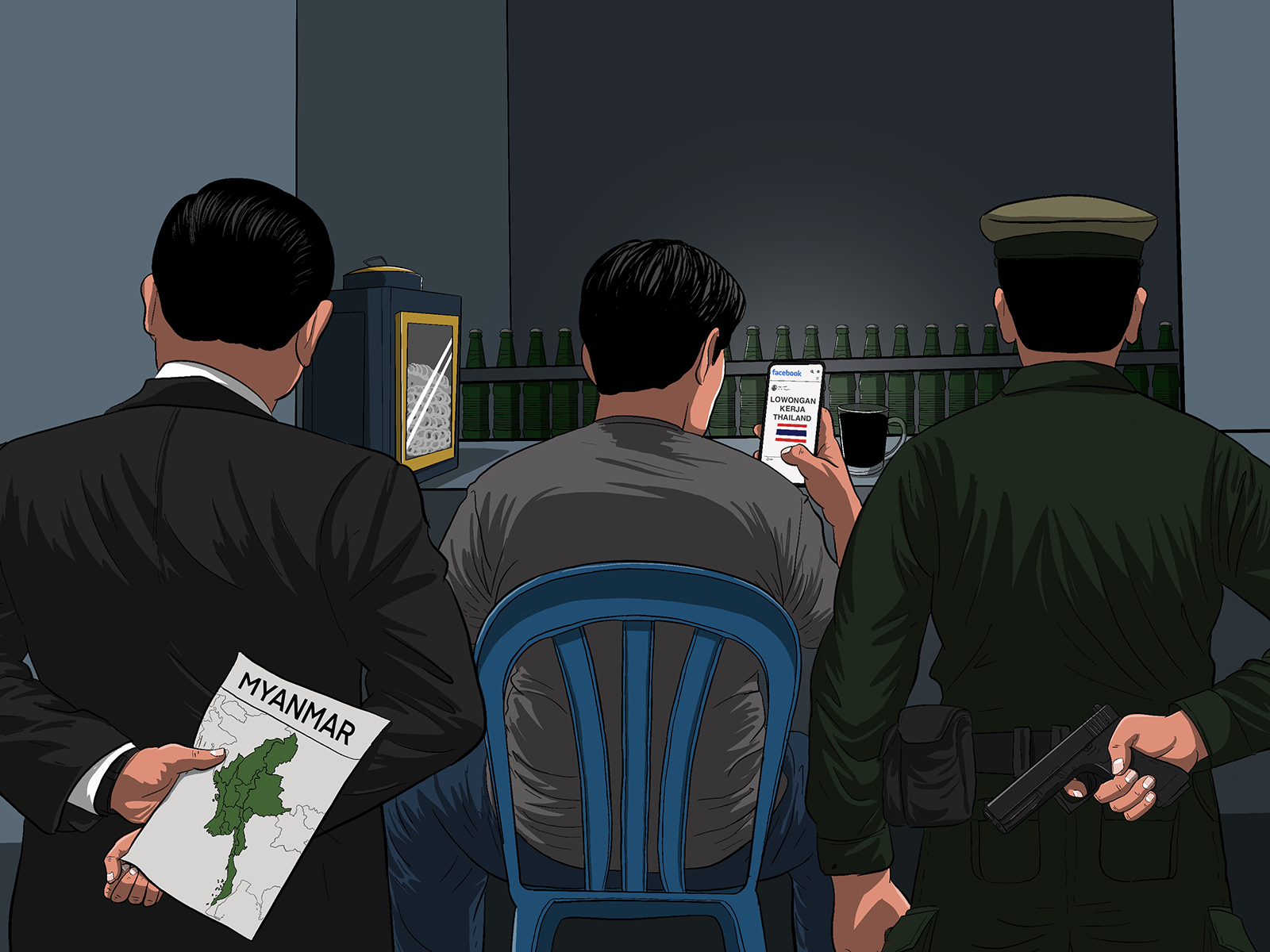
In Jakarta, Indonesia, for two years, the families of human trafficking victims have waited anxiously for the return of their loved ones, who have been forced into slavery in online scam operations in Myanmar. These families continue to hope the Indonesian government will intervene and rescue them.
“Please, Indonesian government. How much longer will our family remain abandoned?” asked Yanti, the sister of one of the victims still trapped in Myanmar.
Myanmar—along with Cambodia, the Philippines, Laos, and Thailand—has become a Southeast Asian hub for pig butchering scams. This form of long-term financial fraud involves perpetrators building trust with victims, often through fake romantic or friendship relationships, before convincing them to invest in fraudulent schemes.
As of March 2024, Indonesia’s Ministry of Foreign Affairs reported that 30 Indonesian citizens remain trapped in Myanmar.
“We truly understand the families’ concerns, and I will do everything possible to bring them home. However, the problem lies in accessing such a dangerous area. No foreigner has ever managed to enter it,” said Rina Komaria, Head of the Southeast Asia Sub-Directorate at the Directorate for the Protection of Indonesian Citizens, Ministry of Foreign Affairs.
Recruitment Pattern
Friend’s Deception
The COVID-19 pandemic devastated lives, leaving household finances in ruins. Many people were laid off, struggled to find new jobs, and became burdened with debt. This situation made some individuals easy targets for human trafficking syndicates.
These organized crime groups recruit victims through various methods. They post fake job advertisements on social media, posing as trusted institutions. They also exploit their own friends––as happened to Siska and her husband, Tito.
The couple’s nightmare began when Ahong, a friend, visited their home and tricked Tito into becoming a victim of human trafficking. As of August 18, 2024, Tito was still trapped in Myanmar.
“Ahong would eat and drink at our house when he was struggling financially. My husband trusted him. They were close friends—how could my husband think badly of him? And then, he deceived my husband,” Siska said.
In the past, Tito and Ahong worked for the same company. But later, Ahong moved to Thailand. When he found out that Tito had been laid off, he invited him to work at “a tech company” in Thailand, promising a monthly salary of Rp8 million (US$510)—a significant amount compared to Indonesia’s minimum wage of around US$286.
At first, Tito declined because he didn’t have money for travel expenses.
“But Ahong was persistent and even offered to cover the costs,” Siska said.
Siska recalled how Ahong reassured them: “Don’t worry, everything’s safe. There’s nothing strange. I’ll handle everything.”
“So my husband agreed. Our financial situation was bad, and he was stressed about our debts,” Siska explained.
In April 2022, after Ahong arranged the administrative and financial matters, Tito left for Thailand alone. At a Bangkok airport, someone claiming to be from the company—an associate of Ahong—picked him up. Tito stayed in a Bangkok hotel for three days, waiting for another worker, a man from Palembang.
On the third day, a company representative took Tito and the man from Palembang on a long journey through the jungle. When they finally arrived at the company, Tito saw Ahong again.
Soon after, Siska began having trouble contacting her husband—the company had confiscated his phone, allowing Tito to use it only twice a week.
Siska occasionally reached out to Ahong for updates, but over time, her husband told her to stop.
“Don’t contact Ahong anymore. If you do, it’s like killing me. He sold me to the Chinese to work as a scammer,” Siska said, recalling her husband’s words.
“At first, my husband thought he was still in Thailand. Later, he realized he was already in Myanmar,” she added.
Siska never discovered her husband’s exact location, and then Ahong disappeared.
“I’ve lost contact with my husband, and Ahong’s number is no longer active. But I’ve heard that Ahong has returned to Indonesia,” Siska said.
According to a May 2024 report by the United States Institute of Peace (USIP), Chinese criminal networks operating in Myanmar shifted their focus during the COVID-19 pandemic.
Initially, from 2017, these criminal organizations controlled illegal cyber gambling businesses along the Myanmar-Thailand border, with support from the Karen Border Guard Force (BGF), which is affiliated with the Myanmar military. In 2020, the Myanmar government shut down many of these operations in Karen State (now called Kayin State). However, following the military coup in February 2021, these criminal organizations resurfaced and expanded into running pig butchering scams.
During the COVID-19 pandemic, China closed its borders, making it difficult for these networks to recruit workers domestically. As a result, they began targeting workers from other countries, including Indonesia.
“Globally distributed human trafficking networks play a role in this process. Their task is to deliver job seekers to scam centers. And Myanmar-based criminal groups are the ones who pay them,” the USIP report stated.
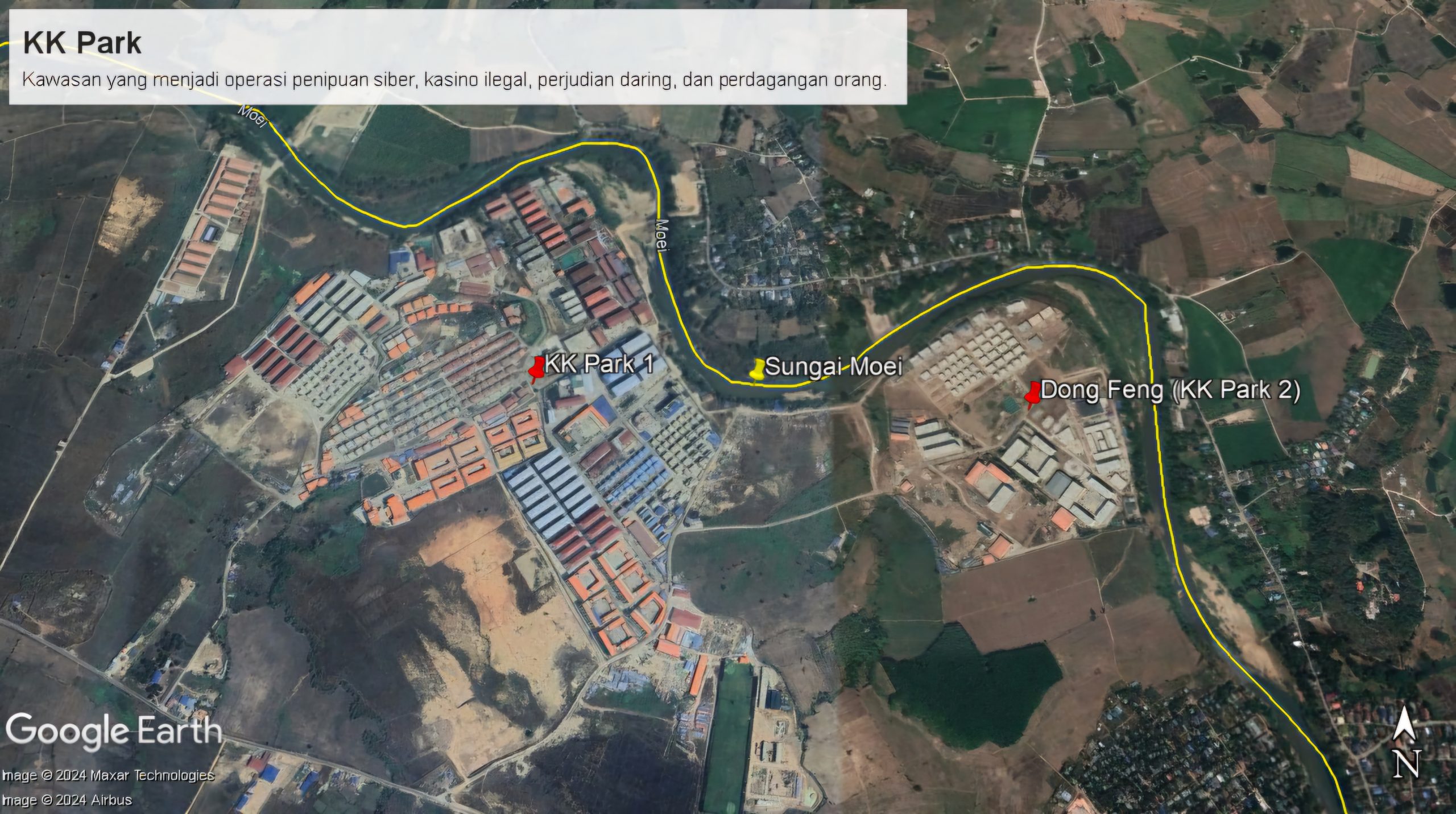
Satellite images of KK Park, an area that has become a base for cyber fraud, online gambling, and human trafficking operations in the state of Myanmar. (Google Earth)
Broker’s Promises
A panel of judges at the Bekasi District Court found Andri Satria Nugraha and Anita Setia Dewi guilty of human trafficking on February 5, 2024. The judges sentenced each of them to eight years in prison and fined them Rp200 million (US$12,763), with an additional four months in jail if they failed to pay the fine. The court also ordered them to jointly pay Rp600 million (US$38,292) in restitution to the victims, or serve an additional six months in prison if they do not pay.
Andri and Anita recruited and deceived dozens of Indonesians, forcing them to work as cyber scammers in Myanmar. Twenty victims recorded a video testimony about the fraud and torture they endured, which went viral on social media and prompted a response from President Joko Widodo.
On May 5, 2023, the Ministry of Foreign Affairs, through the Indonesian embassies in Yangon, Myanmar, and Bangkok, Thailand, successfully evacuated them from Myawaddy, Myanmar. Four days later, the National Police’s Directorate of General Crimes (Bareskrim) arrested Andri and Anita at Sayana Apartment, Kota Harapan Indah, Bekasi Regency.
However, some of Andri’s and Anita’s victims remain trapped in Myanmar.
One of them is Pendi. His wife, Mona, is still fighting for her husband’s return to Indonesia.
The restaurant where Pendi worked went bankrupt due to the COVID-19 pandemic, leaving him with no choice but to work odd jobs. Sometimes, he worked as a motorcycle-taxi driver, and other times as a private driver. His income was barely enough to cover daily expenses.
One day, he met Andri Satria Nugraha and Anita Setia Dewi at Summarecon Mall Bekasi. The couple offered Pendi a job at “a technology company” in Thailand, promising a one-year contract with a monthly salary of around Rp10 million to Rp20 million (US$639 to $1,277).
They also promised to cover his flight, meals, accommodation, and other administrative costs. All that was required was proficiency in English and fast typing skills.
“They soon had a Zoom meeting, where Andri and Anita appeared along with eleven other victims. The departure process moved very quickly after my husband met them,” Mona said.
Mona grew suspicious because Andri and Anita never disclosed the name of the company, saying only that it was located in Bangkok.
“But my husband went anyway because he had good intentions—he wanted to provide for the family. So he accepted the offer to go to Thailand,” Mona said.
Andri and Anita arranged the departures in two groups. Pendi and four others—two women and two men—were part of the first group, which left Jakarta in July 2022. The second group departed from another location at a different time. Meanwhile, Andri and Anita stayed behind in Indonesia.
“When he arrived in Thailand, my husband contacted me. Someone from the company, who seemed to be in charge, picked him up. He looked Chinese but spoke with a bit of a Malaysian accent,” Mona said.
The company representative took the victims to a hotel in Bangkok, where they spent the night. The next day, they were driven 500 kilometers to Mae Sot, a city on Thailand’s western border with Myanmar, before crossing the Moei River. None of the victims realized they had been smuggled into Myanmar.
Once there, the company confiscated their passports and forced them to practice speed typing. They also restricted mobile phone use, making it difficult for Mona to contact Pendi.
“Three weeks later, my husband sent me a letter saying he had realized he’d been tricked. He asked me to report it to the Indonesian authorities,” Mona said.
Language Course Center
Yanti remembers Wahyu as an introverted person, determined to achieve his dreams. Ever since graduating from college, her brother had dreamed of working in South Korea. To pursue that goal, he enrolled in Korean language courses at the Korean Language Center Indonesia (KLCI) in Sukabumi—run by Latif Aliyudin.
“My brother took the Korean language test in Jakarta twice before he finally passed and got his certificate,” Yanti said.
With Latif’s help, Wahyu was almost sent to work at a manufacturing company in South Korea, but the plan was postponed due to the COVID-19 pandemic. In the meantime, Wahyu took on odd jobs, with his last position as a part-time teacher, earning Rp600,000 (US$38) per month.
“Then the course reached out again and offered him another opportunity, asking, ‘Do you still want to work in Korea? Departures have reopened,’” Yanti recalled. “My brother agreed because it was his dream.”
KLCI Sukabumi requested Rp20 million (US$1,278) for Wahyu’s departure costs. His family helped pay in installments—first Rp3 million, then Rp5 million—until the full amount was covered. However, Wahyu never went. KLCI said that processing the visa and work permit for South Korea was still complicated.
As an alternative, Latif suggested that Wahyu take a job at “a Korean subsidiary in Thailand.”
“He said it would only be for three months, at most, before my brother could finally go to South Korea. Wahyu agreed because he was unemployed, getting older, and had already paid in full,” Yanti explained.
Latif introduced Wahyu to a man named Ardli Fajar, who arranged accommodation for Wahyu at the City Park Apartment in Cengkareng. In November 2022, Wahyu departed for Thailand.
After Wahyu moved, Yanti found it difficult to stay in touch with him. His phone was often inactive, and her messages would only show a single check mark.
“I tried messaging him, but it would take three or four days—sometimes even a week—before he replied. He said he was healthy. I stayed positive, thinking maybe he was just adjusting to the work there. By December 2022, I still hadn’t heard much from him,” Yanti said.
Months passed, and Yanti completely lost contact with her brother. The family grew increasingly worried, especially as news reports about fraud and human trafficking in Southeast Asia began to surface.
“One day, I sent him some news articles and asked about his location and how he was doing. Two weeks later, he finally replied. But his messages sounded strange, like he was scared,” Yanti recalled.
Wahyu told her that he had been smuggled into Myanmar through Thailand. He wasn’t working at a manufacturing factory but had been forced to work as a cyber scammer—and he wasn’t getting paid.
“Brother, just escape,” Yanti urged.
“I can’t. I’m trapped behind a mountain.”
“Are they torturing you?”
“Yesterday, they electrocuted me,” Wahyu replied. “Don’t tell Mama. I’m afraid she’ll get sick from stress. Just pray for me to stay strong here.”
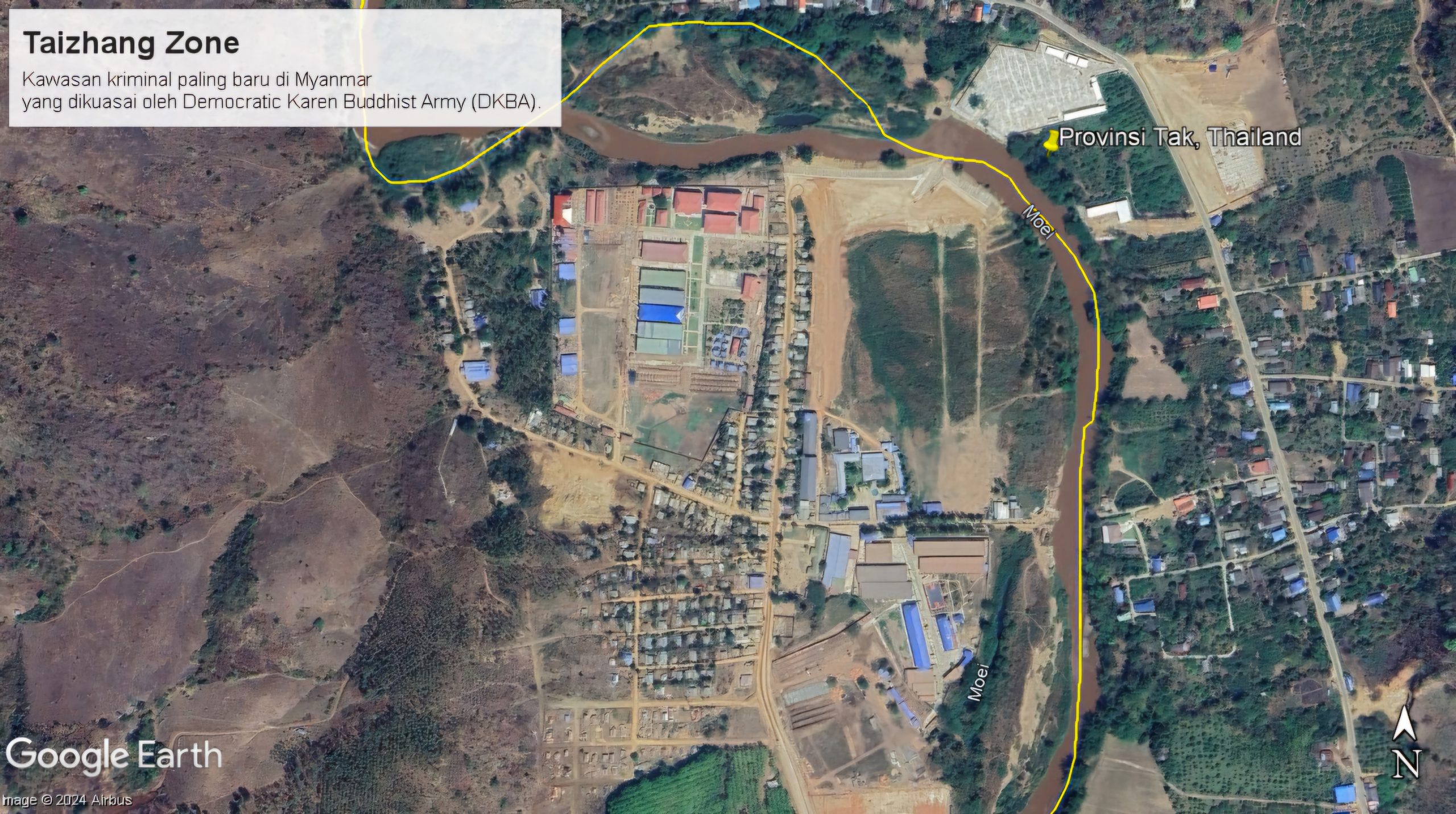
Satellite images of Taizhang Zone, the latest criminal area controlled by armed groups in Karen State, Myanmar. (Google Earth)
Days in the Camp
In Myanmar, Indonesians forced to work as pig butchering scam operators endure extremely long, inhumane working hours—17 to 20 hours a day with only 30 minutes of rest, without holidays or pay.
The cyber fraud organizations force these enslaved workers to scam 100 people each day, primarily targeting citizens from the United States, Canada, and Australia. If they fail to meet their targets, their working hours are extended, or they face physical punishment. These punishments include standing for hours, running 30 laps around a soccer field while carrying a water-filled gallon, doing hundreds of push-ups, being hit with blunt objects, whipped, or even electrocuted—depending on the severity of their failure.
After being electrocuted by the syndicate, Wahyu’s body was covered in bruises, and he struggled to walk.
“His legs hurt, so he had to walk slowly. But even in that condition, he comforted us,” Yanti said.
Yanti recalled her brother telling her: “Don’t worry about me. I wore layers of clothes—thick ones. So when they electrocuted me, it didn’t feel as bad.”
“But being electrocuted is still being electrocuted—it breaks my heart,” Yanti said.
The victims have lost all choice and control over their lives. The company forces them to keep scamming, even though it goes against their conscience.
Siska recalled her husband Tito saying: “Bu, I can’t stand lying to people. When I look at the photos of the people I’m supposed to scam, I see their children and families. It makes me think of you and the kids at home. That’s when they beat me.”
“So my husband just accepted it when they beat his thighs with iron rods and beams until they bruised. Eventually, they hit him on the head. He wanted to fight back, but he couldn’t,” Siska said.
The Pig Butchering Scam
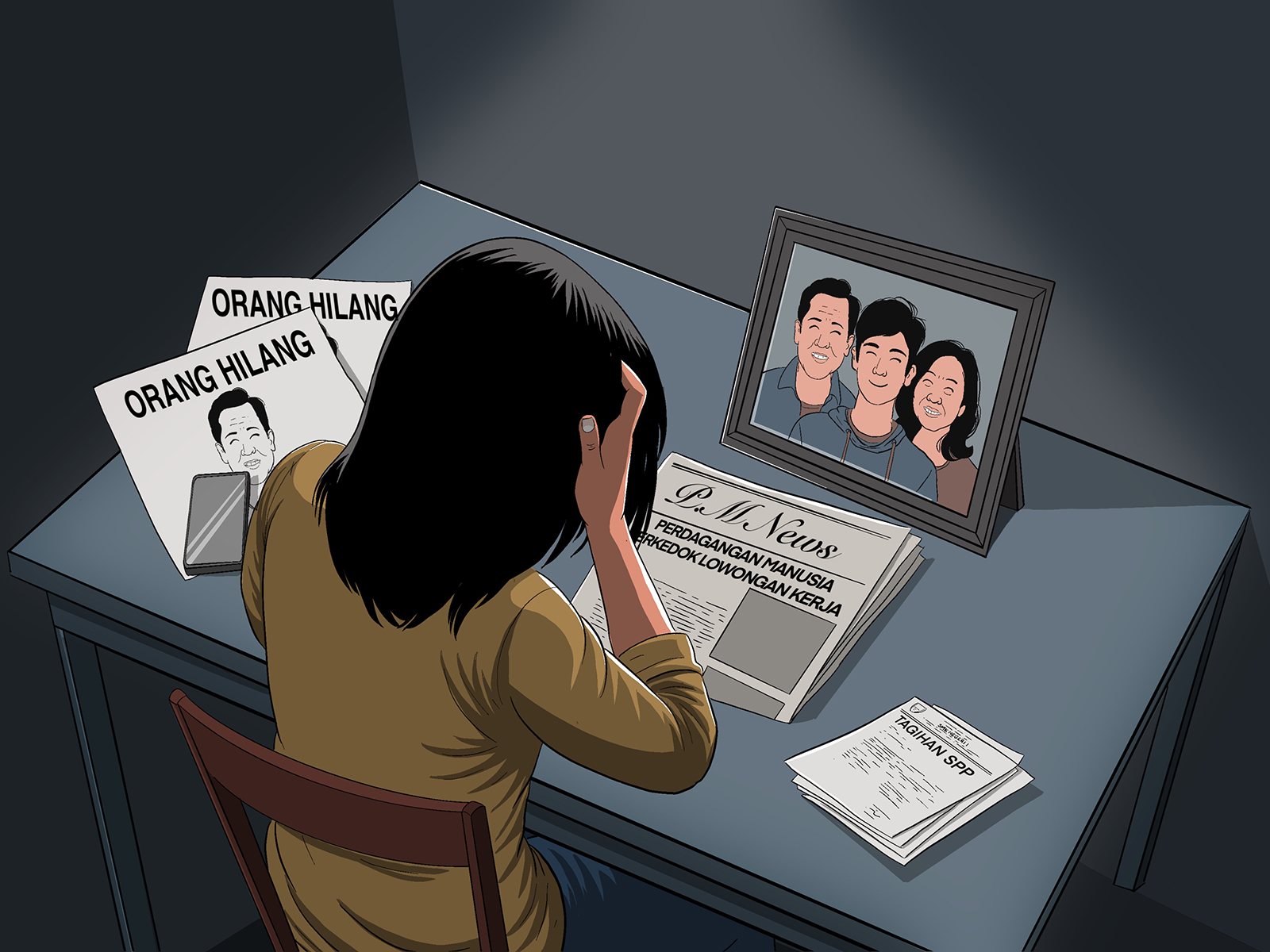
An illustration of the families of human trafficking victims in Myanmar. (Project M/Aan K. Riyadi)
The pig butchering scam is a type of online investment fraud with two stages.
The first stage, known as “fattening the pig,” involves building trust between the scammer and the target. Scammers use fake identities to approach their targets on social media. In some cases, they steal real people’s identities.
The scammers often pose as glamorous, wealthy individuals—attractive, upper-class men or women—who flaunt luxury goods, enjoy horseback riding, travel the world, and drive Ferraris. They use these personas to lure wealthy targets.
Initially, the scammer is warm and friendly, engaging the target as if they’ve known each other for a long time. Once trust is established, the scammer introduces an investment opportunity, promising high returns through fake cryptocurrency trading platforms set up by the company.
The second stage, “butchering the pig,” begins when the scammer embezzles the target’s money. Once the target has invested large sums, the scammer vanishes, along with the investment platform, leaving the target in financial ruin.
But not all scams go as planned.
If the scammer fails to deceive the target, the criminal groups may extort the scammer’s family. For instance, the company might demand a ransom, promising to release the operator if the family pays.
The syndicate once demanded Rp150 million (US$9,560) each from Mona and Yanti for the release of Pendi and Wahyu. Similarly, they asked Siska for US$10,000 to free Tito. When the families couldn’t pay, the company threatened to sell the victims to other criminal groups.
Siska remembered Tito saying: “They sold me to a new company. They confiscated my phone. I can’t take it anymore. Please prepare US$8,000.”
“My husband called me, crying. He couldn’t endure it any longer. The punishments at the second company were even worse. But where was I supposed to get that kind of money?” Siska said.
Mona also had no choice but to accept that her husband would be sold to another company. On average, victims were sold more than twice.
“I asked my extended family for help, but I couldn’t raise that much money. I reached a point where I knew there was nothing else I could do. If my husband was going to be sold again, I just had to accept it,” Mona said.
“We’re also scared. Even if we pay, there’s no guarantee they’ll come home. If not, we’ll just end up in debt,” Yanti added, thinking of her brother, Wahyu.
But the company doesn’t care whether the families have money or not—they just want payment.
Yanti once told the company she couldn’t afford to pay.
“They told me, ‘If you can’t pay, we’ll take him to an underground prison,’” Yanti said.
“At that point, we didn’t know my brother’s condition. We feared the worst—thinking he might die,” she added.
Demanding Repatriation
Transnational crime has a domino effect. The victims’ families—mostly wives—not only suffer emotionally but also bear the financial burden alone.
Siska works tirelessly to support her family and ensure her two young children get enough nutrition.
“Now I have to work harder than ever. In the morning, I run a laundry service from home,” Siska said. “In the afternoon, I work at a clothing store until 10 p.m. If I’m not too tired, I stay up ironing until dawn.”
Mona is in a similar situation, now working as a domestic worker to support her family. Her and Pendi’s two children had to drop out of college to help with the family’s financial struggles.
“They’re working now. We help each other. I feel guilty that their father’s situation has burdened them, especially at such a young age,” Mona said.
These women have taken on multiple roles as they continue to fight for their families. They’ve appealed to the police, BP2MI, the Ministry of Foreign Affairs, the National Commission on Human Rights, and even visited the House of Representatives. Several civil society organizations have supported them, yet they still have no clear answers.
“The government keeps asking us to be patient and wait. We don’t know what the obstacles are—we’re just housewives who don’t understand diplomacy,” Mona said.
“The police still haven’t arrested Latif. They’ve summoned him twice. They should bring him in by force,” Yanti added, referring to Latif Aliyudin, the owner of the Korean Language Center Indonesia (KLCI) in Sukabumi.
“My husband even asked me to seek financial help from people in the village. He said, ‘If the government can’t bring me home, we’ll have to prepare the ransom ourselves,’” Siska said.
Exhausted from fighting alone, the women started a joint movement called “Jerat Kerja Paksa” (Forced Labor Trap), a self-help initiative supporting victims and families of modern slavery in Southeast Asia.
They’ve shared their struggles in public forums and, most recently, sent an open letter to President Joko Widodo on June 26—World Day Against Torture—through the State Secretariat. In the letter, they urged Jokowi and his cabinet to address human trafficking urgently.
“No one deserves to be tortured, and no one should have the right to torture others,” the letter stated.
Meanwhile, the Directorate of Protection of Indonesian Citizens at the Ministry of Foreign Affairs said they have not yet been able to rescue the victims.
The Ministry of Foreign Affairs said they have tried several approaches, including seeking assistance from the Myanmar government, approaching the government of the People’s Republic of China (details of which they cannot disclose), and communicating with the Karen Border Guard Force that controls the Karen State.
“The (Myanmar) government can’t reach the victims because their location is too close to the conflict zone,” said Rina Komaria, Head of the Southeast Asia Sub-Directorate of the Directorate of Protection of Indonesian Citizens at the Ministry of Foreign Affairs.
Myanmar has been engulfed in a prolonged civil war, which intensified after the military staged a coup against the civilian government in February 2021. The conflict has spread across several regions, including Shan, Kachin, Karen, Rakhine and central Myanmar.
“About five to seven people are in the Hpa-An area. It’s extremely remote and close to the heart of the conflict. Not only is it difficult for Indonesians to reach, but even Myanmar authorities struggle to access the area,” Rina added.
Hpa-An is a major city in Karen State, a region that has drawn the attention of international human rights activists due to its role as a hub for transnational criminal operations.
Several areas in Karen State are suspected of being bases for cybercrime, online gambling, illegal casinos, and human trafficking. These include Apollo Park, Yatai New City (Shwe Kokko), Yulong Bay Park, KK Park 1 & 2 (Dongfeng), Dongmei Park and Myawaddy Town.
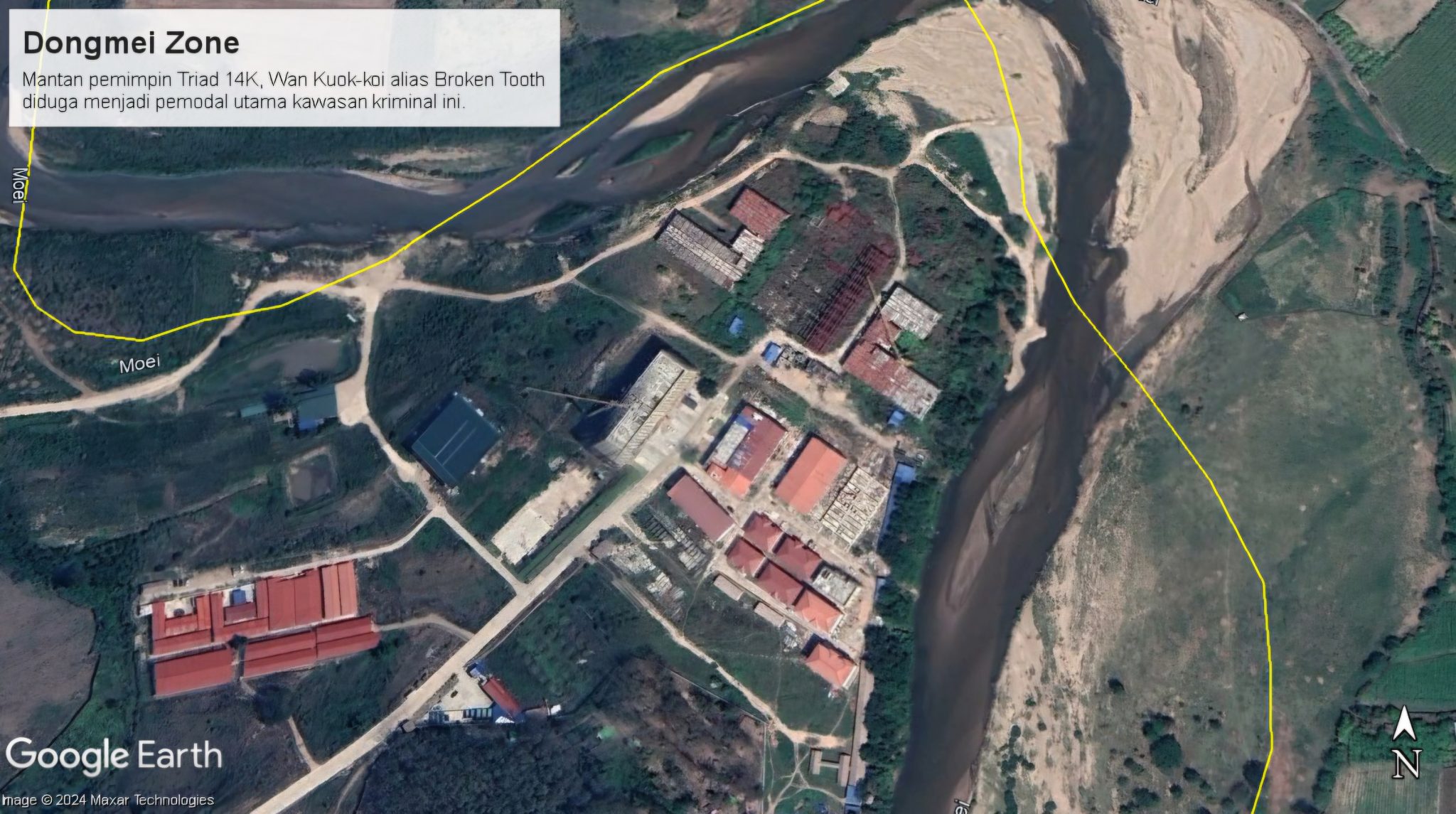
Satellite images of Dongmei Zone, which has become a hub for cyber fraud, online gambling, illegal casinos, and human trafficking in the Myanmar-Thailand border region. (Google Earth)
According to a report by Justice For Myanmar, these transnational criminal operations are controlled by Chinese criminal networks in collaboration with the Karen Border Guard Force (now the Karen National Army). One of the most prominent figures is Wan Kuok-Koi, also known as Yin Gouju or “Broken Tooth,” a former leader of the 14K Triad criminal group and the main investor in Dongmei Park.
Myanmar’s complex political situation is believed to limit the Indonesian government’s options. The success of repatriating Indonesian citizens relied heavily on establishing communication with local power networks.
“There’s no standard method to extract people from these areas. The complexity comes from the presence of numerous armed groups. And those we attempted to contact don’t have the authority to approach these companies directly,” Rina added.
Besides rescue efforts, Rina said the Indonesian authorities must apply preventive measures.
Rina said the Ministry of Foreign Affairs “always coordinates” with the Ministry of Foreign Affairs and “always coordinates” with the Ministry of Communication and Information to remove false recruitment posts from social media. However, she likened the problem to mushrooms: “Cut one, a thousand grow.”
According to the Indonesian Coordinating Ministry for Human Development and Culture (Kemenko PMK), 3,703 Indonesian citizens became victims of human trafficking (TPPO) between 2020 and March 2024, coerced into working as online scam operators.
These individuals were trafficked to Cambodia, followed by the Philippines, Thailand and Myanmar. The victims primarily came from North Sumatra, North Sulawesi, West Kalimantan, Central Java, West Java, DKI Jakarta, East Java, Bali, and Riau.
“Prevention isn’t our main responsibility. Our core work focuses on handling cases and providing services to Indonesian citizens facing problems abroad. If prevention efforts in Indonesia aren’t properly addressed, the Directorate of Protection of Indonesian Citizens will just keep ‘sweeping’ and ‘washing dishes’—because the cases will keep coming,” Rina said.
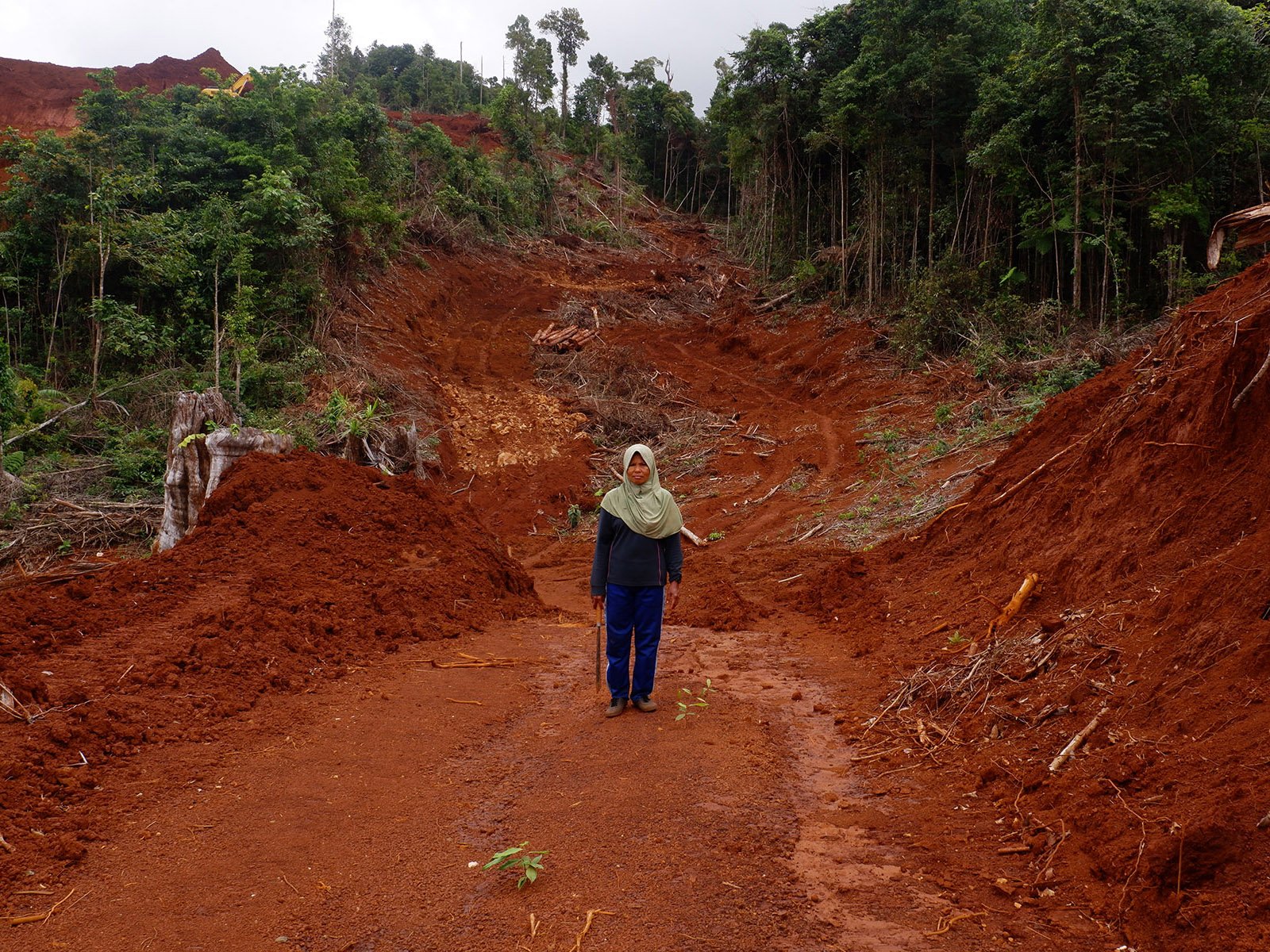
Royani, a resident of Mosolo Village, poses for a photo on her deforested land. No less than 300 of her clove trees were uprooted. Royani is still defending her land from excavation. Image Credit: Project M/Yuli Z.
“Even animals need water. Without water, we will die in vain,” Ratna griped.
The 58-year-old was upset that the water from the local spring water system that flowed into her house was now full of mud. This had become a regular occurrence ever since nickel mining company PT Gema Kreasi Perdana started its operations on Wawonii Island in Konawe Islands Regency in Southeast Sulawesi. The company, the sole owner of a concession permit on the island, is a subsidiary of natural resources conglomerate Harita Group – owned by one of Indonesia’s richest men, Lim Hariyanto Wijaya Sarwono.
Ratna could not hold back her tears. She was angry at the company that had degraded the environment and was disappointed at fellow residents who supported mining on the 706-square-kilometer island.
The mining operation has affected every aspect of her life. She has to wait for hours for the water to be clean enough to be used for bathing and doing her laundry and dishes. Furthermore, she now has to buy drinkable water, which costs her about 50 US cents a gallon.
The impacts of mining on the island’s spring water system possibly started on May 21, 2023. At that time, farmers noticed that the water spring had become increasingly murky, while the pipe used to distribute water from the island’s only water reservoir was cut off. They believed that some people might have purposely cut the water distribution to contain the problem.
Ratna had seen this coming when the nickel company started its operations there.
Those who sold the land said the mining wouldn’t harm us, but now, we’re all looking for clean water. They were fooled by the company. We’re doomed here. —Ratna, lifelong resident of Sukarela Jaya Village, Southeast Wamonii.
The mother of two was never tempted to sell her land, despite being offered hundreds of millions of rupiah. The company’s money could run out in an instant, she said, but the crops could be enjoyed perennially.
“The yield of nutmeg in one year can be tons. We are criticized for refusing good fortune [by selling our land]. Doesn’t the abundance of nutmeg bring good fortune?”
Life had been sufficiently good for Ratna before the nickel miners came. Her plantation allowed her to acquire basic necessities and also save enough money to make an umrah pilgrimage to Mecca in early 2023.
“It’s totally okay to have just enough money to buy food. We must think far ahead. We have a younger generation”. She admitted that she was frustrated at the fact that her complaints had been ignored despite having to face the same problems on a daily basis.
Amid public protests, excavators proceeded to clear the land and dredge the soil. Vehicles carrying nickel ore continued to pass towards the port, which was located only 200 metres or so from Ratna’s house.
It’s only natural that Ratna plans to abstain in the upcoming elections. She feels abandoned by the council members, who are supposed to represent the people. “Our voice means nothing to the council members. When we expressed our opposition to the mining, we were thrown out like animals. We were even attacked with tear gas during our protest in Kendari. I almost died from suffocation.”
They say investors bring prosperity, but in reality they only bring misery. The investors are killing us slowly. There is no justice being served; there is no humanity. It is like living under colonialism. We are colonized by our own country. —Ratna
Fleeing into the Forest
It was 6 in the morning in May 2023 in Sukarela Jaya Village, and Hastati was busy splitting no less than a thousand old coconuts to make copra. Half of the coconuts were harvested from her plantation, and the rest were purchased from her neighbours. The number of coconuts produced in one harvest time, or every three months, is usually around 3,000. Meanwhile, the price of white copra is Rp 7,500 per kg and black copra Rp 6,500 per kg. Apart from coconut meat, Hastati makes a living from selling coconut shell charcoal.
Like other residents who objected to the nickel mining, Hastati was satisfied making a living from the proceeds of her plantation. The 45-year-old was once offered Rp 1 billion to give up the 2-hectare plot of land she inherited from her parents. She was also promised a fully funded umrah and education for her six children, but Hastati never accepted the offer.
“We want to defend our lands, and the rest of Wawonii Island. It’s better for us to be independent like this,” she said. Like Ratna, she emphasised that the company’s money could run out in the blink of an eye, while a well-maintained natural environment could provide a living for many generations.
“When the mountain is completely dredged, the company will leave. What about us, then?”
On Hastati’s land grows nutmeg, cloves, and cashew nuts. Last year, she harvested 50 kg of cloves. The average nutmeg yield was 5 kg. Cashews are the most productive, as the harvest can reach up to 4 tonnes in a year.
Like Ratna, the scarcity of clean water has affected all aspects of her life. Hastati never thought she would go through this difficult time. Before the mining company came, the residents had never lacked clean water as water from the Banda Spring flowed freely into the villages.
“Now we have to go to the river to wash. How can we not be angry?”
As a form of resistance to the mining activities, Hastati refused to accept clean water from the company. It was not just about the water; it was about principles, she said. “Now we have to use river water for cooking.”
Hastati will never forget what happened in 2022, when she and other women stripped off their clothes during a protest against the nickel mining. She also hid in the forest for almost two months. She was afraid of being arrested for ‘obstructing’ the mining operation.
“We were just defending our land, but the police were chasing us as if we were thieves or murderers”.
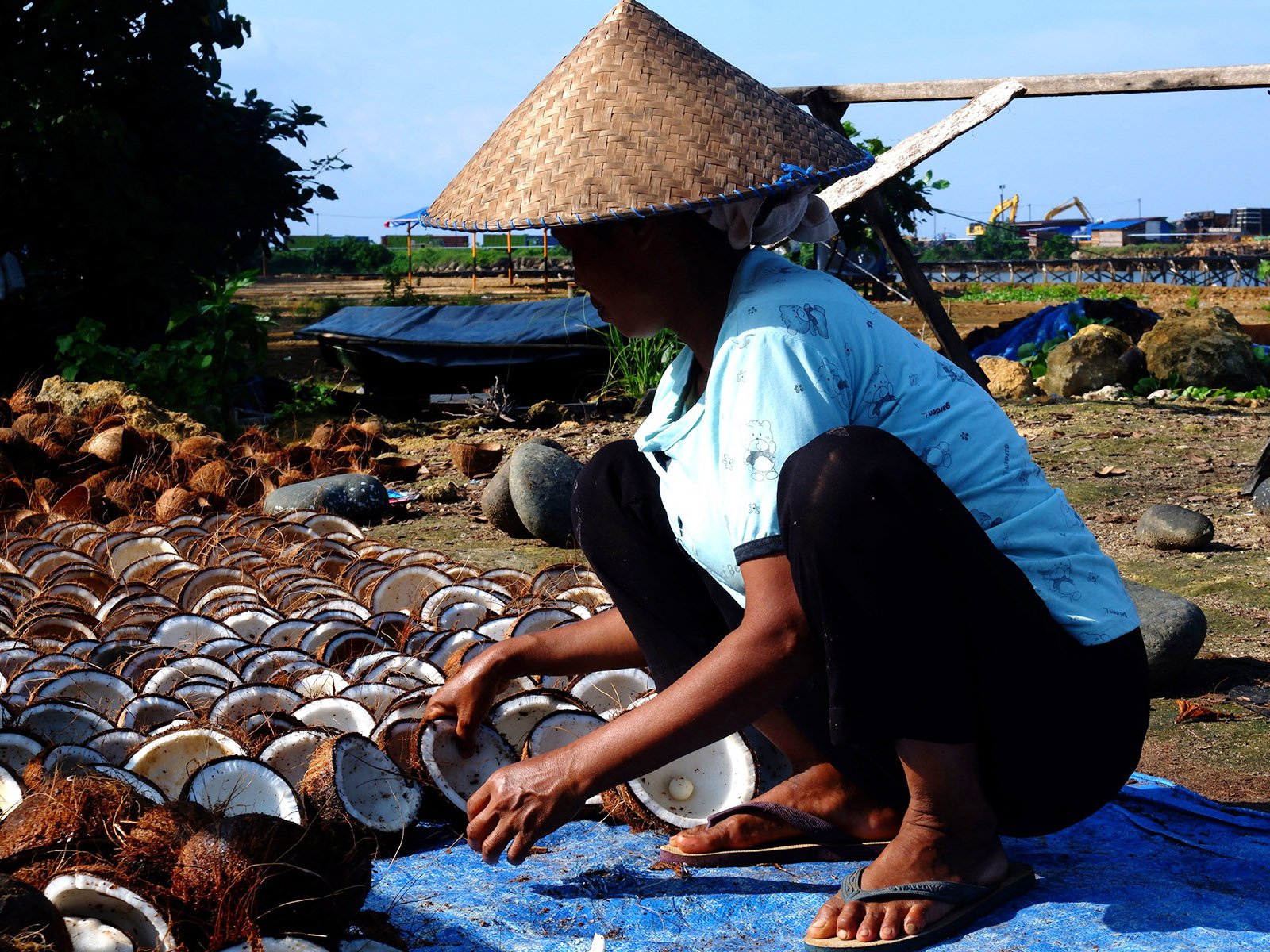
Hastati, a resident of Sukarela Jaya, dries coconuts to make copra. In the background is heavy equipment belonging to PT Gema Kreasi Perdana, a subsidiary of the Harita Group. Photo: Yuli Z./Project Multatuli
Hastati hid in the forest with eight other residents, including Amlia who refused to sell her land for roads for the mine’s trucks and heavy machinery.
I met Amlia in her farm on May 20, 2023. She said that she hid in the forest after receiving a summons as a “witness” by the Konawe Islands Police.
“The persons summoned by the police were the ones who owned the land. As long as they did not give up the land, they would not be released. We thought it’d be better to run than answering the summons.”
Amlia and others went through difficult times when hiding in the forest. They roamed through the forest during the day and looked for a hut to take shelter when the night came. Some days they did not eat at all.
“Even when we could eat, we did not feel like eating. When we rested, we were still anxious. How could we stay calm? The police were looking for us,” said Amlia.
Like Hastati, Amlia was also promised a large sum of money. Her husband and eldest son were both offered a salary from the corporation, without the need to do any work, but she was not tempted by the offer.
Cassava, chilli, banana, and coconut trees grow near her hut. Heavy rain a few days earlier inundated part of the farm with water that carried red mud sediment. Amlia was sure the mud came from the excavated land in mining areas.
The nickel mining has further affected her daily routine as a farmer. She used to go to the farm at 8 in the morning, but now she has to start one-and-a-half hours earlier since access to the farm is blocked by the company’s haul roads. To reach her farm, Amlia needs to walk two hours from where she can park her motorbike. During harvest season, Amlia and her husband have no choice but to carry 20 to 30 kilograms of produce by foot over the hilly roads.
“Even though it is difficult, we are still trying to do our best. As farmers, our income indeed comes from gardening,” said Amalia who was carrying 20 kg of cassava from her farm to the motorbike.
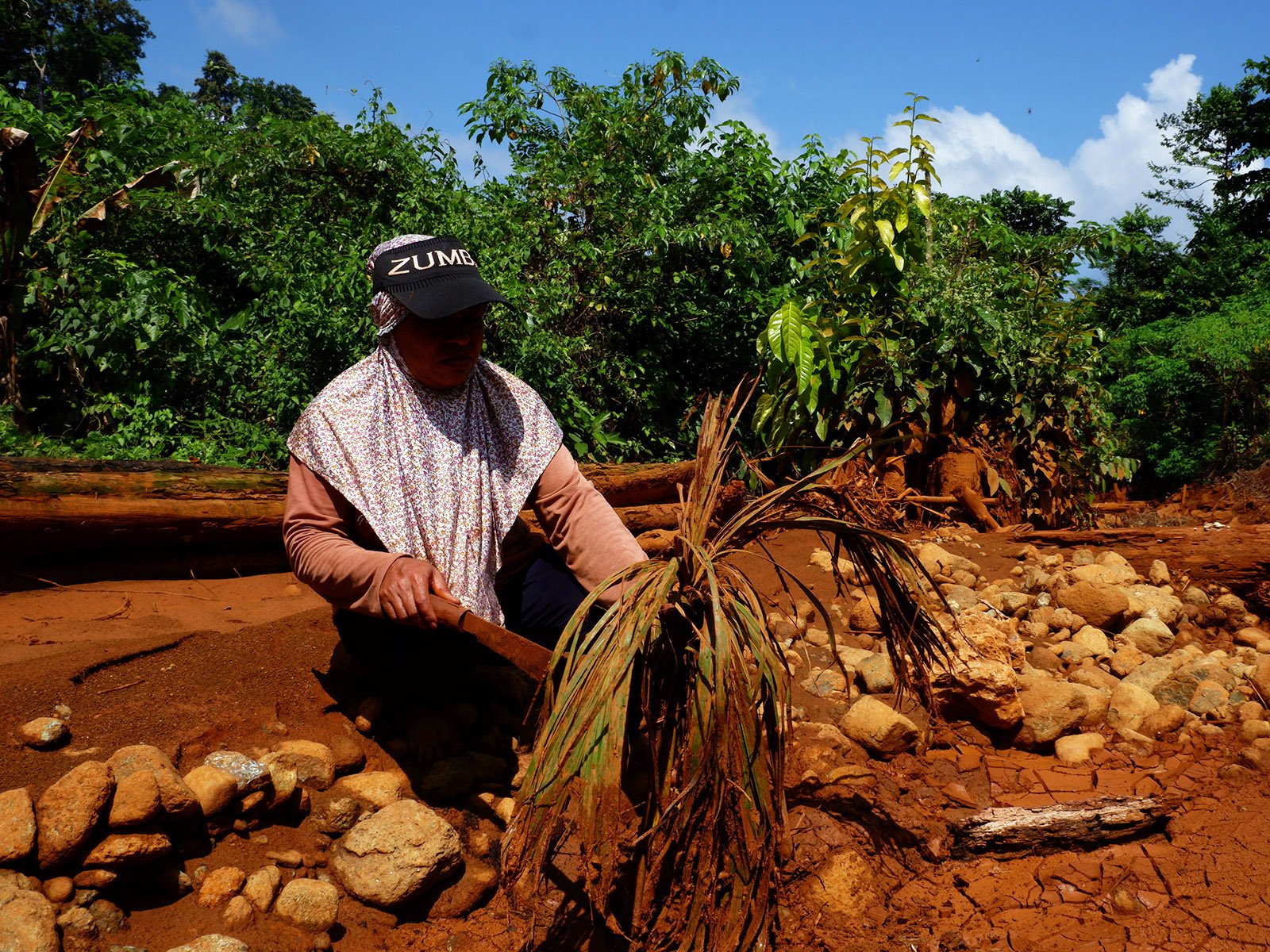
Amlia, a resident of Sukarela Jaya, shows a coconut tree on her farm that was damaged by mud. Photo: Yuli Z./Project Multatuli
Damaged Water Springs
Just like the other days, Saharia, a resident of Dompo-Dompo Jaya village, woke up early in the morning to prepare her family’s breakfast. But when she turned on the tap to wash the fish, the water turned orange. Luckily, there was some water in the tank left from the rain a few days ago.
The 50-year-old is a single mother of four children. Her family owns 250 square metres of garden planted with coconuts, cashews, nutmeg, and cloves. The coconut flesh was later turned into copra, and the shell into charcoal. Saharia was consumed by anxiety as their garden could be taken over at any time by the corporation.
PT Gema Kreasi Perdana started the production and shipment of nickel ore in August 2022, shortly before the pollution of water springs began to be reported. The two main supply channels of clean water in the Sukarela Jaya and Dompo-Dompo Jaya villages have seemingly been polluted by mud since heavy rainfall hit on May 9, 2023.
Banda Spring, which supplies clean water to five villages in Southeast Wawonii District, has become murky. Photo: Yuli Z./Project Multatuli
On May 19, 2023, I visited the Banda Spring in Southeast Wawonii forest, about an hour walk from Dompo-Dompo Jaya Village. The spring, situated in a karst cave at an altitude of 119 metres above sea level, flows into several tributaries serving as sources of irrigation for residents’ farms and rice fields.
On May 21, the area experienced another round of rain. The water in Sukarela Jaya, Dompo-Dompo Jaya, and Roko-Roko turned dark. Those residing on the seashore were busy cleaning the gutters, removing mud carried by rainwater. Locals said changes in the colour of seawater have always occurred after rain, but never with such dramatic contrast.
When I checked the pipes in the settlement, the water was dark. Less than two hours after the rain, water distribution was cut off. Later, I met some women carrying bundles of clothes on their motorbikes. “I am going to do the laundry,” one woman shouted. “The water (flowing into our houses) is useless,” another chimed in.
I then visited the confluence of Roko-Roko River and Tambusiu-Siu River, which supply water to the Banda Spring. The colour difference between the two rivers was quite striking; Roko-Roko was slightly murky, while Tambusiu-Siu was brown. Roko-Roko is the only stream that is not polluted by the mining activities and can still be used by residents for bathing, washing, and cooking. The mining corporation has apparently distributed clean water to the residents, but some of them have refused it to signify their rejection of mining in Wawonii.
The confluence of Tambusiu-Siu River and Roko-Roko River after a two-hour rainstorm hit the surrounding area. Photo: Yuli Z./Project Multatuli
Saharia is among the local residents who object to nickel mining in the area. As a single parent, she has the dual role of taking care of the household and earning a living. The environmental destruction caused by the mining has only made things more difficult for her. To get clean water, she now has to walk to a river 500 metres away from her house. The scarcity of water has forced the family to reduce the frequency with which they go to the toilet. In Saharia’s house, there are three women who go through their menstrual phase every month.
It is very difficult for us when we’re going through our period . We are required to clean ourselves frequently, but what can we do without water? —Saharia
Until the dry season came in mid-August, clean water had yet to be restored. The water flowing in the pipes still carried mud sediment. Saharia was struck by fear every time she used the contaminated water, but she had no other choice. For drinking and cooking, she sometimes asked for clean water from a neighbour who has a well.
“I’m worried about my family’s health. Our bodies get itchy after having a shower. We really miss the old days when the water was clean,” she said.
Nickel Mining is Getting Under the Skin of Locals
Ristan has been sleep-deprived lately. The 24-year-old mother wakes up almost every night because her beloved baby also is also having difficulty sleeping. Abyan, Ristan’s nine-month-old son, has been suffering from itchy skin for the past four months. Reddish spots first appeared on his calf and ankle, and then spread to the toes and soles of his feet.
“It’s actually getting better lately. Before this, my baby’s feet were full of wounds. Very unsightly,” said Ristan while showing me Abyan’s rough skin.
Skin disease also struck Ristan, her husband, and her parents. Nahati, Ristan’s mother, had very itchy black spots all over her body a while ago. Almost all residents of Mosolo, Sinar Mosolo, and Sinaulu Jaya Villages have experienced similar ailments.
“The reddish spots felt itchy at first, and when we started to scratch they’d turn hot or even bleeding. I tried to treat it by drinking a herbal decoction,” Nahati said.
The water consumed by Ristan’s family comes from a source approximately 500 metres from a nickel mining site.
Sixty-five-year-old Nahati has resided in Mosolo since she was 5, but she only experienced the skin condition recently. The water used to turn murky after days of heavy rain. Today, however, the water changes colour after even the briefest rain shower.
Another Mosolo resident, Tika, also complained of itching. An, her one-year-old infant, was no different. The skin on his toes peeled off, and there were black scars on his legs. The mother and son ended up seeing a doctor in the city of Kendari last August.
“The doctor said there wasn’t any problem with the food we eat. He just said it might be due to the weather,” Tika said, adding that her family solely relied on spring water.
Wa Muita lives in Sinaulu Jaya Village with her five family members, three of whom are women. She has had skin ailments for the past year – ever since a nickel mine started operating nearby. She has tried a variety of medications to no avail. The water she uses for the household’s needs has been getting murky recently, and it gets darker anytime it rains.
“I have used a lot of medications, yet the itching persists. Perhaps it’s due to the polluted water we regularly consume. There’s no doubt that we are angry. It’s never been like this before”.
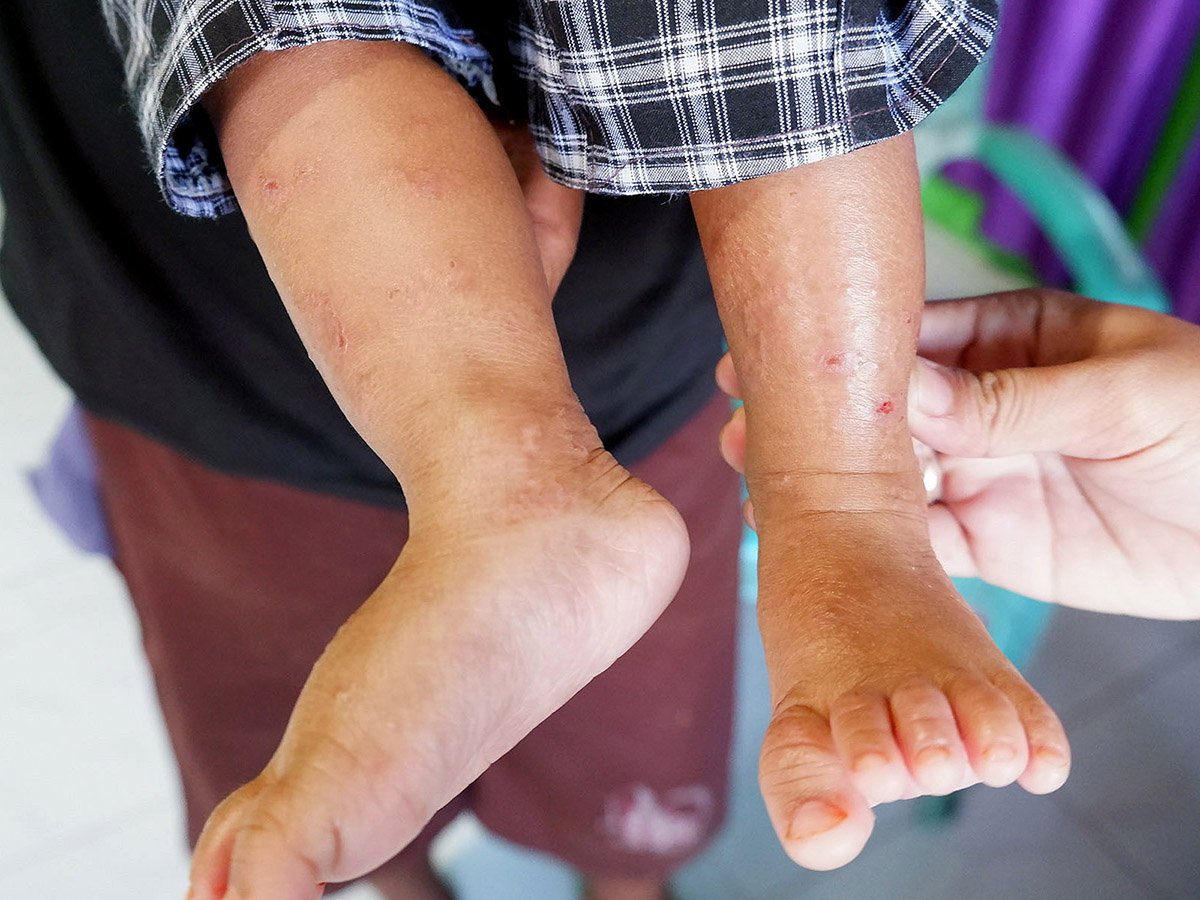
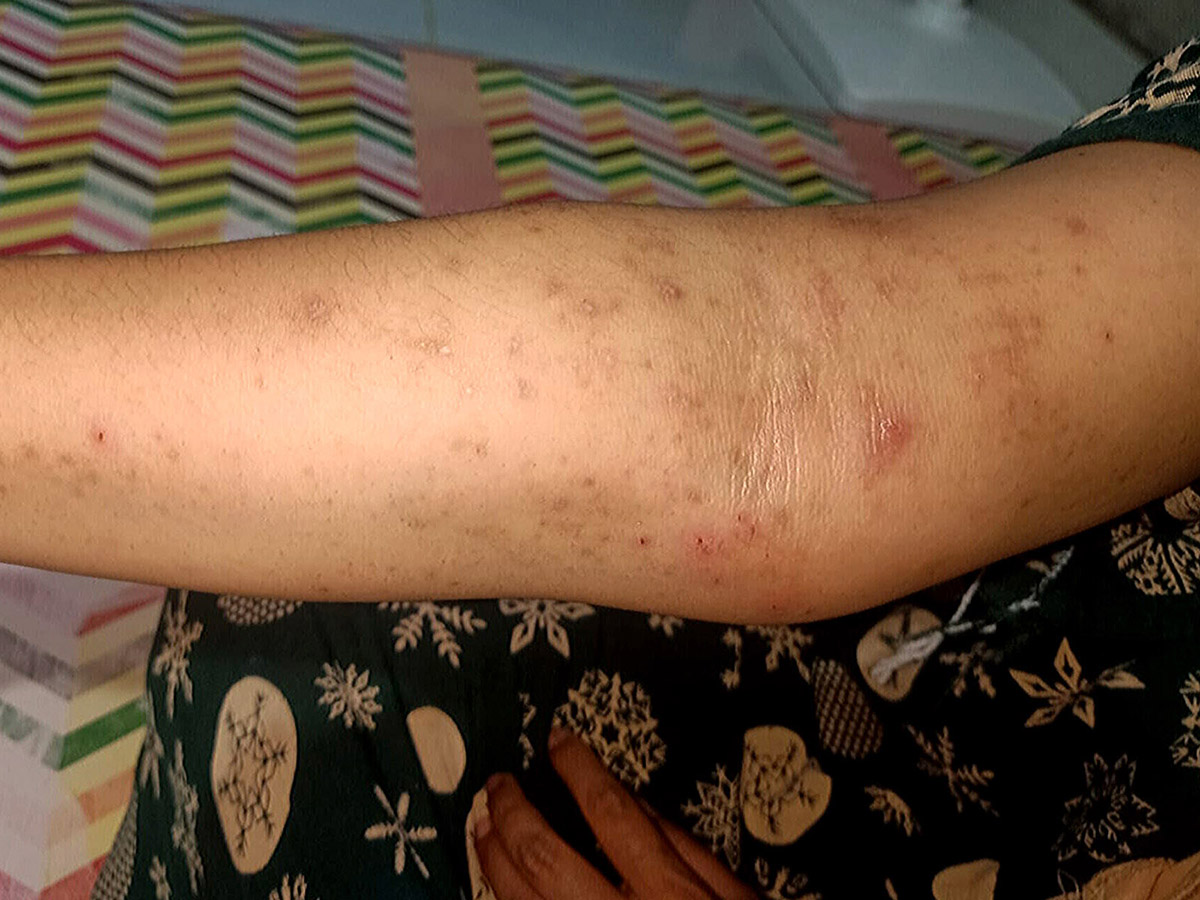
Left: Abyan’s skin is red and itchy. The nine-month-old baby boy has suffered from the skin disease for around four months since the water his family used was allegedly contaminated with mud from nickel mining. Right: A Sinaulu Jaya resident shows her skin rash. Photos: Yuli Z./Project Multatuli
Jumriati, a 24-year-old resident of Sinaulu Jaya, said she was worried about her family’s health due to their regular consumption of the polluted water.
“I hope the government will pay attention to our complaints and not let the community be affected by mining’s destructive impacts. The company is profiting at the expense of our lives,” she said.
Lahadi, a caretaker of the water reservoir in Sinaulu Jaya, confirmed that the water quality had deteriorated since the nickel mining company started excavating land in 2020.
“We cannot be sure whether the pollution is due to the company’s activities. But one thing’s for sure, every time it rains for at least a day, the spring brings lumps of mud into the reservoir,” said Lahadi. “I’m not making up stories. You can ask anyone living near the mining site; the ecosystem has been disrupted.”
A local environmental official in the Konawe Islands, Hasnawati, denied claims that the water in Sinaulu Jaya had been polluted. Water consumed by the community still met the quality standards set by the Environment and Forestry Ministry, she said in a statement, adding that tests had been carried out on the Pamsimas Sukarela Jaya and Pamsimas Dompo-Dompo Jaya Springs.
“The water sample was examined in an accredited laboratory (in Kolaka Regency), and the result shows that the water meets the regulatory standards of the Environment and Forestry Ministry,” she said.
However, she did not provide the test results before this article was completed. “Those are kept by my staff,” said Hasnawati.
Muhammad Jamil, an activist with the environmental group Mining Advocacy Network (JATAM), said skin ailments were common in nickel mining areas. Similar diseases could also be found in the Pomalaa District of Kolaka Regency and Tinanggea District in South Konawe Regency.
“As far as I know, the problem has been studied by a number of universities,” he said.
Research conducted by La Maga, Ahyar Ismail, and Faroby Falatehan from IPB University in Bogor (2017) found that Tinanggea residents experienced skin disease after using water contaminated by material from nickel mining sites. In addition to the skin conditions, residents also suffered from respiratory problems, as they were exposed to dust raised up by the mining. Such air pollution affected those within a three-kilometre radius of nickel mining sites, the study found.
Defending the Land
“I was devastated watching the clove trees being ripped down. It was like seeing your own children murdered,” said Wa Muita, a 43-year-old resident of Sinaulu Jaya, as she recalled the events of August 10, 2023.
A day before, residents received reports that their plantations on Mosolo hill, two hours away from their settlement, had been cleared by PT Gema Kreasi Perdana. Amiri, Wa Muita’s husband, rushed to check his plantation in the middle of the night and found that 40 of his clove trees had been toppled. Apart from that, the corporation also tore down dozens of pepper trees and cashew trees that were about to bear fruit.
Wa Muita and some 20 other farmers came by the next day. They were saddened to see the 18-year-old clove trees that had long been the source of their livelihood destroyed just like that.
“I was speechless, tears streaming down my face,” said Wa Muita.
Shortly after, hundreds of residents gathered at the plantation area. They confronted the company for trespassing, but the company claimed that it had acquired the land through other parties. Wa Muita and Amiri stressed that they had never sold their land, let alone received money from the supposed transaction. The situation quickly spiralled out of hand as members of both conflicting parties threatened each other – some with sharp weapons.
“Every time I go to the farm, I always talk to the clove trees. ‘Please bear fruit soon. We care for you like our own children. And you are the ones paying for your siblings’ school fees’,” she said.
Wa Muita has two children who are attending college; another one is in high school, and the youngest of all is in elementary school. Their tuition fees have been covered by the sale of cloves. In 2019, the family harvested a ton of cloves. The price of one kilogram of cloves in Southeast Wawonii is roughly Rp 130,000. The 40 clove trees uprooted by PT Gema Kreasi Perdana were immensely precious to Wa Muita.
Despite everything the company had put her through, Wa Muita only asked PT Gema Kreasi Perdana to stop clearing the land.
“We accept what they’ve done to us and hope the company still has some conscience. We have further requested the person who sold the land without our authorization to refund the company’s money”.
“Without this land we don’t know what to do. This is our sole source of income,” she emphasised.
Despite encountering such fierce rejection, the company has continued to clear residents’ land, said Wa Muita, forcing her and other farmers to maintain guard of their respective fields for months.
“We didn’t even have time to take care of ourselves from February to May. We did not shower, and only ate whatever was available”.
Wa Muita (front left) together with residents of Sinaulu Jaya and Mosolo stand guard at their plantations to prevent further encroachment by PT Gema Kreasi Perdana. Photo: Yuli Z./Project Multatuli
Before the trespassing incident, Wa Muita visited her field twice a week. Now she’s forced to go there more often to guard her land.
I don’t know what to say. I feel devastated. Why are there such evil people? We desperately care for the land, and they come and violate it just like that.. On top of that, they have also threatened to evict us. I hope the media, or anybody really, can help us to stop the destruction of our mother nature. —Wa Muita
Pitted Against Each Other
Not only does has mining had environmental impacts, it’s also triggered family conflicts: parents and children have come to despise each other; siblings have become enemies; and partners have split up.
For instance, Sanawiahas been estranged from her parents for over three years. The family conflict started when one of Sanawia’s brothers, with their father’s permission, sold their parents’ land in 2019.
The land sale was sealed as Sanawia protested against the mining at the Konawe Islands Council Office. It was only while on her way back home that Sanawia heard her parents’ land had been sold to the mining company.
“I could only cry. The company quickly cleared the land. Since then I haven’t been to visit my parents,” said the 45-year-old woman who has four siblings, three of whom support the mining activities. Sanawia said that, among her siblings, she used to be the closest to her parents — but not anymore.
She did not know exactly how much of her parents’ land was being sold. What she knows is that the field could usually produce 3,000 coconuts each harvest season. The mother of two wants to fix her relationship with her parents and siblings, but only under one condition. “Our relationship can be repaired as soon as the mining operation stops,” Sanawia insisted.
Aba, not his real name, said his daughter was abandoned by her husband while she was pregnant with their second child. His son-in-law had offered him money provided by the company in compensation for Aba’s land, which was used for PT Gema Kreasi Perdana’s haul roads.
Aba had previously been taken to the police station for defending his land. So he was enraged when his son-in-law made a deal with the company without his consent. He refused the money and demanded it be returned to the company.
When the couple was about to build a house, Aba’s son-in-law asked his wife to take out a loan, but she refused. That was when the son-in-law brought up Aba’s refusal to accept compensation from the mining company. The quarrel escalated into domestic violence.
“One night, my daughter came to me, crying. Her right eye was bruised. I tried to reconcile the couple, and they did get back together. But, after a few days, when my daughter was looking for mussels in the sea, her husband ran away and has not yet returned,” Aba explained.
Now, his daughter and two grandchildren live with him. “I will never accept the company’s money. I’m already old, it’s true, but I’m thinking about the future of my grandchildren,” Aba stated.
Both Sanawia and Aba reside in Roko-Roko, and in this village, social divisions caused by the mining company are no longer a secret. A number of people I met expressed reluctance to engage with anybody from the opposing ‘camp’.
A Legal Battle against Mining Activities
Wawonii Island, which covers an area of 706 square kilometres is categorised as a small island, based on Law No. 27/2007 on the Protection of Coastal Areas and Small Islands. Thus, as mandated by the law, mining activities cannot be carried out on the island.
Several civil society groups noted that at least 2,214 people living in the villages of Dompo-Dompo Jaya, Sukarela Jaya, Roko-Roko, Bahaba, and Teporoko were affected by PT Gema Kreasi Perdana’s nickel mining. For the record, PT Gema Kreasi Perdana obtained a nickel mining permit in 2007. By the end of 2019, the subsidiary of Harita Group secured a mining operation permit (IUP) on an area of 850.9 hectares, around 83 percent of which was forest area lent by the state under a forest area utilisation permit (IPPKH) scheme. It was also granted permission to build a port in the Wawonii Strait.
The development, according to a coalition of civil society groups, has harmed the aquatic ecosystem, including mangroves and coral reefs, on and around Wawonii Island. The murky water resulting from mining activities has made it difficult for fishermen to catch fish. The port also keeps fish away from the shoreline. The thick dust generated by the transportation of nickel ore has also damaged residents’ respiratory systems, the coalition emphasised.
Even though the law prohibits mining on the small island, the local government has issued a regional planning regulation (Perda No. 2/2021) that covers the Konawe Islands and carves out an exemption for mining on Wawonii.
Wawonii residents, represented by the Denny Indrayana Law Firm, have filed a judicial review of the regulation. On December 22, 2022, the Supreme Court granted their request.
Through decision No. 57 P/HUM/2022, the Supreme Court states that Wawonii Island is a “small island… which is vulnerable and very limited, therefore requires special protection. All activities that are not intended to support the ecosystem… including but not limited to mining are categorised as abnormally dangerous activities… which must be prohibited… as they will threaten the lives of all living creatures on the island”.
The Supreme Court also mentions that the special planning regulation “…ignores the wishes of the community as conveyed by a huge demonstration on March 6, 2019, against the mining activities”. The court further ordered the Konawe Islands Regent, as well as the Regional Legislative Council, to revise the regulation.
However, president director of PT Gema Kreasi Perdana Rasnius Pasaribu, through his attorney Asmansyah & Partners, submitted a judicial review to the Constitutional Court to challenge a number of articles in the law about the protection of coastal areas and small islands. The articles, number 23 paragraph 2 and 25 letter k, ban mineral mining activities in such areas.
The company’s lawyer argued that the Supreme Court interpreted the two articles as an “unconditional prohibition” on mineral activities in areas classified as small islands, despite the fact that the company “possesses a valid permit” and is therefore “threatened to cease its activities and potentially suffer constitutional and economic losses”.
The company said it had invested a total of Rp 37.5 billion and 77,300 US dollars since 2007, in addition to distributing more than Rp 70 billion in compensation for 568 hectares of land affected by mining activities.
The application was submitted on March 28, 2023, and the Constitutional Court arranged several hearings in May, August, and September. The next stage is the verdict hearing.
Civil society groups have called on the Constitutional Court to reject the judicial review in order to safeguard small islands from the grip of a destructive mining industry.
“If the judicial review is granted, mining activities will be legalised in all coastal areas and small islands in Indonesia, not only on Wawonii Island,” Wildan Siregar from environment watchdog Trend Asia warned. “Both ecological damage and social conflicts due to mining will become far more widespread” he added.
An bird’s-eye view of several villages in Southeast Wawonii District. The mining activities of PT Gema Kreasi Perdana have allegedly polluted the sea. Photo: Benaya Ryamizard Harobu/Project Multatuli
While the company filed a judicial review at the Constitutional Court, the Southeast Sulawesi Provincial Council officially removed the allocation of land for mining on Wawonii Island. The Regional Regulation Draft (Raperda) concerning the 2023-2043 Spatial Planning of Southeast Sulawesi designates Wawonii Island as an integrated fishery region.
Fajar Ishak, head of the Council’s special committee (Pansus) on the Spatial Planning bill, explained that revocation of land for mining in the Konawe Islands Regency was eliminated to comply with the Supreme Court’s decision.
“The Supreme Court’s decision was issued towards the end of 2022 (and became effective this year). Therefore, we cannot ignore it. As a consequence, we decided to declare Wawonii Island as an integrated fishery area. There will be no more mining there,” said Fajar on August 29,2023.
“This is a False Allegation”
PT Gema Kreasi Perdana spokesperson Alexander Lieman denied the accusations that the company had caused environmental damage. According to him, the company has taken preventive measures to prevent air pollution such as routinely monitoring the air quality and regularly watering the roads.
“We are taking such measures as part of our commitment to protect the environment, especially Wawonii Island,” said Lieman. “In fact, we even provided compensation for residents whose plantations were affected by mining activities.”
Regarding the murky water, Lieman claimed the water on Wawonii Island had always been like that, even before the company commenced its operations. He noted that every time it rained, the water turned dark.
“Our mining activities do not pollute the river (…) We strongly reject these baseless accusations. You can validate this with the local administration as well as the Environmental Agency”.
Murky water flowing from a resident’s pipeline on May 21, 2023. Photo: Yuli Z./Project Multatuli
Lieman said the corporation actually helped the communities to access clean water by dispatching water trucks to villages, setting up a special team to find alternative sources of clean water, digging wells, and cleaning the communities’ water tanks.
“The river is clear again, and the residents can easily access clean water for their daily needs”.
Lieman’s statement does not correspond to the facts on the ground. The water flowing in Dompo-Dompo Jaya, Sukarela Jaya, and Roko-Roko villages continues to carry mud. The water was still dark by August 18, 2023, even though there had not been heavy rain for quite some time.
Royani, warga Desa Mosolo, berpose di lahan miliknya yang telah gundul. Sebanyak 300 pohon cengkihnya ditumbangkan. Royani masih mempertahankan lahannya agar perusahaan tidak melakukan penggalian. Photo: Yuli Z./Project Multatuli
“Hewan pun membutuhkan air. Kalau tidak ada air, mati konyol kita,” Ratna merutuk.
Ratna kesal. Pipa yang saban hari mengalirkan air bersih ke rumahnya kini membawa sedimentasi lumpur. Ratna meyakini lumpur itu mengandung tanah bekas galian nikel PT Gema Kreasi Perdana, anak perusahaan Harita Group, pemilik tunggal izin konsesi di Pulau Wawonii, Kabupaten Konawe Kepulauan. Sebab, air yang digunakan selama ini tak pernah sekeruh itu walau di musim hujan.
Ratna menangis. Hatinya teriris. Ia marah bercampur kecewa. Marah kepada perusahaan yang dianggapnya semena-mena. Kecewa kepada siapa saja yang mendukung beroperasinya perusahaan tambang di pulau yang luasnya hanya 706 km² itu.
Hari-hari berikutnya, Ratna harus menunggu berjam-jam hingga air cukup jernih agar bisa digunakan mandi dan mencuci pakaian dan perabotan dapur. Untuk keperluan memasak, Ratna terpaksa membeli air yang harganya Rp8.000 per galon. Kondisi air belum pulih saat Wawonii Tenggara kembali diguyur hujan pada 21 Mei 2023, menyebabkan sumber mata air kian keruh.
Beberapa jam setelahnya, pipa yang mengalirkan air dari satu-satunya bak penampungan yang digunakan warga selama ini terputus. Warga menduga ada “oknum” yang sengaja memutus pipa agar masalah air tercemar tidak tersebar luas.
Ratna sudah menduga hal ini jauh sebelumnya. Tak heran ia mati-matian menolak masuknya tambang.
“Kata mereka yang jual lahan, aktivitas tambang tidak ada dampaknya. Sekarang sama-sama kita cari air bersih. Mereka dikasih bodo-bodo perusahaan.”
“Hancur kami di sini,” suaranya meninggi.
Ibu dua anak ini sudah 58 tahun menetap di Desa Sukarela Jaya, Kecamatan Wawonii Tenggara. Sejak lahir, berumah tangga, dan sekarang memiliki cucu. Walau hidupnya tak berjalan mulus-mulus saja, ia masih mampu memenuhi kebutuhan hidup dan bertahan sampai hari ini. Apalagi sekadar mendapatkan air bersih.
“Kami perjuangkan pulau ini karena di sini kami lahir. Di sini tumpah darah kami.”
Pulau Wawonii telah menyediakan segala yang dibutuhkan. Tanaman jambu mete, pala, cengkih, dan kelapa, cukup untuk menopang hidupnya. Ratna tak pernah tergiur lahannya ditawari uang ratusan juta rupiah. Uang dari perusahaan bisa habis dalam sekejap, katanya, tapi hasil perkebunan bisa dinikmati terus-menerus.
“Setahun hasil pala bisa berton-ton. Kita dibilang tolak rezeki. Lantas, ini bukan rezeki?”
Lagi pula, tanpa hadirnya tambang, Ratna merasakan hidupnya telah berkecukupan. Hasil perkebunan memungkinkannya menabung dan membeli berbagai keperluan hidup. Hasil kebun itu juga telah membawanya umrah pada awal tahun 2023.
“Biar tidak ada uang, kita masih bisa makan. Kita punya pemikiran jangan cuma sejengkal. Harus berpikir jauh ke depan. Kita punya anak cucu.”
Ratna beranjak ke halaman rumah. Di sana, biji dan bunga pala dijemur di bawah terik matahari. Ditatapnya biji-biji pala yang tak lama lagi menjadi rupiah.
Ratna berkata telah bosan menyampaikan keresahan hatinya. Suaranya hanya dianggap angin lalu oleh para pengambil kebijakan. Padahal, tambahnya, “perempuan yang dirugikan karena kami memasak dan mengurus dapur.”
Di tengah berbagai penolakan dan gejolak yang terjadi, eksavator perusahaan terus menggunduli lahan dan mengeruk tanahnya. Kendaraan-kendaraan pengangkut ore nikel tetap lalu lalang menuju pelabuhan, yang letaknya hanya 200-an meter dari rumahnya.
Ratna bertekad tak akan menyalurkan hak pilihnya pada pemilu di tingkat lokal nanti. Ia kadung kecewa. Merasa ditinggalkan anggota dewan yang seharusnya menjadi penyambung suaranya. Merasa tak dipedulikan kepala daerahnya.
“Saya akan golput. Hanya suara kami yang dibutuhkan. Kita demo di DPR, diusir seperti binatang. Dibentak-bentak. Kita demo di Kendari, dihantam dengan gas air mata. Saya hampir mati karena sesak napas.”
“Katanya, mendatangkan investor untuk kesejahteraan, tapi malah menyengsarakan. Mematikan secara halus.”
“Sekarang tidak ada keadilan. Tidak ada perikemanusiaan. Kayak penjajahan Belanda kita dibikin. Penjajahnya negara sendiri.”
Bersembunyi di Hutan
Pukul 6 pagi pada pertengahan Mei 2023 di Desa Sukarela Jaya, Hastati sibuk membelah buah kelapa tua untuk dijadikan kopra. Totalnya 1.000 buah. Sebagian kelapa itu milik sendiri yang baru saja dipanen, sebagian lain dibeli dari warga sekitar. Saat itu harga kopra putih Rp7.500/kg dan kopra hitam Rp6.500/kg. Dalam satu kali panen, setiap tiga bulan, kelapa yang dihasilkan biasanya mencapai 3.000 buah. Selain daging kelapa, Hastati mendapatkan keuntungan ekonomi dari tempurung kelapa yang dibakar menjadi arang.
Hastati, 45 tahun, adalah ibu enam anak. Seperti warga lain yang menolak tambang, Hastati merasa sudah cukup atas hasil perkebunannya. Ia berkata pernah ditawari uang Rp1 miliar agar mau melepas tanah seluas 2 ha warisan orang tua. Ia juga bercerita ditawari umrah gratis berkali-kali, bantuan biaya pendidikan untuk anak-anaknya, dan pernah diajak bekerja di tambang.
“Tapi saya tolak. Kita mau mempertahankan lahan dan Pulau Wawonii. Lebih baik kita berdikari begini.”
Uang dari perusahaan, katanya, bisa habis dalam sekejap. Namun, lahan yang dimilikinya, selama tidak dirusak, bisa memberikan kehidupan hingga generasi mendatang.
“Kalau sudah habis gunung, perusahaan pulang. Sedangkan kita?”
Di lahannya tumbuh pala, cengkih, dan jambu mete. Baru setahun terakhir Hastati mulai membuat kopra. Pohon pala dan cengkih baru belajar berbuah. Tahun lalu, ia memanen 50 kg cengkih. Sementara pala sekali panen rata-rata 5 kg. Jambu mete menjadi tanaman andalannya. Setahun bisa menghasilkan 3-4 ton.
Hastati tinggal bersama suami dan empat anak dan seorang cucu. Sulitnya mendapatkan air bersih menghantam seluruh kehidupannya, tak cuma mempengaruhi ekonomi rumah tangga. Hastati tak pernah menyangka akan melalui fase ini. Sejak dulu, ia tak pernah kesulitan mendapatkan air bersih. Sumur di Roko-Roko rata-rata sudah ditutup lebih dari satu dekade sejak air dari mata air Banda mengalir lancar ke kampung.
“Dulu kita senang air mengalir ke rumah. Sekarang harus ke sungai untuk mencuci. Bagaimana kita tidak mau marah?”
Sebagai bentuk penolakan tambang, Hastati menolak menerima bantuan air dari perusahaan. Ini bukan hanya tentang air. Ini tentang prinsip, katanya. “Sekarang terpaksa pakai air kali untuk memasak.”
Hastati tak pernah lupa kejadian tahun 2022. Saat itu ia bersama ibu-ibu lain nekat melepas baju dalam aksi menolak tambang nikel. Ia juga pernah bersembunyi di hutan selama nyaris dua bulan. Ia takut ditangkap lantaran dianggap menghalangi pertambangan.
“Saya jengkel kepada perusahaan. Kita mempertahankan lahan malah dicari-cari polisi. Padahal kita tidak membunuh atau mencuri.”
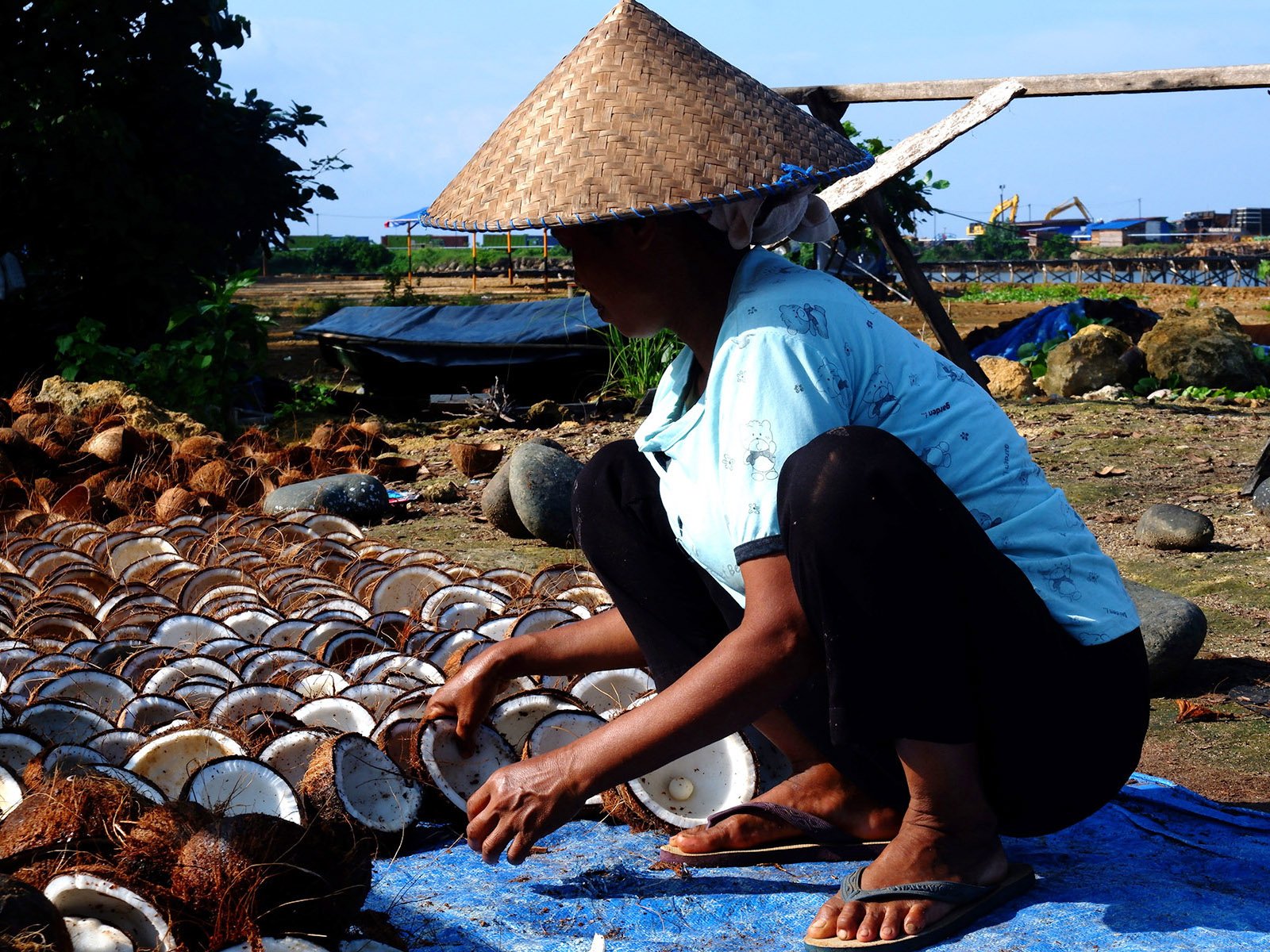
Hastati, warga Sukarela Jaya, menjemur kelapa untuk dijadikan kopra dengan latar belakang alat berat PT Gema Kreasi Perdana, anak usaha Harita Group. Photo: Yuli Z./Project Multatuli
Hastati bersembunyi di hutan bersama delapan warga lain. Di antara mereka ada Amlia yang menolak menjual lahannya untuk dijadikan jalan hauling atau jalan akses kegiatan pertambangan.
Saya menemui Amlia di kebunnya pada 20 Mei 2023. Ia berkisah bersembunyi di hutan lantaran takut ditahan polisi setelah menerima surat panggilan sebagai “saksi” oleh Kepolisian Resor Konawe Kepulauan.
“Kalau tidak dikasih lahannya, kita tidak dilepas di kantor polisi. Yang dipanggil ke polisi yang punya lahan. Kita bingung kenapa dipanggil. Lebih baik kita lari. Tidak usah kita hadiri panggilan polisi itu.”
Selama persembunyian itu, mereka melewati hari-hari cukup berat. Siang berpencar di hutan, malam mencari gubuk untuk berlindung. Dalam sehari, kadang tidak makan apa pun. Pernah mereka terpaksa makan singkong rebus basi.
“Biarpun makan, kita tidak rasa makan. Begitu juga kita duduk. Tidak tenang. Mau tenang bagaimana? Kita lari hampir dua bulan. Kita dicari-cari petugas polisi,” tutur Amlia.
Amlia juga pernah diiming-imingi gaji untuk anak pertama dan suaminya tanpa perlu bekerja oleh pihak perusahaan.
“Saya ditawari terserah mau berapa. Kalau mau, anak dikasih kuliah sambil kerja di kantor. Bapak dapat gaji biar tidak kerja. Anak yang paling tua juga dapat gaji biar tidak kerja.”
Tak jauh dari gubuknya, tumbuh pohon singkong berusia dua bulan dan tanaman lain seperti cabai, pisang, dan kelapa. Hujan deras beberapa hari sebelumnya menyebabkan sebagian lahan itu terendam air yang membawa sedimentasi lumpur merah setinggi pinggang orang dewasa. Amlia menduga tanah merah itu mengandung bekas galian nikel.
Kini Amlia dan suaminya harus berjalan kaki sejauh 2 km dari tempat memarkir sepeda motor mereka setiap kali ke kebun. Rute yang biasa dilalui telah menjadi jalan hauling PT Gema Kreasi Perdana. Saat masih bisa menggunakan sepeda motor, mereka biasanya ke kebun pukul 8 pagi. Sekarang paling telat berangkat pukul 6.30. Dari semula hanya setengah jam naik motor, sekarang mereka harus berjalan kaki selama dua jam untuk tiba di kebun.
Hasil panen pun dipikul dengan berjalan kaki melewati jalanan berbukit. Saat musim panen jambu, Amlia dan suaminya terpaksa mengangkut jambu seberat 20-30 kg dengan berjalan kaki.
“Walau sulit, kita berusaha tembus. Namanya petani. Pendapatan kita dari berkebun,” kata Amlia, yang membopong singkong seberat 20 kg dari kebun menuju parkiran motor sejauh 2 km dengan berjalan kaki.
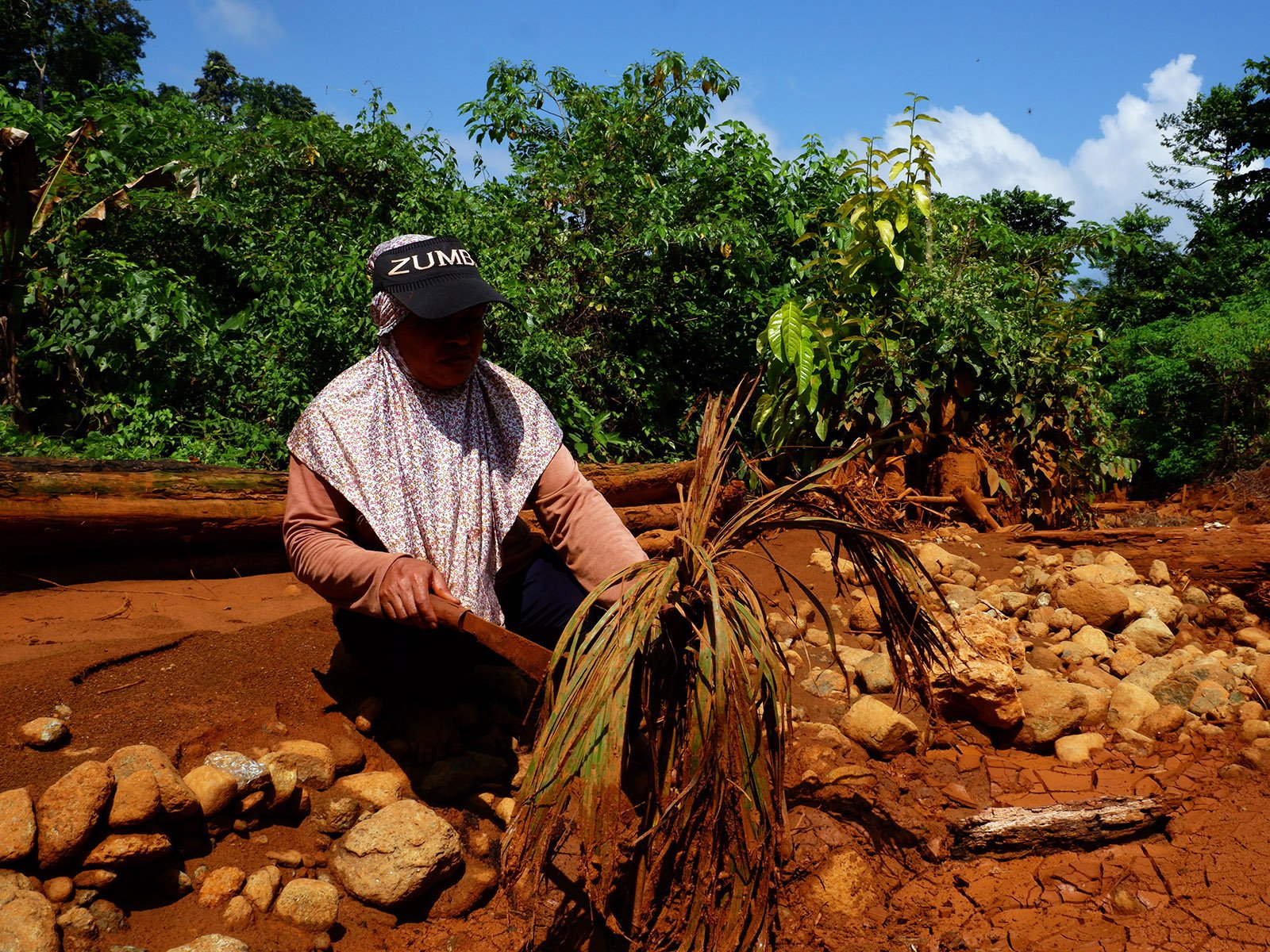
Amlia, warga Sukarela Jaya, memperlihatkan tanaman kelapa di kebunnya yang rusak terendam air berlumpur. Photo: Yuli Z./Project Multatuli
Merusak Mata Air
Saharia, warga Desa Dompo-Dompo Jaya, seperti biasa bangun pagi hari untuk menyiapkan sarapan. Saat memutar keran untuk mencuci ikan, air yang keluar berwarna oranye. Ia terpaksa memasak dan mencuci bahan makanan menggunakan air hujan yang ditampung dari atap rumah beberapa hari sebelumnya.
Saharia, 50 tahun, adalah ibu tunggal empat anak. Keluarga ini memiliki kebun seluas 250 m² yang ditanami kelapa, jambu mete, pala, dan cengkih. Saharia mengolah kelapa yang buahnya dijadikan kopra dan tempurungnya dijadikan arang, dibantu ketiga anaknya. Salah satu anaknya saat ini mencari nafkah di perantauan.
Saat ini Saharia cemas kebun mereka bisa diserobot sewaktu-waktu oleh perusahaan.
PT Gema Kreasi Perdana, anak usaha Harita Group, melakukan produksi dan pengapalan ore nikel pada Agustus 2022. Lokasi penggalian korporasi berada di beberapa desa di Kecamatan Wawonii Tenggara, yang diduga telah mencemari sumber mata air. Pamsimas (program penyediaan air minum dan sanitasi berbasis masyarakat) Sukarela Jaya dan Pamsimas Dompo-Dompo Jaya, keduanya menyuplai air bersih untuk dua desa tersebut, mengalirkan air berlumpur sejak hujan deras pada 9 Mei 2023.
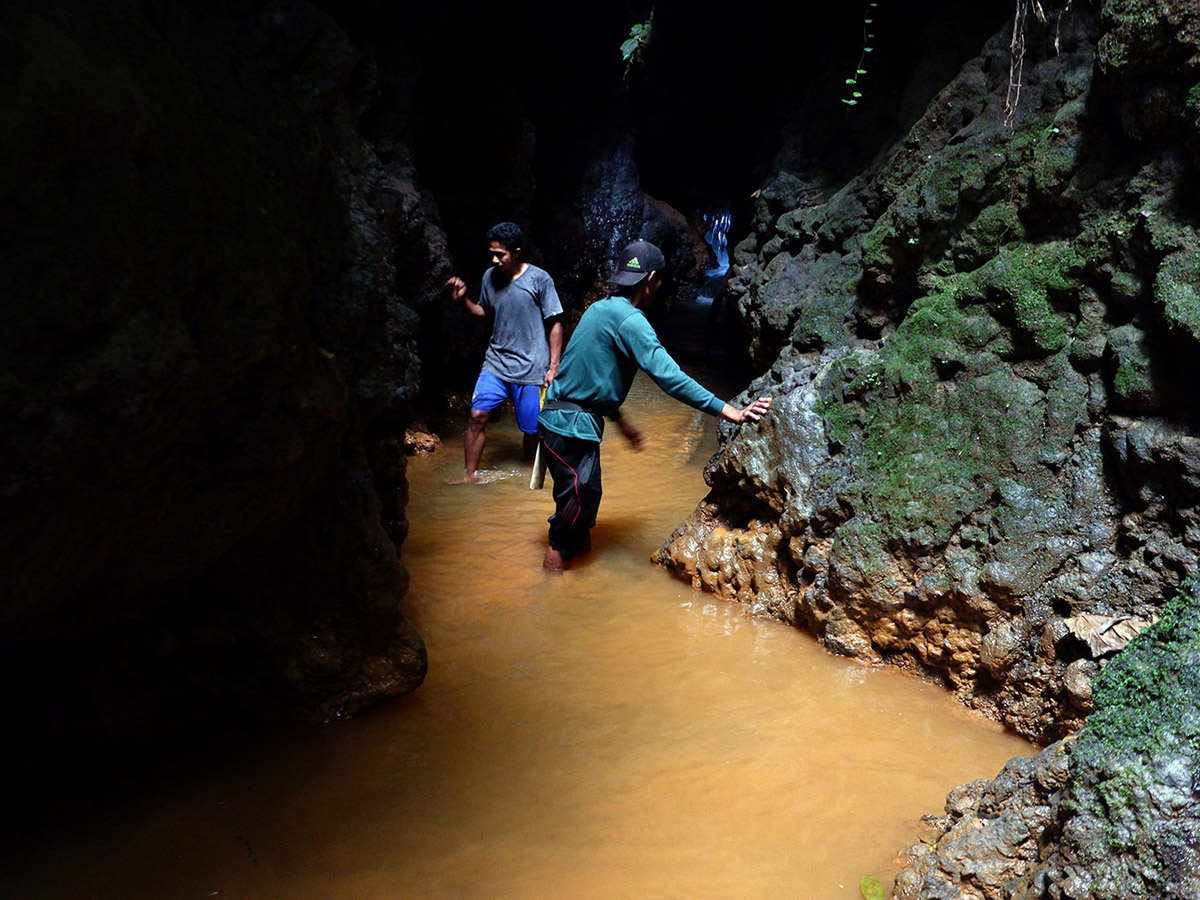
Mata air Banda tampak sangat keruh. Mata air ini menyuplai kebutuhan warga di lima desa di Kecamatan Wawonii Tenggara tapi tak bisa lagi digunakan. Photo: Yuli Z./Project Multatuli
Pada 19 Mei 2023, saya mendatangi mata air Banda di hutan Wawonii Tenggara, sekitar satu jam berjalan kaki dari Desa Dompo-Dompo Jaya. Mata air di dalam gua karst dengan ketinggian 119 mdpl ini mengalir ke beberapa anak sungai sebagai sumber pengairan kebun dan pertanian warga.
Pada 21 Mei, Wawonii Tenggara kembali diguyur hujan. Kawasan perairan di Desa Sukarela Jaya, Dompo-Dompo Jaya, dan Roko-Roko berubah warna cukup pekat. Di tengah hujan, warga yang tinggal di tepian laut membersihkan selokan, menghalau material lumpur yang terbawa air hujan. Menurut warga setempat, perubahan warna air laut kerap terjadi saat hujan, tapi tidak separah itu.
Saya memeriksa pipa di rumah warga. Airnya cokelat pekat. Tak sampai dua jam setelah hujan berhenti, aliran air di rumah-rumah warga terhenti. Dalam perjalanan, saya bertemu seorang wanita yang membawa bundel cucian di atas sepeda motor. Ia berteriak, “Saya mau pergi bilas cucian.” Perempuan lain menimpali, “Air ini sudah tidak ada gunanya.”
Saya mendatangi lokasi pertemuan sungai Roko-Roko dan Tambusiu-siu yang mengalirkan mata air Banda. Gradasi warna mencolok antara keduanya. Sungai Roko-Roko hanya sedikit keruh, sedangkan Tambusiu-siu berwarna kecokelatan. Sungai Roko-Roko adalah satu-satunya yang tidak tercemar dan masih digunakan warga Desa Roko-Roko, Sukarela Jaya, dan desa sekitar untuk keperluan mandi, mencuci, dan memasak. Perusahaan membagikan air bersih tapi sebagian warga menolak sebagai sikap penolakan atas aktivitas tambang di Wawonii.
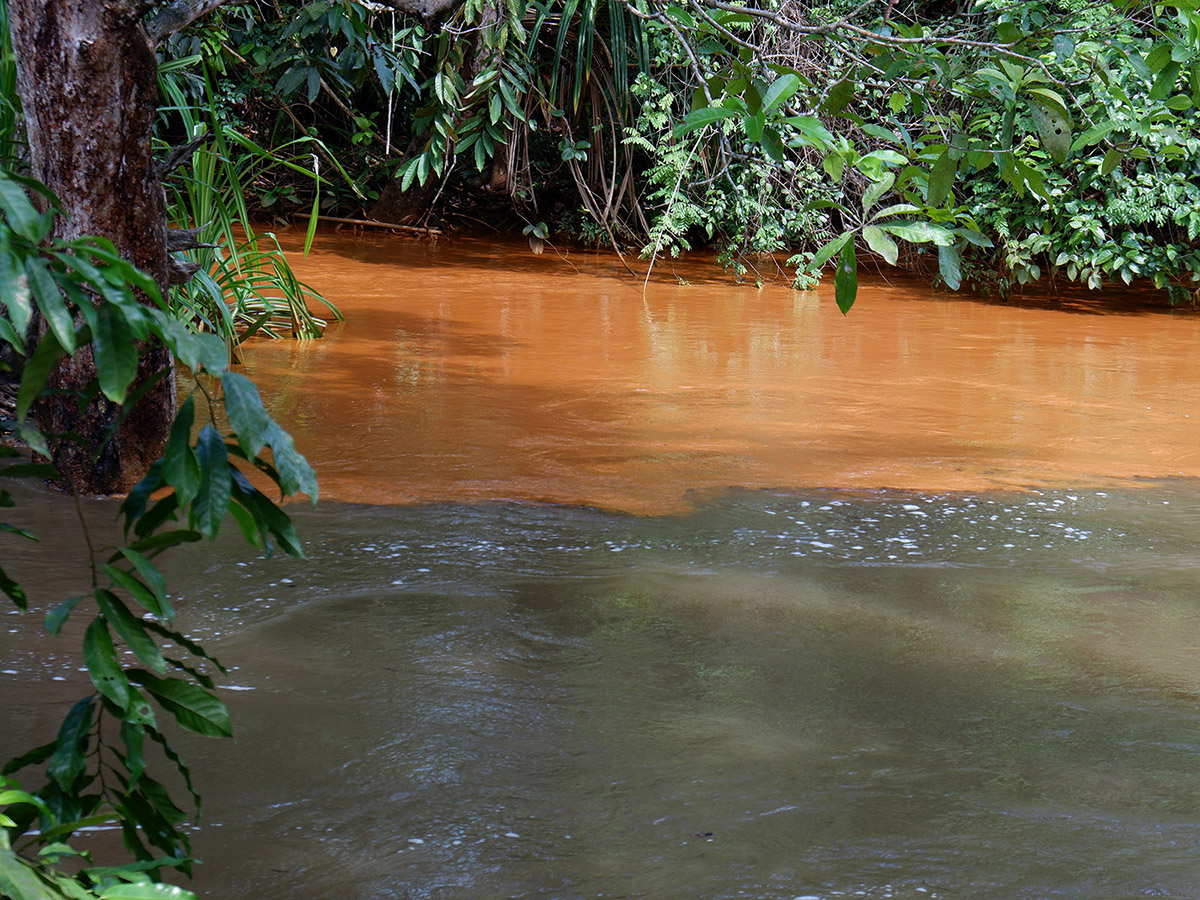
Pertemuan dua sungai, yakni sungai Tambusiu-siu (berwarna oranye) dan sungai Roko-Roko usai hujan selama kurang lebih dua jam mengguyur daerah itu. Photo: Yuli Z./Project Multatuli
Saharia termasuk warga yang menolak tambang. Sebagai ibu tunggal, ia mengemban peran ganda mengurusi rumah dan mencari nafkah. Ia harus ke sungai berjarak 500 meter untuk mendapatkan air bersih, selain mengandalkan air hujan. Ia dan keluarganya terpaksa mengurangi frekuensi mandi karena merasa tak nyaman menggunakan air kotor. Belum lagi anggota keluarga perempuan yang setiap bulan harus melalui fase menstruasi. Di rumahnya, ada tiga perempuan.
“Kita pusing tidak ada air begini,” keluhnya. “Pada masa-masa datang bulan itu berat sekali. Karena harus sering bersih-bersih. Sekarang mau apa? Kita tahan-tahan mi.”
Sampai pertengahan Agustus 2023, air bersih belum juga pulih. Padahal sudah memasuki musim kemarau. Walau tak begitu keruh, air masih berlumpur. Selain itu, saluran air kerap kali macet. Sejak terputus pada Mei, air kembali mengalir pada awal Agustus.
Perasaan takut menghantui Saharia setiap kali menggunakan air yang diduga kuat tercemar itu. Tapi tak ada pilihan lain. Untuk kebutuhan minum, ia kadang mengambil air di sumur warga lain yang berjarak 100 meter dari rumahnya, dengan menggunakan gerobak pasir untuk mengangkut air.
“Saya khawatir soal kesehatan. Biasanya habis mandi kita gatal-gatal. Tapi mau bagaimana lagi? Kita butuh mandi. Saya rindu kehidupan yang dulu,” katanya.
Diserang Gatal-Gatal
Sudah lama tidur Ristan tak nyenyak. Nyaris setiap malam ibu muda berumur 24 ini terbangun dan menyaksikan bayi kesayangannya kesulitan tidur. Abyan, anak lelakinya, diserang gatal-gatal sejak berusia lima bulan. Mulanya pada area betis dan pergelangan kaki muncul bintik-bintik kecil, lambat laun menyebar hingga ke jari dan telapak kaki. Sekarang usia Abyan sembilan bulan.
“Ini sudah lumayan membaik. Awalnya parah sekali. Penuh luka. Jorok,” ujar Ristan memperlihatkan kaki Abyan seperti parutan.
Penyakit itu juga menyerang Ristan, suaminya, dan kedua orang tuanya. Tubuh Nahati, ibu Ristan, berbintik hitam dan terasa gatal sekitar enam bulan lalu. Penyakit ini dialami hampir semua warga di tiga desa meliputi Mosolo, Sinar Mosolo, dan Sinaulu Jaya.
“Awalnya gatal di semua badan. Saat digaruk terasa panas. Bahkan sampai berdarah. Saya pusing. Kadang digaruk pakai sikat. Saya obati dengan meminum rebusan daun,” kata Nahati.
Sumber air yang digunakan Ristan sekeluarga berjarak kurang lebih 500 meter dari lokasi penambangan nikel.
Nahati bermukim di Mosolo sejak umur lima tahun. Sepanjang usianya yang sekarang 65 tahun, ia berkata belum pernah mengalami penyakit gatal-gatal seperti saat ini. Dulu, air menjadi keruh hanya jika hujan deras berhari-hari. Tak seperti sekarang. Air berubah warna walau hujan sebentar. Kini keluarga ini terpaksa menggunakan air kotor. Tak ada sumber air lain. Agar bisa digunakan, air harus didiamkan sampai cukup jernih.
Di Desa Mosolo, nasib Tika pun sama. Ibu dua anak berusia 24 tahun ini mengeluhkan gatal-gatal. Kondisi tubuh An, anak Tika berusia 1 tahun, mirip dengan Abyan. Kulit jari-jari kakinya terkelupas. Pada punggung kaki ada bekas luka-luka berbentuk melingkar kehitaman. Awal Agustus 2023, Tika memeriksakan diri dan anaknya ke dokter di Kota Kendari.
“Kata dokter, tidak ada masalah dengan susunya. Hanya dibilang mungkin pengaruh cuaca. Semua keponakan juga gatal-gatal. Saya sendiri gatal-gatal sejak bulan lalu.”
“Kita tidak pakai sumur bor. Hanya mengharapkan air dari mata air,” kata Tika.
Di Desa Sinaulu Jaya, Wa Muita tinggal bersama lima anggota keluarga, tiga di antaranya perempuan. Ia mengalami gatal-gatal dalam setahun terakhir. Ini rentang saat perusahaan tambang melakukan penggalian nikel. Penyakit gatal-gatal yang dideritanya tak kunjung sembuh, sementara kebutuhan air rumah tangga pun berwarna cokelat saat hujan deras pada Mei 2023.
“Kita pakai mandi, mencuci, memasak. Pokoknya kebutuhan sehari-hari. Di sini sungainya jauh. Kalau musim hujan, pasti merah juga.”
Wa Muita menderita gatal-gatal di beberapa bagian tubuhnya. Ia telah mencoba berbagai obat salep. Pernah berobat di puskesmas dan diberikan obat. Tak ada perubahan.
“Sudah berapa tablet kita minum, masih gatal-gatal. Mungkin karena air yang dipakai masih kotor. Jelas kita marah. Sebelumnya tidak pernah begini.”
“Awalnya muncul bintik-bintik merah. Kalau digaruk semakin gatal. Kita garuk sampai berdarah. Bahkan celana dalam kita berdarah-darah.”
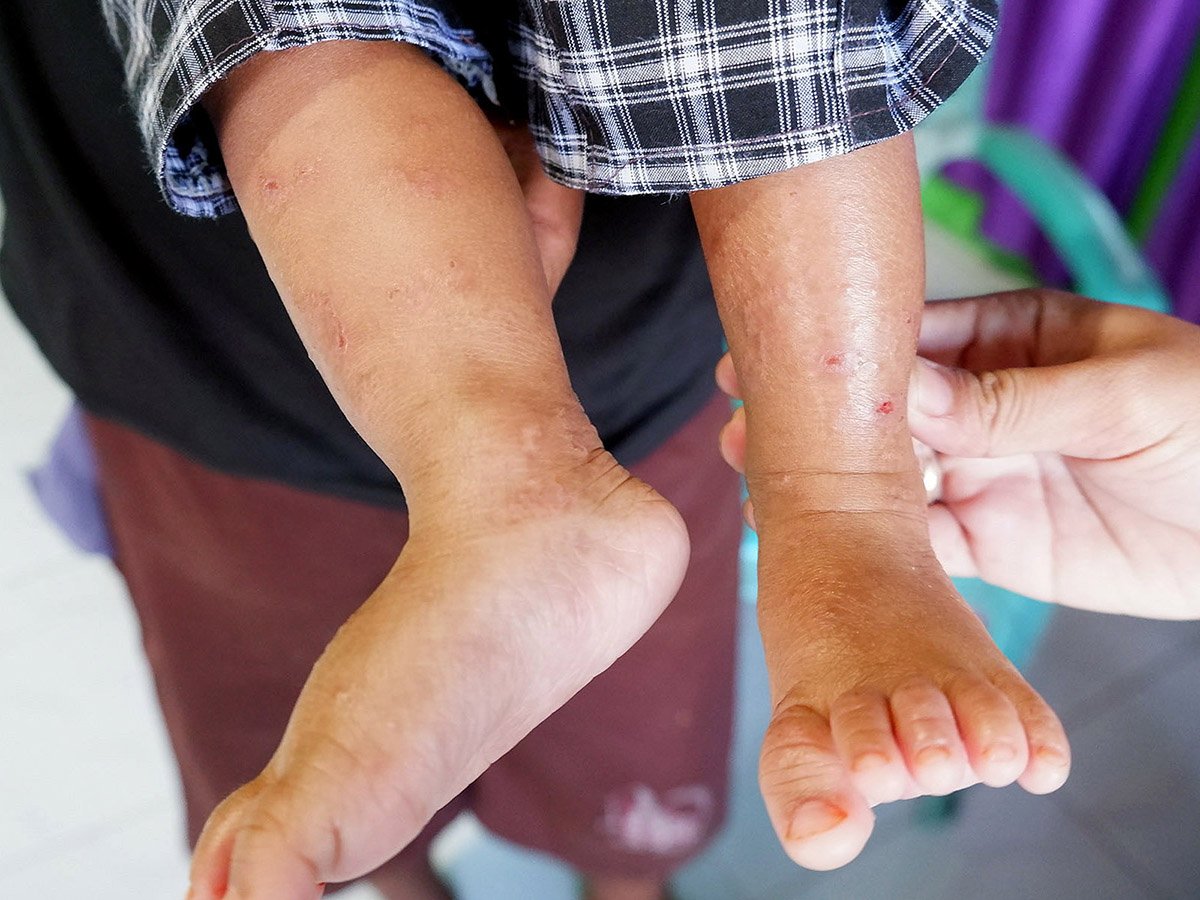
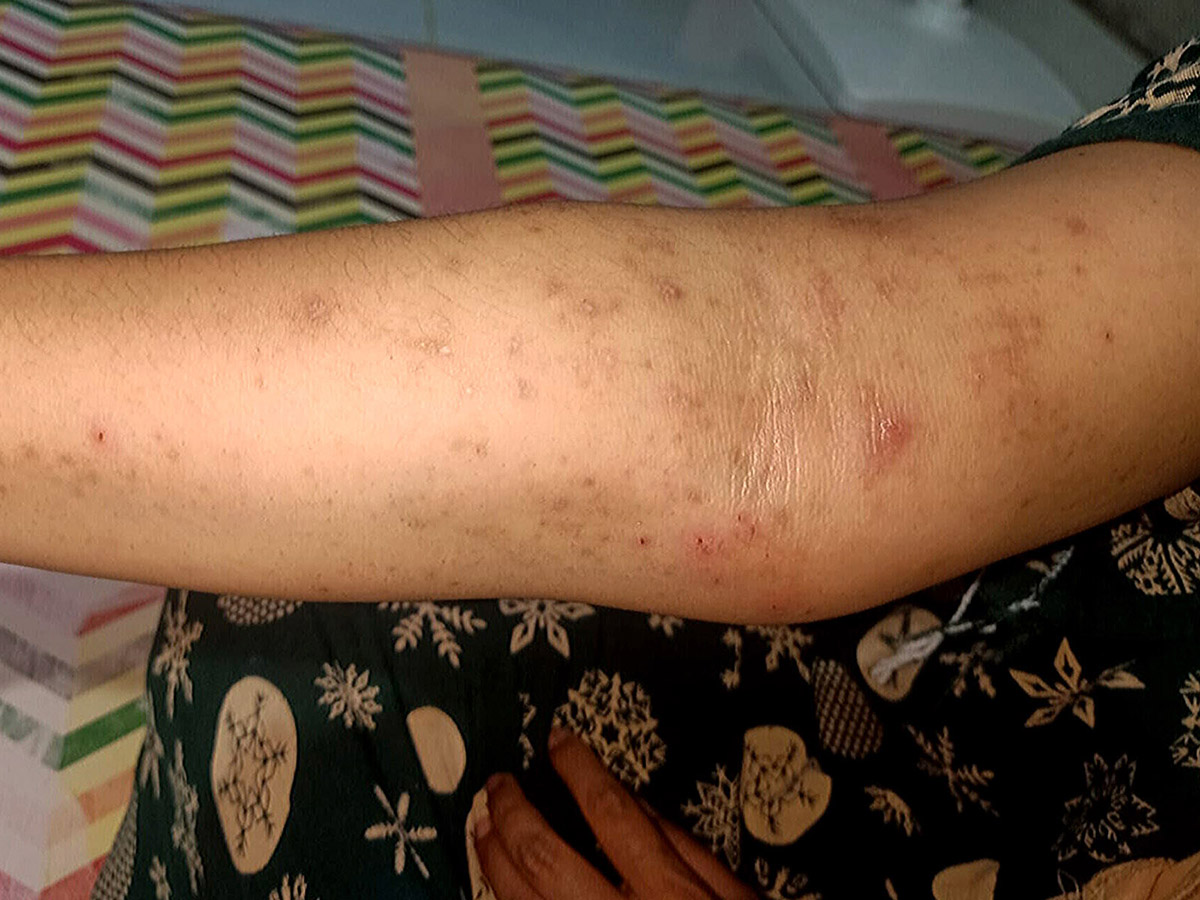
Kiri: Kaki Abyan, bayi di Desa Sinaulu Jaya, yang menderita gatal-gatal sejak usia lima bulan.
Kanan: Lengan penderita gatal-gatal di Desa Sinaulu Jaya. Photos: Yuli Z./Project Multatuli
Jumriati, warga Sinaulu Jaya berusia 24 tahun, khawatir sistem reproduksinya terganggu. Selain itu ia takut jika pertumbuhan anaknya berusia tiga tahun terganggu akibat terus-terusan mengonsumsi air tidak layak pakai.
“Harapannya, pemerintah bisa perhatikan keluhan kita di sini. Perhatikan masyarakatnya. Jangan biarkan masyarakat terdampak pencemaran tambang. Mereka raup keuntungan tapi kehidupan kami dikorbankan.”
Lahadi, penjaga penampungan air warga Sinaulu Jaya, membenarkan air mulai keruh dan kemerahan sejak perusahaan mengebor pada 2020. “Kita tidak bisa mendeteksi apakah pencemaran itu akibat aktivitas perusahaan atau bukan. Akan tetapi, ketika hujan selama satu hari, mata air mengalirkan gumpalan lumpur ke tempat penampungan,” katanya.
“Kita bicara begini bukan mengarang. Ada yang punya lahan di situ dan dia tahu persis bahwa lahan di sekitar itu telah dieksploitasi.”
Terkait dugaan pencemaran air, Kepala Bidang Penataan Peningkatan Kapasitas Lingkungan Dinas Lingkungan Hidup Konawe Kepulauan, Hasnawati mengatakan air yang digunakan warga Roko-Roko masih sesuai baku mutu berdasarkan Peraturan Menteri Lingkungan Hidup dan Kehutanan. Pengujian dilakukan pada mata air Pamsimas Sukarela Jaya dan Pamsimas Dompo-Dompo Jaya.
“Untuk hasil lab yang kami lakukan dan diperiksa di laboratorium terakreditasi (laboratorium Kabupaten Kolaka), hasilnya masih sesuai baku mutu sesuai Permen LHK. Untuk sungai Mosolo, kami pantau sebagai bahan laporan ke KLHK,” katanya.
Hasnawati belum memperlihatkan hasil uji lab tersebut sampai artikel ini dirilis. “Ada sama staf saya,” katanya.
Muhammad Jamil dari Jaringan Advokasi Tambang (JATAM), organisasi masyarakat sipil yang melakukan riset tentang gurita bisnis tambang nikel Harita Group, induk PT Gema Kreasi Perdana, berkata kasus gatal-gatal dan penyakit kulit lainnya umum ditemukan di daerah tambang nikel. Di Sulawesi Tenggara, hal sama terjadi di Kecamatan Pomalaa, Kabupaten Kolaka, dan Kecamatan Tinanggea, Kabupaten Konawe Selatan.
“Setahu kami hal itu sudah diriset oleh kampus,” kata Jamil.
Penelitian La Maga, Ahyar Ismail, dan Faroby Falatehan dari Institut Pertanian Bogor (2017) di Tinanggea menemukan warga setempat menderita penyakit kulit akibat menggunakan air bercampur material tanah dari lokasi tambang nikel. Penyakit kulit umumnya diderita petani saat pengolahan lahan. Selain penyakit kulit, warga mengalami penyakit batuk akibat debu aktivitas penambangan maupun pengangkutan material nikel dari lokasi penambangan ke pelabuhan. Radius pencemaran udara ini sampai 3 km dari lokasi tambang nikel.
Mempertahankan Lahan
“Perasaan saya hancur melihat pohon cengkih tumbang. Seperti melihat anak sendiri dibunuh,” kata Wa Muita, 43 tahun, warga Desa Sinaulu Jaya, mengenang peristiwa 10 Agustus 2023.
Sehari sebelumnya, warga desa menerima laporan bahwa kebun mereka yang terletak di bukit Mosolo, berjarak dua jam perjalanan, diterobos PT Gema Kreasi Perdana.
Sehari sebelumnya, Wa Muita dan suaminya, Amiri, menerima laporan bahwa kebun mereka yang berjarak dua jam perjalanan, diterobos pihak PT Gema Kreasi Perdana. Amiri bergegas mengecek kondisi kebun pada pukul 12 malam dan mendapati 40 pohon cengkih yang sedang berbuah telah rata tanah. Selain cengkih, perusahaan merobohkan 20 pohon merica yang baru belajar berbuah dan puluhan pohon jambu mete yang diperkirakan berbuah pada Oktober nanti. Saat ini harga merica Rp65 ribu/kg.
Wa Muita menyusul keesokan harinya pukul 6 pagi bersama 20-an warga. Mereka melihat pohon-pohon cengkih berumur 18 tahun yang sudah jadi tumpuan ekonomi keluarga itu hancur seketika.
“Saya kehabisan kata-kata. Cuma air mata yang keluar,” kata Wa Muita.
Tak lama kemudian, ratusan warga memenuhi kebun Wa Muita. Warga mempertanyakan alasan penerobosan lahan. Namun, perusahaan berdalih telah membeli lahan itu melalui orang lain. Wa Muita dan Amiri menegaskan tidak pernah menjual lahan apalagi menerima uang hasil penjualan lahan itu. Situasi menjadi tidak terkendali. Warga dan pihak perusahaan hampir saling menyerang dengan senjata tajam.
“Setiap ke kebun saya tidak pernah lupa berbicara ke cengkih, ‘Tolong berbuah. Kita rawat kalian seperti anak sendiri. Kalian yang biayai saudara yang sekolah,” tutur Wa Muita.
Wa Muita memiliki dua anak yang sedang kuliah; satu anak sekolah menengah atas; dan satu anak sekolah dasar. Biaya pendidikan empat anak itu bergantung pada cengkih. Pada 2019, hasil panen cengkih keluarga ini mencapai 1 ton. Harga pasar cengkih di Wawonii Tenggara saat ini Rp130 ribu/kg. Bagi Wa Muita, 40 pohon cengkih yang ditumbangkan itu sangat berharga.
Menahan diri dan berbesar hati, Wa Muita dan Amiri meminta PT Gema Kreasi Perdana tidak memperluas penyerobotan. Ada total 200 pohon cengkih di kebun mereka dan 120 pohon di antaranya telah berbuah.
“Kami ikhlas. Semoga perusahaan mau menyisakan sedikit hati nuraninya. Kami sudah meminta orang yang menjual lahan tanpa sepengetahuan kami untuk mengembalikan uang perusahaan.”
“Kami mau harap apa? Mau cari lagi di mana? Tidak ada. Ini lahan kami satu-satunya. Gaji kami hanya dari kebun,” kata Wa Muita.
Wa Muita pernah mempertahankan lahannya dengan berjaga di kebun selama empat bulan.
“Kadang mandi empat hari sekali. Hanya harapkan air hujan selama berjaga dari bulan Februari sampai Mei. Makan apa adanya. Saya berjaga dengan suami dan orang Mosolo lainnya.”
“Kita berjaga terus jangan sampai ada penerobosan. Ternyata, setelah kita turun dari kebun, pihak perusahaan lirik sudah tidak ada orang, perusahaan garap.”
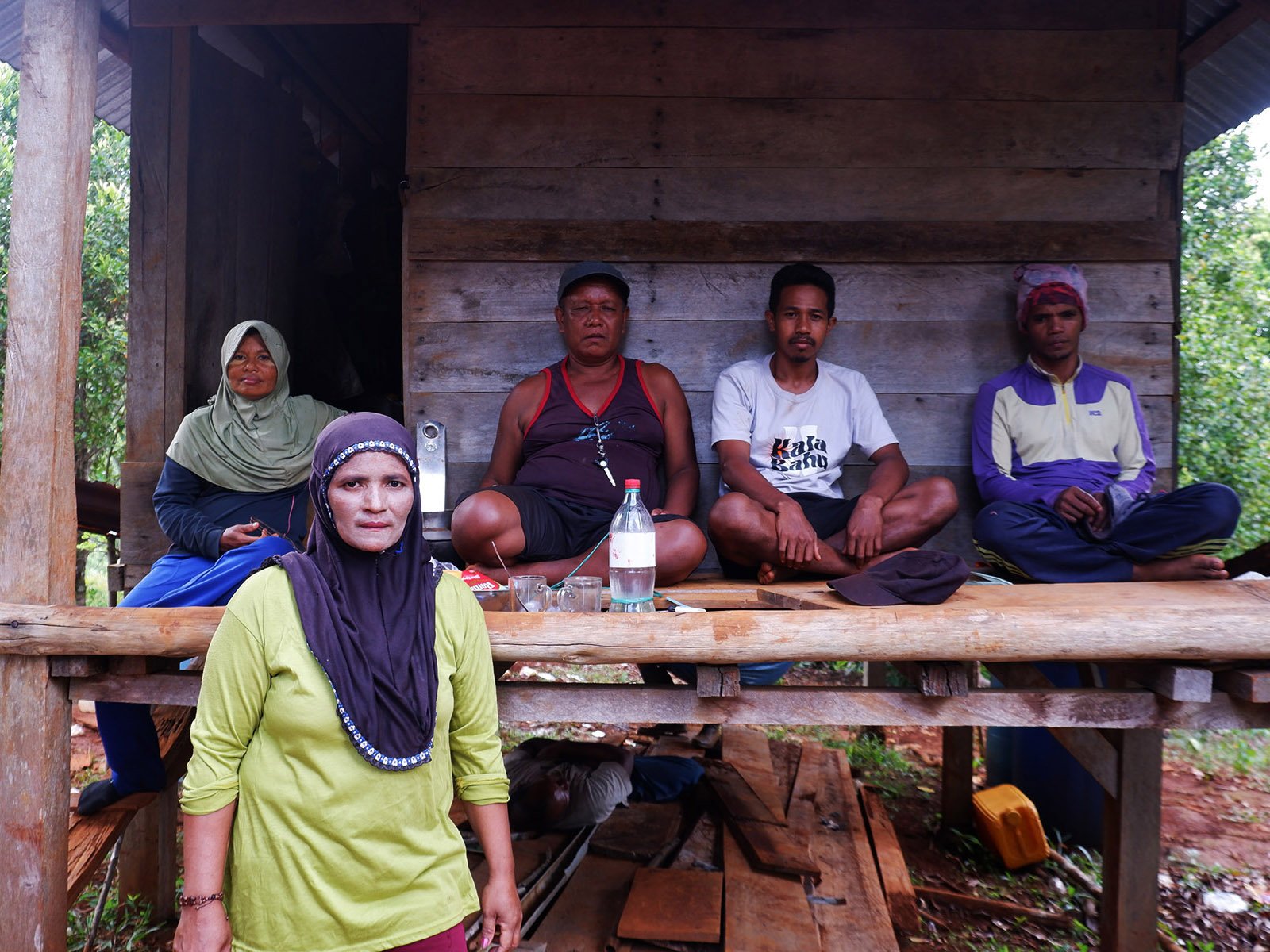
Wa Muita (kiri depan ) bersama warga Sinaulu Jaya dan Mosolo berjaga di kebun untuk mencegah penerobosan lahan oleh pihak perusahaan. Photo: Yuli Z./Project Multatuli
Sebelum kehadiran tambang nikel, Wa Muita biasanya ke kebun dua kali seminggu. Kini ia terpaksa lebih sering ke kebun. Bergantian dengan warga lain untuk memantau situasi.
“Saya tidak tahu mau bilang apa. Ini sadis buat saya. Ngeri. Hancur perasaanku. Kenapa ada orang sejahat itu menerobos saya punya lahan? Mati-matian kita jaga, rawat, perjuangkan. Ujung-ujungnya diterobos. Setelah itu kita masih diancam juga mau digusur.”
“Saya berharap sama media atau siapa pun, tolong hentikan yang merusak ini.”
“Kami Dibuat Terpecah Belah”
Belum cukup dengan dampak lingkungan yang ditimbulkan tambang nikel, warga dibuat terpecah belah. Konflik tak cuma antara warga dan korporasi, tetapi merasuk ke konflik keluarga: antar-tetangga saling bermusuhan; orang tua dan anak saling membenci; sesama saudara tak lagi saling menyapa; suami dan istri bahkan sampai bercerai.
Situasi itu dialami Sanawia yang sudah tiga tahun tak bertegur sapa dengan kedua orang tuanya. Konflik bermula saat salah satu saudara Sanawia menjual lahan warisan orang tua. Tindakan itu didukung sang ayah.
Tanah itu dijual saat Sanawia sedang demonstrasi menolak tambang di kantor DPRD Konawe Kepulauan pada 2019. Di perjalanan pulang, Sanawia mendengar kabar lahan orang tuanya telah dijual kakaknya.
“Saya hanya bisa menangis. Lahan yang dijual itu sudah diratakan. Sampai sekarang saya tidak pernah lagi ke rumah orang tua.”
Sanawia tak tahu pasti berapa luas lahan yang dijual, tapi kebun itu bisa menghasilkan 3.000 buah kelapa sekali panen.
Sanawia memiliki lima saudara, tiga di antaranya pendukung tambang. Saat orang tuanya sakit, ia enggan menjenguk. “Dulunya saya paling dekat dengan orang tua, sekarang tidak lagi.”
Ibu dua anak berusia 45 tahun ini ingin memperbaiki hubungan dengan orang tua dan saudara-saudaranya, tapi “hubungan kita bisa diperbaiki asalkan tambang pergi,” tambahnya.
Aba, bukan nama sebenarnya, pria paruh baya, menyaksikan kesedihan putrinya ditinggal suami saat mengandung anak kedua. Menantunya menawarkan uang dari perusahaan sebagai ganti rugi lahan milik Aba yang dijadikan jalan hauling PT Gema Kreasi Perdana.
Aba pernah dibawa ke kantor polisi demi mempertahankan lahan. Karena itu, ia marah saat menantunya menyodorkan uang ganti rugi tanpa persetujuannya. Ia menolak uang tersebut dan minta dikembalikan ke perusahaan.
Saat hendak membangun rumah, si menantu meminta putri Aba mengutang. Putrinya menolak. Saat itulah si menantu mengungkit-ungkit soal uang ganti rugi lahan yang pernah ditolak Aba. Cekcok suami-istri ini berujung kekerasan dalam rumah tangga.
“Anak saya datang malam hari sambil menangis. Mata kanannya lebam. Saya berusaha mendamaikan. Sempat berbaikan. Tapi beberapa hari setelahnya, saat anak saya mencari kerang di laut, suaminya pergi dari rumah dan tidak pernah kembali sampai hari ini,” kata Aba.
Kini putri dan kedua cucunya tinggal bersamanya. “Saya tidak akan pernah menerima uang perusahaan. Saya memang sudah tua, tapi saya memikirkan masa depan cucu-cucu saya,” kata Aba.
Sanawia dan Aba adalah warga Desa Roko-Roko. Dan di desa ini, perpecahan warga akibat kehadiran tambang bukan rahasia lagi. Beberapa orang yang saya temui mengaku enggan bersosialisasi dengan siapa pun yang tidak sekubu, bahkan sekadar bertegur sapa.
“Situasi sosial di Wawonii Tenggara seperti api dalam sekam,” kata Erwin Suraya dari Koalisi Rakyat untuk Keadilan Perikanan (KIARA), dalam diskusi publik mengenai kehancuran ekosistem Pulau Wawonii, belum lama ini.
Gugatan Hukum
Pulau Wawonii seluas 706 km² termasuk dalam kategori pulau-pulau kecil sesuai Undang-undang No. 27 Tahun 2007 tentang Perlindungan Wilayah Pesisir dan Pulau-Pulau Kecil. Pulau kecil adalah pulau dengan luas lebih kecil atau sama dengan 2.000 km². Dengan demikian, sebagaimana diamanatkan undang-undang tersebut, aktivitas pertambangan tidak boleh dilakukan di Pulau Wawonii.
Ada 2.214 jiwa penduduk yang tinggal di Desa Dompo-Dompo Jaya (441 jiwa), Sukarela Jaya (550 jiwa), Roko-Roko (582 jiwa), Bahaba (160 jiwa), dan Teporoko (481 jiwa) yang terdampak penambangan nikel PT Gema Kreasi Perdana, sebut kelompok masyarakat sipil terdiri atas Yayasan Lembaga Bantuan Hukum Indonesia (YLBHI), JATAM, KIARA, Trend Asia, dan LBH Makassar.
PT Gema Kreasi Perdana mendapatkan izin eksplorasi bahan galian nikel dan mineral pengikut sejak 2007. Pada akhir tahun 2019, anak usaha Harita Group ini mengantongi izin usaha pertambangan (IUP) operasi produksi seluas 850,9 ha. Seluas 707,10 ha konsesi perusahaan merupakan izin pinjam pakai kawasan hutan (IPPKH). Perusahaan mendapatkan wilayah izin area proyek seluas 192,4 ha serta pembangunan terminal khusus di perairan Selat Wawonii seluas 13,3 ha.
Menurut kelompok masyarakat sipil, pengerukan tambang nikel hingga pembuatan dermaga untuk tambang dengan menimbun perairan di Wawonii telah merusak ekosistem mangrove, terumbu karang, dan perairan. Keruhnya sungai menyebabkan warga semakin sulit mendapatkan ikan. Dermaga perusahaan juga menyebabkan ikan menjauh. Aktivitas pengangkutan ore nikel yang menghasilkan debu tebal mengganggu pernapasan warga, sebut koalisi.
Koalisi menaksir korporasi telah melakukan pengapalan ore nikel lebih dari 100 kali untuk diolah di fasilitas pemurnian atau smelter milik Harita Group di Pulau Obi, Provinsi Maluku Utara. Harita Group, berkantor pusat di Jakarta, merupakan perusahaan raksasa di sektor sumber daya alam, mulai dari bisnis pertambangan nikel, bauksit, batu bara, perkebunan sawit, perkapalan, dan perkayuan. Perusahaan ini dimiliki keluarga Lim Hariyanto Wijaya Sarwono.
Sekalipun sudah dilindungi undang-undang, Peraturan Daerah No. 2 Tahun 2021 tentang RTRW Konawe Kepulauan 2021-2041 menetapkan alokasi ruang untuk kegiatan pertambangan di Konawe Kepulauan, Pulau Wawonii.
Warga Wawonii, yang diwakili firma hukum Denny Indrayana, mengajukan uji materiil perda tersebut. Pada 22 Desember 2022, Mahkamah Agung mengabulkan permohonan warga.
Dalam putusan No. 57 P/HUM/2022, Mahkamah Agung menyebutkan Pulau Wawonii merupakan “pulau kecil … yang rentan dan sangat terbatas sehingga membutuhkan perlindungan khusus. Segala kegiatan yang tidak ditujukan untuk menunjang kehidupan ekosistem … termasuk namun tidak terbatas pada kegiatan pertambangan dikategorikan sebagai abnormally dangerous activity … yang harus dilarang … karena akan mengancam kehidupan seluruh makhluk hidup.”
Mahkamah Agung juga menyebut Perda RTRW tersebut “… mengabaikan aspirasi masyarakat … melalui demo besar-besaran pada 6 Maret 2019 … menolak kegiatan usaha pertambangan.” Mahkamah memerintahkan Bupati dan DPRD Konawe Kepulauan merevisi Perda RTRW tersebut.
Namun, PT Gema Kreasi Perdana, diwakili direktur utamanya Rasnius Pasaribu lewat kuasa hukum Asmansyah & Partners, mengajukan judicial review ke Mahkamah Konstitusi atas UU Perlindungan Wilayah Pesisir dan Pulau-Pulau Kecil, sebagai respons atas putusan Mahkamah Agung. Pokok gugatannya adalah pasal 23 ayat 2 dan pasal 35 huruf k dalam undang-undang tersebut, yang intinya melarang aktivitas penambangan mineral.
Pengacara perusahaan menilai Mahkamah Agung menafsirkan kedua pasal itu sebagai “larangan tanpa syarat” atas kegiatan penambangan mineral di wilayah yang tergolong Pulau Kecil padahal perusahaan “telah memiliki izin yang sah” sehingga “terancam harus menghentikan kegiatannya dan berpotensi mengalami kerugian konstitusional dan ekonomi.”
Perusahaan, dalam surat permohonan ke Mahkamah Konstitusi, menyebut telah mengeluarkan total investasi Rp37,5 miliar dan 77,3 ribu dolar AS sejak 2007, selain telah menyalurkan lebih dari Rp70 miliar atas pembayaran “pembebasan tanam tumbuh kepada masyarakat” sebagai “ganti untung” atas tanaman yang terdampak pertambangan pada lahan seluas 568 ha.
Perusahaan mengajukan permohonan perkara itu pada 28 Maret 2023. Berkas permohonannya pun sudah direvisi dan disidangkan pada 9 Mei. Mahkamah sudah menggelar sidang untuk perkara nomor 35/PUU-XXI/2023 itu pada 31 Agustus. Sidang berikutnya dijadwalkan pada 12 September. Tahapan selanjutnya adalah sidang putusan.
Koalisi masyarakat sipil berpendapat Mahkamah Konstitusi seharusnya menolak judicial review yang diajukan PT Gema Kreasi Perdana untuk menyelamatkan pulau-pulau kecil di seluruh Indonesia dari cengkraman industri pertambangan.
“Jika dikabulkan, aktivitas tambang tak cuma dilegalkan di Pulau Wawonii, tapi seluruh wilayah pesisir dan pulau-pulau kecil di Indonesia,” Wildan Siregar dari Trend Asia mengingatkan. “Kerusakan ekologis hingga konflik sosial akibat perusahaan tambang yang tidak menaati Undang-Undang No. 27 Tahun 2007 akan semakin masif.”
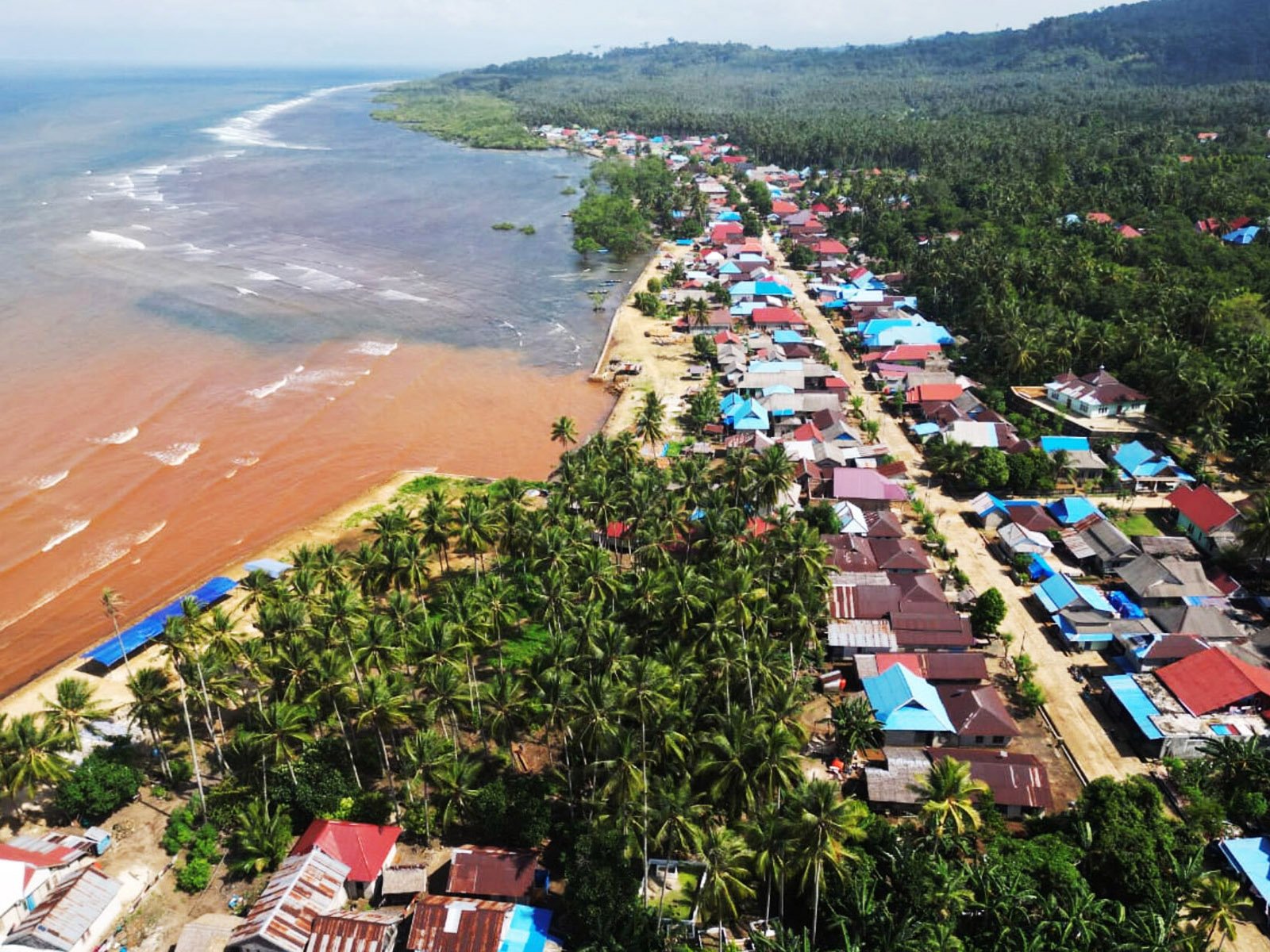
Tampak atas beberapa desa di Kecamatan Wawonii Tenggara. Laut yang keruh tersebut diduga tercemar galian nikel PT Gema Kreasi Perdana. Photo: Benaya Ryamizard Harobu/Project Multatuli
Sementara perusahaan menggugat ke Mahkamah Konstitusi, DPRD Sulawesi Tenggara resmi menghapus alokasi ruang tambang di Pulau Wawonii. Dalam Rancangan Peraturan Daerah (Raperda) Rencana Tata Ruang Wilayah (RTRW) Sulawesi Tenggara 2023-2043, Pulau Wawonii Kabupaten Konawe Kepulauan ditetapkan sebagai kawasan perikanan terpadu.
Ketua Pansus RTRW DPRD Sultra, Fajar Ishak, mengatakan keputusan untuk meniadakan ruang aktivitas pertambangan di Konawe Kepulauan berdasarkan putusan Mahkamah Agung.
Putusan MA meminta Pemda Konawe Kepulauan untuk merevisi pasal alokasi tambang dalam RTRW kabupaten karena bertentangan dengan Undang-Undang Pengelolaan Wilayah Pesisir dan Pulau-Pulau Kecil.
“Keputusan (Mahkamah Agung) itu lahir di penghujung tahun 2022, maka kita tidak boleh membantah itu, sehingga kita tetap mempertahankan Pulau Wawonii menjadi kawasan perikanan terpadu dan tidak ada kawasan tambang di sana,” ujar Fajar Ishak dalam pembahasan revisi RTRW yang yang digelar di Hotel Claro Kendari pada 29 Agustus 2023.
Bantah Tudingan Pencemaran
Humas PT Gema Kreasi Perdana, Alexander Lieman, membantah perusahaan menyebabkan pencemaran lingkungan. Soal tuduhan polusi udara, katanya, perusahaan telah melakukan langkah preventif dengan cara memantau kualitas udara dan kebisingan secara rutin dua kali setahun, melakukan penyiraman jalan secara berkala, serta pengaturan kecepatan kendaraan operasional.
“Berbagai program ini kami jalankan sebagai bentuk komitmen terhadap ketentuan yang berlaku di bidang lingkungan hidup dan untuk menjaga kelestarian lingkungan Pulau Wawonii,” katanya.
“Bahkan sebagai bentuk iktikad baik kami terhadap masyarakat setempat yang menggarap lahan di wilayah Izin Pinjam Pakai Kawasan Hutan (IPPKH) kami, telah kami berikan ganti untung tanam tumbuh,” katanya.
Lieman berkata perusahaan tidak menyebabkan pencemaran air. Sebelum ada kegiatan pertambangan, setiap curah hujan tinggi melanda Pulau Wawonii maka menyebabkan air sungai keruh.
“Kegiatan pertambangan kami tidak menyebabkan pencemaran sungai di sekitar areal pertambangan.”
Lieman juga menampik tuduhan pencemaran air warga Mosolo. Katanya, air keruh pada bulan Mei hanya terjadi di dua desa, yakni Sukarela Jaya dan dan Dompo-Dompo Jaya.
“Kami tegaskan tuduhan ini salah. Boleh dikonfirmasi ke pemerintah desa dan Dinas Lingkungan Hidup setempat.”
Air yang mengalir melalui pipa warga pada 21 Mei 2023. Photo: Yuli Z./Project Multatuli
Lieman menyebut perusahaan justru membantu masyarakat memenuhi kebutuhan air bersih, antara lain mendistribusikan air bersih dengan water truck ke desa-desa yang terdampak kekeruhan air sungai, menurunkan tim untuk mencari alternatif sumber air bersih, membersihkan bak penampungan air bersih warga, serta membuat sumur bor dan sumur cincin.
“Saat ini keadaan sungai sudah jernih kembali dan masyarakat sudah bebas mendapatkan air bersih untuk memenuhi kebutuhan sehari-hari.”
Pernyataan Lieman tak sesuai fakta lapangan. Air yang mengalir di Desa Dompo-Dompo Jaya, Sukarela Jaya, dan Roko-Roko masih mengandung lumpur. Pada 18 Agustus 2023, air masih berwarna cokelat pekat padahal sudah cukup lama tak terjadi hujan deras.
Residents visit Nusantara Zero Point in East Kalimantan. (Project Multatuli)
Whenever President Joko “Jokowi” Widodo asks the Indonesian Chamber of Commerce and Industry (Kadin) to splash the cash for his latest ambitious development project, they say yes.
On Oct. 18, 2022, Kadin presented hundreds of businesspeople before President Jokowi at the Djakarta Theater. At the event, Jokowi hawked the new capital, making comments like “What more do you want?” and “You don’t need to question anything else”. Indonesian netizens disparagingly likened the performance to local TV presenter Feni Rose, who regularly urges her viewers to buy real estate as soon as possible, using the catchphrase “Senin harga naik” (the price will go up on Monday).
In the case of the new capital, the price really did go up on Monday. One of the businessmen Jokowi pressed for investment at the Kadin forum was Budiarsa Sastrawinata, the managing director of property conglomerate Ciputra Group as well as the chairman of Kadin’s new capital city working group.
Before Jokowi announced the new capital city, Ciputra already had 870 hectares of reserve land in East Kalimantan. Once it was announced, property developers like Ciputra immediately raised the price, as was done by Agung Podomoro Land for the Borneo Bay City Apartment in Balikpapan, one of the cities closest to the new capital, from RpRp700 million to RpRp1 billion per unit.
The reciprocal relationship between the government and Kadin has a long history. It reached its peak when the Jokowi administration proposed the controversial Job Creation Law. The all-encompassing “omnibus” piece of legislation revised 82 laws with more than 1,000 articles in one fell swoop, in a move that many experts and activists said disproportionately favored business elites while weakening protections for workers. Then-chairman of Kadin was involved as the head of the Omnibus Law Task Force. He is now the Indonesian ambassador to the United States.
Throughout Jokowi’s tenure as President, Kadin has provided the connections the former furniture businessman has needed to reach domestic and foreign investors. In return, Jokowi has given Kadin a prominent seat at the table, and the most recent manifestation of this symbiotic relationship is the planned national capital of Nusantara in East Kalimantan.
Our research shows that President Jokowi has involved at least two organizations outside the government, Kadin and Real Estate Indonesia (REI), in the lobbying of potential investors abroad.
The government claims that 300 foreign and domestic investors are interested in putting money in the new capital city. Out of these, according to Trend Asia research, at least 85 foreign investors are affiliated with Group of 20 and Group of Seven countries. The potential investors have been lobbied by the President and even business entities in various forums. This does not include lobbying from the Capital City Authority at international economic forums.
But despite Jokowi’s full court press, few foreign investors have made any firm commitments to put money in the new capital. In fact, several, including Madrid World Capital of Construction, Engineering, and Architecture (MWCC), the France Development Agency (AFD), and Softbank, have announced the withdrawal of their interest.
MWCC questioned the potential of developing the capital’s buffer zones for the general public to live in, while the AFD withdrew after considering the results of an investment feasibility assessment.
The capital’s apparently dubious business potential has also confused a number of Japanese entrepreneurs. During one tour with the Investment Ministry of the site of the planned capital, media reported that one Japanese businessman who asked not to be named said it was hard to imagine what they would be investing in, given that the site was still essentially a jungle.
Conflicts of Interest Abound
What the investors really want, but may be reluctant to say, is reassurance that the new capital will not be scuppered midway over a change in administration or policy direction. Jokowi, after all, is nearing the end of his second and, at least according to the current constitution, final term.
At the tail end of 2021, Jokowi sent a letter to the House of Representatives requesting the start of deliberations on a draft bill that would enshrine the new capital city into law. Delivered by State Secretary Pratikno and National Development Planning Agency head Suharso Monoarfa, who is also the chairman of the United Development Party (PPP), the letter was received directly by House Speaker Puan Maharani, the daughter of Indonesian Democratic Party of Struggle (PDI-P) matriarch Megawati.
The House duly formed a committee on Dec. 7, 2021. Then, just 42 days later, the House passed Law No. 3/2022 on the state capital, and President Jokowi signed it the next month. It was a swift legislative process for a megaproject that would require Rp466 trillion to complete. For comparison, a draft bill to outlaw sexual harassment and other forms of sexual violence was stuck in the House for six years before finally passing in April 2022.
The swift deliberation process was largely the work of the House’s State Capital Committee, which, perhaps unsurprisingly, included a number of businessmen.
Sugiono, a committee member from the Gerindra Party, is the director of three coal mining companies: PT Nusantara Wahau Coal, PT Nusantara Santan Coal, and PT Kaltim Nusantara Coal in East Kutai Regency, East Kalimantan.
The three companies have a concession area of 44,830 ha, according to data from the Energy and Mineral Resources Ministry. Some 99.9 percent of the shares in the three companies are owned by PT Nusantara Energindo Coal, of which Defense Minister and Gerindra Party chair Prabowo Subianto owns 40 percent. The complement is owned by PT Ithaca Resources, reported to be affiliated with the Salim Group.
Gerardus Budisatrio Djiwandono, another committee member from Gerindra, is a commissioner of PT Karunia Tidar Abadi. The company is working with PT Aega Prima, one of the largest tin mining license holders in Bangka Belitung province, to operate suction dredge barges Arsari I, II, and III.
Meanwhile, the chair of the committee, Ahmad Doli Kurnia of the Golkar Party, is the main commissioner and holder of 20 percent of the shares of PT Citra Insani Garda Semesta, a company that provides human resources in the security sector, such as security guards, according to data from the Law and Human Rights Ministry.
In the same vein, more than half of all sitting House members have business backgrounds.
Potential conflicts of interest abound in the president-appointed Capital City Authority. Jokowi chose the head of the Sinar Mas property corporation, Dhony Rahajoe, as deputy of the authority, and BSD City in Tangerang, one of Sinar Mas’ “independent city” properties, was used as a reference for the new capital by the committee and the National Development Planning Agency.But BSD City is private, raising the possibility that the new capital will be a private, elite city that exacerbates social segregation and inequality in East Kalimantan.
Overlapping Concessions, Forest Destruction
The capital megaproject may allow coal companies to escape responsibility for the environmental damage they have inflicted by abandoning mining pits after gaining huge profits.
There are 29,000 hectares of mining pits around the site of the new capital, according to the Environment and Forestry Ministry. Twelve of the mining pits are owned by a coal company affiliated with Coordinating Maritime Affairs and Investment Minister Luhut Binsar Pandjaitan. Environment and Forestry Minister Siti Nurbaya has claimed the mining pits will be restored through large-scale tree planting by developing a seed nursery worth Rp 215 billion.
Such efforts, aimed at “improving” the environment of the new capital, could allow coal companies to dodge the responsibility of cleaning up their own mining pits, putting the financial burden on taxpayers instead.
A sign marks the border of a state industrial plantation forest containing eucalyptus trees. (Project Multatuli)
About 51 percent of the land at the site of the planned capital is currently in the hands of corporations, including forestry businesses, in the form of forest concession rights, industrial plantation forests, oil palm plantations, and mines.
Touted by the Jokowi administration as a “forest city” to-be, the site has 4,789 ha of conservation area and protected forest area that has been exploited through permits for industrial plantation forests, mining, and oil palm plantations.
More than 39,000 hectares are also subject to concession conflicts, which include overlapping forest and land use permits, according to research by Forest Watch Indonesia. These overlapping concessions are dominated by mining corporations and industrial plantation forests, as well as oil palm plantation companies.
In the 2018-2021 period, Forest Watch Indonesia found, 18,000 ha in the new capital area had been deforested.
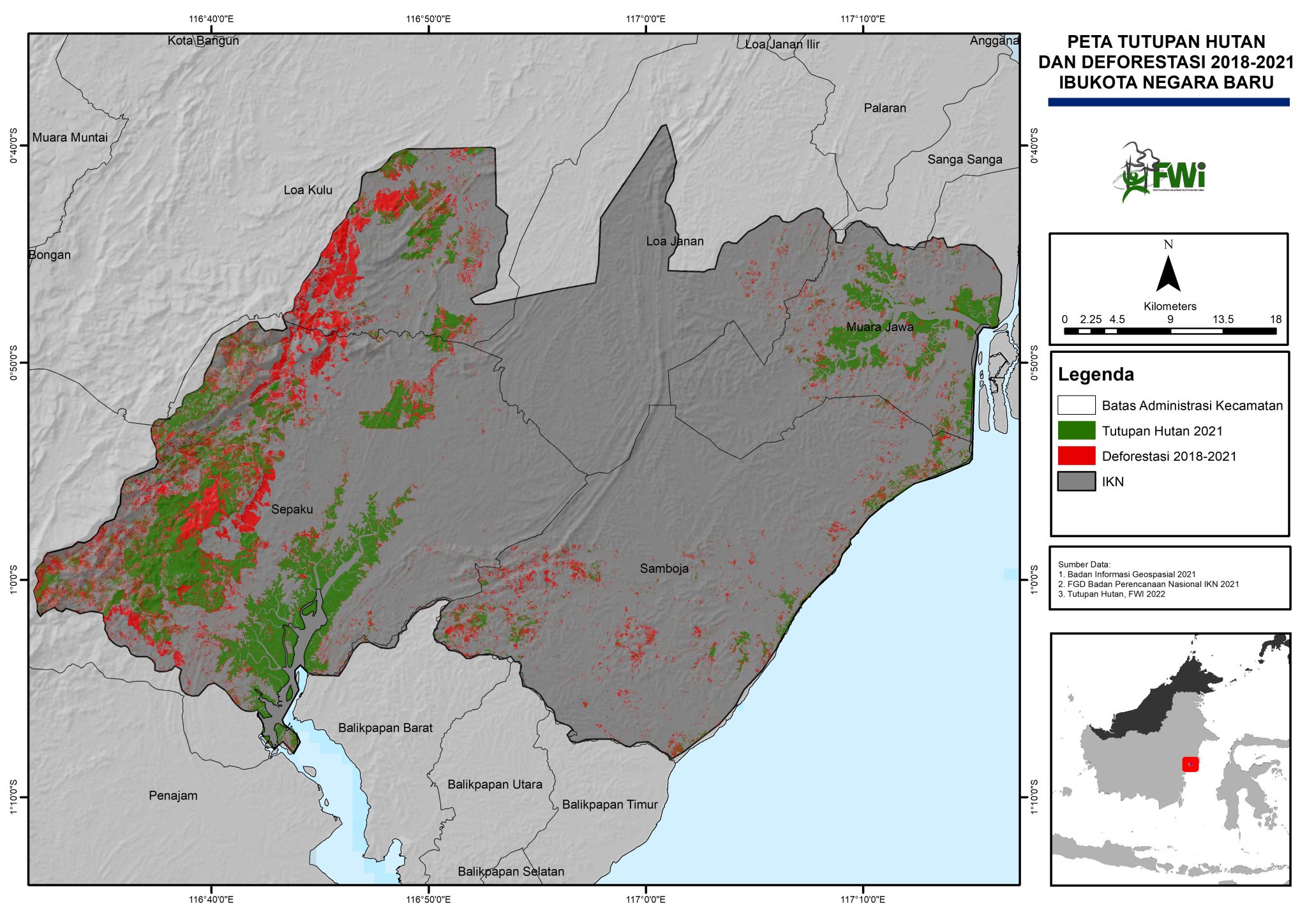
A map of forest cover and deforestation from 2018 to 2021 in the capital area. Graphic: Forest Watch Indonesia
Capital For Sale
The projected cost of developing the capital is nearly Rp466 trillion, and the megaproject needs funding for its initial phase of development.
According to Jokowi administration estimates, about 80 percent, or Rp376 trillion, of the funds for the capital will come from the private sector, as well as cooperation between the government and business entities. Only 19 percent, or Rp 89.4 trillion, of the capital development funds will come from the state budget.
The Jokowi administration and its partners are still hunting for investors. Perhaps prompted by investor pullouts, the president has piled on incentive after incentive to attract funds for the new capital.
The incentives include a “relaxed” permit application process, 30-year tax holidays, 350 percent tax deductions, the right to build for 80 years (normally only 30 years) and extendable by up to another 80 years (normally only 20 years).
All this for a move that experts say will have no significant impact on national economic growth.
According to documents presented by the Institute For Development of Economics and Finance (Indef) and economists from Padjadjaran University at a House hearing, the new capital is expected to increase East Kalimantan’s GDP by 0.27 percent in the short term and 0.26 percent in the long term and increase the national GDP by only 0.2 percent.
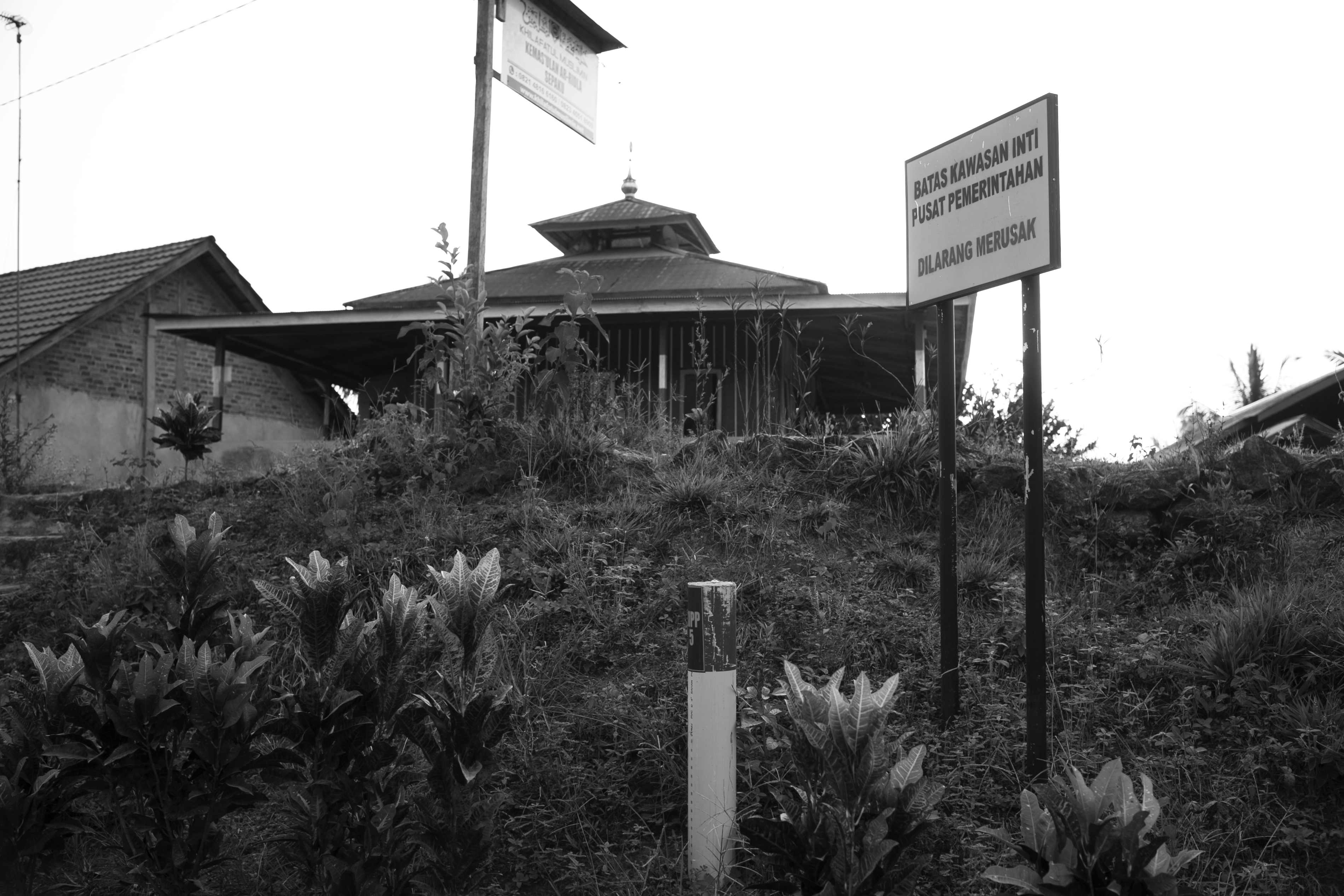
Warning signs mark the border of the Central Government Area of the planned new capital. People living in this area are to be relocated. (Project Multatuli)
Meanwhile, according to Trend Asia research, Jokowi’s pet megaproject has already cost taxpayers Rp 8.42 trillion from 2017 to 2022 and is expected to cost a further Rp 48.18 trillion by 2024 for the construction of basic infrastructure and government, education, health, and security facilities.
At the Kadin event on Oct. 18, 2022, President Jokowi said moving the capital would create “economic justice”. However, the new capital project lacks interest from investors, which has driven Jokowi to offer increasingly lavish incentives that disproportionately benefit business elites, and the site of the new capital is entangled in overlapping corporate concessions that are destroying conservation areas and protected forests.
Jokowi says he wants economic equality, but in reality, only a few elites will likely benefit from the project. He aspires to have a new, green capital, but the project appears set to give coal corporations a golden opportunity to dodge their obligations to reclaim mining pits. Jokowi promises that the new capital will not strain the state budget, but it has already cost taxpayers tens of trillions of rupiah.
The new capital is another example of the consolidation of paternalistic authorities with controversial conglomerates, taking advantage of the support of powerful figures with a foot in both politics and business who are riddled with conflicting interests. The capital megaproject that President Jokowi calls “the future of Indonesia” is simply camouflage for the future interests of the nation’s oligarchs.

The conventional wisdom is that Indonesia is suffering a democratic decline because of the authoritarian tendencies of its leaders and the illiberalism of its people. To quote Australian political scientist Marcus Mietzner, outgoing President Joko “Jokowi” Widodo “pushed the limits of democratic norms and even overstepped them”, and the people have been fine with that.
This view represents the common thinking among progressives within Indonesia’s political class. Muslim scholar Sukidi’s recent commentary in Tempo magazine, for example, satirized Jokowi as Pinokio Jawa, or Javanese Pinokio. Long before that, The Jakarta Post, Indonesia’s largest English daily, had dubbed Jokowi “little Soeharto”, a reference to the New Order autocrat who ruled over Indonesia between 1967 and 1998.
That thinking is not totally groundless. Jokowi has been accused of weaponizing law enforcement institutions to intimidate his political enemies, co-opting judicial institutions to build his political dynasty, and mobilizing state resources to guarantee the victory of his children in regional and national elections. He is also believed to have recently orchestrated a plot to prevent the Indonesian Democratic Party of Struggle (PDI-P) and former presidential candidate Anies Baswedan from contesting the Jakarta gubernatorial election – a race both figures have previously won. Such a power play would clearly be aimed at ensuring that Jokowi’s alliance with his former election rival, Prabowo Subianto, would go unchallenged for years to come.
The problem is that this view tends to frame Jokowi as the sole architect of our political malady, and implies that removing him would be a sufficient remedy. That’s just lazy analysis. The reality is that his rise to power was enabled by different social forces, who have capitalized on his presidency to further their political and economic interests. His enablers, alas, are not confined to a group of coal industry oligarchs who spent billions of rupiah to finance his election campaigns and were later given strategic positions in the Cabinet to create public policies that serve their private interests.
It is high time to acknowledge the elephant in the room: many Indonesian intellectuals are complicit in decimating Indonesian democracy. I define intellectuals broadly to include academics, journalists, activists and religious leaders. Many of these figures have turned a blind eye to, if not directly abetted, Jokowi’s illiberal policies under the pretext of defending pluralism — a crusade against Islamism — and championing technocratism.
A pluralist, technocratic leader
Truth be told, Jokowi was always the favorite of Indonesian intellectuals. This is not only because he was seen, at least initially, as a political outsider with no links to the New Order’s oligarchy, but because he accommodated the dominant ideologies of the urban, educated middle class, particularly those claiming to be defenders of Indonesian pluralism.
It is worth noting that those critical of Jokowi today were in fact once his ardent supporters. At best, their criticisms of Jokowi are too late and too little, as exemplified by the joint statements issued by university professors just a few weeks before the February presidential and legislative elections, sparking speculation they were acting at the behest of Jokowi’s oligarchic rivals. Whatever the case, their criticism smacks of hypocrisy. Many Indonesian intellectuals in fact knew Jokowi had authoritarian tendencies, but they looked the other way when his illiberal policies worked in their favor. They were not only silent but also actively supported Jokowi’s illiberal policies towards Islamist groups.
This was visible during Jokowi’s first term in office, when he was facing an Islamist opposition empowered by his oligarchic rivals. The period was marked not only by the incarceration of then Jakarta governor Basuki “Ahok” Tjahaja Purnama for blasphemy, but also the arrests of dozens of political dissidents on dubious and politically motivated charges, ranging from pornography to treason. Jokowi’s illiberalism culminated with the banning of two Islamic groups — Hizbut Tahrir Indonesia (HTI) and the Islam Defenders Front (FPI) — and the alleged extra-judicial killing of FPI members.
Nahdlatul Ulama (NU) and Muhammadiyah are two key organizations underpinning Jokowi’s illiberal pluralism. While these large Muslim groups are not monolithic, their elite members are overwhelmingly supportive of the President. There is no doubt that both organizations have long served as a bastion of religious moderation in the country, but the implication of their Faustian bargain with Jokowi is clear: their whole campaign against religious intolerance to protect minority groups and preserve diversity was more often than not just a ruse to justify his illiberal policies, which in fact were created mainly to protect the political and economic interests of the oligarchy.
Many Indonesian intellectuals were also supportive of Jokowi’s legislative initiatives that critics said had illiberal tendencies, such as the 2020 Jobs Creation Law. The campaign supporting the controversial law was backed not only by paid cybertroopers, but also academics, including political researchers, who framed it as a technocratic remedy to the COVID-19 economic crisis and a technocratic recipe for turning Indonesia into a developed country.
They defended the law even after it was clear that it was passed without meaningful public consultation, and that it contained illiberal provisions. Regardless of whether they were paid to express their support for the highly problematic law, this shows how the very notion of technocratic leadership could easily be co-opted to disregard democratic norms.
Jokowi’s ‘sorcerers’
Jokowi is a product of the political consultancy industry that boomed during the 2012 Jakarta election. Throughout his presidency, he has relied on political and PR consultants to engineer his persona as a “technocratic populist”. He regularly hired several polling agencies who provided him with statistical data that he could use to not only calibrate his policies, but also to justify his illiberalism. This was most apparent when pollsters suddenly released political surveys that challenged unflattering narratives about his policies on social media.
They are the “sorcerers” who enabled Jokowi’s autocratic machinations.
Several pollsters, such as Indo Barometer and Cyrus Network, have openly expressed their partisanship, if not business dealings, with the President. It is likely that the President, or at least his close allies, have hired many other pollsters too. It is no secret that pollsters who are commissioned to conduct surveys (usually by political parties/politicians) are motivated by profit; this is money they can then use to fund their own surveys. The problem is that they are not always transparent about which surveys were paid for by the powers that be, even if it is clear the survey results serve the interests of the powerful.
It is clear, however, that surveys which have found that Jokowi was highly popular and the public were mostly supportive of, or at least nonchalant about, his authoritarian tendencies have been used to justify unconstitutional proposals, such as extending his term, and normalize his cawe-cawe (meddling) in the judicial system and the internal affairs of political parties.
The pollsters should have known that poll results shape public opinions. It is baffling, for instance, that a high-profile pollster like Indikator Politik Indonesia decided to release opinion polls claiming that the majority of Indonesians were fine with the Constitutional Court’s ruling to pave the way for Jokowi’s son, Gibran Rakabuming Raka, to run for vice president alongside Prabowo. This polling was released when it was clear the ruling was flawed on so many levels, and that there was, for a moment, a certain level of public pushback against it.
The survey results practically shut down any discussion about the ruling, as it portrayed those critical of the court’s ruling — the more progressive intellectuals — as detached and elitist.
Intellectuals of the oligarchy?
In the grand scheme of things, the Jokowi phenomenon is nothing but a symptom of a long-standing asymmetric power structure within Indonesian civil society in which a weak middle class, from which most intellectuals originate, is too dependent on the oligarchic elite to advance their own progressive visions. The result is a reproduction of a system of power where the politically and economically powerful have co-opted public intellectuals to sustain and even strengthen their power.
It is no surprise that after defending the NU’s decision to accept coal mining concessions from the Jokowi government, Muslim scholar Ulil Abshar Abdalla posted a long social media screed downplaying concerns about democratic regression under Jokowi. In a clear attack on the idea of democracy as defined by “foreign observers”, he said that what Indonesia needed was “political order” to achieve prosperity, and not political bickering among political parties.
And that is how democracy dies in Indonesia, not with a bang but with the sophistry of a group of intellectuals too weak to countervail the power of the oligarchy.
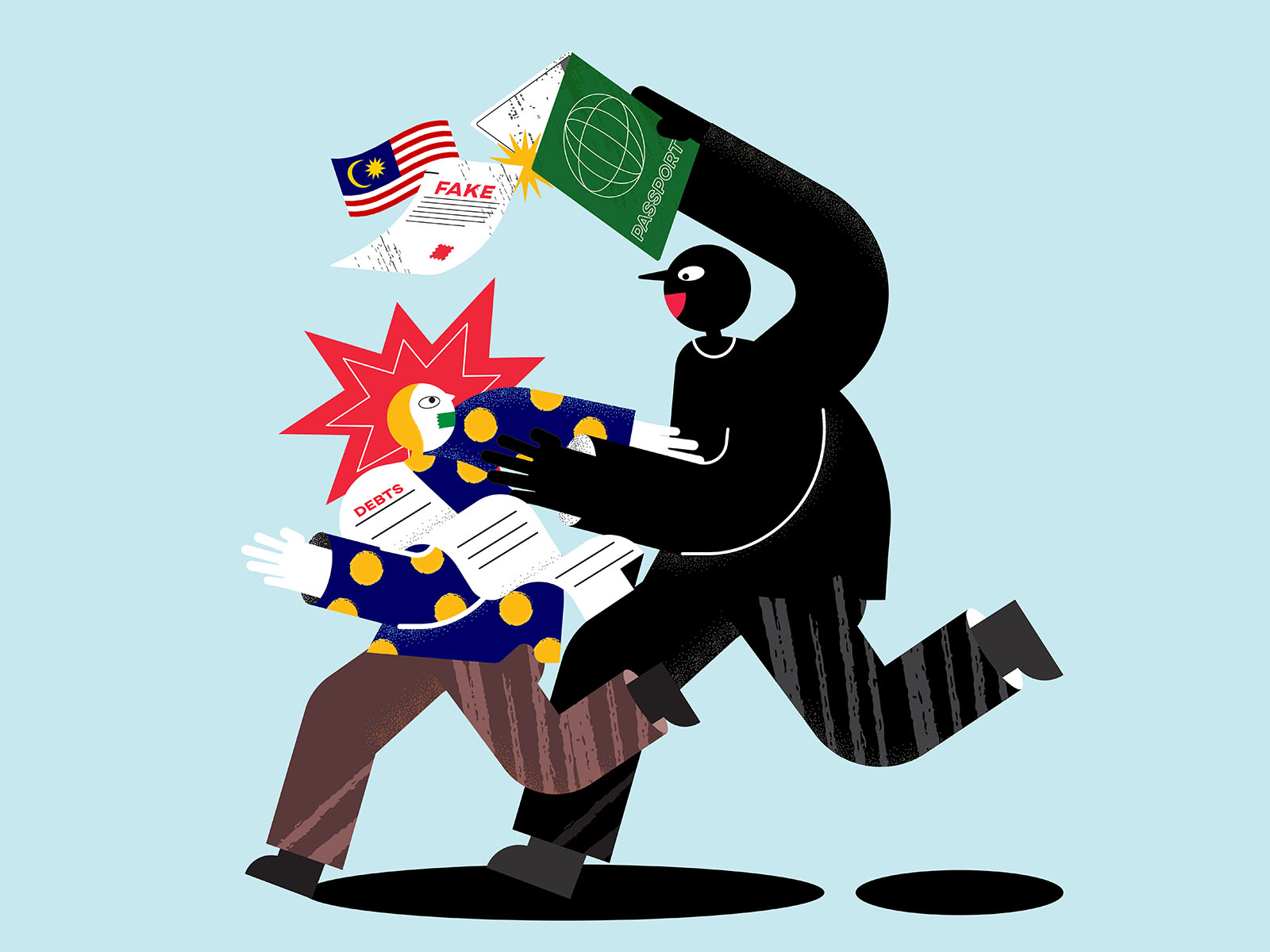
Mariana, who requested anonymity, was riddled with anxiety amidst the chaos of the Kuala Lumpur airport immigration queues. Flanked by two other undocumented workers, she held onto her fake passport, forged in a desperate measure to leave Malaysia.
The price she paid, RM2,000, weighed heavily on her mind, and the memories of that risky—albeit successful—endeavor still haunted her today.
“My hands were shivering. It still affects me to this day,” Mariana said with a shaky voice, even after almost five years of being back in her homeland in East Java, Indonesia.
This wasn’t a situation she envisaged when she first came to Penang, Malaysia back in 2009. Little did she know then that her pursuit of a better life would lead her to living as an undocumented worker, struggling to make ends meet while fearing expulsion from the country. Her undocumented status was triggered when she fled from her employer’s house, unjustly accused of theft, finding herself trapped in a life of precarious odd jobs and vulnerability.
Malaysia has long been a magnet for domestic workers from neighboring Indonesia, with Indonesians forming the most significant portion of 63,323 employed as domestic workers in the country as of January 2023.
However, a concerning trend has emerged—where an increasing number of Indonesian domestic workers are pushed into undocumented status, their lives characterized by constant fear and exploitation. As of 2017, the World Bank estimated that there are between 1.23 million and 1.46 million irregular or undocumented migrant workers in the country.
Yet the domestic labor force remains mired by issues of labor abuse. Lured by the promise of better livelihoods, domestic workers like Mariana find themselves ensnared in a web of uncertainty and vulnerability in Malaysia’s domestic labor market, owing to multifaceted reasons such as trafficking, sudden terminations and unfulfilled contractual obligations.
In response to the rising abuse cases in Malaysia, Indonesia halted sending workers last year, alleging that Kuala Lumpur violated an agreement on the proper channels to recruit workers, as it jeopardised their safety and made them vulnerable to forced labor conditions. The suspension was lifted last August.
To resolve the issue of undocumented workers, the minister of human resource has made efforts to regulate undocumented workers over the years, through calibration programs known as Rekalibrasi Tenaga Kerja (RTK) 2.0. When the government announced their latest calibration plan to legalize foreign workers, more than 410,000 undocumented migrants registered themselves by January.
Meanwhile, bilateral talks between both Indonesian and Malaysian governments continue to discuss better protective mechanisms for Indonesian migrant workers in the country. In April 2022, both countries signed a memorandum of understanding (MOU) to improve protection for domestic workers, following concerns of abuse.
Lived Realities
Domestic worker Dewi, who requested anonymity, believed that the RTK program is a positive step towards helping domestic workers in difficult situations find a job as it recognizes domestic work alongside other forms of labor as a proper employment—for her, it is about respect.
Lina, also a pseudonym, a 53-year-old undocumented worker who has been residing in Selangor for over 16 years, also expressed her support for the RTK 2.0. She plans to return to Indonesia at the end of this year through this program, and believes in the program’s potential to provide legal recognition for herself and her friends who are undocumented.
However, she raised a concern that the program may fail to address the underlying issue of many seeking illicit routes to enter the domestic workforce. The burdensome bureaucratic hurdles and exorbitant fees they encounter push them towards these illegal means, presenting a broader challenge that remains unaddressed.
“Even with the RTK program, the main hurdle is going through an agent. The fees are so high that when employers pay it, they feel like they’ve ‘bought’ us,” she added. “The issue is about educating both employers and domestic workers about labor rights and laws about the host country.”
“Hopefully the employer can make the permit [to help document their workers] directly, rather than going through an agent,” she said.
The contents of bilateral agreements and MOUs must be followed through, Lina added, otherwise it risks becoming just a piece of paper. For instance, she argued that the MOU does not address issues that affect domestic workers who turn undocumented to escape their abusive situations, which even lead to death.
“There are too many challenges faced by domestic workers working in Malaysia. Why do we want to work in Malaysia, when there are so many examples of workers who have died in abusive situations?” Lina said. “But it’s the family’s economic circumstances. We are willing to go that far.”
Not only are workers unprotected within Malaysia’s regulations and laws, they also confront a notable absence of protective measures from the Indonesian government. Indonesia does not have a law that safeguards its domestic workers. Despite discussions spanning two decades on the enactment of the Domestic Workers Protection Bill (RUU PPRT), the current iteration falls short, lacking crucial provisions such as prescribed minimum wage and limitations on work hours.
A recent study by the International Labour Organisation (ILO) conducted between July and September 2022 uncovered a distressing reality: that close to one third of Malaysia’s domestic workers endure forced labor conditions—where approximately 80 percent of the total domestic workers are Indonesians.
“Undocumented workers are not treated in hospitals, and often returned home. This is if you’re sick. What about when you die?” Linashe said. “It is complicated even in death.”
In some cases, domestic workers turn undocumented to escape dangerous exploitative situations like harassment and abuse.
Fighting back tears as she shared the story, undocumented domestic worker Siti, a not her real name, a 42-year-old from West Jawa recounted how she was trafficked upon leaving her abusive employer’s home. Deceived by an acquaintance who promised her a chance at better employment, she was instead held captive in a room and was almost sexually assaulted.
“I still remember entering the room she brought me to. She told me to wait. And then a man entered and locked the room,” she said as she described in harrowing details how she finally summoned the will to escape through the toilet.
Domestic worker Suraya, who requested anonymity, a 44-year-old from Sumatra, has also witnessed the fear that gripped her friends who did not hold a passport nor permit. Being documented, she would help her peers out with medication as they could not readily access healthcare services as she can.
“Their movements are restricted. They have to hide and know exactly what time the bus to work will arrive so that they don’t get caught at the bus stop.”
In one incident, she watched her friend get taken away by the police. “It was so painful to see it happen right in front of my eyes, when they took her. And you can’t do anything,” her voice cracked as she recounted this incident. “It’s not a choice to be undocumented—sometimes their employers don’t want to make the permit because it’s a hassle. Sometimes they’re duped by agencies.”
Suraya said she was fortunate to have a kind employer, whom she continues to work with for almost 18 years now—she never had her salary withheld, and had days off a month ever since she started.
“But this is really a case of being lucky. What if I am not [as fortunate]? People don’t realize how difficult it is for a domestic worker,” she said. “Being undocumented is not a choice.”
Impact on the next generation
The issue also casts an impact on the lives of children, who often bear the brunt of their parents’ undocumented status.
Malaysian-based non-profits like Permai Penang, are taking a proactive stance by organizing educational initiatives modeled after the Indonesian school syllabus to bridge the education gap for impacted youths.
“These children need education,” said Muhammad Mukhotib, an officer of Permai Penang. “Even according to international laws and human rights, children must receive education.”
Deprived of legal recognition and access to essential services, children grapple with barriers to education, healthcare and a stable upbringing.
Committed to addressing these issues, Permai Penang organizes three classes a week to accommodate children aged 6 to 13. The classes, which haves been running for 1.5 years, are also taught by Indonesian students at local universities to ensure that children receive basic and crucial skills such as reading, writing and listening.
Siyat Said, the headmaster of the Permai Penang classes, shed light on the reality that some of these children, at the age of 10, still struggle with reading—an outcome of having no access to education owing to their undocumented status.
“Who else will teach them if not us? They just want to be like other kids,” he said, highlighting the need for intervention.
“Our hope is that they can one day get registered as Indonesians, and return to pursue their studies. Who knows, they may even become diplomats,” said Mukhotib. “Who knows what their future is?”
Mukhotib said that when it comes to issues of undocumented status, it comes with monitoring and ensuring that rules are followed.
Mukhotib urged that addressing undocumented status entails stringent monitoring and adherence to the rules. The ultimate solution, he said, lies in streamlined processes, making it easier for domestic workers to apply for employment in Malaysia.
The goal is to rise above outdated practices and create a more humane and just labour system—one that eliminates the remnants of slavery and ensures the dignity of every worker.
“Slavery is no longer acceptable,” said Mukhotib. “Labor should be humane.”
Reforming Systems
Glorene A. Das, executive director of labour rights group Tenaganita, also stressed for urgent reforms and increased international collaboration to address these systemic issues and provide avenues for workers to emerge from the systemic challenges.
Based on Tenaganita’s case management in 2021-2022, Das shared that 90 percent of domestic workers they met became undocumented not to their own fault, where they are promised a contract and salary before leaving Indonesia.
“Most of our foreign domestic workers or migrant domestic workers do not know the difference between a tourist visa, a working visa, or even a student visa to begin with,” Das explained, emphasizing their vulnerability to exploitation by unscrupulous agencies. “She is completely in the hands of the agencies.”
While past government efforts offered amnesty to undocumented workers, Das aspires for a more empowering approach. She advocates for direct access to information for domestic workers, allowing them to register themselves and claim their rights.
Undocumented worker Mariana, who has returned to West Java, echoed the collective hope for a promising future, one where fellow domestic workers can navigate a system that protects their rights and ensures their well-being. Like her peers, she hopes for a more efficient system where domestic workers are better empowered and have the power to directly register themselves as laborers in the country.
“I don’t want my children to be affected by this,” she said. “But I do want them to know that being a domestic worker is just as dignified as other forms of labor.”
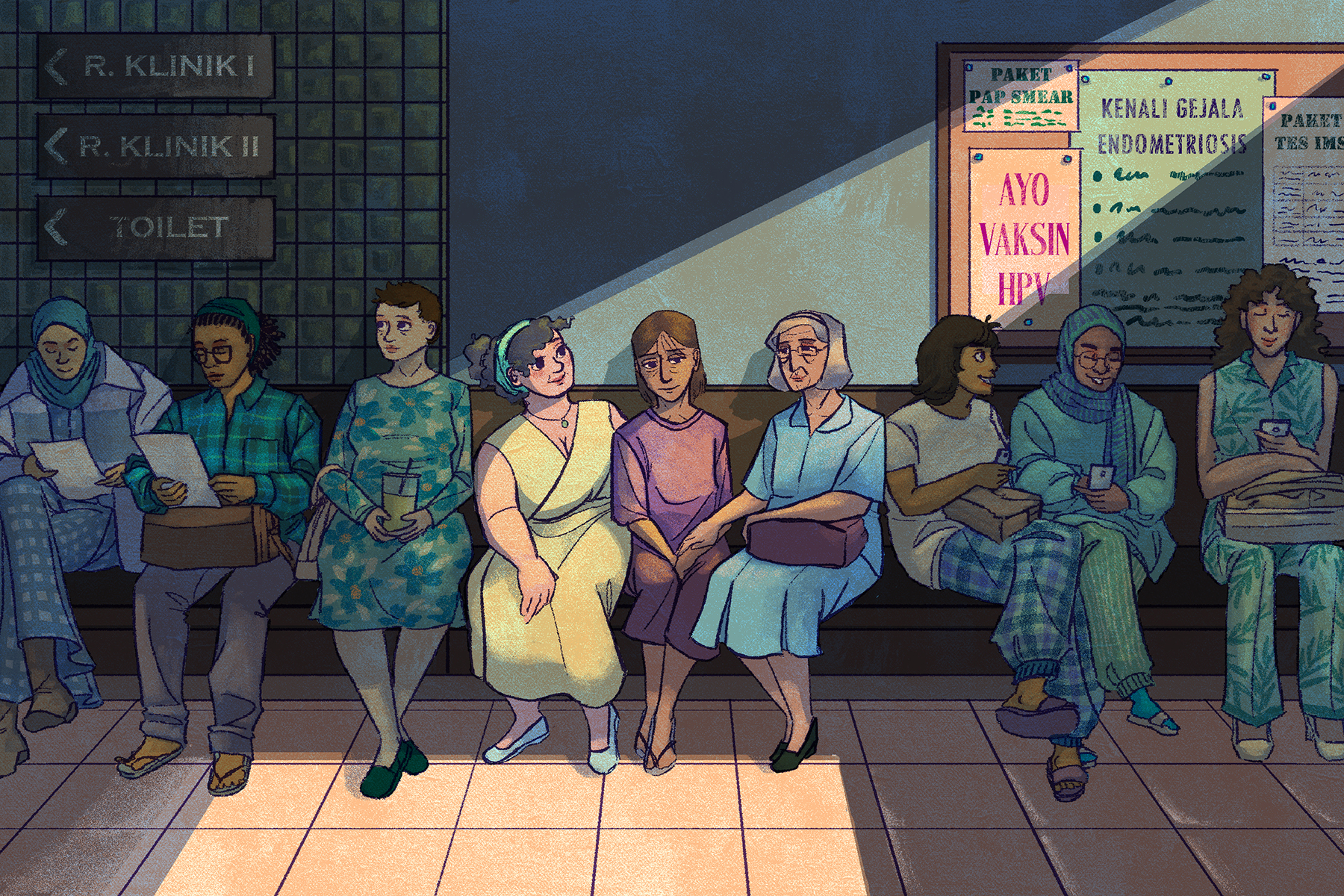
Peringatan: Kekerasan seksual, kehamilan tidak diinginkan, stigmatisasi aborsi
Pembunuhan. Begitu kata seorang dokter kandungan utusan Ikatan Dokter Indonesia (IDI) dan Perkumpulan Obstetri dan Ginekologi Indonesia (POGI) menyebut layanan aborsi bagi korban kekerasan seksual dengan batas usia kehamilan 14 minggu.
Dalam sebuah forum diskusi, dokter yang pernah menjabat sebagai kepala sebuah klinik bayi tabung itu mengatakan, “Ini berlawanan sekali. Yang satu susah punya anak, yang satu membuang-buang anak.”
Pernyataan itu ia lontarkan salah satunya untuk merespons pengalaman Melati, anak usia 12 tahun yang menjadi korban perkosaan pada 2021.
Melati, melalui penuturan pendampingnya, berupaya mengakses layanan aborsi yang sah menurut UU Kesehatan No. 36 Tahun 2009.
Tetapi, birokrasi di lapangan yang rumit, lamban, dan tidak berperspektif korban membuat Melati gagal mengakses layanan tersebut dan mesti menanggung kehamilan tidak diinginkan (KTD) di usia dini.
Tidak sampai di situ, dokter kandungan tersebut meminta para peserta diskusi yang termasuk di antaranya para aktivis perempuan untuk menonton sebuah film propaganda anti-aborsi yang merekam proses aborsi melalui ultrasonografi (USG).
Film yang ia maksud adalah The Silent Scream yang rilis pada 1984. Film propaganda itu menuai kritik dari komunitas kedokteran di New York karena “menyesatkan”, “tidak adil”, dan menggunakan special effects untuk membuat seolah-olah janin tampak meronta.
Dokter kandungan perwakilan POGI dan IDI itu bernama Ilyas Angsar. Ia memberikan pernyataan serupa dalam ajang penampungan pendapat oleh Kementerian Kesehatan terkait penyesuaian pasal aborsi dalam RUU Kesehatan pada 30 Maret.
“…Bagaimana janin di dalam rahim itu disodok-sodok, divakum, dia tidak bisa mengelak, dan harus meninggal dengan pasrah.”
“Teman-teman yang pro-choice mungkin perlu melihat video itu,” katanya. “Problemnya adalah apakah ada dokter spesialis obgyn yang mau melakukan aborsi 14 minggu?”
Dalam kesempatan yang sama, dokter kandungan lain, Rajuddin dari Universitas Syiah Kuala di Aceh, menyampaikan, “Kalau hal ini diberi usia kehamilan sampai 14 minggu, atas dasar apa ini? Itu bukan pemerkosaan lagi. Itu sudah menikmati hubungan seksual.”
Organisasi profesi IDI dan POGI menolak keras pengecualian larangan aborsi untuk korban kekerasan seksual dengan batas kandungan maksimal 14 minggu.
Mereka mendesak pemerintah mengembalikan batas usia menjadi 6 minggu, sesuai dengan UU Kesehatan No. 36 Tahun 2009 terdahulu.
Hanya saja batasan 6 minggu dalam UU tersebut tidak mengacu pada indikasi medis, tetapi merujuk Fatwa MUI No. 4 Tahun 2005 yang membolehkan aborsi untuk korban perkosaan ketika janin berusia di bawah 40 hari atau, dalam kepercayaan Islam, sebelum ruh ditiupkan.
“Kami yang Muslim pasti mengikuti Fatwa MUI. Kita kalau tidak mengikuti ulama-ulama kita akan masuk–akan jadi apa?” kata Ilyas.
Pada Mei 2023, IDI mengadakan forum bertajuk “Kontroversi Aborsi dalam RUU Omnibus Law Kesehatan.” Di forum itu, perwakilan POGI yaitu Wakil Ketua Umum Budi Wiweko dan Ketua Keluarga Berencana & Reproduksi Nurhadi Rahman menyampaikan mereka berpegang pada Lafal Sumpah Dokter yang termuat dalam Peraturan Pemerintah No. 26 Tahun 1960.
Sumpah ini diadopsi dari Deklarasi Jenewa pada 1948 atas penyempurnaan Sumpah Hipokrates. Secara global, sumpah dokter telah mengalami amendemen secara berkala sejak 1948. Amendemen itu tidak ikut terjadi di Indonesia.
SUMPAH DOKTER INDONESIA
DEMI ALLAH saya bersumpah:
Saya akan menghormati setiap hidup insani mulai saat pembuahan.
Pada 2021, Melati yang duduk di bangku SD baru tiga kali menstruasi ketika diperkosa seorang laki-laki paruh baya.
Keluarga mengadukan kasusnya ke Women’s Crisis Center (WCC) di Jombang, Jawa Timur. Usia kandungan Melati sudah memasuki minggu keempat. Sebelumnya, mereka telah melapor ke polsek setempat tetapi tidak ditanggapi dengan serius.
Kata kepolisian, “Jangan sampai menggugurkan kandungan. Nanti berdosa.”
WCC Jombang mendampingi Melati untuk dapat mengakses layanan kesehatan. Tetapi, di tempat Melati tinggal, fasilitas kesehatan tidak ramah korban kekerasan seksual.
Demi akses aborsi, pendamping dan keluarga korban pergi dari satu puskesmas ke puskesmas lainnya untuk mendapatkan rujukan layanan ke tingkat fasilitas kesehatan lebih tinggi. Namun, puskesmas tidak berani memberikan rujukan.
“Di daerah itu susah sekali. Yang mau memberikan rujukan agar korban bisa ke fasilitas kesehatan yang lebih maju, itu sangat susah,” cerita Direktur WCC Jombang yang juga pendamping Melati, Ana Abdillah.
WCC Jombang berinisiatif mengadakan bedah kasus antar-instansi pemerintah daerah yang dipimpin oleh Dinas Pemberdayaan Perempuan (PP) Kabupaten Jombang. Di dalamnya terdiri dari Dinas Sosial Kabupaten Jombang, Polres Jombang, RSUD, dan tim advokat. Akan tetapi, instansi-instansi pemerintahan itu menutup akses untuk Melati.
Kata pihak Dinas Sosial, “Anak sejak usia nol mesti dilindungi.” Pihaknya juga mempertanyakan apakah Melati dapat disebut sebagai “korban perkosaan” seperti yang tertera UU Kesehatan No. 36 Tahun 2009. Sebab UU Perlindungan Anak tidak mengenal istilah perkosaan.
Pihak RSUD Jombang mendorong Melati untuk melanjutkan kehamilannya dengan meyakinkan bahwa, “Bayinya akan tumbuh menjadi anak yang sehat.”
Seorang kepala dinas mendukung WCC Jombang mendampingi Melati mengakses layanan aborsi. Tetapi, katanya, “Jangan bawa-bawa nama dinas, ya. Secara institusi kami nggak bisa.”
Setiap instansi saling lempar tanggung jawab dan enggan mengambil keputusan. Mereka mempertanyakan kebenaran kasus perkosaan dan mencurigai hubungan dengan anak di bawah umur itu terjadi secara sukarela.
Mereka khawatir kasus itu menimbulkan kegaduhan di masyarakat. “Jombang itu kota santri. Kalau memberikan akses aborsi, nanti banyak korban yang minta aborsi juga.”
Kesimpulan dari bedah kasus, layanan aborsi hanya dapat dilakukan dengan adanya rekomendasi dari kepolisian. Tetapi, Polres Jombang saat itu beralasan mereka tidak berpengalaman sehingga tidak dapat memberikan rekomendasi.
Kasat Reskrim Polres Jombang juga memperingatkan pendamping Melati mereka dapat dikriminalisasi atas upaya membantu melakukan aborsi.
Ketika akhirnya Melati mendapatkan rujukan ke RSUD Dr. Soetomo Surabaya, satu-satunya rumah sakit umum daerah di Jawa Timur dengan fasilitas yang mumpuni itu menolak memberikan layanan.
Kata mereka, “Janinnya sehat, kok. Tubuh korban bongsor.”
Kehamilan Melati semakin membesar dan lewat dari batas usia 6 minggu.
Pasien-pasien Korban Kekerasan Seksual
Di klinik pribadinya di DKI Jakarta, Belas, bukan nama sebenarnya, kerap menemui pasien-pasien dengan kehamilan tidak diinginkan karena menjadi korban kekerasan seksual. Belas telah bekerja sebagai bidan selama 19 tahun.
Saking seringnya mendapatkan pasien korban kekerasan seksual, Belas berinisiatif untuk membuka layanan rumah singgah (shelter) bagi mereka yang membutuhkan.
Belas tidak pernah mendapatkan pasien korban kekerasan seksual dengan usia kehamilan kurang dari 6 minggu. Rata-rata kehamilan pasiennya yang mengalami KTD telah berusia 4-5 bulan. Paling rendah berusia 12 minggu.
Beberapa meminta melakukan aborsi. Tetapi, terhalang oleh peraturan hukum Indonesia, Belas tidak dapat melayani mereka. Ada ancaman kriminalisasi bagi tenaga medis dan kesehatan yang berpartisipasi memberikan layanan aborsi di luar hukum yang sah.
Pengalaman-pengalaman itu jadi pergulatan batin di diri Belas. Ia paham bahwa para perempuan yang tidak menginginkan kehamilan itu akan tetap mencari akses aborsi di tempat manapun. Dan mereka berisiko untuk mengakses layanan aborsi yang tidak aman.
“Ada yang bilang ke saya, ‘Kalau Ibu nggak kasih, saya akan cari.’”
“Bahkan ada teman saya sendiri, ‘Gue akan cari. Kalau nanti ada apa-apa sama gue, jangan nyesel ya.’”
Menolak akses ke yang membutuhkan layanan, bagi Belas, adalah hal menyakitkan. “Karena artinya saya menolak. Saya sudah melakukan sesuatu yang unethical dari sumpah jabatan.”
Belas bertemu dengan pasien perempuan yang hamil karena tidak dibolehkan memakai kontrasepsi oleh pasangannya. Perempuan yang diam-diam memakai kontrasepsi tanpa sepengetahuan suaminya. Perempuan pekerja rumah tangga (PRT) yang diperkosa oleh majikan laki-lakinya lalu diusir oleh majikan perempuan (istrinya).
Perempuan yang menyerahkan bayinya ke anggota keluarga lain setelah melahirkan. Perempuan yang menginginkan kehamilan pertamanya, tetapi kehamilan-kehamilan selanjutnya bukan lagi pilihannya.
Sebelum pandemi, Belas mendapatkan pasien seorang anak perempuan yang duduk di bangku SMP. Ia diperkosa oleh pacarnya di kampung halaman. Anak tersebut datang ke Jakarta menemui ibunya yang sedang bekerja, meminta bantuan Belas, dan tinggal sementara di rumah singgahnya. Dengan usia kandungan sudah sekitar 7 bulan, anak itu tak mendapatkan pilihan lain selain melanjutkan kehamilannya.
Si anak dan ibunya hampir meninggalkan bayi yang telah dilahirkan di klinik Belas karena kehamilan tidak diinginkan. Tetapi, mereka mengurungkan niat itu dan membawa serta bayi ke kampung halaman.
Tapi itu bukan happy ending. Karena si perempuan (korban) mengalami banyak hal. Si anak juga mengalami banyak hal. Dibilang anak haram. –kata Belas
Seorang pasien meninggalkan bayinya setelah melahirkan di klinik Belas. “Bayinya ditinggal dalam keadaan rapi di atas tempat tidur,” cerita Belas. Belas meminta pertolongan dinas sosial setempat untuk menampung bayi yang ditinggalkan. Tapi dinas sosial menolak.
“Mereka nggak mau menerima. Nggak ada anggaran, katanya.”

Ilustrasi layanan aborsi untuk korban kekerasan seksual. Illustration: Sekarjoget/Project Multatuli
Aborsi sebagai tindak pidana pertama kali diatur dalam Kitab Undang-undang Hukum Pidana (KUHP), yang lalu diadopsi dalam UU Kesehatan No. 36 Tahun 2009 beserta dengan pengecualiannya.
Pada 2009, ketika UU Kesehatan disahkan, Belas menyaksikan alih-alih UU membuka akses layanan aborsi bagi korban kekerasan seksual yang membutuhkan, peraturan itu justru menguatkan stigma di kalangan tenaga kesehatan dan medis.
Pada 2014, aturan turunan UU Kesehatan berbentuk Peraturan Pemerintah No. 61 Tahun 2014 tentang Kesehatan Reproduksi keluar.
Ketua Umum PB IDI saat itu, Zaenal Abidin, kembali menentang layanan kesehatan ini. Pihaknya menilai aborsi untuk korban perkosaan bertentangan dengan Sumpah Dokter dan kode etik kedokteran.
“Jangan ajak kami. Jangan timbulkan pertentangan batin pada seorang dokter,” kata Zaenal Abidin saat itu.
Dalam PP, penyelenggaran aborsi dengan indikasi kedaruratan medis dan akibat perkosaan harus mendapatkan pelatihan oleh “penyelenggara pelatihan yang terakreditasi”.
Kementerian Kesehatan pada 2016 menetapkan Permenkes No. 3 Tahun 2016 tentang “Pelatihan dan Penyelenggaraan Pelayanan Aborsi atas Indikasi Kedaruratan Medis dan Kehamilan Akibat Perkosaan.”
Peraturan itu mewajibkan pelayanan aborsi diselenggarakan di fasilitas pelayanan kesehatan yang ditunjuk oleh Menteri. Organisasi profesi juga harus ikut serta menyusun kurikulum dan menyelenggarakan pelatihan.
Namun hingga kini, Kementerian Kesehatan belum menunjuk secara terang fasilitas kesehatan yang dapat memberikan akses layanan aborsi aman untuk korban kekerasan seksual.
Marcia Soumokil, dokter umum dan Direktur Yayasan IPAS Indonesia, menyorot sederet persyaratan ini justru mempersulit penyediaan layanan di lapangan.
“Dari seluruh pelayanan kesehatan di Indonesia, tidak ada satu pun pelayanan kesehatan yang harus ditunjuk oleh kementerian. Karena kita sudah punya otonomi daerah. Tapi, khusus layanan aborsi aman, harus ditunjuk oleh kementerian,” sebut Marcia.
Belas pernah bekerja di rumah sakit. Ia menyaksikan ketidakjelasan aturan turunan, implementasi dari UU, beserta dengan ancaman kriminalisasi membuat fasilitas-fasilitas kesehatan merancang mekanisme atau SOP mereka masing-masing.
Bukan untuk melayani pasien, melainkan untuk melindungi diri dari kriminalisasi.
Kecurigaan terhadap perempuan yang mengaku diperkosa juga semakin kuat.
“Ada stigma di sana,” kata Belas. Mereka mempertanyakan, “Apa benar diperkosa?”
Akses Layanan Aborsi yang Aman
Di Indonesia, dari 2,8 juta kehamilan tidak direncanakan/diinginkan sepanjang 2015-2019, lebih dari setengah di antaranya berakhir diaborsi.
Ketentuan pelonggaran batas usia kehamilan aborsi untuk korban kekerasan seksual pada omnibus law UU Kesehatan No. 17 Tahun 2023, selaras dengan revisi KUHP yang telah disahkan Presiden Joko “Jokowi” Widodo pada Januari 2023.
Kedua regulasi itu memperluas pengecualian, tidak lagi “korban perkosaan,” tetapi menjadi “korban kekerasan seksual yang dapat menyebabkan KTD.” Ini merujuk pada UU Tindak Pidana Kekerasan Seksual (TPKS) yang mendefinisikan jenis kekerasan seksual secara luas.
Batas usia kehamilan 14 minggu sesuai dengan pedoman terkini World Health Organization (WHO) yang telah memasukkan layanan aborsi sebagai bagian dari layanan kesehatan esensial.
Khusus untuk usia kehamilan hingga 14 minggu, layanan aborsi dapat dilakukan dengan aman menggunakan obat-obatan atau alat bedah sederhana, kata WHO.
Kendati demikian, IDI menawarkan berbagai macam alasan menolak batas usia kehamilan 14 minggu. Salah satunya faktor keamanan.
Dokter kandungan Ari Kusuma Januarto, anggota advokasi IDI dan Ketua Dewan Pembina POGI mengatakan, “Namanya aborsi itu, itu punya risiko. Risiko pada ibunya jelas. Bisa terjadi pendarahan. Infeksi. Pembiusan.”
Ia juga menambahkan bahwa perubahan dari 6 ke 14 minggu justru memberikan peluang bagi lebih banyak perempuan untuk melakukan aborsi.
Samsara, organisasi yang fokus pada pemenuhan akses informasi kesehatan seksual dan reproduksi, menyimpulkan bahwa pembatasan layanan aborsi sejatinya muncul dari tenaga kesehatan. Pola itu bukan hanya terjadi di Indonesia saja, melainkan juga di negara lain.
Ika Ayu, Direktur Samsara, mengatakan stigmatisasi layanan ini dimulai dengan mengatakan bahwa tindakan hanya akan membawa dampak negatif kepada situasi kesehatan fisik maupun mental seseorang, terlepas dari adanya rekomendasi metode aborsi yang aman.
“Banyak sekali pengalaman korban, perempuan, individu yang dihilangkan,” kata Ika.
Membatasi akses untuk aborsi berisiko membuat perempuan mengakses layanan aborsi yang tidak aman, tetapi tidak mengurangi jumlah perempuan yang mengakses aborsi.
Aborsi tidak aman adalah satu dari lima penyebab utama kematian ibu secara global.
WHO “Abortion Care Guideline” yang terbit pada 2022, merekomendasikan aborsi untuk usia kehamilan kurang dari 14 minggu menggunakan metode bedah vakum aspirasi. Metode ini, terutama aspirasi vakum manual (AVM), direkomendasikan karena lebih aman, cepat, sederhana, dan murah dibandingkan kuretase tajam.
Metode ini dapat digunakan di fasilitas-fasilitas kesehatan dengan sumber daya yang terbatas, karena tidak memerlukan daya listrik, anestesi, dan tidak hanya dapat dilakukan oleh dokter.
Sementara itu, usia kehamilan kurang dari 12 minggu bisa dilakukan dengan obat-obatan seperti mifepristone dan misoprostol yang telah masuk dalam daftar obat-obatan esensial untuk aborsi sejak 2005.
Marcia Soumokil, dokter umum dan Direktur Yayasan IPAS Indonesia, menekankan, “Aborsi dapat dilakukan menggunakan alat bedah sederhana di sistem layanan kesehatan yang sangat standar, bahkan bisa dilakukan di puskesmas di Puncak Jaya (Papua). Syaratnya, alat itu hanya bisa dipakai untuk kehamilan sampai 14 minggu.”
Di Indonesia, metode AVM direkomendasikan oleh Kementerian Kesehatan untuk tindakan asuhan pasca-keguguran, yaitu ketika seseorang mengalami abortus inkomplit atau missed abortion. Tetapi, AVM juga masih terstigmatisasi sebagai metode yang disalahgunakan untuk melakukan aborsi dan belum menjadi standar metode di kebanyakan fasilitas kesehatan di Indonesia.
Jika mengikuti prosedur yang aman dan legal, layanan aborsi memiliki risiko kematian yang lebih rendah dibandingkan melahirkan. Riset pada 2012 menunjukkan bahwa risiko terjadinya komplikasi atau kematian akibat melahirkan 14 kali lebih tinggi dibandingkan aborsi aman.
Untuk Tidak Menghalangi Akses
Sebagai rumah sakit pusat rujukan nasional, RS dr. Cipto Mangunkusumo (RSCM) di Jakarta kerap menerima pasien korban kekerasan seksual yang mengalami KTD dan ingin menggugurkan kandungannya.
Pasien-pasien ini adalah rujukan dari berbagai fasilitas kesehatan di Indonesia. Kebanyakan dari fasilitas kesehatan tersebut gamang mengambil keputusan, lalu menyerahkannya ke RSCM.
Tindakan aborsi, secara teknik, bukan hal yang sulit. Perkaranya, kata dokter kandungan Seno Adjie, adalah decision.
“Kadang-kadang saya pikir, kenapa cuma masalah abortus harus dirujuk? Cuma memang mereka agak gamang memutuskan. Tidak mau menjadi masalah di rumah sakitnya dari sisi hukum maupun etik. Sehingga rujuk ke RSCM,” terang Seno.
Kini, Seno menjabat sebagai Ketua Koordinator Pelayanan Obgyn di RSCM.
Untuk pasien yang diduga adalah korban kekerasan seksual, RSCM memiliki tim kelayakan atau komite etik yang akan memutuskan apakah pasien layak mengakses aborsi atau tidak.
Pasien korban kekerasan seksual yang ingin mendapatkan layanan aborsi tidak dapat langsung mendapatkan tindakan. Ada pertimbangan-pertimbangan yang jadi dasar keputusan tim kelayakan. Mereka akan meminta surat aduan korban ke kepolisian dan hasil visum. Mereka juga akan memeriksa kondisi kesehatan pasien untuk memastikan aborsi dapat secara aman dilakukan.
Jika telah memenuhi persyaratan, tim kelayakan RSCM akan segera melakukan tindakan.
“Biasanya nggak sampai satu minggu. Ketika dilaporkan, langsung dibahas. Karena korban perkosaan ada batas waktu,” ujar Seno.
Tim RSCM tidak mendata jumlah pasien korban kekerasan seksual yang mengakses layanan aborsi setiap tahunnya. Tetapi, Seno mengatakan bahwa setiap tahun selalu ada kasus. “Pasti ada. Dan lebih dari satu kali,” katanya.
Pasien-pasien datang dari berbagai daerah, dari Depok hingga Padang. Ada pula kasus korban perkosaan dengan disabilitas mental. “Oleh tim etik, kami anggap perkosaan. Karena tidak ada consent. Secara hukum sah untuk dikerjakan.”
Dalam perjalanannya, tim kelayakan aborsi juga mempertimbangkan indikasi kedaruratan medis ketika mendapatkan korban kekerasan seksual yang mengalami KTD.
Misalnya, tim kelayakan RSCM menemui pasien anak berusia 10 tahun yang diperkosa oleh tetangga. Kepolisian telah mengeluarkan surat yang menyebutkan ia korban perkosaan. Anak itu mengalami KTD usia 8 minggu.
Tim kelayakan memanggil psikolog anak. Mereka menemukan dampak psikis yang berat jika kehamilan tetap dilanjutkan. “Sehingga, diputuskan ini salah satu indikasi medis. Karena ini medis, lebih dari 6 minggu tidak apa.”
Ada juga perempuan korban perkosaan yang datang ke rumah sakit dengan usia kandungan 27 minggu. Tidak menginginkan kehamilannya, ia berkali-kali melakukan percobaan bunuh diri. “Kami nyatakan ada indikasi medis karena mau bunuh diri. Dikeluarkan.”
Doctors Without Borders dalam situsnya menyebutkan bahwa di banyak negara, hukum aborsi tidaklah hitam putih, legal atau ilegal. Sebagaimana di Indonesia, aborsi dapat sah secara hukum jika bertujuan untuk menyelamatkan nyawa orang yang hamil.
Seno tidak dapat memastikan apakah Kementerian Kesehatan telah secara resmi menunjuk RSCM sebagai fasilitas kesehatan rujukan. Selama ini, tindakan yang dilakukan RSCM sepenuhnya merujuk pada aturan yang ada.
“Kalau memang hal itu menjadi suatu permintaan utama dari korban dan memenuhi syarat secara hukum, sebagai rumah sakit yang memang mematuhi hukum dan melayani masyarakat, kami bisa melakukan tindakan itu,” kata Seno.
Ia tidak memungkiri perdebatan keamanan batas usia kehamilan 14 minggu di kalangan organisasi profesi. “Beberapa mengatakan makin tidak aman,” kata Seno.
Namun, ia meyakini bahwa aborsi tetap aman selama dilakukan oleh tenaga kesehatan yang kompeten dan infrastruktur yang memadai. “Kalau di RSCM, aman-aman saja. Insya Allah mudah-mudahan aman.”
Seno tidak bilang setuju atau tidak setuju dengan aborsi. Ia hanya meyakini aborsi mesti diregulasi untuk menekan angka aborsi tidak aman. “Secara pribadi, saya juga meminta ada perbaikan dari peraturan aborsi kita. Kalau kita ingin mengadakan aborsi yang aman, harus ada perluasan regulasi. Kalau tidak, akan banyak aborsi yang tidak aman.”
Stigmatisasi Berujung Penghalangan Akses
Mengetahui bahwa layanan kesehatan di Indonesia tidak bisa sembarang memberikan akses aborsi, kebanyakan pasien tidak pernah langsung pergi ke fasilitas kesehatan. Mereka memilih mencari cara untuk menggugurkan kandungannya sendiri terlebih dahulu.
Selama delapan tahun berpraktik sebagai dokter umum, Sandra Suryadana mengaku tidak pernah mendapatkan pasien yang terang-terangan meminta akses layanan aborsi.
Permintaan atas layanan aborsi justru kerap Sandra dapatkan ketika ia memberikan layanan via telekonsultasi. Permintaan yang juga ia tidak bisa penuhi. “Mungkin karena mereka tidak berani (datang langsung),” kata Sandra.
Riset Guttmacher Institute dan Universitas Indonesia pada 2018 memperkirakan 43 dari 1.000 perempuan usia 15-49 tahun di Indonesia melakukan aborsi. Dari jumlah perempuan aborsi, hampir sepertiganya melakukannya sendiri dan sedikit lainnya pergi ke penyedia layanan tradisional atau apoteker. Kebanyakan dari mereka mengonsumsi jamu atau pijat tradisional.
Awal 2019, Sandra menggagas platform media sosial Dokter Tanpa Stigma (Instagram: @doktertanpastigma). Melalui platform itu, Sandra dan rekan-rekannya kerap mendengar pengalaman buruk seputar layanan kesehatan dari para audiensnya.
Dalam hal kesehatan dan reproduksi, para audiens Dokter Tanpa Stigma mengeluhkan pengalaman pemeriksaan mereka ke dokter obgyn yang tidak ramah perempuan, menceramahi ranah personal pasien, dan mempermalukan pasien.
Ketika masih bekerja di rumah sakit, Belas menemui rekan-rekan kerjanya yang ogah memberikan akses kontrasepsi kepada pasien. Mengetahui pasiennya adalah seorang janda, mereka mempertanyakan permintaan kontrasepsi oleh pasien. “Ngapain KB? Buat apa?” Belas mengulang kata-kata rekannya.
Mereka juga meragukan pengalaman pasien korban kekerasan seksual. “Ikutan goyang atau nggak?”
Belas pernah menghimpun persepsi tenaga-tenaga kesehatan – bidan, dokter, dokter spesialis – terhadap korban perkosaan dan akses layanan aborsi dalam penelitiannya. “Ada yang memandang itu adalah reinkarnasi dosa masa lalunya. Itu takdirnya. Apapun itu kehamilan harus dilanjutkan.”
Seno selaku dokter kandungan di RSCM juga kerap menemukan sejawat dokter yang menolak memberikan kontrasepsi darurat kepada pasien.
Kontrasepsi darurat adalah obat pencegah kehamilan yang dapat seseorang konsumsi 3-5 hari setelah seseorang melakukan hubungan seks tanpa pengaman. Tenaga kesehatan yang menolak memberikan kontrasepsi darurat menyamakan obat ini dengan tindakan aborsi.
Implikasinya, otonomi pasien atas tubuhnya diabaikan. Perempuan tidak dibiarkan untuk memilih dan menanggung konsekuensi yang ia sanggupi.
“Pendapat pribadi saya, semua perempuan berhak untuk mendapatkan perlindungan reproduksi,” kata Seno. “Kalau seorang obgyn bertanya ke saya, kalau sesuai prinsip atau agama tidak mau kasih, tidak apa. Tapi dia harus tahu bahwa pasien itu berhak. Nggak boleh nggak kasih jalan. Kasih jalan (merujuk) ke dokter lain.”
Praktik yang mencampuradukkan moral dengan etika itu kerap ditemukan di kalangan tenaga kesehatan.
Rasa frustrasi Belas atas kenyataan itu kadang membuatnya melontarkan humor gelap,
“Perempuan harus hampir mati dulu baru dapat layanan.” Ia tertawa kecut.
Deklarasi Jenewa World Medical Association (WMA) telah mengalami perubahan per Oktober 2017. Tetapi, Sumpah Dokter Indonesia yang pertama kali berlaku pada 1960, yang juga didasarkan pada Deklarasi Jenewa 1948, belum mengikuti perubahan Deklarasi Jenewa terkini.
SUMPAH DOKTER (versi World Medical Association)
SEBAGAI ANGGOTA PROFESI MEDIS: SAYA AKAN MENGHORMATI otonomi dan martabat pasien saya*;
SAYA AKAN MENJAGA rasa hormat yang setinggi-tingginya terhadap kehidupan manusia**
*Tidak ada dalam Sumpah Dokter Indonesia.
**Tidak lagi memasukkan “…mulai saat pembuahan.
Pendidikan Kesehatan yang Berorientasi pada Pasien (People-centered)
Sandra berproses menjadi lebih peka setelah ia mengakses berbagai literatur di luar pendidikan kedokteran. Ia juga belajar dari pengalaman di lapangan, bahwa banyak pasien perempuannya adalah korban kekerasan berbasis gender.
Baik di puskesmas, klinik perusahaan, RSUD, rumah sakit swasta, hingga di klinik kecantikan, Sandra bertemu dengan perempuan korban kekerasan.
“Di klinik kecantikan, aku tetap mendengar cerita hal yang sama. Dan itu baru aku. Teman-temanku yang kerja di tempat lain pasti ketemu juga dong? Kok aku nggak pernah dengar ada yang membicarakan ini? Masa sih yang bisa kita lakukan cuma jahit lukanya dia?”
Pemahaman atas layanan yang berorientasi pada pasien (people-centered) dan berperspektif gender tidak Sandra dapatkan ketika ia mengikuti pendidikan kedokteran. Fasilitas-fasilitas kesehatan di tempat Sandra bekerja dulu juga tidak memiliki SOP penanganan yang berperspektif gender.
Menurut Sandra, permasalahan muncul ketika biaya pendidikan kedokteran yang terlampau mahal sehingga hanya kelompok ekonomi atas yang dapat menjangkaunya.
“Tidak banyak ada representasi keberagaman di situ. Itu aja sudah cukup susah membuat mereka dapat relate dengan masalah pasien yang beragam,” terang Sandra.
Begitu juga dengan Belas yang mendapatkan perspektif pelayanan yang humanis ketika ia belajar di luar pendidikan formal kebidanan. Sementara, di pendidikan formal, senioritas justru marak terjadi.
“Lebih ke bagaimana digembleng, harus kompeten, tapi luput bahwa penyedia layanan kesehatan perlu menjadi humanis,” cerita Belas.
Sebagai seorang bidan, Belas lebih nyaman bekerja di kliniknya dibandingkan di rumah sakit. Di klinik yang semula milik ibunya yang sudah pensiun itu, Belas merasa memiliki otoritas. Kewenangan yang tidak ia dapatkan ketika bekerja di rumah sakit dulu.
Ia menyaksikan perlakuan dokter yang sewenang-wenang kepada tenaga kesehatan lain termasuk dirinya. Hardikan dari dokter jadi konsumsi sehari-hari. Ia juga pernah kena pukul di tangan karena ia salah memberikan alat.
Dalam kebidanan, posisi yang hierarkis itu memengaruhi kompetensi dan kewenangan bidan yang menjadi lebih terbatas. Keterbatasan pada akhirnya berpengaruh pada akses layanan untuk masyarakat.
Untuk tindakan aborsi aman di bawah usia 14 minggu dengan metode bedah, WHO merekomendasikan tidak hanya dokter umum maupun dokter spesialis yang berwenang melakukannya, tetapi juga bidan, perawat, hingga tenaga kesehatan tradisional/komplementer.
WHO menyatakan bahwa tugas ini termasuk dalam kompetensi utama bidan. Juga, pasien perempuan umumnya merasa mendapatkan layanan yang lebih suportif di tangan bidan. Di daerah-daerah dengan akses, infrastruktur, dan sumber daya dokter yang terbatas, peran bidan maupun perawat menjadi krusial dalam memperluas akses layanan aborsi.
Tetapi, di Indonesia, kewenangan melakukan tindakan aborsi dominan ada pada dokter spesialis obgyn.
“Sekarang, kita bisa lihat relasi kuasanya: kalau sudah urusan perempuan; maternal health, aborsi, itu approval-nya ke spesialis obgyn. Kalau mereka semua menolak, lalu mau gimana?” kata Belas.
“Bagaimana dehumanisasi itu terjadi di sistem layanan kesehatan yang seharusnya memanusiakan manusia.”
Dalam rapat kerja Komisi IX DPR RI dengan Menteri Kesehatan Budi Gunadi Sadikin tentang RUU Kesehatan pada Januari 2023, Budi Gunadi menyampaikan kekhawatirannya atas relasi kuasa antara dokter dengan tenaga kesehatan lain di Indonesia.
Ia mendapatkan keluhan dari para bidan dan perawat. “Kalau di luar negeri, perawat dan dokter itu setara. Satu tim. Di sini, kastanya begini.” Budi Gunadi memperlebar jarak kedua tangannya yang tadinya bersandingan. “Di luar negeri, dokternya sangat menghargai perawat. Di sini nggak. Perawat itu pesuruh.”
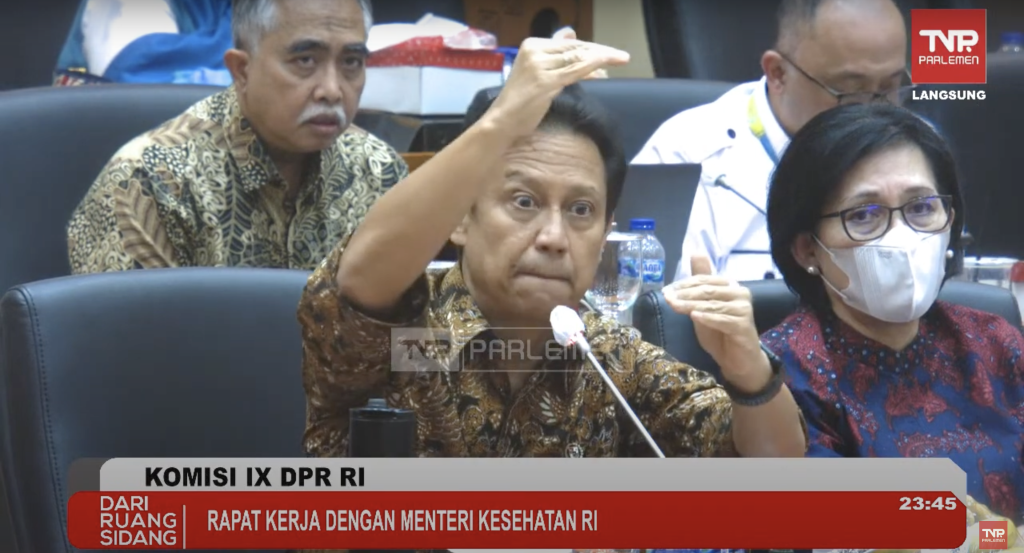
Menteri Kesehatan Budi Gunadi Sadikin saat rapat kerja dengan DPR RI. Screenshot: Tangkapan layar TV Parlemen
Pada 2014, gabungan sejumlah organisasi profesi, termasuk IDI, melakukan judicial review menolak tenaga medis berada dalam satu golongan dengan tenaga kesehatan.
Dalam UU No. 36 Tahun 2014 tentang Tenaga Kesehatan, tenaga medis yaitu dokter, dokter spesialis, dokter gigi, dan dokter gigi spesialis masuk dalam rumpun “tenaga kesehatan”, bersama dengan tenaga kesehatan lainnya seperti psikolog, perawat, bidan, dan lainnya.
Agustus lalu, Kementerian Kesehatan menegur tiga rumah sakit terkait praktik perundungan terhadap dokter-dokter yang sedang mengikuti program pendidikan.
Sikap itu disayangkan oleh perwakilan IDI yang menilai Kemenkes “berlebihan.” Mereka beralasan itu adalah bagian dari pendidikan kedisiplinan, dan bahwa “kelakuan oknum tidak bisa digeneralisir.”
Ketika diwawancarai langsung, perwakilan IDI Ari Kusuma Januarto juga memberikan pernyataan serupa. “Kami sangat khawatir dengan framing dokter saling bully. Kalau ditanya oknum, semua oknum ada.”
Seorang dokter menyebutkan bahwa potensi ancaman memberikan layanan aborsi kepada korban kekerasan seksual bukan hanya dari sisi hukum. Tetapi juga dari organisasi profesi.
Sebelum omnibus law UU Kesehatan No. 17 Tahun 2023 disahkan, seluruh izin praktek dokter dipegang oleh IDI. Pemerintah daerah berwenang untuk mengeluarkan izin praktek, tetapi atas rekomendasi dari IDI. Untuk mendapatkan surat rekomendasi tersebut, setiap dokter mesti mendaftarkan diri sebagai anggota IDI.
“Masalahnya, kalau kami melakukan itu, kami bukan cuma berhadapan dengan tekanan masyarakat. Tapi juga tekanan organisasi profesi,” kata dokter itu. “Kalau kami melawan sikap organisasi profesi, praktek dan karier kami bisa jadi dipersulit.”
Pada 2022, PPH Unika Atma Jaya dan Knowledge Hub Kesehatan Reproduksi Indonesia merilis laporan “Analisis Situasi Aborsi di Indonesia.” Laporan itu menyebutkan bahwa tenaga kesehatan yang memberikan informasi dan layanan aborsi dibayang-bayangi ancaman kehancuran karier.
Seorang narasumber penelitian memberikan kesaksian,
“Dia (dokter yang memberikan konseling) langsung menceritakan bahwa kemarin dokter di (nama rumah sakit) sudah ada yang dipecat karena melakukan ini (aborsi).”
Terlepas pengesahan omnibus law UU Kesehatan yang menuai pro dan kontra, pengalaman sejumlah tenaga kesehatan dan pendamping korban kekerasan seksual menunjukkan bahwa sistem layanan kesehatan yang telah berlaku sedang tidak baik-baik saja.
“Yang sekarang sudah jelas tidak baik. Untuk apa kita bertahan dengan sistem yang sudah tidak baik?” kata seorang dokter.
Layanan yang Menjangkau Korban
Akses layanan aborsi untuk korban kekerasan seksual berkaitan erat dengan penanganan korban kekerasan seksual yang sigap dan terpadu. Dengan batas usia kehamilan yang terbatas, korban kekerasan seksual yang melaporkan kasusnya mesti segera mendapatkan penanganan.
Secara ideal, korban kekerasan seksual berhak untuk mendapatkan pelayanan kesehatan berupa pemeriksaan fisik dan mental, pengobatan luka, pencegahan/penanganan penyakit menular seksual, pencegahan/penanganan kehamilan, terapi psikiatri dan psikoterapi, dan rehabilitasi psikososial.
Hal ini tercantum dalam UU No. 12 Tahun 2022 TPKS.
Hanya saja, di lapangan, prinsip penanganan ini belum terlaksana dengan baik.
Sejak pemerintah mengambil alih kewenangan layanan pendamping korban kekerasan seksual, akses pendampingan menjadi lebih terbatas.
Ana dari WCC Jombang merasakan perubahan itu. Sejak Pusat Pelayanan Terpadu Perlindungan Perempuan dan Anak (P2TP2A) berubah menjadi Unit Pelayanan Terpadu Daerah (UPTD) di bawah pemerintah daerah, birokrasi pelayanan pendampingan korban menjadi lebih tidak fleksibel.
WCC Jombang mendampingi kasus seorang perempuan yang mengalami kekerasan dalam rumah tangga. “Rambutnya diguntingin sama suami, digebukin sampai berdarah-darah,” cerita Ana.
Saat itu tanggal merah. Ketika meminta bantuan UPTD, mereka beralasan tidak bisa melayani karena sedang di luar jam operasional.
Begitu pula akses terhadap rumah aman. “Korban yang butuh akses masih disuruh tunggu. Hari Senin, masuk kerja jam 9, pulang jam 3 sore.”
“Artinya, kita berhadapan dengan sistem yang perspektif, empati, dan responsivitas layanannya tidak dibentuk,” tambah Ana.
Prinsip layanan yang berperspektif korban, menurut Margaretha Hanita, bukan semata layanan yang dapat korban jangkau. Tetapi, “Layanan yang menjangkau korban.”

Ilustrasi layanan aborsi untuk korban kekerasan seksual. Illustration: Sekarjoget/Project Multatuli
Margaretha Hanita adalah seorang dosen, praktisi, dan aktivis di bidang resiliensi perempuan yang pernah bekerja di P2TP2A selama 15 tahun. Ia kini mendampingi Polda Metro Jaya dan sejumlah rumah sakit di DKI Jakarta membangun layanan yang berperspektif korban.
Korban-korban kekerasan seksual, dalam praktiknya, masih menghadapi birokrasi lembaga yang rumit. Misalnya, layanan yang tidak tersedia 24 jam, akses ke rumah aman yang terbatas, persyaratan Nomor Induk Kependudukan (NIK) yang menyulitkan korban yang tidak memiliki/kehilangan kartu identitas, hingga skema pembiayaan yang belum jelas.
Korban kekerasan seksual tidak mendapatkan jaminan pembiayaan dari BPJS yang layanannya merujuk pada penyakit tertentu. “Tapi visum bukan penyakit. Luka akibat kekerasan seksual bukan penyakit. Luka, patah tulang hidung, disiram air keras, itu bukan penyakit,” kata Hanita.
Ketika masih bekerja di P2TP2A dulu, Hanita kerap menemukan anak-anak korban kekerasan seksual yang tidak mendapatkan pelayanan karena ia tidak memiliki NIK. Seorang anak korban perkosaan berkelompok (gang rape) ditemukan di kolong jembatan.
Pemerintah daerah lalu mensyaratkan korban didaftarkan terlebih dahulu ke dukcapil sebelum dapat menerima bantuan dana. “Harus dijadikan warga DKI Jakarta dulu. Harus pakai biometrik dulu,” cerita Hanita.
Ada pula kasus korban tindak pidana perdagangan orang yang kartu identitasnya diambil.
Layanan terpadu untuk korban kekerasan seksual melibatkan koordinasi lintas-sektor.
Di RSUD Kabupaten Bekasi, institusi terkait perlu mengajak setidaknya pihak kepolisian, DPPPA, dan dinas sosial untuk mewujudkan layanan terpadu pasien korban kekerasan seksual.
“Butuh komitmen tinggi untuk membikin PPT. Kami harus melibatkan banyak pihak lintas sektor,” terang Ida Hariyanti selaku Kepala Bidang Pelayanan Medis dan Diagnostik di RSUD Kabupaten Bekasi.
Tahun depan, RSUD Kabupaten Bekasi berencana meresmikan layanan Pusat Pelayanan Terpadu (PPT). Di rumah sakit, pasien dapat sekaligus mengakses pendampingan dari DPPPA. Laporan hasil pemeriksaan dari rumah sakit juga dapat langsung diserahkan ke kepolisian.
Umumnya, pasien korban kekerasan seksual datang ke rumah sakit dengan surat permintaan visum et repertum dari kepolisian kepada dokter forensik.
Tetapi, RSUD Kabupaten Bekasi juga tidak menutup kemungkinan bagi pasien yang belum melapor ke kepolisian untuk datang terlebih dahulu ke rumah sakit. “Kami tangani dulu kegawatdaruratannya, pemeriksaan lengkap, kalau memang perlu kami hubungi kepolisian,” jelas Suryo selaku dokter forensik di RSUD Kabupaten Bekasi.
Dengan koordinasi lintas-sektor, mereka bisa menerapkan pelayanan dalam satu waktu, satu tempat.
RSUD Kabupaten Bekasi jadi satu dari segelintir fasilitas kesehatan yang telah menyiapkan alur khusus menangani korban kekerasan seksual. Tidak banyak pula instansi pemerintahan terkait lainnya yang telah menerapkan prinsip tersebut.
Untuk dapat mewujudkan itu, kata Hanita, “Kita harus punya empati terhadap korban. Bisa dibayangkan korban mau melapor saja sudah syukur.”
Dalam hal akses layanan aborsi untuk korban kekerasan seksual, pelayanan yang belum satu atap, sigap, dan tidak berperspektif korban pada akhirnya ikut menghambat akses tersebut.
“Jangankan korban yang membutuhkan akses aborsi aman, korban yang butuh akses rumah aman aja, masih disuruh tunggu. Entar-entar saja, sampai kehamilannya besar dan melebihi batas yang ditentukan undang-undang,” kata Ana.
Penutup
Melati, anak korban perkosaan di Jombang, tidak pernah mendapatkan haknya atas akses layanan aborsi. Setelah Melati melahirkan, anaknya langsung diadopsi orang lain.
Selama proses kehamilan, keluarga Melati tidak mendapatkan dukungan layanan kesehatan dari pemerintah. “Sebatas kebutuhan sembako,” ujar Ana dari WCC Jombang. Sementara biaya pemeriksaan kehamilan memakai uang pribadi keluarga Melati dan hasil penggalangan donasi.
Melati dan orangtuanya trauma berat. WCC Jombang sempat mengajak orangtua Melati mencarikan baju untuk bayi yang Melati lahirkan. Mereka tidak mau memegang-megang baju di dalam toko. “Jangankan pegang baju bayi. Masuk ke dalam toko saja mereka enggan,” cerita Ana.
Sepanjang WCC Jombang mendampingi korban kekerasan seksual, tidak ada satupun yang pernah dapat mengakses layanan aborsi.
Pada 2021, WCC Jombang mendampingi lima kasus KTD dari total 41 kasus kekerasan seksual terhadap remaja perempuan (8-18 tahun). Pada 2022, ada 7 kasus KTD dari 46 kasus aduan kekerasan seksual.
Seorang korban perkosaan yang mengalami KTD adalah orang dengan disabilitas mental. Seorang korban lain diancam pasal perzinahan ketika hendak melaporkan kasusnya.
Riset PPHK Unika Atma Jaya dan Knowledge Hub Kesehatan Reproduksi Indonesia menemukan terdapat total 160 putusan pidana terkait kasus aborsi sepanjang 2017-2021. Sebanyak 45 perempuan yang membutuhkan akses layanan aborsi menjadi korban kriminalisasi.
Sejumlah kasus dikenakan UU Perlindungan Anak dengan pasal berbunyi: “Setiap orang dilarang melakukan aborsi terhadap anak yang masih dalam kandungan […].”
Sepanjang pengalaman mendampingi korban, akses layanan kesehatan oleh pemerintah untuk korban masih sebatas pada menanggung biaya visum. Ketika korban mengalami kehamilan, biaya rawat jalan, pemeriksaan kehamilan, hingga melahirkan mesti korban tanggung secara mandiri.
Riset menunjukkan sepanjang periode 2015-2019, terdapat total kehamilan mencapai 7,9 juta setiap tahunnya di Indonesia. Dari jumlah tersebut, 2,8 juta kehamilan tidak direncanakan dengan hampir separuhnya berakhir dengan aborsi.
Kata Ana, persoalannya bersifat sistemik menyangkut minimnya kepekaan layanan kesehatan terhadap kebutuhan korban kekerasan seksual. “Ada banyak celah dalam struktur hukum yang tidak punya perspektif terhadap korban. Ke depannya, UU Kesehatan kita harus lebih manusiawi.”
Secara prinsip, peraturan akses layanan aborsi di KUHP dan omnibus law UU Kesehatan membuka peluang bagi perempuan korban kekerasan seksual mendapatkan hak mereka.
Tetapi, undang-undang masih membutuhkan aturan turunan yang akan memastikan kesediaan layanan. Dalam hal UU Kesehatan baru, aturan-aturan itu masih dalam proses penggodokan.
Project Multatuli telah mengirimkan surat permohonan wawancara ke Dirjen Kesehatan Masyarakat Kementerian Kesehatan sejak 8 Agustus 2023. Lalu juga mengirimkannya ke Kepala Biro Komunikasi dan Pelayanan Publik Kemenkes Siti Nadia Tarmizi. Hingga kini, permohonan wawancara tidak mendapatkan respons.
Sepanjang 2015-2016, sebanyak 36% kehamilan di Indonesia tidak direncanakan/diinginkan.
“Ketika undang-undang mengatakan korban kekerasan seksual yang mengalami KTD bisa mengakses layanan itu, harusnya dia bisa mengakses layanan itu.” Marcia menekankan, “Mari memberikan hak kepada mereka yang sudah diatur undang-undang.”
Kamu butuh layanan?
Konseling psikologi:
Yayasan Pulih: https://yayasanpulih.org/konsultasi-online/
Konseling kesehatan seksual dan reproduksi termasuk kehamilan tidak diinginkan:
Perkumpulan Keluarga Berencana Indonesia: https://pkbi.or.id/kontak/klinik-kami/
Samsara: https://samsaranews.com/our-works/
Akses layanan kehamilan tidak diinginkan:
Women on Web: https://www.womenonweb.org/en/
Membutuhkan layanan lain? Cari Layanan: https://carilayanan.com/.
Murder, they called it.
Abortion is largely illegal in Indonesia, with exceptions only made when the mother’s life is at risk, or when the pregnancy is a result of rape. In 2023, the window for seeking legal abortion in such cases was increased from 6 weeks to 14 weeks of pregnancy.
But not without strong opposition from the country’s largest medical associations. Ilyas Angsar, a representative of the Indonesian Medical Association (IDI) and Indonesian Society of Obstetrics and Gynecology (POGI), called this murder. He made his statement at a May 2023 forum discussing the extension, which at the time was under deliberation in the House of Representatives. The revisions were passed into law on July 11.
Angsar maintained his position even when considering the case of Melati, a 12-year-old female child who was raped in 2021. Melati tried to access legal abortion services for weeks, as per her counselor, but bureaucratic red tape and social stigma from health workers prevented her from getting one before the six-week cut-off.
She was legally obligated to carry the pregnancy to term. Her period had started only a few months before the rape.
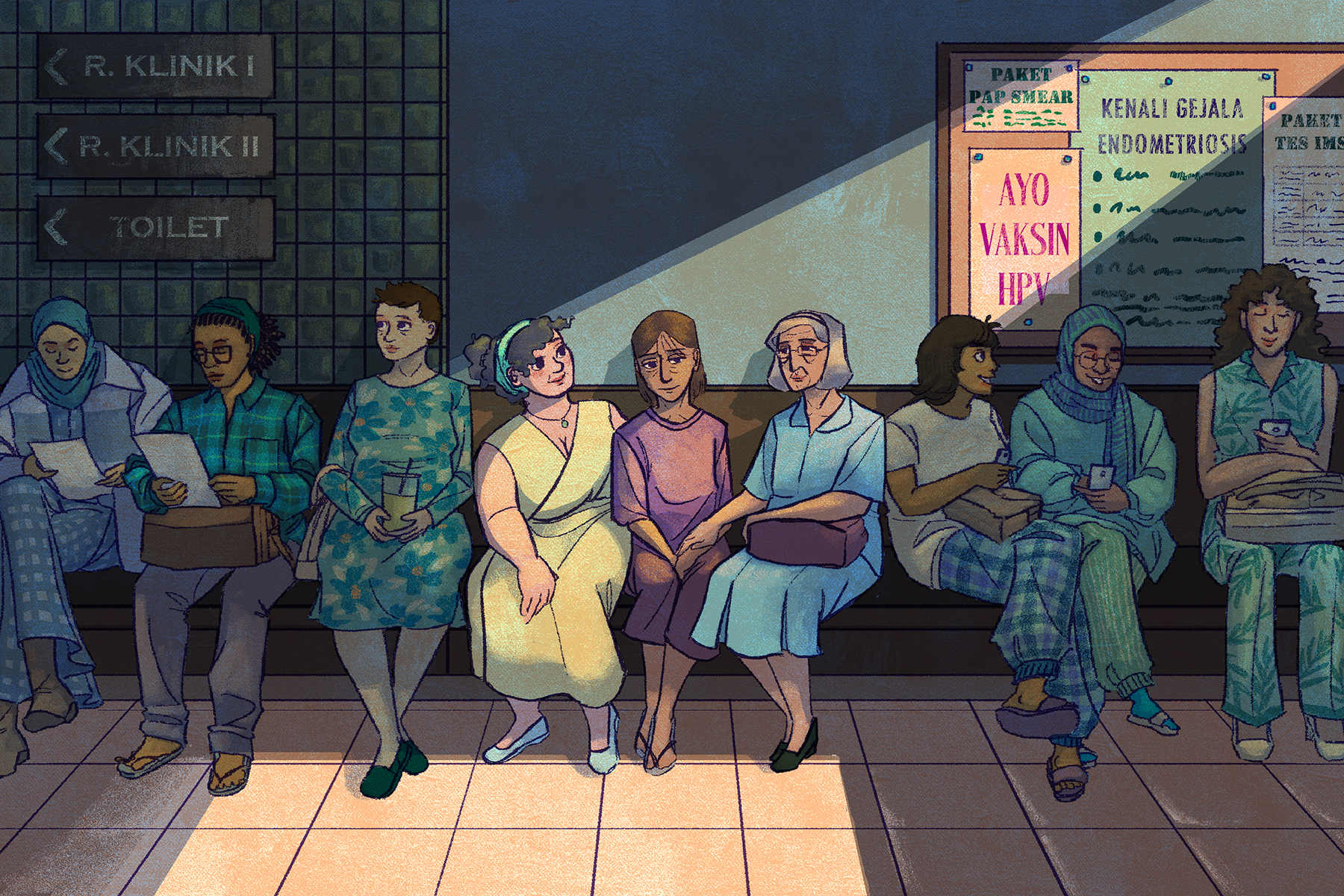
Indonesia’s 2009 Health Law permits abortion within six weeks of the mother’s last period, which is used as a matter of convenience to define the legal gestational age of the fetus, and allows that window to be extended in the case of a “medical emergency”. It is this window in the Health Law and Criminal Code that was revised in 2023.
But Ilyas, who previously headed an IVF clinic, called this contradictory. “There are people who have difficulty having children, and yet others are throwing their children away,” he said. He had made a similar suggestion at an event organized by the Indonesian Health Ministry to discuss the revisions to the Health Law.
“[See] how the fetus in the uterus is poked at, vacuumed. It cannot escape and has to accept its death with resignation,” Ilyas said. “Maybe those who are pro-choice need to see that video. Is there even an OBGYN [obstetrician-gynecologist] who is willing to perform an abortion up to 14 weeks?”
At the same event, obstetrician Rajuddin of Syiah Kuala University in Aceh asked, “What is the basis for allowing [abortions] up to 14 weeks?” He suggested that if it took that long for a woman to realize she was pregnant, she had not been raped but had been “enjoying sexual relations”.
These statements by prominent doctors in Indonesia reflect the sentiments of the general medical community. The IDI and POGI had insistently called for the abortion cut-off to be held at six weeks. Their objections were based on religious grounds rather than medical ones. Ilyas referred to a fatwa issued by the Indonesian Ulema Council (MUI) in 2005 that declared that abortions were only permissible within 40 days of conception, at which point, according to Islamic belief, the fetus gains a soul.
“Those of us who are Muslim will, of course, follow the MUI fatwa. If we do not follow the ulema, then what will we become?” Ilyas said.
More than 5,000 doctors were registered under POGI as of last year, and 65.7 percent were men. The organization is led by a male doctor, Budi Wiweko, and the organization has 11 men and one woman in its leadership. The four leaders of POGI’s advisory board are also all men.
In May 2023, the IDI held a forum titled “The Abortion Controversy in the Omnibus Health Bill.” At the forum, POGI representatives Budi and Nurhadi Rahman said their opposition to the cut-off extension stemmed from their dedication to the Doctor’s Oath, which was set down in a 1960 government regulation.
The oath was adapted from the World Medical Association’s 1948 Declaration of Geneva, which has been amended six times, the latest in 2017. The Indonesian version has never been amended.
| The Indonesian Doctor’s Oath, never revised | Declaration of Geneva, revised in 2017 |
| By God, I swear I will maintain the utmost respect for human life, from the time of its conception. |
I will respect the autonomy and dignity of my patient; I will maintain the utmost respect for human life; |
When Melati’s family sought help from the Women’s Crisis Center (WCC) in finding an abortion provider in Jombang, East Java, she was already four weeks pregnant. They had previously asked for assistance from the local police station but were rebuffed.
“Don’t abort the fetus,” the police had said, according to the family’s account. “It’s a sin.”
The Jombang WCC tried to assist Melati in accessing the health services she was eligible for. However, the medical facilities where Melati lived were not sympathetic to victims of sexual assault. Her family, with the help of a WCC counselor, went from one community health center to the next to get the referrals needed to obtain a legal abortion at a more advanced facility. But none of the health centers dared to give a referral for an abortion.
In an effort to expedite the process, the Jombang WCC brought a number of representatives of state agencies together to consider the case. The consultation was led by the Jombang Women’s Empowerment Agency and included the Jombang Social Services Agency, the Jombang Police, the Jombang hospital, and Melati’s legal team. But none of the agencies were interested in helping Melati obtain a legal abortion.
The Social Services Agency said children had to be protected from “age zero”. Its representative also questioned whether Melati could rightly be considered a rape victim under the 2009 Health Law because the Child Protection Law made no mention of the word “rape”.
The Jombang Hospital urged the family to have Melati carry the pregnancy to term, saying, “The baby will grow into a healthy child.” One agency head said they supported the Jombang WCC’s effort to help Melati access legal abortion services, but they asked for the agency to be kept out of it.
“As an institution, we cannot [support accessing abortion],” the agency head said, according to the WCC’s account.
Each agency tried to pass the buck to another. They questioned whether Melati had really been raped. Maybe the 12-year-old had had consensual sex? They also claimed an abortion would lead to public unrest.
“Jombang is a city of santri [Islamic boarding school students],” one agency said. “If one victim is given access to abortion, then many other victims will also ask for abortions.”
In the end, the representatives concluded that abortion services could only be provided if the police provided a recommendation. But the Jombang Police claimed they did not have enough experience on the matter to offer such a recommendation. The head of the Jombang Police’s criminal investigation division also warned that the WCC counselors could face criminal charges for trying to help Melati get an abortion.
When Melati finally obtained a referral to Dr. Soetomo Public Hospital in Surabaya, the only public hospital in East Java that had the necessary facilities, the hospital refused to provide abortion services. They said that the fetus was healthy and that Melati’s “plump” frame proved it.
By that point, Melati was more than six weeks pregnant.
Patients Who Are Victims of Sexual Violence
At her private clinic in Jakarta, Belas, a midwife with nearly two decades of experience who asked to use a pseudonym for this report, said she had often come across patients with unwanted pregnancies as a result of sexual assault, so often, in fact, that she decided to open a shelter for people such situations.
Belas said she had never encountered a patient who was a victim of sexual violence who was less than six weeks pregnant. Most were four to five months pregnant by the time she saw them. The earliest she could remember was 12 weeks.
Some patients have asked Belas to perform abortions. However, with the threat of criminal charges for providing an abortion outside the legal limits, Belas has been unable to help them. This has presented an inner struggle for the midwife. She knows that women who do not want their pregnancy will seek abortions elsewhere, and her refusal to perform the procedure could put them at risk of getting an unsafe abortion.
“There was even a friend of mine who said, ‘I’ll look for [an abortion somewhere else]. If something happens to me, don’t regret it.’”
Withholding treatment from those who needed it was painful, Belas said, “because it means I have denied them [medical service]. I have done something that is unethical according to the oath of my profession.”
Belas has met many women seeking medical services because they do not have full control over their own bodies. A woman who became pregnant because her partner did not allow her to use contraception. A woman who used contraception clandestinely and in fear because her husband prohibited her from doing so. A domestic worker who was raped by her employer and then forced out by the employer’s wife. A woman who handed her babies over to other family members after giving birth. A married woman who experienced unwanted pregnancy several times
Before the pandemic, Belas encountered a patient in junior high school who had been raped by her boyfriend in her hometown. The girl came to Jakarta to see her mother, who was working in the city, and asked Belas for help and stayed temporarily at her halfway house. Being about 7 months pregnant at the time, was obligated to carry the pregnancy to term.
The girl and her mother almost abandoned the baby, who was born at Belas’ clinic, but in the end, they decided against it and took the baby with them back to their hometown.
But it wasn’t a happy ending. Because the girl [victim] experienced many [bad] things. Her child also experiences many things and has been called ‘illegitimate’. –Belas, midwife
One patient abandoned her baby after giving birth at Belas’ clinic. “The baby was left neatly on the bed,” said Belas. Belas asked the local social services agency for help in caring for the baby, but the agency declined.
“They didn’t want to accept [the baby]. There was no budget for it, they said.”

The Health Ministry has yet to clearly designate any health facilities that are permitted to provide abortions for victims of sexual violence. Illustration: Sekarjoget/Project Multatuli
Abortion was first regulated as a criminal offense in Indonesia’s Criminal Code and was later carried over to the 2009 Health Law with certain exceptions added in, including the policy for rape victims.
But Belas said that instead of making abortion accessible to victims of sexual violence, the Health Law had actually strengthened the stigmatization of abortion among health and medical workers. She said the lack of clarity in derivative regulations and the threat of criminal charges had caused health facilities to create their own abortion policies, not in the interest of treating patients but to protect themselves from legal trouble.
Rape victims were constantly being doubted, Belas said. They were often asked, “Were you really raped?”
In 2014, the government issued derivative regulations to better define the Health Law’s policies on reproductive health.The chair of the IDI at the time, Zaenal Abidin, again opposed the regulations. He said he considered abortion for rape victims to be contrary to the Doctor’s Oath and the medical code of ethics.
“Don’t ask us [to perform abortions]. Don’t cause inner conflict in the conscience of a doctor,” Zaenal said at the time.
The regulations stated that healthcare providers performing abortions in cases of medical emergency had to have received training from accredited instructors. Further regulations in 2016 required training for health workers who provided abortions for rape victims. The regulations stated that abortions could only be performed at health facilities designated by the Health Ministry and that professional organizations were required to help develop curricula and provide training for abortion services.
The Health Ministry has yet to clearly designate any health facilities that are permitted to provide abortions for victims of sexual violence. Marcia Soumokil, a general practitioner and the director of the IPAS Indonesia Foundation, which was founded to help women obtain access to safe abortions, highlighted that the current rules made it more difficult to provide such services in the field.
“Of all the health services in Indonesia, there is not a single one that must be directly appointed by the ministry, because now we have regional autonomy. But safe abortion services must be specifically designated by the ministry,” said Marcia.
Not a Complicated Procedure
Despite the controversy surrounding the issue, the Omnibus Health Law, which extended the cut-off for legal abortions to a gestational age of 14 weeks, was passed in July 2023. The new window for abortion services was based on guidelines from the World Health Organization (WHO), which includes abortion as an essential health service.
The WHO’s 2022 Abortion Care Guideline recommends the use of vacuum aspiration abortion for gestation periods of less than 14 weeks. The method, particularly manual vacuum aspiration (AVM), is recommended because it is safer, faster, simpler, and cheaper than the sharp curettage method.
AVM can be used in health facilities with limited resources because it does not require electricity or anesthesia and can be performed by a medical worker who is not a doctor. Pregnancies of less than 12 weeks may, according to the WHO guidelines, be aborted with drugs such as mifepristone and misoprostol, which have been on the list of essential drugs since 2005.
Marcia Soumokil, general practitioner and director of the IPAS Indonesia Foundation, said, “Abortion can be done using simple surgical tools in a very standard health service system, it can even be done at the community health center in Puncak Jaya [Papua].”
“The condition is that the device can only be used for pregnancies of up to 14 weeks,” she added.
In Indonesia, the AVM method is recommended by the Health Ministry for post-miscarriage care, specifically when someone experiences an incomplete miscarriage or missed abortion. However, AVM is stigmatized as a method that is misused to perform abortions and is not standard procedure in most of the country’s health facilities.
If safe and legal procedures are followed, abortion services have a lower risk of death than giving birth. Research from 2012 found that the risk of complications or death from childbirth was 14 times higher than with safe abortion. However, IDI made arguments to insist only on the risks.
“Clearly, there are risks for the mother: bleeding, infections, anesthesia,” an obstetrician, Ari Kusuma Januarto, the head of POGI’s advisory board said.
Ika Ayu, the director of Samsara, an organization focusing on the rights to information on sexual and reproductive health, said the barriers for victims to access safe abortion came from the medical workers. Ika said this was a pattern that happened globally. Usually the stigmatizing began with an emphasis on negative consequences of abortions, despite the existence of safe methods. Ika said those who accessed legal, safe abortion underwent counseling and had time to make a decision after seeing things clearly. They got access to the recommended, safe method but the ongoing stigma on abortion dismissed such experience.
Jakarta’s Dr. Cipto Mangunkusumo National Central Public Hospital (RSCM) is Indonesia’s oldest teaching hospital. It is also a national referral hospital, meaning that smaller public hospitals and health facilities will refer patients they do not have the capacity to treat to RSCM. Among these referrals, RSCM often receives patients who are victims of sexual violence and are seeking abortions.
RSCM’s chief obstetrician, Seno Adjie, said abortions were not difficult to perform from a technical standpoint.
“Sometimes I think to myself, why do [smaller health facilities] have to refer [the patient to RSCM] when it’s only an abortion? But the issue is that they don’t want to make the decision. They don’t want to create a problem at their hospital from a legal or ethical perspective. So they refer the patient to RSCM,” said Seno.
For patients who are suspected of being victims of sexual violence, RSCM has an ethics committee that will decide whether the patient is eligible for abortion. They will ask for the victim’s report to the police and the results of the rape kit. They will also check the patient’s medical condition to ensure the abortion can be performed safely.
If the requirements are met, the RSCM team will immediately take action. Seno said the process usually took less than a week, as the team was mindful that there was a ticking clock for rape victims who wanted to access legal abortion. The RSCM team does not record the number of victims of sexual of violence who get an abortion at the hospital. However, Seno said that every year there were cases. “And more than one,” he said.
Patients come from various regions, from Depok, just outside Jakarta, to Padang, some 1000 km away in West Sumatra. Some patients have been rape victims with mental disabilities. The abortion ethics committee also considers indications of medical emergencies when examining cases of victims of sexual violence with unwanted pregnancies.
For example, the RSCM team once had a 10-year old patient who had been raped by a neighbor. By the time the girl was referred to RSCM, she was already 8 weeks pregnant, past the legal abortion cut-off for rape victims at the time. The team called in a child psychologist, who concluded that the girl would experience serious psychological harm if she was forced to continue the pregnancy.
“So it was decided that this was a medical emergency. Because of that, it was possible [to perform an abortion] even though [the pregnancy] was older than 6 weeks,” Seno said.
One rape victim came to the hospital 27 weeks pregnant. In despair about her pregnancy, she had repeatedly attempted suicide. “We concluded that there was a medical emergency because she wanted to commit suicide. [So we performed an] abortion.”
Seno could not confirm whether the Health Ministry had designated RSCM an official abortion provider. But he was certain that RSCM was in full compliance with prevailing regulations.
“If the victim requests it and [the case] meets the legal requirements, as a hospital that complies with the law and serves the community, we can [perform an abortion],” said Seno.
He acknowledged that there was debate about the safety of the 14-week gestational age limit among professional organizations. However, he believed that abortion in the longer window remained safe as long as it was carried out by competent health professionals with adequate infrastructure. “At RSCM, [abortions are] safe.”
Seno did not say whether he personally agreed or disagreed with abortion, but he emphasized the need to provide access to safe abortions. “If we want to have safe abortions, there must be an expansion of regulations. Otherwise, there will be many unsafe abortions.”
Stigma Leads to Unsafe Abortion
Given the barriers to accessing legal abortion, many patients do not seek help at medical facilities and rather try to find other ways to terminate the pregnancy. Research conducted by the Guttmacher Institute and the University of Indonesia in 2018 estimated that 43 out of 1,000 women aged 15-49 years in Indonesia had had an abortion. Of those women, almost a third had done it themselves and a few others had gone to traditional healers or pharmacists. Most of them consumed traditional herbal medicine or got traditional massages to terminate the pregnancy.
In her eight years of practice as a general practitioner, Sandra Suryadana said, she had never had a patient openly ask for access to abortion services in person. However, she had received some requests while providing telemedicine services. “Maybe because they don’t dare [to ask in person],” said Sandra.
In early 2019, Sandra initiated the social media account Doctors Without Stigma (Instagram: @doktertanpastigma). Through this platform, Sandra and her colleagues often hear from the followers about bad experiences seeking health services. Women complained about misogynistic OBGYNs, who would give lectures on their personal behavior and humiliate them.
Many of these complaints match Belas’s previous experience working at a hospital. She encountered coworkers who were reluctant to provide access to contraception to patients. If the patient was a widow, for example, they would ask intrusive questions. “Why do you need contraception? What for?” Belas said, mimicking her colleagues. Some of her co-workers would also question the experiences of patients who were victims of sexual violence. “Did you enjoy it?”
Belas once conducted a study on the views of health workers – midwives, general practitioners, specialists and others – regarding rape victims and access to abortion services.
“There are those who see [pregnancy resulting from rape] as a manifestation of past sins, that it’s their destiny. Whatever happens, the pregnancy must continue,” she said. “Women have to almost die before they can get services.”
Seno, the RSCM obstetrician, also often encounters fellow doctors who refuse to provide emergency contraception to patients.
Emergency contraception is a pregnancy prevention drug that a person can take three to five days after having unprotected sex. Health workers who refuse to provide emergency contraception compare the drug to abortion.
“My personal opinion is that all women have the right to reproductive protection,” said Seno. “If an OBGYN tells me that they don’t want to provide [emergency contraception] because of some moral principle or religious belief, then that’s okay. But they must understand that the patient has a right to it. They cannot obstruct that right. They must provide access [by referring the patient] to another doctor.”
Wherever she has practiced, whether at community health centers, company clinics, regional hospitals, private hospitals or even beauty clinics, Sandra has met women who are victims of violence.
“And that’s just me. My friends who work elsewhere must definitely come across some too, right? How come I’ve never heard anyone talk about this? Why are we all just putting a band-aid on the bullet hole?” she said.
Sandra was not taught the concept of people-centered care in her official medical training. The health facilities where Sandra worked previously also did not have standard operating procedures for offering treatment sensitive to the needs of different genders.
Likewise, Belas developed a people-centered perspective of care when she studied outside of formal midwife education.
“[The focus of formal education] is intense training, to make sure that we are competent, but we forget that health service providers need to be humane,” said Belas.
As a midwife, Belas said she was more comfortable working at her clinic, which once belonged to her now-retired mother, than in the hospital because in the clinic, she feels like she has authority.
When Belas worked at a hospital, she and other non-physicians were subject to domineering and condescending behavior from doctors, she said. Getting berated by a doctor was a daily occurrence. One doctor even slapped her hand when she handed them the wrong tool.
This undermining of non-physician practitioners, particularly midwives, results in severe limitations in access to essential health services, including safe abortions.
For safe abortions under 14 weeks of gestational age using surgical methods, the WHO recommends that not only general practitioners and specialist doctors be authorized to carry it out, but also midwives, nurses and traditional or complementary health workers.
The WHO says the task is among the main competencies of midwives. Also, female patients often report feeling they received more supportive service at the hands of midwives than with other medical professionals. In areas with limited access to doctors, whether through infrastructure and resources, midwives and nurses are crucial in expanding access to abortion services.
However, in Indonesia, abortions are predominantly carried out by OBGYNs, and these doctors are mostly male. According to the POGI website, among the 5,270 OBGYNs registered in 2023, 65.7 percent were male.
“Now, we can see the power dynamic. When it comes to women’s affairs, maternal health, abortion – that requires approval from an OBGYN. If they all refuse, then what?” Belas said.
In a House of Representatives hearing on revisions to Health Law in January 2023, Health Minister Budi Gunadi Sadikin echoed these concerns.
He said he had received complaints from midwives and nurses.
Health Minister Budi Gunadi Sadikin at the House of Representatives, gesturing to indicate the difference in status. Source: Screenshot from TV Parlemen via Project Multatuli
“In foreign countries, nurses and doctors are seen as equals. One team. Here, there is a caste difference,” he said, gesturing to indicate the difference in status. “In other countries, doctors really value and respect nurses. Not here. Nurses are seen as lackeys.”
This status difference matters so much to doctors’ organizations that in 2014, a number of them, including the IDI, petitioned the Constitutional Court to amend a law on health workers to have “medical personnel”, that is doctors, classified differently from other “health personnel”, which included nurses and midwives.
It is not only non-physician practitioners who fall victim to this hierarchical, seniority-based culture. Doctors, particularly younger and more junior ones, are often browbeaten by their fellow doctors.
In August 2023, the Health Ministry reprimanded three hospitals for allowing the bullying of doctors taking part in medical residency programs. IDI representatives called the ministry’s actions “excessive”, arguing that the supposed bullying made for more disciplined doctors.
This culture of fear extends to the provision of abortion services. One doctor said it was not just the threat of criminal prosecution that made some doctors hesitate to perform abortions for rape victims; they also feared what might happen to their careers if they ran afoul of doctors’ organizations.
Before the new health law was passed, the IDI was responsible for all practice permits issued to doctors. Regional governments had the authority to issue practice permits, but only based on recommendations from the IDI. To get a letter of recommendation, doctors had to register as an IDI member.
In 2022, PPH Unika Atma Jaya and the Indonesian Reproductive Health Knowledge Hub released a report entitled Analysis of the Abortion Situation in Indonesia. The report states that health workers who provide abortion information and services are often threatened with career ruin.
One of the people interviewed for the study said one doctor “told me that yesterday a doctor at [a certain hospital] had been fired for performing” an abortion.
Despite the adoption of the new health law, many health workers and counselors for victims of sexual violence say the healthcare system is still not doing well. “Why do we persist with a system that is no longer good?” asked a doctor.
The Need for Victim-Centered Services
Providing access to abortion services for victims of sexual violence is closely related to the swift and integrated handling of those victims’ cases. Given the cut-off time for legal abortion, sexual violence cases must be dealt with rapidly by both law enforcement and health officials.
According to the 2022 Sexual Violence Law, victims have the right to receive health services in the form of physical and mental examinations, treatment of injuries, prevention and treatment of sexually transmitted diseases, prevention and treatment of pregnancy, psychiatric and psychological therapy, as well as psychosocial rehabilitation.
However, in the field, these policies remain poorly implemented. Since the passage of the law, which calls for the government to take over counseling services for victims of sexual violence, access to such counseling has become more limited.
Ana Abdillah of the Jombang WCC has felt the change firsthand. She cited the case of a domestic violence victim.
“Her husband cut off her hair, beat her until she bled,” Ana said.
The incident occurred on a public holiday, so when the victim looked to the local women’s protection unit for help, they said they could not do anything because it was outside the agency’s opening hours. “This shows that we are dealing with a system where perspective, empathy and responsiveness are not priorities,” Ana said.

Victims of sexual violence have to wade through red tape to get the care they needed. Illustration: Sekarjoget/Project Multatuli
According to Margaretha Hanita, victim-centered care required not only that victims could access health services but that such services were actively engaged in reaching victims.
Hanita is a lecturer, practitioner and activist in the field of women’s resilience who has worked at an Integrated Care Center for the Empowerment of Women and Children (P2TP2A) for 15 years. She is now assisting the Jakarta police and a number of Jakarta hospitals in providing people-centered care. Over her 15 years of experience, Hanita witnessed how victims of sexual violence had to wade through red tape to get the care they needed. For example, victims’ health costs are typically not covered by the National Health Insurance program, which only covers official “diseases”.
“But a rape kit is not a disease. Injuries resulting from sexual violence are not diseases. Injuries [like] broken noses, being doused with acid, those are not diseases,” said Hanita.
Hanita has also worked with child victims of sexual violence who were denied care because they did not have a national ID card number (NIK), which are only provided to citizens 17 years old or above. Local governments also require victims to be registered at the local civil registry office before they can receive financial assistance.
“You have to become a resident of DKI Jakarta first. You have to have your biometrics [registered] first,” said Hanita.
Integrated services for victims of sexual violence also involve cross-sector coordination, which adds another level of complexity. The Bekasi Regency Regional Hospital (RSUD Bekasi), which plans to open an integrated service center, must invite at least the police, the local women’s empowerment agency and social services to offer integrated services for patients who are victims of sexual violence.
“It takes a high level of commitment to make an integrated service center. We have to involve many parties across sectors,” said Ida Hariyanti, head of the hospital’s medical and diagnostic services division.
Generally, patients who are victims of sexual violence are required to have a letter from the police requesting a rape kit before they can be examined for rape. However, RSUD Bekasi allows patients who have not reported their assault to the police to come to the hospital first.
“We handle the emergency first, complete the examination. If necessary, we contact the police,” explained Suryo, a forensic doctor at the hospital.
RSUD Bekasi is one of only a handful of health facilities that has prepared a special pathway for treating victims of sexual violence. The fact that most other hospitals and government agencies have not yet adopted this approach means that victims of sexual violence are often blocked from getting an abortion before the legal cut-off.
“Never mind victims who need access to a safe abortion; even victims who need access to a safe house are still told to wait,” said Ana.
Closing
Melati, the child rape victim in Jombang, was never able to access a legal abortion. Her child was adopted by someone else immediately after she gave birth. During her pregnancy, Melati’s family did not receive any healthcare support from the government.
“[Government help] was limited to basic foodstuffs,” said Ana of WCC Jombang. Even Melati’s prenatal check-ups were covered by the family and personal donations from others.
Melati and her parents experienced deep trauma as a result of the pregnancy. The Jombang WCC once accompanied Melati’s parents to buy clothes for the baby. When they got to the store, they didn’t want to hold the clothing.
“They were reluctant to even go into the store,” said Ana.
None of the victims that the Jombang WCC has assisted has been able to access legal abortion services. Research by a center at Catholic University Atma Jaya and the Indonesian Reproductive Health Knowledge Hub found that there were a total of 160 criminal verdicts related to abortion cases in the country from 2017 to 2021. As many as 45 women who sought access to abortion services were charged with crimes. A number of cases were prosecuted under the Child Protection Law, which contains an article that reads: “Everyone is prohibited from carrying out abortions on children who are still in the womb […].”
Ana said the problem was the systemic lack of sensitivity of the healthcare system to the needs of victims of sexual violence. “There are many loopholes in the legal structure that have no perspective on victims. In the future, our Health Law must be more humane,” she added.
In principle, regulations in the Criminal Code and the Health Law provide opportunities for women victims of sexual violence to access abortion services. However, the law still requires derivative regulations to ensure the availability of abortions. These regulations are still in the process of being drafted.
Project Multatuli sent a letter on Aug. 8, 2023, requesting an interview with the Health Ministry’s director general of public health. We also sent one to the head of the communications and public services bureau of the Health ministry, Siti Nadia Tarmizi. As of the publication of this article, the requests had received no response.
“When the law says that victims of sexual violence who experience unwanted pregnancies can access those services, they should be able to access those services,” Marcia said, “Let’s give them the rights that are governed by law.”