Trigger Warning: This story mentions physical and sexual abuse, forcible detransitioning of a trans person, death, and suicidal ideation.
It was 24 May 2024. Several queer and transgender people had gathered outside Kolkata’s Kantapukur Morgue, a blue-and-white building. They were waiting for the body of Tamoghno, a transgender woman who had died the previous day. Tamoghno’s natal family members were also present.
Sourish Samanta, a journalist and filmmaker who was at the morgue, recalled Tamoghno’s family members mourning her as “their only son.” Tamoghno’s friends, along with some of the Kolkata-based LGBTQ+ activists, tried to remind them that Tamoghno was a woman. But the family members continued to misgender her. “For many of us,” Aritra, a close friend of Tamoghno’s, told queerbeat, “it was like seeing what would happen were we to die.”
According to Aritra, an elderly trans woman present there remarked, “Even when I become a skeleton, people would call me a man.”
Model and theatre actor Tamoghno was 25 years old when she died. Her domestic help discovered her body “under mysterious circumstances” in her Kolkata apartment, according to a Times of India report.
In India, dead bodies have a legal right to dignity and fair treatment, as established in a 1989 Supreme Court ruling. A 2021 National Human Rights Council (NHRC) advisory built on the judgement by laying down guidelines for handling dead bodies. These guidelines require hospitals to hand over the bodies to natal families, who are required to register the death at the office of the local registrar, according to the 1969 births and deaths registration law. But most transgender people, facing discriminatory and violent treatment from their natal families who don’t approve of their gender, are forced to leave home, or are pushed out by their families. A 2018 NHRC study found that only 2 percent of the 900 transgender people surveyed lived with natal kin, while 93 percent lived with other transgender people in chosen families. Such chosen families, however, have no legal authority to claim dead bodies or perform last rites.
At one point while waiting at the morgue, Aritra overheard Tamoghno’s natal family members’ plans to drape her in dhuti-panjabi, a traditional outfit worn by Bengali men. Aritra had been numbed by grief until then. But upon hearing the family members discuss these arrangements, she was flooded with memories of evenings spent with Tamoghno. “We used to talk about death a lot, and she used to tell me that if she dies, I should ensure that she is dressed [in a sari] on her way to the crematorium,” Aritra recalled.
Immediately, Aritra alerted other queer and transgender persons present at the funeral. A heated debate followed as Tamoghno’s friends tried to convince the natal family to let her be seen off in gender-affirming clothing. Eventually, the family members “were outnumbered,” Aritra said. Tamoghno was taken to the crematorium draped in a customary white sari with a red border.
Tamoghno’s untimely and suspicious demise wasn’t an isolated incident. Transgender people often die young—murder and suicide are common causes of their deaths. A 2021 study in the Netherlands found that transgender women were nearly seven times more likely to die by suicide than cisgender women, while transgender men faced higher risks of death from “non-natural causes.” Another 2023 UK study similarly reported that trans people were almost twice as likely as cisgender peers to die from external causes such as suicide, homicide, or poisoning. The underlying reasons, this study noted, were transphobic hate crimes and chronic stress that transgender people face due to repeated exposure to violence, discrimination, and economic and social marginalisation.
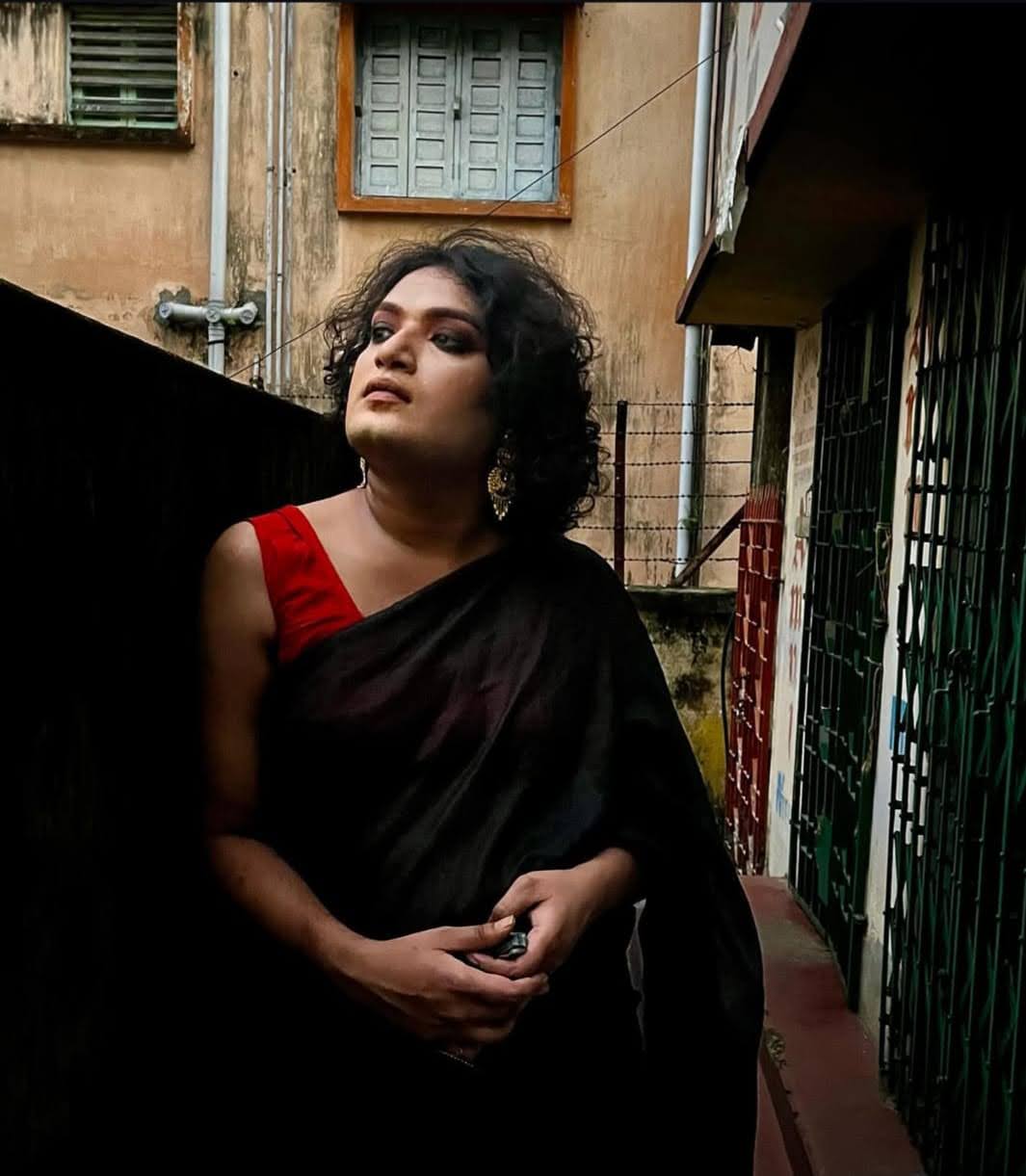
Photo: Tamoghno. Credits: Raj D Ahir, Source: Aritra Chatterjee
Although queerbeat could not find such systematic data for India, multiple queer and transgender people we spoke to agreed that the situation is similar in the country. “Many of my friends or acquaintances have gotten murdered or died by suicide,” said Sintu Bagui, a transgender-rights activist from West Bengal’s Seoraphuli town, as she recalled the recent discovery of a transgender woman’s partially burnt remains in Kolkata. Reshmi*, who is a member of a hijra household in West Bengal, echoed Sintu: “I cannot count on my fingers the number of hijra people I have seen murdered or die by suicide in the last five years.” Reshmi wanted her real name withheld because, according to her, seniors in the hijra community often prohibit disciples like her from speaking with the media. (Hijras are a South Asian cultural group of transfeminine individuals assigned male at birth. Some hijras may be intersex.)
As transgender people remain vulnerable to untimely and violent deaths, queerbeat sought to understand what happens after: for people who fight for a lifetime simply to live their lives on their own terms, do they get dignity in death?
***
Sourish always knew his friend Tamoghno as a woman “full of life.” Tamoghno had moved to Kolkata in 2018 from Siliguri, a city at the Himalayan foothills in West Bengal. When Sourish stood next to her body in Kolkata’s MR Bangur Hospital, he felt disoriented. “It broke me into pieces,” Sourish told queerbeat.
Tamoghno’s life was a “troubled” one, Sourish recalled. Fighting a lifelong battle against her natal family to freely live as a woman, she had taken to alcohol and substance use to cope, Aritra added.
The circumstances surrounding Tamoghno’s death were murky. According to the Times of India, Tamoghno’s domestic help discovered her body on the floor of her Kolkata apartment in a “bloodied state” and alerted Tamoghno’s neighbours immediately. Given the state in which her body was found, several queer and transgender people who knew Tamoghno told queerbeat that they suspected she was murdered. “Her phone also went missing and was never recovered,” said Aritra. However, according to the media report, the police suspected that Tamoghno might have died accidentally or by suicide.
Tamoghno’s body was taken to the MR Bangur Hospital, and then to the Kantapukur Morgue for a postmortem analysis. Bappaditya Mukherjee, a Kolkata-based activist told queerbeat that members of his youth organisation, Prantakatha, learnt from the police that they had registered Tamoghno’s death as a case of “unnatural death.” An unnatural death could include an accident, suicide, or murder, as per the NHRC. The police did not investigate the suspicious circumstances surrounding her death, alleged Bappaditya.
queerbeat’s attempts to find out more about Tamoghno’s death ran into institutional indifference and bureaucratic hurdles at every turn. Sisir Naskar, Superintendent of MR Bangur Hospital, told queerbeat that “the hospital does not receive copies of autopsy reports or hold any such information in their records.” He redirected us to the Golf Green police station, stating that Tamoghno’s death fell under its jurisdiction so they may have the autopsy reports.
Raja Dutta, the investigating officer who handled the case at the Golf Green Police Station, initially told us that the postmortem report concluded that she had died of a heart attack, and therefore, the case was not investigated further. He also claimed that all the documents related to the case were at a different police station in Haridevpur—a locality three kms away from Tamoghno’s house.
The Haridevpur police station officials told queerbeat that they didn’t possess any files related to the case since the area in which Tamoghno lived did not fall under their jurisdiction. The relevant documents would be at Golf Green Police Station, they added.
When we went back to Raja, he directed us to the Kolkata Police headquarters in Lalbazar saying that “all postmortem reports go to Lalbazar and can be accessed only by the natal family after a lengthy application process.” But this time, he claimed that he did not remember the details of Tamoghno’s case, since it occurred more than a year ago. When pressed further, he wavered on his earlier stance that the cause of Tamoghno’s death was a heart attack. He also changed his statement about the cause of why the death was not investigated, saying “either it was not a murder or because the [natal] family did not want to pursue the case.”
queerbeat reached out to Tamoghno’s mother via her Facebook profile, which was active at the time of writing this report. She did not respond to our requests for an interview. We also tried contacting Arundhati Hari Das, a relative of Tamoghno’s whose name was listed in the morgue’s official records as having signed off on the release of Tamoghno’s body. Arundhati did not answer our phone calls or respond to our WhatsApp messages.
Aritra, Sourish, and Bappaditya alleged that the police colluded with Tamoghno’s natal family to prevent an investigation. “The [natal] family kept mentioning [at the morgue and the crematorium] how cooperative the police is,” Bappaditya recalled to queerbeat. “They [the family] were in a rush to complete the last rites and head back home,” Aritra added. Raja, the investigating officer, denied any collusion with the family. “Why would they want to cover this up?” he asked, adding, “[Tamoghno’s death] is, after all, the family’s loss.”
The opacity of the official investigation into Tamoghno’s demise, coupled with the allegations of her family’s indifference, highlights a troubling reality: the systemic neglect of transgender people, in their deaths, as in their lives.
***
On 24 May, when Sourish and Aritra reached the hospital where Tamoghno’s body was taken, they found out that her gender was listed as “male” instead of “transgender” in the hospital forms. Tamoghno did not have a legal document certifying her transgender identity, and her friends’ efforts to negotiate with the hospital staff to correct her gender did not work.
“We even showed the hospital staff Tamoghno’s photos,” Aritra said. Tamoghno’s Instagram profile clearly stated her identity as a ‘transwoman’ and was replete with photos of her in saris. But, the hospital refused to correct Tamoghno’s gender in their records.
The misgendering continued at the mortuary, where Tamoghno’s body was kept in the men’s section, Sourish and Aritra told queerbeat.
Without a transgender certificate and ID card—legal documents from the Indian government’s Ministry of Social Justice and Empowerment that certify a person’s transgender identity—Tamoghno’s friends had little grounds for negotiation. “This is the norm,” Aritra said, “Our legitimacy has been reduced to a set of documents.”
In 2014, the Supreme Court affirmed transgender persons’ right to “decide their self identified gender.” However, the 2020 Transgender Persons (Protection of Rights) Rules introduced a “certificate of identity,” issued by a District Magistrate, making official ratification a condition for the recognition of one’s transgender identity.
According to multiple media reports, the procedure of obtaining a transgender certificate and identity card is sullied with bureaucratic red tape, unnecessary verification such as home visits to confirm addresses, and long waiting periods. As a result, most transgender people in the country have been unable to obtain these documents despite their persistent efforts to do so.
In the absence of these documents, the deaths of transgender people are officially recorded according to the sex they have been assigned at birth (i.e., male or female), Kanmani Ray, a lawyer and a transgender woman, told Behanbox in 2022. As a result, the state and the society remain unaware of how many transgender people die each year—or of the circumstances of their deaths—added Hyderabad-based transgender-rights activist and transgender woman Vyjayanti Vasanta Mogli in the same report.
(According to the National Crime Records Bureau’s latest report—the only official estimate queerbeat could find—13 transgender people were murdered in 2023. The report did not have separate data for transgender men and women.)
But sometimes even having a transgender certificate and ID card doesn’t ensure dignity after death. The case of Daina Dias, a 32-year-old Goa-based transgender activist, who died in January 2024, is an example.
***
“How did this happen?” Harold, a Goa-based gender-nonconforming fashion designer, remembered thinking at the funeral of their friend Daina in January 2024.
Daina was one of Goa’s few vocal transgender-rights activists. Harold had first met her in 2014 through Humsaath Trust Goa, a community-based organisation that, among other activities, provided free HIV testing to queer and transgender people. Daina was a field and outreach worker there. Daina and Harold soon became inseparable friends, Harold told queerbeat.
Harold supported Daina when she decided to transition legally in 2014, following the Supreme Court’s 2014 judgment granting legal recognition to transgender persons. That year, Harold said, Daina had her Aadhar card changed to reflect her identity as a transgender person. When Daina founded Wajood Goa, a transgender rights organisation, in 2018, the two celebrated together. In an interview published in the same year by MARG India, a legal rights NGO, Daina expressed that her aspiration for the next five years was to evolve into a social activist working for “all sections of the society.”
But as those five years drew to a close, Daina found her dreams curtailed by a family she described as abusive, a debilitating illness, and, ultimately, her death.
***
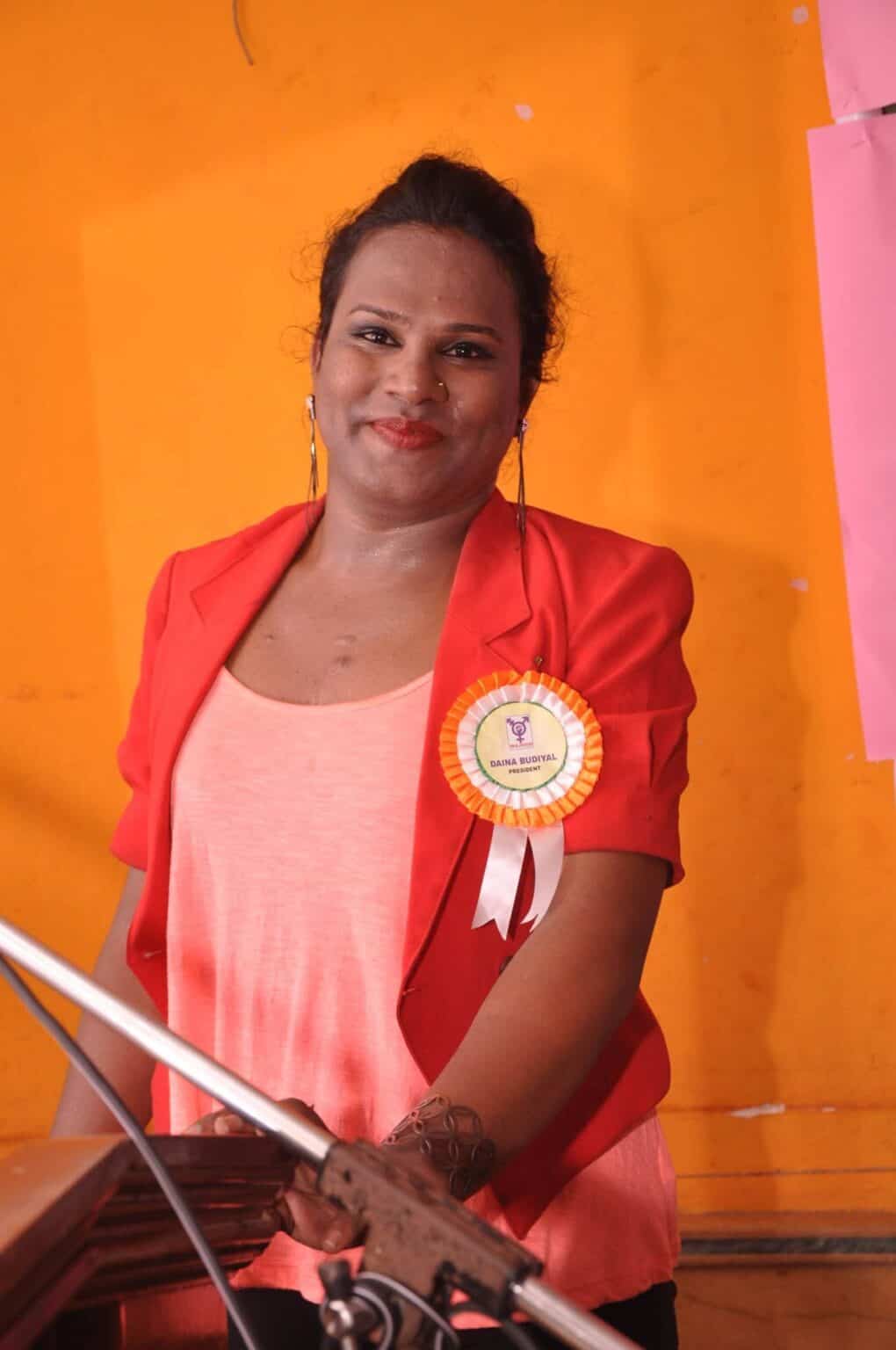
Photo: Daina, Source: Harold
Daina grew up in a cramped house in a densely-packed informal settlement near Vasco Da Gama, Goa. In interviews, Daina said her family physically and sexually abused her after she came out as a transgender woman, and later threw her out of their home. Sashi*, a close relative of Daina, whose name has been withheld by queerbeat to protect their identity, denied the allegations of sexual abuse. But they confirmed that Daina’s father and brothers had beaten her several times.
Several of Daina’s friends accused one of her brothers of being more abusive towards Daina. queerbeat contacted the brother to seek his response. He denied all allegations of wrongdoing. He claimed that the relationship between Daina and him was cordial. “I accepted my brother,” he said.
During our conversation, Sashi was overwhelmed with the grief of losing Daina. She believed that “a shaitan [demon] entered her [Daina’s] body,” while she was recovering from a terrible road accident she had when she was 16 or 17 years old. The demon, according to Sashi, was a hijra. That is how Daina started identifying as a woman, Sashi told queerbeat.
In Daina’s brother’s view, she started identifying as transgender because her friends—the queer and transgender people Daina spent time with—“performed black magic on [her].” “That is why he became shemale,” he said. During our conversations, both Sashi and the brother referred to Daina by her deadname.
(A deadname is the name assigned to a transgender person at birth, which they no longer use after affirming their gender identity.)
After Daina left her home, she lived alone in different parts of Goa, making ends meet, sometimes as part of a restaurant’s staff and at other times as a social worker, according to Sashi. However, in 2021, when the lockdown during the COVID-19 pandemic made it difficult for Daina to live on her own, she moved back in with her natal family. When she returned, Sashi recalled Daina saying that she had missed her mother and sister a lot.
(Multiple studies and reports have highlighted how the lockdowns during the COVID-19 pandemic adversely affected transgender people, including forcing them to return to abusive natal families.)
Madhur*, a non-binary illustrator and educator who took care of Daina during her last days, told queerbeat that soon after Daina was back home, her mother chopped off her hair, clicked a picture of her, and told people in the local marketplace, “my son has now returned.” Daina did not resist, claimed Sashi, who was aware of these incidents and confirmed them. Back at home, according to Madhur and Sashi, Daina was battling hallucinations and seizures. She was later diagnosed with schizophrenia, added Madhur, who didn’t want to reveal their real name in the story to protect their identity.
Madhur said that doctors at the Institute of Psychiatry and Human Behaviour (IPHB), Bambolim, Goa, where the schizophrenia diagnosis was allegedly made, had also asked the family to get Daina tested for encephalitis—a disease where the brain gets inflamed. However, Madhur added, the family didn’t get her tested because they were focused on detransitioning her. Detransitioning is the process of reversing one’s gender transition. IPHB declined to respond to our queries about Daina’s schizophrenia diagnosis citing patient confidentiality. And Sashi could not confirm the exact diagnosis.
But Sashi did confirm that the family attempted to detransition Daina after she returned home. Sashi recounted how she and other family members took Daina to a temple in Maharashtra. There, they dunked her in water and subjected her to rituals to exorcise the spirit they thought she was possessed by.
In November 2023, Daina’s sister—her only ally in the family, according to Madhur and Harold—alerted queer and transgender activists and allies in Goa to Daina’s failing health. Harold was one of them. They rescued Daina from her house and admitted her to the women’s ward at the IPHB, Bambolim, Goa. At home, Harold remembers being taken aback seeing Daina in short hair. “Daina was extremely proud of her hair,” they told queerbeat, adding, “this was not the Daina I knew; this was Daina before her [gender] transition.”
The group that rescued Daina also circulated a message through a local queer group on WhatsApp seeking volunteers to take care of Daina, Madhur recalled. Madhur was one of the people who responded. They and their friends started visiting and caring for her regularly.
Daina’s admission to the women’s ward at IPHB was possible only because a hospital worker recognised her from a gender-affirming care workshop she had conducted at the institute in the past, Madhur told queerbeat. Even then, they recalled that Daina was kept separate from other women, and that the nursing staff refused to tend to her. “In the women’s ward, there were two rooms. One had all the other women patients, and the other had only Daina,” Madhur said. The hospital declined to respond to requests for comment citing patient confidentiality.
At the hospital, Daina underwent electroconvulsive therapy (ECT), a treatment using controlled electric pulses, Madhur said. Several studies have reported that ECT can be effective for persons living with schizophrenia, although some studies suggest that cognitive impairment, such as memory loss, is a potential risk for some patients. Other studies dispute that ECT can cause cognitive impairment.
In Daina’s case, Madhur said that they observed signs of cognitive impairment: When Madhur saw Daina for the first time in November 2023, “she was present and responsive,” they recollected. But a few weeks later, she stopped being in the present, they added.
When Madhur and their friends visited Daina in the first week of January 2024—about two months after she was first admitted—they were shocked to learn that her natal family had gotten her discharged from the hospital. Sashi, Daina’s relative, told queerbeat that the attending doctor had deemed her fit for discharge. However, a couple days later, Daina’s condition worsened. Daina’s sister informed Madhur that she was being admitted to the Intensive Care Unit of the Goa Medical College. When Madhur went there, they recollect seeing Daina “completely unconscious and on tubes.”
A week later, Daina passed away.
***
Madhur was teaching a class when Daina’s sister informed them of her death. On the way to the hospital, one thought lingered on their mind: “We did not want Daina to be sent off in shorts and T-shirt, but in a gown.” Harold also told queerbeat that Daina had wanted “to be seen off in a bridal gown when she dies.” Madhur stopped at a store to buy one. At the hospital, Daina’s sister told Madhur that she had been admitted under her deadname. Given that Daina’s Aadhaar card stated her gender as “transgender,” Madhur and their friends could compel the hospital to correct the records. (queerbeat has seen a copy of Daina’s Aadhaar card.)
But this victory did little to reduce the ordeal that followed.
When Daina’s body was taken to a crematorium—after a day in the morgue so that all her family members could attend the funeral—she was dressed in shorts and a t-shirt. “We had no control over what was happening,” Madhur recollected. “The family got to run the show.” The only intervention Madhur and their friends could make was to put a bindi on Daina’s forehead: a small mark of her womanhood.
The misgendering continued even as the body lay burning on the pyre: Daina’s brothers continued to deadname her and refer to her as a man, Madhur and Harold recalled. “It was very disturbing to watch,” Madhur said, adding, “I realised how cheap transgender lives are.”
For Harold, witnessing Daina’s funeral was a moment of reckoning: “I realised that even when I die, my family will conduct my last rites as if I was a man.”
***
Tamoghno’s and Daina’s stories, and interviews with multiple transgender people reveal how the interference of the natal family often strips transgender people of their dignity after death. “Many transgender women have told me that they want to be cremated or buried in saris,” Sintu, the Seoraphuli-based transgender-rights activist, told queerbeat. “But after their death, their natal families conduct all the rituals as if they were men. The battle to assert one’s gender continues.” Sintu has witnessed the deaths of several underprivileged transgender people, hijras, and kothis. (Kothis, like the hijras, are a South Asian cultural group of transfeminine individuals assigned male at birth.)
Clothing and rituals are not the only aspects transgender people wonder about when they think of their death. Fateh*, a Delhi-based researcher and non-binary transman, said that he has also planned to divide his savings between his natal family, his partner, and some queer and transgender collectives. He had thought about how his body might be discovered, what stories might follow, and how he would be remembered.
Tan, a non-binary transmasculine person, told queerbeat that until our conversation, they had not thought about how their body would be treated after their death, despite “thinking about death often.” Tan works with Prismatic Foundation, a Varanasi-based queer and transgender-rights NGO. Like Fateh, Tan’s deliberations on their death focused more on their finances and their legacy. “I am more worried about what will happen to the projects I am leaving unfinished, and to the friend who needed my care and who I told, ‘I am tired today’,” they told queerbeat.
“Aaj mai jo jee raha hoon, tab mereko dignity nahi mil raha. [These indignities are happening when I am alive],” Tan said, adding, “When I go to a shop to buy a bottle of soft drink, I do not find dignity; when I was house-hunting in Varanasi, I did not find dignity; when I went to study at a university, I did not find dignity. How can I care about indignities after death?”
***
In India, the hijra community has been able to surmount some of these challenges to a certain extent. Hijra persons form familial bonds with each other in the guru-chela kinship system, a hierarchy consisting of gurus [leaders], chelas [disciples], and nati-chelas [disciples of a disciple]. Anthropologist Ina Goel notes in a 2022 study that hijras often list a guru as a parent or a spouse on official documentation, such as voter ID cards, which gives the guru the right to claim their body. Yet, as Reshmi, a member of a hijra household, told queerbeat, natal families still intervene upon a hijra’s death, overriding these ties.
Reshmi also observed that several burial grounds in Kolkata routinely deny service to the hijra community. A similar occurrence in Madhya Pradesh recently made it to the news. In such cases, one reported from Hyderabad, hijras and transgender people had to bribe caretakers of crematoriums and burial grounds to access them so that their community members were laid to rest peacefully.
According to Sintu, part of the reason these issues persist is that death remains underdiscussed in transgender movements. “We are constantly fighting about the right to live and the right to livelihood,” she told queerbeat. “But we don’t realise that after life and livelihood comes death.” Queer and transgender rights activist Bappaditya also stressed the need for stronger community mobilisation after a transgender person’s death, particularly in suspicious cases. Speaking of Tamoghno, he noted that “people were quick to commemorate the death instead of coming together and mounting pressure on the police to ensure a fair investigation.”
The big leap forward that can solve many problems in one go would be official recognition of chosen families. On 2 February 2023, a group of queer feminist activists and young couples petitioned the Supreme Court to “declare and recognise the constitutional right of members of the LGBTI community to have a ‘chosen family’ in lieu of next of kin under all laws.” The petition was among thirty that were grouped together into what came to be known as the marriage equality case. On 17 October 2023, the Court dismissed all the petitions.
A little less than a month later, on 13 November that year, news broke that Nanded, Maharashtra, was set to get a separate crematorium for transgender people—the second in the state. Commenting on this development, Farida, a transgender woman from the city, told The Times of India that “now, at least, there will be no social resistance to the last rites of our community members after their death.”
Only time will tell whether Farida’s expectations are met. But, like Sintu pointed out, the time to think about death is now.
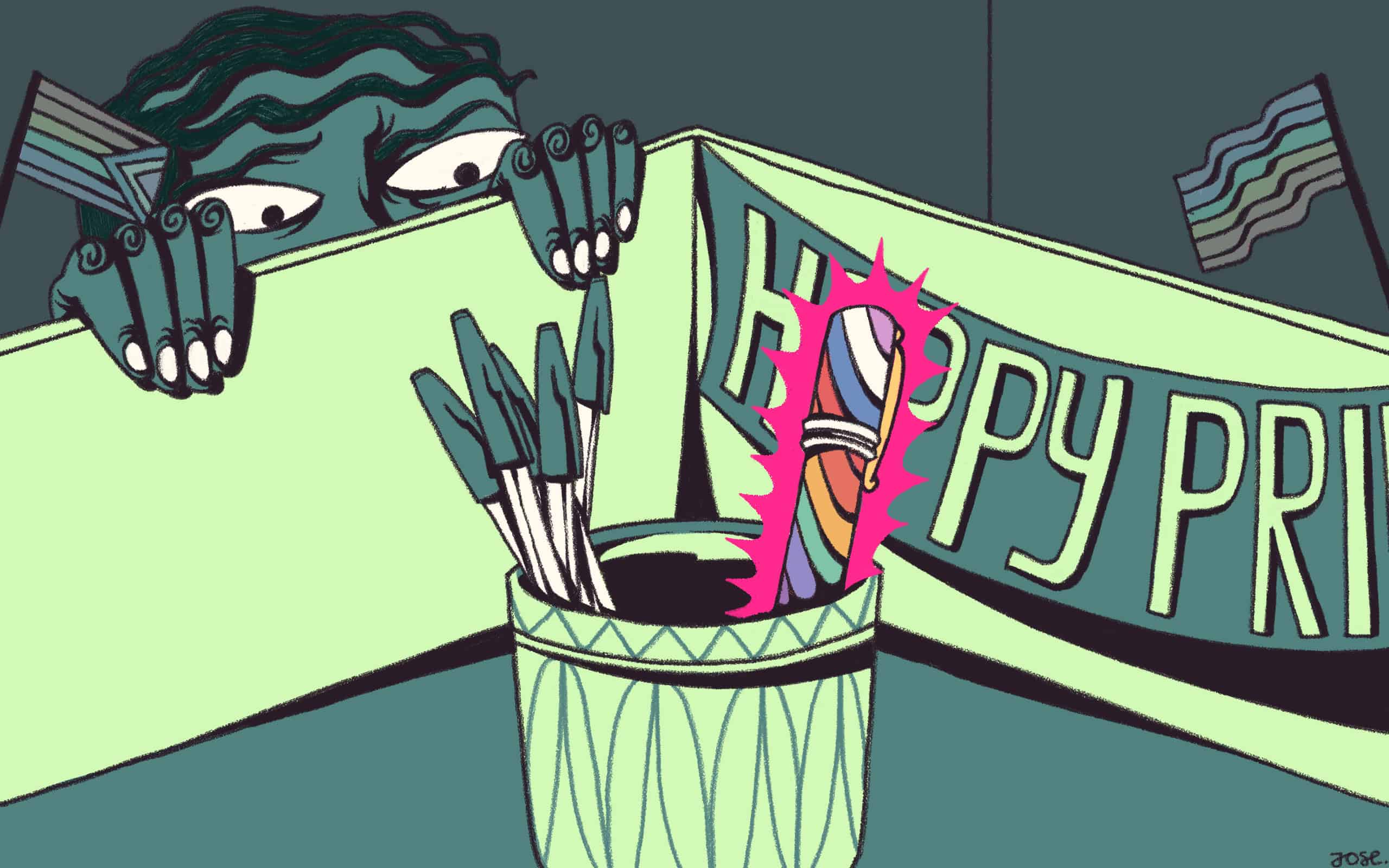
Illustration: Mia Jose
Trigger Warning: This article mentions a suicide attempt. Readers’ discretion is advised.
In April 2022, Sravan joined the Hyderabad office of an American multinational finance corporation as a technical operations analyst with a head full of curly hair and eyes full of dreams. The company’s public profile boasted of its commitment to LGBTQ+ inclusion at the workplace. Sravan, a queer non-binary person, recalls this promise being reiterated to them at the end of their interview for the role.
However, a few months later, Sravan saw the first red flag unfurl. At an annual marathon organised by the company for its employees, they heard “the manager of their manager” mention their sexual orientation casually to other employees. Sravan was surprised. They had not consented to their sexual orientation being publicly disclosed.
Sravan brushed it off as a one-time incident. But it happened again. And again.
In multiple casual office gatherings, the manager would tell other employees, “I have three queer people working under me, and Sravan is one of them,” Sravan recalled. They felt increasingly uncomfortable with their sexual orientation being the subject of casual office conversations. “My sexual orientation is a very personal piece of information,” they said, “and I felt that it was not being handled with care.”
In April 2023, a year after joining the company, Sravan decided to confront the boss publicly, asking them about the company’s confidentiality policy. Sravan recalls the manager dismissing and laughing at his concerns.
But over the next two days, the retribution, by Sravan’s account, was swift. First, they were accused of sexual misconduct towards other employees—an allegation that Sravan vehemently denies. Then, other members of their team stopped speaking with them—an act of social boycotting that Sravan suspects was ordered by the boss.
Soon after, Sravan filed a workplace harassment complaint against the boss with the HR team, which they remember having no queer representation. But Sravan claims he did not hear back from them for two weeks.
It was only when Sravan approached drag performer and tech professional Patruni Chidananda Sastry, who escalated the matter via Pride Circle, a consultancy firm that had facilitated Sravan’s recruitment, to the company’s global HR team, that action was taken. The company launched a six-month investigation, which ultimately led to the manager being found guilty. The result? Sravan was transferred to a different team under a different boss, but Sravan said the HR team declined to reveal what action had been taken against the manager.
By then, however, the workplace environment had soured beyond repair for Sravan. In August 2024, after dealing with months of mental distress, Sravan resigned. The company, a multinational finance empire with an annual turnover around the billion-dollar mark, continues to flourish.
Concerned about the repercussions of discussing their experience, Sravan requested that queerbeat use a gender-neutral pronoun for the boss and not reveal the name of the company. They also requested to be referred to only by their first name.
While queerbeat could not independently verify Sravan’s allegations, workplace culture and policy experts we spoke to agreed that discrimination against queer and transgender people remains commonplace in India’s corporate workforce. As is the practice of retaliation against those who decide to speak up.
“Corporations see themselves as these benevolent and kind people who are ‘allowing’ and ‘tolerating’ people from marginalised groups,” said Asiya Shervani, a senior workplace equity consultant. “Any complaint, or even feedback, is seen as betrayal.
Sravan is likely one of many queer and transgender people in India whose dreams of finding sustainable employment in India’s corporations have been blunted by workplace discrimination that targets their sexual orientation or gender identity. These experiences are in stark contrast to the public messaging by these corporations. For example, a 2023 annual report from the company where Sravan worked mentions the company’s commitment to “continually… create and reinforce a culture of respect, equity and inclusion.” The report also mentions the company having an office dedicated to “LGBTQ+ Affairs,” which “focuses on advancing a culture of inclusion for LGBTQ+ employees… and driving equity and inclusion for the LGBTQ+ community globally.”
In the process of reporting this story, queerbeat interviewed queer and transgender employees, scholars of gender and sexuality studies, workplace culture and policy experts, and representatives of organisations that liaison with corporates to increase queer and transgender visibility in the workforce. These conversations revealed that behind the rainbow banners and inclusive slogans that are becoming increasingly commonplace, the reality of queer inclusion in corporate India is a story of uneven progress and continuing exclusion.
While more queer and transgender people are entering the corporate workforce of late—mostly in entry-level positions—they often find themselves forced to quit due to explicit and implicit discrimination, poor complaint-resolution, and harsh retaliation when reporting unfair treatment.
From Adversary to Ally?
When India opened up its economy in 1991, global corporations scurried to enter the Indian market. And they brought with them the idea of “LGBTQ+ inclusion,” according to Pushpesh Kumar, a professor of sociology at the University of Hyderabad who has studied the lives of “urban corporate gay [men]” in India.
At the time, queer inclusion was a relatively new concept even in their home countries. Carlos A. Ball, a professor at the Rutgers Law School, writes in The Queering of Corporate America (2019) that until the 1970s, large American corporations were adversaries of queer and transgender people. According to him, in that decade, the many “gay liberation” and “LGBTQ Rights” organisations that cropped up in the backdrop of the 1969 Stonewall Riots began to actively challenge that stance.
By the turn of the century, this activism had resulted in many American corporations slowly becoming more welcoming of queer and trans employees. Corporations also began recognising that “adopting and supporting LGBTQ rights positions could help them maximise profits by reaching new customers while hiring and retaining the most qualified employees,” Carlos writes. This is perhaps what Starbucks’ then-CEO meant when he told Politico in 2012 that supporting same-sex marriage had been “good for business.”
In the early 2000s, as these global corporations began establishing offices and campuses in Indian cities, they pushed the Indian teams to “get on board” with the diversity, equity and inclusion (DEI) goals of the parent company, lawyer Meenakshi Vuppuluri told queerbeat. Meenakshi works as a subject matter expert on the prevention of sexual harassment and DEI with Kelp, a company that supports corporations towards making their workplaces safe and inclusive.
The winds of change also began to reconfigure some Indian workplaces. According to Parmesh Shahani’s book Queeristan: LGBTQ Inclusion at the Indian Workplace (2020), starting in 2010, the Indian conglomerate Godrej revised its anti-discrimination policy to explicitly forbid discrimination based on gender identity, sexual orientation, and gender expression; extended health insurance to same-sex partners of employees; and began to pay for gender affirming surgeries. Similar initiatives have also been instated by Tata Steel & Tata Consultancy Services, and Axis Bank. Tata Steel modified its HR policy in 2019 to make it “LGBTQIA+ inclusive,” a representative told queerbeat over email. “This policy recognises same-sex partnerships” and provides benefits such as “gender-neutral parental leave, nursing breaks for adoptive and LGBTQIA+ parents, medical coverage for partners, joint housing benefits, domestic travel assistance, annual health check-ups, and financial support for gender assignment surgery,” they added.
Official communications from these companies’ websites attribute these initiatives to the momentum generated by the Indian Supreme Court’s 2014 NALSA v Union of India and the 2018 Navtej Singh Johar v Union of India verdicts. In the 2014 judgement, the apex court formally recognised transgender persons as ‘third gender’ and upheld their right to self-determination of gender. In the 2018 judgement, the court decriminalised consensual same-sex sexual activity.
Over the years, thanks to the combined efforts of activists and courts, more corporations appear to be gradually joining the bandwagon of change. According to Srini Ramaswamy, co-founder of Pride Circle, a Mumbai-based consultancy firm that liaises with corporations to assist their DEI initiatives, the firm has enabled the hiring of over 1600 queer and transgender people in various companies over the last six years. Most of these appointments have been in the IT sector, Srini told queerbeat.
Given the increasing recruitment of queer and transgender employees, companies have also been working to devise inclusive policies to help them feel supported. The 2024 India Workplace Equality Index (IWEI) assessed 150 companies—most of them large Indian companies or multinationals operating in India—on their inclusion of queer and transgender employees. It reported that over 90% of these companies now offer health insurance to same-sex partners. Nearly 70% provide gender-transitioning support to transgender staff.
Cracks in the Gloss
While it is undeniable that change is happening, it is far from being systemic. The rosy proclamations of corporate DEI brochures often tend to gloss over the many cracks that continue to haunt Indian workplaces when it comes to queer inclusion.
The rising number of queer employees being hired for instance, while heartening, only represents a foot in the door that had previously been slammed shut. According to the Godrej DEI lab’s latest annual report (2024-25), the number of LGBTQ+ employees at the organisation is 245—about 0.5 per cent of all employees at the company. At Tata Steel, the number is at 110, a company representative informed queerbeat. While these numbers are minuscule in the larger context, it is also important to note that these companies have made far more progress than their peers.
These numbers, which group all queer and transgender employees under the “LGBT+” label, invisibilise the fact that transgender people are especially under-represented in the workplace. According to Zainab Patel, a transgender woman who has led DEI initiatives at several multinational corporations, trans people find it much harder than cis queer people to find corporate jobs. She points out that one major reason for this gap is the limited access transgender people have to educational opportunities. A 2017 NHRC survey found that fewer than 20% of transgender respondents had completed school, and under 10% had earned undergraduate degrees.
Further, most queer and transgender people are hired in entry- and mid-level roles, Pride Circle’s Srini and Mobbera Foundation’s Savithri told queerbeat. (Like Pride Circle, Mobbera Foundation helps multiple corporations in Hyderabad recruit queer and transgender people.) Savithri pointed out that most of the hiring she has been involved in has been for “ground-level positions”: those consisting of “security staff and people sitting at the front desk.”
Srini explained that this trend is “partly due to corporate hiring practices that reserve senior roles for employees who have been with a company for a relatively longer term.” But Patruni, a Hyderabad-based drag performer and IT professional, suspects a more sinister reason: those hired in entry-level positions are “easily replaceable.”
Disposable employees
Hiring is only the beginning of a queer individual’s corporate journey. What follows after a queer person enters a corporation?
Patruni’s experience suggests a grim answer. Patruni had worked for ten years in the Hyderabad office of a multinational auditing and consultancy firm, until an encounter with corporate queerphobia forced them to quit in May 2021.
In late 2020, the company’s intranet forum featured an article about Patruni’s journey as a queer dancer and data analyst. They recall the article making them feel like they could trust in their workplace, and as a result, they came out as genderfluid to their colleagues. Later, it became all too apparent to Patruni that they had mistaken a formal, tokenistic gesture to be reflective of the company’s larger attitude towards queer people.
Patruni worked under a manager whom they suspected was biased against queer people. They claim that soon after the article was published, the manager became hostile. Per their account, she started assigning them an impossibly high workload. “There was always a new project to work on,” Patruni recounted, adding, “My job role did not involve taking client demos, but my manager added that also to my workload.”
When they took up the issue with the company’s Internal Complaints Committee—set up under the Sexual Harassment of Women at Workplace (Prevention, Prohibition and Redressal) Act, 2013—it was dismissed because Patruni was regarded, officially, as a man and the Act provided no redress for men. Patruni said that their complaint was instead registered as a case of workplace harassment with the company’s internal compliance team.
The team formed a committee—which did not have any queer or transgender representatives—to investigate the complaint. After four months of investigation, the committee found the manager innocent, Patruni told queerbeat.
Patruni could not share with queerbeat a copy of their complaint and the committee’s decision because the communication took place over the company’s internal mail, which they no longer have access to. However, screenshots of WhatsApp communication between Patruni and a member of the company’s DEI team, reviewed by queerbeat, confirmed that the manager was found innocent because of a lack of proof.
In retribution for the complaint, Patruni said they were declared an underperformer by the manager. To prove their commitment to the job, they recalled being told to work at odd hours over and above their regular working hours. Then came heightened scrutiny and comments on their English-speaking skills. “My manager started telling me—sometimes during calls with clients—that I speak English with an accent,” they recollected.
Patruni felt discriminated against. And with the internal compliance team having closed its doors to them, they also felt trapped. In March 2021, they attempted suicide within the premises of their workplace.
The suicide attempt should have ideally made the company take Patruni’s complaints more seriously. Instead, they were asked to take an online “support session,” and given a ten-week notice to resign, Patruni told queerbeat.
A year and a half later, when they applied for a different job in the same company, they said they were told that the company had blacklisted them. queerbeat has not been able to independently corroborate this claim.
Cut to June 2024, and the company’s Hyderabad office commemorated Pride Month by unfurling the pride flag like it had always belonged there. “And my manager is still there,” Patruni said, their voice low.
In 2021, after leaving their previous job, Patruni briefly joined the India office of a Canadian IT firm, whose name they requested queerbeat keep confidential. Patruni says the company had no policies for queer or transgender staff. When they raised this with HR, they were told the firm treats everyone “equally.” When Patruni said they felt unsafe without such protections, the HR manager suggested termination.
“Let us figure out how to relieve you,” they recall being told. Ten days later, Patruni said they were out of the company.
“They do not want to resolve, only relieve,” Patruni said.
Sastry’s and Sravan’s experiences are not isolated examples. In both cases, the pattern was the same: lack of queer representation in complaint-resolution teams and brutal pushback when employees complained of being treated unfairly. These are two reasons why queer and transgender people who have breached the high walls of corporations choose to—or are forced to—leave.
Restricting queer and transgender people to lower rungs of the corporate ladder means that they remain inadequately represented in key decision-making bodies. “Even if a corporation hires 100 [queer and transgender] people in a year, how many of them will become a director ten years down the line? That is where the real visibility and decision-making power is,” Zainab told queerbeat.
This process of people leaving a company is called attrition. And it appears to be common with queer and transgender employees. In their survey of 300,000 employees across 28 organisations in the United States, University of Michigan sociologists Erin Cech and William Rothwell found that about 38 per cent of LGBT employees intended to leave their workplace within a year.
In India, there is scant data on attrition with regard to queer employees. Even organisations such as Pride Circle and Mobbera Foundation do not track attrition after six months of joining, Srini and Savithri told queerbeat. Similarly, while Godrej DEI Lab’s annual report documents the attrition percentage of women employees, it does not currently provide the statistics for queer and transgender employees. The Tata Steel representative told queerbeat that they have had “very few attritions” of queer and transgender employees.
Essentially, while more and more corporations are adopting queer inclusive policies and there is some evidence to suggest that an increasing number of queer and transgender people are being recruited, little is known about whether these policies are working to support and retain queer employees.
Potential solutions
A publicly-available code of conduct from Patruni’s previous company—the one they worked for until 2021—says, “We do not tolerate discrimination or harassment of any nature on the grounds of gender, race, religion, age, disability, gender identity, sexual orientation…”
Asiya, the workplace culture and policy expert, said that the experiences of queer employees reveal the huge gap between “a very nice policy document” and “completely wrong implementation.” According to her, the implementation fails, at least partly, because of the lack of queer and transgender people, or allies, in complaint-resolution committees. Many people who serve on these committees are “perpetually scared about their own careers and promotions,” she told queerbeat. This compromises the committee’s neutrality.
As a solution, she suggests that complaint-resolution teams in cases of workplace harassment include external members, i.e., those not associated with the organisation. The Sexual Harassment of Women at Workplace (Prevention, Prohibition and Redressal) Act, 2013, suggests a similar model for internal complaints committees that deal with cases of sexual harassment. Asiya acts as an external member in several such committees at corporate and non-corporate workplaces. “There are a lot of things I can say as an external member, which even the chairperson [of the committee] cannot say,” she told queerbeat.
Meenakshi, the lawyer, agreed with Asiya. She also advocated for stronger confidentiality practices when a complaint of workplace harassment is filed, in addition to “escalation matrices” that do not push the employee to rely on the HR or their manager to handle their workplace complaints. An escalation matrix is a set of procedures that outlines different individuals to whom a workplace harassment complaint can be raised.
Finally, Meenakshi also suggested that employees be informed about these policies and escalation matrices through periodic training sessions. “One can openly address the question of retaliation in these training sessions,” she added.
A Rocky Path Ahead
Parmesh, Godrej DEI Lab’s head, agrees that the status quo with regards to queer and trans inclusion in India’s corporations is “not ideal.” “But then, what is?” he asked, adding that “I think it’s okay to start from somewhere, anywhere, and go on the journey, rather than not go on it at all.”
At the time of writing this report, a global force threatens this journey. As of March 2025, US President Donald Trump signed executive orders banning DEI programmes in government, leading to the closure of diversity councils and withdrawal of funds for DEI initiatives. Following the order, it has been reported that nearly 37 major firms—including IBM, Google, and Deloitte—began rolling back queer and trans-inclusive policies, events, and hiring initiatives.
Patruni said that the effects are showing up in India too: unlike the 15-20 invitations they would get every June to participate in events to sensitise company staff about queer and transgender lives, this year they have gotten only five. Srini, Pride Circle’s co-founder, said that hiring of queer and transgender people through online and offline job postings has remained largely unaffected. However, while 35 companies signed up for Pride Circle’s RISE job fair last year, only 17 signed up this year. The RISE job fair is Pride Circle’s annual event that brings queer and transgender people seeking corporate employment face-to-face with corporations willing to hire them.
As global corporations go back on their promises of queer and transgender inclusion, several people see this as a moment for homegrown Indian corporations to fill the gap. “[Multinational companies] provided the ignition,” Harsha Ravikumar, product manager at Microsoft and a gay man, told queerbeat, “but now [Indian] companies are taking it upon themselves to be more sustainable with their DEI initiatives.” Zainab, the ex-DEI lead at multiple global corporations, agrees: “This is a pause in the movement, not a full stop.”
Trigger warning: This story mentions rape and sexual assault.
“I felt dirty. I felt very dirty,” Sheikh Arsalan Ullah Chishti remembers feeling the morning after the Saturday night in June 2018 when they were allegedly raped by their friend.
That night Arsalan, then a 21-year-old queer person, had gone to their friend’s apartment in Delhi’s Lajpat Nagar to drink and chill. As the night progressed, so did the intoxication. Arsalan recalled that at some point, their friend started forcing himself on them. They tried to push him away but eventually froze. The details of the rest of the night are a haze for Arsalan. They remember waking up the next morning and crying. The friend, Arsalan recalled, attempted to calm them down, saying that he felt really bad about what happened and that Arsalan was “like a brother” to him.
“I didn’t know what to do; all I knew was that I was in pain,” Arsalan told queerbeat in early April this year. They got up, puked, and dressed up to leave. Their friend, by that time, had rolled up a joint and was smoking it on the bed. Arsalan looked at him, said “f*ck you, brother,” and left.
Arsalan recalled a painful auto ride back to their apartment. The ride felt unusually long, they said. Arsalan added that initially they didn’t consider reporting the incident to the police because they felt traumatised and confused. Later, from time to time, they would wonder whether they should go to the police. “But my life had moved forward by then,” they told queerbeat. Almost seven years after the incident, Arsalan now remembers this incident as a bad dream that is vivid in some parts, and hazy in others.
If they decide to report the alleged incident now, nothing would come of it because it is no longer recognised as rape by India’s current criminal laws. The country’s laws on rape and sexual assault recognise only cis women as victims or survivors, and only cis men as perpetrators. Arsalan was assigned male at birth. They could have reported the incident under Section 377 of the erstwhile Indian Penal Code (IPC)—until July 2024. That is when India’s ruling political party, Bharatiya Janata Party, replaced the IPC—the law that dealt with criminal acts and their punishments—with the Bharatiya Nyaya Sanhita (BNS), deleting Section 377 in the process.
That section was the only recourse for men, queer or straight, and trans people to seek legal remedy against certain forms of sexual violence—specifically those involving penetration. While Section 377 earlier criminalised all “carnal intercourse against the order of nature,” including homosexual sex acts, the Supreme Court of India in 2018 decriminalised consensual same-sex sexual activity between adults and restricted Section 377 to non-consensual sex. A perpetrator could get imprisoned for up to ten years with a fine, or even life imprisonment.
Transgender people, who are also excluded from the rape laws under the BNS, can turn to the Transgender Persons’ (Protection of Rights) Act, 2019. But, the maximum punishment for sexual violence under that act is just two years. In contrast, rape against cisgender women, as per BNS, carries a minimum penalty of imprisonment for ten years. “The lesser punishment for crimes against transgender people reiterates and strengthens the idea that trans lives are dispensable and of lesser value,” trans rights activists have argued.
Put simply, the new criminal law (BNS) has completely deprived men—queer or otherwise— from protection against rape and sexual assault, and forced transgender people to rely on a weaker law. In addition to that, the BNS offers no recourse to women who experience sexual violence at the hands of other women. To discuss these issues, queerbeat has reached out to the Ministry of Home Affairs with an interview request but haven’t heard from them. The story will be updated if we receive their response.
The transition to BNS has reignited the debate about whether India’s rape and sexual assault laws should be made gender-neutral: an idea that has a long and highly contentious history tracing back many decades. Many activists, lawyers and scholars queerbeat spoke to remain wary of the idea. Some of them suggest a different solution: gender-specific laws that address more forms of sexual violence, including those faced by queer folks and transgender people. But is India ready for such changes in the rape laws?
Numbers
While there is plenty of data on sexual violence against women by men in India, it is scanty when it comes to women sexually assaulting men. A 2019 study in the Indian Journal of Community Medicine, which interviewed 1000 men in Haryana, found that only 0.4 percent of them had reported being sexually assaulted by women.
Sexual violence against queer men by other men, however, is far more common—rendering them uniquely vulnerable to the lacunae in India’s current laws. According to a 2024 study in BMC Public Health that surveyed 300 gay and bisexual men from six metropolitan cities in India, 37.3 percent of respondents between 18 and 24 years of age reported facing sexual violence, including rape.
Rape against trans people is also rampant. According to a 2015 report by the National AIDS Control Organisation, 31.5 percent of about 5000 hijra and transgender women reported that their first sexual encounter with a man was a non-consensual one. Although old, this is the most comprehensive data on sexual abuse against trans people queerbeat could find. A 2019 study published in Transgender Health that surveyed almost 300 hijra and kothi individuals in Bengaluru reported that around 28 percent of its hijra respondents and almost 19 percent of its kothi respondents were raped in the last twelve months. Hijras and kothis are South Asian cultural identities involving gender-diverse individuals, many of whom are assigned male at birth. Some hijras are intersex.
India’s rape laws have always been stacked against queer men. Despite the high number of them facing sexual violence, only a few of them could turn to the legal system for justice, even—and especially—when Section 377 was in full force. “There will not be many cases you can look at,” Mihir Samson, a Delhi-based lawyer told queerbeat.
That’s partly because before 2018 Section 377 itself criminalised same-sex sexual activity. Filing a case of sexual assault under that required the complainant to reveal aspects of their sex lives, which could implicate them. Post 2018, when consensual sexual acts were decriminalised, many queer men who faced sexual assault could not bring themselves to invoke Section 377, said Mihir. After all, it wasn’t easy for them to trust a law that had criminalised their existence for more than a century.
But, on paper, the law was there to protect queer men if they wanted to use it. Visvanath, a 35-year-old PhD scholar at IIT Bombay, decided to do just that. In 2019, he met an older man via Grindr, the popular gay dating app. According to Visvanath, the man began coercing him into sexual acts that he did not want to participate in. Eventually, the situation worsened, and the man allegedly began blackmailing Visvanath and making threats against his life.
Such cases of extortion and sexual assault through Grindr are notoriously common. Yet, such crimes “live as an open secret in the queer community, and shame, exclusion and trauma further prevent people from filing a legal case,” Jaishree Kumar wrote for Boom Decode in January 2024.
Visvanath, however, gathered the courage to go to the Rafi Ahmed Kidwai Marg Police Station in Mumbai to report the sexual and mental abuse. This was in January 2020.
The police were initially dismissive, said Visvanath. However, in 2023, after Visvanath submitted more substantial evidence, such as recordings of phone conversations and texts with the accused, they registered an FIR against the man under Section 377 along with other criminal charges. Since Visvanath’s complaint had been filed when Section 377 was still in force, the case continues to be prosecuted under its provisions. The case was being heard in the Mumbai Sessions Court at the time of writing this report.
If this alleged crime were to take place today, Visvanath—like Arsalan—would have no recourse.
Left in lurch
In March this year, Rohin Bhatt, a lawyer and author, spoke with queerbeat on a video call. They were sitting in the drawing room of their Delhi apartment that doubles up as their chamber for consultations with clients. Behind them was a white wall adorned with pictures—each of them bordered by thick black frames, which, in their aesthetics, resembled Rohin’s spectacles.
Less than a minute after our conversation started, Rohin paused, stepped out of the frame, and returned with a copy of the BNS. They then took us through the different Sections of the 102-page document.
Sections 63 and 64 deal with rape. And only a woman—“a female human being of any age”—can be the victim of a rape. Although the sections do not specifically include trans people, according to Rohin, a trans woman can also fall under the definition of a woman “provided she is certified as a woman.” That means they must have a certificate and identity card issued by the Indian government recognising their gender as a transgender woman.
queerbeat could not find official data on the number of trans women who had been issued these documents. However, the National Portal for Transgender Persons reports that 26,000 trans people have been issued a certificate and identity card from the 30,000 who applied for these so far. As per the 2011 census, there are 487,803 transgender people in India—which is an undercount at this point since the data is a decade and a half old. That means, only about five percent of India’s transgender population can legally claim to be transgender.
Even if a trans woman were to have the documents, it is possible that a judge could disagree with Rohin’s reading of the law. In a 2024 judgement, the Himachal Pradesh High Court stated that “transgenders [people] could not claim themselves to be male or female as they were given separate identity [in the BNS],” SCC Times reported.
There are no cases yet where a transgender woman has filed a rape complaint under the Section 63 and 64 of the BNS, said Rohin. The 2024 judgement by the Himachal Pradesh High Court was in a case where a transgender woman had invoked Section 69 of the BNS, i.e., the section that deals with “sexual intercourse by employing deceitful means.” While the court recognised that “the offence alleged to have been committed by the accused was of heinous nature,” it granted bail to the accused.
“This has not set a good precedent,” Tripti Tandon, a lawyer practising in the Supreme Court and associated with the Lawyer’s Collective, a New Delhi-based NGO that provides legal aid to marginalised communities, told queerbeat. Tripti was one of the lawyers who argued for the decriminalisation of consensual same-sex sexual activity in 2018 at the Supreme Court.
When it comes to transgender men, both Tripti and Rohin said that they are not aware of any cases where transgender men have filed sexual assault or rape cases—either under the BNS’ provisions or those of the older IPC. In absence of examples, one can only speculate on how the law would deal with such a case. Transgender men who possess official documents certifying them as men could technically fall outside the category of the victim, as per the BNS.
If they don’t have the documents—and assuming the trans men have not undergone medical transition—they could theoretically use their assigned-female-at-birth status to file rape complaints, said Tripti. This would, however, come at the cost of misrepresenting their gender identity. Although this might be a legal workaround, “having to constantly go back to their sex assigned at birth and a gender that they have rejected [i.e., woman] could be quite traumatising for them,” Tripti added. Rohin agreed.
“This is why transmasculine people typically do not approach the police when they are molested, sexually assaulted, or raped,” said Satvik Sharma, a Delhi-based trans man. Satvik is a co-founder of the Misfyt Foundation, a Delhi-based NGO that advocates for the inclusion of transgender persons in the workforce. Satvik said he has heard many accounts of trans men facing sexual violence but none of them resulted in FIRs or court cases. “The survivors typically pack up their lives and shift to a different place, hoping to leave behind the trauma and start a new life afresh,” Satvik told queerbeat.
For women who are sexually assaulted by other women—that’s not even a crime since the BNS only recognises men as perpetrators. When the post-2018 version of Section 377 was in place, at least cases of sexual assault that involved penetrative sex acts using fingers or other objects by a woman could be redressed.
Rohin pointed out that women facing marital rape have also been impacted by the BNS’ deletion of Section 377. “Wives would file an FIR in cases of marital rape using Section 377,” they said. Neither the erstwhile IPC nor the BNS recognise marital rape as a crime, but if a married woman was subjected to oral or anal rape by her husband, it would have fallen into the purview of “carnal intercourse against the order of nature” mentioned in Section 377.
Courts are, however, divided on this issue. While the High Courts of Madhya Pradesh, Uttarakhand, and Chhattisgarh did not allow the use of Section 377 in cases of marital rape, the Karnataka High Court has upheld—in one case—the invocation of Section 377 by a woman who was forced to have “unnatural anal sex, oral sex” by her husband. This case is being contested in the Supreme Court, which is yet to deliver its verdict.
In short, barring rape against a woman by a man who is not her husband, the new criminal law is blind to sexual violence against many other identities. In most cases, the BNS makes it totally legal, and in others, it forces victims to rely on weaker laws. All the activists, scholars, and lawyers queerbeat spoke to agree that this is unjust. But most of them also agree that making the rape laws gender-neutral is probably not a good solution.
To understand why, we need to look at the history.
How did we get here?
26 March 1972. Mathura, a 16-year-old Adivasi girl was raped by Ganpat, an intoxicated constable inside a police station in Gadchiroli district, Maharashtra. Head constable Tukaram was too intoxicated to rape her, but he did touch her and remarked “achhi hai” [she is good], Mathura recounted to The Print fifty years after the incident.
Initially, in 1974, a sessions court acquitted the two constables, citing that Mathura was a “shocking liar.” However, when the case caught the attention of feminist activist Seema Sakhare, she filed a petition in the Bombay High Court. In 1976, the court set aside the initial judgement and sentenced Tukaram to one and Ganpat to five years of prison time. Two years later, the Supreme Court reversed the High Court’s judgement, stating that while sexual intercourse did happen, the evidence for it being a case of rape was unsatisfactory. The constables were acquitted once again.
This infuriated women’s groups, who started mobilising against the decision in different regions of the country. Their representatives met in Mumbai for a national conference in 1980 where they protested the judgement, deliberated on how to define consent, and advocated for separate—and stricter—laws against custodial and marital rape.
(Custodial rape refers to a situation in which the perpetrator is in a ‘custodial position,’ i.e., someone is in charge of the wellbeing of the victim. For example, a police officer, a public servant, or a member of the managerial staff of a jail, remand home, or hospital.)
One of the attendees of the conference was Chayanika Shah, a queer feminist activist and physicist, who was 21 years old then. Chayanika, who is now 66, recalled that the deliberations at the conference focused on cisgender heterosexual women as victims of rape and cisgender heterosexual men as perpetrators. The activism of these women’s rights groups led to amendments in the criminal law. The Criminal Law (Amendment) Act, 1983 mandated that a rape survivor’s identity should be kept confidential, and recognised custodial rape as a separate offence with 10 years’ imprisonment.
Things evolved further in the 1990s, Chayanika told queerbeat, when an increasing number child sexual abuse cases—involving boys and girls—began to make it to courts across the country. In response, some feminist and child rights groups began advocating for a separate law dealing with child sexual abuse.
Meanwhile, in 1994, the AIDS Bhedbhav Virodhi Andolan (ABVA), a Delhi-based NGO, filed a petition in the Delhi High Court, asking that the Section 377 that criminalised same sex sexual activity be declared unconstitutional. ABVA’s petition, and their report titled Less Than Gay, compiled several instances of sexual assault and extortion faced by queer men. It was no longer possible to deny that—like children and adult cis heterosexual women—adult queer men too were highly vulnerable to sexual violence.
The timely convergence of all these developments in the late 1990s led a few women’s and child-rights groups to suggest—perhaps for the first time—that India’s rape laws should be rewritten to be gender-neutral.
The groups included Delhi-based NGOs Sakshi, Interventions for Support Healing and Awareness (IFSHA) and the All India Democratic Women’s Association (AIDWA).
In 1997, Sakshi filed a case in the Supreme Court demanding changes to India’s rape laws—gender-neutrality being prominent among them. The court’s final order in the case in 2004 did not accede to the petitioner’s demands, holding that such substantial changes could only come from the legislature. However, its 1999 interim order in the same case had set the ball rolling. Intense debates began on whether India’s rape laws should be gender neutral.
The 1999 order had instructed the Law Commission of India (LCI) to review the existing rape laws and submit its recommendations. The LCI’s review and consultations resulted in a March 2000 report that recommended various changes to India’s rape laws—the most significant of these were replacing the term ‘rape’ with ‘sexual assault,’ expanding the scope of what constituted sexual assault, and making the crime gender-neutral.
Partly, the demand for gender-neutrality in rape laws followed the trends in the global north, Vrinda Grover, a New Delhi-based lawyer and women’s rights activist, told queerbeat. By the time the LCI report was published, countries such as Canada, Germany and the Netherlands had either amended existing laws to be gender-neutral or enacted new sexual assault laws.
The LCI report kicked up a storm. Feminist legal scholars in India and abroad strongly critiqued the LCI report. Flavia Agnes, a lawyer who works on women’s rights, said following the western trend of gender-neutral rape laws would be akin to “mindlessly aping the mistakes committed by western feminists”. To the critics of the report, gender-neutrality was not gender just, at least not in the Indian context.
Kirti Singh, lawyer, activist, and AIDWA’s legal advisor for over forty years, was a part of the LCI consultations. Kirti, 71-years-old now, recollects that as soon as the report came out, other women’s rights groups, such as New Delhi-based Saheli, opposed the gender-neutrality recommendation.
They were joined by queer and transgender rights groups that felt, based on a summary of the meetings present on Saheli’s website, that a gender-neutral law that acknowledges same-sex violence may not help queer and trans people until consensual same-sex sexual activity—which was still a criminal offense under Section 377—was decriminalised. They felt that the demand for decriminalisation should precede any advocacy for changing rape laws. Once decriminalisation was achieved, Section 377 could be deployed for the purpose of providing justice to queer and trans survivors of sexual violence.
What followed was a series of meetings between various Delhi-based groups in Kirti’s office at Jangpura Extension, New Delhi. By November 2001, they had reached a consensus: that laws against sexual assault and rape “should not be gender-neutral, but gender-specific.” In Kirti’s words, “we [AIDWA] changed our stance.”
Gender specific laws mean that there should be separate laws that address sexual violence faced by people of different genders instead of one gender-neutral law.
A month later, in December 2001, women’s, child, and queer rights groups from all over the country met in Mumbai to discuss the next course of action. In January 2002, 38 of these groups wrote to the then Law Minister, Arun Jaitley. While appreciating the LCI report for expanding the definition of sexual assault and recognising child sexual abuse, they opposed gender-neutrality of the rape laws.
“…rape is a gendered crime and is an indication of men’s power over women and their bodies. Hence, we strongly oppose gender-neutrality that seemingly equates women and men,” they wrote. They also demanded a separate law dealing with child sexual abuse and rights for queer and transgender individuals.
However, a few groups kept the demand for gender-neutral rape laws alive. Leading one such group was Anil Murty, the co-founder of the Save India Family Foundation (SIFF), one of India’s most visible men’s rights organisations.
When queerbeat spoke to him in March, he was in Münich, Germany, attending a global “men’s rights get-together.” According to Anil, SIFF started when some of its founders had “false cases” lodged against them by their wives. SIFF’s activism has largely centered around the laws against domestic violence, dowry, and—per queerbeat’s estimation from the articles published on their website, to a somewhat lesser extent—rape. SIFF argues that these laws unfairly discriminate against men and make them vulnerable to “false cases” by women. The organisation has repeatedly demanded that these laws, including the rape laws, be made gender-neutral.
In July 2012, a decade after the law commission published its report, the Congress-led UPA government proposed the Criminal Law (Amendment) Bill, which incorporated many of the changes suggested by the LCI report, including the proposal to make sexual assault a gender-neutral crime.
Once again, this led to an instant backlash from women’s-rights groups. But before the bill could become law, a heinous incident in Delhi catapulted the issue into a frenzied national conversation. On 16 December 2012, a female physiotherapy intern was brutally gangraped and murdered by four men. Protests in the wake of what came to be known as the “Nirbhaya case” compelled the government to constitute a committee under the leadership of former chief justice of India JS Verma to review India’s rape laws—as well as the 2012 Bill.
The JS Verma Committee’s recommendations, published in January 2013, were comprehensive. The committee suggested sweeping reforms that affected police and judicial procedures, electoral norms, educational curricula, and even the powers of the armed forces—with the aim of holistically tackling the epidemic of sexual violence in India.
The committee recognised the reality of sexual assault against gay and trans people. It suggested that the rape laws be revised to make the victim’s identity gender-neutral. That is, a person of any gender would be able to file a complaint of rape by men. This would allow almost everyone except queer women and cishet men who have been sexually assaulted by women, to seek justice.
In February 2013, the parliament of India passed the Criminal Law (Amendment) Ordinance, enacting many of the JS Verma Committee’s recommendations. But instead of making the law gender-neutral only for the victim, the ordinance introduced “blanket gender-neutrality”—i.e., where both the victim and the perpetrator of sexual violence could be of any gender. As expected, women’s rights groups upped the ante against it. In a press release issued in response, they pointed out, again, that blanket gender-neutrality “makes a mockery” of the “deeply entrenched power inequalities between men and women” in our society.
“We were worried that this is going to boomerang,” said Chayanika. They feared that making the identity of the perpetrator in the rape laws gender-neutral could open the gates to counter-complaints of rape by male perpetrators seeking to silence female victims.
In response to the backlash, the government blinked. Two months later, the rape laws were reverted. Once again, women could only be victims or survivors of rape, and only men could be perpetrators.
Power imbalance
Since India’s rape laws are not gender-neutral, it is almost impossible to confirm whether men accused of raping a woman would file counter-complaints of rape.
However, what is clear is that men retaliate when women pursue cases involving gendered violence. And this retaliation often does comes in the form of counter-complaints—not of rape, but of defamation. For example, earlier this year when a woman alleged that Lakshman Sit, a Trinamool Congress leader and the head of the Makrampur Panchayat in West Bengal, raped her in the party office, Sit filed a defamation case against her the next day.
Similarly, Chayanika told queerbeat, such retaliations by men are common at workplaces when women file sexual harassment complaints. “I am dealing with cases where two men have threatened the complainants with defamation and torture,” said Chayanika, who is a member of committees for the prevention of sexual harassment at several institutions.
Mihir, the Delhi-based lawyer, agrees with Chayanika. He said he has seen cases where the accused—especially if they are in senior positions—often retaliate by influencing the organisation to terminate the complainant’s employment. This “confirms the concerns of the feminist movement,” that making rape laws gender-neutral could increase the retaliatory cases, Mihir told queerbeat.
Although the Sexual Harassment at Workplace Act 2013 allows only women to file harassment complaints—against perpetrators of any gender—some companies and institutions have put in place internal gender-neutral policies against sexual harassment. Chayanika said that in such organisations that she is familiar with, she has not seen many cases of counter complaints of sexual harassment by men against women complainants. That is perhaps because, she added, the other forms of retaliation mentioned above are more prevalent.
While the threat of counter-complaints cannot be ignored, “it isn’t reason enough to deny cis-het men, and queer and transgender people protection [against sexual violence],” said Vrinda Grover, the New Delhi-based lawyer and women’s rights activist. “Every law can be misused; what can we do?” But the protection “will not come by changing ‘woman’ and ‘man’ [in the rape laws] to ‘person’,” she added.
Even as women’s rights activists remain steadfastly opposed to gender-neutral rape laws, according to Chayanika, they have been consulting with queer and trans rights groups to look for legal alternatives that could protect queer folks against sexual violence. One proposed concession that emerged from these conversations was for the law to be made gender-neutral in cases of custodial rape alone.
The conversation on gender-neutral rape laws shifted a little in 2018 when consensual adult homosexuality was decriminalised. Many women’s rights groups took the position that Section 377 could be used by gay people to seek recourse in cases of rape. But that position was valid only until July 2024, when the new criminal code, BNS came into force, shorn of Section 377.
In the absence of laws recognising them as potential victims of rape, queer and transgender people will need to turn to other sections in the BNS—particularly those that concern physical assault: “voluntarily causing hurt”, “wrongful restraint,” “wrongful confinement,” “criminal force,” and “assault.” Pursuing justice through these sections, raises three problems.
One, as both Mihir and Rohin pointed out, is that these sections obscure the fact that the violence involved coercing someone into non-consensual sex. The distinction between sexual and non-sexual violence matters: survivors of sexual violence have lower self-esteem, higher self-criticism, and more anxiety as compared to survivors of non-sexual violence, according to 2022 study. Further, Mihir said that when queer and transgender victims of sexual assault attempt to file FIRs under the physical assault laws, the police often force them to forego narrating the details of the sexual assault. “They tell people ‘Don’t say it; there is no remedy for it’,” Mihir told queerbeat.
When such narrations of sexual assault fail to make it to legal records, the legal system continues to not see queer and transgender persons as potential victims of sexual assault. Why does this matter? “When you can’t see a problem, you pretty much can’t solve it,” argues Kimberlé Crenshaw, a professor of law at the Columbia Law School.
The second problem is that these laws mandate much lesser punishments compared to the rape laws. For example, the punishment for physical assault is a mere three months of imprisonment with a fine. Causing hurt—i.e., “bodily pain, disease or infirmity”—can invite punishments between one to ten years along with a fine. Only in cases of “grievous hurt”—where the victim suffers permanent disability—or if hurt is caused for the purpose of extortion, can the perpetrator be liable for life imprisonment. In contrast, the BNS mandates a minimum of ten years of imprisonment, potentially extending up to imprisonment for life, along with a fine.
“As someone who gets calls [from queer people] every week with someone saying ‘I’ve been [sexually] assaulted’ or ‘I’ve been raped’, it is very difficult for me to tell them to file [a case] for a lesser offense,” Rohin lamented. And convincing police officers to file FIRs for grievous hurt in such cases is often an uphill battle, they added.
The third problem is that “there are a number of procedures that kick in after rape complaints are filed [by women],” said Mihir. “None of those are available under these general offenses sections.” For example, when a woman files a rape complaint, she is entitled to free emergency medical care and the investigators are prohibited from questioning her about her sexual history.
In Mihir’s words, “the general offenses [sections in the BNS] are not really a replacement for sexual offenses [sections in the BNS].” Tripti, the New Delhi-based lawyer, agreed. “It is not a viable remedy,” she said.
As the debates around making the rape laws gender-neutral continue, Chayanika, Rohin and Mihir, agree that at least the victim’s identity can be made gender-neutral in the laws—what the JS Verma Committee had recommended in 2013.
But even extending gender-neutrality just to the victim “will not take [us] very far,” believes Vrinda. It sets up a “false alternative,” suggesting that gender-neutral rape laws alone can provide protection to queer and transgender people and cis-het men, she said.
“Why can’t there be standalone protections for [cis-het] men, and queer and transgender persons?” asked Vrinda. Effectively addressing sexual assault and rape against them requires not gender-neutral but gender-specific laws that “reflects the experiences of these communities,” said Vrinda.
Tripti suggested another “narrow window”: amending the Transgender Persons’ (Protection of Rights) Act to clearly define rape and sexual assault, and make the punishment equal with that of the rape laws in the BNS. This might be easier than getting the government to amend the BNS, she believes.
(The Transgender Persons’ Act currently mentions “sexual abuse”, but does not define what it constitutes. It also does not mention rape or sexual assault.)
Another concern continues to loom: having the right to file a rape complaint is only the first step in seeking justice for sexual assault. What follows is even more arduous: police investigations, medical procedures, and court hearings. It is not uncommon for rape survivors to face multiple bureaucratic challenges with a dose of moral judgement as they walk the path of seeking justice.
Although the “two finger test” which was used commonly as evidence to declare a woman “habituated to sexual intercourse” got banned in 2013, reports indicate that not only was the practice common until 2022, but medical examiners’ verdicts from the tests were used to dismiss rape survivors’ claims.
Chayanika is worried that such scrutiny of one’s ‘character’ and sexual life might be heightened for queer and transgender people because they are already misjudged as hypersexual, promiscuous beings. The scrutiny might be far worse for many trans women who have to take to sex work to earn their living. This is why, Vrinda said, there should be “corresponding changes in the law of evidence and procedural law” that addresses the negative experiences of queer and transgender people with the police and the medical establishment.
(‘Law of evidence’ refers to a set of principles that govern what is considered as valid proof of a crime, and how that should be presented to the court. ‘Procedural law’ refers to the processes that are followed in the case of a crime, including how complaints are investigated by the police, and how they are presented to and decided by the court.)
The police, medical system, and the judiciary need to be sensitised to the realities of transgender persons’ lives, added Satvik. This would mean expanding the very understanding of sex, sexuality, and sexual violence, beyond heterosexual penetrative sex acts.
“The creation of an offense is but a step in the larger schema of the justice delivery system,” said Rohin.
The debate then is bigger. It is not only about whether rape laws should be gender-neutral or gender specific, but also about how to make systems that kick in after an act of rape more effective. Chayanika is of the opinion that advocacy to strengthen these systems and expand their ambit to queer and transgender survivors of rape should take precedence over changing rape laws. That requires a more organised and sustained conversation, which is not currently happening, according to multiple queer and feminist activists queerbeat interviewed.
Chayanika is disappointed by the silence around how the BNS leaves queer and transgender people in the lurch. “Nobody is discussing this; women’s groups and queer rights groups are all keeping quiet and there is no large-scale mobilisation with demands,” she said. “Not because we are not concerned, but because we don’t know how to address this in the face of an unresponsive government.”
Arsalan, however, refuses to be silent. When New Delhi went to vote for its state government elections in February this year, Arsalan stood as an independent candidate from the Okhla constituency. Among other things, their manifesto stated their commitment to making rape and sexual assault laws gender-neutral. Although they lost the election, they plan to file a Public Interest Litigation (PIL) in the Supreme Court of India this year asking that the rape laws be made gender-neutral—with respect to both the victim and the perpetrator.
While Arsalan’s path to justice for queer and transgender survivors of rape and sexual assault differ from those of the other women, queer, and transgender rights activists queerbeat spoke to, they all agree on one thing: the laws, as they stand, are unjust and it is high time we fix them.
Sudipta Das contributed reporting to the story.
By the time the summons from the principal came for Jane Kaushik (she/her), she had already heard the whispers from the students. It was late 2022, and it had only been a week since Jane joined Uma Devi Children’s Academy, a residential school, in Uttar Pradesh’s Lakhimpur Kheri district as a teacher. She had been living in Delhi when she got the job and decided to relocate for it.
At the time of her hiring, the principal of the school knew Jane was a transgender woman because of a difference in her older education certificates and her current ID proof. Jane said that the principal had asked her not to tell anyone about her gender identity, a condition Jane had rejected at other schools but was forced to accept in this one because she had been unemployed for two years and needed the work.
A student in Jane’s dorm ‘found out’ that Jane was trans, and the news spread like wildfire. She prepared herself for the worst as she made her way to the principal’s office. As she entered the room, she noticed that two male teachers sat beside the principal.
Jane told me that the principal asked her to write a resignation letter, and that when she tried to reason with her, the principal said that if the job really meant so much to her, she shouldn’t have “let it out.” The reference was to her gender identity—Jane said that she still thinks about the principal’s choice of phrasing.
Many institutions in India, educational institutions foremost among them, tend to view any deviation from the norm as an aberration to be punished. The political scientist Asim Ali recently wrote that “the Indian schooling system produces an exceptional, soul crushing conformity.” One of the ways in which this is accomplished, he argues, is by “inculcating in students an eternal suspicion of their own autonomy.” This sort of environment is particularly oppressive towards queer people, whose very existence defies societal norms.
How then do teachers who are queer navigate this flawed system? What does it mean for them to carry their queerness into these deeply unsafe spaces? How does their queerness inform their pedagogy? And how does their presence in the classroom influence the lives of students?
In search of answers to these questions, I spoke to six queer teachers from across the country. Three of them have only taught in private schools or colleges in cities. The others either currently teach in smaller towns and villages, or have done so in the past.
In my conversations, I found a common refrain: they all want to be the kind of teacher they wished they’d had as students.
Destabilising Heteronormativity
Around a decade ago, when Prerna (he/she/they) was still a student in high school, they asked their teacher a question during a sexuality education class—what did it mean that they weren’t interested in crushes and didn’t experience attraction? In response, the teacher told Prerna, “Sexual attraction and desire can be very liberating, there’s no need to feel shame around it,” adding that when they met the right person, “it would all make sense”.
For most teachers, and even some queer teachers like me, there’s nothing immediately untoward about that teacher’s fairly progressive and sex-positive response. For Prerna, however, it made coming to terms with their own queerness a lot more complicated as a young asexual person.
In the comprehensive sexuality education (CSE) sessions that they conduct and even in general classroom interactions at a private alternative school in Bengaluru, Prerna makes it a point to let children know what it was like for them to grow up without experiencing attraction. “I’ve found that at least two students in every classroom will say, ‘I feel the same’. I’m not sure if it’s [queerness] or if they’ve just internalised ‘this is not the age for crushes’, but it’s something I wish I had when I was a child.”
Going beyond CSE sessions, Prerna said they ask themselves how to destabilise heteronormativity “through everyday conversation and in every little practical moment.” As a masc-presenting non-binary person, they often go to school dressed in veshtis and shirts and finds that children almost always respond to their presentation with “enthusiastic curiosity that is very open to listening and understanding.” Another opportunity arises during PT/games periods. Sports are segregated in schools, and for Prerna, it’s crucial to show that “non-gendered joy in play is possible.” Instead of organizing separate games for boys and girls, which is still a norm in many schools, Prerna makes all children play together, whether it is football or volleyball. They also makes them play against each other. “The point isn’t who wins or who is stronger but that they have fun together.”
Like Prerna, Kabir Maan (he/him) is a sexuality educator who works with government and private schools and engages with children in formal and informal learning spaces. In a recent art exhibit he set up for students at Delhi University, he guided young viewers through a map of his experience as a transgender man. The audience was confronted with elements that are part of his everyday life—layers of clothing, disposable stand-to-pee instruments, underwear with a pad stuck to it. Kabir uses each of these elements to tell a larger story—about trans ingenuity, dysphoria and fashion, harassment and complicated doctors’ appointments, and all the ways in which trans bodies are forced to fit into binaries.
While Prerna and Kabir’s approaches to education are likely to help queer students feel more comfortable in the classroom, non-queer students also stand to benefit immensely. Ultimately, learning how to think beyond society’s default rules regarding gender and sexuality can increase students’ capacity for critical thought and their appetite for freedom.
A non-binary approach to art education (and life)
Three years ago, Krishna*(they/he), a trans non-binary art educator, joined an educational organisation in a small town. Since then, they, along with a colleague, have been setting up a Pride Month display for children in the library run by the organisation, whose name Krishna prefers not to reveal to protect their identity. They have painted bookshelves in rainbow colours and in the colours of the trans flag and stacked them with queer-themed books for children to read. However, as they did so, they noticed a conspicuous absence of some types of stories in the library.
“All of the picture books in the library [which are queer] are about either homosexual cis people or trans femme children/people. There are books about girls wanting to ride motorcycles, or having facial hair, but there are no books about trans masculine people or about [being] non-binary,” they said. Krishna decided to do some research of their own and made a list of books that represented experiences more familiar to their own experience with gender, and is waiting for the library to buy these books.
As an art educator, Krishna views their work as an important tool that helps them build an environment in which all children learn to believe that their way of perceiving and existing in the world is valid. This is especially important, they said, because the children they teach are mostly from low-income families and marginalised communities.
Krishna’s facilitation involves bookmaking, narrative work, and story writing—and a lot of the prompts they use in these sessions are related to the self. They call this their “non-binary approach to art education.”
“It’s important to design spaces so that each person can bring their own individuality, perception, perspective, and lifeworld into whatever they do,” they said. “There is no one way to perceive things, experience things, or express things. Even if there is a single prompt or a common theme, the way each child processes that is completely different, and to build that environment of acceptance and interpretation in my classroom is very influenced by me being non-binary.”
For Krishna, it is also important to resist the idea that people can only express themselves in words. “I work with children for whom certain kinds of language acquisition is a struggle, and their own languages are not the mainstream. If queerness or difference of any kind is an unnamed thing, that’s okay. Language around queerness is so new…only some children who have access to English and the internet have access to that language, [but] that doesn’t mean [those who don’t] shouldn’t have access to their connection with their self, their way of being different.”
In an older strain of education philosophy, children were thought of as blank slates, or tabula rasa, waiting to be fed and filled with knowledge and meaning. While this notion has long been set aside in theory, many schools and teachers continue to build their classes and their relationships with children around it. Krishna has witnessed that attitude around them too and seeks to challenge it every day.
“Children are not encouraged to talk about themselves. They are not treated as full people,” Krishna lamented. “My focus is to let them spend time with whatever’s inside them, to help them connect to their queerness, if that exists, or their neurodivergence, or [to whatever makes them] feel different, in the hope that over time they’ll build a connection with themselves [so that] if they discover queerness, there is no discomfort there. This is at the core of how my queerness interacts with what I do.”
Protecting queer children from bullying
Receiving an education that is sensitive to—and respectful of—queerness is a rare privilege in India. It is far likelier that a student ends up in an educational setting where their queerness becomes a burden—in many cases, even the reason for them dropping out of education altogether.
In a study conducted in Tamil Nadu by UNESCO and Sahodaran, a Chennai-based NGO that is run by and for the LGBTQIA+ community, 241 of the 371 participants surveyed from gender and sexual minorities reported that they felt unsafe in schools. With 43 percent of participants reporting sexual bullying in primary school and 60 percent reporting physical bullying in middle and high school, it is no wonder that these young people felt unsafe.
Of the 18 percent of those who dared to report being bullied to school authorities, the action was taken on their complaints in just about half of those cases. Devastatingly, 33.2 percent said that bullying was an important factor in their discontinuing school.
Radz (they/them) is a teacher in an international school in Chennai and a parent educator. When they became aware of a student who was being bullied viciously for being queer, they confronted the bully, a boy in the same class as the queer student, but nothing changed. Radz pressed on and set up a meeting with the parents of the bully, hoping that it would translate to adults at home holding the bully accountable as well. The parents showed up to the meeting and listened impatiently to what Radz had to say about their son. When Radz had relayed everything, the parents asked with great urgency, “But how is he [their child] doing in his piano lessons at school?”
By the end of the conversation, Radz realised they couldn’t expect any support from the parents. Radz focused instead on protecting the queer student in whatever way they could from the bullying.
Radz told me that it is vital to involve parents in sexuality education in schools.“It may not be smooth sailing, but we need parents on board if this is going to work,” they said. “Teachers can help children organise seminars or art festivals or open houses around queer concepts to involve parents. I know people will create a ruckus, but I know I don’t want another Arvey.”
In 2022, a class 10 student of Delhi Public School, Faridabad, Arvey Malhotra, died by suicide after years of complaining about the bullying and harassment doled out to him by classmates because of his queerness. Aarti Malhotra, his mother, who was an art teacher in the same school, has since been active on social media in advocating for LGBTQIA+ children and is still fighting a court case that implicates students, teachers, and the principal of the school. Among other things, Aarti has petitioned the Delhi High Court to make gender sensitisation training mandatory in all schools in order to safeguard queer children.
In 2021, the National Council for Educational Research and Training (NCERT) released the Inclusion of Transgender Children in School Education, a manual for making schools safer and more welcoming for gender non-conforming and transgender children. The manual was taken down from the NCERT website a few days after its publication because of backlash from right-wing and parent groups, as well as from the National Commission for Protection of Child Rights (NCPCR). The NCPCR has its own guide for educators and schools to prevent bullying, but the recommendations are neither mandatory nor is there a section for preventing bullying of queer children.
In the absence of a systematic approach to deal with queerness as a concept or queer students as individuals, most of the burden of protecting queer students ends up falling on individual queer teachers.
Why are queer teachers important?
It’s important not to assume and push students one way or another. Even if they come out to you, it’s important not to give them solutions,” said Nadika (she/her), who teaches at St. Joseph University in Bengaluru. She pointed out that students entering college are probably encountering some freedoms for the first time, and just starting to think about who they are and what they want. “If a student tells me they are trans, I’ll say, ‘That’s cool, what have you thought about it? How do you want to do things?’, rather than ‘do this’ or ‘do that’,” she added.
It’s possible that these students first began asking these questions about themselves in their early teens, but not knowing where to go, they may have coped with or responded to those questions in ways that harmed their mental health, Nadika explained. Which is why it is important, in her view, to allow students to think of themselves as people who are capable of helping themselves.
Being queer themselves, Nadika and Radz are uniquely positioned to respond to queer students’ questions and concerns. “It’s important to ease the tension that exists in queer kids, and cis people can’t always do that, they may not have the right words and analogies,” said Radz.
However, the idea that queer teachers alone know how to show up for queer children can have harmful consequences for both teachers and students. Prerna believes it can become an isolating and closeting experience for a student to be expected to seek out only queer adults, adding that she doesn’t want to be “a flag bearer or some kind of agent of queerness” either.
Radz believes that one part of the solution lies in sensitising non-queer teachers to respond to the needs of queer students. Over the past year, the Tamil Nadu government has been holding public consultations for a state LGBTQIA+ policy, and in the light of this development, they have created lesson plans for teachers to introduce queerness in their classrooms, focusing on neurodivergent-friendly and age-appropriate pedagogical strategies and techniques. However, they insist that any effort to introduce queer concepts in schools has to be a multi-stakeholder effort. There is no point in creating a policy about queer sensitisation without looking closely at teacher trainers and training curriculum as well. Teachers should examine their own biases, and in this country, biases are not limited to queerness, but also operate on a complicated hierarchy of caste, religion, gender, and class.
Additionally, schools need to create frameworks that support the queer teachers that they do hire—not just because of what they have to offer to queer children, but because their queerness could make them good educators in unique ways. It isn’t enough to just hire them, but to ensure that they feel safe and supported enough to stay in schools.
Making queer teachers feel welcome
In December 2022, the same month that Jane had been coerced into resigning from the school in Uttar Pradesh, the National Commission for Women (NCW) had taken cognisance of the discrimination and issued a notice to the Chief Secretary of the Uttar Pradesh government, asking that an inquiry be conducted into the incident. The inquiry led nowhere as the school claimed that Jane was fired for incompetence and went on to sue Jane for Rs.1 crore in a defamation suit.
Unfortunately, it wasn’t the last time Jane was fired from a job because of her gender identity. In July 2023, she got another teaching job at JP Modi school in Jamnagar, Gujarat. She said she was fired the day after she arrived in the city when the school management learned that she was a transgender woman. In response to her writ petition to the Supreme Court, a bench comprising then Chief Justice of India D.Y. Chandrachud and two others issued a notice in January 2024 to the Uttar Pradesh and Gujarat state governments and the Centre, and the hearings are ongoing as of December 2024.
As Jane pointed out to me, the Transgender Persons (Protection of Rights) Act, 2019, already prohibits discrimination against trans people, but she has now been fired from two private schools explicitly because she is a transgender woman, and has also been fighting a defamation suit for speaking plainly about why she was fired. The absence of supportive and inclusive guidelines around hiring and supporting queer teachers creates a hostile environment for these teachers. When queerbeat reached out to the administration of the two schools to check why Jane was fired, the management from Uma Devi Children’s Academy in UP responded that they cannot comment on the issue because the matter is in court. The authorities of JP Modi School in Gujarat did not respond.
Krishna has been asking their organisation to conduct sensitisation sessions for their colleagues since before they joined, but it has still not happened. “If you are the first and only queer or trans employee, it’s an intense amount of work for you,” Krishna said.
Prerna recently joined a private school in Bengaluru and told me how pleasantly surprised he was when he first found a clause in the school handbook that said, “we’re open to students of all sexualities and gender expressions.” Prerna believes that this has the potential to signal to queer students that they don’t need to specifically seek out a queer teacher, and to queer teachers that they will be accepted in the staff room, which can be a relief.
Nadika believes that queer teachers should form associations and unions, and rally around larger issues rather than fighting personal and individual battles. “If you form a circle and you’re helping one student, then you’re doing something better than what we had as kids. When I was growing up, I didn’t know I could transition. If a queer student realises that they can get some support from me, then that’s a lot more useful than me fighting, for example, for my right to cut my hair when I want to. I think our fight has to be at the larger, structural level. Our fight should be policy, it should be governance, it should be better standards of education and healthcare, and access to education for people who are denied it.”
Look how dark I was a few years ago, and look at me now,” said Archana Reena Shaikh, a 27-year-old transgender dancer from the Hijra community in Maharashtra’s Shrirampur city, as she scrolled through photos of herself on her phone. “It took five years for me to transform into the beauty you see today,” she said, speaking of her gender transition journey. Her face lit up as she spoke.
Hijra is a cultural identity in South Asia, involving trans, intersex and nonbinary people.
The difference between the Archana in the photos and the person sitting in front of me was stark. Her skin seemed smoother than before and she was definitely fairer—excessively so in fact, to the point of appearing pale.
The drastic transformation was the result of fairness injections that Archana had used—once every fortnight initially and then once a month—for nearly a year between mid-2023 and 2024. The key ingredient in the injections is an antioxidant called Glutathione, which is sometimes marketed as a “wonder drug” with skin-lightening properties.
According to the National Cancer Institute, Glutathione is naturally produced in the liver and by aiding in the process of detoxification, it helps protect the body from damage caused by toxins, ageing, and pollutants. It is widely used in skincare products since it is considered effective in preventing tanning and other kinds of skin damage caused by the sun.
Cognitive Market Research, a Pune-based market research and consulting firm, noted in its 2025 report that the Indian market for Glutathione was worth 13.39 million dollars in 2024 and is projected to grow at 12.7 percent annually over the next five years.
For Hijra women like Archana, Glutathione holds a particular appeal. As they transition to align their bodies with their gender identity, they say that the beauty standards set by Bollywood and popularised by social media shape their idea of the feminine ideal. Driven by the desire to be accepted and perceived as women, many of them end up chasing the flawless, glowing fair skin epitomised by their favourite actresses. And in the process, Glutathione injections become an integral part of the lives of some Hijra women.
Hijra women are not the only ones taking these injections though. From Bollywood celebrities to ordinary brides, the usage of Glutathione seems to have become so commonplace that it has begun to feature in the storylines of TV shows such as Made in Heaven.
These treatments, which are unregulated and often performed by unscrupulous clinics indulging in predatory practices, can pose health risks and come at a significant financial cost. The results can be unpredictable and begin to fade sometime after the user stops taking the injections. Yet, they seem to have become a trend.
Ease of Access
A few months ago, Taniya Khatun, a hijra woman who also lives in Shrirampur, made a phone call to a clinic in Pune to ask about fairness injections. Taniya recalled a soft-spoken voice answering her call, telling her to visit the clinic whenever she was ready. “We can start the treatment immediately, on the same day,” she said she was told.
“I was already fair, the same as you see me now,” Taniya told me. Yet, she travelled almost 200 kilometres to the clinic in Koregaon Park, Pune to seek treatment. “I took the injections due to peer pressure. It has become a trend [in her community],” she said.
The process was fairly simple. Taniya recalled that when she walked into the clinic, the staff asked for her budget and based on that selected an injection from a range of options. Then, she was told to lie on a bed and hooked up to an intravenous saline drip which contained Glutathione. Once the drip was finished, she said she was charged Rs 3000 and sent on her way.
The only instruction she was given was that for the injection to be truly effective, she needed to avoid exposing her skin to the sun and pollution for too long. Taniya, who is dependent on begging and dancing at public functions for an income, had to mostly ignore the directive. Maybe because of that, she said, she did not notice any change in her skin colour. She went back to the clinic for one more injection after the initial one.
Taniya’s experience is in line with medical knowledge of Glutathione’s effects. “It is a very slow-acting drug so it takes time for it to show effect. You will start seeing noticeable changes in colouration if you take it for the whole year, with the periodicity of an injection every three weeks,” said Shashank*, a dermatologist who works at two private hospitals in the National Capital Region. “But there is no guarantee that the fairness you achieved will last after that. We have seen the older colouration return after 3-4 months if patients stopped taking the injections.
Unlike Taniya, Archana persisted with the injections for much longer, taking 15 in total over the year. But when she stopped taking them, the Glutathione glow started to fade away. “I was even fairer than what you see now. The effects have reduced 50 percent,” she said with a hint of disappointment. Archana had spent Rs 53,000 on the treatment. That is roughly five months of income for her. She said she makes about Rs 10,000 a month through dance performances and begging.
The Hijra women I spoke to in Shrirampur told me that a two-person dance show typically earns them a total of Rs 2,000, while a four-person group performance might bring in Rs 5,000, exclusive of travel costs. Tilotama Patil, a 34-year-old Hijra woman who also lives in Shrirampur, said the Hijra women in her community are only able to get shows twice a month. They rely on tips to bolster their earnings, but Taniya told me that people often do not tip.
Almost all the Hijra women I spoke to for this story said that fairness treatments are becoming a financial burden for them. “We are left with no balance between how much we invest in our bodies and how much we earn. Fairness treatments alone cost more than what we make through dancing,” said Tilotama.
Unregulated and Unsupervised
Glutathione was never meant to make people fair,” said Shashank. “It was an accidental discovery. When doctors were using it to treat patients for liver conditions, they noticed a change in the skin colouration of patients. That is how it came to be marketed as a fairness drug.”
The Central Drugs Standard Control Organisation, India’s national regulatory body for cosmetics, pharmaceuticals, and medical devices, has only approved Glutathione for use in the treatment of liver-related diseases. However, hospitals and clinics across the country now offer it as a treatment to increase fairness and improve skin quality. The drug is also available in tablet and gel form, but injecting it is considered the most effective method to get immediate results.
“From big pharma to small drug manufacturers, everyone is making it. From big hospitals to small roadside clinics, everyone is injecting it,” said Shashank. “Around 2021, when my dermatologist friends and I started providing this treatment, we’d get about 5-6 patients in a month. But now, some of my friends are injecting Glutathione to 3-4 patients every day in Delhi NCR.”
Since its usage as a skin treatment is not officially approved, how it is administered varies wildly from one dermatologist to the next. “There are absolutely no guidelines. No dosage recommendations, no idea about how long it should be given and what is safe or unsafe. People are using it based on their whims and fancies,” said Shashank.
To get a first-hand experience of how easy it is to access Glutathione IV treatment and how predatory the clinics can be, I called up a clinic near my home in Salt Lake, Kolkata and made an appointment. While I was on my way I got three calls from the clinic in 20 minutes to know how far I was.
After I arrived at the clinic, I was then taken into a small chamber where a woman in her late 20s began suggesting fairness treatment options, including Glutathione injections. There were three options for the Glutathione injection — basic, advance, and premier. The basic option would involve 600 mg dosage per injection and cost Rs 36,000 for 15 sessions, advance was 20,000 mg for Rs 48,000, and premier was 90,000 mg for Rs 84,000. The main difference among them, she said, was that the injections with higher doses would lead to an “overall better effect on the skin and health.” When I asked about the side effects, she said, “It is completely safe.” The clinic staff was keen that I start the treatment right away. When I attempted to stall, saying I needed to think about it and discuss the cost with my family, the clinic manager offered discounts as well as EMI options which could be approved in 10 minutes flat.
For those who don’t want to deal with the cost of accessing it through a clinic, procuring Glutathione online is scarily trivial. When I googled “order glutathione injection,” a long list of corporate pharmacies and e-commerce websites showed up, promising to deliver Glutathione vials, in a variety of dosages and prices. Within 10 minutes of sharing my phone number with the e-commerce directory, Just Dial, I received messages from multiple vendors offering to ship the injections to my home.
“In our community, we see that people have started purchasing these injections online and injecting it with the help of nurses who can implant an IV either at home or at local clinics,” said Tilotama. Multiple Hijra women I spoke to in Shrirampur said that this helps them not only cut the cost but also gives them the freedom to take higher doses. Their reasoning is that higher doses, taken more frequently, mean quicker, more effective results.
This kind of unregulated and unsupervised use of Glutathione injections can be harmful. The US Food and Drug Administration warned in a 2019 advisory that potential side effects from Glutathione injections could include harmful impacts on the liver, kidneys and nervous system.
Rashmi Sarkar, Director Professor at the Department of Dermatology, Leprosy, and Venereology at Lady Hardinge Medical College and Hospital, told me that while topical and oral Glutathione are relatively safer, they should not be used indiscriminately without a dermatologist’s advice. The intravenous injection of the same drug is a “strict no because of the side effects.”
“We don’t know in which way it will work. The results can be unpredictable and the procedure can lead to severe side-effects. It can have renal side effects, severe skin reactions, sometimes it can lead to peeling of the entire skin,” she said. Adding that these side effects don’t occur all the time, she emphasised that due to the lack of clinical trials involving Glutathione injections, doctors are flying blind with regard to potential risks. Shashank, however, said that none of his patients ever had any side effects.
In an article published in The Print, Deepali Bhardwaj, a dermatologist and aesthetician, wrote, “Glutathione affects your kidney function in the long run. You need to know what dosage works for you. And you will need to first take a kidney test to see the viability of administering the glutathione injection.” Both Archana and Taniya told me that they were neither asked to undergo any tests before or after taking these injections nor were they told about any potential side effects.
The potential risks do not seem to faze Archana though. “We do not care about the side effects. Most of us live a short life, we rather live it satisfied,” she said firmly.
The Emotional Burden
The quest for fair skin can also have serious implications for the mental health of Hijra persons.
In a 2020 study, 38 percent of Hijra persons reported having some kind of mental health condition. These challenges, the studies note, are systemic and often stem from societal stigma, discrimination, rejection by family and friends, violence and lack of access to appropriate healthcare services.
For the Hijra women of Shrirampur, pre-existing mental health pressures are exacerbated by society’s emphasis on conventional beauty standards, and sometimes lead to a deep sense of isolation and despair.
“For a Hijra woman, it is important to look like a woman. And the image of a woman is all about fair skin, a thin waist, long hair and pink, puffed lips,” said Tilotama. The goal, as she puts it, is to escape the popular imagination of a Hijra woman as “someone with dark and heavy makeup, whose face is packed with layers of foundation that do not match the rest of her body.”
But the quest for acceptance through fair skin among the Hijra community isn’t confined to Shrirampur. Yoga S. Nambiar, who has a PhD in mental health and is the founder of the Global Rights Foundation, an Ulhasnagar-based NGO focused on transgender welfare, said that the phenomenon is widespread. “I can vouch for Delhi, Maharashtra and Punjab and say that around 45 percent of community members are taking these glutathione injections and also pills,” she told me.
This struggle does not end at fair skin but leads them to other treatments too. “From skin whitening treatments to lip fillers and liposuctions (cosmetic fat removal surgery) too, almost all of us save for years to get these procedures done,” Tilotama said. “It is not just about becoming fair, it is about finding self-acceptance.”
From Screen to Skin: the Media’s role
Tilotama sees having fair skin partly as a professional requirement—being perceived as attractive helps Hijra performers get more shows.
It has been 17 years since Tilotama started her gender transition journey. Now 34, she has never taken a Glutathione injection, nor does she wish to take one because she believes she is already fair. She said she can maintain her skin tone by using fairness creams. Tilotama believes that the aggressive marketing of fair skin tones through social media and films is the main reason driving this generational shift.
“Earlier, Hijra women from our community would follow heroines like Kajol and many like her who were not fair; the darker shades were appreciated more back then,” said Tilotama. Kajol, a Bollywood actress who debuted in the early 90s, has spoken of how she was taunted for being dark in her early days in the industry. Her skin has become markedly fairer in the decades since. While she denies using any skin treatments, attributing her fairness to “staying out of the sun,” other Bollywood actresses and social media celebrities are quite open about the treatments they use, including Glutathione.
These kinds of cultural shifts are forcing some Hijra performers to adapt even though many of them may not be able to afford such treatments. Outfits once inspired by traditional, conservative styles have been replaced by revealing costumes: blouses with thin bra-like straps and skirts with thigh-high slits. “Our livelihood depends on adapting to these trends,” Tilotama said. “If we don’t, we’re left behind or forced to perform [only] in rural areas where the pay is significantly lower.”
As a result, Hijra women in rural places like Shirampur find themselves striving to embrace a beauty ideal that can be unattainable or damaging.
Tilotama described to me how when a dancer from a city is hired in their small town, she brings the city fashion with her. After that, she said, audiences only want to see dancers who resemble them. In order to compete, women like Taniya and Archana sign up for endless procedures and treatments to alter their bodies.
“If you open a shop or a parlour, if you decorate that shop and invest in it then only you will be able to attract customers, right? Similarly, we need to invest in our bodies and look pretty, then only we can get work. After all, people only care about outer beauty and not skills anymore,” Tilotama explained.
In Yoga’s opinion, the pressure to be fair comes not just from professional compulsions, but also from wanting to be a desirable romantic partner. “I think transgender people are taking Glutathione because the livelihoods they are dependent on like badhai, toli or begging involve a lot of exposure to the sun, which makes the skin dull. But the general expectation is to look good and attractive so your boyfriend will love you more and stay with you,” she said. “Hijra women really believe that if they start looking more and more like a [cis]woman their boyfriends will come back to them. But, honestly, nothing of that sort happens, boys come, have fun and then leave.”
“There is no shortcut to self-acceptance, one needs to seek support from supportive individuals,” said Meenal Solanki, a Delhi-based counselling psychologist. She believes that the journey towards self-acceptance for Hijra women like Archana needs to include a collective, community-based approach.
“For a queer person, I feel social support—finding your people, other queers, a sense of community—is extremely important,” she said. “Receiving compassion from or even being around queer individuals, who are vibrantly themselves in all their shapes & sizes, who model self-compassion, will be super helpful for queer individuals to fast track self-compassion, along with working in therapy.
But the path Meenal is prescribing is less straightforward than the one offered by skin clinics eager to add to their bottom line.
“Tomorrow is my ex-boyfriend’s marriage and on this occasion, I have decided to put my entire efforts to be prettier than his wife,” Archana’s voice echoes.
Having taken a six-month break, Archana is now planning to start taking Glutathione injections again. She wants to invest whatever spare money she has in beauty and has no plans of saving up for old age.
“My last wish is to die fair and pretty, there is nothing else to this life,” she said.
It was a fairly hot October afternoon in Bengaluru, and Arka, a trans-masculine person in their mid-20s living with mixed connective tissue disease (MCTD) and rheumatoid arthritis, was on their way back from a long-due appointment with their rheumatologist. A series of events in interaction with the doctor led to a moment of acute breakdown in communication between them, Arka told me. Arka said they were in tears, while the doctor snapped at them, saying, “If you’re going to behave like this, then don’t ever come back to me.” As we will learn later in the story, Arka’s doctor shut them down for attempting to advocate for their medical history. Arka’s real name, and those of other people in this story have been changed to protect their identities.
Arka found themselves unable to talk. Just about an hour earlier, they had been preparing themselves for several weeks for the day of this appointment. As a highly sought-after specialist in the city, there was a 3-4 week waiting period to get an appointment with him.
While waiting for the appointment, Arka found the hospital to be particularly crowded that day. They started experiencing sensory overwhelm. The constant chatter, beeps of printers, and the sanitized smell that hangs around hospitals added to their sensory issues. The pointed stares of strangers as they seemingly pass silent judgment on your choice of clothes and use of disability aids, can be overwhelming for a disabled, genderqueer person.
In such situations, it can be extremely difficult for some people to find the words to articulate and explain the nuances of one’s experience. This experience has been termed as selective mutism by the American Psychiatric Association, and is widely referred to as ‘selective mutism’ by neurodivergent researchers themselves.
Long studied in young children, it has been described as the absence of speech in select situations in which the child is expected to speak, even though a physical impediment to speech is not evident. In such a situation, the child experiences high levels of anxiety and is therefore unable to articulate themselves. They particularly display sensitivity to verbal interactions with others.
While many children who experience such moments grow out of it, children socialized as girls or those learning a second language because of migrating to a different place have been found to display mutism more often. Furthermore, those who have experienced bullying as a direct result of experiencing mutism might struggle with it well into adulthood. Such disabilities may include being autistic or having ADHD wherein lowered vagal tone, which can affect cardiovascular function and leads to emotional and attentional dysregulation. This, in turn, results in a highly anxious experience that renders them non-verbal. Over the long run, this damages the vagus nerve and can even result in difficulty speaking, loss of voice, difficulty swallowing, and even loss of gag reflex. This reflects how social identities can socially disable-ize people.
When Doctors Don’t Believe You
In the days leading up to the appointment, Arka, had been experiencing a flare-up. “I had been showing symptoms of my autoimmune condition since I was 7 years old,” said Arka. As someone with caste privilege [as a person raised in a Brahmin family in Bengaluru for the most part], and a father who has health insurance, I feel like a lot of barriers in the medical field that might exist for others were not there for me – like, finding the right kind of specialists for my specific, rare auto-immune condition. In some ways, I have it easier than most people,” explained Arka.
Like most people with chronic illnesses and autoimmune conditions, Arka’s symptoms, too, have changed over the course of their life and they turn to doctors to help manage them, especially during flare-ups.
“In my previous flare-up, I had experienced some new symptoms that I was finding difficult to handle. I was having trouble doing work and was sleeping for 12-16 hours everyday. When I asked for advice on how I could support my body through this, the doctor [the specialist they had consulted] remarked that my pain threshold had gone down, and that my psychiatric medication was making me sleep so much.”
Arka tried to explain to their rheumatologist that they had consulted with their psychiatrist prior to the appointment, who had assured them that while such symptoms do show up during the early days following the prescription, since Arka was way past that time window, their medications weren’t causing the reaction. Arka told me, “[The specialist] did not like that I was talking about another doctor [and seemed to perceive it as a defiance of his own expertise]. I had my hands in my lap and he rapped them sharply to make me shut up. It’s not like he hit me hard, but I don’t like to be touched when I am already experiencing a sensory overload. My guards went up and I started crying. Suddenly, the lights felt too bright and like the people around me were talking too much.” Before Arka knew it, the interaction seemed to spiral out of their control. They got up and rushed out of the doctor’s office.
Arka’s experience portrays how experiencing situational mutism as an adult in the context of accessing medical care, can affect the quality of care received.
For years, I had felt myself shutting down in the gynaecologist’s office, unable to answer their questions. Memories of a doctor forcefully conducting a physical examination on a teenaged-me without prior discussion about what it would entail, triggering intense body dysphoria in the process, would rise up every time as if to convince me that others would not understand how I experience my own body.
Jan, an autistic person with ADHD in their early 30s, emphasized on the importance of having doctor-patient relationships built over a period of time. “If you’re going to a ‘family doctor’, they will listen to you, because [they perceive their reputation as being at stake within the community] and expect to be held accountable. That if there are any violations of consent [such as with respect to touch or sharing private medical information], they know that they can’t easily get away with it.”
Queer persons, especially those who live with disabilities and chronic conditions, often find the need to build long-term patient-doctor relationships, so as to feel a sense of trust to be able to open up about one’s identity and medical history over regular consultation sessions spanning across lengthy periods of times.
Arka’s negative experience was despite a 6 year medical relationship with their doctor.
“I was making the effort to communicate [my experiences] to him, and he knows that I usually experience sensory overload at hospitals,” Arka said wistfully. They were visibly hurt over the interaction with their former rheumatologist, which they described as hostile.
The Disabling Power of Casteism in Healthcare
As a Dalit person, Jan shared that ze had never met a Dalit doctor and this meant most healthcare providers were not able to relate to zir’s lived experiences when offering medical advice. “I expect a Dalit doctor to have the cultural knowledge [about the experience of caste in society] to know how to interact with me, and this will make me feel safe and taken care of [when seeking their services].”
Across the world, identities systemically marginalized by gender, race, caste, sexuality, and other markers, have been excluded from being represented in healthcare. This is often due to subtle reasons and hoops that they are often made to jump through, such as internship requirements and regulatory guidelines that gatekeep training opportunities and professional access under the guise of maintaining ‘educational merit’ in medical institutions. “Just the other day, I was reading that most medical students skip the mandatory government posting and instead find a way to pay the ₹10 lakh fine to get out of it,” Jan remarked, observing how class hierarchies often form along the faultlines of caste.
This cements the social model of disability, which puts forward the theory that disability is a creation of society, i.e., a person is not born disabled, but is disable-ized by lack of understanding, accommodation, and community offered to them in private and public spaces. In turn, marginalization due to gender, caste, class, race, mental illness, and neurodivergence can all be disable-izing experiences.
Dating around for doctors whilst in medical need is not only an irksome affair, but often an expensive one as well. “In Mumbai, I went to a doctor who was charging ₹2000 per consultation, and she constantly referred to me as ‘beta’ in a very condescending tone. I found it very annoying, and she wasn’t helpful [with her medical advice] either,” recounted Jan, when asked about their experiences with doctors.
As a queer person, it also means putting oneself out there, making ourselves vulnerable to the judgments of a system that positions itself as an expert of our bodies, and dismisses our own lived experience and preferred ways of navigating through the world. This often means a lack of empathy for our complex experiences of alienation, exclusion, and trauma that becomes compounded by its intersection with caste, mental illness, and disability, among others.
Jan was diagnosed with anxiety when ze were 17, and also had an eating disorder. “[Around the same time], I was suicidal and ended up cutting myself, and had to be taken to the hospital. I was bleeding profusely, but since this was a suicide-related case, [the doctors] wouldn’t start medical treatment immediately until the police arrived.”
In India, Section 309 of the Indian Penal Code continues to criminalize an attempt to suicide, watering the seeds of social stigma around suicidality. According to the Act, behaviors of suicidality (otherwise known as ‘attempt to suicide’) would attract fines and potential imprisonment – a bizarre and damaging response to a person in medical crisis. Despite its decriminalisation by the Mental Healthcare Act, 2017, section 309 of the Indian Penal remained a legal provision. These contradictory terms create a lot of confusion in treatment of supporting suicide victims.
“The psychiatrist at the hospital told my mother that I was on drugs. However, given my anxiety and eating disorder (a high occurrence among transgender and gender-diverse folx when compared to the cis-gendered population), I was behaving in a way that [seemed odd and uncommunicative to them],” Jan shared, when asked about the doctors’ response during this time. At that point, ze was on anxiety medication and without them, couldn’t make an assessment about how ze was feeling or why ze was feeling that way. Jan said, “My competence to consent was very blurry. However, outside of therapists and psychiatrists, the medical fraternity is not aware about how to handle this aspect of our health with sensitivity. [Interacting with them and explaining myself] feels labour-intensive, especially for people who are from a caste and class background such as mine.”
Jan’s experience shows how ableism manifests as a stigma around caste, queerness, and disability among healthcare providers, inhibiting their ability to understand layered experiences of persons at these intersections. Many people continue to refer to disabilities like autism and ADHD as ‘invisible’. However, nothing can be farther from the truth. Such disabilities present themselves in tangible ways – such as situational mutism, where our speech abilities are hampered – affecting our material reality and physical health.
Diversity in Communication Methods: Notes on Bridging the Gap
Sandi is a therapist in her mid-20s living in Mumbai with cerebral palsy (CP). She is also a survivor of cancer, which she was diagnosed with in her teens. “My disability has been mistaken for incompetence a lot of times,” she reflected. “The only reason I was being consulted in my medical decisions [during my chemotherapy] was because people perceived my vocabulary as “proof” of intellectual competence and presence of mind. Being able to speak is the only way that people can believe that my mind is sound. This bothers me immensely because it makes me wonder what would happen if I was one of those whose speech was affected,” she remarked, referring to spastic cerebral palsy (CP), a commonly-occurring form of CP, which renders a person non-verbal due to nervous system disorder and muscle weakness.
During the treatment of such patients, it becomes important to explore Augmentative and Alternative Communication (AAC) tools and approaches. It can be useful to use tools like drawing and art-based therapy, communication boards, AAC apps and speech-generating devices (such as the one popularized by Stephen Hawking) to communicate with people of varying ages, differing speech abilities (or those experiencing situational mutism due to various factors), including those who may be used to communicating in a different tongue altogether.
Gestures, eye gaze, body language, and wordless sounds are all commonly used ways to communicate that do not involve the spoken word. “There are people who may be in pain, but because of their disability, they may not know how to explain it, except maybe through tears. In such a situation, it may not be possible to get direct [written or verbal consent from that person],” explained Sandi, while talking about the different scenarios that need to be considered.
“In an ideal scenario, unless it is an extreme case of intellectual impediment where the person is in comatose or in a state of psychosis where they are hallucinating, you would still want to have a conversation with them in a way that is understandable and feels safe to them. Their comprehension of the message is key to them making a decision, so you may want to explain in a way that they will understand, and their input must be sought regarding how they would like to proceed with the treatment. If they can understand even a part of what is going on, it is important to ask and not assume that they are incompetent to make that decision [for themselves],” Sandi offered, when asked about how care-providers can communicate with a disabled person who may be non-verbal for any of the myriad reasons during a crucial moment of medical care.
As a genderqueer disabled person myself, I dream of a world where healthcare didn’t feel so daunting and inaccessible. Where I didn’t have to put on armor against microaggressions such as misgendering or heteronormative, ableist assumptions about how my body works, even as I feel the dire need for medical attention and support from trained professionals. The answer doesn’t probably lie in yet another medical startup, but a systemic overhaul in how we study and understand the body, and who is considered an expert on it. It requires acknowledging deep-seated social biases, and returning to a modality that promotes healing and ease of living, instead of “betterment.” Now, how do I find the words to tell my doctor all this in a 30-minute consultation slot?
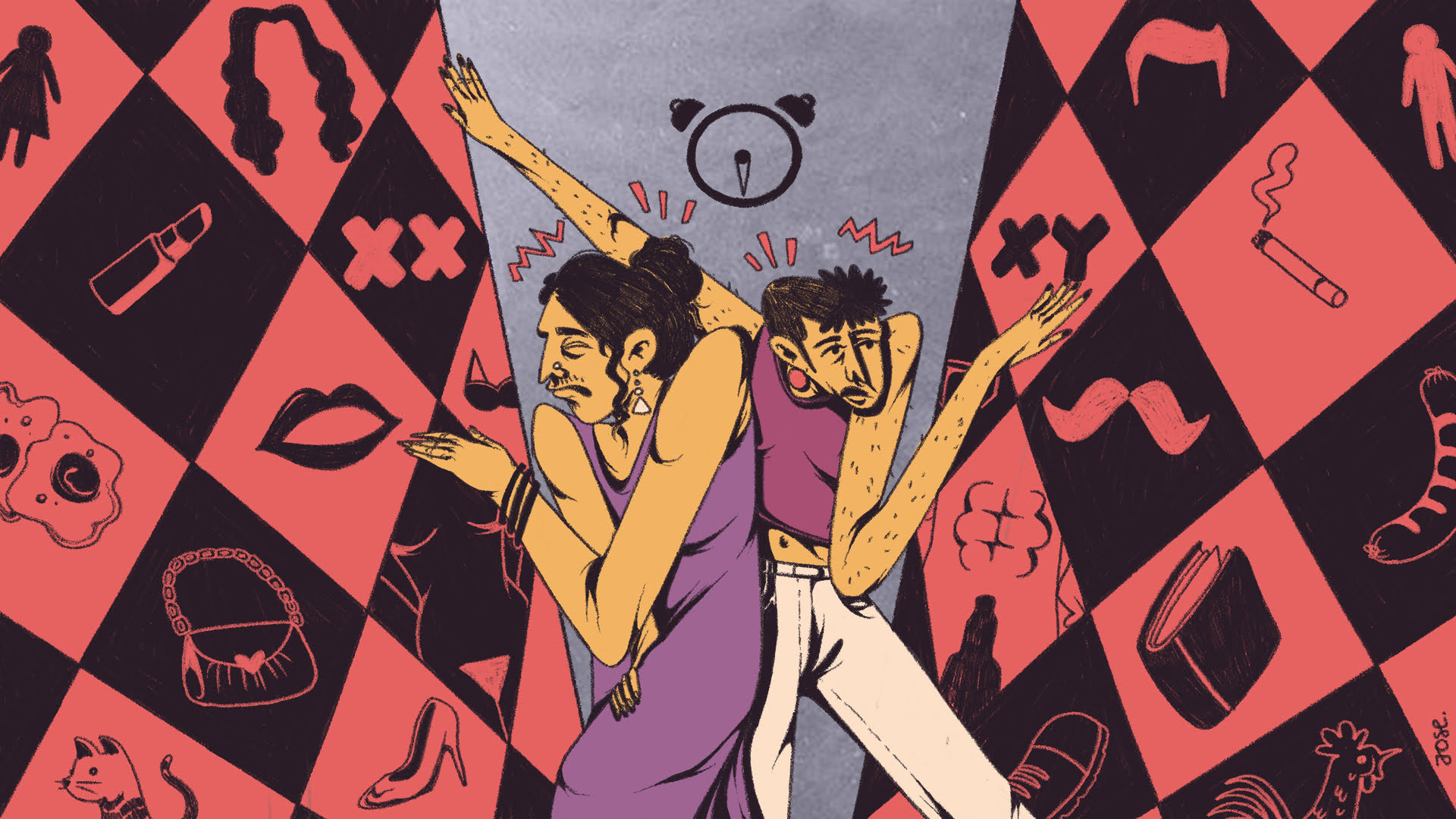
Neel, 23, wakes up early, often before the sun rises over the bustling streets of suburban Kolkata. In the hour or so that he has to himself before leaving for work, he follows a practised routine: he quickly exercises watching YouTube workout and yoga tutorials, freshens up, drinks water soaked with black chickpeas, and gets dressed, usually in comfortable pants and loose shirts. He then drives his electric rickshaw to one of the stands in Ballygunge, a 25-minute drive from his home, a room with a kitchen, where he lives alone. He has been driving the rickshaw, mostly in and around the Ballygunge area, for almost a year now.
Around 1pm he takes a break. He returns home, bathes, eats lunch, and rests briefly before heading back to the stand for the evening shift.
With most of his time spent on the road, Neel often goes 5 to 6 hours without urinating, even when he desperately needs to. Although there are public toilets in the area, he prefers to avoid them. Public toilets in India are typically segregated along the gender binary– for males and females. As a trans man, Neel feels unsafe using the men’s toilet and he is often denied access to the women’s toilet because his presentation is masculine.
About three months ago, when Neel attempted to use a women’s public toilet in Ballygunge, the guard at its entrance stopped him. Neel had to spend some time explaining that he is a trans man before the puzzled guard eventually let him enter. After using the bathroom, when he was washing his hands at a basin, a middle-aged woman shouted at Neel. “What are you doing here? This is a ladies’ toilet,” Neel remembers her saying. She wore a neatly-draped saree, and the id card of a large private sector bank — one which takes great pride in advertising itself as LGBTQIA+-friendly.
Neel responded hesitantly, “I am trans. I am using this toilet because I don’t have any other option.”
“This toilet is for men and women. Go to your own washroom,” retorted the woman, abusing and cursing loudly.
Encountering multiple such instances, Neel feels scared , helpless and sometimes angry. “I can still retort and fight back, but many trans people like me might not. Isn’t going to a bathroom without any resistance our basic right?” sighed Neel.
It has been 10 years since the landmark NALSA judgement of 2014, where the Supreme Court of India directed the central and state governments to provide public restrooms for the transgender community. Since then, ‘transgender toilets’ have been established in a number of cities including Mumbai, Delhi, Bengaluru, Mysore, Chennai, Imphal and Varanasi. However the reach of these initiatives is far from universal.
In a May 2019 article in the Economic and Political Weekly, Durba Biswas, a researcher at the Ashoka Trust for Research in Ecology and the Environment, noted that while policies addressing trans people’s bathroom rights now exist, their implementation remains weak.
In December 2022, Aneel Hegde, a Rajya Sabha MP from Bihar, raised a question in parliament about the progress made in providing safe toilet access to trans people, as mandated by the Transgender Persons (Protection of Rights) Act. The government dodged the question. In his response, A. Narayanaswamy, the Minister of State for Social Justice and Empowerment, stated that the government has constructed a total of 6,36,826 community and public toilet seats under the Swachh Bharat Mission, but did not offer any data on the number of toilets that were specifically built for transgender people.
queerbeat has reached out to the Ministry of Drinking Water and Sanitation, and the Ministry of Housing and Urban Affairs to seek their responses on the current status of toilets for transgender and genderqueer people in India. We will update the story when we receive responses from them.
Restroom Rights and Wrongs
Three years after the NALSA judgement, the Ministry of Drinking Water and Sanitation, in 2017, issued guidelines stating that members of the ‘third gender’ should be allowed to use public toilets of their choice, whether male or female or the ‘other’. Like many government guidelines, these too exist only on paper, show the everyday experiences of trans people like Neel.
When Neel was 19 and lived in Nadia district in West Bengal with his natal family, he said he was physically assaulted by a security guard and a few other men when he tried to use the men’s washroom at the Ranaghat railway station. “They could gauge I am female bodied and kept asking intrusive questions”, shared Neel. Traumatised by that experience, Neel has ever since gotten into the habit of suppressing his need to urinate whilst in public instead of using men’s washroom.
“I am still afraid. People can often tell that I am a female-bodied person, which leads to unsolicited harassment and abuse,” he explained. Although he feels dysphoric when using women’s washrooms, they remain his only option in emergencies.
Studies indicate that retaining urine can potentially lead to urinary tract infections (UTIs) as bacteria may accumulate in the bladder. Prolonged urine retention can pose severe health risks, including kidney disease.
For gender queer people , toilet access therefore becomes a constant, inescapable struggle that forces them to make the impossible choice of accepting either health issues or dysphoria and violence.
Daniella Mendonca, a person with intersex variations, who works as a senior executive for a large real estate company, has struggled to safely access toilets all her life.
She grew up in the chawls of Khar in Mumbai, where a visit to the community restrooms was always fraught with danger for her. “My mother would accompany me to the washroom to make sure I was safe,” she said. “That’s because I have been sexually harassed as a child by neighbours and people of the chawls in these restrooms.”
At school — an all-boys institution — Daniella was constantly teased for being effeminate and even molested by her seniors in the restrooms. “I never never really knew how to express or process this trauma,” she said.
In her teens, Daniella was forced to leave home, and resorted to begging and sex work to make a living. She remembers this time in her life with a lot of disdain. She recalls, “We [trans sex workers] could use the women’s loo during sex work days but the women would stare and pass snide comments at us, and the men’s washroom was out of question because of how ready they were to harass you.”
Despite the visceral violence directed at genderqueer people in restrooms, conversations around making toilets more accessible often end up centering the safety sentiments of cis gender people than genderqueer realities.
Megha, a cis-woman and mother of two, said, “I am all for gender inclusivity, but I once witnessed a trans woman adjust her tuck in a women’s washroom at a rest stop, and it made me visibly uncomfortable. I also had my 8 year old daughter with me. We quickly rushed out. I felt bad, but my conditioning got the better of me at that moment.”
Contrary to such popular perceptions around safety, a 2018 study from the Williams Institute at UCLA School of Law found that letting transgender people use toilets that align with their gender identity does not make the toilets a safety risk for cis gender straight people. In an interview with NBC, Amira Hasenbush, the lead author of the study, stated that opponents of laws and policies ensuring protection and access to public services, such as restroom access for trans and genderqueer people, often claim that such laws leave women and children vulnerable to attacks in public restrooms. “But this study provides evidence that these incidents are rare and unrelated to the laws,” emphasised Amira.
While there are no similar studies in the Indian context, there is plenty of anecdotal evidence of violence against genderqueer people in gender-segregated restrooms in India. Given this reality, does the solution India seems to be trying to adopt — separate ‘third gender’ restrooms — actually centre genderqueer realities or does it merely cater to cis sentiments?
Separate Restrooms: Othering Or Inclusion
Nisha is a trans woman who makes her living by begging at the signal across from Shaheed Tukaram Ombale Udyan in Goregaon, Mumbai. She moved to the city from Tamil Nadu in her teens. Now in her late 30s, she lives in the slums of Goregaon. Her daily routine involves begging from 10 in the morning until around 8 at night, with a short break in the afternoon.
Since Nisha spends most of her day at the signal, she is reliant on public toilets. While accessing gender-segregated washrooms in the past, she has encountered men who’ve threatened to beat her up, and women who have outright asked her to stay out. Often, she’d be forced to find clandestine spots to pee outdoors. This changed in 2022, when a toilet for transgender persons was set up in Goregaon. Now, she tries to stay within the vicinity of that washroom as far as possible.
Located just off the busy Western Express Highway, the Shaheed Tukaram Ombale Udyan, the park within which the trans-only restroom is situated, is a surprisingly spacious slice of quiet away from the honking vehicles outside. The toilet is right by the park entrance, clearly advertised in bold letters as a space reserved for transgender persons.
The security guard, Pramod, said that the washroom has 7-8 regular users who greet him every day.
Nisha was there from the day the toilet was installed. “My guru (leader of a Hijra group) and my entire clan of girls came to witness it. It’s one of the best things we have,” she said.
Trans individuals need to use washrooms to meet other needs too. For example, Maks, a 20-year-old trans man who is pursuing a masters degree in sports management, and has started transitioning three years ago said that he often needs to use the washroom to adjust his binder or deal with menstruation. Going to a male facility is just not a safe option for him, he said
For people like Maks and Nisha, a separate washroom for genderqueer persons is a pragmatic solution. However, other trans folks believe that such initiatives are isolating and perpetuate the notion that genderqueer individuals are somehow dangerous and need to be segregated. “We don’t need separate toilets; we need gender-neutral toilets,” said Grace Banu, a Dalit trans woman activist from Tamil Nadu, in an interview to Hindustan Times.
Apart from the stigma of segregation, separate washrooms come with their own safety risks because they mark out the users. “Even when there is a separate washroom for genderqueer folks, I always prefer to go to the women’s room. Accessing the separate washroom risks my safety, putting me under the gaze of people all over again,” said Pratyay, a 27 year old trans-feminine educator and trainer from Delhi. For her, because she passes as a woman, accessing the women’s washroom is easier.
Given the diversity of experiences that gender queer persons have when it comes to toilet access, what shape would potential solutions take, is a question that the trans community, researchers and queer activists have been grappling with for years.
The future of queer affirming washrooms
When Raju, a public health professional based in Bengaluru, travelled in Europe in June 2023, they felt extremely affirmed by the experience of using stand-alone all-gender washrooms. In such washrooms, individual cubicles have their own entrance and are spacious enough for people to relieve themselves, refresh, change, and go about their day without interacting with others.
“The architecture of the washroom was very useful. You could pull up the commode if you wanted to use it standing or keep it down if someone preferred sitting,” Raju remembers. They were also elated to see syringe disposal facilities in these washrooms, which could be a game-changer for trans-masc people needing to take testosterone shots or other medications.
Often, investing in standalone gender-inclusive cubicles is seen as an expensive and space-consuming affair, which is why it isn’t widely adopted as an effective architectural model. “Nobody really wants to spend money on making good public restrooms including gender-inclusive cubicles,” said Kalpit Ashar, an architect and urban designer based in Mumbai. “We often get told, ‘It’s just a cubicle, not the Taj Mahal.’”
Another approach, which would involve less expense than individual chambers, would be to simply label toilets by function rather than gender. In April 2017, the Barbican performing arts complex in London made its toilets gender-neutral. Interestingly, the Barbican didn’t change the physical layout of the toilets, only the signage. The former men’s toilets, which had urinals, and the women’s toilets, which had cubicles, were simply labelled so that anyone could use either facility. After cis women started tweeting complaints about longer queues—since both spaces were crowded with cis-men and they couldn’t use the gender-neutral toilets with urinals—the Barbican released a statement defending its decision to make its transgender and non-binary visitors feel more welcome. However, they admitted that a wider consultation could have been beneficial.
Most of the trans and genderqueer people queerbeat interviewed for this article said that there is a need for stand-alone bathroom cubicles in India, while acknowledging that the implementation of it has to be thought through. However, as Biswas pointed out in her EPW article, the trans community is not homogenous. “In reality, transgender communities are heterogeneous along the caste, age, and gender axes; all or some combination of these can determine a transgender person’s access to public sanitation,” she wrote.
Vyjayanti Vasanta Mogli, a Telangana-based transgender RTI and human rights activist, echoes the need for multiple solutions. “Gendered bathroom spaces will continue to exist, separate bathrooms for transgender persons are also necessary,” she said.
Neel vividly recalls the first time he encountered and used a separate trans persons’ washroom, at an event organised by Sappho for Equality, a feminist organisation advocating for the rights of sexually marginalised women and trans men. He recalled, “I will never forget that day. I took a picture and kept it as a fond memory. It felt like I was respected.”