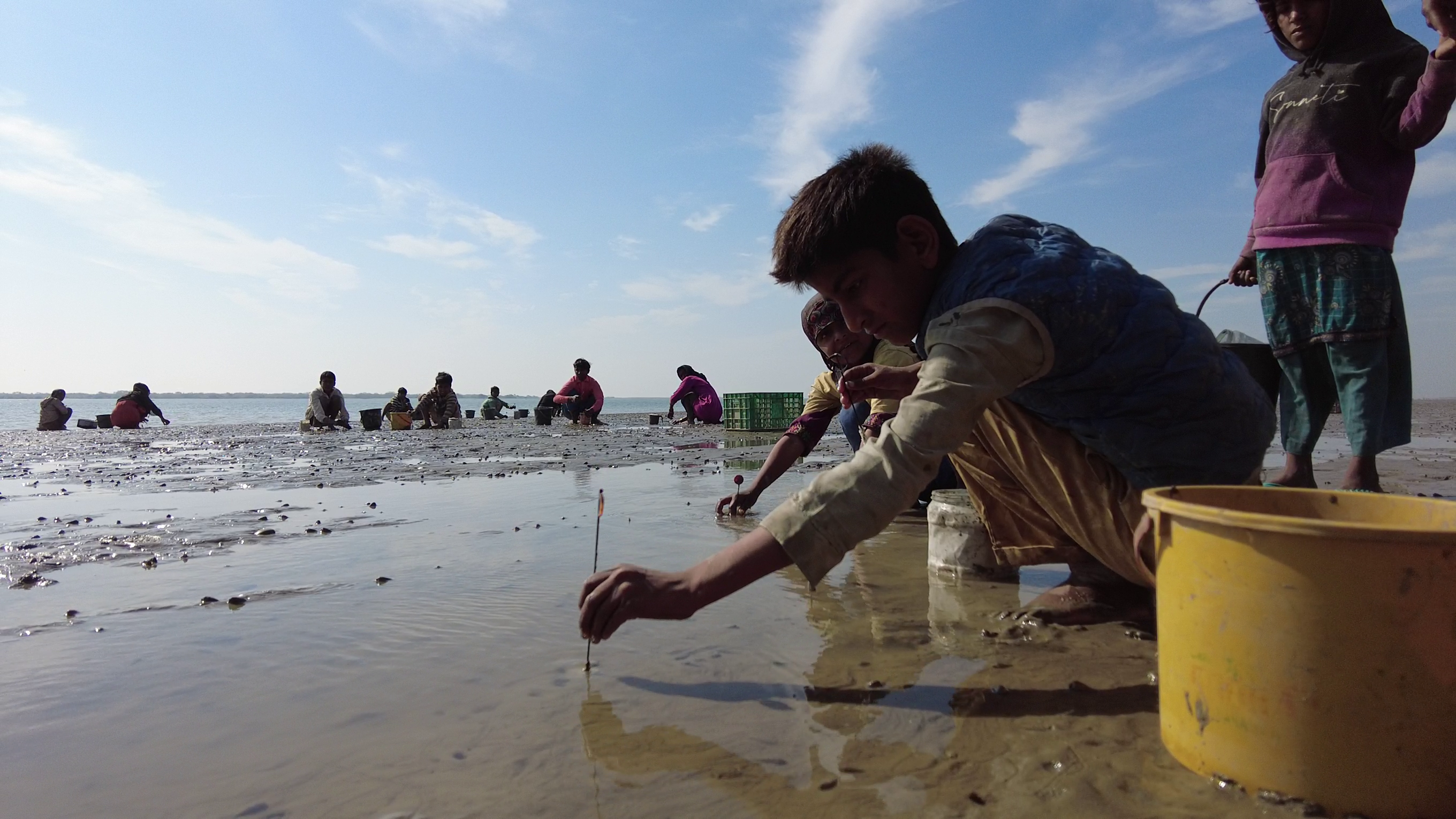
Children harvest razor clams in Pakistan’s Sindh province. Photo: Zuhaib Ahmed Pirzada
It’s a cold February night on the banks of Sanri Creek in Thatta’s coastal belt, deep in the Indus Delta in Pakistan’s Sindh province. Here, the moon slices through thinning clouds, slowly fading into the west. The tide pulls back from the land, leaving behind a wide plain of wet, glistening mud. Above, the sky is full with stars. Below, women and children prepare to fish Marori, the local term for the cigarette-shaped oyster species called razor clams, which are found in the mudflats of the Arabian Sea.
The lives of the women and children are bound to the moon. The moon pulls the tide. The tide reveals the clams. The clams then pull them into the mud for food, money and survival.
Wasai Mallah tightens the strap of her flickering headlamp. She is 32 years old, though her face has been aged by the wind, salt and sleepless nights. Behind her, three smaller lights flicker on. They’re her children, walking in her shadow as they drag their salt bags and digging rods across the cold mud. Their hands are cracked and red due to cold winds.
They step onto the wide, ink-dark flats. Around them, the lights of other families move slowly in the distance. There are dozens of women and children, bent over the earth, hunched in silence like question marks. Wasai’s youngest is only eight years old. She shivers in her worn clothes as she kneels down. The cold bites through the fabric. But her eyes are sharp, trained by need, not age. She spots a tiny hole: It’s a razor clam emerging to breathe. She sprinkles salt into its burrow and in seconds, irritation forces the clam to surface. When it rises, she catches it and tosses it into a basket. Then she starts over, one clam after another. The family will work until the tide returns and reclaims the flats.
Wasai and her children arrived here 10 days ago, crossing the Indus delta on a wooden boat with other Mallah families after travelling six hours from Dhandho Jeti in Sindh. This is not their home, but hunger brought them here. For the next few weeks, they will live on this flat, exposed edge of the sea.
In Pakistan’s Indus Delta, the Mallahs – or Mirbhars – are a fishing community who are indigenous to the land but have faced increasing marginalisation as agriculture, riverine fishing and cattle farming are increasingly erased due to scarcity of sweet water. For survival, the Mallahs turn to harvesting razor clams, which are largely found in mudflats and creeks such as the one in Sindh’s coastal belts.
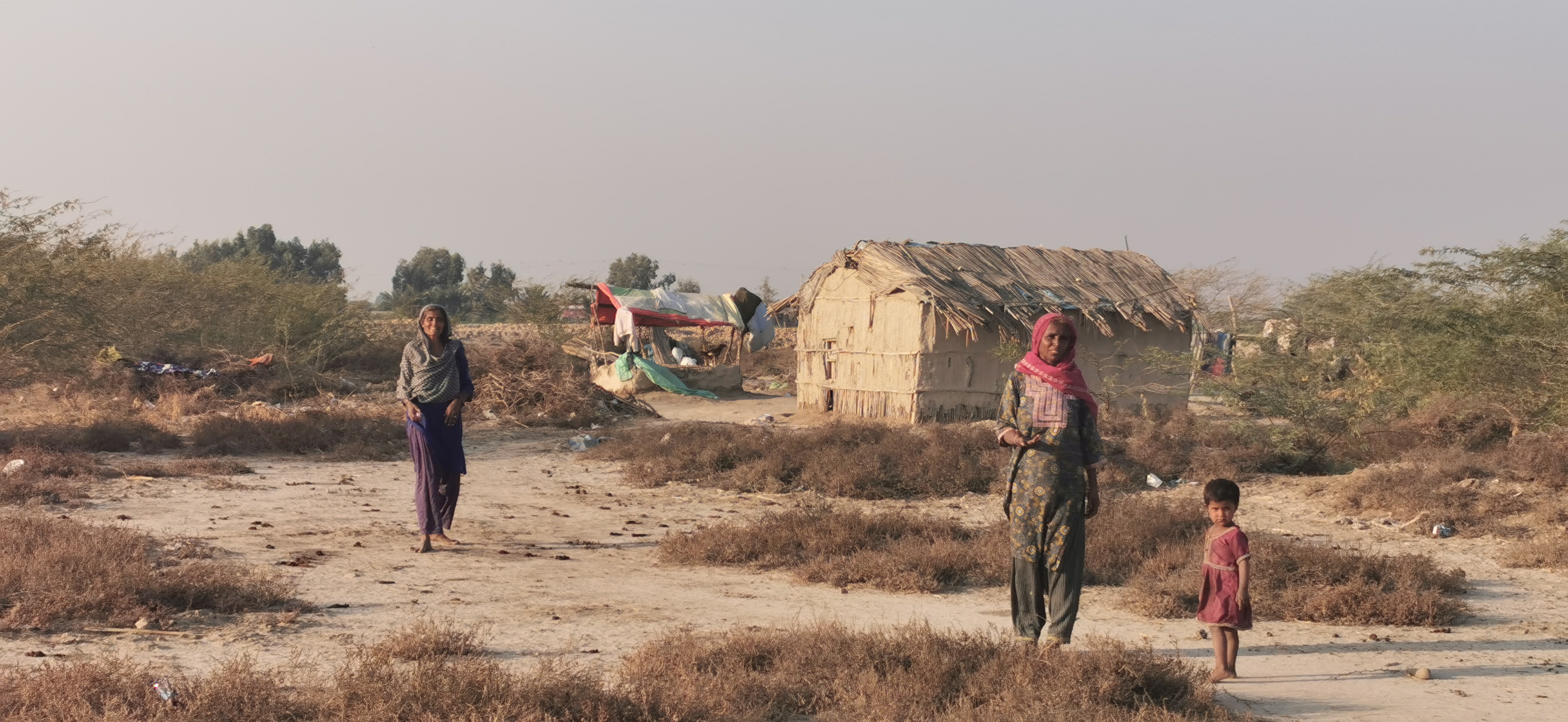
The Mallahs were once a thriving agrarian community in Sindh, but were compelled to harvest clams as the Indus Delta turned saline. Photo: Zuhaib Ahmed Pirzada
At the Indus Delta, the Mallah families have built a temporary village on the shore made up of shelters of driftwood, discarded plastic sheets, fishing nets and tarps stitched together with wire. There are no toilets or running water, nor any protection from the biting cold or the rising sea. When the tides come back, they must lift everything — children, baskets, and shelters — and run.
Every night, they harvest the mud. And yet, the reward is cruelly small. For every kilogram of razor clams they gather, they receive just PKR 45 — barely 15 US cents. If Wasai works all night and manages to collect 12 kilograms, she gets around PKR 600 ($2.12). That’s less than the cost of a simple meal in a city, earned through hours of backbreaking work, cold winds, and salty cuts.
The clams are handed over to a middleman or their contractor, who sells the same clams to buyers in Karachi for over PKR 200 ($0.71) per kilo — almost five times what the women receive. From Karachi, the clams are cleaned, frozen, and packed for export to other parts of Pakistan, and countries such as China.
In recent years, seafood export has increased along with overexploitation of fish due to erasure of traditional practices and irregulaties. Pakistan’s seafood export reached $489.2 million in 2024-2025 financial year. In China — one of the world’s largest importers of razor clams — an appetite for Pakistani razor clams can cost up to US $10 to $11 per kilogram. That’s more than PKR 3,000 per kilo. And yet, the women who dig for them, knee-deep in freezing mud, remain poor.
No one from the Mallah’s village knows what becomes of their clams. No one asks. They live on what they are given.
Debt wraps around them like the sea. To reach Sanri Creek, they borrow money from middlemen, boat owners or shopkeepers back in their native villages. The loans come with interest. If the clams are few, the debt grows. Wasai’s family owes PKR 1 lakh (352 USD) from last season. She paid some of it in clams, the rest still lingers.
“Our seth (owner) doesn’t even count the clams. He just gives what he feels better,” Wasai tells Asian Dispatch.
Most of the women here are Muslims, and Sindhi or Balochi speakers. Some are from the Hindu communities too. All of them, poor. All of them, forgotten.
The Unforgiving River
Like all the deltas of the world, the Indus Delta was once rich and prosperous, its people nourished by the generosity of a river that flowed freely and feeding farms, forests and fish. The river arrived every summer like a guest of honour, overflowing into lowlands, blessing them with rich black silt and washing salt from the soil. Small farms thrived. People lived close to the land, close to each other. Elders still remember the scent of buffalo milk bubbling in clay pots, the crackle of fish frying on wood stoves, and children rolling in fields of golden wheat. Riverine fish like palla shimmered in their nets, caught with woven ropes and rowboats. The estuary was full of life.
But in the pre-independence subcontinent, when the British colonisers began engineering the Indus with barrages and canals, and when Pakistan later continued this legacy — of building dams, diversions, and concrete walls to tame the mighty river — the river lost its freedom.
Over time, freshwater and silt, the lifeblood of the delta, stopped reaching the sea. The Arabian Sea, once held back by the sheer force of the river, began creeping inland. As more than 3.5 million acres of fertile delta land were claimed by salt, it swallowed rice fields. Wells turned brackish. Homes sank into silence. Rice harvests shriveled. Cows stopped giving milk. Fish disappeared from the river’s mouth. People, once self-sufficient, grew poor. Slowly, all the old ways of living began to vanish. When all forms of sustenance failed, people turned to the only thing left in the mud: Razor clams.
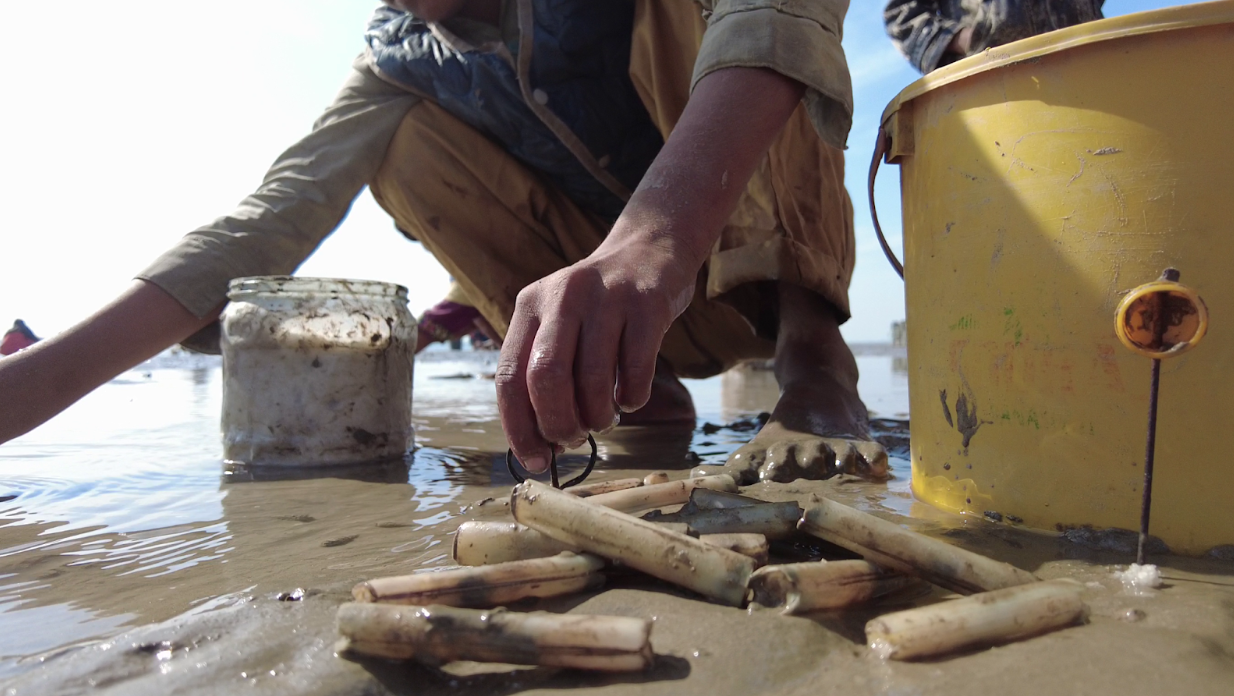
Freshly harvested razor clams, which are a cigarette shaped oyster species. Photo: Zuhaib Ahmed Pirzada
Razor clams are highly beneficial to the coastal ecology. They silently engineer healthier estuaries by transforming murky water into clearer, oxygen-rich habitats where mangroves and fisheries thrive. Their decline risks ecosystem collapse. Many creeks near Karachi, Gizri Creek, Korangi Creek, parts of Phitti Creek are heavily polluted where clams population has vanished.
“We are here, and it is all because of compulsions. Otherwise who takes their small children here?” Wasai asks before going silent and bending to search for the next breath hole.
Muhammad Moazzam Khan, the technical advisor (marine fisheries) at World Wide Fund for Nature-Pakistan told Asian Dispatch that the razor clam trade traps coastal families in a cycle of ecological poverty. When pollution destroys nearshore habitats — like Karachi’s vanished clam beds — these communities become climate refugees on their own shores. Children lose education to join harvests because survival demands it.
Kathyar Mirbhar, now 65, once farmed the land his father passed down to him in Dhandho. He grew rice and wheat, kept goats, and drank from freshwater wells. But after the sea engulfed his fields and the rains became uncertain, he had no choice but to leave farming behind. Now, he brokers razor clams for a living.
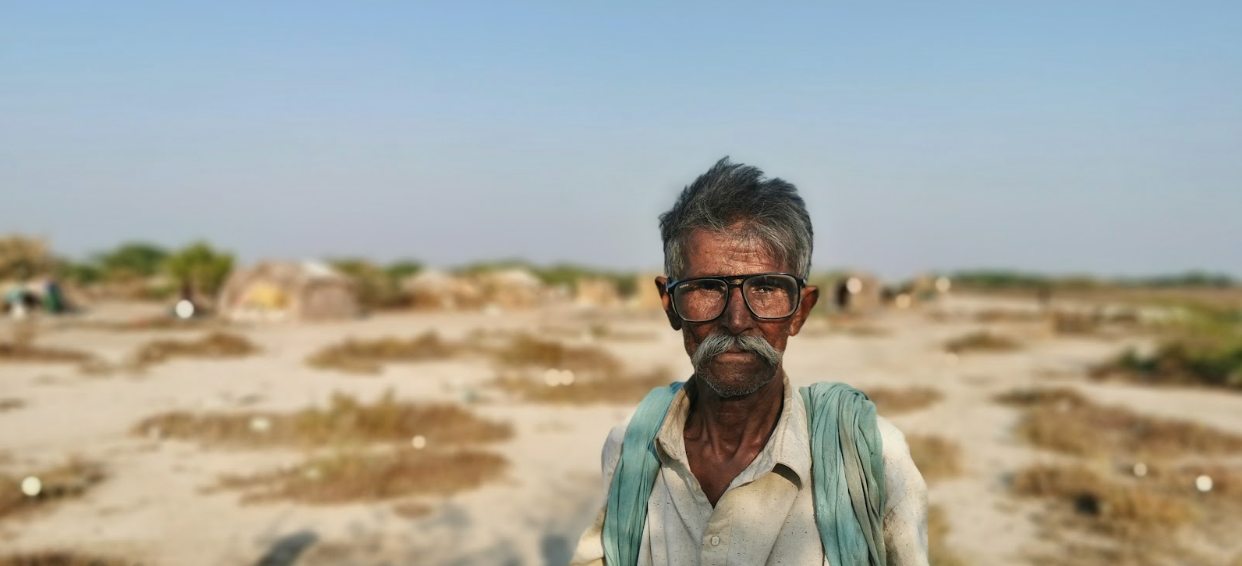
Kathyar Mirbhar tells stories about prosperity and destruction. Photo: Zuhaib Ahmed Pirzada
“We didn’t even know what a clam was,” he tells Asian Dispatch. “We had wheat, rice, goats, everything. Life was full.”
Twenty years ago, nobody in the delta touched razor clams or mud crabs. The work was looked down upon as dirty and low. It was not something you did if you had land or nets. Palla fish were still plentiful then, and river fishing provided dignity and income. But as the fresh water disappeared, so did the fish. About 44 percent of coastal children in Pakistan are malnourished. Today, thousands of families from Kharo Chhan, Keti Bandar, Jati, and dozens of other coastal towns in the country migrate to the flats to catch clams. They no longer harvest fields. They harvest tides.
“The owner just gives us the boat, some sweet water, and bags of salt,” Kathyar says with a bitter laugh. “The rest is our headache. The mud, the cold, the nights—we bear it.” He pauses, then adds with quiet rage, “But the owner, he has a new car now. A bungalow in the city.”
This February, the cold was biting. Many families chose not to go fishing. Among them was Kathyar’s.
As winter comes, it cuts through skin. The air drops below freezing. Salt burns deeper in cracked fingers. The mud hardens. The clams burrow deeper.
“Though in winter, we get good rates, around PKR 52 ($0.18) per kg, but catches fall by 40 percent,” says Kathyar.
In summer, clams catch is good but rates are low, around PKR 35($0.12) per kg. Hot days have their own difficulties. As temperatures hit high, hydrogen sulfide rises from the mud. Children and women collapse from heatstroke and they face silt and salt in their eyes due to winds all summer.
In the rain, it is more difficult as burrows are choked with silt, sometimes causing clams mortality and this directly impacts income during the rains.
The Boatman’s Conundrum
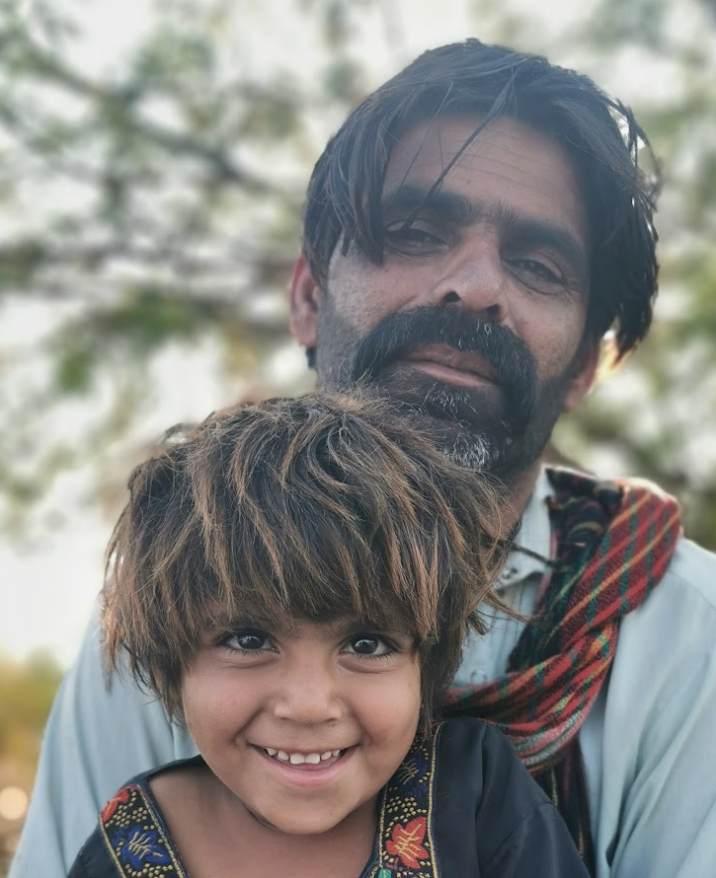
The horho (local term for a boat) coughs awake beneath Hassan Mallah’s bare feet. Hassan is a nakho, the boatman.
Fifteen years ago, he left the cracked earth of Chuhar Jamali, a city in Sindh, and started living in Dhandho, where he chased work near water. Now, he is the keeper of the horho, and lives between the jetty and the breathing mud.
For PKR 30,000 ($105) a month, he loads the groaning boat with sacks of coarse flour, lentils, the precious blue cans of sweet water, vital bags of rough salt and the quiet weight of three dozen women and children. Then, he steers them through the delta’s watery veins for six slow hours to Sanri. And there, he stays, anchored off the mudflats for 45 days.
(Right) Hassan Mallah with his daughter. Photo: Zuhaib Ahmed Pirzada
For Hassan, his boat is his world. Wide-beamed, flat-bottomed, its faded blue and green paint, it sits heavy on the creek like a tired water buffalo.
Sweet water is very precious here. One night in the Sanri Creek hut, as sounds of guttural noise of dogs scavenging at trash fish grew louder, Mallah told Asian Dispatch that he doesn’t hide the fish from the dogs. He hides the sweet water instead. “These dogs walk miles in this salt in search of sweet water,” he says.
Mallah’s duty doesn’t end with tides. When the sweet water runs dry, he must sail the boat back to the Dhandho Jeti for 12 hours, leaving the families exposed, just to refill the jerrycans.
He’s also their only hope when sickness strikes, or there’s a sudden fever, a snake bite or even a woman struggling with childbirth.
Hassan must rush them back to the jetty, where a hospital might be reached. But he tells of darker truths: Some owners are cruel. They refuse permission. “No,” they say, “the boat stays. The catch matters more.”
Spring tides bring the deepest exhaustion. When the swollen sea floods the flats completely, the women and children huddle together on the cramped deck all night, the boat rocking violently. There is no sleep, only shivering and waiting. Then, as the tide finally begins its slow retreat near dawn, it reveals the razor clams in wet mud again. The hunt for razor clams begins immediately. The sea gives them no time; the debt allows no pause.
Fire in the Belly
The sun is like white fire on the Sanri Creek. As the heat shimmers, a 16-year-old young man called Umer walks alone. He’s thin, with his baseball cap pulled low, a digging rod in hand and salt bag on shoulder. There’s a sack for clams at his waist.
“I passed ninth class,” he says, with his eyes on the empty flats. “I wanted to study more but… pait pujja (stomach to feed).” He taps his stomach. “Compulsions [because of] my family. So I earn now.”
“Mehngai (expenses),” he adds. “It eats everything. Flour, oil, sugar: Mountains of rupees.” He nudges the sack at his hip, which is half-full. “This? Vanishes. Like water on hot mud. When my father was alive, he earned. We lived at home. I went to school.” With a small shrug, he says: “Now? I earn.” Pakistan has experienced significant inflation in the recent past, with annual rates sometimes exceeding 25 percent.
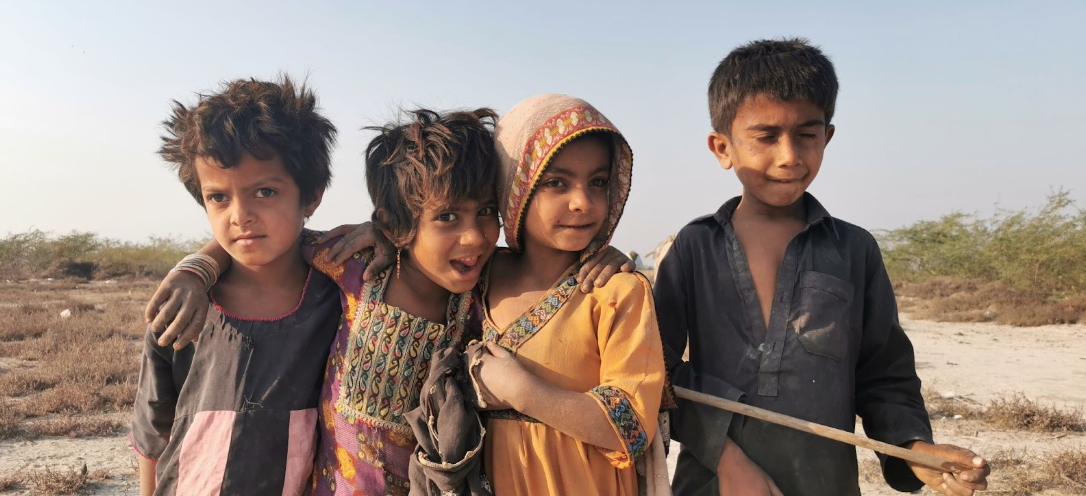
About 44 percent of coastal children in Sindh are malnourished. Photo: Zuhaib Ahmed Pirzada
Umer looks at this reporter and says, “You come from Karachi. People there see pictures and think that this place is very beautiful. But live here? You try. Stay many days and see.” He gestures to the plastic huts far off. “[It is] beautiful,” he says again. “But it eats you. Salt air burns your throat. Salt water dries your skin. Salt gets in every crack.” He kicks mud from his boot. “Cannot live here long. Too difficult.”
He hoists the salt bag and grips the digging rod. The tide will turn soon. The creek gives no rest. Umer turns his back and walks further onto the blinding, glistening plain.
In another village near Bhaghan, where the clam-digging women return to, Hawwi, a clam farmer sits in her makeshift home, a knife flashing in her hands as she cuts opinions. “I am haryani,” she states firmly. “A farmer.” Before razor clams, she used to harvest vegetables and other crops.
She looks past me, towards the salt-scarred land. “These hands,” she holds them up, “knew chillies red as blood. Knew cotton white as clouds. Knew tomatoes. That was my work. My training is in harvesting the earth.” She brings the knife down hard on another onion. “Then the sea came. Poisoned the soil. Killed the crops. So now?” She gestures with the knife towards the unseen mudflats. “Now I harvest clams.”
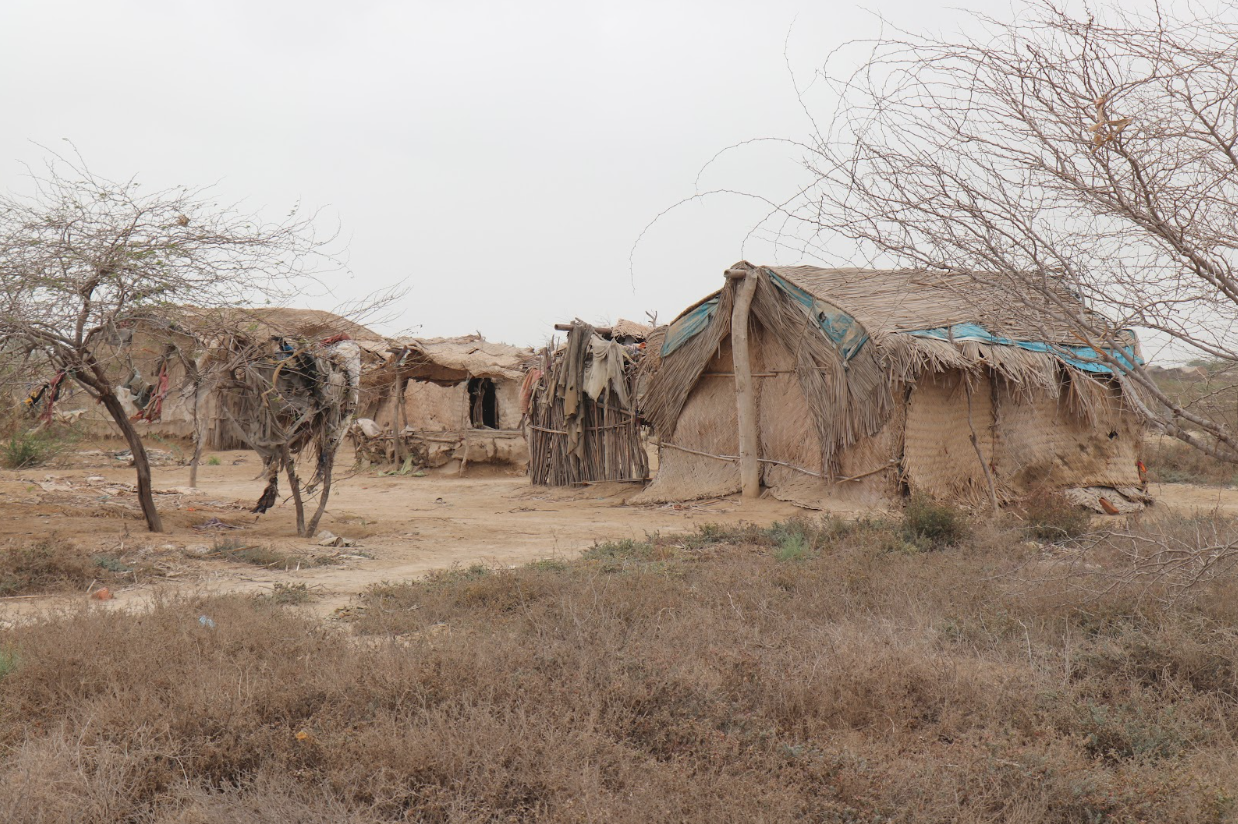
Huts of clam catchers near Bhaghan in Sindh, Pakistan. Photo: Zuhaib Ahmed Pirzada
“PKR 42 ($0.15) per kilo,” she spits the words like bad seeds. “PKR 42! For hours in the mud, back bent, hands freezing? It is nothing. Less than nothing. A joke. What we earned from the land…” She trails off, the memory heavy. “It was different. Difficult, yes, sun hot on the neck, back aching. But different. It was clean work. Under the sky. Bringing in food we knew. Grain. Fruit. Life.”
The contractors, she adds, are very cruel. “They see us only as hands to dig. They do not count the clams right,” she says. “They take our sweat, our cold nights, our children’s strength. And give back pennies. Pennies that vanish like smoke for salt, for flour, for the debt that never ends.”
An analysis titled ‘An Assessment of Razor Clam Fisheries of Pakistan’ (International Journal of Biology and Biotechnology, 2023) by Khan of WWF-Pakistan, and Naseem Moazzam, the managing director of Pakistan’s Marine Fisheries Department, found that Pakistan doesn’t consume razor clams, but has been harvesting them since 2004. Every year, the country exports around 500 metric tons generating $1 million.
The Sindh government, too, allocated PKR 8.1 billion (approx $28 million) for livestock and fisheries to boost its blue economy. But for razor clam harvesters, the Indus Delta is both their lifeline and their prison. Their survival hinges on river-nourished mudflats, yet they remain excluded from Pakistan’s blue economy profits. When stocks collapse, families migrate miles away. When exports boom, middlemen thrive while harvesters drown in debt. Without community-led management, Khan warns, this fishery will only deepen coastal poverty.
Months later, the moon still pulls the tide over Sanri Creek. Wasai bends in the mud, her headlamp flickering. Hassan nakho watches the water level dip in the horho’s jerrycans. Umer, older now, digs under the sun to feed the belly. The owners still drive new cars. The debt still wraps tight. PKR 45 a kilo. The salt still burns, the tide still turns.
Nothing changes. Only the faces do, perhaps, bent low, harvesting salt and surviving under the same indifferent moon.