On September 1, Swarna Das was attempting to cross the 4096-kilometer-long barbed-wired border – one of the longest and deadliest in the world – between her home country Bangladesh and India, when she was shot dead. The teen – whose age is reported to be between 13 and 16 – was on her way to visit her elder brother, who had been living in the Indian state of Tripura, which borders Bangladesh, along with her mother. On that fateful day, she and her mother were assisted by two local agents in the dead of night when, amid shots, Das’s body dropped dead in the Indian territory. Her body was recovered by India’s Border Security Force (BSF), and 45 hours later, they returned her “bullet-ridden” body to her family after completing formalities.
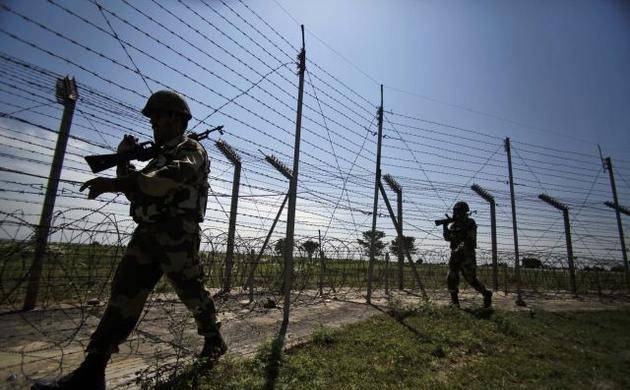
Bangladesh-India border is one of the world’s deadliest. Photo for representational purpose.
Bangladesh and India share friendly political relations but the border that divides the two countries is violent and hostile. Drawn in 1947 by the departing British colonial rulers and built on the foundations of security infrastructure, Bangladesh-India border is home to many residents who have historically moved fluidly across the demarcations not as a form of defiance but because of shared histories, culture and even families. Das, in this case, has family both in Bangladesh and India. Border residents like Das are one of the many to come in the middle of the countries’ troubling border relations.
Data released by Bangladesh’s Ain O Salish Kendra, a human rights organisation, documented at least 522 killings of Bangladesh citizens between 2009 and 2020. But Das’s killing evoked a different response.
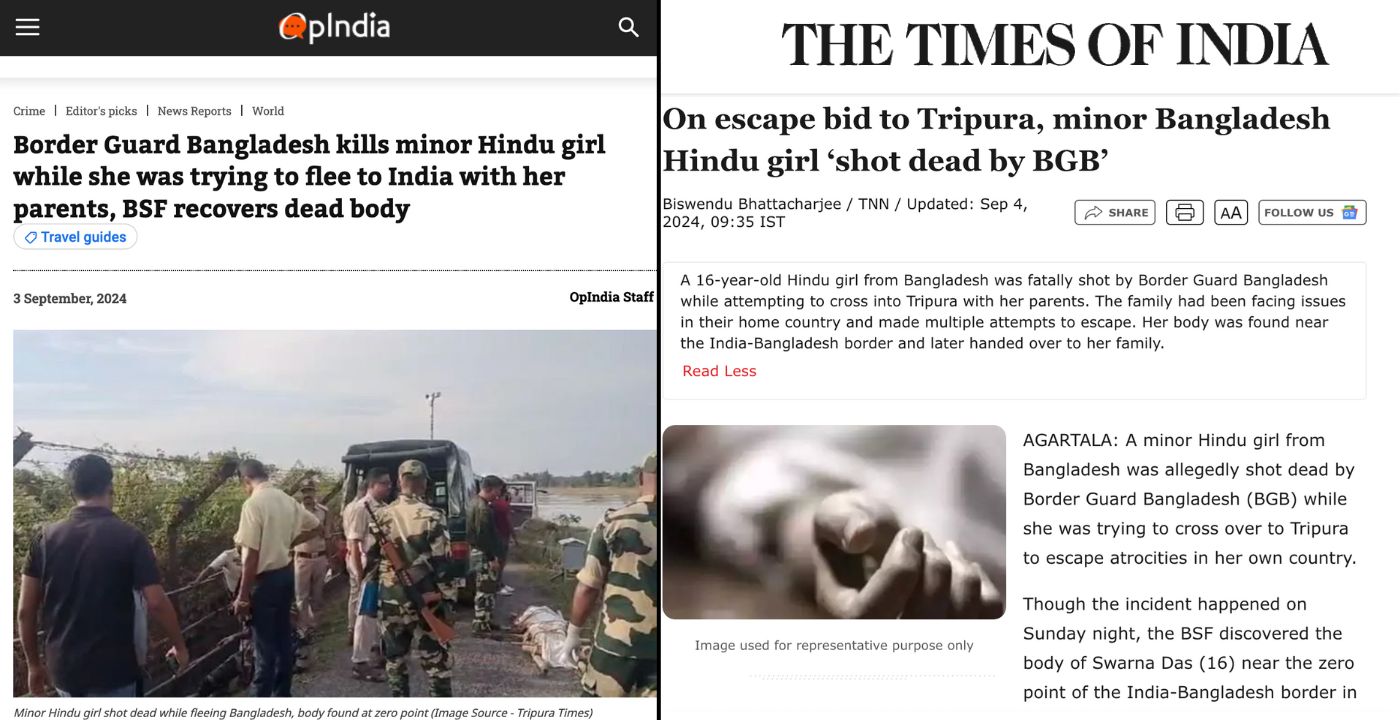
News coverage of Das’s killing in India
As people in Bangladesh and human rights organisations stepped in to demand justice, Das’s killing fuelled a war of narratives between the two South Asian countries. Mainstream media in Bangladesh, a Muslim-majority country of 173 million, reported the role of India’s BSF in Das’s killing, while in Hindu-majority India, the mainstream media including The Times of India and News 18 along with far-right Hindu publications such as OpIndia and Hindu Post published articles blaming Border Guard Bangladesh (BGB) and claimed they shot her dead for fleeing anti-Hindu persecution in Bangladesh.
‘Trigger-Happy’ BSF and a History of Violence at Bangladesh-India Border
India’s BSF has a policy of shoot-on-sight to prevent illegal migration and illicit activities like trafficking and smuggling, a measure that Human Rights Watch called indiscriminate and with a culture of impunity. Bangladesh’s BGB, on the other hand, has long been criticised by their home country for being ineffective against illegal migration and BSF’s violence.
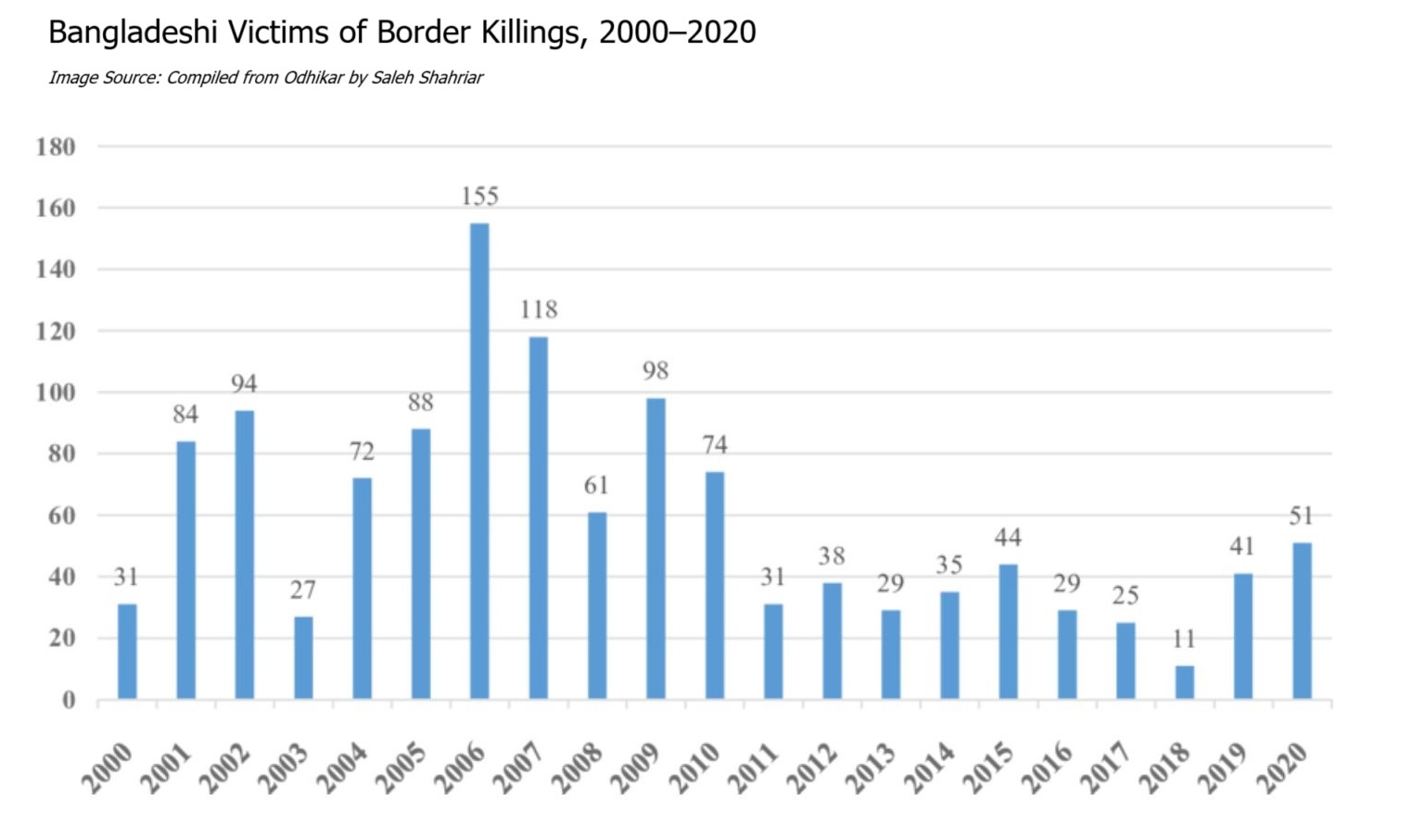
Recent Killings of Unarmed Civilians on the Bangladesh-India Border:
• 2011: Felani Khatun, 15, was shot in the chest and was found hanging on the barbed fences diving India and Bangladesh. In 2013, India acquitted the BSF constable accused of shooting her.
• 2016: Shihab Uddin Sajal, a Bangladeshi teen, was plucking mangoes in a farm when BSF members allegedly physically tortured and shot him. India suspended seven of its BSF troopers connected to his death.
• 2020: Hasinur Rahman Chand, a Bangladeshi shopkeeper, was fishing in a river near the border when he was killed allegedly by the BSF troopers. BSF claimed he was a cattle smuggler.
Das’s killing came on the heels of the student-led uprising in Bangladesh that ousted former prime minister Sheikh Hasina and her Awami League party from power.
The violence reflects the changing political dynamics between Bangladesh and India, says Pritam Das, the Executive Committee Member of Rashtra Sanskar Andolan (RSA), which led a fact-finding mission into Das’s killing. Under the interim leadership of Nobel laureate Muhammad Yunus, Bangladesh has accused India of harbouring Hasina among other discontentments. However, border communities don’t know about these political changes, Pritam adds.
Read More: As a ‘Gen Z’ Journalist, This is How I Felt Witnessing Young Bangladeshis Overthrow Sheikh Hasina
“Swarna Das’s family has relatives in India,” Pritam told Asian Dispatch. “Her mother’s side of the family is in [Indian state] Tripura. They’ve been traveling to India without passports for a long time. This is quite normal for border communities. But right now, there is a new tension around Bangladesh-India relations. Without realising this change, they attempted to visit as they did before.” Das and her mother took the help of agents who often assist people to cross borders without passport or visa, for a fee. As with many, the two were told they’ll be safe. That night, Pritam said, the mother-daughter duo got cold feet and wanted to turn back. However, the agents pressured them to cross.
“Swarna was shot at close range, and the bullet exited through her back while she was holding her mother’s hand,” Pritam says. “After she was shot, she fell into a ditch nearby. Her mother tried to pull her up but because the brokers feared more shots might be fired, they pulled her mother away, leaving Swarna’s body behind.”
“There is no evidence that BGB killed Swarna,” Pritam adds. “However, both the BGB and the police in Bangladesh showed negligence as they didn’t take the incident seriously or investigate it properly.” Asian Dispatch reached out to Kulaura Police Station, where Das’s body was handed over. The officials did not divulge much information and told this reporter that they do not have the post-mortem report.
Asian Dispatch also spoke to Das’s neighbour Dibakar Das, a schoolteacher, who asserted that the claim made by the Indian media outlets, which suggested that Das and her mother were fleeing Bangladesh in the face of minority oppression, is false.
In the days to come, Das’s killing reignited the conversation on the long, deadly history of India’s “trigger-happy” BSF’s border policy towards Bangladeshis. “Incidents of shootings or killings on the border of two hostile neighbouring countries are not rare. But the case of one country regularly shooting and killing citizens of the other country on their common border, when the countries are officially ‘friends,’ is rare,” engineer and writer Kallol Mustafa wrote in an opinion piece on Bangladesh’s top newspaper, The Daily Star.
How Domestic Politics Shaped Media Coverage of Das’s Killing
Shah Mohammad Shamrir Al-Af, a lecturer of International Relations at Dhaka-based Bangladesh University of Professionals, reaffirms the role of the media in shaping public perception on Das’s killing.
“Indian media’s portrayal of Swarna as a victim fleeing religious persecution contrasts sharply with Bangladeshi reports, which suggested an illegal border crossing to meet her brother,” Shamrir Al-Af told Asian Dispatch. “Given her mother is still alive and supports Bangladesh’s narrative, this divergence of reporting highlights how media narratives can be influenced by national interests and political agendas.”
The Indian media coverage blaming Hindu persecution in Bangladesh fuelled several social media users in India to push Islamophobic rhetoric, with #SaveBangladeshiHindus as a hashtag.
In Bangladesh, social media users directed blame towards the BSF, the Indian government and its media.
Mubashar Hasan, a Sydney-based expert in South Asian geopolitics told Asian Dispatch that Hasina’s ouster is a glaring failure of Modi’s foreign policy but the communal undertones of Indian media coverage on Bangladesh diverts the attention from that and serves both Modi’s foreign and domestic agendas.
“Objective reporting on the border issue is nearly impossible due to the high-risk environment,” Hasan added. “Journalists often rely on official statements from the BSF and BGB, which are not neutral sources but reflect institutional priorities. This results in one-sided narratives that feed into the deeper mistrust between Indian and Bangladeshi media, which is closely tied to the domestic politics of both nations.”
The Indian media landscape is increasingly riddled with bias, propaganda and pro-government narrative. At the same time, the country is witnessing declining press freedom and attacks on independent journalists and media houses for asking tough questions from the Indian Prime Minister Narendra Modi’s government. A study by Lokniti and the Centre for the Study of Developing Societies in India found that 82 percent of the surveyed journalists believed most media coverage is favourable or beneficial to Modi’s Bharatiya Janata Party regime.
In Bangladesh, on the other hand, mainstream news media has suffered under several periods of authoritarian rule, martial law and multiple political uprisings. News outlets such as The Daily Star and Prothom Alo have been declared “enemy” of the state by former prime minister Hasina for their critical coverage. Recent decisions and public statements, too, fuels aspersions towards Yunus’s administration. Last month, Mohammad Asaduzzaman, the Attorney General of Bangladesh, called to remove “secularism” and “socialism” from Bangladesh’s Constitution. In August, Yunus’s administration also oversaw the release of Mufti Jashimuddin Rahmani, the chief of Al Qaeda-inspired terror outfit Ansarullah Bangla Team, who was convicted of killing blogger Rajib Haider in 2013. Haider was an atheist blogger who was killed in a spate of assassinations of secular bloggers and writers by extremist groups.
The current state of political turmoil and uncertainty in Bangladesh, especially attacks on Hindus during student uprising in August, fuelled the ongoing far-right Hindu supremacist movement in India. Das’s killing became a part of that narrative.
“In India, the rise of Hindu nationalism and the portrayal of Muslims as ‘outsiders’ (often from Bangladesh) or threats have been amplified by certain media outlets, leading to increased communal tensions and violence,” said professor Shamrir Al-Af. “Such reports or social media posts and interactions can severely deteriorate the bilateral relations between the two countries.”
Justice Delayed is Justice Denied
The information war over Das’s killing isn’t the first – nor the last. This January, the killing of a BGB official, allegedly by the BSF, sparked contrasting narratives in both countries. According to Bangladesh news media, the incident took place near the Dhanyokhola border outpost where a BGB patrol unit confronted a group of suspected cattle smugglers from India crossing into Bangladesh. A chase ensued and one BGB member, who got separated from his unit due to dense fog, went missing. Later, BGB officials received information that he had been injured by BSF fire and was receiving medical treatment in India before succumbing to injuries.
The Indian media reported a different version, which detailed how a BSF soldier accosted a group of cattle smugglers at its Sutia outpost and then fired in self defense after the smugglers allegedly attacked him with sharp-edged sickles. Taking advantage of the fog, the smugglers reportedly fled toward the Bangladesh border, leaving an injured “smuggler” on the Indian side.
Indian journalist Ramananda Sengupta said it’s incredibly challenging to report on border issues sensitively and with accuracy. “It’s because the details about such incidents are usually provided by the local administration or security officials, who are unlikely to admit wrongdoing,” he said. “Even eyewitness accounts can be fudged, manipulated or coerced to buttress the official narrative.”
Sengupta recommends that journalists from both sides should insist on joint briefing by border officials of both countries even though the bigger challenge is the spread of unverified news on social media.
Weeks after Das’s body was returned, the government of Bangladesh lodged a formal protest to the Indian government and called upon the country to review its border policy. At the moment, Bangladesh is one of India’s leading export destinations and the trade value between the two countries is approximately $11 billion (2023). Bangladesh’s Foreign Adviser Mohammad Touhid Hossain told The Daily Star that border killings by the BSF remain “an obstacle to good relations between Bangladesh and India.”
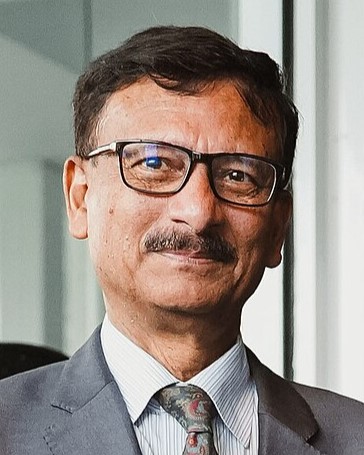
Such incidents do not occur along the borders of other countries unless there is a state of war. If individuals commit crimes, they might be prosecuted in court, but shouldn’t be killed.
—Md Touhid Hossain, Bangladeshi Foreign Affairs Adviser, at a roundtable titled “Bangladesh-India Relations: Expectations, Barriers and Future” in Nov ’24. Image Source: Wikimedia Commons
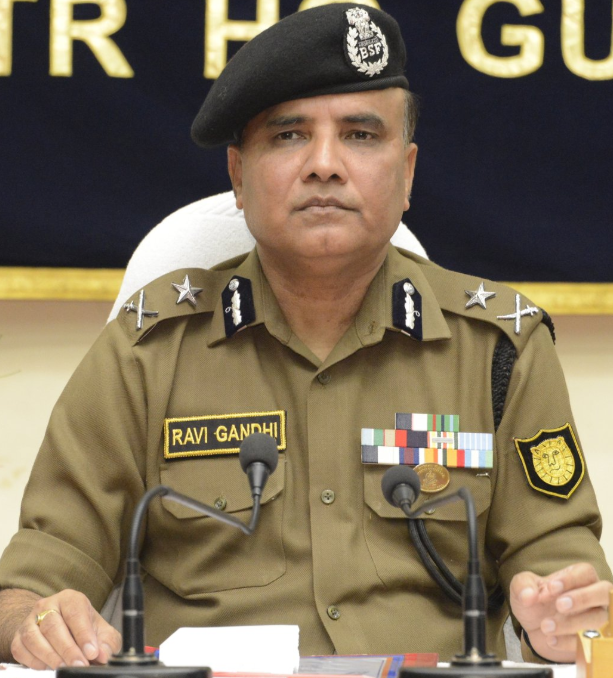
The incidents of shooting occur when a large number of people come with agents and attempt to infiltrate the border, sometimes attacking our personnel. At that time, in self-defence, our personnel open fire.
–Ravi Gandhi, Additional Director-General of BSF’s eastern command, as quoted by Scroll.in in November 2024. Image Source: @BSF_Gujarat/X
In October, the Bangladesh government sent another letter of protest to the Indian government. This time, a youth from its Cumilla district was shot allegedly by the BSF officials. The Indian media cited the BSF public relations officer who identified the deceased man as a smuggler. As noise dies down on Das’s killing, Asian Dispatch reached out to her brother Pintu for an interview.
He declined this reporter’s interview request, exasperated by the lack of action or any hopes of justice. “Will giving more media statements make my sister come back?” he said, before hanging up.