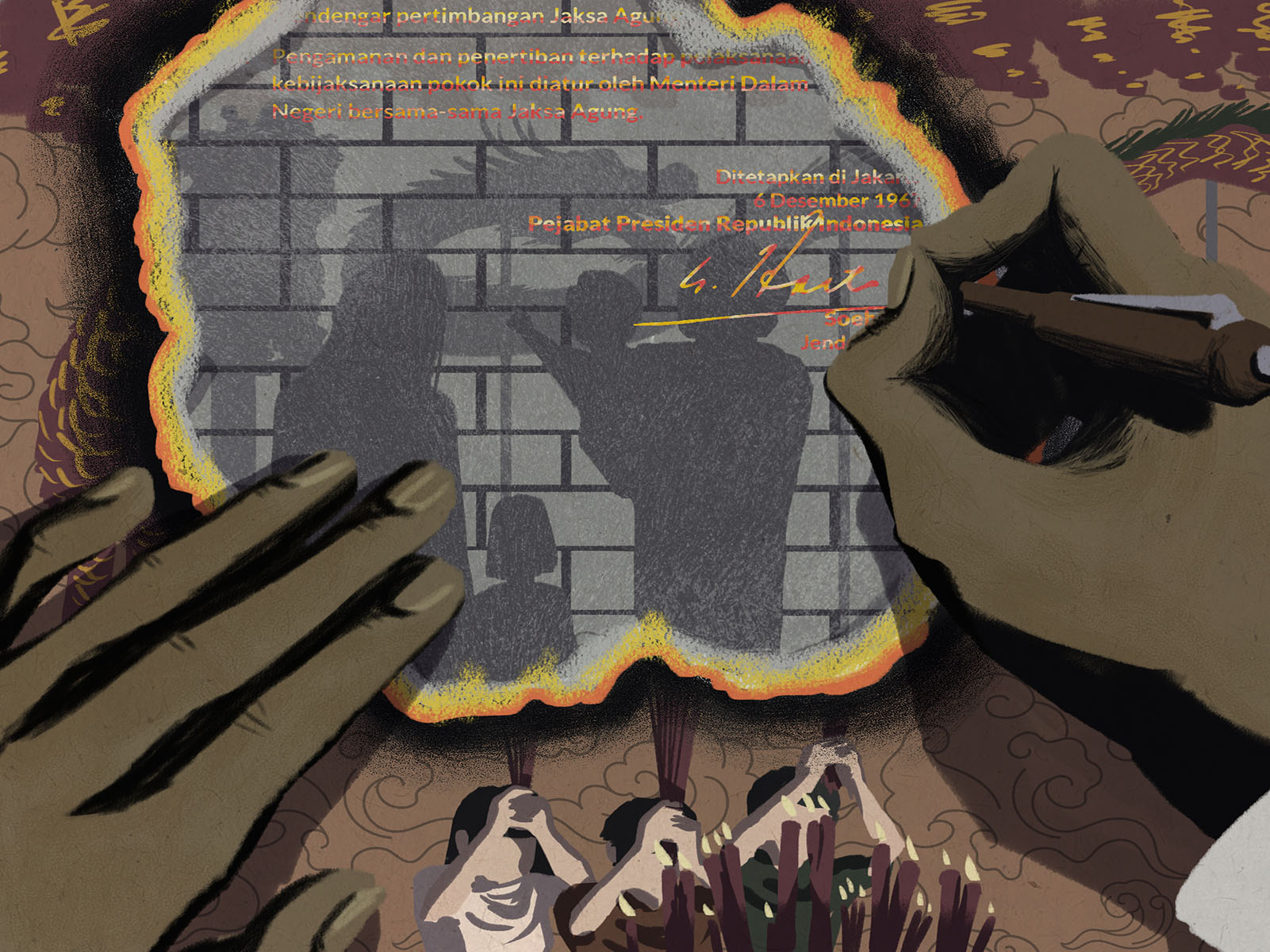
The epistemicide of Chinese-Indonesians. Illustration: Abdul Malik Amirullah/Project Multatuli
(Trigger Warning: This article may be distressing or triggering for some readers.)
May 1998 was the moment when I began to associate the word “Chinese-Indonesian” with “violence” and “rape”.
At the end of elementary school, it was the first time I was forced to be afraid of my identity both as a woman and as a Chinese-Indonesian, and I was frustrated because I did not understand how I ended up feeling that way. I knew almost nothing about the history of Chinese-Indonesians that led to the May 1998 riots. That ignorance made it even harder for me to understand my own emotions.
My parents also didn’t explain much. “The most important thing is, as a Chinese-Indonesian, you always have to be cautious. You can’t just say whatever you want, especially when it comes to politics,” they said.
For years I carried a pile of unanswered questions in my head. Who am I? Who is my family? What is Chinese-Indonesian? How is it that other holidays are marked with red-letter dates and celebrated festively, except for Chinese New Year? Why must we learn Mandarin in secrecy, while other regional languages can be studied freely? What really happened? Why did being Chinese start to feel wrong?
The turning point came in 2009. After graduating from university, I worked as a journalist for Suara Baru, an internal media of the Chinese-Indonesian Association (INTI) that was formed in 1999.
Even though I only worked there briefly, my time opened many doors for me to learn more deeply about Chinese-Indonesian issues and meet several Chinese-Indonesians who were directly involved in social and political work. Slowly, I began to find answers to the many questions that had haunted me for so long. Those answers were often shocking and heartbreaking.
I began to understand that the history of Chinese-Indonesians in this country is almost inseparable from the history of violence, which has often been systematically orchestrated by those in power since the VOC era. This systematic violence has spanned hundreds of years and is not only physical but also epistemic, taking the forms of neglect, concealment, and even denial of many historical facts, especially the darker parts of history.
I came to realize that the New Order regime carried out a systematic epistemicide against the Chinese-Indonesian community. The state deliberately stripped away knowledge about the history of my own ethnicity, uprooting me and other Chinese-Indonesians from our cultural roots, leaving me confused and struggling to process my own position and feelings.
As a result, I began to understand that the New Order never really died. More than 27 years after Soeharto’s downfall, the state has become increasingly blatant in its efforts to whitewash the past by erasing the violent and painful chapters of history involving the Chinese-Indonesian community.
This became very clear with a statement made by Culture Minister Fadli Zon on June 10, 2025. In an interview with IDN Times about the project to rewrite national history, Fadli referred to the mass rape of May 1998 as a “rumor” that had no proof.
His statement made my stomach turn. My chest tightened. Tears streamed down uncontrollably.
The History of Violence and ‘Disciplining’
“This is insane! How could the riots get out of control?”
My mother said that with panic etched across her face, appalled as scene after scene of apocalyptic brutality flashed endlessly across the television screen in front of us.
Fires raged and smoke filled the air. Physical clashes led to gunfire that killed without hesitation. Clenched fists went up and down as people screamed and scattered in all directions. Buildings and vehicles were covered in ash. Smooth highways turned into battlegrounds clouded with dust.
Unfortunately, we were not watching an action movie. It was real life that pierced straight into the Chinese-Indonesian community in the blink of an eye, leaving behind open wounds that have never fully healed.
Even more unfortunate, this was not the first time that a tragedy like this had happened to Chinese-Indonesians.
A number of historical milestones demonstrate how racism and discrimination against the Chinese-Indonesian community have manifested in their most extreme forms, including acts that amount to literal genocide. These include brutal massacres, rape, mutilations, and live immolations of Chinese-Indonesians.
These events include the 1740 Batavia Massacre; anti-Chinese massacres during the Indonesian National Revolution from 1946 to 1949; violence following the issuance of Presidential Regulation No. 10/1959 prohibiting Chinese-Indonesians from rural trade; the 1965 tragedy; and of course the May 1998 riots that included looting, burglary, and the mass rape of Chinese-Indonesian women.
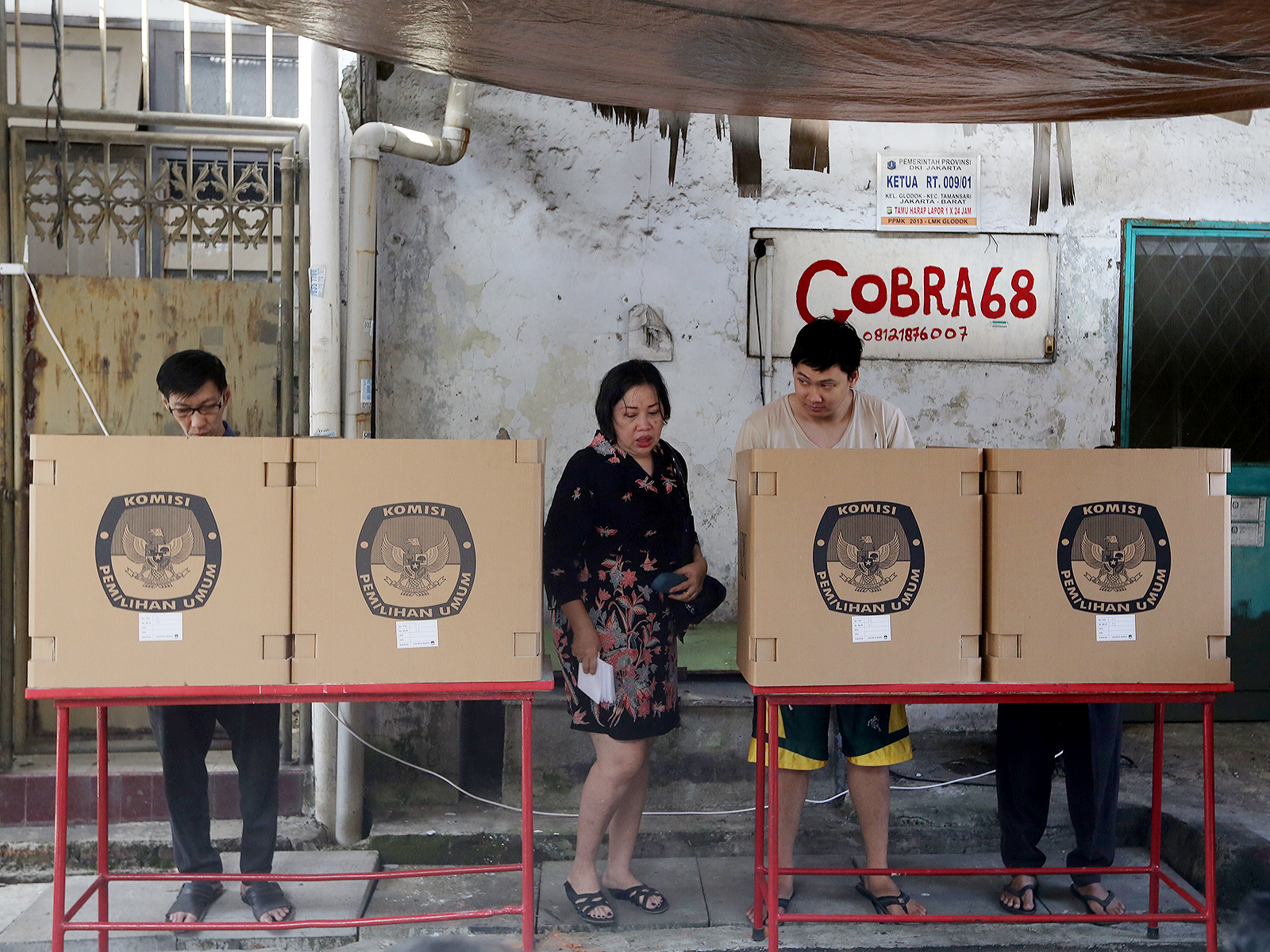
Chinese-Indonesian citizens participate in the 2014 General Elections in Glodok, Jakarta’s Chinatown and one of the tensest areas during the May 1998 riots. The high fences and iron security bars commonly installed on the windows of Chinese-Indonesian homes and shops since the riots remain a visible manifestation of the community’s lingering trauma. Photo: Ricky Yudhistira/Project Multatuli
These incidents occurred at the national level, but we have yet to fully address the widespread anti-Chinese violence at regional and sub-regional levels, where scale of brutality was no less appalling. For instance, the mass slaughter and rape of members of the Benteng Chinese community in Tangerang in June 1946, and the Mergosono tragedy in Malang in July 1947, which claimed the lives of at least 30 Chinese-Indonesians. In my own hometown, Bandung, several anti-Chinese riots have also occurred, including those on May 10, 1963 and August 5, 1973.
The repeated episodes of violence were made possible by the persistence of stereotypes that can be tracked back centuries like “Chinese-Indonesians are nothing but economic animals who only care about their own interest and benefits” and “Chinese-Indonesians are exclusive”.
During the Dutch colonial rule, Chinese-Indonesians were classified as Eastern Foreigners within the colonial demographic hierarchy. They were assigned the role of distribution intermediaries for daily necessities, serving both the colonial administration and the Malay-descended locals, whom the Dutch labeled as pribumi (a pejorative term that means “native”). This was a dilemmatic position that the Chinese-Indonesian community was compelled to occupy, whether they liked it or not.
Slowly but surely, a majority of Chinese-Indonesians (forcibly) ended up working in commerce and trade, a situation that bred resentment among the so-called pribumi, who came to see them as selfish profiteers.
After Indonesia declared independence, successive regimes carefully preserved these negative sentiments. Leaders appeared to understand how useful it was to deflect attention from their own failures by scapegoating the Chinese-Indonesians, portraying them as the root of the nation’s economic problem. The narrative was simple: “Chinese-Indonesians are greedy, so everything is their fault.”
During Sukarno’s era, the government enacted many discriminatory policies against Chinese-Indonesians that continued colonial legacies. A particularly controversial policy was the Presidential Regulation No. 10/1959, which banned Chinese-Indonesians from running retail businesses in rural areas. The military involvement in the implementation of the regulation led to major unrest that claimed the lives of many Chinese-Indonesians and massive exodus.
The 1965 tragedy, which paved the way for the rise of the New Order regime, also disproportionately targeted Chinese-Indonesians. As a communist state, China was accused of supporting the uprising and, thus, Chinese-Indonesians were automatically suspected of complicity. This logical fallacy led to the arrest and imprisonment of many Chinese-Indonesian figures who had actively contributed to Indonesia’s independence struggle. Ordinary Chinese-Indonesians suffered the most, especially with the closure of schools and constant fear of persecution.
During the New Order regime, the authoritarian president Soeharto reproduced colonial-era discriminatory tactics. He stripped Chinese-Indonesians of their access to and rights within practical politics, while granting privileges to a select few tycoons whom he considered loyal allies. This strategy ensured that all economic resources remained concentrated within the New Order’s circle of power, while Chinese-Indonesians continued to play essential roles in the economy even though they were never fully trusted. Therefore, writer Pramoedya Ananta Toer described the Chinese-Indonesian community as a “minority without political muscle”.
The New Order regime obliterated the history of the Chinese-Indonesian community’s roles and contributions to the nation-building process from various official references, before introducing new narratives that portrayed them as mere “foreign guests”—temporary residents whose rights could be easily revoked. Chinese-Indonesians were consistently constructed as “a problem” that needed to be surveilled and “solved” to avoid being seen as a threat to the country.
From there emerged a number of assimilationist policies that prohibited the use of Chinese names, as well as the Mandarin language and script. Chinese-Indonesians were banned from publicly displaying their religious, spiritual and cultural practices. At the same time, all Chinese-Indonesian media, political and social organizations, as well as Chinese-language schools were disbanded.
These discriminatory policies effectively laid the foundation for long-term racism, uprooting the Chinese-Indonesian identity to its very core and depriving the future generation of knowledge of the ethnic group’s history. The regime deliberately created distance between younger Indonesians and the collective memory of Chinese-Indonesians’ valuable contributions to the nation-building process. Even when some members of the new generations chose to become critical of the regime’s narratives and attempted to uncover the true history of Chinese-Indonesians, trauma and lack of reliable sources caused members of the ethnic group to remain silent.
This fear-based culture and knowledge, instilled by the regime, ended up being affirmed and embraced by generations of Indonesians, even by the Chinese-Indonesians.
In his Master’s thesis for Lund University in 2017, Roy Thaniago explicitly described how the Chinese-Indonesian community was being “disciplined” during the New Order regime through manipulation of media narratives. These narratives were crafted to ensure the community’s total obedience to the authorities to the point where the Chinese-Indonesians willingly disciplined and monitored their own behavior into submission.
In the end, the knowledge and culture that belong to Chinese-Indonesians today are nothing more than a product of state government violence. Centuries of systematic oppression have instilled fear so deeply that it can no longer be seen as just an individual issue. It has turned into a collective problem which has triggered intergenerational trauma.
This explains why my parents repeatedly reminded me that, as someone of Chinese-descent living in Indonesia, I always have to be extra careful. Careful with what I say, careful with how I act—because anything we say or do could backfire and put us in danger, no matter how good our intentions were. Whenever I find myself in a potential conflict with a non-Chinese, my parents always ask me to back down because even if I’m right, Chinese-Indonesians will always be seen as wrong, and will always lose in the end.
My parents also reminded me to study diligently, work hard, and focus on achieving academic and professional achievements—especially because in this country, Chinese-Indonesians are often valued only for their wealth.
Chinese-Indonesians are pressured to be financially generous, even though only a small number of us are truly wealthy. We are also expected to constantly prove our contributions just to be recognized as legitimate members of this country, even though it often feels like running a race with no finish line.
Epistemicide
I grew up in a Chinese-Indonesian family that is still deeply rooted in Chinese culture, yet I never truly experienced what it is like to see Chinese-Indonesian traditions publicly celebrated, let alone embraced in a deep and meaningful way.
Throughout the New Order period, the only major Chinese tradition my family celebrated that left a lasting impression on me was Chinese New Year. Even then, we could only celebrate it in the evening after my father came home from working long hours at a factory, physically exhausted, because Chinese New Year had not yet been recognized as a national holiday.
During that period, my parents also continued to observe several other Chinese-Indonesian traditions in private, but they never made any effort to pass them down to their children.
When I was in elementary school, my parents made an effort to teach me Mandarin themselves. At one point, they even asked me to join a Mandarin “course” held at a Christian church whose congregation was mostly Chinese-Indonesians. Of course, at that time, I didn’t understand why learning Mandarin had to be done discreetly in a church. Unfortunately, since I never use the language in daily interactions, I ended up forgetting much of the Mandarin vocabulary as I grew older.
At first, I didn’t care. But later, I realized that it was all the result of Soeharto’s discriminatory policies, which had a profound impact on me and many other Chinese-Indonesians.
For instance, I haven’t been able to trace my own family’s history because I struggled to understand my parents’ archived documents and letters, most of which were written in traditional Mandarin script. Yet the documents are the closest sources for me to understand my family history as well as the broader context of Chinese-Indonesian history as a whole.
Because my younger siblings and I did not understand Chinese customs, my father made a major decision. In 2007, he and his younger sister (my aunt) decided to exhume their parents’ graves. The bongpai, or gravestone, was destroyed, and the remaining bones were collected and cremated on the spot. They then scattered the ashes into the open sea. In their eyes, this was the best course of action, so that their children and grandchildren would not be burdened with maintaining traditions or tending graves, which can be costly.
For most Chinese families, graves carry far more cultural significance than simply being a final resting place. They are considered sacred, a symbolic tribute of respect for ancestors, a marker of identity, and a site of pilgrimage for future generations. To dismantle a grave is to erase a symbol of identity and lose the opportunity to honor and remember ancestral stories.
The dismantling of the grave is the perfect metaphor for the erasure of Chinese-Indonesian historical footprints, which was part of the epistemicide systematically carried out by the New Order regime.
As explained by Beth Patin, a professor of library and information science, epistemicide is “the killing, silencing, annihilation, or devaluing of a knowledge system”. According to her, epistemicide occurs when epistemic injustices take place persistently and systematically, collectively working as a structured and systemic oppression of particular ways of knowing.
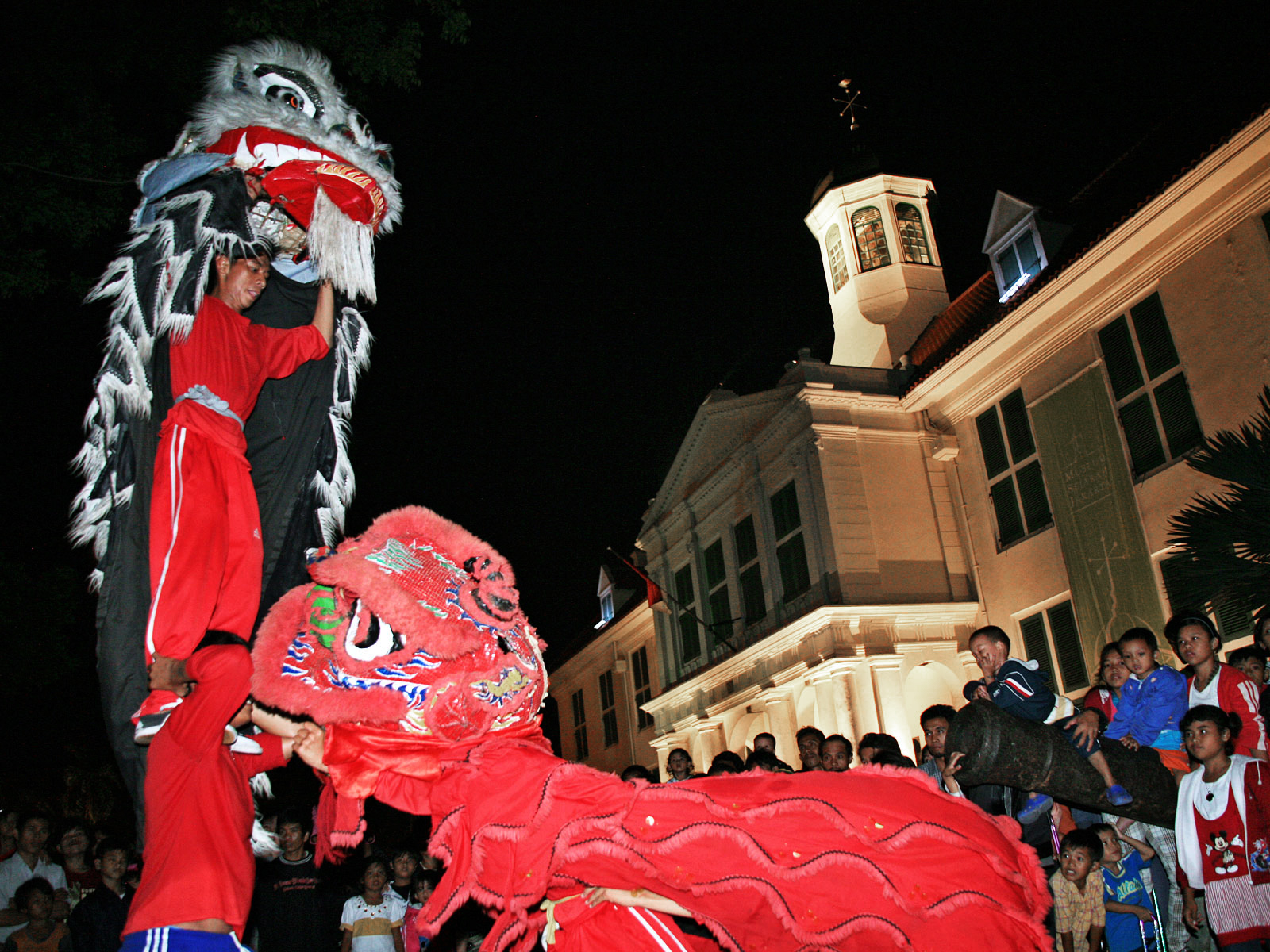
A group of barongsai (lion dance) performers play in front of the Fatahillah Park in Jakarta. Presidential Instruction No. 14/1967 on Chinese Religions, Beliefs, and Traditions once prohibited Chinese-Indonesians from practicing religious and cultural traditions rooted in their ancestral heritage, including barongsai. Even after the instruction was officially revoked by Presidential Decree No. 6/2000, the discriminatory policy has left many young Chinese-Indonesians disconnected from their cultural identity. Photo: Ricky Yudhistira/Project Multatuli
It’s disheartening to see how many Chinese-Indonesians today know next to nothing about the important roles their ancestors once played in politics, society, media, arts, or culture. Even in the sports sector, few are aware that Chinese-Indonesians have contributed not only to badminton but also to soccer.
In August 2024, I had the privilege of discussing this topic with Astrid Reza, a researcher from the Women’s Archive and History Center (RUAS). She said that historical writing about the Chinese-Indonesian community remains rare. As a result, it will take a much longer process for anyone to uncover, layer by layer, the knowledge that was subjected long ago to a form of epistemicide by those in power.
Not to mention those who attempt to uncover the truth about their own history must contend with deeply rooted New Order narratives about Chinese-Indonesians, along with waves of paid social media operatives working to preserve the narratives.
And, just as importantly, some Chinese-Indonesians remain hesitant to learn their own history.
“The New Order not only effectively obliterated the collective memory and knowledge related to Chinese-Indonesians, but also succeeded in killing the awareness of how important that knowledge is,” Astrid said.
“The greatest success [of epistemicide] is when even Chinese-Indonesians themselves become reluctant to learn about their own history. All it takes is silencing two or three generations, and entire bodies of knowledge, even the awareness of the importance of having that knowledge, will disappear.”
Understanding the Trauma of Chinese-Indonesians
Before Culture Minister Fadli Zon dismissed the mass rapes of May 1998 as a “rumor”, several political statements and events had already signaled the continued vulnerability of Chinese-Indonesians.
In 2016, Basuki Tjahaja Purnama, also known as Ahok, who was then serving as the governor of Jakarta, was accused of blasphemy after someone edited his speech quoting a verse from the Quran, uploaded the doctored clip to social media, and spread it with a misleading narrative. Large-scale anti-Chinese protests soon followed. Although the blasphemy charges were never truly proven, Ahok who is both Chinese and Christian, was sentenced to nearly two years.
For many of my Chinese-Indonesian friends, the massive protests instantly triggered bitter memories related to the May 1998 riots. One of them who felt this was Anastasia Satriyo, a Chinese-Indonesian who works as a child and adolescent psychologist.
“It’s as if my body is having a panic attack. I can’t watch the news about [anti-Chinese] issues for too long, just getting the gist of it is enough for me. I’ve realized that watching news related to these issues could cause me to stop functioning. On top of that, I always feel some tightening sensation in my chest every time I hear people shouting anti-Chinese sentiments,” Anastasia said.
“I always wonder, why is there always prejudice against Chinese-Indonesians?”
Anies Baswedan, who succeeded Ahok as governor of Jakarta, seemed to further inflame the situation. In his inauguration speech, he explicitly used the term “pribumi” (a pejorative term meaning “native”) and contrasted it with “non-pribumi“. Historically, these terms were used by the Dutch colonial government to divide the society along ethnic lines.
Anies earned his master’s degree at the University of Maryland and his PhD at Northern Illinois University. Therefore, many people believed he knew exactly the history behind those politicized terms, and it was no coincidence that he chose to use them. It is important to note that the use of “pribumi” and “non-pribumi” had officially been abolished by B.J.Habibie’s administration in 1998.
Eight years after the Ahok incident, Prabowo Subianto came to power. Prabowo, a former son-in-law of Soeharto, is widely believed to be involved in the forced disappearance of several activists in 1998.
It didn’t take long for his regime to reveal its true colors. On October 21, 2024, after being sworn in as Coordinating Minister of Law, Human Rights, Immigration and Correctional Services, Yusril Ihza Mahendra said what happened in May 1998 “was not a gross human rights violation”.
This came despite former President Joko Widodo’s acknowledgment in 2023 of 12 past gross human rights violations, including the 1965 tragedy and the May 1998 riots.
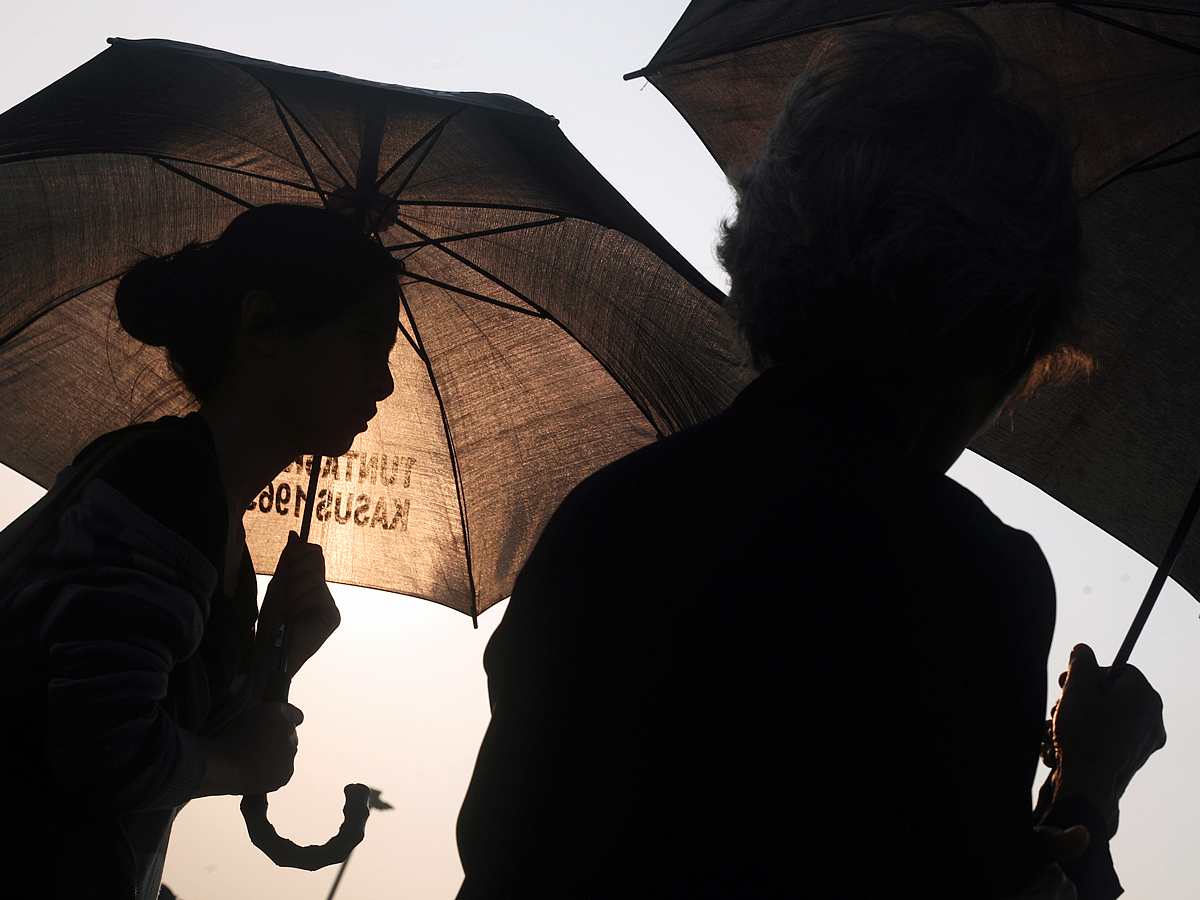
The Kamisan (Thursday) silent protests have persisted for two decades, as victims and families of gross human rights violations—including the 1965 and 1998 tragedies—continue to demand state accountability and justice. And yet, despite multiple regime changes, no legal resolution has been delivered. Instead, the state has opted for non-judicial measures that disregard the victim’s rights and dignity. Photo: Ricky Yudhistira/Project Multatuli
But it didn’t end there. My frustration and that of many other Chinese-Indonesians reached a boiling point when Fadli questioned the truth of the May 1998 mass rapes.
The first thing that came to my mind at that time was Ita Martadinata Haryono, a victim and young activist brutally murdered by those who couldn’t bear the thought of having their vile crimes exposed on the international stage. Ita was killed just before she was scheduled to testify about the mass rape in the United Nations forum.
Fadli’s words were incredibly cruel. He truly spat on the victims, witnesses and volunteers of the May 1998 tragedy, especially the women and Chinese-Indonesian community who, to this day, continue to carry the trauma, both directly and indirectly.
How can the findings of the Joint Fact-finding Team (TGPF), which clearly confirmed that a series of brutal gang rape took place in public spaces during May 1998, be denied simply because of “lack of evidence”?
Why insist on a legalistic argument which lacks empathy to defend himself? How is it possible to obtain evidence that requires victim testimony when the state offers no assurance of protection for the witnesses and survivors courageous enough to speak out?
That’s why, even though I wasn’t a direct victim, Fadli’s words threw me into emotional turmoil. My stomach turned. My chest tightened. Tears streamed down uncontrollably.
According to psychologist Anastasia, intergenerational trauma often manifests physically. When someone experiences trauma, their body’s DNA responds by activating certain genes and hormones to help the individual cope whether by confronting the threat (fight), escaping it (flight), appeasing it (fawn), or turning stiff, not taking any actions while trying to figure out the safest response (freeze).
It explains why Anastasia felt as if she was having a panic attack during the mass protest against Ahok’s so-called “blasphemy”, and why my chest suddenly tightened when I heard Fadli’s words.
In her practice as a psychologist, Anastasia often encounters subtle cases of intergenerational trauma among young Chinese-Indonesians, which usually manifest in relationship issues with their partners or parents.
“I once worked with a teenager who was confused about why her parents wouldn’t allow her to come home after 9 p.m., even though they lived in Jakarta. When she asked them about it, they simply said, ‘Remember your ethnicity,’” Anastasia said.
“This teenager became angry with her parents, especially since she had been exposed to concepts of human rights, democracy, and more. Her relationship with them turned sour.”
Other subtle forms of intergenerational trauma are also common among Chinese-Indonesians who live in a bubble, preoccupied with money, wealth, power, and lifestyle. Their focus tends to be solely on personal interests. According to Anastasia, this behavior may be an unconscious trauma response shaped by decades of systemic oppression in which Chinese-Indonesians were only allowed to engage in business and economic sectors to survive.
Therefore, Anastasia added, the issue of intergenerational trauma among Chinese-Indonesians cannot be separated from the broader power structures that have always targeted them. It is also deeply influenced by political, social, and cultural factors. This is why understanding their historical roots is crucial for Chinese-Indonesians.
“Awareness of one’s identity has a significant impact on a person’s psychological well-being. This awareness is shaped, among other things, by knowledge about one’s past, be it through family history or national history,” Anastasia said.
“The government’s attempt to uproot knowledge from Chinese-Indonesians is not just an act of epistemicide, but also of mental genocide.”
This means that efforts to heal from intergenerational trauma cannot be done by Chinese-Indonesians alone. They require strong support from the broader society—including fellow Indonesians—and the government.
But how realistic is it to expect support from the government?
After his controversial statement sparked public outrage, Culture Minister Fadli didn’t bother to apologize. On June 16, 2025, he even posted a thread on X, defending his stance, which only made people angrier.
Without acknowledging the TGPF’s findings, Fadli said the people “need to be careful and meticulous” before concluding that mass rape occurred in May 1998 because “it concerns the truth and the nation’s good name”.
This argument once again reminds us of the normalization of impunity toward perpetrators of sexual violence by institutions that prioritize protecting their reputation over delivering justice to victims.
What’s even more horrifying is the state’s blatant effort to whitewash past crimes by continuously manipulating history, while all protests are dismissed as meaningless noise.
Presenting Alternate Narratives
At a time when expecting support from the government is difficult, the rise of alternative sources about Chinese-Indonesians on social media offers a glimpse of hope.
One platform that has consistently promoted understanding of Chinese-Indonesians is Suara Peranakan. Founded in 2020, Suara Peranakan uses Instagram and X to spark discussions about Chinese-Indonesian identity and history, aiming to rebuild awareness within the community. The content it shares includes personal reflections with local perspectives that are rarely heard or represented.
Suara Peranakan covers a wide range of topics, including the hidden histories of Chinese-Indonesians, food and culinary traditions, intercultural communication, traditions and celebrations, the climate crisis, and calls for solidarity with other minority and marginalized groups sidelined by those in power. These topics are compelling because Chinese-Indonesians are no longer viewed as a single entity as they are always connected to the broader picture of global humanity.
“We must always uphold the values of solidarity and humanity because, in the end, you can’t stand alone. During the New Order era, Chinese-Indonesians were consistently labeled as money-oriented. We can break this stereotype by standing in solidarity with economically disadvantaged communities and other oppressed minority groups,” said Randy Mulyanto, a member of Suara Peranakan, in September 2024.
“Still, understanding our own history is essential as a starting point. It’s hard for us to be aware of broader issues if we don’t even know our own identity.”
Astrid Reza, the RUAS researcher, said Chinese-Indonesians could also resist epistemicide by stepping into social spaces that have long been considered difficult or even impossible for them to enter, although this is certainly no easy task.
Astrid cited her own experience of spending several days participating in the 2024 protests against the revision of the Regional Elections Law, which was allegedly aimed at allowing Kaesang Pangarep—former president Joko Widodo’s youngest son—to compete in the gubernatorial election. Astrid wanted to show that Chinese-Indonesians could voice their concerns through a demonstration, an avenue long avoided by the community due to past trauma.
Astrid’s words reminded me of a personal experience from years ago in East Aceh, during a visit for a literacy program.
One day, I ran into a group of elementary school students who were giggling, then yelled at me: “Kafir!”
“Kafir”, often translated as “infidel”, is frequently used in a derogatory way in Indonesia to refer to non-Muslims.
For a moment, I froze. I then decided to approach them and strike up a casual conversation. We talked about light topics, mostly about their daily lives.
These children admitted that they had never seen a single Chinese-Indonesian in their lives. As children of farm laborers, they rarely traveled outside their region due to financial constraints. They only knew that I looked different and assumed I might be a foreigner from Japan, Korea, or China.
After a while, as we grew closer, they started to get curious about Chinese-Indonesians.
“Tell us more about Chinese in Indonesia, please!”
I was immediately moved.
To me, their initial remark stemmed purely from ignorance. And when the official government narratives can’t be relied on, I believe there is nothing wrong with taking the initiative to reach out and share the alternative narratives myself.
Peringatan: Artikel ini bisa memicu trauma.
Epistemisida Tionghoa-Indonesia. Ilustrasi: Abdul Malik Amirullah/Project Multatuli
Mei 1998 adalah momen perdana saya mengasosiasikan “Tionghoa” dengan “kekerasan”, juga “pemerkosaan”.
Saat itu, di akhir jenjang SD, untuk pertama kalinya saya dipaksa merasa takut dengan identitas saya sebagai seorang perempuan sekaligus Tionghoa, dan saya kesal karena tak tahu mengapa bisa demikian. Selain nyaris tidak tahu apa-apa mengenai sejarah Tionghoa yang berujung kerusuhan Mei 1998, saya kesal karena ketidaktahuan tersebut membuat saya kesulitan memproses perasaan saya sendiri.
Orang tua pun tidak banyak menjelaskan. “Pokoknya, sebagai Tionghoa itu kamu mesti selalu waspada. Enggak bisa sembarang omong, apalagi omong politik,” ucap mereka.
Selama bertahun-tahun, setumpuk pertanyaan memenuhi kepala. Siapa saya? Siapa keluarga saya? Tionghoa itu apa? Mengapa hari besar lain bertanggal merah dan dirayakan semarak berhari-hari sementara Imlek tidak? Mengapa belajar Mandarin saja harus sembunyi-sembunyi seolah itu perbuatan ilegal sementara bahasa daerah lainnya tidak? Apa yang sebenarnya terjadi? Mengapa lama-lama muncul perasaan bahwa menjadi Tionghoa itu salah?
Titik baliknya ada di 2009. Setelah lulus kuliah, saya bekerja sebagai jurnalis Suara Baru. Ini adalah media internal Perhimpunan Indonesia Tionghoa (INTI), salah satu asosiasi Tionghoa terbesar di Indonesia yang berdiri pasca-1998.
Meski usia kerja di sana sangat singkat, terbuka pintu bagi saya untuk berkenalan dengan isu-isu Tionghoa secara lebih mendalam sekaligus berjumpa orang-orang Tionghoa yang terjun langsung dalam bidang sosial-politik. Perlahan, saya mulai memperoleh jawaban-jawaban atas segala pertanyaan yang begitu lama menghantui; jawaban-jawaban yang justru mengejutkan dan mencabik hati.
Saya jadi paham bahwa sejarah terkait Tionghoa di negeri ini nyaris tak pernah lepas dari sejarah kekerasan yang biasanya dirancang sistematis oleh para pemegang kekuasaan sejak era VOC. Membentang ratusan tahun, kekerasan sistemik ini bukan cuma perkara fisik tapi juga epistemik dalam bentuk pengabaian, penyembunyian, bahkan penyangkalan rupa-rupa realitas sejarah—terutama sejarah kelam.
Saya jadi paham bahwa rezim Orde Baru sungguh-sungguh menjalankan genosida pengetahuan terkait Tionghoa atau epistemisida secara sistematis. Negara sengaja merenggut pengetahuan mengenai sejarah etnis saya sendiri, mencerabut saya dan teman-teman Tionghoa lainnya dari akar kultural, juga membuat saya gamang memproses posisi dan perasaan saya sendiri.
Dan, saya jadi paham bahwa Orde Baru tak pernah benar-benar mati. Selewat 27 tahun setelah Soeharto turun takhta, negara justru kian gamblang berusaha mencuci dosa dengan menyetip babak-babak sejarah kelam yang sarat kekerasan terhadap komunitas Tionghoa.
Ini tampak jelas dalam pernyataan Menteri Kebudayaan Fadli Zon pada 10 Juni 2025. Dalam sesi wawancara dengan IDN Times terkait proyek penulisan ulang sejarah nasional, Fadli menyebut pemerkosaan massal pada Mei 1998 sebagai “rumor” yang tidak pernah ada buktinya.
Mendengar hal ini, asam lambung saya mendadak naik. Dada sesak seketika. Air mata pun mengalir tak terbendung.
Sejarah Kekerasan dan ‘Pendisiplinan’
“Ini betul-betul gila! Kok bisa rusuh sampai segitunya?”
Mama berujar dengan raut panik, tercekat menyaksikan adegan demi adegan brutal nan apokaliptik yang tak henti hilir-mudik melintasi layar televisi di hadapan kami.
Kobar api dan asap di mana-mana. Bentrok fisik berujung letup peluru tak ragu meminta nyawa. Tangan-tangan terkepal naik-turun silih berganti seiring jerit manusia yang lari berhamburan tak tentu arah. Bangunan dan kendaraan sekejap diselimuti abu. Jalan raya yang mulus jadi medan tempur berlumur debu.
Sayangnya, yang sedang kami tonton bukanlah film laga. Ia adalah realitas yang seketika menghunjam komunitas Tionghoa hingga meninggalkan luka menganga yang sulit kering.
Sayangnya lagi, ini bukan kali pertama tragedi semacam ini menimpa orang Tionghoa di Indonesia.
Ada sejumlah titik sejarah penting yang menunjukkan bagaimana rasisme dan diskriminasi terhadap Tionghoa muncul dalam wujudnya yang paling ekstrem, termasuk genosida dalam pengertian harfiah. Ini termasuk pembantaian keji, pemerkosaan, mutilasi, dan pembakaran Tionghoa hidup-hidup.
Sebut saja genosida Tionghoa di Batavia pada 1740 oleh kolonial Belanda, rangkaian pembantaian sepanjang periode revolusi kemerdekaan 1946-1949, pembantaian Tionghoa menyusul terbitnya Peraturan Pemerintah (PP) No. 10/1959, tragedi 1965, dan—tentunya—kerusuhan Mei 1998 yang diwarnai penjarahan, perampokan, serta pemerkosaan massal terhadap perempuan Tionghoa.
Warga Tionghoa mengikuti pemilihan umum 2014 di Glodok, kawasan Pecinan paling mencekam saat peristiwa kerusuhan Mei 1998 di Jakarta. Pagar tinggi dan teralis besi di setiap jendela rumah dan toko yang ramai dipasang untuk perlindungan diri sejak kerusuhan rasial itu menjadi manifestasi trauma warga Tionghoa yang tidak pernah sembuh. Foto: Ricky Yudhistira/Project Multatuli
Itu baru contoh di tingkat nasional. Belum lagi di tingkat regional dan sub-regional yang skala kekejamannya tak kalah mencengangkan, misalnya tragedi Cina Benteng di Tangerang pada Juni 1946 yang juga diwarnai pembunuhan dan pemerkosaan massal dan tragedi Mergosono di Malang pada Juli 1947 yang mengorbankan setidaknya 30 Tionghoa. Di kota kelahiran saya, Bandung, beragam huru-hara anti-Tionghoa pun pernah terjadi seperti kerusuhan 10 Mei 1963 dan 5 Agustus 1973.
Kekerasan berulang kali terjadi seiring langgengnya stigma-stigma seperti “Tionghoa adalah binatang ekonomi yang hanya memikirkan kepentingan dan keuntungannya sendiri” dan “Tionghoa itu selalu eksklusif”, yang bisa ditelusuri jejaknya hingga ratusan tahun silam.
Di masa kolonial Belanda, Tionghoa diposisikan sebagai Timur Asing dalam strata kependudukan, yang berfungsi sebagai perantara distribusi barang kebutuhan sehari-hari bagi kolonial sekaligus bumiputra. Ini peran dilematis yang mau tak mau mesti dilakoni komunitas Tionghoa saat itu.
Perlahan tapi pasti, sebagian besar Tionghoa (terpaksa) menjalankan hidup dalam bidang ekonomi dan perdagangan, situasi yang lantas melahirkan sentimen negatif di kalangan bumiputra bahwa kelompok ini hanya fokus mengejar keuntungan pribadi dengan menghalalkan segala cara.
Setelah Indonesia merdeka, setiap rezim yang berkuasa dengan telaten memelihara sentimen negatif ini. Para penguasa tampaknya tahu persis bahwa cara paling ampuh untuk mengalihkan perhatian rakyat dari ketidakbecusan mereka mengelola negara adalah mengambinghitamkan komunitas Tionghoa, menunjuk kelompok ini sebagai penyebab utama krisis atau ketimpangan ekonomi. Mudahnya, narasinya seperti ini: “Tionghoa rakus, jadi semuanya salah Tionghoa.”
Sepanjang era Sukarno, aneka kebijakan diskriminatif yang menargetkan Tionghoa hadir melanjutkan warisan kolonial Belanda. Salah satu yang memicu konflik adalah PP No. 10/1959 yang melarang orang Tionghoa berdagang eceran di perdesaan. Pelibatan militer dalam implementasi kebijakan ini berujung rusuh hebat yang memakan banyak korban orang Tionghoa dan memicu gelombang pengungsian besar-besaran.
Tragedi 1965 yang membuka jalan lahirnya Orde Baru pun menumbalkan banyak orang Tionghoa. Tiongkok yang komunis dituding terlibat mendukung pemberontakan sehingga Tionghoa di Indonesia diasumsikan pasti ikut terlibat. Sesat logika ini bahkan membuat banyak tokoh Tionghoa yang berjasa besar memerdekakan Indonesia tetap diciduk dan dibui. Dampak 1965 paling nyata dirasakan para Tionghoa jelata, termasuk karena penutupan sekolah-sekolah dan rasa takut yang senantiasa mengintai.
Selama rezim Orde Baru, presiden otoriter Soeharto mereproduksi taktik kolonial. Ia mengebiri seluruh akses dan hak Tionghoa terhadap politik praktis, tapi melimpahkan hak istimewa pada segelintir cukong yang dianggap sekutu loyal. Strategi ini memastikan ekonomi tetap terkonsentrasi pada lingkaran kekuasaan Orde Baru, sementara masyarakat Tionghoa tetap dalam posisi diperlukan tetapi tidak pernah dipercaya. Karena itu, penulis Pramoedya Ananta Toer menyebut komunitas Tionghoa “minoritas tanpa otot politik”.
Orde Baru melenyapkan sejarah peran dan kontribusi Tionghoa dalam pembangunan bangsa dari berbagai rujukan resmi, lalu menyusun ulang narasi-narasi baru yang membingkai Tionghoa sebagai “tamu asing” yang menumpang hidup di Indonesia dan pantas dikebiri. Tionghoa dikonstruksikan sebagai “masalah”, sehingga perlu diawasi dan dicari jalan keluarnya supaya tidak merugikan Indonesia.
Dari sana, lahirlah serangkaian kebijakan asimilasi yang melarang penggunaan nama Tionghoa serta bahasa dan aksara Mandarin. Kegiatan keagamaan, kepercayaan, dan adat istiadat orang Tionghoa tak bisa ditampilkan di depan umum. Media, organisasi politik dan sosial, serta sekolah Tionghoa pun dibubarkan.
Ini semua terbukti berhasil meletakkan fondasi rasialisme jangka panjang, mencerabut identitas Tionghoa hingga ke akar-akarnya, sekaligus membuat generasi berikutnya buta sejarah. Generasi penerus sengaja dibuat berjarak dengan memori kolektif terkait kontribusi Tionghoa. Kalaupun ada yang memilih kritis dan mencoba membongkar sejarahnya, minimnya referensi yang bisa dipercaya dan trauma membuat orang Tionghoa enggan bersuara.
Budaya dan pengetahuan berbasis rasa takut yang dialami selama bergenerasi-generasi akhirnya diamini dan dirangkul, bahkan oleh orang Tionghoa sendiri.
Dalam tesis masternya untuk Lund University pada 2017, Roy Thaniago gamblang memperlihatkan bagaimana Tionghoa “didisiplinkan” melalui permainan wacana di media massa supaya mereka selalu patuh terhadap kehendak penguasa, sampai-sampai pendisiplinan ini menjadi hal yang diinginkan oleh orang Tionghoa sendiri.
Akhirnya, segenap pengetahuan serta kebudayaan yang dimiliki Tionghoa-Indonesia saat ini tak lain merupakan produk kekerasan dari pemerintah. Penindasan terstruktur yang membuahkan ketakutan selama ratusan tahun bukan lagi masalah individu semata. Ia telah menjelma permasalahan kolektif yang memicu trauma lintas generasi.
Ini cukup menjelaskan mengapa orang tua berkali-kali menasihati saya bahwa hidup sebagai Tionghoa yang tinggal di Indonesia itu mesti selalu ekstra hati-hati. Hati-hati dalam berucap, hati-hati dalam bertindak, karena apa pun yang kami katakan dan lakukan bisa berbalik menjadi bumerang yang membahayakan sekalipun itikadnya baik. Jika berpotensi adu konflik dengan non-Tionghoa, saya selalu diminta mengalah karena sekalipun saya benar, Tionghoa pasti dianggap salah dan akan kalah.
Orang tua juga mengingatkan saya untuk belajar dengan tekun, bekerja keras, dan mencapai prestasi setinggi-tingginya—apalagi nilai Tionghoa di mata banyak orang biasanya terletak pada hartanya.
Tionghoa dituntut rajin memberi, sekalipun faktanya hanya segelintir saja Tionghoa yang super kaya. Tionghoa pun diminta selalu pro-aktif menunjukkan kontribusi mereka agar bisa diakui sebagai bagian dari Indonesia, meski ini bagai lomba lari tanpa garis finis.
Genosida Pengetahuan
Saya tumbuh besar di lingkungan keluarga Tionghoa yang masih sangat totok, tapi tak pernah benar-benar merasakan bagaimana kultur Tionghoa dirayakan, apalagi dimaknai secara mendalam.
Di era Orde Baru, tradisi akbar Tionghoa yang dirayakan keluarga dan membekas dalam benak saya hanyalah Imlek. Itu pun baru bisa kami rayakan jelang petang selepas papa yang buruh pabrik pulang bekerja dalam kondisi lelah karena Imlek belum diakui sebagai hari libur nasional.
Ada beberapa tradisi Tionghoa lain yang masih dijalankan orang tua, tapi mereka tak pernah berusaha menjelaskan kepada anak-anaknya.
Saat saya SD, orang tua memang sempat mengajarkan bahasa Mandarin secara autodidak. Saya pun pernah diminta orang tua mengikuti “kursus” Mandarin di sebuah gereja Kristen yang jemaatnya didominasi Tionghoa. Tentu, saat itu saya belum paham mengapa belajar Mandarin saja harus sembunyi-sembunyi di gereja. Masalahnya, karena tidak pernah digunakan dalam pergaulan, banyak kosakata Mandarin yang akhirnya terlupa begitu saja saat saya beranjak dewasa.
Awalnya, saya tidak ambil pusing. Di kemudian hari, barulah saya sadar bahwa ini semua adalah hasil kebijakan diskriminatif Soeharto yang berdampak begitu dalam bagi saya dan banyak Tionghoa lainnya.
Saya, misalnya, jadi tak mampu menelusuri akar sejarah keluarga sendiri karena kesulitan memahami arsip dokumen dan surat-menyurat orang tua yang kebanyakan ditulis dalam aksara Mandarin tradisional. Padahal, itulah sumber paling dekat untuk memahami sejarah keluarga sekaligus konteks sejarah Tionghoa-Indonesia secara keseluruhan.
Karena saya dan adik-adik tidak mengerti adat istiadat Tionghoa, papa pun mengambil keputusan besar. Pada 2007, papa dan adik perempuannya (tante saya) menggali kembali makam orang tua mereka. Bongpai atau batu nisan dihancurkan, sementara tulang-belulang yang tersisa diangkat dan kemudian dikremasi di tempat. Abunya lantas dilarung ke laut lepas. Di mata mereka, inilah langkah terbaik supaya anak-cucu tak perlu repot di kemudian hari menghidupi tradisi sekaligus mengurus makam yang biayanya tak murah.
Bagi kebanyakan Tionghoa, makam bukan sekadar situs peristirahatan terakhir. Ia bermakna sakral sebagai wujud penghormatan terhadap leluhur, penanda identitas, juga tujuan ziarah bagi generasi penerus. Pembongkaran makam berarti lenyapnya penanda identitas sekaligus buyarnya kesempatan merayakan kisah-kisah leluhur.
Pembongkaran makam itu adalah metafora paling sempurna dari pembumihangusan jejak sejarah Tionghoa, yang merupakan bagian dari genosida pengetahuan atau epistemisida yang begitu gencar dijalankan rezim Orde Baru.
Seperti yang dijelaskan Beth Patin, profesor ilmu perpustakaan dan informasi, “epistemisida” adalah “pembunuhan, pembungkaman, pemusnahan, atau devaluasi sebuah sistem pengetahuan”. Menurutnya, epistemisida terjadi ketika ketidakadilan epistemik terjadi secara terus-menerus dan sistematis, dan secara kolektif menghasilkan penindasan terstruktur dan sistemik terhadap cara-cara kita untuk mengetahui suatu hal.
Kelompok barongsai tampil di hadapan pengunjung Taman Fatahillah di Jakarta. Instruksi Presiden No 14 tahun 1967 tentang Agama, Kepercayaan, dan Adat Istiadat Cina, melarang warga Tionghoa menyelenggarakan kegiatan agama dan tradisi yang berpusat pada budaya negeri leluhur mereka, termasuk barongsai. Setelah Inpres itu dicabut Keputusan Presiden No. 6 tahun 2000, yang tertinggal adalah banyak generasi muda Tionghoa tercerabut dari identitasnya. Foto: Ricky Yudhistira/Project Multatuli
Sungguh sedih rasanya ketika saya mendapati orang-orang Tionghoa sendiri kini sudah tidak tahu apa-apa mengenai peran penting nenek moyangnya dalam bidang politik, sosial, media, seni, ataupun budaya. Bahkan dalam bidang olahraga yang lebih familier pun tak banyak yang tahu bahwa kontribusi Tionghoa bukan sekadar di bidang badminton, tapi juga sepak bola.
Pada Agustus 2024, saya sempat berbincang soal ini dengan Astrid Reza, peneliti dari Ruang Arsip dan Sejarah Perempuan (RUAS). Ia bilang penulisan sejarah mengenai Tionghoa masih langka. Karena itu, perlu waktu relatif lebih panjang bagi seseorang untuk membuka kembali lapis demi lapis pengetahuan-pengetahuan yang sudah lama digenosida oleh penguasa.
Belum lagi, mereka yang berusaha menggali sejarah mesti bergelut dengan narasi Orde Baru yang telah begitu mendarah daging dan serbuan buzzer di media sosial yang aktif dikerahkan untuk melestarikan narasi tersebut.
Dan, yang tak kalah pentingnya, ada keengganan dari kelompok Tionghoa untuk mempelajari sejarahnya sendiri.
“Orde Baru bukan hanya efektif membunuh memori kolektif dan pengetahuan-pengetahuan tentang Tionghoa, tapi juga membunuh kesadaran tentang pentingnya memiliki pengetahuan itu sendiri,” kata Astrid.
“Keberhasilan paling gemilang [dari epistemisida] adalah ketika justru orang-orang Tionghoa menjadi enggan mencari tahu sejarah mereka sendiri. Hanya perlu membungkam dua hingga tiga generasi, berbagai pengetahuan dan bahkan kesadaran untuk memiliki pengetahuan pun lenyap.”
Memahami Trauma Tionghoa-Indonesia
Sebelum Menteri Kebudayaan Fadli Zon menyatakan pemerkosaan massal Mei 1998 adalah “rumor”, sebenarnya telah muncul sejumlah pernyataan dan peristiwa politik yang menunjukkan posisi Tionghoa-Indonesia masih sangat rentan.
Pada 2016, Basuki Tjahaja Purnama alias Ahok yang saat itu menjabat gubernur Jakarta dituduh menista Islam setelah ada oknum yang memenggal pidatonya yang mengutip ayat Al-Qur’an, mengunggahnya di media sosial, dan menyebarluaskannya dengan narasi menyesatkan. Demonstrasi besar-besaran bernuansa anti-Tionghoa digelar tak lama kemudian. Meski tuduhan menista tak pernah benar-benar terbukti, Ahok yang Tionghoa dan Kristen lantas dipenjara hampir dua tahun.
Bagi banyak teman Tionghoa, demonstrasi besar yang terjadi saat itu sontak memantik memori pahit terkait kerusuhan Mei 1998. Salah satu yang merasakan hal ini adalah Anastasia Satriyo, seorang Tionghoa yang berprofesi sebagai psikolog anak dan remaja.
“Tubuhku seperti mengalami serangan panik. Aku enggak bisa lihat berita kayak gitu terlalu lama, cukup tahu saja. Aku sadar kalau lama-lama menonton berita seperti itu, aku bisa enggak berfungsi. Selain itu, ada sensasi sesak di dada tiap kali mendengar sentimen-sentimen anti-Tionghoa diteriakkan,” ujar Anastasia.
“Saya bertanya-tanya kenapa sih harus selalu ada prasangka terhadap kelompok Tionghoa?”
Anies Baswedan, yang menggantikan Ahok sebagai gubernur Jakarta, lalu seakan memperkeruh suasana. Dalam pidato pelantikannya, Anies terang-terangan menyebut istilah “pribumi” versus “non-pribumi” yang dahulu digunakan Belanda untuk memecah belah masyarakat.
Anies menamatkan pendidikan S2 di University of Maryland dan S3 di Northern Illinois University. Karena itu, banyak orang percaya Anies tahu persis sejarah di balik kata-kata tersebut, dan bukan kebetulan ia memilih menggunakannya. Sebagai catatan, penggunaan istilah “pribumi” dan “non-pribumi” di lingkungan pemerintahan telah resmi dicabut pemerintahan B.J. Habibie pada 1998.
Selang delapan tahun setelah peristiwa Ahok, terbitlah rezim Prabowo Subianto, mantan menantu Soeharto yang diduga ada di belakang penghilangan paksa sejumlah aktivis 1998.
Tak butuh waktu lama bagi rezim ini untuk menampilkan watak aslinya. Pada 21 Oktober 2024, usai dilantik sebagai Menteri Koordinator Bidang Hukum, HAM, Imigrasi, dan Pemasyarakatan, Yusril Ihza Mahendra menyebut apa yang terjadi pada Mei 1998 “bukan merupakan bentuk pelanggaran HAM berat”.
Padahal, pada awal 2023, Presiden Joko Widodo telah mengakui ada 12 pelanggaran HAM berat di masa lalu, termasuk tragedi 1965 dan kerusuhan Mei 1998.
Selama hampir dua dekade aksi Kamisan, korban dan keluarga pelanggaran HAM berat -di antaranya tragedi 1965 dan 1998- terus menuntut keadilan dan pertanggungjawaban negara. Namun, pergantian rezim tak membawa penyelesaian hukum, dan negara justru memilih jalur non-yudisial yang mengabaikan hak serta martabat korban. Foto: Ricky Yudhistira/Project Multatuli
Tak berhenti di situ, frustrasi saya dan banyak Tionghoa lainnya memuncak setelah Fadli mempertanyakan kebenaran pemerkosaan massal pada Mei 1998.
Hal pertama yang tebersit dalam benak saya tentu saja Ita Martadinata Haryono, korban sekaligus aktivis perempuan muda yang dibunuh secara keji oleh mereka yang tak terima laku bejatnya bakal diumbar di altar internasional. Ucapan Fadli luar biasa jahat. Ia benar-benar meludahi para korban, saksi, dan relawan Mei 1998, khususnya perempuan dan komunitas Tionghoa yang secara langsung maupun tak langsung masih terdampak peristiwa tersebut hingga detik ini.
Bagaimana mungkin temuan Tim Gabungan Pencari Fakta (TGPF) yang sudah sedemikian gamblang mengonfirmasi terjadinya gang rape alias pemerkosaan massal di ruang publik secara brutal selama peristiwa Mei 1998 malah disangkal begitu saja dengan alasan minim pembuktian?
Mengapa ngotot menggunakan alasan legal yang nir-empati untuk membela diri? Mana bisa pembuktian yang mensyaratkan pengakuan korban diharapkan terjadi di tengah ketiadaan jaminan perlindungan negara terhadap para saksi dan korban yang berani buka suara?
Karena itu, meski bukan korban langsung, emosi saya bergolak hebat mendengar kata-kata Fadli. Asam lambung saya naik. Dada sesak seketika. Air mata pun mengalir tak terbendung.
Menurut psikolog Anastasia, jejak trauma lintas generasi biasanya memang termanifestasi di tubuh. Ketika seseorang mengalami trauma, DNA tubuh akan merespons dengan mengaktifkan gen dan hormon tertentu untuk membantu individu melewati masa-masa traumatis entah dengan melawan ancaman (fight), menghindari ancaman (flight), meredakan sumber ancaman (fawn), atau malah kaku dan menunggu untuk menentukan respons terbaik (freeze).
Makanya, Anastasia bagai kena serangan panik saat terjadi demonstrasi menentang “penistaan agama” oleh Ahok, dan dada saya sesak mendengar kata-kata Fadli.
Selama berpraktik sebagai psikolog, Anastasia pun kerap menemui kasus-kasus trauma lintas generasi pada level yang lebih subtil di kalangan anak muda Tionghoa, yang umumnya termanifestasi dalam isu hubungan dengan pasangan atau orang tua.
“Pernah ada remaja yang bingung kenapa orang tuanya melarang dia pulang di atas jam sembilan malam, padahal mereka tinggal di Jakarta. Ketika dia bertanya, orang tuanya hanya menjawab singkat, ‘Ingat kamu tuh etnis apa,’” kata Anastasia.
“Remaja ini jadi marah dengan orang tuanya, apalagi ia sudah banyak terpapar dengan konsep-konsep hak asasi manusia, demokrasi, dan lainnya. Relasi dengan orang tuanya jadi buruk.”
Trauma lintas generasi subtil lainnya pun jamak ditemui pada kelompok Tionghoa yang hidup di dalam bubble dan hanya sibuk membahas uang, kekayaan, kekuasaan, dan gaya hidup. Fokusnya hanyalah diri sendiri. Anastasia bilang hal-hal macam ini bisa jadi merupakan bentuk respons trauma yang tak disadari akibat penindasan bertahun-tahun terhadap Tionghoa yang dulunya hanya diizinkan menggeluti bidang bisnis dan ekonomi untuk bertahan hidup.
Karena itu, menurut Anastasia, problem trauma lintas generasi Tionghoa tak bisa dilepaskan begitu saja dari keterkaitannya dengan struktur kekuasaan yang selalu menargetkan Tionghoa. Ini sangat dipengaruhi faktor-faktor politik, sosial, dan budaya. Itu sebabnya amat penting bagi Tionghoa untuk memahami akar sejarahnya sendiri.
“Kesadaran akan identitas sangat memengaruhi kondisi psikologis seseorang. Salah satu sumber untuk membangun kesadaran tersebut berasal dari pengetahuan-pengetahuan akan sejarah masa lalunya, baik sejarah keluarga maupun sejarah nasional,” kata Anastasia.
“Upaya pemerintah mencerabut pengetahuan dari diri Tionghoa bukan saja genosida pengetahuan tetapi juga genosida mental.”
Artinya, upaya pemulihan trauma lintas generasi tidak bisa diselesaikan sendiri oleh Tionghoa. Ia sangat membutuhkan dukungan dari lingkungan, dalam hal ini masyarakat dan pemerintah.
Masalahnya, realistiskah berharap ada dukungan dari pemerintah?
Setelah pernyataannya membuat gaduh, Menteri Kebudayaan Fadli toh tidak meminta maaf. Pada 16 Juni 2025, ia malah membuat utas penyangkalan di media sosial X yang isinya semakin bikin jengkel.
Tanpa menyinggung temuan TGPF, Fadli mengatakan “perlu kehati-hatian dan ketelitian” sebelum menyimpulkan ada pemerkosaan massal pada Mei 1998, karena ini “menyangkut kebenaran dan nama baik bangsa”.
Argumen ini sekali lagi mengingatkan kita pada normalisasi praktik impunitas terhadap para pelaku kekerasan seksual oleh institusi yang lebih memilih nama baiknya ketimbang keadilan pada korban.
Yang lebih mengerikan, upaya negara mencuci dosa dengan memanipulasi sejarah itu terus berjalan dengan begitu gamblang, dan segala protes yang muncul hanya dianggap angin lalu.
Menghadirkan Narasi Alternatif
Di saat sulit berharap pada pemerintah, munculnya sumber-sumber pengetahuan alternatif mengenai Tionghoa di media sosial seakan memberi sepercik harapan.
Salah satu yang konsisten menyebarluaskan pemahaman mengenai Tionghoa adalah Suara Peranakan. Digagas pada 2020, Suara Peranakan memanfaatkan Instagram dan X untuk memantik diskusi mengenai Tionghoa sekaligus membangun kembali kesadaran Tionghoa akan sejarah dan identitasnya. Pengetahuan yang disebarluaskan menyertakan refleksi pribadi, juga perspektif lokal yang selama ini jarang disuarakan.
Suara Peranakan mengusung topik beragam, termasuk sejarah-sejarah Tionghoa yang disembunyikan, pangan dan kuliner, komunikasi antarbudaya, tradisi dan perayaan Tionghoa, ragam Tionghoa non-Jawa, krisis iklim, hingga seruan solidaritas terhadap sesama minoritas dan kelompok marginal yang tersisihkan oleh kekuasaan. Topik-topik ini jadi sangat menarik karena Tionghoa tak lagi disorot sebagai entitas tunggal melainkan selalu terkait dengan gambar besar kemanusiaan global.
“Nilai solidaritas dan kemanusiaan memang harus selalu dibawa karena pada akhirnya lo enggak bisa berdiri sendiri. Di zaman Orde Baru, Tionghoa selalu dicap berorientasi pada uang. Tionghoa bisa mendobrak stereotip tersebut dengan menggalang solidaritas bersama masyarakat yang ekonominya lebih terbatas, juga bersama kelompok minoritas tertindas lainnya,” kata Randy Mulyanto, anggota Suara Peranakan, pada September 2024.
“Tapi, mengenali sejarah sendiri tetap penting sebagai pintu masuk. Sulit bagi kita untuk sadar dengan isu-isu yang lebih luas kalau identitas sendiri saja tidak tahu.”
Astrid Reza, peneliti RUAS, mengatakan Tionghoa juga dapat berupaya melawan genosida pengetahuan dengan menempatkan diri di ruang-ruang yang selama ini jarang atau bahkan dianggap mustahil dimasuki—walau ini tentu tak mudah.
Astrid mencontohkan bagaimana ia terjun berhari-hari dalam demonstrasi menentang revisi Undang-Undang Pilkada yang menjadi kedok untuk menempatkan putra bungsu presiden dalam tampuk kekuasaan di level provinsi—sebuah ancaman serius bagi demokrasi Indonesia. Selain menyuarakan aspirasinya, Astrid ingin memperlihatkan bahwa Tionghoa juga dapat menyampaikan pendapat melalui demonstrasi, ruang yang selama ini banyak dihindari Tionghoa akibat trauma masa lalu.
Pernyataan Astrid melayangkan ingatan saya pada sebuah pengalaman pribadi yang terjadi bertahun-tahun silam di Aceh Timur, ketika saya berkunjung ke sana dalam rangka aktivitas literasi.
Satu hari, saya berpapasan dengan sekelompok anak SD, yang sembari cekikikan kemudian meneriaki saya: “Kafir!”
Sejenak, saya terpaku, sebelum memutuskan menghampiri dan mengajak mereka berbincang santai. Kami mengobrol soal topik-topik ringan saja, utamanya terkait keseharian mereka.
Anak-anak ini mengaku tidak pernah melihat seorang Tionghoa pun sejak mereka lahir. Sebagai anak-anak buruh tani, mereka jarang bepergian ke luar daerah karena keterbatasan biaya. Mereka hanya tahu bahwa saya berbeda tampilan, mengira saya warga negara asing entah dari Jepang, Korea, atau Tiongkok.
Selang beberapa waktu, ketika kedekatan perlahan terjalin, mereka mulai tertarik mengetahui lebih banyak tentang Tionghoa.
“Kak, ceritakan lebih banyak tentang Cina yang tinggal di Indonesia dong!”
Saya sontak terharu.
Bagi saya, celetukan anak-anak itu murni datang dari ketidaktahuan. Dan, saat narasi resmi pemerintah tak bisa diandalkan, saya kira tidak ada salahnya menjemput bola dan menyerukan narasi alternatif.
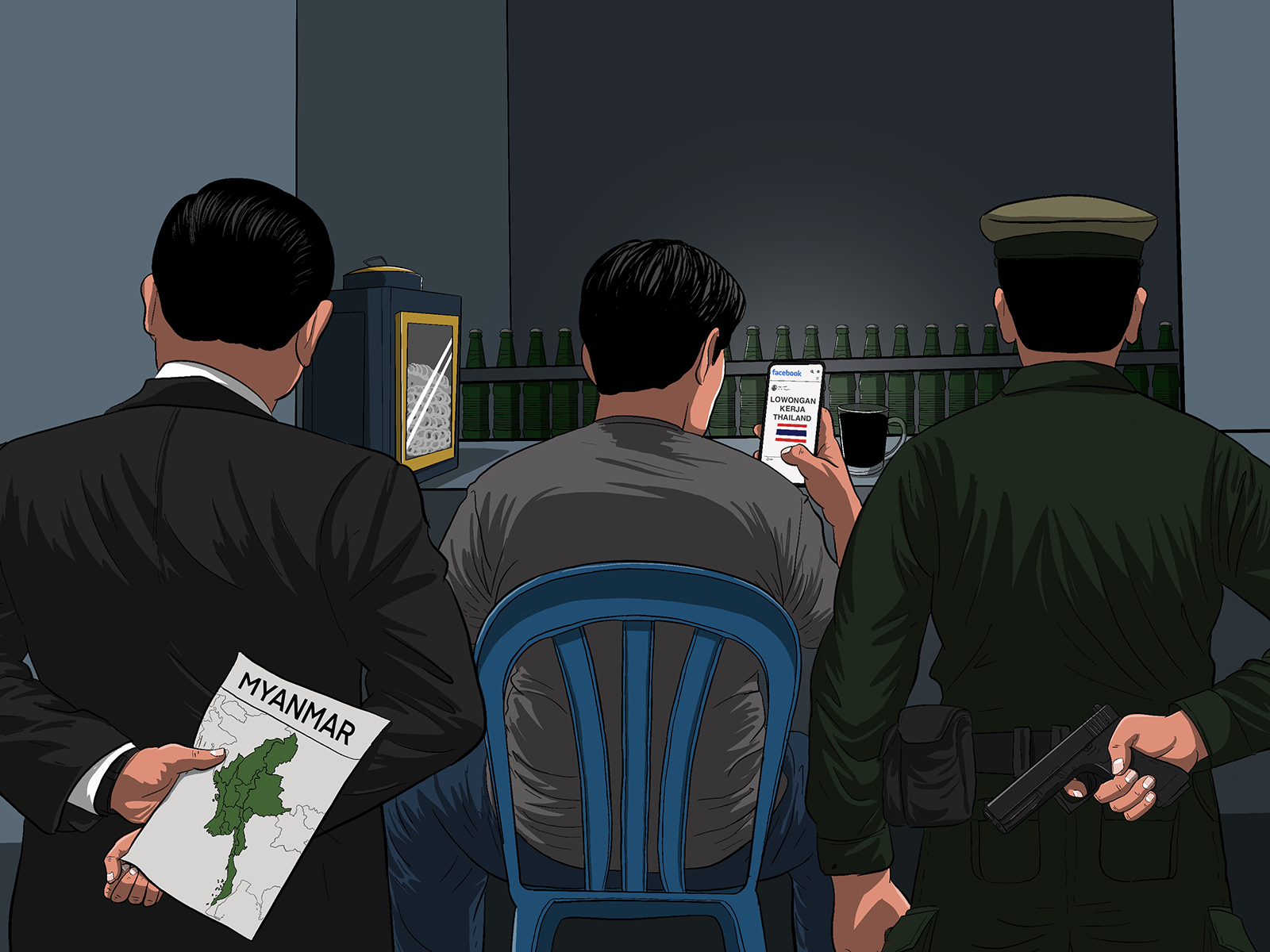
In Jakarta, Indonesia, for two years, the families of human trafficking victims have waited anxiously for the return of their loved ones, who have been forced into slavery in online scam operations in Myanmar. These families continue to hope the Indonesian government will intervene and rescue them.
“Please, Indonesian government. How much longer will our family remain abandoned?” asked Yanti, the sister of one of the victims still trapped in Myanmar.
Myanmar—along with Cambodia, the Philippines, Laos, and Thailand—has become a Southeast Asian hub for pig butchering scams. This form of long-term financial fraud involves perpetrators building trust with victims, often through fake romantic or friendship relationships, before convincing them to invest in fraudulent schemes.
As of March 2024, Indonesia’s Ministry of Foreign Affairs reported that 30 Indonesian citizens remain trapped in Myanmar.
“We truly understand the families’ concerns, and I will do everything possible to bring them home. However, the problem lies in accessing such a dangerous area. No foreigner has ever managed to enter it,” said Rina Komaria, Head of the Southeast Asia Sub-Directorate at the Directorate for the Protection of Indonesian Citizens, Ministry of Foreign Affairs.
Recruitment Pattern
Friend’s Deception
The COVID-19 pandemic devastated lives, leaving household finances in ruins. Many people were laid off, struggled to find new jobs, and became burdened with debt. This situation made some individuals easy targets for human trafficking syndicates.
These organized crime groups recruit victims through various methods. They post fake job advertisements on social media, posing as trusted institutions. They also exploit their own friends––as happened to Siska and her husband, Tito.
The couple’s nightmare began when Ahong, a friend, visited their home and tricked Tito into becoming a victim of human trafficking. As of August 18, 2024, Tito was still trapped in Myanmar.
“Ahong would eat and drink at our house when he was struggling financially. My husband trusted him. They were close friends—how could my husband think badly of him? And then, he deceived my husband,” Siska said.
In the past, Tito and Ahong worked for the same company. But later, Ahong moved to Thailand. When he found out that Tito had been laid off, he invited him to work at “a tech company” in Thailand, promising a monthly salary of Rp8 million (US$510)—a significant amount compared to Indonesia’s minimum wage of around US$286.
At first, Tito declined because he didn’t have money for travel expenses.
“But Ahong was persistent and even offered to cover the costs,” Siska said.
Siska recalled how Ahong reassured them: “Don’t worry, everything’s safe. There’s nothing strange. I’ll handle everything.”
“So my husband agreed. Our financial situation was bad, and he was stressed about our debts,” Siska explained.
In April 2022, after Ahong arranged the administrative and financial matters, Tito left for Thailand alone. At a Bangkok airport, someone claiming to be from the company—an associate of Ahong—picked him up. Tito stayed in a Bangkok hotel for three days, waiting for another worker, a man from Palembang.
On the third day, a company representative took Tito and the man from Palembang on a long journey through the jungle. When they finally arrived at the company, Tito saw Ahong again.
Soon after, Siska began having trouble contacting her husband—the company had confiscated his phone, allowing Tito to use it only twice a week.
Siska occasionally reached out to Ahong for updates, but over time, her husband told her to stop.
“Don’t contact Ahong anymore. If you do, it’s like killing me. He sold me to the Chinese to work as a scammer,” Siska said, recalling her husband’s words.
“At first, my husband thought he was still in Thailand. Later, he realized he was already in Myanmar,” she added.
Siska never discovered her husband’s exact location, and then Ahong disappeared.
“I’ve lost contact with my husband, and Ahong’s number is no longer active. But I’ve heard that Ahong has returned to Indonesia,” Siska said.
According to a May 2024 report by the United States Institute of Peace (USIP), Chinese criminal networks operating in Myanmar shifted their focus during the COVID-19 pandemic.
Initially, from 2017, these criminal organizations controlled illegal cyber gambling businesses along the Myanmar-Thailand border, with support from the Karen Border Guard Force (BGF), which is affiliated with the Myanmar military. In 2020, the Myanmar government shut down many of these operations in Karen State (now called Kayin State). However, following the military coup in February 2021, these criminal organizations resurfaced and expanded into running pig butchering scams.
During the COVID-19 pandemic, China closed its borders, making it difficult for these networks to recruit workers domestically. As a result, they began targeting workers from other countries, including Indonesia.
“Globally distributed human trafficking networks play a role in this process. Their task is to deliver job seekers to scam centers. And Myanmar-based criminal groups are the ones who pay them,” the USIP report stated.
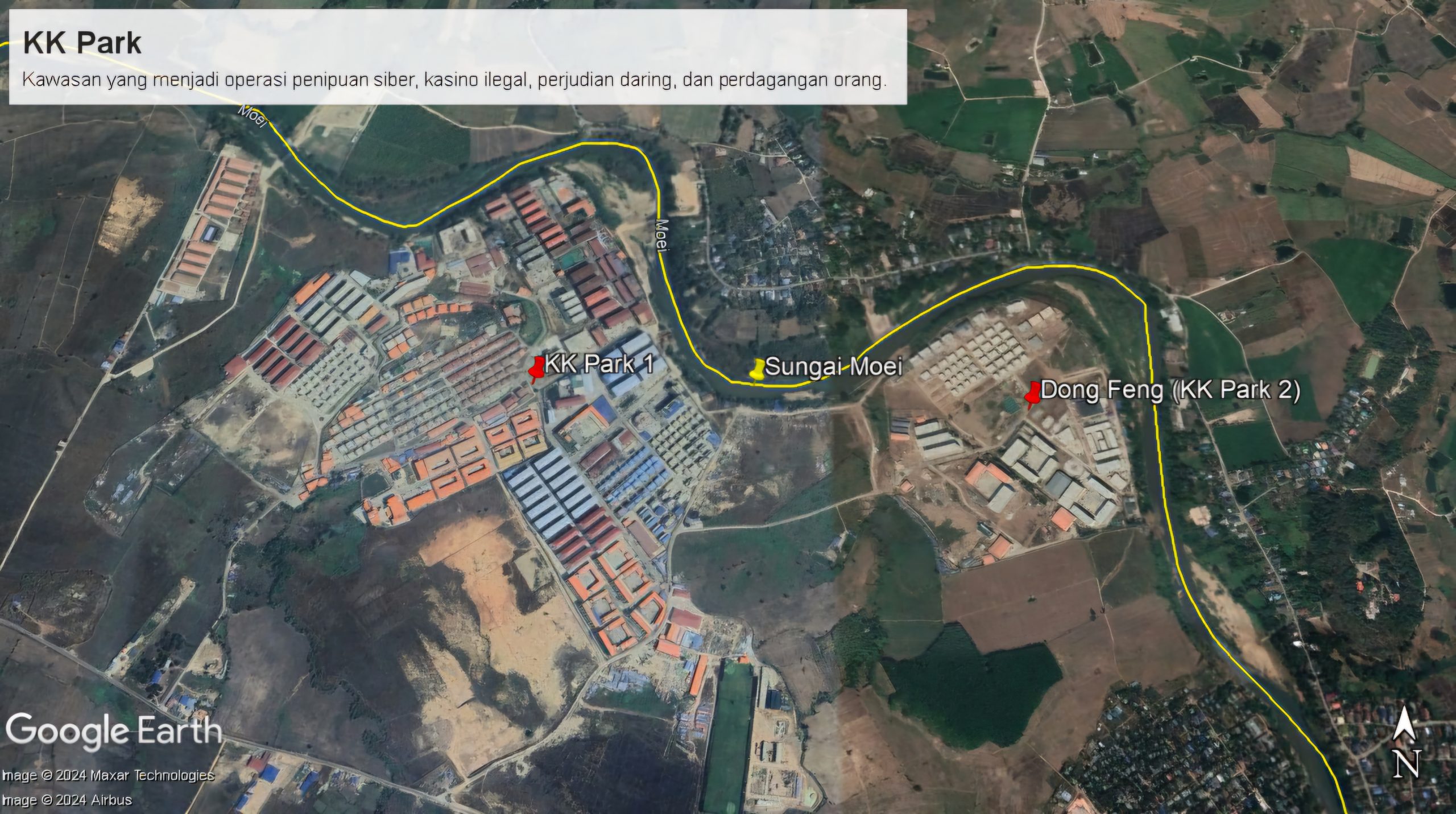
Satellite images of KK Park, an area that has become a base for cyber fraud, online gambling, and human trafficking operations in the state of Myanmar. (Google Earth)
Broker’s Promises
A panel of judges at the Bekasi District Court found Andri Satria Nugraha and Anita Setia Dewi guilty of human trafficking on February 5, 2024. The judges sentenced each of them to eight years in prison and fined them Rp200 million (US$12,763), with an additional four months in jail if they failed to pay the fine. The court also ordered them to jointly pay Rp600 million (US$38,292) in restitution to the victims, or serve an additional six months in prison if they do not pay.
Andri and Anita recruited and deceived dozens of Indonesians, forcing them to work as cyber scammers in Myanmar. Twenty victims recorded a video testimony about the fraud and torture they endured, which went viral on social media and prompted a response from President Joko Widodo.
On May 5, 2023, the Ministry of Foreign Affairs, through the Indonesian embassies in Yangon, Myanmar, and Bangkok, Thailand, successfully evacuated them from Myawaddy, Myanmar. Four days later, the National Police’s Directorate of General Crimes (Bareskrim) arrested Andri and Anita at Sayana Apartment, Kota Harapan Indah, Bekasi Regency.
However, some of Andri’s and Anita’s victims remain trapped in Myanmar.
One of them is Pendi. His wife, Mona, is still fighting for her husband’s return to Indonesia.
The restaurant where Pendi worked went bankrupt due to the COVID-19 pandemic, leaving him with no choice but to work odd jobs. Sometimes, he worked as a motorcycle-taxi driver, and other times as a private driver. His income was barely enough to cover daily expenses.
One day, he met Andri Satria Nugraha and Anita Setia Dewi at Summarecon Mall Bekasi. The couple offered Pendi a job at “a technology company” in Thailand, promising a one-year contract with a monthly salary of around Rp10 million to Rp20 million (US$639 to $1,277).
They also promised to cover his flight, meals, accommodation, and other administrative costs. All that was required was proficiency in English and fast typing skills.
“They soon had a Zoom meeting, where Andri and Anita appeared along with eleven other victims. The departure process moved very quickly after my husband met them,” Mona said.
Mona grew suspicious because Andri and Anita never disclosed the name of the company, saying only that it was located in Bangkok.
“But my husband went anyway because he had good intentions—he wanted to provide for the family. So he accepted the offer to go to Thailand,” Mona said.
Andri and Anita arranged the departures in two groups. Pendi and four others—two women and two men—were part of the first group, which left Jakarta in July 2022. The second group departed from another location at a different time. Meanwhile, Andri and Anita stayed behind in Indonesia.
“When he arrived in Thailand, my husband contacted me. Someone from the company, who seemed to be in charge, picked him up. He looked Chinese but spoke with a bit of a Malaysian accent,” Mona said.
The company representative took the victims to a hotel in Bangkok, where they spent the night. The next day, they were driven 500 kilometers to Mae Sot, a city on Thailand’s western border with Myanmar, before crossing the Moei River. None of the victims realized they had been smuggled into Myanmar.
Once there, the company confiscated their passports and forced them to practice speed typing. They also restricted mobile phone use, making it difficult for Mona to contact Pendi.
“Three weeks later, my husband sent me a letter saying he had realized he’d been tricked. He asked me to report it to the Indonesian authorities,” Mona said.
Language Course Center
Yanti remembers Wahyu as an introverted person, determined to achieve his dreams. Ever since graduating from college, her brother had dreamed of working in South Korea. To pursue that goal, he enrolled in Korean language courses at the Korean Language Center Indonesia (KLCI) in Sukabumi—run by Latif Aliyudin.
“My brother took the Korean language test in Jakarta twice before he finally passed and got his certificate,” Yanti said.
With Latif’s help, Wahyu was almost sent to work at a manufacturing company in South Korea, but the plan was postponed due to the COVID-19 pandemic. In the meantime, Wahyu took on odd jobs, with his last position as a part-time teacher, earning Rp600,000 (US$38) per month.
“Then the course reached out again and offered him another opportunity, asking, ‘Do you still want to work in Korea? Departures have reopened,’” Yanti recalled. “My brother agreed because it was his dream.”
KLCI Sukabumi requested Rp20 million (US$1,278) for Wahyu’s departure costs. His family helped pay in installments—first Rp3 million, then Rp5 million—until the full amount was covered. However, Wahyu never went. KLCI said that processing the visa and work permit for South Korea was still complicated.
As an alternative, Latif suggested that Wahyu take a job at “a Korean subsidiary in Thailand.”
“He said it would only be for three months, at most, before my brother could finally go to South Korea. Wahyu agreed because he was unemployed, getting older, and had already paid in full,” Yanti explained.
Latif introduced Wahyu to a man named Ardli Fajar, who arranged accommodation for Wahyu at the City Park Apartment in Cengkareng. In November 2022, Wahyu departed for Thailand.
After Wahyu moved, Yanti found it difficult to stay in touch with him. His phone was often inactive, and her messages would only show a single check mark.
“I tried messaging him, but it would take three or four days—sometimes even a week—before he replied. He said he was healthy. I stayed positive, thinking maybe he was just adjusting to the work there. By December 2022, I still hadn’t heard much from him,” Yanti said.
Months passed, and Yanti completely lost contact with her brother. The family grew increasingly worried, especially as news reports about fraud and human trafficking in Southeast Asia began to surface.
“One day, I sent him some news articles and asked about his location and how he was doing. Two weeks later, he finally replied. But his messages sounded strange, like he was scared,” Yanti recalled.
Wahyu told her that he had been smuggled into Myanmar through Thailand. He wasn’t working at a manufacturing factory but had been forced to work as a cyber scammer—and he wasn’t getting paid.
“Brother, just escape,” Yanti urged.
“I can’t. I’m trapped behind a mountain.”
“Are they torturing you?”
“Yesterday, they electrocuted me,” Wahyu replied. “Don’t tell Mama. I’m afraid she’ll get sick from stress. Just pray for me to stay strong here.”
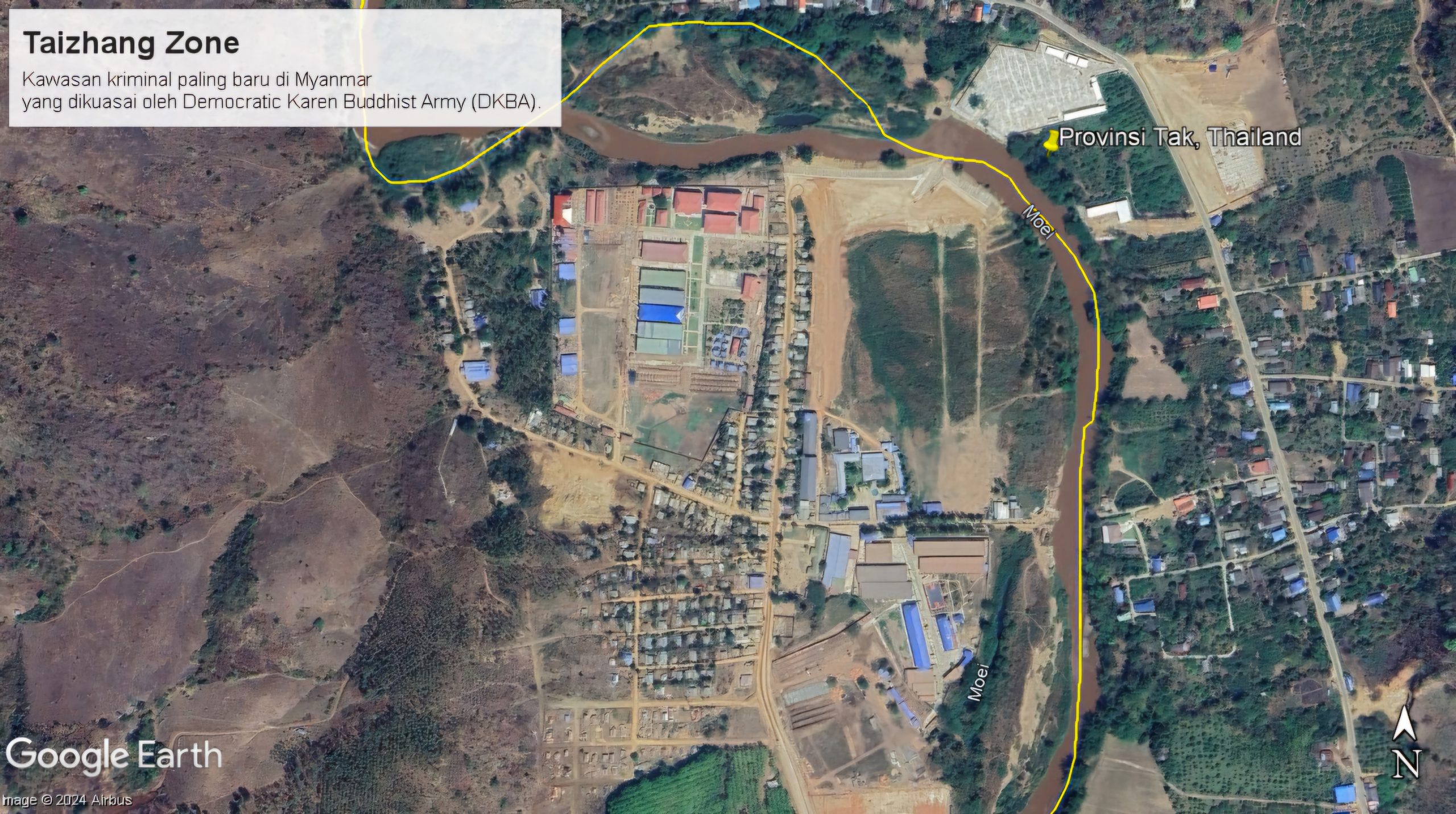
Satellite images of Taizhang Zone, the latest criminal area controlled by armed groups in Karen State, Myanmar. (Google Earth)
Days in the Camp
In Myanmar, Indonesians forced to work as pig butchering scam operators endure extremely long, inhumane working hours—17 to 20 hours a day with only 30 minutes of rest, without holidays or pay.
The cyber fraud organizations force these enslaved workers to scam 100 people each day, primarily targeting citizens from the United States, Canada, and Australia. If they fail to meet their targets, their working hours are extended, or they face physical punishment. These punishments include standing for hours, running 30 laps around a soccer field while carrying a water-filled gallon, doing hundreds of push-ups, being hit with blunt objects, whipped, or even electrocuted—depending on the severity of their failure.
After being electrocuted by the syndicate, Wahyu’s body was covered in bruises, and he struggled to walk.
“His legs hurt, so he had to walk slowly. But even in that condition, he comforted us,” Yanti said.
Yanti recalled her brother telling her: “Don’t worry about me. I wore layers of clothes—thick ones. So when they electrocuted me, it didn’t feel as bad.”
“But being electrocuted is still being electrocuted—it breaks my heart,” Yanti said.
The victims have lost all choice and control over their lives. The company forces them to keep scamming, even though it goes against their conscience.
Siska recalled her husband Tito saying: “Bu, I can’t stand lying to people. When I look at the photos of the people I’m supposed to scam, I see their children and families. It makes me think of you and the kids at home. That’s when they beat me.”
“So my husband just accepted it when they beat his thighs with iron rods and beams until they bruised. Eventually, they hit him on the head. He wanted to fight back, but he couldn’t,” Siska said.
The Pig Butchering Scam
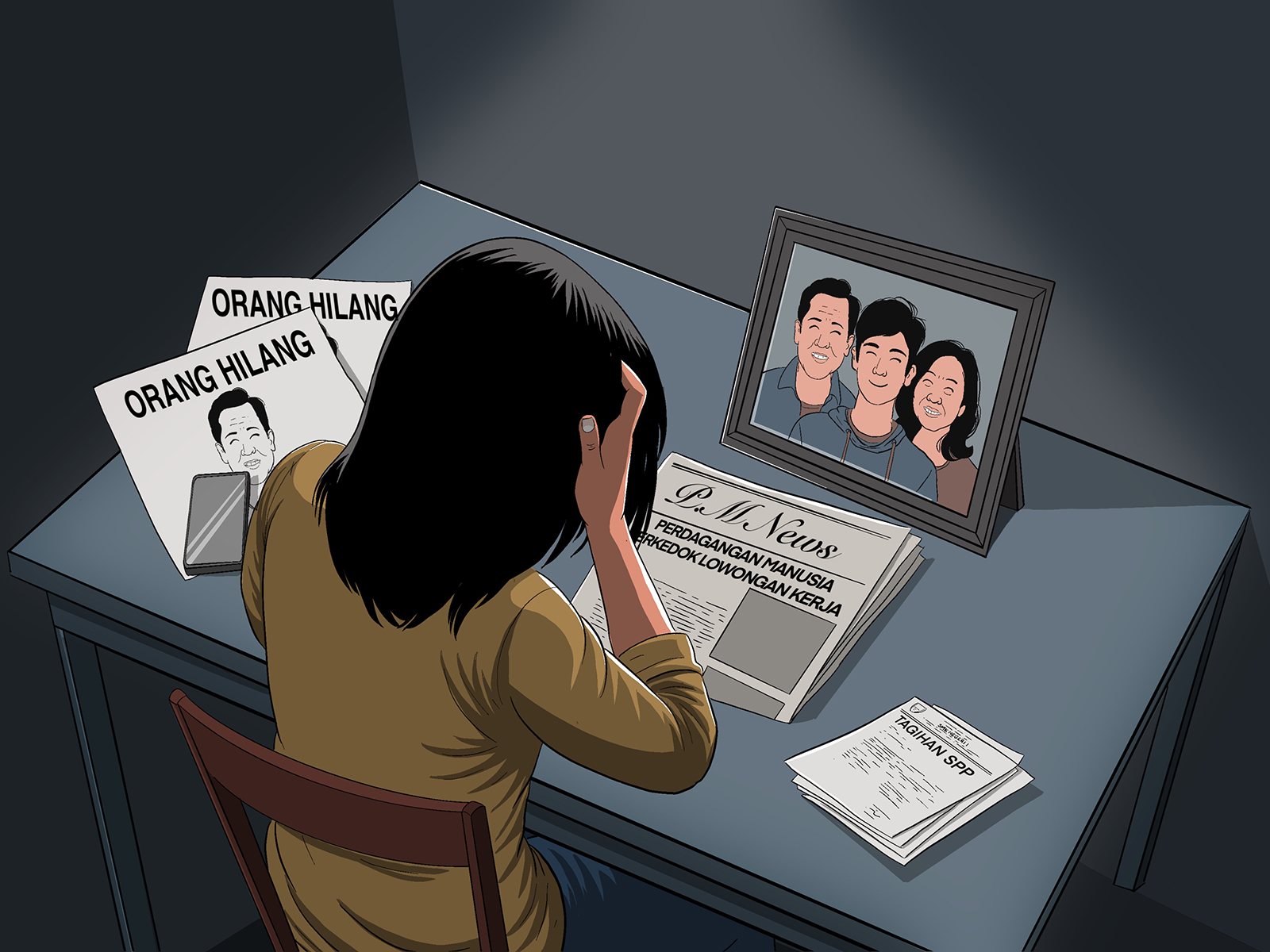
An illustration of the families of human trafficking victims in Myanmar. (Project M/Aan K. Riyadi)
The pig butchering scam is a type of online investment fraud with two stages.
The first stage, known as “fattening the pig,” involves building trust between the scammer and the target. Scammers use fake identities to approach their targets on social media. In some cases, they steal real people’s identities.
The scammers often pose as glamorous, wealthy individuals—attractive, upper-class men or women—who flaunt luxury goods, enjoy horseback riding, travel the world, and drive Ferraris. They use these personas to lure wealthy targets.
Initially, the scammer is warm and friendly, engaging the target as if they’ve known each other for a long time. Once trust is established, the scammer introduces an investment opportunity, promising high returns through fake cryptocurrency trading platforms set up by the company.
The second stage, “butchering the pig,” begins when the scammer embezzles the target’s money. Once the target has invested large sums, the scammer vanishes, along with the investment platform, leaving the target in financial ruin.
But not all scams go as planned.
If the scammer fails to deceive the target, the criminal groups may extort the scammer’s family. For instance, the company might demand a ransom, promising to release the operator if the family pays.
The syndicate once demanded Rp150 million (US$9,560) each from Mona and Yanti for the release of Pendi and Wahyu. Similarly, they asked Siska for US$10,000 to free Tito. When the families couldn’t pay, the company threatened to sell the victims to other criminal groups.
Siska remembered Tito saying: “They sold me to a new company. They confiscated my phone. I can’t take it anymore. Please prepare US$8,000.”
“My husband called me, crying. He couldn’t endure it any longer. The punishments at the second company were even worse. But where was I supposed to get that kind of money?” Siska said.
Mona also had no choice but to accept that her husband would be sold to another company. On average, victims were sold more than twice.
“I asked my extended family for help, but I couldn’t raise that much money. I reached a point where I knew there was nothing else I could do. If my husband was going to be sold again, I just had to accept it,” Mona said.
“We’re also scared. Even if we pay, there’s no guarantee they’ll come home. If not, we’ll just end up in debt,” Yanti added, thinking of her brother, Wahyu.
But the company doesn’t care whether the families have money or not—they just want payment.
Yanti once told the company she couldn’t afford to pay.
“They told me, ‘If you can’t pay, we’ll take him to an underground prison,’” Yanti said.
“At that point, we didn’t know my brother’s condition. We feared the worst—thinking he might die,” she added.
Demanding Repatriation
Transnational crime has a domino effect. The victims’ families—mostly wives—not only suffer emotionally but also bear the financial burden alone.
Siska works tirelessly to support her family and ensure her two young children get enough nutrition.
“Now I have to work harder than ever. In the morning, I run a laundry service from home,” Siska said. “In the afternoon, I work at a clothing store until 10 p.m. If I’m not too tired, I stay up ironing until dawn.”
Mona is in a similar situation, now working as a domestic worker to support her family. Her and Pendi’s two children had to drop out of college to help with the family’s financial struggles.
“They’re working now. We help each other. I feel guilty that their father’s situation has burdened them, especially at such a young age,” Mona said.
These women have taken on multiple roles as they continue to fight for their families. They’ve appealed to the police, BP2MI, the Ministry of Foreign Affairs, the National Commission on Human Rights, and even visited the House of Representatives. Several civil society organizations have supported them, yet they still have no clear answers.
“The government keeps asking us to be patient and wait. We don’t know what the obstacles are—we’re just housewives who don’t understand diplomacy,” Mona said.
“The police still haven’t arrested Latif. They’ve summoned him twice. They should bring him in by force,” Yanti added, referring to Latif Aliyudin, the owner of the Korean Language Center Indonesia (KLCI) in Sukabumi.
“My husband even asked me to seek financial help from people in the village. He said, ‘If the government can’t bring me home, we’ll have to prepare the ransom ourselves,’” Siska said.
Exhausted from fighting alone, the women started a joint movement called “Jerat Kerja Paksa” (Forced Labor Trap), a self-help initiative supporting victims and families of modern slavery in Southeast Asia.
They’ve shared their struggles in public forums and, most recently, sent an open letter to President Joko Widodo on June 26—World Day Against Torture—through the State Secretariat. In the letter, they urged Jokowi and his cabinet to address human trafficking urgently.
“No one deserves to be tortured, and no one should have the right to torture others,” the letter stated.
Meanwhile, the Directorate of Protection of Indonesian Citizens at the Ministry of Foreign Affairs said they have not yet been able to rescue the victims.
The Ministry of Foreign Affairs said they have tried several approaches, including seeking assistance from the Myanmar government, approaching the government of the People’s Republic of China (details of which they cannot disclose), and communicating with the Karen Border Guard Force that controls the Karen State.
“The (Myanmar) government can’t reach the victims because their location is too close to the conflict zone,” said Rina Komaria, Head of the Southeast Asia Sub-Directorate of the Directorate of Protection of Indonesian Citizens at the Ministry of Foreign Affairs.
Myanmar has been engulfed in a prolonged civil war, which intensified after the military staged a coup against the civilian government in February 2021. The conflict has spread across several regions, including Shan, Kachin, Karen, Rakhine and central Myanmar.
“About five to seven people are in the Hpa-An area. It’s extremely remote and close to the heart of the conflict. Not only is it difficult for Indonesians to reach, but even Myanmar authorities struggle to access the area,” Rina added.
Hpa-An is a major city in Karen State, a region that has drawn the attention of international human rights activists due to its role as a hub for transnational criminal operations.
Several areas in Karen State are suspected of being bases for cybercrime, online gambling, illegal casinos, and human trafficking. These include Apollo Park, Yatai New City (Shwe Kokko), Yulong Bay Park, KK Park 1 & 2 (Dongfeng), Dongmei Park and Myawaddy Town.
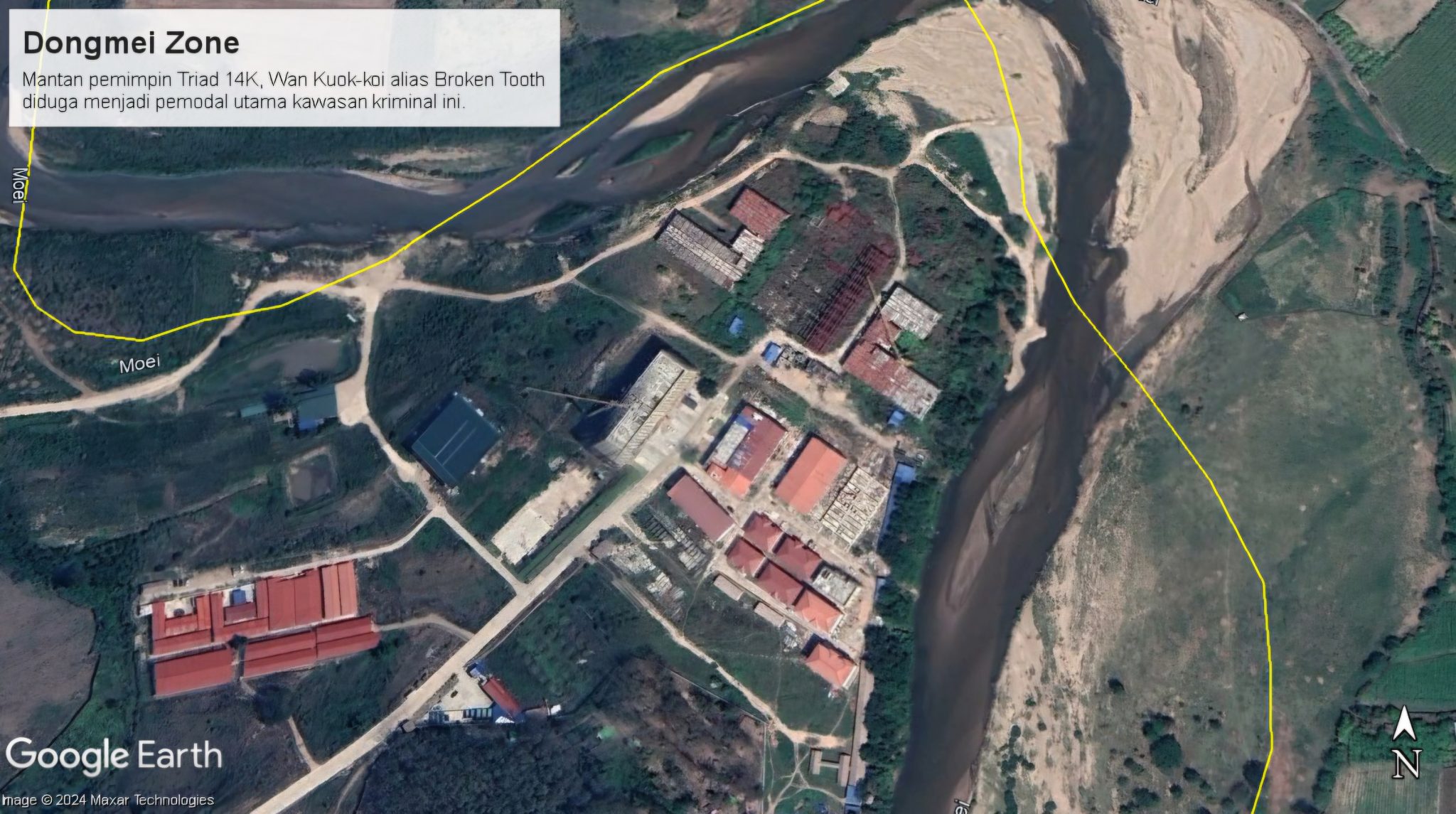
Satellite images of Dongmei Zone, which has become a hub for cyber fraud, online gambling, illegal casinos, and human trafficking in the Myanmar-Thailand border region. (Google Earth)
According to a report by Justice For Myanmar, these transnational criminal operations are controlled by Chinese criminal networks in collaboration with the Karen Border Guard Force (now the Karen National Army). One of the most prominent figures is Wan Kuok-Koi, also known as Yin Gouju or “Broken Tooth,” a former leader of the 14K Triad criminal group and the main investor in Dongmei Park.
Myanmar’s complex political situation is believed to limit the Indonesian government’s options. The success of repatriating Indonesian citizens relied heavily on establishing communication with local power networks.
“There’s no standard method to extract people from these areas. The complexity comes from the presence of numerous armed groups. And those we attempted to contact don’t have the authority to approach these companies directly,” Rina added.
Besides rescue efforts, Rina said the Indonesian authorities must apply preventive measures.
Rina said the Ministry of Foreign Affairs “always coordinates” with the Ministry of Foreign Affairs and “always coordinates” with the Ministry of Communication and Information to remove false recruitment posts from social media. However, she likened the problem to mushrooms: “Cut one, a thousand grow.”
According to the Indonesian Coordinating Ministry for Human Development and Culture (Kemenko PMK), 3,703 Indonesian citizens became victims of human trafficking (TPPO) between 2020 and March 2024, coerced into working as online scam operators.
These individuals were trafficked to Cambodia, followed by the Philippines, Thailand and Myanmar. The victims primarily came from North Sumatra, North Sulawesi, West Kalimantan, Central Java, West Java, DKI Jakarta, East Java, Bali, and Riau.
“Prevention isn’t our main responsibility. Our core work focuses on handling cases and providing services to Indonesian citizens facing problems abroad. If prevention efforts in Indonesia aren’t properly addressed, the Directorate of Protection of Indonesian Citizens will just keep ‘sweeping’ and ‘washing dishes’—because the cases will keep coming,” Rina said.
Singapore has reignited debates over the death penalty with three executions carried out in just one week. While many Asian nations consider capital punishment a critical measure against crime, the question extends beyond its effectiveness, which evidence suggests is minimal.
China is known as the world’s leading executioner, the Dui Hua Foundation, a nonprofit organisation, estimated approximately 2,000 executions in China in 2018 marking a significant decline from previous years. This reduction reflects ongoing reforms in the country’s capital punishment practices, which have led to a notable decrease in execution numbers over time.
However, Amnesty International’s latest global review indicates that the number of death sentences issued annually in China is believed to be in the thousands, surpassing the total of all other countries combined. But the exact figures remain obscured by state secrecy which the Chinese authorities maintain to prevent public awareness and scrutiny to obfuscate the scale of capital punishment practices. Despite this alarming number, research suggests that the death penalty has neither prevented nor reduced crime rates in China. The larger issue is how these nations use it as a quick fix, a way to wash their hands of complex problems by eliminating people rather than tackling the problem itself at the roots.

When it comes to drug trafficking, public sentiment often frames the ones executed as irredeemable ‘bad people’. With the removal of such peddlers, the society breathes a collective sigh of relief as their death is considered a societal win. But the uncomfortable question unanswered is: When was the last time a major drug lord in Asia was arrested, let alone faced the full weight of the law or capital punishment? It is not unknown that these are the individuals who flood societies with massive quantities of drugs, yet those who face the gallows are marginalized individuals from impoverished backgrounds or foreign nationals, often exploited as mere pawns in larger criminal networks.
Illustration: Sharanya Eshwar
The war on drugs carries a devastating cost, and is always borne by the vulnerable – the poor and marginalised. There are multiple instances all over the world to prove that fighting the war on drugs for governments was never just about drugs, it was a convenient mask to legitimise discrimination and reinforce stereotypes against marginalised communities. In the United States, the fight against drugs led to mass incarceration, with most of them disproportionately Black people. In the Philippines, the anti-drug campaign turned violent, with thousands of poor people gunned down by the police and unknown assailants, often without any evidence or trial. In India, indigenous tribes who rely on growing traditional cannabis have had their crops destroyed by the government, leaving them poorer and more vulnerable. In all these cases, the war on drugs never addressed the real issues of addiction or trafficking.
The irony of the war on drugs is that it’s not a lack of intelligence that spares the true masterminds of the drug trade but their power and wealth that allows them control over justice. While governments may often have access to detailed information about these powerful kingpins their connections shield them from prosecution, allowing them to evade accountability even as they oversee operations that destroy lives. They operate behind layers of intermediaries, while using their power to shield themselves and letting small-time traffickers take the fall. This raises critical questions about justice and equity within legal systems that disproportionately target the powerless while allowing the true culprits of the drug epidemic to evade consequences.
Justice should not be a tool to maintain the status quo but a force for transformation, it should uplift the vulnerable and confront the powerful. We as a society should demand more than just an illusion of control. The fleeting sense of resolution that capital punishment offers is only superficial. Are we willing to accept superficial solutions that leave structural injustices unchallenged, or do we demand a system that values accountability, fairness, and humanity?
Dai Kaung, a 19-year-old Kachin young man, has lived in a refugee camp in Waingmaw Township since the military coup. After spending over two years in the camp, he found work at a rare earth mining site in the Pangwa area in early January 2024. He wanted to support his struggling family in the refugee camp.
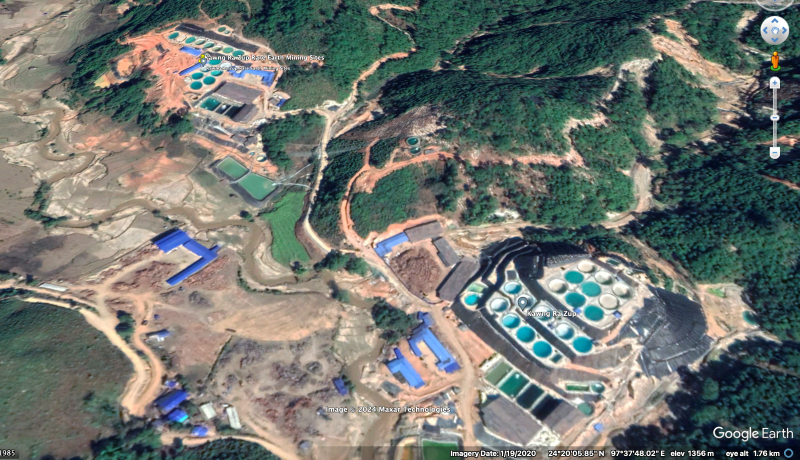
Aerial view of a block being mined in Momok Township. Photo: Mizzima
Pangwa, located in northern Kachin State, is under the control of the Kachin militia led by Zakhung Ting Ying, who is loyal to the Myanmar military. This region is one of Myanmar’s largest producers of rare earth minerals, which are in high demand in neighbouring country China. Despite local opposition due to the environmental and livelihood impacts, rare earth production increased significantly after the military coup.
Dai Kaung was aware that rare earth production could severely harm the local environment and livelihood, but he needed the daily wage of 100 yuan (RMB) to support his family. Unfortunately, on May 29, the mining took his life when the mining site collapsed.
Along with him, some Chinese workers also went missing. Of the approximately 20 missing workers, only five bodies were recovered, and 12 people were confirmed dead.
“They told us he died. It rained heavily that day. He was such a good child, always helping his parents,” said Dai Naw, Dai Kaung’s sister. The family, including his parents, sister, and a younger brother, remained in the refugee camp and could not afford to hold a funeral for him.
Natural Resources and the Resistance after the Coup
Since the coup, Myanmar’s natural resource management has significantly deteriorated. The military’s administration has weakened, and previously ongoing environmental protection and management efforts have collapsed. Many youths have taken up arms against the military’s oppressive rule. Consequently, the number of armed groups across the country has reached nearly 900, according to political research organizations.
“We need money to fight the military. We rely on public donations and have to find other sources of income from the areas we control. The primary goal is to overthrow the military regime,” said a member of the current resistance movement.
They added that the need for funding and weapons for the armed resistance has driven the involvement in resource extraction activities.
Due to this situation, once-covert mining activites, opposed by local communities, are now onducted openly. Previously, only the militia, allies of the military, were involved in extensive rare earth production. Now, the Kachin Independence Army (KIA/KIO) is also heavily involved in these activities, leading to increased pressure and protests from local Kachin communities. However, as the belief strengthens that selling these natural resources to fund weapon purchases is crucial for toppling the military dictatorship, local Kachin environmental activists find themselves in a challenging position, unable to resist and left to watch helplessly.
China’s General Administration of Customs (GACC) records from the past four years show that Myanmar has been one of the top 20 countries supplying rare earth minerals to China. According to ISP – Myanmar, a think-tank, Myanmar has sold rare earth minerals worth approximately 2.6 billion USD to China since 2017, with about 2 billion USD worth sold after the coup.
Rare earth extraction in Kachin State has increased significantly since the coup. Before the coup, there were 114 rare earth mining sites in Kachin State, but now there are over 340 sites.
We need weapons and money to fight the military dictatorship. On the one hand, the environmental damage is severe, and Myanmar will suffer the consequences. This is already happening in Kachin and other regions. —an environmental expert who requested anonymity due to security reasons.
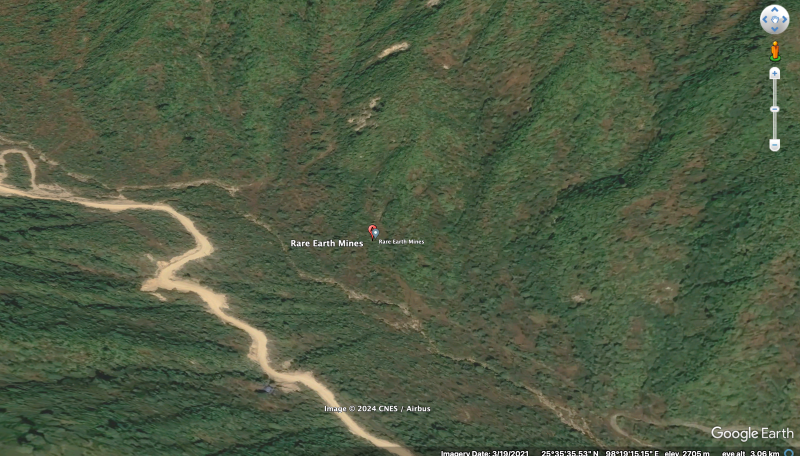
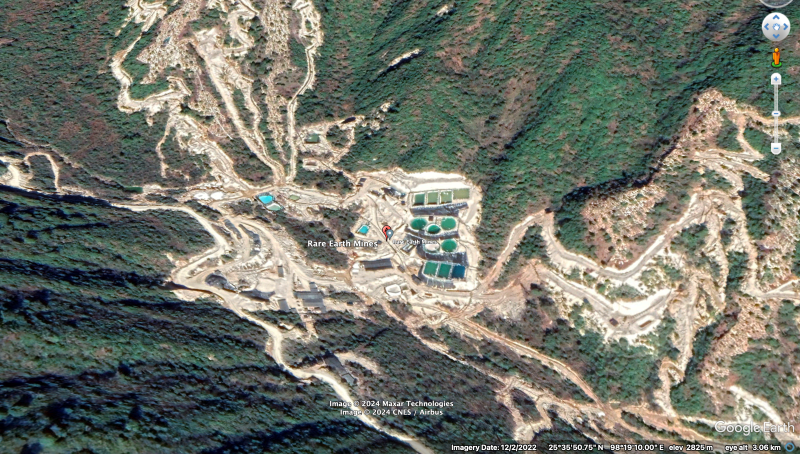
Before and After: Rare Earth Mineral Block in Chiphue Township in March 2021 (left) and February 2022 (right). Photo: Google Earth/Mizzima
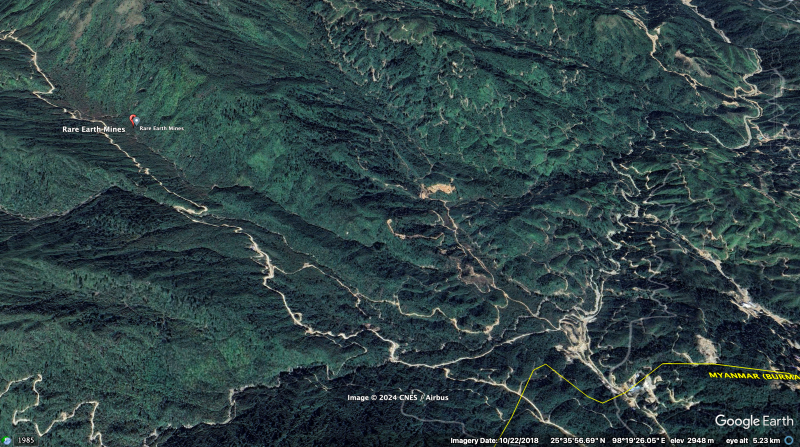
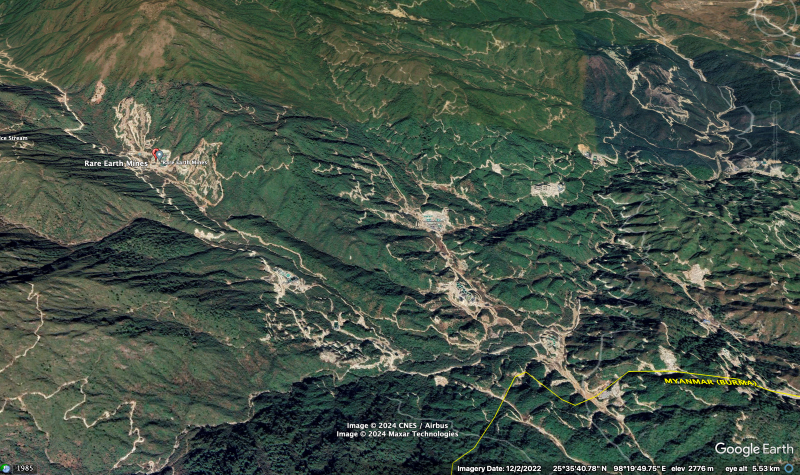
Before and After: Mountain Ridge in Chiphue Township in October 2018 (left) that turned into a cluster of rare earth blocks by December 2022 (right). Photo: Google Earth/Mizzima
Number of Tons of Rare Earth Minerals exported from Myanmar to China by year
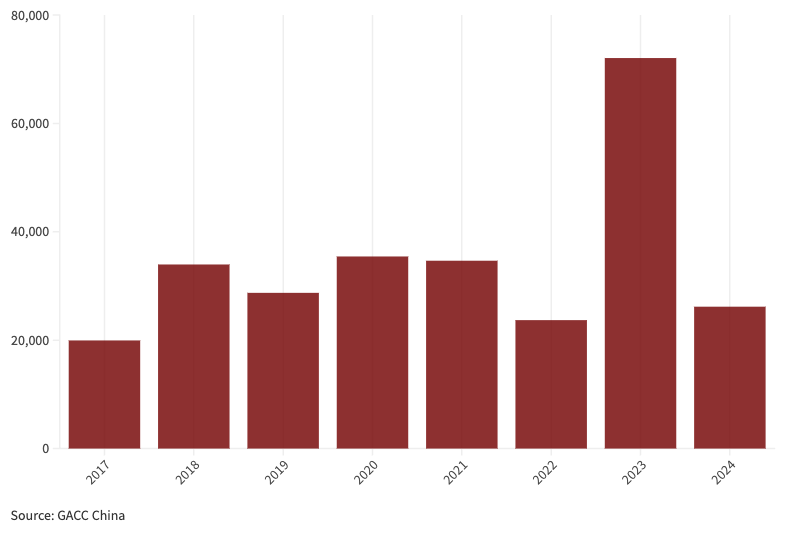
Why is Rare Earth so important to China?
Rare earth mining is mainly conducted in Chipwi, Momauk, and Mansi townships in Kachin State. Satellite images show extensive environmental damage in these mining areas.
Rare earth minerals are vital for the production of smartphones, vehicles, and military goods, making them highly valuable to China. China is also the world’s largest exporter of rare earth minerals, using this capacity to build political and economic power. Over the past four years, 80% of the rare earth minerals China imported came from Myanmar.
“They exploit rare earth from struggling countries like Myanmar, ruining local communities. Meanwhile, they use it to gain economic, political and diplomatic advantages over the US and Western countries,” said an expert on China-Myanmar relations.
Conflict between Rare Earth Mining, Local Communities, and Authorities
During Aung San Suu Kyi’s government, experts and activists voiced concerns about Myanmar’s natural resources and environmental issues, including rare earth mining. However, environmental policies were hard to implement amid conflicts with the military and ethnic armed groups. The areas controlled by the militia have always been weak in terms of civilian government influence, largely due to their cooperation with the military. Now, the situation has worsened significantly. Previously, the Kachin Independence Army (KIA/KIO) listened to the voices of local Kachin communities and refrained from rare earth mining. However, in the current situation, they have begun allowing rare earth mining in their controlled areas.
“They make holes on the mountains, and put acid into it. It destroys the environment. Streams that used to flow are now polluted or dry up,” said Tin Baung, a local from Pangwa. “The land is severely damaged. From an aerial view, Pangwa looks like a sore spot.”
In these dire conditions, another young Kachin, 16-year-old Shun Tu, lost his life. A seventh-grade student, he worked at a rare earth mining site because of his strength. He died within months after falling ill.
“People say he drank contaminated water from the mining site. Others have had similar experiences. Losing a son is indescribable,” his mother told Mizzima.
As rare earth mining sites increased, people in Chipwi Township, Phare locals said they could no longer let their chickens, pigs, buffaloes, and cows roam freely. Contaminated water from the mining areas killed the animals. We can’t farm or raise livestock anymore. It’s hard to survive here, they said.
Regarding the environmental issues in Kachin State, Khawn Zang, one of the leaders of the Transparency and Accountability Network Kachin (TANK), an environmental watchdog in Kachin said, “In the past, the chemicals they used caused many problems. Now, there are more environmental issues. They dig into people’s fields more often, leading to more protests. The situation has worsened.”
About 150,000 people live in the three main mining townships of Chipwi, Momauk, and Mansi, and their livelihoods are increasingly threatened by mining activities, according to environmental researchers.
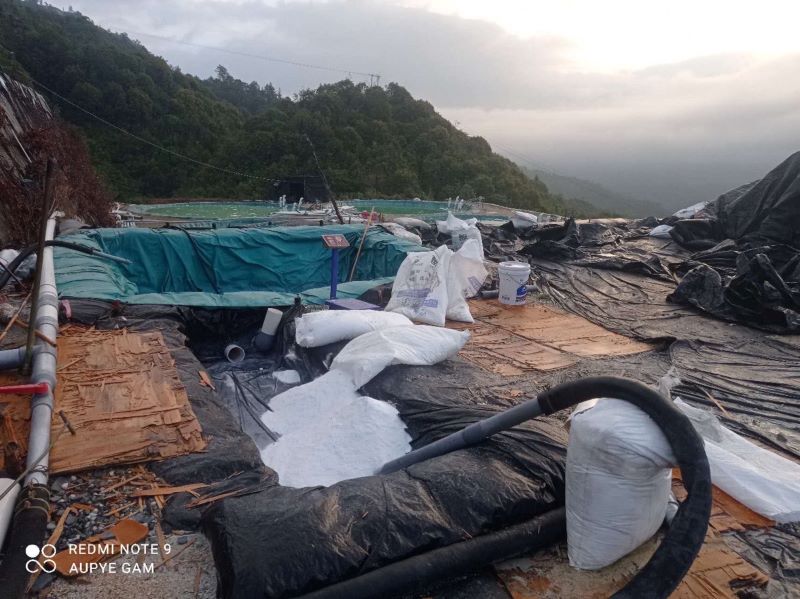
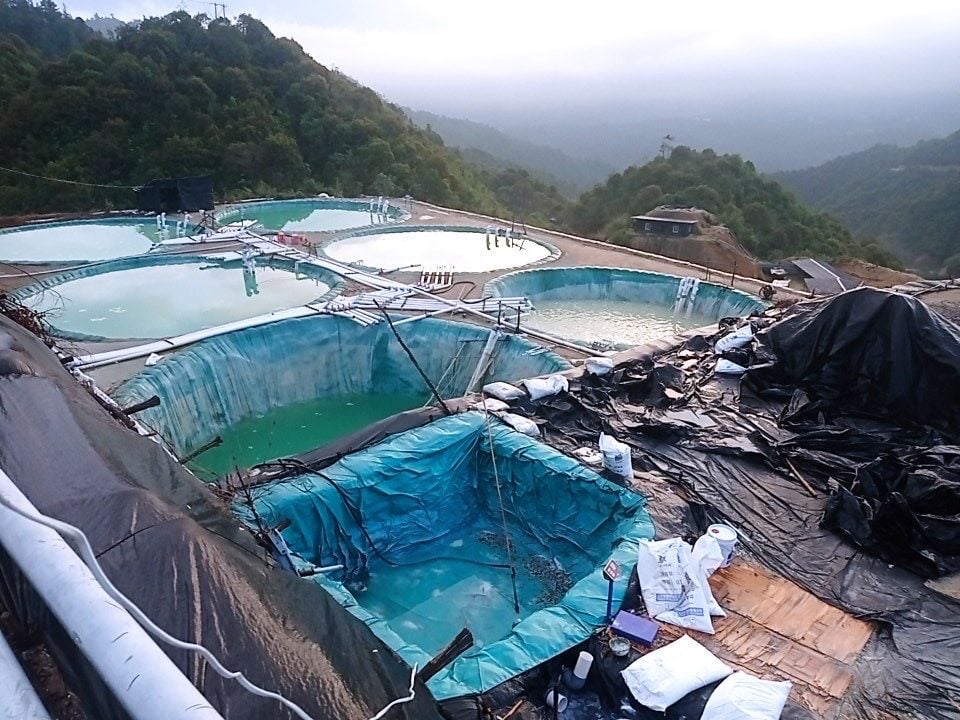
Work Sites in Chiphue Township. Photo: Mizzima
Deforestation and the Resistance War in Sagaing
“People can’t continue farming or other regular jobs because of the fires and military raids. So they cut and sell trees to brokers to make a living,” said Tun Tun, a former forest department officer from Monywa District who joined the Civil Disobedience Movement (CDM) after the coup.
Sagaing’s famous timber areas like Yinmarpin, Monywa, Kathar, Kalay, Banmauk, Wuntho, and Chaung-U experienced illegal logging even before 2020, but forests remained. After the coup, deforestation skyrocketed. Valuable timber such as teak, ironwood, and tamalan attracted demand from China.
The NLD’s government had policies to protect forests, but these were abandoned after the coup when forest officers joined the CDM. The military’s involvement in forest management led to rampant illegal logging.
The resistance groups also relied on logging for funding their fight, Sagaing locals said. “They cut a lot of trees. All groups are involved. The checkpoints are manned by PDFs and the military. Each checkpoint costs between 500,000 to 1 million kyats. Brokers from Monywa and Mandalay handle it,” a local resident told Mizzima.
According to the Global Forest Watch (GFW), Myanmar had more than 31.7 million forest alerts from February 1, 2021, to March 27, 2024. Environmental researchers pointed out that this indicates the extent of logging.
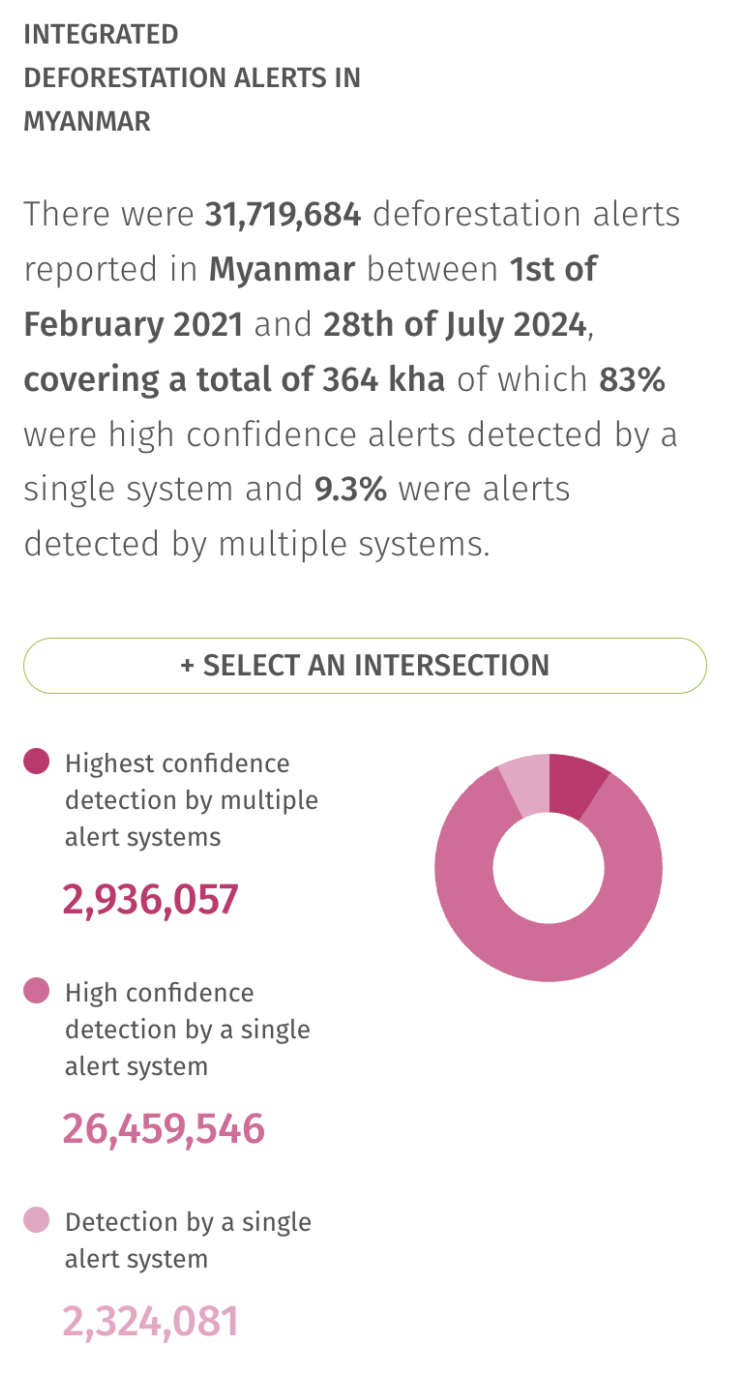
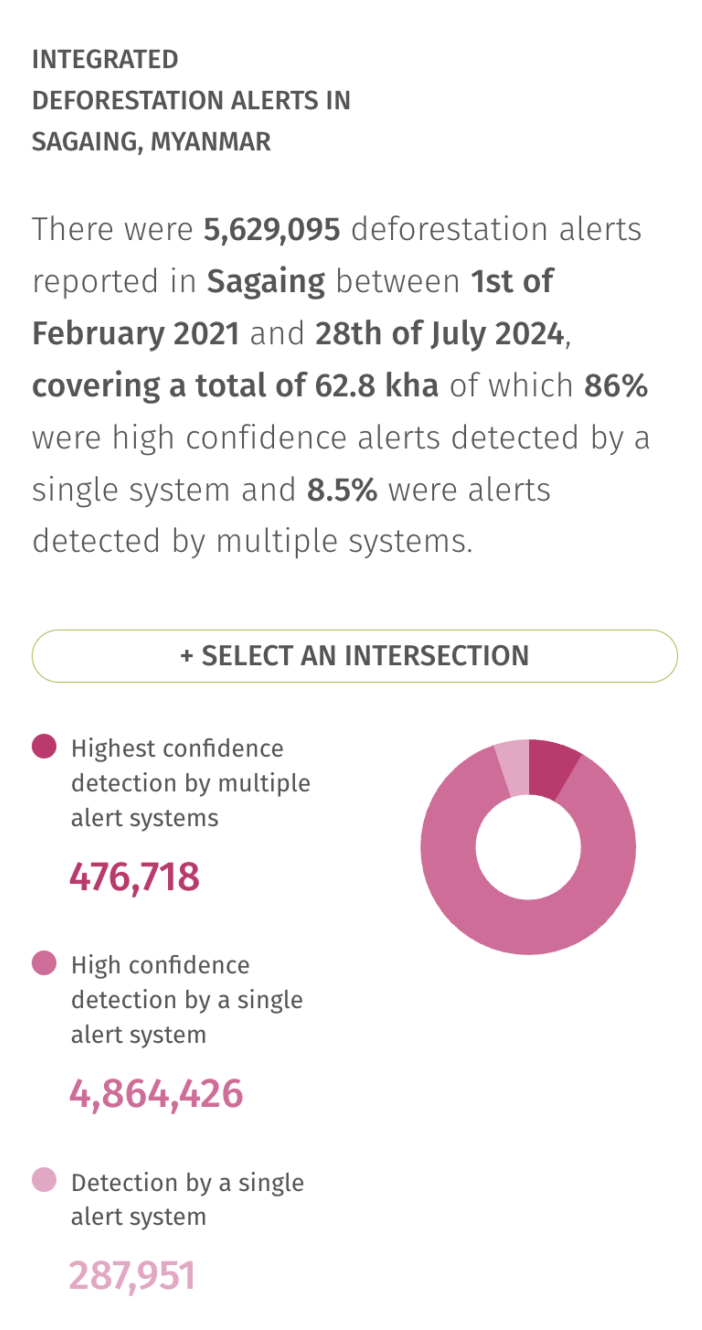
With over 220 of the 330 townships in Myanmar experiencing some form of armed conflict, deforestation in Sagaing is a serious issue. Sagaing’s 45 townships include 19 severely affected by military violence. Villages have been burned, and airstrikes have been conducted by the military, resulting in over 90,000 homes burned nationwide, with 60,000 in Sagaing alone, according to Data for Myanmar.
Locals and experts say it is challenging to prioritize environmental protection amid the struggle for survival. “It’s not easy to get weapons. We have a lot of struggles. Some timber merchants used to trade guns for timber. Not all of them, though. Timber is transported to China. It’s sad to see the forests disappear. We will have to recover them later (after the overthrowing of Myanmar military junta),” a local close to Sagaing’s public administration PDF told Mizzima.
These logging activities are not only happening in Sagaing but also in the ASEAN Heritage Park of Alaungdaw Kathapa National Park. This park, spanning over 540 square miles, is a safe haven for wildlife. Now, even these forests are disappearing.
“After the coup, logging trucks started taking timber daily. It’s not a small amount,” a local eyewitness told Mizzima. Chinese merchants favor tamalan wood due to its beautiful grain, making it highly sought after by furniture manufacturers, locals said.
“A few months after the coup, the frequency of trucks coming to cut and transport wood has increased significantly,” a local eyewitness told Mizzima. The Alaungdaw Kathapa Forest is rich with teak and ironwood, and the Mahamyaing Reserve, not far from Alaungdaw Kathapa, has a high output of tamalan, a type of wood highly prized by Chinese merchants due to its beautiful grain, making it very popular among furniture makers, according to locals.
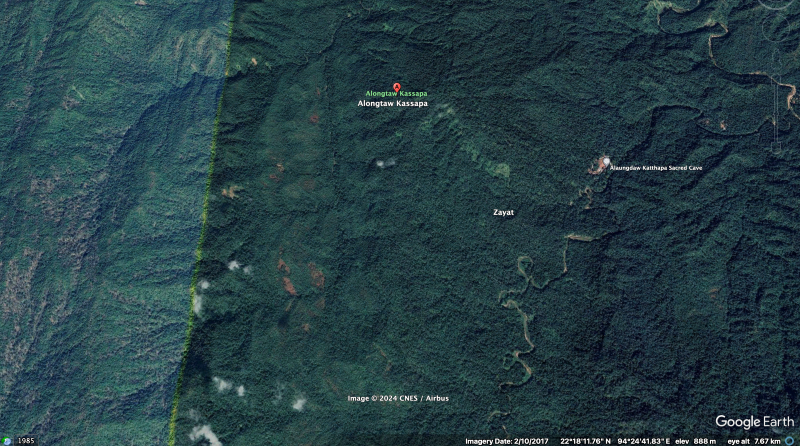
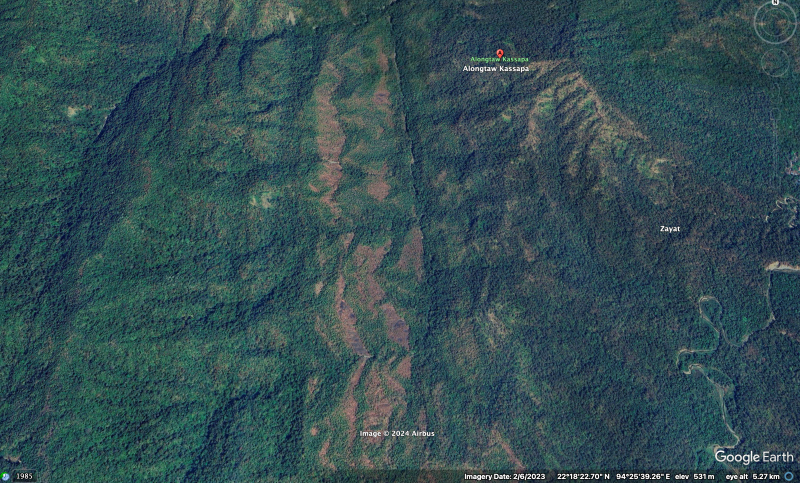
Before and After: Alongtaw Kassapa region in 2017 (left) and 2023 (right). Photos: Google Earth/Mizzima
Illegal logging poses a significant threat to the environment in Sagaing. However, Sagaing has long faced environmental challenges. The Letpadaung Copper Mine, which previously generated over two million USD in revenue per day, is one such challenge.
Since the coup, the mine has not been operating as visibly, but the military has erected fences and destroyed the homes of local residents near the project area. Copper from the mine continues to be transported with the help of Myanmar military forces, leading to frequent clashes between resistance forces and the military.
Similarly, the Taguang Nickel Plant in Tagaung Township, Sagaing, is another project of significant importance to China. This project is notorious for displacing local residents, violating human rights, and damaging the environment. At the end of July, the People’s Defense Forces (PDF) under the National Unity Government (NUG) seized control of the plant.
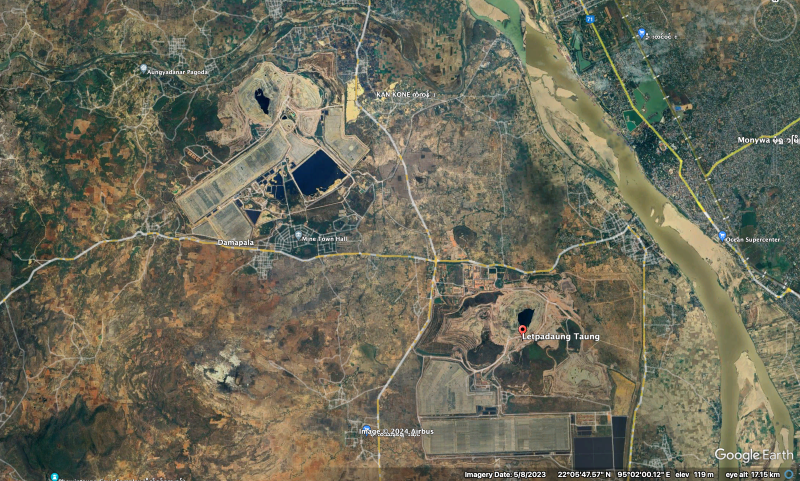
Aerial view of Letpadaung Copper Mine. Photo: Google Earth/Mizzima
However, due to pressure from the Chinese government, the resistance has assured that the project will be protected. This situation highlights that while Chinese projects may harm local communities and the environment, those involved in the conflict in Myanmar cannot easily resist China’s influence, both politically and economically.
Shan State’s Projects in Darkness
The escalating conflict and the instability following the military coup have silenced many local community-based organizations that once worked to raise awareness about the negative impacts of various projects and led protests against them. These organizations have had to flee their homes and now live under constant threat from armed groups, rendering them unable to speak out against ongoing projects, which are now proceeding unchecked.
In Shan State, after Operation 1027 launched in October last year, many strategically important Chinese projects in the region came under the control of Three Brotherhood Alliance (3BHA). These armed groups are reportedly close to Chinese influence, leading to situations where these projects could later be subject to negotiations with the armed groups. This scenario raises concerns about environmental impacts, especially if it results in conditions where the rights and voices of the local people are suppressed.
There is no rule of law to protect the people at this time. The public is not protected by the law, so businesses exploit them, and there are human rights violations, but the people can’t speak out. —an environmental activist based in Shan State, reflecting on the current situation.
In recent years, Chinese mining companies have operated in Shan State, but local residents are often kept in the dark about essential information. “With the country in ruins, those with weapons and power are doing whatever they can for their own benefit. For ordinary people, this means they can no longer cultivate their land or are increasingly exposed to environmental hazards. But right now, survival is the priority,” said a young displaced person from Shan State.
According to research by ISP-Myanmar, the combined value of projects planned and currently being implemented in Shan State by Chinese companies is over $23 billion, representing almost half of China’s total investment in Myanmar.
The military junta is currently facing both military and economic crises. The junta, which once profited from various trade routes, has lost control of many border trading posts connecting Myanmar with China, India, Bangladesh, and Thailand.
Since Operation 1027, they have lost control of five major trading posts, which account for nearly 40% of the total trade volume. Although the junta regained control of the Myawaddy post on the Thailand-Myanmar border with the help of the Karen Border Guard Force, trade flows have not returned to pre-conflict levels.
The economic situation in Myanmar has deteriorated significantly. The value of the kyat has plummeted from around 1,330 kyats per dollar in February 2021, at the time of the coup, to over 6,000 kyats per dollar today. The World Bank’s June report highlighted that due to ongoing conflict, labour shortages, and currency instability, conducting business in Myanmar has become extremely challenging, with poverty levels reaching their highest point in six years.
Given the country’s economic collapse, it raises the question of whether addressing environmental and resource destruction is still a priority or if more pressing issues have taken precedence.
However, the ongoing extraction and exploitation of resources make it increasingly difficult to mitigate environmental damage, as noted by an environmental expert. “There is practically nothing we can do now. Even if we try to revive the environment, it will take a long time. Right now, nothing is possible. The Chinese are buying up everything they can get their hands on,” the expert said.
Currently, most of the rare earth minerals from Kachin State are being directed to China, just as the majority of timber from Sagaing and Bago is also destined for China.
“Not everyone in the resistance is ignorant of environmental issues. Some are well aware. But with the pressing need for weapons and funding, they have no choice but to take this path. This makes it difficult to mitigate the damage,” the environmental expert explained.
The Chinese have also seized the opportunity to secure their influence in the resistance, with Chinese merchants capitalizing on the situation. The funds generated from selling timber to China are reportedly being used to purchase weapons. “Trucks are leaving Kachin every day, heading to China. Every group, regardless of who controls the area, is selling the timber to Chinese merchants. They handle transportation and clearing the routes,” a source close to the Sagaing resistance explained.
The path to effectively managing and conserving Myanmar’s natural environment and resources has always been fraught with challenges. However, the current situation represents an unprecedented difficulty. Amid political upheaval and the ongoing resistance, the continued exploitation of resources resembles a self-inflicted wound that exacerbates the country’s plight.
အသက် ၁၉ နှစ်အရွယ် ကချင်အမျိုးသား ဒိုင်ခေါင်ဟာ ဝိုင်းမော်မြို့နယ်ထဲက စစ်ဘေးရှောင်ဒုက္ခသည် စခန်းတခုမှာ နေခဲ့ရပါတယ်။ စခန်းမှာ နှစ်နှစ်ကျော်နေခဲ့ပြီးတဲ့နောက် ၂၀၂၄ ခုနှစ် ဇန်နဝါရီလဆန်းပိုင်းမှာတော့ ပန်ဝါဒေသမှာရှိတဲ့ မြေရှားသတ္တုထူးဖော်ရေးလုပ်ငန်းခွင်ထဲကို ရောက်ရှိလာခဲ့ပါတယ်။ ဒါကလည်း ဒုက္ခသည်စခန်းထဲက မိသားစုကို ထောက်ပံ့ပေးနိုင်ဖို့ပါ။
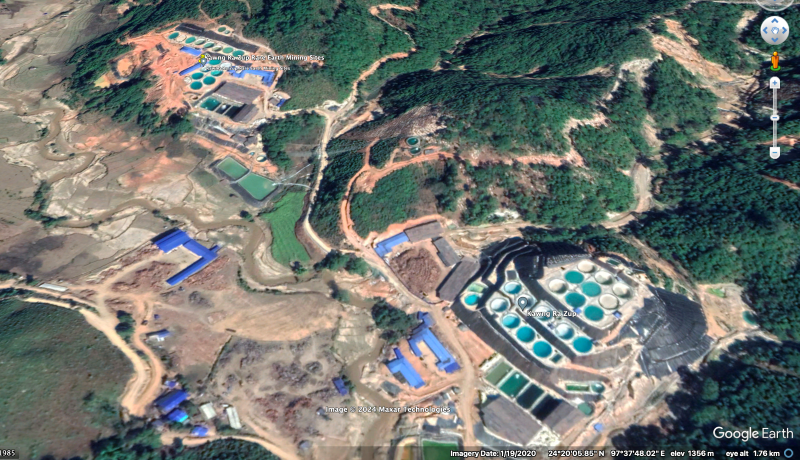
မိုးကုတ်မြို့နယ်တွင် မိုင်းခွဲသည့်လုပ်ကွက်တစ်ခုကို ဝေဟင်မှမြင်ကွင်း။ Photo: Mizzima
ပန်ဝါဆိုတာ ကချင်ပြည်နယ်မြောက်ပိုင်း၊ ချီဖွေမြို့နယ်ထဲကဖြစ်ပြီး နေပြည်တော်ရဲ့သစ္စာခံ ဇခုန်တိန့်ယိန်းဦးဆောင်တဲ့ ပြည်သူစစ်ရဲ့ ထိန်းချုပ်မှုအောက်မှာ ရှိနေတဲ့နေရာပါ။ နောက်ပြီး အဲ့ဒီဒေသဟာ မြန်မာရဲ့ မြေရှားထုတ်လုပ်မှုအမြင့်ဆုံးသောနေရာဒေသတွေထဲက တခုဖြစ်ပြီး အိမ်နီးချင်းအင်အားကြီး တရုတ်နိုင်ငံက အသည်းအသန်လိုအပ်နေတဲ့ မြေရှားအတွက်လည်း အရေးကြီးတဲ့နေရာဖြစ်ပါတယ်။
ဒီလို မြေရှားထုတ်လုပ်နေတာတွေဟာ ကချင်ဒေသခံပြည်သူတွေအဖို့ သဘာ၀ပတ်ဝန်းကျင် ထိခိုက်နစ်နာမှုတွေအပြင် ဘ၀နေထိုင်မှုကိုပါထိခိုက်စေတဲ့အတွက် ပြင်းပြင်းထန်ထန် ကန့်ကွက်နေခဲ့ကြပေမဲ့ စစ်အာဏာသိမ်းပြီးနောက်ပိုင်း ထုတ်လုပ်မှုတွေက ပိုမိုများပြားလာခဲ့ပါတယ်။
တရက်လုပ်ခ ယွမ် ၁၀၀ ဆိုတဲ့ ဒိုင်ခေါင်နေ့စားခက မိသားစုစားဝတ်နေရေးအတွက် တဒင်္ဂအဖြေသာဖြစ်ခဲ့ပါတယ်။ ဘာကြောင့်လဲဆိုတော့ ငါးလ ဝန်းကျင်သာ အလုပ်လုပ်ခဲ့ရလို့ပါ။ မေ ၂၉ ရက်မှာတော့ ဒိုင်ခေါင် အလုပ်လုပ်နေတဲ့ မြေရှားလုပ်ကွက် ပြိုကျပြီး သူလည်းတွင်းထဲမှာ သေဆုံးသွားခဲ့ပါတယ်။ အဲ့ဒီနေ့က ပျောက်ဆုံးသွားသူတွေထဲမှာ တရုတ်နိုင်ငံသားအလုပ်သမားတချို့လည်း ပါဝင်ခဲ့ပါတယ်။ အလောင်း ငါးလောင်းပဲ ပြန်ရပြီး လူ ၁၂ ဦး သေဆုံးတယ်လို့သာ တာဝန်ရှိသူ တရုတ်အကြီးအကဲတွေက စာရင်းသွင်းခဲ့ပါတယ်။
“သူ သေတယ်လို့ သတင်းလှမ်းပေးတယ်။ သူတို့ဘက်ကပြောတာတော့ မိုးတွေအရမ်းရွာတယ်တဲ့ အဲ့နေ့က။ သူက အရမ်းလိမ္မာတဲ့ ကလေးပါ။ မိဘကိုလည်း ကူတယ်” လို့ ဒိုင်ခေါင်ရဲ့ အစ်မဖြစ်သူ ဒိုင်နော်က မဇ္ဈိမ ကို ပြောပါတယ်။ ဒိုင်ခေါင်တို့ မိသားစုမှာ ဖခင်၊ မိခင်၊ အစ်မနဲ့ ညီငယ်လေးတဦး ကျန်ရစ်ခဲ့ပါတယ်။ သူတို့ အားလုံးလည်း အခုတော့ စစ်ရှောင်ဒုက္ခသည်စခန်းထဲမှာ နေရဆဲဖြစ်လို့ ဒိုင်ခေါင်ရဲ့ အသုဘကို မလုပ်ပေးနိုင်ခဲ့ဘူးလို့လည်း ဆိုပါတယ်။
အာဏာသိမ်းခြင်းနောက် သယံဇာတနှင့် ခုခံစစ်
စစ်အာဏာသိမ်းပြီးတဲ့နောက်မှာ မြန်မာနိုင်ငံရဲ့ သဘာ၀သယံဇာတ စီမံခန့်ခွဲမှုဟာ သိသိသာသာ ပိုမိုပျက်စီးခဲ့ပါတယ်။ စစ်ကောင်စီရဲ့ အုပ်ချုပ်ရေးယန္တရားဟာ ယိုင်နဲ့နေခဲ့ပြီး အာဏာမသိမ်းခင်အချိန်ကာလများက အစိုးရအနေနဲ့ ကိုင်တွယ်ဖြေရှင်းဖို့ လိုအပ်ဆဲ၊ လုပ်ဆောင်နေဆဲဖြစ်တဲ့ သဘာ၀ပတ်ဝန်းကျင်ဆိုင်ရာ ထိန်းသိမ်းရေး၊ စီမံခန့်ခွဲရေးကိစ္စတွေဟာလည်း ပျက်စီးသွားခဲ့ပါတယ်။ အာဏာသိမ်းတာကိုကန့်ကွက်တဲ့ နိုင်ငံတဝှမ်း ငြိမ်းချမ်းစွာဆန္ဒပြမှုကို စစ်ကောင်စီက လက်နက်နဲ့ဖြိုခွင်းမှုတွေအပြီး လူငယ်အများအပြားဟာ လက်နက်ကိုင်တော်လှန်ဖို့ ရွေးချယ်ခဲ့ကြပါတယ်။ နိုင်ငံအနှံ့အပြားမှာ ပေါ်ထွက်လာခဲ့တဲ့ လက်နက်ကိုင် အဖွဲ့ကြီး၊ အဖွဲ့ငယ် အရေအတွက်ဟာ ၉၀၀ နီးပါး ရှိလာခဲ့ပြီလို့ နိုင်ငံရေးဆိုင်ရာ သုသေသနအဖွဲ့အစည်းတွေရဲ့ မှတ်တမ်းတွေအရ သိရပါတယ်။
“စစ်တပ်ကို တိုက်တော့ ငွေလိုတယ်လေ။ ပြည်သူတွေ လှူကြတာလည်း မှီခိုရတာပေါ့။ ကိုယ်အုပ်ချုပ်ထားတဲ့ နေရာတွေကနေ ရပေါက်ရလမ်းတွေလည်း ရှာကြရတာပေါ့။ အဓိက အရေးက စစ်အာဏာရှင်စနစ်ပျက်သုဉ်းရေးဖြစ်နေတယ်” လို့ လက်ရှိစစ်အာဏာရှင်တော်လှန်ရေးရဲ့ ခုခံစစ်ထဲမှာ ပါဝင်လုပ်ဆောင်နေသူတဦးက မဇ္ဈိမကို ပြောပါတယ်။ အဲ့ဒီအဖွဲ့တွေကို လက်နက်တပ်ဆင်ပေးတာတွေ၊ သင်တန်းပေးတာတွေကို တာဝန်ယူကြတဲ့ တိုင်းရင်းသားတော်လှန်ရေးအဖွဲ့ကြီးတွေရဲ့ ငွေကြေးလိုအပ်မှုတွေနဲ့ သယံဇာတထုတ်လုပ်မှုတွေဟာ ချိတ်ဆက်နေတယ်လို့လည်း သူက ဆိုပါတယ်။
အရင်က ဒေသခံတွေရဲ့ ကန့်ကွက်မှုတွေကြားမှာ သိုသိုသိပ်သိပ်လုပ်ခဲ့ကြတဲ့ မြေရှားသတ္တုတူးဖော်မှုဟာ အခုမှာတော့ ပြောင်ကိုပဲလုပ်နေခဲ့ကြပါတော့တယ်။ အရင်က မြန်မာစစ်တပ်ရဲ့လက်အောက်ခံ ကချင်ပြည်သူ့စစ်တွေကသာ မြေရှားထုတ်လုပ်မှုကို လုပ်ခဲ့ကြပေမဲ့ အခုအခါမှာတော့ ကချင်လွတ်မြောက်ရေးတပ်မတော် (KIA/KIO) အနေနဲ့ပါ ထုတ်လုပ်မှုတွေမှာပါဝင်နေခဲ့တာဖြစ်လို့ ကချင်ဒေသခံတွေက ကန့်ကွက်မှုတွေ၊ ခေါင်းဆောင်တွေအပေါ်ဖိအားပေးမှုတွေလည်း ရှိခဲ့ပါတယ်။ ဒါပေမဲ့ ဒီလိုသယံဇာတရောင်းချ ခြင်းဟာ စစ်အာဏာရှင်စနစ်ဖြုတ်ချရေးအတွက် လိုအပ်တဲ့အရာဖြစ်တယ်လို့ ယူဆချက်ကြီးကြီးမားမားရှိလာတဲ့ အခါ ကချင်ဒေသခံသဘာ၀ပတ်ဝန်းကျင်တက်ကြွလှုပ်ရှားသူတွေလည်း မတတ်သာလို့ လက်ပိုက်ကြည့်ရတဲ့ အနေအထားကို ရောက်ရှိလာခဲ့ပါတယ်။
တရုတ်နိုင်ငံရဲ့ အကောက်အခွန်အထွေထွေအုပ်ချုပ်မှုအာဏာပိုင်အဖွဲ့ (General Administration of Customs of China – GACC) ရဲ့ ပြီးခဲ့တဲ့ လေးနှစ်တာ မှတ်တမ်းတွေအရ မြန်မာဟာ တရုတ်ဆီ မြေရှားတင်သွင်းတဲ့ ထိပ်တန်းနိုင်ငံ ၂၀ စာရင်းမှာ ပါဝင်ခဲ့ပါတယ်။ တရုတ်အရေးကို အထူးပြုလေ့လာနေတဲ့ ISP – Myanmar ရဲ့ အချက်အလက်တွေအရတော့ မြန်မာဟာ ၂၀၁၇ ခုနှစ်ကနေ အခုအချိန်ထိ စုစုပေါင်း အမေရိကန်ဒေါ်လာ ၂.၆ ဘီလီယံတန်ဖိုးရှိတဲ့ မြေရှားသတ္တုတွေကို တရုတ်နိုင်ငံထံ ရောင်းချခဲ့ပြီး အဲဒီအထဲက နှစ်ဘီလီယံဝန်းကျင်တန်ဖိုးဟာ စစ်အာဏာသိမ်းပြီးမှ ရောင်းချခဲ့တာလို့ သိရပါတယ်။ အာဏာသိမ်းမှုမတိုင်ခင်က ကချင်ပြည်နယ်မှာ မြေရှားလုပ်ကွက်ပေါင်း ၁၁၄ လုပ်ကွက် ရှိခဲ့တာကနေ လက်ရှိအချိန်မှာတော့ လုပ်ကွက်ပေါင်း ၃၄၀ ကျော်အထိ ရှိလာပါတယ်။
“စစ်အာဏာရှင်ကို အမြစ်ပြတ်တိုက်ဖို့ဆိုတဲ့ အရေးကိစ္စမှာ လက်နက်လိုတယ်။ ပိုက်ဆံလိုတယ်ပေါ့။ ကျွန်တော်တို့ အမြင်မှာတော့ အဲ့ဒီအခြေအနေက တပိုင်း။ သယံဇာတတွေ ပျက်ဆီးသွားပြီး နောင်ဆို မြန်မာနိုင်ငံမှာ သဘာ၀ပတ်ဝန်းကျင်ဆိုင်ရာ ဆိုးကျိုးတွေ ပိုခံစားလာရမယ်ဆိုတာ သတိပြုစေချင်တာပါ။ အခုလည်း ကချင်နဲ့ တခြားနေရာတွေမှာပါ ဖြစ်နေပါပြီ” လို့ အမည်မဖော်လိုသူ သဘာ၀ပတ်ဝန်းကျင်ပညာရှင်တဦးက မဇ္ဈိမကိုပြောပါတယ်။
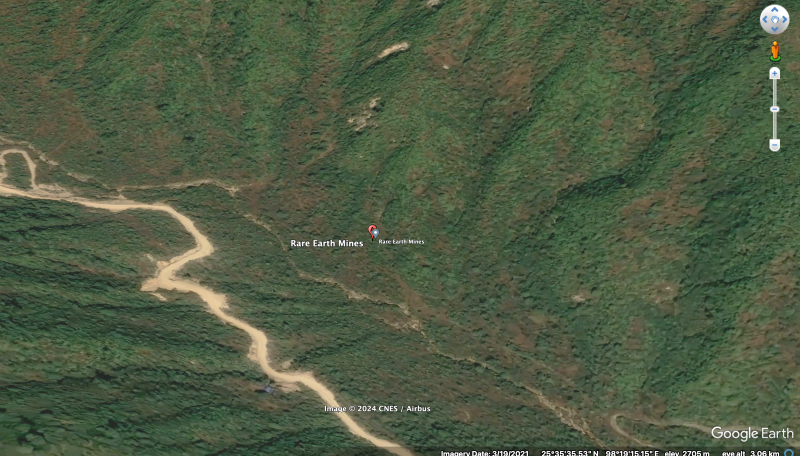
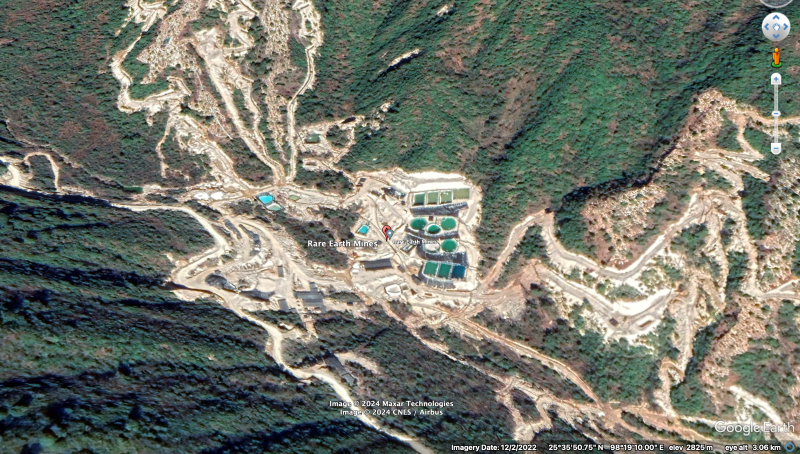
Left: ချီဖွေမြို့နယ်အတွင်းရှိ မြေရှားသတ္တု လုပ်ကွက်တခုဖြစ်လာမည့် တောင်ကို ၂၀၂၁ ခုနှစ် မတ်လတွင် မြင်ရပုံ.
Right: ချီဖွေမြို့နယ်အတွင်းရှိ မြေရှားသတ္တု လုပ်ကွက်တခုအဖြစ်အသွင်ပြောင်းသွားသည့် တောင်ကို ၂၀၂၂ ခုနှစ် ဖေဖော်ဝါရီ လတွင် မြင်ရပုံ. Photos: Mizzima
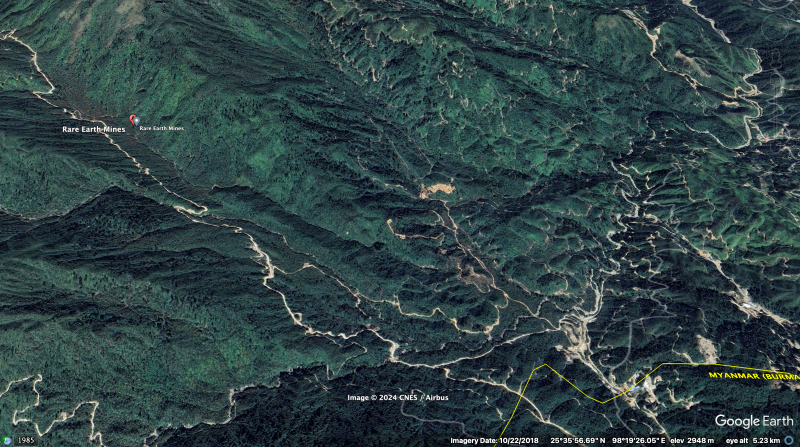
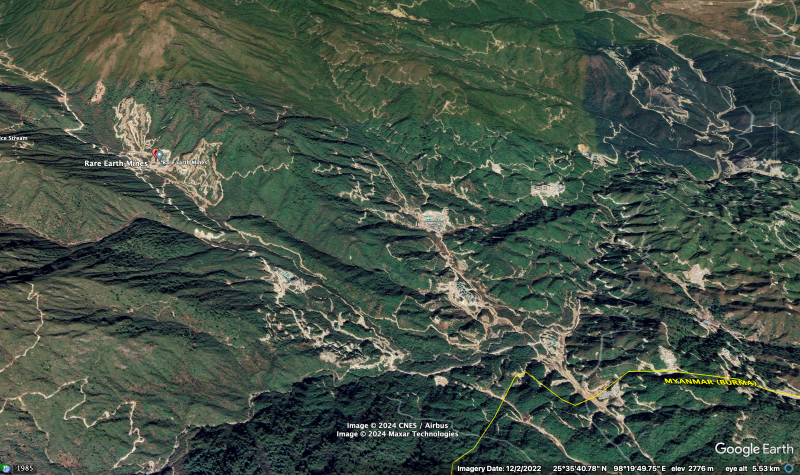
Left: ချီဖွေမြို့နယ်အတွင်းရှိ မြေရှားသတ္တု လုပ်ကွက်များအစုအဝေးဖြစ်လာမည့် တောင်ကြောကို ၂၀၁၈ ခုနှစ် အောက်တိုဘာလတွင်တွေ့ရစဥ်.
Right: ချီဖွေမြို့နယ်အတွင်းရှိ မြေရှားသတ္တု လုပ်ကွက်များအစုအဝေးအဖြစ်အသွင်ပြောင်းသွားသည့် တောင် ကြောကို ၂၀၂၂ ခုနှစ် ဒီဇင်ဘာလ တွင်တွေ့ရစဥ်. Photos: Mizzima
မြန်မာနိုင်ငံမှ တရုတ်နိုင်ငံသို့ တစ်နှစ်ထက်တစ်နှစ်တင်ပို့သည့် ရှားပါးမြေတွင်းထွက်သတ္တု တန်ချိန်များစွာရှိသည်။
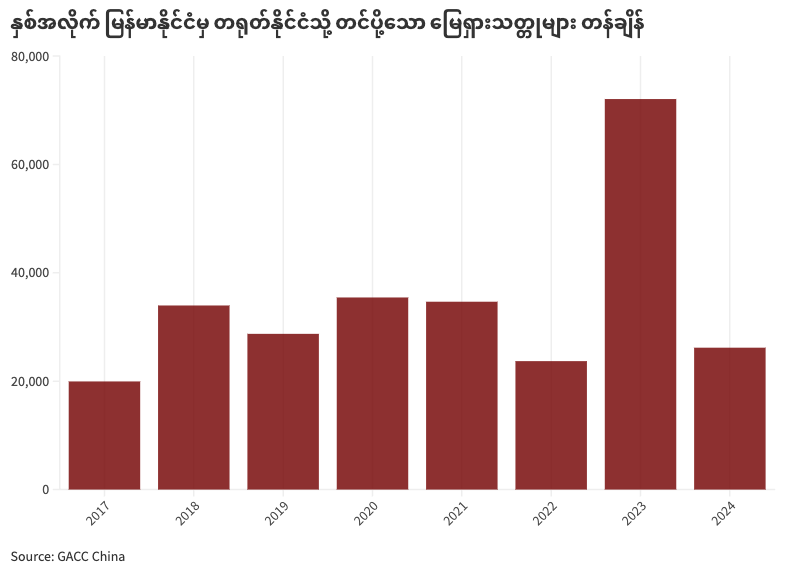
တရုတ်အတွက် ဘာကြောင့်မြေရှားက အရေးပါသလဲ
ကချင်ပြည်နယ်မှာ မြေရှားသတ္တုကို ချီဖွေ၊ မိုးမောက်၊ မန်စီစတဲ့ မြို့နယ်တွေမှာ အဓိကအားဖြင့် တူးဖော်ကြပါတယ်။ ဂြိုလ်တုကနေ ရိုက်ယူတဲ့ ကောင်းကင်ဓာတ်ပုံတွေအရ ချီဖွေမြို့နယ်ထဲမှာ သဘော၀ပတ်ဝန်းကျင် ရုပ်ပျက်ဆင်းပျက် ပျက်စီးနေတဲ့ မြေရှားလုပ်ကွက်တွေကို တွေ့မြင်ရပါတယ်။ စမတ်ဖုန်း၊ မော်တော်ကားကနေ စစ်ဘက်ဆိုင်ရာကုန်ထုတ်လုပ်မှုတွေအထိ အသုံးဝင်နေတဲ့ မြေရှားဟာ တရုတ်အတွက်တော့ ရသလောက်ဝယ်ယူနေမယ့် သတ္တုရတနာဖြစ်နေပါတယ်။ တဘက်မှာလည်း တရုတ်ဟာ နိုင်ငံတကာကို မြေရှားတင်ပို့ရောင်းချတဲ့နေရာမှာလည်း ကမ္ဘာ့အင်အားအကြီးဆုံးဖြစ်နေတယ်။ တရုတ်ဟာ ကမ္ဘာကို နိုင်ငံရေးနဲ့ စီးပွားရေးဆိုင်ရာ ပါဝါ၊ ဩဇာတည်ဆောက်တဲ့ ကစားကွက်မှာ မြေရှားတင်ပို့နိုင်မှုကလည်း အကြောင်းတစ်ရပ်ဖြစ်တယ်။ ပြီးခဲ့တဲ့ လေးနှစ်အတွင်း တရုတ်က တခြားနိုင်ငံတွေကဆီက ဝယ်ယူခဲ့တဲ့ မြေရှားသတ္တုအားလုံးရဲ့ ၈၀ ရာခုန်နှုန်းဟာ မြန်မာက ဖြစ်နေခဲ့တာပါ။
သူက မြန်မာနိုင်ငံလို ဖွံ့ဖြိုးဖို့ အခက်အခဲတွေ ရင်ဆိုင်နေရတဲ့ နိုင်ငံငယ်တွေဆီကနေ လူမှုဘ၀တွေကို ပျက်စီးစေတဲ့ မြေရှားကို ဂုတ်သွေးစုပ် ဝယ်တယ်။ ပြီးတော့ အမေရိကန်နဲ့ အနောက်နိုင်ငံတွေကိုကျတော့ သံခင်းတမံခင်းအရရော၊ စီးပွားရေးအရရော အသာစီးယူတာတွေကို လုပ်တယ်” လို့ တရုတ်မြန်မာဆက်ဆံရေးဆိုင်ရာ လေ့လာသုံးသပ်သူတဦးက မဇ္ဈိမကိုပြောပါတယ်။
မြေရှားသတ္တု၊ ဒေသခံ၊ တာဝန်ရှိသူတို့ကြား ပဋိပက္ခ
လက်ရှိ စစ်ကောင်စီက ထောင်ချချုပ်နှောင်တာခံနေရတဲ့ နိုင်ငံတော်အတိုင်ပင်ခံပုဂ္ဂိုလ် ဒေါ်အောင်ဆန်းစုကြည်အစိုးရ ဦးဆောင်ခဲ့တဲ့ ကာလတွေထဲမှာပဲ ပညာရှင်တွေ၊ တက်ကြွလှုပ်ရှားသူတွေဟာ မြန်မာနိုင်ငံရဲ့ သဘာ၀သယံဇာတနဲ့ သဘာ၀ပတ်ဝန်း ကျင်ဆိုင်ရာအရေးကိစ္စတွေအတွက် ဝေဖန်ထောက်ပြမှုတွေ၊ တောင်းဆိုမှုတွေ ရှိခဲ့ပါတယ်။ အဲ့ဒီအထဲမှာ မြေရှားကိစ္စလည်း ပါဝင်ခဲ့ပါတယ်။ ဒါပေမဲ့ စစ်ဘက်-အရပ်ဘက်အာဏာခွဲဝေအုပ်ချုပ်မှုအောက်မှာ ဒေါ်အောင်ဆန်းစုကြည်ရဲ့ အမျိုးသားဒီမိုကရေစီအဖွဲ့ချုပ် (NLD) အစိုးရဟာ မြေရှားနဲ့ ပတ်သက်ရင် မကိုင်တွယ်နိုင်ခဲ့ပါဘူး။ ပြည်သူ့စစ်တွေ ထိန်းချုပ်တဲ့နေရာဖြစ်ပြီး စစ်တပ်နဲ့အကျိုးတူလုပ်ကိုင်နေတာတွေကြောင့် အရပ်သားအစိုးရရဲ့ ဩဇာသက်ရောက်မှု မရှိသလောက်ကို အားနည်းခဲ့ပါတယ်။ အခုတော့ ပိုမိုဆိုးရွားတဲ့အခြေအနေဆီ ရောက်လို့ လာခဲ့ပါတယ်။ အရင်က ကချင်ဒေသခံတွေရဲ့ စကားကို နားထောင်ပြီး မြေရှားတူးဖော်မှုကို မလုပ်ခဲ့တဲ့ KIA/KIO အနေနဲ့လည်း အခုအချိန်မှာ သူရဲ့ ထိန်းချုပ်နယ်မြေတွေမှာ မြေရှားတူးဖော်မှုတွေကို ပေါ်တင်ပဲ လုပ်လာခဲ့ပါတယ်။
“ တောင်တွေ အားလုံးကို ဖောက်ပြီးလုပ်ကြတဲ့အခါကျတော့ သဘာ၀ပတ်ဝန်းကျင် ပျက်စီးတာပေါ့။ အရင်ကစီးတဲ့ ချောင်းတွေက ရေတွေနောက်သွားတယ်။ မစီးဆင်းတော့တာတွေလည်း ဖြစ်တယ်” လို့ ပန်ဝါဒေသခံ ဦးတိန့်ဘောမ့်က မဇ္ဈိမကိုပြောပါတယ်။ “မြေတွေကတော့ တော်တော်တော့ ပျက်စီးသွားပြီပေါ့။ ပန်ဝါမြို့ မြေပုံကို အပေါ်က ကြည့်ရင် ယားနာဖြစ်နေတဲ့ တင်ပါးလို ဖြစ်နေပြီ” လို့ သူက ဆက်ပြောပါတယ်။
အခြေအနေဆိုးထဲမှာ ဒိုင်ခေါင်လို အသက်ပေးခဲ့ရတဲ့ နောက်ထပ်ကချင်လူငယ်တယောက်ကတော့ ၁၆ နှစ်အရွယ် ရှန်တူးပါ။ သူက သတ္တမတန်းကျောင်းသားဖြစ်ပြီး ၁၆ နှစ် အရွယ်သာရှိသေးပေမဲ့ မြေရှားလုပ်ကွက်မှာ အလုပ်သွားလုပ်ခဲ့တာ လပိုင်းအကြာမှာပဲ ဖျားနာပြီး သေဆုံးသွားပါတယ်။
“အကုန်လုံးကတော့ မြေရှားတူးတဲ့နားက ရေတွေ သောက်မိလို့ ဆုံးရတာလို့ ပြောကြတယ်။ တခြားသူတွေလည်း အဲ့လိုဖြစ်တာတွေ ရှိတယ်တဲ့လေ။ သားလေးတယောက်ဆုံးတဲ့ ခံစားချက်က ပြောမပြတတ်အောင်ပဲ” လို့ မိခင်ဖြစ်သူက မဇ္ဈိမကို ပြောပါတယ်။
မြေရှားထုတ်လုပ်မှု လုပ်ကွက်တွေ များလာတဲ့နောက် ကြုံတွေ့ရတဲ့အခြေအနေတွေနဲ့ ပတ်သက်လို့တော့ ချီဖွေမြို့နယ်၊ ဖရဲဒေသံခံတဦးကတော့ သူတို့အနေနဲ့ ကြက်၊ ဝက်၊ ကျွဲ၊ နွားစတဲ့ အိမ်မွေးတိရစ္တာန်တွေကို အရင်ကလို လွှတ်ကျောင်းလို့ မရတော့ဘူးလို့ ဆိုပါတယ်။ လွှတ်ကျောင်းလိုက်ရင် မြေရှားထုတ်လုပ်မှုဘက်ကလာတဲ့ ဓာတုဓာတ်တွေရောနေတဲ့ရေတွေ သောက်မိပြီး သေဆုံးကုန်တယ်လို့လည်း ဆိုပါတယ်။ “စိုက်ပျိုးရေးရော၊ မွေးမြူရေးရော မရတော့ဘူး။ နှစ်ရှည်ပင်တွေလည်း စိုက်လို့ မရတော့ဘူး။ ဒီမှာတော့ အသက်ရှင်ဖို့ တော်တော်ခက်နေပြီ” လို့ သူက ဆိုပါတယ်။
ကချင်ပြည်နယ်သဘာ၀ပတ်ဝန်းကျင်အရေးလှုပ်ရှားတဲ့ Tank အဖွဲ့ခေါင်းဆောင် ဦးခေါင်ဇောင်းကလည်း မြေရှားသတ္တု ပိုတိုးထုတ်လာတာဟာ ပြဿနာတွေ ပိုကြီးလာတယ်လို့ ပြောပါတယ်။
ဟိုအရင်ကတော့ (တူးတဲ့အခါမှာ) သူတို့ သုံးတဲ့ ဓာတုပစ္စည်းတွေကြောင့် ပြဿနာဖြစ်တာ များတာ။ အခုက သဘာ၀ပတ်ဝန်းကျင်ပြဿနာတွေလည်း များလာတယ်။ ပြည်သူတွေရဲ့ ခြံတွေထဲမှာ ဝင်တူးတာလည်း များလာတယ်။ အဲဒါကြောင့် ဆန္ဒပြတာတွေ များလာတာ။ အခြေအနေက ပိုဆိုးလာလို့ပေါ့” လို့ သူက ဆိုပါတယ်။
မြေရှားသတ္တုတူးဖော်မှုကို အဓိကအားဖြင့် လုပ်ကိုင်နေတဲ့ ချီဖွေ၊ မိုးမောက်၊ မန်စီ မြို့နယ် သုံးခုမှာ နေထိုင်သူ ဒေသခံပြည်သူပေါင်း ၁၅၀,၀၀၀ ဝန်းကျင်ရှိနေတာဖြစ်ပြီး သူတို့ရဲ့ ဘ၀နေထိုင်မှုအပေါ် သက်ရောက်မှုကြီးတယ်လို့ သဘာ၀ပတ်ဝန်းကျင်လေ့လာသူတွေက ဆိုပါတယ်။
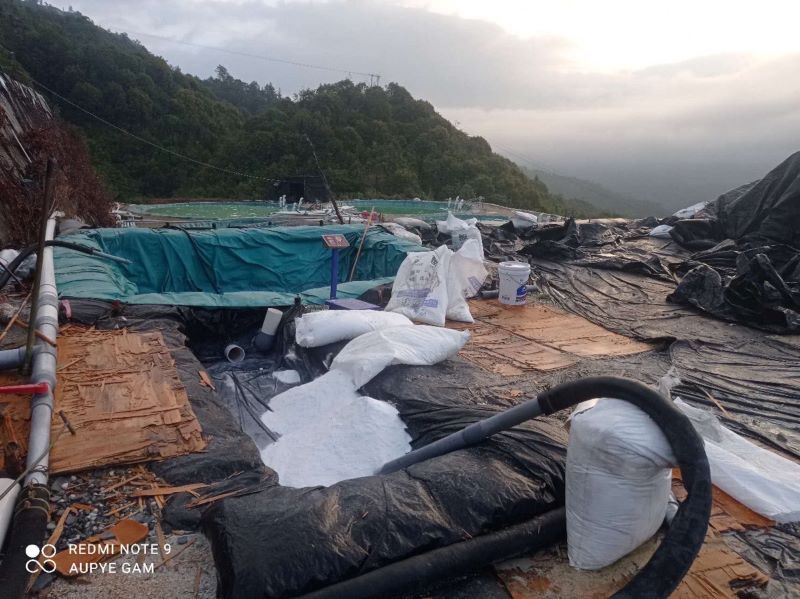
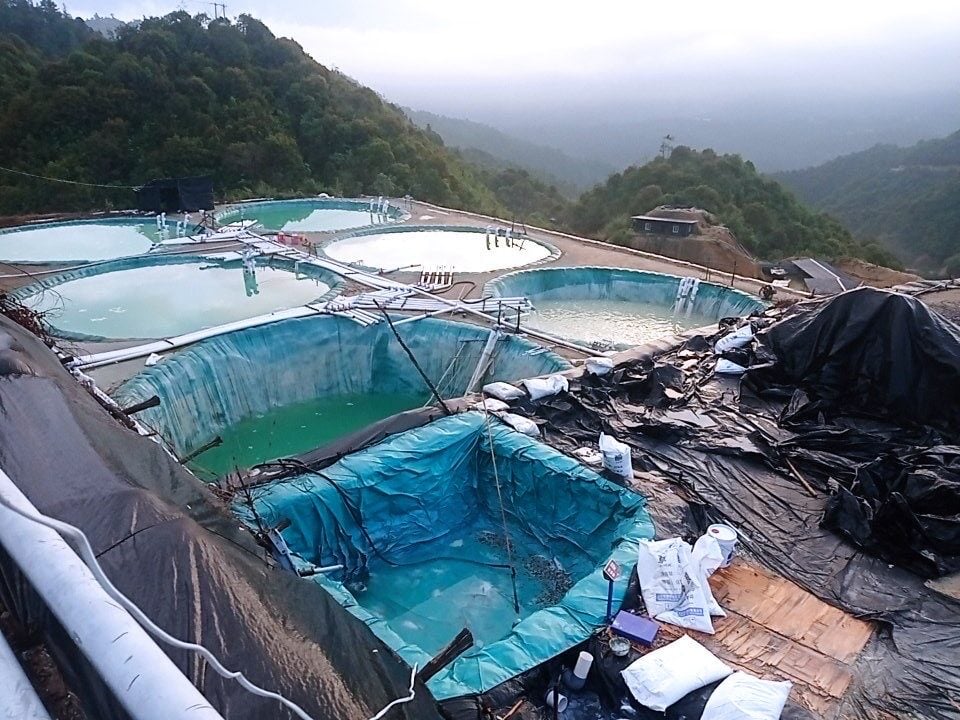
Left: ချီဖွေ မြို့နယ်ရှိ မြေရှားလုပ်ငန်းခွင်တခုအားတွေ့ရစဥ် (၁)
Right: ချီဖွေ မြို့နယ်ရှိ မြေရှားလုပ်ငန်းခွင်တခုအားတွေ့ရစဥ် (၂). Photos: Mizzima
စစ်ကိုင်း၊ ခုခံစစ်နဲ့ သစ်တောပြုန်းတီးမှု ပြဿနာ
အိမ်တွေ မီးလောင်လိုက်၊ စစ်တပ်က ဝင်စီးလို့ ပြေးရလိုက်နဲ့ လူတွေလည်း ပုံမှန်လုပ်နေတဲ့ စိုက်ပျိုးရေးနဲ့ တခြားအလုပ်တွေ လုပ်ဖို့ ခက်ခဲလာတယ်ဗျ။ အဲတော့ သူတို့တွေက နီးစပ်ရာတွေက သစ်တွေကို ခုတ်၊ ဝယ်လက်ရှိတဲ့ ပွဲစားတွေဆီ ရောင်းပြီး စားဝတ်နေရေးဖြေရှင်းရတာတွေ ရှိလာတယ်” လို့ စစ်တပ်အာဏာသိမ်းပြီးနောက် သစ်တောဌာနကနေ CDM လုပ်ခဲ့တဲ့ အရာရှိဟောင်းတဦးဖြစ်တဲ့ ကိုထွန်းထွန်း (အမည်လွှဲ) က ပြောပါတယ်။
စစ်ကိုင်းရဲ့ နာမည်ကြီး သစ်ထွက်ရာနေရာတွေဖြစ်တဲ့ ယင်းမာပင်၊ မော်လိုက်၊ ကသာ၊ ကလေး၊ ဗန်းမောက်၊ ဝန်းသို၊ ချောင်းဦးစတဲ့နေရာတွေဟာ ၂၀၂၀ ပြည့်နှစ်အထိ သစ်ခိုးထုတ်မှုတွေ ရှိနေခဲ့တာဆိုပေမဲ့ အာဏာသိမ်းပြီးနောက်မှာတော့ သစ်တောပြုန်းတီးမှုဟာ အဆမတန်မြင့်တက်လာခဲ့ပါတယ်။ ကျွန်းသစ်နဲ့ သစ်မာပင်တွေနဲ့ တမလန်းသစ်တွေဟာ အဆိုပါဒေသတွေရဲ့ နာမည်ကျော်ထွက်ကုန်တွေဖြစ်ပြီး တရုတ်နိုင်ငံရဲ့ သစ်လိုအပ်ချက်ကို ဆွဲဆောင်နိုင်ခဲ့တဲ့ သစ်တွေလည်း ဖြစ်ပါတယ်။
NLD အစိုးရလက်ထက်မှာ သစ်တောတွေ ထိန်းသိမ်းဖို့ ကြိုးစားခဲ့တဲ့ မူဝါဒတွေဟာ အာဏာသိမ်းလို့ သစ်တောအရာရှိတွေ အာဏာသိမ်းစစ်အုပ်စုနဲ့မပူးပေါင်းအလုပ်မဆင်းတဲ့ (CDM )လုပ်ခဲ့အခါ ရပ်တန့်ခဲ့ပါတယ်။ နောက်ပြီး စစ်တပ်ဘက်က သစ်တောရေးရာစီမံခန့်ခွဲရေးထဲ ထဲထဲဝင်ဝင်ရောက်ခဲ့တဲ့အခါ သစ်ထုတ်လုပ်မှုဟာ စာရင်းပျောက် အဆမတန်ဖြစ်လာခဲ့ပါတော့တယ်။ ပြည်သူ့ကာကွယ်ရေးတပ်တွေဘက်ကလည်း ခုခံစစ်အတွက် လိုအပ်တဲ့လက်နက်တွေနဲ့ ရိက္ခာတွေ ဝယ်နိုင်ဖို့ ကြိုးစားရှာဖွေကြရာမှာ ဒီသစ်ထုတ်လုပ်မှုတွေနဲ့ ပတ်သက်လာရတယ်လို့ စစ်ကိုင်းဒေသခံတွေက ဆိုပါတယ်။
“သစ်က တော်တော်ထုတ်တာ။ အဖွဲ့တွေတော့ အကုန်ပါတာပဲ။ ဂိတ်တွေက PDF (ပြည်သူ့ကာကွယ်ရေးတပ်) ဂိတ်တွေ၊ စစ်တပ်ဂိတ်တွေပေါ့။ တဂိတ်ဖြတ်တိုင်း ငါးသိန်းကနေ ဆယ်သိန်းအထိ ပေးရတယ်။ မုံရွာနဲ့ မန္တလေးက ပွဲစားတွေပဲ လုပ်တာ” လို့ စစ်ကိုင်းဒေသခံတဦးက မဇ္ဈိမကို ပြောပြပါတယ်။
ကမ္ဘာ့သစ်တောလေ့လာစောင့်ကြည့်ရေးအဖွဲ့ (GFW) ရဲ့ အဆိုအရ အာဏာသိမ်းတဲ့နေ့ဖြစ်တဲ့ ၂၀၂၁ ခုနှစ်၊ ဖေဖော်ဝါရီ ၁ ရက်ကနေ ၂၀၂၄ ခုနှစ်၊ ဇူလိုင် ၂၈ ရက်အထိ မြန်မာနိုင်ငံအတွက် သစ်တောပြုန်းတီးမှုဆိုင်ရာ သတိပေးသည့်အကြိမ်ရေ သိန်း ၃၀၀ ကျော် ရှိခဲ့တယ်လို့ သိရပါတယ်။ ဒီအခြေအနေကို ကြည့်ခြင်းအားဖြင့် သစ်ထုတ်လုပ်မှုအနေအထားကို မှန်းဆနိုင်မယ်လို့လည်း သဘာ၀ပတ်ဝန်းကျင်လေ့လာသူတွေက ထောက်ပြပါတယ်။
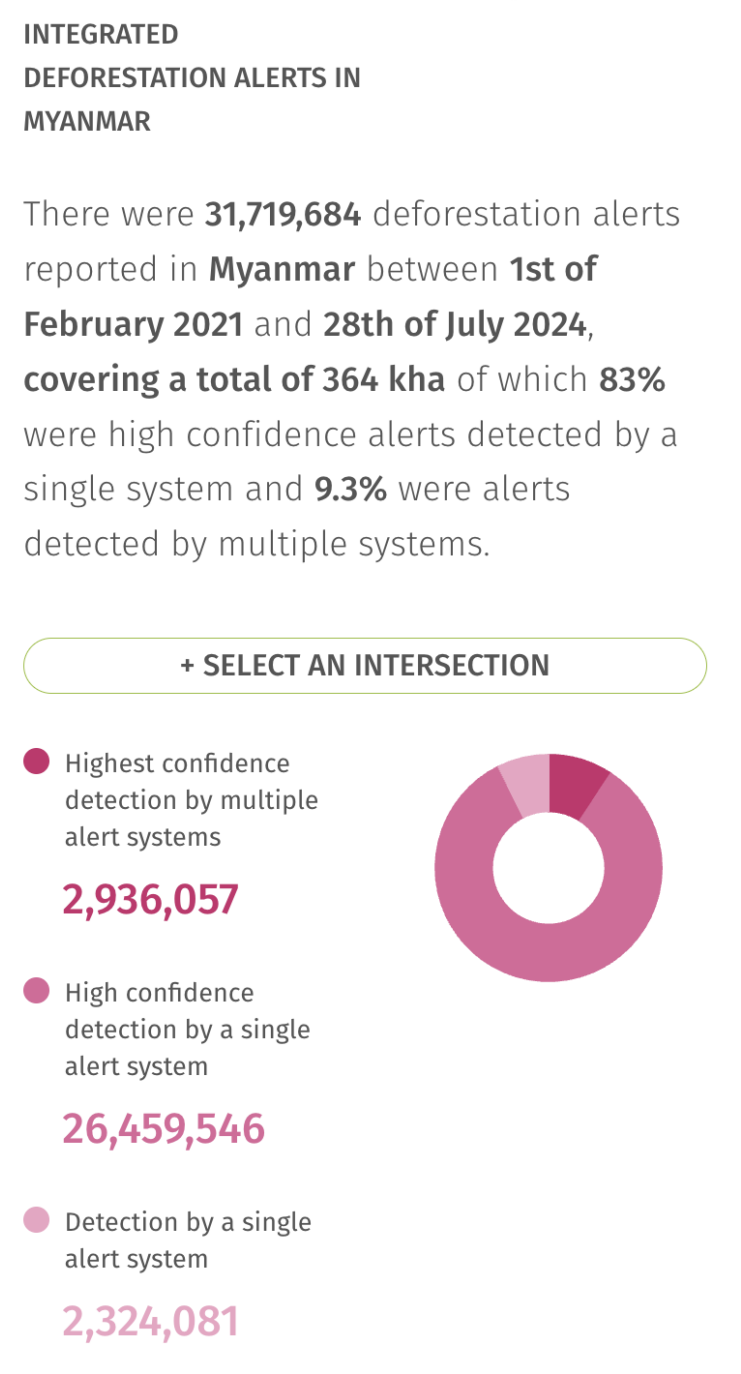
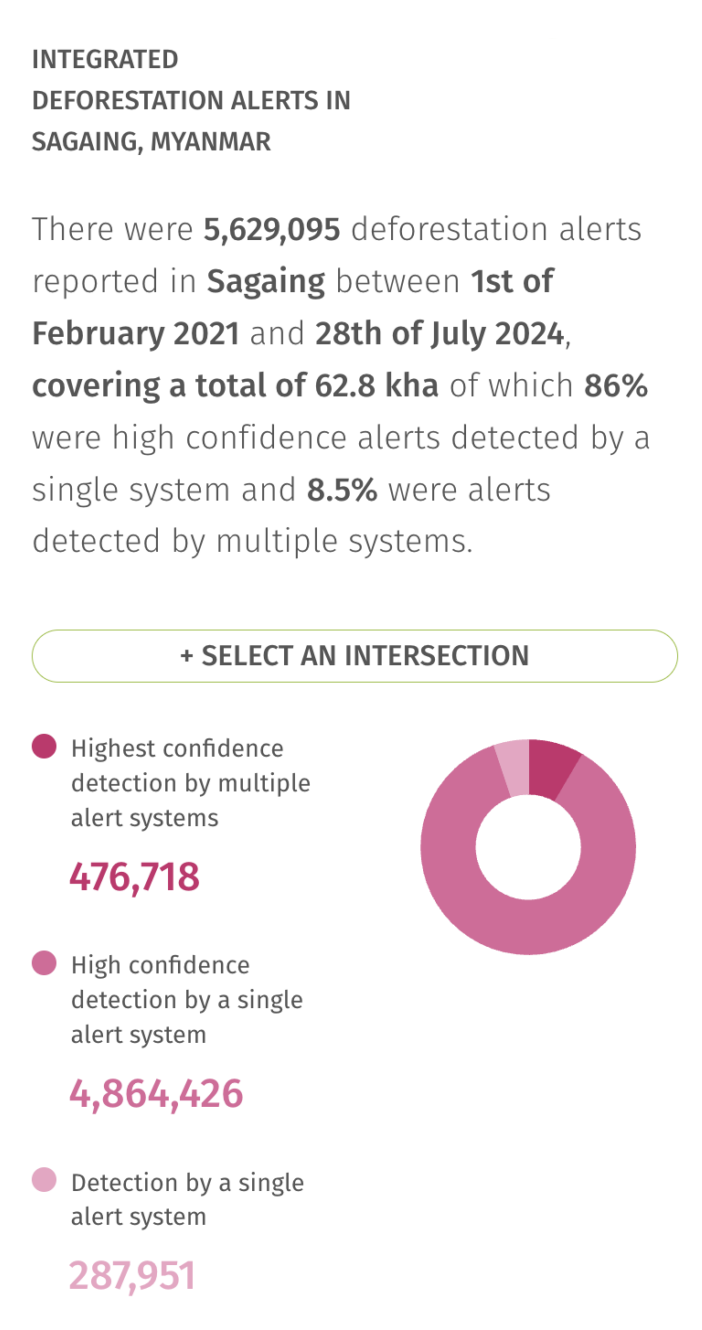
အခုဆိုရင်မြန်မာနိုင်ငံရဲ့ စုစုပေါင်း မြို့နယ် ၃၃၀ မှာ ၂၂၀ ကျော်ဟာ တိုက်ပွဲကြီး၊ တိုက်ပွဲငယ်၊ ချောင်းမြောင်းပစ်ခတ်မှုစတဲ့ အခြေအနေ တခုမဟုတ် တစ်ခုနဲ့ ကြုံတွေ့နေရပြီဖြစ်ပါတယ်။ စစ်ကိုင်းမှာ ၄၅ မြို့နယ်ရှိတဲ့အထဲက ၁၉ မြို့နယ်ဟာလည်း စစ်ဘေးအန္တရာယ်အောက်ကို ကျရောက်နေခဲ့ပြီးဖြစ်ပါတယ်။ ပြည်သူ့ကာကွယ်ရေးတပ်တွေ ထိန်းချုပ်ထားရာနေရာတွေကို လက်နက်ကြီးနဲ့ ပစ်ခတ်မှုတွေ၊ လေယာဉ်နဲ့ ဗုံးကြဲတာတွေ၊ နေအိမ်တွေ ရွာတွေကို မီးရှို့တာတွေ စစ်ကောင်စီတပ်က လုပ်နေခဲ့ပါတယ်။ တနိုင်ငံလုံး အတိုင်းအတာနဲ့ နေအိမ်ပေါင်း ၉၀,၀၀၀ ဝန်းကျင် မီးရှို့ခံခဲ့ရတဲ့အထဲမှာ စစ်ကိုင်းက ၆၀,၀၀၀ဝန်းကျင်ဖြစ်တယ်လို့ Data for Myanmar အဖွဲ့အစည်းရဲ့ အချက်အလက်တွေအရ သိရပါတယ်။
ဒီလိုအခြေအနေတွေနဲ့ ကြုံတွေ့နေရတဲ့စစ်ကိုင်းအတွက် သဘာ၀ပတ်ဝန်းကျင်နဲ့ သစ်တောတွေကို ဂရုစိုက်နိုင်ဖို့ထက် လူတွေ မသေအောင်ဘဲ ပိုဂရုစိုက်နေရတယ်လို့ စစ်ကိုင်းပြည်သူ့အုပ်ချုပ်ရေးပိုင်းနဲ့ နီးစပ်သူတဦးက မဇ္ဈိမကို ပြောပါတယ်။ “လက်နက်ရဖို့က မလွယ်ဘူးဗျ။ ဒီလိုပဲ ရုန်းကန်ကြရတာ။ အရင်က သစ်ကုန်သည်တွေထဲက တချို့ဆို သေနတ်နဲ့ သစ်နဲ့ လဲပေးတာမျိုး ကမ်းလှမ်းတာတွေလည်း ရှိပါတယ်။ အကုန်တော့မဟုတ်ဘူး။ သစ်က တရုတ်ကို အများဆုံး သယ်နေတာ။ သစ်တောတွေ ကုန်တာတွေတော့ ဝမ်းနည်းတယ်ဗျာ။ ပြီးမှ ပြန်တည်ဆောက်ကြတာပေါ့ဗျာ” လို့ သူက ဆိုပါတယ်။
ဒီသစ်ထုတ်လုပ်မှုတွေဟာ ဒီနေရာတွေမှာသာမကဘဲ အာဆီယံအမွှေအနှစ်ဥယျာဉ်ရယ် သတ်မှတ်ထားတဲ့ အလောင်းတော်ကဿပသစ်တောမှာလည်း ဖြစ်နေခဲ့ပါတယ်။ အလောင်းတော် ကဿပအမျိုးသားဥယျာဉ်ဟာ စတုရန်းမိုင် ၅၄၀ ကျော် ကျယ်ဝန်းပြီး တိရစ္ဆာန်တွေကို ဘေးမဲ့ပေးရာတောလည်း ဖြစ်ပါတယ်။ အခုအချိန်မှာတော့ အဲ့ဒီက သစ်တောတွေလည်း ပြုန်းကုန်ပြီဖြစ်ပါတယ်။
“အာဏာသိမ်းပြီး လပိုင်းတွေအကြာမှာပေါ့။ တရက်တရက်ကို ကားတွေနဲ့ ခုတ်ပြီး သယ်ကြတာ မနည်းဘူး” လို့ မျက်မြင်တွေ့ခဲ့တဲ့ ဒေသခံတဦးက မဇ္ဈိမကို ပြောပါတယ်။ အလောင်းတော်ကဿပသစ်တောမှာ ကျွန်းသစ်နဲ့ သစ်မာတွေတွေ ပေါများပြီး အလောင်းတော်ကဿပနဲ့ မဝေးတဲ့ မဟာမြိုင်ကြိုးဝိုင်းမှာတော့ တရုတ်ဘက်က ကုန်သည်တွေကြိုက်တဲ့ တမလန်းသစ်တွေ အထွက်များပါတယ်။ တမလန်းသစ်မှာ အလွန်လှပတဲ့ အပွေးအရစ်လေးတွေ ရှိတာမို့ ပရိဘောဂ ထုတ်လုပ်သူများ အလွန်ဝယ်လိုအားများကြောင်းလည်း ဒေသခံတွေက ဆိုပါတယ်။
“သစ်ခိုးထုတ်တာတွေက အရင်တည်းက ရှိတယ်ဗျ။ ဒါပေမဲ့ ဒီလောက်တော့ စည်းမဲ့ကမ်းမဲ့ မဖြစ်ခဲ့ဘူး။ အခုက တိုင်းပြည်ပျက်သွားတာဗျ။ အလောင်းတော်ကဿပဆို အရမ်းဝမ်းနည်းဖို့ကောင်းတာ။ သစ်တောတွေကောင်း၊ တိရစ္ဆာန်တွေလည်း ခိုလှုံ၊ စစ်ကိုင်းရဲ့ သစ်တောဂေဟစနစ်အတွက်လည်း အဖိုးတန်ဗျာ။ အခုတော့ တော်တော်ထိခိုက်ကုန်တာပဲ” လို့ မန္တလေးမြို့မှာ နေထိုင်တဲ့ သစ်တောပညာရှင်တဦးက သုံးသပ်ပြပါတယ်။
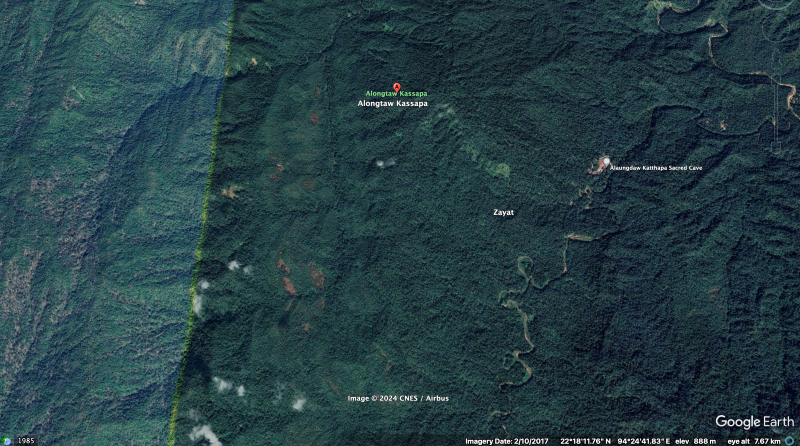
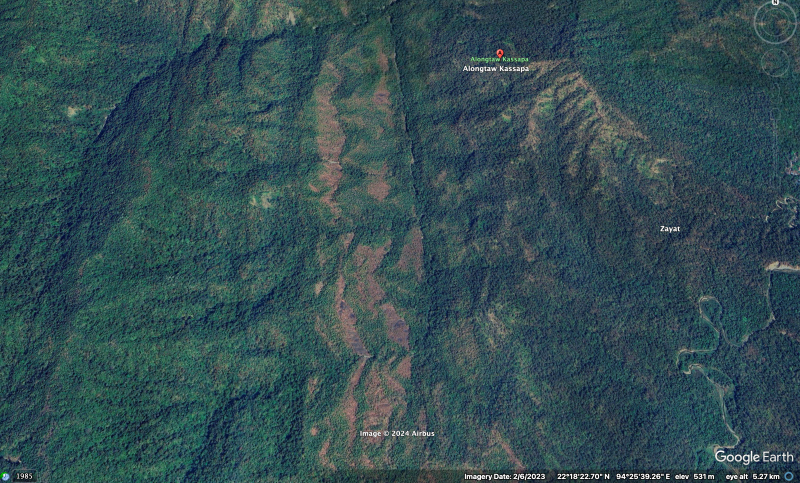
Left: အလောင်းတော်ကဿပကြိုးဝိုင်းဧရိယာကို ၂၀၁၇ခုနှစ်တွင် ကောင်းကင်ဓာတ်ပုံမှမြင်ရပုံ
Right: အလောင်းတော်ကဿပကြိုးဝိုင်းဧရိယာကို ၂၀၂၃ ခုနှစ်တွင် ကောင်းကင်ဓာတ်ပုံမှမြင်ရပုံ. Photos: Mizzima
သစ်မှောင်ခိုထုတ်မှုတွေကသာ စစ်ကိုင်းရဲ့ သဘာ၀ပတ်ဝန်းကျင်ပျက်စီးမှုကို အကြီးအကျယ်ခြိမ်းခြောက်နေပါတယ်။ ဒါပေမဲ့ စစ်ကိုင်းဟာ အရင်တည်းက သဘာ၀ပတ်ဝန်းကျင်ဆိုင်ရာ စိန်ခေါ်မှုတွေက ရှိနေခဲ့တာပါ။ အရင်က တရက်ကို အမေရိကန်ဒေါ်လာ နှစ်သန်းကျော်လောက် ဝင်ငွေရစေတဲ့ လက်ပံတောင်းတောင်ကြေးနီတောင် စီမံကိန်းဟာလည်း စစ်ကိုင်းရဲ့ စိန်ခေါ်မှုတခုပါပဲ။ ဒီစီမံကိန်းဟာ အာဏာသိမ်းပြီးတဲ့နောက်မှာ သိသာထင်ရှားစွာ လည်ပတ်နေတဲ့ အခြေအနေ မရှိတော့ပါဘူး။ ဒါပေမဲ့ စီမံကိန်းနယ်မြေရဲ့ အပြင်ဘက်အထိ ခြံစည်းရိုးတွေခက်တာတွေ လုပ်ခဲ့ပြီး ပြည်သူတွေရဲ့ အသက်အိုးအိမ်တွေကို ဖျက်ဆီးပစ်တာတွေ စစ်တပ်က လုပ်ခဲ့ပါတယ်။ တဘက်မှာလည်းကြေးနီတွေကို စစ်တပ် အစောင့်အရှောက်နဲ့ သယ်ထုပ်တာ စီမံကိန်းကို စစ်ကောင်စီတပ်သားတွေက အကာအကွယ်ပေးတာတွေကြောင့် တော်လှန်ရေးတပ်တွေနဲ့ စစ်ကောင်စီ တပ်တွေကြားမကြာခဏ ပဋိပက္ခတွေ လည်းဖြစ်ပွားခဲ့ပါတယ်။
ကြေးနီးစီမံကိန်းလိုပဲ စစ်ကိုင်းတိုင်း ထီးချိုင့်မြို့နယ်ထဲက တကောင်းနီကယ်စက်ရုံဟာလည်း တရုတ်အတွက် အင်မတန်အရေးပါတဲ့ စက်ရုံဖြစ်ပါတယ်။ အဲ့ဒီစီမံကိန်းကလည်း ဒေသခံပြည်သူတွေကို နေရာရွှေ့ပြောင်းခိုင်းတာ၊ လူ့အခွင့်အရေး ချိုးဖောက်တာနဲ့ သဘာ၀ပတ်ဝန်းကျင်ထိခိုက်တာတွေကြောင့် နာမည်ဆိုးနဲ့ကျော်ကြားပါတယ်။
ဒီစက်ရုံကို အမျိုးသားညီညွှတ်ရေးအစိုးရ (NUG) လက်အောက်မှာရှိတဲ့ ပြည်သူကာကွယ်ရေးတပ်တွေက ဇူလိုင်လကုန်က သိမ်းပိုက်ခဲ့ပါတယ်။ ဒါပေမဲ့ တရုတ်အစိုးရကြောင့် ဒီစီမံကိန်းကို အကာကွယ်စောင့်ရှောက်ပေးမယ်လို့ တော်လှန်ရေးအစိုးရဘက်က အာမခံထားရပါတယ်။ ဒီအခြေအနေ ကိုကြည့်ရင် တရုတ်စီမံကိန်းတွေဟာ လူမူနဲ့သဘာဝ ပတ်ဝန်းကျင်ကိုထိခိုက်ပေမဲ့ နိုင်ငံရေးအရ စီးပွားရေးအရ မြန်မာနိုင်ငံက ပဋိပက္ခမှာပါဝင်နေသူတွေက တရုတ်ကိုမလွန်ဆန်နိုင်တဲ့ အခြေအနေဟာပေါ်လွင်နေပါတယ်။
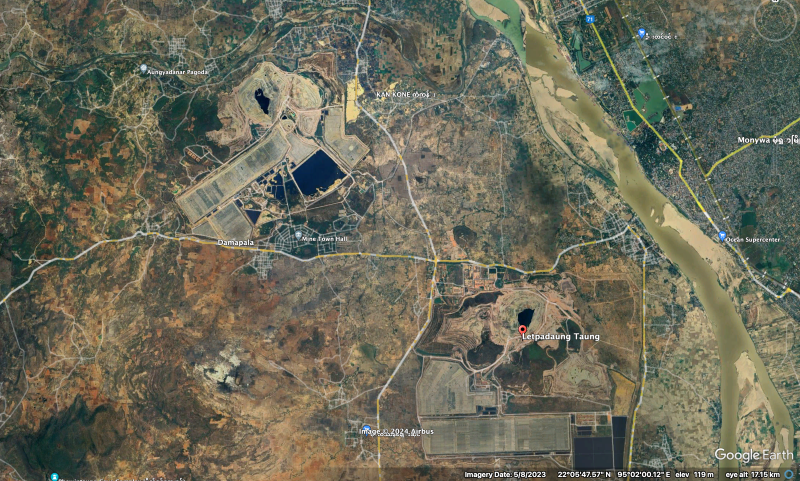
လက်ပံတောင်းတောင် ကြေးနီမိုင်းတွင်းပုံကို ကောင်းကင်မှမြင်ရပုံ. Photo: Mizzima
အာဏာသိမ်းမှုနောက်ပိုင်းမှာ အရင်က သဘာဝပတ်ဝန်းကျင်မှုထိခိုက်မှု၊ လူမှုဘဝထိခိုက်မှုတွေကြောင့် ရပ်တန့်ထားတဲ့ သံယံဲဇာတ စီမံကိန်းကြီးတွေ (အထူးသဖြင့်ကျောက်မီးသွေး တူးဖော်ရေး လုပ်ငန်း၊ ရေကာတာ စီမံကိန်းတွေ၊သံမဏိစက်ရုံတွေ၊သတ္တုတွင်းစီမံကိန်းတွေ) ဟာ အလျိုလျိုပြန်လည် စတင်ကြလာပါတယ်။
ဒီစီမံကိန်းတွေထဲမှာ တရုတ်နိုင်ငံက အကောင်အထည်ဖော်နေတဲ့စီမံကိန်းတွေ အများဆုံးဝင်ပြီး တီကျစ်ကျောက်မီးသွေးစီမံကိန်း၊ ပင်းပက် သံမဏိစက်ရုံ၊ ဘော်ဆိုင်းသတ္တုတွင်းတွေပြန်လည်စတင်ခဲ့သလို ပြည်သူတွေ အပြင်းအထန်ကန့်ကွက်ခဲ့တဲ့ ရေကာတာစီမံကိန်းကြီးတွေကို စတင်ဖို့ပြင်ဆင်လာကြပါတယ်။ ဒီလိုစီမံကိန်းတွေပြန်စတဲ့နေရာမှာ စစ်ကောင်စီသာမက တိုင်းရင်းသား လက်နက်ကိုင်တွေပါဝင်လာကြပါတယ်။
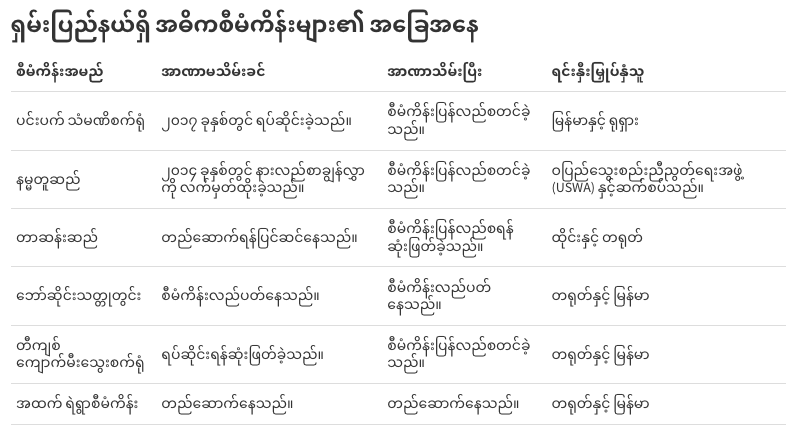
ရှမ်းပြည်နယ်ရှိ စီမံကိန်းများအခြေအနေ. Photo: Mizzima
အာဏာသိမ်းပြီး ရှုပ်ထွေးနေတဲ့ ပဋိပက္ခတွေကြောင့် အရင်ကစီမံကိန်းတွေနဲ့ပတ်သက်တဲ့ ဆိုးကျိုးတွေကို ပြည်သူသိအောင် လုပ်နေတဲ့၊ စီမံကိန်းတွေကို ကန့်ကွက်ဖို့ဦး ဆောင်နေတဲ့ ဒေသခံလူထုအခြေပြုအဖွဲ့အစည်းတွေဟာလည်း နေရပ်စွန့်ခွာ ထွက်ပြေးရတဲ့အပြင် လက်နက်ကိုင်တွေရဲ့ချိန်းခြောက်မှုတွေကြောင့် နူတ်ဆိတ်နေရတဲ့အနေအထားတွေနဲ့ နေထိုင်နေရတာကြောင့် စီမံကိန်းတွေကို ပေါ်ပေါ်ထင်ထင်ပဲ လုပ်နိုင်တဲ့အခြေအနေ ဖြစ်သွားပါတယ်။ ရှမ်းမြောက်မှာ ပြီးခဲ့နှစ် အောက်တိုဘာလမှာစတင် ဖြစ်ပွားခဲ့တဲ့ စစ်ဆင်ရေး ၁၀၂၇ နောက်ပိုင်းမှာတော့ မဟာဗျူဟာကျ တရုတ်စီမံကိန်းတွေ ရဲ့နေရာတော်တော်များများကို မြောက်ပိုင်းက တော်လှန်ရေးမဟာမိတ်အဖွဲ့တွေ ထိန်းချုပ်မိသွားပါတယ်။ ဒီအဖွဲ့တွေဟာ တရုတ်ရဲ့သြဇာ မလွတ်ကင်းဘူးလို့ လူသိများကြပြီး နောက်ပိုင်းမှာ ဒီစီမံကိန်းတွေဟာ သက်ဆိုင်ရာတပ်ဖွဲ့တွေနဲ့ လက်သိပ်ထိုးပြီးမှ လုပ်နိုင်တဲ့ အခြေအနေတွေကို ရောက်သွားခဲ့ပါတယ်။
“လူထုကိုအကာအကွယ်ပေးမယ့် Rule of Law (တရားဥပဒေစိုးမိုးမှု) က ဒီအချိန်မှာ ဘာမှရှိမနေဘူး။ လူထုက ဥပဒေရဲ့အကာအကွယ်မှာရှိမနေဘူးဆိုတော့ စီးပွားရေးလုပ်ငန်းရှင်တွေက လက်ဝါးကြီးအုပ်တာတွေ လူ့အခွင့်အရေးချိူးဖောက်တာတွေရှိတယ်။ ဒါပေမဲ့ လူထုကအသံထွက်လို့မရတော့တဲ့အခြေအနေ” လို့ လက်ရှိရှမ်းပြည်မှာ ဖြစ်နေတဲ့ စီမံကိန်းတွေနဲ့ ပတ်သက်ပြီး ရှမ်းပြည်အခြေစိုက် သဘာ၀ပတ်ဝန်းကျင်အရေးလှုပ်ရှားသူတဦးက ဆိုပါတယ်။ ယခုနှစ်များအတွင်း တရုတ်ဘက်မှာ သတ္တုတူးဖော်ရေး ကုမ္ပဏီများက ရှမ်းပြည်နယ်အတွင်း ဝင်ရောက်လုပ်ကိုင်နေသော်လည်း ဒေသခံပြည်သူတို့အတွက် သိသင့်တဲ့အချက်အလက်များကို အမှောင်ချထားတယ်လို့ သူက ဆိုပါတယ်။
“တိုင်းပြည်က ပျက်နေတော့ လက်နက်ရှိတဲ့စစ်တပ်နဲ့ အင်အားကြီးတဲ့ သူတွေက သူတို့အကျိုးအမြတ်အတွက်ပဲ လုပ်ကုန်ရော။ သာမန်ပြည်သူတွေအတွက်ကတော့ စိုက်ပျိုးစားလို့ မရတာတွေ၊ သဘာ၀ ဘေးအန္တရာယ်ဆိုးကျိုးခံရတာတွေ ထပ်ဖြစ်နေဦးမှာပဲ။ ဒါပေမဲ့ အခုအချိန်မှာ အသက်ဘေးက ပိုအရေးကြီးတယ်” လို့ ရှမ်းပြည်နယ်မှ ဒေသခံစစ်ဘေးရှောင်လူငယ်တဦးက ဆိုပါတယ်။
ISP- Myanmar အဖွဲ့အစည်းရဲ့ သုသေသနတွေ့ရှိချက်တွေအရ ရှမ်းပြည်အတွင်းမှာ တရုတ်ဘက်က အကောင်အထည်ဖော်ဖို့ ပြင်ဆင်ထားတာတွေရော၊ လက်ရှိအနေအထားမှာ အကောင်အထည် ဖော်နေတာရော ပေါင်းလိုက်မယ်ဆိုရင် စုစုပေါင်း အမေရိကန်ဒေါ်လာ ၂၃ ဘီလီယံကျော်လောက် ဖြစ်ပါတယ်။ ဒီပမာဏဟာ တရုတ်ရဲ့ မြန်မာနိုင်ငံအတွင်း မြှုပ်နှံမှုတန်ဖိုးရဲ့ ထက်ဝက်ခန့်ဖြစ်ပါတယ်။
ဘယ်လိုကုစားကြမလဲ
စစ်ကောင်စီဟာ လက်ရှိအချိန်မှာတော့ စစ်ရေးအကြပ်အတည်းရော၊ စီးပွားရေးအကြပ်အတည်းပါ ရင်ဆိုင်ကြုံတွေ့နေရတာဖြစ်ပါတယ်။ ကုန်သွယ်လမ်းကြောင်းများစွာကနေ ဝင်ငွေတွေရခဲ့တဲ့ စစ်ကောင်စီဟာ လက်ရှိအချိန်မှာတော့ တရုတ်၊ အိန္ဒိယ၊ ဘင်္ဂလားဒေ့ရှ်နဲ့ ထိုင်းစတဲ့ ကုန်သွယ်မှုစီးဆင်းတဲ့နိုင်ငံတွေနဲ့ ချိတ်ဆက်နေတဲ့ ကုန်သွယ်ဂိတ်တွေ၊ နယ်စပ်ဧရိယာတွေများစွာကို ဆုံးရှုံးခဲ့ပြီးလည်း ဖြစ်ပါတယ်။
၁၀၂၇ စစ်ဆင်ရေးနောက်ပိုင်း ဒီလိုမျိုး ကုန်သွယ်ဂိတ်တွေ ဆုံးရှုံးလာခဲ့တာဖြစ်ပြီး လက်ရှိအခြေ အနေမှာတော့ အရေးကြီးတဲ့ ကုန်သွယ်ဂိတ် ငါးခုကို လက်လွတ်ခဲ့ရပါတယ်။ မြန်မာနိုင်ငံရဲ့ နယ်စပ်ကုန်သွယ်ရေးပိုင်းမှာ ကုန်သွယ်ဂိတ်ပေါင်း ၁၇ ခုရှိတဲ့အထဲက အဲ့ဒီ ငါးဂိတ်ဟာ စုစုပေါင်း ကုန်သွယ်မှုရဲ့ ၄၀ ရာခိုင်နှုန်းအထိနီးပါး ကုန်စည်စီးဆင်းမှု အားကောင်းတဲ့ ဂိတ်တွေလည်း ဖြစ်ပါတယ်။ ထိုင်း-မြန်မာနယ်စပ်က မြ၀တီဂိတ်ကို စစ်ကောင်စီက လက်လွတ်ခဲ့ရပေမဲ့ ကရင်နယ်ခြားစောင့်တပ်နဲ့အတူ ပြန်လည် ထိန်းချုပ် နိုင်ခဲ့ပါတယ်။ ဒါပေမဲ့ အရင်ကလို ကုန်သွယ်စီးဆင်းမှုအားကောင်းတဲ့ အခြေအနေမျိုး ပြန်မရရှိသေးပါဘူး။ တချို့သော ကုန်သွယ်ဂိတ်တွေဟာလည်း စစ်ကောင်စီရဲ့ ထိန်းချုပ်မှု အောက်မှာ ရှိနေသေးတယ်ဆိုပေမဲ့ ကုန်စည်စီးဆင်းမှုတော့ ရပ်တန့်နေပါတယ်။
အာဏာသိမ်းစဉ်ကာ ၂၀၂၁ ဖေဖော်ဝါရီ ၁ မှာ ဒေါ်လာစျေးဟာ ကျပ် ၁၃၃၀ ဝန်းကျင်သာရှိခဲ့ပေမဲ့ လက်ရှိအချိန်မှာတော့ ကျပ် ၆၀၀၀ ကျော်လာခဲ့ပါပြီ။ ပြီးခဲ့တဲ့ ဇွန်လက ထုတ်ပြန်ခဲ့တဲ့ World Bank ရဲ့ အစီရင်ခံစာမှာလည်း ပဋိပက္ခတွေ၊ အလုပ်သမား ရှားပါးမှုတွေ၊ ငွေကြေးတန်ဖိုး မငြိမ်သက်မှုတွေကြောင့် မြန်မာနိုင်ငံမှာ စီးပွားရေးလုပ်ငန်းတွေ လုပ်ကိုင်ဖို့ ခက်ခဲလွန်းနေကြောင်း ထောက်ပြခဲ့ပါတယ်။ ၂၀၂၃-၂၄ မှာ ဆင်းရဲမွဲတေမှုက ပြီးခဲ့တဲ့ ခြောက်နှစ်အတွင်းမှာ အမြင့်ဆုံးဖြစ်လာခဲ့တယ်လို့ ဆိုပါတယ်။
တနိုင်ငံလုံးအတိုင်းအတာနဲ့ ဒီလိုမျိုးစီးပွားရေးအရ ချွတ်ခြုံကျနေတဲ့ အခြေအနေမှာ သဘာ၀ပတ်ဝန်းကျင် ပျက်စီးမှုနဲ့ သယံဇာတဆုံးရှုံးမှုတွေအကြောင်းဟာ အရေးတယူလုပ် တင်ပြကြဖို့ ကုစားကြဖို့ လိုအပ်နေပါလား၊ ဒီထက်ပိုအရေးကြီးတဲ့အကြောင်းအရာတွေက ပိုရှိနေတာမဟုတ်ဘူးလားဆိုတဲ့ ယူဆချက်တွေက ခုခံစစ် ဆင်နွှဲနေသူတွေဘက်မှာလည်း ရှိနေပါတယ်။ ဒါပေမဲ့ ပဋိပက္ခတွေနဲ့အတူ အကျိုးစီးပွား ရယူနေသူတွေကြောင့် သယံဇာတဆုံးရှုံးမှုကတော့ အဖက်ဆယ်ဖို့ ခက်ခဲနေခဲ့ပါပြီလို့ သဘာ၀ပတ်ဝန်းကျင်ပညာရှင်တဦးက ဆိုပါတယ်။
“တကယ်က ဘာမှ လုပ်လို့ မရတော့ဘူးဗျ။ သေသေချာချာ မွေးမြူရင်တောင် အချိန်အကြာကြီး လုပ်ရမှာလေ။ အခုက ဘာမှကို လုပ်လို့ မရတော့ဘူး။ တရုတ်ကလည်း ရသလောက် ဝယ်နေတာ” လို့ ၎င်းက ဆိုပါတယ်။
လက်ရှိအချိန်မှာတော့ ကချင်က မြေရှားဟာ တရုတ်ဆီကိုပဲ ဦးတည်နေရသလို၊ စစ်ကိုင်းနဲ့ ပဲခူးရိုးမက သစ်တွေရဲ့ အများဆုံးလားရာဟာလည်း တရုတ်ဆီပဲ ဖြစ်နေခဲ့ပါတယ်။
“တော်လှန်ရေးဆင်နွှဲနေသူတွေထဲမှာ သဘာ၀ပတ်ဝန်းကျင်ကို နားမလည်တဲ့သူတွေချည်း မဟုတ်ဘူး။ တချို့က အတော့်ကို သိတာ။ ဒါပေမဲ့ လက်နက်လိုအပ်ချက်၊ ငွေကြေးလိုအပ်ချက်တွေ ရှိလာတဲ့အပေါ်မှာ ဒီလမ်းကိုပဲ ရွေးကြရတော့တာ။ အဲ့ဒါကြောင့် အဖက်ဆယ်ဖို့ ခက်ခဲသွားပြီလို့ ပြောချင်တာ” လို့ အဆိုပါ သဘာ၀ပတ်ဝန်းကျင် ပညာရှင်က ရှင်းပြပါတယ်။
တရုတ်ဘက်ကလည်း တော်လှန်ရေးမှာ ဩဇာရှိတဲ့အခြေအနေတစ်ရပ်ကို မိမိရရ ဆုပ်ကိုင်ထားနိုင် တာဖြစ်ပြီး တရုတ်သူဌေးတွေဟာ ဒီအခြေအနေတွေပေါ်မှာ အကောင်းဆုံးချယ်လှယ်နေနိုင်တာ တွေ့ရတယ်လို့ စစ်ကိုင်းတော်လှန်ရေးနဲ့ နီးစပ်သူတဦးက ဆိုပါတယ်။ တရုတ်ဘက်ကို ရောင်းတဲ့ သစ်တွေကနေရတဲ့ ငွေကြေးဟာလည်း လက်နက်ဝယ်ယူဖို့အတွက် အများကြီးအထောက်အကူဖြစ် တယ်လို့ ဆိုပါတယ်။
“သစ်ကားတွေလည်း နေတိုင်း ကချင်ဘက်ကနေ တရုတ်ကို ထွက်နေတာ။ ဘယ်အဖွဲ့မဆို သူတို့ထိန်းထားတဲ့နေရာက သစ်တွေကို တရုတ်သူဌေးတွေဆီ ရောင်းလိုက်ရုံပဲ။ သယ်တာတွေ၊ လမ်းကြောင်းရှင်းတာတွေ သူတို့ပဲ တာဝန်ယူလုပ်တယ်” လို့ သူက ပြောပြပါတယ်။
မြန်မာနိုင်ငံမှာ သဘာ၀ပတ်ဝန်းကျင်ကို ကောင်းမွန်စွာထိန်းသိမ်းရေးနဲ့ သဘာ၀သယံဇာတတွေအပေါ် မူဝါဒခိုင်ခိုင်မာမာနဲ့ စီမံခန့်ခွဲအသုံးပြုနိုင်ဖို့ဆိုတဲ့ ခရီးဟာ အမြဲတစေ စိန်ခေါ်မှုတွေနဲ့ ပြည့်နှက်နေခဲ့တာပါ။ ဒါပေမဲ့ ဒီတကြိမ်ကြုံတွေ့ရတဲ့ ပုဒ်စာကတော့ အတော့်ကို ခက်ခဲလွန်းတယ်လို့ ဆိုရပါမယ်။ နိုင်ငံရေး အလှည့်အပြောင်း၊ တော်လှန်ရေးရဲ့ အလင်းရောင်စတဲ့ မျှော်လင့်ချက်တွေကြားထဲမှာ ကိုယ့်အသား ကိုယ်ပြန်လှီး ကြသလို၊ ကိုယ့်ဘ၀တွေ ကိုယ့်ကိုယ်တိုင် ပြန်ပစ်ချကြသလိုမျိုး သယံဇာတတွေ ရင်းနှီးပြီး အဖြေရှာရတဲ့ အခြေအနေတွေဟာ ဆက်သွားနေဦးမှာပဲ ဖြစ်ပါတယ်။
If the economic crisis of 2022 sent shockwaves through Sri Lanka and altered its political trajectory, the upcoming presidential election – scheduled for September 21– promises to do more than just shift the course. Experts say it will chart an entirely new direction for the island nation.
As over 17 million registered voters head to the polls, their choices will draw from the hard lessons learned from the events of 2022, ranging from the country’s bankruptcy to the lingering shadows of a decades-long armed ethnic conflict.
Sri Lankans will choose from 38 candidates vying for the presidency. Current President Ranil Wickremesinghe managed to stabilise the situation with loans and aid from the International Monetary Fund after taking charge of the country in 2022 when former president Gotabaya Rajapaksa fled the country after protesters took over his official residence – a moment quite similar to last month’s events in Bangladesh. However, his government continues to face high inflation and shortages of essential goods and medicines. The opposition calls it an “economic Armageddon” while Wickremesinghe asserts that this is the only way forward for Sri Lanka.
Now, the questions that loom large on the island nation’s psyche are: Will Sri Lanka slide further over the economic edge? Or is it capable of finding a progressive leader to steer it forward? In the larger scheme of things, what implications will these election results have on the world, and specifically South Asia?
Sri Lanka’s mass anti-government protests in 2022 ushered in a change in the country’s leadership. But not much has changed. Photo: AntanO via Wikimedia Commons
On September 3, Asian Dispatch collaborated with Sri Lanka’s Center for Investigative Reporting (CIR) to host a webinar and seek answers to these compelling questions.
Titled ‘The Road Ahead: What Sri Lanka’s Presidential Elections Means for the World’, the webinar had an esteemed guest panel of Dr Paikiasothy Saravanamuttu, the Executive Director of Center for Policy Alternatives; Rathindra Kuruwita, the Deputy News Editor at The Island; Aditi Phadnis, Political Editor at Business Standard; and Kunwar Khuldune Shahid, Pakistan Correspondent at The Diplomat.
The conversation was moderated by Dilrukshi Handunnetti, Co-founder/Director of CIR.
Dilrukshi Handunnetti moderates the September 3 webinar on Sri Lanka’s elections. The webinar was co-presented by Asian Dispatch and Centre for Investigative Reporting.
Here are some highlights from the conversation:
The Sri Lankan Perspective
Dr Saravanamuttu, of the Center for Policy Alternatives, offered a sobering assessment.
“This election comes in the wake of the near-total collapse, signifying not just an economic crisis, but a crisis of governance. It’s the first election since the 2022 protests that ousted the Rajapaksas from government—though not from Sri Lankan politics.”
Dr. Paikiasothy Saravanamuttu, centre, addresses the speakers and audiences on September 3 webinar.
He emphasised that while the ballot is long, the real contest lies between three major contenders: The incumbent President Wickremesinghe, Sajith Premadasa and National People’s Power (NPP) leader Anura Kumara Dissanayake. Wickremesinghe is credited for stabilising the country but remains unpopular due to tax policies that disproportionately burden the middle and lower classes. The competition is fierce.
Internationally, Sri Lanka’s political landscape has significant ramifications. Early this year, India, with its complex history of engagement with Sri Lanka, met with leaders of the NPP to discuss bilateral initiatives and development.
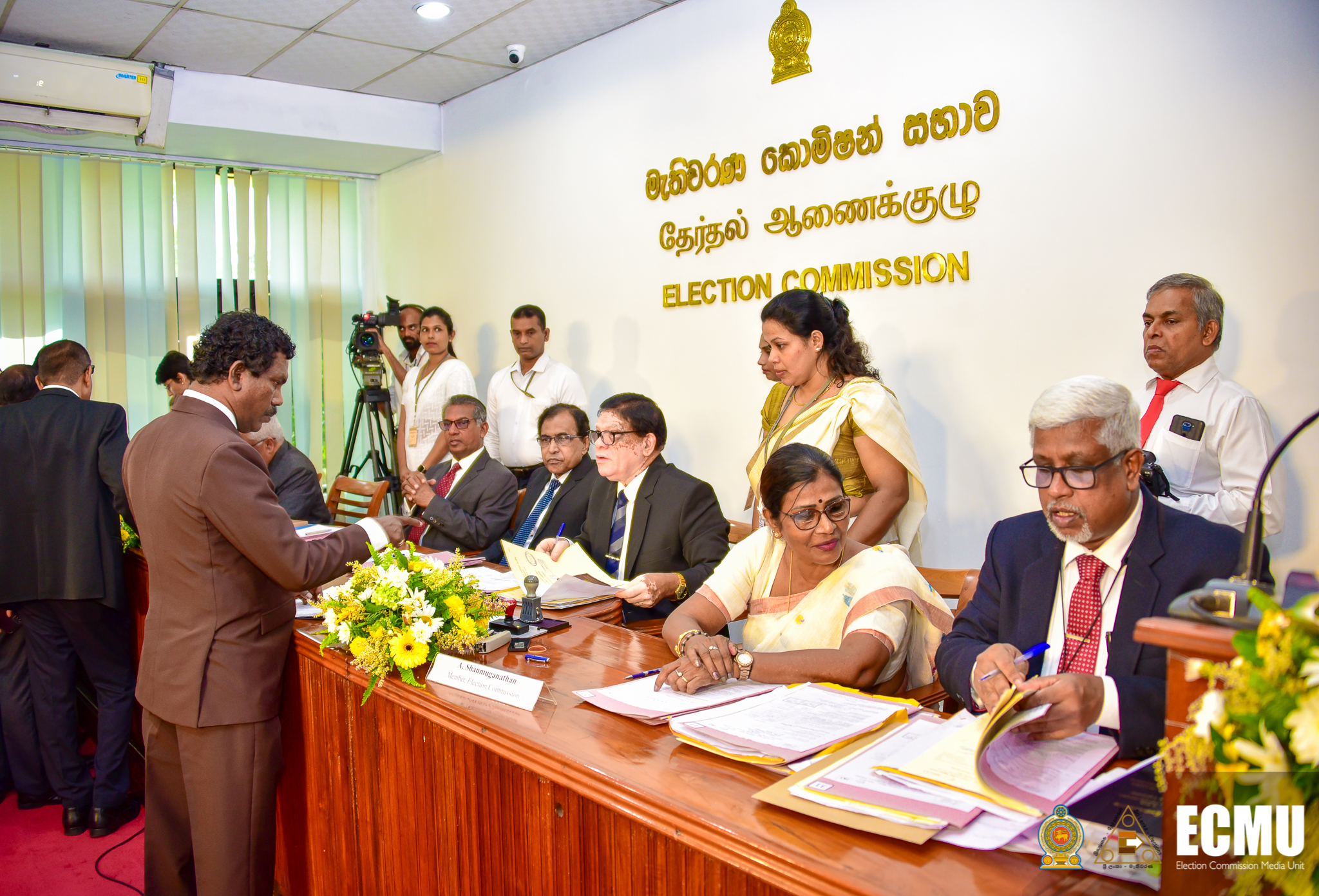
The Election Commission of Sri Lanka has published tough guidelines for the 38 candidates – who are all men – who are competing for the role of Sri Lanka’s next president. Photo: Election Commission of Sri Lanka via Facebook
China remains deeply invested in the country too due to its financial backing of the Rajapaksa regime.
Meanwhile, the U.S. is cautiously monitoring developments in the strategically critical Indian Ocean region for its own interests.
India’s Perspective
Phadnis of India’s Business Standard newspaper highlights the growing concerns within Indian political circles about the upcoming Sri Lankan elections.
“We are entering a period of great challenge and great disconnect,” Phadnis notes, reflecting on the longstanding issues that continue to strain the relationship between the two countries. “Many of the challenges and cause of discontent in the relationship between India and Sri Lanka remain the same. I don’t see any political parties in Sri Lanka addressing this in any meaningful way.”
Aditi Phadnis, a senior political journalist from India, talks about the challenges that Sri Lankan elections outcomes can pose for India.
One of the most contentious issues that Phadnis raised during the webinar is the 13th Amendment of the Sri Lankan Constitution, a key point of tension between India and Sri Lanka. The 13th Amendment, borne out of the Indo-Sri Lanka Accord of 1987, calls for the devolution of central powers to provincial councils, a move toward federalism which is intended to empower Sri Lanka’s provinces, particularly in the Tamil-majority northern and eastern regions.
Phadnis says that for India, the full implementation of this amendment is seen as crucial, not only for the empowerment of the Tamil minority in Sri Lanka but also as a means to secure itself from any spillover of conflict that could destabilise the region.
However, she notes that mainstream Sri Lankan leaders have been hesitant to fully implement the 13th Amendment, especially concerning land and police powers, which are seen as critical components of true devolution. This hesitancy has perpetuated a sense of disenfranchisement among the Tamil community here, creating further complications in the already complex relationship between the two nations.
Phadnis also points out the fractures within the Tamil political landscape, noting the split between Tamil parties such as the Tamil National Alliance (TNA) and the Ilankai Tamil Arasu Kachchi (ITAK) over their choice of presidential candidate. This division has not only weakened the Tamil political front but has also complicated the broader issue of devolution of power. The ideological underpinnings of the Tamil Eelam movement, once driven by India’s Dravidian movement, have undergone significant fractures, leaving the Tamil cause fragmented.
Reflecting on India’s stance on the Tamil representation in the election, Phadnis says: “There will be no effort by India to prop up any candidate that tempers the demand for a separate homeland. That is all in the past, and India will not make the same mistake again.” She references the Indian Peace Keeping Force (IPKF), which operated in Sri Lanka from 1987 to 1990, noting that even today, it struggles to be recognised as an out-of-area peacekeeping force within India.
Phadnis further noted that no one in India would want to see a repeat of the Easter bombings or the Aragalaya (as the 2022 protests is popularly called in Sri Lanka), underscoring the deep concerns over Sri Lanka’s stability and the broader implications for regional security.
Pakistan’s Perspective
Shahid from The Diplomat offered a nuanced perspective on his country’s relationship with its South Asian neighbors, particularly Sri Lanka.
“Pakistan finds itself in a paradoxical position in the region — it has little to offer its South Asian neighbors in many respects. However, with Sri Lanka, the relationship is different,” Shahid explains. “Pakistan seeks a more balanced diplomatic approach with Sri Lanka, especially vis a vis India. Together, Sri Lanka and Pakistan share a long history of security and military cooperation.”
Kunwar Khuldune Shahid talks about Pakistan’s diplomatic relations with Sri Lanka and the opportunities therein.
Despite Pakistan’s limited trade agreements — limited to only four countries so far — Sri Lanka stands out an exceptional and positive trade partner. However, Shahid points out that this trade, while positive, pales in comparison to Sri Lanka’s trade with India, which is 10 times more in scale. Pakistan aspires to expand this aspect, seeking collaboration not just in economic and defense sectors but also on issues related to minorities.
Shahid acknowledges that the relationship between Pakistan and Sri Lanka has been somewhat lukewarm, largely because both countries have historically maintained non-aligned stances on key regional issues. Sri Lanka, for example, has consistently maintained neutrality on sensitive issues like Kashmir, which has helped sustain diplomatic balance with India.
“This neutrality, this diplomatic balance, has been beneficial [for Sri Lanka],” Shahid notes.
Pakistan has, in turn, supported Sri Lanka on the international stage, notably by voting against the 2021 UNHRC resolution that called for international investigations into the country’s war crimes, at the United Nations Human Rights Council in Geneva. This solidarity has strengthened the security collaboration between the two countries, with military drills, intelligence sharing, and arms supplies reaching unprecedented levels. “It is in the realm of security that Pakistan has something tangible to offer Sri Lanka, and Sri Lanka values this assistance,” Shahid explains.
The Elephant in the Room: China
Kuruwita of The Island sheds light on the big source of global curiosity, which is China’s engagement in Sri Lanka.
“There are many questions surrounding what China has been doing in Sri Lanka for the last 2 years, and the answer – quite simply – is ‘Almost nothing,’” Kuruwita states. “Over the last two years, China has been virtually silent, with minimal economic activity. The reasons for this are multifaceted, but one stands out: China’s engagement in Sri Lanka has historically varied depending on which political party is in power.”
Kuruwita elaborates on the long-standing relationship between Sri Lanka and China, dating back to 1950 when Sri Lanka became one of the first countries to recognise the People’s Republic of China. “This relationship has seen fluctuations based on the ruling party in Sri Lanka,” he explains. “When the Sri Lanka Freedom Party (SLFP) is in power, China typically provides more loans, aid, and political support as compared to when the United National Party (UNP) governs the country.”
Rathindra Kuruwita of Sri Lanka’s The Island newspaper addresses the elephant in the room: China
According to Kuruwita, the current administration under President Wickremesinghe is not favoured by China, which explains the noticeable lack of Chinese activity in the country. “China clearly doesn’t like Ranil’s administration, and until there’s a change in leadership, we shouldn’t expect much from China in terms of engagement,” he notes.
Looking ahead, Kuruwita says the outcome of September 21 election could significantly impact China’s involvement in Sri Lanka.
“If JVP comes to power – despite their criticism of foreign engagement – China might find a soft spot for them. On the other hand, Sajith Premadasa, often seen as UNP 2.0, would likely continue the current trend of limited Chinese activity. It’s clear under whose leadership we can expect a shift in Chinese engagement after September 21.”
In conclusion, all four panelists agreed that the aftermath of the September 21 election will have profound and long-lasting implications for the broader region. As both Delhi and Beijing adopt a cautious wait-and-watch approach, the stakes are quite high in what is clearly a nail-biting electoral contest.