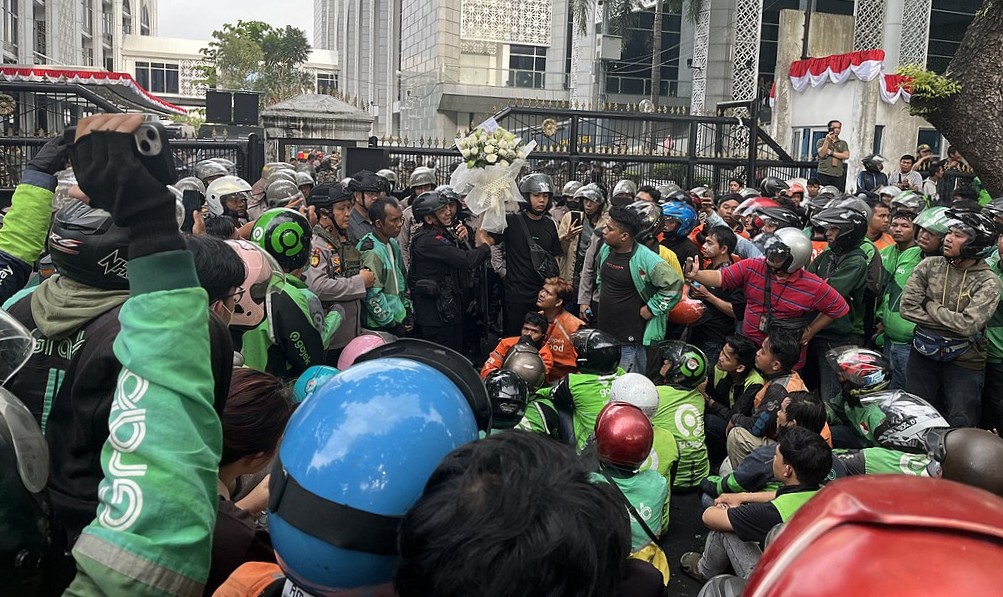
Protesters gather in front of DPRD Sumut gate entrance in Medan on August 29, 2025. Photo: Wikimedia Commons

In late August 2025, years of frustration against institutional malfeasance culminated in protests, demonstrations, and violence across Indonesia, the world’s third-largest democracy. The week-long turmoil eased only in September, after the scale of the unrest compelled the government and lawmakers to introduce changes, which rights groups and activists say fell short of meaningful reform.
The widespread protests began on August 25, after it was revealed that Indonesian lawmakers had been receiving a monthly housing allowance of Rp 50 million (approximately $3000) over and above their salaries since October 2024. This amount is 10 times the minimum monthly wage in capital city Jakarta and 20 times the minimum wage in economically weaker areas of the country.
In a country with a long history of corruption and authoritarian rule, racked by economic instability and rising costs, the revelation of this exorbitant perk sparked a fresh wave of outrage across the nation. This came at a time when the government was implementing austerity measures, including cuts to education and healthcare.
The public outcry escalated when a 21-year-old food delivery driver, Affan Kurniawan, was run over by a vehicle belonging to the nation’s elite paramilitary police unit at the protest on August 28.
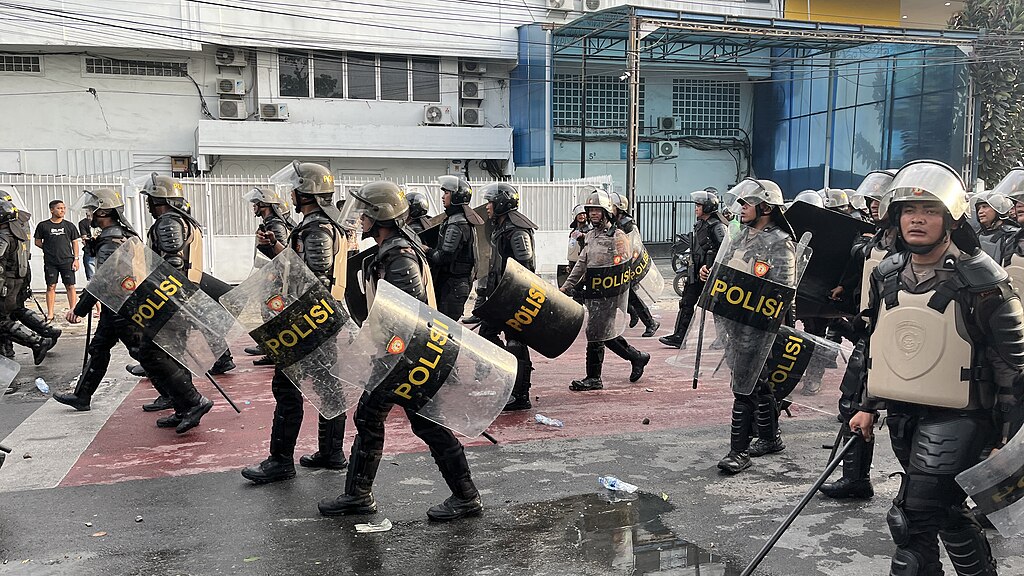
Riot police walking by in Medan, Indonesia, on August 29, 2025. Photo: Wikimedia Commons

Indonesia’s National Police (Polri) Chief General Listyo Sigit Prabowo issued an apology to Kurniawan’s family and assured an investigation into the case. Investigation into the incident was also assured by President Prabowo Subianto, who initially called the protests “treason and terrorism”.
On August 31, following the protests, Subianto announced that the parliament had decided to scrap housing allowance and suspend overseas trips.
The week-long clashes between protesters and police and military led to the death of at least ten people, and 44 others remain missing.
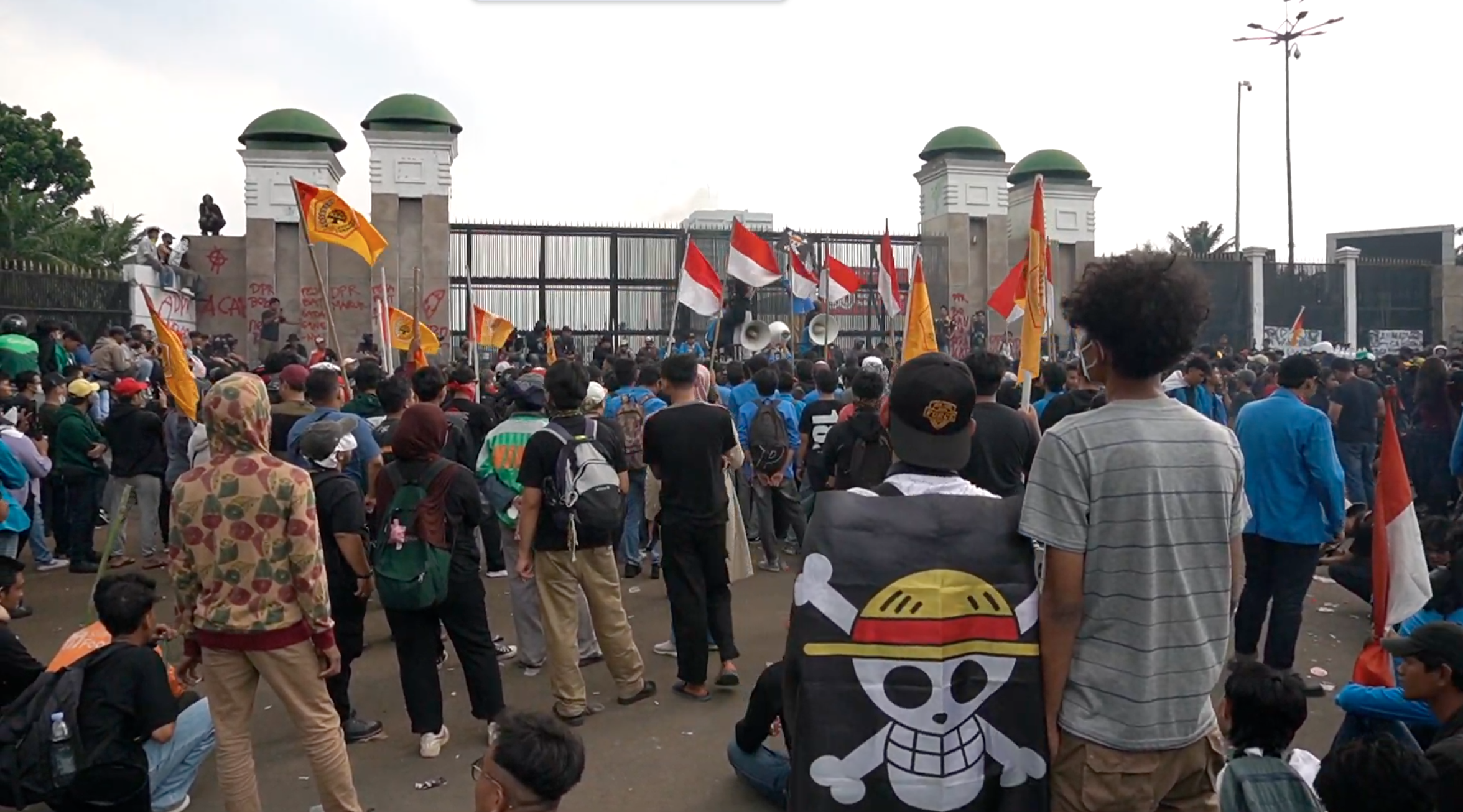
Protestors in Jakarta on August 28, 2025. Photo: Viriya Paramita Singgih/Project Multatuli
Although the tension has eased over the last week, demonstrations continue, primarily led by student groups in Jakarta.
Demands and Government Action
By early September, the “17+8 Demands” campaign gained influence across the protest movement. Compiled using statements from civil organisations and unions, the campaign lists 17 short-term demands such as releasing detainees, freezing lawmakers’ perks, equitable wages, and eight long-term demands to address corruption and induce institutional reform.
However, senior activists who have been voicing concerns for years, have expressed distress on social media, saying that the 17+8 demands lacked consultation with wider civil society.
Meanwhile, the government and the lawmakers have addressed some of these demands, such as detailing parliamentarians’ “take home pay” and beginning the release of political detainees. But significant action is yet to be taken toward many other demands.
On September 9, in a sudden reshuffle of his Cabinet, Subianto replaced five economic and security ministers, including Finance Minister Sri Mulyani Indrawati, former executive director of the International Monetary Fund and managing director of the World Bank. However, the newly appointed Minister of Finance Purbaya Yudhi Sadewa, has made dismissive comments about the “17+8” campaign after he was sworn in.
History of Protests
Over the last two years, there have been many waves of mass protests and demonstrations against controversial moves by Indonesian governments.
In August last year, thousands of people took to the streets after the government attempted to change an election law to favour the dynastic coalition led by former President Joko “Jokowi” Widodo, and current President Subianto.
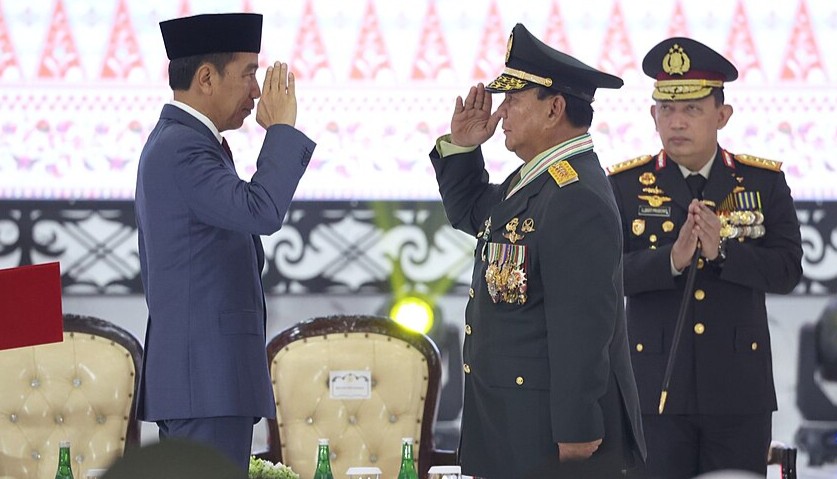
Former Indonesian president Joko Widodo (left) and then-Defense Minister Prabowo Subianto (right). Photo: Indonesian Ministry of Defense/Wikimedia Commons
In February 2025, student-led ‘Dark Indonesia’ protests took place in Yogyakarta, Jakarta, and Medan. Sporadic protests continued throughout the year over controversial government policies, budget cuts, against the increased re-involvement of the military in civilian matters, economic inequality, the Gaza genocide, government and police corruption, and more.
READ: Indonesia’s New Capital: How Jokowi Uses Extravagant Promises to Lure Investors
Police and military have been accused of using disproportionate force during the latest protests, prompting the United Nations to call for an investigation. Seven officers were detained in relation to Kurniawan’s death and one of them was dishonorably discharged.
Although the situation seems to have abated, the foundational issues causing nationwide tensions haven’t been addressed by Subianto’s government. Subianto, a former special forces commandant, has established 100 new battalions since coming to power less than a year ago in October 2024, with plans for much more.
The new battalions are allegedly to assist in civilian domains like agriculture, husbandry and food security. These battalions, along with the passing of a law allowing armed forces personnel to hold more civilian posts, have signalled a return to Indonesia’s “New Order” era, a dark period of authoritarian rule in Indonesian history led by military dictator Suharto. Subianto is Suharto’s former son-in-law.
However, Prabawo is not the first since Suharto to be accused of undermining Indonesia’s democracy. His predecessor, Joko Widodo—elected in 2014 as a “man of the people”— left behind a tainted legacy of corruption and nepotism.
The story has been updated on September 9 with the latest developments.
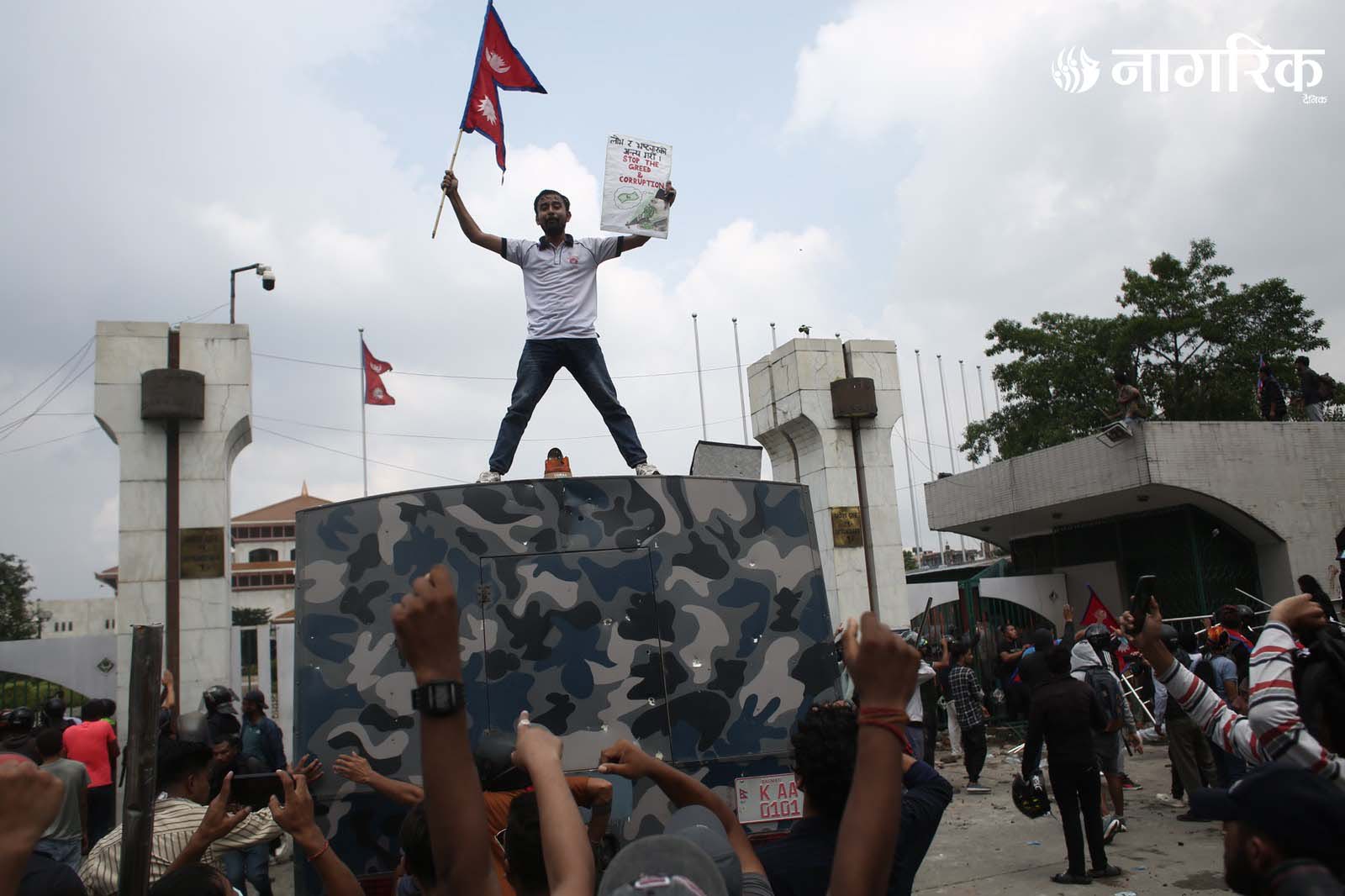
Nepal Prime Minister KP Sharma Oli resigned from office following the massive protests in the country by the youth against corruption and a ban on social media platforms. As the protests turned violent and snowballed out of control, at least 19 people lost their lives and hundreds of others have been injured.
The protesters set ablaze Oli’s house, the Parliament building, the main gate of Singha Durbar, the Nepali Congress’ (NC) central office, and the CPN-UML’s central office.
Earlier on Monday, police used heavy force including multiple gunshots, rubber bullets, water cannons, and baton charges to disperse the agitating youngsters.
Baneshwor—the heart of the capital city Kathmandu and home to Nepal’s federal Parliament—descended into chaos as protests, dubbed as Gen Z protests, escalated into violent confrontations. Despite the government’s imposition of a curfew, defiant crowds of protesters continued to occupy the streets, chanting slogans, and challenging security forces.
The tense standoff transformed Baneshwor into a flashpoint of unrest.
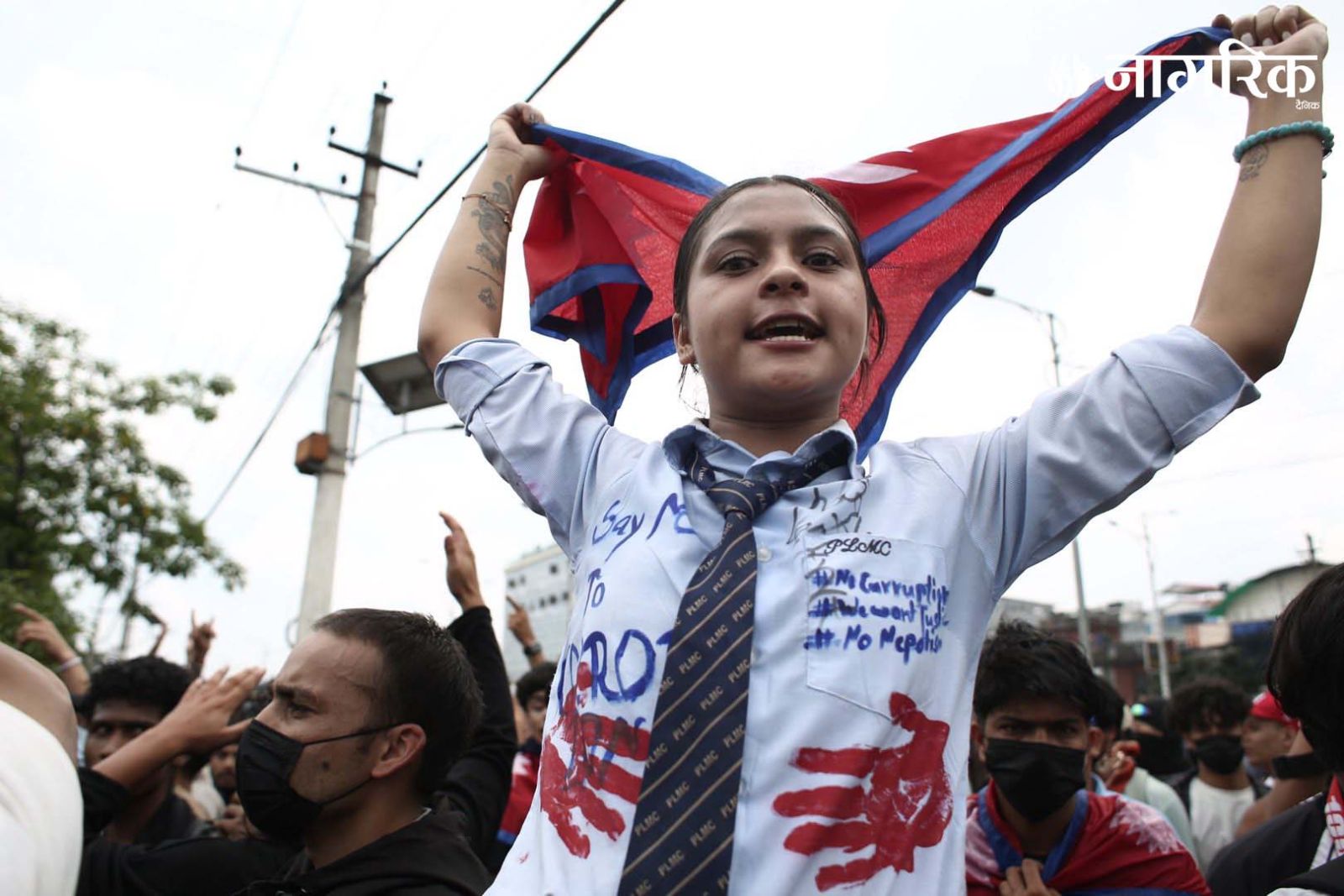
Photo: República
Curfew Imposed
The District Administration Office (DAO) Kathmandu imposed an indefinite curfew starting 8:30 am on Tuesday. The earlier curfew, enforced following Monday’s protests, had ended at 5 am this morning.
Earlier, Nepali Army (NA) personnel took control of the roads surrounding the Parliament complex in New Baneshwor, Kathmandu. As of September 8, protesters remained between Baneshwor and Bijulibazar, and didn’t disperse despite curfew order, according to SSP Shekhar Khanal of the Kathmandu Valley Police Office, Ranipokhari.
Gen Z Nepal, however, distanced itself from the incident, stressing that those who stormed the Parliament were not affiliated with their campaign.
“Our movement had around 20 to 25 groups, and the plan was to march only up to Everest Hotel,” said organiser Ujen Raj Bhandari. “Those who went beyond that point are not recognized by us. We have already asked students present there to return.”
As tensions escalated, Gen Z Nepal issued an urgent appeal on social media urging participants to leave the protest site immediately.
“Please exit safely as soon as possible. Several vested groups are inciting the crowd. Our day has already been a success. Please go home safely today,” the statement read.
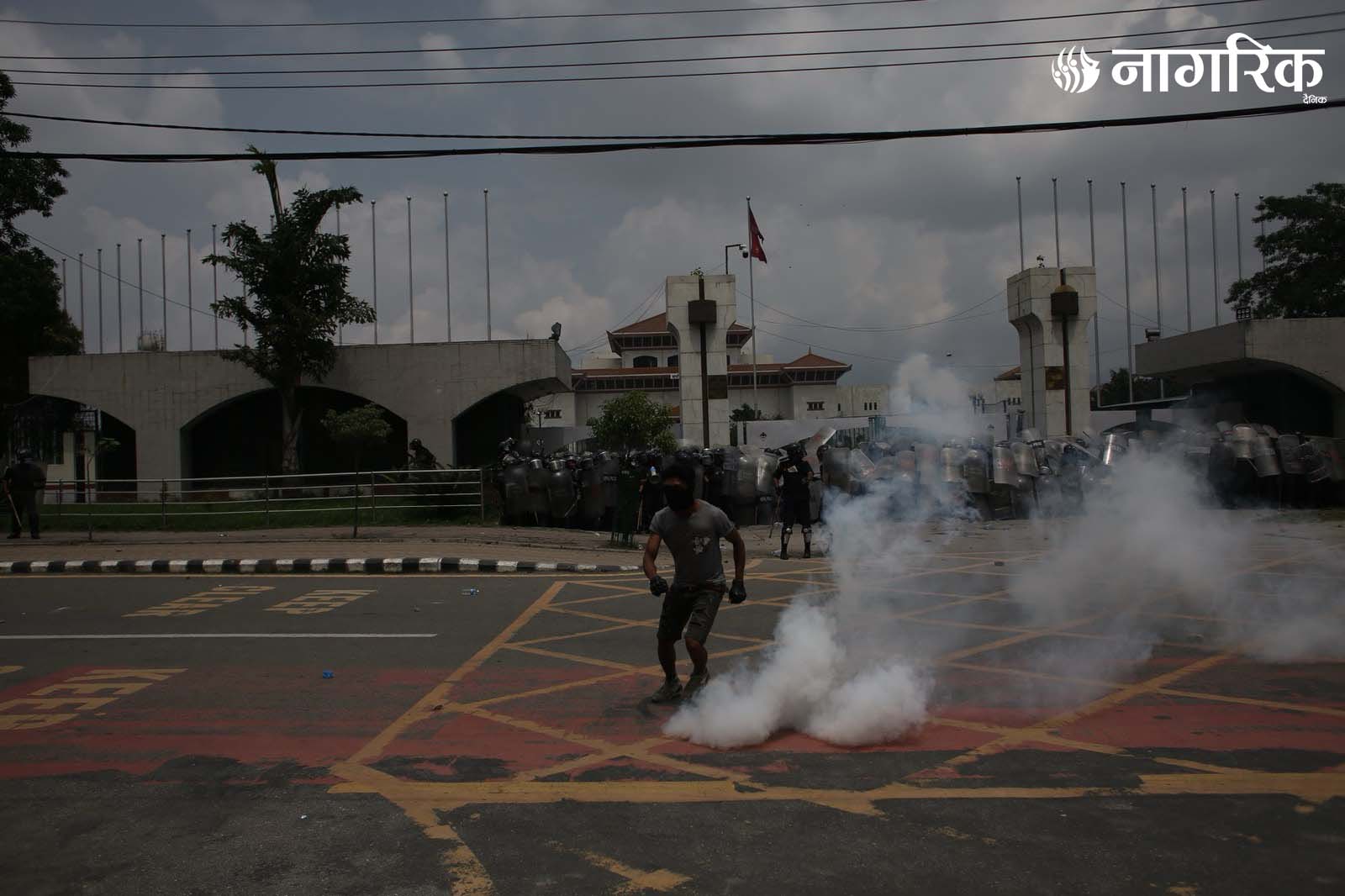
Photo: República
Government Response
President Ramchandra Paudel has accepted the resignation of PM Oli. He is now preparing to move forward with the process of forming a new government in accordance with Nepal’s Constitution. “The President is consulting with relevant parties to advance the government formation process as per the Constitution,” a presidential advisor stated.
In the early hours on Tuesday, the government had reportedly lifted the ban on social media platforms and formed a committee to investigate the protest.
A cabinet meeting, held on Monday evening, decided that the committee would look into all incidents that occurred during the demonstration. The panel has been given 15 days to complete the investigation and submit its report to the government.
Meanwhile, the Ministry of Health and Population (MoHP) had instructed all federal hospitals to provide free treatment to citizens injured during the protests.
MoHP led by Minister Pradip Paudel issued a circular directing hospitals to ensure prompt care for injured protesters without any charges. The MoHP also called for making ambulance services more efficient and easily accessible where needed.
The Kathmandu Valley ambulance network was urged to facilitate transfers of patients referred between hospitals. Additionally, all doctors and healthcare workers were appealed to come together to provide timely treatment to the injured.
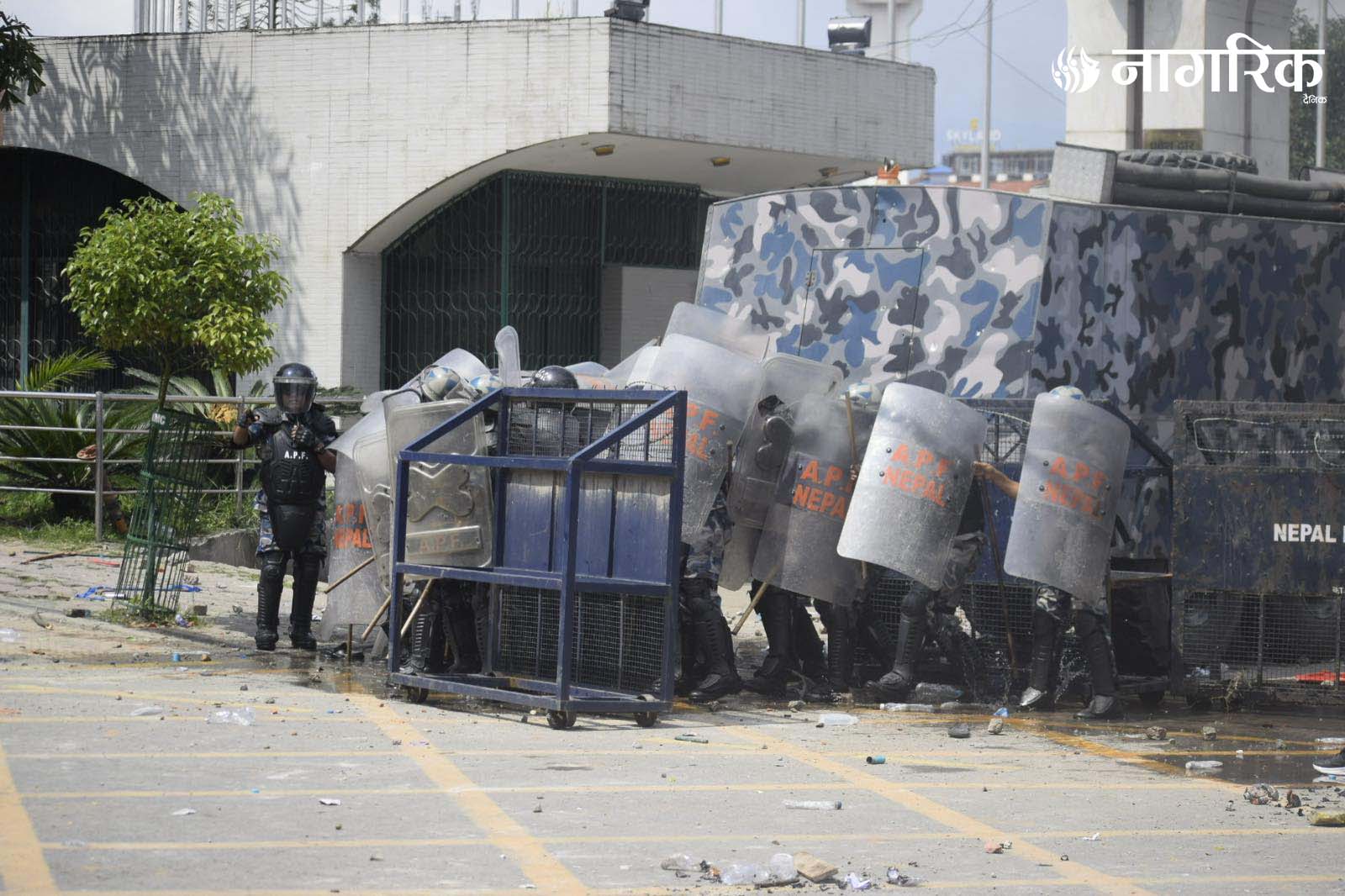
Photo: República
Opposition Demands PM’s Resignation
Opposition parties, including the CPN (Maoist Center) and the Rastriya Swatantra Party (RSP), had demanded the resignation of the prime minister, accusing his government of committing a massacre during the protests in the capital and across the country.
They concluded that the government’s handling of the movement was “highly inappropriate,” insisting the prime minister step down to create a conducive political environment.
As part of its campaign “Maoist with the People, Mid-Hill Pushpalal Highway — National Awakening Drive,” top Maoist leaders, including Chairman Pushpa Kamal Dahal, senior vice-chairs, vice-chairs, and the general secretary, had reached Gorkha on Monday. However, after learning about the escalation of protests in Kathmandu and reports of casualties, the leaders held an informal meeting, demanded the PM’s resignation, suspended their campaign, and returned to the capital the same day.
Similarly, the RSP also demanded Oli’s immediate resignation and early elections. Meanwhile, the Janata Samajbadi Party-Nepal (JSP-N), led by Upendra Yadav, demanded the immediate lifting of the social media ban and urged the government to hold talks with protesters to resolve the crisis.
Reason Behind the Protests
Public anger has surged since the government’s September 4 decision to simultaneously shut down 26 platforms, including Facebook, WhatsApp, Instagram and YouTube. In response, Gen Z has turned the issue into a broader campaign, raising voices against violations of fundamental rights as well as against nepotism and corruption.
One of the youths involved is Aarati Ray of Kathmandu. According to her, the country’s system has already been ruined by partisan politics, leaving no choice but for this generation to take to the streets. “We are clear. The country has been devastated by corruption. The root cause is a broken system,” Ray told Republica. For many, social media was the only outlet to vent frustration over hardships faced in public services.
On TikTok, the hashtag #PoliticiansNepoBabyNepal is raising questions about expensive cars, foreign education, and lavish lifestyles of politicians’ children. As Gen Z’s movement heads to the streets, the sharpest criticism has targeted the family of Nepali Congress President Sher Bahadur Deuba.
Gen Z activists have been posting photos and videos of his son Jaiveer and daughter-in-law Sivana’s lavish lifestyle, running a “Nepobaby” campaign online. Youth have also taken a dig at Shrinkhala Khatiwada, daughter of a former health minister Birodh Khatiwada; Ganga Dahal and Smita Dahal, daughter and granddaughter of former prime minister Pushpa Kamal Dahal; Anjila Basnet, daughter of former minister Mahesh Basnet; Ankit Khand, son of a former home minister, and Kshitiz Parajuli, son of former chief justice Gopal Parajuli.
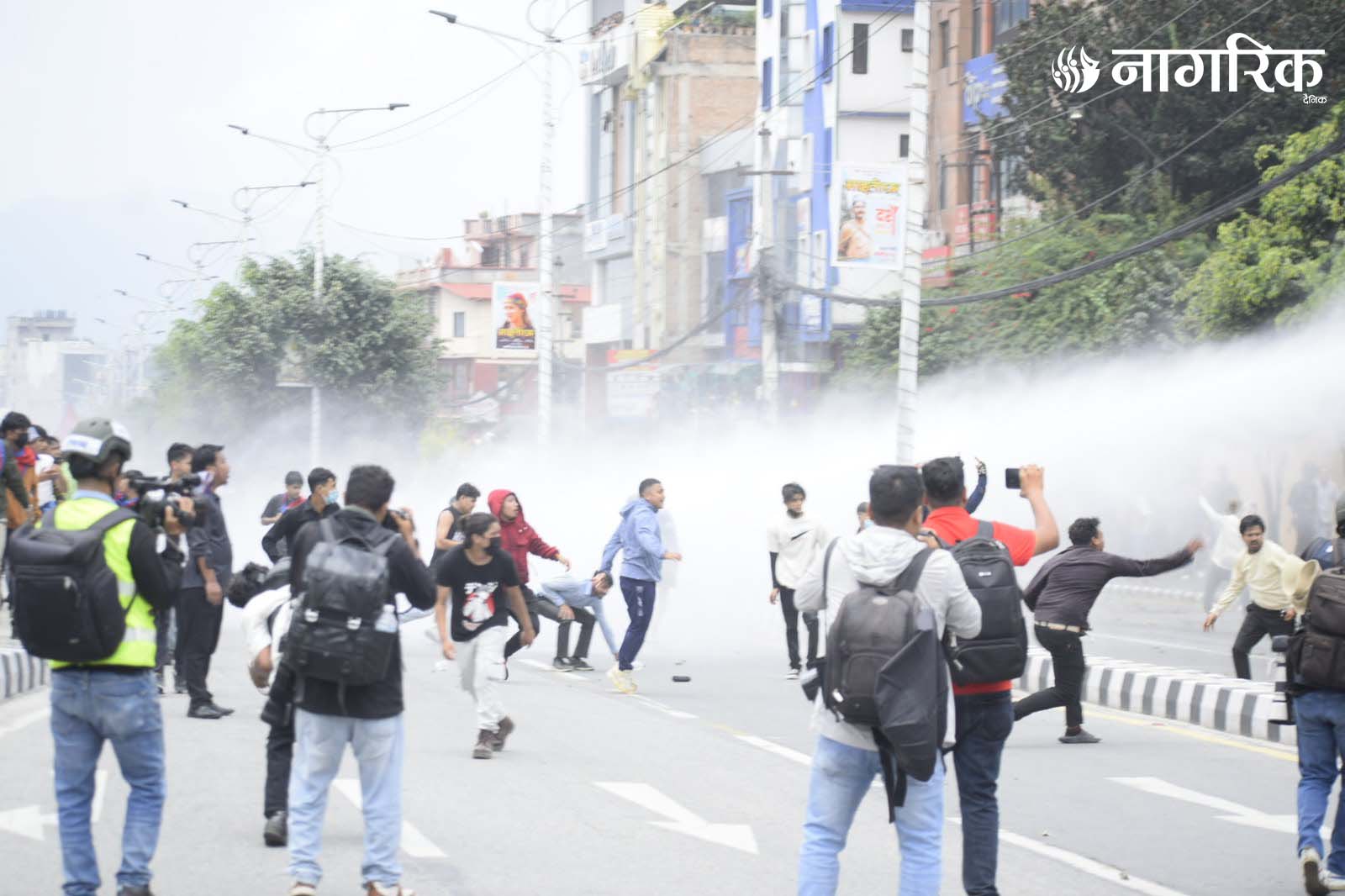
Photo: República
Content creator Bishal Gautam made a satirical video calling out ‘Nepo Baby’ privileges, which has already gathered over 400,000 views. Another user @am___bika expressed frustration commenting: “Corruption in Nepal is not just a political issue — it’s a deep-rooted crisis that affects every citizen, every community, and every dream for a better future. From the smallest public office to the highest levels of government, the misuse of power and public funds has become so common that many have stopped questioning it. That is the most dangerous part — when corruption becomes normalized, accepted, and even expected.”
The protest has been amplified by the viral “Holy Airball!” trend, which became a social media sensation among youth worldwide. The “Holy Airball” trend, popular among youth, uses a three-part format to show off personal or family achievements. The first slide shares a fact about themselves or their family, the second presents a common assumption, and the third humorously proves that assumption wrong with the phrase “holy airball.” Borrowing the basketball term for a complete miss, the trend became a way for young people to flex their success, wealth, or talents while playfully telling viewers not to underestimate them.
As the movement against the social media ban gained ground, the trend inadvertently became a platform for expressing frustration at government restrictions and corruption, turning it into a symbol of youth defiance. However, in the wake of the social media ban and growing public scrutiny, several of these flashy posts have reportedly been deleted by their original posters.
The shutdown of Facebook and YouTube has directly hit content creators and digital marketers. Despite promoting the idea of a “Digital Nepal,” the government shut down these platforms overnight without offering any alternatives for those whose income depends on them.
In response, youth have been voicing outrage at the government and political leaders. Many influencers, digital entrepreneurs and even some politicians have declared support for Gen Z’s protest campaign.
This is a developing story.
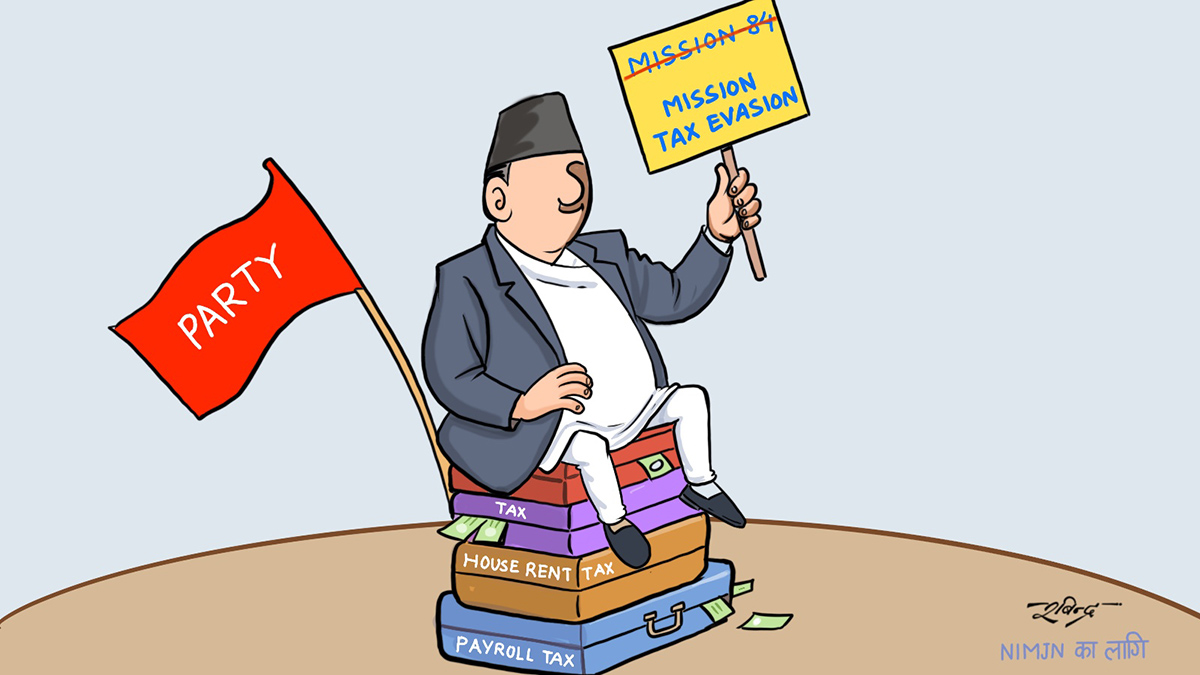
62 political parties in Nepal failed to pay a combined Rs 3.4 million in taxes. An expert audit — with a director from the Auditor General’s Office — found they skipped paying house rent tax, failed to deposit the 1% social security tax deducted from staff salaries, and dodged other advance taxes.
The quotes below are a collection of commitments from the election manifestos of major political parties in Nepal, which were made public in 2079 BS (2022 AD) before they went to voters’ doorsteps to ask for votes for the House of Representatives and Provincial Assembly elections:
“Good governance is our highest priority. The misuse of authority, the exploitation of national and government resources, and corruption will be met with a merciless, strict and zero-tolerance approach. Similarly, monitoring, investigation and scrutiny will be made more effective and any individual who engages in corruption, irregularities, misuse or misappropriation of government property will be brought to justice.”
— CPN (UML) Election Manifesto, 2079
“… Establishing economic good governance is our priority.”
— Nepali Congress Election Manifesto, 2079
“We will not engage in corruption and will not spare those who do.” “… Good governance is for the people.”
— Rastriya Swatantra Party Election Manifesto, 2079
“It is our firm commitment to develop a system of good governance with zero tolerance for corruption, complete transparency and effective service delivery at the doorsteps of the people in line with the principle of separation of powers and the spirit of federalism. This system will also ensure that all tasks, including development work, are completed quickly, efficiently and within a set timeframe. We will always remain steadfast in these commitments.”
— CPN (Unified Socialist) Election Manifesto, 2079
“A system of administration will be adopted that follows all principles of good governance, transparency, accountability and financial discipline, and provides services in a corruption-free and economical manner through digitized government offices.”
— CPN (Maoist Centre) Election Manifesto, 2079
Despite emphasizing good governance and transparency before seeking votes, the parties themselves have made a mockery of these principles. The very year they issued election manifestos promising to uphold good governance, transparency, accountability and financial discipline, that is, in the Fiscal Year 2079/080 (mid-July 2022 to mid-July 2023), they evaded taxes owed to the state.
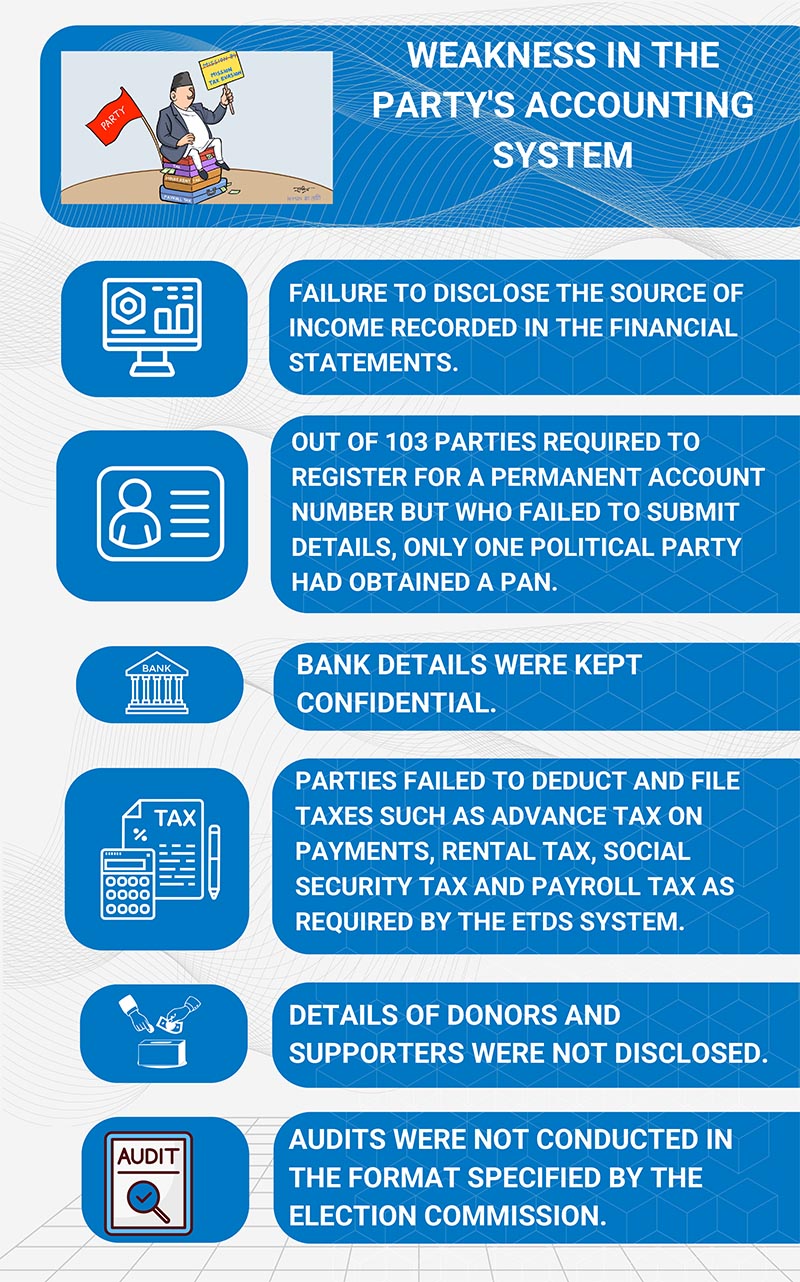
An audit conducted by the Election Commission, with the help of an expert team including a director from the Auditor General’s office, on the parties’ audit reports revealed that the parties had evaded taxes and that their accounting systems were found to be opaque. This raises questions about the parties’ commitment to transparency.
While the audit reports submitted by the parties to the Commission have been made public, the expert team’s audit report from the Auditor General’s office has not been. However, acting Chief Election Commissioner Ram Prasad Bhandari stated that the Commission has informed the concerned parties about the weaknesses pointed out by the expert team in that report.
The confidential report, which was not made public by the Commission, was analyzed by the Nepal Investigative Multimedia Journalism Network (NIMJN). The analysis found that in the fiscal year 2079/2080 (mid-July 2022 to mid-July 2023), 62 political parties failed to pay a total of 3,409,866 rupees in house rent tax, social security tax and other advance taxes. This total includes 3,066,704 rupees in house rent tax, 309,094 rupees in social security tax, and 34,068 rupees in advance tax and audit fees.
According to that report, political parties have committed irregularities, including maintaining disorganized and non-transparent accounting systems, failing to deposit taxes deducted from the salaries of their office staff to the tax office, and not paying house rent tax.
Major parties also among those not paying taxes
Of the 103 political parties that submitted financial reports to the Election Commission in the Fiscal Year 2079/080 (mid-July 2022 to mid-July 2023), 62 have not paid taxes. These include major parties that have received national party status, such as the Nepali Congress, CPN (UML), CPN (Maoist Centre), Rastriya Swatantra Party, Rastriya Prajatantra Party, Janata Samajwadi Party, and Janamat Party, all of whom were in government at the time. It was in this same year that the House of Representatives and Provincial Assembly elections took place and these parties were granted national party status.
When the audit reports submitted by the parties for the Fiscal Year 2079/080 (mid-July 2022 to mid-July 2023) were reviewed by the expert team from the Auditor General’s office, the CPN (UML), which currently leads the government, was found to have evaded the most taxes. According to the report, the UML has not paid 1.83 million rupees in house rent tax and 47,842 rupees in payroll tax, for a total of 1,877,872 rupees in unpaid taxes.
Schedule 13 of the UML’s 2079/080 (mid-July 2022 to mid-July 2023) audit report shows an expenditure of 18,383,520 rupees for building leasehold expenses.
After the 2072 (2015) earthquake, the CPN (UML) moved its office to the Pasang Lhamu Foundation building in Dhumbarahi. On April 14, 2021, it relocated to a private rented house in Thapathali. However, citing that building as too small, the UML office moved again on April 22, 2022, to the Tulsilal Memorial Foundation in Chyasal, Lalitpur, where it has remained since.
UML office secretary Bhishma Adhikari stated that the party does not have to pay rent, saying, “We don’t pay house rent, so how can we pay house rent tax?”
However, according to Baburam Thapa, the foundation’s treasurer, the UML gives the foundation a monthly ‘donation’ for using the building. “It is not given as rent, but as a donation of 400,000 rupees,” he said.
Bishnu Pokhrel, the office secretary of the foundation, also stated that the UML provides the agreed-upon amount to the foundation to cover expenses for building maintenance, research and other projects. The memorandum of understanding regarding the UML’s use of the foundation’s building for office purposes was signed on October 24, 2021, by then-UML General Secretary Ishwor Pokhrel and the foundation’s chairman, Gopal Shakya.
In that year, 2079/080 BS (mid-July 2022 to mid-July 2023), the UML spent 4.584 million rupees on employee salaries. Based on this expenditure, the expert team’s report noted that the party had not paid the required taxes and a clarification was written stating that the taxes should be recovered.
Bhishma Adhikari, the UML’s office secretary, claimed that the party has no outstanding tax liabilities. We had informed him that the Election Commission, using experts from the Auditor General’s office, had prepared a report that indicated there were outstanding taxes.
The next day, he contacted us and said, “The Auditor General’s office and the Election Commission should have asked us once before preparing the report. After you informed us, we made inquiries, and only then did we learn about the report with the details of the taxes we were supposed to pay.”
He claimed that the one percent tax deducted from employee salaries is submitted monthly.
The expert team also pointed out that the Rastriya Swatantra Party (RASWAPA), which has consistently advocated for good governance in the streets and parliament, has not paid 324,496 rupees in house rent tax and 75,519 rupees in payroll/social security tax, totaling 400,015 rupees.
RASWAPA, which was announced on June 21, 2022, moved its central office from Basundhara to Banasthali on June 22, 2023.
RASWAPA’s treasurer, Lima Adhikari, said that the outstanding house rent tax from 2079/080 (mid-July 2022 to mid-July 2023) was paid in the following year. “We have already paid the outstanding tax from the previous year at the ward office,” she said. “I cannot show you the exact amount we paid, however.”
According to sources from Kathmandu Metropolitan City Ward 16, RASWAPA has been paying 10% of its monthly rent, or 300,000 rupees, as house rent tax since last year (2080/81 BS) {mid-July 2023 to mid-July 2024}.
Clause 6 of Schedule 6 of the Kathmandu Metropolitan City Financial Act of 2078 states that a house rent tax of 10% of the annual rent amount is applicable.
Also, on the list of tax defaulters is the CPN (Unified Socialist), a party led by former Prime Minister Madhav Kumar Nepal and with another former Prime Minister, Jhalanath Khanal, as its esteemed leader. The report notes that it still owes 426,000 rupees in house rent tax and 20,635 rupees in payroll tax. Khem Paudel, a staff member of the party’s accounting department, said that the party had paid the outstanding house rent tax for 2079/80 BS (mid-July 2022 to mid-July 2023) on January 14, 2024.
“Whatever tax we owed, we have already paid it,” he said.
The audit report for the CPN (Unified Socialist) shows an expenditure of 4.26 million rupees for house rent in 2079/80 BS (mid-July 2022 to mid-July 2023). According to the city’s laws, the party should have paid 426,000 rupees in tax. However, according to the tax receipt obtained by NIMJN, the party only paid 360,000 rupees. Its central office is located in Ward 31 of Kathmandu Metropolitan City.
Nepali Congress failed to pay tax deducted from employee salaries for seven years
According to the report prepared by the expert team from the Auditor General’s office, the Nepali Congress did not pay 101,145 rupees in payroll/social security tax for the Fiscal Year 2079/080 BS (mid-July 2022 to mid-July 2023).
However, during our investigation, we found that the Nepali Congress had not paid the tax deducted from its office employees’ salaries for seven years. Robin Bajracharya, the accountant at the Nepali Congress party office, acknowledged this, stating, “There is a plan to pay the one percent tax from employees’ salaries for the last seven years within this year.”
The party’s audit report shows that the Nepali Congress spent 12,004,500 rupees on employee salaries, wages, and gratuities in the Fiscal Year 2079/080 BS (mid-July 2022 to mid-July 2023). Bajracharya said that even though they were ready to pay the tax last year, they were delayed because a system issue made it unclear how much tax each person owed.
He also mentioned that the Congress party had obtained a PAN from the tax office on June 7, 2023. Bajracharya stated that the party office is aware of the tax issue raised by the Auditor General’s office and has kept the amount it is supposed to pay as a liability.
Krishna Prasad Paudel, the chief secretary of the Nepali Congress central office, said that it is possible some taxes the party was supposed to pay were missed. “We haven’t received any such information from the Election Commission and it’s not like the party would skip paying taxes it owes,” he said. “We are ready to pay the outstanding taxes; the party has no intention of evading taxes.”
The report also mentions that the Janamat Party, which participated in the 2079 BS (2022 AD) elections for the first time and became a national party, has not paid 78,000 rupees in house rent tax. Janamat Party chairman C.K. Raut said that while the party was aware of the tax it owed, it was delayed due to technical reasons. “We had planned to pay it last year but there were some issues, which caused the delay,” he said.
The report also mentions that the Janata Samajwadi Party has not paid 1,275 rupees, while the Nagarik Unmukti Party has not paid 8,750 rupees in taxes, which includes 8,000 rupees in payroll tax and 750 rupees in TDS.
Newly appointed Chairman of the Nagarik Unmukti Party, Lalbir Chaudhary, said he was not aware of the taxes the party owed. “I’ve just taken on the responsibility, I’ll figure out where and how much we need to pay and then we will pay it,” he said. Chaudhary was made chairman of the Nagarik Unmukti Party on July 31, 2025, replacing Ranjita Shrestha.
The Rastriya Prajatantra Party (RPP) has not submitted 17,000 rupees in taxes, which is 1% of its employees’ salaries. RPP Senior Vice Chairman Dhurva Bahadur Pradhan claimed that no one receives a salary that requires paying payroll tax, so no tax was deducted. “People work as volunteers and only get pocket money,” he said. “Except for the security guards, no one receives a salary that requires them to pay taxes, which is why we have not paid them.”
The audit report for the fiscal year 2078/79 (mid-July 2021 to mid-July 2022), which the RPP submitted to the Election Commission, shows that the party spent 2.626 million rupees on employee salaries.
What does the law say?
Section 2 (d) (2) of the Income Tax Act, 2058 (2002), mentions that political parties registered with the Election Commission are considered tax-exempt organizations. This same section clarifies that such organizations will not be tax-exempt if they benefit any individual from their property or income, except when making payments for work done according to the organization’s goals or for assets or services provided to the organization by an individual.
Rule 23 of the Income Tax Regulations states that any individual required to deduct tax under Chapter 17 of the Act must apply for a Permanent Account Number (PAN) from the Inland Revenue Department before earning income or deducting tax. The expert team’s report points out that the parties did not comply with the Act and Regulations by failing to obtain a PAN and neglecting to use the eTDS system to deduct advance tax on payments, social security tax and payroll tax.
The secret report prepared by the expert team from the Auditor General’s office states, “Evidence of tax deduction on payments was not presented and in the financial statements of some parties, the amount of advance tax deduction was shown under outstanding liabilities but no evidence of its submission was provided.”
Why different laws for political parties and citizens?
Former Acting Auditor General, Sukdev Bhattarai Khatry, said that there should not be a system where ordinary citizens pay taxes while political parties are exempt.
“The same rules that apply to the people should also apply to the parties that lead the country,” he said. “Except for exemptions specified in the Financial Act and the Income Tax Act, taxes must be paid. Just because you make the laws in parliament doesn’t mean anything goes.”
Acting Chief Election Commissioner Ram Prasad Bhandari stated that the audit reports submitted by the parties were not in the format prescribed by the commission. “The parties have submitted their audit reports, but they were not found to be in the format we had specified,” he said. “We have already instructed them to make the necessary improvements and it is the parties’ responsibility to comply with those instructions.” He added that whether the parties have complied with the instructions will only be known from the audit reports they submit the following year.
Bhandari also said that, similar to previous years, they are preparing to have the audit reports submitted by the parties this year re-audited through the Auditor General’s office.
Section 40, Subsection 1 of the Political Parties Act, 2073 (2017), stipulates that parties must maintain accounts that accurately show their income and expenses. The Act also states that such accounts can be kept in electronic records. The law mandates that the accounts must be in the format specified by the Election Commission, and the commission must be informed about the officials responsible for the party’s accounts.
Similarly, there is a legal provision that allows the commission to demand or inspect the accounts maintained by a party through an officer or expert it designates. Based on the provision in Section 42 of the Act, which allows the commission to verify if a party’s submitted report is in the legally prescribed format, the commission has been conducting re-audits through the Auditor General’s office for the past two years. “The work the commission is doing to make party accounting systems transparent shows that improvements are being made,” said former Acting Auditor General Sukdev.
Eager to impose fines but weak on ensuring transparency
The Election Commission has a history of fining candidates from political parties who fail to submit their election expense reports on time. For instance, the commission published a list of candidates from local level elections who hadn’t submitted their expense reports and fined them. According to the list, the total fines amounted to more than 24 billion rupees.
The commission had issued a notice on September 22, 2022, to collect 24.638 billion rupees from 123,650 candidates for failing to submit their expense reports within 30 days of the election results being made public.
After the commission announced that candidates who didn’t pay the fine would be barred from participating in elections for six years, many paid up. However, following a writ petition filed by Kathmandu Metropolitan City Mayor Balen Shah, the Supreme Court issued an interim order to the commission on February 16, 2023, to not implement the decision to impose the fines.
On the same day, February 16, 2023, a cabinet meeting recommended to then-President Bidya Devi Bhandari to waive the fines imposed by the commission. Following that recommendation, the President waived the fines on February 17, 2023, under Article 276 of the Constitution.
On March 6, 2024, the Supreme Court also dismissed the writ petition filed by Balen Shah.
The commission has also fined candidates for the House of Representatives and Provincial Assembly elections 15,000 rupees each for not submitting their election expense reports, similar to the candidates in the local elections. The commission levied a total fine of 36,525,000 rupees on 2,435 candidates – 1,037 from the House of Representatives and 1,398 from the Provincial Assembly – at a rate of 15,000 rupees per person. The 61st annual report of the Auditor General has recommended that this outstanding amount be collected.
The confidential report notes that the commission has not been as proactive in getting the political parties to pay their taxes as it was in getting the candidates to pay their fines.
Although the Auditor General’s office provided a list of parties that had not paid taxes and the amounts owed, the commission has only informed the parties about the matter.
According to the acting Chief Election Commissioner, the commission has not yet pressured the parties to pay their taxes.
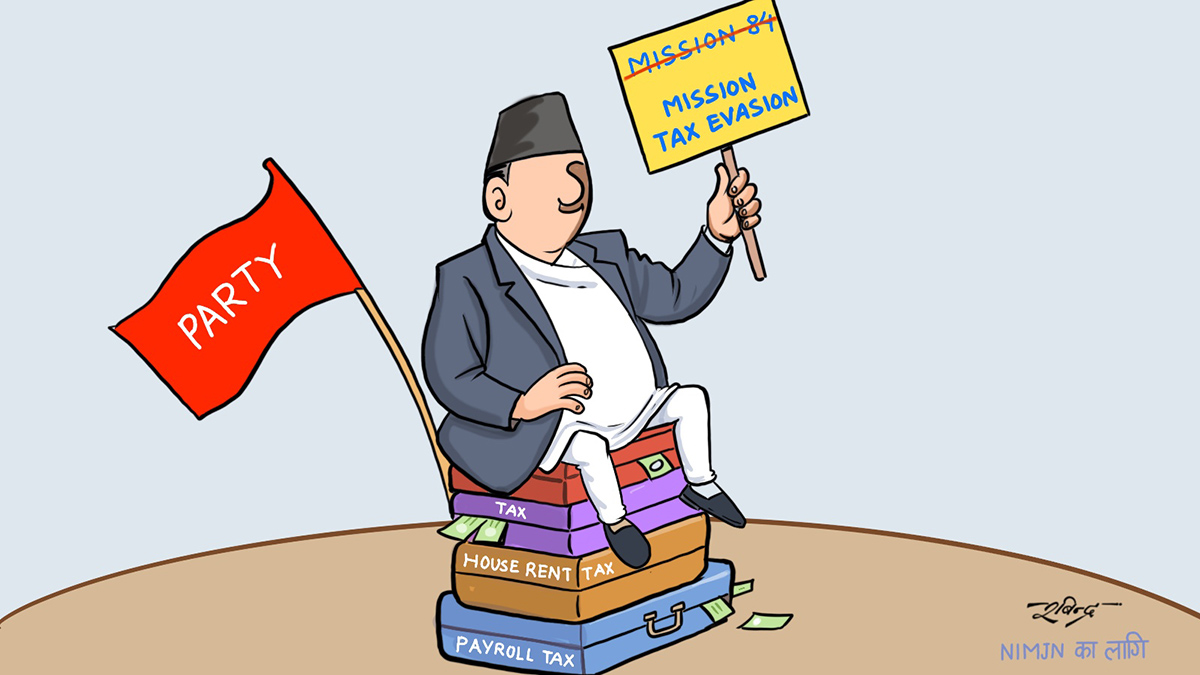
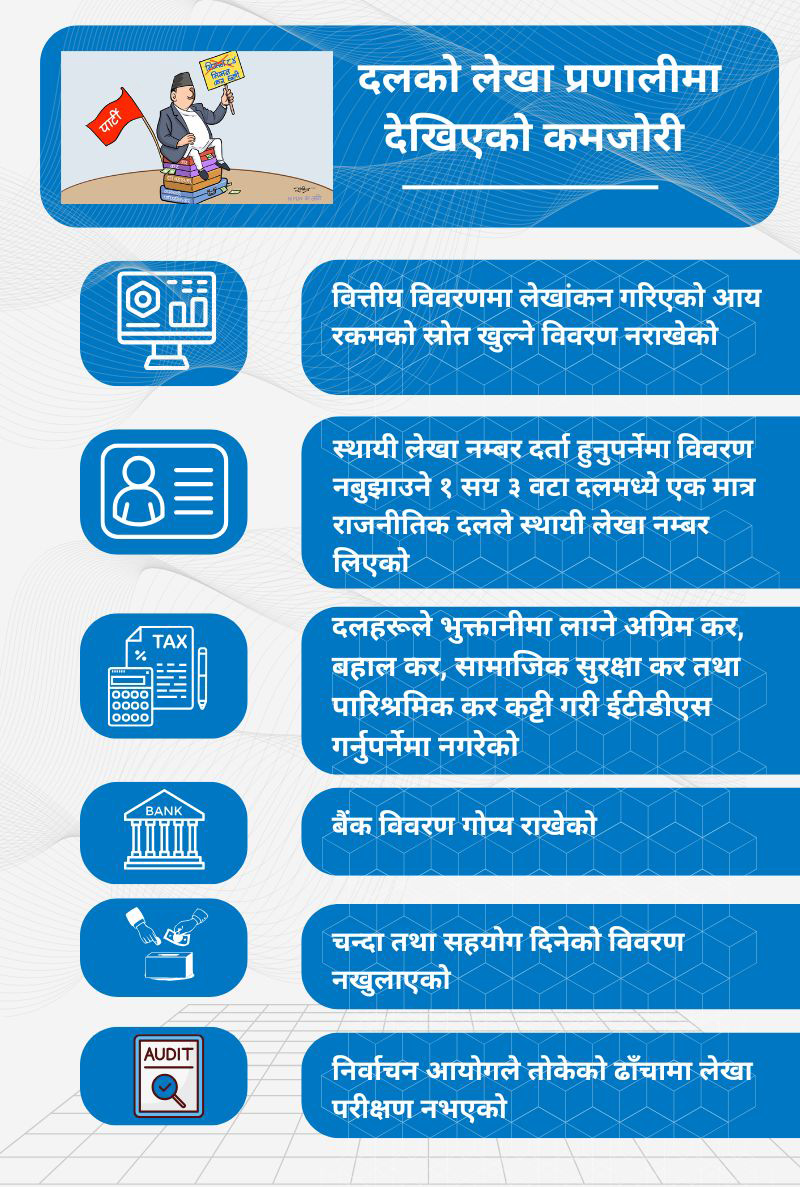
राष्ट्रिय दलको मान्यता प्राप्तसहित ६२ वटा राजनीतिक दलले राज्यलाई बुझाउनु पर्ने कर छली गरेको पाइएको छ । उनीहरूले घर बहाल कर, कर्मचारीको पारिश्रमिकबाट कट्टा गरिएको १ प्रतिशत सामाजिक सुरक्षा कर र अन्य अग्रिम कर छलेको भेटिएको छ ।
“सुशासन हाम्रो उच्च प्राथमिकता । अख्तियारको दुरुपयोग, राष्ट्रिय तथा सरकारी स्रोतको दोहन र भ्रष्टाचारप्रति निर्मम, कठोर र शून्य सहनशीलता अपनाइनेछ । यस्तै अनुगमन, अनुसन्धान र छानबिन कार्यलाई सशक्त बनाइने, भ्रष्टाचार, अनियमितता, सरकारी सम्पत्तिको दुरुपयोग र अपचलन गर्ने जुनसुकै व्यक्तिलाई कानुनी कारबाहीको दायरामा ल्याइनेछ ।”
– नेकपा एमालेको घोषणा पत्र, २०७९
“… आर्थिक सुशासन कायम गर्नु हाम्रो प्राथमिकता हुन् ।”
– नेपाली कांग्रेसको घोषणापत्र, २०७९
“भ्रष्टाचार गरिन्न र गर्नेलाई छाडिन्न ।” “ …सुशासन जनताको लागि ।”
– राष्ट्रिय स्वतन्त्र पार्टीको घोषणापत्र, २०७९
“भ्रष्टाचारमा शून्य सहनशीलतासहितको सुशासन, पूर्ण पारदर्शिता, शक्ति पृथकीकरणको सिद्धान्तअनुरूप राज्यका सबै अंगहरूको कार्य सम्पादन र संघीयताको मर्मअनुरूप जनताको घरदैलोमै प्रभावकारी सेवा प्रदान गर्ने तथा छिटो, छरितो र समय सीमाभित्र विकास निर्माणलगायत सबै काम सम्पन्न गर्ने प्रणालीको विकास गर्ने हाम्रो दृढ प्रतिज्ञा छ । हामी यी प्रतिज्ञामा सधैँ अडिग रहनेछौँ ।”
– नेकपा एकीकृत समाजवादीको घोषणापत्र, २०७९
“सुशासन, पारदर्शिता, जवाफदेहिता र वित्तीय अनुशासनका सम्पूर्ण सिद्धान्त अनुसरण गरी डिजिटाइज्ड सरकारी कार्यालयमार्फत भ्रष्टाचारमुक्त र मितव्ययी रूपमा सेवा प्रवाह हुने प्रशासन प्रणाली अवलम्बन गरिनेछ ।”
– माओवादी केन्द्रको घोषणपत्र, २०७९
प्रमुख राजनीतिक दलहरूले प्रतिनिधिसभा र प्रदेशसभाको निर्वाचनको बेला भोट माग्न मतदाताको घरदैलोमा जानुअघि २०७९ सालमा सार्वजनिक गरेका चुनावी घोषणापत्रका प्रतिबद्धताहरू हुन् यी ।
भोट माग्न जानुअघि सुशासन र पारदर्शितामा जोड दिने दलहरू आफैंले भने त्यसको धज्जी उडाएका छन् । दलहरूले सुशासन, पारदर्शिता, जवाफदेहिता र वित्तीय अनुशासन पालना गर्ने आश्वासनसहित चुनावी घोषणा पत्र जारी गरेकै वर्ष अर्थात् आर्थिक वर्ष २०७९/०८० मा राज्यलाई तिर्नुपर्ने कर छली गरेका छन् ।
दलहरूको लेखा परीक्षण प्रतिवेदनलाई निर्वाचन आयोगले महालेखा परीक्षकको कार्यालयका निर्देशकसहित अरू लेखा परीक्षकबाट परीक्षण गराउँदा दलहरूले कर छली गरेको र दलका लेखा प्रणाली अपारदर्शी पाइएको छ । यसले दलहरुको पारदर्शिताप्रतिको प्रतिबद्धतामाथि नै प्रश्न उठेको छ ।
दलहरूले आयोगमा बुझाएका लेखा परीक्षण प्रतिवेदन सार्वजनिक भए पनि त्यसकै आधारमा महालेखाको विज्ञ टिमबाट गराएको लेखा परीक्षण प्रतिवेदन भने आयोगले सार्वजनिक गरेको छैन ।
तर, प्रतिवेदनमाथि महालेखाको विज्ञ टिमले औंल्याएका कमजोरीका बारेमा सम्बन्धित दलहरूलाई जानकारी गराएको आयोगका कार्यवाहक प्रमुख निर्वाचन आयुक्त रामप्रसाद भण्डारीले जानकारी दिए ।
आयोगले सार्वजनिक नगरेको त्यो गोप्य प्रतिवेदन नेपाल इन्भिेस्टिगेटिभ मल्टिमिडिया जर्नालिज्म नेटवर्क (निमजिन) ले फेला पारेर विश्लेषण गर्दा आर्थिक वर्ष २०७९/२०८० मा ६२ राजनीतिक दलले घर बहाल कर, सामाजिक सुरक्षा कर र अन्य अग्रिम कर गरी ३४ लाख ९ हजार ८ सय ६६ रुपैयाँ नतिरेको पाइएको छ । जसमा घर बहाल करबापत ३० लाख ६६ हजार ७ सय ४ रुपैयाँ, सामाजिक सुरक्षा करबापत् ३ लाख ९ हजार ९४ रुपैयाँ, अग्रिम कर र अडिट शुल्क ३४ हजार ६८ रुपैयाँ छ ।
त्यो प्रतिवेदनअनुसार दलहरूको लेखा प्रणाली अव्यवस्थित र अपादर्शी रहेको, दलका कार्यालयमा कार्यरत कर्मचारीको पारिश्रमिकबाट कर कट्टा गरेको तर त्यो रकम कर कार्यालयमा जम्मा नगरेको, घरबहाल कर नतिरेकोसहितका अनियमितता राजनीतिक दलबाट भएका छन् ।
कर नतिर्नेमा ठूला दल पनि
निर्वाचन आयोगमा आर्थिक वर्ष २०७९/०८० मा १ सय ३ वटा रजानीतिक दलले वित्तीय विवरण बुझाएका थिए । तीमध्ये कर नतिर्ने ६२ दल छन् । जसमा सरकारमा रहेको नेपाली कांग्रेस, नेकपा एमालेसहित राष्ट्रिय दलको मान्यता पाएका राष्ट्रिय स्वतन्त्र पार्टी, राष्ट्रिय प्रजातन्त्र पार्टी, जनता समाजवादी पार्टी र जनमत पार्टी पनि छन् । त्यही वर्ष प्रतिनिधिसभा र प्रदेशसभा चुनाव भएको थियो र यी दललले राष्ट्रिय दलको मान्यता पाएका थिए ।
आर्थिक वर्ष २०७९/०८० मा दलहरूले आयोगमा बुझाएको लेखा परीक्षण प्रतिवेदनलाई महालेखाको विज्ञ टोलीले परीक्षण गर्दा सबैभन्दा बढी कर छली गर्नेमा अहिले सरकारको नेतृत्व गर्ने नेकपा एमालेलाई देखाइएको छ । प्रतिवेदनले औंल्याएअनुसार एमालेले घर बाहल कर मात्रै १८ लाख ३० हजार, पारिश्रमिक कर ४७ हजार ८ सय ४२ गरी १८ लाख ७७ हजार ८ सय ४२ रुपैयाँ कर बुझाएको छैन ।
एमालेको २०७९/०८० को लेखा परीक्षण प्रतिवेदनको अनुसूची १३ मा भवन लिजहोल्ड खर्चबापत १ करोड ८३ लाख ८३ हजार ५ सय २० रुपैयाँ खर्च लेखेको छ ।
२०७२ सालको भूकम्पपछि धुम्बाराहीस्थित पासाङ ल्हामु प्रतिष्ठानको भवनमा सरेको नेकपा एमाले वैशाख १, २०७८ मा थापाथलीमा रहेको एउटा निजी घरमा भाडामा सरेको थियो । तर त्यो घर साँघुरो भएको भन्दै एक वर्षपछि वैशाख ९, २०७९ मा एमालेको कार्यालय ललितपुरको च्याँसलस्थित तुल्सीलाल स्मृति प्रतिष्ठानमा सरेको छ । त्यसयता एमालेको कार्यालय प्रतिष्ठानमै छ ।
एमालेका कार्यालय सचिव भीष्म अधिकारीले भने पार्टीले घरभाडा नै तिर्न नपरेको बताए । उनले भने, “हामीले घरभाडा नै तिरेको छैन, बहाल कर कसरी तिर्नु ?” उनले भने ।
तर, प्रतिष्ठानका कोषाध्यक्ष बाबुराम थापाका अनुसार भवन प्रयोग गर्न दिएबापत् एमालेले प्रतिष्ठानलाई मासिक ‘सहयोग’ दिने गरेको छ । “भाडा भनेर दिएको छैन, सहयोगस्वरूप भनेर ४ लाख तिर्छ,” उनले भने ।
प्रतिष्ठानको भवन मर्मतसम्भार, अध्ययन अनुसन्धानलगायतका शीर्षकमा खर्च गर्ने गरी एमालेले सम्झौताअनुसारको रकम दिने गरेको प्रतिष्ठानका कार्यालय सचिव विष्णु पोखरेलले पनि बताए । प्रतिष्ठानको भवन एमालेले कार्यालय प्रयोजनका लागि प्रयोग गर्नेबारेको समझदारी पत्रमा एमालेका तत्कालीन महासचिव ईश्वर पोखरेल र प्रतिष्ठानका अध्यक्ष गोपाल शाक्यले कात्तिक ७, २०७८ मा हस्ताक्षर गरेका थिए ।
त्यो वर्ष अर्थात् २०७९/०८० कर्मचारीको पारिश्रमिकमा ४५ लाख ८४ हजार रुपैयाँ खर्च गरेको छ । यही खर्चका आधारमा सरकारलाई तिर्नुपर्ने कर नतिरेको भन्दै विज्ञ टोलीको प्रतिवेदनमा कर असुल गर्नुपर्ने कैफियत लेखेको हो ।
एमालेका कार्यालय सचिव भीष्म अधिकारीले पार्टीले तिर्नुपर्ने कुनै कर बाँकी नरहेको दाबी गरे । हामीले उनलाई निर्वाचन आयोगले महालेखाका विज्ञ प्रयोग गरेर प्रतिवेदन तयार गरेको र त्यसमा कर तिर्न बाँकी रहेको रहेछ नि भनेर जानकारी गराएका थियौँ ।
त्यसको भोलिल्ट उनले नै सम्पर्क गरेर हामीलाई भने, “महालेखा र निर्वाचन आयोगले रिपोर्ट तयार गर्नुअघि एक पटक सोधेको भए हुन्थ्यो, तपाईंहरूले जानकारी गराएपछि हामीले सोधखोज गर्यौं, त्यसपछि मात्रै हामीले कर तिर्नुपर्ने विवरणसहितको प्रतिवेदनको बारेमा बल्ल थाहा पायौं ।”
कर्मचारीको पारिश्रमिकमा कट्टा गरिएको एक प्रतिशत कर मासिक बुझाउने गरेको उनले दाबी गरे ।
सुशासनको पक्षमा सडक र सदनमा आवाज उठाउँदै आएको रास्वपाले पनि बहाल करबापत् ३ लाख २४ हजार ४ सय ९६ रुपैयाँ, पारिश्रमिक/सामाजिक सुरक्षा करबापत् ७५ हजार ५ सय १९ रुपैयाँ गरी ४ लाख १५ रुपैयाँ कर नबुझाएको विज्ञ टोलीले औंल्याएको छ ।
७ असार, २०७९ मा घोषणा भएको रास्वपाको केन्द्रीय कार्यालय वसुन्धराबाट ७ असार, २०८० मा वनस्थलीमा सरेको थियो ।
रास्वपाकी कोषाध्यक्ष लिमा अधिकारीले भने २०७९/०८० मा तिर्न बाँकी घरबहाल कर पछिल्लो वर्षमा तिरेको बताइन् । “अघिल्लो वर्ष तिर्न बाँकी कर हामीले वडा कार्यालयमा तिरिसक्यौं,” उनले भनिन, “कति तिर्यौं भन्नेचाहिँ तपाईंलाई देखाउन मिल्दैन ।”
काठमाडौं महानगरपालिका १६ नम्बर वडा कार्यालय स्रोतका अनुसार रास्वपाले गतवर्ष (२०८०/०८१) देखि मासिक ३ लाख रुपैयाँको १० प्रतिशत घरबहाल कर तिर्ने गरेको छ ।
काठमाडौं महानगरपालिकाको आर्थिक ऐन २०७८ को अनुसूची ६ को बुँदा नम्बर ६ मा बहाल रकमको वार्षिक १० प्रतिशतका दरले बहाल कर लाग्ने उल्लेख छ ।
कर नतिर्नेमा पूर्वप्रधानमन्त्री माधवकुमार नेपाल र अर्का पूर्वप्रधानमन्त्री झलनाथ खनालको दल नेकपा एकीकृत समाजवादी पनि छ । उसले घरबाहल कर मात्रै ४ लाख २६ हजार र पारिश्रमिक कर २० हजार ६ सय ३५ रुपैयाँ तिर्न बाँकी रहेको प्रतिवेदनमा उल्लेख छ । पार्टीका लेखा शाखाका कर्मचारी खेम पौडेलले २०७९/०८० मा पार्टीले तिर्नुपर्ने घरबाहल कर पुस २९, २०८० मा तिरिसकेको बताए । “हामीले जेजति तिर्नुपर्ने कर हो, त्यो तिरिसकेका छौं,” उनले भने ।
एकीकृत समाजवादीले २०७९/०८० मा ४२ लाख ६० हजार रुपैयाँ घरभाडाबापत् तिरेको लेखा परीक्षण प्रतिवेदनमा खर्च लेखेको छ ।
महानगरको कानुनअनुसार समाजवादीले ४ लाख २६ हजार कर तिर्नुपर्ने हो । तर, निमजिनले प्राप्त गरेको कर तिरेको रसिदअनुसार उसले ३ लाख ६० हजार मात्रै कर तिरेको छ । काठमाडौं महानगरको ३१ नम्बर वडामा उसको केन्द्रीय कार्यालय छ ।
कांग्रेसले कर्मचारीको तलबमा कट्टा गरेको कर ७ वर्षसम्म तिरेन
महालेखाका विज्ञ टोलीले तयार पारेको प्रतिवेदनअनुसार नेपाली कांग्रेसले आर्थिक वर्ष २०७९/०८० मा कर्मचारीको पारिश्रमिक/सामाजिक सुरक्षा करबापत्को १ लाख १ हजार १ सय ४५ रुपैयाँ बुझाएको छैन ।
तर हामीले खोजी गर्ने क्रममा कांग्रेसले कार्यालयका कर्मचारीको तलबबाट कट्टा गरेको कर ७ वर्षदेखि नतिरेको पायौं । कांग्रेस पार्टी कार्यालयका लेखापाल रविन बज्राचार्यले यसलाई स्वीकार गर्दै भने, “पछिल्लो सात वर्षदेखिका कर्मचारीको पारिश्रमिकको एक प्रतिशत कर यो वर्षभित्र तिर्ने योजना रहेको छ ।”
नेपाली कांग्रेसले आर्थिक वर्ष २०७९/०८० मा कर्मचारीको तलब, ज्याला र उपदानमा १ करोड २० लाख ४ हजार ५ सय रुपैयाँ खर्च गरेको उसको लेखा परीक्षण प्रतिवेदनमा उल्लेख छ ।
गतवर्ष नै तिर्ने तयारी गरेको भए पनि सिस्टममा समस्या भएपछि कसको कति कर तिर्ने भन्ने यकिन नभएकाले ढिला भएको उनले बताए ।
कांग्रेसले जेठ २४, २०८० मा कर कार्यालयबाट प्यान नम्बरसमेत लिइसकेको उनले बताए । लेखापाल रविनले महालेखाले करका बारेमा औंल्याएको विषयमा पार्टी कार्यालय जानकार रहेको र उसले तिर्नुपर्ने भनेको रकम दायित्वमा नै राखेको बताए ।
कांग्रेस केन्द्रीय कार्यालयका मुख्य सचिव कृष्णप्रसाद पौडेलले पार्टीले तिर्नुपर्ने कुनै कर छुट भएको हुन सक्ने बताए । “निर्वाचन आयोगबाट कुनै त्यस्तो जानकारी त आएको छैन, पार्टीले तिर्नुपर्ने कर छुट लिने भन्ने पनि हुँदैन,” उनले भने, “तिर्न बाँकी देखाएको कर तिर्न तयार छौं, कर छली गर्ने पार्टीको नियत छैन ।”
२०७९ सालको चुनावमा पहिलोपल्ट भाग लिएर राष्ट्रिय पार्टी बनेको जनमत पार्टीले पनि बहाल करबापत्को ७८ हजार नतिरेको प्रतिवेदनमा उल्लेख छ । जनमत पार्टीका अध्यक्ष सीके राउतले पार्टीले तिर्नुपर्ने करको बारेमा जानकारी भए पनि प्राविधिक कारणले ढिलाइ भएको बताए । “पोहोर नै तिर्ने भनेका थियौं, केही समस्या भएकाले ढिलाइ भएको हो,” उनले भने ।
यस्तै, जनता समाजवादी पार्टीले १ हजार २ सय ७५ तिरेको छैन भने नागरिक उन्मुक्ति पार्टीले पारिश्रमिक कर ८ हजार र टीडीएसबापत्को ७ सय ५० समेत गरी ८ हजार ७ सय ५० रुपैयाँ कर नतिरेको प्रतिवेदनमा उल्लेख छ ।
नागरिक उन्मुक्ति पार्टीका नवनियुक्त अध्यक्ष लालवीर चौधरीले पार्टीले तिर्नुपर्ने करका बारेमा जानकारी नभएको बताए । उनले भने, “भर्खर जिम्मेवारी सम्हालेको छु, कहाँ कति तिर्नुपर्नेछ, बुझेर तिर्छौं ।”
रञ्जिता श्रेष्ठलाई हटाएर नागरिक उन्मुक्तिले साउन १५, २०८२ मा लालवीरलाई अध्यक्ष बनाएको थियो ।
राष्ट्रिय प्रजातन्त्र पार्टीले कर्मचारीको पारिश्रमिकको १ प्रतिशतले हुन आउने १७ हजार रुपैयाँ कर बुझाएको छैन । राष्ट्रिय प्रजातन्त्र पार्टीका वरिष्ठ नेता उपाध्यक्ष धुव्रबहादुर प्रधानले पारिश्रमिक कर तिर्ने गरी कसैले पनि तलब नखाने भएकाले कट्टा नगरेको दाबी गरे । “स्वयंसेवकको रूपमा काम गरिरहेका हुन्छन्, पकेटमनी मात्रै पाउँछन्,” उनले भने, “सुरक्षागार्डले बाहेक कर तिर्ने गरी कसैले पनि तलब पाउँदैनन्, त्यसैले कर नबुझाएका हौं ।”
निर्वाचन आयोगमा राप्रपाले बुझाएको २०७८/०७९ को लेखा परीक्षण प्रतिवेदनमा कर्मचारीको तलबमा २६ लाख २६ हजार खर्च लेखेको छ ।
कानुनमा के छ ?
आयकर ऐन २०५८ को दफा २ को (ध) (२) मा निर्वाचन आयोगमा दर्ता भएका राजनीतिक दललाई कर छुट पाउने संस्थाको रूपमा उल्लेख गरिएको छ । यही दफामा छुट पाउने संस्थाको उद्देश्यअनुसार कार्य सम्पन्न हुँदा वा कुनै व्यक्तिद्वारा त्यस्तो संस्थालाई प्रदान गरिएका सम्पत्ति वा सेवाबापत्को कुनै भुक्तानी गर्दाबाहेक त्यस्तो संस्थाको सम्पत्ति र त्यस्तो संस्थाले प्राप्त गरेको रकमबाट कुनै व्यक्तिलाई फाइदा पुर्याएको भए त्यस्तो संस्थालाई कर छुट नहुने स्पष्ट छ ।
आयकर नियमावलीको नियम २३ मा ऐनको परिच्छेद १७ अन्तर्गत करकट्टी गर्नुपर्ने जुनसुकै व्यक्तिले त्यस्तो आय आर्जन वा करकट्टीअगावै स्थायी लेखा नम्बरका लागि आन्तरिक राजस्व विभागमा आवेदन दिनुपर्ने उल्लेख छ । दलहरूले ऐन र नियमावलीअनुसार स्थायी लेखा नम्बर लिई भुक्तानीमा लाग्ने अग्रिम कर, सामाजिक सुरक्षा कर तथा पारिश्रमिक करकट्टी गरी ईटीडीएस नगरेको विज्ञ टोलीको प्रतिवेदनले औंल्याएको छ ।
“भुक्तानी लाग्ने करकट्टी गरेको प्रमाण पेस नगरेको र कतिपय दलको वित्तीय विवरणमा अग्रिम करकट्टीको रकम भुक्तानी गर्न बाँकी दायित्वअन्तर्गत देखाइएकोमा सो दाखिला गरेको प्रमाण पेस गरेको देखिएन,” महालेखाको विज्ञ टोलीले तयार पारेको गोप्य प्रतिवेदनमा भनिएको छ ।
दल र नागरिकलाई फरक कानुन किन ?
महालेखा परीक्षकको कार्यालयका पूर्वकार्यवाहक महालेखा परीक्षक सुकदेव भट्टराई खत्रीले सर्वसाधारणले कर तिर्ने र दललाई छुट दिने व्यवस्था गर्न नहुने बताए ।
“जनतालाई जे व्यवस्था हुन्छ, देशको नेतृत्व गर्ने दलहरूलाई पनि त्यही लागू हुनुपर्छ,” उनी भन्छन्, “आर्थिक ऐन र आयकर ऐनले नै छुट दिने भनेको बाहेकमा कर तिर्नैै पर्नेहुन्छ, संसद्मा कानुन बनाउने भएपछि जे पनि हुन्छ भन्ने हुँदैन ।”
कार्यवाहक प्रमुख निर्वाचन आयुक्त रामप्रसाद भण्डारीले दलहरूले बुझाएको लेखा परीक्षण प्रतिवेदन आयोगले तोकेको ढाँचामा नपाइएको बताए । “दलहरूले लेखा परीक्षण प्रतिवेदन त बुझाएका छन्, तर हामीले जुन ढाँचामा हुनुपर्छ भनेका छौं, त्यसअनुसार पाइएन,” उनले भने, “कमजोरी देखिए जतिको सुधार गर्न निर्देशन दिइसकेका छौं, निर्देशनको पालना गर्नु दलको दायित्व हुन्छ ।”
दललाई दिएको निर्देशन पालना भए/नभएको पछिल्लो वर्ष बुझाएको लेखा परीक्षण प्रतिवेदनबाट मात्रै थाहा हुने उनले बताए ।
विगतको जस्तै यस वर्ष पनि दलहरूले बुझाएको लेखा परीक्षण प्रतिवेदनलाई महालेखामार्फत पुनःपरीक्षण गराउने तयारी रहेको उनले बताए ।
राजनीतिक दलसम्बन्धी ऐन २०७३ को दफा ४० को उपदफा १ मा दलले आफ्नो आय र व्ययको वास्तविक हिसाब देखिने गरी लेखा राख्नुपर्ने व्यवस्था छ । त्यस्तो लेखा विद्युतीय अभिलेखमा पनि राख्न सकिने ऐनमा उल्लेख छ । लेखाको अभिलेख निर्वाचन आयोगले तोकेको ढाँचामा हुनुपर्ने, दलको हिसाब हेर्ने पदाधिकारीका बारेमा आयोगलाई जानकारी दिनुपर्ने ऐनमै उल्लेख छ ।
यसैगरी, दलले राखेको हिसाब आयोगले तोकेको अधिकृत वा विशेषज्ञमार्फत माग गर्न वा निरीक्षण गराउन सक्ने कानुनी प्रावधान छ । ऐनअनुसार दलहरूले आर्थिक वर्ष सकिएको ६ महिनाभित्र आफ्नो आय र व्ययको लेखा परीक्षण गराई एक महिनाभित्र आयोगमा पेस गर्नुपर्ने हुन्छ ।
ऐनको दफा ४२ मा दलले बुझाएको प्रतिवेदन कानुनले तोकेको ढाँचामा भए/नभएको जाँच गराउन सकिने व्यवस्थालाई टेकेर आयोगले महालेखामार्फत पछिल्लो दुई वर्षयता परीक्षण गराउँदै आएको हो । “दलको लेखा प्रणाली पारदर्शी बनाउन आयोगले जुन काम गरिरहेको छ, यसले सुधार हुँदै गएको पनि देखिन्छ,” पूर्वकार्यवाहक महालेखा परीक्षक सुकदेवले भने ।
जरिवाना तोक्न आतुर, पारदर्शिता कायम गराउन फितलो
निर्वाचन आयोगले तोकेको समयमा निर्वाचन खर्च विवरण नबुझाउने दलका उम्मेदवारलाई जरिवाना गर्दै आएको छ । स्थानीय तह निर्वाचनको खर्च विवरण नबुझाउने उम्मेदवारहरूलाई जरिवाना तोक्दै आयोगले सूची नै सार्वजनिक गरेको थियो । आयोगले सार्वजनिक गरेको सूचीअनुसार २४ अर्ब रुपैयाँभन्दा धेरै जरिवाना तोकिएको थियो ।
निर्वाचन परिणाम सार्वजनिक भएको मितिले ३० दिनभित्र खर्च विवरण नबुझाएको भन्दै १ लाख २३ हजार ६ सय ५० जना उम्मेदवारबाट आयोगले २४ अर्ब ६३ करोड ८८ लाख रुपैयाँ असुल्न असोज ६, २०७९ मा सूचना निकालेको थियो ।
जरिवाना नतिर्ने उम्मेदवारले ६ वर्षसम्म निर्वाचनमा भाग लिन नपाउने भनेपछि धेरैले जरिवाना बुझाएका पनि थए । तर काठमाडौं महानगरपालिकाका मेयर बालेन्द्र शाहले दायर गरेको रिटमा सुनुवाइ गर्दै ४ फागुन, २०७९ मा सर्वोच्च अदालतले जरिवाना तिराउने निर्णय कार्यान्वयन नगर्न आयोगलाई अन्तरिम आदेश दिएको थियो ।
४ फागुन, २०७९ मै बसेको मन्त्रिपरिषद् बैठकले आयोगले तोकेको जरिवाना रकम मिनाहा गर्न तत्कालीन राष्ट्रपति विद्यादेवी भण्डारीसमक्ष सिफारिस गरेको थियो । त्यो सिफारिसअनुसार राष्ट्रपतिले ५ फागुन, २०७९ मा संविधानको धारा २७६ अनुसार जरिवाना मिनाहा गरेकी थिइन् ।
सर्वोच्च अदालतले फागुन २३, २०८० मा बालेन्द्र शाहले दायर गरेको रिट पनि खारेज गरिदिएको छ ।
आयोगले स्थानीय तहका उम्मेदवारलाई जस्तै निर्वाचन खर्च विवरण पेस नगरेको भन्दै प्रतिनिधिसभा र प्रदेशसभाका उम्मेदवारलाई पनि १५ हजार रुपैयाँ जरिवाना तोकेको छ । आयोगले प्रतिनिधिसभातर्फ १ हजार ३७ र प्रदेशसभातर्फ १ हजार ३ सय ९८ समेत गरी २ हजार ४ सय ३५ उम्मेदवारलाई जनही १५ हजारका दरले कुल ३ करोड ६५ लाख २५ हजार जरिवाना तोकेकोमा त्यो रकम उठ्न बाँकी रहेकाले उठाउन महालेखा परीक्षकको ६१ औं वार्षिक प्रतिवेदनमा सुझाव दिइएको छ ।
आयोगले उम्मेदवारलाई जरिवाना तिराउन जसरी ताकेता गरेको थियो, त्यसैगरी दलहरूबाट कर तिराउन भने ताकेता नगरेको गोप्य प्रतिवेदनमा उल्लेख छ ।
विज्ञ टोलीले कर नतिर्ने दलबाट असुल गर्नुपर्ने कर रकमसहितको सूची उपलब्ध गराए पनि आयोगले यसबारे दललाई जानकारी मात्रै गराएको छ । आयोगका कार्यवहाक प्रमुख निर्वाचन आयुक्तको भनाइअनुसार कर तिराउन आयोगले ताकेता भने गरेको छैन ।
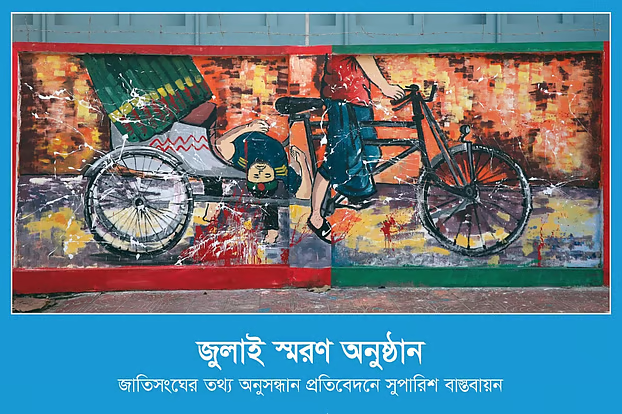
The interim government’s Chief Adviser Professor Muhammad Yunus has reaffirmed his commitment to ensuring justice for human rights violators.
Emphasising the need for reforms, he stated, “This is not just cosmetic change, rather this is a transformation at the deepest level. If we do not bring about such profound reforms, the very autocracy we are speaking against today will return, no matter how much we try to contain it or reform it. We need deeper reform. It is absolutely essential.”
He made these remarks on Tuesday, while addressing a July Commemoration organised by the United Nations’ Dhaka office at a hotel in the capital. The event focused on the July mass uprising and the UN’s investigative report.
Other speakers at the event included Bangladesh Nationalist Party (BNP) Secretary General Mirza Fakhrul Islam Alamgir, Bangladesh Jamaat-e-Islami Ameer Shafiqur Rahman, National Citizen Party (NCP) Secretary General Akhter Hossen, Golam Rahman—father of July uprising martyr Nafis—and Sabrina Afroz Srabonti, sister of martyred activist Saikat.
A recorded message was delivered by UN High Commissioner for Human Rights Volker Türk.
In his address as the chief guest at the closing ceremony, Professor Yunus said, “Alongside conducting reforms, we are committed to bringing to justice those responsible for the grave human rights violations committed in July. Justice is not just about punishment; it is about building a state where power is never again used against the people.”
He further noted that from 1 July to 5 August last year, serious human rights violations occurred, prompting the government to request an independent and impartial investigation by the UN Human Rights Office. The UN’s report, published in February, documented the deaths of around 1,400 people. The report concluded that the violence was planned, coordinated, and executed at the highest levels of the previous government.
READ: In Bangladesh, Cops Accused of Killing Protesters During 2024 Uprising Roam Free
“We are grateful to the UN Human Rights Office not only for documenting this repression but also for offering a wide-ranging set of recommendations to prevent such atrocities from ever happening again,” Professor Yunus said.
He also outlined steps already taken by the incumbent government to protect human rights, including amendments to the Penal Code, Bangladesh’s accession to the international convention on the protection of all persons from enforced disappearance, and the signing of a memorandum of understanding (MoU) with the UN.
Under this MoU, a support mission is being set up in Dhaka to provide technical assistance and training to both government institutions and civil society, he added.
Reaffirming his vision for an inclusive political and social system, the Chief Adviser said, “We are working towards a national consensus for a new political framework that ensures inclusive, participatory, and credible elections.”
In his remarks, Mirza Fakhrul Islam Alamgir stated, “We too want justice for those killings to be delivered swiftly, urgent reforms be implemented without delay. But one thing must be remembered—a government that genuinely represents the people is crucial. Because, there is a clear difference between acting with a mandate and acting without one.”
The senior BNP leader stressed the need to build a democratic Bangladesh. “I believe a democratic system will gradually solve our problems. We cannot expect a revolutionary transformation overnight, but meaningful change will certainly come through democratic means.”
He also expressed hope that a free, fair, and inclusive election will be held, leading to a government truly representative of the people, as promised by the Chief Adviser.
Fakhrul acknowledged the Chief Adviser’s efforts, saying, “Actually, one year is not a long time. But within that time, significant progress has been made. And most notably, they have advanced the reform process.”
Jamaat-e-Islami Ameer Shafiqur Rahman remarked that no election could be held before trying those responsible for crimes against humanity committed by the Awami League during the July movement.
“Justice, reform, and elections must go hand in hand. Holding an election before justice and reform would be a disaster for the nation,” he warned.
He further said, “We demand justice for the Awami League, but it must be just—not vengeful. Let them receive the justice they deserve. If true justice is established, no one will be spared. Those who committed murder must receive their rightful punishment, and the culture of impunity must end.”
NCP leader Akhter Hossen endorsed the UN investigation team’s recommendation for an independent judiciary. He also called for the identification and prosecution of those involved in the July killings who remain in the country, and for extradition of those who have fled abroad.
Golam Rahman, father of July uprising martyr Nafis, alleged that the police officer responsible for killing his son is still serving in Cox’s Bazar. He demanded the officer be brought to trial soon.
Sabrina Afroz Shrabonti, sister of martyr Saikat, said she wanted to see the conclusion of the trial for the July killings and called for the immediate publication of the July Charter.
UN Human Rights Commissioner Volker Türk, in his message, called for swift prosecution of those responsible.
The event was presided over and moderated by Huma Khan, Senior Human Rights Adviser at the UN Office in Dhaka.
A documentary on the martyrs and injured of the July uprising was screened at the start of the closing session.
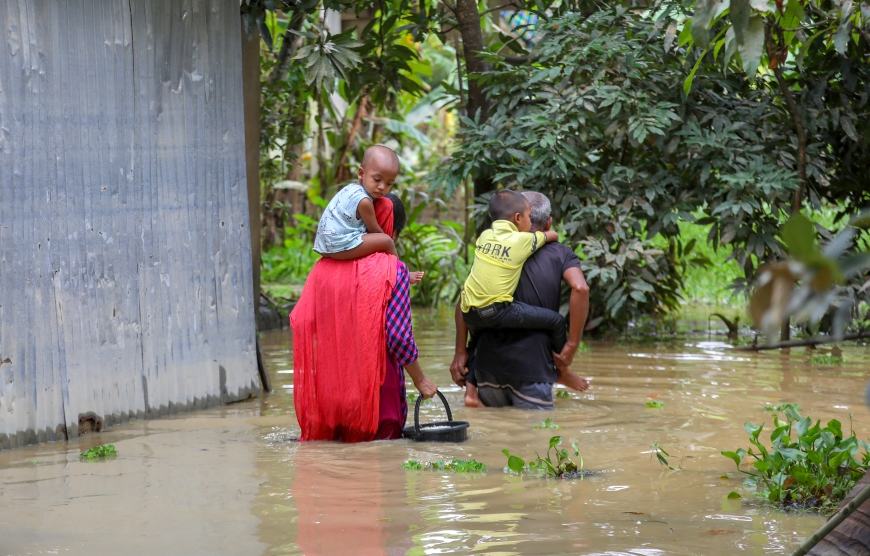
Shimul Chandra Paul, a resident of Parshuram in Feni, woke up to incessant rain for the third consecutive day. The looming risk of flooding, which had seemed unlikely just a day before, had suddenly become a reality. By noon, water had reached his village, rising rapidly with each passing minute. Before he could figure out how to save his belongings, the water level rose too high. Shimul barely managed to save himself, first taking refuge on a tin-shed rooftop before moving to a building in nearby bazaar as the surging waters continued to rise.
“We have never seen such massive rain in our lives. Even our fathers hadn’t,” said Shimul. Although the water rose rapidly, it didn’t recede as quickly. It took over a week for the discharge to begin. By then, Shyamal’s house was in ruins, and his properties were irreversibly damaged.
Shimul, his brothers, extended family, and millions of others in southeastern Bangladesh – along with the people in the Indian state of Tripura – were stranded in the prolonged flood in August 2024. Thousands lost their houses and belongings to the flash floods. But, except for inundating national sympathy and private help in the immediate aftermath of the disaster, many victims found no help as the government came up with little hope for them.
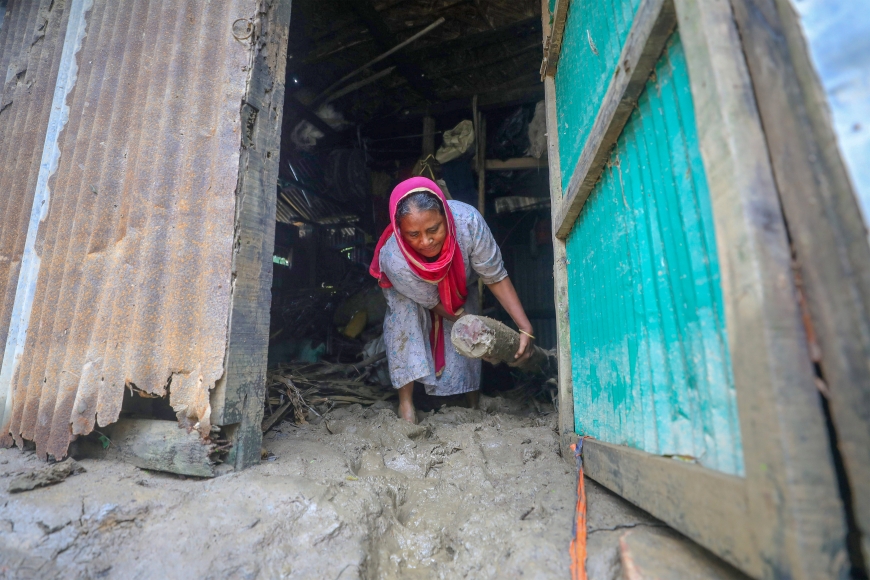
Thousands lost their houses and belongings to the flash floods. Photo: Mohammad Minhaj Uddin
District officials in Cumilla and Feni reported shortages in relief supplies, immediately receiving only 400 metal sheet bundles and Tk12 lakh each, despite much higher demands as thousands of houses were damaged. However, around 300 houses were handed over to the victims by the government this April, while many needs relied on private aid or were simply left unmet as over 8,000 houses were fully or partially damaged in Feni alone.
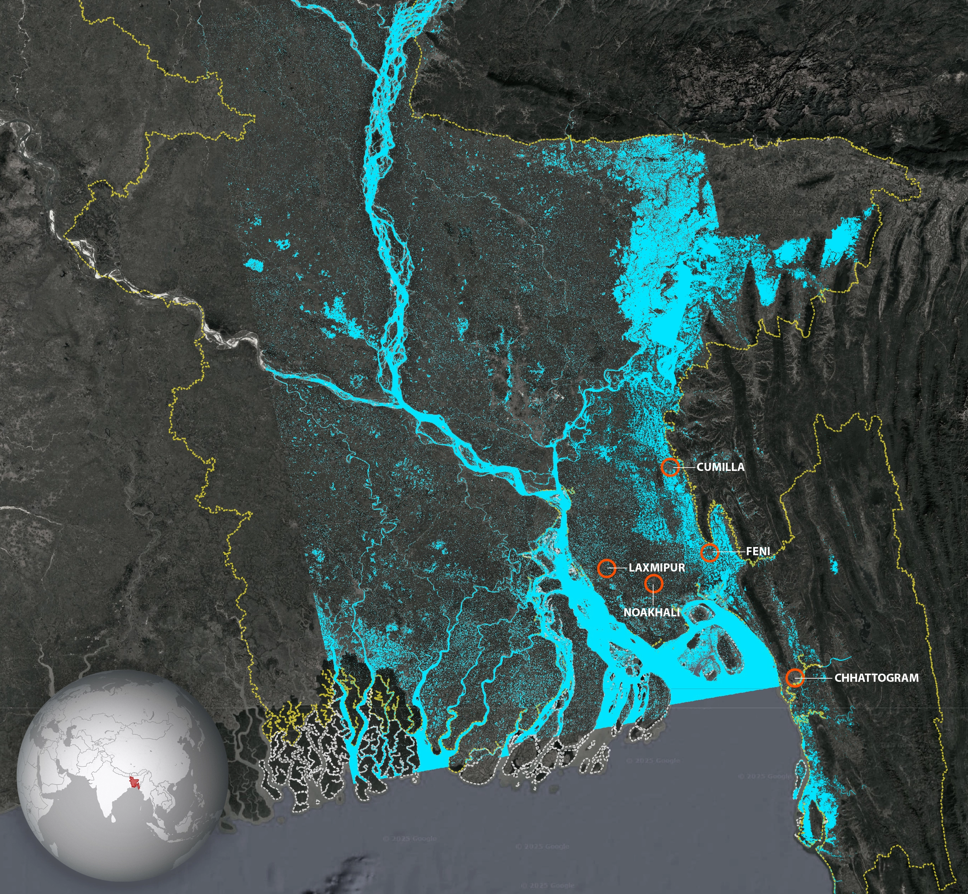
Bangladesh’s Feni has been the most affected besides Cumilla, Noakhali, Chattogram, and Laxmipur, as it rarely experiences floods. So, when consecutive days of heavy rainfall, amounting to hundreds of millimetres, poured down along with a cloudburst, people were caught off guard, lacking prior experience in dealing with floods of this scale.
About 71 people died in southeastern Bangladesh, including 28 in Feni, while 31 lost their lives in the Indian state of Tripura. The floodwater remained for over a week as drainage channels were blocked, and swamps and canals had been lost to encroachment.
As a result, people’s suffering worsened. Although private aid poured into flood-affected areas, many struggled without food and water for days, as relief workers faced difficulties reaching remote areas. Even after the water finally receded, the devastation left behind was staggering. Waves of diseases spread, and many victims received little to no assistance for rehabilitation.
Erratic rainfall – the force behind August disaster
From August 19-23, 2024, Bangladesh’s Feni recorded 832 mm of rain in just five days, while Comilla received 513 mm and Noakhali 605 mm. This erratic downpour, combined with water cascading from the hilly regions across the Indian border in Tripura, triggered the unprecedented flood in southeastern Bangladesh.
Tripura also recorded one of its highest 24-hour rainfall totals on August 22, 2024. For example, South Tripura District (Bokafa) received 493.6 mm, Sepahijala District (Sonamura) 293.4 mm, West Tripura District (Agartala) 233 mm, and Gomati District (Udaipur) 155 mm in 24 hours, exacerbating the flood situation in the Indian state.
K M Abdul Wadud, Additional Secretary at the Ministry of Disaster Management and Relief, said both Feni and Tripura receiving a gigantic amount of rain simultaneously overstrained the discharge channels, which were already encroached.
“Water from both sides was released into the same area. The Gomti, Mohuri, Kohua, and Feni rivers are hilly and shallow, with limited capacity. If it had been only upstream water, we would have had some lead time and an opportunity to issue early warnings.”
On a monthly estimate, in August 2024, Feni recorded a total of 1,787 mm of rainfall.
According to our analysis of 30 years of daily and monthly data, the previous highest recorded rainfall in August for Feni was 858 mm in 1998. Similarly, Noakhali received 1,646 mm of rain in August 2024, whereas its highest in the past 30 years was 897 mm in 1998. Comilla recorded 880 mm, significantly surpassing its previous near-highest record of 523 mm from the previous year.
For instance, in Sylhet, the highest recorded monthly rainfall in June was 1,288 mm in 2006, based on our 30-year data analysis. The average is far below. However, in the past three years, rainfall levels have consecutively far exceeded or come close to this record – reaching 2,124 mm in 2024, 1,485 mm in 2022, and 1,267 mm in 2023.
“The August rainfall in Feni was about three times higher than the 30-year average. Since this massive rainfall occurred in a clustered manner, it became a major trigger for flooding, highlighting the abrupt shift in rainfall patterns due to climate change,” said Dr. Md Sarwar Hossain, Associate Professor at the University of Glasgow’s School of Social and Environmental Sustainability.
A similar erratic rainfall pattern was also observed on the Indian side in Tripura. But questions remain about whether information was exchanged regarding the opening of the Dumbur Dam gates. If it wasn’t shared, we need to determine who is responsible,” he said.
When asked if India notified Bangladesh before releasing water from the Dumbur Dam and whether an agreement mandates such notification, Wadud said, “Yes, regional data is shared”, and emphasized that they “do not rely solely on Indian data. We use our own assumption models.”
What was unusual in the Feni flood was the local rainfall, Wadud said. There was a cloudburst, which added to the regular monsoon rains.
“The Feni event was highly unusual – so many things don’t usually happen all at once,” he added.
Sarwar Hossain said erratic rainfall is likely to increase in the future, but with canals disappearing and rivers narrowing, flash floods will only heighten the risks further. He also emphasised the need for an early warning system and a robust disaster management mechanism to minimise damage from flash floods.
Vanishing waterways and encroachment
Erratic rainfall triggered the initial flooding, but the decay of rivers and the encroachment on waterways, such as canals, worsened the situation in Bangladesh – prolonging the suffering as floodwaters had nowhere to drain. We investigated satellite images and conducted field visits to see first-hand the ruined canals and encroached waterways.
The Pagli Chhara canal in Feni’s Daudpur, for example, illustrates the impact of encroachment and pollution. Once over 30 feet wide, it was navigated by boats and even served as a docking point for cargo ships coming from Noakhali. Now, in some areas, it is less than three feet wide and largely filled in.
“This canal had good water flow even a few years ago, but encroachment has nearly destroyed it,” said Nurul Islam, a local resident.
Other canals, such as the Damdama Canal, have become drains. Locals say that dozens of such water bodies have disappeared from Feni city in the last two decades, with canals and water flow filled in or destroyed. Experts warn that the reduction of water bodies in a city significantly increases flood risks.
“Mohuri, Kohua, and Silonia rivers have been encroached on both sides, narrowing the rivers. Houses have been built in riverbeds, and tree plantations along the riverbed have obstructed water flow,” said M A Hasan, a journalist based in Feni.
When asked what made the Feni flood worse and why no significant river restoration projects had succeeded, Wadud pointed out the negligence in water management systems.
“Our water flows from north to south, yet we keep building roads that cross from east to west, which creates obstacles. But riverbanks aren’t dredged properly – there’s no integrated coordination. We face water shortages during the dry season, yet have overflowing rivers during the monsoon. These are also forms of disaster,” he added.
Nayma Baten, a meteorologist at the Climate Division of the Bangladesh Meteorological Department, said that while erratic rainfall has contributed to flooding, the narrowing of rivers and the disappearance of other water bodies have worsened the flash flood situation.
“Water can no longer flow effectively through the rivers or be released through running water bodies. This was evident when we received heavy rainfall several decades ago – the floods were not as severe because the rivers were free-flowing,” she said.
The Feni River, a vital drainage route for Feni, Khagrachari, and Chittagong, flows approximately 153 km into the Bay of Bengal. Nearby, the 50-km Muhuri Project dam, built in 1984 to protect Mirsarai and Sonagazi from floods, has contributed to the formation of chars. Over time, fish enclosures and ponds, established through occupation or leasing, have further obstructed water flow.
Meanwhile, the Gomti River, which flows through Cumilla, has also dried up and narrowed down in places, obstructing its capacity to carry enough water.
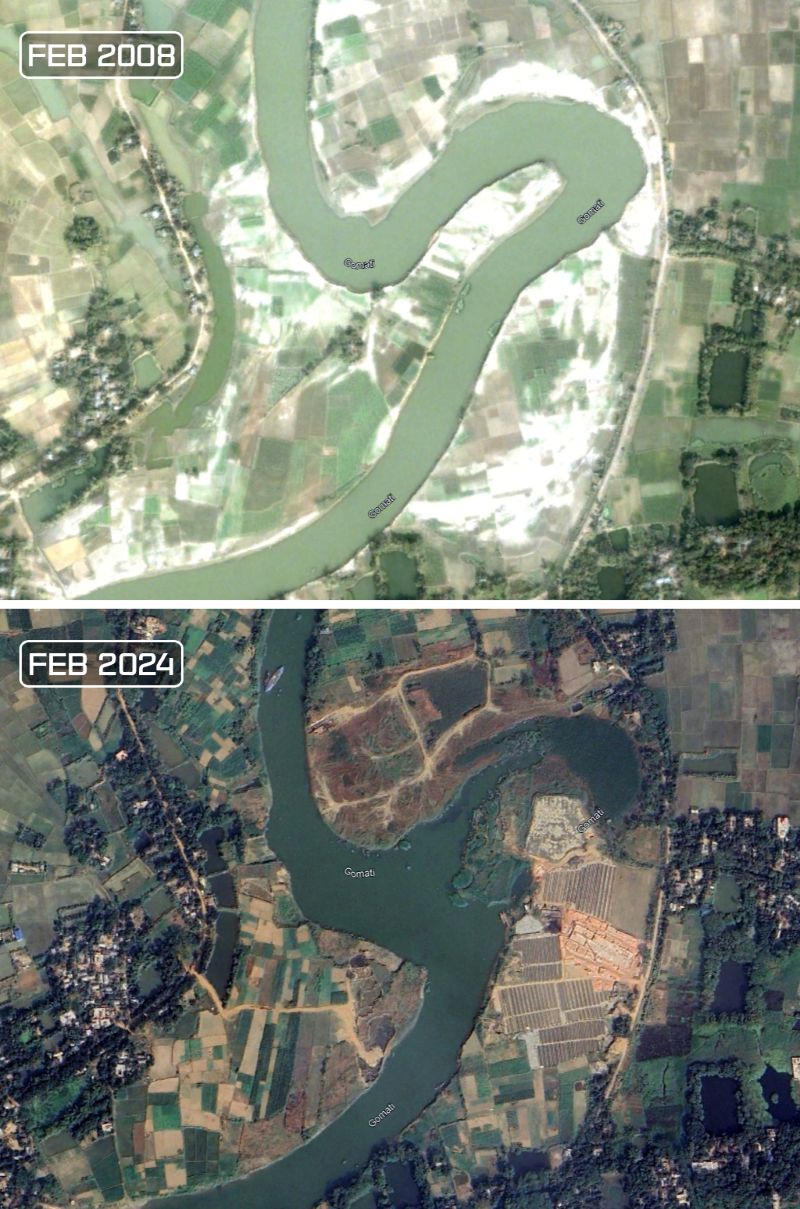
“Gomti didn’t dry out on its own,” said Mohammad Azaz, Chairman of the River & Delta Research Centre (RDRC), referring to the dam in the Indian side of Tripura, which reduced the regular water flow in the river.
“Besides, the swamps and water bodies have also disappeared. The damage done to rivers and water bodies in Bangladesh causes flooding not only in Feni, but also in Sylhet and other areas,” he said.
“All the canals and water bodies in Noakhali, Feni, and Laxmipur have been filled. Re-excavation projects for canals must be launched urgently to ensure water discharge. Without this, it will take a long time for water to flow properly,” he added.
Negligence in post-flood rehabilitation
The August 2024 flood caused massive damage to lives and livelihoods. Flood victims in these districts, having essentially lost everything, needed assistance from the authorities to rebuild and restart.
However, despite private efforts during the flood to save lives, the people in these areas didn’t get adequate support for rehabilitation.
“I got Tk50,000 for rebuilding my house, which was destroyed, but this fund is not enough, so I still couldn’t start the rebuilding of my house,” Shaymol Chandra said. “But my brothers didn’t get a penny from anyone, the flood had damaged their houses too.”

By combining flood extent data from ARIA Water Maps (OPERA Dynamic Surface Water Extent) and the UNOSAT SAR AI model, our analysis shows that at least 8,000 structures in Feni and surrounding areas (orange) with flooded areas (light blue), highlighting the scale of inundation. Credit: Arun Karki
When asked about the gaps in relief distribution and funding for flood rehabilitation, Wadud, addressing the lack of funds, said the budgetary timeframe had something to do with poor government response.
“Our disaster management fund is governed by specific rules – there is a Disaster Management Act that allows local collection of funds, but Deputy Commissioners (DCs) often don’t collect them. Even when funds are available locally, they must be returned to the government by June [budget year end]. But floods usually begin in July. This becomes a major barrier.”
Juel Mahmud, former Programme Coordinator at the International Centre for Climate Change and Development (ICCCAD), said that erratic precipitation patterns themselves hinder resilience capacity.
“We have mechanisms in place to deal with such flood situations. But the erratic nature of it, coupled with the failure of local officials, exacerbated the suffering of the people,” he said.
Md Sirajul Islam, a local social worker, said that flood survivors in remote areas hadn’t received help.
“Our agriculture had been severely damaged. While there has been some effort to support farmers with rice seedlings from the northern area, it has been minimal compared to the actual need. If the government could provide enough seeds, fertilisers, or at least subsidised fertilisers, our farmers could have overcome this crisis.”
“Our land is fertile. Our watermelons meet the demand of several districts. If our farmers are properly supported, they will stand on their own feet again,” Sirajul Islam said.
Mohammad Abed Ali District Relief & Rehabilitation Officer in Cumilla, said that against a demand for one lakh bundles of corrugated metal sheets, they received only 400 bundles and Tk12 lakh. “We submitted our requisition, but the department couldn’t provide us with more,” he said.
In Feni, on the other hand, about 8659 houses were destroyed in full or partially. District Relief and Rehabilitation Officer Mahbub Alam said they also received 400 bundles of corrugated metal sheets and Tk12 lakh besides private help, which was inadequate to the demand.
However, according to a document shared by Mahbub, some other government wings, including the military, have built around 300 houses, which was delivered to the victims this April. The document also lists donations from NGOs and non-profits such as UNDP, WFP, and others.
While most donations ranged between Tk 6,000 and Tk 30,000 – providing a little relief in the rebuilding process – As Sunnah Foundation offered Tk 300,000 per damaged family. However, they were able to assist only 287 families, whereas over 1,700 houses were completely destroyed.
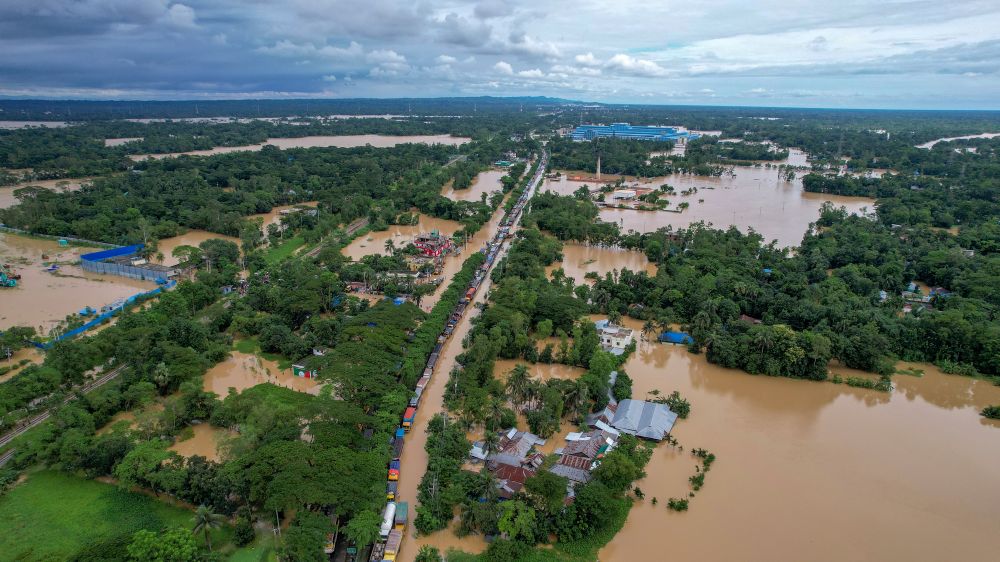
The erratic nature of rainfall and accompanying flash flood exacerbated the suffering of the people. Photo: Mohammad Minhaj Uddin
“The flood claimed everything we had, and most of us are now left alone in the fight to rebuild our lives,” Shimul said. “Only God knows how we will survive if such a disaster strikes us again.”
After last year’s flood, Syeda Rizwana Hasan, adviser to the Ministry of Water Resources, promised embankments in strategic locations, modern surveys, cancellation of illegal sand leases, and eviction of river encroachers to prevent future disasters.
Around a year later, at a recent advisory council meeting, the officials discussed finalising designs for the Musapur Regulator and Bamni Closure, permanent embankments in Feni, and freeing drainage canals in Noakhali.
Pointing out that a year has passed and these project discussions remain “finalising” or “ongoing,” river researcher Sheikh Rokon wrote in a recent column: “It is inevitable to question: what has the government actually done in the past year to tackle flooding in Feni?
Across the beds of Feni’s rivers, there is now cultivation and fish farming. Why couldn’t the government remove these encroachments over the past year? No matter how many embankments or structures are built or repaired, they will not be sustainable without clearing these flow paths,” he added.
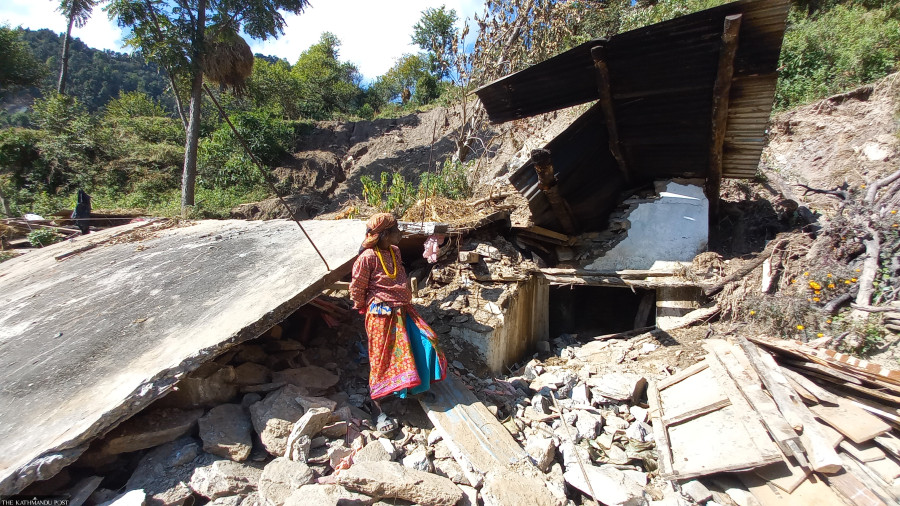
A house destroyed by a landslide in Khaptadchhanna Rural Municipality in Bajhang four years ago, pictured recently. Photo: Basant Pratap Singh
Sekugaun village in Farwest Province was alive with celebration during Dashain, Nepal’s biggest festival. People had gathered to celebrate the Hindu festival with friends, relatives and family. But as twilight fell on October 16, 2021, dark clouds rolled in and a relentless rain began to pour.
Sher Damai, 65, lay awake as water roared just meters from his house. His family slept soundly. He could not. By midnight, floodwaters had reached their doorstep. “I knew we had to get out,” he recalled. As they scrambled uphill in the dark, the wall behind them collapsed with a deafening crash.
Fifteen homes in Sekugaun, most of them Dalit households, were damaged that night. Sher’s was one of hundreds across Bajhang destroyed by unseasonal monsoon floods that displaced over 1,145 families who needed complete home reconstruction. Another 854 required significant repairs. Dalits made up 463 of these affected families. The National Disaster Risk Reduction and Management Authority (NDRRMA), a government agency tasked with managing disaster risks, identified 31 families whose homes needed complete relocation because they were built in high-risk areas.
To uncover how Dalit families were excluded from the disaster reconstruction grant, Asian Dispatch analysed the government records obtained through a Right to Information (RTI) request and conducted ground-level verification across flood and landslide affected settlements in Bajhang. We cross-checked multiple beneficiary lists issued by the National Disaster Risk Reduction and Management Authority (NDRRMA) over the years and found many names had been removed or left pending. Using satellite imagery and Google Earth Engine, we also analyzed four decades of rainfall data, which confirmed the 2021 floods hit after the monsoon’s official withdrawal – adding urgency to the devastation. A visual timeline further showed how bureaucratic delays, official inaction, and structural discrimination quietly erased hundreds of Dalit families from the recovery process.

The disaster damaged 15 houses in Sekugaun, home to 85 Dalit families.
Nearly four years later, many of the worst-hit families – especially the Dalit community – have been ignored by the state, with insufficient funds to rebuild. Left off government beneficiary lists or granted partial aid at best, they remain trapped in debt or have been forced to migrate to India. The failure to deliver post-disaster support exposes deep-rooted caste discrimination that persists despite Nepal’s promises of inclusive recovery. Dalits, historically labeled as ‘untouchables,’ are among the most disadvantaged castes in Nepal–routinely excluded from land ownership, state services and political power.
In Bajhang, 125 Dalit families affected by the disaster remain abandoned, their homes marked by padlocked doors. Already among the worst hit, the Dalit community now faces a second crisis–systematic neglect by the government in both relief and reconstruction efforts.
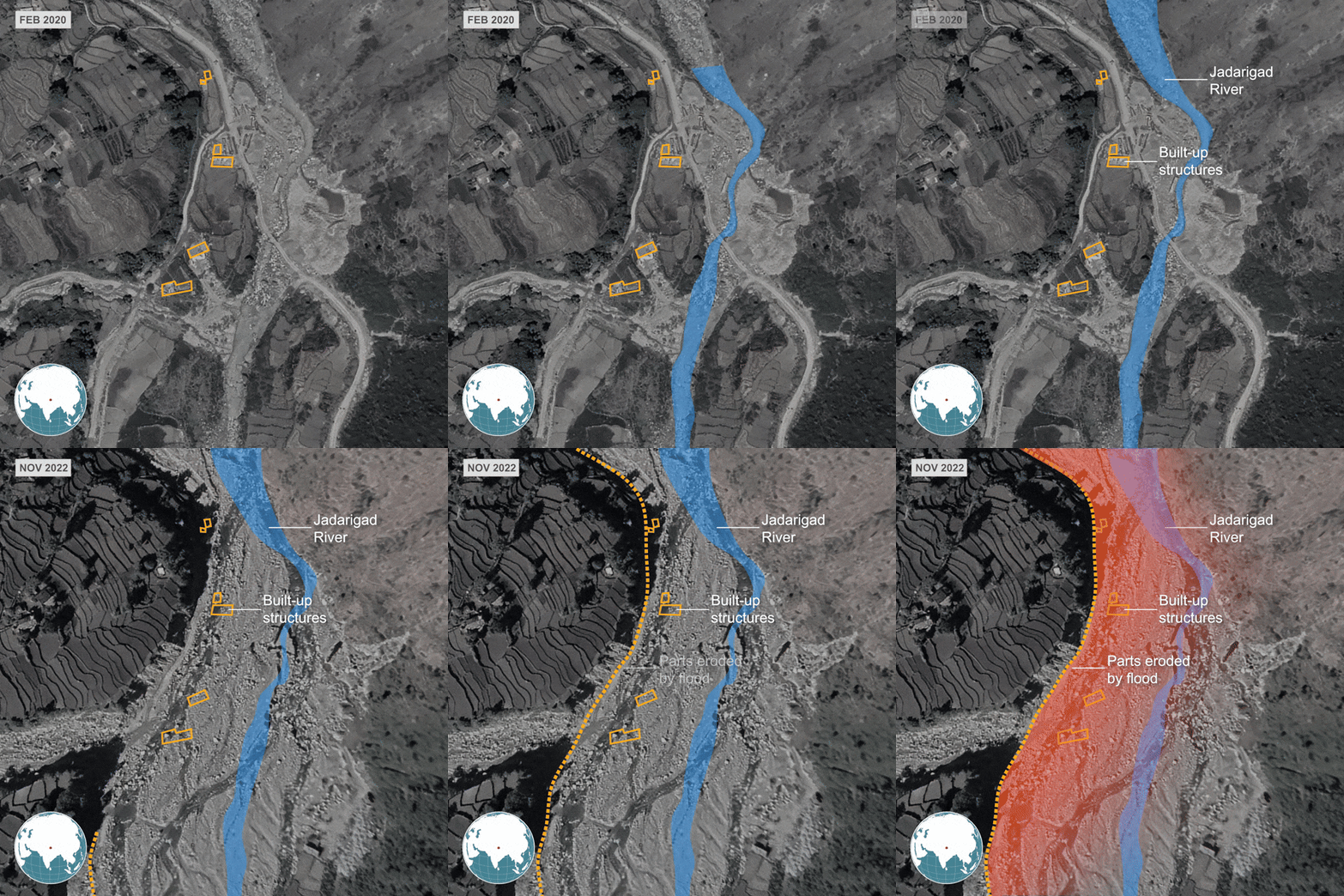
(Left) The October 2021 rainfall triggered landslides in many parts of Bajhang district, Nepal – particularly in Khaptadchhana Rural Municipality. During the same period, floods in the municipality caused significant damage, sweeping away houses, arable land, and infrastructure. Satellite image source: Google Earth Pro
Govinda Raj Pokharel, a former CEO of the National Reconstruction Authority, criticized the government’s failure. “The prolonged delay in rehabilitation and reconstruction work for Bajhang’s disaster victims demonstrates a fundamental weakness in governance. It has ultimately forced people to abandon their country,” said Pokharel, a former Vice Chairman of the National Planning Commission.
“After a disaster in Nepal, the government is tasked with providing immediate temporary shelter to the victims. It is followed by permanent housing within two to three years. This clearly wasn’t a priority,” he said. “Consequently, Dalit and impoverished families – who possessed nothing beyond their homes – were left without any economic safety net when their houses collapsed. These vulnerable people and communities should have received priority attention and additional support compared to others. Instead, they were rendered invisible – the state failed to see them, and they, in turn, felt abandoned by the state.”
Debt and Displacement
Despite the Dashain festival, several teams – including local officials from the rural municipality – arrived days after the landslide to assess the damage. Some brought emergency relief. Deepak Luhar, a local whose ground floor had been engulfed by mud after the landslide broke through one side of his house, followed the teams.
Deepak and his neighbor Sher Damai had narrowly escaped with their families, fleeing just in time. While their lives were spared, their homes were not. In the immediate aftermath, they were told the government would support reconstruction. “They asked us to submit applications to the ward office, saying funds would come for rebuilding,” he recalled. “It’s been four years since we applied. We haven’t received a single rupee.”
Deepak and Sher are among many Dalit families across Bajhang who submitted applications after their homes were destroyed. But most are still waiting. Some weren’t included in the beneficiary list at all. Others received only the first installment and were forced into debt trying to repair or retrofit their houses. A few homes stand shuttered, locked up by families who have since left. Some left for India with hastily built structures abandoned behind them. Others are packing to leave. One by one, Dalit settlements in the district are emptying in the wake of the disaster.
Sher managed to rebuild part of his flood-damaged house by borrowing money. But the repaired walls are already showing cracks. Stones have begun to loosen and fall.
Deepak’s family now lives in a neighbor’s home. Sher earns what little he can through grain paid twice a year in exchange for tailoring clothes for non-Dalits. Deepak relies on his blacksmithing. In their spare time, both take up day labor and borrow money just to survive.
They share a dream: to build strong, permanent homes. But that dream has come at a cost. With mounting debts and no support, their families have been forced to migrate. In April 2022, Deepak’s brother and sister-in-law left for Anarkatta in Bangalore, India, taking their infant child to work as laborers. Two years earlier, Sher’s three sons and two daughters-in-law also migrated with four young children.
“They went hoping to earn enough to rebuild what the landslide destroyed,” Sher said. “But they have to feed their families and send money back too. What little they manage to send is just enough for us to eat. I don’t know when–or if–our dream of building a proper house will come true.”
Systemic Neglect
Neither Sher’s nor Deepak’s name appears on the beneficiary list compiled by the NDRRMA for reconstruction and repair of housing for those at risk from monsoon-induced disasters. When informed of this, the two Dalit members became angry. “Those with less damage than us and even those with no damage at all are on the list, but our names have been removed,” Deepak said angrily. “The well-off receive relief even when they’re not victims, while those of us with real problems have our names cut off. What kind of justice is this?”
According to records from the NDRRMA, 46 Dalit families across all nine wards of Kedarsyun Rural Municipality were affected by the floods and landslides. Of these, NDRRMA’s survey found that 33 families required full house reconstruction, while 13 needed repairs. Yet, even after four years, not a single family–neither those on the list nor those left out–has received any government support for rebuilding or repairs.
One of the victims is 63-year-old Kaisi Od from Dundil in Kedarsyun-1. Her home, built with mud walls and a thatched roof, partially collapsed when one of its walls gave way during the disaster. For two months, her extended family of 19 lived under makeshift tents.
As the cold weather took a toll on her grandchildren’s health, they were forced to take out a loan to build a temporary shed. Repairing the wall and replacing the roof with tin sheets cost them 650,000 rupees–plunging the family into debt. Though they managed to escape the harsh conditions of tent life, they were soon overwhelmed by the financial burden. Eventually, four sons, three daughters-in-law, and nine grandchildren left for India in search of work, leaving behind Kaisi and two of her granddaughters.
“There’s so much debt and no jobs here,” Kaisi said. “They went to India hoping to pay it off. If they’d stayed, how would I feed them all? How could we repay such a huge amount?” She expressed frustration at the government’s failure to deliver on its promises. “If we had received the funds for house reconstruction, my family wouldn’t have had to leave. I wouldn’t be left alone like this in my old age.”
In Dundil village, six out of 23 Dalit families are included in the NDRRMA’s list. Kaisi and four others are categorized as needing house reconstruction and one family is marked for repair. But locals say that 13 Dalit households in the village suffered damage from the disaster.
Broken Promises
In the aftermath of the disaster, it wasn’t just local officials who arrived for an assessment. National leaders, too, descended on Bajhang–each by separate helicopter. Among them were then-Prime Minister Sher Bahadur Deuba, Home Minister Bal Krishna Khand, Far West Province Chief Minister Trilochan Bhatta, Speaker Arjun Thapa, Minister for Internal Affairs and Law Purna Joshi and Kalyani Khadka, chair of the Federal Parliament’s Development and Technology Committee.
They assured survivors that financial aid would soon arrive under the government’s “Private Housing Reconstruction, Retrofitting and Resettlement Grant Procedure 2077,” which allocates 500,000 Nepali rupees for house reconstruction, 50,000 Nepali rupees for repairs and an additional 300,000 Nepali rupees for land purchase in mountainous districts like Bajhang.
Nearly four years later, however, most victims are still waiting.
Under the procedure, local Disaster Management Committees are responsible for identifying beneficiaries and forwarding the list to the District Disaster Management Committee (DDMC). The process is based on digital entries submitted by ward offices, along with required documents like citizenship certificates, proof of land or other records confirming disaster vulnerability. The DDMC then verifies the extent of damage and finalizes the list.
But the reality on the ground tells a different story. Many Dalits–like Deepak Luhar and Sher Damai–were excluded from the initial list. Others, such as Kaisi Od of Dundil village, were listed but later neglected.
Data from the NDRRMA reveals that while the preliminary list had identified 463 Dalit families as eligible for assistance, the final list included only 97. As of now, just 33 families have received the first installment of 50,000 Nepali rupees.
Tasbir Bika, spokesperson for Kedarsyun Rural Municipality, attributes the disparity to deep-rooted structural discrimination. “We raised the issue at the municipal level,” he said. “But across the district, Dalit voices are still ignored. They’re seen as lower-caste citizens and there are no Dalits in decision-making roles. That’s why they’re deprived of services.”
This pattern repeats in Durgathali Rural Municipality, where 107 Dalit families were affected by the 2021 floods and landslides. Of them, 31 needed full reconstruction and 73 required repairs. Yet only 14 families made it to the second list of beneficiaries and none have received any financial support.
Rakail village in Durgathali–3 was among the hardest hit. A landslide severed the road below the settlement, causing several homes to collapse or crack. Five Dalit families abandoned the village three years ago. Those who remain – mostly the elderly and children – live in precarious conditions.
“We submitted petitions to both the ward and the municipality,” said Dhan Bahadur Parki. “But we got nothing. We live in crumbling homes, barely surviving. The government doesn’t care.” His son migrated to India three years ago in hopes of earning enough to rebuild.
According to the DDMC, these victims were eligible, but their names never made it through the system because the municipality failed to approve their inclusion on time.
Kailash Thakurathi, District Chief Officer and DDMC chair, said: “The beneficiary list is uploaded to the NDRRMA’s online system. It only progresses once the municipality verifies and approves it. That didn’t happen. We’ve urged them again and again, but there’s been no action.”
Local officials, for their part, deflect the blame.
“This disaster occurred under the previous leadership. It was their responsibility to ensure victims got aid,” said Ramesh Bahadur Bohara, ward chair of Durgathali–3. “I wasn’t aware people on the list hadn’t received funds. Now that I know, I’ll take action.”
Bohara said that Dalit settlements are often located in disaster-prone areas. “When generational poverty collides with natural calamities,” he said, “people are left with no choice but to leave the country.”
Locked Homes
The consequences of this cycle are starkly visible in Dikla, a village in Thalara Rural Municipality–4. On the night of October 18, 2021, a landslide struck around midnight, wiping out homes and families in an instant. Kalak Sarki lost 18 family members – his mother, wife, four children, brother, sister-in-law and several nieces and nephews. Nare Parki, his neighbor, lost five: his mother, wife, and three children. The landslide destroyed five additional homes and swept away 50 ropani (2.5 hectares) of farmland.
The municipality listed Kalak, Nare and five other families as eligible for government grants. Each was supposed to receive 500,000 Nepali rupees under the disaster assistance program. But three years on, they’ve received only the first installment: 50,000 Nepali rupees.
To rebuild, Kalak borrowed 150,000 Nepali rupees and went to India to work as a laborer, but the debt still looms. Nare, now 57, used donations from individuals and NGOs to buy a plot of land for 150,000 Nepali rupees and lay a foundation for his new house. But with no additional funds, construction stalled. He, too, has since migrated to India.
“Everyone in my family is gone,” Nare said in a phone call from Bengaluru, India. “I thought if the government helped, I could build a home and die on my own land. But fate cheated me – and so did the government.”
Two other affected families in Dikla faced the same situation. After receiving only 50,000 Nepali rupees–far short of what they needed to rebuild or buy land–they, too, left for India with their families. Some now live with relatives, while others struggle to find work abroad.
“We got the 50,000 Nepali rupees in our accounts three years after the landslide,” said Bhagwati Devi Dikli. “That’s not even enough to buy land. How are we supposed to build homes with that?” Her husband, daughter-in-law, and ten other family members have been living in India ever since.
Forgotten by the State
Among the areas hit hardest by the 2021 disaster was Khaptadchhanna Rural Municipality. Floods and landslides left 287 families homeless, including 63 Dalit households. Across Wards 1 through 7, 18 Dalit settlements bore the brunt of the destruction.
In Meltadi, a Dalit village in Ward 3 with 23 households – 20 Damai (Dalit tailors) and 3 Chadara (Dalit wooden utensil makers)–only eight homes still have their doors open. The rest have been locked up. Entire families have migrated to India, abandoning the village.
Surjan Damai said these families, who once relied on scraps of leather given by non-Dalits in exchange for labor, had little to fall back on – just small patches of land and hope. After the disaster, they took shelter in the cowsheds of non-Dalit neighbors, waiting for government relief. When it didn’t arrive, they left for India.
Further east, in Masuradi village of Ward 1, Kali Kami would soon leave for New Delhi with her children. Her husband migrated there two years ago. The family had taken a loan of 425,000 Nepali rupees to build their house, hoping to repay it with the reconstruction aid promised by the government. So far, they have received just 50,000 rupees.
“The government betrayed us,” she said. “We wouldn’t have borrowed so much if they hadn’t promised support. Who wants to leave their home behind?”
Of the 23 families in Masuradi, 12 Dalit households displaced by the landslide had already migrated two years ago. Those who remain live in constant fear, especially during heavy rains. “Our houses are like death traps,” said Prakash Sarki. “We sleep in fear. More families are getting ready to leave.”
According to the 2021 census, Khaptadchhanna has a Dalit population of 2,223. But Ram Bahadur Singh, the ward chair of Khaptadchhanna–5, said only a fraction now live in the village. “Most Dalit villages are empty,” he said. “Maybe five or six hundred Dalits remain in the entire municipality. The rest have gone to India.”
Nepal’s laws mandate that marginalized groups be prioritized in disaster response. The National Disaster Risk Reduction Policy of 2017 and the 12-year Strategic Plan (2018–2030) call for rescue and relief to focus on at-risk groups, including Dalits, the elderly, single women and people with disabilities.
But these commitments rarely translate into action, said Rup Sunar, chairperson of the Dignity Initiative, which researches issues affecting Dalit communities. “We’re good at drafting policies,” he said. “But when it comes to implementation, the deep-rooted discrimination becomes visible. The policies fade into the background.”
He said the situation isn’t unique to Bajhang. Across Far West Province, Dalit communities are among the most exposed to climate-related risks and the most neglected. “With no support, they’re forced to hand over their house keys to neighbors and leave the country,” he said. “It’s tragic that people are being pushed out of their homeland because the state can’t enforce its own promises.”
Four years on, festivals in Bajhang no longer feel the same.
“Sometimes it feels like the Dashain of 2021 brought nothing but misfortune for us,” said Harka Kami of Khaptadchhanna–1. “Since then, we’ve never had the kind of gathering we used to.”
The village is quieter now–emptied by disaster, debt and despair.
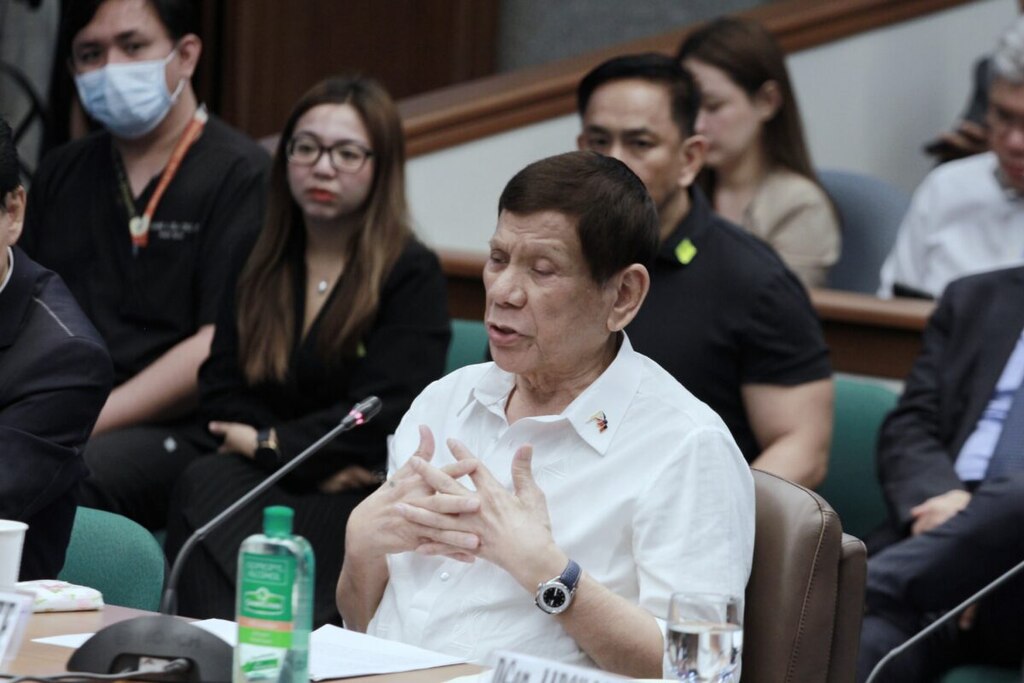
Former President Rodrigo Duterte attends the hearing of the Senate Blue Ribbon Committee probe into the War on Drugs, on October 28, 2024. Photo via Wikimedia Commons.
On March 11, the International Criminal Court arrested Rodrigo Duterte, former Philippine President, on charges of ‘crimes against humanity’ for leading the infamous seven-year ‘War on Drugs’ campaign that killed as many as 30,000 people, mostly poor Filipinos. . His anti-drugs campaign, though globally condemned, had made him hugely popular in the country of around 116 million people, and enabled the rise of his family members in politics too.
A 2017 investigation by Human Rights Watch found that police falsified evidence to justify many of these killings. Other human rights? reports found that police even received “incentives to kill”.
Family members and supporters of Duterte claim that the arrest is tantamount to a “kidnapping’, as the Philippines is no longer a member of the ICC. This claim spread across social media within a day of Duterte’s arrest in what appeared to be a coordinated ‘copypasta’ blitz, reported Philstar.
Philstar also reports that supporters have been harassing ICC judges and drug war victims in this coordinated online campaign, a strategy that might backfire and harm Duterte’s chances for interim release.
The Philippines had withdrawn from the ICC in 2018 (effective from 2019) but prosecutors from The Hague-based organisation says that they still have jurisdiction over crimes committed before the withdrawal. An official statement from the ICC office clarified that they are charging Duterte for crimes committed when he was the Mayor of Davao City (and head of the infamous Davao Death Squad), and for the first few years of his presidency – a period when the country was an ICC member.
“Mr Duterte is alleged to have committed these crimes as part of a widespread and systematic attack directed against the civilian population,” read the ICC’s March 12 statement.
The ICC recently came under fire from the Trump administration due to their investigation into Israel’s war crimes in Gaza, and the issuance of an arrest warrant for Benjamin Netanyahu and Yoav Gallant. It’s significant to note that US President Donald Trump had praised Duterte’s war on drugs campaign during his first tenure in 2016. By then, the death toll was 4,800 people.
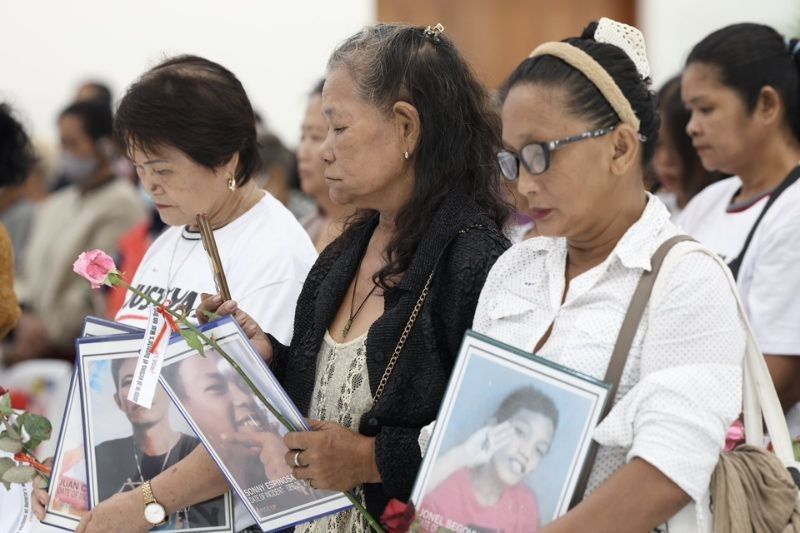
Families of extrajudicial killing victims attend a Catholic Mass at the House of Representatives prior to the eighth hearing on EJKs on Oct. 11, 2024. Photo: Philippine House of Representatives via Philstar
For families of the victims of Duterte’s war, this arrest is a breakthrough in their long search for accountability. But human rights advocates stress that this is only the first step in what should be a comprehensive accountability process.
This is a developing story. For more updates on Duterte’s trial, visit Philstar.com.
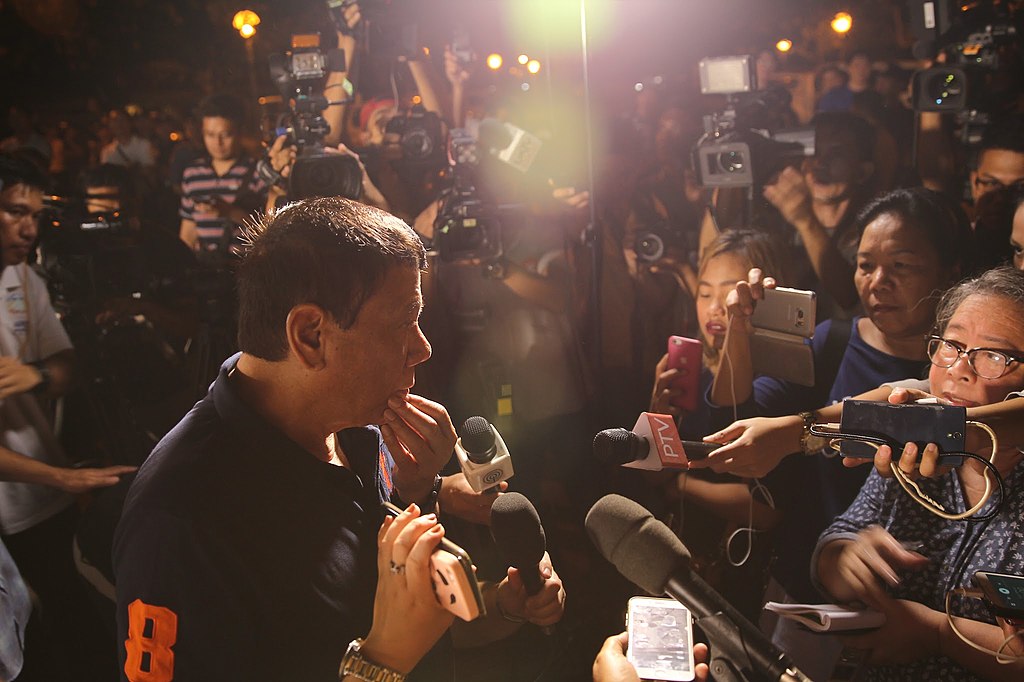
Former Philippine President Rodrigo Duterte once dared the International Criminal Court (ICC) to investigate him in the Philippines over his bloody war on drugs.
But right before stepping off the plane from a weekend trip to Hong Kong, his tone shifted. Facing officials, he said: “You will just have to kill me.”
Duterte arrived in the Philippines on Tuesday, March 11, greeted by several police personnel at Ninoy Aquino International Airport (NAIA). He was served the ICC arrest warrant by the Prosecutor General, according to the Presidential Communications Office (PCO).
This follows days of speculation about a possible arrest warrant in the ICC’s investigation into Duterte’s war on drugs and its related extrajudicial killings. Human rights groups and the ICC estimate the number of extrajudicial killings at 12,000 to 30,000, while official data records over 6,000 arbitrary deaths tied to the drug war.
In a contributed video sent to the media, Duterte said he refuses to be arrested, especially by officials aligned with Western powers. “Hindi ako papayag kung kakampi ka riyan sa mga puti (I will not allow it if you’re siding with those Westerners),” the former president said.
PNP-Criminal Investigation and Detection Group (CIDG) Chief Nicholas Torre III said that a representative from the International Criminal Police Organization (Interpol) was also present at the airport. The PCO also confirmed that the Interpol Manila received the warrant of arrest’s official copy from the ICC early Tuesday morning. However, it can also be recalled that Duterte had challenged the ICC to “hurry up” when he attended as a resource person at the House Quad Committee’s probe into his drug war.
I’m asking the ICC to hurry up. This issue has been left hanging for so many years. Matagal, Ma’am, baka mamatay na ako hindi na nila ako maimbestigahan. [It’s taking a long time, Ma’am, I might be dead before they’re able to investigate me] —said Duterte on Nov. 13, 2024.
Not the First Time
This, however, was not the only instance where his reaction today clashed with his past statements. Duterte’s refusal to accept the arrest warrant marked a sharp reversal from his remarks in Hong Kong, where he claimed he was “ready” to be detained.
“If this is truly my fate, it’s okay, I will accept it. They can arrest me, imprison me,” he told a crowd at a campaign rally attended by overseas Filipino workers. He made this remark despite insisting he had not ‘sinned’, claiming his actions were for the country and to bring peace to Filipinos.
Yet Duterte contradicted himself again, having repeatedly stated during a congressional probe that he should take the fall for the “shortcomings” of his drug war.
For all of its (war on drugs) successes and shortcomings, I and I alone take full legal responsibility sa lahat ng nagawa ng pulis pursuant to my order. Ako ang malagot at ako ang makulong, ‘wag yung pulis na sumunod sa order ko. [For all its successes and shortcomings, I and I alone take full legal responsibility for everything the police did pursuant to my orders. I should be held accountable and jailed, not the officers who followed my orders.]—Duterte said during the Senate probe on Oct. 28, 2024.
Congressional Probe’s Findings
The Quad Comm hearings on the drug war have given families of extrajudicial killing (EJK) victims a platform to share their experiences — losing loved ones without due process. Many recalled being told that drug suspects were killed for “nanlaban” or resisting arrest.
Police officials appointed by Duterte himself testified in the investigation that rewards were given for every drug suspect killed. Duterte has since denied this, admitting only that extra funds were allocated for anti-drug operations.
In its report, the mega panel recommended that the Department of Justice (DOJ) file charges against Duterte following revelations from its hearings. With the ICC’s arrest warrant for crimes against humanity, Duterte has become the first former Philippine president to be arrested by the international tribunal.
The founder of the controversial migrant recruitment technology company Bestinet Sdn Bhd is among some 300 Malaysians who own luxury properties in Dubai.
According to leaked property data, accessed by Malaysiakini through a consortium of investigative journalists, Bestinet’s former president Aminul Islam Abdul Nor owns a four-bedroom luxury residential property at Sidra Villas, a residential community in the prestigious Dubai Hills Estate.
The posh dwelling has four bedrooms and a build-up area of 3,595.25 sq ft (334.1 sq m), according to property data leaked through a journalism consortium – the Organised Crime and Corruption Reporting Project (OCCRP).
Comparable properties in the same residential area are advertised for sale with an asking price of AED7.5 million (RM8.76 million).
Its developer Emaar Properties describes it as “a prestigious community that epitomises sophisticated urban living.”
“Boasting an array of luxurious properties, including stunning villas and apartments, this development presents a golden opportunity for property investment in Dubai,” it said.
Besides the opulent villa, Dubai property records also showed that Aminul owns two office units at The Binary by Omniyat, an iconic skyscraper in the city’s Business Bay.
According to estimates by property website Bayut.com, office units there are sold between AED700,000 for 896 sq ft of space to AED3.8 million for 3,393 sq ft of space.
The units owned by Aminul are 2,292.93 and 1,647.42 sq ft respectively, the documents revealed.
When contacted, Aminul declined to respond but a source close to him confirmed the properties do belong to him. The source also said they were purchased legitimately.
Owning property in Dubai is not illegal but experts say Dubai’s property market is particularly attractive to real estate speculators, money launderers, and tax evaders in part due to its absence of taxes, particularly tax on capital gains and rents.
The documents reviewed by Malaysiakini do not suggest that Aminul’s assets were purchased through dubious means, or that the source of the income was questionable.
However, Aminul’s upmarket property holdings are in stark contrast with the plight of scores of Bangladeshi migrant workers, who reportedly are forced to mortgage or sell off family land to pay exorbitant fees to come to work in blue-collar jobs in Malaysia.
Money laundering accusations
In late October, the Bangladeshi government wrote to the Malaysian police seeking the arrest and extradition of Aminul and an associate in the migrant worker business, Ruhul Amin @ Swapon, over accusations of money laundering, extortion, and trafficking of migrant workers.
Official document revealing Ruhul Amin’s Catharsis Solutions Ltd was once known as Bestinet Bangladesh.
Ruhul runs Catharsis International, a company which manages migrant worker recruitment in Bangladesh, but he has been widely reported as an associate of Aminul.
According to official documents obtained by Bangladesh newspaper Prothom Alo, Bestinet Bangladesh Ltd was registered there on March 24, 2014, with Aminul as chairperson and Ruhul as managing director.
Aminul transferred all his shares in Bestinet Bangladesh to Ruhul in 2019 and three years later, the company was renamed Catharsis Solutions, according to a document from Bangladesh’s Registrar of Joint Stock Companies And Firms.
Ruhul owns Catharsis International and Catharsis Solutions.
Malaysian authorities confirmed receiving the Bangladesh government’s letter seeking Aminul’s extradition and replied to the letter requesting the Bangladesh police to submit a formal request.
Based on interviews with industry insiders, Prothom Alo reported in September that Aminul and Bestinet were accused of money laundering via migrant worker recruitment fees, to the tune of Tk87.50 billion (RM3.22 billion).
The MACC has cleared the company of the allegations while N Sivanathan, the lawyer representing the company and Aminul, said his clients were falsely accused of money laundering.
Aminul was the primary mover of Malaysia’s Foreign Worker Central Management System (FWCMS) and controlled Bestinet from its inception. Today, however, he only owns one percent of the company.
Celebrity counsellor and life coach Abdullah Sher Kawi Jaafar, famed for his appearance as a trainer in the reality TV show “Akademi Fantasia”, now holds 93.45 percent of the company.
Long controversy
Bestinet has long been dogged by controversy, starting from 2015, when the FWCMS it provided to the government was suspended from use amid claims that it won the deal through political connections, ostensibly with former home minister Azmi Khalid.
In a response at the time, Azmi said the deal was not signed yet and that it was only in the proof of concept stage.
Despite the initial suspension, the system was later reinstated and used by government agencies to process the hundreds of thousands of migrant workers entering Malaysia every year.
However, the Public Accounts Committee (PAC) and Auditor-General’s Department found there was never a formal contract between the government and Bestinet, which collected RM100 from each worker for the service.
The PAC found that the cabinet in August 2015 agreed to trial the FWCMS and another system provided by another provider, called ePPAx.
ePPAx was built by Syarikat Ivy Matrix Sdn Bhd, which won a RM20 million Human Resources Ministry project through an open tender.
The PAC found both the FWCMS and ePPAx served the same purpose of “processing (migrant workers) from the application stage to the end of employment and return to their sending country”.
Unauthorised approvals
Despite the development of ePPAx, the Home Ministry decided to use FWCMS instead, and in 2018 issued an approval letter to Bestinet to develop, supply, provide, and maintain FWCMS for six years from April 1, 2018, to May 31, 2024.
On Dec 22, 2021, the Ismail Sabri Yaakob-led cabinet agreed to use FWCMS exclusively but no formal contract was drawn up. Hamzah Zainudin was the home minister at the time.
“This means that the government/Home Ministry has used the FWCMS system for approximately six years without a finalised contract, clearly violating the regulations set by the government,” the PAC said in a statement.
The PAC also flagged other issues, including system vulnerabilities to hacking and potential fraud in migrant worker management.
Despite these issues, in June, the cabinet agreed to extend Bestinet’s contract for another three years, but with improvements in governance.