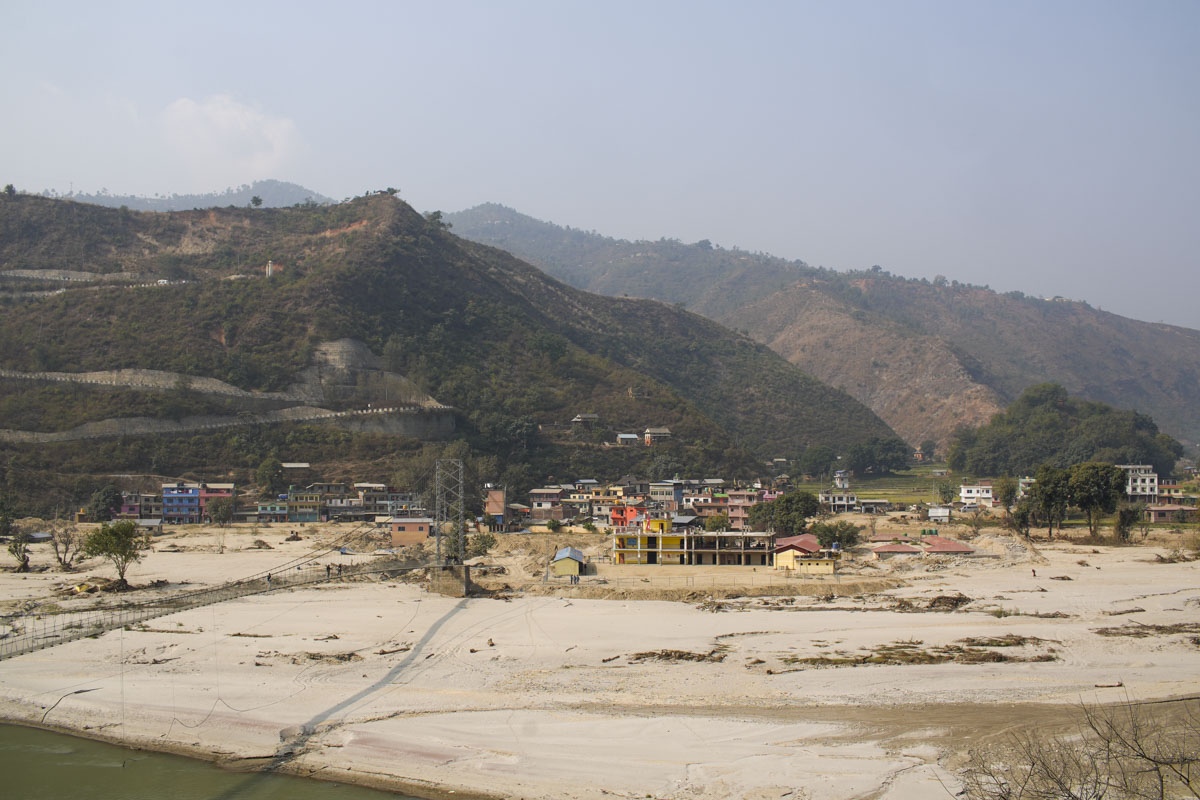
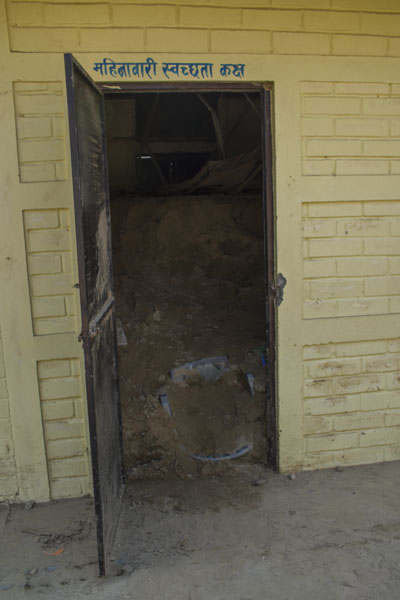
Tanka Prasad Dahal is 18 years old and lives very close to his school, Pashupati Basic School in Mulkot, Sindhuli. Even though he is older than most students, he lives at the school because he has an intellectual disability. But everything changed on September 26, 2024. After two days of heavy rain, the Sunkoshi River flooded and went over his school. When the water went down, the school was full of sand and broken pieces. The two-story building now looked like it only had one story.
A total of 117 students went to Pashupati Basic School, including 95 regular students and 22 students with disabilities. The 95 regular students were able to start classes again, even if they had to use one classroom for two different classes. But students like Tanka have not been able to return. This makes it hard for students with disabilities to get back to school after the disaster.
Nirmala Kumari Shrestha, the school principal, said that they haven’t been able to bring the students with disabilities back because the flood destroyed the entire first floor. All the supplies and materials that were stored there were also ruined. On February 12, 2025, she came with us (the NMJN team) to check on Tanka’s situation.
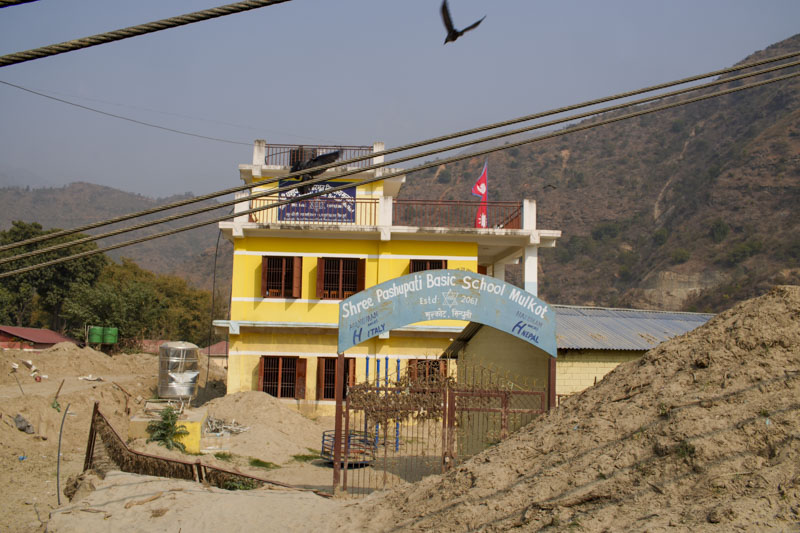
Pashupati Basic School. Photo: NIMJN
Tanka has a problem with his leg. Last year, he went to Kathmandu for an operation on his leg but it didn’t get much better because he didn’t get enough exercises to help it heal, his mother Sharada said. The principal said that Tanka has trouble walking because there is no one at home who can help him do these exercises regularly, probably because both of his parents have health issues.
Tanka’s mother, Sharada, says that he is trying to walk on his own. For his part, Tanka cannot speak confidently and clearly. He shows his feelings through babbling and humming when he hears his favorite song on the radio. Tanka is also trying to write his name clearly. He told us, while his mother was there, that he really wants to go to school and that he misses his friends from school. It’s clear that his parents also want him to be able to go to school.
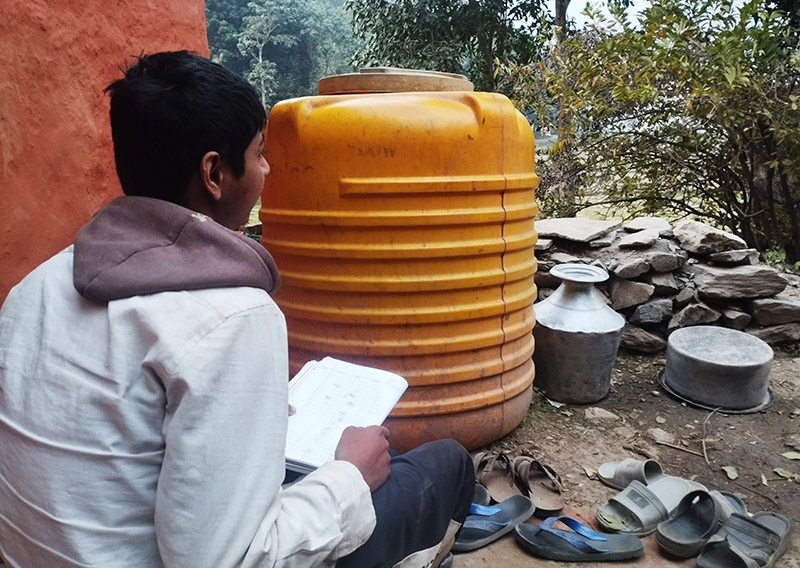
Tanka Prasad Dahal at his home. Photo: NIMJN
Hira Devi Shankar is another child with a disability from Sindhuli Nanglebhare. Her parents send her to a school nearby but she doesn’t want to go because that school doesn’t have things that make it easy and comfortable for children with disabilities. Hira, who is 10, learned a lot at Pashupati School. Before she came to that school, she didn’t even know how to hold a pencil. Before the flood damaged the school, including the classrooms, she could write and read a little. The school hasn’t asked her to come back because there is no fence around the school for safety.
Now, Hira’s parents have started sending her to a school close to their home, but she doesn’t want to go there. Her mother, Kalpana, said, “The school is only about 15 minutes from our house. We started sending her there so she wouldn’t forget what she learned, but she doesn’t want to go because it’s not a good place for her.” Kalpana also said, “Even when she goes, she doesn’t learn anything new.” According to Kalpana, Hira forgets things easily. She doesn’t speak clearly and takes a long time to understand what other people are saying to her. Kalpana said, “She has missed school because of the flood. The school said they will call us after they build a fence. I really hope they do.”
The school principal, Nirmala Kumari, said that the children with disabilities used to learn practical skills and knowledge instead of just theory. But the school hasn’t been able to start classes for them again because it’s not easy for them to get around after the floods. A wire fence has been put up at the edge of the school grounds. She says that once they build a proper wall around the school and get the money to fix the damage, it won’t take long to make the school like it was before. She also mentioned that a new building with three rooms is being built with help from the local government so that the children with disabilities can continue their learning. The principal said that once the wall is built, they will be able to bring the children with disabilities back to school.
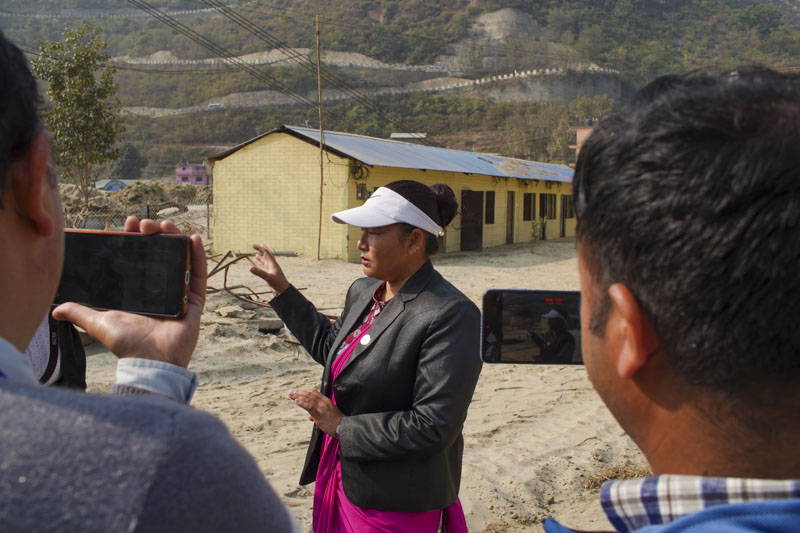
School principal Nirmala Kumari Shrestha briefing about loss and damage caused by floods. Photo: NIMJN
Surath Kumar Basyal, spokesperson for the Sunkoshi Rural Municipality, said that there used to be a special learning center just for children with intellectual disabilities. Two teachers and two helpers worked there for these children. They had two rooms to live in and one classroom, and the Rural Municipality took care of it all. The floods ruined everything except the building itself.
Because they don’t have enough desks and benches, some students have to sit on the floor during classes.
There are no good restrooms or clean drinking water. The flood filled up their well, so now they get dirty water from it. They also have to walk a long way to get water to drink. Nirmala Kumari said that the mud from the flood has dried up and is now causing a lot of pollution, which is making the children sick.
677 schools in suffering
According to the National Disaster Risk Reduction and Management Authority (NDRRMA), a total of 677 schools in 41 different districts of the country were damaged or destroyed by the floods in 2024. Forty-five of these schools were in Sindhuli. Sadly, 13 students died because of the monsoon disaster, and 50 affected students were rescued alive. However, the NDRRMA doesn’t have information on how many children with disabilities were affected. The NDRRMA says that Bagmati province was the most affected by floods and landslides, with Kavrepalanchok district reporting damage to as many as 182 schools. The Authority estimates that it will cost over 1.78 billion rupees to rebuild the school buildings that were destroyed by the monsoon disaster.
The Ministry of Education has slightly different numbers. They say that floods and landslides damaged 163 schools – 110 in Bagmati and 53 in Koshi provinces. The difference is because the NDRRMA counted all schools that had any damage, while the Ministry of Education only counted the schools that had serious damage. Debaka Dhakal, the head of the Education Development and Coordination Unit (EDCU), said that the monsoon floods and landslides have made some schools unsafe for children to attend. Other schools have reopened after some small repairs. She said that the local government, through the EDCU, gathered information about the losses and damage to help with aid and rebuilding in the education area. According to her, they are currently talking about how to manage money for school cleaning, repairs, rebuilding and preparing for future disasters.
The floods have badly damaged the places where schools get drinking water and the toilets. It’s very important to make sure the schools have clean drinking water right away, and the paths to the school and the playground need to be fixed. A first report about getting ready for the monsoon and helping after emergencies, made by the Makawanpur district, showed that they need to rebuild the damaged schools more quickly. The report says that 29 schools in that district were damaged.
Surath Kumar Basyal, Spokesperson for the Sunkoshi Rural Municipality, said that even though the local government is trying to fix the problems caused by the disaster, they don’t have enough money to do it. At the same time, Dr. Dijan Bhattarai, who is an Undersecretary and was the spokesperson for NDRRMA, said that they have created a joint plan to help the schools that were damaged by the monsoon floods and the earthquakes in Jajarkot.
(Left) The menstrual hygiene room covered by flood. Photo: NIMJN
Education for children with disability
There are rules in Nepal’s constitution, laws, and government plans to make sure children with disabilities get the education they need. Devidutta Acharya, who leads the National Disability Federation Nepal, said that in recent years, some regular schools have become inclusive, and more children with disabilities are getting access to education. According to a guidebook from 2018 about including people with disabilities in education, there were 33 special schools, 23 schools that combined special and regular education, and 316 resource classes for children with disabilities.
However, the schools that are open still have problems. Janaki Thapa, who is an interpreter, said that the school for the deaf in Birgunj, Parsa, doesn’t have enough classrooms. This school goes up to grade five and has 53 students, 38 of whom live there, and four teachers. The school needs a building and more classrooms.
The situation is much worse at Ramjanaki Sustamanasthiti School in Dhanusha – it is not even open anymore. Baliram Jha, who used to be the principal, retired two years ago. Now, only one staff member looks after the school. According to Baliram, this person just signs the attendance book whenever they want and still gets paid. Baliram said, “Nobody cares about it. Students come to the school and find the gate locked, so they go back home. Parents call me to complain. When I go to check myself, I find the school closed.”
When Baliram retired two years ago, there were 14 students at the school. Now, all of them have lost their chance to learn.
The situation of these two schools from Dhanusha and Birgunj is symbolic of the various problems faced by schools for children with disability.
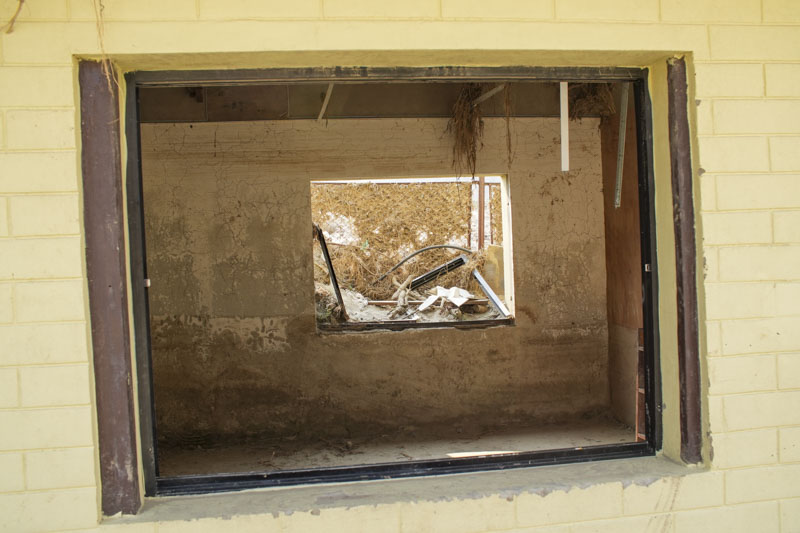
Classroom of Pashupati Basic School. Photo: NIMJN
The government gives four kinds of money help to children with disabilities. There is a “Motivation” scholarship of 1000 rupees each month for ten months. There is also a monthly transportation scholarship of 3000 rupees or 5000 rupees for each child who needs help to go to school regularly. Children who live in hostels, away from their homes, get 50,000 rupees each year. The schools get this money from their local government.
Devidutta Acharya said that they are trying to build schools in safer places. However, the government hasn’t yet made it possible to build school buildings that are completely safe for children. Because of this, when disasters happen, the schools that teach children with disabilities become risky for these children, especially because there aren’t good ways to rescue them that consider their needs.
The number of disasters happening in schools and the education area is increasing every day, making both the schools and the children there unsafe.
Around the world and in Nepal, steps are being taken to make schools and the education area less risky. There are laws and government plans in place, both internationally and in Nepal, to reduce disaster risks in schools and to encourage a culture of school safety. These efforts will help get everyone involved to work together to make sure schools are safe in the future.
Even though children with physical disabilities, vision problems, and hearing problems are currently going to school, those with more severe disabilities are still not in school, which means they are missing out on education. The Ministry of Education has a program to teach children at home. They are talking about finding these children and creating a way to have volunteer teachers educate them in their homes. The government has been making plans to make sure these children can go to school. However, when you look at how well these plans are being put into action, you don’t see much real progress.
Disability and social inclusion
The government has created a plan called the Strategic Action Plan for Gender Equality, Disability and Social Inclusion (GEDSI) in Disaster Risk Reduction and Management (2024). Dr. Dijan Bhattarai, who was the spokesperson for NDRRMA at the time, said that this plan gives clear instructions on how to include everyone equally, including people with disabilities, when preparing for and dealing with disasters.
Devidutta Acharya said that even though the 2015 earthquakes showed that children with disabilities are very likely to be in danger during disasters, there still isn’t enough specific preparation that includes them.
Pashupati Basic School doesn’t have enough classrooms, so students are being taught in an open area on the second floor of a building that is still being built.
According to him, he has asked the NDRRMA to make children with disabilities a priority in schools and hospitals when they are doing rescue and recovery work. He believes that early warnings about disasters should also be easy for everyone to understand and access. He also said that not having access to information makes these children even more at risk during disasters. When making plans for how to respond to disasters, they should think about how to provide services for people who can’t hear or speak, people who use wheelchairs, and children who can’t see.
Also, the people who help during disasters should be trained on how to assist these individuals. The Strategic Action Plan (2024) says that the government should give out kits with tools that people with disabilities will need in emergency situations. Devidutta Acharya says that his organization has been working on this issue constantly.
Making schools safe
According to a report from 2017/18, there are 35,601 schools in Nepal, with 29,005 being public and 6,566 private. A study called ‘School Safety and Existing Legal Provision Directive’ by Krishna Prasad Bhattarai found that two-thirds of these schools are in danger of disasters. The Ministry of Education has started a big plan called the Comprehensive School Safety Masterplan (2017) and created a guide called the Comprehensive School Safety Minimum Package (2018). The National Policy for Disaster Risk Reduction (2018) aims to help Nepal grow in a way that is safer, can adapt to climate change, and can recover from disasters. These rules give schools at all levels advice on having good education and being ready for disasters. Chandra Kanta Bushal, Spokesperson for the Center for Education and Human Resource Development (CEHRD), said that CEHRD is working with aid groups and other organizations to promote the comprehensive school safety masterplan. They also provide training and do practice drills.
The School Safety campaign includes programs that protect students, teachers, and staff from dangerous weather, fires, diseases, and natural disasters, including ways to prevent them. According to Chandra Kanta Bushal, they are teaching people and sharing information as part of this campaign. He also said that they are working to make schools safe by creating education groups and working with the national, regional, and local governments. They are also providing training to the School Management Committee and parents.
However, education expert Professor Dr. Bidhyanath Koirala says that this campaign hasn’t been very effective because it doesn’t consider the specific needs of local areas. He believes that if the training included local knowledge and skills, it would work better.
The study by Krishna Prasad Bhattarai also showed that putting school safety programs into action in schools is still weak. The study found that people involved in education don’t know much about school safety, and they also don’t know much about the existing laws and school safety rules. The study showed that most students are at risk of disasters because they don’t have a safe place to learn. The study lists the problems caused by disasters, such as damage to school buildings, disruption of teaching and learning, students being forced to leave school, and the need for recovery in the local community.
Leaving no child behind
Article 24 of the Convention on the Rights of Persons with Disabilities (2006) says that people with disabilities have the right to education. It states that countries that have signed this agreement must make sure that everyone, including those with disabilities, has the same chance to get an education at all levels and throughout their lives. The Convention also says that these countries should provide the specific support that each person needs to achieve this.
The Rules Regarding Rights of Persons with Disabilities (2020) in Nepal say that the government must arrange accessible education with places to live for children who cannot travel to and from school on their own because of a severe disability or because they are very poor and have no one to help them.
The constitution of Nepal has given the responsibility for education up to the secondary level to the local governments. Because of this, Devidutta Acharya argues that it is the job of the local authorities to know how many children with disabilities there are, to understand what each of them needs, and to make sure they can go to school.
What kind of tools would help children like Tanka to learn easily or to walk? Devidutta says that the local authorities should create a helpful environment for Tanka to get to school. And once he is there, the school should make it easy for him to interact with teachers and other students. Children with disabilities can get the regular money help that the government provides for free education if their schools write to the local authorities, and then the local authorities recommend it to the Department of Education.
Education expert Dr. Bidyanath Koirala argues that local authorities need to take the lead in providing desks, benches, and trained teachers for children with disabilities and in making sure they can go to school. He says that the regional and national governments should help the local authorities with this. According to him, each school should provide what a child with a disability needs based on their individual situation, and the local government should make sure this happens. He says that schools, local authorities, parents, and organizations that work with people with disabilities all need to support this cause.
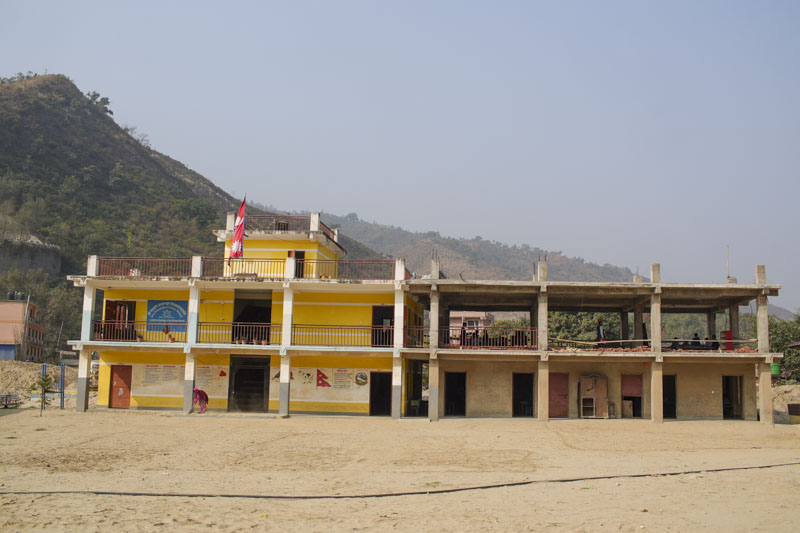
The schoolyard of Pashupati Basic School ravaged by floods. Photo: NIMJN
There is a special learning plan made just for children with intellectual disabilities. But they need teachers and helpers who are trained, and they need different kinds of technical help based on what they need. For example, children with physical disabilities need help from a physiotherapist. Those with speech problems need a speech therapist. And they need occupational therapy to learn practical knowledge and skills.
Dr. Bidhyanath Koirala says that because schools, local authorities, and the community don’t know enough about these needed services, children with disabilities have been missing out on school education. He says that there are now good technologies and training available for learning. The government has also made a plan to use resources, and there are different organizations working in this area.
Devidutta Acharya, the president of the National Disability Federation Nepal, says that if all these things are well organized and if schools can create the right way to teach, then no children will be left behind.
It was a fairly hot October afternoon in Bengaluru, and Arka, a trans-masculine person in their mid-20s living with mixed connective tissue disease (MCTD) and rheumatoid arthritis, was on their way back from a long-due appointment with their rheumatologist. A series of events in interaction with the doctor led to a moment of acute breakdown in communication between them, Arka told me. Arka said they were in tears, while the doctor snapped at them, saying, “If you’re going to behave like this, then don’t ever come back to me.” As we will learn later in the story, Arka’s doctor shut them down for attempting to advocate for their medical history. Arka’s real name, and those of other people in this story have been changed to protect their identities.
Arka found themselves unable to talk. Just about an hour earlier, they had been preparing themselves for several weeks for the day of this appointment. As a highly sought-after specialist in the city, there was a 3-4 week waiting period to get an appointment with him.
While waiting for the appointment, Arka found the hospital to be particularly crowded that day. They started experiencing sensory overwhelm. The constant chatter, beeps of printers, and the sanitized smell that hangs around hospitals added to their sensory issues. The pointed stares of strangers as they seemingly pass silent judgment on your choice of clothes and use of disability aids, can be overwhelming for a disabled, genderqueer person.
In such situations, it can be extremely difficult for some people to find the words to articulate and explain the nuances of one’s experience. This experience has been termed as selective mutism by the American Psychiatric Association, and is widely referred to as ‘selective mutism’ by neurodivergent researchers themselves.
Long studied in young children, it has been described as the absence of speech in select situations in which the child is expected to speak, even though a physical impediment to speech is not evident. In such a situation, the child experiences high levels of anxiety and is therefore unable to articulate themselves. They particularly display sensitivity to verbal interactions with others.
While many children who experience such moments grow out of it, children socialized as girls or those learning a second language because of migrating to a different place have been found to display mutism more often. Furthermore, those who have experienced bullying as a direct result of experiencing mutism might struggle with it well into adulthood. Such disabilities may include being autistic or having ADHD wherein lowered vagal tone, which can affect cardiovascular function and leads to emotional and attentional dysregulation. This, in turn, results in a highly anxious experience that renders them non-verbal. Over the long run, this damages the vagus nerve and can even result in difficulty speaking, loss of voice, difficulty swallowing, and even loss of gag reflex. This reflects how social identities can socially disable-ize people.
When Doctors Don’t Believe You
In the days leading up to the appointment, Arka, had been experiencing a flare-up. “I had been showing symptoms of my autoimmune condition since I was 7 years old,” said Arka. As someone with caste privilege [as a person raised in a Brahmin family in Bengaluru for the most part], and a father who has health insurance, I feel like a lot of barriers in the medical field that might exist for others were not there for me – like, finding the right kind of specialists for my specific, rare auto-immune condition. In some ways, I have it easier than most people,” explained Arka.
Like most people with chronic illnesses and autoimmune conditions, Arka’s symptoms, too, have changed over the course of their life and they turn to doctors to help manage them, especially during flare-ups.
“In my previous flare-up, I had experienced some new symptoms that I was finding difficult to handle. I was having trouble doing work and was sleeping for 12-16 hours everyday. When I asked for advice on how I could support my body through this, the doctor [the specialist they had consulted] remarked that my pain threshold had gone down, and that my psychiatric medication was making me sleep so much.”
Arka tried to explain to their rheumatologist that they had consulted with their psychiatrist prior to the appointment, who had assured them that while such symptoms do show up during the early days following the prescription, since Arka was way past that time window, their medications weren’t causing the reaction. Arka told me, “[The specialist] did not like that I was talking about another doctor [and seemed to perceive it as a defiance of his own expertise]. I had my hands in my lap and he rapped them sharply to make me shut up. It’s not like he hit me hard, but I don’t like to be touched when I am already experiencing a sensory overload. My guards went up and I started crying. Suddenly, the lights felt too bright and like the people around me were talking too much.” Before Arka knew it, the interaction seemed to spiral out of their control. They got up and rushed out of the doctor’s office.
Arka’s experience portrays how experiencing situational mutism as an adult in the context of accessing medical care, can affect the quality of care received.
For years, I had felt myself shutting down in the gynaecologist’s office, unable to answer their questions. Memories of a doctor forcefully conducting a physical examination on a teenaged-me without prior discussion about what it would entail, triggering intense body dysphoria in the process, would rise up every time as if to convince me that others would not understand how I experience my own body.
Jan, an autistic person with ADHD in their early 30s, emphasized on the importance of having doctor-patient relationships built over a period of time. “If you’re going to a ‘family doctor’, they will listen to you, because [they perceive their reputation as being at stake within the community] and expect to be held accountable. That if there are any violations of consent [such as with respect to touch or sharing private medical information], they know that they can’t easily get away with it.”
Queer persons, especially those who live with disabilities and chronic conditions, often find the need to build long-term patient-doctor relationships, so as to feel a sense of trust to be able to open up about one’s identity and medical history over regular consultation sessions spanning across lengthy periods of times.
Arka’s negative experience was despite a 6 year medical relationship with their doctor.
“I was making the effort to communicate [my experiences] to him, and he knows that I usually experience sensory overload at hospitals,” Arka said wistfully. They were visibly hurt over the interaction with their former rheumatologist, which they described as hostile.
The Disabling Power of Casteism in Healthcare
As a Dalit person, Jan shared that ze had never met a Dalit doctor and this meant most healthcare providers were not able to relate to zir’s lived experiences when offering medical advice. “I expect a Dalit doctor to have the cultural knowledge [about the experience of caste in society] to know how to interact with me, and this will make me feel safe and taken care of [when seeking their services].”
Across the world, identities systemically marginalized by gender, race, caste, sexuality, and other markers, have been excluded from being represented in healthcare. This is often due to subtle reasons and hoops that they are often made to jump through, such as internship requirements and regulatory guidelines that gatekeep training opportunities and professional access under the guise of maintaining ‘educational merit’ in medical institutions. “Just the other day, I was reading that most medical students skip the mandatory government posting and instead find a way to pay the ₹10 lakh fine to get out of it,” Jan remarked, observing how class hierarchies often form along the faultlines of caste.
This cements the social model of disability, which puts forward the theory that disability is a creation of society, i.e., a person is not born disabled, but is disable-ized by lack of understanding, accommodation, and community offered to them in private and public spaces. In turn, marginalization due to gender, caste, class, race, mental illness, and neurodivergence can all be disable-izing experiences.
Dating around for doctors whilst in medical need is not only an irksome affair, but often an expensive one as well. “In Mumbai, I went to a doctor who was charging ₹2000 per consultation, and she constantly referred to me as ‘beta’ in a very condescending tone. I found it very annoying, and she wasn’t helpful [with her medical advice] either,” recounted Jan, when asked about their experiences with doctors.
As a queer person, it also means putting oneself out there, making ourselves vulnerable to the judgments of a system that positions itself as an expert of our bodies, and dismisses our own lived experience and preferred ways of navigating through the world. This often means a lack of empathy for our complex experiences of alienation, exclusion, and trauma that becomes compounded by its intersection with caste, mental illness, and disability, among others.
Jan was diagnosed with anxiety when ze were 17, and also had an eating disorder. “[Around the same time], I was suicidal and ended up cutting myself, and had to be taken to the hospital. I was bleeding profusely, but since this was a suicide-related case, [the doctors] wouldn’t start medical treatment immediately until the police arrived.”
In India, Section 309 of the Indian Penal Code continues to criminalize an attempt to suicide, watering the seeds of social stigma around suicidality. According to the Act, behaviors of suicidality (otherwise known as ‘attempt to suicide’) would attract fines and potential imprisonment – a bizarre and damaging response to a person in medical crisis. Despite its decriminalisation by the Mental Healthcare Act, 2017, section 309 of the Indian Penal remained a legal provision. These contradictory terms create a lot of confusion in treatment of supporting suicide victims.
“The psychiatrist at the hospital told my mother that I was on drugs. However, given my anxiety and eating disorder (a high occurrence among transgender and gender-diverse folx when compared to the cis-gendered population), I was behaving in a way that [seemed odd and uncommunicative to them],” Jan shared, when asked about the doctors’ response during this time. At that point, ze was on anxiety medication and without them, couldn’t make an assessment about how ze was feeling or why ze was feeling that way. Jan said, “My competence to consent was very blurry. However, outside of therapists and psychiatrists, the medical fraternity is not aware about how to handle this aspect of our health with sensitivity. [Interacting with them and explaining myself] feels labour-intensive, especially for people who are from a caste and class background such as mine.”
Jan’s experience shows how ableism manifests as a stigma around caste, queerness, and disability among healthcare providers, inhibiting their ability to understand layered experiences of persons at these intersections. Many people continue to refer to disabilities like autism and ADHD as ‘invisible’. However, nothing can be farther from the truth. Such disabilities present themselves in tangible ways – such as situational mutism, where our speech abilities are hampered – affecting our material reality and physical health.
Diversity in Communication Methods: Notes on Bridging the Gap
Sandi is a therapist in her mid-20s living in Mumbai with cerebral palsy (CP). She is also a survivor of cancer, which she was diagnosed with in her teens. “My disability has been mistaken for incompetence a lot of times,” she reflected. “The only reason I was being consulted in my medical decisions [during my chemotherapy] was because people perceived my vocabulary as “proof” of intellectual competence and presence of mind. Being able to speak is the only way that people can believe that my mind is sound. This bothers me immensely because it makes me wonder what would happen if I was one of those whose speech was affected,” she remarked, referring to spastic cerebral palsy (CP), a commonly-occurring form of CP, which renders a person non-verbal due to nervous system disorder and muscle weakness.
During the treatment of such patients, it becomes important to explore Augmentative and Alternative Communication (AAC) tools and approaches. It can be useful to use tools like drawing and art-based therapy, communication boards, AAC apps and speech-generating devices (such as the one popularized by Stephen Hawking) to communicate with people of varying ages, differing speech abilities (or those experiencing situational mutism due to various factors), including those who may be used to communicating in a different tongue altogether.
Gestures, eye gaze, body language, and wordless sounds are all commonly used ways to communicate that do not involve the spoken word. “There are people who may be in pain, but because of their disability, they may not know how to explain it, except maybe through tears. In such a situation, it may not be possible to get direct [written or verbal consent from that person],” explained Sandi, while talking about the different scenarios that need to be considered.
“In an ideal scenario, unless it is an extreme case of intellectual impediment where the person is in comatose or in a state of psychosis where they are hallucinating, you would still want to have a conversation with them in a way that is understandable and feels safe to them. Their comprehension of the message is key to them making a decision, so you may want to explain in a way that they will understand, and their input must be sought regarding how they would like to proceed with the treatment. If they can understand even a part of what is going on, it is important to ask and not assume that they are incompetent to make that decision [for themselves],” Sandi offered, when asked about how care-providers can communicate with a disabled person who may be non-verbal for any of the myriad reasons during a crucial moment of medical care.
As a genderqueer disabled person myself, I dream of a world where healthcare didn’t feel so daunting and inaccessible. Where I didn’t have to put on armor against microaggressions such as misgendering or heteronormative, ableist assumptions about how my body works, even as I feel the dire need for medical attention and support from trained professionals. The answer doesn’t probably lie in yet another medical startup, but a systemic overhaul in how we study and understand the body, and who is considered an expert on it. It requires acknowledging deep-seated social biases, and returning to a modality that promotes healing and ease of living, instead of “betterment.” Now, how do I find the words to tell my doctor all this in a 30-minute consultation slot?