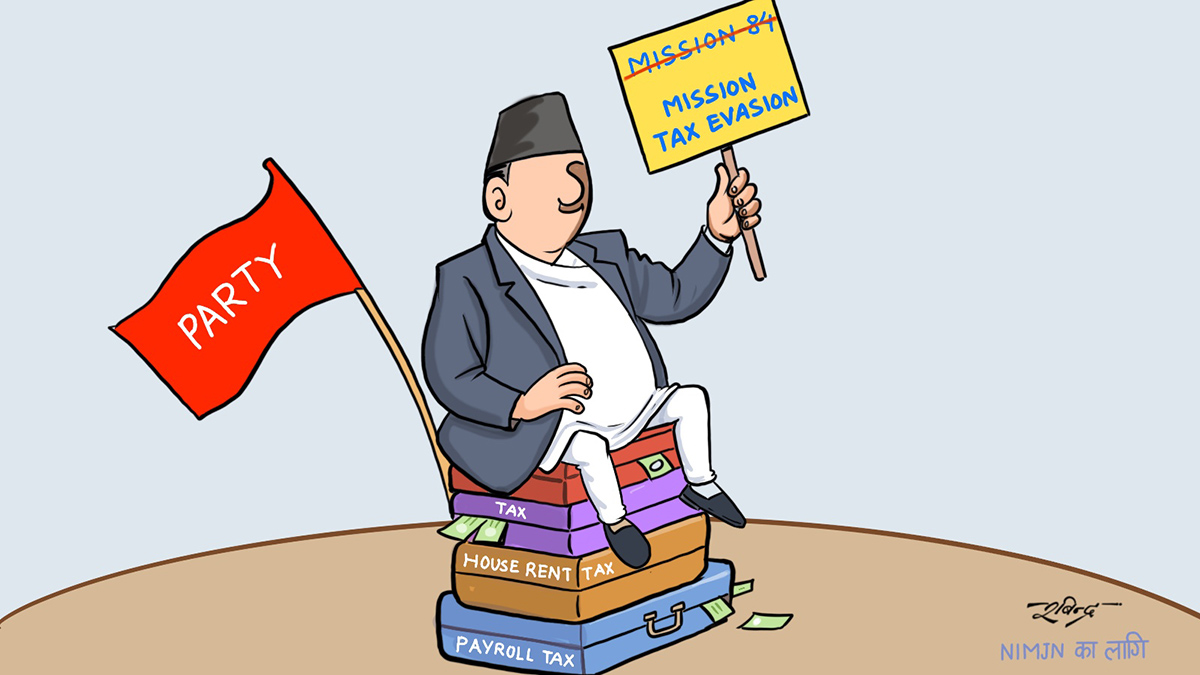
62 political parties in Nepal failed to pay a combined Rs 3.4 million in taxes. An expert audit — with a director from the Auditor General’s Office — found they skipped paying house rent tax, failed to deposit the 1% social security tax deducted from staff salaries, and dodged other advance taxes.
The quotes below are a collection of commitments from the election manifestos of major political parties in Nepal, which were made public in 2079 BS (2022 AD) before they went to voters’ doorsteps to ask for votes for the House of Representatives and Provincial Assembly elections:
“Good governance is our highest priority. The misuse of authority, the exploitation of national and government resources, and corruption will be met with a merciless, strict and zero-tolerance approach. Similarly, monitoring, investigation and scrutiny will be made more effective and any individual who engages in corruption, irregularities, misuse or misappropriation of government property will be brought to justice.”
— CPN (UML) Election Manifesto, 2079
“… Establishing economic good governance is our priority.”
— Nepali Congress Election Manifesto, 2079
“We will not engage in corruption and will not spare those who do.” “… Good governance is for the people.”
— Rastriya Swatantra Party Election Manifesto, 2079
“It is our firm commitment to develop a system of good governance with zero tolerance for corruption, complete transparency and effective service delivery at the doorsteps of the people in line with the principle of separation of powers and the spirit of federalism. This system will also ensure that all tasks, including development work, are completed quickly, efficiently and within a set timeframe. We will always remain steadfast in these commitments.”
— CPN (Unified Socialist) Election Manifesto, 2079
“A system of administration will be adopted that follows all principles of good governance, transparency, accountability and financial discipline, and provides services in a corruption-free and economical manner through digitized government offices.”
— CPN (Maoist Centre) Election Manifesto, 2079
Despite emphasizing good governance and transparency before seeking votes, the parties themselves have made a mockery of these principles. The very year they issued election manifestos promising to uphold good governance, transparency, accountability and financial discipline, that is, in the Fiscal Year 2079/080 (mid-July 2022 to mid-July 2023), they evaded taxes owed to the state.
An audit conducted by the Election Commission, with the help of an expert team including a director from the Auditor General’s office, on the parties’ audit reports revealed that the parties had evaded taxes and that their accounting systems were found to be opaque. This raises questions about the parties’ commitment to transparency.
While the audit reports submitted by the parties to the Commission have been made public, the expert team’s audit report from the Auditor General’s office has not been. However, acting Chief Election Commissioner Ram Prasad Bhandari stated that the Commission has informed the concerned parties about the weaknesses pointed out by the expert team in that report.
The confidential report, which was not made public by the Commission, was analyzed by the Nepal Investigative Multimedia Journalism Network (NIMJN). The analysis found that in the fiscal year 2079/2080 (mid-July 2022 to mid-July 2023), 62 political parties failed to pay a total of 3,409,866 rupees in house rent tax, social security tax and other advance taxes. This total includes 3,066,704 rupees in house rent tax, 309,094 rupees in social security tax, and 34,068 rupees in advance tax and audit fees.
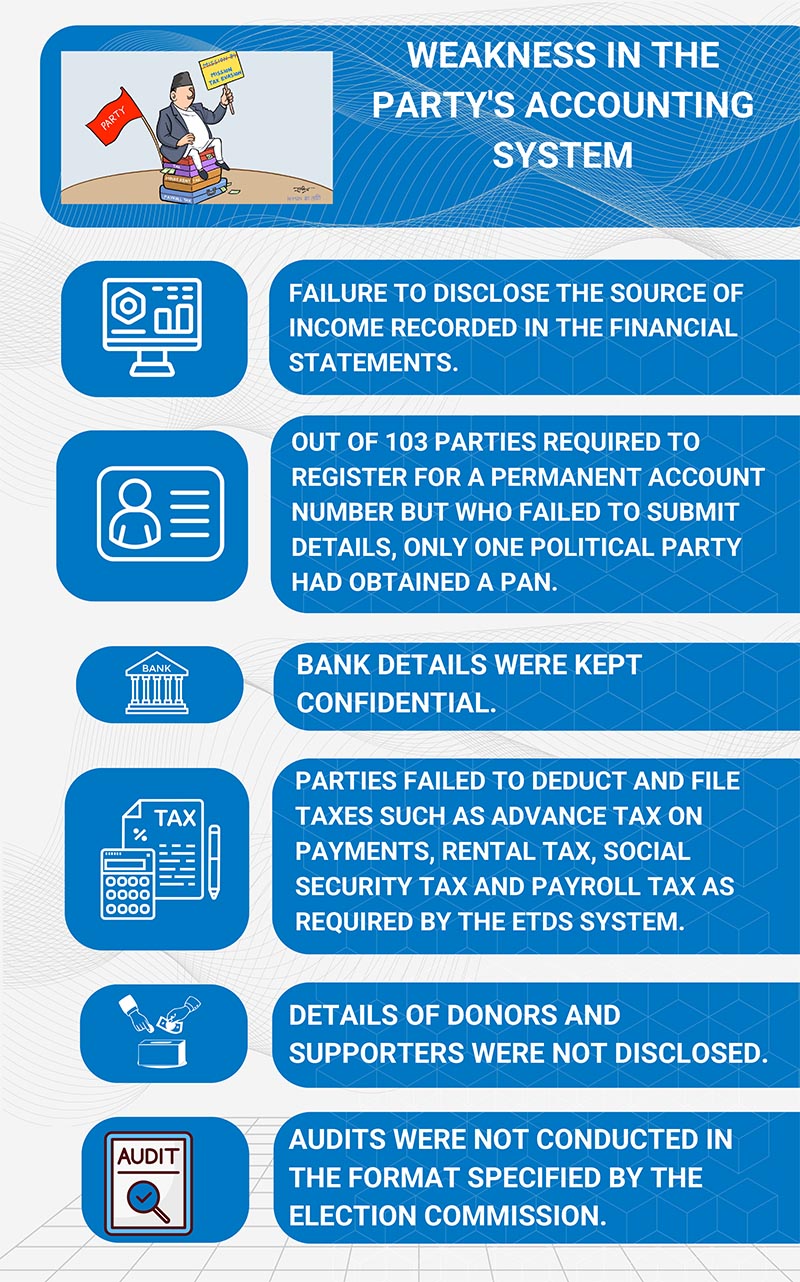
According to that report, political parties have committed irregularities, including maintaining disorganized and non-transparent accounting systems, failing to deposit taxes deducted from the salaries of their office staff to the tax office, and not paying house rent tax.
Major parties also among those not paying taxes
Of the 103 political parties that submitted financial reports to the Election Commission in the Fiscal Year 2079/080 (mid-July 2022 to mid-July 2023), 62 have not paid taxes. These include major parties that have received national party status, such as the Nepali Congress, CPN (UML), CPN (Maoist Centre), Rastriya Swatantra Party, Rastriya Prajatantra Party, Janata Samajwadi Party, and Janamat Party, all of whom were in government at the time. It was in this same year that the House of Representatives and Provincial Assembly elections took place and these parties were granted national party status.
When the audit reports submitted by the parties for the Fiscal Year 2079/080 (mid-July 2022 to mid-July 2023) were reviewed by the expert team from the Auditor General’s office, the CPN (UML), which currently leads the government, was found to have evaded the most taxes. According to the report, the UML has not paid 1.83 million rupees in house rent tax and 47,842 rupees in payroll tax, for a total of 1,877,872 rupees in unpaid taxes.
Schedule 13 of the UML’s 2079/080 (mid-July 2022 to mid-July 2023) audit report shows an expenditure of 18,383,520 rupees for building leasehold expenses.
After the 2072 (2015) earthquake, the CPN (UML) moved its office to the Pasang Lhamu Foundation building in Dhumbarahi. On April 14, 2021, it relocated to a private rented house in Thapathali. However, citing that building as too small, the UML office moved again on April 22, 2022, to the Tulsilal Memorial Foundation in Chyasal, Lalitpur, where it has remained since.
UML office secretary Bhishma Adhikari stated that the party does not have to pay rent, saying, “We don’t pay house rent, so how can we pay house rent tax?”
However, according to Baburam Thapa, the foundation’s treasurer, the UML gives the foundation a monthly ‘donation’ for using the building. “It is not given as rent, but as a donation of 400,000 rupees,” he said.
Bishnu Pokhrel, the office secretary of the foundation, also stated that the UML provides the agreed-upon amount to the foundation to cover expenses for building maintenance, research and other projects. The memorandum of understanding regarding the UML’s use of the foundation’s building for office purposes was signed on October 24, 2021, by then-UML General Secretary Ishwor Pokhrel and the foundation’s chairman, Gopal Shakya.
In that year, 2079/080 BS (mid-July 2022 to mid-July 2023), the UML spent 4.584 million rupees on employee salaries. Based on this expenditure, the expert team’s report noted that the party had not paid the required taxes and a clarification was written stating that the taxes should be recovered.
Bhishma Adhikari, the UML’s office secretary, claimed that the party has no outstanding tax liabilities. We had informed him that the Election Commission, using experts from the Auditor General’s office, had prepared a report that indicated there were outstanding taxes.
The next day, he contacted us and said, “The Auditor General’s office and the Election Commission should have asked us once before preparing the report. After you informed us, we made inquiries, and only then did we learn about the report with the details of the taxes we were supposed to pay.”
He claimed that the one percent tax deducted from employee salaries is submitted monthly.
The expert team also pointed out that the Rastriya Swatantra Party (RASWAPA), which has consistently advocated for good governance in the streets and parliament, has not paid 324,496 rupees in house rent tax and 75,519 rupees in payroll/social security tax, totaling 400,015 rupees.
RASWAPA, which was announced on June 21, 2022, moved its central office from Basundhara to Banasthali on June 22, 2023.
RASWAPA’s treasurer, Lima Adhikari, said that the outstanding house rent tax from 2079/080 (mid-July 2022 to mid-July 2023) was paid in the following year. “We have already paid the outstanding tax from the previous year at the ward office,” she said. “I cannot show you the exact amount we paid, however.”
According to sources from Kathmandu Metropolitan City Ward 16, RASWAPA has been paying 10% of its monthly rent, or 300,000 rupees, as house rent tax since last year (2080/81 BS) {mid-July 2023 to mid-July 2024}.
Clause 6 of Schedule 6 of the Kathmandu Metropolitan City Financial Act of 2078 states that a house rent tax of 10% of the annual rent amount is applicable.
Also, on the list of tax defaulters is the CPN (Unified Socialist), a party led by former Prime Minister Madhav Kumar Nepal and with another former Prime Minister, Jhalanath Khanal, as its esteemed leader. The report notes that it still owes 426,000 rupees in house rent tax and 20,635 rupees in payroll tax. Khem Paudel, a staff member of the party’s accounting department, said that the party had paid the outstanding house rent tax for 2079/80 BS (mid-July 2022 to mid-July 2023) on January 14, 2024.
“Whatever tax we owed, we have already paid it,” he said.
The audit report for the CPN (Unified Socialist) shows an expenditure of 4.26 million rupees for house rent in 2079/80 BS (mid-July 2022 to mid-July 2023). According to the city’s laws, the party should have paid 426,000 rupees in tax. However, according to the tax receipt obtained by NIMJN, the party only paid 360,000 rupees. Its central office is located in Ward 31 of Kathmandu Metropolitan City.
Nepali Congress failed to pay tax deducted from employee salaries for seven years
According to the report prepared by the expert team from the Auditor General’s office, the Nepali Congress did not pay 101,145 rupees in payroll/social security tax for the Fiscal Year 2079/080 BS (mid-July 2022 to mid-July 2023).
However, during our investigation, we found that the Nepali Congress had not paid the tax deducted from its office employees’ salaries for seven years. Robin Bajracharya, the accountant at the Nepali Congress party office, acknowledged this, stating, “There is a plan to pay the one percent tax from employees’ salaries for the last seven years within this year.”
The party’s audit report shows that the Nepali Congress spent 12,004,500 rupees on employee salaries, wages, and gratuities in the Fiscal Year 2079/080 BS (mid-July 2022 to mid-July 2023). Bajracharya said that even though they were ready to pay the tax last year, they were delayed because a system issue made it unclear how much tax each person owed.
He also mentioned that the Congress party had obtained a PAN from the tax office on June 7, 2023. Bajracharya stated that the party office is aware of the tax issue raised by the Auditor General’s office and has kept the amount it is supposed to pay as a liability.
Krishna Prasad Paudel, the chief secretary of the Nepali Congress central office, said that it is possible some taxes the party was supposed to pay were missed. “We haven’t received any such information from the Election Commission and it’s not like the party would skip paying taxes it owes,” he said. “We are ready to pay the outstanding taxes; the party has no intention of evading taxes.”
The report also mentions that the Janamat Party, which participated in the 2079 BS (2022 AD) elections for the first time and became a national party, has not paid 78,000 rupees in house rent tax. Janamat Party chairman C.K. Raut said that while the party was aware of the tax it owed, it was delayed due to technical reasons. “We had planned to pay it last year but there were some issues, which caused the delay,” he said.
The report also mentions that the Janata Samajwadi Party has not paid 1,275 rupees, while the Nagarik Unmukti Party has not paid 8,750 rupees in taxes, which includes 8,000 rupees in payroll tax and 750 rupees in TDS.
Newly appointed Chairman of the Nagarik Unmukti Party, Lalbir Chaudhary, said he was not aware of the taxes the party owed. “I’ve just taken on the responsibility, I’ll figure out where and how much we need to pay and then we will pay it,” he said. Chaudhary was made chairman of the Nagarik Unmukti Party on July 31, 2025, replacing Ranjita Shrestha.
The Rastriya Prajatantra Party (RPP) has not submitted 17,000 rupees in taxes, which is 1% of its employees’ salaries. RPP Senior Vice Chairman Dhurva Bahadur Pradhan claimed that no one receives a salary that requires paying payroll tax, so no tax was deducted. “People work as volunteers and only get pocket money,” he said. “Except for the security guards, no one receives a salary that requires them to pay taxes, which is why we have not paid them.”
The audit report for the fiscal year 2078/79 (mid-July 2021 to mid-July 2022), which the RPP submitted to the Election Commission, shows that the party spent 2.626 million rupees on employee salaries.
What does the law say?
Section 2 (d) (2) of the Income Tax Act, 2058 (2002), mentions that political parties registered with the Election Commission are considered tax-exempt organizations. This same section clarifies that such organizations will not be tax-exempt if they benefit any individual from their property or income, except when making payments for work done according to the organization’s goals or for assets or services provided to the organization by an individual.
Rule 23 of the Income Tax Regulations states that any individual required to deduct tax under Chapter 17 of the Act must apply for a Permanent Account Number (PAN) from the Inland Revenue Department before earning income or deducting tax. The expert team’s report points out that the parties did not comply with the Act and Regulations by failing to obtain a PAN and neglecting to use the eTDS system to deduct advance tax on payments, social security tax and payroll tax.
The secret report prepared by the expert team from the Auditor General’s office states, “Evidence of tax deduction on payments was not presented and in the financial statements of some parties, the amount of advance tax deduction was shown under outstanding liabilities but no evidence of its submission was provided.”
Why different laws for political parties and citizens?
Former Acting Auditor General, Sukdev Bhattarai Khatry, said that there should not be a system where ordinary citizens pay taxes while political parties are exempt.
“The same rules that apply to the people should also apply to the parties that lead the country,” he said. “Except for exemptions specified in the Financial Act and the Income Tax Act, taxes must be paid. Just because you make the laws in parliament doesn’t mean anything goes.”
Acting Chief Election Commissioner Ram Prasad Bhandari stated that the audit reports submitted by the parties were not in the format prescribed by the commission. “The parties have submitted their audit reports, but they were not found to be in the format we had specified,” he said. “We have already instructed them to make the necessary improvements and it is the parties’ responsibility to comply with those instructions.” He added that whether the parties have complied with the instructions will only be known from the audit reports they submit the following year.
Bhandari also said that, similar to previous years, they are preparing to have the audit reports submitted by the parties this year re-audited through the Auditor General’s office.
Section 40, Subsection 1 of the Political Parties Act, 2073 (2017), stipulates that parties must maintain accounts that accurately show their income and expenses. The Act also states that such accounts can be kept in electronic records. The law mandates that the accounts must be in the format specified by the Election Commission, and the commission must be informed about the officials responsible for the party’s accounts.
Similarly, there is a legal provision that allows the commission to demand or inspect the accounts maintained by a party through an officer or expert it designates. Based on the provision in Section 42 of the Act, which allows the commission to verify if a party’s submitted report is in the legally prescribed format, the commission has been conducting re-audits through the Auditor General’s office for the past two years. “The work the commission is doing to make party accounting systems transparent shows that improvements are being made,” said former Acting Auditor General Sukdev.
Eager to impose fines but weak on ensuring transparency
The Election Commission has a history of fining candidates from political parties who fail to submit their election expense reports on time. For instance, the commission published a list of candidates from local level elections who hadn’t submitted their expense reports and fined them. According to the list, the total fines amounted to more than 24 billion rupees.
The commission had issued a notice on September 22, 2022, to collect 24.638 billion rupees from 123,650 candidates for failing to submit their expense reports within 30 days of the election results being made public.
After the commission announced that candidates who didn’t pay the fine would be barred from participating in elections for six years, many paid up. However, following a writ petition filed by Kathmandu Metropolitan City Mayor Balen Shah, the Supreme Court issued an interim order to the commission on February 16, 2023, to not implement the decision to impose the fines.
On the same day, February 16, 2023, a cabinet meeting recommended to then-President Bidya Devi Bhandari to waive the fines imposed by the commission. Following that recommendation, the President waived the fines on February 17, 2023, under Article 276 of the Constitution.
On March 6, 2024, the Supreme Court also dismissed the writ petition filed by Balen Shah.
The commission has also fined candidates for the House of Representatives and Provincial Assembly elections 15,000 rupees each for not submitting their election expense reports, similar to the candidates in the local elections. The commission levied a total fine of 36,525,000 rupees on 2,435 candidates – 1,037 from the House of Representatives and 1,398 from the Provincial Assembly – at a rate of 15,000 rupees per person. The 61st annual report of the Auditor General has recommended that this outstanding amount be collected.
The confidential report notes that the commission has not been as proactive in getting the political parties to pay their taxes as it was in getting the candidates to pay their fines.
Although the Auditor General’s office provided a list of parties that had not paid taxes and the amounts owed, the commission has only informed the parties about the matter.
According to the acting Chief Election Commissioner, the commission has not yet pressured the parties to pay their taxes.
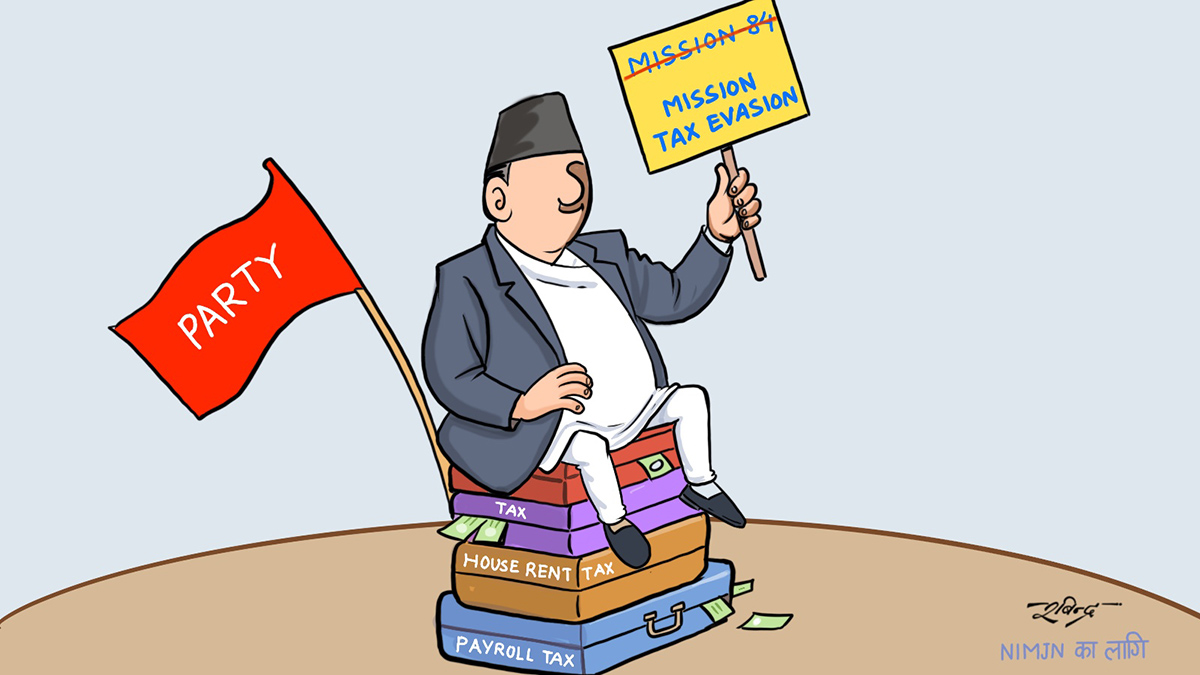
राष्ट्रिय दलको मान्यता प्राप्तसहित ६२ वटा राजनीतिक दलले राज्यलाई बुझाउनु पर्ने कर छली गरेको पाइएको छ । उनीहरूले घर बहाल कर, कर्मचारीको पारिश्रमिकबाट कट्टा गरिएको १ प्रतिशत सामाजिक सुरक्षा कर र अन्य अग्रिम कर छलेको भेटिएको छ ।
“सुशासन हाम्रो उच्च प्राथमिकता । अख्तियारको दुरुपयोग, राष्ट्रिय तथा सरकारी स्रोतको दोहन र भ्रष्टाचारप्रति निर्मम, कठोर र शून्य सहनशीलता अपनाइनेछ । यस्तै अनुगमन, अनुसन्धान र छानबिन कार्यलाई सशक्त बनाइने, भ्रष्टाचार, अनियमितता, सरकारी सम्पत्तिको दुरुपयोग र अपचलन गर्ने जुनसुकै व्यक्तिलाई कानुनी कारबाहीको दायरामा ल्याइनेछ ।”
– नेकपा एमालेको घोषणा पत्र, २०७९
“… आर्थिक सुशासन कायम गर्नु हाम्रो प्राथमिकता हुन् ।”
– नेपाली कांग्रेसको घोषणापत्र, २०७९
“भ्रष्टाचार गरिन्न र गर्नेलाई छाडिन्न ।” “ …सुशासन जनताको लागि ।”
– राष्ट्रिय स्वतन्त्र पार्टीको घोषणापत्र, २०७९
“भ्रष्टाचारमा शून्य सहनशीलतासहितको सुशासन, पूर्ण पारदर्शिता, शक्ति पृथकीकरणको सिद्धान्तअनुरूप राज्यका सबै अंगहरूको कार्य सम्पादन र संघीयताको मर्मअनुरूप जनताको घरदैलोमै प्रभावकारी सेवा प्रदान गर्ने तथा छिटो, छरितो र समय सीमाभित्र विकास निर्माणलगायत सबै काम सम्पन्न गर्ने प्रणालीको विकास गर्ने हाम्रो दृढ प्रतिज्ञा छ । हामी यी प्रतिज्ञामा सधैँ अडिग रहनेछौँ ।”
– नेकपा एकीकृत समाजवादीको घोषणापत्र, २०७९
“सुशासन, पारदर्शिता, जवाफदेहिता र वित्तीय अनुशासनका सम्पूर्ण सिद्धान्त अनुसरण गरी डिजिटाइज्ड सरकारी कार्यालयमार्फत भ्रष्टाचारमुक्त र मितव्ययी रूपमा सेवा प्रवाह हुने प्रशासन प्रणाली अवलम्बन गरिनेछ ।”
– माओवादी केन्द्रको घोषणपत्र, २०७९
प्रमुख राजनीतिक दलहरूले प्रतिनिधिसभा र प्रदेशसभाको निर्वाचनको बेला भोट माग्न मतदाताको घरदैलोमा जानुअघि २०७९ सालमा सार्वजनिक गरेका चुनावी घोषणापत्रका प्रतिबद्धताहरू हुन् यी ।
भोट माग्न जानुअघि सुशासन र पारदर्शितामा जोड दिने दलहरू आफैंले भने त्यसको धज्जी उडाएका छन् । दलहरूले सुशासन, पारदर्शिता, जवाफदेहिता र वित्तीय अनुशासन पालना गर्ने आश्वासनसहित चुनावी घोषणा पत्र जारी गरेकै वर्ष अर्थात् आर्थिक वर्ष २०७९/०८० मा राज्यलाई तिर्नुपर्ने कर छली गरेका छन् ।
दलहरूको लेखा परीक्षण प्रतिवेदनलाई निर्वाचन आयोगले महालेखा परीक्षकको कार्यालयका निर्देशकसहित अरू लेखा परीक्षकबाट परीक्षण गराउँदा दलहरूले कर छली गरेको र दलका लेखा प्रणाली अपारदर्शी पाइएको छ । यसले दलहरुको पारदर्शिताप्रतिको प्रतिबद्धतामाथि नै प्रश्न उठेको छ ।
दलहरूले आयोगमा बुझाएका लेखा परीक्षण प्रतिवेदन सार्वजनिक भए पनि त्यसकै आधारमा महालेखाको विज्ञ टिमबाट गराएको लेखा परीक्षण प्रतिवेदन भने आयोगले सार्वजनिक गरेको छैन ।
तर, प्रतिवेदनमाथि महालेखाको विज्ञ टिमले औंल्याएका कमजोरीका बारेमा सम्बन्धित दलहरूलाई जानकारी गराएको आयोगका कार्यवाहक प्रमुख निर्वाचन आयुक्त रामप्रसाद भण्डारीले जानकारी दिए ।
आयोगले सार्वजनिक नगरेको त्यो गोप्य प्रतिवेदन नेपाल इन्भिेस्टिगेटिभ मल्टिमिडिया जर्नालिज्म नेटवर्क (निमजिन) ले फेला पारेर विश्लेषण गर्दा आर्थिक वर्ष २०७९/२०८० मा ६२ राजनीतिक दलले घर बहाल कर, सामाजिक सुरक्षा कर र अन्य अग्रिम कर गरी ३४ लाख ९ हजार ८ सय ६६ रुपैयाँ नतिरेको पाइएको छ । जसमा घर बहाल करबापत ३० लाख ६६ हजार ७ सय ४ रुपैयाँ, सामाजिक सुरक्षा करबापत् ३ लाख ९ हजार ९४ रुपैयाँ, अग्रिम कर र अडिट शुल्क ३४ हजार ६८ रुपैयाँ छ ।
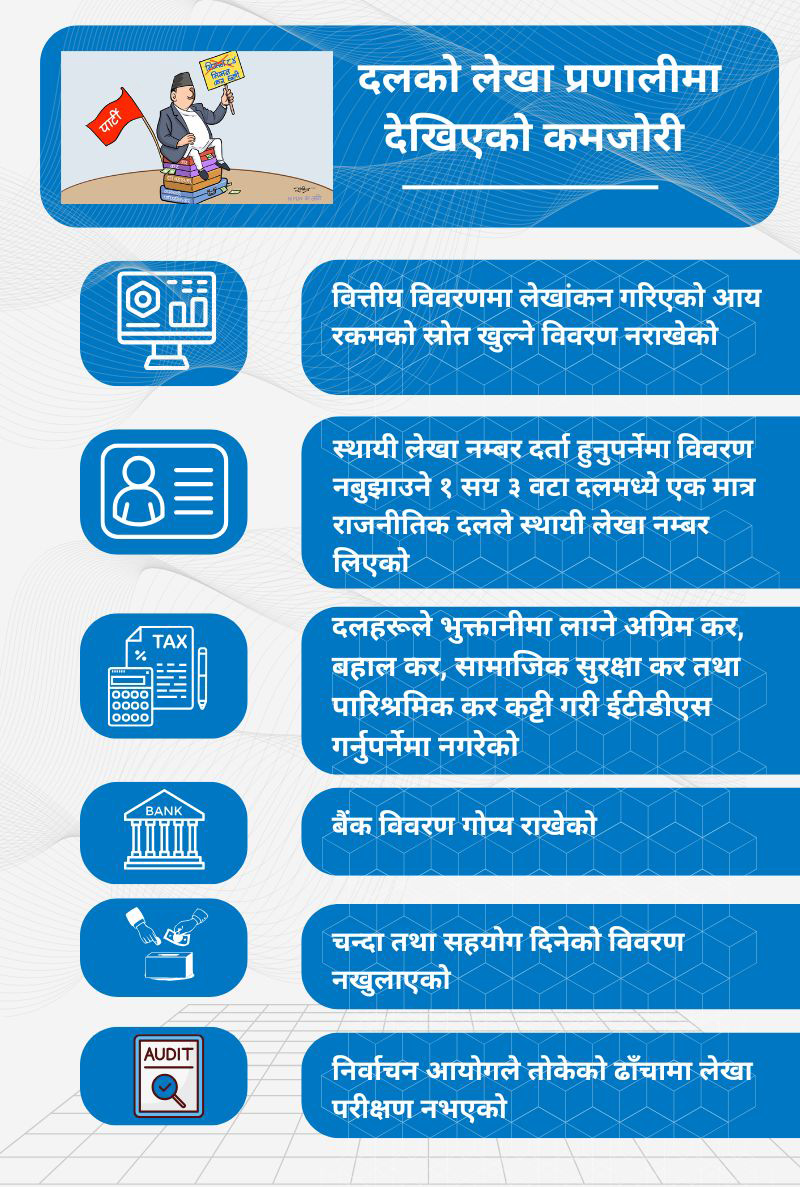
त्यो प्रतिवेदनअनुसार दलहरूको लेखा प्रणाली अव्यवस्थित र अपादर्शी रहेको, दलका कार्यालयमा कार्यरत कर्मचारीको पारिश्रमिकबाट कर कट्टा गरेको तर त्यो रकम कर कार्यालयमा जम्मा नगरेको, घरबहाल कर नतिरेकोसहितका अनियमितता राजनीतिक दलबाट भएका छन् ।
कर नतिर्नेमा ठूला दल पनि
निर्वाचन आयोगमा आर्थिक वर्ष २०७९/०८० मा १ सय ३ वटा रजानीतिक दलले वित्तीय विवरण बुझाएका थिए । तीमध्ये कर नतिर्ने ६२ दल छन् । जसमा सरकारमा रहेको नेपाली कांग्रेस, नेकपा एमालेसहित राष्ट्रिय दलको मान्यता पाएका राष्ट्रिय स्वतन्त्र पार्टी, राष्ट्रिय प्रजातन्त्र पार्टी, जनता समाजवादी पार्टी र जनमत पार्टी पनि छन् । त्यही वर्ष प्रतिनिधिसभा र प्रदेशसभा चुनाव भएको थियो र यी दललले राष्ट्रिय दलको मान्यता पाएका थिए ।
आर्थिक वर्ष २०७९/०८० मा दलहरूले आयोगमा बुझाएको लेखा परीक्षण प्रतिवेदनलाई महालेखाको विज्ञ टोलीले परीक्षण गर्दा सबैभन्दा बढी कर छली गर्नेमा अहिले सरकारको नेतृत्व गर्ने नेकपा एमालेलाई देखाइएको छ । प्रतिवेदनले औंल्याएअनुसार एमालेले घर बाहल कर मात्रै १८ लाख ३० हजार, पारिश्रमिक कर ४७ हजार ८ सय ४२ गरी १८ लाख ७७ हजार ८ सय ४२ रुपैयाँ कर बुझाएको छैन ।
एमालेको २०७९/०८० को लेखा परीक्षण प्रतिवेदनको अनुसूची १३ मा भवन लिजहोल्ड खर्चबापत १ करोड ८३ लाख ८३ हजार ५ सय २० रुपैयाँ खर्च लेखेको छ ।
२०७२ सालको भूकम्पपछि धुम्बाराहीस्थित पासाङ ल्हामु प्रतिष्ठानको भवनमा सरेको नेकपा एमाले वैशाख १, २०७८ मा थापाथलीमा रहेको एउटा निजी घरमा भाडामा सरेको थियो । तर त्यो घर साँघुरो भएको भन्दै एक वर्षपछि वैशाख ९, २०७९ मा एमालेको कार्यालय ललितपुरको च्याँसलस्थित तुल्सीलाल स्मृति प्रतिष्ठानमा सरेको छ । त्यसयता एमालेको कार्यालय प्रतिष्ठानमै छ ।
एमालेका कार्यालय सचिव भीष्म अधिकारीले भने पार्टीले घरभाडा नै तिर्न नपरेको बताए । उनले भने, “हामीले घरभाडा नै तिरेको छैन, बहाल कर कसरी तिर्नु ?” उनले भने ।
तर, प्रतिष्ठानका कोषाध्यक्ष बाबुराम थापाका अनुसार भवन प्रयोग गर्न दिएबापत् एमालेले प्रतिष्ठानलाई मासिक ‘सहयोग’ दिने गरेको छ । “भाडा भनेर दिएको छैन, सहयोगस्वरूप भनेर ४ लाख तिर्छ,” उनले भने ।
प्रतिष्ठानको भवन मर्मतसम्भार, अध्ययन अनुसन्धानलगायतका शीर्षकमा खर्च गर्ने गरी एमालेले सम्झौताअनुसारको रकम दिने गरेको प्रतिष्ठानका कार्यालय सचिव विष्णु पोखरेलले पनि बताए । प्रतिष्ठानको भवन एमालेले कार्यालय प्रयोजनका लागि प्रयोग गर्नेबारेको समझदारी पत्रमा एमालेका तत्कालीन महासचिव ईश्वर पोखरेल र प्रतिष्ठानका अध्यक्ष गोपाल शाक्यले कात्तिक ७, २०७८ मा हस्ताक्षर गरेका थिए ।
त्यो वर्ष अर्थात् २०७९/०८० कर्मचारीको पारिश्रमिकमा ४५ लाख ८४ हजार रुपैयाँ खर्च गरेको छ । यही खर्चका आधारमा सरकारलाई तिर्नुपर्ने कर नतिरेको भन्दै विज्ञ टोलीको प्रतिवेदनमा कर असुल गर्नुपर्ने कैफियत लेखेको हो ।
एमालेका कार्यालय सचिव भीष्म अधिकारीले पार्टीले तिर्नुपर्ने कुनै कर बाँकी नरहेको दाबी गरे । हामीले उनलाई निर्वाचन आयोगले महालेखाका विज्ञ प्रयोग गरेर प्रतिवेदन तयार गरेको र त्यसमा कर तिर्न बाँकी रहेको रहेछ नि भनेर जानकारी गराएका थियौँ ।
त्यसको भोलिल्ट उनले नै सम्पर्क गरेर हामीलाई भने, “महालेखा र निर्वाचन आयोगले रिपोर्ट तयार गर्नुअघि एक पटक सोधेको भए हुन्थ्यो, तपाईंहरूले जानकारी गराएपछि हामीले सोधखोज गर्यौं, त्यसपछि मात्रै हामीले कर तिर्नुपर्ने विवरणसहितको प्रतिवेदनको बारेमा बल्ल थाहा पायौं ।”
कर्मचारीको पारिश्रमिकमा कट्टा गरिएको एक प्रतिशत कर मासिक बुझाउने गरेको उनले दाबी गरे ।
सुशासनको पक्षमा सडक र सदनमा आवाज उठाउँदै आएको रास्वपाले पनि बहाल करबापत् ३ लाख २४ हजार ४ सय ९६ रुपैयाँ, पारिश्रमिक/सामाजिक सुरक्षा करबापत् ७५ हजार ५ सय १९ रुपैयाँ गरी ४ लाख १५ रुपैयाँ कर नबुझाएको विज्ञ टोलीले औंल्याएको छ ।
७ असार, २०७९ मा घोषणा भएको रास्वपाको केन्द्रीय कार्यालय वसुन्धराबाट ७ असार, २०८० मा वनस्थलीमा सरेको थियो ।
रास्वपाकी कोषाध्यक्ष लिमा अधिकारीले भने २०७९/०८० मा तिर्न बाँकी घरबहाल कर पछिल्लो वर्षमा तिरेको बताइन् । “अघिल्लो वर्ष तिर्न बाँकी कर हामीले वडा कार्यालयमा तिरिसक्यौं,” उनले भनिन, “कति तिर्यौं भन्नेचाहिँ तपाईंलाई देखाउन मिल्दैन ।”
काठमाडौं महानगरपालिका १६ नम्बर वडा कार्यालय स्रोतका अनुसार रास्वपाले गतवर्ष (२०८०/०८१) देखि मासिक ३ लाख रुपैयाँको १० प्रतिशत घरबहाल कर तिर्ने गरेको छ ।
काठमाडौं महानगरपालिकाको आर्थिक ऐन २०७८ को अनुसूची ६ को बुँदा नम्बर ६ मा बहाल रकमको वार्षिक १० प्रतिशतका दरले बहाल कर लाग्ने उल्लेख छ ।
कर नतिर्नेमा पूर्वप्रधानमन्त्री माधवकुमार नेपाल र अर्का पूर्वप्रधानमन्त्री झलनाथ खनालको दल नेकपा एकीकृत समाजवादी पनि छ । उसले घरबाहल कर मात्रै ४ लाख २६ हजार र पारिश्रमिक कर २० हजार ६ सय ३५ रुपैयाँ तिर्न बाँकी रहेको प्रतिवेदनमा उल्लेख छ । पार्टीका लेखा शाखाका कर्मचारी खेम पौडेलले २०७९/०८० मा पार्टीले तिर्नुपर्ने घरबाहल कर पुस २९, २०८० मा तिरिसकेको बताए । “हामीले जेजति तिर्नुपर्ने कर हो, त्यो तिरिसकेका छौं,” उनले भने ।
एकीकृत समाजवादीले २०७९/०८० मा ४२ लाख ६० हजार रुपैयाँ घरभाडाबापत् तिरेको लेखा परीक्षण प्रतिवेदनमा खर्च लेखेको छ ।
महानगरको कानुनअनुसार समाजवादीले ४ लाख २६ हजार कर तिर्नुपर्ने हो । तर, निमजिनले प्राप्त गरेको कर तिरेको रसिदअनुसार उसले ३ लाख ६० हजार मात्रै कर तिरेको छ । काठमाडौं महानगरको ३१ नम्बर वडामा उसको केन्द्रीय कार्यालय छ ।
कांग्रेसले कर्मचारीको तलबमा कट्टा गरेको कर ७ वर्षसम्म तिरेन
महालेखाका विज्ञ टोलीले तयार पारेको प्रतिवेदनअनुसार नेपाली कांग्रेसले आर्थिक वर्ष २०७९/०८० मा कर्मचारीको पारिश्रमिक/सामाजिक सुरक्षा करबापत्को १ लाख १ हजार १ सय ४५ रुपैयाँ बुझाएको छैन ।
तर हामीले खोजी गर्ने क्रममा कांग्रेसले कार्यालयका कर्मचारीको तलबबाट कट्टा गरेको कर ७ वर्षदेखि नतिरेको पायौं । कांग्रेस पार्टी कार्यालयका लेखापाल रविन बज्राचार्यले यसलाई स्वीकार गर्दै भने, “पछिल्लो सात वर्षदेखिका कर्मचारीको पारिश्रमिकको एक प्रतिशत कर यो वर्षभित्र तिर्ने योजना रहेको छ ।”
नेपाली कांग्रेसले आर्थिक वर्ष २०७९/०८० मा कर्मचारीको तलब, ज्याला र उपदानमा १ करोड २० लाख ४ हजार ५ सय रुपैयाँ खर्च गरेको उसको लेखा परीक्षण प्रतिवेदनमा उल्लेख छ ।
गतवर्ष नै तिर्ने तयारी गरेको भए पनि सिस्टममा समस्या भएपछि कसको कति कर तिर्ने भन्ने यकिन नभएकाले ढिला भएको उनले बताए ।
कांग्रेसले जेठ २४, २०८० मा कर कार्यालयबाट प्यान नम्बरसमेत लिइसकेको उनले बताए । लेखापाल रविनले महालेखाले करका बारेमा औंल्याएको विषयमा पार्टी कार्यालय जानकार रहेको र उसले तिर्नुपर्ने भनेको रकम दायित्वमा नै राखेको बताए ।
कांग्रेस केन्द्रीय कार्यालयका मुख्य सचिव कृष्णप्रसाद पौडेलले पार्टीले तिर्नुपर्ने कुनै कर छुट भएको हुन सक्ने बताए । “निर्वाचन आयोगबाट कुनै त्यस्तो जानकारी त आएको छैन, पार्टीले तिर्नुपर्ने कर छुट लिने भन्ने पनि हुँदैन,” उनले भने, “तिर्न बाँकी देखाएको कर तिर्न तयार छौं, कर छली गर्ने पार्टीको नियत छैन ।”
२०७९ सालको चुनावमा पहिलोपल्ट भाग लिएर राष्ट्रिय पार्टी बनेको जनमत पार्टीले पनि बहाल करबापत्को ७८ हजार नतिरेको प्रतिवेदनमा उल्लेख छ । जनमत पार्टीका अध्यक्ष सीके राउतले पार्टीले तिर्नुपर्ने करको बारेमा जानकारी भए पनि प्राविधिक कारणले ढिलाइ भएको बताए । “पोहोर नै तिर्ने भनेका थियौं, केही समस्या भएकाले ढिलाइ भएको हो,” उनले भने ।
यस्तै, जनता समाजवादी पार्टीले १ हजार २ सय ७५ तिरेको छैन भने नागरिक उन्मुक्ति पार्टीले पारिश्रमिक कर ८ हजार र टीडीएसबापत्को ७ सय ५० समेत गरी ८ हजार ७ सय ५० रुपैयाँ कर नतिरेको प्रतिवेदनमा उल्लेख छ ।
नागरिक उन्मुक्ति पार्टीका नवनियुक्त अध्यक्ष लालवीर चौधरीले पार्टीले तिर्नुपर्ने करका बारेमा जानकारी नभएको बताए । उनले भने, “भर्खर जिम्मेवारी सम्हालेको छु, कहाँ कति तिर्नुपर्नेछ, बुझेर तिर्छौं ।”
रञ्जिता श्रेष्ठलाई हटाएर नागरिक उन्मुक्तिले साउन १५, २०८२ मा लालवीरलाई अध्यक्ष बनाएको थियो ।
राष्ट्रिय प्रजातन्त्र पार्टीले कर्मचारीको पारिश्रमिकको १ प्रतिशतले हुन आउने १७ हजार रुपैयाँ कर बुझाएको छैन । राष्ट्रिय प्रजातन्त्र पार्टीका वरिष्ठ नेता उपाध्यक्ष धुव्रबहादुर प्रधानले पारिश्रमिक कर तिर्ने गरी कसैले पनि तलब नखाने भएकाले कट्टा नगरेको दाबी गरे । “स्वयंसेवकको रूपमा काम गरिरहेका हुन्छन्, पकेटमनी मात्रै पाउँछन्,” उनले भने, “सुरक्षागार्डले बाहेक कर तिर्ने गरी कसैले पनि तलब पाउँदैनन्, त्यसैले कर नबुझाएका हौं ।”
निर्वाचन आयोगमा राप्रपाले बुझाएको २०७८/०७९ को लेखा परीक्षण प्रतिवेदनमा कर्मचारीको तलबमा २६ लाख २६ हजार खर्च लेखेको छ ।
कानुनमा के छ ?
आयकर ऐन २०५८ को दफा २ को (ध) (२) मा निर्वाचन आयोगमा दर्ता भएका राजनीतिक दललाई कर छुट पाउने संस्थाको रूपमा उल्लेख गरिएको छ । यही दफामा छुट पाउने संस्थाको उद्देश्यअनुसार कार्य सम्पन्न हुँदा वा कुनै व्यक्तिद्वारा त्यस्तो संस्थालाई प्रदान गरिएका सम्पत्ति वा सेवाबापत्को कुनै भुक्तानी गर्दाबाहेक त्यस्तो संस्थाको सम्पत्ति र त्यस्तो संस्थाले प्राप्त गरेको रकमबाट कुनै व्यक्तिलाई फाइदा पुर्याएको भए त्यस्तो संस्थालाई कर छुट नहुने स्पष्ट छ ।
आयकर नियमावलीको नियम २३ मा ऐनको परिच्छेद १७ अन्तर्गत करकट्टी गर्नुपर्ने जुनसुकै व्यक्तिले त्यस्तो आय आर्जन वा करकट्टीअगावै स्थायी लेखा नम्बरका लागि आन्तरिक राजस्व विभागमा आवेदन दिनुपर्ने उल्लेख छ । दलहरूले ऐन र नियमावलीअनुसार स्थायी लेखा नम्बर लिई भुक्तानीमा लाग्ने अग्रिम कर, सामाजिक सुरक्षा कर तथा पारिश्रमिक करकट्टी गरी ईटीडीएस नगरेको विज्ञ टोलीको प्रतिवेदनले औंल्याएको छ ।
“भुक्तानी लाग्ने करकट्टी गरेको प्रमाण पेस नगरेको र कतिपय दलको वित्तीय विवरणमा अग्रिम करकट्टीको रकम भुक्तानी गर्न बाँकी दायित्वअन्तर्गत देखाइएकोमा सो दाखिला गरेको प्रमाण पेस गरेको देखिएन,” महालेखाको विज्ञ टोलीले तयार पारेको गोप्य प्रतिवेदनमा भनिएको छ ।
दल र नागरिकलाई फरक कानुन किन ?
महालेखा परीक्षकको कार्यालयका पूर्वकार्यवाहक महालेखा परीक्षक सुकदेव भट्टराई खत्रीले सर्वसाधारणले कर तिर्ने र दललाई छुट दिने व्यवस्था गर्न नहुने बताए ।
“जनतालाई जे व्यवस्था हुन्छ, देशको नेतृत्व गर्ने दलहरूलाई पनि त्यही लागू हुनुपर्छ,” उनी भन्छन्, “आर्थिक ऐन र आयकर ऐनले नै छुट दिने भनेको बाहेकमा कर तिर्नैै पर्नेहुन्छ, संसद्मा कानुन बनाउने भएपछि जे पनि हुन्छ भन्ने हुँदैन ।”
कार्यवाहक प्रमुख निर्वाचन आयुक्त रामप्रसाद भण्डारीले दलहरूले बुझाएको लेखा परीक्षण प्रतिवेदन आयोगले तोकेको ढाँचामा नपाइएको बताए । “दलहरूले लेखा परीक्षण प्रतिवेदन त बुझाएका छन्, तर हामीले जुन ढाँचामा हुनुपर्छ भनेका छौं, त्यसअनुसार पाइएन,” उनले भने, “कमजोरी देखिए जतिको सुधार गर्न निर्देशन दिइसकेका छौं, निर्देशनको पालना गर्नु दलको दायित्व हुन्छ ।”
दललाई दिएको निर्देशन पालना भए/नभएको पछिल्लो वर्ष बुझाएको लेखा परीक्षण प्रतिवेदनबाट मात्रै थाहा हुने उनले बताए ।
विगतको जस्तै यस वर्ष पनि दलहरूले बुझाएको लेखा परीक्षण प्रतिवेदनलाई महालेखामार्फत पुनःपरीक्षण गराउने तयारी रहेको उनले बताए ।
राजनीतिक दलसम्बन्धी ऐन २०७३ को दफा ४० को उपदफा १ मा दलले आफ्नो आय र व्ययको वास्तविक हिसाब देखिने गरी लेखा राख्नुपर्ने व्यवस्था छ । त्यस्तो लेखा विद्युतीय अभिलेखमा पनि राख्न सकिने ऐनमा उल्लेख छ । लेखाको अभिलेख निर्वाचन आयोगले तोकेको ढाँचामा हुनुपर्ने, दलको हिसाब हेर्ने पदाधिकारीका बारेमा आयोगलाई जानकारी दिनुपर्ने ऐनमै उल्लेख छ ।
यसैगरी, दलले राखेको हिसाब आयोगले तोकेको अधिकृत वा विशेषज्ञमार्फत माग गर्न वा निरीक्षण गराउन सक्ने कानुनी प्रावधान छ । ऐनअनुसार दलहरूले आर्थिक वर्ष सकिएको ६ महिनाभित्र आफ्नो आय र व्ययको लेखा परीक्षण गराई एक महिनाभित्र आयोगमा पेस गर्नुपर्ने हुन्छ ।
ऐनको दफा ४२ मा दलले बुझाएको प्रतिवेदन कानुनले तोकेको ढाँचामा भए/नभएको जाँच गराउन सकिने व्यवस्थालाई टेकेर आयोगले महालेखामार्फत पछिल्लो दुई वर्षयता परीक्षण गराउँदै आएको हो । “दलको लेखा प्रणाली पारदर्शी बनाउन आयोगले जुन काम गरिरहेको छ, यसले सुधार हुँदै गएको पनि देखिन्छ,” पूर्वकार्यवाहक महालेखा परीक्षक सुकदेवले भने ।
जरिवाना तोक्न आतुर, पारदर्शिता कायम गराउन फितलो
निर्वाचन आयोगले तोकेको समयमा निर्वाचन खर्च विवरण नबुझाउने दलका उम्मेदवारलाई जरिवाना गर्दै आएको छ । स्थानीय तह निर्वाचनको खर्च विवरण नबुझाउने उम्मेदवारहरूलाई जरिवाना तोक्दै आयोगले सूची नै सार्वजनिक गरेको थियो । आयोगले सार्वजनिक गरेको सूचीअनुसार २४ अर्ब रुपैयाँभन्दा धेरै जरिवाना तोकिएको थियो ।
निर्वाचन परिणाम सार्वजनिक भएको मितिले ३० दिनभित्र खर्च विवरण नबुझाएको भन्दै १ लाख २३ हजार ६ सय ५० जना उम्मेदवारबाट आयोगले २४ अर्ब ६३ करोड ८८ लाख रुपैयाँ असुल्न असोज ६, २०७९ मा सूचना निकालेको थियो ।
जरिवाना नतिर्ने उम्मेदवारले ६ वर्षसम्म निर्वाचनमा भाग लिन नपाउने भनेपछि धेरैले जरिवाना बुझाएका पनि थए । तर काठमाडौं महानगरपालिकाका मेयर बालेन्द्र शाहले दायर गरेको रिटमा सुनुवाइ गर्दै ४ फागुन, २०७९ मा सर्वोच्च अदालतले जरिवाना तिराउने निर्णय कार्यान्वयन नगर्न आयोगलाई अन्तरिम आदेश दिएको थियो ।
४ फागुन, २०७९ मै बसेको मन्त्रिपरिषद् बैठकले आयोगले तोकेको जरिवाना रकम मिनाहा गर्न तत्कालीन राष्ट्रपति विद्यादेवी भण्डारीसमक्ष सिफारिस गरेको थियो । त्यो सिफारिसअनुसार राष्ट्रपतिले ५ फागुन, २०७९ मा संविधानको धारा २७६ अनुसार जरिवाना मिनाहा गरेकी थिइन् ।
सर्वोच्च अदालतले फागुन २३, २०८० मा बालेन्द्र शाहले दायर गरेको रिट पनि खारेज गरिदिएको छ ।
आयोगले स्थानीय तहका उम्मेदवारलाई जस्तै निर्वाचन खर्च विवरण पेस नगरेको भन्दै प्रतिनिधिसभा र प्रदेशसभाका उम्मेदवारलाई पनि १५ हजार रुपैयाँ जरिवाना तोकेको छ । आयोगले प्रतिनिधिसभातर्फ १ हजार ३७ र प्रदेशसभातर्फ १ हजार ३ सय ९८ समेत गरी २ हजार ४ सय ३५ उम्मेदवारलाई जनही १५ हजारका दरले कुल ३ करोड ६५ लाख २५ हजार जरिवाना तोकेकोमा त्यो रकम उठ्न बाँकी रहेकाले उठाउन महालेखा परीक्षकको ६१ औं वार्षिक प्रतिवेदनमा सुझाव दिइएको छ ।
आयोगले उम्मेदवारलाई जरिवाना तिराउन जसरी ताकेता गरेको थियो, त्यसैगरी दलहरूबाट कर तिराउन भने ताकेता नगरेको गोप्य प्रतिवेदनमा उल्लेख छ ।
विज्ञ टोलीले कर नतिर्ने दलबाट असुल गर्नुपर्ने कर रकमसहितको सूची उपलब्ध गराए पनि आयोगले यसबारे दललाई जानकारी मात्रै गराएको छ । आयोगका कार्यवहाक प्रमुख निर्वाचन आयुक्तको भनाइअनुसार कर तिराउन आयोगले ताकेता भने गरेको छैन ।
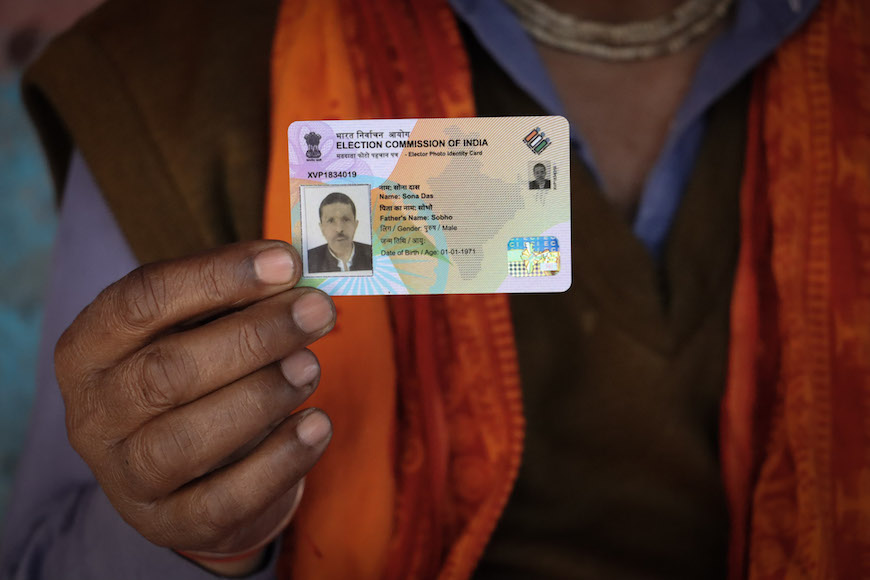
Das holds up his voter ID card ahead of the Delhi Assembly elections, a milestone in his journey as a newly-minted citizen under the CAA law. Photo: Shivalika Puri
Sona Das never imagined he would leave Pakistan, the country of his ancestors where he built a home, where his children took their first steps, and where he worked as a farmer to provide for his family.
Sitting inside their makeshift home in Majnu Ka Tilla refugee colony, located in northern Delhi, Das’s wife Rani prepares a cup of tea as her husband sits cross-legged, his shoulder draped in a thin blanket. The couple recalls the day they left their home in Pakistan’s Hyderabad city, located in Sindh province, calling it a “difficult decision.”
In 2011, Das and Rani traversed the hostile borders between the two nuclear-armed South Asian countries – India and Pakistan – on a religious visa. They were among the first Pakistanis fleeing years of discrimination and religious persecution that nearly 4.4 million Hindus face in their country.
Although there is no official figure, an estimated 300 Pakistani Hindus will be a part of history and vote as citizens – the second time in India since 2022 when over 1,000 Pakistani Hindus, who were awarded citizenship by local authorities, voted in the western Indian state of Gujarat.
Today, India’s capital New Delhi went to polls where Aam Aadmi Party, an upstart party set up in 2013, will battle it out against Bharatiya Janata Party (BJP), which has, since its first election as the national ruling party in 2014, campaigned hard on issues of identity, specifically Hindu nationalism.
In fact, Das is the beneficiary of the BJP’s Citizenship Amendment Act (CAA), which grants citizenship to Hindus, Sikhs, Buddhists, Jains, Parsis and Christian refugees from Muslim-majority Pakistan, Afghanistan and Bangladesh who came to India before December 2014. The law sparked widespread protests in 2019, mainly from India’s largest religious minority, the Muslims. Muslims from other South Asian countries are not included in this safe passage.
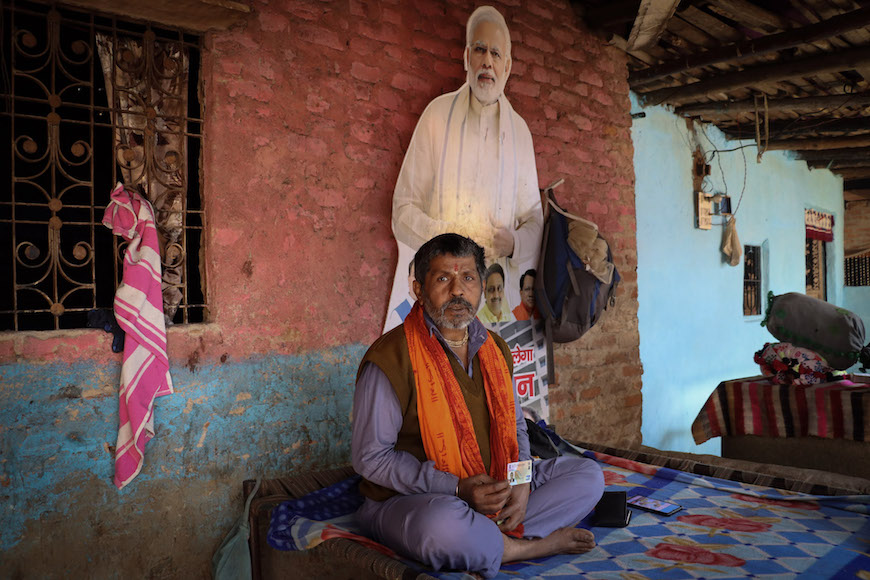
Sona Das sits inside his makeshift home in New Delhi’s refugee colony. Beside him stands a cutout of Indian Prime Minister Narendra Modi, whom he reveres as a god. Photo: Shivalika Puri
For 54-year-old Das, the CAA was a turning point. “We were uncertain about our future in Sindh,” he says. “But this law gave us a sense of belonging and hope for our children. It made us Indian.”
Sona’s story reflects the larger challenges faced by many Hindus in Sindh, Pakistan, where economic hardships, religious discrimination, and insecurity have driven countless families to seek refuge in India. A 2023 report by the Human Rights Commission of Pakistan (HRCP) documented key drivers of forced migration, including insecurity, economic hardship, threats to women, and worsening climate conditions. The report also states that much of the violence and discrimination is targeted against communities of lower castes or Dalits.
Das says that even when his family would ask for food or water, Muslims in their previous home town would use separate utensils. “At first, we endured it, thinking we could manage. But when we thought about our children’s future, we decided to leave our home,” he said.
An estimated 5,000 Hindus migrate from Pakistan to India annually, according to data presented at Pakistan’s parliament in 2014, often on grounds of deteriorating human rights conditions for the community, especially in Sindh. In Pakistan, successive governments have downplayed the issue, or denied it. A 2015 BBC report documented 1,200 people having set up camps in Delhi since 2010, awaiting citizenship.
The forced migration of Pakistani Hindus also has roots in the violent colonial history of the partition between India and Pakistan, which left in its wake a Hindu-majoritarian India, which has Muslims as its largest religious minority group, and Muslim-majority Pakistan with Hindus as the largest minority. Both religious minorities in those countries have been documented to face human rights violations.
READ: Why the 2024 Indian Election Results Shook the Nation
Assad Iqbal Butt, the chairman of HRCP in Pakistan, emphasised the need for cross-border support.
“It’s not an easy decision for our Hindu brothers to leave Sindh,” he told Asian Dispatch. “They are refugees, leaving behind their ancestral land to seek a new life in India. This is not just about asylum seekers in India and Pakistan, but about the broader South Asian region, which must foster cross-border support and cooperation.”
He also acknowledged New Delhi’s efforts in granting Pakistani Hindus the right to vote, calling it a significant step. “Granting these refugees voting rights in India is not only a lesson for Pakistan but for the whole of South Asia and many more governments to come,” he added.
For Das and wife Rani, the choice this election season is clear. Despite being housed in a makeshift settlement in Majnu Ka Tilla, which is also home to Tibetan refugees, the duo have only some pieces of second-hand furniture, some utensils and a charpai to their name. Next to their furniture is a large cutout of BJP leader and Indian Prime Minister Narendra Modi.
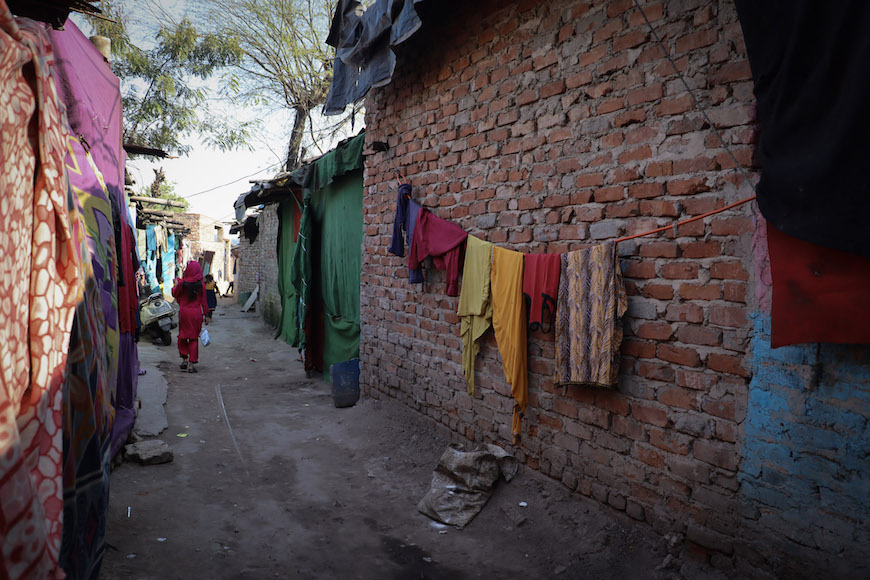
Majnu Ka Tilla, New Delhi, is home to hundreds of Pakistani Hindu refugees, where small makeshit homes are tightly packed together. Photo: Shivalika Puri
“There is no one like him,” Das says. “What he did for us is something no other leader or government would have even thought of. I am willing to sacrifice my years of life to extend his.”
It’s not an easy decision for our Hindu brothers to leave Sindh. They are refugees, leaving behind their ancestral land to seek a new life in India. This is not just about asylum seekers in India and Pakistan, but about the broader South Asian region, which must foster cross-border support and cooperation. — Assad Iqbal Butt, chairman of the Human Rights Commission of Pakistan.
But not all recently-coined citizens share the same perspective.
For 30-year-old Jamna, who has lived in Majnu Ka Tilla with her husband for eight years, life is a daily struggle. As she sits and sews a pillow cover – like most Pakistani Hindu girls and women in the colony – she says, “I’ve sewn every day for the past eight years. But I don’t want this life for my children. Right now, no one from our settlement has an office job or a government job. We’re surviving by either selling phone accessories or street food.”
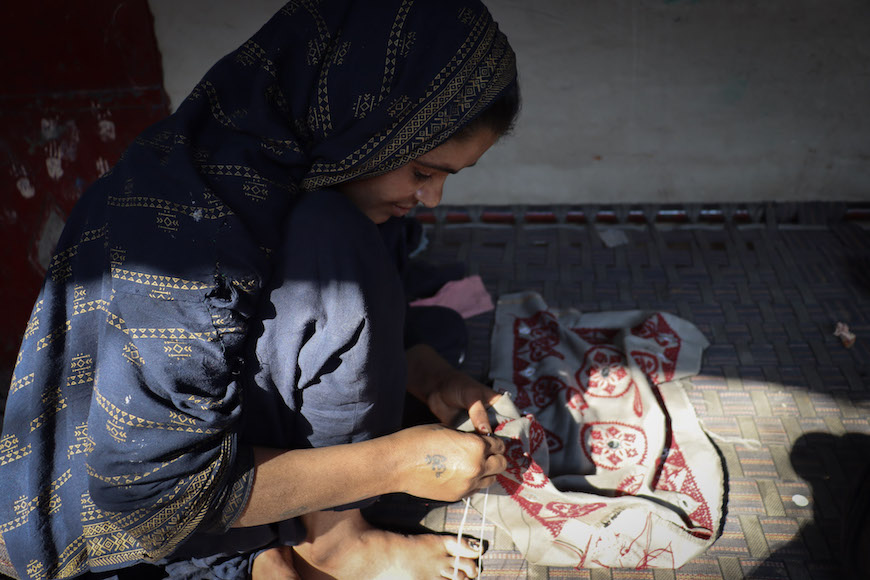
A Pakistani Hindu refugee woman weaves a pillowcase, threading hope into every stitch inside her makeshift home in the Majnu Ka Tilla refugee colony. Photo: Shivalika Puri
Her words reflect the struggles of young people here. Many young men remain unemployed or engage in menial labour. Young women, on the other hand, are confined to their homes, with parents focused on getting them married early.
Rajkumari Gulab, 18, spoke to Asian Dispatch with a sense of defeat even as she prepared for her final senior school examination. “I want to be a police officer, but this dream feels next to impossible,” she says. “Almost every day, men and their families visit my parents to ask for my hand in marriage. I wish the youth in our community had more support to find decent jobs and become successful.”
Equal rights and dignity of life to Hindus from Pakistan has been Modi’s campaign material since 2014. Last year, ahead of the General Elections in India, Modi met Pakistani Hindu refugees who got Indian citizenship under CAA. Modi’s party won the elections through a coalition of parties. While CAA has been at the heart of BJP’s rhetoric, its implementation has not been smooth. In 2022, Seemant Lok Sangathan, an Indian rights group advocating for Pakistani minority migrants, found that around 800 Pakistani Hindus who came to India in 2021, returned after no progress was made on their citizenship.
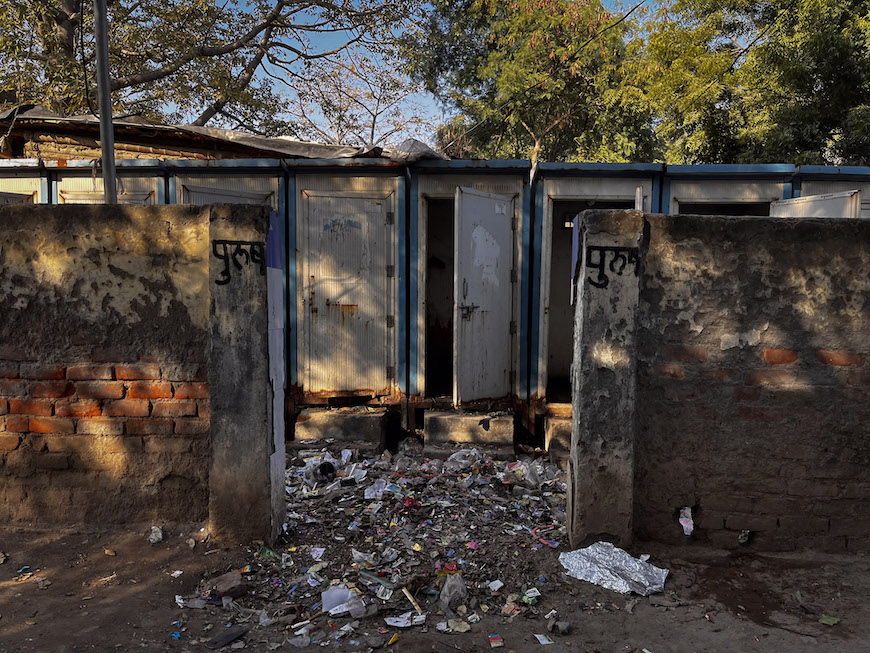
Neglected toilet facilities in Majnu Ka Tilla refugee colony, with overflowing garbage highlighting the lack of proper sanitation. Photo: Shivalika Puri
Many are still waiting. Under New Delhi’s Signature Bridge, spanning India’s sacred river Yamuna, an informal settlement has become home to Pakistani Hindus since 2014. They’re still waiting for citizenship. Not only are they excluded from voting rights but also welfare schemes. In Delhi’s harsh weather conditions, the refugees face everything from dangerous levels of air pollution to flooding.
READ: Kashmir’s First Election in a Decade Shows the Changing Face of Political Participation
A 50-year-old woman, who requested anonymity, says they have to be alert all the time. “We are surrounded by a jungle here. There are snakes and wild animals. Then, during floods every monsoon, our tents get submerged, forcing us to move to higher ground for safety. We don’t need money or food ration. All we want is a decent place to live.”
Hindu Singh Sodha, the founder and president of Seemant Lok Sangathan, emphasised that the real challenge goes beyond just granting citizenship.
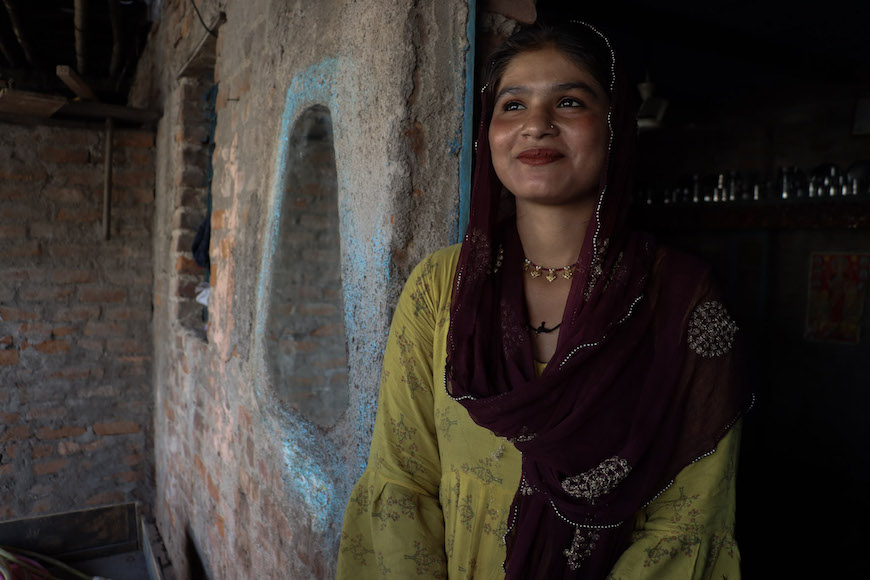
Rajkumari Gulab, 18, poses for a portrait inside her makeshift home in Majnu Ka Tilla refugee colony. Photo: Shivalika Puri
“Under the CAA, citizenship is only granted to those who arrived before December 31, 2014. So what about those arriving today? Has the persecution and discrimination against them stopped?” Sodha told Asian Dispatch. “I believe having a cut-off date for CAA eligibility is not justified. This is one area where the government needs to reflect and reform the law.”
Sodha also highlighted the complex and lengthy process to gain citizenship in India, which sidelines the real issue of rehabilitation. “[The citizenship process] can take 20 to 25 years but that alone does not solve their problems if [refugees] continue living in deplorable conditions,” he said. “The government must go beyond legal recognition and focus on structured resettlement, which includes access to housing, healthcare, and opportunities for livelihoods. Currently, there are no proper rehabilitation measures in place.”
As the fate of refugees and newly-minted citizens remains uncertain, Sodha says the government’s duties are far from over. “If refugees are left stranded, it will damage the government’s credibility and the trust of those who believed in India’s commitment to them.”
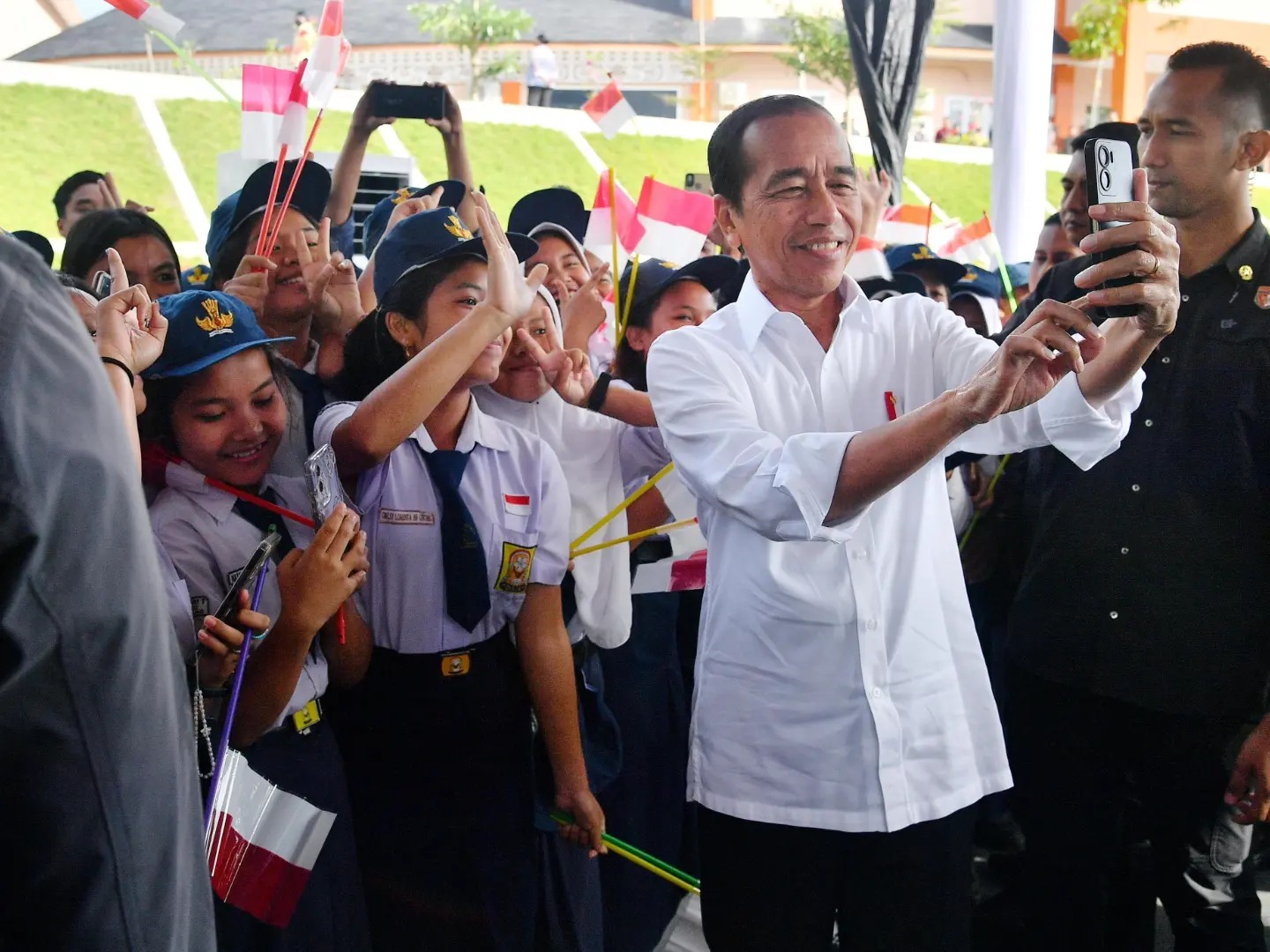
Outgoing Indonesian president Joko Widodo has sparked a global debate on dynastic politics. Photo: Facebook/President Joko Widodo
This year of elections has been nothing less than politically significant for Asia. There’s been mass protests, governments getting toppled, and new blood replacing legacy politics. But recent events in Indonesia have put a spotlight on a long-standing tradition across the world: Dynastic politics.
In the last few months, Indonesia has seen mass protests centered around its outgoing president, Joko Widodo, who rose to power on the backs of being non-elite and non-legacy in a country where the Yudhoyonos or the Sukarnos ruled the nation. Today, he’s being accused of promoting a political nepo-baby – his eldest son Gibran Rakabuming – who will be inaugurated as the vice president on October 20. The 37-year-old Rakabuming will be Indonesia’s youngest vice president.
Indonesia is not alone. Political families are everywhere: In India, there’s the Nehru-Gandhi family; Thailand has the Shinawatra clan; in the Philippines, it’s the Marcos or the Aquino families; and the US has the Kennedys and the Bush family. The appeal of influential families in politics is rooted in many things, including myth-making, leadership vacuum and local factors such as conflict, economic crisis and so on. But there are strong correlations between political dynasties and stunted economic development and corruption.
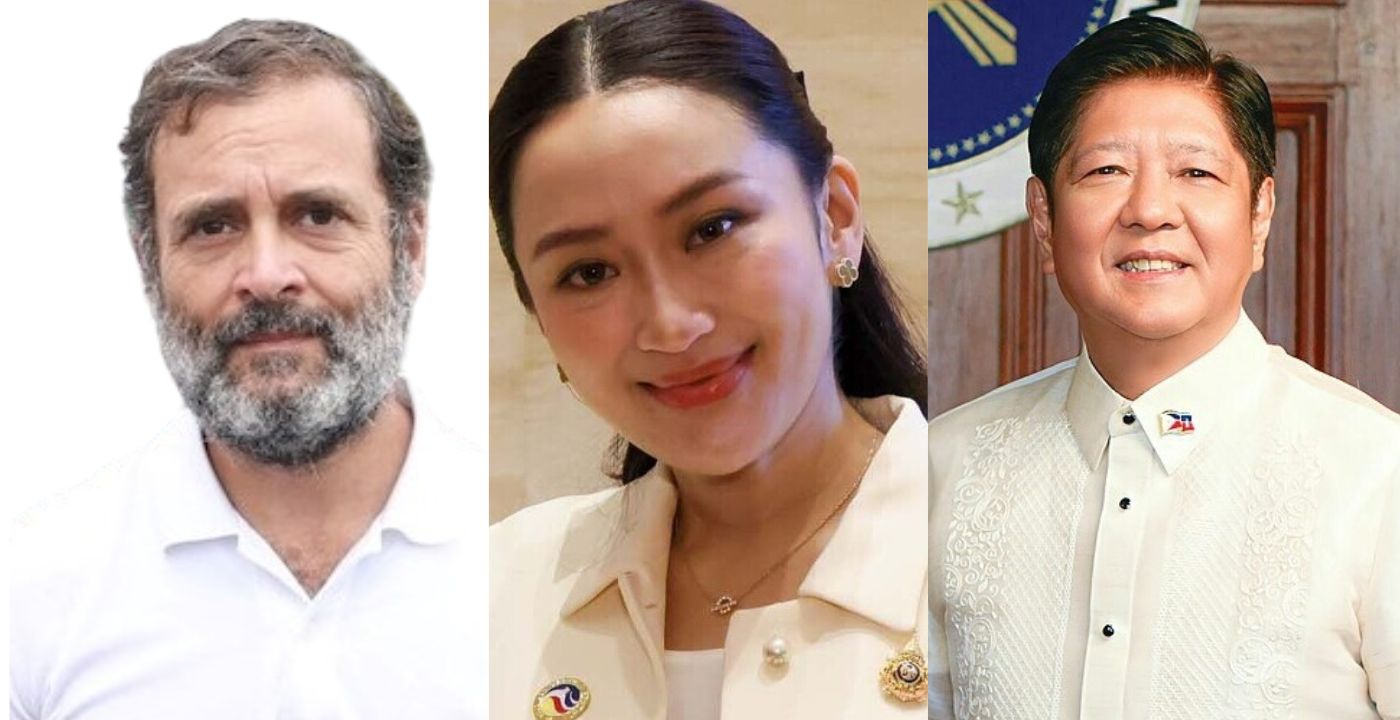
Scions of political dynasties in (Left to right) India, Thailand and the Philippines. Photo: Wikimedia Commons
On October 16, Asian Dispatch collaborated with Project Multatuli to host a webinar to find out why, despite the downsides, people continue to vote for political nepobabies. Titled ‘Dynasties and Democracy: Unpacking Indonesia’s Elections and the Future of Political Power in Asia’, the webinar featured Dr. Yoes C. Kenawas, a Post-Doctoral Research Fellow at Universitas Katolik Atma Jaya; Pana Janviroj, the former Executive Director of Asia News Network; and Endy M. Bayuni, the former Editor of the Jakarta Post. Project Multatuli’s Executive Director Evi Mariani moderated the session while Pallavi Pundir, the Editorial Lead at Asian Dispatch, provided the keynote address.
Indonesia is very significant for the world. It is the world’s largest archipelagic nation and with the fourth-largest Muslim population. The country is the driving force behind the hugely successful ASEAN and is of key interest to the US and China for geopolitical reasons. Indonesia also powers the world’s demand for key resources such as nickel.
Since his reelection in 2019, Jokowi – as Widodo is popularly called – has introduced several family members in politics. His eldest son Rakabuming became the mayor of Surakarta last year before being elected as the vice president this year. His youngest son Kaesang Pangarep, who was once a YouTuber and criticised for his lavish lifestyle, is the chairman of the Indonesian Solidarity Party. In 2020, Jokowi’s son-in-law Bobby Nasution became the mayor of Medan. Last year, Anwar Usman, a Chief Constitutional Judge and Widodo’s brother-in-law, was demoted by a judicial panel for lowering the age limit for presidential candidates, which enabled Rakabuming to become Prabowo Subianto’s running mate this year.
Official data, released by the Indonesian Ministry of Home Affairs, documented the rise of nepotism in politics and showed that between 2005 and 2014, 11 percent of candidates for the post of district chief and provincial governor were related by blood or marriage to the district head, legislator, governor, party chairman or president. That figure was 32 percent in 2020.
Here are some highlights from the conversation:
Why do political dynasties exist?
Pana Janviroj cited India as the “prototype of dynasty politics”, where the Gandhi family dug deep roots right from the day it gained independence in 1947. “The Gandhi brand still sells,” he added. “Big businesses supported the Gandhis. It’s a monopoly of politics, which decayed when you saw the rise of the Bharatiya Janata Party. This is not about democracy; it’s about power.”
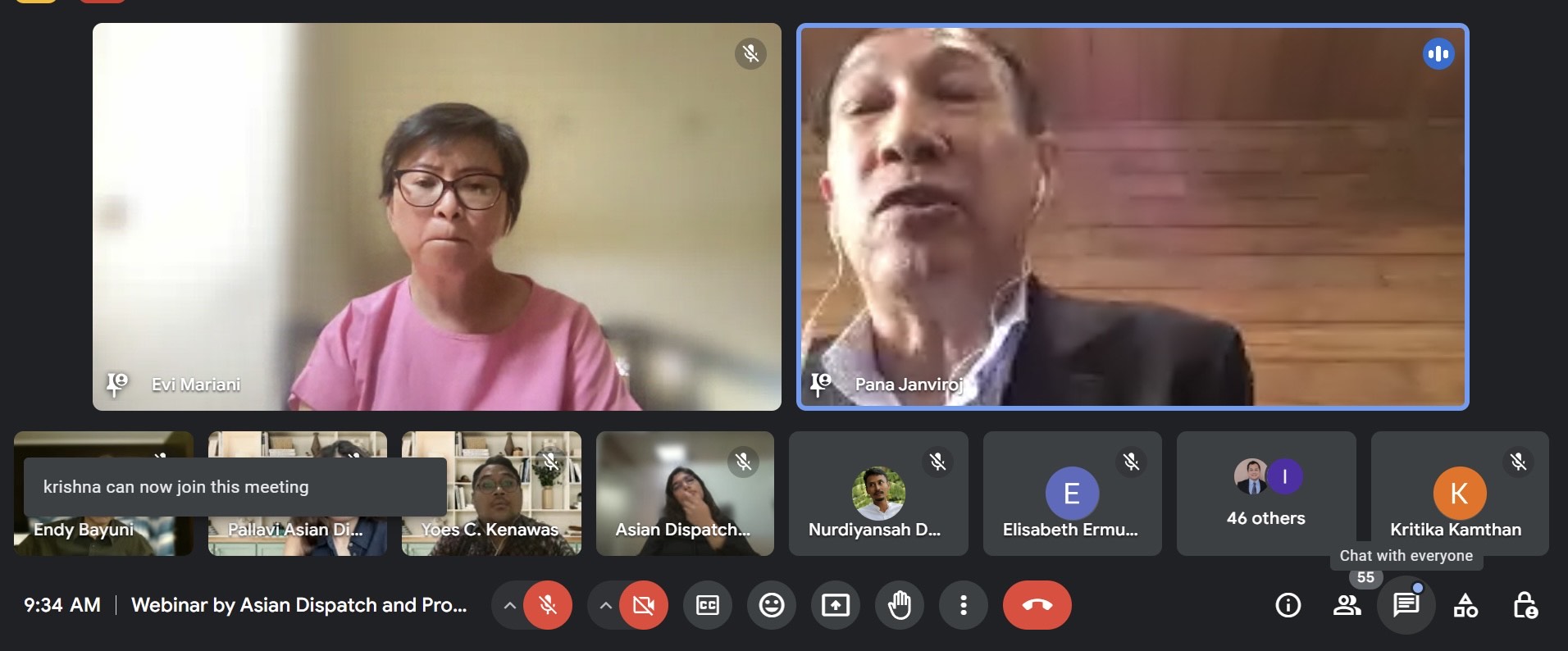
Pana Janviroj detailed what dynastic politics looks like in Asia.
Pana said that political dynasties start small, at a provincial level. Social media has made it easy for political families to brand themselves, especially for younger nepobabies. “The networking of these people makes it difficult for outsiders and independents to enter politics. This diversity affects the quality of government, whether it’s nepotism or professionalism.”
Despite knowing the ill-effects of political dynasties, how can functioning democracies platform their rule for so long? Endy M. Bayuni asked this question before noting that political families adapt to changing political times. “They were at the top, then democracy came, and they learned the rules of the game and how to beat the system,” Bayuni said. “In the case of Indonesia, they either build a political party or seize control of an old political party. Political parties are not run democratically, not in Indonesia. Power is very much concentrated in the hands of one person, often the chair.”
It is also cultural, Bayuni adds. “We live in patriarchal societies and with so-called Asian values such as deference to authority, to power, and an unwillingness to challenge that power. These political families know that, and once they’re in power, they manipulate it.”
Why do people keep voting for political nepobabies?
Global voting behaviours have shown that people are well aware of political dynasties. Often, the families or their successors openly promote their legacy, highlighting past contributions to the nation and peddling reassurances for the future.
Yoes C Kenawas, who has done extensive surveys documenting voting behaviours in Indonesia, found that people preferred political nepobabies than those candidates who rejected dynastic politics. “This was concerning because it reflects indifference,” he said. “That indifference didn’t just encourage political dynasties but also normalised them.”
Bayuni pointed to the February 2024 elections and noted how Prabowo running with Gibran won by an overwhelming landslide despite media reports of corruption. “People knew, and they still voted for them,” he said. “The same thing happened in the Philippines: Marcos Jr. came back to power – again through democratic elections. In Thailand, the Thaksin family is back in charge.”
“In Indonesia, we built democracy, had democratic elections, and somehow, today, we’re back to where we were 24-25 years ago, with a kind of authoritarianism,” Bayuni said.
Kenawas added that peoples’ vote is also shaped by the political elite and the corrupt processes they install. “[In Indonesia], what we have right now is just procedural democracy without substantive democracy,” said Kenawas.
The past 10 to 15 years has seen an increasing trend of dynastic politics at the subnational level in Indonesia, Kenawas noted, and much of it is due to regulatory policies too.
“One of the reasons why these dynastic politicians keep emerging is because there’s no regulation that prohibits politicians from building political dynasties,” said Kenawas. “Indonesia once introduced an anti-dynasty clause in its local elections law. Unfortunately, the Constitutional Court canceled it in 2015, resulting in an explosion of dynastic politicians at the national level.”
How Jokowi changed the rules of dynastic politics in Indonesia
Kenawas marks the current political developments in Indonesia as exceptional in its history after Jokowi introduced political succession at a national level. Even Suharto – the military dictator who was the longest serving Indonesian president with a term that began in 1968 and ended in 1998 – didn’t have dynastic succession at a national level, he added. The year 1998 is marked by a movement called the Reformasi, which dethroned Suharto and brought in sweeping political, economic and grassroots changes that, among others, detailed ways to eradicate corruption, collusion and nepotism. Jokowi has overturned these efforts.
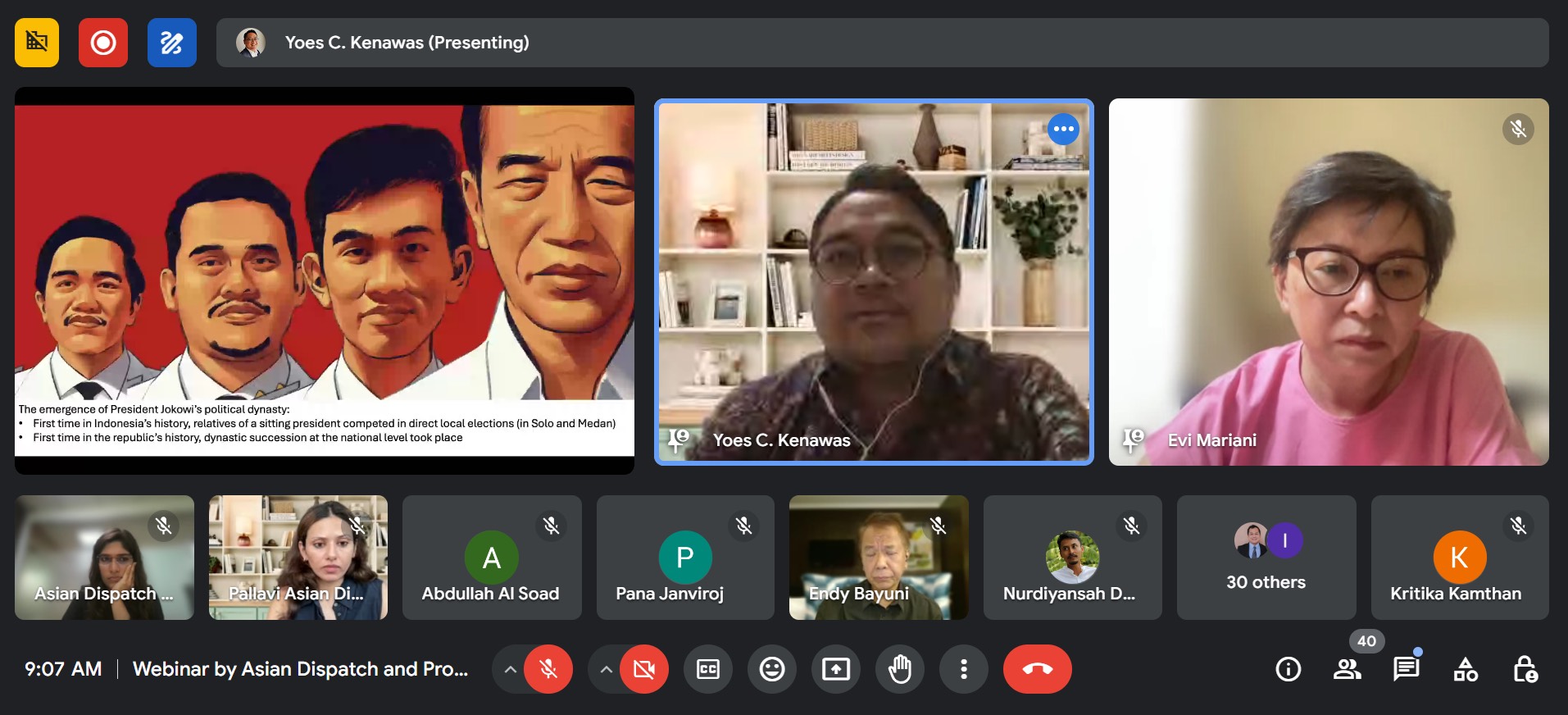
“Today,” Kenawas remarked, “What we have is the perfect example of nepotism, presented by the president himself, who was touted as the man of the people, someone who came from a non-elite background. For the first time in Indonesia’s history, [a president] has relatives who will compete in the upcoming gubernatorial election. Most importantly, for the first time in the Republic’s history, dynastic succession is taking place at the national level, with his son, Gibran Rakabuming – or Raka – being elected as vice president.”
What is the way forward?
Bayuni said that he’s a believer in democracy despite all the doom and gloom. “But democracy has effective checks and balances between the different branches — executive, legislative, judiciary— with credible and strong law enforcement,” he said. “The regulations have to ensure that these checks and balances are effective.”
Even more important, he added, is the role of the fourth estate, the independent and critical media. “This is to ensure that during elections, voters make informed decisions,” Bayuni added. “This February, the Indonesian media failed to enlighten the public. That’s why Prabowo and Gibran won the election. They had public opinion behind them.”
You can hear the recorded conversation on our YouTube below:
In a historic victory, an alliance of opposition political parties has won the assembly elections in the Indian Union Territory of Jammu & Kashmir. Omar Abdullah – who previously held the office from 2009 to 2014 – will make a comeback after nine years.
The election outcome is significant for one of the world’s most militarised zones, which is holding its first assembly elections for the first time in a decade. Voters turned up in historic numbers to elect 90 members for the union territory’s Legislative Assembly.
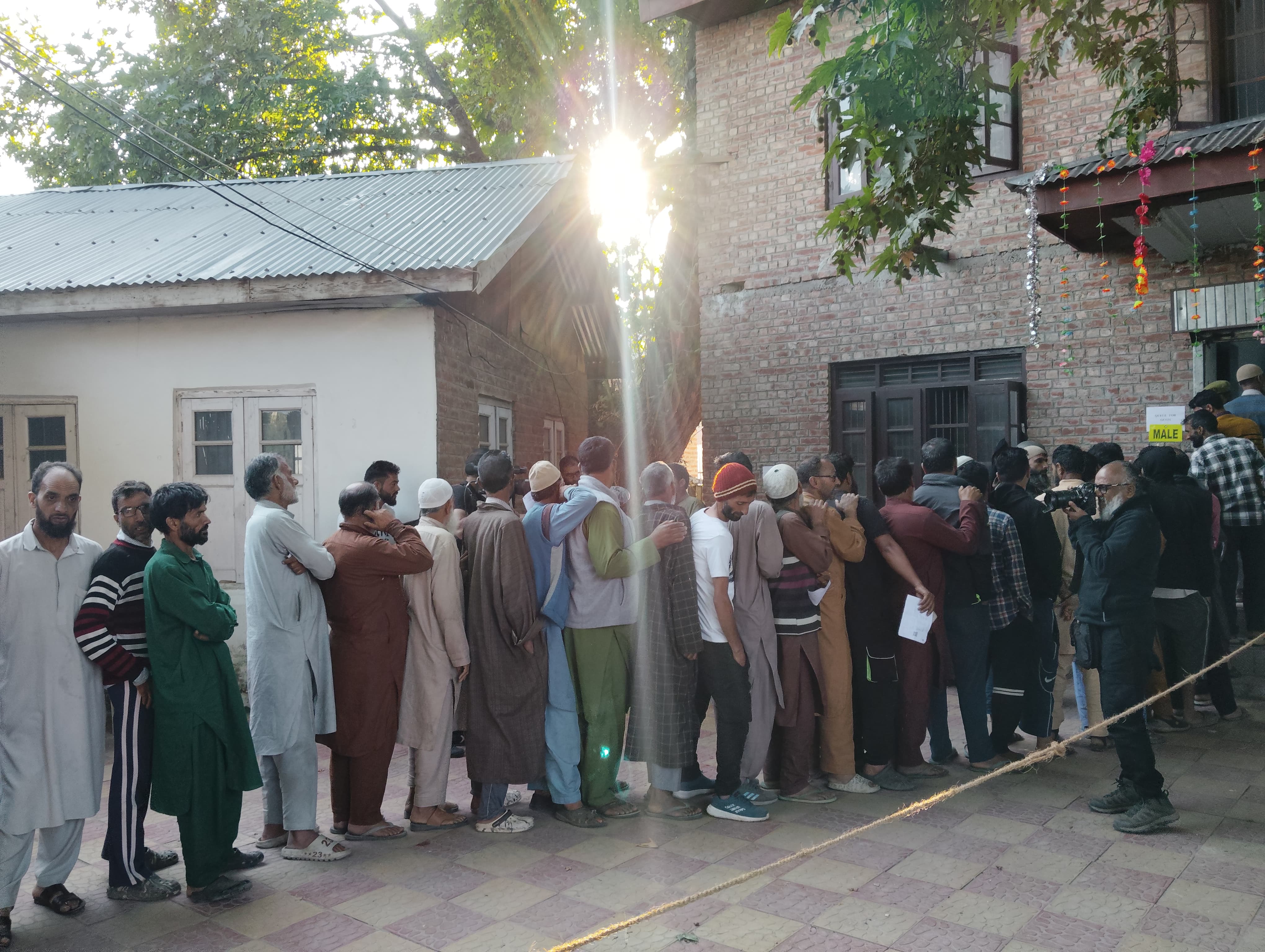
People line up at a voting booth in Pulwama district of Kashmir on September 19, 2024. Photo: Nasir Khuehami
The Kashmir region is at the heart of conflict between India and Pakistan. Both the nuclear-armed countries govern parts of the region but claim it in its entirety. For the last three decades, an armed separatist movement in the Union territory of Jammu & Kashmir has led to the deployment of around 130,000 military personnel, of which around 80,000 are stationed at the country’s border with Pakistan. The fate of Kashmir is an international issue and many of India’s powerful allies, including the US, avoid taking sides while maintaining that the two countries should consider the wishes of the people of Kashmir.
In August 2019, Indian Prime Minister Narendra Modi and his ruling Bharatiya Janata Party (BJP) revoked a long-held autonomous status – secured within Article 370 and 35A of Indian Constitution – of Jammu and Kashmir. For the BJP, it was an election promise meant to restore India’s administrative control over India’s only Muslim-majority state. For the Kashmiris, the move led to rising unemployment, continued violence and free reign by the federal government over its profitable natural resources.
These elections came three years after the timeline promised by the Modi government, and were held after the Supreme Court issued an order last December. In the past few decades, Kashmiris have boycotted elections in the region as a protest against the demotion of Kashmir.
Autonomous or not, Kashmiris exhibited their electoral choices after a long time this time.
Changing face of Political Participation
The election saw Modi’s BJP pitted against an alliance of the National Conference (NC), the Indian National Congress (INC), National Panthers Party and Communist Party of India (Marxist). The NC and its dynastic Abdullah family have dominated politics in Kashmir for decades.
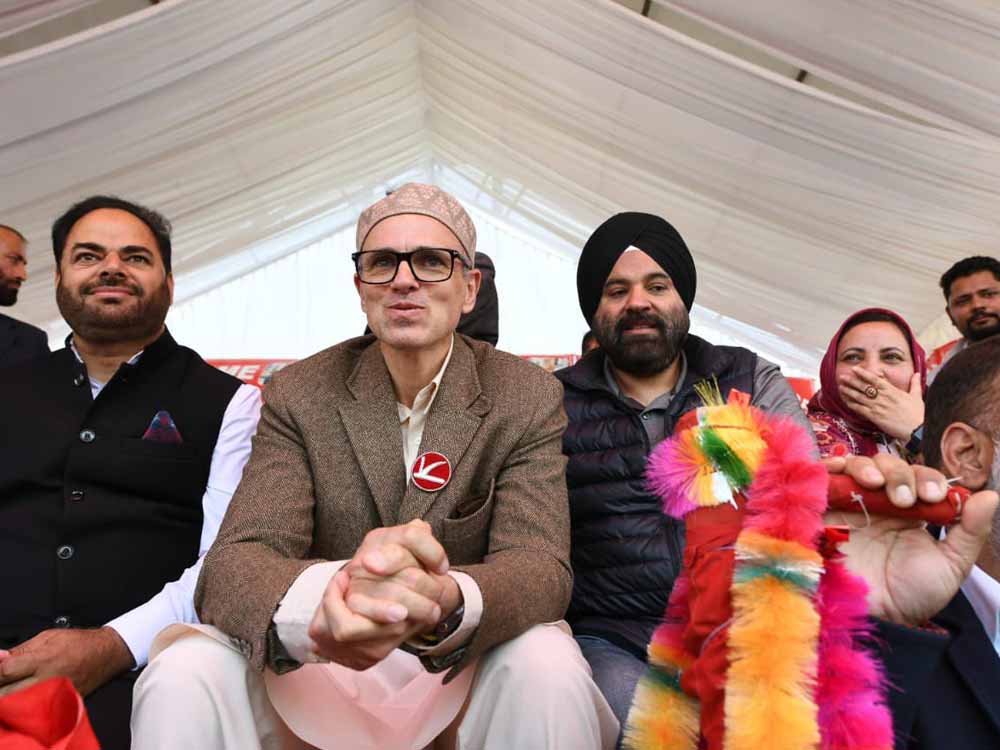
Omar Abdullah (center) is set to be the Chief Minister of Jammu & Kashmir once again. Photo: JKNC
These elections also saw the rise of independent candidates, some of whom had been arrested during the protests after the abrogation of 370 and 35A in 2019. One of them is Abdul Rashid Sheikh, an independent candidate known widely as “Engineer Rashid”, who was arrested under India’s draconian anti-terror law, the Unlawful Activities (Prevention) Act (UAPA) in 2019. He defeated Abdullah in the 2024 Lok Sabha Elections and last month, he was granted bail to campaign for these elections.
As the Indian opposition accused the BJP of having “non-locals running Jammu and Kashmir”, local representatives like Rashid came to symbolise the rising political participation of Kashmiris.
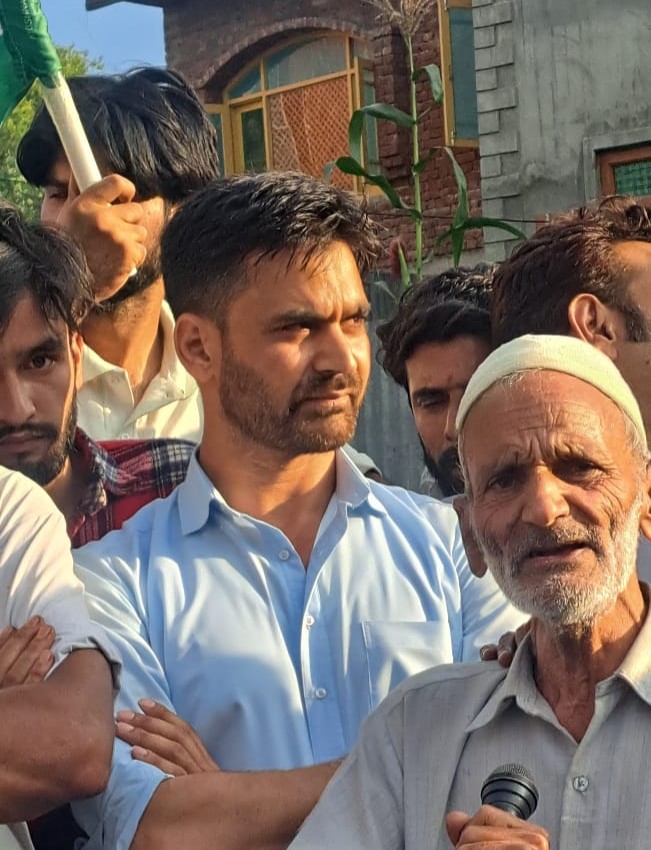
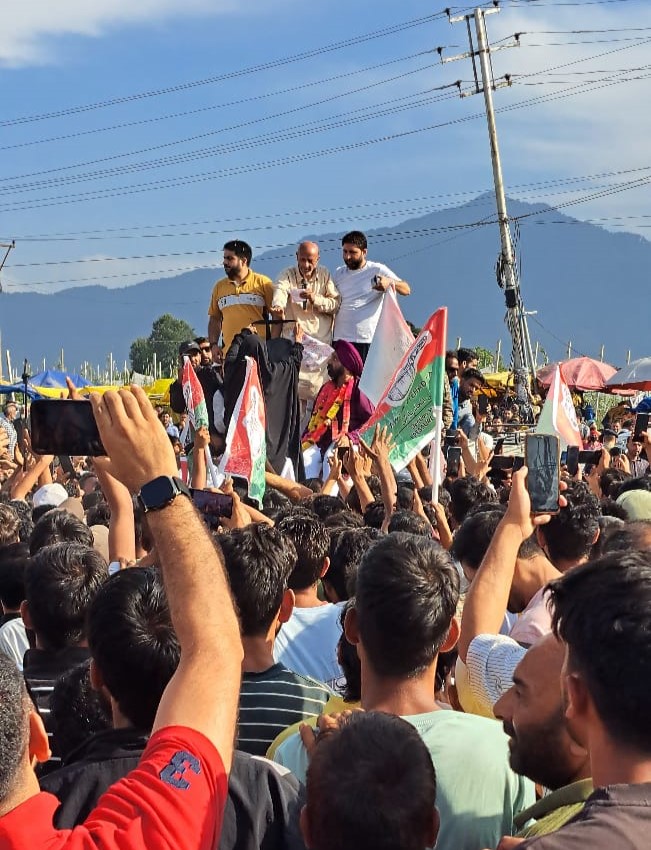
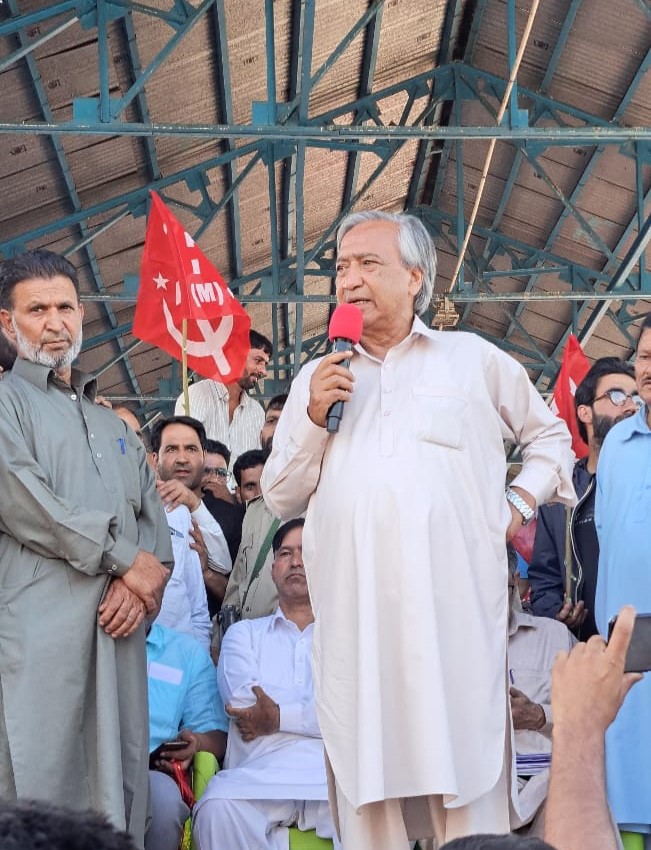
Caption: (from left to right) a) PDP’s Waheed Para, who won Pulwama seat b) Engineer Rashid addressing a crowd c) CPI(M) leader Mohammed Yousuf Tarigami. Photos: Naseer Ahmad
“Since 2019 particularly, a feeling of disenfranchisement has run very deeply in the Kashmiri psyche,” Yaqoob-Ul-Hassan, a research analyst at the Indian government-funded think tank Manohar Parrikar Institute for Defence Studies and Analyses, told Asian Dispatch. “[The Kashmiris] may dislike the NC or the PDP as entities, but they still see the representatives from these parties as one of their own.”
For Sumantra Bose, a comparative political scientist and author of Kashmir at the Crossroads: Inside a 21st Century Conflict, the popularity of representatives like Rashid is a gesture of protest. But it also reflects Kashmiris’ dissatisfaction with legacy parties.
“Both Omar Abdullah and the NC party have a long history of what many in the Kashmir valley regard as collaboration with Indian authorities,” Bose told Asian Dispatch. “Even though NC is the historic party for the region, Omar Abdullah was Chief Minister during the stone pelting uprising of 2010, which was suppressed very harshly.”
In 2010, Indian Army soldiers killed three Kashmiri civilians, citing it as an anti-militancy operation against Pakistani infiltrators but was later found to be staged. The incident triggered state-wide protests demanding reduction of troops. The Indian government grants special privileges to the armed forces in Kashmir – under the The Armed Forces (Jammu and Kashmir) Special Powers Act – to operate under impunity and emergency powers. The 2010 protests killed over a hundred people – mostly civilians.
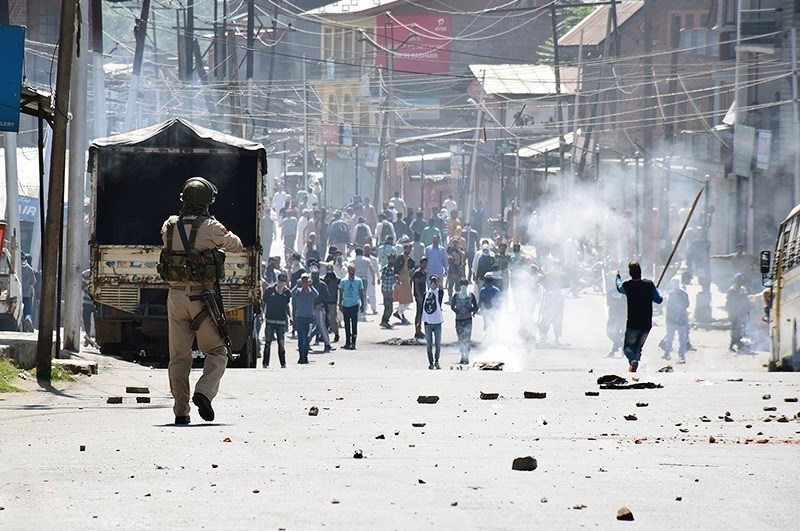
Police confront protestors in Kashmir during a December 2018 demonstration. Photo: Seyyed Sajed Hassan Razavi via Wikimedia Commons

Bose added that other legacy parties including the People’s Democratic Party (PDP) and its leader Mehbooba Mufti are similarly infected too. Mufti was the chief minister during the violence of 2016-17. At that time, her party’s failed coalition with the BJP left the region at the mercy of federal rule.
However, Waheed Para, the PDP candidate from Pulwama constituency who won the seat by over 8,000 votes yesterday, reaffirmed the popularity of his party and told Asian Dispatch that these elections are different.
“For the first time, all sorts of ideologies met at the ballot box. From the so-called ‘anti-nationals’ to the UAPA-accused, to the detained people to mainstream— all political ideologies are participating in the process,” said Para. “Today, democracy is seen as defiance and a means of resistance. It is not about violence anymore. So young people are inspired to vote.”
Bose added: “Rather than the product, it is the process that is more important. The people are getting to vote again, and the turnout over three polling days has been significant. It signals the return in some form of normal cognitive politics.”
In the Hindu-majority Jammu region, the BJP dominated and won 29 seats out of 43. However, that win doesn’t dilute the misgivings Kashmiris have about the events of 2019.
An election in the shadows of 2019
In 1947, when India gained freedom from British colonisation, the state of Jammu and Kashmir was granted special autonomy that allowed self-governance on issues ranging from transfer of land to defining permanent residents and granting state benefits. The provision has been at odds with successive governments, who used presidential orders to gradually reduce those privileges. In August 2019, when the BJP abrogated Article 370 and 35A, it created the Union Territories of Kashmir and Ladakh, which places the region directly under the federal government.
Since then, human rights watchdogs such as Amnesty International have highlighted consistent efforts by the federal government to crush political participation that opposes the BJP. Activists, journalists and academics have been detained and harassed arbitrarily. Dissenters are widely punished through the ambiguous public safety laws. The federal government has announced many plans to bring private investment in, which is likely to be a double-edged sword for a region that is also on the frontlines of climate change.
“Grassroots political activity was stifled through fear and persecution. Even the likes of Omar Abdullah and Mehbooba Mufti have been imprisoned for considerable periods,” said Bose. “The agenda was to virtually erase competitive politics from Jammu & Kashmir.”
The current election, locals told Asian Dispatch, may have fuelled local political participation. But 2019 looms large in public memory.
INC’s Suhail Bukhari told Asian Dispatch that the people have clearly indicated that the central government’s actions in Kashmir are unacceptable, and that the results favour anybody who stands against the BJP and the Rashtriya Swayamsevak Sangh, BJP’s ideological parent.
“Generation after generation, Kashmiris have given so much to this country. By blood and conviction, we’re Indian — and yet, we are treated differently,” Nasir Khuehami, the National Convenor of the Jammu & Kashmir Students Association, told Asian Dispatch. “Our leadership was stripped away, ignored and detained, and if the condition of local politicians and activists has been so terrible — think of the common man.”
What next?
In the lead up to the current elections, the rhetoric of Naya Kashmir, or “New Kashmir”, has dominated mainstream Indian media narrative, which is in line with the BJP’s co-opting of the 1944 manifesto that outlined the autonomous status of the region. Modi’s government turned the term around to signal massive changes as part of its campaign to dominate regional politics in Jammu and Kashmir.
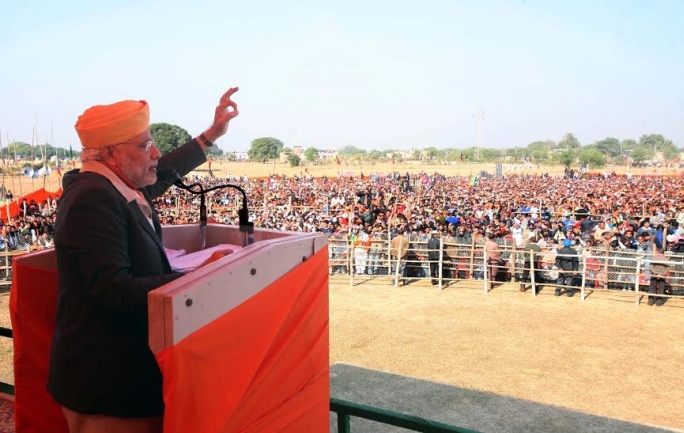
BJP’s Narendra Modi speaks at a campaign rally in Jammu & Kashmir in December, 2014. Photo: Prime Minister’s Office via Wikimedia Commons

Khuehami told Asian Dispatch that many issues such as high levels of unemployment, especially among the youth, directly counter the Naya Kashmir narrative. Since 2019, the Modi government has also been hosting foreign diplomats and dignitaries for guided tours of Kashmir, which critics say is designed to establish an insincere global narrative of a supposed normalcy and acceptance of the BJP’s 2019 ruling among the people.
“[The Modi government] brought all these sheikhs from Dubai, these big businessmen, with promises of jobs and recruitment. But on the ground, the reality is very different. Where is the prosperity? Where is the development?” said Khuehami.
Hassan, the research analyst, says that the BJP’s proclamation of Naya Kashmir isn’t entirely false. “The violence has gone down, there are no protests or strikes, and tourists have been coming in great numbers,” he countered before adding, “But militancy going down does not mean it won’t come back. We’ve seen the decline of insurgency [in Kashmir] in the past also,” he said. “But with some sort of a click, it could go up again. It’s down, but not gone.”
Violence and deaths in Kashmir has continued, with spikes in militant deaths and no sustained decline in civilian deaths, but official figures claim an era of peace. Bose says that figures of declining violence is a myth and artificially generated.
“It’s true that stone-pelting has declined post-2019 but that’s because of extremely draconian repression. There’s no guarantee that just as insurgency hasn’t gone away, that kind of uprising won’t come back,” he said. “(The decline) should come about through a genuine improvement in people’s situations.”
In the current elections, almost all parties promised restoration of statehood in some form. After the results, Abdullah reiterated that his party would work with the central government to bring back Article 370. Previously, Modi had also promised to reinstate statehood too but that “only the BJP will fulfil this commitment”.
National Conference spokesperson Tanveer Sadiq told Asian Dispatch that the people have reaffirmed their faith in them, and they look forward to doing everything to restore Kashmir’s political status while also ensuring jobs and work on everyday issues. However, Safiq added, a working relationship with the Center is vital for any of that to happen.
“The BJP-led government in the Center has to understand that now that people have given the mandate to the NC-Congress alliance, it becomes incumbent on the Central government to have a cordial relationship,” said Sadiq. “The Center and State need each other to ensure that states like Jammu & Kashmir become prosperous.”
Khuehami is optimistic about the question of accountability in the state. “We know that if they don’t stand up for us, we can vote them out. This is why people came out and voted,” he said. “We kept aside our political differences to preserve our identity, to get back our dignity—through this vote.”
Had it been any other time in Sri Lanka’s history — outside of an election — a leader from the country’s ethnic minority, Tamil, calling for a referendum on self-determination and constitutional changes to establish a separate homeland would have likely faced imprisonment. It’s also possible the leader would never have been seen again.
But it is not so for Pakkiyaselvam Ariyanethran, Sri Lanka’s first Tamil common candidate – meaning one endorsed by several Tamil civil society and political parties – standing for the 9th presidential elections in the island nation on September 21.
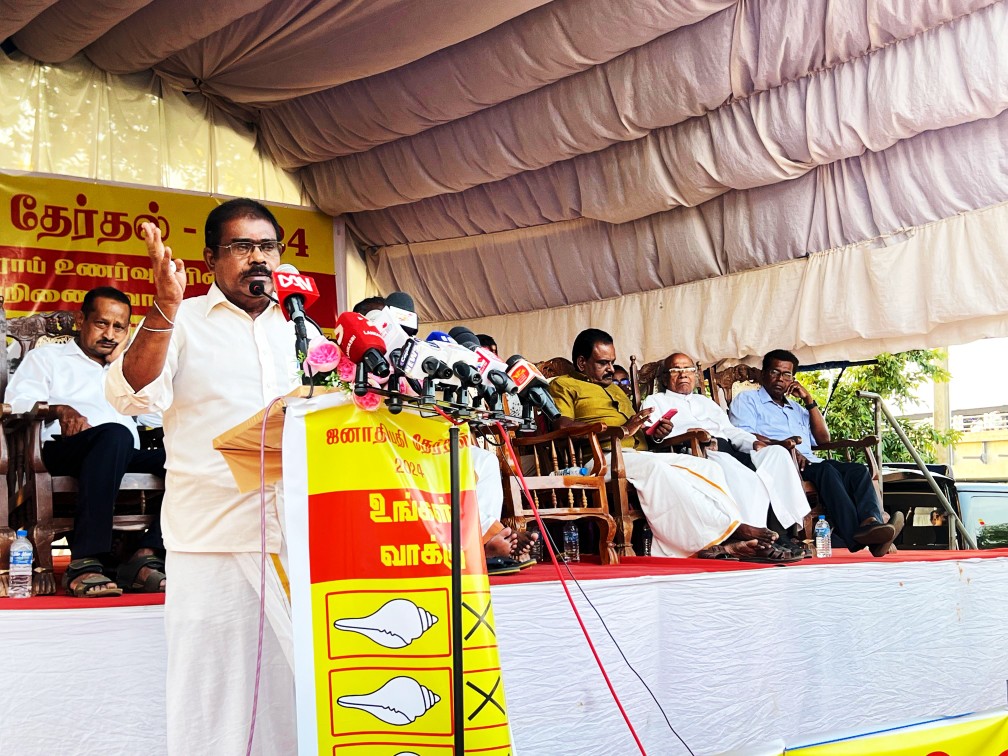
The candidate addressing a crowd in Vavuniya in Sri Lanka. Photo: Ariyanethran’s Facebook page
“This should have happened in 2010,” Ariyanethran tells Asian Dispatch, referring to the year after the Sri Lankan state put a brutal end to an armed conflict between them and a separatist Tamil movement.
Since the end of the Mullivaikkal massacre, we’ve seen three presidents come and go. Each one secured our vote but lost our trust. We no longer have faith in them. —Ariyanethran
Ariyanethran is referring to the last phase of Sri Lanka’s 25-year civil war between the Sri Lankan state and the separatist Tamil government called the Liberation Tigers of Tamil Eelam (LTTE). LTTE’s separatist government arose out of decades of discriminatory laws and policies in the Sinhalese-majority island nation. The Sinhalese people constitute 75 percent of the country’s 23 million population, while the Tamil are 11.2 percent of it.
The incidents Ariyanethran speaks of took place in a northern village called Mullivaikkal, where thousands of Tamil civilians taking shelter in government-assigned “safe zones” were bombed.
The civil war may have ended in 2009, but the wounds from its violent end are palpable even now. For Sri Lanka’s government – which is dominated by Sinhalese leaders – any mention or memorialization of Tamil separatism or nationalistic expressions leads to crackdowns and state repression.
This is why, Ariyanethran’s candidature is a significant moment in Sri Lankan politics. He isn’t the first candidate to have been fielded in a presidential election. Ariyanethran recalls Kumar Ponnambalam, who ran in 1982, and Sivajilingam, who ran in 2019.
But there was one difference between past candidates and him.
[The previous candidates] ran independently. For the first time, 83 civil organisations and seven Tamil national political parties have united to make this collective decision on behalf of the Tamil people. —Ariyanethran
Ariyanethran’s candidacy marks a new chapter in challenging long-standing political norms in the country.
Ariyanethran stands against 37 other candidates across the country – including frontrunners Ranil Wickremesinghe, Sajith Premadasa and Anura Kumara Dissanayake. At the moment, Sri Lanka is still emerging from the shocks of a crippling economic crisis and foreign debt. It is coping with a crisis of governance of 2022, when anti-government protesters drove then president Gotabaya Rajapaksa – who played a key role in the Civil War – out of power. Economy has been at the forefront of most people’s demands but for Tamils, the economic and social strife go decades back.
“We Tamils have endured hardships that have tested us to our very core: Death threats, bombings, kidnappings, murders, extortion,” says Ariyanenthiran. “But I’m not scared.”
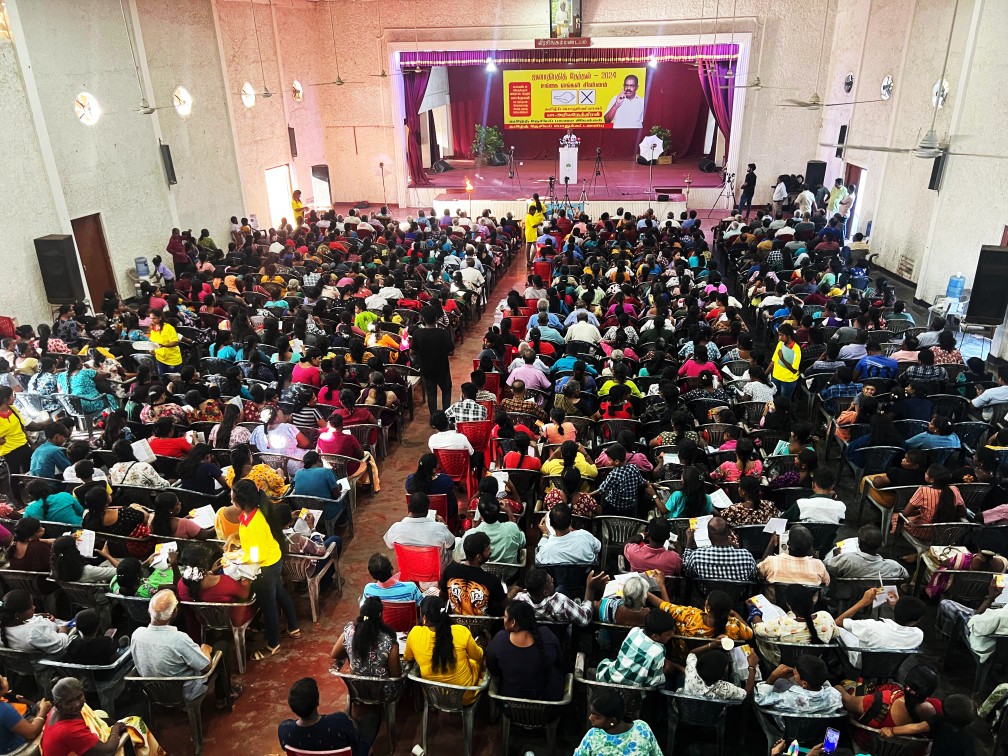
Pakkiyaselvam Ariyanethran addressing a crowd in Vavuniya in Sri Lanka. Photo: Ariyanethran’s Facebook page
Ariyanethran’s own journey started in the early 2000s, when LTTE governed parts of northern Sri Lanka. The politician was an editor of an LTTE newspaper called Thamil Alai (Tamil Wave), after which he was inducted into the Tamil National Alliance, an alliance of Tamil-led parties that support Tamil self-determination. In its initial years, the TNA supported LTTE’s negotiations during the war. Ariyanethran’s first entry into the parliament was in 2004 with TNA and was re-elected in the 2010 parliamentary elections.
This year, the Ilankai Tamil Arasu Kachchi, Sri Lanka’s oldest and the most prominent political party representing the Tamils, announced Ariyanethran’s ticket under their political party.
In modern-day Sri Lanka, ITAK’s manifesto is bold. It calls for a new constitution recognising Tamils as a sovereign people with the right to self-determination. It also calls for the establishment of Sri Lanka as a plurinational state, the return of Tamil land confiscated during the war, and the right for Tamils to seek international assistance in determining their political future. Additionally, the manifesto addresses the protection of Upcountry Tamils and demands the perpetrators of crimes committed during the war be brought before the International Criminal Court.
For Ariyanethran, his candidacy is deeply personal too. He says it honours the legacy of ITAK’s founder, SJV Chelvanayakam, affectionately known as “Thanthai Chelva” (‘thantai’ translating to ‘father’). Chelvanayakam is regarded as the father of Tamil nationalism and with ITAK, he advocated federalism as a means to share power between Sri Lanka’s majority Sinhalese and minority Tamils. In 1977, his resolution for an independent Tamil state received overwhelming support in the parliamentary elections. But decades after that saw only unfulfilled promises and failed negotiations with successive governments.
“It is time for the Sri Lankan government and the international community to recognise [the Tamil right to self-determination],” Ariyanethran says.
Despite the enormity of the challenge, Ariyanethran has been actively campaigning in the Tamil-majority North-East, urging Tamils to cast their votes for liberation.
“There is overwhelming support,” he says. “People tell me it’s a good decision. They hope that the 9th president will deliver a political solution for the Tamils and recognise that we should not be deceived again. Tamil votes matter.”
Interestingly, running for presidency was Ariyanethran’s original plan. “The party has been discussing this for over six months, even before the elections were announced,” he reveals. “I am a member of ITAK and the deputy chairman for the Batticaloa district. I joined the party in 2004, but I had no intention of running for office.”
However, after attending several party meetings and voicing the concerns of Tamils, Ariyanethran found himself among 45 potential candidates. “I was chosen,” he says simply, “And I accepted.”
Seventeen million people are eligible to vote on September 21 to elect the next president of Sri Lanka. Exactly one tenth of this population –1.7 million voters– are migrant workers, living outside their home country. And unless they travel home, they cannot vote.
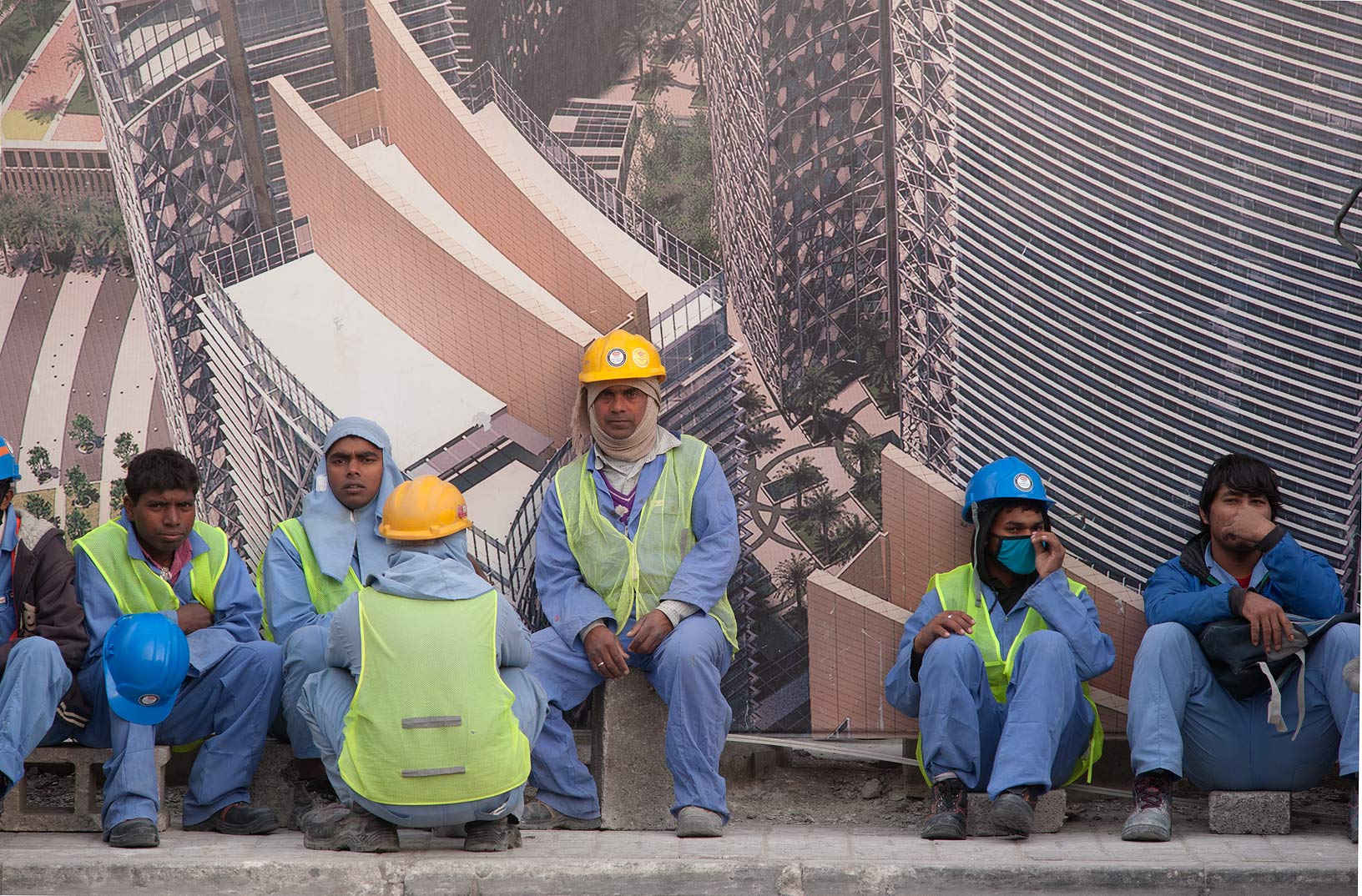
Migrant workers from Asia in Doha, Qatar. Photo: Alex Sergeev/Wikimedia Commons

Despite the island’s remittance economy, there is still no way for Sri Lanka’s migrant worker community to vote from their current location.
“In my 20 years as a migrant worker, I have never voted during a single election. During COVID-19, when migrant workers were trying to return home amidst border closures, some politicians called us ‘COVID bombs’, but when the economy crashed in 2022, they wanted our dollars to save the country,” says Nilu Athukorala, 40, a domestic worker based in Kuwait.
At the age of 18, Athukorala left her village near Kurunegala, a district in North Western Sri Lanka. She obtained her national identity card with the intention of going abroad.
“I have a son in Sri Lanka. I have sent every cent I earned back home. It was only last year that I opened a bank account for myself. I have sent my earnings home for 20 years, but have never depended on any government welfare scheme,” Athukorala told the Center for Investigative Reporting (CIR).
Remittances into Sri Lanka reached over 1,500 million dollars (approximately 452 billion LKR) in the first quarter of 2024, according to the Central Bank of Sri Lanka (CBSL). Yet, over a million Sri Lankans working abroad will not be voting this year too. Nearly a million of them are working in the Middle East on short-term contracts, and plan to return home someday. This is in contrast to those based in the Global North, where obtaining permanent residency remains an aspiration.
Senarath Yapa, Additional General Manager (International Affairs), Sri Lanka Bureau of Foreign Employment (SLBFE), said that ahead of the September 21 Presidential Election, the bureau has received three separate requests from Qatar-based workers to facilitate them to vote.
“These requests were duly forwarded to the Election Commission through the Ministry of Labour and Foreign Employment,” Yapa told CIR.
“We have received many such requests before. This time, requests came from three worker groups,” said Saman Sri Rathnayake, Commissioner General of Elections.
There had been no satisfactory response from the authorities to the demand for facilitating voting from abroad.
Migrant workers, especially those working in the Middle East as low-skilled workers face serious problems, but their plight is largely seen as a distant struggle. However, when the economy crashed, it was the migrant workers the government called upon to help revive the economy.
Votes with no Value
Athukorala argues that voting by migrant workers is not facilitated because politicians fear their power due to the large number of workers.
They cannot predict how we would vote and are possibly worried about having to cater to our demands. We get little or no help from the Sri Lankan authorities when we encounter problems. My calls to the embassies in 20 years have always gone unanswered. –Nilu Athukorala, a domestic worker based in Kuwait.
The Centre for Working Women (CFWW) has been advocating for migrant workers’ voting rights since 1996. CFWW agrees that enabling workers to vote would exert pressure on the authorities to focus on migrant workers’ rights.
“Article 14 of the United Nations Convention on the Rights of All Migrant Workers and Members of their Families specifically refers to their voting rights. Sri Lanka ratified the Convention in 1996 but has not introduced an enabling law. Successive governments have shown no interest in enacting domestic laws to address these issues,” says Amali Kalupahana, President of the CFWW. “Migrant workers face multiple problems in destination countries. They are abused and sometimes abandoned without help or resources. If they are facilitated to vote, them some of these issues will come to the fore and might get addressed through government-to-government labour agreements.”
D.M.V. Dissanayake, an independent election analyst who has observed elections for two decades, insists the non-facilitation of migrant workers to vote amounts to a violation of their fundamental rights.
“Migrant workers in the Middle East are among the most marginalised people yet they line Sri Lanka’s economy,” Dissanayake told.
Meanwhile, the three frontrunning presidential hopefuls this year have included migrant workers’ concerns in their manifestos. Samagi Jana Balawegeya (SJB) candidate Sajith Premadasa has promised to amend the election law to allow workers to vote from abroad while the National People’s Power (NPP) candidate Anura Kumara Dissanayake has pledged to safeguard the voting rights of international labour migrants. Incumbent President Ranil Wickremesinghe’s manifesto promises to amend the Foreign Employment Bureau Act to provide workers with ‘better facilities and working conditions’.
According to Priyantha Weerasekara, AGM (Local Affairs) and Information Officer, SLBFE, the estimated number of migrant workers in the Middle East is around 878,510. However, the total number of Sri Lankan migrant workers around the world is much higher as the bureau has statistics on only those who have registered with the SLBFE.
“We base this number on the data we get from embassies or interior ministries in destination countries – that’s mainly the Middle East and low-skilled workers. We don’t have the numbers from countries like Canada and the United States,” he told CIR, explaining existing data gaps.
Weerasekara added that an estimated 300,000 migrant workers were based in the United Arab Emirates (UAE) – data also reflected in CBSL’s quarterly bulletin on labour migration. The bulletin states that even out of the 75,175 labour migrants in the first quarter of 2024, nearly 81% headed to a Middle Eastern destination.
| Country | Estimated number of Sri Lankan Migrant Workers |
| United Arab Emirates (UAE) | 300,000 |
| Saudi Arabia | 180,000 |
| Qatar | 113,000 |
Source: Sri Lanka Bureau of Foreign Employment (SLBFE)
Out-of-Country Voting
Chandana Sanjeewa Perera, 50, who currently works in Germany, terms the lack of facilitation to vote a “human rights violation”.
“We understand the lack of funds to facilitate migrant workers to vote this time. When Gotabaya Rajapaksa ran for presidency in 2019, many workers returned to Sri Lanka to vote, but this time, workers may not do that. Although we work in countries like Australia, the US and Canada, many cannot bear the travel expenses. We prefer an online voting or similar process. Post election, we plan to exert some pressure on the new administration to address this issue,” said Perera, who had worked in the UK, Italy, and Germany.
In the 2019 Presidential Election, out of 15,992,096 registered voters, only 13,387,951 voters had cast their vote, raising questions as to why over 2.6 million eligible voters did not vote.
Manjula Gajanayake, Executive Director, Institute for Democratic Reforms and Electoral Studies (IRES) told the CIR that out-of-country voting, if facilitated, would allow registered voters living abroad including students and workers.
“Everyone has the right to vote even though some may be living abroad. The problem is facilitation. There are many advance voting systems like voting through embassies but unfortunately, Sri Lanka only uses postal voting as an advance voting mechanism. This results in the exclusion of migrant our worker population,” he said.
READ: What Sri Lanka’s Unpredictable Elections Mean For the World
Kalupahana adds that since 2008, workers have advocated for the national policy and action plan on migration for employment, finally released in 2023. The policy recognises: “The right to vote as a fundamental right of all citizens. Ensuring voting rights for migrant workers will ensure migrant workers’ voices are reflected in national politics, are recognised by the political system and their contribution to national and socio-economic development.”
To move forward, a greater contribution from migrant workers is necessary, Kalupahana added.
“We need to help organise migrant workers as a pressure group,” she said.
Concerns
Kalupahana says that the authorities should ensure any voting process does not result in vote buying and exploitation.
People’s Action for Free and Fair Elections (PAFFREL) Executive Director Rohana Hettiarachchi has similar concerns and speaks of two main problems in an out-of-country voting system.
“Our diplomatic missions are politicised and include political appointees. This means, workers may be influenced when voting, especially when they are unskilled and voiceless. It is possible to pressurise workers to vote in a certain way and use forms of threat or financial bribes. Workers may be living or working far away from the missions abroad. Can domestic workers spend and travel to embassies for voting? Will they secure leave to facilitate voting?” asks Hettiarachchi.
Hettiarachchi adds that securing the right to vote does not only involve the introduction of a new law but also a proper mechanism with checks and balances: “Measures should be taken to prevent the integrity of the electoral result being questioned. There shouldn’t be any allegations of influence from political parties once results are announced. People should be able to trust the election result and an improper mechanism to facilitate out-of-country voting may prove disastrous.”
SLBFE’s AGM (Local Affairs) Weerasekara notes that another option could be to allow migrant workers to vote for their own representative, instead of the other district representatives during the parliamentary elections.
Yet, Commissioner General of Elections, Saman Sri Rathnayake, says their hands will remain tied until the Parliament passes a law to enable migrant workers to vote from their destination states.
If the economic crisis of 2022 sent shockwaves through Sri Lanka and altered its political trajectory, the upcoming presidential election – scheduled for September 21– promises to do more than just shift the course. Experts say it will chart an entirely new direction for the island nation.
As over 17 million registered voters head to the polls, their choices will draw from the hard lessons learned from the events of 2022, ranging from the country’s bankruptcy to the lingering shadows of a decades-long armed ethnic conflict.
Sri Lankans will choose from 38 candidates vying for the presidency. Current President Ranil Wickremesinghe managed to stabilise the situation with loans and aid from the International Monetary Fund after taking charge of the country in 2022 when former president Gotabaya Rajapaksa fled the country after protesters took over his official residence – a moment quite similar to last month’s events in Bangladesh. However, his government continues to face high inflation and shortages of essential goods and medicines. The opposition calls it an “economic Armageddon” while Wickremesinghe asserts that this is the only way forward for Sri Lanka.
Now, the questions that loom large on the island nation’s psyche are: Will Sri Lanka slide further over the economic edge? Or is it capable of finding a progressive leader to steer it forward? In the larger scheme of things, what implications will these election results have on the world, and specifically South Asia?
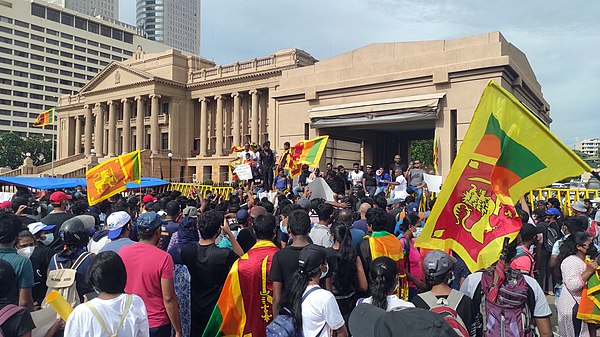
Sri Lanka’s mass anti-government protests in 2022 ushered in a change in the country’s leadership. But not much has changed. Photo: AntanO via Wikimedia Commons
On September 3, Asian Dispatch collaborated with Sri Lanka’s Center for Investigative Reporting (CIR) to host a webinar and seek answers to these compelling questions.
Titled ‘The Road Ahead: What Sri Lanka’s Presidential Elections Means for the World’, the webinar had an esteemed guest panel of Dr Paikiasothy Saravanamuttu, the Executive Director of Center for Policy Alternatives; Rathindra Kuruwita, the Deputy News Editor at The Island; Aditi Phadnis, Political Editor at Business Standard; and Kunwar Khuldune Shahid, Pakistan Correspondent at The Diplomat.
The conversation was moderated by Dilrukshi Handunnetti, Co-founder/Director of CIR.
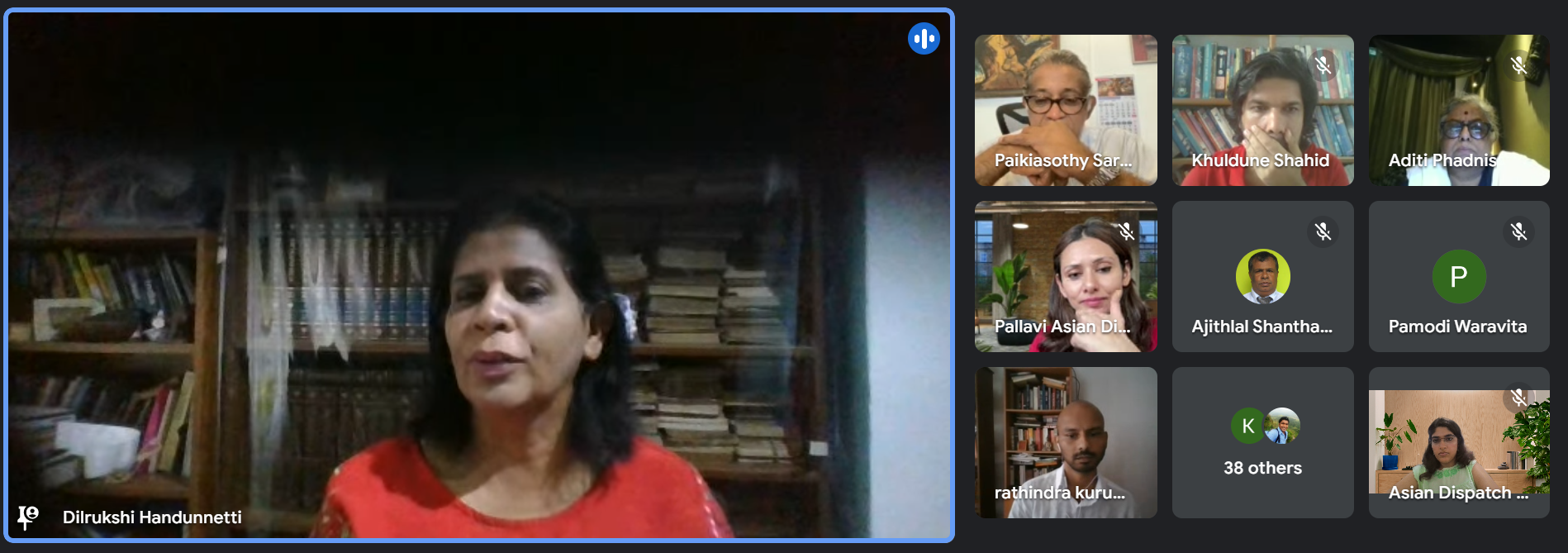
Dilrukshi Handunnetti moderates the September 3 webinar on Sri Lanka’s elections. The webinar was co-presented by Asian Dispatch and Centre for Investigative Reporting.
Here are some highlights from the conversation:
The Sri Lankan Perspective
Dr Saravanamuttu, of the Center for Policy Alternatives, offered a sobering assessment.
“This election comes in the wake of the near-total collapse, signifying not just an economic crisis, but a crisis of governance. It’s the first election since the 2022 protests that ousted the Rajapaksas from government—though not from Sri Lankan politics.”
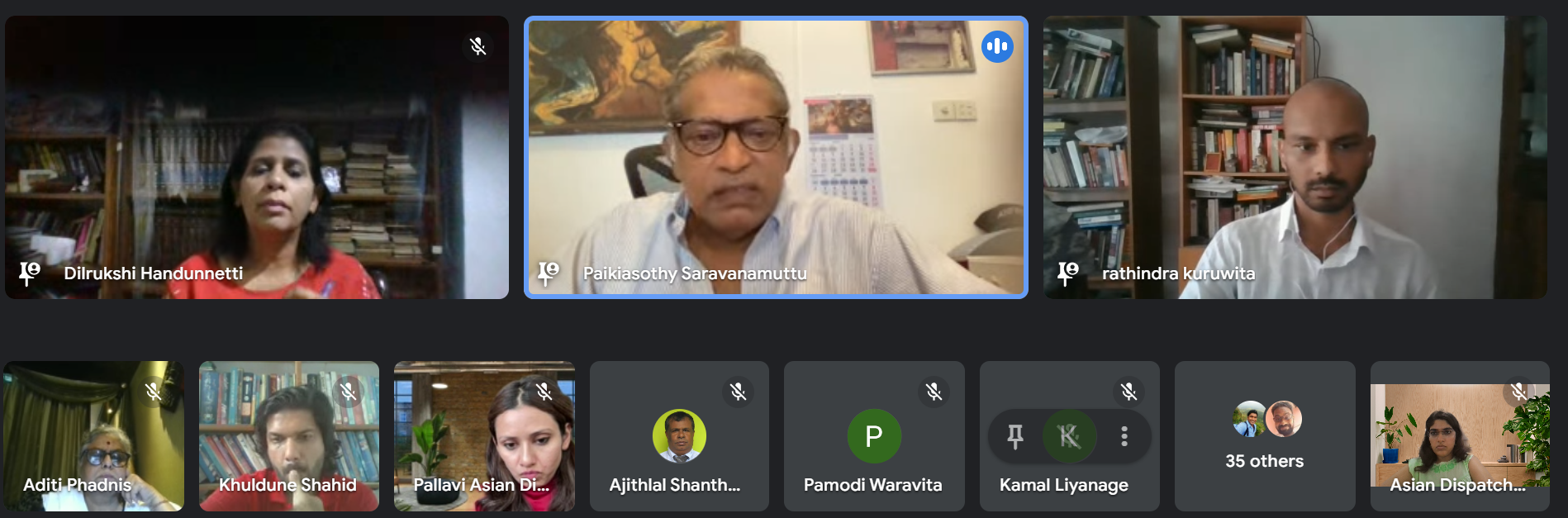
Dr. Paikiasothy Saravanamuttu, centre, addresses the speakers and audiences on September 3 webinar.
He emphasised that while the ballot is long, the real contest lies between three major contenders: The incumbent President Wickremesinghe, Sajith Premadasa and National People’s Power (NPP) leader Anura Kumara Dissanayake. Wickremesinghe is credited for stabilising the country but remains unpopular due to tax policies that disproportionately burden the middle and lower classes. The competition is fierce.
Internationally, Sri Lanka’s political landscape has significant ramifications. Early this year, India, with its complex history of engagement with Sri Lanka, met with leaders of the NPP to discuss bilateral initiatives and development.
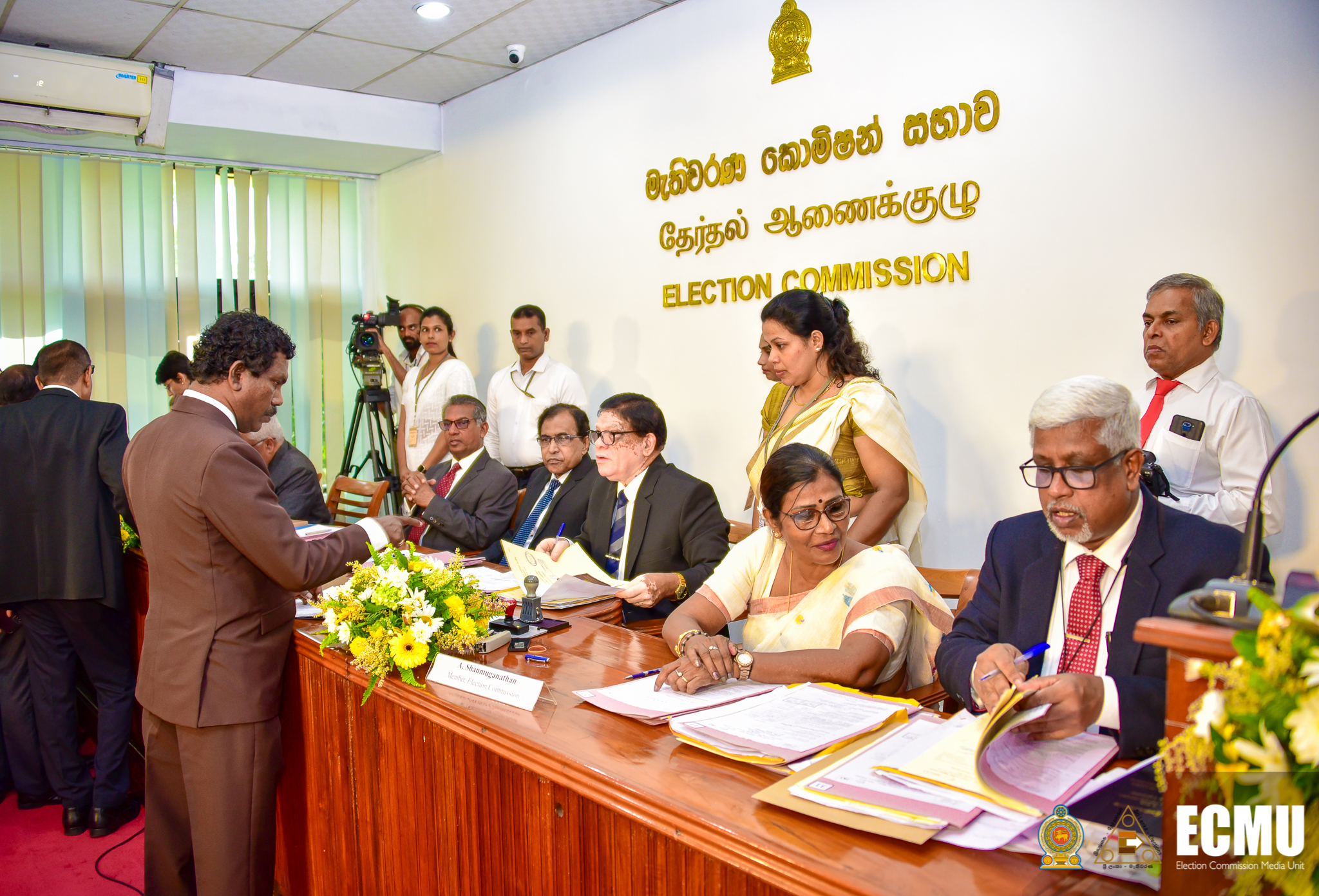
The Election Commission of Sri Lanka has published tough guidelines for the 38 candidates – who are all men – who are competing for the role of Sri Lanka’s next president. Photo: Election Commission of Sri Lanka via Facebook
China remains deeply invested in the country too due to its financial backing of the Rajapaksa regime.
Meanwhile, the U.S. is cautiously monitoring developments in the strategically critical Indian Ocean region for its own interests.
India’s Perspective
Phadnis of India’s Business Standard newspaper highlights the growing concerns within Indian political circles about the upcoming Sri Lankan elections.
“We are entering a period of great challenge and great disconnect,” Phadnis notes, reflecting on the longstanding issues that continue to strain the relationship between the two countries. “Many of the challenges and cause of discontent in the relationship between India and Sri Lanka remain the same. I don’t see any political parties in Sri Lanka addressing this in any meaningful way.”
Aditi Phadnis, a senior political journalist from India, talks about the challenges that Sri Lankan elections outcomes can pose for India.
One of the most contentious issues that Phadnis raised during the webinar is the 13th Amendment of the Sri Lankan Constitution, a key point of tension between India and Sri Lanka. The 13th Amendment, borne out of the Indo-Sri Lanka Accord of 1987, calls for the devolution of central powers to provincial councils, a move toward federalism which is intended to empower Sri Lanka’s provinces, particularly in the Tamil-majority northern and eastern regions.
Phadnis says that for India, the full implementation of this amendment is seen as crucial, not only for the empowerment of the Tamil minority in Sri Lanka but also as a means to secure itself from any spillover of conflict that could destabilise the region.
However, she notes that mainstream Sri Lankan leaders have been hesitant to fully implement the 13th Amendment, especially concerning land and police powers, which are seen as critical components of true devolution. This hesitancy has perpetuated a sense of disenfranchisement among the Tamil community here, creating further complications in the already complex relationship between the two nations.
Phadnis also points out the fractures within the Tamil political landscape, noting the split between Tamil parties such as the Tamil National Alliance (TNA) and the Ilankai Tamil Arasu Kachchi (ITAK) over their choice of presidential candidate. This division has not only weakened the Tamil political front but has also complicated the broader issue of devolution of power. The ideological underpinnings of the Tamil Eelam movement, once driven by India’s Dravidian movement, have undergone significant fractures, leaving the Tamil cause fragmented.
Reflecting on India’s stance on the Tamil representation in the election, Phadnis says: “There will be no effort by India to prop up any candidate that tempers the demand for a separate homeland. That is all in the past, and India will not make the same mistake again.” She references the Indian Peace Keeping Force (IPKF), which operated in Sri Lanka from 1987 to 1990, noting that even today, it struggles to be recognised as an out-of-area peacekeeping force within India.
Phadnis further noted that no one in India would want to see a repeat of the Easter bombings or the Aragalaya (as the 2022 protests is popularly called in Sri Lanka), underscoring the deep concerns over Sri Lanka’s stability and the broader implications for regional security.
Pakistan’s Perspective
Shahid from The Diplomat offered a nuanced perspective on his country’s relationship with its South Asian neighbors, particularly Sri Lanka.
“Pakistan finds itself in a paradoxical position in the region — it has little to offer its South Asian neighbors in many respects. However, with Sri Lanka, the relationship is different,” Shahid explains. “Pakistan seeks a more balanced diplomatic approach with Sri Lanka, especially vis a vis India. Together, Sri Lanka and Pakistan share a long history of security and military cooperation.”
Kunwar Khuldune Shahid talks about Pakistan’s diplomatic relations with Sri Lanka and the opportunities therein.
Despite Pakistan’s limited trade agreements — limited to only four countries so far — Sri Lanka stands out an exceptional and positive trade partner. However, Shahid points out that this trade, while positive, pales in comparison to Sri Lanka’s trade with India, which is 10 times more in scale. Pakistan aspires to expand this aspect, seeking collaboration not just in economic and defense sectors but also on issues related to minorities.
Shahid acknowledges that the relationship between Pakistan and Sri Lanka has been somewhat lukewarm, largely because both countries have historically maintained non-aligned stances on key regional issues. Sri Lanka, for example, has consistently maintained neutrality on sensitive issues like Kashmir, which has helped sustain diplomatic balance with India.
“This neutrality, this diplomatic balance, has been beneficial [for Sri Lanka],” Shahid notes.
Pakistan has, in turn, supported Sri Lanka on the international stage, notably by voting against the 2021 UNHRC resolution that called for international investigations into the country’s war crimes, at the United Nations Human Rights Council in Geneva. This solidarity has strengthened the security collaboration between the two countries, with military drills, intelligence sharing, and arms supplies reaching unprecedented levels. “It is in the realm of security that Pakistan has something tangible to offer Sri Lanka, and Sri Lanka values this assistance,” Shahid explains.
The Elephant in the Room: China
Kuruwita of The Island sheds light on the big source of global curiosity, which is China’s engagement in Sri Lanka.
“There are many questions surrounding what China has been doing in Sri Lanka for the last 2 years, and the answer – quite simply – is ‘Almost nothing,’” Kuruwita states. “Over the last two years, China has been virtually silent, with minimal economic activity. The reasons for this are multifaceted, but one stands out: China’s engagement in Sri Lanka has historically varied depending on which political party is in power.”
Kuruwita elaborates on the long-standing relationship between Sri Lanka and China, dating back to 1950 when Sri Lanka became one of the first countries to recognise the People’s Republic of China. “This relationship has seen fluctuations based on the ruling party in Sri Lanka,” he explains. “When the Sri Lanka Freedom Party (SLFP) is in power, China typically provides more loans, aid, and political support as compared to when the United National Party (UNP) governs the country.”
Rathindra Kuruwita of Sri Lanka’s The Island newspaper addresses the elephant in the room: China
According to Kuruwita, the current administration under President Wickremesinghe is not favoured by China, which explains the noticeable lack of Chinese activity in the country. “China clearly doesn’t like Ranil’s administration, and until there’s a change in leadership, we shouldn’t expect much from China in terms of engagement,” he notes.
Looking ahead, Kuruwita says the outcome of September 21 election could significantly impact China’s involvement in Sri Lanka.
“If JVP comes to power – despite their criticism of foreign engagement – China might find a soft spot for them. On the other hand, Sajith Premadasa, often seen as UNP 2.0, would likely continue the current trend of limited Chinese activity. It’s clear under whose leadership we can expect a shift in Chinese engagement after September 21.”
In conclusion, all four panelists agreed that the aftermath of the September 21 election will have profound and long-lasting implications for the broader region. As both Delhi and Beijing adopt a cautious wait-and-watch approach, the stakes are quite high in what is clearly a nail-biting electoral contest.
Supporters of both Bharatiya Janata Party (left) and INDIA (right) celebrate the election outcome on June 4, at their respective New Delhi headquarters. Photos: Vijay Pandey
On Tuesday morning, just as vote counting for India’s General Elections began, a video of a man crying on a prime-time news show in India went viral.
This man was Pradeep Gupta, the chairman and managing director of a poll survey company called Axis My India, had predicted a landslide victory for Prime Minister Narendra Modi’s Bharatiya Janata Party (BJP), with a vote share of almost 400 seats out of total 543 in the Parliament. The result, however, was wildly different.
Although BJP has been declared victorious for a rare third consecutive time, it fell short of the 272 seats that are needed to form the government, thereby relying on allied parties to constitute the majority.
Poll predictions aren’t a definitive indicator of election outcomes. Nevertheless, Axis My India’s survey had been splashed all over mainstream media channels and social media before and during elections, which took over a month.
Modi’s comeback, according to Gupta, was not just imminent but also signalled his strongman persona and the enduring cult of the BJP. Coinciding with the exit polls arrived Modi’s own post on X, formerly known as Twitter: “I can say with confidence that the people of India have voted in record numbers to re-elect the [BJP alliance] NDA government.”
But the results on Tuesday were a far cry from the dominant stronghold that BJP had established in the last two elections. This stumble also constituted a symbolic victory for INDIA (Indian National Developmental Inclusive Alliance), a multi-party alliance formed in 2023 led by India’s largest opposition party, the Indian National Congress.
INDIA was formed directly in opposition to NDA, but was predicted to lose by a huge margin. However, they won 234 seats, putting up a legitimate fight against NDA’s 272. For comparison, in the last general elections in 2019, NDA won 353 seats while the Congress-led alliance won only 91. This rearrangement marks a monumental shift for the political sentiments in India, which had been overwhelmingly supportive of BJP, at least in vote shares.
On June 4, as vote numbers started to form a clear picture, Gupta was grilled by news anchors on how predictions went so wrong. He started weeping, prompting journalist-anchor Rajdeep Sardesai to comment, “All pollsters need to introspect…that [poll predictions are] terrible.”
In the theatre of the world’s largest electoral process this year, Axis My India was among a flurry of opinion polls that predicted Modi’s landslide victory. But in the world’s most populated country – with over 640 million voters this year – exit polls are tricky, and their purpose can lean toward self-fulfilment.
“Some goals of [exit polls] may be flattery, but there can also be attempts to create or strengthen a narrative,” said Joyojeet Pal, a professor at the School of Information at the University of Michigan. “For instance, by repeatedly stressing that one party is likely to win in a big way, the coalition partners of the likely winner may be moved to be more acquiescent to the wishes of the broader coalition.”
Indian journalist and researcher Pamela Philipose called it a money-making system: “Pollsters are often supported by political parties, especially the ruling party, who stand to benefit from their projections even if it is only for a short time. It creates a narrative which helps in government formation.”
“Media channels mint money through advertising for such programmes,” she added, referring to how exit polls have historically boosted Television Rating Point (TRP) of English and Hindi news channels. “And then there’s the stock market.”
This week saw India’s stock market’s worst tumble in four years after BJP lost its parliamentary majority. India’s stocks recorded losses on both June 4 and June 5, driving investors to react negatively to the election results. On June 6, opposition leader Rahul Gandhi accused the BJP’s top leaders, including Modi, of misleading people into buying stocks before elections, which led to the market crash.
Before the results, another opposition leader Sitaram Yechury had told Indian news channel NDTV that exit polls were done to influence share markets.
“The way the stock markets behaved,” Philipose added, “shows how this system fuels financial speculation.”
In the lead up to the 2024 elections, the BJP had the ambitious slogan, “Ab ki baar, 400 paar”, or “This time, we’ll cross 400 (seats).” As per the final count, BJP won 240 seats, down from 303 seats it won in 2019. This discrepancy left most of the country shocked with the results.
All the biggest private survey agencies such as Today’s Chanakya, Matrize and C-Voter, got it wrong. An aggregate of 14 such exit polls predicted that the NDA would win 365 Lok Sabha seats, an increase from the 352 seats it secured in 2019. INDIA was predicted to receive just 146 seats. This, when there was no visible wave in favour of any party or politician, including Modi.
The most astonishing were the results in Uttar Pradesh, India’s most populous state which sends 80 members to the Parliament, and had been BJP’s flagship supporter in the last two elections. This is where Modi’s Ram Mandir project, which was built in Ayodhya city on a site contested by the Muslim minority, galvanised millions of Hindu supporters worldwide.
Exit polls had predicted that the BJP would secure between 64-68 seats in the state on the back of, among other aspects, the Ram Temple popularity. Instead, it secured only 36. INDIA, on the other hand, secured 43. The BJP, ironically, also lost in the Faizabad constituency, which includes Ayodhya city, to INDIA.
Voting takes place at poll stations in Noida, Uttar Pradesh, on April 26, 2024. Photos: Vijay Sadasivuni
The pattern continued in West Bengal, where the BJP was predicted to win between 20-30 seats, but ended up with just 12, and Maharashtra, where the NDA secured 17 seats out of 48. Praveen Dhonti, an analyst at International Crisis Group, says one of the biggest reasons why the exit polls missed the clear shift of voting preferences away from the BJP was fear.
There is a fear [among the people] towards the Modi government, the BJP and its supporters. The masses kept the cards close to their chest. They didn’t open up to most of the media or the agencies conducting these exit poll surveys. —Praveen Dhonti
Pal, the professor, echoed this sentiment, calling it a “spiral of silence”, in which “people may be slightly afraid to admit to not voting for the BJP since it is very well organised on the ground.”
Polling agencies have confirmation bias too, Dhonti added. “They didn’t see or explore beyond what they thought would be a sure win for Modi,” he said.
This isn’t the first time exit polls failed their own predictions. In 2004, the favourably placed Atal Bihari Vajpayee-led NDA government failed to secure a second term despite running a high-decibel campaign. Experts are now questioning whether the tradition of exit polls should continue after all.
For one, exit polls operate opaquely, says Pal. “[They] are not clear about their sampling, enumeration process, and framing of questions – all of which may have biassing impacts,” he said. “It has been suggested that over-sampling of urban, middle class populations may have caused systematic failure in accurately capturing the mood.”
“The opacity is likely intentional in part because a lot of the agencies which run these are not empirically trained to do these,” Pal added.
The polls may have exaggerated but Modi will be sworn in as Prime Minister for his third consecutive term on Sunday, June 9, at 6 pm IST. BJP’s alliance parties are expected to demand key positions in return for their support.
The political impact of this week’s turn of events are yet to be seen, but the failure of exit polls in predicting national sentiment will not be forgotten anytime soon.
“Exit polls are a bit of a mystery to me,” said Michael Kugelman, the director of South Asia Institute at The Wilson Center. “If they’re meant to bolster the ruling party, then why would they put themselves out there and risk looking silly later on, as was the case with just about every exit pollster this time?”