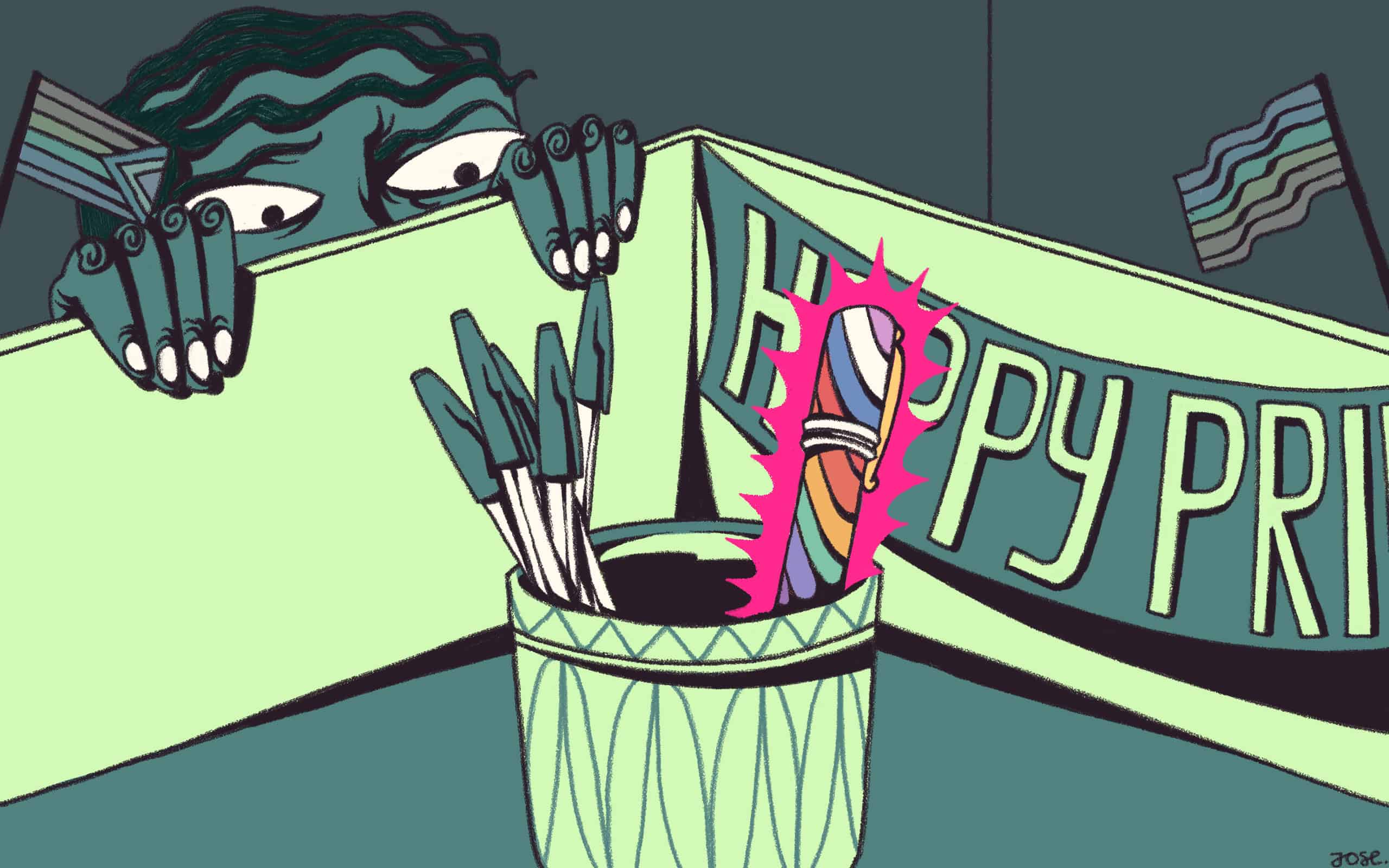
Illustration: Mia Jose
Trigger Warning: This article mentions a suicide attempt. Readers’ discretion is advised.
In April 2022, Sravan joined the Hyderabad office of an American multinational finance corporation as a technical operations analyst with a head full of curly hair and eyes full of dreams. The company’s public profile boasted of its commitment to LGBTQ+ inclusion at the workplace. Sravan, a queer non-binary person, recalls this promise being reiterated to them at the end of their interview for the role.
However, a few months later, Sravan saw the first red flag unfurl. At an annual marathon organised by the company for its employees, they heard “the manager of their manager” mention their sexual orientation casually to other employees. Sravan was surprised. They had not consented to their sexual orientation being publicly disclosed.
Sravan brushed it off as a one-time incident. But it happened again. And again.
In multiple casual office gatherings, the manager would tell other employees, “I have three queer people working under me, and Sravan is one of them,” Sravan recalled. They felt increasingly uncomfortable with their sexual orientation being the subject of casual office conversations. “My sexual orientation is a very personal piece of information,” they said, “and I felt that it was not being handled with care.”
In April 2023, a year after joining the company, Sravan decided to confront the boss publicly, asking them about the company’s confidentiality policy. Sravan recalls the manager dismissing and laughing at his concerns.
But over the next two days, the retribution, by Sravan’s account, was swift. First, they were accused of sexual misconduct towards other employees—an allegation that Sravan vehemently denies. Then, other members of their team stopped speaking with them—an act of social boycotting that Sravan suspects was ordered by the boss.
Soon after, Sravan filed a workplace harassment complaint against the boss with the HR team, which they remember having no queer representation. But Sravan claims he did not hear back from them for two weeks.
It was only when Sravan approached drag performer and tech professional Patruni Chidananda Sastry, who escalated the matter via Pride Circle, a consultancy firm that had facilitated Sravan’s recruitment, to the company’s global HR team, that action was taken. The company launched a six-month investigation, which ultimately led to the manager being found guilty. The result? Sravan was transferred to a different team under a different boss, but Sravan said the HR team declined to reveal what action had been taken against the manager.
By then, however, the workplace environment had soured beyond repair for Sravan. In August 2024, after dealing with months of mental distress, Sravan resigned. The company, a multinational finance empire with an annual turnover around the billion-dollar mark, continues to flourish.
Concerned about the repercussions of discussing their experience, Sravan requested that queerbeat use a gender-neutral pronoun for the boss and not reveal the name of the company. They also requested to be referred to only by their first name.
While queerbeat could not independently verify Sravan’s allegations, workplace culture and policy experts we spoke to agreed that discrimination against queer and transgender people remains commonplace in India’s corporate workforce. As is the practice of retaliation against those who decide to speak up.
“Corporations see themselves as these benevolent and kind people who are ‘allowing’ and ‘tolerating’ people from marginalised groups,” said Asiya Shervani, a senior workplace equity consultant. “Any complaint, or even feedback, is seen as betrayal.
Sravan is likely one of many queer and transgender people in India whose dreams of finding sustainable employment in India’s corporations have been blunted by workplace discrimination that targets their sexual orientation or gender identity. These experiences are in stark contrast to the public messaging by these corporations. For example, a 2023 annual report from the company where Sravan worked mentions the company’s commitment to “continually… create and reinforce a culture of respect, equity and inclusion.” The report also mentions the company having an office dedicated to “LGBTQ+ Affairs,” which “focuses on advancing a culture of inclusion for LGBTQ+ employees… and driving equity and inclusion for the LGBTQ+ community globally.”
In the process of reporting this story, queerbeat interviewed queer and transgender employees, scholars of gender and sexuality studies, workplace culture and policy experts, and representatives of organisations that liaison with corporates to increase queer and transgender visibility in the workforce. These conversations revealed that behind the rainbow banners and inclusive slogans that are becoming increasingly commonplace, the reality of queer inclusion in corporate India is a story of uneven progress and continuing exclusion.
While more queer and transgender people are entering the corporate workforce of late—mostly in entry-level positions—they often find themselves forced to quit due to explicit and implicit discrimination, poor complaint-resolution, and harsh retaliation when reporting unfair treatment.
From Adversary to Ally?
When India opened up its economy in 1991, global corporations scurried to enter the Indian market. And they brought with them the idea of “LGBTQ+ inclusion,” according to Pushpesh Kumar, a professor of sociology at the University of Hyderabad who has studied the lives of “urban corporate gay [men]” in India.
At the time, queer inclusion was a relatively new concept even in their home countries. Carlos A. Ball, a professor at the Rutgers Law School, writes in The Queering of Corporate America (2019) that until the 1970s, large American corporations were adversaries of queer and transgender people. According to him, in that decade, the many “gay liberation” and “LGBTQ Rights” organisations that cropped up in the backdrop of the 1969 Stonewall Riots began to actively challenge that stance.
By the turn of the century, this activism had resulted in many American corporations slowly becoming more welcoming of queer and trans employees. Corporations also began recognising that “adopting and supporting LGBTQ rights positions could help them maximise profits by reaching new customers while hiring and retaining the most qualified employees,” Carlos writes. This is perhaps what Starbucks’ then-CEO meant when he told Politico in 2012 that supporting same-sex marriage had been “good for business.”
In the early 2000s, as these global corporations began establishing offices and campuses in Indian cities, they pushed the Indian teams to “get on board” with the diversity, equity and inclusion (DEI) goals of the parent company, lawyer Meenakshi Vuppuluri told queerbeat. Meenakshi works as a subject matter expert on the prevention of sexual harassment and DEI with Kelp, a company that supports corporations towards making their workplaces safe and inclusive.
The winds of change also began to reconfigure some Indian workplaces. According to Parmesh Shahani’s book Queeristan: LGBTQ Inclusion at the Indian Workplace (2020), starting in 2010, the Indian conglomerate Godrej revised its anti-discrimination policy to explicitly forbid discrimination based on gender identity, sexual orientation, and gender expression; extended health insurance to same-sex partners of employees; and began to pay for gender affirming surgeries. Similar initiatives have also been instated by Tata Steel & Tata Consultancy Services, and Axis Bank. Tata Steel modified its HR policy in 2019 to make it “LGBTQIA+ inclusive,” a representative told queerbeat over email. “This policy recognises same-sex partnerships” and provides benefits such as “gender-neutral parental leave, nursing breaks for adoptive and LGBTQIA+ parents, medical coverage for partners, joint housing benefits, domestic travel assistance, annual health check-ups, and financial support for gender assignment surgery,” they added.
Official communications from these companies’ websites attribute these initiatives to the momentum generated by the Indian Supreme Court’s 2014 NALSA v Union of India and the 2018 Navtej Singh Johar v Union of India verdicts. In the 2014 judgement, the apex court formally recognised transgender persons as ‘third gender’ and upheld their right to self-determination of gender. In the 2018 judgement, the court decriminalised consensual same-sex sexual activity.
Over the years, thanks to the combined efforts of activists and courts, more corporations appear to be gradually joining the bandwagon of change. According to Srini Ramaswamy, co-founder of Pride Circle, a Mumbai-based consultancy firm that liaises with corporations to assist their DEI initiatives, the firm has enabled the hiring of over 1600 queer and transgender people in various companies over the last six years. Most of these appointments have been in the IT sector, Srini told queerbeat.
Given the increasing recruitment of queer and transgender employees, companies have also been working to devise inclusive policies to help them feel supported. The 2024 India Workplace Equality Index (IWEI) assessed 150 companies—most of them large Indian companies or multinationals operating in India—on their inclusion of queer and transgender employees. It reported that over 90% of these companies now offer health insurance to same-sex partners. Nearly 70% provide gender-transitioning support to transgender staff.
Cracks in the Gloss
While it is undeniable that change is happening, it is far from being systemic. The rosy proclamations of corporate DEI brochures often tend to gloss over the many cracks that continue to haunt Indian workplaces when it comes to queer inclusion.
The rising number of queer employees being hired for instance, while heartening, only represents a foot in the door that had previously been slammed shut. According to the Godrej DEI lab’s latest annual report (2024-25), the number of LGBTQ+ employees at the organisation is 245—about 0.5 per cent of all employees at the company. At Tata Steel, the number is at 110, a company representative informed queerbeat. While these numbers are minuscule in the larger context, it is also important to note that these companies have made far more progress than their peers.
These numbers, which group all queer and transgender employees under the “LGBT+” label, invisibilise the fact that transgender people are especially under-represented in the workplace. According to Zainab Patel, a transgender woman who has led DEI initiatives at several multinational corporations, trans people find it much harder than cis queer people to find corporate jobs. She points out that one major reason for this gap is the limited access transgender people have to educational opportunities. A 2017 NHRC survey found that fewer than 20% of transgender respondents had completed school, and under 10% had earned undergraduate degrees.
Further, most queer and transgender people are hired in entry- and mid-level roles, Pride Circle’s Srini and Mobbera Foundation’s Savithri told queerbeat. (Like Pride Circle, Mobbera Foundation helps multiple corporations in Hyderabad recruit queer and transgender people.) Savithri pointed out that most of the hiring she has been involved in has been for “ground-level positions”: those consisting of “security staff and people sitting at the front desk.”
Srini explained that this trend is “partly due to corporate hiring practices that reserve senior roles for employees who have been with a company for a relatively longer term.” But Patruni, a Hyderabad-based drag performer and IT professional, suspects a more sinister reason: those hired in entry-level positions are “easily replaceable.”
Disposable employees
Hiring is only the beginning of a queer individual’s corporate journey. What follows after a queer person enters a corporation?
Patruni’s experience suggests a grim answer. Patruni had worked for ten years in the Hyderabad office of a multinational auditing and consultancy firm, until an encounter with corporate queerphobia forced them to quit in May 2021.
In late 2020, the company’s intranet forum featured an article about Patruni’s journey as a queer dancer and data analyst. They recall the article making them feel like they could trust in their workplace, and as a result, they came out as genderfluid to their colleagues. Later, it became all too apparent to Patruni that they had mistaken a formal, tokenistic gesture to be reflective of the company’s larger attitude towards queer people.
Patruni worked under a manager whom they suspected was biased against queer people. They claim that soon after the article was published, the manager became hostile. Per their account, she started assigning them an impossibly high workload. “There was always a new project to work on,” Patruni recounted, adding, “My job role did not involve taking client demos, but my manager added that also to my workload.”
When they took up the issue with the company’s Internal Complaints Committee—set up under the Sexual Harassment of Women at Workplace (Prevention, Prohibition and Redressal) Act, 2013—it was dismissed because Patruni was regarded, officially, as a man and the Act provided no redress for men. Patruni said that their complaint was instead registered as a case of workplace harassment with the company’s internal compliance team.
The team formed a committee—which did not have any queer or transgender representatives—to investigate the complaint. After four months of investigation, the committee found the manager innocent, Patruni told queerbeat.
Patruni could not share with queerbeat a copy of their complaint and the committee’s decision because the communication took place over the company’s internal mail, which they no longer have access to. However, screenshots of WhatsApp communication between Patruni and a member of the company’s DEI team, reviewed by queerbeat, confirmed that the manager was found innocent because of a lack of proof.
In retribution for the complaint, Patruni said they were declared an underperformer by the manager. To prove their commitment to the job, they recalled being told to work at odd hours over and above their regular working hours. Then came heightened scrutiny and comments on their English-speaking skills. “My manager started telling me—sometimes during calls with clients—that I speak English with an accent,” they recollected.
Patruni felt discriminated against. And with the internal compliance team having closed its doors to them, they also felt trapped. In March 2021, they attempted suicide within the premises of their workplace.
The suicide attempt should have ideally made the company take Patruni’s complaints more seriously. Instead, they were asked to take an online “support session,” and given a ten-week notice to resign, Patruni told queerbeat.
A year and a half later, when they applied for a different job in the same company, they said they were told that the company had blacklisted them. queerbeat has not been able to independently corroborate this claim.
Cut to June 2024, and the company’s Hyderabad office commemorated Pride Month by unfurling the pride flag like it had always belonged there. “And my manager is still there,” Patruni said, their voice low.
In 2021, after leaving their previous job, Patruni briefly joined the India office of a Canadian IT firm, whose name they requested queerbeat keep confidential. Patruni says the company had no policies for queer or transgender staff. When they raised this with HR, they were told the firm treats everyone “equally.” When Patruni said they felt unsafe without such protections, the HR manager suggested termination.
“Let us figure out how to relieve you,” they recall being told. Ten days later, Patruni said they were out of the company.
“They do not want to resolve, only relieve,” Patruni said.
Sastry’s and Sravan’s experiences are not isolated examples. In both cases, the pattern was the same: lack of queer representation in complaint-resolution teams and brutal pushback when employees complained of being treated unfairly. These are two reasons why queer and transgender people who have breached the high walls of corporations choose to—or are forced to—leave.
Restricting queer and transgender people to lower rungs of the corporate ladder means that they remain inadequately represented in key decision-making bodies. “Even if a corporation hires 100 [queer and transgender] people in a year, how many of them will become a director ten years down the line? That is where the real visibility and decision-making power is,” Zainab told queerbeat.
This process of people leaving a company is called attrition. And it appears to be common with queer and transgender employees. In their survey of 300,000 employees across 28 organisations in the United States, University of Michigan sociologists Erin Cech and William Rothwell found that about 38 per cent of LGBT employees intended to leave their workplace within a year.
In India, there is scant data on attrition with regard to queer employees. Even organisations such as Pride Circle and Mobbera Foundation do not track attrition after six months of joining, Srini and Savithri told queerbeat. Similarly, while Godrej DEI Lab’s annual report documents the attrition percentage of women employees, it does not currently provide the statistics for queer and transgender employees. The Tata Steel representative told queerbeat that they have had “very few attritions” of queer and transgender employees.
Essentially, while more and more corporations are adopting queer inclusive policies and there is some evidence to suggest that an increasing number of queer and transgender people are being recruited, little is known about whether these policies are working to support and retain queer employees.
Potential solutions
A publicly-available code of conduct from Patruni’s previous company—the one they worked for until 2021—says, “We do not tolerate discrimination or harassment of any nature on the grounds of gender, race, religion, age, disability, gender identity, sexual orientation…”
Asiya, the workplace culture and policy expert, said that the experiences of queer employees reveal the huge gap between “a very nice policy document” and “completely wrong implementation.” According to her, the implementation fails, at least partly, because of the lack of queer and transgender people, or allies, in complaint-resolution committees. Many people who serve on these committees are “perpetually scared about their own careers and promotions,” she told queerbeat. This compromises the committee’s neutrality.
As a solution, she suggests that complaint-resolution teams in cases of workplace harassment include external members, i.e., those not associated with the organisation. The Sexual Harassment of Women at Workplace (Prevention, Prohibition and Redressal) Act, 2013, suggests a similar model for internal complaints committees that deal with cases of sexual harassment. Asiya acts as an external member in several such committees at corporate and non-corporate workplaces. “There are a lot of things I can say as an external member, which even the chairperson [of the committee] cannot say,” she told queerbeat.
Meenakshi, the lawyer, agreed with Asiya. She also advocated for stronger confidentiality practices when a complaint of workplace harassment is filed, in addition to “escalation matrices” that do not push the employee to rely on the HR or their manager to handle their workplace complaints. An escalation matrix is a set of procedures that outlines different individuals to whom a workplace harassment complaint can be raised.
Finally, Meenakshi also suggested that employees be informed about these policies and escalation matrices through periodic training sessions. “One can openly address the question of retaliation in these training sessions,” she added.
A Rocky Path Ahead
Parmesh, Godrej DEI Lab’s head, agrees that the status quo with regards to queer and trans inclusion in India’s corporations is “not ideal.” “But then, what is?” he asked, adding that “I think it’s okay to start from somewhere, anywhere, and go on the journey, rather than not go on it at all.”
At the time of writing this report, a global force threatens this journey. As of March 2025, US President Donald Trump signed executive orders banning DEI programmes in government, leading to the closure of diversity councils and withdrawal of funds for DEI initiatives. Following the order, it has been reported that nearly 37 major firms—including IBM, Google, and Deloitte—began rolling back queer and trans-inclusive policies, events, and hiring initiatives.
Patruni said that the effects are showing up in India too: unlike the 15-20 invitations they would get every June to participate in events to sensitise company staff about queer and transgender lives, this year they have gotten only five. Srini, Pride Circle’s co-founder, said that hiring of queer and transgender people through online and offline job postings has remained largely unaffected. However, while 35 companies signed up for Pride Circle’s RISE job fair last year, only 17 signed up this year. The RISE job fair is Pride Circle’s annual event that brings queer and transgender people seeking corporate employment face-to-face with corporations willing to hire them.
As global corporations go back on their promises of queer and transgender inclusion, several people see this as a moment for homegrown Indian corporations to fill the gap. “[Multinational companies] provided the ignition,” Harsha Ravikumar, product manager at Microsoft and a gay man, told queerbeat, “but now [Indian] companies are taking it upon themselves to be more sustainable with their DEI initiatives.” Zainab, the ex-DEI lead at multiple global corporations, agrees: “This is a pause in the movement, not a full stop.”
It was the third Friday in June this year when the labour helpline rang.
“Can you help us? We have not been paid.”
It was a group of 80 labourers from Kushalgarh, a town in the Indian state of Rajasthan, who had gone to work on sites in neighbouring tehsils within the state. For two months they dug trenches two feet wide and six feet deep to lay telecom fibre cables. Wages are paid per metre of trench that has been dug.
After two months when they asked for their full dues, the contractor cited poor work, played with the numbers and then tried to fob them off saying, “deta hoon, deta hoon [I’ll pay up, I’ll pay up].” But he didn’t, and after another week of waiting for their dues of Rs. 7-8 lakhs, they went to the police who told them to call the labour helpline.
When the workers called, “we asked them if they had any proof. If they could give us names and phone numbers of the contractor, and any photos of an attendance register,” said Kamlesh Sharma, a social worker in Banswara, district headquarters.
Luckily some of the younger mobile-savvy labourers were able to furnish all this as well as send photos of their workplace sites by phone to build their case.
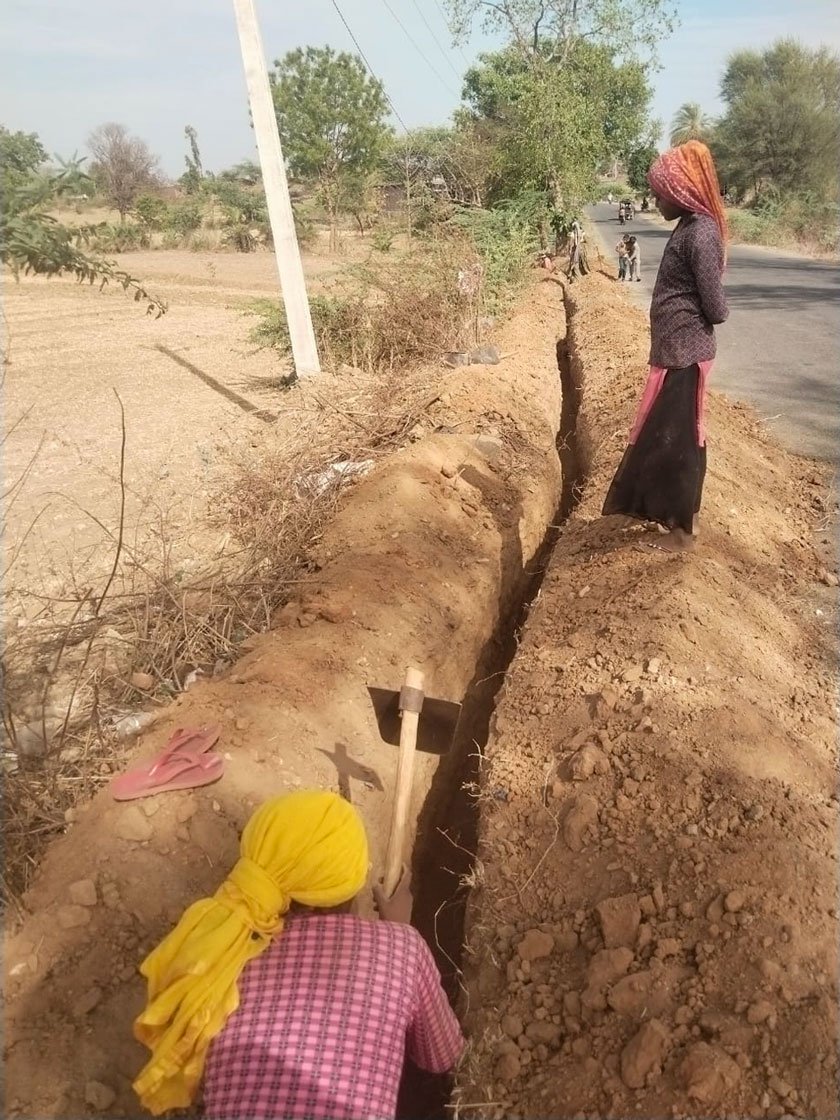
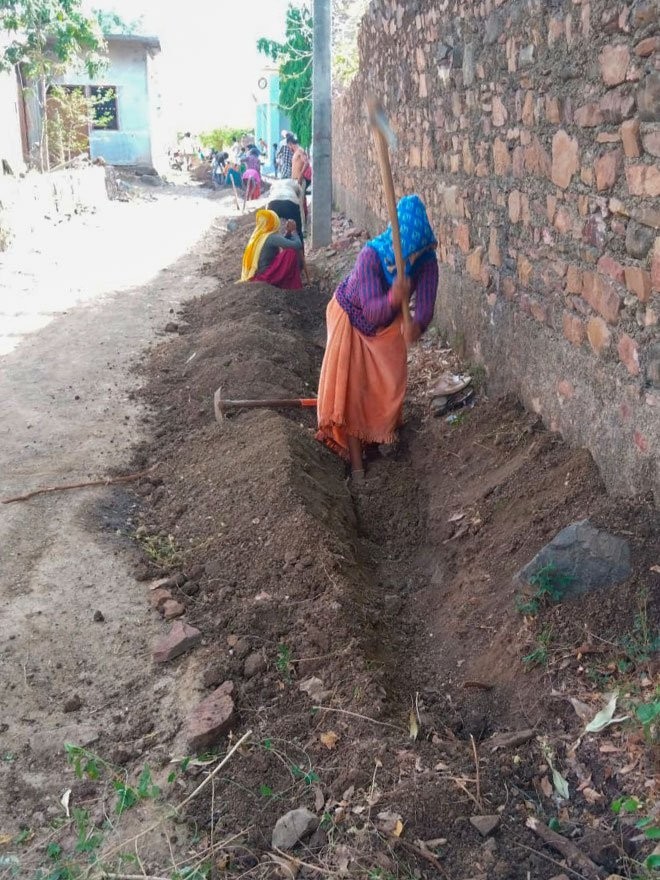
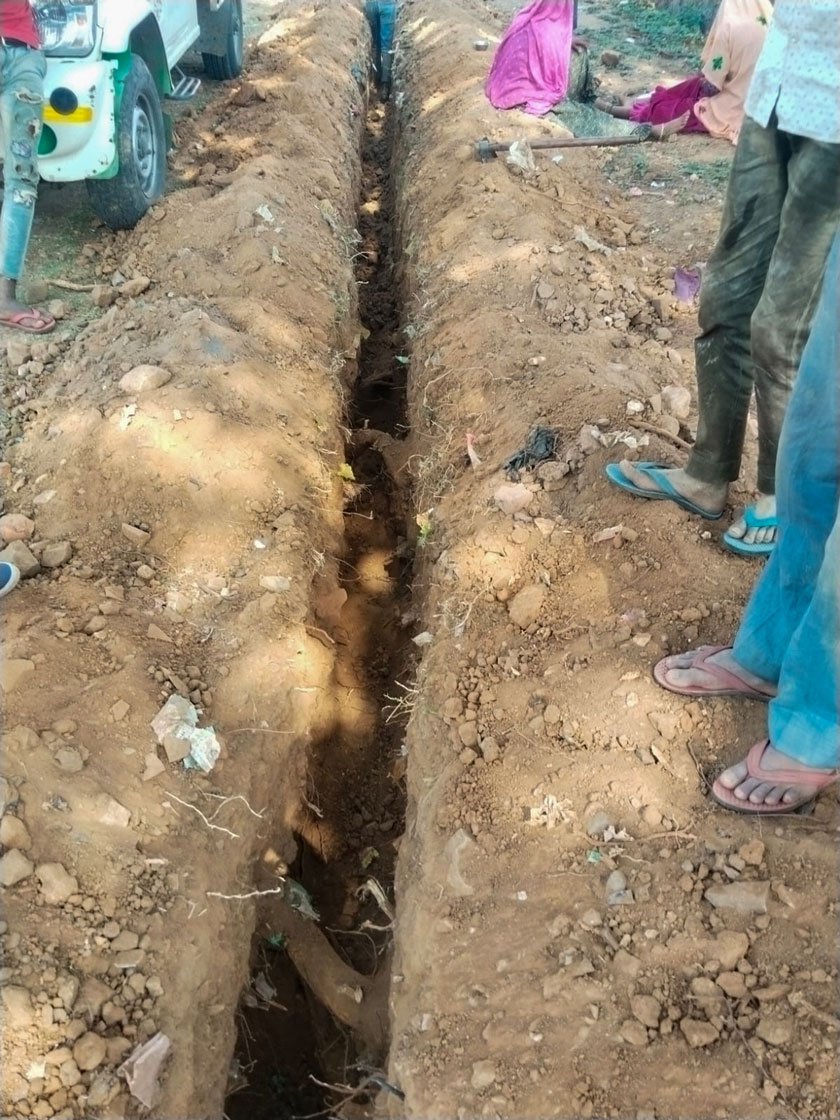
Migrants workers were able to show these screen shots taken on their mobiles as proof that they had worked laying telecom fibre cables in Banswara, Rajasthan. The images helped the 80 odd labourers to push for their Rs. 7-8 lakh worth of dues. Photos: Aajeevika Bureau via PARI
The irony is not lost on them – the trenches they had dug were for one of the country’s biggest telecom providers who wants to ‘connect people’.
Kamlesh – a project manager with Aajeevika Bureau a non-profit working on labour issues – and others, helped build their case. All their outreach material carries both the Aajeevika helpline – 1800 1800 999, and the phone numbers of officials at the bureau.
The workers from Banswara are among the lakhs migrating in search of work. “Kushalgarh has many pravasi [migrants],” says Joga Pitta, sarpanch of Churada village in the district. “We are not able to sustain ourselves with farming.”
Small landholdings, lack of irrigation, absence of jobs and overall poverty have made this district a hub for distress migration among Bhil tribals, who make up 90 per cent of the population here. An International Institute for Environment and Development Working Paper observes that migration rises sharply after climate extreme events like drought, flood and heatwaves.
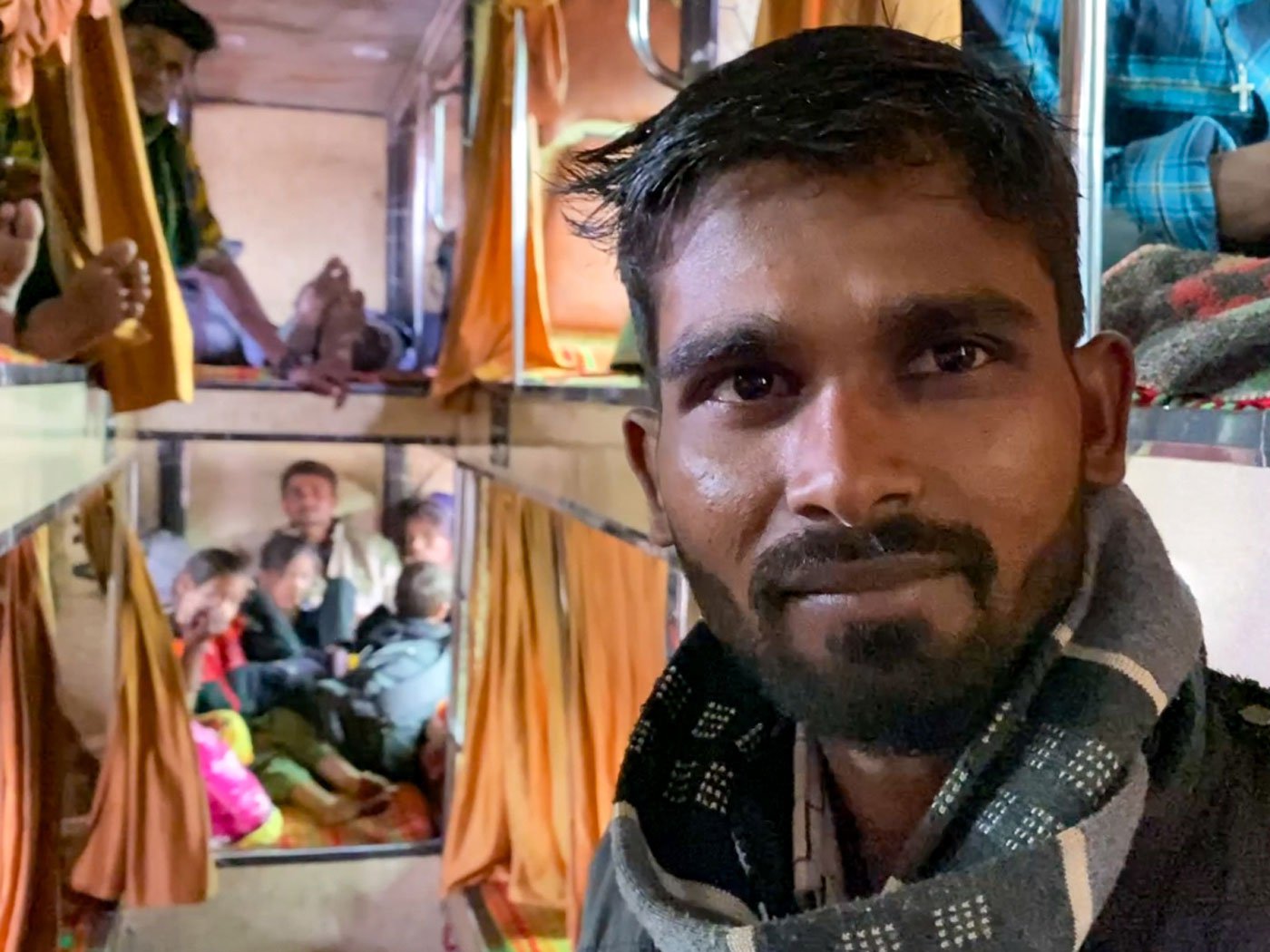
At the busy Kushalgarh bus stands, around 40 state buses leave every day through the year carrying 50-100 people in one journey. Then there are the private buses of roughly the same number. A ticket to Surat costs 500 rupees and the conductor says they don’t charge for children.
Suresh Maida arrives early to find space, and settle his wife and three small children into the bus to Surat. He gets off to put their luggage – a big sack with five kilos of flour, some utensils and clothes into the storage area behind the bus, and clambers back in.
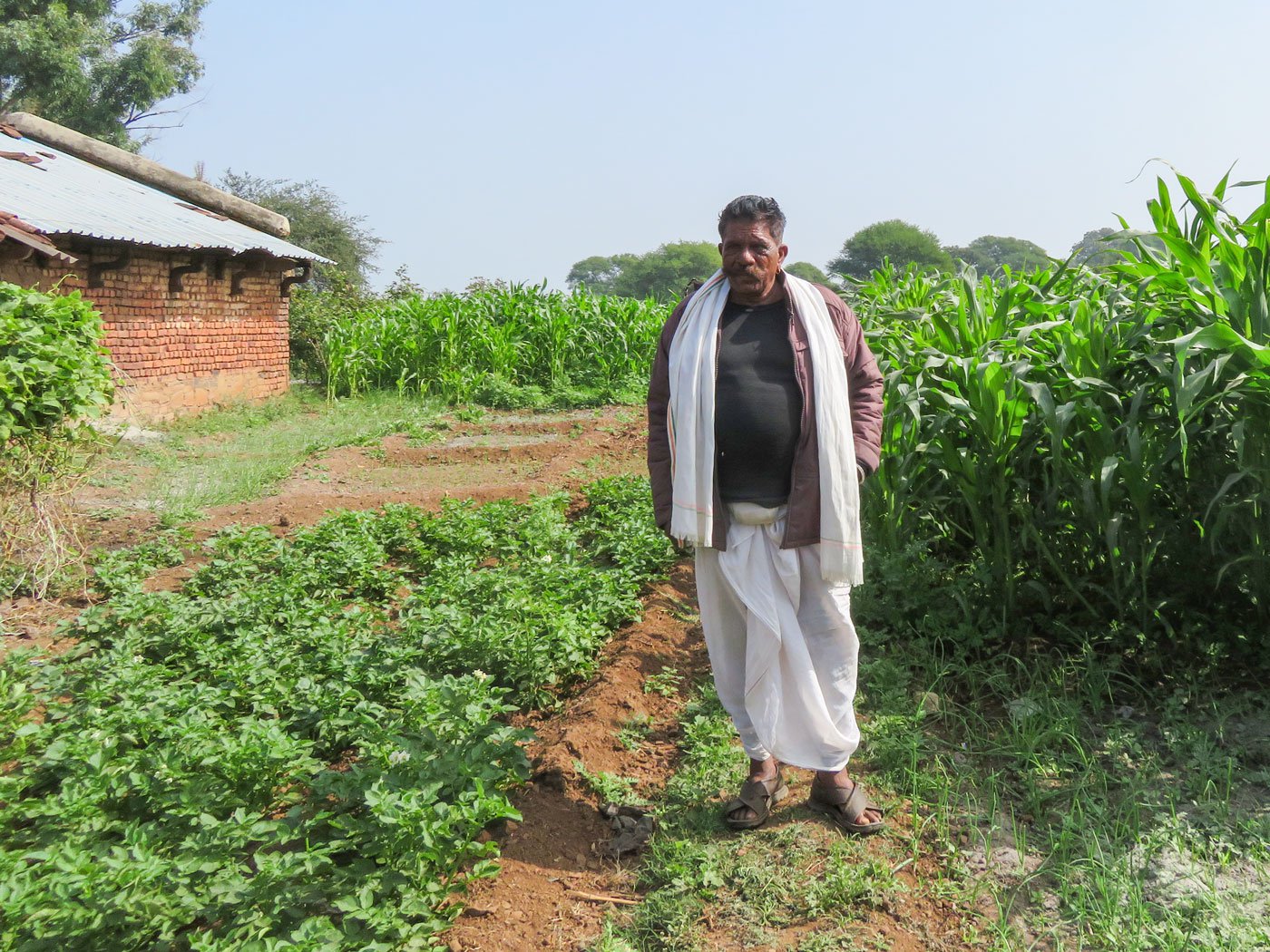
Left: Suresh Maida is from Kherda village and migrates multiple times a year, taking a bus from the Kushalgarh bus stand to cities in Gujarat. Right: Joga Pitta is the sarpanch of Churada village in the same district and says even educated youth cannot find jobs here. Photos: Priti David/PARI
“I will earn around 350 [rupees] a day,” the Bhil Adivasi daily wage worker tells PARI; his wife will earn 250-300 rupees. Suresh expects they will stay a month or two before returning, spend roughly 10 days at home and set off again. “I’ve been doing this for more than 10 years,” adds the 28-year-old. Migrants like Suresh usually come home for big festivals like Holi, Diwali and Raksha Bandhan.
Rajasthan is a net out-migration state – more people leave than enter as migrants; only Uttar Pradesh and Bihar see greater numbers leaving for wage work. “Not only is agriculture the only option, but it also only one-time – after the rains,” points out V.S. Rathod, an official in the Kushalgarh tehsil office.
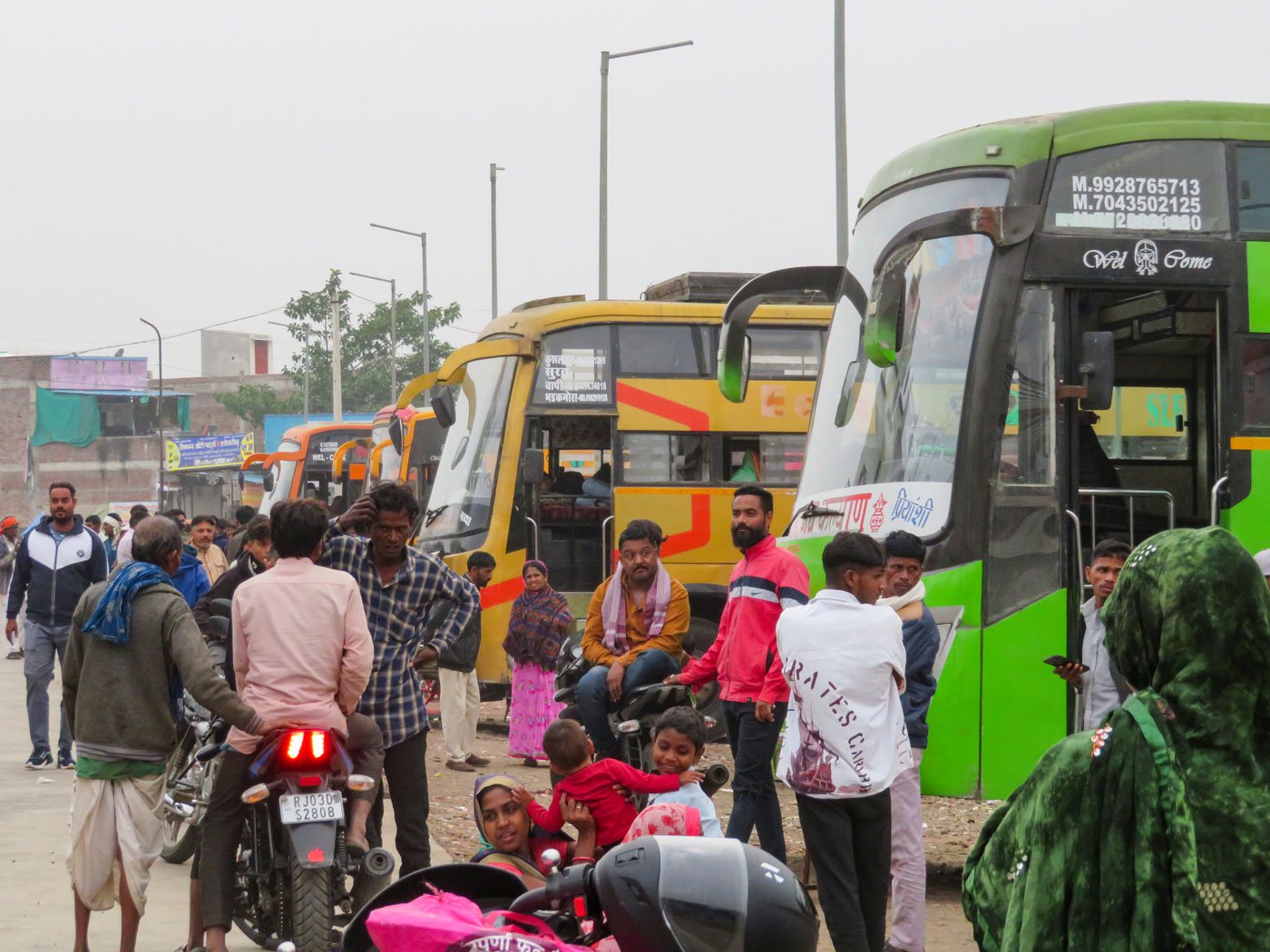
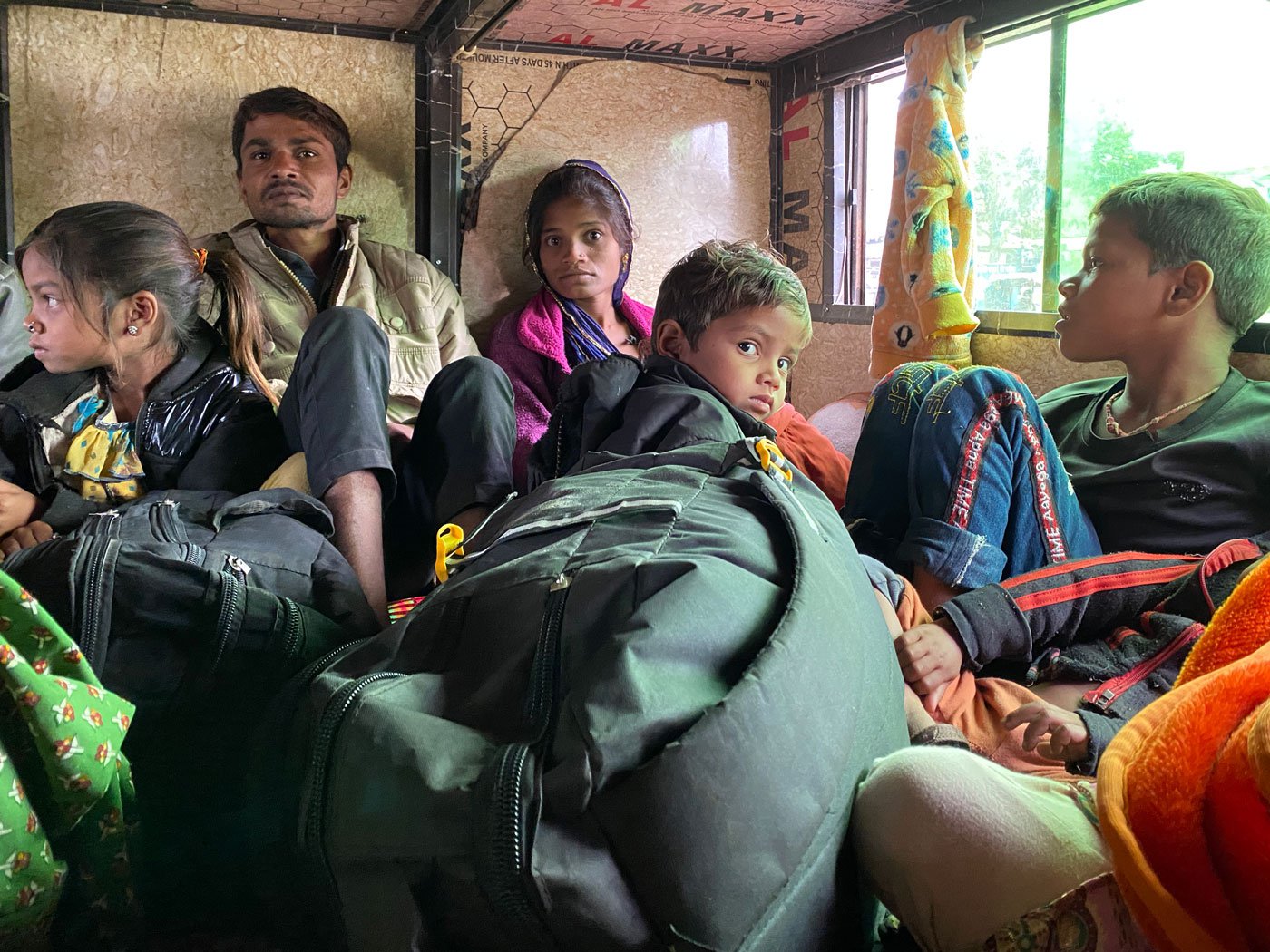
At the Timeda bus stand (left) in Kushalgarh, roughly 10-12 busses leave every day for Surat and big cities in Gujarat carrying labourers – either alone or with their families – looking for wage work. Photos: Priti David/PARI
All workers are hoping for kayam work where they are attached to one contractor for the entire period. It offers more stability as against rokdi or dehadi – standing at the mazdoor mandi (labour market) every morning.
Joga ji has educated all his children but even so “yahan berojgaari zyaada hain. Padhe likhe logon ke liye bhi naukri nahin [There is a lot of unemployment here, even those who are educated have no jobs].”
Migration is the only foreseeable option.
When Maria Paaru leaves home, she takes a mitti ka tawa (clay pan) with her. It’s a critical part of her packing. Corn rotis are best made on the clay pans which can handle the heat of wood fires without burning the roti she says, while showing me how it’s done.
Maria and her husband Paaru Damor are among the lakhs of Bhil Adivasis who move out of their homes in Banswara district of Rajasthan in search of daily wage work in Surat, Ahmedabad, Vapi and cities in Gujarat, as well as other neighbouring states. “MNREGA takes too long and is not enough,” says Paaru, speaking of the Mahatma Gandhi National Rural Employment Guarantee scheme that gives 100 days of work.
The 30-year-old Maria also carries 10-15 kilograms of makai (corn) flour. “We prefer to eat these,” she says, sharing the food habits of her family who are away for up to nine months in a year. Familiar food is a comfort when away from home in Dungra Chhota.
The couple have six children whose ages range from 3-12 years, and they own two acres of land on which they grow wheat, channa and corn for their own consumption. “We can’t manage [finances] without migrating for work. I have to send money home to my parents, pay for irrigation water, buy fodder for cattle, food for the family…,” Paaru reels off his expenses. “So, we have to migrate.”
He first migrated when he was eight years old, travelling with his older brother and sister after the family incurred a debt of 80,000 rupees on medical expenses. “It was winter,” he recalls, “I went to Ahmedabad and would earn 60 rupees a day.” The siblings stayed for four months and managed to pay off the debt. “I enjoyed the fact that I had helped out,” he adds. Two months later he went again. It’s been 25 years of a migrant’s life for Paaru, now in his early thirties.
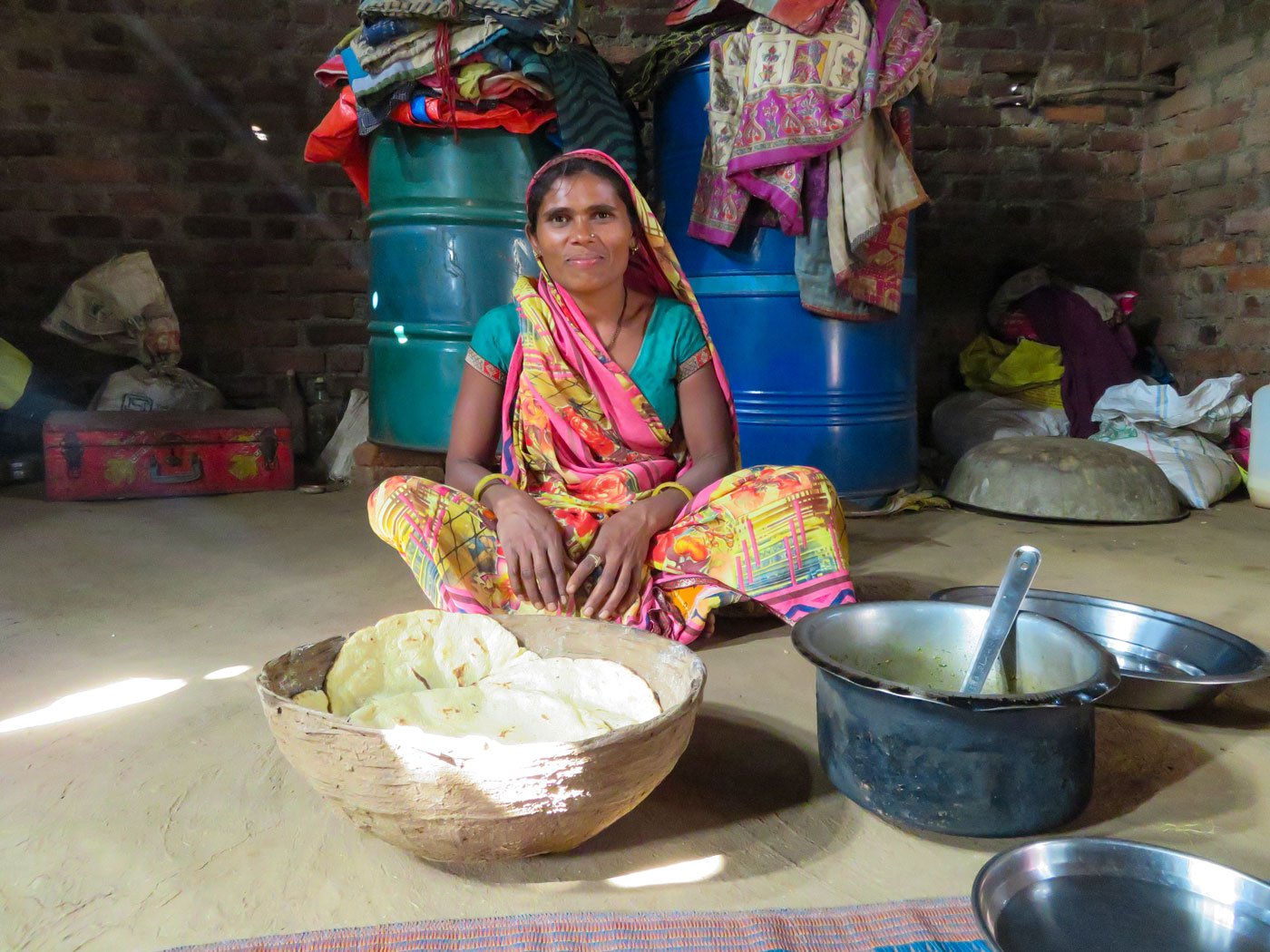
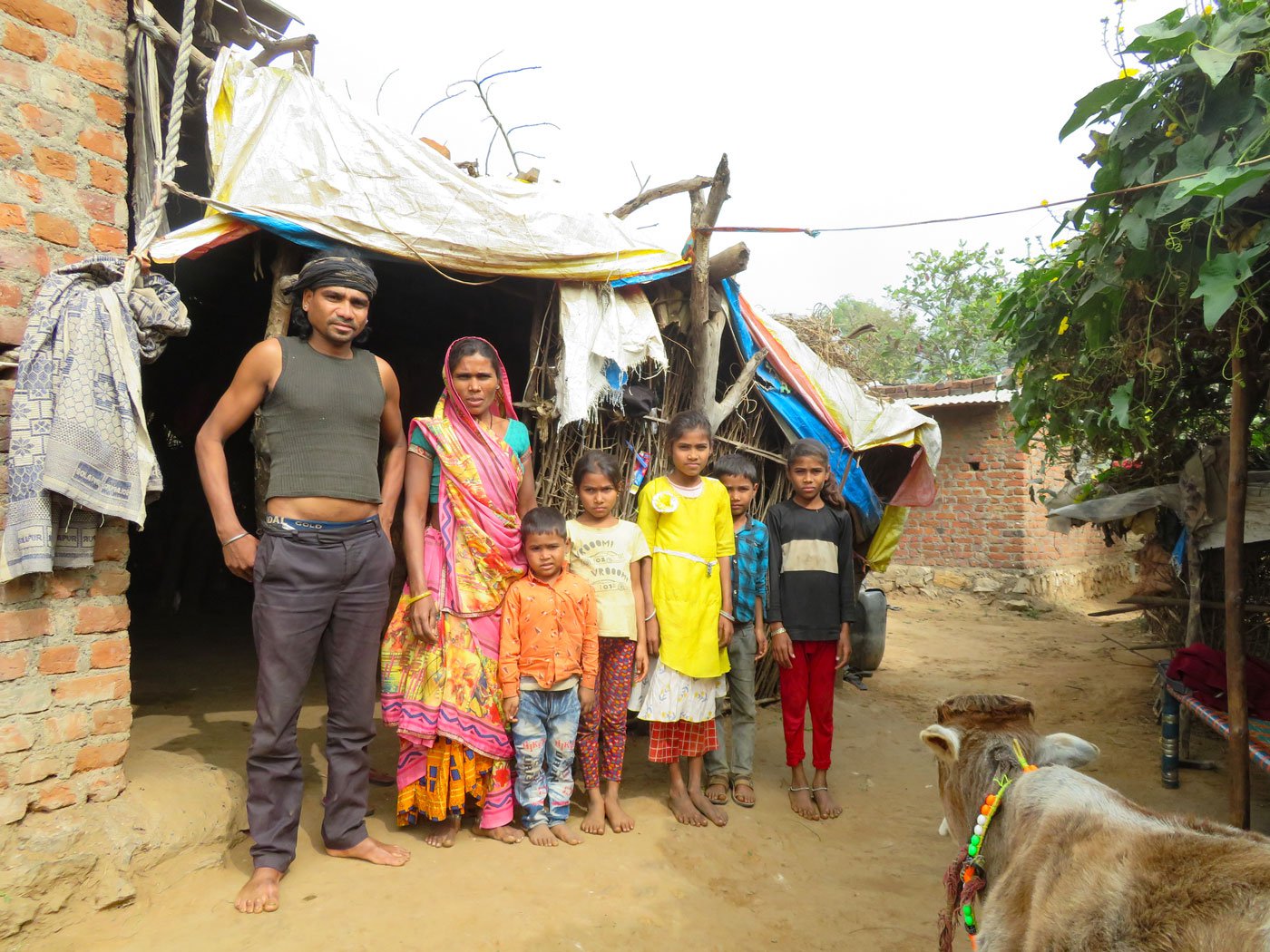
Left: Maria Paaru has been migrating annually with her husband Paaru Damor since they married 15 years ago. Maria and Paaru with their family at home (right) in Dungra Chhota, Banswara district. Photos: Priti David/PARI
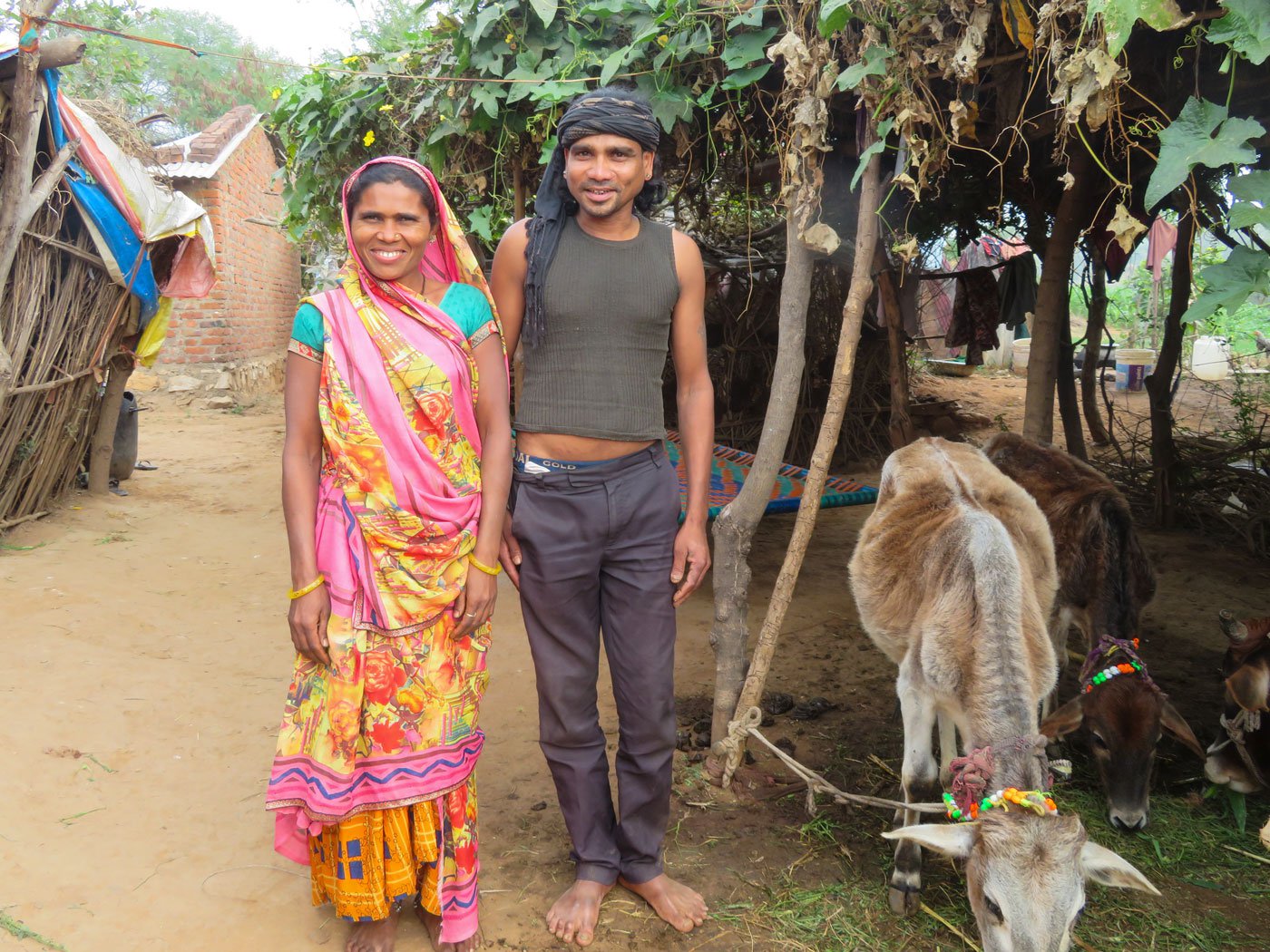
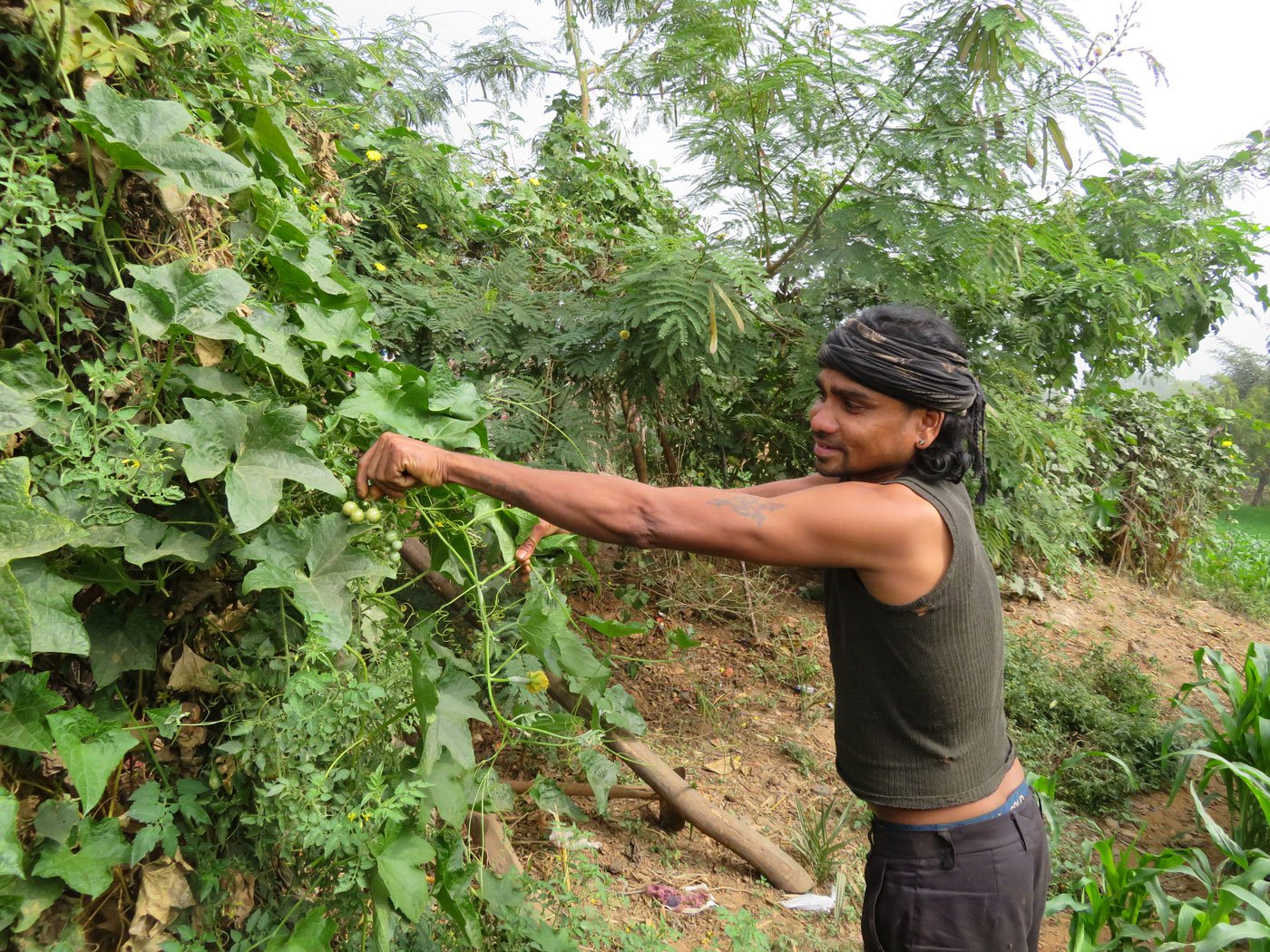
“We can’t manage [finances] without migrating for work. I have to send money home to my parents, pay for irrigation water, buy fodder for cattle, food for the family…,” Paaru reels off his expenses. “So, we have to migrate.” Photos: Priti David/PARI
Migrants dream of a pot of ‘gold’ at the end that will pay off debts, keep children in school and hunger at bay. But things often go wrong. The state labour helpline run by Aajeevika receives up to 5,000 calls a month from migrant workers seeking legal redress for non-payment of dues.
“For wage labour, agreements are never formal, they are verbal. Labourers are passed from one contractor to another,” says Kamlesh who estimates that the denial of wages for just the migrants out of Banswara district adds up to crores of rupees.
“They never get to know who their principal contractor is, who they are working for, so redressal of dues is a frustrating and longwinded process,” he adds. His job gives him a ringside view of how migrants are exploited.
On June 20, 2024, Rajesh Damor, a 45-year-old Bhil Adivasi and two other workers walked into his office in Banswara seeking help. Temperatures in the state were at an all-time high, but that was not the reason why the beleaguered workers were hot and bothered. Collectively due Rs. 226,000 from the labour contractor who had hired them, they had approached the Patan Police Station in Kushalgarh tehsil to lodge a complaint. The cops redirected them to Aajeevika’s Shramik Sahayata Evam Sandarb Kendra, a resource centre for migrant labour in the area.
In April, Rajesh and 55 workers from Sukhwara panchayat had left for Morbi in Gujarat, 600 kilometres away. They had been hired to do labour and masonry work at a construction site in a tile factory there. A daily wage of Rs. 700 was promised to the 10 skilled workers and the rest would get Rs. 400.
After a month of working, “we asked the thekedar [contractor] to pay us all our dues and he kept pushing the dates,” says Rajesh speaking on the phone to PARI. It helped that Rajesh, who was at the forefront of negotiations, speaks five languages – Bhili, Wagdi, Mewari, Hindi and Gujarati. The contractor dealing with their dues was from Jhabua in Madhya Pradesh and spoke Hindi. Often labour is unable to communicate with the final contractor sometimes because of a language barrier, but often because it means wading through a hierarchy of sub-contractors below him. Sometimes contractors get physically violent when the labourers demand their dues.
The 56 workers waited weeks to be paid their hefty dues. They were running out of food from home and purchases in the open market were eating away at their earnings.
“He kept pushing the date – 20, then 24 May, 4 June…” recalls a distressed Rajesh. “We asked him ‘what will we eat? We are so far from home.’ Finally, we stopped working the last 10 days, hoping that would force him to pay up.” They were promised June 20 as the final date.
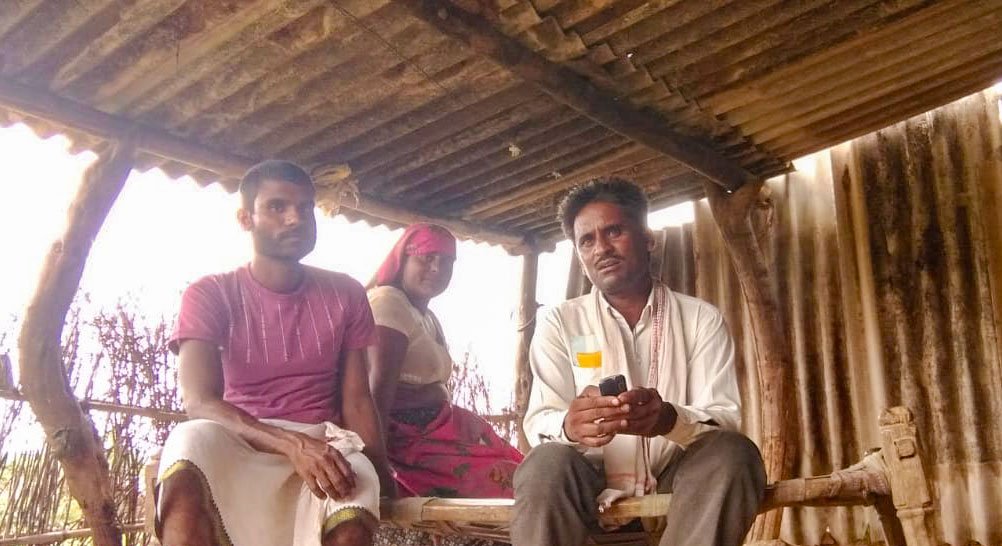
Unsure but unable to stay, on June 9, the party of 56 took the bus home to Kushalgarh. On June 20 when Rajesh called him, “he was rude and started haggling and cursing us.” That’s when Rajesh and the others walked into a police station near their home.
Rajesh Damor (seated on the right) with his neighbours in Sukhwara panchayat. He speaks Bhili, Wagdi, Mewari, Gujarati and Hindi, the last helped him negotiate with the contractor when their dues of over Rs. two lakh were held back in Morbi in Gujarat. Photo: PARI
Rajesh has 10 bighas of land on which his family grow soybean, cotton and wheat, the latter for their own consumption. His four children have all received an education, and are enrolled in schools and colleges. Yet, this summer they joined their parents in wage work. “It was the holidays, so I said they can come along and earn some money,” says Rajesh. He is hopeful his family will see the earnings now that the contractor has been threatened with a case in the labour court.
The mention of labour court does force erring contractors to make good their promises. But to get there, labourers need help with filing the case. A group of 12 wage workers who had gone from this district to work on roads in Alirajpur, in neighbouring Madhya Pradesh were denied full payment after three months of working. The contractor cited poor work and refused to pay the Rs. 4-5 lakh due to them.
“We got a call saying we are stuck in Madhya Pradesh, and we have not been paid,” recalls Teena Garasia who often gets such calls on her personal phone. “Our numbers get circulated among workers,” explains the head of Aajeevika’s Livelihood Bureau in Banswara district.
This time the workers were able to give details of the work site, photos of the attendance register, and the name and mobile number of the contractor for the case to be filed.
Six months later the contractor paid up in two instalments. “He came here [Kushalgarh] to give the money,” say the relieved workers who received the wages, but not the interest due on late payment.
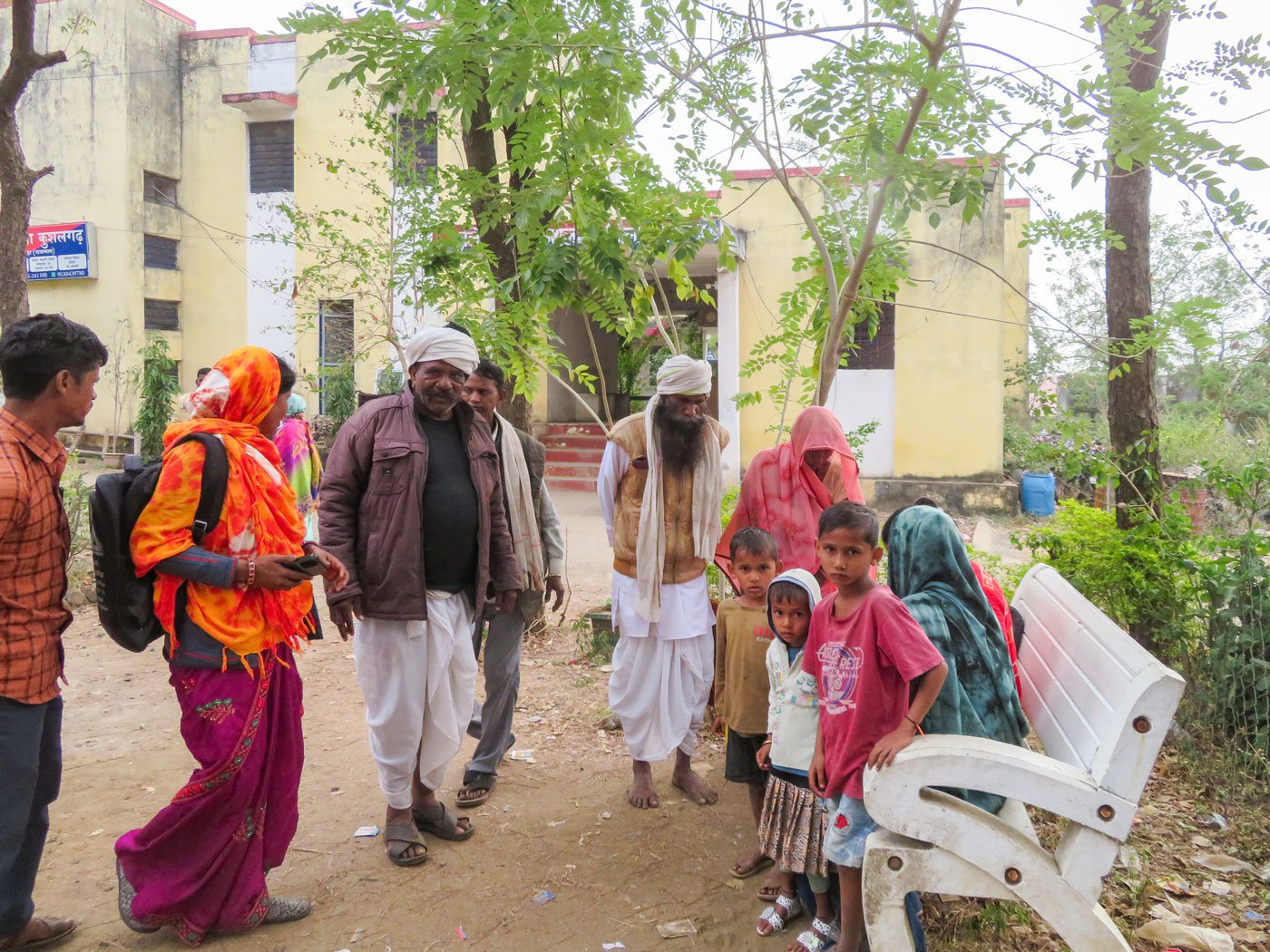
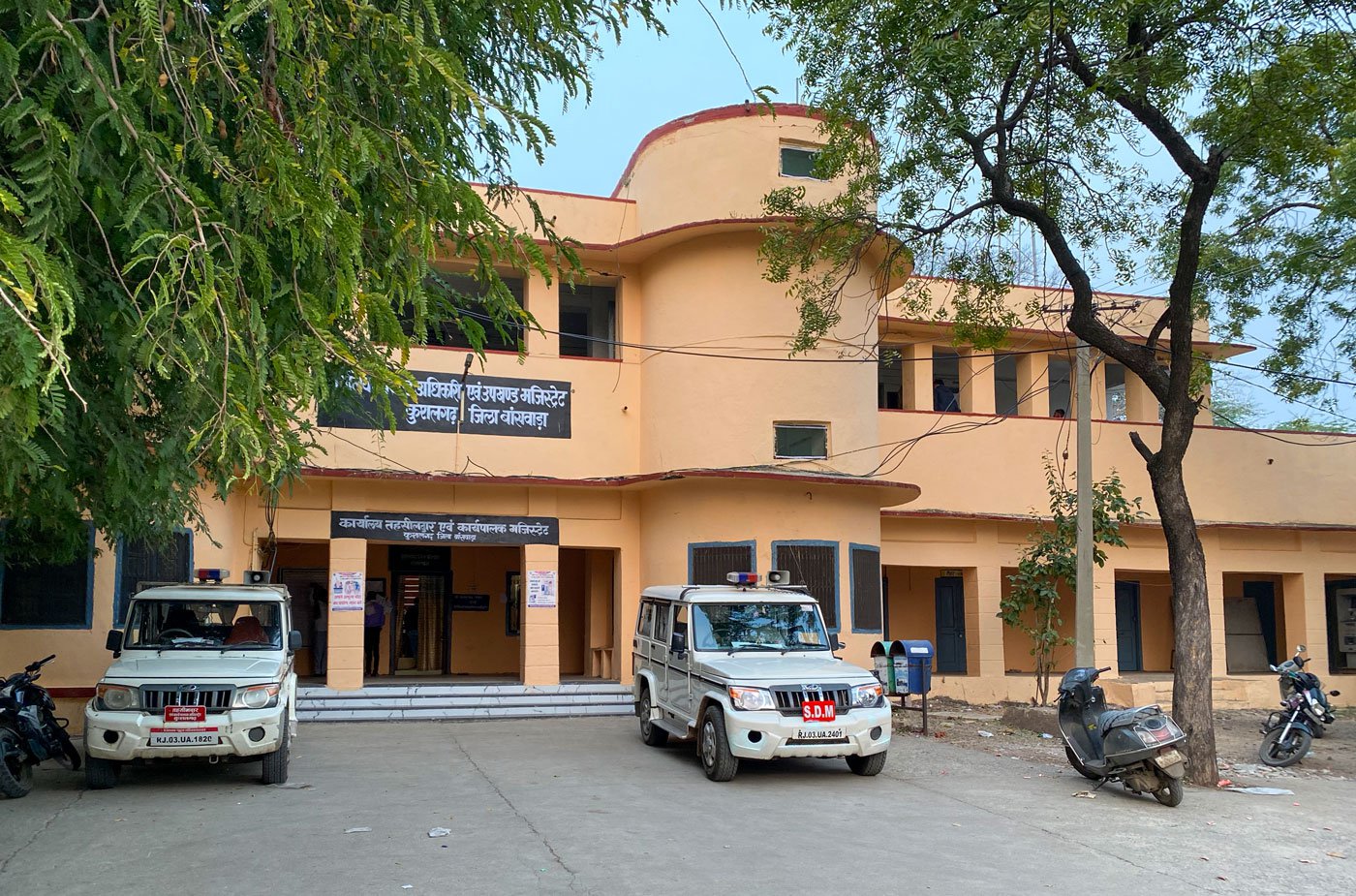
For unpaid workers, accessing legal channels such as the police (left) and the law (right) in Kushalgarh is not always easy as photographic proof, attendance register copies, and details of the employers are not always available. Photos: Priti David/PARI
“We try negotiation first,” says Kamlesh Sharma. “But that is only possible if the details of the contractor are there.
The 25 labourers who migrated for Surat to work in a textile factory had no proof. “They were passed on from one contractor to another and have no phone number or name to pin the person down,” says Teena. “They couldn’t identity the factory in the sea of similar looking ones.”
Harassed and denied their full wages of Rs. 6 lakhs, they returned home to their villages in Banswara’s Kushalgarh and Sajjangarh.
It’s for such cases that social worker Kamlesh places a lot of faith in kanoon shiksha (legal literacy). Banswara district lies on the state border and is the scene of maximum migration. Eighty per cent of families in Kushalgarh, Sajjangarh, Ambapara, Ghatol and Gangar Talai have at least one migrant, if not more, says Aajeevika’s survey data.
Kamlesh is hopeful that since “the younger generation have phones, can store numbers, take photos and therefore nailing defaulting contractors will become easier in the future.”
The union government’s Samadhan Portal was launched pan-India on September 17, 2020 for filing industrial disputes, and in 2022 it was rejigged to allow workers to file claims. But there is no office in Banswara despite it being an obvious choice.
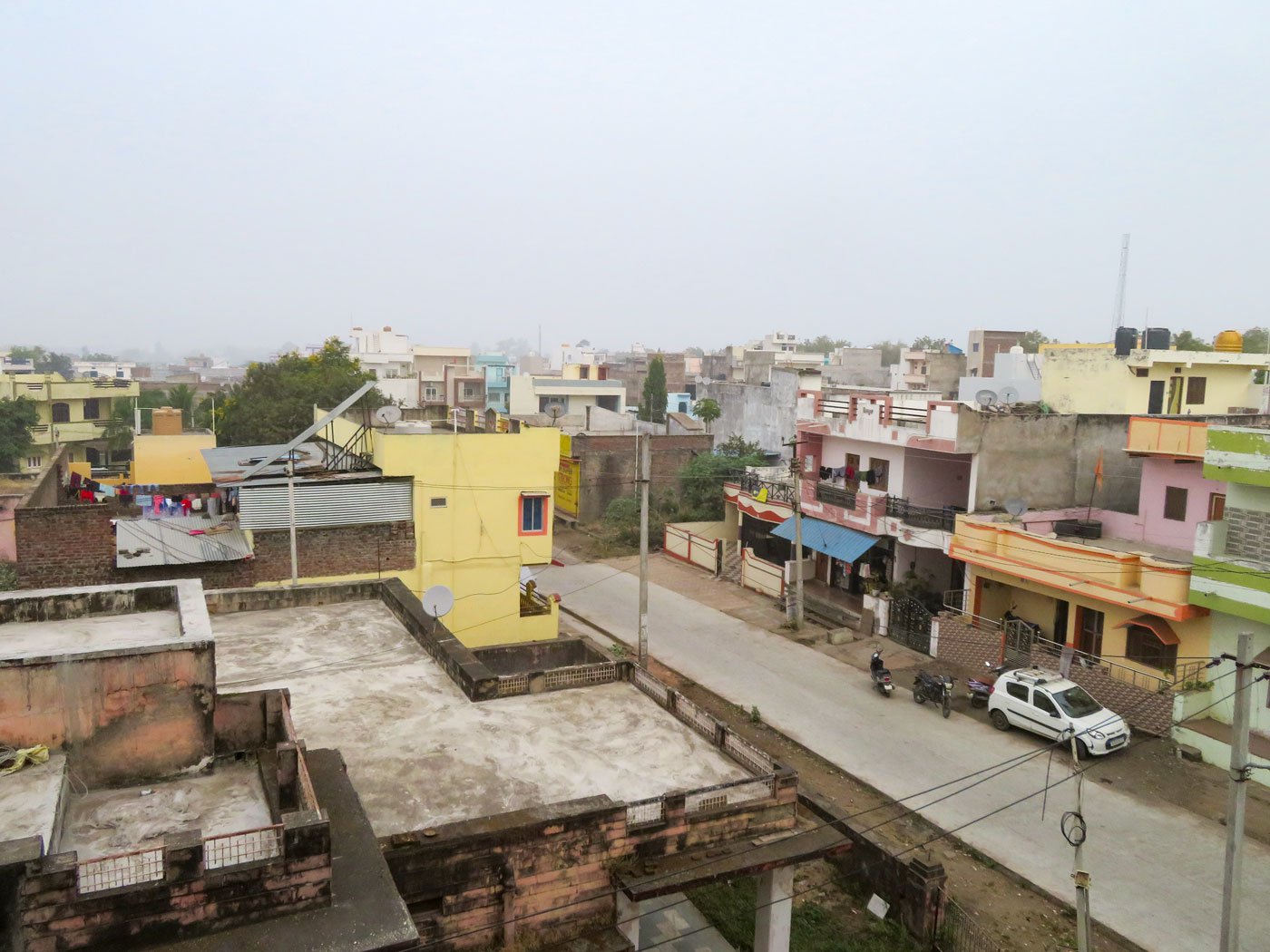
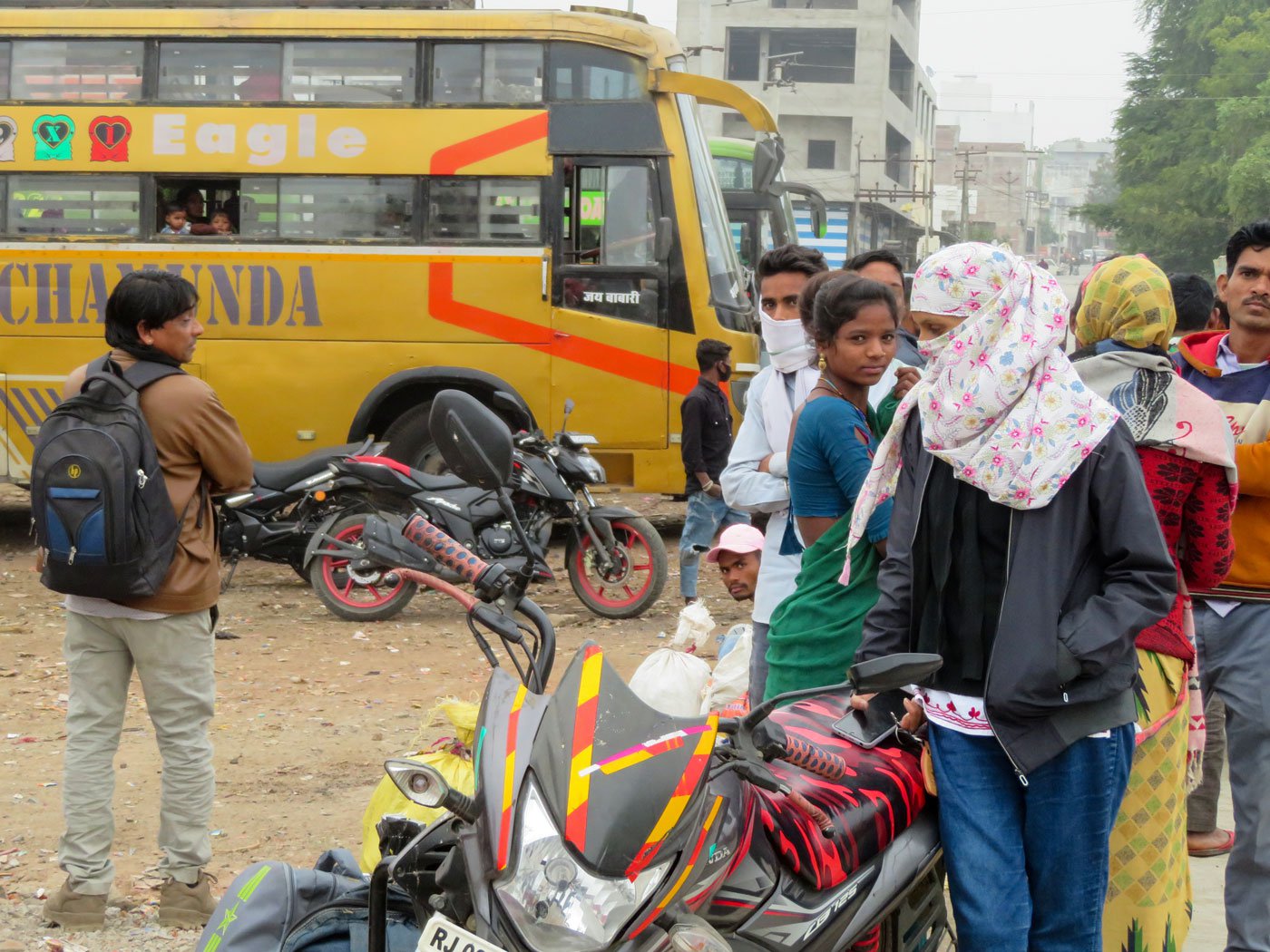
Kushalgarh town in Banswara district lies on the state border and is the scene of maximum migration. Eighty per cent of families in Kushalgarh, Sajjangarh, Ambapara, Ghatol and Gangar Talai have at least one migrant, if not more, says Aajeevika’s survey data. Photos: Priti David/PARI
Women migrants don’t find a voice in wage conversations. They rarely have their own phone and both work and wages are directed through the men around them. There has been serious resistance to women getting their own phones. The last government of the state, led by Ashok Gehlot of the Congress, launched a programme for distribution of over 13 crore free phones to women in the state. Close to 25 lakh phones were distributed to poor women till the Gehlot government lost power. In the first phase, the phones were given to widows and girls in Class 12 who were from migrant families.
The incoming government of Bhajan Lal Sharma of the Bhartiya Janata Party has put the programme on hold “till the scheme’s benefits are examined.” It was among the first decisions he made barely a month after being sworn in. Locals says the scheme is unlikely to be revived.
For most women the lack of agency over their earnings contributes to the routine gender, sexual abuse and abandonment they face.
“I cleaned the wheat and he took it along with some corn flour, 5-6 kilos. He took it and left,” recalls Sangeeta, a Bhil Adivasi now living with her parents in their home in Churada, Kushalgarh block. She had migrated with her husband when he went to Surat after they were married.
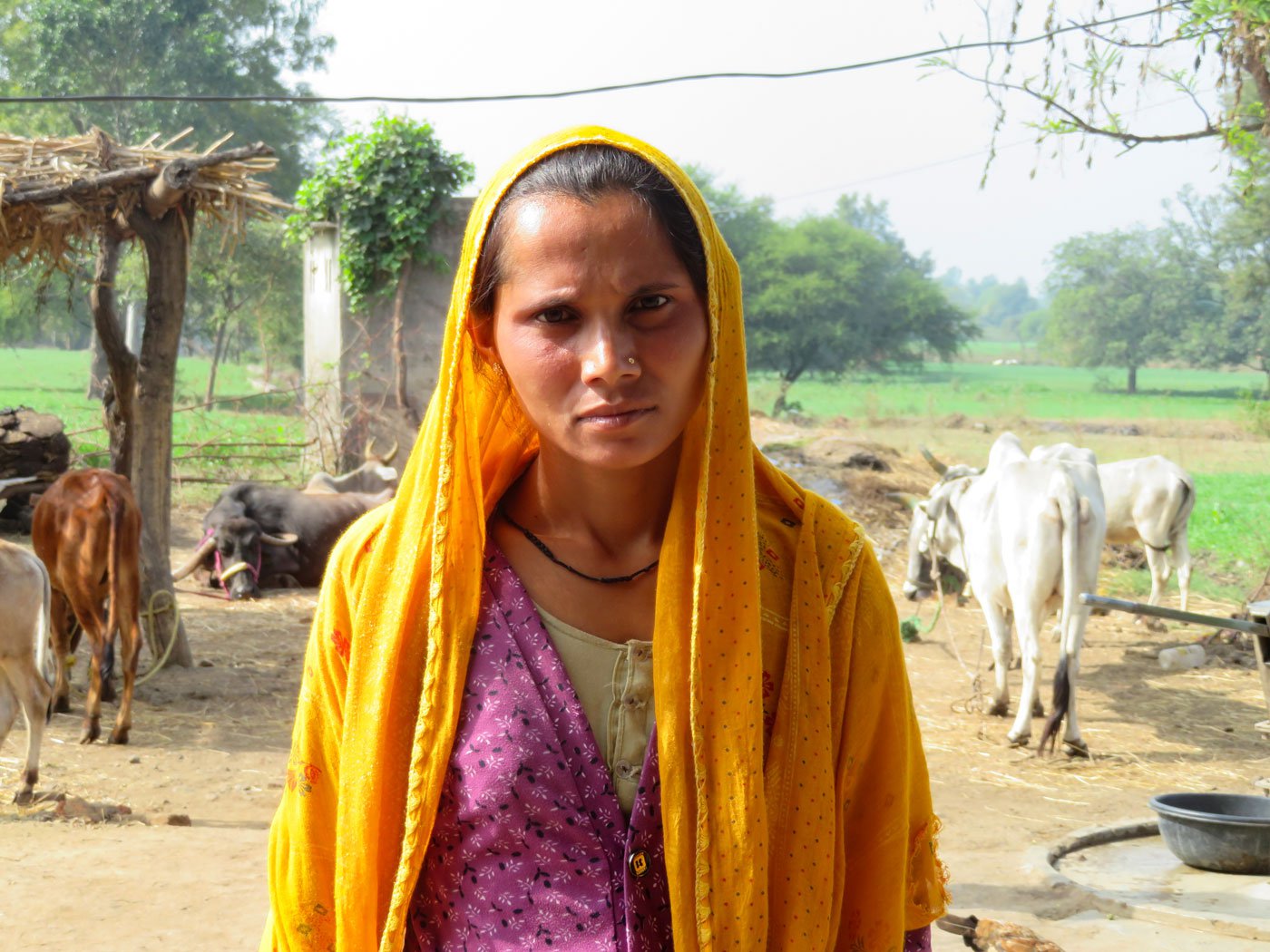
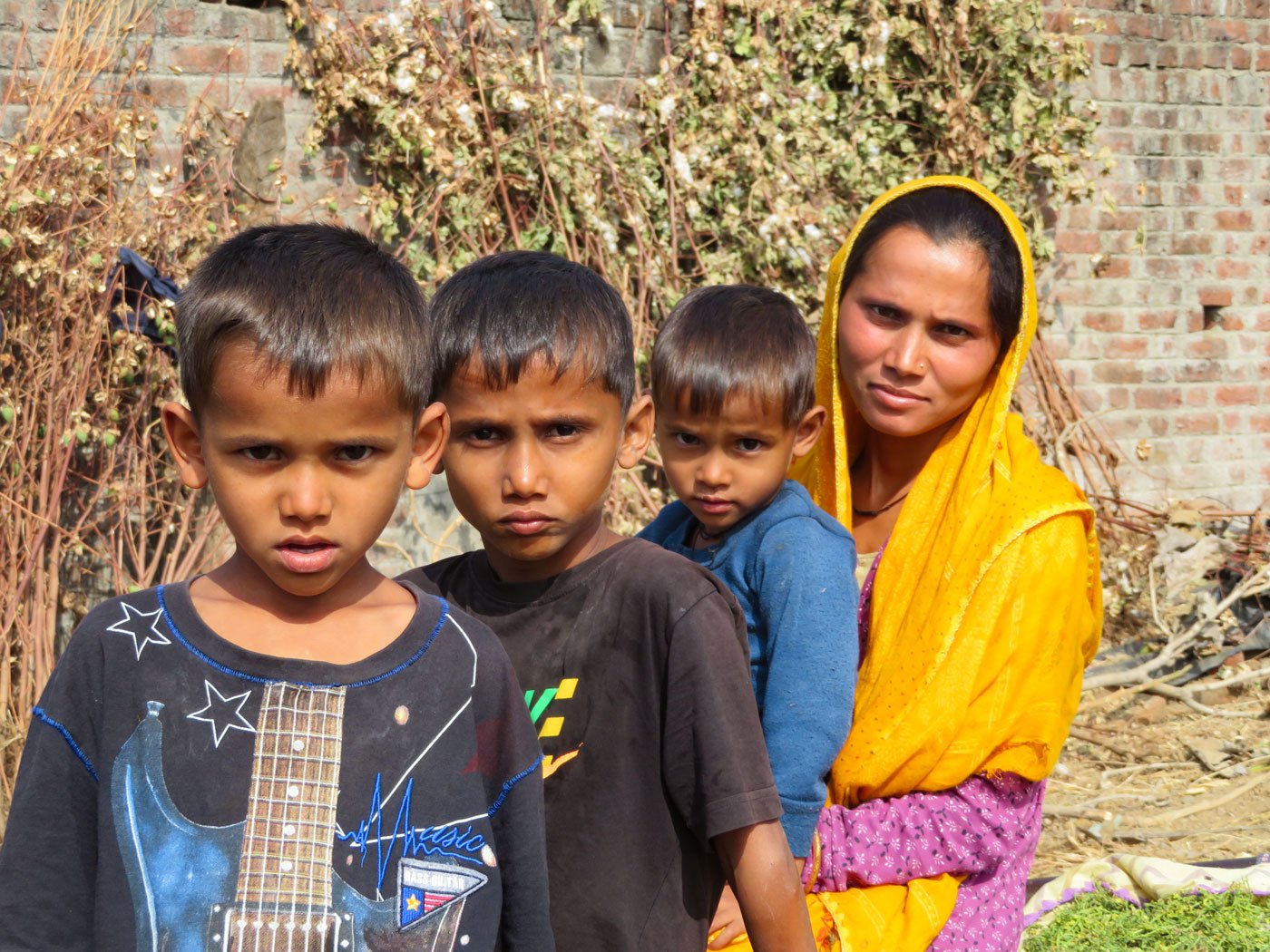
Sangeeta in Churada village of Kushalgarh block with her three children. She arrived at her parent’s home after her husband abandoned her and she could not feed her children. Photos: Priti David/PARI
“I helped in construction work,” she recalls, and her earnings were handed to her husband. “I didn’t like it there.” Once the couple’s children were born – they have three boys ages aged seven, five and four – she stopped going. “I was taking care of the children and the house.”
For more than a year now, she has not seen her husband, or received any money from him. “I have come to my parent’s house as there is nothing to feed my children there [at her married home].”
In January this year (2024), she went to the police station in Kushalgarh to file a case. Rajasthan accounts for almost 10 per cent of India’s abandoned women, says the National Crimes Records Bureau (NCRB) 2020 report . But real data is hard to find as figures for abandoned women are clubbed with miscarriage, infanticide, foeticide.
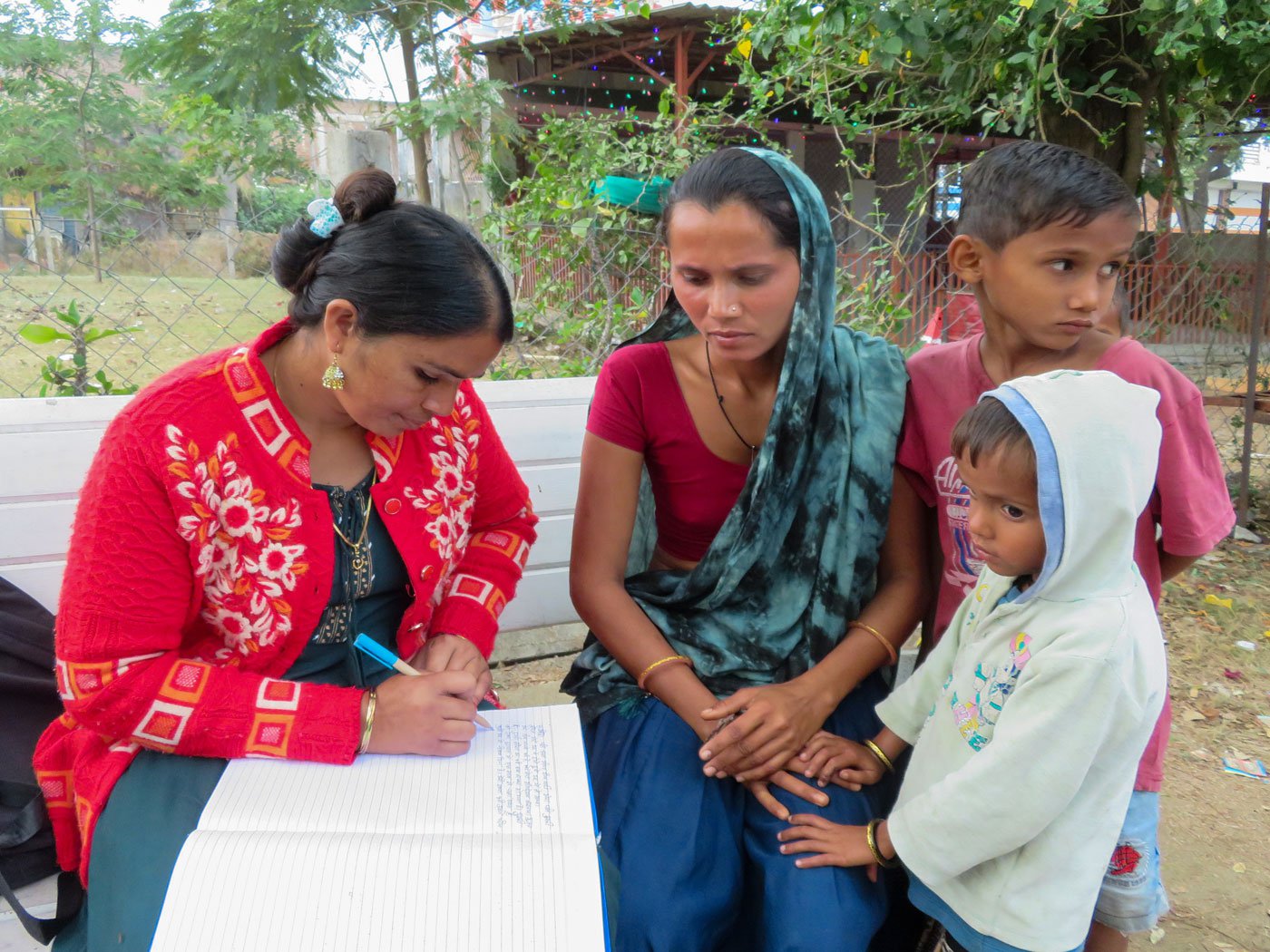
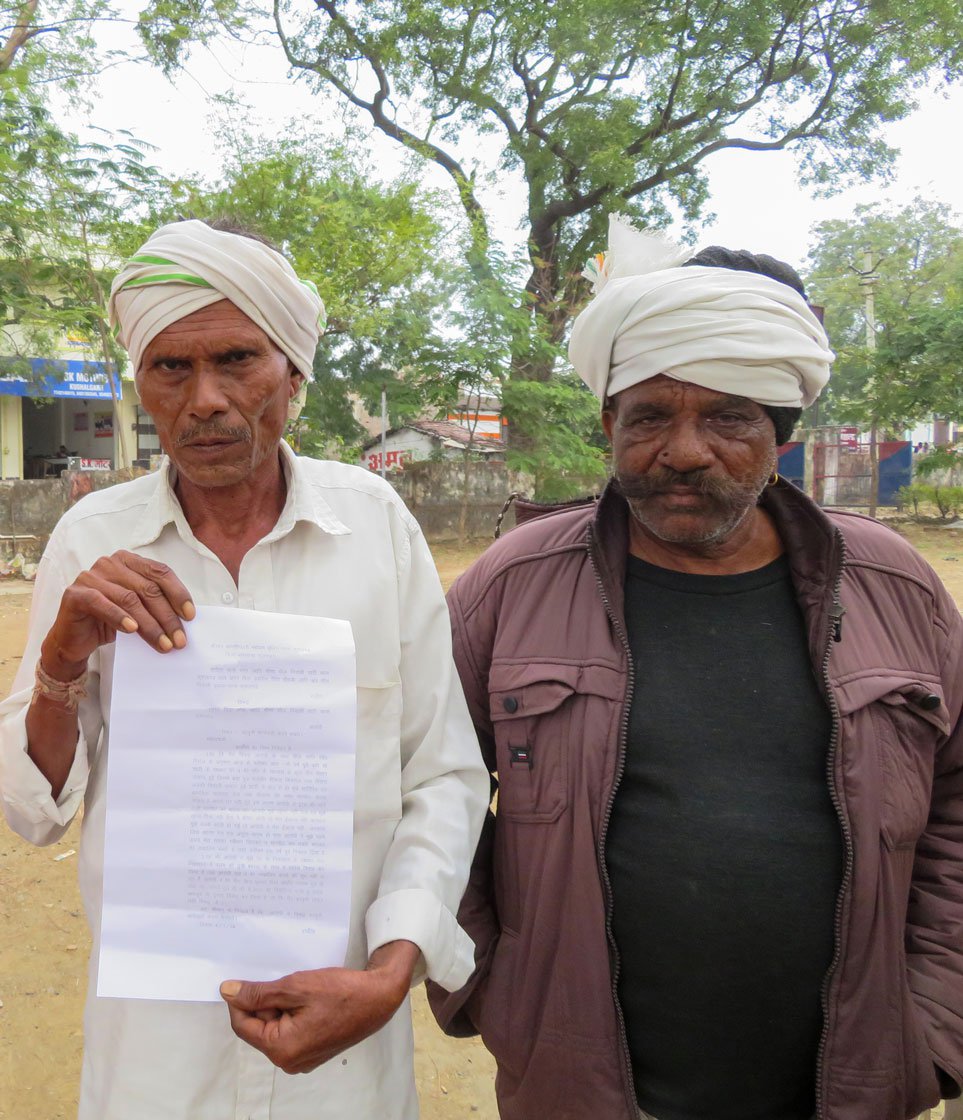
Sangeeta is helped by Jyotsna Damor to file her case at the police station. Sangeeta’s father holding up the complaint of abandonment that his daughter filed. Sarpanch Joga (in brown) has come along for support. Photos: Priti David/PARI
At the Kushalgarh Police Station, officers admit that the number of women seeking redressal is only rising. But they also admit that most cases don’t reach them as the banjadia – an all-men group in the village who take decisions – prefer to settle without the cops. “The banjadia take money from both sides,” says a resident. “Justice is an eye wash, and women never get their due.”
Sangeeta’s distress is worsening as relatives are telling her that her husband is with another woman who he wants to marry. “I feel bad that the man has hurt my children, not come to see them for over a year. They ask me ‘is he dead?’ My eldest one abuses him and tells me, ‘Mummy when the police catch him you also beat him up!’” she says, a small smile on her face.
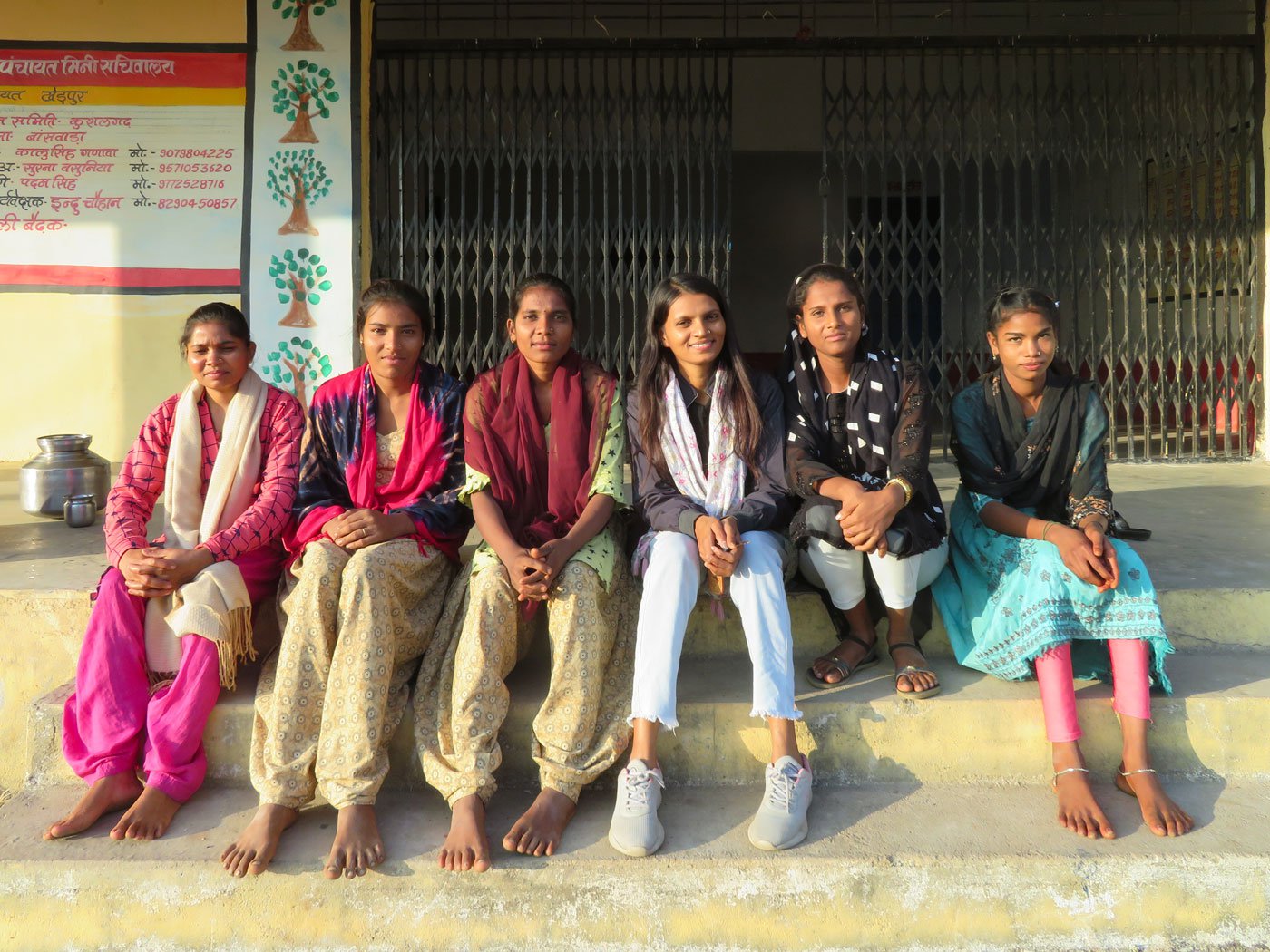
Menka (wearing blue jeans) with girls from surrounding villages who come for the counselling every Saturday afternoon. Photo: Priti David/PARI
On a Saturday afternoon in the deserted panchayat office in Kherpur, 27-year-old social worker Menka Damor is speaking to young girls of five panchayats here in Kushalgarh block.
“What is your sapna [dream]?” she asks the 20 odd girls sitting in a circle around her. All of them are daughters of migrants, all have travelled with their parents and are likely to again. “They tell me even if we get to school, we will only have the migration at the end,” says Menka who manages the Kishori Shramik Programme for young girls.
She wants them to see a future beyond migration. Switching between Wagdi and Hindi, she flashes cards showing people from different professions – cameraperson, weightlifter, dress designer, skateboarder, teacher and engineer. “You can be anything you want, and you have to work towards it,” she tells the bright faces.
“Migration is not the only option.”
जून महीने का तीसरा शुक्रवार था, जब मज़दूर हेल्पलाइन नंबर की घंटी बजी.
“क्या आप हमारी मदद कर सकते हैं? हमें हमारी मजूरी नहीं दी रही है.”
कुशलगढ़ में रहने वाले 80 मज़दूरों की टोली राजस्थान में ही आसपास की तहसीलों में काम करने गई हुई थी. दो माह से वे टेलीकॉम फाइबर केबल बिछाने के लिए दो फीट चौड़ा और छः फीट गहरा गड्ढा खोद रहे थे. मजूरी खोदे जा रहे गड्ढे की प्रति मीटर गहराई के हिसाब से मिलनी तय हुई थी.
दो माह बाद जब काम पूरा हुआ, तो उन्होंने अपनी मजूरी मांगी. ठेकेदार ख़राब काम करने का बहाना देने लगा, और हिसाब-किताब में फंसाने लगा. इसके बाद वह उन्हें यह कहकर टालने लगा कि “देता हूं, देता हूं.” लेकिन उसने पैसे नहीं दिए. एक हफ़्ते तक अपने बकाया 7-8 लाख रुपए का इंतज़ार करने के बाद मज़दूर पुलिस के पास गए, जहां उन्हें मज़दूर हेल्पलाइन में फोन करने को कहा गया.
जब मज़दूरों ने हेल्पलाइन में फ़ोन किया, तो “हमने पूछा कि उनके पास कोई सबूत है कि नहीं. हमने उनसे ठेकेदार का नाम और फ़ोन नंबर, और हाज़िरी रजिस्टर की तस्वीरें मांगी,” बांसवाड़ा ज़िला मुख्यालय में सामाजिक कार्यकर्ता कमलेश शर्मा बताते हैं.
क़िस्मत से नई उम्र के कुछ मज़दूर – जो मोबाइल चलाने में माहिर थे – ये सब इकट्ठा करने में कामयाब रहे. अपना पक्ष मज़बूत करने के लिए उन्होंने काम के जगह की कुछ तस्वीरें भी भेजीं.
प्रवासी मज़दूर मोबाइल में लिए इन स्क्रीनशॉट को सबूत के रूप में पेश करने में कामयाब रहे, जिससे यह साबित होता था कि वे राजस्थान के बांसवाड़ा में दूरसंचार फाइबर केबल बिछाने का काम कर रहे थे. इन तस्वीरों से 80 मज़दूरों को 7-8 लाख रुपए की बकाया मजूरी के लिए दबाव बनाने में मदद मिली | Photos: Aajeevika Bureau via PARI
विडंबना है कि जो गड्ढे उन्होंने खोदे थे वो देश की सबसे बड़ी दूरसंचार कंपनियों में से एक की ख़ातिर खोदे गए थे. उस कंपनी के लिए को ‘लोगों को जोड़ने’ का दावा करती है.
श्रमिकों से जुड़े मुद्दों पर काम करने वाली एक ग़ैर-लाभकारी संस्था ‘आजीविका ब्यूरो’ के प्रोजेक्ट मैनेजर कमलेश और अन्य लोगों ने मिलकर उनके मामले को आगे बढ़ाया. इस संस्था तक पहुंचने के लिए आजीविका हेल्पलाइन नंबर- 1800 1800 999 के साथ ब्यूरो के अधिकारियों के फ़ोन नंबर उपलब्ध कराए जाते हैं.
बांसवाड़ा के ये मज़दूर हर साल काम की तलाश में पलायन करने वाले लाखों मज़दूरों में शामिल हैं. ज़िले के चुड़ादा गांव के सरपंच जोगा पित्ता कहते हैं, “कुशलगढ़ में बहुत से प्रवासी हैं. सिर्फ़ खेती करके हमारा गुज़ारा नहीं चल पाता.”
खेत के छोटे-छोटे जोत, सिंचाई की कमी, रोज़गार के अभाव और इन सब के ऊपर ग़रीबी ने इलाक़े को भील आदिवासियों के पलायन का गढ़ बना दिया है. यहां की 90 प्रतिशत आबादी भील आदिवासियों की है. इंटरनेशनल इंस्टिटयूट फ़ॉर एनवायरनमेंट एंड डेवलपमेंट विश्लेषण के मुताबिक़ सूखे, बाढ़ और गर्मी की लहर (हीट वेव) जैसे चरम मौसमी बदलावों ने पलायन में तेज़ी ला दी है.
कुशलगढ़ के व्यस्त बस स्टैंड से हर दिन क़रीब 40 सरकारी बसें एक बार में 50-100 लोगों को लेकर जाती हैं. इसके अलावा लगभग इतनी ही निजी बसें भी चलती हैं. सूरत की टिकट 500 रुपए में आती है और कंडक्टर बताते हैं कि वे बच्चों के टिकट के पैसे नहीं लेते.
सुरेश मेडा बस में जगह पाने के लिए जल्दी पहुंच जाते हैं और सूरत जाने वाली बस में अपनी पत्नी व तीन छोटे बच्चों को बिठाते हैं. सामान चढ़ाने के लिए वह उतरते हैं और पांच किलो आटा, थोड़े बर्तन और कपड़ों से भरी बोरी बस के पीछे की तरफ़ सामान रखने वाली जगह पर रखते हैं और फिर से बस में चढ़ जाते हैं.
बाएं: सुरेश मेडा खेरदा गांव से हैं और साल में एक से ज़्यादा बार पलायन करते हैं. कुशलगढ़ बस स्टैंड से वह गुजरात के अलग-अलग शहरों के लिए बस पकड़ते हैं. दाएं: जोगा पित्ता चुड़ादा गांव के सरपंच हैं और बताते हैं कि यहां पढ़े-लिखे युवाओं के लिए भी नौकरी नहीं है | Photos: Priti David/PARI
“मैं हर रोज़ 350 रुपए के आसपास कमाऊंगा,” भील आदिवासी मज़दूर सुरेश पारी को बताते हैं; उनकी पत्नी को रोज़ के 250-300 रुपए मिलेंगे. सुरेश को उम्मीद है कि वे लौटने से पहले एक या दो महीने तक काम करेंगे. फिर घर पर 10 दिन रहने के बाद, दोबारा काम पर निकल जाएंगे. सुरेश (28) कहते हैं, “दस साल ज़्यादा समय से जीवन इसी तरह चल रहा है.” सुरेश जैसे प्रवासी मज़दूर आम तौर पर होली, दिवाली और रक्षाबंधन जैसे बड़े त्योहारों में घर आते हैं.
राजस्थान से बड़ी मात्रा में बाहर के राज्यों में पलायन होता है. यहां काम के लिए आने वाले लोगों के बनिस्पत काम के लिए बाहर जाने वाले लोग ज़्यादा हैं. मज़दूरी के लिए पलायन के मामले में राजस्थान सिर्फ़ उत्तर प्रदेश और बिहार से पीछे है. कुशलगढ़ तहसील कार्यालय के अधिकारी वी. एस राठौड़ कहते हैं, “यहां खेती ही कमाई का एकमात्र साधन है. और यह भी साल में बस एक बार, बारिश के बाद की जा सकती है.”
कुशलगढ़ के टिमेड़ा बस स्टैंड (बाएं) से रोज़ क़रीब 10 से 12 बसें गुजरात के सूरत और अन्य बड़े शहरों के लिए रवाना होती हैं. इनमें ज़्यादातर मज़दूर चलते हैं, जो काम की तलाश में अकेले या अपने परिवार के साथ यात्रा करते हैं | Photos: Priti David/PARI
सभी मज़दूर कायम वाले काम की आस में रहते हैं, जिसमें पूरे अंतराल के लिए वे एक ठेकेदार के साथ काम करते हैं. इसमें रोकड़ी या दिहाड़ी – जिसके लिए हर सुबह मज़दूर मंडी में खड़ा होना पड़ता है – के बनिस्पत ज़्यादा स्थिरता होती है.
जोगाजी ने सभी बच्चों को पढ़ाया-लिखाया है, लेकिन “यहां बेरोज़गारी ज़्यादा है. पढ़े-लिखे लोगों के लिए भी नौकरी नहीं है.”
ऐसे में पलायन ही आख़िरी सहारा बचता है.
मरिया पारू जब घर से निकलती हैं, तो साथ में मिट्टी का तवा साथ ले जाती हैं. इसके बिना वह नहीं चलती हैं. वह बताती हैं कि मिट्टी के तवे पर मकई की रोटी बढ़िया बनती है. उनके मुताबिक़, लकड़ी के चूल्हे पर जब रोटी पकती है, तो मिट्टी का तवा उसे जलने नहीं देता. यह बताते हुए वह मुझे रोटी पकाकर दिखाती भी हैं.
मरिया और उनके पति पारू दामोर जैसे लाखों भील आदिवासी राजस्थान के बांसवाड़ा ज़िले से दिहाड़ी के काम की तलाश में गुजरात के सूरत, अहमदाबाद, वापी जैसे शहरों में तथा अन्य पड़ोसी राज्यों में पलायन करते हैं. साल में 100 दिन काम देने का वादा करने वाली महात्मा गांधी राष्ट्रीय ग्रामीण रोज़गार गारंटी योजना के बारे में बताते हुए पारू कहती हैं, “मनरेगा में जल्दी काम नहीं मिलता और पूरा भी नहीं पड़ता.”
तीस साल की मरिया अपना साथ मकई का 10-15 किलो आटा भी ले जाती हैं. वह कहती हैं, “हम लोग इसे खाना पसंद करते हैं.” उनका परिवार साल में नौ महीने घर से दूर रहता है. डुंगरा छोटा में स्थित अपने घर से दूर रहते हुए ‘घर’ का भोजन सुकून देता है.
इस दंपति के तीन से 12 बरस के छः बच्चे हैं और गांव में उनके पास दो एकड़ ज़मीन है. इस पर वे अपने खाने के लिए गेहूं, चना और मक्का उगाते हैं. “काम की तलाश में घर छोड़े बिना हमारा गुज़ारा नहीं चलता. घर पर मां-बाप को पैसा भेजना पड़ता है, सिंचाई का ख़र्च उठाना होता है, मवेशियों के लिए चारा ख़रीदना होता, घरवालों का पेट पालना पड़ता है…,” पारू पूरा हिसाब गिनाते हैं. “इसलिए हमें पलायन करना पड़ता है.”
पहली बार उन्होंने आठ साल की उम्र में बड़े भाई और बहन के साथ पलायन किया था, जब परिवार के ऊपर अस्पताल के ख़र्चों के चलते 80,000 रुपए का क़र्ज़ चढ़ गया था. उन्हें याद है, “सर्दियों के दिन थे. मैं अहमदाबाद गया था और रोज़ के 60 रुपए कमाता था.” सभी भाई-बहन वहां चार महीना रहे थे और क़र्ज़ चुकाने में कामयाब हुए थे. वह कहते हैं, “मुझे इस बात के लिए अच्छा लगा था कि मैं भी कुछ मदद कर पाया था.” दो महीने बाद वह फिर से काम पर चले गए थे. तीस की उम्र पार कर चुके पारू लगभग 25 साल से पलायन कर रहे हैं.
बाएं: मरिया पारू की 15 साल पहले शादी हुई थी, जिसके बाद से वह अपने पति पारू दामोर के साथ हर साल काम की तलाश में पलायन करती रही हैं. मरिया और पारू, बांसवाड़ा के डुंगरा छोटा गांव में अपने परिवार के साथ घर (दहिना) पर | Photos: Priti David/PARI
‘काम की तलाश में घर छोड़े बिना हमारा गुज़ारा नहीं चलता. घर पर मां-बाप को पैसा भेजना पड़ता है, सिंचाई का ख़र्च उठाना होता है, मवेशियों के लिए चारा ख़रीदना होता, घरवालों का पेट पालना पड़ता है…,’ पारू पूरा हिसाब गिनाते हैं. ‘इसलिए हमें पलायन करना पड़ता है’ | Photos: Priti David/PARI
मज़दूरों को उम्मीद रहती है कि काम की अवधि ख़त्म होने पर उन्हें इतने पैसे मिल जाएंगे कि क़र्ज़ चुका पाएंगे, उनके बच्चों के स्कूल की फ़ीस भरी जा सकेगी, और सबका पेट भरा जा सकेगा. आजीविका द्वारा संचालित राज्य के मज़दूर हेल्पलाइन नंबर पर हर महीने तक़रीबन 5,000 कॉल आती है, जिसमें बकाया मजूरी न मिलने की समस्या से निपटने के लिए क़ानूनी मदद की गुहार लगायी गई होती है.
“दिहाड़ी मज़दूरी के काम में लिखा-पढ़ी नहीं होती, सबकुछ मुंह-ज़बानी तय होता है. मज़दूरों को एक ठेकेदार से दूसरे ठेकेदार के पास भेज दिया जाता है.” कमलेश कहते हैं. उनका अनुमान है कि सिर्फ़ बांसवाड़ा ज़िले के मज़दूरों का करोड़ों रुपया बकाया होगा.
वह आगे कहते हैं, “उन्हें लोगों को सही-सही पता ही नहीं चलता कि असली ठेकेदार कौन है, वे किसके लिए काम कर रहे हैं. इसलिए बकाया रक़म को हासिल करने की प्रक्रिया लंबी और हताश कर देने वाली होती है.” कमलेश का काम ऐसा है कि उन्हें इसका अंदाज़ा मिल जाता है कि प्रवासियों का किस तरह शोषण किया जा रहा है.
बीते 20 जून, 2024 को 45 वर्षीय भील आदिवासी राजेश दामोर और दो अन्य मज़दूर बांसवाड़ा में स्थित उनके कार्यालय में मदद मांगने आए. गर्मी अपना चरम पर थी, लेकिन मज़दूरों के ग़ुस्से और परेशानी का कारण कुछ और था. जिस ठेकेदार ने उन्हें काम पर रखा था उसके पास उनके सामूहिक रूप से 226,000 रुपए बकाया थे. इसकी शिकायत के लिए जब वे कुशलगढ़ तहसील के पाटन पुलिस स्टेशन गए, तो पुलिस ने उन्हें आजीविका के श्रमिक सहायता एवं संदर्भ केंद्र भेज दिया.
अप्रैल में राजेश और 55 अन्य मज़दूर सुखवाड़ा पंचायत से 600 किमी दूर स्थित गुजरात के मोरबी के लिए रवाना हुए. उन्हें वहां की एक टाइल फैक्ट्री में निर्माण स्थल पर मज़दूरी और राजगीरी के काम के लिए बुलाया गया था. दस कुशल मज़दूर को दिहाड़ी के 700 रुपए मिलने थे, और बाक़ियों को हर रोज़ 400 रुपए दिए जाने थे.
एक महीने काम करने के बाद, “हमने ठेकेदार से बकाया पैसे देने को कहा, लेकिन वो टालता रहा,” राजेश पारी को फ़ोन पर बताते हैं. राजेश को भीली, वागड़ी, मेवाड़ी, हिंदी और गुजराती बोलनी आती है, इसलिए उन्हें बातचीत में सबसे आगे रखा जाता है. जिस ठेकेदार के पास उनका पैसा बकाया था वह मध्य प्रदेश के झाबुआ का था और हिंदी बोलता था. अक्सर मज़दूर भाषा की समस्या के चलते मुख्य ठेकेदार से सीधे बात नहीं कर पाते हैं, और उन्हें उसके चेलों व छुटभैयों से बात करनी पड़ती है. कई बार जब मज़दूर अपना बकाया मांगते हैं, तो ठेकेदार उनके साथ मारपीट करते हैं.
सभी 56 मज़दूर हफ़्तों तक बकाये के पैसों का इंतज़ार करते रहे. घर में खाने के लाले पड़ने लगे थे, और बचा-खुचा पैसा हाट से सामान ख़रीदने में उड़ रहा था.
“ठेकेदार भुगतान को बार-बार टालता रहा- पहले बोला 20 मई को दूंगा, फिर कहा 24 मई, 4 जून…” राजेश याद करते हैं. “हमने उससे पूछा कि ‘हम पेट कैसे भरेंगे? हम अपने घरों से इतने दूर हैं.’ हारकर, हमने आख़िर के 10 दिनों का काम बंद कर दिया. हमें लगा कि शायद इससे ठेकेदार पर दबाव पड़ेगा.” उन्हें भुगतान के लिए 20 जून की आख़िरी तारीख़ दी गई.
मज़दूर अनिश्चितताओं से घिरे हुए थे, लेकिन अब वहां रुक पाने में असमर्थ थे, इसलिए सभी 56 मज़दूरों ने 9 जून को कुशलगढ़ की बस पकड़ी और घर लौट गए. राजेश ने जब 20 जून को ठेकेदार को फ़ोन किया, तो “वह बदतमीज़ी से बात की, मोल-भाव करने लगा और गाली बकने लगा.” इसके बाद, राजेश और अन्य मज़दूरों को मजबूरन पास के पुलिस थाने जाना पड़ा.
राजेश दामोर (दाईं तरफ़ बैठे) सुखवाड़ा पंचायत में अपने पड़ोसियों के साथ. वह भीली, वागड़ी, मेवाड़ी, गुजराती और हिंदी बोलना जानते हैं. गुजरात के मोरबी में दो लाख से ज़्यादा रुपए की बकाया मज़दूरी के लिए ठेकेदार से बातचीत करने में हिन्दी जानना उनके काम आया | Photo: PARI
राजेश के पास 10 बीघा ज़मीन है, जिस पर उनका परिवार सोयाबीन, कपास और अपने खाने के लिए गेहूं उगाता है. उनके चारों बच्चे पढ़ाई करते हैं और स्कूल व कॉलेज में हैं. फिर भी इस बार गर्मी के सीज़न में उन्होंने मां-बाप के साथ मज़दूरी की. “छुट्टी के दिन थे, इसलिए मैंने उन्हें साथ आने को कहा, ताकि कुछ पैसे कमा सकें.” उनको उम्मीद है कि अब परिवार को पैसे मिल जाएंगे, क्योंकि ठेकेदार के ख़िलाफ़ लेबर कोर्ट में केस होने की चेतावनी दे दी गई है.
लेबर कोर्ट में मामला जाने की बात से ठेकेदारों पर अपना वादा पूरा करने का दबाव पड़ता है. लेकिन इसके लिए मज़दूरों को मामला दर्ज कराने में मदद की ज़रूरत पड़ती है. पड़ोसी राज्य मध्य प्रदेश के अलीराजपुर में सड़क का काम करने के लिए इस ज़िले से गए 12 मज़दूरों के समूह को तीन महीने काम करने के बाद पूरे पैसे नहीं मिले. ठेकेदार ने ख़राब काम का हवाला देकर मज़दूरी के 4-5 लाख रुपए देने से मना कर दिया.
“हमारे पास फ़ोन आया कि वे मध्य प्रदेश में फंसे हुए हैं और उन्हें मज़दूरी नहीं मिली है,” टीना गरासिया बताती हैं, जिन्हें फ़ोन पर अक्सर इस तरह के कॉल आते रहते हैं. वह बांसवाड़ा ज़िले में स्थित आजीविका ब्यूरो की प्रमुख हैं, और आगे बताती हैं, “हमारे नंबर मज़दूरों के पास होते हैं.”
इस बार मज़दूर कार्यस्थल से जुड़ी जानकारी, हाज़िरी रजिस्टर की तस्वीरें, ठेकेदार के नाम और मोबाइल नंबर वगैरह के साथ तैयार थे, ताकि मामला दर्ज किया जा सके.
छः महीने बाद ठेकेदार ने दो क़िस्तों में पैसा चुकाया. “वह हमारी मज़दूरी देने यहां [कुशलगढ़] आया,” मज़दूरों ने बताया, जिन्हें उनके पैसे मिल गए थे. हालांकि, मज़दूरी मिलने में हुई देरी के लिए उन्हें कोई हर्जाना नहीं मिला.
जिन मज़दूरों को उनकी मजूरी नहीं मिली उनके लिए कुशलगढ़ में पुलिस (बाएं) और क़ानूनी (दाएं) सहायता पाना आसान नहीं होता, क्योंकि उनके पास सबूत के तौर पर तस्वीर, हाज़िरी रजिस्टर की प्रतियां, और ठेकेदार से जुड़ी जानकारी कई बार नहीं होती | Photos: Priti David/PARI
कमलेश शर्मा कहते हैं, “पहले हम बातचीत से मसला सुलझाने की कोशिश करते हैं. लेकिन ये तभी संभव हो पाता है, जब ठेकेदार के बारे में सभी जानकारी उपलब्ध हो.”
कपड़ा कारखाना में काम करने के लिए सूरत गए 25 मज़दूरों के पास कोई सबूत नहीं था. टीना कहती हैं, “उन्हें एक ठेकेदार से दूसरे ठेकेदारों के पास भेजा गया था, और उनके पास कोई फ़ोन नंबर या ठेकेदार की पहचान के लिए कोई नाम नहीं था. एक जैसे दिखाई देने वाले तमाम कारखानों के बीच वे अपनी फैक्ट्री की पहचान नहीं कर पाए.”
उत्पीड़न का शिकार होने और 6 लाख रुपए का भुगतान न मिलने के बाद, वंचित मज़दूर बांसवाड़ा के कुशलगढ़ और सज्जनगढ़ लौट आए.
सामाजिक कार्यकर्ता कमलेश इस तरह के मामलों में क़ानूनी तौर पर शिक्षित होने पर बहुत ज़ोर देते हैं. बांसवाड़ा ज़िला राज्य की सीमा पर स्थित है और यहां से सबसे ज़्यादा पलायन होता है. कुशलगढ़, सज्जनगढ़, अंबापाड़ा, घाटोल और गंगर तलाई के अस्सी प्रतिशत परिवारों में कम से कम एक सदस्य ज़रूर पलायन करता है.
कमलेश को उम्मीद करते हैं कि “नई पीढ़ी के पास फ़ोन हैं, वे नंबर सेव कर सकते हैं, तस्वीरें ले सकते हैं, और इसलिए भविष्य में दोषी ठेकेदारों को आसानी से पकड़ा जा सकेगा.”
उद्योग-धंधों से जुड़े विवादों के निपटारे के लिए केंद्र सरकार ने 17 सितंबर, 2020 को देशव्यापी समाधान पोर्टल लॉन्च किया था. साल 2022 में श्रमिकों को अपने दावे दाख़िल करने की अनुमति देने के लिए इसमें बदलाव किए गए. लेकिन विकल्प के तौर पर मौजूद होने के बावजूद इसका बांसवाड़ा में कोई कार्यालय नहीं है.
बांसवाड़ा का कुशलगढ़ राज्य की सीमा पर पड़ता है, और यहां सबसे ज़्यादा पलायन देखने को मिलता है. कुशलगढ़, सज्जनगढ़, अंबापाड़ा, घाटोल और गंगर तलाई के अस्सी फ़ीसदी परिवारों में कम से कम एक सदस्य पलायन ज़रूर करता है | Photos: Priti David/PARI
मज़दूरी तय करने से जुड़े फ़ैसलों में महिला मज़दूरों का कोई दख़ल नहीं होता. उनके पास अपना फ़ोन नहीं होता, और काम व मज़दूरी परिवार के मर्दों के ज़रिए उन तक पहुंचती है. कांग्रेस नेता अशोक गहलोत के नेतृत्व वाली राज्य की पिछली सरकार ने औरतों के बीच 13 करोड़ से ज़्यादा फ़ोन मुफ़्त में बांटने का कार्यक्रम शुरू किया था. गहलोत सरकार जब तक सत्ता में थी, तब तक 25 लाख फ़ोन ग़रीब औरतों के बीच बांटे गए थे. पहले चरण में, प्रवासी परिवारों की विधवा औरतों और 12वीं में पढ़ने वाली लड़कियों के बीच फ़ोन बांटे गए थे.
भारतीय जनता पार्टी के भजन लाल शर्मा की वर्तमान सरकार ने “योजना के लाभ की जांच होने तक” इस कार्यक्रम पर रोक लगा दी है. पद की शपथ लेने के मुश्किल से एक महीने बाद लिए गए शुरुआती फ़ैसलों में से एक यह भी था. स्थानीय लोगों को इस योजना के फिर से चालू होने की उम्मीद कम है.
ख़ुद की कमाई पर अपना हक़ न रहने के चलते ज़्यादातर महिलाओं के साथ होने वाले लैंगिक भेदभाव व यौन शोषण, और पति द्वारा छोड़ दिए जाने जैसी मुश्किलों में बढ़ोतरी देखने को मिलती है. पढ़ें: बांसवाड़ा: शादी की आड़ में लड़कियों की तस्करी
“मैंने गेहूं साफ़ किया और वह 5-6 किलो मक्के के आटे के साथ उसे भी ले गया. उसने ये सब लिया और चला गया,” संगीता बताती हैं. वह भील आदिवासी हैं और अब अपने मां-बाप के साथ कुशलगढ़ ब्लॉक के चुड़ादा गांव में रह रही हैं. शादी के बाद जब पति कमाने के लिए सूरत गया, तो वह भी उसके साथ गई थीं.
कुशलगढ़ ब्लॉक के चुड़ादा गांव में अपने तीन बच्चों के साथ संगीता. जब पति ने उन्हें छोड़ दिया और वह अपने बच्चों का पेट भरने में असमर्थ हो गईं, तो अपने मां-बाप के घर आ गईं | Photos: Priti David/PARI
वह बताती हैं, “मैं निर्माण के काम में मदद करती थी.” उनकी कमाई उनके पति को थमा दी जाती थी. “मुझे ये अच्छा नहीं लगता था.” जब उनके बच्चे पैदा हुए – उनके सात साल, पांच साल और चार साल के तीन बेटे हैं – उन्होंने साथ जाना बंद कर दिया. “हम घर और बच्चों को संभालती थी.”
एक साल से ज़्यादा समय हो चुका था, और उन्होंने अपने पति को नहीं देखा था, न ही उनके पति ने पैसे ही भेजे. “मैं मां-बाप के घर आ गई, क्योंकि बच्चों का पेट भरने के लिए कुछ था ही नहीं…”
आख़िर में, वह इस साल जनवरी में कुशलगढ़ के पुलिस थाने में शिकायत लेकर गईं. नेशनल क्राइम रिकॉर्ड ब्यूरो (एनसीआरबी) की साल 2020 की रिपोर्ट के अनुसार, देश में महिलाओं के ख़िलाफ़ (पति या रिश्तेदारों द्वारा की गई) क्रूरता के मामलों में राजस्थान तीसरे नंबर पर आता है.
थाना में मामला दर्ज कराने में ज्योत्सना दामोर ने संगीता की मदद की है. संगीता को पति द्वारा छोड़ दिए जाने की शिकायत के काग़ज़ात के साथ उनके पिता. सरपंच जोगा (भूरे कपड़ों में) समर्थन में आए हैं | Photos: Priti David/PARI
कुशलगढ़ थाने के अधिकारी स्वीकार करते हैं कि औरतों के साथ ज़्यादती के मामले बढ़ रहे हैं. लेकिन, वे बताते हैं कि ज़्यादातर मामले उन तक नहीं पहुंचते, क्योंकि गांव के मर्दों का समूह – बांजड़िया – इस तरह के मामलों में फ़ैसले लेता है, और पुलिस के बगैर ही मामलों को रफ़ा-दफ़ा कर दिया जाता है. एक स्थानीय निवासी के मुताबिक़, “बांजड़िया दोनों पक्षों से पैसे खाता है. इंसाफ़ का बस दिखावा किया जाता है, और औरतों को कभी न्याय नहीं मिलता.”
संगीता की परेशानी बढ़ती जा रही है. उनके रिश्तेदार बताते हैं कि उनका पति किसी दूसरी महिला के साथ है और उससे शादी करना चाहता है. संगीता कहती हैं, “मुझे ख़राब लगता है कि उस आदमी ने मेरे बच्चों को दुख दिया है, एक साल से उन्हें देखने भी नहीं आया. बच्चे पूछते हैं, ‘क्या वो मर गए?’ मेरा बड़ा बेटा अपने पिता को गालियां देता है और मुझसे कहता है, ‘मम्मी, जब पुलिस उन्हें पकड़ेगी, तो आप भी पीटना!’” संगीता के होंठों पर फीकी सी मुस्कान आ जाती है.
मेनका (नीली जींस में) के साथ आसपास के गांवों की लड़कियां हैं, जो हर शनिवार की दोपहर काउंसलिंग के लिए आती हैं | Photo: Priti David/PARI
शनिवार की एक दोपहर खेरपुर के उजाड़ से पंचायत कार्यालय में 27 वर्षीय सामाजिक कार्यकर्ता मेनका दामोर युवा लड़कियों से बात कर रही हैं, जो कुशलगढ़ ब्लॉक के पांच पंचायतों से आई हैं.
“तुम्हारा सपना क्या है?” वह अपने इर्द-गिर्द गोल घेरा बनाकर बैठीं 20 लड़कियों से सवाल करती हैं. ये लड़कियां प्रवासी कामगारों की बेटियां हैं और अपने मां-बाप के साथ पलायन कर चुकी हैं; शायद फिर से करेंगी. युवा लड़कियों के लिए संचालित किशोरी श्रमिक कार्यक्रम का प्रबंधन संभालने वाली मेनका बताती हैं, “ये लड़कियां कहती हैं कि अगर हम स्कूल पहुंच भी जाते हैं, तो आख़िर में पलायन ही करना पड़ता है.”
वह चाहती हैं कि ये लड़कियां पलायन से परे अपने भविष्य के बारे में सोच पाएं. वागड़ी और हिन्दी में बोलते हुए वह अलग-अलग काम और पेशों से जुड़े लोगों के कार्ड दिखाती हैं, जिसमें कैमरामैन, वेटलिफ्टर, ड्रेस डिज़ाइनर, स्केटबोर्डर, मास्टर, इंजीनियर आदि शामिल हैं. वह उनसे कहती हैं, “तुम लोग जो चाहो वह बन सकती हो, और इसके लिए मेहनत कर सकती हो.”
“पलायन आख़िरी विकल्प नहीं है.”
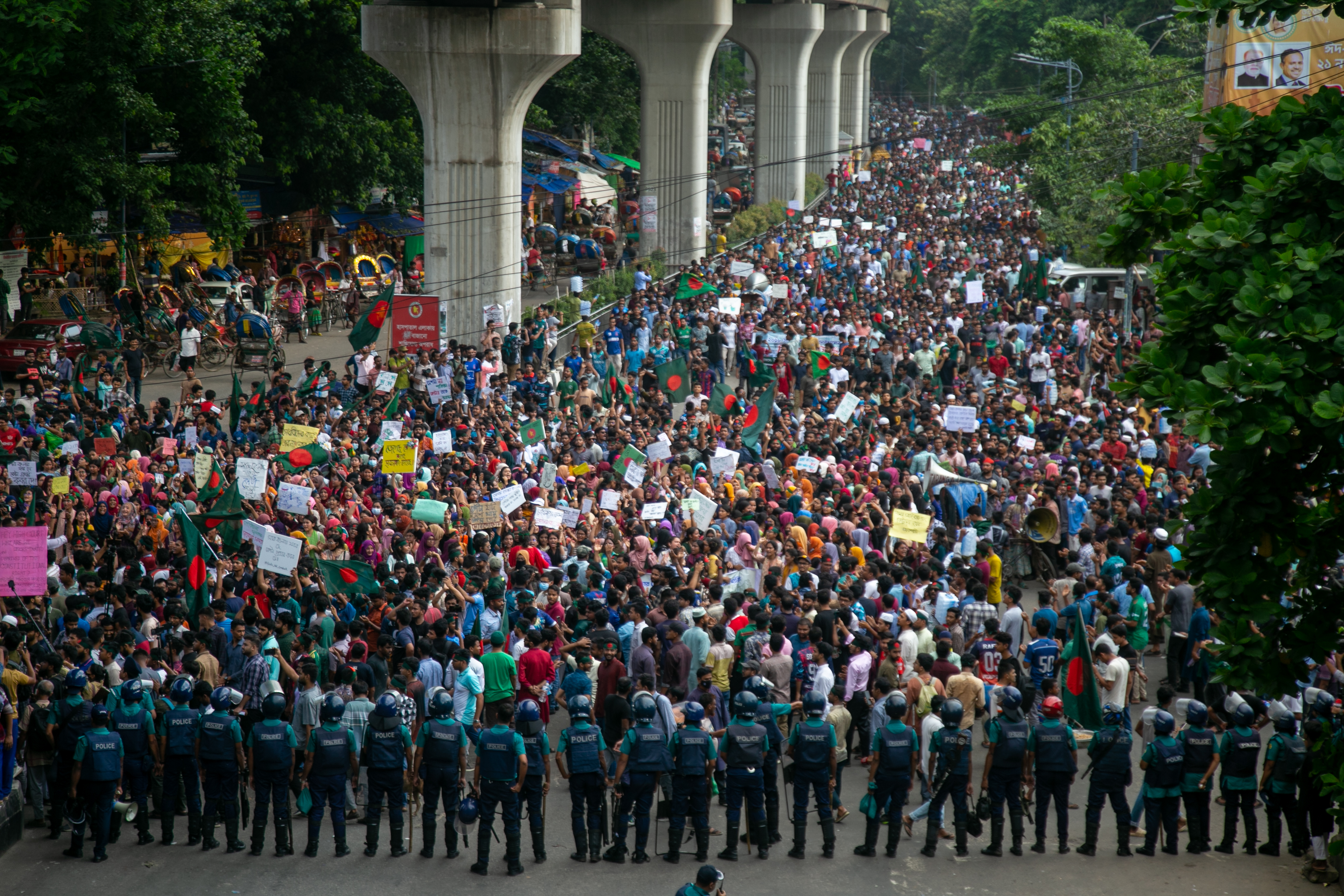
It took nationwide protests, violent state and military intervention and deaths of at least 139 people for the Supreme Court in Bangladesh to step in and scale back the reinstatement of controversial job quotas in the country that favours descendents of freedom fighters, women and people from underdeveloped districts.
As of July 22, Bangladeshi media reported over a thousand had been injured in protests that were primarily peaceful and led by students. Last week, the police fired sound grenades, tear gas shells and rubber bullets as it tried to quell their movement. The government under Prime Minister Sheikh Hasina, who won an unprecedented fourth term this January, denied using excessive and indiscriminate force, but the death toll continues to rise. At least 50 people died on Friday.
At the moment, there’s an indefinite curfew, and internet and text message services have been suspended. Local media websites such as Dhaka Tribune, which is an Asian Dispatch member, are suspended too. On Sunday, even though the country’s highest court directed a scale-back of quotas from 56 percent to 7 percent, news outlet BBC Bangla quoted some protest coordinators as saying that they will continue protests, especially to secure release of detained student leaders.
Asian Dispatch breaks down the sequence of events to understand what led to the civil discontentment over the quotas, and what is the way forward for Hasina.
Why is the job quota system so controversial?
The quota system for government jobs in Bangladesh was created after Bangladesh won its independence from Pakistan in 1971, a movement that was led by Sheikh Mujibur Rahman, who is widely considered the father of independent Bangladesh. He is also Hasina’s father. Rahman himself started out as a student activist during British rule. After independence, in 1972, it was his government that introduced job quotas for freedom fighters. Back then, too, it met with heavy resistance, especially from the University of Dhaka who demanded merit and equal opportunity.
The quota system, ubiquitous across South Asia, is designed to be affirmative action to bring more representation in the employment sector. In Bangladesh, job quotas are especially coveted because of the promise of better pay and job security. However, government data shows that the number of Bangladesh’s working population is increasing, but the jobs aren’t.
The original quota system reserved 30 percent of jobs for veterans of the Bangladesh Liberation War and their descendents, while 10 percent were for women who survived mass sexual violence by the Pakistani army during the war, and 40 percent for those from underrepresented districts. Over the years, these quotas have been modified. But it remained controversial.
Since 1971, the number of freedom fighters and their descendents have dwindled, leading to many job-seekers questioning the need for such a high number in reservations. There have been accusations of misuse and corruption in how these quotas are being sought. Many critics blame the system for benefitting those close to the ruling party.
Bangladesh’s unemployment rate, according to an official survey done between January and March this year, is 3.51 percent, amounting to 25 lakh unemployed out of the country’s total population of 17.12 crores. As of now, only 44 percent of government jobs are allocated based on merit.
But this isn’t the first time students have come down to the streets to demand quota reforms.
In 2018, after Hasina confirmed she will keep the job quotas, university students led nationwide protests demanding job quota reforms. Hasina’s government immediately cracked down on the movement, but a few months later, she issued an executive order to remove all job quotas entirely. In 2020, the decision to abolish the quotas became effective.
However, this June, the Bangladesh High Court cancelled the government notification, declaring it illegal, and reinstated the quotas, resulting in ongoing mass protests.
How did the protest get violent?
The protests started on July 1 by the students of the University of Dhaka who demanded that the quota system be modified to reflect the needs of present-day Bangladesh. Soon, students of other universities joined in. Right now, the movement is led by an umbrella organisation of students called Anti-Discrimination Student Movement.
On July 14, Hasina, who staunchly supported the quotas, blamed the opposition for fuelling violence, and dismissed the demonstrators as “razakars”, referring to a pre-independence paramilitary group with the Pakistan military who led a brutal campaign during Bangladesh’s freedom movement, which included widespread massacres of Bangladeshi freedom fightors and weaponising rape against the women.
“Why do they have so much resentment towards freedom fighters?” Hasina is quoted as saying. “If the grandchildren of the freedom fighters don’t get quota benefits, should the grandchildren of Razakars get the benefit?”
The students pushed back against Hasina’s remarks by adopting the term and raising slogans such as, “Asked for rights and became a Razakar!”
On Wednesday, July 17, the police used tear gas and sound grenades to break up a student demonstration at Dhaka University. Violence spread across the city, with retaliation by the government’s student wing Chhatra League, prompting the United Nations Secretary General spokesperson to urge the Bangladesh government to protect the students.
On Wednesday evening, Hasina addressed the nation and asked all sides to maintain peace until the Supreme Court’s verdict and blamed the deaths on “vested quarters.” At the same time, Asif Mahmud, a coordinator of the Anti-Discrimination Student Movement, called for a nationwide shutdown through a Facebook post.
In response, the state installed its paramilitary forces including Border Guard Bangladesh (BGB), Rapid Action Battalion (RAB), SWAT, and the Chhatra League. The RAB, which was set up by former Prime Minister Khaleda Zia, has been accused of extrajudicial killings and human rights violations in the past. By Thursday, the state-backed crackdown saw the deployment of another 229 platoons of BGB.
Deadly clashes broke out in several parts of the city including Uttara, Mohammadpur Beribadh, Merul Badda. Unknown persons broke into state broadcaster Bangladesh Television’s (BTV) headquarters in Dhaka and vandalised it. News reports also reported protesters storming a prison in central Bangladesh, setting hundreds of prisoners free. Reuters quoted Bangladesh’s attorney general AM Amin Uddin as saying that students were not a part of the violence and arson the country has seen since Monday.
On Friday afternoon, as the Dhaka Metropolitan Police (DMP) banned rallies and processions, a shoot-at-sight order was administered alongside a telecommunication blackout.
By the weekend, at least 139 people had been killed, including a journalist. As of July 23, local media remained largely silenced under the communication blackout. The student movement has pledged to continue protests and ensure the release of their imprisoned supporters, and to hold the perpetrators of violence accountable.
The original Supreme Court verdict on the quotas was scheduled for August, but this was pushed up to Sunday in light of the escalating situation. Presently, the latest ruling will make 93 percent of job allocations merit-based, 5 percent will be reserved for descendents of Bangladeshi freedom fighters, and 2 percent will be reserved for ethnic minorities, transgender individuals, and the disabled.