Trigger Warning: This story mentions physical and sexual abuse, forcible detransitioning of a trans person, death, and suicidal ideation.
It was 24 May 2024. Several queer and transgender people had gathered outside Kolkata’s Kantapukur Morgue, a blue-and-white building. They were waiting for the body of Tamoghno, a transgender woman who had died the previous day. Tamoghno’s natal family members were also present.
Sourish Samanta, a journalist and filmmaker who was at the morgue, recalled Tamoghno’s family members mourning her as “their only son.” Tamoghno’s friends, along with some of the Kolkata-based LGBTQ+ activists, tried to remind them that Tamoghno was a woman. But the family members continued to misgender her. “For many of us,” Aritra, a close friend of Tamoghno’s, told queerbeat, “it was like seeing what would happen were we to die.”
According to Aritra, an elderly trans woman present there remarked, “Even when I become a skeleton, people would call me a man.”
Model and theatre actor Tamoghno was 25 years old when she died. Her domestic help discovered her body “under mysterious circumstances” in her Kolkata apartment, according to a Times of India report.
In India, dead bodies have a legal right to dignity and fair treatment, as established in a 1989 Supreme Court ruling. A 2021 National Human Rights Council (NHRC) advisory built on the judgement by laying down guidelines for handling dead bodies. These guidelines require hospitals to hand over the bodies to natal families, who are required to register the death at the office of the local registrar, according to the 1969 births and deaths registration law. But most transgender people, facing discriminatory and violent treatment from their natal families who don’t approve of their gender, are forced to leave home, or are pushed out by their families. A 2018 NHRC study found that only 2 percent of the 900 transgender people surveyed lived with natal kin, while 93 percent lived with other transgender people in chosen families. Such chosen families, however, have no legal authority to claim dead bodies or perform last rites.
At one point while waiting at the morgue, Aritra overheard Tamoghno’s natal family members’ plans to drape her in dhuti-panjabi, a traditional outfit worn by Bengali men. Aritra had been numbed by grief until then. But upon hearing the family members discuss these arrangements, she was flooded with memories of evenings spent with Tamoghno. “We used to talk about death a lot, and she used to tell me that if she dies, I should ensure that she is dressed [in a sari] on her way to the crematorium,” Aritra recalled.
Immediately, Aritra alerted other queer and transgender persons present at the funeral. A heated debate followed as Tamoghno’s friends tried to convince the natal family to let her be seen off in gender-affirming clothing. Eventually, the family members “were outnumbered,” Aritra said. Tamoghno was taken to the crematorium draped in a customary white sari with a red border.
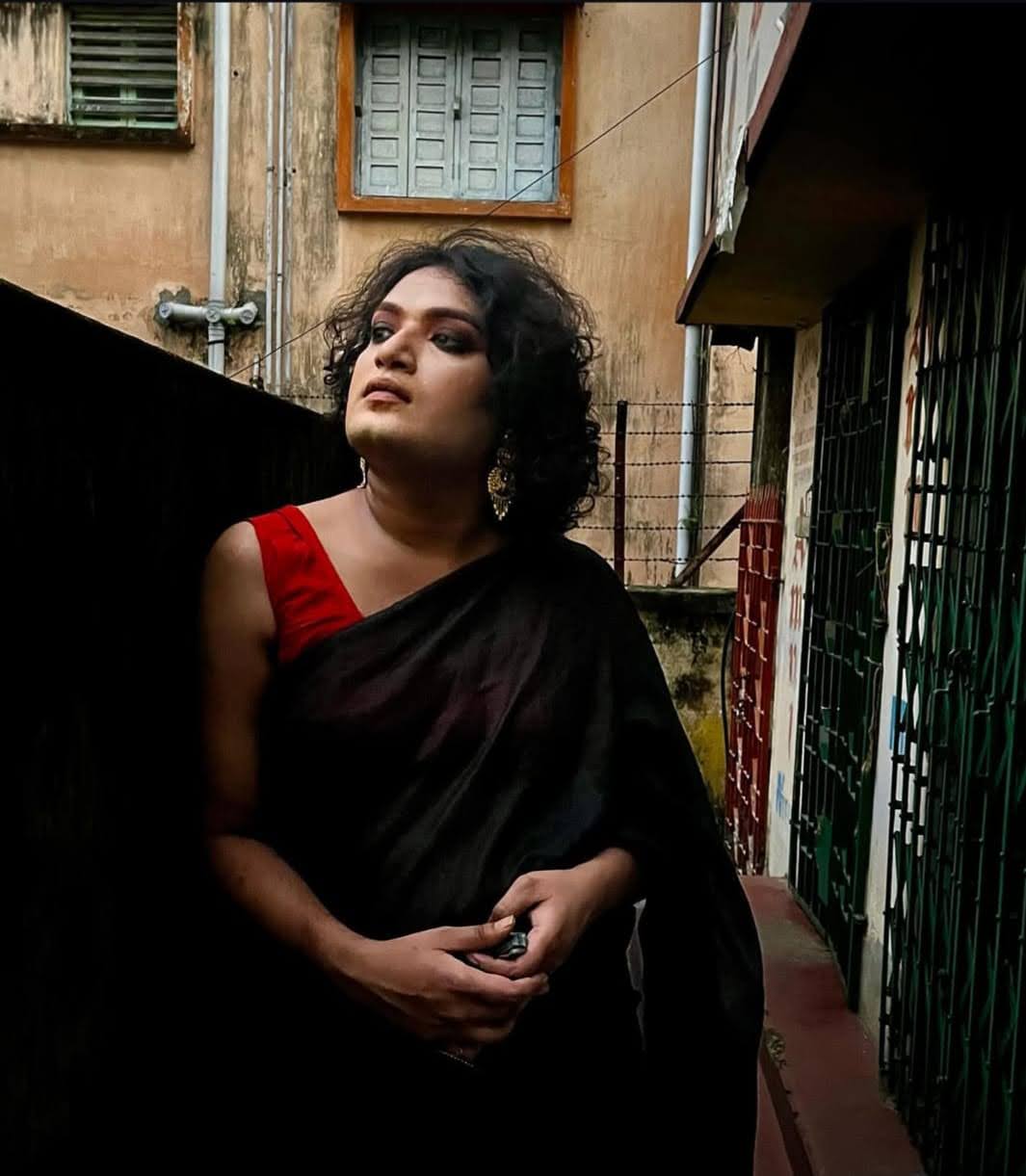
Tamoghno’s untimely and suspicious demise wasn’t an isolated incident. Transgender people often die young—murder and suicide are common causes of their deaths. A 2021 study in the Netherlands found that transgender women were nearly seven times more likely to die by suicide than cisgender women, while transgender men faced higher risks of death from “non-natural causes.” Another 2023 UK study similarly reported that trans people were almost twice as likely as cisgender peers to die from external causes such as suicide, homicide, or poisoning. The underlying reasons, this study noted, were transphobic hate crimes and chronic stress that transgender people face due to repeated exposure to violence, discrimination, and economic and social marginalisation.
Photo: Tamoghno. Credits: Raj D Ahir, Source: Aritra Chatterjee
Although queerbeat could not find such systematic data for India, multiple queer and transgender people we spoke to agreed that the situation is similar in the country. “Many of my friends or acquaintances have gotten murdered or died by suicide,” said Sintu Bagui, a transgender-rights activist from West Bengal’s Seoraphuli town, as she recalled the recent discovery of a transgender woman’s partially burnt remains in Kolkata. Reshmi*, who is a member of a hijra household in West Bengal, echoed Sintu: “I cannot count on my fingers the number of hijra people I have seen murdered or die by suicide in the last five years.” Reshmi wanted her real name withheld because, according to her, seniors in the hijra community often prohibit disciples like her from speaking with the media. (Hijras are a South Asian cultural group of transfeminine individuals assigned male at birth. Some hijras may be intersex.)
As transgender people remain vulnerable to untimely and violent deaths, queerbeat sought to understand what happens after: for people who fight for a lifetime simply to live their lives on their own terms, do they get dignity in death?
***
Sourish always knew his friend Tamoghno as a woman “full of life.” Tamoghno had moved to Kolkata in 2018 from Siliguri, a city at the Himalayan foothills in West Bengal. When Sourish stood next to her body in Kolkata’s MR Bangur Hospital, he felt disoriented. “It broke me into pieces,” Sourish told queerbeat.
Tamoghno’s life was a “troubled” one, Sourish recalled. Fighting a lifelong battle against her natal family to freely live as a woman, she had taken to alcohol and substance use to cope, Aritra added.
The circumstances surrounding Tamoghno’s death were murky. According to the Times of India, Tamoghno’s domestic help discovered her body on the floor of her Kolkata apartment in a “bloodied state” and alerted Tamoghno’s neighbours immediately. Given the state in which her body was found, several queer and transgender people who knew Tamoghno told queerbeat that they suspected she was murdered. “Her phone also went missing and was never recovered,” said Aritra. However, according to the media report, the police suspected that Tamoghno might have died accidentally or by suicide.
Tamoghno’s body was taken to the MR Bangur Hospital, and then to the Kantapukur Morgue for a postmortem analysis. Bappaditya Mukherjee, a Kolkata-based activist told queerbeat that members of his youth organisation, Prantakatha, learnt from the police that they had registered Tamoghno’s death as a case of “unnatural death.” An unnatural death could include an accident, suicide, or murder, as per the NHRC. The police did not investigate the suspicious circumstances surrounding her death, alleged Bappaditya.
queerbeat’s attempts to find out more about Tamoghno’s death ran into institutional indifference and bureaucratic hurdles at every turn. Sisir Naskar, Superintendent of MR Bangur Hospital, told queerbeat that “the hospital does not receive copies of autopsy reports or hold any such information in their records.” He redirected us to the Golf Green police station, stating that Tamoghno’s death fell under its jurisdiction so they may have the autopsy reports.
Raja Dutta, the investigating officer who handled the case at the Golf Green Police Station, initially told us that the postmortem report concluded that she had died of a heart attack, and therefore, the case was not investigated further. He also claimed that all the documents related to the case were at a different police station in Haridevpur—a locality three kms away from Tamoghno’s house.
The Haridevpur police station officials told queerbeat that they didn’t possess any files related to the case since the area in which Tamoghno lived did not fall under their jurisdiction. The relevant documents would be at Golf Green Police Station, they added.
When we went back to Raja, he directed us to the Kolkata Police headquarters in Lalbazar saying that “all postmortem reports go to Lalbazar and can be accessed only by the natal family after a lengthy application process.” But this time, he claimed that he did not remember the details of Tamoghno’s case, since it occurred more than a year ago. When pressed further, he wavered on his earlier stance that the cause of Tamoghno’s death was a heart attack. He also changed his statement about the cause of why the death was not investigated, saying “either it was not a murder or because the [natal] family did not want to pursue the case.”
queerbeat reached out to Tamoghno’s mother via her Facebook profile, which was active at the time of writing this report. She did not respond to our requests for an interview. We also tried contacting Arundhati Hari Das, a relative of Tamoghno’s whose name was listed in the morgue’s official records as having signed off on the release of Tamoghno’s body. Arundhati did not answer our phone calls or respond to our WhatsApp messages.
Aritra, Sourish, and Bappaditya alleged that the police colluded with Tamoghno’s natal family to prevent an investigation. “The [natal] family kept mentioning [at the morgue and the crematorium] how cooperative the police is,” Bappaditya recalled to queerbeat. “They [the family] were in a rush to complete the last rites and head back home,” Aritra added. Raja, the investigating officer, denied any collusion with the family. “Why would they want to cover this up?” he asked, adding, “[Tamoghno’s death] is, after all, the family’s loss.”
The opacity of the official investigation into Tamoghno’s demise, coupled with the allegations of her family’s indifference, highlights a troubling reality: the systemic neglect of transgender people, in their deaths, as in their lives.
***
On 24 May, when Sourish and Aritra reached the hospital where Tamoghno’s body was taken, they found out that her gender was listed as “male” instead of “transgender” in the hospital forms. Tamoghno did not have a legal document certifying her transgender identity, and her friends’ efforts to negotiate with the hospital staff to correct her gender did not work.
“We even showed the hospital staff Tamoghno’s photos,” Aritra said. Tamoghno’s Instagram profile clearly stated her identity as a ‘transwoman’ and was replete with photos of her in saris. But, the hospital refused to correct Tamoghno’s gender in their records.
The misgendering continued at the mortuary, where Tamoghno’s body was kept in the men’s section, Sourish and Aritra told queerbeat.
Without a transgender certificate and ID card—legal documents from the Indian government’s Ministry of Social Justice and Empowerment that certify a person’s transgender identity—Tamoghno’s friends had little grounds for negotiation. “This is the norm,” Aritra said, “Our legitimacy has been reduced to a set of documents.”
In 2014, the Supreme Court affirmed transgender persons’ right to “decide their self identified gender.” However, the 2020 Transgender Persons (Protection of Rights) Rules introduced a “certificate of identity,” issued by a District Magistrate, making official ratification a condition for the recognition of one’s transgender identity.
According to multiple media reports, the procedure of obtaining a transgender certificate and identity card is sullied with bureaucratic red tape, unnecessary verification such as home visits to confirm addresses, and long waiting periods. As a result, most transgender people in the country have been unable to obtain these documents despite their persistent efforts to do so.
In the absence of these documents, the deaths of transgender people are officially recorded according to the sex they have been assigned at birth (i.e., male or female), Kanmani Ray, a lawyer and a transgender woman, told Behanbox in 2022. As a result, the state and the society remain unaware of how many transgender people die each year—or of the circumstances of their deaths—added Hyderabad-based transgender-rights activist and transgender woman Vyjayanti Vasanta Mogli in the same report.
(According to the National Crime Records Bureau’s latest report—the only official estimate queerbeat could find—13 transgender people were murdered in 2023. The report did not have separate data for transgender men and women.)
But sometimes even having a transgender certificate and ID card doesn’t ensure dignity after death. The case of Daina Dias, a 32-year-old Goa-based transgender activist, who died in January 2024, is an example.
***
“How did this happen?” Harold, a Goa-based gender-nonconforming fashion designer, remembered thinking at the funeral of their friend Daina in January 2024.
Daina was one of Goa’s few vocal transgender-rights activists. Harold had first met her in 2014 through Humsaath Trust Goa, a community-based organisation that, among other activities, provided free HIV testing to queer and transgender people. Daina was a field and outreach worker there. Daina and Harold soon became inseparable friends, Harold told queerbeat.
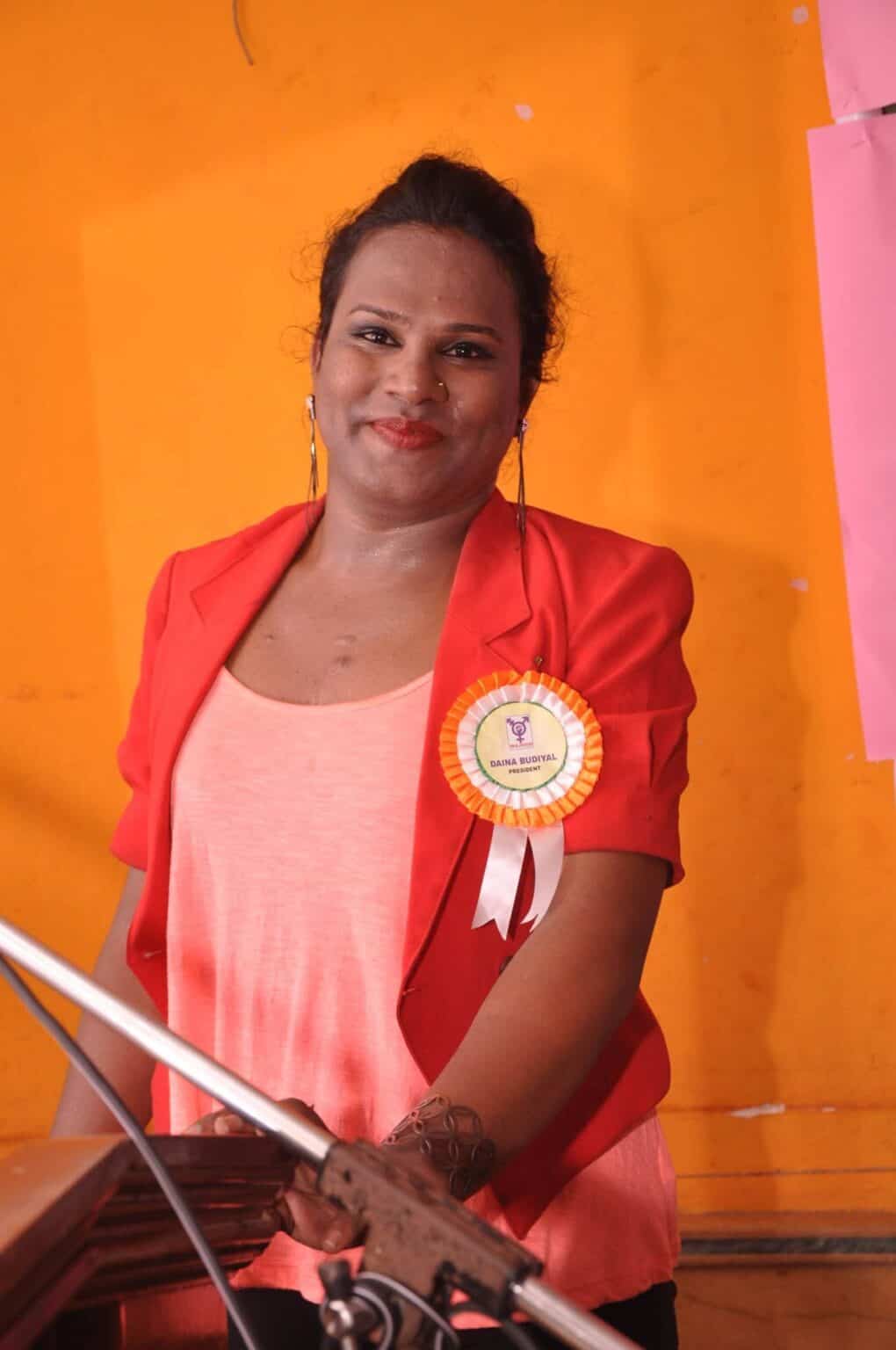
Harold supported Daina when she decided to transition legally in 2014, following the Supreme Court’s 2014 judgment granting legal recognition to transgender persons. That year, Harold said, Daina had her Aadhar card changed to reflect her identity as a transgender person. When Daina founded Wajood Goa, a transgender rights organisation, in 2018, the two celebrated together. In an interview published in the same year by MARG India, a legal rights NGO, Daina expressed that her aspiration for the next five years was to evolve into a social activist working for “all sections of the society.”
But as those five years drew to a close, Daina found her dreams curtailed by a family she described as abusive, a debilitating illness, and, ultimately, her death.
***
Photo: Daina, Source: Harold
Daina grew up in a cramped house in a densely-packed informal settlement near Vasco Da Gama, Goa. In interviews, Daina said her family physically and sexually abused her after she came out as a transgender woman, and later threw her out of their home. Sashi*, a close relative of Daina, whose name has been withheld by queerbeat to protect their identity, denied the allegations of sexual abuse. But they confirmed that Daina’s father and brothers had beaten her several times.
Several of Daina’s friends accused one of her brothers of being more abusive towards Daina. queerbeat contacted the brother to seek his response. He denied all allegations of wrongdoing. He claimed that the relationship between Daina and him was cordial. “I accepted my brother,” he said.
During our conversation, Sashi was overwhelmed with the grief of losing Daina. She believed that “a shaitan [demon] entered her [Daina’s] body,” while she was recovering from a terrible road accident she had when she was 16 or 17 years old. The demon, according to Sashi, was a hijra. That is how Daina started identifying as a woman, Sashi told queerbeat.
In Daina’s brother’s view, she started identifying as transgender because her friends—the queer and transgender people Daina spent time with—“performed black magic on [her].” “That is why he became shemale,” he said. During our conversations, both Sashi and the brother referred to Daina by her deadname.
(A deadname is the name assigned to a transgender person at birth, which they no longer use after affirming their gender identity.)
After Daina left her home, she lived alone in different parts of Goa, making ends meet, sometimes as part of a restaurant’s staff and at other times as a social worker, according to Sashi. However, in 2021, when the lockdown during the COVID-19 pandemic made it difficult for Daina to live on her own, she moved back in with her natal family. When she returned, Sashi recalled Daina saying that she had missed her mother and sister a lot.
(Multiple studies and reports have highlighted how the lockdowns during the COVID-19 pandemic adversely affected transgender people, including forcing them to return to abusive natal families.)
Madhur*, a non-binary illustrator and educator who took care of Daina during her last days, told queerbeat that soon after Daina was back home, her mother chopped off her hair, clicked a picture of her, and told people in the local marketplace, “my son has now returned.” Daina did not resist, claimed Sashi, who was aware of these incidents and confirmed them. Back at home, according to Madhur and Sashi, Daina was battling hallucinations and seizures. She was later diagnosed with schizophrenia, added Madhur, who didn’t want to reveal their real name in the story to protect their identity.
Madhur said that doctors at the Institute of Psychiatry and Human Behaviour (IPHB), Bambolim, Goa, where the schizophrenia diagnosis was allegedly made, had also asked the family to get Daina tested for encephalitis—a disease where the brain gets inflamed. However, Madhur added, the family didn’t get her tested because they were focused on detransitioning her. Detransitioning is the process of reversing one’s gender transition. IPHB declined to respond to our queries about Daina’s schizophrenia diagnosis citing patient confidentiality. And Sashi could not confirm the exact diagnosis.
But Sashi did confirm that the family attempted to detransition Daina after she returned home. Sashi recounted how she and other family members took Daina to a temple in Maharashtra. There, they dunked her in water and subjected her to rituals to exorcise the spirit they thought she was possessed by.
In November 2023, Daina’s sister—her only ally in the family, according to Madhur and Harold—alerted queer and transgender activists and allies in Goa to Daina’s failing health. Harold was one of them. They rescued Daina from her house and admitted her to the women’s ward at the IPHB, Bambolim, Goa. At home, Harold remembers being taken aback seeing Daina in short hair. “Daina was extremely proud of her hair,” they told queerbeat, adding, “this was not the Daina I knew; this was Daina before her [gender] transition.”
The group that rescued Daina also circulated a message through a local queer group on WhatsApp seeking volunteers to take care of Daina, Madhur recalled. Madhur was one of the people who responded. They and their friends started visiting and caring for her regularly.
Daina’s admission to the women’s ward at IPHB was possible only because a hospital worker recognised her from a gender-affirming care workshop she had conducted at the institute in the past, Madhur told queerbeat. Even then, they recalled that Daina was kept separate from other women, and that the nursing staff refused to tend to her. “In the women’s ward, there were two rooms. One had all the other women patients, and the other had only Daina,” Madhur said. The hospital declined to respond to requests for comment citing patient confidentiality.
At the hospital, Daina underwent electroconvulsive therapy (ECT), a treatment using controlled electric pulses, Madhur said. Several studies have reported that ECT can be effective for persons living with schizophrenia, although some studies suggest that cognitive impairment, such as memory loss, is a potential risk for some patients. Other studies dispute that ECT can cause cognitive impairment.
In Daina’s case, Madhur said that they observed signs of cognitive impairment: When Madhur saw Daina for the first time in November 2023, “she was present and responsive,” they recollected. But a few weeks later, she stopped being in the present, they added.
When Madhur and their friends visited Daina in the first week of January 2024—about two months after she was first admitted—they were shocked to learn that her natal family had gotten her discharged from the hospital. Sashi, Daina’s relative, told queerbeat that the attending doctor had deemed her fit for discharge. However, a couple days later, Daina’s condition worsened. Daina’s sister informed Madhur that she was being admitted to the Intensive Care Unit of the Goa Medical College. When Madhur went there, they recollect seeing Daina “completely unconscious and on tubes.”
A week later, Daina passed away.
***
Madhur was teaching a class when Daina’s sister informed them of her death. On the way to the hospital, one thought lingered on their mind: “We did not want Daina to be sent off in shorts and T-shirt, but in a gown.” Harold also told queerbeat that Daina had wanted “to be seen off in a bridal gown when she dies.” Madhur stopped at a store to buy one. At the hospital, Daina’s sister told Madhur that she had been admitted under her deadname. Given that Daina’s Aadhaar card stated her gender as “transgender,” Madhur and their friends could compel the hospital to correct the records. (queerbeat has seen a copy of Daina’s Aadhaar card.)
But this victory did little to reduce the ordeal that followed.
When Daina’s body was taken to a crematorium—after a day in the morgue so that all her family members could attend the funeral—she was dressed in shorts and a t-shirt. “We had no control over what was happening,” Madhur recollected. “The family got to run the show.” The only intervention Madhur and their friends could make was to put a bindi on Daina’s forehead: a small mark of her womanhood.
The misgendering continued even as the body lay burning on the pyre: Daina’s brothers continued to deadname her and refer to her as a man, Madhur and Harold recalled. “It was very disturbing to watch,” Madhur said, adding, “I realised how cheap transgender lives are.”
For Harold, witnessing Daina’s funeral was a moment of reckoning: “I realised that even when I die, my family will conduct my last rites as if I was a man.”
***
Tamoghno’s and Daina’s stories, and interviews with multiple transgender people reveal how the interference of the natal family often strips transgender people of their dignity after death. “Many transgender women have told me that they want to be cremated or buried in saris,” Sintu, the Seoraphuli-based transgender-rights activist, told queerbeat. “But after their death, their natal families conduct all the rituals as if they were men. The battle to assert one’s gender continues.” Sintu has witnessed the deaths of several underprivileged transgender people, hijras, and kothis. (Kothis, like the hijras, are a South Asian cultural group of transfeminine individuals assigned male at birth.)
Clothing and rituals are not the only aspects transgender people wonder about when they think of their death. Fateh*, a Delhi-based researcher and non-binary transman, said that he has also planned to divide his savings between his natal family, his partner, and some queer and transgender collectives. He had thought about how his body might be discovered, what stories might follow, and how he would be remembered.
Tan, a non-binary transmasculine person, told queerbeat that until our conversation, they had not thought about how their body would be treated after their death, despite “thinking about death often.” Tan works with Prismatic Foundation, a Varanasi-based queer and transgender-rights NGO. Like Fateh, Tan’s deliberations on their death focused more on their finances and their legacy. “I am more worried about what will happen to the projects I am leaving unfinished, and to the friend who needed my care and who I told, ‘I am tired today’,” they told queerbeat.
“Aaj mai jo jee raha hoon, tab mereko dignity nahi mil raha. [These indignities are happening when I am alive],” Tan said, adding, “When I go to a shop to buy a bottle of soft drink, I do not find dignity; when I was house-hunting in Varanasi, I did not find dignity; when I went to study at a university, I did not find dignity. How can I care about indignities after death?”
***
In India, the hijra community has been able to surmount some of these challenges to a certain extent. Hijra persons form familial bonds with each other in the guru-chela kinship system, a hierarchy consisting of gurus [leaders], chelas [disciples], and nati-chelas [disciples of a disciple]. Anthropologist Ina Goel notes in a 2022 study that hijras often list a guru as a parent or a spouse on official documentation, such as voter ID cards, which gives the guru the right to claim their body. Yet, as Reshmi, a member of a hijra household, told queerbeat, natal families still intervene upon a hijra’s death, overriding these ties.
Reshmi also observed that several burial grounds in Kolkata routinely deny service to the hijra community. A similar occurrence in Madhya Pradesh recently made it to the news. In such cases, one reported from Hyderabad, hijras and transgender people had to bribe caretakers of crematoriums and burial grounds to access them so that their community members were laid to rest peacefully.
According to Sintu, part of the reason these issues persist is that death remains underdiscussed in transgender movements. “We are constantly fighting about the right to live and the right to livelihood,” she told queerbeat. “But we don’t realise that after life and livelihood comes death.” Queer and transgender rights activist Bappaditya also stressed the need for stronger community mobilisation after a transgender person’s death, particularly in suspicious cases. Speaking of Tamoghno, he noted that “people were quick to commemorate the death instead of coming together and mounting pressure on the police to ensure a fair investigation.”
The big leap forward that can solve many problems in one go would be official recognition of chosen families. On 2 February 2023, a group of queer feminist activists and young couples petitioned the Supreme Court to “declare and recognise the constitutional right of members of the LGBTI community to have a ‘chosen family’ in lieu of next of kin under all laws.” The petition was among thirty that were grouped together into what came to be known as the marriage equality case. On 17 October 2023, the Court dismissed all the petitions.
A little less than a month later, on 13 November that year, news broke that Nanded, Maharashtra, was set to get a separate crematorium for transgender people—the second in the state. Commenting on this development, Farida, a transgender woman from the city, told The Times of India that “now, at least, there will be no social resistance to the last rites of our community members after their death.”
Only time will tell whether Farida’s expectations are met. But, like Sintu pointed out, the time to think about death is now.
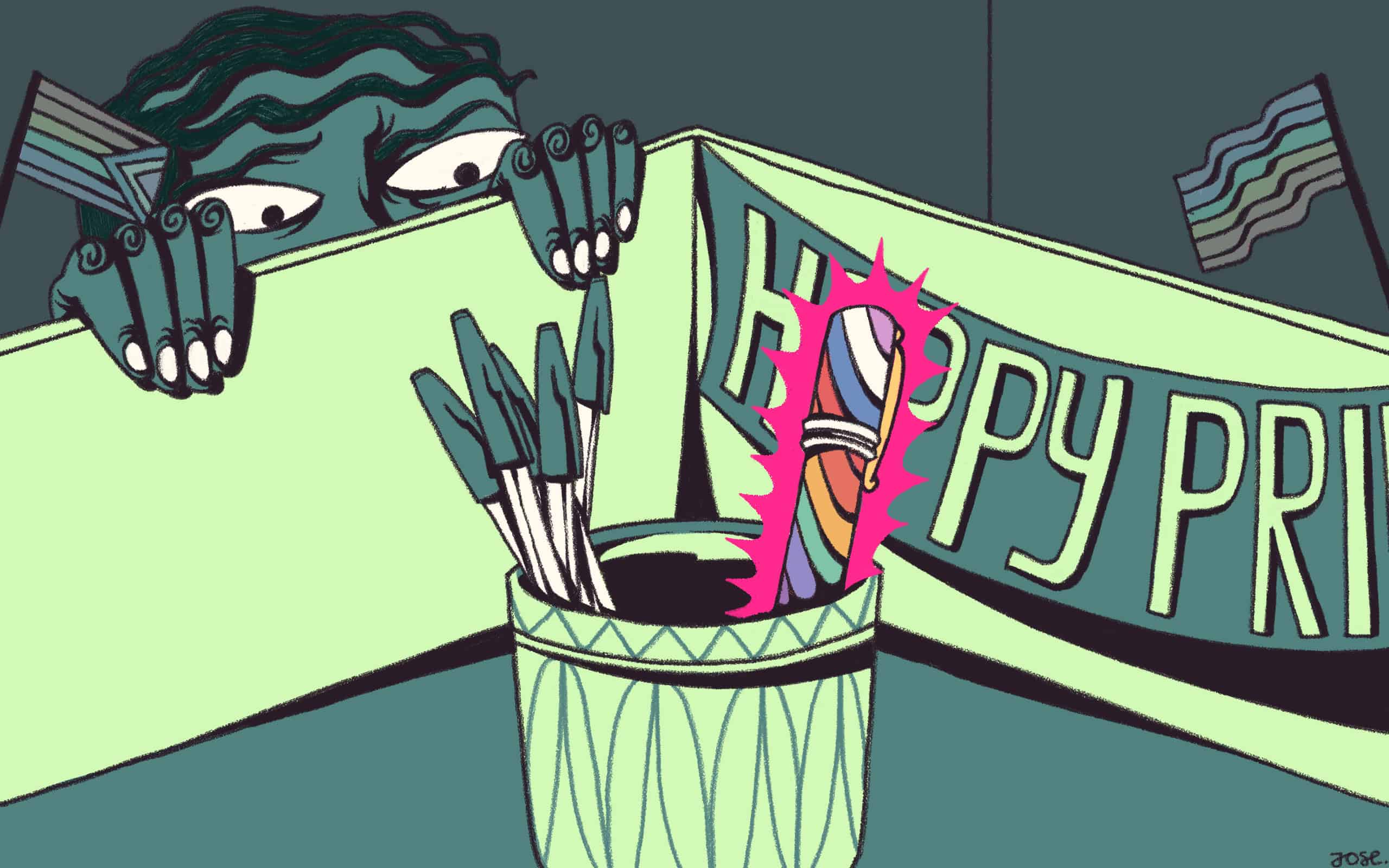
Illustration: Mia Jose
Trigger Warning: This article mentions a suicide attempt. Readers’ discretion is advised.
In April 2022, Sravan joined the Hyderabad office of an American multinational finance corporation as a technical operations analyst with a head full of curly hair and eyes full of dreams. The company’s public profile boasted of its commitment to LGBTQ+ inclusion at the workplace. Sravan, a queer non-binary person, recalls this promise being reiterated to them at the end of their interview for the role.
However, a few months later, Sravan saw the first red flag unfurl. At an annual marathon organised by the company for its employees, they heard “the manager of their manager” mention their sexual orientation casually to other employees. Sravan was surprised. They had not consented to their sexual orientation being publicly disclosed.
Sravan brushed it off as a one-time incident. But it happened again. And again.
In multiple casual office gatherings, the manager would tell other employees, “I have three queer people working under me, and Sravan is one of them,” Sravan recalled. They felt increasingly uncomfortable with their sexual orientation being the subject of casual office conversations. “My sexual orientation is a very personal piece of information,” they said, “and I felt that it was not being handled with care.”
In April 2023, a year after joining the company, Sravan decided to confront the boss publicly, asking them about the company’s confidentiality policy. Sravan recalls the manager dismissing and laughing at his concerns.
But over the next two days, the retribution, by Sravan’s account, was swift. First, they were accused of sexual misconduct towards other employees—an allegation that Sravan vehemently denies. Then, other members of their team stopped speaking with them—an act of social boycotting that Sravan suspects was ordered by the boss.
Soon after, Sravan filed a workplace harassment complaint against the boss with the HR team, which they remember having no queer representation. But Sravan claims he did not hear back from them for two weeks.
It was only when Sravan approached drag performer and tech professional Patruni Chidananda Sastry, who escalated the matter via Pride Circle, a consultancy firm that had facilitated Sravan’s recruitment, to the company’s global HR team, that action was taken. The company launched a six-month investigation, which ultimately led to the manager being found guilty. The result? Sravan was transferred to a different team under a different boss, but Sravan said the HR team declined to reveal what action had been taken against the manager.
By then, however, the workplace environment had soured beyond repair for Sravan. In August 2024, after dealing with months of mental distress, Sravan resigned. The company, a multinational finance empire with an annual turnover around the billion-dollar mark, continues to flourish.
Concerned about the repercussions of discussing their experience, Sravan requested that queerbeat use a gender-neutral pronoun for the boss and not reveal the name of the company. They also requested to be referred to only by their first name.
While queerbeat could not independently verify Sravan’s allegations, workplace culture and policy experts we spoke to agreed that discrimination against queer and transgender people remains commonplace in India’s corporate workforce. As is the practice of retaliation against those who decide to speak up.
“Corporations see themselves as these benevolent and kind people who are ‘allowing’ and ‘tolerating’ people from marginalised groups,” said Asiya Shervani, a senior workplace equity consultant. “Any complaint, or even feedback, is seen as betrayal.
Sravan is likely one of many queer and transgender people in India whose dreams of finding sustainable employment in India’s corporations have been blunted by workplace discrimination that targets their sexual orientation or gender identity. These experiences are in stark contrast to the public messaging by these corporations. For example, a 2023 annual report from the company where Sravan worked mentions the company’s commitment to “continually… create and reinforce a culture of respect, equity and inclusion.” The report also mentions the company having an office dedicated to “LGBTQ+ Affairs,” which “focuses on advancing a culture of inclusion for LGBTQ+ employees… and driving equity and inclusion for the LGBTQ+ community globally.”
In the process of reporting this story, queerbeat interviewed queer and transgender employees, scholars of gender and sexuality studies, workplace culture and policy experts, and representatives of organisations that liaison with corporates to increase queer and transgender visibility in the workforce. These conversations revealed that behind the rainbow banners and inclusive slogans that are becoming increasingly commonplace, the reality of queer inclusion in corporate India is a story of uneven progress and continuing exclusion.
While more queer and transgender people are entering the corporate workforce of late—mostly in entry-level positions—they often find themselves forced to quit due to explicit and implicit discrimination, poor complaint-resolution, and harsh retaliation when reporting unfair treatment.
From Adversary to Ally?
When India opened up its economy in 1991, global corporations scurried to enter the Indian market. And they brought with them the idea of “LGBTQ+ inclusion,” according to Pushpesh Kumar, a professor of sociology at the University of Hyderabad who has studied the lives of “urban corporate gay [men]” in India.
At the time, queer inclusion was a relatively new concept even in their home countries. Carlos A. Ball, a professor at the Rutgers Law School, writes in The Queering of Corporate America (2019) that until the 1970s, large American corporations were adversaries of queer and transgender people. According to him, in that decade, the many “gay liberation” and “LGBTQ Rights” organisations that cropped up in the backdrop of the 1969 Stonewall Riots began to actively challenge that stance.
By the turn of the century, this activism had resulted in many American corporations slowly becoming more welcoming of queer and trans employees. Corporations also began recognising that “adopting and supporting LGBTQ rights positions could help them maximise profits by reaching new customers while hiring and retaining the most qualified employees,” Carlos writes. This is perhaps what Starbucks’ then-CEO meant when he told Politico in 2012 that supporting same-sex marriage had been “good for business.”
In the early 2000s, as these global corporations began establishing offices and campuses in Indian cities, they pushed the Indian teams to “get on board” with the diversity, equity and inclusion (DEI) goals of the parent company, lawyer Meenakshi Vuppuluri told queerbeat. Meenakshi works as a subject matter expert on the prevention of sexual harassment and DEI with Kelp, a company that supports corporations towards making their workplaces safe and inclusive.
The winds of change also began to reconfigure some Indian workplaces. According to Parmesh Shahani’s book Queeristan: LGBTQ Inclusion at the Indian Workplace (2020), starting in 2010, the Indian conglomerate Godrej revised its anti-discrimination policy to explicitly forbid discrimination based on gender identity, sexual orientation, and gender expression; extended health insurance to same-sex partners of employees; and began to pay for gender affirming surgeries. Similar initiatives have also been instated by Tata Steel & Tata Consultancy Services, and Axis Bank. Tata Steel modified its HR policy in 2019 to make it “LGBTQIA+ inclusive,” a representative told queerbeat over email. “This policy recognises same-sex partnerships” and provides benefits such as “gender-neutral parental leave, nursing breaks for adoptive and LGBTQIA+ parents, medical coverage for partners, joint housing benefits, domestic travel assistance, annual health check-ups, and financial support for gender assignment surgery,” they added.
Official communications from these companies’ websites attribute these initiatives to the momentum generated by the Indian Supreme Court’s 2014 NALSA v Union of India and the 2018 Navtej Singh Johar v Union of India verdicts. In the 2014 judgement, the apex court formally recognised transgender persons as ‘third gender’ and upheld their right to self-determination of gender. In the 2018 judgement, the court decriminalised consensual same-sex sexual activity.
Over the years, thanks to the combined efforts of activists and courts, more corporations appear to be gradually joining the bandwagon of change. According to Srini Ramaswamy, co-founder of Pride Circle, a Mumbai-based consultancy firm that liaises with corporations to assist their DEI initiatives, the firm has enabled the hiring of over 1600 queer and transgender people in various companies over the last six years. Most of these appointments have been in the IT sector, Srini told queerbeat.
Given the increasing recruitment of queer and transgender employees, companies have also been working to devise inclusive policies to help them feel supported. The 2024 India Workplace Equality Index (IWEI) assessed 150 companies—most of them large Indian companies or multinationals operating in India—on their inclusion of queer and transgender employees. It reported that over 90% of these companies now offer health insurance to same-sex partners. Nearly 70% provide gender-transitioning support to transgender staff.
Cracks in the Gloss
While it is undeniable that change is happening, it is far from being systemic. The rosy proclamations of corporate DEI brochures often tend to gloss over the many cracks that continue to haunt Indian workplaces when it comes to queer inclusion.
The rising number of queer employees being hired for instance, while heartening, only represents a foot in the door that had previously been slammed shut. According to the Godrej DEI lab’s latest annual report (2024-25), the number of LGBTQ+ employees at the organisation is 245—about 0.5 per cent of all employees at the company. At Tata Steel, the number is at 110, a company representative informed queerbeat. While these numbers are minuscule in the larger context, it is also important to note that these companies have made far more progress than their peers.
These numbers, which group all queer and transgender employees under the “LGBT+” label, invisibilise the fact that transgender people are especially under-represented in the workplace. According to Zainab Patel, a transgender woman who has led DEI initiatives at several multinational corporations, trans people find it much harder than cis queer people to find corporate jobs. She points out that one major reason for this gap is the limited access transgender people have to educational opportunities. A 2017 NHRC survey found that fewer than 20% of transgender respondents had completed school, and under 10% had earned undergraduate degrees.
Further, most queer and transgender people are hired in entry- and mid-level roles, Pride Circle’s Srini and Mobbera Foundation’s Savithri told queerbeat. (Like Pride Circle, Mobbera Foundation helps multiple corporations in Hyderabad recruit queer and transgender people.) Savithri pointed out that most of the hiring she has been involved in has been for “ground-level positions”: those consisting of “security staff and people sitting at the front desk.”
Srini explained that this trend is “partly due to corporate hiring practices that reserve senior roles for employees who have been with a company for a relatively longer term.” But Patruni, a Hyderabad-based drag performer and IT professional, suspects a more sinister reason: those hired in entry-level positions are “easily replaceable.”
Disposable employees
Hiring is only the beginning of a queer individual’s corporate journey. What follows after a queer person enters a corporation?
Patruni’s experience suggests a grim answer. Patruni had worked for ten years in the Hyderabad office of a multinational auditing and consultancy firm, until an encounter with corporate queerphobia forced them to quit in May 2021.
In late 2020, the company’s intranet forum featured an article about Patruni’s journey as a queer dancer and data analyst. They recall the article making them feel like they could trust in their workplace, and as a result, they came out as genderfluid to their colleagues. Later, it became all too apparent to Patruni that they had mistaken a formal, tokenistic gesture to be reflective of the company’s larger attitude towards queer people.
Patruni worked under a manager whom they suspected was biased against queer people. They claim that soon after the article was published, the manager became hostile. Per their account, she started assigning them an impossibly high workload. “There was always a new project to work on,” Patruni recounted, adding, “My job role did not involve taking client demos, but my manager added that also to my workload.”
When they took up the issue with the company’s Internal Complaints Committee—set up under the Sexual Harassment of Women at Workplace (Prevention, Prohibition and Redressal) Act, 2013—it was dismissed because Patruni was regarded, officially, as a man and the Act provided no redress for men. Patruni said that their complaint was instead registered as a case of workplace harassment with the company’s internal compliance team.
The team formed a committee—which did not have any queer or transgender representatives—to investigate the complaint. After four months of investigation, the committee found the manager innocent, Patruni told queerbeat.
Patruni could not share with queerbeat a copy of their complaint and the committee’s decision because the communication took place over the company’s internal mail, which they no longer have access to. However, screenshots of WhatsApp communication between Patruni and a member of the company’s DEI team, reviewed by queerbeat, confirmed that the manager was found innocent because of a lack of proof.
In retribution for the complaint, Patruni said they were declared an underperformer by the manager. To prove their commitment to the job, they recalled being told to work at odd hours over and above their regular working hours. Then came heightened scrutiny and comments on their English-speaking skills. “My manager started telling me—sometimes during calls with clients—that I speak English with an accent,” they recollected.
Patruni felt discriminated against. And with the internal compliance team having closed its doors to them, they also felt trapped. In March 2021, they attempted suicide within the premises of their workplace.
The suicide attempt should have ideally made the company take Patruni’s complaints more seriously. Instead, they were asked to take an online “support session,” and given a ten-week notice to resign, Patruni told queerbeat.
A year and a half later, when they applied for a different job in the same company, they said they were told that the company had blacklisted them. queerbeat has not been able to independently corroborate this claim.
Cut to June 2024, and the company’s Hyderabad office commemorated Pride Month by unfurling the pride flag like it had always belonged there. “And my manager is still there,” Patruni said, their voice low.
In 2021, after leaving their previous job, Patruni briefly joined the India office of a Canadian IT firm, whose name they requested queerbeat keep confidential. Patruni says the company had no policies for queer or transgender staff. When they raised this with HR, they were told the firm treats everyone “equally.” When Patruni said they felt unsafe without such protections, the HR manager suggested termination.
“Let us figure out how to relieve you,” they recall being told. Ten days later, Patruni said they were out of the company.
“They do not want to resolve, only relieve,” Patruni said.
Sastry’s and Sravan’s experiences are not isolated examples. In both cases, the pattern was the same: lack of queer representation in complaint-resolution teams and brutal pushback when employees complained of being treated unfairly. These are two reasons why queer and transgender people who have breached the high walls of corporations choose to—or are forced to—leave.
Restricting queer and transgender people to lower rungs of the corporate ladder means that they remain inadequately represented in key decision-making bodies. “Even if a corporation hires 100 [queer and transgender] people in a year, how many of them will become a director ten years down the line? That is where the real visibility and decision-making power is,” Zainab told queerbeat.
This process of people leaving a company is called attrition. And it appears to be common with queer and transgender employees. In their survey of 300,000 employees across 28 organisations in the United States, University of Michigan sociologists Erin Cech and William Rothwell found that about 38 per cent of LGBT employees intended to leave their workplace within a year.
In India, there is scant data on attrition with regard to queer employees. Even organisations such as Pride Circle and Mobbera Foundation do not track attrition after six months of joining, Srini and Savithri told queerbeat. Similarly, while Godrej DEI Lab’s annual report documents the attrition percentage of women employees, it does not currently provide the statistics for queer and transgender employees. The Tata Steel representative told queerbeat that they have had “very few attritions” of queer and transgender employees.
Essentially, while more and more corporations are adopting queer inclusive policies and there is some evidence to suggest that an increasing number of queer and transgender people are being recruited, little is known about whether these policies are working to support and retain queer employees.
Potential solutions
A publicly-available code of conduct from Patruni’s previous company—the one they worked for until 2021—says, “We do not tolerate discrimination or harassment of any nature on the grounds of gender, race, religion, age, disability, gender identity, sexual orientation…”
Asiya, the workplace culture and policy expert, said that the experiences of queer employees reveal the huge gap between “a very nice policy document” and “completely wrong implementation.” According to her, the implementation fails, at least partly, because of the lack of queer and transgender people, or allies, in complaint-resolution committees. Many people who serve on these committees are “perpetually scared about their own careers and promotions,” she told queerbeat. This compromises the committee’s neutrality.
As a solution, she suggests that complaint-resolution teams in cases of workplace harassment include external members, i.e., those not associated with the organisation. The Sexual Harassment of Women at Workplace (Prevention, Prohibition and Redressal) Act, 2013, suggests a similar model for internal complaints committees that deal with cases of sexual harassment. Asiya acts as an external member in several such committees at corporate and non-corporate workplaces. “There are a lot of things I can say as an external member, which even the chairperson [of the committee] cannot say,” she told queerbeat.
Meenakshi, the lawyer, agreed with Asiya. She also advocated for stronger confidentiality practices when a complaint of workplace harassment is filed, in addition to “escalation matrices” that do not push the employee to rely on the HR or their manager to handle their workplace complaints. An escalation matrix is a set of procedures that outlines different individuals to whom a workplace harassment complaint can be raised.
Finally, Meenakshi also suggested that employees be informed about these policies and escalation matrices through periodic training sessions. “One can openly address the question of retaliation in these training sessions,” she added.
A Rocky Path Ahead
Parmesh, Godrej DEI Lab’s head, agrees that the status quo with regards to queer and trans inclusion in India’s corporations is “not ideal.” “But then, what is?” he asked, adding that “I think it’s okay to start from somewhere, anywhere, and go on the journey, rather than not go on it at all.”
At the time of writing this report, a global force threatens this journey. As of March 2025, US President Donald Trump signed executive orders banning DEI programmes in government, leading to the closure of diversity councils and withdrawal of funds for DEI initiatives. Following the order, it has been reported that nearly 37 major firms—including IBM, Google, and Deloitte—began rolling back queer and trans-inclusive policies, events, and hiring initiatives.
Patruni said that the effects are showing up in India too: unlike the 15-20 invitations they would get every June to participate in events to sensitise company staff about queer and transgender lives, this year they have gotten only five. Srini, Pride Circle’s co-founder, said that hiring of queer and transgender people through online and offline job postings has remained largely unaffected. However, while 35 companies signed up for Pride Circle’s RISE job fair last year, only 17 signed up this year. The RISE job fair is Pride Circle’s annual event that brings queer and transgender people seeking corporate employment face-to-face with corporations willing to hire them.
As global corporations go back on their promises of queer and transgender inclusion, several people see this as a moment for homegrown Indian corporations to fill the gap. “[Multinational companies] provided the ignition,” Harsha Ravikumar, product manager at Microsoft and a gay man, told queerbeat, “but now [Indian] companies are taking it upon themselves to be more sustainable with their DEI initiatives.” Zainab, the ex-DEI lead at multiple global corporations, agrees: “This is a pause in the movement, not a full stop.”
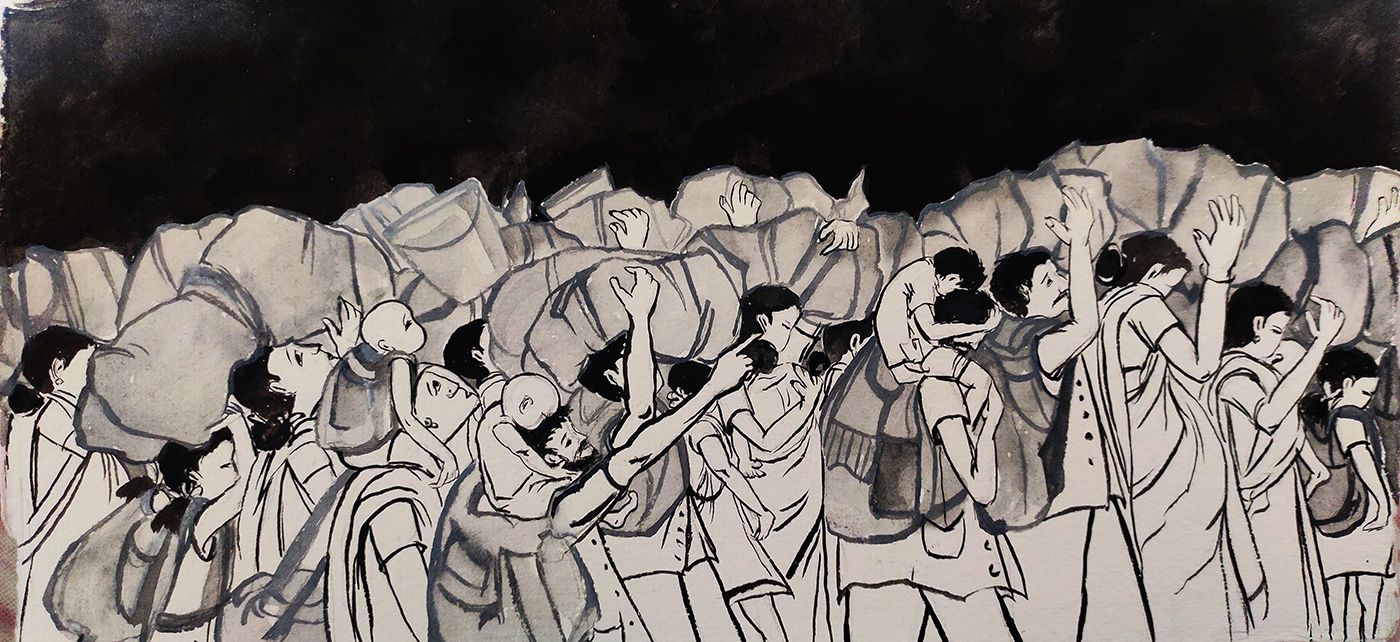
“যখন কাঁটাতার দেখলাম, মনে হল সব শেষ… মনে হল, এই জীবনে আর দেশে ফিরতে পারব না। আমার দাদোর দাদো (ঠাকুরদার ঠাকুরদা) এই মুর্শিদাবাদেই থাকতেন। আমরা এখন ভগবানগোলা [ব্লকের] যে গ্রামে থাকি সেটাও আমার নানির গ্রাম।“
বালিয়া হোসেন নগর গ্রামে নিজের বাড়িতে বসে মুর্শিদাবাদ জেলার সঙ্গে তাঁর পরিবারের আজন্মকালের সম্পর্কের খতিয়ান দিচ্ছিলেন বছর ৩৬-এর মেহেবুব শেখ। চোখেমুখে আতঙ্কের ছাপ। মাসখানেক আগেই ভয়ঙ্কর এক অভিজ্ঞতার মধ্যে দিয়ে গিয়েছেন। দেশের প্রশাসন তাঁকে ‘বাংলাদেশি অনুপ্রবেশকারী’ হিসেবে দাগিয়ে ঘাড়ধাক্কা দিয়ে সীমার ওপারে চালান করেছিল।
“আমার ভোটার কার্ড, আধার কার্ড, রেশন কার্ড সবই আছে। গায়ে গতরে খেটে জমিও কিনেছি। তারপরেও আমি বাংলাদেশি হই কেমন করে?” জানতে চান মেহেবুব, পেশাগত পরিচয়ে তিনি পরিযায়ী শ্রমিক।
মেহেবুবের মতোই এই প্রশ্নের উত্তর খোঁজার চেষ্টা করছেন তাঁর জেলাতুতো আরও হাজার হাজার দেশান্তরি শ্রমিকেরা। তাঁদের কেউ নির্মাণশ্রমিক, কেউ গৃহশ্রমিক, কেউ ফেরিওয়ালা, কেউ বা হকার। হঠাৎ নেমে আসা অস্তিত্বের সংকটে জেরবার দিন আনি দিন খাই এই মজুরদের ঠিক ঠাহর হচ্ছে না কেন মুর্শিদাবাদের বাংলাভাষী মুসলমান পরিযায়ী শ্রমিকেরা ভিনরাজ্যে কাজে গিয়ে আক্রান্ত হচ্ছেন।
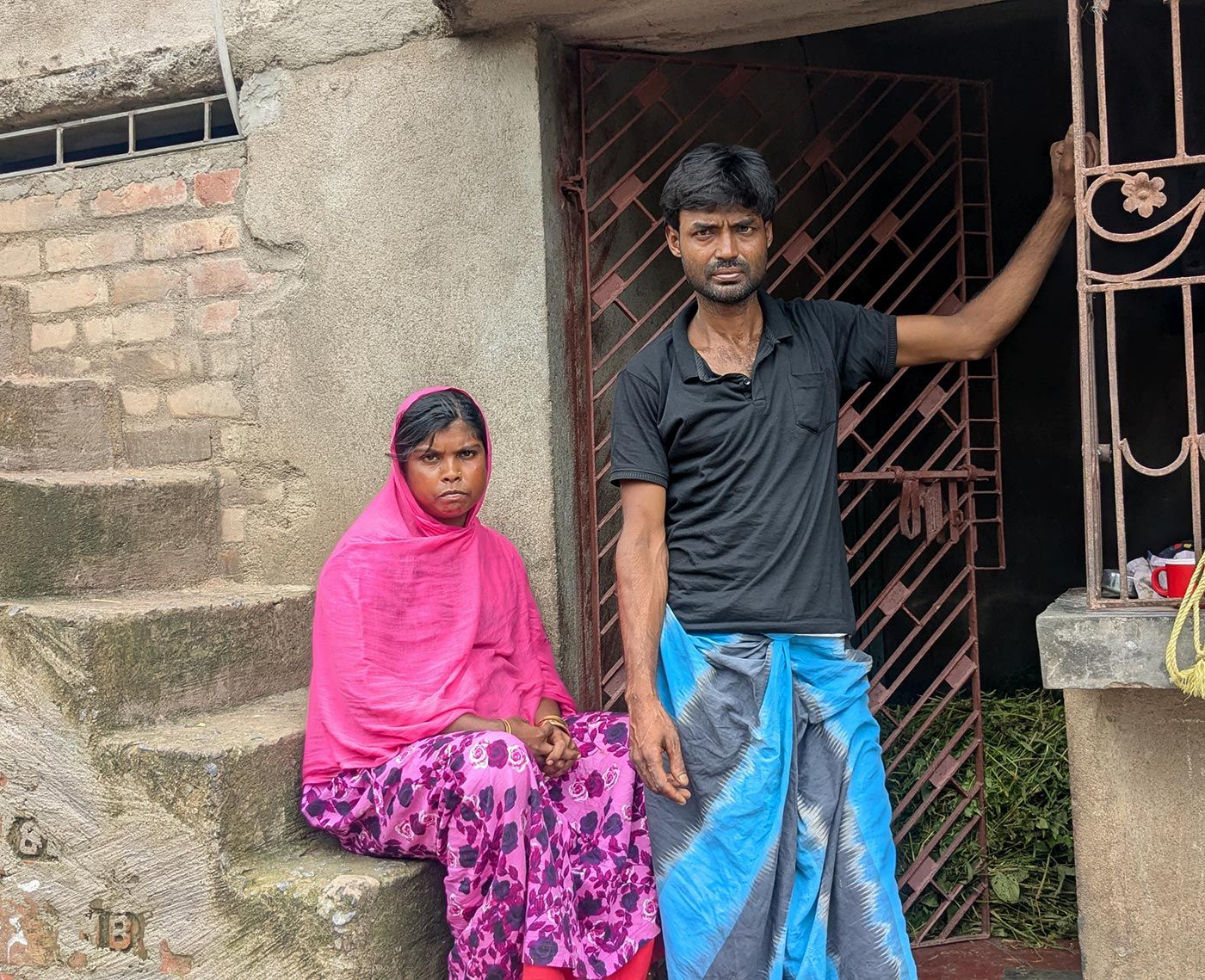
![মুর্শিদাবাদের কান্দি ব্লকের গোকর্ণ গ্রামের বিশাখা মণ্ডল (নাম পরিবর্তিত) দিল্লিতে গৃহশ্রমিক হিসেবে কাজ করছেন তিন দশক হল। তিনি বলছেন: 'আমাকে এখনও কেউ [আমরা ভারতীয় কিনা] কিছু বলেনি। কিন্তু চারদিকে এত ঝামেলা হচ্ছে [আমাদের মতো বাঙালি মুসলমানদের নিয়ে], আমরাও চিন্তিত'। Photo: Anirban Dey/PARI](https://admin.asiandispatch.net/uploads/editor-image-new/image_20250917175810580868ca90d0f2dc0.jpg)
(Left) স্ত্রী সুরনা বিবির সঙ্গে মুর্শিদাবাদের বালিয়া হোসেন নগরে নিজেদের বাড়িতে মেহেবুব শেখ। ২০২৫-এর ৯ জুন এই পরিযায়ী রাজমিস্ত্রিকে তুলে নিয়ে যায় মহারাষ্ট্র পুলিশ, তাঁর নাগরিকত্বের প্রমাণ হিসেবে কাগজপত্র চায়। শেষপর্যন্ত তাঁকে জোর করে বাংলাদেশে রেখে আসা হয়।
(Right) মুর্শিদাবাদের কান্দি ব্লকের গোকর্ণ গ্রামের বিশাখা মণ্ডল (নাম পরিবর্তিত) দিল্লিতে গৃহশ্রমিক হিসেবে কাজ করছেন তিন দশক হল। তিনি বলছেন: ‘আমাকে এখনও কেউ [আমরা ভারতীয় কিনা] কিছু বলেনি। কিন্তু চারদিকে এত ঝামেলা হচ্ছে [আমাদের মতো বাঙালি মুসলমানদের নিয়ে], আমরাও চিন্তিত’। Photos: Anirban Dey/PARI
“আমাকে এখনও কেউ [আমরা ভারতীয় কিনা] কিছু বলেনি,” বলেন বছর বাহান্নর বিশাখা মণ্ডল (নাম পরিবর্তিত)। কান্দি ব্লকের গোকর্ণ গাঁয়ে তাঁর ঘর। “কিন্তু চারদিকে এত ঝামেলা হচ্ছে [আমাদের মতো] বাঙালি মুসলমানদের নিয়ে, আমরাও চিন্তিত।” দিল্লিতে তিন দশক ধরে গৃহশ্রমিক হিসেবে কাজ করছেন তিনি। পাঁচ বাড়ি খেটে মাসে ২৫০০০ টাকা আয় করেন। ভোটার কার্ড, রেশন কার্ড সবই যথাযথ আছে তাঁর। রয়েছে আধার কার্ড, মায় দিল্লির ঠিকানার সঙ্গে লিংক করা ব্যাঙ্ক অ্যাকাউন্টও।
ইংরেজরা কলকাতায় রাজধানী স্থানান্তরের আগে পর্যন্ত অবিভক্ত বাংলার প্রশাসনিক কেন্দ্র মুর্শিদাবাদ পরিচিত ছিল তার সম্পদ আর প্রাচুর্যের জন্য। বর্তমানে অবশ্য তার পরিচয় রাজ্যের সর্বাধিক পরিযায়ী শ্রমিক সরবরাহকারী জেলা হিসেবে। ২০২৫ সালের মে মাস পর্যন্ত পাওয়া হিসেব অনুযায়ী মুর্শিদাবাদ জেলার মোটামুটি ৪ লক্ষ শ্রমিক পশ্চিমবঙ্গ রাজ্য সরকারের মাইগ্র্যান্ট ওয়ার্কার্স ওয়েলফেয়ার স্কিমে নাম নথিভুক্ত করেছেন।[আশ্চর্যের বিষয়, উক্ত নথি অধুনা অপ্রকাশিত হয়েছে সরকারি সাইট থেকে]। বিভিন্ন পরিযায়ী সংগঠনের বেসরকারি হিসেব বলছে মুর্শিদাবাদ জেলায় পরিযায়ী শ্রমিকের সংখ্যা ১০ লক্ষেরও বেশি। নাম প্রকাশে অনিচ্ছুক শিক্ষা দপ্তরের জনৈক সরকারি আধিকারিক এও জানান, “সরকারি কোনও পরিসংখ্যানেই নাবালক শ্রমিকদের উল্লেখ থাকবে না। কিন্তু বাস্তব এটাই যে জেলার অসংখ্য নাবালক শ্রমিক বাইরে কাজে যাচ্ছে প্রতিদিন।“
মেহেবুব শেখের দাদা ৩৩ বছরের মুজিবর শেখ আর বাবা হোসেন শেখও ছিলেন পরিযায়ী শ্রমিক। ষাটের কোঠার গোড়ায় পৌঁছে হোসেন আজও কলকাতা শহরে রাজমিস্ত্রির কাজ করেন। ভাইয়ের সঙ্গে মুজিবরও দিল্লি, মুম্বইয়ে রাজমিস্ত্রির কাজে গিয়েছেন। এখন গাড়ি চালান তিনি। দুই ভাই-ই চরম দারিদ্র্যের সঙ্গে লড়াই করে বড়ো হয়েছেন। মেহেবুব বলছেন, “এক সময় গ্রামে অন্যদের বাড়িতে ছাগলও চরিয়েছি। স্কুলে বেশিদিন যাইনি। অভাবের সংসার। ছোটো থেকেই খাটছি।”
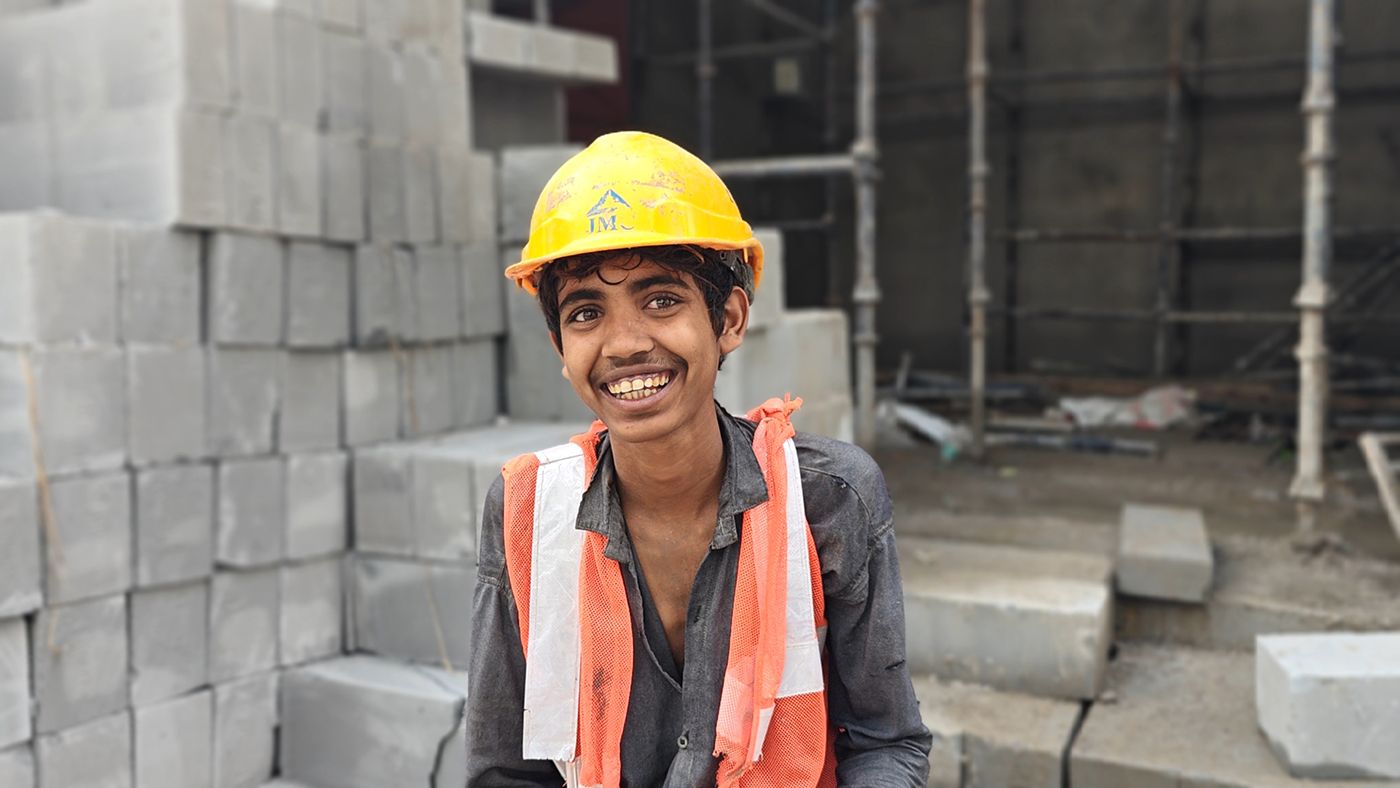
‘এখন বরং ভালো আছি। ফিরে এসে কলকাতায় এই কাজ নিয়েছি। বাড়ির কথা মনে পড়ে,’ বলেন মুর্শিদাবাদের ধুলিয়ানের বাবু ইসলাম (আসল নাম জানাতে চাননি)। ২০২৪ সালের সেপ্টেম্বর মাস নাগাদ ওড়িশায় বাঙালি মুসলিম পরিযায়ী শ্রমিকদের ওপর অত্যাচার শুরু হলে সেখান থেকে পালিয়ে আসেন তিনি। Photo: Smota Khator/PARI
সতেরোয় পা দিয়েই, বংশ পরম্পরায় শেখা রাজমিস্ত্রির বিদ্যেটুকু সম্বল করে কাজের তাগিদে ভিনরাজ্যে পাড়ি জমান মেহেবুব। সেই থেকে দিল্লি, পঞ্জাব, তামিলনাডু, রাজস্থান-সহ বিভিন্ন রাজ্যে কাজ করে আসা এই ওস্তাদ রাজমিস্ত্রি বিশ্বাসই করতে পারছেন না যে চারপাশ এতটা বদলে যাবে। মেহেবুবের মতো বহু পরিযায়ী শ্রমিককে সন্দেহের বশে গ্রেফতার করে বাংলাদেশের ভূখণ্ডে পাঠিয়ে দেওয়ার মতো ঘটনাও সামনে এসেছে সংবাদমাধ্যমের রিপোর্ট আর প্রকাশিত নানান প্রত্যক্ষ বয়ান এবং অভিজ্ঞতার মারফত।
বাতাসে ভাসছে সন্দেহ আর অবিশ্বাসের বিষ। তাতে অবশ্য অবাক হওয়ার কিছু নেই: এক বছরেরও বেশি সময় ধরে রাজ্য ও কেন্দ্রীয় সরকারের আইন প্রয়োগকারী সংস্থাগুলো আক্রমণ শানিয়েছে তাঁদের বিরুদ্ধে। “আমাদের নামগুলো শুনতে আপনাদের মতো না। সেজন্যই আমাদের এই অবস্থা,” ক্ষুব্ধ স্বরে বলেন মুজিবর। গত একবছর যাবত পশ্চিমবঙ্গ থেকে বাইরে যাওয়া পরিযায়ী শ্রমিকরা নিশানা হচ্ছেন বারবার। ‘বাংলাদেশি’, ‘রোহিঙ্গা’, ‘ঘুসপেটিয়া,’ ‘অনুপ্রবেশকারী’, ‘ইল্লিগাল’ ইত্যাদি তকমা জুটছে তাঁদের।
বিগত এক দশকে ধর্ম, ভাষা, জাতি তথা স্থানিক পরিচিতির ভিত্তিতে যে বিদ্বেষমূলক আচরণ নিয়ম করে বেড়েছে, প্রত্যেকেই খেয়াল করেছেন সেটা। বর্তমান বাড়বাড়ন্ত সেসবেরই এক চরম পর্যায়। মৌলবাদী সংগঠন ও রাজনৈতিক দলের নেতানেত্রীদের ঘৃণাপ্রসূত বয়ান তথা ভাষণের জেরে সর্বাধিক আক্রান্ত হয়েছেন মুসলমান পরিযায়ী শ্রমিকেরা।
“হয় জান, নয় কাম, একটা বেছে নিতে বাধ্য হচ্ছি আমরা,” এই প্রতিবেদকের কাছে ক্ষোভ উগরে দেন ডিয়ার জালি বাগিচার বাসিন্দারা। এখানেই ইটের গাঁথনি দেওয়া প্লাস্টার বিহীন দুই কামরার ঘরে থাকেন ৩২ বছরের নাজেমা বিবি, উত্তরপ্রদেশের কানপুরে কর্মরত স্বামীর জন্য ভয়ে-ভাবনায় দিন কাটছে তাঁর। “এখন কয়েক ঘণ্টা ফোন না ধরলেই বুক কাঁপে,” জানান তিনি।
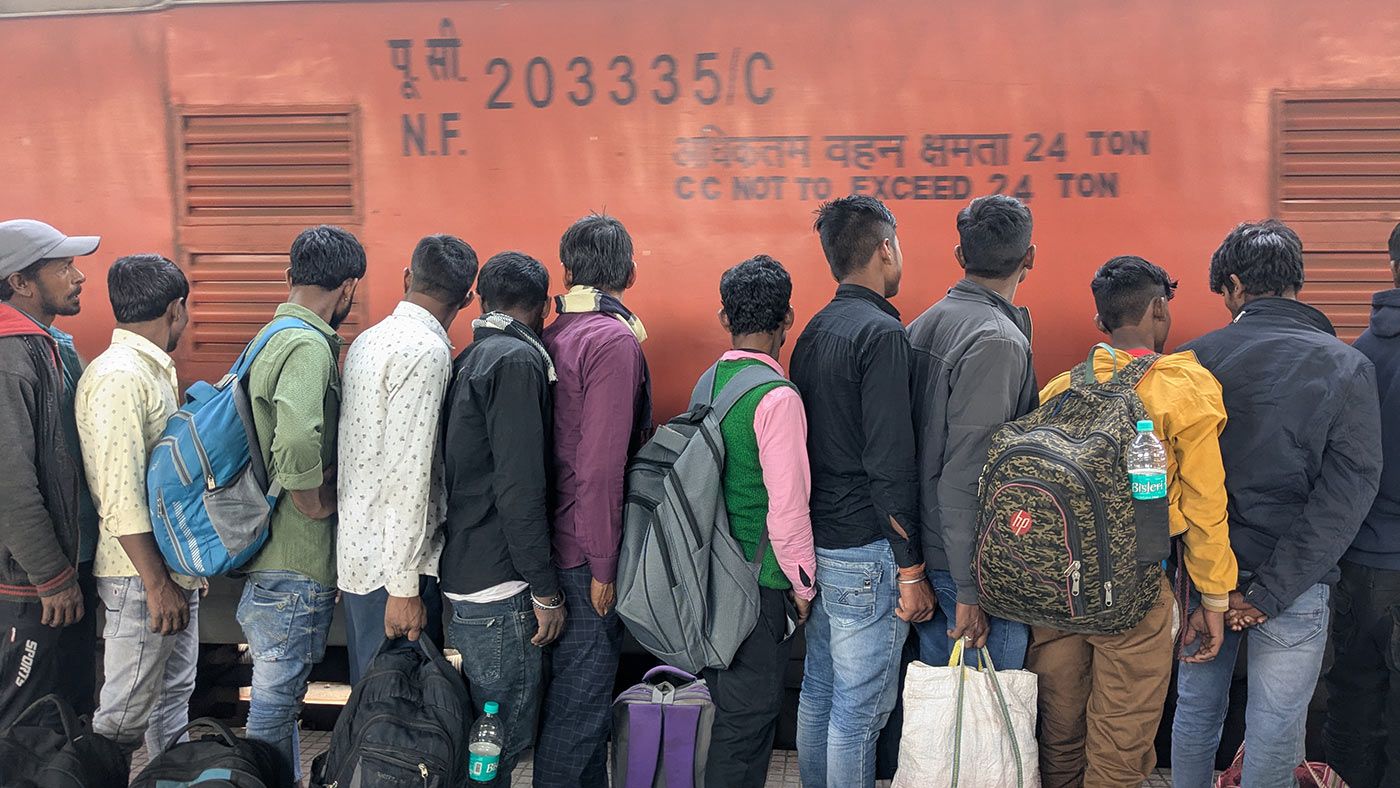
মুর্শিদাবাদ জেলা জুড়ে স্থিতিশীল কাজের আকাল ও দিন গুজরানের জন্য যথেষ্ট মজুরির অভাবে শ্রমজীবী মানুষদের কাছে দেশান্তরি হওয়া ছাড়া উপায় থাকে না। ছবিতে দেখা যাচ্ছে, হাওড়া স্টেশন থেকে অন্ধ্রপ্রদেশগামী ট্রেনে ওঠার অপেক্ষায় আছেন তরুণ পরিযায়ী শ্রমিকেরা । Photo: Anirban Dey/PARI
চলতি বছরের জুন মাসের প্রথম দিকে ঈদ উল আজহা সপরিবারে পালন করবেন বলে মে মাসেই বালিয়া হোসেন নগর ফিরেছিলেন মেহেবুব। বহুকষ্টে তিল তিল করে দাদা, ভাই, বাবা – তিন রাজমিস্ত্রি মিলে আড়াই তলা পাকা বাড়িটা বানিয়েছেন। ৫টা ঘর। নিচে দোকান করার মতো কিছুটা জায়গা রাখা। গৃহিণী স্ত্রী সুরনা বিবি (৩০) আর তিন সন্তানকে নিয়ে মেহেবুব যে দিকটায় থাকেন সেদিকে এখনও ভিতর বা বাইরে কোথাও-ই প্লাস্টার হয়নি। বড়ো ছেলে বকুল শেখ (১৬) পড়াশোনা ছেড়ে এখন কাছেই একটা দোকানে কাজ করে। বাকি দুই ছেলে সাগর শেখ (১২), রেহান শেখ (৭) স্কুলে পড়ছে। মেহেবুব ঈদে ফিরেছেন দেখে বাড়ির সব আত্মীয় পরিজনেরা মিলে পবিত্র কুরবানির জন্য পশুর ব্যবস্থাও করেছিলেন।
কিন্তু বাধ সাধল কাজের চাপ। থানে শহরে যে ইমারতি সাইটে কাজ করতেন তিনি, “সেখান থেকে বারবার ফোন আসতে থাকে।” অগত্যা পরিবারের সঙ্গে পরব না কাটিয়েই প্লেনে চেপে মহারাষ্ট্র ফিরে রাজমিস্ত্রির কাজে যোগ দেন মেহেবুব।
জুন মাসের ৯ তারিখ কাজের ফাঁকে খানিক বিরতি নিয়ে কাছেই একটা দোকানে চা খেতে বেরিয়েছিলেন তিনি। হঠাৎ সেখান থেকেই তাঁকে তুলে নিয়ে যাওয়া হয় থানের মীরা রোডে শ্রী এল আর তিওয়ারি ইঞ্জিনিয়ারিং কলেজের পাশে পুলিশ চৌকিতে। রাতেই সেখান থেকে নিয়ে যাওয়া হয় মীরা রোড পুলিশ স্টেশনে। দেখতে চাওয়া হয় কাগজ।
“’তুই বাংলাদেশি?’ হিন্দিতে এই প্রশ্নই করছিল পুলিশ অফিসাররা। আমি বলি, ‘আমার বাড়ি পশ্চিমবঙ্গে’। আধার কার্ড, প্যান কার্ড দেখাই। পুলিশ বলে, ‘এসব পাঁচ টাকায় পাওয়া যায়’,“ প্রতিবেদককে জানালেন মেহেবুব।
কোনও মতে থানা থেকেই লুকিয়ে বাড়িতে ফোন করে সব কথা জানান তিনি। বালিয়া হোসেন নগরে তাঁর পরিবারের সদস্যরা তক্ষুনি যোগাযোগ করেন তাঁদের স্থানীয় মহিষাস্থলী গ্রাম পঞ্চায়েতের সঙ্গে। সেখান থেকেও যাবতীয় নথিপত্র পাঠানো হয় মহারাষ্ট্রের মীরা রোড থানায়। “চারদিন ধরে চলে অসহ্য মানসিক নির্যাতন। সারাদিন থানার বাইরে বসিয়ে রাখত। রাতে পাঠিয়ে দেওয়া হত একটা পুলিশ ক্যাম্পে।“
যদিও মেহেবুবের বয়ানে উঠে আসা নিজেদের যাবতীয় অপরাধ সটান খারিজ করে মীরা রোডের পুলিশ। সিনিয়র ইন্সপেক্টর মেঘনা বুরাডে জানান, তাঁদের কোনও “দোষ ছিল না” এবং এক পুলিশ কমিশনারের আদেশমাফিকই মেহেবুব শেখ সহ বাকিদের আটক করা হয়।
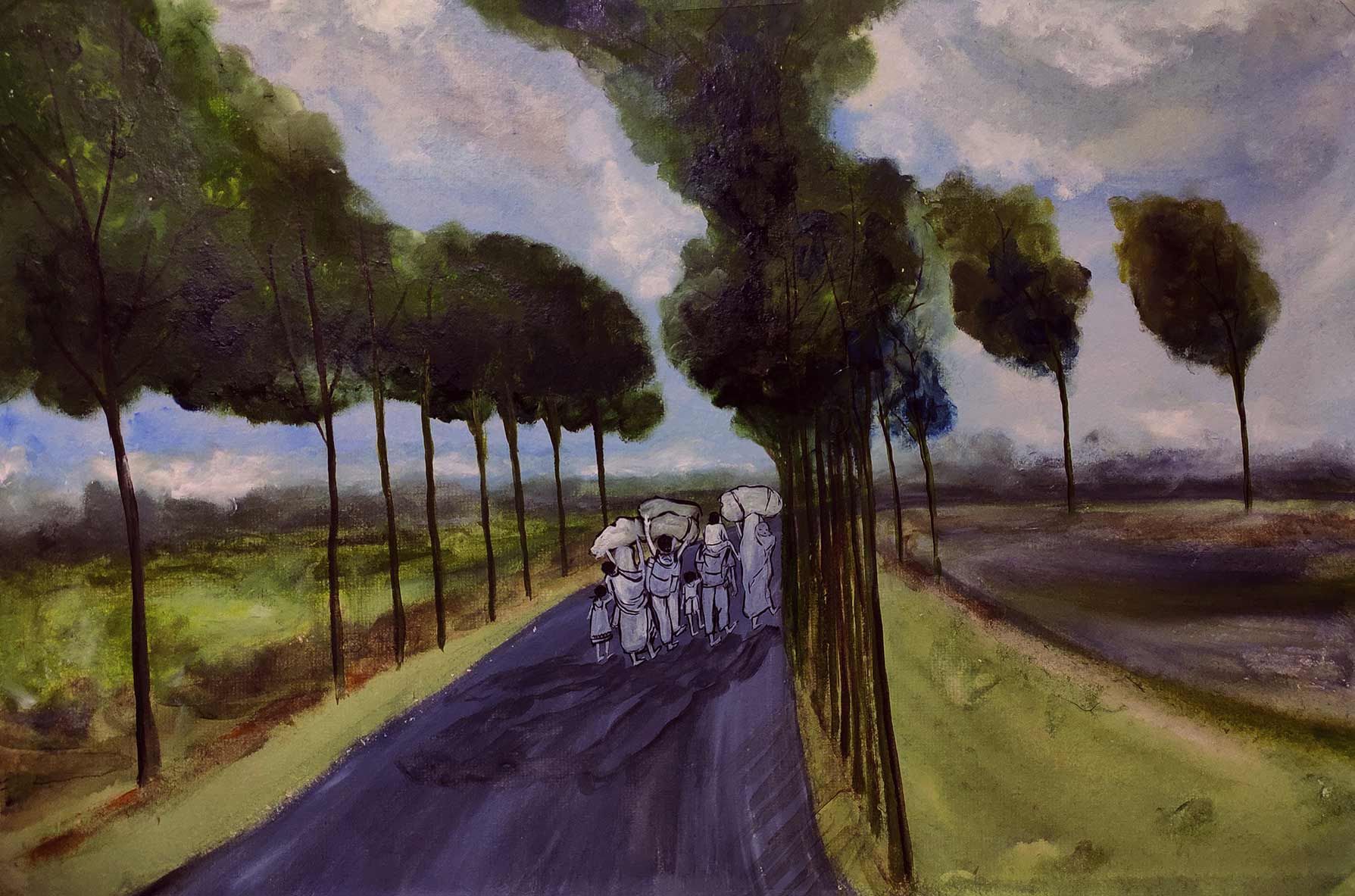
‘হয় জান, নয় কাম, একটা বেছে নিতে বাধ্য হচ্ছি আমরা,’ বলছেন লাগাতার ধরপাকড় ও ‘বাংলাদেশি ঘুসপেটিয়া’ তকমায় দিশেহারা পশ্চিমবঙ্গের পরিযায়ী শ্রমিকরা । Illustration: Labani Jangi/PARI
মেহেবুবর জন্য, অবশ্য ১৩ জুন দিনটা ছিল ভয়াবহ।
“সেদিন থানা থেকে আমাদের বড়ো একটা জাল দেওয়া গাড়িতে তোলা হয়। সামনে পিছনে আরও অনেক গাড়ি। মনে হচ্ছিল, নেতা মন্ত্রী যাচ্ছে,” বলছেন মেহবুব। “গাড়ি পানভেলের সিকিউরিটি ফোর্সের ক্যাম্পে এসে থামে।“
১৪ তারিখ সেই একই গাড়ি করে মেহেবুব-সহ প্রায় তিরিশ জনকে নিয়ে যাওয়া হয় পুণে বিমান বন্দরে। দুপুর ২টোয় বিমানে তোলা হয়। নামার পর মেহেবুব বুঝতে পারেন, পশ্চিমবঙ্গের বাগডোগরা বিমান বন্দরে এসে পড়েছেন। তাঁর কথায়, “এয়ারপোর্টে গুণতি করা হয়। আমাদের ছোটো ছোটো গ্রুপে ভাগ করে দেয়। আসামীদের গুণতির কথা শুনেছি। আমাদেরও এই রকম গুণতি কেন হচ্ছে? সন্দেহ হয়…” এয়ারপোর্ট থেকে তাঁদের আনা হয় শিলিগুড়ির বিএসএফ এর ছাউনিতে। সেখান থেকে অজানা গন্তব্যের পথে যাত্রা শুরু হয়।
“প্রায় পাঁচ, ছয় ঘণ্টা গাড়িতে গিয়েছি। যেখানে নামাল সেখানে জঙ্গল। একটা ছোটো বিএসএফ’এর ক্যাম্প। অল্প কয়েকজন অফিসার। নামিয়ে প্রশ্ন করল, ‘বাড়ি কোথায়?’ ঠিকানা বললাম। বেধড়ক মার শুরু হল। গলায় বন্দুক অবধি ঠেকানো হল। এরপর বিএসএফ অফিসাররা আমাদের ছবি তুলল। বলল, হেঁটে চলে যেতে জঙ্গল দিয়ে।”
“কোথায় যাব? কীভাবে যাব কিছুই জানি না। অনেকে বলছে, বিএসএফ বা বিজিবি (বর্ডার গার্ড বাংলাদেশ) দেখলে গুলি করে দেবে। ভয় হচ্ছিল। জঙ্গলে লুকিয়ে থাকলাম সারারাত,” আতঙ্কের সেই রাতের কথা জানাচ্ছেন বিধ্বস্ত সন্ত্রস্ত মেহেবুব।
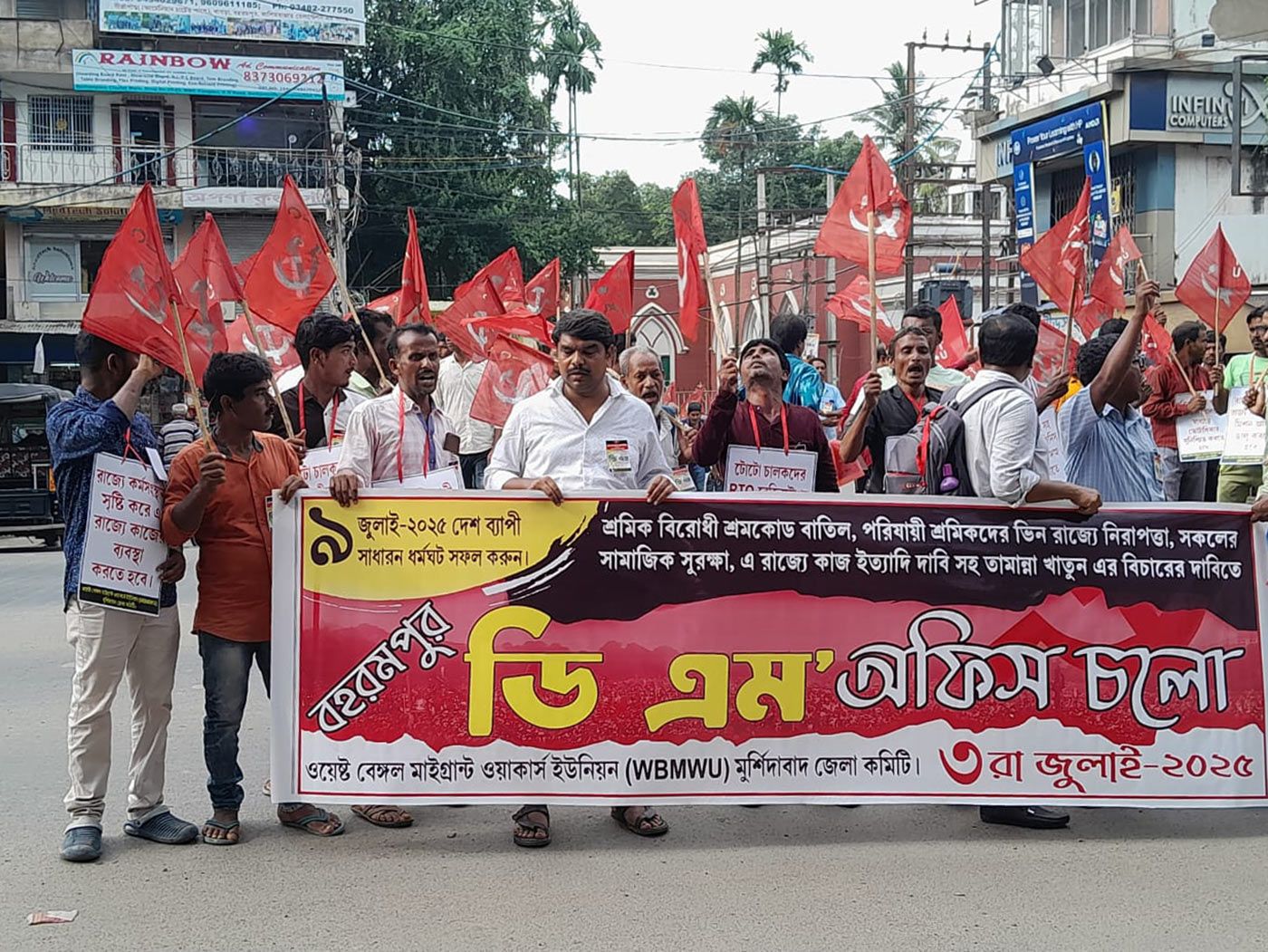
(Left) ভিনরাজ্যে পরিযায়ী শ্রমিকদের নিরাপত্তার দাবি জানিয়ে মুর্শিদাবাদের সদর শহর বহরমপুরে একটি মিছিলের ডাক দেয় ওয়েস্ট বেঙ্গল মাইগ্রান্ট ওয়ার্কাস ইউনিয়ন। Photo: Anirban Dey/PARI
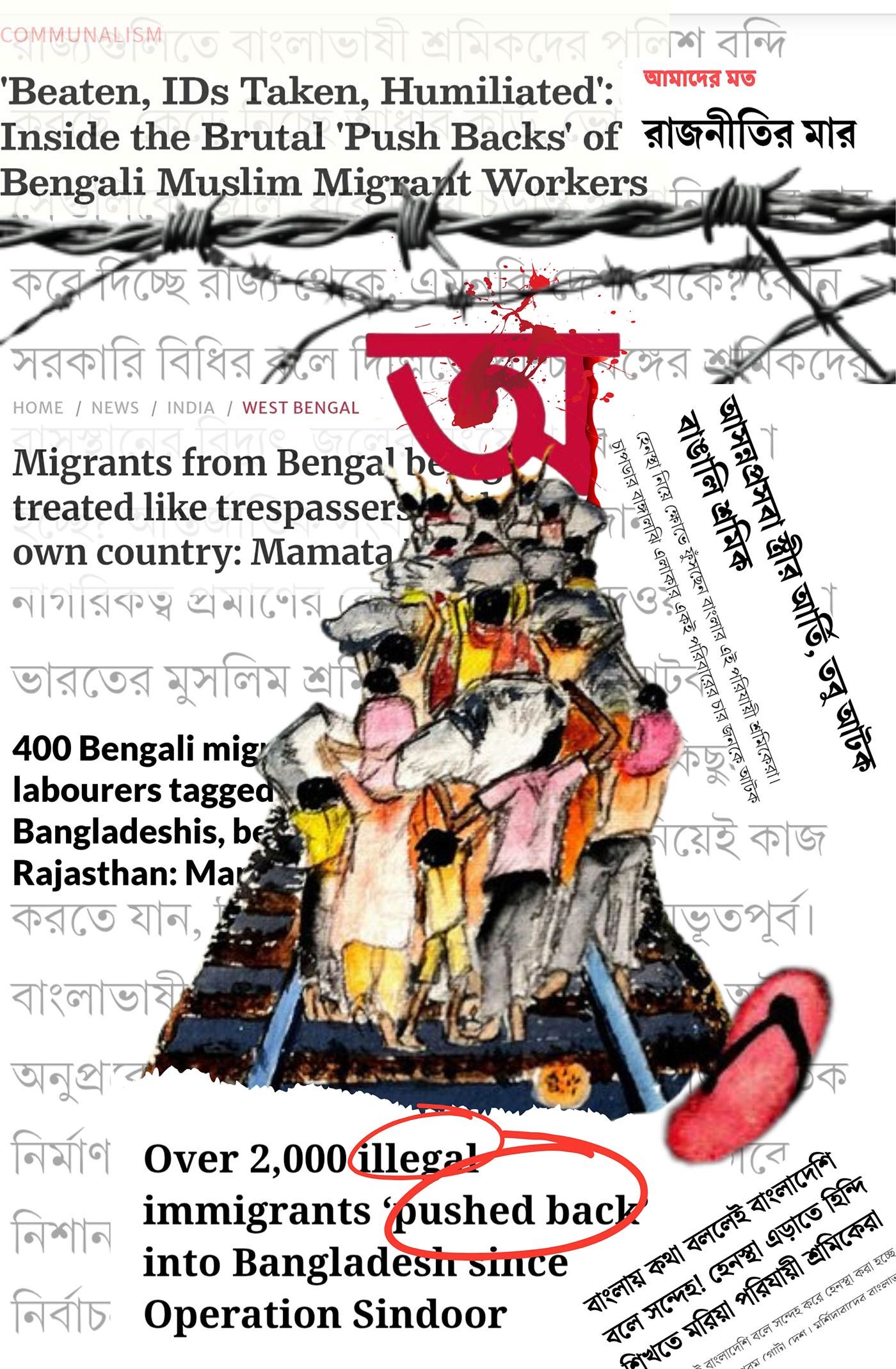
(Right) ভারতের বিভিন্ন রাজ্যে বাংলাভাষী পরিযায়ী শ্রমিকদের ওপর নেমে আসা অত্যাচার নিয়ে সাম্প্রতিক কিছু সংবাদ-শিরোনামের কোলাজ। Photo: Aunshuparna Mustafi/PARI
সকাল হতেই কষ্ট বেড়েছে। পুণে বিমান বন্দরে তাঁদের খেতে দিয়েছিল বিএসএফ। তারপর আর ২৪ ঘণ্টা পেটে কিচ্ছুটি পড়েনি। বলছেন, “মনে হচ্ছিল এখানেই মরে যাব। চারদিকে শুধুই গাছ। আমরা কয়েকজন একসঙ্গে থাকছিলাম।” খানিক থেমে আবারও বলেন মেহেবুব, “দুপুর ২টো নাগাদ হাঁটতে হাঁটতে যেখানে গেলাম সেখানে বাংলাদেশের ছোটো একটা বসতি ছিল। ওদের গিয়ে বললাম যে আমরা ভারতীয়। ওরা আমাদের স্নান করতে বলল, ভাত খেতে দিল। [ওদের সাহায্যে] ইমো অ্যাপ [আন্তর্জাতিক কল এবং চ্যাট করার মোবাইল অ্যাপ] থেকে বাড়িতে ফোন করলাম। কাঁদছিলাম। কথা বলতে পারছিলাম না…”
সেই অবস্থা থেকে যে কোনওদিন ফিরে আসবেন, ভাবতে পারেননি। মেহেবুব শেখকে উদ্ধারের জন্য তাঁর দাদা মুজিবর শিলিগুড়ি, রায়গঞ্জ কত না জায়গায় ছোটাছুটি করেছেন। স্থানীয় পঞ্চায়েত অফিস থেকে শুরু করে জেলা আর রাজ্য প্রশাসনের নানান সরকারি কর্তাব্যক্তির দ্বারস্থ হয়েছেন। অবশেষে মেহেবুব ফিরতে পেরেছেন ঘরে। “মেহেবুবকে উদ্ধার করে নিয়ে আসার পরেও বাড়িতে সরকারি লোকজন এসেছে। জমির কাগজও দেখতে চেয়েছে।“ তবে তাঁরা কোন দপ্তর থেকে এসেছিলেন সেটা পরিবারের কাছে স্পষ্ট নয়।
ফিরে এসেও চিন্তা আর শেষ হচ্ছে কোথায়? তাঁদের জন্য বাইরে যাওয়া যে আর ছাড়া গতি নেই, সেকথাই বুঝিয়ে বলেন মেহেবুব। “ভিনরাজ্যে দিনে যে ৮০০ থেকে ১২০০ টাকা আয় হয়, ঘরে বসে তো সেসব বন্ধ। অনেকসময় ওখানে আবার ডবল শিফটেও কাজ করি আমরা।“ অথচ মনে গেড়ে বসেছে চরম ভয়। বলছেন, “বছরের পর বছর পুণে, মুম্বই, থানে শহরে রাজমিস্ত্রির কাজ করেছি। এইরকম দিন দেখব কখনও ভাবিনি।”
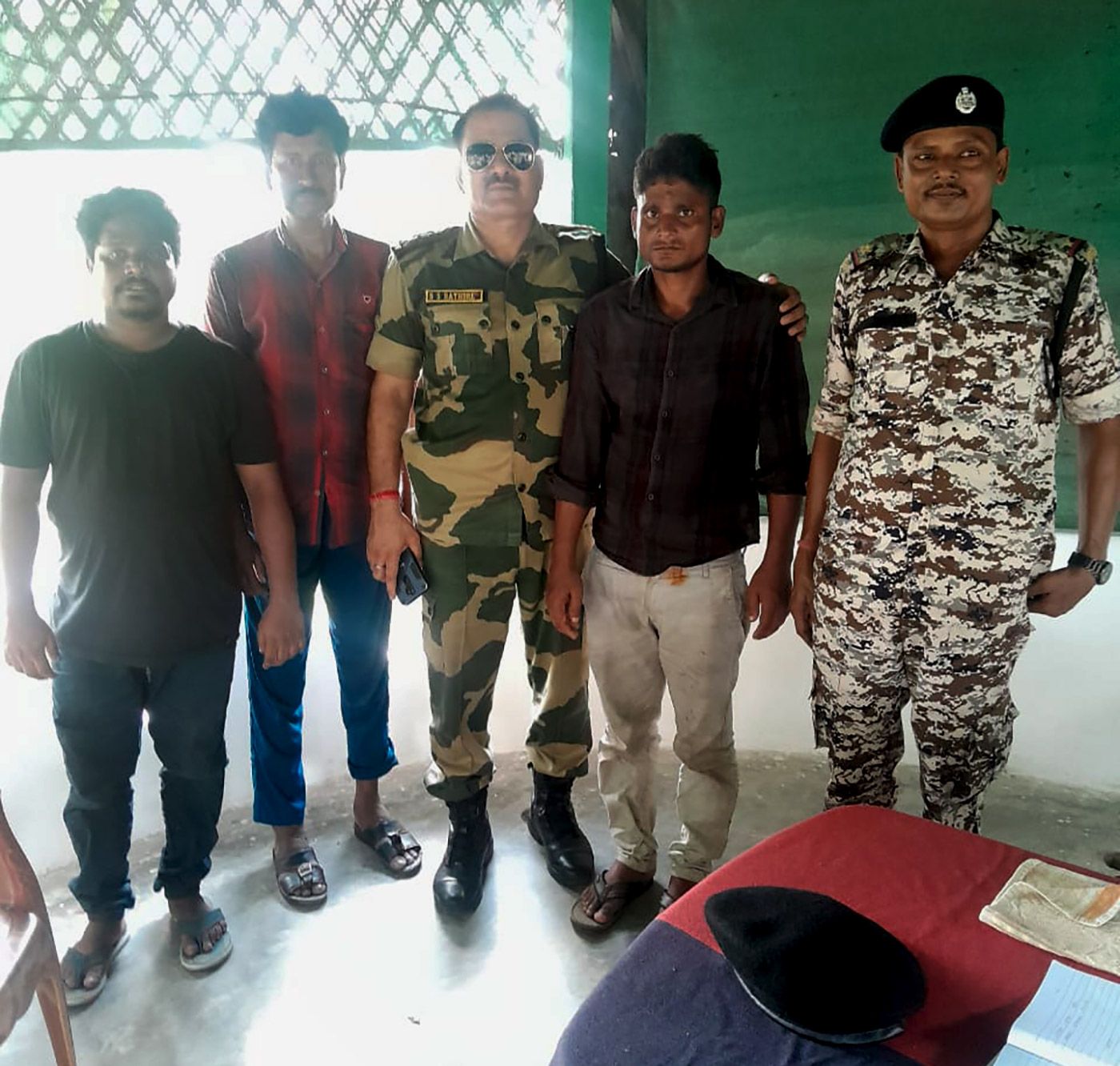
(Left) ১৫ জুন উদ্ধার পাওয়ার পর নিরাপত্তা আধিকারিকদের সঙ্গে নাজিমুদ্দিন মণ্ডল (কালো শার্ট গায়ে), মোস্তফা কামাল শেখ (লাল শার্ট গায়ে) ও মিনারুল শেখ (বাঁদিকে)। ১৩ জুন জবরদস্তি বাংলাদেশ পাঠিয়ে দেওয়া হয় এই তিন পরিযায়ী শ্রমিককে ।
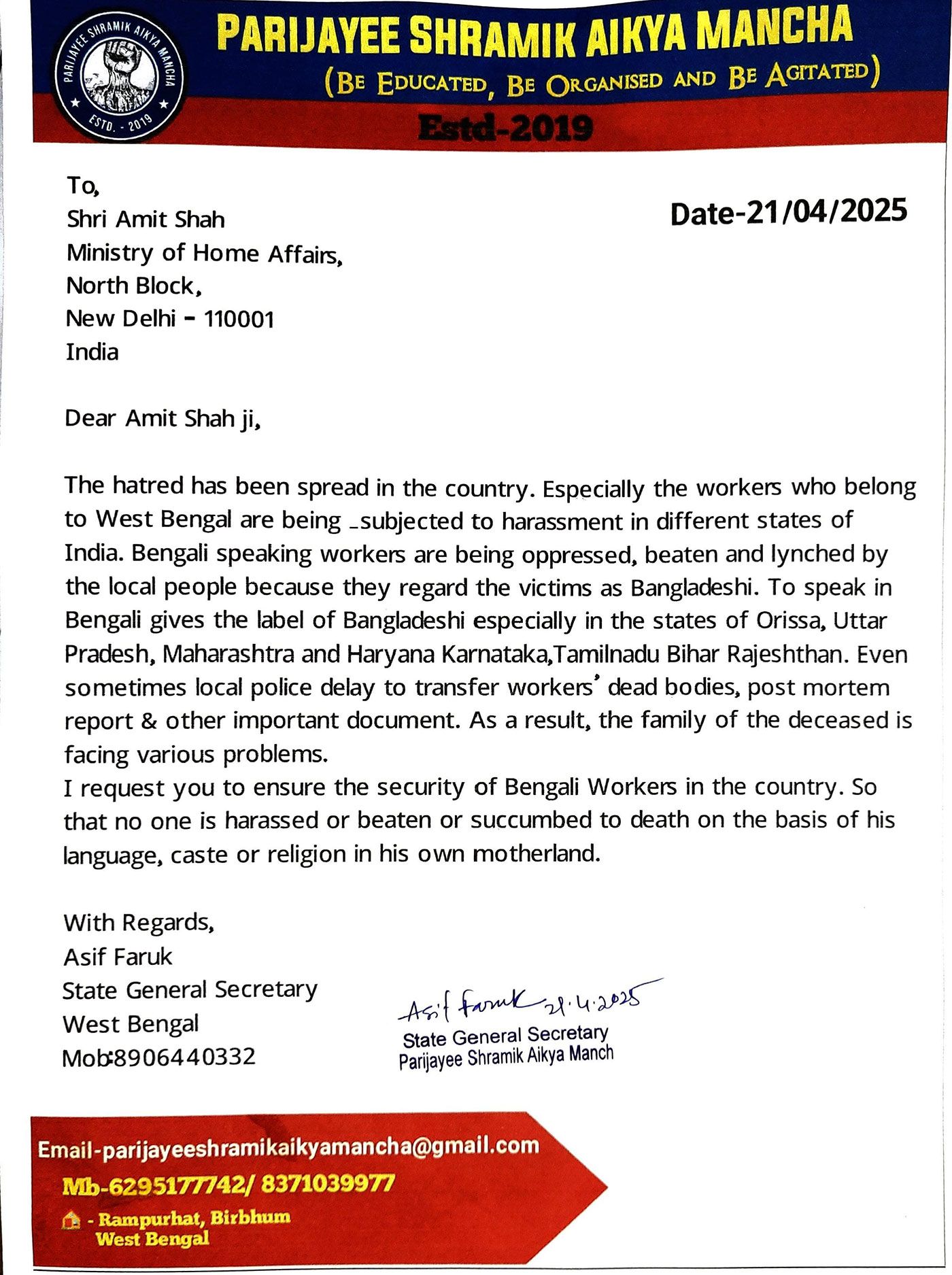
(Right) পশ্চিমবঙ্গ থেকে বহির্গামী শ্রমজীবীদের অধিকার নিয়ে কর্মরত সংগঠন পরিযায়ী শ্রমিক ঐক্য মঞ্চের তরফ থেকে পরিযায়ী শ্রমিকদের ওপর হামলার বিরুদ্ধে অবিলম্বে ব্যবস্থাগ্রহণের দাবি জানিয়ে কেন্দ্রীয় স্বরাষ্ট্রমন্ত্রীকে চিঠি দেওয়া হয়েছে। Photos: Courtesy of Parijayee Shramik Aikya Mancha via PARI
সাংবাদিক দেখেই মুর্শিদাবাদেরই হরিহরপাড়া ব্লকের নাজিমুদ্দিন মণ্ডল নিজের রাগ বিরক্তি উগরে দেন। সরকার, প্রশাসনের পাশাপাশি তাঁর সমান ক্ষোভ সংবাদমাধ্যমকে ঘিরেও। যবে থেকে রাষ্ট্রের হাতে ঘাড়ধাক্কা খেয়ে বাংলাদেশ পৌঁছনো নাজিমুদ্দিনের একটি ভিডিও সমাজমাধ্যমে ছড়িয়ে পড়েছে, সাংবাদিকরা প্রশ্নে প্রশ্নে জেরবার করে তুলেছেন তাঁকে। পেশায় রাজমিস্ত্রি, তরতিপুর গ্রামের ৩৫ বছর বয়সি নাজিমুদ্দিনকে হঠাৎ বাংলাদেশি তকমা দিয়ে ওদেশে ঠেলে দেওয়া প্রসঙ্গে জানতে চাওয়া হচ্ছে বারবার। ক্ষোভে ফেটে পড়েন তিনি, “কি করবেন জেনে? আপনারা লিখতে পারেন না কেন [আমাদের উপর] অত্যাচার করা হচ্ছে? কেন আমাদের বাংলাদেশি বলা হচ্ছে? মিডিয়াকেও তো বলতে হবে।”
সাম্প্রতিক পরিস্থিতি বিষয়ে মিডিয়ার বড়ো অংশের নীরবতা বিচলিত করে নাজিমুদ্দিনকে। অনেকেই যে আবার খবরের নামে বাংলাভাষী শ্রমিকদের ঘিরে সন্দেহের বাতাবরণ তৈরি করতে তৎপর, সেটাও নজর করেছেন তিনি।
বাংলাদেশে ঠেলে দেওয়ার অভিজ্ঞতায় এখনও আতঙ্কিত নাজিমুদ্দিন। বাড়িতে ক্লাস টেনের পড়ুয়া মেয়ে আর স্ত্রীকে রেখে ভিনরাজ্যে পাড়ি দিতে এখন রীতিমতো ভয় হচ্ছে তাঁর। “মীরা রোড [আমি] থানাতেও কাজ করেছি,” বলেন তিনি। রাজমিস্ত্রির কাজ, মেরামতি সবই করেছেন সেখানে। “সেই থানার লোকে এসেই মাঝরাতে ভাড়ার ঘর থেকে তুলে নিয়ে গেল। বলল, ‘বাংলাদেশি’। এ কেমন নিয়ম?” প্রশ্ন করছেন নাজিমুদ্দিন। মহারাষ্ট্র পুলিশ প্রশ্ন তুলেছিল জন্ম সার্টিফিকেট নিয়ে। নাজিমুদ্দিন বলছেন, “৩৫ বছর আগে জন্ম হরিহরপাড়ায়। এখানেই বাপ, দাদাদের জন্ম। বাবা, মা কেউই পড়াশোনা জানেন না। জন্মসার্টিফিকেটও তোলেননি। আমার বাড়ির অবস্থা খুব খারাপ ছিল। আমি প্রাইমারি স্কুলটাও পাশ করিনি।”
মহারাষ্ট্রের মীরা রোডে সেই ঘরে এখনও জিনিসপত্র পড়ে আছে। ঠিকাদারের কাছে মজুরির টাকাও বকেয়া আছে। সেসবের কী হবে তারও কোনও ঠিক নেই। পুলিশ মোবাইল ফোন কেড়ে নিয়েছে। সেই ফোনও ফেরত পাননি। “নতুন জায়গায় কাজ খোঁজা মুশকিল। পাঁচ বছর ধরে যে জায়গাটা তৈরি হয়েছে। সেটা এইভাবে কেড়ে নেওয়া যায়?” প্রশ্ন তাঁর।
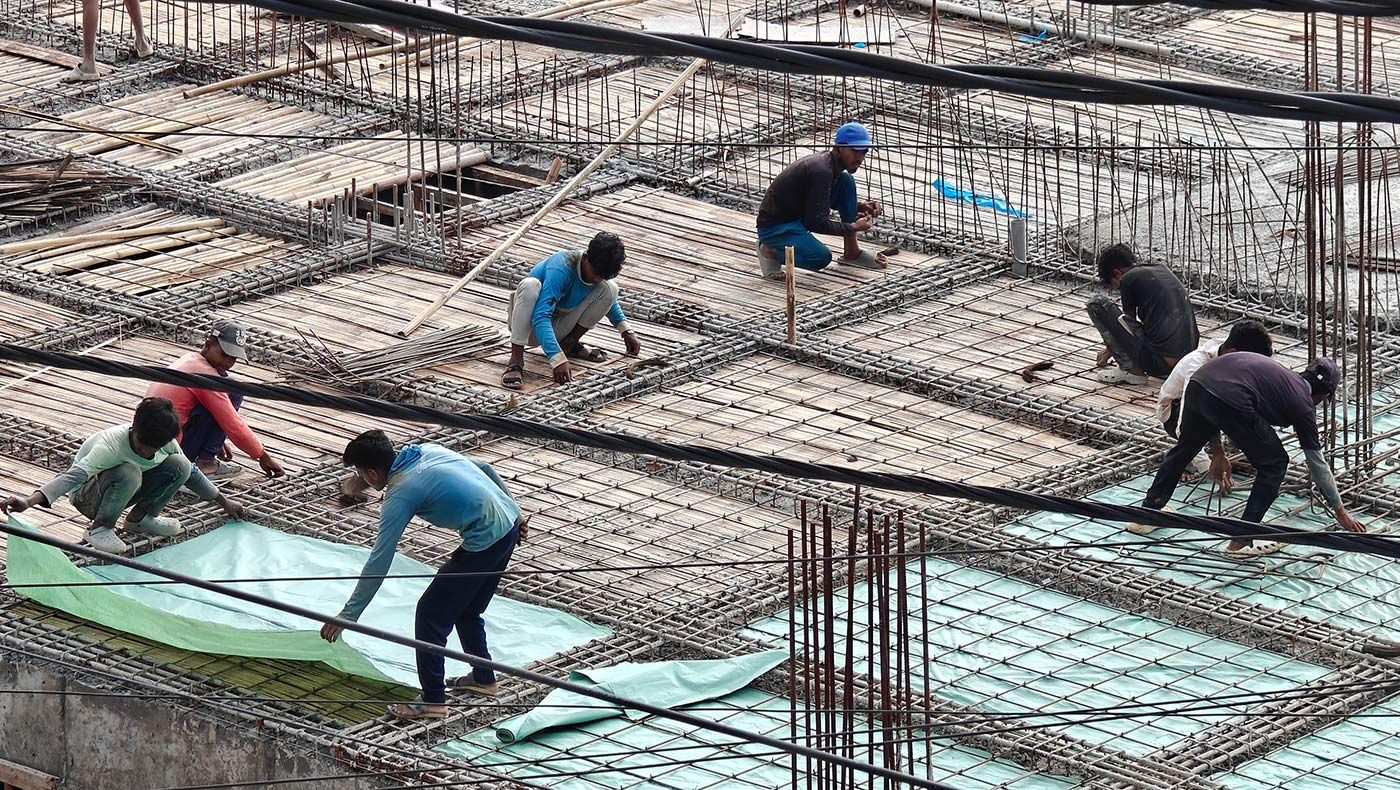
অবৈধ বাংলাদেশি অনুপ্রবেশকারী সন্দেহে মানুষজনকে লাগাতার হেনস্থা নিয়ে কেন্দ্র-রাজ্য তরজার মাঝে চাপা পড়ে যাচ্ছে গোড়ার প্রশ্নটাই: মুর্শিদাবাদে যদি ঠিকঠাক কাজের সুযোগ থাকত, কৃষিক্ষেত্রে যদি একটুও সুযোগ-সুবিধে মিলত – বাসিন্দাদের কি আদৌ মিজোরাম (ছবিতে) কি মহারাষ্ট্রের মতো নানান রাজ্যে পাড়ি দিতে হত? Photo: Smita Khator/PARI
নাজিমুদ্দিনের অন্য দুই ভাইও পরিযায়ী শ্রমিক। একজন কেরালায়, অন্যজন তামিলনাড়ুতে কাজ করেন। এলাকার শ্রমিকরা প্রতিবেদককে জানাচ্ছেন, দক্ষিণের রাজ্যগুলিতে বাঙালি শ্রমিকদের উপর তেমন অত্যাচার হচ্ছে না। তাই মহারাষ্ট্র, গুজরাট, দিল্লি থেকে ফিরে আসা শ্রমিকরা এখন মরিয়া হয়ে দক্ষিণের রাজ্যে কাজ খুঁজছেন।
মুর্শিদাবাদের বেলডাঙা ১ ব্লকের কাজিসাহা গ্রামের বাসিন্দা মিনারুল শেখ এবং বর্ধমান জেলার মন্তেশ্বর থানা এলাকার বাসিন্দা মোস্তফা কামাল শেখকেও তাঁর সঙ্গে একই দুর্ভোগের শিকার হতে হয়েছিল বলে জানান নাজিমুদ্দিন। “১৩ জুন আমাদের শিলিগুড়ি দিয়ে বাংলাদেশে পাঠিয়ে দেওয়া হয়। উদ্ধার পাই ১৫ জুন।
“যা হয়ে গেল… এরপর বাইরে যাওয়াই এখন মুশকিল। দেশে দিনে [যে-কদিন কাজ জোটে] ৫০০ টাকা রোজগার। ২৫০ টাকা খরচ। বাইরে [ভিনরাজ্যে] ৩০০ টাকা খরচ হলেও [আয়] ৮০০ টাকা রোজ। ৫০০ টাকা হাতে থাকে। বাড়িতে পাঠাতে পারি। তাই বাইরে যাওয়া ছাড়া উপায় নেই,” সহজ হিসেবটা বুঝিয়ে বলছেন নাজিমুদ্দিন। “ঝুঁকি নিয়েই [বাইরে] কাজে ফিরে যেতে হবে।“
জেলা জুড়ে মজুরি নির্ভর নিয়মিত কাজ অমিল। যা মজুরি মেলে তাতে দিন গুজরান অসম্ভব। বন্ধ মনরেগার ১০০ দিনের কাজও। অগত্যা দেশান্তরি হওয়া ছাড়া আয়ের আর পথ নেই শ্রমজীবী মানুষের মধ্যে। দেশের অনগ্রসরতম জেলাগুলির মধ্যে অন্যতম মুর্শিদাবাদ পরিসংখ্যানের নিরিখে আদতে গ্রামীণ – জেলার শতকরা ৮০ শতাংশ মানুষ ২,১৬৬টি গ্রামে বাস করেন। শতকরা ৬৬ শতাংশ সাক্ষরতার হার নিয়ে মুর্শিদাবাদ রাজ্যের গড় ৭৬ শতাংশের চেয়ে অনেকখানি নিচে অবস্থান করছে (তথ্যসূত্র: জনগণনা ২০১১)। মুর্শিদাবাদের মোট জনসংখ্যার দুই তৃতীয়াংশই মুসলমান সম্প্রদায়ভুক্ত। ফলে এই অবশ্যম্ভাবী অভিবাসন এবং সে সংক্রান্ত যাবতীয় সমস্যার সর্বাধিক ভুক্তভোগী শ্রেণি, ধর্ম, আঞ্চলিক পরিচিতির নিরিখে জেলার প্রান্তিকতম মুসলিম জনগোষ্ঠী।
ভগবানগোলার হাবাসপুর গ্রাম পঞ্চায়েতের ডিয়ার জালি বাগিচা গ্রামের দিকে তাকালেই ছবিটা স্পষ্ট হয়ে যায়। এই গ্রামে ষাট শতাংশেরও বেশি বাড়ির অন্তত একজন ভিনরাজ্যে আছেন। এখানকার বাসিন্দা লতিবুল হক, আইনাল হক, আমির হোসেন, রাজ্জাক হোসেন শেখ মুটে শ্রমিকের কাজ ছেড়ে ফেরিওয়ালা হিসেবে কাজ শুরু করেছিলেন ওড়িশার ঝাড়সুগুডায়, খানিক ভদ্রস্থ রোজগারের আশায়। ফোনে জানান, তাঁরা মহাজনের কাছ থেকে হরেক মনিহারি মালপত্র বাকিতে নিয়ে সেসব সাইকেল, বাইকে করে গ্রামে গ্রামে ঘুরে বিক্রি করেন। ঠিকাদারের ভাগটুকু বাদ দিলে গড়পড়তা দৈনিক ৭০০-৮০০ টাকা আয় থাকে। দলবেঁধে ঘর ভাড়া নিয়ে একসঙ্গে থাকেন তাঁরা।
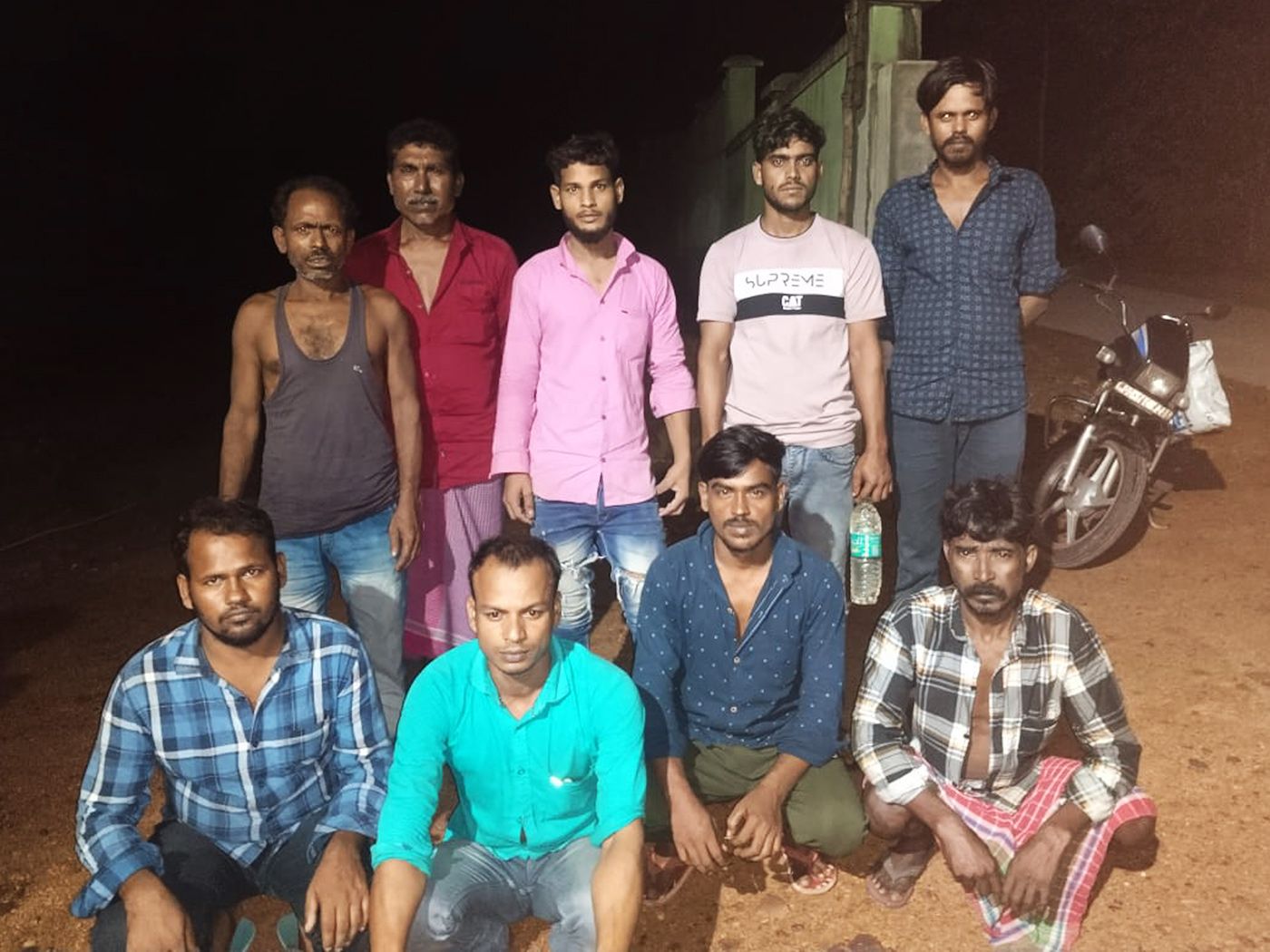
(Left) ওড়িশার ঝাড়সুগুডার লাখনপুর থানায় চারদিন আটক রাখা হয়েছিল মুর্শিদাবাদের ভগবানগোলা ১ ব্লকের এই পরিযায়ী শ্রমিকদের দলটিকে। পশ্চিমবঙ্গে তাঁদের দেশ-গাঁ দক্ষিণ হনুমন্ত নগর গ্রাম পঞ্চায়েত থেকে হস্তক্ষেপ করার পর ১১ জুলাই ছাড়া পান তাঁরা। Photo: Courtesy of WB Migrant Workers’ Union via PARI
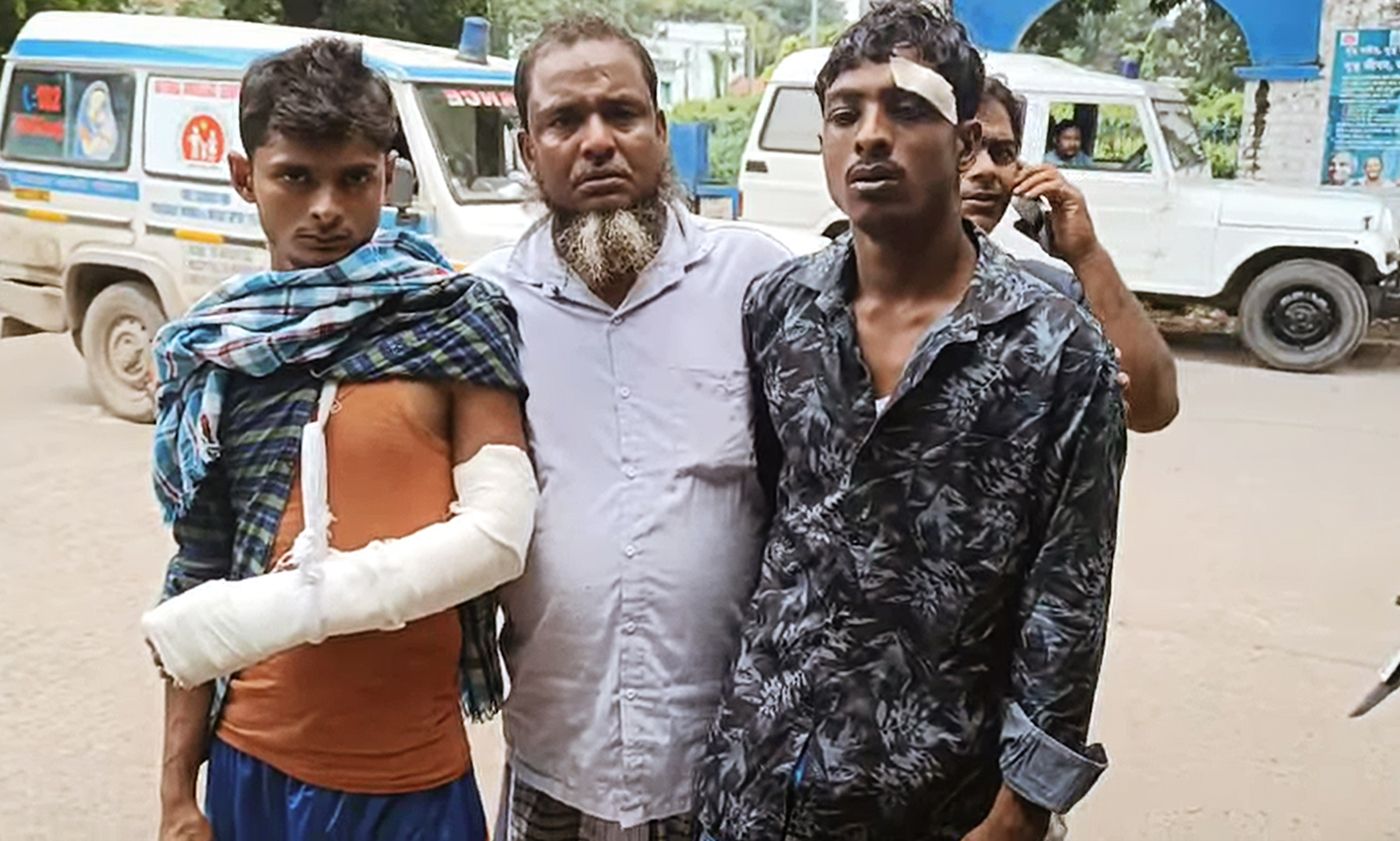
(Right) মুর্শিদাবাদের লালবাগ থানা এলাকার এই তিন পরিযায়ী শ্রমিক – মিলন শেখ, ইসমাইল শেখ ও বাবু শেখ – তামিলনাড়ুর চেন্নাইয়ের একটি নির্মাণক্ষেত্রে কাজ করেন। ২০২৫ সালের ১৫ জুলাই নিজেদের মধ্যে বাংলায় কথা বলায় আক্রান্ত হতে হয় তাঁদের । Photo: Courtesy of Parijayee Shramik Aikya Mancha via PARI
ডিয়ার জালি বাগিচা গ্রামে তাঁদের পরিবারের লোকেরা জানালেন, গত সেপ্টেম্বর (২০২৪) মাস থেকেই মুর্শিদাবাদের অনেক বাঙালি মুসলিম ফেরিওয়ালাকে ওড়িশায় কাজ করতে গিয়ে আক্রান্ত হতে হচ্ছিল, চলছিল ধরপাকড়। কখনও বাংলাদেশের সাম্প্রদায়িক সমস্যার অজুহাত দেখিয়ে, কখনও মুর্শিদাবাদ জেলার সামশেরগঞ্জে ধর্মীয় উত্তেজনার দায়ে তাঁরা হয়রানির শিকার হচ্ছিলেন। তবে ক্রমশ ওড়িশা পুলিশও আরও বেশি করে এই কাজে মদত দেওয়ায় প্রমাদ গুনছেন শ্রমিকরা।
লতিবুল হকের কাগজপত্রের সত্যতা নিয়ে সেখানকার পুলিশের তরফ থেকে প্রশ্ন তোলা হলে, ডিয়ার জালি বাগিচায় তাঁর পরিবারের সদস্যরা ভগবানগোলা থানার দ্বারস্থ হন। থানা থেকে নথি পাঠানোর পরে ছাড়া হয় লতিবুল সহ বাকি শ্রমিকদের। তবে এখনও তাঁরা ওড়িশাতেই আটকে আছেন। ঝাড়সুগুডার একটি ক্যাম্পে প্রায় চারদিন বন্দি থাকা লতিবুল হক ফোনে জানালেন, “পুলিশ বলল আমরা ভারতীয় কিনা সেই কাগজ যাচাই হচ্ছে। একমাস রাজ্যে যাওয়া যাবে না।“
মহারাষ্ট্র, ওড়িশা, উত্তরপ্রদেশ, দিল্লির মতো বিদেশবিভুঁইয়ে থাকা শ্রমিকদের কথা ভেবে দেশগাঁয়ে চরম ত্রাসে দিন কাটাচ্ছে পেছনে ফেলে আসা তাঁদের পরিবারগুলিও। ডিয়ার জালি বাগিচা গ্রামের এমন কয়েকটি বাড়ির মেয়েদের সঙ্গে কথা বলতে গিয়ে আইনাল হকের মা, বছর ষাটের মদিনা বিবির সঙ্গে সাক্ষাৎ হল। উৎকণ্ঠায় জর্জরিত প্রৌঢ়ার শরীর অশক্ত হলে কি হবে, চোখের দৃষ্টি প্রখর। নিবিড় হাতে কাঁথা বোনেন। কাঁথা বুনিয়ে, সেলাই করিয়ে নিয়ে কেউ কুড়ি টাকা, কেউবা তিরিশ টাকা দেন। তাতে সংসারের কিছুটা সাহায্য হয়। ভিনরাজ্যে আছে তাঁর ছেলে আর নাতিরা। তাঁদের উপর অত্যাচার, হেনস্থার প্রসঙ্গে চোখ ভিজে ওঠে তাঁর।
“যখন বলল, ছেলে, পোতা [নাতি] সবাই বাংলাদেশি তখন কি আর মন মানে?” আর্তি ছাপিয়ে ওঠে মদিনা বিবির গলায়। তাঁর মেজ ছেলে আইনাল হক আর বড়ো ছেলের দুই সন্তান আমির হোসেন, রাজ্জাক হোসেন চারদিন কাটিয়েছেন ওড়িশা পুলিশের হেফাজতে। “ছেলে আর দুই পোতাকে ওড়িশায় পুলিশ চারদিন ধরে আটকে রেখেছিল। ছাড়া পেয়েছে। কিন্তু ওই চারদিন আমিও ঘুমাতে পারিনি।”
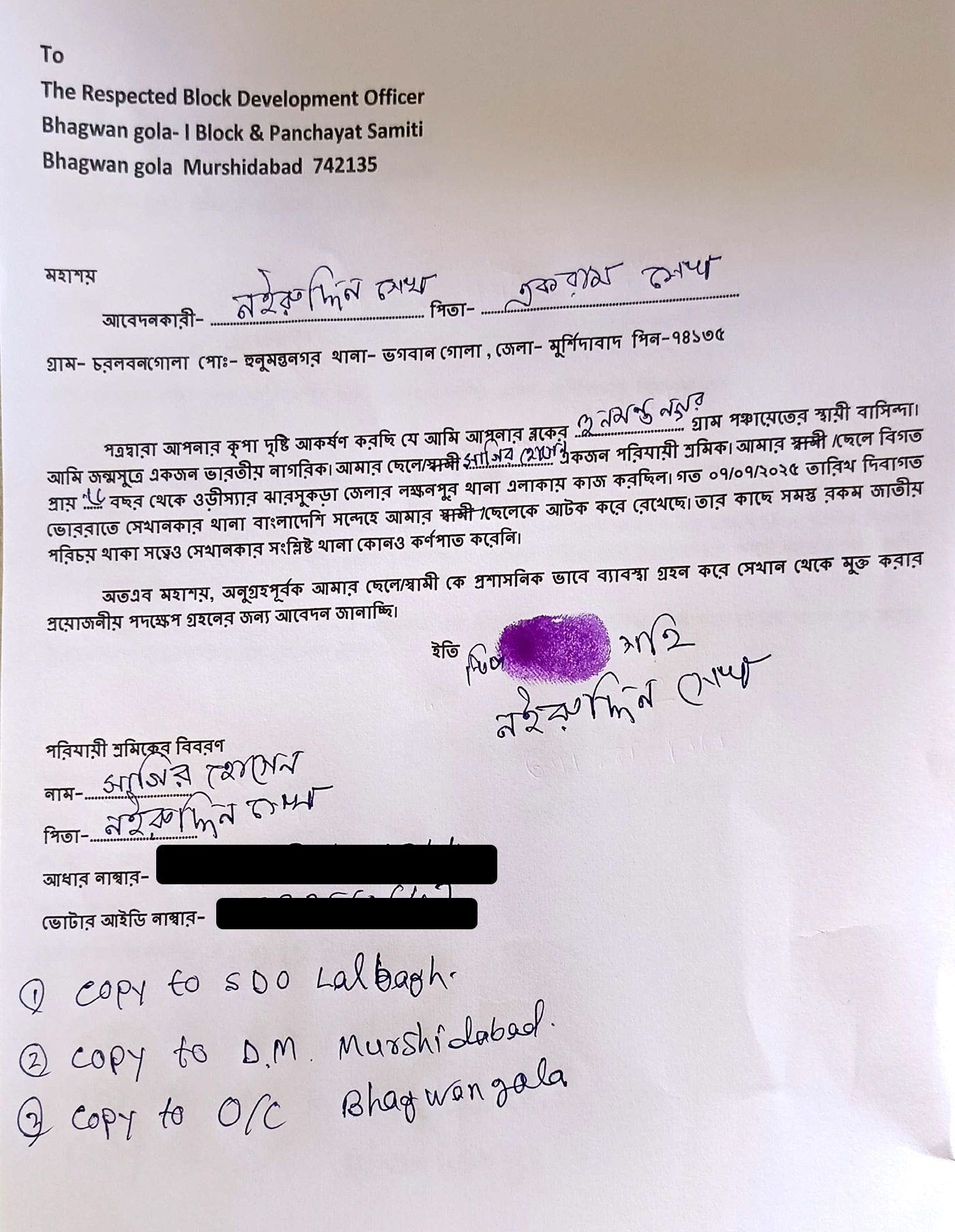
(Left) নিজের ছেলের নাগরিকত্বের প্রমাণ হিসেবে খুঁটিনাটি তথ্য জানিয়ে নানান সরকারি আধিকারিকদের কাছে এই আবেদনপত্রই দাখিল করেন আটক হওয়া পরিযায়ী শ্রমিক সাগির হোসেনের বাবা। মুর্শিদাবাদের দক্ষিণ হনুমন্ত নগরের বাসিন্দা সাগিরের অবিলম্বে মুক্তির আবেদন জানান তিনি।Photo: Courtesy of WB Migrant Workers’ Union via PARI
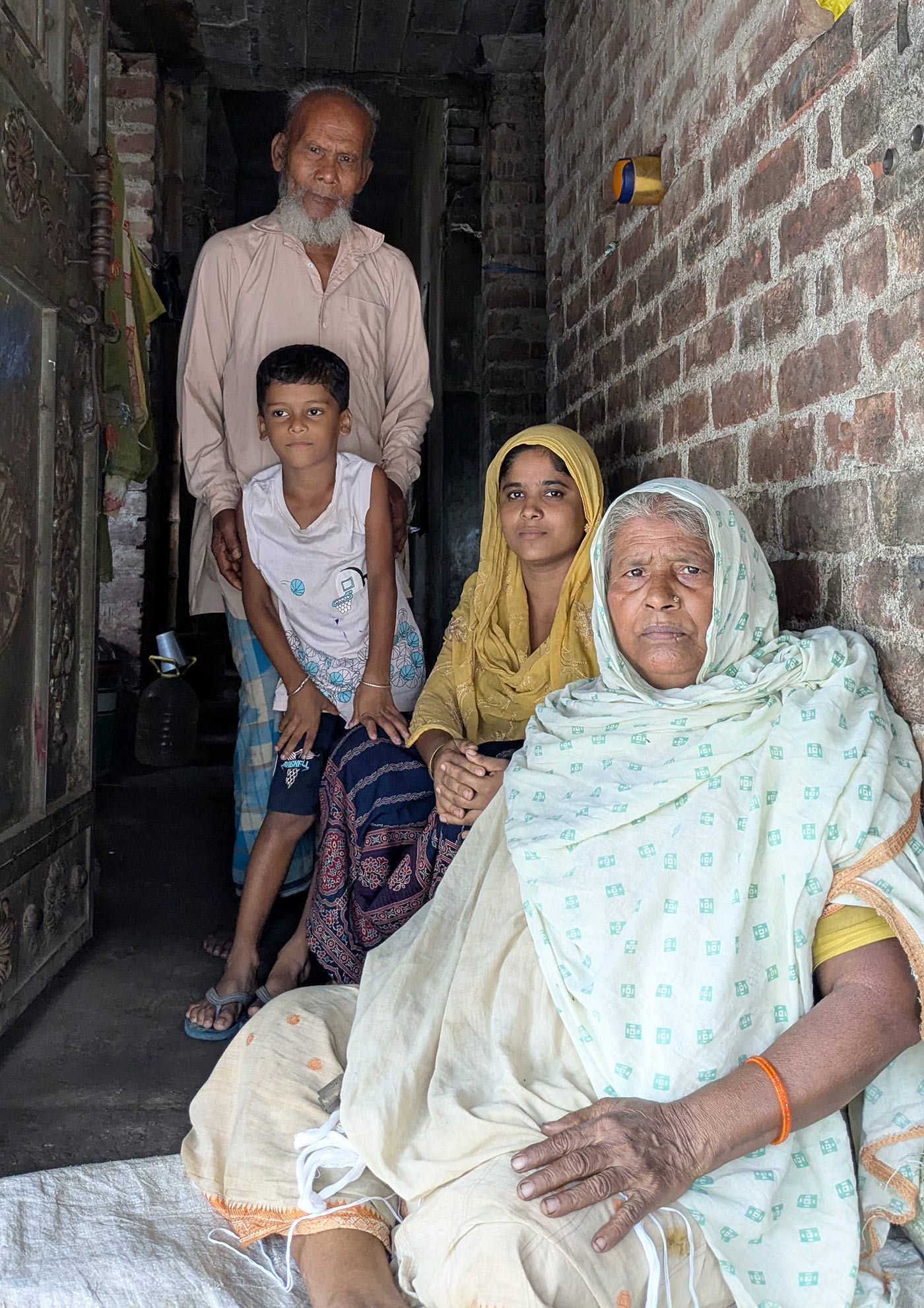
(Right) আটক পরিযায়ী শ্রমিক আইনাল হকের স্ত্রী শিউলি বিবি, তাঁদের ছেলে, মা মদিনা বিবি আর বাবা মইনুল শেখ, ভগবানগোলার ১ ব্লকের ডিয়ার জালি বাগিচা গ্রামে নিজেদের বাড়িতে।Photo: Anirban Dey/PARI
আইনাল হকের স্ত্রী শিউলি বিবির কাছে ফোন এসেছিল। সেই ফোনেই ঘুম উড়েছিল সারা পরিবারের। আধার কার্ড, মাধ্যমিকের অ্যাডমিট কার্ড সব জোগাড় করে পাঠাতে হয়েছে থানায়। এই সব কাগজপত্তর নিয়ে থানায় গিয়েছিলেন আইনাল হকের বাবা শেষ ষাটের মইনুল শেখ। বলছেন, “দেরি করে যাওয়ার জন্য থানাতে ধমকও খেয়েছি। কিন্তু কী করব? ছেলের কথা ভেবে বাকহারা হয়ে গিয়েছিলাম…”
সন্তানসন্ততির চিন্তায় মনের কোণে গভীর আতঙ্ক জেগে আছে মদিনা বিবির। “মাধ্যমিক দেওয়ার পর ছেলে (আইনাল) বলল পেটে খেতে হবে তো, কাজ করতে হবে। শুরুতে একটা ইটভাটায় মালিকের কাজকাম করে দিয়ে মাসে আটশো টাকা মজুরি পেত।“ তারপর টানা বহুদিন প্রতি বস্তার হিসেবে, “গোডাউনে কাজ করেছে বস্তা তোলার। সেখানেও মাসে দশ হাজারের বেশি আসত না। দেনা হচ্ছিল। তাই দুই বছর ধরে ছেলে বাইরে। পেট চালাতে গিয়ে এই রকম অবস্থায় পড়তে হবে কেন?” সওয়াল তাঁর। জানান, “[আমার] দাদাশ্বশুর, শ্বশুর, সবাই তো ইন্ডিয়ার। এখনও আতঙ্ক লেগে থাকে।”
ভগবানগোলা ১ ব্লকের চরলবণগোলা গ্রামের মধ্য তিরিশের আমিরুল শেখকে, ৭ জুলাই ওড়িশার ঝাড়সুগুডার লখনপুর থানায় আটক করা হয়। সেখানেই ছিলেন পশ্চিমবঙ্গের আরও প্রায় তিরিশ জন শ্রমিক। খবর পেয়ে পরিবারের সদস্যরা কখনও ভগবানগোলা থানায় কখনও স্থানীয় দক্ষিণ হনুমন্তনগর গ্রাম পঞ্চায়েতে ছোটাছুটি করেছেন। থানায় জমা করেছেন দরখাস্ত। চারদিন পর আটক শ্রমিকেরা ছাড়া পান ওড়িশার লখনপুর থানা থেকে। স্পষ্টতই বিপর্যস্ত আমিরুল শেখ ফোনে জানালেন, “১০ বছর ধরে ওড়িশায় ফেরিওয়ালার কাজ করি। কিন্তু গত কয়েক বছরে সব যেন পালটে গেছে। আগেও অনেককে মারধোর করা হয়েছে। কিন্তু এবার তো সরাসরি বাংলাদেশিই বলে দেওয়া হচ্ছে।“ কাজ না করলে সংসার চলবে না, কাজেই এখনও ওড়িশাতেই থাকছেন আমিরুল।
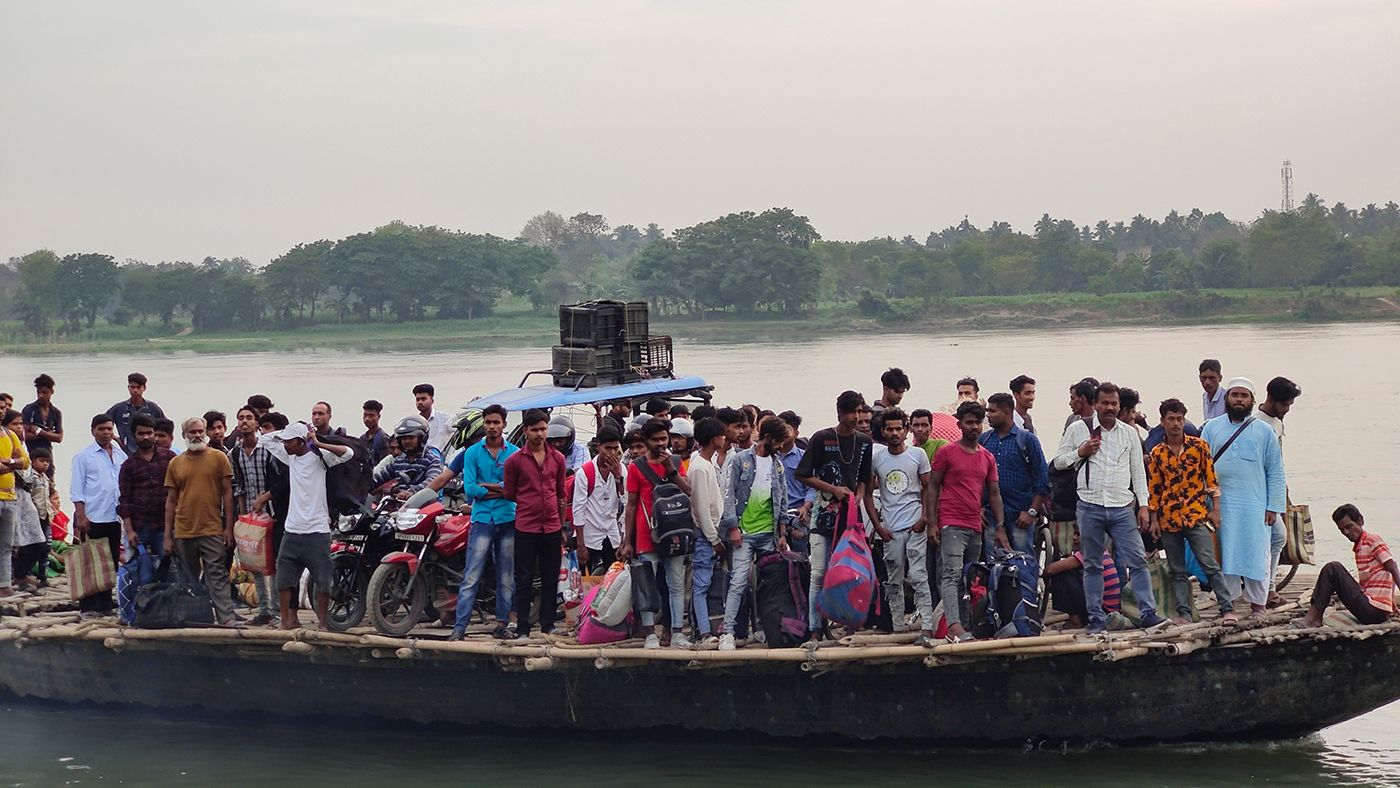
বেলডাঙা ১ ব্লকের কুমারপুর ফেরিঘাটে এই বিহারফেরত তরুণ পরিযায়ী শ্রমিকেরাও জানান মুসলিম শ্রমিকদের বিরুদ্ধে ক্রমবর্ধমান অসহিষ্ণুতার কথা। Photo: Smita Khator/PARI
“এই বছরই মুর্শিদাবাদ জেলার ৫ হাজারেরও বেশি পরিযায়ী শ্রমিককে ওড়িশায় পুলিশি হেনস্থার শিকার হতে হয়েছে,” জানাচ্ছেন আসিফ ফারুক। পরিযায়ী শ্রমিক ঐক্য মঞ্চ (পিএসএএম) নামে পশ্চিমবঙ্গ থেকে বহির্গামী শ্রমজীবীদের অধিকার নিয়ে কর্মরত একটি সংগঠনের সম্পাদক তিনি। “ওড়িশার ঝারসুগুডা, পারাদ্বীপ সহ বিভিন্ন এলাকায় চার থেকে পাঁচদিন করে মুর্শিদাবাদের বহু শ্রমিককে পুলিশ ক্যাম্পে আটকে রেখে দেশের নাগরিকত্বের প্রমাণ চাওয়া হচ্ছে।“
ওদিকে কেন্দ্র আর রাজ্য সরকারের মধ্যে রাজনৈতিক তরজা অব্যাহত, দুদিকের নেতানেত্রীদের ভাষণে সেটাই স্পষ্ট হচ্ছে বারবার। তবে, কাজের কাজ কিছুই হচ্ছে না তাতে। কয়েক মাস আগে কেন্দ্রীয় শ্রম মন্ত্রকের একটি প্রেস বিজ্ঞপ্তিতে পরিযায়ী শ্রমিকদের কল্যাণার্থে কেন্দ্র সরকারের গৃহীত নানান যোজনা আর প্রকল্পের কথা ফলাও করে বলা হয়েছে। অথচ তাঁদের উপর এহেন অত্যাচারের নিরিখে কোনওরকম সরকারি বিবৃতি তো আসেইনি, নিন্দাটুকুও জানানো হয়নি কেন্দ্রের তরফে।
ভারতের বিভিন্ন রাজ্যে অবৈধ বাংলাদেশি অনুপ্রবেশকারী সন্দেহে লাগাতার হেনস্থার মতো যেসব অনৈতিক কাজকর্মের অভিযোগ আনা হয়েছে, তার ভিত্তিতেও কোনও সরকারি বিবৃতি জারি করেনি সীমান্তরক্ষী বাহিনী বা বিএসএফ। ভগবানগোলার গ্রামবাসীদের কথায়: “নিচুপদের সেনা [অধস্তন বিএসএফ জওয়ানরা] বলছে, ‘আমরা তো ওপরওয়ালাদের হুকুমে কাজ করছি’।”
যদিও, নাগরিকদের অধিকার রক্ষা ও জবরদস্তি সীমান্ত-পার করানোর বিষয়টি খতিয়ে দেখা হবে বলে প্রতিশ্রুতি দেওয়া হয়েছে রাজ্য সরকারের তরফে। পরিযায়ী শ্রমিক ঐক্য মঞ্চের সম্পাদক আসিফ ফারুকের বয়ান, ইতিমধ্যেই “পশ্চিমবঙ্গ সরকার আক্রান্ত শ্রমিকদের উদ্ধারের চেষ্টা করছে।“ তিনি আরও জানাচ্ছেন, “এপ্রিল মাস থেকেই পরিযায়ী শ্রমিকদের জন্য হেল্পলাইন চালু করেছি আমরা।”
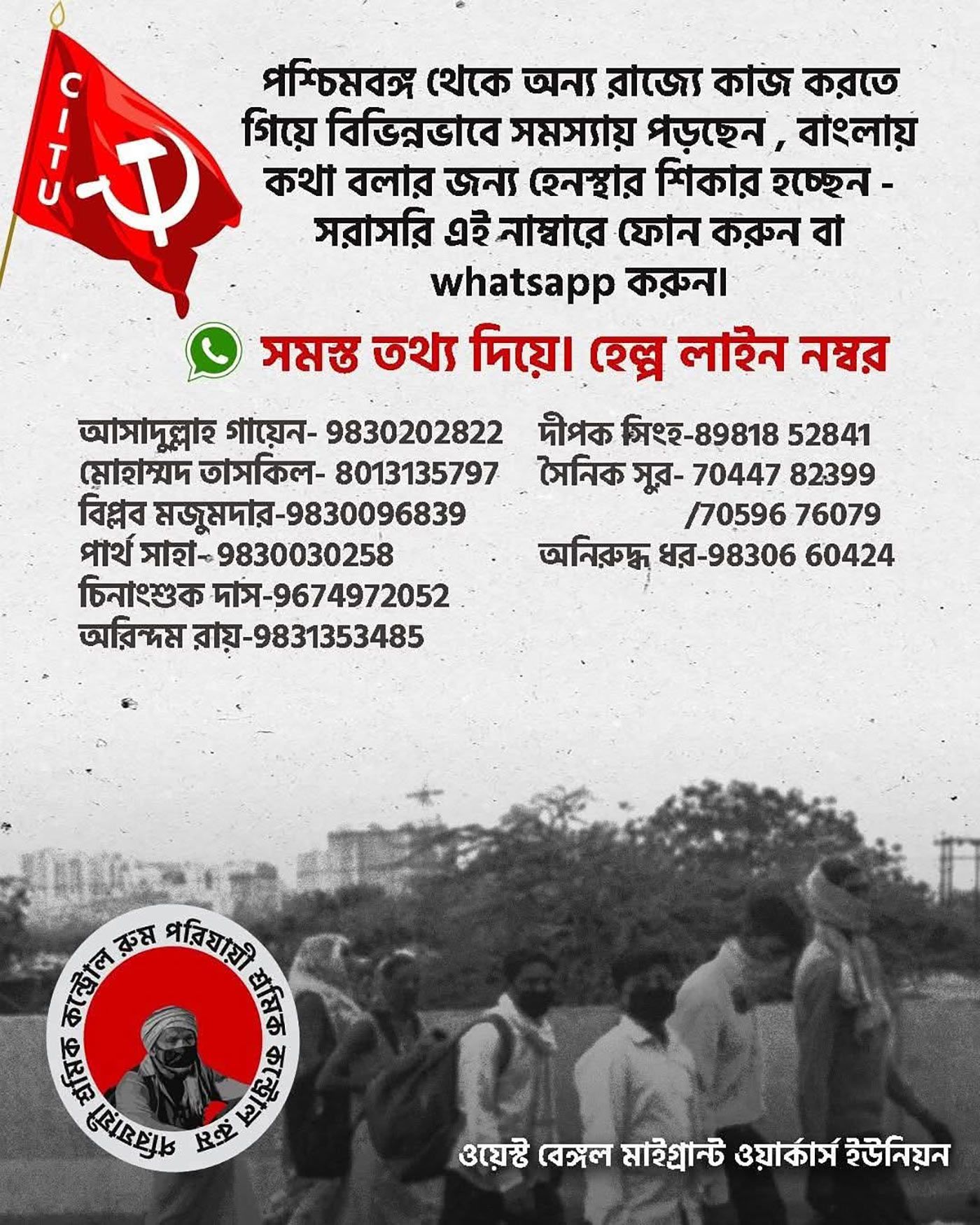
(Left) ভিনরাজ্যে আক্রান্ত শ্রমিক আর গ্রামে তাঁদের নিজের নিজের পরিবারের জন্য একটি হেল্পলাইন চালু করেছে ওয়েস্ট বেঙ্গল মাইগ্রান্ট ওয়ার্কাস ইউনিয়ন। Photo: Courtesy of WB Migrant Workers’ Union via PARI
(Right) উত্তরপ্রদেশের কানপুরে কর্মরত, পেশায় রাজমিস্ত্রি, ভাই রফিকুল ইসলামের জন্য চিন্তায় থাকেন ডিয়ার জালি বাগিচা গ্রামের সফিকুল ইসলাম। বাংলাভাষী মুসলিমদের ওপর হামলা, ধরপাকড় ও জবরদস্তি সীমান্ত পার করানোর মতো ঘটনা যে উত্তরোত্তর বাড়ছে ফেসবুক-সহ নানান সমাজমাধ্যমের কল্যাণে তা বেশ খেয়াল করেন বলে জানান সফিকুল। Photo: Anirban Dey/PARI
দেশজুড়ে বাঙালি পরিযায়ী শ্রমিকদের হেনস্থা অবিলম্বে বন্ধ করার দাবিতে কলকাতা হাইকোর্টে একটি জনস্বার্থ মামলাও দায়ের করেছে পরিযায়ী শ্রমিক ঐক্য মঞ্চ। অন্য একটি সংগঠন – ওয়েস্ট বেঙ্গল মাইগ্রান্ট ওয়ার্কাস ইউনিয়নও ভিনরাজ্যে পরিযায়ী শ্রমিকদের নিরাপত্তার দাবি নিয়ে ৩ জুলাই মুর্শিদাবাদের সদর শহর বহরমপুরে একটি মিছিল করে। ইউনিয়নের জেলা সম্পাদক কামাল হোসেন স্পষ্ট ভাষায় নিজেদের দাবি তুলে ধরেন, “যে যে রাজ্যে শ্রমিকরা আক্রান্ত হচ্ছেন, [নির্দিষ্ট] জেলার সাংসদদের সেই সব রাজ্যে গিয়ে হস্তক্ষেপ করতে হবে।“
এদিকে, কেন্দ্র-রাজ্যের দায় ঠেলাঠেলির মাঝে চাপা পড়ে যাচ্ছে গোড়ার প্রশ্নটাই: মুর্শিদাবাদে যদি ঠিকঠাক কাজের সুযোগ থাকত, কৃষিক্ষেত্রে যদি একটুও সুযোগ-সুবিধে মিলত – বাসিন্দাদের কি ভিনরাজ্যে পাড়ি দিতে হত আদৌ?
ওদিকে, বালিয়া হোসেননগর গ্রামে সংসারের অন্নসংস্থানের কি উপায় হবে ভেবে কূলকিনারা পাচ্ছেন না তাড়া খাওয়া শ্রমিক মেহেবুব শেখ। “[নির্মাণ] কোম্পানির লোকজন কাজের জন্য ফোন করছে [মুম্বই থেকে]। কিন্তু জিম্মা (দায়িত্ব) নিতে চাচ্ছে না…”
জমাট হতাশা তাঁর গলায়: “এবার কোথায় কাজে যাব? সে প্রশ্নের উত্তর জানি না…”
“As I saw the barbed wire, it seemed to be the end of everything… I thought I’d never be able to return to my homeland. My dado’s dado [great grandfather] used to live right here in Murshidabad. My nani [maternal grandmother] lived in this village in Bhagawangola [block] where we have our home now.”
A visibly upset Mehbub Sheikh, 36, explains his family’s historic roots in Murshidabad district to us at his home in Balia Hasennagar. It’s barely a month since he was labelled a ‘Bangladeshi infiltrator’ and shoved across the border.
“Voter card, ration card, Aadhaar card – I have every single one. I have toiled hard and bought some land as well. How come they call me a Bangladeshi now?” asks the migrant labourer.
Mehbub is not alone. Migrants from Murshidabad across the country – construction labourers, domestic workers, street vendors and hawkers – ask the same question: why are Bengali-speaking Muslim migrant labourers of our district being targeted in various states?
(Left) Mehbub Sheikh with his wife Surna Bibi at their home in Murshidabad’s Balia Hasennagar. On June 9, 2025, he was picked up by Maharashtra police and asked for documents to prove his citizenship. He was eventually pushed back and abandoned in Bangladesh.
(Right) ‘No one raised a question [about our being Indians] until now. But with all these troubles [us] Bangali Musalman workers everywhere, we can’t help getting worried,’ says Bishakha Mondal (name changed), a domestic worker in Delhi. Photos: Anirban Dey/PARI
“No one raised a question [about our being Indians] until now,” says Bishakha Mondal, 52 (name changed) from Gokarna village in Kandi. “But with all these troubles [us] Bangali Musalman workers everywhere, we can’t help getting worried.” She has been a domestic worker in Delhi for three decades. Her labour in five households there brings in Rs. 25,000 a month. She has an authentic voter card and ration card. Also an Aadhaar card and bank account linked to her Delhi address.
Murshidabad, administrative centre of undivided Bengal till the British shifted the capital to Kolkata, was once famed for its prosperity. Today, it supplies the biggest out-migrant workforce from West Bengal. Till May 2025, close to 4 lakh workers from here had registered for the Migrant Workers Welfare Scheme of West Bengal. (Curiously, the document citing these numbers has vanished from the government site). Independent estimates by different migrant organisations suggest there are more than a million such workers in Murshidabad. A state education ministry official says on condition of anonymity, “no government data would ever mention it… but the reality is, countless child labourers are [also] moving out for work every day.”
Both Mehbub’s younger brother Mujibar Sheikh,33, and their father Hossein Sheikh in his early sixties, worked as migrant labourers. Hossein still works in Kolkata as a mason. Mujibar, now a driver, had been to Delhi and Mumbai with Mehbub, for masonry work. Both brothers remember childhood as an incessant battle with poverty. Mehbub remembers: “There was a time when I used to graze the goats of others. I have not studied much. Ours was a very needy family. The burden of poverty had me working from an early age.”
Babu Islam (doesn’t wish to reveal his real name) from Dhuliyan in Murshidabad fled Odisha when the attacks on Bengali Muslim migrant workers began around September, 2024. He says: ‘I am better now. I came back and took this work in Kolkata. I miss my home’. Photo: Smota Khator/PARI
At 17, Mehbub migrated out in search of a livelihood with his inheritance of masonry skills. As someone who has worked in states like Delhi, Punjab, Tamil Nadu, Rajasthan and elsewhere, he finds the awful changes in his migrant workplaces baffling. Media reports and personal accounts record several instances of migrant labourers like him being pushed out on flimsy grounds to Bangladesh.
There is a palpable atmosphere of suspicion and distrust. That’s unsurprising: For more than a year, they have been targeted by law enforcement agencies of both central and state governments. “Our names don’t sound like yours. That’s why we are humiliated,” Mujibar tells us. Over the last one year, Muslim migrant labourers from West Bengal have been picked up, branded as ‘Bangladeshi’, ‘Rohingya’, ‘Ghuspethia’ (infiltrator) or ‘illegal’.
All of them recognise and speak of hatred based on language, religion, caste, or regional identity having intensified in the last decade, leading to the current escalation. The Muslim migrant workforce is the most vulnerable segment, bearing the brunt of hate speech propagated by the fundamentalist outfits and political leaders.
“We are having to choose between life and work,” people in Diarjali Bagicha complained to this reporter. Nejema Bibi, 32, who lives here in a two-room brick house with unplastered walls, fears for her husband Rafiqul Islam working in Kanpur, Uttar Pradesh. “My heart sinks if he doesn’t pick up my calls for even just a few hours,” she says.
Young migrants in search of work wait to board a train to Andhra Pradesh at the Howrah rail terminus. Photo: Anirban Dey/PARI
Mehbub returned to Balia Hasennagar this May to celebrate Eid al-Adha (in early June, 2025) with his family. Their two-and-a-half storey house was built brick by brick over years by this family of masons. It has five rooms and some space on the ground floor to set up a shop in future. The part where Mehbub lives with his wife and homemaker Surna Bibi, 30, and their three children, is as yet unplastered on either side. Their eldest son Bakul Sheikh,16, having dropped out of school, is working in a nearby shop. The younger sons – Sagar Sheikh,12, and Rehan Sheikh,7 – are studying in a local school. On the occasion of holy qurbani and Mehbub’s homecoming, his family even made arrangements for the ritual sacrifice.
It didn’t happen. “Repeated calls from the construction site at Thane,” summoned him back.” Mehbub flew back to Maharashtra and resumed his work – leaving family and celebrations behind.
On June 9, while having tea at a local stall, he was picked up by police without explanation and taken to an outpost of theirs near the Shree L R Tiwari College of Engineering in Mira Road, Thane. At night, he was transferred to the Mira Road Police Station where he was asked for documents to prove his citizenship.
“‘You are a Bangladeshi, right?’ The officers asked me in Hindi. I said, ‘I am from West Bengal’ and showed them my Aadhaar and PAN card. They said, ‘these can be bought for five rupees nowadays’,” Mehbub told this reporter.
Somehow, he stealthily phoned his family in Balia Hasennagar who immediately contacted the local gram panchayat at Mahishasthali and sent all the necessary documents to the Mira Road Police Station. “For four long days,” says Mehbub, “I endured immense mental torture. Through daytime I was made to sit outside the station and was put in a police camp during nights.”
The Mira Road police contest Mehbub’s account of wrongdoing on their part. Senior Inspector Meghna Burade stated that they were “not at fault.” And that the detention of Mehbub Sheikh and others was carried out on a police commissioner’s order.
‘We are having to choose between life and work,’ say Muslim labourers from West Bengal who have been branded as illegal immigrants increasingly over the last year. Illustration: Labani Jangi/PARI
For Mehbub, though, June 13 was to prove dreadful.
“That day we were picked up in a large police van covered with wire-mesh. Many more cars piloted us, like we were some important leaders or ministers,” says Mehbub. “The car finally stopped at some security camp near Panvel.”
On June 14, the same vehicle ferried almost 30 people including Mehbub to the Pune airport. At 2 p.m. they were swiftly put onto a flight. On getting off the plane Mehbub realised it was the Bagdogra airport in West Bengal. “They made a head count and divided us into small groups,” he says. “I had heard criminals face head count. But why count us the same way? Suspicion crept in…” From the airport they were taken to the Siliguri Border Security Force (BSF) camp and from there a new journey began towards an unknown destination.
“The vehicle ran some five-six hours at a stretch. Then they dropped us in the middle of a jungle at a small BSF camp. The handful of officers there got us down and asked, ‘Where are you from?’ I told my address. Immediately, a brutal beating ensued. They even held loaded guns at our throat. Then the BSF officers clicked our photos and asked us to walk off through the forest.
“Where to go? And how? We didn’t have the least idea. We worried that if we got spotted, BSF or Border Guard Bangladesh (BGB) would straightaway shoot us. Fear gripped our hearts. The forest became our hideout for the night,” a traumatised Mehbub recalls.
(Left) In light of workers being harassed, a rally was organised by the West Bengal Migrant Workers’ Union in Baharampur demanding the right to secure and dignified work. Photo: Anirban Dey/PARI
(Right) A collage of recent news headlines on atrocities against Bengali-speaking migrant workers across different states. Photo: Aunshuparna Mustafi/PARI
Daybreak brought more stress. The last they’d eaten something was at the Pune airport. And 24 hours had passed since, without a single morsel of food. “It felt like we would collapse and die right there,” says Mehbub. “There were only trees all around us. We were walking in a group.” He pauses some moments, then continues, “It was around 2 p.m. when we walked up to a small settlement in Bangladesh. We told the people that we were Indians. They suggested we take a bath, and gave us rice to eat. [With their help] I contacted my family through Imo app [a mobile app that enables chats and international calls]. I was crying. My voice choked. I could barely speak …”
Mehbub lost all hope of ever returning. Meanwhile, his brother Mujibar ran around many places including Siliguri and Raiganj, going door to door seeking help and support. From the panchayat office to district administration, even to state-level sarkari officials. Finally, Mehbub could make his way back home. “Even after bringing him back, sarkari people [departmental affiliations unknown] visited our house wanting to verify the land deeds.”
The relief was short lived and did not end their anxieties. From Mehbub, we learn the compulsions of migration. “Sitting idle at home means zero income. I can earn 800-1,200 rupees a day there [other states]. I can even work double shifts for additional income…” But fear has shattered his confidence. “I have been working as a mason in cities like Pune, Mumbai and Thane for years. Never thought I would witness such a time.”
(Left) Nazimuddin Mondal (in black shirt), Mostafa Kamal Sheikh (in red shirt) and Minarul Sheikh (left) seen here with security officials. They were pushed out to Bangladesh on June 13 and rescued back on June 15.
(Right) Parijayee Shramik Aikya Mancha – an organization fighting for the rights of migrant workers from West Bengal – sent out a letter to the Union Home Minister seeking immediate action against harassment of Bengali migrant workers. Photos: Courtesy of Parijayee Shramik Aikya Mancha via PARI
On seeing this reporter, Nazimuddin Mondal could barely control his anger. This resident of Murshidabad’s Hariharpara Block is as resentful of the media as he is of government and administration. Ever since a video of Nazimuddin abandoned by Indian state authorities in Bangladesh went viral, journalists have frequently quizzed this 35-year-old mason from Tartipur village about being pushed across the border. “What have you got to do with that?” he bursts out. “Why can’t you write about the torture [inflicted on us]? Why on earth are we being tagged as Bangladeshis? It’s high time the media speak out.”
The silence of most media on the current situation worries Nazimuddin even more. He sees clearly that in the name of news, some media houses actually promote suspicion about Bangla-speaking Muslim labourers.
The “push-back” experience traumatised Nazimuddin. The thought of leaving his wife and a teen daughter – in Class 10 – at home for work in a distant state now terrifies him. “[I have] worked in the Mira Road Police Station earlier,” he says. There, he did masonry and repair work. “Now police from the same station picked me up from my rented room at the dead of night and called me ‘Bangladeshi’. What kind of system is this?” The Maharashtra police had raised questions regarding his birth certificate. “I was born in Hariharpara 35 years ago. That’s where my baap-dada [father and grandfather] was born. None of my parents got formal education. They didn’t obtain my birth certificate either. Poverty made things difficult. I couldn’t even finish primary schooling,” clarifies Nazimuddin.
His belongings remain in the room at Mira Road, Maharashtra. No one knows how he can collect the wages the contractor still owes him. His mobile phone, confiscated by the police, is yet to be returned. “It’s really hard to get work in a new place. Working somewhere for five long years results in having some contacts and ease. How can that be taken away like this?” he asks angrily.
Lack of decent employment opportunities and an increasingly fruitless agriculture sector forces young people from Murshidabad to migrate to distant states from Mizoram (seen in the photo) to Maharashtra. Photo: Smita Khator/PARI
Two brothers of Nazimuddin work as labourers in Kerala and Tamil Nadu. Workers here generally say the southern-Indian states are a lot safer for Bengali migrant workers. Many labourers, forced to return from Maharashtra, Gujarat or Delhi, are now trying to find wage work in the south.
Nazimuddin says that Minarul Sheikh from Kazisaha, Beldanga I, Murshidabad, and Mostafa Kamal Sheikh from Monteshwar in Barddhaman district shared his ordeal. “On June 13 [2025] we were deported to Bangladesh via Siliguri and got rescued on the 15th.”
“After this…it won’t be easy to move out again. But remaining in our village means a meagre 500 rupees per day [on days that work is available] and expenditure of 250. [In the other states], the daily expense might be 300 rupees, but the wage is 800 a day. We can send 500 rupees to the family. So, leaving [migration] is the only way out,” explains Nazimuddin. “We must return to work [outside] at our own risk.”
There is a dearth of steady work, even that at just survival wage level, across Murshidabad district. The 100 days of employment guaranteed under MGNREGA is still stuck in limbo. Migration seems the only option for working-class people. Murshidabad, one of India’s most underdeveloped districts, is mostly rural. Roughly 80 per cent of its people live in 2,166 villages. At 66 per cent, its literacy rate is way below the state average of 76 per cent (Census 2011). Two-thirds of the population are Muslims. It is obviously they – marginalised in class, region, and religious terms – who account for most of the forced labour migration.
The situation in in Diarjali Bagicha, a hamlet under Habaspur panchayat, captures that reality. In over 60 per cent of households, at least one member is a migrant worker. Residents Latibul Haque, Ainal Haque and Rajjak Hossein Sheikh, who once worked as porters, left their jobs and went to Odisha to earn a better wage as street vendors. They explained to us on phone that the mahajans (moneylenders) lend them various household and stationery items. They load these items on their cycles or motorbikes and sell them across the villages. On average, it earns them Rs. 700-800 a day after deducting the contractor’s share. They live together in groups in small, rented rooms.
(Left) Migrant workers from Murshidabad were detained for four days at Lakhanpur Police Station in Jharsuguda, Odisha. They were eventually released after the intervention of their native gram panchayat back in Dakshin Hanumanta Nagar. Photo: Courtesy of WB Migrant Workers’ Union via PARI
(Right) Three migrant labourers from Lalbagh Police Station in Murshidabad working at a construction site – Milan Sheikh, Ismail Sheikh and Babu Sheikh – were attacked in Chennai, Tamil Nadu, on July 15, 2025, as they were speaking in Bengali among themselves. Photo: Courtesy of Parijayee Shramik Aikya Mancha via PARI
Family members of these migrants told us in Diarjali Bagicha that since September 2024 many travelling Bengali Muslim salesmen from Murshidabad have been attacked and detained in Odisha. That, on the pretext of the violence against Hindus in Bangladesh and in Murshidabad’s Samserganj. But what is panicking the migrants is the increasing involvement of Odisha police in such incidents.
When the police there questioned the validity of Latibul Haque’s documents, his family members in Diarjali Bagicha sought help from the Bhagwangola Police Station. Latibul and others were set free only after the documents were exchanged between the police stations, but are still stuck in Odisha. Latibul who was confined in one of the camps in Jharsuguda for four days tells us on phone: “The police said they are still verifying our documents related to Indian citizenship and instructed us not to return to our home state for a month.”
The families of labourers toiling in distant states like Maharashtra, Odisha, Uttar Pradesh and Delhi are now rattled. In Diarjali Bagicha, we met Ainal Haque’s mother Madina Bibi, 60, frail, but with keen eyesight. Her deft fingers fly while weaving kanthas (hand-embroidered quilts) of intricate design as she speaks to us. People get her to weave and stitch kanthas, paying her just 20 to 30 rupees a piece. However meagre, that amount helps in sustaining the family. With her son and grandsons all toiling in Odisha, Madina can’t hold back her tears as she talks about the ordeal and harassment they’ve been through.
“When they said my son and pota [grandson] are all Bangladeshis, how could I keep calm?” Madina asks. “My second son Ainal Haque and two grandsons from my eldest son – Amir and Rajjak Hossein – live in Odisha. The police detained them for four days. I didn’t get any sleep those days.”
(Left) Father of detained migrant worker Sagir Hossein has sent an application to various government officials detailing his son’s proof of Indian citizenship. He appeals for the immediate release of Sagir, a resident of Dakshin Hanumanta Nagar, Murshidabad. Photo: Courtesy of WB Migrant Workers’ Union via PARI
(Right) Detained migrant worker Ainal Haque’s wife, Shiuli Bibi with his mother Madina Bibi, father Moinul Sheikh and their son at the family home. Photo: Anirban Dey/PARI
The phone call Shiuli Bibi – Ainal Haque’s wife – received, terrified the whole family. Documents such as Aadhaar and ‘admit card’ of the secondary board examination [class-10] had to be found and submitted. Ainal Haque’s father Moinul Sheikh, in his late 60s, had to take all these papers to the police station. “There, they even snapped at me for being late. But what could I do? I was totally numb and dumbfounded, thinking of my son’s situation…” recalls the old gentleman.
A distraught Madina Bibi tells us: “After his secondary exam, my son [Ainal] said, ‘I must work to fill our bellies.’ He ran chores for the malik at a brick kiln and would get 800 rupees a month. Later, he carried loads in a godown. Even that would only get him 10,000 rupees a month at best. We were crushed by debt. That’s the reason he went outside…It’s been two years now. We are merely trying to survive,” she says. “[My] father-in-law, even his father, are all from India… Yet, the fear refuses to leave me.”
On July 7, 2015, Amirul Sheikh, in his mid-30s, from Charlabangola village in Bhagawangola I, were also detained in Lakhanpur Police Station of Jharsuguda in Odisha with 30 other migrant workers from West Bengal. On getting the news, family members ran frantically from Bhagawangola Police Station to the local Dakshin Hanumanta Nagar gram panchayat office. Finally, the detained workers were released four days later from Lakhanpur Police Station, Odisha. “I have worked 10 years in Odisha as a hawker. But everything has changed. People have been beaten up before, but this time we are straightway being labelled as Bangladeshis,” says a shaken Amirul on phone. Still, he has no choice but to remain in Odisha to support his family in Charlabangola.
Migrant workers returning from Bihar report growing intolerance against Muslim workers. Photo: Smita Khator/PARI
“In this year alone, more than 5,000 migrant labourers from Murshidabad have been harassed by police in Odisha,” says Asif Faruk. He is secretary of Parijayee Shramik Aikya Mancha (PSAM) – an organisation fighting for the rights of migrant workers from West Bengal. “In different regions of Odisha including Jharsuguda and Paradip, many Murshidabad labourers have been detained in police camps for four to five days and are being interrogated to prove their citizenship status.”
The political storm between Centre and State governments, highlighted by the speeches of leaders of both, isn’t helping. A press release by the Central Government’s Ministry of Labour months ago lauded the projects and schemes undertaken by them for the welfare of the migrant labourers in India. But there have been no official statements, no condemnation of the violence against them.
The Border Security Force has not issued any official statement on the charges of unlawful conduct during the ongoing crackdown on people alleged to be unauthorised Bangladeshi infiltrators in several Indian states. Villagers in Bhagawangola say: “The lower rank [BSF] jawans tell us ‘we are merely doing as instructed by the oporwalas [higher authority]’.”
The state government has promised to defend the rights of citizens and deal with the issue of people being pushed across the border. Asif Faruk of the PSAM believes the “West Bengal government is trying to rescue and bring the victims back.” And “from April, we started a helpline for the workers.”
(Left) West Bengal Migrant Workers’ Union has started a helpline for workers facing atrocities in other states and their concerned families back home. Photo: Courtesy of WB Migrant Workers’ Union via PARI
(Right) Safiqul Islam from Diarjali Bagicha fears the safety of his brother Rafiqul Islam, a mason working in Kanpur, Uttar Pradesh. He has noticed a sharp surge in reports of harassment of Bengali-speaking Muslim migrants circulated in social media platforms. Photo: Anirban Dey/PARI
The organisation has also filed a Public Interest Litigation in the Calcutta High Court seeking immediate action against harassment of Bengali migrant workers. And the West Bengal Migrant Workers’ Union organised a procession in Murshidabad district headquarters, Baharampur, demanding security for the labourers in other states. “MPs [Members of Parliament] from the concerned districts,” says Kamal Hossein, WBMWU district secretary, “must visit and intervene in the states where the migrant labourers are under attack.”
Meanwhile, the Centre-State squabble sidelines the question: had there been decent employment in Murshidabad, and serious intervention in the agriculture sector – would people have had to migrate in the first place?
Back in Balia Hasennagar, a panic-stricken Mehbub Sheikh, wonders how he will sustain his family now. “The [construction] company is calling me [from Mumbai] to resume work, but they are not willing to take any responsibility…”
Disappointment grips the master mason: “Where shall I find work now? I don’t have any answer to this…”
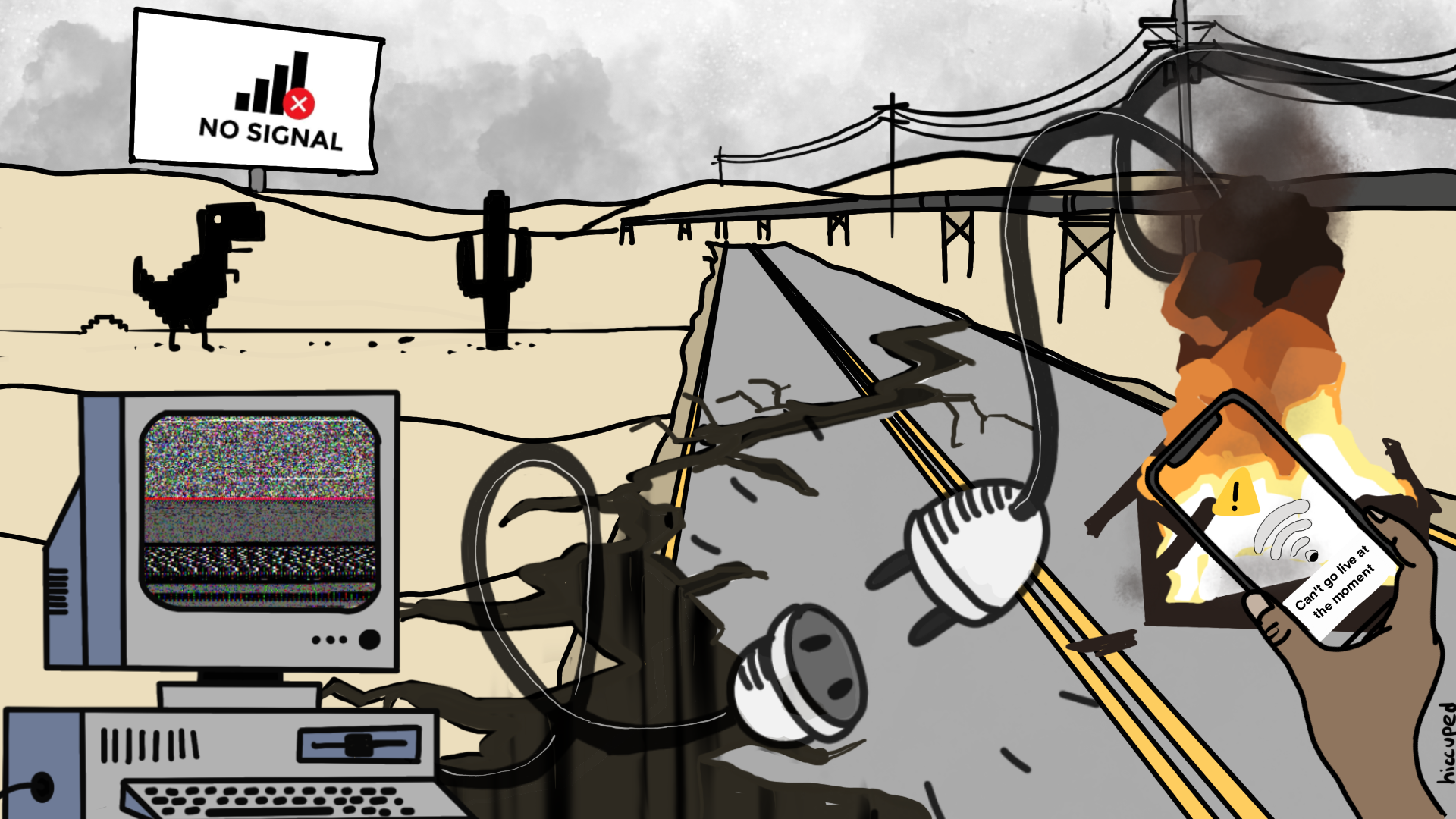
A new Asian Dispatch analysis mapped nearly 400 internet shutdowns in the last five years across South Asia. Illustration: Sharanya Eshwar
Across the world, social media has emerged as a means to collectively voice opinion and advocate for causes since the early 2000s. In South Asia, where internet penetration rates and mobile phone usage are some of the highest in the world, the platforms have been instrumental in democratising freedoms of speech and expression too.
The data speaks for itself. In India, over 70 percent of the population was using the internet as of 2024 data by International Telecommunication Union. In Bangladesh, that rate came up to 44.5 percent in 2024. The mobile broadband subscriptions stand at 899 million users for India and 98 million users in 2024. Looking at data from 2023 for Sri Lanka and Pakistan, we see the connectivity rate at 51.2 percent and 27.4 percent, respectively. The active mobile broadband subscriptions are at 73.5 per 100 people for Sri Lanka and 55.1 per 100 for Pakistan, as of 2024.
At the same time, the digisphere has created a new landscape for non-elite civic participation in everyday politics and political activism, wrote Dr Ratan Kumar Roy, a media studies professor from Bangladesh based in India, in his white paper on digitisation and civic participation. “Politics in the digital age is often subtle and takes on forms different from traditional political activism. This can include liking, sharing or commenting on political content, which can collectively have a large impact,” Roy notes in the report.
According to digital rights group Access Now, South Asia has seen some of the world’s leading internet shutdowns for over six consecutive years until 2024. In their 2024 report, they note that India witnessed 116 internet shutdowns in 2024 and over 500 in the last five years.
Mishi Chaudhary, the founder Software Freedom Law Center (SLFC.in) in India recalls two types of internet shutdowns: Preventive – that are imposed in anticipation of an event that may require the internet to be suspended by the state – and reactive, which are imposed to contain ongoing law and order situations.
Internet shutdowns can take various forms, from blocking of certain websites to partial or full telecommunication and internet shutdowns.
“Internet shutdowns are the easiest tool in the toolbox for governments to control the flow and dissemination of information,” Chaudhary tells Asian Dispatch. “Although no evidence has ever been presented about the effectiveness of shutdowns, state authorities, fearful of the ease of organisation via the internet, are quick to use this blunt instrument of state power.”
In this piece, Asian Dispatch mapped 397 shutdowns between July 2019 and 2024 in India, Sri Lanka, Pakistan and Bangladesh out of which shutdowns in India, Pakistan, Bangladesh and Sri Lanka stand out. This data doesn’t include Afghanistan, Bhutan, the Maldives and Nepal, where internet shutdowns of this measure have not been documented.
Internet shutdowns have tangible real-world costs. In 2024, Pakistan’s economy was estimated to have lost between $892 million and $1.6 billion, according to the Information Technology and Innovation Foundations, a Washington-based think tank working on science and technology policy. In 2018, Sri Lanka faced an estimated $30 million loss due to similar measures, as reported by NetBlocks. The figures for India in 2024 stand at $322.9 million, as per the report by Top10VPN.
Robbie Mitchell, Senior Communication and Technology Advisor for the Internet Society, a global charitable organisation, says that information blackouts resulting from internet shutdowns can, in fact, result in increased violence. He elaborates further by adding that violent tactics of protest are less reliant on effective communication mechanisms and thus they could substitute non-violent protests that rely on the internet for planning and organization in the cases of internet shutdowns.
“In addition, internet shutdowns tend to attract international attention and create pressure on countries that undertake them. This relates to the so-called ‘Streisand effect,’ where the attempt to silence voices or hide information leads to the unintended consequence of bringing more attention to them,” Michelle says.
Left in the Dark
Mandeep Punia, a 30-year-old journalist from India, says that any internet shutdown causes a “fear of the unknown” in the society. Punia has experienced shutdowns first during the 2016 Jat community reservation protests, as well as the 2019 shutdown in Kashmir during the abrogation of article 370, among others. The most recent internet shutdown in India was in the state of Haryana in August 2025, as recorded by the internet tracker maintained by SLFC.
About 3,000 kms away, in Sri Lanka, Oshadi Senanayake, a civil society member and social worker, recalls the communication shutdown during the anti-Muslim violence in Sri Lanka in 2018. The series of violence saw the imposition of a nationwide state of emergency as Sinhalese-Buddhist crowds attacked Muslims and their establishments in the city of Kandy. “When the means of communication were restricted, it was very difficult,” she tells Asian Dispatch. “We were all in the dark, no one knew what was going on and there was no way to find out either.”
The similarity in these narratives connects the dots across South Asia on how internet shutdowns impact people.
In 2024, Pakistan invoked the region’s most recent shutdowns, which was done to curtail mass uprising in support of jailed former prime minister Imran Khan. This was one of the 17 shutdowns Pakistani people faced in the last five years, as per data collected by Asian Dispatch.
The same year, in July, Bangladesh saw mass protests by university students over government jobs, which eventually upended Sheikh Hasina’s 21-year rule. Her government resorted to internet shutdown in order to curb the organised movement. Over 1,000 people were killed during the protests, as per a report released by the interim government led by Nobel Laureate Mohammad Yunus.

At the same time, Asian Dispatch learned of students finding ways to circumvent the internet blackout, specifically by urging the residents to open their Wi-Fi networks, either by removing passwords or using “123456,” to support the movement. Shahriyaz Mohammed, a student at the University of Chittagong, and Raihana Sayeeda Kamal, another student based in Dhaka, confirmed that such appeals were made. According to Roy, who is also a former media studies professor at BRAC University in Bangladesh, this appeal drew widespread response, with many complying.
At the same time, the communication blockade disrupted the academic and professional prospects for many. Kamal said that she graduated last July and was supposed to apply for her postgraduate work permit in Canada. “I couldn’t do it. I was out of touch from Canada. It hampered my job search and communications with my professors, and delayed my application,” she tells Asian Dispatch.
Raihana Sayeeda Kamal, a student based in Dhaka talks to Asian Dispatch about her experience of living through the internet shut down of 2024 in Bangladesh
Mohammed, who lives in Chattogram, the second largest city of Bangladesh, says that internet cuts take place anytime, and that the Internet Service Providers (ISP) do not give any prior notice.
“The internet is the most necessary thing for my occupation and also for my study,” he says. However, due to these shutdowns, he wasn’t able to communicate with his office or get any updates from other parts of the country during the protests which hampered work for him as a budding reporter.
Controlling the Narrative
In 2019, India abrogated Article 370 of the Indian Constitution, which accorded special privileges to the region of Jammu and Kashmir. Along with the announcement came a sweeping communication blockade in order to curb disruptions due to anticipated unrest. The blockade in the region lasted 18 months prior to the services being fully restored. In all, the region experienced 213 days of no Internet and 550 days of partial or no connectivity, as noted by the Internet Society.
“Due to COVID-19, everyone knows what a lockdown looks or feels like. But it was only worse in Kashmir as there was not a restriction to physical spaces but also to virtual spaces,” Sayma Sayyed*, a student at a leading university in India, tells Asian Dispatch on condition of anonymity.
The situation, she added, resembled a pre-digital era, with no internet or mobile reception, forcing people to travel several kilometers just to check in with their loved ones.
The lack of internet creates a void of information in the society, says Sayyed*, a resident of Baramulla in Kashmir. “When I had to fill my form for competitive exams, students had to rush to government offices to do so,” Sayyed added. “So I went to the District Commissioners office to fill my form which is when I realised something has happened. Something I could do on a leisurely day became such a big task.”
Within India, the Union territory of Jammu & Kashmir holds the record of the highest number of shutdowns in the country.
Another student from the valley, who also spoke to Asian Dispatch on condition of anonymity, highlighted the psychological impact of such situations. “You don’t feel normal in places outside Kashmir,” the student said. “When I shifted to Delhi for further studies, I was confused as I was able to carry out my studies without any restrictions. I expressed this to my friends and they, too, agreed with the lack of restrictions. It felt jarring to someone who has seen so many curfews and internet blackouts.”
In this video from 2020, a student from Kashmir Valley in India’s Jammu & Kashmir voices similar concerns to Sayyed’s over the delay in her B.Tech examinations and how due to lack of internet, applying for her sister’s entrance examination became a daunting task. Source: Internetshutdowns.in, a repository of internet shutdowns in India maintained by Software Freedom Law Center, India [SFLC.in]
In Bangladesh, Shamim Hossen, a 28-year-old humanitarian worker and the reporting officer at Muslim Hands International, a charitable organisation, highlights how those solely reliant on mobile data were completely cut off. “I use mobile internet and data, and when I am in my office, I use Wi-Fi. But during the internet shutdown, our office was closed so I have no experience using Wi-Fi during that time,” she tells Asian Dispatch.
Sri Lanka has seen the use of full internet shut downs as well as partial restrictions such as curbing access to social media websites for a certain duration. Incidents such as the Easter bombings in 2019 which saw serial blasts on multiple public and religious sites in Colombo, to the economic crisis of 2022 to the Presidential elections in 2023 saw the use of such measures. The country has seen 5 shut downs from 2019 to 2022, as per data collected by Asian Dispatch.
Amarnath Amarasingam, Assistant Professor at the School of Religion, Department of Political Studies, at Queen’s University in Canada, told Asian Dispatch about the relation between misinformation and shutdowns. “In Sri Lanka, when social media was blocked, citizens turned to alternative, less reliable sources,” he says. “These shutdowns made it difficult for credible journalists and activists to fact-check information, leading to a situation where rumours and conspiracy theories filled the void. In countries with ongoing communal tensions, the spread of false rumours can lead to real-world violence against civilians as well.”
Massive protests in Delhi. All communications have been suspended in select areas where the protests were scheduled to take place. Please report any Internet shutdowns to us @NetShutdowns
Reach out to us – +911143587126#LetTheNetWork #KeepItOn #delhi pic.twitter.com/ziUtYdJEMe— InternetShutdowns.in (@NetShutdowns) December 19, 2019
Women’s safety and internet shutdowns. How internet shutdowns impact women’s safety and travel in the national capital of India, Delhi. Source: Internetshutdowns.in, a repository of internet shutdowns in India maintained by Software Freedom Law Center, India [SFLC.in]
Highlighting the broader implication of using internet shutdowns to control dissent, Amarasingam adds: “Internet shutdowns have significant human rights implications, especially around issues like freedom of speech and access to information. Shutting down internet services curtails individuals’ ability to express dissent, participate in protests, or even access vital services such as health and education. All of this, of course, will impact marginalised communities more than others.”
“In Sri Lanka, these shutdowns particularly affect communities with fewer alternative sources of information and who rely on mobile internet for basic services. In the former war zones in particular, these alternative sources of information are key for receiving information that is not curated by the government.”
“Along with the professional, personal life also gets affected,” adds Aftab Mohmand, a 44-year old senior journalist from Peshawar. Mohmand adds that usually, one can circumvent restrictions through VPN or Wi-Fi. But in Peshawar, there is no such facility. Four of the 35 shutdowns Asian Dispatch has documented from 2019 to 2024 for Pakistan were in Peshawar province. “VPN data is monitored and it can be dangerous too,” says Mohmand. Since 2014, he has been using the phone to make reels, create reports and record everything using the internet.
Disrupting Normalcy
“My clients outside of Peshawar think that people from the region do not work properly due to internet restrictions coming up now and then. We had in fact replied to messages but they would reach one to two hours later, which affected our credibility.”
This is the ordeal of Sufi Ali, a 35-year-old IT officer from Mardan, located in Peshawar, Pakistan. Pakistan has recorded 35 shut downs between July 2024 to July 2019, according to the Asian Dispatch analysis. These include blocking the internet in response to protests such as the ones in support of former Prime Minister Imran Khan in 2022 to allegations of throttling with the internet speed by the government during the testing of speculated possible internal firewall.

Virtual Private Networks (VPNs) are often used to bypass shutdowns or access regionally blocked websites. But Mohmand notes that they significantly slow down internet speeds.
Journalists from India, Sri Lanka and Pakistan told Asian Dispatch that these restrictions make it nearly impossible to verify information for accurate reporting.
“I am a journalist so whenever we go out for conflict reporting, we face [internet shutdown],” says Punia, the rural journalist from India. “But the worst aspect of that is that our [media portals] are also shut down.
His concerns are mirrored by Sandun, a freelance journalist based in Sri Lanka. Talking about covering the 2018 anti-Muslim violence, she says the internet shutdown made their job even more difficult. “We treated every piece of news with suspicion and nothing could be verified. The officials were too silent or evasive and we didn’t have anyone on the ground. We felt like we would risk peddling misinformation,” she says.
READ: In Bangladesh, Cops Accused of Killing Protesters During 2024 Uprising Roam Free
On July 19 alone – the day Sheikh Hasina’s ousted regime enforced an internet blackout – at least 148 people were killed by law enforcement agencies, according to a report by the International Truth and Justice Project (ITJP) and Tech Global Institute.
CIR also identified two “peaks” in violence. The first was on July 18, where killings amounted to a massacre. It all started with the killing of a protester called Abu Sayeed, in Rangpur district, on July 16, which was captured in a now iconic image of him spreading his hands in front of the police force. The second peak in violence was on August 5, the day Hasina resigned and fled to India.
Both these peaks in violence also correspond to internet shutdowns, as Asian Dispatch has investigated.
The Policy Pitfalls
South Asian governments often cite national security and misinformation as reasons for internet shutdowns. However, these terms are frequently undefined or vaguely worded in legislation and policy, prompting global experts to raise concerns about their potential misuse.
In the absence of any explanations by government arms on the reasons behind these moves, speculation is rife. For instance in India, internet shutdowns are governed under the Temporary Suspension of Telecommunication Services Rules, 2024, which, under clause 3, explicitly states that the reason for such measures needs to be released in writing. However, these orders are seldom found in the public domain..
In Pakistan, the legal backing of shutdowns is murky as the Pakistan Telecommunications Authority (PTA) also recently highlighted this legal uncertainty. Numerous laws are speculated at play here, with most shutdowns being informed by PTA, the body responsible for establishing, maintaining and operating telecommunications infrastructure in Pakistan, via orders for enforcement by the Interior Ministry. Other than these orders it is believed that Section 54(3) of Pakistan Telecommunication (Re-organization) Act, 1996 is used for such shut downs, which has been ruled against by the Islamabad High Court in 2018. The opacity of such measures is widely recognised by activists and advocacy organisations in the country as well as globally.
Recently, Pakistani journalist Hamid Mir filed a petition in Islamabad High Court, requesting for clarity on why the internet speed in the country were significantly lagging in the past few months, leading to even voice notes or multimedia on WhatsApp not reaching receivers. The petition comes at a time when speculations are rife about the government installing a “fire wall” that would prevent free and open use of the internet in Pakistan.
Other laws in Pakistan, such as the Prevention of Electronic Crimes Act, 2016 (PECA) under its 2025 amendment-equipped section 26(A) criminalise intentional dissemination of false information in the country. ‘Fake news’ is also the basis of many internet shutdowns, thereby hinting at the indirect use of the act for enforcing such measures.
Sri Lanka, too, sees a similar trend in a mix of non-specific regulations being used to curb internet and social media access in the country. Orders to the Sri Lankan Telecommunications Regulations Commission by the Ministry of Defense have been seen as ways of enforcing such curbs. Reasons for shutdowns range from curbing the spread of misinformation, to stopping demonstrations such as during a state of emergency.
Amarasingam says that the absence of official communication during internet shutdowns often leads to an information vacuum, which can fuel misinformation.
“The problem is that in authoritarian contexts, misinformation merely means critiques of the ruling party. And ‘terrorism’ often just means agitation against the government. And so, these terms are weaponised to curtail fundamental rights. In these contexts, shutdowns may hinder the spread of accurate information, create distrust, and deepen existing societal divisions,” she says.
In India, the law is clearly laid out but often not applied consistently. For this, Chaudhary of SLFC says that the civil society has to constantly approach the courts to enforce their rights. “Time period of shutdowns are extended continuously despite limitations imposed by law. Law requires proportionality,” Chaudhary says, adding that the proportionality of these actions is far more than required for the general good.
“Can shutting down the entire system of social communications and completely crashing the payments economy for months be ‘proportional’ to the necessary problem of preventing the incitement of intercommunal riots? If this government intervention is the ‘least restrictive means,’ what are the other more restrictive means the government would not be allowed to use?” Chaudhary asks. “The mind boggles.”
Mitchell from the Internet Society adds further context to the consequences of these actions: “Internet shutdowns tend to attract international attention and create pressure on countries that undertake them. This relates to the so-called Streisand Effect, where the attempt to silence voices or hide information leads to the unintended consequence of bringing more attention to them.”
Digital Rights are Human Rights
When asked whether they were informed prior to internet shutdowns, there’s an astounding “no” from those interviewed for this piece.
Numerous international statutes reaffirm that the internet is an indispensable part of human rights. The United Nations Human Rights Council enshrines this in Article 19 of the Universal Declaration of Human Rights, which “protects everyone’s right to freedom of expression, which includes the freedom to seek, receive and impart information of all kinds, regardless of frontiers.” Restrictions to right to freedom of expression are only permissible under article 19(3) of the Universal Declaration of Human Rights, although it notes: “When States impose internet shutdowns or disrupt access to communications platforms, the legal foundation for their actions is often unstated.”
In India, on two separate instances – by the High Court of the state of Kerala and then the Supreme Court – access to the internet has been declared a fundamental right under the Indian constitution.
“In India, the law is clearly laid out but often not applied consistently. adds Choudhary of SFLC.in.
In Bangladesh, a similar trend exists. Asian Dispatch spoke to students and young professionals who didn’t receive any prior intimation of internet shutdown orders in the last one year. The trend is to slow down the internet, and then slowly revoke access fully, says Kamal, from Bangladesh.
Noting the impact of shutting down the internet, Michelle says: “Internet shutdowns have far-reaching technical, economic, and human rights impacts. They undermine users’ trust in the internet, setting in motion a whole range of consequences for the local economy, the reliability of critical online government services, and even the reputation of the country itself. Policymakers need to consider these costs alongside security imperatives.”
While law governs social media and not internet shutdowns directly, it is worth noting that the negative effects of problematic regulations become yardsticks for regimes that govern a similar cultural and social landscape.
“It also stops people from both demanding and empowering government action to protect its people,” Chaudhary adds. “Shutdowns don’t create the social and political will to safeguard our people, but rather a cloak for the government to hide its shame.”
Punia, the journalist from India, agrees and adds that freedom of speech and expression are never absolute. “They are only useful until one has to show them as democratic for indexes and rankings and gain marks there,” he says.
These are just a few examples of the broader impact experts point to. Given the concerns raised by individuals like Sayyed in India and Hossen in Bangladesh, a critical review of both the shutdowns and the frameworks enabling them is long overdue. Access restrictions need to be brought to the fore and the internet needs to be given a fair chance to make a case for its freedom.
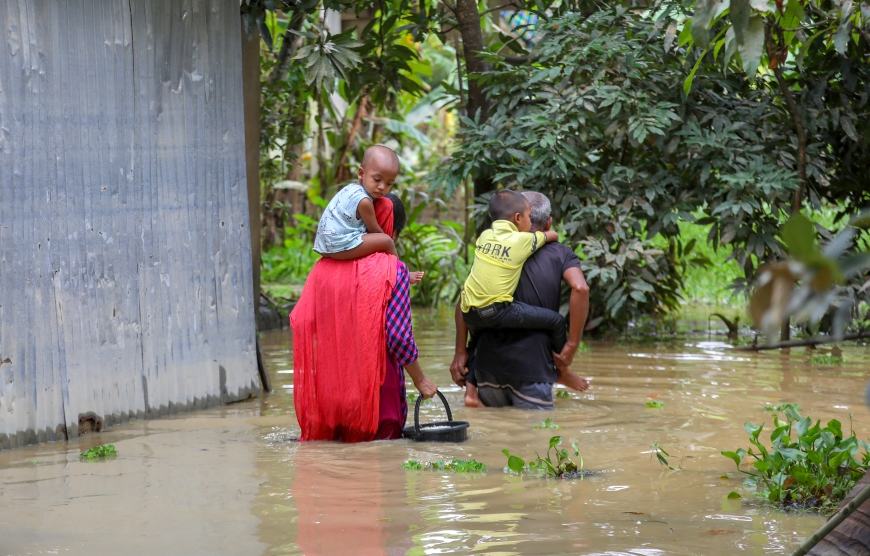
Shimul Chandra Paul, a resident of Parshuram in Feni, woke up to incessant rain for the third consecutive day. The looming risk of flooding, which had seemed unlikely just a day before, had suddenly become a reality. By noon, water had reached his village, rising rapidly with each passing minute. Before he could figure out how to save his belongings, the water level rose too high. Shimul barely managed to save himself, first taking refuge on a tin-shed rooftop before moving to a building in nearby bazaar as the surging waters continued to rise.
“We have never seen such massive rain in our lives. Even our fathers hadn’t,” said Shimul. Although the water rose rapidly, it didn’t recede as quickly. It took over a week for the discharge to begin. By then, Shyamal’s house was in ruins, and his properties were irreversibly damaged.
Shimul, his brothers, extended family, and millions of others in southeastern Bangladesh – along with the people in the Indian state of Tripura – were stranded in the prolonged flood in August 2024. Thousands lost their houses and belongings to the flash floods. But, except for inundating national sympathy and private help in the immediate aftermath of the disaster, many victims found no help as the government came up with little hope for them.
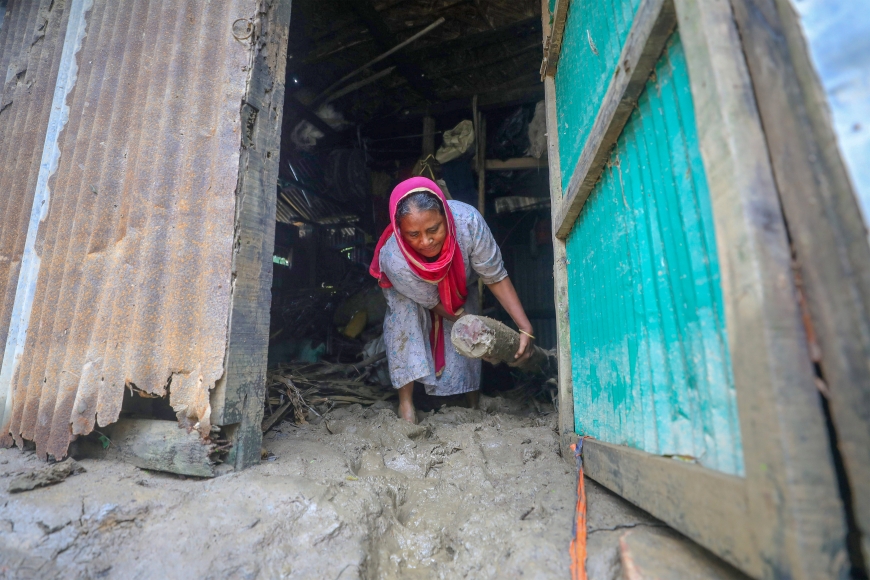
Thousands lost their houses and belongings to the flash floods. Photo: Mohammad Minhaj Uddin
District officials in Cumilla and Feni reported shortages in relief supplies, immediately receiving only 400 metal sheet bundles and Tk12 lakh each, despite much higher demands as thousands of houses were damaged. However, around 300 houses were handed over to the victims by the government this April, while many needs relied on private aid or were simply left unmet as over 8,000 houses were fully or partially damaged in Feni alone.
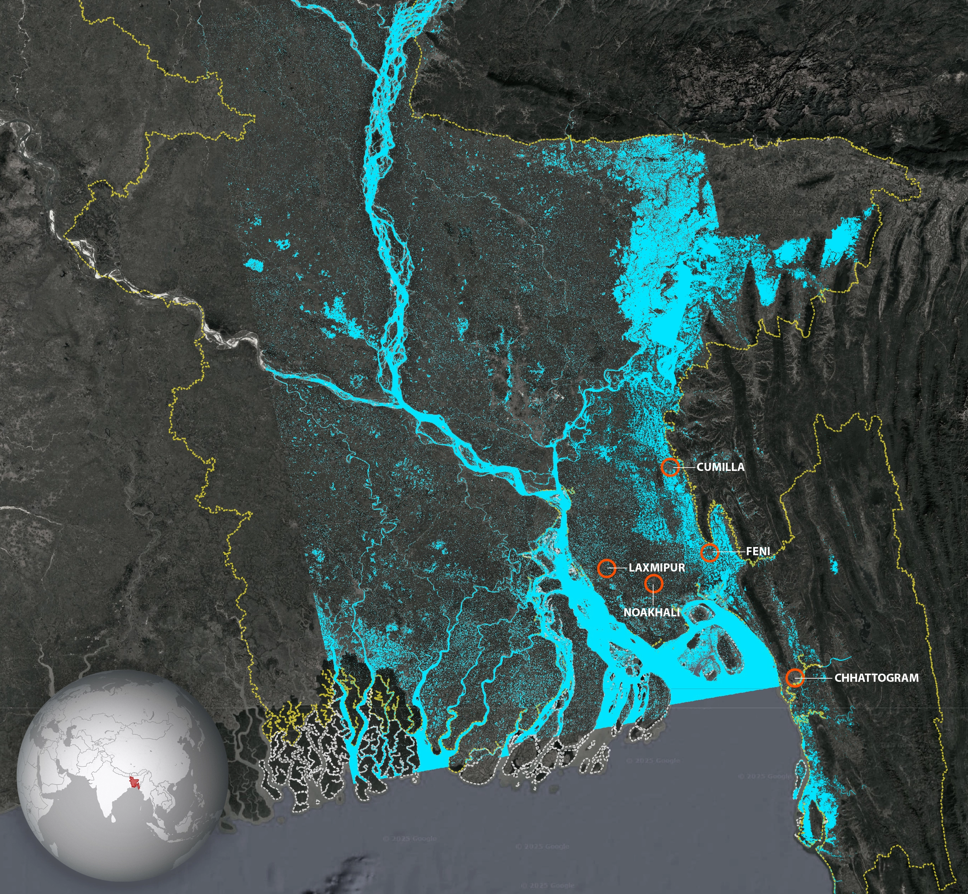
Bangladesh’s Feni has been the most affected besides Cumilla, Noakhali, Chattogram, and Laxmipur, as it rarely experiences floods. So, when consecutive days of heavy rainfall, amounting to hundreds of millimetres, poured down along with a cloudburst, people were caught off guard, lacking prior experience in dealing with floods of this scale.
About 71 people died in southeastern Bangladesh, including 28 in Feni, while 31 lost their lives in the Indian state of Tripura. The floodwater remained for over a week as drainage channels were blocked, and swamps and canals had been lost to encroachment.
As a result, people’s suffering worsened. Although private aid poured into flood-affected areas, many struggled without food and water for days, as relief workers faced difficulties reaching remote areas. Even after the water finally receded, the devastation left behind was staggering. Waves of diseases spread, and many victims received little to no assistance for rehabilitation.
Erratic rainfall – the force behind August disaster
From August 19-23, 2024, Bangladesh’s Feni recorded 832 mm of rain in just five days, while Comilla received 513 mm and Noakhali 605 mm. This erratic downpour, combined with water cascading from the hilly regions across the Indian border in Tripura, triggered the unprecedented flood in southeastern Bangladesh.
Tripura also recorded one of its highest 24-hour rainfall totals on August 22, 2024. For example, South Tripura District (Bokafa) received 493.6 mm, Sepahijala District (Sonamura) 293.4 mm, West Tripura District (Agartala) 233 mm, and Gomati District (Udaipur) 155 mm in 24 hours, exacerbating the flood situation in the Indian state.
K M Abdul Wadud, Additional Secretary at the Ministry of Disaster Management and Relief, said both Feni and Tripura receiving a gigantic amount of rain simultaneously overstrained the discharge channels, which were already encroached.
“Water from both sides was released into the same area. The Gomti, Mohuri, Kohua, and Feni rivers are hilly and shallow, with limited capacity. If it had been only upstream water, we would have had some lead time and an opportunity to issue early warnings.”
On a monthly estimate, in August 2024, Feni recorded a total of 1,787 mm of rainfall.
According to our analysis of 30 years of daily and monthly data, the previous highest recorded rainfall in August for Feni was 858 mm in 1998. Similarly, Noakhali received 1,646 mm of rain in August 2024, whereas its highest in the past 30 years was 897 mm in 1998. Comilla recorded 880 mm, significantly surpassing its previous near-highest record of 523 mm from the previous year.
For instance, in Sylhet, the highest recorded monthly rainfall in June was 1,288 mm in 2006, based on our 30-year data analysis. The average is far below. However, in the past three years, rainfall levels have consecutively far exceeded or come close to this record – reaching 2,124 mm in 2024, 1,485 mm in 2022, and 1,267 mm in 2023.
“The August rainfall in Feni was about three times higher than the 30-year average. Since this massive rainfall occurred in a clustered manner, it became a major trigger for flooding, highlighting the abrupt shift in rainfall patterns due to climate change,” said Dr. Md Sarwar Hossain, Associate Professor at the University of Glasgow’s School of Social and Environmental Sustainability.
A similar erratic rainfall pattern was also observed on the Indian side in Tripura. But questions remain about whether information was exchanged regarding the opening of the Dumbur Dam gates. If it wasn’t shared, we need to determine who is responsible,” he said.
When asked if India notified Bangladesh before releasing water from the Dumbur Dam and whether an agreement mandates such notification, Wadud said, “Yes, regional data is shared”, and emphasized that they “do not rely solely on Indian data. We use our own assumption models.”
What was unusual in the Feni flood was the local rainfall, Wadud said. There was a cloudburst, which added to the regular monsoon rains.
“The Feni event was highly unusual – so many things don’t usually happen all at once,” he added.
Sarwar Hossain said erratic rainfall is likely to increase in the future, but with canals disappearing and rivers narrowing, flash floods will only heighten the risks further. He also emphasised the need for an early warning system and a robust disaster management mechanism to minimise damage from flash floods.
Vanishing waterways and encroachment
Erratic rainfall triggered the initial flooding, but the decay of rivers and the encroachment on waterways, such as canals, worsened the situation in Bangladesh – prolonging the suffering as floodwaters had nowhere to drain. We investigated satellite images and conducted field visits to see first-hand the ruined canals and encroached waterways.
The Pagli Chhara canal in Feni’s Daudpur, for example, illustrates the impact of encroachment and pollution. Once over 30 feet wide, it was navigated by boats and even served as a docking point for cargo ships coming from Noakhali. Now, in some areas, it is less than three feet wide and largely filled in.
“This canal had good water flow even a few years ago, but encroachment has nearly destroyed it,” said Nurul Islam, a local resident.
Other canals, such as the Damdama Canal, have become drains. Locals say that dozens of such water bodies have disappeared from Feni city in the last two decades, with canals and water flow filled in or destroyed. Experts warn that the reduction of water bodies in a city significantly increases flood risks.
“Mohuri, Kohua, and Silonia rivers have been encroached on both sides, narrowing the rivers. Houses have been built in riverbeds, and tree plantations along the riverbed have obstructed water flow,” said M A Hasan, a journalist based in Feni.
When asked what made the Feni flood worse and why no significant river restoration projects had succeeded, Wadud pointed out the negligence in water management systems.
“Our water flows from north to south, yet we keep building roads that cross from east to west, which creates obstacles. But riverbanks aren’t dredged properly – there’s no integrated coordination. We face water shortages during the dry season, yet have overflowing rivers during the monsoon. These are also forms of disaster,” he added.
Nayma Baten, a meteorologist at the Climate Division of the Bangladesh Meteorological Department, said that while erratic rainfall has contributed to flooding, the narrowing of rivers and the disappearance of other water bodies have worsened the flash flood situation.
“Water can no longer flow effectively through the rivers or be released through running water bodies. This was evident when we received heavy rainfall several decades ago – the floods were not as severe because the rivers were free-flowing,” she said.
The Feni River, a vital drainage route for Feni, Khagrachari, and Chittagong, flows approximately 153 km into the Bay of Bengal. Nearby, the 50-km Muhuri Project dam, built in 1984 to protect Mirsarai and Sonagazi from floods, has contributed to the formation of chars. Over time, fish enclosures and ponds, established through occupation or leasing, have further obstructed water flow.
Meanwhile, the Gomti River, which flows through Cumilla, has also dried up and narrowed down in places, obstructing its capacity to carry enough water.
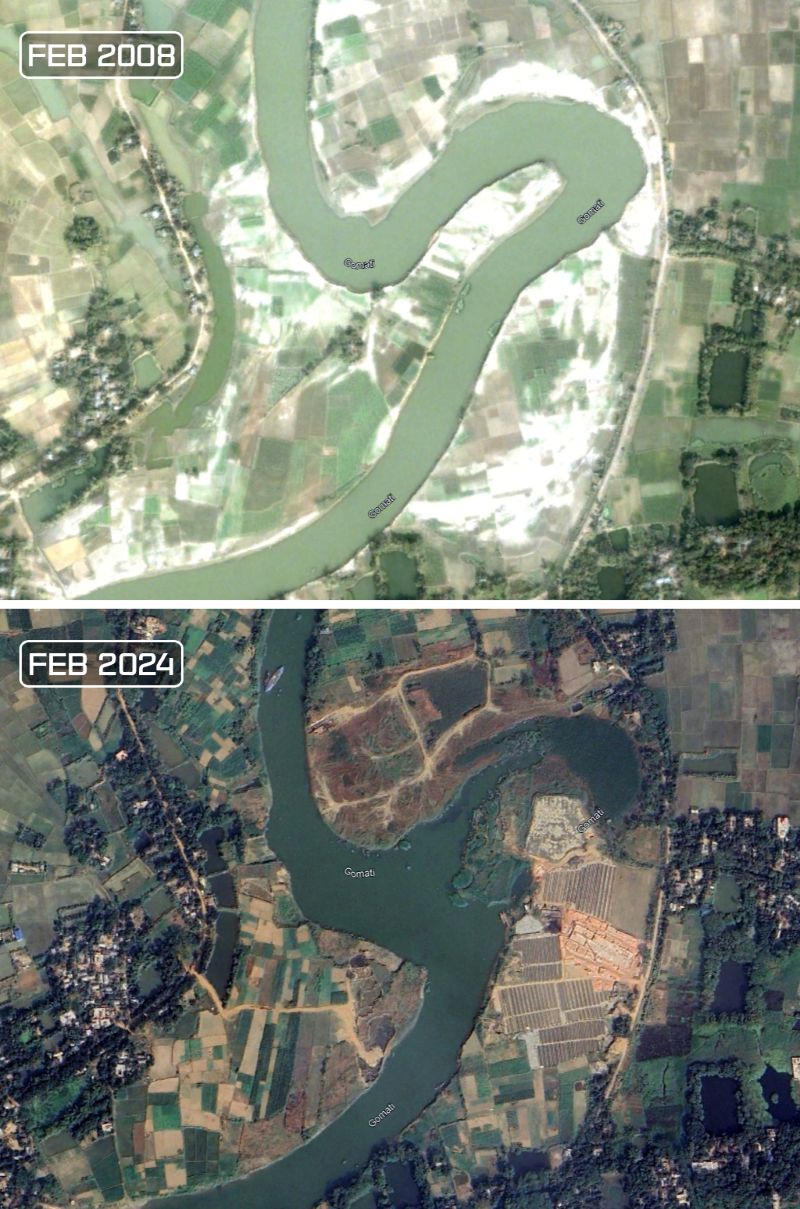
“Gomti didn’t dry out on its own,” said Mohammad Azaz, Chairman of the River & Delta Research Centre (RDRC), referring to the dam in the Indian side of Tripura, which reduced the regular water flow in the river.
“Besides, the swamps and water bodies have also disappeared. The damage done to rivers and water bodies in Bangladesh causes flooding not only in Feni, but also in Sylhet and other areas,” he said.
“All the canals and water bodies in Noakhali, Feni, and Laxmipur have been filled. Re-excavation projects for canals must be launched urgently to ensure water discharge. Without this, it will take a long time for water to flow properly,” he added.
Negligence in post-flood rehabilitation
The August 2024 flood caused massive damage to lives and livelihoods. Flood victims in these districts, having essentially lost everything, needed assistance from the authorities to rebuild and restart.
However, despite private efforts during the flood to save lives, the people in these areas didn’t get adequate support for rehabilitation.
“I got Tk50,000 for rebuilding my house, which was destroyed, but this fund is not enough, so I still couldn’t start the rebuilding of my house,” Shaymol Chandra said. “But my brothers didn’t get a penny from anyone, the flood had damaged their houses too.”
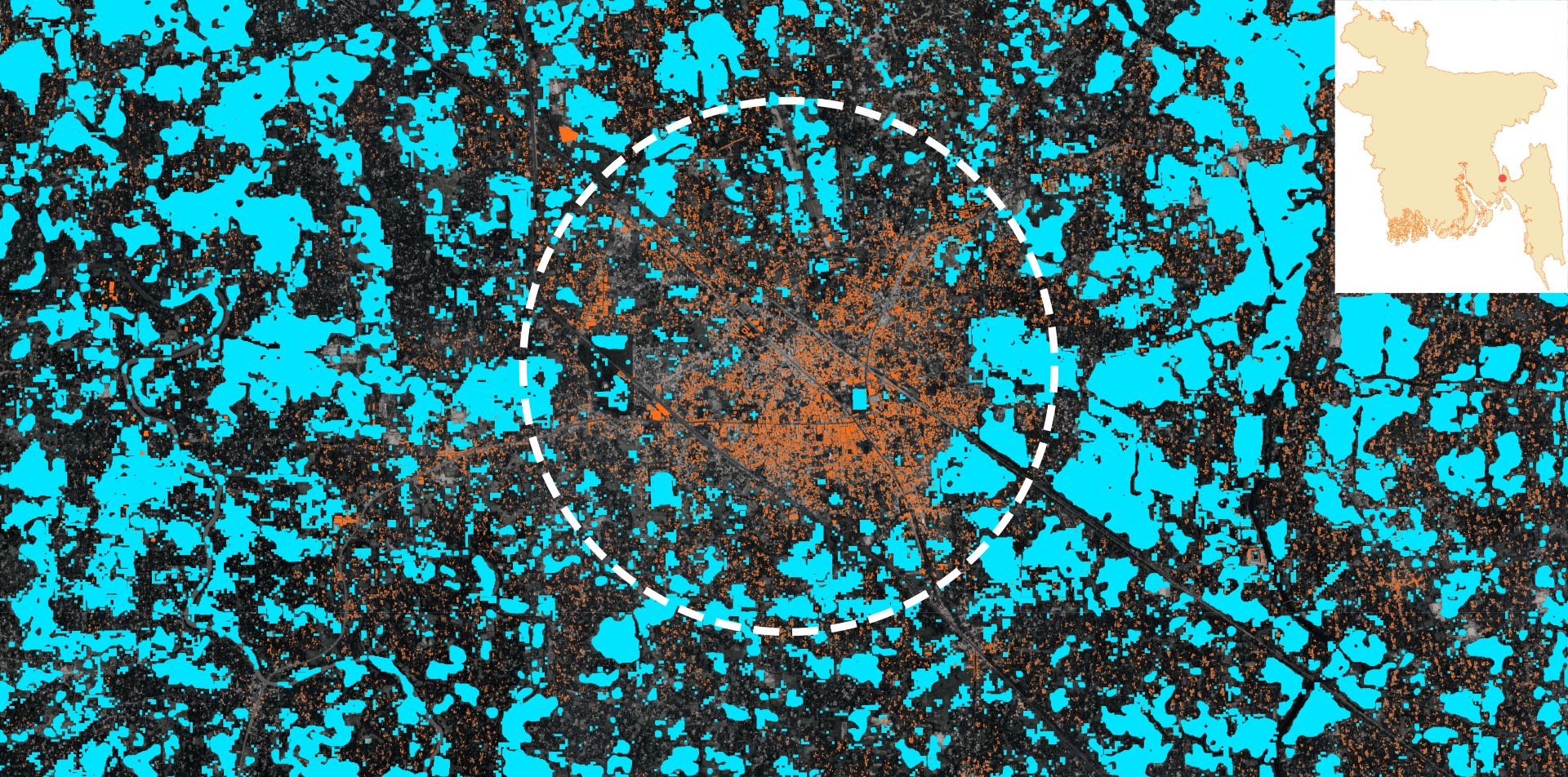
By combining flood extent data from ARIA Water Maps (OPERA Dynamic Surface Water Extent) and the UNOSAT SAR AI model, our analysis shows that at least 8,000 structures in Feni and surrounding areas (orange) with flooded areas (light blue), highlighting the scale of inundation. Credit: Arun Karki
When asked about the gaps in relief distribution and funding for flood rehabilitation, Wadud, addressing the lack of funds, said the budgetary timeframe had something to do with poor government response.
“Our disaster management fund is governed by specific rules – there is a Disaster Management Act that allows local collection of funds, but Deputy Commissioners (DCs) often don’t collect them. Even when funds are available locally, they must be returned to the government by June [budget year end]. But floods usually begin in July. This becomes a major barrier.”
Juel Mahmud, former Programme Coordinator at the International Centre for Climate Change and Development (ICCCAD), said that erratic precipitation patterns themselves hinder resilience capacity.
“We have mechanisms in place to deal with such flood situations. But the erratic nature of it, coupled with the failure of local officials, exacerbated the suffering of the people,” he said.
Md Sirajul Islam, a local social worker, said that flood survivors in remote areas hadn’t received help.
“Our agriculture had been severely damaged. While there has been some effort to support farmers with rice seedlings from the northern area, it has been minimal compared to the actual need. If the government could provide enough seeds, fertilisers, or at least subsidised fertilisers, our farmers could have overcome this crisis.”
“Our land is fertile. Our watermelons meet the demand of several districts. If our farmers are properly supported, they will stand on their own feet again,” Sirajul Islam said.
Mohammad Abed Ali District Relief & Rehabilitation Officer in Cumilla, said that against a demand for one lakh bundles of corrugated metal sheets, they received only 400 bundles and Tk12 lakh. “We submitted our requisition, but the department couldn’t provide us with more,” he said.
In Feni, on the other hand, about 8659 houses were destroyed in full or partially. District Relief and Rehabilitation Officer Mahbub Alam said they also received 400 bundles of corrugated metal sheets and Tk12 lakh besides private help, which was inadequate to the demand.
However, according to a document shared by Mahbub, some other government wings, including the military, have built around 300 houses, which was delivered to the victims this April. The document also lists donations from NGOs and non-profits such as UNDP, WFP, and others.
While most donations ranged between Tk 6,000 and Tk 30,000 – providing a little relief in the rebuilding process – As Sunnah Foundation offered Tk 300,000 per damaged family. However, they were able to assist only 287 families, whereas over 1,700 houses were completely destroyed.
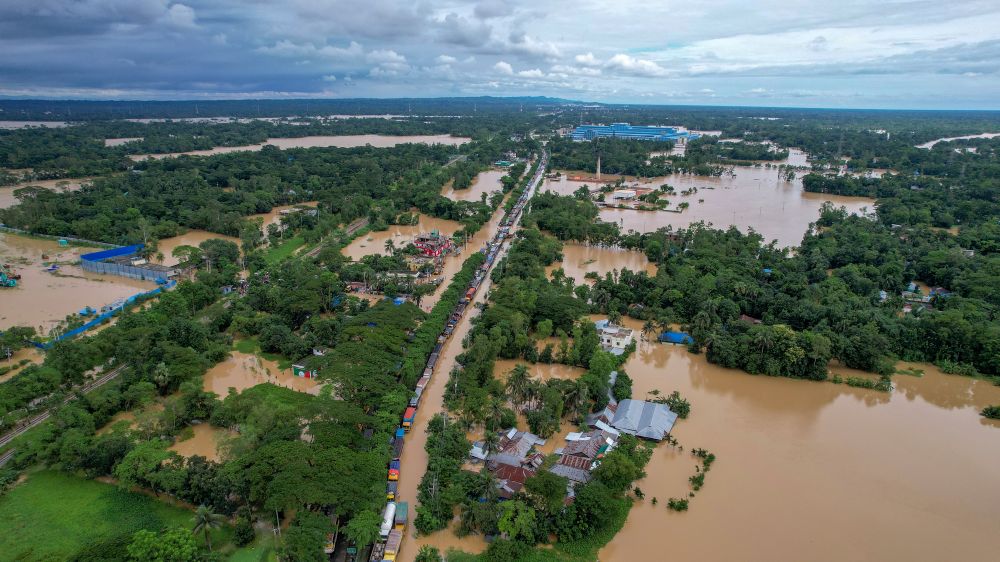
The erratic nature of rainfall and accompanying flash flood exacerbated the suffering of the people. Photo: Mohammad Minhaj Uddin
“The flood claimed everything we had, and most of us are now left alone in the fight to rebuild our lives,” Shimul said. “Only God knows how we will survive if such a disaster strikes us again.”
After last year’s flood, Syeda Rizwana Hasan, adviser to the Ministry of Water Resources, promised embankments in strategic locations, modern surveys, cancellation of illegal sand leases, and eviction of river encroachers to prevent future disasters.
Around a year later, at a recent advisory council meeting, the officials discussed finalising designs for the Musapur Regulator and Bamni Closure, permanent embankments in Feni, and freeing drainage canals in Noakhali.
Pointing out that a year has passed and these project discussions remain “finalising” or “ongoing,” river researcher Sheikh Rokon wrote in a recent column: “It is inevitable to question: what has the government actually done in the past year to tackle flooding in Feni?
Across the beds of Feni’s rivers, there is now cultivation and fish farming. Why couldn’t the government remove these encroachments over the past year? No matter how many embankments or structures are built or repaired, they will not be sustainable without clearing these flow paths,” he added.
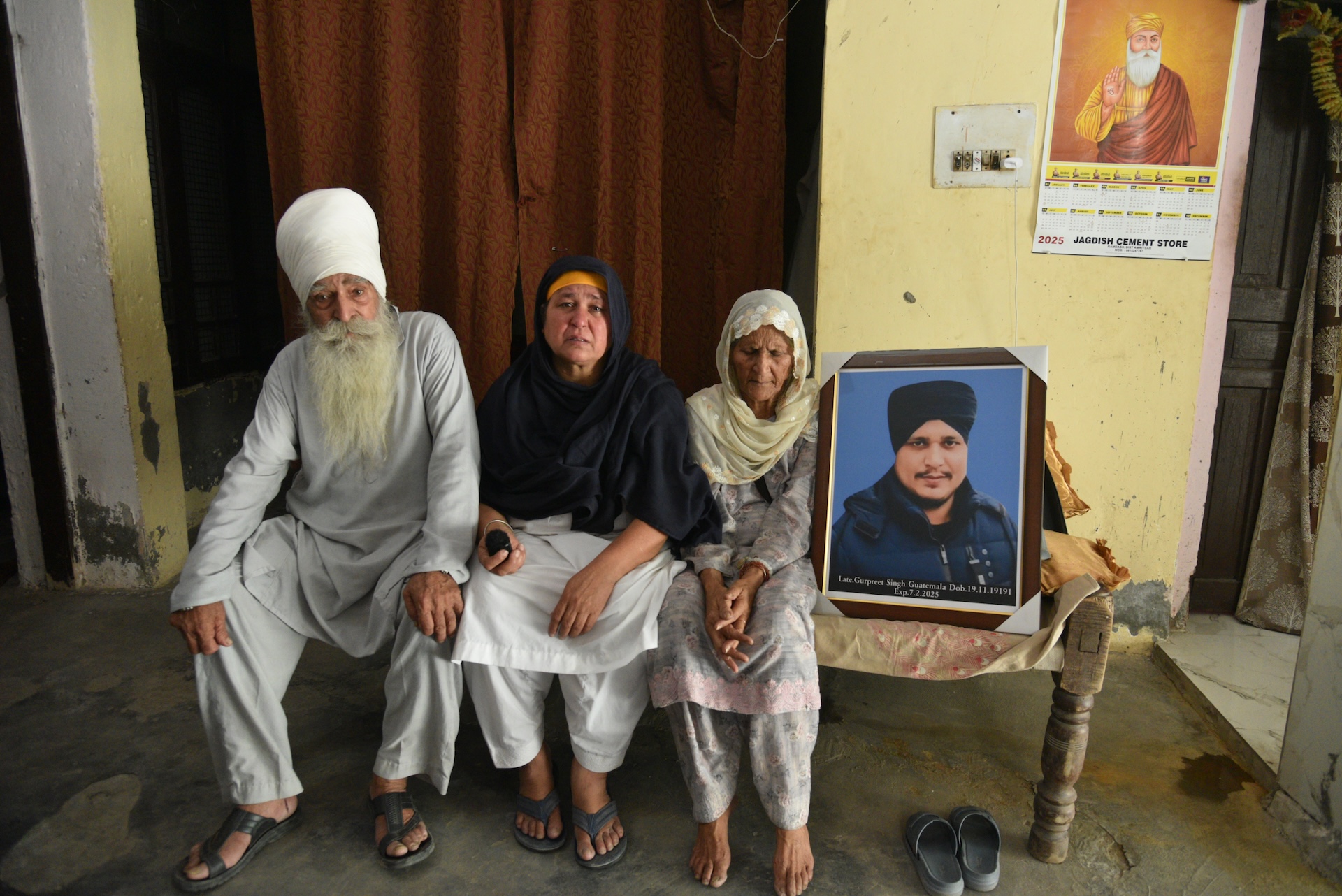
The family of Gurpreet Singh, who died of a heart attack while being taken through the dunki route to the US, still copes with the demise of their son. Photo: Prabhjot Gill
It was August 2021. The sun was on the horizon, ready to set. Jatin* was relieved to have arrived in the northern Indian state of Punjab after crossing multiple police checkpoints deployed as part of India’s COVID-19 protocol.
The 32-year-old was in his newly-registered Hyundai i10 that he had bought from an auto-rental service he started just a month ago to make a living. This was a dream he had along with his childhood friend Sukhbir*. But this was Plan B. Plan A was to start the same business in the US. So when Sukhbir went to the US in July 2017, Jatin thought they’d be closer to the so-called “American Dream.” In August 2018, Sukhbir got deported. A year later, in August 2019, he died by suicide.
“He was extremely depressed after being deported from the US-Mexico border, and embarrassed due to the deportation case against him,” Jatin tells Asian Dispatch. “The Punjabi travel agent also didn’t disclose that he was going to be taken through the dunki route. He refused to speak or meet with anyone, including me.” Dunki, a localised term for illegal routes immigrants are forced to take to reach their destination, has become a recurring term in light of hundreds of Indians who have been deported since February this year.
-
Who is an irregular migrant?
The International Organisation for Migration (IOM) defines an irregular migrant as someone whose movement “takes place outside the laws, regulations, or international agreements governing the entry into or exit from the state of origin, transit, or destination.”
Source: Definition via IOM
Between February 5 and 16 this year, US President Donald Trump’s administration deported 333 Indian immigrants. Out of that, 126 belonged to Punjab, 110 from Haryana, 74 from Gujarat, and 23 were from other Indian states.
The deportation drew unprecedented attention to the issues of irregular migration, human trafficking and the nexus of travel agents in India. As US officials orchestrated highly publicised and humiliating optics around the deportation of Indians – who were in shackles throughout the flight – global media fixated on the “illegality” of their entry. Conversations on the psychological and emotional toll of the ordeal that the deportees experienced were missing.
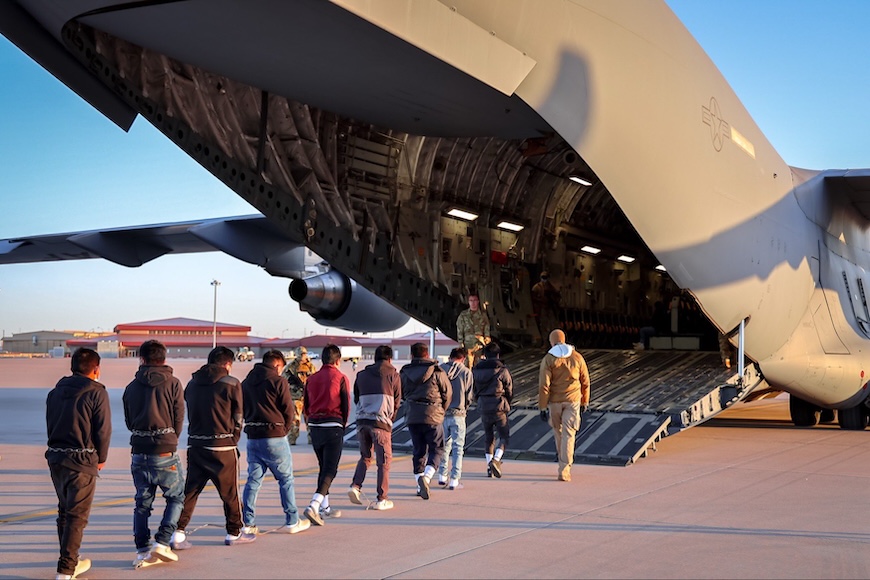
US Press Secretary Karoline Leavitt shared an image of Indians being deported in January 2025. Photo: PressSec/ X
During the course of this reporting in the states of Punjab and Haryana, Asian Dispatch met deported persons and their families who experienced acute mental distress such as depression, suicide ideation, Post-Traumatic Stress Disorder (PTSD) and isolation. This piece digs deeper into the socio-cultural fissures that contribute to high rates of out-migration, and the subsequent mental health crisis that arise out of deportations. To protect their safety and privacy, Asian Dispatch has granted anonymity to all deportees quoted in this story.
Sukhbir would have turned 32 this year. Jatin says that when his friend came back, he faced constant shaming, mocking and social stigma. This was compounded by the pressures to repay his lenders over INR 42,00,000 ($48,806).
Jatin has now abandoned his dreams of moving to the US. “It was not [Sukhbir’s] fault [that he got deported],” he says. “Once you are deported, your neighbours and relatives see you as a failure. They make you feel like you’ve dishonoured the entire village.”
He then implores: “Will you help tell my friend’s story?”
The ripple effect
In Punjab’s city of Sangrur, where Jatin and Sukhbir are from, Sukhbir’s family has not yet come to terms with the death of their eldest son. After his passing, Sukhbir’s younger brother “successfully” migrated to Canada in 2023. His family now sees hope through him.
Asian Dispatch tried to contact Sukhbir’s family for an interview but they turned down the request. “They fear that talking about Sukhbir will jinx the situation for their younger son,” Jatin says.
Suneel Kumar, a professor at the Department of Political Science, University of Jammu, and a subject expert from Punjab on international migration, says that the families often experience the same mental stress as the deportees. “Even the family is a victim here,” Kumar tells Asian Dispatch. “A victim’s family is also involved in arranging the finances, either through loans or borrowing from others,” he adds. “Any loss to the victim — in the form of money, reputation and mental peace — is a loss to the family involved.”
In rural societies, Kumar adds, people don’t see deportation from the lens of mental health due to age-old beliefs in social status and hierarchy. “In rural Punjab and Haryana, while a car loan is seen as a positive investment, a loan for overseas travel – and then being deported – implies a negative message, downgrading the deportees to a low social status,” says Kumar.
A victim’s family is also involved in arranging the finances, either through loans or borrowing from others. Any loss to the victim — in the form of money, reputation and mental peace — is a loss to the family involved. — Suneel Kumar, Department of Political Science, University of Jammu, India
Satnam Singh Chahal, Executive Director of North American Punjabi Association (NAPA), a US-based organisation for the Punjabi diaspora, says that one of the reasons why people don’t come out about being deported is societal shame and fear. “I urge everyone — irregular Indians, their families and society — to come out in public to talk about [mental health] and seek help openly,” he says.
Sunil Jaglan, a Haryana-based social activist who campaigns for gender rights in India, recommends mechanisms to protect deported people from societal bullying.
“Some of the common comments most deported people face in villages are: ‘Kya ukhar liya waha jake?…Sharam ki baat hai galat raste se gaye tha…chori se gaye tha…ghar aur izzat barbad kardiya [What great things did you achieve by going abroad?’ It’s a shame you went through illegal routes. You went like a thief. You ruined our honour and reputation],’” Jaglan says. “Such acts must be avoided to protect their mental health.”
A bitter homecoming
On February 5, 2025, Satish* and Amar*, both from different districts of Haryana state, were among the first batch of Indians to be deported by the US this year. Since their return, they’ve both been visiting government hospitals to seek treatment for “depressive symptoms” after the family feared they might take “aggressive steps” if they didn’t seek help.
Mohit*, Satish’s cousin, told Asian Dispatch that when the Haryana Police escorted 30-year-old Satish home, they took a written declaration from his parents that stated that “no harm should come to Satish.” This came in the light of news reports of recent deaths by suicide, or attempts, by deportees.
“This news made the families, as well as the police, panic and fearful,” says Mohit. “After all, they sold everything to pay the travel agents for their overseas dreams, and as a consequence, incurred heavy monetary loss. But local people would not readily admit to such information out of fear.” Mohit adds Satish hasn’t spoken much since his return. “He is concerned about his future, wondering what he will do now,” Mohit says. Satish had sold off everything after his agent coerced INR 39,00,000 ($44,910) out of him. “The government has not offered him any assurance or support so far,” says Mohit.
Kuldeep Singh, a village head from Amar’s village, which is undisclosed to protect his identity, told Asian Dispatch that the 27-year-old’s mental health isn’t better either. “The family has been taking him to the government hospital to help him with his condition,” Singh says. “They’re affected financially, too. No government or NGO body has visited him.”
The recent cases are more challenging than ever for mental health experts such as Jaglan, who’s currently counselling four recent deportees from Haryana’s Jind and Kurukshetra districts. “When I met them, their mental health was failing, and two of them had attempted suicide,” says Jaglan, who has also served as a village head in a village called Bibipur in Haryana. “The deportation made them feel like their entire world had ended. After the counselling, we observed at least 20–25 percent improvement, if not 100 percent.”
Jaglan adds that at a time like this, the state and central government must step up and work towards the welfare of the deportees. “Just because there aren’t many people impacted doesn’t mean that they should take no or less action,” he says.
The deportation made them feel like their entire world had ended. After the counselling, we observed at least 20–25 percent improvement, if not 100 percent. – Kuldeep Singh, village head in Haryana, India
While India expressed concerns over the US’s treatment of their citizens’ deportations, on domestic frontiers, local leaders reinforced the stigma around deportees. Manohar Lal Khattar, the Union Power minister from the city of Karnal, Haryana, and a member of the ruling Bharatiya Janata Party, said that there should be “no sympathy for the deportees” while also deploying police buses to bring back deportees.
The perilous route of – and after – dunki
In Punjab, Manjit* struggles with insomnia. The 35-year-old was among the hundreds who were brought back on February 15. He had left his village just six months before that, on August 13, 2024. His first tryst with sleep disorder came when he had to spend 27 days in a California’s ICE camp. There, he’d receive a packet of chips, an apple and a small tetra pack of juice every day for all meals. A foil blanket was given to keep them warm. The Sikh deportees were not allowed to wear turbans.
“I cried the moment I deboarded the plane,” Manjit tells Asian Dispatch. “I didn’t take a bath for a month, and stayed in my room. My wife lost a lot of weight. We’re all feeling hopeless now.”
The trauma, however, didn’t start with the deportation. His sleeplessness started when he was forced to embark on the dunki route.
Manjit and his co-travellers were completely unaware of their travel agents’ “nefarious plans” until they were in the Netherlands. “The agent ordered us to hide in the airport’s restroom for up to nine hours,” he says. “That’s when we understood that he was bringing us illegally. He only asked us to come out when our next flight to Suriname was scheduled to depart.”
What was supposed to be a two-month journey turned into a six-month nightmare.
Between August 2024 and January 2025, the agents took the Indians across three Indian states and 18 countries. Manjit lost INR 39 lakh ($44,910) in the process.
-
This is what the route looked like:
Amritsar → Delhi → Mumbai → Nairobi → Dakar → Amsterdam → Suriname → Guyana → Bolivia → Venezuela → Perú → Brazil → Ecuador → Colombia → the jungles of Panama → Costa Rica → Nicaragua → Honduras → Guatemala → Mexico → California.
When Manjit finally crossed the Mexico-US border into California on January 22, he felt like all the risk was worth it. The same day, Manjit and six others were apprehended by the US Border Patrol. “Aisa laga jaise muh se kisi ne niwala chin liya hai (It felt as if someone had taken away a morsel from my mouth),” says Manjit.
A key driver of irregular immigration is better opportunities, Kuldeep Singh Dhaliwal, Punjab’s NRI Affairs Minister, told Asian Dispatch. “People in India believe that foreign countries have higher wages. Therefore, they should go there, work hard, earn a lot of money, and bring it home. When people return (from overseas), the first thing they do is construct massive houses,” he says. “I also constructed my house when I first went to the US. Earlier, I had a small house. Once someone gets on the plane, they do not intend to return.”
The mental health issues, Dhaliwal adds, aren’t widespread and that those who were “disturbed” upon their return are recovering. “It was mostly the shock, disappointment and guilt over the money and trust they had lost for their parents and families,” Dhaliwal says.
Once someone gets on the plane, they do not intend to return. – NRI Affairs Minister, Punjab, India
Chahal, from NAPA, says that there’s more to irregular immigration than just aspirations of wealth. “If the state [of Punjab] gave them jobs or financial security, locals won’t risk their lives to move overseas,” he says. “Instead, farmers’ land is being forcibly taken by the government, while they’re not receiving full compensation for it. The state is focusing on high-rise apartments, buildings and offices at the expense of farmers’ land.” Chahal is referring to Aam Aadmi Party-led Punjab government’s “land pooling scheme”, which allows the state to acquire 24,311 acres of land from 57 villages in Punjab to build an urban development project.
Dhaliwal reassures that the government is supporting all deportees. “Most deportees want their money back from travel agents,” Dhaliwal says. “Some have received refunds too. We’ve told them that the state will help in case any travel agent refuses to cooperate.”
Around 200 travel agents have been arrested in the last three years in the state, the minister adds, but the menace is far from over. “We take action against one agent, people find another one,” he says. “I’ve told Chief Minister Bhagwant Mann that licensed travel agencies that engage in unlawful activities should face repercussions such as having their premises and property seized. They should feel scared that if they break the law, they will lose everything.”
For Manjit, recovering the money would help him get back on his feet, financially and mentally. However, in India’s backlogged courts, a legal case can take years. “This means it’ll take longer to recover the money,” Manjit says. “Poor people don’t have the time due to debts, loans and financial constraints. That is why, in most cases, deported people do not testify against their agents.”
In Haryana, Satish’s cousin Mohit says his travel agent is out on bail even though the police have evidence of the agent’s role in the alleged trafficking. “We’ve not received any money from the travel agent, nor is the government assisting us. Instead, out of all perpetrators named in the police complaint, only one was arrested. Today, he, too, is roaming free,” says Mohit.
On February 8, a man called Gurpreet Singh, 33, from Punjab, died of a heart attack while walking through the Panama jungles of Guatemala after “being prodded by a donker [travel agent] who took INR 20,00,000 ($23,100) for air travel,” his family told Asian Dispatch. His death is a grim reminder of the high cost of the dunki route.
In his unfinished home, which Gurpreet was building for his family, Asian Dispatch met his 75-year-old mother, 85-year-old father and elder sister, 50. The mother and sister say they’re unable to sleep and eat, and often find themselves crying.
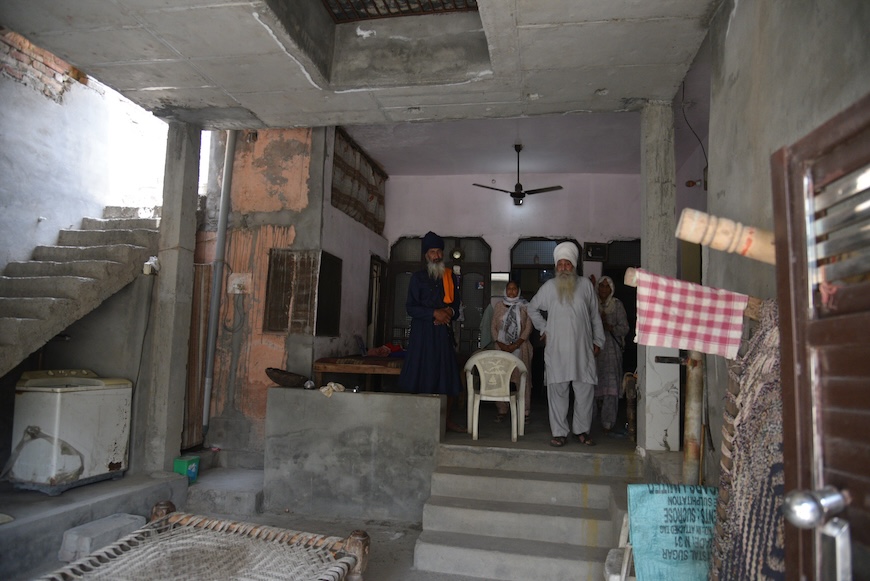
The family of Gurpreet Singh, who died of a heart attack while being taken through the dunki route to the US, stand in their unfinished home in Punjab. Photo: Prabhjot Gill
“Gurpreet sent me a voice note on February 7, in which he informed me of his arrival in Guatemala,” says Harjeet Kaur, his elder sister. “He told me the place is really cold, but he is fine and we should not worry. But the next day, we received a call from his phone saying he was struggling to breathe and was being taken to the hospital. We soon received the news that he is no more.”
Kaur says that she can’t stop listening to his voice messages, and calls his number often with the hope that he will pick up. Their unfinished house is now a painful reminder of Gurpreet. “Once the house was built, we were planning to get him married,” his mother says. “He was working hard for us.”
The family has a total debt of INR 36,00,000 ($41,580), including travel agent fees. They managed to pay back most of it but INR 15,00,000 ($17,325) remains to be paid. “If the government will help us with some financial support, we will be able to pay off our remaining debt,” the mother pleads.
The gendered side of trafficking
Preeti*, 35, has been on a lookout for work since 2023 but she has one condition: She doesn’t want to leave her home district. She is a survivor of human trafficking from Punjab’s Jalandhar city. In April 2023, a trafficker called “Mamta” – as mentioned in Preeti’s police complaint document – lured Preeti with a fake employment offer of INR 35,000 ($403) per month as a cook in Muscat, Oman. Preeti comes from an economically challenged family, where her husband’s wages were insufficient to support the family. She travelled to Oman on a tourist visa, excited about the opportunity. However, when she landed, her passport was confiscated by her Omani employer, and she was forced into sexual slavery.
Two months later, she managed to escape after seeking assistance from the Indian Embassy and taking shelter at a Gurudwara. The embassy provided a return ticket to India and a Punjab-based NGO called Sun Foundation, chaired by Member of Parliament Vikramjit Singh Sahney, assisted her with repatriation. But the psychological and physical torture she experienced continues to haunt her.
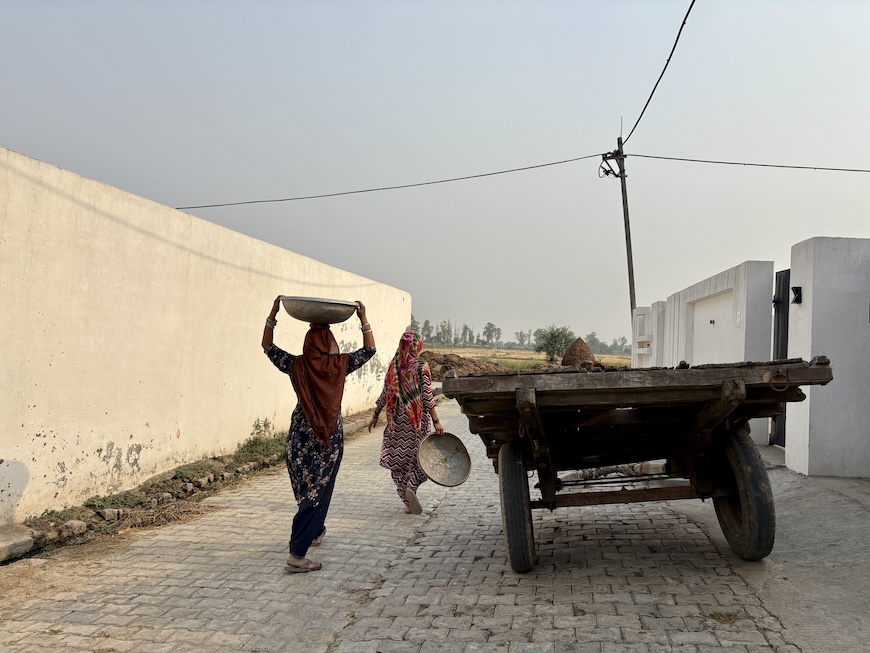
The gendered aspect of deportation and trafficking is challenging to investigate because of the higher chances of stigma that women face. Photo: Pari Saikia
“When I was rescued from Muscat in 2023, the Punjab government offered me a job as part of the rehabilitation process, but I didn’t accept it because it was in Amritsar,” she told Asian Dispatch. “I didn’t wish to move away from my family after the incident.”
She is currently pursuing a legal case (pro-bono) against her trafficker but it has yielded no outcomes. The trafficker is on bail, and is pressuring Preeti to settle the case outside of court for INR 75,000 ($863).
“Finding work in Jalandhar is important to me because the trafficker has added to my stress,” says Preeti. “Would you ask the government to provide me with a job with a minimum salary of INR 10,000 to 15,000 ($115 to $172)?” Preeti has studied only up to the eighth grade.
The gendered aspect of deportation and trafficking is challenging to investigate because of the higher chances of stigma that women face. “People don’t want to talk about the women’s cases,” Kumar, the expert on international migration, says. “It is already difficult to persuade male members to disclose their encounters with trafficking, deportation, or mental health. Women may have endured additional circumstances on top of this, such as trafficking, slavery and harassment.”
A way forward
Dr Parag Sharma, a psychiatrist and founder of mental wellness clinic ‘Betterway’ in Punjab, says that severe depression and insomnia are the most common symptoms among deportees.
“Upon arrival, each deportee should undergo a clinical interview at the airport, guided by psychiatric, social workers, or psychologists for an initial assessment to determine who needs immediate medical assistance,” says Sharma. “Individuals who have anxiety, sleeping issues, depression, or are more vulnerable should be screened and treated further thoroughly. This is the bare minimum we should do.”
He suggests that at the airports, the deportees should be given a checklist in their native languages to inform them of what harms stress can bring upon return. “They should also be informed about the centres (clinics) where they can find help,” Sharma adds.
NRI minister Dhaliwal looks at the “Kerala Model” of migration as a way forward for states like Punjab that see high out-migration. “The Kerala government operates their own travel agencies,” he says. “So if a labour is required in Dubai, this government-run agency will select the candidate based on their qualification and skills, and send them. We will also do the same for Punjab, first at the district level, and then subdivisional.”
The Punjab government also has schemes worth INR 10,00,000 to INR 20,00,000 ($11,515 to $23,030) through which deportees can avail a loan with a low to zero interest rate in order to start a small business. However, when Asian Dispatch enquired about any mental health programs or services in the state, or any plans to establish a rehabilitation fund, Dhaliwal did not respond.
Following the February deportations, NAPA urged the Punjab government to establish a rehabilitation fund for skill development programmes, employment and counselling for deportees. But so far, he’s not seen much progress.
“We can only put pressure on the government,” he says. “And, the government will reassure us by saying ‘We can/will do something.’ To us, these are vague words. In reality, no one will do anything.”
Kumar adds that concrete steps can only be taken if Punjab inserts “human trafficking” into the title of the Punjab Prevention of Human Smuggling Act of 2013. “It should be the Punjab Prevention of Human Smuggling and Human Trafficking Act,” says Kumar, adding that the Punjab Human Trafficking Act of 2008 has been diluted so many times that it now lacks clarity. “The trafficking act changed into a Smuggling Act. Not every incident involves human smuggling, or vice versa. However, most smuggling incidents result in trafficking,” he says. “We need different provisions for each issue separately. The Smuggling Act has detailed provisions for prevention and travel agent regulations. However, victims’ relief, compensation, and rehabilitation are hardly addressed.”
Jaglan adds that gram panchayats – the governing body in Indian villages – should work closely with psychologists and psychiatrists to arrange counselling for everyone. The idea, he adds, is to make everyone, especially deportees, feel included.
In 2024, Jatin moved to Dubai through legal pathways after his unsuccessful stint working in Punjab. From there, he currently tracks Indians involved in incidents of human smuggling, trafficking, migration, deportation, asylum, and dunki cases. He believes the time is right for “many Sukhbirs to be saved.”
“We all miss Sukhbir even today. [His family] lost their son, and I lost a close friend,” he says. “Sukhbir’s life could have been saved had there been some kind of mental support or assurance from the state.”
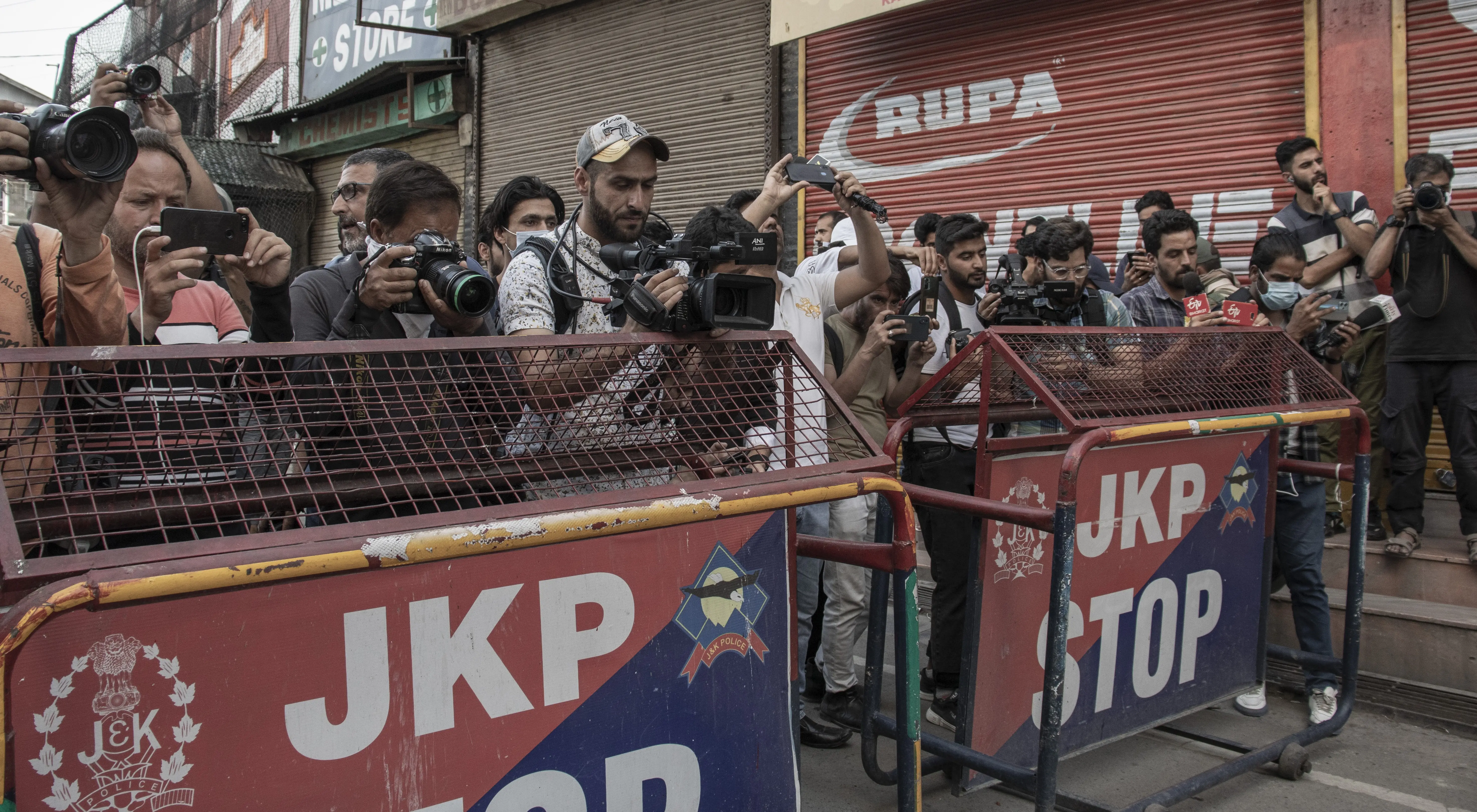
Journalists in the Union territory of Jammu & Kashmir report from behind a barricade in 2022. Photo: Zainab
Earlier this month, India and Pakistan engaged in a military conflict over a course of four days, until a ceasefire was brokered on May 10. Alongside, the two nuclear-armed countries were embroiled in a hailstorm of misinformation, disinformation and propaganda, fuelled by state-backed mainstream media and unverified social media content.
Mainstream TV channels showcased bombings, drones and “invasions” using unverified footage, speculating hour upon hour, and goading their respective militaries to annihilate the other. Internet and network blackouts disrupted communication and the people, desperate for news, had no option but to sift through the barrage of information and videos to judge the truth for themselves.
In the middle of this, journalists on both sides of the border fought a parallel war where they struggled to access impacted areas and report from the ground.
“Independent journalists are the first to reach [impacted] areas, and often the only ones who continue coverage when legacy media goes silent, without any TRP-led bias,” says Suhail Bhat, a Delhi-based journalist from the Union territory of Jammu & Kashmir. TRP refers to Television Rating Point, a metric used by channels to measure the popularity of a segment to determine revenues. “But still, I was stopped by forces many times simply because I’m not affiliated with any particular media house,” Bhat adds.
National and international media outlets are able to provide press cards and appropriate gear to their journalists, while freelancers operate without them. But reporting under editorial mandates of legacy media often means that some crucial stories and aspects can slip through the cracks — a gap that needs local and independent journalism.
“[Non-local journalists] will report that this many people are dead, this many injured, but it’s as if bhed bakriyan mar rahi hai [sheep and goats are dying]. The people have names, families, homes and towns they’re leaving behind. But they’re confined to numbers, or not treated as humans but subjects for stories,” said Gafira Qadir, an independent journalist from the Union territory of Jammu & Kashmir.
The media industry also prioritises viewership and ‘story breaks’, which often means that reporters are sent to the ground at the last moment to capture the first impressions – irrespective of the context. At that, legacy media houses ensure appropriate gear, security checks and access for their journalists. These assets are not provided to freelancers by the newsrooms hiring them on contract for specific assignments.
“TV news channels based in New Delhi always have the upper hand when it comes to access as compared to local reporters. We see it in front of our eyes—a TV reporter can cross a line that other reporters cannot,” said L*, another journalist from the Union territory of Jammu & Kashmir.
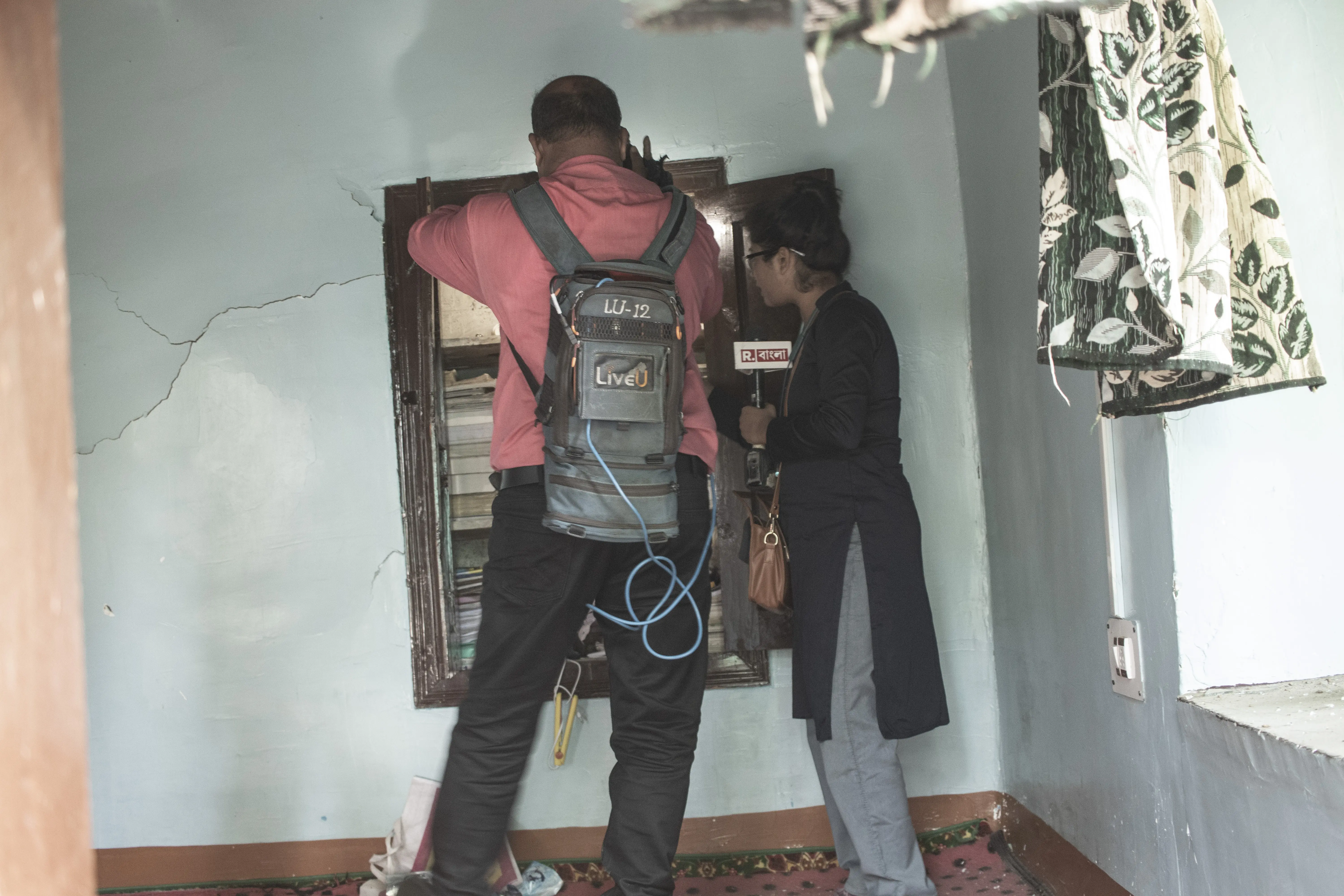
Crew from a prominent Indian TV news channel at a local residence in South Kashmir’s Tral in April 2025. Photo: Zainab
This inequality of access leaves opportunities for sensationalism by certain sections of the media in order to influence public sentiment.
“We’re in these times when the health of the industry isn’t looking good, and people’s faith in the media is at its lowest. At the same time, great journalism is still happening and a lot of it’s coming from independent journalists,” said Karan Deep Singh, an independent journalist and a former Staff Reporter and Visual Journalist with The New York Times and The Wall Street Journal.
Reporting from the frontlines is a different ballgame, and media watchdogs like the Committee to Protect Journalists (CPJ) highly recommend the use of Personal Protective Equipment (PPE) like vests and helmets while covering war zones.
While that is often not an option for independent journalists, proper safety measures aren’t a priority even in established newsrooms, says Kunal Majumdar, CPJ’s India representative.
“There are no mechanisms, no due diligence, not even a basic safety checklist. Does the journalist have a backup plan? An exit strategy? No one takes safety seriously, and the excuse is always cost. Newsroom managers need to understand that journalist safety isn’t just about expensive equipment—it’s about having a clear safety strategy in place,” adds Majumder, formerly a Delhi-based editor with media houses like Tehelka and The Indian Express.
In Kashmir, access is particularly challenging, and journalists are already at risk due to government clampdowns on both sides. During a full-blown conflict, these challenges were exacerbated.
Singh, the Delhi-based journalist, believes that the industry pressure to be the first to publish, combined with how hard it is to make a living off journalism, means that safety and training often take a backseat.
“Most journalists can’t think about it because they’re really trying to get the story, and their entire situation has been so perilous. The industry puts a lot of pressure, and only if they get the story do they get the paycheck. So safety, even for some newsrooms, is an afterthought,” said Singh.
Bhat says that the contracts he signs for a story as an independent journalist for international organisations might be 50-pages long, with clauses on deadlines, compliances and legal liabilities. But safety is not addressed.
“Rarely, if ever, do they mention what happens if the journalist gets injured, arrested or harassed. There is no word on insurance, safety briefings, ethical trainings, or even equipment support,” said Bhat.
On the other side of the border, Islamabad-based journalist Haroon Janjua said that even as drones hovered overhead, the organisations he works with did not provide any protective gear, nor has he received any HEFAT [Hostile Environment and Emergency First Aid Training] yet. This experience was mirrored by all journalists Asian Dispatch spoke to, in both India and Pakistan.
“This lack of gear significantly impacted my ability to work, preventing me from going on the ground to gather accurate and fair information about casualties and the emotions of those affected by the war,” said Janjua.
Others said that the lack of gear doesn’t affect the coverage, because the story must still be told.
“Journalists risk their lives to get the story out. The public sees the news, but they don’t see the emotional, mental, and physical toll it takes on the person behind the camera or mic. That’s the real cost,” said Pakistan-based journalist D*, who requested anonymity to protect their identity over fears of industry backlash.
The Journalist versus ‘Creators’
On May 10, Badar Alam rushed from Islamabad to Lahore to his daughter, who was nervous about the conflict. Upon reaching, he found that the major source of his daughter’s anxiety were Instagram accounts that were posting updates on areas that had been attacked. One of the recent updates that had shaken her was a post about blasts less than 2 kilometers away from her Lahore home. This was not true.
Alam, a seasoned Pakistani journalist, was aghast, and told his daughter that if there really were blasts that close to their home, she would have heard something. “Wouldn’t people around them feel the impact?” he asked her.
Pakistan-based journalist D* said this conflict saw many emotionally-charged local people filming and sharing content using smartphones, without verifying facts.
This negative impact of social media content creators is twofold: It can spread falsehoods, and it undermines journalists trying to find out the truth.
“Local ‘citizen journalists’ were quick to report from their areas whenever a missile or drone hit. They filmed what they could and gave live commentary – often without using the right words, checking facts or understanding journalistic ethics. The rush for instant content and social media engagement is replacing responsible reporting,” said D*.
Journalists and independent newsrooms in both countries are being increasingly targeted and silenced through raids, censorship, intimidation via legal actions, corporate takeovers, court summons, and outright arrests and detention.
This problem is amplified in the Union territory of Jammu & Kashmir, where the Kashmir Press Club – an independent media body – was shut down, making it difficult for freelance journalists to get accreditation, which is an official acknowledgement of a journalist’s credentials.
“Since 2019, we have had ‘Facebook journalists’ who found an opportunity [in the lack of accreditation], resulting in some of them operating very unethically while calling themselves journalists. They don’t ask people before filming and upload their videos online. And then [when we approach people for actual journalistic work], people won’t talk to us because they have been mistreated by these social media creators,” said Qadir. “They put [their content] on Instagram, and make Reels. They’re not reporting, they’re selling.”
Divided by Borders, United in Suppression
Since their partition in 1947, India and Pakistan have come to blows three times over disputed territories, particularly in Kashmir. Currently, different parts of Kashmir are administered by India, Pakistan, and China.
But it’s not just disputed borders that separate the two countries. India and Pakistan’s separation was influenced by an enduring belief that one should be a nation for Hindus, the other for Muslims, and that these two identities are incompatible.
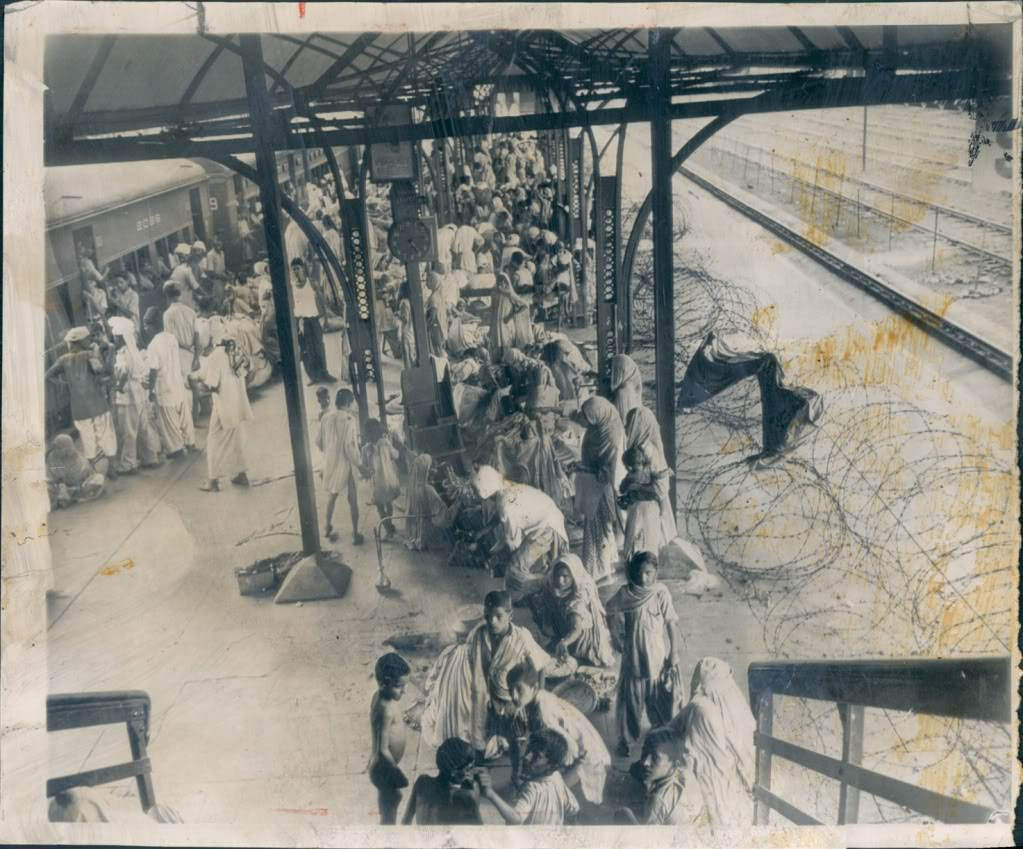
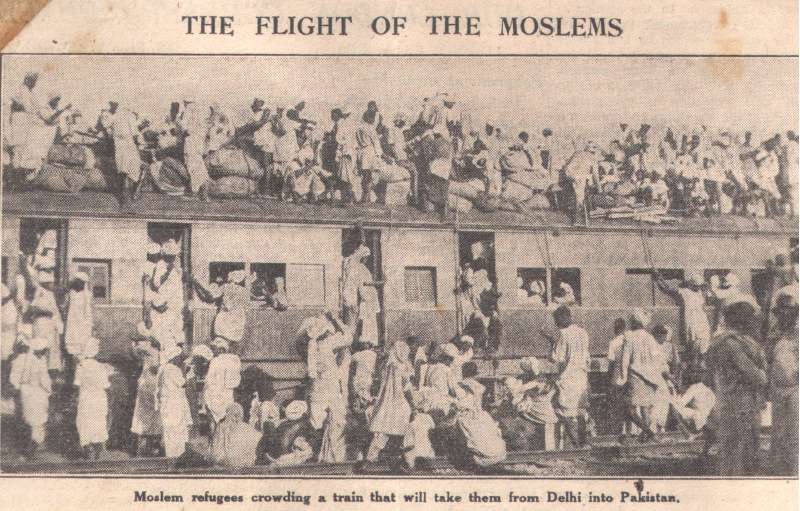
1) An archival image from the Chicago Sun-Times of the Lahore train station in September, 1947, where coils of barbed wire separate the waiting areas. Source: Fran Pritchett’s Archive
2) An archival image of a Delhi train station during Partition, published in The Manchester Guardian in September, 1947. Source: Fran Pritchett’s Archive
Attacks and persecution of minority populations in both India and Pakistan have been increasing. In Hindu-majority India, over 200 million Muslims face rising discrimination, hate and violence, while in Muslim-majority Pakistan, Hindus are among the top minorities who face religious persecution and violence such as forced conversions.
And with restrictions on cross-border communications, travel and trade, successive governments and militaries have controlled public perceptions.
“We’re working in an atmosphere that’s politically charged on both sides, and both sides seek to gain politically from the conflict. So as journalists, our job is very crucial because we are media-literate, and we can see through propaganda versus hard-core evidence-backed information,” said Singh.
Often, it’s the local journalists who are able to get that evidence.
“Independent journalists can move anywhere, without any kind of set direction in our heads, or from our bureau chiefs. So in that way, we are free to document what’s happening on-ground,” said Adil Abass, a 30-year-old independent journalist from the Union territory of Jammu & Kashmir.
Alam, co-founder of Islamabad-based magazine Earthwise, says that the media response on both sides during this conflict was worse than any he had ever seen, not during the Kargil war, during terrorist incidents, slug fests or shouting matches.
“During this conflict, journalists simply lost their ethics in a way that they never have on both sides of the border. This was something different. The state was following what the media was doing, and the media was egging the state to annihilate the other side. And journalism really died in that battle,” he said.
But he believes that like all challenges, it presents an opportunity, even a collaboration between like-minded sane voices from both sides.
“Journalists who do not monger war, who are sick and tired of the lies and fabrication in the news, social media and by the state, must step forward with the courage to hold hands across the border and work together,” said Alam. “It’s a huge challenge for Pakistani and Indian journalists, but that’s what the spirit of journalism is—to be able to take the first step in that direction.”