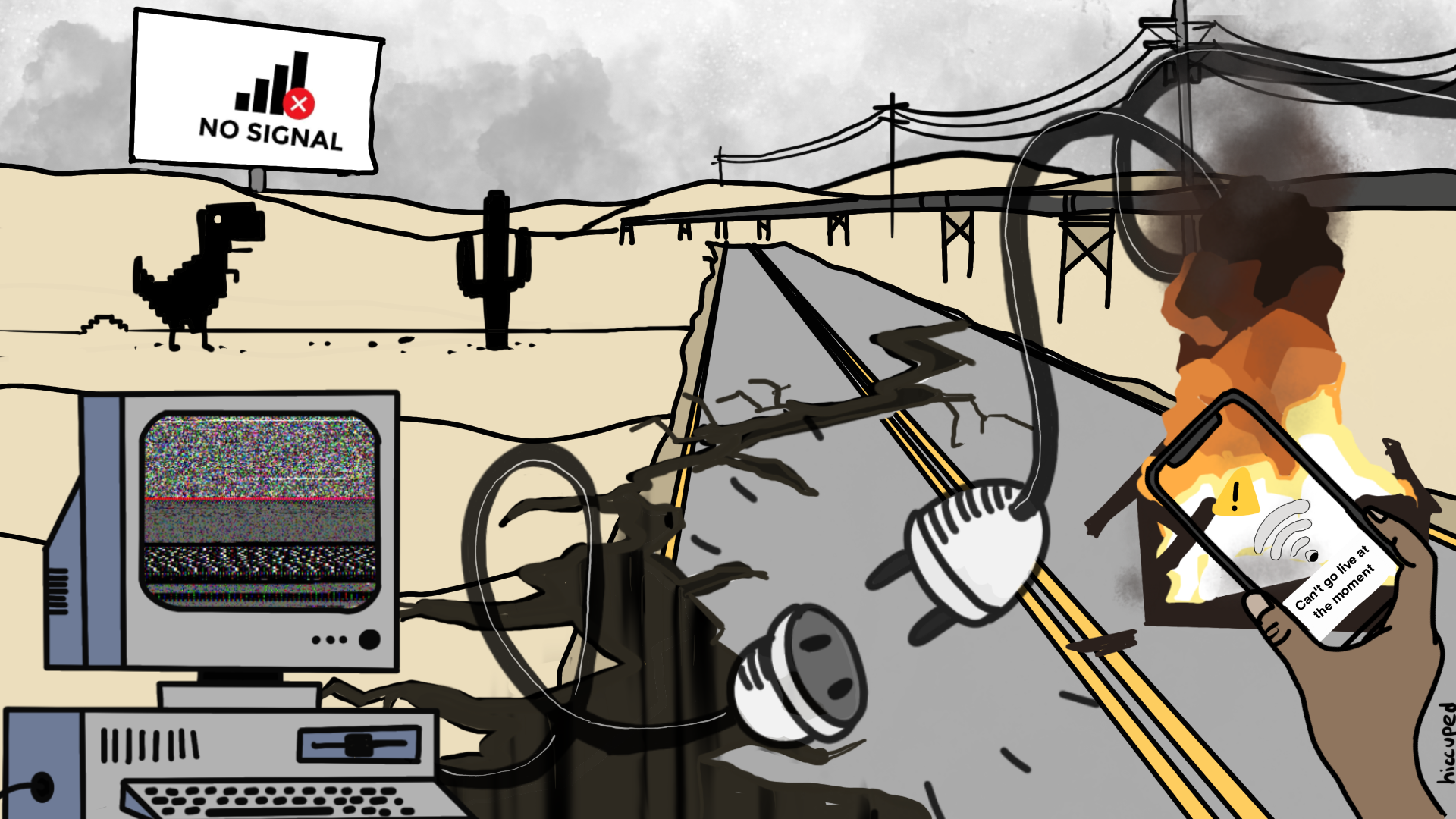
A new Asian Dispatch analysis mapped nearly 400 internet shutdowns in the last five years across South Asia. Illustration: Sharanya Eshwar
Across the world, social media has emerged as a means to collectively voice opinion and advocate for causes since the early 2000s. In South Asia, where internet penetration rates and mobile phone usage are some of the highest in the world, the platforms have been instrumental in democratising freedoms of speech and expression too.
The data speaks for itself. In India, over 70 percent of the population was using the internet as of 2024 data by International Telecommunication Union. In Bangladesh, that rate came up to 44.5 percent in 2024. The mobile broadband subscriptions stand at 899 million users for India and 98 million users in 2024. Looking at data from 2023 for Sri Lanka and Pakistan, we see the connectivity rate at 51.2 percent and 27.4 percent, respectively. The active mobile broadband subscriptions are at 73.5 per 100 people for Sri Lanka and 55.1 per 100 for Pakistan, as of 2024.
At the same time, the digisphere has created a new landscape for non-elite civic participation in everyday politics and political activism, wrote Dr Ratan Kumar Roy, a media studies professor from Bangladesh based in India, in his white paper on digitisation and civic participation. “Politics in the digital age is often subtle and takes on forms different from traditional political activism. This can include liking, sharing or commenting on political content, which can collectively have a large impact,” Roy notes in the report.
According to digital rights group Access Now, South Asia has seen some of the world’s leading internet shutdowns for over six consecutive years until 2024. In their 2024 report, they note that India witnessed 116 internet shutdowns in 2024 and over 500 in the last five years.
Mishi Chaudhary, the founder Software Freedom Law Center (SLFC.in) in India recalls two types of internet shutdowns: Preventive – that are imposed in anticipation of an event that may require the internet to be suspended by the state – and reactive, which are imposed to contain ongoing law and order situations.
Internet shutdowns can take various forms, from blocking of certain websites to partial or full telecommunication and internet shutdowns.
“Internet shutdowns are the easiest tool in the toolbox for governments to control the flow and dissemination of information,” Chaudhary tells Asian Dispatch. “Although no evidence has ever been presented about the effectiveness of shutdowns, state authorities, fearful of the ease of organisation via the internet, are quick to use this blunt instrument of state power.”
In this piece, Asian Dispatch mapped 397 shutdowns between July 2019 and 2024 in India, Sri Lanka, Pakistan and Bangladesh out of which shutdowns in India, Pakistan, Bangladesh and Sri Lanka stand out. This data doesn’t include Afghanistan, Bhutan, the Maldives and Nepal, where internet shutdowns of this measure have not been documented.
Internet shutdowns have tangible real-world costs. In 2024, Pakistan’s economy was estimated to have lost between $892 million and $1.6 billion, according to the Information Technology and Innovation Foundations, a Washington-based think tank working on science and technology policy. In 2018, Sri Lanka faced an estimated $30 million loss due to similar measures, as reported by NetBlocks. The figures for India in 2024 stand at $322.9 million, as per the report by Top10VPN.
Robbie Mitchell, Senior Communication and Technology Advisor for the Internet Society, a global charitable organisation, says that information blackouts resulting from internet shutdowns can, in fact, result in increased violence. He elaborates further by adding that violent tactics of protest are less reliant on effective communication mechanisms and thus they could substitute non-violent protests that rely on the internet for planning and organization in the cases of internet shutdowns.
“In addition, internet shutdowns tend to attract international attention and create pressure on countries that undertake them. This relates to the so-called ‘Streisand effect,’ where the attempt to silence voices or hide information leads to the unintended consequence of bringing more attention to them,” Michelle says.
Left in the Dark
Mandeep Punia, a 30-year-old journalist from India, says that any internet shutdown causes a “fear of the unknown” in the society. Punia has experienced shutdowns first during the 2016 Jat community reservation protests, as well as the 2019 shutdown in Kashmir during the abrogation of article 370, among others. The most recent internet shutdown in India was in the state of Haryana in August 2025, as recorded by the internet tracker maintained by SLFC.
About 3,000 kms away, in Sri Lanka, Oshadi Senanayake, a civil society member and social worker, recalls the communication shutdown during the anti-Muslim violence in Sri Lanka in 2018. The series of violence saw the imposition of a nationwide state of emergency as Sinhalese-Buddhist crowds attacked Muslims and their establishments in the city of Kandy. “When the means of communication were restricted, it was very difficult,” she tells Asian Dispatch. “We were all in the dark, no one knew what was going on and there was no way to find out either.”
The similarity in these narratives connects the dots across South Asia on how internet shutdowns impact people.
In 2024, Pakistan invoked the region’s most recent shutdowns, which was done to curtail mass uprising in support of jailed former prime minister Imran Khan. This was one of the 17 shutdowns Pakistani people faced in the last five years, as per data collected by Asian Dispatch.
The same year, in July, Bangladesh saw mass protests by university students over government jobs, which eventually upended Sheikh Hasina’s 21-year rule. Her government resorted to internet shutdown in order to curb the organised movement. Over 1,000 people were killed during the protests, as per a report released by the interim government led by Nobel Laureate Mohammad Yunus.

At the same time, Asian Dispatch learned of students finding ways to circumvent the internet blackout, specifically by urging the residents to open their Wi-Fi networks, either by removing passwords or using “123456,” to support the movement. Shahriyaz Mohammed, a student at the University of Chittagong, and Raihana Sayeeda Kamal, another student based in Dhaka, confirmed that such appeals were made. According to Roy, who is also a former media studies professor at BRAC University in Bangladesh, this appeal drew widespread response, with many complying.
At the same time, the communication blockade disrupted the academic and professional prospects for many. Kamal said that she graduated last July and was supposed to apply for her postgraduate work permit in Canada. “I couldn’t do it. I was out of touch from Canada. It hampered my job search and communications with my professors, and delayed my application,” she tells Asian Dispatch.
Raihana Sayeeda Kamal, a student based in Dhaka talks to Asian Dispatch about her experience of living through the internet shut down of 2024 in Bangladesh
Mohammed, who lives in Chattogram, the second largest city of Bangladesh, says that internet cuts take place anytime, and that the Internet Service Providers (ISP) do not give any prior notice.
“The internet is the most necessary thing for my occupation and also for my study,” he says. However, due to these shutdowns, he wasn’t able to communicate with his office or get any updates from other parts of the country during the protests which hampered work for him as a budding reporter.
Controlling the Narrative
In 2019, India abrogated Article 370 of the Indian Constitution, which accorded special privileges to the region of Jammu and Kashmir. Along with the announcement came a sweeping communication blockade in order to curb disruptions due to anticipated unrest. The blockade in the region lasted 18 months prior to the services being fully restored. In all, the region experienced 213 days of no Internet and 550 days of partial or no connectivity, as noted by the Internet Society.
“Due to COVID-19, everyone knows what a lockdown looks or feels like. But it was only worse in Kashmir as there was not a restriction to physical spaces but also to virtual spaces,” Sayma Sayyed*, a student at a leading university in India, tells Asian Dispatch on condition of anonymity.
The situation, she added, resembled a pre-digital era, with no internet or mobile reception, forcing people to travel several kilometers just to check in with their loved ones.
The lack of internet creates a void of information in the society, says Sayyed*, a resident of Baramulla in Kashmir. “When I had to fill my form for competitive exams, students had to rush to government offices to do so,” Sayyed added. “So I went to the District Commissioners office to fill my form which is when I realised something has happened. Something I could do on a leisurely day became such a big task.”
Within India, the Union territory of Jammu & Kashmir holds the record of the highest number of shutdowns in the country.
Another student from the valley, who also spoke to Asian Dispatch on condition of anonymity, highlighted the psychological impact of such situations. “You don’t feel normal in places outside Kashmir,” the student said. “When I shifted to Delhi for further studies, I was confused as I was able to carry out my studies without any restrictions. I expressed this to my friends and they, too, agreed with the lack of restrictions. It felt jarring to someone who has seen so many curfews and internet blackouts.”
In this video from 2020, a student from Kashmir Valley in India’s Jammu & Kashmir voices similar concerns to Sayyed’s over the delay in her B.Tech examinations and how due to lack of internet, applying for her sister’s entrance examination became a daunting task. Source: Internetshutdowns.in, a repository of internet shutdowns in India maintained by Software Freedom Law Center, India [SFLC.in]
In Bangladesh, Shamim Hossen, a 28-year-old humanitarian worker and the reporting officer at Muslim Hands International, a charitable organisation, highlights how those solely reliant on mobile data were completely cut off. “I use mobile internet and data, and when I am in my office, I use Wi-Fi. But during the internet shutdown, our office was closed so I have no experience using Wi-Fi during that time,” she tells Asian Dispatch.
Sri Lanka has seen the use of full internet shut downs as well as partial restrictions such as curbing access to social media websites for a certain duration. Incidents such as the Easter bombings in 2019 which saw serial blasts on multiple public and religious sites in Colombo, to the economic crisis of 2022 to the Presidential elections in 2023 saw the use of such measures. The country has seen 5 shut downs from 2019 to 2022, as per data collected by Asian Dispatch.
Amarnath Amarasingam, Assistant Professor at the School of Religion, Department of Political Studies, at Queen’s University in Canada, told Asian Dispatch about the relation between misinformation and shutdowns. “In Sri Lanka, when social media was blocked, citizens turned to alternative, less reliable sources,” he says. “These shutdowns made it difficult for credible journalists and activists to fact-check information, leading to a situation where rumours and conspiracy theories filled the void. In countries with ongoing communal tensions, the spread of false rumours can lead to real-world violence against civilians as well.”
Massive protests in Delhi. All communications have been suspended in select areas where the protests were scheduled to take place. Please report any Internet shutdowns to us @NetShutdowns
Reach out to us – +911143587126#LetTheNetWork #KeepItOn #delhi pic.twitter.com/ziUtYdJEMe— InternetShutdowns.in (@NetShutdowns) December 19, 2019
Women’s safety and internet shutdowns. How internet shutdowns impact women’s safety and travel in the national capital of India, Delhi. Source: Internetshutdowns.in, a repository of internet shutdowns in India maintained by Software Freedom Law Center, India [SFLC.in]
Highlighting the broader implication of using internet shutdowns to control dissent, Amarasingam adds: “Internet shutdowns have significant human rights implications, especially around issues like freedom of speech and access to information. Shutting down internet services curtails individuals’ ability to express dissent, participate in protests, or even access vital services such as health and education. All of this, of course, will impact marginalised communities more than others.”
“In Sri Lanka, these shutdowns particularly affect communities with fewer alternative sources of information and who rely on mobile internet for basic services. In the former war zones in particular, these alternative sources of information are key for receiving information that is not curated by the government.”
“Along with the professional, personal life also gets affected,” adds Aftab Mohmand, a 44-year old senior journalist from Peshawar. Mohmand adds that usually, one can circumvent restrictions through VPN or Wi-Fi. But in Peshawar, there is no such facility. Four of the 35 shutdowns Asian Dispatch has documented from 2019 to 2024 for Pakistan were in Peshawar province. “VPN data is monitored and it can be dangerous too,” says Mohmand. Since 2014, he has been using the phone to make reels, create reports and record everything using the internet.
Disrupting Normalcy
“My clients outside of Peshawar think that people from the region do not work properly due to internet restrictions coming up now and then. We had in fact replied to messages but they would reach one to two hours later, which affected our credibility.”
This is the ordeal of Sufi Ali, a 35-year-old IT officer from Mardan, located in Peshawar, Pakistan. Pakistan has recorded 35 shut downs between July 2024 to July 2019, according to the Asian Dispatch analysis. These include blocking the internet in response to protests such as the ones in support of former Prime Minister Imran Khan in 2022 to allegations of throttling with the internet speed by the government during the testing of speculated possible internal firewall.

Virtual Private Networks (VPNs) are often used to bypass shutdowns or access regionally blocked websites. But Mohmand notes that they significantly slow down internet speeds.
Journalists from India, Sri Lanka and Pakistan told Asian Dispatch that these restrictions make it nearly impossible to verify information for accurate reporting.
“I am a journalist so whenever we go out for conflict reporting, we face [internet shutdown],” says Punia, the rural journalist from India. “But the worst aspect of that is that our [media portals] are also shut down.
His concerns are mirrored by Sandun, a freelance journalist based in Sri Lanka. Talking about covering the 2018 anti-Muslim violence, she says the internet shutdown made their job even more difficult. “We treated every piece of news with suspicion and nothing could be verified. The officials were too silent or evasive and we didn’t have anyone on the ground. We felt like we would risk peddling misinformation,” she says.
READ: In Bangladesh, Cops Accused of Killing Protesters During 2024 Uprising Roam Free
On July 19 alone – the day Sheikh Hasina’s ousted regime enforced an internet blackout – at least 148 people were killed by law enforcement agencies, according to a report by the International Truth and Justice Project (ITJP) and Tech Global Institute.
CIR also identified two “peaks” in violence. The first was on July 18, where killings amounted to a massacre. It all started with the killing of a protester called Abu Sayeed, in Rangpur district, on July 16, which was captured in a now iconic image of him spreading his hands in front of the police force. The second peak in violence was on August 5, the day Hasina resigned and fled to India.
Both these peaks in violence also correspond to internet shutdowns, as Asian Dispatch has investigated.
The Policy Pitfalls
South Asian governments often cite national security and misinformation as reasons for internet shutdowns. However, these terms are frequently undefined or vaguely worded in legislation and policy, prompting global experts to raise concerns about their potential misuse.
In the absence of any explanations by government arms on the reasons behind these moves, speculation is rife. For instance in India, internet shutdowns are governed under the Temporary Suspension of Telecommunication Services Rules, 2024, which, under clause 3, explicitly states that the reason for such measures needs to be released in writing. However, these orders are seldom found in the public domain..
In Pakistan, the legal backing of shutdowns is murky as the Pakistan Telecommunications Authority (PTA) also recently highlighted this legal uncertainty. Numerous laws are speculated at play here, with most shutdowns being informed by PTA, the body responsible for establishing, maintaining and operating telecommunications infrastructure in Pakistan, via orders for enforcement by the Interior Ministry. Other than these orders it is believed that Section 54(3) of Pakistan Telecommunication (Re-organization) Act, 1996 is used for such shut downs, which has been ruled against by the Islamabad High Court in 2018. The opacity of such measures is widely recognised by activists and advocacy organisations in the country as well as globally.
Recently, Pakistani journalist Hamid Mir filed a petition in Islamabad High Court, requesting for clarity on why the internet speed in the country were significantly lagging in the past few months, leading to even voice notes or multimedia on WhatsApp not reaching receivers. The petition comes at a time when speculations are rife about the government installing a “fire wall” that would prevent free and open use of the internet in Pakistan.
Other laws in Pakistan, such as the Prevention of Electronic Crimes Act, 2016 (PECA) under its 2025 amendment-equipped section 26(A) criminalise intentional dissemination of false information in the country. ‘Fake news’ is also the basis of many internet shutdowns, thereby hinting at the indirect use of the act for enforcing such measures.
Sri Lanka, too, sees a similar trend in a mix of non-specific regulations being used to curb internet and social media access in the country. Orders to the Sri Lankan Telecommunications Regulations Commission by the Ministry of Defense have been seen as ways of enforcing such curbs. Reasons for shutdowns range from curbing the spread of misinformation, to stopping demonstrations such as during a state of emergency.
Amarasingam says that the absence of official communication during internet shutdowns often leads to an information vacuum, which can fuel misinformation.
“The problem is that in authoritarian contexts, misinformation merely means critiques of the ruling party. And ‘terrorism’ often just means agitation against the government. And so, these terms are weaponised to curtail fundamental rights. In these contexts, shutdowns may hinder the spread of accurate information, create distrust, and deepen existing societal divisions,” she says.
In India, the law is clearly laid out but often not applied consistently. For this, Chaudhary of SLFC says that the civil society has to constantly approach the courts to enforce their rights. “Time period of shutdowns are extended continuously despite limitations imposed by law. Law requires proportionality,” Chaudhary says, adding that the proportionality of these actions is far more than required for the general good.
“Can shutting down the entire system of social communications and completely crashing the payments economy for months be ‘proportional’ to the necessary problem of preventing the incitement of intercommunal riots? If this government intervention is the ‘least restrictive means,’ what are the other more restrictive means the government would not be allowed to use?” Chaudhary asks. “The mind boggles.”
Mitchell from the Internet Society adds further context to the consequences of these actions: “Internet shutdowns tend to attract international attention and create pressure on countries that undertake them. This relates to the so-called Streisand Effect, where the attempt to silence voices or hide information leads to the unintended consequence of bringing more attention to them.”
Digital Rights are Human Rights
When asked whether they were informed prior to internet shutdowns, there’s an astounding “no” from those interviewed for this piece.
Numerous international statutes reaffirm that the internet is an indispensable part of human rights. The United Nations Human Rights Council enshrines this in Article 19 of the Universal Declaration of Human Rights, which “protects everyone’s right to freedom of expression, which includes the freedom to seek, receive and impart information of all kinds, regardless of frontiers.” Restrictions to right to freedom of expression are only permissible under article 19(3) of the Universal Declaration of Human Rights, although it notes: “When States impose internet shutdowns or disrupt access to communications platforms, the legal foundation for their actions is often unstated.”
In India, on two separate instances – by the High Court of the state of Kerala and then the Supreme Court – access to the internet has been declared a fundamental right under the Indian constitution.
“In India, the law is clearly laid out but often not applied consistently. adds Choudhary of SFLC.in.
In Bangladesh, a similar trend exists. Asian Dispatch spoke to students and young professionals who didn’t receive any prior intimation of internet shutdown orders in the last one year. The trend is to slow down the internet, and then slowly revoke access fully, says Kamal, from Bangladesh.
Noting the impact of shutting down the internet, Michelle says: “Internet shutdowns have far-reaching technical, economic, and human rights impacts. They undermine users’ trust in the internet, setting in motion a whole range of consequences for the local economy, the reliability of critical online government services, and even the reputation of the country itself. Policymakers need to consider these costs alongside security imperatives.”
While law governs social media and not internet shutdowns directly, it is worth noting that the negative effects of problematic regulations become yardsticks for regimes that govern a similar cultural and social landscape.
“It also stops people from both demanding and empowering government action to protect its people,” Chaudhary adds. “Shutdowns don’t create the social and political will to safeguard our people, but rather a cloak for the government to hide its shame.”
Punia, the journalist from India, agrees and adds that freedom of speech and expression are never absolute. “They are only useful until one has to show them as democratic for indexes and rankings and gain marks there,” he says.
These are just a few examples of the broader impact experts point to. Given the concerns raised by individuals like Sayyed in India and Hossen in Bangladesh, a critical review of both the shutdowns and the frameworks enabling them is long overdue. Access restrictions need to be brought to the fore and the internet needs to be given a fair chance to make a case for its freedom.
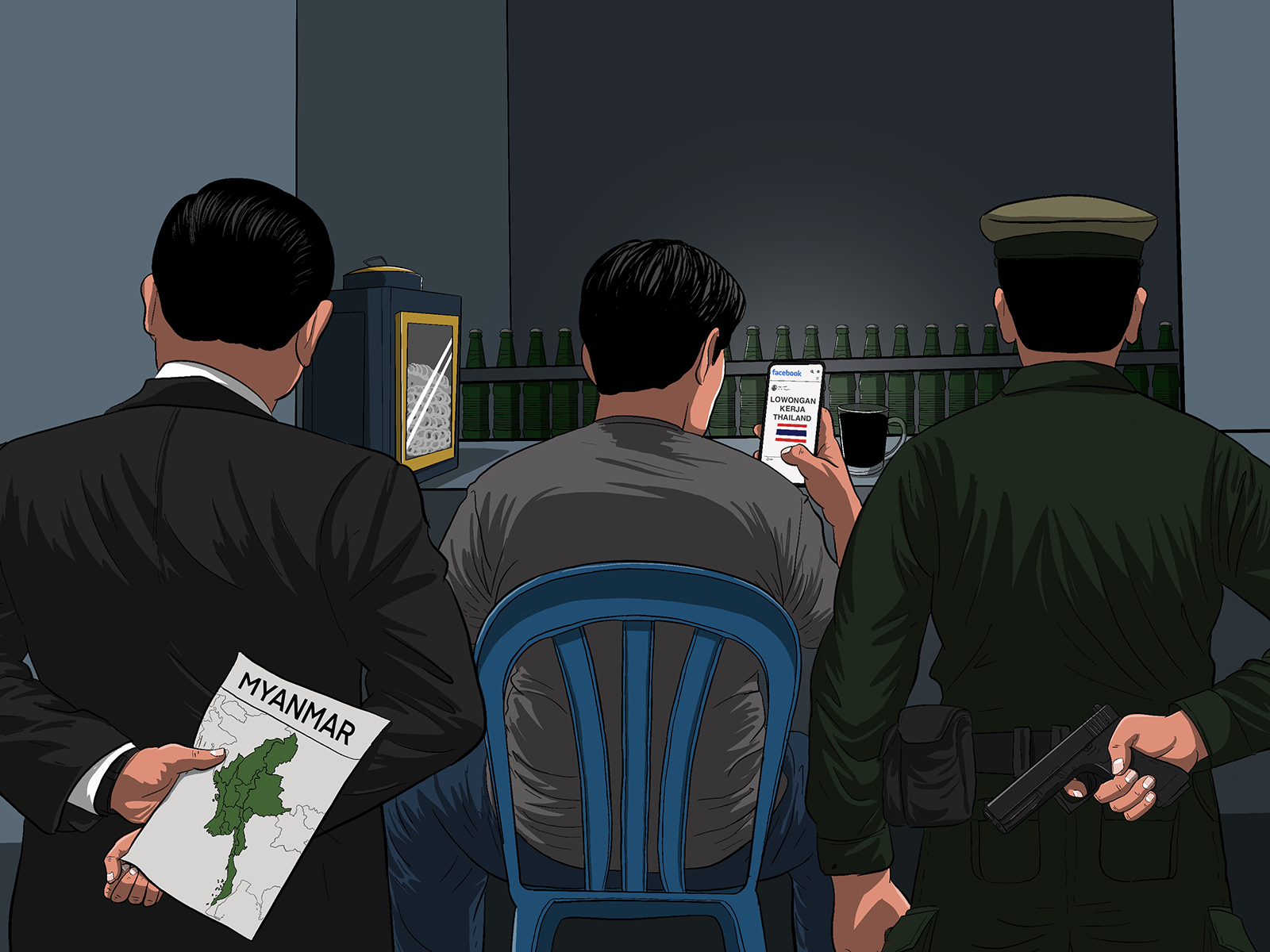
In Jakarta, Indonesia, for two years, the families of human trafficking victims have waited anxiously for the return of their loved ones, who have been forced into slavery in online scam operations in Myanmar. These families continue to hope the Indonesian government will intervene and rescue them.
“Please, Indonesian government. How much longer will our family remain abandoned?” asked Yanti, the sister of one of the victims still trapped in Myanmar.
Myanmar—along with Cambodia, the Philippines, Laos, and Thailand—has become a Southeast Asian hub for pig butchering scams. This form of long-term financial fraud involves perpetrators building trust with victims, often through fake romantic or friendship relationships, before convincing them to invest in fraudulent schemes.
As of March 2024, Indonesia’s Ministry of Foreign Affairs reported that 30 Indonesian citizens remain trapped in Myanmar.
“We truly understand the families’ concerns, and I will do everything possible to bring them home. However, the problem lies in accessing such a dangerous area. No foreigner has ever managed to enter it,” said Rina Komaria, Head of the Southeast Asia Sub-Directorate at the Directorate for the Protection of Indonesian Citizens, Ministry of Foreign Affairs.
Recruitment Pattern
Friend’s Deception
The COVID-19 pandemic devastated lives, leaving household finances in ruins. Many people were laid off, struggled to find new jobs, and became burdened with debt. This situation made some individuals easy targets for human trafficking syndicates.
These organized crime groups recruit victims through various methods. They post fake job advertisements on social media, posing as trusted institutions. They also exploit their own friends––as happened to Siska and her husband, Tito.
The couple’s nightmare began when Ahong, a friend, visited their home and tricked Tito into becoming a victim of human trafficking. As of August 18, 2024, Tito was still trapped in Myanmar.
“Ahong would eat and drink at our house when he was struggling financially. My husband trusted him. They were close friends—how could my husband think badly of him? And then, he deceived my husband,” Siska said.
In the past, Tito and Ahong worked for the same company. But later, Ahong moved to Thailand. When he found out that Tito had been laid off, he invited him to work at “a tech company” in Thailand, promising a monthly salary of Rp8 million (US$510)—a significant amount compared to Indonesia’s minimum wage of around US$286.
At first, Tito declined because he didn’t have money for travel expenses.
“But Ahong was persistent and even offered to cover the costs,” Siska said.
Siska recalled how Ahong reassured them: “Don’t worry, everything’s safe. There’s nothing strange. I’ll handle everything.”
“So my husband agreed. Our financial situation was bad, and he was stressed about our debts,” Siska explained.
In April 2022, after Ahong arranged the administrative and financial matters, Tito left for Thailand alone. At a Bangkok airport, someone claiming to be from the company—an associate of Ahong—picked him up. Tito stayed in a Bangkok hotel for three days, waiting for another worker, a man from Palembang.
On the third day, a company representative took Tito and the man from Palembang on a long journey through the jungle. When they finally arrived at the company, Tito saw Ahong again.
Soon after, Siska began having trouble contacting her husband—the company had confiscated his phone, allowing Tito to use it only twice a week.
Siska occasionally reached out to Ahong for updates, but over time, her husband told her to stop.
“Don’t contact Ahong anymore. If you do, it’s like killing me. He sold me to the Chinese to work as a scammer,” Siska said, recalling her husband’s words.
“At first, my husband thought he was still in Thailand. Later, he realized he was already in Myanmar,” she added.
Siska never discovered her husband’s exact location, and then Ahong disappeared.
“I’ve lost contact with my husband, and Ahong’s number is no longer active. But I’ve heard that Ahong has returned to Indonesia,” Siska said.
According to a May 2024 report by the United States Institute of Peace (USIP), Chinese criminal networks operating in Myanmar shifted their focus during the COVID-19 pandemic.
Initially, from 2017, these criminal organizations controlled illegal cyber gambling businesses along the Myanmar-Thailand border, with support from the Karen Border Guard Force (BGF), which is affiliated with the Myanmar military. In 2020, the Myanmar government shut down many of these operations in Karen State (now called Kayin State). However, following the military coup in February 2021, these criminal organizations resurfaced and expanded into running pig butchering scams.
During the COVID-19 pandemic, China closed its borders, making it difficult for these networks to recruit workers domestically. As a result, they began targeting workers from other countries, including Indonesia.
“Globally distributed human trafficking networks play a role in this process. Their task is to deliver job seekers to scam centers. And Myanmar-based criminal groups are the ones who pay them,” the USIP report stated.
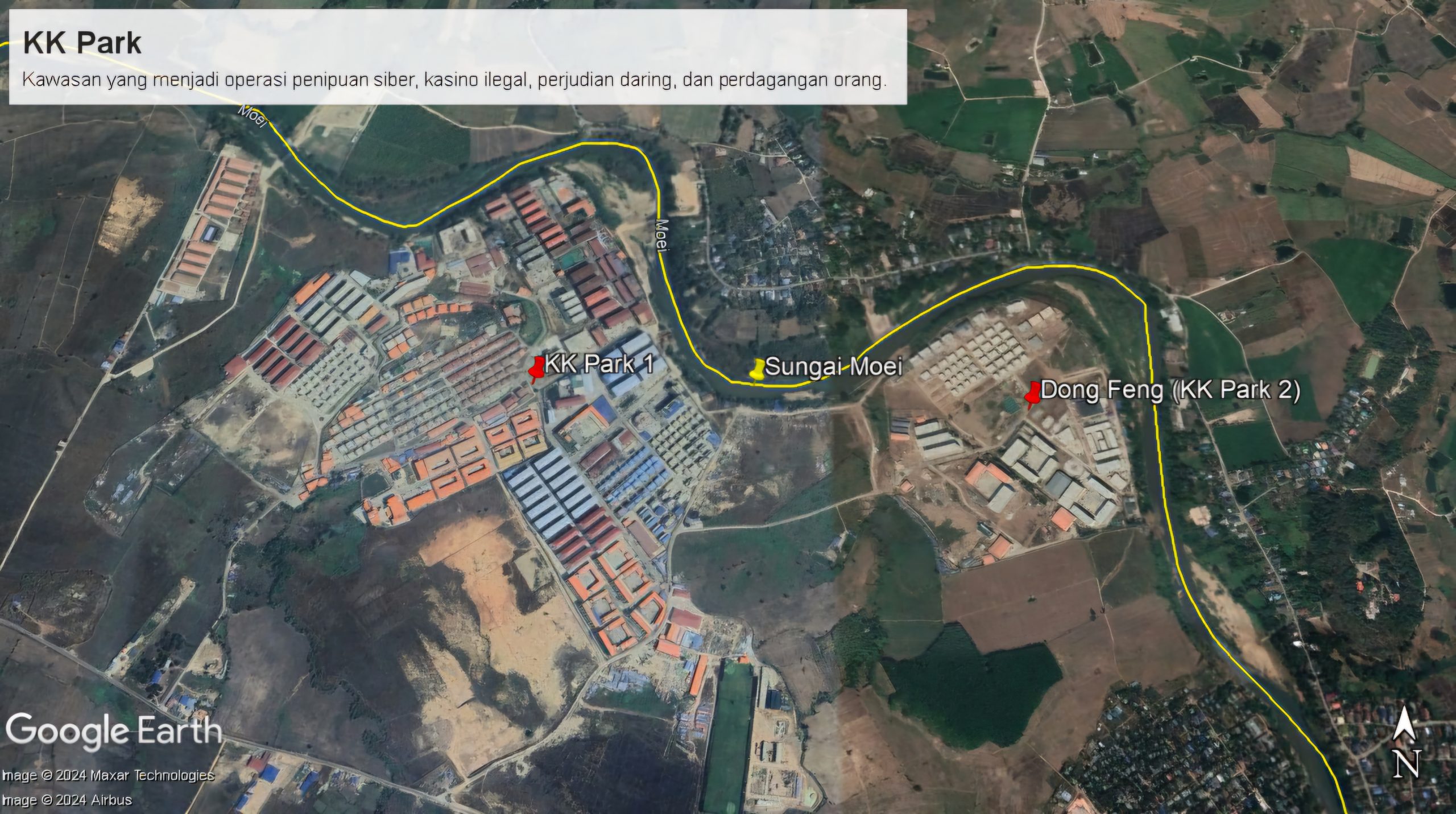
Satellite images of KK Park, an area that has become a base for cyber fraud, online gambling, and human trafficking operations in the state of Myanmar. (Google Earth)
Broker’s Promises
A panel of judges at the Bekasi District Court found Andri Satria Nugraha and Anita Setia Dewi guilty of human trafficking on February 5, 2024. The judges sentenced each of them to eight years in prison and fined them Rp200 million (US$12,763), with an additional four months in jail if they failed to pay the fine. The court also ordered them to jointly pay Rp600 million (US$38,292) in restitution to the victims, or serve an additional six months in prison if they do not pay.
Andri and Anita recruited and deceived dozens of Indonesians, forcing them to work as cyber scammers in Myanmar. Twenty victims recorded a video testimony about the fraud and torture they endured, which went viral on social media and prompted a response from President Joko Widodo.
On May 5, 2023, the Ministry of Foreign Affairs, through the Indonesian embassies in Yangon, Myanmar, and Bangkok, Thailand, successfully evacuated them from Myawaddy, Myanmar. Four days later, the National Police’s Directorate of General Crimes (Bareskrim) arrested Andri and Anita at Sayana Apartment, Kota Harapan Indah, Bekasi Regency.
However, some of Andri’s and Anita’s victims remain trapped in Myanmar.
One of them is Pendi. His wife, Mona, is still fighting for her husband’s return to Indonesia.
The restaurant where Pendi worked went bankrupt due to the COVID-19 pandemic, leaving him with no choice but to work odd jobs. Sometimes, he worked as a motorcycle-taxi driver, and other times as a private driver. His income was barely enough to cover daily expenses.
One day, he met Andri Satria Nugraha and Anita Setia Dewi at Summarecon Mall Bekasi. The couple offered Pendi a job at “a technology company” in Thailand, promising a one-year contract with a monthly salary of around Rp10 million to Rp20 million (US$639 to $1,277).
They also promised to cover his flight, meals, accommodation, and other administrative costs. All that was required was proficiency in English and fast typing skills.
“They soon had a Zoom meeting, where Andri and Anita appeared along with eleven other victims. The departure process moved very quickly after my husband met them,” Mona said.
Mona grew suspicious because Andri and Anita never disclosed the name of the company, saying only that it was located in Bangkok.
“But my husband went anyway because he had good intentions—he wanted to provide for the family. So he accepted the offer to go to Thailand,” Mona said.
Andri and Anita arranged the departures in two groups. Pendi and four others—two women and two men—were part of the first group, which left Jakarta in July 2022. The second group departed from another location at a different time. Meanwhile, Andri and Anita stayed behind in Indonesia.
“When he arrived in Thailand, my husband contacted me. Someone from the company, who seemed to be in charge, picked him up. He looked Chinese but spoke with a bit of a Malaysian accent,” Mona said.
The company representative took the victims to a hotel in Bangkok, where they spent the night. The next day, they were driven 500 kilometers to Mae Sot, a city on Thailand’s western border with Myanmar, before crossing the Moei River. None of the victims realized they had been smuggled into Myanmar.
Once there, the company confiscated their passports and forced them to practice speed typing. They also restricted mobile phone use, making it difficult for Mona to contact Pendi.
“Three weeks later, my husband sent me a letter saying he had realized he’d been tricked. He asked me to report it to the Indonesian authorities,” Mona said.
Language Course Center
Yanti remembers Wahyu as an introverted person, determined to achieve his dreams. Ever since graduating from college, her brother had dreamed of working in South Korea. To pursue that goal, he enrolled in Korean language courses at the Korean Language Center Indonesia (KLCI) in Sukabumi—run by Latif Aliyudin.
“My brother took the Korean language test in Jakarta twice before he finally passed and got his certificate,” Yanti said.
With Latif’s help, Wahyu was almost sent to work at a manufacturing company in South Korea, but the plan was postponed due to the COVID-19 pandemic. In the meantime, Wahyu took on odd jobs, with his last position as a part-time teacher, earning Rp600,000 (US$38) per month.
“Then the course reached out again and offered him another opportunity, asking, ‘Do you still want to work in Korea? Departures have reopened,’” Yanti recalled. “My brother agreed because it was his dream.”
KLCI Sukabumi requested Rp20 million (US$1,278) for Wahyu’s departure costs. His family helped pay in installments—first Rp3 million, then Rp5 million—until the full amount was covered. However, Wahyu never went. KLCI said that processing the visa and work permit for South Korea was still complicated.
As an alternative, Latif suggested that Wahyu take a job at “a Korean subsidiary in Thailand.”
“He said it would only be for three months, at most, before my brother could finally go to South Korea. Wahyu agreed because he was unemployed, getting older, and had already paid in full,” Yanti explained.
Latif introduced Wahyu to a man named Ardli Fajar, who arranged accommodation for Wahyu at the City Park Apartment in Cengkareng. In November 2022, Wahyu departed for Thailand.
After Wahyu moved, Yanti found it difficult to stay in touch with him. His phone was often inactive, and her messages would only show a single check mark.
“I tried messaging him, but it would take three or four days—sometimes even a week—before he replied. He said he was healthy. I stayed positive, thinking maybe he was just adjusting to the work there. By December 2022, I still hadn’t heard much from him,” Yanti said.
Months passed, and Yanti completely lost contact with her brother. The family grew increasingly worried, especially as news reports about fraud and human trafficking in Southeast Asia began to surface.
“One day, I sent him some news articles and asked about his location and how he was doing. Two weeks later, he finally replied. But his messages sounded strange, like he was scared,” Yanti recalled.
Wahyu told her that he had been smuggled into Myanmar through Thailand. He wasn’t working at a manufacturing factory but had been forced to work as a cyber scammer—and he wasn’t getting paid.
“Brother, just escape,” Yanti urged.
“I can’t. I’m trapped behind a mountain.”
“Are they torturing you?”
“Yesterday, they electrocuted me,” Wahyu replied. “Don’t tell Mama. I’m afraid she’ll get sick from stress. Just pray for me to stay strong here.”
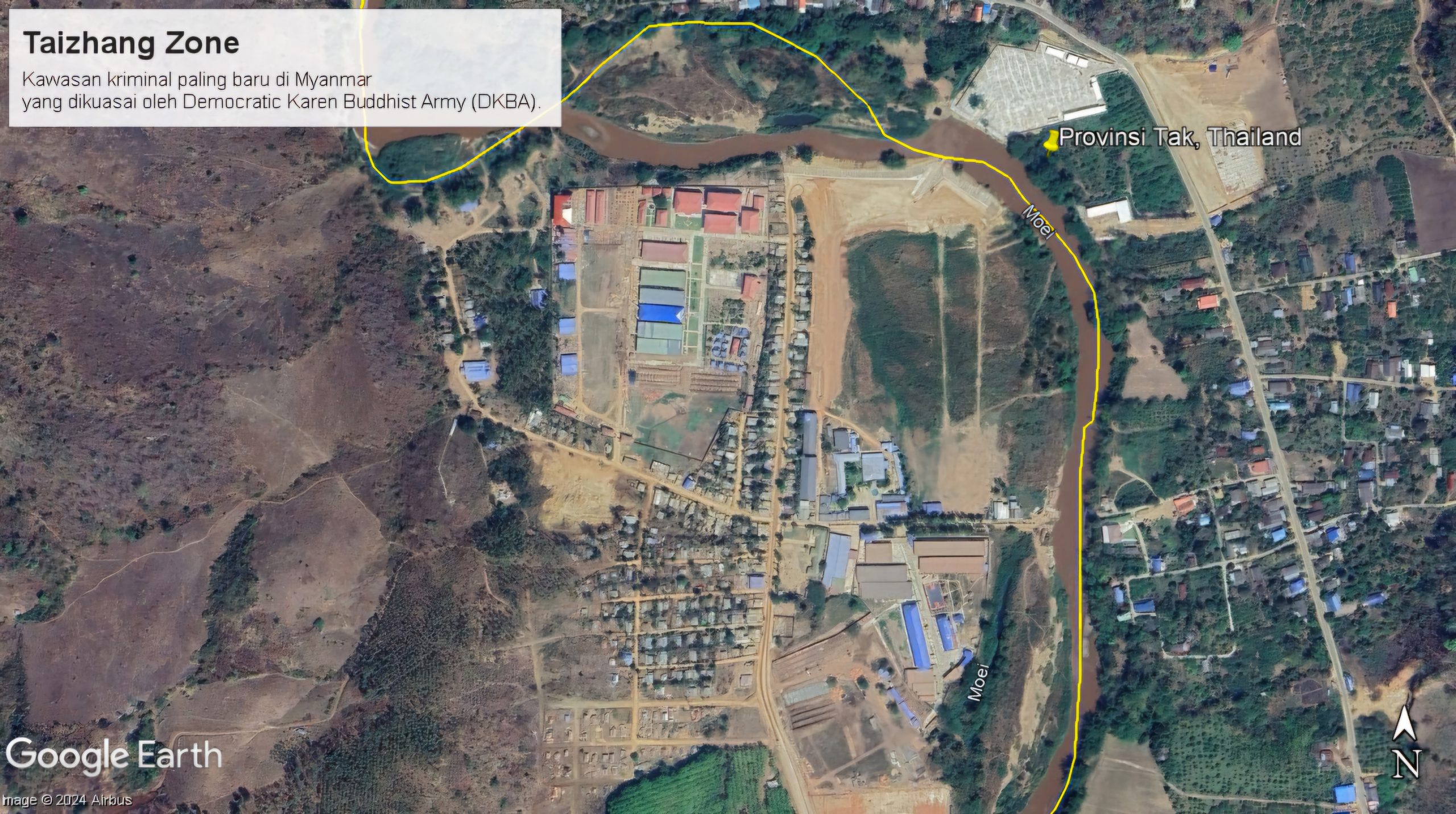
Satellite images of Taizhang Zone, the latest criminal area controlled by armed groups in Karen State, Myanmar. (Google Earth)
Days in the Camp
In Myanmar, Indonesians forced to work as pig butchering scam operators endure extremely long, inhumane working hours—17 to 20 hours a day with only 30 minutes of rest, without holidays or pay.
The cyber fraud organizations force these enslaved workers to scam 100 people each day, primarily targeting citizens from the United States, Canada, and Australia. If they fail to meet their targets, their working hours are extended, or they face physical punishment. These punishments include standing for hours, running 30 laps around a soccer field while carrying a water-filled gallon, doing hundreds of push-ups, being hit with blunt objects, whipped, or even electrocuted—depending on the severity of their failure.
After being electrocuted by the syndicate, Wahyu’s body was covered in bruises, and he struggled to walk.
“His legs hurt, so he had to walk slowly. But even in that condition, he comforted us,” Yanti said.
Yanti recalled her brother telling her: “Don’t worry about me. I wore layers of clothes—thick ones. So when they electrocuted me, it didn’t feel as bad.”
“But being electrocuted is still being electrocuted—it breaks my heart,” Yanti said.
The victims have lost all choice and control over their lives. The company forces them to keep scamming, even though it goes against their conscience.
Siska recalled her husband Tito saying: “Bu, I can’t stand lying to people. When I look at the photos of the people I’m supposed to scam, I see their children and families. It makes me think of you and the kids at home. That’s when they beat me.”
“So my husband just accepted it when they beat his thighs with iron rods and beams until they bruised. Eventually, they hit him on the head. He wanted to fight back, but he couldn’t,” Siska said.
The Pig Butchering Scam
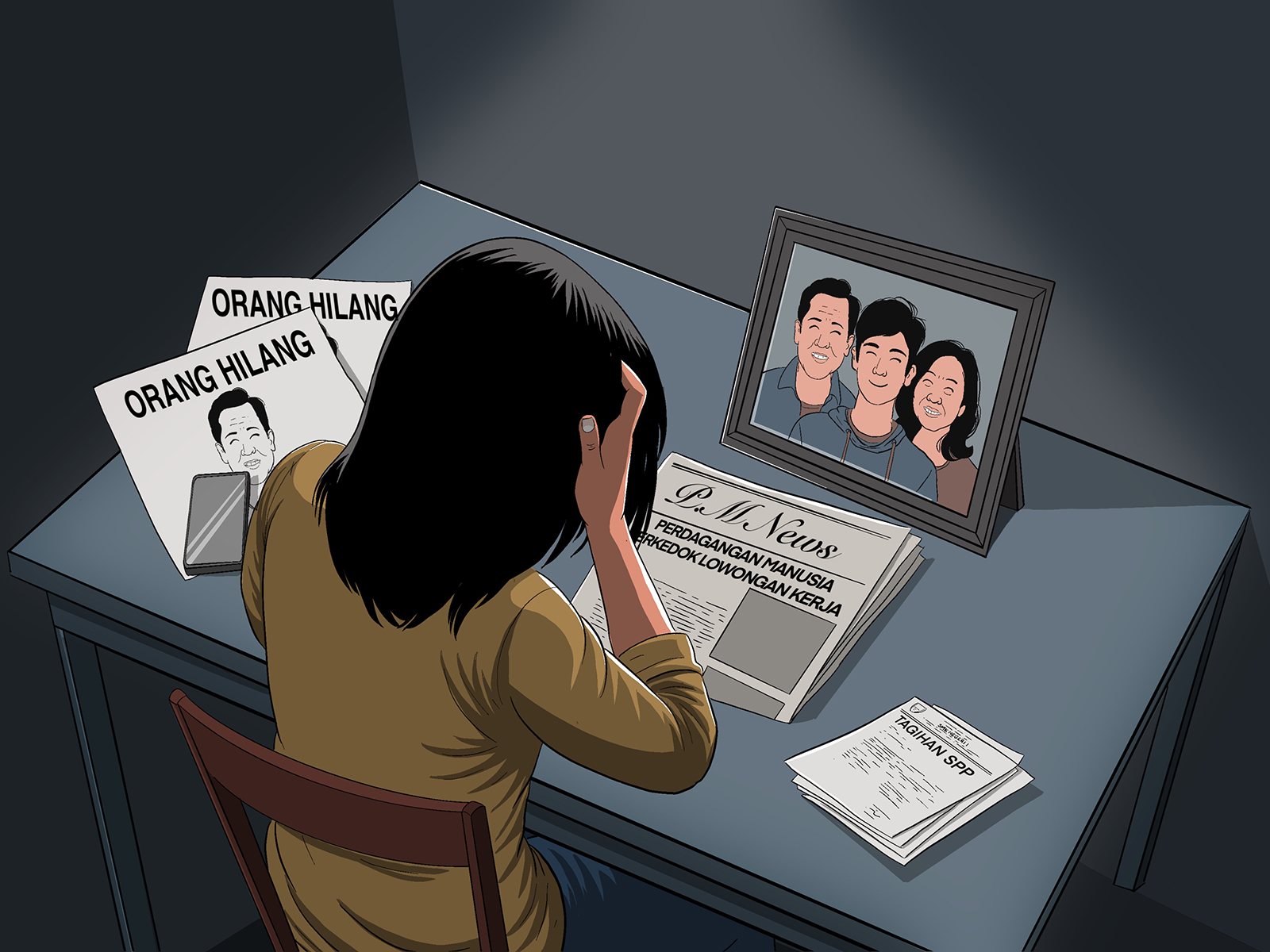
An illustration of the families of human trafficking victims in Myanmar. (Project M/Aan K. Riyadi)
The pig butchering scam is a type of online investment fraud with two stages.
The first stage, known as “fattening the pig,” involves building trust between the scammer and the target. Scammers use fake identities to approach their targets on social media. In some cases, they steal real people’s identities.
The scammers often pose as glamorous, wealthy individuals—attractive, upper-class men or women—who flaunt luxury goods, enjoy horseback riding, travel the world, and drive Ferraris. They use these personas to lure wealthy targets.
Initially, the scammer is warm and friendly, engaging the target as if they’ve known each other for a long time. Once trust is established, the scammer introduces an investment opportunity, promising high returns through fake cryptocurrency trading platforms set up by the company.
The second stage, “butchering the pig,” begins when the scammer embezzles the target’s money. Once the target has invested large sums, the scammer vanishes, along with the investment platform, leaving the target in financial ruin.
But not all scams go as planned.
If the scammer fails to deceive the target, the criminal groups may extort the scammer’s family. For instance, the company might demand a ransom, promising to release the operator if the family pays.
The syndicate once demanded Rp150 million (US$9,560) each from Mona and Yanti for the release of Pendi and Wahyu. Similarly, they asked Siska for US$10,000 to free Tito. When the families couldn’t pay, the company threatened to sell the victims to other criminal groups.
Siska remembered Tito saying: “They sold me to a new company. They confiscated my phone. I can’t take it anymore. Please prepare US$8,000.”
“My husband called me, crying. He couldn’t endure it any longer. The punishments at the second company were even worse. But where was I supposed to get that kind of money?” Siska said.
Mona also had no choice but to accept that her husband would be sold to another company. On average, victims were sold more than twice.
“I asked my extended family for help, but I couldn’t raise that much money. I reached a point where I knew there was nothing else I could do. If my husband was going to be sold again, I just had to accept it,” Mona said.
“We’re also scared. Even if we pay, there’s no guarantee they’ll come home. If not, we’ll just end up in debt,” Yanti added, thinking of her brother, Wahyu.
But the company doesn’t care whether the families have money or not—they just want payment.
Yanti once told the company she couldn’t afford to pay.
“They told me, ‘If you can’t pay, we’ll take him to an underground prison,’” Yanti said.
“At that point, we didn’t know my brother’s condition. We feared the worst—thinking he might die,” she added.
Demanding Repatriation
Transnational crime has a domino effect. The victims’ families—mostly wives—not only suffer emotionally but also bear the financial burden alone.
Siska works tirelessly to support her family and ensure her two young children get enough nutrition.
“Now I have to work harder than ever. In the morning, I run a laundry service from home,” Siska said. “In the afternoon, I work at a clothing store until 10 p.m. If I’m not too tired, I stay up ironing until dawn.”
Mona is in a similar situation, now working as a domestic worker to support her family. Her and Pendi’s two children had to drop out of college to help with the family’s financial struggles.
“They’re working now. We help each other. I feel guilty that their father’s situation has burdened them, especially at such a young age,” Mona said.
These women have taken on multiple roles as they continue to fight for their families. They’ve appealed to the police, BP2MI, the Ministry of Foreign Affairs, the National Commission on Human Rights, and even visited the House of Representatives. Several civil society organizations have supported them, yet they still have no clear answers.
“The government keeps asking us to be patient and wait. We don’t know what the obstacles are—we’re just housewives who don’t understand diplomacy,” Mona said.
“The police still haven’t arrested Latif. They’ve summoned him twice. They should bring him in by force,” Yanti added, referring to Latif Aliyudin, the owner of the Korean Language Center Indonesia (KLCI) in Sukabumi.
“My husband even asked me to seek financial help from people in the village. He said, ‘If the government can’t bring me home, we’ll have to prepare the ransom ourselves,’” Siska said.
Exhausted from fighting alone, the women started a joint movement called “Jerat Kerja Paksa” (Forced Labor Trap), a self-help initiative supporting victims and families of modern slavery in Southeast Asia.
They’ve shared their struggles in public forums and, most recently, sent an open letter to President Joko Widodo on June 26—World Day Against Torture—through the State Secretariat. In the letter, they urged Jokowi and his cabinet to address human trafficking urgently.
“No one deserves to be tortured, and no one should have the right to torture others,” the letter stated.
Meanwhile, the Directorate of Protection of Indonesian Citizens at the Ministry of Foreign Affairs said they have not yet been able to rescue the victims.
The Ministry of Foreign Affairs said they have tried several approaches, including seeking assistance from the Myanmar government, approaching the government of the People’s Republic of China (details of which they cannot disclose), and communicating with the Karen Border Guard Force that controls the Karen State.
“The (Myanmar) government can’t reach the victims because their location is too close to the conflict zone,” said Rina Komaria, Head of the Southeast Asia Sub-Directorate of the Directorate of Protection of Indonesian Citizens at the Ministry of Foreign Affairs.
Myanmar has been engulfed in a prolonged civil war, which intensified after the military staged a coup against the civilian government in February 2021. The conflict has spread across several regions, including Shan, Kachin, Karen, Rakhine and central Myanmar.
“About five to seven people are in the Hpa-An area. It’s extremely remote and close to the heart of the conflict. Not only is it difficult for Indonesians to reach, but even Myanmar authorities struggle to access the area,” Rina added.
Hpa-An is a major city in Karen State, a region that has drawn the attention of international human rights activists due to its role as a hub for transnational criminal operations.
Several areas in Karen State are suspected of being bases for cybercrime, online gambling, illegal casinos, and human trafficking. These include Apollo Park, Yatai New City (Shwe Kokko), Yulong Bay Park, KK Park 1 & 2 (Dongfeng), Dongmei Park and Myawaddy Town.
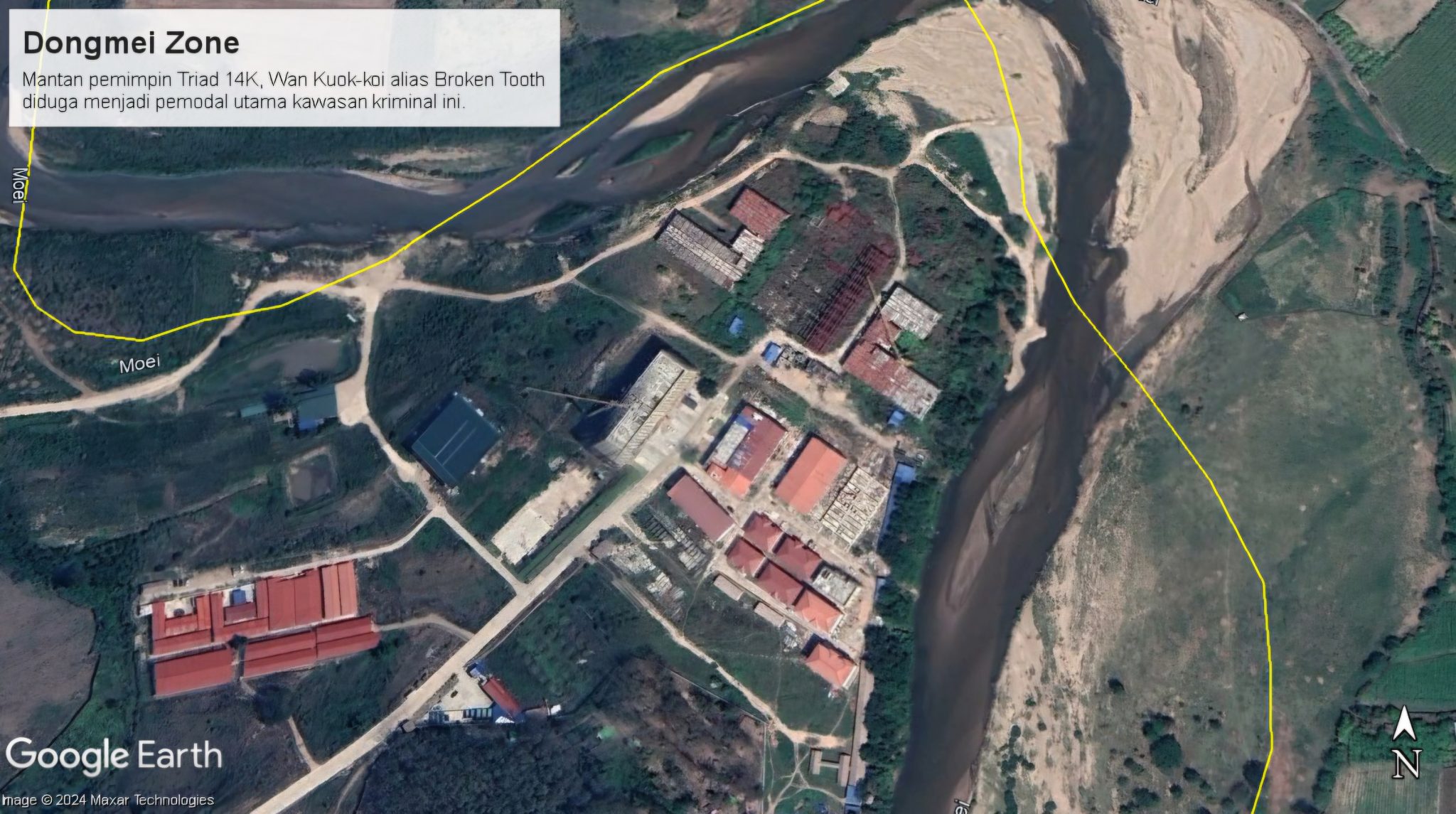
Satellite images of Dongmei Zone, which has become a hub for cyber fraud, online gambling, illegal casinos, and human trafficking in the Myanmar-Thailand border region. (Google Earth)
According to a report by Justice For Myanmar, these transnational criminal operations are controlled by Chinese criminal networks in collaboration with the Karen Border Guard Force (now the Karen National Army). One of the most prominent figures is Wan Kuok-Koi, also known as Yin Gouju or “Broken Tooth,” a former leader of the 14K Triad criminal group and the main investor in Dongmei Park.
Myanmar’s complex political situation is believed to limit the Indonesian government’s options. The success of repatriating Indonesian citizens relied heavily on establishing communication with local power networks.
“There’s no standard method to extract people from these areas. The complexity comes from the presence of numerous armed groups. And those we attempted to contact don’t have the authority to approach these companies directly,” Rina added.
Besides rescue efforts, Rina said the Indonesian authorities must apply preventive measures.
Rina said the Ministry of Foreign Affairs “always coordinates” with the Ministry of Foreign Affairs and “always coordinates” with the Ministry of Communication and Information to remove false recruitment posts from social media. However, she likened the problem to mushrooms: “Cut one, a thousand grow.”
According to the Indonesian Coordinating Ministry for Human Development and Culture (Kemenko PMK), 3,703 Indonesian citizens became victims of human trafficking (TPPO) between 2020 and March 2024, coerced into working as online scam operators.
These individuals were trafficked to Cambodia, followed by the Philippines, Thailand and Myanmar. The victims primarily came from North Sumatra, North Sulawesi, West Kalimantan, Central Java, West Java, DKI Jakarta, East Java, Bali, and Riau.
“Prevention isn’t our main responsibility. Our core work focuses on handling cases and providing services to Indonesian citizens facing problems abroad. If prevention efforts in Indonesia aren’t properly addressed, the Directorate of Protection of Indonesian Citizens will just keep ‘sweeping’ and ‘washing dishes’—because the cases will keep coming,” Rina said.