The coral reef wall at Hanging Garden, Sipadan, is colourful, popping with yellow crinoids, purple table corals and orange-and-white clownfish. But the scuba divers ignore it. Instead, they drift in the deep blue, away from the reef that plunges to a depth of 600 m.
Suddenly, they see them, a shiver of sharks with unmistakable hammer-like heads. And the divers whoop in celebration.
Every year between July and November, groups of magnificent Scalloped Hammerheads (Sphyrna lewini) swim through here and South Point, two dive sites south of this Sabah island. On average, the sharks are in groups of 40. It is a spine-tingling sight. No wonder the divers whoop.
Hammerheads are known to be migratory, but why they keep appearing here, where they come from, and where they are heading, remain puzzles to be solved.
Still, their regular aggregation here alone has put Sipadan on a new global conservation list. The list of Important Shark and Ray Areas (ISRAs) comprises critical habitats of sharks and their relatives, rays, and chimaeras.
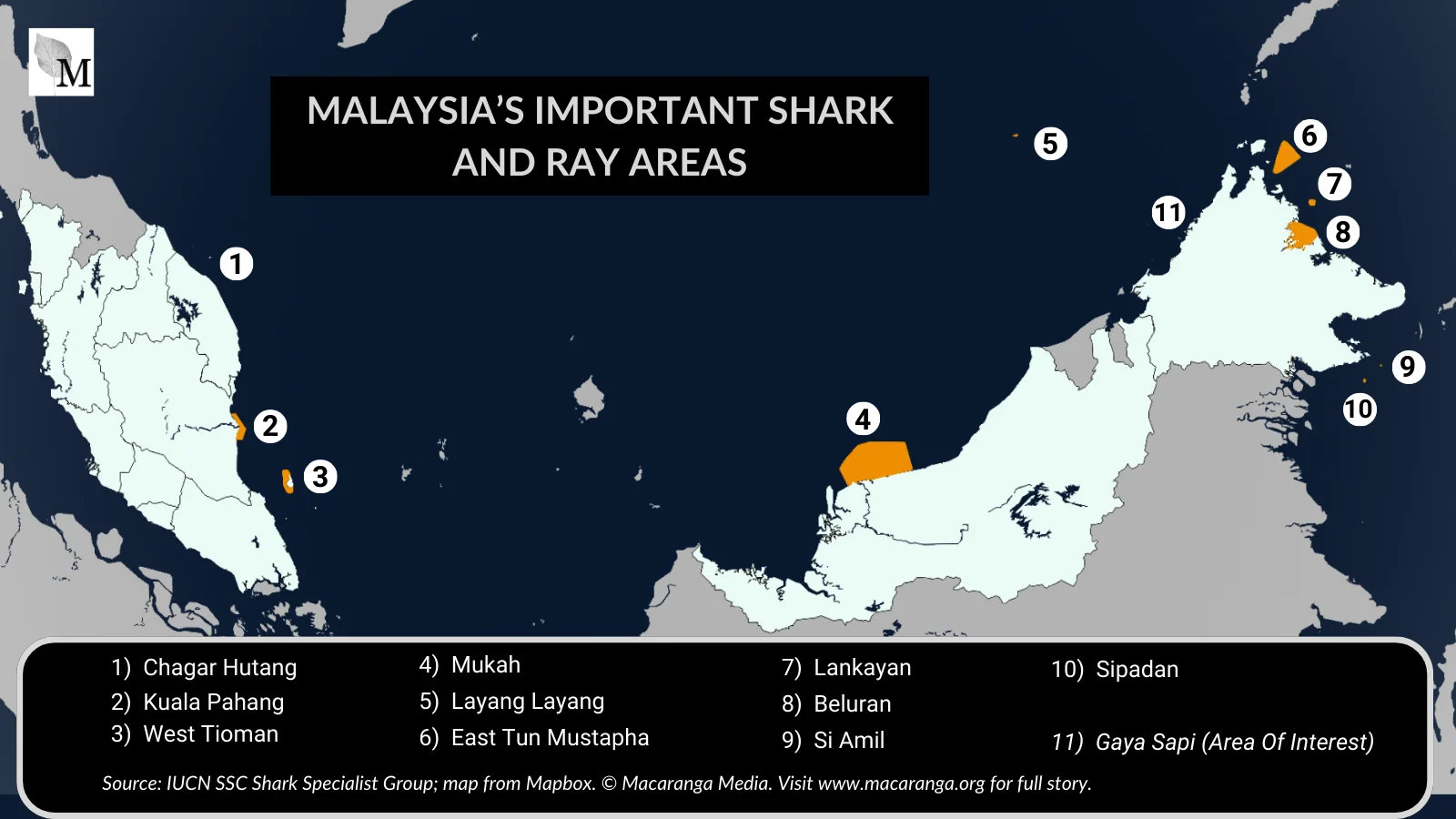
Malaysia’s 10 ISRAs comprise the expected, such as the Coral Triangle islands and the surprising, such as Kuala Pahang. Explore them all in Macaranga’s interactive ISRA map.
“This compilation of information at the species level and considering science-based criteria is the first attempt to ‘put sharks on the map’,” says Dr Rima Jabado, Chair of the IUCN Species Survival Commission Shark Specialist Group. These fishes are going extinct fast, second in scale globally only to amphibians. The Group developed the ISRAs to try to halt the loss.
Though not yet 2 years old, the approach is already seeing results. “ISRAs are being considered in marine spatial planning,” says Jabado. “They are being prioritised for monitoring and enforcement of protected areas. Some areas have led to the protection of species nationally.”
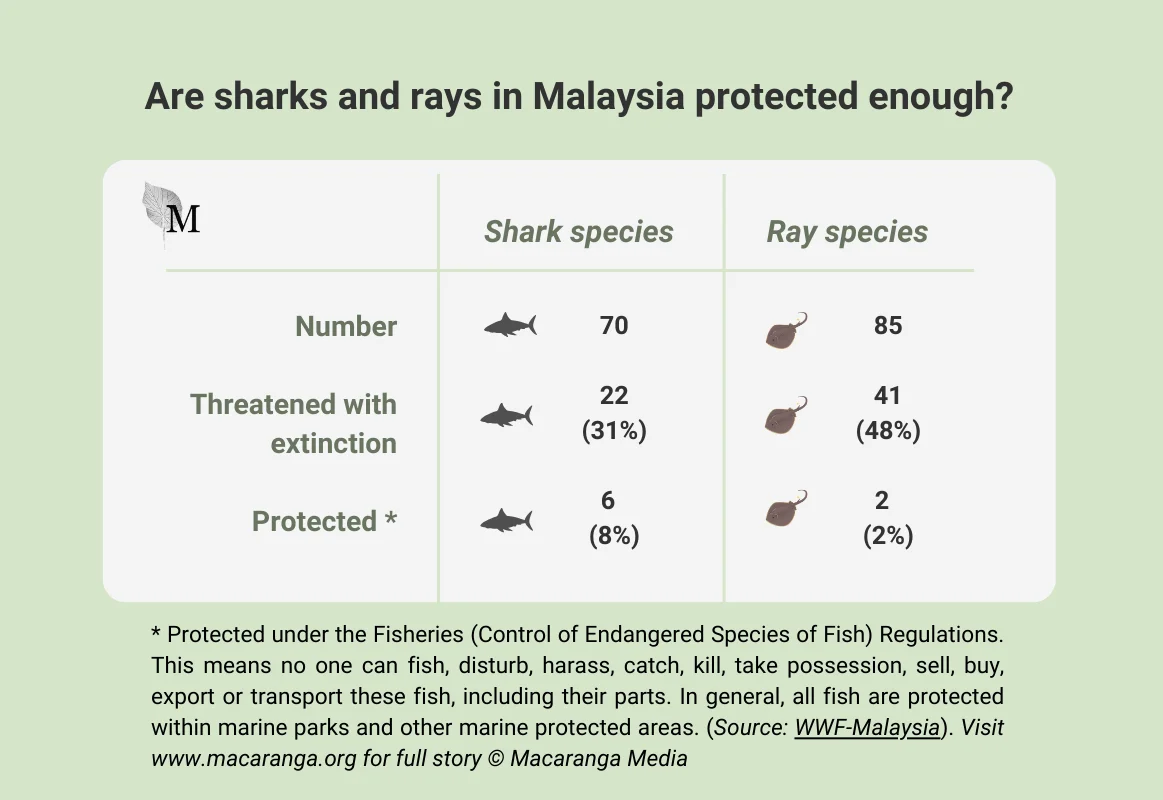
And since April, Malaysia has been part of that list with its 10 ISRAs, including Sipadan. This is critical for Malaysian sharks and rays: scientists warn that too many are ending up in fishing nets and soup bowls, as well as on charcoal grills. But officially, Malaysia denies the existence of targeted shark fishing. Instead, the government considers sharks as bycatch, caught by accident.
Hence, it is crucial to identify the areas that endangered sharks and rays use.
“There is so little data, information, and research on sharks and rays in critical habitats in Malaysia,” says WWF-Malaysia’s Serena Adam. As a IUCN SSC Shark Specialist Group member, Serena coordinated the Malaysian ISRA listings.
“I’m still surprised that all the 10 areas we proposed were approved. The ISRA criteria is very tight.” Nine proposed sites made it as ISRAs; the remaining one designated as an Area of Interest could be upgraded to an ISRA with more evidence.
The IUCN criteria are built on “the complex behaviours, ecology, and biological needs of sharks including species’ vulnerability, range restriction, key life-history activities, distinctiveness, and diversity”, according to the ISRA portal.


1) Whitetip Reef Sharks rest in groups safely in Sipadan. Photo: Sarah Ashton/Proposal Submission for ISRA listing of Sipadan, 2024
2) Grey Reef Sharks reproduce in Sipadan waters. Photo: Albert Kok/Wikimedia Commons

3) Sipadan is recognised for schools of Scalloped Hammerhead Sharks like these. Photo: Scubazoo.com.my
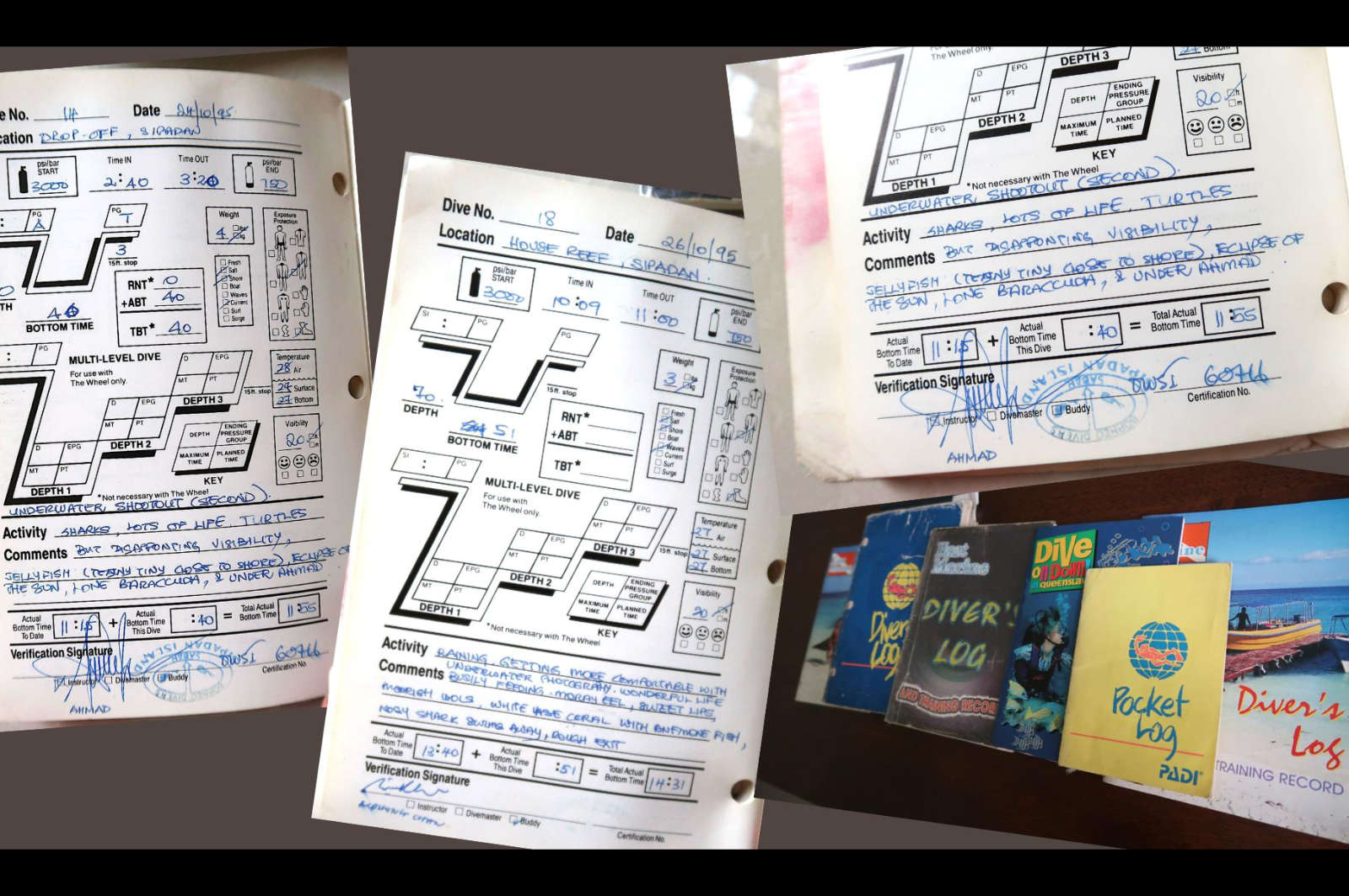
4) A sample of old dive log books with Sipadan entries. Photo: Sarah Irdina via Macaranga
The Sipadan ISRA, for one, meets several criteria. Vulnerable species visit the area for essential phases in their life history. The critically endangered Scalloped Hammerheads aggregate in Sipadan; the endangered Grey Reef Sharks (Carcharhinus amblyrhynchos) reproduce there; and the vulnerable Whitetip Reef Sharks (Triaenodon obesus) breed and rest in groups there.
Meeting each criterion demands robust scientific evidence. Obviously, it will not do to hang about in the deep blue in Sipadan, willing Hammerheads to appear. But dive operator Scuba Junkie SEAS actually did something with these experiences.
Between 2010–2019, they kept a detailed logbook of species sightings by their dive masters and customers. Logging ensures better service by underwater tour guides, dive tourism being an important, lucrative industry.
In all, they logged a whopping 13,308 dives. This data helped Sipadan qualify as an ISRA.
Global Acknowledgement
“It is heartening to know that [Sipadan] now has formal recognition from world experts as a vitally important habitat for the shark species using it,” says Dr Catherine McCaan, a marine biologist who was conservation manager of the outfit then.
“So far, the bulk of this has come from simple sighting data in divers’ logbooks. Hopefully, with this formal recognition, more targeted research will be carried out that would lead to the development and implementation of a long-term monitoring strategy.”
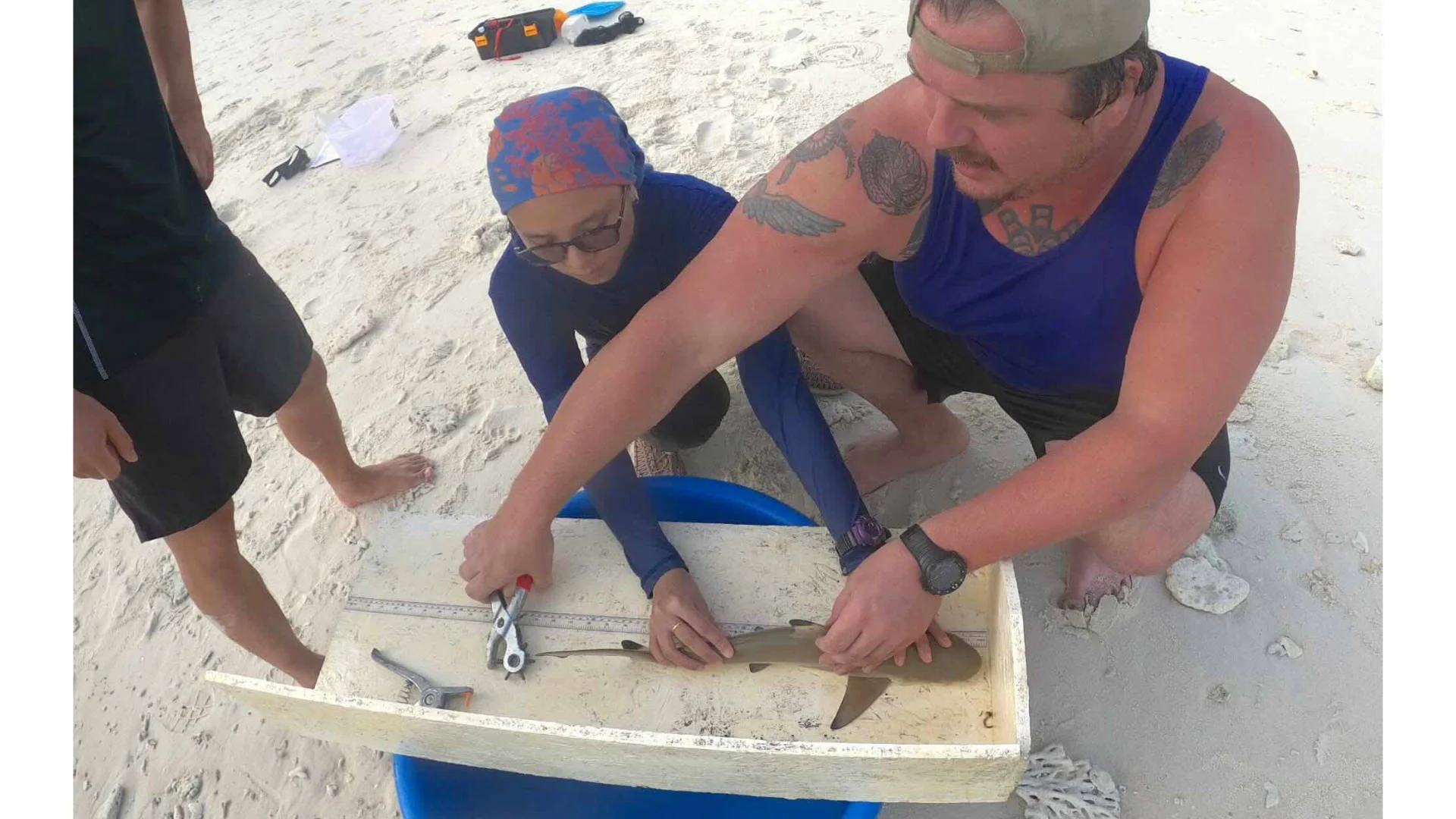

(1) Shark scientists Serena Adam and Nicholas Tolen measure and tag a juvenile Blacktip Reef Shark captured at Chagar Hutang as part of a Mark and Recapture study. Photo: Faqih Akbar via Macaranga
(2) A newly tagged juvenile Blacktip Reef Shark is released at its initial capture site at Chagar Hutang, part of a Mark and Recapture study. Photo: Nicholas Tolen via Macaranga
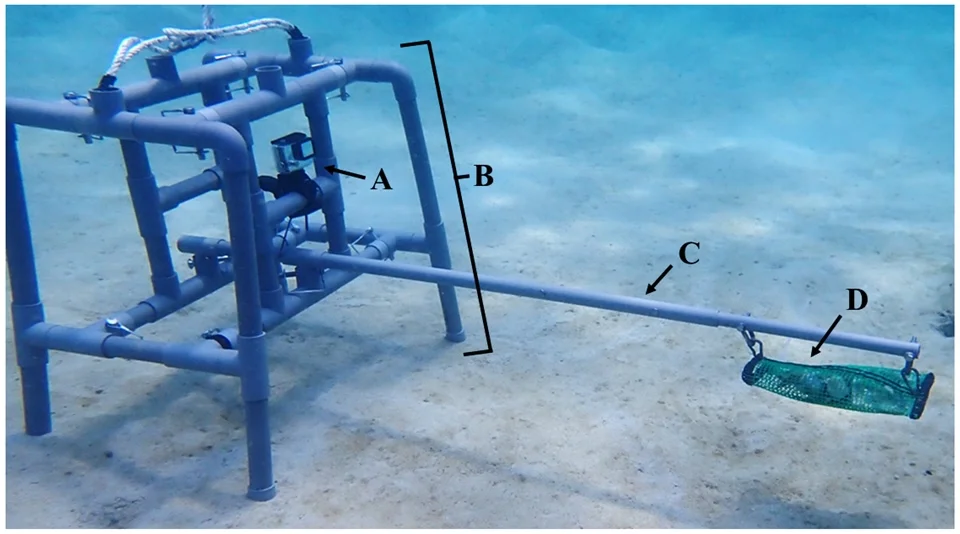

(1) A BRUV device: (A) GoPro Hero 8 camera (B) weighted PVC frame (C) meter-long bait arm (D) 500 grams of oily fish bait, designed to attract juvenile Blacktip Reef Sharks into the camera’s field of view. Photo: Nicholas Tolen via Macaranga
(2) 10 juvenile Blacktip Reef Sharks are captured on camera in the Baited Remote Underwater Video (BRUV) survey at Chagar Hutang. Photo: Nicholas Tolen via Macaranga
Citizen data like this was used as evidence for the listing of half the Malaysian ISRAs, says Serena. Social media was another important source of photos, videos and posts by divers, snorkellers, tour boat operators, and recreational anglers. The Malaysian team combed through hundreds of visuals and write-ups online to support their site proposals.
Why did they source data from the public?
To begin with, Serena says that too few scientists are working on sharks to produce enough data.
“But the main challenge was to fit what we had researched so far into the criteria,” says the shark and ray conservation officer. Scientists had mainly focused on fish landings in boats and at jetties. “So you know what is being caught but not where it is being caught.”
And even when scientists use underwater camera traps in specific locations to record sharks and rays, often, “we don’t have enough to tell exactly what they are doing there”.
Therefore, “we have to use complementary methods to find out what’s going on.”


(1) A neonate Scalloped Hammerhead is identified by its umbilical scar. Photo: Irsyad Pishal via Macaranga
(2) Scalloped Hammerheads are 45-50 cm long at birth, grow quickly and hang around coastal waters. Photo: Amanda Leong via Macaranga


(3) Mukah’s fishers shared their ecological knowledge of Scalloped Hammerheads and this helped this ISRA get listed. Photo: Muhammad Khairi Ismail IG via Macaranga
(4) Fishers’ catches are the main way to determine that a site is important for juvenile Scalloped Hammerheads. Photo: Mazidi Abd Ghani/WWF-Malaysia
In Mukah, Sarawak, coastal-marine researcher Dr Amy Then not only looked at shark and ray landings, she interviewed fishers who shared decades-long catch history and pinpointed exactly where they set their nets. This local ecological knowledge was what got Mukah designated as an important breeding site for Scalloped Hammerheads.
“For us to discover neonate sites – newborns – it’s really not common knowledge at all,” says the UM associate professor. “It’s only something that fishers who go in and out every day will know. Nobody dives in Mukah, so those things don’t get mapped.”
Science-Friendly Fishers
In Sabah, cooperating trawler fishers were what got East Tun Mustapha and Beluran ISRA status. Their respective delineation was based on images from cameras installed on trawlers by the Marine Research Foundation (MRF). The cameras took photos every 3 seconds, and using their GPS location and time stamps, scientists could map the ISRAs.
MRF conservation officer Ho Kooi Chee says, “Once [fishers] realised that we were keeping their identities and boat numbers anonymous, they gradually accepted the project and assisted in deploying the cameras.” They even spread the word among other fishers to allow cameras to be deployed.
Such buy-in from fishers might augur well for tighter conservation measures. Based on this evidence, MRF’s proposal to temporarily exclude fishing in East Tun Mustapha has been accepted by the Department of Fisheries Sabah, says Ho.
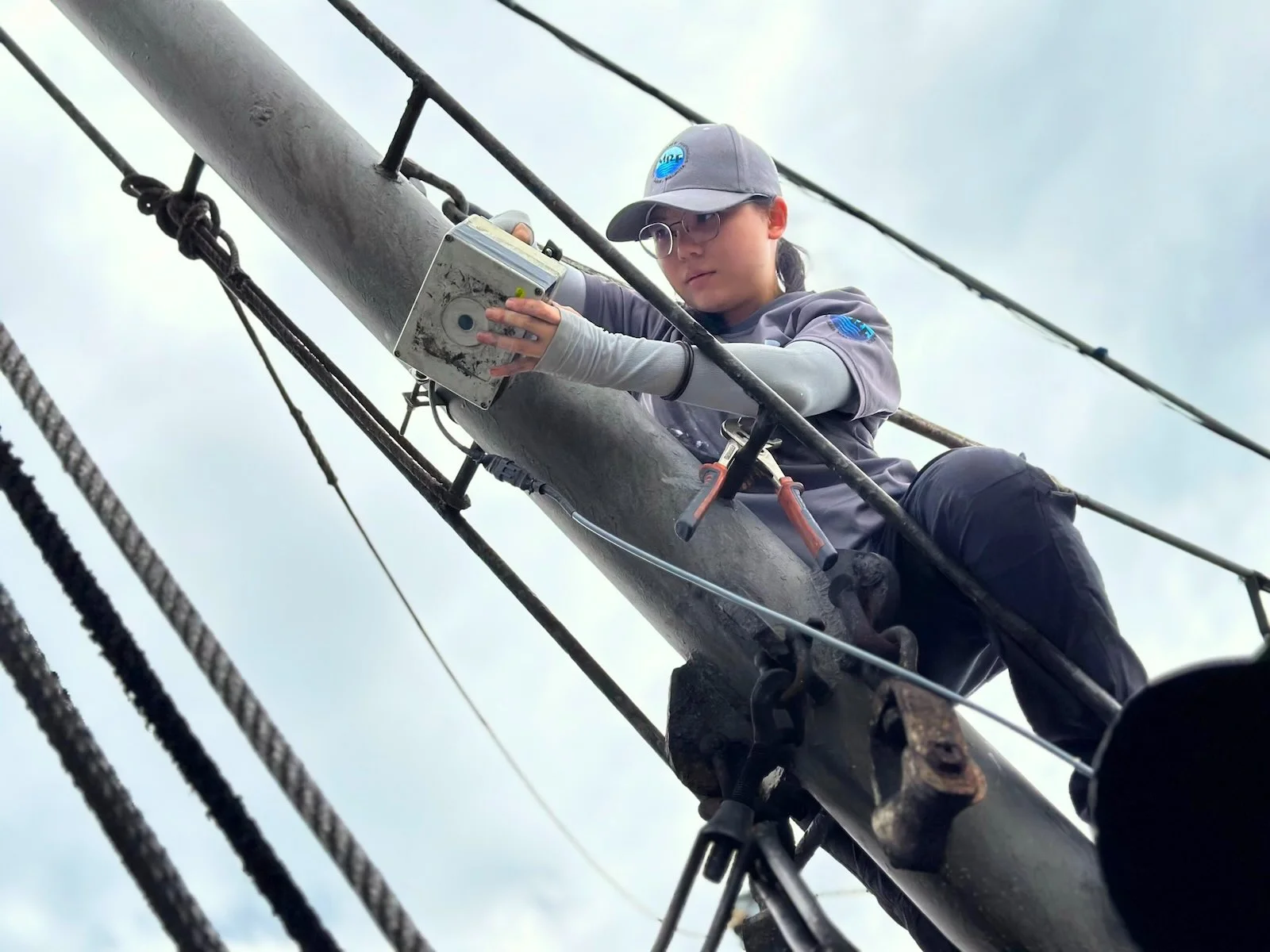
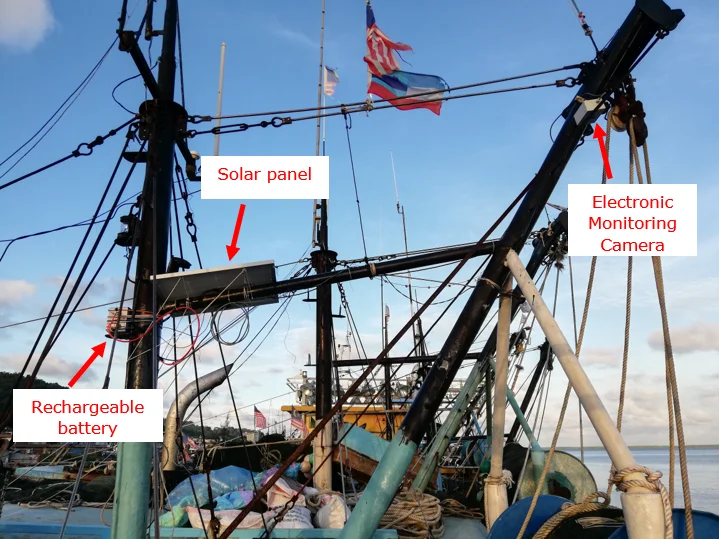
(1) Fishers allowed scientists to set up cameras on their trawlers to collect scientific data on their catches. Photo: Marine Research Foundation
(2) The cameras are GPS-linked and provided accurate location and time data for each catch. Photo: Marine Research Foundation
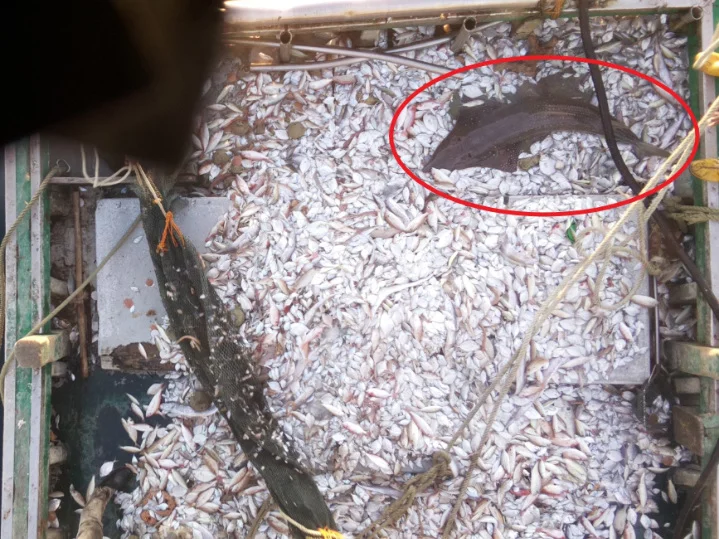
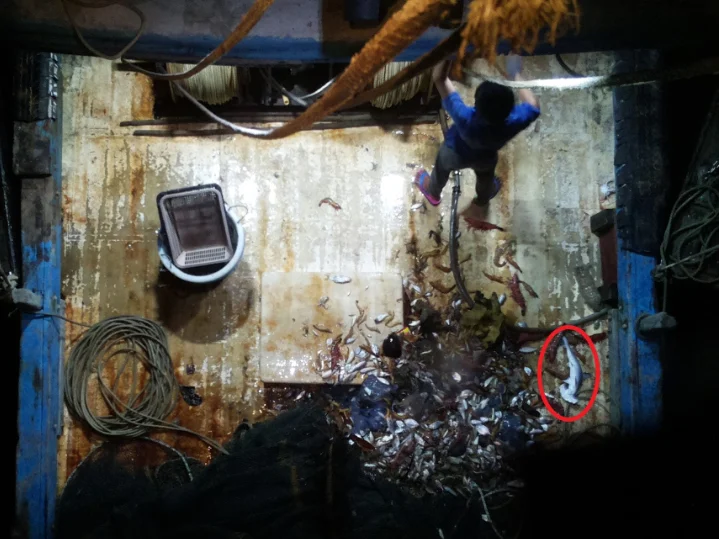
(3) The cameras confirm that East Tun Mustapha is an ISRA for critically endangered Bottlenose Wedgefish (Rhynchobatus australiae). Photo: Marine Research Foundation
(4) East Tun Mustapha is also an important site for Scalloped Hammerheads to reproduce. Photo: Marine Research Foundation
To aid in such decision-making is precisely the aim of ISRA listings.
“It will help highlight these areas’ importance,” agrees Izarenah Md Repin from the Department of Fisheries Malaysia fisheries conservation and protection division.
“And it can be a reference and strengthen justification for the government to potentially protect an area.”
She adds that ISRAs’ scientific basis and global recognition save the government time in identifying protected areas. Malaysia wants to double its marine protected areas (MPA) to 10%.
More Protection Needed
Only 6 ISRAs overlap with MPAs. East Tun Mustapha will need additional attention, says MRF’s Ho, as it is a transboundary area with the Philippines.
“Also, ISRAs in protected areas like Tioman strengthen and justify the importance of existing MPAs, and their effectiveness in protecting sharks and rays,” says Izarenah. The West Tioman ISRA recognises aggregations of the critically endangered Bottlenose Wedgefish (Rhynchobatus australiae).
While holding much promise, ISRA listings are just the beginning. To properly manage them, every scientist who contributed to the listings advocates continued research and long-term monitoring.
Si Amil, Sabah, met the ISRA criteria with proof that threatened Shorthorned Pygmy Devil Rays (Mobula kuhlii) aggregate regularly there, sometimes up to 100 individuals (Video from proposal submission for ISRA listing for Si Amil, 2024)
In Sipadan, the fact that no one knows why the Scalloped Hammerheads aggregate, means more studies need to be done, says McCaan, co-founder of the Sea Collective. “This information could in turn feed into conservation measures for the animal, which could have far-reaching implications worldwide.”
The overall challenge, says Then, is that “different areas have recognitions for different species, and different species also have very different biology.” She reckons that some habitats might be more critical than others, for example, for neonates and feeding.
Serena is hopeful that the listing will attract research funding. For both her and Then, the listing exercise has also been personally meaningful.
Purposeful Research
“As scientists collecting data, we want data not just to remain as data; we want it to translate into something useful,” says Then.
For Serena, working on ISRAs “is a turning point”. Future studies must answer several research objectives, she says, not just to determine species and population size.
“I would design our research to answer key criteria that’s needed for ISRA qualification such as predictable presence of species in the area, and what behaviour do they exhibit (ie. feeding, resting, courtship). Without these other aspects, you’re losing out information that is required to delineate – and better protect – an area.”
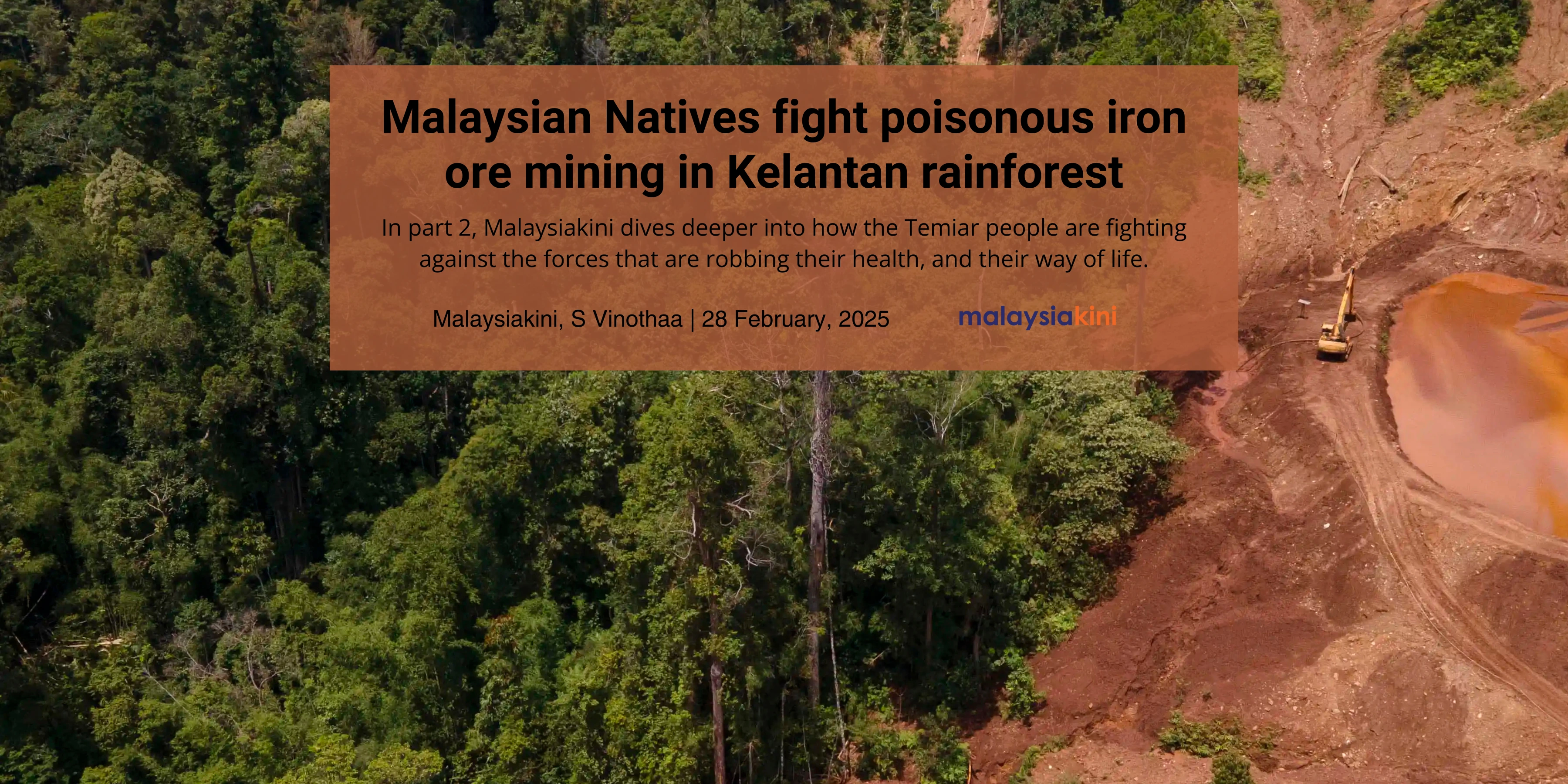
Clutching a mengkuang-weave bag tightly to her chest, Alang Angah’s face clouded with anguish at the mention of her late father, Angah Alang.
“He went to bathe in the river but never returned,” she said, but it was all she could muster before falling silent, overcome by grief nine years after the tragic death.
The death of Angah, 76, in just three feet of water in the river he bathed and fished in all his life, was not just a personal tragedy for his family.
With him died a repository of tradition and knowledge, passed down for generations in the quiet Temiar community.

Alang Angah, the daughter of community patriarch Angah Alang, who was killed in the river amid a deluge that rushed downstream from the mining, allegedly after a mining pond barrier at a slope gave way. The mine operator denies fault. Photo: Malaysiakini
The villagers believe the flood was man-made, pointing to Bukit Tambun where two licensed iron ore mining operations have been progressively disfiguring their hunting grounds, destroying some of their natural resources, and desecrating parts of areas sacred to the Temiar tribe from generations ago.
READ: Iron Ore Mining is invading an indigenous Orang Asli Community in Malaysia
That day, Angah’s grandson Alai Alang said, a tailing pond sitting on a ridge on Bukit Tambun gave way, and water rushed down to where his grandfather was bathing.
The site at Bukit Tambun, which Malaysiakini visited, still shows tell-tale signs of what happened but the pond, with ridge still covered in tailing. The pond, however, has been moved further from the slope.
The mine operator, Redstar Capital Sdn Bhd, said the mining operations had nothing to do with Angah’s death.
Its administrative manager Julice Chu told Malaysiakini the company cooperated with police on the matter, and the case was closed
“You shall refer to the authorities with regards to the facts, instead of relying solely on the untrue and inaccurate allegations,” she said in a statement.
Secluded Paradise laid to Ruin
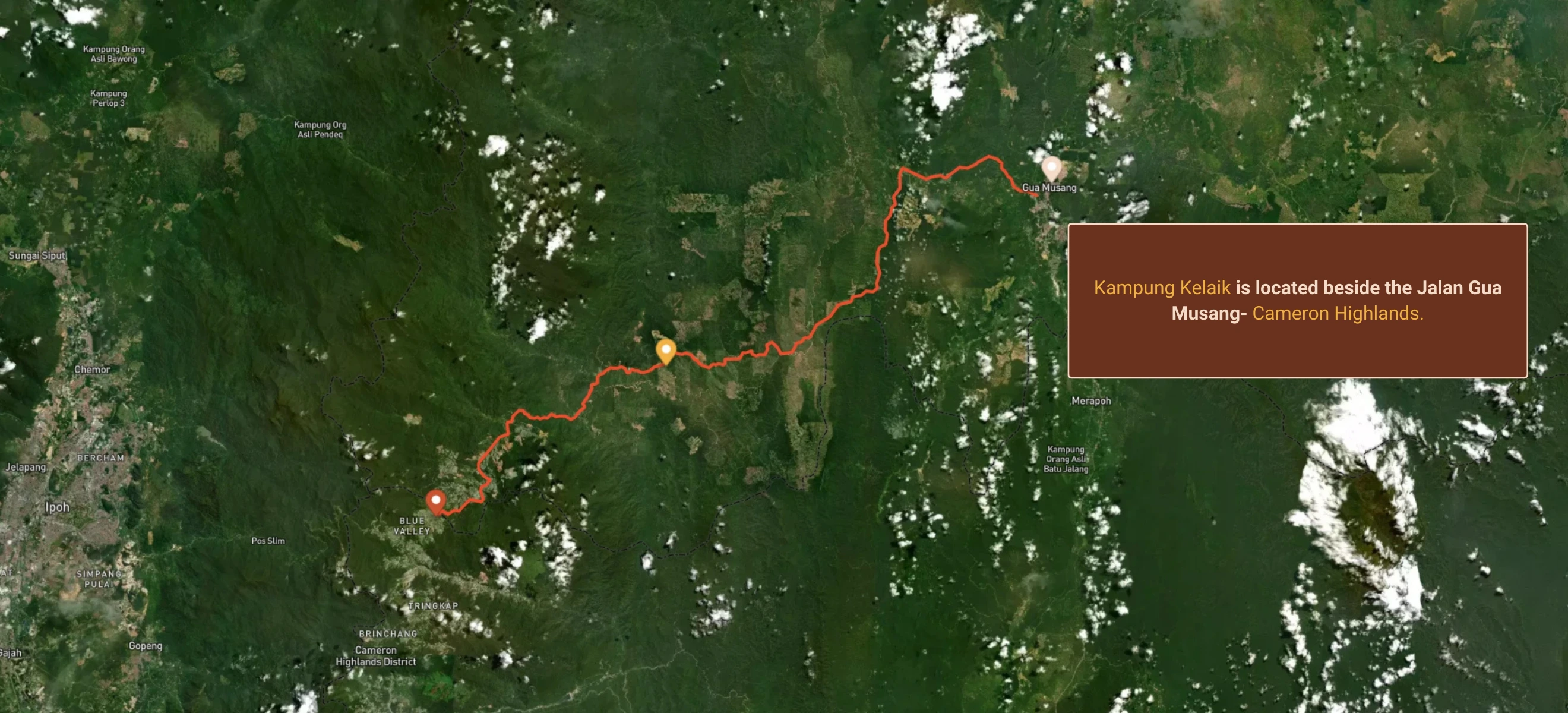
Nothing prepared the quiet community for the vast changes that would come with the opening of the Gua Musang-Cameron Highlands highway in 2004. Indeed, nobody told them it would happen.
Without their consent, their pristine rainforest home turned into oil palm, rubber and durian plantations. In 2009, the first iron ore mine, operated by the Chinese national-owned firm Sterling Goldhill Sdn Bhd completely changed the landscape of their ancestral land.
Before that, the Temiar of Kampung Kelaik lived in seclusion, separate from Orang Asli settlements in Gua Musang and without an administrative centre or “post”.
Even today, getting to the village is a bumpy 30-minute journey through logging trails by four-wheel drive vehicle, from the turn off at the highway.
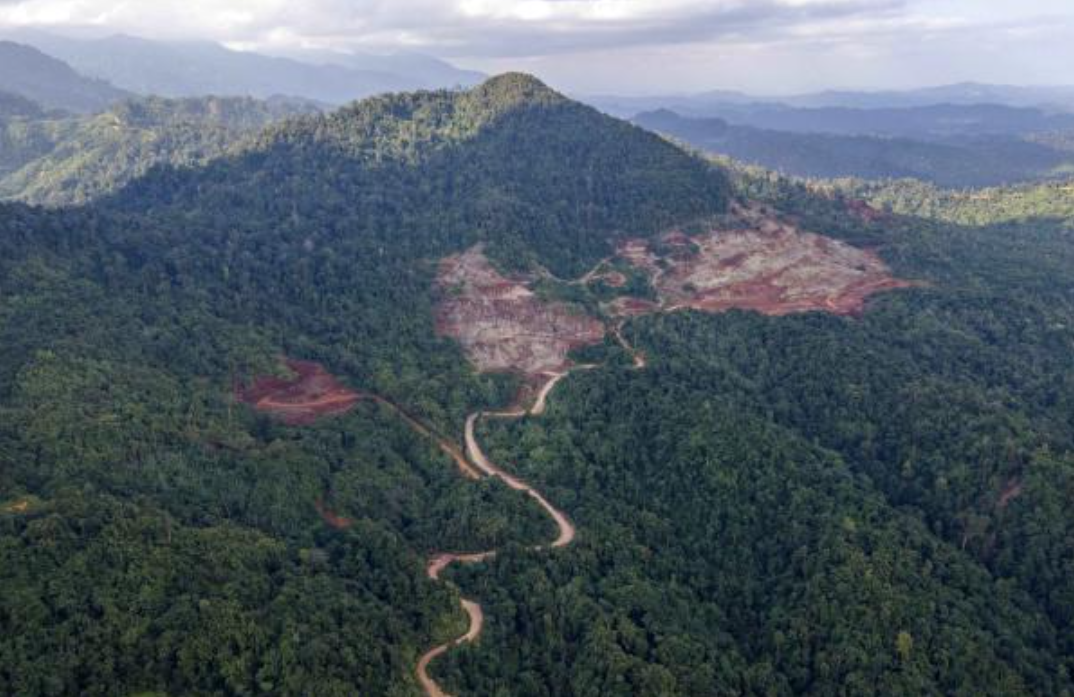
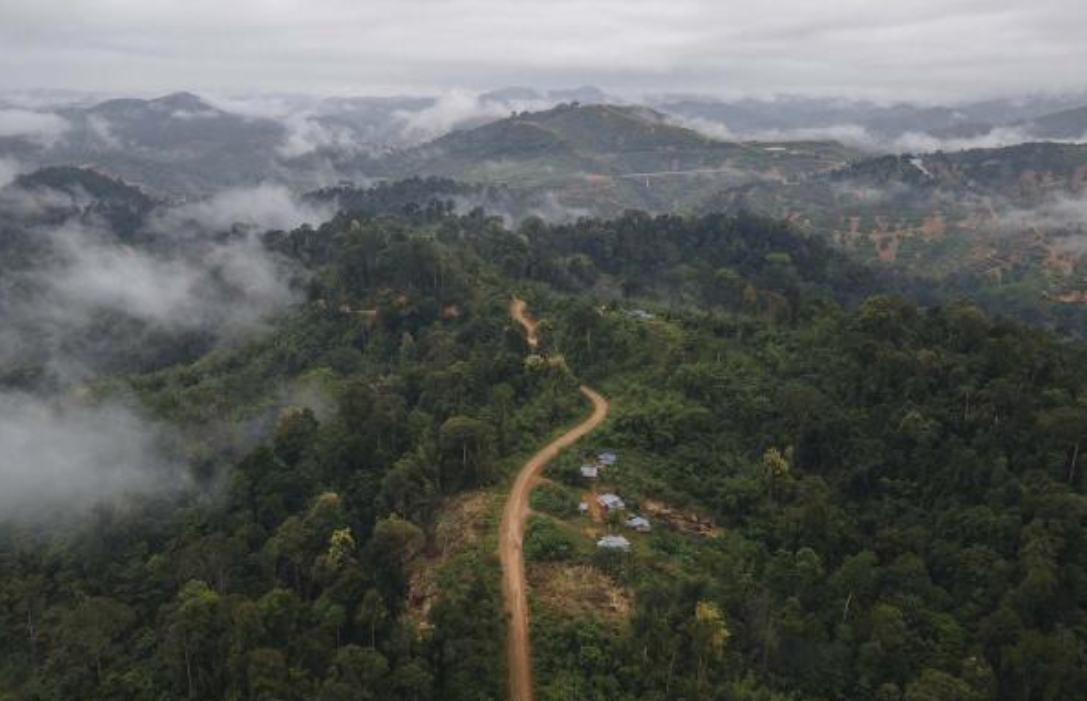
Bukit Tambun (left) and Kampung Kelaik (right), Gua Musang, Kelantan. Photos: Malaysiakini
With no electricity or piped water, they drank from clear streams, foraged and hunted for what they needed, and felt little need to venture beyond their homeland. Even the unhurried pace of Gua Musang town is too bustling for them, said Ahak.
It took the 200 residents of Kampung Kelaik several years after the destruction to realise they had a right to object.
“Twenty years ago when loggers entered our ancestral grounds, some elders from neighbouring Orang Asli posts warned us that challenging the government’s decisions was considered seditious,” he said.

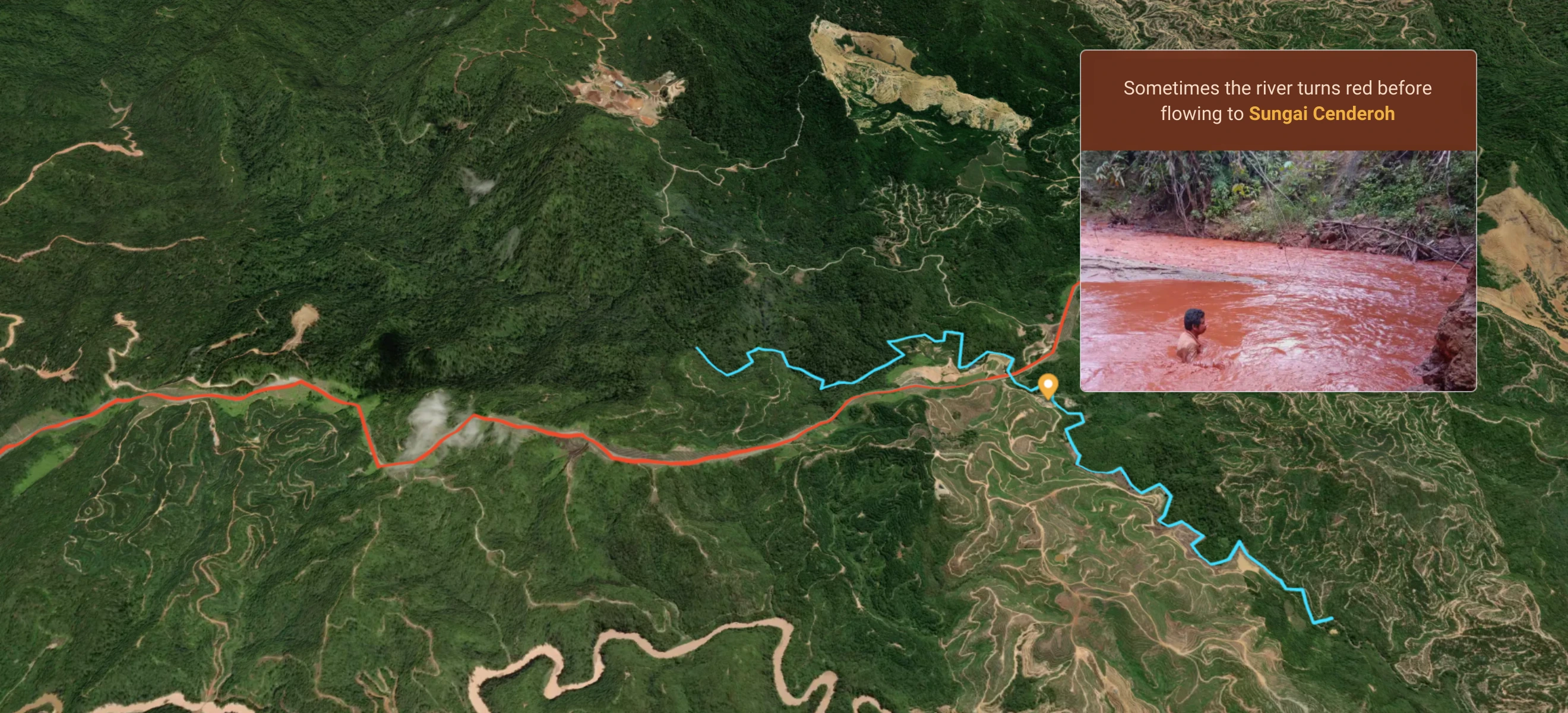
In 2012, the residents of Kampung Kelaik blew the whistle to Malaysiakini, which found the rivers already so red that rice cooked with river water similarly adopted the rusty colour.
But their plights fell on deaf ears as iron ore became even more sought after on the international market. In 2015, another mine – Aqua Orion – opened near Kampung Kelaik.
(Right) Video: Malaysiakini
Poison in Bloodstreams
Returning to Kampung Kelaik more than a decade later, Malaysiakini in the past months conducted more tests on water samples taken at various points of the river – near discharge points of both mines and downstream where Kampung Kelaik residents bathe, swim and fish.
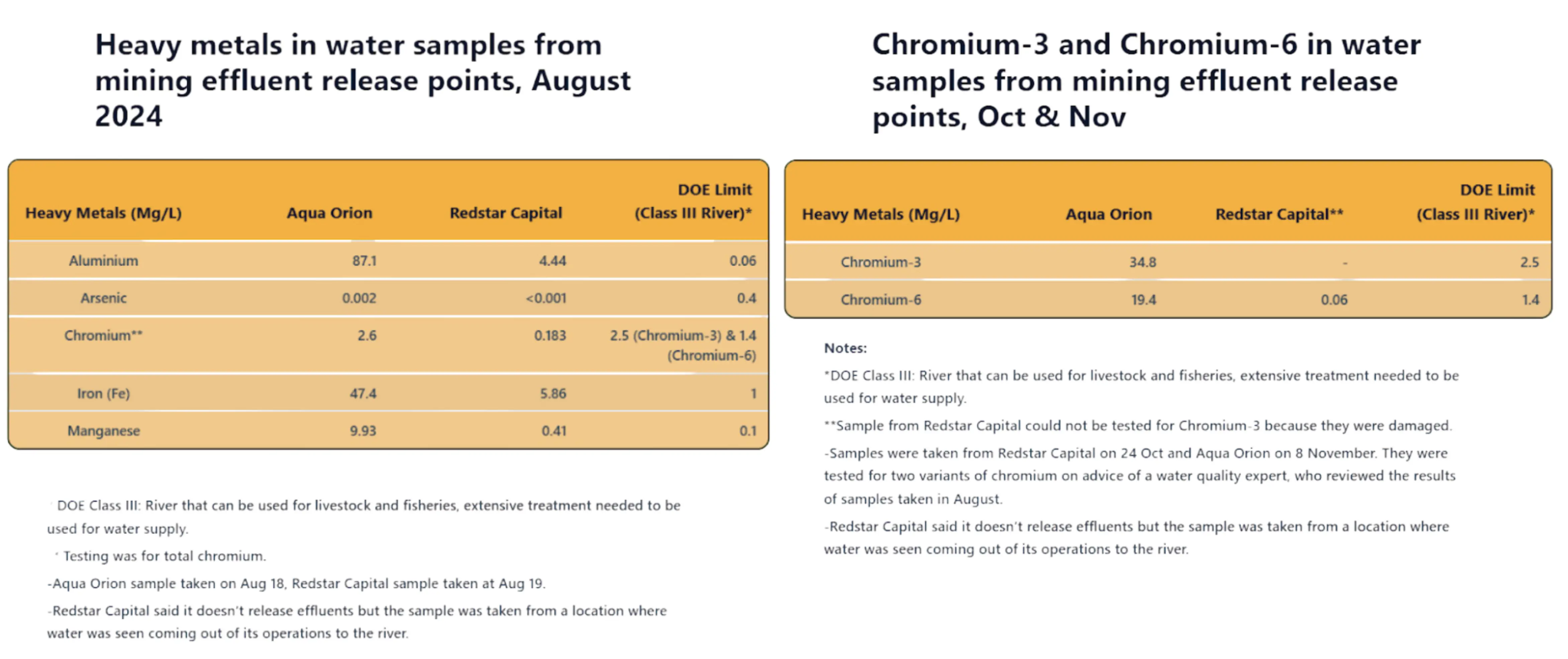
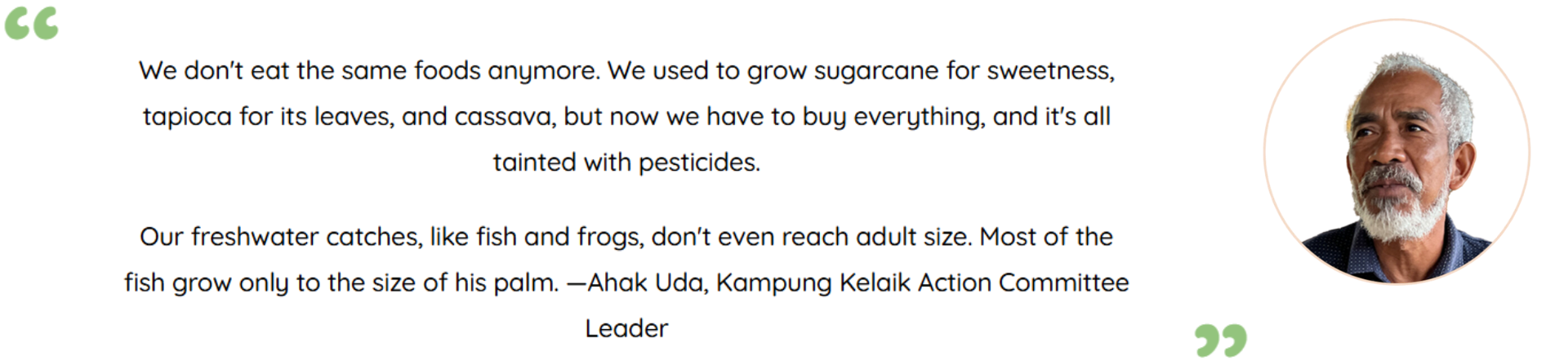
Alarmingly, the tests showed levels of chromium – an element which could cause cancer – were far higher than permissible near the discharge point near the mine run by Aqua Orion, and downstream near Kampung Kelaik.
Even more worrying was the blood test results of one villager, Azlan Ahak, 19, the son of village leader Ahak, whose blood sample was found to have chromium levels four times the normal range, raising his cancer risk 64,000 times higher than normal.
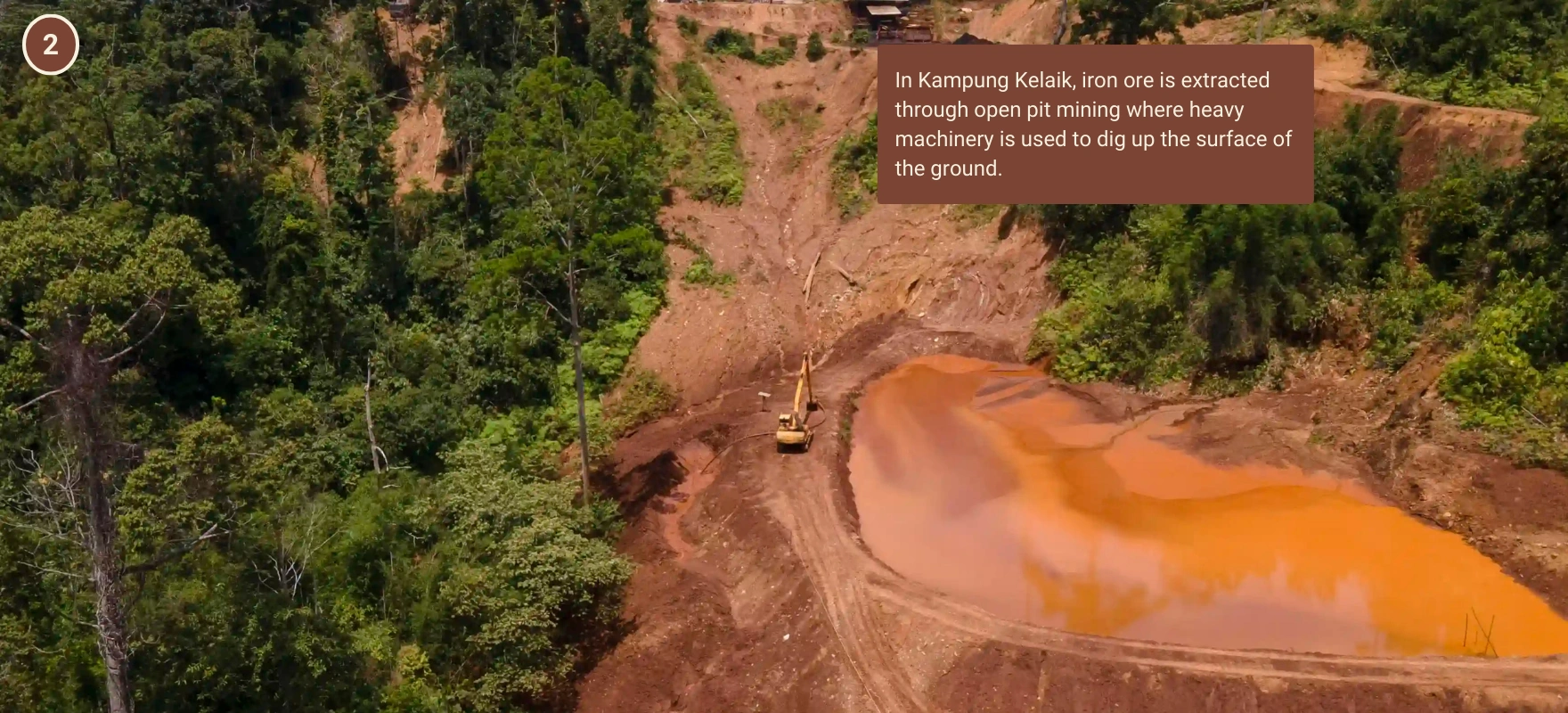
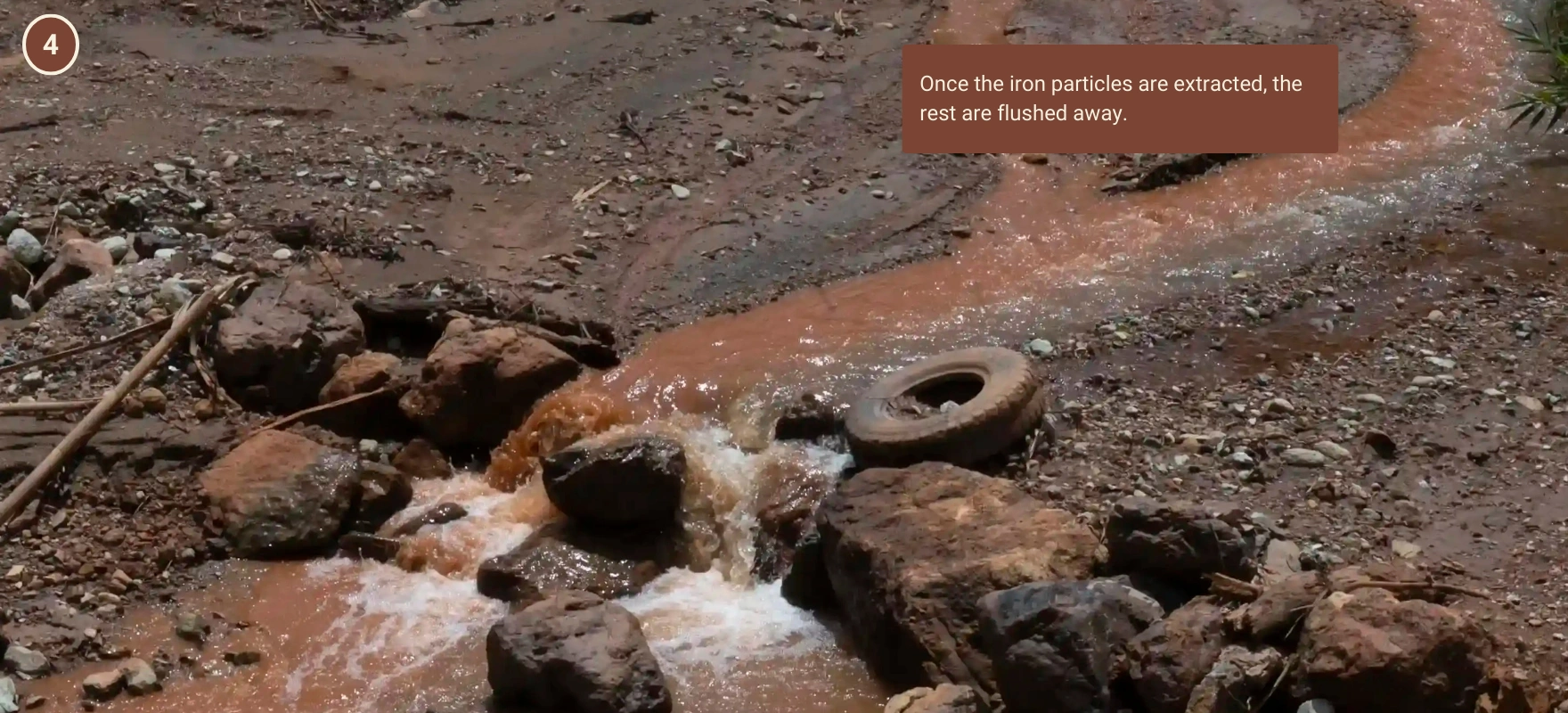
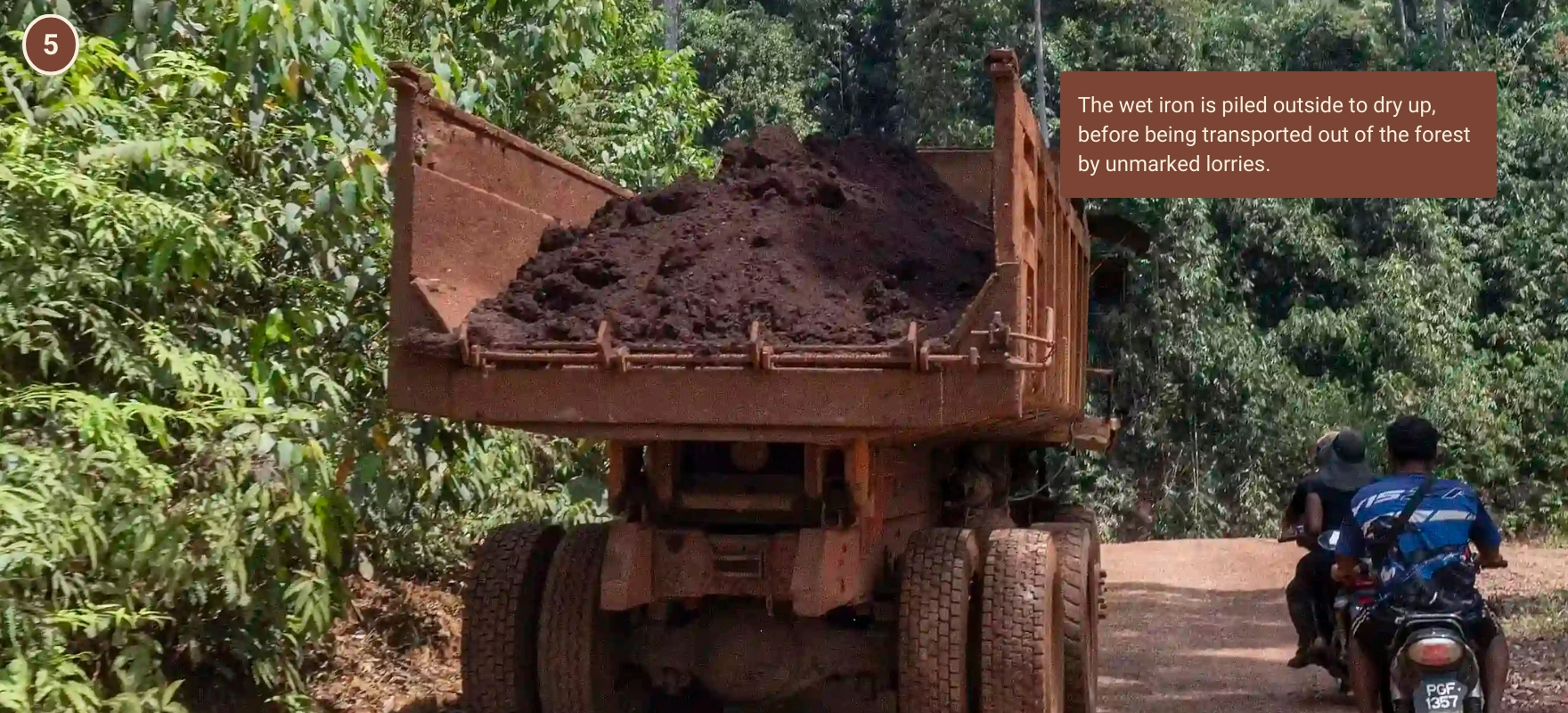
How is Iron Ore Mined?


Near Deaths of Children
Over the years since mining started, water carrying debris would come thundering down to Sungai Kelaik near the village, often without warning, Ahak said.
“During the rainy season, it was daily,” he said.
In 2013, two years before Angah died, children playing in the same river were nearly swept away in a similar incident.
But the mine operator at the time, Sterling Goldhill said it does not discharge iron tailing effluent into the river and reuses the water in mining operations.
Sterling Goldhill has wound up its business and the mine is now run by Redstar Capital Sdn Bhd.
When contacted, Redstar Capital manager Chu, reiterated that the mine doesn’t discharge water into rivers and reuses the water for mining operations. Chu was also attached to Sterling Goldhill.
But when visiting the site, Malaysiakini saw at least two points where water from Redstar Capital’s ponds were released into streams, with at least one via a water lock.
The other mine operator, Aqua Orion and the mine’s licence holder Syarikat Perlombongan Gua Musang, have yet to respond to Malaysiakini’s request for comment.
An 8km hike into Bukit Tambun from a nearby village reveals a once-thriving rainforest reduced to a muddy, uneven wasteland.
Juvenile trees are strewn across man-made ravines, hastily carved by unskilled migrant workers using excavators in a process locals call “cuci hutan,” or “jungle clearing”, where everything is uprooted and removed.
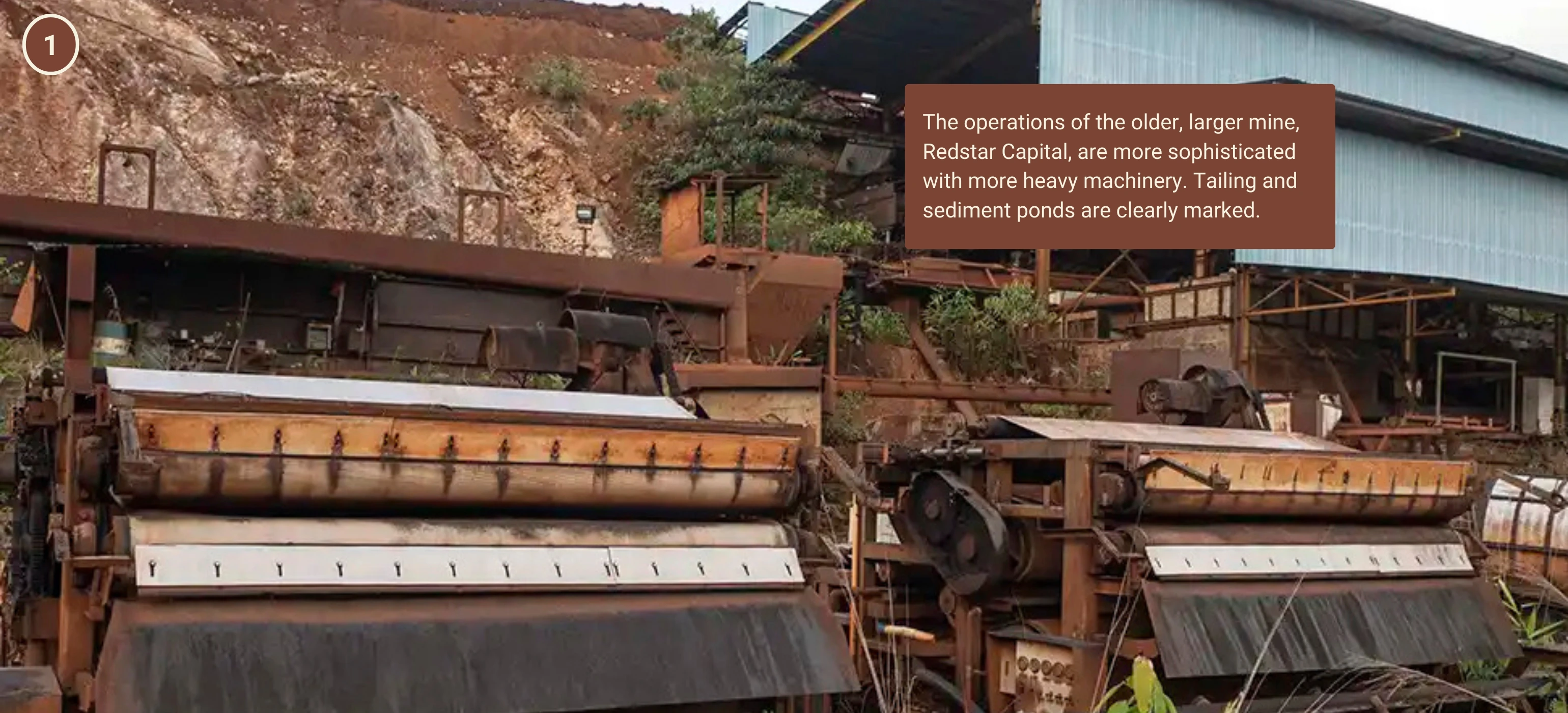
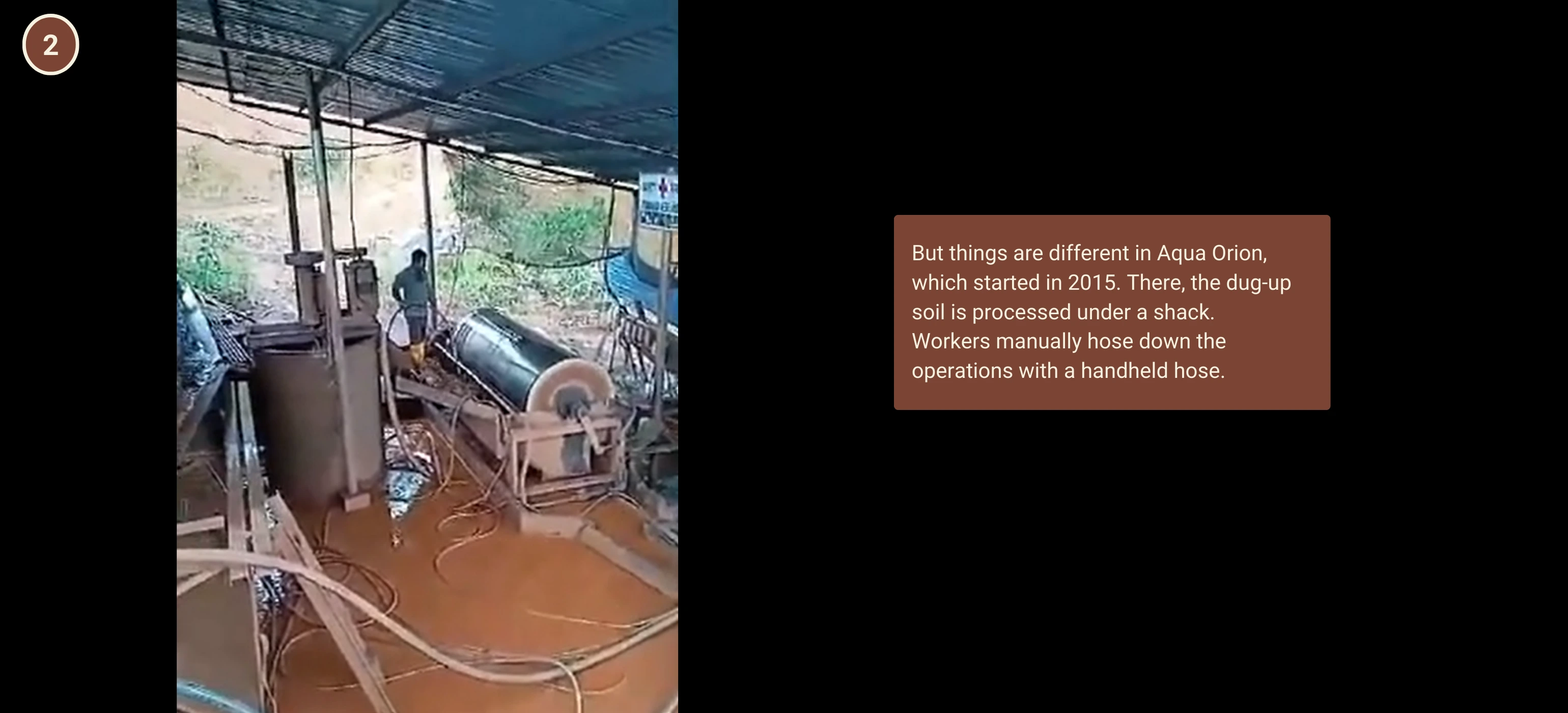
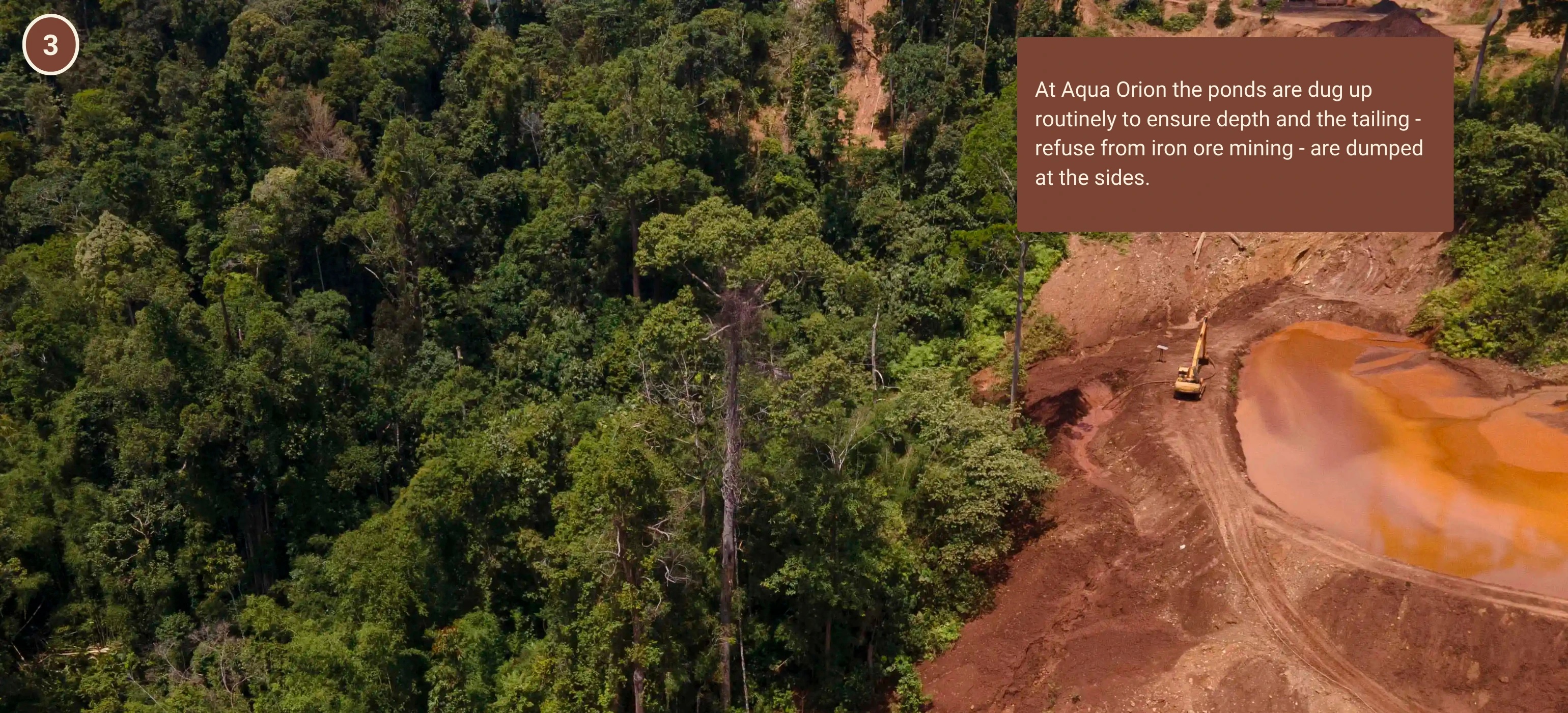
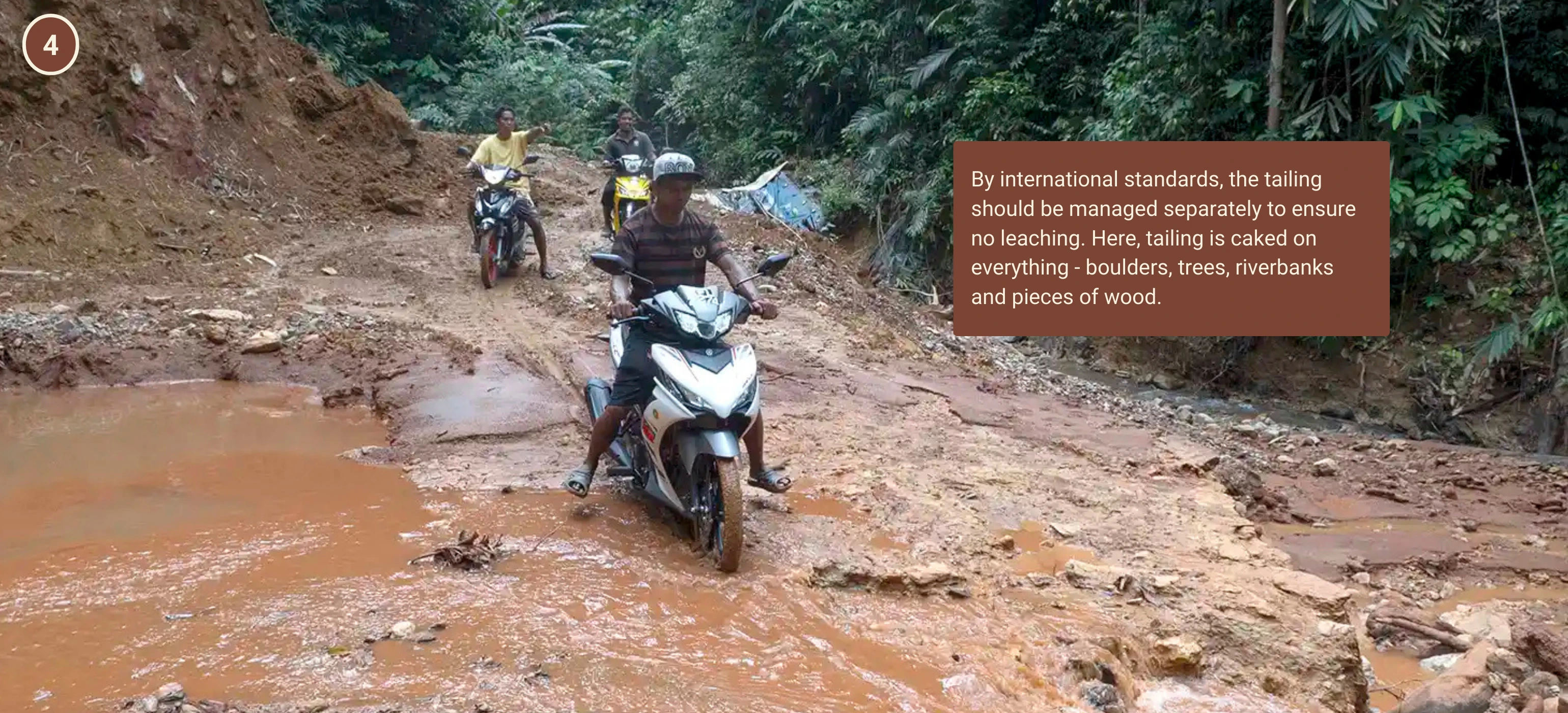
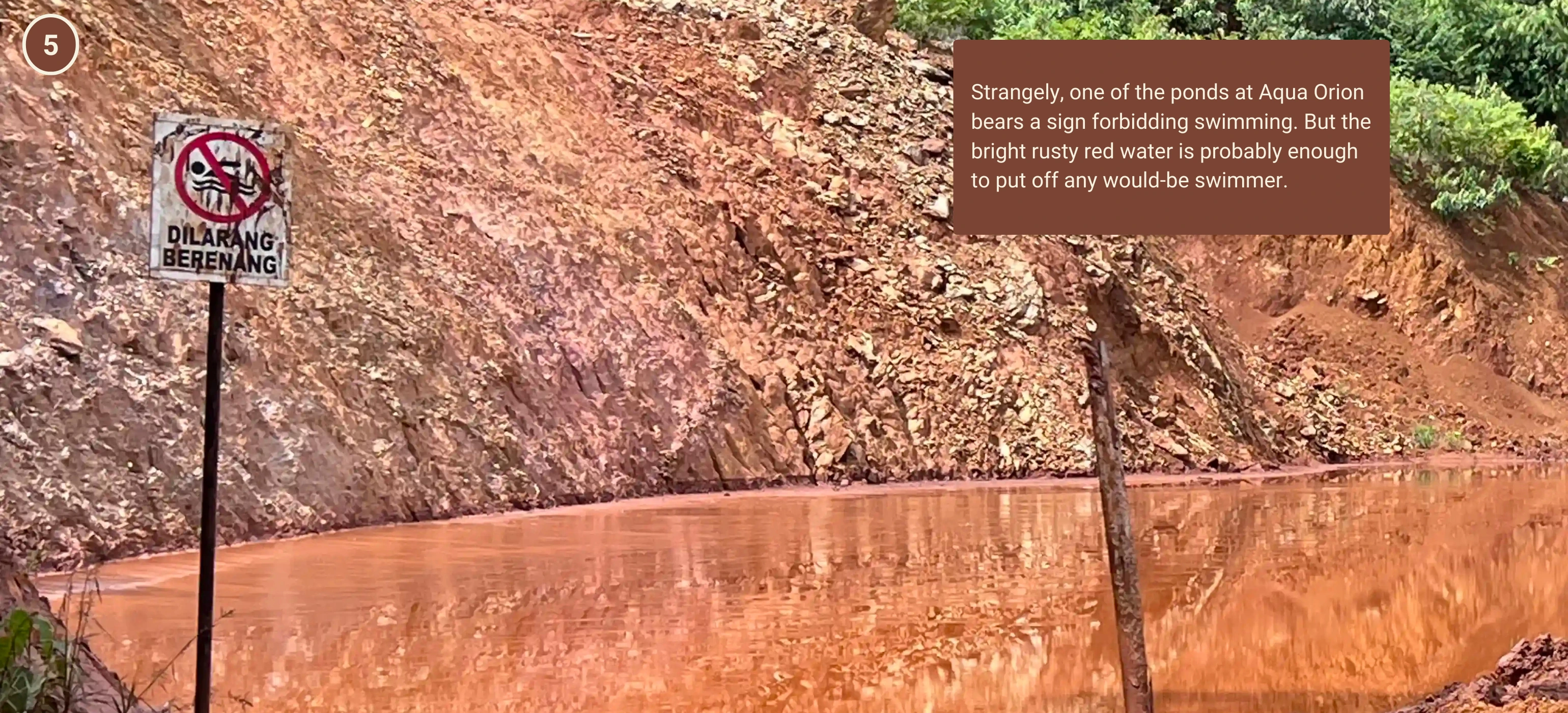
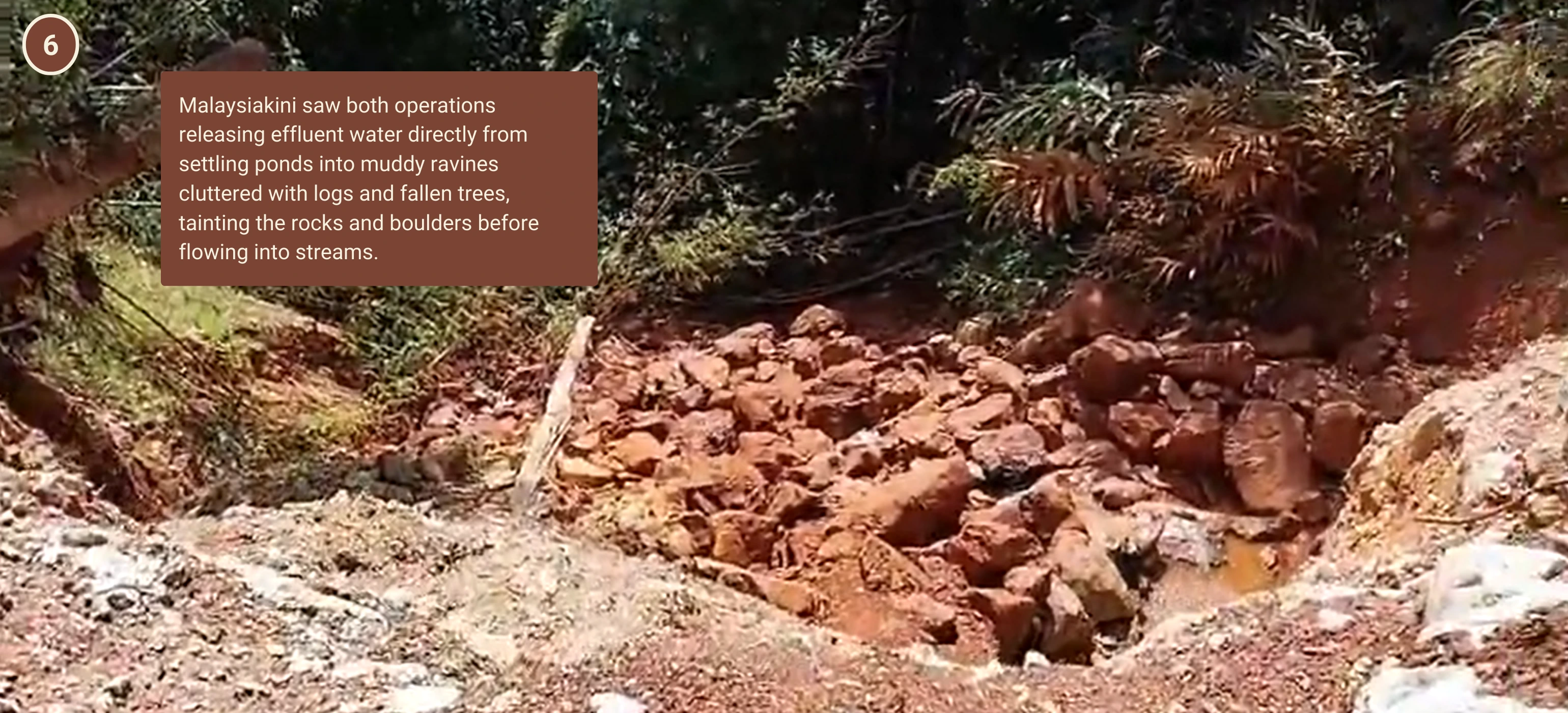
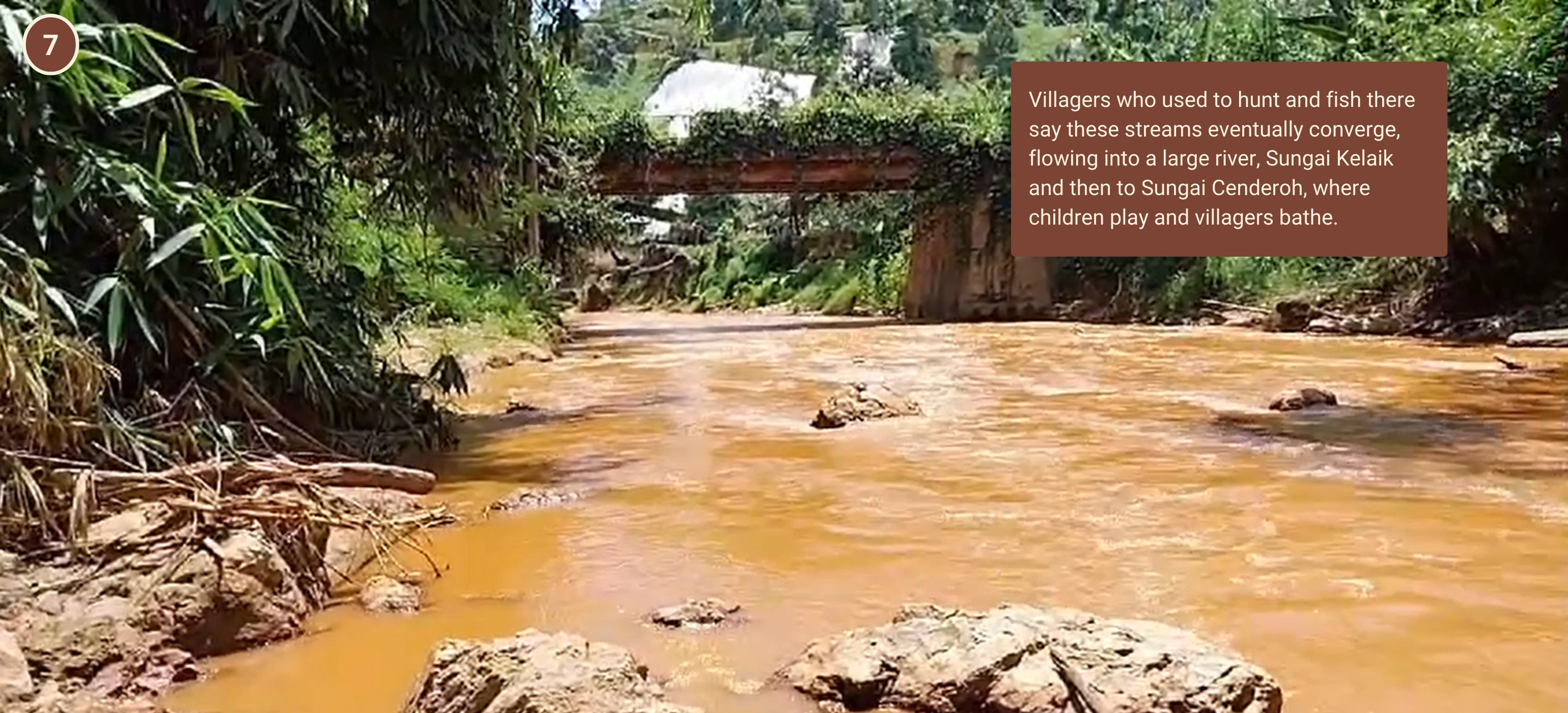
Due to the small size of the rivers that originate from the Bukit Tambun peak, both mines have dammed them to create enough catchment for their water-intensive operations, said Alai.
Licensees under the Waters Act 1920, can, under the supervision of the District Officer, construct infrastructure such as dams and pipes, provided they compensate landowners and remain accountable for any damage caused.
The Act regulates water diversion and construction near rivers to protect water resources and manage flood risks, outlining clear guidelines on licensing, liability, and penalties.
Because of the damming, during the dry seasons, the rivers dry up to become smaller streams, villagers say.
When met, the district officer Nik Raisman Daud said he would instruct the relevant department to inspect the mining sites and investigate allegations of irregularities.
Malaysiakini has also contacted the Environment Department, Geosciences and Mineral Department and the Orang Asli Development Department for comment.
Heavy metal levels in fish and ferns

“We are forest people; we live off what the land gives us,” said Ahak.
But the forest, now ravaged, can no longer provide. The tainted river is no longer teeming with fish, their main source of protein.
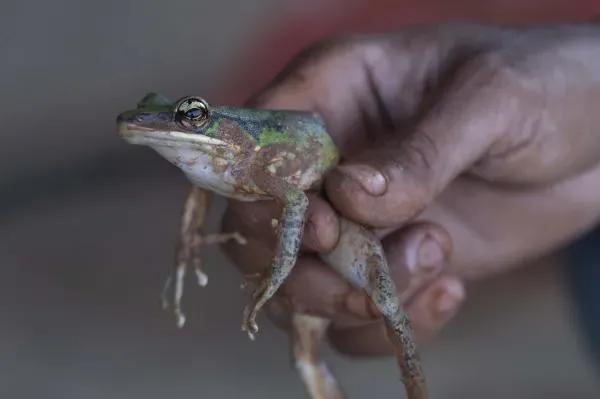
Catches are small, and even frogs caught on the riverbanks have a rusty muddy film on their skin.
Jungle herbs that once thrived are also now scarce and daily life is more dangerous – encounters with displaced wildlife have become common.
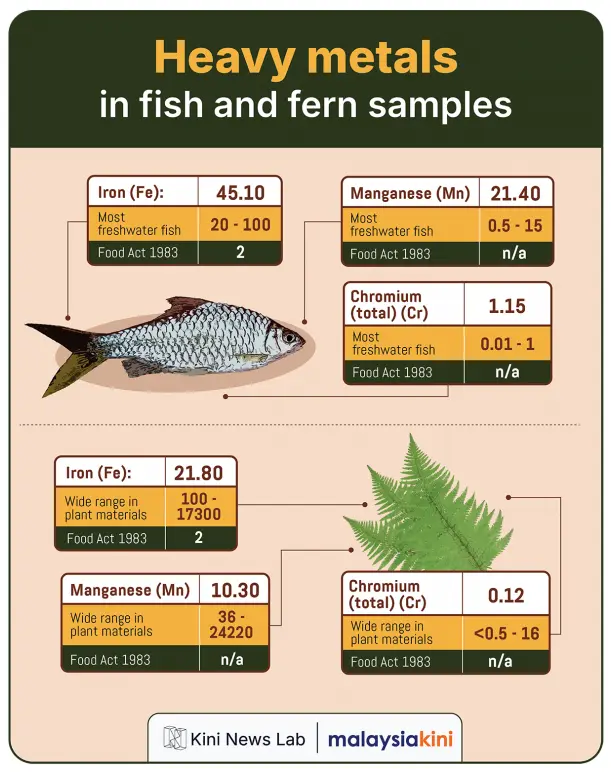
A test conducted on a local fish, ikan sia – a common source of protein – revealed it to be a potent meal for anyone.
Iron readings of 45.10mg/kg were 22 times higher than the legal limit of 2mg/kg in food, set by the Food Act 1983.
It also contained a slightly higher-than-normal level of chromium and a higher-than-normal level of manganese compared to most freshwater fish.
Ferns, typically growing near riverbanks, had iron levels as high as 21.80 mg/kg, more than 20 times the limit set for iron in food, according to the Food Act.
However, Ahmad Abas Kutty from the Earth and Environmental Sciences Department, Universiti Kebangsaan Malaysia (UKM) cautioned that this is not conclusive evidence that it is due to the iron ore mining.
He said although the iron levels in the fish from Kampung Kelaik are higher than the food standards, it is comparable with many freshwater fish.
“Iron levels found in freshwater fish range between 20mg/kg – 100mg/kg,” he told Malaysiakini.
Lawsuit on encroachment of native land
The test results are all compiled as evidence as the Kampung Kelaik residents try to take their matter to the courts again.
Between 2022 and 2023, they tried to seek a court injunction to stop everything that changed the landscape of the entire 8,000ha of their ancestral land – the logging, the palm oil and durian plantations and the mines. But they failed.
Undeterred, they have filed a lawsuit against 10 companies, the state government and three agencies against encroachment into their native land, crowdsourcing legal costs and support.
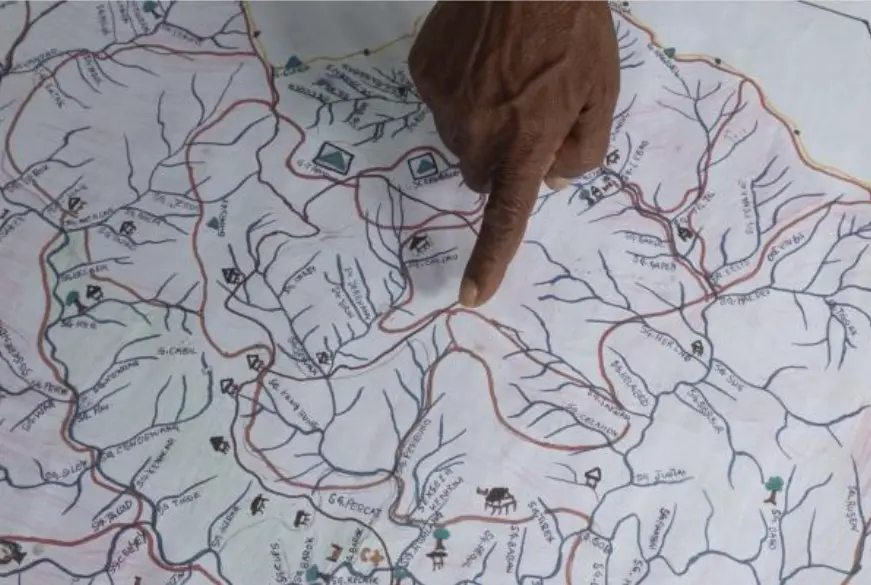
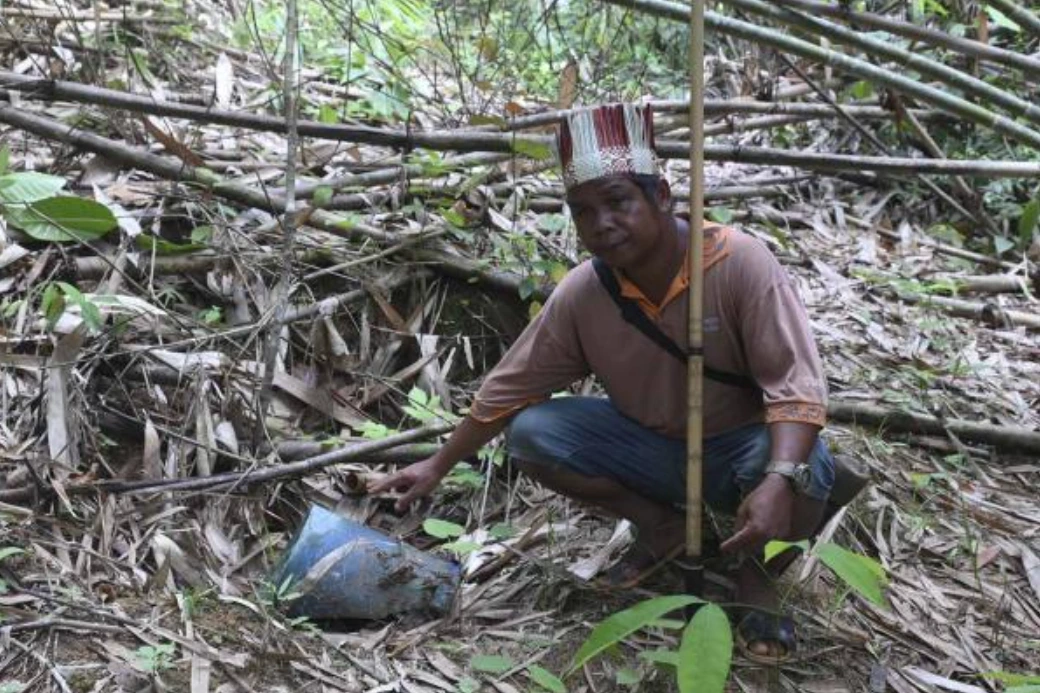
(Left) Ahak showing a hand-drawn map he made by trekking the borders of 8,923.9ha of Temiar Kampung Kelaik’s ancestral land; (Right) A villager showing a grave. They also bury old knives in a bucket at the grave. Many burial grounds were encroached, they say. Photos: Malaysiakini
Using GPS technology, Ahak and the villagers have painstakingly marked out the boundaries of their native land.
Spreading open a hand-drawn map of their land, Ahak reveals how he has shaded in red about 80 percent of the 8,923.9ha that makes up their native land.
Those areas have already been encroached on by iron ore mining, oil palm and rubber plantations, forest plantations and Malaysia’s largest Musang King plantation.
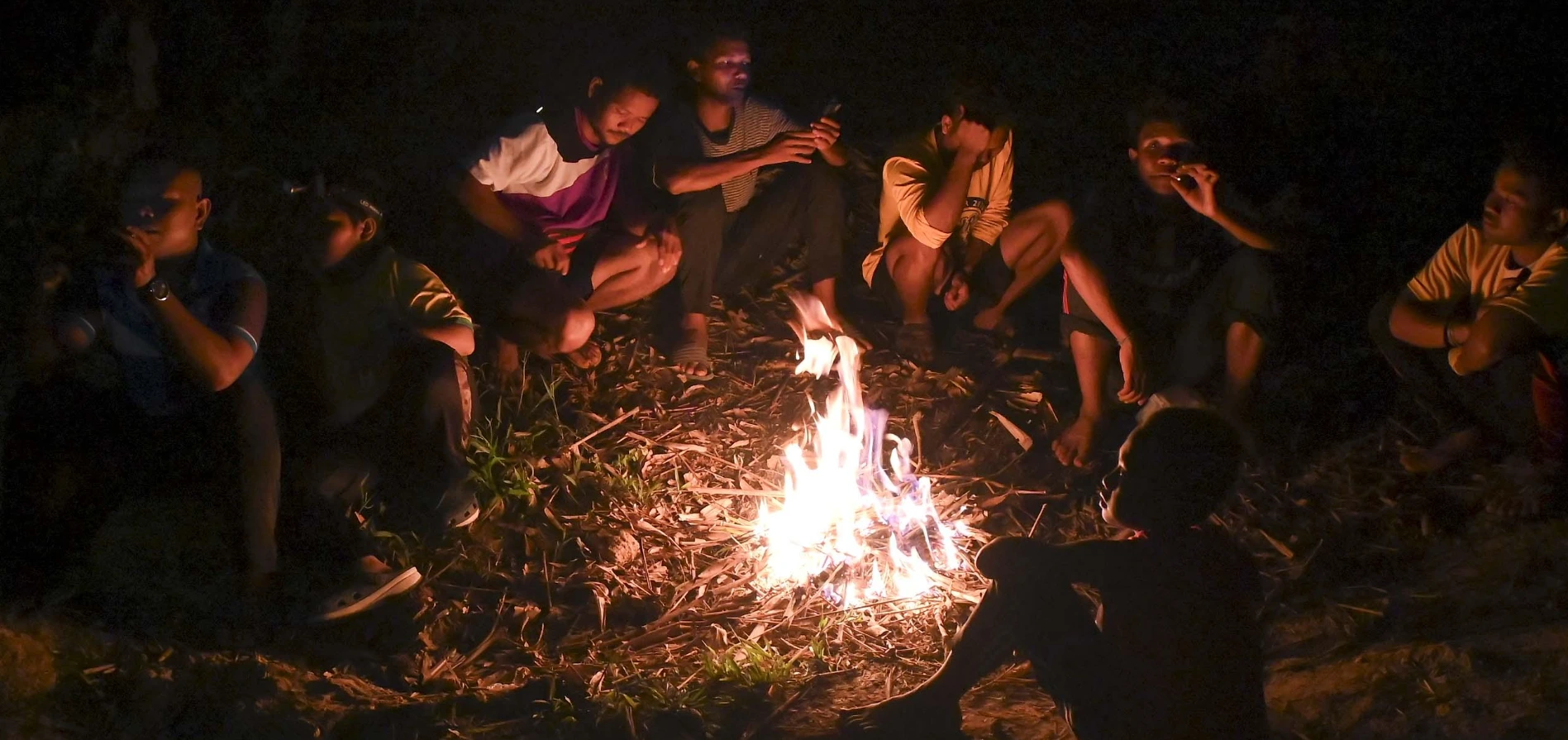
Temiar men gathering around a bonfire on a pitch-black night. Photo: Malaysiakini
Disappearing way of life
One of the claims they make in their lawsuit is a loss of their native way of life because of the mining, logging and plantation activities. To outsiders, the trees felled are just logs but to the villagers, they are family heirlooms, markers of hunting trails.
When each of them is born, a tree is planted for them. Villagers could point out which tree belongs to whom, and which have been passed down for generations.
The trunk of one inherited rubber tree, planted at least 80 years old, was so large that it took four adult men to wrap their arms around the circumference.
But many of these heirloom trees were logged or bulldozed without consent, they said. The clearing and activities have also desecrated burial grounds.
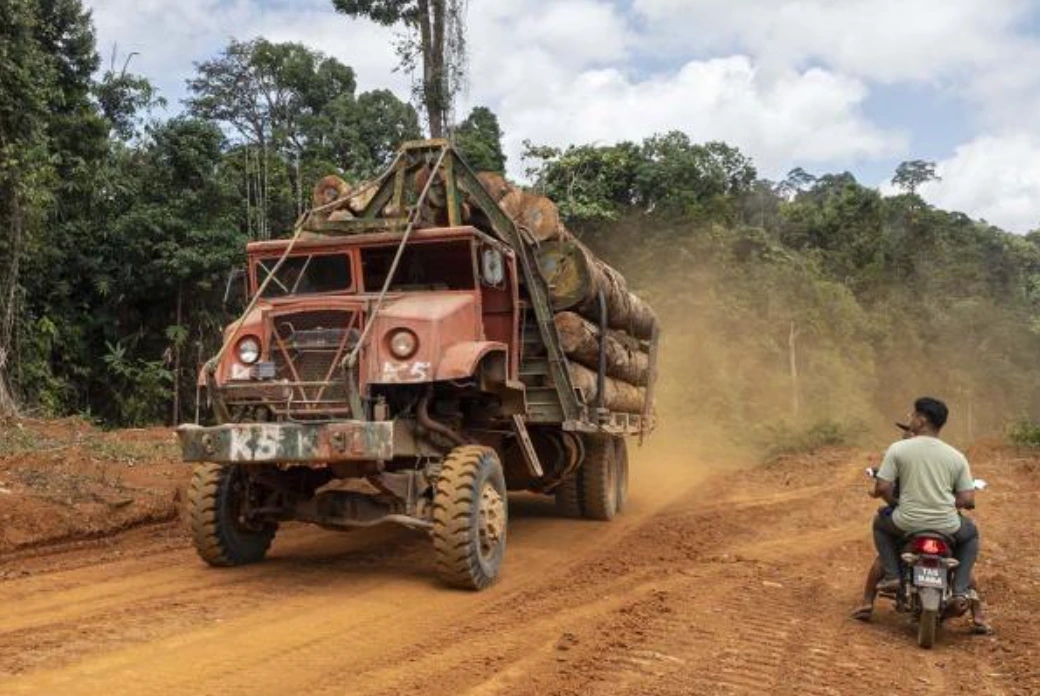
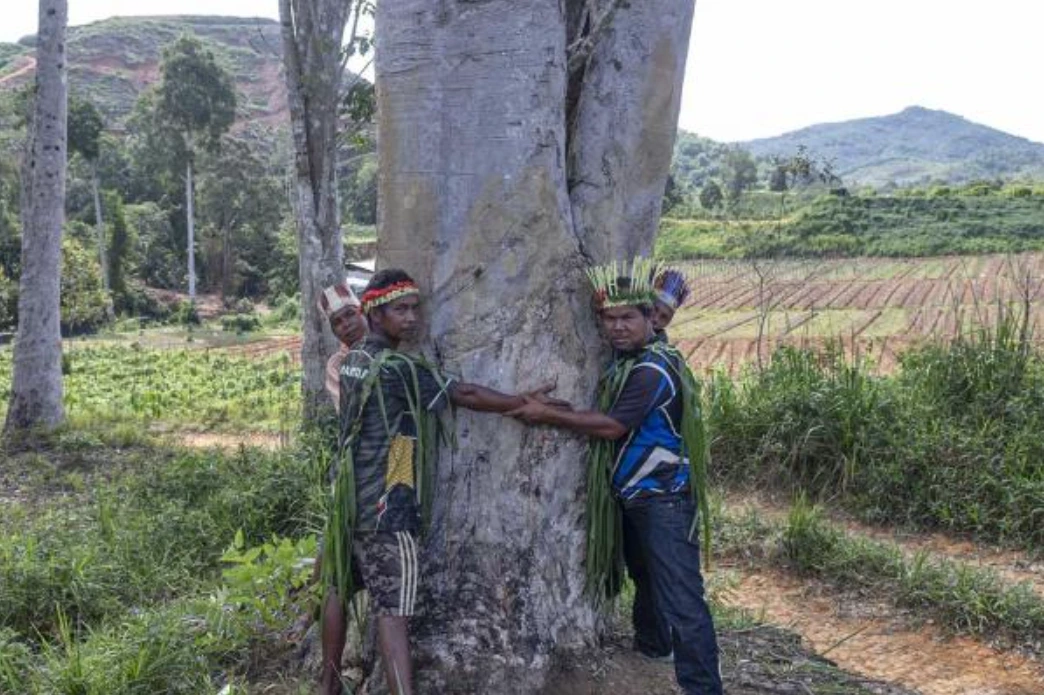
(Left) Villagers watch trucks carrying large logs pass by, leaving a dusty cloud along the trail; (Right) A rubber tree planted 80 years ago is a treasured heirloom. Photos: Malaysiakini
Standing by a dammed river near the top of Bukit Tambun, Alai points to the ravine where the river once flowed. It used to be a favourite camping spot when he hunted with his late father.
“Sometimes we stayed for a month, hunting and living in the dense rainforest, and there were no dirt roads back then.
“Food was plentiful, and we used to catch fish as big as these tree logs,” he added, gesturing to the forest they once trekked through on foot.Now Bukit Tambun is slowly disappearing as excavators continue to chip away at the iron-rich soil.
Now, at the spot about 7.7km uphill from the nearest village, those logs are staked into the ground, along with others, used as spikes to reinforce the dam wall against landslides.
At the edge of the larger mine, Alai points to a one tree amid the scarred landscape, its low-hanging fruits once useful for trapping birds.
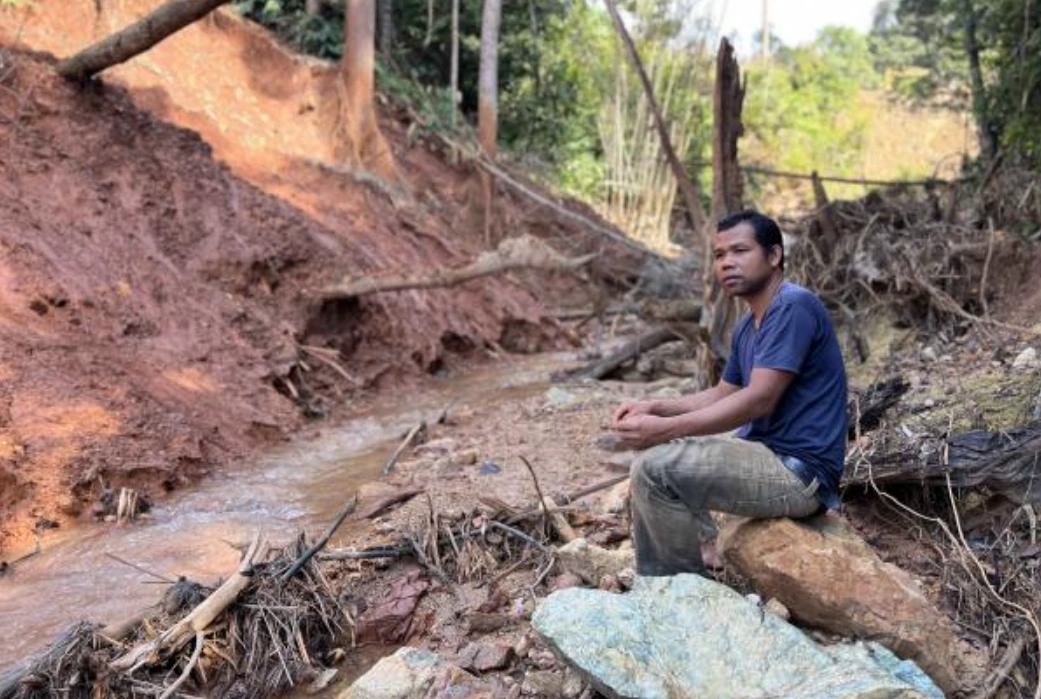
Alai Angah sits by the river bank which has been tainted a rusty red from iron tailing. Photo: S Vinothaa/Malaysiakini
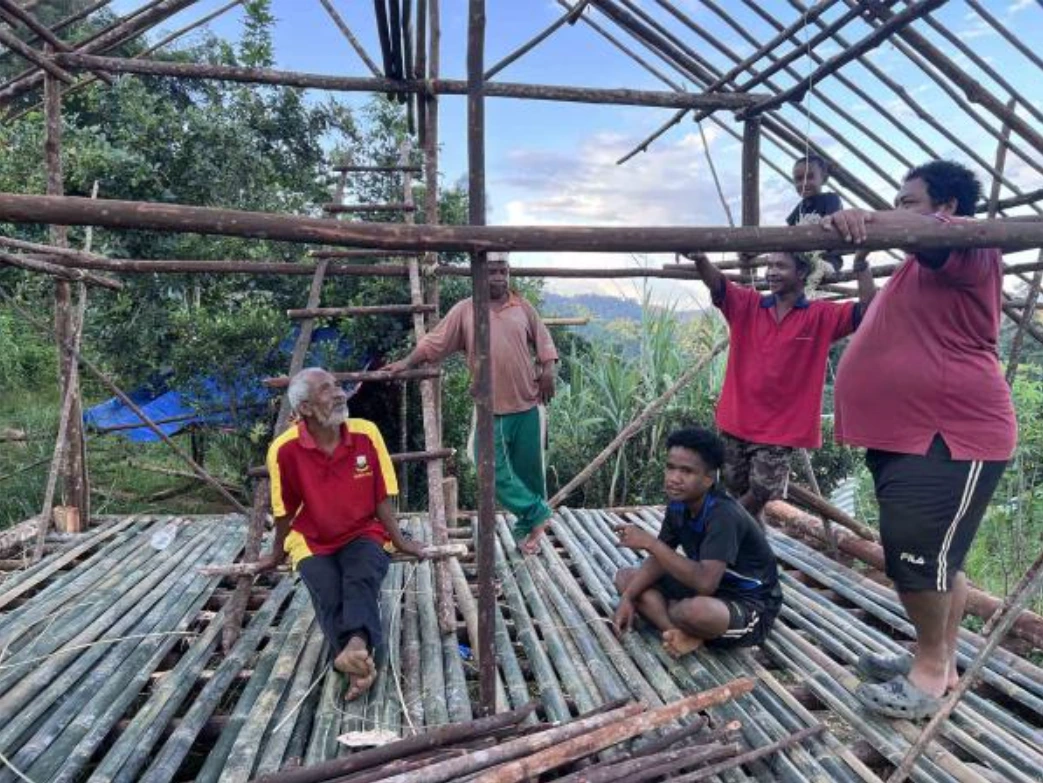
Azlan Ahak, 19, (sitting, right), with his father, Ahak Uda, 57, (sitting, left) and other relatives take a break from house building. Photo: Malaysiakini
Robbed of heritage, robbed of future
But the roar of the heavy machinery had driven wildlife away, and many villagers had to seek work at the mine, to earn money to buy provisions they once hunted or foraged.
The mining has not just robbed the villagers of their heritage and way of life. It may also rob them of their future.
For Azlan, the teenager whose blood chromium levels were four times the normal range, it means an estimated 64,000 times higher chance of developing cancer in his lifetime.
Chemical health expert, How, estimates that six percent of villagers who have the same exposure as Azlan could face the same dim outlook.
The lawsuit is their final hope to make it all stop.

Angah Alang, 76, was an adept swimmer and skilled tribesperson, but on July 23, 2015, he died in just three feet of water.
His body was found trapped among logs and shrubbery which rampaged down the river in a flash flood, along with boulders and mountain debris, some 10km downstream from an iron ore mine uphill.
The Orang Asli patriarch’s death in the river he had fished, swam, and bathed in almost all his life, was a terrible shock to the quiet, remote Temiar community of Kampung Kelaik near Gua Musang, who to this day are grief-stricken by the loss.

Now, the community believes that the same waters that killed Alang are leaving them with skin lesions and tainting their food and water sources.
Worse, they fear whatever that has turned the rivers a rusty red, is poisoning them and their children.
Blood tests revelaed that their fears are not unfounded.
(Left) Video of Azlan Ahak, a 19-year-old boy in Teminar, whose chromium level far exceed the normal range.

At a spot along the quiet Gua Musang-Cameron Highlands highway, raw iron ore – dark and gritty like coarse sand and almost black in colour – lies in heaps awaiting collection.
“These heaps remain untouched until the company receives an order, which can take up to six months. We know the iron is transported to Prai (in Penang), but we don’t know exactly where,” said Ahak Uda, the leader of the Kampung Kelaik action committee.
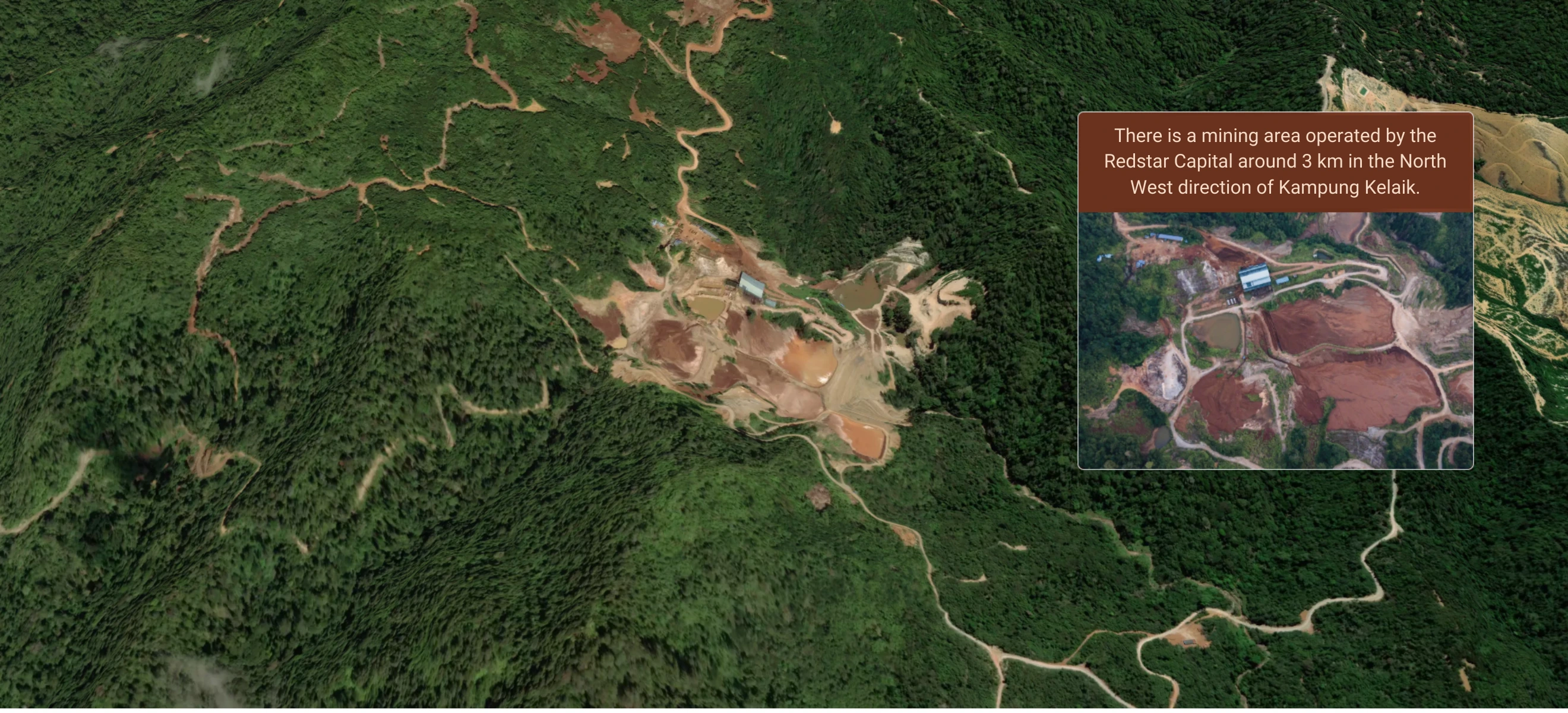
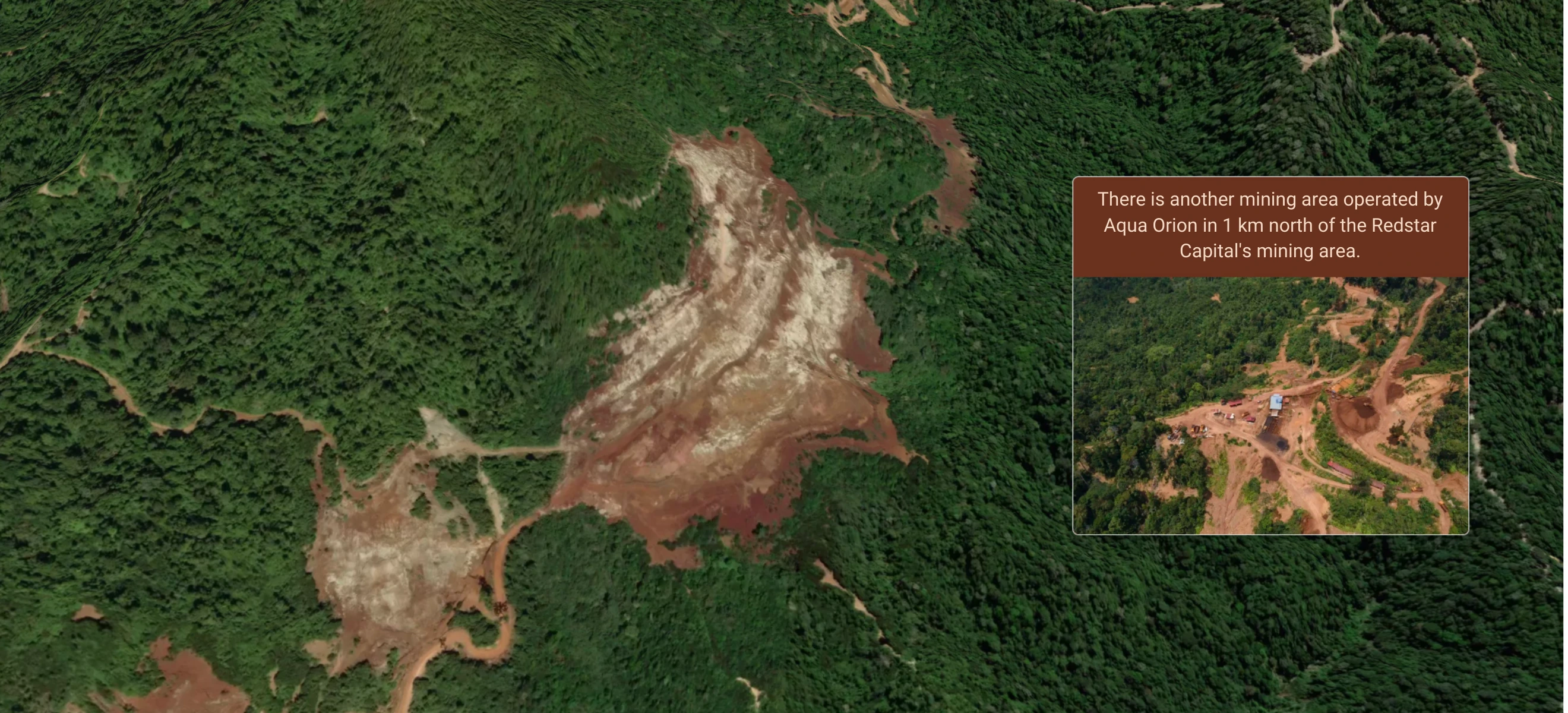
The ore comes from two mines near Kampung Kelaik, a Temiar Orang Asli village in the hinterlands of Gua Musang, which have been ravaged after more than a decade of mining. The two mines are Redstar Capital, which started in 2009, and Aqua Orion, which began operations in 2015.
There, the rivers have turned a rusty red, while what was once a thriving rainforest has turned into a muddy wasteland.
The plight of the Temiar of Kampung Kelaik was first highlighted by Malaysiakini in 2012, when it was reported that the river was so tainted that rice cooked with its water also emerged with a rusty red tint. Returning more than a decade later, Malaysiakini had over the past months conducted multiple water and environment sampling at various points of the river, and on fish and ferns.
They also conducted tests on blood samples of six villagers who consented to have their blood tested for heavy metals.
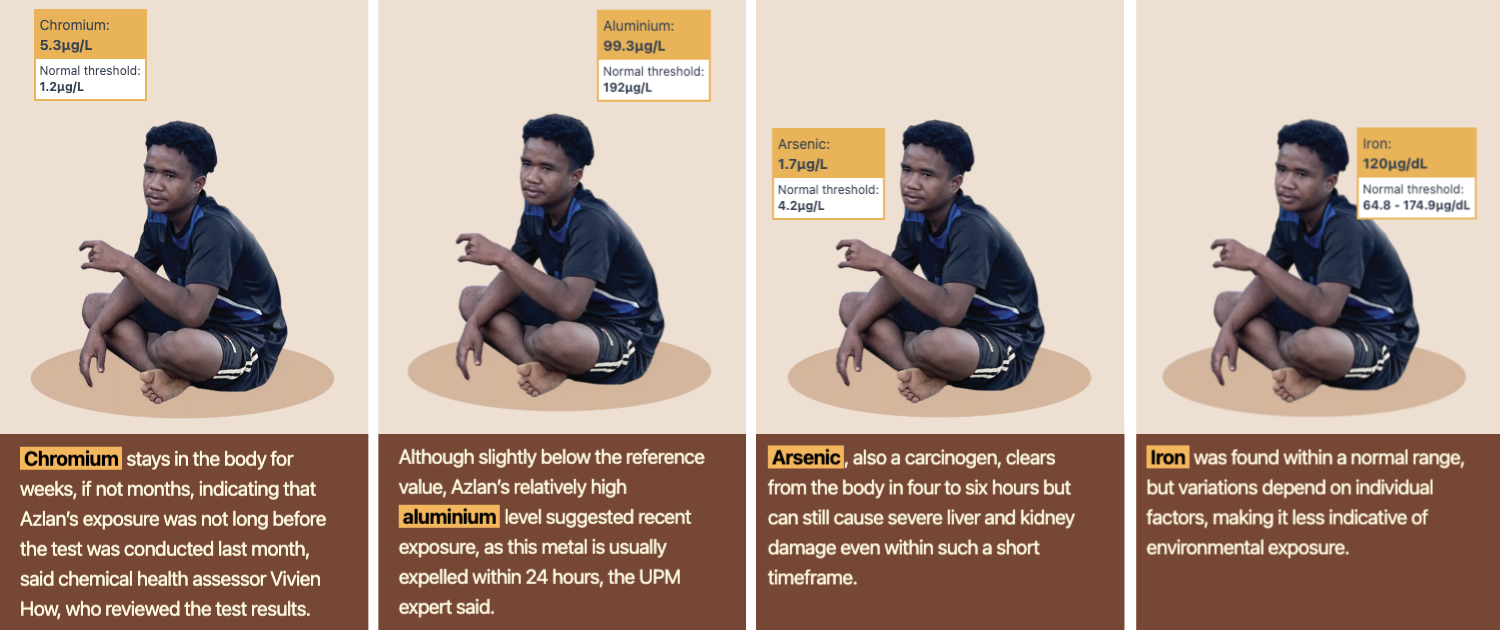
Alarmingly, it found that one villager – Azlan Ahak, 19 – who spent the most time in the river daily, had chromium levels four times the normal range in his blood.
How did Chromium get into Azlan’s blood?
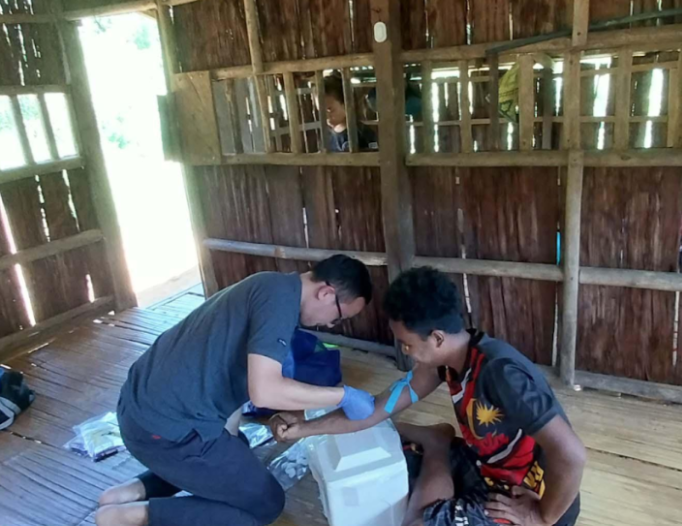
Azlan Ahak providing a blood sample for testing for heavy metals. Photo: S Vinothaa
Chromium is a heavy metal with several variants. One variant – chromium-6 – is sometimes referred to in headlines as the “Erin Brockovich chemical” after it became the subject of the blockbuster film of the same name.
The film told the story of a small town in California, in which residents were disproportionately ill due to chromium pollution in their drinking water source.
Was this also how chromium made it into Azlan’s bloodstream, and were the iron mines the culprit?
Tests conducted by Malaysiakini at the discharge points of the two iron ore mines operating upstream of Kampung Kelaik showed for one of the mines – Aqua Orion – the level of chromium was at 2.6mg/L.
This exceeded the limits allowed by the Department of Environment, said water quality expert Zaki Zainudin, who reviewed the water sample test results.The Department of Minerals and Geosciences does not have a set limit for total chromium, but it sets a limit for two variants of chromium – chromium-6 (0.05mg/L) and chromium-3 (1 mg/L) under the Minerals Development (Effluent) Regulations 2016.
On Zaki’s advice, water samples taken on a subsequent expedition were tested for chromium-6 and chromium-3 separately.
It was found that the sample from a pond where tailing sediments were dumped found elevated levels of both chromium-6 (19.4mg/L) and chromium-3 (34.8mg/L).
The permissible levels by DOE are 1.4mg/L and 2.5mg/L respectively for Class III water sources. Class III refers to rivers that can support aquatic and some human activities with proper treatment.
-
Department of Environment River Classes and Uses
CLASS I—Clean river with no treatment necessary.
CLASS IIA—Can be used for fisheries and water supply with conventional treatment.
CLASS IIB—Suitable for recreational use with body contact.
CLASS III—Can be used for water supply with extensive treatment and for fishery and livestock drinking.
CLASS IV—Can be used for irrigation.
CLASS V—Polluted river which cannot be used.
Effluents from the pond were released into a river, which found its way to Kampung Kelaik – something Zaki said should not happen.
It is crucial to prevent these elevated levels from entering nearby watercourses, such as rivers and ponds, as they could pose serious health and environmental risks. — Zaki Zainudin, water quality expert.
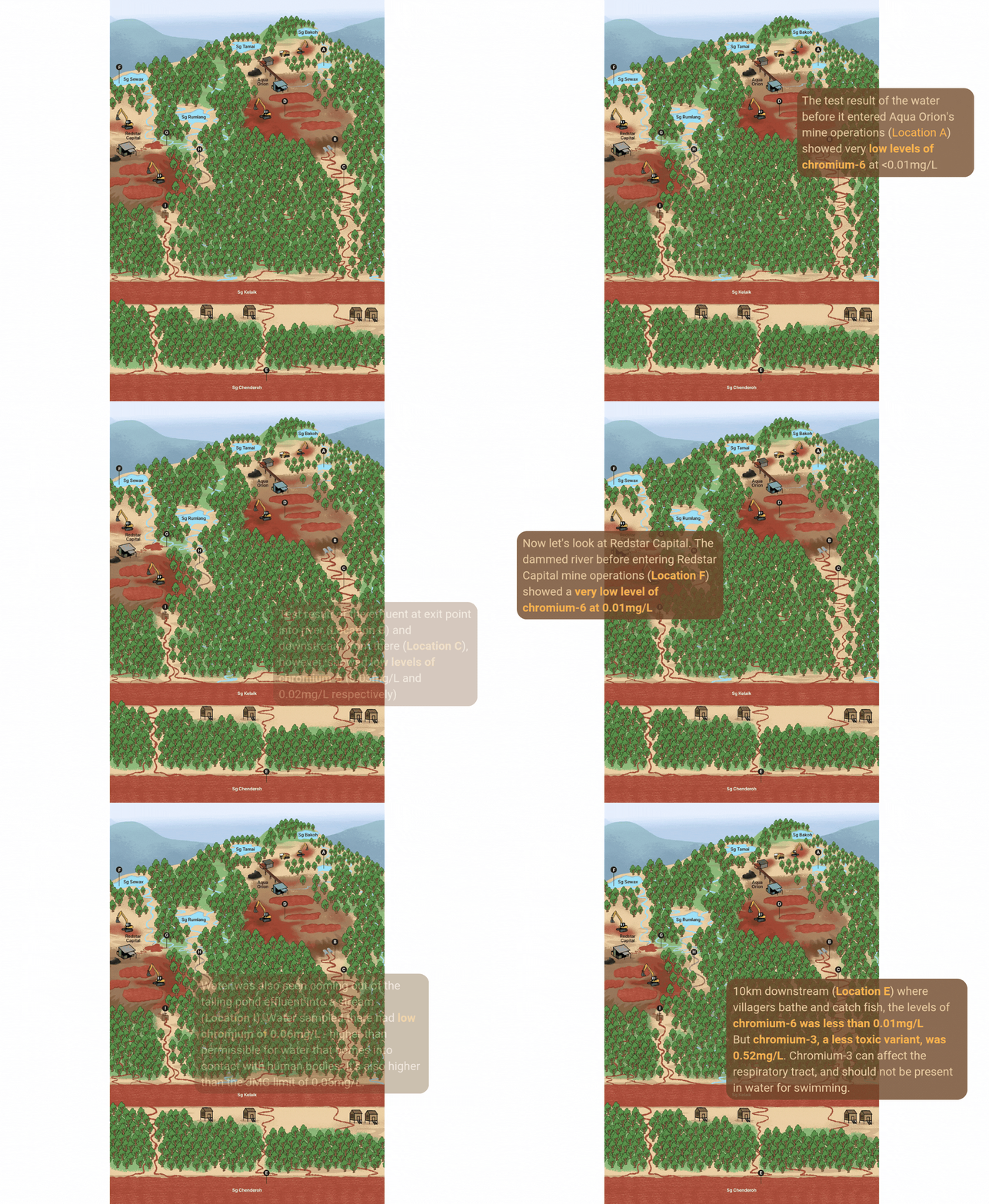
Water sampling downstream, where Azlan and other villagers access the river for bathing or fishing found a much lower level of chromium – 0.52mg/L for chromium-3 and less than 0.01 for chromium-6.
But it had rained just an hour before sampling.
“Heavy rainfall could dilute the chromium concentration in the water at the time of sampling,” said chemical health expert Vivien How. “Rain can also wash contaminated sediments from upstream areas into rivers, potentially increasing exposure to heavy metals in direct contact with the water.
“However, this may not reflect in a single water sample taken after dilution effects from rain,” she said.
[The infographic below is a looping gif – please pause to view and understand it accurately]
Chemical analysis expert How said that further analysis was required to conclusively link the chromium in Azlan’s blood with pollution in the river but the water and blood data showed it is likely.
She added that the test results didn’t show high chromium levels in the swimming area due to heavy rain during sampling, which might have masked true contamination.
When asked if the plantations may have also contributed to the chromium contamination, she said that the pesticides used can “seep into the soil, contaminate the water, and further enhance environmental burdens”.
Elevated Risk of Cancer
How said the findings are red flags, enough to warrant further investigations by relevant authorities, especially due to the severe health implications.
She then estimated Azlan’s lifetime carcinogenic risk (LCR) from his test results. This measures the risk of him developing cancer in his lifetime. She found that it “far exceeded” the normal threshold. How far is that?
[The graphics below are looping gifs – please pause to view them accurately]

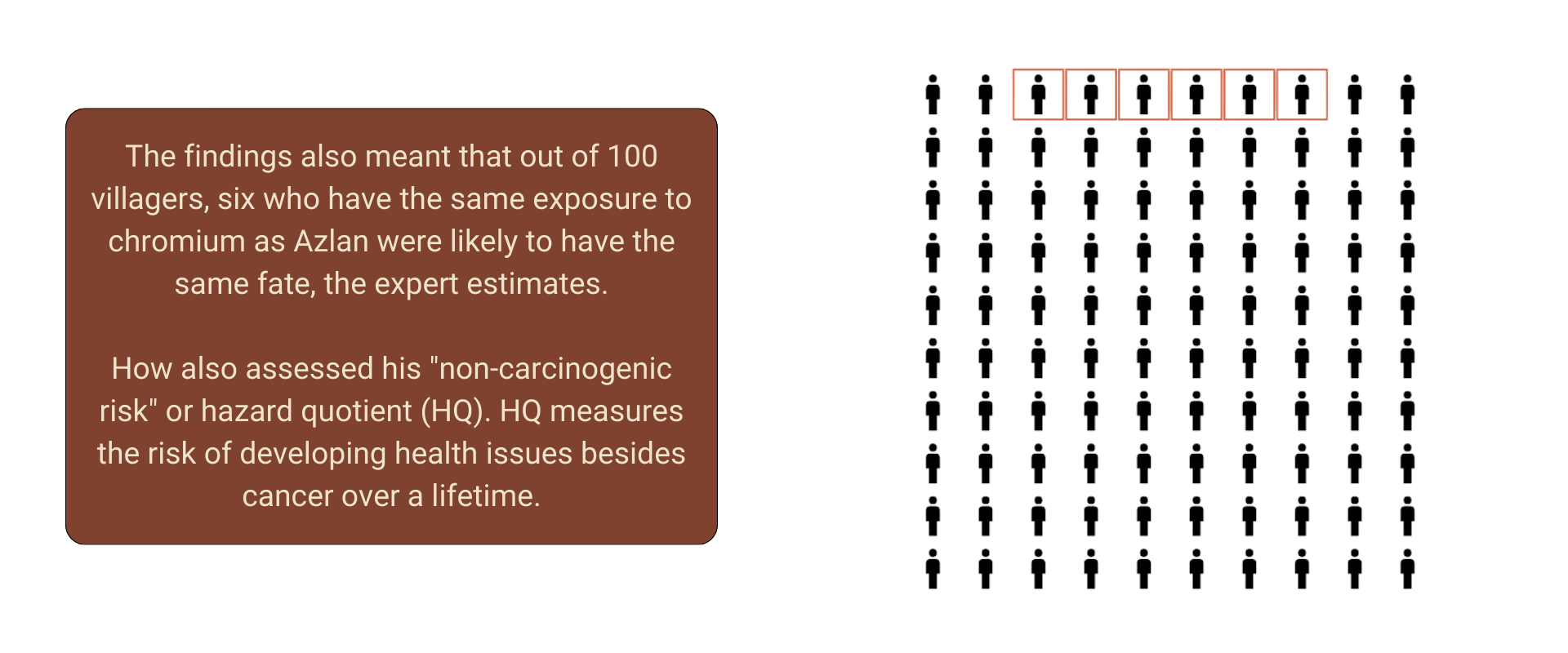

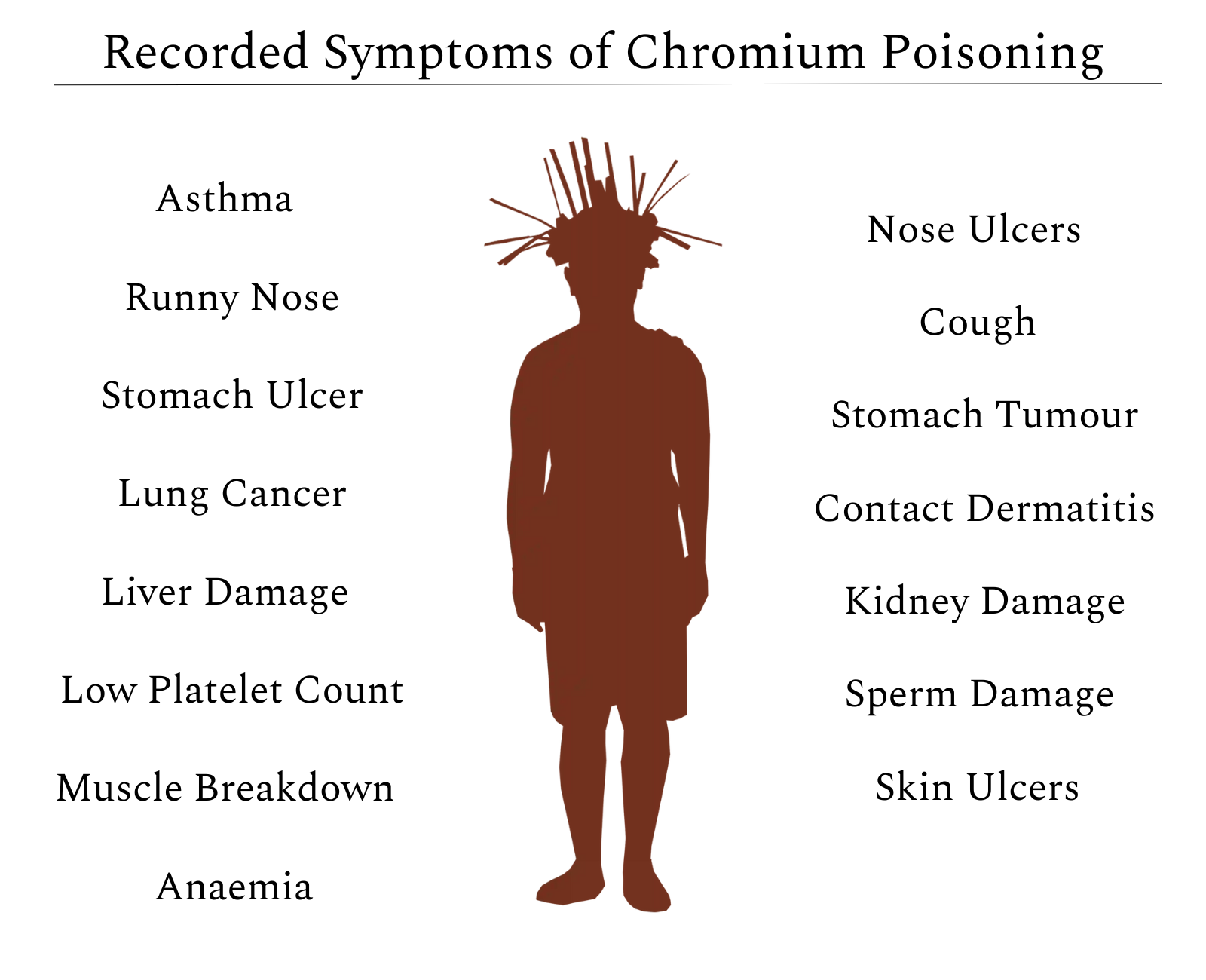
“Using Azlan’s exposure data as a reference for the villagers, this suggested a severe risk of developing non-carcinogenic health effects from chromium exposure through prolonged reliance on the river as a water source. Potential impacts may include kidney, liver, and respiratory issues over the course of exposure,” said How.
Read Vivien How’s technical report here.
Most Exposure to the River
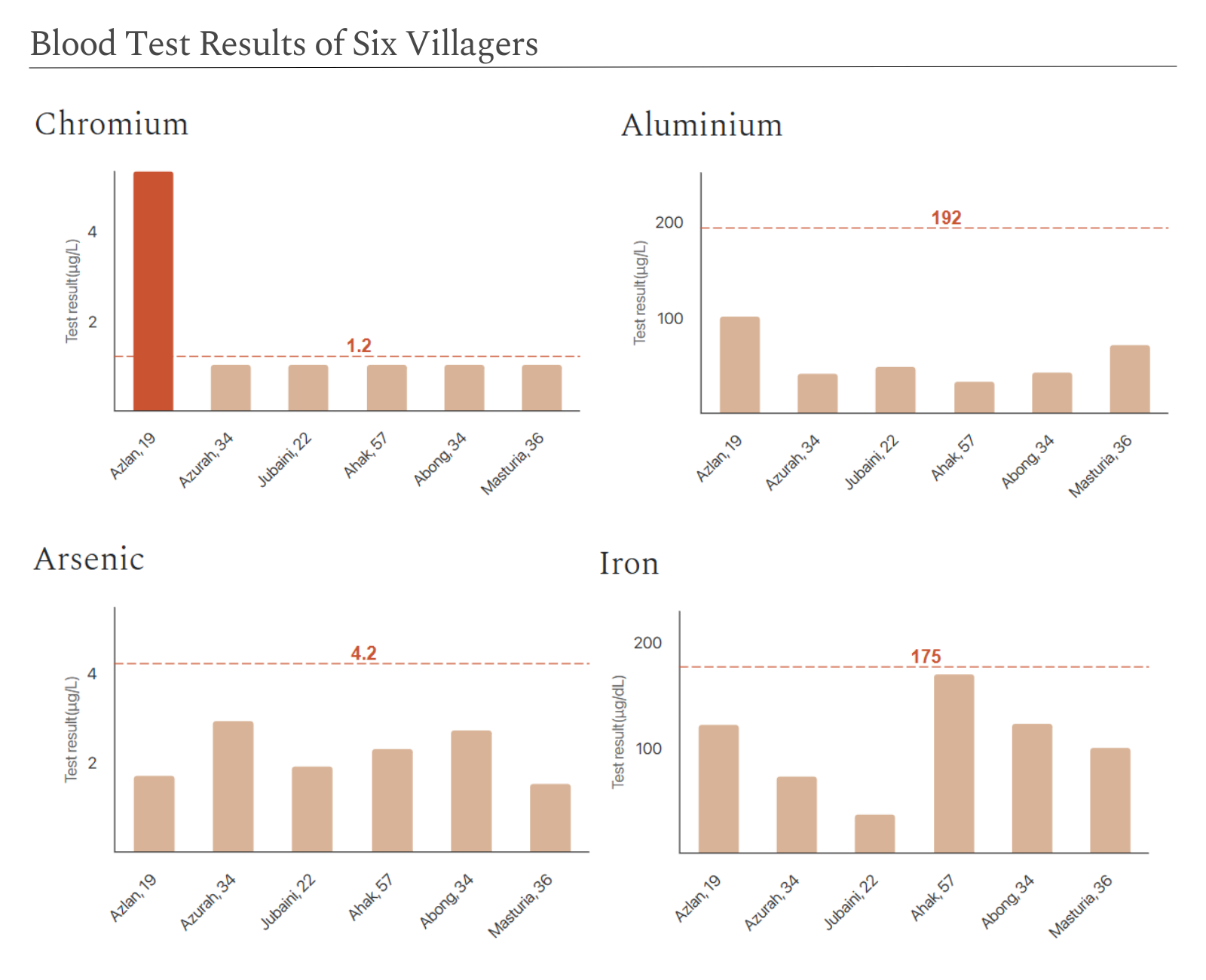
Azlan was the only one among six villagers tested who had higher than normal chromium levels in his blood. How said his result was “worrying”.
Azlan was also the youngest among them, and spent the most time in the river, compared to the other villagers willing to be tested. “The aluminium, arsenic, and chromium are telling us something… It’s enough to raise concern and bring awareness of this to the relevant parties,” she said.
Once a Secluded Paradise
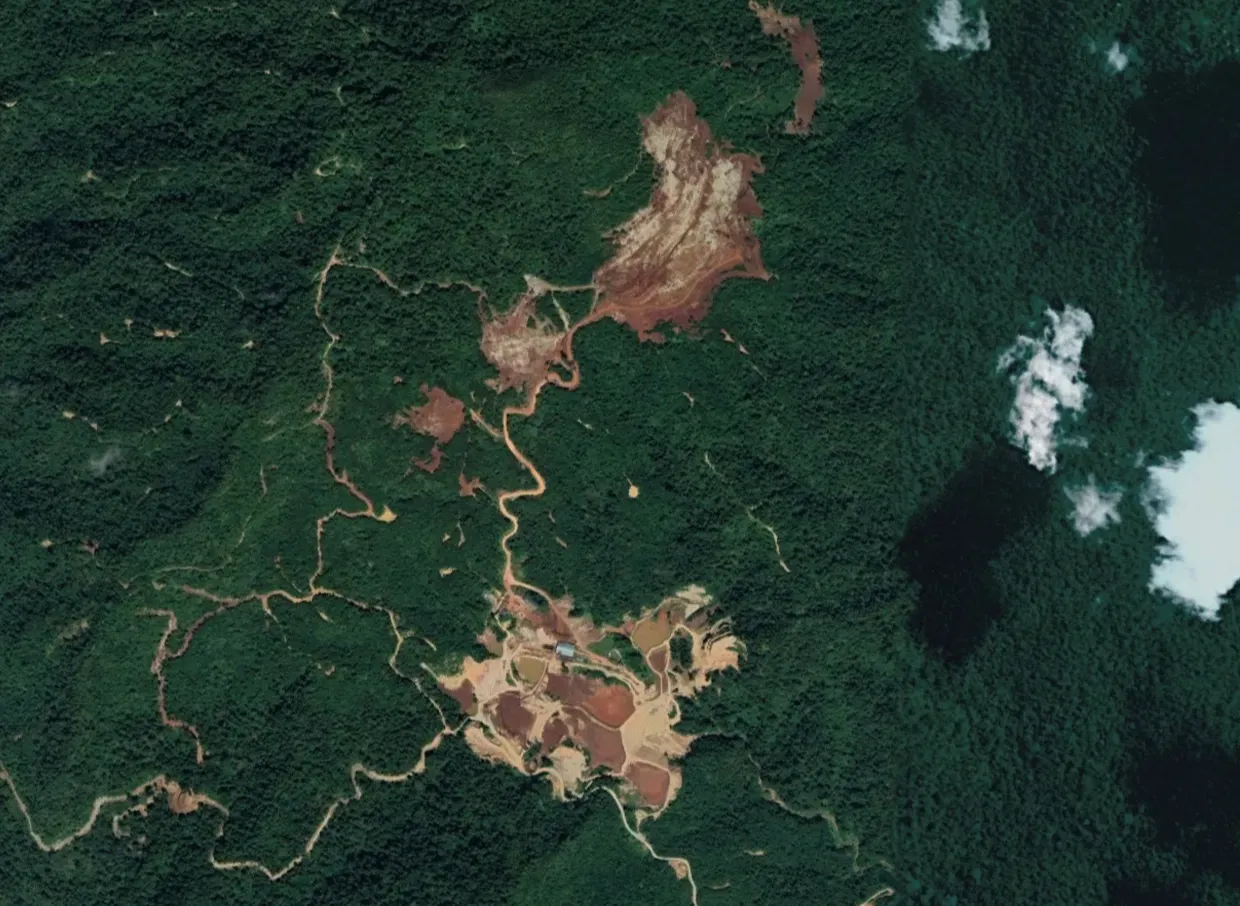
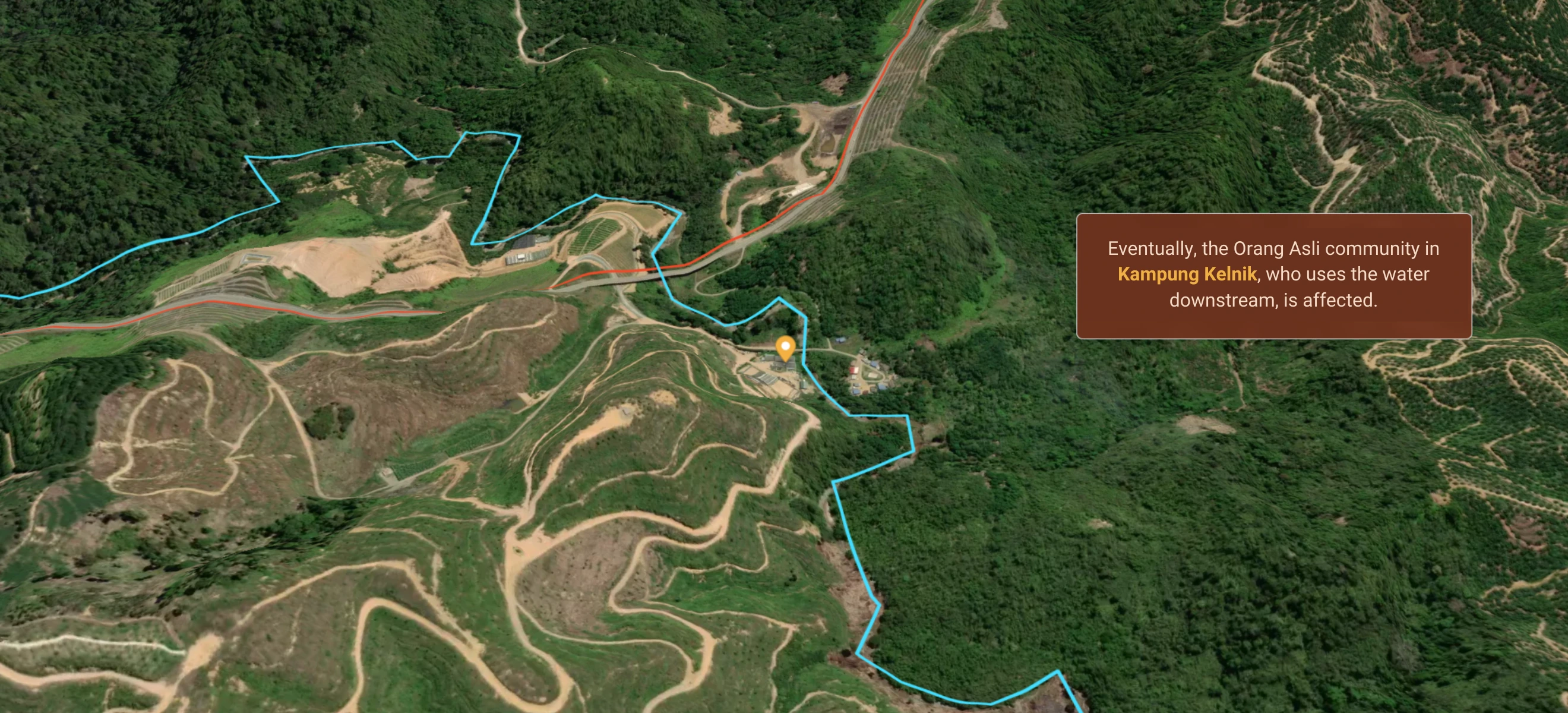
Satellite image from 2023 shows how iron ore mining has ravaged pristine rainforests, home of the Temiar folk of Kampung Kelaik near Gua Musang. Image: Malaysiakini
The Gua Musang-Cameron Highlands highway, which opened in 2004, accelerated the spread of oil palm, rubber, and durian plantations, and the mining operations on their ancestral land.
Before that, this Temiar community of about 200 people lived in seclusion, separate from Orang Asli settlements in Gua Musang and without an administrative centre or “post”.
With no electricity or piped water, they drank from clear streams, foraged and hunted for what they needed, and felt little need to venture beyond their homeland. Even the unhurried pace of Gua Musang town was too bustling for them, said Ahak.
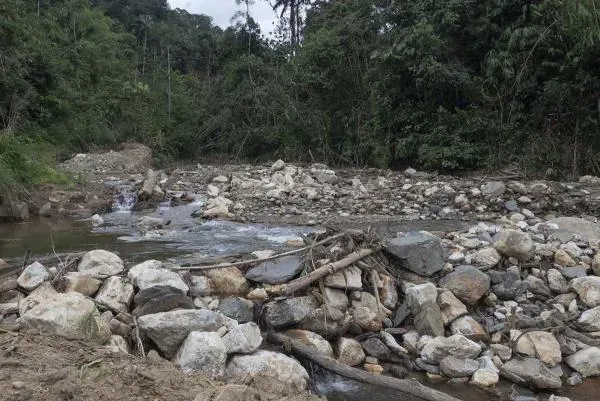
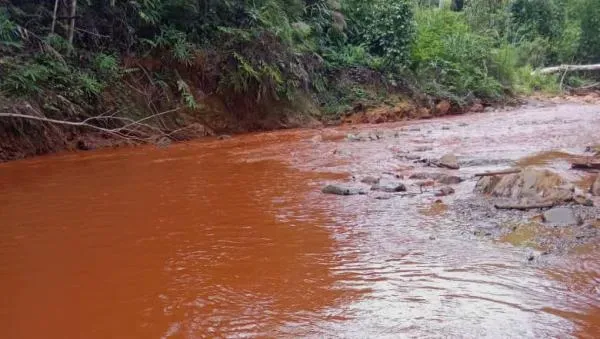
The stream on the left is slightly further from Kampung Kelaik. The water is clear, compared to the rivers at Kampung Kelaik (right), located directly downstream from the mines. Photos: (left) Azneal Ishak, (right) Kg Kelaik villagers via Malaysiakini
Iron ore mining in Kampung Kelaik started in 2009 when Azlan was just four years old.
By the age of five, he was already joining fishing and hunting expeditions, recalled his father, Ahak, who spoke on his behalf because Azlan was not fluent in Bahasa Malaysia.
Today, he visits the water up to three times a week, his father said.
He spends hours at a time in the river, catching fish and frogs, the community’s main source of protein, especially now that wild game has been chased away by widescale deforestation and the sound of heavy machinery from mining activities.
Since the river they used for drinking, bathing, and fishing for generations started turning red, Kampung Kelaik, with the help of the Health Department and NGOs, sourced water from a neighbouring uphill stream. The stream is clear, compared to the rivers downstream from the mines.
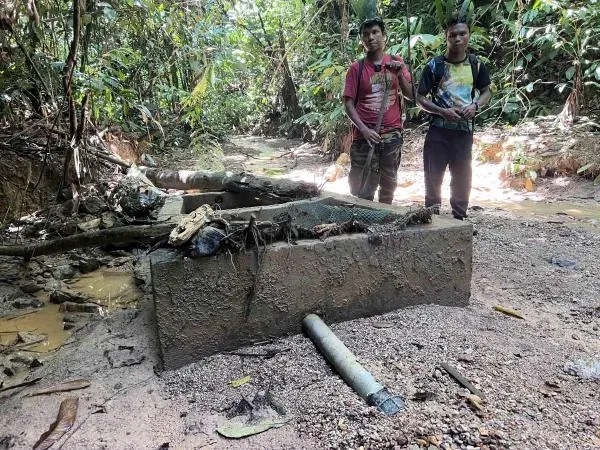
A mini reservoir built with the help of NGOs and the Health Department is meant to capture water from an unpolluted stream further away from Kampung Kelaik and pipe it down to the village. But the reservoir often gets clogged by natural debris. Photo: S Vinothaa/Malaysiakini
But these streams are too small to sustain fish populations, and during heavy downpours, the gravity pipe system and small reservoir built to source water is clogged by debris, cutting water supply, sometimes for days, Ahak said.
The struggle even for the most basic things – water – had worn down the community. They feel they have lost more than just the tranquillity of their forest.
Even the skins of the frogs were stained with a cakey, rusty red film by the time the villagers catch them.
Skin lesions, breathing and neurological difficulties
Like Azlan, those who can’t afford to buy food from outside the village continue to spend hours in the rivers, despite the lesions developing on their skin.

A medical professional who treated some of the villagers for their skin ailments told Malaysiakini she could not rule out the river water as the cause of the contact dermatitis that she saw.
“Lesions usually recover when they avoid contact with the river water and, for the immediate solution, I would suggest rainwater catchment with filters as all gave the history that skin lesions began with contact with river water,” said the doctor, who declined to be identified.
Photos: Azneal Ishak, S Vinothaa and Kampung Kelaik villagers
More worryingly, she said some of them complained of having “respiratory and neurological” problems for up to one hour after getting out of the river.
Further tests would be needed to determine if these conditions suffered by Azlan and others like him in Kampung Kelaik are due to chromium poisoning.
Chromium exposure among workers at chrome and steel factories was found to have led to higher rates of lung cancer mortality, according to the US Department of Occupational Safety.
Loophole in the Law
While higher than permissible rates of chromium and other heavy metals found near the discharge point at Aqua Orion may appear like a clear violation of the law, Zaki, the water quality expert, said enforcing it might be a challenge.
A loophole in the law allows a licence holder to apply to the director-general for permission to discharge effluent exceeding the standard limit with certain limitations, Zaki said.
Another loophole could be that these two mines, which began operations in 2009 and 2015, may not be required to comply with these regulations, because the current regulations became effective January 2017.
(Right) A frog caught in the river polluted by mining effluent, has a rusty red film on it. It is a source of protein. Photo: Azneal Ishak via Malaysiakini
Redstar Capital: We comply to all regulations
The Minerals and Geosciences Department (JMG) has yet to respond to Malaysiakini’s questions on suspected irregularities in the mining at Kampung Kelaik.
However, the department confirmed that Redstar Capital is the contractor responsible for the mining operations under a 20-year lease held by Syarikat Perlombongan Gua Musang Sdn Bhd since 2009.
Aqua Orion, meanwhile, was issued a mining licence for 2015 to 2025, the department said.
Redstar Capital administration manager, Julice Chu Lai Siong, defended the company’s practices, and said that media coverage of the issue over the past 10 years had been one-sided.
“We have received questions from the government…Our operations follow the rules,” she said when contacted via telephone.
Responding to Malaysiakini’s email later, she said the mine uses a “closed circuit” and “zero discharge” concept.
“Effluent water will be recycled to be used for mining processing and no effluent water will be released into the river,” she said, adding that the mine does regular effluent monitoring, and rivers nearby are sampled and sent to the JMG and DOE monthly for checks. “We will comply with the JMG standard limits of chromium-3 and chromium-6 which are 0.20 mg/L and 0.05mg/L respectively.”
She said Redstar Capital has never received complaints from the community about its operations, and that community patriarch Alang Angah’s death nine years ago was unrelated to its operation. The police case on the matter has also been closed, she said.
Malaysiakini has also contacted the other mine operator Aqua Orion, Syarikat Pelombongan Gua Musang, and the Department of Orang Asli Affairs (Jakoa) for comment.
We want our Land back
Ahak’s voice betrayed the anguish and worry he tried to hide when Malaysiakini called him with the bad news about his son Azlan’s blood test.
With urgency in his voice, he asked if all the villagers could be tested because the river is central to their lives – for fishing, washing, and playing.
“Many others go to the river more often. This is very dangerous, and I’m deeply concerned for their safety.”
When met, Health Minister Dzulkefly Ahmad told Malaysiakini his ministry would conduct further testing on the villagers to assess them for heavy metal poisoning, following the high levels of chromium found in Azlan’s blood sample.

Ahak said he was angry and disappointed – with the Kelantan government, the Orang Asli Development Department (Kelaik), Galas assemblyperson Mohd Syahbuddin Hashim, and even the Tok Batin of Kampung Kelaik.
They were all tasked to protect his community, but all of them failed the Temiar community since the loggers first arrived in 2005, Ahak said.
The three plaintiffs (from left): Aziz Angah, 30, Ahak Uda, 57, and Anjang Uda, 33. Photos: Kampung Kelaik villagers via Malaysiakini
Lawsuit against Native Land Encroachment
Ahak is now even more resolved to see through the community’s civil suit against the Kelantan government and other parties the villagers accused of encroaching into some 8,000 hectares of ancestral land and their way of life.
They have filed a lawsuit against 10 companies, the state government, and three agencies, crowdsourcing legal costs and support.
“We want our ancestral land back. We believe if these operations stop, the land will heal and eventually return to its original state, allowing future generations to thrive here,” Ahak said.
“We are the original people of this land and we have every right to reclaim what is ours.”

Photo: Malaysiakini
Aminul Islam Abdul Nor has been photographed with ministers and royalty, and his name has graced corporate pages in reports involving multinational deals worth hundreds of millions of ringgit.
But to the larger Malaysian public, how the Bestinet founder became a lynchpin in the lucrative migrant worker business is somewhat mysterious.
Bestinet is the company behind the Foreign Worker Central Management System (FWCMS), a system used by the government to process the hundreds of thousands of migrant workers arriving in Malaysia yearly.
Even before FWCMS issues hit headlines, or the recent money laundering allegations which he denied, the name “Dato Sri Amin” or the more xenophobic “Amin Bangla” has floated about in the Malaysian cybersphere over the years.
In the lead-up to the watershed 2018 general election, one video clip of the Bangladesh-born Malaysian went viral on social media.
In the video, Aminul, dressed immaculately in a suit and tie, is seen in a heated argument, next to a white BMW which is about to get towed.
The person who captured the video is heard claiming that Aminul had bragged that he “brought in thousands of people into Malaysia” and that he “controlled Hulu Kelang” where the BMW, driven by Aminul’s child, collided with another vehicle.
![A viral video clip of the Bangladesh-born Malaysian Nor showing him bragging about “[bringing] in thousands of people into Malaysia”.](https://admin.asiandispatch.net/uploads/editor-image-new/image_202412051733399463675193a764bd6.jpg)
A viral video clip of the Bangladesh-born Malaysian Nor showing him bragging about “[bringing] in thousands of people into Malaysia”.
“I don’t care who you are,” the man said in the video, with a caption alleging that Aminul was a proxy of powerful politicians who were benefiting from the migrant worker industry.
In a separate incident in 2017, Aminul pleaded not guilty to the charge of assaulting Muhammad Nuraiman Danish Erwazri, 17, at the lift area of the Sunway Putra Hotel, at 3.30am on June 17, and he was released on bail.
According to court records, the case was heard by the Magistrate’s Court five times between Aug 14 and Dec 15, 2017, before two magistrates. However, it did not progress further.
Court records did not show the case’s outcome and Malaysiakini has contacted the court registrar for further details.
Malaysiakini’s checks found the incident also involved Aminul’s child, while the alleged victim is the son of businessperson Marina Hashim, who was later involved in a controversial Felda land deal in 2018.
When asked about these two incidents, Aminul declined to comment. He also declined to be interviewed for this article.
Humble beginnings
Minor tussles aside, who is Aminul?
According to five industry insiders in Malaysia and Bangladesh who spoke to Bangladeshi media Prothom Alo, Aminul first came to Malaysia as a migrant worker in the early 1990s.
One of seven brothers, he grew up in humble circumstances in Brahmanbaria district in Chittagong, Bangladesh – some 100km from Dhaka – where he owns a house.
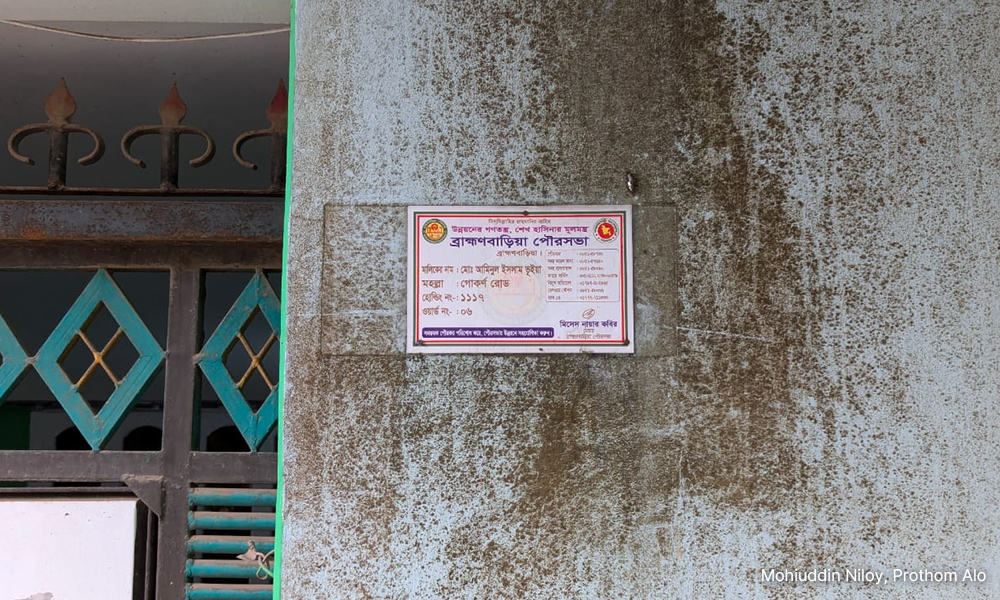
According to the municipal name plate, this home belongs to Nor. Photo: Mohiuddin Niloy/Prothom Alo
During a visit there in June, locals pointed Prothom Alo to a building in his name – the nondescript four-storey Aminul Islam Plaza at Kalibari intersection of Brahmanbaria district city.
He also owns another similar commercial building on the north side of the Pairtala bus stand, named after his father and managed by his brother.
There was also a large mosque under construction, surrounded by seven houses meant for seven brothers. Locals said Aminul funded the project.
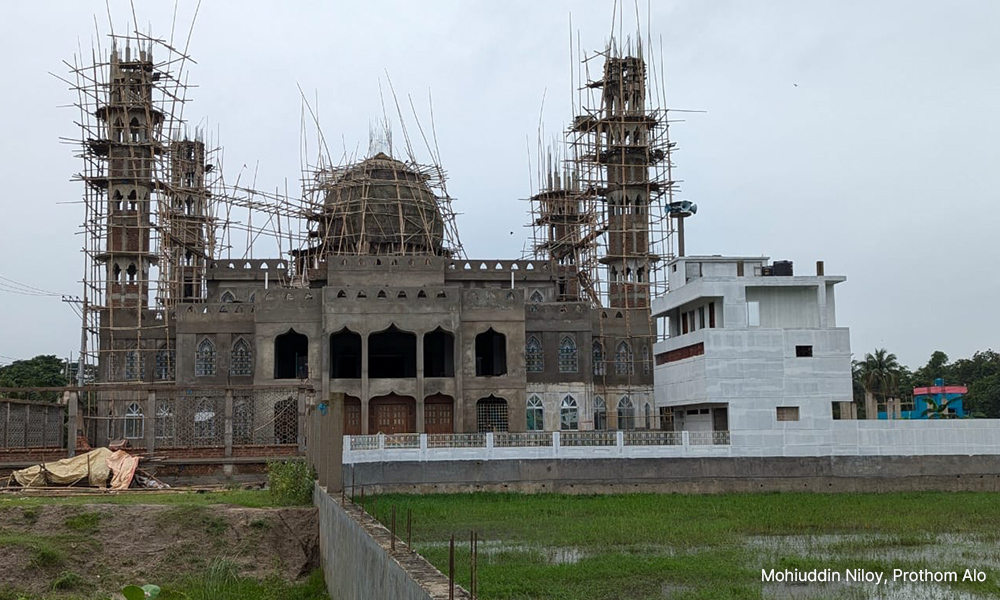
An Aminul-funded mosque under construction in Brahmanbaria, Bangladesh. Photo: Mohiuddin Niloy/Prothom Alo
Prothom Alo learnt that some BDT 140,000 million (RM5.21 million) has already been spent on the construction, with the project managed by Aminul’s younger brother, who runs a local newspaper.
Holding a Bachelor of Arts in Business Management from the University of Chittagong, industry insiders told Prothom Alo that Aminul’s entry into the migrant labour industry started when he parlayed his skills to secure the position as a broker for a businessperson who owned a labour agency.
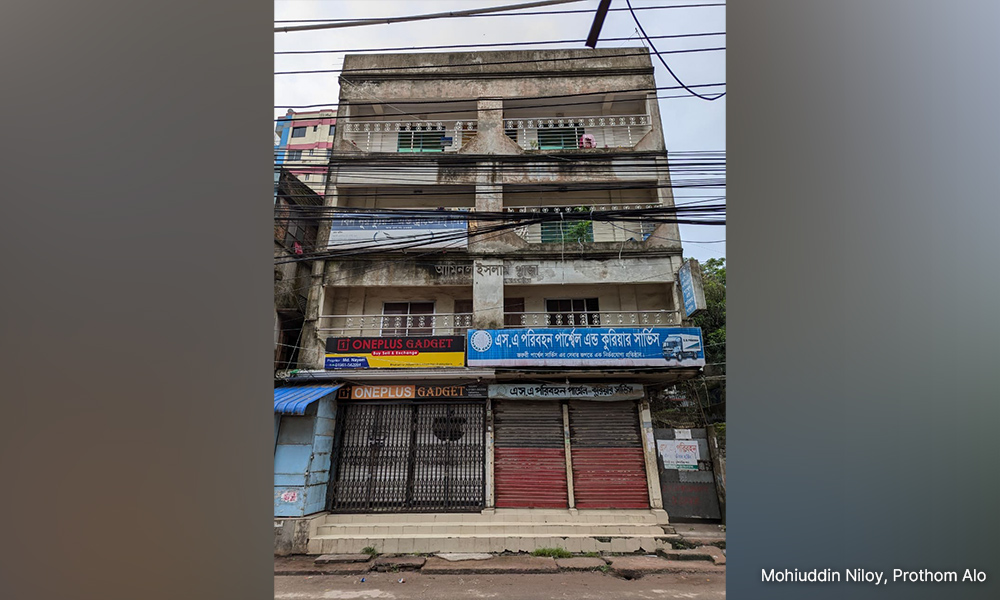
The Aminul Islam Plaza at Brahmanbaria, Bangladesh. Photo: Mohiuddin Niloy/Prothom Alo
His pathway to Malaysian citizenship began when he married a Malaysian – Rusilawati Mohamed Yusoff, known to industry players as Rosie – and the couple started their own business in migrant worker management.
It was around this time that he started having business associations with Ruhul Amin, who is also from Brahmanbaria.
Ruhul, a former secretary-general of the Bangladesh Association of International Recruiting Agencies, is also accused of money laundering.
The Bangladesh authorities have sought Malaysia’s cooperation to arrest and extradite Amin and Ruhul over these charges, but both have denied the claims.
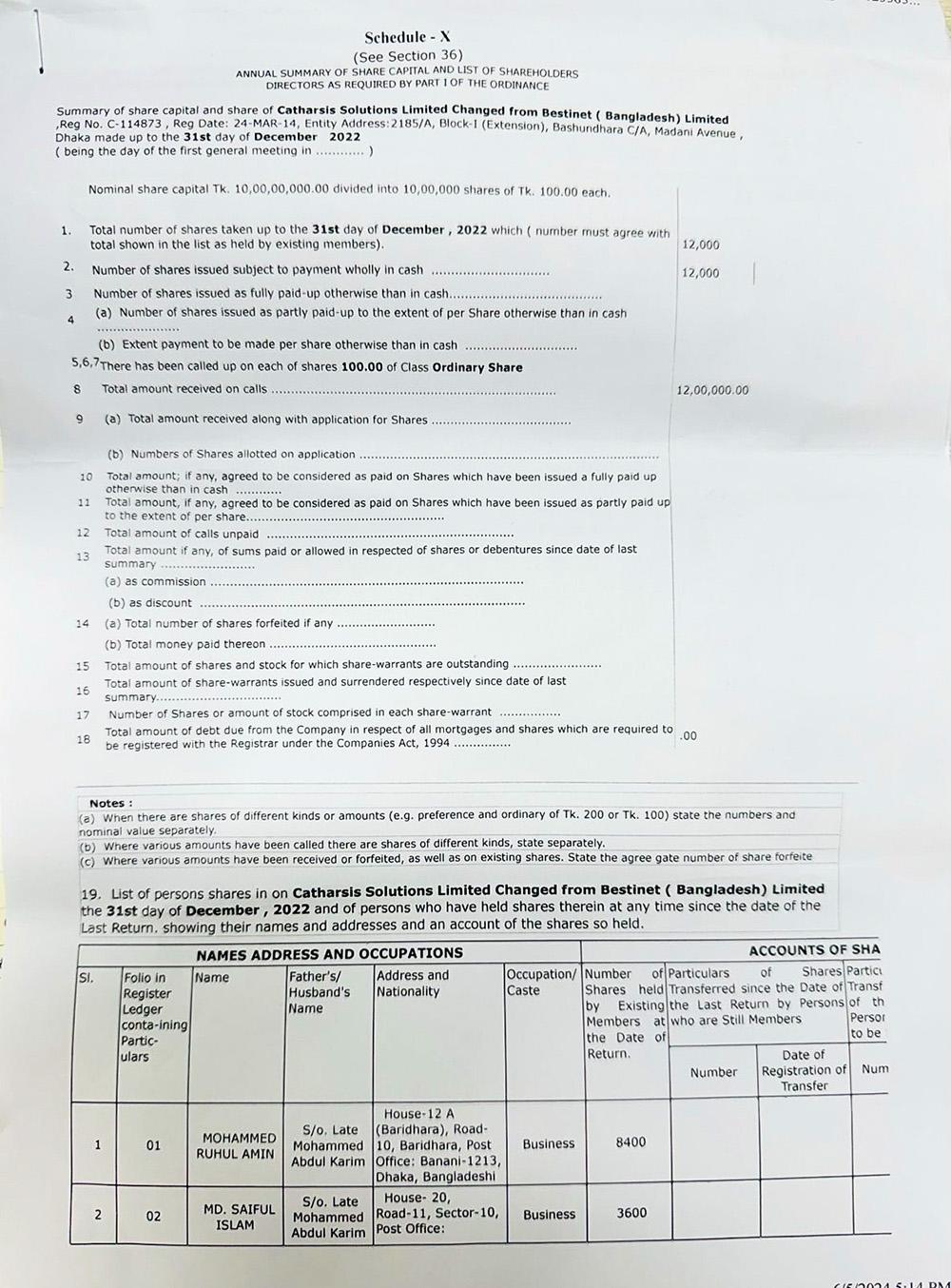
A document showing Ruhul’s company was once known as Bestinet Bangladesh.
Building an empire
Three decades after arriving in Malaysia, no one can say that Aminul’s rise from humble beginnings is less than remarkable.
He now has a significant corporate footprint, with shareholdings in dozens of firms in Malaysia, in a variety of industries including IT, shipping, security, labour recruitment, healthcare, travel, cattle breeding and food.
Although foremost known for being Bestinet’s founder, he has taken steps to pare down his holdings of the company, now owning less than one percent of Bestinet Sdn Bhd.
Still, his name remains connected to an extensive web of companies – at least six of which carry the “Bestinet” name.
They are Bestinet Technology Sdn Bhd, Bestinet FWQS Sdn Bhd (rebranded as Broadfield Natural Resources Sdn Bhd last month), Bestinet IT Solutions Sdn Bhd, Bestinet INTL Solutions Sdn Bhd, Bestinet Healthcare Sdn Bhd (rebranded as G3 Healthcare Sdn Bhd in April) and Bestinet Payment Services Sdn Bhd.
Some of these firms are subsidiaries of JR Joint Resources, a conglomerate established in 1998.
However, Aminul holds shares in only some of the “Bestinet-named” subsidiary companies, and his stake in the parent company, JR Joint Resources, is minimal – less than one percent.
Owners of parent companies and subsidiaries seem to overlap at different intervals, and the companies do business with each other.
For example, in 2021, G3 Global, a public-listed firm where Aminul is a director, acquired a 51 percent stake in Bestinet Healthcare – a distributor of hospital equipment, pharmaceuticals and hospital consumables – from Bestinet Technology.
The next year, Bestinet Healthcare made at least RM32 million supplying two million Covid-19 test kits to a government agency.
Since then, Bestinet Technology has paid G3 Global over RM70 million annually for a suite of services, including comprehensive Covid-19 testing services – ranging from test kit supply and on-site medical personnel to lab coordination and the development and management of end-to-end distribution and tracking systems.
In April this year, Bestinet Healthcare changed its name to G3 Healthcare Sdn Bhd.
Intergenerational wealth
His son, Muhammad Qhailiz Norman Aminul Islam who attended an international school in Kuala Lumpur and a university in London, will likely inherit his father’s empire.
In his twenties, Qhailiz is a substantial shareholder of G3 Global, which in 2022 won an RM118 million contract to provide a security system for both Kuala Lumpur International Airport terminals.

Qhailiz representing Bestinet at an award ceremony in 2021
In June this year, G3 Global’s subsidiary won a 30-year concession to provide migrant worker dormitories in Maldives.
Under the Maldivian government concession, G3 Global will charge employers US$100 (RM445) per worker per month for the first year, after which it will be increased to US$120 per month, out of which US$5 will go to the Maldivian government.
This is similar to the FWCMS deal, where Bestinet collects a fee from each migrant worker, and the government is not charged.
Saravanan: Aminul an honest guy
Like Bestinet, which at different intervals had former home minister Azmi Khalid and Pahang prince Tengku Abdul Rahman Sultan Ahmad Shah as its chairperson, G3 Global also has connected figures on its board.
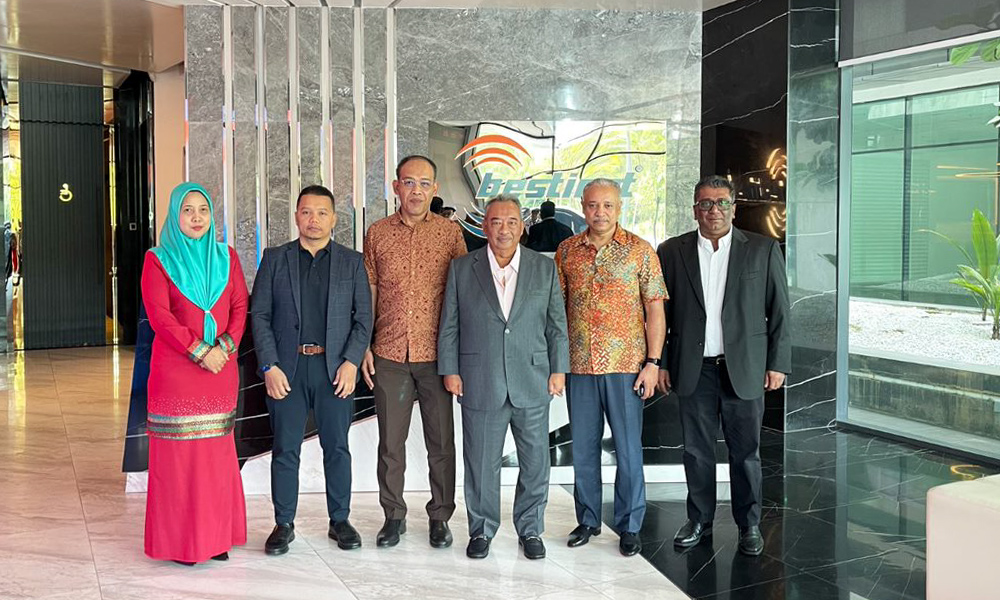
Tengku Muda Pahang Abdul Rahman Sultan Ahmad Shah (third from right) and Aminul (second right) at Bestinet’s office
In G3 Global, Alias Ahmad, former immigration director-general, who retired from the civil service as education secretary-general, is the executive chairperson.
Similarly, like many businesspersons with government deals, Aminul has been seen hobnobbing with government officials and ministers.

Ex-human resources minister M Saravanan in between Aminul and HRD Corp CEO Shahul Hameed Shaikh Dawood (left), with some family members, at Saravanan’s home
Photographs published on then-human resources minister M Saravanan’s social media showed him greeting Aminul and taking a warm photo with Aminul, controversial HRD Corp CEO Shahul Hameed Shaikh Dawood and some family members when he visited the minister at his home for Deepavali in 2023.
A photograph showing them and Shahul allegedly holidaying together at the famous Dubai Miracle Garden also went viral on social media.
MIC senator and Social Security Organisation (Socso) chairperson Haniffa Abdullah was also with them.
When contacted, Saravanan explained that he did not go on holiday with the trio, but that they bumped into each other in Dubai, where Saravanan was on a separate family holiday.
“Since we knew each other, we took a picture. That’s it,” he told Malaysiakini.
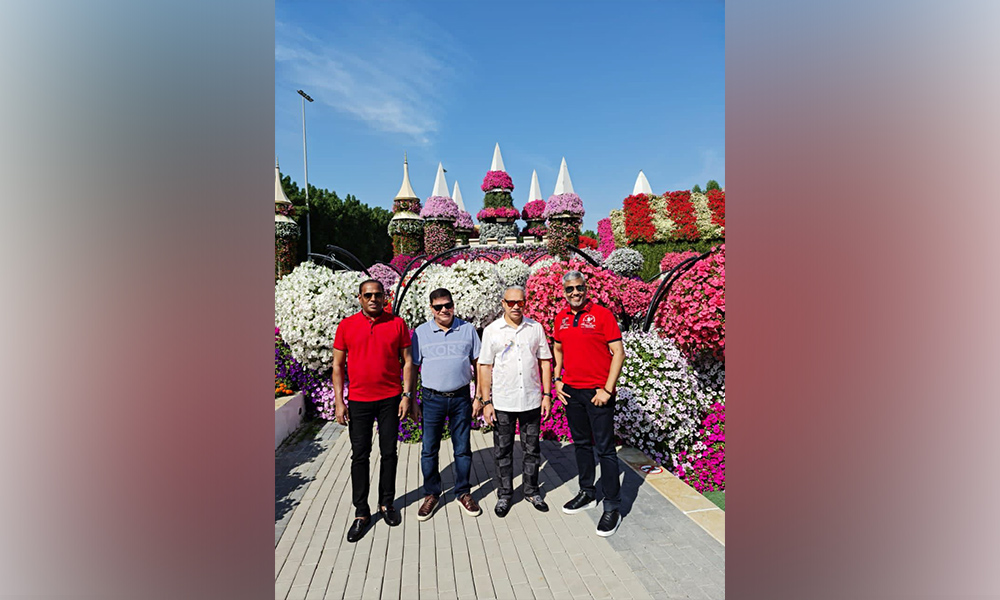
From left: Saravanan, Socso chairperson Haniffa Abdullah, Aminul and Shahul in Dubai
The former minister said as a “very friendly and approachable”, and successful businessperson, “everybody was easily attracted to (Aminul)”.
“I am one of them. Till today, we are good friends,” Saravanan said, characterising Aminul as “one of the most honest guys” he has ever met.
“I don’t know why he is always victimised now and then. A lot of people born elsewhere eventually become Malaysian after migrating here, but just because he is successful, everybody targets him,” the MIC leader said.
Malaysiakini has contacted Shahul and Haniffa for comment.
Zahid, Najib cited in lawsuit
Aminul’s lobbying efforts to get the FWCMS deal was confirmed in a messy legal dispute over company shareholdings involving Aminul-owned JR Joint Resources, two of its shareholders Mohd Zaki Jaafar and SH Yahya Sh Mohamed, as well as Mohamed Nizam Jakel Mohamed Jakel, the scion of the Jakel Group textile empire.
If anything, the legal dispute revealed how tenacious Aminul is in reaching his goals, even if it takes many years to come to fruition.
Although he was not directly a party to the suit, he was a central figure in the case and the court heard that he is “the prime mover of the various platforms and is the controlling mind behind these entities.”
Before the lawsuit hit headlines, JR Joint Resources had already caught flak for allegedly mismanaging a government contract to handle the repatriation of foreign workers in an amnesty programme.
In the lawsuit against Nizam, the High Court heard that Aminul had first introduced the idea to then prime minister Najib Abdul Razak at the Putra World Trade Centre in 2011 and Najib agreed that Aminul should approach the Home Ministry with the idea.
In 2012, the Home Ministry’s secretary-general issued a letter informing Bestinet of the ministry’s approval for the proof of concept.

Syed Alman Syed Alwi with his wife, Nurul Hidayah Ahmad Zahid, the daughter of Deputy Prime Minister Ahmad Zahid Hamidi
However, Nizam testified that in late 2014, then-deputy prime minister Ahmad Zahid Hamidi’s son-in-law, the late Syed Alman Syed Alwi, had asked him to work together with Aminul on the project because “Bestinet was having difficulty implementing and strategising the project for the government”.
Some months later in mid-2015, Nizam offered Aminul his services as a “consultant” with ties with “powerful persons” and senior officials, for RM200 million.
However, Aminul testified that ultimately, he felt Nizam did not do enough to warrant the payment and that the 30-plus meetings he claimed he had with officials to facilitate the FWCMS project were meetings on Jakel deals instead.
Coercion over Bestinet shares
In 2017, Nizam tried to co-opt the project altogether by registering his own company named FWCMS Sdn Bhd.
He showed Aminul a letter bearing this company’s letterhead with a notation from Zahid, who was the then-home minister, directing the FWCMS deal be awarded to the company, the court heard.
Nizam then proposed the RM200 million consultancy services agreement be scrapped in exchange for control of Bestinet.
Eventually, he agreed to accept 49 percent of Bestinet shares, 70 percent of two other related companies – Tass Tech Sdn Bhd and Synerflux Sdn Bhd – and a profit-sharing agreement.
Tass Tech, an IT firm, and Synerflux, a labour agency, were owned by the plaintiffs and were in 2017 reportedly on the cusp of winning government contracts.

Businessperson Mohamed Nizam Mohamed Jakel
The agreement was drawn up to transfer the shares to Nizam’s wife, Norhana Sharkhan, after which FWCMS Sdn Bhd was wound up.
However, JR Joint Resources, the company which owns Bestinet, challenged the agreement after the fall of the BN government in 2018.
The court found this agreement void because it was drawn up under duress and coercion.
The legal tussle to control Bestinet, even before the FWCMS deal was signed, underlines how lucrative the project promised to be.
So far, it has lived up to its multimillion ringgit promise.
According to its latest filing with the Companies Commission, Bestinet retained earnings of RM128 million and made RM85 million in profits out of RM138.92 million in revenue in the financial year ending Dec 31, 2022.
In fact, recent developments revealed that Bestinet’s revenue should run into billions.
Recently, Bestinet slapped the government with a letter of demand for RM1.63 billion, which it said it was not allowed to collect from migrant workers over three years.
To avoid a financially damaging lawsuit, the government decided to extend the FWCMS deal.
Having secured a renewal of service for the FWCMS for another six years – and with a fee hike from RM100 to RM215 per worker – there is more of that to come.

The founder of the controversial migrant recruitment technology company Bestinet Sdn Bhd is among some 300 Malaysians who own luxury properties in Dubai.
According to leaked property data, accessed by Malaysiakini through a consortium of investigative journalists, Bestinet’s former president Aminul Islam Abdul Nor owns a four-bedroom luxury residential property at Sidra Villas, a residential community in the prestigious Dubai Hills Estate.
The posh dwelling has four bedrooms and a build-up area of 3,595.25 sq ft (334.1 sq m), according to property data leaked through a journalism consortium – the Organised Crime and Corruption Reporting Project (OCCRP).
Comparable properties in the same residential area are advertised for sale with an asking price of AED7.5 million (RM8.76 million).
Its developer Emaar Properties describes it as “a prestigious community that epitomises sophisticated urban living.”
“Boasting an array of luxurious properties, including stunning villas and apartments, this development presents a golden opportunity for property investment in Dubai,” it said.
Besides the opulent villa, Dubai property records also showed that Aminul owns two office units at The Binary by Omniyat, an iconic skyscraper in the city’s Business Bay.
According to estimates by property website Bayut.com, office units there are sold between AED700,000 for 896 sq ft of space to AED3.8 million for 3,393 sq ft of space.
The units owned by Aminul are 2,292.93 and 1,647.42 sq ft respectively, the documents revealed.
When contacted, Aminul declined to respond but a source close to him confirmed the properties do belong to him. The source also said they were purchased legitimately.
Owning property in Dubai is not illegal but experts say Dubai’s property market is particularly attractive to real estate speculators, money launderers, and tax evaders in part due to its absence of taxes, particularly tax on capital gains and rents.
The documents reviewed by Malaysiakini do not suggest that Aminul’s assets were purchased through dubious means, or that the source of the income was questionable.
However, Aminul’s upmarket property holdings are in stark contrast with the plight of scores of Bangladeshi migrant workers, who reportedly are forced to mortgage or sell off family land to pay exorbitant fees to come to work in blue-collar jobs in Malaysia.
Money laundering accusations
In late October, the Bangladeshi government wrote to the Malaysian police seeking the arrest and extradition of Aminul and an associate in the migrant worker business, Ruhul Amin @ Swapon, over accusations of money laundering, extortion, and trafficking of migrant workers.
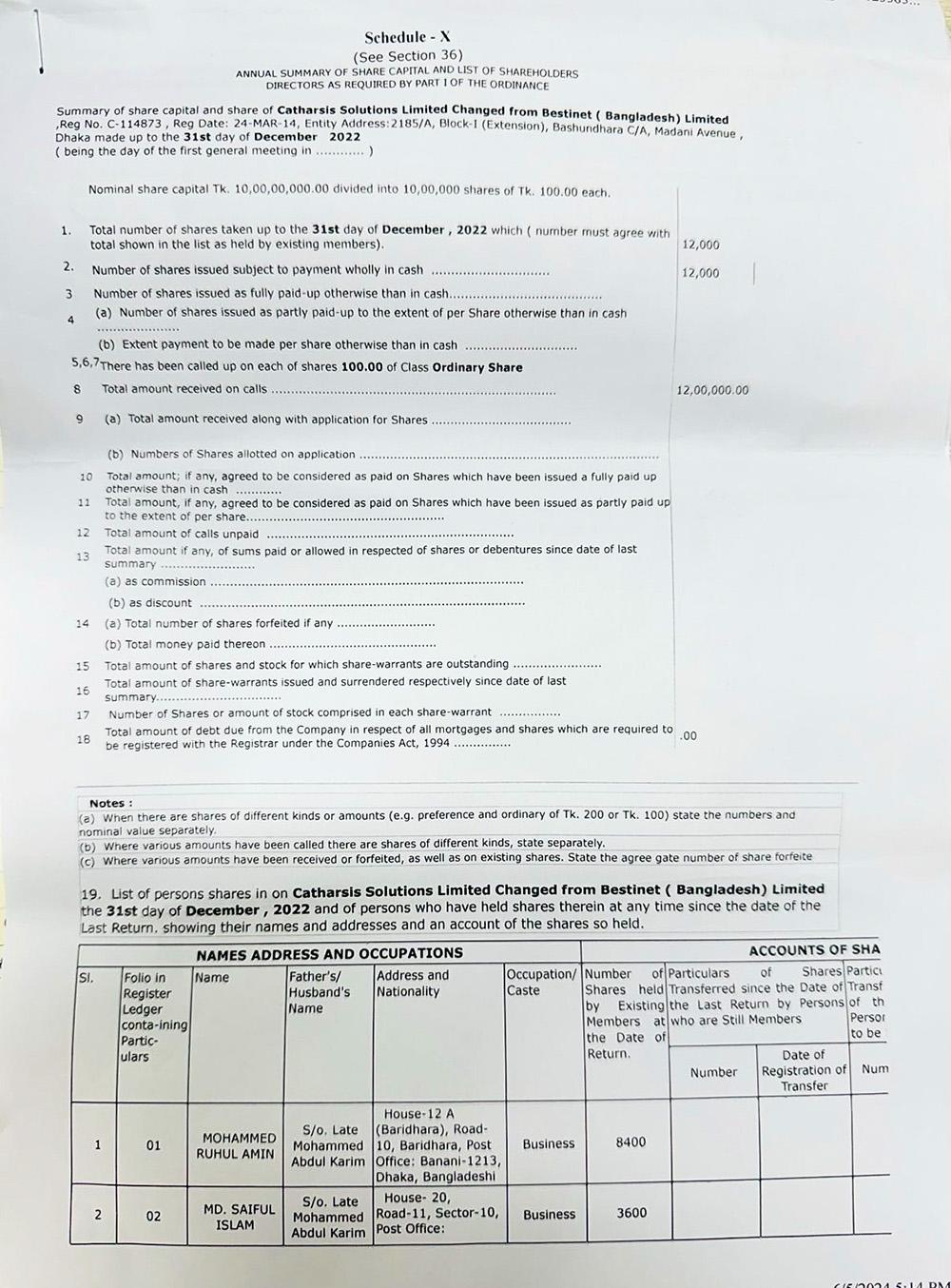
Official document revealing Ruhul Amin’s Catharsis Solutions Ltd was once known as Bestinet Bangladesh.
Ruhul runs Catharsis International, a company which manages migrant worker recruitment in Bangladesh, but he has been widely reported as an associate of Aminul.
According to official documents obtained by Bangladesh newspaper Prothom Alo, Bestinet Bangladesh Ltd was registered there on March 24, 2014, with Aminul as chairperson and Ruhul as managing director.
Aminul transferred all his shares in Bestinet Bangladesh to Ruhul in 2019 and three years later, the company was renamed Catharsis Solutions, according to a document from Bangladesh’s Registrar of Joint Stock Companies And Firms.
Ruhul owns Catharsis International and Catharsis Solutions.
Malaysian authorities confirmed receiving the Bangladesh government’s letter seeking Aminul’s extradition and replied to the letter requesting the Bangladesh police to submit a formal request.
Based on interviews with industry insiders, Prothom Alo reported in September that Aminul and Bestinet were accused of money laundering via migrant worker recruitment fees, to the tune of Tk87.50 billion (RM3.22 billion).
The MACC has cleared the company of the allegations while N Sivanathan, the lawyer representing the company and Aminul, said his clients were falsely accused of money laundering.
Aminul was the primary mover of Malaysia’s Foreign Worker Central Management System (FWCMS) and controlled Bestinet from its inception. Today, however, he only owns one percent of the company.
Celebrity counsellor and life coach Abdullah Sher Kawi Jaafar, famed for his appearance as a trainer in the reality TV show “Akademi Fantasia”, now holds 93.45 percent of the company.
Long controversy
Bestinet has long been dogged by controversy, starting from 2015, when the FWCMS it provided to the government was suspended from use amid claims that it won the deal through political connections, ostensibly with former home minister Azmi Khalid.
In a response at the time, Azmi said the deal was not signed yet and that it was only in the proof of concept stage.
Despite the initial suspension, the system was later reinstated and used by government agencies to process the hundreds of thousands of migrant workers entering Malaysia every year.
However, the Public Accounts Committee (PAC) and Auditor-General’s Department found there was never a formal contract between the government and Bestinet, which collected RM100 from each worker for the service.
The PAC found that the cabinet in August 2015 agreed to trial the FWCMS and another system provided by another provider, called ePPAx.
ePPAx was built by Syarikat Ivy Matrix Sdn Bhd, which won a RM20 million Human Resources Ministry project through an open tender.
The PAC found both the FWCMS and ePPAx served the same purpose of “processing (migrant workers) from the application stage to the end of employment and return to their sending country”.
Unauthorised approvals
Despite the development of ePPAx, the Home Ministry decided to use FWCMS instead, and in 2018 issued an approval letter to Bestinet to develop, supply, provide, and maintain FWCMS for six years from April 1, 2018, to May 31, 2024.
On Dec 22, 2021, the Ismail Sabri Yaakob-led cabinet agreed to use FWCMS exclusively but no formal contract was drawn up. Hamzah Zainudin was the home minister at the time.
“This means that the government/Home Ministry has used the FWCMS system for approximately six years without a finalised contract, clearly violating the regulations set by the government,” the PAC said in a statement.
The PAC also flagged other issues, including system vulnerabilities to hacking and potential fraud in migrant worker management.
Despite these issues, in June, the cabinet agreed to extend Bestinet’s contract for another three years, but with improvements in governance.
In Asia, the battle against gender-based violence reveals the harsh realities of society. World Health Organization reports that 1 in 3 women globally have experienced physical or sexual violence. This alarming statistic, while shocking and devastating, only scratches the surface of a more insidious issue: Marital rape. Despite the prevalence of violence within marriage, the laws governing marital rape in most Asian countries remain nonexistent, leaving countless women trapped in a cycle of abuse.

A study by UNESCO reveals that over 37 percent of women in South Asia, 40 percent in Southeast Asia, and up to 68 percent in the Pacific have faced violence from intimate partners. The numbers could be much higher considering that marital rape often goes unreported because women are conditioned to accept, endure and adjust within the confines of marriage. Across Asian societies, marriage is often presented as a sanctuary of security – both economic and physical. But we must ask: Safety for whom? If this institution is meant to protect women, then how are women expected to safeguard themselves from people within the institution? In reality, this “safety” seems illusory, benefitting the patriarchal individuals who designed these institutions.
Illustration: Sharanya Eshwar
While countries like Nepal, Bhutan, Indonesia and the Philippines recognise marital rape as a crime, many Asian countries still lack comprehensive legal frameworks to curb it, thereby prioritising cultural norms over safety of women. For instance, in India, the debate over criminalising marital rape, which is currently under judicial review by the Supreme Court, has its opponents – which include everyone from government officials to conservative groups – arguing that the law could be misused against men, and that not allowing marital rape could destabilise family structures. India prides itself in having one of the world’s lowest divorce rates but that speaks more to societal stigmas around divorce (especially for women) in the country and lengthy legal processes. The arguments against criminalisation of marital rape also reveal a troubling prioritisation of protecting men in patriarchal societies.
It’s not all hunky dory in countries that recognise marital rape, such as in Sri Lanka, Malaysia and Bangladesh. There are conditions and limitations. For instance, in Sri Lanka, marital rape is recognised only if the couple is legally separated. Or in Malaysia, it’s recognised only if the husband is causing hurt in order to have sexual intercourse with the wife. In Bangladesh, unless the victim is under the age of 13, marital rape isn’t recognised.
In Pakistan, there is no explicit laws where forced sex within marriage is criminalised. However, a recent ruling in Karachi marked a notable shift: A man was sentenced to three years for forcing his wife into non-consensual sex. This verdict acknowledged intimate partner violence as a criminal offence. In this case, the survivor’s lawyer, Bahzad Akbar, argued that the act of forced sodomy fell under the definition of rape in the amended Section 375 of Pakistan’s Penal Code.
The institution of marriage, peddled to offer protection and partnership, often serves as a deeply flawed and unfair structure for women. The failure to criminalise marital rape fully is a glaring example of shielding men from accountability, and enabling them to commit violence behind closed doors. Since time immemorial, social expectations and legal loopholes have trapped women in a position where they must choose between their safety and dignity, often leaving them deprived of both. The idea of marriage as a safe haven is distorted when norms of “obedience”, “sacrifice” and “submissiveness” to a husband are culturally imposed, and the legal system upholds these expectations.
The complicity of societal norms and the law in many parts of Asia reflects a troubling reality: Marriage is less about equal partnership and more about control. By framing consent as unnecessary within a marriage, the law not only fails women but actively enables perpetrators.
This complicity is not coincidental—it’s a well-orchestrated team effort between tradition and the legal system, where both reinforce each other to keep women subjugated within marriages. Women deserve legal systems that prioritise their rights and safety over outdated notions of family and honour. Until then, the institution of marriage, as it currently stands in many Asian countries, will continue to fail women.
Note: This interactive novel is best played on full screen mode on a desktop/laptop. Please click the button on the bottom right to activate full screen. On mobile, you may have to scroll to read the text in its entirety.
A memory from 2022 sent a chill down Mohammad Abdus Salam’s spine sharper than a bone-biting Dhaka night.
In early 2022, the 27-year-old engineering graduate was in his hometown Dhaka, the capital city of Bangladesh, when a school friend whose father ran a local recruiting agency offered him a job he couldn’t refuse. It was for data entry that would fetch him a monthly income of nearly $800, an amount that dwarfed his paltry earnings at a garment factory. Bangladesh’s garment industry, which caters to the international fast-fashion brands, is known for its abysmal minimum wage. In the factory, Salam’s monthly income was just $300. But this job offer, although promising, had one caveat: Moving to Cambodia immediately.
Cambodia, the school friend told Salam, is a new destination for migrants. “He said I have the best education in engineering. I’m able to speak English,” Salam told Asian Dispatch. “I was the perfect person for this job, I was told.”
Salam had never traveled outside his country but as the sole breadwinner of the family, he said yes. With no Cambodian diplomatic mission in Bangladesh, the recruiters took a fee of $3,000 – which Salam paid by mortgaging his family farmland and taking a loan – to book a one-way flight ticket and a tourist visa. He was told he will be able to recover that money once he starts working and his visa will be converted for his employment. But once he was there, he had a shocking revelation.
His “workplace”, which was a casino called Long Beach, was located in Cambodia’s special economic zone called Dara Sakor, 250 kms from the country’s capital Phnom Penh. There, his passport was taken and he was handed a computer, 10 iPhones, and 5 SIM cards. His job, he was told, was to impersonate a young Chinese model through dozens of social media accounts to ensnare male victims and scam them into investing in fraudulent crypto schemes. When he tried to call the Bangladeshi broker who “recruited” him, he was ghosted. He knew then: “I had been sold off.”
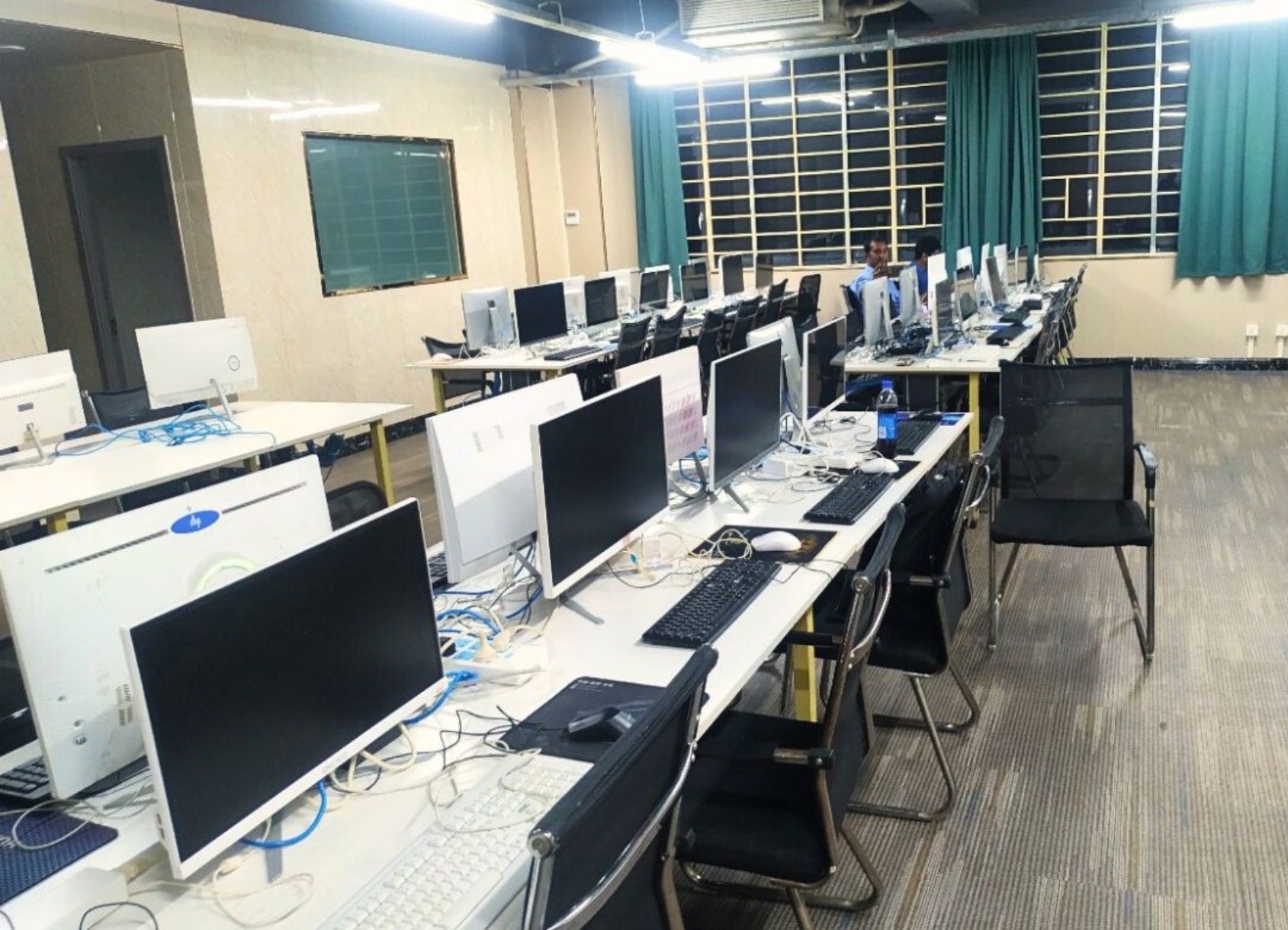
Inside the workstation at a scam compound in Cambodia where Md Abdus Salam was trafficked and tortured into working for five months. This photo was taken secretly by Salam himself and has been used with permission.
For the next five months, Salam went through what he described to Asian Dispatch as torture – both mental and physical – in the scam center that housed men from across South Asia. His employers, who he later found were Chinese, beat him with baseball bats and gave him electric shocks if he failed or refused to work. Outside, the compound was surrounded by gun-toting security guards.
“Unless you’ve seen [the crime] for yourself, you’ll never know how horrible it is,” said Salam. “I was forced to work as [the scam centre’s] slave and at one point, I didn’t care about the people getting scammed because of the torture I faced. I didn’t want to end up dead.”
Salam was rescued by an anti-trafficking non-governmental organisation in September 2022. His story is among hundreds of thousands, according to a United Nations estimate, who have been similarly trafficked by criminal gangs and tortured into running illegal crypto scams in Asia. Pig-butchering scams, as the crime is now widely called, derives its name from the farm practice of fattening pigs before slaughter. The crime involves scamming people after building online relationships with the end goal of exacting money.
Asian Dispatch wove in four stories of those affected by pig-butchering scams in the form of a visual novel– embedded at the beginning of this article – to put the readers in the shoes of those forced to be at its epicenter. As of February 2024, as much as $75 billion is estimated to have been moved to crypto exchanges through scam compounds in Cambodia, Thailand, Myanmar and China. But what is of particular note is the trafficking of South Asians for the purpose of operating these scams. Once among global leaders in IT skills and services, South Asian techies are increasingly being lured into pig-butchering crime hubs as they struggle with post-pandemic economic slowdown and global tech layoffs.
I was forced to work as [the scam centre’s] slave and at one point, I didn’t care about the people getting scammed because of the torture I faced. I didn’t want to end up dead. – Md Abdus Salam, trafficking survivor
Salam says he was sold thrice by compound owners in slave-like conditions. He returned to Dhaka empty-handed while his captors had exchanged tens of thousands of dollars to sell him.

Anti-trafficking organisations have found that scam compounds across Southeast Asia are heavily barricated and deployed with armed men, making it impossible for trafficked victims to escape. Illustration: Sharanya Eshwar
There is no official estimate of the trapped South Asians but in Bangladesh, a 2023 investigation by news outlet The Daily Star estimated thousands trafficked and tortured in these scam centers. In India, officials say they’ve rescued at least 250 citizens this year while news outlet The Indian Express reported the entrapment of around 5,000 Indians. In countries like Nepal, Sri Lanka and Pakistan, the exact number of survivors isn’t known as governments continue to grapple with the crisis.
“We’re in a modern society where we’re traveling all over the world for jobs,” Mechelle Moore, the CEO of an anti-trafficking NGO called Global Alms, told Asian Dispatch. “People aren’t getting jobs in their home countries and [the scam companies] take advantage of that desire to work overseas.”
Moore estimates at least 10,000 trafficking victims stuck in scam compounds that could run up to hundreds if not thousands across Southeast Asia.
“A lot of [these scam] companies lure people who can speak English well, and the jobs advertised for are for logistics, customer service, marketing and so on,” said Moore. “They would specifically target people from South Asian countries that did not have an embassy where they’re operating out of.”
We’re in a modern society where we’re traveling all over the world for jobs. People aren’t getting jobs in their home countries and [the scam companies] take advantage of that desire to work overseas. – Mechelle Moore, CEO, Global Alms
The pandemic provided a big advantage, if not the catalyst, to the criminal network. Civil strife and socio-economic struggles in the host countries add more layers to this complex web of transnational crime.
NGOs like Moore’s have been tracking constructions of new compounds across Asia every year. “They’ve got enough people willing to complete the scams. If the survivors of trafficking don’t want to stay or cause trouble, they’re recycled,” she said. “It’s definitely not dying down.”

Pig butchering scams feed off of job-seekers’ desire and desperation to find a well-paying job, even if it means moving to another country. Illustration: Sharanya Eshwar
Suresh Jayawardena, another pig-butchering trafficking survivor from Sri Lanka, was a “cyber slave” for eight months in Myanmar, where scam compounds have an additional perimeter of armed protection reportedly under the authority of the Myanmar military or its proxies. Jayawardena, who is addressed with a pseudonym, requested anonymity to be quoted in the story due to social stigma associated with the crime in his country. Asian Dispatch spoke to him weeks after he was rescued among dozens of others in April after an intervention and a rescue mission was carried out by the Sri Lankan government.
Like Salam, Jayawardena, too, faced torture when he resisted participating in the crime, which included being stripped, blindfolded and electrocuted. But what’s of note to many anti-trafficking experts is the platform the trafficking victims are given to defraud people. In Jayawardena’s case, it was Telegram, where he offered fake investment opportunities to people desperate for healthy returns.

A recreation of Suresh Jayawardena’s experience of being tricked into believeing he was joining a high-paying job in Myanmar, but ending up being forced to scam victims with fraudulent investment offers. Jayawardena spoke to Asian Dispatch on condition of anonymity. Illustration: Sharanya Eshwar
“It’s clear to me that at various stages of the pig-butchering scam, the onboarding of victims of scams happens on [social media] platforms. This is an obvious win [for the scammers],” Erin West, a prosecutor from Santa Clara County in California, US, told Asian Dispatch. West investigates crypto crimes with primarily American victims, and trains law-enforcement agencies across the US to trace cryptocurrency transitions.
A few months ago, she started ‘Operation Shamrock’, which brings together private and public stakeholders across the world, including big tech companies, to lead a concerted fight against pig-butchering scams. During one of the meetings she held with big tech platforms, she told the representatives that their platforms were enabling the crime. “They didn’t appreciate the language and didn’t want to cooperate,” she said.
“There’s a pressing need for global communities to be involved,” West adds. “I don’t believe these people, the scammers, are untouchables.”
Troy Gochenour, who works at the Global Anti-Scam Organization (GASO), says pig-butchering crimes are of “pandemic proportions.” “We’re living in the age of scam-demic,” he told Asian Dispatch. GASO was set up in 2021 by victims of pig-butchering scams, which includes Gochenour himself. By 2022, the organisation had connected with 1,483 victims worldwide who had suffered losses to the tune of $256 million. This means that every victim lost at least $173,000.
This is why this crime is so insidious because at the other end of the phone is someone who is trained to do this. The so-called relationship is a planned operation.— Troy Gochenour, Global Anti-Scam Organization
Gochenour, an American citizen, lost $28,500 in a liquidity mining scam after developing an online relationship with an online profile of who he thought was an Asian woman called Kris Gia. “The allure [of Kris] was her offer to provide me companionship. We would talk like we’re boyfriend-girlfriend or husband-wife,” said Gochenour. “This is why this crime is so insidious because at the other end of the phone is someone who is trained to do this. The so-called relationship is a planned operation.”

A recreation of the story shared by Troy Gochenour, who found himself on the other end of the pig-butchering scam. He lost $28,500 through a fake profile that he believed was real and was in relationship with. He’s among thousands of victims of these scams. Illustration: Sharanya Eshwar
The victims of the pig-butchering scams aren’t always those in the West. Moore confirms that the scam companies target those in Asian countries too, and hire people from that region to scam them. “We’ve had Vietnamese trafficking victims who were trafficked specifically to scam people in Vietnam. Same with Indonesia, Malaysia, and Chinese,” she said. “It’s a global effort.”
The story of Sandun Silva from Sri Lanka illustrates this. The 34-year-old journalist, who also spoke to Asian Dispatch on condition of anonymity, was introduced to a Telegram group last year after he accepted an online content writing “job” that was attached with a fraudulent investment opportunity. All the admins in the group texted in and spoke Sinhalese. De Silva lost his family savings amounting to $4,000. Even now, the father of two hasn’t told his family about it.
Gochenour says that the first thing tech platforms should do is take down fake profiles when they’re reported. This feature, especially on Meta, is often automated, which Gochenour says doesn’t always resolve the problem. In India, Meta, in its April report, documented receiving over 27,000 reports of fake profiles on Facebook and Instagram but admitted a significant chunk of them were not actioned.
“Unfortunately, there’s not a lot that has been done by these platforms themselves,” Gochenour adds. “Law enforcement has, at times, shut down platforms, but that is only if they’re connected to a particular case they’re working on.”
In May this year, leading tech firms, Match Group, Coinbase, Meta, and Ripple formed a coalition called Tech Against Scam to respond to and prevent online fraud and financial schemes that target consumers through their platforms. Asian Dispatch reached out to Telegram and Meta to understand how they’re tackling these crimes but didn’t get any responses. This story will be updated when it comes.
Early this year, when Asian Dispatch reached out to Salam in Dhaka, he had been back home for a few months. Unlike all survivors quoted in this story, he chose not to be anonymous. He was rescued in 2022 by GASO, which he had covertly reached out to while living at the scam compound. GASO had pressured his “bosses” to release him along with a few others.

Abdus Salam is determined to raise awareness about how the struggles of trafficking survivors don’t end with getting out of the scam compounds. It continues for years. Illustration: Sharanya Eshwar
However, Salam’s struggles didn’t end there. During the course of his captivity, he had exceeded his visa duration by over 100 days. Since he didn’t get paid by his compound employers, he didn’t have money to pay the visa fine and buy a flight ticket. He finally was sponsored by a friend. Today, he works for a non-profit called Humanity Research Consultancy (HRC), which facilitates survivors’ repatriation after they’re rescued from scam centres.
Once home, a battered Salam underwent spinal surgery for injuries inflicted by the torture. He also struggled psychologically to come to terms with the time and money he lost in that period. But his family’s support helped him take his next steps.
“They told me, ‘It’s fine you lost your money. At least you are still alive.’”
Now, Salam helps other survivors of trafficking even after they’re rescued from the compounds.
“This is the right time for me to commit myself to this mission,” he said. “To the mission of survivors’ rights.”

Aimah

Standing barefoot in the cold paediatric ward, Aimah watched in horror as she took in the latest blow of misfortune through blurred, tear-drenched vision.

Over the past months, the Bajau Laut woman lost her siblings to illnesses in Semporna and her husband to the clutches of immigration officers in Lahad Datu, leaving Aimah, who was pregnant, to fend for her six children alone.

On that day in the Lahad Datu Hospital paediatric ward, a stranger cuddled her newborn baby while Aimah, denied access, stood at the doorway crying–and didn’t stop weeping for days.
Having fought for the medical rights of fellow stateless Bajau Laut at Lahad Datu Hospital, Aimah believed this was her ultimate punishment – losing custody of her child to the same hospital.

The circumstances in which she lost custody of her child are being disputed. The hospital claims she left the child unattended so they called the Welfare Department. The department then deemed Aimah an unfit parent and took the child away.
But Aimah, who declined to have her full name published, said after recovering from delivery, she was told to return home and leave the premature baby in the neonatal intensive care unit (NICU).
This harrowing story of a stateless woman having her child snatched away is not unique. Malaysiakini documented three other similar cases. Two of the mothers regained custody of their babies while another mother, faced with the prospect of losing custody, was found dead with her child, having committed murder-suicide at the hospital.
Accused of neglect
Aimah’s ordeal began in September 2021, when she was rushed to the hospital with her premature baby, following an unexpected home birth.
Mother and baby, on the brink of death, were warded immediately. Aimah recovered in a few days after a blood transfusion and was asked to go home while her baby recovered in the NICU.
“I had to care for my other children at home. I am still breastfeeding some of them,” she told Malaysiakini, via a translator.
Maternity block of Lahad Datu Hospital. Photo: S. Vinothaa/Malaysiakini
A child protection officer representing the Welfare Department accused Aimah of child neglect, after the baby was in the NICU for about two months. Although her baby was not ready to be discharged, Aimah rushed back upon hearing of an imminent adoption order relating to her baby.
Within one week, the officer processed the application and the Magistrate’s Court granted the adoptive parents custody of Aimah’s baby.
Who are the Bajau Laut?
The Bajau Laut are sea nomads living on the open waters and their ancestral maritime domain stretches across the Sulu-Celebes seas between the island of Borneo and the Philippines. They have been faring between sea villages in Sulu in the Philippines, Semporna in East Sabah, and South Sulawesi in Indonesia, for generations.

Despite being recognised by the Sabah government as indigenous people of the state, most of the Bajau Laut community are stateless by law, and are often hounded by the Immigration Department for being “illegal immigrants”. This bars them from seeking any avenue of redress and attempting to make a police report would risk their freedom with a potential indefinite term of detention at Sabah’s infamous Rumah Merah detention centres.
Without government-issued documentation, these stateless communities are prevented from getting formal jobs, protection by labour laws, education, healthcare, and are pushed to the brink of survival. They are recognised by their preference of being barefoot wherever they go, and are shunned by many Sabahans as people from the lowest stratum of human beings.
The few who secure ‘cash-in-hand’ jobs earn less than half of what their colleagues who are citizens will take home. Those who depend on the sea for a livelihood have to settle for less as seafood wholesalers peg a lower value on anything they catch.
Aimah’s husband, stateless and penniless, was detained before the birth of his youngest child and remains in detention, unqualified to be deported to any country. He has not received the news that they have lost custody of his youngest child – a child he has not met.
Arung

On Feb 1, 2020, a 16-year-old Bajau Laut mother, Arung (not her real name), committed murder-suicide with her five-month-old infant at Lahad Datu Hospital after she was told she could lose custody of her baby.

The hospital’s internal investigation of the incident found that news of losing custody of her child “compounded by the constant berating and badgering for settlement of hospital bills made the young girl very anxious and depressed”.

“She was successful on her second attempt,” revealed a medical official privy to details of the investigation, but spoke to Malaysiakini on condition of anonymity.
Repeated incidents of stateless mothers losing custody of their babies in Lahad Datu Hospital have struck fear among expectant mothers and those with young children, discouraging them from seeking medical care for themselves and their children. This new fear has led to one in four Bajau Laut mothers opting for home births, said the village midwife, Fatimah Rafily Darao. This, on top of the obligation for non-citizens to pay high registration fees and upfront costs of treatment and diagnostic tests, as well as badgering from hospital administrators if fees cannot be paid.
Against United Nations recommendations, stateless patients in public hospitals are charged the same fees as foreigners, starting with a RM100 upfront registration fee and RM120 outpatient clinic fee. To avoid hospital staff harassment for payments, many stateless persons bear with the pain and wait until they are in critical condition with the hopes of being accepted into the Red Zone in the Emergency Department – the only place where all upfront payments are temporarily waived.
Sometimes, they wait too long and suffer irreparable damage or die.
Adoption process halted upon threat of a counterclaim
Kampung Panji village head Fandry Alsao said apart from Aimah and Arung, two other stateless mothers from his village almost lost custody of their babies in similar circumstances. But Fandry’s timely intervention prevented this from happening. In these cases, he said, the child protection officer relented after Fandry threatened to “file a counterclaim (tuntut)” for custody of the child.
“These words seemed to shake the officer,” he said.
He said all cases, except Arung’s, involved the same child protection officer.
Sarlina Aswan

Sarlina Aswan’s newborn fell ill and was admitted to the NICU sometime in mid-2021. Like Aimah, she was asked to return home and leave her infant at the hospital.

Without access to transportation and with other children to care for, Sarlina was only able to visit her newborn once a week. In the third week, she found a woman she did not know caring for her infant. It was only then that she was told the woman was her child’s adoptive mother. Learning this sent her into a state of depression, she told Malaysiakini.

But in a phone call to the child protection officer, Fandry threatened to file a counterclaim. This prompted the officer to look for Sarlina in Kampung Panji.

“The officer came to Kampung Panji looking to ask her if she wanted to keep her baby. After I threatened to file a counterclaim, he asked Sarlina to follow him to the hospital and handed over her baby after the child was discharged.”
“After I threatened to file a counterclaim, he asked Sarlina to follow him to the hospital and handed over her baby after the child was discharged.”
In all the cases documented by Malaysiakini, the mothers said they were unable to go to the hospital every day because they had other children to care for at home. And while they were away from the hospital, in just a matter of weeks, a prospective adoptive parent was introduced as a carer for their respective babies.
Felindaya

In June last year, 20 days after she gave birth, Felindaya was on the ward floor in tears, begging for her baby to be returned.

Earlier, Fandry received a call notifying him that a child protection officer was preparing adoption papers for Felindaya’s newborn.

He threatened to file a counterclaim and again, the officer backtracked and the adoption process was halted. Relieved, Felindaya, who only wanted to have her first name published, took her child home even before the treatment was complete.
Stateless mothers deemed unfit
Apart from Sarlina, all four mothers were accused of neglect or being unfit parents when custody of their infants came into question.
When it came to teen mothers, the same child protection officer with the Welfare Department told Malaysiakini that underaged mothers were automatically deemed unfit because of their age and because they were not legally married.
The officer was transferred to Lahad Datu sometime in early 2020, and was not involved in Arung’s case.
“A girl aged 16 years old is not mature enough to take care of a child. But if she was legally married (status nikah yang sah), then it is not an issue,” he told Malaysiakini.
He said in Sabah, underaged girls who want to marry must seek permission of the Syariah Court if she is Muslim. If she is deemed mature enough, she can marry. As such, a registered marriage is proof that a teenager is ready to be a mother, he said.
The child protection officer, who acted in all the cases except for teen mother Arung’s, said he generally viewed the stateless community to be unfit parents. This is because they live in poverty and deplorable conditions, which he said is unsuitable for a child.

A woman making a bottle of milk for her child on a road divider. Photo: Malaysiakini
While Bajau Laut men earn their keep by doing odd jobs, the officer claimed the women often took their children to the streets to beg, just for the fun of it.
“I have been to many places in Sabah and street beggars are not a big issue in places like Kunak and Semporna. Begging for money is not their sole option, especially in Kunak where all the (stateless) are employed,” he said.
Swift Adoption Process
There is no direct evidence that Bajau Laut babies born to stateless mothers are being targeted for adoption, but the swiftness of the adoption process raises questions.
The legal adoption process in Malaysia is known to take years and in March this year, Women, Family, and Community Development Minister Nancy Shukri announced a stricter selection process for adoptive parents when she launched new guidelines for eligibility.
It was reported that the new selection process would involve a psychological measurement tool, designed to provide scientific data on an individual’s thoughts, feelings, and behaviour. The process of child placement would be overseen by the respective state Social Welfare directors.
The stricter processes in place suggested longer waits and greater safeguards for adoptions but they do little to reassure stateless mothers who are wary of taking their young children for treatment in hospitals, especially without avenues of redress should anything untoward happen.
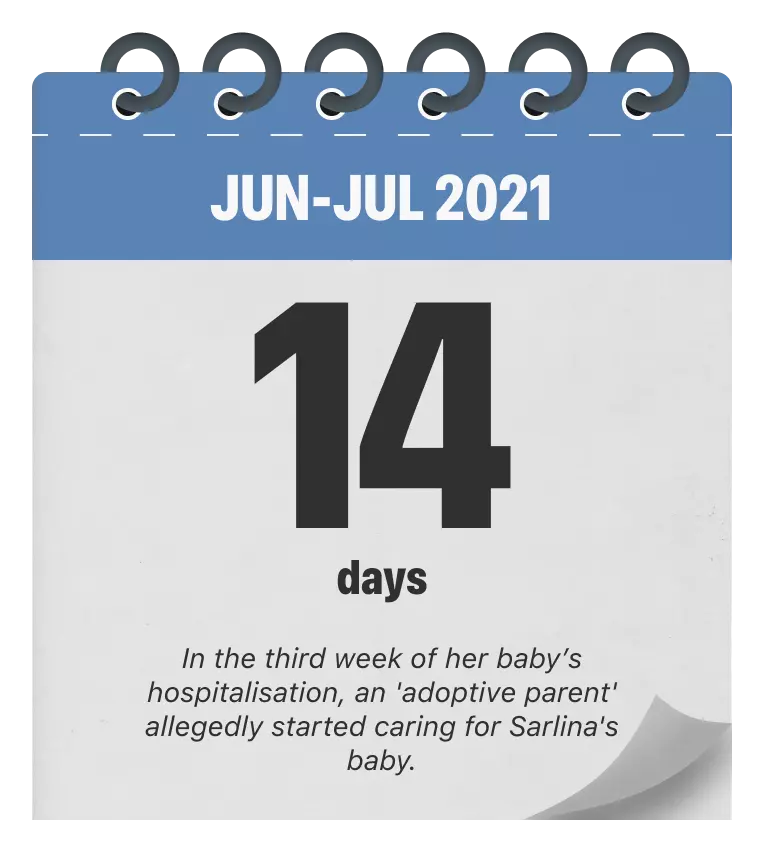
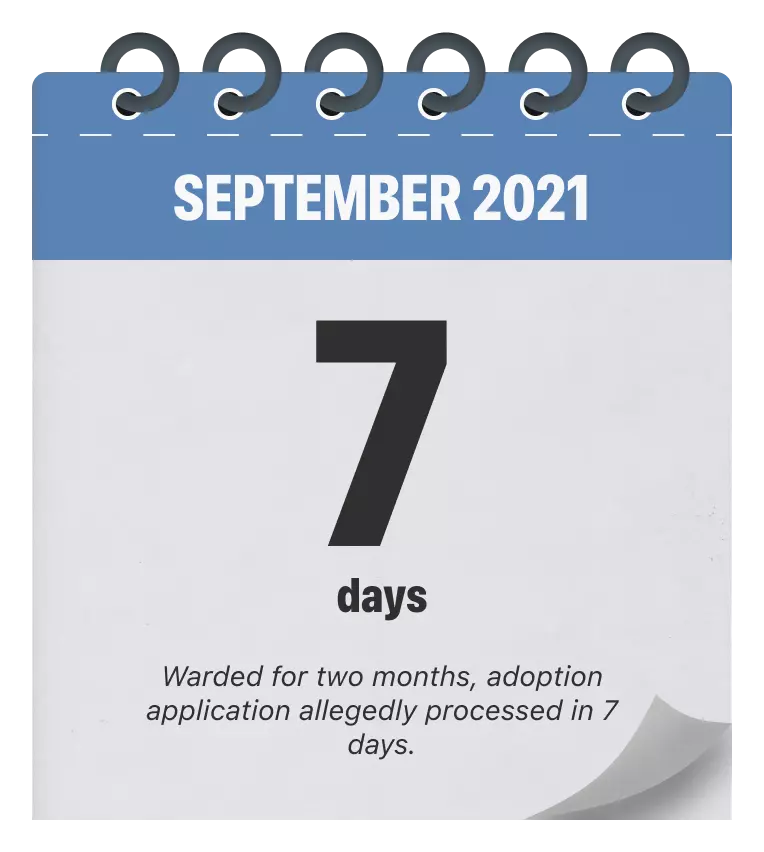
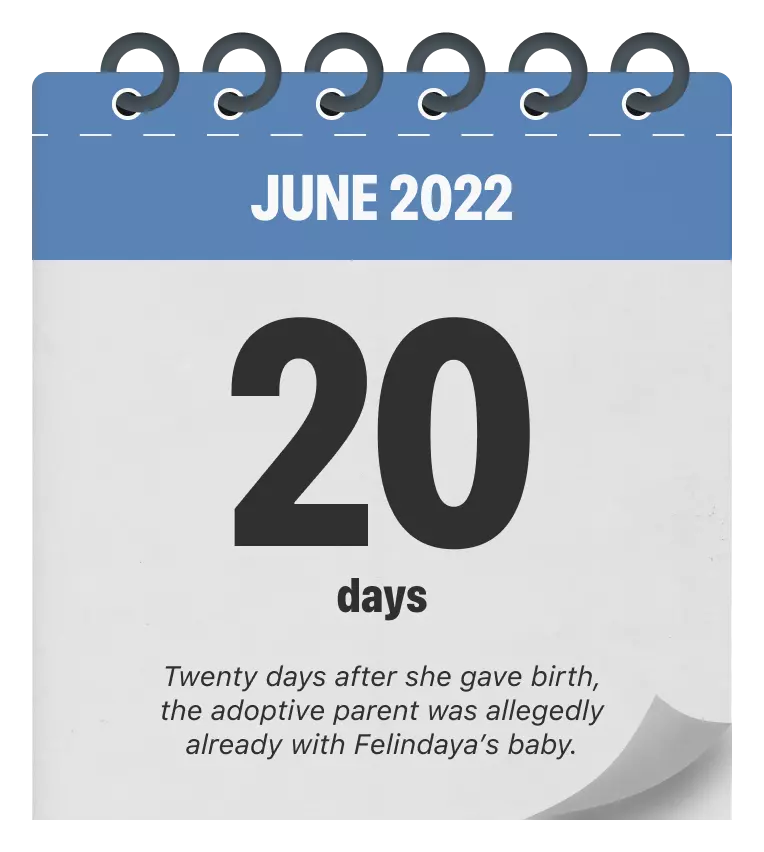
Who paid the hospital bills?
Curiously, the three mothers who spoke to Malaysiakini were not badgered to settle hefty bills for their babies’ care in NICU – something uncharacteristic of the Lahad Datu Hospital’s revenue department which reportedly collects bills from non-citizens with zeal.
Sarlina only paid RM50 but treatment for a non-Malaysian baby in the NICU alone would have exceeded RM10,000, those in the know tell Malaysiakini. A medical official from the hospital, who spoke on condition of anonymity, estimated Felindaya’s bill to reach RM50,000 but she was allowed to leave the hospital without harassment for the full settlement of her bill.
“Aimah was not asked to settle her bill but that could be because she no longer had custody of her baby,” said the medical official, who was unsure if the bill was settled by the adoptive parents.
A Bajau Laut woman bringing clean water to her home.
No Records
Medical officials from different parts of Sabah who spoke to Malaysiakini said hospitals don’t have to keep records of the stateless individuals they turned away.
“So, even if they wanted to complain about the death of a loved one as a result of being turned away by the hospital, they can’t because they are not on our records,” one medical official in Kota Kinabalu said.
The hospital, however, keeps a record of all cases treated at the hospital in the form of ‘case notes’ like a repository of patient medical history, accessible with the consent of the revenue department.
An unforgettable case was of a child who was held under observation for 12 hours and sent home with her fatal injuries untreated because her father was unable to raise the funds needed to conduct the surgery that would have saved her life, the healthcare professional said.
A Bajau Laut child climbing into his home
Unlike other cases of stateless patients, Arung’s death was high profile, and was investigated not just internally but also by the police. But questions arose when the staff nurse, who conducted the internal hospital investigation,
was transferred to Tuaran Hospital less than a month after the incident, after serving more than a decade in Lahad Datu.
The then Lahad Datu police district chief Nasri Mansor who, on the day of the incident vowed to the media to find out the real reason for the tragedy, has since been transferred out of the state to Bukit Aman.
The district crime team has declined to comment.
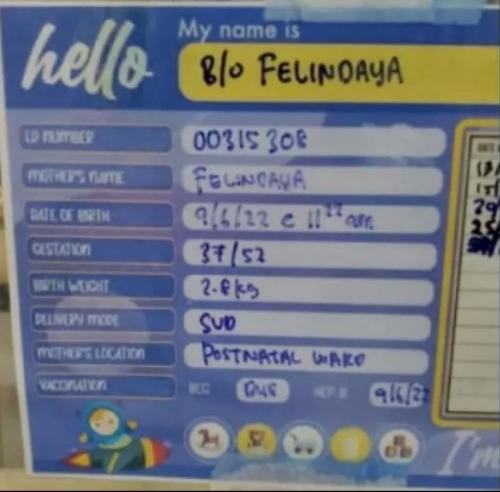
Malaysiakini has contacted the women, family, and community development minister and the Health Ministry, and is awaiting their response. The Sabah Health Department, in a statement after this article was published, denied there were any cases of baby snatching in public hospitals in the state. They have also lodged a police report over the matter.
(Left) Hospital card identifying Felindaya’s newborn. Photo: Malaysiakini
‘Is this my punishment?’
Many of the Bajau Laut are not proficient in Bahasa Malaysia because they do not have access to formal education and have little interaction with those who speak the language.
Despite this, Aimah has helped close to 100 fellow stateless villagers in critical condition to the hospital’s emergency department, in hopes of being admitted to the Red Zone, where fees for non-citizens are temporarily waived. She is their go-to person because after 100 times, she is very familiar with the process.

Stateless people sleeping rough in Lahad Datu town. Image: Malaysiakini
“I am always scared when I go to the hospital. I am terrified they will call the police.”
She knows she is a familiar face to the hospital revenue department, who she believes is unhappy about her bringing in the stateless patients who cannot pay their bills.
As such, she wonders if having her child taken away was a form of punishment. Scarred by the incident, she will not return to the hospital – not even to bring a critically ill fellow
villager like she did before.
No way to prove the baby is hers
Months after her baby was taken away, Aimah still hopes there is a way for her to regain custody. But she doesn’t know how. She has no documentation of the birth of her youngest child, and is terrified of lodging a police report because of her own undocumented status.
“If I am arrested, what will happen to my children?” she asked.
Confirming her fears, the child protection officer said the adoption procedure is already complete and during the process, the department, with the help of police, spent a week looking for her.
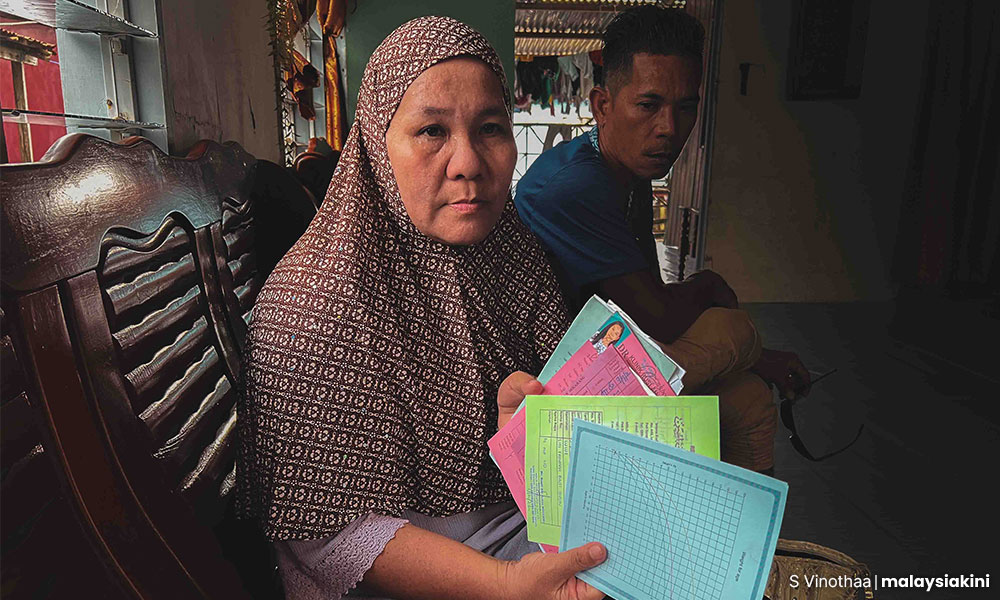
Midwife Fatimah Rafily Darao says recently, babies born to stateless mothers cannot get birth certificates. If they’re born at home, these cards are the only record of their birth. Photo: S. Vinothaa/Malaysiakini
He said they failed to find her and her absenteeism was reported to the Magistrate’s Court, which handled the adoption. “Now she has to prove that the child is hers. What proof does she have?” he asked. He claimed Aimah only showed up after the court had awarded custody to the adoptive parents.
“We already had an application to adopt the child, so we presented the case in court. Why not give the baby to a guardian who is legal?”

It looks like a mess but the dense, interlaced roots and branches of mangroves are what make them so mighty: a shield against the tides that would otherwise inundate the lands and drag shores back to the wider ocean. Living between sea and land, mangroves are called coastal forests. But in reality, they link and transition all the way inland to dryland forests. Or they did.
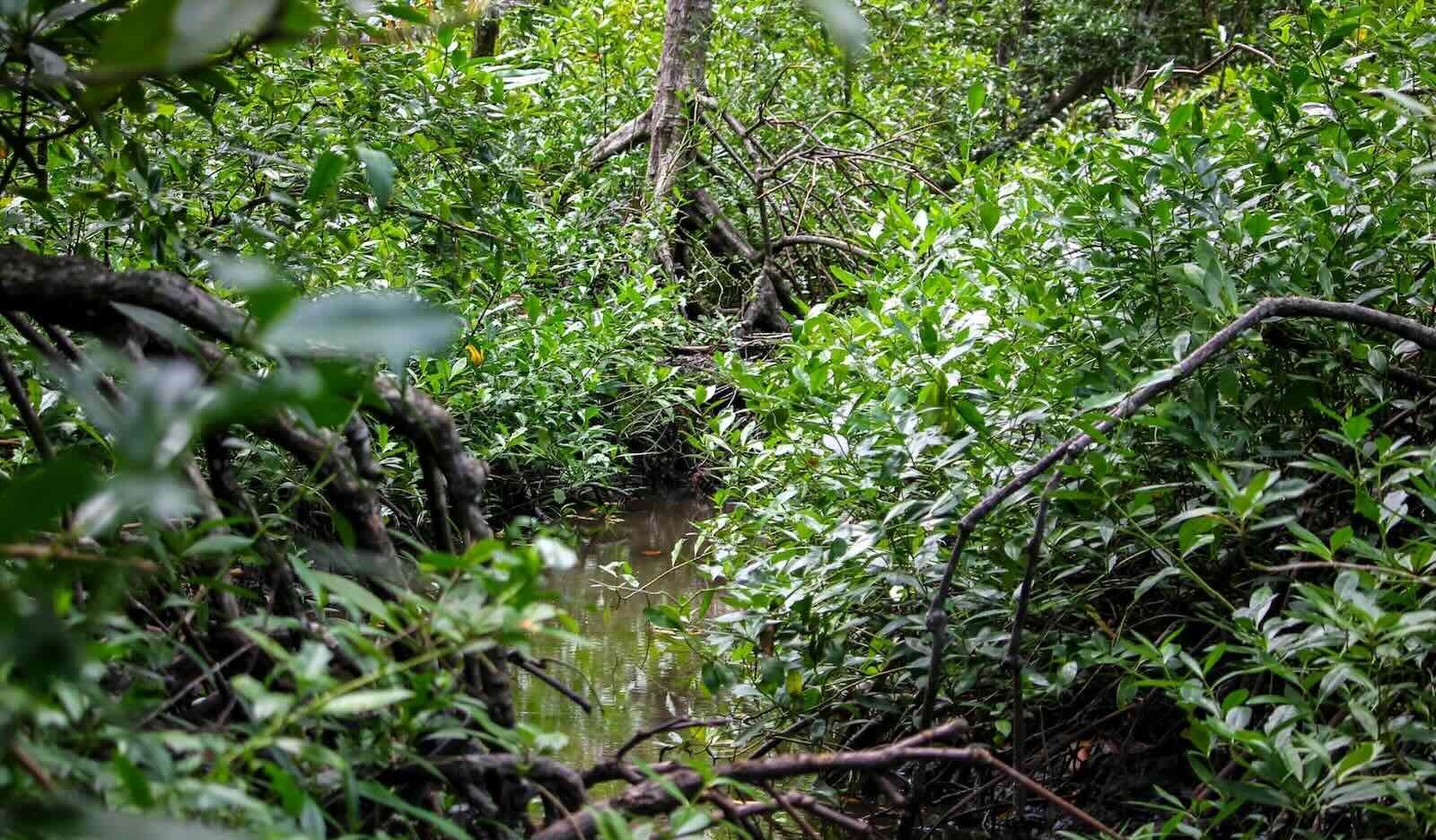
Mangrove forests along Malaysia’s coasts are being cut off from expanding landwards by roads, bunds, aquaculture, urbanisation, and landfills. Photo: Macaranga
In many parts of Malaysia, they no longer do. This makes coastal communities more vulnerable. And it is the birds that are signaling the loss of mangroves – with their absence.
No More Nuthatches
Take the Velvet-fronted Nuthatch (Sitta frontalis). This blue beauty looks like it can defy gravity by walking down vertical tree trunks thanks to powerful curved claws. But this mangrove resident “has been pushed out from, for example, nearly all of the Selangor coast, by bunding and clearance of that vegetation zone,” says eminent ornithologist Dr David Wells.
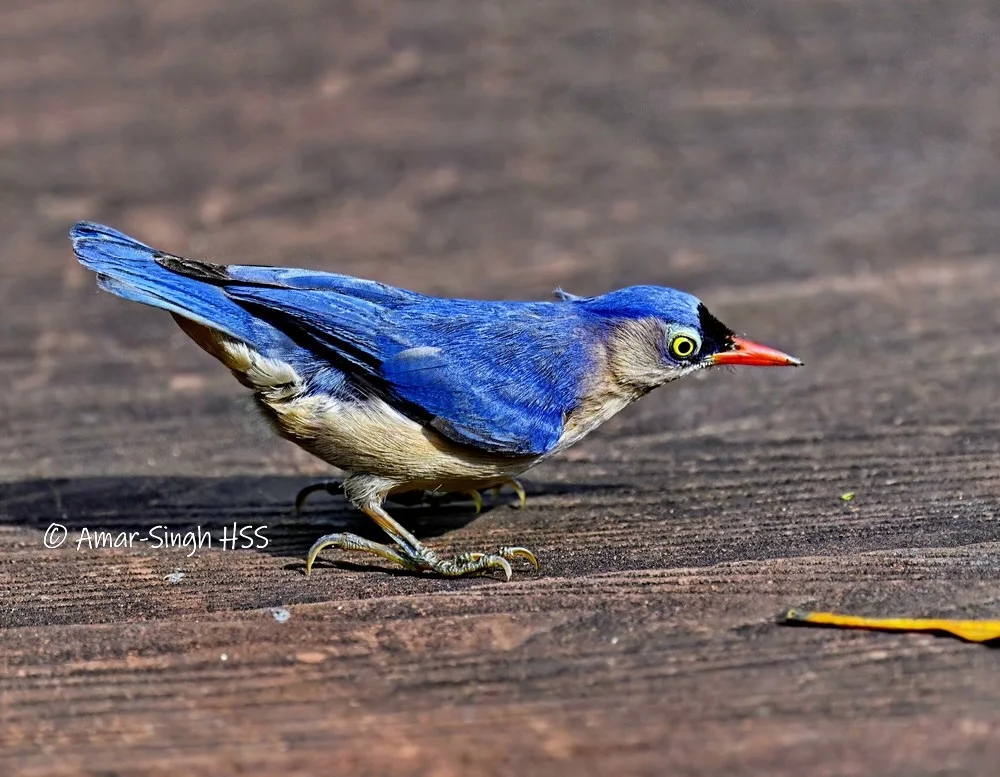
The Velvet-fronted Nuthatch (Sitta frontalis) is absent in many mangroves in Selangor | Photo: Amar-Singh HSS via Macaranga
Of note is that the bird relies on what are called back mangroves. This is the landward section of the mangrove ecosystem where it transitions to non-mangrove forests. “In my estimation, back mangroves are critical to at least half of all mangrove-recorded birds. Their loss is out of all proportion to their relative area,” says Wells, who has an encyclopedic knowledge of birdlife in the region.
Generally, mangroves are not immediately associated with birds. But mangroves in Malaysia support at least 144 species of birds, both resident and migratory. In turn, birds help sustain the ecosystem.
These birds depend on mangroves as a habitat, a rich food source and a breeding ground, says the Malaysian Nature Society (MNS) in its publication ‘Birds of rehabilitated mangrove sites in Selangor’. The dense branches and tangled roots of mangroves provide nesting sites, shelter from predators, and roosting areas for both resident and migratory birds. Mangroves teem with life. Fish, crabs, and insects thrive in the shallow waters and amongst tree roots, providing a plentiful food source for wading birds, herons, and fish eagles.
Additionally, mangrove trees themselves produce fruit and nectar that some bird species consume. The richer and more diverse a mangrove habitat, the richer and more diverse the birdlife. In turn, birds contribute to mangroves in a number of ways. This includes pollination, seed dispersal, pest control and providing nutrients via bird droppings. In Peninsular Malaysia, sunbirds are a major pollinator of the Bruguiera mangrove species, says avian ecologist Richard Noske.
Famously, coastal mangrove regions are “important staging and wintering sites for waterbirds,” says MNS. The north-central Selangor coast is recognised as an Important Bird and Biodiversity Area and is located along the East-Asian-Australasian Flyway. This bird migratory route stretches from Russia all the way down to New Zealand. Specifically, mangroves are “much preferred by wintering shorebirds, herons, egrets and storks because of the strategic location that allows easy access to adjacent tidal mudflats as their foraging sites during low tide”.
But unlike mudflats and the seaward fringes of mangroves, the interiors of a mangrove ecosystem are shrouded in obscurity.
From the air, the extensive mangroves of Matang Mangroves are breathtaking (Video: Ahmad Aldrie Amir)
How Mangrove Zones Work
In Peninsular Malaysia’s largest mangrove forest, when one moves from land to water, “you can see the terrain is starting to change,” says mangrove ecologist Dr Ahmad Aldrie Amir. These are the Matang Mangroves in Perak. Stretching in a crescent, their almost 41,000 hectares of area have been protected and managed for 122 years.
The ecosystem is complex, but as the scientist points out, it is possible to roughly make out the succession of zones from the ‘true’ mangrove species seawards to the mixed dryland forest inland dominated by ‘associate’ mangrove species. The key is how much seawater reaches the various zones.
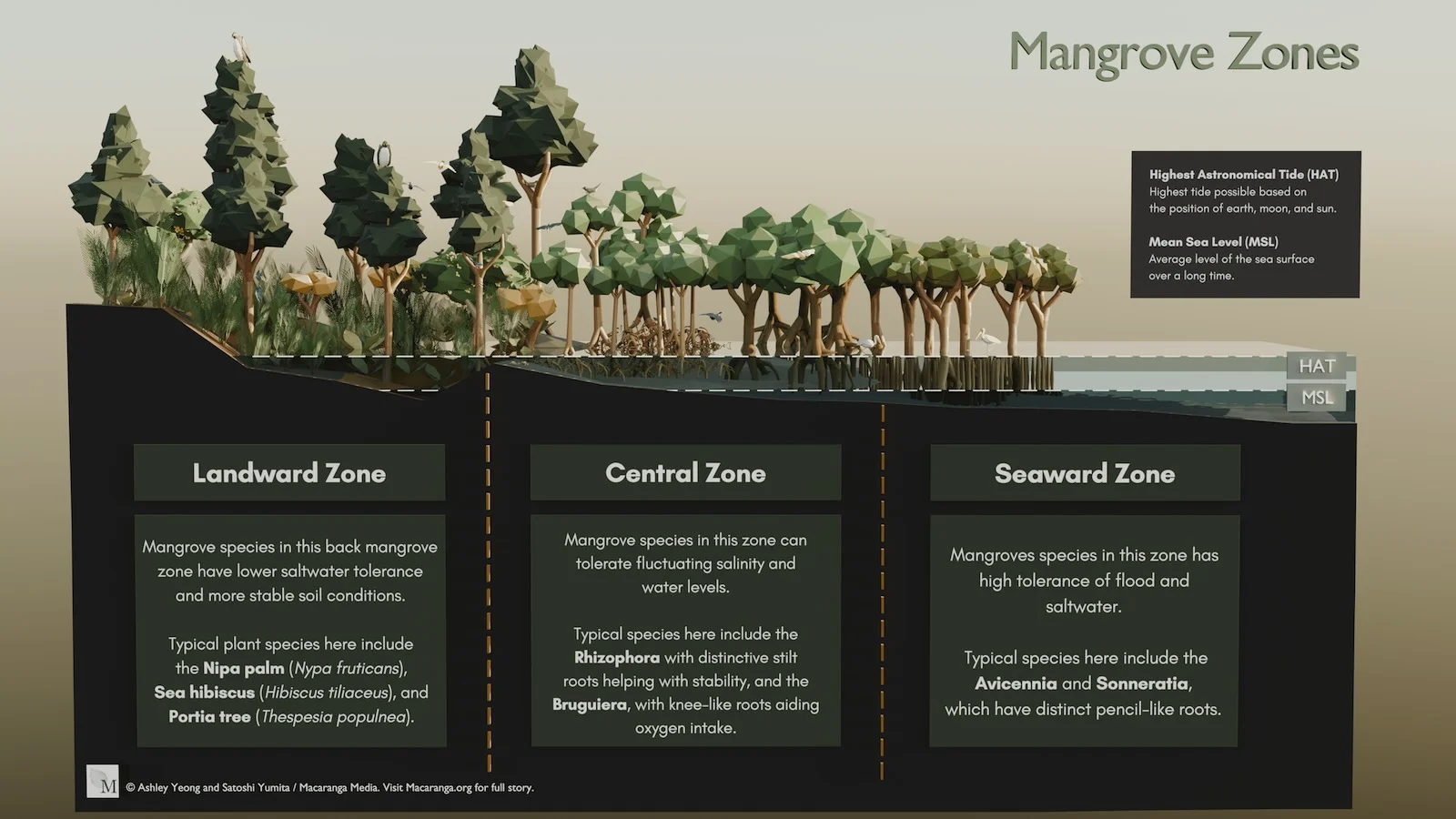
Facing the ocean and awash in 100% salty seawater are hardy species like Avicennia and Sonneratia. These trees are distinguished by their ‘pencil roots’, sticking vertically out of the sand and mud to breathe oxygen. They are called pioneer species because they ‘grow’ land by colonising new deposits of sediment.
Behind the seaward zone is the central zone, dominated by Rhizophora species. Inundated daily by seawater, their tangled web of aerial roots elevate the plants above the saltwater and allow them to ‘breathe’ even while their lower roots are submerged. Moving landward, Brugueira species with their buttresses and knee-shaped roots tend to dominate.
This zone melds into the back mangroves or landward zone, which is influenced by freshwater and is inundated only by the highest tides.
This is where the most diverse communities live, comprising mangrove and mangrove-associates plants. Among them are the Acrostichum, Acanthus, Excoecaria, and river-fringing Nypa fruticans. This zone is also richest in bird numbers and diversity, says ornithologist Wells.
Ideally, back mangroves would merge into dryland forest. However, in reality, their ecological succession is blocked by a slew of man-made impediments. These include roads and plantations, aquaculture farms and landfills, and factories and ports. Often, these fragment the very mangroves themselves.
And when mangroves are degraded or lost, society and the environment suffer. The consequences grow ever more severe as Malaysia’s sea levels are set to rise with climate change. Already, Malaysia has lost plenty of mangroves.
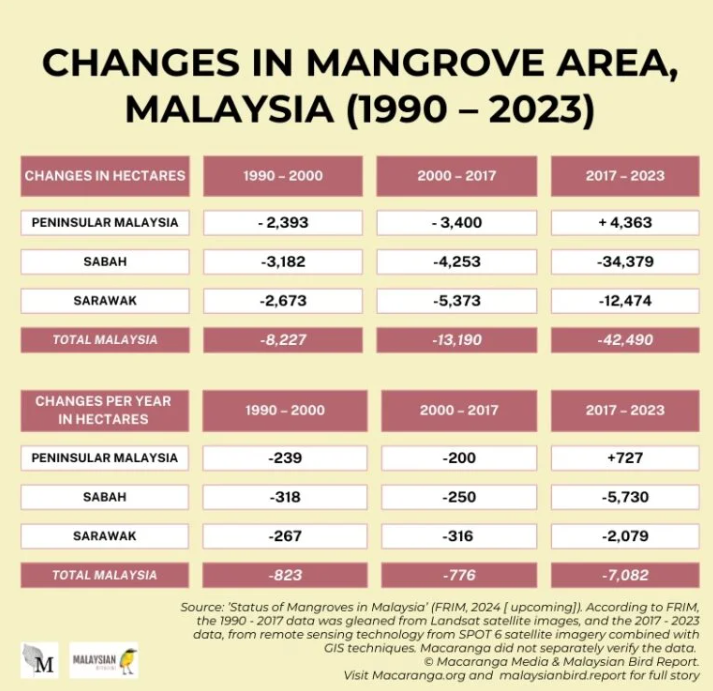
Many of Malaysia’s mangroves are actually legally protected: of its 586,548 ha, 93.74% are inside permanent reserved forests, and state and national parks. But Malaysia has been losing its mangroves steadily since 1990, according to the Forest Research Institute of Malaysia (FRIM) in its upcoming 2024 report on the status of mangroves shared with Macaranga.
While loss can also result naturally, FRIM states that the most loss is caused by development outside protected areas, on state lands. The biggest loss of mangroves took place in the last 6 years, since 2017.
Mangrove areas decreased by 46,853 ha, almost twice the size of Kuala Lumpur. Of this, a massive 73% (34,379 ha) happened in Sabah, and the rest in Sarawak (12,474 ha).
Measured in terms of loss per year, Sabah lost about 19 times more mangroves than in the previous 27 years, and Sarawak, at least 8 times more. Both these regions are home to the most mangroves in the country – Sabah around 22% and Sarawak 59%.
Interestingly, Peninsular Malaysia actually gained 4,364 ha of mangroves, more than making up for the mangroves it lost between 2000 – 2017. The losses and gains differed across states, but most states saw mangrove areas grow. Still, the earlier mangrove loss is evident. Driving from Penang to Selangor, outside of the protected areas, Macaranga found most mangrove forests little more than strips fenced by infrastructure and agriculture.
When agriculture is developed behind mangroves, bunds are typically built to shield plots from tidal flooding. To protect the bunds from eroding, the Department of Irrigation and Drainage has a policy to maintain a strip of mangroves between the bunds and the sea. But the bunds cause the mangroves themselves to erode.
Still, even in these mangrove strips, there is enough avifauna to draw bird-watchers and photographers.
South of Matang in Bagan Datuk are the popular Beting Beras Basah jetty and Kampung Sungai Tiang. To get there, bird-watchers must drive through long stretches of oil palm plantations.
North at the bird sanctuary of Kuala Gula, they must pass aquaculture ponds that ring the mangroves. Here, the forest fringes the coastline, but only roughly 50m wide. A road around the ponds cuts through the back mangroves, fragmenting the habitat. Even further north in Penang, the mangroves of the once-aptly named Pulau Burung draws bird-watchers. This is despite its back mangroves having been replaced by a mountainous 16 ha landfill. Flood researcher Edlic Sathiamurthy says “during heavy rain, the leachate pond can overflow,” bringing toxic leachate into the mangroves and ocean. He personally observed this in 2017.


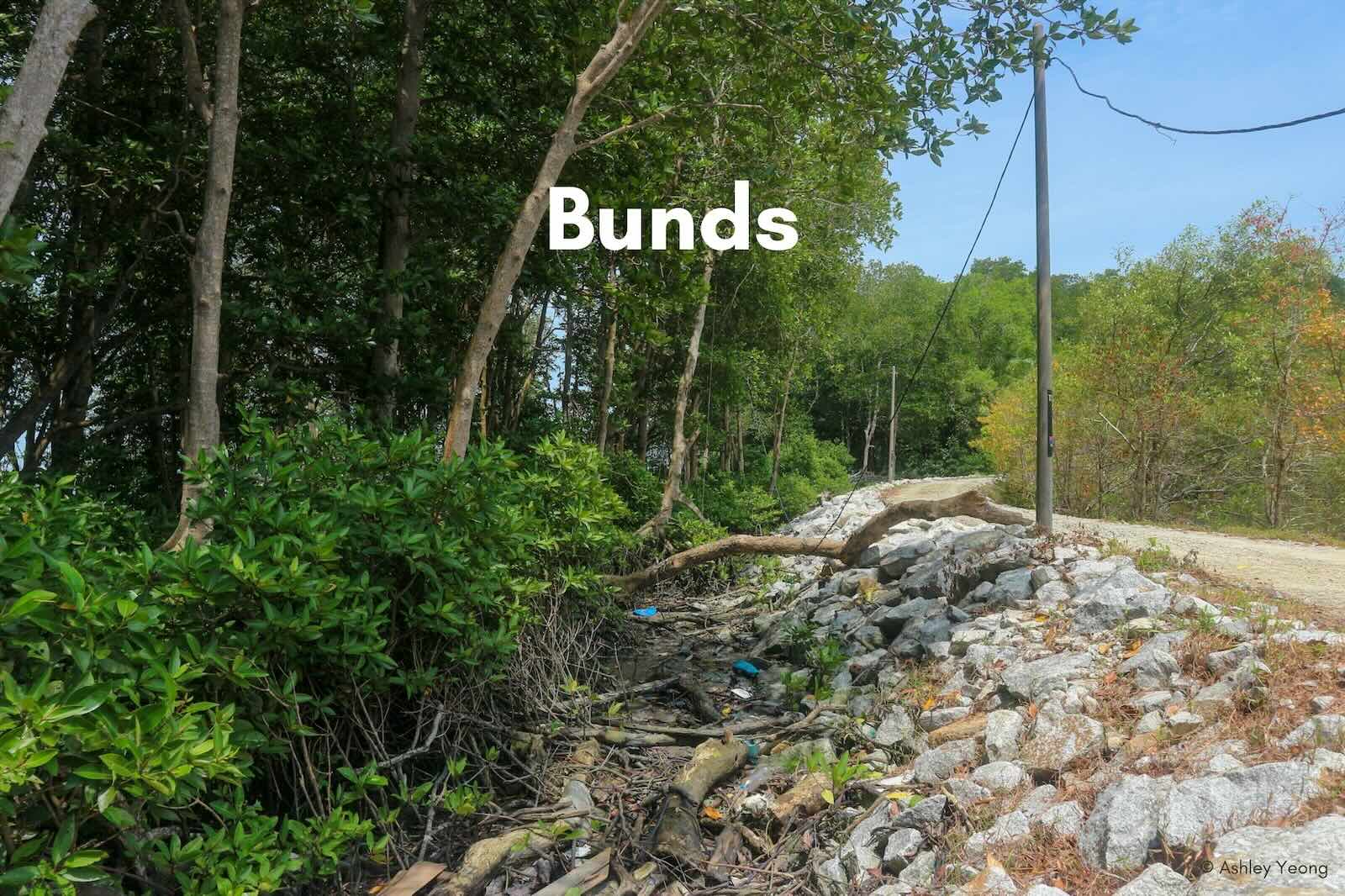
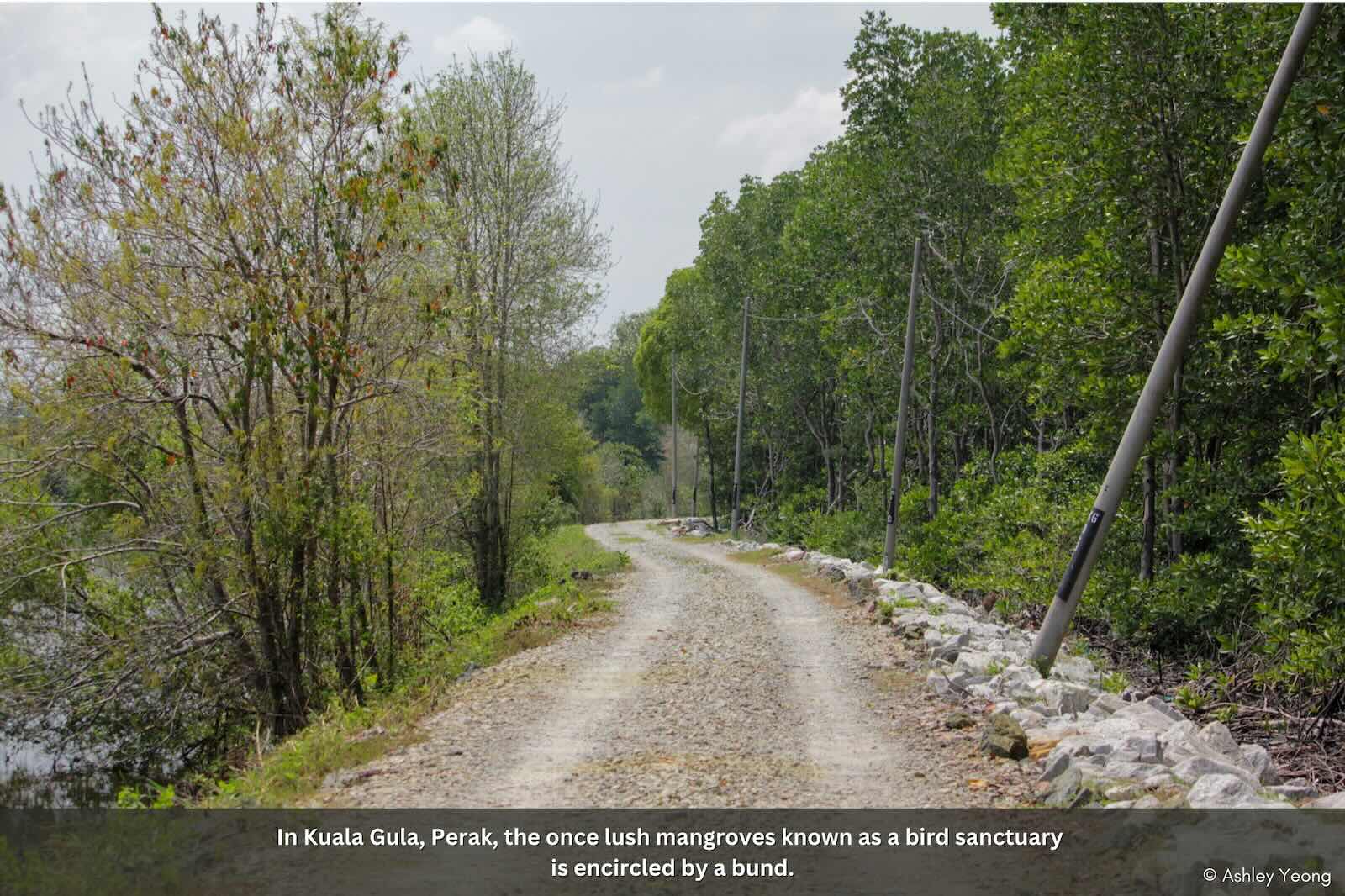
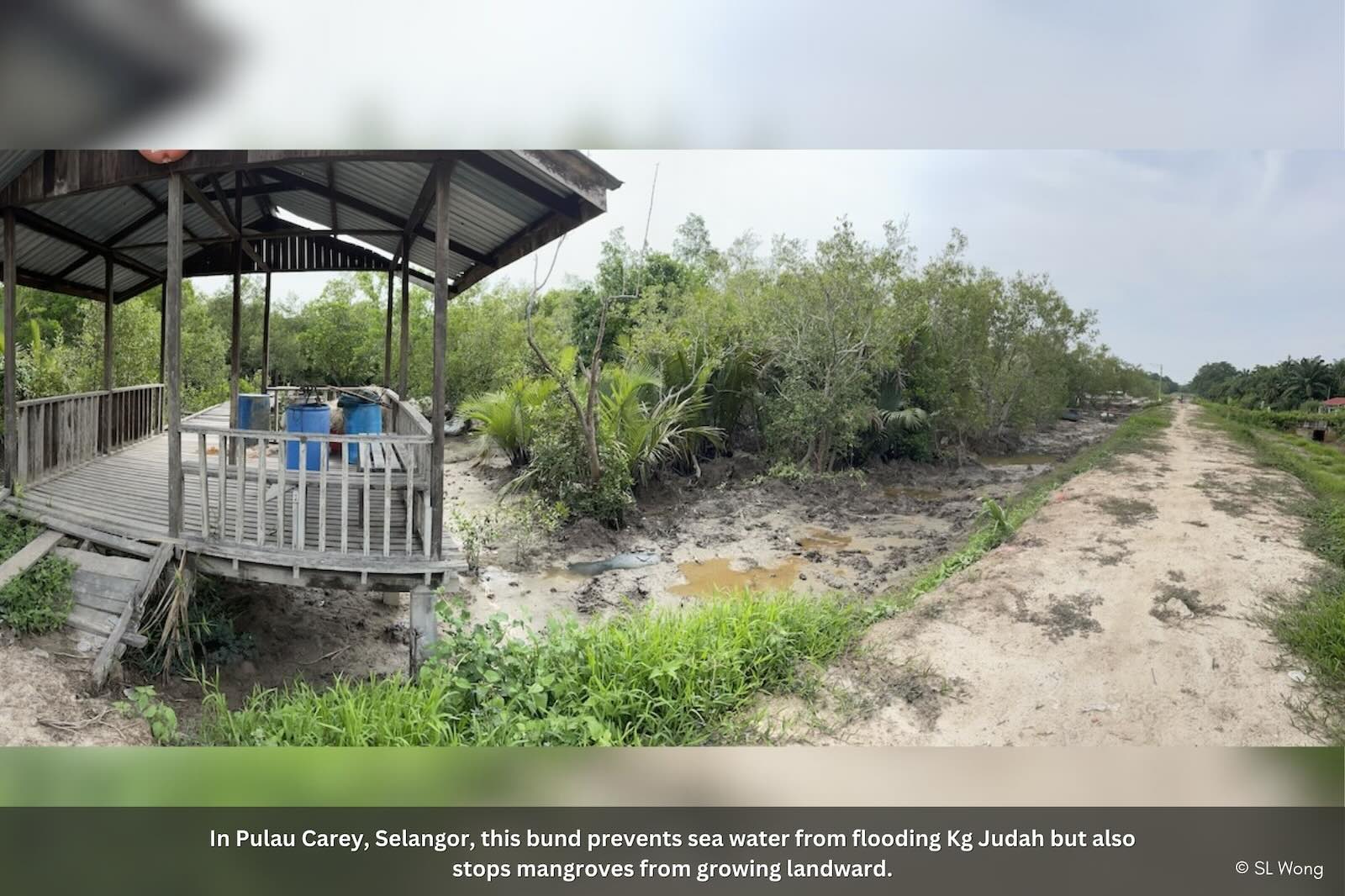
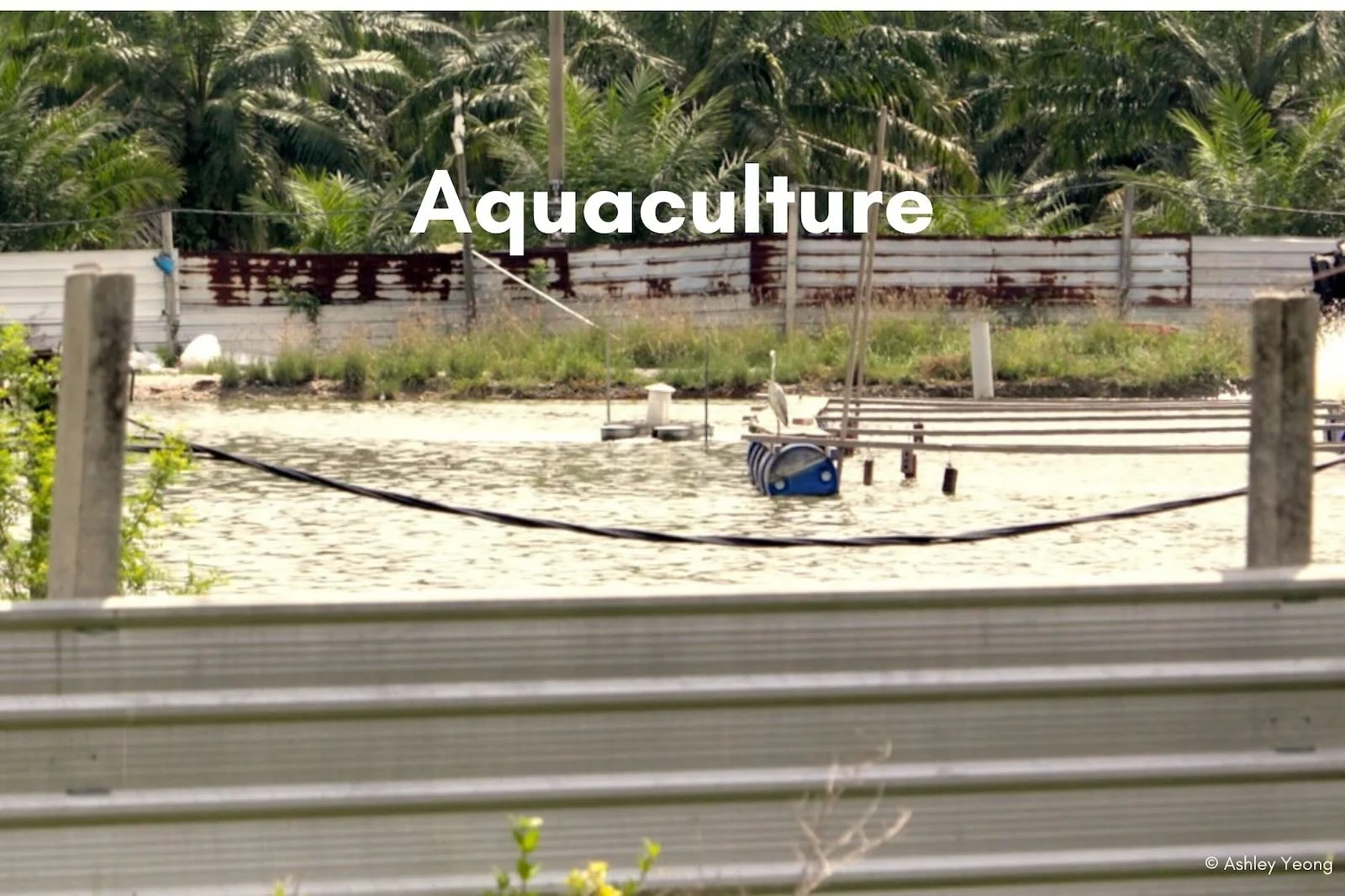
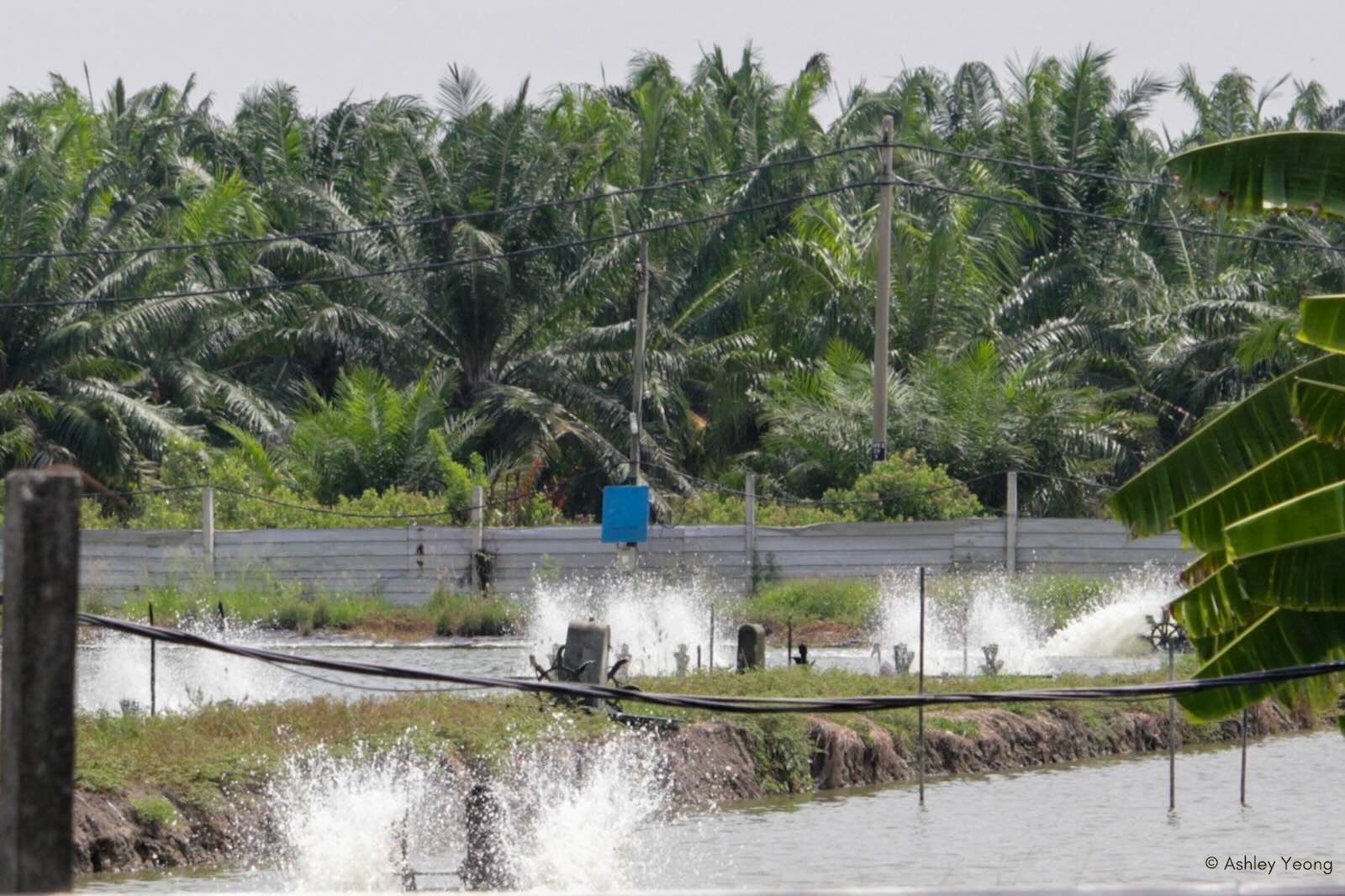
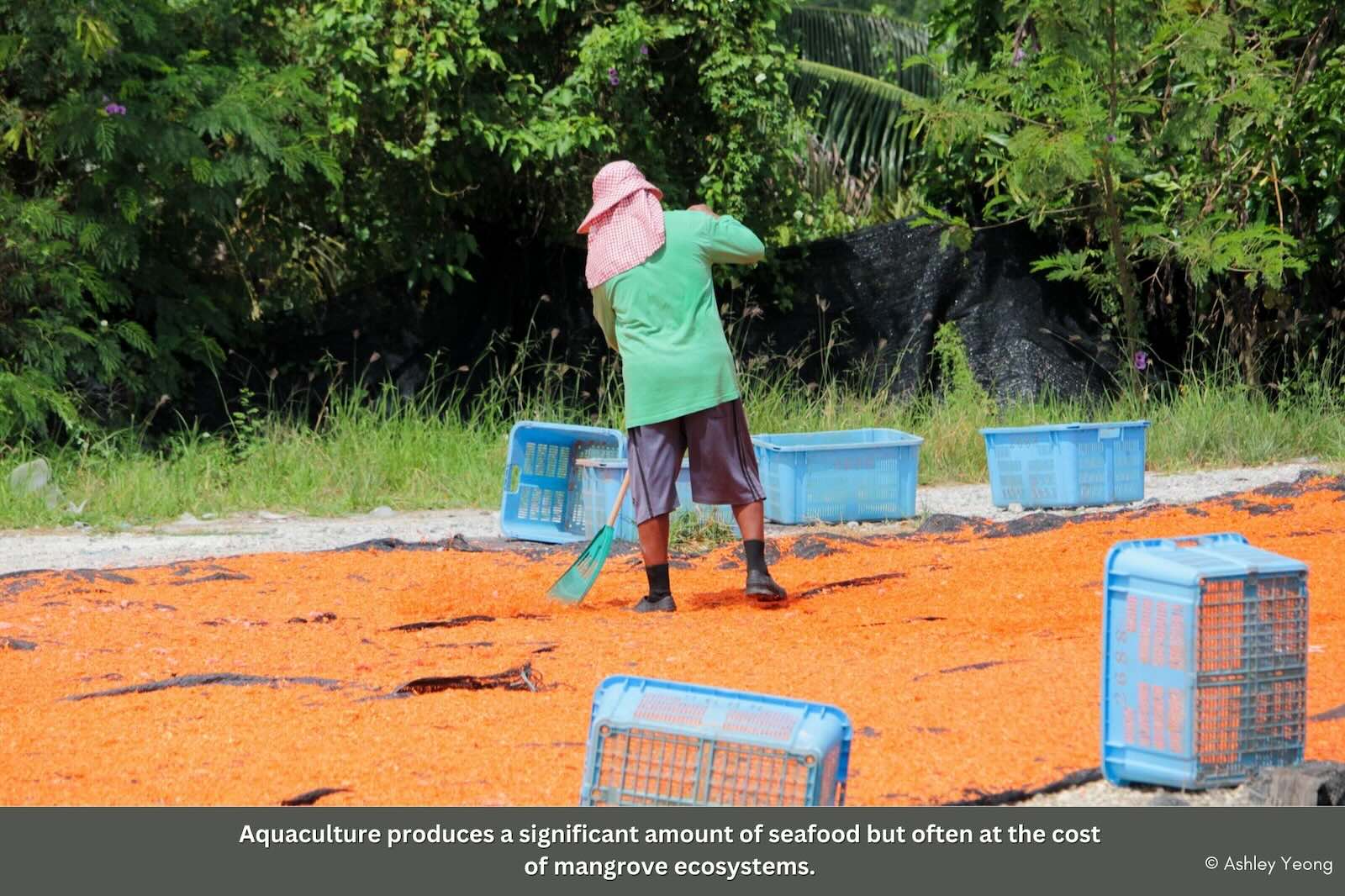

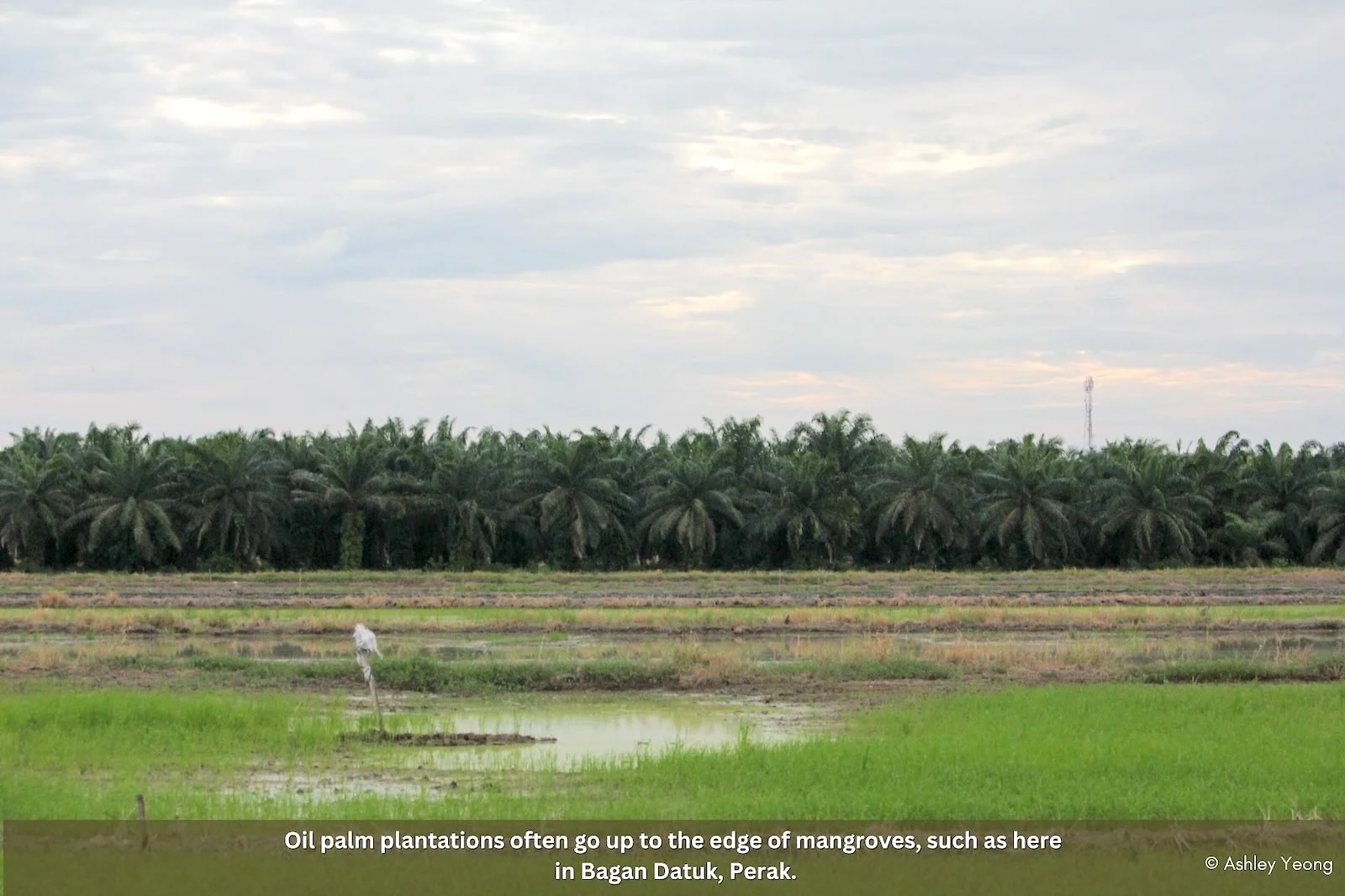
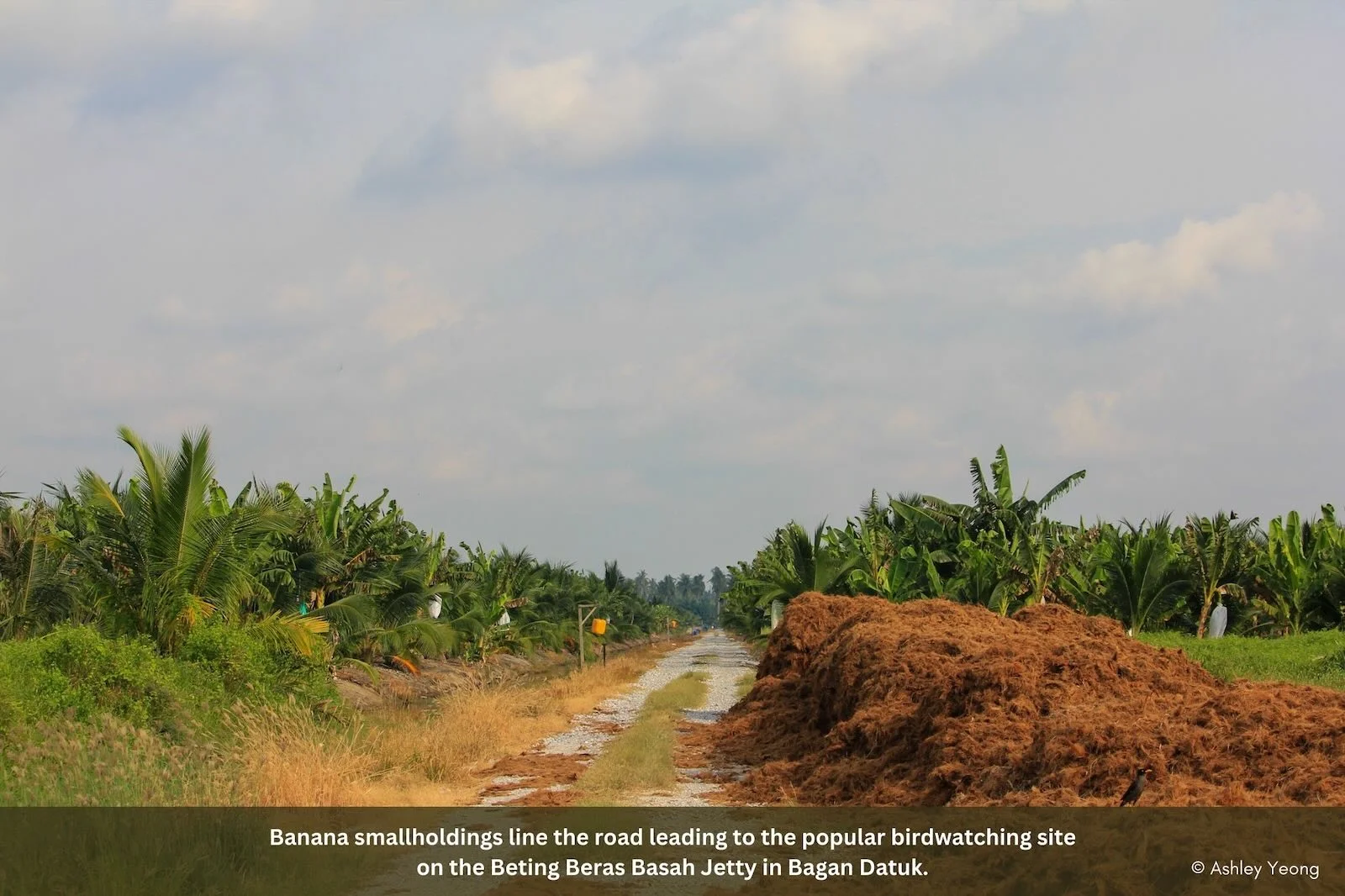

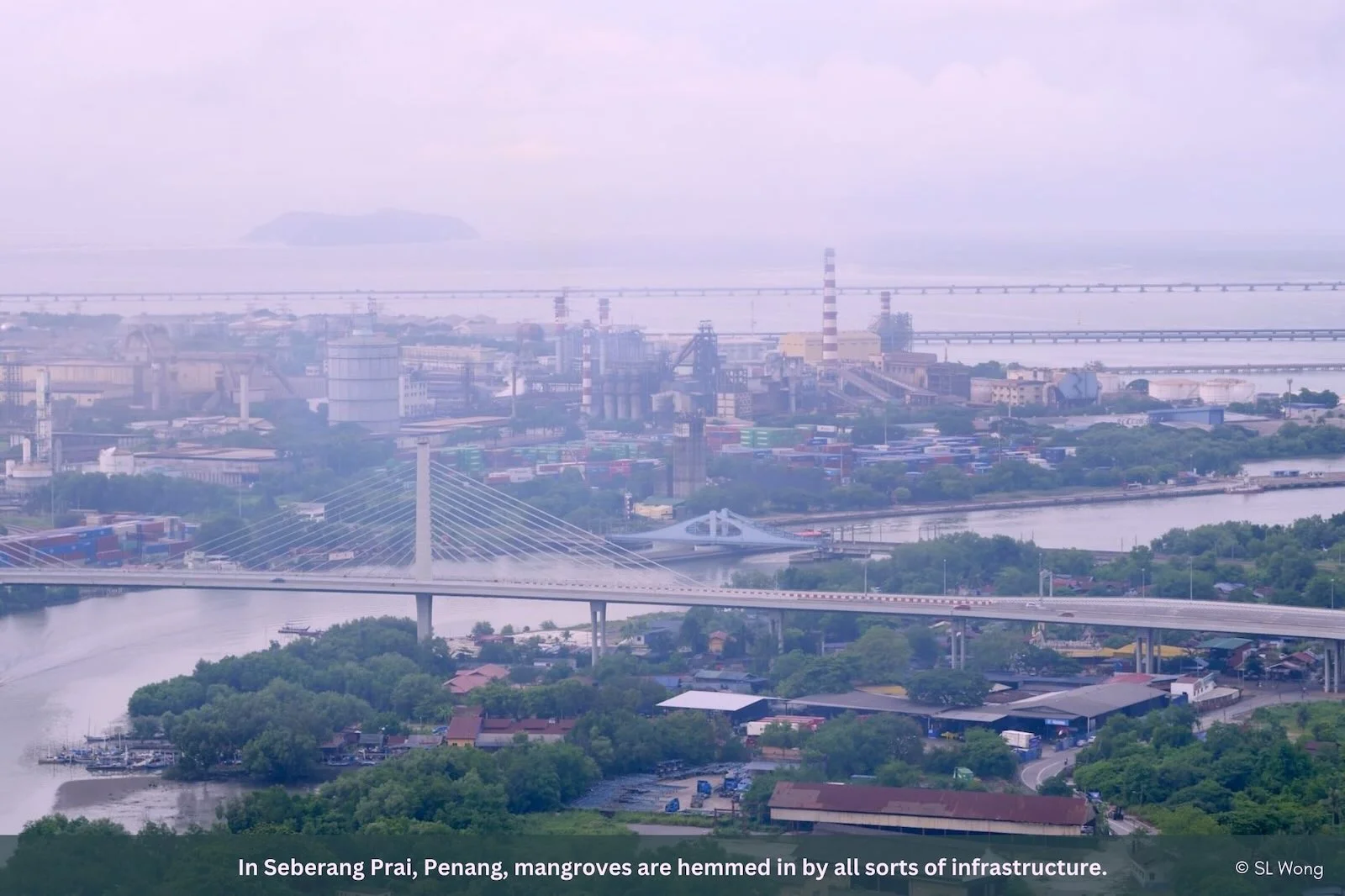
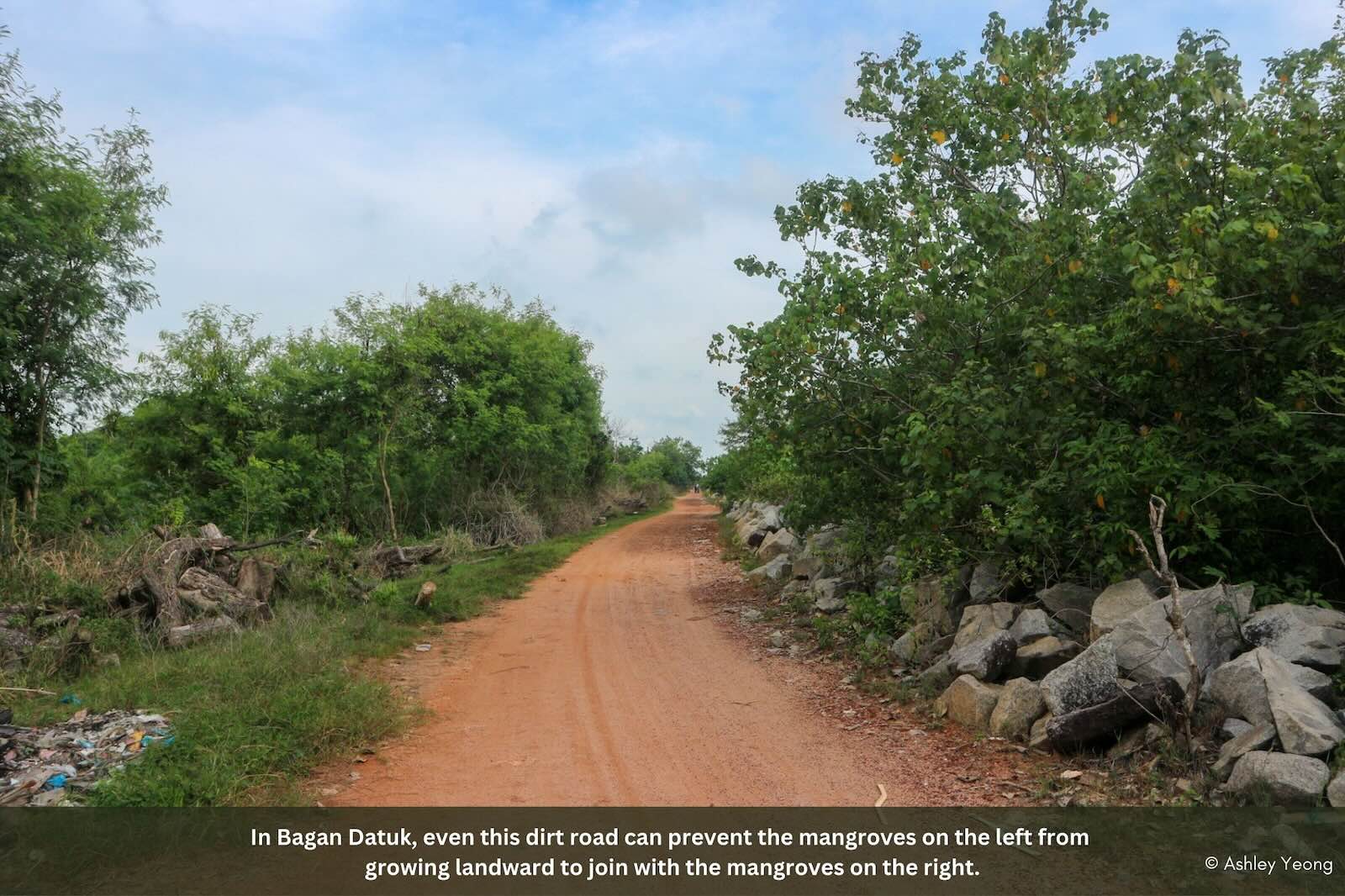
The critical point about cutting off mangroves from expanding landwards is that it throttles the health of mangroves, and their superpower to protect coasts and inland areas. Mangroves can gradually expand landmass from soil or sand deposits caused by the movement of water. Their dense root systems trap sediments carried by tides and rivers, gradually building soil. But mangroves need room to perform their ecological functions effectively, says Dr Chee Su Yin who researches coastal ecosystem conservation.
“If the sea level rises, they can move backwards. And if they have enough soil they can also move (forwards) towards the sea.” By this logic, mangrove areas should be protected to allow them to grow both seaward and landward. This has big implications as Malaysia’s sea levels are set to rise with climate change.
“But mangroves can only grow backwards if there is space,” points out Chee. How much space exactly? Ideally, as much space as possible. In reality though, she notes that the buffer zone is usually a mere 100 m. “This area (back mangroves) is always a tussle between developers and profit-makers and conservationists. One hundred meters is actually not enough. For me, I would advocate for at least 200 m to half a kilometer.”
But she concedes that “space is very precious. If you’re in the developers’ camp, then you want to use this space to develop. There’s a lot of money involved.
That’s where the difficulty of conserving mangroves is. It’s always been the developers and conservationists. Whether it’s mangroves or coral reefs, this is always the issue. –Dr Chee Su Yin
Birds as Red Flags
Without space for back mangrove expansion and the forest’s ability to host all its various zones, birds are at risk. Macaranga compared bird diversity and numbers at 2 sites in Perak 100 km apart, using the citizen birdwatching global database, eBird at Cornell University.
The Matang Mangrove Forest with its healthy forest complete with back mangroves has considerably more different bird species than Bagan Datuk, which only has a sea-front mangrove fringe (see table). In terms of resident bird species spotted, Matang has 96, more than double the 45 species in Bagan Datuk.
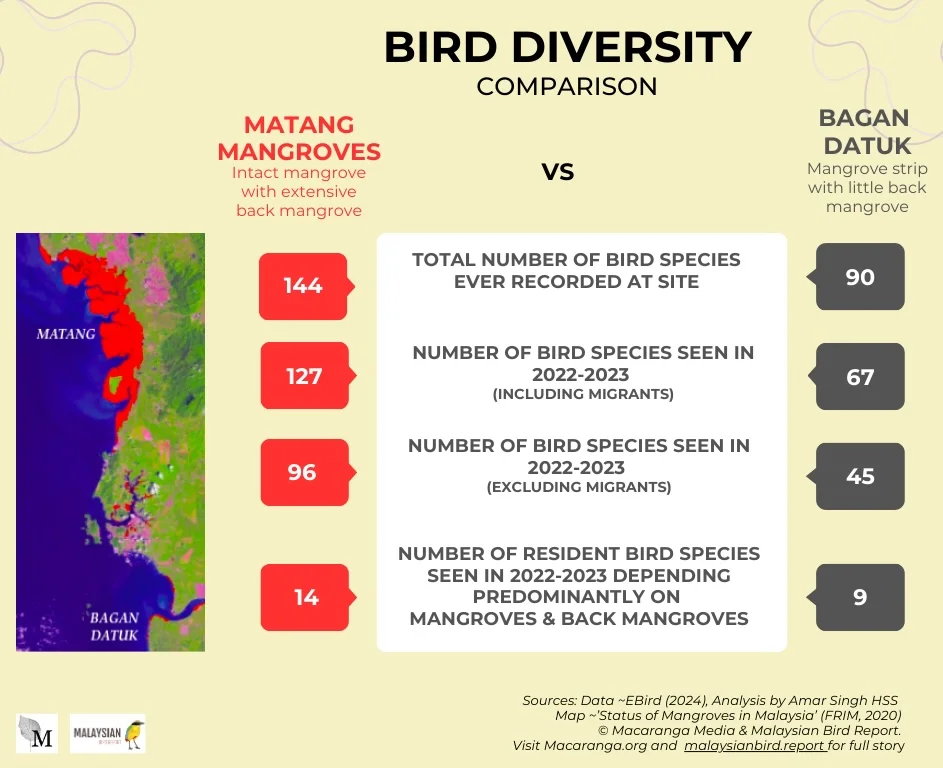
Narrowing it down to birds that live predominantly in mangrove habitats, Matang still has one-and-a-half times more different bird species than Bagan Datuk (mouse over the photos in the gallery below; tap on mobile). In 2022—2023, the majority of resident birds are more commonly seen and in larger numbers at Matang with its extensive back mangroves.
Unfortunately, in the thinner mangroves of Bagan Datuk, species such as the Mangrove Pitta Pitta megarhyncha, Mangrove Whistler Pachycephala cinerea have not been recorded in recent years; the birds were absent in both the 2024 eBird database and the 2018 MNS surveys.
Avian ecologist Noske, in his study of mangrove forest birds in Peninsular Malaysia, noted that birds like the Mangrove Blue Flycatcher have a “preference for dense forests with low light levels”. Hence its absence where the forest has ‘gaps’ or is sparse.
Ensuring the existence of birds in mangroves can actually help mangrove conservation – through ecotourism. Mangrove forests are under-appreciated as ecotourism sites. In recent decades firefly watching, for one, has grown. The top firefly-watching site in Malaysia, Sungai Klias in Sabah, draws 100,400 tourists annually. MNS in 2018 estimated that the economic value of the Teluk Air Tawar-Kula Muda coastal mangrove region at USD6 million per annum (RM28 million); USD760,000 (RM3.5 million) from nature-based tourism.
Drawing bird-waters and photographers can further boost the case for mangrove conservation. In Sabah, which saw the biggest mangrove loss in the last 6 years, 35% of tourists visited for ecotourism, including bird-watching in pre-pandemic 2019. The year before that, the state earned RM8.3 billion from 3.9 million tourists in tourism revenue. The Sabah Tourism Board also recognises bird watching as a niche market in tourism.
For ecotourism to thrive in mangrove forests, so must birdlife. And birds need healthy multi-zone mangroves.
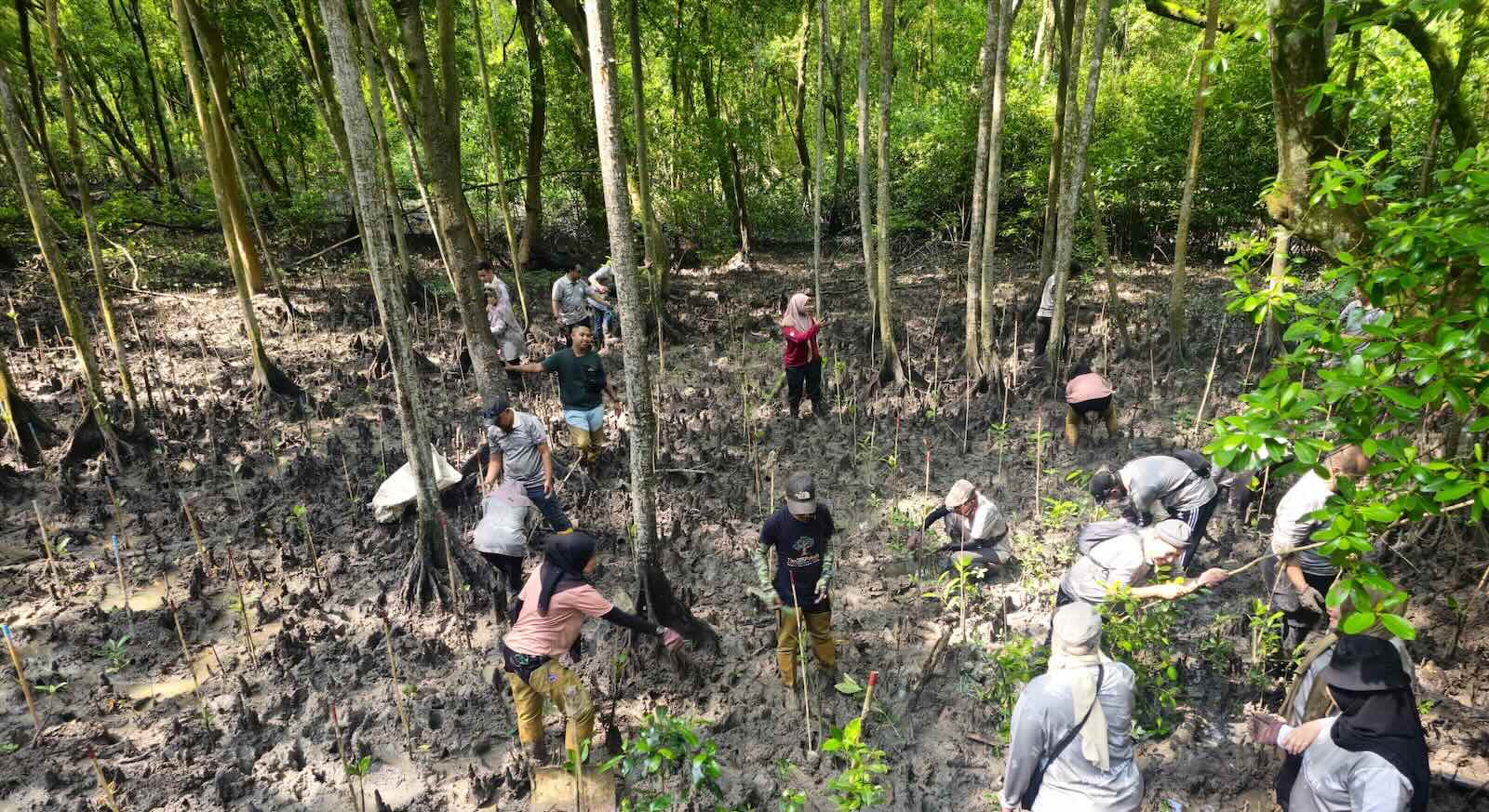
At Mangrove Point, Selangor, seedlings are planted landward-facing and their growth monitored. Photo: Selangor Maritime Gateway via Macaranga
Symbiotic Conservation
To boost mangrove’s land building capacity, restoring is a key activity in Malaysia. “Replanting really started after the tsunami in 2004,” says mangrove researcher Aldrie. The Indian Ocean tsunami of 2004 struck the coasts of several South and Southeast Asian countries, including Malaysia. The disaster killed at least 225,000, of whom at least 68 were in Malaysia.
Recognising the role mangroves played in mitigating the tsunami, Malaysia started the Programme for the Planting of Mangrove and Other Suitable Tree Species Along the National Coastline. From 2005 to 2022, 7.2 million seedlings were planted along coastlines, covering 3,278 hectares.
“The government and companies have a lot of money and they want to do replanting,” says Aldrie. But oftentimes, they do not engage with the scientific community and local communities. The result is ineffective or failed replantings. “They plant the wrong species and [on] the wrong site,” says the scientist. “You plant thousands of seedlings, and it’s washed away the next day.”
The idea is to establish an ecosystem. “We want to reforest, not just replant. Actually, if you let mangroves thrive naturally, they can regrow by themselves.”
Chee, the coastal conservationist, shares the same sentiment. She shares a powerful example of how Penang’s Gurney Drive reclamation had a “happy side effect”. While the developers were piling on sand to reclaim land, it created the perfect environment for mangroves to regenerate.
“It was muddy, sheltered,” she says. “The waves couldn’t get in but the seawater could. So because there was this really ideal situation in where the salinity was right, and there were these bunds stopping the waves from coming in. “And [in the] little space that the mangroves used to be, the propagules started to migrate. In 6 months, you can see that mangroves from a small area [spread] about 200 m down the Gurney Drive coastline. I thought this was really fast. Based on this observation, as long as the conditions are correct, then they can grow at a very fast pace.”
MNS also says that mangrove birds return to well-rehabilitated mangroves, calling their presence “an important indicator”. As elsewhere in the world, Malaysia’s mangroves are under tremendous pressure from competing uses, from agriculture to infrastructure. But what it takes for mangroves to support birdlife is what it takes to ensure they are healthy.
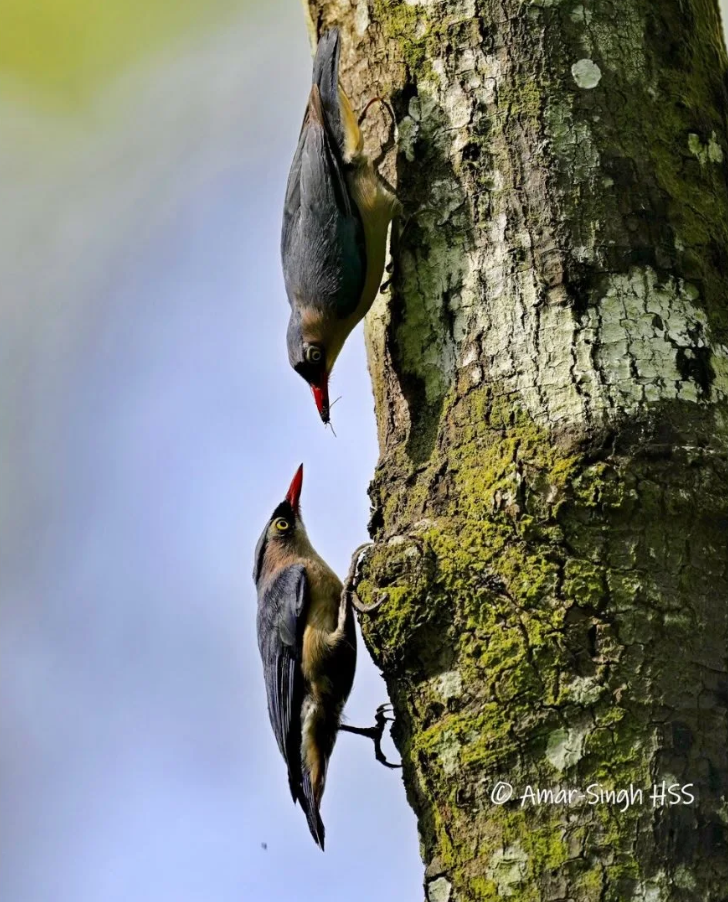
If healthy back mangroves are restored, Velvet-fronted Nuthatches might return to Selangor’s mangroves; Photo: Amar-Singh-HSS via Macaranga
This means having a mix of zones and enough space inland to undergo ecological succession to dryland forest, especially for the forest to survive as climate change raises sea levels. Chee says the discussion between scientists and policymakers is to allow these coastal forests room to migrate landwards; this means ensuring infrastructure like highways are not built too closely.
Ornithologist Wells was particularly worried about how the loss of back mangroves in Selangor had already led to a drop in bird diversity. The good news is that mangrove area has seen a net increase in the states featured in this article: Selangor (21 ha), as well as in Perak (58 ha) and Penang (124 ha) (see graph above).
At Bagan Datoh, Perak, both MNS and FRIM are working to conserve and enrich the remaining mangroves, working with local communities and developing ecotourism, including establishing an on-site mangrove germplasm facility.
All these would certainly augur well for the Velvet Fronted Nuthatch. This blue tree hopper has not actually disappeared from Selangor, as it has been spotted in other forest types. But perhaps one day, if Selangor’s mangroves – and especially its back mangroves – revive, the bird could actually return to its favourite habitat.
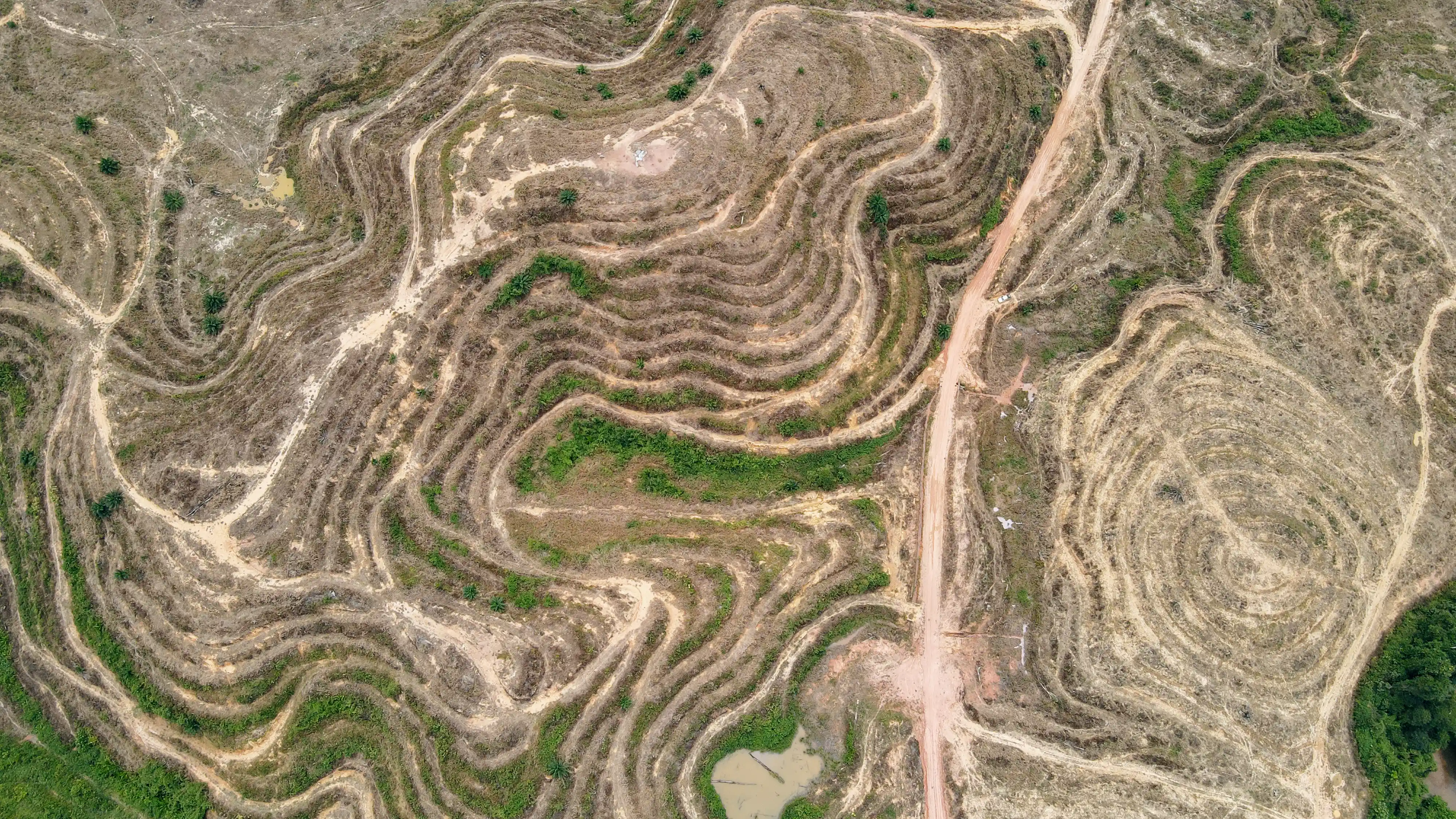
Being in Kampung Tanah Pindah feels like being at the edge of the world. Surrounded by dense mature forests in Hulu Tembeling, Pahang, paved roads stop here. It is so remote that the village does not even have modern water supply, but nature provides.
Through a self-built channelling system, villagers source their water from Sungai Kancin, a river high up the hills 18 kms away. But this harmonious, symbiotic relationship between human and nature is under jeopardy, after a massive oil plantation project wedged itself between the two.
In 2014, Perbadanan Kemajuan Negeri Pahang (PKNP) was granted land titles to develop the jungle into oil palm plantations where Sungai Kancin is situated.
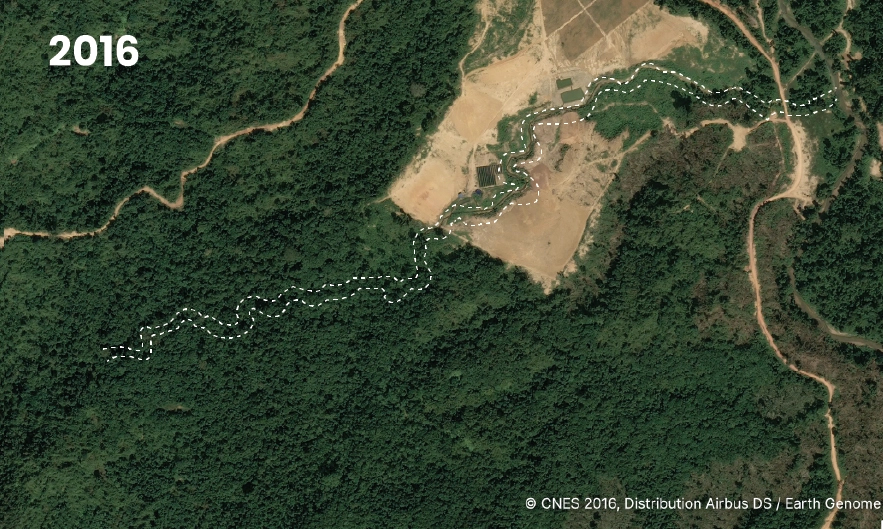
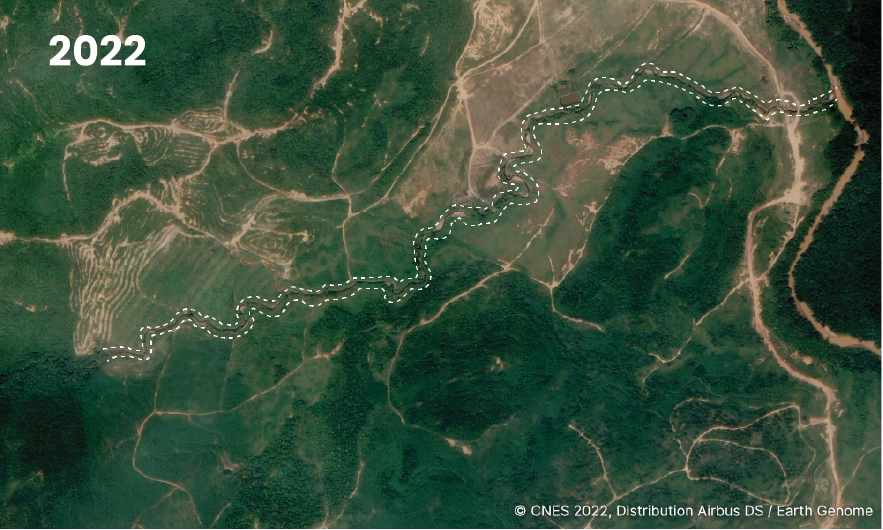
In 2016, vegetation still covered riverbanks that run through PKNP’s plantations. In 2022, the riverbank became fully exposed due to extensive logging activities. The Malaysian Sustainable Palm Oil (MSPO) bans clearing of forests on riverbanks since 2013. But the PKNP plantation continues to get MSPO-certified. Images: Malaysiakini
Villager Wan Mohamad Razali, 61, is unhappy about the logging activities because it has disrupted their water supply. Once tucked away in the forest, their water pipes were exposed on the open grounds of the estate, and were soon destroyed by wild elephants. Still, villagers persisted to head into the hills to repair the pipes. Until the water turned murky, after vegetation along the riverbanks were cleared. Now, they no longer source water from the hills.
The alternative was rainwater or downstream water. At times the water downstream was dirty but the villagers had no choice. A corporate donor provided villagers with groundwater pumps. But water from underground smelled foul, said Wan Mohamad Razali, incomparable to the pristine water from the hills.
Meanwhile, villager Wan Mohd Masri Wan Azahan used to catch fish in Sg Kancin, Hulu Tembeling, Pahang. The river was once filled with fish, but when the trees along the riverbank were cut down, “fish don’t want to stay in the river anymore”, he says.
Kampung Tanah Pindah
Kampung Tanah Pindah is located to the north of PKNP’s plantation in Jerantut. Before the plantation, villagers sourced water from Sungai Kancin located 18 kilometres away. This source was disrupted after forest clearings. Sungai Kancin runs through PKNP’s 8093-hectare-wide plantation, which is one of the largest oil palm plantations in Malaysia. This area is classified as an Environmentally Sensitive Area. On Nov 16, 2023, a forest neighbouring the plantation was gazetted as the Al-Sultan Abdullah Royal Tiger Reserves. Located to the east of PKNP’s plantation, this gazetted area covers 134,183 hectares. Just nine kilometres northwest of the plantation is Taman Negara National Park – the largest protected land in Malaysia and home to many animals on the brink of extinction.Local villagers report tiger sightings from time to time. In October 2023, tiger footprints were discovered in a rubber plantation neighbouring PKNP’s plantation named YP Hevea. The villagers have also discovered a salt lick in the plantation site. This is where wild animals in the forest come to obtain minerals. If logging does not stop, this salt lick will disappear.
Despite being rich in biodiversity, the felling of trees in this invaluable forest went on without interruption.
In July 2023, PKNP’s plantation was a jarring sight – a barren expanse, scarce in vegetation, laid pale and weary beside Taman Negara’s vibrant greenery. By then, the plantation had been in development for eight years.
EOS Data Analytics is a US-based company specialised in analysing satellite images of agriculture and forestry. Their soil expert, Vasyl Cherlinka, calculated the opportunity costs of deforestation caused by PKNP plantation from 2016 to 2023.
By Cherlinka’s measure, if the forests were preserved, it could sequester 227,395 tons of carbon dioxide, akin to the amount of carbon emitted by 49,472 cars in eight years.
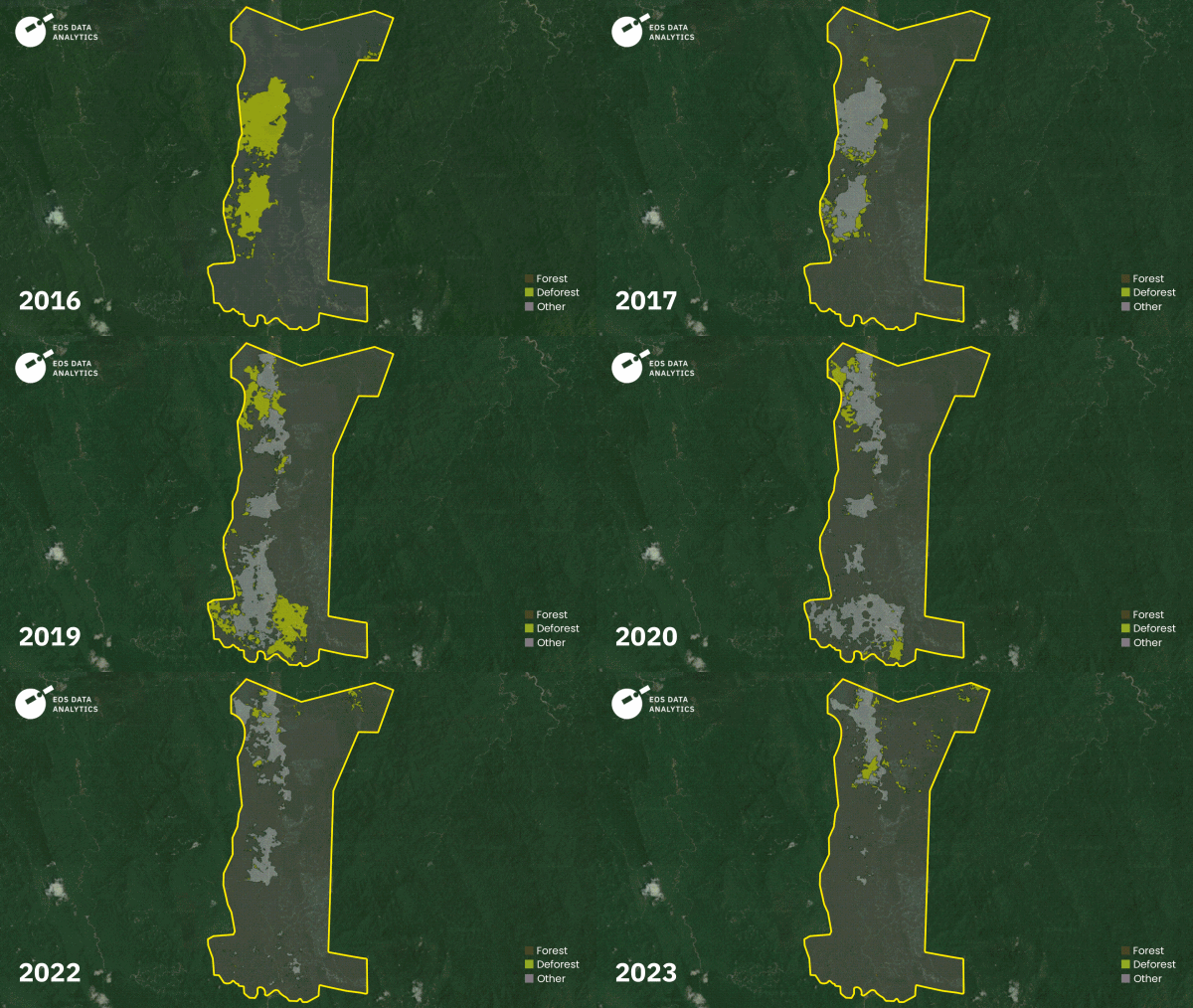
Deforestation that happened in PKNP’s oil palm plantation from 2016 to 2023. Image: Malaysiakini.
PKNP’s deforestation was “done rather chaotically”, said Cherlinka. Instead of being systematically planted with palm trees, the deforested area was gradually reclaimed by shrubs and overgrowth.
The project’s environmental impact assessment (EIA) report stated a phased approach in clearing forests was to mitigate environmental damage, yet satellite images showed logging was done in fragmented patches.
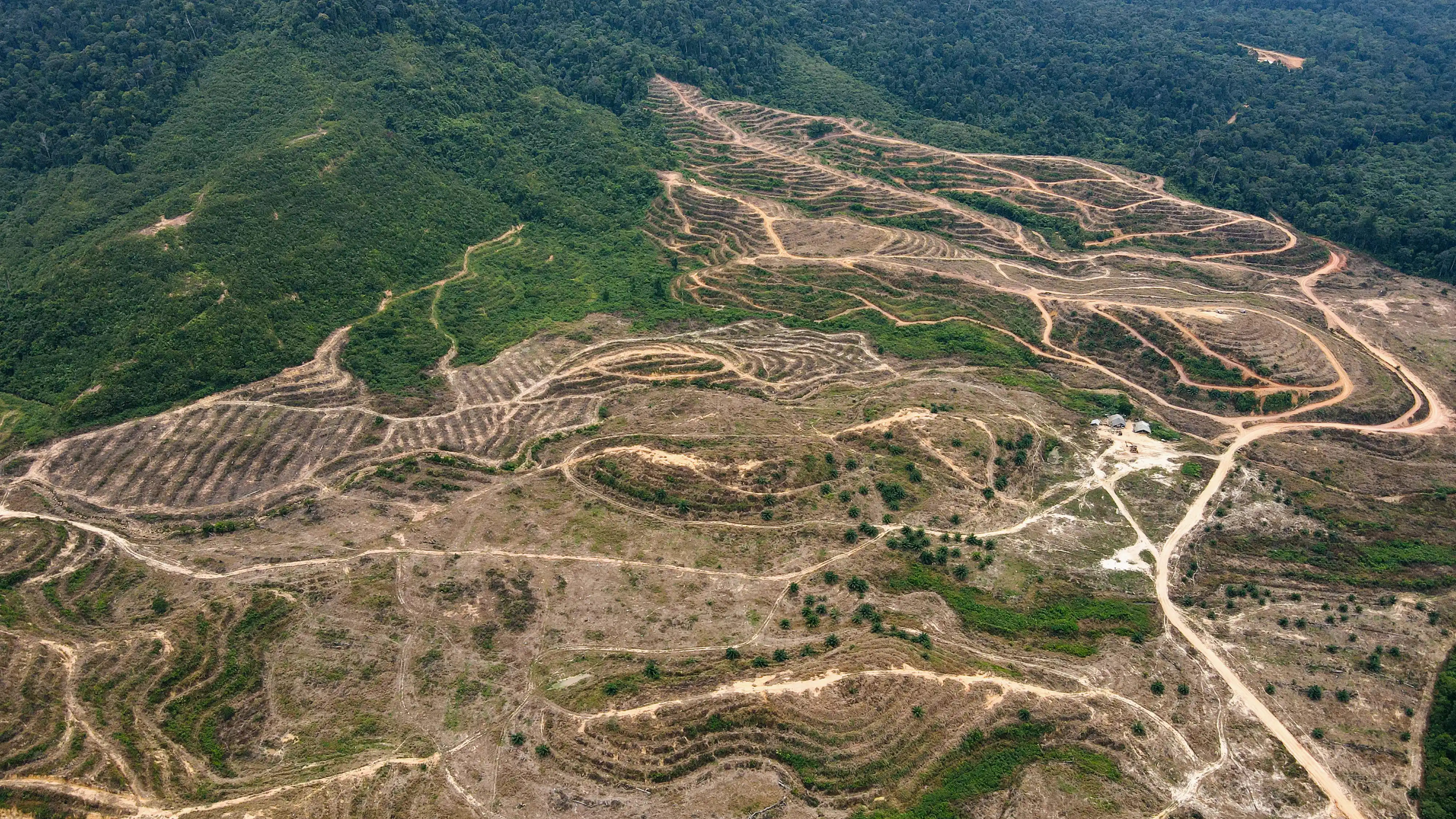
(Left) In contrast to the flourishing green plantations lining the North-South Highway, this plantation is an extended area of sun-scorched brown. (Right) In this post-apocalyptic sight, what little green left are mostly weeds and some scattered oil palm trees. Photos: Malaysiakini
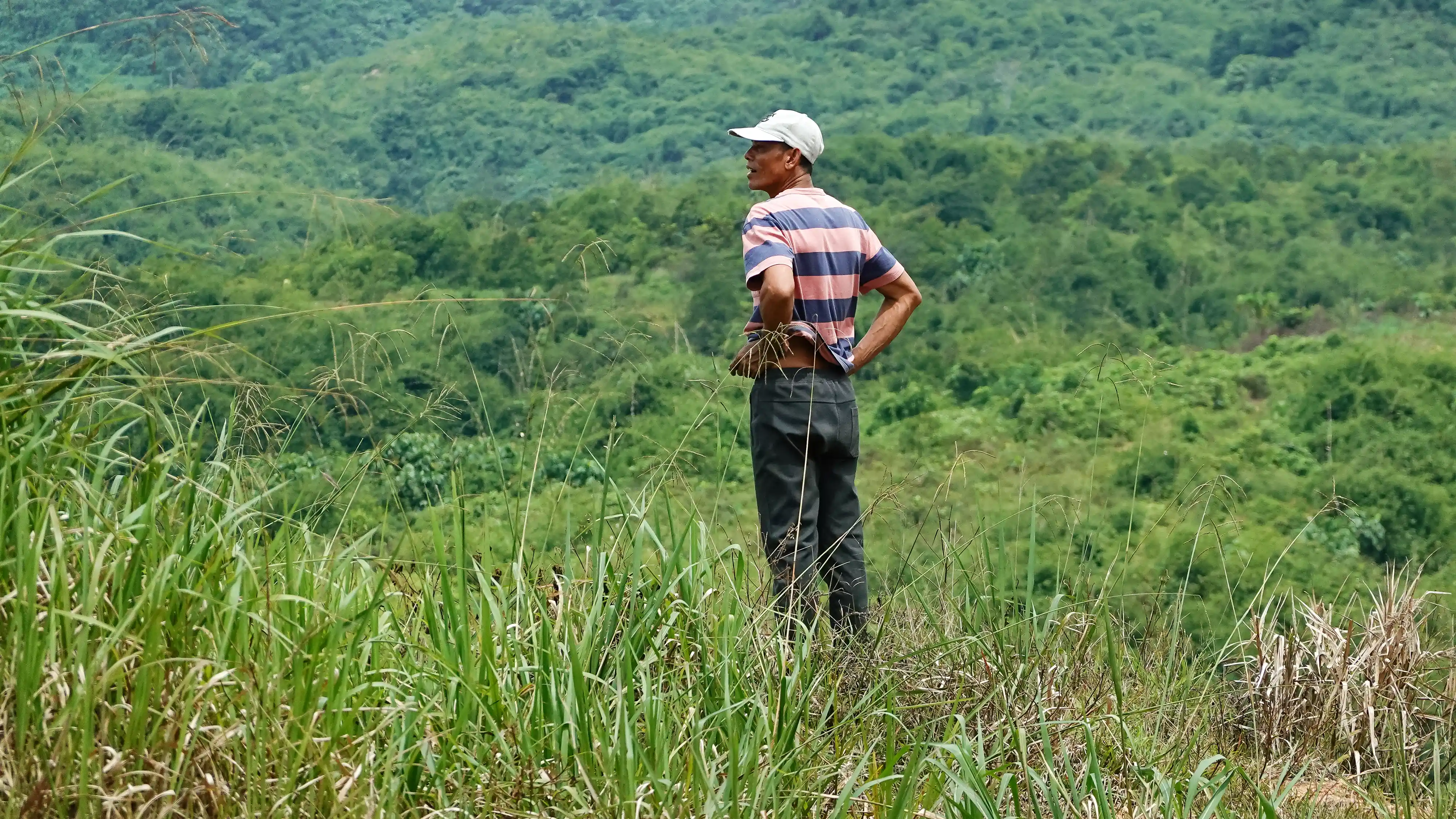
Wan Rokman Wan Ngah, a local villager, finds the plantation’s pitifully low yield laughable. “The elephants are here almost every night and eat all the palm trees.”
Elephant dung was found everywhere on the hillslopes, but the plantation management seems to have no intention of preventing the animals from entering. Photo: Malaysiakini
It takes about four years for a palm tree to reach maturity.
PKNP told the Auditor General it first started planting in Oct 2015, and expected to harvest by 2019. Eight years later, the harvest has been disappointing.
Half of PKNP’s plantation – about 4,046 hectares – are in operation, and from there the plantation yielded just 29 tonnes of fresh fruit bunches (FFB) a year, according to a report published by the Malaysian Palm Oil Board (MPOB) in 2022. This is just seven kilograms per hectare of land, annually.
If we estimate that mature oil palm trees occupy 10% of the total area or 809 hectares, the average yield per hectare of land is 35 kilograms per hectare, annually.
In contrast, the average oil palm harvest of Peninsular Malaysia in 2022 is 16.41 tonnes of FFB per hectare of land – or 469 times more than PKNP’s yield.
According to the report, crops in “almost 90 percent” of the area were damaged by elephant encroachment. An environmental consultant even said that this is “the worst-managed oil palm plantation in Malaysia.”
Warnings of the Human-Elephant Conflict Ignored
PKNP appointed a consultant agency to conduct an EIA study in 2014. The consultants concluded that this area is a wild elephant habitat, because elephant dung and footprints could be seen everywhere.
PKNP were told that human-elephant conflict was inevitable, but the agency made no preparations. The consultants even cautioned that wild elephants are bound to be a threat to a plantation set up in this area.
“The clearance of the forest area will result in habitat fragmentation, which reduces food availability. Generally, young shoots of oil palm trees would be the main target of wildlife.”
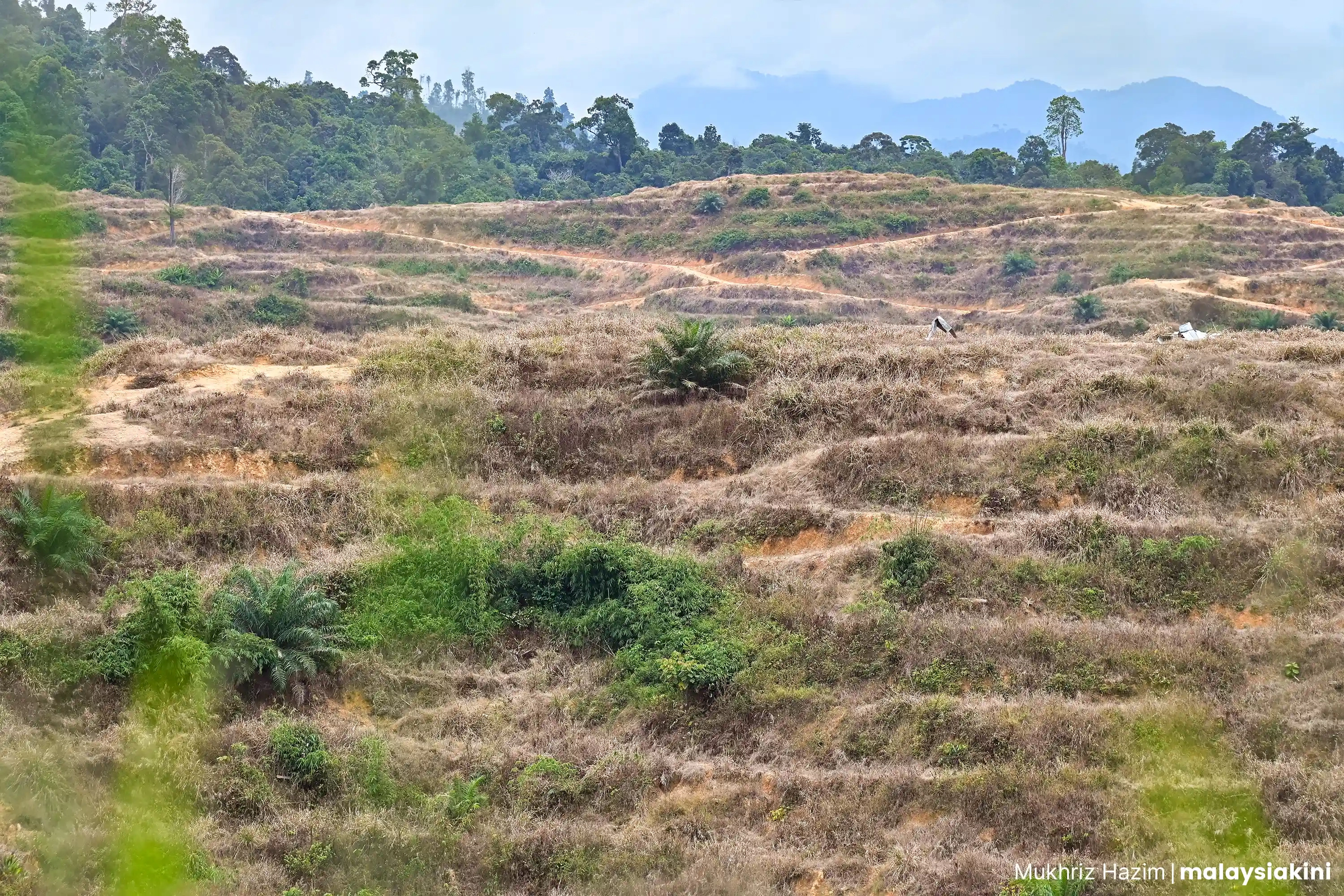
The remaining palm trees in PKNP’s plantation. Photo: Mukhriz Hazim/Malaysiakini
The consultants proposed several mitigation measures: construct ditches and electric fencing, and set up buffer zones.
According to the EIA report, the plantation developer has to appoint an Assistant Estate Manager to lead the Environmental Management Team that is responsible for overseeing the execution and adherence to the EIA report’s guidelines.
But nothing of the sort could be seen at PKNP’s plantation. No ditches, no fences, no buffer zones to keep the elephants away.
In short, PKNP failed to follow the Environmental Management Plan (EMP) requirements listed in the EIA report.
The Malaysian Palm Oil Certification Council (MPOCC) oversees the Malaysian Sustainable Palm Oil (MSPO). The council told Malaysiakini its checks found that the plantation owner did not properly implement the recommendations of EIA, which resulted in the poor crop production due to elephant encroachment.
“Therefore, to preserve impartiality, MSPO decided to bring forward these matters to the Accreditation Body (the Department of Standard Malaysia) for onward verification and action.”
Forests Logged but Oil Palms Unsold
In a way, when it comes to deforestation for plantations in Malaysia, the PKNP plantation story is not unique, forestry insiders say.
A retired timber merchant shared that some parties would cut down forest ostensibly to make way for a plantation, but actually have zero interest in cultivation. Just like PKNP, these parties would hide behind “wildlife conflict” as an excuse, he said.
“Some developers would just grab their timber and run, as plantations are costly to manage, and you won’t see profit for two to three years. They will plant something for show, and write a report about how wild elephants are a problem, they can’t develop this place properly,” the retired timber merchant, who declined to be named, said.
If PKNP was serious about cultivating the oil palm plantation business, it could have chosen to develop a smaller piece of land and prioritise the protection of young oil palm shoots.
After these palm trees have matured, it could then move on to develop the rest of the land in stages. This would be a way to minimise the loss caused by elephants trespassing, but PKNP did not do this.
Instead, despite their issues with elephants, PKNP continued to cut down 539 hectares of forests between 2020 January and 2024 February.
Worse, as the oil palm produced from these forest lands were in non-compliance with the industry’s deforestation regulations, it cannot be sold on the market.

Logging truck in PKNP site. Photo: Mukhriz Hazim/Malaysiakini.
Rising concerns among consumers in the international market – in particular in Europe – on the impact of the oil palm industry on the environment, have prompted industry players to implement various certification standards.
By law, Malaysian palm oil plantations must be MSPO-certified to keep their operating licence.
On top of that, in response to criticisms of excessive logging from the international community, MSPO promised to enforce tighter regulations to keep the oil palm industry sustainable.
Following that, the government banned the conversion of natural forests to oil palm plantations effective Dec 31, 2019. Other measures have also been announced, which included the cap on nationwide oil palm cultivation area at 6.5 million hectares.
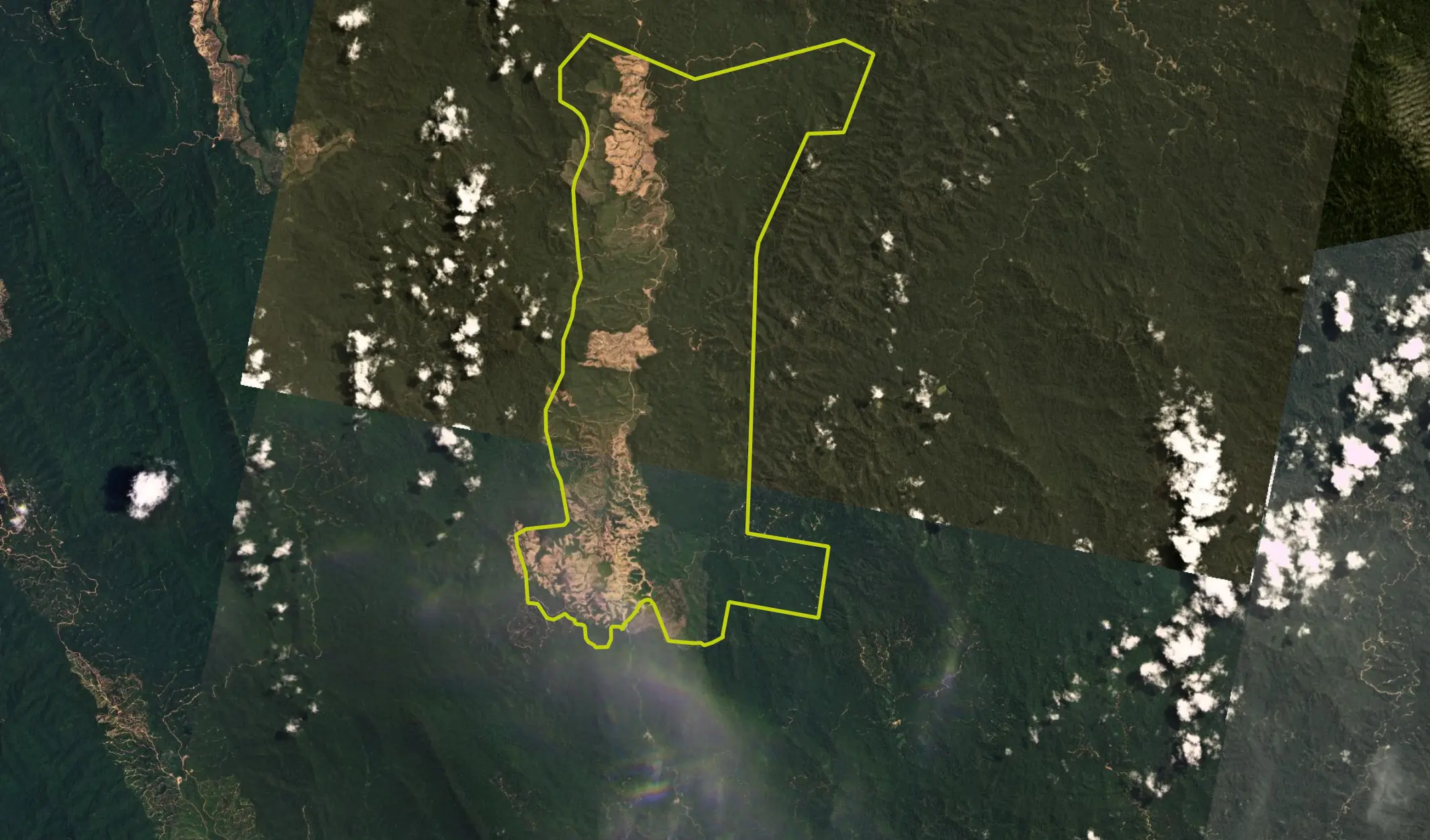
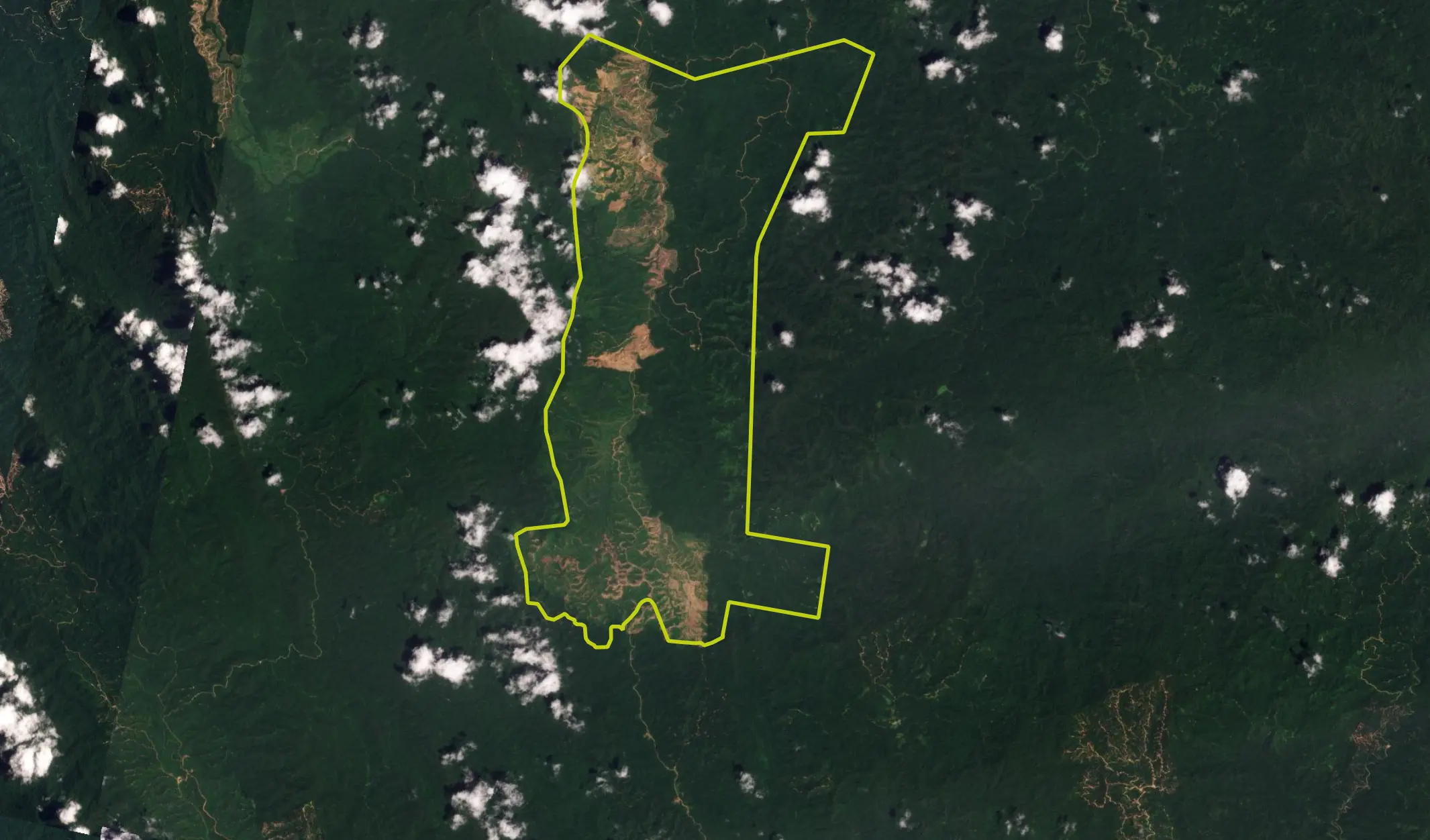
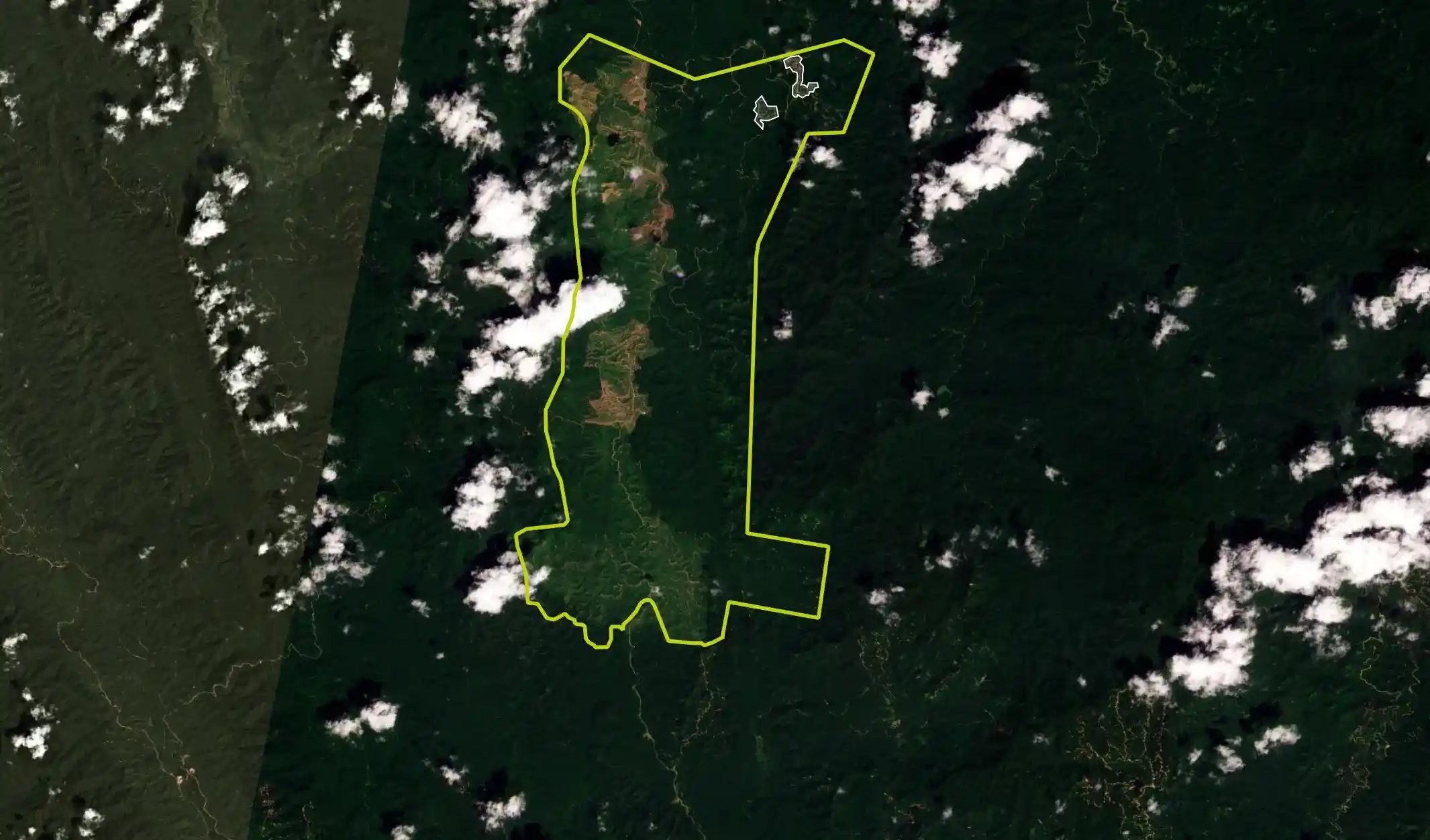
(1) Since the establishment of the oil palm plantation, PKNP has been focused on cutting down forests and developing areas in the west. Source: Planet Labs (July 13, 2019)
(2) Five years since planting started, satellite images show most of the area is still bare. Source: Planet Labs (Oct 27, 2020)
(3) Despite the government restriction, deforestation for the PKNP plantation did not cease on Dec 31, 2019. Instead, clearing was sped up in the northeastern area. Source: Planet Labs (Aug 6, 2021)
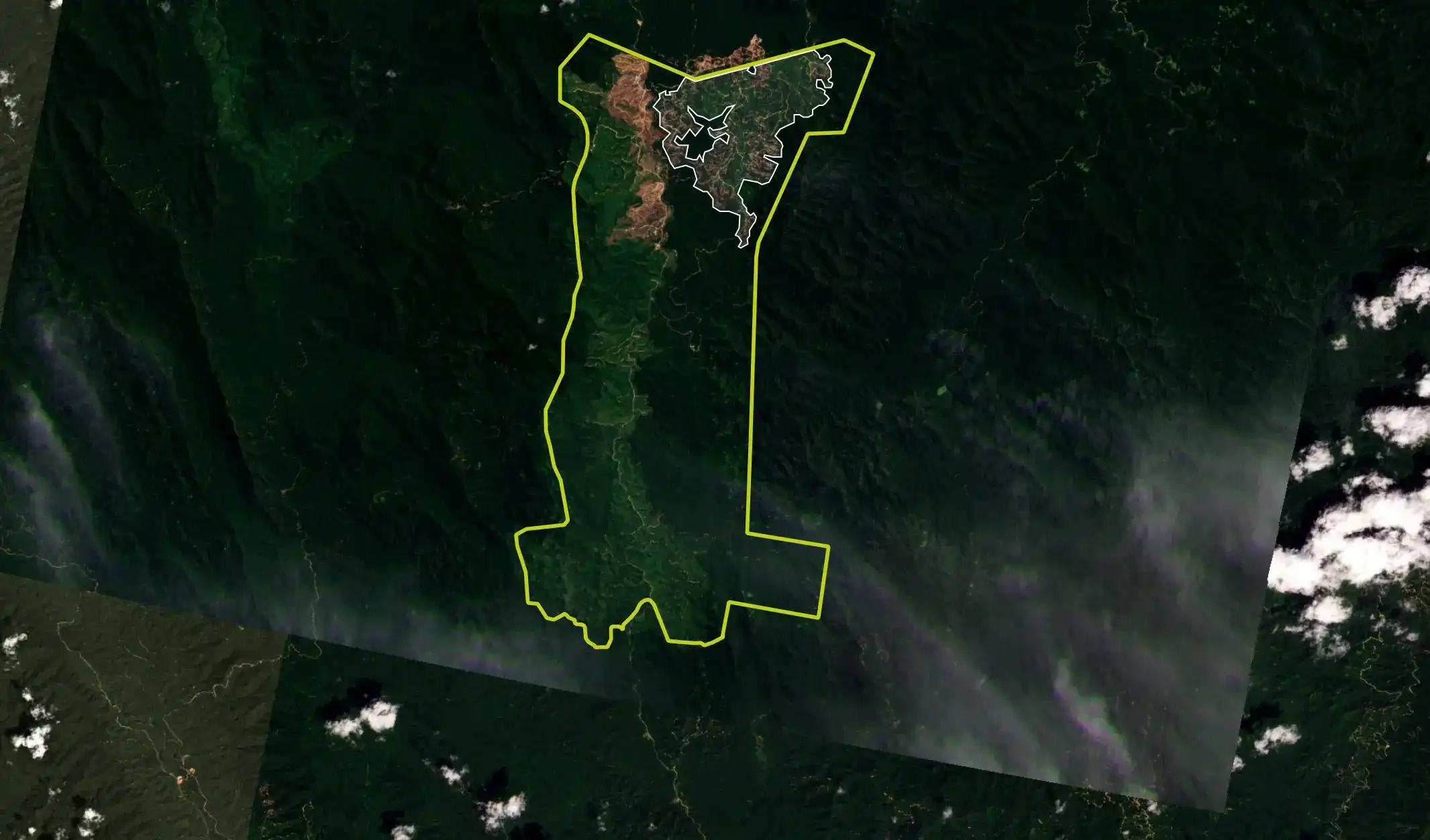
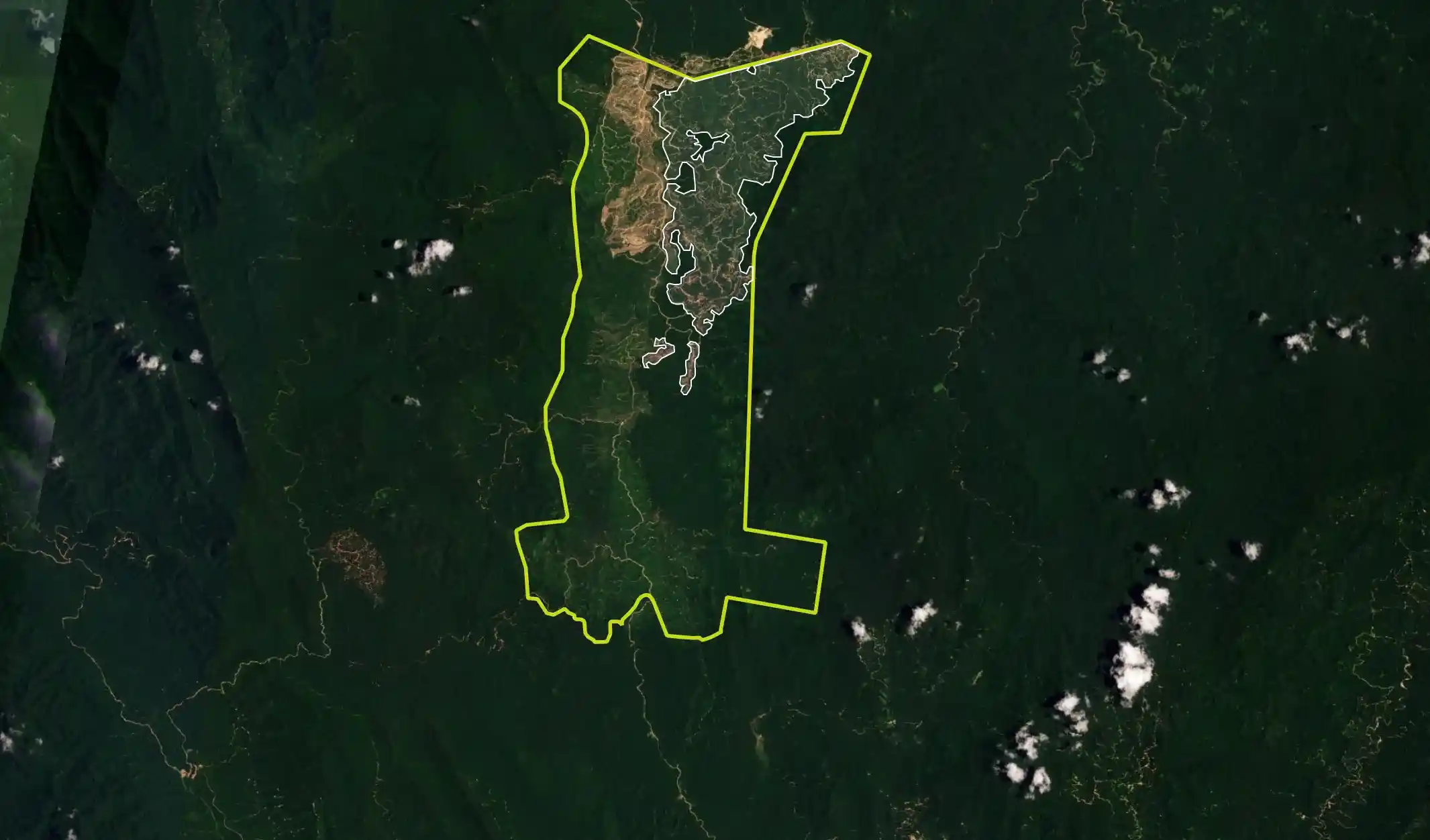
(4) As of July 2023, mature forests in the northeastern part of the plantation are almost entirely cleared. Source: Planet Labs (15 July 2023)
(5) Around 539 hectares of forests were cleared after the MSPO ban. With nothing in PKNP’s way, at this rate, more than 2,000 hectares of the remaining forest lands will be gone in a matter of years – the equivalent size of 3,737 football pitches. Source: Planet Labs (24 March 2024)
Despite clear violation of MSPO guidelines, their certification has not been revoked. This allows them to continue logging under the name of cultivating oil palm plantations.
When contacted, PKNP said the entire 8093-land was leased to its subsidiary – PKNP Agro Tech Sdn Bhd (PASB) – to develop palm oil plantations.
Malaysiakini contacted PASB for a response on Jan 18 but at publication time, the firm has been unable to respond. On March 25, a PASB representative offered to set up a meeting after Hari Raya Aidilfitri, which is likely to fall on April 10. The Pahang state government has not responded to queries.
Responding to Malaysiakini, MPOCC said that MSPO and the certification body Care Certification International had in February interviewed the local community, specifically the chief of Kampung Tanah Pindah found that there have been no instances of water disruption in Sungai Kancin.
“PASB has proactively installed a tube well in the village since 2017, and to date, no complaints have been registered regarding its functionality or service.”
Investigations of MPOCC found that PASB only manages 4046 hectares of land, which is within the MSPO certification scope.
“The land clearing activity (between the period of 2020 to 2023) was found outside of the certified area, which has been leased out to another entity,” MPOCC told Malaysiakini without revealing which entity.
However, a logging licence plate on site confirmed that PKNP is the landowner of the cleared area.
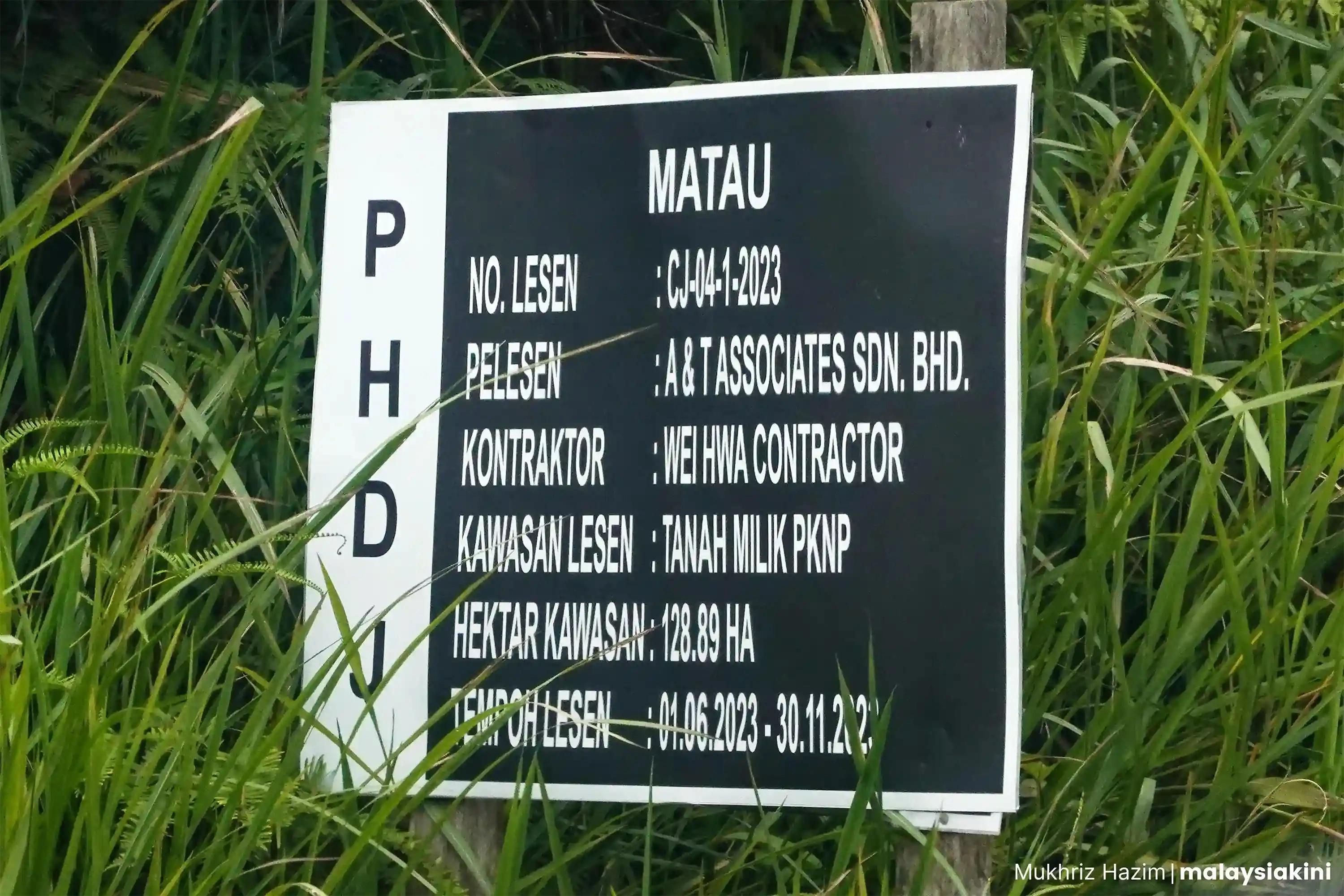
A logging licence plate established on site named PKNP as landowner. Photo: Mukhriz Hazim/Malaysiakini
MPOCC further stated that if the cleared areas are designated for oil palm cultivation, it will fall under the purview of the MSPO New Planting Mechanism, which prohibits conversion of natural forest to oil palm plantations after Dec 31, 2019.
Furthermore, satellite images show that the river bank in the MSPO-certified area was not conserved. The Department of Environment (DOE)’s investigation in February 2024 found that PKNP didn’t maintain the riparian area and failed to arrange for an environmental audit by a third party in 2023.
“Due to the failure of the project proponent to adhere to approval conditions of EIA report dated July 10, 2014, order notifications were issued under section 31 (power to require owner to install, operate, repair etc) and section 37 (owner to furnish information) under the Environmental Quality Act 1974,” the DOE said.
The department added that its investigations in 2019 also found open burning in the plantation and 18 compounds were issued. Order notifications were also issued for the compliance of EIA approval conditions regarding erosion and sediment control.
DOE’s follow up investigation in 2020 and 2023 concluded that the project proponent has complied with these order notifications and EIA approval conditions.
Asked about the deforestation risks of PKNP’s plantation, MPOB said that “any violation of MPOB legislation may be subject to enforcement action”.
A Dream Business Model
All produced oil palm fruits without an MSPO certification have no place in the market. But this doesn’t mean PKNP would suffer losses, because timber in primary forests have high value.
It is estimated that this forest of 8,093 hectares could bring in at least RM858 million in revenue – more than double the total Pahang budget, which stood at RM318 million in 2023.
Curiously, however, PKNP is not directly involved in the logging business.
The GLC gave up the lucrative segment of this venture and was given to a private logging company named A&T Associates.
Instead, the GLC is saddled with the expensive plantation development work, a decision that goes against business sense.
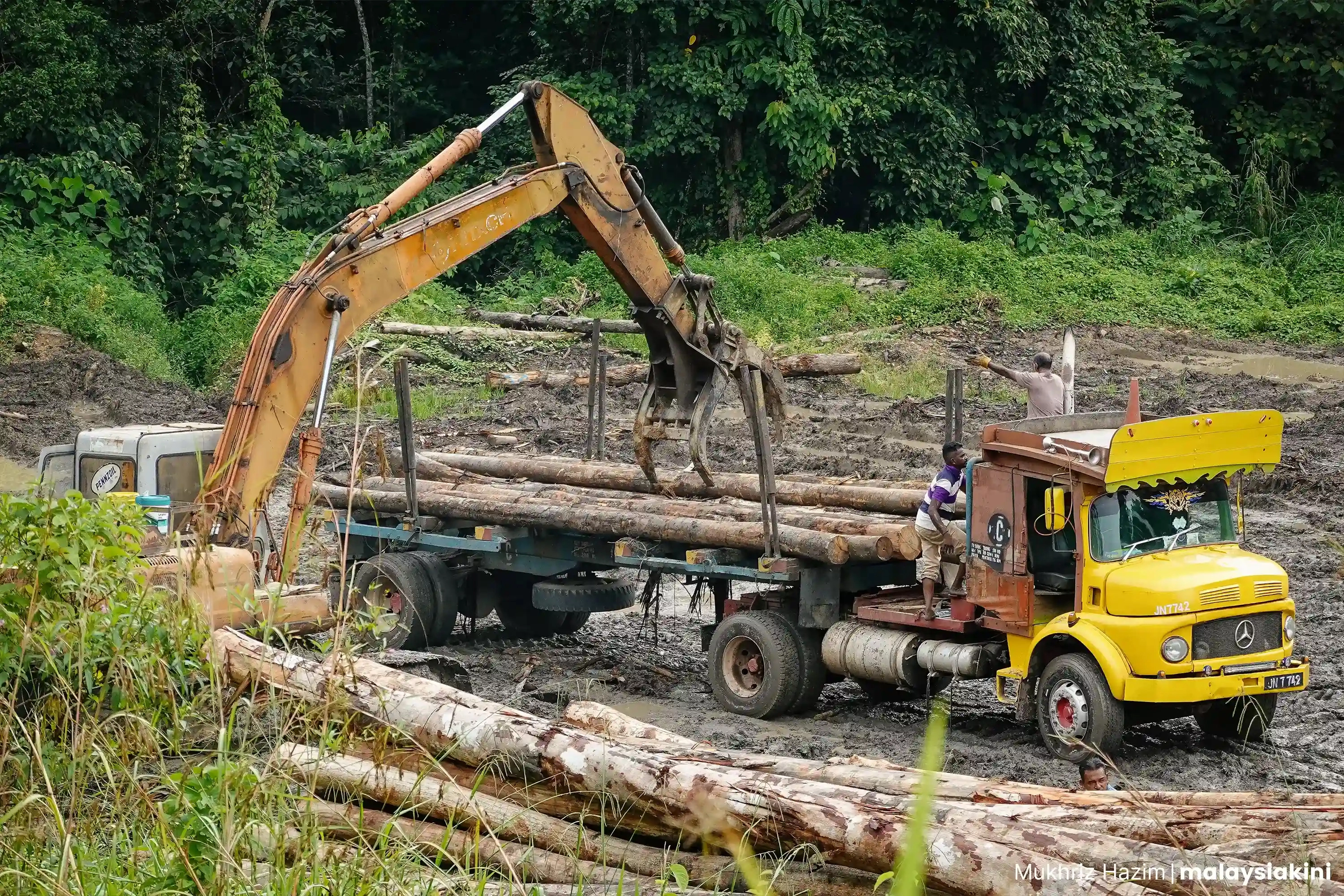
Loggers loading timbers onto trucks. Photo: Mukhriz Hazim/Malaysiakini
This arrangement may be baffling, but is not atypical, said environmental conservationist Lim Teck Wyn. The state government usually does not earn much from selling logging titles to timber merchants, while the ones making a fortune are timber merchants, the honorary associate professor of the University of Nottingham said.
“These companies that are logging are making a lot of profits, billions (of ringgit), but the state does not get billions (of ringgit). So how come the state wants to enrich the company?”
“The royalty imposed by the state government is less than 10 percent of the timber price. In theory, they should increase the royalty, but the reality is, they do not intend to do so.”
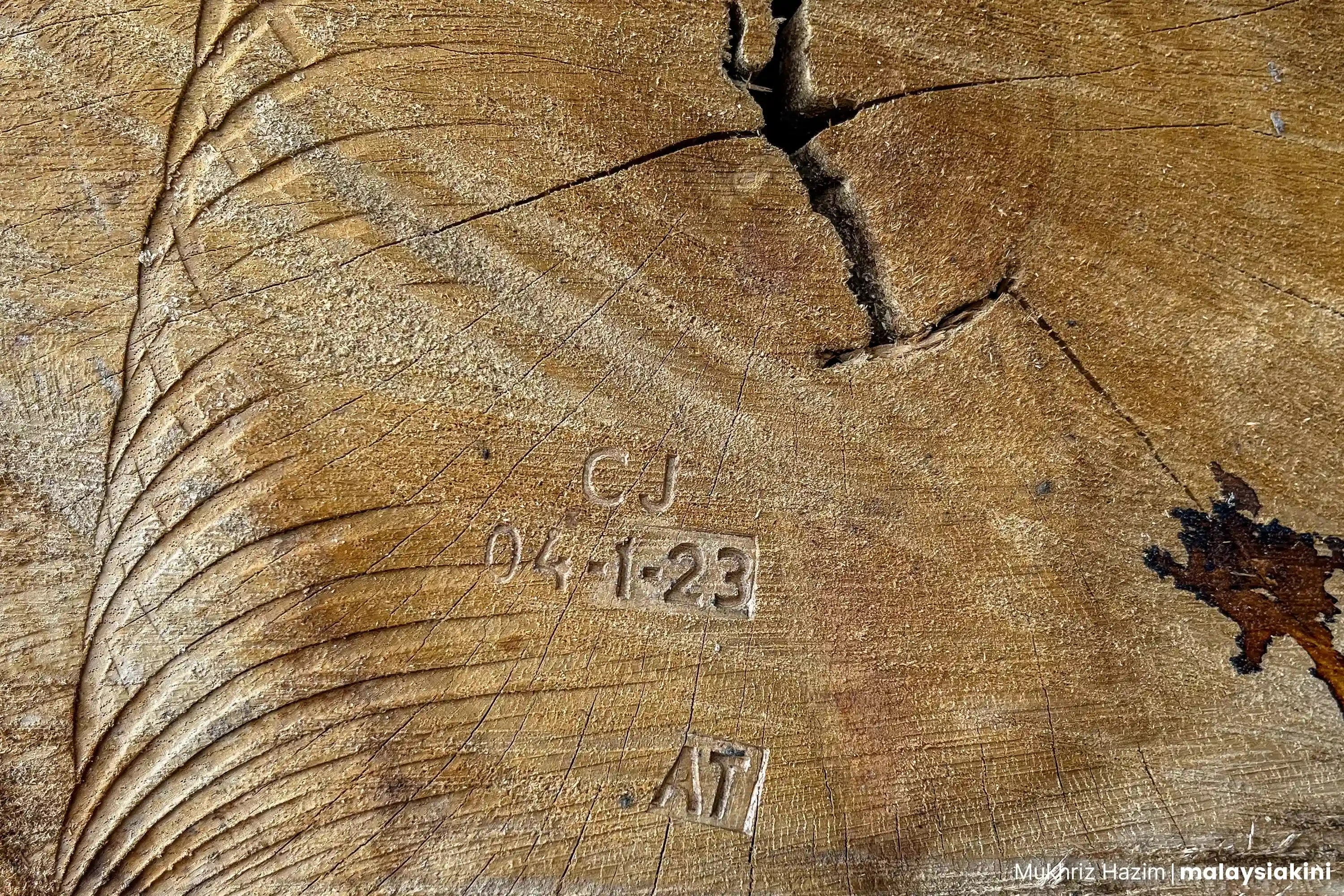
Forest Politics of the VIPs
DOE enforcers play a crucial role to prevent businesses from exploiting loopholes, i.e. conducting logging activities under the guise of developing plantations.
To stop this from happening, DOE enforcement officers are supposed to conduct regular inspections on plantations, one senior MPOB officer told Malaysiakini on condition of anonymity.
This is to ensure that contractors are complying with the EIA requirements and commitments, while failure to do so would result in penalties.
Regrettably, he said, Malaysia’s robust laws are failed by poor enforcement.
“Sometimes, you do have to consider who is the developer behind these projects. It is difficult to do our job if they are VIPs,” he said.
How deeply involved are political VIPs in these plantation developments? To answer this, Malaysiakini analysed oil palm plantation’s EIA reports approved by Peninsular DOE on their official website and data scraped from DOE’s public geospatial server.
It is important to note that the findings are not conclusive as we lack the complete list of approved EIAs, but it gives us a glimpse of VIP’s involvement in deforestation.
Checks found that of the 28 Pahang oil palm plantation projects that were approved by DOE from 2001 to 2023, most have political or royal affiliations.
Pahang has the most number of approved projects, spanning an area of 51,603 hectares – almost as big as Penang Island and Kuala Lumpur combined.
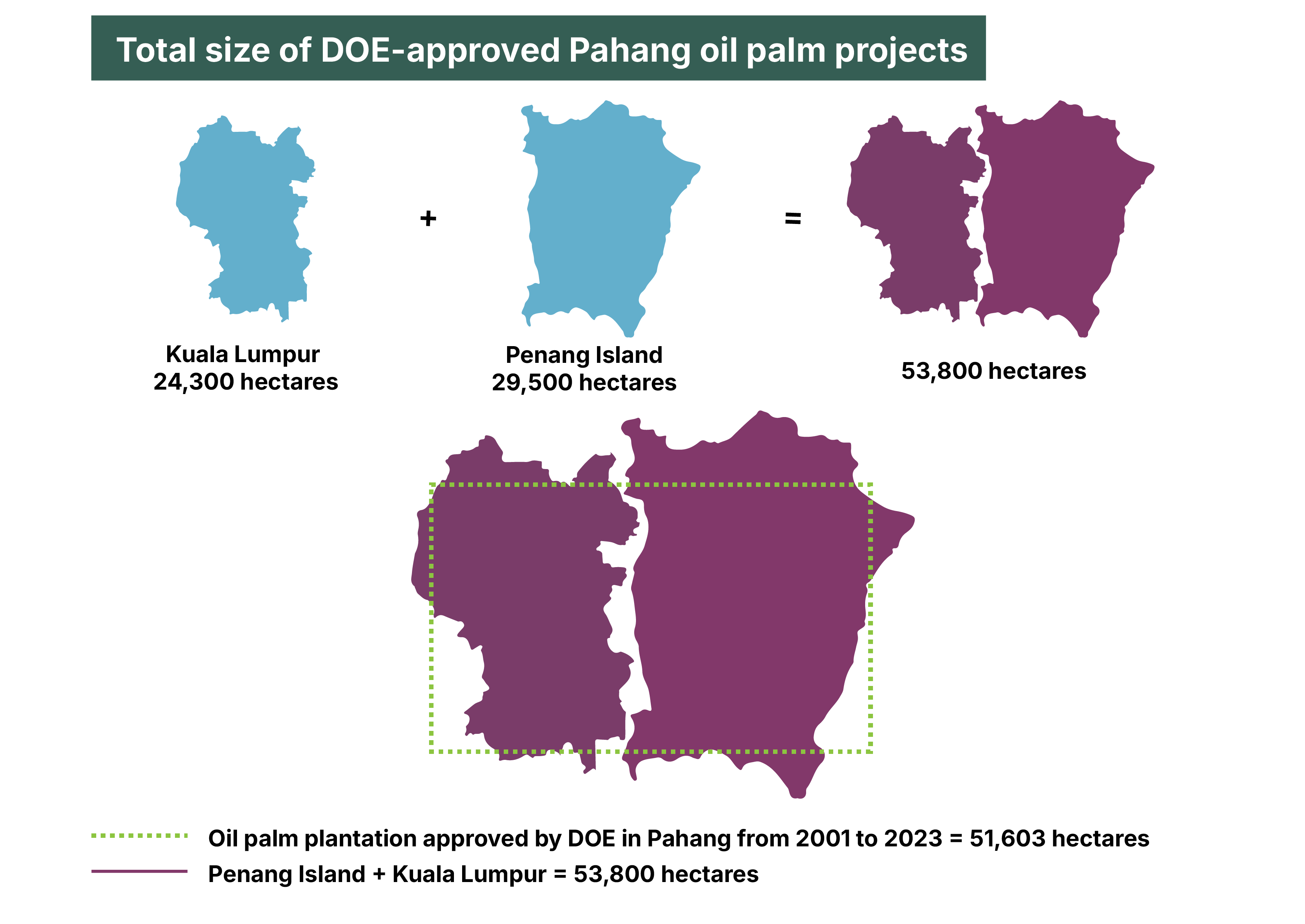
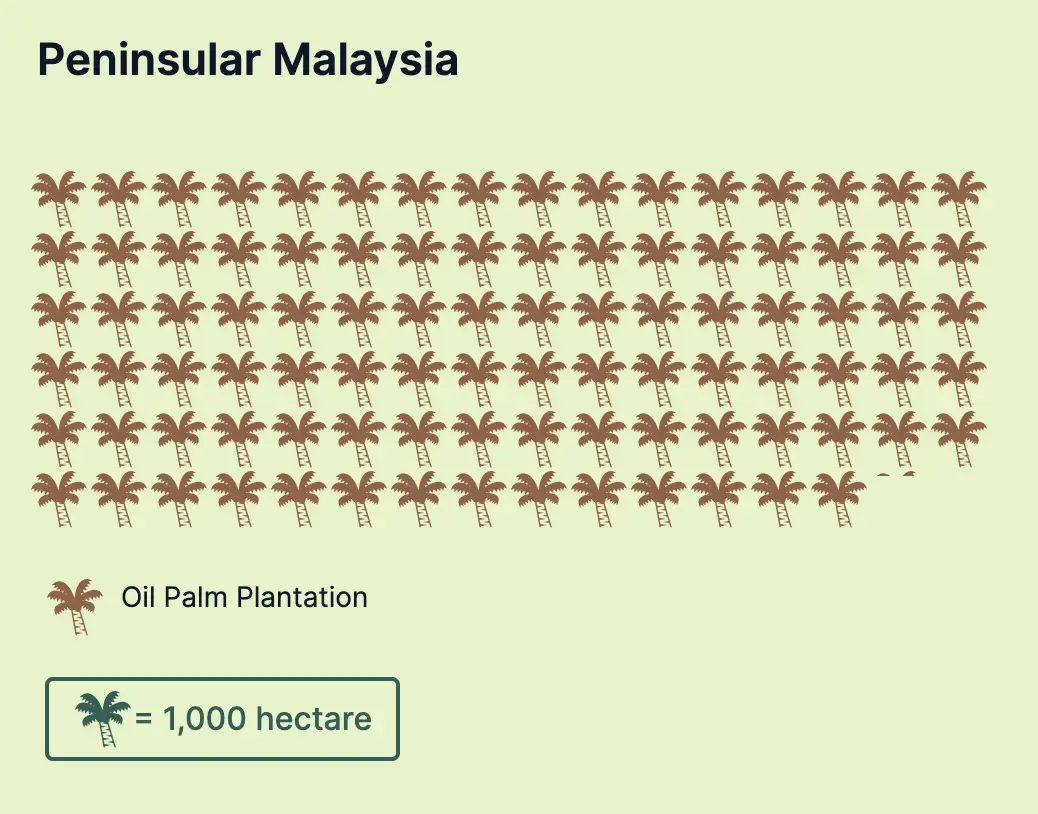
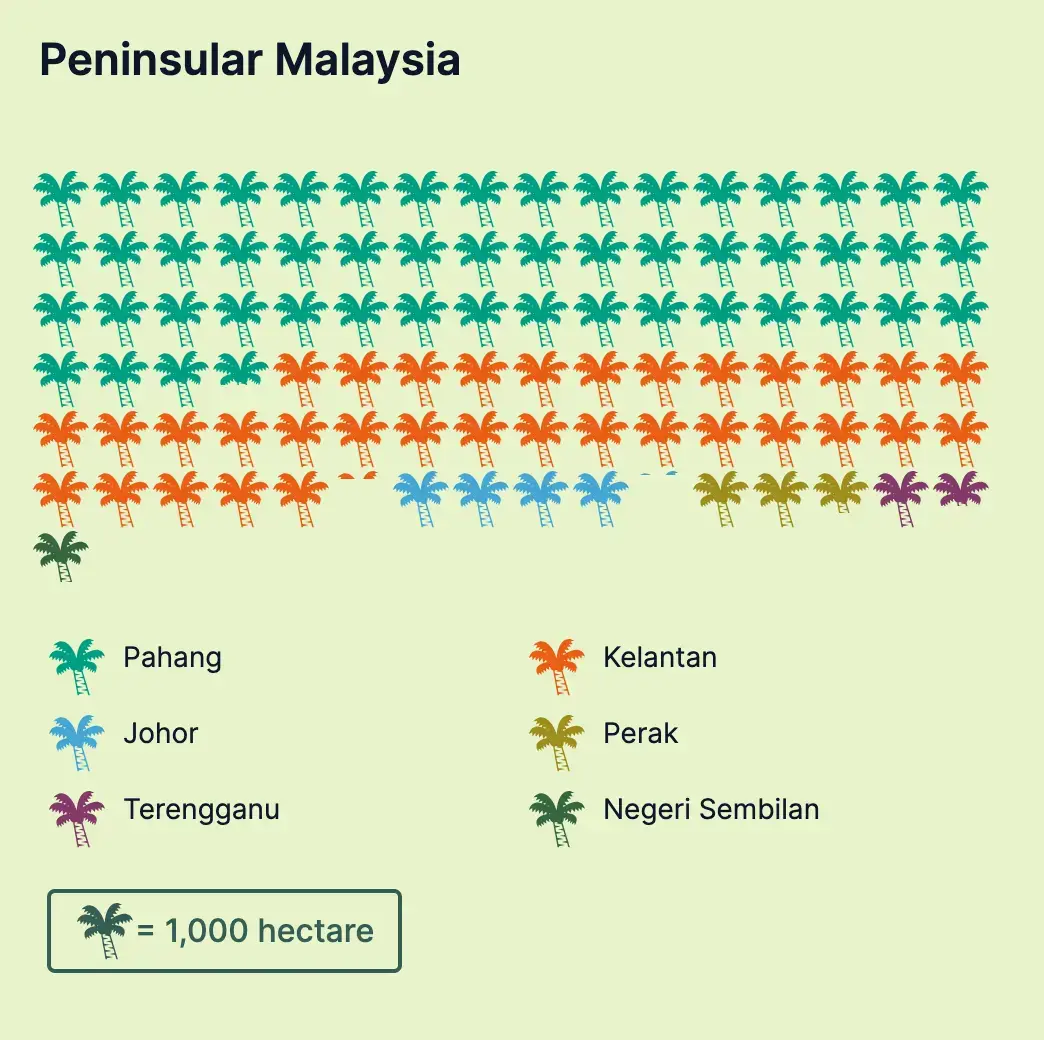
(Left) Between 2001 and 2023, DOE approved at least 94,000 hectares of forests to be developed into oil palm plantations in Peninsular Malaysia alone. Data source: DOE website and scrapped from DOE geospatial server.
(Right) Pahang’s approved projects make up 55 percent of the total oil palm plantation area across all peninsular states. Graphics: Malaysiakini
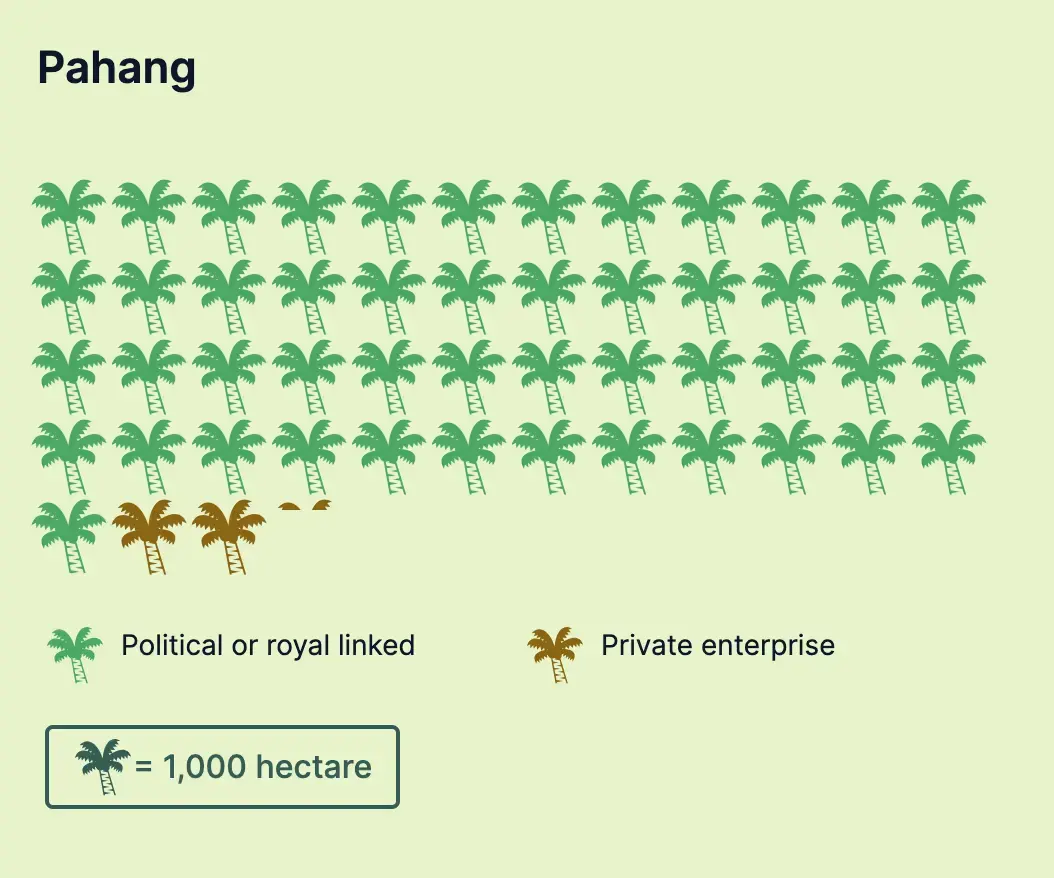
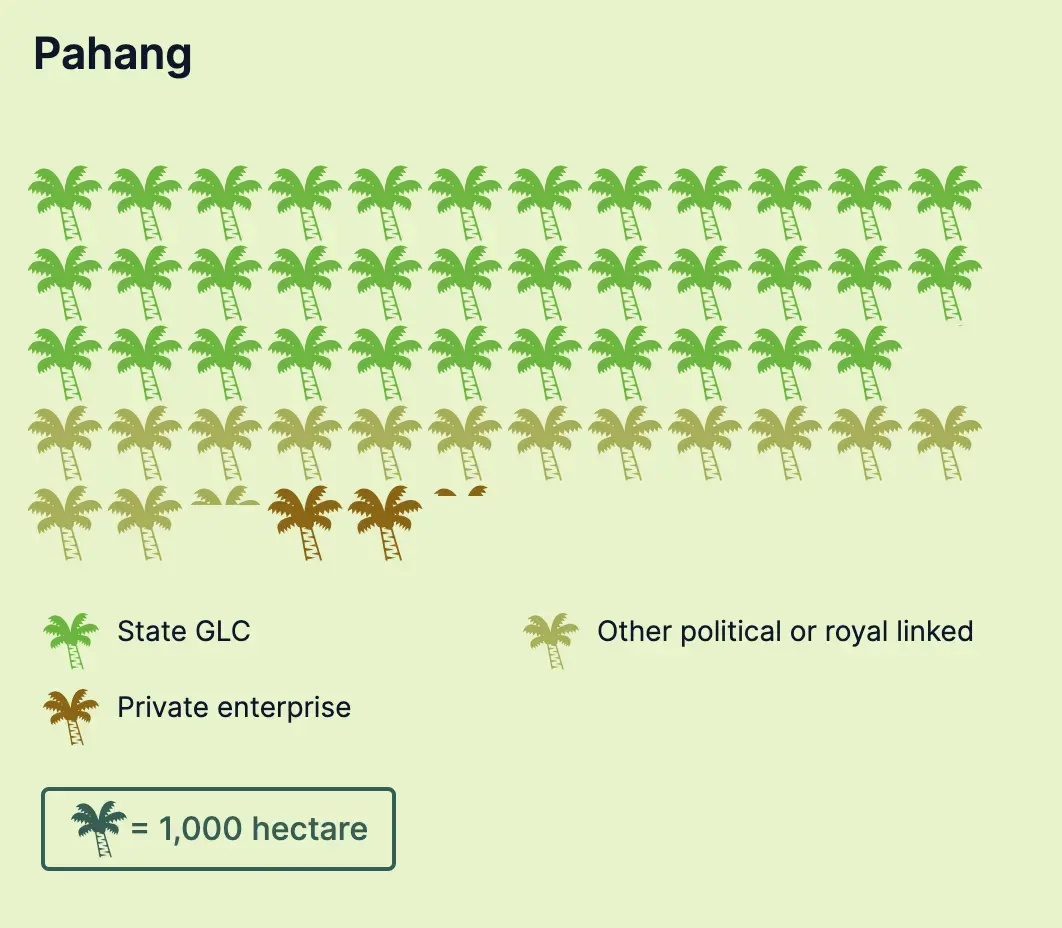
(Left) Among all the DOE approved projects in Pahang, the developers who were developing 95 percent of the land (48,945 hectares) have political or royal affiliations.
(Right) Pahang GLCs own the most land, 35,053 hectares in total. Other corporations with political or royal affiliations include federal government-linked companies, companies owned by royal family members etc. Graphics: Malaysiakini
Trading Lands for more Profits
The numbers show that Pahang GLCs plantations are the main driving force behind Pahang’s deforestation.
These lands, home to villagers and wildlife, are seen by commercial interests as precious goods to be traded for profit – a cosy situation for corruption.
When landholders get approval from the state government to develop a part of the forest, they will first profit from logging and selling valuable timber. After that, they can cultivate those grounds into a plantation to maximise their gains.
However, managing a massive plantation requires professional knowledge and experience. Should they fail just like PKNP did, landholders could still squeeze some profits out through land leases or sales.
YP Olio, a developer managing an oil palm plantation in Rompin, Pahang seemed to have this exact plan in mind.
Its initial plan was to develop a plantation of 8,499 hectares in the Bukit Ibam forests. However, like PKNP, they have continued logging after MSPO’s forest clearing ban, rendering their produced oil palm fruits unmarketable.
This hasn’t stopped them profiting from land sales. Since 2018, there have been posts on Facebook and also the e-commerce platform Mudah advertising the sale of this land at the price of RM 12,000 per acre.
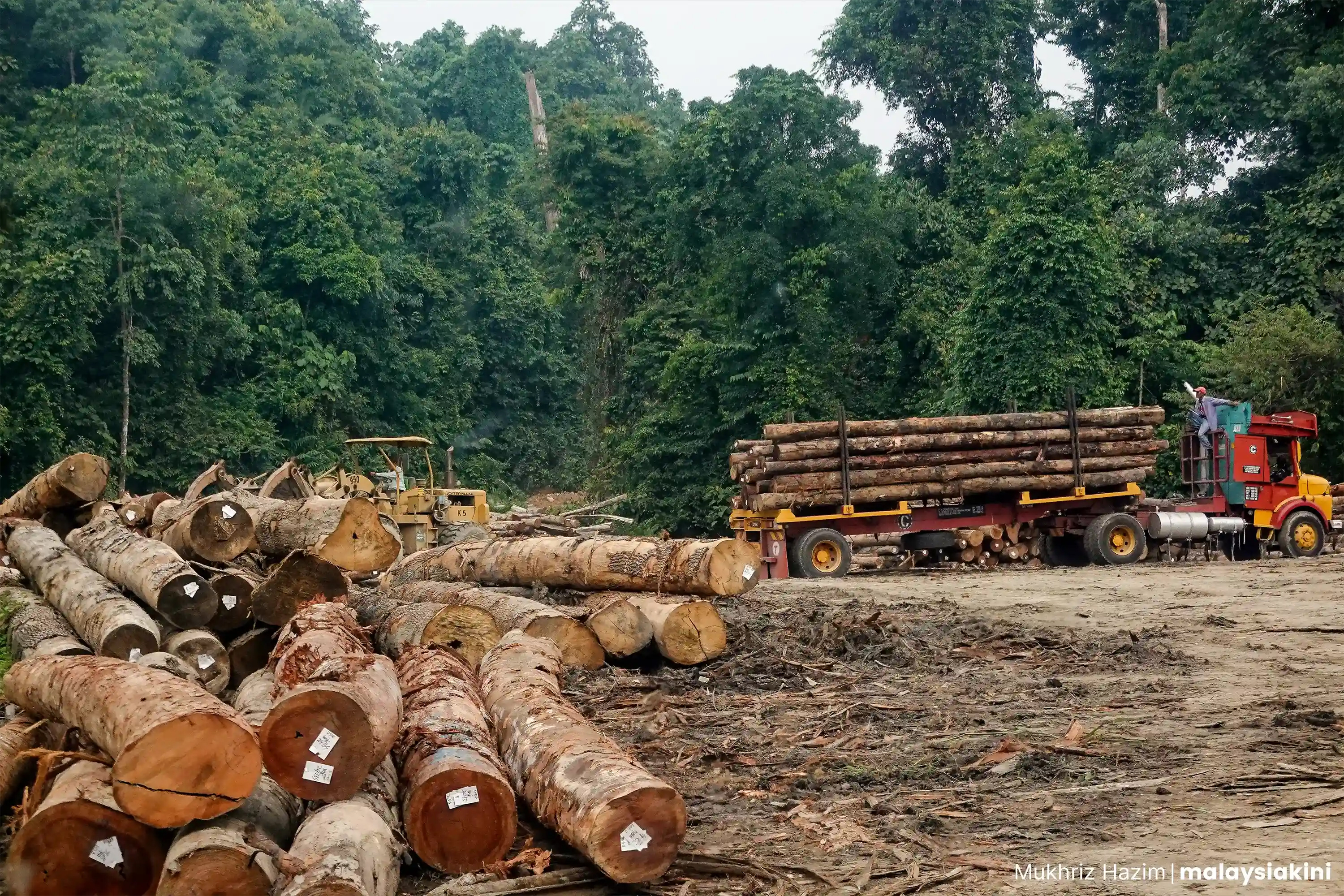
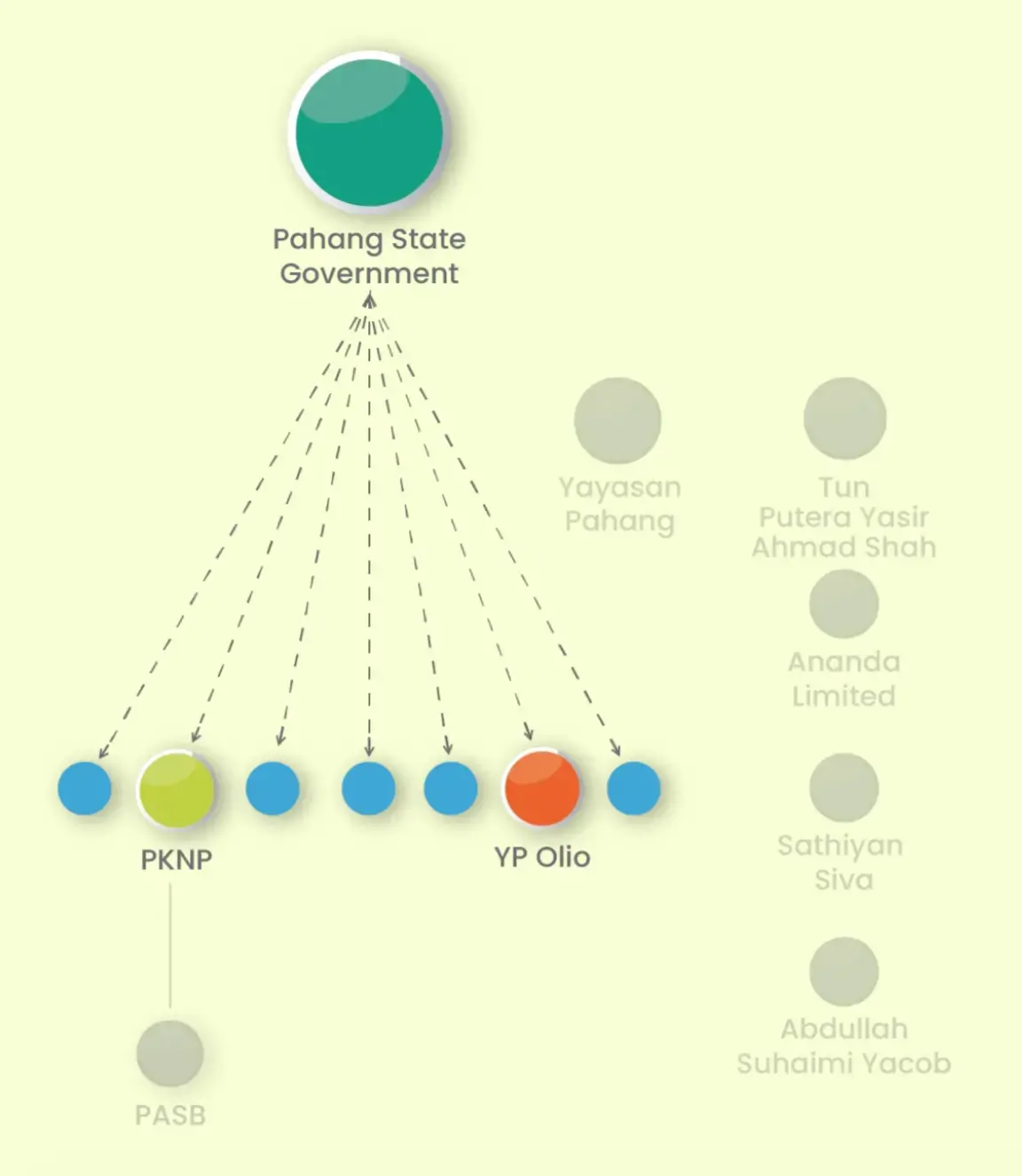
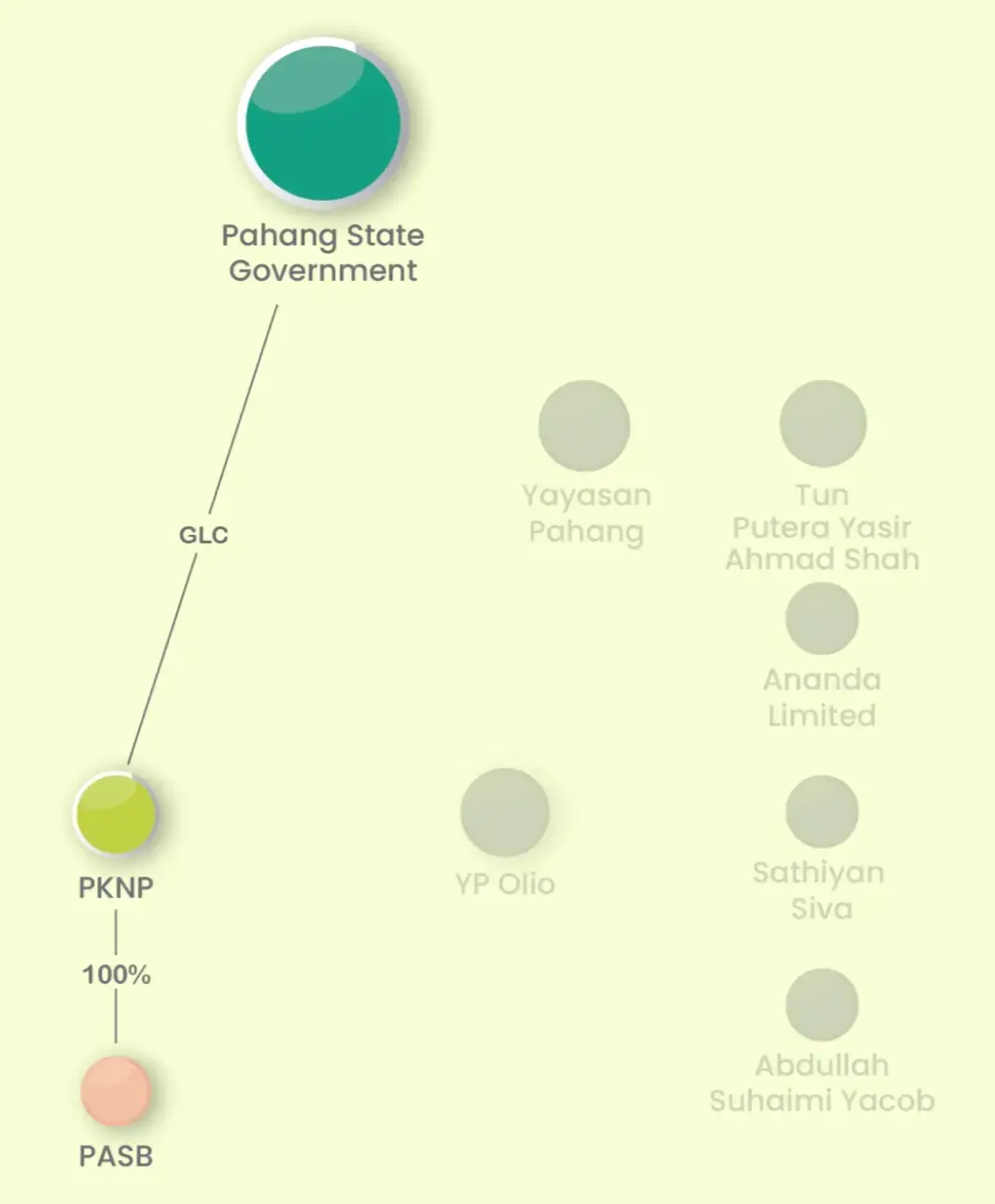
(1) The Pahang government granted oil palm plantation projects to several government-linked and royal-affiliated companies such as PKNP, YP Olio and other companies.
(2) PKNP, the central figure of this article, is a GLC fully-owned by the Pahang government and overseen by the menteri besar of Pahang. PKNP leased the land to its subsidiary PASB. Graphics: Malaysiakini
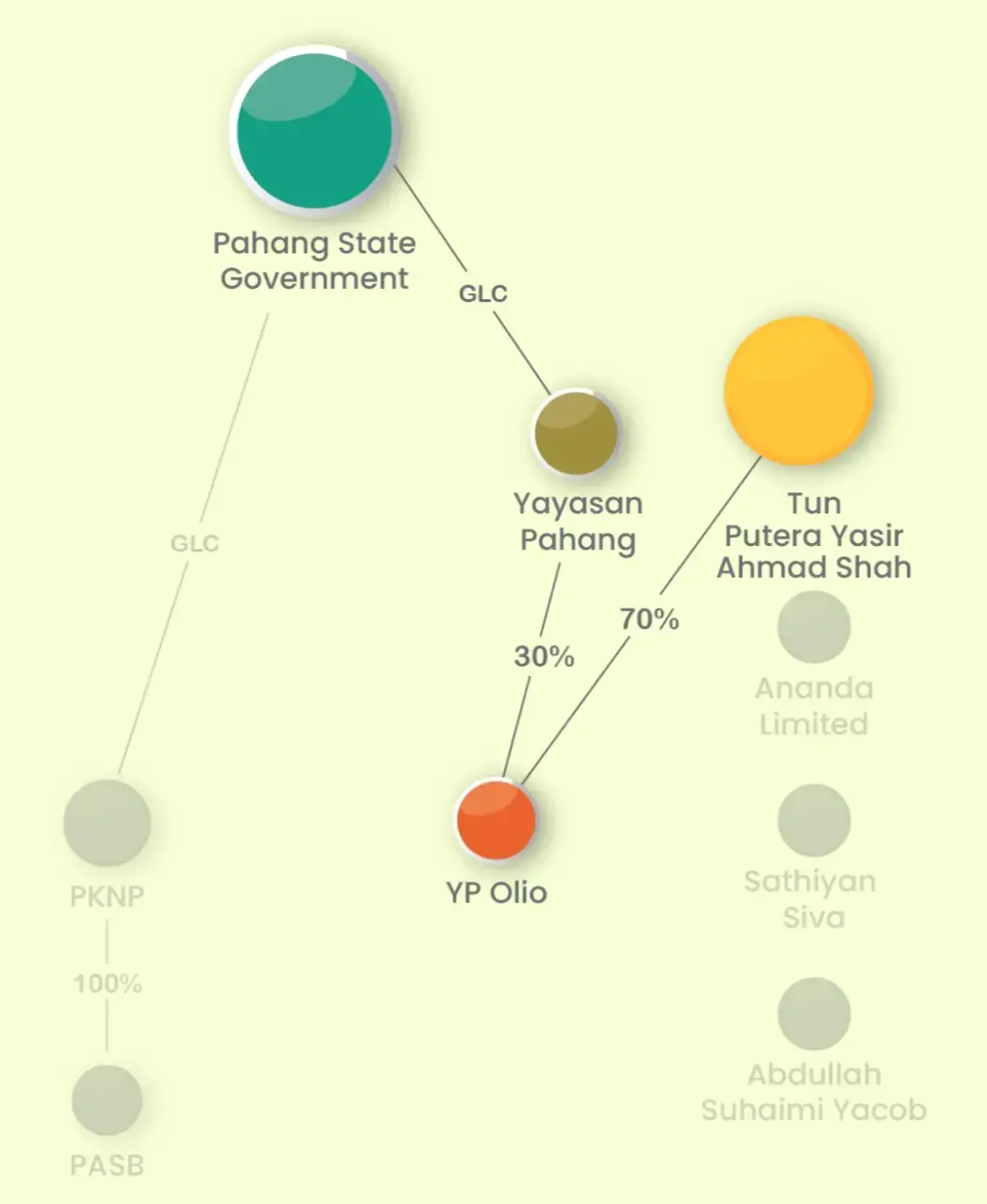
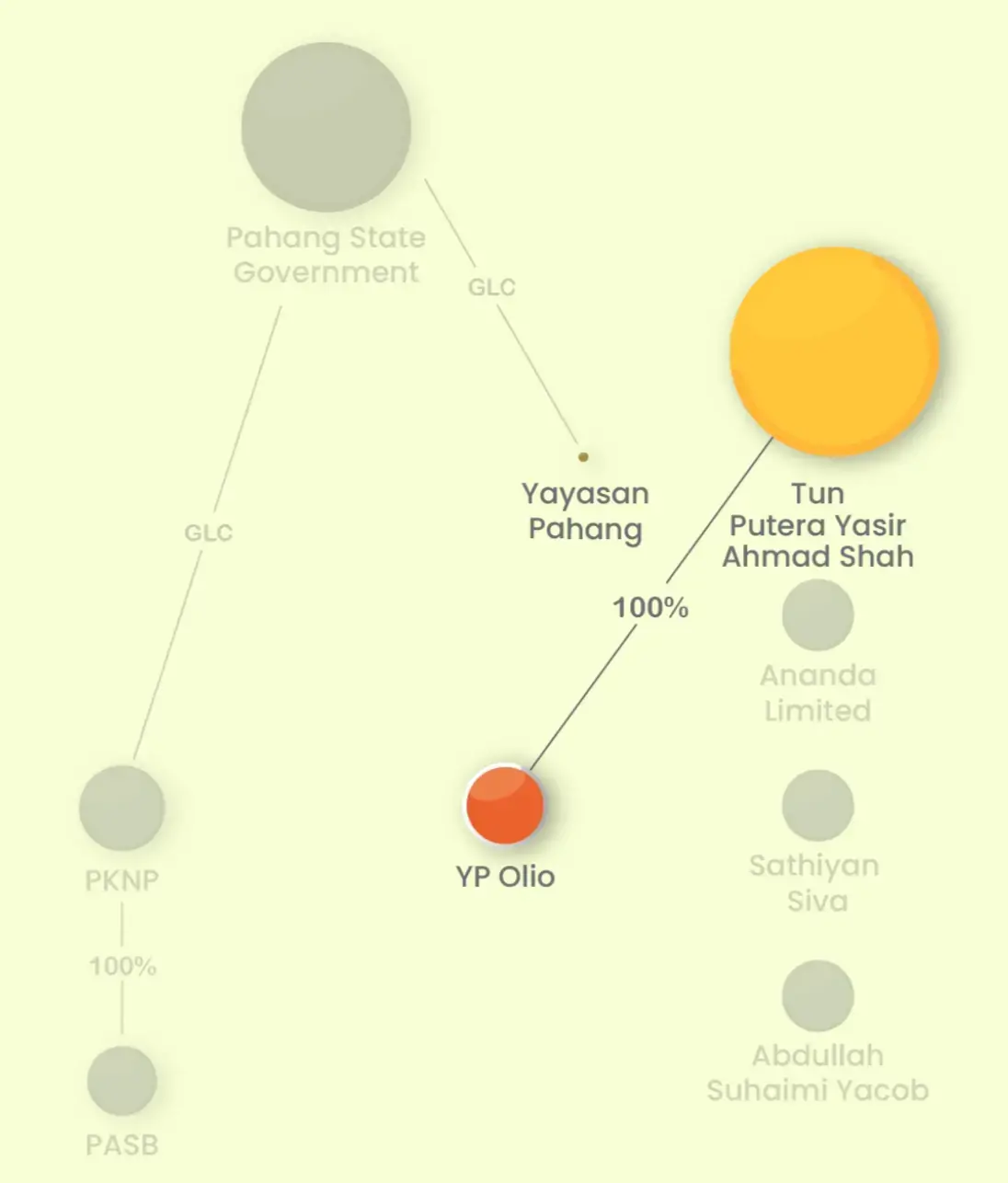
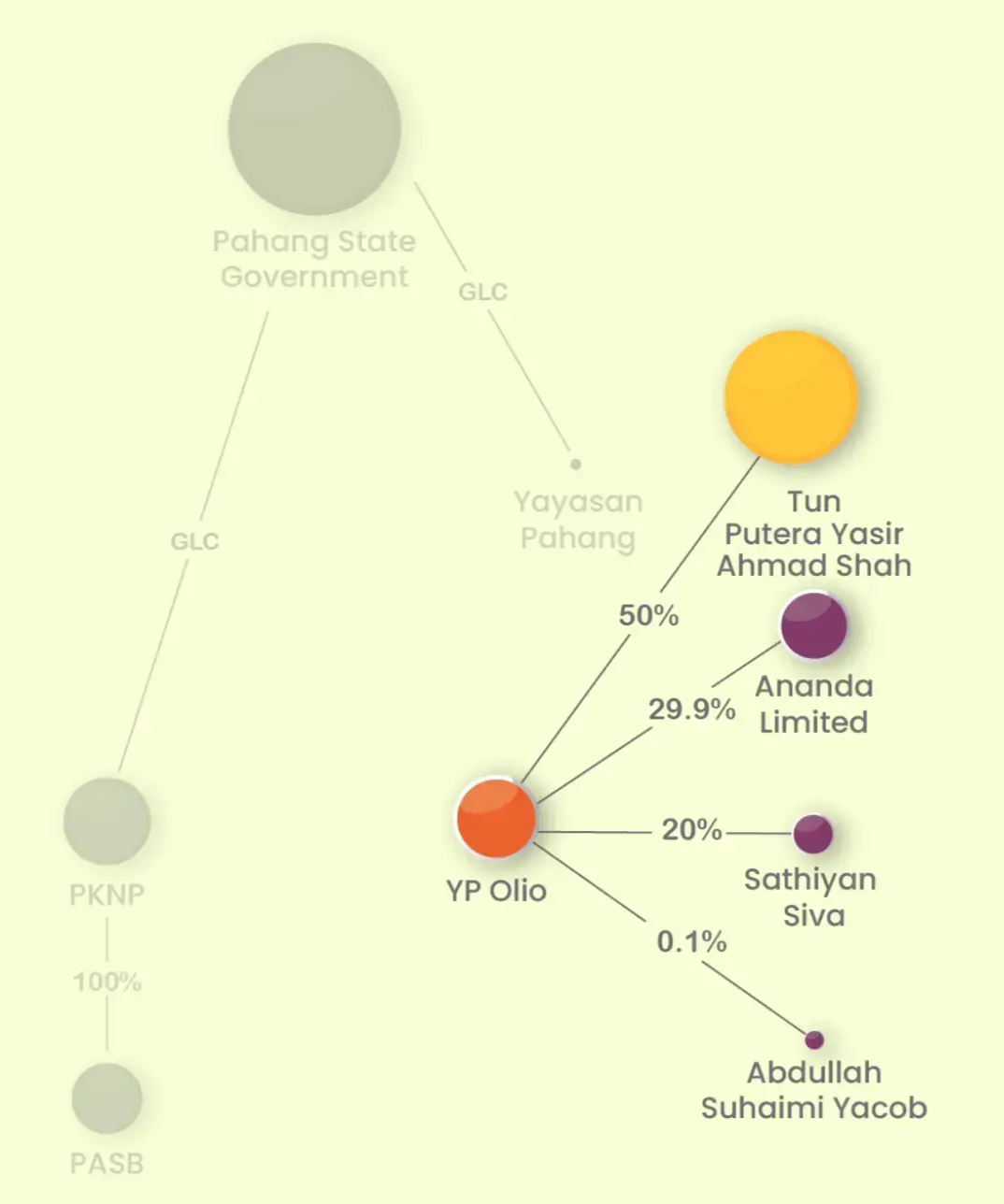
(3) YP Olio was originally owned by Sultan Pahang’s nephew, Tun Putera Yasir Ahmad Shah bin Mohamed Moiz (70%) and the Pahang MB-led Yayasan Pahang (30%).
(4) YP Olio’s oil palm plantation project was approved by the Pahang state executive council in July 2017. Nine months later, Yayasan Pahang sold all their shares to Tun Putera Yasir Ahmad Shah.
(5) Tun Putera Yasir Ahmad Shah further split his shares with a foreign company and two Malaysians. Graphics: Malaysiakini
The EIA report for YP Olio’s oil palm plantations was approved by DOE in September 2022. Malaysiakini has reached out to YP Olio for comment.
The federal government has implemented numerous policies to protect forest coverage and made assurance to the international community that Malaysia’s oil palm industry is not engaged in excessive logging.
Despite this, land and forest regulation matters still fall under the jurisdiction of the state governments. Without their cooperation, it would be difficult for the federal government to institutionalise long-term environment policies.
Furthermore, after MSPO’s sustainability regulations came into effect, the DOE has given the green light to at least seven plantation projects in Pahang, Kelantan, Johor and Perak. This involves 14,423 hectares of forests – an area three times the size of Putrajaya.
This is bewildering because the DOE is approving new plantations in spite of a restriction instituted by the Ministry of Plantations and Commodities.
Responding to Malaysiakini, DOE said it is responsible for making decisions on the EIA report, such as whether the proposed project is in line with the local plans, outlined environmental impacts and mitigation measures.
“However, project approval is under the jurisdiction of the project-approving authority which takes into account the approval of the EIA report as well as other relevant policies, including the sustainable management of oil palm plantations.
“DOE always conducts continuous monitoring of projects subject to the Environmental Quality Act 1974 to ensure compliance with this Act and the Regulations under it.”
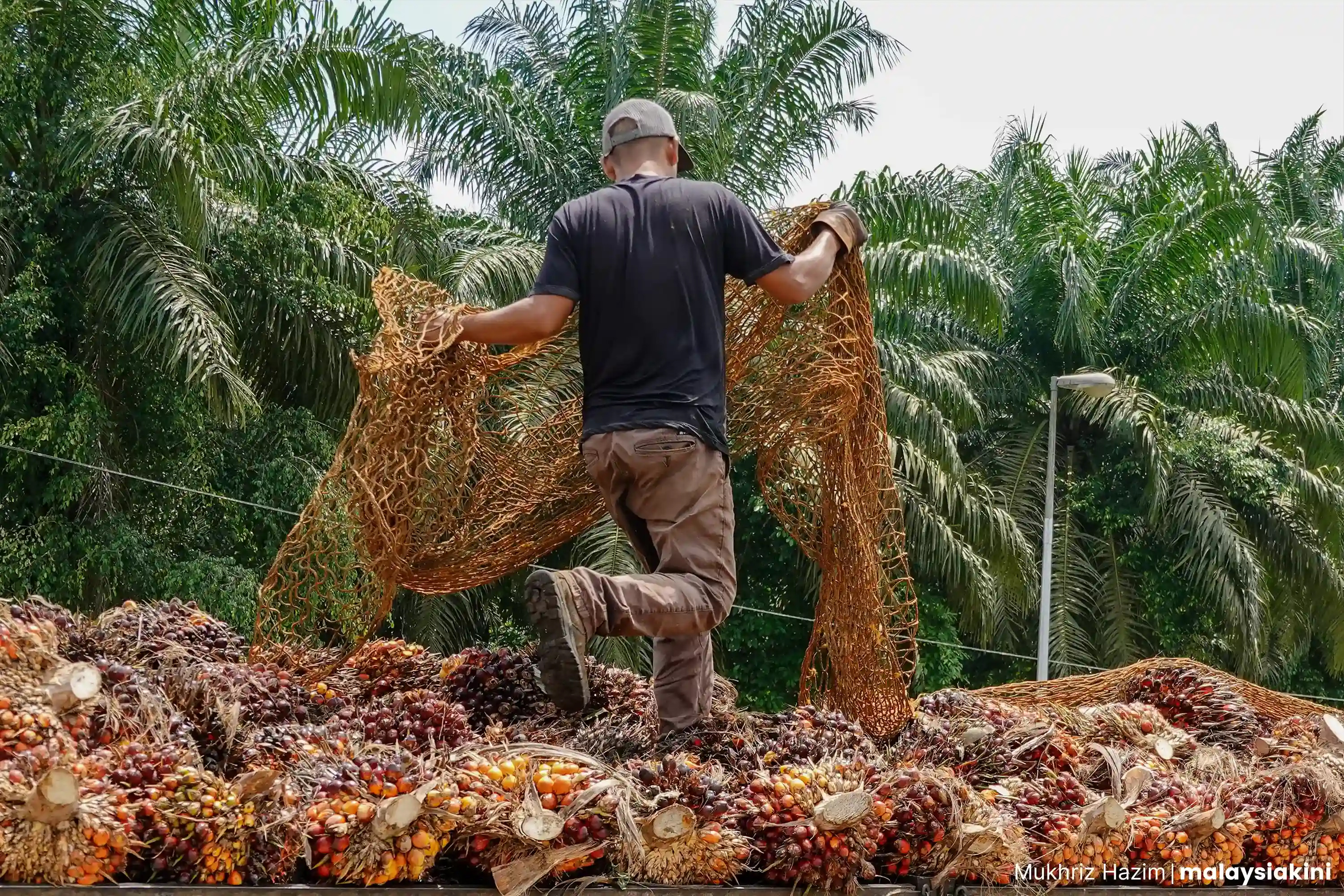
A worker transporting oil palm fruits at Hulu Tembeling. Photo: Mukhriz Hazim/Malaysiakini.
To confront these “forest politics”, civil society should demand transparency from state governments, so the public can scrutinise the decision-making process, said Pushpan Murugiah, CEO of the Center for Combating Corruption and Cronyism (C4).
Puspan suggested states establish a system of checks and balances by setting up a select committee in its state assembly to oversee how the government grants land.
“Without transparency, we cannot fight corruption and abuse of power. Although there are no laws stopping members of the royal family and politicians from doing business, laws regarding information transparency will allow people to ask questions.”
“An open and transparent process allows the public to see what’s going on and they can be the voice of the people and tell the members of the royal family, look, this is a project that we are concerned about and we know you are involved.”