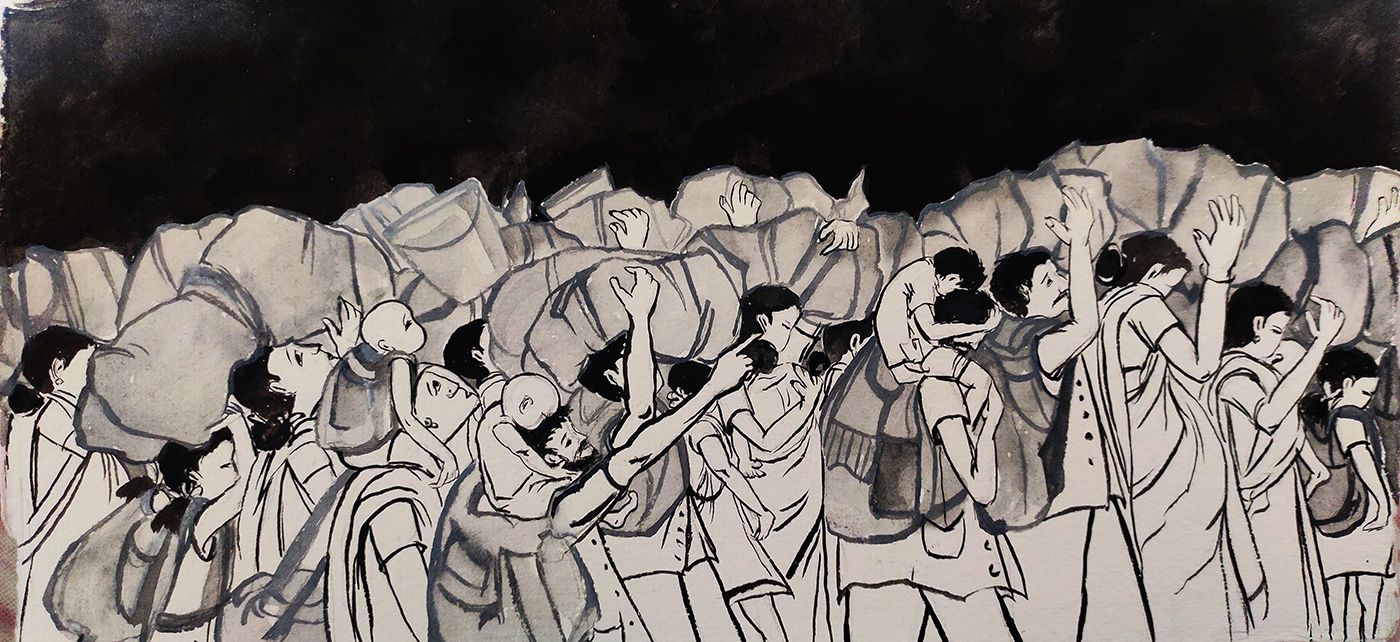
“As I saw the barbed wire, it seemed to be the end of everything… I thought I’d never be able to return to my homeland. My dado’s dado [great grandfather] used to live right here in Murshidabad. My nani [maternal grandmother] lived in this village in Bhagawangola [block] where we have our home now.”
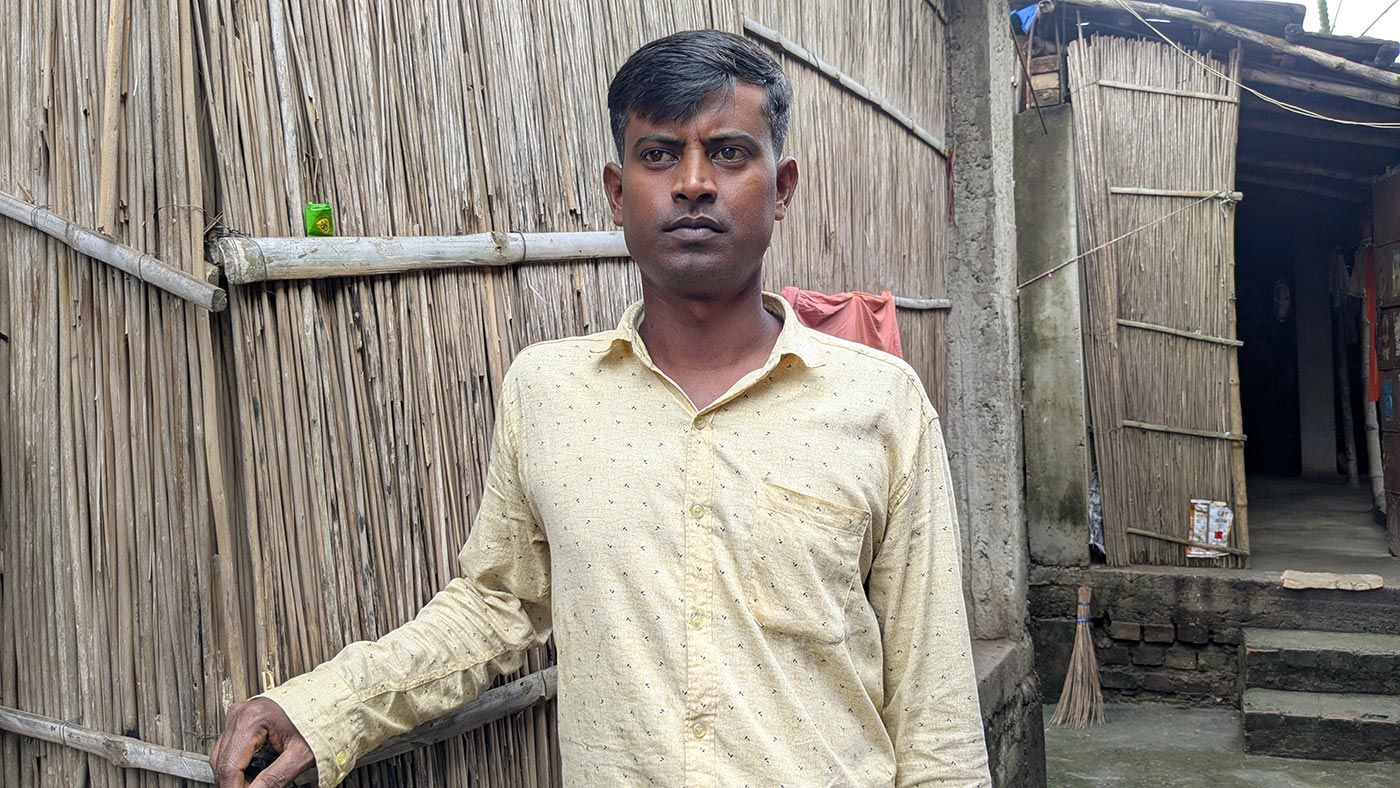
A visibly upset Mehbub Sheikh, 36, explains his family’s historic roots in Murshidabad district to us at his home in Balia Hasennagar. It’s barely a month since he was labelled a ‘Bangladeshi infiltrator’ and shoved across the border.
“Voter card, ration card, Aadhaar card – I have every single one. I have toiled hard and bought some land as well. How come they call me a Bangladeshi now?” asks the migrant labourer.
Mehbub is not alone. Migrants from Murshidabad across the country – construction labourers, domestic workers, street vendors and hawkers – ask the same question: why are Bengali-speaking Muslim migrant labourers of our district being targeted in various states?
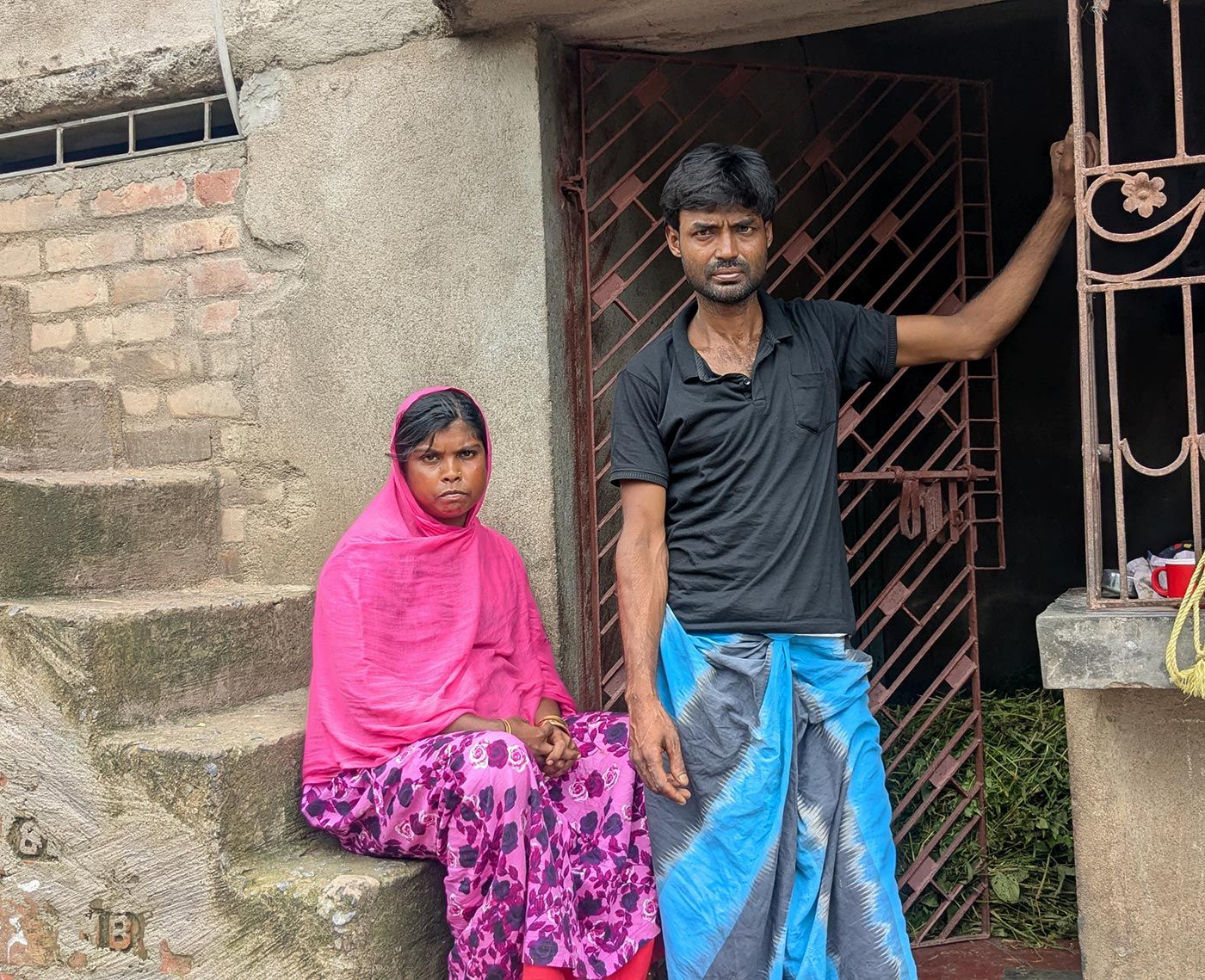
![‘No one raised a question [about our being Indians] until now. But with all these troubles [us] Bangali Musalman workers everywhere, we can’t help getting worried,’ says Bishakha Mondal (name changed), a domestic worker in Delhi. Photo: Anirban Dey/PARI](https://admin.asiandispatch.net/uploads/editor-image-new/image_20250917175810580868ca90d0f2dc0.jpg)
(Left) Mehbub Sheikh with his wife Surna Bibi at their home in Murshidabad’s Balia Hasennagar. On June 9, 2025, he was picked up by Maharashtra police and asked for documents to prove his citizenship. He was eventually pushed back and abandoned in Bangladesh.
(Right) ‘No one raised a question [about our being Indians] until now. But with all these troubles [us] Bangali Musalman workers everywhere, we can’t help getting worried,’ says Bishakha Mondal (name changed), a domestic worker in Delhi. Photos: Anirban Dey/PARI
“No one raised a question [about our being Indians] until now,” says Bishakha Mondal, 52 (name changed) from Gokarna village in Kandi. “But with all these troubles [us] Bangali Musalman workers everywhere, we can’t help getting worried.” She has been a domestic worker in Delhi for three decades. Her labour in five households there brings in Rs. 25,000 a month. She has an authentic voter card and ration card. Also an Aadhaar card and bank account linked to her Delhi address.
Murshidabad, administrative centre of undivided Bengal till the British shifted the capital to Kolkata, was once famed for its prosperity. Today, it supplies the biggest out-migrant workforce from West Bengal. Till May 2025, close to 4 lakh workers from here had registered for the Migrant Workers Welfare Scheme of West Bengal. (Curiously, the document citing these numbers has vanished from the government site). Independent estimates by different migrant organisations suggest there are more than a million such workers in Murshidabad. A state education ministry official says on condition of anonymity, “no government data would ever mention it… but the reality is, countless child labourers are [also] moving out for work every day.”
Both Mehbub’s younger brother Mujibar Sheikh,33, and their father Hossein Sheikh in his early sixties, worked as migrant labourers. Hossein still works in Kolkata as a mason. Mujibar, now a driver, had been to Delhi and Mumbai with Mehbub, for masonry work. Both brothers remember childhood as an incessant battle with poverty. Mehbub remembers: “There was a time when I used to graze the goats of others. I have not studied much. Ours was a very needy family. The burden of poverty had me working from an early age.”
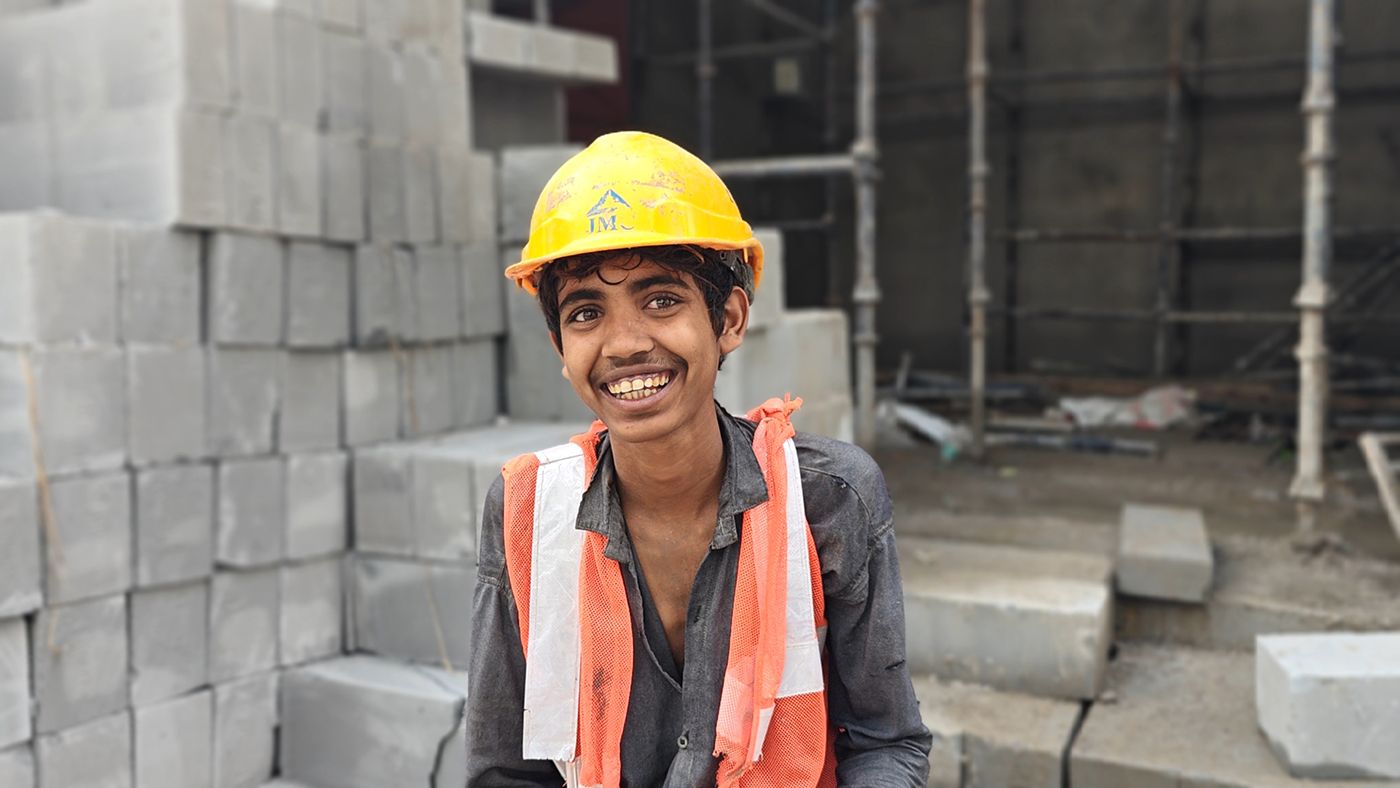
Babu Islam (doesn’t wish to reveal his real name) from Dhuliyan in Murshidabad fled Odisha when the attacks on Bengali Muslim migrant workers began around September, 2024. He says: ‘I am better now. I came back and took this work in Kolkata. I miss my home’. Photo: Smota Khator/PARI
At 17, Mehbub migrated out in search of a livelihood with his inheritance of masonry skills. As someone who has worked in states like Delhi, Punjab, Tamil Nadu, Rajasthan and elsewhere, he finds the awful changes in his migrant workplaces baffling. Media reports and personal accounts record several instances of migrant labourers like him being pushed out on flimsy grounds to Bangladesh.
There is a palpable atmosphere of suspicion and distrust. That’s unsurprising: For more than a year, they have been targeted by law enforcement agencies of both central and state governments. “Our names don’t sound like yours. That’s why we are humiliated,” Mujibar tells us. Over the last one year, Muslim migrant labourers from West Bengal have been picked up, branded as ‘Bangladeshi’, ‘Rohingya’, ‘Ghuspethia’ (infiltrator) or ‘illegal’.
All of them recognise and speak of hatred based on language, religion, caste, or regional identity having intensified in the last decade, leading to the current escalation. The Muslim migrant workforce is the most vulnerable segment, bearing the brunt of hate speech propagated by the fundamentalist outfits and political leaders.
“We are having to choose between life and work,” people in Diarjali Bagicha complained to this reporter. Nejema Bibi, 32, who lives here in a two-room brick house with unplastered walls, fears for her husband Rafiqul Islam working in Kanpur, Uttar Pradesh. “My heart sinks if he doesn’t pick up my calls for even just a few hours,” she says.
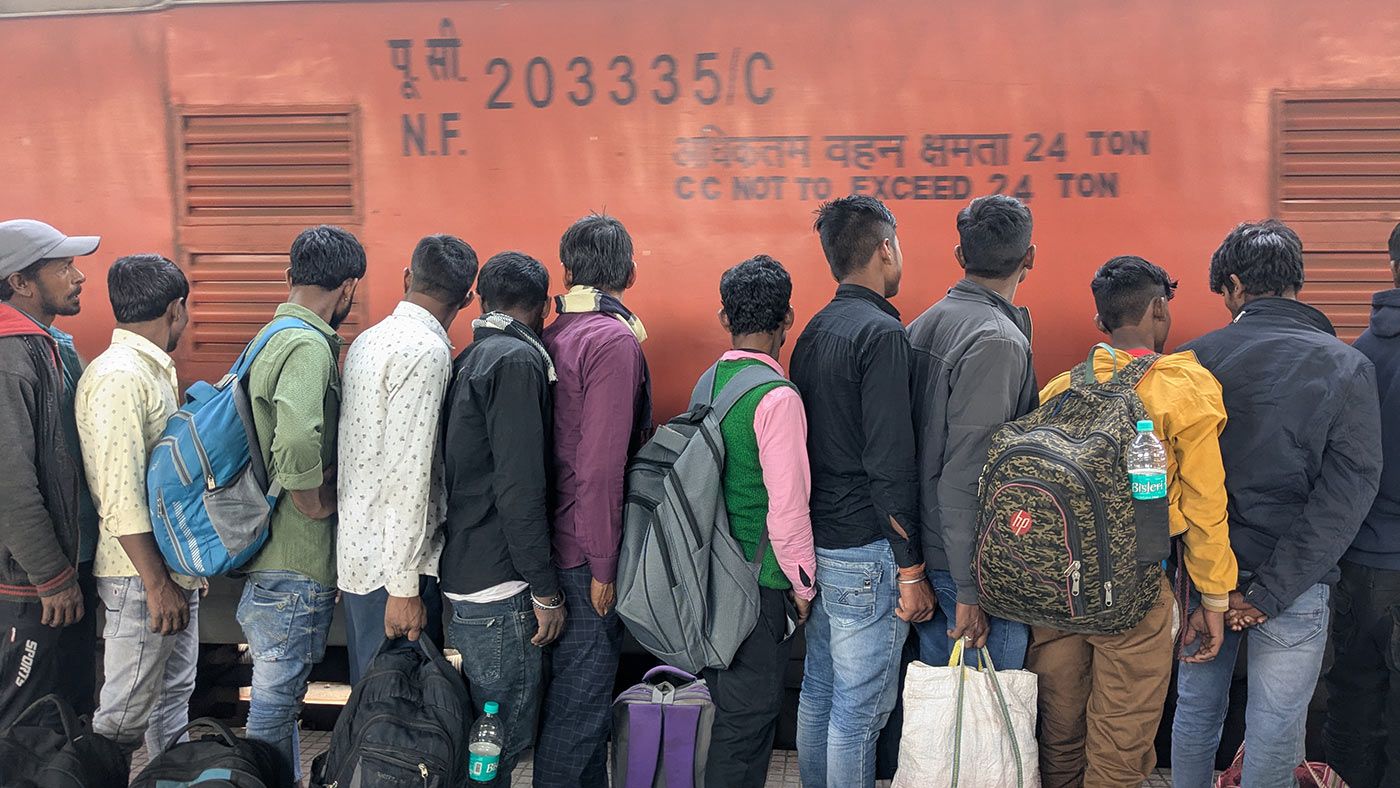
Young migrants in search of work wait to board a train to Andhra Pradesh at the Howrah rail terminus. Photo: Anirban Dey/PARI
Mehbub returned to Balia Hasennagar this May to celebrate Eid al-Adha (in early June, 2025) with his family. Their two-and-a-half storey house was built brick by brick over years by this family of masons. It has five rooms and some space on the ground floor to set up a shop in future. The part where Mehbub lives with his wife and homemaker Surna Bibi, 30, and their three children, is as yet unplastered on either side. Their eldest son Bakul Sheikh,16, having dropped out of school, is working in a nearby shop. The younger sons – Sagar Sheikh,12, and Rehan Sheikh,7 – are studying in a local school. On the occasion of holy qurbani and Mehbub’s homecoming, his family even made arrangements for the ritual sacrifice.
It didn’t happen. “Repeated calls from the construction site at Thane,” summoned him back.” Mehbub flew back to Maharashtra and resumed his work – leaving family and celebrations behind.
On June 9, while having tea at a local stall, he was picked up by police without explanation and taken to an outpost of theirs near the Shree L R Tiwari College of Engineering in Mira Road, Thane. At night, he was transferred to the Mira Road Police Station where he was asked for documents to prove his citizenship.
“‘You are a Bangladeshi, right?’ The officers asked me in Hindi. I said, ‘I am from West Bengal’ and showed them my Aadhaar and PAN card. They said, ‘these can be bought for five rupees nowadays’,” Mehbub told this reporter.
Somehow, he stealthily phoned his family in Balia Hasennagar who immediately contacted the local gram panchayat at Mahishasthali and sent all the necessary documents to the Mira Road Police Station. “For four long days,” says Mehbub, “I endured immense mental torture. Through daytime I was made to sit outside the station and was put in a police camp during nights.”
The Mira Road police contest Mehbub’s account of wrongdoing on their part. Senior Inspector Meghna Burade stated that they were “not at fault.” And that the detention of Mehbub Sheikh and others was carried out on a police commissioner’s order.
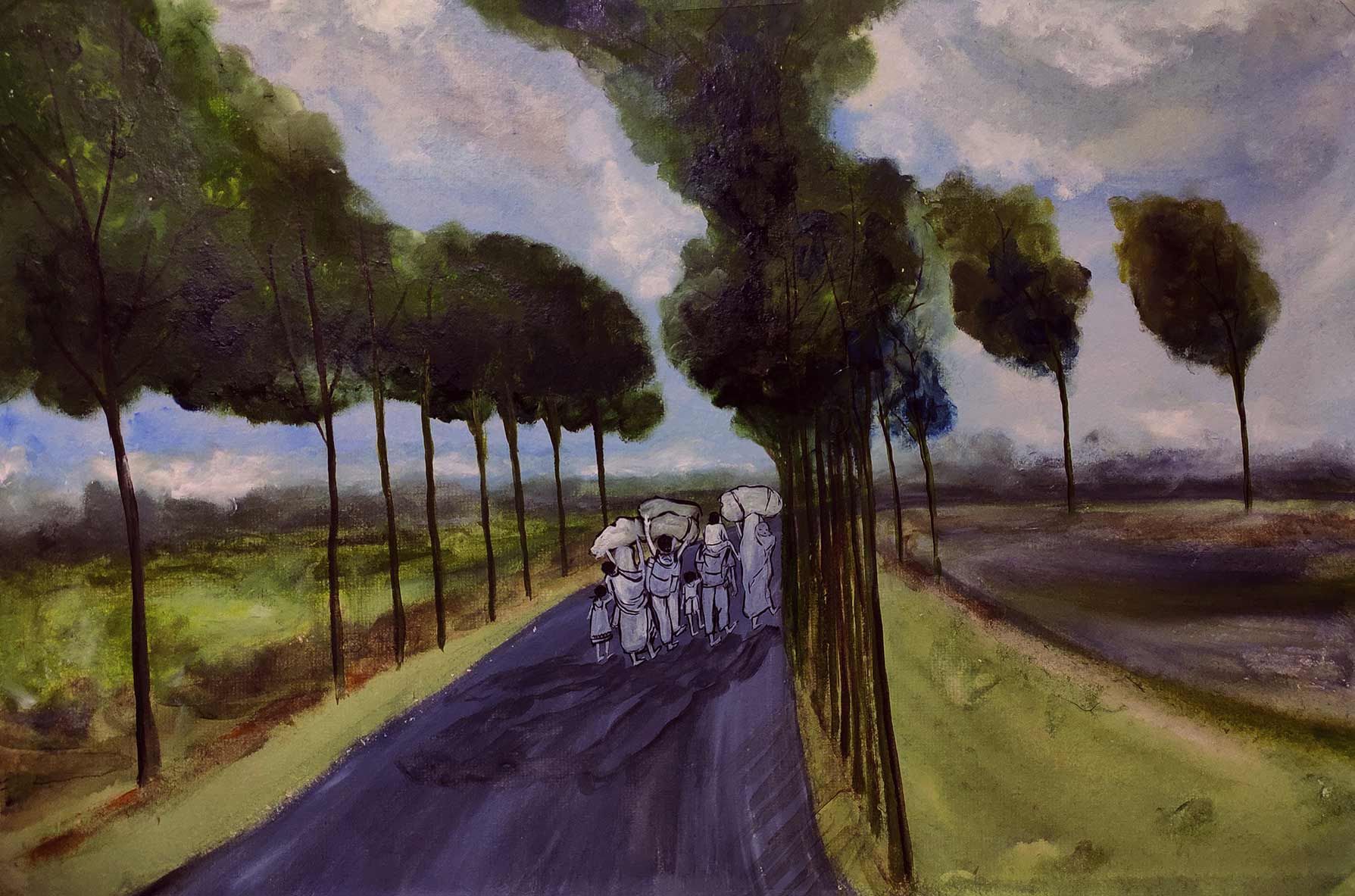
‘We are having to choose between life and work,’ say Muslim labourers from West Bengal who have been branded as illegal immigrants increasingly over the last year. Illustration: Labani Jangi/PARI
For Mehbub, though, June 13 was to prove dreadful.
“That day we were picked up in a large police van covered with wire-mesh. Many more cars piloted us, like we were some important leaders or ministers,” says Mehbub. “The car finally stopped at some security camp near Panvel.”
On June 14, the same vehicle ferried almost 30 people including Mehbub to the Pune airport. At 2 p.m. they were swiftly put onto a flight. On getting off the plane Mehbub realised it was the Bagdogra airport in West Bengal. “They made a head count and divided us into small groups,” he says. “I had heard criminals face head count. But why count us the same way? Suspicion crept in…” From the airport they were taken to the Siliguri Border Security Force (BSF) camp and from there a new journey began towards an unknown destination.
“The vehicle ran some five-six hours at a stretch. Then they dropped us in the middle of a jungle at a small BSF camp. The handful of officers there got us down and asked, ‘Where are you from?’ I told my address. Immediately, a brutal beating ensued. They even held loaded guns at our throat. Then the BSF officers clicked our photos and asked us to walk off through the forest.
“Where to go? And how? We didn’t have the least idea. We worried that if we got spotted, BSF or Border Guard Bangladesh (BGB) would straightaway shoot us. Fear gripped our hearts. The forest became our hideout for the night,” a traumatised Mehbub recalls.
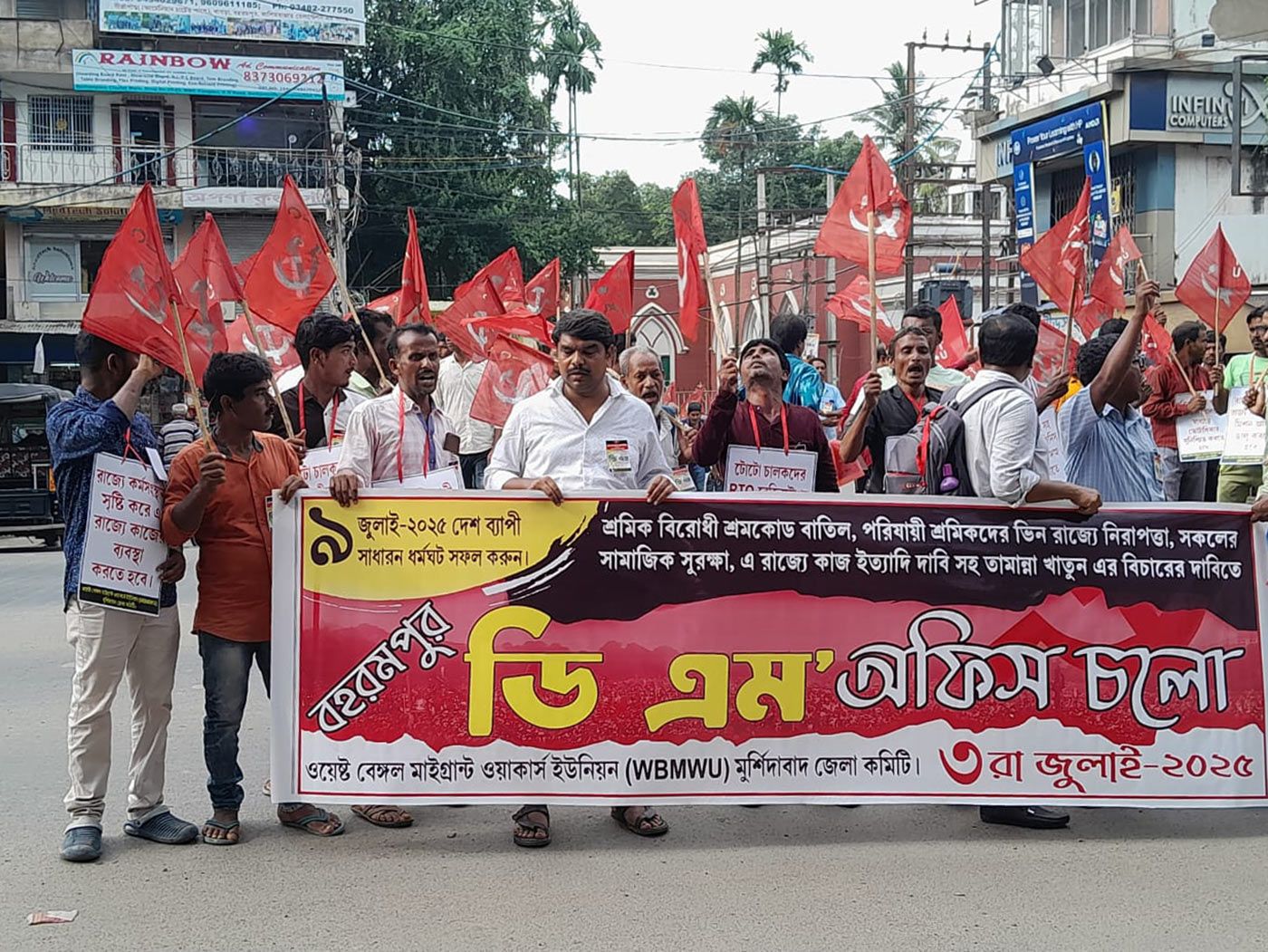
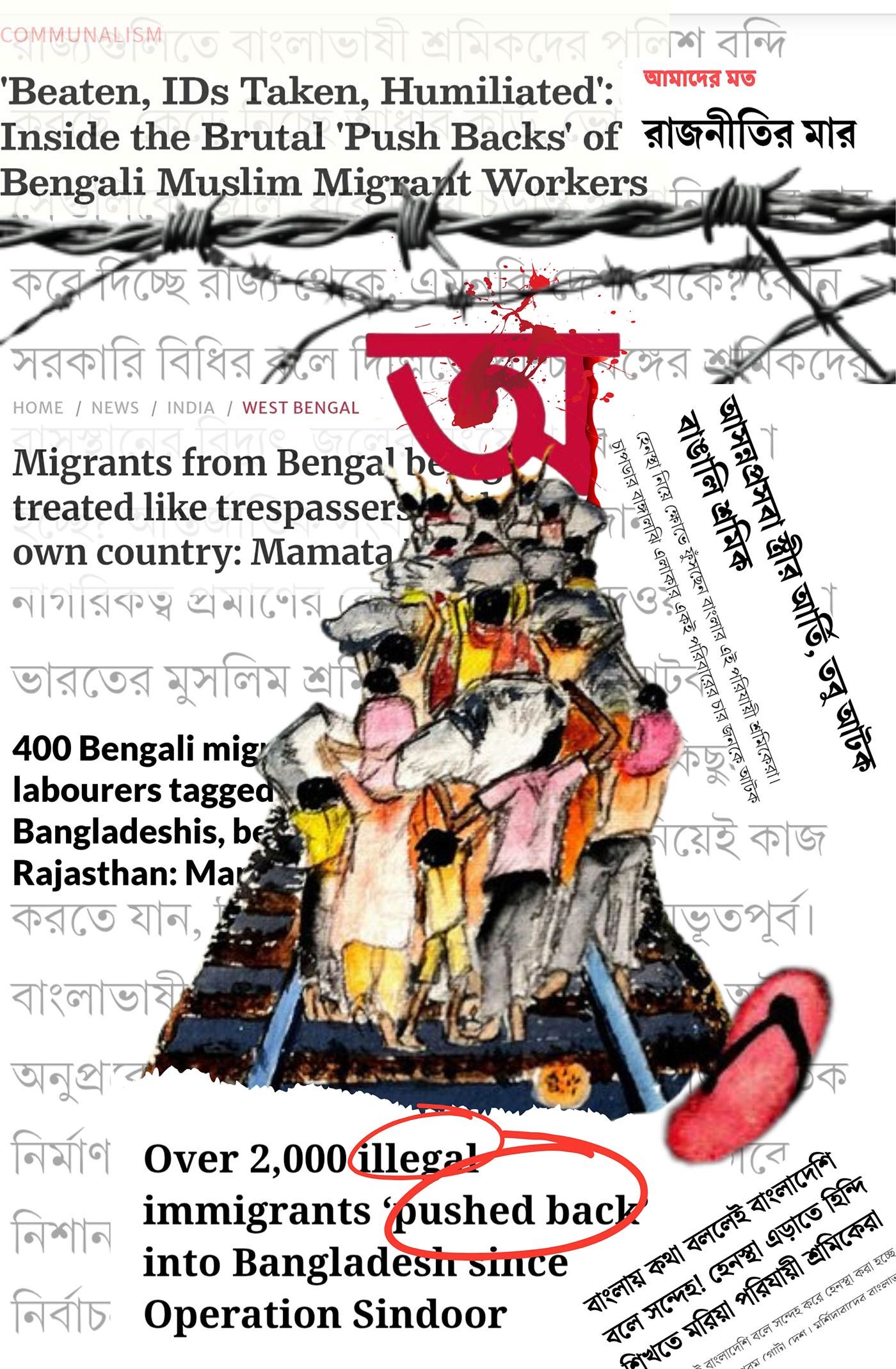
(Left) In light of workers being harassed, a rally was organised by the West Bengal Migrant Workers’ Union in Baharampur demanding the right to secure and dignified work. Photo: Anirban Dey/PARI
(Right) A collage of recent news headlines on atrocities against Bengali-speaking migrant workers across different states. Photo: Aunshuparna Mustafi/PARI
Daybreak brought more stress. The last they’d eaten something was at the Pune airport. And 24 hours had passed since, without a single morsel of food. “It felt like we would collapse and die right there,” says Mehbub. “There were only trees all around us. We were walking in a group.” He pauses some moments, then continues, “It was around 2 p.m. when we walked up to a small settlement in Bangladesh. We told the people that we were Indians. They suggested we take a bath, and gave us rice to eat. [With their help] I contacted my family through Imo app [a mobile app that enables chats and international calls]. I was crying. My voice choked. I could barely speak …”
Mehbub lost all hope of ever returning. Meanwhile, his brother Mujibar ran around many places including Siliguri and Raiganj, going door to door seeking help and support. From the panchayat office to district administration, even to state-level sarkari officials. Finally, Mehbub could make his way back home. “Even after bringing him back, sarkari people [departmental affiliations unknown] visited our house wanting to verify the land deeds.”
The relief was short lived and did not end their anxieties. From Mehbub, we learn the compulsions of migration. “Sitting idle at home means zero income. I can earn 800-1,200 rupees a day there [other states]. I can even work double shifts for additional income…” But fear has shattered his confidence. “I have been working as a mason in cities like Pune, Mumbai and Thane for years. Never thought I would witness such a time.”
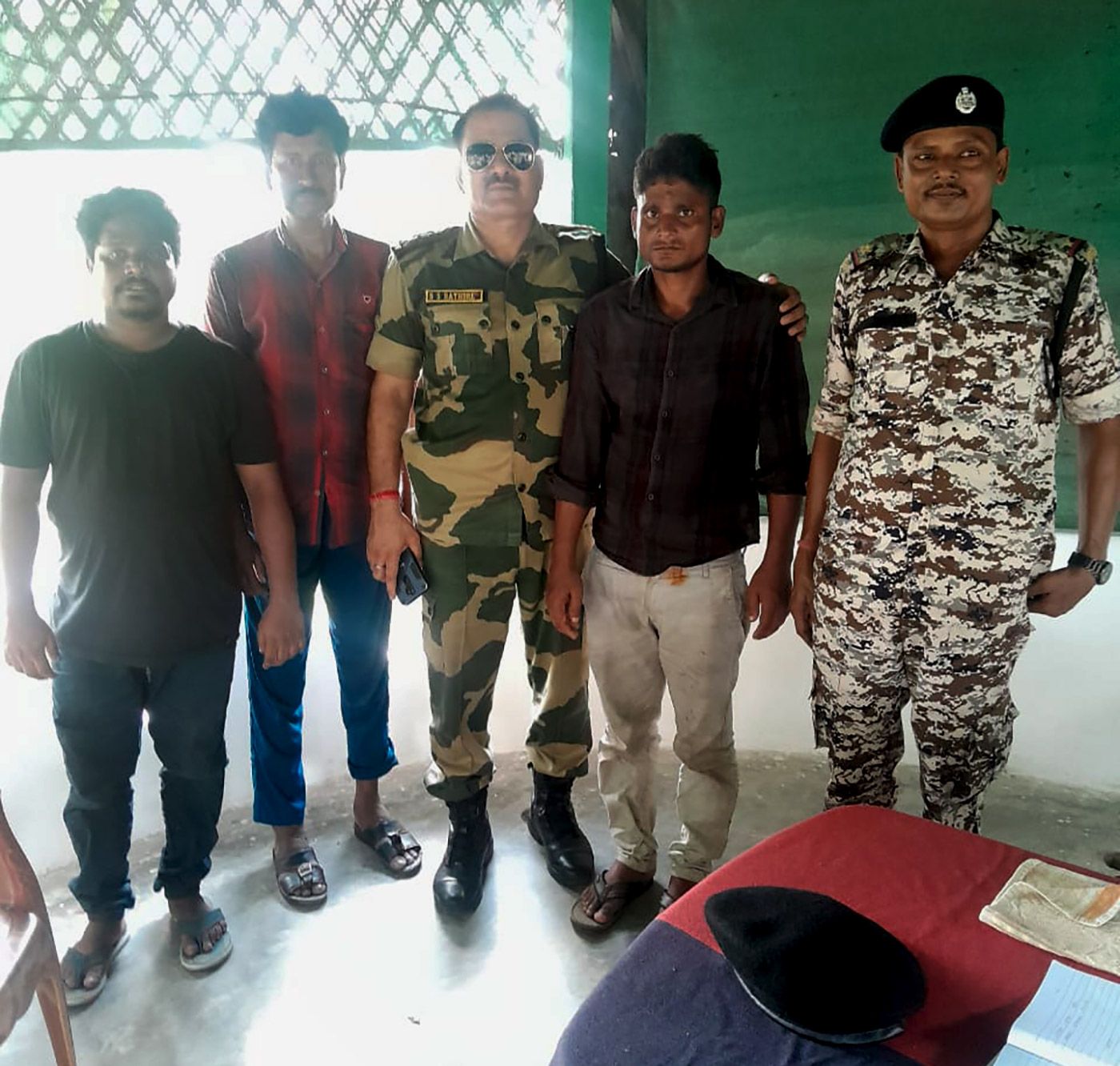
(Left) Nazimuddin Mondal (in black shirt), Mostafa Kamal Sheikh (in red shirt) and Minarul Sheikh (left) seen here with security officials. They were pushed out to Bangladesh on June 13 and rescued back on June 15.
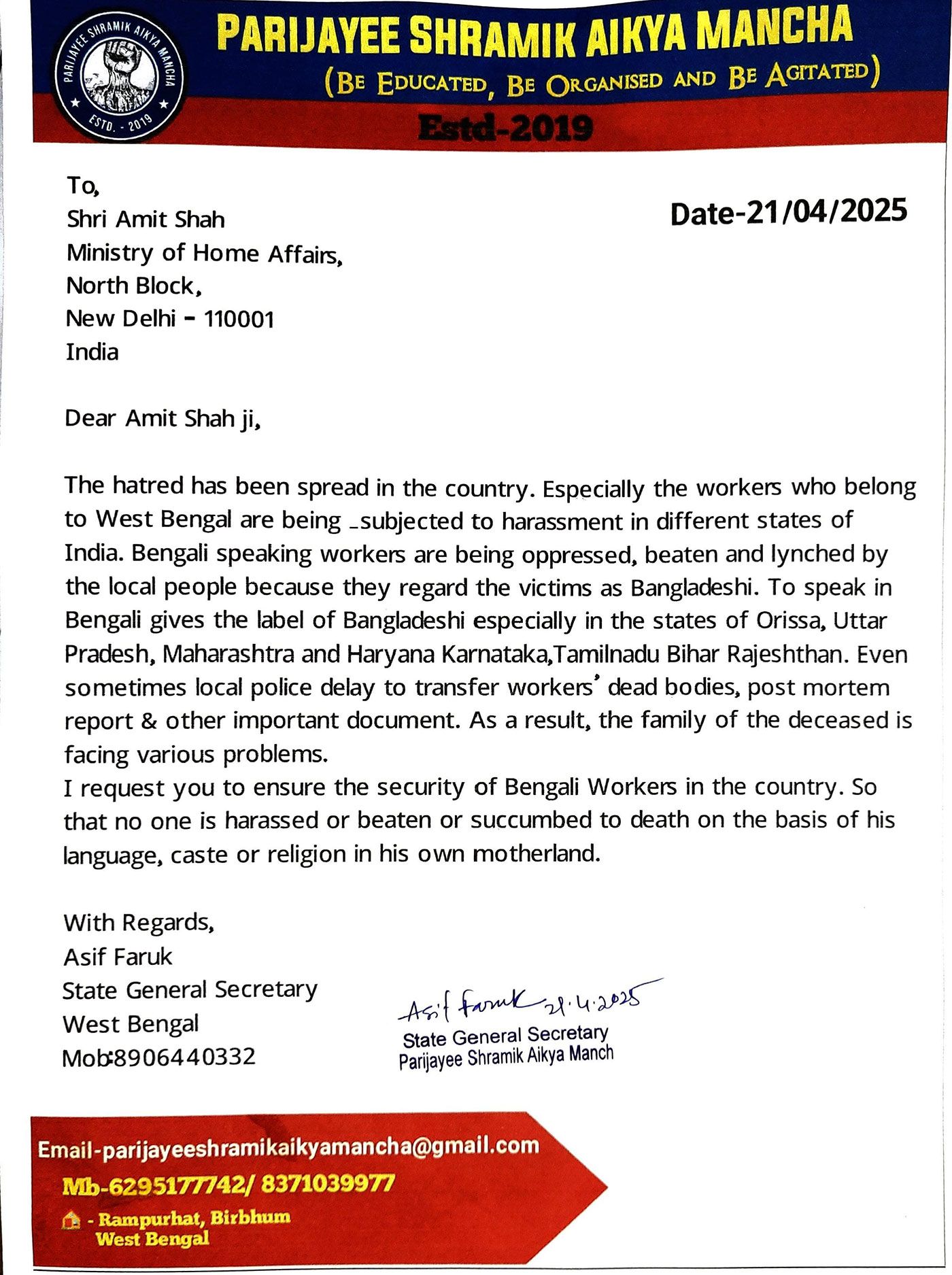
(Right) Parijayee Shramik Aikya Mancha – an organization fighting for the rights of migrant workers from West Bengal – sent out a letter to the Union Home Minister seeking immediate action against harassment of Bengali migrant workers. Photos: Courtesy of Parijayee Shramik Aikya Mancha via PARI
On seeing this reporter, Nazimuddin Mondal could barely control his anger. This resident of Murshidabad’s Hariharpara Block is as resentful of the media as he is of government and administration. Ever since a video of Nazimuddin abandoned by Indian state authorities in Bangladesh went viral, journalists have frequently quizzed this 35-year-old mason from Tartipur village about being pushed across the border. “What have you got to do with that?” he bursts out. “Why can’t you write about the torture [inflicted on us]? Why on earth are we being tagged as Bangladeshis? It’s high time the media speak out.”
The silence of most media on the current situation worries Nazimuddin even more. He sees clearly that in the name of news, some media houses actually promote suspicion about Bangla-speaking Muslim labourers.
The “push-back” experience traumatised Nazimuddin. The thought of leaving his wife and a teen daughter – in Class 10 – at home for work in a distant state now terrifies him. “[I have] worked in the Mira Road Police Station earlier,” he says. There, he did masonry and repair work. “Now police from the same station picked me up from my rented room at the dead of night and called me ‘Bangladeshi’. What kind of system is this?” The Maharashtra police had raised questions regarding his birth certificate. “I was born in Hariharpara 35 years ago. That’s where my baap-dada [father and grandfather] was born. None of my parents got formal education. They didn’t obtain my birth certificate either. Poverty made things difficult. I couldn’t even finish primary schooling,” clarifies Nazimuddin.
His belongings remain in the room at Mira Road, Maharashtra. No one knows how he can collect the wages the contractor still owes him. His mobile phone, confiscated by the police, is yet to be returned. “It’s really hard to get work in a new place. Working somewhere for five long years results in having some contacts and ease. How can that be taken away like this?” he asks angrily.
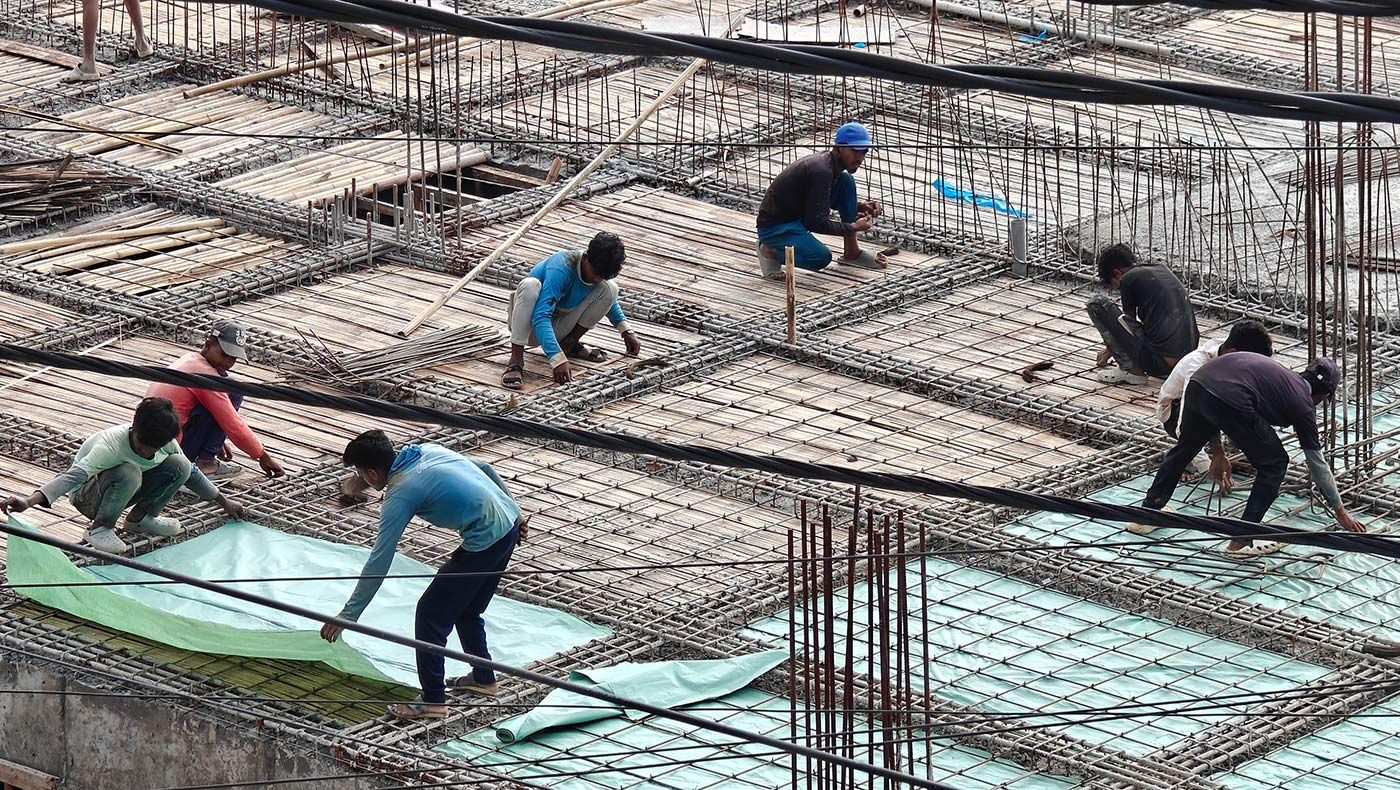
Lack of decent employment opportunities and an increasingly fruitless agriculture sector forces young people from Murshidabad to migrate to distant states from Mizoram (seen in the photo) to Maharashtra. Photo: Smita Khator/PARI
Two brothers of Nazimuddin work as labourers in Kerala and Tamil Nadu. Workers here generally say the southern-Indian states are a lot safer for Bengali migrant workers. Many labourers, forced to return from Maharashtra, Gujarat or Delhi, are now trying to find wage work in the south.
Nazimuddin says that Minarul Sheikh from Kazisaha, Beldanga I, Murshidabad, and Mostafa Kamal Sheikh from Monteshwar in Barddhaman district shared his ordeal. “On June 13 [2025] we were deported to Bangladesh via Siliguri and got rescued on the 15th.”
“After this…it won’t be easy to move out again. But remaining in our village means a meagre 500 rupees per day [on days that work is available] and expenditure of 250. [In the other states], the daily expense might be 300 rupees, but the wage is 800 a day. We can send 500 rupees to the family. So, leaving [migration] is the only way out,” explains Nazimuddin. “We must return to work [outside] at our own risk.”
There is a dearth of steady work, even that at just survival wage level, across Murshidabad district. The 100 days of employment guaranteed under MGNREGA is still stuck in limbo. Migration seems the only option for working-class people. Murshidabad, one of India’s most underdeveloped districts, is mostly rural. Roughly 80 per cent of its people live in 2,166 villages. At 66 per cent, its literacy rate is way below the state average of 76 per cent (Census 2011). Two-thirds of the population are Muslims. It is obviously they – marginalised in class, region, and religious terms – who account for most of the forced labour migration.
The situation in in Diarjali Bagicha, a hamlet under Habaspur panchayat, captures that reality. In over 60 per cent of households, at least one member is a migrant worker. Residents Latibul Haque, Ainal Haque and Rajjak Hossein Sheikh, who once worked as porters, left their jobs and went to Odisha to earn a better wage as street vendors. They explained to us on phone that the mahajans (moneylenders) lend them various household and stationery items. They load these items on their cycles or motorbikes and sell them across the villages. On average, it earns them Rs. 700-800 a day after deducting the contractor’s share. They live together in groups in small, rented rooms.
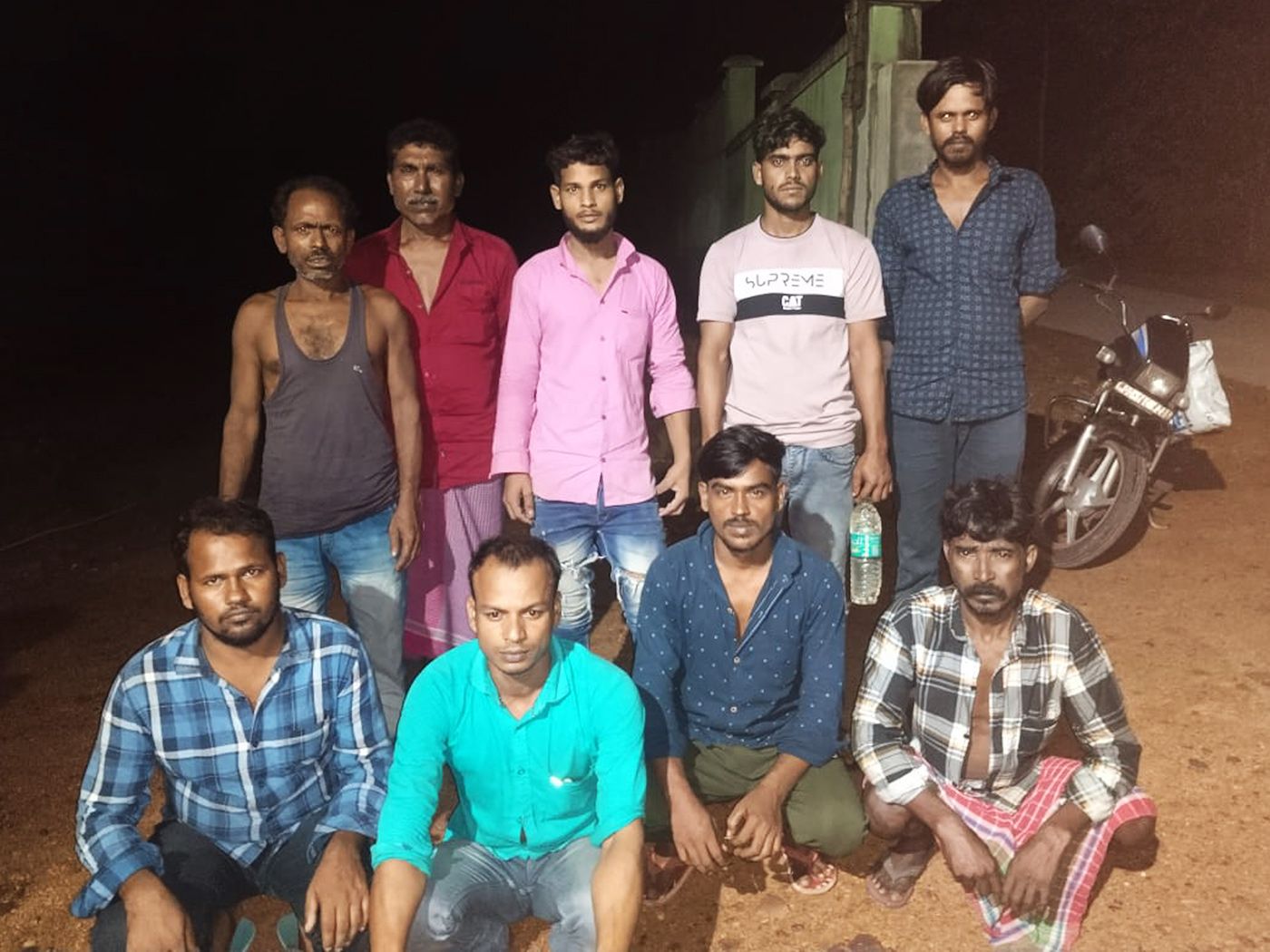
(Left) Migrant workers from Murshidabad were detained for four days at Lakhanpur Police Station in Jharsuguda, Odisha. They were eventually released after the intervention of their native gram panchayat back in Dakshin Hanumanta Nagar. Photo: Courtesy of WB Migrant Workers’ Union via PARI
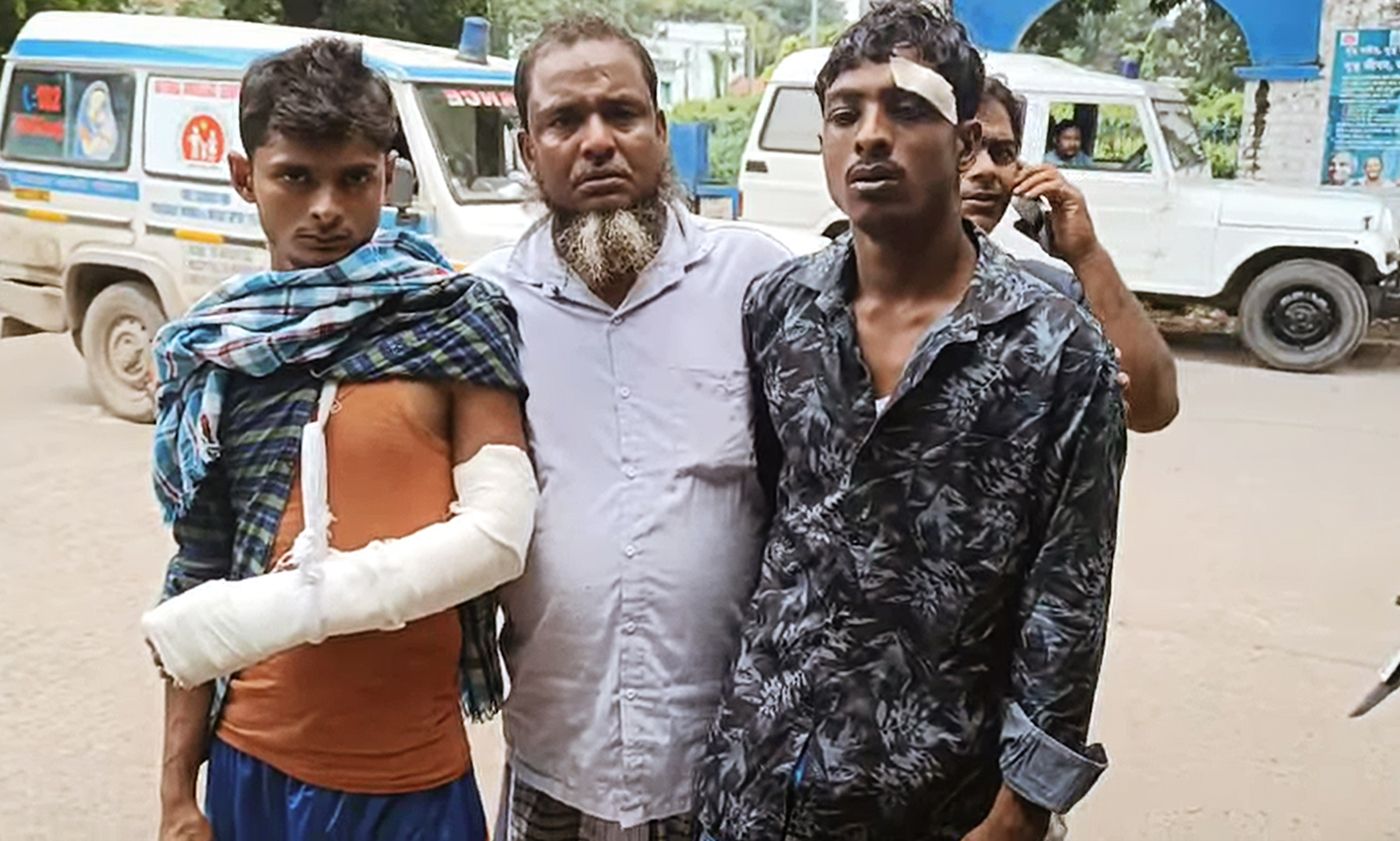
(Right) Three migrant labourers from Lalbagh Police Station in Murshidabad working at a construction site – Milan Sheikh, Ismail Sheikh and Babu Sheikh – were attacked in Chennai, Tamil Nadu, on July 15, 2025, as they were speaking in Bengali among themselves. Photo: Courtesy of Parijayee Shramik Aikya Mancha via PARI
Family members of these migrants told us in Diarjali Bagicha that since September 2024 many travelling Bengali Muslim salesmen from Murshidabad have been attacked and detained in Odisha. That, on the pretext of the violence against Hindus in Bangladesh and in Murshidabad’s Samserganj. But what is panicking the migrants is the increasing involvement of Odisha police in such incidents.
When the police there questioned the validity of Latibul Haque’s documents, his family members in Diarjali Bagicha sought help from the Bhagwangola Police Station. Latibul and others were set free only after the documents were exchanged between the police stations, but are still stuck in Odisha. Latibul who was confined in one of the camps in Jharsuguda for four days tells us on phone: “The police said they are still verifying our documents related to Indian citizenship and instructed us not to return to our home state for a month.”
The families of labourers toiling in distant states like Maharashtra, Odisha, Uttar Pradesh and Delhi are now rattled. In Diarjali Bagicha, we met Ainal Haque’s mother Madina Bibi, 60, frail, but with keen eyesight. Her deft fingers fly while weaving kanthas (hand-embroidered quilts) of intricate design as she speaks to us. People get her to weave and stitch kanthas, paying her just 20 to 30 rupees a piece. However meagre, that amount helps in sustaining the family. With her son and grandsons all toiling in Odisha, Madina can’t hold back her tears as she talks about the ordeal and harassment they’ve been through.
“When they said my son and pota [grandson] are all Bangladeshis, how could I keep calm?” Madina asks. “My second son Ainal Haque and two grandsons from my eldest son – Amir and Rajjak Hossein – live in Odisha. The police detained them for four days. I didn’t get any sleep those days.”
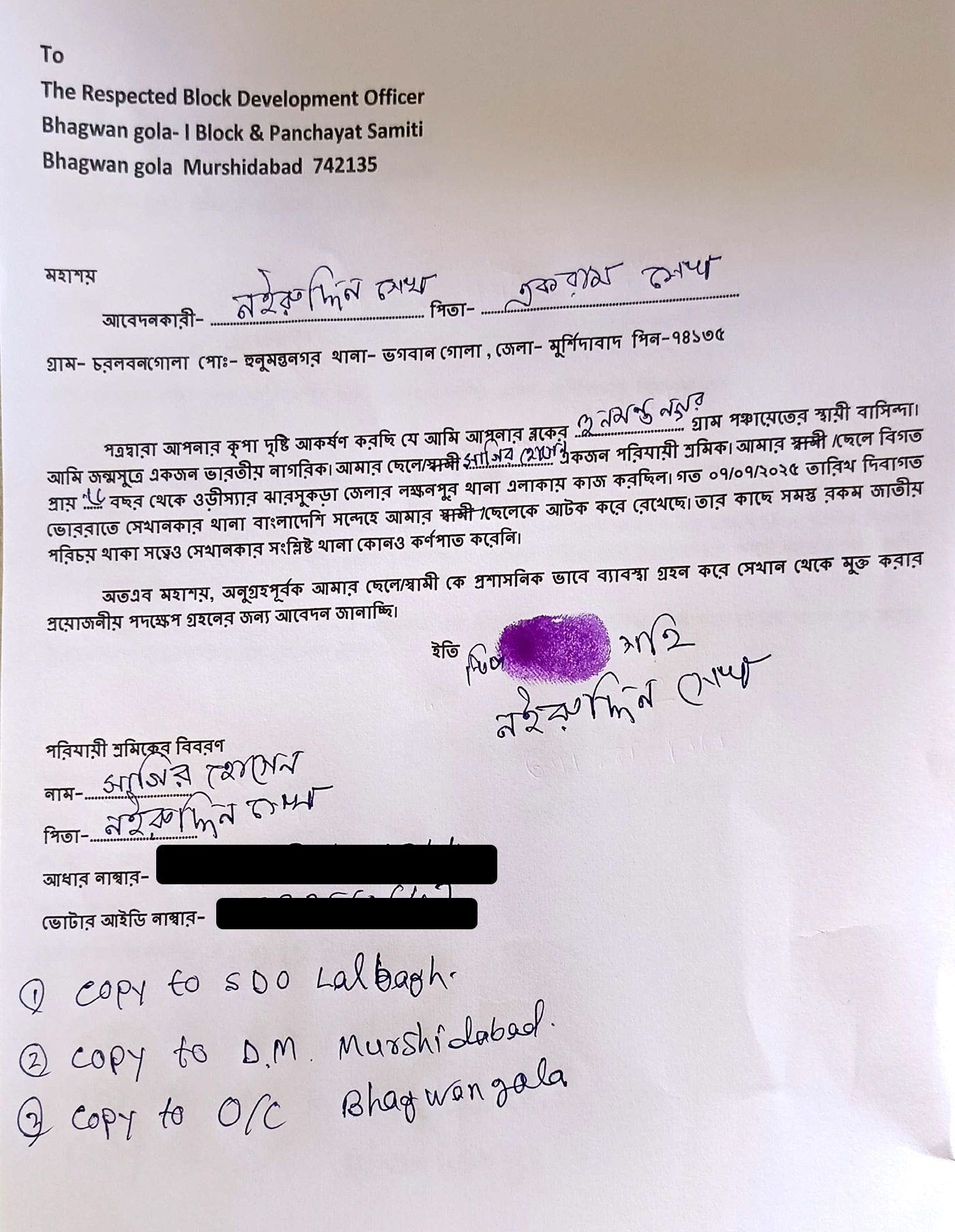
(Left) Father of detained migrant worker Sagir Hossein has sent an application to various government officials detailing his son’s proof of Indian citizenship. He appeals for the immediate release of Sagir, a resident of Dakshin Hanumanta Nagar, Murshidabad. Photo: Courtesy of WB Migrant Workers’ Union via PARI
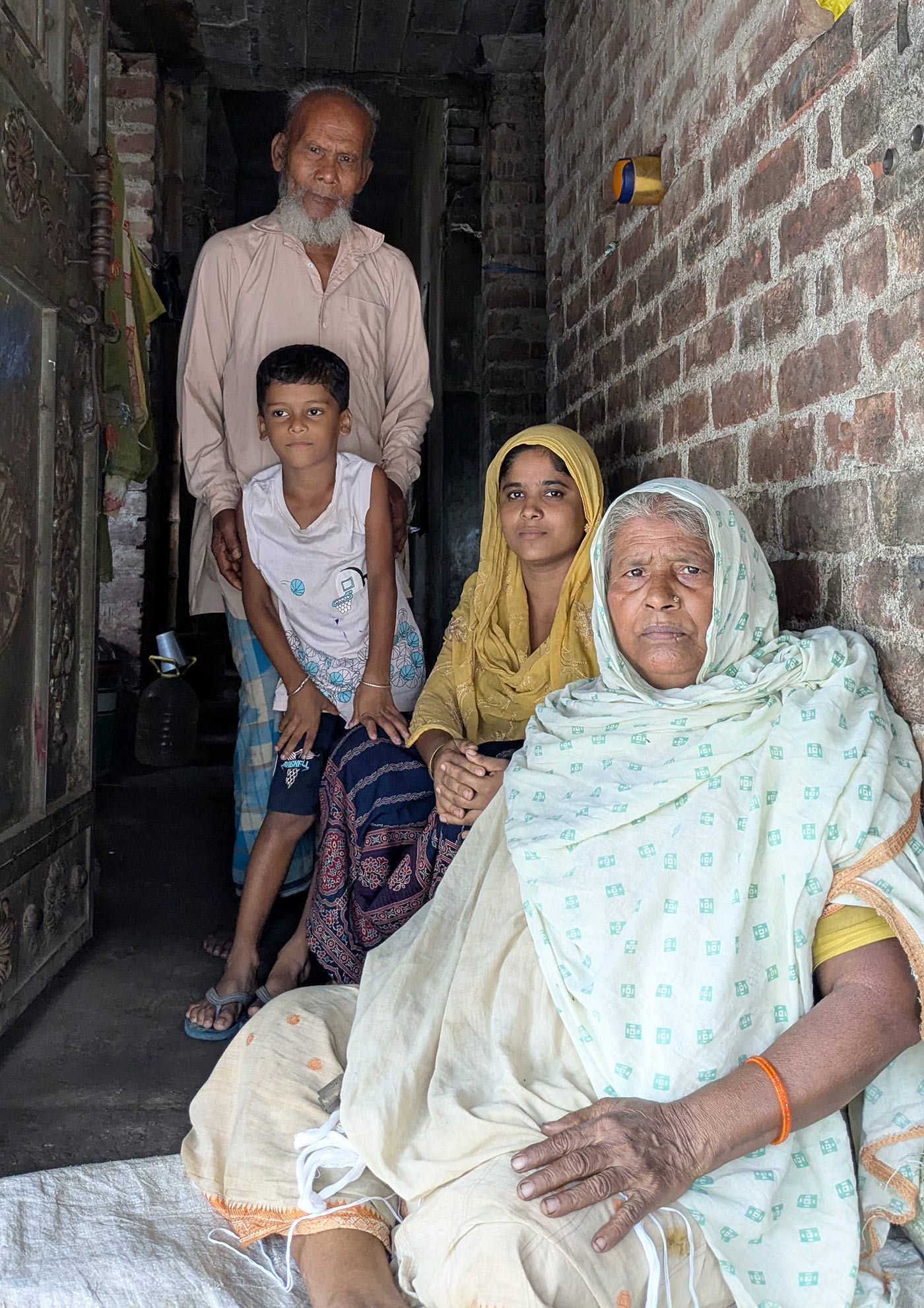
(Right) Detained migrant worker Ainal Haque’s wife, Shiuli Bibi with his mother Madina Bibi, father Moinul Sheikh and their son at the family home. Photo: Anirban Dey/PARI
The phone call Shiuli Bibi – Ainal Haque’s wife – received, terrified the whole family. Documents such as Aadhaar and ‘admit card’ of the secondary board examination [class-10] had to be found and submitted. Ainal Haque’s father Moinul Sheikh, in his late 60s, had to take all these papers to the police station. “There, they even snapped at me for being late. But what could I do? I was totally numb and dumbfounded, thinking of my son’s situation…” recalls the old gentleman.
A distraught Madina Bibi tells us: “After his secondary exam, my son [Ainal] said, ‘I must work to fill our bellies.’ He ran chores for the malik at a brick kiln and would get 800 rupees a month. Later, he carried loads in a godown. Even that would only get him 10,000 rupees a month at best. We were crushed by debt. That’s the reason he went outside…It’s been two years now. We are merely trying to survive,” she says. “[My] father-in-law, even his father, are all from India… Yet, the fear refuses to leave me.”
On July 7, 2015, Amirul Sheikh, in his mid-30s, from Charlabangola village in Bhagawangola I, were also detained in Lakhanpur Police Station of Jharsuguda in Odisha with 30 other migrant workers from West Bengal. On getting the news, family members ran frantically from Bhagawangola Police Station to the local Dakshin Hanumanta Nagar gram panchayat office. Finally, the detained workers were released four days later from Lakhanpur Police Station, Odisha. “I have worked 10 years in Odisha as a hawker. But everything has changed. People have been beaten up before, but this time we are straightway being labelled as Bangladeshis,” says a shaken Amirul on phone. Still, he has no choice but to remain in Odisha to support his family in Charlabangola.
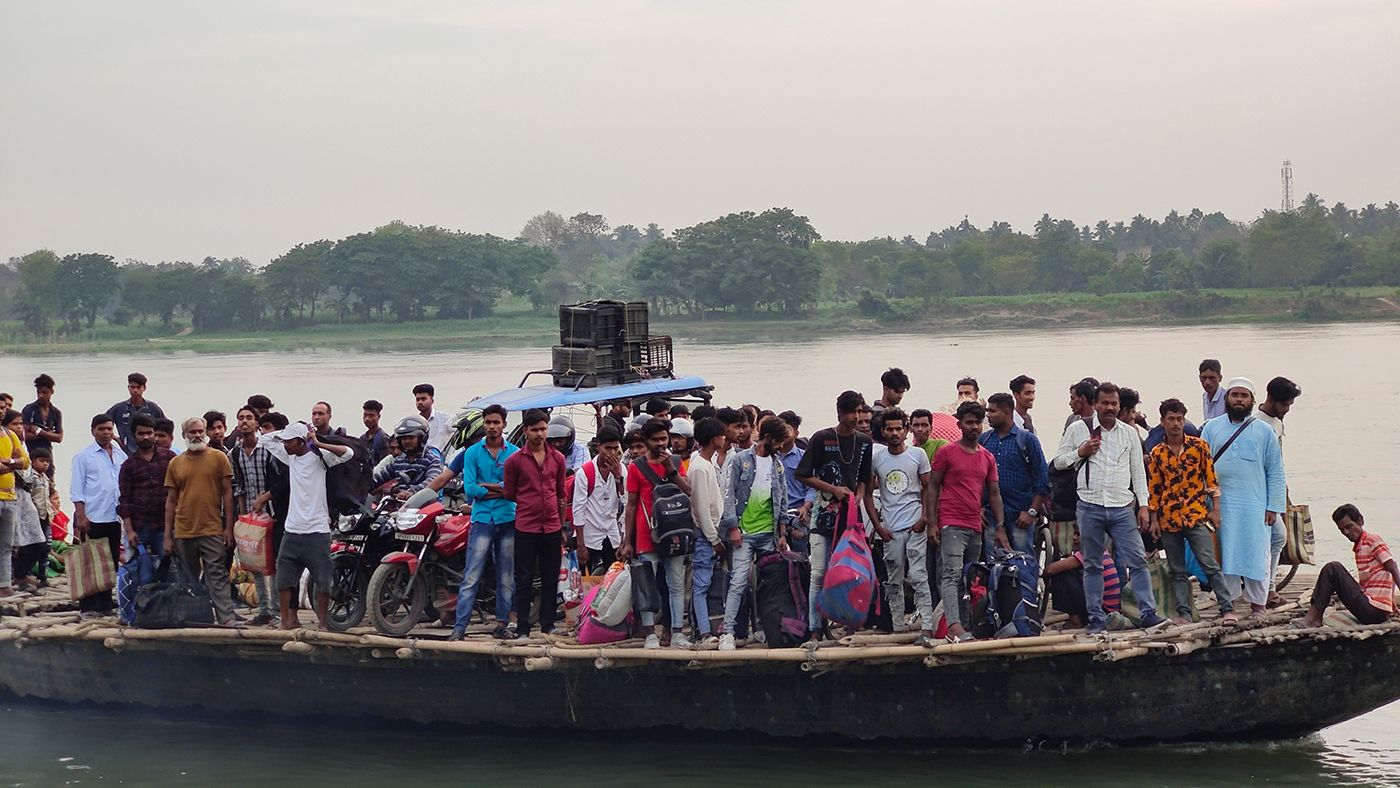
Migrant workers returning from Bihar report growing intolerance against Muslim workers. Photo: Smita Khator/PARI
“In this year alone, more than 5,000 migrant labourers from Murshidabad have been harassed by police in Odisha,” says Asif Faruk. He is secretary of Parijayee Shramik Aikya Mancha (PSAM) – an organisation fighting for the rights of migrant workers from West Bengal. “In different regions of Odisha including Jharsuguda and Paradip, many Murshidabad labourers have been detained in police camps for four to five days and are being interrogated to prove their citizenship status.”
The political storm between Centre and State governments, highlighted by the speeches of leaders of both, isn’t helping. A press release by the Central Government’s Ministry of Labour months ago lauded the projects and schemes undertaken by them for the welfare of the migrant labourers in India. But there have been no official statements, no condemnation of the violence against them.
The Border Security Force has not issued any official statement on the charges of unlawful conduct during the ongoing crackdown on people alleged to be unauthorised Bangladeshi infiltrators in several Indian states. Villagers in Bhagawangola say: “The lower rank [BSF] jawans tell us ‘we are merely doing as instructed by the oporwalas [higher authority]’.”
The state government has promised to defend the rights of citizens and deal with the issue of people being pushed across the border. Asif Faruk of the PSAM believes the “West Bengal government is trying to rescue and bring the victims back.” And “from April, we started a helpline for the workers.”
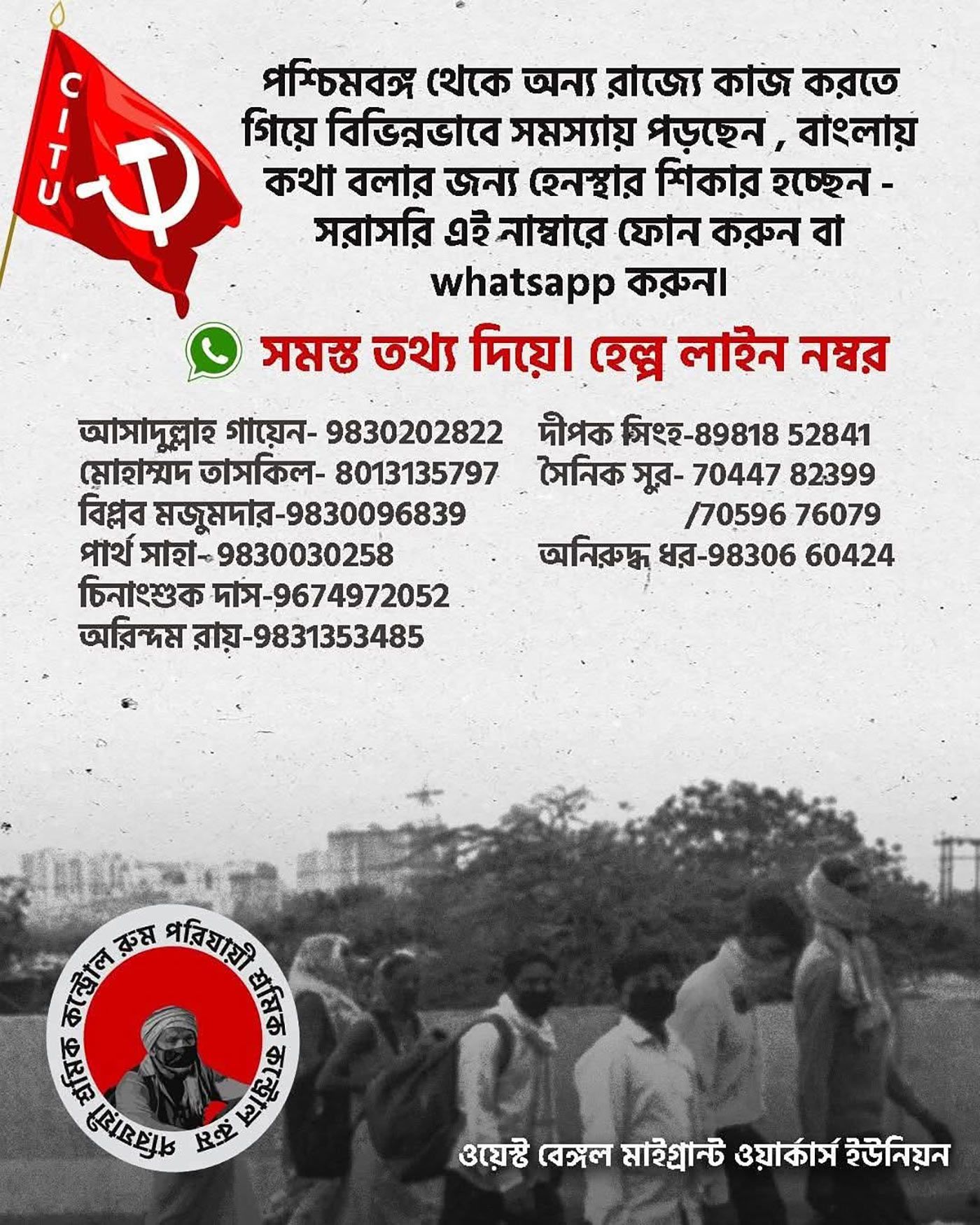
(Left) West Bengal Migrant Workers’ Union has started a helpline for workers facing atrocities in other states and their concerned families back home. Photo: Courtesy of WB Migrant Workers’ Union via PARI
(Right) Safiqul Islam from Diarjali Bagicha fears the safety of his brother Rafiqul Islam, a mason working in Kanpur, Uttar Pradesh. He has noticed a sharp surge in reports of harassment of Bengali-speaking Muslim migrants circulated in social media platforms. Photo: Anirban Dey/PARI
The organisation has also filed a Public Interest Litigation in the Calcutta High Court seeking immediate action against harassment of Bengali migrant workers. And the West Bengal Migrant Workers’ Union organised a procession in Murshidabad district headquarters, Baharampur, demanding security for the labourers in other states. “MPs [Members of Parliament] from the concerned districts,” says Kamal Hossein, WBMWU district secretary, “must visit and intervene in the states where the migrant labourers are under attack.”
Meanwhile, the Centre-State squabble sidelines the question: had there been decent employment in Murshidabad, and serious intervention in the agriculture sector – would people have had to migrate in the first place?
Back in Balia Hasennagar, a panic-stricken Mehbub Sheikh, wonders how he will sustain his family now. “The [construction] company is calling me [from Mumbai] to resume work, but they are not willing to take any responsibility…”
Disappointment grips the master mason: “Where shall I find work now? I don’t have any answer to this…”
“যখন কাঁটাতার দেখলাম, মনে হল সব শেষ… মনে হল, এই জীবনে আর দেশে ফিরতে পারব না। আমার দাদোর দাদো (ঠাকুরদার ঠাকুরদা) এই মুর্শিদাবাদেই থাকতেন। আমরা এখন ভগবানগোলা [ব্লকের] যে গ্রামে থাকি সেটাও আমার নানির গ্রাম।“
বালিয়া হোসেন নগর গ্রামে নিজের বাড়িতে বসে মুর্শিদাবাদ জেলার সঙ্গে তাঁর পরিবারের আজন্মকালের সম্পর্কের খতিয়ান দিচ্ছিলেন বছর ৩৬-এর মেহেবুব শেখ। চোখেমুখে আতঙ্কের ছাপ। মাসখানেক আগেই ভয়ঙ্কর এক অভিজ্ঞতার মধ্যে দিয়ে গিয়েছেন। দেশের প্রশাসন তাঁকে ‘বাংলাদেশি অনুপ্রবেশকারী’ হিসেবে দাগিয়ে ঘাড়ধাক্কা দিয়ে সীমার ওপারে চালান করেছিল।
“আমার ভোটার কার্ড, আধার কার্ড, রেশন কার্ড সবই আছে। গায়ে গতরে খেটে জমিও কিনেছি। তারপরেও আমি বাংলাদেশি হই কেমন করে?” জানতে চান মেহেবুব, পেশাগত পরিচয়ে তিনি পরিযায়ী শ্রমিক।
মেহেবুবের মতোই এই প্রশ্নের উত্তর খোঁজার চেষ্টা করছেন তাঁর জেলাতুতো আরও হাজার হাজার দেশান্তরি শ্রমিকেরা। তাঁদের কেউ নির্মাণশ্রমিক, কেউ গৃহশ্রমিক, কেউ ফেরিওয়ালা, কেউ বা হকার। হঠাৎ নেমে আসা অস্তিত্বের সংকটে জেরবার দিন আনি দিন খাই এই মজুরদের ঠিক ঠাহর হচ্ছে না কেন মুর্শিদাবাদের বাংলাভাষী মুসলমান পরিযায়ী শ্রমিকেরা ভিনরাজ্যে কাজে গিয়ে আক্রান্ত হচ্ছেন।
(Left) স্ত্রী সুরনা বিবির সঙ্গে মুর্শিদাবাদের বালিয়া হোসেন নগরে নিজেদের বাড়িতে মেহেবুব শেখ। ২০২৫-এর ৯ জুন এই পরিযায়ী রাজমিস্ত্রিকে তুলে নিয়ে যায় মহারাষ্ট্র পুলিশ, তাঁর নাগরিকত্বের প্রমাণ হিসেবে কাগজপত্র চায়। শেষপর্যন্ত তাঁকে জোর করে বাংলাদেশে রেখে আসা হয়।
(Right) মুর্শিদাবাদের কান্দি ব্লকের গোকর্ণ গ্রামের বিশাখা মণ্ডল (নাম পরিবর্তিত) দিল্লিতে গৃহশ্রমিক হিসেবে কাজ করছেন তিন দশক হল। তিনি বলছেন: ‘আমাকে এখনও কেউ [আমরা ভারতীয় কিনা] কিছু বলেনি। কিন্তু চারদিকে এত ঝামেলা হচ্ছে [আমাদের মতো বাঙালি মুসলমানদের নিয়ে], আমরাও চিন্তিত’। Photos: Anirban Dey/PARI
“আমাকে এখনও কেউ [আমরা ভারতীয় কিনা] কিছু বলেনি,” বলেন বছর বাহান্নর বিশাখা মণ্ডল (নাম পরিবর্তিত)। কান্দি ব্লকের গোকর্ণ গাঁয়ে তাঁর ঘর। “কিন্তু চারদিকে এত ঝামেলা হচ্ছে [আমাদের মতো] বাঙালি মুসলমানদের নিয়ে, আমরাও চিন্তিত।” দিল্লিতে তিন দশক ধরে গৃহশ্রমিক হিসেবে কাজ করছেন তিনি। পাঁচ বাড়ি খেটে মাসে ২৫০০০ টাকা আয় করেন। ভোটার কার্ড, রেশন কার্ড সবই যথাযথ আছে তাঁর। রয়েছে আধার কার্ড, মায় দিল্লির ঠিকানার সঙ্গে লিংক করা ব্যাঙ্ক অ্যাকাউন্টও।
ইংরেজরা কলকাতায় রাজধানী স্থানান্তরের আগে পর্যন্ত অবিভক্ত বাংলার প্রশাসনিক কেন্দ্র মুর্শিদাবাদ পরিচিত ছিল তার সম্পদ আর প্রাচুর্যের জন্য। বর্তমানে অবশ্য তার পরিচয় রাজ্যের সর্বাধিক পরিযায়ী শ্রমিক সরবরাহকারী জেলা হিসেবে। ২০২৫ সালের মে মাস পর্যন্ত পাওয়া হিসেব অনুযায়ী মুর্শিদাবাদ জেলার মোটামুটি ৪ লক্ষ শ্রমিক পশ্চিমবঙ্গ রাজ্য সরকারের মাইগ্র্যান্ট ওয়ার্কার্স ওয়েলফেয়ার স্কিমে নাম নথিভুক্ত করেছেন।[আশ্চর্যের বিষয়, উক্ত নথি অধুনা অপ্রকাশিত হয়েছে সরকারি সাইট থেকে]। বিভিন্ন পরিযায়ী সংগঠনের বেসরকারি হিসেব বলছে মুর্শিদাবাদ জেলায় পরিযায়ী শ্রমিকের সংখ্যা ১০ লক্ষেরও বেশি। নাম প্রকাশে অনিচ্ছুক শিক্ষা দপ্তরের জনৈক সরকারি আধিকারিক এও জানান, “সরকারি কোনও পরিসংখ্যানেই নাবালক শ্রমিকদের উল্লেখ থাকবে না। কিন্তু বাস্তব এটাই যে জেলার অসংখ্য নাবালক শ্রমিক বাইরে কাজে যাচ্ছে প্রতিদিন।“
মেহেবুব শেখের দাদা ৩৩ বছরের মুজিবর শেখ আর বাবা হোসেন শেখও ছিলেন পরিযায়ী শ্রমিক। ষাটের কোঠার গোড়ায় পৌঁছে হোসেন আজও কলকাতা শহরে রাজমিস্ত্রির কাজ করেন। ভাইয়ের সঙ্গে মুজিবরও দিল্লি, মুম্বইয়ে রাজমিস্ত্রির কাজে গিয়েছেন। এখন গাড়ি চালান তিনি। দুই ভাই-ই চরম দারিদ্র্যের সঙ্গে লড়াই করে বড়ো হয়েছেন। মেহেবুব বলছেন, “এক সময় গ্রামে অন্যদের বাড়িতে ছাগলও চরিয়েছি। স্কুলে বেশিদিন যাইনি। অভাবের সংসার। ছোটো থেকেই খাটছি।”
‘এখন বরং ভালো আছি। ফিরে এসে কলকাতায় এই কাজ নিয়েছি। বাড়ির কথা মনে পড়ে,’ বলেন মুর্শিদাবাদের ধুলিয়ানের বাবু ইসলাম (আসল নাম জানাতে চাননি)। ২০২৪ সালের সেপ্টেম্বর মাস নাগাদ ওড়িশায় বাঙালি মুসলিম পরিযায়ী শ্রমিকদের ওপর অত্যাচার শুরু হলে সেখান থেকে পালিয়ে আসেন তিনি। Photo: Smota Khator/PARI
সতেরোয় পা দিয়েই, বংশ পরম্পরায় শেখা রাজমিস্ত্রির বিদ্যেটুকু সম্বল করে কাজের তাগিদে ভিনরাজ্যে পাড়ি জমান মেহেবুব। সেই থেকে দিল্লি, পঞ্জাব, তামিলনাডু, রাজস্থান-সহ বিভিন্ন রাজ্যে কাজ করে আসা এই ওস্তাদ রাজমিস্ত্রি বিশ্বাসই করতে পারছেন না যে চারপাশ এতটা বদলে যাবে। মেহেবুবের মতো বহু পরিযায়ী শ্রমিককে সন্দেহের বশে গ্রেফতার করে বাংলাদেশের ভূখণ্ডে পাঠিয়ে দেওয়ার মতো ঘটনাও সামনে এসেছে সংবাদমাধ্যমের রিপোর্ট আর প্রকাশিত নানান প্রত্যক্ষ বয়ান এবং অভিজ্ঞতার মারফত।
বাতাসে ভাসছে সন্দেহ আর অবিশ্বাসের বিষ। তাতে অবশ্য অবাক হওয়ার কিছু নেই: এক বছরেরও বেশি সময় ধরে রাজ্য ও কেন্দ্রীয় সরকারের আইন প্রয়োগকারী সংস্থাগুলো আক্রমণ শানিয়েছে তাঁদের বিরুদ্ধে। “আমাদের নামগুলো শুনতে আপনাদের মতো না। সেজন্যই আমাদের এই অবস্থা,” ক্ষুব্ধ স্বরে বলেন মুজিবর। গত একবছর যাবত পশ্চিমবঙ্গ থেকে বাইরে যাওয়া পরিযায়ী শ্রমিকরা নিশানা হচ্ছেন বারবার। ‘বাংলাদেশি’, ‘রোহিঙ্গা’, ‘ঘুসপেটিয়া,’ ‘অনুপ্রবেশকারী’, ‘ইল্লিগাল’ ইত্যাদি তকমা জুটছে তাঁদের।
বিগত এক দশকে ধর্ম, ভাষা, জাতি তথা স্থানিক পরিচিতির ভিত্তিতে যে বিদ্বেষমূলক আচরণ নিয়ম করে বেড়েছে, প্রত্যেকেই খেয়াল করেছেন সেটা। বর্তমান বাড়বাড়ন্ত সেসবেরই এক চরম পর্যায়। মৌলবাদী সংগঠন ও রাজনৈতিক দলের নেতানেত্রীদের ঘৃণাপ্রসূত বয়ান তথা ভাষণের জেরে সর্বাধিক আক্রান্ত হয়েছেন মুসলমান পরিযায়ী শ্রমিকেরা।
“হয় জান, নয় কাম, একটা বেছে নিতে বাধ্য হচ্ছি আমরা,” এই প্রতিবেদকের কাছে ক্ষোভ উগরে দেন ডিয়ার জালি বাগিচার বাসিন্দারা। এখানেই ইটের গাঁথনি দেওয়া প্লাস্টার বিহীন দুই কামরার ঘরে থাকেন ৩২ বছরের নাজেমা বিবি, উত্তরপ্রদেশের কানপুরে কর্মরত স্বামীর জন্য ভয়ে-ভাবনায় দিন কাটছে তাঁর। “এখন কয়েক ঘণ্টা ফোন না ধরলেই বুক কাঁপে,” জানান তিনি।
মুর্শিদাবাদ জেলা জুড়ে স্থিতিশীল কাজের আকাল ও দিন গুজরানের জন্য যথেষ্ট মজুরির অভাবে শ্রমজীবী মানুষদের কাছে দেশান্তরি হওয়া ছাড়া উপায় থাকে না। ছবিতে দেখা যাচ্ছে, হাওড়া স্টেশন থেকে অন্ধ্রপ্রদেশগামী ট্রেনে ওঠার অপেক্ষায় আছেন তরুণ পরিযায়ী শ্রমিকেরা । Photo: Anirban Dey/PARI
চলতি বছরের জুন মাসের প্রথম দিকে ঈদ উল আজহা সপরিবারে পালন করবেন বলে মে মাসেই বালিয়া হোসেন নগর ফিরেছিলেন মেহেবুব। বহুকষ্টে তিল তিল করে দাদা, ভাই, বাবা – তিন রাজমিস্ত্রি মিলে আড়াই তলা পাকা বাড়িটা বানিয়েছেন। ৫টা ঘর। নিচে দোকান করার মতো কিছুটা জায়গা রাখা। গৃহিণী স্ত্রী সুরনা বিবি (৩০) আর তিন সন্তানকে নিয়ে মেহেবুব যে দিকটায় থাকেন সেদিকে এখনও ভিতর বা বাইরে কোথাও-ই প্লাস্টার হয়নি। বড়ো ছেলে বকুল শেখ (১৬) পড়াশোনা ছেড়ে এখন কাছেই একটা দোকানে কাজ করে। বাকি দুই ছেলে সাগর শেখ (১২), রেহান শেখ (৭) স্কুলে পড়ছে। মেহেবুব ঈদে ফিরেছেন দেখে বাড়ির সব আত্মীয় পরিজনেরা মিলে পবিত্র কুরবানির জন্য পশুর ব্যবস্থাও করেছিলেন।
কিন্তু বাধ সাধল কাজের চাপ। থানে শহরে যে ইমারতি সাইটে কাজ করতেন তিনি, “সেখান থেকে বারবার ফোন আসতে থাকে।” অগত্যা পরিবারের সঙ্গে পরব না কাটিয়েই প্লেনে চেপে মহারাষ্ট্র ফিরে রাজমিস্ত্রির কাজে যোগ দেন মেহেবুব।
জুন মাসের ৯ তারিখ কাজের ফাঁকে খানিক বিরতি নিয়ে কাছেই একটা দোকানে চা খেতে বেরিয়েছিলেন তিনি। হঠাৎ সেখান থেকেই তাঁকে তুলে নিয়ে যাওয়া হয় থানের মীরা রোডে শ্রী এল আর তিওয়ারি ইঞ্জিনিয়ারিং কলেজের পাশে পুলিশ চৌকিতে। রাতেই সেখান থেকে নিয়ে যাওয়া হয় মীরা রোড পুলিশ স্টেশনে। দেখতে চাওয়া হয় কাগজ।
“’তুই বাংলাদেশি?’ হিন্দিতে এই প্রশ্নই করছিল পুলিশ অফিসাররা। আমি বলি, ‘আমার বাড়ি পশ্চিমবঙ্গে’। আধার কার্ড, প্যান কার্ড দেখাই। পুলিশ বলে, ‘এসব পাঁচ টাকায় পাওয়া যায়’,“ প্রতিবেদককে জানালেন মেহেবুব।
কোনও মতে থানা থেকেই লুকিয়ে বাড়িতে ফোন করে সব কথা জানান তিনি। বালিয়া হোসেন নগরে তাঁর পরিবারের সদস্যরা তক্ষুনি যোগাযোগ করেন তাঁদের স্থানীয় মহিষাস্থলী গ্রাম পঞ্চায়েতের সঙ্গে। সেখান থেকেও যাবতীয় নথিপত্র পাঠানো হয় মহারাষ্ট্রের মীরা রোড থানায়। “চারদিন ধরে চলে অসহ্য মানসিক নির্যাতন। সারাদিন থানার বাইরে বসিয়ে রাখত। রাতে পাঠিয়ে দেওয়া হত একটা পুলিশ ক্যাম্পে।“
যদিও মেহেবুবের বয়ানে উঠে আসা নিজেদের যাবতীয় অপরাধ সটান খারিজ করে মীরা রোডের পুলিশ। সিনিয়র ইন্সপেক্টর মেঘনা বুরাডে জানান, তাঁদের কোনও “দোষ ছিল না” এবং এক পুলিশ কমিশনারের আদেশমাফিকই মেহেবুব শেখ সহ বাকিদের আটক করা হয়।
‘হয় জান, নয় কাম, একটা বেছে নিতে বাধ্য হচ্ছি আমরা,’ বলছেন লাগাতার ধরপাকড় ও ‘বাংলাদেশি ঘুসপেটিয়া’ তকমায় দিশেহারা পশ্চিমবঙ্গের পরিযায়ী শ্রমিকরা । Illustration: Labani Jangi/PARI
মেহেবুবর জন্য, অবশ্য ১৩ জুন দিনটা ছিল ভয়াবহ।
“সেদিন থানা থেকে আমাদের বড়ো একটা জাল দেওয়া গাড়িতে তোলা হয়। সামনে পিছনে আরও অনেক গাড়ি। মনে হচ্ছিল, নেতা মন্ত্রী যাচ্ছে,” বলছেন মেহবুব। “গাড়ি পানভেলের সিকিউরিটি ফোর্সের ক্যাম্পে এসে থামে।“
১৪ তারিখ সেই একই গাড়ি করে মেহেবুব-সহ প্রায় তিরিশ জনকে নিয়ে যাওয়া হয় পুণে বিমান বন্দরে। দুপুর ২টোয় বিমানে তোলা হয়। নামার পর মেহেবুব বুঝতে পারেন, পশ্চিমবঙ্গের বাগডোগরা বিমান বন্দরে এসে পড়েছেন। তাঁর কথায়, “এয়ারপোর্টে গুণতি করা হয়। আমাদের ছোটো ছোটো গ্রুপে ভাগ করে দেয়। আসামীদের গুণতির কথা শুনেছি। আমাদেরও এই রকম গুণতি কেন হচ্ছে? সন্দেহ হয়…” এয়ারপোর্ট থেকে তাঁদের আনা হয় শিলিগুড়ির বিএসএফ এর ছাউনিতে। সেখান থেকে অজানা গন্তব্যের পথে যাত্রা শুরু হয়।
“প্রায় পাঁচ, ছয় ঘণ্টা গাড়িতে গিয়েছি। যেখানে নামাল সেখানে জঙ্গল। একটা ছোটো বিএসএফ’এর ক্যাম্প। অল্প কয়েকজন অফিসার। নামিয়ে প্রশ্ন করল, ‘বাড়ি কোথায়?’ ঠিকানা বললাম। বেধড়ক মার শুরু হল। গলায় বন্দুক অবধি ঠেকানো হল। এরপর বিএসএফ অফিসাররা আমাদের ছবি তুলল। বলল, হেঁটে চলে যেতে জঙ্গল দিয়ে।”
“কোথায় যাব? কীভাবে যাব কিছুই জানি না। অনেকে বলছে, বিএসএফ বা বিজিবি (বর্ডার গার্ড বাংলাদেশ) দেখলে গুলি করে দেবে। ভয় হচ্ছিল। জঙ্গলে লুকিয়ে থাকলাম সারারাত,” আতঙ্কের সেই রাতের কথা জানাচ্ছেন বিধ্বস্ত সন্ত্রস্ত মেহেবুব।
(Left) ভিনরাজ্যে পরিযায়ী শ্রমিকদের নিরাপত্তার দাবি জানিয়ে মুর্শিদাবাদের সদর শহর বহরমপুরে একটি মিছিলের ডাক দেয় ওয়েস্ট বেঙ্গল মাইগ্রান্ট ওয়ার্কাস ইউনিয়ন। Photo: Anirban Dey/PARI
(Right) ভারতের বিভিন্ন রাজ্যে বাংলাভাষী পরিযায়ী শ্রমিকদের ওপর নেমে আসা অত্যাচার নিয়ে সাম্প্রতিক কিছু সংবাদ-শিরোনামের কোলাজ। Photo: Aunshuparna Mustafi/PARI
সকাল হতেই কষ্ট বেড়েছে। পুণে বিমান বন্দরে তাঁদের খেতে দিয়েছিল বিএসএফ। তারপর আর ২৪ ঘণ্টা পেটে কিচ্ছুটি পড়েনি। বলছেন, “মনে হচ্ছিল এখানেই মরে যাব। চারদিকে শুধুই গাছ। আমরা কয়েকজন একসঙ্গে থাকছিলাম।” খানিক থেমে আবারও বলেন মেহেবুব, “দুপুর ২টো নাগাদ হাঁটতে হাঁটতে যেখানে গেলাম সেখানে বাংলাদেশের ছোটো একটা বসতি ছিল। ওদের গিয়ে বললাম যে আমরা ভারতীয়। ওরা আমাদের স্নান করতে বলল, ভাত খেতে দিল। [ওদের সাহায্যে] ইমো অ্যাপ [আন্তর্জাতিক কল এবং চ্যাট করার মোবাইল অ্যাপ] থেকে বাড়িতে ফোন করলাম। কাঁদছিলাম। কথা বলতে পারছিলাম না…”
সেই অবস্থা থেকে যে কোনওদিন ফিরে আসবেন, ভাবতে পারেননি। মেহেবুব শেখকে উদ্ধারের জন্য তাঁর দাদা মুজিবর শিলিগুড়ি, রায়গঞ্জ কত না জায়গায় ছোটাছুটি করেছেন। স্থানীয় পঞ্চায়েত অফিস থেকে শুরু করে জেলা আর রাজ্য প্রশাসনের নানান সরকারি কর্তাব্যক্তির দ্বারস্থ হয়েছেন। অবশেষে মেহেবুব ফিরতে পেরেছেন ঘরে। “মেহেবুবকে উদ্ধার করে নিয়ে আসার পরেও বাড়িতে সরকারি লোকজন এসেছে। জমির কাগজও দেখতে চেয়েছে।“ তবে তাঁরা কোন দপ্তর থেকে এসেছিলেন সেটা পরিবারের কাছে স্পষ্ট নয়।
ফিরে এসেও চিন্তা আর শেষ হচ্ছে কোথায়? তাঁদের জন্য বাইরে যাওয়া যে আর ছাড়া গতি নেই, সেকথাই বুঝিয়ে বলেন মেহেবুব। “ভিনরাজ্যে দিনে যে ৮০০ থেকে ১২০০ টাকা আয় হয়, ঘরে বসে তো সেসব বন্ধ। অনেকসময় ওখানে আবার ডবল শিফটেও কাজ করি আমরা।“ অথচ মনে গেড়ে বসেছে চরম ভয়। বলছেন, “বছরের পর বছর পুণে, মুম্বই, থানে শহরে রাজমিস্ত্রির কাজ করেছি। এইরকম দিন দেখব কখনও ভাবিনি।”
(Left) ১৫ জুন উদ্ধার পাওয়ার পর নিরাপত্তা আধিকারিকদের সঙ্গে নাজিমুদ্দিন মণ্ডল (কালো শার্ট গায়ে), মোস্তফা কামাল শেখ (লাল শার্ট গায়ে) ও মিনারুল শেখ (বাঁদিকে)। ১৩ জুন জবরদস্তি বাংলাদেশ পাঠিয়ে দেওয়া হয় এই তিন পরিযায়ী শ্রমিককে ।
(Right) পশ্চিমবঙ্গ থেকে বহির্গামী শ্রমজীবীদের অধিকার নিয়ে কর্মরত সংগঠন পরিযায়ী শ্রমিক ঐক্য মঞ্চের তরফ থেকে পরিযায়ী শ্রমিকদের ওপর হামলার বিরুদ্ধে অবিলম্বে ব্যবস্থাগ্রহণের দাবি জানিয়ে কেন্দ্রীয় স্বরাষ্ট্রমন্ত্রীকে চিঠি দেওয়া হয়েছে। Photos: Courtesy of Parijayee Shramik Aikya Mancha via PARI
সাংবাদিক দেখেই মুর্শিদাবাদেরই হরিহরপাড়া ব্লকের নাজিমুদ্দিন মণ্ডল নিজের রাগ বিরক্তি উগরে দেন। সরকার, প্রশাসনের পাশাপাশি তাঁর সমান ক্ষোভ সংবাদমাধ্যমকে ঘিরেও। যবে থেকে রাষ্ট্রের হাতে ঘাড়ধাক্কা খেয়ে বাংলাদেশ পৌঁছনো নাজিমুদ্দিনের একটি ভিডিও সমাজমাধ্যমে ছড়িয়ে পড়েছে, সাংবাদিকরা প্রশ্নে প্রশ্নে জেরবার করে তুলেছেন তাঁকে। পেশায় রাজমিস্ত্রি, তরতিপুর গ্রামের ৩৫ বছর বয়সি নাজিমুদ্দিনকে হঠাৎ বাংলাদেশি তকমা দিয়ে ওদেশে ঠেলে দেওয়া প্রসঙ্গে জানতে চাওয়া হচ্ছে বারবার। ক্ষোভে ফেটে পড়েন তিনি, “কি করবেন জেনে? আপনারা লিখতে পারেন না কেন [আমাদের উপর] অত্যাচার করা হচ্ছে? কেন আমাদের বাংলাদেশি বলা হচ্ছে? মিডিয়াকেও তো বলতে হবে।”
সাম্প্রতিক পরিস্থিতি বিষয়ে মিডিয়ার বড়ো অংশের নীরবতা বিচলিত করে নাজিমুদ্দিনকে। অনেকেই যে আবার খবরের নামে বাংলাভাষী শ্রমিকদের ঘিরে সন্দেহের বাতাবরণ তৈরি করতে তৎপর, সেটাও নজর করেছেন তিনি।
বাংলাদেশে ঠেলে দেওয়ার অভিজ্ঞতায় এখনও আতঙ্কিত নাজিমুদ্দিন। বাড়িতে ক্লাস টেনের পড়ুয়া মেয়ে আর স্ত্রীকে রেখে ভিনরাজ্যে পাড়ি দিতে এখন রীতিমতো ভয় হচ্ছে তাঁর। “মীরা রোড [আমি] থানাতেও কাজ করেছি,” বলেন তিনি। রাজমিস্ত্রির কাজ, মেরামতি সবই করেছেন সেখানে। “সেই থানার লোকে এসেই মাঝরাতে ভাড়ার ঘর থেকে তুলে নিয়ে গেল। বলল, ‘বাংলাদেশি’। এ কেমন নিয়ম?” প্রশ্ন করছেন নাজিমুদ্দিন। মহারাষ্ট্র পুলিশ প্রশ্ন তুলেছিল জন্ম সার্টিফিকেট নিয়ে। নাজিমুদ্দিন বলছেন, “৩৫ বছর আগে জন্ম হরিহরপাড়ায়। এখানেই বাপ, দাদাদের জন্ম। বাবা, মা কেউই পড়াশোনা জানেন না। জন্মসার্টিফিকেটও তোলেননি। আমার বাড়ির অবস্থা খুব খারাপ ছিল। আমি প্রাইমারি স্কুলটাও পাশ করিনি।”
মহারাষ্ট্রের মীরা রোডে সেই ঘরে এখনও জিনিসপত্র পড়ে আছে। ঠিকাদারের কাছে মজুরির টাকাও বকেয়া আছে। সেসবের কী হবে তারও কোনও ঠিক নেই। পুলিশ মোবাইল ফোন কেড়ে নিয়েছে। সেই ফোনও ফেরত পাননি। “নতুন জায়গায় কাজ খোঁজা মুশকিল। পাঁচ বছর ধরে যে জায়গাটা তৈরি হয়েছে। সেটা এইভাবে কেড়ে নেওয়া যায়?” প্রশ্ন তাঁর।
অবৈধ বাংলাদেশি অনুপ্রবেশকারী সন্দেহে মানুষজনকে লাগাতার হেনস্থা নিয়ে কেন্দ্র-রাজ্য তরজার মাঝে চাপা পড়ে যাচ্ছে গোড়ার প্রশ্নটাই: মুর্শিদাবাদে যদি ঠিকঠাক কাজের সুযোগ থাকত, কৃষিক্ষেত্রে যদি একটুও সুযোগ-সুবিধে মিলত – বাসিন্দাদের কি আদৌ মিজোরাম (ছবিতে) কি মহারাষ্ট্রের মতো নানান রাজ্যে পাড়ি দিতে হত? Photo: Smita Khator/PARI
নাজিমুদ্দিনের অন্য দুই ভাইও পরিযায়ী শ্রমিক। একজন কেরালায়, অন্যজন তামিলনাড়ুতে কাজ করেন। এলাকার শ্রমিকরা প্রতিবেদককে জানাচ্ছেন, দক্ষিণের রাজ্যগুলিতে বাঙালি শ্রমিকদের উপর তেমন অত্যাচার হচ্ছে না। তাই মহারাষ্ট্র, গুজরাট, দিল্লি থেকে ফিরে আসা শ্রমিকরা এখন মরিয়া হয়ে দক্ষিণের রাজ্যে কাজ খুঁজছেন।
মুর্শিদাবাদের বেলডাঙা ১ ব্লকের কাজিসাহা গ্রামের বাসিন্দা মিনারুল শেখ এবং বর্ধমান জেলার মন্তেশ্বর থানা এলাকার বাসিন্দা মোস্তফা কামাল শেখকেও তাঁর সঙ্গে একই দুর্ভোগের শিকার হতে হয়েছিল বলে জানান নাজিমুদ্দিন। “১৩ জুন আমাদের শিলিগুড়ি দিয়ে বাংলাদেশে পাঠিয়ে দেওয়া হয়। উদ্ধার পাই ১৫ জুন।
“যা হয়ে গেল… এরপর বাইরে যাওয়াই এখন মুশকিল। দেশে দিনে [যে-কদিন কাজ জোটে] ৫০০ টাকা রোজগার। ২৫০ টাকা খরচ। বাইরে [ভিনরাজ্যে] ৩০০ টাকা খরচ হলেও [আয়] ৮০০ টাকা রোজ। ৫০০ টাকা হাতে থাকে। বাড়িতে পাঠাতে পারি। তাই বাইরে যাওয়া ছাড়া উপায় নেই,” সহজ হিসেবটা বুঝিয়ে বলছেন নাজিমুদ্দিন। “ঝুঁকি নিয়েই [বাইরে] কাজে ফিরে যেতে হবে।“
জেলা জুড়ে মজুরি নির্ভর নিয়মিত কাজ অমিল। যা মজুরি মেলে তাতে দিন গুজরান অসম্ভব। বন্ধ মনরেগার ১০০ দিনের কাজও। অগত্যা দেশান্তরি হওয়া ছাড়া আয়ের আর পথ নেই শ্রমজীবী মানুষের মধ্যে। দেশের অনগ্রসরতম জেলাগুলির মধ্যে অন্যতম মুর্শিদাবাদ পরিসংখ্যানের নিরিখে আদতে গ্রামীণ – জেলার শতকরা ৮০ শতাংশ মানুষ ২,১৬৬টি গ্রামে বাস করেন। শতকরা ৬৬ শতাংশ সাক্ষরতার হার নিয়ে মুর্শিদাবাদ রাজ্যের গড় ৭৬ শতাংশের চেয়ে অনেকখানি নিচে অবস্থান করছে (তথ্যসূত্র: জনগণনা ২০১১)। মুর্শিদাবাদের মোট জনসংখ্যার দুই তৃতীয়াংশই মুসলমান সম্প্রদায়ভুক্ত। ফলে এই অবশ্যম্ভাবী অভিবাসন এবং সে সংক্রান্ত যাবতীয় সমস্যার সর্বাধিক ভুক্তভোগী শ্রেণি, ধর্ম, আঞ্চলিক পরিচিতির নিরিখে জেলার প্রান্তিকতম মুসলিম জনগোষ্ঠী।
ভগবানগোলার হাবাসপুর গ্রাম পঞ্চায়েতের ডিয়ার জালি বাগিচা গ্রামের দিকে তাকালেই ছবিটা স্পষ্ট হয়ে যায়। এই গ্রামে ষাট শতাংশেরও বেশি বাড়ির অন্তত একজন ভিনরাজ্যে আছেন। এখানকার বাসিন্দা লতিবুল হক, আইনাল হক, আমির হোসেন, রাজ্জাক হোসেন শেখ মুটে শ্রমিকের কাজ ছেড়ে ফেরিওয়ালা হিসেবে কাজ শুরু করেছিলেন ওড়িশার ঝাড়সুগুডায়, খানিক ভদ্রস্থ রোজগারের আশায়। ফোনে জানান, তাঁরা মহাজনের কাছ থেকে হরেক মনিহারি মালপত্র বাকিতে নিয়ে সেসব সাইকেল, বাইকে করে গ্রামে গ্রামে ঘুরে বিক্রি করেন। ঠিকাদারের ভাগটুকু বাদ দিলে গড়পড়তা দৈনিক ৭০০-৮০০ টাকা আয় থাকে। দলবেঁধে ঘর ভাড়া নিয়ে একসঙ্গে থাকেন তাঁরা।
(Left) ওড়িশার ঝাড়সুগুডার লাখনপুর থানায় চারদিন আটক রাখা হয়েছিল মুর্শিদাবাদের ভগবানগোলা ১ ব্লকের এই পরিযায়ী শ্রমিকদের দলটিকে। পশ্চিমবঙ্গে তাঁদের দেশ-গাঁ দক্ষিণ হনুমন্ত নগর গ্রাম পঞ্চায়েত থেকে হস্তক্ষেপ করার পর ১১ জুলাই ছাড়া পান তাঁরা। Photo: Courtesy of WB Migrant Workers’ Union via PARI
(Right) মুর্শিদাবাদের লালবাগ থানা এলাকার এই তিন পরিযায়ী শ্রমিক – মিলন শেখ, ইসমাইল শেখ ও বাবু শেখ – তামিলনাড়ুর চেন্নাইয়ের একটি নির্মাণক্ষেত্রে কাজ করেন। ২০২৫ সালের ১৫ জুলাই নিজেদের মধ্যে বাংলায় কথা বলায় আক্রান্ত হতে হয় তাঁদের । Photo: Courtesy of Parijayee Shramik Aikya Mancha via PARI
ডিয়ার জালি বাগিচা গ্রামে তাঁদের পরিবারের লোকেরা জানালেন, গত সেপ্টেম্বর (২০২৪) মাস থেকেই মুর্শিদাবাদের অনেক বাঙালি মুসলিম ফেরিওয়ালাকে ওড়িশায় কাজ করতে গিয়ে আক্রান্ত হতে হচ্ছিল, চলছিল ধরপাকড়। কখনও বাংলাদেশের সাম্প্রদায়িক সমস্যার অজুহাত দেখিয়ে, কখনও মুর্শিদাবাদ জেলার সামশেরগঞ্জে ধর্মীয় উত্তেজনার দায়ে তাঁরা হয়রানির শিকার হচ্ছিলেন। তবে ক্রমশ ওড়িশা পুলিশও আরও বেশি করে এই কাজে মদত দেওয়ায় প্রমাদ গুনছেন শ্রমিকরা।
লতিবুল হকের কাগজপত্রের সত্যতা নিয়ে সেখানকার পুলিশের তরফ থেকে প্রশ্ন তোলা হলে, ডিয়ার জালি বাগিচায় তাঁর পরিবারের সদস্যরা ভগবানগোলা থানার দ্বারস্থ হন। থানা থেকে নথি পাঠানোর পরে ছাড়া হয় লতিবুল সহ বাকি শ্রমিকদের। তবে এখনও তাঁরা ওড়িশাতেই আটকে আছেন। ঝাড়সুগুডার একটি ক্যাম্পে প্রায় চারদিন বন্দি থাকা লতিবুল হক ফোনে জানালেন, “পুলিশ বলল আমরা ভারতীয় কিনা সেই কাগজ যাচাই হচ্ছে। একমাস রাজ্যে যাওয়া যাবে না।“
মহারাষ্ট্র, ওড়িশা, উত্তরপ্রদেশ, দিল্লির মতো বিদেশবিভুঁইয়ে থাকা শ্রমিকদের কথা ভেবে দেশগাঁয়ে চরম ত্রাসে দিন কাটাচ্ছে পেছনে ফেলে আসা তাঁদের পরিবারগুলিও। ডিয়ার জালি বাগিচা গ্রামের এমন কয়েকটি বাড়ির মেয়েদের সঙ্গে কথা বলতে গিয়ে আইনাল হকের মা, বছর ষাটের মদিনা বিবির সঙ্গে সাক্ষাৎ হল। উৎকণ্ঠায় জর্জরিত প্রৌঢ়ার শরীর অশক্ত হলে কি হবে, চোখের দৃষ্টি প্রখর। নিবিড় হাতে কাঁথা বোনেন। কাঁথা বুনিয়ে, সেলাই করিয়ে নিয়ে কেউ কুড়ি টাকা, কেউবা তিরিশ টাকা দেন। তাতে সংসারের কিছুটা সাহায্য হয়। ভিনরাজ্যে আছে তাঁর ছেলে আর নাতিরা। তাঁদের উপর অত্যাচার, হেনস্থার প্রসঙ্গে চোখ ভিজে ওঠে তাঁর।
“যখন বলল, ছেলে, পোতা [নাতি] সবাই বাংলাদেশি তখন কি আর মন মানে?” আর্তি ছাপিয়ে ওঠে মদিনা বিবির গলায়। তাঁর মেজ ছেলে আইনাল হক আর বড়ো ছেলের দুই সন্তান আমির হোসেন, রাজ্জাক হোসেন চারদিন কাটিয়েছেন ওড়িশা পুলিশের হেফাজতে। “ছেলে আর দুই পোতাকে ওড়িশায় পুলিশ চারদিন ধরে আটকে রেখেছিল। ছাড়া পেয়েছে। কিন্তু ওই চারদিন আমিও ঘুমাতে পারিনি।”
(Left) নিজের ছেলের নাগরিকত্বের প্রমাণ হিসেবে খুঁটিনাটি তথ্য জানিয়ে নানান সরকারি আধিকারিকদের কাছে এই আবেদনপত্রই দাখিল করেন আটক হওয়া পরিযায়ী শ্রমিক সাগির হোসেনের বাবা। মুর্শিদাবাদের দক্ষিণ হনুমন্ত নগরের বাসিন্দা সাগিরের অবিলম্বে মুক্তির আবেদন জানান তিনি।Photo: Courtesy of WB Migrant Workers’ Union via PARI
(Right) আটক পরিযায়ী শ্রমিক আইনাল হকের স্ত্রী শিউলি বিবি, তাঁদের ছেলে, মা মদিনা বিবি আর বাবা মইনুল শেখ, ভগবানগোলার ১ ব্লকের ডিয়ার জালি বাগিচা গ্রামে নিজেদের বাড়িতে।Photo: Anirban Dey/PARI
আইনাল হকের স্ত্রী শিউলি বিবির কাছে ফোন এসেছিল। সেই ফোনেই ঘুম উড়েছিল সারা পরিবারের। আধার কার্ড, মাধ্যমিকের অ্যাডমিট কার্ড সব জোগাড় করে পাঠাতে হয়েছে থানায়। এই সব কাগজপত্তর নিয়ে থানায় গিয়েছিলেন আইনাল হকের বাবা শেষ ষাটের মইনুল শেখ। বলছেন, “দেরি করে যাওয়ার জন্য থানাতে ধমকও খেয়েছি। কিন্তু কী করব? ছেলের কথা ভেবে বাকহারা হয়ে গিয়েছিলাম…”
সন্তানসন্ততির চিন্তায় মনের কোণে গভীর আতঙ্ক জেগে আছে মদিনা বিবির। “মাধ্যমিক দেওয়ার পর ছেলে (আইনাল) বলল পেটে খেতে হবে তো, কাজ করতে হবে। শুরুতে একটা ইটভাটায় মালিকের কাজকাম করে দিয়ে মাসে আটশো টাকা মজুরি পেত।“ তারপর টানা বহুদিন প্রতি বস্তার হিসেবে, “গোডাউনে কাজ করেছে বস্তা তোলার। সেখানেও মাসে দশ হাজারের বেশি আসত না। দেনা হচ্ছিল। তাই দুই বছর ধরে ছেলে বাইরে। পেট চালাতে গিয়ে এই রকম অবস্থায় পড়তে হবে কেন?” সওয়াল তাঁর। জানান, “[আমার] দাদাশ্বশুর, শ্বশুর, সবাই তো ইন্ডিয়ার। এখনও আতঙ্ক লেগে থাকে।”
ভগবানগোলা ১ ব্লকের চরলবণগোলা গ্রামের মধ্য তিরিশের আমিরুল শেখকে, ৭ জুলাই ওড়িশার ঝাড়সুগুডার লখনপুর থানায় আটক করা হয়। সেখানেই ছিলেন পশ্চিমবঙ্গের আরও প্রায় তিরিশ জন শ্রমিক। খবর পেয়ে পরিবারের সদস্যরা কখনও ভগবানগোলা থানায় কখনও স্থানীয় দক্ষিণ হনুমন্তনগর গ্রাম পঞ্চায়েতে ছোটাছুটি করেছেন। থানায় জমা করেছেন দরখাস্ত। চারদিন পর আটক শ্রমিকেরা ছাড়া পান ওড়িশার লখনপুর থানা থেকে। স্পষ্টতই বিপর্যস্ত আমিরুল শেখ ফোনে জানালেন, “১০ বছর ধরে ওড়িশায় ফেরিওয়ালার কাজ করি। কিন্তু গত কয়েক বছরে সব যেন পালটে গেছে। আগেও অনেককে মারধোর করা হয়েছে। কিন্তু এবার তো সরাসরি বাংলাদেশিই বলে দেওয়া হচ্ছে।“ কাজ না করলে সংসার চলবে না, কাজেই এখনও ওড়িশাতেই থাকছেন আমিরুল।
বেলডাঙা ১ ব্লকের কুমারপুর ফেরিঘাটে এই বিহারফেরত তরুণ পরিযায়ী শ্রমিকেরাও জানান মুসলিম শ্রমিকদের বিরুদ্ধে ক্রমবর্ধমান অসহিষ্ণুতার কথা। Photo: Smita Khator/PARI
“এই বছরই মুর্শিদাবাদ জেলার ৫ হাজারেরও বেশি পরিযায়ী শ্রমিককে ওড়িশায় পুলিশি হেনস্থার শিকার হতে হয়েছে,” জানাচ্ছেন আসিফ ফারুক। পরিযায়ী শ্রমিক ঐক্য মঞ্চ (পিএসএএম) নামে পশ্চিমবঙ্গ থেকে বহির্গামী শ্রমজীবীদের অধিকার নিয়ে কর্মরত একটি সংগঠনের সম্পাদক তিনি। “ওড়িশার ঝারসুগুডা, পারাদ্বীপ সহ বিভিন্ন এলাকায় চার থেকে পাঁচদিন করে মুর্শিদাবাদের বহু শ্রমিককে পুলিশ ক্যাম্পে আটকে রেখে দেশের নাগরিকত্বের প্রমাণ চাওয়া হচ্ছে।“
ওদিকে কেন্দ্র আর রাজ্য সরকারের মধ্যে রাজনৈতিক তরজা অব্যাহত, দুদিকের নেতানেত্রীদের ভাষণে সেটাই স্পষ্ট হচ্ছে বারবার। তবে, কাজের কাজ কিছুই হচ্ছে না তাতে। কয়েক মাস আগে কেন্দ্রীয় শ্রম মন্ত্রকের একটি প্রেস বিজ্ঞপ্তিতে পরিযায়ী শ্রমিকদের কল্যাণার্থে কেন্দ্র সরকারের গৃহীত নানান যোজনা আর প্রকল্পের কথা ফলাও করে বলা হয়েছে। অথচ তাঁদের উপর এহেন অত্যাচারের নিরিখে কোনওরকম সরকারি বিবৃতি তো আসেইনি, নিন্দাটুকুও জানানো হয়নি কেন্দ্রের তরফে।
ভারতের বিভিন্ন রাজ্যে অবৈধ বাংলাদেশি অনুপ্রবেশকারী সন্দেহে লাগাতার হেনস্থার মতো যেসব অনৈতিক কাজকর্মের অভিযোগ আনা হয়েছে, তার ভিত্তিতেও কোনও সরকারি বিবৃতি জারি করেনি সীমান্তরক্ষী বাহিনী বা বিএসএফ। ভগবানগোলার গ্রামবাসীদের কথায়: “নিচুপদের সেনা [অধস্তন বিএসএফ জওয়ানরা] বলছে, ‘আমরা তো ওপরওয়ালাদের হুকুমে কাজ করছি’।”
যদিও, নাগরিকদের অধিকার রক্ষা ও জবরদস্তি সীমান্ত-পার করানোর বিষয়টি খতিয়ে দেখা হবে বলে প্রতিশ্রুতি দেওয়া হয়েছে রাজ্য সরকারের তরফে। পরিযায়ী শ্রমিক ঐক্য মঞ্চের সম্পাদক আসিফ ফারুকের বয়ান, ইতিমধ্যেই “পশ্চিমবঙ্গ সরকার আক্রান্ত শ্রমিকদের উদ্ধারের চেষ্টা করছে।“ তিনি আরও জানাচ্ছেন, “এপ্রিল মাস থেকেই পরিযায়ী শ্রমিকদের জন্য হেল্পলাইন চালু করেছি আমরা।”
(Left) ভিনরাজ্যে আক্রান্ত শ্রমিক আর গ্রামে তাঁদের নিজের নিজের পরিবারের জন্য একটি হেল্পলাইন চালু করেছে ওয়েস্ট বেঙ্গল মাইগ্রান্ট ওয়ার্কাস ইউনিয়ন। Photo: Courtesy of WB Migrant Workers’ Union via PARI
(Right) উত্তরপ্রদেশের কানপুরে কর্মরত, পেশায় রাজমিস্ত্রি, ভাই রফিকুল ইসলামের জন্য চিন্তায় থাকেন ডিয়ার জালি বাগিচা গ্রামের সফিকুল ইসলাম। বাংলাভাষী মুসলিমদের ওপর হামলা, ধরপাকড় ও জবরদস্তি সীমান্ত পার করানোর মতো ঘটনা যে উত্তরোত্তর বাড়ছে ফেসবুক-সহ নানান সমাজমাধ্যমের কল্যাণে তা বেশ খেয়াল করেন বলে জানান সফিকুল। Photo: Anirban Dey/PARI
দেশজুড়ে বাঙালি পরিযায়ী শ্রমিকদের হেনস্থা অবিলম্বে বন্ধ করার দাবিতে কলকাতা হাইকোর্টে একটি জনস্বার্থ মামলাও দায়ের করেছে পরিযায়ী শ্রমিক ঐক্য মঞ্চ। অন্য একটি সংগঠন – ওয়েস্ট বেঙ্গল মাইগ্রান্ট ওয়ার্কাস ইউনিয়নও ভিনরাজ্যে পরিযায়ী শ্রমিকদের নিরাপত্তার দাবি নিয়ে ৩ জুলাই মুর্শিদাবাদের সদর শহর বহরমপুরে একটি মিছিল করে। ইউনিয়নের জেলা সম্পাদক কামাল হোসেন স্পষ্ট ভাষায় নিজেদের দাবি তুলে ধরেন, “যে যে রাজ্যে শ্রমিকরা আক্রান্ত হচ্ছেন, [নির্দিষ্ট] জেলার সাংসদদের সেই সব রাজ্যে গিয়ে হস্তক্ষেপ করতে হবে।“
এদিকে, কেন্দ্র-রাজ্যের দায় ঠেলাঠেলির মাঝে চাপা পড়ে যাচ্ছে গোড়ার প্রশ্নটাই: মুর্শিদাবাদে যদি ঠিকঠাক কাজের সুযোগ থাকত, কৃষিক্ষেত্রে যদি একটুও সুযোগ-সুবিধে মিলত – বাসিন্দাদের কি ভিনরাজ্যে পাড়ি দিতে হত আদৌ?
ওদিকে, বালিয়া হোসেননগর গ্রামে সংসারের অন্নসংস্থানের কি উপায় হবে ভেবে কূলকিনারা পাচ্ছেন না তাড়া খাওয়া শ্রমিক মেহেবুব শেখ। “[নির্মাণ] কোম্পানির লোকজন কাজের জন্য ফোন করছে [মুম্বই থেকে]। কিন্তু জিম্মা (দায়িত্ব) নিতে চাচ্ছে না…”
জমাট হতাশা তাঁর গলায়: “এবার কোথায় কাজে যাব? সে প্রশ্নের উত্তর জানি না…”
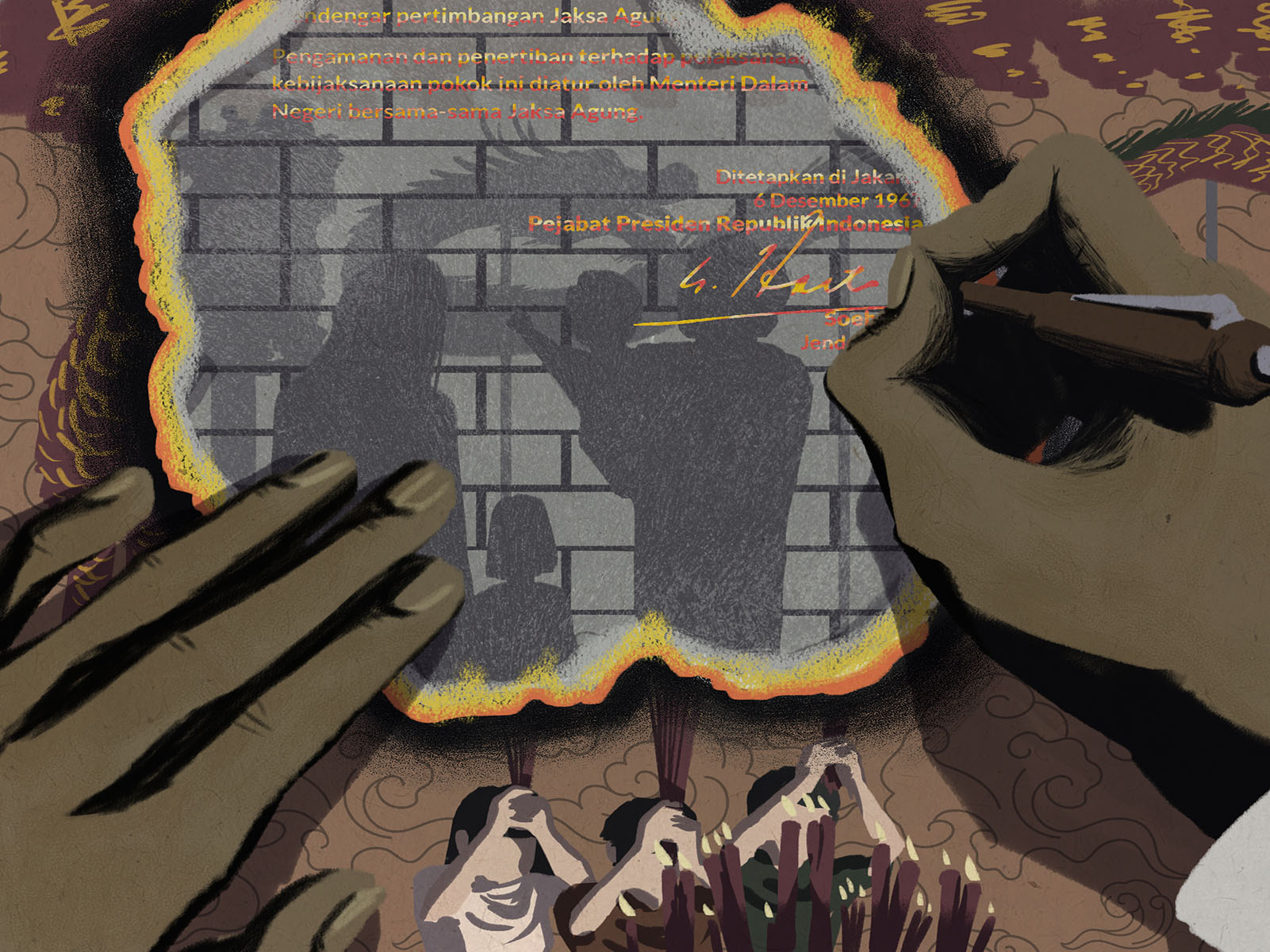
The epistemicide of Chinese-Indonesians. Illustration: Abdul Malik Amirullah/Project Multatuli
(Trigger Warning: This article may be distressing or triggering for some readers.)
May 1998 was the moment when I began to associate the word “Chinese-Indonesian” with “violence” and “rape”.
At the end of elementary school, it was the first time I was forced to be afraid of my identity both as a woman and as a Chinese-Indonesian, and I was frustrated because I did not understand how I ended up feeling that way. I knew almost nothing about the history of Chinese-Indonesians that led to the May 1998 riots. That ignorance made it even harder for me to understand my own emotions.
My parents also didn’t explain much. “The most important thing is, as a Chinese-Indonesian, you always have to be cautious. You can’t just say whatever you want, especially when it comes to politics,” they said.
For years I carried a pile of unanswered questions in my head. Who am I? Who is my family? What is Chinese-Indonesian? How is it that other holidays are marked with red-letter dates and celebrated festively, except for Chinese New Year? Why must we learn Mandarin in secrecy, while other regional languages can be studied freely? What really happened? Why did being Chinese start to feel wrong?
The turning point came in 2009. After graduating from university, I worked as a journalist for Suara Baru, an internal media of the Chinese-Indonesian Association (INTI) that was formed in 1999.
Even though I only worked there briefly, my time opened many doors for me to learn more deeply about Chinese-Indonesian issues and meet several Chinese-Indonesians who were directly involved in social and political work. Slowly, I began to find answers to the many questions that had haunted me for so long. Those answers were often shocking and heartbreaking.
I began to understand that the history of Chinese-Indonesians in this country is almost inseparable from the history of violence, which has often been systematically orchestrated by those in power since the VOC era. This systematic violence has spanned hundreds of years and is not only physical but also epistemic, taking the forms of neglect, concealment, and even denial of many historical facts, especially the darker parts of history.
I came to realize that the New Order regime carried out a systematic epistemicide against the Chinese-Indonesian community. The state deliberately stripped away knowledge about the history of my own ethnicity, uprooting me and other Chinese-Indonesians from our cultural roots, leaving me confused and struggling to process my own position and feelings.
As a result, I began to understand that the New Order never really died. More than 27 years after Soeharto’s downfall, the state has become increasingly blatant in its efforts to whitewash the past by erasing the violent and painful chapters of history involving the Chinese-Indonesian community.
This became very clear with a statement made by Culture Minister Fadli Zon on June 10, 2025. In an interview with IDN Times about the project to rewrite national history, Fadli referred to the mass rape of May 1998 as a “rumor” that had no proof.
His statement made my stomach turn. My chest tightened. Tears streamed down uncontrollably.
The History of Violence and ‘Disciplining’
“This is insane! How could the riots get out of control?”
My mother said that with panic etched across her face, appalled as scene after scene of apocalyptic brutality flashed endlessly across the television screen in front of us.
Fires raged and smoke filled the air. Physical clashes led to gunfire that killed without hesitation. Clenched fists went up and down as people screamed and scattered in all directions. Buildings and vehicles were covered in ash. Smooth highways turned into battlegrounds clouded with dust.
Unfortunately, we were not watching an action movie. It was real life that pierced straight into the Chinese-Indonesian community in the blink of an eye, leaving behind open wounds that have never fully healed.
Even more unfortunate, this was not the first time that a tragedy like this had happened to Chinese-Indonesians.
A number of historical milestones demonstrate how racism and discrimination against the Chinese-Indonesian community have manifested in their most extreme forms, including acts that amount to literal genocide. These include brutal massacres, rape, mutilations, and live immolations of Chinese-Indonesians.
These events include the 1740 Batavia Massacre; anti-Chinese massacres during the Indonesian National Revolution from 1946 to 1949; violence following the issuance of Presidential Regulation No. 10/1959 prohibiting Chinese-Indonesians from rural trade; the 1965 tragedy; and of course the May 1998 riots that included looting, burglary, and the mass rape of Chinese-Indonesian women.
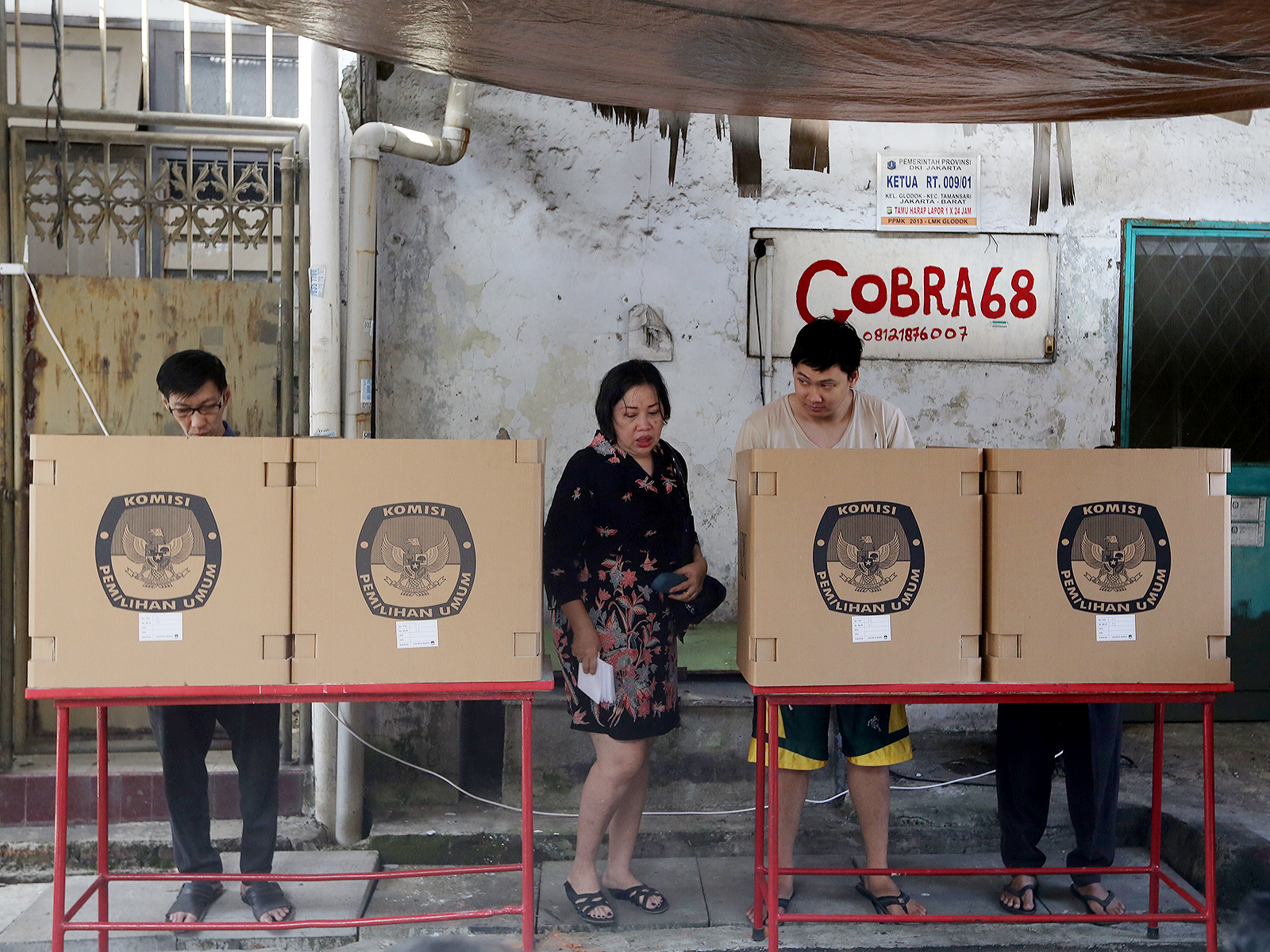
Chinese-Indonesian citizens participate in the 2014 General Elections in Glodok, Jakarta’s Chinatown and one of the tensest areas during the May 1998 riots. The high fences and iron security bars commonly installed on the windows of Chinese-Indonesian homes and shops since the riots remain a visible manifestation of the community’s lingering trauma. Photo: Ricky Yudhistira/Project Multatuli
These incidents occurred at the national level, but we have yet to fully address the widespread anti-Chinese violence at regional and sub-regional levels, where scale of brutality was no less appalling. For instance, the mass slaughter and rape of members of the Benteng Chinese community in Tangerang in June 1946, and the Mergosono tragedy in Malang in July 1947, which claimed the lives of at least 30 Chinese-Indonesians. In my own hometown, Bandung, several anti-Chinese riots have also occurred, including those on May 10, 1963 and August 5, 1973.
The repeated episodes of violence were made possible by the persistence of stereotypes that can be tracked back centuries like “Chinese-Indonesians are nothing but economic animals who only care about their own interest and benefits” and “Chinese-Indonesians are exclusive”.
During the Dutch colonial rule, Chinese-Indonesians were classified as Eastern Foreigners within the colonial demographic hierarchy. They were assigned the role of distribution intermediaries for daily necessities, serving both the colonial administration and the Malay-descended locals, whom the Dutch labeled as pribumi (a pejorative term that means “native”). This was a dilemmatic position that the Chinese-Indonesian community was compelled to occupy, whether they liked it or not.
Slowly but surely, a majority of Chinese-Indonesians (forcibly) ended up working in commerce and trade, a situation that bred resentment among the so-called pribumi, who came to see them as selfish profiteers.
After Indonesia declared independence, successive regimes carefully preserved these negative sentiments. Leaders appeared to understand how useful it was to deflect attention from their own failures by scapegoating the Chinese-Indonesians, portraying them as the root of the nation’s economic problem. The narrative was simple: “Chinese-Indonesians are greedy, so everything is their fault.”
During Sukarno’s era, the government enacted many discriminatory policies against Chinese-Indonesians that continued colonial legacies. A particularly controversial policy was the Presidential Regulation No. 10/1959, which banned Chinese-Indonesians from running retail businesses in rural areas. The military involvement in the implementation of the regulation led to major unrest that claimed the lives of many Chinese-Indonesians and massive exodus.
The 1965 tragedy, which paved the way for the rise of the New Order regime, also disproportionately targeted Chinese-Indonesians. As a communist state, China was accused of supporting the uprising and, thus, Chinese-Indonesians were automatically suspected of complicity. This logical fallacy led to the arrest and imprisonment of many Chinese-Indonesian figures who had actively contributed to Indonesia’s independence struggle. Ordinary Chinese-Indonesians suffered the most, especially with the closure of schools and constant fear of persecution.
During the New Order regime, the authoritarian president Soeharto reproduced colonial-era discriminatory tactics. He stripped Chinese-Indonesians of their access to and rights within practical politics, while granting privileges to a select few tycoons whom he considered loyal allies. This strategy ensured that all economic resources remained concentrated within the New Order’s circle of power, while Chinese-Indonesians continued to play essential roles in the economy even though they were never fully trusted. Therefore, writer Pramoedya Ananta Toer described the Chinese-Indonesian community as a “minority without political muscle”.
The New Order regime obliterated the history of the Chinese-Indonesian community’s roles and contributions to the nation-building process from various official references, before introducing new narratives that portrayed them as mere “foreign guests”—temporary residents whose rights could be easily revoked. Chinese-Indonesians were consistently constructed as “a problem” that needed to be surveilled and “solved” to avoid being seen as a threat to the country.
From there emerged a number of assimilationist policies that prohibited the use of Chinese names, as well as the Mandarin language and script. Chinese-Indonesians were banned from publicly displaying their religious, spiritual and cultural practices. At the same time, all Chinese-Indonesian media, political and social organizations, as well as Chinese-language schools were disbanded.
These discriminatory policies effectively laid the foundation for long-term racism, uprooting the Chinese-Indonesian identity to its very core and depriving the future generation of knowledge of the ethnic group’s history. The regime deliberately created distance between younger Indonesians and the collective memory of Chinese-Indonesians’ valuable contributions to the nation-building process. Even when some members of the new generations chose to become critical of the regime’s narratives and attempted to uncover the true history of Chinese-Indonesians, trauma and lack of reliable sources caused members of the ethnic group to remain silent.
This fear-based culture and knowledge, instilled by the regime, ended up being affirmed and embraced by generations of Indonesians, even by the Chinese-Indonesians.
In his Master’s thesis for Lund University in 2017, Roy Thaniago explicitly described how the Chinese-Indonesian community was being “disciplined” during the New Order regime through manipulation of media narratives. These narratives were crafted to ensure the community’s total obedience to the authorities to the point where the Chinese-Indonesians willingly disciplined and monitored their own behavior into submission.
In the end, the knowledge and culture that belong to Chinese-Indonesians today are nothing more than a product of state government violence. Centuries of systematic oppression have instilled fear so deeply that it can no longer be seen as just an individual issue. It has turned into a collective problem which has triggered intergenerational trauma.
This explains why my parents repeatedly reminded me that, as someone of Chinese-descent living in Indonesia, I always have to be extra careful. Careful with what I say, careful with how I act—because anything we say or do could backfire and put us in danger, no matter how good our intentions were. Whenever I find myself in a potential conflict with a non-Chinese, my parents always ask me to back down because even if I’m right, Chinese-Indonesians will always be seen as wrong, and will always lose in the end.
My parents also reminded me to study diligently, work hard, and focus on achieving academic and professional achievements—especially because in this country, Chinese-Indonesians are often valued only for their wealth.
Chinese-Indonesians are pressured to be financially generous, even though only a small number of us are truly wealthy. We are also expected to constantly prove our contributions just to be recognized as legitimate members of this country, even though it often feels like running a race with no finish line.
Epistemicide
I grew up in a Chinese-Indonesian family that is still deeply rooted in Chinese culture, yet I never truly experienced what it is like to see Chinese-Indonesian traditions publicly celebrated, let alone embraced in a deep and meaningful way.
Throughout the New Order period, the only major Chinese tradition my family celebrated that left a lasting impression on me was Chinese New Year. Even then, we could only celebrate it in the evening after my father came home from working long hours at a factory, physically exhausted, because Chinese New Year had not yet been recognized as a national holiday.
During that period, my parents also continued to observe several other Chinese-Indonesian traditions in private, but they never made any effort to pass them down to their children.
When I was in elementary school, my parents made an effort to teach me Mandarin themselves. At one point, they even asked me to join a Mandarin “course” held at a Christian church whose congregation was mostly Chinese-Indonesians. Of course, at that time, I didn’t understand why learning Mandarin had to be done discreetly in a church. Unfortunately, since I never use the language in daily interactions, I ended up forgetting much of the Mandarin vocabulary as I grew older.
At first, I didn’t care. But later, I realized that it was all the result of Soeharto’s discriminatory policies, which had a profound impact on me and many other Chinese-Indonesians.
For instance, I haven’t been able to trace my own family’s history because I struggled to understand my parents’ archived documents and letters, most of which were written in traditional Mandarin script. Yet the documents are the closest sources for me to understand my family history as well as the broader context of Chinese-Indonesian history as a whole.
Because my younger siblings and I did not understand Chinese customs, my father made a major decision. In 2007, he and his younger sister (my aunt) decided to exhume their parents’ graves. The bongpai, or gravestone, was destroyed, and the remaining bones were collected and cremated on the spot. They then scattered the ashes into the open sea. In their eyes, this was the best course of action, so that their children and grandchildren would not be burdened with maintaining traditions or tending graves, which can be costly.
For most Chinese families, graves carry far more cultural significance than simply being a final resting place. They are considered sacred, a symbolic tribute of respect for ancestors, a marker of identity, and a site of pilgrimage for future generations. To dismantle a grave is to erase a symbol of identity and lose the opportunity to honor and remember ancestral stories.
The dismantling of the grave is the perfect metaphor for the erasure of Chinese-Indonesian historical footprints, which was part of the epistemicide systematically carried out by the New Order regime.
As explained by Beth Patin, a professor of library and information science, epistemicide is “the killing, silencing, annihilation, or devaluing of a knowledge system”. According to her, epistemicide occurs when epistemic injustices take place persistently and systematically, collectively working as a structured and systemic oppression of particular ways of knowing.

A group of barongsai (lion dance) performers play in front of the Fatahillah Park in Jakarta. Presidential Instruction No. 14/1967 on Chinese Religions, Beliefs, and Traditions once prohibited Chinese-Indonesians from practicing religious and cultural traditions rooted in their ancestral heritage, including barongsai. Even after the instruction was officially revoked by Presidential Decree No. 6/2000, the discriminatory policy has left many young Chinese-Indonesians disconnected from their cultural identity. Photo: Ricky Yudhistira/Project Multatuli
It’s disheartening to see how many Chinese-Indonesians today know next to nothing about the important roles their ancestors once played in politics, society, media, arts, or culture. Even in the sports sector, few are aware that Chinese-Indonesians have contributed not only to badminton but also to soccer.
In August 2024, I had the privilege of discussing this topic with Astrid Reza, a researcher from the Women’s Archive and History Center (RUAS). She said that historical writing about the Chinese-Indonesian community remains rare. As a result, it will take a much longer process for anyone to uncover, layer by layer, the knowledge that was subjected long ago to a form of epistemicide by those in power.
Not to mention those who attempt to uncover the truth about their own history must contend with deeply rooted New Order narratives about Chinese-Indonesians, along with waves of paid social media operatives working to preserve the narratives.
And, just as importantly, some Chinese-Indonesians remain hesitant to learn their own history.
“The New Order not only effectively obliterated the collective memory and knowledge related to Chinese-Indonesians, but also succeeded in killing the awareness of how important that knowledge is,” Astrid said.
“The greatest success [of epistemicide] is when even Chinese-Indonesians themselves become reluctant to learn about their own history. All it takes is silencing two or three generations, and entire bodies of knowledge, even the awareness of the importance of having that knowledge, will disappear.”
Understanding the Trauma of Chinese-Indonesians
Before Culture Minister Fadli Zon dismissed the mass rapes of May 1998 as a “rumor”, several political statements and events had already signaled the continued vulnerability of Chinese-Indonesians.
In 2016, Basuki Tjahaja Purnama, also known as Ahok, who was then serving as the governor of Jakarta, was accused of blasphemy after someone edited his speech quoting a verse from the Quran, uploaded the doctored clip to social media, and spread it with a misleading narrative. Large-scale anti-Chinese protests soon followed. Although the blasphemy charges were never truly proven, Ahok who is both Chinese and Christian, was sentenced to nearly two years.
For many of my Chinese-Indonesian friends, the massive protests instantly triggered bitter memories related to the May 1998 riots. One of them who felt this was Anastasia Satriyo, a Chinese-Indonesian who works as a child and adolescent psychologist.
“It’s as if my body is having a panic attack. I can’t watch the news about [anti-Chinese] issues for too long, just getting the gist of it is enough for me. I’ve realized that watching news related to these issues could cause me to stop functioning. On top of that, I always feel some tightening sensation in my chest every time I hear people shouting anti-Chinese sentiments,” Anastasia said.
“I always wonder, why is there always prejudice against Chinese-Indonesians?”
Anies Baswedan, who succeeded Ahok as governor of Jakarta, seemed to further inflame the situation. In his inauguration speech, he explicitly used the term “pribumi” (a pejorative term meaning “native”) and contrasted it with “non-pribumi“. Historically, these terms were used by the Dutch colonial government to divide the society along ethnic lines.
Anies earned his master’s degree at the University of Maryland and his PhD at Northern Illinois University. Therefore, many people believed he knew exactly the history behind those politicized terms, and it was no coincidence that he chose to use them. It is important to note that the use of “pribumi” and “non-pribumi” had officially been abolished by B.J.Habibie’s administration in 1998.
Eight years after the Ahok incident, Prabowo Subianto came to power. Prabowo, a former son-in-law of Soeharto, is widely believed to be involved in the forced disappearance of several activists in 1998.
It didn’t take long for his regime to reveal its true colors. On October 21, 2024, after being sworn in as Coordinating Minister of Law, Human Rights, Immigration and Correctional Services, Yusril Ihza Mahendra said what happened in May 1998 “was not a gross human rights violation”.
This came despite former President Joko Widodo’s acknowledgment in 2023 of 12 past gross human rights violations, including the 1965 tragedy and the May 1998 riots.
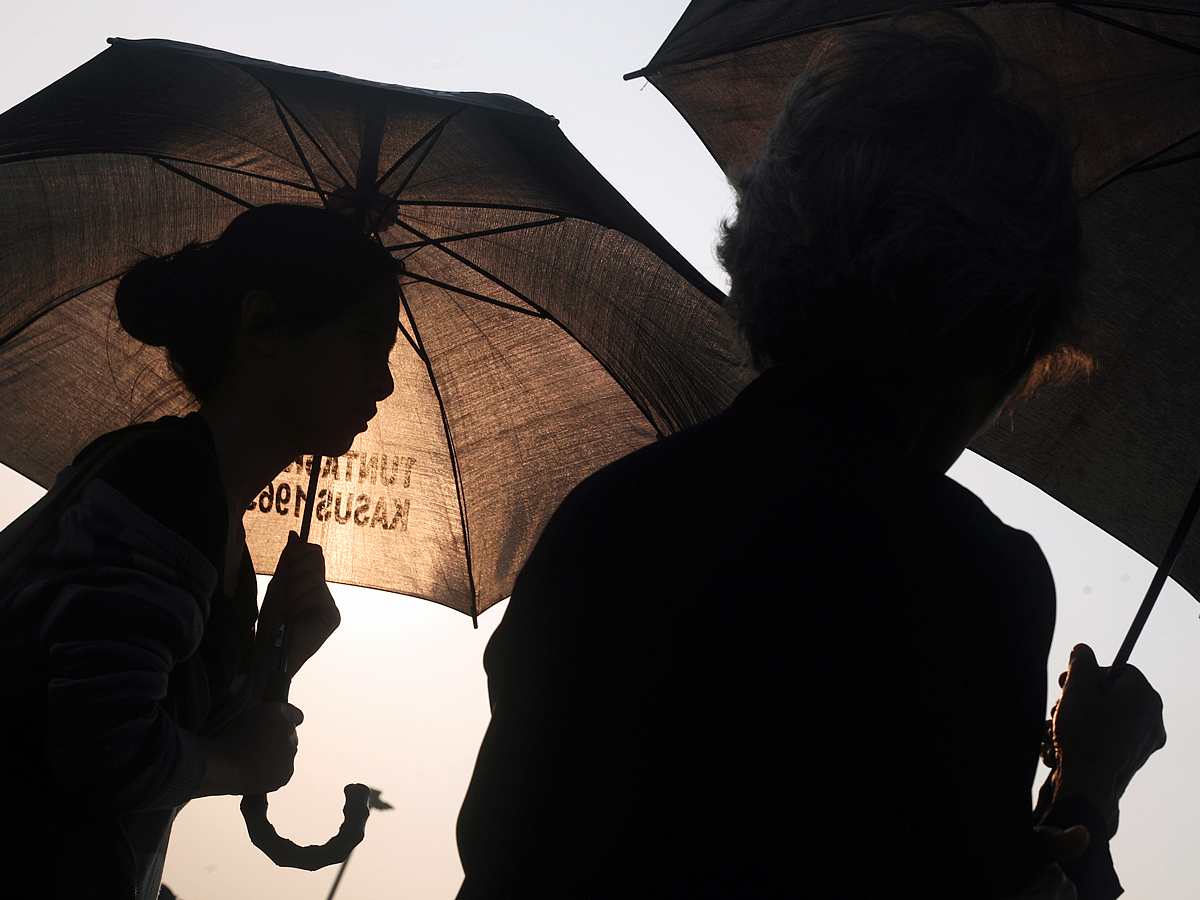
The Kamisan (Thursday) silent protests have persisted for two decades, as victims and families of gross human rights violations—including the 1965 and 1998 tragedies—continue to demand state accountability and justice. And yet, despite multiple regime changes, no legal resolution has been delivered. Instead, the state has opted for non-judicial measures that disregard the victim’s rights and dignity. Photo: Ricky Yudhistira/Project Multatuli
But it didn’t end there. My frustration and that of many other Chinese-Indonesians reached a boiling point when Fadli questioned the truth of the May 1998 mass rapes.
The first thing that came to my mind at that time was Ita Martadinata Haryono, a victim and young activist brutally murdered by those who couldn’t bear the thought of having their vile crimes exposed on the international stage. Ita was killed just before she was scheduled to testify about the mass rape in the United Nations forum.
Fadli’s words were incredibly cruel. He truly spat on the victims, witnesses and volunteers of the May 1998 tragedy, especially the women and Chinese-Indonesian community who, to this day, continue to carry the trauma, both directly and indirectly.
How can the findings of the Joint Fact-finding Team (TGPF), which clearly confirmed that a series of brutal gang rape took place in public spaces during May 1998, be denied simply because of “lack of evidence”?
Why insist on a legalistic argument which lacks empathy to defend himself? How is it possible to obtain evidence that requires victim testimony when the state offers no assurance of protection for the witnesses and survivors courageous enough to speak out?
That’s why, even though I wasn’t a direct victim, Fadli’s words threw me into emotional turmoil. My stomach turned. My chest tightened. Tears streamed down uncontrollably.
According to psychologist Anastasia, intergenerational trauma often manifests physically. When someone experiences trauma, their body’s DNA responds by activating certain genes and hormones to help the individual cope whether by confronting the threat (fight), escaping it (flight), appeasing it (fawn), or turning stiff, not taking any actions while trying to figure out the safest response (freeze).
It explains why Anastasia felt as if she was having a panic attack during the mass protest against Ahok’s so-called “blasphemy”, and why my chest suddenly tightened when I heard Fadli’s words.
In her practice as a psychologist, Anastasia often encounters subtle cases of intergenerational trauma among young Chinese-Indonesians, which usually manifest in relationship issues with their partners or parents.
“I once worked with a teenager who was confused about why her parents wouldn’t allow her to come home after 9 p.m., even though they lived in Jakarta. When she asked them about it, they simply said, ‘Remember your ethnicity,’” Anastasia said.
“This teenager became angry with her parents, especially since she had been exposed to concepts of human rights, democracy, and more. Her relationship with them turned sour.”
Other subtle forms of intergenerational trauma are also common among Chinese-Indonesians who live in a bubble, preoccupied with money, wealth, power, and lifestyle. Their focus tends to be solely on personal interests. According to Anastasia, this behavior may be an unconscious trauma response shaped by decades of systemic oppression in which Chinese-Indonesians were only allowed to engage in business and economic sectors to survive.
Therefore, Anastasia added, the issue of intergenerational trauma among Chinese-Indonesians cannot be separated from the broader power structures that have always targeted them. It is also deeply influenced by political, social, and cultural factors. This is why understanding their historical roots is crucial for Chinese-Indonesians.
“Awareness of one’s identity has a significant impact on a person’s psychological well-being. This awareness is shaped, among other things, by knowledge about one’s past, be it through family history or national history,” Anastasia said.
“The government’s attempt to uproot knowledge from Chinese-Indonesians is not just an act of epistemicide, but also of mental genocide.”
This means that efforts to heal from intergenerational trauma cannot be done by Chinese-Indonesians alone. They require strong support from the broader society—including fellow Indonesians—and the government.
But how realistic is it to expect support from the government?
After his controversial statement sparked public outrage, Culture Minister Fadli didn’t bother to apologize. On June 16, 2025, he even posted a thread on X, defending his stance, which only made people angrier.
Without acknowledging the TGPF’s findings, Fadli said the people “need to be careful and meticulous” before concluding that mass rape occurred in May 1998 because “it concerns the truth and the nation’s good name”.
This argument once again reminds us of the normalization of impunity toward perpetrators of sexual violence by institutions that prioritize protecting their reputation over delivering justice to victims.
What’s even more horrifying is the state’s blatant effort to whitewash past crimes by continuously manipulating history, while all protests are dismissed as meaningless noise.
Presenting Alternate Narratives
At a time when expecting support from the government is difficult, the rise of alternative sources about Chinese-Indonesians on social media offers a glimpse of hope.
One platform that has consistently promoted understanding of Chinese-Indonesians is Suara Peranakan. Founded in 2020, Suara Peranakan uses Instagram and X to spark discussions about Chinese-Indonesian identity and history, aiming to rebuild awareness within the community. The content it shares includes personal reflections with local perspectives that are rarely heard or represented.
Suara Peranakan covers a wide range of topics, including the hidden histories of Chinese-Indonesians, food and culinary traditions, intercultural communication, traditions and celebrations, the climate crisis, and calls for solidarity with other minority and marginalized groups sidelined by those in power. These topics are compelling because Chinese-Indonesians are no longer viewed as a single entity as they are always connected to the broader picture of global humanity.
“We must always uphold the values of solidarity and humanity because, in the end, you can’t stand alone. During the New Order era, Chinese-Indonesians were consistently labeled as money-oriented. We can break this stereotype by standing in solidarity with economically disadvantaged communities and other oppressed minority groups,” said Randy Mulyanto, a member of Suara Peranakan, in September 2024.
“Still, understanding our own history is essential as a starting point. It’s hard for us to be aware of broader issues if we don’t even know our own identity.”
Astrid Reza, the RUAS researcher, said Chinese-Indonesians could also resist epistemicide by stepping into social spaces that have long been considered difficult or even impossible for them to enter, although this is certainly no easy task.
Astrid cited her own experience of spending several days participating in the 2024 protests against the revision of the Regional Elections Law, which was allegedly aimed at allowing Kaesang Pangarep—former president Joko Widodo’s youngest son—to compete in the gubernatorial election. Astrid wanted to show that Chinese-Indonesians could voice their concerns through a demonstration, an avenue long avoided by the community due to past trauma.
Astrid’s words reminded me of a personal experience from years ago in East Aceh, during a visit for a literacy program.
One day, I ran into a group of elementary school students who were giggling, then yelled at me: “Kafir!”
“Kafir”, often translated as “infidel”, is frequently used in a derogatory way in Indonesia to refer to non-Muslims.
For a moment, I froze. I then decided to approach them and strike up a casual conversation. We talked about light topics, mostly about their daily lives.
These children admitted that they had never seen a single Chinese-Indonesian in their lives. As children of farm laborers, they rarely traveled outside their region due to financial constraints. They only knew that I looked different and assumed I might be a foreigner from Japan, Korea, or China.
After a while, as we grew closer, they started to get curious about Chinese-Indonesians.
“Tell us more about Chinese in Indonesia, please!”
I was immediately moved.
To me, their initial remark stemmed purely from ignorance. And when the official government narratives can’t be relied on, I believe there is nothing wrong with taking the initiative to reach out and share the alternative narratives myself.
Peringatan: Artikel ini bisa memicu trauma.
Epistemisida Tionghoa-Indonesia. Ilustrasi: Abdul Malik Amirullah/Project Multatuli
Mei 1998 adalah momen perdana saya mengasosiasikan “Tionghoa” dengan “kekerasan”, juga “pemerkosaan”.
Saat itu, di akhir jenjang SD, untuk pertama kalinya saya dipaksa merasa takut dengan identitas saya sebagai seorang perempuan sekaligus Tionghoa, dan saya kesal karena tak tahu mengapa bisa demikian. Selain nyaris tidak tahu apa-apa mengenai sejarah Tionghoa yang berujung kerusuhan Mei 1998, saya kesal karena ketidaktahuan tersebut membuat saya kesulitan memproses perasaan saya sendiri.
Orang tua pun tidak banyak menjelaskan. “Pokoknya, sebagai Tionghoa itu kamu mesti selalu waspada. Enggak bisa sembarang omong, apalagi omong politik,” ucap mereka.
Selama bertahun-tahun, setumpuk pertanyaan memenuhi kepala. Siapa saya? Siapa keluarga saya? Tionghoa itu apa? Mengapa hari besar lain bertanggal merah dan dirayakan semarak berhari-hari sementara Imlek tidak? Mengapa belajar Mandarin saja harus sembunyi-sembunyi seolah itu perbuatan ilegal sementara bahasa daerah lainnya tidak? Apa yang sebenarnya terjadi? Mengapa lama-lama muncul perasaan bahwa menjadi Tionghoa itu salah?
Titik baliknya ada di 2009. Setelah lulus kuliah, saya bekerja sebagai jurnalis Suara Baru. Ini adalah media internal Perhimpunan Indonesia Tionghoa (INTI), salah satu asosiasi Tionghoa terbesar di Indonesia yang berdiri pasca-1998.
Meski usia kerja di sana sangat singkat, terbuka pintu bagi saya untuk berkenalan dengan isu-isu Tionghoa secara lebih mendalam sekaligus berjumpa orang-orang Tionghoa yang terjun langsung dalam bidang sosial-politik. Perlahan, saya mulai memperoleh jawaban-jawaban atas segala pertanyaan yang begitu lama menghantui; jawaban-jawaban yang justru mengejutkan dan mencabik hati.
Saya jadi paham bahwa sejarah terkait Tionghoa di negeri ini nyaris tak pernah lepas dari sejarah kekerasan yang biasanya dirancang sistematis oleh para pemegang kekuasaan sejak era VOC. Membentang ratusan tahun, kekerasan sistemik ini bukan cuma perkara fisik tapi juga epistemik dalam bentuk pengabaian, penyembunyian, bahkan penyangkalan rupa-rupa realitas sejarah—terutama sejarah kelam.
Saya jadi paham bahwa rezim Orde Baru sungguh-sungguh menjalankan genosida pengetahuan terkait Tionghoa atau epistemisida secara sistematis. Negara sengaja merenggut pengetahuan mengenai sejarah etnis saya sendiri, mencerabut saya dan teman-teman Tionghoa lainnya dari akar kultural, juga membuat saya gamang memproses posisi dan perasaan saya sendiri.
Dan, saya jadi paham bahwa Orde Baru tak pernah benar-benar mati. Selewat 27 tahun setelah Soeharto turun takhta, negara justru kian gamblang berusaha mencuci dosa dengan menyetip babak-babak sejarah kelam yang sarat kekerasan terhadap komunitas Tionghoa.
Ini tampak jelas dalam pernyataan Menteri Kebudayaan Fadli Zon pada 10 Juni 2025. Dalam sesi wawancara dengan IDN Times terkait proyek penulisan ulang sejarah nasional, Fadli menyebut pemerkosaan massal pada Mei 1998 sebagai “rumor” yang tidak pernah ada buktinya.
Mendengar hal ini, asam lambung saya mendadak naik. Dada sesak seketika. Air mata pun mengalir tak terbendung.
Sejarah Kekerasan dan ‘Pendisiplinan’
“Ini betul-betul gila! Kok bisa rusuh sampai segitunya?”
Mama berujar dengan raut panik, tercekat menyaksikan adegan demi adegan brutal nan apokaliptik yang tak henti hilir-mudik melintasi layar televisi di hadapan kami.
Kobar api dan asap di mana-mana. Bentrok fisik berujung letup peluru tak ragu meminta nyawa. Tangan-tangan terkepal naik-turun silih berganti seiring jerit manusia yang lari berhamburan tak tentu arah. Bangunan dan kendaraan sekejap diselimuti abu. Jalan raya yang mulus jadi medan tempur berlumur debu.
Sayangnya, yang sedang kami tonton bukanlah film laga. Ia adalah realitas yang seketika menghunjam komunitas Tionghoa hingga meninggalkan luka menganga yang sulit kering.
Sayangnya lagi, ini bukan kali pertama tragedi semacam ini menimpa orang Tionghoa di Indonesia.
Ada sejumlah titik sejarah penting yang menunjukkan bagaimana rasisme dan diskriminasi terhadap Tionghoa muncul dalam wujudnya yang paling ekstrem, termasuk genosida dalam pengertian harfiah. Ini termasuk pembantaian keji, pemerkosaan, mutilasi, dan pembakaran Tionghoa hidup-hidup.
Sebut saja genosida Tionghoa di Batavia pada 1740 oleh kolonial Belanda, rangkaian pembantaian sepanjang periode revolusi kemerdekaan 1946-1949, pembantaian Tionghoa menyusul terbitnya Peraturan Pemerintah (PP) No. 10/1959, tragedi 1965, dan—tentunya—kerusuhan Mei 1998 yang diwarnai penjarahan, perampokan, serta pemerkosaan massal terhadap perempuan Tionghoa.
Warga Tionghoa mengikuti pemilihan umum 2014 di Glodok, kawasan Pecinan paling mencekam saat peristiwa kerusuhan Mei 1998 di Jakarta. Pagar tinggi dan teralis besi di setiap jendela rumah dan toko yang ramai dipasang untuk perlindungan diri sejak kerusuhan rasial itu menjadi manifestasi trauma warga Tionghoa yang tidak pernah sembuh. Foto: Ricky Yudhistira/Project Multatuli
Itu baru contoh di tingkat nasional. Belum lagi di tingkat regional dan sub-regional yang skala kekejamannya tak kalah mencengangkan, misalnya tragedi Cina Benteng di Tangerang pada Juni 1946 yang juga diwarnai pembunuhan dan pemerkosaan massal dan tragedi Mergosono di Malang pada Juli 1947 yang mengorbankan setidaknya 30 Tionghoa. Di kota kelahiran saya, Bandung, beragam huru-hara anti-Tionghoa pun pernah terjadi seperti kerusuhan 10 Mei 1963 dan 5 Agustus 1973.
Kekerasan berulang kali terjadi seiring langgengnya stigma-stigma seperti “Tionghoa adalah binatang ekonomi yang hanya memikirkan kepentingan dan keuntungannya sendiri” dan “Tionghoa itu selalu eksklusif”, yang bisa ditelusuri jejaknya hingga ratusan tahun silam.
Di masa kolonial Belanda, Tionghoa diposisikan sebagai Timur Asing dalam strata kependudukan, yang berfungsi sebagai perantara distribusi barang kebutuhan sehari-hari bagi kolonial sekaligus bumiputra. Ini peran dilematis yang mau tak mau mesti dilakoni komunitas Tionghoa saat itu.
Perlahan tapi pasti, sebagian besar Tionghoa (terpaksa) menjalankan hidup dalam bidang ekonomi dan perdagangan, situasi yang lantas melahirkan sentimen negatif di kalangan bumiputra bahwa kelompok ini hanya fokus mengejar keuntungan pribadi dengan menghalalkan segala cara.
Setelah Indonesia merdeka, setiap rezim yang berkuasa dengan telaten memelihara sentimen negatif ini. Para penguasa tampaknya tahu persis bahwa cara paling ampuh untuk mengalihkan perhatian rakyat dari ketidakbecusan mereka mengelola negara adalah mengambinghitamkan komunitas Tionghoa, menunjuk kelompok ini sebagai penyebab utama krisis atau ketimpangan ekonomi. Mudahnya, narasinya seperti ini: “Tionghoa rakus, jadi semuanya salah Tionghoa.”
Sepanjang era Sukarno, aneka kebijakan diskriminatif yang menargetkan Tionghoa hadir melanjutkan warisan kolonial Belanda. Salah satu yang memicu konflik adalah PP No. 10/1959 yang melarang orang Tionghoa berdagang eceran di perdesaan. Pelibatan militer dalam implementasi kebijakan ini berujung rusuh hebat yang memakan banyak korban orang Tionghoa dan memicu gelombang pengungsian besar-besaran.
Tragedi 1965 yang membuka jalan lahirnya Orde Baru pun menumbalkan banyak orang Tionghoa. Tiongkok yang komunis dituding terlibat mendukung pemberontakan sehingga Tionghoa di Indonesia diasumsikan pasti ikut terlibat. Sesat logika ini bahkan membuat banyak tokoh Tionghoa yang berjasa besar memerdekakan Indonesia tetap diciduk dan dibui. Dampak 1965 paling nyata dirasakan para Tionghoa jelata, termasuk karena penutupan sekolah-sekolah dan rasa takut yang senantiasa mengintai.
Selama rezim Orde Baru, presiden otoriter Soeharto mereproduksi taktik kolonial. Ia mengebiri seluruh akses dan hak Tionghoa terhadap politik praktis, tapi melimpahkan hak istimewa pada segelintir cukong yang dianggap sekutu loyal. Strategi ini memastikan ekonomi tetap terkonsentrasi pada lingkaran kekuasaan Orde Baru, sementara masyarakat Tionghoa tetap dalam posisi diperlukan tetapi tidak pernah dipercaya. Karena itu, penulis Pramoedya Ananta Toer menyebut komunitas Tionghoa “minoritas tanpa otot politik”.
Orde Baru melenyapkan sejarah peran dan kontribusi Tionghoa dalam pembangunan bangsa dari berbagai rujukan resmi, lalu menyusun ulang narasi-narasi baru yang membingkai Tionghoa sebagai “tamu asing” yang menumpang hidup di Indonesia dan pantas dikebiri. Tionghoa dikonstruksikan sebagai “masalah”, sehingga perlu diawasi dan dicari jalan keluarnya supaya tidak merugikan Indonesia.
Dari sana, lahirlah serangkaian kebijakan asimilasi yang melarang penggunaan nama Tionghoa serta bahasa dan aksara Mandarin. Kegiatan keagamaan, kepercayaan, dan adat istiadat orang Tionghoa tak bisa ditampilkan di depan umum. Media, organisasi politik dan sosial, serta sekolah Tionghoa pun dibubarkan.
Ini semua terbukti berhasil meletakkan fondasi rasialisme jangka panjang, mencerabut identitas Tionghoa hingga ke akar-akarnya, sekaligus membuat generasi berikutnya buta sejarah. Generasi penerus sengaja dibuat berjarak dengan memori kolektif terkait kontribusi Tionghoa. Kalaupun ada yang memilih kritis dan mencoba membongkar sejarahnya, minimnya referensi yang bisa dipercaya dan trauma membuat orang Tionghoa enggan bersuara.
Budaya dan pengetahuan berbasis rasa takut yang dialami selama bergenerasi-generasi akhirnya diamini dan dirangkul, bahkan oleh orang Tionghoa sendiri.
Dalam tesis masternya untuk Lund University pada 2017, Roy Thaniago gamblang memperlihatkan bagaimana Tionghoa “didisiplinkan” melalui permainan wacana di media massa supaya mereka selalu patuh terhadap kehendak penguasa, sampai-sampai pendisiplinan ini menjadi hal yang diinginkan oleh orang Tionghoa sendiri.
Akhirnya, segenap pengetahuan serta kebudayaan yang dimiliki Tionghoa-Indonesia saat ini tak lain merupakan produk kekerasan dari pemerintah. Penindasan terstruktur yang membuahkan ketakutan selama ratusan tahun bukan lagi masalah individu semata. Ia telah menjelma permasalahan kolektif yang memicu trauma lintas generasi.
Ini cukup menjelaskan mengapa orang tua berkali-kali menasihati saya bahwa hidup sebagai Tionghoa yang tinggal di Indonesia itu mesti selalu ekstra hati-hati. Hati-hati dalam berucap, hati-hati dalam bertindak, karena apa pun yang kami katakan dan lakukan bisa berbalik menjadi bumerang yang membahayakan sekalipun itikadnya baik. Jika berpotensi adu konflik dengan non-Tionghoa, saya selalu diminta mengalah karena sekalipun saya benar, Tionghoa pasti dianggap salah dan akan kalah.
Orang tua juga mengingatkan saya untuk belajar dengan tekun, bekerja keras, dan mencapai prestasi setinggi-tingginya—apalagi nilai Tionghoa di mata banyak orang biasanya terletak pada hartanya.
Tionghoa dituntut rajin memberi, sekalipun faktanya hanya segelintir saja Tionghoa yang super kaya. Tionghoa pun diminta selalu pro-aktif menunjukkan kontribusi mereka agar bisa diakui sebagai bagian dari Indonesia, meski ini bagai lomba lari tanpa garis finis.
Genosida Pengetahuan
Saya tumbuh besar di lingkungan keluarga Tionghoa yang masih sangat totok, tapi tak pernah benar-benar merasakan bagaimana kultur Tionghoa dirayakan, apalagi dimaknai secara mendalam.
Di era Orde Baru, tradisi akbar Tionghoa yang dirayakan keluarga dan membekas dalam benak saya hanyalah Imlek. Itu pun baru bisa kami rayakan jelang petang selepas papa yang buruh pabrik pulang bekerja dalam kondisi lelah karena Imlek belum diakui sebagai hari libur nasional.
Ada beberapa tradisi Tionghoa lain yang masih dijalankan orang tua, tapi mereka tak pernah berusaha menjelaskan kepada anak-anaknya.
Saat saya SD, orang tua memang sempat mengajarkan bahasa Mandarin secara autodidak. Saya pun pernah diminta orang tua mengikuti “kursus” Mandarin di sebuah gereja Kristen yang jemaatnya didominasi Tionghoa. Tentu, saat itu saya belum paham mengapa belajar Mandarin saja harus sembunyi-sembunyi di gereja. Masalahnya, karena tidak pernah digunakan dalam pergaulan, banyak kosakata Mandarin yang akhirnya terlupa begitu saja saat saya beranjak dewasa.
Awalnya, saya tidak ambil pusing. Di kemudian hari, barulah saya sadar bahwa ini semua adalah hasil kebijakan diskriminatif Soeharto yang berdampak begitu dalam bagi saya dan banyak Tionghoa lainnya.
Saya, misalnya, jadi tak mampu menelusuri akar sejarah keluarga sendiri karena kesulitan memahami arsip dokumen dan surat-menyurat orang tua yang kebanyakan ditulis dalam aksara Mandarin tradisional. Padahal, itulah sumber paling dekat untuk memahami sejarah keluarga sekaligus konteks sejarah Tionghoa-Indonesia secara keseluruhan.
Karena saya dan adik-adik tidak mengerti adat istiadat Tionghoa, papa pun mengambil keputusan besar. Pada 2007, papa dan adik perempuannya (tante saya) menggali kembali makam orang tua mereka. Bongpai atau batu nisan dihancurkan, sementara tulang-belulang yang tersisa diangkat dan kemudian dikremasi di tempat. Abunya lantas dilarung ke laut lepas. Di mata mereka, inilah langkah terbaik supaya anak-cucu tak perlu repot di kemudian hari menghidupi tradisi sekaligus mengurus makam yang biayanya tak murah.
Bagi kebanyakan Tionghoa, makam bukan sekadar situs peristirahatan terakhir. Ia bermakna sakral sebagai wujud penghormatan terhadap leluhur, penanda identitas, juga tujuan ziarah bagi generasi penerus. Pembongkaran makam berarti lenyapnya penanda identitas sekaligus buyarnya kesempatan merayakan kisah-kisah leluhur.
Pembongkaran makam itu adalah metafora paling sempurna dari pembumihangusan jejak sejarah Tionghoa, yang merupakan bagian dari genosida pengetahuan atau epistemisida yang begitu gencar dijalankan rezim Orde Baru.
Seperti yang dijelaskan Beth Patin, profesor ilmu perpustakaan dan informasi, “epistemisida” adalah “pembunuhan, pembungkaman, pemusnahan, atau devaluasi sebuah sistem pengetahuan”. Menurutnya, epistemisida terjadi ketika ketidakadilan epistemik terjadi secara terus-menerus dan sistematis, dan secara kolektif menghasilkan penindasan terstruktur dan sistemik terhadap cara-cara kita untuk mengetahui suatu hal.
Kelompok barongsai tampil di hadapan pengunjung Taman Fatahillah di Jakarta. Instruksi Presiden No 14 tahun 1967 tentang Agama, Kepercayaan, dan Adat Istiadat Cina, melarang warga Tionghoa menyelenggarakan kegiatan agama dan tradisi yang berpusat pada budaya negeri leluhur mereka, termasuk barongsai. Setelah Inpres itu dicabut Keputusan Presiden No. 6 tahun 2000, yang tertinggal adalah banyak generasi muda Tionghoa tercerabut dari identitasnya. Foto: Ricky Yudhistira/Project Multatuli
Sungguh sedih rasanya ketika saya mendapati orang-orang Tionghoa sendiri kini sudah tidak tahu apa-apa mengenai peran penting nenek moyangnya dalam bidang politik, sosial, media, seni, ataupun budaya. Bahkan dalam bidang olahraga yang lebih familier pun tak banyak yang tahu bahwa kontribusi Tionghoa bukan sekadar di bidang badminton, tapi juga sepak bola.
Pada Agustus 2024, saya sempat berbincang soal ini dengan Astrid Reza, peneliti dari Ruang Arsip dan Sejarah Perempuan (RUAS). Ia bilang penulisan sejarah mengenai Tionghoa masih langka. Karena itu, perlu waktu relatif lebih panjang bagi seseorang untuk membuka kembali lapis demi lapis pengetahuan-pengetahuan yang sudah lama digenosida oleh penguasa.
Belum lagi, mereka yang berusaha menggali sejarah mesti bergelut dengan narasi Orde Baru yang telah begitu mendarah daging dan serbuan buzzer di media sosial yang aktif dikerahkan untuk melestarikan narasi tersebut.
Dan, yang tak kalah pentingnya, ada keengganan dari kelompok Tionghoa untuk mempelajari sejarahnya sendiri.
“Orde Baru bukan hanya efektif membunuh memori kolektif dan pengetahuan-pengetahuan tentang Tionghoa, tapi juga membunuh kesadaran tentang pentingnya memiliki pengetahuan itu sendiri,” kata Astrid.
“Keberhasilan paling gemilang [dari epistemisida] adalah ketika justru orang-orang Tionghoa menjadi enggan mencari tahu sejarah mereka sendiri. Hanya perlu membungkam dua hingga tiga generasi, berbagai pengetahuan dan bahkan kesadaran untuk memiliki pengetahuan pun lenyap.”
Memahami Trauma Tionghoa-Indonesia
Sebelum Menteri Kebudayaan Fadli Zon menyatakan pemerkosaan massal Mei 1998 adalah “rumor”, sebenarnya telah muncul sejumlah pernyataan dan peristiwa politik yang menunjukkan posisi Tionghoa-Indonesia masih sangat rentan.
Pada 2016, Basuki Tjahaja Purnama alias Ahok yang saat itu menjabat gubernur Jakarta dituduh menista Islam setelah ada oknum yang memenggal pidatonya yang mengutip ayat Al-Qur’an, mengunggahnya di media sosial, dan menyebarluaskannya dengan narasi menyesatkan. Demonstrasi besar-besaran bernuansa anti-Tionghoa digelar tak lama kemudian. Meski tuduhan menista tak pernah benar-benar terbukti, Ahok yang Tionghoa dan Kristen lantas dipenjara hampir dua tahun.
Bagi banyak teman Tionghoa, demonstrasi besar yang terjadi saat itu sontak memantik memori pahit terkait kerusuhan Mei 1998. Salah satu yang merasakan hal ini adalah Anastasia Satriyo, seorang Tionghoa yang berprofesi sebagai psikolog anak dan remaja.
“Tubuhku seperti mengalami serangan panik. Aku enggak bisa lihat berita kayak gitu terlalu lama, cukup tahu saja. Aku sadar kalau lama-lama menonton berita seperti itu, aku bisa enggak berfungsi. Selain itu, ada sensasi sesak di dada tiap kali mendengar sentimen-sentimen anti-Tionghoa diteriakkan,” ujar Anastasia.
“Saya bertanya-tanya kenapa sih harus selalu ada prasangka terhadap kelompok Tionghoa?”
Anies Baswedan, yang menggantikan Ahok sebagai gubernur Jakarta, lalu seakan memperkeruh suasana. Dalam pidato pelantikannya, Anies terang-terangan menyebut istilah “pribumi” versus “non-pribumi” yang dahulu digunakan Belanda untuk memecah belah masyarakat.
Anies menamatkan pendidikan S2 di University of Maryland dan S3 di Northern Illinois University. Karena itu, banyak orang percaya Anies tahu persis sejarah di balik kata-kata tersebut, dan bukan kebetulan ia memilih menggunakannya. Sebagai catatan, penggunaan istilah “pribumi” dan “non-pribumi” di lingkungan pemerintahan telah resmi dicabut pemerintahan B.J. Habibie pada 1998.
Selang delapan tahun setelah peristiwa Ahok, terbitlah rezim Prabowo Subianto, mantan menantu Soeharto yang diduga ada di belakang penghilangan paksa sejumlah aktivis 1998.
Tak butuh waktu lama bagi rezim ini untuk menampilkan watak aslinya. Pada 21 Oktober 2024, usai dilantik sebagai Menteri Koordinator Bidang Hukum, HAM, Imigrasi, dan Pemasyarakatan, Yusril Ihza Mahendra menyebut apa yang terjadi pada Mei 1998 “bukan merupakan bentuk pelanggaran HAM berat”.
Padahal, pada awal 2023, Presiden Joko Widodo telah mengakui ada 12 pelanggaran HAM berat di masa lalu, termasuk tragedi 1965 dan kerusuhan Mei 1998.
Selama hampir dua dekade aksi Kamisan, korban dan keluarga pelanggaran HAM berat -di antaranya tragedi 1965 dan 1998- terus menuntut keadilan dan pertanggungjawaban negara. Namun, pergantian rezim tak membawa penyelesaian hukum, dan negara justru memilih jalur non-yudisial yang mengabaikan hak serta martabat korban. Foto: Ricky Yudhistira/Project Multatuli
Tak berhenti di situ, frustrasi saya dan banyak Tionghoa lainnya memuncak setelah Fadli mempertanyakan kebenaran pemerkosaan massal pada Mei 1998.
Hal pertama yang tebersit dalam benak saya tentu saja Ita Martadinata Haryono, korban sekaligus aktivis perempuan muda yang dibunuh secara keji oleh mereka yang tak terima laku bejatnya bakal diumbar di altar internasional. Ucapan Fadli luar biasa jahat. Ia benar-benar meludahi para korban, saksi, dan relawan Mei 1998, khususnya perempuan dan komunitas Tionghoa yang secara langsung maupun tak langsung masih terdampak peristiwa tersebut hingga detik ini.
Bagaimana mungkin temuan Tim Gabungan Pencari Fakta (TGPF) yang sudah sedemikian gamblang mengonfirmasi terjadinya gang rape alias pemerkosaan massal di ruang publik secara brutal selama peristiwa Mei 1998 malah disangkal begitu saja dengan alasan minim pembuktian?
Mengapa ngotot menggunakan alasan legal yang nir-empati untuk membela diri? Mana bisa pembuktian yang mensyaratkan pengakuan korban diharapkan terjadi di tengah ketiadaan jaminan perlindungan negara terhadap para saksi dan korban yang berani buka suara?
Karena itu, meski bukan korban langsung, emosi saya bergolak hebat mendengar kata-kata Fadli. Asam lambung saya naik. Dada sesak seketika. Air mata pun mengalir tak terbendung.
Menurut psikolog Anastasia, jejak trauma lintas generasi biasanya memang termanifestasi di tubuh. Ketika seseorang mengalami trauma, DNA tubuh akan merespons dengan mengaktifkan gen dan hormon tertentu untuk membantu individu melewati masa-masa traumatis entah dengan melawan ancaman (fight), menghindari ancaman (flight), meredakan sumber ancaman (fawn), atau malah kaku dan menunggu untuk menentukan respons terbaik (freeze).
Makanya, Anastasia bagai kena serangan panik saat terjadi demonstrasi menentang “penistaan agama” oleh Ahok, dan dada saya sesak mendengar kata-kata Fadli.
Selama berpraktik sebagai psikolog, Anastasia pun kerap menemui kasus-kasus trauma lintas generasi pada level yang lebih subtil di kalangan anak muda Tionghoa, yang umumnya termanifestasi dalam isu hubungan dengan pasangan atau orang tua.
“Pernah ada remaja yang bingung kenapa orang tuanya melarang dia pulang di atas jam sembilan malam, padahal mereka tinggal di Jakarta. Ketika dia bertanya, orang tuanya hanya menjawab singkat, ‘Ingat kamu tuh etnis apa,’” kata Anastasia.
“Remaja ini jadi marah dengan orang tuanya, apalagi ia sudah banyak terpapar dengan konsep-konsep hak asasi manusia, demokrasi, dan lainnya. Relasi dengan orang tuanya jadi buruk.”
Trauma lintas generasi subtil lainnya pun jamak ditemui pada kelompok Tionghoa yang hidup di dalam bubble dan hanya sibuk membahas uang, kekayaan, kekuasaan, dan gaya hidup. Fokusnya hanyalah diri sendiri. Anastasia bilang hal-hal macam ini bisa jadi merupakan bentuk respons trauma yang tak disadari akibat penindasan bertahun-tahun terhadap Tionghoa yang dulunya hanya diizinkan menggeluti bidang bisnis dan ekonomi untuk bertahan hidup.
Karena itu, menurut Anastasia, problem trauma lintas generasi Tionghoa tak bisa dilepaskan begitu saja dari keterkaitannya dengan struktur kekuasaan yang selalu menargetkan Tionghoa. Ini sangat dipengaruhi faktor-faktor politik, sosial, dan budaya. Itu sebabnya amat penting bagi Tionghoa untuk memahami akar sejarahnya sendiri.
“Kesadaran akan identitas sangat memengaruhi kondisi psikologis seseorang. Salah satu sumber untuk membangun kesadaran tersebut berasal dari pengetahuan-pengetahuan akan sejarah masa lalunya, baik sejarah keluarga maupun sejarah nasional,” kata Anastasia.
“Upaya pemerintah mencerabut pengetahuan dari diri Tionghoa bukan saja genosida pengetahuan tetapi juga genosida mental.”
Artinya, upaya pemulihan trauma lintas generasi tidak bisa diselesaikan sendiri oleh Tionghoa. Ia sangat membutuhkan dukungan dari lingkungan, dalam hal ini masyarakat dan pemerintah.
Masalahnya, realistiskah berharap ada dukungan dari pemerintah?
Setelah pernyataannya membuat gaduh, Menteri Kebudayaan Fadli toh tidak meminta maaf. Pada 16 Juni 2025, ia malah membuat utas penyangkalan di media sosial X yang isinya semakin bikin jengkel.
Tanpa menyinggung temuan TGPF, Fadli mengatakan “perlu kehati-hatian dan ketelitian” sebelum menyimpulkan ada pemerkosaan massal pada Mei 1998, karena ini “menyangkut kebenaran dan nama baik bangsa”.
Argumen ini sekali lagi mengingatkan kita pada normalisasi praktik impunitas terhadap para pelaku kekerasan seksual oleh institusi yang lebih memilih nama baiknya ketimbang keadilan pada korban.
Yang lebih mengerikan, upaya negara mencuci dosa dengan memanipulasi sejarah itu terus berjalan dengan begitu gamblang, dan segala protes yang muncul hanya dianggap angin lalu.
Menghadirkan Narasi Alternatif
Di saat sulit berharap pada pemerintah, munculnya sumber-sumber pengetahuan alternatif mengenai Tionghoa di media sosial seakan memberi sepercik harapan.
Salah satu yang konsisten menyebarluaskan pemahaman mengenai Tionghoa adalah Suara Peranakan. Digagas pada 2020, Suara Peranakan memanfaatkan Instagram dan X untuk memantik diskusi mengenai Tionghoa sekaligus membangun kembali kesadaran Tionghoa akan sejarah dan identitasnya. Pengetahuan yang disebarluaskan menyertakan refleksi pribadi, juga perspektif lokal yang selama ini jarang disuarakan.
Suara Peranakan mengusung topik beragam, termasuk sejarah-sejarah Tionghoa yang disembunyikan, pangan dan kuliner, komunikasi antarbudaya, tradisi dan perayaan Tionghoa, ragam Tionghoa non-Jawa, krisis iklim, hingga seruan solidaritas terhadap sesama minoritas dan kelompok marginal yang tersisihkan oleh kekuasaan. Topik-topik ini jadi sangat menarik karena Tionghoa tak lagi disorot sebagai entitas tunggal melainkan selalu terkait dengan gambar besar kemanusiaan global.
“Nilai solidaritas dan kemanusiaan memang harus selalu dibawa karena pada akhirnya lo enggak bisa berdiri sendiri. Di zaman Orde Baru, Tionghoa selalu dicap berorientasi pada uang. Tionghoa bisa mendobrak stereotip tersebut dengan menggalang solidaritas bersama masyarakat yang ekonominya lebih terbatas, juga bersama kelompok minoritas tertindas lainnya,” kata Randy Mulyanto, anggota Suara Peranakan, pada September 2024.
“Tapi, mengenali sejarah sendiri tetap penting sebagai pintu masuk. Sulit bagi kita untuk sadar dengan isu-isu yang lebih luas kalau identitas sendiri saja tidak tahu.”
Astrid Reza, peneliti RUAS, mengatakan Tionghoa juga dapat berupaya melawan genosida pengetahuan dengan menempatkan diri di ruang-ruang yang selama ini jarang atau bahkan dianggap mustahil dimasuki—walau ini tentu tak mudah.
Astrid mencontohkan bagaimana ia terjun berhari-hari dalam demonstrasi menentang revisi Undang-Undang Pilkada yang menjadi kedok untuk menempatkan putra bungsu presiden dalam tampuk kekuasaan di level provinsi—sebuah ancaman serius bagi demokrasi Indonesia. Selain menyuarakan aspirasinya, Astrid ingin memperlihatkan bahwa Tionghoa juga dapat menyampaikan pendapat melalui demonstrasi, ruang yang selama ini banyak dihindari Tionghoa akibat trauma masa lalu.
Pernyataan Astrid melayangkan ingatan saya pada sebuah pengalaman pribadi yang terjadi bertahun-tahun silam di Aceh Timur, ketika saya berkunjung ke sana dalam rangka aktivitas literasi.
Satu hari, saya berpapasan dengan sekelompok anak SD, yang sembari cekikikan kemudian meneriaki saya: “Kafir!”
Sejenak, saya terpaku, sebelum memutuskan menghampiri dan mengajak mereka berbincang santai. Kami mengobrol soal topik-topik ringan saja, utamanya terkait keseharian mereka.
Anak-anak ini mengaku tidak pernah melihat seorang Tionghoa pun sejak mereka lahir. Sebagai anak-anak buruh tani, mereka jarang bepergian ke luar daerah karena keterbatasan biaya. Mereka hanya tahu bahwa saya berbeda tampilan, mengira saya warga negara asing entah dari Jepang, Korea, atau Tiongkok.
Selang beberapa waktu, ketika kedekatan perlahan terjalin, mereka mulai tertarik mengetahui lebih banyak tentang Tionghoa.
“Kak, ceritakan lebih banyak tentang Cina yang tinggal di Indonesia dong!”
Saya sontak terharu.
Bagi saya, celetukan anak-anak itu murni datang dari ketidaktahuan. Dan, saat narasi resmi pemerintah tak bisa diandalkan, saya kira tidak ada salahnya menjemput bola dan menyerukan narasi alternatif.

Randeep Singh was not fortunate enough to get arrested, shackled, and strapped into a seat on the Amritsar-bound C-17 flight from the United States. After struggling in alien lands for 264 days, he finally died in Cambodia on his way to the US, while taking a dunki route (donkey flight) on February 21 this year.
You might say Pargat Singh was luckier. Another Punjabi lured by foreign dreams, his journey to the US began with selling half of his family’s 3-acre landholding, and most of his mother’s jewellery – and ended with his deportation to India. He returned home in handcuffs, but at least lived to tell the tale.
At Randeep’s house in village Sheikhpura Kalan of Punjab’s Mohali district now, only sathar — a funeral ritual of sitting on the floor after a death in the family — brings grim testimony to his heart-rending story. The tiny two-room house falls short on space in accommodating the mourners, who are waiting for his remains to arrive. But that doesn’t seem about to happen anytime soon. The Indian Embassy in Cambodia has asked for an advance of USD 7,100 (roughly Rs. 6,21,000) to cover all expenses in dispatching the body back home.
That six-digit figure is incomprehensible to Randeep’s father, 55-year-old Balwinder Singh, who is a daily wage labourer and earns Rs. 500 on those lucky days he finds work at all. Regardless of whether he knows them or not, Balwinder gazes at each visitor with a fragile hope and whispers just one sentence. “Body lai ke aaun da dekho [Please do something to bring the body back].”
With joblessness and agrarian crisis stalking the countryside, Randeep, 24, was not the only one yearning to escape Punjab. Born in a landless Dalit family, he was raised amid sheer hopelessness when successive crop failures, unavailability of work, and a wave of suicides had engulfed rural Punjab.

Intense grief marks every corner of Randeep Singh’s house in Sheikhpura Kalan village, Mohali district. His mother Gian Kaur (centre, in printed brown shawl) is inconsolable. Photo: Vishav Bharti/PARI
A study by Punjab Agricultural University, Ludhiana, found that the state had seen 16,606 farm suicides from 2000 to 2015. Half of these were landless Dalit agricultural labourers. Following that period too, the claims of successive governments about ‘turning Punjab into California,’ or creating an abundance of employment that would entice even job-seeking foreigners to come here, seem to have left youth unimpressed.
The return in chains from the USA of many from this generation confirms that. Why would they otherwise have gone there in search of a better life? On March 13 this year, the Union Government stated in Parliament that among the 388 people deported to India by the US, 39.43 per cent were from Punjab and 34.02 per cent from Haryana. That is, close to three-fourths of the total. The boom of the immigration business, of centres running the International English Language Testing System (IELTS) and Test of English as a Foreign Language (TOEFL) even in small towns, confirms this sad truth. Escaping Punjab had become the only dream of large numbers of youngsters.
Earlier, the government of India had stated in Parliament that around half a million people had migrated abroad from Punjab for employment between 2016 and 2021. During the same period, 2.62 lakh students had opted to study abroad; for most of them, education was just a way to exit Punjab. The wave of suicides had been followed by another wave: a mass exodus.
Randeep’s dream was to get his elder sister married and to free his father and mother from hard labour. So, after taking high-interest loans and selling off two buffaloes, he struck a deal for Rs. 42 lakhs with a travel agent. That agent ‘guaranteed’ he would take him to the US through Canada. Randeep left home on June 1, 2024, on that assurance. The family says they paid the travel agent Rs. 25 lakhs.
The agent took him to Cambodia instead, where he died mysteriously in a hospital on February 21. “The agent has duped us. Kids are just sacrificial goats for them. Now we have to get his body back,” says Randeep’s paternal uncle Dharampal, who is a taxi driver. This is a common tale across most youngsters here who have taken the immigration plunge. After spending anywhere between Rs. 30 to 50 lakhs, the journey of many of them ends in interception, even drowning, in the Mediterranean Sea, or in the jungles of Panama, or jails in the USA.
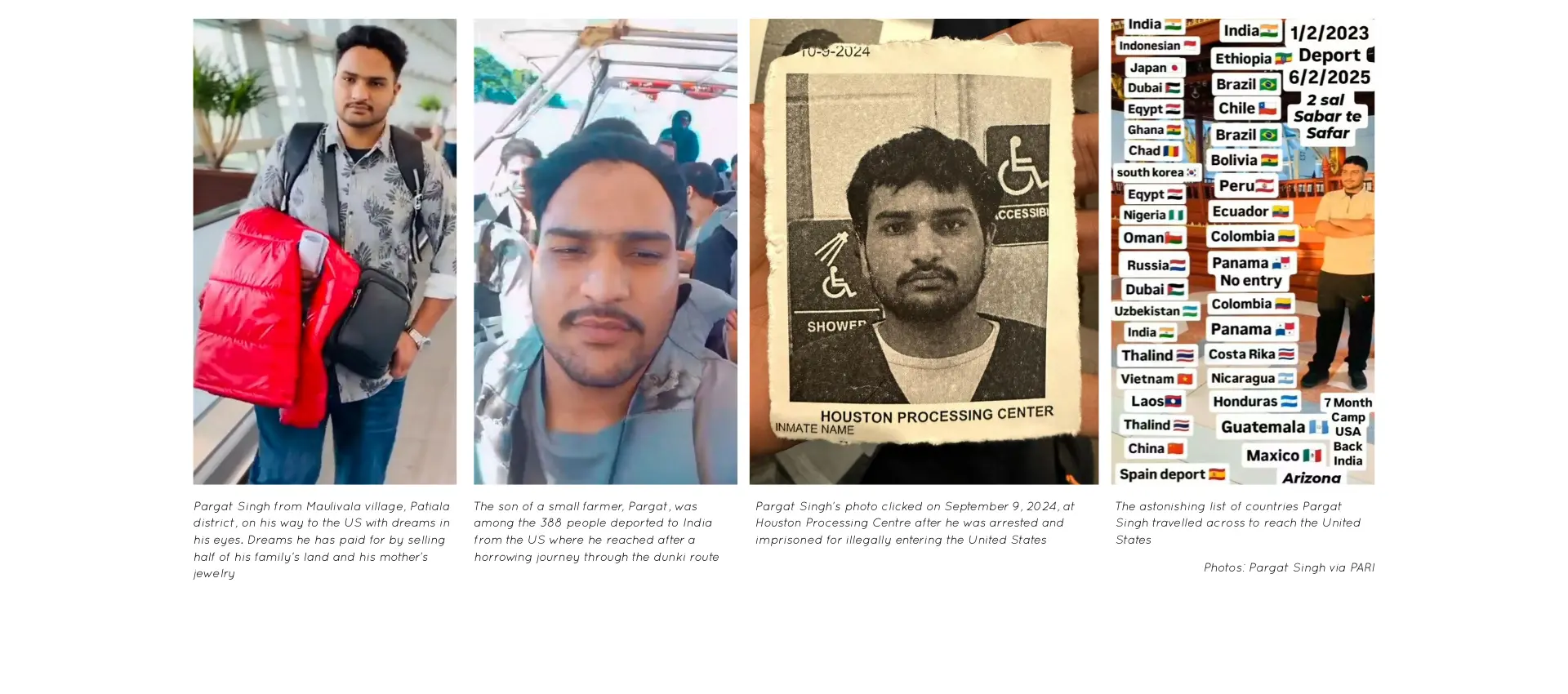
Like Randeep, Pargat Singh, a Jat Sikh and only child of a small farmer from Maulivala village in Patiala district, also wanted to reach the US. Seeing his father, 45-year-old Major Singh, unable to come out of the debt cycle, and noticing him being humiliated in the mandis when trying to get their paddy lifted at the minimum support price (MSP), he decided to move away from agriculture.
After doing a course at an Industrial Training Institute (ITI) in Patran in Patiala district, Pargat started a modern dairy farm. But all his four cows died following the outbreak of Lumpy Skin Disease (a highly contagious viral disease afflicting cattle) in 2022. “The state government promised compensation, but didn’t give us a single paisa,” he says. From that time, he started searching for ways of escaping to Europe or the US. Finally, in June 2024, he left on a long journey — called the dunki route in Punjab — for the US.
“I landed in Brazil,” says Pargat, recounting his epic journey to PARI. “There, donkers [local guides of travel agents who enable people to enter the US illegally] formed an 80-strong group from amongst us. First, we crossed countries like Bolivia, Ecuador, Colombia and Peru on a bus. Then we were pushed to the jungles of Costa Rica, Nicaragua, Honduras and Guatemala. Finally, we entered Mexico. We had trekked five days through the jungle – with just two days rations in hand.
“For the last three days, we survived only on water. Along the way, we were kidnapped by a mafia for 15 days, who demanded money to set us free. They kept on beating us until we paid them their ransom.” Pargat recalls the journey as if it were yesterday.
The moment he entered the US, he was arrested along with the others and confined to a 10×3 feet cell in a Houston jail in Texas. And remained lodged there for six months. On February 10, he was shackled and put on a Delhi-bound flight from New York. But that was not the end of his ordeal, says Pargat ruefully.
“When I landed in Delhi, the immigration officials threatened to send me to Tihar Jail. I broke down and told them: ‘Why don’t you shoot me? I already have had enough.’” The entire trip cost him Rs. 50 lakhs. It was to pay for that trip that Pargat had sold 1.5 acres of his family’s land, the gold ornaments of his 43-year-old mother Simarjit Kaur, and borrowed money from his relatives.
Randeep’s uncle Dharampal says, “It is our poverty that forces us to travel like animals.” Most of those travelling illegally or returning from the US, are marginal farmers. Lakhwinder Singh, 24, an unemployed cousin of Randeep, says “an educated person earns Rs. 10–12,000 here in Punjab. A postgraduate earns Rs. 15,000. What can you do with that? The government has given income tax exemption up to Rs. 12 lakhs. Have you heard of anybody earning one lakh a month? People often blame youngsters for going abroad, but what has the government here offered them?”
It has been eight days since Randeep’s death, but mourners continue to pour into his home. The moment anybody walks in, Balwinder Singh’s eyes look at them with a quiet hope, as if clinging to a fading dream.
The wails get louder. “Oh putt, ikk baari aaja. Ikk baari keh de, ‘Mummy main theek haan. Mera raula jhootha.’ [Son, come back just once. Just once, tell me, ‘Mom, I’m okay. News of my death is untrue’].” Randeep’s 52-year-old mother Gian Kaur wails, unable to talk further – a sound that echoes endlessly. The other women try to console her, but her wails rise with her distress.
As we prepare to leave, Balwinder slowly rises from the sathar. He quietly follows us to the door. With the words dying in his throat, he says, for the last time: “Body lai ke aaun da dekho.” His words seem to have been already lost in the cacophony over ‘illegal immigrants.’


(1) Randeep Singh’s father, daily wage labourer, Balwinder Singh, was devastated by the news of his son’s death. He also found incomprehensible the amount demanded by the Indian Embassy in Cambodia for dispatching the body of his son back home.
(2) Lakhwinder Singh, Randeep Singh’s cousin, says that a government which does little to offer job opportunities to youngsters must not blame youth for risking their lives chasing other options in foreign lands.
(3) Dharampal, Randeep Singh’s paternal uncle, is distraught at his loss and disillusioned by the way agents dupe aspirational young people.
Photos: Vishav Bharti/PARI
Postscript:
Around a month after Randeep’s death, Balwinder Singh’s son came home. Randeep’s body arrived in India and his last rites could finally be conducted at his village on March 19. But it came at a heavy cost — the family paid over Rs. 6 lakhs towards transportation expenses, while being sucked deeper into debt. They have no idea at all of how they will repay that debt.
Pargat, meanwhile, shared videos and photographs with PARI that he had shot during his journey across nine nations shepherded by illegal traffickers. These include a clip of a boat ride during his group’s journey from Colombia to Panama and another of their travel through the jungle in Panama just as they were about to enter Mexico. Also, a few frames of an awful accident they met with in Mexico while being recklessly driven at high-speed to a ‘safe location.’ Many of the group were injured. An earlier deadly accident in Colombia saw the death of two of Pargat’s fellow travellers – but that footage is not included in this video.
It’s a tale of two immigrants – but also of the torment of thousands of others.
रणदीप सिंह इतने भाग्यशाली नहीं थे कि वे अमेरिका से अमृतसर जाने वाली उड़ान संख्या सी-17 में गिरफ़्तार कर लिए जाते और उन्हें हठकड़ी पहनाकर उनकी सीट से बांध दिया जाता. अनजान जगहों पर अनेक मुश्किलों से लगातार 264 दिनों तक लड़ते रहने के बाद आख़िरकार इस साल 21 फरवरी को अमेरिका जाने के कोशिश में कंबोडिया में उनकी मौत हो गई. वे अवैध तरीक़े (डंकी फ्लाईट) से अमेरिका में दाख़िल होने की कोशिश कर रहे थे.
उनकी तुलना में परगट सिंह अधिक ख़ुशक़िस्मत रहे, जिन्होंने विदेश में जीवन के सुखद सपनों के प्रभाव में आकर अपने परिवार की 3 एकड़ ज़मीन में से आधी ज़मीन बेच दी और अपनी मां के ज़्यादातर गहने भी बेच डाले, लेकिन शुक्र था कि उनका यह सपना भारत में उनके निर्वासन के साथ ख़त्म हुआ. वह हथकड़ियों में बंधे घर लौट आए, लेकिन कम से कम अपनी कहानी बताने को जीवित रह गए.
पंजाब के मोहाली ज़िले के शेख़पुरा कलां में रणदीप के घर पर उनके मरने की ख़बर सुनकर सथर (मातमपुर्सी) में आए लोगों की भीड़ उनकी इस दर्द भरी कहानी को मार्मिक ढंग से बयान करती है. दो कमरे के उनके इस छोटे से घर में शव की प्रतीक्षा में बैठे लोगों के लिए पर्याप्त जगह भी नहीं है. बल्कि, उन सबको तो ठीक से यह भी नहीं पता है कि रणदीप का पार्थिव शरीर यहां कब तक पहुंच पाएगा. कम्बोडिया स्थित भारतीय दूतावास ने उनके परिवार से 7,100 अमेरिकी डॉलर का अग्रिम भुगतान करने को कहा है, ताकि पार्थिव शरीर को वापस भेजने का ख़र्च उठाया जा सके.
छह अंकों की यह भारी-भरकम रक़म रणदीप के 55 वर्षीय पिता बलविंदर सिंह की औक़ात से बाहर की बात है. वे एक दिहाड़ी मज़दूर हैं, और जिस दिन उन्हें काम मिल जाता है उस दिन भी वे अधिक से अधिक 500 रुपए ही कमा पाते हैं. उन आगंतुकों को देखकर जिन्हें वे ख़ुद भी नहीं जानते, वे मामूली सी उम्मीद के साथ बस इतना ही कह पाते हैं, “बॉडी लैके औन दा देखो [बॉडी को वापस लाने का कोई उपाय कीजिए].”
गांवों में बढ़ती बेरोज़गारी और अभावों के कारण रणदीप (24) अकेले नहीं थे, जो पंजाब से बाहर जाने के लिए उतावले थे. एक भूमिहीन दलित परिवार में पैदा हुए रणदीप पंजाब के ग्रामीण इलाक़ों में फ़सलों की तबाहियों से जन्मी हताशा, रोज़गार की तंगी, और किसानों की आत्महत्याओं जैसी समस्याओं के बीच पले-बढ़े.
मोहाली ज़िले के शेख़पुरा कलां गांव में रणदीप सिंह के घर का हर कोना गहरे दुख में डूबा है. उनकी मां गियान कौर (बीच में, भूरी प्रिंटेड शॉल में) शोकाकुल हैं. Photo: Vishav Bharti/PARI
लुधियाना स्थित पंजाब कृषि विश्वविद्यालय के एक शोध में यह पाया गया कि वर्ष 2000 से 2015 के बीच राज्य में खेती से जुड़े कुल 16,606 लोगों ने आत्महत्या की, जिनमें क़रीब आधे भूमिहीन दलित खेतिहर मज़दूर थे. इस अवधि के बाद भी सत्ता में आई अलग-अलग सरकारों का ‘पंजाब को कैलीफोर्निया बना देने,’ और ‘राज्य में रोज़गार की बरसात कर देने’ का वायदा भी युवाओं को लुभा नहीं पाया.
इस पीढ़ी के कई लोग जो बेड़ियों में बांधकर अमेरिका द्वारा वापस भेज दिए गए, वे इस कहानी की काली सच्चाई पर मुहर लगाने के लिए काफ़ी हैं. वर्ना वे एक बेहतर ज़िंदगी की तलाश में वहां जाते ही क्यों? इसी साल 13 मार्च को केंद्र सरकार ने संसद में यह कहा कि अमेरिका ने अवैध रूप से रह रहे जिन 388 भारतीयों को वापस भेजा है उनमें से 39.43 फ़ीसदी पंजाब के थे, और 34.02 फ़ीसदी लोग हरियाणा के थे. यह संख्या वापस भेजे गए सभी लोगों का लगभग तीन चौथाई थी. छोटे शहरों में भी विदेश भेजने के धंधे, और इन्टरनेशनल इंग्लिश लैंग्वेज टेस्टिंग सिस्टम (आईईएलटीएस) और टेस्ट ऑफ़ इंग्लिश एज ए फॉरेन लैंग्वेज (टॉफेल) को संचालित करने वाले केंद्रों में आई जबर्दस्त उछाल ने इस मायूस करने वाले सच की तस्दीक़ की है. पंजाब से बाहर निकलना वहां के अधिकतर युवाओं का सबसे बड़ा सपना बन चुका था.
पहले, भारत सरकार ने संसद में यह बात कही थी कि साल 2016 और 2021 के बीच रोज़गार की तलाश में पंजाब से तक़रीबन 5 लाख लोग विदेशों में पलायन कर चुके थे. इसी अवधि में 2.62 लाख छात्रों ने विदेशों में पढ़ने का विकल्प चुना था. इनमें से अधिकतर लोगों के लिए शिक्षा पंजाब से बाहर निकलने का एक बहाना था. पंजाब में आत्महत्याओं के दौर के साथ-साथ एक और दौर शुरू हुआ. यह बड़े पैमाने पर पलायन का दौर था.
रणदीप का सपना था कि वे अपनी बड़ी बहन की शादी कर दें और अपने मां-बाप से कड़ी मेहनत का काम छुड़वाकर उन्हें आराम दे सकें. इसलिए उन्होंने ऊंची ब्याज दर पर न केवल क़र्ज़ लिया, बल्कि अपनी दो भैंसे भी बेच दीं. उन्होंने एक ट्रेवल एजेंट के साथ 42 लाख में बात तय की. एजेंट ने उन्हें ‘भरोसा’ दिलाया कि वे उन्हें कनाडा के रास्ते से अमेरिका ले जाएगा. इस आश्वासन के बाद रणदीप 1 जून, 2024 को घर से निकल पड़े. परिवार वाले बताते हैं कि उन्होंने ट्रेवल एजेंट को 25 लाख रुपए का भुगतान कर दिया था.
लेकिन एजेंट उन्हें कनाडा की जगह कंबोडिया ले गया, जहां 21 फरवरी को एक अस्पताल में संदिग्ध अवस्था में उनकी मौत हो गई. “एजेंट ने हमें धोखा दिया था. उनके लिए बच्चे तो बलि के बकरे होते हैं,” रिश्ते में रणदीप के चाचा लगने वाले धरमपाल कहते हैं. वे एक टैक्सी ड्राईवर हैं. यहां पलायन की दौड़ में शामिल युवाओं के लिए यह एक सामान्य बात है. तीस से लेकर 50 लाख रुपए तक ख़र्च करने के बाद उनमें से कईयों का यह सफ़र किसी न किसी बाधा के कारण ख़त्म हो जाता है. ऐसे युवाओं की कमी नहीं है जिनकी यात्रा भूमध्य सागर में ड़ूबने, या पनामा के जंगलों में भटकने, या अमेरिका की जेलों में समाप्त होती है.
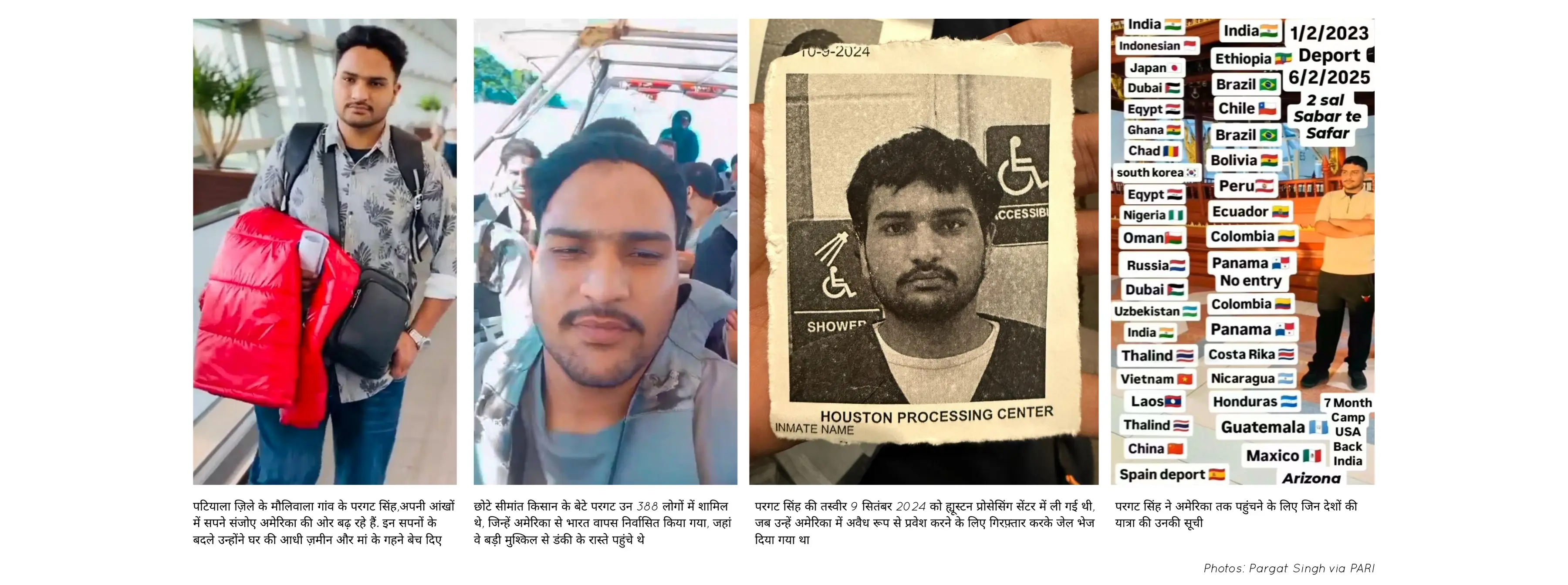
रणदीप की तरह परगट सिंह – जो एक जाट सिख हैं और पटियाला ज़िले में मौलिवाला गांव के एक छोटे से किसान के इकलौते पुत्र – भी अमेरिका जाना चाहते थे. अपने 45 वर्षीय पिता मेजर सिंह को क़र्ज़ के घेरे से बाहर निकलने में नाकाम होता देखकर, और मंडियों में अपने धान की फ़सल को न्यूनतम समर्थन मूल्य (एमएसपी) पर बेचने की कोशिश में अपमानित होता देखकर उन्होंने खेती के कामों से दूर रहने का फ़ैसला लिया.
पटियाला ज़िला में पटरान के इंडस्ट्रियल ट्रेनिंग इंस्टीट्यूट (आईटीआई) में एक कोर्स करने के बाद परगट ने एक आधुनिक डेरी फार्म का काम शुरू किया. लेकिन वर्ष 2022 में लंपी स्किन डिजीज (मवेशियों को होने वाली एक भयानक संक्रामक वायरल बीमारी) से संक्रमित होकर उनकी चारों गाएं मर गईं. “राज्य सरकार ने मुआवज़ा देने का वायदा किया था, लेकिन हमें एक पाई भी नहीं दी गई,” वे कहते हैं. उसी समय से वे यूरोप या अमेरिका पलायन करने की बात सोचने लगे. आख़िरकार जून 2024 में वे अमेरिका के लिए अपने सफ़र पर निकल पड़े, जिसे पंजाब में डंकी रूट कहा जाता है.
“मैं ब्राज़ील पहुंचा,” अपनी उस यात्रा को याद करते हुए परगट पारी को बताते हैं. “वहां डंकरों [ट्रेवल एजेंट के स्थानीय गाइड जो लोगों को ग़ैरक़ानूनी तरीक़े से अमेरिका में दाख़िल होने में मदद करते हैं] ने हममें से 80 लोगों का एक ग्रुप बनाया. सबसे पहले हमने बस पर सवार होकर बोलिविया, इक्वाडोर, कोलंबिया और पेरू जैसे देशों को पार किया. उसके बाद हमें कोस्टारीका, निकारागुआ, हौंडूरस और ग्वाटेमाला के जंगलों में छोड़ दिया गया. आख़िरकर हम मैक्सिको पहुंच गए. हम पांच दिनों तक जंगल में सफ़र करते रहे, लेकिन हमारे साथ सिर्फ़ दो दिनों की रसद थी.
“आख़िर के तीन दिन हम सिर्फ़ पानी पीकर ज़िंदा रहे. रास्ते में एक माफ़िया गिरोह ने हमें अगवा कर लिया और 15 दिनों तक बंधक बनाए रखा. उन्होंने हमें आज़ाद छोड़ने के लिए पैसों की मांग की. वे तब तक हमारी पिटाई करते रहे, जब तक हमने उनको फिरौती नहीं चुका दी.” यादों में डूबे परगट ने हमें इस तरह से यह वाक़या सुनाया जैसे यह कल की ही बात रही हो.
जैसे ही उन्होंने अमेरिका में पांव रखा, अन्य लोगों के साथ गिरफ़्तार कर लिया गया और टेक्सस के ह्यूस्टन जेल की एक 10X3 फीट की सेल में डाल दिया गया. जेल में उन्हें छह महीने बंद रहना पड़ा. बीते 10 फ़रवरी को उनके हाथ और पैरों को ज़ंजीर से बांधकर न्यूयॉर्क से दिल्ली जाने वाले एक जहाज़ में डाल दिया गया. लेकिन उनकी अग्नि परीक्षा अभी पूरी नहीं हुई थी, परगट उदास लहज़े में बताते हैं.
“जब मैं दिल्ली उतरा, तो इमीग्रेशन अधिकारियों ने मुझे तिहाड़ जेल भेज देने की धमकी दी. मैंने उन्हें रोते हुए कहा, ‘आप मुझे गोली क्यों नहीं मार देते? मैं पहले से आधा मरा हुआ हूं’.” इस पूरी ट्रिप में उनके 50 लाख रुपए ख़र्च हो चुके थे. अमेरिका जाने के लिए परगट ने अपने परिवार की 1.5 एकड़ ज़मीन और अपनी मां सिमरजीत कौर (43) के सोने के गहने बेच डाले थे, और बाक़ी पैसे अपने रिश्तेदारों से उधार लिए थे.
रणदीप के चाचा धरमपाल कहते हैं, “अपनी ग़रीबी के हाथों मजबूर होकर ही हमें जानवरों की तरह सफ़र करना पड़ता है.” ग़ैरक़ानूनी तौर पर यात्रा करने या अमेरिका से लौटने वाले अधिकतर लोग छोटे किसान होते हैं. रणदीप के बेरोज़गार चचेरे भाई 24 वर्षीय लखविंदर सिंह कहते हैं, “पंजाब में एक पढ़ा-लिखा आदमी 10 से 12 हज़ार रुपए कमाता है. एक एमए पास आदमी 15,000 रुपए कमाता है. इतने कम पैसों में आप कैसे गुज़ारा कर सकते हैं? सरकार ने आयकर की सीमा बढ़ाकर 12 लाख कर दी है. आपको कोई ऐसा आदमी मिला जो हर महीने एक लाख रुपए कमाता है? लोग युवाओं को दोष देते हैं कि वे देश छोड़कर बाहर जा रहे हैं, लेकिन सवाल यह उठता है कि सरकार के पास उनको देने के लिए क्या है?”
रणदीप की मौत के आठ दिन गुज़र चुके हैं, लेकिन उनके घर शोक प्रकट करने वाले लोग अब भी लगातार आ रहे हैं. जैसे ही कोई आदमी भीतर प्रवेश करता हैं, बलविंदर बुझती उम्मीद के साथ उसकी ओर देखने लगते हैं. उनकी आंखों का सपना अब मुरझाने लगा है.
भीतर से रोने की आवाज़ तेज़ हो जाती है, “ओह पुत्त, इक्क बारी आजा. इक्क बारी कह दे, ‘मम्मी मैं ठीक हां. मेरा रौला झूठा.’ [बेटा, एक बार आ जाओ. एक बार बस ये कह दो, ‘मम्मी, मैं ठीक हूं. मेरे मरने की ख़बर झूठी है].” यह रुलाई रणदीप की 52 वर्षीय मां गियान कौर की है. वे आगे कुछ बोलने की हालत में नहीं हैं. लेकिन चुप हो जाने के बाद भी उनकी रुलाई की आवाज़ सन्नाटे में गूंजती हुई महसूस होती है. दूसरी महिलाएं उन्हें सांत्वना देने की कोशिश कर रही है, लेकिन उनकी रुलाई दोबारा फूट पड़ती है.
जब हम निकलने को होते हैं, बलविंदर धीरे से सथर से उठते हैं. वे हमारे पीछे-पीछे दरवाज़े तक आते है. रुंधे हुए गले से वे अंतिम बार कहते हैं, “बॉडी लैके औण दा देखो.” उनकी आवाज़ पहले ही ‘अवैध घुसपैठिए’ के कोलाहल में डूब गई महसूस होती है.
(1) रणदीप सिंह के पिता और दिहाड़ी मज़दूर बलविंदर सिंह, अपने बेटे की मृत्यु की ख़बर से पूरी तरह टूट गए थे. उन्हें नहीं समझ आया कि कंबोडिया में भारतीय दूतावास ने उनके बेटे का शव वापस भेजने के लिए इतने ज़्यादा पैसे क्यों मांगे.
(2) रणदीप सिंह के चचेरे भाई लखविंदर सिंह कहते हैं कि लोग युवाओं को दोष देते हैं कि वे जान जोखिम में डाल देश छोड़कर बाहर जा रहे हैं, लेकिन सवाल यह उठता है कि सरकार के पास उनको देने के लिए क्या है.
(3) रणदीप सिंह के चाचा धरमपाल मौत की ख़बर से व्यथित नज़र आते हैं और इस बात से निराश हैं कि एजेंट कैसे महत्वाकांक्षी युवाओं को ठगते हैं.
Photos: Vishav Bharti via PARI
पुनश्च:
रणदीप की मौत के लगभग महीने भर बाद बलविंदर सिंह का बेटा घर लौटा. रणदीप का पार्थिव शरीर भारत आया और आख़िरकर 19 मार्च को उनकी अंत्येष्टि उनके गांव में कर दी गई. लेकिन इसके लिए घरवालों को बड़ी क़ीमत चुकानी पड़ी. परिवहन ख़र्च के रूप में उनके परिवार को 6 लाख रुपए चुकाने पड़े, जबकि वे पहले से ही भारी क़र्ज़ के बोझ में थे. उन्हें नहीं पता है कि यह क़र्ज़ वे किस तरह चुकाएंगे.
इस बीच परगट ने पारी के साथ उन वीडियो और तस्वीरों को साझा किया, जिन्हें उन्होंने अपने सफ़र के दौरान उन नौ देशों में शूट किया था जहां-जहां उन्हें लेकर मानव तस्कर गए थे. इनमें वह क्लिप भी शामिल है जिसे एक नाव से कोलंबिया से पनामा जाने के क्रम में बनाया गया था. दूसरी क्लिप पनामा के जंगलों को पार कर मैक्सिको पहुंचने के ठीक पहले की है. इनमें एक क्लिप उस ख़तरनाक दुर्घटना की भी है जो मैक्सिको में ‘सुरक्षित जगह’ तक पहुंचने के लिए तेज़ रफ्तार से ड्राइविंग करने के कारण घटी थी. इसमें बहुत से लोग ज़ख़्मी हो गए थे. इससे पहले कोलंबिया में हुई एक दुर्घटना में परगट के दो सहयात्रियों की मृत्यु हो गई थी – लेकिन उस फुटेज को इस वीडियो में शामिल नहीं किया गया है.
यह दो अप्रवासियों की कहानी है, लेकिन हज़ारों लोगों की मुश्किलों को भी बयान करती है.
ਰਣਦੀਪ ਸਿੰਘ ਇੰਨਾ ਵੀ ਖੁਸ਼ਕਿਸਮਤ ਨਹੀਂ ਸੀ ਕਿ ਉਸ ਨੂੰ ਗ੍ਰਿਫ਼ਤਾਰ ਕਰਕੇ, ਹਥਕੜੀਆਂ ਲਾ ਕੇ ਅਮਰੀਕਾ ਤੋਂ ਅੰਮ੍ਰਿਤਸਰ ਆਉਣ ਵਾਲ਼ੀ ਸੀ-17 ਉਡਾਨ ਰਾਹੀਂ ਲਿਆਂਦਾ ਜਾਂਦਾ। ਬਿਗਾਨੀ ਧਰਤੀ ’ਤੇ 264 ਦਿਨ ਜ਼ਿੰਦਗੀ ਲਈ ਲੜਦੇ ਹੋਏ ਇਸ ਸਾਲ 21 ਫਰਵਰੀ ਨੂੰ ਡੌਂਕੀ ਰਸਤੇ ਅਮਰੀਕਾ ਜਾਂਦੇ ਹੋਏ ਕੰਬੋਡੀਆਂ ਵਿੱਚ ਉਸ ਨੇ ਆਪਣੇ ਸਾਹਾਂ ਦਾ ਸਫ਼ਰ ਮੁਕਾ ਲਿਆ।
ਤੁਸੀਂ ਕਹਿ ਸਕਦੇ ਹੋ ਕਿ ਪਰਗਟ ਸਿੰਘ ਖੁਸ਼ਕਿਸਮਤ ਸੀ। ਵਿਦੇਸ਼ੀ ਸੁਪਨਿਆਂ ਦਾ ਠੱਗਿਆ ਹੋਇਆ ਇੱਕ ਹੋਰ ਪੰਜਾਬੀ ਜਿਸਦਾ ਅਮਰੀਕਾ ਜਾਣ ਦਾ ਸਫ਼ਰ ਆਪਣੇ ਪਰਿਵਾਰ ਦੀ ਤਿੰਨ ਏਕੜ ਜ਼ਮੀਨ ਦਾ ਅੱਧਾ ਹਿੱਸਾ ਅਤੇ ਆਪਣੀ ਮਾਂ ਦੇ ਲਗਭਗ ਸਾਰੇ ਗਹਿਣੇ ਵੇਚਣ ਨਾਲ਼ ਸ਼ੁਰੂ ਹੋਇਆ- ਅਤੇ ਭਾਰਤ ਡਿਪੋਰਟ ਹੋਣ ਨਾਲ਼ ਹੀ ਖ਼ਤਮ ਵੀ ਹੋ ਗਿਆ। ਬਹੁਤ ਦੁਖਦ ਹੈ ਇਹ ਕਹਿਣਾ ਕਿ ਹਥਕੜੀਆਂ ਵਿੱਚ ਜਕੜਿਆ ਪਰਗਟ ਸਿੰਘ ਘਰ ਪਹੁੰਚਿਆ; ਪਰ ਘੱਟੋ-ਘੱਟ ਆਪਣੀ ਕਹਾਣੀ ਸੁਣਾਉਣ ਲਈ ਜਿਉਂਦਾ ਤਾਂ ਰਿਹਾ।
ਪੰਜਾਬ ਦੇ ਮੁਹਾਲੀ ਜ਼ਿਲ੍ਹੇ ਵਿੱਚ ਪੈਂਦੇ ਸ਼ੇਖਪੁਰਾ ਕਲਾਂ ਵਿੱਚ ਰਣਦੀਪ ਦੇ ਘਰ ਵਿਛਿਆ ਸੱਥਰ (ਪਰਿਵਾਰ ਵਿੱਚ ਮੌਤ ਤੋਂ ਬਾਅਦ ਹੇਠਾਂ ਬੈਠਣ ਵਾਲ਼ੀ ਰਸਮ) ਉਸਦੀ ਵਲੂੰਧ ਕੇ ਰੱਖ ਵਾਲ਼ੀ ਕਹਾਣੀ ਦੀ ਗਵਾਹੀ ਭਰਦਾ ਹੈ। ਦੋ ਕਮਰਿਆਂ ਦੇ ਘਰ ਵਿੱਚ ਇੰਨੀ ਵੀ ਥਾਂ ਨਹੀਂ ਕਿ ਅਫ਼ਸੋਸ ਕਰਨ ਵਾਲ਼ੇ ਲੋਕਾਂ ਨੂੰ ਆਪਣੇ ਅੰਦਰ ਸਮਾ ਸਕੇ। ਪਰ ਇਹ ਕੰਮ ਛੇਤੀ ਹੋਣ ਵਾਲ਼ਾ ਨਹੀਂ ਜਾਪਦਾ। ਮ੍ਰਿਤ ਸਰੀਰ ਨੂੰ ਘਰ ਵਾਪਸ ਪਹੁੰਚਾਉਣ ਲਈ ਹੋਣ ਵਾਲ਼ੇ ਖਰਚੇ ਦੀ ਪੂਰਤੀ ਲਈ ਕੰਬੋਡੀਆ ਸਥਿਤ ਭਾਰਤੀ ਦੂਤਾਵਾਸ ਨੇ 7,100 ਅਮਰੀਕੀ ਡਾਲਰਾਂ (ਲਗਭਗ 6,21,000 ਰੁਪਏ) ਦੀ ਪੇਸ਼ਗੀ ਮੰਗ ਕੀਤੀ ਹੈ।
ਛੇ ਅੰਕਾਂ ਦੀ ਇਹ ਰਕਮ ਰਣਦੀਪ ਦੇ ਪਿਤਾ, ਬਲਵਿੰਦਰ ਸਿੰਘ (55) ਦੀ ਸਮਰੱਥਾ ਤੇ ਸਮਝ ਦੋਵਾਂ ਤੋਂ ਹੀ ਬਾਹਰ ਹੈ ਜੋ ਕਿ ਇੱਕ ਦਿਹਾੜੀਦਾਰ ਮਜ਼ਦੂਰ ਹਨ ਅਤੇ 500 ਰੁਪਏ ਦਿਹਾੜੀ ਕਮਾਉਂਦੇਂ ਹਨ, ਉਹ ਵੀ ਉਦੋਂ ਜਦੋਂ ਉਹਨਾਂ ਨੂੰ ਕੋਈ ਕੰਮ ਮਿਲ਼ ਜਾਵੇ। ਸੋਗ ਮਨਾਉਣ ਆਉਣ ਵਾਲ਼ੇ ਨੂੰ ਉਹ ਜਾਣਦੇ ਹੋਣ ਭਾਵੇਂ ਨਾ, ਬਲਵਿੰਦਰ ਸਿੰਘ ਹਰ ਵਿਅਕਤੀ ਵੱਲ ਇਸੇ ਉਮੀਦ ਨਾਲ਼ ਦੇਖਦੇ ਹਨ ਅਤੇ ਮਸਾਂ ਸੁਣੀਂਦੀ ਅਵਾਜ਼ ਵਿੱਚ ਕਹਿੰਦੇ ਹਨ,“ਬੋਡੀ ਲੈ ਕੇ ਆਉਣ ਦਾ ਦੇਖੋ।”
ਪੇਂਡੂ ਇਲਾਕਿਆਂ ਵਿੱਚ ਬੇਰੁਜ਼ਗਾਰੀ ਅਤੇ ਖੇਤੀਬਾੜੀ ਸੰਕਟ ਨੂੰ ਦੇਖਦੇ ਹੋਏ ਸਿਰਫ਼ ਰਣਦੀਪ ਹੀ ਇਕੱਲਾ ਨਹੀਂ ਸੀ ਜੋ ਪੰਜਾਬ ਨੂੰ ਛੱਡ ਜਾਣ ਬਾਰੇ ਸੋਚ ਰਿਹਾ ਸੀ। ਇੱਕ ਬੇਜ਼ਮੀਨੇ ਦਲਿਤ ਪਰਿਵਾਰ ਵਿੱਚ ਪੈਦਾ ਹੋਏ ਰਣਦੀਪ ਦਾ ਬਚਪਨ ਨਿਰਾਸ਼ਾ ਵਿਚਾਲ਼ੇ ਬੀਤਿਆ, ਇਹ ਉਹ ਸਮਾਂ ਸੀ ਜਦੋਂ ਪੰਜਾਬ ਫ਼ਸਲ ਦੀ ਤਬਾਹੀ-ਬਰਬਾਦੀ, ਬੇਰੁਜ਼ਗਾਰੀ ਅਤੇ ਖ਼ੁਦਕੁਸ਼ੀਆਂ ਦੀਆਂ ਸਮੱਸਿਆਵਾਂ ਨਾਲ਼ ਘਿਰਿਆ ਹੋਇਆ ਸੀ।
Iਮੁਹਾਲੀ ਜ਼ਿਲ੍ਹੇ ਦੇ ਸ਼ੇਖਪੁਰਾ ਕਲਾਂ ਪਿੰਡ ਵਿਚਲੇ ਰਣਦੀਪ ਸਿੰਘ ਦੇ ਘਰ ਦਾ ਹਰ ਕੋਨਾ ਦੁੱਖ ਨਾਲ਼ ਭਰਿਆ ਪਿਆ ਹੈ। ਉਸਦੀ ਮਾਤਾ ਗਿਆਨ ਕੌਰ (ਵਿਚਕਾਰ, ਪਰਿੰਟਡ ਸ਼ਾਲ ਲਏ ਹੋਏ) ਪੂਰੀ ਤਰ੍ਹਾਂ ਟੁੱਟ ਗਏ ਜਾਪਦੇ ਹਨ । Photo: Vishav Bharti/PARI
ਪੰਜਾਬ ਖੇਤੀਬਾੜੀ ਯੂਨੀਵਰਸਿਟੀ, ਲੁਧਿਆਣਾ ਦੇ ਇੱਕ ਅਧਿਐਨ ਅਨੁਸਾਰ ਰਾਜ ਵਿੱਚ 2000 ਤੋਂ 2015 ਤੱਕ 16,606 ਕਿਸਾਨ ਖ਼ੁਦਕੁਸ਼ੀਆਂ ਦਰਜ ਕੀਤੀਆਂ ਗਈਆਂ ਹਨ।ਇਹਨਾਂ ਵਿੱਚੋਂ ਅੱਧੀਆਂ ਬੇਜ਼ਮੀਨੇ ਦਲਿਤ ਖੇਤ ਮਜ਼ਦੂਰਾਂ ਵੱਲੋਂ ਕੀਤੀਆ ਗਈਆਂ ਇਸ ਤੋਂ ਬਾਅਦ ਵੀ ਆਉਣ ਵਾਲ਼ੀਆਂ ਸਰਕਾਰਾਂ ਦੇ ਦਾਅਵੇ ਕਿ ‘ਪੰਜਾਬ ਨੂੰ ਕੈਲੀਫੋਰਨੀਆਂ
ਬਣਾ ਦਿਆਂਗੇ’ ਜਾਂ ਰੁਜ਼ਗਾਰ ਦੀ ਇੰਨੀ ਭਰਮਾਰ ਕਰ ਦਿਆਂਗੇ ਕਿ ਵਿਦੇਸ਼ੀ ਵੀ ਇੱਥੇ ਨੌਕਰੀ ਕਰਨ ਆਇਆ ਕਰਨਗੇ, ਨੌਜਵਾਨਾਂ ਨੂੰ ਪ੍ਰਭਾਵਤ ਨਾ ਕਰ ਸਕੇ।
ਧਿਆਨ ਰਹੇ ਅਮਰੀਕਾ ਤੋਂ ਜ਼ੰਜੀਰਾਂ ਵਿੱਚ ਜਕੜੇ ਇਨ੍ਹਾਂ ਨੌਜਵਾਨਾਂ ਦਾ ਵਾਪਸ ਆਉਣਾ ਇਸੇ ਗੱਲ ‘ਤੇ ਮੋਹਰ ਲਾਉਂਦਾ ਹੈ ਨਹੀਂ ਤਾਂ ਉਹ ਇੱਕ ਬਿਹਤਰ ਜ਼ਿੰਦਗੀ ਦੀ ਭਾਲ਼ ਵਿੱਚ ਉੱਥੇ ਕਿਉਂ ਜਾਂਦੇ? ਇਸ ਸਾਲ ਮਾਰਚ 13 ਨੂੰ ਕੇਂਦਰ ਸਰਕਾਰ ਨੇ ਸੰਸਦ ਵਿੱਚ ਦੱਸਿਆ ਕਿ ਅਮਰੀਕਾ ਤੋਂ ਭਾਰਤ ਭੇਜੇ ਗਏ 388 ਲੋਕਾਂ ਵਿੱਚੋਂ 39.43 ਪ੍ਰਤੀਸ਼ਤ ਪੰਜਾਬ ਤੋਂ ਅਤੇ 34.02 ਪ੍ਰਤੀਸ਼ਤ ਹਰਿਆਣੇ ਤੋਂ ਸਨ। ਜੋ ਕੁੱਲ ਗਿਣਤੀ ਦਾ ਲਗਭਗ ਤਿੰਨ-ਚੋਥਾਈ ਹਿੱਸਾ ਬਣਦਾ ਹੈ। ਛੋਟੇ ਕਸਬਿਆਂ ਵਿੱਚ ਵੀ International English Language Testing System (IELTS) ਅਤੇ Test of English as Foreign Language (TOEFL) ਚਲਾ ਰਹੇ ਕੇਂਦਰਾਂ ਦੇ ਇਮੀਗ੍ਰੇਸ਼ਨ ਕਾਰੋਬਾਰ ਦਾ ਉਛਾਲ਼ ਇਸੇ ਦੁਖਦਾਈ ਸੱਚਾਈ ਨੂੰ ਹੀ ਬਿਆਨ ਕਰਦਾ ਹੈ।
ਇਸ ਤੋਂ ਪਹਿਲਾਂ ਭਾਰਤ ਸਰਕਾਰ ਨੇ ਸੰਸਦ ਵਿੱਚ ਕਿਹਾ ਸੀ ਕਿ 2016 ਤੋਂ 2021 ਵਿਚਕਾਰ ਲਗਭਗ ਪੰਜ ਲੱਖ ਲੋਕ ਰੁਜ਼ਗਾਰ ਲਈ ਪੰਜਾਬ ਤੋਂ ਵਿਦੇਸ਼ ਚਲੇ ਗਏ ਸਨ। ਇਸ ਸਮੇਂ ਦੌਰਾਨ 2.62 ਫੀਸਦੀ ਵਿਦਿਆਰਥੀਆਂ ਨੇ ਵਿਦੇਸ਼ ਵਿੱਚ ਪੜ੍ਹਾਈ ਕਰਨ ਦੀ ਚੋਣ ਕੀਤੀ ਸੀ, ਜਿਨ੍ਹਾਂ ਵਿੱਚੋਂ ਜ਼ਿਆਦਾਤਰ ਲਈ ਪੜ੍ਹਾਈ ਸਿਰਫ਼ ਪੰਜਾਬ ਤੋਂ ਨਿਕਲ਼ਣ ਦਾ ਇੱਕ ਰਸਤਾ ਮਾਤਰ ਸੀ। ਖ਼ੁਦਕੁਸ਼ੀਆਂ ਦੇ ਹੜ੍ਹ ਤੋਂ ਬਾਅਦ ਇੱਕ ਹੋਰ ਲਹਿਰ ਉੱਠੀ: ਇੱਕ ਸਮੂਹਿਕ ਪਰਵਾਸ ਦੀ ਲਹਿਰ।
ਰਣਦੀਪ ਦਾ ਸੁਪਨਾ ਸੀ ਕਿ ਉਹ ਆਪਣੀ ਵੱਡੀ ਭੈਣ ਦਾ ਵਿਆਹ ਕਰੇ ਅਤੇ ਆਪਣੇ ਮਾਤਾ-ਪਿਤਾ ਨੂੰ ਮਜ਼ਦੂਰੀ ਤੋਂ ਮੁਕਤ ਕਰੇ। ਸੋ ਉਹਨੇ ਉੱਚ ਵਿਆਜ ’ਤੇ ਕਰਜਾ ਚੁੱਕਣ ਅਤੇ ਦੋ ਮੱਝਾਂ ਵੇਚਣ ਦਾ ਫ਼ੈਸਲਾ ਕੀਤਾ ਤੇ ਟ੍ਰੈਵਲ ਏਜੰਟ ਨਾਲ਼ 42 ਲੱਖ ਰੁਪਏ ਵਿੱਚ ਸੌਦਾ ਮਾਰ ਲਿਆ। ਉਸ ਏਜੰਟ ਨੇ ‘ਗਰੰਟੀ’ ਦਿੱਤੀ ਕਿ ਉਹ ਉਸਨੂੰ ਕੈਨੇਡਾ ਦੇ ਰਸਤੇ ਅਮਰੀਕਾ ਲੈ ਜਾਵੇਗਾ। ਇਸੇ ਭਰੋਸੇ ਆਸਰੇ ਰਣਦੀਪ 1 ਜੂਨ, 2024 ਨੂੰ ਘਰੋਂ ਚੱਲ ਪਿਆ। ਪਰਿਵਾਰ ਦਾ ਕਹਿਣਾ ਹੈ ਕਿ ਉਹਨਾਂ ਨੇ ਏਜੰਟ ਨੂੰ 25 ਲੱਖ ਰੁਪਏ ਦਿੱਤੇ ਸਨ।
ਪਰ ਉਹ ਏਜੰਟ ਉਸਨੂੰ ਕੰਬੋਡੀਆ ਲੈ ਗਿਆ, ਜਿੱਥੇ 21 ਫਰਵਰੀ ਨੂੰ ਇੱਕ ਹਸਪਤਾਲ ਵਿੱਚ ਭੇਤਭਰੀ ਹਾਲਤ ਵਿੱਚ ਉਸਦੀ ਮੌਤ ਹੋ ਗਈ। “ਏਜੰਟ ਨੇ ਸਾਡੇ ਨਾਲ਼ ਧੋਖਾ ਕੀਤਾ। ਬੱਚੇ ਉਹਨਾਂ ਲਈ ਸਿਰਫ਼ ਬਲ਼ੀ ਦਾ ਬੱਕਰਾ ਹੀ ਨੇ। ਹੁਣ ਸਾਨੂੰ ਉਸਦੀ ਮ੍ਰਿਤਕ ਦੇਹ ਹੀ ਵਾਪਸ ਮਿਲ਼ੇਗੀ ਉਹ ਨਹੀਂ,” ਰਣਦੀਪ ਦੇ ਚਾਚਾ ਧਰਮਪਾਲ ਕਹਿੰਦੇ ਹਨ ਜੋ ਇੱਕ ਟੈਕਸੀ ਡਰਾਇਵਰ ਹਨ। ਇੱਥੇ ਜ਼ਿਆਦਾਤਰ ਨੌਜਵਾਨਾਂ ਦੀ ਇਹੋ ਕਹਾਣੀ ਹੈ ਜਿਹੜੇ ਇਮੀਗ੍ਰੇਸ਼ਨ ਦੇ ਜਾਲ਼ ਵਿੱਚ ਜਾ ਫਸਦੇ ਹਨ। 30 ਤੋਂ 40 ਲੱਖ ਰੁਪਏ ਲਾ ਕੇ ਵੀ ਉਹਨਾਂ ਵਿੱਚੋਂ ਬਹੁਤਿਆਂ ਦਾ ਸਫ਼ਰ ਅੱਧ ਵਿਚਾਲ਼ੇ ਦਮ ਤੋੜ ਦਿੰਦਾ ਹੈ, ਕਈ ਵਾਰੀਂ ਭੂਮੱਧ ਸਾਗਰ ਵਿੱਚ ਡੁੱਬਣ ਨਾਲ਼ ਜਾਂ ਪਨਾਮਾ ਦੇ ਜੰਗਲਾਂ ਵਿੱਚ ਮਾਰੇ-ਮਾਰੇ ਫਿਰਨ ਨਾਲ਼ ਵੀ ਮੁੱਕ ਜਾਂਦਾ ਹੈ ਤੇ ਕਈ ਵਾਰੀਂ ਇਹੀ ਸਫ਼ਰ ਉਨ੍ਹਾਂ ਨੂੰ ਅਮਰੀਕਾ ਦੀਆਂ ਜੇਲ੍ਹਾਂ ਤੱਕ ਲੈ ਜਾਂਦਾ ਹੈ।
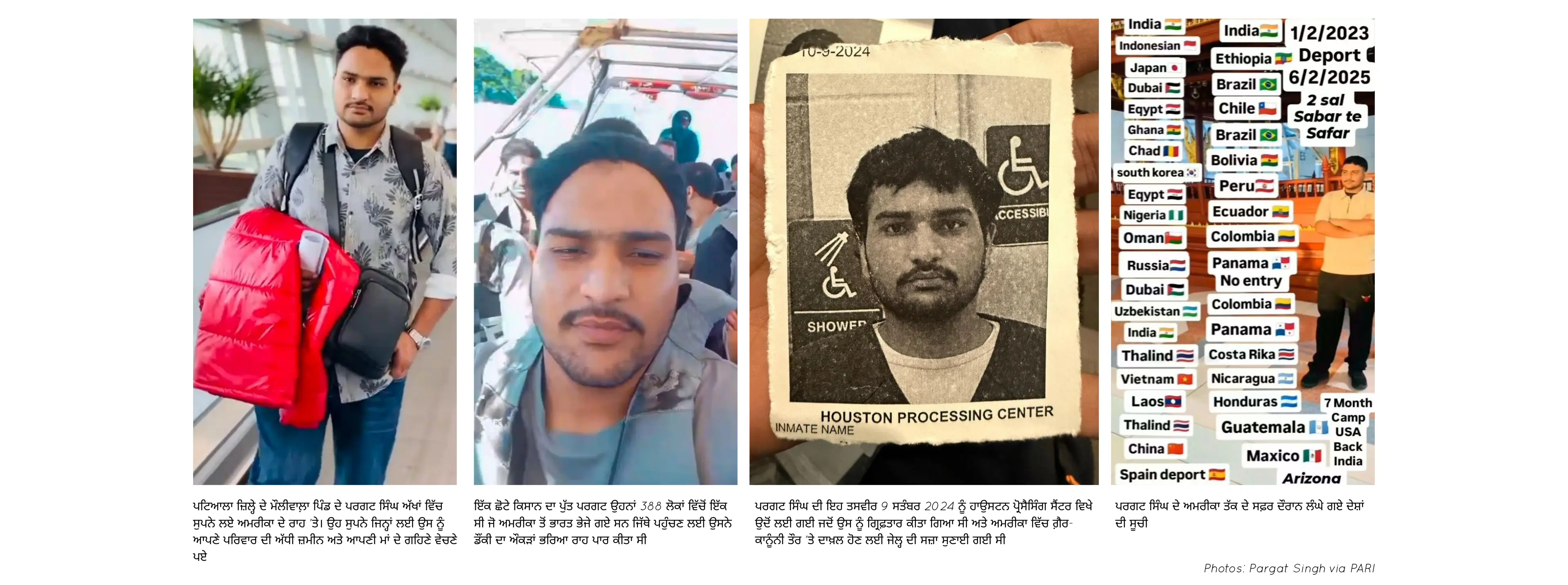
ਰਣਦੀਪ ਵਾਂਗ, ਪਰਗਟ ਸਿੰਘ ਜੋ ਪਟਿਆਲਾ ਜ਼ਿਲ੍ਹੇ ਦੇ ਮੌਲੀਵਾਲ਼ਾ ਪਿੰਡ ਦੇ ਇੱਕ ਜੱਟ ਸਿੱਖ ਪਰਿਵਾਰ ਨਾਲ਼ ਸਬੰਧਤ ਇੱਕ ਛੋਟੇ ਕਿਸਾਨ ਦਾ ਇਕਲੌਤਾ ਪੁੱਤ ਹੈ, ਹਰ ਹੀਲੇ ਅਮਰੀਕਾ ਪਹੁੰਚਣਾ ਚਾਹੁੰਦਾ ਸੀ। ਉਹਨੇ ਬਚਪਨ ਤੋਂ ਹੀ ਪਿਤਾ, 45 ਸਾਲਾ ਮੇਜਰ ਸਿੰਘ ਨੂੰ ਕਰਜੇ ਹੇਠ ਪਿਸਦੇ ਦੇਖਿਆ, ਘੱਟੋ-ਘੱਟ ਸਮਰਥਨ ਮੁੱਲ (MSP) ’ਤੇ ਆਪਣਾ ਝੋਨਾ ਚੁਕਾਉਣ ਲਈ ਮੰਡੀਆਂ ਵਿੱਚ ਅਪਮਾਨਤ ਹੁੰਦੇ ਦੇਖਿਆ, ਇਹ ਸਭ ਦੇਖ ਕੇ ਉਸਦਾ ਮਨ ਖੱਟਾ ਹੋ ਗਿਆ ਤੇ ਉਹਨੇ ਖੇਤੀਬਾੜੀ ਤੋਂ ਦੂਰ ਜਾਣ ਦਾ ਫ਼ੈਸਲਾ ਕੀਤਾ।
ਪਟਿਆਲਾ ਜ਼ਿਲ੍ਹੇ ਦੇ ਪਾਤੜਾਂ ਵਿੱਚ ਇੱਕ ਉਦਯੋਗਿਕ ਸਿਖਲਾਈ ਸੰਸਥਾ (ITI) ਵਿੱਚ ਕੋਰਸ ਕਰਨ ਤੋਂ ਬਾਅਦ ਪਰਗਟ ਨੇ ਇੱਕ ਆਧੁਨਿਕ ਡੇਅਰੀ ਫਾਰਮ ਸ਼ੁਰੂ ਕੀਤਾ। ਪਰ 2022 ਵਿੱਚ ਲੰਪੀ ਸਕਿਨ ਡਿਸੀਜ਼ (ਪਸ਼ੂਆਂ ਨੂੰ ਪ੍ਰਭਾਵਿਤ ਕਰਨ ਵਾਲ਼ੀ ਭਿਆਨਕ ਛੂਤ ਦੀ (ਵਾਇਰਲ) ਬਿਮਾਰੀ, ਫੈਲਣ ਤੋਂ ਬਾਅਦ ਉਸਦੀਆਂ ਚਾਰ ਗਾਵਾਂ ਦੀ ਮੌਤ ਹੋ ਗਈ। “ਰਾਜ ਸਰਕਾਰ ਨੇ ਮੁਆਵਜ਼ਾ ਦੇਣ ਦਾ ਵਾਅਦਾ ਕੀਤਾ ਸੀ, ਪਰ ਸਾਨੂੰ ਇੱਕ ਵੀ ਪੈਸਾ ਨਹੀਂ ਮਿਲ਼ਿਆ,” ਉਸ ਨੇ ਦੱਸਿਆ। ਉਸ ਸਮੇਂ ਤੋਂ ਬਾਅਦ ਉਸ ਨੇ ਯੂਰੋਪ ਜਾਂ ਅਮਰੀਕਾ ਨਿਕਲ਼ਣ ਦੇ ਤਰੀਕੇ ਲੱਭਣੇ ਸ਼ੁਰੂ ਕਰ ਦਿੱਤੇ। ਅਖੀਰ ਜੂਨ 2024 ਵਿੱਚ ਉਹ ਅਮਰੀਕਾ ਦੇ ਲੰਮੇ ਸਫ਼ਰ ’ਤੇ ਨਿਕਲ਼ ਗਿਆ ਜਿਸਨੂੰ ਪੰਜਾਬ ਵਿੱਚ ਡੌਂਕੀ ਲਾਉਣਾ ਕਹਿੰਦੇ ਹਨ।
“ਮੈਂ ਬ੍ਰਾਜ਼ੀਲ ਉਤਰਿਆ,” PARI ਨਾਲ਼ ਆਪਣੇ ਲੰਮੇ ਸਫ਼ਰ ਦੀਆਂ ਯਾਦਾਂ ਸਾਂਝੀਆਂ ਕਰਦੇ ਹੋਏ ਪਰਗਟ ਦੱਸਦਾ ਹੈ। “ਡੌਂਕਰਜ਼ [ਟ੍ਰੈਵਲ ਏਜੰਟਾਂ ਦੇ ਸਥਾਨਕ ਗਾਈਡ ਜੋ ਲੋਕਾਂ ਨੂੰ ਗੈਰ-ਕਾਨੂੰਨੀ ਤੌਰ ’ਤੇ ਅਮਰੀਕਾ ਵਿੱਚ ਦਾਖ਼ਲ ਕਰਵਾਉਂਦੇ ਹਨ] ਨੇ ਸਾਡੇ ਵਿੱਚੋਂ 80 ਜਾਣਿਆਂ ਦਾ ਇੱਕ ਸਮੂਹ ਬਣਾਇਆ। ਅਸੀਂ ਪਹਿਲਾਂ ਬੱਸ ਰਾਹੀਂ ਬੋਲੀਵੀਆ, ਏਕੁਆਡੋਰ, ਕੋਲੰਬੀਆਂ ਅਤੇ ਪੇਰੂ ਵਰਗੇ ਦੇਸ਼ ਪਾਰ ਕੀਤੇ। ਫਿਰ ਸਾਨੂੰ ਕੋਸਟਾ ਰਿਕਾ, ਨਿਕਾਰਾਗੂਆ, ਹੋਂਡੂਰਸ ਅਤੇ ਗੁਆਟੇਮਾਲਾ ਦੇ ਜੰਗਲਾਂ ਵਿੱਚ ਸੁੱਟ ਦਿੱਤਾ ਗਿਆ। ਅਖ਼ੀਰ ਅਸੀਂ ਮੈਕਸੀਕੋ ਜਾ ਪਹੁੰਚੇ। ਅਸੀਂ ਜੰਗਲ ਵਿੱਚ ਸਿਰਫ਼ ਦੋ ਦਿਨ ਦੇ ਰਾਸ਼ਨ ਨਾਲ਼ ਪੰਜ ਦਿਨ ਦਾ ਸਫ਼ਰ ਤੈਅ ਕੀਤਾ।”
“ਮਗਰਲੇ ਤਿੰਨ ਦਿਨ ਅਸੀਂ ਸਿਰਫ਼ ਪਾਣੀ ਪੀ-ਪੀ ਕੱਟੇ। ਰਾਸਤੇ ਵਿੱਚ ਇੱਕ ਮਾਫੀਆ ਨੇ ਸਾਨੂੰ 15 ਦਿਨ ਲਈ ਅਗਵਾ ਕਰ ਲਿਆ ਸੀ ਜੋ ਸਾਨੂੰ ਛੱਡਣ ਦੇ ਪੈਸੇ ਮੰਗ ਰਹੇ ਸੀ। ਉਹ ਸਾਨੂੰ ਉਦੋਂ ਤੱਕ ਕੁੱਟਦੇ ਰਹੇ ਜਦੋਂ ਤੱਕ ਕਿ ਅਸੀਂ ਉਹਨਾਂ ਨੂੰ ਫਿਰੌਤੀ ਦੇ ਪੈਸੇ ਨਹੀਂ ਦੇ ਦਿੱਤੇ।” ਪਰਗਟ ਨੂੰ ਇਹ ਸਫ਼ਰ ਹਾਲੇ ਕੱਲ੍ਹ ਦੀ ਹੀ ਗੱਲ ਜਾਪਦਾ ਹੈ।
ਅਜੇ ਉਹਨੇ ਅਮਰੀਕਾ ਵਿੱਚ ਪੈਰ ਰੱਖਿਆ ਹੀ ਸੀ ਕਿ ਦੂਜਿਆਂ ਨਾਲ਼ ਉਹਨੂੰ ਵੀ ਗ੍ਰਿਫ਼ਤਾਰ ਕਰ ਲਿਆ ਗਿਆ ਅਤੇ ਟੈਕਸਸ ਦੀ ਹਾਉਸਟਨ ਜੇਲ੍ਹ ਵਿੱਚ 10×3′ ਦੀ ਕੋਠੜੀ ਵਿੱਚ ਸੁੱਟ ਦਿੱਤਾ ਗਿਆ। ਉਹ ਛੇ ਮਹੀਨੇ ਉੱਥੇ ਰਹੇ। 10 ਫ਼ਰਵਰੀ ਨੂੰ ਉਹਨਾਂ ਨੂੰ ਬੇੜੀਆਂ ਲਾ ਕੇ ਨਿਊਯਾਰਕ ਤੋਂ ਦਿੱਲੀ ਜਾਣ ਵਾਲ਼ੀ ਉਡਾਨ ਵਿੱਚ ਬਿਠਾ ਦਿੱਤਾ ਗਿਆ। ਪਰ ਬਿਪਤਾਵਾਂ ਦਾ ਅੰਤ ਇੱਥੇ ਹੀ ਨਹੀਂ ਹੋਇਆ, ਪਰਗਟ ਦੁਖੀ ਹੋ ਕੇ ਕਹਿੰਦਾ ਹੈ।
“ਜਦੋਂ ਮੈਂ ਦਿੱਲੀ ਉਤਰਿਆ, ਇਮੀਗ੍ਰੇਸ਼ਨ ਅਫ਼ਸਰ ਮੈਨੂੰ ਤਿਹਾੜ ਜੇਲ਼੍ਹ ਭੇਜਣ ਦੀਆਂ ਧਮਕੀਆਂ ਦੇਣ ਲੱਗੇ। ਮੈਂ ਬਿਲਕੁਲ ਟੁੱਟ ਗਿਆ ਅਤੇ ਉਹਨਾਂ ਨੂੰ ਕਿਹਾ:‘ਤੁਸੀਂ ਮੈਨੂੰ ਗੋਲ਼ੀ ਕਿਉਂ ਨੀ ਮਾਰ ਦਿੰਦੇ? ਮੈਂ ਬਹੁਤ ਕੁਝ ਝੱਲ ਚੁੱਕਿਆਂ’।” ਸਾਰੇ ਸਫ਼ਰ ’ਤੇ ਮੇਰਾ 50 ਲੱਖ ਖ਼ਰਚ ਹੋਇਆ। ਇਸ ਖਰਚੇ ਲਈ ਪਰਗਟ ਨੇ ਆਪਣੀ 1.5 ਏਕੜ ਜ਼ਮੀਨ ਵੇਚੀ ਸੀ, ਆਪਣੀ 43 ਸਾਲਾ ਮਾਤਾ, ਸਿਮਰਨਜੀਤ ਕੌਰ ਦੇ ਗਹਿਣੇ ਤੱਕ ਵੇਚੇ ਸਨ ਅਤੇ ਬਾਕੀ ਆਪਣੇ ਰਿਸ਼ਤੇਦਾਰਾਂ ਤੋਂ ਵੀ ਉਧਾਰ ਲੈਣੇ ਪਏ ਸਨ।
ਰਣਦੀਪ ਦੇ ਚਾਚਾ ਧਰਮਪਾਲ ਦਾ ਕਹਿਣਾ ਹੈ,“ਸਾਡੀ ਗ਼ਰੀਬੀ ਈ ਆ ਜੋ ਸਾਨੂੰ ਜਾਨਵਰਾਂ ਵਾਂਗ ਸਫ਼ਰਾਂ ’ਤੇ ਜਾਣ ਲਈ ਮਜ਼ਬੂਰ ਕਰਦੀ ਆ।” ਗ਼ੈਰ-ਕਾਨੂੰਨੀ ਤਰੀਕੇ ਜਾਣ ਵਾਲ਼ੇ ਜਾਂ ਅਮਰੀਕਾ ਤੋਂ ਵਾਪਸ ਆਉਣ ਵਾਲ਼ੇ ਜ਼ਿਆਦਾਤਰ ਲੋਕ ਛੋਟੇ (ਸੀਮਾਂਤ) ਕਿਸਾਨ ਪਰਿਵਾਰਾਂ ਤੋਂ ਹਨ। ਲਖਵਿੰਦਰ ਸਿੰਘ, 24, ਰਣਦੀਪ ਦੇ ਬੇਰੁਜ਼ਗਾਰ ਚਚੇਰੇ ਭਰਾ ਦਾ ਕਹਿਣਾ ਹੈ, “ਇੱਥੇ ਪੰਜਾਬ ਵਿੱਚ ਪੜ੍ਹਿਆ-ਲਿਖਿਆ ਆਦਮੀ 10-12,000 ਰੁਪਏ ਕਮਾਉਂਦੈ। ਇੱਕ ਪੋਸਟ-ਗ੍ਰੈਜੂਏਟ 15,000 ਰੁਪਏ ਕਮਾਉਂਦੈ। ਇੰਨੇ ਕੁ ਨਾਲ਼ ਤੁਹਾਡਾ ਗੁਜ਼ਾਰਾ ਕਿਵੇਂ ਹੋਊਗਾ ਭਲ਼ਾ? ਸਰਕਾਰ ਨੇ 12 ਲੱਖ ਰੁਪਏ ਤੱਕ ਟੈਕਸ ਤੋਂ ਛੋਟ ਦਿੱਤੀ ਆ। ਕੀ ਤੁਸੀਂ ਕਿਸੇ ਨੂੰ ਮਹੀਨੇ ਦਾ ਇੱਕ ਲੱਖ ਰੁਪਿਆ ਕਮਾਉਂਦੇ ਸੁਣਿਐ? ਲੋਕ ਅਕਸਰ ਨੌਜਵਾਨਾਂ ਨੂੰ ਵਿਦੇਸ਼ ਭੱਜਣ ਲਈ ਦੋਸ਼ੀ ਕਰਾਰ ਦਿੰਦੇ ਨੇ ਪਰ ਇੱਥੇ ਸਰਕਾਰਾਂ ਉਹਨਾਂ ਨੂੰ ਰੋਕਣ ਲਈ ਕਰ ਕੀ ਰਹੀਆਂ ਨੇ?”
ਰਣਦੀਪ ਦੀ ਮੌਤ ਨੂੰ ਅੱਠ ਦਿਨ ਹੋ ਚੁੱਕੇ ਹਨ, ਪਰ ਸੋਗ ਮਨਾਉਣ ਵਾਲ਼ਿਆਂ ਦਾ ਆਉਣਾ-ਜਾਣਾ ਜਾਰੀ ਹੈ। ਜਿਓਂ ਹੀ ਕੋਈ ਅੰਦਰ ਵੜ੍ਹਦਾ ਹੈ, ਬਲਵਿੰਦਰ ਸਿੰਘ ਦੀਆਂ ਅੱਖਾਂ ਲੁਕਵੀਂ ਉਮੀਦ ਨਾਲ਼ ਉਸ ਵੱਲ ਵੇਖਣ ਲੱਗਦੀਆਂ ਹਨ, ਜਿਵੇਂ ਕੋਈ ਧੁੰਦਲੇ ਜਿਹੇ ਸੁਪਨੇ ਨੂੰ ਫੜ੍ਹਦਾ ਹੋਵੇ।
ਵੈਣ ਉੱਚੇ ਹੋਰ ਉੱਚੇ ਹੋ ਜਾਂਦੇ ਹਨ। “ਓ ਪੁੱਤ, ਇੱਕ ਵਾਰੀ ਆਜਾ, ਇੱਕ ਵਾਰੀ ਕਹਿ ਦੇ, ‘ਮੰਮੀ ਮੈਂ ਠੀਕ ਹਾਂ। ਮੇਰਾ ਰੌਲ਼ਾ ਝੂਠਾ।” ਰਣਦੀਪ ਦੇ ਮਾਤਾ ਗਿਆਨ ਕੌਰ ਦੇ ਮੂੰਹੋਂ ਬੱਸ ਇੰਨੇ ਕੁ ਬੋਲ਼ ਹੀ ਨਿਕਲ਼ਦੇ ਹਨ, ਜਿਨ੍ਹਾਂ ਦੀ ਅਵਾਜ਼ ਅਸਮਾਨ ਤੱਕ ਗੂੰਜਦੀ ਜਾਪਦੀ ਹੈ। ਦੂਜੀਆਂ ਔਰਤਾਂ ਉਹਨਾਂ ਨੂੰ ਧਰਵਾਸ ਦੇਣ ਦੀ ਕੌਸ਼ਿਸ਼ ਕਰਦੀਆਂ ਹਨ ਪਰ ਉਹਨਾਂ ਦਾ ਦਿਲ ਜਿਓਂ ਫਟ-ਫਟ ਜਾਂਦਾ ਹੈ।
ਜਦੋਂ ਅਸੀਂ ਉੱਥੋਂ ਨਿਕਲ਼ਣ ਲੱਗੇ, ਬਲਵਿੰਦਰ ਸਿੰਘ ਹੌਲ਼ੀ ਜਿਹੇ ਸੱਥਰ ਤੋਂ ਉੱਠੇ, ਸਾਨੂੰ ਬੂਹੇ ਤੱਕ ਛੱਡਣ ਆਏ, ਗੱਚ ਭਰੀ ਅਵਾਜ਼ ਵਿੱਚ ਇੱਕ ਆਖ਼ਰੀ ਵਾਰ ਸਾਨੂੰ ਕਿਹਾ,“ਬੋਡੀ ਲੈ ਕੇ ਆਉਣ ਦਾ ਦੇਖੋ।” ਉਹਨਾਂ ਦੇ ਇਹ ਬੋਲ ਚੁਫ਼ੇਰੇ ਮੱਚੇ ‘ਗ਼ੈਰ-ਕਾਨੂੰਨੀ ਪ੍ਰਵਾਸੀਆਂ’ ਦੇ ਰੌਲ਼ੇ-ਰੱਪੇ ਹੇਠ ਜਿਓਂ ਕਿਤੇ ਦੱਬ ਕੇ ਰਹਿ ਗਏ ਹੋਣ।
(1) ਰਣਦੀਪ ਦੇ ਪਿਤਾ, ਬਲਵਿੰਦਰ ਸਿੰਘ ਜੋ ਕਿ ਇੱਕ ਦਿਹਾੜੀਦਾਰ ਹਨ, ਆਪਣੇ ਪੁੱਤ ਦੀ ਮੌਤ ਦੀ ਖ਼ਬਰ ਸੁਣ ਕੇ ਪੂਰੀ ਤਰ੍ਹਾਂ ਟੁੱਟ ਗਏ। ਕੰਬੋਡੀਆ ਸਥਿਤ ਭਾਰਤੀ ਦੂਤਾਵਾਸ ਵੱਲੋਂ ਪੁੱਤ ਦੀ ਮ੍ਰਿਤਕ ਦੇਹ ਘਰ ਭੇਜਣ ਲਈ ਮੰਗੀ ਗਈ ਰਕਮ ਉਨ੍ਹਾਂ ਦੀ ਸਮਰੱਥਾ ਤੇ ਸਮਝ ਦੋਵਾਂ ਤੋਂ ਬਾਹਰ ਹੈ
(2) ਰਣਦੀਪ ਸਿੰਘ ਦੇ ਚਚੇਰੇ ਭਰਾ ਲਖਵਿੰਦਰ ਸਿੰਘ ਦਾ ਕਹਿਣਾ ਹੈ ਕਿ ਜਿਹੜੀ ਸਰਕਾਰ ਆਪਣੇ ਨੌਜਵਾਨਾਂ ਨੂੰ ਨੌਕਰੀ ਦੇ ਮੌਕੇ ਤੱਕ ਨਹੀਂ ਦਿੰਦੀ, ਨੌਜਵਾਨਾਂ ਦੇ ਵਿਦੇਸ਼ੀਂ ਪ੍ਰਵਾਸ ਕਰਨ ਤੇ ਆਪਣੀ ਜਾਨ ਜੋਖਮ ਵਿੱਚ ਪਾਉਣ ਲਈ ਵੀ ਇਸੇ ਨੂੰ ਹੀ ਦੋਸ਼ੀ ਨਹੀਂ ਠਹਿਰਾਉਣਾ ਚਾਹੀਦਾ ਹੈ
(3) ਰਣਦੀਪ ਸਿੰਘ ਦੇ ਚਾਚਾ, ਧਰਮਪਾਲ ਉਸਦੀ ਮੌਤ ਦੇ ਬਹੁਤ ਦੁਖੀ ਹਨ ਅਤੇ ਏਜੰਟਾਂ ਦੁਆਰਾ ਨੌਜਵਾਨਾਂ ਨੂੰ ਧੋਖੇ ਦੇਣ ਦੇ ਤਰੀਕੇ ਤੋਂ ਨਿਰਾਸ਼ ਹਨ
Photos: Vishav Bharti/PARI
ਪੋਸਟਸਕ੍ਰਿਪਟ:
ਰਣਦੀਪ ਦੀ ਮੌਤ ਦੇ ਲਗਭਗ ਇੱਕ ਮਹੀਨਾ ਬਾਅਦ ਬਲਵਿੰਦਰ ਸਿੰਘ ਦਾ ਪੁੱਤ ਘਰ ਆ ਗਿਆ। ਰਣਦੀਪ ਦਾ ਸਰੀਰ ਭਾਰਤ ਪਹੁੰਚਿਆ ਅਤੇ 19 ਮਾਰਚ ਨੂੰ ਉਸਦੇ ਪਿੰਡ ਵਿੱਚ ਉਸਦਾ ਅੰਤਿਮ ਸੰਸਕਾਰ ਕੀਤਾ ਗਿਆ। ਪਰ ਇਸ ਸਭ ਦੀ ਇੱਕ ਵੱਡੀ ਕੀਮਤ ਅਦਾ ਕਰਨੀ ਪਈ- ਪਰਿਵਾਰ ਨੇ ਕਰਜ਼ੇ ਦੀ ਦਾਬ ਹੇਠਾਂ ਆਉਣ ਦੇ ਬਾਵਜੂਦ ਆਵਾਜਾਈ ਦੇ ਖਰਚਿਆਂ ਲਈ 6 ਲੱਖ ਦਾ ਭੁਗਤਾਨ ਕੀਤਾ। ਉਹਨਾਂ ਨੂੰ ਬਿਲਕੁਲ ਵੀ ਅੰਦਾਜ਼ਾ ਨਹੀਂ ਹੈ ਕਿ ਸਾਰਾ ਕਰਜ਼ ਕਿਵੇਂ ਚੁਕਾਇਆ ਜਾਵੇਗਾ।
ਇਸ ਦੌਰਾਨ ਪਰਗਟ ਨੇ PARI ਨੂੰ ਤਸਵੀਰਾਂ ਅਤੇ ਚਲਚਿੱਤਰ ਦਿਖਾਏ ਜਿਹੜੇ ਉਸਨੇ ਗ਼ੈਰ-ਕਾਨੂੰਨੀ ਤਸਕਰਾਂ ਦੁਆਰਾ ਚਲਾਏ ਗਏ ਨੌ ਦੇਸ਼ਾਂ ਦੇ ਸਫ਼ਰ ਦੌਰਾਨ ਖਿੱਚੇ ਸਨ। ਇਹਨਾਂ ਵਿੱਚ ਇੱਕ ਕਲਿੱਪ ਵਿੱਚ ਉਹਨਾਂ ਦਾ ਕੰਬੋਡੀਆ ਤੋਂ ਪਨਾਮਾ ਤੱਕ ਦਾ ਕਿਸ਼ਤੀ ਸਫ਼ਰ, ਅਤੇ ਦੂਜੀ ਵਿੱਚ ਮੈਕਸੀਕੋ ਦਾਖ਼ਲ ਹੋਣ ਤੋਂ ਪਹਿਲਾਂ ਪਨਾਮਾ ਜੰਗਲਾਂ ਦਾ ਸਫ਼ਰ ਸ਼ਾਮਲ ਹੈ। ਨਾਲ਼ ਹੀ, ਮੈਕਸੀਕੋ ਵਿੱਚ ਵਾਪਰੇ ਇੱਕ ਭਿਆਨਕ ਹਾਦਸੇ ਦੀਆਂ ਕੁਝ ਝਲਕੀਆਂ ਵੀ ਮਿਲ਼ਦੀਆਂ ਜਦੋਂ ਉਹਨਾਂ ਨੂੰ ਇੱਕ ‘ਸੁਰੱਖਿਅਤ ਜਗ੍ਹਾ’ ਤੱਕ ਲਿਜਾਣ ਲਈ ਬੜੀ ਲਾਪਰਵਾਹੀ ਨਾਲ਼ ਕਾਰ ਚਲਾਈ ਜਾ ਰਹੀ ਸੀ। ਸਮੂਹ ਦੇ ਬਹੁਤੇ ਮੈਂਬਰ ਜ਼ਖ਼ਮੀ ਹੋ ਗਏ ਸੀ। ਇਸ ਤੋਂ ਪਹਿਲਾਂ ਕੋਲੰਬੀਆ ਵਿੱਚ ਹੋਏ ਇੱਕ ਘਾਤਕ ਹਾਦਸੇ ਵਿੱਚ ਪਰਗਟ ਦੇ ਦੋ ਸਾਥੀਆਂ ਦੀ ਮੌਤ ਹੋ ਗਈ ਸੀ- ਪਰ ਉਹ ਫੂਟੇਜ ਇਸ ਵੀਡੀਓ ਵਿੱਚ ਸ਼ਾਮਿਲ਼ ਨਹੀਂ ਹੈ।
ਭਾਵੇਂ ਕਿ ਇਹ ਕਹਾਣੀ ਸਿਰਫ਼ ਦੋ ਪ੍ਰਵਾਸੀਆਂ ਦੀ ਹੈ ਪਰ ਹਜ਼ਾਰਾਂ ਹੋਰ ਲੋਕਾਂ ਦੀਆਂ ਦੁੱਖ-ਤਕਲੀਫਾਂ ਨੂੰ ਵੀ ਬਿਆਨ ਕਰਦੀ ਹੈ।
It was the third Friday in June this year when the labour helpline rang.
“Can you help us? We have not been paid.”
It was a group of 80 labourers from Kushalgarh, a town in the Indian state of Rajasthan, who had gone to work on sites in neighbouring tehsils within the state. For two months they dug trenches two feet wide and six feet deep to lay telecom fibre cables. Wages are paid per metre of trench that has been dug.
After two months when they asked for their full dues, the contractor cited poor work, played with the numbers and then tried to fob them off saying, “deta hoon, deta hoon [I’ll pay up, I’ll pay up].” But he didn’t, and after another week of waiting for their dues of Rs. 7-8 lakhs, they went to the police who told them to call the labour helpline.
When the workers called, “we asked them if they had any proof. If they could give us names and phone numbers of the contractor, and any photos of an attendance register,” said Kamlesh Sharma, a social worker in Banswara, district headquarters.
Luckily some of the younger mobile-savvy labourers were able to furnish all this as well as send photos of their workplace sites by phone to build their case.
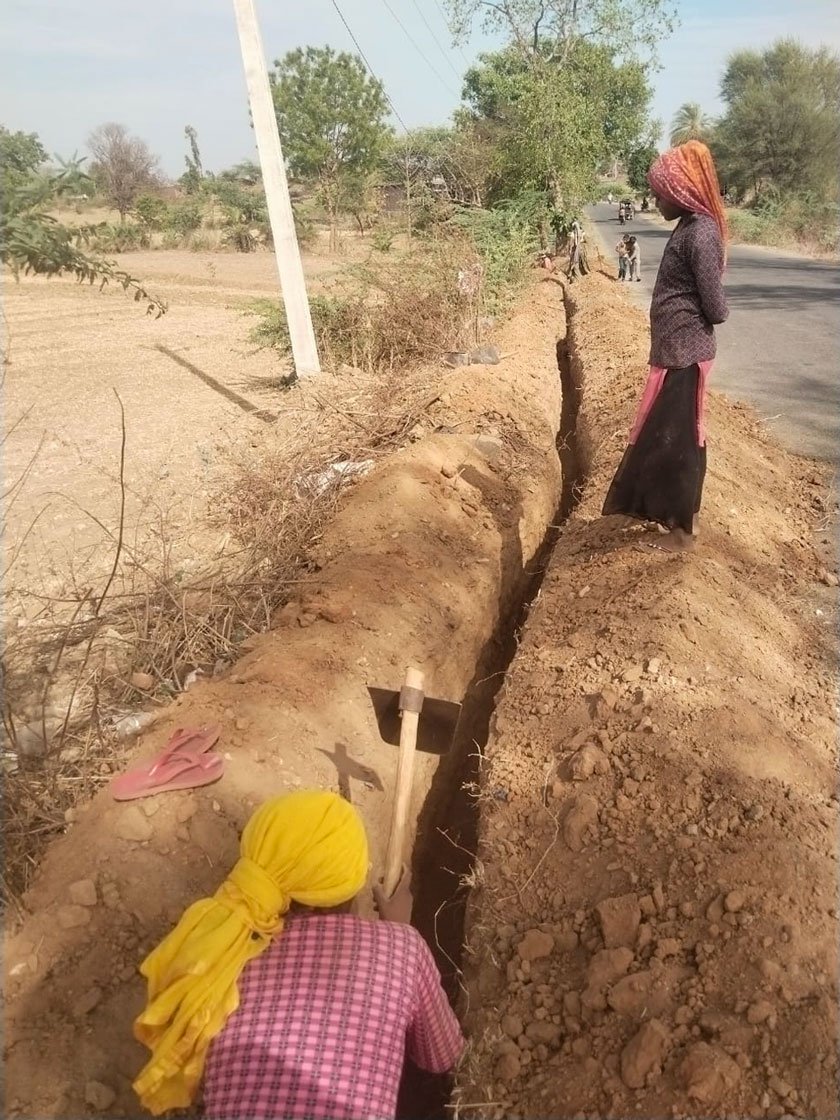
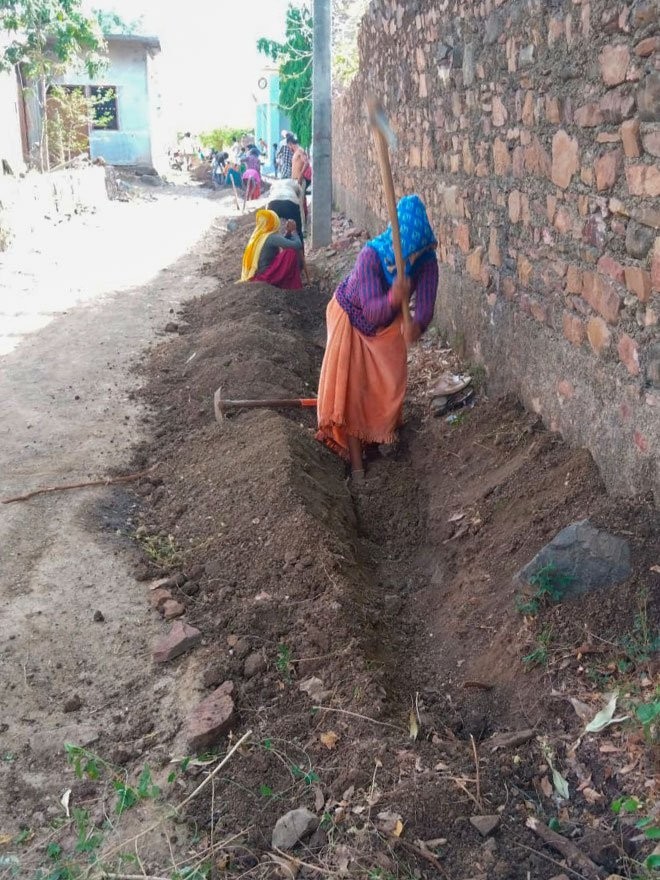
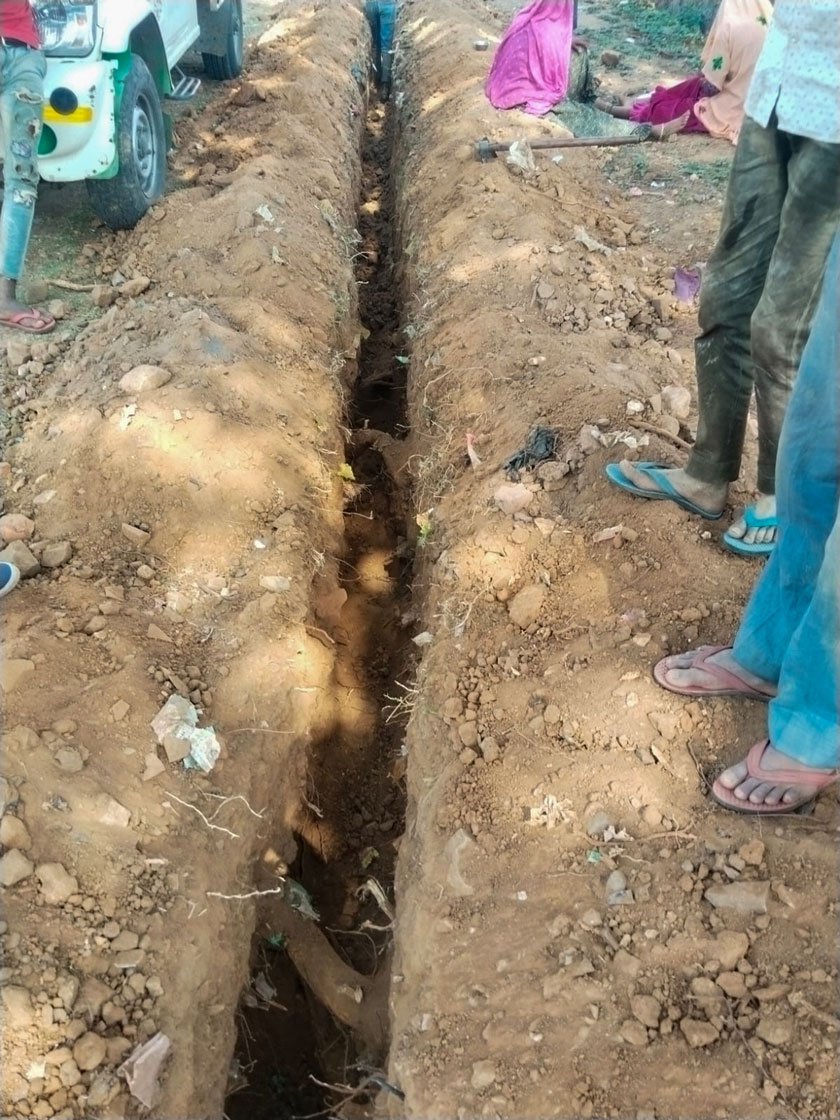
Migrants workers were able to show these screen shots taken on their mobiles as proof that they had worked laying telecom fibre cables in Banswara, Rajasthan. The images helped the 80 odd labourers to push for their Rs. 7-8 lakh worth of dues. Photos: Aajeevika Bureau via PARI
The irony is not lost on them – the trenches they had dug were for one of the country’s biggest telecom providers who wants to ‘connect people’.
Kamlesh – a project manager with Aajeevika Bureau a non-profit working on labour issues – and others, helped build their case. All their outreach material carries both the Aajeevika helpline – 1800 1800 999, and the phone numbers of officials at the bureau.
The workers from Banswara are among the lakhs migrating in search of work. “Kushalgarh has many pravasi [migrants],” says Joga Pitta, sarpanch of Churada village in the district. “We are not able to sustain ourselves with farming.”
Small landholdings, lack of irrigation, absence of jobs and overall poverty have made this district a hub for distress migration among Bhil tribals, who make up 90 per cent of the population here. An International Institute for Environment and Development Working Paper observes that migration rises sharply after climate extreme events like drought, flood and heatwaves.
At the busy Kushalgarh bus stands, around 40 state buses leave every day through the year carrying 50-100 people in one journey. Then there are the private buses of roughly the same number. A ticket to Surat costs 500 rupees and the conductor says they don’t charge for children.
Suresh Maida arrives early to find space, and settle his wife and three small children into the bus to Surat. He gets off to put their luggage – a big sack with five kilos of flour, some utensils and clothes into the storage area behind the bus, and clambers back in.
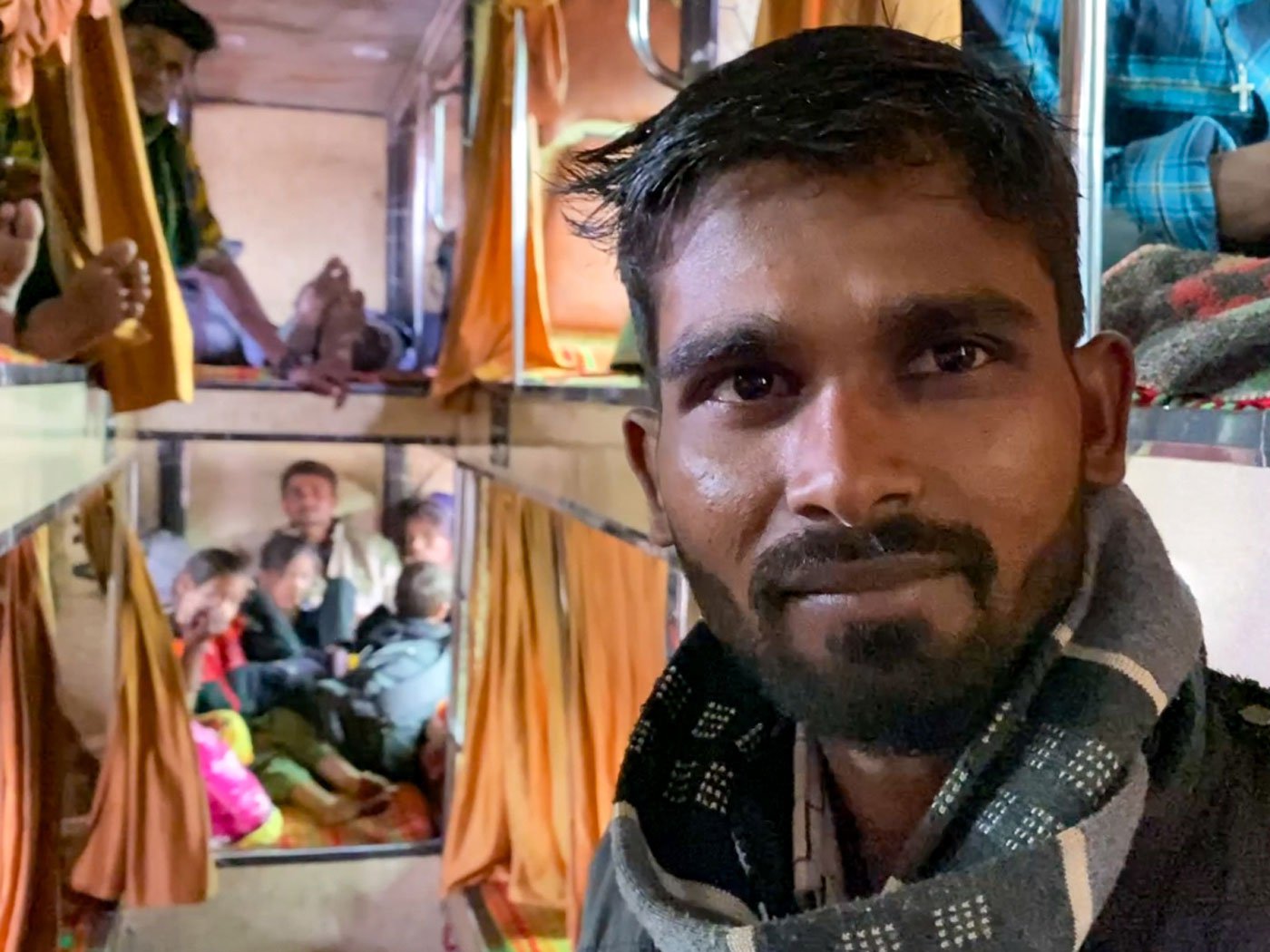
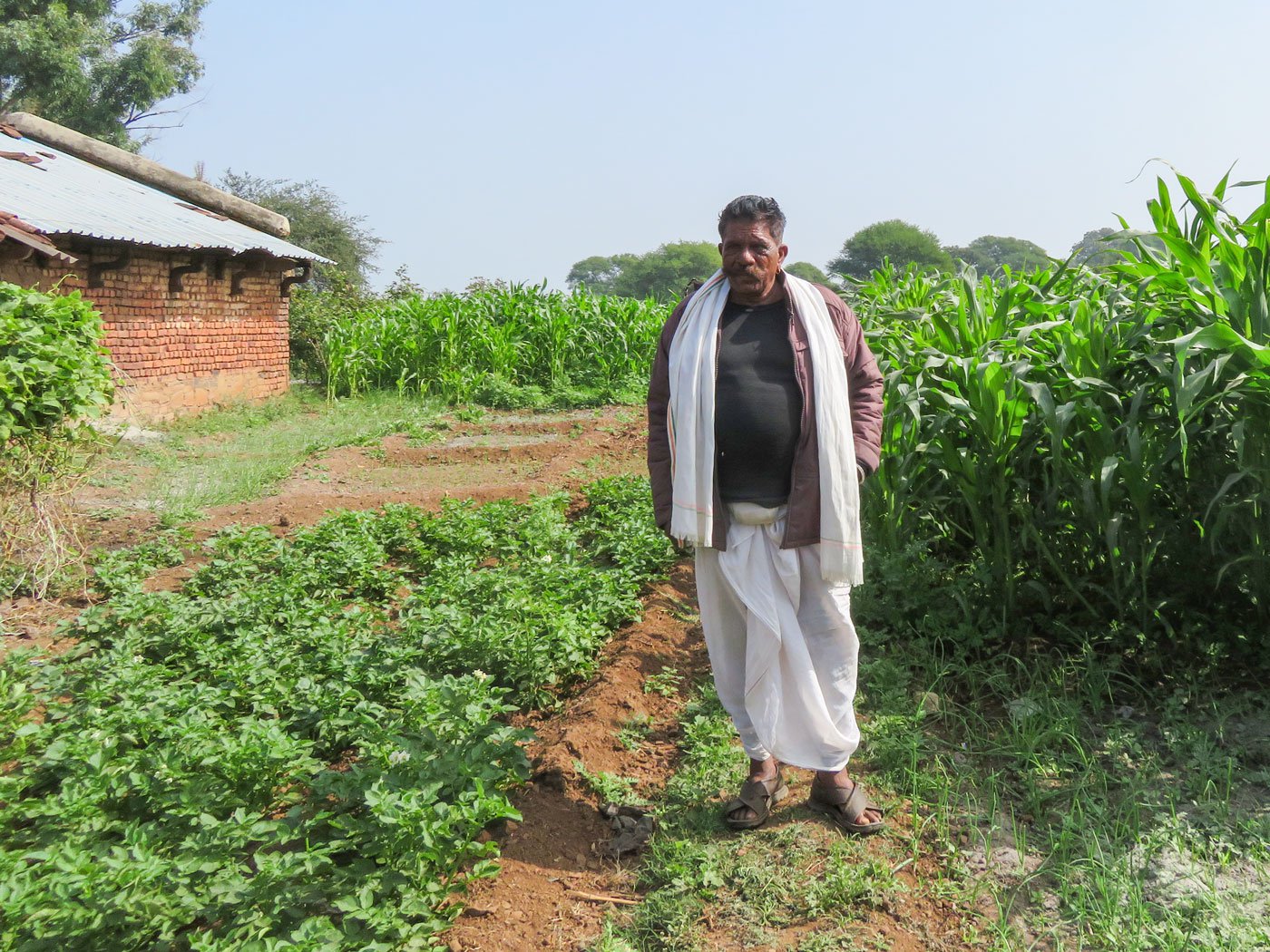
Left: Suresh Maida is from Kherda village and migrates multiple times a year, taking a bus from the Kushalgarh bus stand to cities in Gujarat. Right: Joga Pitta is the sarpanch of Churada village in the same district and says even educated youth cannot find jobs here. Photos: Priti David/PARI
“I will earn around 350 [rupees] a day,” the Bhil Adivasi daily wage worker tells PARI; his wife will earn 250-300 rupees. Suresh expects they will stay a month or two before returning, spend roughly 10 days at home and set off again. “I’ve been doing this for more than 10 years,” adds the 28-year-old. Migrants like Suresh usually come home for big festivals like Holi, Diwali and Raksha Bandhan.
Rajasthan is a net out-migration state – more people leave than enter as migrants; only Uttar Pradesh and Bihar see greater numbers leaving for wage work. “Not only is agriculture the only option, but it also only one-time – after the rains,” points out V.S. Rathod, an official in the Kushalgarh tehsil office.
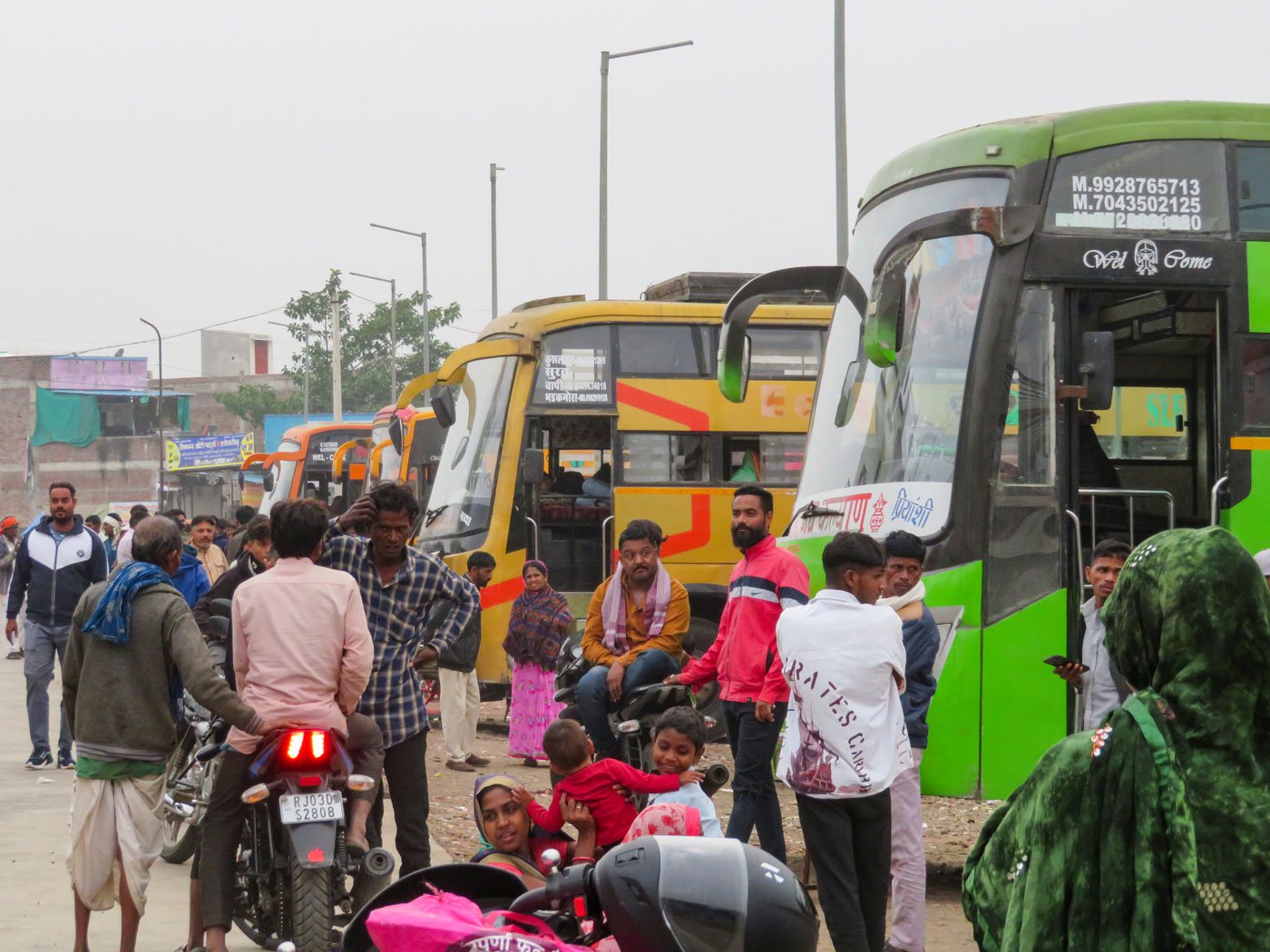
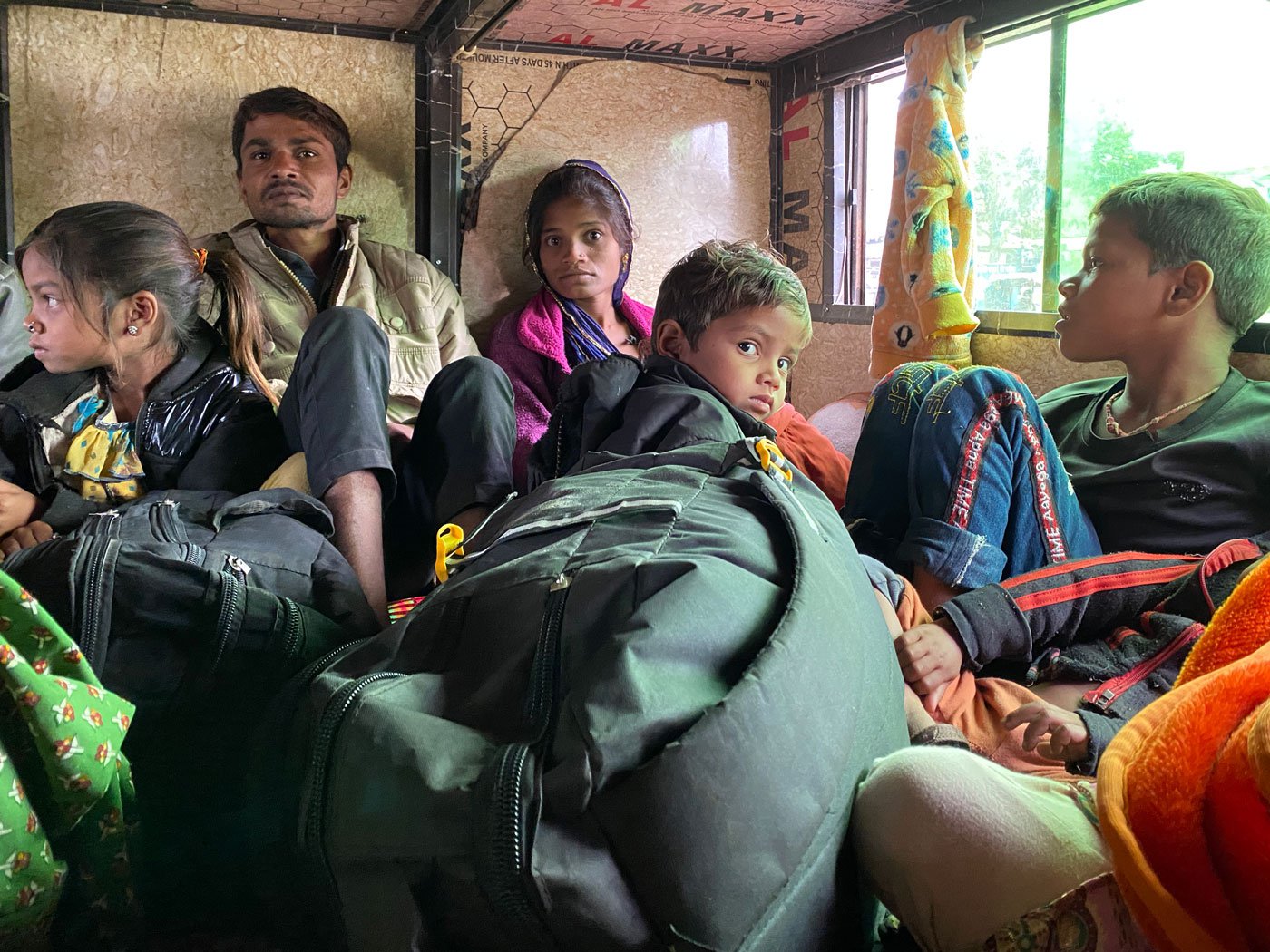
At the Timeda bus stand (left) in Kushalgarh, roughly 10-12 busses leave every day for Surat and big cities in Gujarat carrying labourers – either alone or with their families – looking for wage work. Photos: Priti David/PARI
All workers are hoping for kayam work where they are attached to one contractor for the entire period. It offers more stability as against rokdi or dehadi – standing at the mazdoor mandi (labour market) every morning.
Joga ji has educated all his children but even so “yahan berojgaari zyaada hain. Padhe likhe logon ke liye bhi naukri nahin [There is a lot of unemployment here, even those who are educated have no jobs].”
Migration is the only foreseeable option.
When Maria Paaru leaves home, she takes a mitti ka tawa (clay pan) with her. It’s a critical part of her packing. Corn rotis are best made on the clay pans which can handle the heat of wood fires without burning the roti she says, while showing me how it’s done.
Maria and her husband Paaru Damor are among the lakhs of Bhil Adivasis who move out of their homes in Banswara district of Rajasthan in search of daily wage work in Surat, Ahmedabad, Vapi and cities in Gujarat, as well as other neighbouring states. “MNREGA takes too long and is not enough,” says Paaru, speaking of the Mahatma Gandhi National Rural Employment Guarantee scheme that gives 100 days of work.
The 30-year-old Maria also carries 10-15 kilograms of makai (corn) flour. “We prefer to eat these,” she says, sharing the food habits of her family who are away for up to nine months in a year. Familiar food is a comfort when away from home in Dungra Chhota.
The couple have six children whose ages range from 3-12 years, and they own two acres of land on which they grow wheat, channa and corn for their own consumption. “We can’t manage [finances] without migrating for work. I have to send money home to my parents, pay for irrigation water, buy fodder for cattle, food for the family…,” Paaru reels off his expenses. “So, we have to migrate.”
He first migrated when he was eight years old, travelling with his older brother and sister after the family incurred a debt of 80,000 rupees on medical expenses. “It was winter,” he recalls, “I went to Ahmedabad and would earn 60 rupees a day.” The siblings stayed for four months and managed to pay off the debt. “I enjoyed the fact that I had helped out,” he adds. Two months later he went again. It’s been 25 years of a migrant’s life for Paaru, now in his early thirties.
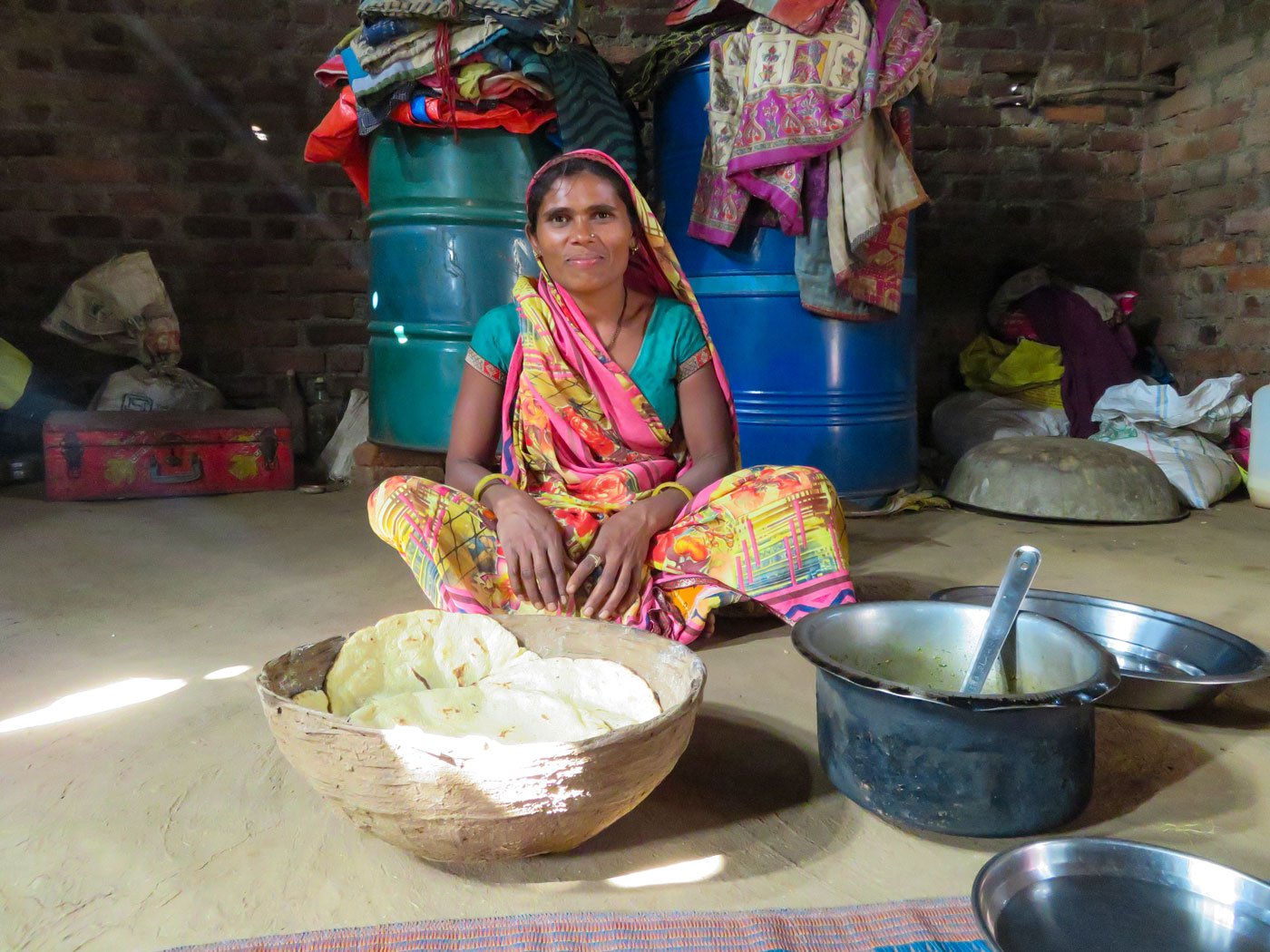
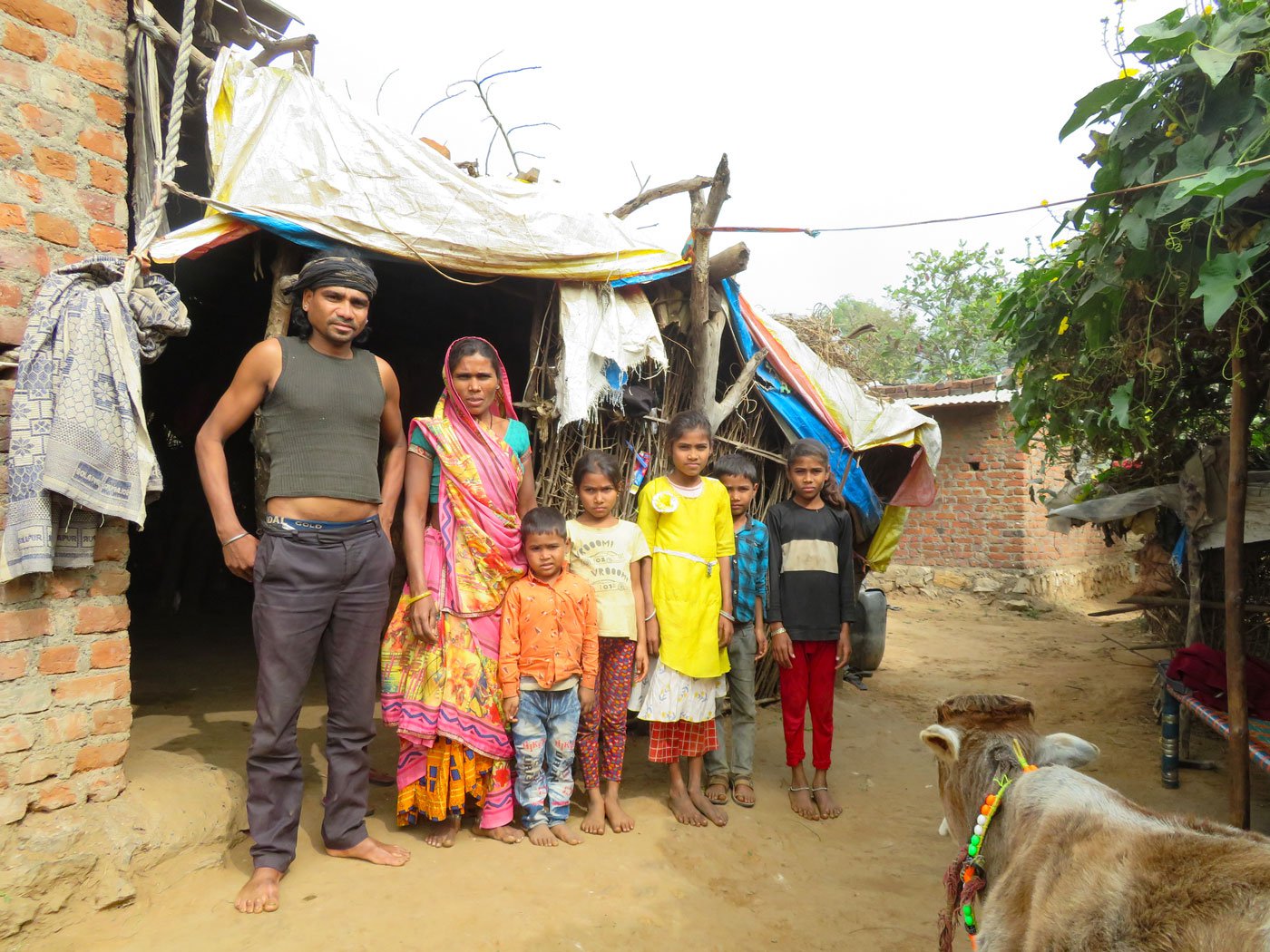
Left: Maria Paaru has been migrating annually with her husband Paaru Damor since they married 15 years ago. Maria and Paaru with their family at home (right) in Dungra Chhota, Banswara district. Photos: Priti David/PARI
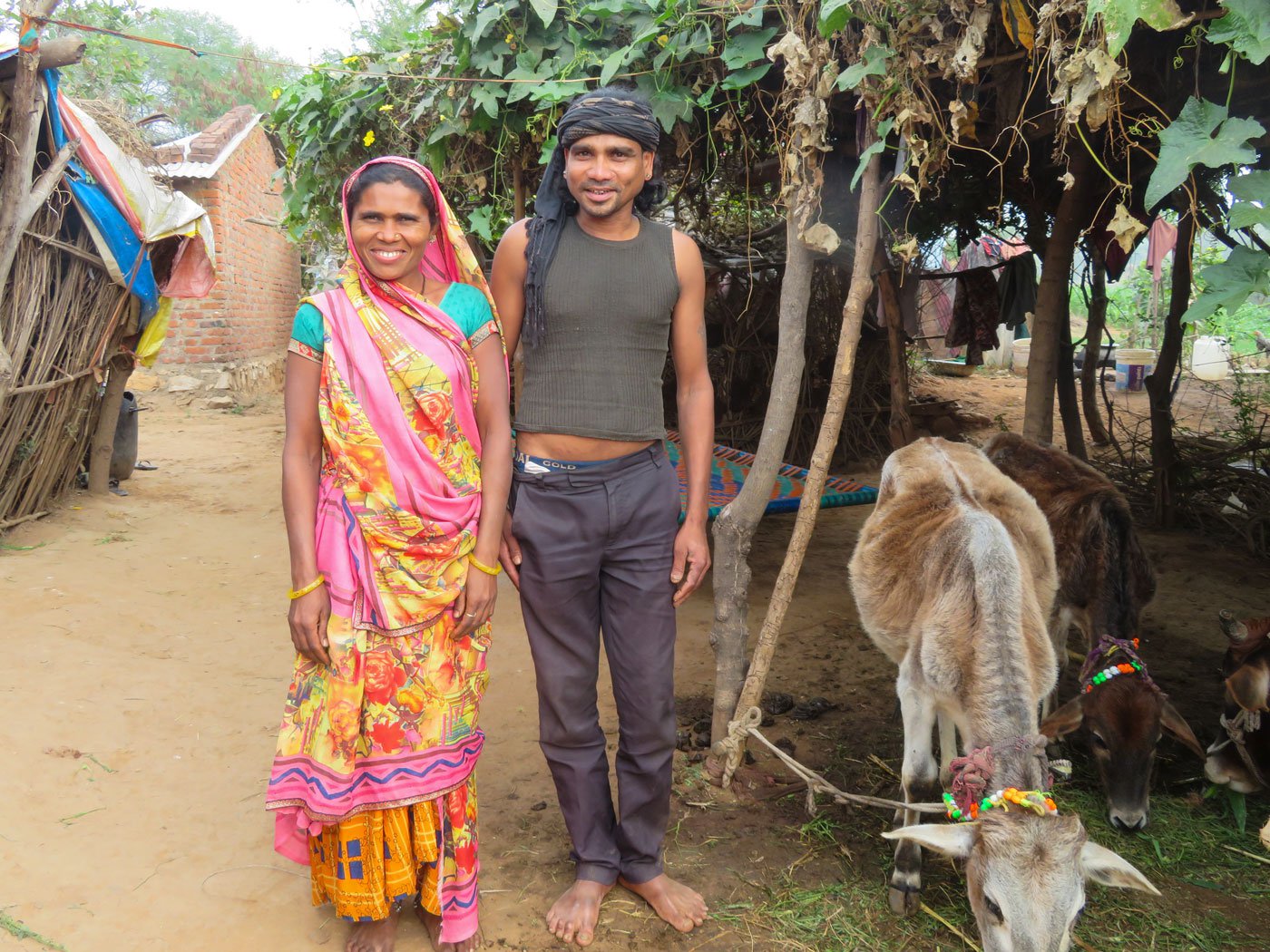
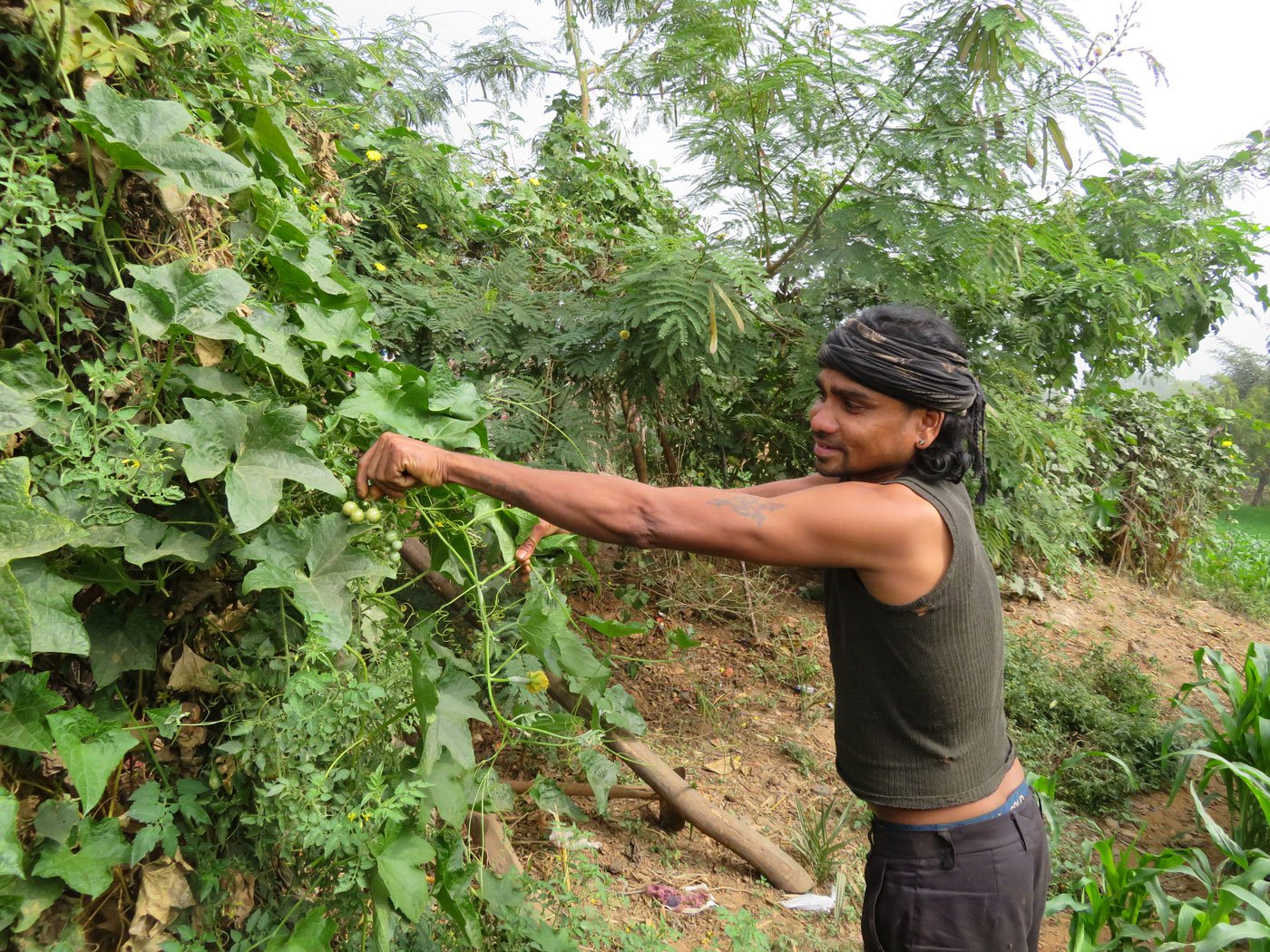
“We can’t manage [finances] without migrating for work. I have to send money home to my parents, pay for irrigation water, buy fodder for cattle, food for the family…,” Paaru reels off his expenses. “So, we have to migrate.” Photos: Priti David/PARI
Migrants dream of a pot of ‘gold’ at the end that will pay off debts, keep children in school and hunger at bay. But things often go wrong. The state labour helpline run by Aajeevika receives up to 5,000 calls a month from migrant workers seeking legal redress for non-payment of dues.
“For wage labour, agreements are never formal, they are verbal. Labourers are passed from one contractor to another,” says Kamlesh who estimates that the denial of wages for just the migrants out of Banswara district adds up to crores of rupees.
“They never get to know who their principal contractor is, who they are working for, so redressal of dues is a frustrating and longwinded process,” he adds. His job gives him a ringside view of how migrants are exploited.
On June 20, 2024, Rajesh Damor, a 45-year-old Bhil Adivasi and two other workers walked into his office in Banswara seeking help. Temperatures in the state were at an all-time high, but that was not the reason why the beleaguered workers were hot and bothered. Collectively due Rs. 226,000 from the labour contractor who had hired them, they had approached the Patan Police Station in Kushalgarh tehsil to lodge a complaint. The cops redirected them to Aajeevika’s Shramik Sahayata Evam Sandarb Kendra, a resource centre for migrant labour in the area.
In April, Rajesh and 55 workers from Sukhwara panchayat had left for Morbi in Gujarat, 600 kilometres away. They had been hired to do labour and masonry work at a construction site in a tile factory there. A daily wage of Rs. 700 was promised to the 10 skilled workers and the rest would get Rs. 400.
After a month of working, “we asked the thekedar [contractor] to pay us all our dues and he kept pushing the dates,” says Rajesh speaking on the phone to PARI. It helped that Rajesh, who was at the forefront of negotiations, speaks five languages – Bhili, Wagdi, Mewari, Hindi and Gujarati. The contractor dealing with their dues was from Jhabua in Madhya Pradesh and spoke Hindi. Often labour is unable to communicate with the final contractor sometimes because of a language barrier, but often because it means wading through a hierarchy of sub-contractors below him. Sometimes contractors get physically violent when the labourers demand their dues.
The 56 workers waited weeks to be paid their hefty dues. They were running out of food from home and purchases in the open market were eating away at their earnings.
“He kept pushing the date – 20, then 24 May, 4 June…” recalls a distressed Rajesh. “We asked him ‘what will we eat? We are so far from home.’ Finally, we stopped working the last 10 days, hoping that would force him to pay up.” They were promised June 20 as the final date.
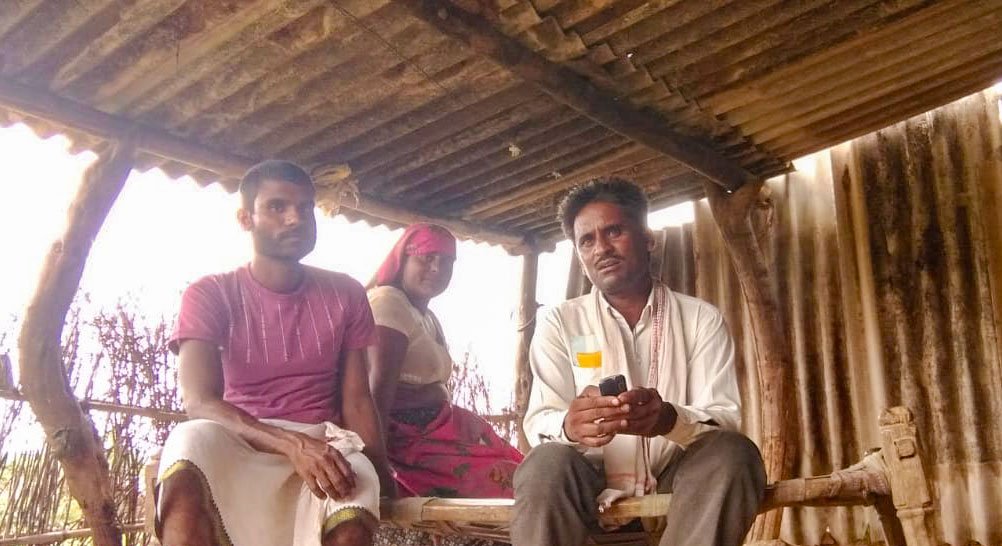
Unsure but unable to stay, on June 9, the party of 56 took the bus home to Kushalgarh. On June 20 when Rajesh called him, “he was rude and started haggling and cursing us.” That’s when Rajesh and the others walked into a police station near their home.
Rajesh Damor (seated on the right) with his neighbours in Sukhwara panchayat. He speaks Bhili, Wagdi, Mewari, Gujarati and Hindi, the last helped him negotiate with the contractor when their dues of over Rs. two lakh were held back in Morbi in Gujarat. Photo: PARI
Rajesh has 10 bighas of land on which his family grow soybean, cotton and wheat, the latter for their own consumption. His four children have all received an education, and are enrolled in schools and colleges. Yet, this summer they joined their parents in wage work. “It was the holidays, so I said they can come along and earn some money,” says Rajesh. He is hopeful his family will see the earnings now that the contractor has been threatened with a case in the labour court.
The mention of labour court does force erring contractors to make good their promises. But to get there, labourers need help with filing the case. A group of 12 wage workers who had gone from this district to work on roads in Alirajpur, in neighbouring Madhya Pradesh were denied full payment after three months of working. The contractor cited poor work and refused to pay the Rs. 4-5 lakh due to them.
“We got a call saying we are stuck in Madhya Pradesh, and we have not been paid,” recalls Teena Garasia who often gets such calls on her personal phone. “Our numbers get circulated among workers,” explains the head of Aajeevika’s Livelihood Bureau in Banswara district.
This time the workers were able to give details of the work site, photos of the attendance register, and the name and mobile number of the contractor for the case to be filed.
Six months later the contractor paid up in two instalments. “He came here [Kushalgarh] to give the money,” say the relieved workers who received the wages, but not the interest due on late payment.
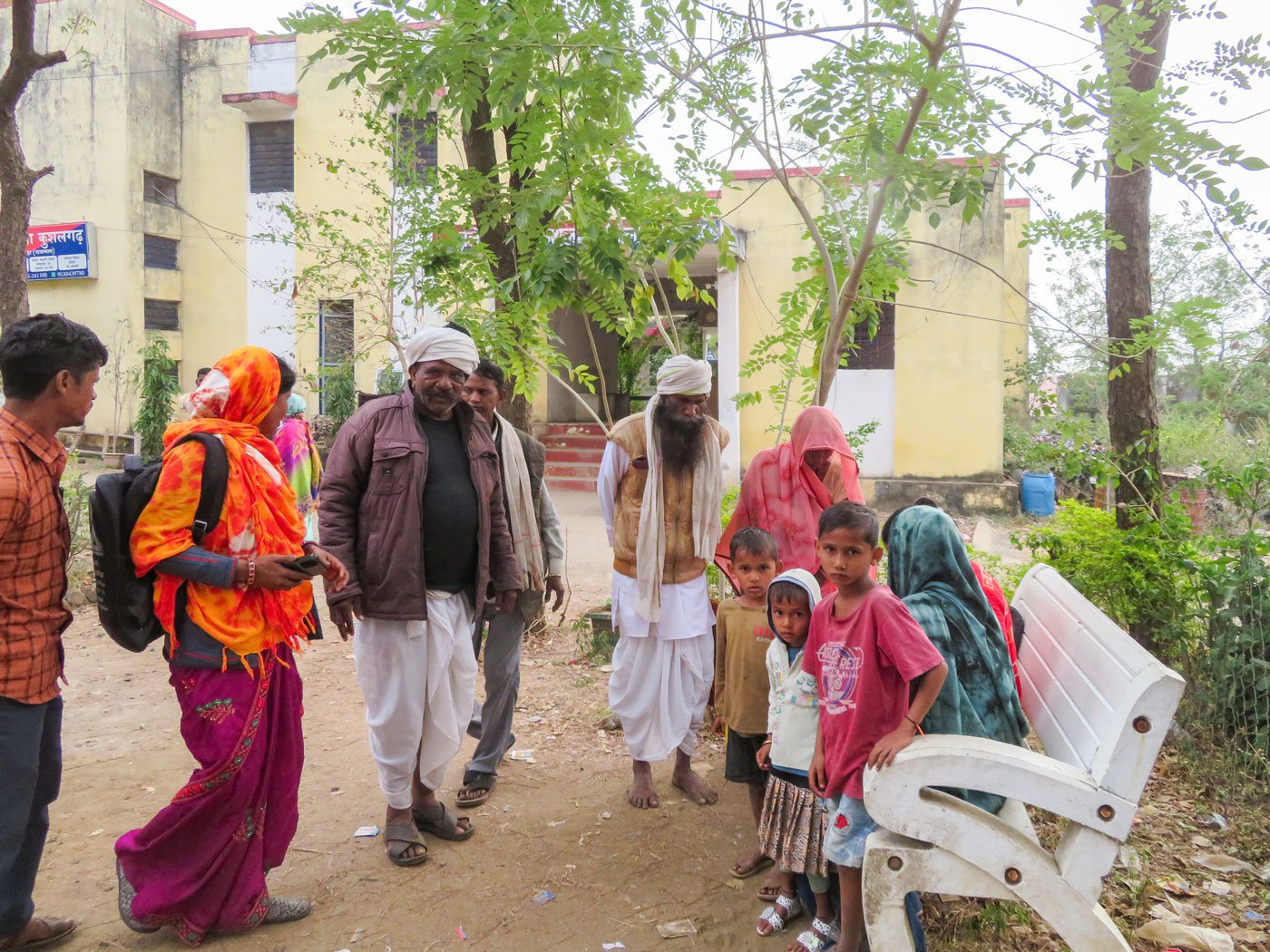
For unpaid workers, accessing legal channels such as the police (left) and the law (right) in Kushalgarh is not always easy as photographic proof, attendance register copies, and details of the employers are not always available. Photos: Priti David/PARI
“We try negotiation first,” says Kamlesh Sharma. “But that is only possible if the details of the contractor are there.
The 25 labourers who migrated for Surat to work in a textile factory had no proof. “They were passed on from one contractor to another and have no phone number or name to pin the person down,” says Teena. “They couldn’t identity the factory in the sea of similar looking ones.”
Harassed and denied their full wages of Rs. 6 lakhs, they returned home to their villages in Banswara’s Kushalgarh and Sajjangarh.
It’s for such cases that social worker Kamlesh places a lot of faith in kanoon shiksha (legal literacy). Banswara district lies on the state border and is the scene of maximum migration. Eighty per cent of families in Kushalgarh, Sajjangarh, Ambapara, Ghatol and Gangar Talai have at least one migrant, if not more, says Aajeevika’s survey data.
Kamlesh is hopeful that since “the younger generation have phones, can store numbers, take photos and therefore nailing defaulting contractors will become easier in the future.”
The union government’s Samadhan Portal was launched pan-India on September 17, 2020 for filing industrial disputes, and in 2022 it was rejigged to allow workers to file claims. But there is no office in Banswara despite it being an obvious choice.
Kushalgarh town in Banswara district lies on the state border and is the scene of maximum migration. Eighty per cent of families in Kushalgarh, Sajjangarh, Ambapara, Ghatol and Gangar Talai have at least one migrant, if not more, says Aajeevika’s survey data. Photos: Priti David/PARI
Women migrants don’t find a voice in wage conversations. They rarely have their own phone and both work and wages are directed through the men around them. There has been serious resistance to women getting their own phones. The last government of the state, led by Ashok Gehlot of the Congress, launched a programme for distribution of over 13 crore free phones to women in the state. Close to 25 lakh phones were distributed to poor women till the Gehlot government lost power. In the first phase, the phones were given to widows and girls in Class 12 who were from migrant families.
The incoming government of Bhajan Lal Sharma of the Bhartiya Janata Party has put the programme on hold “till the scheme’s benefits are examined.” It was among the first decisions he made barely a month after being sworn in. Locals says the scheme is unlikely to be revived.
For most women the lack of agency over their earnings contributes to the routine gender, sexual abuse and abandonment they face.
“I cleaned the wheat and he took it along with some corn flour, 5-6 kilos. He took it and left,” recalls Sangeeta, a Bhil Adivasi now living with her parents in their home in Churada, Kushalgarh block. She had migrated with her husband when he went to Surat after they were married.
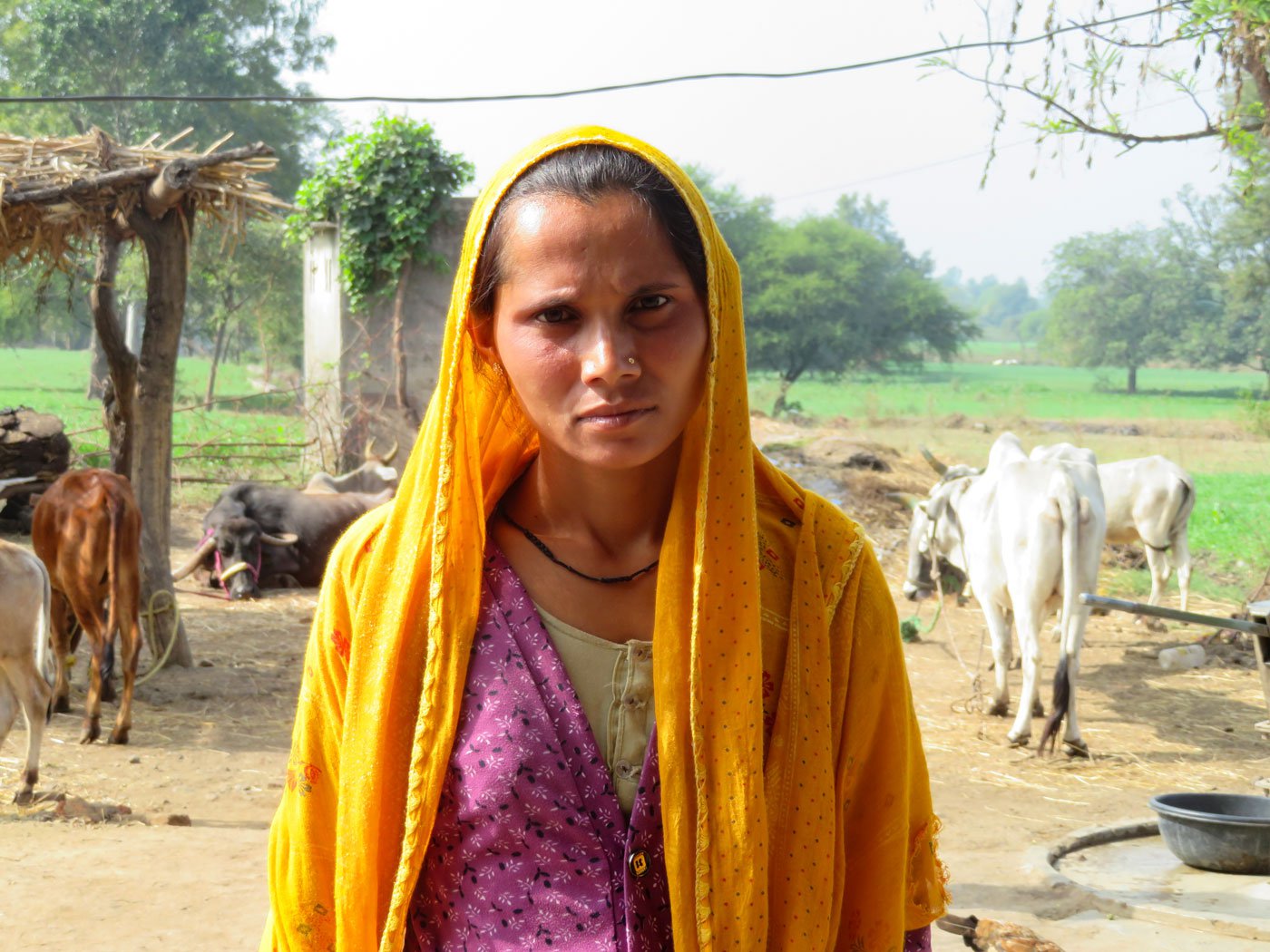
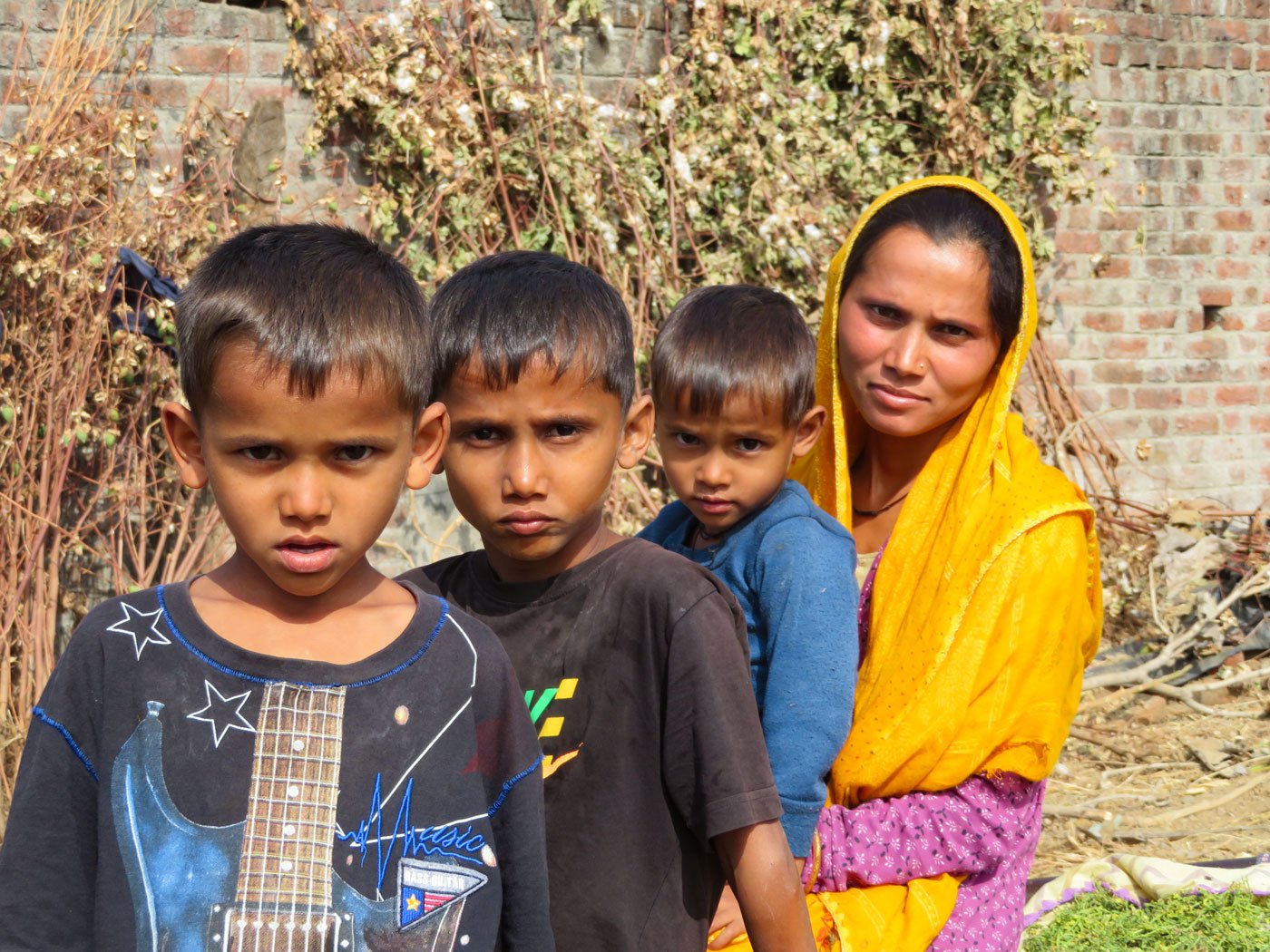
Sangeeta in Churada village of Kushalgarh block with her three children. She arrived at her parent’s home after her husband abandoned her and she could not feed her children. Photos: Priti David/PARI
“I helped in construction work,” she recalls, and her earnings were handed to her husband. “I didn’t like it there.” Once the couple’s children were born – they have three boys ages aged seven, five and four – she stopped going. “I was taking care of the children and the house.”
For more than a year now, she has not seen her husband, or received any money from him. “I have come to my parent’s house as there is nothing to feed my children there [at her married home].”
In January this year (2024), she went to the police station in Kushalgarh to file a case. Rajasthan accounts for almost 10 per cent of India’s abandoned women, says the National Crimes Records Bureau (NCRB) 2020 report . But real data is hard to find as figures for abandoned women are clubbed with miscarriage, infanticide, foeticide.
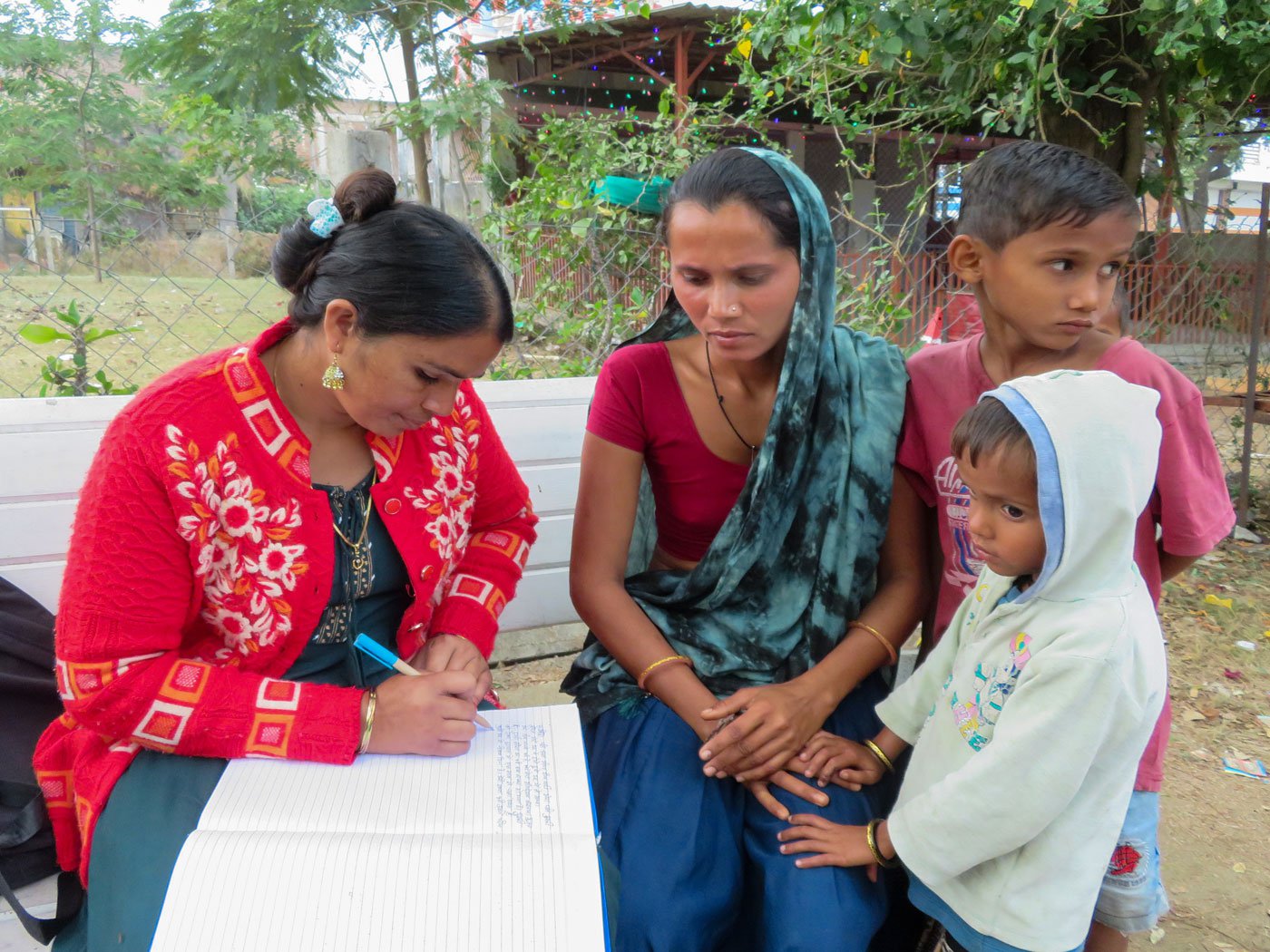
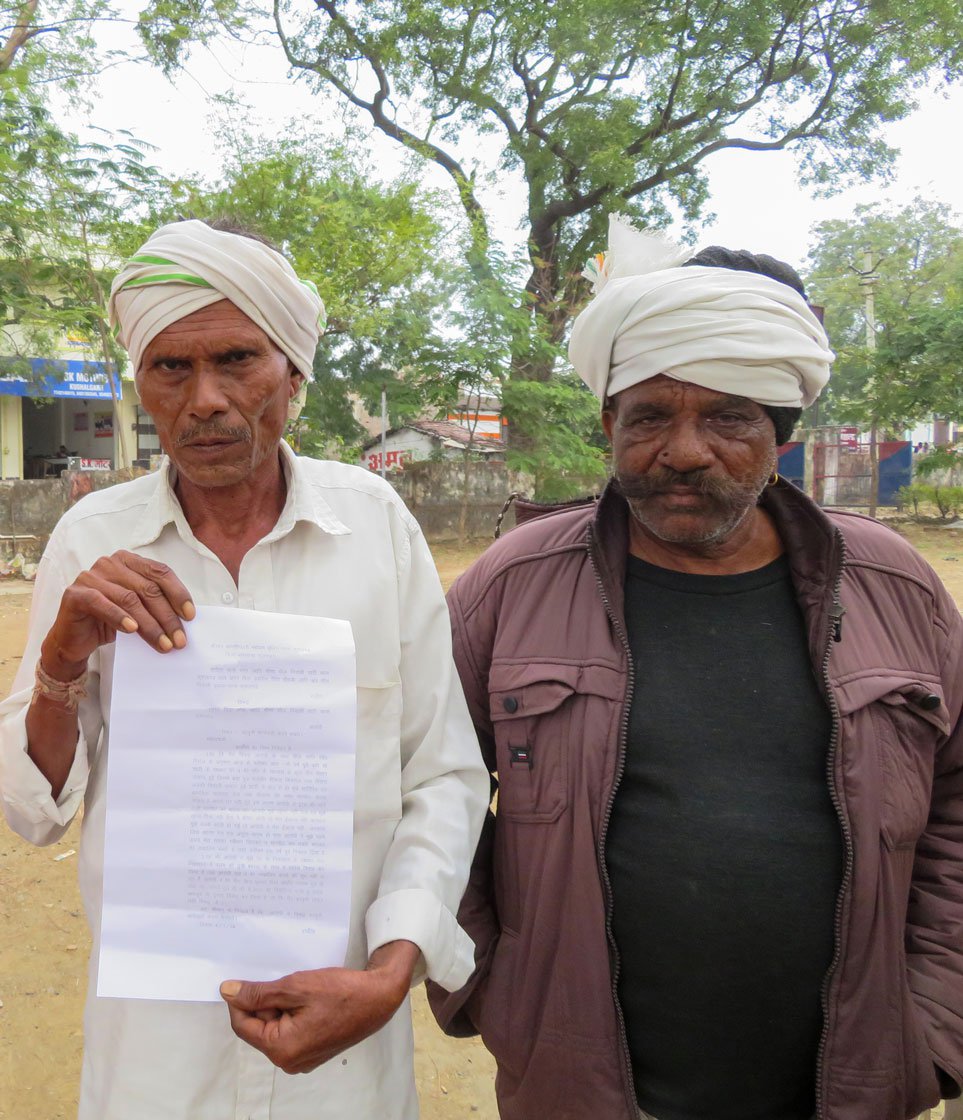
Sangeeta is helped by Jyotsna Damor to file her case at the police station. Sangeeta’s father holding up the complaint of abandonment that his daughter filed. Sarpanch Joga (in brown) has come along for support. Photos: Priti David/PARI
At the Kushalgarh Police Station, officers admit that the number of women seeking redressal is only rising. But they also admit that most cases don’t reach them as the banjadia – an all-men group in the village who take decisions – prefer to settle without the cops. “The banjadia take money from both sides,” says a resident. “Justice is an eye wash, and women never get their due.”
Sangeeta’s distress is worsening as relatives are telling her that her husband is with another woman who he wants to marry. “I feel bad that the man has hurt my children, not come to see them for over a year. They ask me ‘is he dead?’ My eldest one abuses him and tells me, ‘Mummy when the police catch him you also beat him up!’” she says, a small smile on her face.
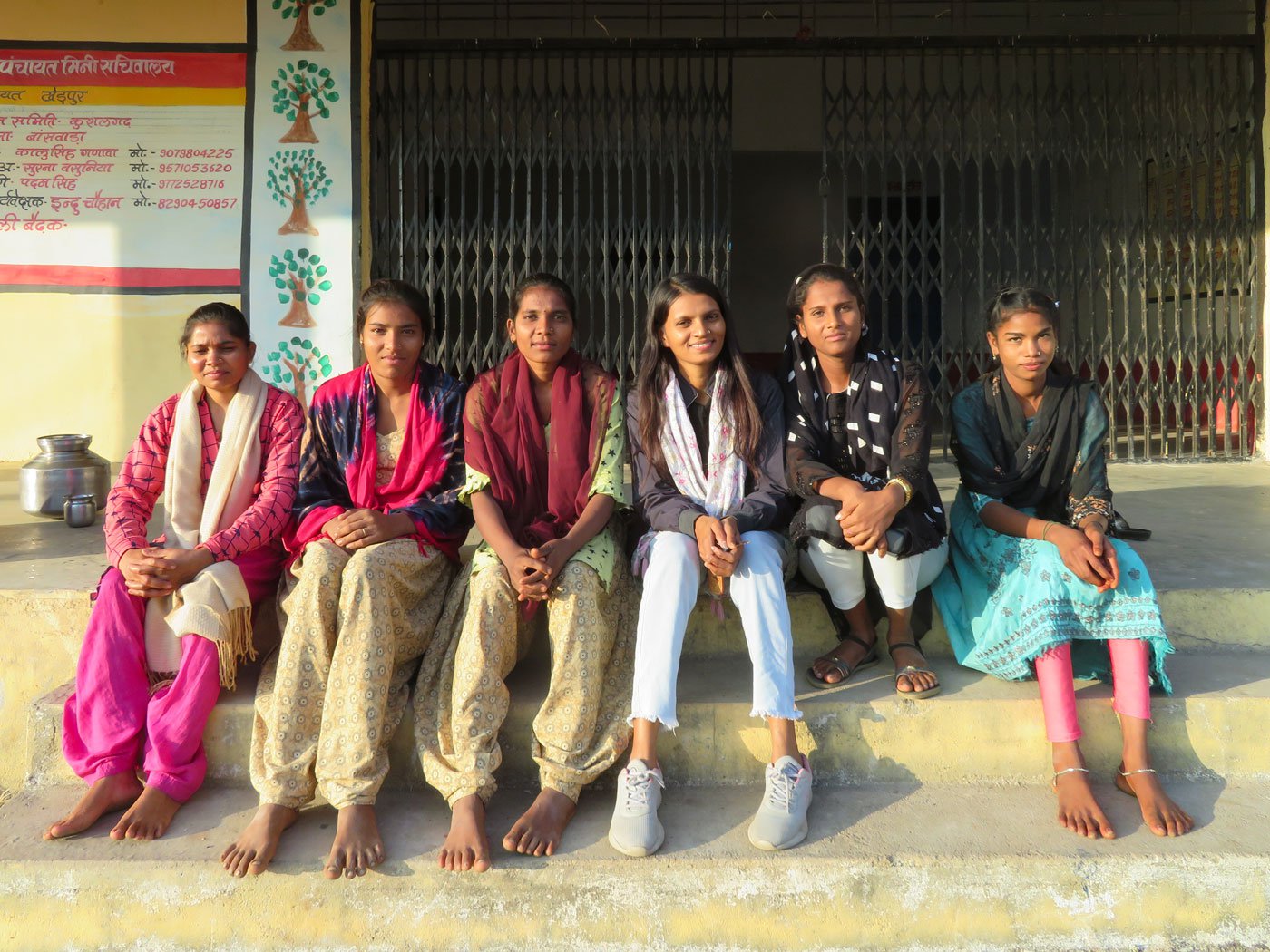
Menka (wearing blue jeans) with girls from surrounding villages who come for the counselling every Saturday afternoon. Photo: Priti David/PARI
On a Saturday afternoon in the deserted panchayat office in Kherpur, 27-year-old social worker Menka Damor is speaking to young girls of five panchayats here in Kushalgarh block.
“What is your sapna [dream]?” she asks the 20 odd girls sitting in a circle around her. All of them are daughters of migrants, all have travelled with their parents and are likely to again. “They tell me even if we get to school, we will only have the migration at the end,” says Menka who manages the Kishori Shramik Programme for young girls.
She wants them to see a future beyond migration. Switching between Wagdi and Hindi, she flashes cards showing people from different professions – cameraperson, weightlifter, dress designer, skateboarder, teacher and engineer. “You can be anything you want, and you have to work towards it,” she tells the bright faces.
“Migration is not the only option.”
जून महीने का तीसरा शुक्रवार था, जब मज़दूर हेल्पलाइन नंबर की घंटी बजी.
“क्या आप हमारी मदद कर सकते हैं? हमें हमारी मजूरी नहीं दी रही है.”
कुशलगढ़ में रहने वाले 80 मज़दूरों की टोली राजस्थान में ही आसपास की तहसीलों में काम करने गई हुई थी. दो माह से वे टेलीकॉम फाइबर केबल बिछाने के लिए दो फीट चौड़ा और छः फीट गहरा गड्ढा खोद रहे थे. मजूरी खोदे जा रहे गड्ढे की प्रति मीटर गहराई के हिसाब से मिलनी तय हुई थी.
दो माह बाद जब काम पूरा हुआ, तो उन्होंने अपनी मजूरी मांगी. ठेकेदार ख़राब काम करने का बहाना देने लगा, और हिसाब-किताब में फंसाने लगा. इसके बाद वह उन्हें यह कहकर टालने लगा कि “देता हूं, देता हूं.” लेकिन उसने पैसे नहीं दिए. एक हफ़्ते तक अपने बकाया 7-8 लाख रुपए का इंतज़ार करने के बाद मज़दूर पुलिस के पास गए, जहां उन्हें मज़दूर हेल्पलाइन में फोन करने को कहा गया.
जब मज़दूरों ने हेल्पलाइन में फ़ोन किया, तो “हमने पूछा कि उनके पास कोई सबूत है कि नहीं. हमने उनसे ठेकेदार का नाम और फ़ोन नंबर, और हाज़िरी रजिस्टर की तस्वीरें मांगी,” बांसवाड़ा ज़िला मुख्यालय में सामाजिक कार्यकर्ता कमलेश शर्मा बताते हैं.
क़िस्मत से नई उम्र के कुछ मज़दूर – जो मोबाइल चलाने में माहिर थे – ये सब इकट्ठा करने में कामयाब रहे. अपना पक्ष मज़बूत करने के लिए उन्होंने काम के जगह की कुछ तस्वीरें भी भेजीं.
प्रवासी मज़दूर मोबाइल में लिए इन स्क्रीनशॉट को सबूत के रूप में पेश करने में कामयाब रहे, जिससे यह साबित होता था कि वे राजस्थान के बांसवाड़ा में दूरसंचार फाइबर केबल बिछाने का काम कर रहे थे. इन तस्वीरों से 80 मज़दूरों को 7-8 लाख रुपए की बकाया मजूरी के लिए दबाव बनाने में मदद मिली | Photos: Aajeevika Bureau via PARI
विडंबना है कि जो गड्ढे उन्होंने खोदे थे वो देश की सबसे बड़ी दूरसंचार कंपनियों में से एक की ख़ातिर खोदे गए थे. उस कंपनी के लिए को ‘लोगों को जोड़ने’ का दावा करती है.
श्रमिकों से जुड़े मुद्दों पर काम करने वाली एक ग़ैर-लाभकारी संस्था ‘आजीविका ब्यूरो’ के प्रोजेक्ट मैनेजर कमलेश और अन्य लोगों ने मिलकर उनके मामले को आगे बढ़ाया. इस संस्था तक पहुंचने के लिए आजीविका हेल्पलाइन नंबर- 1800 1800 999 के साथ ब्यूरो के अधिकारियों के फ़ोन नंबर उपलब्ध कराए जाते हैं.
बांसवाड़ा के ये मज़दूर हर साल काम की तलाश में पलायन करने वाले लाखों मज़दूरों में शामिल हैं. ज़िले के चुड़ादा गांव के सरपंच जोगा पित्ता कहते हैं, “कुशलगढ़ में बहुत से प्रवासी हैं. सिर्फ़ खेती करके हमारा गुज़ारा नहीं चल पाता.”
खेत के छोटे-छोटे जोत, सिंचाई की कमी, रोज़गार के अभाव और इन सब के ऊपर ग़रीबी ने इलाक़े को भील आदिवासियों के पलायन का गढ़ बना दिया है. यहां की 90 प्रतिशत आबादी भील आदिवासियों की है. इंटरनेशनल इंस्टिटयूट फ़ॉर एनवायरनमेंट एंड डेवलपमेंट विश्लेषण के मुताबिक़ सूखे, बाढ़ और गर्मी की लहर (हीट वेव) जैसे चरम मौसमी बदलावों ने पलायन में तेज़ी ला दी है.
कुशलगढ़ के व्यस्त बस स्टैंड से हर दिन क़रीब 40 सरकारी बसें एक बार में 50-100 लोगों को लेकर जाती हैं. इसके अलावा लगभग इतनी ही निजी बसें भी चलती हैं. सूरत की टिकट 500 रुपए में आती है और कंडक्टर बताते हैं कि वे बच्चों के टिकट के पैसे नहीं लेते.
सुरेश मेडा बस में जगह पाने के लिए जल्दी पहुंच जाते हैं और सूरत जाने वाली बस में अपनी पत्नी व तीन छोटे बच्चों को बिठाते हैं. सामान चढ़ाने के लिए वह उतरते हैं और पांच किलो आटा, थोड़े बर्तन और कपड़ों से भरी बोरी बस के पीछे की तरफ़ सामान रखने वाली जगह पर रखते हैं और फिर से बस में चढ़ जाते हैं.
बाएं: सुरेश मेडा खेरदा गांव से हैं और साल में एक से ज़्यादा बार पलायन करते हैं. कुशलगढ़ बस स्टैंड से वह गुजरात के अलग-अलग शहरों के लिए बस पकड़ते हैं. दाएं: जोगा पित्ता चुड़ादा गांव के सरपंच हैं और बताते हैं कि यहां पढ़े-लिखे युवाओं के लिए भी नौकरी नहीं है | Photos: Priti David/PARI
“मैं हर रोज़ 350 रुपए के आसपास कमाऊंगा,” भील आदिवासी मज़दूर सुरेश पारी को बताते हैं; उनकी पत्नी को रोज़ के 250-300 रुपए मिलेंगे. सुरेश को उम्मीद है कि वे लौटने से पहले एक या दो महीने तक काम करेंगे. फिर घर पर 10 दिन रहने के बाद, दोबारा काम पर निकल जाएंगे. सुरेश (28) कहते हैं, “दस साल ज़्यादा समय से जीवन इसी तरह चल रहा है.” सुरेश जैसे प्रवासी मज़दूर आम तौर पर होली, दिवाली और रक्षाबंधन जैसे बड़े त्योहारों में घर आते हैं.
राजस्थान से बड़ी मात्रा में बाहर के राज्यों में पलायन होता है. यहां काम के लिए आने वाले लोगों के बनिस्पत काम के लिए बाहर जाने वाले लोग ज़्यादा हैं. मज़दूरी के लिए पलायन के मामले में राजस्थान सिर्फ़ उत्तर प्रदेश और बिहार से पीछे है. कुशलगढ़ तहसील कार्यालय के अधिकारी वी. एस राठौड़ कहते हैं, “यहां खेती ही कमाई का एकमात्र साधन है. और यह भी साल में बस एक बार, बारिश के बाद की जा सकती है.”
कुशलगढ़ के टिमेड़ा बस स्टैंड (बाएं) से रोज़ क़रीब 10 से 12 बसें गुजरात के सूरत और अन्य बड़े शहरों के लिए रवाना होती हैं. इनमें ज़्यादातर मज़दूर चलते हैं, जो काम की तलाश में अकेले या अपने परिवार के साथ यात्रा करते हैं | Photos: Priti David/PARI
सभी मज़दूर कायम वाले काम की आस में रहते हैं, जिसमें पूरे अंतराल के लिए वे एक ठेकेदार के साथ काम करते हैं. इसमें रोकड़ी या दिहाड़ी – जिसके लिए हर सुबह मज़दूर मंडी में खड़ा होना पड़ता है – के बनिस्पत ज़्यादा स्थिरता होती है.
जोगाजी ने सभी बच्चों को पढ़ाया-लिखाया है, लेकिन “यहां बेरोज़गारी ज़्यादा है. पढ़े-लिखे लोगों के लिए भी नौकरी नहीं है.”
ऐसे में पलायन ही आख़िरी सहारा बचता है.
मरिया पारू जब घर से निकलती हैं, तो साथ में मिट्टी का तवा साथ ले जाती हैं. इसके बिना वह नहीं चलती हैं. वह बताती हैं कि मिट्टी के तवे पर मकई की रोटी बढ़िया बनती है. उनके मुताबिक़, लकड़ी के चूल्हे पर जब रोटी पकती है, तो मिट्टी का तवा उसे जलने नहीं देता. यह बताते हुए वह मुझे रोटी पकाकर दिखाती भी हैं.
मरिया और उनके पति पारू दामोर जैसे लाखों भील आदिवासी राजस्थान के बांसवाड़ा ज़िले से दिहाड़ी के काम की तलाश में गुजरात के सूरत, अहमदाबाद, वापी जैसे शहरों में तथा अन्य पड़ोसी राज्यों में पलायन करते हैं. साल में 100 दिन काम देने का वादा करने वाली महात्मा गांधी राष्ट्रीय ग्रामीण रोज़गार गारंटी योजना के बारे में बताते हुए पारू कहती हैं, “मनरेगा में जल्दी काम नहीं मिलता और पूरा भी नहीं पड़ता.”
तीस साल की मरिया अपना साथ मकई का 10-15 किलो आटा भी ले जाती हैं. वह कहती हैं, “हम लोग इसे खाना पसंद करते हैं.” उनका परिवार साल में नौ महीने घर से दूर रहता है. डुंगरा छोटा में स्थित अपने घर से दूर रहते हुए ‘घर’ का भोजन सुकून देता है.
इस दंपति के तीन से 12 बरस के छः बच्चे हैं और गांव में उनके पास दो एकड़ ज़मीन है. इस पर वे अपने खाने के लिए गेहूं, चना और मक्का उगाते हैं. “काम की तलाश में घर छोड़े बिना हमारा गुज़ारा नहीं चलता. घर पर मां-बाप को पैसा भेजना पड़ता है, सिंचाई का ख़र्च उठाना होता है, मवेशियों के लिए चारा ख़रीदना होता, घरवालों का पेट पालना पड़ता है…,” पारू पूरा हिसाब गिनाते हैं. “इसलिए हमें पलायन करना पड़ता है.”
पहली बार उन्होंने आठ साल की उम्र में बड़े भाई और बहन के साथ पलायन किया था, जब परिवार के ऊपर अस्पताल के ख़र्चों के चलते 80,000 रुपए का क़र्ज़ चढ़ गया था. उन्हें याद है, “सर्दियों के दिन थे. मैं अहमदाबाद गया था और रोज़ के 60 रुपए कमाता था.” सभी भाई-बहन वहां चार महीना रहे थे और क़र्ज़ चुकाने में कामयाब हुए थे. वह कहते हैं, “मुझे इस बात के लिए अच्छा लगा था कि मैं भी कुछ मदद कर पाया था.” दो महीने बाद वह फिर से काम पर चले गए थे. तीस की उम्र पार कर चुके पारू लगभग 25 साल से पलायन कर रहे हैं.
बाएं: मरिया पारू की 15 साल पहले शादी हुई थी, जिसके बाद से वह अपने पति पारू दामोर के साथ हर साल काम की तलाश में पलायन करती रही हैं. मरिया और पारू, बांसवाड़ा के डुंगरा छोटा गांव में अपने परिवार के साथ घर (दहिना) पर | Photos: Priti David/PARI
‘काम की तलाश में घर छोड़े बिना हमारा गुज़ारा नहीं चलता. घर पर मां-बाप को पैसा भेजना पड़ता है, सिंचाई का ख़र्च उठाना होता है, मवेशियों के लिए चारा ख़रीदना होता, घरवालों का पेट पालना पड़ता है…,’ पारू पूरा हिसाब गिनाते हैं. ‘इसलिए हमें पलायन करना पड़ता है’ | Photos: Priti David/PARI
मज़दूरों को उम्मीद रहती है कि काम की अवधि ख़त्म होने पर उन्हें इतने पैसे मिल जाएंगे कि क़र्ज़ चुका पाएंगे, उनके बच्चों के स्कूल की फ़ीस भरी जा सकेगी, और सबका पेट भरा जा सकेगा. आजीविका द्वारा संचालित राज्य के मज़दूर हेल्पलाइन नंबर पर हर महीने तक़रीबन 5,000 कॉल आती है, जिसमें बकाया मजूरी न मिलने की समस्या से निपटने के लिए क़ानूनी मदद की गुहार लगायी गई होती है.
“दिहाड़ी मज़दूरी के काम में लिखा-पढ़ी नहीं होती, सबकुछ मुंह-ज़बानी तय होता है. मज़दूरों को एक ठेकेदार से दूसरे ठेकेदार के पास भेज दिया जाता है.” कमलेश कहते हैं. उनका अनुमान है कि सिर्फ़ बांसवाड़ा ज़िले के मज़दूरों का करोड़ों रुपया बकाया होगा.
वह आगे कहते हैं, “उन्हें लोगों को सही-सही पता ही नहीं चलता कि असली ठेकेदार कौन है, वे किसके लिए काम कर रहे हैं. इसलिए बकाया रक़म को हासिल करने की प्रक्रिया लंबी और हताश कर देने वाली होती है.” कमलेश का काम ऐसा है कि उन्हें इसका अंदाज़ा मिल जाता है कि प्रवासियों का किस तरह शोषण किया जा रहा है.
बीते 20 जून, 2024 को 45 वर्षीय भील आदिवासी राजेश दामोर और दो अन्य मज़दूर बांसवाड़ा में स्थित उनके कार्यालय में मदद मांगने आए. गर्मी अपना चरम पर थी, लेकिन मज़दूरों के ग़ुस्से और परेशानी का कारण कुछ और था. जिस ठेकेदार ने उन्हें काम पर रखा था उसके पास उनके सामूहिक रूप से 226,000 रुपए बकाया थे. इसकी शिकायत के लिए जब वे कुशलगढ़ तहसील के पाटन पुलिस स्टेशन गए, तो पुलिस ने उन्हें आजीविका के श्रमिक सहायता एवं संदर्भ केंद्र भेज दिया.
अप्रैल में राजेश और 55 अन्य मज़दूर सुखवाड़ा पंचायत से 600 किमी दूर स्थित गुजरात के मोरबी के लिए रवाना हुए. उन्हें वहां की एक टाइल फैक्ट्री में निर्माण स्थल पर मज़दूरी और राजगीरी के काम के लिए बुलाया गया था. दस कुशल मज़दूर को दिहाड़ी के 700 रुपए मिलने थे, और बाक़ियों को हर रोज़ 400 रुपए दिए जाने थे.
एक महीने काम करने के बाद, “हमने ठेकेदार से बकाया पैसे देने को कहा, लेकिन वो टालता रहा,” राजेश पारी को फ़ोन पर बताते हैं. राजेश को भीली, वागड़ी, मेवाड़ी, हिंदी और गुजराती बोलनी आती है, इसलिए उन्हें बातचीत में सबसे आगे रखा जाता है. जिस ठेकेदार के पास उनका पैसा बकाया था वह मध्य प्रदेश के झाबुआ का था और हिंदी बोलता था. अक्सर मज़दूर भाषा की समस्या के चलते मुख्य ठेकेदार से सीधे बात नहीं कर पाते हैं, और उन्हें उसके चेलों व छुटभैयों से बात करनी पड़ती है. कई बार जब मज़दूर अपना बकाया मांगते हैं, तो ठेकेदार उनके साथ मारपीट करते हैं.
सभी 56 मज़दूर हफ़्तों तक बकाये के पैसों का इंतज़ार करते रहे. घर में खाने के लाले पड़ने लगे थे, और बचा-खुचा पैसा हाट से सामान ख़रीदने में उड़ रहा था.
“ठेकेदार भुगतान को बार-बार टालता रहा- पहले बोला 20 मई को दूंगा, फिर कहा 24 मई, 4 जून…” राजेश याद करते हैं. “हमने उससे पूछा कि ‘हम पेट कैसे भरेंगे? हम अपने घरों से इतने दूर हैं.’ हारकर, हमने आख़िर के 10 दिनों का काम बंद कर दिया. हमें लगा कि शायद इससे ठेकेदार पर दबाव पड़ेगा.” उन्हें भुगतान के लिए 20 जून की आख़िरी तारीख़ दी गई.
मज़दूर अनिश्चितताओं से घिरे हुए थे, लेकिन अब वहां रुक पाने में असमर्थ थे, इसलिए सभी 56 मज़दूरों ने 9 जून को कुशलगढ़ की बस पकड़ी और घर लौट गए. राजेश ने जब 20 जून को ठेकेदार को फ़ोन किया, तो “वह बदतमीज़ी से बात की, मोल-भाव करने लगा और गाली बकने लगा.” इसके बाद, राजेश और अन्य मज़दूरों को मजबूरन पास के पुलिस थाने जाना पड़ा.
राजेश दामोर (दाईं तरफ़ बैठे) सुखवाड़ा पंचायत में अपने पड़ोसियों के साथ. वह भीली, वागड़ी, मेवाड़ी, गुजराती और हिंदी बोलना जानते हैं. गुजरात के मोरबी में दो लाख से ज़्यादा रुपए की बकाया मज़दूरी के लिए ठेकेदार से बातचीत करने में हिन्दी जानना उनके काम आया | Photo: PARI
राजेश के पास 10 बीघा ज़मीन है, जिस पर उनका परिवार सोयाबीन, कपास और अपने खाने के लिए गेहूं उगाता है. उनके चारों बच्चे पढ़ाई करते हैं और स्कूल व कॉलेज में हैं. फिर भी इस बार गर्मी के सीज़न में उन्होंने मां-बाप के साथ मज़दूरी की. “छुट्टी के दिन थे, इसलिए मैंने उन्हें साथ आने को कहा, ताकि कुछ पैसे कमा सकें.” उनको उम्मीद है कि अब परिवार को पैसे मिल जाएंगे, क्योंकि ठेकेदार के ख़िलाफ़ लेबर कोर्ट में केस होने की चेतावनी दे दी गई है.
लेबर कोर्ट में मामला जाने की बात से ठेकेदारों पर अपना वादा पूरा करने का दबाव पड़ता है. लेकिन इसके लिए मज़दूरों को मामला दर्ज कराने में मदद की ज़रूरत पड़ती है. पड़ोसी राज्य मध्य प्रदेश के अलीराजपुर में सड़क का काम करने के लिए इस ज़िले से गए 12 मज़दूरों के समूह को तीन महीने काम करने के बाद पूरे पैसे नहीं मिले. ठेकेदार ने ख़राब काम का हवाला देकर मज़दूरी के 4-5 लाख रुपए देने से मना कर दिया.
“हमारे पास फ़ोन आया कि वे मध्य प्रदेश में फंसे हुए हैं और उन्हें मज़दूरी नहीं मिली है,” टीना गरासिया बताती हैं, जिन्हें फ़ोन पर अक्सर इस तरह के कॉल आते रहते हैं. वह बांसवाड़ा ज़िले में स्थित आजीविका ब्यूरो की प्रमुख हैं, और आगे बताती हैं, “हमारे नंबर मज़दूरों के पास होते हैं.”
इस बार मज़दूर कार्यस्थल से जुड़ी जानकारी, हाज़िरी रजिस्टर की तस्वीरें, ठेकेदार के नाम और मोबाइल नंबर वगैरह के साथ तैयार थे, ताकि मामला दर्ज किया जा सके.
छः महीने बाद ठेकेदार ने दो क़िस्तों में पैसा चुकाया. “वह हमारी मज़दूरी देने यहां [कुशलगढ़] आया,” मज़दूरों ने बताया, जिन्हें उनके पैसे मिल गए थे. हालांकि, मज़दूरी मिलने में हुई देरी के लिए उन्हें कोई हर्जाना नहीं मिला.
जिन मज़दूरों को उनकी मजूरी नहीं मिली उनके लिए कुशलगढ़ में पुलिस (बाएं) और क़ानूनी (दाएं) सहायता पाना आसान नहीं होता, क्योंकि उनके पास सबूत के तौर पर तस्वीर, हाज़िरी रजिस्टर की प्रतियां, और ठेकेदार से जुड़ी जानकारी कई बार नहीं होती | Photos: Priti David/PARI
कमलेश शर्मा कहते हैं, “पहले हम बातचीत से मसला सुलझाने की कोशिश करते हैं. लेकिन ये तभी संभव हो पाता है, जब ठेकेदार के बारे में सभी जानकारी उपलब्ध हो.”
कपड़ा कारखाना में काम करने के लिए सूरत गए 25 मज़दूरों के पास कोई सबूत नहीं था. टीना कहती हैं, “उन्हें एक ठेकेदार से दूसरे ठेकेदारों के पास भेजा गया था, और उनके पास कोई फ़ोन नंबर या ठेकेदार की पहचान के लिए कोई नाम नहीं था. एक जैसे दिखाई देने वाले तमाम कारखानों के बीच वे अपनी फैक्ट्री की पहचान नहीं कर पाए.”
उत्पीड़न का शिकार होने और 6 लाख रुपए का भुगतान न मिलने के बाद, वंचित मज़दूर बांसवाड़ा के कुशलगढ़ और सज्जनगढ़ लौट आए.
सामाजिक कार्यकर्ता कमलेश इस तरह के मामलों में क़ानूनी तौर पर शिक्षित होने पर बहुत ज़ोर देते हैं. बांसवाड़ा ज़िला राज्य की सीमा पर स्थित है और यहां से सबसे ज़्यादा पलायन होता है. कुशलगढ़, सज्जनगढ़, अंबापाड़ा, घाटोल और गंगर तलाई के अस्सी प्रतिशत परिवारों में कम से कम एक सदस्य ज़रूर पलायन करता है.
कमलेश को उम्मीद करते हैं कि “नई पीढ़ी के पास फ़ोन हैं, वे नंबर सेव कर सकते हैं, तस्वीरें ले सकते हैं, और इसलिए भविष्य में दोषी ठेकेदारों को आसानी से पकड़ा जा सकेगा.”
उद्योग-धंधों से जुड़े विवादों के निपटारे के लिए केंद्र सरकार ने 17 सितंबर, 2020 को देशव्यापी समाधान पोर्टल लॉन्च किया था. साल 2022 में श्रमिकों को अपने दावे दाख़िल करने की अनुमति देने के लिए इसमें बदलाव किए गए. लेकिन विकल्प के तौर पर मौजूद होने के बावजूद इसका बांसवाड़ा में कोई कार्यालय नहीं है.
बांसवाड़ा का कुशलगढ़ राज्य की सीमा पर पड़ता है, और यहां सबसे ज़्यादा पलायन देखने को मिलता है. कुशलगढ़, सज्जनगढ़, अंबापाड़ा, घाटोल और गंगर तलाई के अस्सी फ़ीसदी परिवारों में कम से कम एक सदस्य पलायन ज़रूर करता है | Photos: Priti David/PARI
मज़दूरी तय करने से जुड़े फ़ैसलों में महिला मज़दूरों का कोई दख़ल नहीं होता. उनके पास अपना फ़ोन नहीं होता, और काम व मज़दूरी परिवार के मर्दों के ज़रिए उन तक पहुंचती है. कांग्रेस नेता अशोक गहलोत के नेतृत्व वाली राज्य की पिछली सरकार ने औरतों के बीच 13 करोड़ से ज़्यादा फ़ोन मुफ़्त में बांटने का कार्यक्रम शुरू किया था. गहलोत सरकार जब तक सत्ता में थी, तब तक 25 लाख फ़ोन ग़रीब औरतों के बीच बांटे गए थे. पहले चरण में, प्रवासी परिवारों की विधवा औरतों और 12वीं में पढ़ने वाली लड़कियों के बीच फ़ोन बांटे गए थे.
भारतीय जनता पार्टी के भजन लाल शर्मा की वर्तमान सरकार ने “योजना के लाभ की जांच होने तक” इस कार्यक्रम पर रोक लगा दी है. पद की शपथ लेने के मुश्किल से एक महीने बाद लिए गए शुरुआती फ़ैसलों में से एक यह भी था. स्थानीय लोगों को इस योजना के फिर से चालू होने की उम्मीद कम है.
ख़ुद की कमाई पर अपना हक़ न रहने के चलते ज़्यादातर महिलाओं के साथ होने वाले लैंगिक भेदभाव व यौन शोषण, और पति द्वारा छोड़ दिए जाने जैसी मुश्किलों में बढ़ोतरी देखने को मिलती है. पढ़ें: बांसवाड़ा: शादी की आड़ में लड़कियों की तस्करी
“मैंने गेहूं साफ़ किया और वह 5-6 किलो मक्के के आटे के साथ उसे भी ले गया. उसने ये सब लिया और चला गया,” संगीता बताती हैं. वह भील आदिवासी हैं और अब अपने मां-बाप के साथ कुशलगढ़ ब्लॉक के चुड़ादा गांव में रह रही हैं. शादी के बाद जब पति कमाने के लिए सूरत गया, तो वह भी उसके साथ गई थीं.
कुशलगढ़ ब्लॉक के चुड़ादा गांव में अपने तीन बच्चों के साथ संगीता. जब पति ने उन्हें छोड़ दिया और वह अपने बच्चों का पेट भरने में असमर्थ हो गईं, तो अपने मां-बाप के घर आ गईं | Photos: Priti David/PARI
वह बताती हैं, “मैं निर्माण के काम में मदद करती थी.” उनकी कमाई उनके पति को थमा दी जाती थी. “मुझे ये अच्छा नहीं लगता था.” जब उनके बच्चे पैदा हुए – उनके सात साल, पांच साल और चार साल के तीन बेटे हैं – उन्होंने साथ जाना बंद कर दिया. “हम घर और बच्चों को संभालती थी.”
एक साल से ज़्यादा समय हो चुका था, और उन्होंने अपने पति को नहीं देखा था, न ही उनके पति ने पैसे ही भेजे. “मैं मां-बाप के घर आ गई, क्योंकि बच्चों का पेट भरने के लिए कुछ था ही नहीं…”
आख़िर में, वह इस साल जनवरी में कुशलगढ़ के पुलिस थाने में शिकायत लेकर गईं. नेशनल क्राइम रिकॉर्ड ब्यूरो (एनसीआरबी) की साल 2020 की रिपोर्ट के अनुसार, देश में महिलाओं के ख़िलाफ़ (पति या रिश्तेदारों द्वारा की गई) क्रूरता के मामलों में राजस्थान तीसरे नंबर पर आता है.
थाना में मामला दर्ज कराने में ज्योत्सना दामोर ने संगीता की मदद की है. संगीता को पति द्वारा छोड़ दिए जाने की शिकायत के काग़ज़ात के साथ उनके पिता. सरपंच जोगा (भूरे कपड़ों में) समर्थन में आए हैं | Photos: Priti David/PARI
कुशलगढ़ थाने के अधिकारी स्वीकार करते हैं कि औरतों के साथ ज़्यादती के मामले बढ़ रहे हैं. लेकिन, वे बताते हैं कि ज़्यादातर मामले उन तक नहीं पहुंचते, क्योंकि गांव के मर्दों का समूह – बांजड़िया – इस तरह के मामलों में फ़ैसले लेता है, और पुलिस के बगैर ही मामलों को रफ़ा-दफ़ा कर दिया जाता है. एक स्थानीय निवासी के मुताबिक़, “बांजड़िया दोनों पक्षों से पैसे खाता है. इंसाफ़ का बस दिखावा किया जाता है, और औरतों को कभी न्याय नहीं मिलता.”
संगीता की परेशानी बढ़ती जा रही है. उनके रिश्तेदार बताते हैं कि उनका पति किसी दूसरी महिला के साथ है और उससे शादी करना चाहता है. संगीता कहती हैं, “मुझे ख़राब लगता है कि उस आदमी ने मेरे बच्चों को दुख दिया है, एक साल से उन्हें देखने भी नहीं आया. बच्चे पूछते हैं, ‘क्या वो मर गए?’ मेरा बड़ा बेटा अपने पिता को गालियां देता है और मुझसे कहता है, ‘मम्मी, जब पुलिस उन्हें पकड़ेगी, तो आप भी पीटना!’” संगीता के होंठों पर फीकी सी मुस्कान आ जाती है.
मेनका (नीली जींस में) के साथ आसपास के गांवों की लड़कियां हैं, जो हर शनिवार की दोपहर काउंसलिंग के लिए आती हैं | Photo: Priti David/PARI
शनिवार की एक दोपहर खेरपुर के उजाड़ से पंचायत कार्यालय में 27 वर्षीय सामाजिक कार्यकर्ता मेनका दामोर युवा लड़कियों से बात कर रही हैं, जो कुशलगढ़ ब्लॉक के पांच पंचायतों से आई हैं.
“तुम्हारा सपना क्या है?” वह अपने इर्द-गिर्द गोल घेरा बनाकर बैठीं 20 लड़कियों से सवाल करती हैं. ये लड़कियां प्रवासी कामगारों की बेटियां हैं और अपने मां-बाप के साथ पलायन कर चुकी हैं; शायद फिर से करेंगी. युवा लड़कियों के लिए संचालित किशोरी श्रमिक कार्यक्रम का प्रबंधन संभालने वाली मेनका बताती हैं, “ये लड़कियां कहती हैं कि अगर हम स्कूल पहुंच भी जाते हैं, तो आख़िर में पलायन ही करना पड़ता है.”
वह चाहती हैं कि ये लड़कियां पलायन से परे अपने भविष्य के बारे में सोच पाएं. वागड़ी और हिन्दी में बोलते हुए वह अलग-अलग काम और पेशों से जुड़े लोगों के कार्ड दिखाती हैं, जिसमें कैमरामैन, वेटलिफ्टर, ड्रेस डिज़ाइनर, स्केटबोर्डर, मास्टर, इंजीनियर आदि शामिल हैं. वह उनसे कहती हैं, “तुम लोग जो चाहो वह बन सकती हो, और इसके लिए मेहनत कर सकती हो.”
“पलायन आख़िरी विकल्प नहीं है.”
An autonomous surveillance tower operated by U.S. Customs and Border Protection in New Mexico in May, 2024. Photo: Dugan Meyer via Wikimedia Commons
_on_Mount_Cristo_Rey_in_Sunland_Park,_New_Mexico.jpg)
The return of twelve Indian nationals, deported from the United States to Panama, raises critical questions about the complexities of irregular migration and the role of international organizations. This group, part of a larger cohort of undocumented immigrants targeted by US deportation policies, was routed through Panama before reaching Amritsar. This repatriation has been facilitated by the International Organization for Migration (IOM) under its Regional Assisted Voluntary Return Programme. The IOM’s involvement, encompassing logistical support like travel arrangements and oversight, emphasises its increasing influence in managing irregular migration flows. However, these “voluntary” returns, the circumstances surrounding these deportations and the fact that these individuals were initially deported to Panama, not India raise concerns about the agency of migrants and the ethical dimensions of such programs.
Earlier this month, the harrowing experiences of over 332 Indian deportees during their 40-hour flight from the US to Amritsar was met with widespread concern and dismay over the mistreatment and humiliation. Immediately afterwards, terms like “illegal” started doing the rounds as a blanket label to include all Indians in the US who are without papers or had entered the country without following due process of the law. With nearly 18,000 irregular Indian migrants now awaiting deportation, the news raises questions about the framing of “irregular migration”, specifically from India, the rise in Indians seeking asylum, and donkey routes.
The US immigration system is a complex web of pathways, encompassing visas, humanitarian aid, routes to permanent residency and citizenship, and temporary statuses for those fleeing crises. According to 2024 US Census Bureau data, immigrants constituted 13.9 percent of the US population in 2022 – which is approximately 46 million out of nearly 335 million people. Combined with their US-born children, they represented about 27 percent of the US population. While the proportion of foreign-born individuals has risen since 1970 – when the immigrant population was under 10 million – the 2022 figure remains slightly below the 1890 peak of 14.8 percent.
There’s a confluence of factors at play, like national security concerns post-9/11 or economic anxieties often tied to job competition. Political pressures, including anti-immigrant sentiment, further contribute to a climate favouring tighter controls. These combined forces result in complex regulations, lengthy processing times and stringent eligibility requirements, effectively creating a system that pushes people into irregularity.
The Indian connection
The Office of Homeland Security Statistics (OHSS) puts the number of unauthorised immigrants in the US at nearly 11 million (as of 2022), out of which, an estimated 725,000 (according to Pew Research Centre) are Indians. These numbers comprise those who irregularly entered the US, overstayed their visas or applied for asylum. In 2023 alone, 97,000 Indians arrived in the US following irregular means.
During the US elections, the intersection of immigration and crime were hotly contested topics. When Donald Trump came to power, the threats of deportations became a reality – Indians were among the first to face the brunt of this policy.
(Left) American President Donald Trump with Indian Prime Minister Narendra Modi and his wife Melania Trump, in Ahmedabad, India, in February 2020. Photo: The White House via Wikimedia Commons
Soon after the deportations this month, news outlets reported that another 487 Indians have been cleared for deportation. It’s important to note that deportations aren’t sudden; it’s been taking place since 2009. A total of 15,756 Indians have been deported so far.
In news interviews with deportees, new trends in irregular routes also emerged. Apart from the popular South American route, Indians are increasingly trying to reach the US via Canada, owing to the latter’s friendly visa policies. A 2022 data shows that 1,09,535 individuals attempted to use the Canadian border, out of which nearly 16 percent were Indian nationals. Their share went up in 2023, where out of 189,402 documented illegal crossings, 30,010 were Indians. In 2024, this number increased to 43,764, making it the highest number of Indians along the Canadian border. These figures only include the people caught and not the actual number of people who successfully crossed borders.
The “donkey” route comes at a cost
Most of us in India are aware of the perils of irregular journeys undertaken by young men and women to reach developed nations. The Shah Rukh Khan-starrer Bollywood movie, Dunki, showcased irregular migration from specific Indian states. News around the recent deportation put the focus on the states of Haryana, Punjab and Gujarat. Yet another report found that out of 16,800 Indians seeking asylum at Canadian airports in 2024, 30 percent belonged to Punjab. Gujaratis, meanwhile, comprise nearly half the asylum applicants in the US.
The authors of this report interacted with irregular migrants from Punjab over the years, which reveals how desperation to live overseas leads people to blindly trust dubious agents. In some cases, irregular migrants are aware of the risks involved, but travel anyway. There’s a combination of factors behind why people choose irregular pathways. There’s the promise of a better standard of living, opportunities, diaspora connections and money. In Punjab, one sees it through the multiple public advertisements of coaching centres and travel agencies promising overseas opportunities. Locals are well-versed with the knowledge on “how to settle abroad”. In Punjab’s city of Jalandhar, there’s the Baba Nihal Singh Gurudwara, a unique Sikh temple popularly known as the Hawai Jahaz Gurudwara (Aeroplane Gurudwara) where aspiring migrants offer toy aeroplanes at the altar to increase their chances of moving overseas. Many families borrow money or sell their assets to travel overseas. Studies also attribute the rise of irregular migration to the ongoing agrarian crisis, and the risk-taking ability of some agrarian castes with low educational levels.
In Gujarat’s Mehsana district, on the other hand, almost every family has a member living in the US. Not all migrate following legal channels. Gujarat’s irregular migration became international news when a Gujarati family froze to death in 2022 while crossing the US-Canada border on foot. Their deaths put a spotlight on the dangers of dubious travel agents, who offer so-called solutions like creating a travel history by making people travel across different countries, and ultimately pushing them into irregular pathways.
A usual deal with an agent involves the individuals agreeing to getting smuggled and taking help from “donkers” who provide food supplies, forged documents, and help them navigate a particular route. Donkers, in local parlance, refers to those who help irregular migrants for a fee.
(Right) Painting from 1880 depicting men of Turkic descent migrating into India from western Asia, likely created in then-Punjab. Image via Wikimedia Commons.

Donkers may change at different points of a journey, thereby revealing a transnational network of criminal operatives. Everything is paid for through cash and via hawala transactions. Our interactions with irregular migrants revealed that they spent between ₹50 lakh and ₹1 crore ($57,352 to $114,705) to reach their destination.
Reports from Punjab, and events like the Malta Boat Tragedy, show how existing Indian laws such as the Human Smuggling Act 2012 or the Punjab Travel Professional Regulation Act don’t stop dubious agents from mushrooming. According to data from Punjab Police, 2,140 cases were registered against travel agents across the state between 2017 and 2019. Out of this, 528 cases were found to violate the Punjab Travel Professional Regulation Act, while 1,107 were for defrauding people under Section 420 of the Indian Penal Code, and 505 cases were under the Emigration Act.
Instead of focusing on this sprawling criminal nexus, media outlets have been spinning a narrative around deportees, chasing them for information and invading their privacy. This results in societal stigma.
Framing Irregularity
In India, government officials admit there’s no accurate data on asylum applications of Indians in the US due to privacy and data protection laws, while also framing the out-migration as an attempt to “denigrate” the country for “personal gains”. The admission of unreliable data is accurate: Migration think tanks and experts struggle with data that is inadequate or difficult to access because data collection relies on border detections, which are only indicative of the overall inflow of irregular migrants. What these documentations miss are nuances such as how individuals may cross a border more than once, or some border crossings not getting detected at all, while some who cross a border later leave or are removed from the country.
While the inhumane treatment in US’s deportation policy is sensitive, the event is unlikely to disrupt the broader strategic partnership between the two nations. India outlined support for legal migration, which the country has historically seen as a “brain drain” of its skilled professionals, particularly in STEM. The irregular migration, however, is reflective of the growing flow of less-skilled Indians. India bears the responsibility of enabling regular migration pathways while also curbing irregular migration. Indian states with large migration outflows must engage with the diaspora, students and the larger population to simultaneously address the root causes of emigration while also dismantling the criminal networks involved in irregular migration.
For those who still dare to dream, maybe it’s time to redefine what the “American dream” means under Trump 2.0. Trump’s suspension of a program allowing sponsored entry for migrants from Cuba, Haiti, Nicaragua and Venezuela, combined with the ongoing deportations of Indian immigrants, suggests a potential shift away from the traditional idea of opportunity and inclusion. Instead, the US is prioritising national security and more restrictive immigration practices. This evolving perspective has significant consequences for both the individuals hoping to build a future in the US, and for the latter’s global image in an interconnected world.