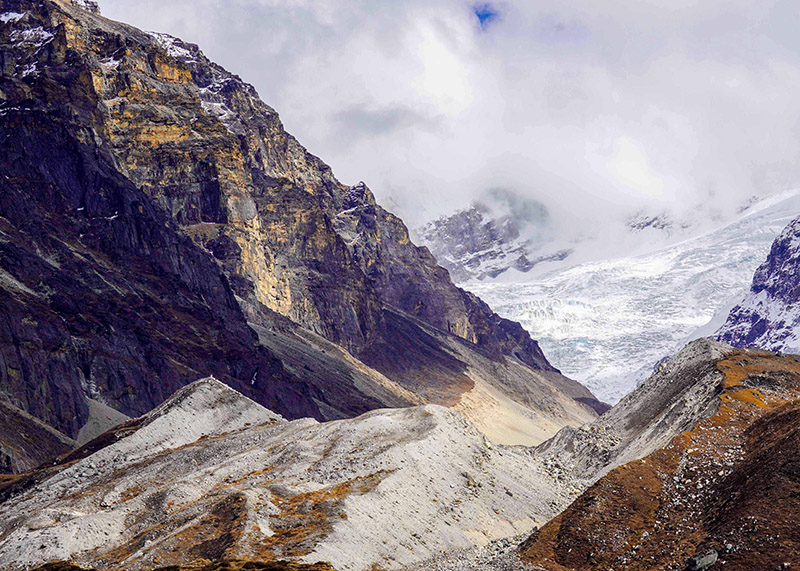
Landslides in the mountains. Photo: Giriraj Banskota/NIMJN
Lonak, the final village before the Kanchenjunga base camp, serves as the ultimate refuge for trekkers embarking on the Kanchenjunga expedition. Given that the base camp, situated at an elevation of 4,790 meters, is a day’s trek from Lonak, allowing for a same-day return, the village hosts hotels catering to tourists. However, a pervasive sense of uncertainty and impending crisis hangs over the local hoteliers. They face the grim reality that they cannot predict how long this scenic village will endure or how much longer they will be able to sustain their businesses there.
Tenjing Sherap Sherpa, a hotelier, has personally witnessed the dramatic shifts in the village’s landscape and harbors deep concerns that Lonak’s very existence may one day be jeopardized.
The United Nations Intergovernmental Panel on Climate Change in its 2023 Synthesis Report has said that human activities, principally through emissions of greenhouse gases, have caused global warming, with global surface temperature rising. Rising temperature of earth has caused topographical changes in the Himalayan region and Kanchenjunga, which spreads across 2,035 square kilometers, is no exception.
The trekking route to the base camp is frequently impacted by landslides and the emergence of new glacial lakes.
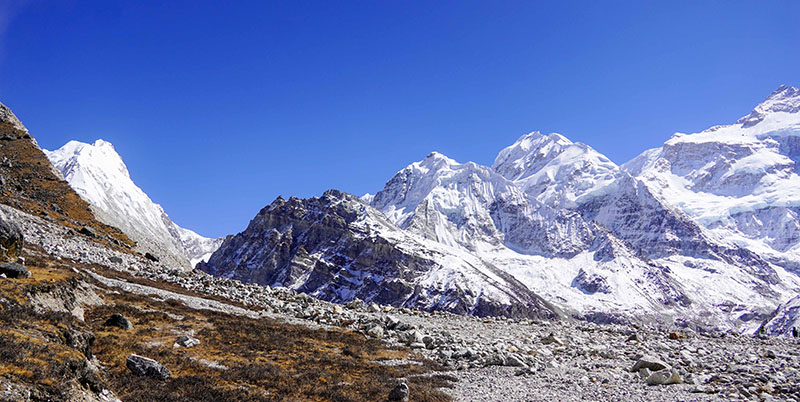
Aggregates and mud swept to the Kanchenjunga Base Camp. Photo: Giriraj Banskota/NIMJN
Kanchenjunga is an example of change. The glacial lake at Lonak appears to expand annually. Locals report that the lake now occupies a site where cowsheds once stood. “We haven’t named this lake, but it’s getting bigger every year,” Tenjing explained. “About 10 to 15 years ago, there were cowsheds here. The grazing land has become a glacier, and where the cattle used to roam, there’s now a lake.”
Tenjing Nupu, another local, has observed a similar phenomenon. Two years ago, when he trekked the Anidesh summit, there was no lake along the route; now, there is one. The water from this lake flows down to Ghunsa and Handrung before reaching the Tamor River. Locals fear that if the lake bursts, it would cause significant loss and damage to downstream settlements, including Khabachen, Ghunsa, and Handrung.
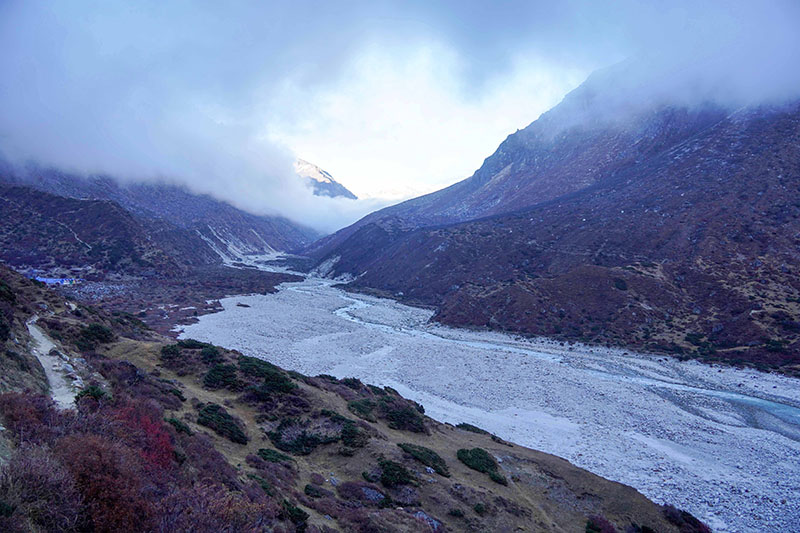
Ghunsa river, which falls along the trekking route, has been widened by floods. Photo: Giriraj Banskota/NIMJN
The widespread landslides serve as another indicator of the environmental shifts occurring in the Kanchenjunga region.
Bibek Basnet, information officer at the District Police Office in Taplejung district, reported that Tika Bahadur Rai of Yabu, Sankhuwasabha, a tourist guide, died in a landslide in Itahari on October 5, 2024.
The Kanchenjunga trekking route begins in Japantar and passes through Itahari. Landslide risks are present not only in Itahari but also along the entire four-day trek to the base camp. A report by the Kanchenjunga Conservation Area states, “The topographical structure of this area is too steep. So the landslide risks become too acute during monsoon.”
The area bordering northeast India and China from Taplejung district was designated a conservation area in 1997. This region encompasses mountain peaks, including the world’s third-highest peak, Kanchenjunga, four peaks over 8,000 meters, and 17 peaks between 7,000 and 8,000 meters.
Due to the risk of landslides, Dikki Sherpa’s “teashop” at Zorque, an hour’s walk from the base camp, has been replaced by a tent. She explained, “Landslides keep occurring, later the walking trail might be damaged. It is expensive to build a house here. Which is why we have put up a tent here.”
Trekkers heading to Kanchenjunga often stop at Zorque for tea, hot water, and soup before continuing their ascent, which sustains local businesses. According to the Kanchenjunga Conservation Area Management Council, 1,085 foreign tourists visited this area in the fiscal year 2023/24. Despite the business potential and her desire to manage her eatery more effectively, Dikki states that she has been unable to invest further due to the persistent risk of landslides.
The trail from Zorque to the base camp has also suffered landslide damage. Debris and piles of earth scattered along the path serve as stark evidence of the ongoing topographical changes in the Kanchenjunga region.
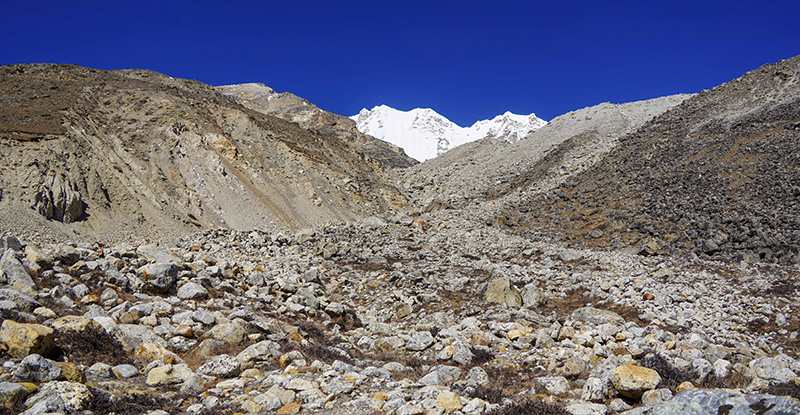
Debris of aggregates brought by landslides. Photo: Giriraj Banskota/NIMJN
Upon reaching the Panpe basecamp, located at an elevation of 5,142 meters, one is greeted by a direct view of the Himalayas. This base camp, offering views of the pristine white mountains against a blue sky, is also threatened by landslides. While one edge of the base camp is eroding, the other side faces active landslides. The glacier in this area is visibly expanding. Tenjing Nurbu, who operates a ‘tea house’ at the base camp, is concerned about the future of the magnificent Kanchenjunga mountain.
“There’s significantly less snowfall. Melting glaciers may have caused the landslides,” Nupu stated. “We’ve witnessed considerable change in the Himalayan region over the past few years.” Like Dikki, Nupu is hesitant to invest further in additional infrastructure for his ‘tea house’ due to these safety risks.
The changes observed in Kanchenjunga are not isolated to this area. According to Sudip Thakuri, Dean of the Faculty of Science and Technology at Mid-western University, who conducts research and studies in the Himalayan region, numerous changes have been occurring across the Hindu-Kush Himalayan region in recent years. This vast region spans 3,500 km across Afghanistan, Bangladesh, Bhutan, China, India, Myanmar, Nepal, and Pakistan, with Nepal’s Himalayas, including Kanchenjunga, falling within it.
According to Sudip Thakuri, the Kanchenjunga region is particularly susceptible to landslides. He attributes this to the area’s proximity to the Tarai, which results in a more compacted landmass, thereby increasing the risks of both floods and landslides.
The rising temperatures and significant decrease in the volume and frequency of snowfall are profoundly impacting the Himalayan region. Sudip Thakuri explains that while land above 5,000 meters typically remains frozen, an increase in temperature weakens the surface, elevating the risks of falling rocks and ice, as well as avalanches.
He stated, “In recent times, incidents such as landslides, avalanches, glacial lake outbursts, melting of glaciers, formation of new glacial lakes, and the expansion of existing glacial lakes have all been observed.”
Floods of June and October
The floods and landslides that occurred from June to October 2024 further exacerbated the fragility of Kanchenjunga’s topography. During this season, tourists found it challenging to navigate the trails due to the widespread flooding and landslides, which extensively damaged the paths in numerous locations.
Some areas have become exceptionally risky and hazardous. “There were dangers in many places. Some sections have become difficult to reach due to the landslides,” said Srithulung Rai, who had returned home from Australia and was trekking in the region. “I felt really bad to see floods and landslides making lives difficult in this beautiful place.”
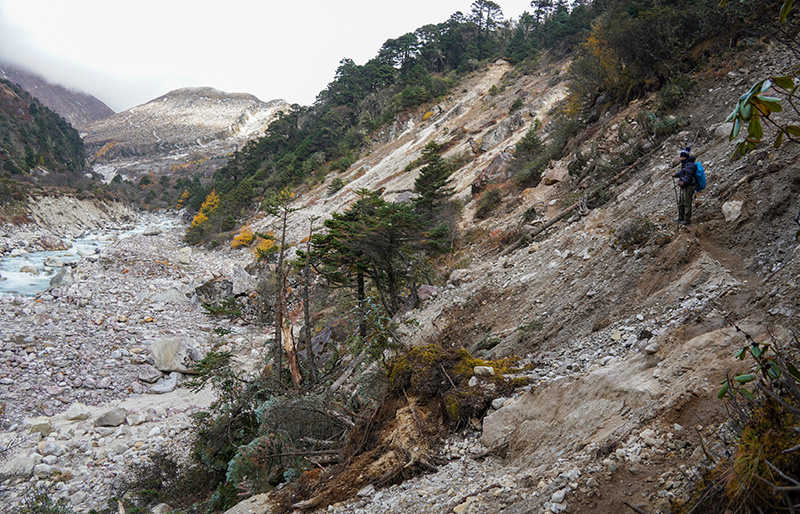
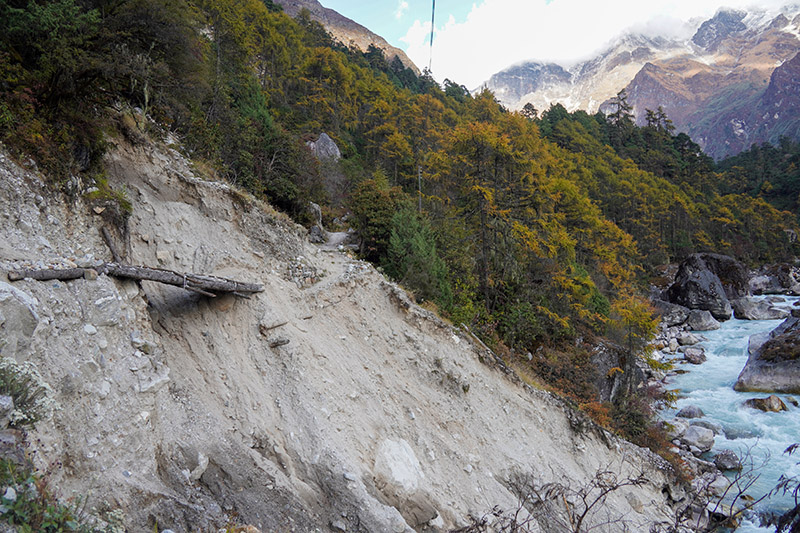
(Left) The Kanchenjunga trail was enveloped by landslides in September. (Right) A makeshift wooden crossing built after the path was broken by a landslide. Photos: Giriraj Banskota/NIMJN
Since the shorter trail from Japantar to Itahari was obstructed by landslides, he had to take a longer, more circuitous route. In certain spots, ladders have been installed, and stools placed on narrow sections of the trail to aid passage.
The old route to Lamatar was swept away by the Ghunsa River floods, forcing travelers to take a longer and more arduous path.
Numerous landslides above Ghunsa have rendered the Himalayan region increasingly fragile. The floodwaters have significantly widened the Ghunsa River. Reaching base camp now requires traversing three camps from Ghunsa, a journey that involves navigating through multiple landslide-affected areas—a situation unlike in the past. Paths are obstructed in many places, preventing mules from traveling to Japantar this year.
These changes in Kanchenjunga, Nepal’s second and the world’s third tallest peak, are attributed to the impacts of climate change. However, there are no authoritative or reliable studies and research specifically addressing the floods and landslides and their precise impacts. Given the recurring and damaging nature of landslides and floods in the area, the Kanchenjunga Conservation Area Management Council has formally requested the International Center for Integrated Mountain Development (ICIMOD) to conduct such studies.
It is worth noting that this conservation area operates on a community-based model. Local tourism entrepreneurs and yak herders are responsible for repairing damaged trails. While the Council also undertakes annual path repairs in many areas, these efforts are often hampered by insufficient budget, according to Council officials. Chhawang Sherpa, the Council’s treasurer and a business owner in Gyabla along the trail, reports that floods and landslides in Kanchenjunga have occurred with unusual intensity.
According to data from the Department of Meteorology and Hydrology’s Lungthung Center, 375.7 mm of rain fell in September/October 2024, and 631 mm in July of the same year. Locals describe significant floods in even smaller rivulets during these rains, which carried substantial debris into the rivers.
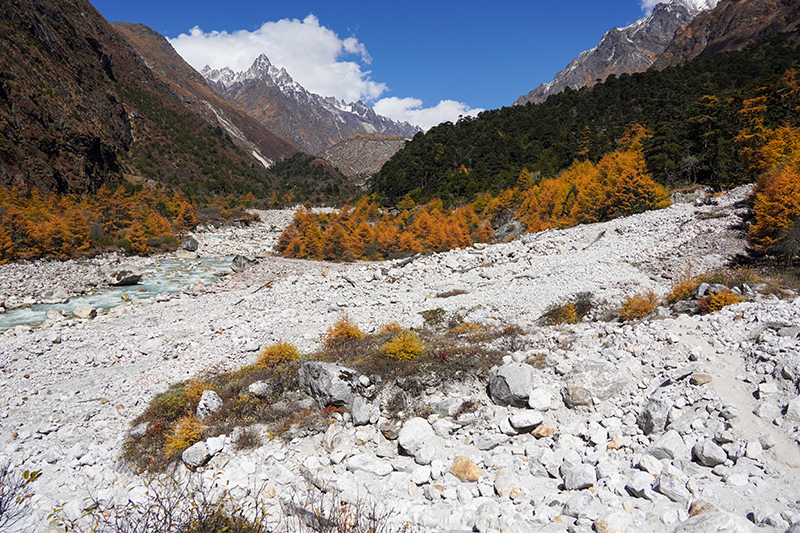
Aggregates brought by landslides near Ghunsa. Photo: Giriraj Banskota/NIMJN
Chhawang reports that landslides have rendered the terrain fragile. He observed, “We’ve experienced rising temperatures, and significantly less snowfall during the winter season. The paths damaged by floods and landslides in October are still awaiting repair.” He added, “I’ve witnessed numerous changes in my lifetime over the last decade.”
Unusual Weather Patterns
Himalayan cow herders, tourism entrepreneurs, and locals in the Kanchenjunga area are observing unusual weather patterns, including unseasonal snowfall, rising temperatures, and scorching daytime heat. These shifts have, in turn, triggered other environmental changes. “We’ve lived in this place since childhood and have experienced several changes,” remarked Chhawang.
He noted that alder trees, once found only above the Thangyam area, now grow at the lower elevation of the Phale riverbed. Similarly, poisonous snakes, previously absent above Thangyam, are now encountered further up in Gyabla. Sherap, also a ward member of Phatanglung Rural Municipality-6, highlighted the significant losses caused by September snowfall and rain in the lower regions. “It snows when it’s not the snowfall season. This year it snowed in September, which caused immense loss and damage,” Sherap stated. He added that in Lonak, at 4,780 meters, mornings and evenings are extremely cold, while the days are very hot.
Tenjing Sherpa, another businessperson from Lonak, recounted instances of underground snowmelt triggering landslides in previously unaffected areas. “The ice underground melts and it triggers landslides,” he explained. According to Tenjing, glaciers they once crossed on foot have now transformed into lakes. Earlier, they could walk directly to the basecamp, but now landslides force them to take a long, winding path. “There used to be small landslides before. Last year there was a big one,” he observed.
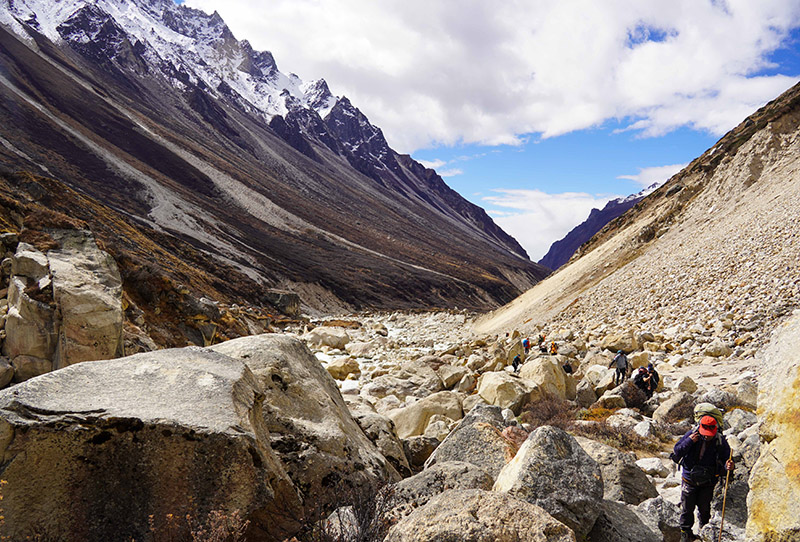
Landslide on the way from Khabachen to Lonak. Since the path has been covered by debris, people have to walk upon the rocks. Photo: Giriraj Banskota/NIMJN
Pema Chhiring Sherpa of Khambachen, who observed dry landslides during the daytime in late September, expressed concern about the region’s future. He remarked, “Unusual things are happening here. Things that existed are becoming extinct.”
Not only locals, but also those engaged in Himalayan research and studies, agree that the changes witnessed in the region are alarming.
Sudip Thakuri, Dean of the Faculty of Science and Technology at Mid-western University, attributes these regional changes to temperature increases induced by climate change. He stated, “Kanchenjunga region is extremely sensitive in the context of climate change. That is the region where rain starts in the monsoon in Nepal. It is very dry in April and May. Once the monsoon starts, the landslides follow.”
The past 30 to 40 years show a clear trend of rising temperatures, he noted. Studies indicate that ice in the Kanchenjunga region is melting at a rate of 15%, and landslides occur when rain falls instead of snow.
A study by the International Centre for Integrated Mountain Development (ICIMOD) reveals that rapidly diminishing snow and ice have negatively impacted both nature and human populations. ICIMOD’s report states that the disappearance of snow and ice in the Hindu Kush Himalaya threatens two billion people and is accelerating species extinction. It further highlights that the effects of the changing cryosphere on fragile mountain habitats are acute, leading to cascading impacts on ecosystems and affecting most inhabitant species. The cryosphere encompasses frozen components of the Earth System, including snow cover, glaciers, ice sheets, ice shelves, icebergs, sea ice, lake ice, river ice, permafrost, seasonally frozen ground, and solid precipitation.
According to ICIMOD, Hindu Kush Himalayan glaciers melted 65% faster between 2011 and 2020 compared to the preceding decade. ICIMOD’s study forecasts that water availability in the Hindu Kush Himalaya will peak in mid-century due to accelerated glacial melt, after which it is projected to decline. The variability in meltwater from glaciers and snow creates significant uncertainty for mountain communities and large lowland populations. Floods and landslides are expected to increase. Exposure to these hazards poses a risk of heightened damage to properties, heritage, and infrastructure, impacting communities already facing adverse conditions.
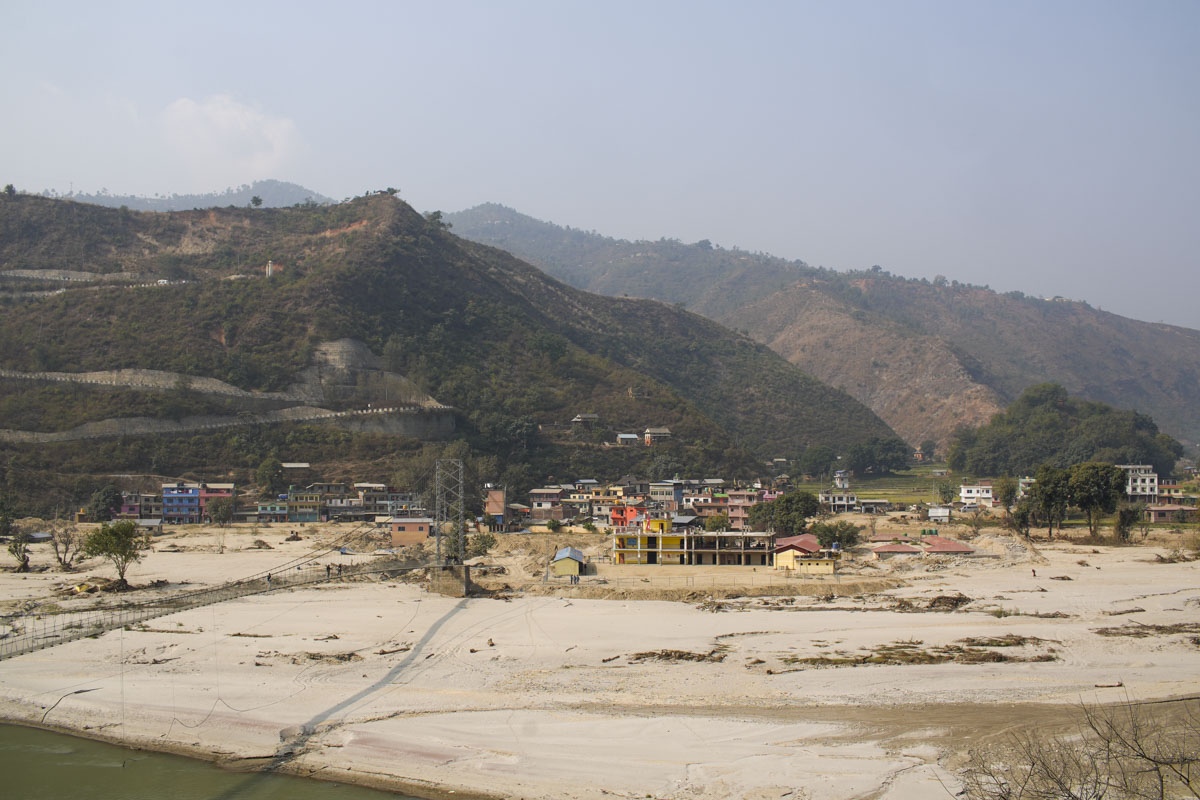
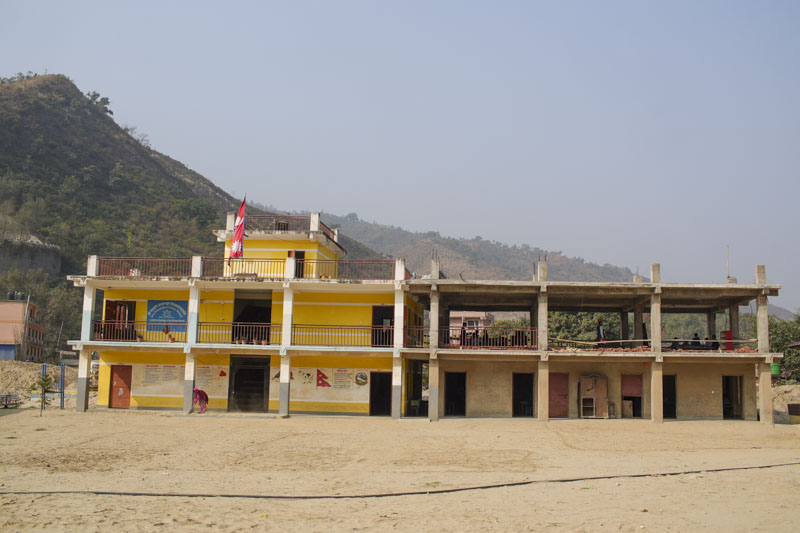
Tanka Prasad Dahal is 18 years old and lives very close to his school, Pashupati Basic School in Mulkot, Sindhuli. Even though he is older than most students, he lives at the school because he has an intellectual disability. But everything changed on September 26, 2024. After two days of heavy rain, the Sunkoshi River flooded and went over his school. When the water went down, the school was full of sand and broken pieces. The two-story building now looked like it only had one story.
A total of 117 students went to Pashupati Basic School, including 95 regular students and 22 students with disabilities. The 95 regular students were able to start classes again, even if they had to use one classroom for two different classes. But students like Tanka have not been able to return. This makes it hard for students with disabilities to get back to school after the disaster.
Nirmala Kumari Shrestha, the school principal, said that they haven’t been able to bring the students with disabilities back because the flood destroyed the entire first floor. All the supplies and materials that were stored there were also ruined. On February 12, 2025, she came with us (the NMJN team) to check on Tanka’s situation.
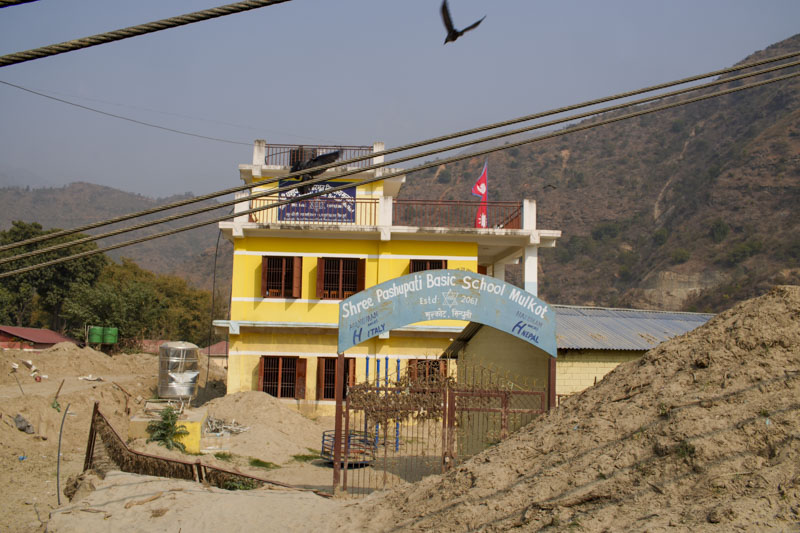
Pashupati Basic School. Photo: NIMJN
Tanka has a problem with his leg. Last year, he went to Kathmandu for an operation on his leg but it didn’t get much better because he didn’t get enough exercises to help it heal, his mother Sharada said. The principal said that Tanka has trouble walking because there is no one at home who can help him do these exercises regularly, probably because both of his parents have health issues.
Tanka’s mother, Sharada, says that he is trying to walk on his own. For his part, Tanka cannot speak confidently and clearly. He shows his feelings through babbling and humming when he hears his favorite song on the radio. Tanka is also trying to write his name clearly. He told us, while his mother was there, that he really wants to go to school and that he misses his friends from school. It’s clear that his parents also want him to be able to go to school.
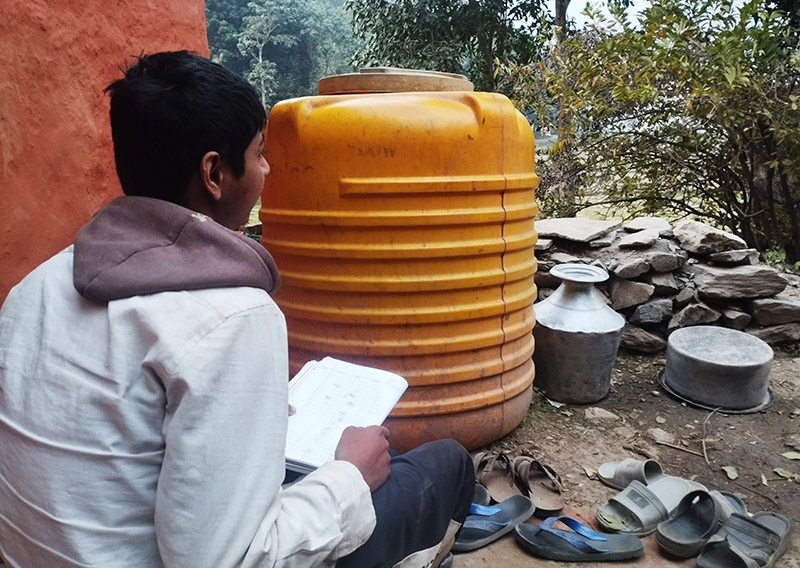
Tanka Prasad Dahal at his home. Photo: NIMJN
Hira Devi Shankar is another child with a disability from Sindhuli Nanglebhare. Her parents send her to a school nearby but she doesn’t want to go because that school doesn’t have things that make it easy and comfortable for children with disabilities. Hira, who is 10, learned a lot at Pashupati School. Before she came to that school, she didn’t even know how to hold a pencil. Before the flood damaged the school, including the classrooms, she could write and read a little. The school hasn’t asked her to come back because there is no fence around the school for safety.
Now, Hira’s parents have started sending her to a school close to their home, but she doesn’t want to go there. Her mother, Kalpana, said, “The school is only about 15 minutes from our house. We started sending her there so she wouldn’t forget what she learned, but she doesn’t want to go because it’s not a good place for her.” Kalpana also said, “Even when she goes, she doesn’t learn anything new.” According to Kalpana, Hira forgets things easily. She doesn’t speak clearly and takes a long time to understand what other people are saying to her. Kalpana said, “She has missed school because of the flood. The school said they will call us after they build a fence. I really hope they do.”
The school principal, Nirmala Kumari, said that the children with disabilities used to learn practical skills and knowledge instead of just theory. But the school hasn’t been able to start classes for them again because it’s not easy for them to get around after the floods. A wire fence has been put up at the edge of the school grounds. She says that once they build a proper wall around the school and get the money to fix the damage, it won’t take long to make the school like it was before. She also mentioned that a new building with three rooms is being built with help from the local government so that the children with disabilities can continue their learning. The principal said that once the wall is built, they will be able to bring the children with disabilities back to school.
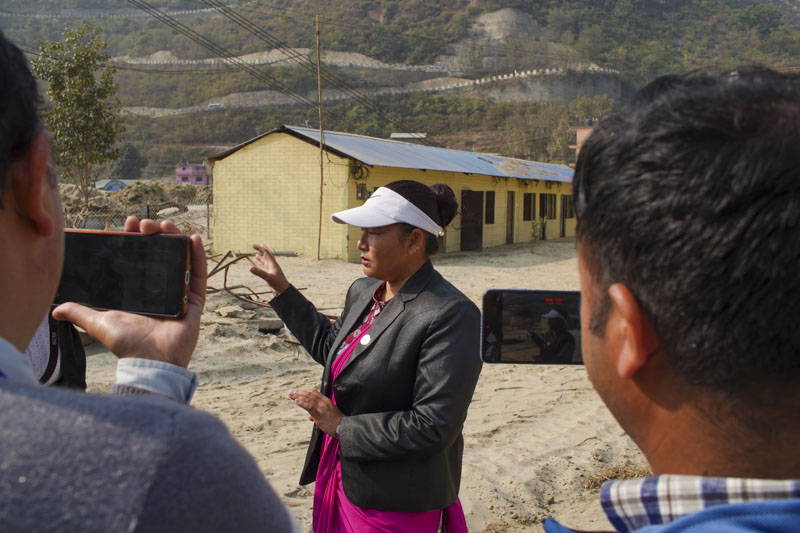
School principal Nirmala Kumari Shrestha briefing about loss and damage caused by floods. Photo: NIMJN
Surath Kumar Basyal, spokesperson for the Sunkoshi Rural Municipality, said that there used to be a special learning center just for children with intellectual disabilities. Two teachers and two helpers worked there for these children. They had two rooms to live in and one classroom, and the Rural Municipality took care of it all. The floods ruined everything except the building itself.
Because they don’t have enough desks and benches, some students have to sit on the floor during classes.
There are no good restrooms or clean drinking water. The flood filled up their well, so now they get dirty water from it. They also have to walk a long way to get water to drink. Nirmala Kumari said that the mud from the flood has dried up and is now causing a lot of pollution, which is making the children sick.
677 schools in suffering
According to the National Disaster Risk Reduction and Management Authority (NDRRMA), a total of 677 schools in 41 different districts of the country were damaged or destroyed by the floods in 2024. Forty-five of these schools were in Sindhuli. Sadly, 13 students died because of the monsoon disaster, and 50 affected students were rescued alive. However, the NDRRMA doesn’t have information on how many children with disabilities were affected. The NDRRMA says that Bagmati province was the most affected by floods and landslides, with Kavrepalanchok district reporting damage to as many as 182 schools. The Authority estimates that it will cost over 1.78 billion rupees to rebuild the school buildings that were destroyed by the monsoon disaster.
The Ministry of Education has slightly different numbers. They say that floods and landslides damaged 163 schools – 110 in Bagmati and 53 in Koshi provinces. The difference is because the NDRRMA counted all schools that had any damage, while the Ministry of Education only counted the schools that had serious damage. Debaka Dhakal, the head of the Education Development and Coordination Unit (EDCU), said that the monsoon floods and landslides have made some schools unsafe for children to attend. Other schools have reopened after some small repairs. She said that the local government, through the EDCU, gathered information about the losses and damage to help with aid and rebuilding in the education area. According to her, they are currently talking about how to manage money for school cleaning, repairs, rebuilding and preparing for future disasters.
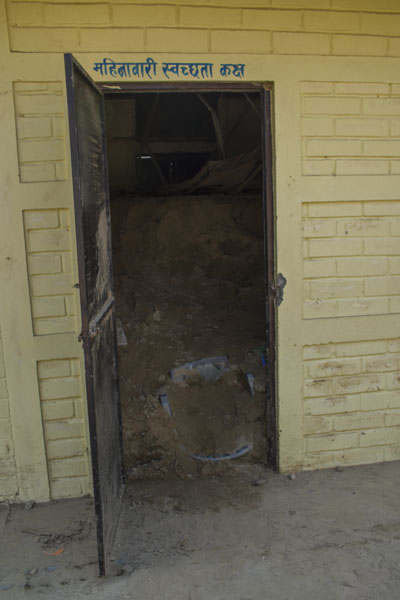
The floods have badly damaged the places where schools get drinking water and the toilets. It’s very important to make sure the schools have clean drinking water right away, and the paths to the school and the playground need to be fixed. A first report about getting ready for the monsoon and helping after emergencies, made by the Makawanpur district, showed that they need to rebuild the damaged schools more quickly. The report says that 29 schools in that district were damaged.
Surath Kumar Basyal, Spokesperson for the Sunkoshi Rural Municipality, said that even though the local government is trying to fix the problems caused by the disaster, they don’t have enough money to do it. At the same time, Dr. Dijan Bhattarai, who is an Undersecretary and was the spokesperson for NDRRMA, said that they have created a joint plan to help the schools that were damaged by the monsoon floods and the earthquakes in Jajarkot.
(Left) The menstrual hygiene room covered by flood. Photo: NIMJN
Education for children with disability
There are rules in Nepal’s constitution, laws, and government plans to make sure children with disabilities get the education they need. Devidutta Acharya, who leads the National Disability Federation Nepal, said that in recent years, some regular schools have become inclusive, and more children with disabilities are getting access to education. According to a guidebook from 2018 about including people with disabilities in education, there were 33 special schools, 23 schools that combined special and regular education, and 316 resource classes for children with disabilities.
However, the schools that are open still have problems. Janaki Thapa, who is an interpreter, said that the school for the deaf in Birgunj, Parsa, doesn’t have enough classrooms. This school goes up to grade five and has 53 students, 38 of whom live there, and four teachers. The school needs a building and more classrooms.
The situation is much worse at Ramjanaki Sustamanasthiti School in Dhanusha – it is not even open anymore. Baliram Jha, who used to be the principal, retired two years ago. Now, only one staff member looks after the school. According to Baliram, this person just signs the attendance book whenever they want and still gets paid. Baliram said, “Nobody cares about it. Students come to the school and find the gate locked, so they go back home. Parents call me to complain. When I go to check myself, I find the school closed.”
When Baliram retired two years ago, there were 14 students at the school. Now, all of them have lost their chance to learn.
The situation of these two schools from Dhanusha and Birgunj is symbolic of the various problems faced by schools for children with disability.
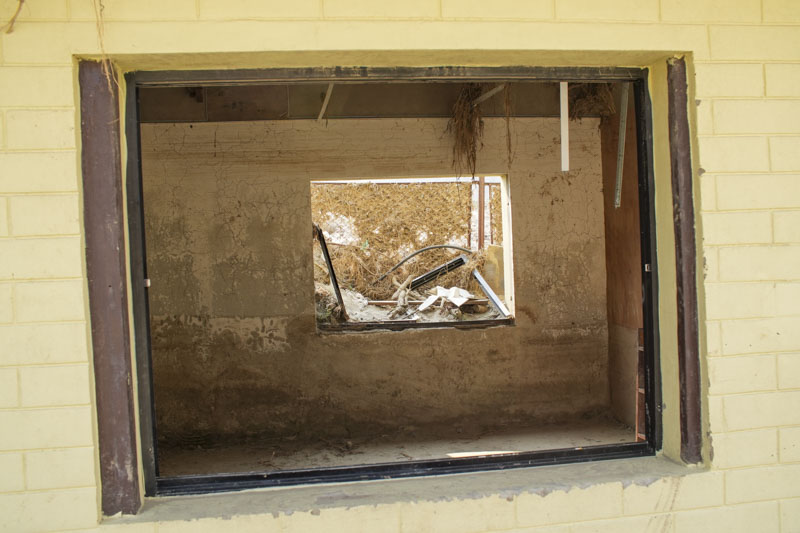
Classroom of Pashupati Basic School. Photo: NIMJN
The government gives four kinds of money help to children with disabilities. There is a “Motivation” scholarship of 1000 rupees each month for ten months. There is also a monthly transportation scholarship of 3000 rupees or 5000 rupees for each child who needs help to go to school regularly. Children who live in hostels, away from their homes, get 50,000 rupees each year. The schools get this money from their local government.
Devidutta Acharya said that they are trying to build schools in safer places. However, the government hasn’t yet made it possible to build school buildings that are completely safe for children. Because of this, when disasters happen, the schools that teach children with disabilities become risky for these children, especially because there aren’t good ways to rescue them that consider their needs.
The number of disasters happening in schools and the education area is increasing every day, making both the schools and the children there unsafe.
Around the world and in Nepal, steps are being taken to make schools and the education area less risky. There are laws and government plans in place, both internationally and in Nepal, to reduce disaster risks in schools and to encourage a culture of school safety. These efforts will help get everyone involved to work together to make sure schools are safe in the future.
Even though children with physical disabilities, vision problems, and hearing problems are currently going to school, those with more severe disabilities are still not in school, which means they are missing out on education. The Ministry of Education has a program to teach children at home. They are talking about finding these children and creating a way to have volunteer teachers educate them in their homes. The government has been making plans to make sure these children can go to school. However, when you look at how well these plans are being put into action, you don’t see much real progress.
Disability and social inclusion
The government has created a plan called the Strategic Action Plan for Gender Equality, Disability and Social Inclusion (GEDSI) in Disaster Risk Reduction and Management (2024). Dr. Dijan Bhattarai, who was the spokesperson for NDRRMA at the time, said that this plan gives clear instructions on how to include everyone equally, including people with disabilities, when preparing for and dealing with disasters.
Devidutta Acharya said that even though the 2015 earthquakes showed that children with disabilities are very likely to be in danger during disasters, there still isn’t enough specific preparation that includes them.
Pashupati Basic School doesn’t have enough classrooms, so students are being taught in an open area on the second floor of a building that is still being built.
According to him, he has asked the NDRRMA to make children with disabilities a priority in schools and hospitals when they are doing rescue and recovery work. He believes that early warnings about disasters should also be easy for everyone to understand and access. He also said that not having access to information makes these children even more at risk during disasters. When making plans for how to respond to disasters, they should think about how to provide services for people who can’t hear or speak, people who use wheelchairs, and children who can’t see.
Also, the people who help during disasters should be trained on how to assist these individuals. The Strategic Action Plan (2024) says that the government should give out kits with tools that people with disabilities will need in emergency situations. Devidutta Acharya says that his organization has been working on this issue constantly.
Making schools safe
According to a report from 2017/18, there are 35,601 schools in Nepal, with 29,005 being public and 6,566 private. A study called ‘School Safety and Existing Legal Provision Directive’ by Krishna Prasad Bhattarai found that two-thirds of these schools are in danger of disasters. The Ministry of Education has started a big plan called the Comprehensive School Safety Masterplan (2017) and created a guide called the Comprehensive School Safety Minimum Package (2018). The National Policy for Disaster Risk Reduction (2018) aims to help Nepal grow in a way that is safer, can adapt to climate change, and can recover from disasters. These rules give schools at all levels advice on having good education and being ready for disasters. Chandra Kanta Bushal, Spokesperson for the Center for Education and Human Resource Development (CEHRD), said that CEHRD is working with aid groups and other organizations to promote the comprehensive school safety masterplan. They also provide training and do practice drills.
The School Safety campaign includes programs that protect students, teachers, and staff from dangerous weather, fires, diseases, and natural disasters, including ways to prevent them. According to Chandra Kanta Bushal, they are teaching people and sharing information as part of this campaign. He also said that they are working to make schools safe by creating education groups and working with the national, regional, and local governments. They are also providing training to the School Management Committee and parents.
However, education expert Professor Dr. Bidhyanath Koirala says that this campaign hasn’t been very effective because it doesn’t consider the specific needs of local areas. He believes that if the training included local knowledge and skills, it would work better.
The study by Krishna Prasad Bhattarai also showed that putting school safety programs into action in schools is still weak. The study found that people involved in education don’t know much about school safety, and they also don’t know much about the existing laws and school safety rules. The study showed that most students are at risk of disasters because they don’t have a safe place to learn. The study lists the problems caused by disasters, such as damage to school buildings, disruption of teaching and learning, students being forced to leave school, and the need for recovery in the local community.
Leaving no child behind
Article 24 of the Convention on the Rights of Persons with Disabilities (2006) says that people with disabilities have the right to education. It states that countries that have signed this agreement must make sure that everyone, including those with disabilities, has the same chance to get an education at all levels and throughout their lives. The Convention also says that these countries should provide the specific support that each person needs to achieve this.
The Rules Regarding Rights of Persons with Disabilities (2020) in Nepal say that the government must arrange accessible education with places to live for children who cannot travel to and from school on their own because of a severe disability or because they are very poor and have no one to help them.
The constitution of Nepal has given the responsibility for education up to the secondary level to the local governments. Because of this, Devidutta Acharya argues that it is the job of the local authorities to know how many children with disabilities there are, to understand what each of them needs, and to make sure they can go to school.
What kind of tools would help children like Tanka to learn easily or to walk? Devidutta says that the local authorities should create a helpful environment for Tanka to get to school. And once he is there, the school should make it easy for him to interact with teachers and other students. Children with disabilities can get the regular money help that the government provides for free education if their schools write to the local authorities, and then the local authorities recommend it to the Department of Education.
Education expert Dr. Bidyanath Koirala argues that local authorities need to take the lead in providing desks, benches, and trained teachers for children with disabilities and in making sure they can go to school. He says that the regional and national governments should help the local authorities with this. According to him, each school should provide what a child with a disability needs based on their individual situation, and the local government should make sure this happens. He says that schools, local authorities, parents, and organizations that work with people with disabilities all need to support this cause.
The schoolyard of Pashupati Basic School ravaged by floods. Photo: NIMJN
There is a special learning plan made just for children with intellectual disabilities. But they need teachers and helpers who are trained, and they need different kinds of technical help based on what they need. For example, children with physical disabilities need help from a physiotherapist. Those with speech problems need a speech therapist. And they need occupational therapy to learn practical knowledge and skills.
Dr. Bidhyanath Koirala says that because schools, local authorities, and the community don’t know enough about these needed services, children with disabilities have been missing out on school education. He says that there are now good technologies and training available for learning. The government has also made a plan to use resources, and there are different organizations working in this area.
Devidutta Acharya, the president of the National Disability Federation Nepal, says that if all these things are well organized and if schools can create the right way to teach, then no children will be left behind.
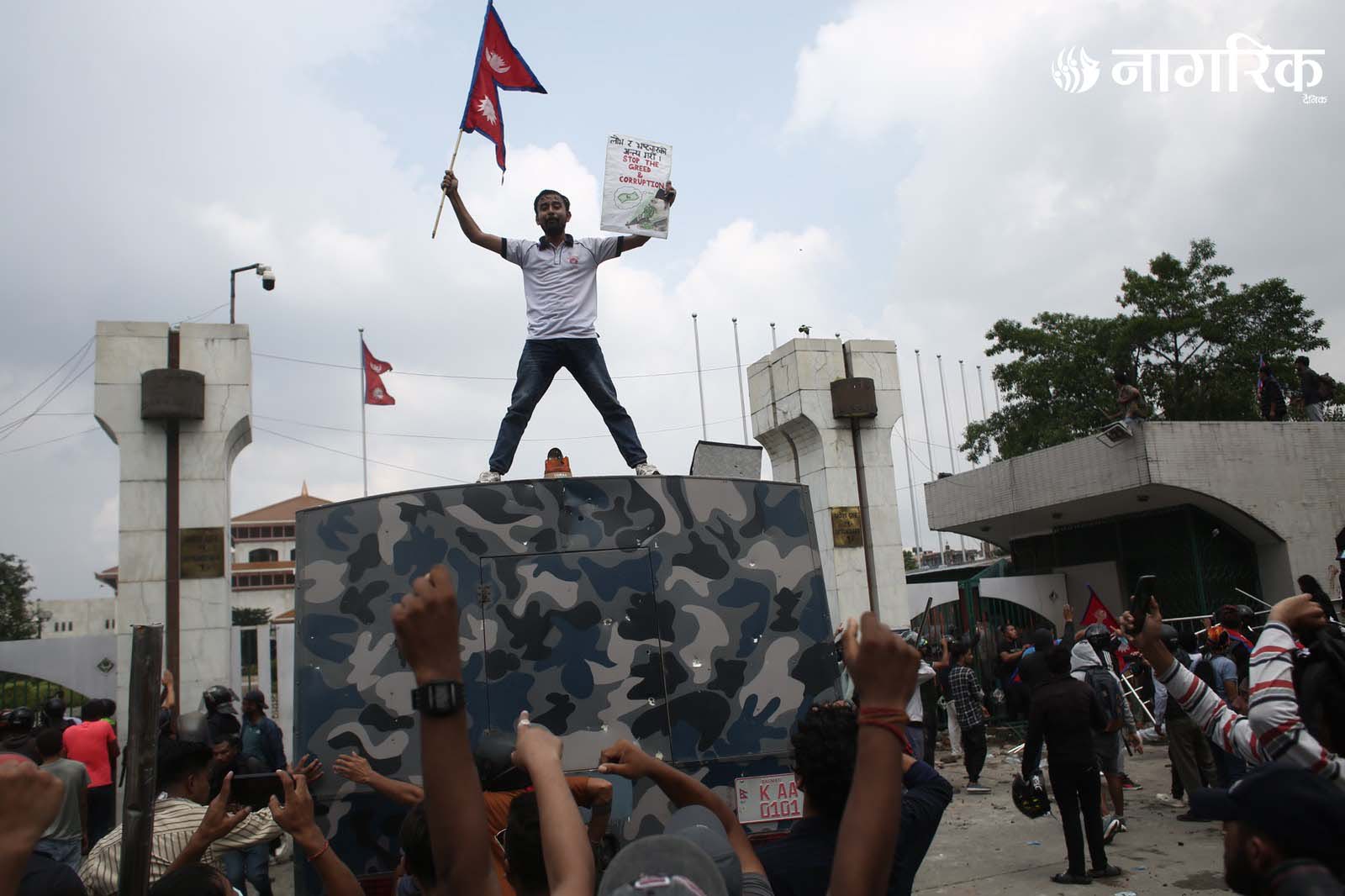
The story has been updated on September 9 with the latest developments.
Nepal Prime Minister KP Sharma Oli resigned from office following the massive protests in the country by the youth against corruption and a ban on social media platforms. As the protests turned violent and snowballed out of control, at least 19 people lost their lives and hundreds of others have been injured.
The protesters set ablaze Oli’s house, the Parliament building, the main gate of Singha Durbar, the Nepali Congress’ (NC) central office, and the CPN-UML’s central office.
Earlier on Monday, police used heavy force including multiple gunshots, rubber bullets, water cannons, and baton charges to disperse the agitating youngsters.
Baneshwor—the heart of the capital city Kathmandu and home to Nepal’s federal Parliament—descended into chaos as protests, dubbed as Gen Z protests, escalated into violent confrontations. Despite the government’s imposition of a curfew, defiant crowds of protesters continued to occupy the streets, chanting slogans, and challenging security forces.
The tense standoff transformed Baneshwor into a flashpoint of unrest.
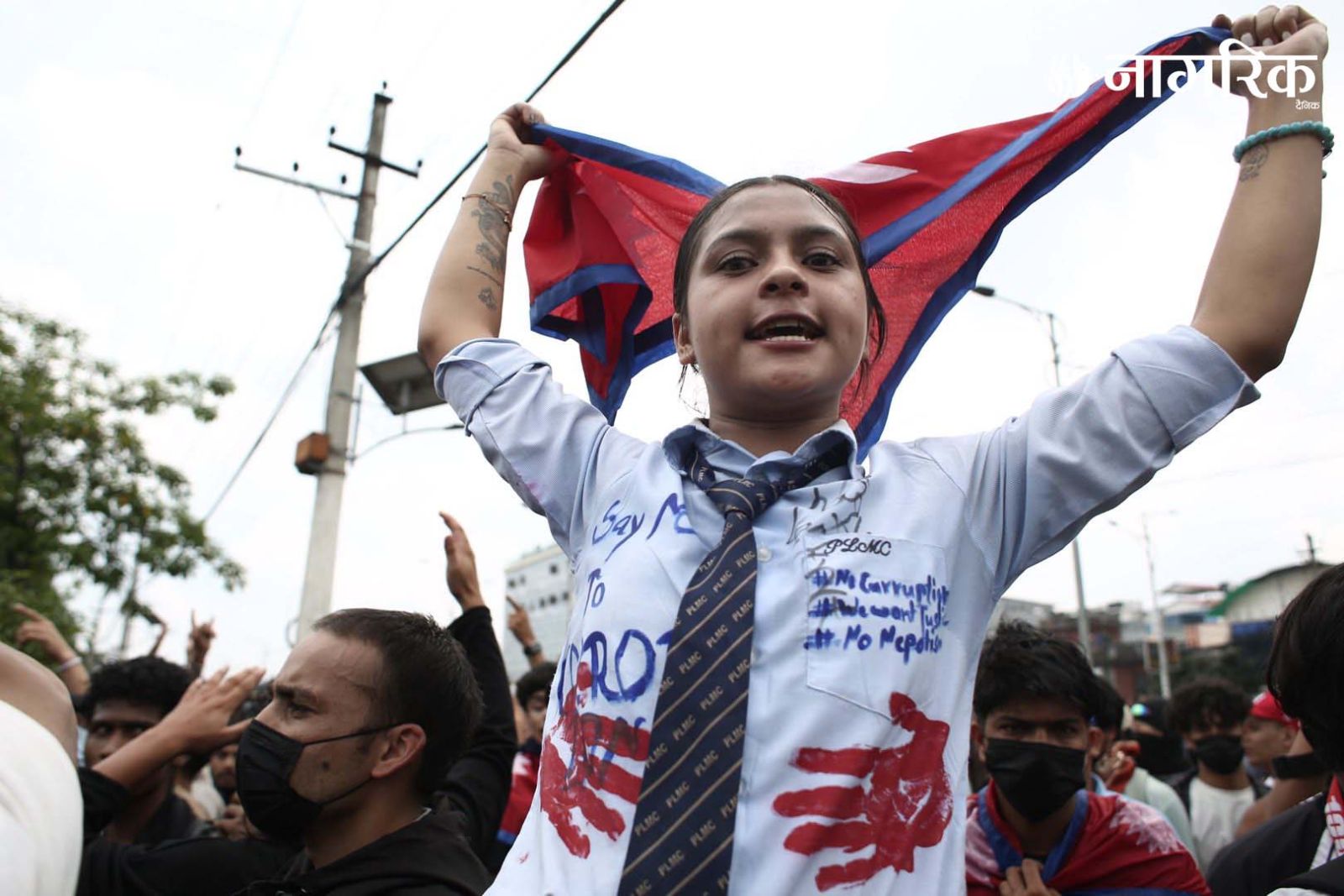
Photo: República
Curfew Imposed
The District Administration Office (DAO) Kathmandu imposed an indefinite curfew starting 8:30 am on Tuesday. The earlier curfew, enforced following Monday’s protests, had ended at 5 am this morning.
Earlier, Nepali Army (NA) personnel took control of the roads surrounding the Parliament complex in New Baneshwor, Kathmandu. As of September 8, protesters remained between Baneshwor and Bijulibazar, and didn’t disperse despite curfew order, according to SSP Shekhar Khanal of the Kathmandu Valley Police Office, Ranipokhari.
Gen Z Nepal, however, distanced itself from the incident, stressing that those who stormed the Parliament were not affiliated with their campaign.
“Our movement had around 20 to 25 groups, and the plan was to march only up to Everest Hotel,” said organiser Ujen Raj Bhandari. “Those who went beyond that point are not recognized by us. We have already asked students present there to return.”
As tensions escalated, Gen Z Nepal issued an urgent appeal on social media urging participants to leave the protest site immediately.
“Please exit safely as soon as possible. Several vested groups are inciting the crowd. Our day has already been a success. Please go home safely today,” the statement read.
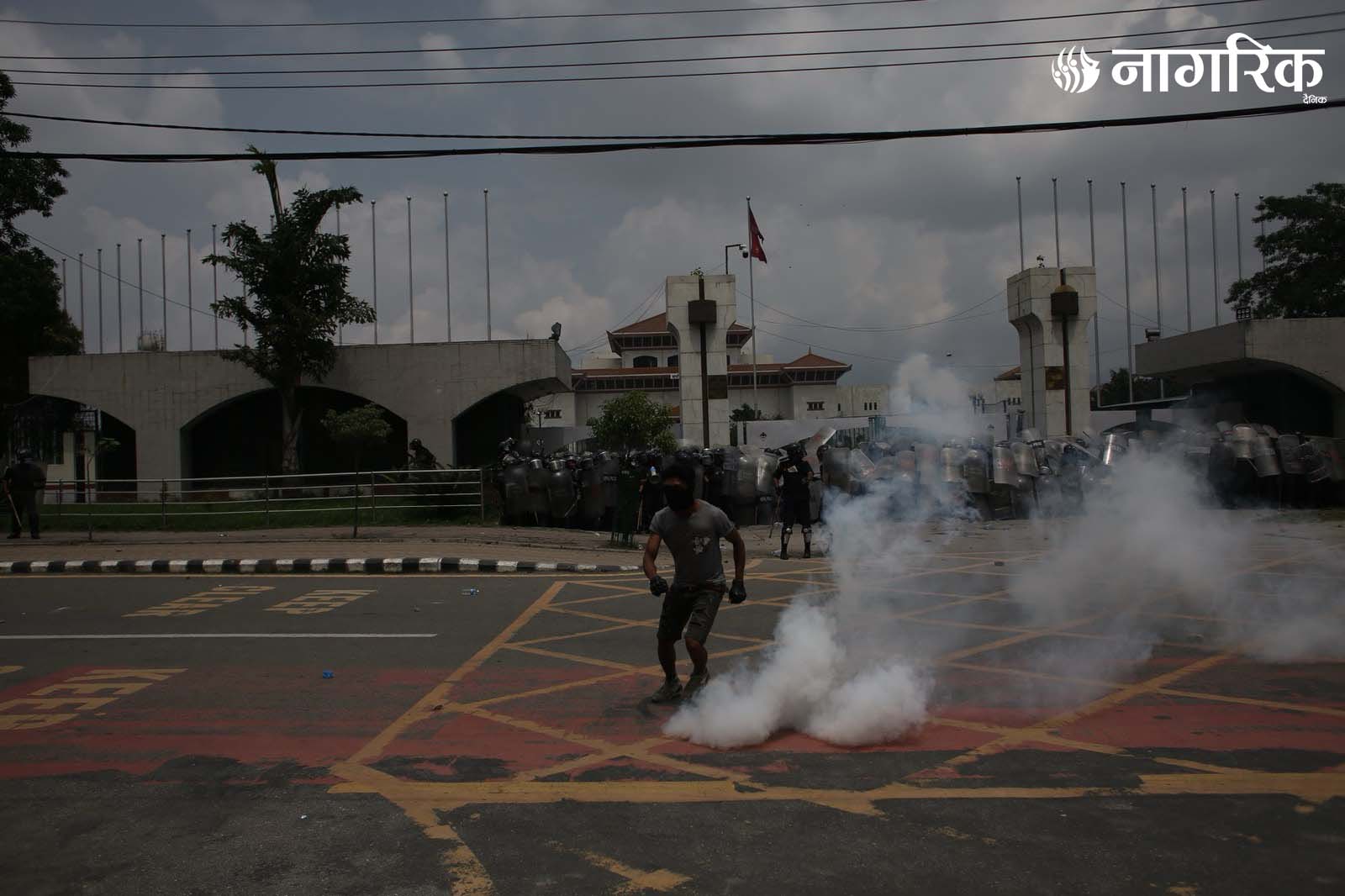
Photo: República
Government Response
President Ramchandra Paudel has accepted the resignation of PM Oli. He is now preparing to move forward with the process of forming a new government in accordance with Nepal’s Constitution. “The President is consulting with relevant parties to advance the government formation process as per the Constitution,” a presidential advisor stated.
In the early hours on Tuesday, the government had reportedly lifted the ban on social media platforms and formed a committee to investigate the protest.
A cabinet meeting, held on Monday evening, decided that the committee would look into all incidents that occurred during the demonstration. The panel has been given 15 days to complete the investigation and submit its report to the government.
Meanwhile, the Ministry of Health and Population (MoHP) had instructed all federal hospitals to provide free treatment to citizens injured during the protests.
MoHP led by Minister Pradip Paudel issued a circular directing hospitals to ensure prompt care for injured protesters without any charges. The MoHP also called for making ambulance services more efficient and easily accessible where needed.
The Kathmandu Valley ambulance network was urged to facilitate transfers of patients referred between hospitals. Additionally, all doctors and healthcare workers were appealed to come together to provide timely treatment to the injured.
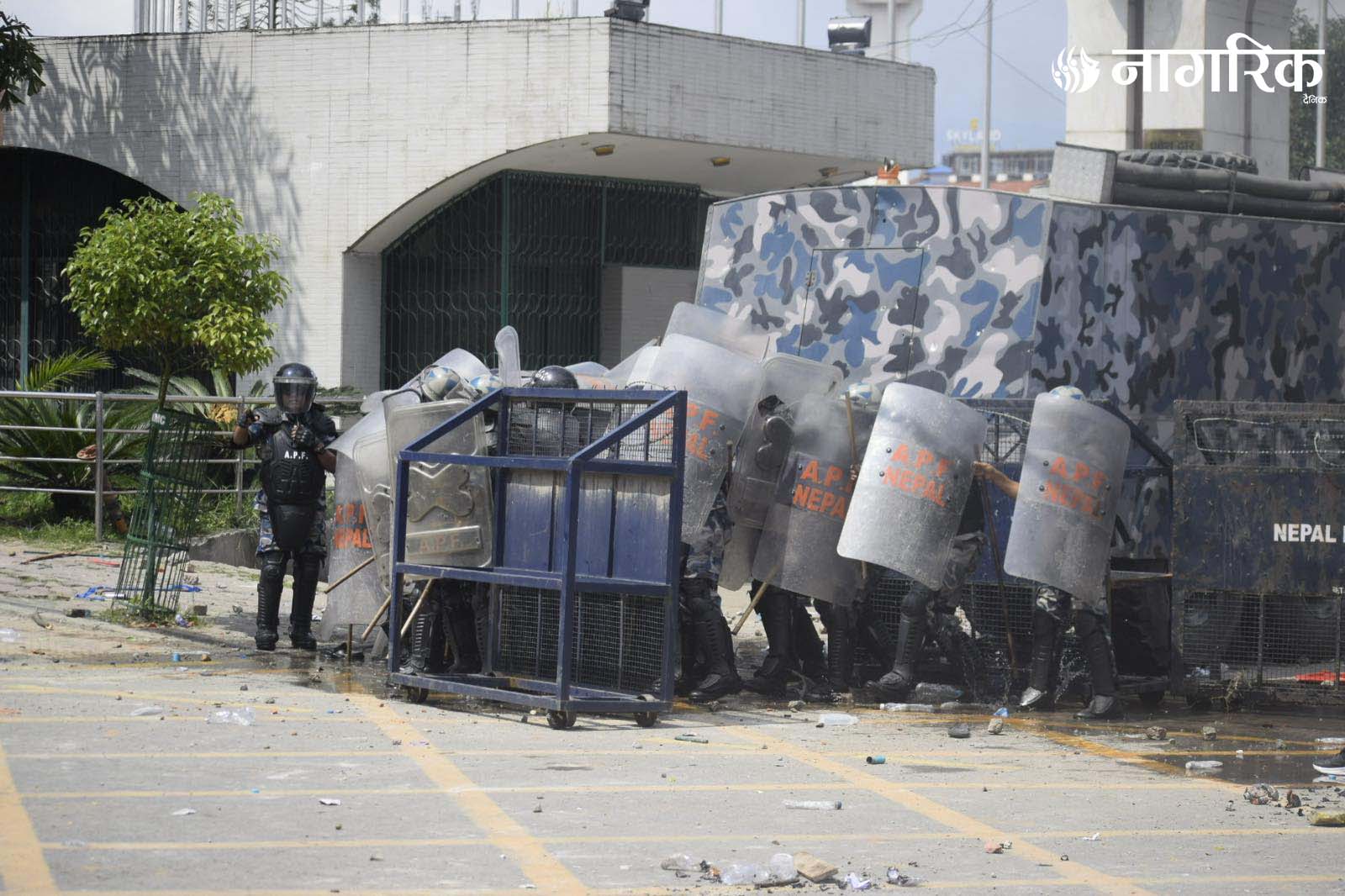
Photo: República
Opposition Demands PM’s Resignation
Opposition parties, including the CPN (Maoist Center) and the Rastriya Swatantra Party (RSP), had demanded the resignation of the prime minister, accusing his government of committing a massacre during the protests in the capital and across the country.
They concluded that the government’s handling of the movement was “highly inappropriate,” insisting the prime minister step down to create a conducive political environment.
As part of its campaign “Maoist with the People, Mid-Hill Pushpalal Highway — National Awakening Drive,” top Maoist leaders, including Chairman Pushpa Kamal Dahal, senior vice-chairs, vice-chairs, and the general secretary, had reached Gorkha on Monday. However, after learning about the escalation of protests in Kathmandu and reports of casualties, the leaders held an informal meeting, demanded the PM’s resignation, suspended their campaign, and returned to the capital the same day.
Similarly, the RSP also demanded Oli’s immediate resignation and early elections. Meanwhile, the Janata Samajbadi Party-Nepal (JSP-N), led by Upendra Yadav, demanded the immediate lifting of the social media ban and urged the government to hold talks with protesters to resolve the crisis.
Reason Behind the Protests
Public anger has surged since the government’s September 4 decision to simultaneously shut down 26 platforms, including Facebook, WhatsApp, Instagram and YouTube. In response, Gen Z has turned the issue into a broader campaign, raising voices against violations of fundamental rights as well as against nepotism and corruption.
One of the youths involved is Aarati Ray of Kathmandu. According to her, the country’s system has already been ruined by partisan politics, leaving no choice but for this generation to take to the streets. “We are clear. The country has been devastated by corruption. The root cause is a broken system,” Ray told Republica. For many, social media was the only outlet to vent frustration over hardships faced in public services.
On TikTok, the hashtag #PoliticiansNepoBabyNepal is raising questions about expensive cars, foreign education, and lavish lifestyles of politicians’ children. As Gen Z’s movement heads to the streets, the sharpest criticism has targeted the family of Nepali Congress President Sher Bahadur Deuba.
Gen Z activists have been posting photos and videos of his son Jaiveer and daughter-in-law Sivana’s lavish lifestyle, running a “Nepobaby” campaign online. Youth have also taken a dig at Shrinkhala Khatiwada, daughter of a former health minister Birodh Khatiwada; Ganga Dahal and Smita Dahal, daughter and granddaughter of former prime minister Pushpa Kamal Dahal; Anjila Basnet, daughter of former minister Mahesh Basnet; Ankit Khand, son of a former home minister, and Kshitiz Parajuli, son of former chief justice Gopal Parajuli.
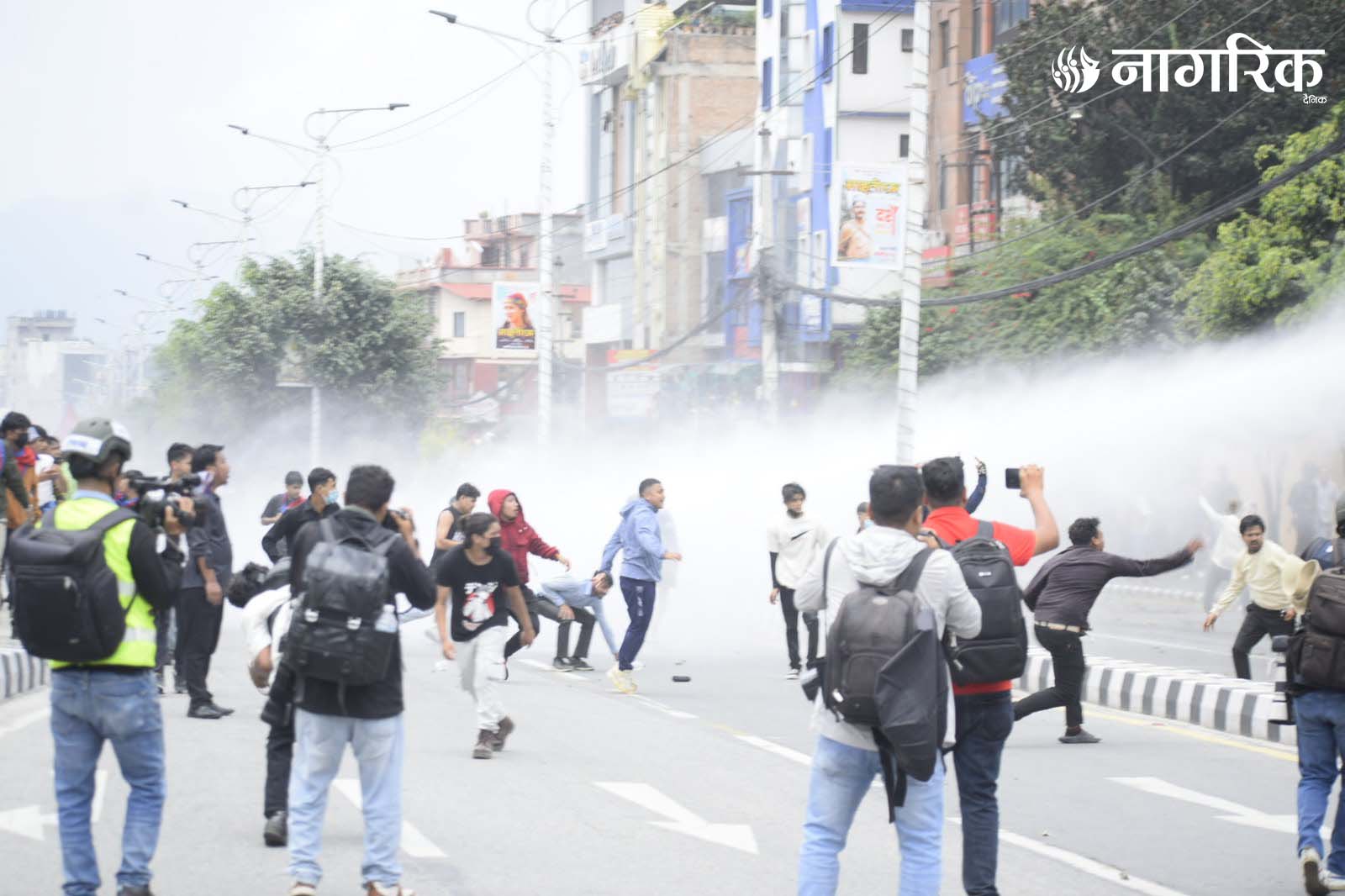
Photo: República
Content creator Bishal Gautam made a satirical video calling out ‘Nepo Baby’ privileges, which has already gathered over 400,000 views. Another user @am___bika expressed frustration commenting: “Corruption in Nepal is not just a political issue — it’s a deep-rooted crisis that affects every citizen, every community, and every dream for a better future. From the smallest public office to the highest levels of government, the misuse of power and public funds has become so common that many have stopped questioning it. That is the most dangerous part — when corruption becomes normalized, accepted, and even expected.”
The protest has been amplified by the viral “Holy Airball!” trend, which became a social media sensation among youth worldwide. The “Holy Airball” trend, popular among youth, uses a three-part format to show off personal or family achievements. The first slide shares a fact about themselves or their family, the second presents a common assumption, and the third humorously proves that assumption wrong with the phrase “holy airball.” Borrowing the basketball term for a complete miss, the trend became a way for young people to flex their success, wealth, or talents while playfully telling viewers not to underestimate them.
As the movement against the social media ban gained ground, the trend inadvertently became a platform for expressing frustration at government restrictions and corruption, turning it into a symbol of youth defiance. However, in the wake of the social media ban and growing public scrutiny, several of these flashy posts have reportedly been deleted by their original posters.
The shutdown of Facebook and YouTube has directly hit content creators and digital marketers. Despite promoting the idea of a “Digital Nepal,” the government shut down these platforms overnight without offering any alternatives for those whose income depends on them.
In response, youth have been voicing outrage at the government and political leaders. Many influencers, digital entrepreneurs and even some politicians have declared support for Gen Z’s protest campaign.
This is a developing story.
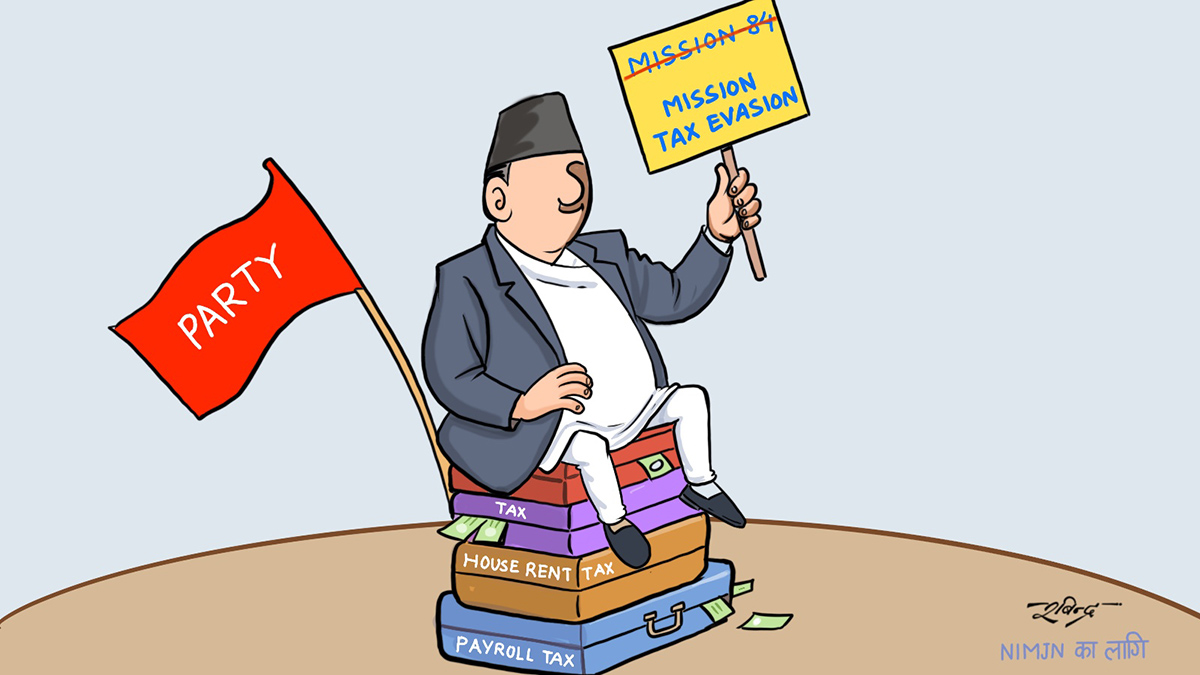
62 political parties in Nepal failed to pay a combined Rs 3.4 million in taxes. An expert audit — with a director from the Auditor General’s Office — found they skipped paying house rent tax, failed to deposit the 1% social security tax deducted from staff salaries, and dodged other advance taxes.
The quotes below are a collection of commitments from the election manifestos of major political parties in Nepal, which were made public in 2079 BS (2022 AD) before they went to voters’ doorsteps to ask for votes for the House of Representatives and Provincial Assembly elections:
“Good governance is our highest priority. The misuse of authority, the exploitation of national and government resources, and corruption will be met with a merciless, strict and zero-tolerance approach. Similarly, monitoring, investigation and scrutiny will be made more effective and any individual who engages in corruption, irregularities, misuse or misappropriation of government property will be brought to justice.”
— CPN (UML) Election Manifesto, 2079
“… Establishing economic good governance is our priority.”
— Nepali Congress Election Manifesto, 2079
“We will not engage in corruption and will not spare those who do.” “… Good governance is for the people.”
— Rastriya Swatantra Party Election Manifesto, 2079
“It is our firm commitment to develop a system of good governance with zero tolerance for corruption, complete transparency and effective service delivery at the doorsteps of the people in line with the principle of separation of powers and the spirit of federalism. This system will also ensure that all tasks, including development work, are completed quickly, efficiently and within a set timeframe. We will always remain steadfast in these commitments.”
— CPN (Unified Socialist) Election Manifesto, 2079
“A system of administration will be adopted that follows all principles of good governance, transparency, accountability and financial discipline, and provides services in a corruption-free and economical manner through digitized government offices.”
— CPN (Maoist Centre) Election Manifesto, 2079
Despite emphasizing good governance and transparency before seeking votes, the parties themselves have made a mockery of these principles. The very year they issued election manifestos promising to uphold good governance, transparency, accountability and financial discipline, that is, in the Fiscal Year 2079/080 (mid-July 2022 to mid-July 2023), they evaded taxes owed to the state.
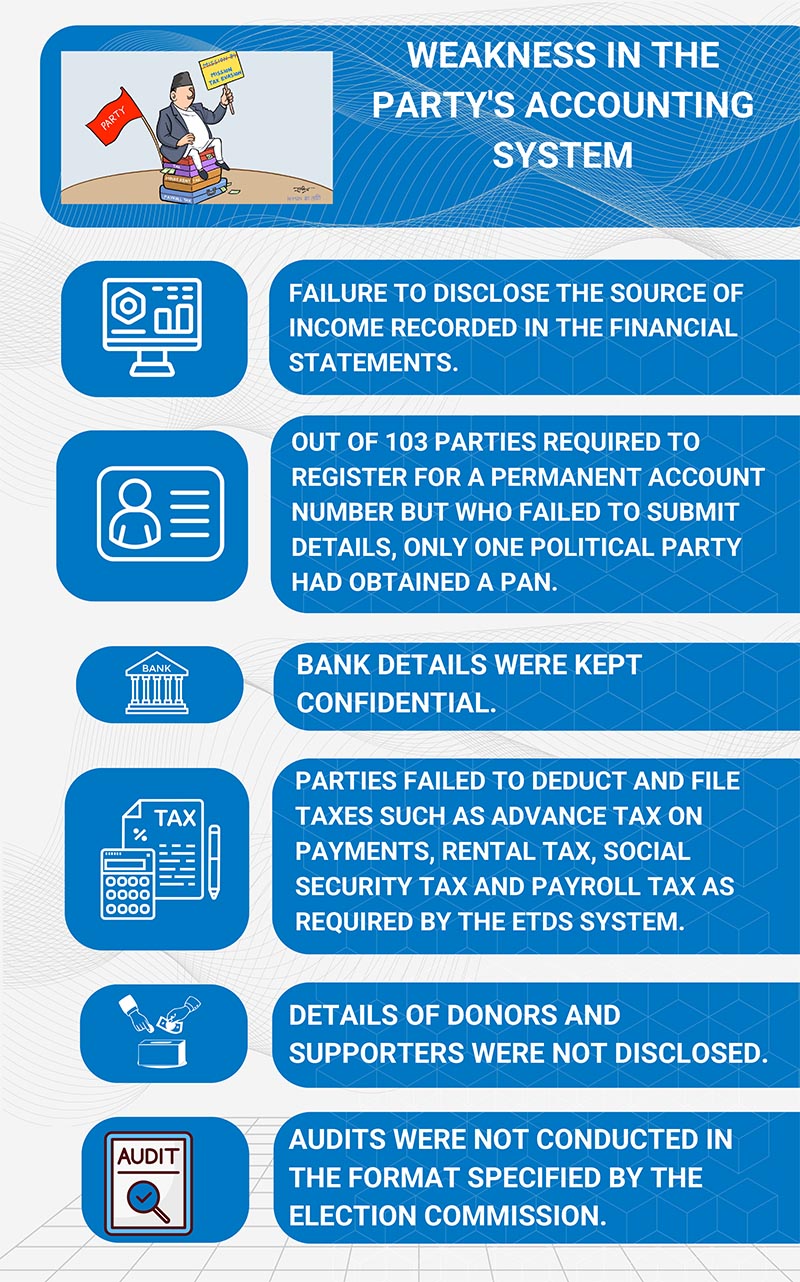
An audit conducted by the Election Commission, with the help of an expert team including a director from the Auditor General’s office, on the parties’ audit reports revealed that the parties had evaded taxes and that their accounting systems were found to be opaque. This raises questions about the parties’ commitment to transparency.
While the audit reports submitted by the parties to the Commission have been made public, the expert team’s audit report from the Auditor General’s office has not been. However, acting Chief Election Commissioner Ram Prasad Bhandari stated that the Commission has informed the concerned parties about the weaknesses pointed out by the expert team in that report.
The confidential report, which was not made public by the Commission, was analyzed by the Nepal Investigative Multimedia Journalism Network (NIMJN). The analysis found that in the fiscal year 2079/2080 (mid-July 2022 to mid-July 2023), 62 political parties failed to pay a total of 3,409,866 rupees in house rent tax, social security tax and other advance taxes. This total includes 3,066,704 rupees in house rent tax, 309,094 rupees in social security tax, and 34,068 rupees in advance tax and audit fees.
According to that report, political parties have committed irregularities, including maintaining disorganized and non-transparent accounting systems, failing to deposit taxes deducted from the salaries of their office staff to the tax office, and not paying house rent tax.
Major parties also among those not paying taxes
Of the 103 political parties that submitted financial reports to the Election Commission in the Fiscal Year 2079/080 (mid-July 2022 to mid-July 2023), 62 have not paid taxes. These include major parties that have received national party status, such as the Nepali Congress, CPN (UML), CPN (Maoist Centre), Rastriya Swatantra Party, Rastriya Prajatantra Party, Janata Samajwadi Party, and Janamat Party, all of whom were in government at the time. It was in this same year that the House of Representatives and Provincial Assembly elections took place and these parties were granted national party status.
When the audit reports submitted by the parties for the Fiscal Year 2079/080 (mid-July 2022 to mid-July 2023) were reviewed by the expert team from the Auditor General’s office, the CPN (UML), which currently leads the government, was found to have evaded the most taxes. According to the report, the UML has not paid 1.83 million rupees in house rent tax and 47,842 rupees in payroll tax, for a total of 1,877,872 rupees in unpaid taxes.
Schedule 13 of the UML’s 2079/080 (mid-July 2022 to mid-July 2023) audit report shows an expenditure of 18,383,520 rupees for building leasehold expenses.
After the 2072 (2015) earthquake, the CPN (UML) moved its office to the Pasang Lhamu Foundation building in Dhumbarahi. On April 14, 2021, it relocated to a private rented house in Thapathali. However, citing that building as too small, the UML office moved again on April 22, 2022, to the Tulsilal Memorial Foundation in Chyasal, Lalitpur, where it has remained since.
UML office secretary Bhishma Adhikari stated that the party does not have to pay rent, saying, “We don’t pay house rent, so how can we pay house rent tax?”
However, according to Baburam Thapa, the foundation’s treasurer, the UML gives the foundation a monthly ‘donation’ for using the building. “It is not given as rent, but as a donation of 400,000 rupees,” he said.
Bishnu Pokhrel, the office secretary of the foundation, also stated that the UML provides the agreed-upon amount to the foundation to cover expenses for building maintenance, research and other projects. The memorandum of understanding regarding the UML’s use of the foundation’s building for office purposes was signed on October 24, 2021, by then-UML General Secretary Ishwor Pokhrel and the foundation’s chairman, Gopal Shakya.
In that year, 2079/080 BS (mid-July 2022 to mid-July 2023), the UML spent 4.584 million rupees on employee salaries. Based on this expenditure, the expert team’s report noted that the party had not paid the required taxes and a clarification was written stating that the taxes should be recovered.
Bhishma Adhikari, the UML’s office secretary, claimed that the party has no outstanding tax liabilities. We had informed him that the Election Commission, using experts from the Auditor General’s office, had prepared a report that indicated there were outstanding taxes.
The next day, he contacted us and said, “The Auditor General’s office and the Election Commission should have asked us once before preparing the report. After you informed us, we made inquiries, and only then did we learn about the report with the details of the taxes we were supposed to pay.”
He claimed that the one percent tax deducted from employee salaries is submitted monthly.
The expert team also pointed out that the Rastriya Swatantra Party (RASWAPA), which has consistently advocated for good governance in the streets and parliament, has not paid 324,496 rupees in house rent tax and 75,519 rupees in payroll/social security tax, totaling 400,015 rupees.
RASWAPA, which was announced on June 21, 2022, moved its central office from Basundhara to Banasthali on June 22, 2023.
RASWAPA’s treasurer, Lima Adhikari, said that the outstanding house rent tax from 2079/080 (mid-July 2022 to mid-July 2023) was paid in the following year. “We have already paid the outstanding tax from the previous year at the ward office,” she said. “I cannot show you the exact amount we paid, however.”
According to sources from Kathmandu Metropolitan City Ward 16, RASWAPA has been paying 10% of its monthly rent, or 300,000 rupees, as house rent tax since last year (2080/81 BS) {mid-July 2023 to mid-July 2024}.
Clause 6 of Schedule 6 of the Kathmandu Metropolitan City Financial Act of 2078 states that a house rent tax of 10% of the annual rent amount is applicable.
Also, on the list of tax defaulters is the CPN (Unified Socialist), a party led by former Prime Minister Madhav Kumar Nepal and with another former Prime Minister, Jhalanath Khanal, as its esteemed leader. The report notes that it still owes 426,000 rupees in house rent tax and 20,635 rupees in payroll tax. Khem Paudel, a staff member of the party’s accounting department, said that the party had paid the outstanding house rent tax for 2079/80 BS (mid-July 2022 to mid-July 2023) on January 14, 2024.
“Whatever tax we owed, we have already paid it,” he said.
The audit report for the CPN (Unified Socialist) shows an expenditure of 4.26 million rupees for house rent in 2079/80 BS (mid-July 2022 to mid-July 2023). According to the city’s laws, the party should have paid 426,000 rupees in tax. However, according to the tax receipt obtained by NIMJN, the party only paid 360,000 rupees. Its central office is located in Ward 31 of Kathmandu Metropolitan City.
Nepali Congress failed to pay tax deducted from employee salaries for seven years
According to the report prepared by the expert team from the Auditor General’s office, the Nepali Congress did not pay 101,145 rupees in payroll/social security tax for the Fiscal Year 2079/080 BS (mid-July 2022 to mid-July 2023).
However, during our investigation, we found that the Nepali Congress had not paid the tax deducted from its office employees’ salaries for seven years. Robin Bajracharya, the accountant at the Nepali Congress party office, acknowledged this, stating, “There is a plan to pay the one percent tax from employees’ salaries for the last seven years within this year.”
The party’s audit report shows that the Nepali Congress spent 12,004,500 rupees on employee salaries, wages, and gratuities in the Fiscal Year 2079/080 BS (mid-July 2022 to mid-July 2023). Bajracharya said that even though they were ready to pay the tax last year, they were delayed because a system issue made it unclear how much tax each person owed.
He also mentioned that the Congress party had obtained a PAN from the tax office on June 7, 2023. Bajracharya stated that the party office is aware of the tax issue raised by the Auditor General’s office and has kept the amount it is supposed to pay as a liability.
Krishna Prasad Paudel, the chief secretary of the Nepali Congress central office, said that it is possible some taxes the party was supposed to pay were missed. “We haven’t received any such information from the Election Commission and it’s not like the party would skip paying taxes it owes,” he said. “We are ready to pay the outstanding taxes; the party has no intention of evading taxes.”
The report also mentions that the Janamat Party, which participated in the 2079 BS (2022 AD) elections for the first time and became a national party, has not paid 78,000 rupees in house rent tax. Janamat Party chairman C.K. Raut said that while the party was aware of the tax it owed, it was delayed due to technical reasons. “We had planned to pay it last year but there were some issues, which caused the delay,” he said.
The report also mentions that the Janata Samajwadi Party has not paid 1,275 rupees, while the Nagarik Unmukti Party has not paid 8,750 rupees in taxes, which includes 8,000 rupees in payroll tax and 750 rupees in TDS.
Newly appointed Chairman of the Nagarik Unmukti Party, Lalbir Chaudhary, said he was not aware of the taxes the party owed. “I’ve just taken on the responsibility, I’ll figure out where and how much we need to pay and then we will pay it,” he said. Chaudhary was made chairman of the Nagarik Unmukti Party on July 31, 2025, replacing Ranjita Shrestha.
The Rastriya Prajatantra Party (RPP) has not submitted 17,000 rupees in taxes, which is 1% of its employees’ salaries. RPP Senior Vice Chairman Dhurva Bahadur Pradhan claimed that no one receives a salary that requires paying payroll tax, so no tax was deducted. “People work as volunteers and only get pocket money,” he said. “Except for the security guards, no one receives a salary that requires them to pay taxes, which is why we have not paid them.”
The audit report for the fiscal year 2078/79 (mid-July 2021 to mid-July 2022), which the RPP submitted to the Election Commission, shows that the party spent 2.626 million rupees on employee salaries.
What does the law say?
Section 2 (d) (2) of the Income Tax Act, 2058 (2002), mentions that political parties registered with the Election Commission are considered tax-exempt organizations. This same section clarifies that such organizations will not be tax-exempt if they benefit any individual from their property or income, except when making payments for work done according to the organization’s goals or for assets or services provided to the organization by an individual.
Rule 23 of the Income Tax Regulations states that any individual required to deduct tax under Chapter 17 of the Act must apply for a Permanent Account Number (PAN) from the Inland Revenue Department before earning income or deducting tax. The expert team’s report points out that the parties did not comply with the Act and Regulations by failing to obtain a PAN and neglecting to use the eTDS system to deduct advance tax on payments, social security tax and payroll tax.
The secret report prepared by the expert team from the Auditor General’s office states, “Evidence of tax deduction on payments was not presented and in the financial statements of some parties, the amount of advance tax deduction was shown under outstanding liabilities but no evidence of its submission was provided.”
Why different laws for political parties and citizens?
Former Acting Auditor General, Sukdev Bhattarai Khatry, said that there should not be a system where ordinary citizens pay taxes while political parties are exempt.
“The same rules that apply to the people should also apply to the parties that lead the country,” he said. “Except for exemptions specified in the Financial Act and the Income Tax Act, taxes must be paid. Just because you make the laws in parliament doesn’t mean anything goes.”
Acting Chief Election Commissioner Ram Prasad Bhandari stated that the audit reports submitted by the parties were not in the format prescribed by the commission. “The parties have submitted their audit reports, but they were not found to be in the format we had specified,” he said. “We have already instructed them to make the necessary improvements and it is the parties’ responsibility to comply with those instructions.” He added that whether the parties have complied with the instructions will only be known from the audit reports they submit the following year.
Bhandari also said that, similar to previous years, they are preparing to have the audit reports submitted by the parties this year re-audited through the Auditor General’s office.
Section 40, Subsection 1 of the Political Parties Act, 2073 (2017), stipulates that parties must maintain accounts that accurately show their income and expenses. The Act also states that such accounts can be kept in electronic records. The law mandates that the accounts must be in the format specified by the Election Commission, and the commission must be informed about the officials responsible for the party’s accounts.
Similarly, there is a legal provision that allows the commission to demand or inspect the accounts maintained by a party through an officer or expert it designates. Based on the provision in Section 42 of the Act, which allows the commission to verify if a party’s submitted report is in the legally prescribed format, the commission has been conducting re-audits through the Auditor General’s office for the past two years. “The work the commission is doing to make party accounting systems transparent shows that improvements are being made,” said former Acting Auditor General Sukdev.
Eager to impose fines but weak on ensuring transparency
The Election Commission has a history of fining candidates from political parties who fail to submit their election expense reports on time. For instance, the commission published a list of candidates from local level elections who hadn’t submitted their expense reports and fined them. According to the list, the total fines amounted to more than 24 billion rupees.
The commission had issued a notice on September 22, 2022, to collect 24.638 billion rupees from 123,650 candidates for failing to submit their expense reports within 30 days of the election results being made public.
After the commission announced that candidates who didn’t pay the fine would be barred from participating in elections for six years, many paid up. However, following a writ petition filed by Kathmandu Metropolitan City Mayor Balen Shah, the Supreme Court issued an interim order to the commission on February 16, 2023, to not implement the decision to impose the fines.
On the same day, February 16, 2023, a cabinet meeting recommended to then-President Bidya Devi Bhandari to waive the fines imposed by the commission. Following that recommendation, the President waived the fines on February 17, 2023, under Article 276 of the Constitution.
On March 6, 2024, the Supreme Court also dismissed the writ petition filed by Balen Shah.
The commission has also fined candidates for the House of Representatives and Provincial Assembly elections 15,000 rupees each for not submitting their election expense reports, similar to the candidates in the local elections. The commission levied a total fine of 36,525,000 rupees on 2,435 candidates – 1,037 from the House of Representatives and 1,398 from the Provincial Assembly – at a rate of 15,000 rupees per person. The 61st annual report of the Auditor General has recommended that this outstanding amount be collected.
The confidential report notes that the commission has not been as proactive in getting the political parties to pay their taxes as it was in getting the candidates to pay their fines.
Although the Auditor General’s office provided a list of parties that had not paid taxes and the amounts owed, the commission has only informed the parties about the matter.
According to the acting Chief Election Commissioner, the commission has not yet pressured the parties to pay their taxes.
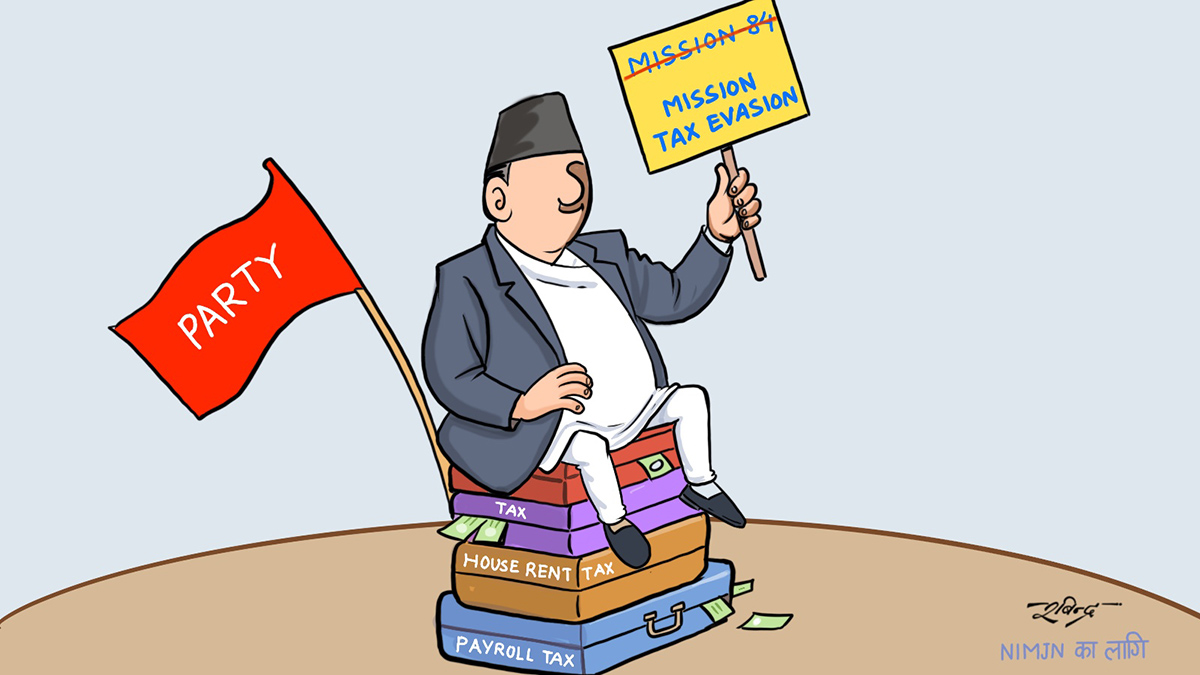
राष्ट्रिय दलको मान्यता प्राप्तसहित ६२ वटा राजनीतिक दलले राज्यलाई बुझाउनु पर्ने कर छली गरेको पाइएको छ । उनीहरूले घर बहाल कर, कर्मचारीको पारिश्रमिकबाट कट्टा गरिएको १ प्रतिशत सामाजिक सुरक्षा कर र अन्य अग्रिम कर छलेको भेटिएको छ ।
“सुशासन हाम्रो उच्च प्राथमिकता । अख्तियारको दुरुपयोग, राष्ट्रिय तथा सरकारी स्रोतको दोहन र भ्रष्टाचारप्रति निर्मम, कठोर र शून्य सहनशीलता अपनाइनेछ । यस्तै अनुगमन, अनुसन्धान र छानबिन कार्यलाई सशक्त बनाइने, भ्रष्टाचार, अनियमितता, सरकारी सम्पत्तिको दुरुपयोग र अपचलन गर्ने जुनसुकै व्यक्तिलाई कानुनी कारबाहीको दायरामा ल्याइनेछ ।”
– नेकपा एमालेको घोषणा पत्र, २०७९
“… आर्थिक सुशासन कायम गर्नु हाम्रो प्राथमिकता हुन् ।”
– नेपाली कांग्रेसको घोषणापत्र, २०७९
“भ्रष्टाचार गरिन्न र गर्नेलाई छाडिन्न ।” “ …सुशासन जनताको लागि ।”
– राष्ट्रिय स्वतन्त्र पार्टीको घोषणापत्र, २०७९
“भ्रष्टाचारमा शून्य सहनशीलतासहितको सुशासन, पूर्ण पारदर्शिता, शक्ति पृथकीकरणको सिद्धान्तअनुरूप राज्यका सबै अंगहरूको कार्य सम्पादन र संघीयताको मर्मअनुरूप जनताको घरदैलोमै प्रभावकारी सेवा प्रदान गर्ने तथा छिटो, छरितो र समय सीमाभित्र विकास निर्माणलगायत सबै काम सम्पन्न गर्ने प्रणालीको विकास गर्ने हाम्रो दृढ प्रतिज्ञा छ । हामी यी प्रतिज्ञामा सधैँ अडिग रहनेछौँ ।”
– नेकपा एकीकृत समाजवादीको घोषणापत्र, २०७९
“सुशासन, पारदर्शिता, जवाफदेहिता र वित्तीय अनुशासनका सम्पूर्ण सिद्धान्त अनुसरण गरी डिजिटाइज्ड सरकारी कार्यालयमार्फत भ्रष्टाचारमुक्त र मितव्ययी रूपमा सेवा प्रवाह हुने प्रशासन प्रणाली अवलम्बन गरिनेछ ।”
– माओवादी केन्द्रको घोषणपत्र, २०७९
प्रमुख राजनीतिक दलहरूले प्रतिनिधिसभा र प्रदेशसभाको निर्वाचनको बेला भोट माग्न मतदाताको घरदैलोमा जानुअघि २०७९ सालमा सार्वजनिक गरेका चुनावी घोषणापत्रका प्रतिबद्धताहरू हुन् यी ।
भोट माग्न जानुअघि सुशासन र पारदर्शितामा जोड दिने दलहरू आफैंले भने त्यसको धज्जी उडाएका छन् । दलहरूले सुशासन, पारदर्शिता, जवाफदेहिता र वित्तीय अनुशासन पालना गर्ने आश्वासनसहित चुनावी घोषणा पत्र जारी गरेकै वर्ष अर्थात् आर्थिक वर्ष २०७९/०८० मा राज्यलाई तिर्नुपर्ने कर छली गरेका छन् ।
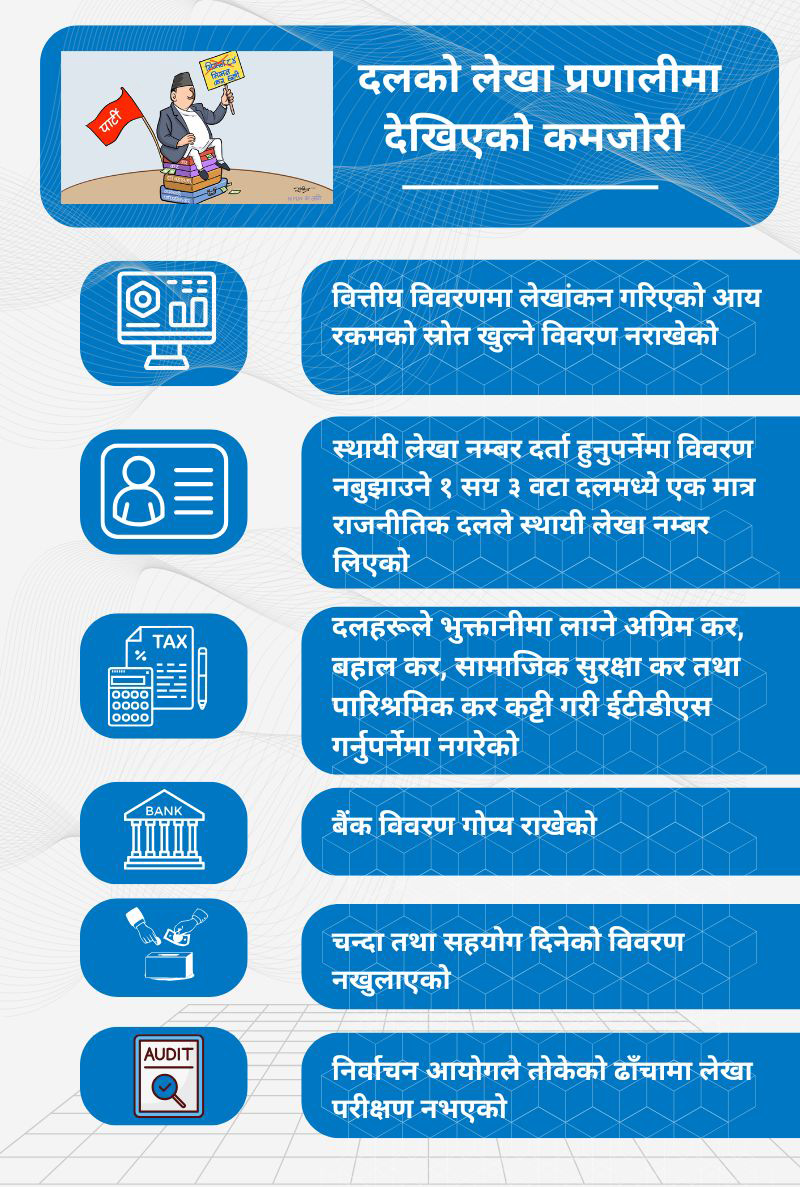
दलहरूको लेखा परीक्षण प्रतिवेदनलाई निर्वाचन आयोगले महालेखा परीक्षकको कार्यालयका निर्देशकसहित अरू लेखा परीक्षकबाट परीक्षण गराउँदा दलहरूले कर छली गरेको र दलका लेखा प्रणाली अपारदर्शी पाइएको छ । यसले दलहरुको पारदर्शिताप्रतिको प्रतिबद्धतामाथि नै प्रश्न उठेको छ ।
दलहरूले आयोगमा बुझाएका लेखा परीक्षण प्रतिवेदन सार्वजनिक भए पनि त्यसकै आधारमा महालेखाको विज्ञ टिमबाट गराएको लेखा परीक्षण प्रतिवेदन भने आयोगले सार्वजनिक गरेको छैन ।
तर, प्रतिवेदनमाथि महालेखाको विज्ञ टिमले औंल्याएका कमजोरीका बारेमा सम्बन्धित दलहरूलाई जानकारी गराएको आयोगका कार्यवाहक प्रमुख निर्वाचन आयुक्त रामप्रसाद भण्डारीले जानकारी दिए ।
आयोगले सार्वजनिक नगरेको त्यो गोप्य प्रतिवेदन नेपाल इन्भिेस्टिगेटिभ मल्टिमिडिया जर्नालिज्म नेटवर्क (निमजिन) ले फेला पारेर विश्लेषण गर्दा आर्थिक वर्ष २०७९/२०८० मा ६२ राजनीतिक दलले घर बहाल कर, सामाजिक सुरक्षा कर र अन्य अग्रिम कर गरी ३४ लाख ९ हजार ८ सय ६६ रुपैयाँ नतिरेको पाइएको छ । जसमा घर बहाल करबापत ३० लाख ६६ हजार ७ सय ४ रुपैयाँ, सामाजिक सुरक्षा करबापत् ३ लाख ९ हजार ९४ रुपैयाँ, अग्रिम कर र अडिट शुल्क ३४ हजार ६८ रुपैयाँ छ ।
त्यो प्रतिवेदनअनुसार दलहरूको लेखा प्रणाली अव्यवस्थित र अपादर्शी रहेको, दलका कार्यालयमा कार्यरत कर्मचारीको पारिश्रमिकबाट कर कट्टा गरेको तर त्यो रकम कर कार्यालयमा जम्मा नगरेको, घरबहाल कर नतिरेकोसहितका अनियमितता राजनीतिक दलबाट भएका छन् ।
कर नतिर्नेमा ठूला दल पनि
निर्वाचन आयोगमा आर्थिक वर्ष २०७९/०८० मा १ सय ३ वटा रजानीतिक दलले वित्तीय विवरण बुझाएका थिए । तीमध्ये कर नतिर्ने ६२ दल छन् । जसमा सरकारमा रहेको नेपाली कांग्रेस, नेकपा एमालेसहित राष्ट्रिय दलको मान्यता पाएका राष्ट्रिय स्वतन्त्र पार्टी, राष्ट्रिय प्रजातन्त्र पार्टी, जनता समाजवादी पार्टी र जनमत पार्टी पनि छन् । त्यही वर्ष प्रतिनिधिसभा र प्रदेशसभा चुनाव भएको थियो र यी दललले राष्ट्रिय दलको मान्यता पाएका थिए ।
आर्थिक वर्ष २०७९/०८० मा दलहरूले आयोगमा बुझाएको लेखा परीक्षण प्रतिवेदनलाई महालेखाको विज्ञ टोलीले परीक्षण गर्दा सबैभन्दा बढी कर छली गर्नेमा अहिले सरकारको नेतृत्व गर्ने नेकपा एमालेलाई देखाइएको छ । प्रतिवेदनले औंल्याएअनुसार एमालेले घर बाहल कर मात्रै १८ लाख ३० हजार, पारिश्रमिक कर ४७ हजार ८ सय ४२ गरी १८ लाख ७७ हजार ८ सय ४२ रुपैयाँ कर बुझाएको छैन ।
एमालेको २०७९/०८० को लेखा परीक्षण प्रतिवेदनको अनुसूची १३ मा भवन लिजहोल्ड खर्चबापत १ करोड ८३ लाख ८३ हजार ५ सय २० रुपैयाँ खर्च लेखेको छ ।
२०७२ सालको भूकम्पपछि धुम्बाराहीस्थित पासाङ ल्हामु प्रतिष्ठानको भवनमा सरेको नेकपा एमाले वैशाख १, २०७८ मा थापाथलीमा रहेको एउटा निजी घरमा भाडामा सरेको थियो । तर त्यो घर साँघुरो भएको भन्दै एक वर्षपछि वैशाख ९, २०७९ मा एमालेको कार्यालय ललितपुरको च्याँसलस्थित तुल्सीलाल स्मृति प्रतिष्ठानमा सरेको छ । त्यसयता एमालेको कार्यालय प्रतिष्ठानमै छ ।
एमालेका कार्यालय सचिव भीष्म अधिकारीले भने पार्टीले घरभाडा नै तिर्न नपरेको बताए । उनले भने, “हामीले घरभाडा नै तिरेको छैन, बहाल कर कसरी तिर्नु ?” उनले भने ।
तर, प्रतिष्ठानका कोषाध्यक्ष बाबुराम थापाका अनुसार भवन प्रयोग गर्न दिएबापत् एमालेले प्रतिष्ठानलाई मासिक ‘सहयोग’ दिने गरेको छ । “भाडा भनेर दिएको छैन, सहयोगस्वरूप भनेर ४ लाख तिर्छ,” उनले भने ।
प्रतिष्ठानको भवन मर्मतसम्भार, अध्ययन अनुसन्धानलगायतका शीर्षकमा खर्च गर्ने गरी एमालेले सम्झौताअनुसारको रकम दिने गरेको प्रतिष्ठानका कार्यालय सचिव विष्णु पोखरेलले पनि बताए । प्रतिष्ठानको भवन एमालेले कार्यालय प्रयोजनका लागि प्रयोग गर्नेबारेको समझदारी पत्रमा एमालेका तत्कालीन महासचिव ईश्वर पोखरेल र प्रतिष्ठानका अध्यक्ष गोपाल शाक्यले कात्तिक ७, २०७८ मा हस्ताक्षर गरेका थिए ।
त्यो वर्ष अर्थात् २०७९/०८० कर्मचारीको पारिश्रमिकमा ४५ लाख ८४ हजार रुपैयाँ खर्च गरेको छ । यही खर्चका आधारमा सरकारलाई तिर्नुपर्ने कर नतिरेको भन्दै विज्ञ टोलीको प्रतिवेदनमा कर असुल गर्नुपर्ने कैफियत लेखेको हो ।
एमालेका कार्यालय सचिव भीष्म अधिकारीले पार्टीले तिर्नुपर्ने कुनै कर बाँकी नरहेको दाबी गरे । हामीले उनलाई निर्वाचन आयोगले महालेखाका विज्ञ प्रयोग गरेर प्रतिवेदन तयार गरेको र त्यसमा कर तिर्न बाँकी रहेको रहेछ नि भनेर जानकारी गराएका थियौँ ।
त्यसको भोलिल्ट उनले नै सम्पर्क गरेर हामीलाई भने, “महालेखा र निर्वाचन आयोगले रिपोर्ट तयार गर्नुअघि एक पटक सोधेको भए हुन्थ्यो, तपाईंहरूले जानकारी गराएपछि हामीले सोधखोज गर्यौं, त्यसपछि मात्रै हामीले कर तिर्नुपर्ने विवरणसहितको प्रतिवेदनको बारेमा बल्ल थाहा पायौं ।”
कर्मचारीको पारिश्रमिकमा कट्टा गरिएको एक प्रतिशत कर मासिक बुझाउने गरेको उनले दाबी गरे ।
सुशासनको पक्षमा सडक र सदनमा आवाज उठाउँदै आएको रास्वपाले पनि बहाल करबापत् ३ लाख २४ हजार ४ सय ९६ रुपैयाँ, पारिश्रमिक/सामाजिक सुरक्षा करबापत् ७५ हजार ५ सय १९ रुपैयाँ गरी ४ लाख १५ रुपैयाँ कर नबुझाएको विज्ञ टोलीले औंल्याएको छ ।
७ असार, २०७९ मा घोषणा भएको रास्वपाको केन्द्रीय कार्यालय वसुन्धराबाट ७ असार, २०८० मा वनस्थलीमा सरेको थियो ।
रास्वपाकी कोषाध्यक्ष लिमा अधिकारीले भने २०७९/०८० मा तिर्न बाँकी घरबहाल कर पछिल्लो वर्षमा तिरेको बताइन् । “अघिल्लो वर्ष तिर्न बाँकी कर हामीले वडा कार्यालयमा तिरिसक्यौं,” उनले भनिन, “कति तिर्यौं भन्नेचाहिँ तपाईंलाई देखाउन मिल्दैन ।”
काठमाडौं महानगरपालिका १६ नम्बर वडा कार्यालय स्रोतका अनुसार रास्वपाले गतवर्ष (२०८०/०८१) देखि मासिक ३ लाख रुपैयाँको १० प्रतिशत घरबहाल कर तिर्ने गरेको छ ।
काठमाडौं महानगरपालिकाको आर्थिक ऐन २०७८ को अनुसूची ६ को बुँदा नम्बर ६ मा बहाल रकमको वार्षिक १० प्रतिशतका दरले बहाल कर लाग्ने उल्लेख छ ।
कर नतिर्नेमा पूर्वप्रधानमन्त्री माधवकुमार नेपाल र अर्का पूर्वप्रधानमन्त्री झलनाथ खनालको दल नेकपा एकीकृत समाजवादी पनि छ । उसले घरबाहल कर मात्रै ४ लाख २६ हजार र पारिश्रमिक कर २० हजार ६ सय ३५ रुपैयाँ तिर्न बाँकी रहेको प्रतिवेदनमा उल्लेख छ । पार्टीका लेखा शाखाका कर्मचारी खेम पौडेलले २०७९/०८० मा पार्टीले तिर्नुपर्ने घरबाहल कर पुस २९, २०८० मा तिरिसकेको बताए । “हामीले जेजति तिर्नुपर्ने कर हो, त्यो तिरिसकेका छौं,” उनले भने ।
एकीकृत समाजवादीले २०७९/०८० मा ४२ लाख ६० हजार रुपैयाँ घरभाडाबापत् तिरेको लेखा परीक्षण प्रतिवेदनमा खर्च लेखेको छ ।
महानगरको कानुनअनुसार समाजवादीले ४ लाख २६ हजार कर तिर्नुपर्ने हो । तर, निमजिनले प्राप्त गरेको कर तिरेको रसिदअनुसार उसले ३ लाख ६० हजार मात्रै कर तिरेको छ । काठमाडौं महानगरको ३१ नम्बर वडामा उसको केन्द्रीय कार्यालय छ ।
कांग्रेसले कर्मचारीको तलबमा कट्टा गरेको कर ७ वर्षसम्म तिरेन
महालेखाका विज्ञ टोलीले तयार पारेको प्रतिवेदनअनुसार नेपाली कांग्रेसले आर्थिक वर्ष २०७९/०८० मा कर्मचारीको पारिश्रमिक/सामाजिक सुरक्षा करबापत्को १ लाख १ हजार १ सय ४५ रुपैयाँ बुझाएको छैन ।
तर हामीले खोजी गर्ने क्रममा कांग्रेसले कार्यालयका कर्मचारीको तलबबाट कट्टा गरेको कर ७ वर्षदेखि नतिरेको पायौं । कांग्रेस पार्टी कार्यालयका लेखापाल रविन बज्राचार्यले यसलाई स्वीकार गर्दै भने, “पछिल्लो सात वर्षदेखिका कर्मचारीको पारिश्रमिकको एक प्रतिशत कर यो वर्षभित्र तिर्ने योजना रहेको छ ।”
नेपाली कांग्रेसले आर्थिक वर्ष २०७९/०८० मा कर्मचारीको तलब, ज्याला र उपदानमा १ करोड २० लाख ४ हजार ५ सय रुपैयाँ खर्च गरेको उसको लेखा परीक्षण प्रतिवेदनमा उल्लेख छ ।
गतवर्ष नै तिर्ने तयारी गरेको भए पनि सिस्टममा समस्या भएपछि कसको कति कर तिर्ने भन्ने यकिन नभएकाले ढिला भएको उनले बताए ।
कांग्रेसले जेठ २४, २०८० मा कर कार्यालयबाट प्यान नम्बरसमेत लिइसकेको उनले बताए । लेखापाल रविनले महालेखाले करका बारेमा औंल्याएको विषयमा पार्टी कार्यालय जानकार रहेको र उसले तिर्नुपर्ने भनेको रकम दायित्वमा नै राखेको बताए ।
कांग्रेस केन्द्रीय कार्यालयका मुख्य सचिव कृष्णप्रसाद पौडेलले पार्टीले तिर्नुपर्ने कुनै कर छुट भएको हुन सक्ने बताए । “निर्वाचन आयोगबाट कुनै त्यस्तो जानकारी त आएको छैन, पार्टीले तिर्नुपर्ने कर छुट लिने भन्ने पनि हुँदैन,” उनले भने, “तिर्न बाँकी देखाएको कर तिर्न तयार छौं, कर छली गर्ने पार्टीको नियत छैन ।”
२०७९ सालको चुनावमा पहिलोपल्ट भाग लिएर राष्ट्रिय पार्टी बनेको जनमत पार्टीले पनि बहाल करबापत्को ७८ हजार नतिरेको प्रतिवेदनमा उल्लेख छ । जनमत पार्टीका अध्यक्ष सीके राउतले पार्टीले तिर्नुपर्ने करको बारेमा जानकारी भए पनि प्राविधिक कारणले ढिलाइ भएको बताए । “पोहोर नै तिर्ने भनेका थियौं, केही समस्या भएकाले ढिलाइ भएको हो,” उनले भने ।
यस्तै, जनता समाजवादी पार्टीले १ हजार २ सय ७५ तिरेको छैन भने नागरिक उन्मुक्ति पार्टीले पारिश्रमिक कर ८ हजार र टीडीएसबापत्को ७ सय ५० समेत गरी ८ हजार ७ सय ५० रुपैयाँ कर नतिरेको प्रतिवेदनमा उल्लेख छ ।
नागरिक उन्मुक्ति पार्टीका नवनियुक्त अध्यक्ष लालवीर चौधरीले पार्टीले तिर्नुपर्ने करका बारेमा जानकारी नभएको बताए । उनले भने, “भर्खर जिम्मेवारी सम्हालेको छु, कहाँ कति तिर्नुपर्नेछ, बुझेर तिर्छौं ।”
रञ्जिता श्रेष्ठलाई हटाएर नागरिक उन्मुक्तिले साउन १५, २०८२ मा लालवीरलाई अध्यक्ष बनाएको थियो ।
राष्ट्रिय प्रजातन्त्र पार्टीले कर्मचारीको पारिश्रमिकको १ प्रतिशतले हुन आउने १७ हजार रुपैयाँ कर बुझाएको छैन । राष्ट्रिय प्रजातन्त्र पार्टीका वरिष्ठ नेता उपाध्यक्ष धुव्रबहादुर प्रधानले पारिश्रमिक कर तिर्ने गरी कसैले पनि तलब नखाने भएकाले कट्टा नगरेको दाबी गरे । “स्वयंसेवकको रूपमा काम गरिरहेका हुन्छन्, पकेटमनी मात्रै पाउँछन्,” उनले भने, “सुरक्षागार्डले बाहेक कर तिर्ने गरी कसैले पनि तलब पाउँदैनन्, त्यसैले कर नबुझाएका हौं ।”
निर्वाचन आयोगमा राप्रपाले बुझाएको २०७८/०७९ को लेखा परीक्षण प्रतिवेदनमा कर्मचारीको तलबमा २६ लाख २६ हजार खर्च लेखेको छ ।
कानुनमा के छ ?
आयकर ऐन २०५८ को दफा २ को (ध) (२) मा निर्वाचन आयोगमा दर्ता भएका राजनीतिक दललाई कर छुट पाउने संस्थाको रूपमा उल्लेख गरिएको छ । यही दफामा छुट पाउने संस्थाको उद्देश्यअनुसार कार्य सम्पन्न हुँदा वा कुनै व्यक्तिद्वारा त्यस्तो संस्थालाई प्रदान गरिएका सम्पत्ति वा सेवाबापत्को कुनै भुक्तानी गर्दाबाहेक त्यस्तो संस्थाको सम्पत्ति र त्यस्तो संस्थाले प्राप्त गरेको रकमबाट कुनै व्यक्तिलाई फाइदा पुर्याएको भए त्यस्तो संस्थालाई कर छुट नहुने स्पष्ट छ ।
आयकर नियमावलीको नियम २३ मा ऐनको परिच्छेद १७ अन्तर्गत करकट्टी गर्नुपर्ने जुनसुकै व्यक्तिले त्यस्तो आय आर्जन वा करकट्टीअगावै स्थायी लेखा नम्बरका लागि आन्तरिक राजस्व विभागमा आवेदन दिनुपर्ने उल्लेख छ । दलहरूले ऐन र नियमावलीअनुसार स्थायी लेखा नम्बर लिई भुक्तानीमा लाग्ने अग्रिम कर, सामाजिक सुरक्षा कर तथा पारिश्रमिक करकट्टी गरी ईटीडीएस नगरेको विज्ञ टोलीको प्रतिवेदनले औंल्याएको छ ।
“भुक्तानी लाग्ने करकट्टी गरेको प्रमाण पेस नगरेको र कतिपय दलको वित्तीय विवरणमा अग्रिम करकट्टीको रकम भुक्तानी गर्न बाँकी दायित्वअन्तर्गत देखाइएकोमा सो दाखिला गरेको प्रमाण पेस गरेको देखिएन,” महालेखाको विज्ञ टोलीले तयार पारेको गोप्य प्रतिवेदनमा भनिएको छ ।
दल र नागरिकलाई फरक कानुन किन ?
महालेखा परीक्षकको कार्यालयका पूर्वकार्यवाहक महालेखा परीक्षक सुकदेव भट्टराई खत्रीले सर्वसाधारणले कर तिर्ने र दललाई छुट दिने व्यवस्था गर्न नहुने बताए ।
“जनतालाई जे व्यवस्था हुन्छ, देशको नेतृत्व गर्ने दलहरूलाई पनि त्यही लागू हुनुपर्छ,” उनी भन्छन्, “आर्थिक ऐन र आयकर ऐनले नै छुट दिने भनेको बाहेकमा कर तिर्नैै पर्नेहुन्छ, संसद्मा कानुन बनाउने भएपछि जे पनि हुन्छ भन्ने हुँदैन ।”
कार्यवाहक प्रमुख निर्वाचन आयुक्त रामप्रसाद भण्डारीले दलहरूले बुझाएको लेखा परीक्षण प्रतिवेदन आयोगले तोकेको ढाँचामा नपाइएको बताए । “दलहरूले लेखा परीक्षण प्रतिवेदन त बुझाएका छन्, तर हामीले जुन ढाँचामा हुनुपर्छ भनेका छौं, त्यसअनुसार पाइएन,” उनले भने, “कमजोरी देखिए जतिको सुधार गर्न निर्देशन दिइसकेका छौं, निर्देशनको पालना गर्नु दलको दायित्व हुन्छ ।”
दललाई दिएको निर्देशन पालना भए/नभएको पछिल्लो वर्ष बुझाएको लेखा परीक्षण प्रतिवेदनबाट मात्रै थाहा हुने उनले बताए ।
विगतको जस्तै यस वर्ष पनि दलहरूले बुझाएको लेखा परीक्षण प्रतिवेदनलाई महालेखामार्फत पुनःपरीक्षण गराउने तयारी रहेको उनले बताए ।
राजनीतिक दलसम्बन्धी ऐन २०७३ को दफा ४० को उपदफा १ मा दलले आफ्नो आय र व्ययको वास्तविक हिसाब देखिने गरी लेखा राख्नुपर्ने व्यवस्था छ । त्यस्तो लेखा विद्युतीय अभिलेखमा पनि राख्न सकिने ऐनमा उल्लेख छ । लेखाको अभिलेख निर्वाचन आयोगले तोकेको ढाँचामा हुनुपर्ने, दलको हिसाब हेर्ने पदाधिकारीका बारेमा आयोगलाई जानकारी दिनुपर्ने ऐनमै उल्लेख छ ।
यसैगरी, दलले राखेको हिसाब आयोगले तोकेको अधिकृत वा विशेषज्ञमार्फत माग गर्न वा निरीक्षण गराउन सक्ने कानुनी प्रावधान छ । ऐनअनुसार दलहरूले आर्थिक वर्ष सकिएको ६ महिनाभित्र आफ्नो आय र व्ययको लेखा परीक्षण गराई एक महिनाभित्र आयोगमा पेस गर्नुपर्ने हुन्छ ।
ऐनको दफा ४२ मा दलले बुझाएको प्रतिवेदन कानुनले तोकेको ढाँचामा भए/नभएको जाँच गराउन सकिने व्यवस्थालाई टेकेर आयोगले महालेखामार्फत पछिल्लो दुई वर्षयता परीक्षण गराउँदै आएको हो । “दलको लेखा प्रणाली पारदर्शी बनाउन आयोगले जुन काम गरिरहेको छ, यसले सुधार हुँदै गएको पनि देखिन्छ,” पूर्वकार्यवाहक महालेखा परीक्षक सुकदेवले भने ।
जरिवाना तोक्न आतुर, पारदर्शिता कायम गराउन फितलो
निर्वाचन आयोगले तोकेको समयमा निर्वाचन खर्च विवरण नबुझाउने दलका उम्मेदवारलाई जरिवाना गर्दै आएको छ । स्थानीय तह निर्वाचनको खर्च विवरण नबुझाउने उम्मेदवारहरूलाई जरिवाना तोक्दै आयोगले सूची नै सार्वजनिक गरेको थियो । आयोगले सार्वजनिक गरेको सूचीअनुसार २४ अर्ब रुपैयाँभन्दा धेरै जरिवाना तोकिएको थियो ।
निर्वाचन परिणाम सार्वजनिक भएको मितिले ३० दिनभित्र खर्च विवरण नबुझाएको भन्दै १ लाख २३ हजार ६ सय ५० जना उम्मेदवारबाट आयोगले २४ अर्ब ६३ करोड ८८ लाख रुपैयाँ असुल्न असोज ६, २०७९ मा सूचना निकालेको थियो ।
जरिवाना नतिर्ने उम्मेदवारले ६ वर्षसम्म निर्वाचनमा भाग लिन नपाउने भनेपछि धेरैले जरिवाना बुझाएका पनि थए । तर काठमाडौं महानगरपालिकाका मेयर बालेन्द्र शाहले दायर गरेको रिटमा सुनुवाइ गर्दै ४ फागुन, २०७९ मा सर्वोच्च अदालतले जरिवाना तिराउने निर्णय कार्यान्वयन नगर्न आयोगलाई अन्तरिम आदेश दिएको थियो ।
४ फागुन, २०७९ मै बसेको मन्त्रिपरिषद् बैठकले आयोगले तोकेको जरिवाना रकम मिनाहा गर्न तत्कालीन राष्ट्रपति विद्यादेवी भण्डारीसमक्ष सिफारिस गरेको थियो । त्यो सिफारिसअनुसार राष्ट्रपतिले ५ फागुन, २०७९ मा संविधानको धारा २७६ अनुसार जरिवाना मिनाहा गरेकी थिइन् ।
सर्वोच्च अदालतले फागुन २३, २०८० मा बालेन्द्र शाहले दायर गरेको रिट पनि खारेज गरिदिएको छ ।
आयोगले स्थानीय तहका उम्मेदवारलाई जस्तै निर्वाचन खर्च विवरण पेस नगरेको भन्दै प्रतिनिधिसभा र प्रदेशसभाका उम्मेदवारलाई पनि १५ हजार रुपैयाँ जरिवाना तोकेको छ । आयोगले प्रतिनिधिसभातर्फ १ हजार ३७ र प्रदेशसभातर्फ १ हजार ३ सय ९८ समेत गरी २ हजार ४ सय ३५ उम्मेदवारलाई जनही १५ हजारका दरले कुल ३ करोड ६५ लाख २५ हजार जरिवाना तोकेकोमा त्यो रकम उठ्न बाँकी रहेकाले उठाउन महालेखा परीक्षकको ६१ औं वार्षिक प्रतिवेदनमा सुझाव दिइएको छ ।
आयोगले उम्मेदवारलाई जरिवाना तिराउन जसरी ताकेता गरेको थियो, त्यसैगरी दलहरूबाट कर तिराउन भने ताकेता नगरेको गोप्य प्रतिवेदनमा उल्लेख छ ।
विज्ञ टोलीले कर नतिर्ने दलबाट असुल गर्नुपर्ने कर रकमसहितको सूची उपलब्ध गराए पनि आयोगले यसबारे दललाई जानकारी मात्रै गराएको छ । आयोगका कार्यवहाक प्रमुख निर्वाचन आयुक्तको भनाइअनुसार कर तिराउन आयोगले ताकेता भने गरेको छैन ।
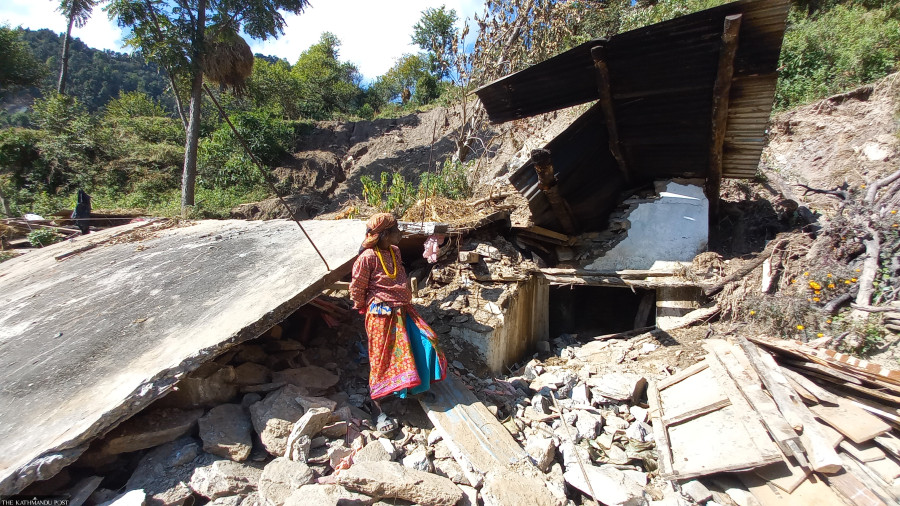
A house destroyed by a landslide in Khaptadchhanna Rural Municipality in Bajhang four years ago, pictured recently. Photo: Basant Pratap Singh
Sekugaun village in Farwest Province was alive with celebration during Dashain, Nepal’s biggest festival. People had gathered to celebrate the Hindu festival with friends, relatives and family. But as twilight fell on October 16, 2021, dark clouds rolled in and a relentless rain began to pour.
Sher Damai, 65, lay awake as water roared just meters from his house. His family slept soundly. He could not. By midnight, floodwaters had reached their doorstep. “I knew we had to get out,” he recalled. As they scrambled uphill in the dark, the wall behind them collapsed with a deafening crash.
Fifteen homes in Sekugaun, most of them Dalit households, were damaged that night. Sher’s was one of hundreds across Bajhang destroyed by unseasonal monsoon floods that displaced over 1,145 families who needed complete home reconstruction. Another 854 required significant repairs. Dalits made up 463 of these affected families. The National Disaster Risk Reduction and Management Authority (NDRRMA), a government agency tasked with managing disaster risks, identified 31 families whose homes needed complete relocation because they were built in high-risk areas.
To uncover how Dalit families were excluded from the disaster reconstruction grant, Asian Dispatch analysed the government records obtained through a Right to Information (RTI) request and conducted ground-level verification across flood and landslide affected settlements in Bajhang. We cross-checked multiple beneficiary lists issued by the National Disaster Risk Reduction and Management Authority (NDRRMA) over the years and found many names had been removed or left pending. Using satellite imagery and Google Earth Engine, we also analyzed four decades of rainfall data, which confirmed the 2021 floods hit after the monsoon’s official withdrawal – adding urgency to the devastation. A visual timeline further showed how bureaucratic delays, official inaction, and structural discrimination quietly erased hundreds of Dalit families from the recovery process.

The disaster damaged 15 houses in Sekugaun, home to 85 Dalit families.
Nearly four years later, many of the worst-hit families – especially the Dalit community – have been ignored by the state, with insufficient funds to rebuild. Left off government beneficiary lists or granted partial aid at best, they remain trapped in debt or have been forced to migrate to India. The failure to deliver post-disaster support exposes deep-rooted caste discrimination that persists despite Nepal’s promises of inclusive recovery. Dalits, historically labeled as ‘untouchables,’ are among the most disadvantaged castes in Nepal–routinely excluded from land ownership, state services and political power.
In Bajhang, 125 Dalit families affected by the disaster remain abandoned, their homes marked by padlocked doors. Already among the worst hit, the Dalit community now faces a second crisis–systematic neglect by the government in both relief and reconstruction efforts.
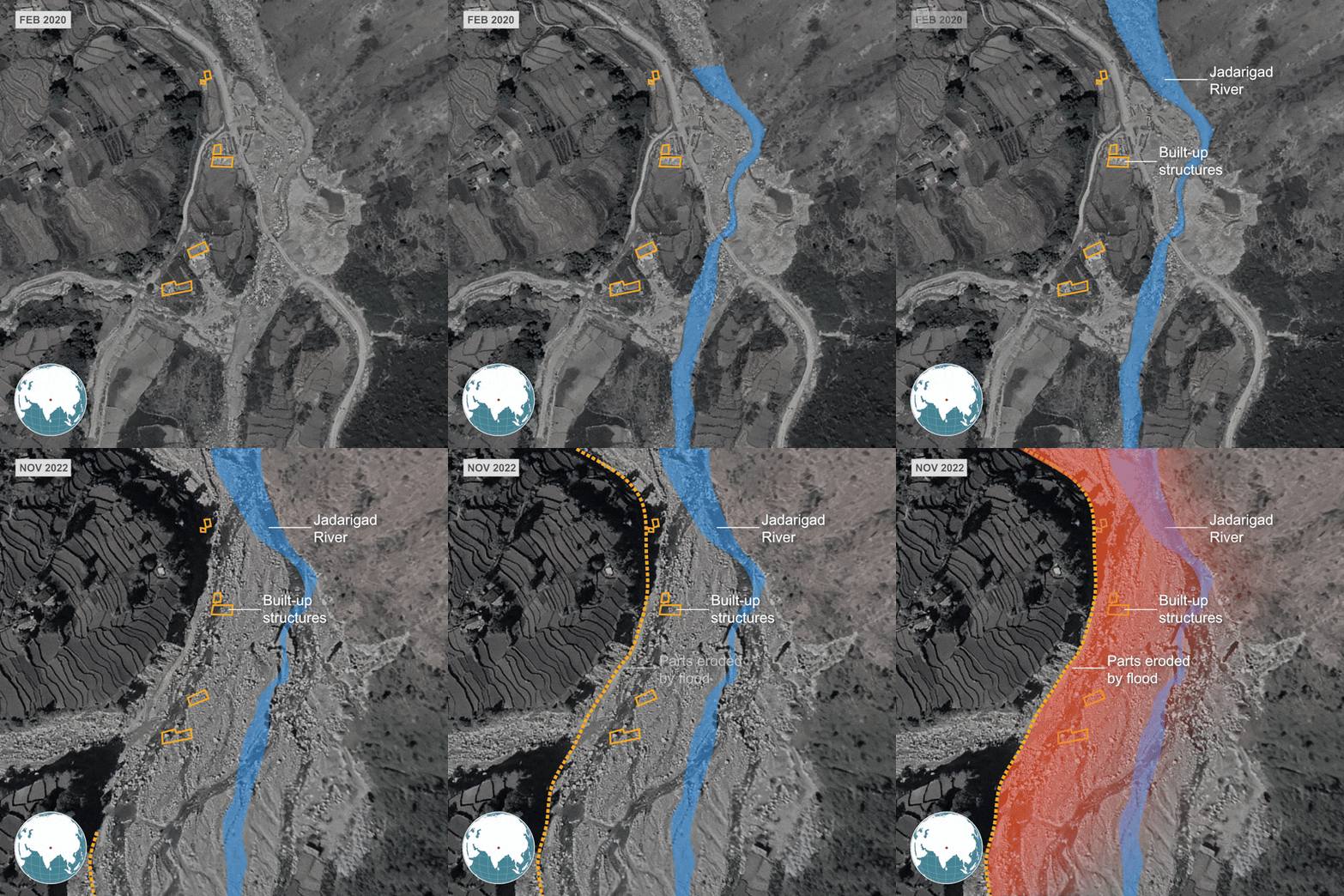
(Left) The October 2021 rainfall triggered landslides in many parts of Bajhang district, Nepal – particularly in Khaptadchhana Rural Municipality. During the same period, floods in the municipality caused significant damage, sweeping away houses, arable land, and infrastructure. Satellite image source: Google Earth Pro
Govinda Raj Pokharel, a former CEO of the National Reconstruction Authority, criticized the government’s failure. “The prolonged delay in rehabilitation and reconstruction work for Bajhang’s disaster victims demonstrates a fundamental weakness in governance. It has ultimately forced people to abandon their country,” said Pokharel, a former Vice Chairman of the National Planning Commission.
“After a disaster in Nepal, the government is tasked with providing immediate temporary shelter to the victims. It is followed by permanent housing within two to three years. This clearly wasn’t a priority,” he said. “Consequently, Dalit and impoverished families – who possessed nothing beyond their homes – were left without any economic safety net when their houses collapsed. These vulnerable people and communities should have received priority attention and additional support compared to others. Instead, they were rendered invisible – the state failed to see them, and they, in turn, felt abandoned by the state.”
Debt and Displacement
Despite the Dashain festival, several teams – including local officials from the rural municipality – arrived days after the landslide to assess the damage. Some brought emergency relief. Deepak Luhar, a local whose ground floor had been engulfed by mud after the landslide broke through one side of his house, followed the teams.
Deepak and his neighbor Sher Damai had narrowly escaped with their families, fleeing just in time. While their lives were spared, their homes were not. In the immediate aftermath, they were told the government would support reconstruction. “They asked us to submit applications to the ward office, saying funds would come for rebuilding,” he recalled. “It’s been four years since we applied. We haven’t received a single rupee.”
Deepak and Sher are among many Dalit families across Bajhang who submitted applications after their homes were destroyed. But most are still waiting. Some weren’t included in the beneficiary list at all. Others received only the first installment and were forced into debt trying to repair or retrofit their houses. A few homes stand shuttered, locked up by families who have since left. Some left for India with hastily built structures abandoned behind them. Others are packing to leave. One by one, Dalit settlements in the district are emptying in the wake of the disaster.
Sher managed to rebuild part of his flood-damaged house by borrowing money. But the repaired walls are already showing cracks. Stones have begun to loosen and fall.
Deepak’s family now lives in a neighbor’s home. Sher earns what little he can through grain paid twice a year in exchange for tailoring clothes for non-Dalits. Deepak relies on his blacksmithing. In their spare time, both take up day labor and borrow money just to survive.
They share a dream: to build strong, permanent homes. But that dream has come at a cost. With mounting debts and no support, their families have been forced to migrate. In April 2022, Deepak’s brother and sister-in-law left for Anarkatta in Bangalore, India, taking their infant child to work as laborers. Two years earlier, Sher’s three sons and two daughters-in-law also migrated with four young children.
“They went hoping to earn enough to rebuild what the landslide destroyed,” Sher said. “But they have to feed their families and send money back too. What little they manage to send is just enough for us to eat. I don’t know when–or if–our dream of building a proper house will come true.”
Systemic Neglect
Neither Sher’s nor Deepak’s name appears on the beneficiary list compiled by the NDRRMA for reconstruction and repair of housing for those at risk from monsoon-induced disasters. When informed of this, the two Dalit members became angry. “Those with less damage than us and even those with no damage at all are on the list, but our names have been removed,” Deepak said angrily. “The well-off receive relief even when they’re not victims, while those of us with real problems have our names cut off. What kind of justice is this?”
According to records from the NDRRMA, 46 Dalit families across all nine wards of Kedarsyun Rural Municipality were affected by the floods and landslides. Of these, NDRRMA’s survey found that 33 families required full house reconstruction, while 13 needed repairs. Yet, even after four years, not a single family–neither those on the list nor those left out–has received any government support for rebuilding or repairs.
One of the victims is 63-year-old Kaisi Od from Dundil in Kedarsyun-1. Her home, built with mud walls and a thatched roof, partially collapsed when one of its walls gave way during the disaster. For two months, her extended family of 19 lived under makeshift tents.
As the cold weather took a toll on her grandchildren’s health, they were forced to take out a loan to build a temporary shed. Repairing the wall and replacing the roof with tin sheets cost them 650,000 rupees–plunging the family into debt. Though they managed to escape the harsh conditions of tent life, they were soon overwhelmed by the financial burden. Eventually, four sons, three daughters-in-law, and nine grandchildren left for India in search of work, leaving behind Kaisi and two of her granddaughters.
“There’s so much debt and no jobs here,” Kaisi said. “They went to India hoping to pay it off. If they’d stayed, how would I feed them all? How could we repay such a huge amount?” She expressed frustration at the government’s failure to deliver on its promises. “If we had received the funds for house reconstruction, my family wouldn’t have had to leave. I wouldn’t be left alone like this in my old age.”
In Dundil village, six out of 23 Dalit families are included in the NDRRMA’s list. Kaisi and four others are categorized as needing house reconstruction and one family is marked for repair. But locals say that 13 Dalit households in the village suffered damage from the disaster.
Broken Promises
In the aftermath of the disaster, it wasn’t just local officials who arrived for an assessment. National leaders, too, descended on Bajhang–each by separate helicopter. Among them were then-Prime Minister Sher Bahadur Deuba, Home Minister Bal Krishna Khand, Far West Province Chief Minister Trilochan Bhatta, Speaker Arjun Thapa, Minister for Internal Affairs and Law Purna Joshi and Kalyani Khadka, chair of the Federal Parliament’s Development and Technology Committee.
They assured survivors that financial aid would soon arrive under the government’s “Private Housing Reconstruction, Retrofitting and Resettlement Grant Procedure 2077,” which allocates 500,000 Nepali rupees for house reconstruction, 50,000 Nepali rupees for repairs and an additional 300,000 Nepali rupees for land purchase in mountainous districts like Bajhang.
Nearly four years later, however, most victims are still waiting.
Under the procedure, local Disaster Management Committees are responsible for identifying beneficiaries and forwarding the list to the District Disaster Management Committee (DDMC). The process is based on digital entries submitted by ward offices, along with required documents like citizenship certificates, proof of land or other records confirming disaster vulnerability. The DDMC then verifies the extent of damage and finalizes the list.
But the reality on the ground tells a different story. Many Dalits–like Deepak Luhar and Sher Damai–were excluded from the initial list. Others, such as Kaisi Od of Dundil village, were listed but later neglected.
Data from the NDRRMA reveals that while the preliminary list had identified 463 Dalit families as eligible for assistance, the final list included only 97. As of now, just 33 families have received the first installment of 50,000 Nepali rupees.
Tasbir Bika, spokesperson for Kedarsyun Rural Municipality, attributes the disparity to deep-rooted structural discrimination. “We raised the issue at the municipal level,” he said. “But across the district, Dalit voices are still ignored. They’re seen as lower-caste citizens and there are no Dalits in decision-making roles. That’s why they’re deprived of services.”
This pattern repeats in Durgathali Rural Municipality, where 107 Dalit families were affected by the 2021 floods and landslides. Of them, 31 needed full reconstruction and 73 required repairs. Yet only 14 families made it to the second list of beneficiaries and none have received any financial support.
Rakail village in Durgathali–3 was among the hardest hit. A landslide severed the road below the settlement, causing several homes to collapse or crack. Five Dalit families abandoned the village three years ago. Those who remain – mostly the elderly and children – live in precarious conditions.
“We submitted petitions to both the ward and the municipality,” said Dhan Bahadur Parki. “But we got nothing. We live in crumbling homes, barely surviving. The government doesn’t care.” His son migrated to India three years ago in hopes of earning enough to rebuild.
According to the DDMC, these victims were eligible, but their names never made it through the system because the municipality failed to approve their inclusion on time.
Kailash Thakurathi, District Chief Officer and DDMC chair, said: “The beneficiary list is uploaded to the NDRRMA’s online system. It only progresses once the municipality verifies and approves it. That didn’t happen. We’ve urged them again and again, but there’s been no action.”
Local officials, for their part, deflect the blame.
“This disaster occurred under the previous leadership. It was their responsibility to ensure victims got aid,” said Ramesh Bahadur Bohara, ward chair of Durgathali–3. “I wasn’t aware people on the list hadn’t received funds. Now that I know, I’ll take action.”
Bohara said that Dalit settlements are often located in disaster-prone areas. “When generational poverty collides with natural calamities,” he said, “people are left with no choice but to leave the country.”
Locked Homes
The consequences of this cycle are starkly visible in Dikla, a village in Thalara Rural Municipality–4. On the night of October 18, 2021, a landslide struck around midnight, wiping out homes and families in an instant. Kalak Sarki lost 18 family members – his mother, wife, four children, brother, sister-in-law and several nieces and nephews. Nare Parki, his neighbor, lost five: his mother, wife, and three children. The landslide destroyed five additional homes and swept away 50 ropani (2.5 hectares) of farmland.
The municipality listed Kalak, Nare and five other families as eligible for government grants. Each was supposed to receive 500,000 Nepali rupees under the disaster assistance program. But three years on, they’ve received only the first installment: 50,000 Nepali rupees.
To rebuild, Kalak borrowed 150,000 Nepali rupees and went to India to work as a laborer, but the debt still looms. Nare, now 57, used donations from individuals and NGOs to buy a plot of land for 150,000 Nepali rupees and lay a foundation for his new house. But with no additional funds, construction stalled. He, too, has since migrated to India.
“Everyone in my family is gone,” Nare said in a phone call from Bengaluru, India. “I thought if the government helped, I could build a home and die on my own land. But fate cheated me – and so did the government.”
Two other affected families in Dikla faced the same situation. After receiving only 50,000 Nepali rupees–far short of what they needed to rebuild or buy land–they, too, left for India with their families. Some now live with relatives, while others struggle to find work abroad.
“We got the 50,000 Nepali rupees in our accounts three years after the landslide,” said Bhagwati Devi Dikli. “That’s not even enough to buy land. How are we supposed to build homes with that?” Her husband, daughter-in-law, and ten other family members have been living in India ever since.
Forgotten by the State
Among the areas hit hardest by the 2021 disaster was Khaptadchhanna Rural Municipality. Floods and landslides left 287 families homeless, including 63 Dalit households. Across Wards 1 through 7, 18 Dalit settlements bore the brunt of the destruction.
In Meltadi, a Dalit village in Ward 3 with 23 households – 20 Damai (Dalit tailors) and 3 Chadara (Dalit wooden utensil makers)–only eight homes still have their doors open. The rest have been locked up. Entire families have migrated to India, abandoning the village.
Surjan Damai said these families, who once relied on scraps of leather given by non-Dalits in exchange for labor, had little to fall back on – just small patches of land and hope. After the disaster, they took shelter in the cowsheds of non-Dalit neighbors, waiting for government relief. When it didn’t arrive, they left for India.
Further east, in Masuradi village of Ward 1, Kali Kami would soon leave for New Delhi with her children. Her husband migrated there two years ago. The family had taken a loan of 425,000 Nepali rupees to build their house, hoping to repay it with the reconstruction aid promised by the government. So far, they have received just 50,000 rupees.
“The government betrayed us,” she said. “We wouldn’t have borrowed so much if they hadn’t promised support. Who wants to leave their home behind?”
Of the 23 families in Masuradi, 12 Dalit households displaced by the landslide had already migrated two years ago. Those who remain live in constant fear, especially during heavy rains. “Our houses are like death traps,” said Prakash Sarki. “We sleep in fear. More families are getting ready to leave.”
According to the 2021 census, Khaptadchhanna has a Dalit population of 2,223. But Ram Bahadur Singh, the ward chair of Khaptadchhanna–5, said only a fraction now live in the village. “Most Dalit villages are empty,” he said. “Maybe five or six hundred Dalits remain in the entire municipality. The rest have gone to India.”
Nepal’s laws mandate that marginalized groups be prioritized in disaster response. The National Disaster Risk Reduction Policy of 2017 and the 12-year Strategic Plan (2018–2030) call for rescue and relief to focus on at-risk groups, including Dalits, the elderly, single women and people with disabilities.
But these commitments rarely translate into action, said Rup Sunar, chairperson of the Dignity Initiative, which researches issues affecting Dalit communities. “We’re good at drafting policies,” he said. “But when it comes to implementation, the deep-rooted discrimination becomes visible. The policies fade into the background.”
He said the situation isn’t unique to Bajhang. Across Far West Province, Dalit communities are among the most exposed to climate-related risks and the most neglected. “With no support, they’re forced to hand over their house keys to neighbors and leave the country,” he said. “It’s tragic that people are being pushed out of their homeland because the state can’t enforce its own promises.”
Four years on, festivals in Bajhang no longer feel the same.
“Sometimes it feels like the Dashain of 2021 brought nothing but misfortune for us,” said Harka Kami of Khaptadchhanna–1. “Since then, we’ve never had the kind of gathering we used to.”
The village is quieter now–emptied by disaster, debt and despair.
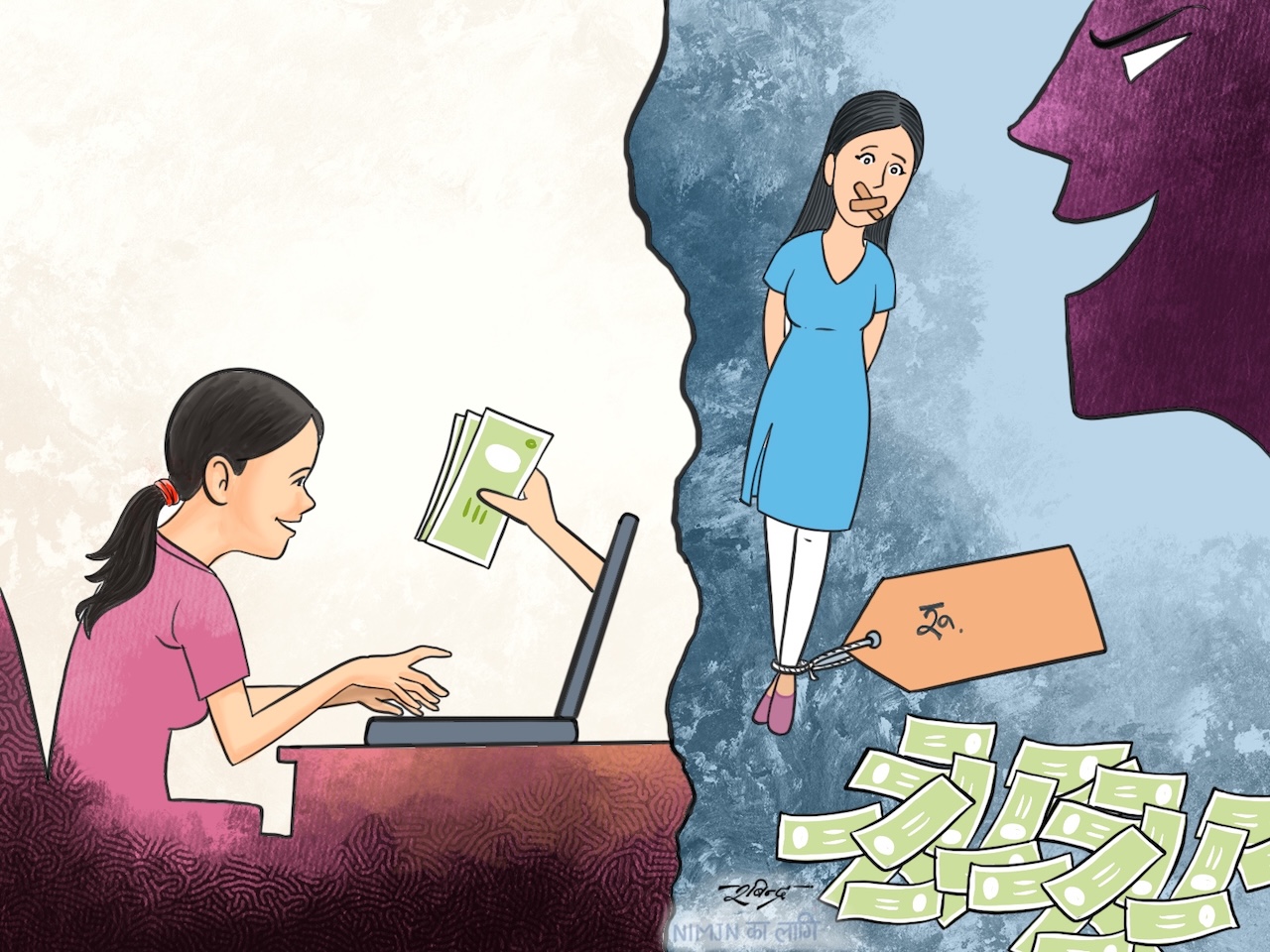
While visiting Gaighat Bazaar in Udayapur district of eastern Nepal, Elisa (name changed) went to a restaurant for a snack. The restaurant owner, whom she knew from her village, greeted her warmly. Anil Sewa, the owner of Brothers Restaurant, asked for her mobile number and Facebook ID.
“I gave him my number and Facebook ID and went home,” says Elisa. “A few days later, he messaged me and said, ‘When you come to the market, come to my restaurant for a snack. I have a secret to tell you’.”
Elisa cannot remember the exact date but recalls it was around June/July when she visited Brothers Restaurant for work. She says, “When I met him and asked, ‘What’s the secret, Dada (elder brother)?’ he replied, ‘Sometimes interesting customers come to my restaurant. If you have fun with them, you can enjoy good food and earn money too’.”
She also asked the hotel owner what kind of work it was. The owner said it wasn’t difficult work. It was about ‘eating, drinking, and having fun. “It sounded easy, and I needed money. So, I was tempted and agreed to it.”
The next day around 11 am, Sewa called Elisa and asked her to come. “When I went there, he made me sit in a room with an unknown man, probably around 50 years old,” Elisa says. “The man ordered beer, cigarettes and snacks, and offered me some too.”
Having seen her parents fight daily due to alcoholism, Elisa had become addicted to drugs at the age of eight due to peer pressure. Therefore, she didn’t refuse the beer and cigarettes. She says that while they were eating, the man made a sexual advance, which she rejected. But the man didn’t stop. “I told him I had never done such a thing before, but he didn’t listen and started forcing himself on me, saying that he had paid the hotel owner for this,” she said tearfully. “I was scared. The man was much older than me and I resisted but in vain.”
Elisa fainted. She says that when she regained consciousness, she was naked, and the man was sleeping naked on the bed. She got dressed and went downstairs to meet the hotel owner and told him about the abuse. But the hotel owner gave her 1,000 rupees, saying it was her ‘earning’ for the day.
Elisa was furious. “I was so angry. How could someone I knew do this to me?” she says. “I was also scared that someone else might find out what happened with me.”
Hotel owner Sewa had used Facebook Messenger to lure Elisa, trafficked her, forced her into prostitution, and she had been raped. But out of fear, she did not report the crime.
The hotel owner had lured Elisa with promises, knowing full well about her weak family and financial situation. “He told me, ‘You won’t find such work anywhere else. Look, you earned a thousand rupees in less than two hours. If a better customer comes, you’ll earn even more. Then, you can buy whatever you want with that money’, he tempted me,” she recalls. “I didn’t say anything. He said, ‘I’ll call you when a good customer comes’, and I went home without saying anything.”
Some hotels and restaurants in urban areas are found to have forced minors like Elisa into sex work under the guise of entertaining customers. According to the police, most of these girls are between ages 13-19. In her statement to the police, Elisa revealed that the hotel owner, Sewa, had also made other women engage with customers. However, in the court statement, Sewa said that he had never had any physical relationship with her and had never made such a proposal.
Elisa was told by the hotel owner in Gaighat that the more people she had physical relations with, the more money she would get. She was paid accordingly. “I used to get 1,000 rupees for having physical relations with one person and 3,000 rupees if I had such relations with two persons,” says Elisa. “Since I could earn more by doing it with more people, I would sleep with two or three people a day.”
She admits that due to her financial need, she was willing to have physical relations with anyone. She says that she would get extra money if she could make the customer happy.
In his statement to the police, restaurant owner Sewa admitted that he would call Elisa when customers wanted to have fun and engage in physical contact. He said that he would take 2,000 rupees from the customer and keep half of it for himself, giving the other half to Elisa.
Cases like Elisa’s have been increasing. Maiti Nepal, an organization working against human trafficking, has rescued 6,434 girls and women in the last 10 years alone. According to Maiti Nepal’s statistics, the number of rescues of those trafficked has been increasing every year.
Last year alone, 101 people were rescued from abroad and 2,287 from within the country, totaling 2,388. Similarly, in 2022, 117 people were rescued from abroad and 2,180 from within the country, totaling 2,297.
| Year | Number of people rescued |
| 2023 | 2388 |
| 2022 | 2297 |
| 2021 | 142 |
| 2020 | 94 |
| 2019 | 322 |
| 2018 | 250 |
| 2017 | 273 |
| 2016 | 239 |
| 2015 | 144 |
| 2014 | 183 |
| 2013 | 142 |
SP Gautam Mishra, the then Information Officer of Nepal Police’s Human Trafficking Investigation Bureau, says that girls from poor families and broken homes are often lured into prostitution with promises of work. Mishra said that the operators themselves trap these girls in massage centers, spas, parlors and restaurants, promising them good jobs.
He said that social media has made it easier for girls to be trafficked. Mishra says that girls are lured and sexually exploited through TikTok, Facebook and Viber, and through online advertisements promising employment.
According to him, children and adolescents are forced into the sex trade through fear and intimidation, and are used to perform obscene acts on video for customers through various apps like strip chat, free live sex cam, and adult chat.
Mishra said that groups are created on Facebook, WhatsApp, and other platforms, and girls are sent to the places specified by the customers who pay.
Lured with the promise of work and raped
Apsara (name changed), a 17-year-old girl from near Butwal, received a mobile number from an unknown person on TikTok. The person who sent the number from a TikTok account named Kelvin James was Resham Gurung from Gorkha, who lived in Tokha, Kathmandu.
After asking why he sent the number, Resham replied, “If you need a job, contact me.” Apsara still remembers saying, “I will not work right now.” Resham assured her that the massage parlor job paid 10,000 rupees per month with a promise of a future raise.
Resham also asked for Apsara’s Facebook ID, and they started chatting daily. One day, Resham said, “If you don’t want a parlor job, it’s okay. I need someone to work at my house. You’re like my sister, and I’ll take good care of you. Don’t be afraid to come to Kathmandu.”
When she said she didn’t have the money to come to Kathmandu, Resham sent her 8,000 rupees as travel expenses. On her first day in Kathmandu, she was raped.
“On the very day I got off the bus, he took me home. While changing my clothes after eating, he knocked on the door,” she says. “When I opened the door, he forced himself on me, saying he would sleep with me. When I resisted, he made a video and threatened to post it online.”
Frightened by threat, Apsara was forced to comply with Resham. In her statement to the police, she said that after the rape, Resham brought a contraceptive from a nearby medical store and forced her to take it, scolding her when she refused.
Resham’s flat was home to his paralyzed mother and postpartum wife. Apsara stayed there for a month, taking care of them, and during this time, she was raped three times, as she revealed in her police statement.
After a month, Resham put her to work at his own Sunflower Wellness Spa in Gongabu. “Although it was called a massage parlor, I had to have sexual relations with the customers and engage in sexual activities to please them,” she says. She faced harassment and abuse at the spa.
According to the police, Resham initially confessed to the charges after his arrest. However, the charge sheet states that he later retracted his statement. Quoting him, the charge sheet states, “When the police interrogated me for the first time after my arrest, I said those things. I don’t remember now.”
Using the victim to find other girls
Resham used Apsara to bring other girls to Kathmandu. After working for a few months, Resham threatened her, saying, “Call another friend from your village, or I’ll make your video go viral.” Out of fear, she called her friend Ayusha (name changed) to Kathmandu.
“Out of fear, I called my 17-year-old classmate Ayusha, telling her there was a good job in Kathmandu,” said Apsara. Ayusha, who didn’t receive much love and affection from her father after her mother left and her father remarried, came to Kathmandu and faced the same fate as Apsara.
Resham knew Makhmali Maya Syangtan, the owner of A-One Spa in Thamel. While visiting Resham’s spa, she met Apsara and Ayusha. Afterward, they left Resham’s spa and started working at A-One.
Apsara said that Makhmali, like Resham, would take 1,000 rupees for each sexual encounter with a customer, keeping 500 for herself and giving 500 to them.
Both Apsara and Ayusha, while working at A-One, were rescued by a team deployed by the Human Trafficking Investigation Bureau on the evening of May 19, 2024. The police filed a case against Resham in the Kathmandu District Court for human trafficking and rape. Both Apsara and Ayusha are currently in a safe house. According to Mishra, the bureau’s information officer, although both girls’ families have been informed, they have not come to take them back, and the girls have also refused to go home.
Just as Resham had used Apsara to bring Ayusha, Sewa and Satish Kumar Yadav had used Elisa to bring another girl from Gaighat. On September 8, 2023, Yadav, who had been staying with Elisa at Sewa’s hotel, took her to Lahan, Siraha, the next day. When Elisa said she would only go to Lahan if Sewa went, Yadav gave her money for the bus fare and they went to Lahan on a scooter.
Sewa told the police in his statement that Yadav had agreed to pay for the hotel expenses in Lahan and had said he would arrange for a fee of 5,000 rupees for one night.
On the night of September 9, 2023, Yadav and Elisa were in one room and Sewa in another room at a hotel in Lahan. On the afternoon of September 10, 2023, when Yadav saw Elisa chatting with a friend on Facebook Messenger, he pressured her to call her friend. According to Sewa’s statement to the police, Yadav had told Elisa’s friend, “Come to Lahan, I’ll give you as much money as you want.”
However, when she said she didn’t have the bus fare, Yadav went to Gaighat on a motorcycle. While returning to Lahan with her, the police at the Jaljale checkpoint stopped their motorcycle and questioned them. When the girl said that she did not know Yadav and that her friend had told her she could earn some money by staying at a hotel for a while, Yadav was arrested. After Yadav’s arrest, the police arrested Sewa on September 13, 2023, and filed a human trafficking case against him in the Udayapur District Court.
Elisa’s friend’s father has filed another human trafficking case against Elisa, Yadav and Sewa. These cases are pending in court.
Trafficking to India
Girls are also being trafficked to India through online contacts. There has been an increase in gangs luring girls with promises of employment on social media and then trafficking them. Binod Pokharel, the program coordinator of Maiti Nepal, Biratnagar, said that rural girls are particularly vulnerable to such traps.
“They lure simple village girls with promises of attractive salaries and take them away. It has been found that they are forced into prostitution in India,” said Pokharel. “These trafficking gangs have been found to use social media, Viber and WhatsApp the most.”
Gitanjali Sharma of Maiti Nepal shared that in July/August alone, they rescued and brought back a 13-year-old girl who had been trafficked to India after getting acquainted with a person through Facebook.
Human trafficking and smuggling is a global and multifaceted problem. Like the illegal trade in weapons and drugs, human trafficking and smuggling has become a thriving business operated by international criminal organizations worldwide. Social analyst Bigyan Luintel states that this crime has become widespread because it is less risky and more profitable compared to other crimes.
Social media has further facilitated this. “The pursuit of urban lifestyles, including commercial sex work, cheap labor, and easy living, has become a pull factor for trafficking,” says Luintel. “Children in local environments are influenced by poverty, illiteracy, unemployment, lack of income-generating opportunities, and social insecurity.”
Mishra said that in the fiscal year 2022/23, the bureau raided hotels, restaurants, and massage parlors 18 times and rescued 61 girls who were forced into risky work. Of these, only 14 were taken by their families, and the rest are still in safe houses.
Mishra said that the bureau has been posting various messages on social media about how to protect oneself from human trafficking through social media. He suggests not chatting with strangers on social media, not being lured by anyone’s promises, not sharing personal information on social media, not trusting anyone easily, and consulting with family members if someone makes any proposal.
उदयपुरको गाईघाट बजार घुम्न गएको बेला खाजा खान छिरेकी एलिसा (परिवर्तित नाम) लाई होटलका सञ्चालकले पहिला नै चिनजान रहेको भन्दै सन्चोबिसन्चो सोध्छन् ।
गाउँकै सामान्य चिनजान रहेका ब्रोदर्स रेस्टुरेन्टका मालिक अनिल सेवाले उनीसँग मोबाइल नम्बर र फेसबुक आईडी माग्छन् । “उहाँलाई मेरो नम्बर र फेसबुक आईडी दिएर घर फर्किएँ,” एलिसा भन्छिन्, “केही दिनपछि उहाँले मलाई मेसेन्जरमा फोन गर्नुभयो र ‘बजार आएको बेला मेरो रेस्टुरेन्टतिर खाजा खान आउनु तिमीसँग एउटा गोप्य कुरा गर्नुछ’ भन्नुभयो ।”
एलिसाका अनुसार उनले मिति त सम्झिएकी छैनन् । तर असारतिर हुनुपर्छ उनी कामविशेषले गाईघाट गएको बेलामा ब्रदर्स रेस्टुरेन्टमा छिरिन् । उनी भन्छिन्, “उहाँलाई भेटेर ‘के गोप्य कुरा छ दादा ?’ भनेर सोध्दा उहाँले ‘मेरो रेस्टुरेन्टतिर कहिलेकाहीँ रमाइलो गर्ने ग्राहक आउँछन्, तिनीहरूसँग रमाइलो गरी बस्यौ भने मिठोमिठो खान पाउनुको साथै पैसा नि कमाइ हुन्छ’ भन्नुभयो ।”
उनले होटल सञ्चालकलाई कामचाहिँ के गुर्नपर्छ नि भनेर पनि सोधेकी थिइन् । सञ्चालकले गाह्रो काम होइन ‘खाने, पिउने रमाइलो गर्ने’ भने । “सुन्दा काम सजिलै लाग्यो, मलाई पैसाको नि जरुरत थियो र खान नि पाइन्छ भनेपछि म प्रलोभनमा परेँ र हुन्छ भनी सहमति जनाएर घर फर्केँ ।”
त्यसको भोलिपल्ट ११ बजेतिर होटल सञ्चालक सेवाले फोन गरेर बोलाएपछि एलिसा गइन् । “त्यहाँ जाँदा मैले नचिनेका अन्दाजी ५० वर्षका मानिससँग कोठामा बस्न लगाउनुभयो,” एलिसा भन्छिन्, “त्यस व्यक्तिले बियर, चुरोट र नास्ता मगाएर मलाई नि खान दिए र आफूले पनि खाए ।”
आमाबुबाले दैनिक रक्सी खाएर झगडा गर्ने गरेको देखेकी उनी ८ कक्षा पढ्दा नै साथीको संगतमा लागूऔषधको दुर्व्यसनमा फसेकी थिइन् । त्यसैले वियर र चुरोटमा नाइँनास्ती नगरेको बताउने उनका अनुसार खानपिन चलिरहेकै बेला तीे व्यक्तिले शारीरिक सम्पर्क गर्ने प्रस्ताव राखे, उनले अस्वीकार गरिन् । तर ती मान्छे रोकिएनन् ।
“मैले अहिलेसम्म यस्तो कार्य गरेको छैन भन्दाभन्दै नमान्दा पनि त्यस व्यक्तिले ‘मैले यसको लागि होटल मालिकलाई पैसा दिएको छु’ भन्दै जबरजस्ती गर्न थाल्यो,” उनले सुस्केरा हाल्दै भनिन्, “मलाई डर लागिरहेको थियो, त्यो मान्छे मभन्दा उमेरमा धेरै ठूलो थियो, मैले प्रतिकार गरिहेको थिएँ, तर मेरो प्रतिकार व्यर्थ रह्यो ।”
एलिसा बेहोस भएकी थिइन् । उनका अनुसार होसमा आउँदा उनको शरीरमा कुनै लुगा थिएन, ती व्यक्ति नग्न अवस्थामै बेडमा सुतिरहेका थिए । उनी लुगा लगाएर होटल मालिकलाई भेट्न तल झरिन् र आफूमाथि भएको अत्याचारको बारेमा बताइन् । तर होटल मालिकले ‘तिम्रो आजको कमाइ’ भनेर हातमा १ हजार रुपैयाँ थमाए ।
एलिसा रिसाइन् । “मलाई रिस उठिरहेको थियो, चिनेजानेको मानिसले मलाई यस्तो काम गर्न कसरी लगाउन सक्छ भनेर,” उनी भन्छिन्, “डर पनि लागेको थियो, कतै अरुले थाहा पाउछ कि भनेर ।”
होटल मालिक सेवाले फेसबुक म्यासेन्जरबाट बोलाएर एलिसाको बेचबिखन गरेका थिए, वेश्यावृत्ति गराएका थिए, त्यहाँ एलिसामाथि बलात्कार भएको थियो । तर डरले उनले आफूमाथि भएको अपराधका बारेमा कतै उजुरी गरिनन् ।
एलिसाको पारिवारिक अवस्था र आर्थिक अवस्था कमजोर रहेको बुझेरै होटल मालिकले लोभलालच देखाएका थिए । “उहाँले मलाई ‘तिमीले यस्तो काम अरु कहीँ पाउँदिनौ, हेर दुई घण्टा नबित्दै एक हजार कमायौ, अझै राम्रो ग्राहक आयो भने योभन्दा धेरै कमाउँछौ, त्यसछि त्यो पैसाले तिमीले मन लागेको कुरा लाउन खान खान पाउँछौ’ भन्दै मलाई प्रलोभन देखाउनुभयो,” उनी सम्झन्छिन्, “म केही नबोली बसेँ, उहाँले ‘म राम्रो ग्राहक आयो भने फोन गर्छु आउनू’ भनेपछि म केही नबोली घर फर्किएको थिएँ ।”
सहर बजारका केही होटल रेस्टुरेन्टमा ग्राहकलाई मनोरञ्जन दिने भन्दै एलिसाजस्ता नाबालिकाहरूलाई यौनकार्यमा लगाउने गरेको पाइन्छ । जसमा १३ वर्षदेखि १९ वर्षसम्मका किशोरी धेरै हुने गरेका प्रहरीको भनाइ छ । एलिसाले प्रहरीमा दिएको बयानअनुसार होटल सञ्चालक सेवाले अरु महिलालाई समेत ग्राहकसँग बस्न लगाउने गरेका थिए । सेवा स्वयंले भने आफूसँग कहिल्यै शारीरिक सम्बन्ध नराखेको र राख्ने प्रस्ताव पनि नगरेको उनले अदालतमा दिएको बयानमा स्पष्ट पारेकी छन् ।
एलिसालाई गाईघाटका होटल सञ्चालकले जति धेरै जनासँग शारीरिक सम्बन्ध बनायो धेरै त्यति पैसा हुन्छ भनेका थिए, त्यसअनुसार उनलाई पैसा पनि दिएका थिए । “एक जनासँग शारीरिक सम्बन्ध बनाउँदा १ हजार र दुई जनासँग बनाउँदा ३ हजार दिनुहुन्थ्यो,” एलिसा भन्छिन्, “धेरै जनासँग गर्दा धेरै पैसा हुने भएकोले म दिनमा दुई–तीन जनासँग नि सुत्थेँ ।”
पैसाको आवश्यकता भएकाले जति जनासँग पनि शारीरिक सम्बन्ध राख्न आफू तयार भएको उनी बताउँछिन् । ग्राहकलाई खुसी बनाएमा अझै अतिरिक्त पैसा आउने गरेको उनी बताउँछिन् ।
| वर्ष | उद्धार गरिएकाको सङ्ख्या |
| 2023 | 2388 |
| 2022 | 2297 |
| 2021 | 142 |
| 2020 | 94 |
| 2019 | 322 |
| 2018 | 250 |
| 2017 | 273 |
| 2016 | 239 |
| 2015 | 144 |
| 2014 | 183 |
| 2013 | 142 |
रेस्टुरेन्ट सञ्चालक सेवाले प्रहरीसँगको बयानमा ग्राहकले रमाइलो गर्न तथा शारीरिक सम्पर्क राख्न केटी खोजीमा एलिसालाई बोलाउने गरेको स्विकारेका छन् । उनले ग्राहसँगबाट २ हजार रुपैयाँ लिने गरेको त्यो पैसा आधा आफूले राखेर १ हजार रुपैयाँ उनलाई दिने गरेको बताए ।
गाउँघरका आर्थिक अवस्था कमजोर भएका, पारिवारिक विखण्डन भएका किशोरीलाई काम लगाइदिन्छु भनेर प्रलोभन देखाई वेश्यावृत्तिमा लगाउने गरेको नेपाल प्रहरीको मानव बेचबिखन अनुसन्धान ब्युरोको सूचना अधिकारी एसपी गौतम मिश्र बताउँछन् । मसाज सेन्टर, स्पा, पार्लर, रेस्टुरेन्टमा काम लगाइदिने भनेर सञ्चालकहरूले नै उनीहरूलाई फसाउने गरेका पाइएको मिश्रले बताए ।
उनका अनुसार सामाजिक सञ्जालको कारणले किशोरीहरू बेचबिखनमा सजिलैसँग फस्ने गरेका छन् । टिकटक, फेसबुक, भाइबरका माध्यमबाट सम्पर्क गरेर तथा अनलाइन माध्यममा विज्ञापन दिएर रोजगारीको प्रलोभन देखाएर किशोरीहरूलाई बोलाउने र यौनशोषण गर्ने गरेको मिश्र बताउँछन् ।
उनका अनुसार बालबालिका तथा किशोरीहरूलाई डर, धाकधम्की दिई जबरजस्ती यौनधन्दामा लाउने, इन्टरनेटको माध्यमबाट विभिन्न एपहरूजस्तै बाट स्ट्रिप च्याट, फ्री लाइभ सेक्स क्याम, एडल्ट च्याटलगायतमा बसाएर ग्राहकले भनेअनुसार भिडियोमा अश्लील हर्कत गर्न लाउने काममा प्रयोग गरिएको पाइन्छ ।
फेसबुक, ह्वाट्सएपलगायतमा ग्रुप बनाई सम्पर्कमा आएका ग्राहकहरूले पेमेन्ट गरेपछि उनीहरूले भनेको स्थानमा किशोरीहरू पठाउनेसमेत पाइएको मिश्र बताउँछन् ।
काम लगाइदिन्छु भन्दै बोलाएर बलात्कार
बुटवल नजिकैकी १७ वर्षीया अप्सरा (परिवर्तित नाम) को टिकटकमा अपरिचित व्यक्तिले मोबाइल नम्बर पठाउँछन् । केल्भिन जेम्स नाम गरेको टिकटकबाट नम्बर पठाउने गोरखा घर भई काठमाडौंको टोखा बस्ने रेशम गुरुङ हुन्छन् ।
किन नम्बर पठाएको भनेर सोधेपछि रेशमले ‘तपाईंलाई काम चाहिएको छ भने सम्पर्क गर्नु’ भनेको र आफूले ‘अहिले म काम गर्दिनँ’ भनेको अप्सारलाई अहिले पनि सम्झना छ । रेशमले मसाज पार्लरको काम मासिक १० हजार रुपैयाँ तलब हुने र पछि तलब बढाइदिने आश्वासन पनि दिन्छन् ।
रेशमले अप्सराको फेसबुक आईडी पनि माग्छन् र उनीहरूबीच दैनिकजसो च्याट हुन्छ । यसै क्रममा एक दिन रेशमले ‘तिमीलाई पार्लरको काम आउँदैन भने केही छैन, मेरो घरमा काम गर्ने मान्छे चाहिएको छ, तिमी मेरो बहिनीजस्तै मान्छे हो, राम्रोसँग काममा राख्ने छु डराउनु पर्दैन काठमाडौं आऊ’ भन्छन् ।
उनले काठमाडौं आउने पैसा छैन भन्दा रेशमले बाटोखर्च भन्दै मनी ट्रान्सफरबाट ८ हजार रुपैयाँ पठाइदिएका थिए । त्यही खर्चले काठमाडौं पुगेको पहिलो दिन नै उनी बलात्कारमा परिन् ।
“बसबाट ओर्लिएकै दिन उहाँले घर लैजानुभयो, खाना खाएर कोठामा लुगा चेन्ज गर्दैगर्दा उहाँले ढोका ढकढक्याउनुभयो,” उनी भन्छिन्, “मैले ढोका खोलेपछि ‘म नि यही सुत्छु भन्दै जबरजस्ती गर्नुभयो, मैले प्रतिकार गर्दा भिडियो बनाउनुभयो, यो कुरा कोही कसैलाई भनेमा नेटमा हाल्दिन्छु भनी डर देखाउनुभयो ।”
अप्सरा त्यही डरले कतै उजुरी नगरी रेशमले भनेको मान्न बाध्य हुन्छिन् । बलात्कारपछि रेशमले नजिकैको मेडिकलबाट गर्भ रोक्ने औषधि ल्याएर खान दिएको र आफूले इन्कार गर्दा गाली गरेको उनले प्रहरीसँगको बयानमा बताएकी छन् ।
रेशमको फ्ल्याटमा प्यारालाइसिस भएकी आमा, सुत्केरी श्रीमती पनि हुन्छन् । उनीहरूकै स्याहार गरेर एक महिना बसेकी अप्सारले त्यसबीचमा ३ पटक करणी गरेको प्रहरीसँगको बयानमा बताएकी छन् ।
एक महिनापछि रेशमले गोंगबुमा रहेको आफ्नै सनफ्लावर वेलनेस स्पामा उनलाई काम लगाउँछन् । “मसाज पार्लर भने पनि त्यहाँ आउने ग्राहकसँग शारीरिक सम्बन्ध राख्नुपर्ने, उनीहरूलाई खुसी बनाउन यौनजन्य गतिविधि गर्नुपर्थ्यो ,” उनी भन्छिन् । मसाज पार्लरमा धेरै नै दुर्व्यवहारको सामना गरेको उनी सुनाउँछिन् ।
प्रहरीका अनुसार रेशमले पक्राउ परेलगत्तै आरोप स्वीकार गरेका थिए । तर पछि उनले आफ्नो बयान फेरेको अभियोगपत्रमा उल्लेख छ । उनलाई उद्धृत गर्दै अभियोग पत्रमा लेखिएको छ, “म पक्राउ परी आएपश्चात् पहिलो पटक मलाई प्रहरीले सोधपुछ गर्ने क्रममा मैले उल्लेखित कुराहरू बोल्न पुगेछु, हाल मलाई याद छैन ।”
पीडितलाई नै प्रयोग गरिन्छ किशोरी खोज्न
अप्सरालाई प्रयोग गरेर रेशमले अरु किशोरीलाई समेत काठमाडौं बोलाएका थिए । केही महिना काम गरेपछि रेशमले ‘गाउँबाट अर्को साथीलाई बोला, नत्र तेरो भिडियो भाइरल गराइदिन्छु’ भनेर डर देखाएपछि गाउँकै साथी आयुशा (परिवर्तिन नाम) लाई काठमाडौं बोलाएको उनी बताउँछिन् ।
“डरका कारण सँगै पढेकी १७ वर्षकी आयुशालाई राम्रो काम छ भन्दै काठमाडौं बोलाएँ,” अप्सराले भनिन् । आमा अर्केसँग हिँडेपछि बुबाले पनि अर्की आमा ल्याएका कारण राम्रो मायाममता पाउन नसकेकी आयुशाले काठमाडौं आएर अप्सराकै नियति भोग्छिन् ।
ठमेलको ए वान स्पाकी सञ्चालिका मखमली माया स्याङ्तानसँग रेशमको चिनजान हुन्छ । उनी रेशमको पार्लरमा आउजाउ गर्ने क्रममा अप्सरा र आयुशाको चिनजान हुन्छ । त्यसपछि उनीहरू रेशमको स्पा छाडेर ए वानमा काम गर्न पुग्छन् ।
मखमलीले पनि रेशमको जस्तै ग्राहकसँग यौनसम्बन्ध बनाएबापत् १ हजार लिने र ५ सय आफूले राखेर ५ सय आफूहरूलाई दिने गरेको अप्सराले बताएकी छन् ।
ए वानमै कार्यरत रहेको बेला अप्सरा र आयुशा दुवै जनालाई जेठ ६, २०८१ को साँझ मानब बेचबिखन अनुसन्धान ब्युरोबाट खटिएको टोलीले उद्धार गरेको थियो । प्रहरीले रेशमविरुद्ध मानव बेचबिखन र जबरजस्ती करणीको कसुरमा काठमाडौं जिल्ला अदालतमा मुद्दा दर्ता गरेको छ । अप्सरा र आयुशा दुवै सेफ हाउसमा छन् ।
ब्युरोका सूचना अधिकारी मिश्रका अनुसार दुवै किशोरीका परिवारलाई खबर गरे पनि हालसम्म लिन नआएको र उनीहरूले पनि घर जान मानेका छैनन् ।
जसरी अप्सरालाई प्रयोग गरेर रेशमले आयुशालाई बोलाएका थिए, त्यस्तै गरेर गाईघाटकी एलिसाकै माध्यमबाट सेवा र सतीशकुमार यादवले अर्की किशोरीलाई समेत बोलाएका थिए । भदौ २२, २०८० मा एलिसासँग सेवाको होटलमा बसेका यादवले भोलिपल्ट उनलाई सिरहाको लहान लगेका थिए । एलिसाले सेवा गए मात्रै लहान जाने भनेपछि एलिसालाई गाडीबाट आऊ भन्दै भाडा दिएर उनीहरू स्कुटरमा लहान पुगेका थिए ।
लहान गएको होटल खर्चबाहेक एक रातको ५ हजार रुपैयाँ लाग्छ भन्दा यादवले मिलाएर दिन्छु भनेको सेवाले प्रहरीसँगको बयानमा बताएका छन् ।
भदौ २३ गते राति लहानको एक होटलमा यादव र एलिसा एउटा कोठामा र सेवा अलग्गै कोठामा सुतेका थिए । भदौ २४ गते दिउँसो लहानको होटलमा बसिरहेको बेला एलिसाले साथीसँग फेसबुक म्यासेन्जरमा कुराकानी गरेको देखेपछि यादवले ती साथीलाई पनि बोलाउन दबाब दिए । सेवाले प्रहरीमा दिएको बयानअनुसार यादवले एलिसाका साथीलाई ‘लहान आऊ मागेजति पैसा दिन्छु’ भनेका थिए ।
तर उनले गाडीभाडा छैन भनेपछि यादव मोटरसाइकल लिएर गाईघाटसम्म गएका थिए । उनलाई लिएर लहान फर्कंदै गर्दा जलजलेको चेकप्वाइन्टमा प्रहरीले मोटरसाइकल रोकेर सोधपुछ गर्दा ती किशोरीले ‘हामीबीच चिनजान नभएको, साथीले होटलमा केही समय बसेपछि पैसा कमाइ हुन्छ भनेकाले लहानतिर जान लागेको’ भनेपछि आफू पक्राउ परेको यादवले बताएका छन् । यादव पक्राउ परेपछि प्रहरीले सेवालाई भदौ २७, २०८० मा पक्राउ गरेर जिल्ला अदालत उदयपुरमा मानव बेचबिखनको मुद्दा दर्ता गरेको छ ।
एलिसाकी साथीका बुबाले एलिसासहित, यादव र सेवालाई आरोपी बनाएर मानव बेचबिखनको अर्को मुद्दा दर्ता गरेका छन् । यी मुद्दा अदातलमा विचाराधीन छन् ।
भारतमा समेत बेचिन्छन्
अनलाइनमार्फत सम्पर्क गरेर किशोरीहरूलाई भारतमा समेत लैजान गरिएको छ । रोजगारी लगाइदिने भनेर सामाजिक सञ्जालमा पोस्ट गर्ने र झुक्याई उनीहरूलाई बेचबिखन गर्ने गिरोह बढ्दै गएको पाइन्छ । यसमा विशेषतः ग्रामीण क्षेत्रका बालबालिकाहरू त्यसको जालमा पर्ने गरेको पाइएको माइती नेपाल विराटनगरका कार्यक्रम संयोजक विनोद पोखरेलले जानकारी दिए ।
“गाउँका सिधासाधा किशोरीहरूलाई आकर्षक तलब हुने भनेर यहाँबाट फकाएर लैजान्छन् । भारततिर पुर्याएपछि वेश्यावृत्तिमा लगाउने गरेको पाइएको छ,” पोखरेलले भने, “बेचबिखन गर्न लैजाने गिरोहले सबैभन्दा बढी सामाजिक सञ्जाल, भाइबर र वाट्स एप प्रयोग गरेको पाइएको छ ।”
माइती नेपालकै गिताञ्जली शर्माले गत साउनमा मात्र फेसबुकको माध्यमबाट चिनजान भएर भारत पुगेकी १३ वर्षकी बालिकालाई उद्धार गरेर फिर्ता ल्याएको जानकारी दिइन् ।
मानव बेचबिखन तथा ओसारपसार एक विश्वव्यापी र बहुआयामिक समस्या हो । हातहतियार र लागूऔषधको अवैध कारोबारजस्तै मानव बेचबिखन तथा ओसारपसार अन्तर्राष्ट्रिय आपराधिक संगठित गिरोहद्वारा सञ्चालित धन्दाका रूपमा विश्वमा फस्टाउँदै गएको छ । अन्यको तुलनामा बेचबिखन र ओसारपसारमा कम जोखिम तर धेरै नाफा आर्जन हुने हुँदा यो अपराधले व्यापकता पाउँदै गएको सामाजिक विश्लेषक विज्ञान लुइँटेल बताउँछन् ।
अहिले सामाजिक सञ्जालले यसलाई थप सहजता दिएको पाइन्छ । “सहर बजारमा व्यावसायिक यौनधन्दा, सस्तो श्रम, सहरी मस्ती, आरामको जीवनशैली नक्कल गर्ने प्रवृत्ति बेचबिखनका लागि तान्ने शक्ति बनेका छन्,” लुइँटेल भन्छन्, “स्थानीय परिवेशमा गरिबी, अशिक्षा, बेरोजगारी, आयआर्जनको अवसरमा कमी, सामाजिक असुरक्षाको प्रभावमा बालबालिका परिरहेका छन् ।”
मिश्रका अनुसार गत आर्थिक वर्ष २०८०/८१ मा ब्युरोले १८ पटक होटल, खाजाघर, मसाज पार्लरलगायतमा छापा मारेर जोखिमपूर्ण काम गर्न बाध्य ६१ जना किशोरीलाई उद्धार गरेको छ । जसमध्येका १४ जनालाई मात्रै परिवारले बुझेर लगेका छन् । अरु सबै सेफ हाउसमै छन् ।
सामाजिक सञ्जालको माध्यमबाट हुने मानव बेचबिखन पर्नबाट जोगिन के गर्ने भन्ने बारेमा ब्युरोले सामाजिक सञ्जालमै विभिन्न पोस्टसमेत गर्ने गरेको मिश्र बताउँछन् । नचिनेका व्यक्तिहरूसँग सामाजिक सञ्जालमा कुराकानी नगर्ने, कसैले कुनै लोभलालच देखाउँदैमा नलोभिने, आफ्नो व्यक्तिगत तथा निजी कुराहरू सामाजिक सञ्जालमा नराख्ने, कसैलाई पनि हत्तपत्त विश्वास नगर्ने र कसैले कुनै प्रस्ताव गरेको छ भने घरपरिवारमा सरसल्लाह गर्नुपर्ने उनको सुझाव छ ।
(यो खोज समाचार निमजिनको फेलोसिप कार्यक्रम अन्तर्गत अस्ट्रेलियन एडको सहयोगमा उत्पादन गरिएको हो । यो सामग्रीको पूर्ण जिम्मेवारी प्रकाशक र लेखकसँग मात्र रहने छ ।)