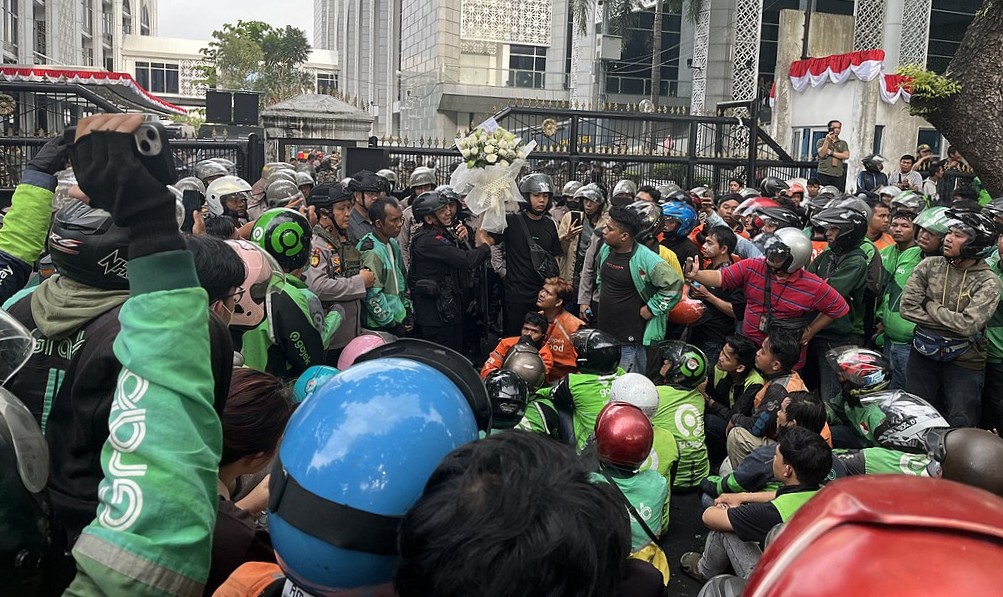
Protesters gather in front of DPRD Sumut gate entrance in Medan on August 29, 2025. Photo: Wikimedia Commons

In late August 2025, years of frustration against institutional malfeasance culminated in protests, demonstrations, and violence across Indonesia, the world’s third-largest democracy. The week-long turmoil eased only in September, after the scale of the unrest compelled the government and lawmakers to introduce changes, which rights groups and activists say fell short of meaningful reform.
The widespread protests began on August 25, after it was revealed that Indonesian lawmakers had been receiving a monthly housing allowance of Rp 50 million (approximately $3000) over and above their salaries since October 2024. This amount is 10 times the minimum monthly wage in capital city Jakarta and 20 times the minimum wage in economically weaker areas of the country.
In a country with a long history of corruption and authoritarian rule, racked by economic instability and rising costs, the revelation of this exorbitant perk sparked a fresh wave of outrage across the nation. This came at a time when the government was implementing austerity measures, including cuts to education and healthcare.
The public outcry escalated when a 21-year-old food delivery driver, Affan Kurniawan, was run over by a vehicle belonging to the nation’s elite paramilitary police unit at the protest on August 28.
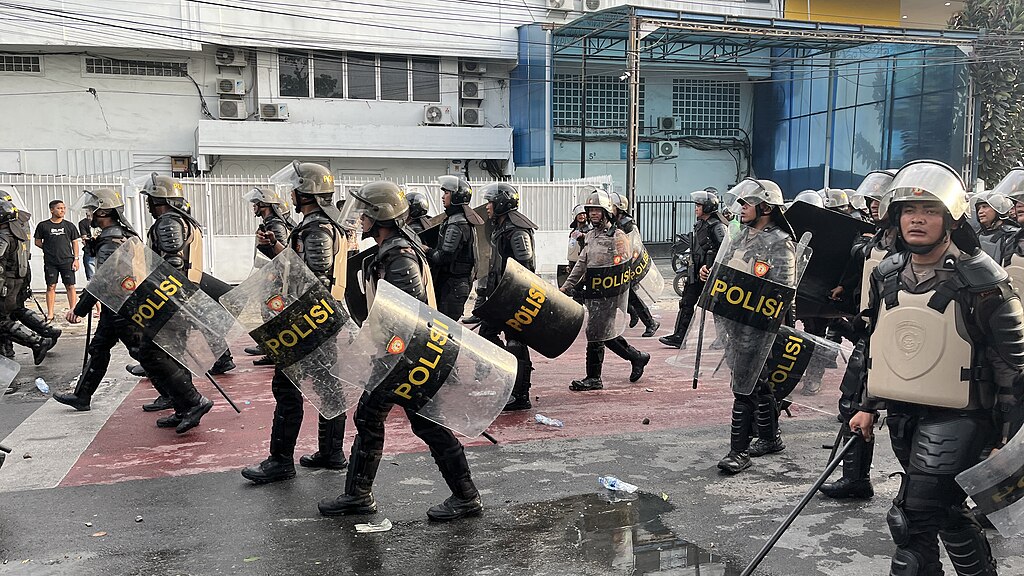
Riot police walking by in Medan, Indonesia, on August 29, 2025. Photo: Wikimedia Commons

Indonesia’s National Police (Polri) Chief General Listyo Sigit Prabowo issued an apology to Kurniawan’s family and assured an investigation into the case. Investigation into the incident was also assured by President Prabowo Subianto, who initially called the protests “treason and terrorism”.
On August 31, following the protests, Subianto announced that the parliament had decided to scrap housing allowance and suspend overseas trips.
The week-long clashes between protesters and police and military led to the death of at least ten people, and 44 others remain missing.
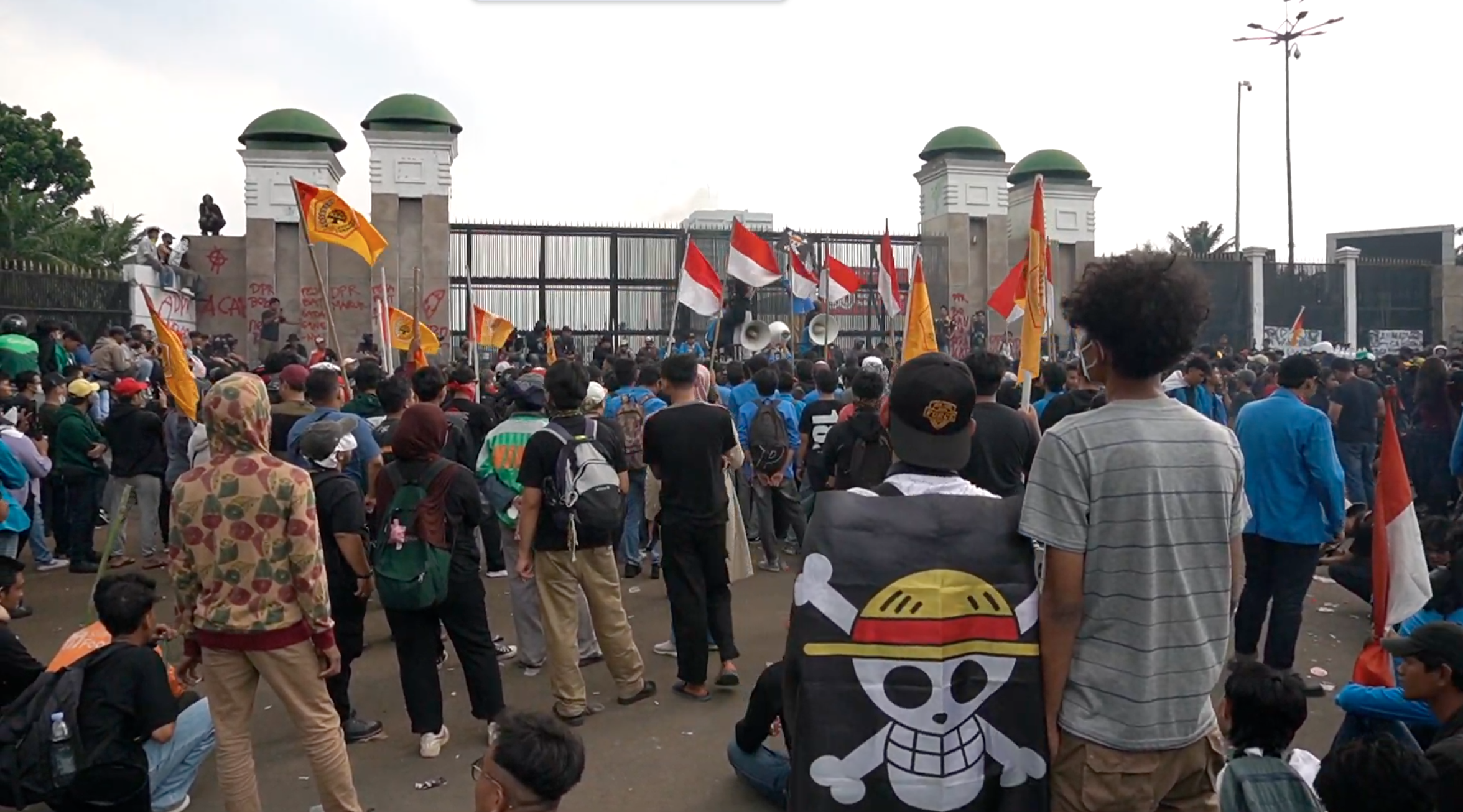
Protestors in Jakarta on August 28, 2025. Photo: Viriya Paramita Singgih/Project Multatuli
Although the tension has eased over the last week, demonstrations continue, primarily led by student groups in Jakarta.
Demands and Government Action
By early September, the “17+8 Demands” campaign gained influence across the protest movement. Compiled using statements from civil organisations and unions, the campaign lists 17 short-term demands such as releasing detainees, freezing lawmakers’ perks, equitable wages, and eight long-term demands to address corruption and induce institutional reform.
However, senior activists who have been voicing concerns for years, have expressed distress on social media, saying that the 17+8 demands lacked consultation with wider civil society.
Meanwhile, the government and the lawmakers have addressed some of these demands, such as detailing parliamentarians’ “take home pay” and beginning the release of political detainees. But significant action is yet to be taken toward many other demands.
On September 9, in a sudden reshuffle of his Cabinet, Subianto replaced five economic and security ministers, including Finance Minister Sri Mulyani Indrawati, former executive director of the International Monetary Fund and managing director of the World Bank. However, the newly appointed Minister of Finance Purbaya Yudhi Sadewa, has made dismissive comments about the “17+8” campaign after he was sworn in.
History of Protests
Over the last two years, there have been many waves of mass protests and demonstrations against controversial moves by Indonesian governments.
In August last year, thousands of people took to the streets after the government attempted to change an election law to favour the dynastic coalition led by former President Joko “Jokowi” Widodo, and current President Subianto.
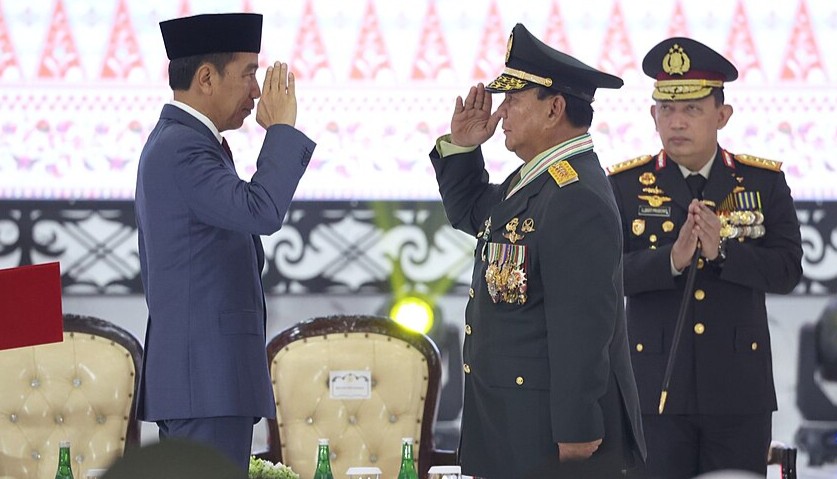
Former Indonesian president Joko Widodo (left) and then-Defense Minister Prabowo Subianto (right). Photo: Indonesian Ministry of Defense/Wikimedia Commons
In February 2025, student-led ‘Dark Indonesia’ protests took place in Yogyakarta, Jakarta, and Medan. Sporadic protests continued throughout the year over controversial government policies, budget cuts, against the increased re-involvement of the military in civilian matters, economic inequality, the Gaza genocide, government and police corruption, and more.
READ: Indonesia’s New Capital: How Jokowi Uses Extravagant Promises to Lure Investors
Police and military have been accused of using disproportionate force during the latest protests, prompting the United Nations to call for an investigation. Seven officers were detained in relation to Kurniawan’s death and one of them was dishonorably discharged.
Although the situation seems to have abated, the foundational issues causing nationwide tensions haven’t been addressed by Subianto’s government. Subianto, a former special forces commandant, has established 100 new battalions since coming to power less than a year ago in October 2024, with plans for much more.
The new battalions are allegedly to assist in civilian domains like agriculture, husbandry and food security. These battalions, along with the passing of a law allowing armed forces personnel to hold more civilian posts, have signalled a return to Indonesia’s “New Order” era, a dark period of authoritarian rule in Indonesian history led by military dictator Suharto. Subianto is Suharto’s former son-in-law.
However, Prabawo is not the first since Suharto to be accused of undermining Indonesia’s democracy. His predecessor, Joko Widodo—elected in 2014 as a “man of the people”— left behind a tainted legacy of corruption and nepotism.
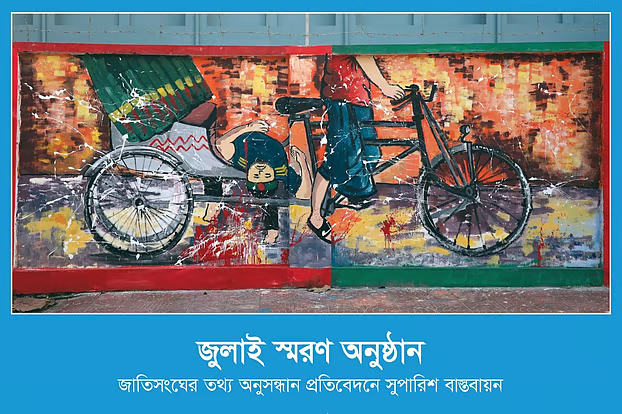
The interim government’s Chief Adviser Professor Muhammad Yunus has reaffirmed his commitment to ensuring justice for human rights violators.
Emphasising the need for reforms, he stated, “This is not just cosmetic change, rather this is a transformation at the deepest level. If we do not bring about such profound reforms, the very autocracy we are speaking against today will return, no matter how much we try to contain it or reform it. We need deeper reform. It is absolutely essential.”
He made these remarks on Tuesday, while addressing a July Commemoration organised by the United Nations’ Dhaka office at a hotel in the capital. The event focused on the July mass uprising and the UN’s investigative report.
Other speakers at the event included Bangladesh Nationalist Party (BNP) Secretary General Mirza Fakhrul Islam Alamgir, Bangladesh Jamaat-e-Islami Ameer Shafiqur Rahman, National Citizen Party (NCP) Secretary General Akhter Hossen, Golam Rahman—father of July uprising martyr Nafis—and Sabrina Afroz Srabonti, sister of martyred activist Saikat.
A recorded message was delivered by UN High Commissioner for Human Rights Volker Türk.
In his address as the chief guest at the closing ceremony, Professor Yunus said, “Alongside conducting reforms, we are committed to bringing to justice those responsible for the grave human rights violations committed in July. Justice is not just about punishment; it is about building a state where power is never again used against the people.”
He further noted that from 1 July to 5 August last year, serious human rights violations occurred, prompting the government to request an independent and impartial investigation by the UN Human Rights Office. The UN’s report, published in February, documented the deaths of around 1,400 people. The report concluded that the violence was planned, coordinated, and executed at the highest levels of the previous government.
READ: In Bangladesh, Cops Accused of Killing Protesters During 2024 Uprising Roam Free
“We are grateful to the UN Human Rights Office not only for documenting this repression but also for offering a wide-ranging set of recommendations to prevent such atrocities from ever happening again,” Professor Yunus said.
He also outlined steps already taken by the incumbent government to protect human rights, including amendments to the Penal Code, Bangladesh’s accession to the international convention on the protection of all persons from enforced disappearance, and the signing of a memorandum of understanding (MoU) with the UN.
Under this MoU, a support mission is being set up in Dhaka to provide technical assistance and training to both government institutions and civil society, he added.
Reaffirming his vision for an inclusive political and social system, the Chief Adviser said, “We are working towards a national consensus for a new political framework that ensures inclusive, participatory, and credible elections.”
In his remarks, Mirza Fakhrul Islam Alamgir stated, “We too want justice for those killings to be delivered swiftly, urgent reforms be implemented without delay. But one thing must be remembered—a government that genuinely represents the people is crucial. Because, there is a clear difference between acting with a mandate and acting without one.”
The senior BNP leader stressed the need to build a democratic Bangladesh. “I believe a democratic system will gradually solve our problems. We cannot expect a revolutionary transformation overnight, but meaningful change will certainly come through democratic means.”
He also expressed hope that a free, fair, and inclusive election will be held, leading to a government truly representative of the people, as promised by the Chief Adviser.
Fakhrul acknowledged the Chief Adviser’s efforts, saying, “Actually, one year is not a long time. But within that time, significant progress has been made. And most notably, they have advanced the reform process.”
Jamaat-e-Islami Ameer Shafiqur Rahman remarked that no election could be held before trying those responsible for crimes against humanity committed by the Awami League during the July movement.
“Justice, reform, and elections must go hand in hand. Holding an election before justice and reform would be a disaster for the nation,” he warned.
He further said, “We demand justice for the Awami League, but it must be just—not vengeful. Let them receive the justice they deserve. If true justice is established, no one will be spared. Those who committed murder must receive their rightful punishment, and the culture of impunity must end.”
NCP leader Akhter Hossen endorsed the UN investigation team’s recommendation for an independent judiciary. He also called for the identification and prosecution of those involved in the July killings who remain in the country, and for extradition of those who have fled abroad.
Golam Rahman, father of July uprising martyr Nafis, alleged that the police officer responsible for killing his son is still serving in Cox’s Bazar. He demanded the officer be brought to trial soon.
Sabrina Afroz Shrabonti, sister of martyr Saikat, said she wanted to see the conclusion of the trial for the July killings and called for the immediate publication of the July Charter.
UN Human Rights Commissioner Volker Türk, in his message, called for swift prosecution of those responsible.
The event was presided over and moderated by Huma Khan, Senior Human Rights Adviser at the UN Office in Dhaka.
A documentary on the martyrs and injured of the July uprising was screened at the start of the closing session.
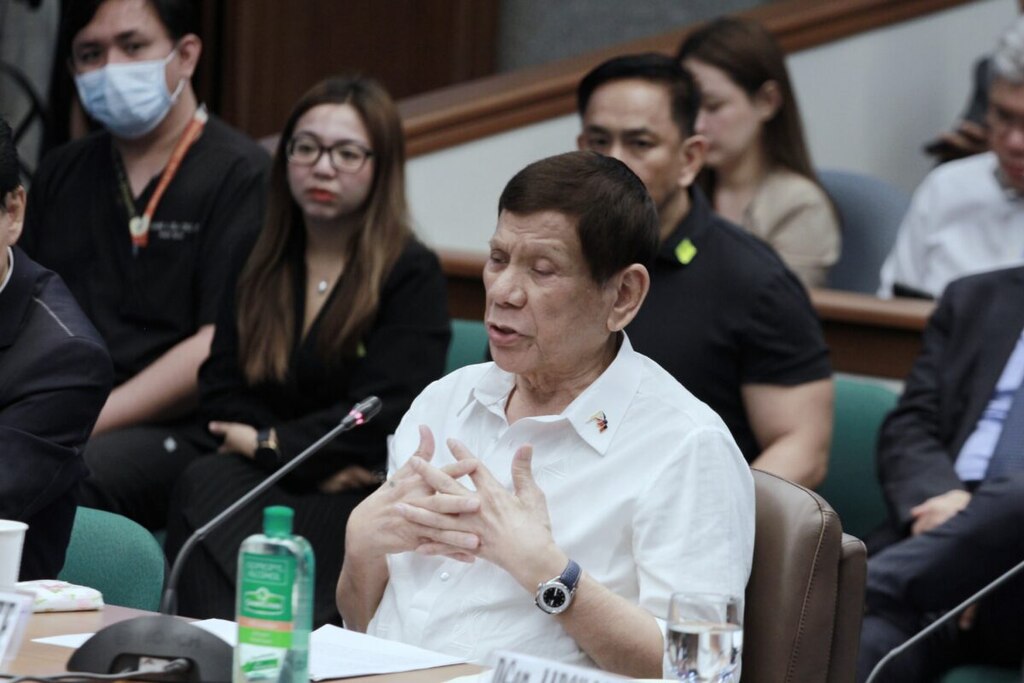
Former President Rodrigo Duterte attends the hearing of the Senate Blue Ribbon Committee probe into the War on Drugs, on October 28, 2024. Photo via Wikimedia Commons.
On March 11, the International Criminal Court arrested Rodrigo Duterte, former Philippine President, on charges of ‘crimes against humanity’ for leading the infamous seven-year ‘War on Drugs’ campaign that killed as many as 30,000 people, mostly poor Filipinos. . His anti-drugs campaign, though globally condemned, had made him hugely popular in the country of around 116 million people, and enabled the rise of his family members in politics too.
A 2017 investigation by Human Rights Watch found that police falsified evidence to justify many of these killings. Other human rights? reports found that police even received “incentives to kill”.
Family members and supporters of Duterte claim that the arrest is tantamount to a “kidnapping’, as the Philippines is no longer a member of the ICC. This claim spread across social media within a day of Duterte’s arrest in what appeared to be a coordinated ‘copypasta’ blitz, reported Philstar.
Philstar also reports that supporters have been harassing ICC judges and drug war victims in this coordinated online campaign, a strategy that might backfire and harm Duterte’s chances for interim release.
The Philippines had withdrawn from the ICC in 2018 (effective from 2019) but prosecutors from The Hague-based organisation says that they still have jurisdiction over crimes committed before the withdrawal. An official statement from the ICC office clarified that they are charging Duterte for crimes committed when he was the Mayor of Davao City (and head of the infamous Davao Death Squad), and for the first few years of his presidency – a period when the country was an ICC member.
“Mr Duterte is alleged to have committed these crimes as part of a widespread and systematic attack directed against the civilian population,” read the ICC’s March 12 statement.
The ICC recently came under fire from the Trump administration due to their investigation into Israel’s war crimes in Gaza, and the issuance of an arrest warrant for Benjamin Netanyahu and Yoav Gallant. It’s significant to note that US President Donald Trump had praised Duterte’s war on drugs campaign during his first tenure in 2016. By then, the death toll was 4,800 people.
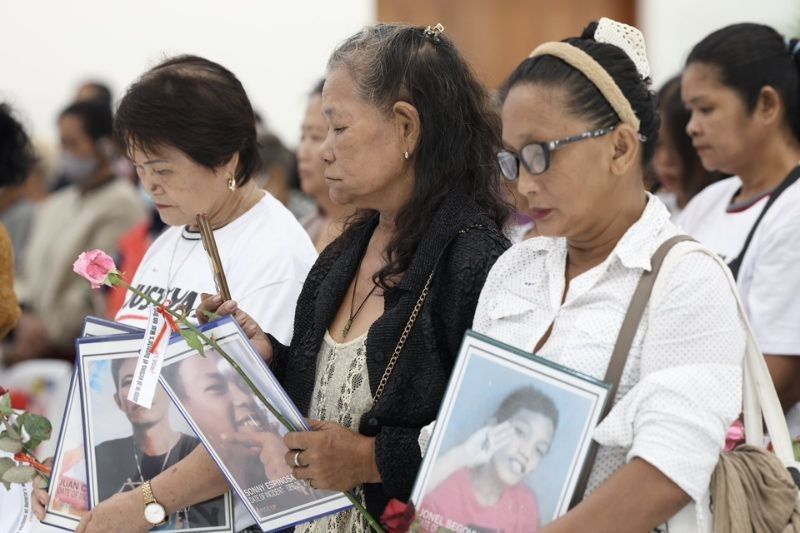
Families of extrajudicial killing victims attend a Catholic Mass at the House of Representatives prior to the eighth hearing on EJKs on Oct. 11, 2024. Photo: Philippine House of Representatives via Philstar
For families of the victims of Duterte’s war, this arrest is a breakthrough in their long search for accountability. But human rights advocates stress that this is only the first step in what should be a comprehensive accountability process.
This is a developing story. For more updates on Duterte’s trial, visit Philstar.com.
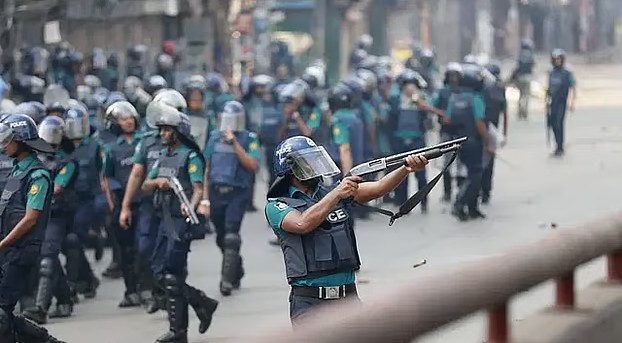
Cases have been filed against 1,059 police officers in various police stations and courts across Bangldesh on charges of shootings and killings during the July 2024 mass uprising. So far, 41 officers have been arrested in connection with these cases.
Among the arrested are former Inspector General of Police (IGP) Chowdhury Abdullah-Al Mamun, former IGP AKM Shahidul Haque, former Dhaka Metropolitan Police (DMP) Commissioner Md. Asaduzzaman Mia, and Joint Commissioner Mashiur Rahman.
Others include Deputy Inspector General (DIG) Mollah Nazrul Islam and former Chittagong Metropolitan Police Commissioner Saiful Islam. However, several high-profile officers remain at large, including former Additional IGP Md. Monirul Islam, former DMP Commissioner Habibur Rahman, and former Additional Commissioner (Detective Branch) Mohammad Harun-ur-Rashid. Some have reportedly fled the country.
According to the police headquarters, the widespread shooting and killing of civilians during the student-led movement from 16 July to 5 August last year has drawn intense criticism, both within and outside the police force. There have been growing demands to identify and hold those responsible accountable.
READ: In Bangladesh, Cops Accused of Killing Protesters During 2024 Uprising Roam Free
The 1,059 police officers facing charges include five former IGPs, 41 former Additional IGPs, 12 former DIGs, 12 current DIGs, two former Additional DIGs, 42 current Additional DIGs, three former Superintendents of Police (SPs), 59 current SPs, 56 Additional Superintendents of Police, 21 Assistant Superintendents of Police, 168 Inspectors, and 638 Sub-Inspectors (SIs), Assistant Sub-Inspectors (ASIs), Naiks, and Constables.
While the police headquarters has not officially disclosed the number of cases against its officers, sources indicate that 656 cases have been filed related to killings during the uprising, while 737 cases involve injuries—bringing the total number of cases linked to casualties to 1,393. Several senior police officers have stated that many of those implicated were close to the ousted Awami League government and were involved in issuing or executing orders to suppress the protests.
However, they also claim that some officers have been accused unfairly. Authorities insist that legal action is being taken after thorough verification, and innocent officers will not be harassed.
IGP Baharul Alam told Prothom Alo in December that a committee has been formed in each of the eight police ranges, led by an Additional DIG, to oversee cases related to the killings. These committees will supervise the investigations, which will be conducted by experienced former and current officers.
In most cases, police officers are being charged alongside other individuals. As a result, the prosecution of those involved in the killings depends on the progress of these investigations.
When asked about the matter, Assistant Inspector General (AIG) of the Police Headquarters’ Media and Public Relations Department, Enamul Haque Sagar, told Prothom Alo that law enforcement is taking these cases seriously and will bring those found guilty to justice.
Apart from cases filed by victims’ families, the killings during the July mass uprising are also being prosecuted at the International Crimes Tribunal. So far, 18 former law enforcement officers have been arrested in connection with those proceedings.
Those Arrested
Among the then-officers of the arrested police are former Deputy Commissioner of DMP Md. Jasim Uddin Molla, Superintendent of Police (SP) Tanvir Salehin, Mohiuddin Farooqui, Abdul Mannan, SM Tanvir Arafat, Asaduzzaman, Md. Abdullahil Kafi, Jewel Rana, Additional Superintendent of Police of Armed Police Battalion (APBN) Md. Rafiqul Islam, Additional Superintendent of Police of Dhaka District Shahidul Islam, Additional Deputy Commissioner of Khulna Metropolitan Police (KMP) Md. Sadeq Kawsar Dastagir, Additional Superintendent of Police of Barisal Alep Uddin, Additional Deputy Commissioner of DMP Mirpur Division Darus Salam Region MM Mainul Islam, Assistant Commissioners of DMP Traffic Division Iftekhar Mahmud and Md. Tanzil Ahmed, Assistant Commissioner of DMP Badda Region Rajan Kumar Saha, Former Officer-in-Charge (OC) of Jatrabari Police Station Abul Hasan, Former OC of Gulshan Police Station Mazharul Islam, among others.
Who face the most cases?
According to the police headquarters, the highest number of cases has been filed against the then Additional Commissioner of Dhaka Metropolitan Police (DMP), Mohammad Harun-or-Rashid, who faces 174 cases. He is followed by former Inspector General of Police (IGP) Chowdhury Abdullah Al-Mamun, against whom 159 cases have been filed. Additionally, former IGP Shahidul Haque faces 23 cases, Benazir Ahmed 11 cases, Hasan Mahmud Khandaker seven cases, and Javed Patwari two cases.
Among other senior officials, former Additional IGP Md. Monirul Islam has been accused in 46 cases, while former DMP Commissioner Habibur Rahman faces 118 cases. Former Dhaka Range DIG Syed Nurul Islam has been named in 16 cases, former Additional DIG Biplab Kumar Sarkar in 128 cases, and Additional DIG SM Mehedi Hasan in 33 cases.
Among DMP deputy commissioners, the highest number of cases has been filed against Mohammad Iqbal Hossain, the then Deputy Commissioner of Wari Division, who faces 27 cases. A video that went viral after the fall of the government shows Iqbal speaking with former Home Minister Md. Asaduzzaman Khan about the shooting of anti-discrimination protesters.
In the footage, Iqbal is seen showing a video on his mobile phone and saying, ”Sir, it seems like shooting and taking down bodies. I shoot, one dies, one is injured. Only one goes, sir, the rest don’t go. This is the biggest fear and worry, sir…” Former IGP Chowdhury Abdullah Al-Mamun and former Home Secretary Jahangir Alam were also present at the time.
The list of accused includes several high-ranking officers such as former Additional IGPs Mokhlesur Rahman, Shafiqul Islam, Iqbal Bahar, Mahbubur Rahman, Atiqul Islam, Banaj Kumar Majumder, Didar Ahmed, Mohammad Ali Mia, M Khurshid Hossain, Selim Mohammad Jahangir, Khandaker Lutful Kabir, Krishnapada Roy, and AKM Hafiz Akhter. Additionally, former DIG SM Mahfuzul Haque Nuruzzaman has also been implicated.
Former IGP Muhammad Nurul Huda told Prothom Alo that the investigation into the July mass uprising cases should be expedited. He emphasised that those who are innocent should be acquitted, while those found responsible should be brought before the court.
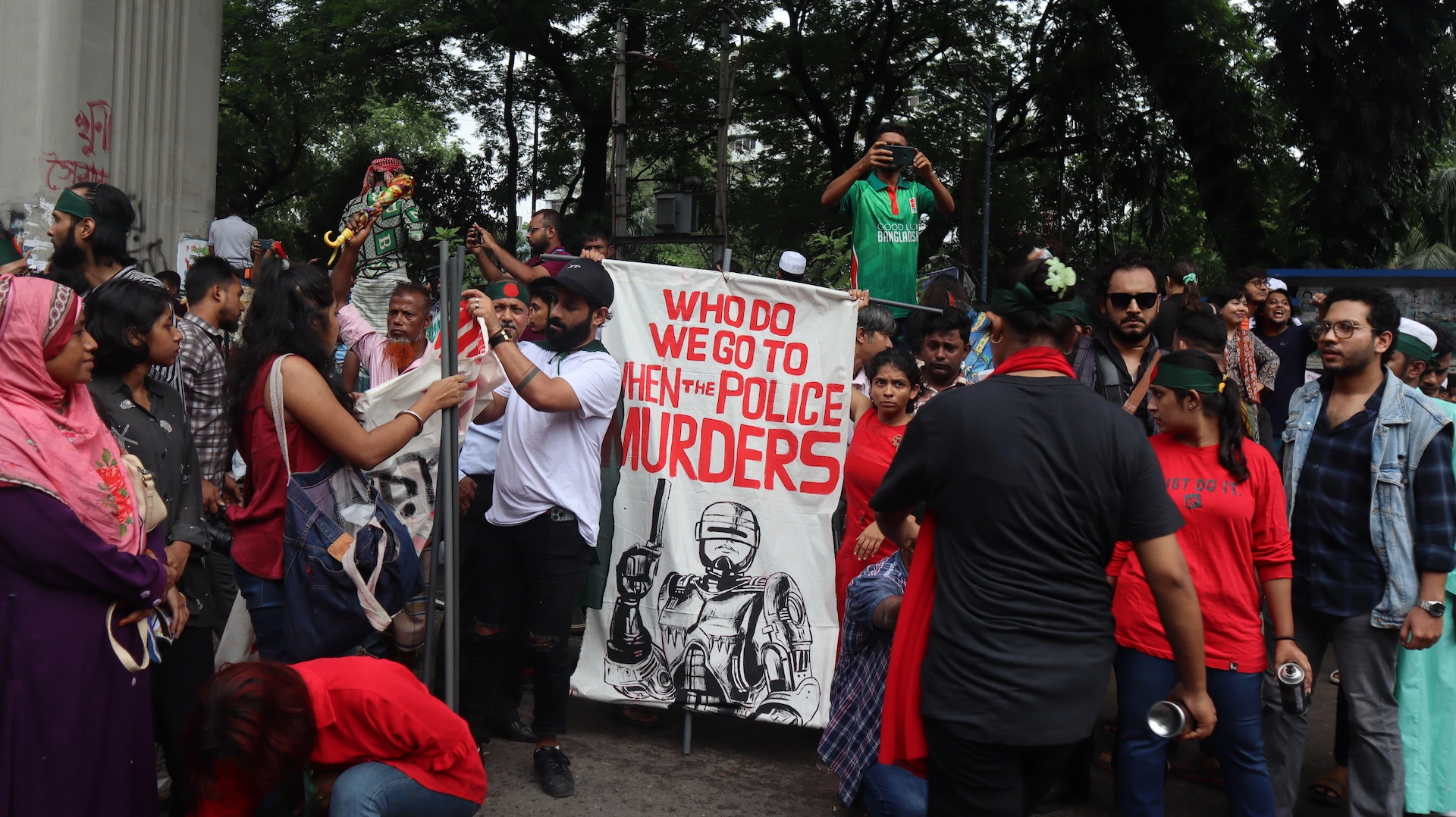
On August 2, 2024, protesters in Dhaka brought a large procession for Hasina’s resignation. Photo: Masum Billah
Imam Hasan Taim had already been shot twice before the camera started recording.
On July 20, 2024, Taim was in Jatrabari, a neighbourhood in Bangladesh’s capital city Dhaka, when the police started firing. He was one of the student protesters in a crowd that had gathered to demand resignation of the now ousted prime minister Sheikh Hasina.
In the now-viral footage, taken by a journalist called Arefin Mahmud Shakil, Taim is seen being dragged by his friend Rahat Hossain to safety. A few seconds in, a police officer is seen shooting Imam at close range. The officer’s name was later identified as Jakir Hossain. Rahat was also injured but he continued to drag Imam. In the next few seconds, Jakir Hossain was seen shooting Imam again — then again. Unable to go on any further, Rahat fled to save his own life.
Ironically the son of a police officer himself, Taim was left at the scene for half an hour before officers carried his body to Jatrabari police station. There, his family claims that the officers trampled their son – who was alive until then – to death.
“My brother would have survived had he been taken to the hospital,” Rabiul Awal, Imam Hasan’s older brother, told Asian Dispatch. “But after they took him to Jatrabari thana, a group of officers led by an officer called Assistant Commissioner (AC) Nahid Ferdous trampled him to death.”
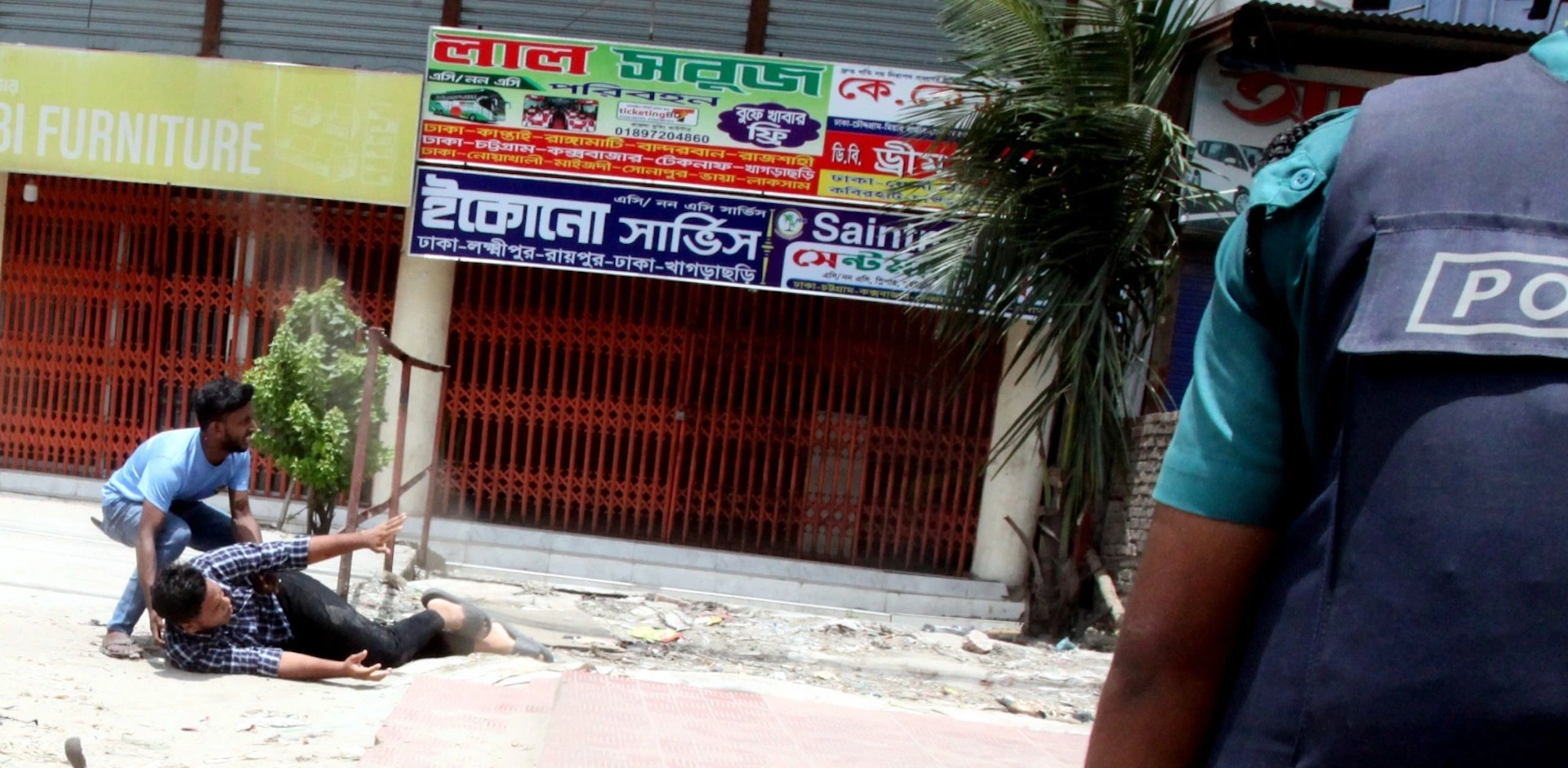
Taim (right) and his friend Rahat being attacked during protests on July 20, 2024. Photo via screengrab.
Taim’s family identified at least eight more police officers from the Dhaka Metropolitan Police alongside Jakir Hossain, including Additional Deputy Commissioners Shakil Mohammad Shamim and Shahadat Ali, and Additional Deputy Commissioner Masudur Rahman.
My brother would have survived had he been taken to the hospital. But after they took him to Jatrabari thana, a group of officers led by an officer called Assistant Commissioner Nahid Ferdous trampled him to death. — Rabiul Awal, Taim’s older brother.
Taim’s brother Awal told this reporter – based on his review of government documents – that out of this group of cops, Nahid Ferdous was later transferred and stationed at a Rapid Action Battalion (RAB) camp in Jhinaidaha district, which is nearly 200 kms from Dhaka. RAB is a paramilitary force in Bangladesh sanctioned by the US for human rights abuses under Hasina’s rule.
Imam’s family filed a case against 10 police officers, including Jakir Hossain, Iqbal Hossain, Shakil Mohammad Shamim, Tanjil Ahmed, Shahadat Ali, Masudur Rahman, Nahid Ferdous, Shudipta Kumar and Wahidul Haque, in a Dhaka court. Among them, only Abul Hasan, Tanjil Ahmed, and Shahadat Ali have been arrested.
The family also filed a case against the accused at the country’s International Crimes Tribunal (ICT), where warrants were issued for several officers, including Nahid.
“The ICT issued warrants for them on November 12. But AC Nahid was on duty until November 20. How is that possible?” Tuhin asked, implying Nahid’s connection with an influential Dhaka Metropolitan Police official. He suspects forces within the police are sheltering the accused officers.
A Tale of Disproportionate Police Violence
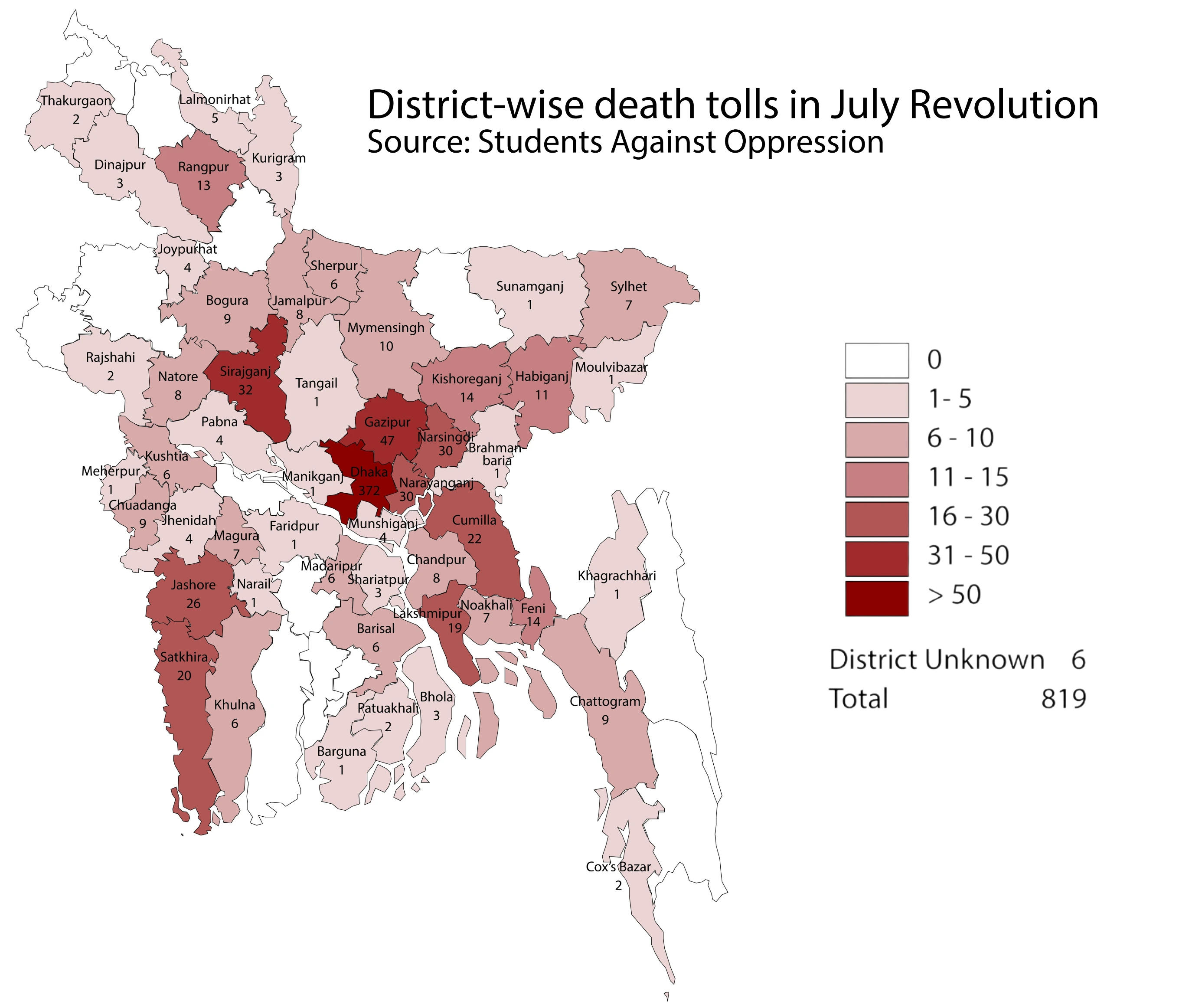
The mass uprising in Bangladesh – South Asia’s youngest country formed in 1971 – was a pivotal moment in the world that saw thousands of people, mostly students, not only shake Hasina’s 16 years of autocratic rule, but dismantle it entirely. Hasina fled the country – she’s currently in hiding in India – but left, in the wake of her ouster, a lasting legacy of police brutality. From July 16 to August 5, 2024, more than 800 people, including at least 89 children, were killed by the police, other security forces and men associated with Hasina’s party.
On July 19 alone – the day the fallen regime enforced an internet blackout – at least 148 people were killed by law enforcement agencies, according to a report by the International Truth and Justice Project (ITJP) and Tech Global Institute.
“Shockingly, 54 of the dead were shot in the head or throat. Many of those killed were not even part of the protests, but bystanders and people who happened to live or work close to the shooting that was completely indiscriminate,” the ITJP report found.
Among them were children as young as four-year-old Abdul Ahad and six-year-old Riya Gope, each shot in the head in front of their parents at home during an attack on protesters in their neighborhood.
In a report by Human Rights Watch (HRW), released on January 27, 2025, a police officer is quoted as saying, “I witnessed officers firing at vital organs…. In many cases, I witnessed live ammunition being fired even when officers’ lives were not in danger.” Another police official described, to HRW, how senior officers in the Dhaka Metropolitan Police headquarters watched live CCTV footage and directed officers on the ground to shoot protesters as if “they were ordering someone to shoot in a video game.”
Many of the July-August killings were captured on video by witnesses, bystanders and journalists. Law enforcement agencies shot citizens from helicopters, killed children in their homes through windows, targeted long-range shooting aimed at protesters, denied treatment and burned bodies after killing people.
I witnessed officers firing at vital organs…. In many cases, I witnessed live ammunition being fired even when officers’ lives were not in danger. — A police officer quoted in Human Rights Watch’s report on 2024 police brutality.
After Hasina fled the country, legal cases against cops poured in by families of the deceased. Top officers, including the then Inspector General of Police Chowdhury Abdullah Al-Mamun, Harun Or Rashid, Monirul Islam and Biplob Kumar Sarker, face dozens of murder charges each. According to a list of cases against police officials obtained by Asian Dispatch, at least 94 officers face charges of murder or torture. Different reports published in local dailies such as Prothom Alo also suggest nearly a hundred police officers being charged.
These statistics are now several months old. Asian Dispatch reached out to various authorities – including Bangladesh’s police headquarters, CID and International Crimes Tribunals – to confirm the estimated number of police officers facing murder charges. None of them provided answers. “We don’t have information about this,” Assistant Inspector General Enamul Haque Sagar, the spokesperson of Police Headquarters, told Asian Dispatch. However, he did confirm that only 34 officers – as of Feb. 5 – have been arrested so far in connection to the July uprising.
READ: As a ‘Gen Z’ Journalist, This is How I Felt Witnessing Young Bangladeshis Overthrow Sheikh Hasina
The Center for Information Resilience (CIR), an international agency that uses open source and digital investigations to expose human rights violations, verified 83 pieces of footage showcasing 52 separate incidents of police brutality in July-August. Of these, 24 showed verified casualties.
The CIR findings also identified “two peaks” in violence. The first was on July 18, where killings amounted to a massacre. It all started with the killing of a protester called Abu Sayeed, in Rangpur district, on July 16, which was captured in a now iconic image of him spreading his hands in front of the police force. The second “peak” in violence was on August 5, the day Hasina resigned and fled to India.
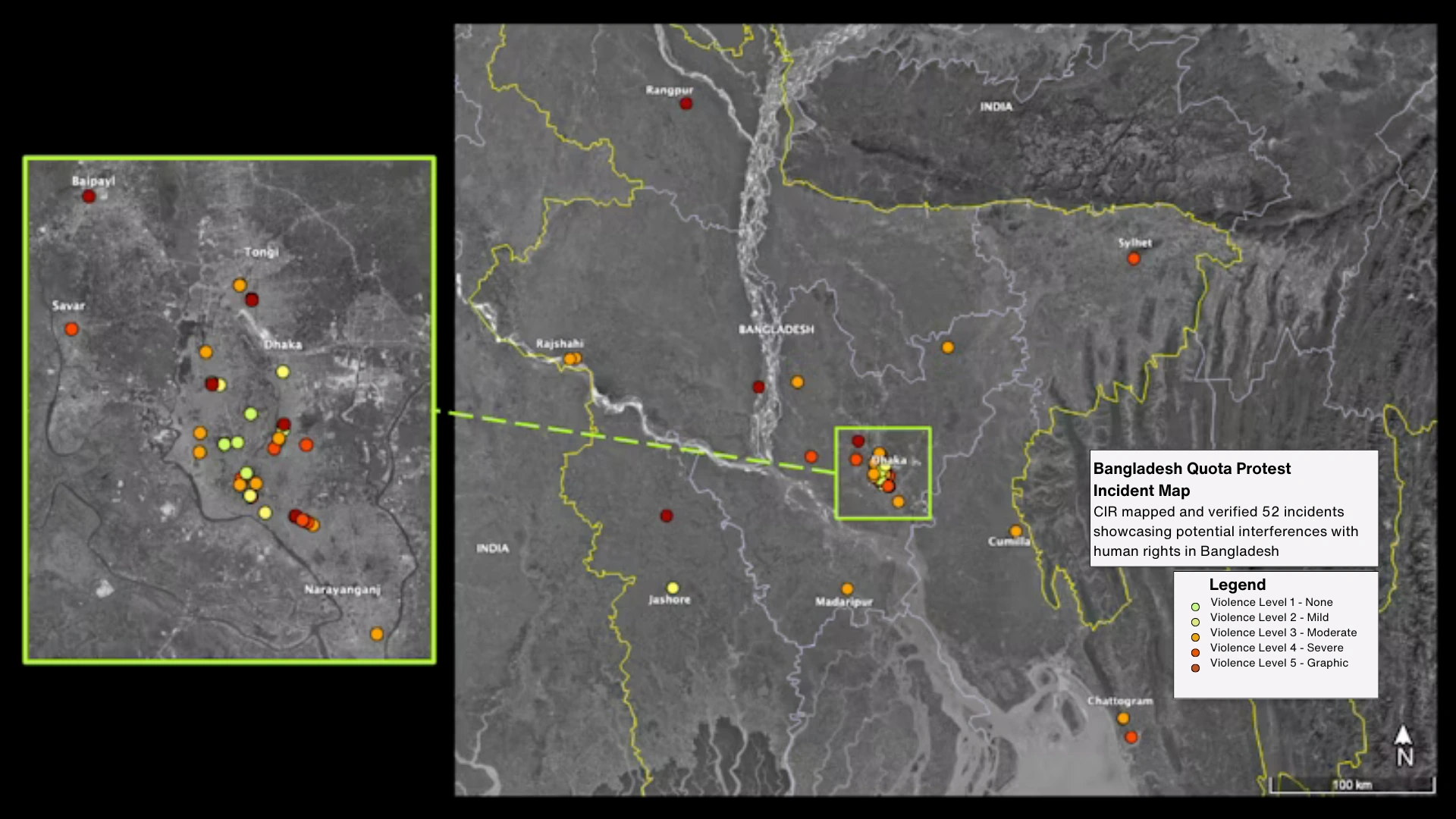
Centre for Information Resilience mapped and verified 52 incidents showcasing potential interferences with human rights in Bangladesh. The key on the right-hand side indicates the graphic level of footage and images collected. Graphics courtesy: CIR
“Within these verified incidents, CIR identified a concerning trend of disproportionate violence by police officers and military personnel, which potentially breaches human rights, including the use of live ammunition against protesters, the desecration of bodies, and the beating of unarmed civilians,” the report states.
Cold-blooded Targeted Killing
On August 5, Mohammed Sujon Hossain, a police officer from the Armed Police Battalion (APBn), a specialised combat unit of Bangladesh Police, was seen shooting a protester. On duty in Dhaka’s Changkharpur area, the official is seen firing a Type 56 semi-automatic carbine – an assault rifle often used by military personnel or armed groups – at protesters located less than 100 meters to the east. In a video that was later aired on Jamuna TV, the official is seen shooting one protester, after which other officers join in. Sujon Hossain is seen leaning on his knee to shoot again and saying, “Someone is dead,” as other officers start shooting at unarmed civilians.
Sujon was arrested on September 12, 2024.
Asian Dispatch got the said footage verified by CIR. The video was shot from Zahir Raihan Road near the Sheikh Hasina National Institute of Burn & Plastic Surgery and Chankharpul General Hospital in the Chankharpul area of Dhaka, geolocated at 23.7238, 90.4010.
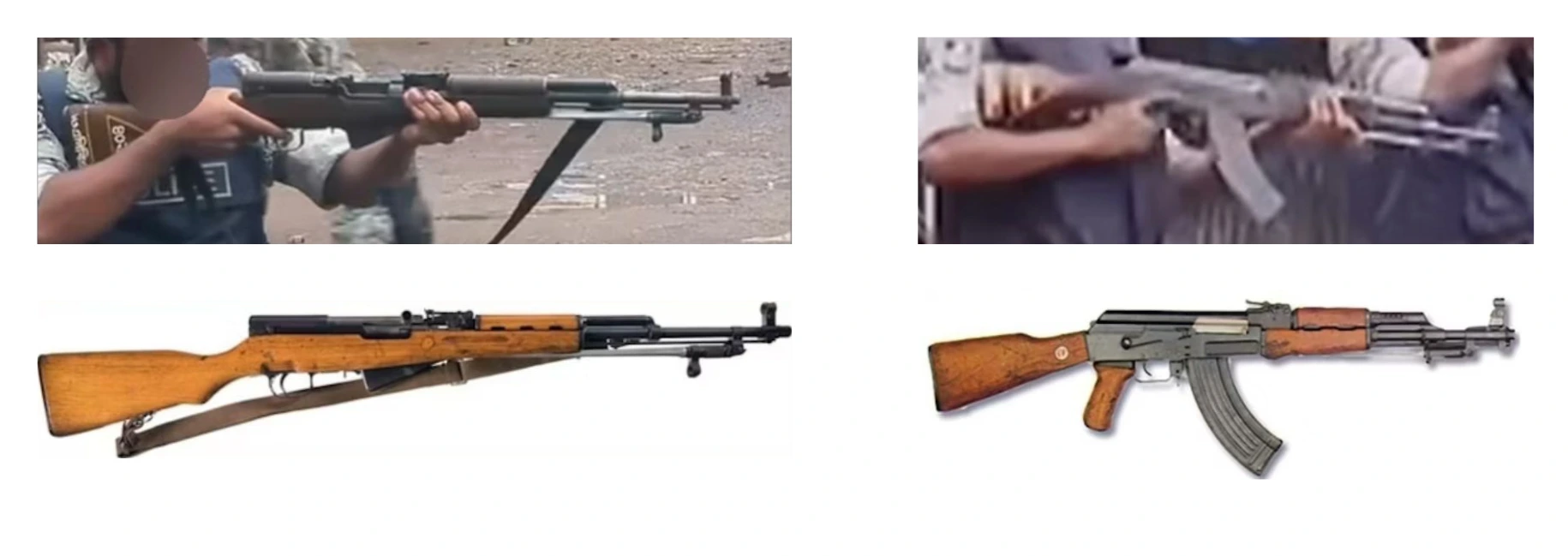
Officers fired multiple weapons, including Type 56 semi-automatic carbines (left) and a Type 56 assault rifle (right). Graphics Courtesy: CIR
On this day, more than 10 dead bodies were reportedly brought to Dhaka Medical College Hospital from Chankharpul soon after the shootouts.
One of those shot dead was Shahriar Khan Anas, a 16-year-old student at Gandaria Ideal High School in Dhaka. Before joining the march to Hasina’s residence, Anas had written a letter to his mother saying, “Rather than staying at home like a coward, it is much better to join the struggle and be shot dead like a hero.”
His father, Shahria Khan Palash, filed a case at the ICT, naming Hasina as the prime accused, along with several police officers. He told Asian Dispatch that he asked the ICT to include the then Additional Deputy Police Commissioner (ADPC) Akhtarul Islam in his case. “Whenever I call, they [ICT] say my case is still being processed. But arrest is far away,” Palash said.
When contacted, ICT investigating officer Munirul Islam told Asian Dispatch that they were still investigating the allegations and refused to share any details about charges, including the allegations against Akhtarul Islam.
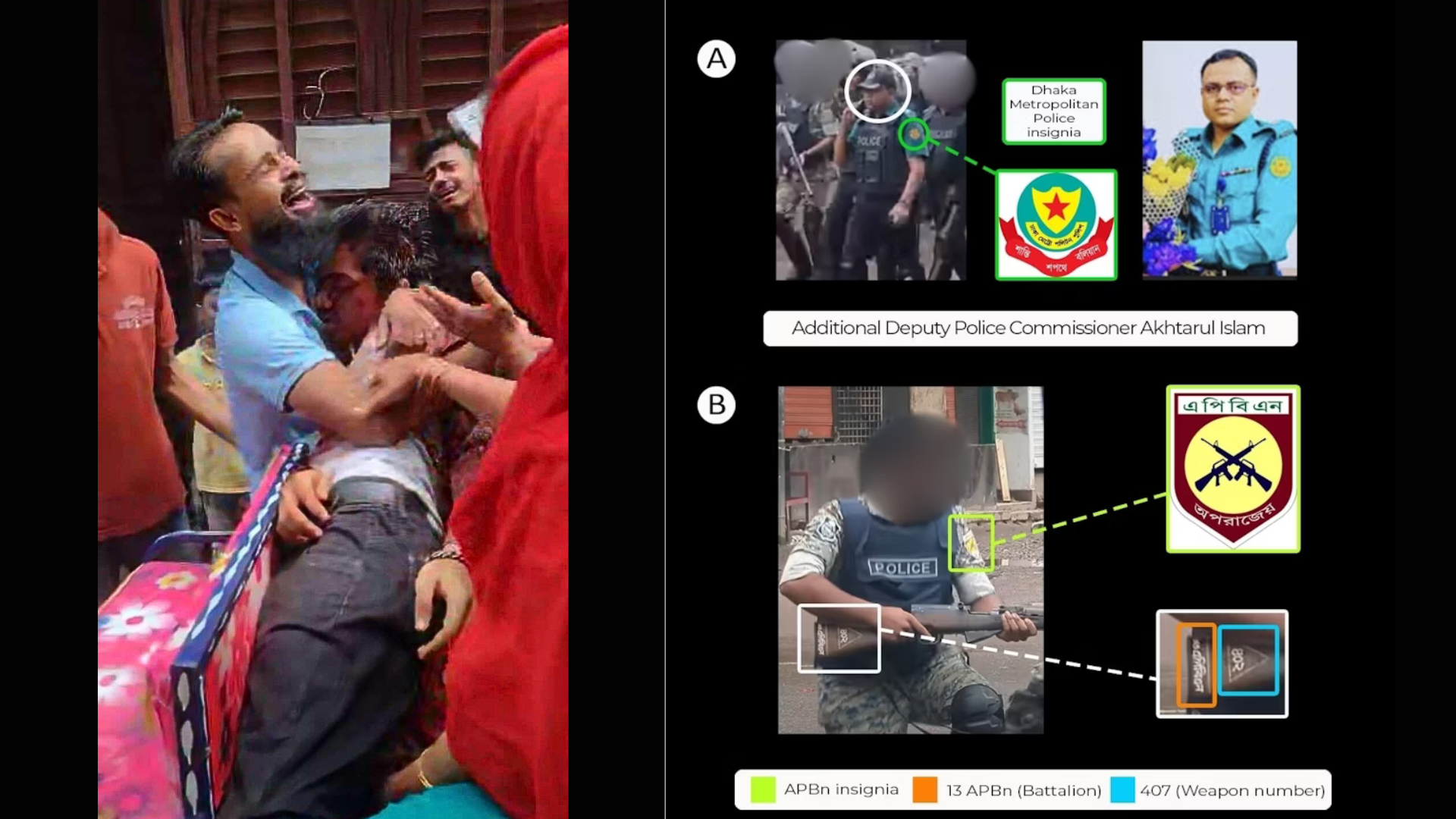
(Left) Shahria Khan Palash holds the body of his son Shahrirar Khan Anas. Photo courtesy: Shahria Khan Palash; (Right) CIR confirmed that Additional Deputy Police Commissioner Akhtarul Islam was present during the incident. Sources: upper left (A): Samakal News, bottom left (B): X. Graphics courtesy: CIR
According to Bangladeshi daily, The Business Standard, ADPC Akhtarul Islam was seen in command in Chankharpul that day. Another police officer present there told The Business Standard that, “Sir Akhtarul himself also fired that day.” When Asian Dispatch asked ICT about Akhtarul Islam’s whereabouts on the aforementioned day, spokesperson Enamul Haque Sagar responded: “We don’t have that information.”
In another part of Dhaka, another police officer called Arafatul Islam was seen in a video near a van where police officers were loading several dead bodies, with at least six other officers in the background. The bodies were later burned on a truck. Arafatul was subsequently arrested for concealing evidence of police brutality. Md Abdullahil Kafi, the additional superintendent of police (crime and operations) in Dhaka, was also arrested in connection to this case.
Escaping Justice
Asian Dispatch reviewed around 100 videos from this time, and corroborated those of over a dozen police officers in connection to the July-August violence. The interim government of Nobel Laureate Muhammad Yunus has, so far, set up a foundation to support the families of wounded and killed, with a funding of TK100 crore ($8.1 million). In January 2025, the Police Reform Commission submitted recommendations to curb abuse of power and excessive force by the police. But mounting evidence shows little to no attempts to bring the accused to justice.
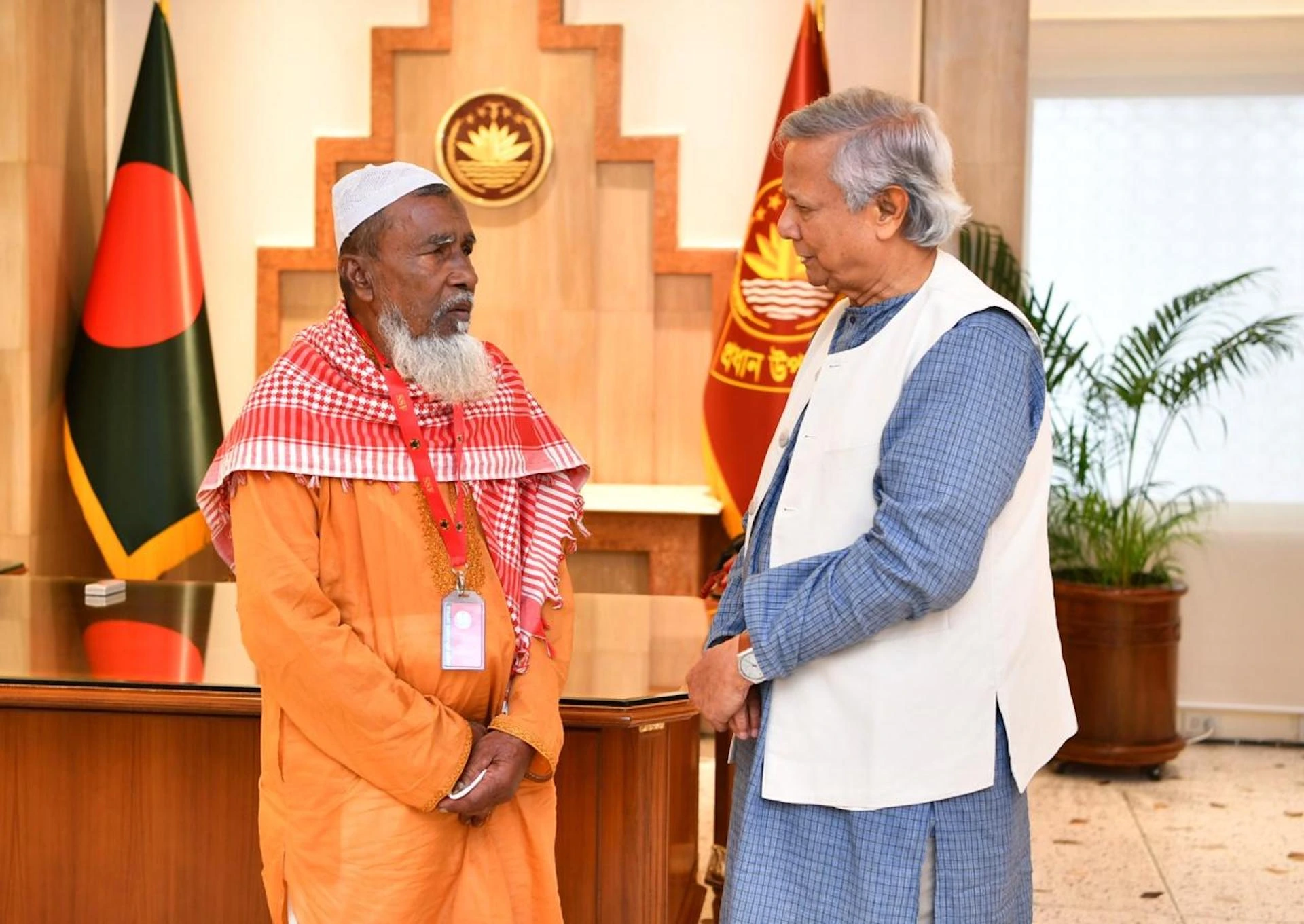
Chief Adviser Professor Yunus meets the father of a student called Abu Syed, a student activist from Rangpur who was shot dead by the Bangladesh police last July. Photo: ChiefAdviserGoB/X
Another accused official, Harun Or Rashid, the then Additional Commissioner (Crime and Operations) of the Dhaka Metropolitan Police and former chief of the Detective Branch, was rumoured to have been detained after Hasina fled. Rashid dismissed those claims in a text message to the Daily Star on August 6. However, despite a travel ban on him by a Dhaka court on August 27, Rashid appeared in an interview with a US-based Bangladeshi journalist in October, where he denied all charges. He continues to be at large. Asian Dispatch couldn’t confirm his whereabouts to secure an interview.
Former head of the Police’s Special Branch (SB), Monirul Islam, who faces several cases too, also remains free. Asian Dispatch found him active on Facebook – his last post on his Facebook account was January 21. Asian Dispatch contacted him via WhatsApp but did not receive a response at the time of publishing this story.
Many other top police officers are believed to have fled Bangladesh after August 5.
Salahuddin Miah, the former officer in-charge of Khilgaon police station in Dhaka during the protests, faces charges but is currently stationed in Rangamati with the Armed Police Battalion.
“The cases against me are related to BNP programs from [2023], not the July uprising,” Salahuddin Miah told Asian Dispatch, referring to police violence against a Bangladesh Nationalist Party (BNP) rally in 2023.
Attempts to reach out to up to 15 police officers facing charges of murder and torture went in vain. Their whereabouts remain unknown and did not respond to text and calls.
The Government’s Efforts and Limitations
On July 20, when Moynal Hossain discovered the lifeless body of his son, Taim – the young protester mentioned at the beginning of this report – riddled with bullets, he called his superior in despair, crying, “How many bullets are necessary to kill a person?”
Moynal Hossain is a senior sub-inspector from the Bangladesh Police. Despite his rank and evidence, the grieving family claims they were denied the right to file a case.
Ramizul Huq, the investigating officer from the Police Bureau of Investigation assigned to Taim’s case, told Asian Dispatch that arresting government officers requires authorisation from the relevant authorities. For instance, arresting an Assistant Superintendent of Police or higher ranks requires permission from the Home Ministry, while constables to inspectors need approval from the Inspector General of Police.
“At the same time, multiple investigating officers were being changed, which caused further delays. Sometimes, following these procedures takes considerable time,” said Huq.
Taim’s family is among many waiting in darkness for justice. Many live in fear of consequences from the charges they’ve pressed against police officers since the accused remain free.
We are scared to talk to the press. If they find out I am speaking against them, I fear we may not be able to sleep peacefully in our own homes. —Kamal Hawlader, whose son was killed in July, told Asian Dispatch.
Enamul Haque Sagar, the Police Headquarters spokesperson, says that the charges are being investigated with “great seriousness.” “The investigations are ongoing, and the process of bringing those found involved to justice is in progress,” he added.
But these words of reassurance aren’t enough.
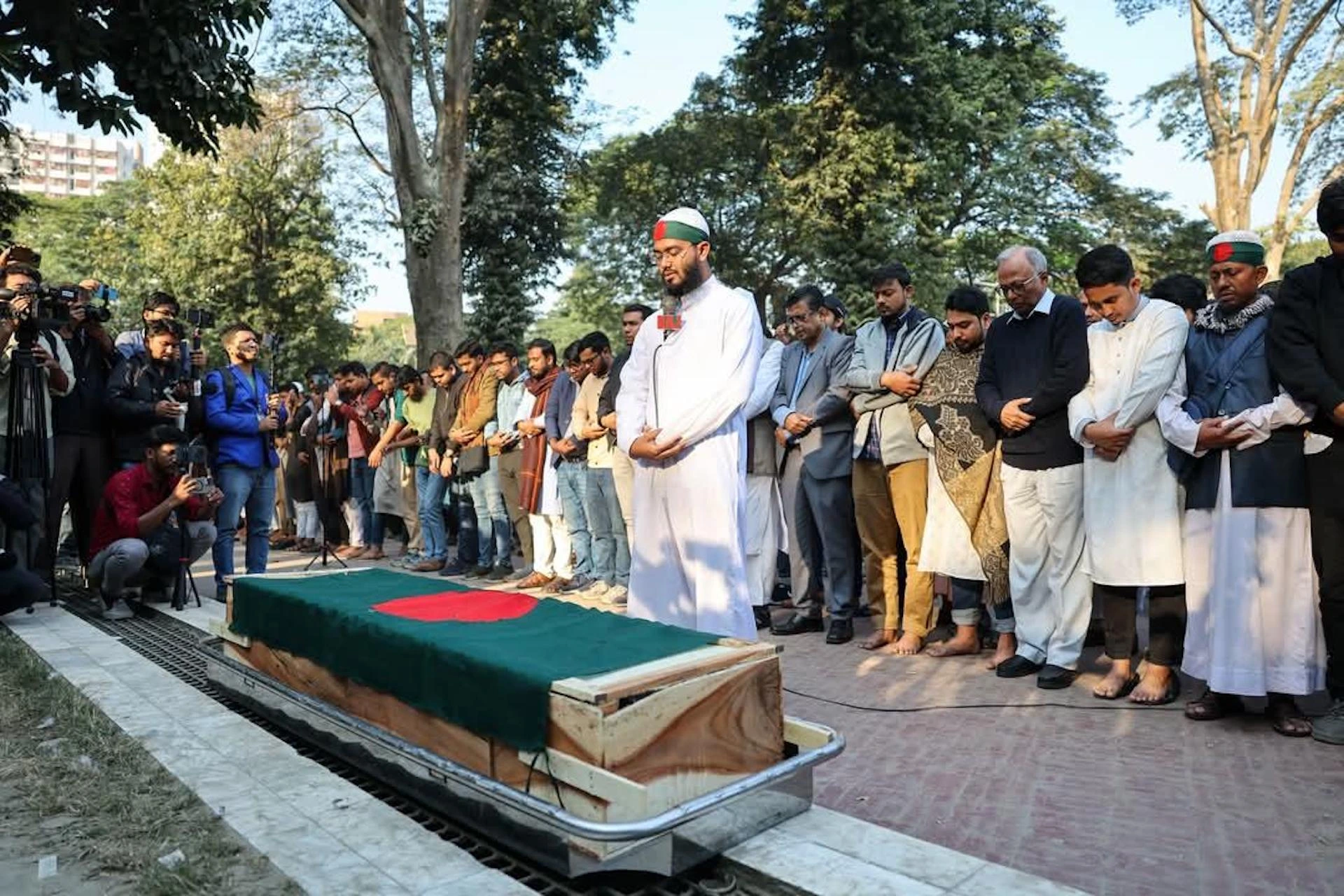
Members of Yunus’s interim government attend the final rites of a 12-year-old boy called Arafat, who was shot during the anti-government protests last year. Photo: Photo: ChiefAdviserGoB/X
Human rights activist Rezaur Rahman Lenin told Asian Dispatch that internal processes and weak systems set by the government allow police officials to evade accountability. “The government faces multiple challenges on various fronts, which they are unable to address due to a lack of commitment, prudence, and bureaucratic transformation,” he said.
Institutional fragmentations among different commissions and the International Crimes Tribunal are both visible and vibrant, he says. “Harmonising legal approaches transparently and effectively is essential to ensure justice,” said Lenin, noting the paradox of relying on the same force accused of killing protesters in order to maintain law and order.
Professor CR Abrar, the president of human rights organisation Odhikar, shared similar concerns.
“It is deeply disconcerting that after such heinous crimes, only 34 are apprehended,” he said. “The evil force protecting the accused officials remains dominant and continues to call the shots.”
Singapore has reignited debates over the death penalty with three executions carried out in just one week. While many Asian nations consider capital punishment a critical measure against crime, the question extends beyond its effectiveness, which evidence suggests is minimal.
China is known as the world’s leading executioner, the Dui Hua Foundation, a nonprofit organisation, estimated approximately 2,000 executions in China in 2018 marking a significant decline from previous years. This reduction reflects ongoing reforms in the country’s capital punishment practices, which have led to a notable decrease in execution numbers over time.
However, Amnesty International’s latest global review indicates that the number of death sentences issued annually in China is believed to be in the thousands, surpassing the total of all other countries combined. But the exact figures remain obscured by state secrecy which the Chinese authorities maintain to prevent public awareness and scrutiny to obfuscate the scale of capital punishment practices. Despite this alarming number, research suggests that the death penalty has neither prevented nor reduced crime rates in China. The larger issue is how these nations use it as a quick fix, a way to wash their hands of complex problems by eliminating people rather than tackling the problem itself at the roots.
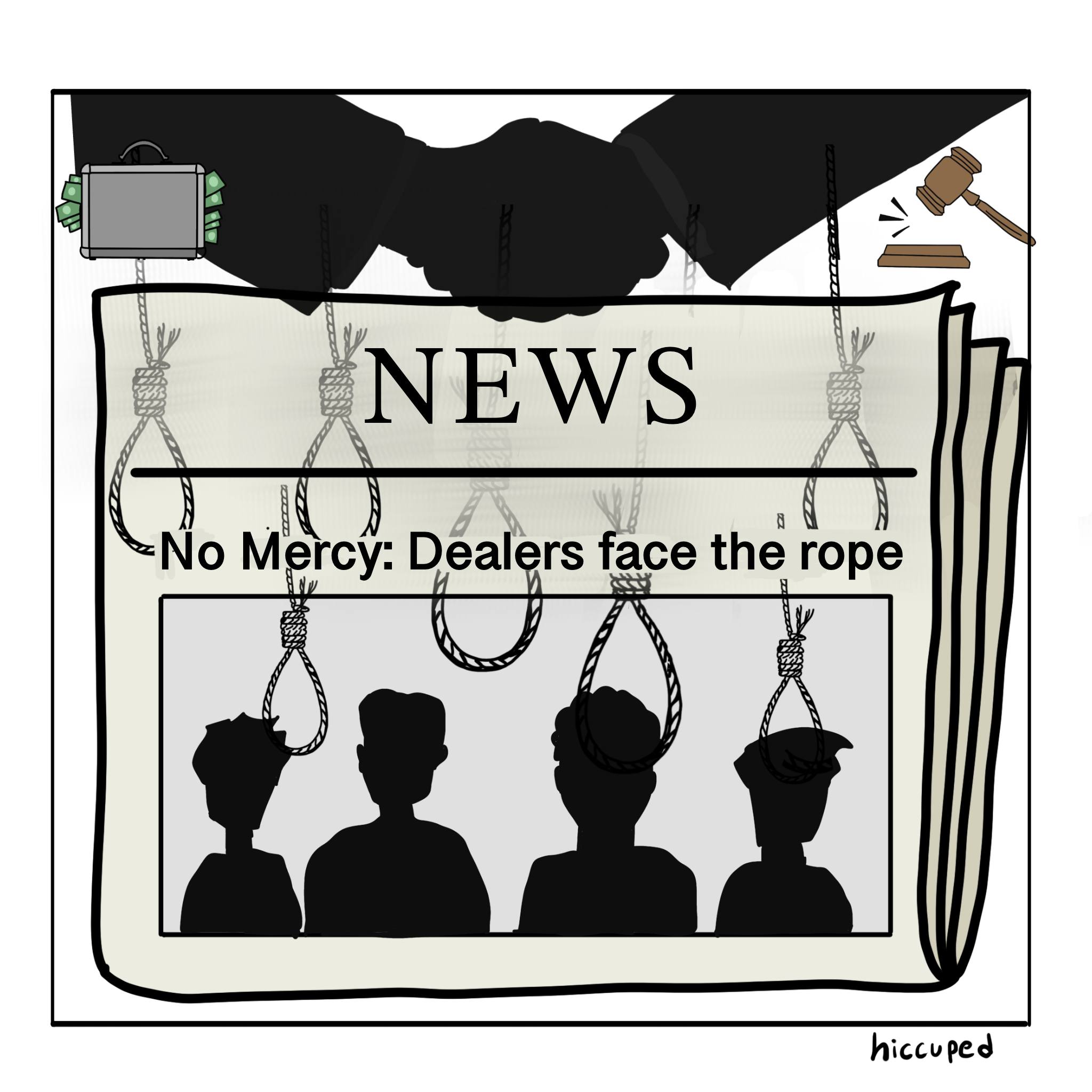
When it comes to drug trafficking, public sentiment often frames the ones executed as irredeemable ‘bad people’. With the removal of such peddlers, the society breathes a collective sigh of relief as their death is considered a societal win. But the uncomfortable question unanswered is: When was the last time a major drug lord in Asia was arrested, let alone faced the full weight of the law or capital punishment? It is not unknown that these are the individuals who flood societies with massive quantities of drugs, yet those who face the gallows are marginalized individuals from impoverished backgrounds or foreign nationals, often exploited as mere pawns in larger criminal networks.
Illustration: Sharanya Eshwar
The war on drugs carries a devastating cost, and is always borne by the vulnerable – the poor and marginalised. There are multiple instances all over the world to prove that fighting the war on drugs for governments was never just about drugs, it was a convenient mask to legitimise discrimination and reinforce stereotypes against marginalised communities. In the United States, the fight against drugs led to mass incarceration, with most of them disproportionately Black people. In the Philippines, the anti-drug campaign turned violent, with thousands of poor people gunned down by the police and unknown assailants, often without any evidence or trial. In India, indigenous tribes who rely on growing traditional cannabis have had their crops destroyed by the government, leaving them poorer and more vulnerable. In all these cases, the war on drugs never addressed the real issues of addiction or trafficking.
The irony of the war on drugs is that it’s not a lack of intelligence that spares the true masterminds of the drug trade but their power and wealth that allows them control over justice. While governments may often have access to detailed information about these powerful kingpins their connections shield them from prosecution, allowing them to evade accountability even as they oversee operations that destroy lives. They operate behind layers of intermediaries, while using their power to shield themselves and letting small-time traffickers take the fall. This raises critical questions about justice and equity within legal systems that disproportionately target the powerless while allowing the true culprits of the drug epidemic to evade consequences.
Justice should not be a tool to maintain the status quo but a force for transformation, it should uplift the vulnerable and confront the powerful. We as a society should demand more than just an illusion of control. The fleeting sense of resolution that capital punishment offers is only superficial. Are we willing to accept superficial solutions that leave structural injustices unchallenged, or do we demand a system that values accountability, fairness, and humanity?
On September 1, Swarna Das was attempting to cross the 4096-kilometer-long barbed-wired border – one of the longest and deadliest in the world – between her home country Bangladesh and India, when she was shot dead. The teen – whose age is reported to be between 13 and 16 – was on her way to visit her elder brother, who had been living in the Indian state of Tripura, which borders Bangladesh, along with her mother. On that fateful day, she and her mother were assisted by two local agents in the dead of night when, amid shots, Das’s body dropped dead in the Indian territory. Her body was recovered by India’s Border Security Force (BSF), and 45 hours later, they returned her “bullet-ridden” body to her family after completing formalities.
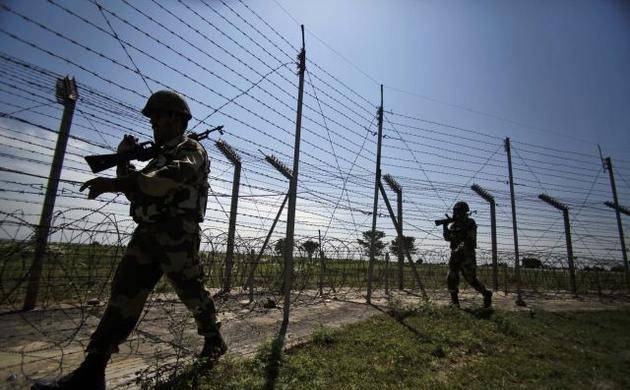
Bangladesh-India border is one of the world’s deadliest. Photo for representational purpose.
Bangladesh and India share friendly political relations but the border that divides the two countries is violent and hostile. Drawn in 1947 by the departing British colonial rulers and built on the foundations of security infrastructure, Bangladesh-India border is home to many residents who have historically moved fluidly across the demarcations not as a form of defiance but because of shared histories, culture and even families. Das, in this case, has family both in Bangladesh and India. Border residents like Das are one of the many to come in the middle of the countries’ troubling border relations.
Data released by Bangladesh’s Ain O Salish Kendra, a human rights organisation, documented at least 522 killings of Bangladesh citizens between 2009 and 2020. But Das’s killing evoked a different response.
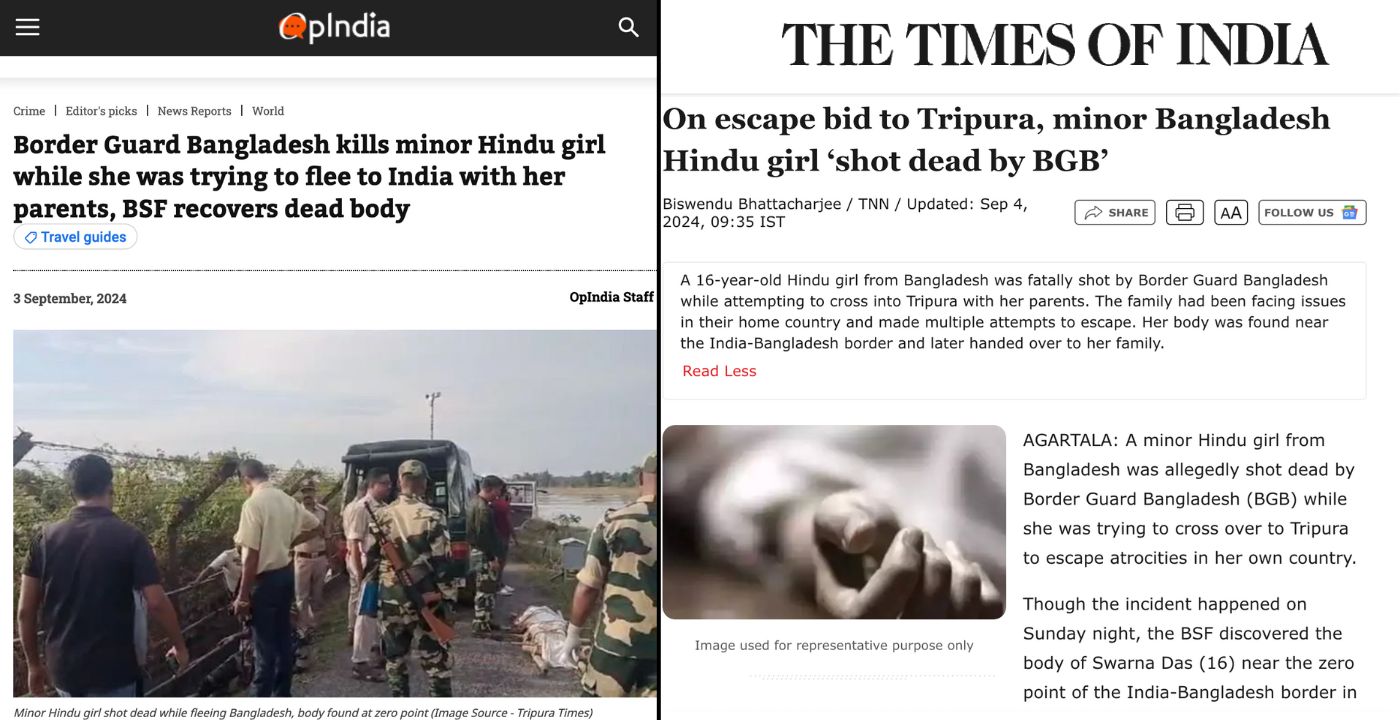
News coverage of Das’s killing in India
As people in Bangladesh and human rights organisations stepped in to demand justice, Das’s killing fuelled a war of narratives between the two South Asian countries. Mainstream media in Bangladesh, a Muslim-majority country of 173 million, reported the role of India’s BSF in Das’s killing, while in Hindu-majority India, the mainstream media including The Times of India and News 18 along with far-right Hindu publications such as OpIndia and Hindu Post published articles blaming Border Guard Bangladesh (BGB) and claimed they shot her dead for fleeing anti-Hindu persecution in Bangladesh.
‘Trigger-Happy’ BSF and a History of Violence at Bangladesh-India Border
India’s BSF has a policy of shoot-on-sight to prevent illegal migration and illicit activities like trafficking and smuggling, a measure that Human Rights Watch called indiscriminate and with a culture of impunity. Bangladesh’s BGB, on the other hand, has long been criticised by their home country for being ineffective against illegal migration and BSF’s violence.
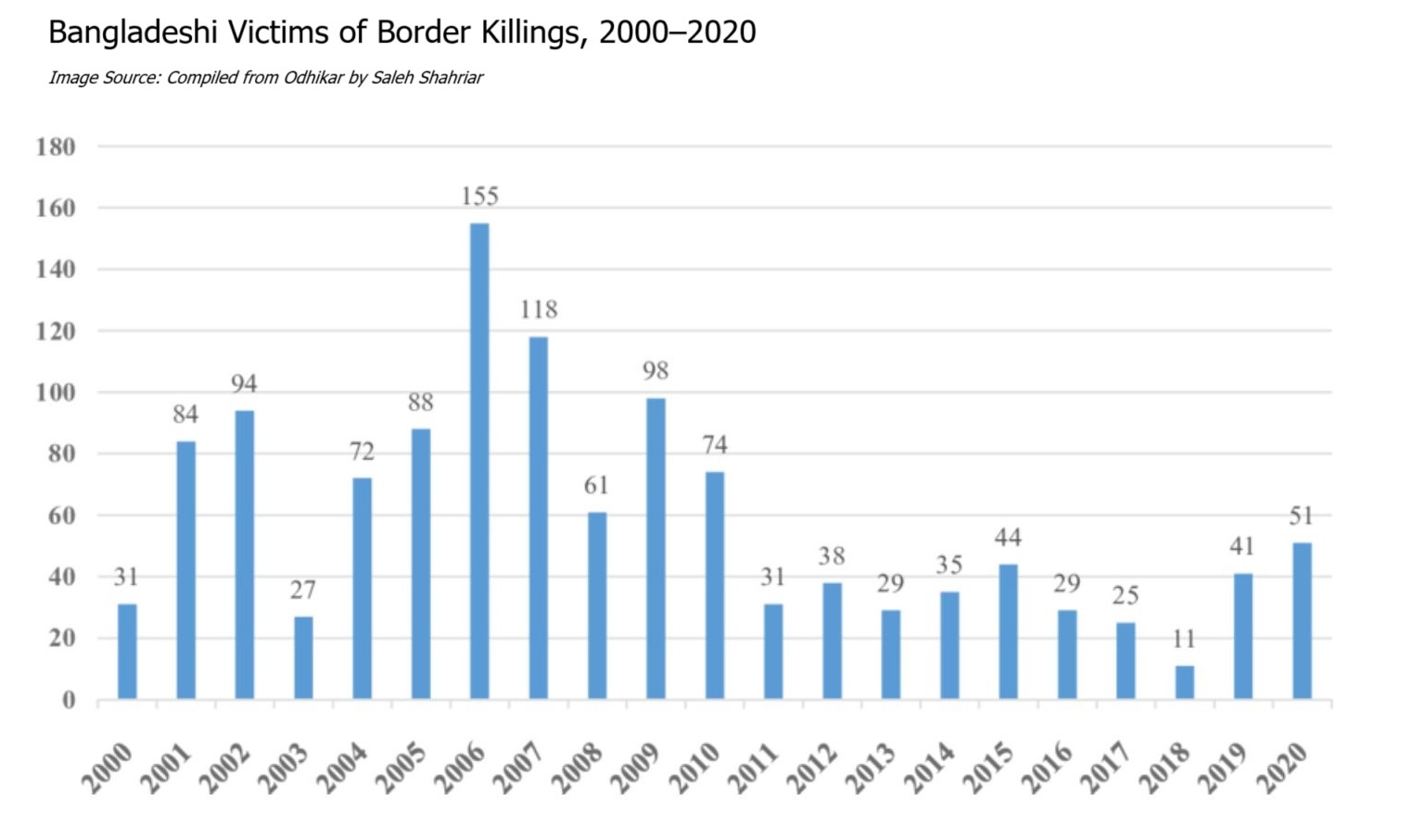
Recent Killings of Unarmed Civilians on the Bangladesh-India Border:
• 2011: Felani Khatun, 15, was shot in the chest and was found hanging on the barbed fences diving India and Bangladesh. In 2013, India acquitted the BSF constable accused of shooting her.
• 2016: Shihab Uddin Sajal, a Bangladeshi teen, was plucking mangoes in a farm when BSF members allegedly physically tortured and shot him. India suspended seven of its BSF troopers connected to his death.
• 2020: Hasinur Rahman Chand, a Bangladeshi shopkeeper, was fishing in a river near the border when he was killed allegedly by the BSF troopers. BSF claimed he was a cattle smuggler.
Das’s killing came on the heels of the student-led uprising in Bangladesh that ousted former prime minister Sheikh Hasina and her Awami League party from power.
The violence reflects the changing political dynamics between Bangladesh and India, says Pritam Das, the Executive Committee Member of Rashtra Sanskar Andolan (RSA), which led a fact-finding mission into Das’s killing. Under the interim leadership of Nobel laureate Muhammad Yunus, Bangladesh has accused India of harbouring Hasina among other discontentments. However, border communities don’t know about these political changes, Pritam adds.
Read More: As a ‘Gen Z’ Journalist, This is How I Felt Witnessing Young Bangladeshis Overthrow Sheikh Hasina
“Swarna Das’s family has relatives in India,” Pritam told Asian Dispatch. “Her mother’s side of the family is in [Indian state] Tripura. They’ve been traveling to India without passports for a long time. This is quite normal for border communities. But right now, there is a new tension around Bangladesh-India relations. Without realising this change, they attempted to visit as they did before.” Das and her mother took the help of agents who often assist people to cross borders without passport or visa, for a fee. As with many, the two were told they’ll be safe. That night, Pritam said, the mother-daughter duo got cold feet and wanted to turn back. However, the agents pressured them to cross.
“Swarna was shot at close range, and the bullet exited through her back while she was holding her mother’s hand,” Pritam says. “After she was shot, she fell into a ditch nearby. Her mother tried to pull her up but because the brokers feared more shots might be fired, they pulled her mother away, leaving Swarna’s body behind.”
“There is no evidence that BGB killed Swarna,” Pritam adds. “However, both the BGB and the police in Bangladesh showed negligence as they didn’t take the incident seriously or investigate it properly.” Asian Dispatch reached out to Kulaura Police Station, where Das’s body was handed over. The officials did not divulge much information and told this reporter that they do not have the post-mortem report.
Asian Dispatch also spoke to Das’s neighbour Dibakar Das, a schoolteacher, who asserted that the claim made by the Indian media outlets, which suggested that Das and her mother were fleeing Bangladesh in the face of minority oppression, is false.
In the days to come, Das’s killing reignited the conversation on the long, deadly history of India’s “trigger-happy” BSF’s border policy towards Bangladeshis. “Incidents of shootings or killings on the border of two hostile neighbouring countries are not rare. But the case of one country regularly shooting and killing citizens of the other country on their common border, when the countries are officially ‘friends,’ is rare,” engineer and writer Kallol Mustafa wrote in an opinion piece on Bangladesh’s top newspaper, The Daily Star.
How Domestic Politics Shaped Media Coverage of Das’s Killing
Shah Mohammad Shamrir Al-Af, a lecturer of International Relations at Dhaka-based Bangladesh University of Professionals, reaffirms the role of the media in shaping public perception on Das’s killing.
“Indian media’s portrayal of Swarna as a victim fleeing religious persecution contrasts sharply with Bangladeshi reports, which suggested an illegal border crossing to meet her brother,” Shamrir Al-Af told Asian Dispatch. “Given her mother is still alive and supports Bangladesh’s narrative, this divergence of reporting highlights how media narratives can be influenced by national interests and political agendas.”
The Indian media coverage blaming Hindu persecution in Bangladesh fuelled several social media users in India to push Islamophobic rhetoric, with #SaveBangladeshiHindus as a hashtag.
In Bangladesh, social media users directed blame towards the BSF, the Indian government and its media.
Mubashar Hasan, a Sydney-based expert in South Asian geopolitics told Asian Dispatch that Hasina’s ouster is a glaring failure of Modi’s foreign policy but the communal undertones of Indian media coverage on Bangladesh diverts the attention from that and serves both Modi’s foreign and domestic agendas.
“Objective reporting on the border issue is nearly impossible due to the high-risk environment,” Hasan added. “Journalists often rely on official statements from the BSF and BGB, which are not neutral sources but reflect institutional priorities. This results in one-sided narratives that feed into the deeper mistrust between Indian and Bangladeshi media, which is closely tied to the domestic politics of both nations.”
The Indian media landscape is increasingly riddled with bias, propaganda and pro-government narrative. At the same time, the country is witnessing declining press freedom and attacks on independent journalists and media houses for asking tough questions from the Indian Prime Minister Narendra Modi’s government. A study by Lokniti and the Centre for the Study of Developing Societies in India found that 82 percent of the surveyed journalists believed most media coverage is favourable or beneficial to Modi’s Bharatiya Janata Party regime.
In Bangladesh, on the other hand, mainstream news media has suffered under several periods of authoritarian rule, martial law and multiple political uprisings. News outlets such as The Daily Star and Prothom Alo have been declared “enemy” of the state by former prime minister Hasina for their critical coverage. Recent decisions and public statements, too, fuels aspersions towards Yunus’s administration. Last month, Mohammad Asaduzzaman, the Attorney General of Bangladesh, called to remove “secularism” and “socialism” from Bangladesh’s Constitution. In August, Yunus’s administration also oversaw the release of Mufti Jashimuddin Rahmani, the chief of Al Qaeda-inspired terror outfit Ansarullah Bangla Team, who was convicted of killing blogger Rajib Haider in 2013. Haider was an atheist blogger who was killed in a spate of assassinations of secular bloggers and writers by extremist groups.
The current state of political turmoil and uncertainty in Bangladesh, especially attacks on Hindus during student uprising in August, fuelled the ongoing far-right Hindu supremacist movement in India. Das’s killing became a part of that narrative.
“In India, the rise of Hindu nationalism and the portrayal of Muslims as ‘outsiders’ (often from Bangladesh) or threats have been amplified by certain media outlets, leading to increased communal tensions and violence,” said professor Shamrir Al-Af. “Such reports or social media posts and interactions can severely deteriorate the bilateral relations between the two countries.”
Justice Delayed is Justice Denied
The information war over Das’s killing isn’t the first – nor the last. This January, the killing of a BGB official, allegedly by the BSF, sparked contrasting narratives in both countries. According to Bangladesh news media, the incident took place near the Dhanyokhola border outpost where a BGB patrol unit confronted a group of suspected cattle smugglers from India crossing into Bangladesh. A chase ensued and one BGB member, who got separated from his unit due to dense fog, went missing. Later, BGB officials received information that he had been injured by BSF fire and was receiving medical treatment in India before succumbing to injuries.
The Indian media reported a different version, which detailed how a BSF soldier accosted a group of cattle smugglers at its Sutia outpost and then fired in self defense after the smugglers allegedly attacked him with sharp-edged sickles. Taking advantage of the fog, the smugglers reportedly fled toward the Bangladesh border, leaving an injured “smuggler” on the Indian side.
Indian journalist Ramananda Sengupta said it’s incredibly challenging to report on border issues sensitively and with accuracy. “It’s because the details about such incidents are usually provided by the local administration or security officials, who are unlikely to admit wrongdoing,” he said. “Even eyewitness accounts can be fudged, manipulated or coerced to buttress the official narrative.”
Sengupta recommends that journalists from both sides should insist on joint briefing by border officials of both countries even though the bigger challenge is the spread of unverified news on social media.
Weeks after Das’s body was returned, the government of Bangladesh lodged a formal protest to the Indian government and called upon the country to review its border policy. At the moment, Bangladesh is one of India’s leading export destinations and the trade value between the two countries is approximately $11 billion (2023). Bangladesh’s Foreign Adviser Mohammad Touhid Hossain told The Daily Star that border killings by the BSF remain “an obstacle to good relations between Bangladesh and India.”
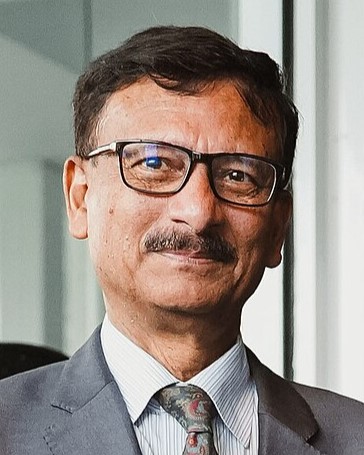
Such incidents do not occur along the borders of other countries unless there is a state of war. If individuals commit crimes, they might be prosecuted in court, but shouldn’t be killed.
—Md Touhid Hossain, Bangladeshi Foreign Affairs Adviser, at a roundtable titled “Bangladesh-India Relations: Expectations, Barriers and Future” in Nov ’24. Image Source: Wikimedia Commons
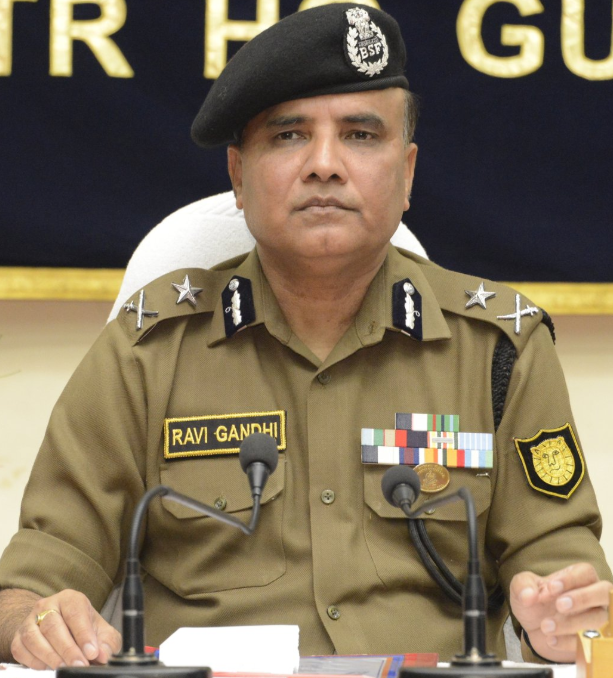
The incidents of shooting occur when a large number of people come with agents and attempt to infiltrate the border, sometimes attacking our personnel. At that time, in self-defence, our personnel open fire.
–Ravi Gandhi, Additional Director-General of BSF’s eastern command, as quoted by Scroll.in in November 2024. Image Source: @BSF_Gujarat/X
In October, the Bangladesh government sent another letter of protest to the Indian government. This time, a youth from its Cumilla district was shot allegedly by the BSF officials. The Indian media cited the BSF public relations officer who identified the deceased man as a smuggler. As noise dies down on Das’s killing, Asian Dispatch reached out to her brother Pintu for an interview.
He declined this reporter’s interview request, exasperated by the lack of action or any hopes of justice. “Will giving more media statements make my sister come back?” he said, before hanging up.