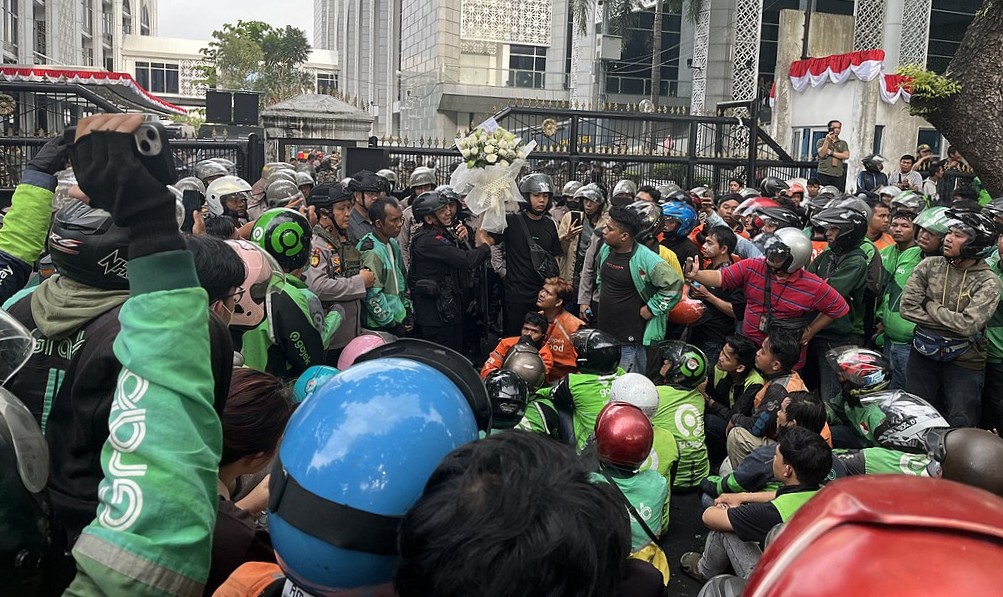
Protesters gather in front of DPRD Sumut gate entrance in Medan on August 29, 2025. Photo: Wikimedia Commons

In late August 2025, years of frustration against institutional malfeasance culminated in protests, demonstrations, and violence across Indonesia, the world’s third-largest democracy. The week-long turmoil eased only in September, after the scale of the unrest compelled the government and lawmakers to introduce changes, which rights groups and activists say fell short of meaningful reform.
The widespread protests began on August 25, after it was revealed that Indonesian lawmakers had been receiving a monthly housing allowance of Rp 50 million (approximately $3000) over and above their salaries since October 2024. This amount is 10 times the minimum monthly wage in capital city Jakarta and 20 times the minimum wage in economically weaker areas of the country.
In a country with a long history of corruption and authoritarian rule, racked by economic instability and rising costs, the revelation of this exorbitant perk sparked a fresh wave of outrage across the nation. This came at a time when the government was implementing austerity measures, including cuts to education and healthcare.
The public outcry escalated when a 21-year-old food delivery driver, Affan Kurniawan, was run over by a vehicle belonging to the nation’s elite paramilitary police unit at the protest on August 28.
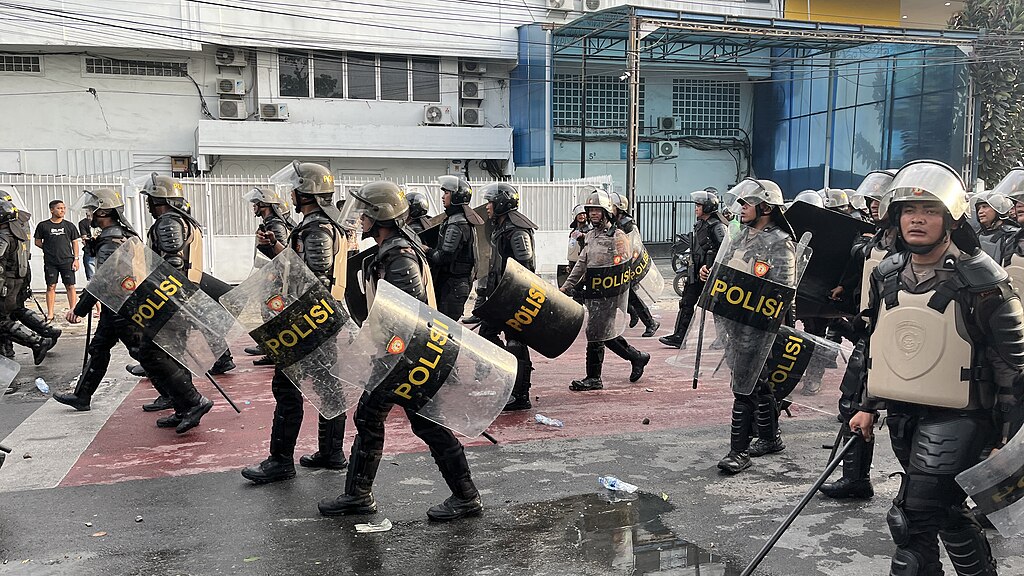
Riot police walking by in Medan, Indonesia, on August 29, 2025. Photo: Wikimedia Commons

Indonesia’s National Police (Polri) Chief General Listyo Sigit Prabowo issued an apology to Kurniawan’s family and assured an investigation into the case. Investigation into the incident was also assured by President Prabowo Subianto, who initially called the protests “treason and terrorism”.
On August 31, following the protests, Subianto announced that the parliament had decided to scrap housing allowance and suspend overseas trips.
The week-long clashes between protesters and police and military led to the death of at least ten people, and 44 others remain missing.
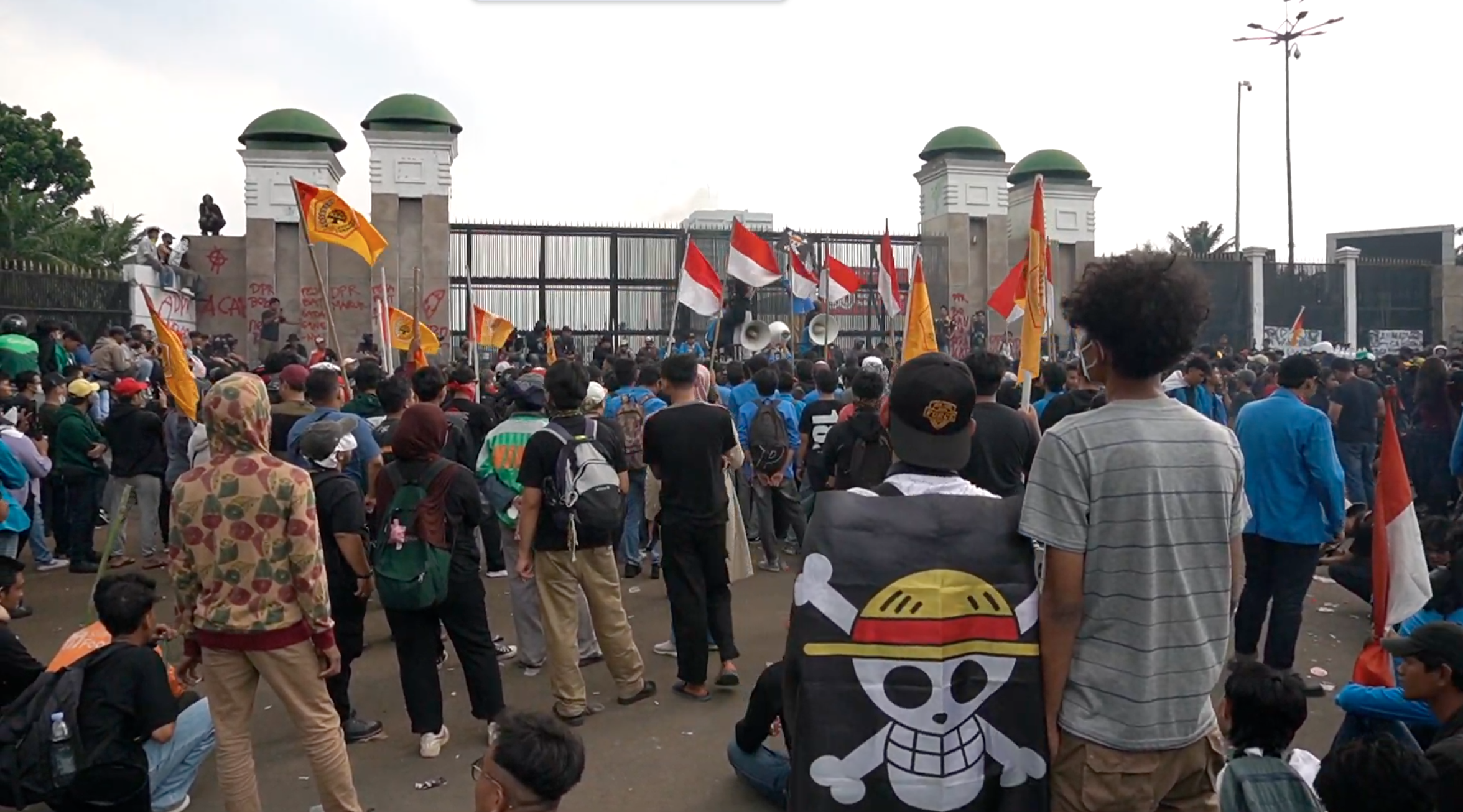
Protestors in Jakarta on August 28, 2025. Photo: Viriya Paramita Singgih/Project Multatuli
Although the tension has eased over the last week, demonstrations continue, primarily led by student groups in Jakarta.
Demands and Government Action
By early September, the “17+8 Demands” campaign gained influence across the protest movement. Compiled using statements from civil organisations and unions, the campaign lists 17 short-term demands such as releasing detainees, freezing lawmakers’ perks, equitable wages, and eight long-term demands to address corruption and induce institutional reform.
However, senior activists who have been voicing concerns for years, have expressed distress on social media, saying that the 17+8 demands lacked consultation with wider civil society.
Meanwhile, the government and the lawmakers have addressed some of these demands, such as detailing parliamentarians’ “take home pay” and beginning the release of political detainees. But significant action is yet to be taken toward many other demands.
On September 9, in a sudden reshuffle of his Cabinet, Subianto replaced five economic and security ministers, including Finance Minister Sri Mulyani Indrawati, former executive director of the International Monetary Fund and managing director of the World Bank. However, the newly appointed Minister of Finance Purbaya Yudhi Sadewa, has made dismissive comments about the “17+8” campaign after he was sworn in.
History of Protests
Over the last two years, there have been many waves of mass protests and demonstrations against controversial moves by Indonesian governments.
In August last year, thousands of people took to the streets after the government attempted to change an election law to favour the dynastic coalition led by former President Joko “Jokowi” Widodo, and current President Subianto.
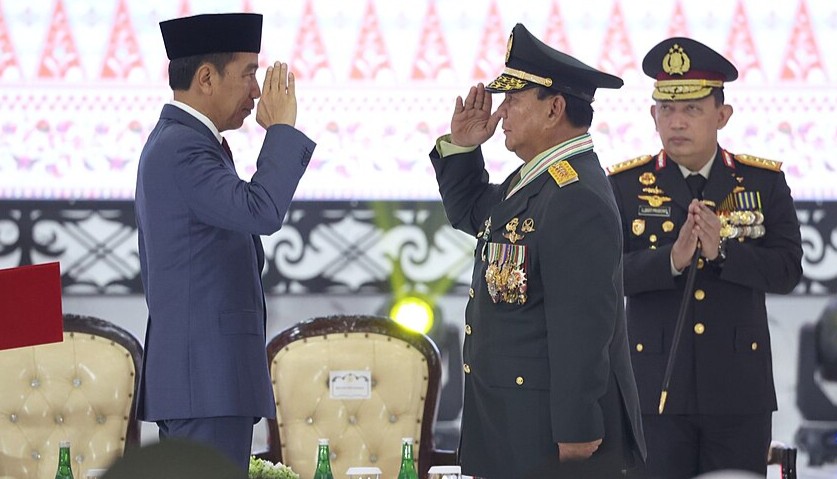
Former Indonesian president Joko Widodo (left) and then-Defense Minister Prabowo Subianto (right). Photo: Indonesian Ministry of Defense/Wikimedia Commons
In February 2025, student-led ‘Dark Indonesia’ protests took place in Yogyakarta, Jakarta, and Medan. Sporadic protests continued throughout the year over controversial government policies, budget cuts, against the increased re-involvement of the military in civilian matters, economic inequality, the Gaza genocide, government and police corruption, and more.
READ: Indonesia’s New Capital: How Jokowi Uses Extravagant Promises to Lure Investors
Police and military have been accused of using disproportionate force during the latest protests, prompting the United Nations to call for an investigation. Seven officers were detained in relation to Kurniawan’s death and one of them was dishonorably discharged.
Although the situation seems to have abated, the foundational issues causing nationwide tensions haven’t been addressed by Subianto’s government. Subianto, a former special forces commandant, has established 100 new battalions since coming to power less than a year ago in October 2024, with plans for much more.
The new battalions are allegedly to assist in civilian domains like agriculture, husbandry and food security. These battalions, along with the passing of a law allowing armed forces personnel to hold more civilian posts, have signalled a return to Indonesia’s “New Order” era, a dark period of authoritarian rule in Indonesian history led by military dictator Suharto. Subianto is Suharto’s former son-in-law.
However, Prabawo is not the first since Suharto to be accused of undermining Indonesia’s democracy. His predecessor, Joko Widodo—elected in 2014 as a “man of the people”— left behind a tainted legacy of corruption and nepotism.
The story has been updated on September 9 with the latest developments.
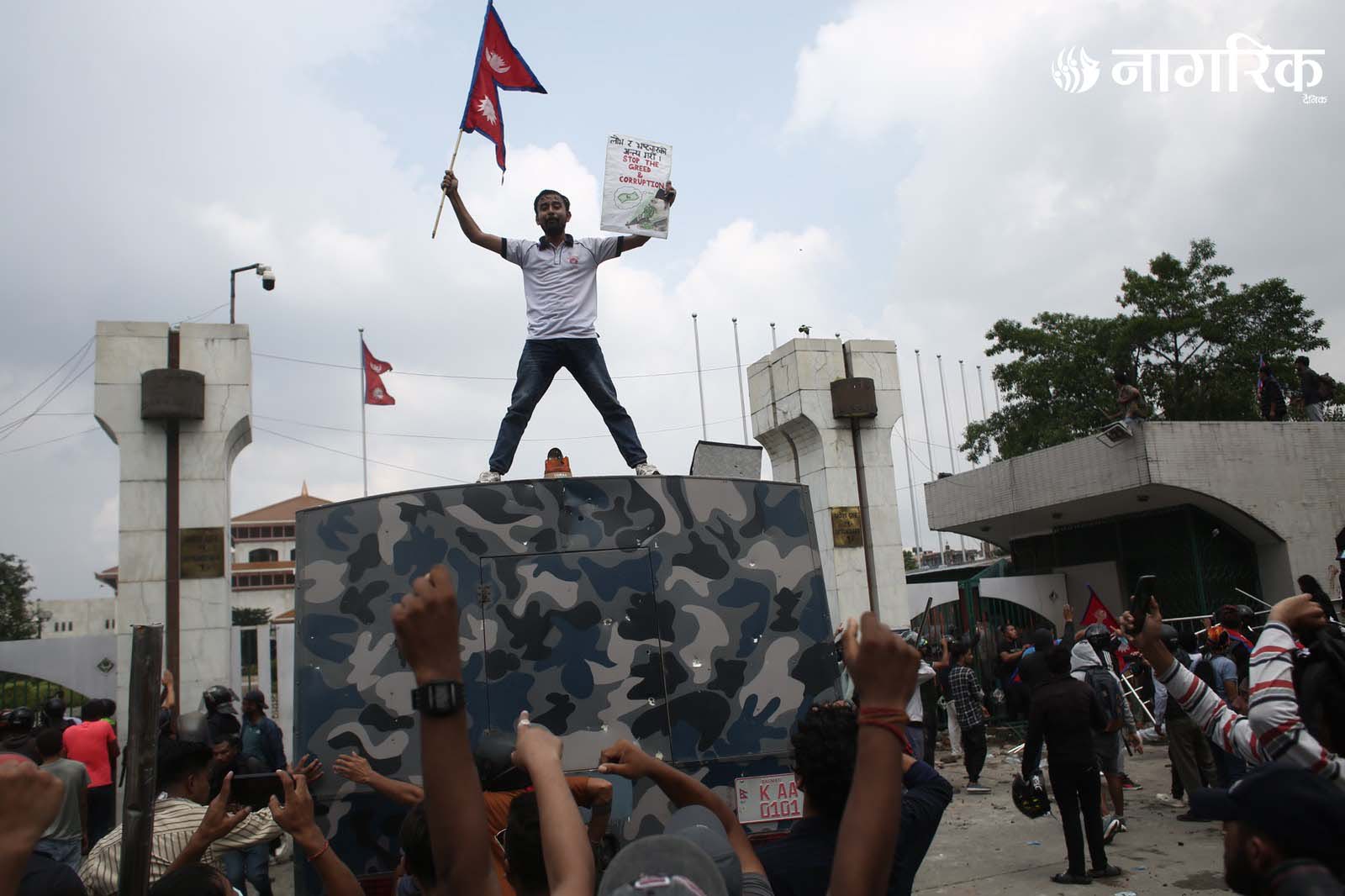
Nepal Prime Minister KP Sharma Oli resigned from office following the massive protests in the country by the youth against corruption and a ban on social media platforms. As the protests turned violent and snowballed out of control, at least 19 people lost their lives and hundreds of others have been injured.
The protesters set ablaze Oli’s house, the Parliament building, the main gate of Singha Durbar, the Nepali Congress’ (NC) central office, and the CPN-UML’s central office.
Earlier on Monday, police used heavy force including multiple gunshots, rubber bullets, water cannons, and baton charges to disperse the agitating youngsters.
Baneshwor—the heart of the capital city Kathmandu and home to Nepal’s federal Parliament—descended into chaos as protests, dubbed as Gen Z protests, escalated into violent confrontations. Despite the government’s imposition of a curfew, defiant crowds of protesters continued to occupy the streets, chanting slogans, and challenging security forces.
The tense standoff transformed Baneshwor into a flashpoint of unrest.
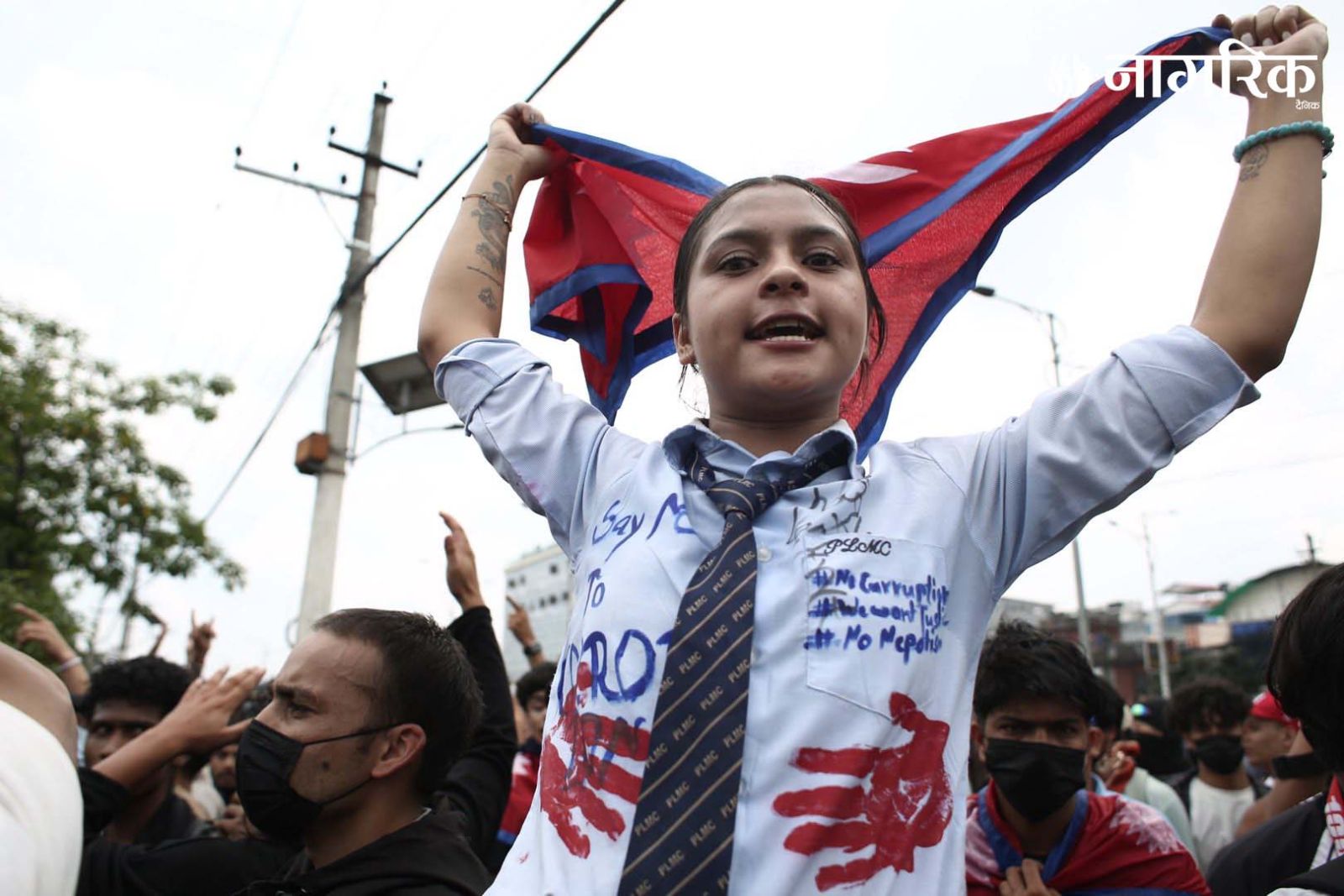
Photo: República
Curfew Imposed
The District Administration Office (DAO) Kathmandu imposed an indefinite curfew starting 8:30 am on Tuesday. The earlier curfew, enforced following Monday’s protests, had ended at 5 am this morning.
Earlier, Nepali Army (NA) personnel took control of the roads surrounding the Parliament complex in New Baneshwor, Kathmandu. As of September 8, protesters remained between Baneshwor and Bijulibazar, and didn’t disperse despite curfew order, according to SSP Shekhar Khanal of the Kathmandu Valley Police Office, Ranipokhari.
Gen Z Nepal, however, distanced itself from the incident, stressing that those who stormed the Parliament were not affiliated with their campaign.
“Our movement had around 20 to 25 groups, and the plan was to march only up to Everest Hotel,” said organiser Ujen Raj Bhandari. “Those who went beyond that point are not recognized by us. We have already asked students present there to return.”
As tensions escalated, Gen Z Nepal issued an urgent appeal on social media urging participants to leave the protest site immediately.
“Please exit safely as soon as possible. Several vested groups are inciting the crowd. Our day has already been a success. Please go home safely today,” the statement read.
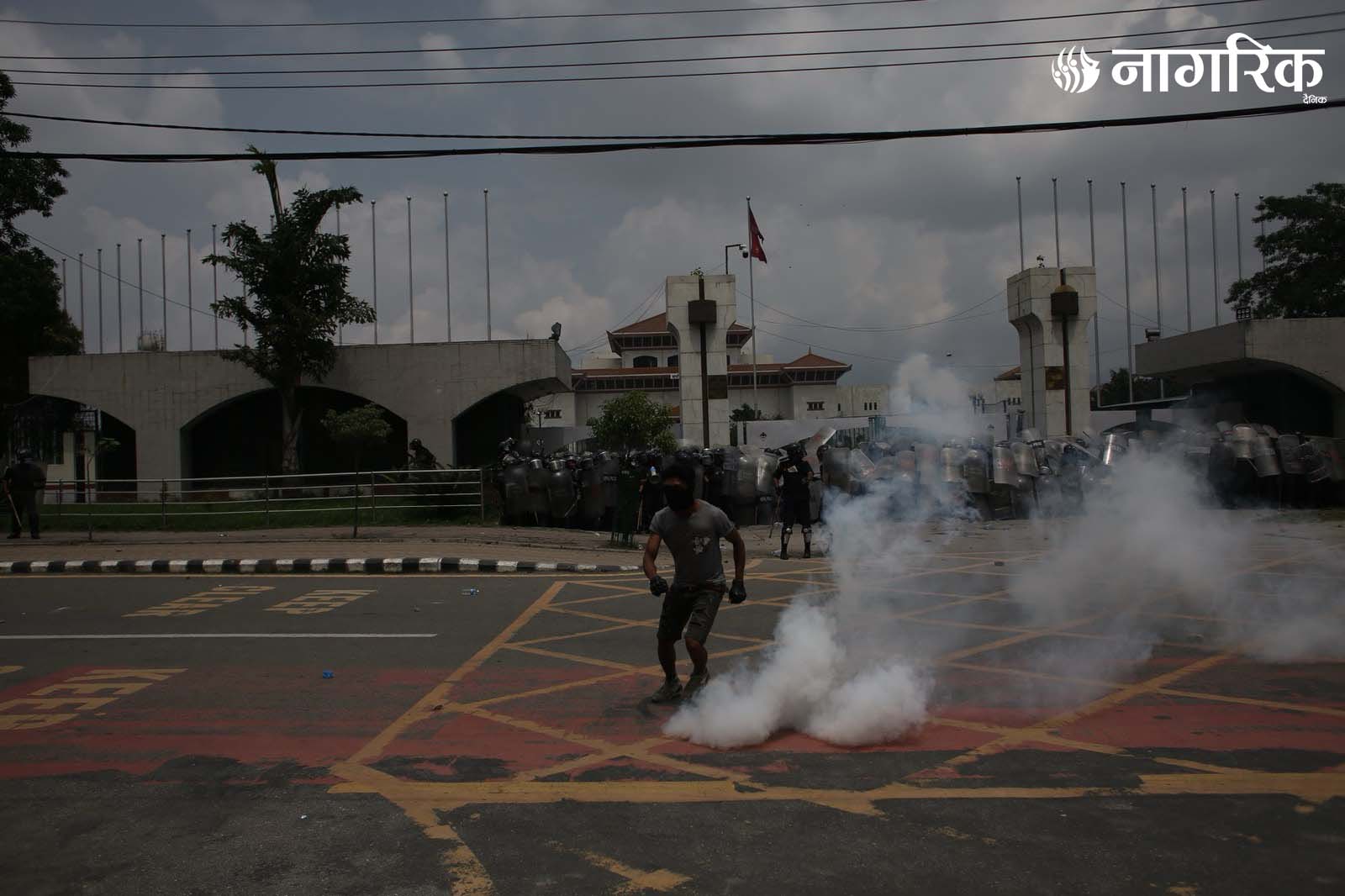
Photo: República
Government Response
President Ramchandra Paudel has accepted the resignation of PM Oli. He is now preparing to move forward with the process of forming a new government in accordance with Nepal’s Constitution. “The President is consulting with relevant parties to advance the government formation process as per the Constitution,” a presidential advisor stated.
In the early hours on Tuesday, the government had reportedly lifted the ban on social media platforms and formed a committee to investigate the protest.
A cabinet meeting, held on Monday evening, decided that the committee would look into all incidents that occurred during the demonstration. The panel has been given 15 days to complete the investigation and submit its report to the government.
Meanwhile, the Ministry of Health and Population (MoHP) had instructed all federal hospitals to provide free treatment to citizens injured during the protests.
MoHP led by Minister Pradip Paudel issued a circular directing hospitals to ensure prompt care for injured protesters without any charges. The MoHP also called for making ambulance services more efficient and easily accessible where needed.
The Kathmandu Valley ambulance network was urged to facilitate transfers of patients referred between hospitals. Additionally, all doctors and healthcare workers were appealed to come together to provide timely treatment to the injured.
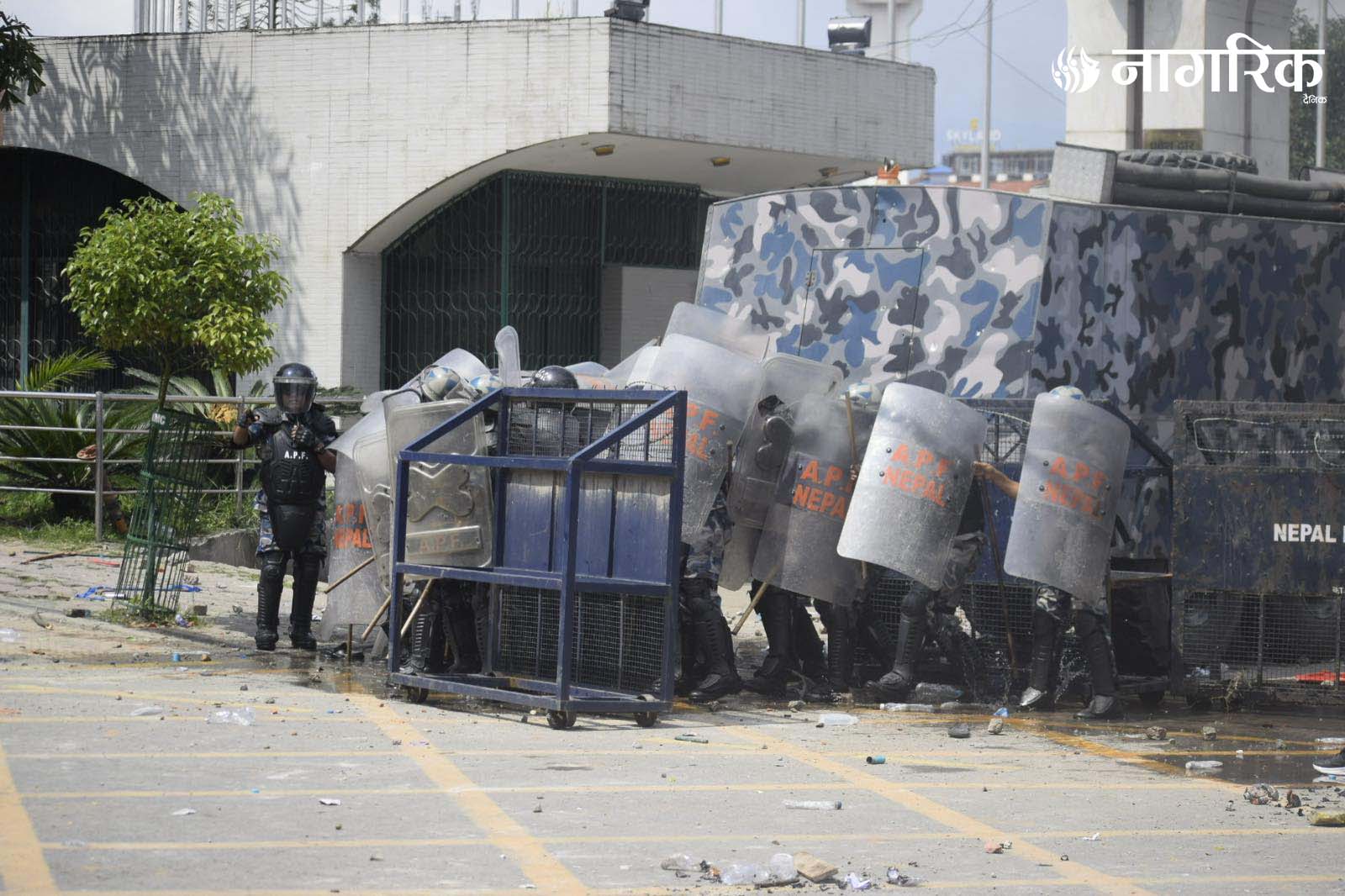
Photo: República
Opposition Demands PM’s Resignation
Opposition parties, including the CPN (Maoist Center) and the Rastriya Swatantra Party (RSP), had demanded the resignation of the prime minister, accusing his government of committing a massacre during the protests in the capital and across the country.
They concluded that the government’s handling of the movement was “highly inappropriate,” insisting the prime minister step down to create a conducive political environment.
As part of its campaign “Maoist with the People, Mid-Hill Pushpalal Highway — National Awakening Drive,” top Maoist leaders, including Chairman Pushpa Kamal Dahal, senior vice-chairs, vice-chairs, and the general secretary, had reached Gorkha on Monday. However, after learning about the escalation of protests in Kathmandu and reports of casualties, the leaders held an informal meeting, demanded the PM’s resignation, suspended their campaign, and returned to the capital the same day.
Similarly, the RSP also demanded Oli’s immediate resignation and early elections. Meanwhile, the Janata Samajbadi Party-Nepal (JSP-N), led by Upendra Yadav, demanded the immediate lifting of the social media ban and urged the government to hold talks with protesters to resolve the crisis.
Reason Behind the Protests
Public anger has surged since the government’s September 4 decision to simultaneously shut down 26 platforms, including Facebook, WhatsApp, Instagram and YouTube. In response, Gen Z has turned the issue into a broader campaign, raising voices against violations of fundamental rights as well as against nepotism and corruption.
One of the youths involved is Aarati Ray of Kathmandu. According to her, the country’s system has already been ruined by partisan politics, leaving no choice but for this generation to take to the streets. “We are clear. The country has been devastated by corruption. The root cause is a broken system,” Ray told Republica. For many, social media was the only outlet to vent frustration over hardships faced in public services.
On TikTok, the hashtag #PoliticiansNepoBabyNepal is raising questions about expensive cars, foreign education, and lavish lifestyles of politicians’ children. As Gen Z’s movement heads to the streets, the sharpest criticism has targeted the family of Nepali Congress President Sher Bahadur Deuba.
Gen Z activists have been posting photos and videos of his son Jaiveer and daughter-in-law Sivana’s lavish lifestyle, running a “Nepobaby” campaign online. Youth have also taken a dig at Shrinkhala Khatiwada, daughter of a former health minister Birodh Khatiwada; Ganga Dahal and Smita Dahal, daughter and granddaughter of former prime minister Pushpa Kamal Dahal; Anjila Basnet, daughter of former minister Mahesh Basnet; Ankit Khand, son of a former home minister, and Kshitiz Parajuli, son of former chief justice Gopal Parajuli.
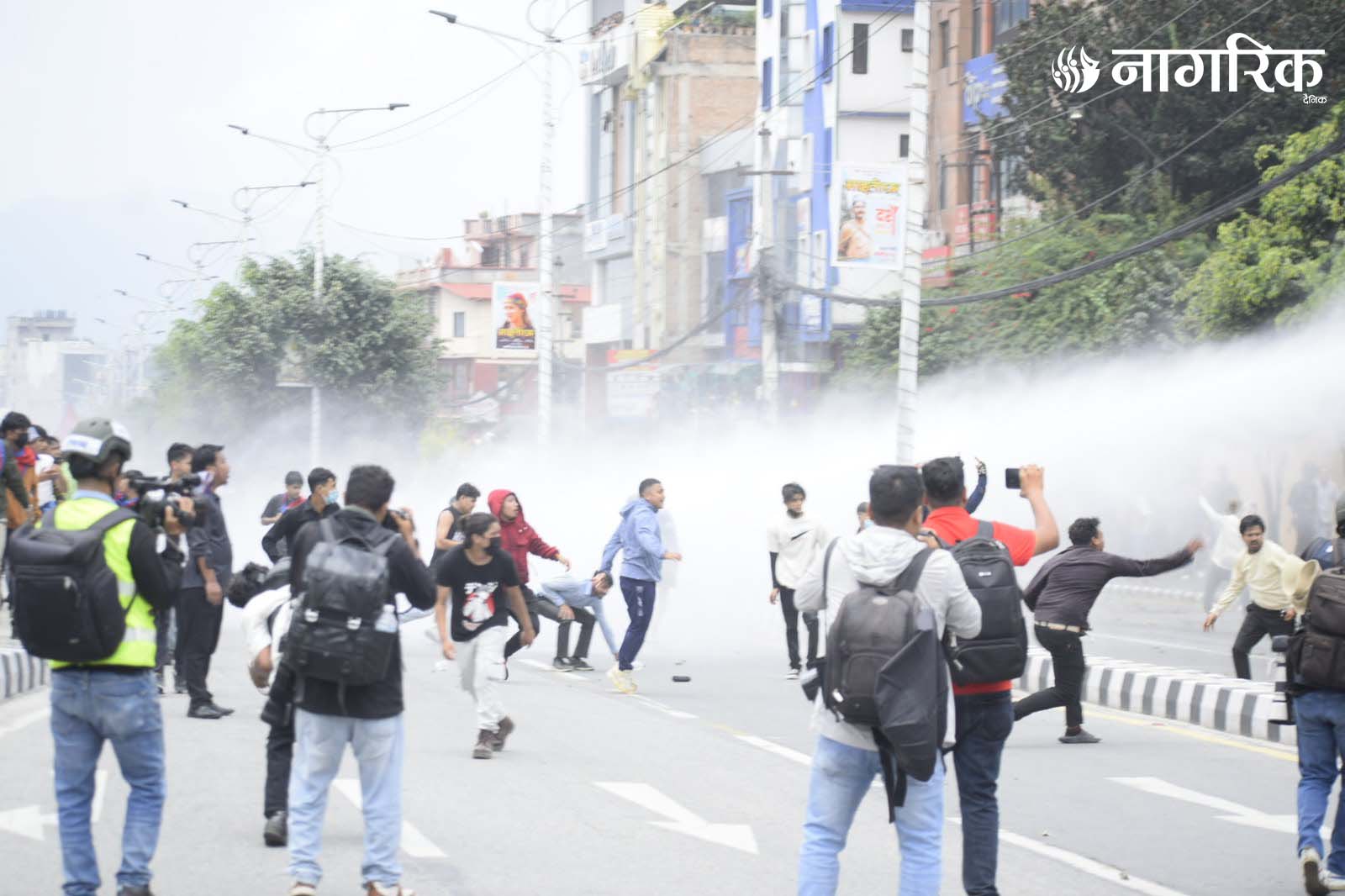
Photo: República
Content creator Bishal Gautam made a satirical video calling out ‘Nepo Baby’ privileges, which has already gathered over 400,000 views. Another user @am___bika expressed frustration commenting: “Corruption in Nepal is not just a political issue — it’s a deep-rooted crisis that affects every citizen, every community, and every dream for a better future. From the smallest public office to the highest levels of government, the misuse of power and public funds has become so common that many have stopped questioning it. That is the most dangerous part — when corruption becomes normalized, accepted, and even expected.”
The protest has been amplified by the viral “Holy Airball!” trend, which became a social media sensation among youth worldwide. The “Holy Airball” trend, popular among youth, uses a three-part format to show off personal or family achievements. The first slide shares a fact about themselves or their family, the second presents a common assumption, and the third humorously proves that assumption wrong with the phrase “holy airball.” Borrowing the basketball term for a complete miss, the trend became a way for young people to flex their success, wealth, or talents while playfully telling viewers not to underestimate them.
As the movement against the social media ban gained ground, the trend inadvertently became a platform for expressing frustration at government restrictions and corruption, turning it into a symbol of youth defiance. However, in the wake of the social media ban and growing public scrutiny, several of these flashy posts have reportedly been deleted by their original posters.
The shutdown of Facebook and YouTube has directly hit content creators and digital marketers. Despite promoting the idea of a “Digital Nepal,” the government shut down these platforms overnight without offering any alternatives for those whose income depends on them.
In response, youth have been voicing outrage at the government and political leaders. Many influencers, digital entrepreneurs and even some politicians have declared support for Gen Z’s protest campaign.
This is a developing story.
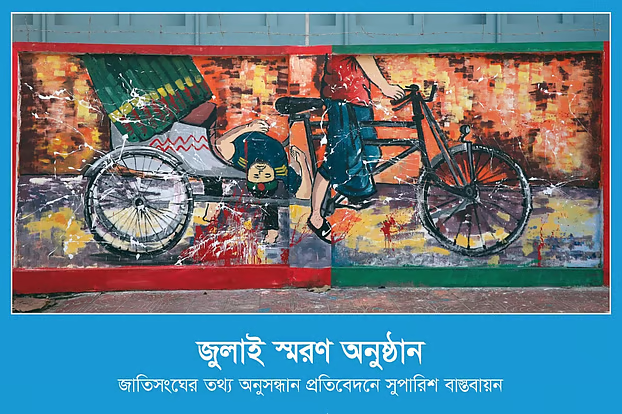
The interim government’s Chief Adviser Professor Muhammad Yunus has reaffirmed his commitment to ensuring justice for human rights violators.
Emphasising the need for reforms, he stated, “This is not just cosmetic change, rather this is a transformation at the deepest level. If we do not bring about such profound reforms, the very autocracy we are speaking against today will return, no matter how much we try to contain it or reform it. We need deeper reform. It is absolutely essential.”
He made these remarks on Tuesday, while addressing a July Commemoration organised by the United Nations’ Dhaka office at a hotel in the capital. The event focused on the July mass uprising and the UN’s investigative report.
Other speakers at the event included Bangladesh Nationalist Party (BNP) Secretary General Mirza Fakhrul Islam Alamgir, Bangladesh Jamaat-e-Islami Ameer Shafiqur Rahman, National Citizen Party (NCP) Secretary General Akhter Hossen, Golam Rahman—father of July uprising martyr Nafis—and Sabrina Afroz Srabonti, sister of martyred activist Saikat.
A recorded message was delivered by UN High Commissioner for Human Rights Volker Türk.
In his address as the chief guest at the closing ceremony, Professor Yunus said, “Alongside conducting reforms, we are committed to bringing to justice those responsible for the grave human rights violations committed in July. Justice is not just about punishment; it is about building a state where power is never again used against the people.”
He further noted that from 1 July to 5 August last year, serious human rights violations occurred, prompting the government to request an independent and impartial investigation by the UN Human Rights Office. The UN’s report, published in February, documented the deaths of around 1,400 people. The report concluded that the violence was planned, coordinated, and executed at the highest levels of the previous government.
READ: In Bangladesh, Cops Accused of Killing Protesters During 2024 Uprising Roam Free
“We are grateful to the UN Human Rights Office not only for documenting this repression but also for offering a wide-ranging set of recommendations to prevent such atrocities from ever happening again,” Professor Yunus said.
He also outlined steps already taken by the incumbent government to protect human rights, including amendments to the Penal Code, Bangladesh’s accession to the international convention on the protection of all persons from enforced disappearance, and the signing of a memorandum of understanding (MoU) with the UN.
Under this MoU, a support mission is being set up in Dhaka to provide technical assistance and training to both government institutions and civil society, he added.
Reaffirming his vision for an inclusive political and social system, the Chief Adviser said, “We are working towards a national consensus for a new political framework that ensures inclusive, participatory, and credible elections.”
In his remarks, Mirza Fakhrul Islam Alamgir stated, “We too want justice for those killings to be delivered swiftly, urgent reforms be implemented without delay. But one thing must be remembered—a government that genuinely represents the people is crucial. Because, there is a clear difference between acting with a mandate and acting without one.”
The senior BNP leader stressed the need to build a democratic Bangladesh. “I believe a democratic system will gradually solve our problems. We cannot expect a revolutionary transformation overnight, but meaningful change will certainly come through democratic means.”
He also expressed hope that a free, fair, and inclusive election will be held, leading to a government truly representative of the people, as promised by the Chief Adviser.
Fakhrul acknowledged the Chief Adviser’s efforts, saying, “Actually, one year is not a long time. But within that time, significant progress has been made. And most notably, they have advanced the reform process.”
Jamaat-e-Islami Ameer Shafiqur Rahman remarked that no election could be held before trying those responsible for crimes against humanity committed by the Awami League during the July movement.
“Justice, reform, and elections must go hand in hand. Holding an election before justice and reform would be a disaster for the nation,” he warned.
He further said, “We demand justice for the Awami League, but it must be just—not vengeful. Let them receive the justice they deserve. If true justice is established, no one will be spared. Those who committed murder must receive their rightful punishment, and the culture of impunity must end.”
NCP leader Akhter Hossen endorsed the UN investigation team’s recommendation for an independent judiciary. He also called for the identification and prosecution of those involved in the July killings who remain in the country, and for extradition of those who have fled abroad.
Golam Rahman, father of July uprising martyr Nafis, alleged that the police officer responsible for killing his son is still serving in Cox’s Bazar. He demanded the officer be brought to trial soon.
Sabrina Afroz Shrabonti, sister of martyr Saikat, said she wanted to see the conclusion of the trial for the July killings and called for the immediate publication of the July Charter.
UN Human Rights Commissioner Volker Türk, in his message, called for swift prosecution of those responsible.
The event was presided over and moderated by Huma Khan, Senior Human Rights Adviser at the UN Office in Dhaka.
A documentary on the martyrs and injured of the July uprising was screened at the start of the closing session.
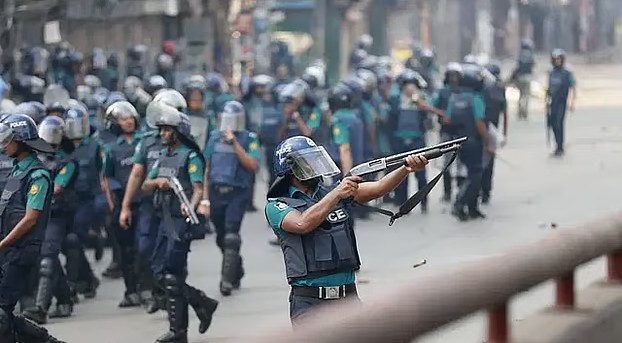
Cases have been filed against 1,059 police officers in various police stations and courts across Bangldesh on charges of shootings and killings during the July 2024 mass uprising. So far, 41 officers have been arrested in connection with these cases.
Among the arrested are former Inspector General of Police (IGP) Chowdhury Abdullah-Al Mamun, former IGP AKM Shahidul Haque, former Dhaka Metropolitan Police (DMP) Commissioner Md. Asaduzzaman Mia, and Joint Commissioner Mashiur Rahman.
Others include Deputy Inspector General (DIG) Mollah Nazrul Islam and former Chittagong Metropolitan Police Commissioner Saiful Islam. However, several high-profile officers remain at large, including former Additional IGP Md. Monirul Islam, former DMP Commissioner Habibur Rahman, and former Additional Commissioner (Detective Branch) Mohammad Harun-ur-Rashid. Some have reportedly fled the country.
According to the police headquarters, the widespread shooting and killing of civilians during the student-led movement from 16 July to 5 August last year has drawn intense criticism, both within and outside the police force. There have been growing demands to identify and hold those responsible accountable.
READ: In Bangladesh, Cops Accused of Killing Protesters During 2024 Uprising Roam Free
The 1,059 police officers facing charges include five former IGPs, 41 former Additional IGPs, 12 former DIGs, 12 current DIGs, two former Additional DIGs, 42 current Additional DIGs, three former Superintendents of Police (SPs), 59 current SPs, 56 Additional Superintendents of Police, 21 Assistant Superintendents of Police, 168 Inspectors, and 638 Sub-Inspectors (SIs), Assistant Sub-Inspectors (ASIs), Naiks, and Constables.
While the police headquarters has not officially disclosed the number of cases against its officers, sources indicate that 656 cases have been filed related to killings during the uprising, while 737 cases involve injuries—bringing the total number of cases linked to casualties to 1,393. Several senior police officers have stated that many of those implicated were close to the ousted Awami League government and were involved in issuing or executing orders to suppress the protests.
However, they also claim that some officers have been accused unfairly. Authorities insist that legal action is being taken after thorough verification, and innocent officers will not be harassed.
IGP Baharul Alam told Prothom Alo in December that a committee has been formed in each of the eight police ranges, led by an Additional DIG, to oversee cases related to the killings. These committees will supervise the investigations, which will be conducted by experienced former and current officers.
In most cases, police officers are being charged alongside other individuals. As a result, the prosecution of those involved in the killings depends on the progress of these investigations.
When asked about the matter, Assistant Inspector General (AIG) of the Police Headquarters’ Media and Public Relations Department, Enamul Haque Sagar, told Prothom Alo that law enforcement is taking these cases seriously and will bring those found guilty to justice.
Apart from cases filed by victims’ families, the killings during the July mass uprising are also being prosecuted at the International Crimes Tribunal. So far, 18 former law enforcement officers have been arrested in connection with those proceedings.
Those Arrested
Among the then-officers of the arrested police are former Deputy Commissioner of DMP Md. Jasim Uddin Molla, Superintendent of Police (SP) Tanvir Salehin, Mohiuddin Farooqui, Abdul Mannan, SM Tanvir Arafat, Asaduzzaman, Md. Abdullahil Kafi, Jewel Rana, Additional Superintendent of Police of Armed Police Battalion (APBN) Md. Rafiqul Islam, Additional Superintendent of Police of Dhaka District Shahidul Islam, Additional Deputy Commissioner of Khulna Metropolitan Police (KMP) Md. Sadeq Kawsar Dastagir, Additional Superintendent of Police of Barisal Alep Uddin, Additional Deputy Commissioner of DMP Mirpur Division Darus Salam Region MM Mainul Islam, Assistant Commissioners of DMP Traffic Division Iftekhar Mahmud and Md. Tanzil Ahmed, Assistant Commissioner of DMP Badda Region Rajan Kumar Saha, Former Officer-in-Charge (OC) of Jatrabari Police Station Abul Hasan, Former OC of Gulshan Police Station Mazharul Islam, among others.
Who face the most cases?
According to the police headquarters, the highest number of cases has been filed against the then Additional Commissioner of Dhaka Metropolitan Police (DMP), Mohammad Harun-or-Rashid, who faces 174 cases. He is followed by former Inspector General of Police (IGP) Chowdhury Abdullah Al-Mamun, against whom 159 cases have been filed. Additionally, former IGP Shahidul Haque faces 23 cases, Benazir Ahmed 11 cases, Hasan Mahmud Khandaker seven cases, and Javed Patwari two cases.
Among other senior officials, former Additional IGP Md. Monirul Islam has been accused in 46 cases, while former DMP Commissioner Habibur Rahman faces 118 cases. Former Dhaka Range DIG Syed Nurul Islam has been named in 16 cases, former Additional DIG Biplab Kumar Sarkar in 128 cases, and Additional DIG SM Mehedi Hasan in 33 cases.
Among DMP deputy commissioners, the highest number of cases has been filed against Mohammad Iqbal Hossain, the then Deputy Commissioner of Wari Division, who faces 27 cases. A video that went viral after the fall of the government shows Iqbal speaking with former Home Minister Md. Asaduzzaman Khan about the shooting of anti-discrimination protesters.
In the footage, Iqbal is seen showing a video on his mobile phone and saying, ”Sir, it seems like shooting and taking down bodies. I shoot, one dies, one is injured. Only one goes, sir, the rest don’t go. This is the biggest fear and worry, sir…” Former IGP Chowdhury Abdullah Al-Mamun and former Home Secretary Jahangir Alam were also present at the time.
The list of accused includes several high-ranking officers such as former Additional IGPs Mokhlesur Rahman, Shafiqul Islam, Iqbal Bahar, Mahbubur Rahman, Atiqul Islam, Banaj Kumar Majumder, Didar Ahmed, Mohammad Ali Mia, M Khurshid Hossain, Selim Mohammad Jahangir, Khandaker Lutful Kabir, Krishnapada Roy, and AKM Hafiz Akhter. Additionally, former DIG SM Mahfuzul Haque Nuruzzaman has also been implicated.
Former IGP Muhammad Nurul Huda told Prothom Alo that the investigation into the July mass uprising cases should be expedited. He emphasised that those who are innocent should be acquitted, while those found responsible should be brought before the court.
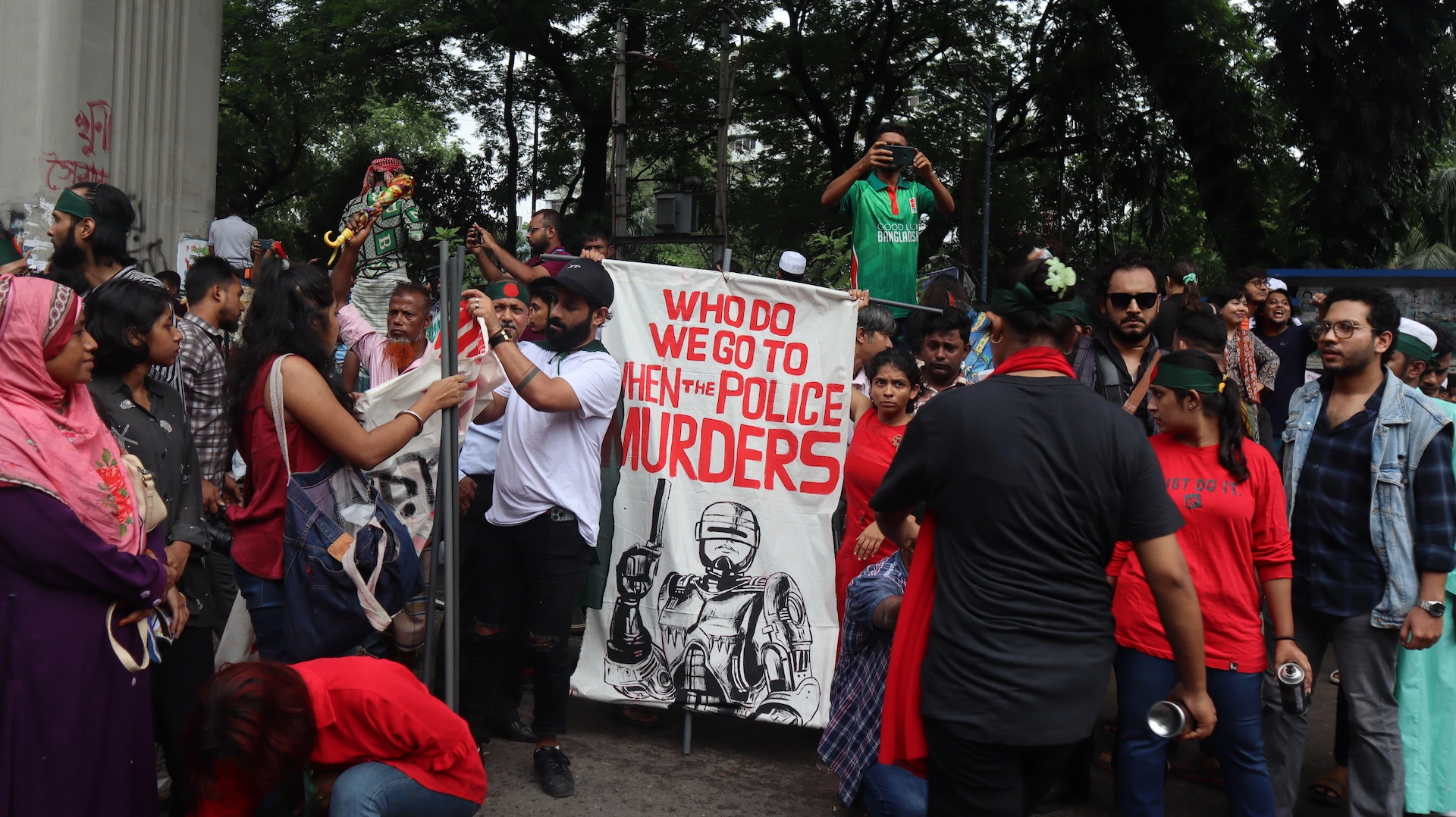
On August 2, 2024, protesters in Dhaka brought a large procession for Hasina’s resignation. Photo: Masum Billah
Imam Hasan Taim had already been shot twice before the camera started recording.
On July 20, 2024, Taim was in Jatrabari, a neighbourhood in Bangladesh’s capital city Dhaka, when the police started firing. He was one of the student protesters in a crowd that had gathered to demand resignation of the now ousted prime minister Sheikh Hasina.
In the now-viral footage, taken by a journalist called Arefin Mahmud Shakil, Taim is seen being dragged by his friend Rahat Hossain to safety. A few seconds in, a police officer is seen shooting Imam at close range. The officer’s name was later identified as Jakir Hossain. Rahat was also injured but he continued to drag Imam. In the next few seconds, Jakir Hossain was seen shooting Imam again — then again. Unable to go on any further, Rahat fled to save his own life.
Ironically the son of a police officer himself, Taim was left at the scene for half an hour before officers carried his body to Jatrabari police station. There, his family claims that the officers trampled their son – who was alive until then – to death.
“My brother would have survived had he been taken to the hospital,” Rabiul Awal, Imam Hasan’s older brother, told Asian Dispatch. “But after they took him to Jatrabari thana, a group of officers led by an officer called Assistant Commissioner (AC) Nahid Ferdous trampled him to death.”
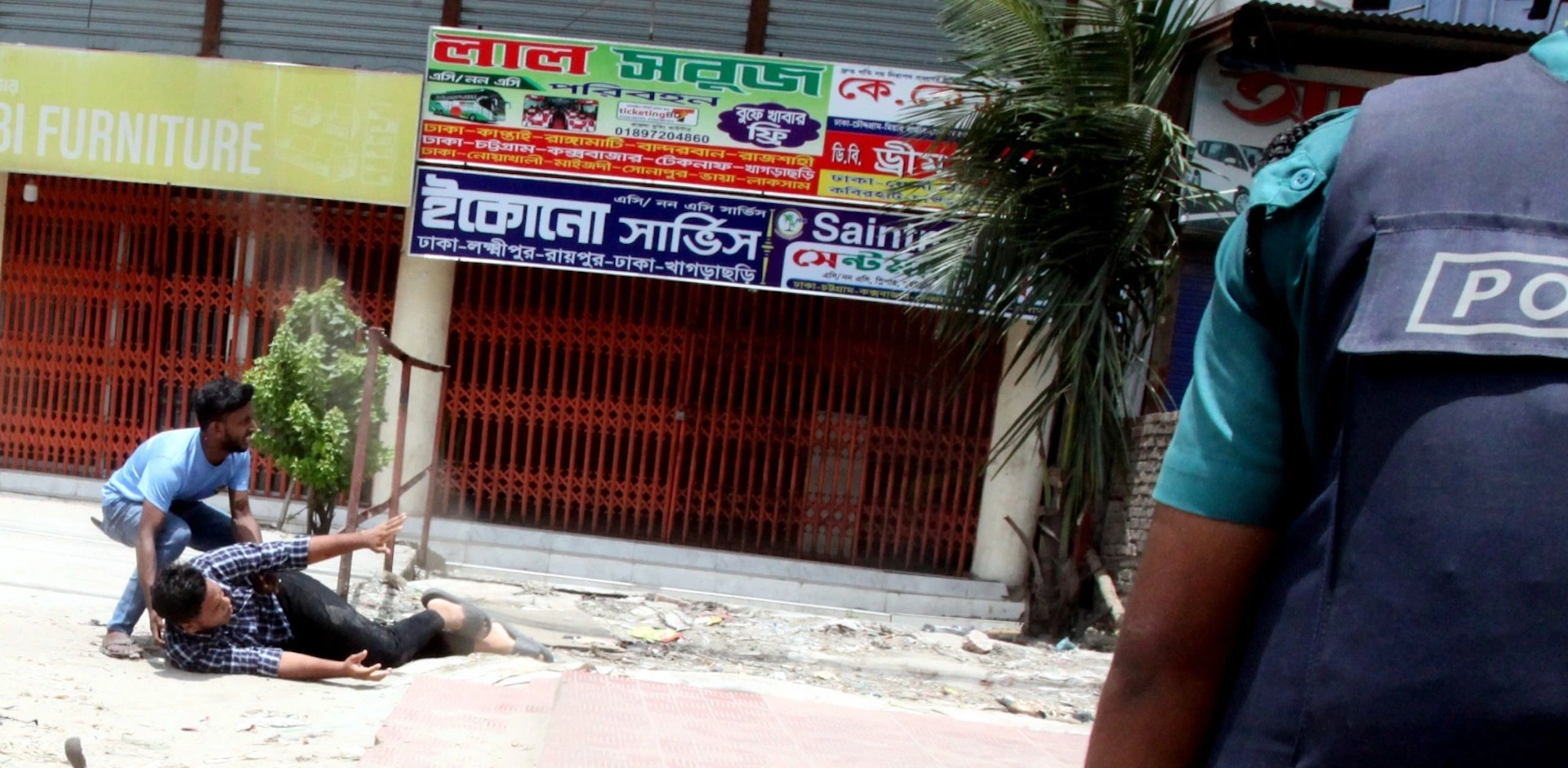
Taim (right) and his friend Rahat being attacked during protests on July 20, 2024. Photo via screengrab.
Taim’s family identified at least eight more police officers from the Dhaka Metropolitan Police alongside Jakir Hossain, including Additional Deputy Commissioners Shakil Mohammad Shamim and Shahadat Ali, and Additional Deputy Commissioner Masudur Rahman.
My brother would have survived had he been taken to the hospital. But after they took him to Jatrabari thana, a group of officers led by an officer called Assistant Commissioner Nahid Ferdous trampled him to death. — Rabiul Awal, Taim’s older brother.
Taim’s brother Awal told this reporter – based on his review of government documents – that out of this group of cops, Nahid Ferdous was later transferred and stationed at a Rapid Action Battalion (RAB) camp in Jhinaidaha district, which is nearly 200 kms from Dhaka. RAB is a paramilitary force in Bangladesh sanctioned by the US for human rights abuses under Hasina’s rule.
Imam’s family filed a case against 10 police officers, including Jakir Hossain, Iqbal Hossain, Shakil Mohammad Shamim, Tanjil Ahmed, Shahadat Ali, Masudur Rahman, Nahid Ferdous, Shudipta Kumar and Wahidul Haque, in a Dhaka court. Among them, only Abul Hasan, Tanjil Ahmed, and Shahadat Ali have been arrested.
The family also filed a case against the accused at the country’s International Crimes Tribunal (ICT), where warrants were issued for several officers, including Nahid.
“The ICT issued warrants for them on November 12. But AC Nahid was on duty until November 20. How is that possible?” Tuhin asked, implying Nahid’s connection with an influential Dhaka Metropolitan Police official. He suspects forces within the police are sheltering the accused officers.
A Tale of Disproportionate Police Violence
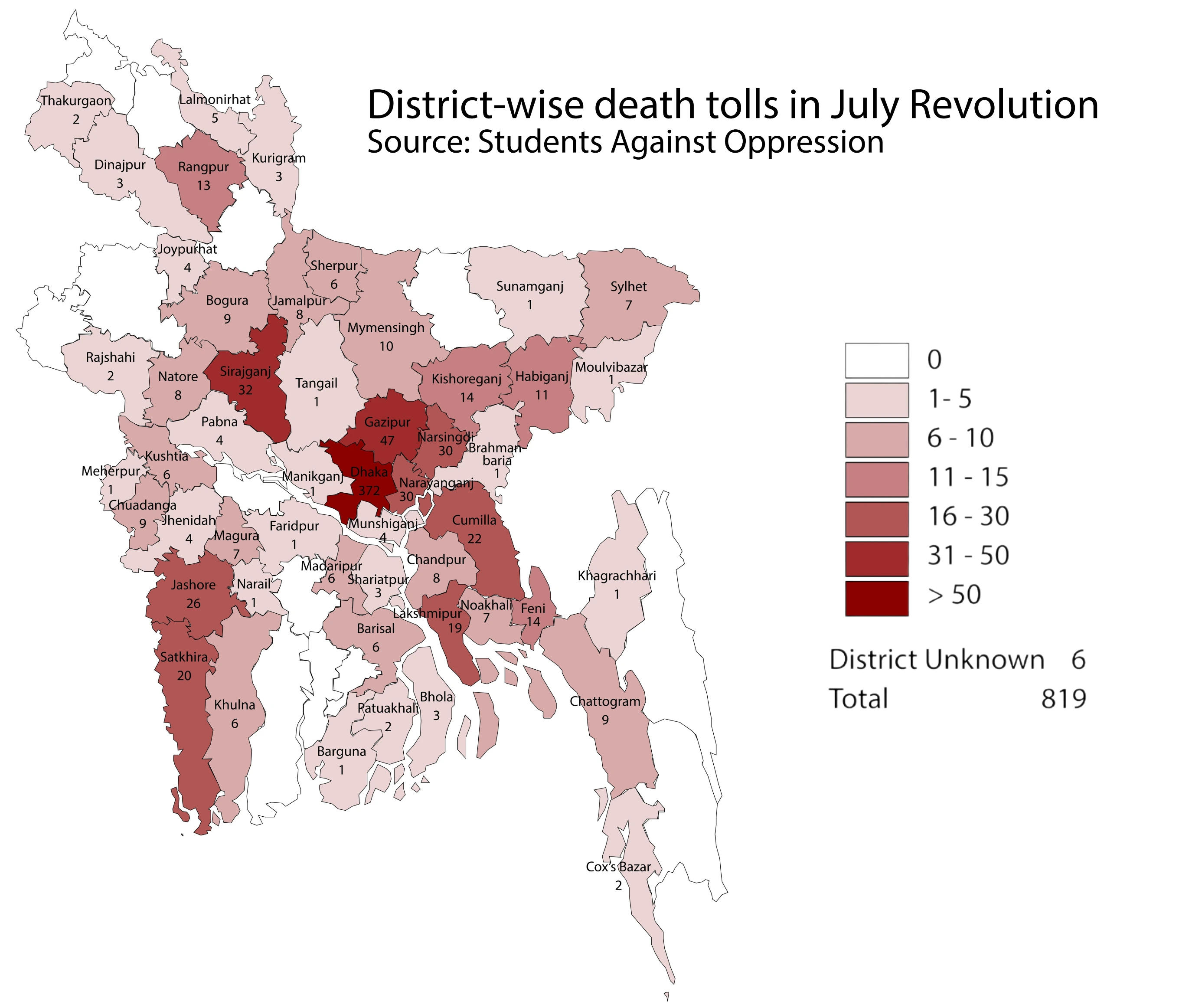
The mass uprising in Bangladesh – South Asia’s youngest country formed in 1971 – was a pivotal moment in the world that saw thousands of people, mostly students, not only shake Hasina’s 16 years of autocratic rule, but dismantle it entirely. Hasina fled the country – she’s currently in hiding in India – but left, in the wake of her ouster, a lasting legacy of police brutality. From July 16 to August 5, 2024, more than 800 people, including at least 89 children, were killed by the police, other security forces and men associated with Hasina’s party.
On July 19 alone – the day the fallen regime enforced an internet blackout – at least 148 people were killed by law enforcement agencies, according to a report by the International Truth and Justice Project (ITJP) and Tech Global Institute.
“Shockingly, 54 of the dead were shot in the head or throat. Many of those killed were not even part of the protests, but bystanders and people who happened to live or work close to the shooting that was completely indiscriminate,” the ITJP report found.
Among them were children as young as four-year-old Abdul Ahad and six-year-old Riya Gope, each shot in the head in front of their parents at home during an attack on protesters in their neighborhood.
In a report by Human Rights Watch (HRW), released on January 27, 2025, a police officer is quoted as saying, “I witnessed officers firing at vital organs…. In many cases, I witnessed live ammunition being fired even when officers’ lives were not in danger.” Another police official described, to HRW, how senior officers in the Dhaka Metropolitan Police headquarters watched live CCTV footage and directed officers on the ground to shoot protesters as if “they were ordering someone to shoot in a video game.”
Many of the July-August killings were captured on video by witnesses, bystanders and journalists. Law enforcement agencies shot citizens from helicopters, killed children in their homes through windows, targeted long-range shooting aimed at protesters, denied treatment and burned bodies after killing people.
I witnessed officers firing at vital organs…. In many cases, I witnessed live ammunition being fired even when officers’ lives were not in danger. — A police officer quoted in Human Rights Watch’s report on 2024 police brutality.
After Hasina fled the country, legal cases against cops poured in by families of the deceased. Top officers, including the then Inspector General of Police Chowdhury Abdullah Al-Mamun, Harun Or Rashid, Monirul Islam and Biplob Kumar Sarker, face dozens of murder charges each. According to a list of cases against police officials obtained by Asian Dispatch, at least 94 officers face charges of murder or torture. Different reports published in local dailies such as Prothom Alo also suggest nearly a hundred police officers being charged.
These statistics are now several months old. Asian Dispatch reached out to various authorities – including Bangladesh’s police headquarters, CID and International Crimes Tribunals – to confirm the estimated number of police officers facing murder charges. None of them provided answers. “We don’t have information about this,” Assistant Inspector General Enamul Haque Sagar, the spokesperson of Police Headquarters, told Asian Dispatch. However, he did confirm that only 34 officers – as of Feb. 5 – have been arrested so far in connection to the July uprising.
READ: As a ‘Gen Z’ Journalist, This is How I Felt Witnessing Young Bangladeshis Overthrow Sheikh Hasina
The Center for Information Resilience (CIR), an international agency that uses open source and digital investigations to expose human rights violations, verified 83 pieces of footage showcasing 52 separate incidents of police brutality in July-August. Of these, 24 showed verified casualties.
The CIR findings also identified “two peaks” in violence. The first was on July 18, where killings amounted to a massacre. It all started with the killing of a protester called Abu Sayeed, in Rangpur district, on July 16, which was captured in a now iconic image of him spreading his hands in front of the police force. The second “peak” in violence was on August 5, the day Hasina resigned and fled to India.
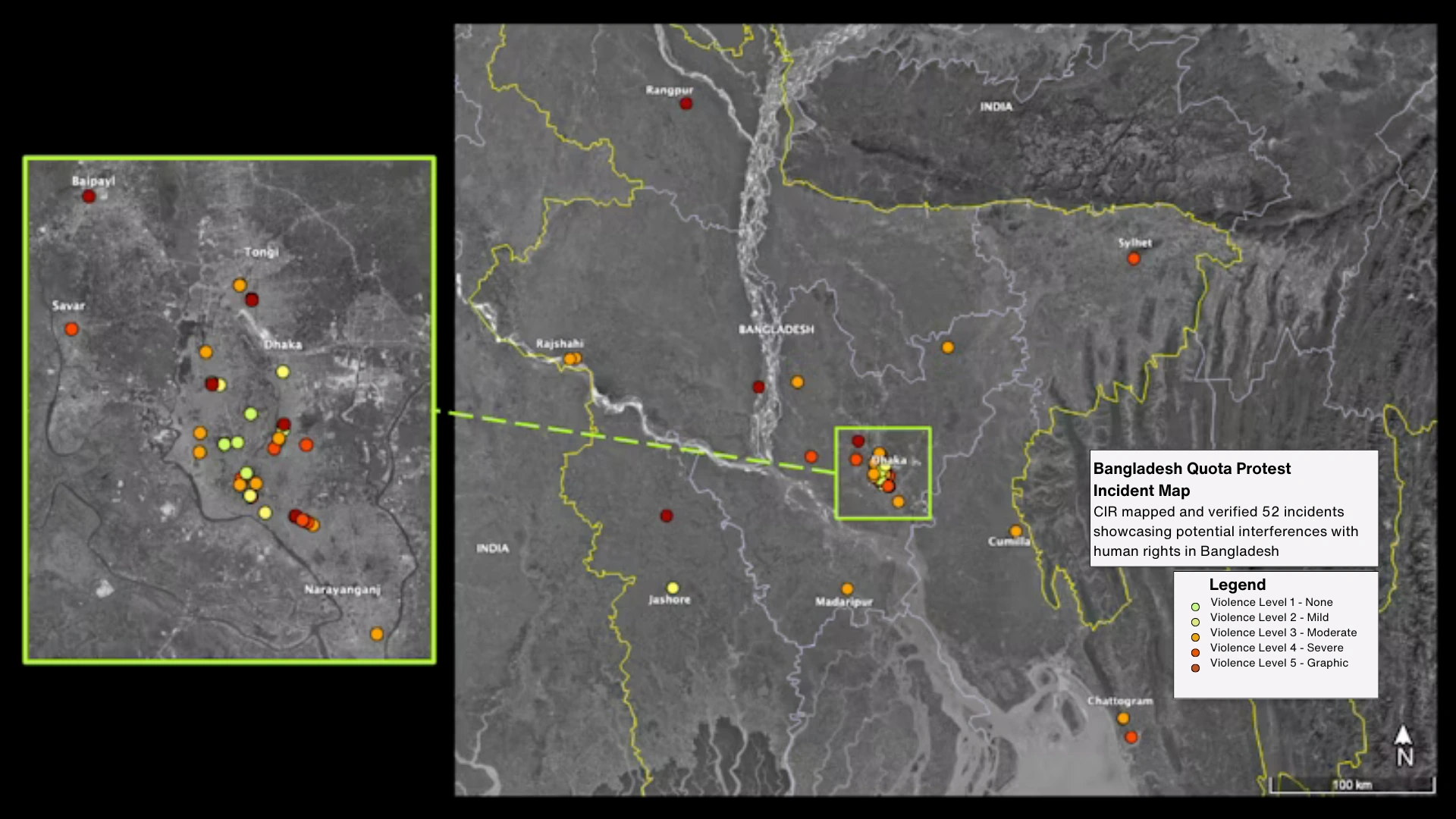
Centre for Information Resilience mapped and verified 52 incidents showcasing potential interferences with human rights in Bangladesh. The key on the right-hand side indicates the graphic level of footage and images collected. Graphics courtesy: CIR
“Within these verified incidents, CIR identified a concerning trend of disproportionate violence by police officers and military personnel, which potentially breaches human rights, including the use of live ammunition against protesters, the desecration of bodies, and the beating of unarmed civilians,” the report states.
Cold-blooded Targeted Killing
On August 5, Mohammed Sujon Hossain, a police officer from the Armed Police Battalion (APBn), a specialised combat unit of Bangladesh Police, was seen shooting a protester. On duty in Dhaka’s Changkharpur area, the official is seen firing a Type 56 semi-automatic carbine – an assault rifle often used by military personnel or armed groups – at protesters located less than 100 meters to the east. In a video that was later aired on Jamuna TV, the official is seen shooting one protester, after which other officers join in. Sujon Hossain is seen leaning on his knee to shoot again and saying, “Someone is dead,” as other officers start shooting at unarmed civilians.
Sujon was arrested on September 12, 2024.
Asian Dispatch got the said footage verified by CIR. The video was shot from Zahir Raihan Road near the Sheikh Hasina National Institute of Burn & Plastic Surgery and Chankharpul General Hospital in the Chankharpul area of Dhaka, geolocated at 23.7238, 90.4010.

Officers fired multiple weapons, including Type 56 semi-automatic carbines (left) and a Type 56 assault rifle (right). Graphics Courtesy: CIR
On this day, more than 10 dead bodies were reportedly brought to Dhaka Medical College Hospital from Chankharpul soon after the shootouts.
One of those shot dead was Shahriar Khan Anas, a 16-year-old student at Gandaria Ideal High School in Dhaka. Before joining the march to Hasina’s residence, Anas had written a letter to his mother saying, “Rather than staying at home like a coward, it is much better to join the struggle and be shot dead like a hero.”
His father, Shahria Khan Palash, filed a case at the ICT, naming Hasina as the prime accused, along with several police officers. He told Asian Dispatch that he asked the ICT to include the then Additional Deputy Police Commissioner (ADPC) Akhtarul Islam in his case. “Whenever I call, they [ICT] say my case is still being processed. But arrest is far away,” Palash said.
When contacted, ICT investigating officer Munirul Islam told Asian Dispatch that they were still investigating the allegations and refused to share any details about charges, including the allegations against Akhtarul Islam.
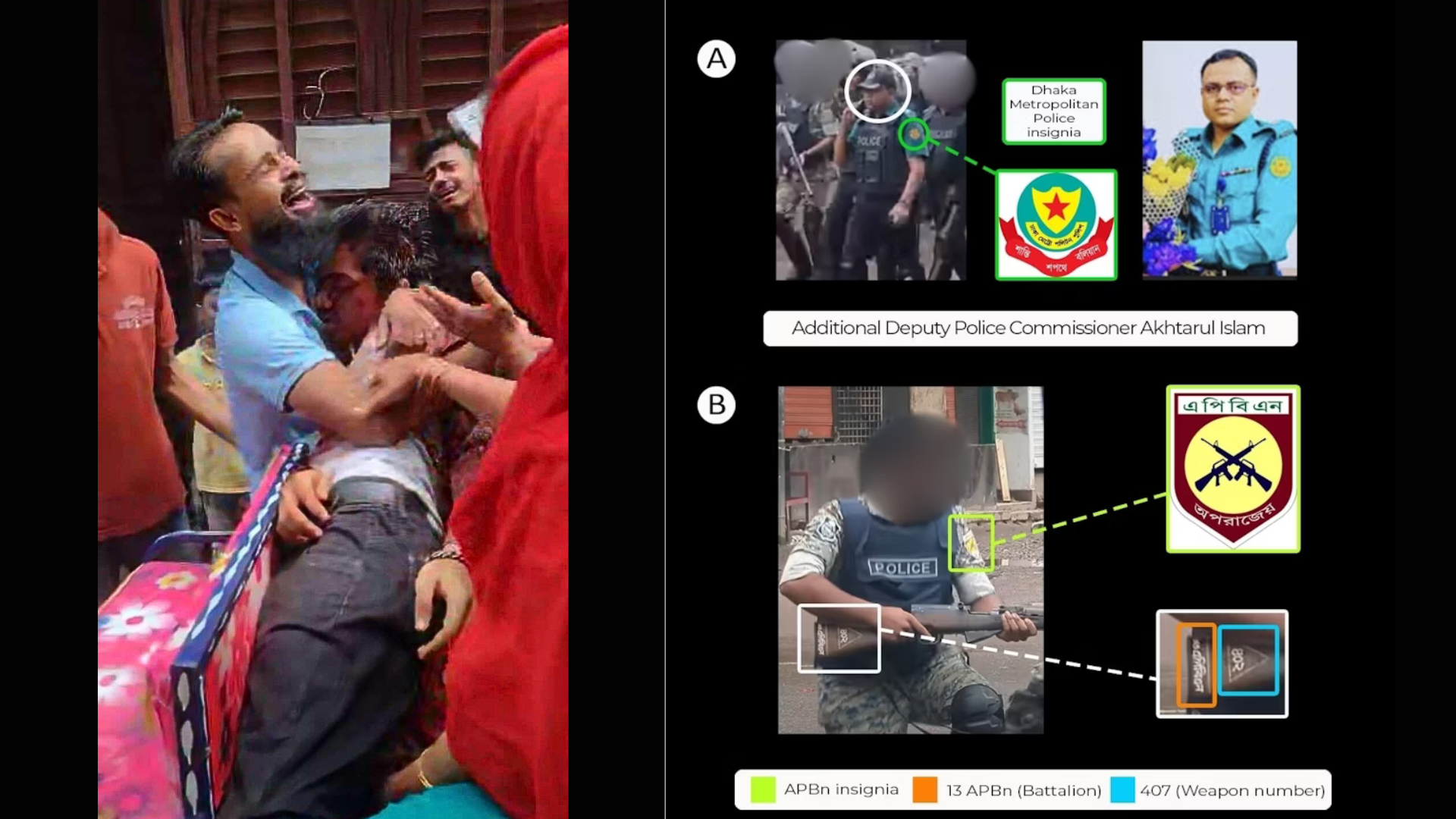
(Left) Shahria Khan Palash holds the body of his son Shahrirar Khan Anas. Photo courtesy: Shahria Khan Palash; (Right) CIR confirmed that Additional Deputy Police Commissioner Akhtarul Islam was present during the incident. Sources: upper left (A): Samakal News, bottom left (B): X. Graphics courtesy: CIR
According to Bangladeshi daily, The Business Standard, ADPC Akhtarul Islam was seen in command in Chankharpul that day. Another police officer present there told The Business Standard that, “Sir Akhtarul himself also fired that day.” When Asian Dispatch asked ICT about Akhtarul Islam’s whereabouts on the aforementioned day, spokesperson Enamul Haque Sagar responded: “We don’t have that information.”
In another part of Dhaka, another police officer called Arafatul Islam was seen in a video near a van where police officers were loading several dead bodies, with at least six other officers in the background. The bodies were later burned on a truck. Arafatul was subsequently arrested for concealing evidence of police brutality. Md Abdullahil Kafi, the additional superintendent of police (crime and operations) in Dhaka, was also arrested in connection to this case.
Escaping Justice
Asian Dispatch reviewed around 100 videos from this time, and corroborated those of over a dozen police officers in connection to the July-August violence. The interim government of Nobel Laureate Muhammad Yunus has, so far, set up a foundation to support the families of wounded and killed, with a funding of TK100 crore ($8.1 million). In January 2025, the Police Reform Commission submitted recommendations to curb abuse of power and excessive force by the police. But mounting evidence shows little to no attempts to bring the accused to justice.
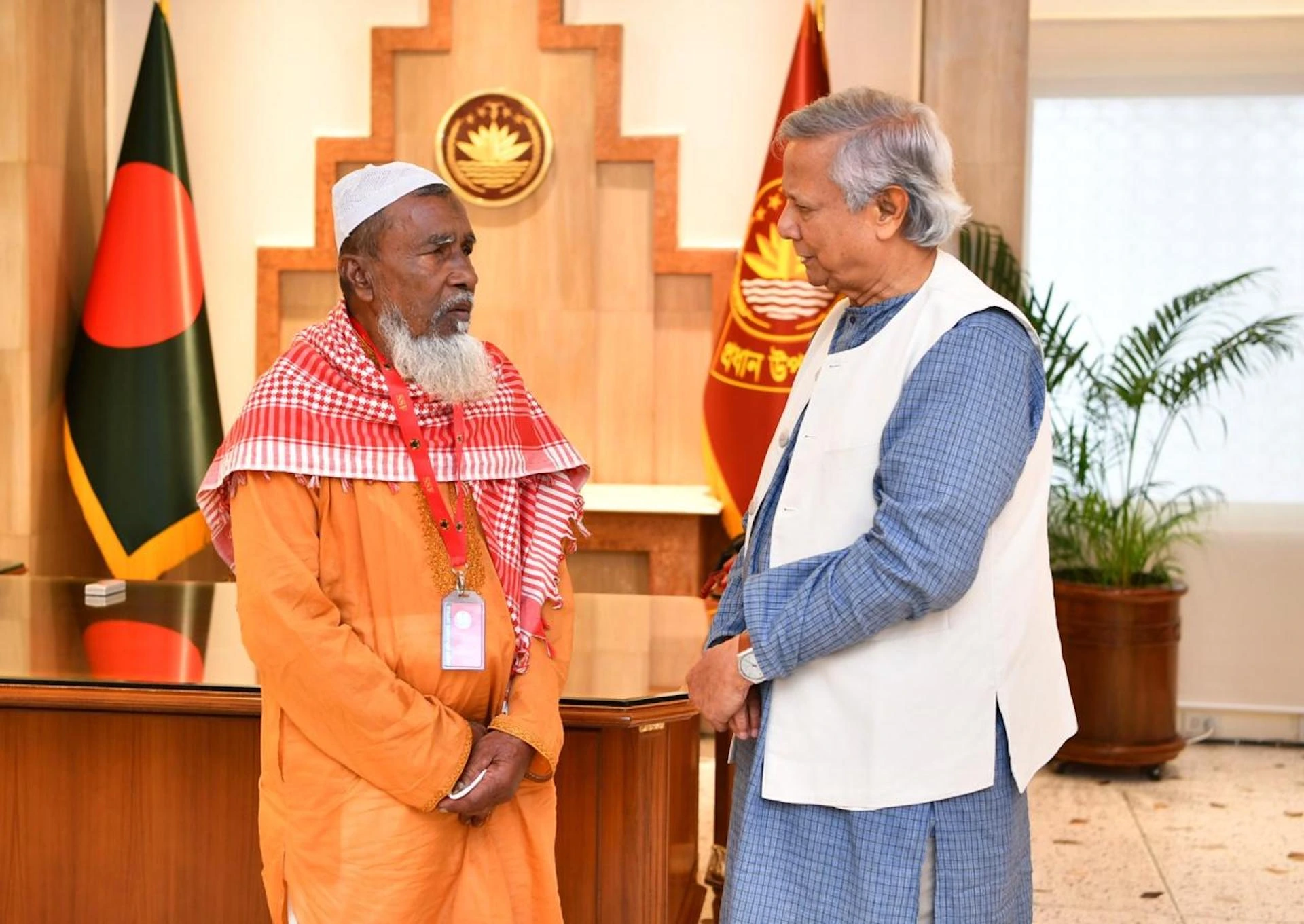
Chief Adviser Professor Yunus meets the father of a student called Abu Syed, a student activist from Rangpur who was shot dead by the Bangladesh police last July. Photo: ChiefAdviserGoB/X
Another accused official, Harun Or Rashid, the then Additional Commissioner (Crime and Operations) of the Dhaka Metropolitan Police and former chief of the Detective Branch, was rumoured to have been detained after Hasina fled. Rashid dismissed those claims in a text message to the Daily Star on August 6. However, despite a travel ban on him by a Dhaka court on August 27, Rashid appeared in an interview with a US-based Bangladeshi journalist in October, where he denied all charges. He continues to be at large. Asian Dispatch couldn’t confirm his whereabouts to secure an interview.
Former head of the Police’s Special Branch (SB), Monirul Islam, who faces several cases too, also remains free. Asian Dispatch found him active on Facebook – his last post on his Facebook account was January 21. Asian Dispatch contacted him via WhatsApp but did not receive a response at the time of publishing this story.
Many other top police officers are believed to have fled Bangladesh after August 5.
Salahuddin Miah, the former officer in-charge of Khilgaon police station in Dhaka during the protests, faces charges but is currently stationed in Rangamati with the Armed Police Battalion.
“The cases against me are related to BNP programs from [2023], not the July uprising,” Salahuddin Miah told Asian Dispatch, referring to police violence against a Bangladesh Nationalist Party (BNP) rally in 2023.
Attempts to reach out to up to 15 police officers facing charges of murder and torture went in vain. Their whereabouts remain unknown and did not respond to text and calls.
The Government’s Efforts and Limitations
On July 20, when Moynal Hossain discovered the lifeless body of his son, Taim – the young protester mentioned at the beginning of this report – riddled with bullets, he called his superior in despair, crying, “How many bullets are necessary to kill a person?”
Moynal Hossain is a senior sub-inspector from the Bangladesh Police. Despite his rank and evidence, the grieving family claims they were denied the right to file a case.
Ramizul Huq, the investigating officer from the Police Bureau of Investigation assigned to Taim’s case, told Asian Dispatch that arresting government officers requires authorisation from the relevant authorities. For instance, arresting an Assistant Superintendent of Police or higher ranks requires permission from the Home Ministry, while constables to inspectors need approval from the Inspector General of Police.
“At the same time, multiple investigating officers were being changed, which caused further delays. Sometimes, following these procedures takes considerable time,” said Huq.
Taim’s family is among many waiting in darkness for justice. Many live in fear of consequences from the charges they’ve pressed against police officers since the accused remain free.
We are scared to talk to the press. If they find out I am speaking against them, I fear we may not be able to sleep peacefully in our own homes. —Kamal Hawlader, whose son was killed in July, told Asian Dispatch.
Enamul Haque Sagar, the Police Headquarters spokesperson, says that the charges are being investigated with “great seriousness.” “The investigations are ongoing, and the process of bringing those found involved to justice is in progress,” he added.
But these words of reassurance aren’t enough.
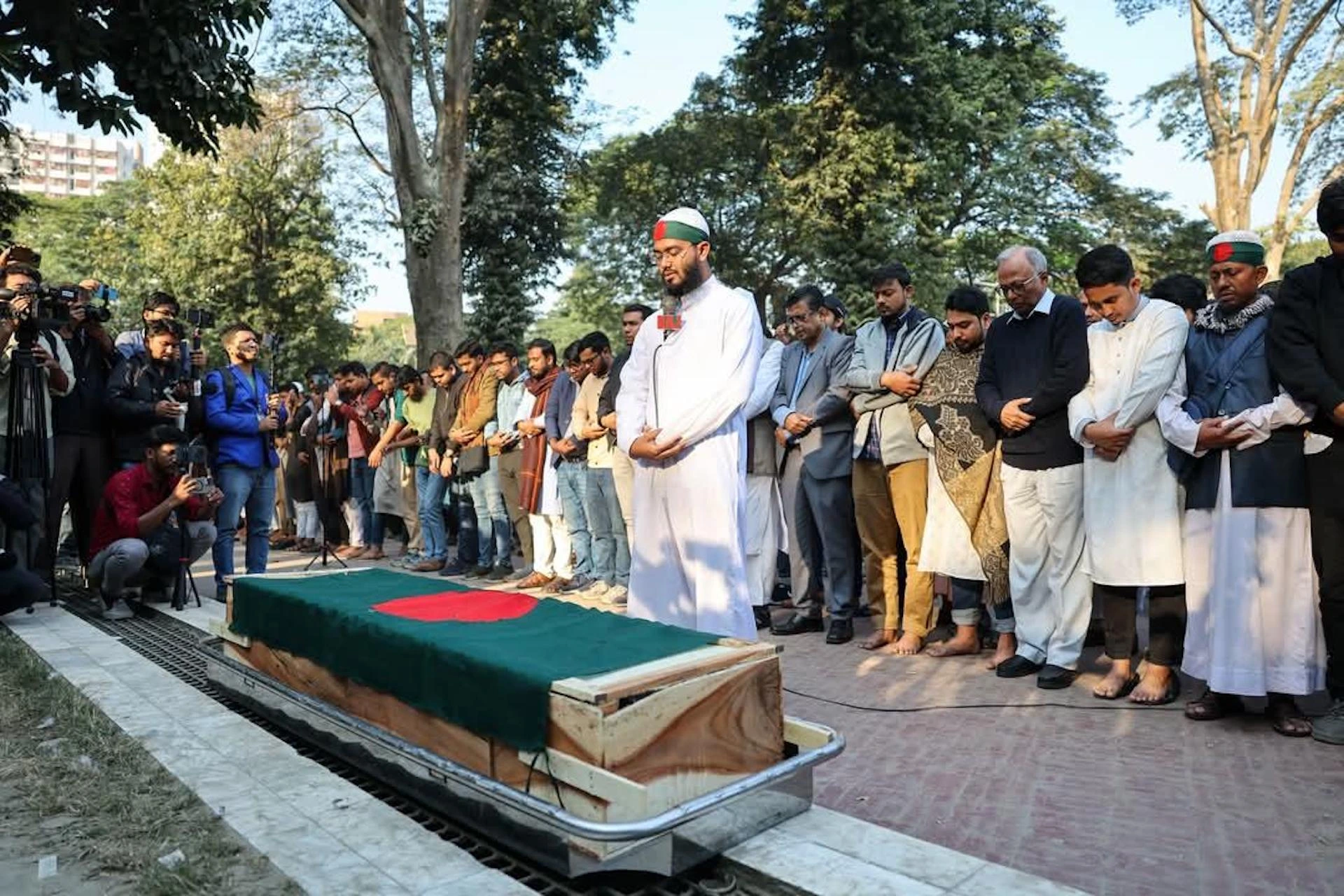
Members of Yunus’s interim government attend the final rites of a 12-year-old boy called Arafat, who was shot during the anti-government protests last year. Photo: Photo: ChiefAdviserGoB/X
Human rights activist Rezaur Rahman Lenin told Asian Dispatch that internal processes and weak systems set by the government allow police officials to evade accountability. “The government faces multiple challenges on various fronts, which they are unable to address due to a lack of commitment, prudence, and bureaucratic transformation,” he said.
Institutional fragmentations among different commissions and the International Crimes Tribunal are both visible and vibrant, he says. “Harmonising legal approaches transparently and effectively is essential to ensure justice,” said Lenin, noting the paradox of relying on the same force accused of killing protesters in order to maintain law and order.
Professor CR Abrar, the president of human rights organisation Odhikar, shared similar concerns.
“It is deeply disconcerting that after such heinous crimes, only 34 are apprehended,” he said. “The evil force protecting the accused officials remains dominant and continues to call the shots.”
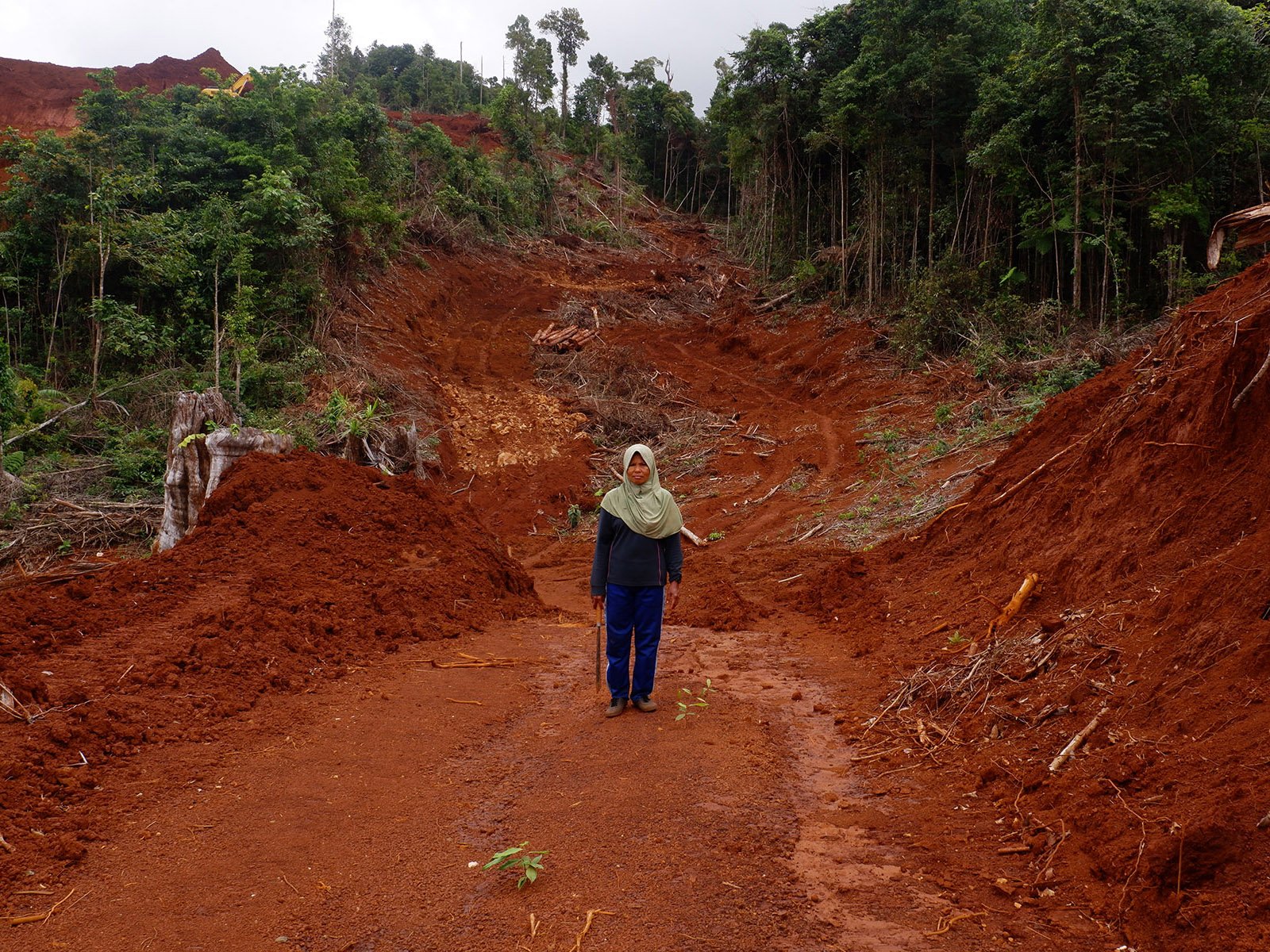
Royani, a resident of Mosolo Village, poses for a photo on her deforested land. No less than 300 of her clove trees were uprooted. Royani is still defending her land from excavation. Image Credit: Project M/Yuli Z.
“Even animals need water. Without water, we will die in vain,” Ratna griped.
The 58-year-old was upset that the water from the local spring water system that flowed into her house was now full of mud. This had become a regular occurrence ever since nickel mining company PT Gema Kreasi Perdana started its operations on Wawonii Island in Konawe Islands Regency in Southeast Sulawesi. The company, the sole owner of a concession permit on the island, is a subsidiary of natural resources conglomerate Harita Group – owned by one of Indonesia’s richest men, Lim Hariyanto Wijaya Sarwono.
Ratna could not hold back her tears. She was angry at the company that had degraded the environment and was disappointed at fellow residents who supported mining on the 706-square-kilometer island.
The mining operation has affected every aspect of her life. She has to wait for hours for the water to be clean enough to be used for bathing and doing her laundry and dishes. Furthermore, she now has to buy drinkable water, which costs her about 50 US cents a gallon.
The impacts of mining on the island’s spring water system possibly started on May 21, 2023. At that time, farmers noticed that the water spring had become increasingly murky, while the pipe used to distribute water from the island’s only water reservoir was cut off. They believed that some people might have purposely cut the water distribution to contain the problem.
Ratna had seen this coming when the nickel company started its operations there.
Those who sold the land said the mining wouldn’t harm us, but now, we’re all looking for clean water. They were fooled by the company. We’re doomed here. —Ratna, lifelong resident of Sukarela Jaya Village, Southeast Wamonii.
The mother of two was never tempted to sell her land, despite being offered hundreds of millions of rupiah. The company’s money could run out in an instant, she said, but the crops could be enjoyed perennially.
“The yield of nutmeg in one year can be tons. We are criticized for refusing good fortune [by selling our land]. Doesn’t the abundance of nutmeg bring good fortune?”
Life had been sufficiently good for Ratna before the nickel miners came. Her plantation allowed her to acquire basic necessities and also save enough money to make an umrah pilgrimage to Mecca in early 2023.
“It’s totally okay to have just enough money to buy food. We must think far ahead. We have a younger generation”. She admitted that she was frustrated at the fact that her complaints had been ignored despite having to face the same problems on a daily basis.
Amid public protests, excavators proceeded to clear the land and dredge the soil. Vehicles carrying nickel ore continued to pass towards the port, which was located only 200 metres or so from Ratna’s house.
It’s only natural that Ratna plans to abstain in the upcoming elections. She feels abandoned by the council members, who are supposed to represent the people. “Our voice means nothing to the council members. When we expressed our opposition to the mining, we were thrown out like animals. We were even attacked with tear gas during our protest in Kendari. I almost died from suffocation.”
They say investors bring prosperity, but in reality they only bring misery. The investors are killing us slowly. There is no justice being served; there is no humanity. It is like living under colonialism. We are colonized by our own country. —Ratna
Fleeing into the Forest
It was 6 in the morning in May 2023 in Sukarela Jaya Village, and Hastati was busy splitting no less than a thousand old coconuts to make copra. Half of the coconuts were harvested from her plantation, and the rest were purchased from her neighbours. The number of coconuts produced in one harvest time, or every three months, is usually around 3,000. Meanwhile, the price of white copra is Rp 7,500 per kg and black copra Rp 6,500 per kg. Apart from coconut meat, Hastati makes a living from selling coconut shell charcoal.
Like other residents who objected to the nickel mining, Hastati was satisfied making a living from the proceeds of her plantation. The 45-year-old was once offered Rp 1 billion to give up the 2-hectare plot of land she inherited from her parents. She was also promised a fully funded umrah and education for her six children, but Hastati never accepted the offer.
“We want to defend our lands, and the rest of Wawonii Island. It’s better for us to be independent like this,” she said. Like Ratna, she emphasised that the company’s money could run out in the blink of an eye, while a well-maintained natural environment could provide a living for many generations.
“When the mountain is completely dredged, the company will leave. What about us, then?”
On Hastati’s land grows nutmeg, cloves, and cashew nuts. Last year, she harvested 50 kg of cloves. The average nutmeg yield was 5 kg. Cashews are the most productive, as the harvest can reach up to 4 tonnes in a year.
Like Ratna, the scarcity of clean water has affected all aspects of her life. Hastati never thought she would go through this difficult time. Before the mining company came, the residents had never lacked clean water as water from the Banda Spring flowed freely into the villages.
“Now we have to go to the river to wash. How can we not be angry?”
As a form of resistance to the mining activities, Hastati refused to accept clean water from the company. It was not just about the water; it was about principles, she said. “Now we have to use river water for cooking.”
Hastati will never forget what happened in 2022, when she and other women stripped off their clothes during a protest against the nickel mining. She also hid in the forest for almost two months. She was afraid of being arrested for ‘obstructing’ the mining operation.
“We were just defending our land, but the police were chasing us as if we were thieves or murderers”.
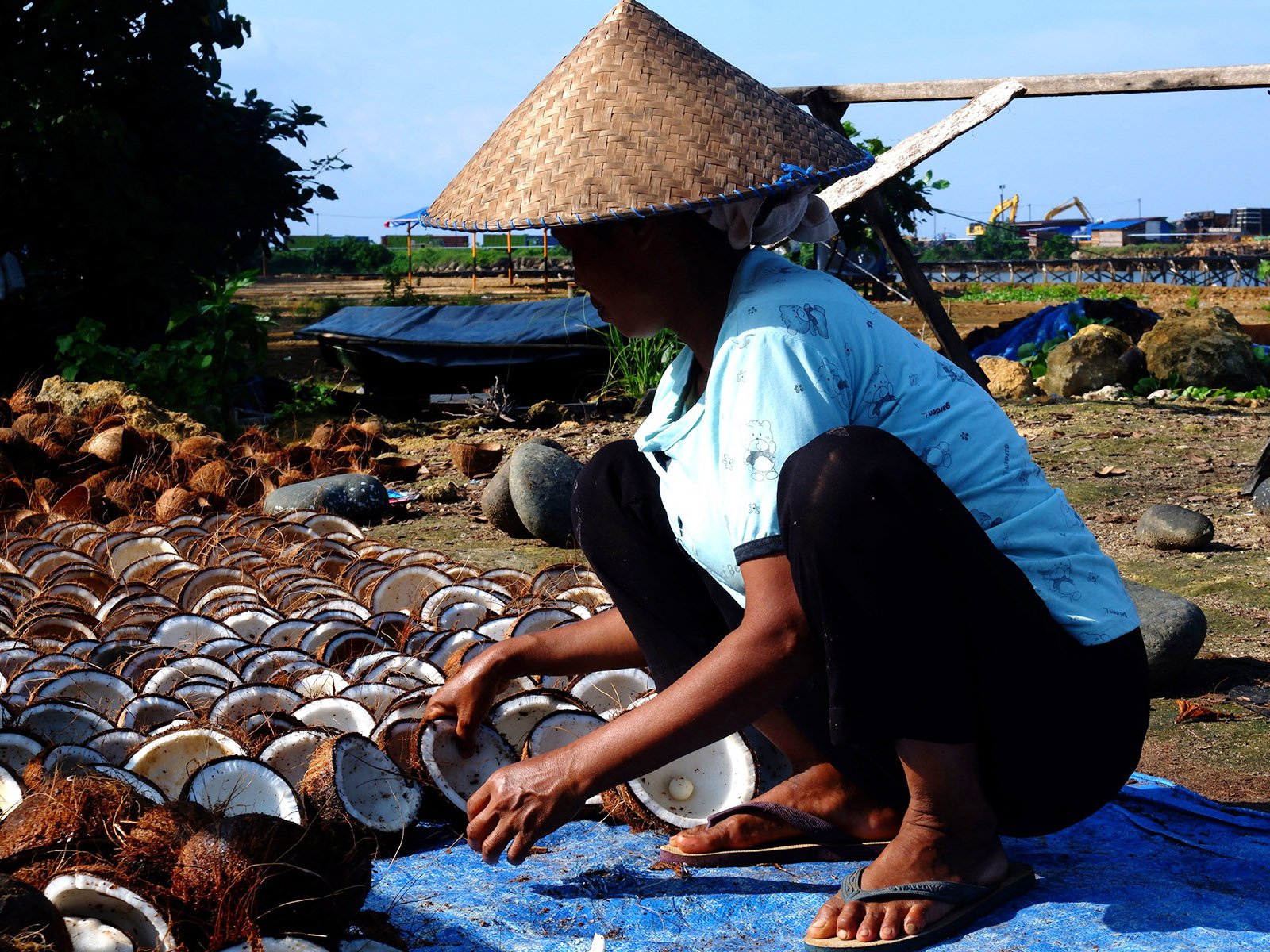
Hastati, a resident of Sukarela Jaya, dries coconuts to make copra. In the background is heavy equipment belonging to PT Gema Kreasi Perdana, a subsidiary of the Harita Group. Photo: Yuli Z./Project Multatuli
Hastati hid in the forest with eight other residents, including Amlia who refused to sell her land for roads for the mine’s trucks and heavy machinery.
I met Amlia in her farm on May 20, 2023. She said that she hid in the forest after receiving a summons as a “witness” by the Konawe Islands Police.
“The persons summoned by the police were the ones who owned the land. As long as they did not give up the land, they would not be released. We thought it’d be better to run than answering the summons.”
Amlia and others went through difficult times when hiding in the forest. They roamed through the forest during the day and looked for a hut to take shelter when the night came. Some days they did not eat at all.
“Even when we could eat, we did not feel like eating. When we rested, we were still anxious. How could we stay calm? The police were looking for us,” said Amlia.
Like Hastati, Amlia was also promised a large sum of money. Her husband and eldest son were both offered a salary from the corporation, without the need to do any work, but she was not tempted by the offer.
Cassava, chilli, banana, and coconut trees grow near her hut. Heavy rain a few days earlier inundated part of the farm with water that carried red mud sediment. Amlia was sure the mud came from the excavated land in mining areas.
The nickel mining has further affected her daily routine as a farmer. She used to go to the farm at 8 in the morning, but now she has to start one-and-a-half hours earlier since access to the farm is blocked by the company’s haul roads. To reach her farm, Amlia needs to walk two hours from where she can park her motorbike. During harvest season, Amlia and her husband have no choice but to carry 20 to 30 kilograms of produce by foot over the hilly roads.
“Even though it is difficult, we are still trying to do our best. As farmers, our income indeed comes from gardening,” said Amalia who was carrying 20 kg of cassava from her farm to the motorbike.
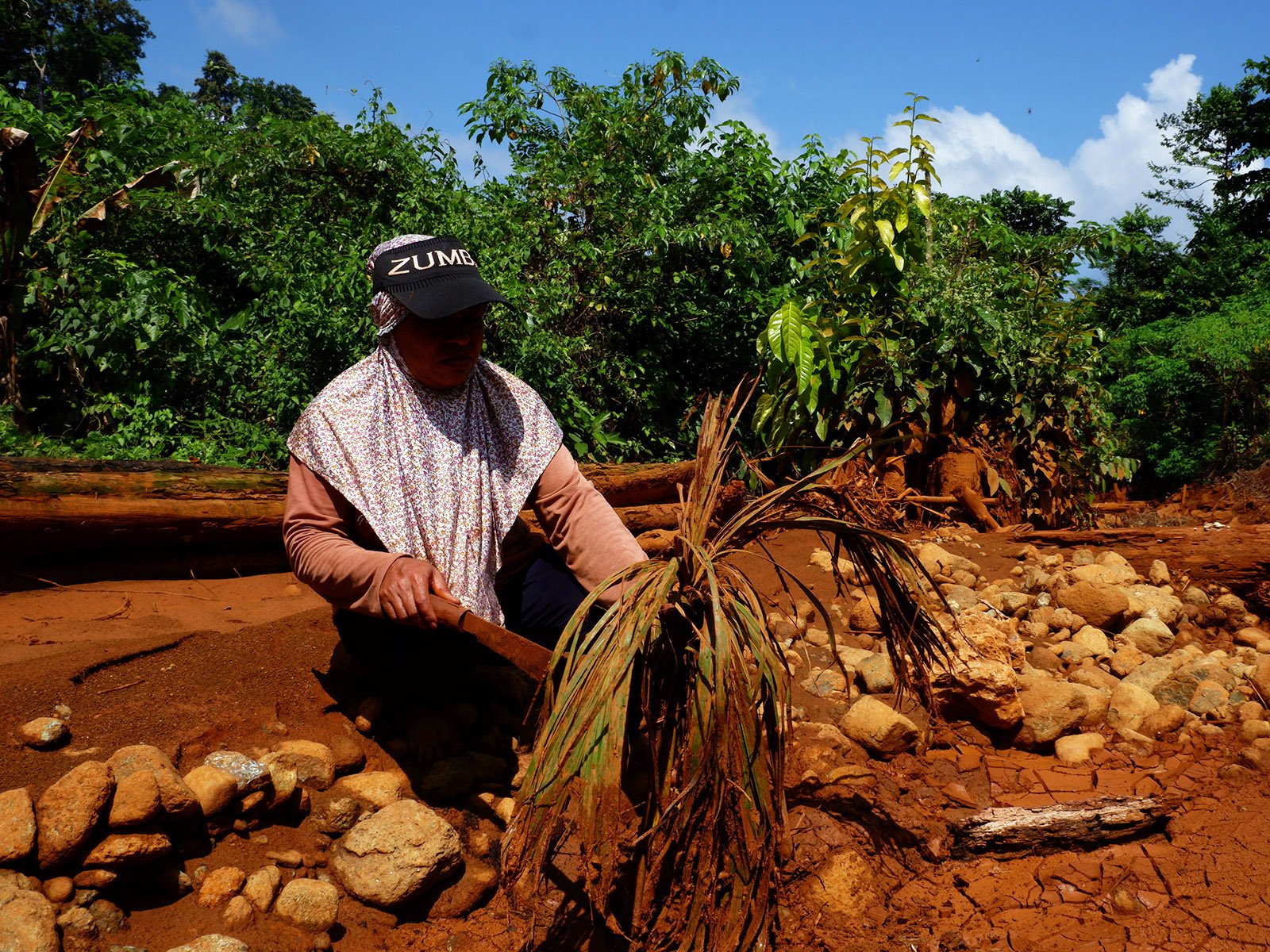
Amlia, a resident of Sukarela Jaya, shows a coconut tree on her farm that was damaged by mud. Photo: Yuli Z./Project Multatuli
Damaged Water Springs
Just like the other days, Saharia, a resident of Dompo-Dompo Jaya village, woke up early in the morning to prepare her family’s breakfast. But when she turned on the tap to wash the fish, the water turned orange. Luckily, there was some water in the tank left from the rain a few days ago.
The 50-year-old is a single mother of four children. Her family owns 250 square metres of garden planted with coconuts, cashews, nutmeg, and cloves. The coconut flesh was later turned into copra, and the shell into charcoal. Saharia was consumed by anxiety as their garden could be taken over at any time by the corporation.
PT Gema Kreasi Perdana started the production and shipment of nickel ore in August 2022, shortly before the pollution of water springs began to be reported. The two main supply channels of clean water in the Sukarela Jaya and Dompo-Dompo Jaya villages have seemingly been polluted by mud since heavy rainfall hit on May 9, 2023.
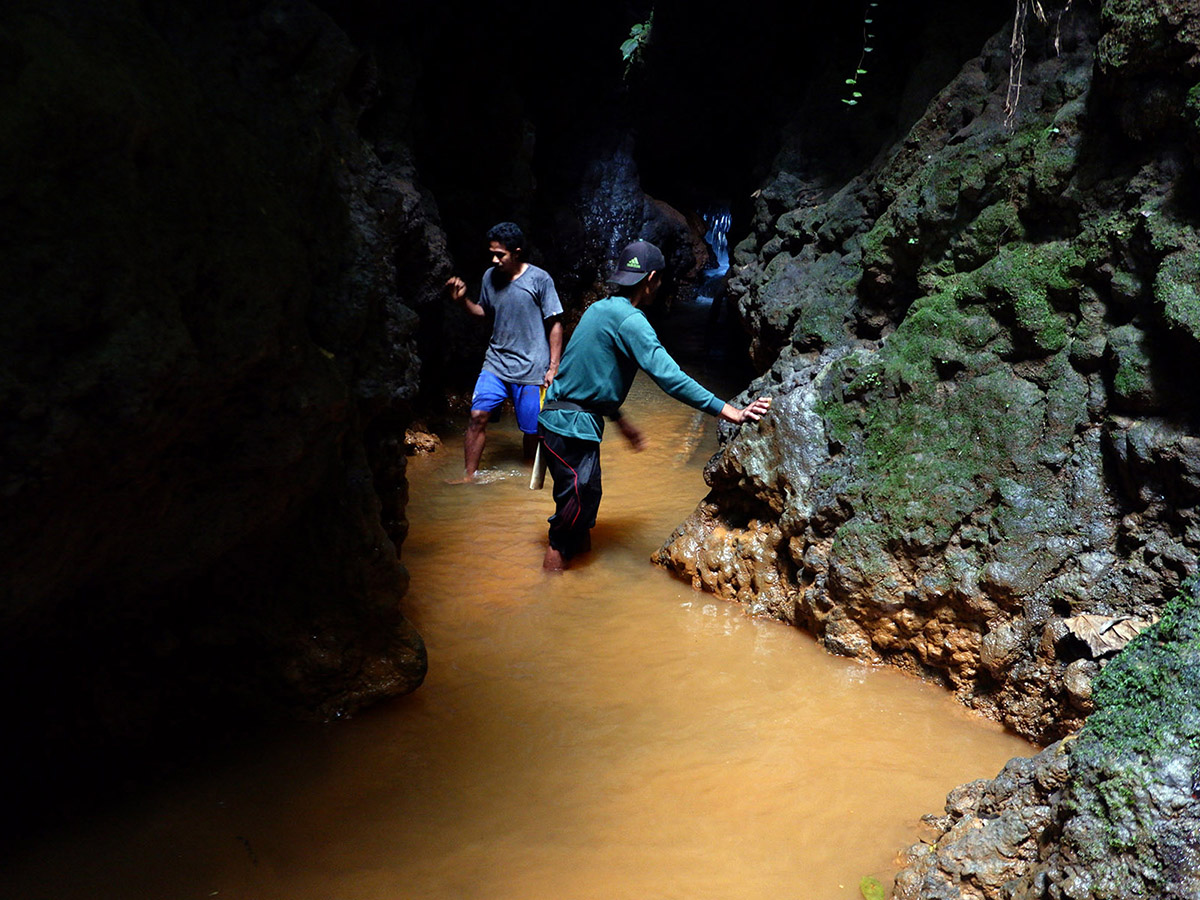
Banda Spring, which supplies clean water to five villages in Southeast Wawonii District, has become murky. Photo: Yuli Z./Project Multatuli
On May 19, 2023, I visited the Banda Spring in Southeast Wawonii forest, about an hour walk from Dompo-Dompo Jaya Village. The spring, situated in a karst cave at an altitude of 119 metres above sea level, flows into several tributaries serving as sources of irrigation for residents’ farms and rice fields.
On May 21, the area experienced another round of rain. The water in Sukarela Jaya, Dompo-Dompo Jaya, and Roko-Roko turned dark. Those residing on the seashore were busy cleaning the gutters, removing mud carried by rainwater. Locals said changes in the colour of seawater have always occurred after rain, but never with such dramatic contrast.
When I checked the pipes in the settlement, the water was dark. Less than two hours after the rain, water distribution was cut off. Later, I met some women carrying bundles of clothes on their motorbikes. “I am going to do the laundry,” one woman shouted. “The water (flowing into our houses) is useless,” another chimed in.
I then visited the confluence of Roko-Roko River and Tambusiu-Siu River, which supply water to the Banda Spring. The colour difference between the two rivers was quite striking; Roko-Roko was slightly murky, while Tambusiu-Siu was brown. Roko-Roko is the only stream that is not polluted by the mining activities and can still be used by residents for bathing, washing, and cooking. The mining corporation has apparently distributed clean water to the residents, but some of them have refused it to signify their rejection of mining in Wawonii.
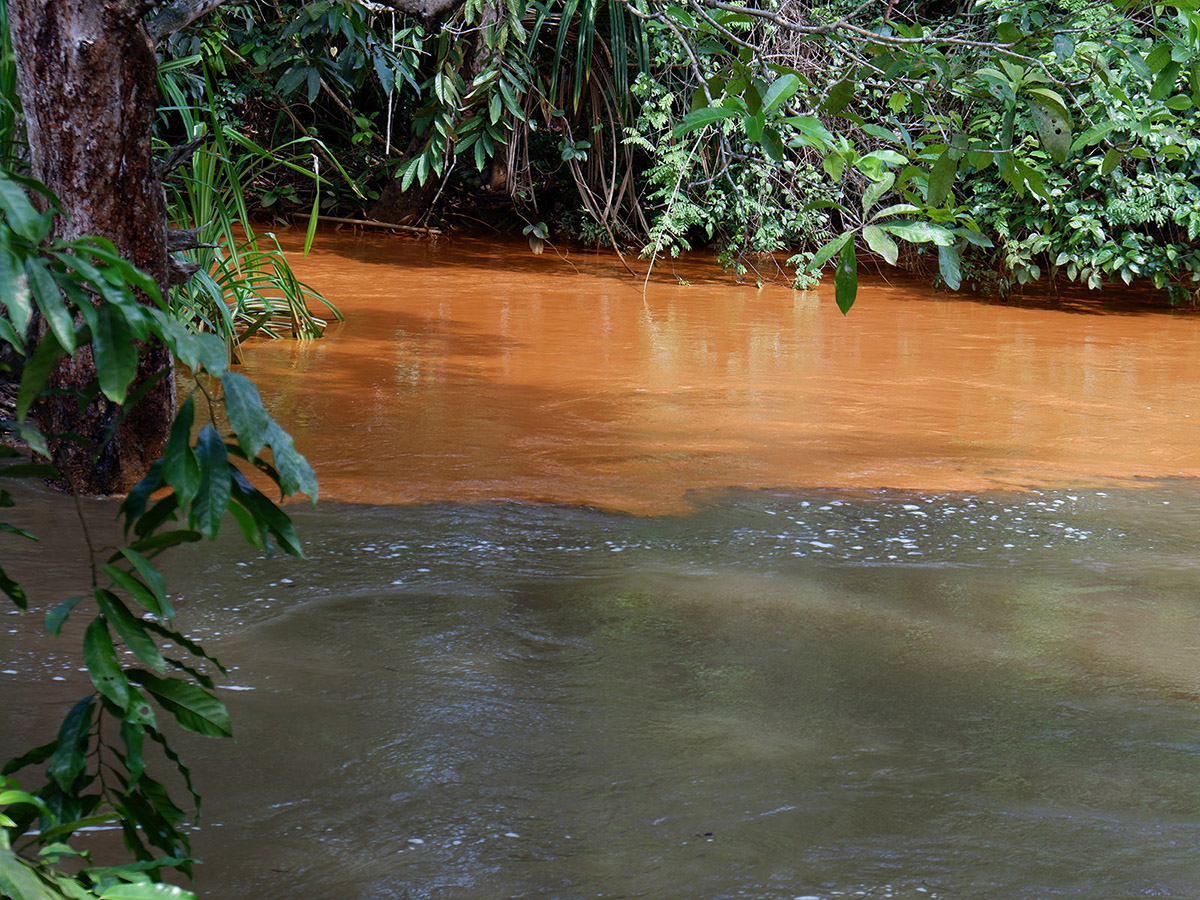
The confluence of Tambusiu-Siu River and Roko-Roko River after a two-hour rainstorm hit the surrounding area. Photo: Yuli Z./Project Multatuli
Saharia is among the local residents who object to nickel mining in the area. As a single parent, she has the dual role of taking care of the household and earning a living. The environmental destruction caused by the mining has only made things more difficult for her. To get clean water, she now has to walk to a river 500 metres away from her house. The scarcity of water has forced the family to reduce the frequency with which they go to the toilet. In Saharia’s house, there are three women who go through their menstrual phase every month.
It is very difficult for us when we’re going through our period . We are required to clean ourselves frequently, but what can we do without water? —Saharia
Until the dry season came in mid-August, clean water had yet to be restored. The water flowing in the pipes still carried mud sediment. Saharia was struck by fear every time she used the contaminated water, but she had no other choice. For drinking and cooking, she sometimes asked for clean water from a neighbour who has a well.
“I’m worried about my family’s health. Our bodies get itchy after having a shower. We really miss the old days when the water was clean,” she said.
Nickel Mining is Getting Under the Skin of Locals
Ristan has been sleep-deprived lately. The 24-year-old mother wakes up almost every night because her beloved baby also is also having difficulty sleeping. Abyan, Ristan’s nine-month-old son, has been suffering from itchy skin for the past four months. Reddish spots first appeared on his calf and ankle, and then spread to the toes and soles of his feet.
“It’s actually getting better lately. Before this, my baby’s feet were full of wounds. Very unsightly,” said Ristan while showing me Abyan’s rough skin.
Skin disease also struck Ristan, her husband, and her parents. Nahati, Ristan’s mother, had very itchy black spots all over her body a while ago. Almost all residents of Mosolo, Sinar Mosolo, and Sinaulu Jaya Villages have experienced similar ailments.
“The reddish spots felt itchy at first, and when we started to scratch they’d turn hot or even bleeding. I tried to treat it by drinking a herbal decoction,” Nahati said.
The water consumed by Ristan’s family comes from a source approximately 500 metres from a nickel mining site.
Sixty-five-year-old Nahati has resided in Mosolo since she was 5, but she only experienced the skin condition recently. The water used to turn murky after days of heavy rain. Today, however, the water changes colour after even the briefest rain shower.
Another Mosolo resident, Tika, also complained of itching. An, her one-year-old infant, was no different. The skin on his toes peeled off, and there were black scars on his legs. The mother and son ended up seeing a doctor in the city of Kendari last August.
“The doctor said there wasn’t any problem with the food we eat. He just said it might be due to the weather,” Tika said, adding that her family solely relied on spring water.
Wa Muita lives in Sinaulu Jaya Village with her five family members, three of whom are women. She has had skin ailments for the past year – ever since a nickel mine started operating nearby. She has tried a variety of medications to no avail. The water she uses for the household’s needs has been getting murky recently, and it gets darker anytime it rains.
“I have used a lot of medications, yet the itching persists. Perhaps it’s due to the polluted water we regularly consume. There’s no doubt that we are angry. It’s never been like this before”.
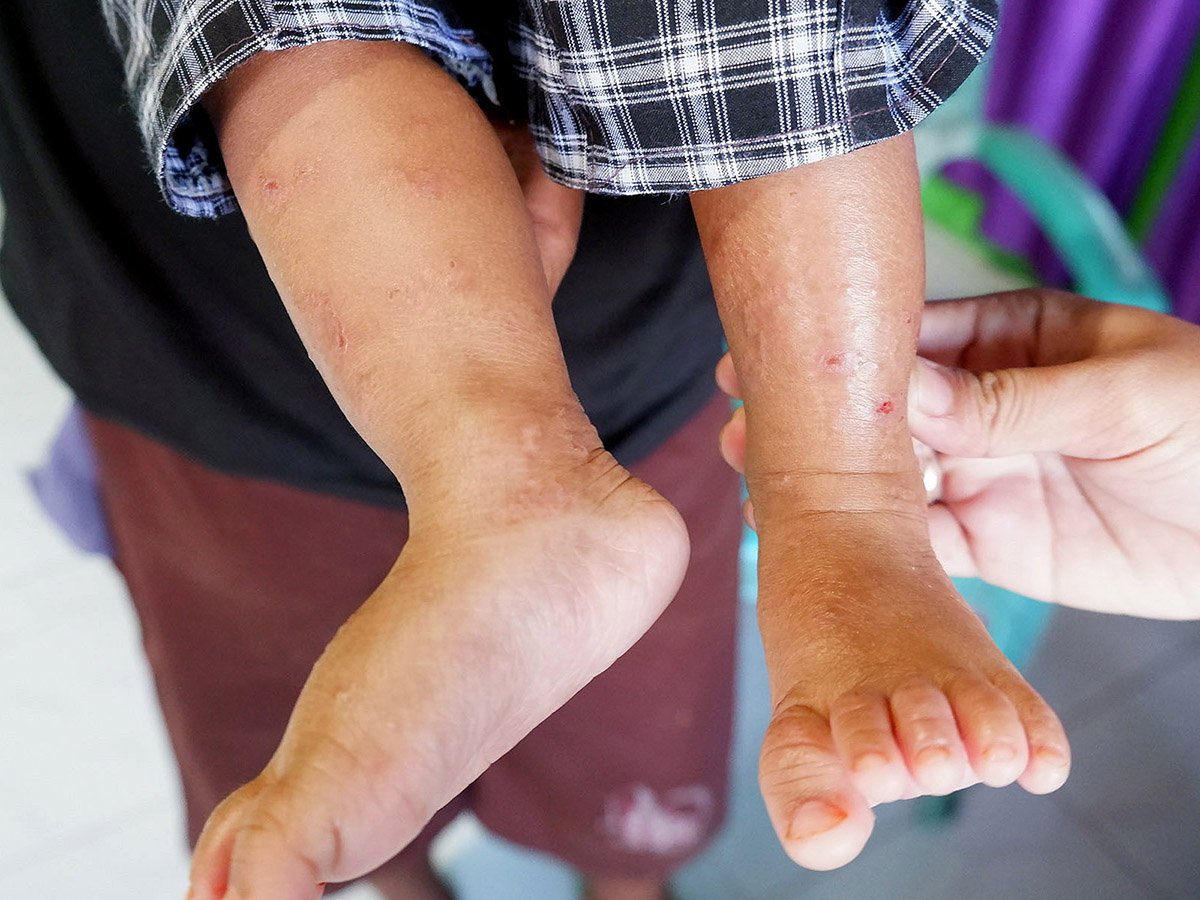
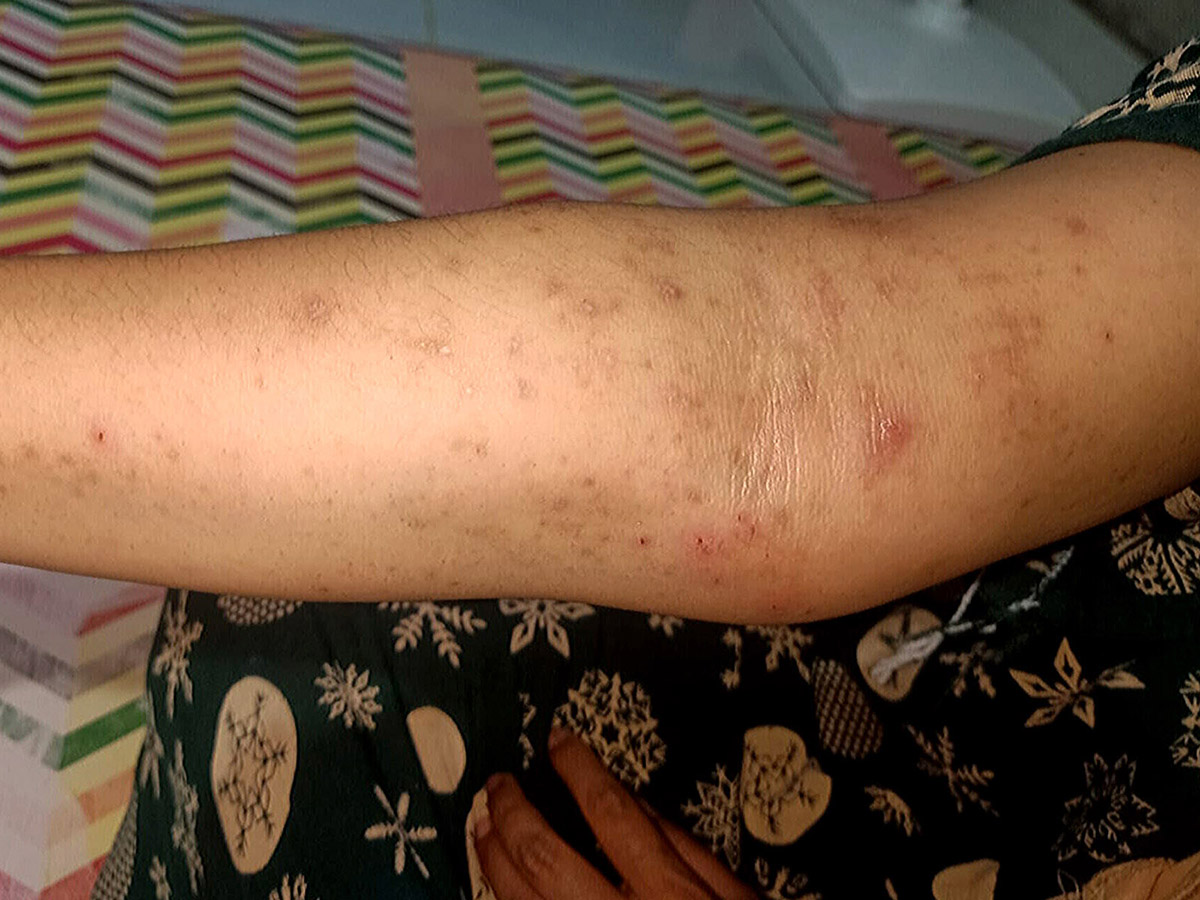
Left: Abyan’s skin is red and itchy. The nine-month-old baby boy has suffered from the skin disease for around four months since the water his family used was allegedly contaminated with mud from nickel mining. Right: A Sinaulu Jaya resident shows her skin rash. Photos: Yuli Z./Project Multatuli
Jumriati, a 24-year-old resident of Sinaulu Jaya, said she was worried about her family’s health due to their regular consumption of the polluted water.
“I hope the government will pay attention to our complaints and not let the community be affected by mining’s destructive impacts. The company is profiting at the expense of our lives,” she said.
Lahadi, a caretaker of the water reservoir in Sinaulu Jaya, confirmed that the water quality had deteriorated since the nickel mining company started excavating land in 2020.
“We cannot be sure whether the pollution is due to the company’s activities. But one thing’s for sure, every time it rains for at least a day, the spring brings lumps of mud into the reservoir,” said Lahadi. “I’m not making up stories. You can ask anyone living near the mining site; the ecosystem has been disrupted.”
A local environmental official in the Konawe Islands, Hasnawati, denied claims that the water in Sinaulu Jaya had been polluted. Water consumed by the community still met the quality standards set by the Environment and Forestry Ministry, she said in a statement, adding that tests had been carried out on the Pamsimas Sukarela Jaya and Pamsimas Dompo-Dompo Jaya Springs.
“The water sample was examined in an accredited laboratory (in Kolaka Regency), and the result shows that the water meets the regulatory standards of the Environment and Forestry Ministry,” she said.
However, she did not provide the test results before this article was completed. “Those are kept by my staff,” said Hasnawati.
Muhammad Jamil, an activist with the environmental group Mining Advocacy Network (JATAM), said skin ailments were common in nickel mining areas. Similar diseases could also be found in the Pomalaa District of Kolaka Regency and Tinanggea District in South Konawe Regency.
“As far as I know, the problem has been studied by a number of universities,” he said.
Research conducted by La Maga, Ahyar Ismail, and Faroby Falatehan from IPB University in Bogor (2017) found that Tinanggea residents experienced skin disease after using water contaminated by material from nickel mining sites. In addition to the skin conditions, residents also suffered from respiratory problems, as they were exposed to dust raised up by the mining. Such air pollution affected those within a three-kilometre radius of nickel mining sites, the study found.
Defending the Land
“I was devastated watching the clove trees being ripped down. It was like seeing your own children murdered,” said Wa Muita, a 43-year-old resident of Sinaulu Jaya, as she recalled the events of August 10, 2023.
A day before, residents received reports that their plantations on Mosolo hill, two hours away from their settlement, had been cleared by PT Gema Kreasi Perdana. Amiri, Wa Muita’s husband, rushed to check his plantation in the middle of the night and found that 40 of his clove trees had been toppled. Apart from that, the corporation also tore down dozens of pepper trees and cashew trees that were about to bear fruit.
Wa Muita and some 20 other farmers came by the next day. They were saddened to see the 18-year-old clove trees that had long been the source of their livelihood destroyed just like that.
“I was speechless, tears streaming down my face,” said Wa Muita.
Shortly after, hundreds of residents gathered at the plantation area. They confronted the company for trespassing, but the company claimed that it had acquired the land through other parties. Wa Muita and Amiri stressed that they had never sold their land, let alone received money from the supposed transaction. The situation quickly spiralled out of hand as members of both conflicting parties threatened each other – some with sharp weapons.
“Every time I go to the farm, I always talk to the clove trees. ‘Please bear fruit soon. We care for you like our own children. And you are the ones paying for your siblings’ school fees’,” she said.
Wa Muita has two children who are attending college; another one is in high school, and the youngest of all is in elementary school. Their tuition fees have been covered by the sale of cloves. In 2019, the family harvested a ton of cloves. The price of one kilogram of cloves in Southeast Wawonii is roughly Rp 130,000. The 40 clove trees uprooted by PT Gema Kreasi Perdana were immensely precious to Wa Muita.
Despite everything the company had put her through, Wa Muita only asked PT Gema Kreasi Perdana to stop clearing the land.
“We accept what they’ve done to us and hope the company still has some conscience. We have further requested the person who sold the land without our authorization to refund the company’s money”.
“Without this land we don’t know what to do. This is our sole source of income,” she emphasised.
Despite encountering such fierce rejection, the company has continued to clear residents’ land, said Wa Muita, forcing her and other farmers to maintain guard of their respective fields for months.
“We didn’t even have time to take care of ourselves from February to May. We did not shower, and only ate whatever was available”.
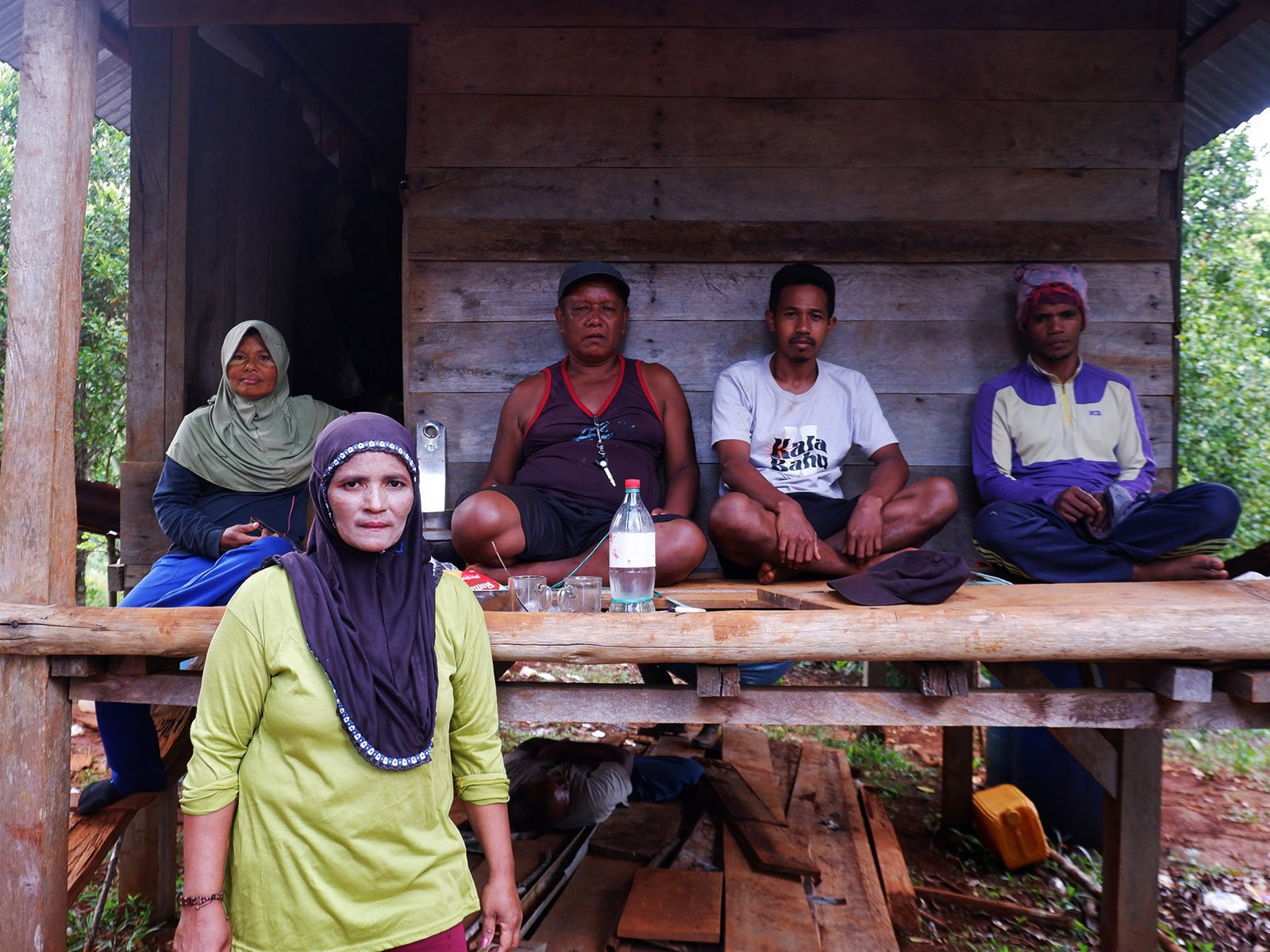
Wa Muita (front left) together with residents of Sinaulu Jaya and Mosolo stand guard at their plantations to prevent further encroachment by PT Gema Kreasi Perdana. Photo: Yuli Z./Project Multatuli
Before the trespassing incident, Wa Muita visited her field twice a week. Now she’s forced to go there more often to guard her land.
I don’t know what to say. I feel devastated. Why are there such evil people? We desperately care for the land, and they come and violate it just like that.. On top of that, they have also threatened to evict us. I hope the media, or anybody really, can help us to stop the destruction of our mother nature. —Wa Muita
Pitted Against Each Other
Not only does has mining had environmental impacts, it’s also triggered family conflicts: parents and children have come to despise each other; siblings have become enemies; and partners have split up.
For instance, Sanawiahas been estranged from her parents for over three years. The family conflict started when one of Sanawia’s brothers, with their father’s permission, sold their parents’ land in 2019.
The land sale was sealed as Sanawia protested against the mining at the Konawe Islands Council Office. It was only while on her way back home that Sanawia heard her parents’ land had been sold to the mining company.
“I could only cry. The company quickly cleared the land. Since then I haven’t been to visit my parents,” said the 45-year-old woman who has four siblings, three of whom support the mining activities. Sanawia said that, among her siblings, she used to be the closest to her parents — but not anymore.
She did not know exactly how much of her parents’ land was being sold. What she knows is that the field could usually produce 3,000 coconuts each harvest season. The mother of two wants to fix her relationship with her parents and siblings, but only under one condition. “Our relationship can be repaired as soon as the mining operation stops,” Sanawia insisted.
Aba, not his real name, said his daughter was abandoned by her husband while she was pregnant with their second child. His son-in-law had offered him money provided by the company in compensation for Aba’s land, which was used for PT Gema Kreasi Perdana’s haul roads.
Aba had previously been taken to the police station for defending his land. So he was enraged when his son-in-law made a deal with the company without his consent. He refused the money and demanded it be returned to the company.
When the couple was about to build a house, Aba’s son-in-law asked his wife to take out a loan, but she refused. That was when the son-in-law brought up Aba’s refusal to accept compensation from the mining company. The quarrel escalated into domestic violence.
“One night, my daughter came to me, crying. Her right eye was bruised. I tried to reconcile the couple, and they did get back together. But, after a few days, when my daughter was looking for mussels in the sea, her husband ran away and has not yet returned,” Aba explained.
Now, his daughter and two grandchildren live with him. “I will never accept the company’s money. I’m already old, it’s true, but I’m thinking about the future of my grandchildren,” Aba stated.
Both Sanawia and Aba reside in Roko-Roko, and in this village, social divisions caused by the mining company are no longer a secret. A number of people I met expressed reluctance to engage with anybody from the opposing ‘camp’.
A Legal Battle against Mining Activities
Wawonii Island, which covers an area of 706 square kilometres is categorised as a small island, based on Law No. 27/2007 on the Protection of Coastal Areas and Small Islands. Thus, as mandated by the law, mining activities cannot be carried out on the island.
Several civil society groups noted that at least 2,214 people living in the villages of Dompo-Dompo Jaya, Sukarela Jaya, Roko-Roko, Bahaba, and Teporoko were affected by PT Gema Kreasi Perdana’s nickel mining. For the record, PT Gema Kreasi Perdana obtained a nickel mining permit in 2007. By the end of 2019, the subsidiary of Harita Group secured a mining operation permit (IUP) on an area of 850.9 hectares, around 83 percent of which was forest area lent by the state under a forest area utilisation permit (IPPKH) scheme. It was also granted permission to build a port in the Wawonii Strait.
The development, according to a coalition of civil society groups, has harmed the aquatic ecosystem, including mangroves and coral reefs, on and around Wawonii Island. The murky water resulting from mining activities has made it difficult for fishermen to catch fish. The port also keeps fish away from the shoreline. The thick dust generated by the transportation of nickel ore has also damaged residents’ respiratory systems, the coalition emphasised.
Even though the law prohibits mining on the small island, the local government has issued a regional planning regulation (Perda No. 2/2021) that covers the Konawe Islands and carves out an exemption for mining on Wawonii.
Wawonii residents, represented by the Denny Indrayana Law Firm, have filed a judicial review of the regulation. On December 22, 2022, the Supreme Court granted their request.
Through decision No. 57 P/HUM/2022, the Supreme Court states that Wawonii Island is a “small island… which is vulnerable and very limited, therefore requires special protection. All activities that are not intended to support the ecosystem… including but not limited to mining are categorised as abnormally dangerous activities… which must be prohibited… as they will threaten the lives of all living creatures on the island”.
The Supreme Court also mentions that the special planning regulation “…ignores the wishes of the community as conveyed by a huge demonstration on March 6, 2019, against the mining activities”. The court further ordered the Konawe Islands Regent, as well as the Regional Legislative Council, to revise the regulation.
However, president director of PT Gema Kreasi Perdana Rasnius Pasaribu, through his attorney Asmansyah & Partners, submitted a judicial review to the Constitutional Court to challenge a number of articles in the law about the protection of coastal areas and small islands. The articles, number 23 paragraph 2 and 25 letter k, ban mineral mining activities in such areas.
The company’s lawyer argued that the Supreme Court interpreted the two articles as an “unconditional prohibition” on mineral activities in areas classified as small islands, despite the fact that the company “possesses a valid permit” and is therefore “threatened to cease its activities and potentially suffer constitutional and economic losses”.
The company said it had invested a total of Rp 37.5 billion and 77,300 US dollars since 2007, in addition to distributing more than Rp 70 billion in compensation for 568 hectares of land affected by mining activities.
The application was submitted on March 28, 2023, and the Constitutional Court arranged several hearings in May, August, and September. The next stage is the verdict hearing.
Civil society groups have called on the Constitutional Court to reject the judicial review in order to safeguard small islands from the grip of a destructive mining industry.
“If the judicial review is granted, mining activities will be legalised in all coastal areas and small islands in Indonesia, not only on Wawonii Island,” Wildan Siregar from environment watchdog Trend Asia warned. “Both ecological damage and social conflicts due to mining will become far more widespread” he added.
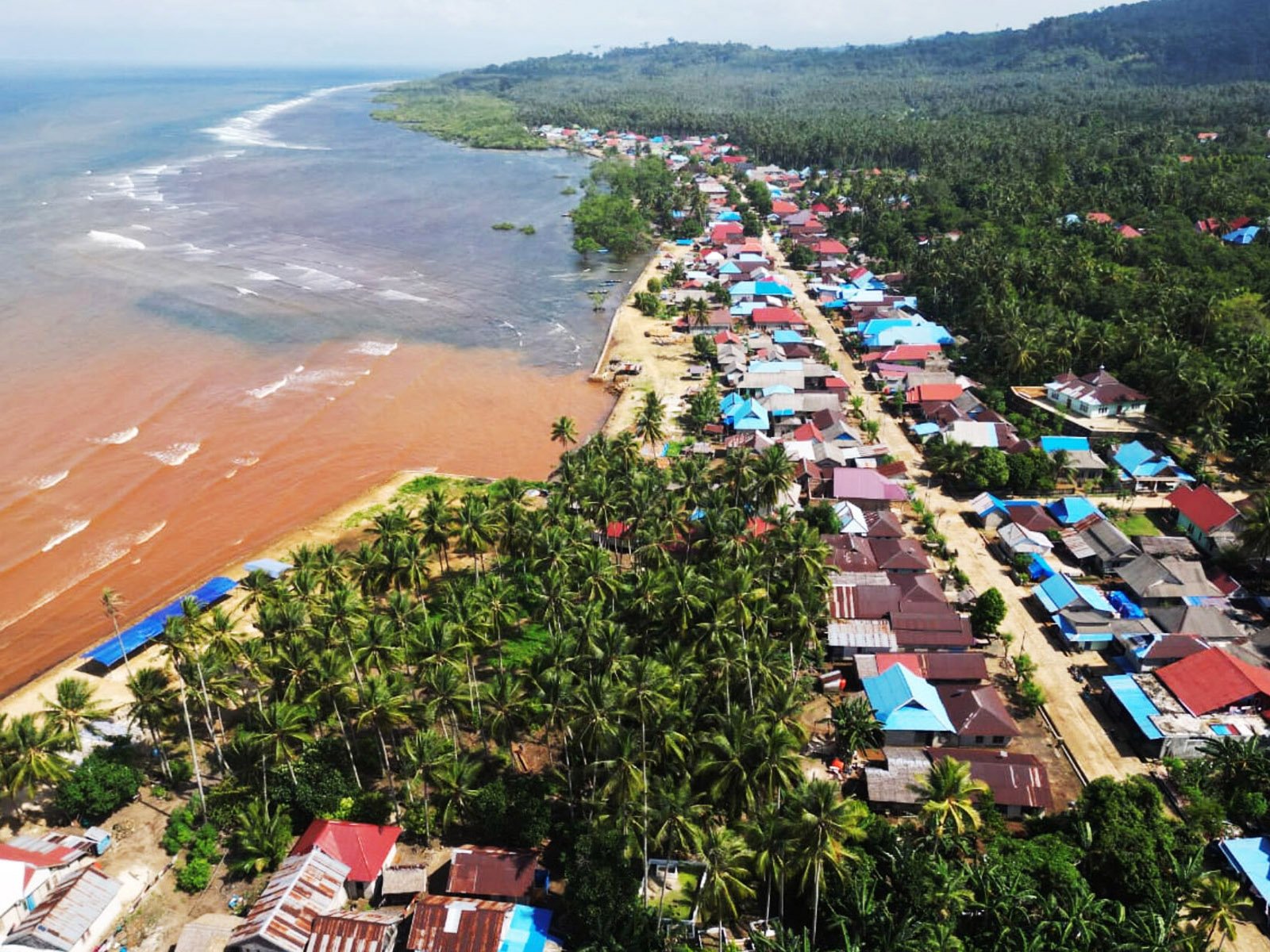
An bird’s-eye view of several villages in Southeast Wawonii District. The mining activities of PT Gema Kreasi Perdana have allegedly polluted the sea. Photo: Benaya Ryamizard Harobu/Project Multatuli
While the company filed a judicial review at the Constitutional Court, the Southeast Sulawesi Provincial Council officially removed the allocation of land for mining on Wawonii Island. The Regional Regulation Draft (Raperda) concerning the 2023-2043 Spatial Planning of Southeast Sulawesi designates Wawonii Island as an integrated fishery region.
Fajar Ishak, head of the Council’s special committee (Pansus) on the Spatial Planning bill, explained that revocation of land for mining in the Konawe Islands Regency was eliminated to comply with the Supreme Court’s decision.
“The Supreme Court’s decision was issued towards the end of 2022 (and became effective this year). Therefore, we cannot ignore it. As a consequence, we decided to declare Wawonii Island as an integrated fishery area. There will be no more mining there,” said Fajar on August 29,2023.
“This is a False Allegation”
PT Gema Kreasi Perdana spokesperson Alexander Lieman denied the accusations that the company had caused environmental damage. According to him, the company has taken preventive measures to prevent air pollution such as routinely monitoring the air quality and regularly watering the roads.
“We are taking such measures as part of our commitment to protect the environment, especially Wawonii Island,” said Lieman. “In fact, we even provided compensation for residents whose plantations were affected by mining activities.”
Regarding the murky water, Lieman claimed the water on Wawonii Island had always been like that, even before the company commenced its operations. He noted that every time it rained, the water turned dark.
“Our mining activities do not pollute the river (…) We strongly reject these baseless accusations. You can validate this with the local administration as well as the Environmental Agency”.
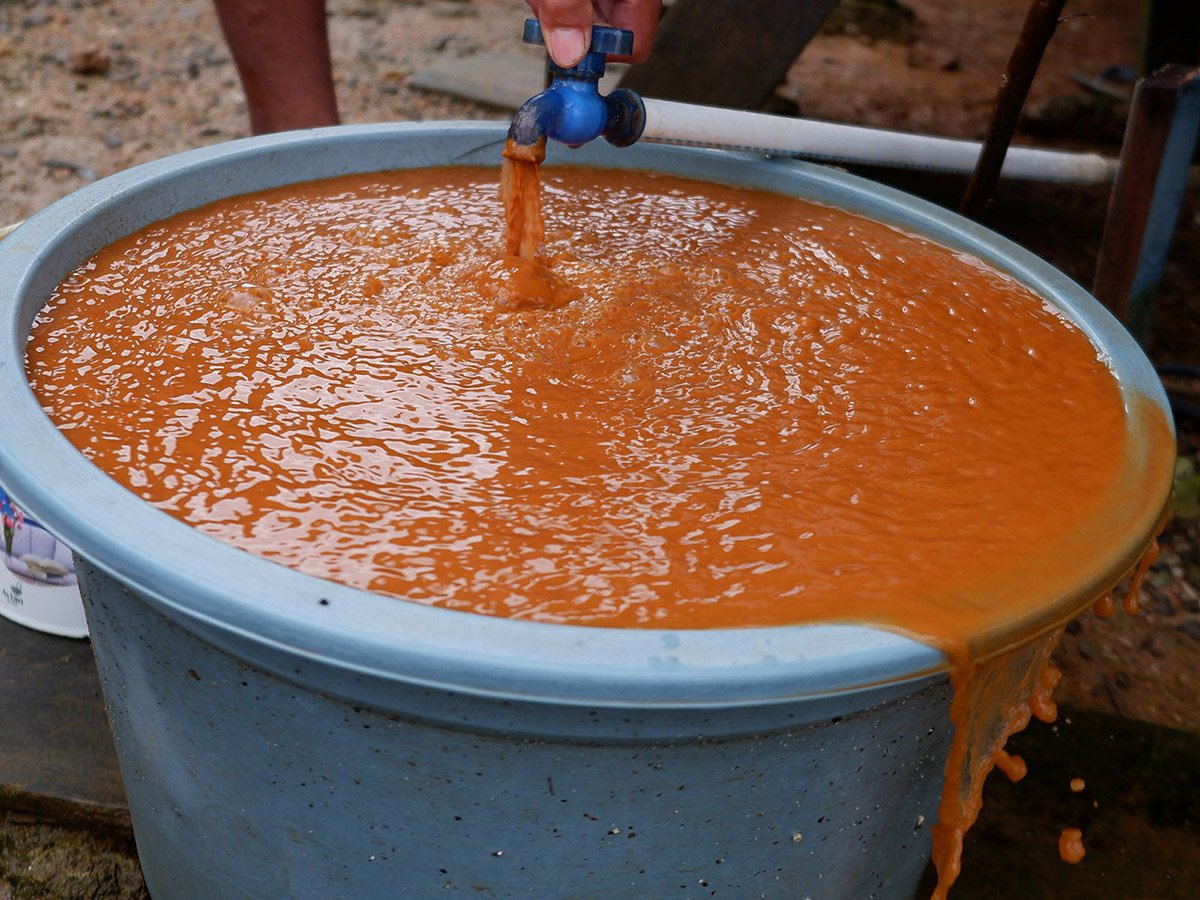
Murky water flowing from a resident’s pipeline on May 21, 2023. Photo: Yuli Z./Project Multatuli
Lieman said the corporation actually helped the communities to access clean water by dispatching water trucks to villages, setting up a special team to find alternative sources of clean water, digging wells, and cleaning the communities’ water tanks.
“The river is clear again, and the residents can easily access clean water for their daily needs”.
Lieman’s statement does not correspond to the facts on the ground. The water flowing in Dompo-Dompo Jaya, Sukarela Jaya, and Roko-Roko villages continues to carry mud. The water was still dark by August 18, 2023, even though there had not been heavy rain for quite some time.
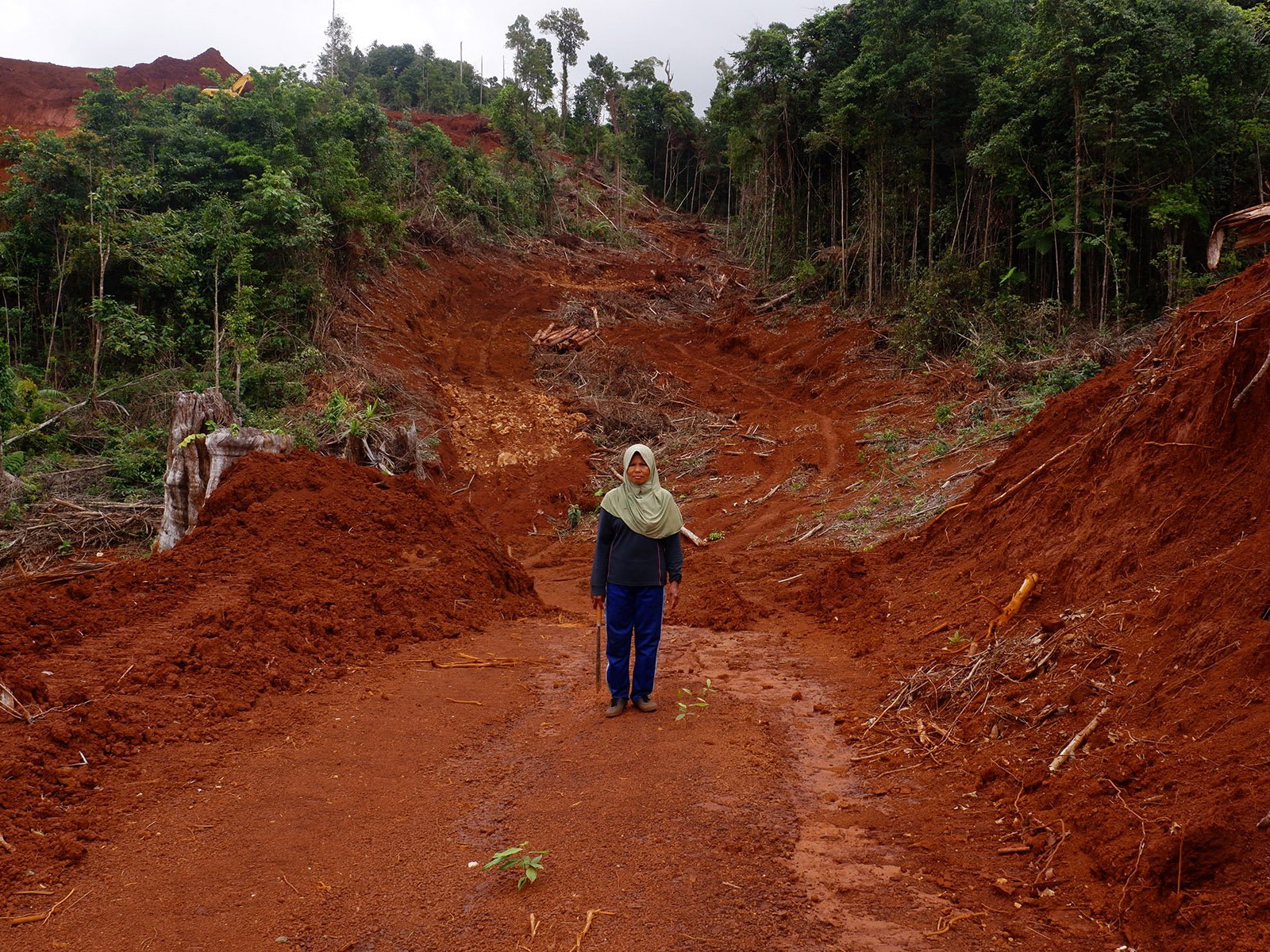
Royani, warga Desa Mosolo, berpose di lahan miliknya yang telah gundul. Sebanyak 300 pohon cengkihnya ditumbangkan. Royani masih mempertahankan lahannya agar perusahaan tidak melakukan penggalian. Photo: Yuli Z./Project Multatuli
“Hewan pun membutuhkan air. Kalau tidak ada air, mati konyol kita,” Ratna merutuk.
Ratna kesal. Pipa yang saban hari mengalirkan air bersih ke rumahnya kini membawa sedimentasi lumpur. Ratna meyakini lumpur itu mengandung tanah bekas galian nikel PT Gema Kreasi Perdana, anak perusahaan Harita Group, pemilik tunggal izin konsesi di Pulau Wawonii, Kabupaten Konawe Kepulauan. Sebab, air yang digunakan selama ini tak pernah sekeruh itu walau di musim hujan.
Ratna menangis. Hatinya teriris. Ia marah bercampur kecewa. Marah kepada perusahaan yang dianggapnya semena-mena. Kecewa kepada siapa saja yang mendukung beroperasinya perusahaan tambang di pulau yang luasnya hanya 706 km² itu.
Hari-hari berikutnya, Ratna harus menunggu berjam-jam hingga air cukup jernih agar bisa digunakan mandi dan mencuci pakaian dan perabotan dapur. Untuk keperluan memasak, Ratna terpaksa membeli air yang harganya Rp8.000 per galon. Kondisi air belum pulih saat Wawonii Tenggara kembali diguyur hujan pada 21 Mei 2023, menyebabkan sumber mata air kian keruh.
Beberapa jam setelahnya, pipa yang mengalirkan air dari satu-satunya bak penampungan yang digunakan warga selama ini terputus. Warga menduga ada “oknum” yang sengaja memutus pipa agar masalah air tercemar tidak tersebar luas.
Ratna sudah menduga hal ini jauh sebelumnya. Tak heran ia mati-matian menolak masuknya tambang.
“Kata mereka yang jual lahan, aktivitas tambang tidak ada dampaknya. Sekarang sama-sama kita cari air bersih. Mereka dikasih bodo-bodo perusahaan.”
“Hancur kami di sini,” suaranya meninggi.
Ibu dua anak ini sudah 58 tahun menetap di Desa Sukarela Jaya, Kecamatan Wawonii Tenggara. Sejak lahir, berumah tangga, dan sekarang memiliki cucu. Walau hidupnya tak berjalan mulus-mulus saja, ia masih mampu memenuhi kebutuhan hidup dan bertahan sampai hari ini. Apalagi sekadar mendapatkan air bersih.
“Kami perjuangkan pulau ini karena di sini kami lahir. Di sini tumpah darah kami.”
Pulau Wawonii telah menyediakan segala yang dibutuhkan. Tanaman jambu mete, pala, cengkih, dan kelapa, cukup untuk menopang hidupnya. Ratna tak pernah tergiur lahannya ditawari uang ratusan juta rupiah. Uang dari perusahaan bisa habis dalam sekejap, katanya, tapi hasil perkebunan bisa dinikmati terus-menerus.
“Setahun hasil pala bisa berton-ton. Kita dibilang tolak rezeki. Lantas, ini bukan rezeki?”
Lagi pula, tanpa hadirnya tambang, Ratna merasakan hidupnya telah berkecukupan. Hasil perkebunan memungkinkannya menabung dan membeli berbagai keperluan hidup. Hasil kebun itu juga telah membawanya umrah pada awal tahun 2023.
“Biar tidak ada uang, kita masih bisa makan. Kita punya pemikiran jangan cuma sejengkal. Harus berpikir jauh ke depan. Kita punya anak cucu.”
Ratna beranjak ke halaman rumah. Di sana, biji dan bunga pala dijemur di bawah terik matahari. Ditatapnya biji-biji pala yang tak lama lagi menjadi rupiah.
Ratna berkata telah bosan menyampaikan keresahan hatinya. Suaranya hanya dianggap angin lalu oleh para pengambil kebijakan. Padahal, tambahnya, “perempuan yang dirugikan karena kami memasak dan mengurus dapur.”
Di tengah berbagai penolakan dan gejolak yang terjadi, eksavator perusahaan terus menggunduli lahan dan mengeruk tanahnya. Kendaraan-kendaraan pengangkut ore nikel tetap lalu lalang menuju pelabuhan, yang letaknya hanya 200-an meter dari rumahnya.
Ratna bertekad tak akan menyalurkan hak pilihnya pada pemilu di tingkat lokal nanti. Ia kadung kecewa. Merasa ditinggalkan anggota dewan yang seharusnya menjadi penyambung suaranya. Merasa tak dipedulikan kepala daerahnya.
“Saya akan golput. Hanya suara kami yang dibutuhkan. Kita demo di DPR, diusir seperti binatang. Dibentak-bentak. Kita demo di Kendari, dihantam dengan gas air mata. Saya hampir mati karena sesak napas.”
“Katanya, mendatangkan investor untuk kesejahteraan, tapi malah menyengsarakan. Mematikan secara halus.”
“Sekarang tidak ada keadilan. Tidak ada perikemanusiaan. Kayak penjajahan Belanda kita dibikin. Penjajahnya negara sendiri.”
Bersembunyi di Hutan
Pukul 6 pagi pada pertengahan Mei 2023 di Desa Sukarela Jaya, Hastati sibuk membelah buah kelapa tua untuk dijadikan kopra. Totalnya 1.000 buah. Sebagian kelapa itu milik sendiri yang baru saja dipanen, sebagian lain dibeli dari warga sekitar. Saat itu harga kopra putih Rp7.500/kg dan kopra hitam Rp6.500/kg. Dalam satu kali panen, setiap tiga bulan, kelapa yang dihasilkan biasanya mencapai 3.000 buah. Selain daging kelapa, Hastati mendapatkan keuntungan ekonomi dari tempurung kelapa yang dibakar menjadi arang.
Hastati, 45 tahun, adalah ibu enam anak. Seperti warga lain yang menolak tambang, Hastati merasa sudah cukup atas hasil perkebunannya. Ia berkata pernah ditawari uang Rp1 miliar agar mau melepas tanah seluas 2 ha warisan orang tua. Ia juga bercerita ditawari umrah gratis berkali-kali, bantuan biaya pendidikan untuk anak-anaknya, dan pernah diajak bekerja di tambang.
“Tapi saya tolak. Kita mau mempertahankan lahan dan Pulau Wawonii. Lebih baik kita berdikari begini.”
Uang dari perusahaan, katanya, bisa habis dalam sekejap. Namun, lahan yang dimilikinya, selama tidak dirusak, bisa memberikan kehidupan hingga generasi mendatang.
“Kalau sudah habis gunung, perusahaan pulang. Sedangkan kita?”
Di lahannya tumbuh pala, cengkih, dan jambu mete. Baru setahun terakhir Hastati mulai membuat kopra. Pohon pala dan cengkih baru belajar berbuah. Tahun lalu, ia memanen 50 kg cengkih. Sementara pala sekali panen rata-rata 5 kg. Jambu mete menjadi tanaman andalannya. Setahun bisa menghasilkan 3-4 ton.
Hastati tinggal bersama suami dan empat anak dan seorang cucu. Sulitnya mendapatkan air bersih menghantam seluruh kehidupannya, tak cuma mempengaruhi ekonomi rumah tangga. Hastati tak pernah menyangka akan melalui fase ini. Sejak dulu, ia tak pernah kesulitan mendapatkan air bersih. Sumur di Roko-Roko rata-rata sudah ditutup lebih dari satu dekade sejak air dari mata air Banda mengalir lancar ke kampung.
“Dulu kita senang air mengalir ke rumah. Sekarang harus ke sungai untuk mencuci. Bagaimana kita tidak mau marah?”
Sebagai bentuk penolakan tambang, Hastati menolak menerima bantuan air dari perusahaan. Ini bukan hanya tentang air. Ini tentang prinsip, katanya. “Sekarang terpaksa pakai air kali untuk memasak.”
Hastati tak pernah lupa kejadian tahun 2022. Saat itu ia bersama ibu-ibu lain nekat melepas baju dalam aksi menolak tambang nikel. Ia juga pernah bersembunyi di hutan selama nyaris dua bulan. Ia takut ditangkap lantaran dianggap menghalangi pertambangan.
“Saya jengkel kepada perusahaan. Kita mempertahankan lahan malah dicari-cari polisi. Padahal kita tidak membunuh atau mencuri.”
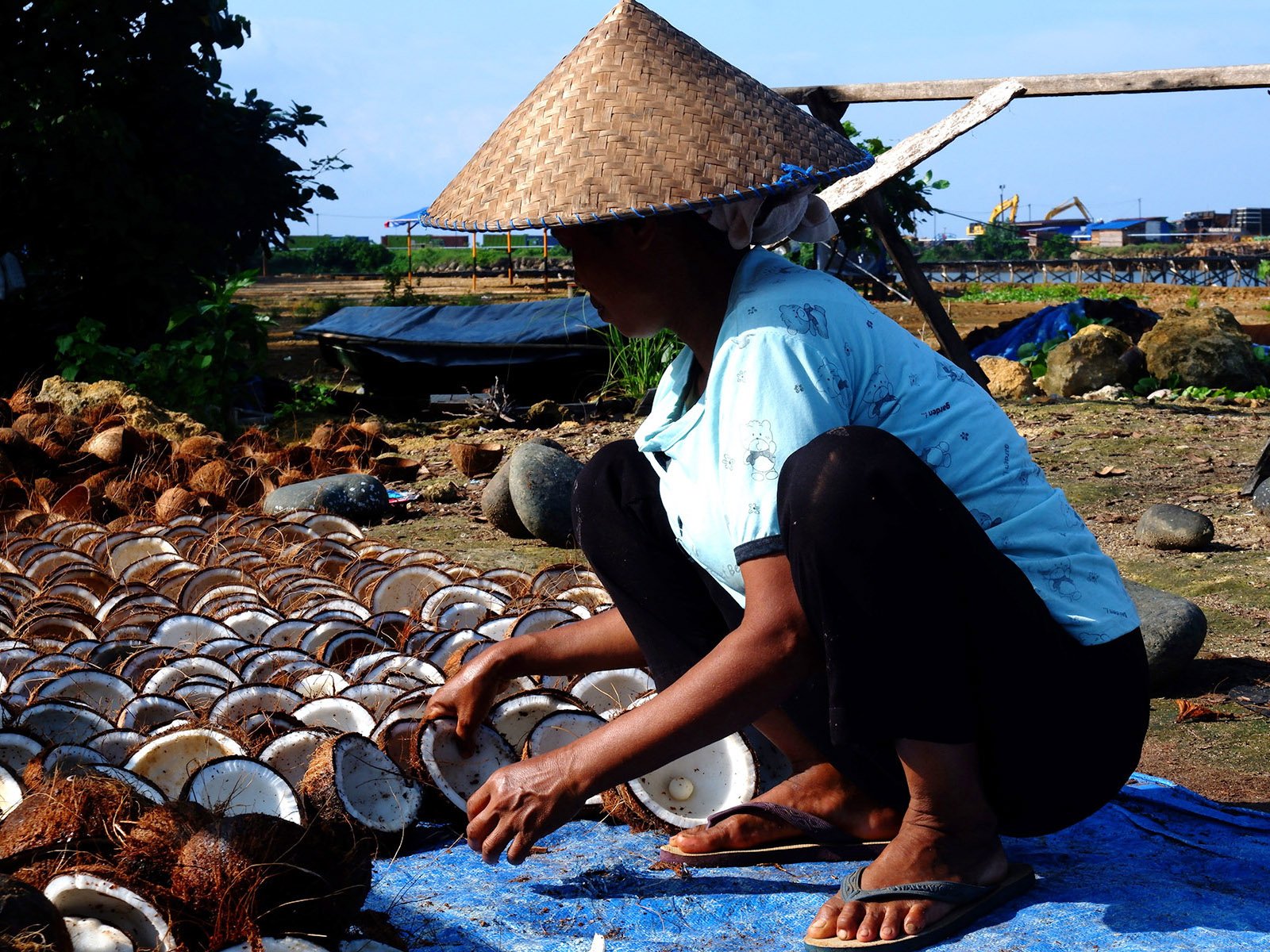
Hastati, warga Sukarela Jaya, menjemur kelapa untuk dijadikan kopra dengan latar belakang alat berat PT Gema Kreasi Perdana, anak usaha Harita Group. Photo: Yuli Z./Project Multatuli
Hastati bersembunyi di hutan bersama delapan warga lain. Di antara mereka ada Amlia yang menolak menjual lahannya untuk dijadikan jalan hauling atau jalan akses kegiatan pertambangan.
Saya menemui Amlia di kebunnya pada 20 Mei 2023. Ia berkisah bersembunyi di hutan lantaran takut ditahan polisi setelah menerima surat panggilan sebagai “saksi” oleh Kepolisian Resor Konawe Kepulauan.
“Kalau tidak dikasih lahannya, kita tidak dilepas di kantor polisi. Yang dipanggil ke polisi yang punya lahan. Kita bingung kenapa dipanggil. Lebih baik kita lari. Tidak usah kita hadiri panggilan polisi itu.”
Selama persembunyian itu, mereka melewati hari-hari cukup berat. Siang berpencar di hutan, malam mencari gubuk untuk berlindung. Dalam sehari, kadang tidak makan apa pun. Pernah mereka terpaksa makan singkong rebus basi.
“Biarpun makan, kita tidak rasa makan. Begitu juga kita duduk. Tidak tenang. Mau tenang bagaimana? Kita lari hampir dua bulan. Kita dicari-cari petugas polisi,” tutur Amlia.
Amlia juga pernah diiming-imingi gaji untuk anak pertama dan suaminya tanpa perlu bekerja oleh pihak perusahaan.
“Saya ditawari terserah mau berapa. Kalau mau, anak dikasih kuliah sambil kerja di kantor. Bapak dapat gaji biar tidak kerja. Anak yang paling tua juga dapat gaji biar tidak kerja.”
Tak jauh dari gubuknya, tumbuh pohon singkong berusia dua bulan dan tanaman lain seperti cabai, pisang, dan kelapa. Hujan deras beberapa hari sebelumnya menyebabkan sebagian lahan itu terendam air yang membawa sedimentasi lumpur merah setinggi pinggang orang dewasa. Amlia menduga tanah merah itu mengandung bekas galian nikel.
Kini Amlia dan suaminya harus berjalan kaki sejauh 2 km dari tempat memarkir sepeda motor mereka setiap kali ke kebun. Rute yang biasa dilalui telah menjadi jalan hauling PT Gema Kreasi Perdana. Saat masih bisa menggunakan sepeda motor, mereka biasanya ke kebun pukul 8 pagi. Sekarang paling telat berangkat pukul 6.30. Dari semula hanya setengah jam naik motor, sekarang mereka harus berjalan kaki selama dua jam untuk tiba di kebun.
Hasil panen pun dipikul dengan berjalan kaki melewati jalanan berbukit. Saat musim panen jambu, Amlia dan suaminya terpaksa mengangkut jambu seberat 20-30 kg dengan berjalan kaki.
“Walau sulit, kita berusaha tembus. Namanya petani. Pendapatan kita dari berkebun,” kata Amlia, yang membopong singkong seberat 20 kg dari kebun menuju parkiran motor sejauh 2 km dengan berjalan kaki.
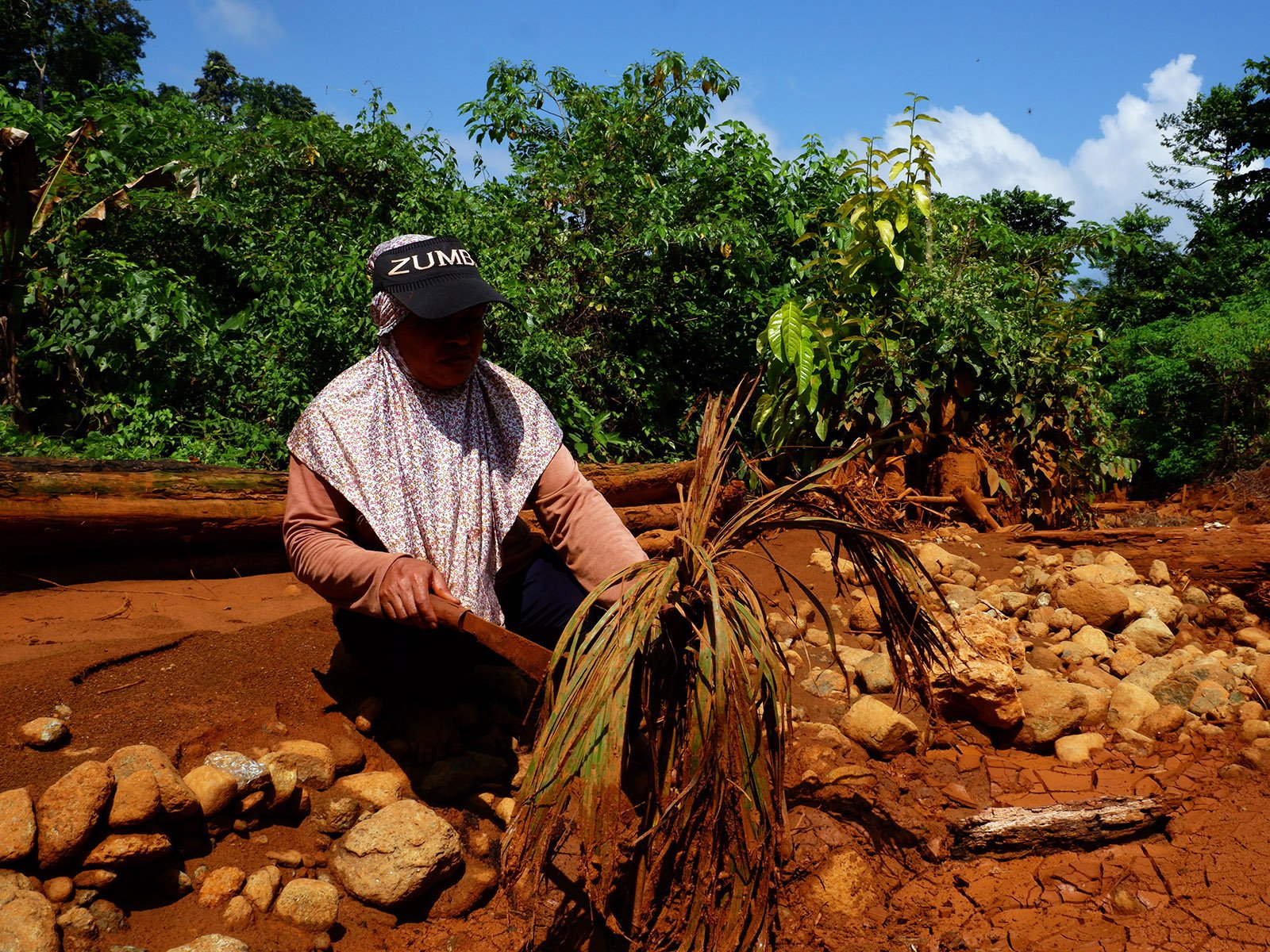
Amlia, warga Sukarela Jaya, memperlihatkan tanaman kelapa di kebunnya yang rusak terendam air berlumpur. Photo: Yuli Z./Project Multatuli
Merusak Mata Air
Saharia, warga Desa Dompo-Dompo Jaya, seperti biasa bangun pagi hari untuk menyiapkan sarapan. Saat memutar keran untuk mencuci ikan, air yang keluar berwarna oranye. Ia terpaksa memasak dan mencuci bahan makanan menggunakan air hujan yang ditampung dari atap rumah beberapa hari sebelumnya.
Saharia, 50 tahun, adalah ibu tunggal empat anak. Keluarga ini memiliki kebun seluas 250 m² yang ditanami kelapa, jambu mete, pala, dan cengkih. Saharia mengolah kelapa yang buahnya dijadikan kopra dan tempurungnya dijadikan arang, dibantu ketiga anaknya. Salah satu anaknya saat ini mencari nafkah di perantauan.
Saat ini Saharia cemas kebun mereka bisa diserobot sewaktu-waktu oleh perusahaan.
PT Gema Kreasi Perdana, anak usaha Harita Group, melakukan produksi dan pengapalan ore nikel pada Agustus 2022. Lokasi penggalian korporasi berada di beberapa desa di Kecamatan Wawonii Tenggara, yang diduga telah mencemari sumber mata air. Pamsimas (program penyediaan air minum dan sanitasi berbasis masyarakat) Sukarela Jaya dan Pamsimas Dompo-Dompo Jaya, keduanya menyuplai air bersih untuk dua desa tersebut, mengalirkan air berlumpur sejak hujan deras pada 9 Mei 2023.
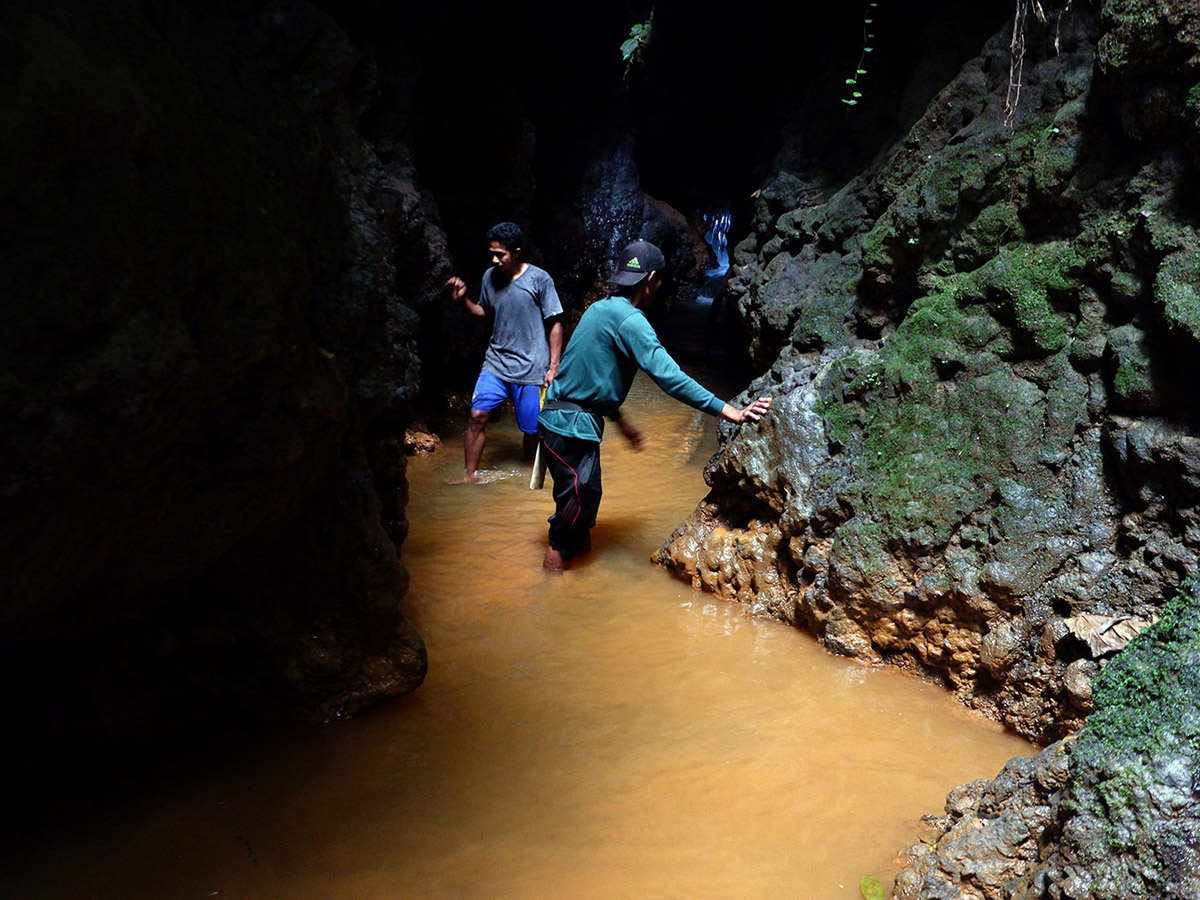
Mata air Banda tampak sangat keruh. Mata air ini menyuplai kebutuhan warga di lima desa di Kecamatan Wawonii Tenggara tapi tak bisa lagi digunakan. Photo: Yuli Z./Project Multatuli
Pada 19 Mei 2023, saya mendatangi mata air Banda di hutan Wawonii Tenggara, sekitar satu jam berjalan kaki dari Desa Dompo-Dompo Jaya. Mata air di dalam gua karst dengan ketinggian 119 mdpl ini mengalir ke beberapa anak sungai sebagai sumber pengairan kebun dan pertanian warga.
Pada 21 Mei, Wawonii Tenggara kembali diguyur hujan. Kawasan perairan di Desa Sukarela Jaya, Dompo-Dompo Jaya, dan Roko-Roko berubah warna cukup pekat. Di tengah hujan, warga yang tinggal di tepian laut membersihkan selokan, menghalau material lumpur yang terbawa air hujan. Menurut warga setempat, perubahan warna air laut kerap terjadi saat hujan, tapi tidak separah itu.
Saya memeriksa pipa di rumah warga. Airnya cokelat pekat. Tak sampai dua jam setelah hujan berhenti, aliran air di rumah-rumah warga terhenti. Dalam perjalanan, saya bertemu seorang wanita yang membawa bundel cucian di atas sepeda motor. Ia berteriak, “Saya mau pergi bilas cucian.” Perempuan lain menimpali, “Air ini sudah tidak ada gunanya.”
Saya mendatangi lokasi pertemuan sungai Roko-Roko dan Tambusiu-siu yang mengalirkan mata air Banda. Gradasi warna mencolok antara keduanya. Sungai Roko-Roko hanya sedikit keruh, sedangkan Tambusiu-siu berwarna kecokelatan. Sungai Roko-Roko adalah satu-satunya yang tidak tercemar dan masih digunakan warga Desa Roko-Roko, Sukarela Jaya, dan desa sekitar untuk keperluan mandi, mencuci, dan memasak. Perusahaan membagikan air bersih tapi sebagian warga menolak sebagai sikap penolakan atas aktivitas tambang di Wawonii.
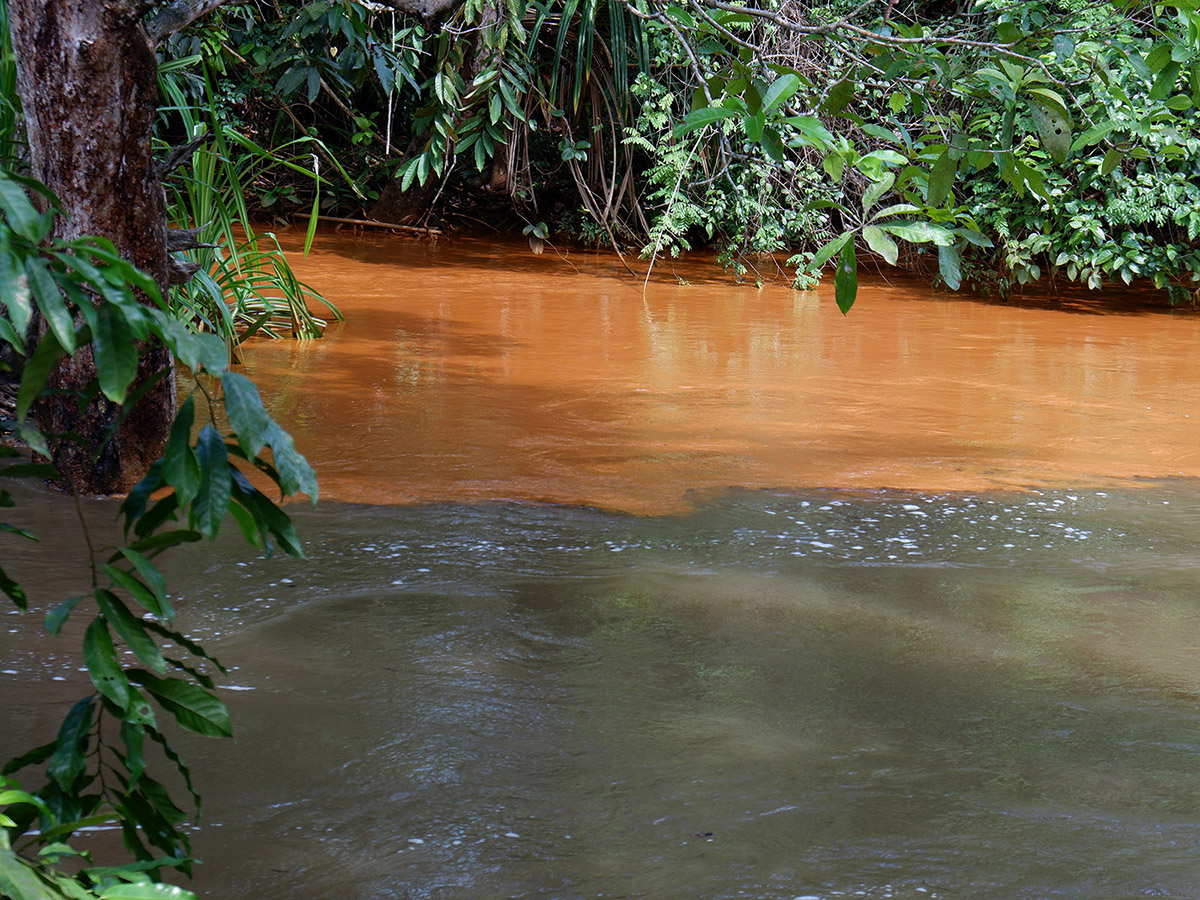
Pertemuan dua sungai, yakni sungai Tambusiu-siu (berwarna oranye) dan sungai Roko-Roko usai hujan selama kurang lebih dua jam mengguyur daerah itu. Photo: Yuli Z./Project Multatuli
Saharia termasuk warga yang menolak tambang. Sebagai ibu tunggal, ia mengemban peran ganda mengurusi rumah dan mencari nafkah. Ia harus ke sungai berjarak 500 meter untuk mendapatkan air bersih, selain mengandalkan air hujan. Ia dan keluarganya terpaksa mengurangi frekuensi mandi karena merasa tak nyaman menggunakan air kotor. Belum lagi anggota keluarga perempuan yang setiap bulan harus melalui fase menstruasi. Di rumahnya, ada tiga perempuan.
“Kita pusing tidak ada air begini,” keluhnya. “Pada masa-masa datang bulan itu berat sekali. Karena harus sering bersih-bersih. Sekarang mau apa? Kita tahan-tahan mi.”
Sampai pertengahan Agustus 2023, air bersih belum juga pulih. Padahal sudah memasuki musim kemarau. Walau tak begitu keruh, air masih berlumpur. Selain itu, saluran air kerap kali macet. Sejak terputus pada Mei, air kembali mengalir pada awal Agustus.
Perasaan takut menghantui Saharia setiap kali menggunakan air yang diduga kuat tercemar itu. Tapi tak ada pilihan lain. Untuk kebutuhan minum, ia kadang mengambil air di sumur warga lain yang berjarak 100 meter dari rumahnya, dengan menggunakan gerobak pasir untuk mengangkut air.
“Saya khawatir soal kesehatan. Biasanya habis mandi kita gatal-gatal. Tapi mau bagaimana lagi? Kita butuh mandi. Saya rindu kehidupan yang dulu,” katanya.
Diserang Gatal-Gatal
Sudah lama tidur Ristan tak nyenyak. Nyaris setiap malam ibu muda berumur 24 ini terbangun dan menyaksikan bayi kesayangannya kesulitan tidur. Abyan, anak lelakinya, diserang gatal-gatal sejak berusia lima bulan. Mulanya pada area betis dan pergelangan kaki muncul bintik-bintik kecil, lambat laun menyebar hingga ke jari dan telapak kaki. Sekarang usia Abyan sembilan bulan.
“Ini sudah lumayan membaik. Awalnya parah sekali. Penuh luka. Jorok,” ujar Ristan memperlihatkan kaki Abyan seperti parutan.
Penyakit itu juga menyerang Ristan, suaminya, dan kedua orang tuanya. Tubuh Nahati, ibu Ristan, berbintik hitam dan terasa gatal sekitar enam bulan lalu. Penyakit ini dialami hampir semua warga di tiga desa meliputi Mosolo, Sinar Mosolo, dan Sinaulu Jaya.
“Awalnya gatal di semua badan. Saat digaruk terasa panas. Bahkan sampai berdarah. Saya pusing. Kadang digaruk pakai sikat. Saya obati dengan meminum rebusan daun,” kata Nahati.
Sumber air yang digunakan Ristan sekeluarga berjarak kurang lebih 500 meter dari lokasi penambangan nikel.
Nahati bermukim di Mosolo sejak umur lima tahun. Sepanjang usianya yang sekarang 65 tahun, ia berkata belum pernah mengalami penyakit gatal-gatal seperti saat ini. Dulu, air menjadi keruh hanya jika hujan deras berhari-hari. Tak seperti sekarang. Air berubah warna walau hujan sebentar. Kini keluarga ini terpaksa menggunakan air kotor. Tak ada sumber air lain. Agar bisa digunakan, air harus didiamkan sampai cukup jernih.
Di Desa Mosolo, nasib Tika pun sama. Ibu dua anak berusia 24 tahun ini mengeluhkan gatal-gatal. Kondisi tubuh An, anak Tika berusia 1 tahun, mirip dengan Abyan. Kulit jari-jari kakinya terkelupas. Pada punggung kaki ada bekas luka-luka berbentuk melingkar kehitaman. Awal Agustus 2023, Tika memeriksakan diri dan anaknya ke dokter di Kota Kendari.
“Kata dokter, tidak ada masalah dengan susunya. Hanya dibilang mungkin pengaruh cuaca. Semua keponakan juga gatal-gatal. Saya sendiri gatal-gatal sejak bulan lalu.”
“Kita tidak pakai sumur bor. Hanya mengharapkan air dari mata air,” kata Tika.
Di Desa Sinaulu Jaya, Wa Muita tinggal bersama lima anggota keluarga, tiga di antaranya perempuan. Ia mengalami gatal-gatal dalam setahun terakhir. Ini rentang saat perusahaan tambang melakukan penggalian nikel. Penyakit gatal-gatal yang dideritanya tak kunjung sembuh, sementara kebutuhan air rumah tangga pun berwarna cokelat saat hujan deras pada Mei 2023.
“Kita pakai mandi, mencuci, memasak. Pokoknya kebutuhan sehari-hari. Di sini sungainya jauh. Kalau musim hujan, pasti merah juga.”
Wa Muita menderita gatal-gatal di beberapa bagian tubuhnya. Ia telah mencoba berbagai obat salep. Pernah berobat di puskesmas dan diberikan obat. Tak ada perubahan.
“Sudah berapa tablet kita minum, masih gatal-gatal. Mungkin karena air yang dipakai masih kotor. Jelas kita marah. Sebelumnya tidak pernah begini.”
“Awalnya muncul bintik-bintik merah. Kalau digaruk semakin gatal. Kita garuk sampai berdarah. Bahkan celana dalam kita berdarah-darah.”
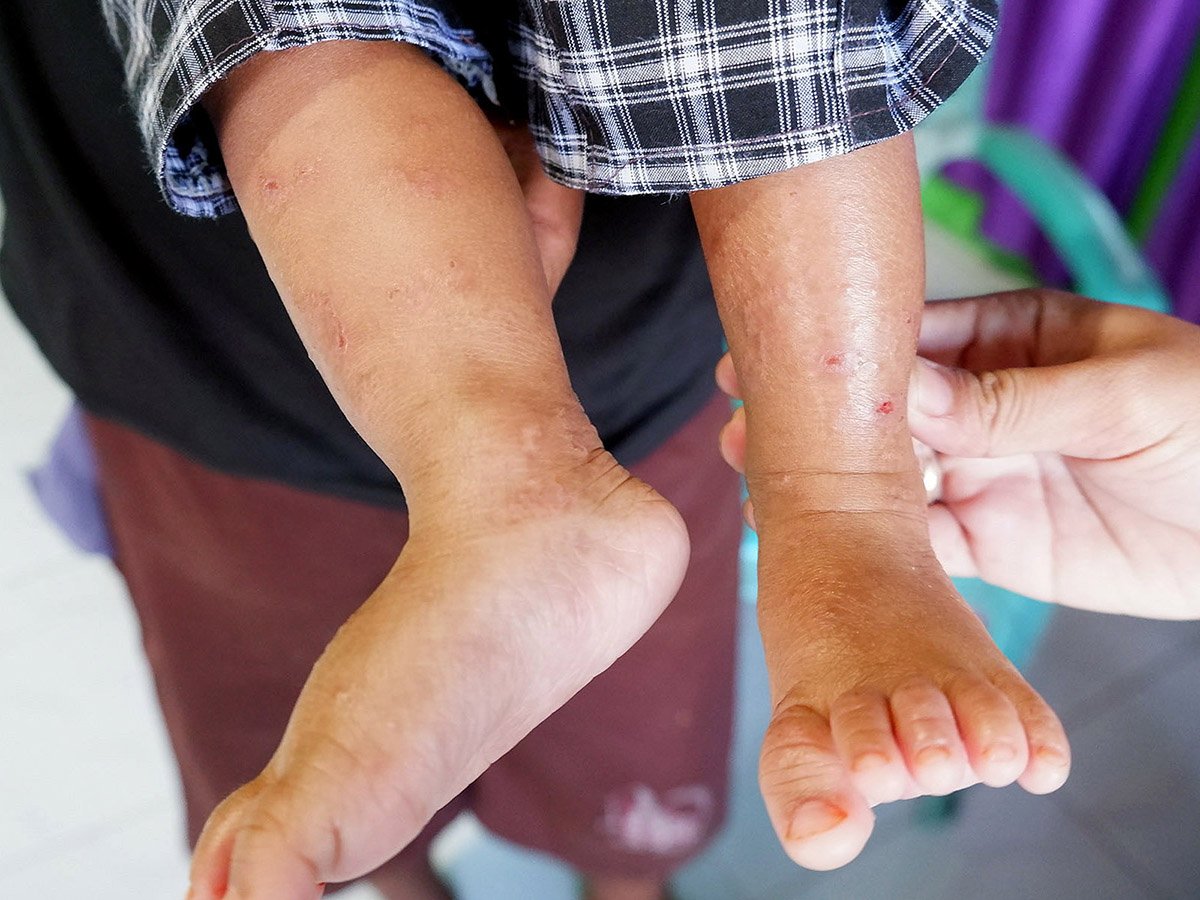
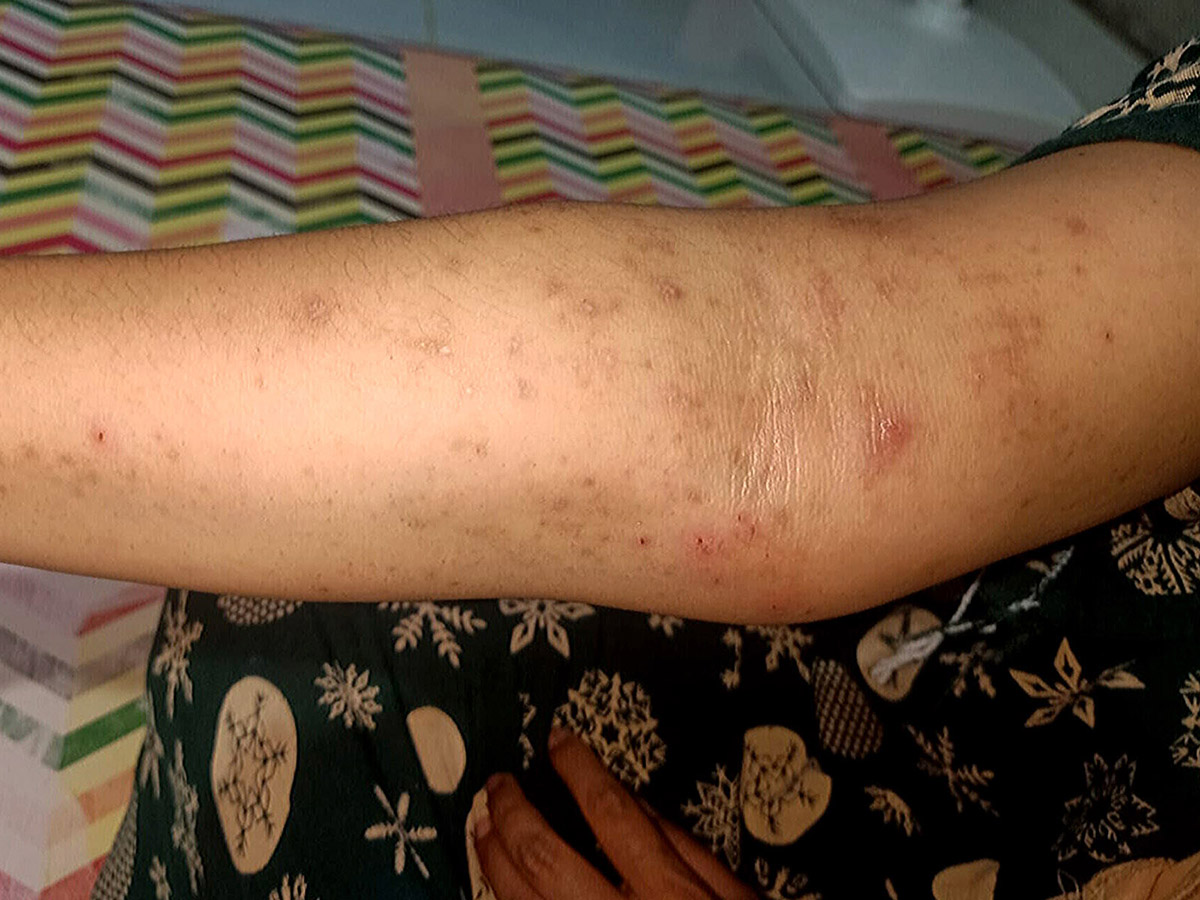
Kiri: Kaki Abyan, bayi di Desa Sinaulu Jaya, yang menderita gatal-gatal sejak usia lima bulan.
Kanan: Lengan penderita gatal-gatal di Desa Sinaulu Jaya. Photos: Yuli Z./Project Multatuli
Jumriati, warga Sinaulu Jaya berusia 24 tahun, khawatir sistem reproduksinya terganggu. Selain itu ia takut jika pertumbuhan anaknya berusia tiga tahun terganggu akibat terus-terusan mengonsumsi air tidak layak pakai.
“Harapannya, pemerintah bisa perhatikan keluhan kita di sini. Perhatikan masyarakatnya. Jangan biarkan masyarakat terdampak pencemaran tambang. Mereka raup keuntungan tapi kehidupan kami dikorbankan.”
Lahadi, penjaga penampungan air warga Sinaulu Jaya, membenarkan air mulai keruh dan kemerahan sejak perusahaan mengebor pada 2020. “Kita tidak bisa mendeteksi apakah pencemaran itu akibat aktivitas perusahaan atau bukan. Akan tetapi, ketika hujan selama satu hari, mata air mengalirkan gumpalan lumpur ke tempat penampungan,” katanya.
“Kita bicara begini bukan mengarang. Ada yang punya lahan di situ dan dia tahu persis bahwa lahan di sekitar itu telah dieksploitasi.”
Terkait dugaan pencemaran air, Kepala Bidang Penataan Peningkatan Kapasitas Lingkungan Dinas Lingkungan Hidup Konawe Kepulauan, Hasnawati mengatakan air yang digunakan warga Roko-Roko masih sesuai baku mutu berdasarkan Peraturan Menteri Lingkungan Hidup dan Kehutanan. Pengujian dilakukan pada mata air Pamsimas Sukarela Jaya dan Pamsimas Dompo-Dompo Jaya.
“Untuk hasil lab yang kami lakukan dan diperiksa di laboratorium terakreditasi (laboratorium Kabupaten Kolaka), hasilnya masih sesuai baku mutu sesuai Permen LHK. Untuk sungai Mosolo, kami pantau sebagai bahan laporan ke KLHK,” katanya.
Hasnawati belum memperlihatkan hasil uji lab tersebut sampai artikel ini dirilis. “Ada sama staf saya,” katanya.
Muhammad Jamil dari Jaringan Advokasi Tambang (JATAM), organisasi masyarakat sipil yang melakukan riset tentang gurita bisnis tambang nikel Harita Group, induk PT Gema Kreasi Perdana, berkata kasus gatal-gatal dan penyakit kulit lainnya umum ditemukan di daerah tambang nikel. Di Sulawesi Tenggara, hal sama terjadi di Kecamatan Pomalaa, Kabupaten Kolaka, dan Kecamatan Tinanggea, Kabupaten Konawe Selatan.
“Setahu kami hal itu sudah diriset oleh kampus,” kata Jamil.
Penelitian La Maga, Ahyar Ismail, dan Faroby Falatehan dari Institut Pertanian Bogor (2017) di Tinanggea menemukan warga setempat menderita penyakit kulit akibat menggunakan air bercampur material tanah dari lokasi tambang nikel. Penyakit kulit umumnya diderita petani saat pengolahan lahan. Selain penyakit kulit, warga mengalami penyakit batuk akibat debu aktivitas penambangan maupun pengangkutan material nikel dari lokasi penambangan ke pelabuhan. Radius pencemaran udara ini sampai 3 km dari lokasi tambang nikel.
Mempertahankan Lahan
“Perasaan saya hancur melihat pohon cengkih tumbang. Seperti melihat anak sendiri dibunuh,” kata Wa Muita, 43 tahun, warga Desa Sinaulu Jaya, mengenang peristiwa 10 Agustus 2023.
Sehari sebelumnya, warga desa menerima laporan bahwa kebun mereka yang terletak di bukit Mosolo, berjarak dua jam perjalanan, diterobos PT Gema Kreasi Perdana.
Sehari sebelumnya, Wa Muita dan suaminya, Amiri, menerima laporan bahwa kebun mereka yang berjarak dua jam perjalanan, diterobos pihak PT Gema Kreasi Perdana. Amiri bergegas mengecek kondisi kebun pada pukul 12 malam dan mendapati 40 pohon cengkih yang sedang berbuah telah rata tanah. Selain cengkih, perusahaan merobohkan 20 pohon merica yang baru belajar berbuah dan puluhan pohon jambu mete yang diperkirakan berbuah pada Oktober nanti. Saat ini harga merica Rp65 ribu/kg.
Wa Muita menyusul keesokan harinya pukul 6 pagi bersama 20-an warga. Mereka melihat pohon-pohon cengkih berumur 18 tahun yang sudah jadi tumpuan ekonomi keluarga itu hancur seketika.
“Saya kehabisan kata-kata. Cuma air mata yang keluar,” kata Wa Muita.
Tak lama kemudian, ratusan warga memenuhi kebun Wa Muita. Warga mempertanyakan alasan penerobosan lahan. Namun, perusahaan berdalih telah membeli lahan itu melalui orang lain. Wa Muita dan Amiri menegaskan tidak pernah menjual lahan apalagi menerima uang hasil penjualan lahan itu. Situasi menjadi tidak terkendali. Warga dan pihak perusahaan hampir saling menyerang dengan senjata tajam.
“Setiap ke kebun saya tidak pernah lupa berbicara ke cengkih, ‘Tolong berbuah. Kita rawat kalian seperti anak sendiri. Kalian yang biayai saudara yang sekolah,” tutur Wa Muita.
Wa Muita memiliki dua anak yang sedang kuliah; satu anak sekolah menengah atas; dan satu anak sekolah dasar. Biaya pendidikan empat anak itu bergantung pada cengkih. Pada 2019, hasil panen cengkih keluarga ini mencapai 1 ton. Harga pasar cengkih di Wawonii Tenggara saat ini Rp130 ribu/kg. Bagi Wa Muita, 40 pohon cengkih yang ditumbangkan itu sangat berharga.
Menahan diri dan berbesar hati, Wa Muita dan Amiri meminta PT Gema Kreasi Perdana tidak memperluas penyerobotan. Ada total 200 pohon cengkih di kebun mereka dan 120 pohon di antaranya telah berbuah.
“Kami ikhlas. Semoga perusahaan mau menyisakan sedikit hati nuraninya. Kami sudah meminta orang yang menjual lahan tanpa sepengetahuan kami untuk mengembalikan uang perusahaan.”
“Kami mau harap apa? Mau cari lagi di mana? Tidak ada. Ini lahan kami satu-satunya. Gaji kami hanya dari kebun,” kata Wa Muita.
Wa Muita pernah mempertahankan lahannya dengan berjaga di kebun selama empat bulan.
“Kadang mandi empat hari sekali. Hanya harapkan air hujan selama berjaga dari bulan Februari sampai Mei. Makan apa adanya. Saya berjaga dengan suami dan orang Mosolo lainnya.”
“Kita berjaga terus jangan sampai ada penerobosan. Ternyata, setelah kita turun dari kebun, pihak perusahaan lirik sudah tidak ada orang, perusahaan garap.”
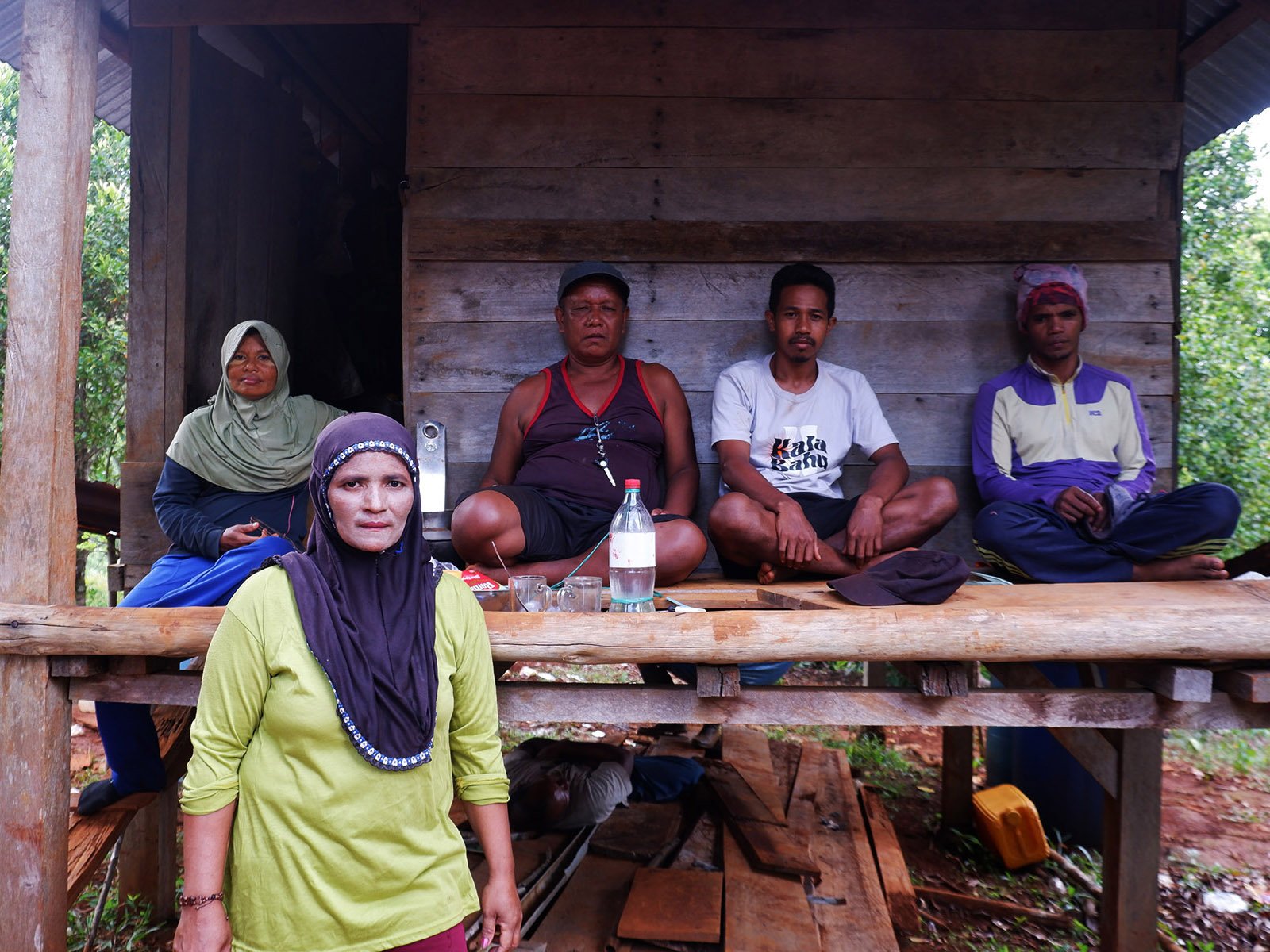
Wa Muita (kiri depan ) bersama warga Sinaulu Jaya dan Mosolo berjaga di kebun untuk mencegah penerobosan lahan oleh pihak perusahaan. Photo: Yuli Z./Project Multatuli
Sebelum kehadiran tambang nikel, Wa Muita biasanya ke kebun dua kali seminggu. Kini ia terpaksa lebih sering ke kebun. Bergantian dengan warga lain untuk memantau situasi.
“Saya tidak tahu mau bilang apa. Ini sadis buat saya. Ngeri. Hancur perasaanku. Kenapa ada orang sejahat itu menerobos saya punya lahan? Mati-matian kita jaga, rawat, perjuangkan. Ujung-ujungnya diterobos. Setelah itu kita masih diancam juga mau digusur.”
“Saya berharap sama media atau siapa pun, tolong hentikan yang merusak ini.”
“Kami Dibuat Terpecah Belah”
Belum cukup dengan dampak lingkungan yang ditimbulkan tambang nikel, warga dibuat terpecah belah. Konflik tak cuma antara warga dan korporasi, tetapi merasuk ke konflik keluarga: antar-tetangga saling bermusuhan; orang tua dan anak saling membenci; sesama saudara tak lagi saling menyapa; suami dan istri bahkan sampai bercerai.
Situasi itu dialami Sanawia yang sudah tiga tahun tak bertegur sapa dengan kedua orang tuanya. Konflik bermula saat salah satu saudara Sanawia menjual lahan warisan orang tua. Tindakan itu didukung sang ayah.
Tanah itu dijual saat Sanawia sedang demonstrasi menolak tambang di kantor DPRD Konawe Kepulauan pada 2019. Di perjalanan pulang, Sanawia mendengar kabar lahan orang tuanya telah dijual kakaknya.
“Saya hanya bisa menangis. Lahan yang dijual itu sudah diratakan. Sampai sekarang saya tidak pernah lagi ke rumah orang tua.”
Sanawia tak tahu pasti berapa luas lahan yang dijual, tapi kebun itu bisa menghasilkan 3.000 buah kelapa sekali panen.
Sanawia memiliki lima saudara, tiga di antaranya pendukung tambang. Saat orang tuanya sakit, ia enggan menjenguk. “Dulunya saya paling dekat dengan orang tua, sekarang tidak lagi.”
Ibu dua anak berusia 45 tahun ini ingin memperbaiki hubungan dengan orang tua dan saudara-saudaranya, tapi “hubungan kita bisa diperbaiki asalkan tambang pergi,” tambahnya.
Aba, bukan nama sebenarnya, pria paruh baya, menyaksikan kesedihan putrinya ditinggal suami saat mengandung anak kedua. Menantunya menawarkan uang dari perusahaan sebagai ganti rugi lahan milik Aba yang dijadikan jalan hauling PT Gema Kreasi Perdana.
Aba pernah dibawa ke kantor polisi demi mempertahankan lahan. Karena itu, ia marah saat menantunya menyodorkan uang ganti rugi tanpa persetujuannya. Ia menolak uang tersebut dan minta dikembalikan ke perusahaan.
Saat hendak membangun rumah, si menantu meminta putri Aba mengutang. Putrinya menolak. Saat itulah si menantu mengungkit-ungkit soal uang ganti rugi lahan yang pernah ditolak Aba. Cekcok suami-istri ini berujung kekerasan dalam rumah tangga.
“Anak saya datang malam hari sambil menangis. Mata kanannya lebam. Saya berusaha mendamaikan. Sempat berbaikan. Tapi beberapa hari setelahnya, saat anak saya mencari kerang di laut, suaminya pergi dari rumah dan tidak pernah kembali sampai hari ini,” kata Aba.
Kini putri dan kedua cucunya tinggal bersamanya. “Saya tidak akan pernah menerima uang perusahaan. Saya memang sudah tua, tapi saya memikirkan masa depan cucu-cucu saya,” kata Aba.
Sanawia dan Aba adalah warga Desa Roko-Roko. Dan di desa ini, perpecahan warga akibat kehadiran tambang bukan rahasia lagi. Beberapa orang yang saya temui mengaku enggan bersosialisasi dengan siapa pun yang tidak sekubu, bahkan sekadar bertegur sapa.
“Situasi sosial di Wawonii Tenggara seperti api dalam sekam,” kata Erwin Suraya dari Koalisi Rakyat untuk Keadilan Perikanan (KIARA), dalam diskusi publik mengenai kehancuran ekosistem Pulau Wawonii, belum lama ini.
Gugatan Hukum
Pulau Wawonii seluas 706 km² termasuk dalam kategori pulau-pulau kecil sesuai Undang-undang No. 27 Tahun 2007 tentang Perlindungan Wilayah Pesisir dan Pulau-Pulau Kecil. Pulau kecil adalah pulau dengan luas lebih kecil atau sama dengan 2.000 km². Dengan demikian, sebagaimana diamanatkan undang-undang tersebut, aktivitas pertambangan tidak boleh dilakukan di Pulau Wawonii.
Ada 2.214 jiwa penduduk yang tinggal di Desa Dompo-Dompo Jaya (441 jiwa), Sukarela Jaya (550 jiwa), Roko-Roko (582 jiwa), Bahaba (160 jiwa), dan Teporoko (481 jiwa) yang terdampak penambangan nikel PT Gema Kreasi Perdana, sebut kelompok masyarakat sipil terdiri atas Yayasan Lembaga Bantuan Hukum Indonesia (YLBHI), JATAM, KIARA, Trend Asia, dan LBH Makassar.
PT Gema Kreasi Perdana mendapatkan izin eksplorasi bahan galian nikel dan mineral pengikut sejak 2007. Pada akhir tahun 2019, anak usaha Harita Group ini mengantongi izin usaha pertambangan (IUP) operasi produksi seluas 850,9 ha. Seluas 707,10 ha konsesi perusahaan merupakan izin pinjam pakai kawasan hutan (IPPKH). Perusahaan mendapatkan wilayah izin area proyek seluas 192,4 ha serta pembangunan terminal khusus di perairan Selat Wawonii seluas 13,3 ha.
Menurut kelompok masyarakat sipil, pengerukan tambang nikel hingga pembuatan dermaga untuk tambang dengan menimbun perairan di Wawonii telah merusak ekosistem mangrove, terumbu karang, dan perairan. Keruhnya sungai menyebabkan warga semakin sulit mendapatkan ikan. Dermaga perusahaan juga menyebabkan ikan menjauh. Aktivitas pengangkutan ore nikel yang menghasilkan debu tebal mengganggu pernapasan warga, sebut koalisi.
Koalisi menaksir korporasi telah melakukan pengapalan ore nikel lebih dari 100 kali untuk diolah di fasilitas pemurnian atau smelter milik Harita Group di Pulau Obi, Provinsi Maluku Utara. Harita Group, berkantor pusat di Jakarta, merupakan perusahaan raksasa di sektor sumber daya alam, mulai dari bisnis pertambangan nikel, bauksit, batu bara, perkebunan sawit, perkapalan, dan perkayuan. Perusahaan ini dimiliki keluarga Lim Hariyanto Wijaya Sarwono.
Sekalipun sudah dilindungi undang-undang, Peraturan Daerah No. 2 Tahun 2021 tentang RTRW Konawe Kepulauan 2021-2041 menetapkan alokasi ruang untuk kegiatan pertambangan di Konawe Kepulauan, Pulau Wawonii.
Warga Wawonii, yang diwakili firma hukum Denny Indrayana, mengajukan uji materiil perda tersebut. Pada 22 Desember 2022, Mahkamah Agung mengabulkan permohonan warga.
Dalam putusan No. 57 P/HUM/2022, Mahkamah Agung menyebutkan Pulau Wawonii merupakan “pulau kecil … yang rentan dan sangat terbatas sehingga membutuhkan perlindungan khusus. Segala kegiatan yang tidak ditujukan untuk menunjang kehidupan ekosistem … termasuk namun tidak terbatas pada kegiatan pertambangan dikategorikan sebagai abnormally dangerous activity … yang harus dilarang … karena akan mengancam kehidupan seluruh makhluk hidup.”
Mahkamah Agung juga menyebut Perda RTRW tersebut “… mengabaikan aspirasi masyarakat … melalui demo besar-besaran pada 6 Maret 2019 … menolak kegiatan usaha pertambangan.” Mahkamah memerintahkan Bupati dan DPRD Konawe Kepulauan merevisi Perda RTRW tersebut.
Namun, PT Gema Kreasi Perdana, diwakili direktur utamanya Rasnius Pasaribu lewat kuasa hukum Asmansyah & Partners, mengajukan judicial review ke Mahkamah Konstitusi atas UU Perlindungan Wilayah Pesisir dan Pulau-Pulau Kecil, sebagai respons atas putusan Mahkamah Agung. Pokok gugatannya adalah pasal 23 ayat 2 dan pasal 35 huruf k dalam undang-undang tersebut, yang intinya melarang aktivitas penambangan mineral.
Pengacara perusahaan menilai Mahkamah Agung menafsirkan kedua pasal itu sebagai “larangan tanpa syarat” atas kegiatan penambangan mineral di wilayah yang tergolong Pulau Kecil padahal perusahaan “telah memiliki izin yang sah” sehingga “terancam harus menghentikan kegiatannya dan berpotensi mengalami kerugian konstitusional dan ekonomi.”
Perusahaan, dalam surat permohonan ke Mahkamah Konstitusi, menyebut telah mengeluarkan total investasi Rp37,5 miliar dan 77,3 ribu dolar AS sejak 2007, selain telah menyalurkan lebih dari Rp70 miliar atas pembayaran “pembebasan tanam tumbuh kepada masyarakat” sebagai “ganti untung” atas tanaman yang terdampak pertambangan pada lahan seluas 568 ha.
Perusahaan mengajukan permohonan perkara itu pada 28 Maret 2023. Berkas permohonannya pun sudah direvisi dan disidangkan pada 9 Mei. Mahkamah sudah menggelar sidang untuk perkara nomor 35/PUU-XXI/2023 itu pada 31 Agustus. Sidang berikutnya dijadwalkan pada 12 September. Tahapan selanjutnya adalah sidang putusan.
Koalisi masyarakat sipil berpendapat Mahkamah Konstitusi seharusnya menolak judicial review yang diajukan PT Gema Kreasi Perdana untuk menyelamatkan pulau-pulau kecil di seluruh Indonesia dari cengkraman industri pertambangan.
“Jika dikabulkan, aktivitas tambang tak cuma dilegalkan di Pulau Wawonii, tapi seluruh wilayah pesisir dan pulau-pulau kecil di Indonesia,” Wildan Siregar dari Trend Asia mengingatkan. “Kerusakan ekologis hingga konflik sosial akibat perusahaan tambang yang tidak menaati Undang-Undang No. 27 Tahun 2007 akan semakin masif.”
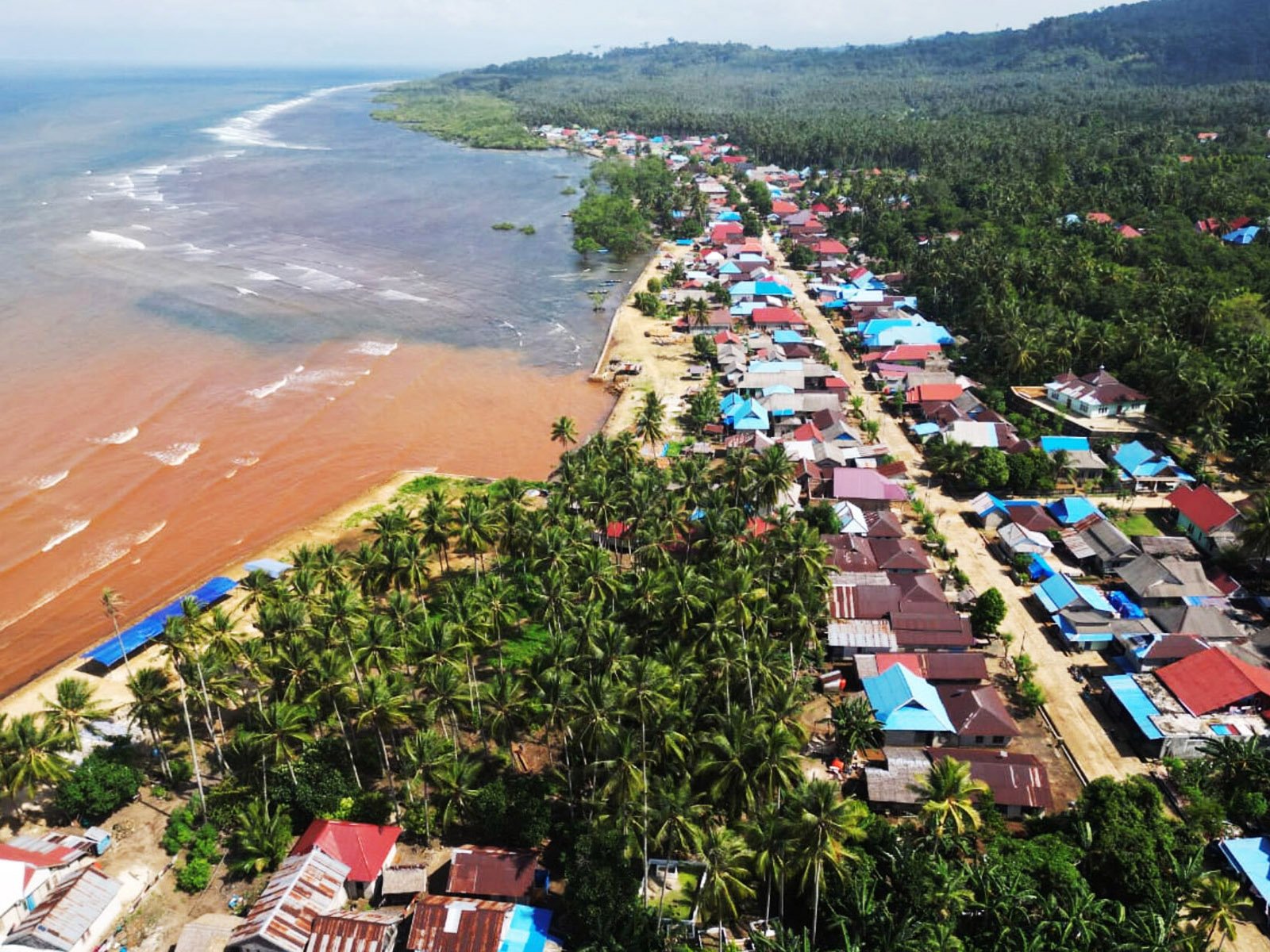
Tampak atas beberapa desa di Kecamatan Wawonii Tenggara. Laut yang keruh tersebut diduga tercemar galian nikel PT Gema Kreasi Perdana. Photo: Benaya Ryamizard Harobu/Project Multatuli
Sementara perusahaan menggugat ke Mahkamah Konstitusi, DPRD Sulawesi Tenggara resmi menghapus alokasi ruang tambang di Pulau Wawonii. Dalam Rancangan Peraturan Daerah (Raperda) Rencana Tata Ruang Wilayah (RTRW) Sulawesi Tenggara 2023-2043, Pulau Wawonii Kabupaten Konawe Kepulauan ditetapkan sebagai kawasan perikanan terpadu.
Ketua Pansus RTRW DPRD Sultra, Fajar Ishak, mengatakan keputusan untuk meniadakan ruang aktivitas pertambangan di Konawe Kepulauan berdasarkan putusan Mahkamah Agung.
Putusan MA meminta Pemda Konawe Kepulauan untuk merevisi pasal alokasi tambang dalam RTRW kabupaten karena bertentangan dengan Undang-Undang Pengelolaan Wilayah Pesisir dan Pulau-Pulau Kecil.
“Keputusan (Mahkamah Agung) itu lahir di penghujung tahun 2022, maka kita tidak boleh membantah itu, sehingga kita tetap mempertahankan Pulau Wawonii menjadi kawasan perikanan terpadu dan tidak ada kawasan tambang di sana,” ujar Fajar Ishak dalam pembahasan revisi RTRW yang yang digelar di Hotel Claro Kendari pada 29 Agustus 2023.
Bantah Tudingan Pencemaran
Humas PT Gema Kreasi Perdana, Alexander Lieman, membantah perusahaan menyebabkan pencemaran lingkungan. Soal tuduhan polusi udara, katanya, perusahaan telah melakukan langkah preventif dengan cara memantau kualitas udara dan kebisingan secara rutin dua kali setahun, melakukan penyiraman jalan secara berkala, serta pengaturan kecepatan kendaraan operasional.
“Berbagai program ini kami jalankan sebagai bentuk komitmen terhadap ketentuan yang berlaku di bidang lingkungan hidup dan untuk menjaga kelestarian lingkungan Pulau Wawonii,” katanya.
“Bahkan sebagai bentuk iktikad baik kami terhadap masyarakat setempat yang menggarap lahan di wilayah Izin Pinjam Pakai Kawasan Hutan (IPPKH) kami, telah kami berikan ganti untung tanam tumbuh,” katanya.
Lieman berkata perusahaan tidak menyebabkan pencemaran air. Sebelum ada kegiatan pertambangan, setiap curah hujan tinggi melanda Pulau Wawonii maka menyebabkan air sungai keruh.
“Kegiatan pertambangan kami tidak menyebabkan pencemaran sungai di sekitar areal pertambangan.”
Lieman juga menampik tuduhan pencemaran air warga Mosolo. Katanya, air keruh pada bulan Mei hanya terjadi di dua desa, yakni Sukarela Jaya dan dan Dompo-Dompo Jaya.
“Kami tegaskan tuduhan ini salah. Boleh dikonfirmasi ke pemerintah desa dan Dinas Lingkungan Hidup setempat.”
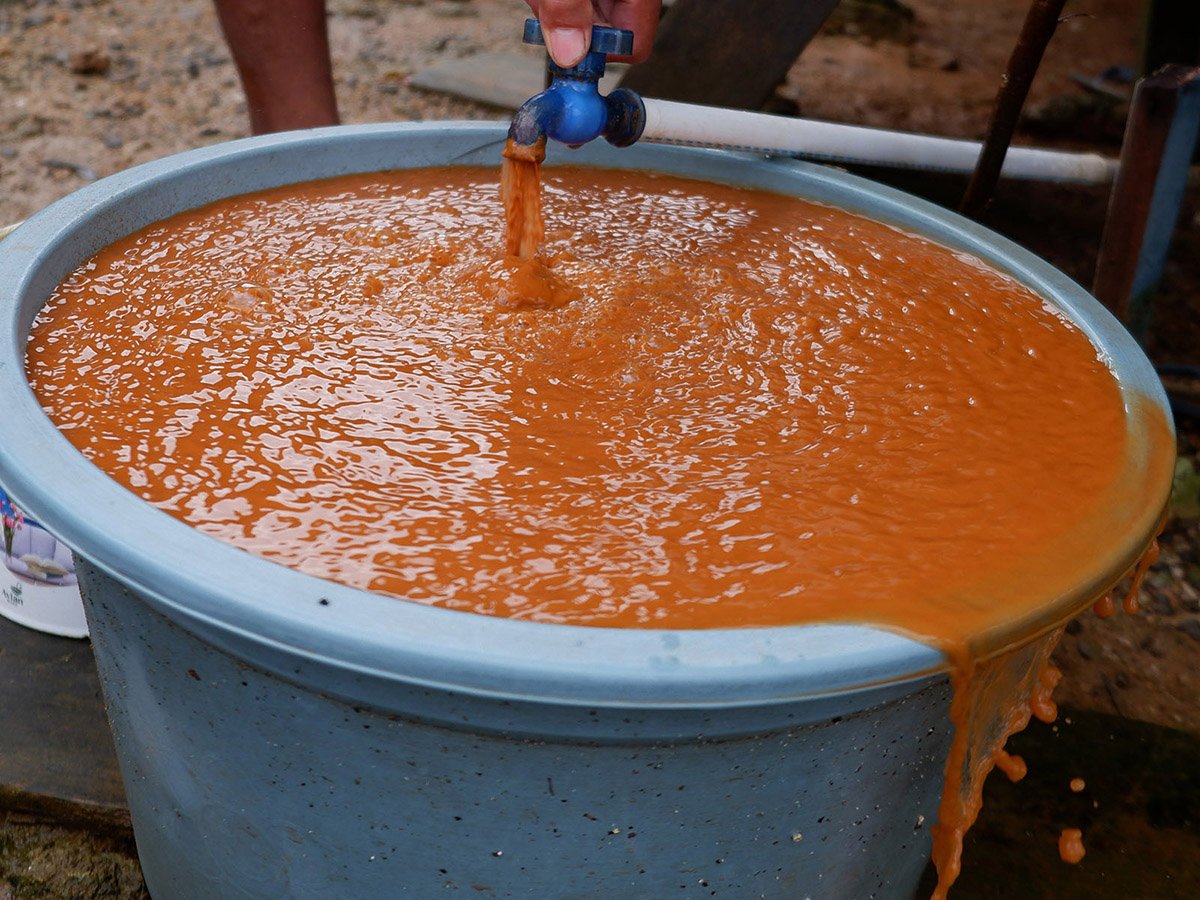
Air yang mengalir melalui pipa warga pada 21 Mei 2023. Photo: Yuli Z./Project Multatuli
Lieman menyebut perusahaan justru membantu masyarakat memenuhi kebutuhan air bersih, antara lain mendistribusikan air bersih dengan water truck ke desa-desa yang terdampak kekeruhan air sungai, menurunkan tim untuk mencari alternatif sumber air bersih, membersihkan bak penampungan air bersih warga, serta membuat sumur bor dan sumur cincin.
“Saat ini keadaan sungai sudah jernih kembali dan masyarakat sudah bebas mendapatkan air bersih untuk memenuhi kebutuhan sehari-hari.”
Pernyataan Lieman tak sesuai fakta lapangan. Air yang mengalir di Desa Dompo-Dompo Jaya, Sukarela Jaya, dan Roko-Roko masih mengandung lumpur. Pada 18 Agustus 2023, air masih berwarna cokelat pekat padahal sudah cukup lama tak terjadi hujan deras.

The conventional wisdom is that Indonesia is suffering a democratic decline because of the authoritarian tendencies of its leaders and the illiberalism of its people. To quote Australian political scientist Marcus Mietzner, outgoing President Joko “Jokowi” Widodo “pushed the limits of democratic norms and even overstepped them”, and the people have been fine with that.
This view represents the common thinking among progressives within Indonesia’s political class. Muslim scholar Sukidi’s recent commentary in Tempo magazine, for example, satirized Jokowi as Pinokio Jawa, or Javanese Pinokio. Long before that, The Jakarta Post, Indonesia’s largest English daily, had dubbed Jokowi “little Soeharto”, a reference to the New Order autocrat who ruled over Indonesia between 1967 and 1998.
That thinking is not totally groundless. Jokowi has been accused of weaponizing law enforcement institutions to intimidate his political enemies, co-opting judicial institutions to build his political dynasty, and mobilizing state resources to guarantee the victory of his children in regional and national elections. He is also believed to have recently orchestrated a plot to prevent the Indonesian Democratic Party of Struggle (PDI-P) and former presidential candidate Anies Baswedan from contesting the Jakarta gubernatorial election – a race both figures have previously won. Such a power play would clearly be aimed at ensuring that Jokowi’s alliance with his former election rival, Prabowo Subianto, would go unchallenged for years to come.
The problem is that this view tends to frame Jokowi as the sole architect of our political malady, and implies that removing him would be a sufficient remedy. That’s just lazy analysis. The reality is that his rise to power was enabled by different social forces, who have capitalized on his presidency to further their political and economic interests. His enablers, alas, are not confined to a group of coal industry oligarchs who spent billions of rupiah to finance his election campaigns and were later given strategic positions in the Cabinet to create public policies that serve their private interests.
It is high time to acknowledge the elephant in the room: many Indonesian intellectuals are complicit in decimating Indonesian democracy. I define intellectuals broadly to include academics, journalists, activists and religious leaders. Many of these figures have turned a blind eye to, if not directly abetted, Jokowi’s illiberal policies under the pretext of defending pluralism — a crusade against Islamism — and championing technocratism.
A pluralist, technocratic leader
Truth be told, Jokowi was always the favorite of Indonesian intellectuals. This is not only because he was seen, at least initially, as a political outsider with no links to the New Order’s oligarchy, but because he accommodated the dominant ideologies of the urban, educated middle class, particularly those claiming to be defenders of Indonesian pluralism.
It is worth noting that those critical of Jokowi today were in fact once his ardent supporters. At best, their criticisms of Jokowi are too late and too little, as exemplified by the joint statements issued by university professors just a few weeks before the February presidential and legislative elections, sparking speculation they were acting at the behest of Jokowi’s oligarchic rivals. Whatever the case, their criticism smacks of hypocrisy. Many Indonesian intellectuals in fact knew Jokowi had authoritarian tendencies, but they looked the other way when his illiberal policies worked in their favor. They were not only silent but also actively supported Jokowi’s illiberal policies towards Islamist groups.
This was visible during Jokowi’s first term in office, when he was facing an Islamist opposition empowered by his oligarchic rivals. The period was marked not only by the incarceration of then Jakarta governor Basuki “Ahok” Tjahaja Purnama for blasphemy, but also the arrests of dozens of political dissidents on dubious and politically motivated charges, ranging from pornography to treason. Jokowi’s illiberalism culminated with the banning of two Islamic groups — Hizbut Tahrir Indonesia (HTI) and the Islam Defenders Front (FPI) — and the alleged extra-judicial killing of FPI members.
Nahdlatul Ulama (NU) and Muhammadiyah are two key organizations underpinning Jokowi’s illiberal pluralism. While these large Muslim groups are not monolithic, their elite members are overwhelmingly supportive of the President. There is no doubt that both organizations have long served as a bastion of religious moderation in the country, but the implication of their Faustian bargain with Jokowi is clear: their whole campaign against religious intolerance to protect minority groups and preserve diversity was more often than not just a ruse to justify his illiberal policies, which in fact were created mainly to protect the political and economic interests of the oligarchy.
Many Indonesian intellectuals were also supportive of Jokowi’s legislative initiatives that critics said had illiberal tendencies, such as the 2020 Jobs Creation Law. The campaign supporting the controversial law was backed not only by paid cybertroopers, but also academics, including political researchers, who framed it as a technocratic remedy to the COVID-19 economic crisis and a technocratic recipe for turning Indonesia into a developed country.
They defended the law even after it was clear that it was passed without meaningful public consultation, and that it contained illiberal provisions. Regardless of whether they were paid to express their support for the highly problematic law, this shows how the very notion of technocratic leadership could easily be co-opted to disregard democratic norms.
Jokowi’s ‘sorcerers’
Jokowi is a product of the political consultancy industry that boomed during the 2012 Jakarta election. Throughout his presidency, he has relied on political and PR consultants to engineer his persona as a “technocratic populist”. He regularly hired several polling agencies who provided him with statistical data that he could use to not only calibrate his policies, but also to justify his illiberalism. This was most apparent when pollsters suddenly released political surveys that challenged unflattering narratives about his policies on social media.
They are the “sorcerers” who enabled Jokowi’s autocratic machinations.
Several pollsters, such as Indo Barometer and Cyrus Network, have openly expressed their partisanship, if not business dealings, with the President. It is likely that the President, or at least his close allies, have hired many other pollsters too. It is no secret that pollsters who are commissioned to conduct surveys (usually by political parties/politicians) are motivated by profit; this is money they can then use to fund their own surveys. The problem is that they are not always transparent about which surveys were paid for by the powers that be, even if it is clear the survey results serve the interests of the powerful.
It is clear, however, that surveys which have found that Jokowi was highly popular and the public were mostly supportive of, or at least nonchalant about, his authoritarian tendencies have been used to justify unconstitutional proposals, such as extending his term, and normalize his cawe-cawe (meddling) in the judicial system and the internal affairs of political parties.
The pollsters should have known that poll results shape public opinions. It is baffling, for instance, that a high-profile pollster like Indikator Politik Indonesia decided to release opinion polls claiming that the majority of Indonesians were fine with the Constitutional Court’s ruling to pave the way for Jokowi’s son, Gibran Rakabuming Raka, to run for vice president alongside Prabowo. This polling was released when it was clear the ruling was flawed on so many levels, and that there was, for a moment, a certain level of public pushback against it.
The survey results practically shut down any discussion about the ruling, as it portrayed those critical of the court’s ruling — the more progressive intellectuals — as detached and elitist.
Intellectuals of the oligarchy?
In the grand scheme of things, the Jokowi phenomenon is nothing but a symptom of a long-standing asymmetric power structure within Indonesian civil society in which a weak middle class, from which most intellectuals originate, is too dependent on the oligarchic elite to advance their own progressive visions. The result is a reproduction of a system of power where the politically and economically powerful have co-opted public intellectuals to sustain and even strengthen their power.
It is no surprise that after defending the NU’s decision to accept coal mining concessions from the Jokowi government, Muslim scholar Ulil Abshar Abdalla posted a long social media screed downplaying concerns about democratic regression under Jokowi. In a clear attack on the idea of democracy as defined by “foreign observers”, he said that what Indonesia needed was “political order” to achieve prosperity, and not political bickering among political parties.
And that is how democracy dies in Indonesia, not with a bang but with the sophistry of a group of intellectuals too weak to countervail the power of the oligarchy.
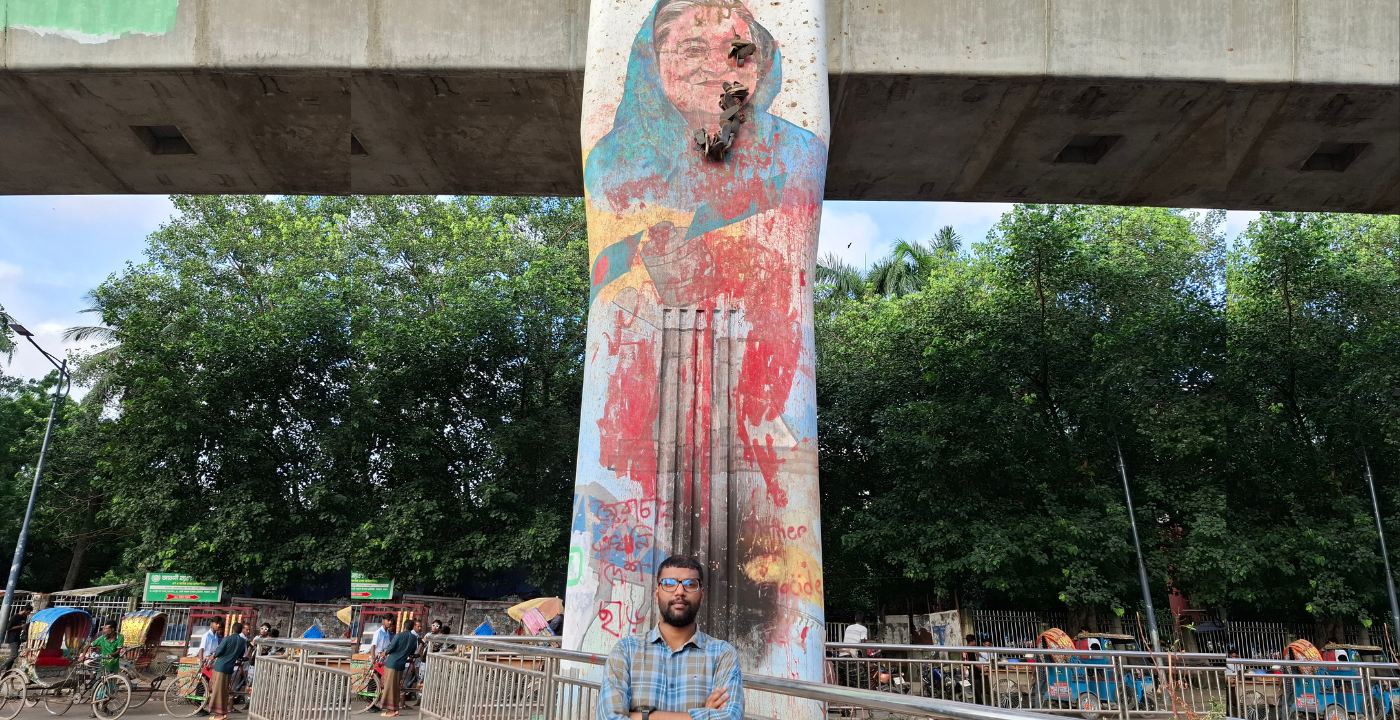
A photo of the author in front of the Dhaka University campus, one of the main sites of the student movement. Photo: Rifat Bin Latif
On July 16, I was attending a friend’s wedding in Naogaon, located around 200 kms from Bangladesh’s capital city Dhaka, where I live now, when a Facebook notification shocked me.
Bangladesh was in the middle of massive protests led by university students and young people like me. Some of the protesters were my own friends. I had, in fact, joined the protests twice in early July, when it was peaceful. We formed human chains and chanted slogans such as, “Quota or merit? Merit, merit!” The demand, as the slogan connotes, was to scrap reservations in government jobs, which, though reserved for descendants of freedom fighters (and women and the disabled), was being exploited to favour loyalists of then Prime Minister Sheikh Hasina and her Awami League party. Like all young Bangladeshis, I wanted fair selection for the prestigious civil service jobs.
Various news outlets have coined the current state of the country as “Bangladesh 2.0”. I call it ‘Bangla Bashanta’ – our very own Arab Spring.
But on the day of my friend’s wedding in mid-July, protests turned violent. Hasina had invoked thousands of paramilitary and police forces to crack down upon students. Six people died. Just before Hasina’s government shut down the internet, my Facebook feed showed that among those killed was my own school friend, Jahiduzzaman Tanvin. He was a talented young man who co-founded the country’s first and only company focused on drone sales. While the situation in the country had instilled a deep sense of anger in me, his death hit me hard.
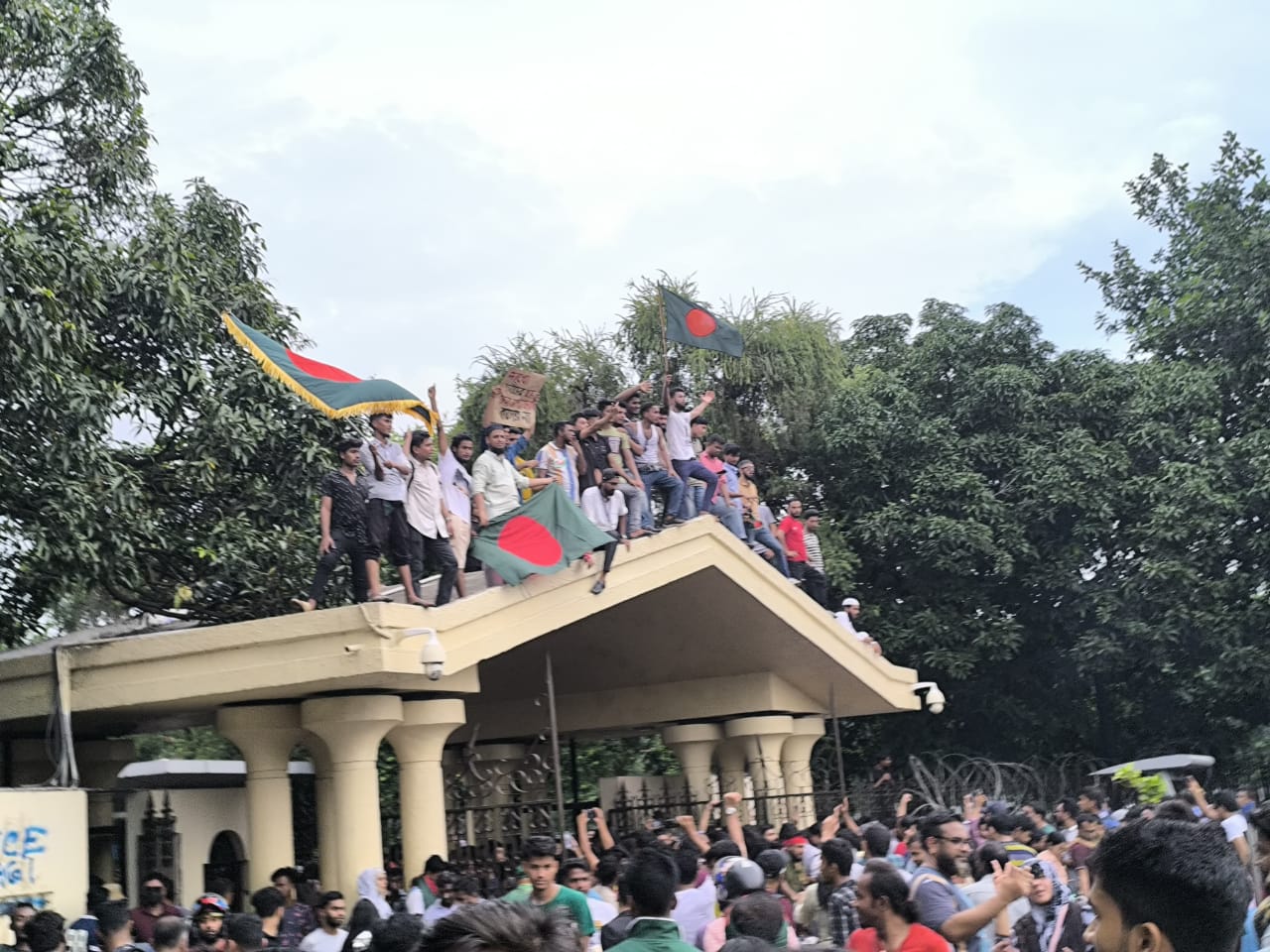
Students wave flags atop former prime minister Sheikh Hasina’s official residence on August 5. Photo: Sajib Hasan
The death toll is over 600 as of this month, according to a United Nations estimate. But in the last 48 days since Tanvin’s death, I have gone from utter helplessness, fear and anger, to a strong feeling of empowerment, especially with the way my generation took matters into their own hands.
Often perceived to be completely inept without social media or the internet, young Bangladeshis defied brutal crackdown and internet blockades to drive Hasina, who held the throne for 15 long years with an iron fist, away. One quarter of my country’s population is aged between 10 and 24: The Gen-Z generation. I, myself, am 26. Various news outlets have coined the current state of the country as “Bangladesh 2.0”. I call it ‘Bangla Bashanta’ – our very own Arab Spring.
I have been drawn to the anti-quota movement since 2018. In those years, Hasina would respond to students’ demands and cancel quotas in government jobs. What the students, however, always wanted was a reform, and not a complete scrapping of the reservations.
I’ve never sat for government exams but I’m well aware of the pain and struggles young Bangladeshis go through for these jobs. The Bangladesh Civil Service (BCS) exams take three to four years to prepare. Hundreds of thousands of BCS applicants compete for a handful of posts. These jobs are nevertheless coveted because of a common belief that, unlike most jobs, you can never lose a government job.
Behind this prestige and glamour, however, is a history of corruption scandals.
Police investigations have exposed a syndicate involving officials and employees of the Public Service Commission leaking at least 30 question papers for government recruitment tests in the last 12 years. This year, The Daily Star found documents showing how a company founded by former Awami League politicians took out Bangladeshi Taka 95,331 crore (USD7.98 billion) between 2017 and June 2024 from six government banks. Another report found how a former police chief and his family were embroiled in corruption, including buying at least 204.5 acres of land between 2009 and 2023, while also winning awards such as the Best Taxpayer Award and the Integrity Award.
The Bangladesh Civil Service (BCS) exams take three to four years to prepare. Hundreds of thousands of BCS applicants compete for a handful of posts. These jobs are nevertheless coveted because of a common belief that, unlike most jobs, you can never lose a government job.
The chequered history of government employees also includes a driver for the Directorate General of Health Services amassed wealth worth more than Bangladeshi Taka 100 crore (USD8.38 million) illegally, while Dhaka Wasa Managing Director Taqsem A Khan, along with eight others, was accused of embezzling Bangladeshi Taka 132 crore (USD11.06 million) from the Dhaka Wasa Employees Multipurpose Cooperative Society Limited. Even Hasina’s office aide amassed Bangladeshi Taka 400 crore (USD33.50 million), while her former private sector adviser Salman F Rahman owes some Bangladeshi Taka 36,865 crore (USD3.09 billion) to seven banks.
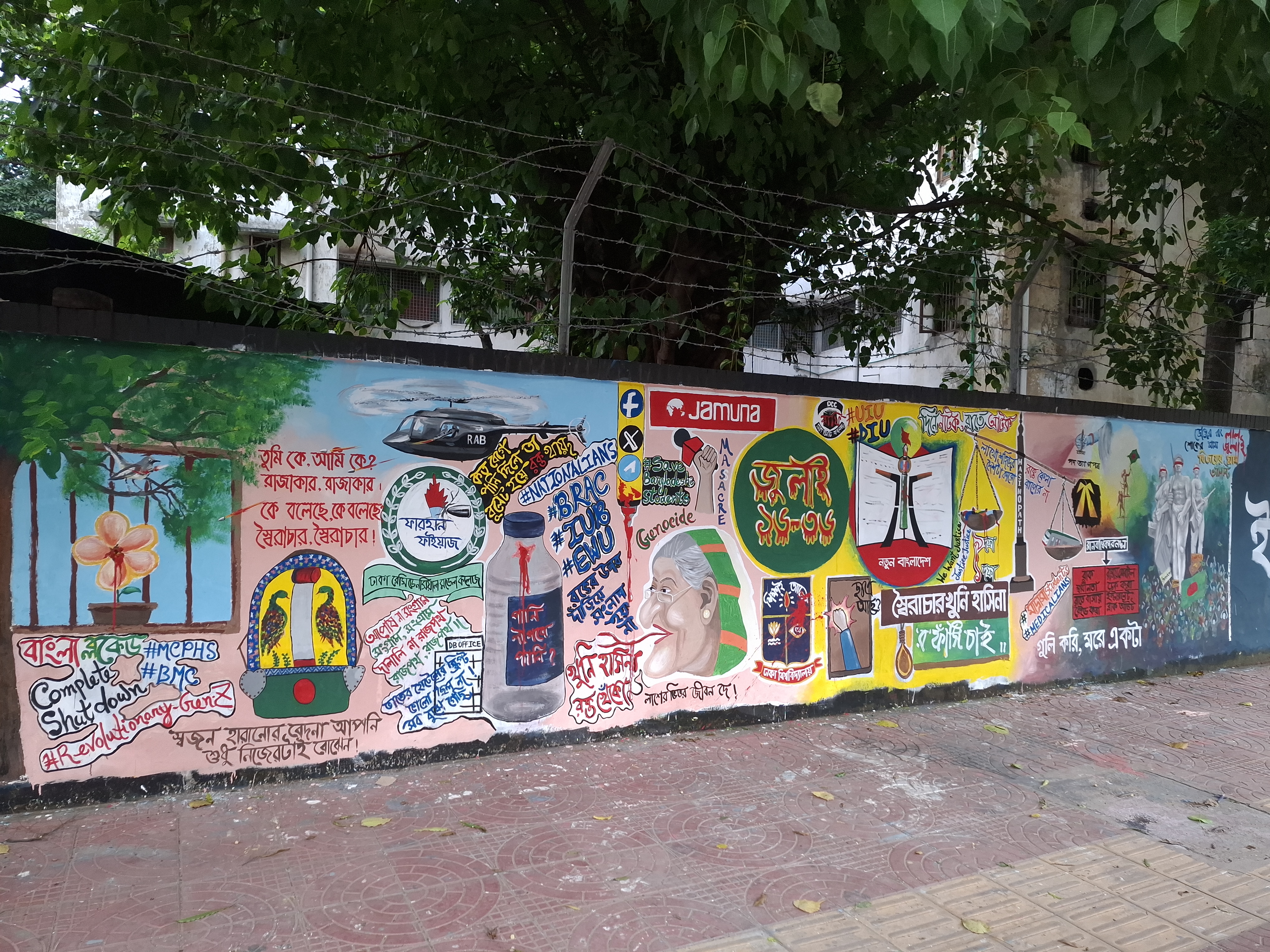
A graffiti in Dhaka depicts sequence of events in July during the protests. Photo: Abdullah Al Soad
We’ve had two anti-quota protests in the last six years so while this year’s anger wasn’t new, it was definitive in its intentions. The protests quickly expanded from scrapping reservations, to demanding Hasina’s resignation. The protests were successful, and how.
What may have worked this time was how students across different university systems united for one common goal. Previously, anti-quota protesters were divided on the basis of institutions: Public, private and national. Public universities are considered the best, while private universities are expensive and widely perceived to be for those who can afford it. National universities aren’t as meritorious as public universities, and their funding is far less. The protests were scattered and weak, owing to strength in numbers. And madrasa students were often looked down upon. These sections didn’t support each other.
This year, these divisions melted away.
In the last two months, these students have been labelled “Razakars”, a derogatory slang used for paramilitary forces that supported and aided Pakistan’s brutal military operation against Bangladesh’s 1971 Liberation War. Then, the police shot at them. The first casualty being Abu Sayed, a student from Rangpura’s Begum Rokeya University, on July 16. As the death toll rose, casualties started to include even those who weren’t protesting but were merely standing on their verandahs or rooftops.
The day I arrived in Dhaka, my father told me, “I was telling my colleagues that maybe my son is alive because he was not in the city. Had he been there, he would have gone to the protests, and God knows what might have happened to him.” My mom couldn’t sleep. “I saw those videos [of students getting killed]. What if one of them was my son?” she told me.
On August 5, Hasina fled and security forces disappeared as students and other protesters opened the gates of the Gono Bhaban, which is the official residence of the prime minister. These were spaces considered too elite and inaccessible for people like us.
The day I arrived in Dhaka, my father told me, “I was telling my colleagues that maybe my son is alive because he was not in the city. Had he been there, he would have gone to the protests, and God knows what might have happened to him.” My mom couldn’t sleep. “I saw those videos [of students getting killed]. What if one of them was my son?” she told me.
It wasn’t entirely hunky dory though. While many count August 5 as victory day, there was news of rioting and burning down of historical structures. Members of Hasina’s Awami League Party were attacked by students. Hindus and other minority communities were attacked too although in some places, Muslims protected Hindu and Christian places of worship. In the absence of the police, students took over the streets with sticks, cleaning up after the violence, manning the traffic and protecting neighbourhoods from night-time looting.
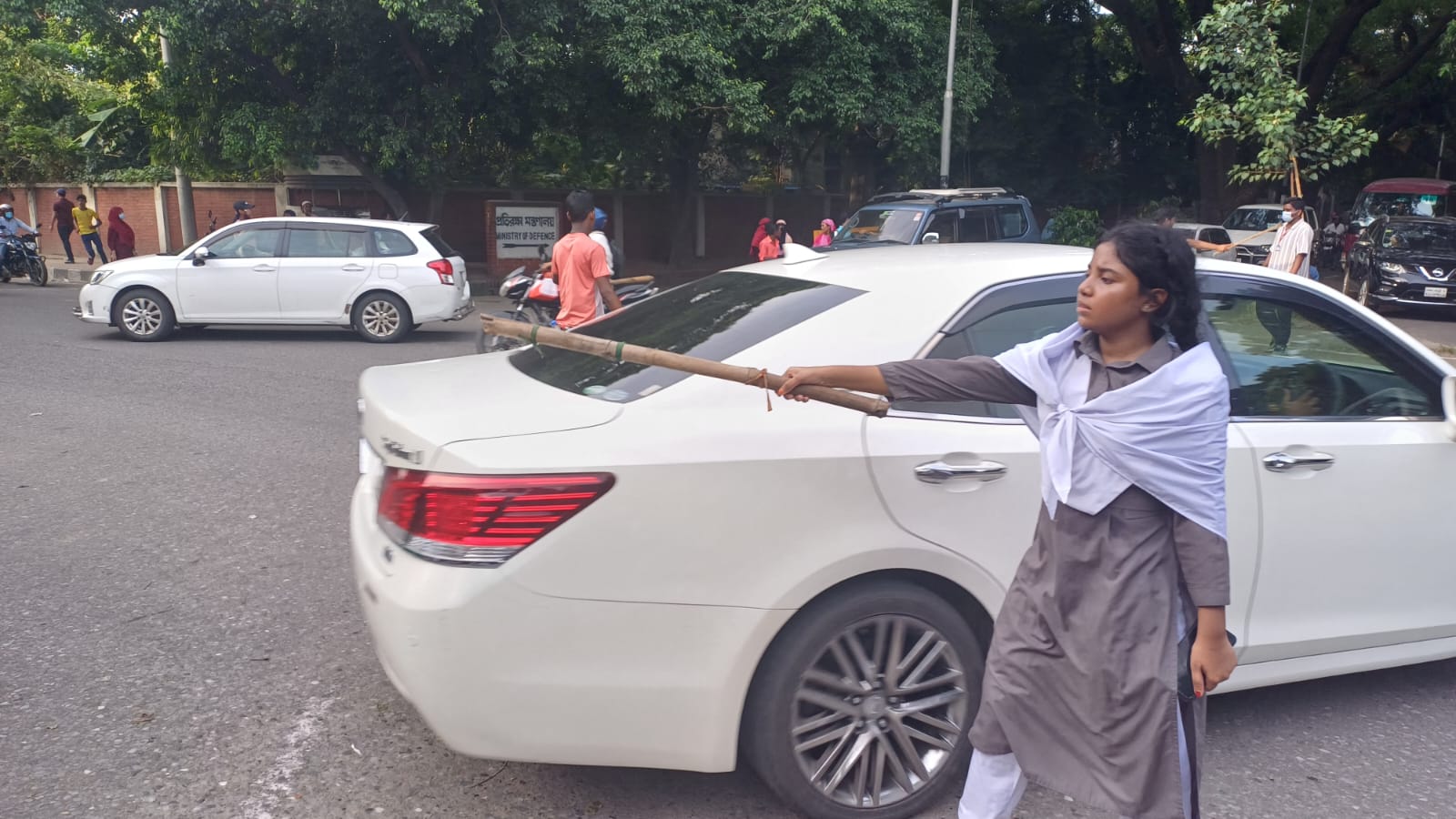
A student mans the traffic in Dhaka on August 7. Photo: Muhammad Zahidur Rabbi
Under the watchful eyes of students and their demands for Bangladesh 2.0, an interim government has been set up, with Nobel Laureate Mohammad Yunus as its interim leader. Right now, they’re preparing for a snap general election. This is a big change from the previous elections of 2014, 2018 and this year, which people largely believe to be rigged. I remember as a kid, professor Yunus became the first Nobel prize winner from Bangladesh, and that accomplishment made me feel proud of my country. When the student movement coordinators asked him to lead this interim government, it made me hopeful of achieving reforms our country needs right now.
I remember as a kid, professor Yunus became the first Nobel prize winner from Bangladesh, and that accomplishment made me feel proud of my country. When the student movement coordinators asked him to lead this interim government, it made me hopeful of achieving reforms our country needs right now.
In Bangladesh 2.0, my personal vision is to reform the state machinery. Hasina is gone but her corrupt legacy leaves us with a USD156 billion debt. Several banks are on the verge of collapse. A 2023 World Bank report positions Bangladesh second in the list of South Asian countries with bad loan ratio, which is reflective of record-high default loans and also non-performing loans that industry insiders say is a result of corruption and bad governance in Bangladesh. The 2023 Corruption Perceptions Index, released by the Transparency International, shows us ranking tenth from the bottom.
On top of the economic worries, human rights violations and gender disparities plague the nation. Bangladeshi human rights group Odhikar has documented extrajudicial killings of around 3,000 people and enforced disappearance of more than 700. This could just be the tip of the iceberg. Furthermore, Global Gender Gap Index 2024 ranks us 99th among 146 countries even though we’ve had a woman leading the country for 15 years. There’s also a lot of work to be done to protect and uplift indigenous people and minorities. They, too, are Bangladeshis.
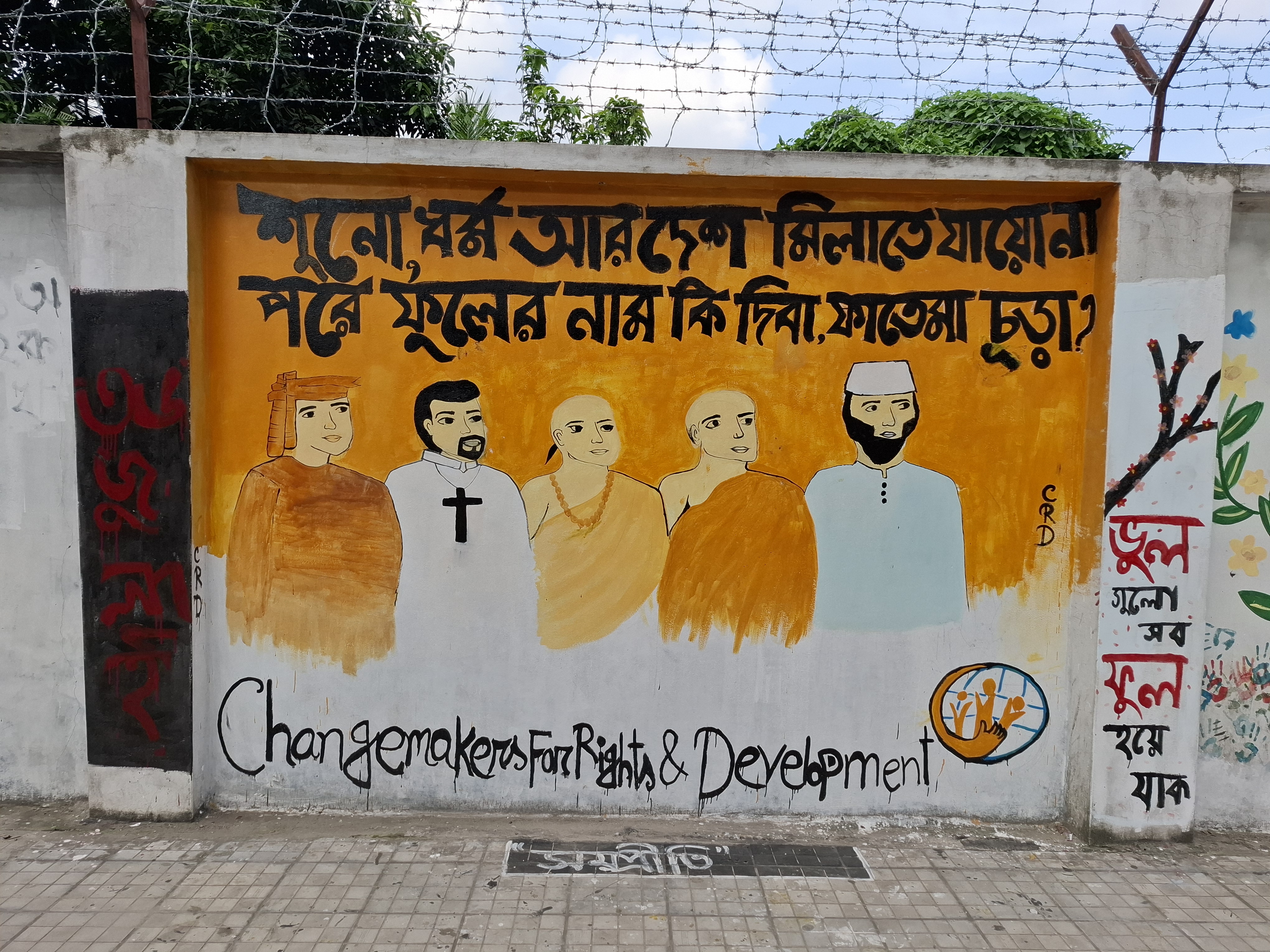
Another mural in Dhaka calling for religious harmony in Bangladesh 2.0. Photo: Abdullah Al Soad
With Yunus as their chief advisor, 20 advisors – made up of highly accomplished professionals – are tasked with bringing change. So far, this cabinet has dismissed 876 elected representatives and 25 deputy commissioners in an effort to shed the agents of corruption. This newly-minted cabinet includes students too. Nahid Islam, for instance, is a sociology student at the University of Dhaka, who is now an adviser for information and communications technology. Another Gen-Z, Asif Mahmud Shojib Bhuiyan, a linguistics student, now the Minister of youth and sports.
There’s also a lot of work to be done to protect and uplift indigenous people and minorities. They, too, are Bangladeshis.
Even though I’m cautiously optimistic, I’m confident that the events of the last two months will be a part of Bangladesh’s history that will unite and empower generations to come.
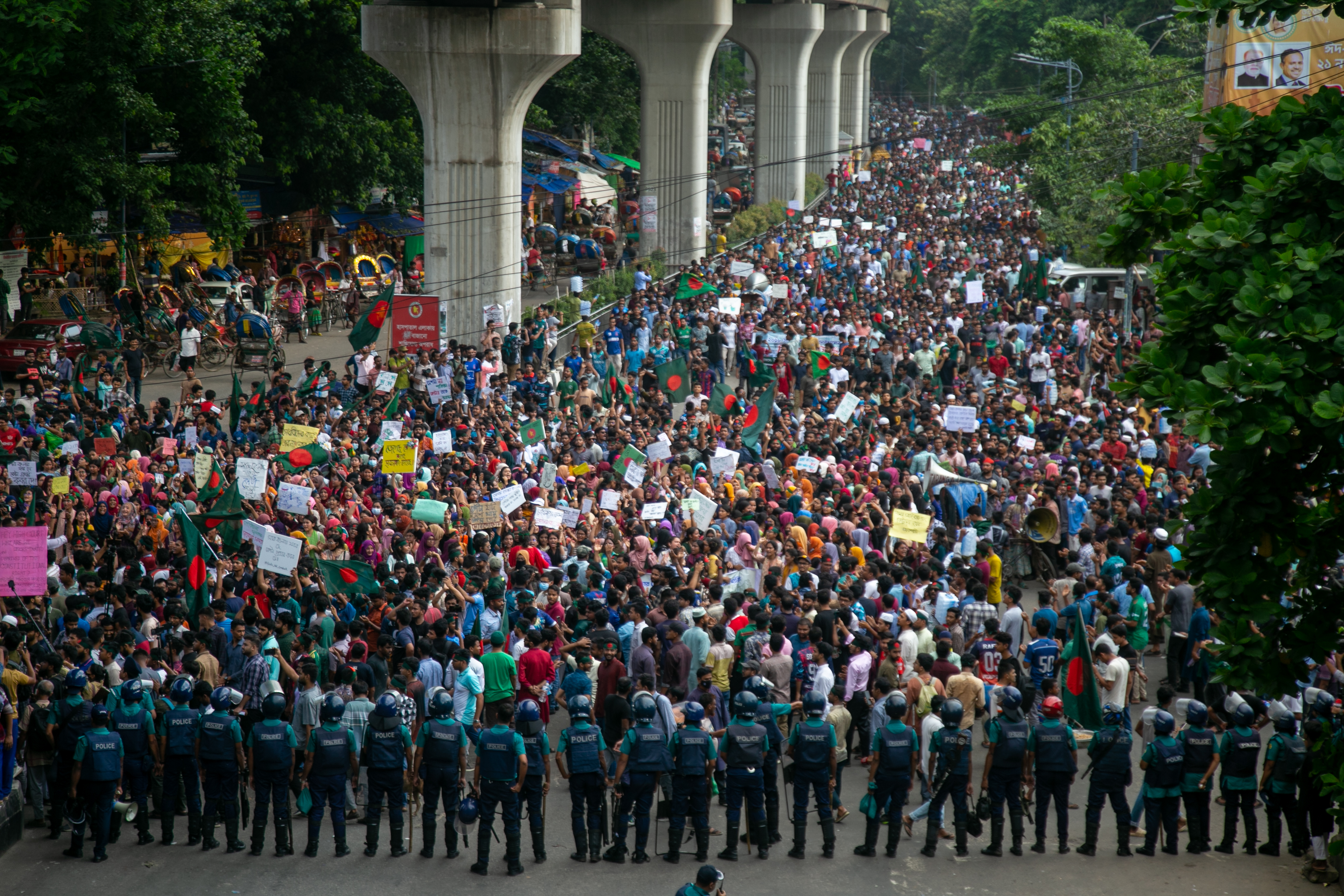
It took nationwide protests, violent state and military intervention and deaths of at least 139 people for the Supreme Court in Bangladesh to step in and scale back the reinstatement of controversial job quotas in the country that favours descendents of freedom fighters, women and people from underdeveloped districts.
As of July 22, Bangladeshi media reported over a thousand had been injured in protests that were primarily peaceful and led by students. Last week, the police fired sound grenades, tear gas shells and rubber bullets as it tried to quell their movement. The government under Prime Minister Sheikh Hasina, who won an unprecedented fourth term this January, denied using excessive and indiscriminate force, but the death toll continues to rise. At least 50 people died on Friday.
At the moment, there’s an indefinite curfew, and internet and text message services have been suspended. Local media websites such as Dhaka Tribune, which is an Asian Dispatch member, are suspended too. On Sunday, even though the country’s highest court directed a scale-back of quotas from 56 percent to 7 percent, news outlet BBC Bangla quoted some protest coordinators as saying that they will continue protests, especially to secure release of detained student leaders.
Asian Dispatch breaks down the sequence of events to understand what led to the civil discontentment over the quotas, and what is the way forward for Hasina.
Why is the job quota system so controversial?
The quota system for government jobs in Bangladesh was created after Bangladesh won its independence from Pakistan in 1971, a movement that was led by Sheikh Mujibur Rahman, who is widely considered the father of independent Bangladesh. He is also Hasina’s father. Rahman himself started out as a student activist during British rule. After independence, in 1972, it was his government that introduced job quotas for freedom fighters. Back then, too, it met with heavy resistance, especially from the University of Dhaka who demanded merit and equal opportunity.
The quota system, ubiquitous across South Asia, is designed to be affirmative action to bring more representation in the employment sector. In Bangladesh, job quotas are especially coveted because of the promise of better pay and job security. However, government data shows that the number of Bangladesh’s working population is increasing, but the jobs aren’t.
The original quota system reserved 30 percent of jobs for veterans of the Bangladesh Liberation War and their descendents, while 10 percent were for women who survived mass sexual violence by the Pakistani army during the war, and 40 percent for those from underrepresented districts. Over the years, these quotas have been modified. But it remained controversial.
Since 1971, the number of freedom fighters and their descendents have dwindled, leading to many job-seekers questioning the need for such a high number in reservations. There have been accusations of misuse and corruption in how these quotas are being sought. Many critics blame the system for benefitting those close to the ruling party.
Bangladesh’s unemployment rate, according to an official survey done between January and March this year, is 3.51 percent, amounting to 25 lakh unemployed out of the country’s total population of 17.12 crores. As of now, only 44 percent of government jobs are allocated based on merit.
But this isn’t the first time students have come down to the streets to demand quota reforms.
In 2018, after Hasina confirmed she will keep the job quotas, university students led nationwide protests demanding job quota reforms. Hasina’s government immediately cracked down on the movement, but a few months later, she issued an executive order to remove all job quotas entirely. In 2020, the decision to abolish the quotas became effective.
However, this June, the Bangladesh High Court cancelled the government notification, declaring it illegal, and reinstated the quotas, resulting in ongoing mass protests.
How did the protest get violent?
The protests started on July 1 by the students of the University of Dhaka who demanded that the quota system be modified to reflect the needs of present-day Bangladesh. Soon, students of other universities joined in. Right now, the movement is led by an umbrella organisation of students called Anti-Discrimination Student Movement.
On July 14, Hasina, who staunchly supported the quotas, blamed the opposition for fuelling violence, and dismissed the demonstrators as “razakars”, referring to a pre-independence paramilitary group with the Pakistan military who led a brutal campaign during Bangladesh’s freedom movement, which included widespread massacres of Bangladeshi freedom fightors and weaponising rape against the women.
“Why do they have so much resentment towards freedom fighters?” Hasina is quoted as saying. “If the grandchildren of the freedom fighters don’t get quota benefits, should the grandchildren of Razakars get the benefit?”
The students pushed back against Hasina’s remarks by adopting the term and raising slogans such as, “Asked for rights and became a Razakar!”
On Wednesday, July 17, the police used tear gas and sound grenades to break up a student demonstration at Dhaka University. Violence spread across the city, with retaliation by the government’s student wing Chhatra League, prompting the United Nations Secretary General spokesperson to urge the Bangladesh government to protect the students.
On Wednesday evening, Hasina addressed the nation and asked all sides to maintain peace until the Supreme Court’s verdict and blamed the deaths on “vested quarters.” At the same time, Asif Mahmud, a coordinator of the Anti-Discrimination Student Movement, called for a nationwide shutdown through a Facebook post.
In response, the state installed its paramilitary forces including Border Guard Bangladesh (BGB), Rapid Action Battalion (RAB), SWAT, and the Chhatra League. The RAB, which was set up by former Prime Minister Khaleda Zia, has been accused of extrajudicial killings and human rights violations in the past. By Thursday, the state-backed crackdown saw the deployment of another 229 platoons of BGB.
Deadly clashes broke out in several parts of the city including Uttara, Mohammadpur Beribadh, Merul Badda. Unknown persons broke into state broadcaster Bangladesh Television’s (BTV) headquarters in Dhaka and vandalised it. News reports also reported protesters storming a prison in central Bangladesh, setting hundreds of prisoners free. Reuters quoted Bangladesh’s attorney general AM Amin Uddin as saying that students were not a part of the violence and arson the country has seen since Monday.
On Friday afternoon, as the Dhaka Metropolitan Police (DMP) banned rallies and processions, a shoot-at-sight order was administered alongside a telecommunication blackout.
By the weekend, at least 139 people had been killed, including a journalist. As of July 23, local media remained largely silenced under the communication blackout. The student movement has pledged to continue protests and ensure the release of their imprisoned supporters, and to hold the perpetrators of violence accountable.
The original Supreme Court verdict on the quotas was scheduled for August, but this was pushed up to Sunday in light of the escalating situation. Presently, the latest ruling will make 93 percent of job allocations merit-based, 5 percent will be reserved for descendents of Bangladeshi freedom fighters, and 2 percent will be reserved for ethnic minorities, transgender individuals, and the disabled.