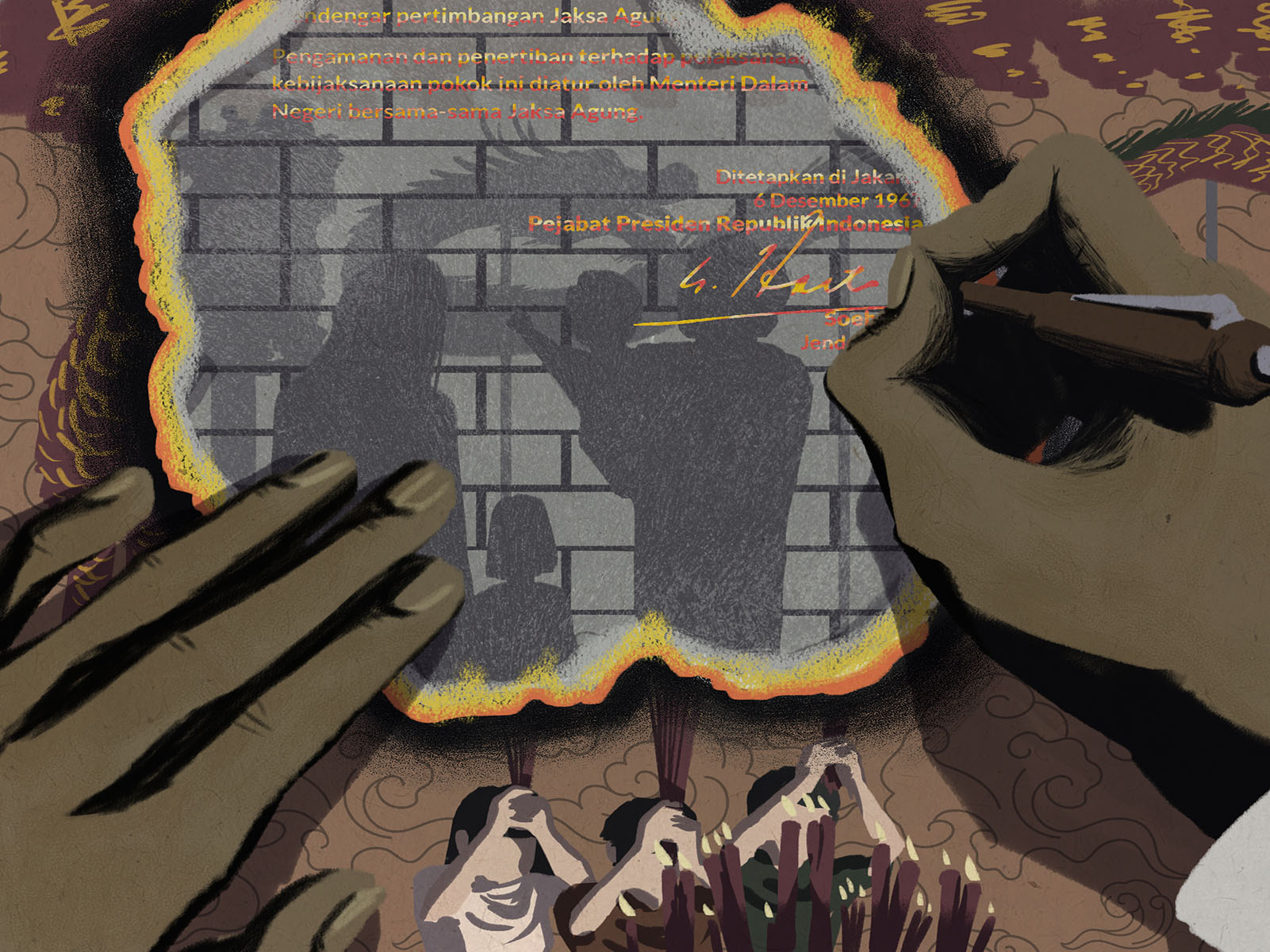
The epistemicide of Chinese-Indonesians. Illustration: Abdul Malik Amirullah/Project Multatuli
(Trigger Warning: This article may be distressing or triggering for some readers.)
May 1998 was the moment when I began to associate the word “Chinese-Indonesian” with “violence” and “rape”.
At the end of elementary school, it was the first time I was forced to be afraid of my identity both as a woman and as a Chinese-Indonesian, and I was frustrated because I did not understand how I ended up feeling that way. I knew almost nothing about the history of Chinese-Indonesians that led to the May 1998 riots. That ignorance made it even harder for me to understand my own emotions.
My parents also didn’t explain much. “The most important thing is, as a Chinese-Indonesian, you always have to be cautious. You can’t just say whatever you want, especially when it comes to politics,” they said.
For years I carried a pile of unanswered questions in my head. Who am I? Who is my family? What is Chinese-Indonesian? How is it that other holidays are marked with red-letter dates and celebrated festively, except for Chinese New Year? Why must we learn Mandarin in secrecy, while other regional languages can be studied freely? What really happened? Why did being Chinese start to feel wrong?
The turning point came in 2009. After graduating from university, I worked as a journalist for Suara Baru, an internal media of the Chinese-Indonesian Association (INTI) that was formed in 1999.
Even though I only worked there briefly, my time opened many doors for me to learn more deeply about Chinese-Indonesian issues and meet several Chinese-Indonesians who were directly involved in social and political work. Slowly, I began to find answers to the many questions that had haunted me for so long. Those answers were often shocking and heartbreaking.
I began to understand that the history of Chinese-Indonesians in this country is almost inseparable from the history of violence, which has often been systematically orchestrated by those in power since the VOC era. This systematic violence has spanned hundreds of years and is not only physical but also epistemic, taking the forms of neglect, concealment, and even denial of many historical facts, especially the darker parts of history.
I came to realize that the New Order regime carried out a systematic epistemicide against the Chinese-Indonesian community. The state deliberately stripped away knowledge about the history of my own ethnicity, uprooting me and other Chinese-Indonesians from our cultural roots, leaving me confused and struggling to process my own position and feelings.
As a result, I began to understand that the New Order never really died. More than 27 years after Soeharto’s downfall, the state has become increasingly blatant in its efforts to whitewash the past by erasing the violent and painful chapters of history involving the Chinese-Indonesian community.
This became very clear with a statement made by Culture Minister Fadli Zon on June 10, 2025. In an interview with IDN Times about the project to rewrite national history, Fadli referred to the mass rape of May 1998 as a “rumor” that had no proof.
His statement made my stomach turn. My chest tightened. Tears streamed down uncontrollably.
The History of Violence and ‘Disciplining’
“This is insane! How could the riots get out of control?”
My mother said that with panic etched across her face, appalled as scene after scene of apocalyptic brutality flashed endlessly across the television screen in front of us.
Fires raged and smoke filled the air. Physical clashes led to gunfire that killed without hesitation. Clenched fists went up and down as people screamed and scattered in all directions. Buildings and vehicles were covered in ash. Smooth highways turned into battlegrounds clouded with dust.
Unfortunately, we were not watching an action movie. It was real life that pierced straight into the Chinese-Indonesian community in the blink of an eye, leaving behind open wounds that have never fully healed.
Even more unfortunate, this was not the first time that a tragedy like this had happened to Chinese-Indonesians.
A number of historical milestones demonstrate how racism and discrimination against the Chinese-Indonesian community have manifested in their most extreme forms, including acts that amount to literal genocide. These include brutal massacres, rape, mutilations, and live immolations of Chinese-Indonesians.
These events include the 1740 Batavia Massacre; anti-Chinese massacres during the Indonesian National Revolution from 1946 to 1949; violence following the issuance of Presidential Regulation No. 10/1959 prohibiting Chinese-Indonesians from rural trade; the 1965 tragedy; and of course the May 1998 riots that included looting, burglary, and the mass rape of Chinese-Indonesian women.
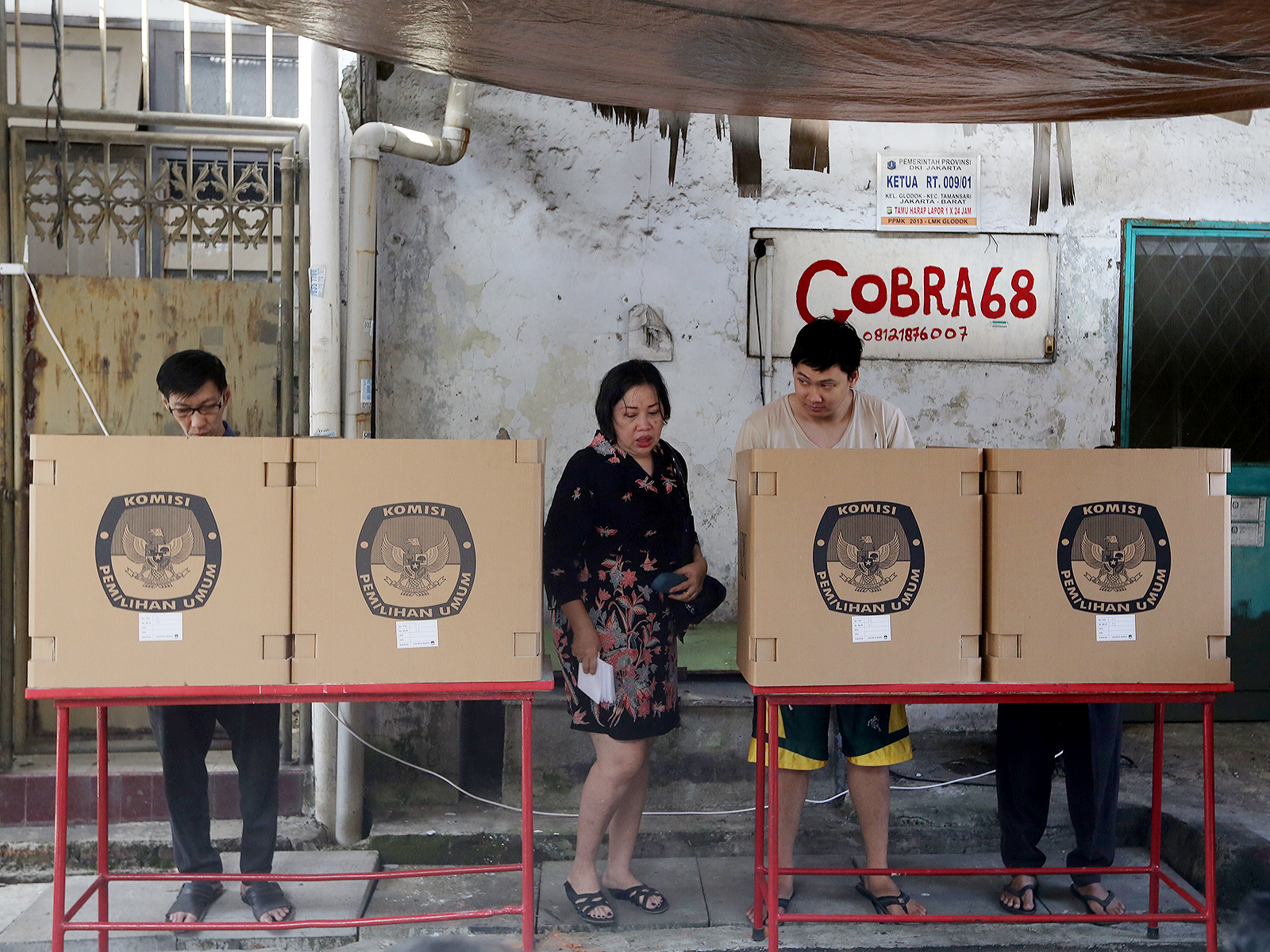
Chinese-Indonesian citizens participate in the 2014 General Elections in Glodok, Jakarta’s Chinatown and one of the tensest areas during the May 1998 riots. The high fences and iron security bars commonly installed on the windows of Chinese-Indonesian homes and shops since the riots remain a visible manifestation of the community’s lingering trauma. Photo: Ricky Yudhistira/Project Multatuli
These incidents occurred at the national level, but we have yet to fully address the widespread anti-Chinese violence at regional and sub-regional levels, where scale of brutality was no less appalling. For instance, the mass slaughter and rape of members of the Benteng Chinese community in Tangerang in June 1946, and the Mergosono tragedy in Malang in July 1947, which claimed the lives of at least 30 Chinese-Indonesians. In my own hometown, Bandung, several anti-Chinese riots have also occurred, including those on May 10, 1963 and August 5, 1973.
The repeated episodes of violence were made possible by the persistence of stereotypes that can be tracked back centuries like “Chinese-Indonesians are nothing but economic animals who only care about their own interest and benefits” and “Chinese-Indonesians are exclusive”.
During the Dutch colonial rule, Chinese-Indonesians were classified as Eastern Foreigners within the colonial demographic hierarchy. They were assigned the role of distribution intermediaries for daily necessities, serving both the colonial administration and the Malay-descended locals, whom the Dutch labeled as pribumi (a pejorative term that means “native”). This was a dilemmatic position that the Chinese-Indonesian community was compelled to occupy, whether they liked it or not.
Slowly but surely, a majority of Chinese-Indonesians (forcibly) ended up working in commerce and trade, a situation that bred resentment among the so-called pribumi, who came to see them as selfish profiteers.
After Indonesia declared independence, successive regimes carefully preserved these negative sentiments. Leaders appeared to understand how useful it was to deflect attention from their own failures by scapegoating the Chinese-Indonesians, portraying them as the root of the nation’s economic problem. The narrative was simple: “Chinese-Indonesians are greedy, so everything is their fault.”
During Sukarno’s era, the government enacted many discriminatory policies against Chinese-Indonesians that continued colonial legacies. A particularly controversial policy was the Presidential Regulation No. 10/1959, which banned Chinese-Indonesians from running retail businesses in rural areas. The military involvement in the implementation of the regulation led to major unrest that claimed the lives of many Chinese-Indonesians and massive exodus.
The 1965 tragedy, which paved the way for the rise of the New Order regime, also disproportionately targeted Chinese-Indonesians. As a communist state, China was accused of supporting the uprising and, thus, Chinese-Indonesians were automatically suspected of complicity. This logical fallacy led to the arrest and imprisonment of many Chinese-Indonesian figures who had actively contributed to Indonesia’s independence struggle. Ordinary Chinese-Indonesians suffered the most, especially with the closure of schools and constant fear of persecution.
During the New Order regime, the authoritarian president Soeharto reproduced colonial-era discriminatory tactics. He stripped Chinese-Indonesians of their access to and rights within practical politics, while granting privileges to a select few tycoons whom he considered loyal allies. This strategy ensured that all economic resources remained concentrated within the New Order’s circle of power, while Chinese-Indonesians continued to play essential roles in the economy even though they were never fully trusted. Therefore, writer Pramoedya Ananta Toer described the Chinese-Indonesian community as a “minority without political muscle”.
The New Order regime obliterated the history of the Chinese-Indonesian community’s roles and contributions to the nation-building process from various official references, before introducing new narratives that portrayed them as mere “foreign guests”—temporary residents whose rights could be easily revoked. Chinese-Indonesians were consistently constructed as “a problem” that needed to be surveilled and “solved” to avoid being seen as a threat to the country.
From there emerged a number of assimilationist policies that prohibited the use of Chinese names, as well as the Mandarin language and script. Chinese-Indonesians were banned from publicly displaying their religious, spiritual and cultural practices. At the same time, all Chinese-Indonesian media, political and social organizations, as well as Chinese-language schools were disbanded.
These discriminatory policies effectively laid the foundation for long-term racism, uprooting the Chinese-Indonesian identity to its very core and depriving the future generation of knowledge of the ethnic group’s history. The regime deliberately created distance between younger Indonesians and the collective memory of Chinese-Indonesians’ valuable contributions to the nation-building process. Even when some members of the new generations chose to become critical of the regime’s narratives and attempted to uncover the true history of Chinese-Indonesians, trauma and lack of reliable sources caused members of the ethnic group to remain silent.
This fear-based culture and knowledge, instilled by the regime, ended up being affirmed and embraced by generations of Indonesians, even by the Chinese-Indonesians.
In his Master’s thesis for Lund University in 2017, Roy Thaniago explicitly described how the Chinese-Indonesian community was being “disciplined” during the New Order regime through manipulation of media narratives. These narratives were crafted to ensure the community’s total obedience to the authorities to the point where the Chinese-Indonesians willingly disciplined and monitored their own behavior into submission.
In the end, the knowledge and culture that belong to Chinese-Indonesians today are nothing more than a product of state government violence. Centuries of systematic oppression have instilled fear so deeply that it can no longer be seen as just an individual issue. It has turned into a collective problem which has triggered intergenerational trauma.
This explains why my parents repeatedly reminded me that, as someone of Chinese-descent living in Indonesia, I always have to be extra careful. Careful with what I say, careful with how I act—because anything we say or do could backfire and put us in danger, no matter how good our intentions were. Whenever I find myself in a potential conflict with a non-Chinese, my parents always ask me to back down because even if I’m right, Chinese-Indonesians will always be seen as wrong, and will always lose in the end.
My parents also reminded me to study diligently, work hard, and focus on achieving academic and professional achievements—especially because in this country, Chinese-Indonesians are often valued only for their wealth.
Chinese-Indonesians are pressured to be financially generous, even though only a small number of us are truly wealthy. We are also expected to constantly prove our contributions just to be recognized as legitimate members of this country, even though it often feels like running a race with no finish line.
Epistemicide
I grew up in a Chinese-Indonesian family that is still deeply rooted in Chinese culture, yet I never truly experienced what it is like to see Chinese-Indonesian traditions publicly celebrated, let alone embraced in a deep and meaningful way.
Throughout the New Order period, the only major Chinese tradition my family celebrated that left a lasting impression on me was Chinese New Year. Even then, we could only celebrate it in the evening after my father came home from working long hours at a factory, physically exhausted, because Chinese New Year had not yet been recognized as a national holiday.
During that period, my parents also continued to observe several other Chinese-Indonesian traditions in private, but they never made any effort to pass them down to their children.
When I was in elementary school, my parents made an effort to teach me Mandarin themselves. At one point, they even asked me to join a Mandarin “course” held at a Christian church whose congregation was mostly Chinese-Indonesians. Of course, at that time, I didn’t understand why learning Mandarin had to be done discreetly in a church. Unfortunately, since I never use the language in daily interactions, I ended up forgetting much of the Mandarin vocabulary as I grew older.
At first, I didn’t care. But later, I realized that it was all the result of Soeharto’s discriminatory policies, which had a profound impact on me and many other Chinese-Indonesians.
For instance, I haven’t been able to trace my own family’s history because I struggled to understand my parents’ archived documents and letters, most of which were written in traditional Mandarin script. Yet the documents are the closest sources for me to understand my family history as well as the broader context of Chinese-Indonesian history as a whole.
Because my younger siblings and I did not understand Chinese customs, my father made a major decision. In 2007, he and his younger sister (my aunt) decided to exhume their parents’ graves. The bongpai, or gravestone, was destroyed, and the remaining bones were collected and cremated on the spot. They then scattered the ashes into the open sea. In their eyes, this was the best course of action, so that their children and grandchildren would not be burdened with maintaining traditions or tending graves, which can be costly.
For most Chinese families, graves carry far more cultural significance than simply being a final resting place. They are considered sacred, a symbolic tribute of respect for ancestors, a marker of identity, and a site of pilgrimage for future generations. To dismantle a grave is to erase a symbol of identity and lose the opportunity to honor and remember ancestral stories.
The dismantling of the grave is the perfect metaphor for the erasure of Chinese-Indonesian historical footprints, which was part of the epistemicide systematically carried out by the New Order regime.
As explained by Beth Patin, a professor of library and information science, epistemicide is “the killing, silencing, annihilation, or devaluing of a knowledge system”. According to her, epistemicide occurs when epistemic injustices take place persistently and systematically, collectively working as a structured and systemic oppression of particular ways of knowing.
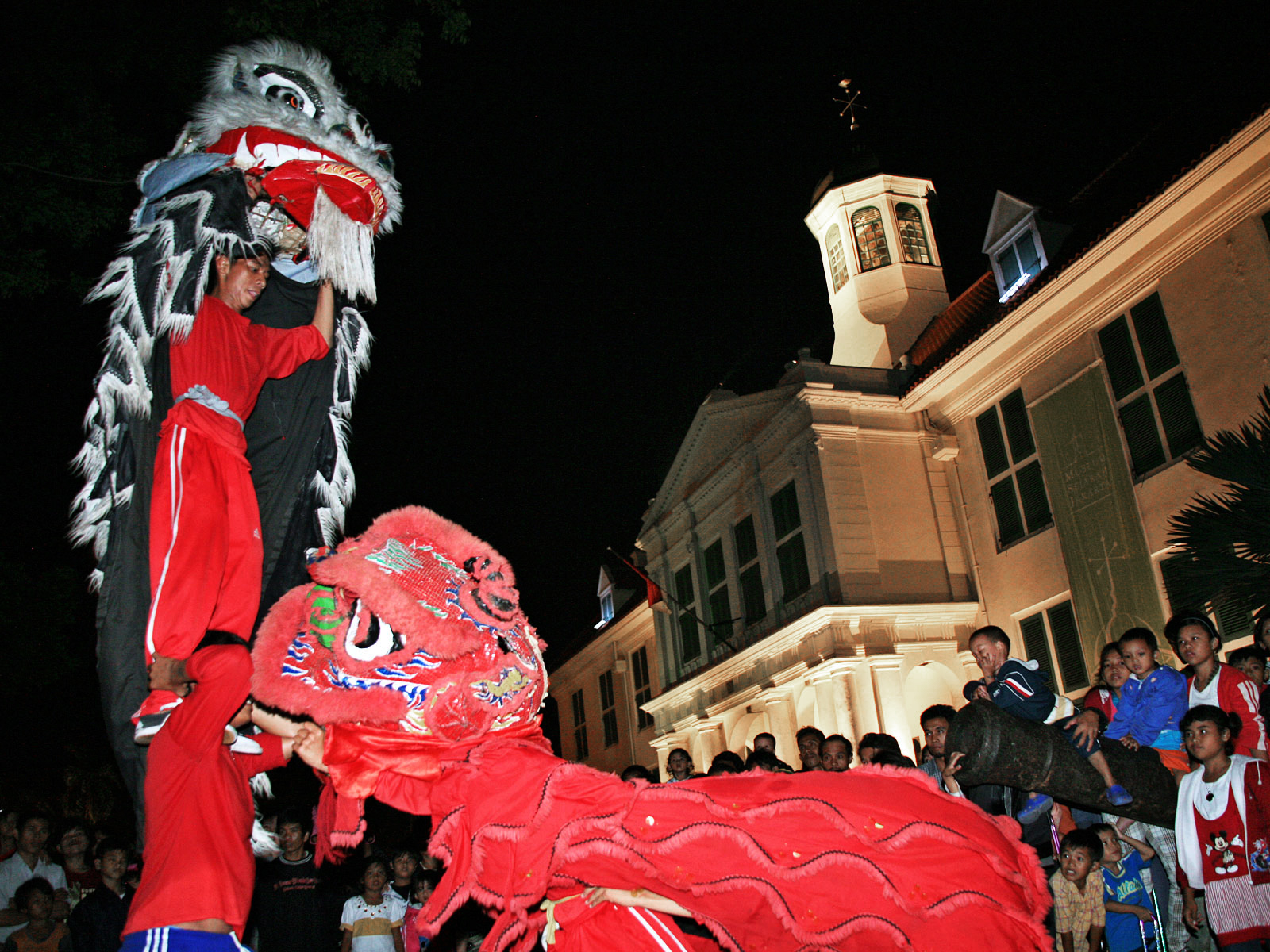
A group of barongsai (lion dance) performers play in front of the Fatahillah Park in Jakarta. Presidential Instruction No. 14/1967 on Chinese Religions, Beliefs, and Traditions once prohibited Chinese-Indonesians from practicing religious and cultural traditions rooted in their ancestral heritage, including barongsai. Even after the instruction was officially revoked by Presidential Decree No. 6/2000, the discriminatory policy has left many young Chinese-Indonesians disconnected from their cultural identity. Photo: Ricky Yudhistira/Project Multatuli
It’s disheartening to see how many Chinese-Indonesians today know next to nothing about the important roles their ancestors once played in politics, society, media, arts, or culture. Even in the sports sector, few are aware that Chinese-Indonesians have contributed not only to badminton but also to soccer.
In August 2024, I had the privilege of discussing this topic with Astrid Reza, a researcher from the Women’s Archive and History Center (RUAS). She said that historical writing about the Chinese-Indonesian community remains rare. As a result, it will take a much longer process for anyone to uncover, layer by layer, the knowledge that was subjected long ago to a form of epistemicide by those in power.
Not to mention those who attempt to uncover the truth about their own history must contend with deeply rooted New Order narratives about Chinese-Indonesians, along with waves of paid social media operatives working to preserve the narratives.
And, just as importantly, some Chinese-Indonesians remain hesitant to learn their own history.
“The New Order not only effectively obliterated the collective memory and knowledge related to Chinese-Indonesians, but also succeeded in killing the awareness of how important that knowledge is,” Astrid said.
“The greatest success [of epistemicide] is when even Chinese-Indonesians themselves become reluctant to learn about their own history. All it takes is silencing two or three generations, and entire bodies of knowledge, even the awareness of the importance of having that knowledge, will disappear.”
Understanding the Trauma of Chinese-Indonesians
Before Culture Minister Fadli Zon dismissed the mass rapes of May 1998 as a “rumor”, several political statements and events had already signaled the continued vulnerability of Chinese-Indonesians.
In 2016, Basuki Tjahaja Purnama, also known as Ahok, who was then serving as the governor of Jakarta, was accused of blasphemy after someone edited his speech quoting a verse from the Quran, uploaded the doctored clip to social media, and spread it with a misleading narrative. Large-scale anti-Chinese protests soon followed. Although the blasphemy charges were never truly proven, Ahok who is both Chinese and Christian, was sentenced to nearly two years.
For many of my Chinese-Indonesian friends, the massive protests instantly triggered bitter memories related to the May 1998 riots. One of them who felt this was Anastasia Satriyo, a Chinese-Indonesian who works as a child and adolescent psychologist.
“It’s as if my body is having a panic attack. I can’t watch the news about [anti-Chinese] issues for too long, just getting the gist of it is enough for me. I’ve realized that watching news related to these issues could cause me to stop functioning. On top of that, I always feel some tightening sensation in my chest every time I hear people shouting anti-Chinese sentiments,” Anastasia said.
“I always wonder, why is there always prejudice against Chinese-Indonesians?”
Anies Baswedan, who succeeded Ahok as governor of Jakarta, seemed to further inflame the situation. In his inauguration speech, he explicitly used the term “pribumi” (a pejorative term meaning “native”) and contrasted it with “non-pribumi“. Historically, these terms were used by the Dutch colonial government to divide the society along ethnic lines.
Anies earned his master’s degree at the University of Maryland and his PhD at Northern Illinois University. Therefore, many people believed he knew exactly the history behind those politicized terms, and it was no coincidence that he chose to use them. It is important to note that the use of “pribumi” and “non-pribumi” had officially been abolished by B.J.Habibie’s administration in 1998.
Eight years after the Ahok incident, Prabowo Subianto came to power. Prabowo, a former son-in-law of Soeharto, is widely believed to be involved in the forced disappearance of several activists in 1998.
It didn’t take long for his regime to reveal its true colors. On October 21, 2024, after being sworn in as Coordinating Minister of Law, Human Rights, Immigration and Correctional Services, Yusril Ihza Mahendra said what happened in May 1998 “was not a gross human rights violation”.
This came despite former President Joko Widodo’s acknowledgment in 2023 of 12 past gross human rights violations, including the 1965 tragedy and the May 1998 riots.
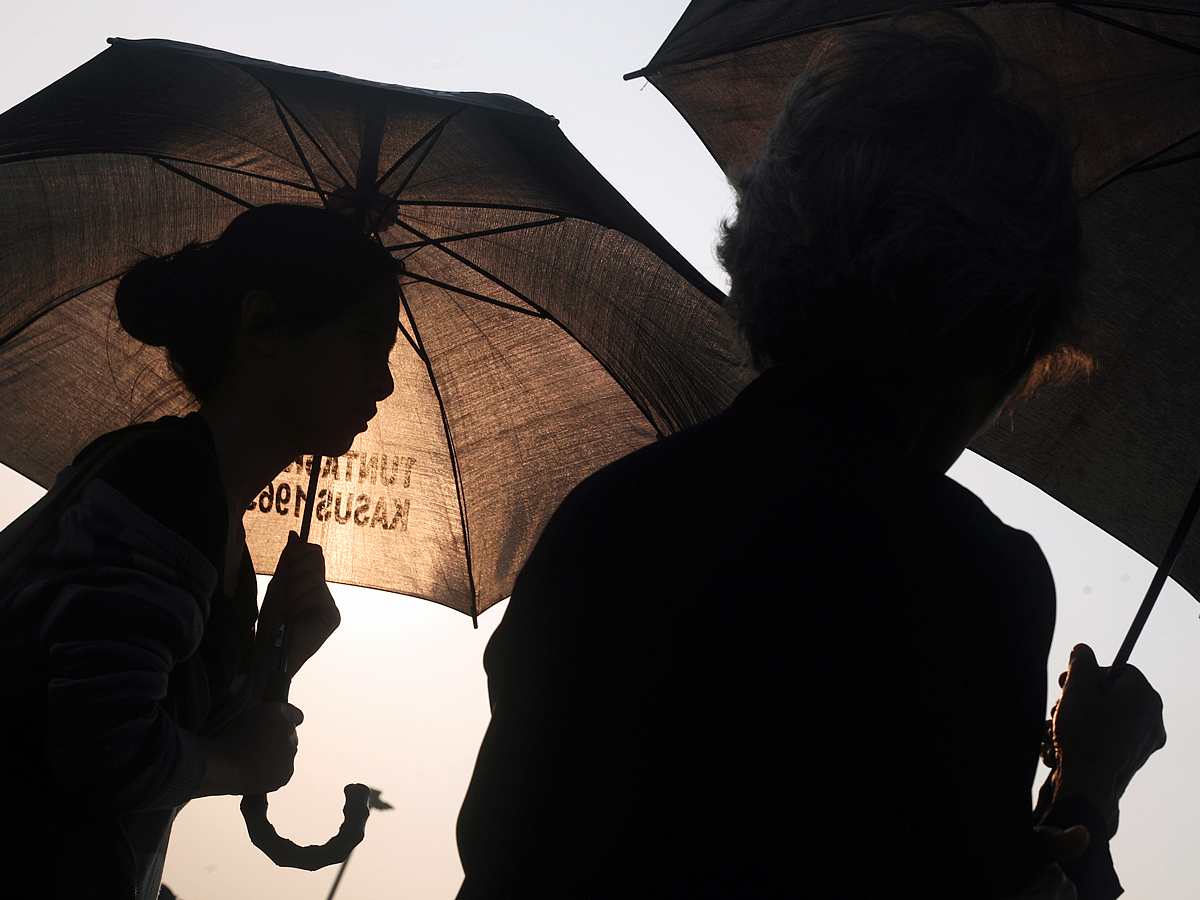
The Kamisan (Thursday) silent protests have persisted for two decades, as victims and families of gross human rights violations—including the 1965 and 1998 tragedies—continue to demand state accountability and justice. And yet, despite multiple regime changes, no legal resolution has been delivered. Instead, the state has opted for non-judicial measures that disregard the victim’s rights and dignity. Photo: Ricky Yudhistira/Project Multatuli
But it didn’t end there. My frustration and that of many other Chinese-Indonesians reached a boiling point when Fadli questioned the truth of the May 1998 mass rapes.
The first thing that came to my mind at that time was Ita Martadinata Haryono, a victim and young activist brutally murdered by those who couldn’t bear the thought of having their vile crimes exposed on the international stage. Ita was killed just before she was scheduled to testify about the mass rape in the United Nations forum.
Fadli’s words were incredibly cruel. He truly spat on the victims, witnesses and volunteers of the May 1998 tragedy, especially the women and Chinese-Indonesian community who, to this day, continue to carry the trauma, both directly and indirectly.
How can the findings of the Joint Fact-finding Team (TGPF), which clearly confirmed that a series of brutal gang rape took place in public spaces during May 1998, be denied simply because of “lack of evidence”?
Why insist on a legalistic argument which lacks empathy to defend himself? How is it possible to obtain evidence that requires victim testimony when the state offers no assurance of protection for the witnesses and survivors courageous enough to speak out?
That’s why, even though I wasn’t a direct victim, Fadli’s words threw me into emotional turmoil. My stomach turned. My chest tightened. Tears streamed down uncontrollably.
According to psychologist Anastasia, intergenerational trauma often manifests physically. When someone experiences trauma, their body’s DNA responds by activating certain genes and hormones to help the individual cope whether by confronting the threat (fight), escaping it (flight), appeasing it (fawn), or turning stiff, not taking any actions while trying to figure out the safest response (freeze).
It explains why Anastasia felt as if she was having a panic attack during the mass protest against Ahok’s so-called “blasphemy”, and why my chest suddenly tightened when I heard Fadli’s words.
In her practice as a psychologist, Anastasia often encounters subtle cases of intergenerational trauma among young Chinese-Indonesians, which usually manifest in relationship issues with their partners or parents.
“I once worked with a teenager who was confused about why her parents wouldn’t allow her to come home after 9 p.m., even though they lived in Jakarta. When she asked them about it, they simply said, ‘Remember your ethnicity,’” Anastasia said.
“This teenager became angry with her parents, especially since she had been exposed to concepts of human rights, democracy, and more. Her relationship with them turned sour.”
Other subtle forms of intergenerational trauma are also common among Chinese-Indonesians who live in a bubble, preoccupied with money, wealth, power, and lifestyle. Their focus tends to be solely on personal interests. According to Anastasia, this behavior may be an unconscious trauma response shaped by decades of systemic oppression in which Chinese-Indonesians were only allowed to engage in business and economic sectors to survive.
Therefore, Anastasia added, the issue of intergenerational trauma among Chinese-Indonesians cannot be separated from the broader power structures that have always targeted them. It is also deeply influenced by political, social, and cultural factors. This is why understanding their historical roots is crucial for Chinese-Indonesians.
“Awareness of one’s identity has a significant impact on a person’s psychological well-being. This awareness is shaped, among other things, by knowledge about one’s past, be it through family history or national history,” Anastasia said.
“The government’s attempt to uproot knowledge from Chinese-Indonesians is not just an act of epistemicide, but also of mental genocide.”
This means that efforts to heal from intergenerational trauma cannot be done by Chinese-Indonesians alone. They require strong support from the broader society—including fellow Indonesians—and the government.
But how realistic is it to expect support from the government?
After his controversial statement sparked public outrage, Culture Minister Fadli didn’t bother to apologize. On June 16, 2025, he even posted a thread on X, defending his stance, which only made people angrier.
Without acknowledging the TGPF’s findings, Fadli said the people “need to be careful and meticulous” before concluding that mass rape occurred in May 1998 because “it concerns the truth and the nation’s good name”.
This argument once again reminds us of the normalization of impunity toward perpetrators of sexual violence by institutions that prioritize protecting their reputation over delivering justice to victims.
What’s even more horrifying is the state’s blatant effort to whitewash past crimes by continuously manipulating history, while all protests are dismissed as meaningless noise.
Presenting Alternate Narratives
At a time when expecting support from the government is difficult, the rise of alternative sources about Chinese-Indonesians on social media offers a glimpse of hope.
One platform that has consistently promoted understanding of Chinese-Indonesians is Suara Peranakan. Founded in 2020, Suara Peranakan uses Instagram and X to spark discussions about Chinese-Indonesian identity and history, aiming to rebuild awareness within the community. The content it shares includes personal reflections with local perspectives that are rarely heard or represented.
Suara Peranakan covers a wide range of topics, including the hidden histories of Chinese-Indonesians, food and culinary traditions, intercultural communication, traditions and celebrations, the climate crisis, and calls for solidarity with other minority and marginalized groups sidelined by those in power. These topics are compelling because Chinese-Indonesians are no longer viewed as a single entity as they are always connected to the broader picture of global humanity.
“We must always uphold the values of solidarity and humanity because, in the end, you can’t stand alone. During the New Order era, Chinese-Indonesians were consistently labeled as money-oriented. We can break this stereotype by standing in solidarity with economically disadvantaged communities and other oppressed minority groups,” said Randy Mulyanto, a member of Suara Peranakan, in September 2024.
“Still, understanding our own history is essential as a starting point. It’s hard for us to be aware of broader issues if we don’t even know our own identity.”
Astrid Reza, the RUAS researcher, said Chinese-Indonesians could also resist epistemicide by stepping into social spaces that have long been considered difficult or even impossible for them to enter, although this is certainly no easy task.
Astrid cited her own experience of spending several days participating in the 2024 protests against the revision of the Regional Elections Law, which was allegedly aimed at allowing Kaesang Pangarep—former president Joko Widodo’s youngest son—to compete in the gubernatorial election. Astrid wanted to show that Chinese-Indonesians could voice their concerns through a demonstration, an avenue long avoided by the community due to past trauma.
Astrid’s words reminded me of a personal experience from years ago in East Aceh, during a visit for a literacy program.
One day, I ran into a group of elementary school students who were giggling, then yelled at me: “Kafir!”
“Kafir”, often translated as “infidel”, is frequently used in a derogatory way in Indonesia to refer to non-Muslims.
For a moment, I froze. I then decided to approach them and strike up a casual conversation. We talked about light topics, mostly about their daily lives.
These children admitted that they had never seen a single Chinese-Indonesian in their lives. As children of farm laborers, they rarely traveled outside their region due to financial constraints. They only knew that I looked different and assumed I might be a foreigner from Japan, Korea, or China.
After a while, as we grew closer, they started to get curious about Chinese-Indonesians.
“Tell us more about Chinese in Indonesia, please!”
I was immediately moved.
To me, their initial remark stemmed purely from ignorance. And when the official government narratives can’t be relied on, I believe there is nothing wrong with taking the initiative to reach out and share the alternative narratives myself.
Peringatan: Artikel ini bisa memicu trauma.
Epistemisida Tionghoa-Indonesia. Ilustrasi: Abdul Malik Amirullah/Project Multatuli
Mei 1998 adalah momen perdana saya mengasosiasikan “Tionghoa” dengan “kekerasan”, juga “pemerkosaan”.
Saat itu, di akhir jenjang SD, untuk pertama kalinya saya dipaksa merasa takut dengan identitas saya sebagai seorang perempuan sekaligus Tionghoa, dan saya kesal karena tak tahu mengapa bisa demikian. Selain nyaris tidak tahu apa-apa mengenai sejarah Tionghoa yang berujung kerusuhan Mei 1998, saya kesal karena ketidaktahuan tersebut membuat saya kesulitan memproses perasaan saya sendiri.
Orang tua pun tidak banyak menjelaskan. “Pokoknya, sebagai Tionghoa itu kamu mesti selalu waspada. Enggak bisa sembarang omong, apalagi omong politik,” ucap mereka.
Selama bertahun-tahun, setumpuk pertanyaan memenuhi kepala. Siapa saya? Siapa keluarga saya? Tionghoa itu apa? Mengapa hari besar lain bertanggal merah dan dirayakan semarak berhari-hari sementara Imlek tidak? Mengapa belajar Mandarin saja harus sembunyi-sembunyi seolah itu perbuatan ilegal sementara bahasa daerah lainnya tidak? Apa yang sebenarnya terjadi? Mengapa lama-lama muncul perasaan bahwa menjadi Tionghoa itu salah?
Titik baliknya ada di 2009. Setelah lulus kuliah, saya bekerja sebagai jurnalis Suara Baru. Ini adalah media internal Perhimpunan Indonesia Tionghoa (INTI), salah satu asosiasi Tionghoa terbesar di Indonesia yang berdiri pasca-1998.
Meski usia kerja di sana sangat singkat, terbuka pintu bagi saya untuk berkenalan dengan isu-isu Tionghoa secara lebih mendalam sekaligus berjumpa orang-orang Tionghoa yang terjun langsung dalam bidang sosial-politik. Perlahan, saya mulai memperoleh jawaban-jawaban atas segala pertanyaan yang begitu lama menghantui; jawaban-jawaban yang justru mengejutkan dan mencabik hati.
Saya jadi paham bahwa sejarah terkait Tionghoa di negeri ini nyaris tak pernah lepas dari sejarah kekerasan yang biasanya dirancang sistematis oleh para pemegang kekuasaan sejak era VOC. Membentang ratusan tahun, kekerasan sistemik ini bukan cuma perkara fisik tapi juga epistemik dalam bentuk pengabaian, penyembunyian, bahkan penyangkalan rupa-rupa realitas sejarah—terutama sejarah kelam.
Saya jadi paham bahwa rezim Orde Baru sungguh-sungguh menjalankan genosida pengetahuan terkait Tionghoa atau epistemisida secara sistematis. Negara sengaja merenggut pengetahuan mengenai sejarah etnis saya sendiri, mencerabut saya dan teman-teman Tionghoa lainnya dari akar kultural, juga membuat saya gamang memproses posisi dan perasaan saya sendiri.
Dan, saya jadi paham bahwa Orde Baru tak pernah benar-benar mati. Selewat 27 tahun setelah Soeharto turun takhta, negara justru kian gamblang berusaha mencuci dosa dengan menyetip babak-babak sejarah kelam yang sarat kekerasan terhadap komunitas Tionghoa.
Ini tampak jelas dalam pernyataan Menteri Kebudayaan Fadli Zon pada 10 Juni 2025. Dalam sesi wawancara dengan IDN Times terkait proyek penulisan ulang sejarah nasional, Fadli menyebut pemerkosaan massal pada Mei 1998 sebagai “rumor” yang tidak pernah ada buktinya.
Mendengar hal ini, asam lambung saya mendadak naik. Dada sesak seketika. Air mata pun mengalir tak terbendung.
Sejarah Kekerasan dan ‘Pendisiplinan’
“Ini betul-betul gila! Kok bisa rusuh sampai segitunya?”
Mama berujar dengan raut panik, tercekat menyaksikan adegan demi adegan brutal nan apokaliptik yang tak henti hilir-mudik melintasi layar televisi di hadapan kami.
Kobar api dan asap di mana-mana. Bentrok fisik berujung letup peluru tak ragu meminta nyawa. Tangan-tangan terkepal naik-turun silih berganti seiring jerit manusia yang lari berhamburan tak tentu arah. Bangunan dan kendaraan sekejap diselimuti abu. Jalan raya yang mulus jadi medan tempur berlumur debu.
Sayangnya, yang sedang kami tonton bukanlah film laga. Ia adalah realitas yang seketika menghunjam komunitas Tionghoa hingga meninggalkan luka menganga yang sulit kering.
Sayangnya lagi, ini bukan kali pertama tragedi semacam ini menimpa orang Tionghoa di Indonesia.
Ada sejumlah titik sejarah penting yang menunjukkan bagaimana rasisme dan diskriminasi terhadap Tionghoa muncul dalam wujudnya yang paling ekstrem, termasuk genosida dalam pengertian harfiah. Ini termasuk pembantaian keji, pemerkosaan, mutilasi, dan pembakaran Tionghoa hidup-hidup.
Sebut saja genosida Tionghoa di Batavia pada 1740 oleh kolonial Belanda, rangkaian pembantaian sepanjang periode revolusi kemerdekaan 1946-1949, pembantaian Tionghoa menyusul terbitnya Peraturan Pemerintah (PP) No. 10/1959, tragedi 1965, dan—tentunya—kerusuhan Mei 1998 yang diwarnai penjarahan, perampokan, serta pemerkosaan massal terhadap perempuan Tionghoa.
Warga Tionghoa mengikuti pemilihan umum 2014 di Glodok, kawasan Pecinan paling mencekam saat peristiwa kerusuhan Mei 1998 di Jakarta. Pagar tinggi dan teralis besi di setiap jendela rumah dan toko yang ramai dipasang untuk perlindungan diri sejak kerusuhan rasial itu menjadi manifestasi trauma warga Tionghoa yang tidak pernah sembuh. Foto: Ricky Yudhistira/Project Multatuli
Itu baru contoh di tingkat nasional. Belum lagi di tingkat regional dan sub-regional yang skala kekejamannya tak kalah mencengangkan, misalnya tragedi Cina Benteng di Tangerang pada Juni 1946 yang juga diwarnai pembunuhan dan pemerkosaan massal dan tragedi Mergosono di Malang pada Juli 1947 yang mengorbankan setidaknya 30 Tionghoa. Di kota kelahiran saya, Bandung, beragam huru-hara anti-Tionghoa pun pernah terjadi seperti kerusuhan 10 Mei 1963 dan 5 Agustus 1973.
Kekerasan berulang kali terjadi seiring langgengnya stigma-stigma seperti “Tionghoa adalah binatang ekonomi yang hanya memikirkan kepentingan dan keuntungannya sendiri” dan “Tionghoa itu selalu eksklusif”, yang bisa ditelusuri jejaknya hingga ratusan tahun silam.
Di masa kolonial Belanda, Tionghoa diposisikan sebagai Timur Asing dalam strata kependudukan, yang berfungsi sebagai perantara distribusi barang kebutuhan sehari-hari bagi kolonial sekaligus bumiputra. Ini peran dilematis yang mau tak mau mesti dilakoni komunitas Tionghoa saat itu.
Perlahan tapi pasti, sebagian besar Tionghoa (terpaksa) menjalankan hidup dalam bidang ekonomi dan perdagangan, situasi yang lantas melahirkan sentimen negatif di kalangan bumiputra bahwa kelompok ini hanya fokus mengejar keuntungan pribadi dengan menghalalkan segala cara.
Setelah Indonesia merdeka, setiap rezim yang berkuasa dengan telaten memelihara sentimen negatif ini. Para penguasa tampaknya tahu persis bahwa cara paling ampuh untuk mengalihkan perhatian rakyat dari ketidakbecusan mereka mengelola negara adalah mengambinghitamkan komunitas Tionghoa, menunjuk kelompok ini sebagai penyebab utama krisis atau ketimpangan ekonomi. Mudahnya, narasinya seperti ini: “Tionghoa rakus, jadi semuanya salah Tionghoa.”
Sepanjang era Sukarno, aneka kebijakan diskriminatif yang menargetkan Tionghoa hadir melanjutkan warisan kolonial Belanda. Salah satu yang memicu konflik adalah PP No. 10/1959 yang melarang orang Tionghoa berdagang eceran di perdesaan. Pelibatan militer dalam implementasi kebijakan ini berujung rusuh hebat yang memakan banyak korban orang Tionghoa dan memicu gelombang pengungsian besar-besaran.
Tragedi 1965 yang membuka jalan lahirnya Orde Baru pun menumbalkan banyak orang Tionghoa. Tiongkok yang komunis dituding terlibat mendukung pemberontakan sehingga Tionghoa di Indonesia diasumsikan pasti ikut terlibat. Sesat logika ini bahkan membuat banyak tokoh Tionghoa yang berjasa besar memerdekakan Indonesia tetap diciduk dan dibui. Dampak 1965 paling nyata dirasakan para Tionghoa jelata, termasuk karena penutupan sekolah-sekolah dan rasa takut yang senantiasa mengintai.
Selama rezim Orde Baru, presiden otoriter Soeharto mereproduksi taktik kolonial. Ia mengebiri seluruh akses dan hak Tionghoa terhadap politik praktis, tapi melimpahkan hak istimewa pada segelintir cukong yang dianggap sekutu loyal. Strategi ini memastikan ekonomi tetap terkonsentrasi pada lingkaran kekuasaan Orde Baru, sementara masyarakat Tionghoa tetap dalam posisi diperlukan tetapi tidak pernah dipercaya. Karena itu, penulis Pramoedya Ananta Toer menyebut komunitas Tionghoa “minoritas tanpa otot politik”.
Orde Baru melenyapkan sejarah peran dan kontribusi Tionghoa dalam pembangunan bangsa dari berbagai rujukan resmi, lalu menyusun ulang narasi-narasi baru yang membingkai Tionghoa sebagai “tamu asing” yang menumpang hidup di Indonesia dan pantas dikebiri. Tionghoa dikonstruksikan sebagai “masalah”, sehingga perlu diawasi dan dicari jalan keluarnya supaya tidak merugikan Indonesia.
Dari sana, lahirlah serangkaian kebijakan asimilasi yang melarang penggunaan nama Tionghoa serta bahasa dan aksara Mandarin. Kegiatan keagamaan, kepercayaan, dan adat istiadat orang Tionghoa tak bisa ditampilkan di depan umum. Media, organisasi politik dan sosial, serta sekolah Tionghoa pun dibubarkan.
Ini semua terbukti berhasil meletakkan fondasi rasialisme jangka panjang, mencerabut identitas Tionghoa hingga ke akar-akarnya, sekaligus membuat generasi berikutnya buta sejarah. Generasi penerus sengaja dibuat berjarak dengan memori kolektif terkait kontribusi Tionghoa. Kalaupun ada yang memilih kritis dan mencoba membongkar sejarahnya, minimnya referensi yang bisa dipercaya dan trauma membuat orang Tionghoa enggan bersuara.
Budaya dan pengetahuan berbasis rasa takut yang dialami selama bergenerasi-generasi akhirnya diamini dan dirangkul, bahkan oleh orang Tionghoa sendiri.
Dalam tesis masternya untuk Lund University pada 2017, Roy Thaniago gamblang memperlihatkan bagaimana Tionghoa “didisiplinkan” melalui permainan wacana di media massa supaya mereka selalu patuh terhadap kehendak penguasa, sampai-sampai pendisiplinan ini menjadi hal yang diinginkan oleh orang Tionghoa sendiri.
Akhirnya, segenap pengetahuan serta kebudayaan yang dimiliki Tionghoa-Indonesia saat ini tak lain merupakan produk kekerasan dari pemerintah. Penindasan terstruktur yang membuahkan ketakutan selama ratusan tahun bukan lagi masalah individu semata. Ia telah menjelma permasalahan kolektif yang memicu trauma lintas generasi.
Ini cukup menjelaskan mengapa orang tua berkali-kali menasihati saya bahwa hidup sebagai Tionghoa yang tinggal di Indonesia itu mesti selalu ekstra hati-hati. Hati-hati dalam berucap, hati-hati dalam bertindak, karena apa pun yang kami katakan dan lakukan bisa berbalik menjadi bumerang yang membahayakan sekalipun itikadnya baik. Jika berpotensi adu konflik dengan non-Tionghoa, saya selalu diminta mengalah karena sekalipun saya benar, Tionghoa pasti dianggap salah dan akan kalah.
Orang tua juga mengingatkan saya untuk belajar dengan tekun, bekerja keras, dan mencapai prestasi setinggi-tingginya—apalagi nilai Tionghoa di mata banyak orang biasanya terletak pada hartanya.
Tionghoa dituntut rajin memberi, sekalipun faktanya hanya segelintir saja Tionghoa yang super kaya. Tionghoa pun diminta selalu pro-aktif menunjukkan kontribusi mereka agar bisa diakui sebagai bagian dari Indonesia, meski ini bagai lomba lari tanpa garis finis.
Genosida Pengetahuan
Saya tumbuh besar di lingkungan keluarga Tionghoa yang masih sangat totok, tapi tak pernah benar-benar merasakan bagaimana kultur Tionghoa dirayakan, apalagi dimaknai secara mendalam.
Di era Orde Baru, tradisi akbar Tionghoa yang dirayakan keluarga dan membekas dalam benak saya hanyalah Imlek. Itu pun baru bisa kami rayakan jelang petang selepas papa yang buruh pabrik pulang bekerja dalam kondisi lelah karena Imlek belum diakui sebagai hari libur nasional.
Ada beberapa tradisi Tionghoa lain yang masih dijalankan orang tua, tapi mereka tak pernah berusaha menjelaskan kepada anak-anaknya.
Saat saya SD, orang tua memang sempat mengajarkan bahasa Mandarin secara autodidak. Saya pun pernah diminta orang tua mengikuti “kursus” Mandarin di sebuah gereja Kristen yang jemaatnya didominasi Tionghoa. Tentu, saat itu saya belum paham mengapa belajar Mandarin saja harus sembunyi-sembunyi di gereja. Masalahnya, karena tidak pernah digunakan dalam pergaulan, banyak kosakata Mandarin yang akhirnya terlupa begitu saja saat saya beranjak dewasa.
Awalnya, saya tidak ambil pusing. Di kemudian hari, barulah saya sadar bahwa ini semua adalah hasil kebijakan diskriminatif Soeharto yang berdampak begitu dalam bagi saya dan banyak Tionghoa lainnya.
Saya, misalnya, jadi tak mampu menelusuri akar sejarah keluarga sendiri karena kesulitan memahami arsip dokumen dan surat-menyurat orang tua yang kebanyakan ditulis dalam aksara Mandarin tradisional. Padahal, itulah sumber paling dekat untuk memahami sejarah keluarga sekaligus konteks sejarah Tionghoa-Indonesia secara keseluruhan.
Karena saya dan adik-adik tidak mengerti adat istiadat Tionghoa, papa pun mengambil keputusan besar. Pada 2007, papa dan adik perempuannya (tante saya) menggali kembali makam orang tua mereka. Bongpai atau batu nisan dihancurkan, sementara tulang-belulang yang tersisa diangkat dan kemudian dikremasi di tempat. Abunya lantas dilarung ke laut lepas. Di mata mereka, inilah langkah terbaik supaya anak-cucu tak perlu repot di kemudian hari menghidupi tradisi sekaligus mengurus makam yang biayanya tak murah.
Bagi kebanyakan Tionghoa, makam bukan sekadar situs peristirahatan terakhir. Ia bermakna sakral sebagai wujud penghormatan terhadap leluhur, penanda identitas, juga tujuan ziarah bagi generasi penerus. Pembongkaran makam berarti lenyapnya penanda identitas sekaligus buyarnya kesempatan merayakan kisah-kisah leluhur.
Pembongkaran makam itu adalah metafora paling sempurna dari pembumihangusan jejak sejarah Tionghoa, yang merupakan bagian dari genosida pengetahuan atau epistemisida yang begitu gencar dijalankan rezim Orde Baru.
Seperti yang dijelaskan Beth Patin, profesor ilmu perpustakaan dan informasi, “epistemisida” adalah “pembunuhan, pembungkaman, pemusnahan, atau devaluasi sebuah sistem pengetahuan”. Menurutnya, epistemisida terjadi ketika ketidakadilan epistemik terjadi secara terus-menerus dan sistematis, dan secara kolektif menghasilkan penindasan terstruktur dan sistemik terhadap cara-cara kita untuk mengetahui suatu hal.
Kelompok barongsai tampil di hadapan pengunjung Taman Fatahillah di Jakarta. Instruksi Presiden No 14 tahun 1967 tentang Agama, Kepercayaan, dan Adat Istiadat Cina, melarang warga Tionghoa menyelenggarakan kegiatan agama dan tradisi yang berpusat pada budaya negeri leluhur mereka, termasuk barongsai. Setelah Inpres itu dicabut Keputusan Presiden No. 6 tahun 2000, yang tertinggal adalah banyak generasi muda Tionghoa tercerabut dari identitasnya. Foto: Ricky Yudhistira/Project Multatuli
Sungguh sedih rasanya ketika saya mendapati orang-orang Tionghoa sendiri kini sudah tidak tahu apa-apa mengenai peran penting nenek moyangnya dalam bidang politik, sosial, media, seni, ataupun budaya. Bahkan dalam bidang olahraga yang lebih familier pun tak banyak yang tahu bahwa kontribusi Tionghoa bukan sekadar di bidang badminton, tapi juga sepak bola.
Pada Agustus 2024, saya sempat berbincang soal ini dengan Astrid Reza, peneliti dari Ruang Arsip dan Sejarah Perempuan (RUAS). Ia bilang penulisan sejarah mengenai Tionghoa masih langka. Karena itu, perlu waktu relatif lebih panjang bagi seseorang untuk membuka kembali lapis demi lapis pengetahuan-pengetahuan yang sudah lama digenosida oleh penguasa.
Belum lagi, mereka yang berusaha menggali sejarah mesti bergelut dengan narasi Orde Baru yang telah begitu mendarah daging dan serbuan buzzer di media sosial yang aktif dikerahkan untuk melestarikan narasi tersebut.
Dan, yang tak kalah pentingnya, ada keengganan dari kelompok Tionghoa untuk mempelajari sejarahnya sendiri.
“Orde Baru bukan hanya efektif membunuh memori kolektif dan pengetahuan-pengetahuan tentang Tionghoa, tapi juga membunuh kesadaran tentang pentingnya memiliki pengetahuan itu sendiri,” kata Astrid.
“Keberhasilan paling gemilang [dari epistemisida] adalah ketika justru orang-orang Tionghoa menjadi enggan mencari tahu sejarah mereka sendiri. Hanya perlu membungkam dua hingga tiga generasi, berbagai pengetahuan dan bahkan kesadaran untuk memiliki pengetahuan pun lenyap.”
Memahami Trauma Tionghoa-Indonesia
Sebelum Menteri Kebudayaan Fadli Zon menyatakan pemerkosaan massal Mei 1998 adalah “rumor”, sebenarnya telah muncul sejumlah pernyataan dan peristiwa politik yang menunjukkan posisi Tionghoa-Indonesia masih sangat rentan.
Pada 2016, Basuki Tjahaja Purnama alias Ahok yang saat itu menjabat gubernur Jakarta dituduh menista Islam setelah ada oknum yang memenggal pidatonya yang mengutip ayat Al-Qur’an, mengunggahnya di media sosial, dan menyebarluaskannya dengan narasi menyesatkan. Demonstrasi besar-besaran bernuansa anti-Tionghoa digelar tak lama kemudian. Meski tuduhan menista tak pernah benar-benar terbukti, Ahok yang Tionghoa dan Kristen lantas dipenjara hampir dua tahun.
Bagi banyak teman Tionghoa, demonstrasi besar yang terjadi saat itu sontak memantik memori pahit terkait kerusuhan Mei 1998. Salah satu yang merasakan hal ini adalah Anastasia Satriyo, seorang Tionghoa yang berprofesi sebagai psikolog anak dan remaja.
“Tubuhku seperti mengalami serangan panik. Aku enggak bisa lihat berita kayak gitu terlalu lama, cukup tahu saja. Aku sadar kalau lama-lama menonton berita seperti itu, aku bisa enggak berfungsi. Selain itu, ada sensasi sesak di dada tiap kali mendengar sentimen-sentimen anti-Tionghoa diteriakkan,” ujar Anastasia.
“Saya bertanya-tanya kenapa sih harus selalu ada prasangka terhadap kelompok Tionghoa?”
Anies Baswedan, yang menggantikan Ahok sebagai gubernur Jakarta, lalu seakan memperkeruh suasana. Dalam pidato pelantikannya, Anies terang-terangan menyebut istilah “pribumi” versus “non-pribumi” yang dahulu digunakan Belanda untuk memecah belah masyarakat.
Anies menamatkan pendidikan S2 di University of Maryland dan S3 di Northern Illinois University. Karena itu, banyak orang percaya Anies tahu persis sejarah di balik kata-kata tersebut, dan bukan kebetulan ia memilih menggunakannya. Sebagai catatan, penggunaan istilah “pribumi” dan “non-pribumi” di lingkungan pemerintahan telah resmi dicabut pemerintahan B.J. Habibie pada 1998.
Selang delapan tahun setelah peristiwa Ahok, terbitlah rezim Prabowo Subianto, mantan menantu Soeharto yang diduga ada di belakang penghilangan paksa sejumlah aktivis 1998.
Tak butuh waktu lama bagi rezim ini untuk menampilkan watak aslinya. Pada 21 Oktober 2024, usai dilantik sebagai Menteri Koordinator Bidang Hukum, HAM, Imigrasi, dan Pemasyarakatan, Yusril Ihza Mahendra menyebut apa yang terjadi pada Mei 1998 “bukan merupakan bentuk pelanggaran HAM berat”.
Padahal, pada awal 2023, Presiden Joko Widodo telah mengakui ada 12 pelanggaran HAM berat di masa lalu, termasuk tragedi 1965 dan kerusuhan Mei 1998.
Selama hampir dua dekade aksi Kamisan, korban dan keluarga pelanggaran HAM berat -di antaranya tragedi 1965 dan 1998- terus menuntut keadilan dan pertanggungjawaban negara. Namun, pergantian rezim tak membawa penyelesaian hukum, dan negara justru memilih jalur non-yudisial yang mengabaikan hak serta martabat korban. Foto: Ricky Yudhistira/Project Multatuli
Tak berhenti di situ, frustrasi saya dan banyak Tionghoa lainnya memuncak setelah Fadli mempertanyakan kebenaran pemerkosaan massal pada Mei 1998.
Hal pertama yang tebersit dalam benak saya tentu saja Ita Martadinata Haryono, korban sekaligus aktivis perempuan muda yang dibunuh secara keji oleh mereka yang tak terima laku bejatnya bakal diumbar di altar internasional. Ucapan Fadli luar biasa jahat. Ia benar-benar meludahi para korban, saksi, dan relawan Mei 1998, khususnya perempuan dan komunitas Tionghoa yang secara langsung maupun tak langsung masih terdampak peristiwa tersebut hingga detik ini.
Bagaimana mungkin temuan Tim Gabungan Pencari Fakta (TGPF) yang sudah sedemikian gamblang mengonfirmasi terjadinya gang rape alias pemerkosaan massal di ruang publik secara brutal selama peristiwa Mei 1998 malah disangkal begitu saja dengan alasan minim pembuktian?
Mengapa ngotot menggunakan alasan legal yang nir-empati untuk membela diri? Mana bisa pembuktian yang mensyaratkan pengakuan korban diharapkan terjadi di tengah ketiadaan jaminan perlindungan negara terhadap para saksi dan korban yang berani buka suara?
Karena itu, meski bukan korban langsung, emosi saya bergolak hebat mendengar kata-kata Fadli. Asam lambung saya naik. Dada sesak seketika. Air mata pun mengalir tak terbendung.
Menurut psikolog Anastasia, jejak trauma lintas generasi biasanya memang termanifestasi di tubuh. Ketika seseorang mengalami trauma, DNA tubuh akan merespons dengan mengaktifkan gen dan hormon tertentu untuk membantu individu melewati masa-masa traumatis entah dengan melawan ancaman (fight), menghindari ancaman (flight), meredakan sumber ancaman (fawn), atau malah kaku dan menunggu untuk menentukan respons terbaik (freeze).
Makanya, Anastasia bagai kena serangan panik saat terjadi demonstrasi menentang “penistaan agama” oleh Ahok, dan dada saya sesak mendengar kata-kata Fadli.
Selama berpraktik sebagai psikolog, Anastasia pun kerap menemui kasus-kasus trauma lintas generasi pada level yang lebih subtil di kalangan anak muda Tionghoa, yang umumnya termanifestasi dalam isu hubungan dengan pasangan atau orang tua.
“Pernah ada remaja yang bingung kenapa orang tuanya melarang dia pulang di atas jam sembilan malam, padahal mereka tinggal di Jakarta. Ketika dia bertanya, orang tuanya hanya menjawab singkat, ‘Ingat kamu tuh etnis apa,’” kata Anastasia.
“Remaja ini jadi marah dengan orang tuanya, apalagi ia sudah banyak terpapar dengan konsep-konsep hak asasi manusia, demokrasi, dan lainnya. Relasi dengan orang tuanya jadi buruk.”
Trauma lintas generasi subtil lainnya pun jamak ditemui pada kelompok Tionghoa yang hidup di dalam bubble dan hanya sibuk membahas uang, kekayaan, kekuasaan, dan gaya hidup. Fokusnya hanyalah diri sendiri. Anastasia bilang hal-hal macam ini bisa jadi merupakan bentuk respons trauma yang tak disadari akibat penindasan bertahun-tahun terhadap Tionghoa yang dulunya hanya diizinkan menggeluti bidang bisnis dan ekonomi untuk bertahan hidup.
Karena itu, menurut Anastasia, problem trauma lintas generasi Tionghoa tak bisa dilepaskan begitu saja dari keterkaitannya dengan struktur kekuasaan yang selalu menargetkan Tionghoa. Ini sangat dipengaruhi faktor-faktor politik, sosial, dan budaya. Itu sebabnya amat penting bagi Tionghoa untuk memahami akar sejarahnya sendiri.
“Kesadaran akan identitas sangat memengaruhi kondisi psikologis seseorang. Salah satu sumber untuk membangun kesadaran tersebut berasal dari pengetahuan-pengetahuan akan sejarah masa lalunya, baik sejarah keluarga maupun sejarah nasional,” kata Anastasia.
“Upaya pemerintah mencerabut pengetahuan dari diri Tionghoa bukan saja genosida pengetahuan tetapi juga genosida mental.”
Artinya, upaya pemulihan trauma lintas generasi tidak bisa diselesaikan sendiri oleh Tionghoa. Ia sangat membutuhkan dukungan dari lingkungan, dalam hal ini masyarakat dan pemerintah.
Masalahnya, realistiskah berharap ada dukungan dari pemerintah?
Setelah pernyataannya membuat gaduh, Menteri Kebudayaan Fadli toh tidak meminta maaf. Pada 16 Juni 2025, ia malah membuat utas penyangkalan di media sosial X yang isinya semakin bikin jengkel.
Tanpa menyinggung temuan TGPF, Fadli mengatakan “perlu kehati-hatian dan ketelitian” sebelum menyimpulkan ada pemerkosaan massal pada Mei 1998, karena ini “menyangkut kebenaran dan nama baik bangsa”.
Argumen ini sekali lagi mengingatkan kita pada normalisasi praktik impunitas terhadap para pelaku kekerasan seksual oleh institusi yang lebih memilih nama baiknya ketimbang keadilan pada korban.
Yang lebih mengerikan, upaya negara mencuci dosa dengan memanipulasi sejarah itu terus berjalan dengan begitu gamblang, dan segala protes yang muncul hanya dianggap angin lalu.
Menghadirkan Narasi Alternatif
Di saat sulit berharap pada pemerintah, munculnya sumber-sumber pengetahuan alternatif mengenai Tionghoa di media sosial seakan memberi sepercik harapan.
Salah satu yang konsisten menyebarluaskan pemahaman mengenai Tionghoa adalah Suara Peranakan. Digagas pada 2020, Suara Peranakan memanfaatkan Instagram dan X untuk memantik diskusi mengenai Tionghoa sekaligus membangun kembali kesadaran Tionghoa akan sejarah dan identitasnya. Pengetahuan yang disebarluaskan menyertakan refleksi pribadi, juga perspektif lokal yang selama ini jarang disuarakan.
Suara Peranakan mengusung topik beragam, termasuk sejarah-sejarah Tionghoa yang disembunyikan, pangan dan kuliner, komunikasi antarbudaya, tradisi dan perayaan Tionghoa, ragam Tionghoa non-Jawa, krisis iklim, hingga seruan solidaritas terhadap sesama minoritas dan kelompok marginal yang tersisihkan oleh kekuasaan. Topik-topik ini jadi sangat menarik karena Tionghoa tak lagi disorot sebagai entitas tunggal melainkan selalu terkait dengan gambar besar kemanusiaan global.
“Nilai solidaritas dan kemanusiaan memang harus selalu dibawa karena pada akhirnya lo enggak bisa berdiri sendiri. Di zaman Orde Baru, Tionghoa selalu dicap berorientasi pada uang. Tionghoa bisa mendobrak stereotip tersebut dengan menggalang solidaritas bersama masyarakat yang ekonominya lebih terbatas, juga bersama kelompok minoritas tertindas lainnya,” kata Randy Mulyanto, anggota Suara Peranakan, pada September 2024.
“Tapi, mengenali sejarah sendiri tetap penting sebagai pintu masuk. Sulit bagi kita untuk sadar dengan isu-isu yang lebih luas kalau identitas sendiri saja tidak tahu.”
Astrid Reza, peneliti RUAS, mengatakan Tionghoa juga dapat berupaya melawan genosida pengetahuan dengan menempatkan diri di ruang-ruang yang selama ini jarang atau bahkan dianggap mustahil dimasuki—walau ini tentu tak mudah.
Astrid mencontohkan bagaimana ia terjun berhari-hari dalam demonstrasi menentang revisi Undang-Undang Pilkada yang menjadi kedok untuk menempatkan putra bungsu presiden dalam tampuk kekuasaan di level provinsi—sebuah ancaman serius bagi demokrasi Indonesia. Selain menyuarakan aspirasinya, Astrid ingin memperlihatkan bahwa Tionghoa juga dapat menyampaikan pendapat melalui demonstrasi, ruang yang selama ini banyak dihindari Tionghoa akibat trauma masa lalu.
Pernyataan Astrid melayangkan ingatan saya pada sebuah pengalaman pribadi yang terjadi bertahun-tahun silam di Aceh Timur, ketika saya berkunjung ke sana dalam rangka aktivitas literasi.
Satu hari, saya berpapasan dengan sekelompok anak SD, yang sembari cekikikan kemudian meneriaki saya: “Kafir!”
Sejenak, saya terpaku, sebelum memutuskan menghampiri dan mengajak mereka berbincang santai. Kami mengobrol soal topik-topik ringan saja, utamanya terkait keseharian mereka.
Anak-anak ini mengaku tidak pernah melihat seorang Tionghoa pun sejak mereka lahir. Sebagai anak-anak buruh tani, mereka jarang bepergian ke luar daerah karena keterbatasan biaya. Mereka hanya tahu bahwa saya berbeda tampilan, mengira saya warga negara asing entah dari Jepang, Korea, atau Tiongkok.
Selang beberapa waktu, ketika kedekatan perlahan terjalin, mereka mulai tertarik mengetahui lebih banyak tentang Tionghoa.
“Kak, ceritakan lebih banyak tentang Cina yang tinggal di Indonesia dong!”
Saya sontak terharu.
Bagi saya, celetukan anak-anak itu murni datang dari ketidaktahuan. Dan, saat narasi resmi pemerintah tak bisa diandalkan, saya kira tidak ada salahnya menjemput bola dan menyerukan narasi alternatif.

Mobs set a van on fire during August riots in Southport city in the UK. Photo: StreetMic LiveStream via Wikimedia Commons
Over the last few weeks, courts across the UK have been busy.
On July 29, when an 18-year-old boy attacked children at a Taylor Swift-themed event and killed three young girls in the UK’s Southport city, it opened a Pandora’s box that is the long-simmering racist sentiments among some sections of its society. Violence engulfed several cities in the country led by far-right British mobs and lone individuals. Their target? Muslims and their businesses, and services like hotels used by asylum seekers.
Now, courts are doling out sentences to citizens accused of partaking or fanning violence. A total of 1,280 arrests and 796 charges later, trials include a 12 year old from Manchester, a Tory councillor’s wife in Southport and a law student in Plymouth.
The riots are widely attributed to a long-simmering anti-immigration sentiment in the UK. For many British citizens of South Asian and African descent, also known as the “Windrush generation”, last month’s events were a painful reminder of deadly racist attacks in the ’70s and ’80s. The Windrush generation were people of former colonies invited to rebuild post-World War 2 UK. A 2023 survey by the University of Oxford shows that while attitudes towards immigrants have softened over the decades, over 50 percent of people there still think immigration numbers should be reduced.

UK police have confirmed the role of not just far-right extremism but also disinformation that led to the worst violence the country has seen over a decades where hotels housing asylum seekers, migrants and Muslims were targeted. The rioters also set alight police vehicles, mosques and Asian-owned businesses.
(Right) The Southport Mosque in Southport was the first site of riots in the UK. Photo: Hassocks5489 via Wikimedia Commons
Who created the racist hoax that fanned UK race riots?
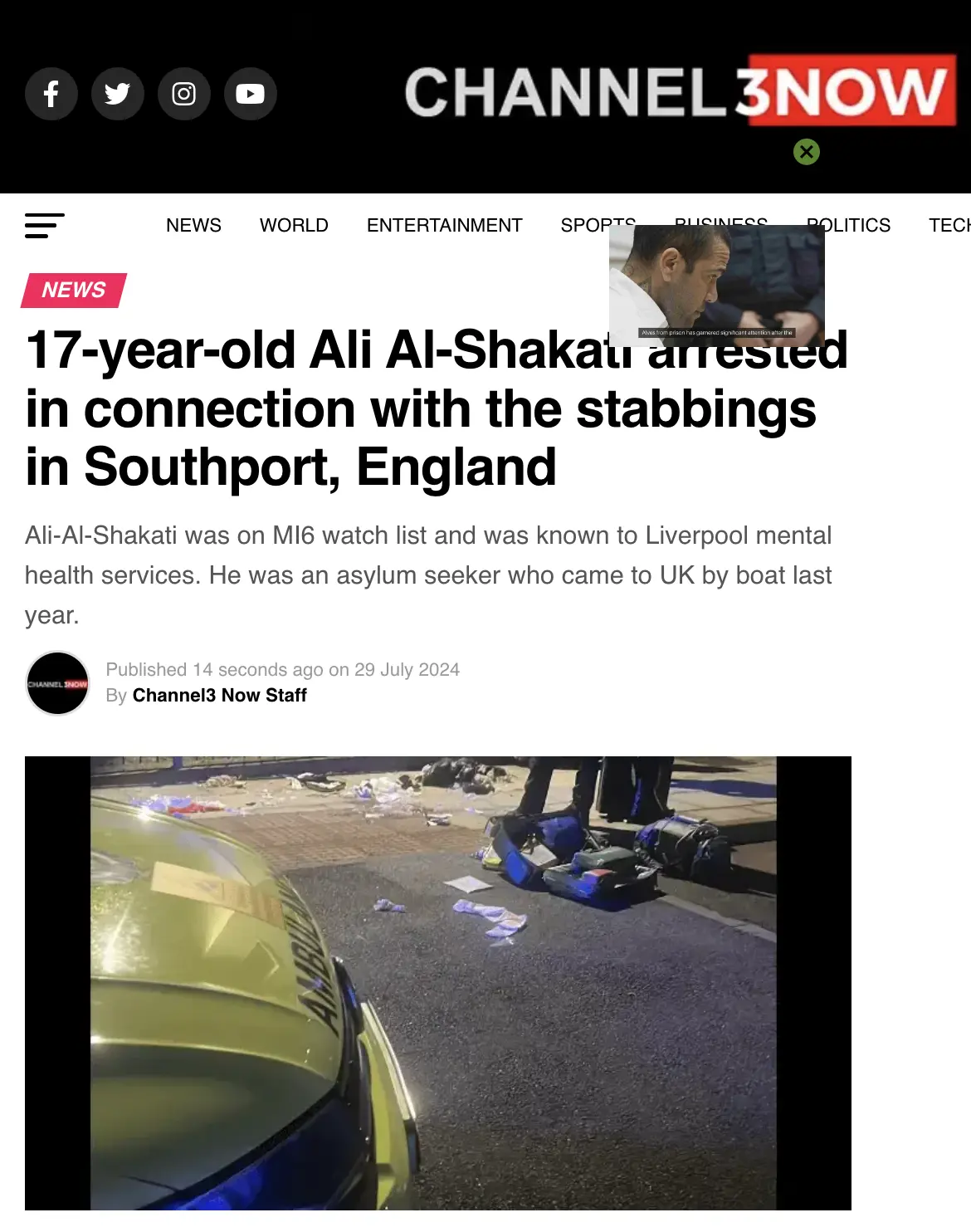
It was the social media handle of a “Channel3Now News” on X that gained conspicuous traffic shortly after the July 29 attacks.
In a now-deleted post on X detailing the identity of the attacker, this obscure website published an article and X post claiming that the attacker is an immigrant who came to the UK illegally by boat and is on a watch list related to security and mental health.
(Left) An archived version of Channel3Now article that fanned disinformation and fuelled anti-immigrant riots. Photo via archive.is
Channel3Now is a little-known website operated from Pakistan. A BBC investigation found that the website aggregates crime news from across the world to earn its revenue. Channel3Now had shared the hoax without a byline and admitted to the BBC that the fake news “shouldn’t have happened but it was an error, not intentional.”
A man called Farhan Asif, who lives in Lahore and is identified as a 32-year-old web developer, was arrested last month by Pakistani police under cyberterrorism laws, but eventually released last week after the police said they couldn’t find evidence that he posted the news. The UK police, however, say that it was Asif who shared the post and deleted it later. Asian Dispatch could not independently confirm whether the hoax was posted from Pakistan, the UK or another part of the world.
In another interview, Asif is quoted as saying: “I don’t know how such a small article or a minor Twitter account could cause widespread confusion.”
The website has since been shut down but an archived version of the hoax article shows the name “Ali-Al-Shakati” attached to the attacker on July 29 without any attribution to police statements. On Twitter, the website still has an unverified page.
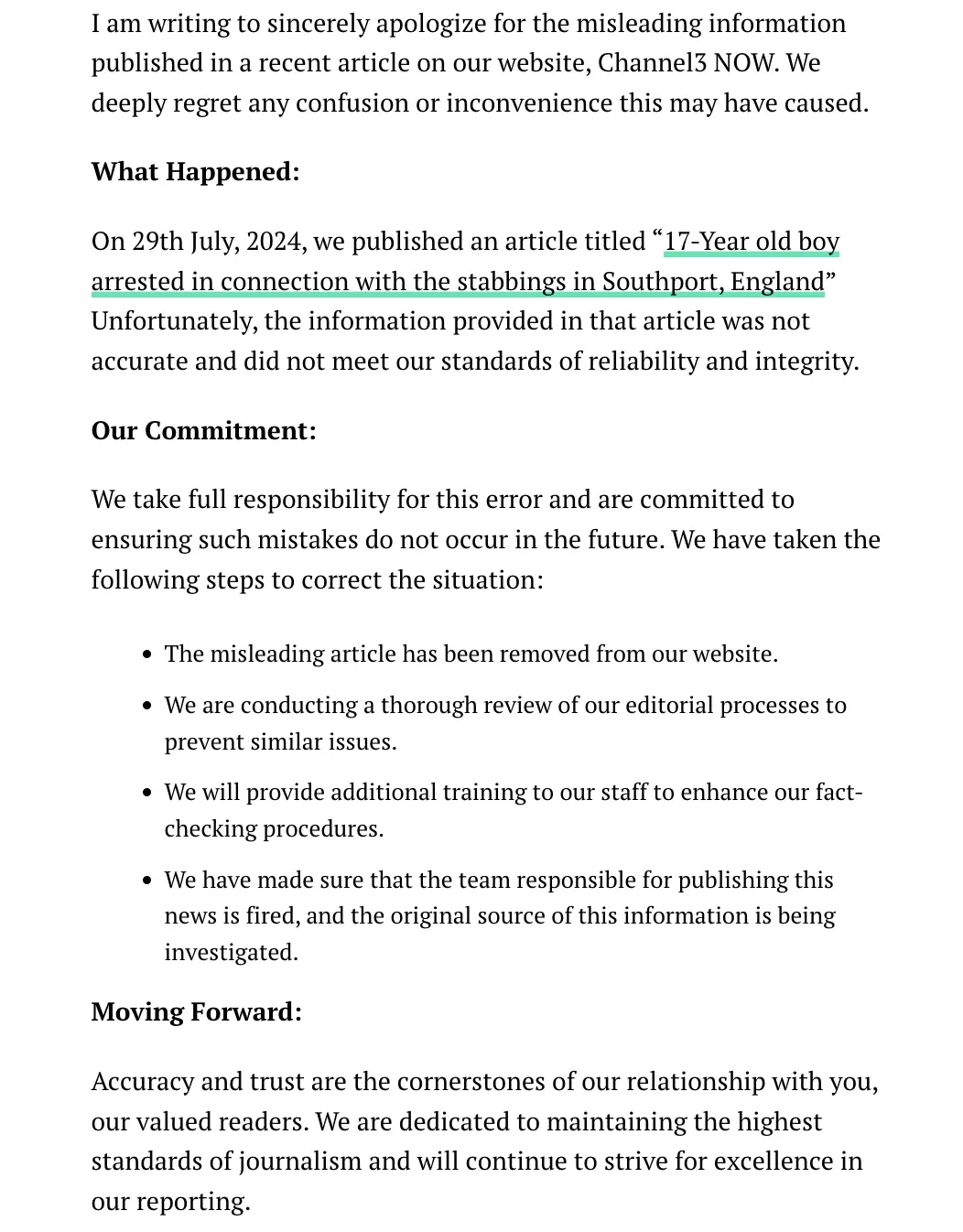
(Right) Channel3Now website published an apology titled ‘Sincere Apology and Correction Regarding Southport Stabbing Incident’. Photo via archive.is
The real name of the attacker was revealed last month by the Liverpool crown court for the sake of public interest and in the light of disinformation being spread online. Axel Rudakubana, who is 18, was born to Rwandan parents in Cardiff.
How did the Western far-right influencers cash in on the hoax?
The fake news has since been debunked by media outlets and the UK police. However, the damage has been irrevocable.
By the time Channel3Now’s hoax post was deleted, it had received 1.7 million views. Far-right influencers reshared the fake news on their platforms. In his video, which is flagged for “hateful conduct” on X but still has 15.2 million views, Andrew Tate said, “The soul of the western man is so broken that when invaders slaughter your daughters, do you nothing” and warned that “they are going to keep coming.” Tate has been charged with rape and human trafficking in Romania.
Former British actor-turned-rightwing influencer Laurence Fox tweeted how “British girls have been raped by immigrant barbarians”, garnering 5 million views. Fox has previously opposed protests in support of George Floyd’s killing in the US and shared anti-vaxxer sentiments during COVID-19 pandemic.
Another rightwing influencer Stephen Yaxley-Lennon, better known as Tommy Robinson, also shared the fake news on his X account that has nearly one million followers, repeatedly linking Muslims in general to the attacks and accusing the government of “gaslighting” the public. Before his posts were deleted, it reportedly had 54 million daily views. Robinson is the founder of English Defence League, a now-defunct anti-immigrant and Islamophobic group.
Nigel Farage, who runs UK’s populist and right-wing political party called Reform, amplified the fake news too by suggesting that the UK police is withholding information about the July 19 attacks.
The violence followed soon and in tandem with these posts, first in Southport, then followed by cities of Rotherham, Tamworth, Manchester, Liverpool, Belfast in Northern Ireland, and others.
What is the role of social media platforms in all of this?
In conversations of social media platforms and threats to democratic and pluralistic values, X has been more than just culpable. Reports have shown how X is an incubator of misinformation. A Washington Post analysis found that hate speech is inherent in X’s algorithm. X’s owner Elon Musk himself has been accused of spreading hate and misinformation. In the wake of UK attacks, his now-deleted posts targeted prime minister Keir Starmer while claiming the UK was on the cusp of a “civil war” because of “unchecked immigration.”
How did the July 29 hoax contribute to existing racism in the UK?
A 2023 survey carried out by an independent UK research institute Centre on Dynamics of Ethnicity found that over a third of people from minority groups in the UK have experienced racist assaults. The report also documents varying degrees of racism across all aspects of life, from health and wellbeing to socioeconomic indicators. Last month, the UN released a report connecting the rise in racism with racist comments by the UK’s political leaders.
Surveys show that although Brexit toned down anti-immigrant sentiments, it has been seeing a rise since 2022 as reports of immigration rose. A YouGov tracker of issues that UK citizens feel strongly about, found a dip in interest in immigration and asylum issues after 2016, but there’s a sharp uptick in mid-2022. Another YouGov data found that 57 percent of surveyed people blame the role of the media in painting the immigration and asylum issue negatively.
Axel, a student at Durham University who withheld his full name for privacy reasons, explained how the far-right media has been framing the immigrants as the “other.”
“(It) frames the people of colour as the source of Britain’s plight and the enemy of the white working class,” he said. “This false narrative resonates with many who are struggling, especially those with racist sentiments, pulling them towards more entrenched far-right politics and racism.”
The UK government data shows a decline in the number of asylum seekers – 69,298 asylum applications until March 2024, which is 14 percent lower than the number of applications by March 2023.
However, another official data on illegal immigration, which shows 6,265 small boat arrivals between January 1 and April 21, 2024, compared to 5,049 in the same period last year, an increase of 24 percent.
“Anti-immigration sentiment has grown due to inadequate and poorly communicated immigration policy,” Axel said. “Both in processing immigrants and refugees justly, and in failing to provide towns and cities the resources, they need to manage demographic changes as a diverse and integrated community.”
“This has led to a rise in far-right politics, instead of an inclusive and just policy change,” he added. “Declining living standards, poverty and widening inequality associated with the cost of living crisis has left many wondering why their lives are getting harder.”
Raza Rumi, a lecturer at the City University of New York, and a graduate of London School of Economics, reiterated the role of economic stress.
“In part, the economic stress in recent years and squeeze in public services and entitlements under the larger framework of neoliberal economic policies has created a difficult situation for working people and middle classes. Homelessness, poverty including child poverty have been on the rise,” he said.
“This is a fertile environment to blame the migrants and build false narratives that they are the problem for these societies. In fact studies show that immigrants in western societies are contributing to economic development and fulfilling important needs for skilled and semi skilled workers,” he added.
Today, anti-immigration sentiment has now become a Europe-wide phenomenon. In this year’s European parliamentary elections, anti-immigrant sentiment was a key factor that enabled far-right parties in several countries, including France, Germany, and Italy, to secure more seats.