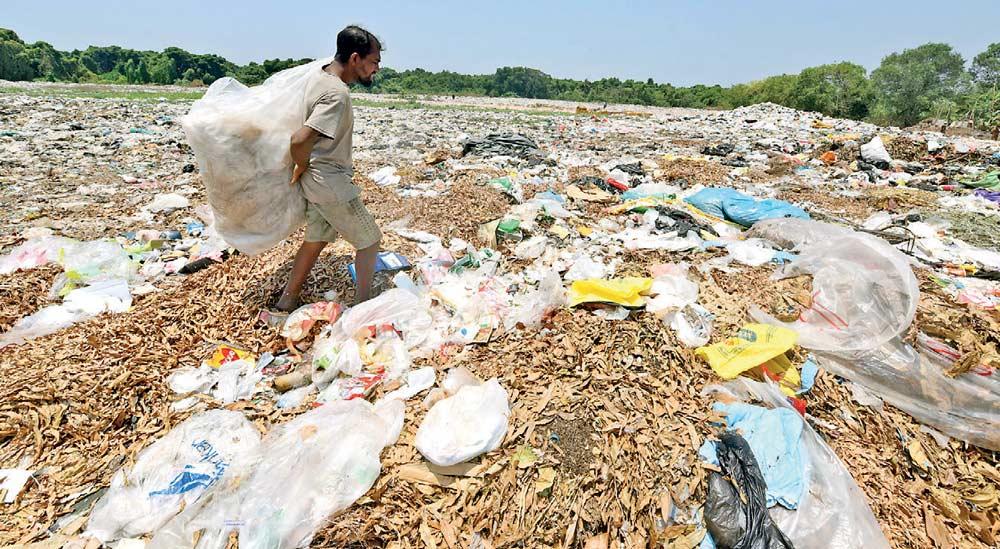
Colombo is a high risk MOH area for dengue due to the lack of a proper solid waste management system. Photo: Kithsiri de Mel
Three-year-old Nethmi Sehansa* from Dematagoda, a suburb of Colombo, succumbed to dengue in May 2023. Her parents and elder siblings remain devastated by her untimely demise. Even though they had big plans for their little daughter, the dengue endemic shattered their dreams.
The Western Province of Sri Lanka had been identified as a high-risk Medical Officer of Health (MOH) area since 2010 with a high density of dengue infected patients. As of March 1, 2025, as many as 4119 cases have been reported from the Western Province, which is the highest recorded number of patients among nine other provinces in the country. The fact that many dengue cases have been reported during a usually low peak season has raised concerns among health officials.
- As of March 1, 2025, as many as 4119 cases had been reported from the Western Province
- Western Province of Sri Lanka had been identified as a high-risk Medical Officer of Health (MOH) area since 2010
- Increasing evidence also suggests that peak dengue seasons may stretch due to unseasonal rains and warmer temperatures
Surge in Dengue Cases
Dengue is a viral infection transmitted following the bite of infected Aedes species of mosquitoes. According to the National Dengue Control Unit, dengue has a seasonal transmission with two peaks occurring with monsoon rains between June-July and October-December respectively.
Usual symptoms of dengue fever include high fever, pain behind eyes, severe headache, nausea, vomiting etc. Little Sehansa had had high fever and her parents took her to the hospital on the second day. The doctor had asserted that her platelet count was low and advised her parents to admit her to the hospital. Unfortunately, the doctors couldn’t save her life.
Since the beginning of 2023, the National Dengue Control Unit (NDCU) in Sri Lanka has reported 36,628 dengue cases. These figures are around three times higher than the cases reported during the same period in 2021 and 2022.
A 2024 research conducted to investigate reasons behind the outbreak of dengue in 2023 explains the fluctuating incidence of dengue fever that occurred in Sri Lanka since 1989. The largest outbreak due to dengue was reported in 2017 with 186,101 cases, associated with the cosmopolitan strain of the dengue virus (DENV) serotype 2. DENV-2 continued to be the predominant circulating serotype until October 2019. In Sri Lanka, the number of cases began to gradually increase from June 2022 onwards with a total number of 89,799 cases reported in 2023, with 18,650 from Colombo equivalent to one fifth of the caseload. Usually, Sri Lanka has two seasons of intensified dengue activity coinciding with the monsoon seasons. One season typically spans November to early February and the second season runs from May to July.
According to Dr. Preshila Samaraweera, Consultant Community Physician at the NDCU, the endemicity of the dengue virus has increased since 2000. “Therefore the number of cases cannot be brought down to zero even during a drought period. Due to the tropical climate the incidence of dengue is high and there is high transmissibility,” said Dr. Samaraweera.
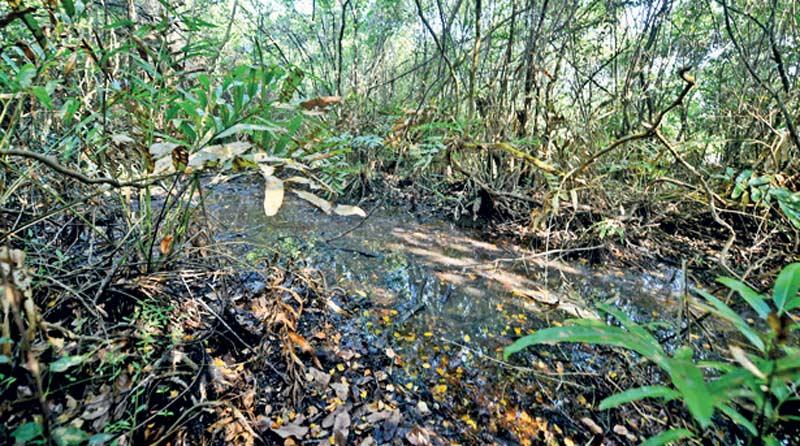
(Left) More rain also creates more stagnant water bodies and receptacles that mosquitoes may breed in.
When asked why there had been a sudden spike of dengue cases during the pre-monsoon period in 2025, Dr. Samaraweera said it cannot be described as a surge in cases because a similar trend had been observed during the past few years during the same period.
Dengue Vector and Climate Change
But increasing evidence also suggests that peak dengue seasons may stretch due to unseasonal rains and warmer temperatures.
More rain also creates more stagnant water bodies and receptacles that mosquitoes may breed in. Three of the four stages of the mosquito life cycle take place in water – eggs are laid in pools of stagnant water, which hatch into larvae and pupae which develop within them.
A 2020 research on climate change induced vulnerability and adaptation for dengue incidence in Colombo and Kandy explores how numerous models have predicted that climate change would increase the geographic distribution and potential risk of dengue incidence.
Relative humidity is a vital factor, which directly enhances the feeding frequency, inter sexual attractions and oviposition rates of Aedes mosquitoes. The adult longevity and survival success after being infected by DENV have also been found to increase under high humid conditions leading to a wide geographical dispersion of dengue.
Colombo – A High Risk MOH Area
As for the Colombo district, a combination of factors make it a highly vulnerable area for dengue fever. A study on the impact of environmental factors on the spread of dengue fever in Sri Lanka reveals that dengue fever incidence was caused by following factors: precipitation, wind, urbanization, land management, socio-demographic characteristics.
Consequently, western province possessed higher dengue cases (41% in 2017) than the eastern parts of the country (7% during the 2017 outbreak).
A 2024 research on dengue dynamics and environmental impact indicates that in Sri Lanka, the tropical climate, marked by seasonal weather primarily influenced by monsoons, fosters optimal conditions for the virus to spread efficiently. This heightened transmission results in increased per-capita vector density. Dr. Samaraweera further said that every year 45-50% of cases are always being reported from the Western Province of Sri Lanka. “Out of 57 MOH areas in the Western Province, a high number of cases are often being reported in areas such as Nugegoda. The reasons are manifold including high population density, flash flood situations after a heavy rain that would usually increase the number of stagnant water bodies and most importantly the lack of a proper solid waste management system,” said Dr. Samaraweera.
She said that potential breeding sites for the dengue vector include discarded items such as yoghurt cups, coconut shells etc., mostly found in the backyards of houses and commercial buildings.
Speaking about changes in weather patterns over the years, Dr. Lareef Zubair, Principal Scientist at the Federation of Environment, Climate and Technology, observe some ‘unusual rain events’ in dry seasons thereby delaying wet seasons at times. It appears that the frequency of such extremes has changed.
The endemicity of the dengue virus has increased since 2000. Therefore the number of cases cannot be brought down to zero even during a drought period. Due to the tropical climate the incidence of dengue is high and there is high transmissibility. —Dr. Preshila Samaraweera, Consultant Community Physician at the NDCU
“Certainly, the temperature highs, the air quality highs and evaporation has been exacerbated due to the already observed climate change. The argument that the warmer atmosphere has the capacity to hold much greater amounts of water vapour is sound and when large clouds burst it can lead to extreme rainfall,” said Dr. Zubair who had been observing weather patterns over the past 15 years.
He further said that people are experiencing a hydrological change. “Both maximum and minimum temperature is higher than in the last century. As a result, evaporation is much higher. Sri Lanka experiences lower air quality, which influences rain formation and the acidification of rain,” he stated.
Dengue Infection and Non-Economic Losses
So far, the dengue infection has claimed four lives during the first two months of 2025. In 2024, dengue claimed the lives of 24 individuals. Dr. Samaraweera further said that by reducing the number of cases, it would also save the expenses borne in treating patients with dengue. “When a patient is diagnosed with dengue, his or her economic productivity drops for three weeks. On the other hand the intensity of the infection varies from person to person. Therefore as the apex body to control dengue infections, we carry out targeted interventions such as fogging activities, source reductions and so on,” she added.
A 2014 study done on the economic cost of non-fatal paediatric dengue cases indicate that the average cost to hospital per case of dengue haemorrhagic fever (DHF) and dengue fever (DF) was SLR 24,856 (US$ 191) and SLR 10,348 (US$ 80) respectively.
Sehansa’s case is a classic example which indicates that dengue infection affects individuals irrespective of age. Other non-economic losses associated with dengue fever includes potential long-term health complications and psychological impact on caregivers.
However, the NDCU has been taking various measures to bring down the frequency of deaths by dengue. Dr. Samaraweera said that compared to 72 deaths in 2023 the number of deaths were brought down to 24 by 2024,” she added.
According to WHO, improper water storage practices and high population density are risk factors for dengue. But even though the authorities are taking steps to bring down the cases of dengue, V. Chithra, Sehansa’s mother, claims that even though fogging activities are being conducted by authorities on a regular basis, none of those interventions could save her daughter. “Fogging alone isn’t enough. If you check around these flats, the drainage systems are blocked and there are many stagnant water bodies. People aren’t interested in cleaning their sewage lines or cleaning the surroundings because poverty is a bigger burden they have to face on a daily basis,” she added.
In her comments, Dr. Anoja Dheerasinghe, Consultant Community Physician at NDCU said that there’s no stigma attached to the dengue infection unlike for diseases such as tuberculosis and HIV. When asked whether the urban poor is more vulnerable to the dengue infection Dr. Dheerasinghe said that people in highly populated areas are more vulnerable. “The population density in underserved settlements is high and the mosquitos’ flight range is between 100-200 metres. Therefore chances of an outbreak is highly likely in these areas and people therefore have to take all precautions,” she underscored.
The temperature highs, the air quality highs and evaporation has been exacerbated due to the already observed climate change. The argument that the warmer atmosphere has the capacity to hold much greater amounts of water vapour is sound and when large clouds burst it can lead to extreme rainfall. —Dr. Lareef Zubair, Principal Scientist at the Federation of Environment, Climate and Technology
According to the newly drafted National Strategic Plan for Prevention and Control of Dengue – 2024-2030, Sri Lanka has made a commitment to reduce dengue deaths to zero by 2030. The authorities are determined to bring down the average infection rate by 40%. But whether increasing risk factors such as climate change and the adaptability of the dengue vector would pose significant challenges in reaching this target, remains a doubt.
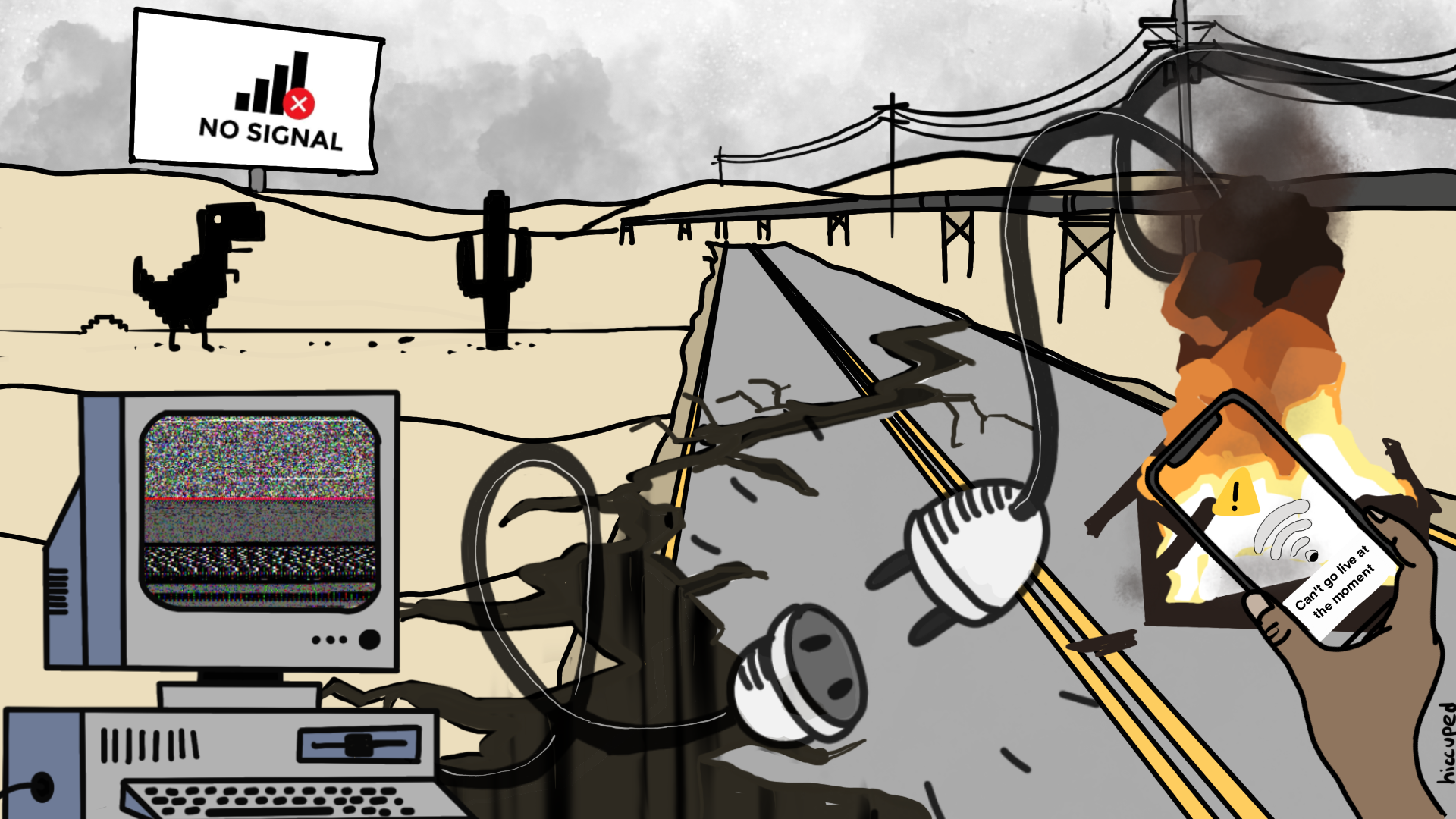
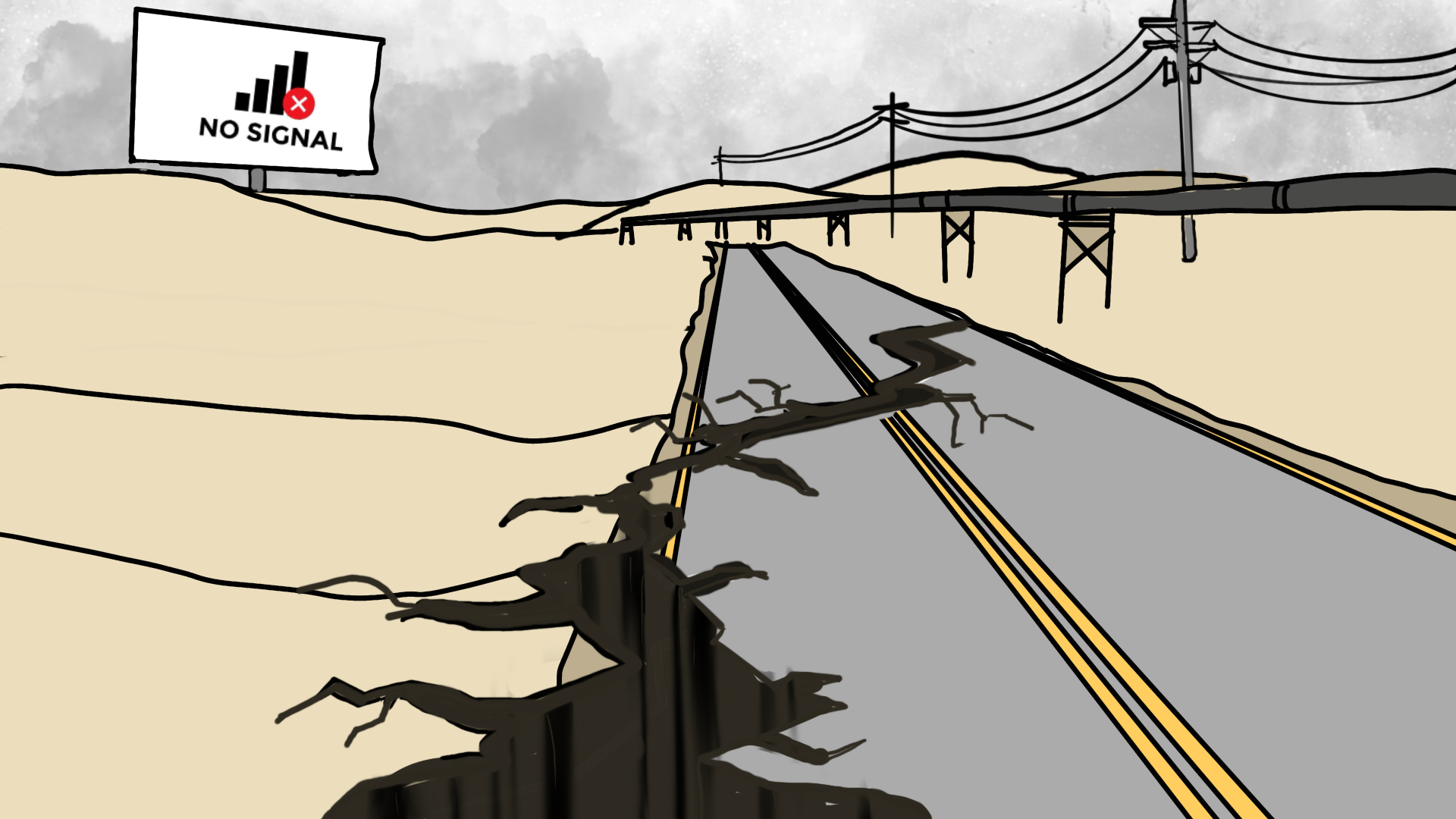
A new Asian Dispatch analysis mapped nearly 400 internet shutdowns in the last five years across South Asia. Illustration: Sharanya Eshwar
Across the world, social media has emerged as a means to collectively voice opinion and advocate for causes since the early 2000s. In South Asia, where internet penetration rates and mobile phone usage are some of the highest in the world, the platforms have been instrumental in democratising freedoms of speech and expression too.
The data speaks for itself. In India, over 70 percent of the population was using the internet as of 2024 data by International Telecommunication Union. In Bangladesh, that rate came up to 44.5 percent in 2024. The mobile broadband subscriptions stand at 899 million users for India and 98 million users in 2024. Looking at data from 2023 for Sri Lanka and Pakistan, we see the connectivity rate at 51.2 percent and 27.4 percent, respectively. The active mobile broadband subscriptions are at 73.5 per 100 people for Sri Lanka and 55.1 per 100 for Pakistan, as of 2024.
At the same time, the digisphere has created a new landscape for non-elite civic participation in everyday politics and political activism, wrote Dr Ratan Kumar Roy, a media studies professor from Bangladesh based in India, in his white paper on digitisation and civic participation. “Politics in the digital age is often subtle and takes on forms different from traditional political activism. This can include liking, sharing or commenting on political content, which can collectively have a large impact,” Roy notes in the report.
According to digital rights group Access Now, South Asia has seen some of the world’s leading internet shutdowns for over six consecutive years until 2024. In their 2024 report, they note that India witnessed 116 internet shutdowns in 2024 and over 500 in the last five years.
Mishi Chaudhary, the founder Software Freedom Law Center (SLFC.in) in India recalls two types of internet shutdowns: Preventive – that are imposed in anticipation of an event that may require the internet to be suspended by the state – and reactive, which are imposed to contain ongoing law and order situations.
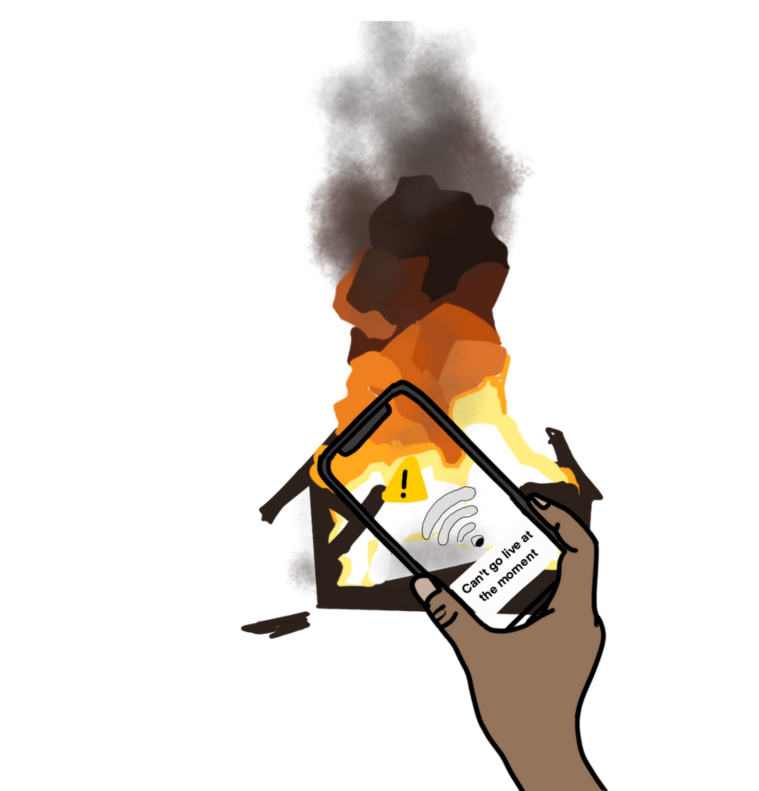
Internet shutdowns can take various forms, from blocking of certain websites to partial or full telecommunication and internet shutdowns.
“Internet shutdowns are the easiest tool in the toolbox for governments to control the flow and dissemination of information,” Chaudhary tells Asian Dispatch. “Although no evidence has ever been presented about the effectiveness of shutdowns, state authorities, fearful of the ease of organisation via the internet, are quick to use this blunt instrument of state power.”
In this piece, Asian Dispatch mapped 397 shutdowns between July 2019 and 2024 in India, Sri Lanka, Pakistan and Bangladesh out of which shutdowns in India, Pakistan, Bangladesh and Sri Lanka stand out. This data doesn’t include Afghanistan, Bhutan, the Maldives and Nepal, where internet shutdowns of this measure have not been documented.
Internet shutdowns have tangible real-world costs. In 2024, Pakistan’s economy was estimated to have lost between $892 million and $1.6 billion, according to the Information Technology and Innovation Foundations, a Washington-based think tank working on science and technology policy. In 2018, Sri Lanka faced an estimated $30 million loss due to similar measures, as reported by NetBlocks. The figures for India in 2024 stand at $322.9 million, as per the report by Top10VPN.
Robbie Mitchell, Senior Communication and Technology Advisor for the Internet Society, a global charitable organisation, says that information blackouts resulting from internet shutdowns can, in fact, result in increased violence. He elaborates further by adding that violent tactics of protest are less reliant on effective communication mechanisms and thus they could substitute non-violent protests that rely on the internet for planning and organization in the cases of internet shutdowns.
“In addition, internet shutdowns tend to attract international attention and create pressure on countries that undertake them. This relates to the so-called ‘Streisand effect,’ where the attempt to silence voices or hide information leads to the unintended consequence of bringing more attention to them,” Michelle says.
Left in the Dark
Mandeep Punia, a 30-year-old journalist from India, says that any internet shutdown causes a “fear of the unknown” in the society. Punia has experienced shutdowns first during the 2016 Jat community reservation protests, as well as the 2019 shutdown in Kashmir during the abrogation of article 370, among others. The most recent internet shutdown in India was in the state of Haryana in August 2025, as recorded by the internet tracker maintained by SLFC.
About 3,000 kms away, in Sri Lanka, Oshadi Senanayake, a civil society member and social worker, recalls the communication shutdown during the anti-Muslim violence in Sri Lanka in 2018. The series of violence saw the imposition of a nationwide state of emergency as Sinhalese-Buddhist crowds attacked Muslims and their establishments in the city of Kandy. “When the means of communication were restricted, it was very difficult,” she tells Asian Dispatch. “We were all in the dark, no one knew what was going on and there was no way to find out either.”
The similarity in these narratives connects the dots across South Asia on how internet shutdowns impact people.
In 2024, Pakistan invoked the region’s most recent shutdowns, which was done to curtail mass uprising in support of jailed former prime minister Imran Khan. This was one of the 17 shutdowns Pakistani people faced in the last five years, as per data collected by Asian Dispatch.
The same year, in July, Bangladesh saw mass protests by university students over government jobs, which eventually upended Sheikh Hasina’s 21-year rule. Her government resorted to internet shutdown in order to curb the organised movement. Over 1,000 people were killed during the protests, as per a report released by the interim government led by Nobel Laureate Mohammad Yunus.

At the same time, Asian Dispatch learned of students finding ways to circumvent the internet blackout, specifically by urging the residents to open their Wi-Fi networks, either by removing passwords or using “123456,” to support the movement. Shahriyaz Mohammed, a student at the University of Chittagong, and Raihana Sayeeda Kamal, another student based in Dhaka, confirmed that such appeals were made. According to Roy, who is also a former media studies professor at BRAC University in Bangladesh, this appeal drew widespread response, with many complying.
At the same time, the communication blockade disrupted the academic and professional prospects for many. Kamal said that she graduated last July and was supposed to apply for her postgraduate work permit in Canada. “I couldn’t do it. I was out of touch from Canada. It hampered my job search and communications with my professors, and delayed my application,” she tells Asian Dispatch.
Raihana Sayeeda Kamal, a student based in Dhaka talks to Asian Dispatch about her experience of living through the internet shut down of 2024 in Bangladesh
Mohammed, who lives in Chattogram, the second largest city of Bangladesh, says that internet cuts take place anytime, and that the Internet Service Providers (ISP) do not give any prior notice.
“The internet is the most necessary thing for my occupation and also for my study,” he says. However, due to these shutdowns, he wasn’t able to communicate with his office or get any updates from other parts of the country during the protests which hampered work for him as a budding reporter.
Controlling the Narrative
In 2019, India abrogated Article 370 of the Indian Constitution, which accorded special privileges to the region of Jammu and Kashmir. Along with the announcement came a sweeping communication blockade in order to curb disruptions due to anticipated unrest. The blockade in the region lasted 18 months prior to the services being fully restored. In all, the region experienced 213 days of no Internet and 550 days of partial or no connectivity, as noted by the Internet Society.
“Due to COVID-19, everyone knows what a lockdown looks or feels like. But it was only worse in Kashmir as there was not a restriction to physical spaces but also to virtual spaces,” Sayma Sayyed*, a student at a leading university in India, tells Asian Dispatch on condition of anonymity.
The situation, she added, resembled a pre-digital era, with no internet or mobile reception, forcing people to travel several kilometers just to check in with their loved ones.
The lack of internet creates a void of information in the society, says Sayyed*, a resident of Baramulla in Kashmir. “When I had to fill my form for competitive exams, students had to rush to government offices to do so,” Sayyed added. “So I went to the District Commissioners office to fill my form which is when I realised something has happened. Something I could do on a leisurely day became such a big task.”
Within India, the Union territory of Jammu & Kashmir holds the record of the highest number of shutdowns in the country.
Another student from the valley, who also spoke to Asian Dispatch on condition of anonymity, highlighted the psychological impact of such situations. “You don’t feel normal in places outside Kashmir,” the student said. “When I shifted to Delhi for further studies, I was confused as I was able to carry out my studies without any restrictions. I expressed this to my friends and they, too, agreed with the lack of restrictions. It felt jarring to someone who has seen so many curfews and internet blackouts.”
In this video from 2020, a student from Kashmir Valley in India’s Jammu & Kashmir voices similar concerns to Sayyed’s over the delay in her B.Tech examinations and how due to lack of internet, applying for her sister’s entrance examination became a daunting task. Source: Internetshutdowns.in, a repository of internet shutdowns in India maintained by Software Freedom Law Center, India [SFLC.in]
In Bangladesh, Shamim Hossen, a 28-year-old humanitarian worker and the reporting officer at Muslim Hands International, a charitable organisation, highlights how those solely reliant on mobile data were completely cut off. “I use mobile internet and data, and when I am in my office, I use Wi-Fi. But during the internet shutdown, our office was closed so I have no experience using Wi-Fi during that time,” she tells Asian Dispatch.
Sri Lanka has seen the use of full internet shut downs as well as partial restrictions such as curbing access to social media websites for a certain duration. Incidents such as the Easter bombings in 2019 which saw serial blasts on multiple public and religious sites in Colombo, to the economic crisis of 2022 to the Presidential elections in 2023 saw the use of such measures. The country has seen 5 shut downs from 2019 to 2022, as per data collected by Asian Dispatch.
Amarnath Amarasingam, Assistant Professor at the School of Religion, Department of Political Studies, at Queen’s University in Canada, told Asian Dispatch about the relation between misinformation and shutdowns. “In Sri Lanka, when social media was blocked, citizens turned to alternative, less reliable sources,” he says. “These shutdowns made it difficult for credible journalists and activists to fact-check information, leading to a situation where rumours and conspiracy theories filled the void. In countries with ongoing communal tensions, the spread of false rumours can lead to real-world violence against civilians as well.”
Massive protests in Delhi. All communications have been suspended in select areas where the protests were scheduled to take place. Please report any Internet shutdowns to us @NetShutdowns
Reach out to us – +911143587126#LetTheNetWork #KeepItOn #delhi pic.twitter.com/ziUtYdJEMe— InternetShutdowns.in (@NetShutdowns) December 19, 2019
Women’s safety and internet shutdowns. How internet shutdowns impact women’s safety and travel in the national capital of India, Delhi. Source: Internetshutdowns.in, a repository of internet shutdowns in India maintained by Software Freedom Law Center, India [SFLC.in]
Highlighting the broader implication of using internet shutdowns to control dissent, Amarasingam adds: “Internet shutdowns have significant human rights implications, especially around issues like freedom of speech and access to information. Shutting down internet services curtails individuals’ ability to express dissent, participate in protests, or even access vital services such as health and education. All of this, of course, will impact marginalised communities more than others.”
“In Sri Lanka, these shutdowns particularly affect communities with fewer alternative sources of information and who rely on mobile internet for basic services. In the former war zones in particular, these alternative sources of information are key for receiving information that is not curated by the government.”
“Along with the professional, personal life also gets affected,” adds Aftab Mohmand, a 44-year old senior journalist from Peshawar. Mohmand adds that usually, one can circumvent restrictions through VPN or Wi-Fi. But in Peshawar, there is no such facility. Four of the 35 shutdowns Asian Dispatch has documented from 2019 to 2024 for Pakistan were in Peshawar province. “VPN data is monitored and it can be dangerous too,” says Mohmand. Since 2014, he has been using the phone to make reels, create reports and record everything using the internet.
Disrupting Normalcy
“My clients outside of Peshawar think that people from the region do not work properly due to internet restrictions coming up now and then. We had in fact replied to messages but they would reach one to two hours later, which affected our credibility.”
This is the ordeal of Sufi Ali, a 35-year-old IT officer from Mardan, located in Peshawar, Pakistan. Pakistan has recorded 35 shut downs between July 2024 to July 2019, according to the Asian Dispatch analysis. These include blocking the internet in response to protests such as the ones in support of former Prime Minister Imran Khan in 2022 to allegations of throttling with the internet speed by the government during the testing of speculated possible internal firewall.

Virtual Private Networks (VPNs) are often used to bypass shutdowns or access regionally blocked websites. But Mohmand notes that they significantly slow down internet speeds.
Journalists from India, Sri Lanka and Pakistan told Asian Dispatch that these restrictions make it nearly impossible to verify information for accurate reporting.
“I am a journalist so whenever we go out for conflict reporting, we face [internet shutdown],” says Punia, the rural journalist from India. “But the worst aspect of that is that our [media portals] are also shut down.
His concerns are mirrored by Sandun, a freelance journalist based in Sri Lanka. Talking about covering the 2018 anti-Muslim violence, she says the internet shutdown made their job even more difficult. “We treated every piece of news with suspicion and nothing could be verified. The officials were too silent or evasive and we didn’t have anyone on the ground. We felt like we would risk peddling misinformation,” she says.
READ: In Bangladesh, Cops Accused of Killing Protesters During 2024 Uprising Roam Free
On July 19 alone – the day Sheikh Hasina’s ousted regime enforced an internet blackout – at least 148 people were killed by law enforcement agencies, according to a report by the International Truth and Justice Project (ITJP) and Tech Global Institute.
CIR also identified two “peaks” in violence. The first was on July 18, where killings amounted to a massacre. It all started with the killing of a protester called Abu Sayeed, in Rangpur district, on July 16, which was captured in a now iconic image of him spreading his hands in front of the police force. The second peak in violence was on August 5, the day Hasina resigned and fled to India.
Both these peaks in violence also correspond to internet shutdowns, as Asian Dispatch has investigated.
The Policy Pitfalls
South Asian governments often cite national security and misinformation as reasons for internet shutdowns. However, these terms are frequently undefined or vaguely worded in legislation and policy, prompting global experts to raise concerns about their potential misuse.
In the absence of any explanations by government arms on the reasons behind these moves, speculation is rife. For instance in India, internet shutdowns are governed under the Temporary Suspension of Telecommunication Services Rules, 2024, which, under clause 3, explicitly states that the reason for such measures needs to be released in writing. However, these orders are seldom found in the public domain..
In Pakistan, the legal backing of shutdowns is murky as the Pakistan Telecommunications Authority (PTA) also recently highlighted this legal uncertainty. Numerous laws are speculated at play here, with most shutdowns being informed by PTA, the body responsible for establishing, maintaining and operating telecommunications infrastructure in Pakistan, via orders for enforcement by the Interior Ministry. Other than these orders it is believed that Section 54(3) of Pakistan Telecommunication (Re-organization) Act, 1996 is used for such shut downs, which has been ruled against by the Islamabad High Court in 2018. The opacity of such measures is widely recognised by activists and advocacy organisations in the country as well as globally.
Recently, Pakistani journalist Hamid Mir filed a petition in Islamabad High Court, requesting for clarity on why the internet speed in the country were significantly lagging in the past few months, leading to even voice notes or multimedia on WhatsApp not reaching receivers. The petition comes at a time when speculations are rife about the government installing a “fire wall” that would prevent free and open use of the internet in Pakistan.
Other laws in Pakistan, such as the Prevention of Electronic Crimes Act, 2016 (PECA) under its 2025 amendment-equipped section 26(A) criminalise intentional dissemination of false information in the country. ‘Fake news’ is also the basis of many internet shutdowns, thereby hinting at the indirect use of the act for enforcing such measures.
Sri Lanka, too, sees a similar trend in a mix of non-specific regulations being used to curb internet and social media access in the country. Orders to the Sri Lankan Telecommunications Regulations Commission by the Ministry of Defense have been seen as ways of enforcing such curbs. Reasons for shutdowns range from curbing the spread of misinformation, to stopping demonstrations such as during a state of emergency.
Amarasingam says that the absence of official communication during internet shutdowns often leads to an information vacuum, which can fuel misinformation.
“The problem is that in authoritarian contexts, misinformation merely means critiques of the ruling party. And ‘terrorism’ often just means agitation against the government. And so, these terms are weaponised to curtail fundamental rights. In these contexts, shutdowns may hinder the spread of accurate information, create distrust, and deepen existing societal divisions,” she says.
In India, the law is clearly laid out but often not applied consistently. For this, Chaudhary of SLFC says that the civil society has to constantly approach the courts to enforce their rights. “Time period of shutdowns are extended continuously despite limitations imposed by law. Law requires proportionality,” Chaudhary says, adding that the proportionality of these actions is far more than required for the general good.
“Can shutting down the entire system of social communications and completely crashing the payments economy for months be ‘proportional’ to the necessary problem of preventing the incitement of intercommunal riots? If this government intervention is the ‘least restrictive means,’ what are the other more restrictive means the government would not be allowed to use?” Chaudhary asks. “The mind boggles.”
Mitchell from the Internet Society adds further context to the consequences of these actions: “Internet shutdowns tend to attract international attention and create pressure on countries that undertake them. This relates to the so-called Streisand Effect, where the attempt to silence voices or hide information leads to the unintended consequence of bringing more attention to them.”
Digital Rights are Human Rights
When asked whether they were informed prior to internet shutdowns, there’s an astounding “no” from those interviewed for this piece.
Numerous international statutes reaffirm that the internet is an indispensable part of human rights. The United Nations Human Rights Council enshrines this in Article 19 of the Universal Declaration of Human Rights, which “protects everyone’s right to freedom of expression, which includes the freedom to seek, receive and impart information of all kinds, regardless of frontiers.” Restrictions to right to freedom of expression are only permissible under article 19(3) of the Universal Declaration of Human Rights, although it notes: “When States impose internet shutdowns or disrupt access to communications platforms, the legal foundation for their actions is often unstated.”
In India, on two separate instances – by the High Court of the state of Kerala and then the Supreme Court – access to the internet has been declared a fundamental right under the Indian constitution.
“In India, the law is clearly laid out but often not applied consistently. adds Choudhary of SFLC.in.
In Bangladesh, a similar trend exists. Asian Dispatch spoke to students and young professionals who didn’t receive any prior intimation of internet shutdown orders in the last one year. The trend is to slow down the internet, and then slowly revoke access fully, says Kamal, from Bangladesh.
Noting the impact of shutting down the internet, Michelle says: “Internet shutdowns have far-reaching technical, economic, and human rights impacts. They undermine users’ trust in the internet, setting in motion a whole range of consequences for the local economy, the reliability of critical online government services, and even the reputation of the country itself. Policymakers need to consider these costs alongside security imperatives.”
While law governs social media and not internet shutdowns directly, it is worth noting that the negative effects of problematic regulations become yardsticks for regimes that govern a similar cultural and social landscape.
“It also stops people from both demanding and empowering government action to protect its people,” Chaudhary adds. “Shutdowns don’t create the social and political will to safeguard our people, but rather a cloak for the government to hide its shame.”
Punia, the journalist from India, agrees and adds that freedom of speech and expression are never absolute. “They are only useful until one has to show them as democratic for indexes and rankings and gain marks there,” he says.
These are just a few examples of the broader impact experts point to. Given the concerns raised by individuals like Sayyed in India and Hossen in Bangladesh, a critical review of both the shutdowns and the frameworks enabling them is long overdue. Access restrictions need to be brought to the fore and the internet needs to be given a fair chance to make a case for its freedom.
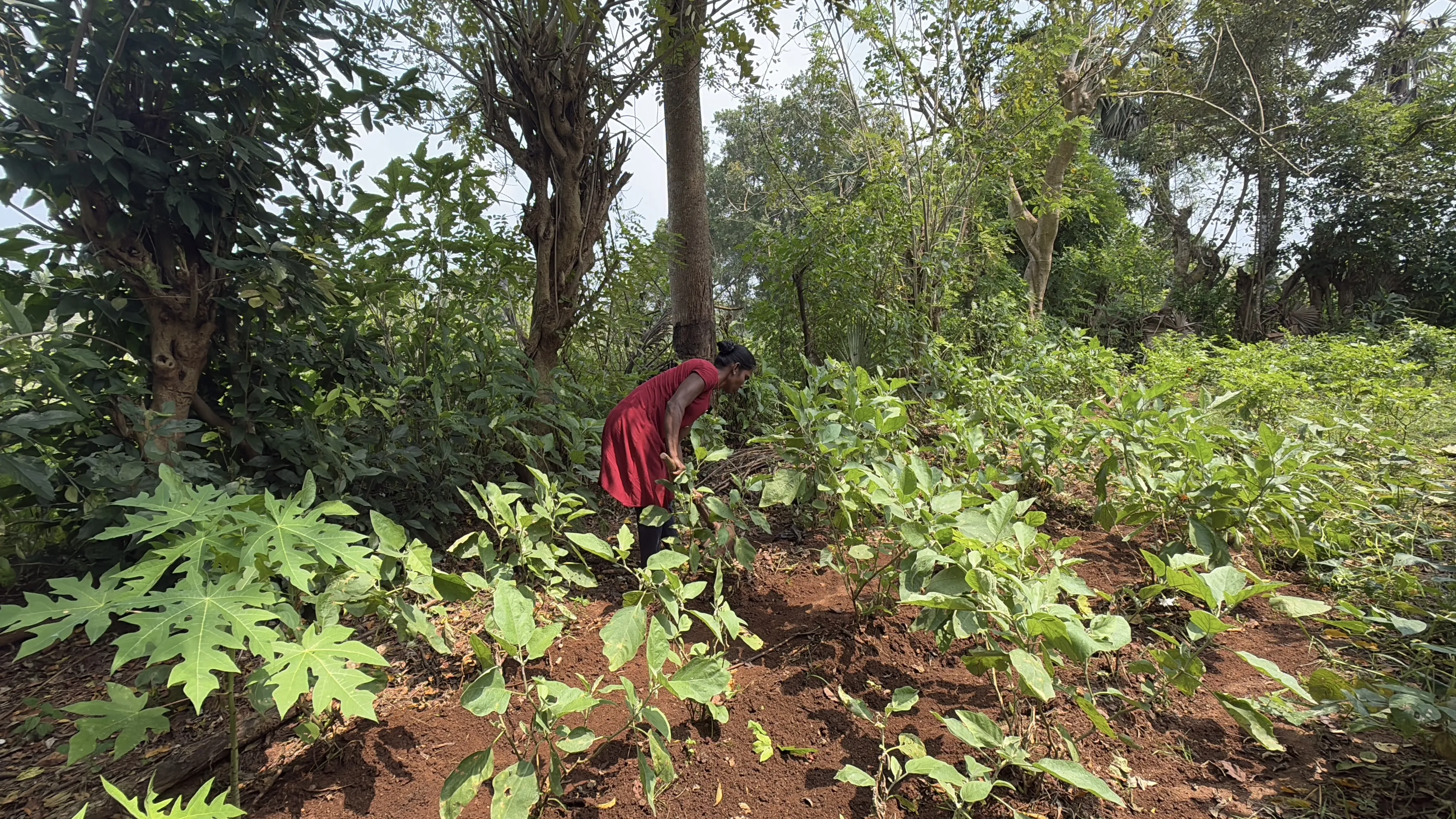
Women like Sivaranjini are forced to deal with the existential crisis of either having too much or too little water for their land. Sivaranjini, seen in this photograph, grows vegetables in a patch next to her home for the third year in a row. Photo: Rukshana Rizwie
Santhirasegaram Sivaranjini kneels in the dry soil of her home garden, her hands caked in dirt as she carefully plants seedlings. The sun beats down relentlessly, a reminder of the prolonged drought that has ravaged her land. Around her, the remnants of last year’s failed harvest — withered stalks and cracked earth — tell a story of loss. But Sivaranjini is determined. “This year, I will try again,” she says, her voice steady despite the weight of her struggles.
For the 44-year-old war widow and a mother of three, this small plot of land is more than a garden. It’s a lifeline. She endures the dual devastations of Sri Lanka’s recently concluded 26-year-long civil war and the escalating impacts of climate change.
Sri Lanka’s civil war was a conflict between the Sri Lankan security forces and a separatist group of Tamil minority called the Liberation Tigers of Tamil Eelam (LTTE). In the final stages of the conflict in 2009, the Sri Lankan military ruthlessly bombed LTTE strongholds in the north. The death toll – mostly civilians – is estimated to be up to 100,000. One of the victims was Sivaranjini’s husband, who died from injuries sustained during the shelling of Oddusuddan, a township that witnessed some of the fiercest fighting between the Sri Lankan forces and the LTTE.
Today, the war is over, but not for Sivaranjini.
“This year has been the most devastating,” she tells Asian Dispatch, her voice tinged with exhaustion. “There was no rain during the weeding period, and then too much rain just before harvest. Severe droughts in between. Everything was destroyed.”
Sivaranjini is the sole provider for her home, and her story is not unique. In northern Sri Lanka, particularly in Mullaitivu, Tamil women — many of whom are war widows or survivors of the conflict — are facing the compounded impacts of prolonged droughts and erratic weather patterns.
One of the significant impacts that the conflict has had is the increased number of female-headed households (FHH) in the Northern Province including Mullaitivu district. Out of the 5.2 million households in Sri Lanka, an estimated 1.1 million households or 23 percent of the households are FHH.41. Of that it is estimated that women head 58,121 households in the Northern Province.
For over two decades, the north has experienced drastic climate shifts, with severe droughts rendering vast tracts of agricultural land infertile and torrential rains causing floods. Climate change has robbed these women of their primary livelihood—farming—and forced them to seek solutions for survival.
Oddusudan by Asian Dispatch
A time-lapse of Oddusuddan, in Mullaitivu district, highlights how much the landscape changed from 1966 onwards. The landscape shows lush greenery in the late 90s to parched and infertile lands in the 2000s. Video: Rukshana Rizwie; satellite images via Google Earth
Sivaranjini’s family once thrived on farming. Before the war, they earned at least LKR 1,000 (roughly $3) per day, growing black gram, green gram, maize, ground nut, cowpea, sesame, kurakkan, red onion, big onion and soya beans.
But the conflict and its aftermath left deep scars. Her eldest son, who sustained severe fractures during the shelling, requires frequent hospital visits. With no borewells to irrigate her three acres of land, Sivaranjini relies on borrowed water from a nearby well—a precarious arrangement. “If the other landowners see my plants bearing fruit, they won’t let me fetch water,” she says. This makes her increasingly reliant on the rain cycle.
Mullaitivu is located in Sri Lanka’s dry zone, and has long been a hub for growing red rice and other field crops such as groundnut, green gram, black gram and pulses. This is also where the last phases of the civil war were fought.
Over the past few decades, the district has experienced significant shifts in its rainfall patterns, disrupting traditional farming practices and challenging the resilience of its agricultural dependents. Data from 1961 to 2002 reveals a complex picture of climate change impacts, with Mullaitivu standing out as one of the few regions in Sri Lanka where annual rainfall has increased, even as the number of rainy days has declined.
According to academicians Sulakshika Senalankadhikara and L Manawadu, who both teach at the Department of Geography at the University of Colombo, who are co-authors of a study, Mullaitivu recorded an increase in total annual rainfall of 7.215 mm per year over the 42-year period from 1961 to 2002. However, this increase in total rainfall has not been accompanied by a rise in the number of rainy days.
“Mullaitivu experienced a decline in the number of rainy days by 0.818 days per year. This suggests that while the total volume of rainfall has grown, it is now concentrated in fewer, more intense downpours,” Senalankadhikara says, adding that this shift has significant implications for agriculture, as it leads to longer dry spells interspersed with heavy rainfall events that can cause flooding and soil erosion.
For example, the study’s spatial interpolation maps show that Mullaitivu’s rainfall patterns have shifted significantly over the decades. While the district once received relatively consistent rainfall, it now experiences more extreme fluctuations, with periods of intense rainfall followed by prolonged dry spells. This variability is particularly challenging for paddy cultivation, which relies on consistent water availability.

Spatial interpolation maps of Sri Lanka show that rainfall patterns have changed over the years with the district now receiving torrential pours.
According to V Pathmanandakumar of the Department of Geography at Eastern University in Sri Lanka, the land cover in Oddusuddan has undergone significant changes over the past two decades. His research, which produced thematic maps illustrating land-use changes between 1997 and 2016, reveals a troubling trend: A 5.88 square kilometre decline in vegetation cover.
“In 1997, about 453.02 square kilometres of the Oddusuddan division was covered with vegetation,” Pathmanandakumar explains. “By 2016, that figure had dropped to 447.14 square kilometres.”
Legacy of loss in the north
In the north, the story of the climate crisis is closely intertwined with the legacy of loss among the Tamils. Sri Lanka is a Sinhalese Buddhist-majority country, and Tamils form its largest minority, making up 12 percent out of its 23 million population. The community has historically faced systemic discrimination since the country gained independence from British colonisation in 1948. Sinhalese Buddhists have great influence in Sri Lanka’s institutions, including politics, judiciary and police, leading to further marginalisation. Ethnic fissures, compounded by violence and discrimination, eventually erupted into a civil war in 1983, which lasted until 2009. The war is over now, but not for 3.1 million Tamils, who still reel from the impacts of war. Women and children are disproportionately impacted by its outcomes.
Sasikumar Ranjinidevi, who lives 30 km away from Sivaranjini, says the war has left her feeling like a stranger in her own land. Her husband and family members surrendered to Sri Lankan security forces during the final years of the armed conflict. Her kin are now among an estimated hundred thousands of disappeared, with no sign of their return. This left Ranjinidevi to shoulder the burden of raising her children and rebuild their shattered lives alone.
According to the United Nations Human Rights Council Report, Sri Lanka has the second highest number of enforced disappearances worldwide, tipping 100,000 disappearances.
“I see the sorrow etched on my son’s face,” she tells Asian Dispatch. “There are days he returns from school in a solemn mood, refusing meals and weeping alone for hours or even days. He misses his father terribly.”
The weight of her loss is palpable. Yet, Ranjinidevi masks her grief, knowing life must go on. After the end of the armed conflict, she returned to her hometown to reclaim her land and rebuild what was lost. “Our harvests and planting cycles always revolved around the weather,” she recalls. “It was like clockwork. Now, it’s as unpredictable as our lives. Over the years, we’ve abandoned our land, plot by plot. Today, an entire acre lies barren and unusable.”

Ranjinidevi’s lands are vast but her farms are small, she can only grow what the weather allows. Today she is tending to wheat and hopes her vegetables will withstand the next downpour. Photo: Rukshana Rizwie
What little remains of her land tells a story of struggle. Ranjinidevi once grew vegetables in her home garden and pulses in the fields. “Either the seeds drown in excessive rainwater or the crops are washed away before we can harvest them,” she explains. Though the rains are brief, they are devastatingly intense, leaving no chance for recovery.
Knee-deep in debt, Ranjinidevi has borrowed from both private and government banks. “We can’t make enough. Nothing grows, and when it does, it’s destroyed. Whatever I hoped to salvage has been lost. I can’t even pay the interest on my loans. I don’t know what to do, and there’s no one to share my worries with,” she says.
During droughts, the situation worsens. Wells dry up, forcing them to buy drinking water. “The brinjals and pulses I planted withered under the scorching heat and lack of water,” she says with despair. ”There was a time when lorries would come to our lands to load up on onions to take to [capital city] Colombo,” she said. “Today we jump for joy at the sight of a growing single onion.” The dry spells are the hardest to bear, she says. The severe drought in 2018 she and her family experienced, lasted for more than eleven months and affected the western part of the entire district.
She says no matter how much effort or money she invests, the force of climate change is against her. “It isn’t supposed to rain this month (February), but it has been pouring and last year around this time, we experienced floods.”
When is the next big drought?
Based on the research by a group of scientists from Malaysia-based Universiti Sains Malaysia, the next significant drought in Mullaitivu is likely to occur during the southwest monsoon season, which spans June, July and August. Historically, these months have been identified as the driest in the region, with minimal or no rainfall recorded in some years. The study highlights that drought conditions often originate in the western part of the district in March and progressively spread eastward, intensifying during the peak dry months of July and August. This pattern is influenced by geographical factors and the Indian Ocean Dipole (IOD), which has a strong correlation with drought occurrences in the area.
Given the cyclical nature of droughts in Mullaitivu, the southwest monsoon season of 2025 is expected to follow this established trend. The combination of high temperatures, increased evaporation rates, and reduced rainfall during these months will likely exacerbate water scarcity, impacting agriculture and daily life.
The study also notes that the IOD plays a significant role in shaping these conditions, with positive IOD phases linked to warmer sea surface temperatures and reduced rainfall in the region.

A heatmap based on scientific studies conducted in Mullaitivu which shows the occurrences and incidents of severe droughts from 1977 onwards to date. Graphic: Rukshana Rizwie
A struggle for identity and land
To understand the climate crisis for Sri Lanka’s north, one needs to acknowledge the historical role land plays in Tamil identity. The community is believed to have descended from the Jaffna kingdom and are natives to the country. Despite the legacy, the Sri Lankan government listed them as a separate ethnic group and even removed the Tamil language as an official language in 1956 – which was later reinstated in 1987. The Sri Lankan government is also accused of erasing Tamil legacy by destroying archeological evidence of the community’s historical roots. With the Tamil culture, language and history under siege, the LTTE was borne out of the idea of a Tamil “homeland” where LTTE founder V Prabhakaran famously said that the Tamil race is “deeply rooted” to the northern soil. After the war, the Sri Lankan government has been waging a quiet war on Tamil land. Most of it is on agricultural land.
Sasikumar Santhidevi was eight months pregnant when her husband died during the shelling in the war. She fled to save her and her unborn baby’s lives but when she came back in 2011, her land was occupied by the Sri Lankan military. Military occupation of Tamil land became a jarring reality for thousands of civilians like Santhidevi, who returned after the war only to find camps, bases and High Security Zones on their agrarian and familial land. According to the Adayaalam Centre for Policy Research, an advocacy group, the military held 30,000 acres of land in Mullaitivu in 2019, a decade after the war.
For Santhidevi, the military eventually let go of some land but a portion of it is still occupied by Sri Lanka’s Department of Forests.
“[When I came back after the war],I couldn’t locate my home, Santhidevi recalls. “The entire area was a jungle. My mother and my little children took axes and began to cut through the dense shrubbery. I remember one occasion when we were having a meal during a brief respite, the army commander of the area came over and told us to leave everything and go.”
Santhidevi didn’t give up: “We lived on this land and had all the documentation to prove it, so I went to court. The army offered us money in exchange for an acre of land, but we refused. We wanted to keep our land.” Once she was finished dealing with the army, she confronted another issue: The Department of Forests, which still claimed an acre of her land. “We can’t access it to date,” she says, leading us to a spot marked with concrete poles. “They’ve fenced the land, and if we are to go to court over it, we need at least LKR 100,000 ($334) in legal fees, money which we don’t have.”
Despite the Department of Forests’ claim on the land, Santhidevi says she sees them planting and harvesting pulses each year, which they later sell.
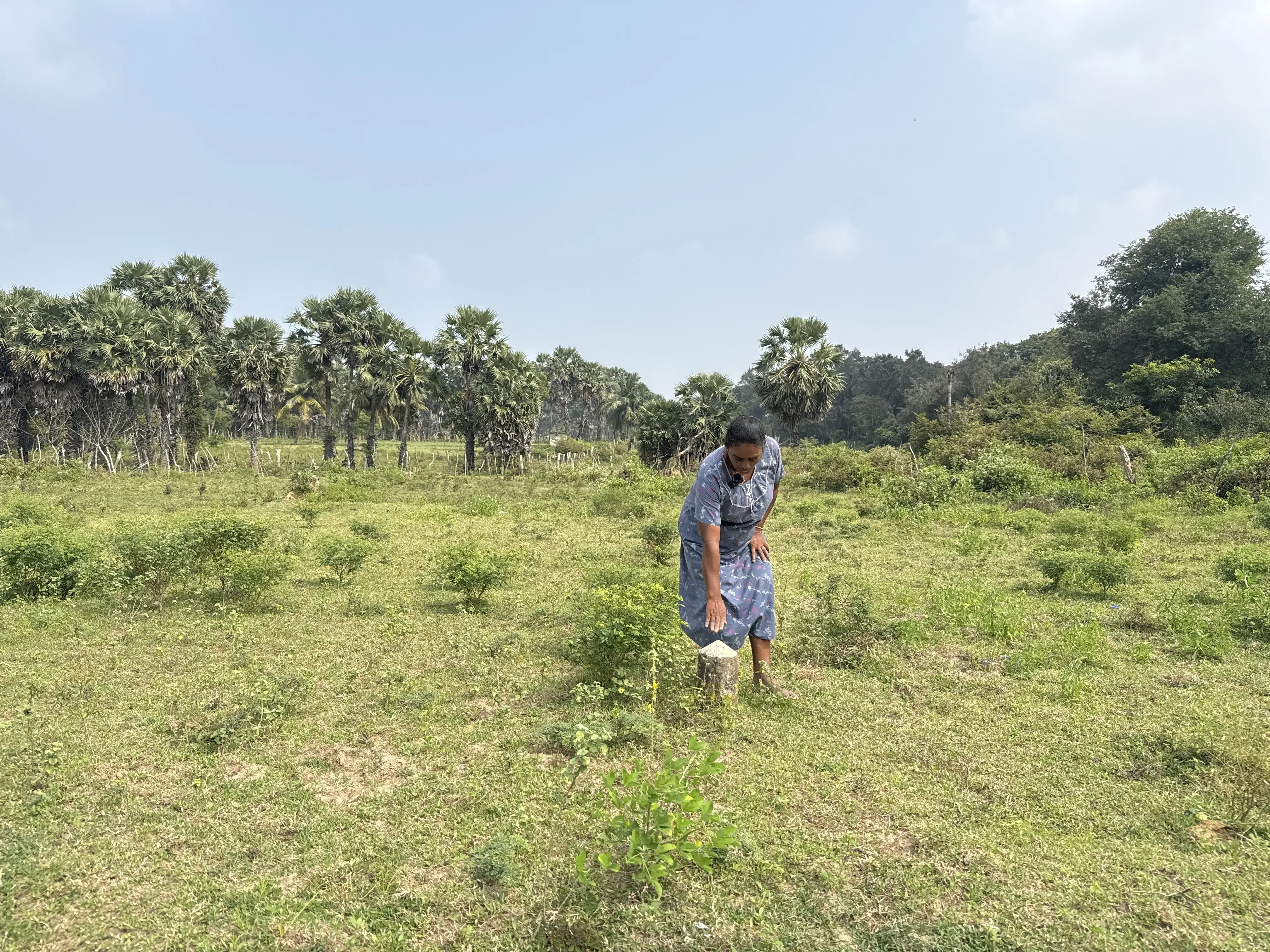
Santhidevi shows us the concrete polls that separate her own lands from the rest of the plot. Photo: Rukshana Rizwie
Asian Dispatch investigated the land occupation in Mullaitivu district.
In response to a Right to Information (RTI) petition submitted by us, the Mullaitivu secretariat responded with a calculation that showed a total of 4,859 acres that still remain occupied. Only 2,891.75 acres have been released so far. Of the five divisions in the Mullaitivu, Karaithuraipatru (Maritimepattu) is the most heavily occupied. Over 4,000 acres of the total occupied land fell within this division.
| Division | Total seized by tri-forces | Land Released (acres) | Land Remaning (acres) |
| Karaithuraipatru | 6809 | 2764 | 4045 |
| Thunukkai | 429.25 | 0.25 | 429 |
| Oddusuddan | 188 | 2 | 186 |
| Puthukudiyiruppu | 284.5 | 115.5 | 169 |
| Manthai East | 40 | 10 | 30 |
| Total | 7750.75 | 2891.75 | 4859 |
Keppapulavu is where hundreds of residents – including Santhidevi – were forced to flee their homes during the final stages of the war in 2008. Soon after, the military took control of more than 202 hectares of Tamil-owned residential land, incorporating the former residents’ homes into vast military camps. The army now uses the land for farming and maintaining guarded military camps, despite promising that they’ll return the land as part of the government’s justice, peace and reconciliation process.
The RTI petition also revealed that Sri Lanka’s Forest Department has expropriated 32,110 acres of land, while the Wildlife Department continues to lay claim to 23,515 acres. The Sri Lankan military, at the same time, continues to occupy large tracts of state and private land in Mullaitivu, estimated to be 16,910 acres, according to a research by the Oakland Institute researchers.
Although the government claims that the military has released 90 percent of occupied land in the Tamil-majority north, a Human Rights Watch report last year found that this figure was impossible to verify as there was “no publicly available accurate and comprehensive mapping of land occupation”. The Adayaalam Centre for Policy Research estimates that the military still occupies 12,140 hectares of land in Mullaitivu alone.
A Google Maps search shows several key military institutions scattered across Mullaitivu, including the Sri Lankan Air Force base and station, the Sri Lanka Army barracks, the security forces headquarters, a military barracks next to the GE Office, the 6th Battalion Sri Lanka Electrical and Mechanical Engineers base, the 9th Sri Lanka Army Signal Corps, and the Mullaitivu army base hospital.

A simple Google map search reveals just a few of the military installations and camps dotted along the main roads in Mullaitivu. Screenshot: Google Maps
At the same time, the Sri Lankan Army has commercialised the agricultural land in question, by selling the produce to landowners. The military has been running commercial projects such as resorts and shops in high-security zones, which prevents the resettlement of displaced Tamils. For example, Valikamam North in Jaffna district is approved for resettlement, but large military camps and bungalows remain on private land, and access to many areas continues to be restricted.
A time-lapse video showing how the area around Mullaitivu has changed since 1965. Graphic: Rukshana Rizwie
In 2023, the Sri Lanka army admitted that several of its battalions had been stationed on private land, occupying 70.05 acres of private land. Many of these military companies are not even pinned on a map to be easily identified or located.


Images on the Sri Lankan army website show its military personnel engaging in farming. Photos: Army.lk
Building a new life, one garden at a time
Pulasthi*, a war survivor who requested anonymity, expressed exhaustion from monitoring the Sri Lankan army’s occupation of two acres of her Keppapulavu farmland. She recounted fleeing with her husband and two children to Mullivaikkal during the war’s final phase. While taking refuge in Mullivaikkal camps, her husband and eldest son were killed by a shell that struck their camp. The army forced her to leave her home in 2009, moving her to Manik Farm. Manik Farm was a military-run displacement camp, which recorded several human rights violations. Pulasthi was there until 2012, when the site was shut down and its residents relocated to another camp in Sooripuram. Pulasthi was given a new house in another village but returning to her land in Keppapulavu isn’t allowed.
“The land I’m on isn’t mine,” she says. “It’s only 40 perches. I used to have two acres [in Keppapulavu] where we farmed and lived comfortably. This land is barren. We have no electricity, and I can’t make ends meet.”
Today, in a parched home granted to her, Pulasthi finds solace in her home garden, where she’s planted chillies and palm trees. What she lacks is irrigation as her plot of land is situated at a lower elevation, which makes it vulnerable to flooding during rainfall. “Either the water is too salty or it evaporates too quickly,” she claims. “I pray to God it rains soon.”
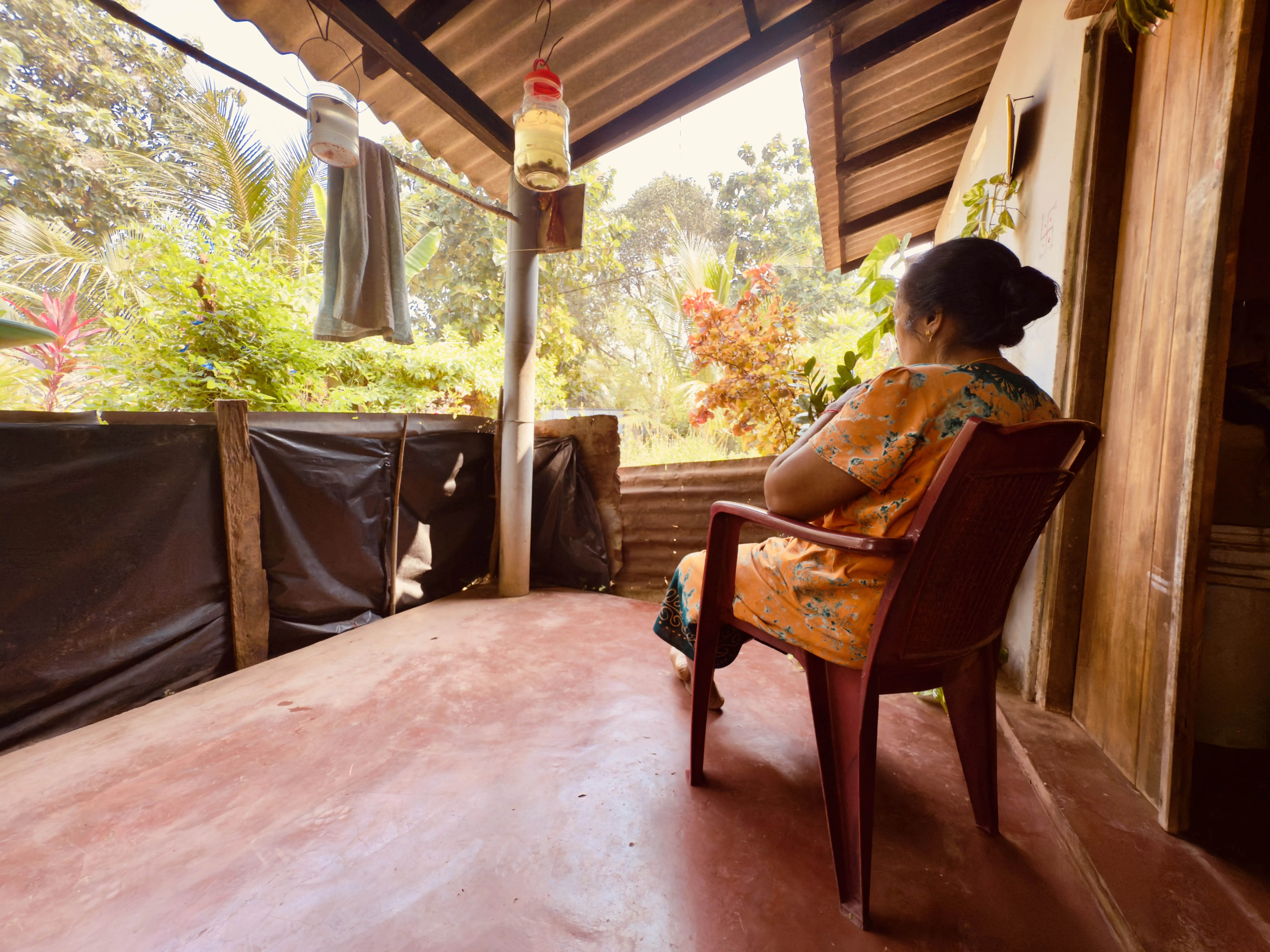
Pulasthi looks out at the expanse of land beyond the confines of her humble home. Photo: Rukshana Rizwie
Daily life often revolves around accessing clean water from wells and nearby tanks. Now, rising salinity levels, exacerbated by droughts and saltwater intrusion, is making this increasingly difficult. The consequences are far-reaching: Water resources are under immense strain. Major reservoirs experience fluctuating water levels, minor irrigation systems dry up rapidly, and streams flow irregularly. Just like Pulasthi described, the groundwater sources are depleting, and water quality is declining due to high salinity.
Compounding these physical vulnerabilities is the district’s low socioeconomic resilience. With a disaster resilience index of less than 30 percent, Mullaitivu residents struggle to cope with and recover from climate shocks. Poverty, limited income diversity, low financial inclusion, and inadequate social protection systems leave communities ill-equipped to face long-term challenges. The result is a cycle of hardship that undermines well-being and hampers recovery efforts.
“We live because dying isn’t a choice,” she says, her voice steady but her eyes betraying the weight of her struggles. “What can I do? I’m cornered in this piece of land that isn’t mine. We grow and eat whatever we can and live for the sake of our children.”
Sivarasa Rajeshwari, a war widow with four children, says that agricultural resilience is the only hope for Tamil women. The 46 year old had fled the war to Puthukudiyiruppu, a small town in Mullaitivu, and was displaced several times without money or belongings until she came back home to reclaim her land – and sustenance. “Growing vegetables not only feeds my family but also brings in a little extra when I sell them at the market,” she says. In 2018, the worst drought in memory wiped out her entire harvest. “I’m grateful it was only that year,” she says, her relief tempered by fear. “I pray we never see a repeat of it.”
Despite the erratic climate, Rajeshwari says it’s necessary for women like them to adapt. “Only certain vegetables can survive these conditions,” she explains, gesturing to a field of eggplants. “Thankfully, I have a well with a motor to pump water to the plants. Before, we carried water in buckets for each plant —it was exhausting.”

Rajeshwari inspects her eggplants to ensure the leaves are not infected with pests. She tells us that she has a few more weeks before she can harvest them. Photo: Rukshana Rizwie
Despite the hardships, the resolve of the women in Mullaitivu remains unshaken. For Sivaranjini, the path forward is clear.
“I will keep working,” she says, her hands returning to the soil. “This land is all I have.” Her words echo the quiet determination of a community that refuses to be defeated, even as the odds stack higher against them.
In the face of war and climate change, women’s resilience is a powerful reminder of the human capacity to endure and adapt. Amid the rubble of loss and the scars of conflict, new life sprouts in the women’s home gardens, a testament to hope and perseverance.
In Asia, the battle against gender-based violence reveals the harsh realities of society. World Health Organization reports that 1 in 3 women globally have experienced physical or sexual violence. This alarming statistic, while shocking and devastating, only scratches the surface of a more insidious issue: Marital rape. Despite the prevalence of violence within marriage, the laws governing marital rape in most Asian countries remain nonexistent, leaving countless women trapped in a cycle of abuse.

A study by UNESCO reveals that over 37 percent of women in South Asia, 40 percent in Southeast Asia, and up to 68 percent in the Pacific have faced violence from intimate partners. The numbers could be much higher considering that marital rape often goes unreported because women are conditioned to accept, endure and adjust within the confines of marriage. Across Asian societies, marriage is often presented as a sanctuary of security – both economic and physical. But we must ask: Safety for whom? If this institution is meant to protect women, then how are women expected to safeguard themselves from people within the institution? In reality, this “safety” seems illusory, benefitting the patriarchal individuals who designed these institutions.
Illustration: Sharanya Eshwar
While countries like Nepal, Bhutan, Indonesia and the Philippines recognise marital rape as a crime, many Asian countries still lack comprehensive legal frameworks to curb it, thereby prioritising cultural norms over safety of women. For instance, in India, the debate over criminalising marital rape, which is currently under judicial review by the Supreme Court, has its opponents – which include everyone from government officials to conservative groups – arguing that the law could be misused against men, and that not allowing marital rape could destabilise family structures. India prides itself in having one of the world’s lowest divorce rates but that speaks more to societal stigmas around divorce (especially for women) in the country and lengthy legal processes. The arguments against criminalisation of marital rape also reveal a troubling prioritisation of protecting men in patriarchal societies.
It’s not all hunky dory in countries that recognise marital rape, such as in Sri Lanka, Malaysia and Bangladesh. There are conditions and limitations. For instance, in Sri Lanka, marital rape is recognised only if the couple is legally separated. Or in Malaysia, it’s recognised only if the husband is causing hurt in order to have sexual intercourse with the wife. In Bangladesh, unless the victim is under the age of 13, marital rape isn’t recognised.
In Pakistan, there is no explicit laws where forced sex within marriage is criminalised. However, a recent ruling in Karachi marked a notable shift: A man was sentenced to three years for forcing his wife into non-consensual sex. This verdict acknowledged intimate partner violence as a criminal offence. In this case, the survivor’s lawyer, Bahzad Akbar, argued that the act of forced sodomy fell under the definition of rape in the amended Section 375 of Pakistan’s Penal Code.
The institution of marriage, peddled to offer protection and partnership, often serves as a deeply flawed and unfair structure for women. The failure to criminalise marital rape fully is a glaring example of shielding men from accountability, and enabling them to commit violence behind closed doors. Since time immemorial, social expectations and legal loopholes have trapped women in a position where they must choose between their safety and dignity, often leaving them deprived of both. The idea of marriage as a safe haven is distorted when norms of “obedience”, “sacrifice” and “submissiveness” to a husband are culturally imposed, and the legal system upholds these expectations.
The complicity of societal norms and the law in many parts of Asia reflects a troubling reality: Marriage is less about equal partnership and more about control. By framing consent as unnecessary within a marriage, the law not only fails women but actively enables perpetrators.
This complicity is not coincidental—it’s a well-orchestrated team effort between tradition and the legal system, where both reinforce each other to keep women subjugated within marriages. Women deserve legal systems that prioritise their rights and safety over outdated notions of family and honour. Until then, the institution of marriage, as it currently stands in many Asian countries, will continue to fail women.
Had it been any other time in Sri Lanka’s history — outside of an election — a leader from the country’s ethnic minority, Tamil, calling for a referendum on self-determination and constitutional changes to establish a separate homeland would have likely faced imprisonment. It’s also possible the leader would never have been seen again.
But it is not so for Pakkiyaselvam Ariyanethran, Sri Lanka’s first Tamil common candidate – meaning one endorsed by several Tamil civil society and political parties – standing for the 9th presidential elections in the island nation on September 21.
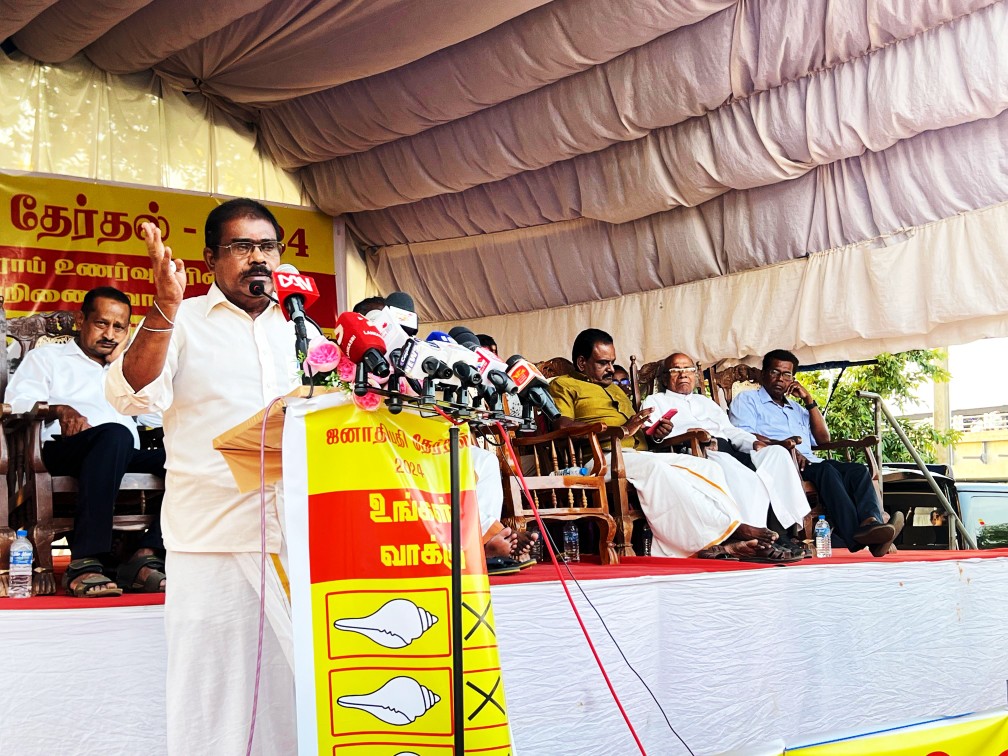
The candidate addressing a crowd in Vavuniya in Sri Lanka. Photo: Ariyanethran’s Facebook page
“This should have happened in 2010,” Ariyanethran tells Asian Dispatch, referring to the year after the Sri Lankan state put a brutal end to an armed conflict between them and a separatist Tamil movement.
Since the end of the Mullivaikkal massacre, we’ve seen three presidents come and go. Each one secured our vote but lost our trust. We no longer have faith in them. —Ariyanethran
Ariyanethran is referring to the last phase of Sri Lanka’s 25-year civil war between the Sri Lankan state and the separatist Tamil government called the Liberation Tigers of Tamil Eelam (LTTE). LTTE’s separatist government arose out of decades of discriminatory laws and policies in the Sinhalese-majority island nation. The Sinhalese people constitute 75 percent of the country’s 23 million population, while the Tamil are 11.2 percent of it.
The incidents Ariyanethran speaks of took place in a northern village called Mullivaikkal, where thousands of Tamil civilians taking shelter in government-assigned “safe zones” were bombed.
The civil war may have ended in 2009, but the wounds from its violent end are palpable even now. For Sri Lanka’s government – which is dominated by Sinhalese leaders – any mention or memorialization of Tamil separatism or nationalistic expressions leads to crackdowns and state repression.
This is why, Ariyanethran’s candidature is a significant moment in Sri Lankan politics. He isn’t the first candidate to have been fielded in a presidential election. Ariyanethran recalls Kumar Ponnambalam, who ran in 1982, and Sivajilingam, who ran in 2019.
But there was one difference between past candidates and him.
[The previous candidates] ran independently. For the first time, 83 civil organisations and seven Tamil national political parties have united to make this collective decision on behalf of the Tamil people. —Ariyanethran
Ariyanethran’s candidacy marks a new chapter in challenging long-standing political norms in the country.
Ariyanethran stands against 37 other candidates across the country – including frontrunners Ranil Wickremesinghe, Sajith Premadasa and Anura Kumara Dissanayake. At the moment, Sri Lanka is still emerging from the shocks of a crippling economic crisis and foreign debt. It is coping with a crisis of governance of 2022, when anti-government protesters drove then president Gotabaya Rajapaksa – who played a key role in the Civil War – out of power. Economy has been at the forefront of most people’s demands but for Tamils, the economic and social strife go decades back.
“We Tamils have endured hardships that have tested us to our very core: Death threats, bombings, kidnappings, murders, extortion,” says Ariyanenthiran. “But I’m not scared.”
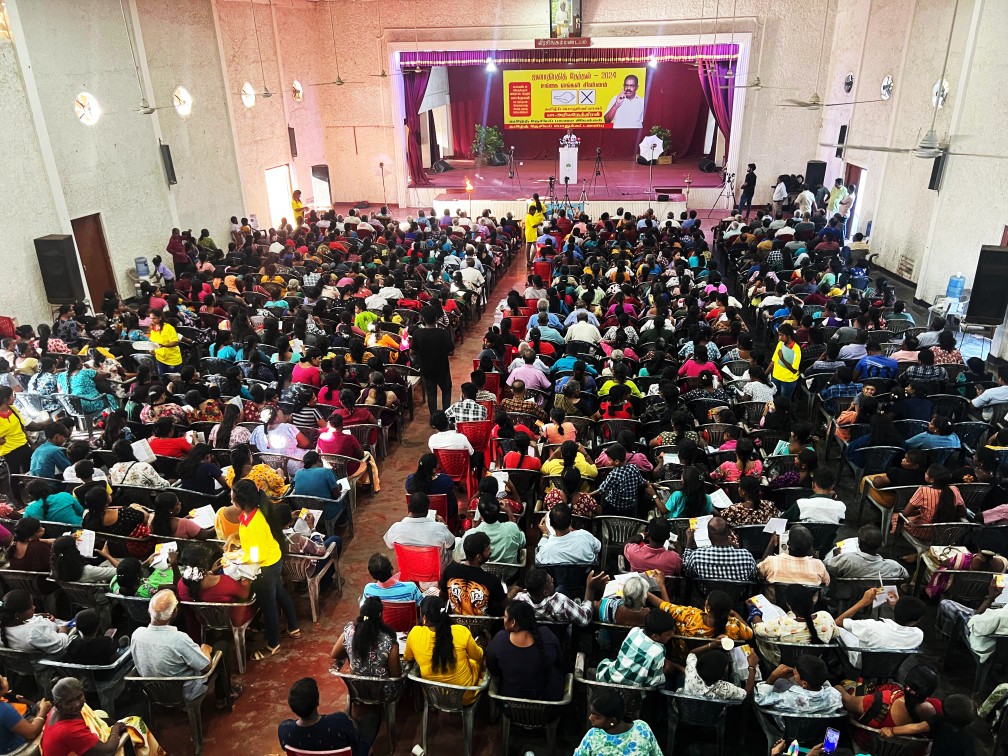
Pakkiyaselvam Ariyanethran addressing a crowd in Vavuniya in Sri Lanka. Photo: Ariyanethran’s Facebook page
Ariyanethran’s own journey started in the early 2000s, when LTTE governed parts of northern Sri Lanka. The politician was an editor of an LTTE newspaper called Thamil Alai (Tamil Wave), after which he was inducted into the Tamil National Alliance, an alliance of Tamil-led parties that support Tamil self-determination. In its initial years, the TNA supported LTTE’s negotiations during the war. Ariyanethran’s first entry into the parliament was in 2004 with TNA and was re-elected in the 2010 parliamentary elections.
This year, the Ilankai Tamil Arasu Kachchi, Sri Lanka’s oldest and the most prominent political party representing the Tamils, announced Ariyanethran’s ticket under their political party.
In modern-day Sri Lanka, ITAK’s manifesto is bold. It calls for a new constitution recognising Tamils as a sovereign people with the right to self-determination. It also calls for the establishment of Sri Lanka as a plurinational state, the return of Tamil land confiscated during the war, and the right for Tamils to seek international assistance in determining their political future. Additionally, the manifesto addresses the protection of Upcountry Tamils and demands the perpetrators of crimes committed during the war be brought before the International Criminal Court.
For Ariyanethran, his candidacy is deeply personal too. He says it honours the legacy of ITAK’s founder, SJV Chelvanayakam, affectionately known as “Thanthai Chelva” (‘thantai’ translating to ‘father’). Chelvanayakam is regarded as the father of Tamil nationalism and with ITAK, he advocated federalism as a means to share power between Sri Lanka’s majority Sinhalese and minority Tamils. In 1977, his resolution for an independent Tamil state received overwhelming support in the parliamentary elections. But decades after that saw only unfulfilled promises and failed negotiations with successive governments.
“It is time for the Sri Lankan government and the international community to recognise [the Tamil right to self-determination],” Ariyanethran says.
Despite the enormity of the challenge, Ariyanethran has been actively campaigning in the Tamil-majority North-East, urging Tamils to cast their votes for liberation.
“There is overwhelming support,” he says. “People tell me it’s a good decision. They hope that the 9th president will deliver a political solution for the Tamils and recognise that we should not be deceived again. Tamil votes matter.”
Interestingly, running for presidency was Ariyanethran’s original plan. “The party has been discussing this for over six months, even before the elections were announced,” he reveals. “I am a member of ITAK and the deputy chairman for the Batticaloa district. I joined the party in 2004, but I had no intention of running for office.”
However, after attending several party meetings and voicing the concerns of Tamils, Ariyanethran found himself among 45 potential candidates. “I was chosen,” he says simply, “And I accepted.”
Seventeen million people are eligible to vote on September 21 to elect the next president of Sri Lanka. Exactly one tenth of this population –1.7 million voters– are migrant workers, living outside their home country. And unless they travel home, they cannot vote.
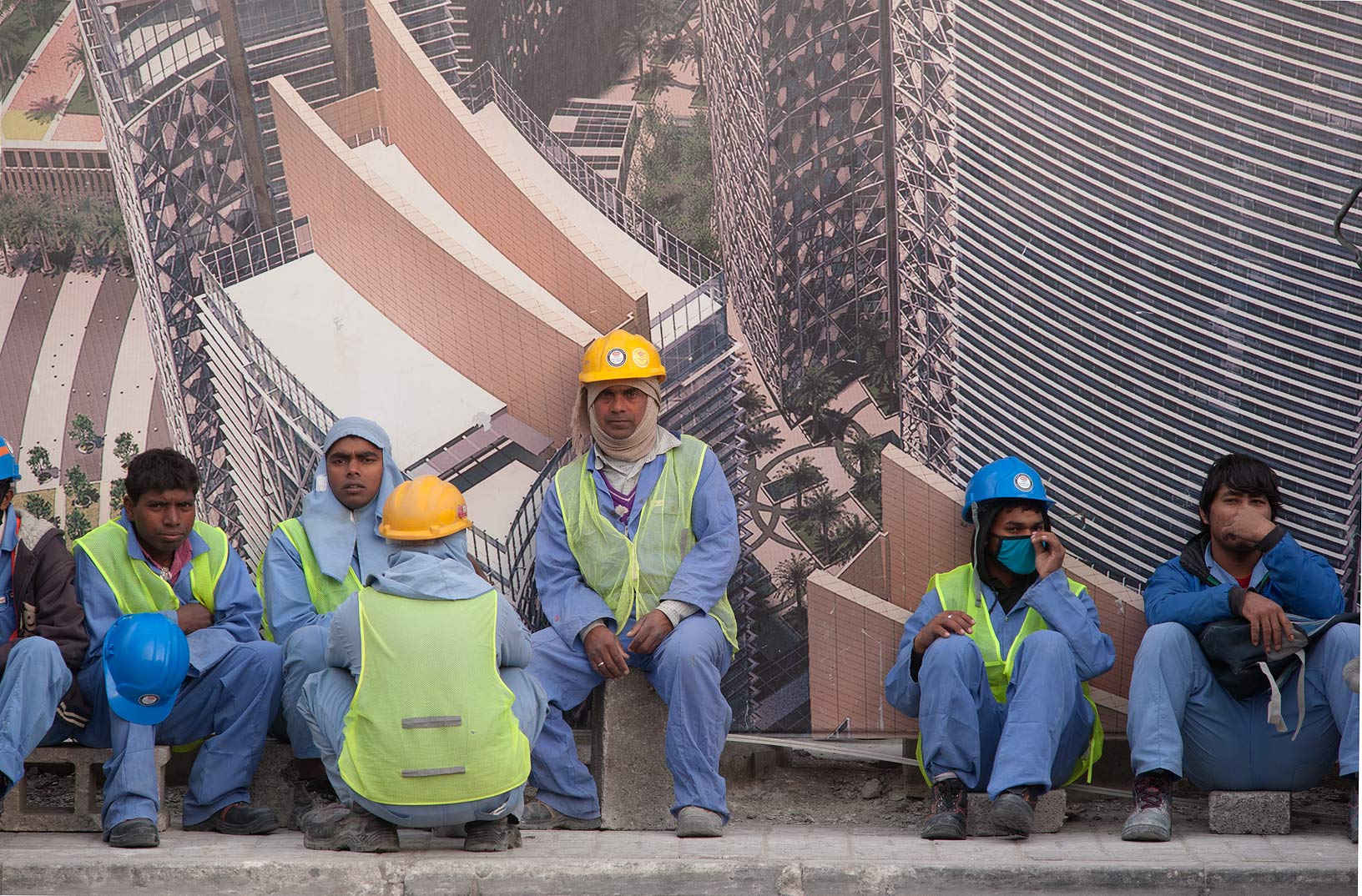
Migrant workers from Asia in Doha, Qatar. Photo: Alex Sergeev/Wikimedia Commons

Despite the island’s remittance economy, there is still no way for Sri Lanka’s migrant worker community to vote from their current location.
“In my 20 years as a migrant worker, I have never voted during a single election. During COVID-19, when migrant workers were trying to return home amidst border closures, some politicians called us ‘COVID bombs’, but when the economy crashed in 2022, they wanted our dollars to save the country,” says Nilu Athukorala, 40, a domestic worker based in Kuwait.
At the age of 18, Athukorala left her village near Kurunegala, a district in North Western Sri Lanka. She obtained her national identity card with the intention of going abroad.
“I have a son in Sri Lanka. I have sent every cent I earned back home. It was only last year that I opened a bank account for myself. I have sent my earnings home for 20 years, but have never depended on any government welfare scheme,” Athukorala told the Center for Investigative Reporting (CIR).
Remittances into Sri Lanka reached over 1,500 million dollars (approximately 452 billion LKR) in the first quarter of 2024, according to the Central Bank of Sri Lanka (CBSL). Yet, over a million Sri Lankans working abroad will not be voting this year too. Nearly a million of them are working in the Middle East on short-term contracts, and plan to return home someday. This is in contrast to those based in the Global North, where obtaining permanent residency remains an aspiration.
Senarath Yapa, Additional General Manager (International Affairs), Sri Lanka Bureau of Foreign Employment (SLBFE), said that ahead of the September 21 Presidential Election, the bureau has received three separate requests from Qatar-based workers to facilitate them to vote.
“These requests were duly forwarded to the Election Commission through the Ministry of Labour and Foreign Employment,” Yapa told CIR.
“We have received many such requests before. This time, requests came from three worker groups,” said Saman Sri Rathnayake, Commissioner General of Elections.
There had been no satisfactory response from the authorities to the demand for facilitating voting from abroad.
Migrant workers, especially those working in the Middle East as low-skilled workers face serious problems, but their plight is largely seen as a distant struggle. However, when the economy crashed, it was the migrant workers the government called upon to help revive the economy.
Votes with no Value
Athukorala argues that voting by migrant workers is not facilitated because politicians fear their power due to the large number of workers.
They cannot predict how we would vote and are possibly worried about having to cater to our demands. We get little or no help from the Sri Lankan authorities when we encounter problems. My calls to the embassies in 20 years have always gone unanswered. –Nilu Athukorala, a domestic worker based in Kuwait.
The Centre for Working Women (CFWW) has been advocating for migrant workers’ voting rights since 1996. CFWW agrees that enabling workers to vote would exert pressure on the authorities to focus on migrant workers’ rights.
“Article 14 of the United Nations Convention on the Rights of All Migrant Workers and Members of their Families specifically refers to their voting rights. Sri Lanka ratified the Convention in 1996 but has not introduced an enabling law. Successive governments have shown no interest in enacting domestic laws to address these issues,” says Amali Kalupahana, President of the CFWW. “Migrant workers face multiple problems in destination countries. They are abused and sometimes abandoned without help or resources. If they are facilitated to vote, them some of these issues will come to the fore and might get addressed through government-to-government labour agreements.”
D.M.V. Dissanayake, an independent election analyst who has observed elections for two decades, insists the non-facilitation of migrant workers to vote amounts to a violation of their fundamental rights.
“Migrant workers in the Middle East are among the most marginalised people yet they line Sri Lanka’s economy,” Dissanayake told.
Meanwhile, the three frontrunning presidential hopefuls this year have included migrant workers’ concerns in their manifestos. Samagi Jana Balawegeya (SJB) candidate Sajith Premadasa has promised to amend the election law to allow workers to vote from abroad while the National People’s Power (NPP) candidate Anura Kumara Dissanayake has pledged to safeguard the voting rights of international labour migrants. Incumbent President Ranil Wickremesinghe’s manifesto promises to amend the Foreign Employment Bureau Act to provide workers with ‘better facilities and working conditions’.
According to Priyantha Weerasekara, AGM (Local Affairs) and Information Officer, SLBFE, the estimated number of migrant workers in the Middle East is around 878,510. However, the total number of Sri Lankan migrant workers around the world is much higher as the bureau has statistics on only those who have registered with the SLBFE.
“We base this number on the data we get from embassies or interior ministries in destination countries – that’s mainly the Middle East and low-skilled workers. We don’t have the numbers from countries like Canada and the United States,” he told CIR, explaining existing data gaps.
Weerasekara added that an estimated 300,000 migrant workers were based in the United Arab Emirates (UAE) – data also reflected in CBSL’s quarterly bulletin on labour migration. The bulletin states that even out of the 75,175 labour migrants in the first quarter of 2024, nearly 81% headed to a Middle Eastern destination.
| Country | Estimated number of Sri Lankan Migrant Workers |
| United Arab Emirates (UAE) | 300,000 |
| Saudi Arabia | 180,000 |
| Qatar | 113,000 |
Source: Sri Lanka Bureau of Foreign Employment (SLBFE)
Out-of-Country Voting
Chandana Sanjeewa Perera, 50, who currently works in Germany, terms the lack of facilitation to vote a “human rights violation”.
“We understand the lack of funds to facilitate migrant workers to vote this time. When Gotabaya Rajapaksa ran for presidency in 2019, many workers returned to Sri Lanka to vote, but this time, workers may not do that. Although we work in countries like Australia, the US and Canada, many cannot bear the travel expenses. We prefer an online voting or similar process. Post election, we plan to exert some pressure on the new administration to address this issue,” said Perera, who had worked in the UK, Italy, and Germany.
In the 2019 Presidential Election, out of 15,992,096 registered voters, only 13,387,951 voters had cast their vote, raising questions as to why over 2.6 million eligible voters did not vote.
Manjula Gajanayake, Executive Director, Institute for Democratic Reforms and Electoral Studies (IRES) told the CIR that out-of-country voting, if facilitated, would allow registered voters living abroad including students and workers.
“Everyone has the right to vote even though some may be living abroad. The problem is facilitation. There are many advance voting systems like voting through embassies but unfortunately, Sri Lanka only uses postal voting as an advance voting mechanism. This results in the exclusion of migrant our worker population,” he said.
READ: What Sri Lanka’s Unpredictable Elections Mean For the World
Kalupahana adds that since 2008, workers have advocated for the national policy and action plan on migration for employment, finally released in 2023. The policy recognises: “The right to vote as a fundamental right of all citizens. Ensuring voting rights for migrant workers will ensure migrant workers’ voices are reflected in national politics, are recognised by the political system and their contribution to national and socio-economic development.”
To move forward, a greater contribution from migrant workers is necessary, Kalupahana added.
“We need to help organise migrant workers as a pressure group,” she said.
Concerns
Kalupahana says that the authorities should ensure any voting process does not result in vote buying and exploitation.
People’s Action for Free and Fair Elections (PAFFREL) Executive Director Rohana Hettiarachchi has similar concerns and speaks of two main problems in an out-of-country voting system.
“Our diplomatic missions are politicised and include political appointees. This means, workers may be influenced when voting, especially when they are unskilled and voiceless. It is possible to pressurise workers to vote in a certain way and use forms of threat or financial bribes. Workers may be living or working far away from the missions abroad. Can domestic workers spend and travel to embassies for voting? Will they secure leave to facilitate voting?” asks Hettiarachchi.
Hettiarachchi adds that securing the right to vote does not only involve the introduction of a new law but also a proper mechanism with checks and balances: “Measures should be taken to prevent the integrity of the electoral result being questioned. There shouldn’t be any allegations of influence from political parties once results are announced. People should be able to trust the election result and an improper mechanism to facilitate out-of-country voting may prove disastrous.”
SLBFE’s AGM (Local Affairs) Weerasekara notes that another option could be to allow migrant workers to vote for their own representative, instead of the other district representatives during the parliamentary elections.
Yet, Commissioner General of Elections, Saman Sri Rathnayake, says their hands will remain tied until the Parliament passes a law to enable migrant workers to vote from their destination states.
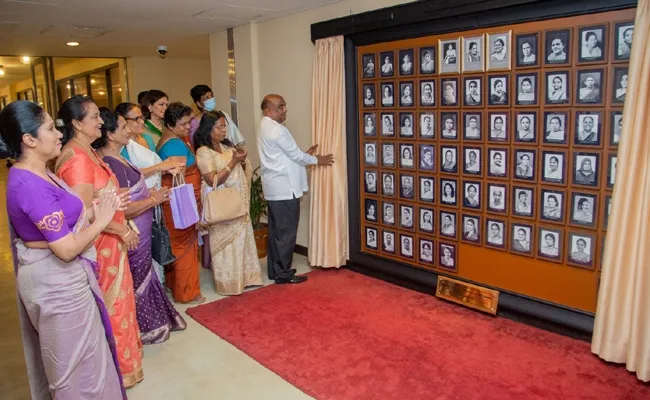
Women’s Caucus in Sri Lanka. Photo: CIR/Sri Lanka Parliament
Female politicians continue to face an uphill battle in politics, especially when obtaining nominations from their mainstream political parties and spending money on their election campaigns. Women representing the current Parliament in Sri Lanka note that structural and financial barriers are forcing them to reckon with their future in politics as they still only have one foot in the door.
A case in point is Samagi Jana Balawegaya (SJB) MP Rohini Wijeratne Kavirathna, who first entered Parliament in 2015, and says that she has sold four lands in the past 10 years to fund her political career and educate her children. In such a context, she questioned how women could even “put their head through the door”.
She said that despite coming from a family with a strong political background (her father was a Deputy Minister while her late husband was a Member of Parliament), the United National Party (UNP) had been reluctant to give her nominations in 2015.
“Other party members were against it – they thought I couldn’t do it due to various reasons such as a lack of financial means. I had my strength of mind and that’s what allowed me to get in.
“The electorate supported me because I was a teacher and due to the political backgrounds of my husband and father. I didn’t have a lot of support in 2015 from the party,” said Wijeratne, adding that if parties did not perceive a female candidate as popular or as a “winning candidate,” they would receive less internal backing.
“I received some financial support in 2015 [from the UNP], but I did hear that others received more support than me. After I entered Parliament in 2015 I worked hard, so at the next General Elections in 2019, I was considered an essential candidate. I was more reluctant to contest in 2019 as the UNP had split in two, but the SJB promised me its backing. The SJB provided me with Rs. 1 million in financial support for the 2020 campaign,” she said.
Patronage Politics and Female Candidates
“Women don’t have as much of a chance to connect with private well-wishers and donors either, to help them with their campaigns. Even the business community will support male candidates because they can open a bottle together and become friends. We don’t have that opportunity to receive support, so it is very difficult for a woman to even enter the political system,” said Wijeratne.
Women Parliamentarians’ Caucus Chair and Parliamentarian Dr. Sudarshini Fernandopulle, who first entered Parliament in 2010, noted too that for female candidates, raising campaign finances was difficult as they did not tend to support illicit deals. “So people think there is no point in supporting us.”
However, Gender and Election Working Group (GEWG) Voluntary Convenor Kanaka Abeygunawardana observed that even female politicians could benefit from the existing patronage system in the country if the political party they represented presented them as a “winning horse”.
“Our political system is based on patronage so you bet on the winning horse. How the party presents the candidate is how they receive prominence in this patronage system. Women are on a sticky wicket because if they’re not dominating or represented as equal to the men in the area, people won’t bet on them. The electorate is not for clean politics, transparency, or accountability either. We need to change the electorate too,” said Abeygunawardana.
Questionable Nomination Processes
Dr. Fernandopulle said that the issue mainly lay with the leadership bodies of political parties that did not consider women as being ‘suitable’ for politics due to its violent and expensive nature.
“I didn’t have a problem with the nomination process as I came in after the assassination of my husband. However, for other women, receiving a nomination is a tough game as there is no clear system through which they can enter. It depends on the party leaders and general secretaries, and their consent. There is no clear nomination process for any candidate – male or female.”
Adding that some political parties did not have women even on their nomination boards, she said that women were only considered as ‘suitable’ by parties after the loss of their male family members: “There is a ready-made electorate there.”
Dr. Fernandopulle contested with the Sri Lanka Podujana Peramuna (SLPP) in 2020. “I didn’t receive any financial backing for my campaign then. I think this was the same for the other candidates as well.”
SLPP MP Muditha Prishanthi too said she had been granted a nomination to contest the 2020 General Elections immediately after the death of her husband, who had been a parliamentarian.
“Prior to that I was involved politically in women’s organisations and in my husband’s politics. The party did not provide me with money to contest, but it did support me in organising in other ways. I was already known in the district due to my husband’s popularity. But someone who enters politics newly would find it difficult. There are financial issues and many women are scared of the campaign trail because they face more ‘kapili’ (sabotage),” said Prishanthi.
Meanwhile, SLPP MP Rajika Wickramasinghe said that when she first contested in 2015, she had received the opportunity to do so because she had been politically involved in women’s organisations and because her husband was in politics. She had lost in 2015 but won in 2020. “I am not from Kegalle, I came to Kegalle due to my marriage so there was a lot of criticism against me, with people saying that someone from Colombo shouldn’t get the vote.”
Abeygunawardana pointed to other social and structural barriers that existed during an election.
Caste plays a major role in most parts of Sri Lanka. If the man representing a particular caste from a district dies, then the best thing for a political party to do is to find his wife. Women are affected because of the perceptions of society – we are not supposed to be talking, we are supposed to be pleasing to the eye. Due to that, we are not given positions within parties as well. — Kanaka Abeygunawardana, Gender and Election Working Group
“Selection procedures are also mainly done by men – sometimes, there is not a single woman. Unless we change those structures slowly, it is very difficult for women to be in politics,” she said.
On the other hand, actress-turned-politician Women’s Affairs State Minister Geetha Kumarasinghe, who currently represents the SLPP, noted that it was her “famous name, wealth, and business income” that had helped her in her political journey.
“I am not from a political family – many women come to politics after their husband or father dies. That is the procedure in Sri Lanka, otherwise women don’t engage in politics. But I was someone who had an established name – that made it easy for me to enter politics. A woman who doesn’t have that can’t even think of coming in. That is wrong, that is not what should happen in politics.
“How can people be committed to politics if they don’t have money? I don’t have any personal problems or many personal expenses, so I can spend on politics. But that is a problem in our political system,” she said.
Kumarasinghe further said that she had not received a “single cent” in financial support from the political parties she had represented since 2010 and little support otherwise.
“There was no support from the party – especially no special support due to my being a woman. The first time I contested, I lost because there were two people contesting from the same seat: Sagara Kariyawasam and me. That was one reason for me to lose that election, yet I campaigned heavily for President Mahinda Rajapaksa at the time.
“During the elections, there were a lot of false rumours about me. The party did ask me whether I could spend on a campaign – that was all they asked. I did hear that men received more financial support than me at the time, in 2010, from the party,” said Kumarasinghe.
Meanwhile, National People’s Power (NPP) MP Dr. Harini Amarasuriya said that the NPP campaigned centrally, as a party, as opposed to running individual campaigns.
“Individual candidates are not expected to spend since local organisers in charge will handle whatever financials are necessary so they are not given money individually. We are not expected to raise funds or spend on our own. Funds are collected by the party’s central fund to organise meetings and print pamphlets,” said Amarasuriya, adding that therefore, the NPP did not consider financial capabilities when handing out nominations.
Meanwhile, Samanmalee Gunasinghe, who contested from the NPP in 2020 and who has been part of the Janatha Vimukthi Peramuna (JVP) for the past 25 years, said that she had witnessed the JVP/NPP change over the years.
“With the political background in the past, there was no chance for women to engage in politics. Politics was done by criminals, drug traffickers, or thugs. In that system, it is unlikely that women would enter politics. Even though our women comrades were willing to enter politics, that environment impacted their entry.
“However, in the past few years we have been forming women’s groups that could face those challenges. Parallel to that, the political background also changed, where more progressive politics became more popular. Our organising and awareness-raising became more strengthened, and with that, women are now ready to face that challenge,” she said, adding that it was unfair to ask women to contest in an election without providing them with the necessary understanding and support so that they would be willing to do so.
Recognising this need, Gunasinghe said that in the past two years the NPP had been involved with women in three ways: awareness-raising about political rights amongst women in a non-partisan manner at the village level, programmes for grassroots NPP women leaders on contesting elections, and forming district women leaders for the party.
Minority Women
Former United People’s Freedom Alliance (UPFA) MP Ferial Ismail Ashraff, one of just two Muslim women to have contested in an election in Sri Lanka and entered Parliament, said that her political career was a “swim against the current”.
Ashraff said that she had received the nomination after her husband passed away as party members had seen how closely she had worked with him. “But there was a bigger half of people saying that a Muslim woman shouldn’t be in politics. The community was not willing to accept it and it was difficult to convince even women to support me. But now, 20 years later, when I speak with young Muslim women and see that they accept what I have done, I consider it as a step forward.”
She added that “nothing much has changed as far as the men are concerned,” but noted the positive development that came after the 25% quota for Local Government (LG) authorities was introduced, which mandated that 25% of LG bodies must be represented by women.
“Even when the quota was being introduced, Muslim parties protested saying that they would not be able to find women to represent them. However, Muslim women activists stepped forward saying that they could find women for the parties. I assume there will be some change that seeps through to the Parliament system too as a result,” she said.
Ambika Satkunanathan, who had been part of the Tamil National Alliance (TNA) National List in 2020, said that she had “zero interest” in entering politics.
“In 2020, I turned down the invitation to contest but was later included in the National List. Throughout this entire process I faced sexist, misogynistic, and abusive personal hate campaigns directed at me, especially on social media, by sections of the TNA itself. There were even claims of being in an inappropriate romantic relationship with a Tamil politician, and a Tamil TV channel telecast a skit alluding to this rumour,” Satkunanathan said, recounting her experience.
She noted that similar to other political parties in the country, Tamil parties too rarely had women holding positions of power within the parties. “Historically, Tamil women have been active in politics and were seen on political stages, even though they didn’t hold positions of power within political parties. Their participation has become less visible and we don’t commonly see women on political stages. The conservative nature of the Tamil community exacerbates the general challenges that women entering politics face.”
Women’s Caucus Attempts
Female MPs said that if the system were to change to increase female representation in Parliament, then the change should come from party leaders themselves.
“The first step should come from the party leaders – they should have the will to increase female representation in Parliament. We can attempt to bring in laws for representation, but those decisions will also be finally taken by men, which means they will get delayed. The decision-making rooms are filled with men. Equality is only there as a sentence in the Constitution,” said MP Wijeratne.
Dr. Fernandopulle said that women unfortunately did not have an equal opportunity as male colleagues to enter politics, as almost all parties were headed by men: “Even within the decision-making bodies of parties, there are very few women.”
She said that on behalf of the Women’s Caucus, she had brought in two private member’s bills – one to mandate parties to provide 50% of the National List seats to women and one to ensure that 30% of party leadership is represented by women.
“We lobbied parties and asked to make voluntary amendments, but we didn’t receive any response. Only the NPP has a manifesto of 50-50 for the National List. But none of the other parties have a plan to increase women’s representation,” she said.
The 25% Quota
Local Government councillors who contested in 2018 noted that the question of financial means was an important one during the interview process conducted by their respective political parties, prior to granting them nominations.
“They asked us to come to Colombo for interviews and asked how much we can spend,” said Achala Rajakaruna Kularatne, an LG Councillor who contested from the UNP in 2018, adding that this meant that “talented ones” rarely got the opportunity to contest in an election.
“We all went through the interview process in 2018. If the husbands of the potential candidates have been involved in politics, they are then prioritised. This happens from the party headquarters, yet some women fight for their spot by showing they have paddy fields and lands to support them during an election,” said Kularatne.
She added that she had supported herself in politics with the income of her husband, who was working abroad, and income obtained through her other assets.
Accordingly, elections researcher and analyst Attorney-At-Law (AAL) D.M. Dissanayake said that this led to only ‘upper-class’ women even stepping up to ask for nominations from their parties, as land rights were mostly only enjoyed by such women.
Dissanayake pointed out that the question of money was a common one that was asked by most parties when determining their nominations for any election. “If they don’t have that financial backing, the chances of them getting the nomination really decrease.”
Sujeewani Nanayakkara, another UNP LG Councillor, also said that she had been asked about her financial means to support an election run during the nomination interview at the party headquarters, while pointing out that the interview panels rarely included women.
Institute for Democratic Reforms and Electoral Studies (IRES) Executive Director (ED) Manjula Gajanayake said that political parties were reluctant to give nominations for women candidates as they did not consider them to be “winning horses”.
“Political parties are constantly treating female candidates as second citizens. Women candidates often pawn their land or other assets to cover the cost of a campaign,” he said.
Party Promises
SJB General Secretary Ranjith Madduma Bandara, noting that they had been part of the Government which had introduced the 25% women’s quota for LG bodies, said that more women needed to come forward for nominations. “We are offering training these days to encourage more women to come forward. The SJB Executive Council is prepared to increase female representation in the coming elections.”
NPP General Secretary Dr. Nihal Abeysinghe said that the party hoped to ensure that each district would have female representation at the next General Elections. “We just haven’t decided on the numbers from each district for women as we still haven’t discussed the General Elections yet. However, we can say with certainty that each district will have female representation.”
SLPP General Secretary Sagara Kariyawasam said that of the current female SLPP MPs in Parliament, only Wildlife and Forest Resources Conservation Minister Pavithra Wanniarachchi had funds: “We selected based on who was with the people.”
“We treat everyone as a candidate and we don’t discriminate based on gender,” Kariyawasam said in response to whether money was being unfairly allocated to male candidates over female ones when campaigning. “We help the way we can and people who don’t need that help do not take it.”
He added: “We have always been of the stance that talented persons should be given a chance. Our party allocated two National List seats to women and has the largest representation of women from any party in the current Parliament.”
If the economic crisis of 2022 sent shockwaves through Sri Lanka and altered its political trajectory, the upcoming presidential election – scheduled for September 21– promises to do more than just shift the course. Experts say it will chart an entirely new direction for the island nation.
As over 17 million registered voters head to the polls, their choices will draw from the hard lessons learned from the events of 2022, ranging from the country’s bankruptcy to the lingering shadows of a decades-long armed ethnic conflict.
Sri Lankans will choose from 38 candidates vying for the presidency. Current President Ranil Wickremesinghe managed to stabilise the situation with loans and aid from the International Monetary Fund after taking charge of the country in 2022 when former president Gotabaya Rajapaksa fled the country after protesters took over his official residence – a moment quite similar to last month’s events in Bangladesh. However, his government continues to face high inflation and shortages of essential goods and medicines. The opposition calls it an “economic Armageddon” while Wickremesinghe asserts that this is the only way forward for Sri Lanka.
Now, the questions that loom large on the island nation’s psyche are: Will Sri Lanka slide further over the economic edge? Or is it capable of finding a progressive leader to steer it forward? In the larger scheme of things, what implications will these election results have on the world, and specifically South Asia?
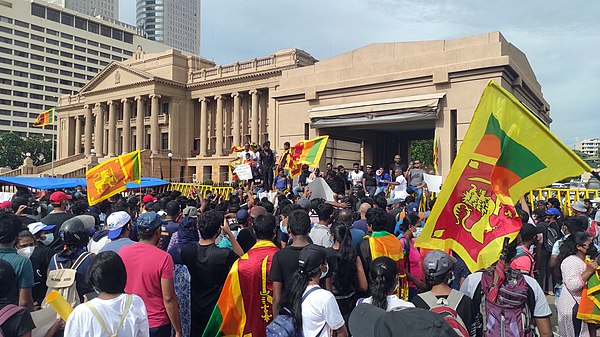
Sri Lanka’s mass anti-government protests in 2022 ushered in a change in the country’s leadership. But not much has changed. Photo: AntanO via Wikimedia Commons
On September 3, Asian Dispatch collaborated with Sri Lanka’s Center for Investigative Reporting (CIR) to host a webinar and seek answers to these compelling questions.
Titled ‘The Road Ahead: What Sri Lanka’s Presidential Elections Means for the World’, the webinar had an esteemed guest panel of Dr Paikiasothy Saravanamuttu, the Executive Director of Center for Policy Alternatives; Rathindra Kuruwita, the Deputy News Editor at The Island; Aditi Phadnis, Political Editor at Business Standard; and Kunwar Khuldune Shahid, Pakistan Correspondent at The Diplomat.
The conversation was moderated by Dilrukshi Handunnetti, Co-founder/Director of CIR.
Dilrukshi Handunnetti moderates the September 3 webinar on Sri Lanka’s elections. The webinar was co-presented by Asian Dispatch and Centre for Investigative Reporting.
Here are some highlights from the conversation:
The Sri Lankan Perspective
Dr Saravanamuttu, of the Center for Policy Alternatives, offered a sobering assessment.
“This election comes in the wake of the near-total collapse, signifying not just an economic crisis, but a crisis of governance. It’s the first election since the 2022 protests that ousted the Rajapaksas from government—though not from Sri Lankan politics.”
Dr. Paikiasothy Saravanamuttu, centre, addresses the speakers and audiences on September 3 webinar.
He emphasised that while the ballot is long, the real contest lies between three major contenders: The incumbent President Wickremesinghe, Sajith Premadasa and National People’s Power (NPP) leader Anura Kumara Dissanayake. Wickremesinghe is credited for stabilising the country but remains unpopular due to tax policies that disproportionately burden the middle and lower classes. The competition is fierce.
Internationally, Sri Lanka’s political landscape has significant ramifications. Early this year, India, with its complex history of engagement with Sri Lanka, met with leaders of the NPP to discuss bilateral initiatives and development.
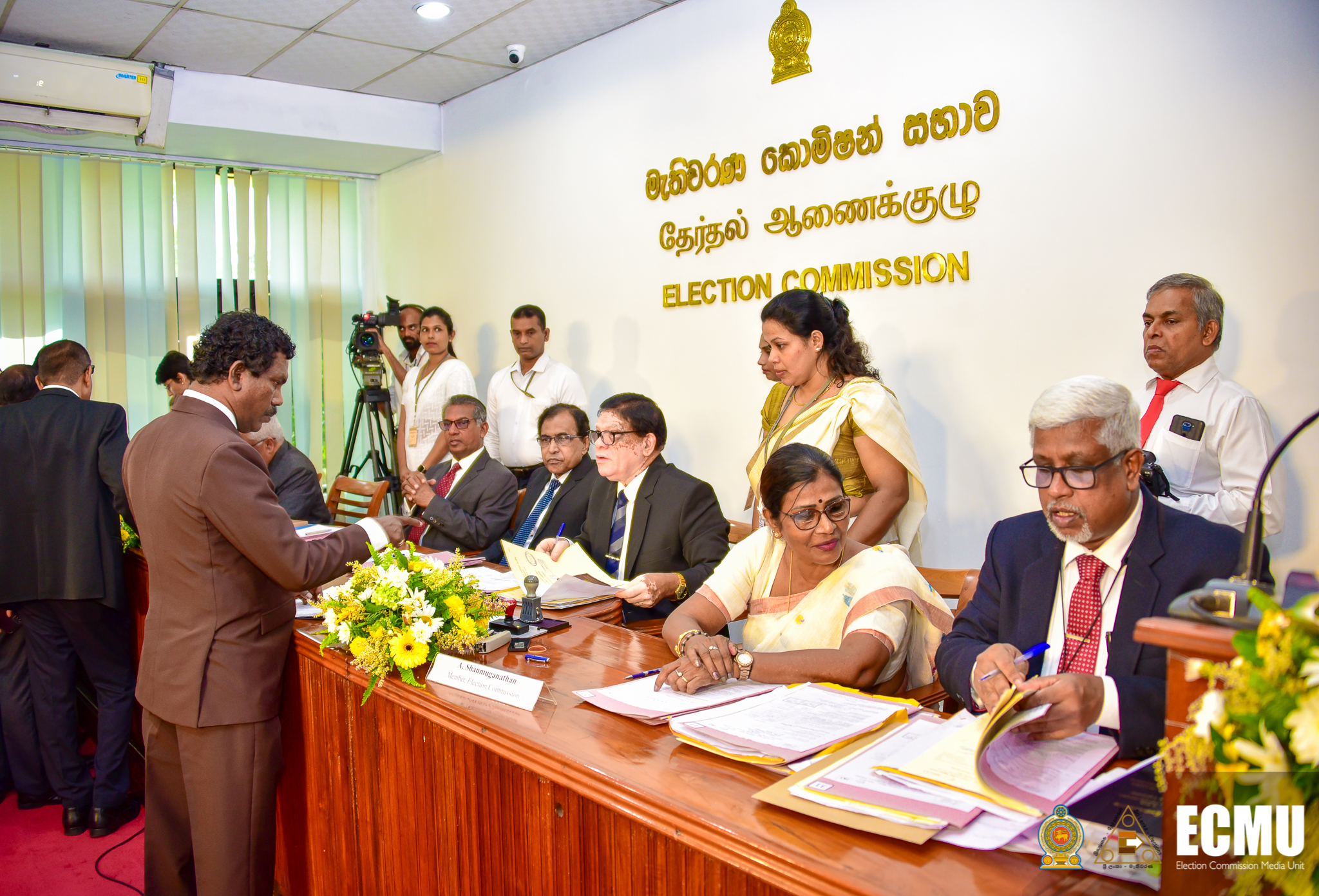
The Election Commission of Sri Lanka has published tough guidelines for the 38 candidates – who are all men – who are competing for the role of Sri Lanka’s next president. Photo: Election Commission of Sri Lanka via Facebook
China remains deeply invested in the country too due to its financial backing of the Rajapaksa regime.
Meanwhile, the U.S. is cautiously monitoring developments in the strategically critical Indian Ocean region for its own interests.
India’s Perspective
Phadnis of India’s Business Standard newspaper highlights the growing concerns within Indian political circles about the upcoming Sri Lankan elections.
“We are entering a period of great challenge and great disconnect,” Phadnis notes, reflecting on the longstanding issues that continue to strain the relationship between the two countries. “Many of the challenges and cause of discontent in the relationship between India and Sri Lanka remain the same. I don’t see any political parties in Sri Lanka addressing this in any meaningful way.”
Aditi Phadnis, a senior political journalist from India, talks about the challenges that Sri Lankan elections outcomes can pose for India.
One of the most contentious issues that Phadnis raised during the webinar is the 13th Amendment of the Sri Lankan Constitution, a key point of tension between India and Sri Lanka. The 13th Amendment, borne out of the Indo-Sri Lanka Accord of 1987, calls for the devolution of central powers to provincial councils, a move toward federalism which is intended to empower Sri Lanka’s provinces, particularly in the Tamil-majority northern and eastern regions.
Phadnis says that for India, the full implementation of this amendment is seen as crucial, not only for the empowerment of the Tamil minority in Sri Lanka but also as a means to secure itself from any spillover of conflict that could destabilise the region.
However, she notes that mainstream Sri Lankan leaders have been hesitant to fully implement the 13th Amendment, especially concerning land and police powers, which are seen as critical components of true devolution. This hesitancy has perpetuated a sense of disenfranchisement among the Tamil community here, creating further complications in the already complex relationship between the two nations.
Phadnis also points out the fractures within the Tamil political landscape, noting the split between Tamil parties such as the Tamil National Alliance (TNA) and the Ilankai Tamil Arasu Kachchi (ITAK) over their choice of presidential candidate. This division has not only weakened the Tamil political front but has also complicated the broader issue of devolution of power. The ideological underpinnings of the Tamil Eelam movement, once driven by India’s Dravidian movement, have undergone significant fractures, leaving the Tamil cause fragmented.
Reflecting on India’s stance on the Tamil representation in the election, Phadnis says: “There will be no effort by India to prop up any candidate that tempers the demand for a separate homeland. That is all in the past, and India will not make the same mistake again.” She references the Indian Peace Keeping Force (IPKF), which operated in Sri Lanka from 1987 to 1990, noting that even today, it struggles to be recognised as an out-of-area peacekeeping force within India.
Phadnis further noted that no one in India would want to see a repeat of the Easter bombings or the Aragalaya (as the 2022 protests is popularly called in Sri Lanka), underscoring the deep concerns over Sri Lanka’s stability and the broader implications for regional security.
Pakistan’s Perspective
Shahid from The Diplomat offered a nuanced perspective on his country’s relationship with its South Asian neighbors, particularly Sri Lanka.
“Pakistan finds itself in a paradoxical position in the region — it has little to offer its South Asian neighbors in many respects. However, with Sri Lanka, the relationship is different,” Shahid explains. “Pakistan seeks a more balanced diplomatic approach with Sri Lanka, especially vis a vis India. Together, Sri Lanka and Pakistan share a long history of security and military cooperation.”
Kunwar Khuldune Shahid talks about Pakistan’s diplomatic relations with Sri Lanka and the opportunities therein.
Despite Pakistan’s limited trade agreements — limited to only four countries so far — Sri Lanka stands out an exceptional and positive trade partner. However, Shahid points out that this trade, while positive, pales in comparison to Sri Lanka’s trade with India, which is 10 times more in scale. Pakistan aspires to expand this aspect, seeking collaboration not just in economic and defense sectors but also on issues related to minorities.
Shahid acknowledges that the relationship between Pakistan and Sri Lanka has been somewhat lukewarm, largely because both countries have historically maintained non-aligned stances on key regional issues. Sri Lanka, for example, has consistently maintained neutrality on sensitive issues like Kashmir, which has helped sustain diplomatic balance with India.
“This neutrality, this diplomatic balance, has been beneficial [for Sri Lanka],” Shahid notes.
Pakistan has, in turn, supported Sri Lanka on the international stage, notably by voting against the 2021 UNHRC resolution that called for international investigations into the country’s war crimes, at the United Nations Human Rights Council in Geneva. This solidarity has strengthened the security collaboration between the two countries, with military drills, intelligence sharing, and arms supplies reaching unprecedented levels. “It is in the realm of security that Pakistan has something tangible to offer Sri Lanka, and Sri Lanka values this assistance,” Shahid explains.
The Elephant in the Room: China
Kuruwita of The Island sheds light on the big source of global curiosity, which is China’s engagement in Sri Lanka.
“There are many questions surrounding what China has been doing in Sri Lanka for the last 2 years, and the answer – quite simply – is ‘Almost nothing,’” Kuruwita states. “Over the last two years, China has been virtually silent, with minimal economic activity. The reasons for this are multifaceted, but one stands out: China’s engagement in Sri Lanka has historically varied depending on which political party is in power.”
Kuruwita elaborates on the long-standing relationship between Sri Lanka and China, dating back to 1950 when Sri Lanka became one of the first countries to recognise the People’s Republic of China. “This relationship has seen fluctuations based on the ruling party in Sri Lanka,” he explains. “When the Sri Lanka Freedom Party (SLFP) is in power, China typically provides more loans, aid, and political support as compared to when the United National Party (UNP) governs the country.”
Rathindra Kuruwita of Sri Lanka’s The Island newspaper addresses the elephant in the room: China
According to Kuruwita, the current administration under President Wickremesinghe is not favoured by China, which explains the noticeable lack of Chinese activity in the country. “China clearly doesn’t like Ranil’s administration, and until there’s a change in leadership, we shouldn’t expect much from China in terms of engagement,” he notes.
Looking ahead, Kuruwita says the outcome of September 21 election could significantly impact China’s involvement in Sri Lanka.
“If JVP comes to power – despite their criticism of foreign engagement – China might find a soft spot for them. On the other hand, Sajith Premadasa, often seen as UNP 2.0, would likely continue the current trend of limited Chinese activity. It’s clear under whose leadership we can expect a shift in Chinese engagement after September 21.”
In conclusion, all four panelists agreed that the aftermath of the September 21 election will have profound and long-lasting implications for the broader region. As both Delhi and Beijing adopt a cautious wait-and-watch approach, the stakes are quite high in what is clearly a nail-biting electoral contest.
Note: This interactive novel is best played on full screen mode on a desktop/laptop. Please click the button on the bottom right to activate full screen. On mobile, you may have to scroll to read the text in its entirety.
A memory from 2022 sent a chill down Mohammad Abdus Salam’s spine sharper than a bone-biting Dhaka night.
In early 2022, the 27-year-old engineering graduate was in his hometown Dhaka, the capital city of Bangladesh, when a school friend whose father ran a local recruiting agency offered him a job he couldn’t refuse. It was for data entry that would fetch him a monthly income of nearly $800, an amount that dwarfed his paltry earnings at a garment factory. Bangladesh’s garment industry, which caters to the international fast-fashion brands, is known for its abysmal minimum wage. In the factory, Salam’s monthly income was just $300. But this job offer, although promising, had one caveat: Moving to Cambodia immediately.
Cambodia, the school friend told Salam, is a new destination for migrants. “He said I have the best education in engineering. I’m able to speak English,” Salam told Asian Dispatch. “I was the perfect person for this job, I was told.”
Salam had never traveled outside his country but as the sole breadwinner of the family, he said yes. With no Cambodian diplomatic mission in Bangladesh, the recruiters took a fee of $3,000 – which Salam paid by mortgaging his family farmland and taking a loan – to book a one-way flight ticket and a tourist visa. He was told he will be able to recover that money once he starts working and his visa will be converted for his employment. But once he was there, he had a shocking revelation.
His “workplace”, which was a casino called Long Beach, was located in Cambodia’s special economic zone called Dara Sakor, 250 kms from the country’s capital Phnom Penh. There, his passport was taken and he was handed a computer, 10 iPhones, and 5 SIM cards. His job, he was told, was to impersonate a young Chinese model through dozens of social media accounts to ensnare male victims and scam them into investing in fraudulent crypto schemes. When he tried to call the Bangladeshi broker who “recruited” him, he was ghosted. He knew then: “I had been sold off.”
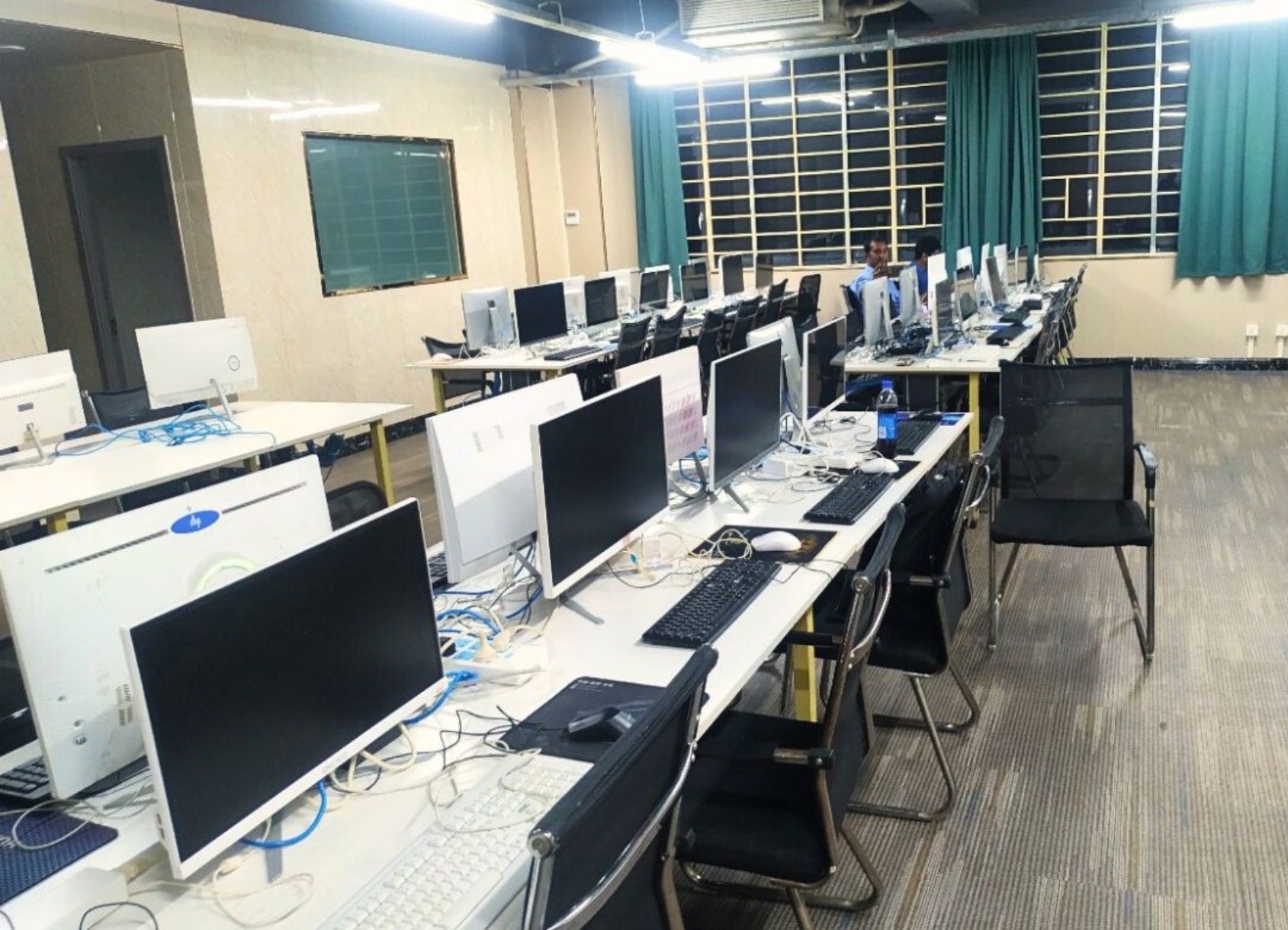
Inside the workstation at a scam compound in Cambodia where Md Abdus Salam was trafficked and tortured into working for five months. This photo was taken secretly by Salam himself and has been used with permission.
For the next five months, Salam went through what he described to Asian Dispatch as torture – both mental and physical – in the scam center that housed men from across South Asia. His employers, who he later found were Chinese, beat him with baseball bats and gave him electric shocks if he failed or refused to work. Outside, the compound was surrounded by gun-toting security guards.
“Unless you’ve seen [the crime] for yourself, you’ll never know how horrible it is,” said Salam. “I was forced to work as [the scam centre’s] slave and at one point, I didn’t care about the people getting scammed because of the torture I faced. I didn’t want to end up dead.”
Salam was rescued by an anti-trafficking non-governmental organisation in September 2022. His story is among hundreds of thousands, according to a United Nations estimate, who have been similarly trafficked by criminal gangs and tortured into running illegal crypto scams in Asia. Pig-butchering scams, as the crime is now widely called, derives its name from the farm practice of fattening pigs before slaughter. The crime involves scamming people after building online relationships with the end goal of exacting money.
Asian Dispatch wove in four stories of those affected by pig-butchering scams in the form of a visual novel– embedded at the beginning of this article – to put the readers in the shoes of those forced to be at its epicenter. As of February 2024, as much as $75 billion is estimated to have been moved to crypto exchanges through scam compounds in Cambodia, Thailand, Myanmar and China. But what is of particular note is the trafficking of South Asians for the purpose of operating these scams. Once among global leaders in IT skills and services, South Asian techies are increasingly being lured into pig-butchering crime hubs as they struggle with post-pandemic economic slowdown and global tech layoffs.
I was forced to work as [the scam centre’s] slave and at one point, I didn’t care about the people getting scammed because of the torture I faced. I didn’t want to end up dead. – Md Abdus Salam, trafficking survivor
Salam says he was sold thrice by compound owners in slave-like conditions. He returned to Dhaka empty-handed while his captors had exchanged tens of thousands of dollars to sell him.
Anti-trafficking organisations have found that scam compounds across Southeast Asia are heavily barricated and deployed with armed men, making it impossible for trafficked victims to escape. Illustration: Sharanya Eshwar
There is no official estimate of the trapped South Asians but in Bangladesh, a 2023 investigation by news outlet The Daily Star estimated thousands trafficked and tortured in these scam centers. In India, officials say they’ve rescued at least 250 citizens this year while news outlet The Indian Express reported the entrapment of around 5,000 Indians. In countries like Nepal, Sri Lanka and Pakistan, the exact number of survivors isn’t known as governments continue to grapple with the crisis.
“We’re in a modern society where we’re traveling all over the world for jobs,” Mechelle Moore, the CEO of an anti-trafficking NGO called Global Alms, told Asian Dispatch. “People aren’t getting jobs in their home countries and [the scam companies] take advantage of that desire to work overseas.”
Moore estimates at least 10,000 trafficking victims stuck in scam compounds that could run up to hundreds if not thousands across Southeast Asia.
“A lot of [these scam] companies lure people who can speak English well, and the jobs advertised for are for logistics, customer service, marketing and so on,” said Moore. “They would specifically target people from South Asian countries that did not have an embassy where they’re operating out of.”
We’re in a modern society where we’re traveling all over the world for jobs. People aren’t getting jobs in their home countries and [the scam companies] take advantage of that desire to work overseas. – Mechelle Moore, CEO, Global Alms
The pandemic provided a big advantage, if not the catalyst, to the criminal network. Civil strife and socio-economic struggles in the host countries add more layers to this complex web of transnational crime.
NGOs like Moore’s have been tracking constructions of new compounds across Asia every year. “They’ve got enough people willing to complete the scams. If the survivors of trafficking don’t want to stay or cause trouble, they’re recycled,” she said. “It’s definitely not dying down.”
Pig butchering scams feed off of job-seekers’ desire and desperation to find a well-paying job, even if it means moving to another country. Illustration: Sharanya Eshwar
Suresh Jayawardena, another pig-butchering trafficking survivor from Sri Lanka, was a “cyber slave” for eight months in Myanmar, where scam compounds have an additional perimeter of armed protection reportedly under the authority of the Myanmar military or its proxies. Jayawardena, who is addressed with a pseudonym, requested anonymity to be quoted in the story due to social stigma associated with the crime in his country. Asian Dispatch spoke to him weeks after he was rescued among dozens of others in April after an intervention and a rescue mission was carried out by the Sri Lankan government.
Like Salam, Jayawardena, too, faced torture when he resisted participating in the crime, which included being stripped, blindfolded and electrocuted. But what’s of note to many anti-trafficking experts is the platform the trafficking victims are given to defraud people. In Jayawardena’s case, it was Telegram, where he offered fake investment opportunities to people desperate for healthy returns.
A recreation of Suresh Jayawardena’s experience of being tricked into believeing he was joining a high-paying job in Myanmar, but ending up being forced to scam victims with fraudulent investment offers. Jayawardena spoke to Asian Dispatch on condition of anonymity. Illustration: Sharanya Eshwar
“It’s clear to me that at various stages of the pig-butchering scam, the onboarding of victims of scams happens on [social media] platforms. This is an obvious win [for the scammers],” Erin West, a prosecutor from Santa Clara County in California, US, told Asian Dispatch. West investigates crypto crimes with primarily American victims, and trains law-enforcement agencies across the US to trace cryptocurrency transitions.
A few months ago, she started ‘Operation Shamrock’, which brings together private and public stakeholders across the world, including big tech companies, to lead a concerted fight against pig-butchering scams. During one of the meetings she held with big tech platforms, she told the representatives that their platforms were enabling the crime. “They didn’t appreciate the language and didn’t want to cooperate,” she said.
“There’s a pressing need for global communities to be involved,” West adds. “I don’t believe these people, the scammers, are untouchables.”
Troy Gochenour, who works at the Global Anti-Scam Organization (GASO), says pig-butchering crimes are of “pandemic proportions.” “We’re living in the age of scam-demic,” he told Asian Dispatch. GASO was set up in 2021 by victims of pig-butchering scams, which includes Gochenour himself. By 2022, the organisation had connected with 1,483 victims worldwide who had suffered losses to the tune of $256 million. This means that every victim lost at least $173,000.
This is why this crime is so insidious because at the other end of the phone is someone who is trained to do this. The so-called relationship is a planned operation.— Troy Gochenour, Global Anti-Scam Organization
Gochenour, an American citizen, lost $28,500 in a liquidity mining scam after developing an online relationship with an online profile of who he thought was an Asian woman called Kris Gia. “The allure [of Kris] was her offer to provide me companionship. We would talk like we’re boyfriend-girlfriend or husband-wife,” said Gochenour. “This is why this crime is so insidious because at the other end of the phone is someone who is trained to do this. The so-called relationship is a planned operation.”
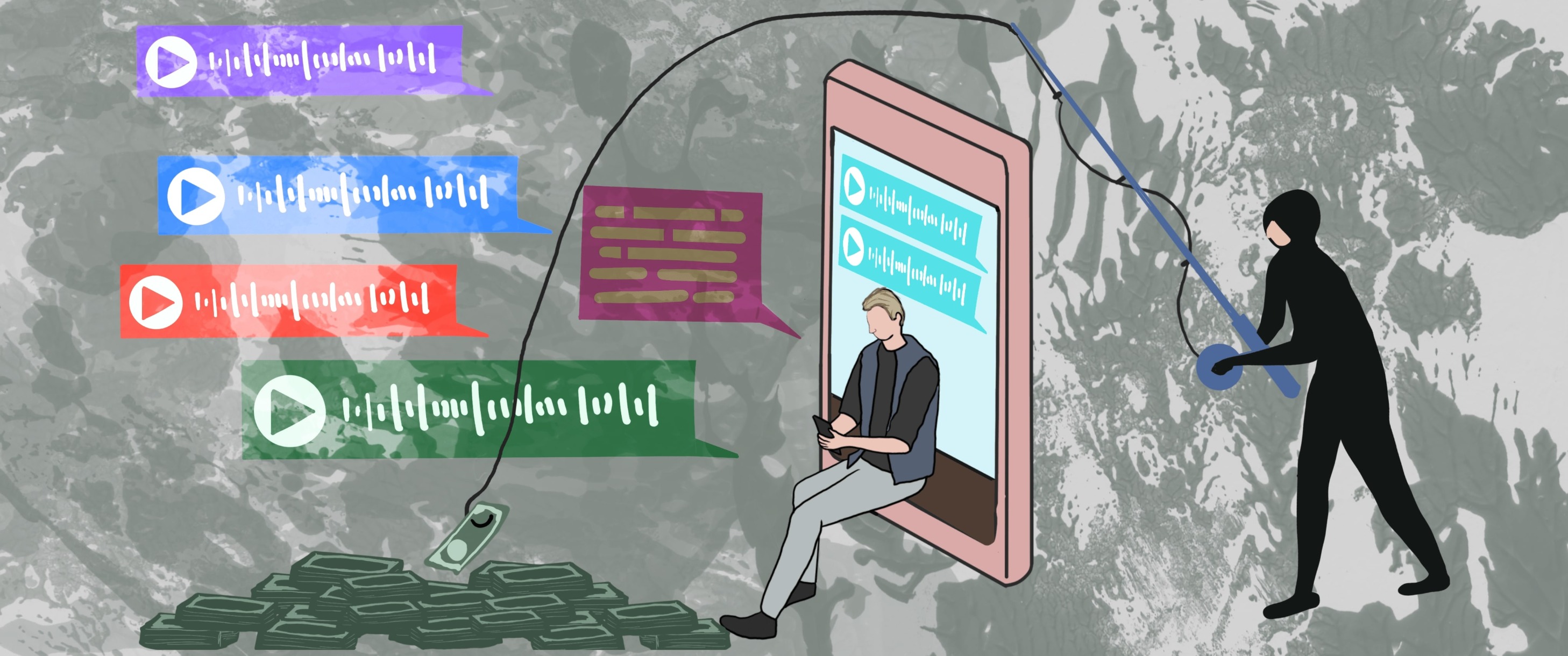
A recreation of the story shared by Troy Gochenour, who found himself on the other end of the pig-butchering scam. He lost $28,500 through a fake profile that he believed was real and was in relationship with. He’s among thousands of victims of these scams. Illustration: Sharanya Eshwar
The victims of the pig-butchering scams aren’t always those in the West. Moore confirms that the scam companies target those in Asian countries too, and hire people from that region to scam them. “We’ve had Vietnamese trafficking victims who were trafficked specifically to scam people in Vietnam. Same with Indonesia, Malaysia, and Chinese,” she said. “It’s a global effort.”
The story of Sandun Silva from Sri Lanka illustrates this. The 34-year-old journalist, who also spoke to Asian Dispatch on condition of anonymity, was introduced to a Telegram group last year after he accepted an online content writing “job” that was attached with a fraudulent investment opportunity. All the admins in the group texted in and spoke Sinhalese. De Silva lost his family savings amounting to $4,000. Even now, the father of two hasn’t told his family about it.
Gochenour says that the first thing tech platforms should do is take down fake profiles when they’re reported. This feature, especially on Meta, is often automated, which Gochenour says doesn’t always resolve the problem. In India, Meta, in its April report, documented receiving over 27,000 reports of fake profiles on Facebook and Instagram but admitted a significant chunk of them were not actioned.
“Unfortunately, there’s not a lot that has been done by these platforms themselves,” Gochenour adds. “Law enforcement has, at times, shut down platforms, but that is only if they’re connected to a particular case they’re working on.”
In May this year, leading tech firms, Match Group, Coinbase, Meta, and Ripple formed a coalition called Tech Against Scam to respond to and prevent online fraud and financial schemes that target consumers through their platforms. Asian Dispatch reached out to Telegram and Meta to understand how they’re tackling these crimes but didn’t get any responses. This story will be updated when it comes.
Early this year, when Asian Dispatch reached out to Salam in Dhaka, he had been back home for a few months. Unlike all survivors quoted in this story, he chose not to be anonymous. He was rescued in 2022 by GASO, which he had covertly reached out to while living at the scam compound. GASO had pressured his “bosses” to release him along with a few others.
Abdus Salam is determined to raise awareness about how the struggles of trafficking survivors don’t end with getting out of the scam compounds. It continues for years. Illustration: Sharanya Eshwar
However, Salam’s struggles didn’t end there. During the course of his captivity, he had exceeded his visa duration by over 100 days. Since he didn’t get paid by his compound employers, he didn’t have money to pay the visa fine and buy a flight ticket. He finally was sponsored by a friend. Today, he works for a non-profit called Humanity Research Consultancy (HRC), which facilitates survivors’ repatriation after they’re rescued from scam centres.
Once home, a battered Salam underwent spinal surgery for injuries inflicted by the torture. He also struggled psychologically to come to terms with the time and money he lost in that period. But his family’s support helped him take his next steps.
“They told me, ‘It’s fine you lost your money. At least you are still alive.’”
Now, Salam helps other survivors of trafficking even after they’re rescued from the compounds.
“This is the right time for me to commit myself to this mission,” he said. “To the mission of survivors’ rights.”